You internet speed is slow. Switch to text view mode

Switch
epaper logo
ST

Last Login:
Logout
+
Page 1
HOME PAGE

We have too many pines and it’s not a good thing
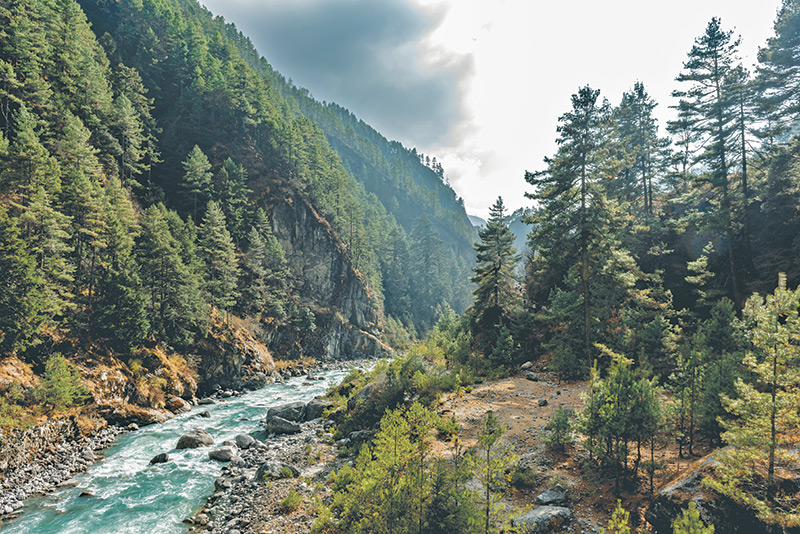
Pine trees might have helped repopulate the country’s barren mid-hills but they could also have led to springs drying up and reduced vegetational diversity.
- TSERING NGODUP LAMA
When the government started its nation-wide afforestation drive in the 80s, pine was the most common species it planted across the country’s mid-hills. shutterstock

Three decades ago, the hills behind Nurpu Sherpa’s house were barren and ugly. Today, they are lush green with pine trees—a result of a massive tree plantation drive in 1991 that began on the hills of Anthali Village, as well as the barren mountainside around the nearby villages.
“My grandfather and father were among the many locals from the villages who planted the pine trees,” said Sherpa. “The hills look much more beautiful today than they did when they were barren.”
But as the pine trees started to grow taller, the villagers began to notice something unexpected.
“Plants like chutra, banmara and titepati, which grew in abundance in the hills, started dying and disappearing from the forests. Even grass on the forest floor started dying,” said Sherpa. For villagers, this was a big problem, as the plants and grass provided fodder for the livestock that many in the villages reared.
The changes weren’t just limited to inside the forests. For decades, a network of 10 springs located in the villages had ensured that villagers had plenty of water to drink, bathe, and feed their livestock. The springs were also an important source of water for birds and wild animals.
“A few years into the pine plantation, we started noticing a depletion in water flow in all 10 springs. By 2010, eight of the springs had completely dried up; the remaining two disappeared after the 2015 earthquakes,” said Sherpa. “Now the water is not even enough for human use, let alone for livestock and wild animals. We have never had to face such levels of water scarcity.”
For many years, the locals remained unaware of what was behind the changes in the village’s natural ecosystem.
“Then we learned from government forest officials that pine trees deplete groundwater levels and inhibit the growth of other vegetation. Everything that was happening in our villages started to make sense,” said Sherpa. “It is these trees that are making our lives so difficult.”
The government didn’t just plant pine trees around the barren hills of Anthali, Baldung, and Dhanpal, in Sindhupalchok District; it did the same across the country. In fact, pine was the most abundant species the government planted in the mid-hills when it started its nation-wide afforestation drive in the 80s. But as these pine trees began to mature, their environmental impacts began to unravel.
Multiple reports from across the world have documented the manifold impacts of pine trees, including reduced vegetational diversity in forests and the drying up of water sources. But despite the fact that pine has become the predominant species in the mid-hills after the government’s afforestation drive, there have been few national studies regarding the consequences of these trees on the environment and on human settlements.

Dibya Mani Adhikari, headmaster of Naimisharanya Sanskrit Gurukul, has to buy almost 2,000 litres of water every other day during spring to run the school. Post Photos: anish regmi


Why pine?
The government’s drive to plant trees in the mid-hills began in the 80s and continued well into the mid-2000s. But its roots date back to 1957, when the Private Forests Nationalisation Act was introduced. Before the Act came into effect, forested lands in the country were under individual and communal ownership, but the new law turned all forested lands in the country into public property.
“Rampant deforestation began when people learned that the government was planning to introduce the Private Forests Nationalisation Act. Many private owners, worried that they might have to hand over their land, started clearing forests,” said Ananta Bhattarai, forest lead at WWF Nepal. The Act also restricted people’s access to forest resources, which many depended upon for firewood, fodder for livestock and building materials.
“It was in the interests of the people to protect forests and ensure that the forests’ resources were used sustainably, but when the Act restricted access to the forests, people no longer felt the need to protect them. Illegal deforestation became rampant,” he said.
Even though the Act was introduced to prevent deforestation, it ended up facilitating the cutting down of trees, leading to unintended consequences, say both locals and experts.
Deforestation in the country became so rampant that by the 70s, Nepal’s forest coverage was decreasing by at least 1.7 percent annually, say experts. To address this, the government, in 1976, formulated the National Forestry Plan.
“The new policy made it the responsibility of the local panchayats to look after forests, laying the foundation for today’s community forests,” said Bhattarai. “And in the 80s, in an effort to undo the decades of deforestation that had left vast tracts of forest lands barren, the government started a country-wide afforestation drive, and pine was chosen as the species to plant in the mid-hills.”
The choice of pine stems from many years of joint collaboration between the governments of Nepal and Australia, named The Nepal-Australia Forestry Project.
More than a decade before the afforestation drive began, the governments of Nepal and Australia had already started collaborating to identify which species of trees would be ideal to grow in the country’s mid-hills.
“The project, which started in the mid-60s, planted different species of broadleaf trees, fodder trees, pine trees, and eucalyptus trees to identify the best species to grow in the country’s mid-hills,” said Shambhu Prasad Dangal, country representative for RECOFTC (The Center for People and Forests) Nepal. “The study found that the ideal tree species was pine, as there were already native pine species in the mid-hills.”
Three of the most common pines that were used for plantation were Pinus roxburghii (khote salla), Pinus wallichiana (gobre salla), and Pinus patula (patle/patula salla).
“The country’s objective was reforestation and to increase the forest coverage as quickly as possible. Pine made sense because it is a fast-growing species,” said Anustha Shrestha, researcher at the Institute for Social and Environmental Transition-Nepal. “Also, the soil quality of the barren mid-hills was poor, and pine doesn’t require fertile soil to grow. Once planted, pine doesn’t need much tending either.
All these inherent characteristics made them the right trees to fulfill the country’s forest objective.”
In 1999, the country’s forest cover stood at 39.6 percent and by 2016, it had increased to 44.7 percent.
The mid-hills, where pine is one of the most common species, is the greenest region in the country, with 37.8 percent of its land covered in forest.
But a few years into plantation, their negative impacts began to emerge.


The consequences of planting pines
In 2010, when Shrestha travelled to Gosainkunda Community Forest, a pine forest in Dhulikhel, to conduct a soil test, the villagers told her that the water level in the springs had started decreasing after the pine trees were planted. In a piece Shrestha wrote for the Post in 2016, she mentions that a study conducted in the Gosainkunda forest to measure water usage revealed that an average pine tree consumes an average of 13.5 litres of water daily. Bigger pines drain up to 80 litres per day.
“Some fifty years ago, Gosainkunda community forest had just shrubs and grass,” said 81-year-old Hari Bahadur Bhujel, a resident of Budol Village, which lies in the foothills of the forest. “Residents of nearby villages brought their livestock to graze in these hills. These hills also had around four natural springs, where our livestock used to drink and bathe. But once pine trees were planted here some 30 years ago, water sources started drying up. Now there’s not even a single source remaining.”

Pine needles carpet forest floor and restrict rainwater from percolating into the ground and reaching the aquifers.


Located inside the Gosainkunda Forest in Dhulikhel is Gosainkunda temple, which once housed two ponds where pilgrims would take baths.
“But the ponds are now empty. Elders from the nearby Karki Gaun tell me that there used to be around a dozen seasonal springs and a few perennial springs in these hills. But all of them have dried now,” said Dibya Mani Adhikari, headmaster of the Naimisharanya Sanskrit Gurukul, which is located near the temple. “The whole village is reeling under a water shortage.”
Dangal from RECOFTC echoes Adhikari, reporting numerous similar experiences from across the mid-hills.
“There have been multiple incidents where people told me how water sources started drying once pine trees were planted. But the truth is, we don’t have scientific evidence to back those claims,” he said.
Although a correlation can be established between the amount of water pine trees require and the drying up of springs, there is no large-scale study that irrefutably shows that pine is behind the reduction in water levels.
“There are some places in the mid-hills where there are thick pine forests but the villagers haven’t seen any reduction in water flow. If pine trees are the sole reason behind water depletion, these places should also see a drop in water levels,” said Rajendra KC, joint secretary at the Ministry of Forests and Environment’s Forest and Watershed Division.
According to KC, there are many other factors that are contributing to the depletion in water levels, with rampant road building across the hills being a prime reason.
“When you carve hills to build roads and other building activities, there are high chances of disrupting the natural flow of underground water channels,” he said. “It’s important for people to understand that before putting all the blame on pine trees for water scarcity.”
But reports of pine trees causing water level to drop are not limited in Nepal. Similar reports continue to be reported from countries across the world. According to an article published by Edith Cowan University in Perth, Australia, swathes of the Perth Banksia Woodlands were cleared and planted with pine trees to cater to the growing demand for timber. As the trees were cleared, the water level in the nearby Gnangara groundwater system rose. But as the pine trees grew, the water level started depleting. The university found that the pine trees were consuming more water than the trees
they replaced. Fearing Perth would run out of water, the state government started clearing the pine plantation.
“Apart from being very water thirsty, pine trees also have very fibrous roots. This helps pine extract water collected deep within the soil, water that would have otherwise collected in aquifers,” said Dangal.
The fact that pine trees are coniferous evergreens, many experts say, could also contribute to the stress on aquifers, as the trees require water throughout the year. That is not the case with many broadleaf deciduous trees, which shed their leaves during the winter season, lessening the trees’ water intake.
The suspected impacts of pine trees are not just limited to water intake. According to WWF’s Bhattarai, the trees shed pine needles, which take longer to decompose than leaves from broadleaf trees. The needles end up carpeting the forest floor, and when it rains, the needles create a barrier that stops rainwater from percolating into the ground and reaching the aquifers.   
The needles not only restrict water movement, but also impede grass from growing.
“This is the reason why we don’t often see much grass growing in pine forests,” said Shrestha. “The needles are acidic and change the pH content of the soil, hindering the growth of other trees and plants. What this does is create a pine monoculture in the forest, reducing the forests’ biodiversity, which is crucial for any natural forest ecosystem.”
Pine needles are also inedible to both livestock and many wild animals, which is leading to a dual problem. For wild herbivores, pine forests with limited vegetational diversity create food scarcity. This, experts say, could be one of the reasons for wild animals raiding agricultural fields.
“With no grass and plants growing, even our livestock don’t use  pine forests,” said Sherpa, the local from Anthali village in Sindhupalchok. “So except for timber, pine has no use for us farmers.”

Ramita Thapa (left) and Kamala Ghimire, of Ravi Opi village in Kavre, say that the pine trees of the forest behind their village has caused water sources to dry up.


Reducing our pine dependency
“In a country like Nepal where people are still very dependent on forests, it’s very important to first understand what we want from our forests,” said Dangal. “If it’s just greenery and timber, then pine makes sense. But if you depend on forests for fodder and fuel, then we have to diversify forest vegetation so that the needs of the people are met.”
A lot of the negative impacts of pine trees, say experts, could have been avoided or minimised had the country focused on forest management measures alongside aggressive tree plantation.
“While the country did a great job in successfully conducting large-scale pine plantation, we failed to effectively manage our planted forests. Silvicultural techniques like thinning and tending to the pine forests after a certain period of time would have helped a lot,” said Bhattarai.
The problem with pine trees is not something that has gone unnoticed by the government. The Nepal government, in its  Environment Protection Rules 1997, came up with provisions to restrict the environmental impact of forest monoculture. The Act states that plantation of indigenous species of plants in a single block of 50 to 100 hectares of land in the Tarai and 25 to 50 hectares in the hills, and imported species on a single block of 10 to 50 hectares in the Tarai and 5 to 25 hectares in the hills, will only be allowed after conducting initial environmental examination.
The forest department, according to Joint Secretary of Forest and Watershed Rajendra KC, is also conducting a trial in a pine forest in Kavre by planting Schima wallichii (chilaune) and chestnut (katus) trees to see what kinds of species can best survive in pine forests.
But in the forests behind Nurpu Sherpa’s house, there is still nothing apart from pine trees.
“People from my village only had to walk five minutes to get grass and fodder for livestock. Now, they have to walk at least half an hour,” he said. “The water shortage has made things so challenging that many families have stopped rearing livestock or have reduced the number of animals. Had we known then what planting pine trees would lead to, the village elders would never have done it.”
HOME PAGE

Co-chairs’ introspective document fails to allay leaders’ concerns

Decision to enter into an electoral alliance with Rastriya Janata Party without informing the party has been widely criticised in the Nepal Communist Party Standing Committee.
- TIKA R PRADHAN
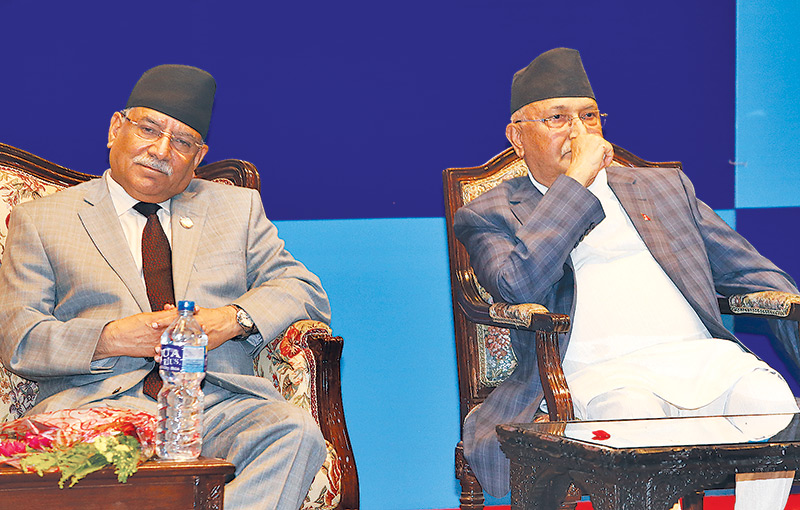
Post File Photo

KATHMANDU,
Prime Minister KP Sharma Oli’s old habits refuse to die, despite the submission of an apology-filled 11-page political document to the Nepal Communist Party. Even as the Standing Committee was discussing the document, Oli, who co-chairs the ruling party, went on to sign a two-point deal with the Rastriya Janata Party Nepal for an electoral alliance all on his own.
Party leaders say that an agreement with any other party should have been made with the knowledge of Co-chair Pushpa Kamal Dahal and General Secretary Bishnu Poudel. But Oli has long had a penchant for working unilaterally, instead of following the procedure and taking decisions through party meetings.
At Thursday’s standing committee meeting, leaders took exception to the deal, on the grounds that it had not been discussed with the party and that it only proved the party’s criticism of its leadership.
“Leaders have criticised themselves for not following the party procedure, but the two leaders struck the deal with the Janata Party while a crucial meeting was ongoing,” Bhim Rawal, a standing committee member, told the Post. “It’s our system that when crucial meetings are underway, any party decisions should either be discussed in the meeting or the meeting must be informed about it.”
Leaders including Rawal, Madhav Nepal, Bamdev Gautam, Yubaraj Gyawali, Asta Laxmi Shakya, Mukunda Neupane and Raghuji Panta have demanded answers.
Even party Spokesperson Narayan Kaji Shrestha was against the leadership’s decision, said party insiders.
“How can we trust the co-chairs whose written self-criticism did not even hold up till the end of the Standing Committee meeting?” one party leader quoted Rawal as saying at the meeting. “This incident has made us suspicious over the implementation of the political document. We need to discuss this right away or else the meeting cannot go ahead.”
After vehement criticism from leaders, primarily from the Madhav Nepal faction, Dahal was forced to admit that Oli had kept him in the dark too.
“I only came to know about the deal when Oli called me to Baluwatar,” Dahal was quoted as saying in Thursday’s meeting. “Since I felt it was a good deal, I agreed to it.”
But Dahal admitting his ignorance of the deal is a blow to his executive role in the party. Despite making Dahal executive chair of the party, it is now clear that Oli still holds the party’s decision-making power, say leaders.
“Oli will not transfer his authority to Dahal. Wednesday’s incident was the proof,” said Mani Thapa, a standing committee member.
According to Thapa, it was always clear that Dahal’s executive role was more symbolic than substantive.
A Standing Committee member who has close relations with Dahal said that Oli had not only managed to show that he was the sole authority of the party but had also included Dahal in his plot.
“Oli has been testing Dahal,” said the Standing Committee member. “But it is not only Nepal’s people, but also Oli’s men, including Ishwar Pokhrel, who have been criticising the document.” Pokhrel, the defence minister, is believed to be an Oli loyalist.

Since party leaders are not going to let the issue go without discussing it thoroughly, the Standing Committee meeting, which was supposed to conclude in two days, is expected to continue for two more days. Dahal is scheduled to present a revised joint political document by incorporating suggestions from leaders at Saturday’s meeting. The standing committee meeting, the first in one year, began on Sunday after Dahal was given chairmanship last month.

HOME PAGE

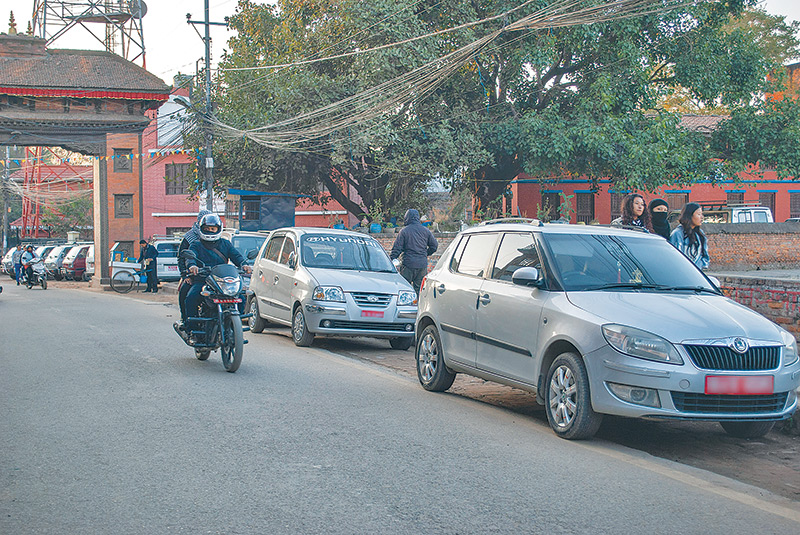
Private cars drive taxis away from Bhaktapur

An estimated 400 private second-hand cars and vans are available for rent in Dudhpati, Bhaktapur Durbar Square, Kamalbinayak, Thimi and Sallaghari.
- ANUP OJHA
Private cars and vans used to ferry passengers are parked in Dudhpati, Bhaktapur. Post Photo: Anup Ojha  

BHAKTAPUR,
Taxi drivers in Bhaktapur have repeatedly complained of the private car owners’ syndicate in transporting passengers, which have curtailed their daily earnings. Despite the complaints, the government has turned a blind eye to the drivers’ concerns.
Every day the entry gate of Bhaktapur Durbar Square in Dudhpati sees a line of more than three dozen private cars waiting for passengers. Similar is the scene at Bhaktapur Durbar Square, Kamalbinayak, Thimi, Sallaghari, Suryabinayak and Gatthaghar. It is estimated that more than 400 such cars and vans are illegally operating in these areas.
If one has to go to Nagarkot or Dhulikhel, they cannot get a taxi while private Suzuki cars are easily available to rent, Bhaktapur residents say.
“This is a syndicate of locals. They are operating their private cars as taxis. They do not let us park in those areas. Still, the local authority has not shown any concern over our repeated complaints. The authority has permitted them to run those cars illegally,” said Jeevan Lama, 47, a taxi driver based in Sallaghari.
The Motor Vehicles and Transportation Management Act-1993 does not allow the operation of private vehicles for purposes other than specified. In the third week of November, the government issued a second notice in a bid to stop popular ride-sharing services. But, after widespread criticism, the government backtracked on its decision.
“They buy an old car and operate it as a taxi, and they have been earning good money illegally. There is no one to monitor them,” said Lama, who is the sole breadwinner of a seven-member family.
“If we take passengers to Bhaktapur Durbar Square, we have to return empty, because private car owners won’t let us carry new passengers.”
Taxi drivers complain that they can’t stop for passengers in Dudhpati, Suryabinayak and other areas as the local car owners chase them out.
When the Post approached private car operators to inquire why they were running their cars as taxis, many said tourists are their only source of income. “I bought this car with Rs300,000, taking a loan as I don’t have any land. And this is feeding my family,” said Rajindra Chawala, a residence of Bansa Gopal Chowk, who was parking his car a few meters east of Siddha Pokhari.  
Chawala said he has been into this business for more than a decade. “In my case, I am doing this as I don’t have an alternative, but there are some rich people too, who are using their cars to ferry passengers and are making good money.”
When the Post contacted Inspector Hari Om Khadka, in charge of the Sallaghari Traffic Police Circle, regarding the illegal use of private cars, he said the police have been cracking down on them. “We have nabbed them many times. We slap them with Rs 1,000 fines, but they do it repeatedly. We don’t have enough traffic officials to monitor the area,” said Khadka.  
When the Post contacted Senior Superintendent Bhim Prasad Dhakal, chief of the Metropolitan Traffic Police Division, he said personnel would be deployed immediately to look into the issue of illegal taxi operators.

Page 2
MEDLEY

Horoscope

ARIES (March 21-April 19)
***
Be careful not to react too soon to someone’s urgent cries for help today. Chances are, this is a textbook case of crying wolf—or this person may have a very distorted sense of what ‘urgent’ really means. Either way, he or she wants attention, and you don’t have time to deal with this sort of immaturity right now.


TAURUS (April 20-May 20)
**
An innocent comment that someone makes may irk you—but keep in mind that this person is just trying to help. Of course, this kind of help is the last thing you need! If you aren’t ready to hear other people’s versions of the truth, let them know. Your ego is exceptionally sensitive lately, partially due to a power struggle.


GEMINI (May 21-June 21)
***
Today, try to get involved in a fun debate or at least eavesdrop on a titillating conversation. You should definitely not go around looking for a fight, but it wouldn’t be a bad idea to step out of your comfort zone and experience a little bit of conflict right now. It will strengthen some of your beliefs, and give you some new ideas.


CANCER (June 22-July 22)
*****
You’ll be the recipient of an extravagant gift today. Someone will give you the gift of understanding something new. You’re developing a significant appreciation for the subtle connections people can make—even two strangers can look each other in the eye and suddenly understand each other.


LEO (July 23-August 22)
***
You may have your eyes on the prize—but is this prize the right prize to be focusing on? You will have no trouble achieving what you set out to do right now, so don’t be too conservative in your goals. Aim high and really challenge yourself—give yourself a task that’s way outside your comfort zone. A little bit of fear is a good thing.


VIRGO (August 23-September 22)
**
You have to know when to stand your ground and not give in—not even an inch. Today, speak up if you can’t go along with what everyone else is saying or doing. Sometimes the only way to get people to listen to you is to force them to. A quiet word to the right person will get you all the satisfaction you need.


LIBRA (September 23-October 22)
****
Whenever you’re in doubt about how to act today, just talk! Your way with words will turn the key and unlock many exciting new opportunities. It’s time for you to take a bigger leadership role with your people, and your attitude will be the perfect thing to motivate people who aren’t usually ‘team players’.


SCORPIO (October 23-November 21)
***
Coasting through life can be a lot of fun, but it won’t get you too excited today. What you need right now is a real challenge—something that tests your abilities and enables you to prove to the people around you that you are worthy of high praise. You are learning that when a goal is too easy to attain, it is not very fulfilling.


SAGITTARIUS (November 22-December 21)
***
The bold risk-taker deep inside of you is eager to take this chance you have been given—it’s fully confident that all will go well and that you will succeed. Do not do something just for the sake of doing something. Make sure that it is the right thing to do and that it will take you where you want to go.


CAPRICORN (December 22-January 19)
****
It’s in your best interest to lend a friend a few of your resources. So open up your wallet, hand over your car keys, or give up some of your free time. What, are you worried that you’ll help someone out and get nothing in return? Well, you might not get any money back, but the goodwill you receive will be a lot more valuable!


CAPRICORN (December 22-January 19)
****
It’s in your best interest to lend a friend a few of your resources. So open up your wallet, hand over your car keys, or give up some of your free time. What, are you worried that you’ll help someone out and get nothing in return? Well, you might not get any money back, but the goodwill you receive will be a lot more valuable!


AQUARIUS (January 20-February 18)
***
Be very mindful of taking direction from your whims today—there are going to be a few situations where you should obey them fully, but there will also be a few situations where you need to tell them to shut up! You definitely have the wisdom to recognise each situation as it comes up.


PISCES (February 19-March 20)
***
As conversational topics go, politics and religion can be very tricky—so even if you are among friends, be aware that enemies can be created if the wrong comments are made. So try very hard not to inflict your opinions on others today. Yes, you should say what you feel if you want to, but do not expect everyone else to agree with you.

Page 3
NATIONAL

Amid contradicting stances, deputy Speaker commences House session

Speaker appointment process will begin next week.
- BINOD GHIMIRE
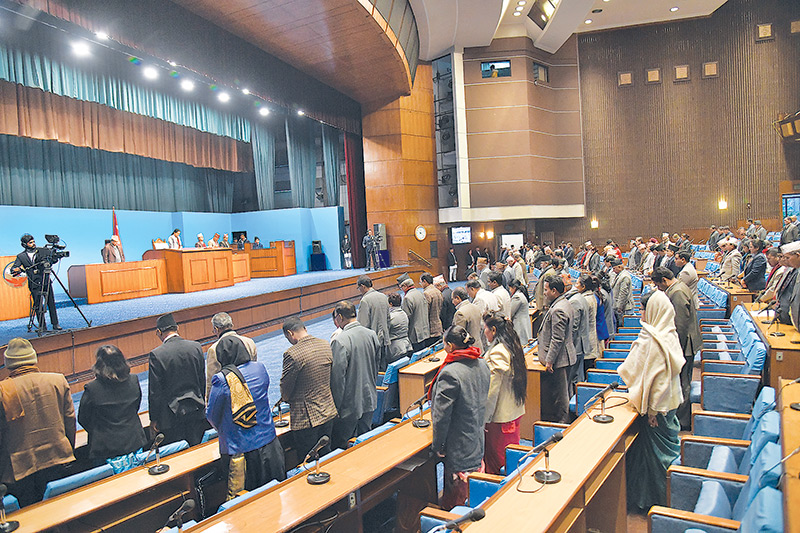
Lawmakers attend the first meeting of the winter session of Parliament on Friday. post Photo: Deepak KC

KATHMANDU,
Despite controversy over whether the deputy Speaker is authorised to hold the inaugural meeting of the House of Representatives, Shiva Maya Tumbahangphe chaired the first meeting of Parliament’s winter session on Friday after an agreement between the ruling and opposition parties.
The House rule makes the Speaker’s presence mandatory to begin and close meetings. The House has been without the Speaker after Krishna Bahadur Mahara resigned on October 1 after being charged with attempted rape. Clause 6 of the Regulations reads, “The Speaker shall announce the beginning and closure of every meeting of the House of Representatives.” However, Article 91 (4) of the Constitution of Nepal authorises the deputy Speaker to chair the House in the Speaker’s absence but doesn’t specify whether s/he can announce the beginning and closure of the session.
Amid the confusion, a Business Advisory Committee meeting, which comprises leaders from the parties that have representation in Parliament, was called prior to the House meeting to clear the way.
“After a long discussion, the committee took a practical step of allowing Tumbahangphe to convene the House session,” Gopal Nath Yogi, secretary of the Lower House, told the Post. This is the first time in Nepal’s history where the deputy Speaker started the House session.
Opposition leaders say they agreed for the deputy Speaker to commence the session because it was necessary to clear the hurdles. “In a parliamentary democracy, technical difficulties can be resolved through political consensus,” Nepali Congress Whip Pushpa Bhusal told the Post. “Though the decision is not at par with the regulations, it doesn’t contradict with the spirit of the constitution.”
Friday’s meeting that lasted a few minutes was limited to the formalities where Tumbahangphe read out the letters from President about the commencement of the new session and reshuffling of the Cabinet. The meeting was adjourned after endorsing a condolence motion on the demise of four former parliamentarians--Hari Prasad Dahal, Kamala Kumari Ghimire, Ram Lakhan Mahato and Rameshwor Dhungel.
The House will meet next on December 27 to begin the process to elect the new Speaker. As the constitution requires the Speaker and the deputy Speaker to be from different parties, leaders of the ruling Nepal Communist Party (NCP) say Tumbahangphe would resign before the process begins to elect the new Speaker.
As the ruling party would want to have its leader as the Speaker, Tumbahangphe has to resign for her party to claim the position. “She will resign as the party has already conveyed a message to her to this effect,” said a central committee leader of the ruling party on the condition of anonymity.
Tumbahangphe has staked her claim to the Speaker post saying that she cannot be punished for the crime Mahara committed. The senior-most lawmaker will chair the Lower House until it gets the Speaker if she resigns before the next meeting.
However, as former Speaker Subas Nembang, who is also the deputy leader of the NCP Parliamentary Party, and Agni Prasad Sapkota, a leader close to NCP Co-chairman Pushpa Kamal Dahal, are in the race, it is unlikely that she would get the position.
The main opposition is demanding the Deputy Speaker’s position that will become vacant after her resignation. “It is natural for us to claim the position,” said Bhusal. “If the ruling party wants the House to move smoothly, it will accept our demand.”

NATIONAL

Malaysia’s minimum wage raise to benefit thousands of Nepalis

The new salary scheme will be enforced in 57 major cities of Malaysia covering the majority of Nepali workers.
- CHANDAN KUMAR MANDAL
The Malaysian government has said that the minimum wage rates will be revised in line with the cost of living effective from January 2020. Post file Photo

KATHMANDU,
The Malaysia government’s decision to raise the minimum monthly wage for workers in the country is likely to benefit tens of thousands of Nepali workers in the South-East Asian nation.
The local government recently decided to increase the minimum monthly wage to Malaysian Ringgit (RM) 1,200 (Rs 32,954) for workers in the country’s cities and urban areas.
The new wage comes into effect in January 2020, providing a hike for workers employed in 57 cities and towns, including the 13 state capitals and three federal territories, local media reported.
Introduction of a new salary range for workers, including foreign labour force, will cover tens of thousands of Nepali workers in the country as well, according to Maheshwor Mani Tripathi, second secretary at the Nepal Embassy in Malaysia.
“The new salary scheme will benefit the majority of Nepali workers as they are employed in those areas. Only a small fraction of Nepali workers will be left out,” Tripathi said citing the Human Resource Ministry.
The new minimum monthly salary will not be applicable for small towns and rural areas where the existing rate of RM1,100 would remain, according to the ministry.
Nepali workers in Malaysia are happy with the proposed salary hike although it is not a huge addition.
Roshan, a Nepali worker in Malaysia, told the Post that he was aware of the new salary rate coming into effect from next month.
“We have been hearing about the proposed minimum wage from the local media. Since then, everyone at my workplace is elated,” Roshan, who wanted to be identified by his first name, told the Post from Malaysia over the phone. “The hike will mean Nepali workers will also get a raise. Nepali workers are happy with an increase in the minimum monthly wage.”
The Malaysian government has also said that the minimum wage rates will be regularly revised to ensure that they are in line with the current cost of living.
The minimum wage is likely to rise more in future also because the current Pakatan Harapan administration had promised during its election campaign to increase the minimum wage to RM1,500 within five years of its rule. The government continues to reaffirm its commitment to raising the minimum wage to RM1,500.
Malaysia currently hosts nearly 400,000 Nepalis. A Nepali worker, on average, earns between RM 1,500 and 1,600 a month, including overtime work pay.
“Salaries and other facilities are better in multinational companies here in Malaysia,” said Tripathi. “A significant chunk of the workers’ salary comes from overtime work which can differ from company to company.”
A Nepali worker is entitled to the minimum wage along with the local workers. As per the labour agreement between Nepal and Malaysia signed in October 2018, the monthly salary of the Nepali workers should be in accordance with the minimum wage policy of the Malaysian government. The local employer cannot discriminate Nepali workers in terms of wages for the same nature of jobs.
The Nepal government has set a minimum salary of RM1,925 for Nepali security guards in Malaysia whereas other workers cannot be paid less than the host country’s standard minimum wage.
“Workers’ salaries depend upon their experience and profile of the companies they work for. After working for some time, many workers are promoted as supervisors and fetch handsome monthly salary,” said Tripathi. The embassy does not approve the demand for Nepali workers with offered salary less than the government’s minimum rate.

NATIONAL

Barun Beverages pays Rs1.6b bail to prevent arrest of its officials over tax fraud case

- PRITHVI MAN SHRESTHA

KATHMANDU,
Barun Beverages, the bottlers for Pepsi in Nepal, has deposited Rs1.6 billion as bail amount to prevent the arrest of its officials charged in a fake value-added tax bill case, according to the Department of Revenue Investigation.
The department had on Tuesday filed a case against seven current and former officials of the company, including Amit Gupta, Rabikanta Jayapuriya, Rohit Kohali, Prabin Kumar Agrawal, Binod Kumar Singh and Ashok Kumar, for evading tax worth Rs649.6 million by producing fake VAT bills.
According to Dirgharaj Prasain, director general at the department, they sought Rs1.6 billion bail for seven incumbent and former officials of Barun Beverages. “A consortium of banks led by Standard Chartered Bank has provided the bank guarantee on behalf of the company,” he said.
The department had interrogated four officials, including Binod Kumar Singh and Ashok Kumar Singh, before filing the case.
“Our investigation revealed that the company used to issue cheques in line with the fake VAT bills, only for the
other parties to return the amount after charging eight percent commission on the value of fake VAT bills.”
The department began investigating into fake VAT bill cases from early this year.
In this period, it built tax evasion cases worth Rs 12 billion against 130 of the 981 companies under investigation.  
More and more big companies are being investigated for tax-related issues in the recent years, including capital gain tax to be paid by the Ncell and decision of Tax Settlement Commission to waive tax for a large number of big companies.
Although Ncell was supposed to pay Rs21.1 billion as per the Supreme Court verdict last month, there is uncertainty over whether the company would pay the amount after International Centre for Settlement of Investment Disputes, a body under the World Bank, on December 18 gave provisional order not to enforce the government’s decision in line with the Supreme Court order.
Earlier in July 2017, the Commission for the Investigation of Abuse of Authority, in one of the largest ever corruption cases, had charged Chudamani Sharma and other two members of the Tax Settlement Commission—Lumba Dhwoj Mahat and Umesh Dhakal—with embezzling revenues worth Rs10.02 billion each while exempting enterprises of taxes in dubious ways.

Page 4
NATIONAL

Kathmandu police bust a gang involved in motorcycle theft

Auto theft incidents are on the rise, but vehicle recovery and arrest rates are dismal, data show.
- SHUVAM DHUNGANA
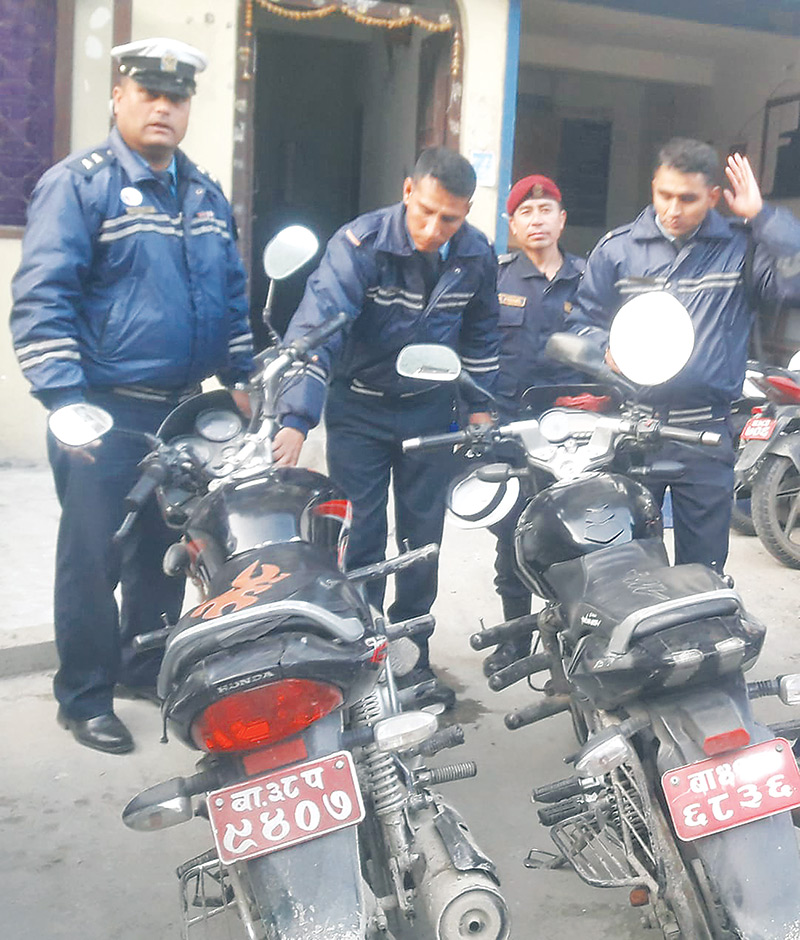
Out of 34 stolen motorcycles, police recovered 11. Post Photo: anish tiwari

KATHMANDU,
Police have arrested twelve people involved in motorcycle theft in Kathmandu Valley. The arrests were made over the period of the last three weeks.
The suspects had lifted at least thirty-four motorcycles in the past five months. Police said eleven of the stolen motorcycles were recovered.
The Metropolitan Police Circle, Kirtipur, had mobilised a team to bust the ring that had long been involved in motorcycle theft, DSP Chhedulal Kamati, chief of the police circle, said.
He identified the suspects as Ranjeet Chettri of Hetauda, Rinjen Moktan of Chandragiri, Madan Tamang of Kirtipur, Bharat Thapa of Nawalparasi,  Santosh Gole of Makwanpur, Bikram Bhujel of Sindhuli, Raju Poudel of Bardiya,  Som Sunar and Sandeep Gurung of Chitwan, Indra Bahadur Tamang and Ganesh Lama of Kavre.
“They used to steal two-wheelers from Balaju, Swayambhu, Kirtipur and other busy parts of the Valley and sell them in Chitwan and Hetauda,” said Kamati. “They had even used forged documents to sell some of the stolen motorcycles.”
According to the data of the Metropolitan Traffic Police Division, the number of vehicle thefts is rising every year. The data also show that the recovery rate of stolen vehicles and the arrest rate are very low.
In the fiscal year 2016-17, the division recorded 1,030 cases of vehicle theft. Police recovered only 168 of those stolen vehicles and arrested only 15 people.
In the following fiscal year 2017-18, the number of vehicle theft cases stood at 1,385. Police recovered only 251 of those vehicles and managed to arrest only seventeen people.
Similarly, in the fiscal year 2018-19, there were 1,611 incidents of vehicle theft; 189 vehicles were recovered and 81 people were arrested.
“Most of the people who are involved in vehicle theft are longtimers. Once they are out of jail, there is a high chance of them going back to their old ways,” said Sub-Inspector, Ramesh Bajgain, chief of the Victim Support Unit of the Metropolitan Traffic Police Division.
The unit specialises in the investigation of vehicle theft.

NATIONAL

A school that gives goat to top scorers

- HARI GAUTAM
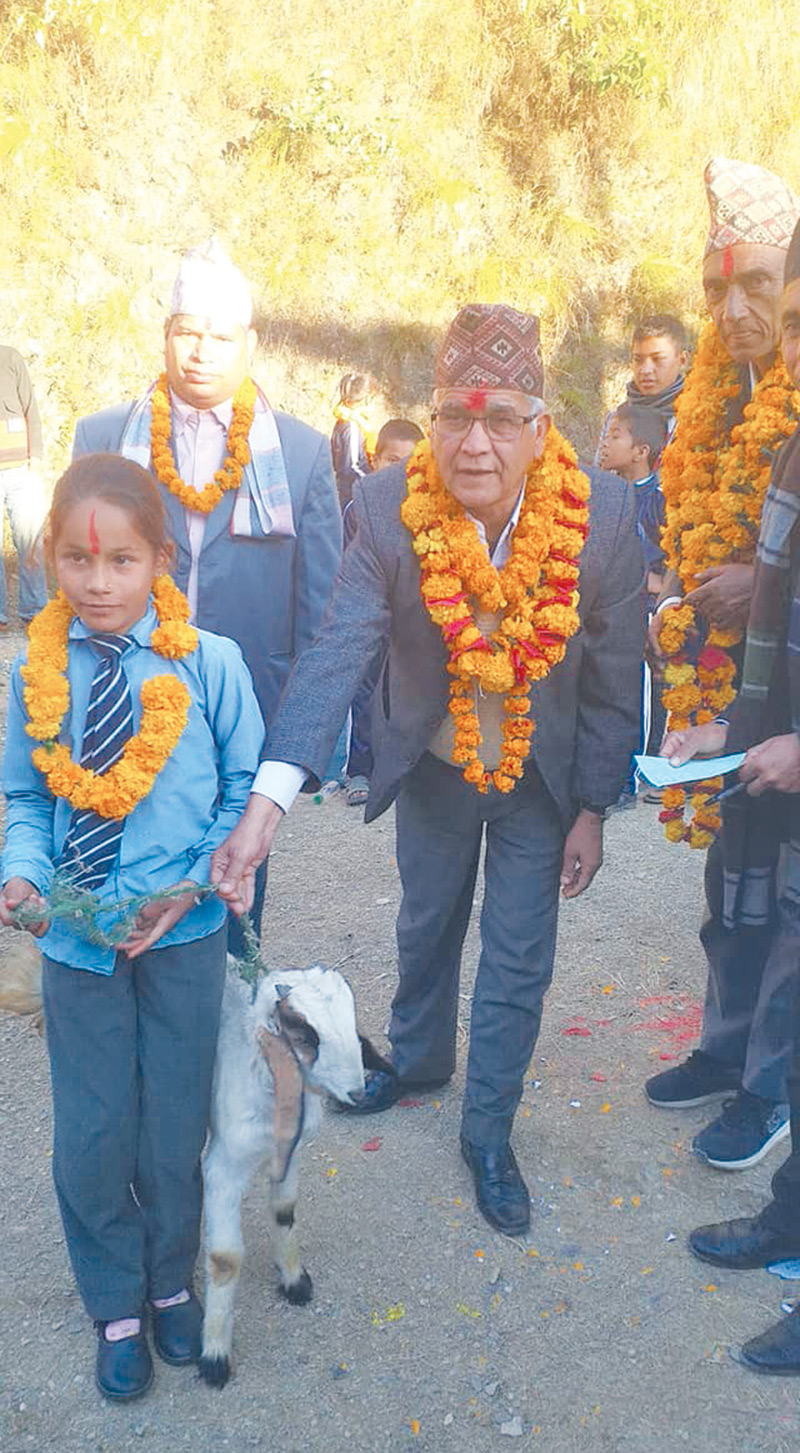
A student of Rajapani Basic School in Rukum (West) gets a goat on Wednesday. Post Photo: HARI GAUTAM

RUKUM (WEST),
Four students from Rajapani Basic School in Musikot Municipality Ward No. 1 received a goat each on Wednesday.
Amid the school assembly, Sandeep Roka of grade two; Purushottam Devkota of grade three; Bhawanai Badi of grade four; and Bimala Khatri of grade five were each given a goat. The goats were not provided as a grant but were actually lent by four other students from the same school.
The school coordinated the give-and-take, handed over by
Musikot Municipality Mayor Devilal Gautam. The four students were
provided with the goats for ‘maintaining academic excellence’, as they had scored the best in their respective grades.
But this is not the first instance where students with good academic performance were provided with goats as a reward. The strange tradition has been in place for eight years. The students tend the goat for a year, and once it breeds, the first offspring should be provided to another top-scoring junior.
The four students who received goats this year will hand over their goats’ offsprings to four other students. They use the revenue generated from the goats to buy stationery, the students say. In the span of eight years, 17 students have received goats.
The tradition was started to get the school out of a financial quagmire, according to school Principal Danda Bahadur Khadka.
“The goats would lift the school’s financial status while also providing the deserving students with some subsidy,” Khadka said. Students from two local units, Musikot Municipality and Banfifot Rural Municipality, study in the school. Khadka added that the tradition has been instrumental in attracting new students.
The basic school has 68 students and four teachers. The school bought its first goat in 2011 at Rs5000 with the money saved from one of the budgets received for a school project, Khadka said. Even today, the school lacks manpower and other essentials, but the tradition to hand over goats is ongoing, said Mane Sarki, chief of the School Management Committee.
Gautam termed the school’s goat programme a ‘creative’ endeavour.
“This is a creative effort beneficial to both the students and the school,” he said. “If the school wants to add some goats to the programme, the municipality will come to help.”

Page 5
NATIONAL

Province 5 government fails to conserve Buddha-era lake

Human activities—particularly fishing—have defiled the sacred lake, say locals.
- MANOJ PAUDEL
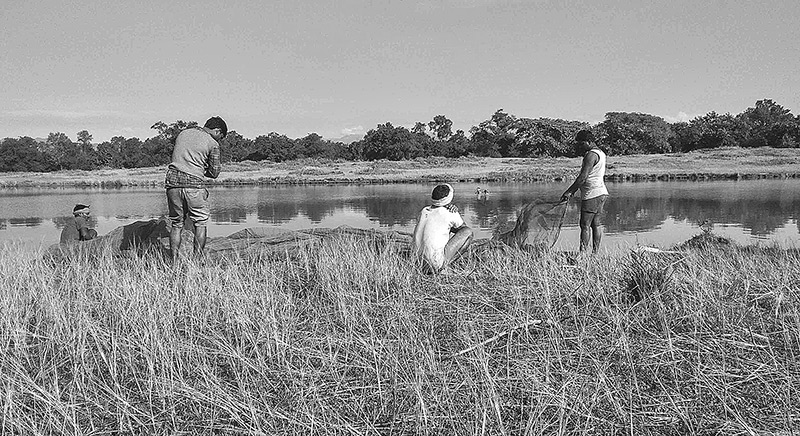
Fishermen get ready to cast their net at the Sagarhawa lake, in Jagdishpur of Kapilvastu district. Despite the lake’s historical importance, locals have set up fishing traps all over it, violating its beauty and sanctity.  Post Photo: manoj paudel

KAPILVASTU,
A week ago, Priyanka Kurnagal of Sri Lanka visited Sagarhawa Lake, a historic site in Jagadishpur of Kapilvastu district. Kurnagal was excited to visit the place, which is a major attraction for Buddhists from around the world. However, upon arrival, she was taken by surprise to see that the sacred site turned into a fishery, with locals setting fishing traps all over the lake.
Another visitor from Cambodia, Lensen Howe, was also disheartened by the scenes he encountered at the lake, where people were netting and killing fishes. Many Buddhist worshippers have expressed similar sentiments after visiting the Buddha-era lake that is spread over an area of about 100 bighas. The then Niglihawa VDC had leased the lake to Bijay Khanal, a local, on a contract basis for five years to operate a fishery.
Despite repeated complaints from locals demanding an end to fishing in the lake, the concerned authorities tasked with the preservation of the lake have turned a blind eye to the water body’s degradation. However, with the provincial government directing the Lumbini Development Trust with the task of conserving and promoting the lake area, the 2,600-year-old lake that holds historical and archaeological importance is heading to become a no-fishing area.
The Sagarhawa Lake area has been one of the pilgrimage sites for Buddhist devotees for a long time. According to archaeologist Basant Bidari, the lake has been mentioned in Chinese and Buddhist scriptures where they talk of the slaughter of 9,999 Shakyas. It is believed that the slaughter site is the present Sagarhawa, and because of the unpleasant incident that occurred in the past, Buddhist pilgrims visit the lake to pray for the loved ones whom they lost untimely.
Himal Upreti, an archaeological officer at the Trust, said that fishing activities at the holy site have defiled the historic lake.
“These sort of activities affect the archaeological aspect of the site,” said Upreti. “Items of historical significance can sustain damage and also be lost in the water because of unnecessary human activities.”
Earlier in 2015/16, locals had filed a complaint at the District Administration Office against the handing over of the contract to Khanal. However, the authorities failed to take any action. The Lumbini Development Trust, which was tasked with the conservation of the Sagarhawa Lake, also failed to deploy officials to curb the illegal activities, stating that the Trust was not given the jurisdiction to carry out conservation works at the lake area.
The Trust was formed in 1985
as provisioned by the Lumbini Development Trust Act 1985 to implement Lumbini Master Plan and explore, excavate and conserve archaeological sites scattered in Kapilavastu, Rupandehi and Nawalparasi districts.
Last week, on December 15, a decision by the Province 5 Ministry of Industry, Tourism, Forest and Environment entrusted the Trust with the conservation and promotion of the lake.
“Earlier, the lake area was not under our jurisdiction,” said Saroj Bhattarai, acting member secretary of the Trust. “We had stopped fishing activities in the lake last year, but we failed to follow up on the matter after that. Now, we have the authority to permanently put a stop to all fishing activities at the lake.”
Bhattarai said the Trust is currently preparing a plan to preserve the lake site.
“We will fix the signboards and boundary wires, and initiate a drive to clean and clear the shrub-covered areas,” he said.

NATIONAL

Free health check-up drive in Province 3 on hold due to lack of skilled human resources

The programme aims to help the poor, marginalised families, conflict victims and family members of martyrs.
- SUBASH BIDARI

MAKWANPUR,
The Chief Minister People Health Check-up Programme, a dream project of the Province-3 government, was launched in the last fiscal year with an aim to provide free health examination facilities to impoverished people, conflict victims, family members of martyrs and marginalised communities.
The programme that was scheduled to take off at the beginning of the last fiscal year was delayed, and took off only at the tail-end of the year.
And it’s been nearly six months into this fiscal year and the target groups have not yet received the promised health services.
According to officials of the Ministry of Social Development, the programme has been delayed due to a lack of skilled human resources and shortage of medical equipment.
Yubaraj Dulal, minister of social development in Province-3, said that they are unable to start the programme on time this fiscal year too. “The working guideline has already been endorsed by the Cabinet meeting. We are doing working on fulfilling our need for skilled human resources and managing medical equipment for health check-ups,” said Dulal, adding that they are also going to train the ward chairman of various wards to streamline the process of selection of beneficiaries.
Under this programme, the assigned hospital will conduct health checkups of 2,000 people in each district on the recommendation of the ward chairperson of the local units. The beneficiary should be above 30 years of age.
Last year, the provincial government had initiated the health programme from five districts of Province 3. Besides Makwanpur, the programme was launched in Bhaktapur, Sindhupalchok, Sindhuli and Dhading. The provincial government aims to extend the programme to all 13 districts of the province in the current fiscal year, but Satish Bista, health division chief of the social developmentministry, said that for the programme to be a success in all 13 districts, the working guidelines should be amended. “We have to train the ward chairmen and also manage human resources and medical equipment. It will take at least two months more for us to start the
programme,” said Bista.
The ministry had allocated Rs32 million for the programme in the last fiscal year but only around Rs25 million was spent. Each hospital was provided Rs2,200 for the health check-up of an individual. In the fiscal year 2018/19, only 7,500 received services from the programme in Makwanpur, Bhaktapur, Sindhupalchok, Sindhuli and Dhading. The service seekers had undergone lungs, liver, urine, blood pressure, obesity and kidney tests. They had also received other health services free of cost.
In the current fiscal year, the ministry has allocated Rs 110 million for the programme. Bista said, “The ministry aims to provide health services to 100,000 people in the current fiscal year. Under the plan, 25,000 impoverished people will receive health services free of cost, and remaining 75,000 people will receive 25 percent discount for health check-ups.”

NATIONAL

A Musahar settlement in Rautahat lacks land to build toilets

Local government-run open defecation free programme fails to take off.
- SHIVA PURI
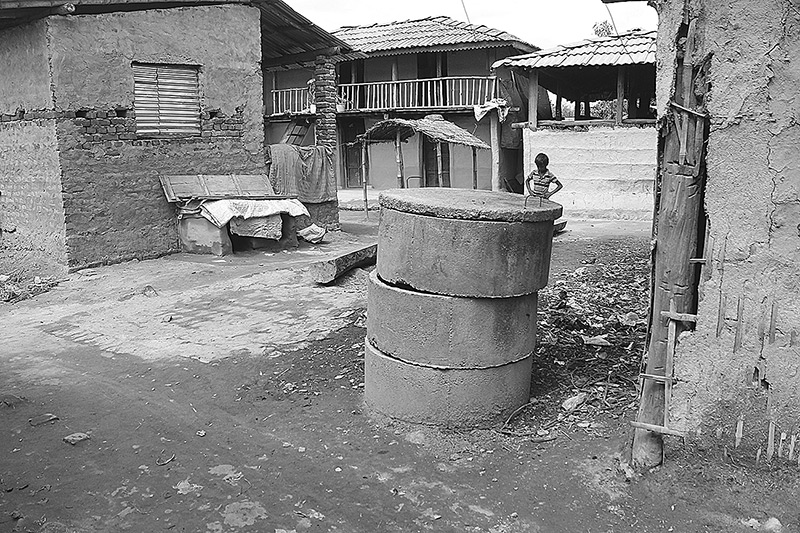
The concrete rings that the municipal office had distributed in the settlement five months ago lie unused. Post Photo: shiva puri

RAUTAHAT,
The 100-odd households of Musahar community at the ninth ward of Chandrapur Municipality in Rautahat do not have toilets at their homes.
The dearth of lavatories in the settlement means its residents take their business outdoors.  
A local government-run open defecation free programme in the settlement has failed to take off due to the lack of land to construct toilet facilities.  
Although the municipal office had distributed toilet pans and concrete rings in the settlement five months ago, they lie unused.
The municipal officials and local representatives have repeatedly asked the households to build toilets, but to no avail.    
“Where would we build toilets when we don’t even have enough living space?” said  Siyaram Musahar,  a local man. “There is no point in pressuring us to build toilets. We need land.”
The settlement is built on a public land. Most of the huts are crammed tightly, with little to no space in between. The people in the settlement, most of whom eke out their living as daily wage workers, complained that they neither have land nor money to build toilets.
They said the local government should find another solution.  
Gobinda Dulal, chairman of Chandrapur Ward No. 9, admitted that the open defecation free programme failed due to the lack of land plots to build toilets on.  
“We provided the necessary materials to construct toilets in the settlement. But the programme beneficiaries are telling us that they don’t have space for toilets,” said Dulal.
For now, Dulal sees no solution to the problem.
Open defecation is still commonplace in Rautahat, even though the district was declared open defecation free in December 2018.  
Toilet facilities are non-existent or limited in many places, including Dumariya, Badaharwa, Dhamaura, Laximpur and Cetnagar.
According to that data at the district’s sanitation office, 2,576 households in Rautahat still do not have toilets.

NATIONAL

Pappu leaves a bridge incomplete over the Trishuli river

- HARIRAM UPRETY

GORKHA,
The construction of a bridge over the Trishuli river near Prithvi Highway took off some five years ago. Fast forward to today and the construction site wears an abandoned look, with construction materials stacked up and scattered around. Not a single worker has been spotted in the construction site for the past two years, say locals.
The company behind the construction of the bridge is Pappu Construction, notorious for grabbing a large number of projects but not completing them on time. “The representatives of the construction company have even stopped receiving our phone calls,” said Hom Bahadur Rana, chairman of Gandaki Rural Municipality in Gorkha.
Pappu Construction was awarded the contract to construct the bridge back in June 2014 at the total cost of 174.6 million. According to the contract, the construction company had to complete the construction by January 1, 2018. Upon completion, the bridge will connect Buttar of Gandaki in Gorkha to Chumkhola along the Prithvi Highway in Chitwan district.
“The deadline for the bridge construction expired around two years ago. Only 11 percent of the work has been completed so far,” said Rabindra Lal Das, chief of the Egharkilo-Barpak-Bhaluswara Road Office.
The construction company had already received 10 percent of the total contract amount. “We sought to retrieve the amount from the company. But the company filed a case at the court,” said Das.
“The contractor claimed that it could not carry out the bridge project because it needed a heavy machine to drill hard rock in the construction site and that they could not take the machine across the river due to the lack of a bridge,” said Das.
According to Das, the road office is planning to extend the project deadline by June 4, 2020. “But the construction company has not produced the necessary documents and have been out of contact. We are thinking of other alternatives,” Das added.
Hundreds of people of Tanglichok, Makaisingh, Batase and the surrounding area in Gorkha have been affected by the construction delay. “The locals have to use either the bridge in Benighat or go through Gorkha
bazaar to reach the Prithvi Highway. It’s almost an additional two hours ride,” said Rana. The local farmers have been affected the most by the absence of the bridge, since they have to carry their produce all the way to Prithvi Highway to reach their consumers.

NATIONAL

815 undergo cataract surgery

Briefing

BIRGUNJ: Eight hundred and fifteen eye patients received treatment in a week-long eye camp organised in Panitanki, Birgunj, according to Birgunj Metropolitan City. Bijaya Kumar Sarawagi, mayor of the metropolitan city, said that they have started the campaign to make Parsa a cataract-free district.

NATIONAL

Missing woman rescued after five years

Briefing

JAJARKOT: A 30-year-old woman of Barekot, who went missing five years ago in India, has been rescued from New Delhi. According to the family members, Kalpana Thapa was working as a daily wage worker in India when she went out of contact. She was rescued by an Indian organisation named Sisters of Charity.

NATIONAL

Women compelled to give birth to their babies at home

Briefing

NAWALPUR: Pregnant women in Gaidakot Municipality Ward No. 11, Nawalparasi (East), are still compelled to give birth to their babies at home due to lack of birthing centres. According to the data, out of 37 pregnant women, around 10 gave birth to their babies at home in the last fiscal year.

NATIONAL

Traffic police start road safety campaign in Banke

Briefing

NEPALGUNJ: Traffic police has started a district-wide campaign to educate people about traffic rules and regulations in Banke district. Pabindra Bam, police inspector of the District Police Office, said they have started the road safety education campaign to educate people. He said, “This campaign is for  both pedestrians and vehicle drivers.”

NATIONAL

Bulldozer, excavator used to clear snow in Manang

Briefing

LAMJUNG: Authorities have started to clear snow from Timang-Manang Gaun and Khangsar road from Thursday. The vehicular movement along the road section has come to a halt after the thick layer of snow deposited on the road since past one week. Lawmaker Polden Chhopang Gurung, who was elected from Manang, took the initiative to manage clear snow.

Page 6
MONEY

China’s Great Wall revs up for India as rivals hit the brakes

Chinese automakers see India as a chance to combat slowing sales at home, which fell in November for a 17th month in a row.
- REUTERS
Workers inspect vehicles at a workshop of a production base of Great Wall Motors in Yongchuan, Chongqing, China. reuters

NEW DELHI, 
Chinese automakers Great Wall Motor and Changan Automobile are accelerating plans to build cars in India after the initial success of rival SAIC Motor in one of the world’s biggest markets, three sources said.
Great Wall, one of the biggest sellers of sports-utility vehicles (SUV) in China, expects to secure a production site in the first half of 2020, likely a General Motors plant in Maharashtra, a source familiar with Great Wall’s plans said.
Buying a factory is seen as the best way to get up and running fast and Great Wall is finalising which SUVs it plans to make in India, including whether to kick off its launch with an electric SUV, the source told Reuters.
Great Wall said it would make an announcement next month about its plans for India but declined further comment.
A spokesman for GM in Detroit said it was continuing to make vehicles for export at its Talegaon plant in Maharashtra state.
“As we have said previously, we continue to explore options to improve utilisation of the plant. We do not comment on speculation,” he said.
Changan, too, is scouting for a production base and has held initial talks with suppliers, sources aware of its plans said. Both automakers, which produce electric vehicles (EVs) in China, are also considering whether to set up EV battery assembly plants in India, the sources said.
Changan declined to comment.
The companies see India as a chance to combat slowing sales at home, which fell in November for a 17th month in a row. While car sales in India are stuttering, the market is expected to become the world’s third biggest by 2026, behind China and the United States, according to consultancy LMC Automotive
The Chinese firms also hope to capitalise on gaps left by global automakers such as Fiat Chrysler, Ford Motor and GM which have scaled back plans in a market still dominated by smaller, low-cost cars made by Maruti Suzuki and Hyundai Motor.
“It is an opportune time for China’s automakers to enter India. There is currently a gap in competition and it may take a couple of years for some of the established carmakers to bring new products to the market,” said LMC Automotive’s Ammar Master.
GM’s retreat from India, for example, could help Great Wall get going quickly and it has been in talks to buy GM’s plant in Maharashtra, two of the sources said.
GM stopped selling cars in India in 2017 and has already sold its other plant in Gujarat to SAIC, where the state-owned Chinese automaker now makes the Hector SUV it launched in June under its MG Motor brand.
India is part of Great Wall’s planned global expansion into South America, South Africa, Southeast Asia and Australia, and it also plans to export from there to places such as Europe and the United States, said the source who is aware of its plans.
“The plant in India is expected to be the biggest for Great Wall outside of China,” the source said.
Great Wall has hired a former executive from Maruti Suzuki, India’s biggest carmaker, for its product and business planning, and appointed a former executive from SAIC’s India division as a consultant to liaise with the government.
“For global automakers, India is one of the many markets they are in but for the Chinese it is the first major market outside of home and so the level of investment and commitment will be proportionately high,” said the source.
One of the biggest hurdles in India will be fighting perceptions about the quality and reliability of Chinese products and winning over brand-conscious buyers for whom cars are a prestige statement, say analysts.
Chinese smartphone makers such as Xiaomi Corp faced similar perception issues when they launched in India but they now dominate the market. However, cars remain a significant outlay for most Indians and the Chinese brands will need to make their mark quickly.
“Once the likes of Volkswagen and Ford start launching new models in India, the entrants from China could face tougher competition because a lot of buyers in India are still very brand conscious,” said LMC’s Master.
Still, the initial success of SAIC’s Hector SUV has helped. Launched at the end of June it said it had sold more than 13,000 cars by the end of November and plans to sell 24,000 next year.
“SAIC has changed the perception about whether a Chinese brand can be made and sold in India,” said Santosh Pai, partner at law firm Link Legal which advises Chinese companies setting up in India.
“Fence sitters are getting in and have realised they can sell in India if the price and strategy is right.”
Lessons for Great Wall and Changan from SAIC’s India launch include marketing the brand aggressively, packing the car with features to differentiate it from rivals and giving extended warranties to dispel doubts over reliability, analysts say.
Another advantage for Chinese carmakers in the coming years will be their EV expertise. With the sale of EVs slowing in China they can deploy some of their existing capacity to India where the government is encouraging clean fuel cars.
SAIC, which will soon launch an electric SUV in India, is also scouting for a second manufacturing site and is expected to make a decision in early 2020, said a source aware of its plans.
SAIC did not respond to a request for comment though the head of its Indian division said in November it was working on an expansion plan and expected its total sales in India to hit 70,000 in 2021.

MONEY

US safety agency probes four automakers in new Takata air bag recall

- ASSOCIATED PRESS
Visitors walk behind a Takata Corp’s display at a showroom for vehicles in Tokyo, Japan.  reuters

DETROIT,
The US government’s highway safety agency has launched an investigation into four automakers that have a potentially deadly type of Takata air bag inflator in their vehicles but have yet to recall them.
The National Highway Traffic Safety Administration said in documents posted Thursday that it is investigating Audi, Toyota, Honda and Mitsubishi in connection with a Takata recall involving 1.4 million inflators.
The inflators made by the now-bankrupt Takata have a distinct and separate problem that can cause them to blow apart a metal canister and spew shrapnel into people’s faces and bodies. The problem killed a driver in Australia who was in an older 3-Series BMW, which has already recalled more than 116,000 vehicles.
The problem is so dangerous that in some cases BMW has told drivers to park their vehicles until repairs can be made.
The safety agency says in documents that Takata didn’t provide details on the affected makes, models or model years of vehicles with the defective inflators. So it is telling the companies to recall them promptly.
The agency says that based on when the faulty inflators were produced, it’s likely that the vehicles to be recalled came from the 1995 through 2000 model years. In letters to all four automakers, NHTSA says they have five business days to notify the agency after finding out about a safety defect.
“If your company has not yet gathered enough evidence to make a determination that the subject air bag inflators present an unreasonable risk to motor vehicle safety, reply with a detailed work plan including the benchmark dates required to make the determination,” the agency wrote in letters to all four automakers dated Wednesday.
A Honda spokesman said Thursday it hasn’t determined yet whether its vehicles are affected, but a decision should be made soon. Audi, Mitsubishi and Toyota said they are still investigating. NHTSA has told the companies to respond by Jan. 17.
On Dec. 4, NHTSA posted documents from Takata and BMW detailing the problems. The documents said the Australian driver was killed, while another Australian driver and a driver in Cyprus were injured.
Unlike previous recalls, the Takata non-azide inflators do not use volatile ammonium nitrate to fill the air bags in a crash. But the air bag propellant can still deteriorate over time when exposed to moisture and explode too fast, blowing apart the inflator body. They also might not fully inflate to protect people in a crash.
Takata says in government documents that it made about 4.5 million of the inflators worldwide but only a portion are still in use because the vehicles are so old. The faulty inflators have problems with insufficient seals.
Jason Levine, executive director of the Center for Auto Safety, a nonprofit advocacy group, said it’s too early to tell if the automakers are dragging their feet on the recalls. But he says the investigation “highlights the need for aggressive oversight both by NHTSA and by the companies themselves in terms of when they get these reports to take them seriously and move more quickly.”

MONEY

Two deals in pocket but no holiday cheer for US trade chief Lighthizer

- REUTERS
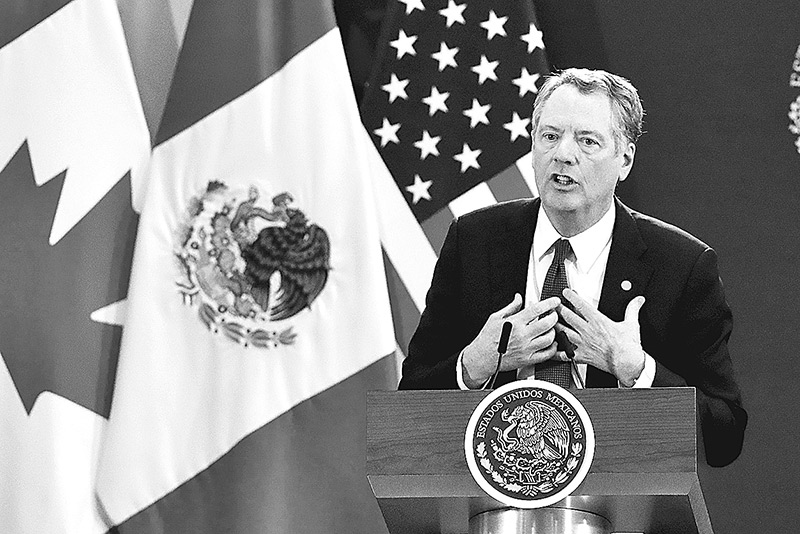
US Trade Representative Robert Lighthizer gestures as he speaks during ameeting at the Presidential Palace, in Mexico City, Mexico. reuters 

WASHINGTON, 
US Trade Representative Robert Lighthizer was looking forward to some holiday peace and quiet after wrapping up trade deals with the United States’ most important trading partners—China, Mexico, and Canada—last week.
Instead, the long-standing member of President Donald Trump’s inner circle who normally eschews public appearances found himself doing wall-to-wall interviews, scrambling to correct a misunderstanding with the Mexican government and taking heat from his fellow Republicans in Congress.
The conservative Wall Street Journal carried an opinion piece that said the Trump administration had bowed to “politically managed trade” in agreeing to Democratic demands to revamp the new US-Mexico-Canada Agreement (USMCA), while former USTR officials and investment analysts panned the Phase 1 US-China trade deal as falling far short of expectations.
Lighthizer, 72, is an anomaly in today’s hyper-partisan Washington, a powerful member of Trump’s White House who has won sometimes grudging praise from Democrats and Republicans, while keeping the ear and respect of the president throughout.
The USTR chief was “the most present person from this administration that I have seen in my three years in Congress,” said US Representative Jimmy Panetta, a Democrat. “He was all over the place, and I think that helped out quite a bit.”
Richard Trumka, the president of the AFL-CIO labor union, whose support for USMCA was critical to ensuring congressional backing, called Lighthizer “an honorable man,” adding, “I’ve worked with him for 35, 40 years, and we’ve always been able to work deals out because I know when he tells me something, it’s good.”
The USMCA, which will replace the North American Free Trade Agreement, and the China trade deal were two of Trump’s top priorities, and landing them both in the same week was a public relations triumph.
But the efforts to reel in those deals took longer and proved harder than expected, and triggered further questions.
Critics say some of that is a byproduct of Lighthizer’s tight-fisted negotiating style. Congressional sources and former US government officials say he is always well-prepared, but can appear arrogant and unwilling to delegate.
Lighthizer is also prone to slamming down the phone in anger, Representative Richard Neal, the Democratic chairman of the US House of Representatives Ways and Means Committee, told reporters last week.
Tasked with resetting the main US trading relationships in the world to reflect the Trump administration’s conviction that the United States has been taken advantage of for years, Lighthizer has taken to the job like a duck to water.
There is little daylight between Trump and the Georgetown University-educated Ohio native on the key planks of an “America First” policy that is aimed at rebalancing the global trading arena in favor of US workers and companies.
Lighthizer, who was a deputy trade negotiator in the Reagan administration in the 1980s, honed his views during a lengthy career as a private international trade lawyer.
Among his clients were US steel companies struggling to compete against heavily subsidized imports from China.
He “understands the president better than most,” and wants to significantly change the way trade is done, a veteran US trade negotiator said on condition of anonymity.
Dismantling the World Trade Organization, moving away from multilateral trade agreements and using steel and aluminum tariffs to punish countries accused of hurting US industry are policies Lighthizer accepts, the source said.
But it’s his negotiating style as well as that of others in the Trump administration that has generated much criticism.
The Trump trade team often refuses to commit negotiations to paper while discussions are underway, according to multiple congressional sources, and Lighthizer, unlike his predecessors, has clamped down on background conversations with reporters.
That can lead to misunderstandings and confusion.
For instance, Lighthizer insists the first phase of the US-China trade deal is completely “done,” but Beijing has not confirmed details released by US officials, leaving markets and key affected industrial sectors befuddled.
It could be weeks before the 86-page agreement is translated into Chinese and further details are released.
Several Chinese officials this week said the wording of the deal remained a delicate issue and care was needed to ensure expressions used in text did not re-escalate tensions, raising concerns it could still unravel.
Jorge Guajardo, a former Mexican ambassador to China who is now a senior director at McLarty Associates, said both the dust-up with the Mexicans over US plans to monitor changes to Mexican labor rules, and the delayed release of the text of the China deal raised questions about how Lighthizer operated.
“Both Mexico and China seem to have been caught off guard,” Guajardo said. “It’s troubling. It does indicate a bit of a pattern on the US side of presenting different agreements than their parties think they agreed to.”
Harry Broadman, a former senior USTR official, said there was no reason the Mexico issue should have spilled into public view. Announcing the trade deal with China before the text was translated was also unusual, he said.
“That is not the procedure usually followed in trade negotiations worldwide. Usually you speak after you have something in writing, and both sides release it,” Broadman said.
An apologetic Lighthizer, speaking on Fox Business Network on Tuesday, said the Mexico situation was a “last-minute snag” and “a misunderstanding ... that was easily taken care of.” Lighthizer also came under
fire from fellow Republicans for dropping a 10-year data protection provision for certain pharmaceuticals
from USMCA.
US Senator Pat Toomey, a Pennsylvania Republican and fierce USMCA critic, said on Thursday it was a major setback for a “very, very exciting new category of medicines” and would make it harder for US drug makers to recoup heavy investment costs. Lighthizer conceded on Fox Business Network it “was a step backwards” but said it was a needed compromise to ensure congressional support from the Democratic-controlled House.
Ultimately, Trump was the one who wanted to get the China deal done ahead of Dec. 15, when a new set of tariffs were due to kick in, said Christian Whiton, a fellow at the Center for the National Interest think tank in Washington and a member of Trump’s transition team after the 2016 election.

Page 7
MONEY

Bangladesh to pay 7.7 cents per unit for Upper Karnali power

The energy-hungry country will pay out a massive Tk381.60 billion (equivalent to Rs511.69 billion) over 25 years to procure 500 megawatts of electricity.
- PRAHLAD RIJAL
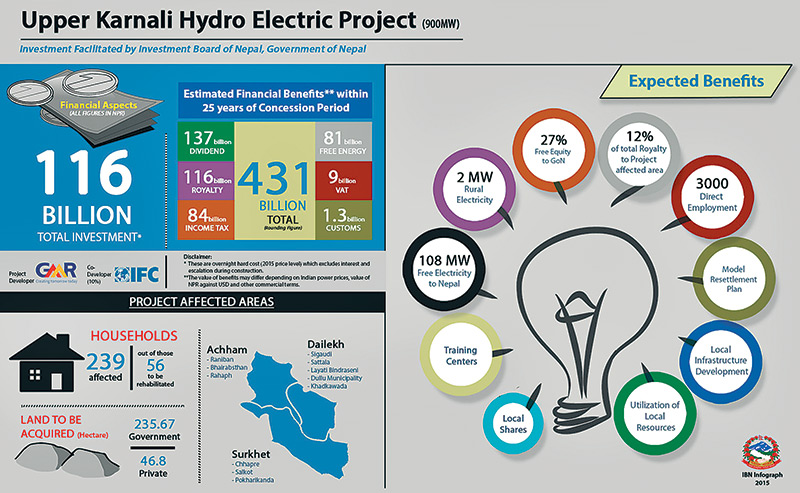
infographics courtesy: IBN

KATHMANDU,
Bangladesh has formalised its pledges to buy electricity from the 900-MW Upper Karnali hydropower project in Nepal which is currently being developed by India’s infrastructure giant GMR Group, opening the door for the first-ever trilateral power trade.
In the latest landmark development, the Cabinet Committee on Public Purchase of Bangladesh has given the nod to import power at a rate of 7.71 cents per unit for a period of 25 years, according to Dhaka Tribune. The decision was made on Wednesday.
Kulmeet Sharma, GMR appointed project head of Upper Karnali in Nepal, confirmed the development.
The tariff rate, a major sticking point in past discussions between the Indian developer and Bangladeshi energy officials, is around 2.5 cents less than what GMR Energy had offered to Bangladesh.
This will now help GMR to arrange funds for the construction of the power plant because the lender will approve credit only if a market for the electricity to be generated by the project is secured.
“It was a much-awaited development and now a letter of intent from Bangladesh is expected within 4-5 weeks,” said Kulmeet Sharma, GMR appointed project head of Upper Karnali. “After the project receives the letter of intent, it will open the doors to make financing arrangements to build the power plant in western Nepal.”
According to Sharma, the project has been unofficially holding talks with potential lenders including local banks and multilateral agencies and with a formal offtake agreement in hand, it will gear up the required processes and also clear bottlenecks pertaining to land acquisition.
As per the proposal cleared by Bangladeshi officials, the energy-hungry country will pay out a massive Tk381.60 billion (equivalent to Rs511.69 billion) over 25 years to procure 500 megawatts of electricity.
Nepal will receive 108 MW out of the remaining 400 MW for free while GMR plans to sell the rest to the government of the Indian state of Haryana.
A principal agreement on the commercial terms of the power purchase agreement excluding tariff rates was reached between the Bangladesh Power Development Board and GMR last year and negotiations had been struck over the rates since then.
According to an official close to the situation, the two parties were in disagreement, probably because of the ‘high rate’ proposed by the developer.
The export-oriented Upper Karnali project has a high price tag due to surcharges placed on the use of Nepali and Indian transmission grids. As the developer is required to relay energy using Nepali and Indian infrastructure, it will have to pay wheeling charges to both Nepal and India. Apart from the charges, the loss of electricity in long-distance transmission is also usually high.
Power-hungry Bangladesh signed a memorandum of understanding (MoU) with India’s NVVN to import electricity from the Upper Karnali scheme via India during Bangladeshi Prime Minister Sheikh Hasina’s visit to India in April 2017.
As Indian laws don’t allow private developers to export electricity produced in third countries over Indian transmission lines, Bangladesh signed an MoU with the state-owned cross-border electricity trading agency while GMR was a witness.
In absence of a power purchase agreement, the Indian developer has already sought deadline extensions for financial closure twice from Investment Board of Nepal, the facilitating agency.
GMR Energy and the government signed a memorandum of understanding on building the plant in 2008.
As of September 2019, the developer has not been able to acquire 12 hectares of unregistered and unidentified land parcels, out of planned 49 hectares and is awaiting forest clearance permits from four community forest groups.

MONEY

Zero climbing fees to boost Visit Nepal 2020

The government aims to lure climbers and promote peaks which have received little attention.
- SANGAM PRASAIN
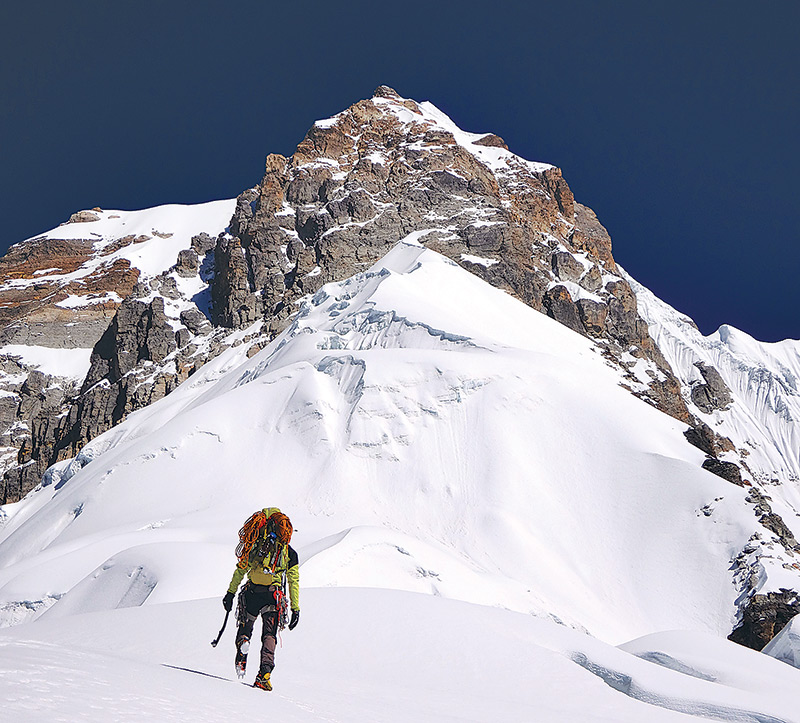
There are 3,310 walking and climbing peaks above 5,500 metres in Nepal. Post file Photo

KATHMANDU,
The government plans to slash climbing fees and even waive them completely for some Himalayan peaks in a bid to lure mountaineers during Visit Nepal 2020.
The Department of Mountaineering, which issues climbing permits, said no fees would be charged for Cho Oyu, the sixth highest mountain in the world at 8188 metres.
Permits to climb Dhaulagiri (8167 metres) and Kanchanjunga (8586 metres) will be issued at a 50 percent discount, said Meera Acharya, director at the department.
The climbing fee for Everest, the world’s tallest mountain, has been set at $11,000 per person in the spring season. The charge for other eight-thousanders has been set at $1,800 per person.
No climbing fee will be charged for mountains like Api, Saipal, Ganesh Himal, Gyalzen Peak and others, said Acharya.
“We have sent the proposal to reduce and waive climbing permit fees to the cabinet for its approval,” said Acharya. The much-hyped Visit Nepal 2020 campaign is targeting 2 million arrivals to Nepal next year.
“This scheme is intended partly to lure climbers to visit Nepal and partly to promote peaks which have received little attention from mountaineers,” said Acharya.
The government is also introducing a set of new rules in an attempt to improve the safety of climbers on Nepal’s mountains, including Everest, following the death of nine people on the world’s highest peak this year, the highest number of casualties during a single season in the past four years.
All climbers seeking a permit to climb Everest will now need to disclose their full medical history, and submit a medical report by a certified doctor in order to obtain a permit to climb mountains in Nepal.
The rules, which will come into effect from the next spring climbing season, were drafted in an effort to allow only climbers in good health to attempt the high-altitude challenge after a number of climbers died on Everest this year.
In 2014, the government opened 104 peaks to commercial expeditions, including five eight-thousanders--Kanchanjunga South (8476 metres), Kanchanjunga Central (8473 metres), Lhotse Middle (8413 metres), Lhotse Shar (8400 metres) and Kanchanjunga Yalung Khang West (8077 metres)--but it has not been officially recognised by the World Mountaineering and Climbing Federation, according to Nepali mountaineering officials.
The number of peaks open for commercial climbing, including eight-thousanders, has reached 414. Among them, 72 are higher than 7000 metres.
According to a study conducted by the government and the Nepal Mountaineering Association, there are 3,310 walking and climbing peaks above 5500 metres in Nepal. The government estimates that there are more than 1,600 virgin summits in the Nepal Himalaya.

MONEY

Massive debt wave could crash on developing nations, World Bank warns

- AGENCE FRANCE-PRESSE

WASHINGTON,
A wave of debt in emerging and developing nations has
grown faster and larger than in any period of the last five decades and could end with another crisis, the World Bank warned Thursday.
And if the wave breaks, it could be more damaging since it would engulf private companies in addition to governments, at a time when economic growth is sluggish, according to a new report that covers four debt surges from 1970-2018.
“The size, speed and breadth of the latest debt wave should concern us all,” World Bank President David Malpass said in a statement.
“Clearly, it’s time for course corrections,” he added.
The World Bank and International Monetary Fund have been sounding the warning about growing global debt for years, but the latest report is even more stark and turned up the volume on its calls for governments to take steps to prevent a debt crisis.
IMF chief Kristalina Georgieva on Thursday said developing nations in Africa especially need to strike the right balance between financing development and a manageable debt level.
The IMF reported that total global debt rose to $188 trillion at the end of 2018, equivalent to nearly 230 percent of the world’s economy.
The World Bank report highlights the “striking” debt surge in emerging and developing economies, which is the “largest, fastest and most broad-based in EMDEs in the past 50 years.”
After declining during the 2008 global financial crisis, amid very low borrowing costs in just eight years since 2010, debt in these countries climbed to an all-time high of roughly 170 percent of GDP or about $55 trillion.

MONEY

Huawei and Deutsche Telekom hold talks over 5G network

- REUTERS

BERLIN, 
Deutsche Telekom was in advanced talks to retain China’s Huawei as its main supplier of radio equipment for new mobile networks before it put the negotiations on hold for political reasons, according to three sources familiar with the matter.
The United States has urged its allies to freeze out the Chinese supplier over cybersecurity concerns. Washington has told allies that the company’s equipment could be used by China as spying tools, an allegation denied by Huawei and Beijing.
Deutsche Telekom, Europe’s largest telecoms operator, announced last week that it was not entering into 5G network equipment contracts as it awaited the resolution of a political debate in Berlin over whether to restrict Huawei’s access to the German market. Before that announcement, Deutsche Telekom had held discussions with Huawei in Paris and hammered out terms for a possible deal, though no contract was signed, said the sources, who declined to be named due to the sensitivity of the matter.
In response to Reuters questions about talks with Huawei, a Deutsche Telekom spokesman confirmed that no deal or arrangement had been reached about making the Chinese company its main supplier of 5G network equipment.
Before the talks were put on hold, the sources said that the two sides had discussed key terms which envisioned that Huawei would provide 70 percent of radio transmission gear for Deutsche Telekom’s upcoming ultra-fast 5G networks for a price of 533 million euros ($587 million).
A mechanism was also worked out that, should Huawei’s share of the 5G equipment provision fall due to any move by the Berlin government to limit Chinese involvement, the amount the company would be paid would fall proportionately, the sources said. The Paris discussions took place last month, when Deutsche Telekom held talks with Huawei as well as with other potential vendors of 5G network equipment, according to the sources.
Subsequently, on Dec. 3, senior executives from the German and Chinese companies held a meeting at Frankfurt Airport, said the sources. Claudia Nemat, a Deutsche Telekom management board member and its top technology executive, and Huawei Deputy Chairman Eric Xu attended the meeting, they added.
The Deutsche Telekom spokesman confirmed the meetings took place in Frankfurt and Paris but said negotiations about all transactions had been suspended while the Berlin government, which owns 32 percent of the telecom operator, decided on official policy regarding Huawei.
He added the purpose of the Dec. 3 meeting was to inform Huawei that talks were on hold.
Huawei declined to comment on its discussions with Deutsche Telekom.
The talks and their subsequent suspension highlight the complexities and disruption facing carriers around the world as they try to move forward with 5G networks, which will enable much higher wireless internet speeds.
Huawei is the world’s biggest supplier of mobile network gear, and has been used by Deutsche Telekom and many other of the world’s biggest telecom operators to provide the bulk of their existing 3G and 4G network infrastructure.

MONEY

Nike’s strong online sales help beat expectations in Q2

- ASSOCIATED PRESS

NEW YORK, 
Nike’s quarterly results again beat Wall Street expectations, as its online sales grew and customers shrugged off a series of corporate scandals.
The company’s revenues grew to $10.33 billion in the second quarter ending Nov. 30, up 10 percent from the same period last year. Analysts had been expecting $10.1 billion in revenue, according to Zacks Investment Research.
Nike’s North America sales, however, disappointed slightly at $3.98 billion, up 5 percent from $3.78 billion during the same period last year. Analyst had anticipated sales closer to $4 billion, according to FactSet.
Nike’s shares fell $1.95, or almost 2 percent, to $99.18 in after-hours trading. Its net income rose 32 percent to $1.12 billion. Strong sales, a lower tax rate and a focus on selling more shoes at full price helped offset cost increases related to tariffs. Earnings per share rose to 70 cents, beating expectations of 58 cents per share, according to Zacks.
It was Nike’s first earnings reporting since announcing that CEO Mark Parker will step down early next year. He will be replaced by board member John Donahoe, who formerly ran e-commerce company eBay and was tapped to push forward Nike’s digital transformation.
The Beaverton, Oregon-based company has focused on building up its direct-to-consumer business through its own website, app and stores. The company launched a subscription service for children’s shoes last summer. Last month, it announced it will stop selling its sneakers and athletic gear directly to Amazon, ending a two-year-old pilot programme with the world’s largest online retailer.
Selling sneakers directly to its customers gives Nike information on its shoppers that can help it design shoes in colors or sizes it knows they want.
Nike said its operating expenses rose 9 percent to $2.44 billion as the company invested in its NIKE Direct business and global operations.

Page 8
Page 9
CULTURE & ARTS

Nine trends that defined Nepali films in the past decade

While the industry’s output is increasing, the quality is often questionable.
- ABHIMANYU DIXIT
screengrabs via youtube

By the early 2010s, around 40 Nepali films were released each year. That number surged to more than 100 films in 2019. This is indicative of increasing interest from more exciting makers over the past decade.
Many individuals from a diverse milieu—short-film makers, film students, theatre professionals, music video makers, advertisement producers, film critics, television series producers, and even YouTubers—tried their hand at producing films for the big screen. All of them, in one way or the other, have shaped cinema in Nepal—whether by providing fresh talent on or off screen, by shaping the cinematic process, or by bringing their medium’s audience into cinema halls.
Albeit the arrival of such variegation, there were certain trends that dominated the Nepali film industry throughout the past decade. The categorisation of these trends, however, is my personal take and do not follow any scientific rubric. These definitions are an attempt to thoroughly comprehend and study the course taken by Nepali film since 2010. Hopefully it’ll point us to where Nepali cinema is headed.

Money-in-the-bag films
This category or trend was introduced by Loot (2012), and it changed Nepali cinema. Writer and director Nischal Basnet led the way by breaking Nepali narrative conventions, which usually feature a strong well-meaning, well-spoken hero. Basnet’s hero wasn’t good natured or even good looking, the characters talked like they were on the streets of Kathmandu, the fight scenes weren’t choreographed, and for a movie about looting; there wasn’t even one gun shot.
But watch the film today and you’ll realise Loot hasn’t aged well. And other films in this category follows a similar plot: a bunch of economically impoverished men living in narrow streets of Kathmandu mingle with criminals, because at the end of the day, everyone expects to get a share of the money.
This was a simple enough premise to take Loot to the box office, and for it to be a relative success, even though there were plenty of loopholes, but the films that followed, like Loot 2 (2017) and Jai Shree Daam (2018), couldn’t replicate its success—rather they are just bad. You’ll encounter traces of toxic masculinity, eve teasing, and glorification of violence on full display. The worst end of the stick is reserved for female characters, who are either objectified in item songs, or are loot for the male hero protagonists. This is actually true for the next category as well.


Ensemble comedies
Celebrities from Nepali theatre or TV, or both, come together in this genre to present a plot that centres on multiple characters.  Here, the lead, mostly male, is a lovable baddie, and we follow his redemption arc through carefully planned moments of comedic cringe. Two film series under this category became commercially successful—Kabaddi and Chhakka Panja.
While Kabaddi recycles the same old plot, the Chhakka Panja series deals with specific issues in each of its films. And that’s all you get to learn—Nepal is full of issues.
The worst of this lot are the original Chhakka Panja (2016), and Shatru Gate (2018)—both films with huge budgets which are perfect displays of mindless and offensive comedies.


Glossy romance flicks
Usually in these films, Anmol KC is the male lead, and if not, other doppelganger wannabes. The plot is more or less about a rich kid, who comes from privilege but is dumb, or arrogant, or without any personality whatsoever. Then, he meets an interesting girl, who completes his arc. The plot mixes romantic comedy and Korean dramatic conventions, where one or both of the prime characters usually dies in the end. The makers put real effort in song choreography. They even travel to off-the-map locations for a picturesque shot.
These films are commercially successful, and whether we like it or not, they’ll not go anywhere. We critics can call films like A Mero Hajur 3 (2018), a waste of time (even though director Jharana Thapa strongly disagrees), but they’ll be coming back the next year with another sequel.
It’s quite difficult to choose the least rotten of the bunch, but maybe Jerry (2014) is somewhat bearable.   


Revenge plots
Revenge plots usually come embedded within action or thriller genres. Mostly seen in the earlier half of this decade, it’s usually one man, or group of men going berserk on the bad guy(s).
Sudarshan Thapa’s Dhanda (2012) is one of the worst examples in this trend. There are no notable films here, but Nigam Shrestha’s Chhadke (2013) deserves a special mention. The film stands out because he experiments with the genre, which really takes some guts. Here, he haphazardly turns a gangster film into a slasher. In the film, Saugat Malla’s character is hurt pretty bad, but he somehow survives, reincarnates as Tarzan and kills everyone with a jaw bone.  


The common man
There’s an adamant man, usually impoverished, recently migrated to Kathmandu, and wants to make his life better. He will do menial jobs, or will be in a tussle with a criminal (and/or political) system. These films focus on a single character rather than a bunch of characters.
The maker wants the audience to really understand the protagonist, so when something bad happens to him (which certainly will), we empathise and get our emotions involved.
The best of the lot is Pashupati Prasad (2016) from Dipendra K Khanal and the worst is Dhanapati (2017) (also Pashupati Prasad Part 2) from the same makers. Khagendra Lamichhane usually writes these films to act as the lead. While the first part presented a critique of the current patriarchal and political scenario, the second did the same by glorifying misogyny, and bullying female characters. Hem Raj BC’s Ghamad Shere (2019) and Gopi (2019) also deserve special mention.


The common woman (but written by men)
This dramatic trend is similar to the common man, except the gender is reversed. These are the stories of women told by men. And that’s the problem.
These films don’t explore the depth of a woman’s personality. They mainly cater to a man’s perception of women. Two films in this genre were released in 2019 alone, Bulbul and Saili. In Saili, the titular character had no agency. Men always drive the narrative forward in these films. And, in Bulbul, the lead female character’s main conflict was: whether to go to her lover, or her husband.
A recent film Prasad (2018) shows a woman being happy (in slow motion) to be pregnant from her rapist. Had these films been conceived by women, surely, the narratives would be different.


Film festival darlings
Commercial Nepali films are exhibited abroad specifically to non-residential Nepalis. But films that are selected into festivals have the opportunity to be distributed, and exhibited to countries among non-Nepali speaking
foreigners. These films introduce Nepal to the rest of the world. Currently, two filmmakers have represented Nepal in major film festivals, Min Bham’s Black Hen (2015), and Deepak Rauniyar’s Highway (2011), and White Sun (2016).
Both makers’ films are better than all of the above in terms of storytelling, cinematic qualities, and even performances. Now, it is the maker’s prerogative to choose the content they want to make, however, the content of these films reaffirms the myth of Nepali mysticism as seen through a tourist’s lens. Previously, Nepal used to be a land of mystic mountains with weird traditions. That’s what foreigners thought of Nepal. Now, the average foreigner, who watches the Nepali festival darling films will think that contemporary Nepal is a civil war ridden country that continues to lick its wounds, even though the conflict ended decades ago.
But, these are early days, and two is a very small sample size to generalise from. We clearly need more makers pitching a variety of perceptions of contemporary Nepali life on festival circuits.  


Underrated films
Nepali cinema needs more trends in terms of variety than the ones mentioned above. However, there were makers attempting to make bold and different films, but they go unnoticed.
Navin Awal’s Bijuli Machine (2016) introduced science fiction to contemporary Nepali audiences in a more grounded form. I thought his actor, Jeewan Adhikari, was a revelation, and I am still surprised to not see him in many films. Kathaa (2013) was a Prashant Rasaili’s feature that used minimal actors and locations to
convey something poetic. Both lead actors
Usha Rajak and Saugat Malla were excellent in the film.
Bhaskar Dhungana’s Suntali (2014) plays out like a whodunit with multiple characters but in a social context. But if it weren’t for the loud expressions of actors, the film and genre would’ve been emulated. Even so, Dhungana proved that he was a proficient maker that too in his debut film. But we haven’t seen anything more from him.


Independent films
This decade saw the rise of independent filmmakers expressing their ideas on small budgets. Local film festivals, like the recently completed Kathmandu International Mountain Film Festival, have hosted feature length gems like Murray Kerr’s Sick City (2011), Sahara Sharma’s Chasing Rainbows (2013), Prabin Syangbo’s Katha ‘72 (2018), and the latest, Dhondup Tsering’s Amakhando (2019).
But these don’t run in cinema halls, and even when they do, audiences don’t turn up. Maybe that’ll change in the next decade.

All of the mentioned films in this article may not be the best Nepali films of the decade. You may not even like them. But these are films that defined Nepali cinema as well as the makers. In hindsight, there’s one thing common in all of them—makers are successful, because they trust their instincts and not follow trends.
I am hopeful the next decade will be as eventful as the last one. I really hope young makers bring new ideas and bolder content to Nepali cinema.


Dixit is a filmmaker, film educator and film campaigner based in Kathmandu.

Page 10
BOOKS

10 books that defined 10 years

The past decade has been a reader’s delight in Nepal, as writers continue to innovate and push the envelope.
- Richa Bhattarai

This past decade saw a deluge of biographies and autobiographies, and a worrying decline in the publication of essays and dramas. The emergence of new and diverse writers, themes and styles was exciting. Poetry seems to have gotten more urgent, radical and performative; while writers are ready to experiment with issues and characters in fiction and bare their souls in memoirs, talking about things never revealed.
A profusion of publication houses, and writers being elevated to the status of ‘celebrities’, also meant better options for both the writer and the reader. Readers have grown increasingly discerning, and a writer must produce something explosive and out of the box to impress readers in the next decade.   


Kahar (2016) By Janakraj Sapkota
As Nepal’s economy relies more and more on remittance, it is also important to know about the lives of the hardworking emigrants who send home such happiness, while going through great struggles. Janakraj Sapkota’s Kahar is a reportage that does justice to the state of foreign labour employment today. It is emotional, balanced, and a touching read.

Kathputala (2017) By Archana Thapa
The stories in Kathputala are quite unlike any other anthologies in Nepali literature. They revolve around a varied range of issues, from sci-fi to LGBTIQ to childhood sexual abuse and identity crises. The author’s grip on language is noteworthy, with beautiful literary symbols and motifs in some places, and rousing ones in others—especially on women. This is recommended for a contemporary, composed and passionate commentary on present day Nepal (and the world).


Khalangama Hamala (2015)  By Radha Poudel
A nurse lives through the horrors of a civil war, and recounts it in such a simple, artless manner that the trauma is immediately felt by everyone who reads it. This memoir needs to be read for the ways in which the ‘people’s war’ impacted the very people it was purportedly fighting for.  


Laato Pahad (2015) By Upendra Subba
Upendra Subba is a poet at heart, and his stories are poems. The writing is guileless, earthy and rustic, a true rendition of life in Nepal’s villages, especially of the East. The abundant use of Limbu words and expressions brings us closer to the culture. The stories also need to be read for the portrayals of lifelike characters and their days full of hardships and heartwarming joys.


Lamppost Bata Khaseko Jun (2011) By Manu Manjil
Manu Manjil’s poetry is a sensory delight, an overwhelming torrent of beautiful images, metaphors and lyrical incantations that appeal to the eyes, the mind and heart. His poetry brought about a new era in poetry, encouraging a range of poets who have come up with exciting themes and expressions. The outward softness of his poems, with deep, deep meanings running underneath, deserve to be read and soaked into the soul.


Lekhak ki Swasni (2013) By Pragati Rai
This novel, translating to ‘The Writer’s Wife’, is a representative story of many, many women in Nepal—especially the wives of ‘famous’ and ‘revered’ men. As the men go about climbing ever higher and gaining accolades, the women have to struggle to manage home and hearth, often leading a lonely and neglected life. Pragati Rai writes simply but heart-wrenchingly of the anguish that these women undergo.


Mayur Times (2010) By Narayan Wagle
This novel is special for the friendship it explores between two women, one from the hills and another from the plains of Nepal. Parag is an enviable amalgamation of the practical and the idealist, brought up by admirable parents who “put wings on her”. Her friend, Lisara Pun, is a sensitive girl who never fails to stand up for what is right. This heartwarming friendship undergoes many tribulations throughout the civil war – leading to an interesting climax.

Sagarmathako Gahirai (2017) By Nawaraj Parajuli
“I think of you on the day/I think of myself. I think of you on the day/I forget myself. Tell me truthfully, son, did you remember me today, on my birthday?” Nawaraj Parajuli’s poetry is fresh, sensitive, and hard-hitting. The poems stand out because of the simple but universal themes they are written around—a mother’s love, a child’s query, menstrual taboos, emigrants’ distress, longing for the homeland. They are poems that deserve to be reread, and read out loud and clear.


Toda (2015) By Uma Subedi
Uma Subedi’s Toda unveils the rarely-analysed perspective of female migrant workers—their miseries, for the most part—in a knowledgeable and authentic manner. Drawing parallels between Nepal’s civil war to Nazi Germany, and then linking these to the modern-day trauma of emigrants, Subedi does an impressive job, describing in succinct prose the complex web of human relations. The novel also explores Israeli food and customs, introducing us to a new culture that hasn’t featured all too extensively in Nepali literature.


Tuin (2013) By Suresh Pranjali
Tuin, a novel on the harrowing influences of the civil war of Nepal, is an underrated work—for the lilt of its sentences and the flow of its story are quite noteworthy. It is a sad, relatively slow read, but delves deep into the psychology of innocent people whose lives are irreversibly destroyed by the war.


Bhattarai is a writer based in Kathmandu.

Page 11
AS IT IS

Kathmandu doesn’t make sense, and that’s the beauty of it

Why should I live in Nepal, when so many here seem to be sprinting from the country as fast as they can?
- Thomas Heaton
post photos: elite joshi

Walking down the dusty road from Kupondole to Thapathali is a visceral experience for a foreigner. There are the mangled roads left in Melamchi Project’s aftermath, the freshly ground jeera wafting through the air, the monger selling various forms of fish, dead or alive—then there’s the tinkers, the tailors, the soldiers, the cops, the ragamuffin mongrels roaming around.
By the time the Bagmati bridge is reached, more humanity has been seen than in a day where I come from. The quotidian 10-minute walk is something I never thought could become normal, and I’m coming to think it has become as quotidian as brushing one’s teeth. There’s tea-slurping old men with cigarettes, firmly placed in the fingers, close to the knuckle murmuring to each other.  There’s the chime of the bells as people give prasad to Hanuman on the corner. There’s the dodging of the vehicles being driven by people with questionable skill. There’s the stench of the Bagmati.
Kathmandu is worlds away from where I once was. Every morning, come 7:30, I would be bumper-to-bumper on the Harbour Bridge from Auckland’s North Shore to its centre. I would listen to the radio, listening to the predictable and at-times trivial circadian issues of politics and sport. The rugby team does well, the politician does something wrong. Arrive at work, do the same thing every day—churn, churn, churn some more, then burn out.
But here in Kathmandu, every day is different. When the walk seems to become predictable, Kathmandu creeps up and bashes me over the head. Perhaps the road has been lifted again, and there’s a troop of people working on it. Perhaps there’s a fleet of dogs swimming through the Bagmati, maybe a dead cow or some kids bathing. Perhaps, on a lucky day, the Himalayas will poke their faces from above the smog and grace the Valley with their omnipotent glory.
Having lived in Kathmandu for a sum of 18 months, and working here for a year, I’ve not gotten used to the place. I don’t think I ever really want to. This country bestows knowledge upon inquisitive outsiders and pours until their cups runneth over. There are the complexities of the incalculable cultures, the dichotomy of super-rich and super-poor, the hypocrisy of the politics. There’s the side that seems to be hidden from tourists, and it’s that side of the country that keeps me so interested.


Why should I live in Kathmandu, when so many here seem to be sprinting from the country as fast as they can? This is a question put to me by just about every stranger who comes to know I live and work here. It’s a question that I ask myself, on the bad days, but it’s a question that can only be answered by taking a look at this city. The conversation typically goes like this, following an argument with a taxi driver trying to fleece me because I’m a kuire.
“Where you from?” the taxi driver asks.
“New Zealand,” I say.
“How long will you be here? One month?”
“Yaha basne,” I often reply, trying to make sure they don’t try to fleece me anymore.
Their shock at the length of time I’ve been here, and the fact that I’m not working on some lofty foreign salary comes as a shock. Money is not a measure of success for me, experiences are. While it’s certainly more comfortable when you don’t have to worry about saving pennies, it’s the experiences that you remember. You can’t take money with you when you die, but you can make sure that you properly lived.
“Why are you here? New Zealand is beautiful.”
They’re always quizzed by the fact I live here, because they always seem to think that New Zealand is this place that’s clean, green and full of opportunity. Sure, the quality of life is leagues above Kathmandu, and seems to be regarded as one of the cleanest in the world.
But, you know what? It’s boring. Perhaps that’s speaking to a form of foreign privilege, that I was able to exit my country for another, and work and know that I can leave anytime, but Kathmandu boasts its own beauty. Yes, the traffic sucks and the pollution sucks the life from its population, but the people, on the whole, are mostly kind and considerate. It’s the people, their stories and their views and their raison d’etre that keeps me here.  
Sure, tomorrow I will be back in New Zealand, in my ‘hometown’, for Christmas and I’ll be ankle-deep in hot white sand, looking out at Mayor Island, on the country’s eastern coast. It’ll be sunny, windy and it’s going to be nice.
But nothing will have changed when I get there, or at least I don’t expect it to. More of my friends won’t be around, because they all seem to be chasing dreams in the UK; my grandmothers passed away this year too, so those beloved and steadfast totems have been lost too. My parents will be there, as will my brother, and we’ll be happy celebrating Christmas together. But nothing will have changed. There’s still going to be the local cafe that serves monstrous squares of custard and meat-filled pies.
The air will still be clean and clear, there’ll be the empty roads and occasional cars that interrupt the overwhelming blare of silence. The Pacific will not have stopped crashing on the shore, and it will wave hello to me as I dive into it for the first time in too long.
But give it a couple of days, and there’s no doubt that the quiet will irritate me until my brain swells with boredom. I’ll yearn for the imperfection and adventure that my daily foot-based commute provides, I’ll yearn for the giant brick and wood antiquities, the incessant horns, a never-ending plate of dal bhat and the sweet mouth-lining goodness of milk tea and ripe pong of stale chhyang.
As I board my flight back to New Zealand, I’m saying ‘see you later’ to the city. I’m only away for three weeks, but it will be enough to reflect on the learnings I’ve had in Nepal’s awkward and laborious capital. While people’s cups run over, when it comes to learning new things, I think I’ve got a bucket and it’s not even half full. I’ve still got more to learn, more drops of Nepal to add to the tincture, and I’m looking forward to resuming the cocktail soon.
I know nothing will have changed when I get back, and I’m glad. The road to work will still be stuffed, the fish man will sell his rahu, the tinker will clatter his way down the road, the tailor’s sewing machine will sing its solo as I walk past. The mountains might wink through the clouds too. But the country will be just as enchanting and captivating, and remain a beguiling assault on the senses.

AS IT IS

Of puzzles that need no solving

Nature has strange ways of speaking to us: the storming river always calms the mind, while the serene hills make it run amok.
- Shuvechchhya Pradhan
unsplash

Rivers were what kept me afloat—at least the sight of them. I always found myself drawn to  large water bodies, but unlike calm lakes, turbulent rivers fascinated me. The sound of a raging river and its angry waves stirred peace within me—almost as if the storm in those waters calmed the storm inside my heart. The impatient water running fiercely through the mountains also seemed to wash away my fear, anger, sadness or any pain brewing inside of me.  
But it was during a trip to Nuwakot that I found an affinity to something else—the hills. The hills comforted and calmed me, as if they could wrap their arms around me. If I looked at them closely for too long, they even looked like giants looking back at me.
When we reached our hotel room, I felt like the hills had come a little closer than when I was looking at them from my bus window. Were they intrigued by me as much as I am by them? Were they welcoming me to their place?
In the lap of those hills, I wished to be never found. I told myself, I could go invisible and vanish without a trace. Lost.
But just because I can, should I? Will someone miss me when they notice that I’m gone? Will they come to these hills looking for me—to save me from something I need no saving at all?
In between these thoughts, a voice nudges me. “Purple is the absence of green,” he says, stating it to no one in particular. But it kindles a curiosity inside me. I look at the hills again; they stand against the blue backdrop of the vast sky and are covered in green forests. There are spots of red and black here and there. And then, there is purple.
But is purple really an absence of green? It was difficult to comprehend. Purple is my favourite colour, sometimes, or that is what I’d like to believe. So, what I see as a favourite is an absence of something?
If the hills could hear my thoughts, they would laugh. Maybe the cold wind that touched my bare face were remnants of their silent titter.
But it is while I stare at them that my thoughts drift to the unknown. These hills were moving me, opposite of what I had heard and read—that one can move mountains with right emotions, usually poets.
I bet all the people before me, who allowed themselves to be lost in the hills, had it wrong. How can you move hills and mountains? It is the hills that move you, show you the reflection of what you really are, show you how small you are, so that even in its absence, you can feel what it generously offers you. Just like the colour purple.
Nature has its strange ways of speaking to us. The storming river calms the mind, while the serene atmosphere of hills makes the it amok. No amount of books or knowledge can solve this mystery, and perhaps it is no puzzle that needs solving. It is there to move you—in ways you never thought possible.


Pradhan is a writer based in Kathmandu.

Page 12
BOOKS

‘Ghachar Ghochar’ delivers literary perfection

Unlike many of the novels in social realism, Vivel Shanbhag’s novella is brief and fresh.
What is said is skillful, but what is left unsaid matters a great deal.
- Bibek Adhikari
unsplash

Originally written in Kannada and doubly translated—first in English, then in Nepali—Vivek Shanbhag’s gripping novella, Ghachar Ghochar, tells the story of a Bangalore-based nouveau riche family and quite amazingly secures the slim book’s position among weighty tomes like Midnight’s Children and The God of Small Things.
In around 28,000 words, Shanbhag masterfully narrates the nitty-gritty of an Indian family, stripping the finest details to its bare bones and thus depicting the true, unapologetic picture of modern-day India. The Nepali translation has done justice to the English translation; however, the primary focus of this review is the English language novella.
The book opens with a commonplace declarative statement: “Vincent is a waiter at Coffee House.” Not the best of hooks—yet there is something fascinating about the description of this “airy, spacious, high-ceilinged” place. As the unnamed (or perhaps unreliable) narrator keeps ruminating about his humdrum life at a local coffee shop, the reader gets a sense that something is wrong with this man and his family—something eerie is lurking beneath these well-crafted sentences. The laconic waiter Vincent, attired in cummerbund and turban, also known for his prophetic proclamations, remains at the centre of attraction to the focaliser. One cannot help but wonder if the whole work is about the epigrammatic prophecies of Vincent; however, that turns out to be fallacious as soon as the reader reach the second chapter. The story begins here. The reader can read the whole book, come back to the first chapter, and re-read it: it enriches the whole reading experience.
We are then hurled into the household of a middle-class joint family in Bangalore. The central figure of the house is not the narrator’s father, but his uncle, Chikkappa—the family’s sole earning member. Through his spice trade, Sona Masala, he has made a fortune: the wealth is so enormous that none of the other members of the family feel like working at all. The business is simple enough: “order spices in bulk from Kerala, parcel them into small plastic packets in [the] warehouse, and sell these to the grocers of the city.” But this simple ritual is the real mantra of success of the family. The whole family orbits around Chikappa’s money, squandering it for their whims and desires. Even Malati, the narrator’s elder sister, after breaking her marriage, lives off her uncle’s money—buying every unnecessary item there were ever invented to buy. Everything seems to be poised at equilibrium. Then, an unknown woman arrives, and “throws everything off balance.”
The arrival of this woman, who’s carrying masoor dal for Chikappa, brings not only lentil stew but profuses suspicion in the family. Slowly, the dynamics of this dysfunctional family start to get revealed. What we see in the beginning, the initial impressions, are nothing but a mirage. The flawless, happy family facade is masked with private despair. And as the chapters go unfurling, we learn more and more about this family: the uncle, the father, the elder sister, the narrator and his wife—everyone has their share of stories to be told. And each one of these stories is told by this sensitive, young narrator, who at times derails from the plotlines, draws tangents, and makes strikingly humorous remarks about the family.
As the novella progresses, the reader gets to see a better picture of this new rich family in Bangalore—for the members of which money is an end, a mere object for amassing other (perhaps worthless) objects. This consumer culture reminds the reader of the 19th-century Russian novels, especially the works of Tolstoy and Chekhov—the two literary giants who wrote about the everyday problems of the upper-middle-class people in a pre-industrialised Russia. The class conflict and the anxiety to clamber up the ladder of social hierarchy echo the moral concerns that were raised by the Russain giants. Not only that, the book also reflects some of the concerns raised by Nepali writers like Guru Prasad Mainali and Bhawani Bhikshu—the underbelly of familial and societal conflicts. However, the central conflict of this Shanbhag’s narrative is something different: it is dark and utterly ominous.
And one question keeps haunting the reader—what happened to Anita, the narrator’s wife? No one knows for sure. But a careful reader might speculate and come up with shocking revelations. There are plenty of implicit hints toward domestic violence: bad tea leading to a broken arm, a forgotten key to a murder. But it’s not the tea or the key that has tortured this sensitive young man of twenty-six. It’s “the last strands of a relationship [that] can snap from a single glance or a moment of silence.” His relationship, not only with his wife but other members of the family, seems to have snapped—and at times he thinks like Meursault in The Stranger, showing little or no emotional warmth, except that he still likes to think that he cares about his wife.
All the while, metaphors serve the storytelling, making the novella multi-layered and open to multiple interpretations. One central conceit is the arrival of ants. They invade the familial space, destroying the semblance of peace and harmony. The narrator’s mother thinks that these ants are not simply ants, but evil spirits in disguise. They take secret pleasure in destroying the family’s security. As the family struggles with their battle against the invasion of ants, they too grapple with the falling familial ties. There’s one instance in the book where the narrator squishes an ant that’s crawling on the windowsill. Anita seems to disapprove of the act and reprimands him sharply—not caring much about his personal as well as family history.
Anita turns out to be a not-so-stereotypical Indian wife. Although meek before marriage, she becomes bold and outspoken afterward. Hurling touches of sarcasm and profanities at family members, mocking their stupidity, and ridiculing her husband’s lack of ambition in life are some of her favourite pastimes. She even goes to the extent of supporting the mysterious woman who had arrived with the masoor dal for Chikkapa, asking her mother-in-law to listen to that stranger’s story. She abhors the uncomfortable silence in which her husband loves to wallow. Against everyone’s dismay, she even questions Chikkapa’s relationship with that woman who was humiliated in their house. The reader can speculate that this audacity might easily lead her into trouble, especially when one is caged inside the iron-bars of patriarchy.
Unable to go home, the narrator has been loitering around the cafe for two days. And the greatest suspense is that his wife still hasn’t arrived from her mother’s house. Only the other day, the whole family had mocked her, and amid the laughter they shared, they had cups after cups of tea. The husband now feels guilty for laughing with them, which shows that he still has a soft corner for her. He sits at the cafe and broods. So in the closing chapter, Vincent comes up with one of his classic succinct remarks: “Sir, you have blood on your hand.” The narrator is caught off guard by this unexpected announcement, and it sends chills down his spine. Any wise reader can join the dots and come up with a denouement that seems fitting for this horror story of a bourgeois family.
Apart from some awkward wordage like “compunction” for unease, or “washing vessels” for washing dishes, the translation is lean and elegant. It is graceful and balletic; so is the Nepali translation. Also, unlike many of the novels in social realism, this one is brief and fresh. What is said is skillful, but what is left unsaid matters a great deal. What begins as a normal narrative of a family’s social mobility becomes a psychological thriller, where everyone is ‘ghachar ghochar’: tangled up beyond repair. This haunting imagery resounds with deeper, darker truth. If there is anything like ‘literary perfection,’ Ghachar Ghochar is close to achieving that, cementing its own place in the tradition of The Great Indian Novel.


Ghachar Ghochar
Author    :    Vivek Shanbhag
Translators    :    Srinath Perur/Yug Pathak
Publisher    :    Harper Perennial/SAFU
Price    :    Rs 400


Adhikari is a student of English Literature at RR Campus. He tweets as @bibek_writes.

BOOKS

Talking cats and confessing monkeys

Haruki Murakami marked 40 years since his debut as a novelist with his first public reading in Japan .
- MARI YAMAGUCHI
Author Haruki Murakami speaks on stage in Tokyo on December 17. AP/RSS

A monkey that confesses he steals women’s identity cards, causing them to temporarily forget who they are, starred Tuesday as author Haruki Murakami marked 40 years since his debut as a novelist with his first public reading in Japan in nearly a quarter-century.
Now 70 and one of the world’s most popular and acclaimed novelists, Murakami debuted with Hear the Wind Sing in 1979, four years after he began writing while running a jazz bar in Tokyo. His 1987 romantic novel Norwegian Wood was his first best-seller, establishing him as a young literary star. His latest novel, Killing Commendatore, hit US bookstores last year.
Media-shy Murakami’s last public readings were in Kobe and Ashiya in western Japan, where he grew up, following a deadly 1995 earthquake there. On Tuesday, he was joined by award-winning young female novelist Mieko Kawakami, a longtime Murakami fan who was in the audience at both events 24 years ago before she became a novelist.
After the two authors took turns reading passages from their works, Murakami said, “Actually, I have a brand new novel that I wrote a few weeks ago, and I haven’t even published it.” He said it is called “Confessions of a Shinagawa Monkey” and is a sequel to A Shinagawa Monkey, a story of a woman named Mizuki who forgets her name because a monkey had stolen it, published as part of a 2002 compilation, Five Strange Tales from Tokyo.
The new story takes place at a small Japanese hot spring hotel where a monkey appears as the protagonist takes a bath. The monkey, apparently speaking in Japanese, offers to wash his back, and explains he was raised by a professor and grew up listening to classical music such as Joseph Bruckner and Richard Strauss. The monkey-faced discrimination in the conformist monkey community and ended up at the hot springs hotel where he is hired as a helper and given an attic to live in.
After the protagonist invites the monkey to his room for a chat over beer, the monkey says he is called Shinagawa Monkey and reveals he has a bad habit of stealing part of the names of women he falls in love with by taking their driver’s licenses and other identification cards, causing them to forget their names.
Murakami said Confessions of a Shinagawa Monkey takes about 50 minutes to read, so he read a 30-minute abridged version for the event. Murakami comically acted out the conversation between the monkey and the protagonist, setting off laughter from the floor. He said the story may be published in the near future.
Without any video cameras present, Murakami appeared relaxed as he and Kawakami took turns reading their works. Kawakami won the prestigious Akutagawa Prize in 2008 for Breasts and Eggs and has penned other award-winning novels including Dreams of Love, etc, Yearning and Heaven.
The two authors have published a new book, A Horned Owl Takes Off at Dawn: A long long interview by Kawakami Mieko, a collection of her interviews of Murakami.


—Associated Press

Page 13
WORLD

From housewives to hijab-clad students, women take centre stage in Indian protests

The protests erupted after Parliament passed the controversial citizenship law, which protesters say is an attack on India’s secular foundations.
- Aftab Ahmed,Zeba Siddiqui
Demonstrators shout slogans during a protest against the National Register of Citizens (NRC) and a new citizenship law. REUTERS

As a crowd of protesters swelled around them under the watchful eyes of dozens of policemen in riot gear, a cluster of young female students in burqas stood outside their university in New Delhi shouting anti-government slogans.
“What is happening in the country is wrong,” Shabana, a 21-year-old student at Jamia Millia Islamia University, said through the veil covering her face. Jamia Millia is a major public university in the capital where a large number of Muslims study. “They can’t suppress our voices.”
As protests in India against a new citizenship law that critics say targets Muslims grow by the day, they have drawn many women and girls—some housewives, some students with hijabs covering their hair, and others in full-length burqa robes—in a rare sign of public anger against the government.
The women can be seen painting graffiti on university walls, organising rallies and gathering funds for posters and food for protesters.
Shabana, who would only provide her first name, said she had been moved to act after some of her friends had been injured when police stormed the Jamia campus to break up a protest involving hundreds of students last weekend. At least 200 students were injured as police fired tear gas and used batons to disperse the crowd. The police have denied using excess force.
“I had to lie to my parents, but I’m still here, because this is important. We need to speak out,” Shabana said at the rally Tuesday. “I was horrified when I saw their injuries.”
The protests, some of the most widespread in India in recent years, erupted on Dec. 11 after Parliament passed the controversial law, which protesters say is an attack on India’s secular foundations.
The Hindu nationalist government of Prime Minister Narendra Modi insists the new law is essential as it eases the path for minorities from neighbouring countries to gain Indian citizenship. But critics say it is biased as it excludes Muslim immigrants.

   
We are not scared
Many protesters Reuters spoke to over the past week are Muslim women and girls from conservative backgrounds. Some said they had to sneak out of their homes to join the protests.
“My mother stops us from stepping out, but if we do not know show strength now, then how will we encourage others to step out?” said Nazia, a 13-year-old schoolgirl protesting outside the university.
In the past, women have played a prominent role in many Indian protests, including those that broke out following the brutal rape of a young woman on a Delhi bus in 2012.
But the current displays of public anger include people not usually seen out protesting. Social norms have often restricted participation by Muslim women in the public arena in India.
Most girls and women interviewed declined to give their full names as they did not want their families to know they were involved in the protests.
Shumaila, a 24-year-old PhD scholar at the Jamia university, said that many women from around the surrounding neighbourhood had also come out in solidarity with the students.
One of them was Nadia Khan, a 35-year-old housewife who said: “The government has forced us to come out on the streets.”
“We are not scared of the government or the prime minister. We are ready to take a bullet in our chest,” she said. “We know how to fight for our rights.”

   
Big tongue
Among the most striking images of the protests that began in India’s northeast before mushrooming across the country, was one of three young women pointing fingers in the air and shouting slogans from the top of a wall outside the Jamia campus last week, with a throng of protesters around them.
One of those women, Chanda Yadav, comes from the northern Indian state of Uttar Pradesh, where she says she was raised in a conservative environment in which women’s voices were suppressed.
“There were restrictions on everything from the kind of clothes I wore to what time I would come home from school,” said Yadav. “I would always argue with my family over it. My uncles would often say, ‘Shut up, you’ve got a big tongue!’”
Yadav, 20, is now a Hindi language masters student at the Jamia university, and her voice, as she stood alongside two hijab-clad school-mates, was among the loudest at the protest.
Yadav said she was a Hindu, but felt strongly that all Indians needed to come forward to oppose the law.
“This is not the issue of just one community,” said Yadav. “What they are doing to Muslims today could happen to anyone tomorrow.”


—Reuters

WORLD

Impeachment trial plans in disarray as Congress heads home

Democrats were ‘too afraid’ to send the charges to the Senate, where Trump would be expected to be acquitted by the Republican majority: Senate Majority Leader Mitch McConnell.
- MARY CLARE JALONICK,LAURIE KELLMAN,ZEKE MILLER
President Donald Trump speaks at a campaign rally in Battle Creek, Michigan on December 18. (Below) House Speaker Nancy Pelosi walks from the chamber through Statuary Hall a day after House of Representatives voted to impeach President Donald Trump on charges of abuse of power andobstruction of Congress. AP/rss

Congress has headed home for the holidays leaving plans and a possible timeline for President Donald Trump’s impeachment trial in disarray.
Democratic House Speaker Nancy Pelosi insisted Thursday that Senate Republicans must provide details on witnesses and testimony before she would send over the charges for Trump’s trial. No deal, replied Senate Majority Leader Mitch McConnell after meeting with his Senate Democratic counterpart.
“We remain at an impasse,” he said.
As darkness fell and lawmakers prepared to depart for the year, McConnell wondered from the Senate floor why in the world the Republicans should give ground to persuade House Democrats “to send us something we do not want.”
McConnell and the Democrats’ Senate leader, Chuck Schumer of New York, met for about 20 minutes in their first attempt to negotiate the contours of an agreement on running the rare Senate impeachment trial that was expected to start in January.
McConnell favours a swift trial, without the new witnesses Democrats want, and he holds a clear tactical advantage if he can keep his 53-member Senate majority united. Schumer, who also met privately with Pelosi, has to bet that GOP senators won’t hold the line and Republicans will peel away as public pressure mounts for a fuller trial.
For the record, Sen Lindsey Graham of South Carolina said he had met with Trump and “he is demanding his day in court.”
McConnell, who has drawn criticism for saying he won’t be an impartial juror, said the Democrats were “too afraid’’ to send the charges to the Senate, where Trump would be expected to be acquitted by the Republican majority. We’ll see, he said, “whether the House Democrats ever work up the courage to take their accusations to trial.”
Pelosi said that McConnell “says it’s OK for the foreman of the jury to be in cahoots with the lawyers of the accused. That doesn’t sound right to us.”
Dismissing the idea that Democrats would hold off the proceeding indefinitely to prevent Trump from being acquitted, Schumer said there will almost certainly be a trial.
“There’s an obligation under the Constitution to have a trial,” Schumer told The Associated Press.
He noted that even the Democratic senators campaigning for the party’s presidential nomination, with early state voting starting in February, are prepared to return to Washington to sit for the days-long proceedings. “The Constitution requires it,” he said.
Wednesday night’s House vote, almost entirely along party lines, made the president just the third in US history to be impeached. The House impeached Trump on two charges—abusing his presidential power and obstructing Congress—stemming from his pressure on Ukraine to announce investigations of his political rival as Trump withheld US aid.


Pelosi’s procedural delay in taking the next step—apparently in search of leverage with Senate Republicans in locking in trial arrangements—threw a wrench into the expected timing.
“So far we haven’t seen anything that looks fair to us,” she had said Wednesday night. On Thursday at the Capitol, she said, “We’d like to see a fair process, but we’ll see what they have and will be ready for whatever it is.”
Trump mocked on Twitter: “Now the Do Nothing Party want to Do Nothing with the Articles.”
Both parties said public opinion was with them after the House impeachment vote.
Trump claimed polling showed him leading all potential Democratic opponents for next fall’s election.
Pelosi said, “We’ve been hearing from people all over the country. Seems like people have a spring in their step because the president was held accountable for his reckless behaviour.”
With elections in mind, Trump welcomed Democratic Rep Jeff Van Drew into the GOP after the New Jersey freshman said he would be changing parties because he opposed impeachment.
Pelosi, pressed about next steps for impeachment, wouldn’t say. She and her Democrats are insisting on more witnesses, testimony and documents than McConnell appears willing to provide before they name the House “managers” who would prosecute Trump in the Senate.
“The next thing will be when we see the process that is set forth in the Senate,” Pelosi said. “Then we’ll know the number of managers we may have to go forward and who we would choose.”
Not yet.
On the Senate floor, McConnell described the House actions against Trump as “the most rushed, least thorough and most unfair impeachment inquiry in modern history.”
Fighting back using McConnell’s own words, Schumer said the Republican leader was plotting the “most rushed, least thorough and most unfair” impeachment trial in history by declining to agree to call witnesses, including former Trump national security adviser John Bolton, who declined to testify before the House.
“McConnell claimed the impeachment was motivated by partisan rage,” said Schumer. “This from the man who said proudly, ‘I am not impartial.’
“What hypocrisy.”


—Associated Press

Page 14
SPORTS

Saheen five-wicket spurs Pakistan’s fightback

Openers responded aggressively as Pakistan fought back to reduce the visitors lead on the second day.
- AGENCE FRANCE-PRESSE
Pakistan’s Shaheen Afridi bowls against Sri Lanka during the second day of the second Test in Karachi, Pakistan, on Friday. AP/RSS

KARACHI,
Lanky paceman Shaheen Shah Afridi took a maiden five-wicket haul to lead Pakistan’s fightback after Sri Lanka gained a crucial lead in the second Test in Karachi on Friday.
The 19-year-old paceman took 5-77 and was ably supported by new-ball partner Mohammad Abbas (4-55) to keep Sri Lanka down to 271 on a tricky National Stadium pitch.
That gave the visitors a lead of 80 runs over Pakistan’s first-innings total of 191.
By the close of second day’s play Pakistan had wiped off 57 of the deficit for no loss but they still trail by 23 runs with all 10 wickets in hand and three days to play. Opener Abid Ali—who became the first batsman ever to hit a debut hundred in both Test and one-day international in the first match in Rawalpindi—was unbeaten on 32 and Shan Masood on 21 not out.
The first Test in Rawalpindi ended in a draw due to bad weather, leaving both teams to fight it out for the series win in Karachi. The series is part of the ongoing World Test championship with nine teams competing. The top two teams will play the final in June 2021.
Sri Lanka fought through Dinesh Chandimal who made 74 and Dilruwan Perera who made a fighting 48 batting at number nine. With his team wobbling at 80-5 in the morning, Chandimal built partnerships of 67 with Dhananjaya de Silva (32) for the sixth wicket, 37 for the seventh wicket with Niroshan Dickwella (21) and then another 51 with Perera for the eighth.
“It was not an easy pitch to bat on,” Chandimal said. “At one time we were struggling at 80-5 and I knew first we have to get the runs they got, so I just try to play positive and it helped. I think if we get early wickets tomorrow and keep them down to below 250 then that will be a winning score.”
Chandimal was finally dismissed by part-time spinner Haris Sohail, caught at backward point after he mistimed a cut. He hit 10 boundaries in his 143-ball knock. The extended two-and-a-half hour first session belonged to Pakistan who took three early wickets after Sri Lanka resumed at 64-3.
It were Abbas and Shaheen who rattled the Sri Lankan batting. Abbas had nightwatchman Lasith Embuldeniya caught in the slip for 13 before left-armer Afridi dismissed Angelo Mathews, also for 13.
De Silva, who scored a century in the first Test, batted with grit to frustrate Pakistan and take Sri Lanka to 170-6 at lunch Shaheen broke the stand by luring De Silva into hooking straight into the hands of deep square-leg fielder Abbas, who held a running catch.
Perera also added an invaluable 36 for the ninth wicket with Vishwa Fernando to increase Sri Lanka’s lead before Shaheen took the last two wickets in three balls. Shahen’s previous best of 4-64 came in the Centurion Test against South Africa earlier this year. Perera hit six boundaries and a six in his 84-ball stay.
The Test series—part of the ongoing World Test championship—is the first in Pakistan since a militant attack on the Sri Lankan team bus in 2009 suspended international cricket in the country.

SPORTS

Arsenal name Arteta as head coach

- REUTERS
Mikel Arteta. Reuters

LONDON, 
Arsenal have appointed former midfielder Mikel Arteta as their head coach on a 3-1/2 year contract, the Premier League club said on Friday.
Arteta, who made 149 appearances for Arsenal between 2011 and 2016 before joining Manchester City’s coaching staff, will replace fellow Spaniard Unai Emery at the Emirates Stadium. “This is a huge honour. Arsenal is one of the biggest clubs in the world. We need to be competing for the top trophies in the game,” Arteta said in a statement .
Arsenal are 10th in the league table, seven points behind fourth-placed Chelsea, after five victories in 17 matches this season. Emery was sacked last month after Arsenal’s 2-1 Europa League home defeat by Eintracht Frankfurt which extended their winless run in all competitions to seven games, their worst streak since February 1992 under George Graham.
After Arsenal’s 3-0 league defeat by Manchester City on Sunday, interim manager Freddie Ljungberg urged the club hierarchy to make a quick decision over the identity of their next permanent manager. Arteta was named by British media as one of the candidates in the running to replace former Arsenal boss Arsene Wenger in 2018 before the club appointed Emery.

SPORTS

Rabada hails Kallis, Boucher in team

- AGENCE FRANCE-PRESSE
Jacques Kallis. scoreline.org

CENTURION,
South African fast bowler Kagiso Rabada on Thursday gave a ringing endorsement of the new coaching structure around the national team.
“It’s amazing to have someone like Jacques Kallis in,” Rabada said of South Africa’s new batting consultant and the country’s most-capped Test player. “I’ve never worked with him, he’s a great of the game. So is (new head coach) Mark Boucher.” Rabada said the experience of Kallis and Boucher, with a combined 313 Test caps, would be invaluable for the Proteas.
“Just to hear their knowledge... it doesn’t even have to be skill-based, just mentally how you want to approach certain situations. It’s great to have them around. They speed up the learning process.”
At the age of 24, Rabada will have to play a key role for South Africa in a fast bowling attack hit by the retirements of Dale Steyn and Morne Morkel, injury to Lungi Ngidi and the decision of Duanne Olivier to commit to a Kolpak contract with Yorkshire in England. A recently-leaked report into South Africa’s poor performance at the Cricket World Cup in England earlier this year pinpointed Rabada’s heavy workload—exacerbated by Cricket South Africa’s insistence on racial transformation—as being a factor in the fast bowler failing to make a major impact at the tournament.
Rabada did not mention his workload in a brief interview during a break in the national squad’s first full day of training on Thursday but said he was enjoying “putting in the hard yards.” He also praised the return of Charl Langeveldt as bowling coach. “I really enjoy working with him. He’s in the same light as Mark and Jacques. They know what they are talking about. They’ve been playing at this level for a very long time. Everything is well-drilled and well-oiled. There’s no hesitation, they have a plan and they’re really decisive.”
Rabada said he was glad that Enoch Nkwe, who was briefly South Africa’s first black African national coach when he took the side to India earlier this season as interim team director, had decided to accept a position as assistant coach to Boucher. “Enoch is someone I’ve worked with since age group level, so have other guys like Quinny (De Kock) and Temba (Bavuma),” said Rabada.
“The guys who have worked with him know his quality. He’s a valuable person to have in the change room. He would have had to make a decision whether he was going to walk away or stay. I’m really glad he stayed because I have a relationship with him and so do a lot of the young players who are in the one-day and T20 formats. He’s made a decision to invest in the team... hopefully we can reap our rewards.”

SPORTS

Jorge Jesus stands in Jurgen Klopp’s way as Flamengo eye Club World Cup title

- AGENCE FRANCE-PRESSE
Flamengo’s Giorgian De Arrascaeta (left) celebrates his goal during the FIFA Club World Cup semi-final match against Saudi’s al-Hilal at the Khalifa International Stadium in Doha on Tuesday. AFP/RSS

DOHA,
Jurgen Klopp’s impact on Liverpool during four years in charge has been transformative, but the man in the opposing dugout in Saturday’s Club World Cup final has needed just a few short months to make history at Flamengo.
Jorge Jesus was only appointed by the Rio de Janeiro giants in June, the arrival of the white-haired 65-year-old Portuguese coach raising eyebrows in Brazil. He immediately made his mark and in the last month has seen the country’s best-supported side win the Copa Libertadores for just the second time and then claim a first Brazilian title in a decade.
Jesus has overseen just two defeats in 29 league games and his team are now one win away from lifting the Club World Cup after defeating Al-Hilal 3-1 on Tuesday. Only the small matter of Klopp’s Liverpool stands between them and a first victory for South America in this competition since Corinthians beat Chelsea in 2012. “This is the most important game of my career. It is the cherry on the cake of Flamengo’s season, the biggest final I have been involved in,” said Jesus.
Those comments in some ways speak to the importance of this occasion in South America, with the Club World Cup their one chance to compete with Europe’s giants. Interest in this competition is always muted in Europe, especially as it comes in the middle of the club season. Meanwhile, the number of Flamengo fans visible around Doha, decked out in red and black, confirms what this event means to them.
“This is the game of our lives and we will be at our very best,” said the former Atletico Madrid and Chelsea full-back Filipe Luis to Globoesporte. Jesus has taken them there, to their 74th and final game in 2019, having become a rare foreign coach to work in Brazil, never mind succeed. Jesus was already a comparative veteran when his managerial career really took off upon joining Benfica in 2009.
He stayed six years, becoming their longest-serving coach while winning three Portuguese titles and reaching two Europa League finals. His move to Flamengo came after three more years at Sporting Lisbon and a brief stint at Al Hilal. Regular observers of Brazilian football have noticed the success he has enjoyed with a more typically intense, European approach, and that will give them reason to believe an upset could happen against Klopp’s team.
“Of course with Jorge Jesus there is European influence but the players themselves are already quality,” Klopp insisted. “If there was not a European coach it would already be difficult. Jorge Jesus is very, very experienced and was very successful in Portugal and now in Brazil as well, so we have a lot of respect for that.”
Liverpool are hoping victory can give them renewed energy in their draining Premier League title push. It has been quite a week for the Anfield club since they beat Watford 2-0 last Saturday and moved 10 points clear at the top of the table. On Sunday they flew to Qatar before Monday’s Champions League last-16 draw paired them with Atletico Madrid. After a team of academy players lost 5-0 at Aston Villa in the League Cup on Tuesday, Klopp’s senior side edged out Monterrey in the semi-final in Doha on Wednesday.
Thursday brought confirmation of the signing of Japanese star Takumi Minamino from Red Bull Salzburg. Now they are hoping to crown a fabulous year by winning this trophy for the first time, but the pressing issue for Klopp will be to see if Virgil van Dijk can return after illness. With Fabinho, Dejan Lovren and Joel Matip already absent and Georginio Wijnaldum missing Wednesday’s game too, the European champions have been down almost to the bare bones.
The increasingly prominent Naby Keita could have a key role to play again, though, after scoring in the semi-final. “He has scored a lot of goals for us already, important goals as well. It’s absolutely brilliant how well he did that (against Monterrey) and there is so much more to come,” said Klopp.

Page 15
SPORTS

Machhindra score late to earn a point against Chyasal

Veteran striker Sahukhala scored a stunner, but Chyasal failed to protect their lead and were held 1-1 by star-studded Machhindra.
- Prarambha Dahal
Chyasal Youth Club’s Santosh Sahukhala (right) vies for the ball with Machhindra Club’s Devendra Tamang during their Martyrs’ Memorial ‘A’ Division League match in Satdobato on Friday. POST PHOTO: KESHAV THAPA

Kathmandu,
Chyasal Youth Club could not protect their lead in the crucial Martyrs’ Memorial ‘A’ Division League match against Machhindra Club as the two title contenders settled for a 1-1 draw on Friday.
Former Nepal forward Santosh Sahukhala put Chyasal ahead in the 27th minute. Sahukhala beat three defenders in scoring a spectacular left-footed half volley from outside the area comfortably beating Machhindra custodian Bishal Shrestha.
Bishal Rai could have equalized for Machhindra three minutes later but his attempt could not get past Chyasal goalkeeper Alan Neupane. Joint top scorer of the previous season, left-back Ranjit Dhimal came close to bringing the star-studded Janabahal based club in level terms in the 36th minute, but his attempt from a freekick lacked adequate dip and landed on the roof of the post.
Chyasal were clinical in maintaining their shape and did not provide any goalscoring opponents as the first-half ended with Machhindra trailing by a solitary stunner.
Machhindra, however, shifted gears in the second half and kept piling pressure on Chyasal from the very beginning.
Joint top scorer of the men’s football tournament at the 13th South Asian Games, Abhishek Rijal who was largely unnoticed in the first half found the back of the net in the 51st minute.
However, the goal didn’t stand as Rijal was adjudged offside by the linesman. Three minutes later, Dhimal found an unmarked Bishal Rai inside the area but Rai couldn’t direct the ball past Neupane.
Dhimal had another opportunity from a dead ball situation in the 84th minute from just outside the 18-yard area. However, the defender who is recognized for his abilities from free-kicks hit the wall.
Machhindra, however, continued to pile pressure. With a minute left for the regulation full-time whistle, Devendra Tamang equalized for Machhindra from inside the area scored. Chyasal had lost their defensive composure as Tamang was found unmarked by Rai.
Chyasal’s Japanese defender Taiga Nakamura could have reinstated their lead in the additional time, but his attempt from a free-kick just outside the area met with an impressive save from Shrestha.
“The match went the way we expected, we knew it was going to be tough and our chances of winning were 50-50. We have to be content with the point against a strong Machhindra side,” said Bal Gopal Sahukhala, coach of Chyasal and the elder brother of their veteran forward Santosh.
Bal Gopal added: “We were defensive in the second half to protect our lead, but boys looked fatigued and tired as the match progressed. However, we must also consider the fact that we were playing against quality opponents who were determined to earn a point.”
On his team’s performance, he said, “Our Japanese players are just getting used to Nepali conditions. The Nepali boys are yet to understand their movement. I’m sure the team will start showing beautiful football once they begin to gel well.”
Praising the Chyasal side, Machhindra coach Prabesh Katuwal lamented, “You get limited opportunities playing against good teams. Chyasal have very good players and we failed to convert the chances we had. We must get better in converting our opportunities.”
“We are content with the point, we have a long season ahead. This draw does not really hurt our title aspirations as a lot of matches are yet to be played,” said Katuwal.
In the other match of the league played at the Dashrath Stadium, Brigade Boys Club secured their first win as two late goals from Jay Gurung and Roshan Rana Magar helped them brush aside Friends Club 2-0. Friends have yet to open their account in the league standings.

SPORTS

Leicester City carry title fight to Liverpool

- AGENCE FRANCE-PRESSE

MANCHESTER, 
Leicester may never again scale the heights of shocking the world to win the Premier League four seasons ago, but the Foxes are upsetting the odds once more as the closest challengers to Liverpool at the top of the table.
Brendan Rodgers’s men travel to Manchester City on Saturday four points ahead of the champions as the side in need of the victory to keep the title race alive. Liverpool’s absence from league duty this weekend to compete in the Club World Cup gives Leicester the chance to cut the gap at the top to seven points.
Win their next two games and Liverpool’s advantage will be down to four points as the European champions then visit the King Power on their return from Qatar on Boxing Day.
Back-to-back wins against a side that have won five of the last six domestic trophies in England and a Liverpool team that has lost just once in their last 56 league games is a massive ask. But the fact Leicester now believe it is possible is testament to how far the club have come since Rodgers took charge in February.
When the Northern Irishman returned to the Premier League after two-and-a-half successful seasons at Celtic, Leicester were languishing in 12th. Ten months on, they are well on course for a return to the Champions League next season.
Leicester have a 13-point cushion over fifth-placed Tottenham as they look to become the first club outside Liverpool, City, Tottenham, Chelsea, Manchester United and Arsenal to finish in the top four since they last did it as champions in 2015-16.
Silverware could also be just over two months away as Rodgers’s men booked their place in the semi-finals of the League Cup on Wednesday.
“Everyone wants to win trophies of course. We have to fight, we are not entitled to win,” said Rodgers. “We just have to fight and work very hard at our game, and if we can do it great, but as long as we can make progress and develop, then that will be great.”
The progress made is undeniable, but not a surprise to Rodgers’s opposite number on Saturday. Leicester nearly halted City’s title charge on their last visit to the Etihad when Pep Guardiola’s men needed a late thunderbolt from departed captain Vincent Kompany to claim a 1-0 win in their penultimate league game of the season. “Brendan shows his incredible quality as a manager,” said Guardiola that night.

SPORTS

Sharapova still motivated to compete professionally

- AGENCE FRANCE-PRESSE
Russia’s Maria Sharapova reacts during her match with Australia’s Ajla Tomljanovic at the Mubadala World Tennis Championship at Zayed Sports City in Abu Dhabi on Thursday. AFP/RSS

ABU DHABI, 
Maria Sharapova insisted Thursday that she still has the “internal fire and motivation” to compete professionally, despite the lingering shoulder problem that kept her out of action for long stretches this season.
The former world number one was only able to play in eight events in 2019, contesting just 15 matches in total. The Russian five-time major champion made her first on-court appearance since her US Open first round exit in August in an exhibition in Abu Dhabi on Thursday, where she fought back from a break down in each set to defeat Australia’s Ajla Tomljanovic 6-4, 7-5.
“Any chance that I get to come out and play competitively is a really good day because I just haven’t played a lot,” Sharapova told reporters at the Mubadala World Tennis Championship.
While she wouldn’t reveal too many details about the state of her shoulder injury, she did say she “felt fine” after her clash with Tomljanovic, while keeping her expectations in check having been sidelined for nearly four months. Sharapova plans on travelling Down Under for next month’s Australian Open but confirmed she will not be playing the Olympic Games in Tokyo.
With many question marks still surrounding her form and her shoulder, she’s unsure what her 2020 calendar will look like. “I think that will be one of the biggest challenges for the new year, it’s to have a set schedule,” said the 32-year-old. “I definitely look forward to going to Australia and seeing how things go, see how the body holds up there.  It’s tough to tell, I’ve barely played any events last year. The start and stopping was one of the most challenging parts of the year as well, just when you think I got going a little bit I had to tone it down and stop and then just keep training. Although it seems I haven’t played actually I’ve been working a lot.”
The US-based Russian will fly home for Christmas, then compete in a couple of exhibition matches in Hawaii, before heading to Australia where she plans on playing a warm-up event ahead of the opening Grand Slam of the season in Melbourne.
Asked how she’s been able to maintain her spirits during her lengthy struggle with injuries, Sharapova added: “I really love what I do. I think you see it when I am on the court, when I do have the chance to compete, I really enjoy being there. I really have a great purpose for what I do. I have goals and dreams for life after tennis, but I still have that internal fire and motivation. Really, all on my mind when I wake up is getting into my sports gear and going out and working to be a better tennis player.”
Now down at 131 in the world rankings, Sharapova insists she hasn’t considered retirement from the sport just yet, and realises injuries are part of every athlete’s life.

SPORTS

Defending champions Pokhara Paltan in trouble, Chitwan Rhinos in a commanding position

Third successive defeat means Paltan’s playoff chances are only mathematical, Rhinos march on with three wins.
- Sports Bureau
Butwal Blasters’ Aftabuddin Ahmed plays a stroke during their Pokhara Premier League match against Pokhara Paltan on Friday. Post Photo: Hemanta Shrestha

Kathmandu,
Defending champions Pokhara Paltan suffered their third consecutive defeat in the ongoing Pokhara Premier League, effectively shutting them out of the tournament. The host city outfit suffered an eight-wicket defeat to Butwal Blasters on Friday.
Blasters won the toss, putting Pokhara in to bat. Pokhara managed to score a modest 121-5 in their stipulated 20 overs.
Shankar Rana provided able support to India’s Aftabuddin Ahmed as the Blasters began their chase. The opening pair put on 87 runs before Rana (19) was clean bowled by Prathamesh Dake in the 11th over. Ahmed was the second wicket to fall with Blasters’ score reading 105-2 at the end of the 12th over. His innings of 75 runs from 46 balls included two sixes and 12 fours.
Bhim Sharki (16*) and Harsh Tonk (6*) then remained unbeaten as the Blasters scored the necessary runs for victory in just 14 overs.
Earlier, the Paltans lost early wickets to find themselves languishing at 69-5 in the 14th over. Ravi Inder Singh and Dake provided respite to their innings as the Indian pair added 52 runs while remaining unbeaten to put up a respectable total of 121-5. Singh scored 45 runs from 42 balls, clubbing two sixes and hitting two fours while Dake added a run-a-ball 20 from .
Tonk was the pick of the Blasters bowlers with two scalps against his name. Lalit Bhandari, Shivam Singh and Nitesh Thapa shared a wicket each. The defeat on Friday means Pokhara’s chances of progressing to the tournament playoffs are only mathematical. They will be now be eyeing upset wins of less favoured teams and score a massive win against Expert Dhangadi on Monday to stay in the hunt.
In the second match of the league played on Friday, Chitwan Rhinos registered a 52-run win against Dhangadi. Their third win in as many matches puts the Rhinos in a comfortable position to qualify for the tournament finals.

SPORTS

Alderweireld extends Tottenham contract

Briefing

LONDON: Belgian international Toby Alderweireld signed a new contract with Premier League side Tottenham Hotspur which will keep him at the club until 2023. The 30-year-old central defender, capped 98 times and a pivotal figure in Belgium’s run to the 2018 World Cup semi-finals, has been at Spurs since signing from Atletico Madrid in 2015. “We are delighted to announce that Toby Alderweireld has signed a new contract with the Club until 2023,” read a statement form the club.  Alderweireld agreeing to a new contract is a boost for Spurs manager Jose Mourinho, who was keen to sign him last year when he was in charge of Manchester United. (AGENCIES)

SPORTS

FIFA hands life ban to Alvarado for bribery

Briefing

LAUSANNE: Ariel Alvarado, a Panamanian who was a member of FIFA’s ethics committee, has been banned from football for life, the governing body announced on Thursday. FIFA’s adjudicatory chamber said in a statement Alvarado was “guilty of bribery in violation of the FIFA Code of Ethics.” The charges stem from the sale of television rights for matches involving Pananama and other teams in the region. Alvarado is only the latest former FIFA official to be banned. Several have been jailed by US courts. Alvarado who was president of his national federation and a member of the executive committee of the Confederation of North, Central America and Caribbean football was also fined $511,000. (AGENCIES)

SPORTS

French side Lyon buy Rapinoe’s US club

Briefing

LYON: OL Groupe, which owns Lyon’s men’s and women’s teams, announced on Thursday they had agreed to purchase Reign FC, the US club where Ballon d’Or winner Megan Rapinoe plays. The holding company run by Jean-Michel Aulas is acquiring the National Women’s Soccer League outfit based in Tacoma, 30 miles south of Seattle, for $3.5 million.
Lyon said it expected to finalise the deal in January. They have four straight women’s Champions League titles and said in November they wanted to “consolidate its position ... as a major player in women’s football in the world. (AGENCIES)

Page 16
DESTINATIONS

Here’s why Galkot should make it to your bucket list

This ancient fort city is set to restore its towering glory to tap into its tourism potential.
- PRAKASH BARAL
The historic durbar is one of Galkot’s crown jewels. Post Photos: Prakash baral

BAGLUNG,
Did you know Galkot was one of the Chaubisi Rajya before the Gorkhali king Prithvi Narayan Shah unified Nepal? The town of Galkot that exists today once served as the citadel of the hilly kingdom, ruled by the Mallas. The historical palace is still intact—one of the many reasons to visit Galkot. Today Galkot might have slipped out of public knowledge but the locals here are gearing up to restore the historical town’s storied legacy. Before the Panchayat era, Galkot served as the headquarters of Baglung and if not the administrative headquarters, the locals seek to make Galkot the tourism headquarters of Baglung.
Mayor Bharat Sharma Gaihre says that he has no-nonsense tactics—to act locally and to welcome investment from Nepalis overseas. Gaihre recently travelled to Japan to promote the campaign to restore Galkot’s withering glory. “We are expecting investment and knowledge from Japan to foster education, healthcare, and cleanliness and, of course, tourism,” Gaihre told the Post. “Many Nepalis there said they are ready and interested should the local government support them.”
Before the adoption of federalism Galkot meant not an administrative unit but an area divided into three of the district’s election zones. But after the local level elections, Galkot became a municipality, and it was then that the campaigns to promote Galkot started, said Gaihre. The municipality has championed tourism committees and youth clubs such as Ghumte Tourism Development Committee and Ghumte Youth Society that have in turn launched campaigns to tap into Galkot’s tourism potential.

Galkot bazaar awash with morning light.


Ghumte’s resurgence
Ghumte, towering majestically at 11,000ft from sea level, is the tallest mountain in Galkot. The tourism campaigns for Galkot start from this tourism hub.
“Ghumte is associated with Galkot’s prestige, its identity,” said Jhanka Bahadur Basnet, chair of the committee. “We are currently working towards developing infrastructure in Ghumte, to ease the tourists’ trips and facilitate an efficient stay. We are trying to give the visitors options: either to trek for seven hours from Harichauk or take a vehicle and condense the trek down to one-and-half hours.”
The Ghumte peak overlooks Baglung bazaar and even parts of Gulmi and Palpa towards the south. The way to Ghumte is nevertheless rich on its own—featuring hangout spots such as the Bhimsen Lauri, Siddha Baraha and Bhimsen Temple, among others. “Our first and foremost aim is to develop a motor road that will be the springboard for other infrastructure development,” Basnet said.
Part of the infrastructure at the mountain top has already been repaired with a budget of Rs two million. The same amount is allocated this year too. Meanwhile, other plans of religious and cultural tourism are being tabled. Every ward in the municipality has focussed on developing tourism, according to Gaihre. Homestays are in the pipeline and historical sites are being revamped. Community hotels, rest spots, and drinking water facilities are being constructed. Many hotel entrepreneurs and workers recently attended a hospitality training to learn more about hosting visitors, said Basnet.
Ghumte hosts different kinds of festivals every year during Baisakh Purnima and New Year, and a unique Gurans Festival in honour of the hills that are painted red with rhododendrons.
The ancient palace of Galkot is in dire straits for the lack of conservation. But there are preparations to turn it into a historical museum, according to Narayan Dhwoj Malla, Ward Chairman of Galkot Ward No. 5. “We can create a rich ambience layered with historical material and so attract history nerds,” he said.


Adventure tourism
Adventure sports like canyoning and paragliding are also the attractions of Galkot. Sahashradhara is popular for canyoning, by the Gaighat waterfall. Municipality officials say they are promoting canyoning outside the district as well. Likewise, paragliding services have taken off in places such as Teuwa, Ramchedhunga and Dhustung. Both paragliding and canyoning have been attracting a significant number of youths. While currently popular among local youths only, adventure sports are bound to attract aficionados from other districts as well, with the construction of the mid-hill highway that cuts through Galkot and stretches further west.
Meanwhile, the local unit is also promoting sports such as martial arts, volleyball and basketball, among others. The 22th iteration of National Volleyball Tournament recently concluded in Galkot. “Galkot gave a warm welcome to players coming from across the country and the players seemed to enjoy the place’s beauty,” said Renuka Kaucha, deputy mayor. “There’s a lot to be done but we succeeded to render the message that Galkot is beautiful and is a place to visit.”

Visitors at Gaighat jharana, an hour’s ride from Galkot.