You internet speed is slow. Switch to text view mode

Switch
epaper logo
ST

Last Login:
Logout
+
Page 1
HOME PAGE

For Nepali women seeking work in the Gulf, new routes and old risks

Despite restrictions from traveling to the Gulf countries, desperate Nepali women are falling into traps of trafficking agents who are exploiting new routes to take them out of the country.
- PARBAT PORTEL
Post illustration: Raj Kumar Poudyal

When Parvati Waiba arrived in Aizawl in the Indian state of Mizoram, she was exhausted. It was April 24, 2019, and she had travelled 20 hours on a bus from Guwahati in Assam to reach Aizawl, a teeming city in northeast India. At the bus station she met Bal Bahadur Kadariya, who took her to the Leela Hotel to rest. Kadariya told 39-year-old Waiba that she would have to stay at the hotel for a few days and then, they would cross the border into Myanmar, en route to the Middle East for work.
After nine long days of nothing to do in a foreign city, Waiba, who is from Kakani in Nuwakot, was getting frustrated. But on May 3, there was a knock on her door. She assumed it was Kadariya, come to take her to Myanmar. It was the Aizawl police.
Twenty-three Nepali women along with Waiba were taken into protective custody and on May 9, handed over to Maiti Nepal, an anti-trafficking organisation, on behalf of the Nepal government.
The women were from all over Nepal—Jhapa, Rupandehi, Nawalparasi (East), Surkhet, Kathmandu and Nuwakot—and ranged from the ages of 20 to 50. Similarly, two of the women were from Nawalparasi and two from Kathmandu. All the women had been told the same thing—they were going to the Middle East to work as domestic help.
The ordeal of these 23 women shed light to a new, previously unexplored, human trafficking route to the Middle East—via Myanmar. As there are restrictions on Nepali women travelling to the Gulf countries for work, women desperate for work are lured by trafficking agents with promises of large salaries in domestic work. But in order to get them to the Middle Eastern countries of Qatar, Saudi Arabia, Bahrain, Kuwait and the United Arab Emirates, where most of these jobs are, traffickers explore new routes even as old ones are discovered and closed down by the authorities.
The May 3 raid on the Leela Hotel was prompted by the foresight of Major Tarun Kunwar of the Assam Rifles, who was deployed at the Indian border with Myanmar, according to the Aizawl police. On May 2, he had noticed a few Nepali girls crossing the border and as Kunwar could speak Nepali, he asked them where they were headed. The girls informed him that they were planning to go abroad and that there were other girls like them in Aizawl. Suspecting human trafficking, Kunwar informed the Aizawl police who in turn
coordinated the raid and arrested Kadariya in the process.

Nepali traffickers like Kadariya are increasingly using the Myanmar border to traffic people with the help of Indian nationals who can speak Nepali, said Superintendent Kartik Kashyap, the Aizawl police chief.
“Investigations have revealed that there have been similar incidents not only along the Mizoram border but also in Manipur,” said Kashyap. “As people in both Myanmar and along the border towns in India can speak Nepali, it has become easier for traffickers to cross the border.”

Trafficked and re-trafficked
In the late 90s, after numerous cases of women being taken advantage of in the Gulf began to emerge in the media, the Nepal government prohibited women from going abroad for domestic work. Since then, the ban has been lifted and replaced multiple times. Most recently, the government has begun allowing women with older work permits to go abroad again, but has refrained from allowing first-timers to go abroad for work.
In 2015, the government had restricted workers, both men and women, from going to Malaysia and the Gulf countries as domestic workers. The Department of Foreign Employment had then identified 49 manpower companies that were allowed to recruit and send Nepalis abroad for household works.
“The government has introduced this policy for the security of Nepali workers,” said department director Bholanath Guragain. “However, people are still going abroad via illegal channels.”
Social activist Basanta Karki agrees, saying that restrictions on travelling abroad do not prevent human trafficking; instead, they only force vulnerable people towards more perilous avenues, leaving them more at risk of exploitation.
Among the 23 women rescued from Aizawl, 16, including Waiba, had already been abroad while seven were going for the first time. Waiba had previously been to Lebanon and Kuwait for four years.
One day, around a year ago, Waiba received a message from another woman who had returned from Kuwait. She wanted to meet. It had already been a year-and-a-half since Waiba returned from Kuwait but had been unable to save much and was under financial stress. The woman assured Waiba that she would help her return to Kuwait for work.
According to Waiba, she was put in touch with an agent named Deepak, who lived in Delhi. In mid-April, Waiba travelled from Kathmandu to Nepalgunj and crossed the border. Police and Maiti Nepal officials duly questioned Waiba at the Jamunaha border in Nepalgunj but Waiba had been coached to say that she was travelling to meet some relatives.
“I was taken to a hotel in Paharganj but there were lots of other girls there so I was not scared,” said Waiba. “They were from different districts of Nepal and I learnt that a few of them had already spent over a month at the hotel.”
Waiba was introduced to Deepak, who assured her she would be able to depart for Kuwait as soon as she received her visa from Myanmar. After 10 days in Paharganj, Deepak told her that since it was difficult to arrange the itinerary from Delhi, they would have to go to Mizoram. Waiba then took a 35-hour train ride to Guwahati from Delhi and spent a night there. The next day, she travelled 513 kilometres to reach Aizawl.
Anyone entering the state of Mizoram requires an inner line permit, a travel document issued to any visitor by the state government as part of measures to protect indigenous populations and cultures. Waiba had with her a certificate issued in the name of the Presbyterian Church of India. The certificate stated ‘Mizoram Synod, Baptism’, meaning that Waiba was going to be baptised into Christianity
at the Mizoram synod of the Presbyterian Church of India.
The Presbyterian Church of India, which started in Mizoram, is a Protestant Christian church with its primary headquarters in Shillong, Meghalaya. All the 23 girls rescued from the Leela Hotel were carrying similar baptism certificates, signed by one David Chhetri.
According to Superintendent Kashyap, all the girls had crossed into Mizoram on the grounds that they were going to be baptised by the church. Upon interrogation, Kadariya, the agent, implicated Delhi-based agents Ram Tamang, who is originally from Dharan in Sunsari, and Laxman Magar from Gaushala in Kathmandu as also being part of the trafficking ring, said Kashyap. As per the police investigation, Kadariya, who hails from Jhapa, had come to Mizoram to check the area.
“It was after he returned with the assurance that it was safe to traffic girls from that area that Nepali women were brought to that location,” reads the police investigation report.
Waiba, like many Nepali women who choose these dangerous, illegal routes to the Gulf, did not have an easy life back in Nuwakot. Thirteen years ago, she lost her husband to cancer, leaving her with three kids to look after. Unable to adequately provide for them, Waiba decided to leave her children with her parents and fly to Lebanon in 2011. She made
Rs 10,000 a month with room and board and although she wasn’t allowed to leave the home she was working in, she didn’t mind as the job wasn’t too difficult.
“I sent my salary home every month for my children,” said Waiba, who was in Lebanon for two years. “I spent all that I had earned in those two years on my children’s education.”
When she returned to Nepal, she came back with just Rs25,000.
Although she didn’t think she would have to go abroad again, her finances remained dire, leading her to fly again, this time to Kuwait. Once again, she spent all her earnings on her children’s education. And when she was in Kuwait, the earthquakes of 2015 struck and destroyed her home. She returned to Nepal and applied for relief, but she says she has received no help, as she is a single woman.
Since being rescued from Mizoram, Waiba has been working in a carpet factory in Jorpati, where she makes about Rs12,000 a month.
“I can manage with this income so I won’t have to go abroad for work,” she said. “I am happier here.”

Mizoram and Manipur to Myanmar
India shares a 1,624 kilometre-long border with Myanmar and although there are ongoing plans to create a barrier, many border points remain a relatively lax zone, with people crossing easily into both countries. Four Indian states share the border with Myanmar—Mizoram, Arunachal Pradesh, Nagaland and Manipur.
India’s new Act East policy under the Narendra Modi government has meant that it is pursuing more connections with South East Asia, especially Myanmar, which only recently opened up to the world. A significant part of the policy is a trilateral highway that will connect India with Myanmar and Thailand, the first leg of which involves linking Moreh in Manipur with Mandalay in Myanmar. But this new linkage has provided traffickers with new routes to explore.
Moreh is host to a significant number of people who speak Burmese and the Nepali language. Across the border, after crossing the Indo-Myanmar Friendship Gate, there are even more people who speak Nepali. So it is not untoward to see large groups of Nepali-speaking people gathered along the border towns.
However, on January 30, 2019, city police noticed a large group of nearly 150 Nepalis, mostly women, waiting to cross the border into Myanmar. All of them were taken into custody and interrogated. Of them, 57 were headed to Iraq, a restricted labour destination for all Nepalis, both men and women, according to Deputy Superintendent Rajkumar Silwal of the Nepal Police’s Bureau of Human Trafficking Control.
Police discovered that most had reached Imphal, the capital of Manipur, after crossing the Nepal-India border at various places, including Kakarbhitta, Nepalgunj and Bhairahawa.
According to Arjun Jogi, a social activist from Manipur, one Tularam Sangraula from Shantipur in Manipur was involved in trafficking these people. Sangraula had already spent 20 days in police custody for being involved in human trafficking. Among other men implicated were Akash Acharya, who in turn fingered one Madan Kharel, who was involved in scoping out Moreh.
According to Acharya, who was released after 18 days in custody, Kharel had told him that he knew of a few women who are planning to go abroad and that Acharya would have to help them cross the border. Since Acharya, who is fluent in Burmese, had already worked with immigration officials, he was a good point of contact for Kharel, who is in now in police custody in Manipur on charges of human trafficking.
“I helped him because of the Nepali connection but he ditched me in the end,” Acharya told the Post.
Acharya said that the Nepali women have been trafficked via Myanmar since almost four years ago. Although he said he had no role in the trafficking operation, he alleged that at least 300 Nepalis had crossed into Myanmar and then left for third countries.
In October 2015, an immigration office was established in the nearby Myanmar city of Tamu and Myanmar started providing e-visas on arrival. This has made it easier to traffic Nepalis, said police.
“It is easy to apply for an online visa for Myanmar,” said senior superintendent Adhikari. “Women are taken from Tamu to Rangoon, and from Rangoon to Colombo. From Colombo, they fly to other countries.”
There are currently seven Nepalis in police custody on charges of human trafficking at the Central Manipur Jail in Sajiwa, according to Manipur police.

When old routes closes, new ones open
Human traffickers are wily and tend to frequently change their tactics, according to police inspector Basanta Basnet. Trafficking agents employ motorcycles, rickshaws and even cycles to cross the border while others simply walk across. But on most occasions, women are taken to Delhi by road, as there is a direct bus available from Dang to Delhi.
Nepal and India share an open border of around 1,690 kilometres, which has made it easy for human traffickers to conduct their
nefarious activities. Activists and police know this, and hence, there is often a sizeable number of security personnel alongside more than two dozen non-governmental organisations at the border points. Yet, it has not been easy to stop agents from taking girls across the border.
Local agents often cajole girls from poor families and sell them dreams of earning lots of money through easy work in foreign
destinations. Some women are easily lured by these false promises while others have no choice but to go abroad due to their financial conditions at home.
According to Deputy Superintendent Rajkumar Silwal, the village is the starting point for human trafficking. Agents from the villages send women to employment agencies in the Capital for a commission. Urban agents then receive their own commission for sending women
to Delhi from Kathmandu. From Delhi, the girls are sent to countries in the Middle East, where agents sell the women to landlords as maids.
“It has been found that
landlords buy girls for Rs 400,000 to Rs 500,000,” said Silwal.
Without proper work permits, these women end up at the
mercy of their employers and thus, are more prone to being abused—physically, mentally, financially and sexually.
Most women, however, are not aware of these pitfalls, said Silwal.

Reporting for this story was funded through a fellowship by Media Foundation, with support from Humanity United.


Traffickers are increasingly using the India-Myanmar border to smuggle people with the help of Indian nationals who can speak Nepali.Post Photos: parbat portel


Many women are trafickked into India via the Nepalgunj-Jamunaha border.


Most women are taken to Delhi via bus.


Seven Nepalis are in the Central Manipur Jail for human trafficking.

Bal Bahadur Kadariya was caught trafficking 23 Nepali women.

Kartik Kashyap, the Aizawl police chief, who arrested Kadariya.

HOME PAGE

China says it welcomes any foreign economic support—even the MCC—to Nepal

Chinese ambassador’s statement runs counter to the argument by some ruling party members that the MCC, as part of Indo-Pacific Strategy, is against China.
- BINOD GHIMIRE
Hou Yanqi

KATHMANDU : As the debate within the ruling Nepal Communist Party over the ratification of the United States’ Millennium Challenge Corporation’s Nepal Compact through Parliament continues, China has said it welcomes any foreign economic support to Nepal.
Chinese Ambassador to Nepal Hou Yanqi said on Friday that Nepal is a least developed nation and therefore needs international support—not just from China but all over the world—for its prosperity.
“We welcome any international assistance to Nepal if it is for economic cooperation,” said Hou. “We would like to see the ratification process of the MCC and the Nepal government take a positive decision for its interest.”
A significant bone of contention in the ongoing debate over the Millennium Challenge Corporation has been that the MCC is a part of the US’ Indo-Pacific Strategy (IPS), which is widely seen to be aimed at countering China in the region. A section of ruling party leaders has been arguing that Nepal should reject the MCC—and the IPS—since it is countering a friendly neighbour.
The Chinese ambassador’s clarification now throws a spanner in those arguments. However, party leaders remain steadfast in their opposition.
“When the government has taken a position, a diplomat cannot publicly counter it,” Nepal Communist Party (NCP) Standing Committee member Dev Gurung told the Post. “It’s a matter of decorum which the Chinese strictly follow. So diplomats won’t object openly.
Her [Hou’s] statement appears conditional—‘if Nepal agrees’.”
Gurung, who is also the chief whip of the NCP Parliamentary Party, has been one of the most vocal opponents of the MCC.
Friday’s meet was only the second press conference Hou has held since taking charge at the Chinese embassy in November 2018. The ambassador said that she had been closely
following the ongoing debate over the MCC and wished to clarify China’s position. The MCC’s Nepal compact was registered in the House of Represenatives on July 15 last year but has not yet been tabled for ratification due to differences within the ruling party. In an interview with Kantipur daily, the Post’s sister publication, Prime Minister KP Sharma Oli had blamed former Speaker Krishna Bahadur Mahara for delaying the ratification process.
Oli, however, has committed to ratifying the agreement via the Parliament’s ongoing winter session.
However, a number of ruling party leaders have opposed the MCC. The recent secretariat and Standing Committee meetings of the NCP failed to decide on ratification following a heated debate over whether the MCC was a part of the IPS.
Senior leaders Madhav Kumar Nepal, Bhim Rawal, Dev Gurung and Minister for Tourism Yogesh Bhattarai have asked the government to modify the compact and not approve it through the federal parliament if the MCC is a part of the US-led Indo-Pacific Strategy.
US officials, on numerous occasions, have said that the MCC is most definitely a part of the IPS, which is a broad umbrella for everything that the US is doing in the region.
The Nepali Congress, meanwhile, has stood firmly in favour of the agreement and has asked the ruling party to not create any hindrances for its ratification. The opposition party has even so far as to say that it would be “suicidal” for Nepal to reject the agreement.
Nepali Congress spokesperson Bishwo Prakash Sharma said that Nepal should accept support from any country for its prosperity, although it has to be cautious if necessary.
“However, it would be unfortunate to reject the MCC on the grounds that it is linked to the IPS,” Sharma told the Post. “The government needs to abide by its commitments and the document, regardless of what others, even China, are saying.”

HOME PAGE

Iran vows revenge after US kills its top commander

As much of the world voices concern over escalation, officials in Washington have defended their action, saying the decision was based on imminent threat to Americans.
- REUTERS

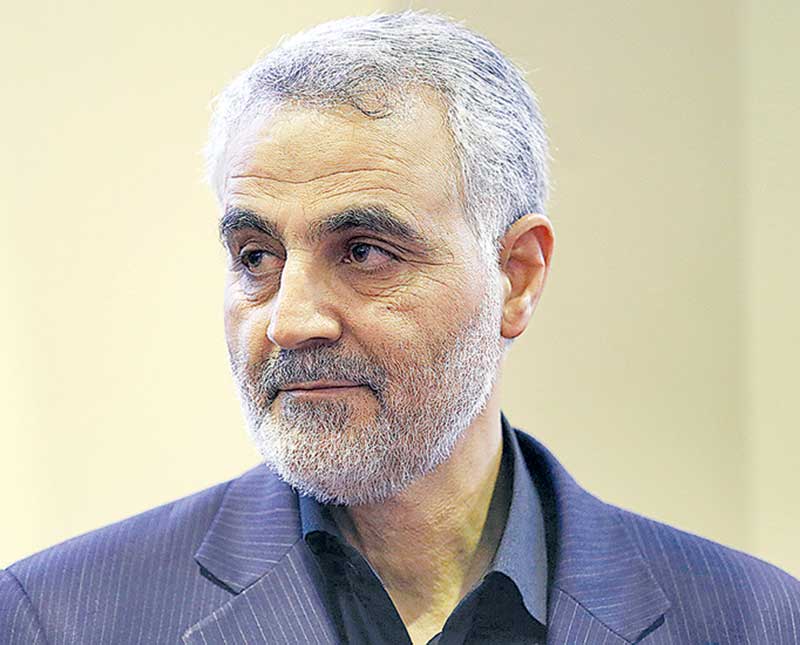
Qasem Soleimani was killed in US airstrike.AFP/rss

BAGHDAD : Iran promised harsh revenge on Friday after a US air strike in Baghdad on Friday killed Qassem Soleimani, commander of Iran’s elite Quds Force and architect of its growing military influence in the Middle East.
Soleimani, a 62-year-old general, was regarded as the second most powerful figure in Iran after Supreme Leader Ayatollah Ali Khamenei.
The overnight attack, authorised by President Donald Trump, was a dramatic escalation in a “shadow war” in the Middle East between Iran and the United States and its allies, principally Israel and Saudi Arabia.
US Secretary of State Mike Pompeo said the strike aimed to disrupt an “imminent attack” that would have endangered Americans in the Middle East. Democratic critics said the Republican president had raised the risk of more violence in a dangerous region. Pompeo, in interviews on Fox News and CNN, declined to discuss many details of the alleged threat but said it was “an intelligence based assessment” that drove the decision to target Soleimani.
The attack also killed top Iraqi militia commander Abu Mahdi al-Muhandis, an adviser to Soleimani.
It followed a sharp increase in longrunning US-Iranian hostilities last week when pro-Iranian militiamen attacked the US embassy in Iraq following a US air raid on the Kataib Hezbollah militia, founded by Muhandis.
Iraq’s prime minister said that with Friday’s attack Washington had violated a deal for keeping US troops in his country.
Israel put its army on high alert and US allies in Europe including Britain, France and Germany voiced concerns about an escalation in tensions.
US officials, speaking on condition of anonymity, said Soleimani was killed in a drone strike. Iran’s Revolutionary Guards said he died in an attack by US helicopters.
The US embassy in Baghdad urged all American citizens to depart Iraq immediately.
Dozens of US citizens working for foreign oil companies in the southern city of Basra were leaving the country. Iraqi officials said the evacuations would not affect output and exports were unaffected.
Oil prices jumped more than $3 a barrel over concern about disruption to Middle East supplies.
Khamenei said harsh revenge awaited the “criminals” who killed Soleimani and said his death would double resistance against the United States and Israel.
In statements on state media, he called for three days of national mourning and appointed Soleimani’s deputy, Brigadier General Esmail Ghaani, to replace him as Quds Force head.
Trump critics called the operation reckless.
“President Trump just tossed a stick of dynamite into a tinderbox,” said former Vice President Joe Biden, a contender in this year’s US presidential election.
As leader of the Quds Force, the foreign arm of the Guards, Soleimani had a key role in fighting in Syria and Iraq.
Over two decades he was at the forefront of projecting the Islamic Republic’s military influence across the Middle East, acquiring celebrity status at home and abroad.
President Hassan Rouhani said the assassination would make Iran more decisive in resisting the United States, while the Revolutionary Guards said anti-US forces would exact revenge across the Muslim world. Hundreds of Iranians marched toward Khamenei’s compound in central Tehran to convey their condolences.
“I am not a pro-regime person but I liked Soleimani. He was brave and he loved Iran, I am very sorry for our loss,” said housewife Mina Khosrozadeh in Tehran.
In Soleimani’s hometown, Kerman, people wearing black gathered in front of his father’s house, crying as they listened to a recitation of verses from the Koran. “Heroes never die. It cannot be true. Qassem Soleimani will always be alive,” said Mohammad Reza Seraj, a teacher.
Iraqi Prime Minister Adel Abdul Mahdi condemned the killings as an act of aggression that breached Iraq’s sovereignty and would lead to war.
Israel has long seen Soleimani as a major threat and Prime Minister Benjamin Netanyahu defended the US action. Israeli Army Radio said the military was on heightened alert.
Russia’s Ministry of Defence called the killing a “short-sighted” step that would lead to escalations in the region.
The slain commander’s Quds Force, along with paramilitary proxies from Lebanon’s Hezbollah to Iraq’s Popular Mobilisation Forces grouping of Iran-backed militias—battle-hardened militias armed with missiles—has ample means to respond.
In September, US officials blamed Iran for a missile and drone attack on oil plants of Saudi energy giant Saudi Aramco. Washington also blamed Tehran for earlier raids on Gulf shipping.
Iran has denied responsibility for the strikes and accused Washington of warmongering by reimposing crippling sanctions on Iran’s main export, oil, in order to force Tehran to renegotiate a deal to freeze its nuclear activities. Soleimani had survived several assassination attempts by Western, Israeli and Arab agencies over the past two decades.
The Quds Force, tasked with operating beyond Iran’s borders, shored up support for Syria’s President Bashar al-Assad when he looked close to defeat in the civil war raging since 2011 and also helped militias defeat Islamic State in Iraq.
Soleimani became head of the force in 1998, after which he quietly strengthened Iran’s ties with Hezbollah in Lebanon, Syria’s
government and Shi’ite militia groups in Iraq.

Page 2
HOROSCOPE

HOROSCOPE

ARIES (March 21-April 19)
**
Today you should be wary of people taking advantage of you. It’s not that you shouldn’t be friendly and generous like you usually are. It’s just that you have to keep an eye out for people who are asking for too much too soon. Plan ahead of the needy people who might try to get on your good side.


TAURUS (April 20-May 20)
**
Tensions might be running high right now, but you won’t have to worry about power struggles today. Everyone seems to be retreating to their own corners for a while, which will give you time to get things done and get out of the war zone when the battles begin again. You can create a positive outcome for yourself.

GEMINI (May 21-June 21)
***
You can see what needs to be fixed in your life right now, and you are starting to come to the conclusion that things need to be radically changed if you’re going to get to where you want to be. But don’t get scared, get empowered! You know you need to do it, and you know how to do it, so do it!

CANCER (June 22-July 22)
***
Money might make the world go ‘round, but you should try not to become too obsessed with it right now. Having too little or too much of it might affect your comfort, but it should not affect your choice of people you want to spend your time with! Friends with different budgets don’t have to throw a wrench into your plans.


LEO (July 23-August 22)
***
Make your personal relationships your top priority, today. You need to find peace and create harmony with even the most difficult personalities. If you are in the midst of a tug of war, let go of your end of the rope. By being so singularly focused on gaining power over someone else, you’re losing sight of what really matters.


VIRGO (August 23-September 22)
***
Being a member of a team is good for you. It brings out your compassion and provides you with the support system you need to stay positive. And if you need to improve on something, a teammate is the best person capable of giving you constructive criticism. If you aren’t currently on a team, that’s easy enough to remedy.


LIBRA (September 23-October 22)
***
A lot of the people in your social circle are looking for fun, but they don’t want to work for it. It’s up to you to pull together some sort of group activity that can keep everyone smiling, and you have the perfect event in mind. Getting input from other people might not be necessary, since they trust you to make the right decisions.


SCORPIO (October 23-November 21)
**
To create greater harmony at home, you need to be focused more on making a compromise than on winning any arguments. Right now, the way things are done, the places where things are stored and the channel that the television is tuned to are all much more important to someone else than they are to you.

SAGITTARIUS (November 22-December 21)
***
If you free yourself from the petty details of life, you will be free to indulge in an exploration of new interests and ideas. So, what does that mean for how you live this day? It means that if someone cuts you off in traffic, don’t waste energy getting mad at them. If you forget where you left your sunglasses, wear a hat.


CAPRICORN (December 22-January 19)
****
Today offers you a great opportunity to stir things up in your life. If you’ve been itching to get your adrenaline going again, this is the day you’ve been waiting for. Getting that jolt might require you to take a risk, but sometimes that is the only way you can get the stimulation you need.

AQUARIUS (January 20-February 18)
***
In a tricky or potentially embarrassing situation today, reach into your brain for a creative idea to solve the problem. Don’t worry, it will be there. And if it’s not right there at your fingertips, have confidence that your creativity will come to the rescue and help you to at least figure out an effective approach.

PISCES (February 19-March 20)
****
You’re a lot smarter than the people who will be around you, today. You’ll be torn between feeling superior and feeling frustrated, because like it or not, you have to deal with these folks. Your charm and their willingness to listen to direction will help things. By the end of the day, you will have accomplished all of your goals.

Page 3
NATIONAL

NCP leadership takes unilateral decision as it picks National Assembly candidates

The party leadership failed to live up to its recent commitment to following due process, accuse leaders.
- TIKA R PRADHAN

KATHMANDU : A secretariat meeting of the ruling Nepal Communist Party has picked 16 candidates for the upcoming National Assembly election, but by doing so, the party has once again violated due process.
According to party leaders, candidates for the National Assembly should be nominated by the party’s provincial committees before they are endorsed by the secretariat. The 16 candidates, however, were unilaterally selected by the secretariat.
Although the top leadership of the party had committed to following due process in the recently concluded Standing Committee meeting, party leaders say that they’ve failed to do so. During the meeting, in a joint political document, the two party chairs had expressed their commitment to running the party through the due process while self-criticising themselves for not doing so in the past.
“The selection of candidates for the National Assembly shows that the leadership has stepped back from its decision in the recent Standing Committee meeting,” said Mani Thapa, a Standing Committee member. “Top leaders of the party had vowed to follow procedures, but that did not last very long.”
The party’s provincial committee chiefs have also objected to the secretariat’s decision, saying that it is their right to nominate leaders for the National Assembly. Satya Narayan Mandal, in charge of the Province 2 committee, said that he was not even asked to select nominations from the province.
“It’s common sense for all leaders and cadres that the party follow procedure and the concerned committees be allowed to recommend names,” said Mandal. “But the leaders didn’t bother to ask the provinces to nominate anyone.”
When asked how the party secretariat could violate the party procedure of decision making while selecting candidates, spokesperson Narayan Kaji Shrestha said that the party had no time to ask the concerned committees for their recommendations as the deadline for candidates to file their nominations is 3pm on Monday. The election itself has been scheduled for January 23. National Assembly members are selected through an election, which has been scheduled for January 23 for all seven provinces. The Electoral College, which elects members of the National Assembly, includes the chiefs and deputies of the local levels and members of the provincial assemblies.
Senior party leader and former prime minister Jhala Nath Khanal, who is a member of the secretariat, admitted that the secretariat should have taken recommendations from the provincial committees but also blamed the time constraint.
“As per the procedure, we should have taken suggestions and recommendations from the concerned provincial committees but we were unable to do that this time around,” said Khanal. “We were running out of time.”
As many as 19 National Assembly positions—eight from the Nepal Communist Party, seven from the Nepali Congress, two from Rastriya Janata Party, and one from Samajbadi Party—will be vacant from March 4 as their two-year term comes to an end. As per constitutional provisions, their positions must be filled 35 days before the end of their term.
Among the 59 National Assembly members, 56 were elected—eight members each from the seven provinces—while three were nominated by the President. The terms—two, four or six years—of all members are decided by a lottery system.
Another Standing Committee member who did not wish to be named said that the self-critical decision of the top leadership did not even stand for two weeks because Co-chairs KP Sharma Oli and Pushpa Kamal Dahal have gotten used to making decisions by themselves. “Why should even leaders defeated in the polls two years ago receive positions in the National Assembly when there are so many leaders who are idle?” the Standing Committee member told the Post.
According to spokesperson Shrestha, the nine-member secretariat has picked Indu Gautam (Woman), Gopi Achhami (Dalit) and Devendra Dahal (Others) from Province 1; Tulasa Dahal (Woman) and Radheshyam Paswan (Dalit) from Province 2; Ganga Belbase (Woman) and Beduram Bhusal (Others) from Province 3; Bhagawati Neupane (Woman) and Narayan Kaji Shrestha (Others) from Gandaki Province; Bimala Ghimire (Woman), Jag Prasad Sharma (Differently-abled and Minorities) and Gopal Bhattarai (Others) from Province 5; Sumitra BC (Woman) and Maya Prasad Sharma (Others) from Karnali Province; and Sharada Bhatta (Woman) and Taraman Swanr (Others) from Sudurpaschim Province.
Among the 16 candidates, a few of them, including Shrestha himself and Jag Prasad Sharma, were defeated in the previous polls.

NATIONAL

Singha Durbar to share up to 60 percent cost to build local government offices

Only 54 percent of the local governments have their own buildings for administrative work.
- PRITHVI MAN SHRESTHA

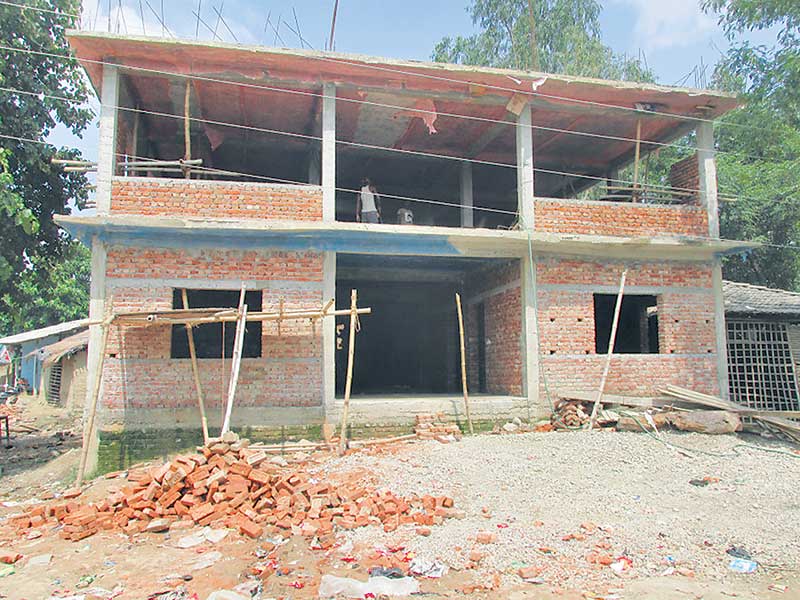
An under-construction municipal office building in Sarlahi district. Post FILE Photo

KATHMANDU : Singha Durbar will foot up to 60 percent of the cost for building local governments’ offices, a senior federal government official told the Post on Friday.
Jaya Narayan Acharya, joint-secretary at the Ministry of Federal Affairs and General Administration, said that as per the Working Procedure on Local Level Administrative Building Infrastructure Development Programme endorsed by the Cabinet on December 30, the federal government will fund as much as 60 percent of the cost for constructing
administrative buildings for rural municipalities.
“The central government will share 50 percent of the cost of construction for administrative buildings for the municipalities. The cost to be shared by the federal government will be 40 percent in the case of a sub-metropolitan city,” said Acharya.
He said the cost-sharing mechanism was introduced to construct the administrative buildings in a partnership model. “Even the provincial governments can share the cost. If they join, the current cost-sharing mechanism may differ.”
In 2018, the Federal Affairs Ministry had prepared a proposal under which the burden of cost-sharing on the federal government was kept as high as 70 percent.
As most of the local governments don’t have their own buildings, the federal government sought to help them with construction. The incomes of most of the local governments still rely on federal grants to run various programmes.
Only 54 percent of the local governments have their own buildings to run administrative works, according to the Nepal Federal Capacity Needs Assessment Report published in August. However, officials say many of them are also not suitable as per the need of the local governments.
Besides a shortage of government employees, the lack of a proper administrative building is another complaint of the local councils. The local elections were held in 2017.
According to Hom Narayan Shrestha, president of the National Association for Rural Municipalities in Nepal, most of the rural municipalities, particularly in the earthquake-affected areas, are crippled by the absence of proper buildings to run the local administration.
Shrestha, who is also the chairman in Sidhupalchok’s Jugal Rural Municipality, the district most affected by the earthquake in 2015, said his rural municipality has offices in makeshift buildings and rented houses, which are not proper for delivering services.
The federal government has, however, left it open for the local government what type of buildings they want. The Federal Affairs Ministry had proposed four models to bring uniformity in the administrative buildings across the local governments.
“But, the participants at the discussions at the Cabinet committee raised the issue that the local governments could prefer to construct a building suitable to local cultures. The working procedure gives the local governments the choice—whether they want to build as per their design or the federal government’s,” said Ram Chandra Shrestha, director general at the Department of Local Infrastructure under the Federal Affairs Ministry.
Currently, the government has not calculated the exact cost of building these structures as the requirement of space could differ depending on the number of employees.
“However, there are certain standards set by the Department of Urban Development and Building for an administrative building which should be adhered to,” said Shrestha.

NATIONAL

Nepal may be becoming a new transit point for drug smugglers

As many as 5,607 people were arrested for drug-related crimes in the first five months of the current fiscal year, data show.

- SHUVAM DHUNGANA

KATHMANDU : On December 21, the Narcotics Control Bureau of Nepal Police arrested two Belarusian nationals with six kilograms of cocaine during immigration check at the Tribhuvan International Airport. The amount of cocaine seized from the two foreigners is the single-largest seizure by the bureau yet. The confiscated cocaine was worth more than Rs150 million, officials said.
The accused were trying to smuggle the cocaine to Hong Kong by a Cathay Pacific flight.
They had concealed the cocaine in jackets, which were kept in their luggage.
Upon interrogation, they said two Bolivians Roberto Carlos Merubia Mariace and Raul Zambrana Ordonez had supplied them the cocaine. Police arrested the duo from Lost Garden Hotel, Lazimpat, on the same day.
“The arrested men had made a meticulous plan to use Nepal as a transit point. Nepal was certainly not the destination country for the contraband,” said Superintendent of Police Birendra Kumar Bashyal, a spokesperson for the bureau. “The case is still under investigation.”
According to Bashyal, during interrogation, the bureau found out that the main supplier lived abroad. “We have already requested the Interpol Nepal to inform the country and arrest the main supplier,” said Bashyal, without revealing the name of the country because the investigation is currently underway.
On December 17, police had arrested another Bolivian national, Herrera Arteaga Olga, 41, from the Tribhuvan International Airport with three kilograms of cocaine.
Olga had arrived in Kathmandu from Dubai and had hidden the cocaine in his luggage.
The number of foreigners being arrested by the narcotics bureau has increased over the years. According to the data provided by the Narcotics Control Bureau, in the past five months alone, 206 foreigners, including Indian nationals, were held for possessing illegal drugs. “This fiscal year alone, the bureau has confiscated more than 12 kg cocaine which is the highest of all time,” said SP Bashyal.
“Expensive drugs like cocaine are not much used in Nepal. They are produced mainly in Latin American countries and are smuggled to countries like Japan, Korea, Australia, and Hong Kong,” said Bashyal.
He added: “However, the bureau has done great work in the past by arresting a number of national and international smugglers from various places. We have our unit working 24 hours in major places like the airport and border areas like Nepalgunj, Birgunj and Kakadbhitta to ensure the arrest of such smugglers.”
Foreign smugglers may have targeted the Kathmandu airport to use it as a transit point because the security check is not so advanced.
“However, we have experienced and hardworking officers who are deployed by the bureau in civil dress to monitor suspicious activities,” Bashyal said.
The Narcotics Control Bureau has 123 officers. “Although the team is working hard, we need drug analyser equipment at the airport to work more effectively,” said an officer at the bureau.
The bureau’s data of the last three years show that drug smuggling cases and arrests are on the rise in the country.
In the fiscal year 2016/17, police arrested 3,607 persons on drug smuggling charges—of them, 159 were foreigners. In the fiscal year 2017/18, it arrested 4,754 persons, including 149 foreigners. In 2018/19, 5,558 people were arrested, including 201 foreign nationals.
During the first five months of the current fiscal year, data show that as many as 5,607 people were arrested for drug-related crimes, including 206 foreigners.

NATIONAL

Kathmandu Metropolitan City once again starts waste segregation campaign

This time, the city office will strictly enforce waste segregation rule, officials say.
- ANUP OJHA

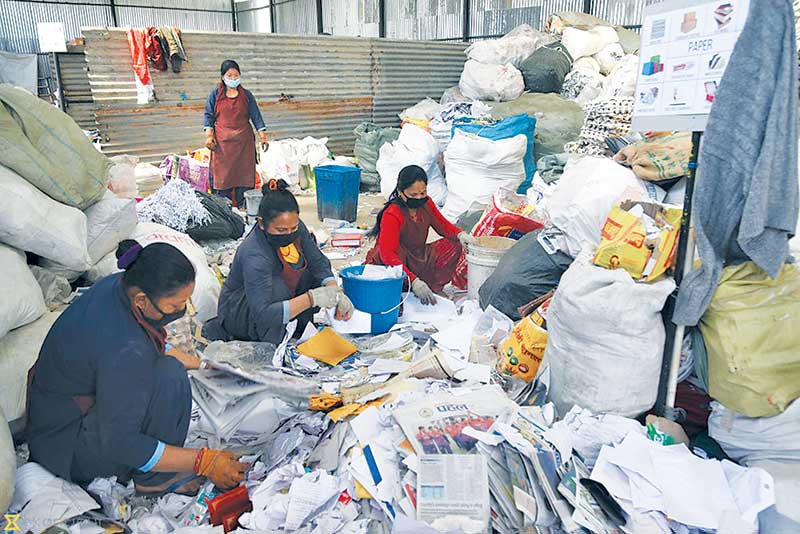
Kathmandu Metropolitan City had previously failed to enforce waste segregation rule.Post Photo: ANGAD DHAKAL

KATHMANDU : After its earlier failed attempt, the Kathmandu Metropolitan City has once again started a drive to collect segregated solid waste from households from the core area. It also aims to take forward the campaign to other wards.
The city office had started a pilot project from Naradevi in Ward No. 18 in with an awareness rally in August-end. The project was supposed to be carried out in Ward No. 12 and 21 as well, but it failed to succeed.
“This time, we are going to monitor it strictly and make the people segregate the waste from each household because we are at the beginning of Visit Nepal 2020 and unmanaged garbage has tarnished the reputation of the city,” said Ishwor Man Dangol, a spokesperson for the Kathmandu Metropolitan City.
This time, the city office is going to extend the drive in Ward No 7, 9, 31 and 32 before taking it to all the other wards.
When the Post asked Environment Division chief of the city office, Hari Kumar Shrestha, as to why it had failed to execute its earlier programme, he said, it was due to the ‘indifference and negligence’ of the locals.
He said all the ward members have already been trained for waste segregation, and they will be deployed to inspect the waste
segregation.
“We have already sent dustbins to all the wards for segregation purposes,” said Shrestha.
This time, the city aims to receive only biodegradable waste on Sundays, Tuesdays, Thursdays and Saturdays, while non-biodegradable waste will get collected on Mondays and Wednesdays.
Littering on the streets, alleys and sidewalks is a perennial problem in the oldest and wealthiest metropolis in the country. Every day, Kathmandu Valley generates 1,000 metric tonnes of solid waste, of which 60 percent is generated within the city.
On January 1, when the metropolitan city allocated Rs 2 million for a week-long extravaganza for Visit Nepal 2020 campaign, the city received widespread criticism for not managing garbage on the roads, its public toilets and numerous potholes dotting its road network.
After public criticism for not being able to manage solid waste, Minister of State for Urban Development Ram Bir Manandhar, Mayor Bidya Sundar Shakya, Deputy Mayor Hari Prabha Khadgi and other representatives from municipalities in Kathmandu Valley visited Banchare Danda, the proposed landfill site for the Valley, on Friday.
Banchare Danda is an alternative to Sisdol landfill site in Okharpauwa, Nuwakot, which is nearing overcapacity.
“Once the road that leads to Banchare Danda is completed, all the waste will be dumped there. Work is undergoing to build a separate Gas plant and compost manure plant in Banchare Danda,” said Dangol.
Shrestha said litterbugs and people who do not abide by the segregation rules will be booked as per the Solid Waste Management Act, 2068 (2011). The Act specifies a punishment of jail sentence up to three months and up to Rs 100,000 fine against those found guilty of polluting public places.

Page 5
NATIONAL

Sugarcane farmers end protest as government promises payments

Farmers and Industry Ministry reach a deal on setting up a task force to study an automated pricing system for sugarcane.
- KRISHANA PRASAIN

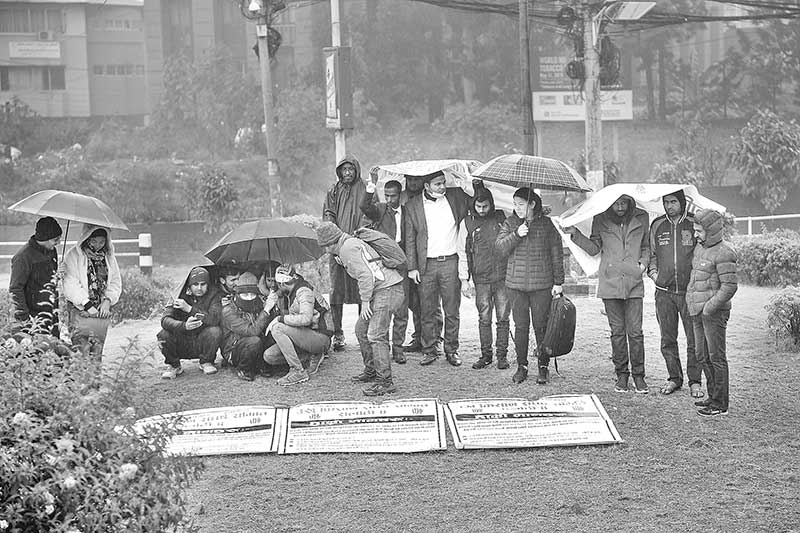
Protesters stand in support for sugarcane farmers despite rain at Maitighar, in Kathmandu, on Friday. post Photo: Deepak KC

KATHMANDU : Sugarcane farmers have withdrawn their indefinite protest following the government’s assurance that the state would get the defaulting sugar mills to pay their outstanding dues by January 21.
On Friday, the sugarcane farmers and the Ministry of Industry, Commerce and Supplies reached a five-point deal that also includes
setting up a task force to study an automated system to fix sugarcane prices every year.
The task force has also been mandated to prepare reports on providing fertilisers, seeds and machinery required for sugarcane farming to make the country self-sufficient on sugar and even export the surplus.
Tussles flare up every year between sugarcane cultivators and sugar
producers over the rates of the crop.
Most of the times, factory owners refuse to clear the dues on time and delay the collection of sugarcane, which is a cash crop that needs
to be harvested and sent for processing on time.
Farmers often incur huge losses because of the delay in their product reaching sugar mills.
The Cabinet on February 26, 2015, had instructed the Industry Ministry to fix sugarcane prices after tussles erupted between the mills and sugarcane farmers, but the policy has not been implemented consistently.
In order to address the grievances that the farmers are not paid the subsidy allocated by the government, the ministry said it would request the Finance and Agriculture ministries to release the amount on time.
The government has also assured the farmers that a public relation unit will be set up at the Ministry of Industry, Commerce and Supplies to address their grievances regarding delayed payment and supply of farm inputs.
“We are now hopeful of getting our money from the sugar mills,” Rajesh Yadav, a sugarcane farmer, told the Post. “We have decided to return home tomorrow. But if things don’t happen as promised by the government, we will come back to protest again.”
According to joint-secretary Dinesh Bhattarai, spokesperson for the Ministry of Industry, Commerce and Supplies, the owner of Annapurna Sugar Mills, Rakesh Kumar Agrawal, came in contact and made payments of Rs5 million on Thursday and Friday.
“He [Agrawal] has made a written commitment to clearing the remaining dues of Rs120 million by January 21,” said Bhattarai.
According to sugarcane farmers, Agrawal owes them Rs500 million in payments. Sugar mills owe more than Rs1.28 billion in outstanding dues to the farmers. Farmers have also complained that they have not received a subsidy of Rs1.32 billion provided by the government.
However, Lok Raj Awasthi, a campaigner for the farmers, expressed his doubts over the agreement reached by the government.
“This type of agreement was made before as well, but farmers have been struggling to get the amount for their products for five years,” he said.
In 2018, the Home Ministry ordered sugar mills that had not been paying the farmers on time to prepare a reliable payment plan, as the debts had been piling up. But the mills ignored the directive.
In February 2014, a delegation of sugarcane producers from Nawalparasi district met with then-prime minister Sushil Koirala and requested him to address their problems.
On January 3, 2011, the local administration was forced to impose a daylong curfew on a 13-km stretch of the East-West Highway in Sarlahi
district following a strike enforced by farmers demanding fixation of cane prices. At least 40 police personnel were injured in clashes with the irate farmers.

NATIONAL

Residents take over extraction of materials from Biring and Tangting rivers

- Arjun Rajbanshi

BIRTAMOD : Arjundhara Municipality has repeatedly issued tender notices to extract riverbed materials from the Biring and Tangting rivers, but the local unit hasn’t reached a consensus with any contractor yet. This has worried municipality officials, given the prospect of high revenue that the contract would generate.
Despite this, the extraction of river materials in the local unit has
continued unabated. Every day, dozens of trucks and trippers have been transporting river materials out of the rivers.
The river was closed from Asadh to Bhadra end. The extraction started after the month of Asoj.
Pankaj Bhurtel, chief administration officer at the municipality, told the Post that the municipality office had issued the contract notice thrice, but nobody has applied yet. The contract’s amount has been set at Rs41.89 million.
However, according to municipality officials, the locals have granted the contract of the river by themselves, claiming that the river flows from private lands. The locals have been collecting riverbed materials from the respective lands that they claim to be theirs.
Municipality officials claimed the locals have been selling the riverbed materials worth millions in hundreds of tractors daily.
“The locals have been keeping the contract from getting any response,” Mayor Hari Kumar Rana said. “They seem to be engaging in selling river materials to outsiders.”
Indra Siwakoti, a local, said that one of the rivers, Tangting, has been flowing over about 60 bighas of land that belongs to a nearby settlement.
“The river changed its course in 2035BS and is currently flowing over private land,” Siwakoti said. “The land used to produce a good amount of crops.”
Siwakoti complained that the municipality hasn’t done anything to keep the river from invading their lands, and refuted the municipality’s claim that the locals are selling riverbed materials.
“We have only dug the channels to clear the excess sand that has accumulated on our lands,” he said.
But another local said that the villagers have been selling river materials at Rs600 for a tripper full.
“The materials have been sold in the mediation of JCB (excavator) operators,” the local, who asked not to be named, said.
“While the locals have been selling the materials at a low price, the entrepreneurs sell it at over three-fold the cost price.”
Mayor Rana said that the municipality would move to punish the locals after obtaining sufficient proof on their ‘illegal activity’.
The locals had obstructed the excavation project granted by the municipality last year as well. This had soured the relationship between the municipality and the contractors, who said that they couldn’t extract river materials worth their money because of the obstruction by the locals.
Last year, the municipality had granted a joint contract at Rs25million for both rivers.

NATIONAL

Court issues arrest warrant against lawmaker Sah in attempted murder case

Briefing
- Post Report

KAPILVASTU: The District Court in Kapilvastu on Friday has granted permission to arrest Abhishek Pratap Shah, a member of House of Representative elected from Kapilvastu-3, for investigation over an attempt to murder charge. Shyam Mishra of Krishnanagar had filed a case against Sah in the Area Police Office 12 days ago. According to Mishra, he was thrashed by Sah and his driver (in Sah’s home) on December 21. Sah is an elected lawmaker from Nepali Congress.


NATIONAL

Two held with a pistol

Briefing
- Post Report

BIRATNAGAR: Police arrested two persons with a pistol and bullets in Itahari, Sunsari, on Thursday. Jagir Khan of Sundar Haraicha in Morang and Jamil Ansari of Harninagar in Sunsari, who were on a motorcycle, were arrested during regular police checking in Kadma Tol, Itahari Sub Metropolis Ward No 8, said police.


NATIONAL

Mid-winter bird count kicks off

Briefing
- Post Report

KAPILVASTU: A nation-wide mid-winter bird count event will kick off on Saturday with the direct involvement of ornithologists, birdwatchers and local communities. The mid-winter bird count will be carried out in around 50 birds habitat (especially in wetlands, lakes and ponds) until January 19, said Som Jisi, an ornithologist.


NATIONAL

167 school buildings reconstructed in Nuwakot

Briefing
- Post Report

NUWAKOT: Out of 364 earthquake-damaged community schools, 167 have already been shifted into new school buildings in Nuwakot district. According to the District Project Implementation Education Unit of the National Reconstruction Authority, the construction work of 197 school buildings is underway. There are 453 schools in the district.


NATIONAL

Cold related diseases on the rise

Briefing
- Post Report

SALYAN: Owing to the growing chill, the number of patients suffering from cold-related diseases in Salyan district is on the rise in the last two days. According to the data of the District Hospital, the hospital has been receiving more than 150 patients on a daily basis. Most of the patients (children and senior citizens) are showing symptoms of common cold, asthma, fever, pneumonia and body aches among others, health workers say.

Page 6
MONEY

US farmers see another bleak year despite Phase 1 trade deal

China’s need for soy and sorghum to feed livestock is waning because of a deadly pig disease.
- REUTERS

Frozen corn is seen on a farm near East Grand Forks, Minnesota, US.reuters 

CHICAGO (UNITED STATES) : Across snow-covered North Dakota, US farmers are stuck with fields full of weather-damaged corn - a crop they planted after the US-China trade war killed their soybean market. Many don’t know yet what crops they’ll plant next season among a host of dicey options.
In Texas, Kansas and Colorado, farmers are weighing whether they should plant fewer acres of corn and more sorghum, even though China has all but stopped buying it. That’s because sorghum costs about half as much as corn to plant, which appeals to farmers wary of investing too much for an uncertain return.
As the US farm economy reels from the worst harvest in decades after nearly two years of the trade war, US grain growers are struggling to
decide what crops might keep them in business.
US President Donald Trump announced last month that China had agreed to double its pre-trade war purchases of US agricultural products over the next two years as part of a Phase 1 trade deal. That brought little comfort to US farmers because China still has not confirmed the commitment or signed any deal.
“President Trump said that we’re all going to need to go buy bigger tractors,” said North Dakota farmer Justin Sherlock. “I don’t think many farmers are going to invest much money until we see that this is a done deal and a long-term deal.”
Trump administration officials say the Phase 1 trade deal with China will be signed in January, though many tariffs will remain in place during further negotiation. Commodity market analysts and agricultural economists warn an agreement won’t be an immediate fix for the US farm economy because the conflict has spurred China to develop new supply chains.
China has, for instance, deepened ties with rival exporters such as Brazil and Argentina. Brazilian soy cultivation is expanding after record exports to China in the past year and China is investing in South American ports.
Making matters worse, China’s need for soy and sorghum to feed livestock is waning because of a deadly pig disease that experts estimate has killed off about half the world’s largest hog herd. China’s hog industry has also worked to reformulate pig rations to include less soy and more alternative feeds that don’t have to be imported from the United States.
“We won’t go immediately back to where we were 18 months ago - maybe not for a long time,” Jay Debertin, chief executive officer of CHS Inc, the largest US farmer cooperative, told grain producers at a recent conference in North Dakota.
Many US farmers have tried shifting crops to dodge the economic fallout from losing such a crucial export market. They planted 76.5 million acres of soybeans in 2019, 14.3 percent fewer than the previous year, according to the latest US Department of Agriculture data. US plantings of sorghum—used in livestock feed and the fiery Chinese liquor baijiu—dipped about 7.5 percent in 2019, to 5.3 million acres. Plantings of cotton have dropped, too, as China pulled back on purchases.
Plantings of such China-dependent crops likely would have fallen much further were it not for the Trump administration’s allocation of $24.5 billion in aid to compensate farmers for trade-war losses. The bailouts gave many farmers an incentive to keep planting crops such as soybeans that they knew would be difficult to sell at any profitable price. Government handouts are expected to account for nearly a third of 2019 net farm income, according to federal government and bank regulatory data.
Trump administration officials have not said if farmers will get more payments in 2020. Robert Johansson, chief economist at USDA, told Reuters he expected the interim trade deal would solve the issues that the aid programme had addressed.
USDA Deputy Press Secretary Alec Varsamis said the agency would decide in January on future payments. White House spokesman Judd Deere declined to comment and referred to previous statements by US Trade Representative Robert Lighthizer, who has said China committed to “massive” US agriculture purchases.
Farmers in export-dependent regions say they can’t continue to sell their crops for below the cost of production without a third round of subsidies to cover the losses.
“If the government doesn’t pay us, we’re done,” said Sherlock, who did not vote for Trump in 2016 and remains undecided for 2020.
Most farmers have backed the president as he seeks re-election, according to polls by Reuters and farm media outlets. In 2016, they were drawn to Trump’s promise to shake up Washington bureaucracy and hoped the trade war, although it might bring short-term losses, would eventually improve the size and scope of China’s US agricultural purchases.
Farmers last season intended to use more of their land for corn—a crop aimed at markets outside China—but that backfired for many growers when extreme weather prevented planting on millions of acres. Early seed orders for 2020 suggest farmers will again turn to corn to replace soybeans, China’s largest agricultural import. Scott Beck—president of Beck’s Hybrids, the largest family-owned US retail seed company—told Reuters that sales of corn seed for 2020 planting are already up about 40 percent from 2019.
Sherlock and many of his neighbours last spring sowed one of North Dakota’s largest-ever corn crops by acreage. They were enticed by rising springtime prices and the promise of trade aid as long as they planted something. They figured their corn would find buyers among domestic livestock or ethanol producers or in established export markets such as Japan, South Korea or Mexico. But bad weather
left almost 60 percent of the state’s corn—about 2 million acres—unfit for harvest at winter’s onset, according to USDA.
Many growers are caught in limbo. Their fields are not bad enough to trigger crop insurance payouts but not good enough to recoup costs. And trade-aid payments for North Dakota are not robust enough to cover losses, with larger per-acre aid payments flowing to southern states.
Sherlock says he might contract to grow more soybeans for a local seed company, a niche crop that costs more to grow but could reap higher prices. Field peas, used in grain-free pet foods, are another option.

MONEY

After Tesla’s record year in Norway, rivals gear up for 2020

- REUTERS

People look at an electric Mustang Mach-E car during its launch in Oslo, Norway.reuters

OSLO : New electric car sales in Norway rose by a third last year amid soaring demand for Tesla Inc’s vehicles, but the pioneering US company will face a more competitive market in 2020 as rivals prepare to launch new electric models.
Fully electric cars made up 42.4 percent of sales in the Nordic country last year, a global record, rising from a 31.2 percent market share in 2018 and just 5.5 percent in 2013, the Norwegian Road Federation said on Friday.
Norway, which is Europe’s biggest oil and gas producer, is seeking to become the first country to end the sale of fossil-fuelled cars by 2025. The country has exempted battery-powered vehicles from the taxes imposed on petrol and diesel engines and after just a few years the streets of Oslo have become quieter and have less air pollution.
Most of Norway’s top-10 cars in 2019 were electric, including Volkswagen’s Golf, Nissan’s Leaf, Audi’s e-tron, BMW’s i3, Jaguar’s I-PACE and several of Hyundai’s models.
New car sales in the country last year were 142,381, of which 60,316 were fully electric. This year, as many as six in 10 of all new cars sold in the country could be fully electric, said Volkswagen (VW) distributor Harald A. Moeller AS, which is preparing to launch several models in 2020.
Other importers predicted the market share in 2020 would be in a range of 50-60 percent of all sales.
“The electrification of the car market is accelerating ... we forecast electric vehicles to hold a 100 percent market share in 2025,” Volkswagen said of the outlook for Norway.
The country’s best-selling car in 2019 was Tesla’s mid-sized Model 3 sedan, which retails from 384,900 Norwegian crowns ($43,721.74),
racking up an 11 percent market share in the California-based firm’s first attempt at cracking the mass market.
Rising global awareness of climate change has encouraged a shift in regulation, technology and consumer preferences, disrupting the auto industry and boosting Tesla’s share price to make it one of the world’s most highly valued car brands.
This year, the company will start producing a medium-sized sport utility vehicle, the Model Y, but faces competition from a plethora of rivals, including by Daimler AG’s Mercedes-Benz, VW’s Audi and Ford Motor Co.
“There will be between 20 and 30 new electric models on the market in 2020, many of them launching early in the year,” the Norwegian Electric Vehicle Association said in a statement.
Ford late last year unveiled the Mustang Mach-E SUV, which it hopes will help turn around its flagging fortunes.
“It will compete with Tesla’s models 3 and Y. I also think Audi e-tron is a big competitor. The customers have waited for this car for over two years,” said Kjetil Hagestande, chief executive of Ford importer RoehneSelmer.
“This amazing car with four-wheel drive and long range fits the Norway market perfectly,” Hagestande told Reuters on the sidelines of the Mach-E launch in November.
Also aiming for a slice of Norway’s market is China’s Geely group, whose Polestar and Volvo brands will begin producing fully electric cars this year.
In October, Polestar opened its first European showroom in Oslo’s most upmarket shopping district, rubbing shoulders with fashion designers rather than with rival auto makers.
“I’m here to consider a new car because my wife already has her second electric car, a Hyundai,” said Espen Cook, a retired IT worker, on a recent visit to the Polestar venue.
“Two months ago I sold my hybrid Lexus so I would like to go full electric,” the 70-year-old told Reuters.

MONEY

Canadian CEOs make 200 times more than average worker: Study

- AGENCE FRANCE-PRESSE

MONTREAL : The 100 highest-paid CEOs in Canada made 227 times more than the average worker in 2018, an unprecedented high, according to a report published Thursday.
“Put another way, by 10:09am on January 2, the average top CEOs will have made as much money as the average Canadian worker will make all year,” according to the annual report published by the Canadian Center for Policy Alternatives (CCPA).
“That’s the earliest time on record in the 13 years we’ve been tracking these numbers.”
Between 2008 and 2018, the 100 highest-paid CEOs saw their salaries increase by 61 percent, compared to the average worker, who only saw a 24 percent rise—a rate more or less equal to inflation, the study found.
Between 2017 and 2018, CEO salaries jumped by 18 percent, while average worker pay rose just 2.6 percent, according to the left-leaning CCPA.
“Wealth continues to concentrate at the very top while average incomes barely keep up with inflation,” said report author David Macdonald.
On average, the top CEOs made Can$11.8 million ($9 million) in 2018, versus about Can$52,000 for the average Canadian.
Most (79 percent) of the average CEO’s pay came from bonuses related to company stock prices, particularly through stock options.
These options are securities that can be converted into shares of the company, which distributes them at an advantageous price set in advance.
In 2018, only four women were among Canada’s richest CEOs, up from only three the year before.
The report also found that CEOs were well-compensated even when their companies reported losses. One third of the companies reported that the five best-paid executives were given an amount equal to at least 40 percent of losses incurred.
Additionally, 13 percent of profitable companies paid their executives more than they paid in income tax.
The CCPA urged the Canadian government to address the pay imbalance and proposed several methods for doing so, including a higher
income tax rate for top executives, the elimination of corporate tax breaks for salaries over Can$1 million and a complete review of loopholes such as stock options.

MONEY

Uber Eats goes local to find its niche in South African food fight

- REUTERS

A flyer advertising Uber Eats delivery service at a restaurant in Cape Town, South Africa.reuters 

SOWETO (South Africa) : A stone’s throw from Nelson Mandela’s former home in South Africa’s Soweto township, Dumile Badela’s restaurant is now more hectic and lucrative than ever, thanks to Uber Eats, his hungriest customer yet.
Having already dominated Africa’s ride-hailing sector, Uber is trying to conquer the food delivery market by leveraging its massive fleet of drivers in the continent’s most developed economy and tracking popular food choices and destinations.
The prize is big. The country’s online food delivery industry was worth 10.49 billion rand ($713 million) in 2019, according to data portal Statista. And with growth pegged at nearly 14 percent annually, it will hit 17.6 billion rand by 2023.
Surprisingly perhaps, Uber got off to a tricky start.
An initial focus on high-end restaurants proved to be a mistake in a country perpetually on the verge of recession.
The San Francisco-based app is now targeting traditional, local fare.
In May, it launched in Soweto, where it works with around 20 partners and is adding more local foods to its 480,000 menu items, dispatching dishes like stewed tripe, caterpillars, cow heels and sheep’s head to mostly middle-class customers who crave a taste of home.
“I’d say Uber Eats has improved our sales by about 15 percent to 20 percent. But I’m targeting even more, up to 50 percent,” Badela says. “There’s huge opportunity.”
It could be a win-win; Uber posted a $1.16 billion third-quarter loss and Uber Eats is the company’s fastest-growing business, contributing more than 10 percent of its quarterly revenue of $3.8 billion.
Uber isn’t alone in wanting a large piece of the South African pie.
Launched in the early 1990s as a call-and-deliver service, South Africa’s Mr D Food—part of Naspers-controlled e-commerce firm Take-a-Lot—is the established player.
Some two million South Africans have downloaded its app. It boasts 700,000 active monthly users, and over the past 12 months processed 1.5 billion rand in food orders.
Uber Eats said it’s recorded 2.1 million app downloads since its 2016 launch, but declined to give figures for food sales.
Between them, the two companies have captured around 80 percent-90 percent of South Africa’s food-hailing market, according to research firm Insight Surveys.
They’ll soon be joined by Bolt, the ride-hailing firm formerly known as Taxify, which is Uber’s main competition in Africa. The Estonian company plans to launch its food delivery service in South Africa early next year.
“There is space for three, possibly four key market players, as the market is still in its infancy and will continue to show rapid growth in the future,” said Yashvir Maharaj, research director at Insight Surveys.
Uber is using data from its rides service to monitor popular food destinations and is tracking popular food searches on the Uber Eats app to gauge what people are craving.
In South Africa, it has found that Soweto and other traditionally black townships have a reservoir of middle-class consumers who may move further afield and crave a taste of home.
“Now that we’re in Soweto we want to take those experiences and expand them to other townships, and go even deeper into Soweto,” Dave Kitley, Uber Eats’ General Manager for South Africa, told Reuters.
“We’re thinking a lot about migration ... When they move, their taste buds move with them.”
That’s something George Makume, the Soweto-raised owner of So Cafe, understands.
Three years ago, he opened his restaurant in the middle-class suburb of Roodepoort, 25 kilometres (16 miles) west of Soweto, noticing a lack of traditional food options despite a growing number of black professionals moving to the area.
“People grew up with this kind of food, but it’s difficult to find unless you travel 20 or 30 kilometres to Soweto,” he said.
Among his best-sellers are skopo—sheep’s head steam-cooked or grilled on an open fire - followed by “Mogodu Mondays”—a 2-for-1 special of spicy tripe and maize porridge.
Since partnering with Uber Eats, and more recently Mr D Food, Makume said his weekday sales have jumped 30 percent-40 percent.
Back at Badela’s restaurant where evening prep is under way, he says there’s plenty of business to go around.
“I’m not the only one in Soweto offering this kind of food. There are many places,” he says. “So if I succeed, the guys selling amanqgina
(pig trotters), namatwana (chicken feet) and skopo will say ‘Yo! I can do it as well.’”
That’s a potential boon for black communities, where unemployment typically outstrips the nationwide average of nearly 30 percent.

Page 7
MONEY

Nepali farmers gather bumper paddy harvest of 5.55 million tonnes

Experts say the government might have manipulated the data to achieve its ambitious 8.5pc growth target.
- SANGAM PRASAIN
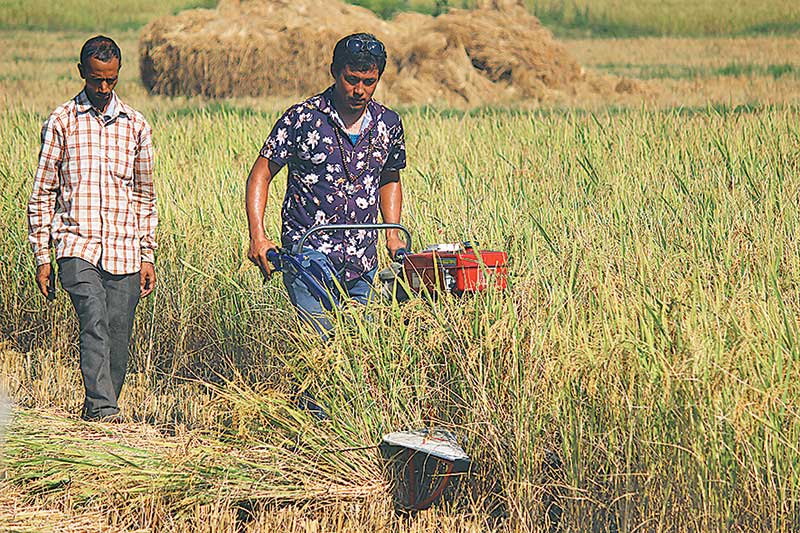
Post file photo

KATHMANDU : Nepali farmers gathered the second largest paddy harvest in history this fiscal year, despite a series of misfortunes ranging from a delayed monsoon, fertiliser shortage and supply of fake seeds to an armyworm invasion, officials said.
As per the Ministry of Agriculture and Livestock Development, paddy output totalled 5.55 million tonnes, only 1.1 percent less than last year’s record harvest.
The Agriculture Ministry released the figures on Friday, almost a month later than usual; and attributed the better-then-expected yield to increased productivity which stood at 3.8 tonnes per hectare.
But some experts are not convinced by the government’s statistics.
“If production has increased despite all the problems reported, it’s a miracle,” said Satya Narayan Mandal, a retired soil scientist. In Province 2, the ministry’s statistics show that productivity increased to 3.76 tonnes per hectare, and that’s improbable.
“Soil health in Province 2 is very poor; and this fiscal year, there was a glaring shortage of chemical fertiliser during the peak paddy planting period. How can we be convinced by the ministry’s data?” he said.
“Besides, the monsoon was not good enough; and irrigation facilities are poor in Nepal, including in Province 2, to support higher growth. There should be some logic to substantiate the growth in productivity. It’s not real. No one will believe this.”
Paddy expert Bhola Man Singh Basnet said he was surprised by this year’s production data. “We had estimated that the paddy crop could drop by at least 8 percent. The data is collected by the government, and we have to believe it because there is no other agency that gathers such information. The production is not justifiable,” said Basnet.
Agriculture Secretary Yubak Dhoj GC had initially estimated that production could drop by 7-8 percent this year owing to varied problems in the farm sector. Some agro experts who spoke to the Post on condition of anonymity said paddy production was the key factor determining the country’s economic growth, and the government may have manipulated the figures to show that its ambitious growth target of 8.5 percent or something close was achievable. Basnet said that Nepal recorded its highest ever paddy production in the last fiscal year, even then imports of the staple grain are ballooning to alarming levels. “There is something wrong somewhere.”
According to the statistics of the Department of Customs, the cereal import bill amounted to Rs51.80 billion in the last fiscal year. Imports of rice and paddy amounted to Rs24.59 billion and Rs6.84 billion respectively.
This year a shortage of chemical fertiliser appeared after the Finance Ministry delayed releasing payment of Rs3 billion to the Agriculture Ministry to import additional supply to make up for reduced purchases due to a stronger US dollar and a price hike in the global market.
The Agriculture Ministry had planned to buy 286,000 tonnes of soil nutrients, but due to the appreciation of the greenback and higher prices in the global market, it was only able to buy 225,000 tonnes.
To immediately resolve the crisis, the Agriculture Ministry was forced to ask the cabinet to approve immediate import of fertiliser from India through government-to-government channels. Subsequently, on June 6, the cabinet allowed the government to import 50,000 tonnes of fertiliser (30,000 tonnes of urea and 20,000 tonnes of DAP).
The Indian government assigned two state-run trading companies—Metals and Minerals Trading Corporation of India and State Trading Corporation—to export fertiliser to Nepal. But these companies did not supply any fertiliser stating that they were out of stock.
In the last fiscal year, the country’s paddy harvest hit a record high of 5.61 million tonnes, up 9 percent year-on-year, thanks to a good monsoon and sufficient supply of chemical fertiliser.
Ram Krishna Regmi, a senior statistician at the Agriculture Ministry, said that the delayed monsoon had affected the paddy transplantation initially during the June-August period, but it was extended by 19 days which has offset the losses.
The monsoon entered Nepal on June 20 and withdrew on October 12 this year. The normal monsoon onset and withdrawal date in Nepal is June 10 and September 23 respectively, according to the Department of Hydrology and Meteorology.
Rainfall was recorded at 96.2 percent. According to the department, 90 to 110 percent rainfall is considered to be normal rainfall for the season. According to Regmi, a hybrid variety of paddy named Garima produced only empty grains in many places this year, but its impact was not big.
The ministry’s investigation showed that the dealer had sold fake Garima brand paddy seeds to farmers during the planting season. A preliminary investigation found that Garima planted on 1,700 hectares produced empty grains. The most affected districts were Chitwan, Kailali, Banke and Bardia.
An armyworm invasion wiped out paddy crops on 17,000 hectares in different parts of the country, according to the Agriculture Ministry. Regmi said that as per the ministry’s observation, the actual scale of damage caused by the armyworm invasion was not as big as reported in the initial stages.
“One of the major factors for increased productivity is the seed replacement rate,” said Regmi, adding that every year farmers
have been replacing the seeds which have helped to increase productivity. “Besides, farm mechanisation has helped growth as farmers in the Tarai region are increasingly using machines.”
The country has witnessed a normal monsoon for three consecutive years, propelling the country to record growth rates of over 6 percent for three years in a row.
The performance of Nepal’s economy is dependent on the farm sector. In the fiscal year 2016-17, the country’s gross domestic product expanded by 7.74 percent, the highest since fiscal 1993-94, largely due to an above-normal monsoon that helped Nepal to secure the biggest paddy harvest of 5.23 million tonnes, in a rebound from two consecutive years of falling harvests triggered by drought.
The economy grew by 6.3 percent in the following year 2017-18, according to the Central Bureau of Statistics.

MONEY

Nepal secures nearly $12 billion from Investment Summit 2019

- PRAHLAD RIJAL

KATHMANDU : Ten months after showcasing 50 infrastructure projects in Investment Summit and after one deadline extension to prospective investors to submit the proposals, the Investment Board Nepal has finally completed the prequalification of companies which are vying to bag 14 such projects.
As per board data, officials have shortlisted proposals for seven agricultural infrastructure projects, five hydroelectric schemes, much-touted Nijgadh International Airport and Kathmandu Outer Ring Road Project, with a combined estimated cost of $11.88 billion.
And, from the list of 14 showcased projects, the board has selected a joint venture of Hydroelectricity Investment and Development Company and Power China to carry out detailed feasibility studies of the 756-megawatt Tamor Storage Hydroelectric Project and has signed Memorandum of Understandings with two companies for detailed study of Rs13 billion multimodal logistics park at industrial towns and trade transit points of Biratnagar, Birgunj and Bhairahawa.
Out of the total applications, the board disqualified 16 proposals and 20 of the total projects are still in the IBN basket as the board did not receive any proposals from investors.
“It is expected that once the projects move towards implementation, it will add to the infrastructure development in sectors of energy, industry, transportation and agriculture, among others,” said Balaram Rijyal, joint secretary of the Office of the Investment Board of Nepal. “At present, the board is also facilitating and implementing 9 infrastructure projects worth Rs565 billion.”
Out of the nine ongoing projects, construction works of 900-megawatt Arun-III being developed by Indian state-owned SJVN at the cost of $1040 million in eastern Nepal are thirty percent complete, $360 million Hongshi Shivam Cement Factory is under operation and planning the second phase of expansion, $140 million Huaxin Narayani Cement is carrying out construction works, informed the Board.
“At a time when the country has become self-reliant in cement and clinker, we are still receiving proposals for new cement factories despite objections from domestic producers,” said Maha Prasad Adhikari, chief executive officer of IBN. “A few years back, we were not able to procure high-quality cement and the price was high compared to regional markets but with foreign plants starting operations in Nepal, we will get high-quality cement and the market has also seen a price correction.”
According to Adhikari, the board is positive on the prospect of facilitating more foreign cement plants in line with the government’s target to make cement an exportable commodity and correct the balance of payments.

Page 9
CULTURE & ARTS

There is an interesting premise, but the performances are better

‘Good Newwz’ is a new entry in a series of films in Bollywood that deals with the issue of sex in a mature way, but couldn’t stay away from stereotypes.
- ABHIMANYU DIXIT

Sex and Bollywood is a tale as old as cinema and equally old is the struggle Bollywood has faced dealing or even talking about sex. In the early days, sex in Indian cinema was representative—two flowers emerged out of nowhere and began shaking and trembling, and we all understood that the actors kissed. Archaic censorship laws meant that the audiences were expected to use their imaginations, like if actors thrust their gyrating hips to lewd lyrics, we understood the metaphor.
Things didn’t change much in the 21st century. But now came audience-friendly sex scenes. Sweaty actors mock kissed each other’s necks, and moaned (always in songs) with their eyes shut. Slowly entered the sex comedies, but these were mostly without any thought or plot featuring perverts who talk in lewd double entendres, objectified women, and got in trouble, all because they want to get laid.
But slowly there seems to a slight shift in the way sex is dealt with in Bollywood. Issue-based sex comedies are being given serious thought and are well written. Sex is no longer the most scandalous thing but rather an everyday reality. Vicky Donor (2012), Shubh Mangal Saavdaan (2017), and Badhaai Ho (2018) proved that you can make a film with sex in the epicentre and still be mature about everything. There are sex jokes in these films, but none of them are indecent. The double
entendres here are situational. The actors talk about sex, but somehow, and yet, more often than not, you can watch these
films with your parents, and not cringe. The latest film, Good Newwz falls in
this spectrum.
Varun Batra (Akshay Kumar) and Deepti Batra (Kareena Kapoor Khan) regard sex as a means to bear a child. They haven’t tried to conceive for the last seven years of their marriage. Now Deepti believes that time is running out. And, the mandatory pressure from friends and family to conceive doesn’t help her cause either. Varun, however, hasn’t really come to terms with being a father, but he agrees to everything Deepti asks him to do. The film begins with Deepti declaring that she is ovulating, and Varun races (literally in a cycle) to her.
Deepti and Varun are portrayed as sophisticated couples, who have done their internet research on positions during and after sex that help conceive. Most of the jokes in the first fifteen minutes are based on this situation. Sex isn’t ever shown in the film, instead it’s comically implied. Sex for this couple is a job. Even after trying their best, Deepti and Varun can’t conceive. So, they ask doctors Anand Joshi (Adil Hussain) and Sandhya Joshi (Tisca Chopra) for help. Their doctors suggest a very potent in vitro fertilisation (IVF), and Deepti and Varun agree.
In the same hospital, we meet another couple. Honey Batra (Diljit Dosanjh) and Monika Batra (Kiara Advani). They are emotional, very reactive, and struggle with the English language. They seem nothing like the sophisticated Batras, but they share the same problems. They too haven’t been able to conceive, and have also agreed to IVF, to be performed by the same doctors.
Things get messed up when doctors Anand and Sandhya apologise to the two Batra couples for a terrible mistake. They confess that the sperm samples from Honey and Varun were switched in the laboratory, because of their similar surnames. Now, Deepti is pregnant with Honey’s sperm, and Monika is pregnant with Varun’s. Now, abortion they’re told is a bad idea because of health conditions, and both couples have to live with the gross negligence. This is where the film breaks for interval.
There isn’t much to the story after that and the film relies on the strongly written characters—it’s four leads. And, the actors who play these characters are easily the high point of the film. The lead, Akshay Kumar is a delight to watch. His portrayal of Varun as a mean, selfish orthodox man, who lives in the ideologies of the 90s, but is learning the ways of the new millennium is a delight to watch. Kumar’s casting feels on point, also because he’s playing very close to his age. His wife Deepti, played by Kareena is also equally good. Deepti is the stark opposite of Varun. She is controlling and demanding, and although they might not sound like an ideal couple, these actors and their performances will make you believe that the two perfectly complement each other.
Honey and Monika are written as the Punjabi stereotypes. They are everything a Punjabi song is—loud, flashy, blunt, but jolly. This could have been a catastrophe in the hands of incapable actors because both Honey and Monica are written as very conventional characters. However, because of the fabulous performances of Advani and Dosanjh, the audiences see beyond the exterior Punjabi stereotypes.
The film is written by Jyoti Kapoor, Rishabh Sharma (dialogues), and Raj Mehta (director). The writing is brisk, and filled with sharp humour in the first half But through the second half, the film starts feeling formulaic and stretchy. And that’s mostly because all the emotional and melodramatic moments are reserved for the second half. However, the humour aspect is maintained throughout and it saves the film.
The writing, however, isn’t without flaws. For example, the writers seem to be a little too invested in the idea of lineage. Two major characters in two different instances are saying things like, ‘The obsession to pass on your genes is a very deep one’ and, ‘Akhir apna khoon toh apna hi hota hai na?’ (In the end, own blood is what matters, no?). These are statements by the doctor and Deepti respectively. But strangely the film doesn’t carry these values and never even deals with the issue any more than the dialogues. The writers could have also definitely dealt better with the Punjabi stereotypes.
In hindsight, it’s as if the writers found one interesting idea and designed everything else around that one premise. However, in order to maintain their interesting premise, they stayed away from developing the story any further. Also, at times, the film focuses too much on culture and traditions, making it feel like this film isn’t aware of the contemporary India. In their bid to maintain the dramatic twists in the plot, the film portrays a clear anti-abortion stance. Both the doctors, and Varun and Deepti discuss abortion, but they quickly shut down as soon as the topic comes up. Deepti doesn’t want an abortion because, she says, “We can’t be murderers.” An accomplished celebrity, Kareena Kapoor Khan, calling abortion murder can’t be the message contemporary India needs.
All said and done, we must appreciate the film, first for its actors and second for bringing issues like this in the mainstream, and for treating the issue with respect. Commercial Indian cinema has always struggled dealing with sex. It has always been an eyebrow raising, scandalous issue and therefore it’s a welcome change that makers of today want to do more than jiggle flowers.

Dixit is a filmmaker, film educator and film campaigner based in Kathmandu.

CULTURE & ARTS

Harry Potter themed fundraising event to be held at Malpi Institute today

Proceeds from this year’s Hogwarts Express will be used to organise art workshops for cancer survivors.
- Post Report

Participants of the last year’s Hogwarts Express event organised by The Children’s Art Museum of Nepal make wands and pose for photographs with a broom, hat and iconic Harry Potter glasses. Post Photos: Anish Regmi

The Children’s Art Museum of Nepal is organising their annual fundraiser event, the Hogwarts Express, on January 4 at Malpi International College in Baluwatar.
Organisers say the fourth iteration of the event, inspired by the Harry Potter books and movies, has been growing every year. “When we started out in 2017, only 70 people showed up. But last year around 400 people showed up. The event is gaining popularity which has been helpful for us,” says Nistha Shrestha, director at Children’s Art Museum of Nepal.
The Children’s Art Museum Nepal provides children and youth a safe space to express themselves through creative activities that have an educational component to it, says Shrestha. Fundraisers like the Hogwarts Express help the museum fulfil its goal of making art accessible to all children.
“We do art workshops regularly and these events help us take art to children who don’t have the resources to do so. As schools don’t have enough money to host these events, these events along with other donations help us organise these workshops which we also take outside the Valley,” says Shrestha. “This year, the proceeds will go to cancer survivors.”
Like last year’s event, there will be a variety of paid and free activities and games for all. Activities will include making wands, crafting potions, creating charms and other Harry Potter-inspired games. Harry Potter-themed merchandise—from robes, scarves, screen-printed t-shirts and notebooks—will also be on sale.
Participants can also play a round of Quidditch, fill out Harry Potter colouring pages, and make a Lego Hogwarts Castle. The event will also have food counters selling unique Harry Potter-themed food items, like Butter Beer and Chocolate Frog. “People can also buy their own Hogwarts robes at the event,” says Shrestha.
One of the most anticipated activities of the night, however, is the Triwizard Trivia Tournament, where teams will test their knowledge of the books and movies in a quiz competition to see who the biggest Potter-head is. Interested participants, however, will have to register prior to the event.
Tickets for the event are available at Khalti, Children’s Art Museum of Nepal (Hattisar), Flat Iron Grill at Hotel Ambassador (Lainchaur), Malpi International College (Baluwatar), Nana’s Delight (Patan Dhoka) and Sweet Fix (Freak Street).
Starting this year, Children’s Art Museum of Nepal is also inviting Harry Potter cosplayers to this event whom event-goers can interact and take pictures with.

Page 10
EXPRESSION

Portraits from the frontlines of global protests

Volleys of tear gas became a familiar sight in traditionally peaceful and stable Hong Kong.
- REUTERS
Mohammad Anas Qureshi, 20, a fruit vendor, with the national flag of India in front of riot police during a protest against the new citizenship law in Delhi, India.Photos: Reuters

Protests swept the globe in 2019, with millions of people taking to the streets from Catalonia to Colombia, Haiti to Hong Kong.
Each movement had its own trigger. Some were fed up with corruption and entrenched elites. Others wanted democracy or independence.
Some called for reforms and others opposed them. Worries over climate change and environmental destruction also galvanised activists worldwide. The frustrations were sometimes similar, from inequality to powerlessness.
Often the protests turned violent, with security forces killing several hundred people in Iran, Iraq and elsewhere. Volleys of tear gas became a familiar sight in traditionally peaceful and stable Hong Kong.
Yet amid the gunfire and clouds of tear gas, there was a global solidarity as demonstrators drew on each other’s determination and strength.
“Right now we are in a stage of awakening and we have to take advantage of that,” said Andres Felipe Vargas, a professor joining an anti-government strike in Bogota, Colombia.
“What is happening in our country, and these injustices that generate inequities, are the same injustices that are destroying the planet,” he said. In Algeria, Amiri Yacine, who joined rolling demonstrations since February in opposition to the elite that has controlled the country since independence in 1962, likewise feels his demands are universal.
“I am protesting against injustice and dictatorship,” said Yacine, 26, holding a poster depicting the world’s protests as a blossoming flower, packed amongst hundreds of mostly young demonstrators in Algiers. “We want to build a new Algeria.”
“My message to protesters is just be peaceful—be wise and keep calm. Fight the system with good ideas, because they don’t have ideas.”
Summer has turned to winter in Hong Kong, where demonstrations against a controversial extradition bill turned into a push for greater democracy.
The Beijing-backed government has refused to yield, while the protesters have gathered in vast numbers, turning shopping districts into a sea of black-clad people. “This is a universal demand for democracy and fairness,” said Jasper, a 27-year-old bank worker, who joined a downtown protest at lunchtime. He cut a suave figure, in a suit, red-and-blue striped tie and pocket square, standing on Pedder Street in the city’s central district.
The movement has invited comparisons with protesters pushing for independence for the Spanish region of Catalonia, where the sentencing of separatist leaders to long prison terms led to renewed and sometimes violent protests.
“We’re here, mainly young people, outraged by the sentences and the inability of politicians to talk,” said Barcelona student Axel Buxade, 18, holding a Catalan flag at a demonstrators’ camp on a city street.
“There have been acts of mutual support, if they reach their goal we’ll be very happy,” he said, referring to Hong Kong.
Economics, and in particular inequality has also proved potent fuel for protests in Lebanon, Chile, Ecuador and Iraq.
“People in the world are tired of injustice,” said Chilean Alex Munoz Fuentes, a 47-year-old accountant, standing before a burning barricade on a Santiago street.
“I don’t want anything given for free,” he said, the national flag in one hand and a pair of goggles to protect him from the effects of tear gas in the other.
“But I know that in Chile the institutions, the law and the constitution are made to abuse the working classes. I want a new deal.
“Hong Kong is similar, the authorities are not thinking about people’s well-being. I have a fraternal hug for them, and all my solidarity from Chile. Please don’t give up.”

Jasper, 27, during a demonstration in Central Hong Kong, China.


Alex Munoz Fuentes, 47, with a Chilean flag in Santiago, Chile.


Axel Buxade, 18, with a Catalan flag during a protest at University Square in Barcelona, Spain.

Umm Mahdi, 66, an Iraqi demonstrator, during the ongoing anti-government protests, in Baghdad, Iraq.

Andres Felipe Vargas, 52, at a protest during a national strike in Bogota, Colombia.

Page 11
AS IT IS

The bite-sized myopia of poetry

The frontrunner of new culture of ‘Insta-poets’, Rupi Kaur’s work do not add anything to the larger poetic narrative.
- Bibek Adhikari

Earlier this week, when Ruman Aalam in The New Republic declared Rupi Kaur—the Indian-Canadian poet known for her aphoristic poems on Instagram—as the ‘Writer of the Decade,’ all I could do was stare at the screen, unable to comprehend the looming dismal reality.
Aalam’s main argument is that her work is “within the parameters of a smartphone screen,” the only constraint modern readers are accustomed to. By embodying technology with contemporary life, Kaur has created scribblings (along with authentic sketches) about self-love, sexual abuse, feminism, and much more.
But does that explain the 3.5 million copies of the sale of her books? For one reason, Kaur’s writing is extremely accessible. A 15-year-old with little or no knowledge of poetry may cursorily scan her verses and explain what she’s trying to say. You don’t have to reach for a dictionary, scratch your head over a metaphor, or read the same line over and over. You don’t even have to be an English major to unknot the tangled strings of allusions, myths, and symbols—because there aren’t any. Another reason is, she likes to state the obvious, hacking prose into enjambed lines that look like poetry. For instance, let’s take this work of hers: “the rape will / tear you / in half // but it / will not / end you.” Her lazy use of line breaks is self-evident. And what’s more—she’s making a commonplace sentence sound profound: a perfect feat for her readers who nibble on her bite-size Instapoetry.
Moreover, she speaks to millions of her readers because she makes them think that she cares. By infusing the elements of love and sex as well as feministic adages, she helps her readers make sense of this incomprehensible world. If you are unsure how to pour your heart out to your recent highschool crush, Kaur has a solution for it. Or, say there’s a black hole in your heart that’s eating you up from the inside, don’t worry, Kaur has got you covered. Maybe someone abused you, either at home or workplace, Kaur will simplify the trauma in sweeping generalisations. So, all you’ve got to do is sit back, swipe across the screen (or flip the pages, if you may), enjoy the new form of avant-garde poetry—the only way the world is going to read and write from now on.
That’s her strength.
However, if you are a literary snob, you will soon realise there’s nothing more than what is apparently put on the screen or page. Unlike the poems of William Carlos Williams, there is no energy beneath the prosody of Kaur’s. Unlike his poems, readers don’t find any subtext—the powerful interplay of themes and ideas—beneath her work. What she states is obvious and vacuous. Read all of her poems from Milk and Honey or The Sun and Her Flowers, and you’ll notice how she likes to state the banal without any hint at craftsmanship. Her poems are byproducts of inefficiency and ignorance.
Let’s look at one of her works: “the way you speak of yourself / the way you degrade yourself / into smallness / is abuse.” Overlooking the simplistic use of diction and all too obvious idea, one can still question—is her poetic engagement of trauma a defence of her lack of subtext or style? Is she trying to “sell” the idea of sexual abuse by masquerading a self-help tone in her poems? Is it because she speaks of female trauma that other female readers are able to connect to her words?
Since she engages her readers with bits and pieces of her personal trauma, they fail to see the bad quality of her language—the formulaic and shallow use of words. That makes her look like an authentic writer describing an image that comes from her personal space. From marriage to sex to rape to femininity to race, she has marketed herself as a self-help poet, who’s willing to speak the pain of a million other women.
She openly rejects the literary establishments and doesn’t like to be compared with other mainstream poets. By ridiculing the literary magazines in her interviews, and by self-publishing, she has made a mark. As for the question of why she writes what she writes, she puts it quite bluntly—“I write to document that we were here.” By “we” she’s speaking of women, who went through pain and took time in healing. In that sense, she thinks she’s representing the whole womankind—the worst possible folly a writer can commit—and she believes she’s speaking on behalf of them.
As for the style that is so important in poetry, Kaur lacks the basics. On her website, she explains the reason for using only lowercase and periods in her poetry. Since she wanted to write in her mother tongue, Punjabi (but failed), she adopted the linguistic sensibilities of that language. As the Gurumukhi script in Punjabi only has lowercase and period, she used that concept in English. Also, she has little or no idea why she’s using all those random line breaks and enjambments. Paying no heed to the heritage of words, she resembles an amateur who sits in front of the piano for the first time and hits whatever key in whatever way she likes.
To borrow Oscar Wilde’s famous saying and twist it to suit the context—“There’s no such thing as a subjective poem. Poems are either well written or badly written.”
And when it comes to Kaur’s poetry, they are absolutely badly written with lackluster language and the illusion of profundity—all kept together using a simple type font on a white background accompanied by a cute little drawing.
But some people need a cute little lines to make sense of their cute little worlds, and that’s okay. Still, the unvarnished truth is, if Rupi Kaur is the ‘Writer of the Decade’ for her soft readers of poetry, the decade is (probably) not a good one.

Adhikari is a writer based in Kathmandu. He tweets @bibek_writes.

AS IT IS

Will 2020 let Nepalis see better days?

The present administration should realise the government can’t retain its power without taking people along.
- Mohan Guragain

At the onset of 2020, Nepal is a country plagued by multiple problems, but two issues need urgent attention. The government, which basically exercises state power to carry out general administration, has the primary responsibility of defending its people and the territory.
Since individuals can’t resort to violence to protect themselves or others, people of all classes and at all levels need protection. The very rationale behind people giving the state coercive power and a share of their income is with the hope that the collective strength protects them in times of emergency and for national defence. Diplomacy, thus, becomes imperative to counter foreign aggression.
I don’t see much exaggeration in saying that Nepalis, in general, are helpless people, at home or abroad. Our youths fighting in foreign armies or working as immigrant labours, toiling in the Arabian desert, are essentially at the mercy of the forces we have no say about. Within the country too, people are generally defenceless against all sorts of problems—economic hardships, extreme weather, disasters, loan sharks and shrewd businessmen fleecing people. Workers and farmers are among the most vulnerable lots.
To focus on the second, take the emblematic case of Sarlahi farmers. They travelled to Kathmandu as the last resort to protest against sugar mills that did not pay them for years, even as they pocketed the subsidies provided by the government for the cultivators as support price.
The government’s response to their protest, and whether the sugar mill operators will be forced to pay their dues, are mere reactions to what these farmers had to go through. The major issue here, in the first place, is that the farmers had to borrow a few thousand rupees at high-interest rates to flock to the centre, beyond the jurisdictions of the local and provincial governments, demanding justice.
This speaks volumes about how people continue to suffer to the worst possible extents even as there are elected representatives and state institutions that are supposed to deliver justice. This presents another symptom of state failure even as the KP Oli administration commands an overwhelming majority, not just in Kathmandu but most provincial headquarters.
What worth is a government if it can’t defend its people? Then comes the age-old and several unresolved border issues with India. The latest being New Delhi’s evident territorial aggression when it published a new map to account for the bifurcation of Jammu and Kashmir into two centrally governed regions. In the process, Nepal’s Kalapani in the western frontier was deliberately shown as part of India. In Kathmandu, the government presented a weak defence to safeguard Nepal’s territory that has been illegally occupied by Indian forces for decades.
Our government seems to have drawn New Delhi’s attention to the unacceptable act of aggression, but the Narendra Modi government does not appear to have taken Nepal’s objection seriously. It does not even commit to a foreign secretary-level meeting that Kathmandu has demanded to discuss outstanding border issues.
Successive governments in Nepal don’t seem to have taken the issues of people and the country seriously. Had that been the case, several of the pressing problems such as corruption, backwardness, illiteracy, poverty and unemployment would have long been resolved.
In the post-1990 democratic era, political parties had succeeded in wrongly convincing people that political instability had restrained the nation from marching towards prosperity. This was the reason people overwhelmingly voted for the communist coalition in 2017 to install a powerful government in Singha Durbar.
The mighty Oli administration had a chance to right many of the country’s wrongs from the start, while letting the nascent federalism take root as provisioned by the new constitution.
Despite the pro-nation image Oli had built fighting India’s economic blockade in 2015, and his self-proclaimed anti-corruption stance, a string of latest decisions seem to favour a certain interest. The unified Nepal Communist Party (NCP) still functions as a front united to cover up its weaknesses, rather than a consolidated political party.
The myth of strong governments delivering on their promises is busted also considering that the 30-year Panchayat government commanded by the king failed to lift the country out of poverty. Two majority Nepali Congress governments were hamstrung by infighting in the democratic era that followed, and the Maoist-led government didn’t complete a year as the revolutionaries refused to take the old forces into confidence while making drastic moves.
The present administration should realise the government can’t retain its power without taking people along. Policies that trample on popular aspirations fail, eroding the government’s mandate and credibility.
Given the prime minister’s frail health, state administration appears slack, but his rivals and opportunists are acting with extra vigour to push through policies and legislations that further empower the governing class and weaken the people. Many of his party colleagues are conspiring to benefit in the situation arising from the premier’s health condition.
Oli may have been directing the state affairs with a failed kidney, but he must mind the national business with full attention and a robust heart. Many believed Oli had little to extract from the state resources for purposes other than his medical treatment. Let’s hope he doesn’t have other personal commitments to fulfil when he perceives his position in Baluwatar to be momentary.
Nepal’s communist parties are not tired of invoking the people in their statements. But when it comes to bailing them out of problems like the Sarlahi farmers’, will their hands do the actual service?
If there was a pro-people government, desperate farmers wouldn’t have to beat their chests for their losses and crop failures. Only when there is a government that cares for people, will people perceive state mechanisms as their guardians, and not tormentors. Had the administration been carrying out pro-poor policies, villagers would have warm clothes to put on and comfortable beds to sleep in the winter chill. People would have access to basic sanitation, clean water and essential healthcare.
When out of power, parties make national defence and independence their political slogans. Do the slogans still ring in their ears, when the nation calls upon their actions? Or are the walls of Singha Durbar too thick to let people’s cries in? Will 2020 let Nepalis see better days?

The writer tweets @GuragainMohan.

Page 12
BOOKS

TS Eliot letters to muse to be unveiled after 60 years

Lifelong friends, Emily Hale and Eliot exchanged letters for about 25 years beginning in 1930.
- CHRISTINA PACIOLLA

After more than 60 years spent sealed up in a library storage facility, about 1,000 letters written by poet TS Eliot to confidante Emily Hale will be unveiled this week, and scholars hope they will reveal the extent of a relationship that’s been speculated about for decades.
Many consider Hale to not only be his close friend, but also his muse, and they hope their correspondence will offer insight into the more intimate details about Eliot’s life and work. Students, researchers and scholars can read the letters at Princeton University Library starting Thursday.
“I think it’s perhaps the literary event of the decade,” says Anthony Cuda, an Eliot scholar and director of the TS Eliot International Summer School. “I don’t know of anything more awaited or significant. It’s momentous to have these letters coming out.”
Lifelong friends, Hale and Eliot exchanged letters for about 25 years beginning in 1930. The two met in 1912 in Cambridge, Massachusetts, but did not rekindle their friendship until 1927. Eliot was already living in England and Hale taught drama at US universities, including Scripps College in California.
In 1956, Hale donated the letters under an agreement they wouldn’t be opened until 50 years after either her or Eliot’s death, whichever came second. Eliot died in 1965. Hale died four years later.
Biographers say Eliot ordered Hale’s letters to him to be burned. Their relationship “must have been incredibly important and their correspondence must have been remarkably intimate for him to be so concerned about the publication,” Cuda says.
TS Eliot was born in St. Louis, Missouri, in 1888 and gained notoriety as a poet early in life. He was only 26 when ‘The Love Song of J. Alfred Prufrock’ became his first professionally published poem.
Eliot’s 1939 book of whimsical poetry, Old Possum’s Book of Practical Cats, was adapted into Cats, the award-winning musical by Andrew Lloyd Webber. The play opened in London first in 1981 and then on Broadway the next year. It was then turned into a feature film starring an ensemble cast that includes Judi Dench and James Corden just released in December.
His best known works include The Waste Land, The Hollow Men and Four Quartets.
The first poem in the ‘Quartets’ series, called ‘Burnt Norton,’ piques the interest of enthusiasts of the poet, says Eliot scholar Frances Dickey, because of lines that suggest missed opportunities and what might have been with his muse. The poem is named after a home in England that Eliot visited with Hale in 1934.
“His relationship with her seems to be deep and meaningful and it’s a door he chose not to open,” she said.
The letters could also reveal details about Eliot’s conversion to Anglicanism, something he deeply cherished, Dickey says.
Dickey, who served as one of the editors on The Complete Prose of TS Eliot, said the poet was deeply ashamed of his marriage to his first wife, Vivienne Haigh-Wood, whom he was with for more than 15 years. Dickey said the letters could reveal just how close he and Hale were and if the two ever considered marriage.
“Was this an epistolary romance they would carry across the Atlantic?” Dickey said. “What role did she play in his emotional life?”
Eliot’s letters to Hale began after that first marriage ended. Whatever else she was, Hale was a link to the life Eliot had left behind in the United States as a young man, Dickey said.
“He was really thinking more about the United States and his childhood during the period where he was in correspondence with Hale,” says Dickey. “I have a feeling that having a relationship with an American woman helped him to uncover his past in a way.”
The unsealed boxes, which also contain photographs, clippings and other ephemera, were actually opened at the library’s special collections area called Firestone Library in October for cataloguing and digitizing. Daniel Linke, interim head of special collections at the library, was part of the team working on the 14 boxes. He said there was very minimal, if any, reading.
He said that scholars from around the world will be traveling to Princeton in the first days they are available since they are copyrighted and won’t be made available online.
“It will be the special collections equivalent of a stampede at a rock concert,” Linke said.
—Associated Press

BOOKS

In defence of economic liberalism

Ram Sharan Mahat’s recent book debates on mainstream economic meta-narratives, their applicability and practical implications.
- ACHYUT WAGLE

The discourse of political economy in present day Nepal is heavily skewed to the left-of-the-centre. It is evident since the country’s political atmosphere is overwhelmingly dominated by the faces and forces that are unmistakably communist in orientation. The intellectual defenders of the liberal order of political economy, that too through a systematic review in publication, are far rarer. In such a scenario, Ram Sharan Mahat, a Nepali Congress stalwart and six-time finance minister of Nepal since the restoration of multi-party democracy in 1990, is among a few of the rarest advocates of the liberal, free-market economy.
His recent book Trials, Tremors and Hope: The Political Economy of Contemporary Nepal unequivocally highlights the importance of an amalgamation of liberal political and economic orders for faster growth and prosperity. He calls the new book a sequel to his one-and-a-half-decades old publication, In Defence of Democracy: Dynamics and Fault Lines of Nepal’s Political Economy (2005). The 12-chapter book released last month debates on mainstream economic meta-narratives, their applicability and practical implications viewed through the lens of an experienced practitioner and a staunch reformer. The book also excavates into current economic concerns and discusses the probable future course of, largely, corrective actions and strategies required to keep the Nepali economy viable in the long-run.
The author draws his point home in favour of a mixed but uncompromisingly liberal economy through four major perspectives: one, comparative analysis of key theoretical expositions that now shape the global as well as national debate on economic and development policies; two, as a sworn democrat and a disciplined member of the historic Nepali Congress party; three, as a technocrat who knows the ins and outs of managing the state treasury and; four, a ruthless reformer ready to risk the political opposition given the fact that benefit of any extensive policy and institutional reforms often invited instant resistance and criticism, even as the desirable results could only be felt in the long term.
In the first chapter, Mahat has painstakingly chronicled the evolution of the ideology of socialism, its several forms and their relevance in the contemporary world. His effort to marry the role of the state (in the event of a market failure and also as a responsible custodian of the social contract to ensure economic justice and equality) with market freedom (with unrestricted space for private sector-led investment and productivity) goes a bit overboard—but represents the current framework of Nepal’s mixed economy. His interpretation of feasible socialism as a “market that works for people” is not, in essence, socialism of any form. But he seems compelled, as a Congress leader, to defend socialism at least in some contextualised form. This is because Nepali Congress has not been able to shed the term ‘socialism’ as an overarching socioeconomic goal from its formal literature, and the current constitution also aims to ‘orient’ Nepal towards socialism—albeit, without defining what exactly the term ‘socialism’ means.
The reference in the book about his discussion with the late BP Koirala, the founder of Nepali Congress, on what exactly socialism meant for Nepal provides a wider latitude of interpretation, which effectively makes the very tag irrelevant. BP did not, reportedly, claim his interpretation of socialism to be the final truth. He apparently thought the idea would be vetted and scrutinised for its viability and utility. Mahat also makes the interesting revelation that Koirala, as a visionary thinker, had foreseen the consequences of what the present-day global debate of climate change would focus on. “The essence of BP’s views was being against the pursuit of unrestrained growth driven by excessive greed, joblessness and disproportionate use of the Earth’s finite resources leading to unsustainable and irreversible consequences,” Mahat mentions in his book.
Above and beyond anything, the mainstay of the book, rightfully, is the agenda of economic reform—both accomplished and pending. Mahat, who served as the vice-chair of the National Planning Commission under the first elected government after the political change of 1990, is the undisputed architect of Nepal’s economic reform. Working under that Nepali Congress-led government, he laid the blueprint to liberalise the Nepali economy. The policy reforms that covered a wide range of areas including fiscal discipline, taxation, the financial sector, trade openness, divestment and privatisation, and extensive opportunities given for the private investment marked a paradigm shift. As a result, the role of the private sector has expanded; compared to that of the state, private entities have a far larger investment in key areas of the economy like banking and finance, aviation, health and education services, surface transport, agriculture, tourism etc. These policy reforms initiated by Mahat and his team then were subsequently implemented and consolidated during his multiple tenures as finance minister. This undoubtedly helped Nepal to maintain overall macroeconomic stability even during the decade-long Maoist insurgency, which he has termed in the book as a major political tremor.
The book with interwoven themes of political and economic developments that took place in Nepal—mainly over the past three decades have chapters on the pangs of writing a new federal constitution, Nepal’s geo-political imperative as a ‘yam’ between two boulders, the boons and perils of a remittance-dependent economy and a detailed account of the current state of the country’s economy. His successful role, as finance minister, in garnering substantial international support for post-earthquake recovery and reconstruction, after the 2015 natural disaster, is covered in a dedicated chapter. The final chapter, ‘Challenges and Tasks Ahead’, provides an informed prescription for Nepal’s current and future policy-makers, regardless of whichever political ideology the government subscribes to. He sees the need for creating institutions at the sub-national levels to make the new polity of federalism functional and the country prosperous. He advises for a rational approach with an emphasis on austerity, efficiency and growth in productivity. Uncharacteristically though, for a seasoned politician himself, Mahat’s way-out from the current mess is that: ‘The excessive preoccupation with politics and factional interests must give way to social mobility, quality governance, meritocracy and social justice.’
On the flip side, the book somehow misses on igniting much-needed, extensive debate on potential long-run strategies to control the alarming instances and magnitude of corruption that engulfs the highest political class. The future of federalism now hangs in precarious balance due to the rapidly burgeoning informal economy, which is about to displace the formal one. Some things that should have been covered, but the book fails to address, are the short-run priorities of the economy like enhancing productivity growth mainly of the industrial sector which has now fallen below the five percent of the GDP, employment generation which effectively is zero in the formal sector, containing the trade deficit that already has become unsustainable and reversing the absolute lack of absorption capacity of the resources by the government(s). The missing ‘hows’ in the book, necessitate another ‘sequel’ from the author.

Wagle is an econo-political analyst.
He tweets @DrAchyutWagle.

Page 13
WORLD

Indonesia flood rescuers hunt for missing after 43 killed

Around 192,000 residents have been evacuated to temporary shelters, with around a dozen people still unaccounted for after record rains that started on New Year’s Eve.
- AGNES ANYA,DESSY SAGITA

Indonesian rescuers mounted a desperate search on January 3 for those missing after flash floods and landslides sparked by torrential rains killed at least 43 people across the Jakarta region, leaving whole districts under water and thousands homeless. AFP/rss

Indonesian rescuers mounted a desperate search Friday for those missing after flash floods and landslides sparked by torrential rains killed at least 43 people across the Jakarta region while health authorities raced to prevent disease outbreaks.
Around a dozen people were still unaccounted for after record rains that started on New Year’s Eve pounded the capital and left swathes of the megalopolis, home to some 30 million, under water and with thousands homeless.
Around 192,000 residents have been evacuated to temporary shelters, according to authorities, with any unable to return to waterlogged homes in neighbourhoods turned into wastelands of debris and overturned cars.
“We’re encouraging people whose houses are still inundated to go to a safer place,” said National Disaster Mitigation Agency spokesman Agus Wibowo.
The agency said 43 people had been confirmed dead in Greater Jakarta and neighbouring Lebak regency in the south of Java island.
Waters had receded in many areas and power, which had been shut off across many districts, was being restored.
In hard-hit Bekasi, on the outskirts of the city, swampy streets were littered with debris and crushed cars lying on top of each other—with waterline marks reaching as high as buildings’ second floors.
The government said Friday it would start cloud seeding to the west of the capital—inducing rain using chemicals sprayed from planes—to prevent approaching rainfall from pounding the region.

‘Everything’s gone’
Using inflatable boats to evacuate residents trapped in their homes, including children and seniors, rescuers said they were targeting the hardest-hit areas of the city on Friday.
Shelters filled up with many refugees, including infants, resting on thin mats as food and drinking water ran low.
“It’s impossible for me to go back to my home,” said 72-year-old Lumongga Siregar.
“We have no clean water right now ... and we’re hoping for more food because there isn’t much,” she added. Mother Dewi Puspitasari worried about her one-year-old daughter’s health.
“The blanket and mat I’ve got here aren’t thick enough for her and we’re scared she will get sick,” she told AFP.
Indonesia’s health ministry said it deployed some 11,000 health workers and soldiers to distribute medicine, disinfectant hygiene kits and food in a bid to stave off outbreaks of Hepatitis A, mosquito-borne Dengue fever and other illnesses, including infections linked to contact with dead animals.
In hard-hit Lebak outside Jakarta, residents started the slow process of cleaning up their deluged homes.
“Everything’s gone,” said shop owner Aminah, who goes by one name.
“I couldn’t bring anything ... I left it all because I got scared at how high the water was getting.”

‘Phenomenally bad’
Around Jakarta, a family—including a four and nine-year-old—died of suspected gas poisoning from a portable power generator, while an eight-year-old boy killed in a landslide and an 82-year-old pensioner were also among the victims. Others died from drowning or hypothermia, while one 16-year-old boy was electrocuted by a power line. Most services have been restored although some commuter train lines were still suspended Friday.
Jakarta is regularly hit by floods during the rainy season, which started in late November.
But this week’s disaster marked Jakarta’s worst flooding since 2013 when dozens were killed after the city was inundated by monsoon rains.
“This year’s flooding was phenomenally bad because of the extremely high rainfall,” said Yayat Supriatna, a Jakarta-based urban planning expert.
But Jakarta’s myriad infrastructure problems, including poor drainage and rampant overdevelopment, worsened the situation, he added.
“Yes, the weather conditions were terrible, but this was exacerbated by awful urban planning,” Supriatna said.
Indonesian President Joko Widodo has announced a plan to move the country’s capital to Borneo island to take pressure off Jakarta, which suffers from some of the world’s worst traffic jams and is fast sinking due to excessive groundwater extraction.
—Agence France-Presse

WORLD

Turkish lawmakers authorise sending troops to fight in Libya

Greece, Israel and Cyprus call Turkey’s planned Libya deployment ‘dangerous escalation’.
- SUZAN FRASER

Members of Turkey’s parliament vote to send Turkish troops to Libya to help UN-supported government in Tripoli battle forces loyal to a rival administration in eastern Libya.AP/rss

Turkey’s parliament on Thursday authorised the deployment of troops to Libya to support the UN-backed government in Tripoli that is battling forces loyal to a rival government seeking to capture the capital.
Turkish lawmakers voted 325-184 at an emergency session in favour of a one-year mandate allowing the government to dispatch troops amid concerns that Turkish forces could aggravate the conflict in Libya and destabilise the region. The Tripoli-based government of Libyan Prime Minister Fayez Sarraj has faced an offensive by the rival regime in the east and forces loyal to commander Gen Khalifa Hifter. The fighting has threatened to plunge Libya into violent chaos rivalling the 2011 conflict that ousted and killed long-time dictator Moammar Gadhafi.
Turkish President Recep Tayyip Erdogan said last month that Sarraj requested the Turkish deployment after he and Sarraj signed a deal that allows Ankara to dispatch military experts and personnel to Libya. That deal, along with a separate agreement on maritime boundaries between Turkey and Libya, has led to anger across the region and beyond.
Ankara says the deployment is vital for Turkey to safeguard its interests in Libya and in the eastern Mediterranean, where it finds itself increasingly isolated as Greece, Cyprus, Egypt and Israel have established exclusive economic zones paving the way for oil and gas exploration.
“A Libya whose legal government is under threat can spread instability to Turkey,” ruling party legislator Ismet Yilmaz argued in defense of the motion. “Those who shy away from taking steps on grounds that there is a risk will throw our children into a greater danger.”
The government has not revealed details about the possible Turkish deployment. The motion allows the government to decide on the scope, amount and timing of any mission. Erdogan and U.S. President Donald Trump held a telephone conversation and discussed the situation in Syria and in Libya, the Turkish president’s office said soon after the vote. A brief statement said they discussed “the importance of diplomacy in solving regional issues.”
Egypt’s foreign ministry condemned “in the strongest language” the Turkish parliament’s authorisation to deploy troops, saying Turkey would carry full responsibility for the negative effect it would have on the stability of the Mediterranean region. Egypt, which neighbors Libya, has backed the regime in the country’s east.
The leaders of Greece, Israel and Cyprus denounced the move as a “dangerous threat to regional stability” and a “dangerous escalation” of the Libyan conflict that violates U.N. resolutions and undermines international peace efforts.
“The repercussions of such a reckless move will be dire for the stability and peace of the entire region,” Greek Prime Minister Kyriakos Mitsotakis, Cypriot President Nicos Anastasiades and Israeli Prime Minister Benjamin Netanyahu said in a joint statement after signing a deal for a pipeline conveying east Mediterranean gas to Europe.
“Ankara should refrain from taking such action, which blatantly violates Libyan national sovereignty and independence.”
Numan Kurtulmus, deputy chairman of Turkey’s ruling party, welcomed parliament’s vote, telling CNN-Turk television the mandate “will ensure that the legal government in Libya remains in place and Turkey’s natural rights (in the Mediterranean) are maintained.” He added that the mandate does not mean that “troops will be quickly sent tomorrow to conduct operations.”
Turkish Vice President Fuat Oktay told state-run Anadolu Agency that Turkey would send “the necessary number (of troops) whenever there is a need.” But he also said it would not dispatch forces if Libya’s rival government halts its offensive.
Turkey’s main opposition party, CHP, had vowed to vote against the motion arguing that the deployment would embroil Turkey in another conflict and make it a party to the further “shedding of Muslim blood.”
Before the vote, CHP leader Kemal Kilicdaroglu called on the government to work for the establishment of a United Nations peacekeeping force in Libya.
Kurtulmus, the ruling party official, said the mandate does not exclude a peacekeeping force. He said, however, the government believes that UN peacekeeping missions were not successful in ending conflicts in the past.
Two other opposition parties voted against the motion.
“We cannot throw our soldiers in the line of fire of a civilian war that has nothing to do with our national security,” Aytun Ciray, a member of the opposition Good Party, said during the parliamentary debate. However, Erdogan’s ruling party is in an alliance with a nationalist party, and the two held sufficient votes for the motion to pass.
Fighting around Tripoli escalated in recent weeks after Hifter declared a “final” and decisive battle for the capital. He has the backing of the United Arab Emirates and Egypt, as well as France and Russia, while the Tripoli-based government receives aid from Turkey, Qatar and Italy.
—Associated Press

Page 14
SPORTS

Top of the table clash in league on Monday

Champions Manang take on Machhindra after the schedule was revised due to rain and unplayable field conditions.
- Prarambha Dahal
Machhindra Club’s Sujal Shrestha (right) and Somide Oluwawunmi Adelaja (centre) celebrating against NRT on December 30. Both of them were key to Manang’s title success last season.POST PHOTO: KESHAV THAPA

KATHMANDU : With less than half of the Martyrs Memorial ‘A’ Division League season gone by, consequences of Monday’s match between Manang Marshyangdi Club and Machhindra Club may have little to do with silverware decisions at the end of the season.
However, the ‘clash of the titans’ is certain to draw traction among ardent football followers as the two teams have a few things in common—six players who swapped sides and their title aspirations.
Leaders Manang Marshyangdi Club take on Machhindra Club, currently
at second place, when the tournament resumes on Monday. The clash
was previously scheduled for a 3pm kick-off on Saturday. However,
the fixture has been revised due to ‘rain and unplayable field conditions
of the Dashrath Stadium’ as stated by ANFA, the apex football governing entity.
The much-awaited match between the teams separated by a single point at the top of the standings will follow the game between New Road Team and Jawalakhel Youth Club slated for a midday kick-off.
Machhindra trail the leaders only because of the deduction of a point as they had finished second from bottom in the preceding edition of the tournament which did not feature a provision for relegation.
Star midfielder Anjan Bista, one of four national players suspended by ANFA for violating the players’ code, is likely to make a comeback for Manang, the defending champions against Machhindra who boast a star-studded lineup after making top recruitments in the season break. 
The battle of the contenders is certain to be an acid test for Nepal Under- 23 captain Sujal Shrestha, former Nepal captain Biraj Maharjan, custodian Bishal Shrestha, midfielder Bishal Rai, defender Devendra Tamang and forward Somide Oluwawunmi Adelaja of Nigeria. All
players who now play for Machhindra had shone for Manang, the runaway champions last year.
While both clubs have conceded just a single goal, Machhindra boast a better goal difference as they have found the back of the net twice more than Manang. MMC, the record winners of the league with eight titles, have scored five goals in their four matches so far.
Despite having to do with a depleted squad in comparison to the previous season, Manang have dropped points only after being held by Friends Club in the fourth round of the tournament.
It was, however, a better result for Manang as they had lost to the same opponents in the last edition of the league. In the other fifth-round matches, Friends Club play against Himalayan Sherpa Club in the only match on Tuesday. Friends are placed second from the bottom with a single point but are buoyed after holding the champions as they take on Sherpas who are just a point and a position ahead of them at 12th in the table.
On Wednesday, seventh-placed Brigade Boys play against Three Star Club, sixth, both sides also separated by a point. Santosh Sahukhala will be aiming to complete his 100th goal in the league’s history as Chyasal Youth Club play against Nepal Police Club also on Wednesday.
Other departmental teams Armed Police Force and Tribhuvan Army Club play against Sankata Club and bottom-placed Saraswoti Youth Club respectively on Thursday.

SPORTS

Ibrahimovic looking to lift AC Milan

- AGENCE FRANCE-PRESSE

MILAN : Swedish star Zlatan Ibrahimovic warned Friday he was not back at AC Milan as a mascot but for the “last bit of adrenaline” and to lift a club he loved out of a difficult situation.
“I’m not here as a mascot to dance for the fans next to the Devil (Milan
mascot),” the 38-year-old told a press conference in Milan. “I’m looking for the last bit of adrenaline I might have.
At my age you’re not looking for anything else but a challenge. When
you’re 38 and get hired by AC Milan it’s something that doesn’t happen
very often, coming here means I still have something to give. I got more
requests now than when I was 28,” he continued.
Ibrahimovic has signed a six-month contract worth 3.5 million euros ($3.9 million) with the option for an additional year. It will mark the Swede’s second stint with Milan, seven years after he left for Paris Saint-Germain.
He played for the Rossoneri from 2010- 2012 scoring 56 goals in 85 appearances and helped the club win their 18th and last league title in 2011.
One of the most successful clubs in the world the seven-times European champions are 11th in the table just seven points above relegation. Milan chief football officer Zvonimir Boban contacted the Swede after he left Los Angeles Galaxy in October and the calls intensified after a 5-0 loss to Atalanta last month, their heaviest defeat in 21 years.

“After Atalanta I got lots and lots of calls, it wasn’t a difficult decision in the end,” continued Ibrahimovic.”Last time I left Milan I didn’t want to leave.
Milan gave me the happiness of playing football, I hope this will be true again. Things need to be improved in the field and that’s why I’m here.”
Ibrahimovic said that going to the United States after his career-threatening knee injury at Manchester United had refuelled his passion.
“After two MLS championships I feel more than lively,” he said. “It’s not that I can play like when I was 28 or 35, things change but you know what you can do. Rather than running you can kick a ball from 40 metres,” he smiled.
Ibrahimovic started his career at Malmo in his native Sweden. He went on to play for Ajax, Juventus, Inter, Barcelona, Milan, PSG and
Manchester United, winning trophies with all these clubs.
AC Milan’s first game after the winter break will be at home against Sampdoria on Monday.

SPORTS

Liverpool edge Sheffield United to finish the year unbeaten

Salah and Mane score for the runaway leaders who open up 13-point lead atop the standings. Liverpool are unbeaten in 51 top-flight matches at Anfield since April 2017.
- AGENCE FRANCE-PRESSE

Sheffield United’s John Egan (left) duels for the ball with Liverpool’s Sadio Mane during their English Premier League match at the Anfield Stadium in Liverpool on Thursday.AP/RSS

LIVERPOOL : Jurgen Klopp hailed “exceptional” Liverpool after they made it an entire calendar year without a Premier League defeat as the runaway leaders beat Sheffield United 2-0 on Thursday.
Klopp’s side moved 13 points clear of second placed Leicester thanks to
goals from Egypt forward Mohamed Salah and Senegal winger Sadio Mane at Anfield. Liverpool’s 19th win in 20 league games this season completed an incredible 12 months for a team at the peak of their powers. The Reds haven’t lost in 37 league games since a defeat at Manchester City on January 3, 2019 and it looks certain they will
win the English title for the first time since 1990.
With a game in hand to further bolster their advantage, it would take an
astonishing collapse to deprive Liverpool of their holy grail. “It says a lot of positive things. I have not enough words for it, it is exceptional,” Klopp said. “I’m really happy and really proud of the boys. We should not take things like this for granted.”
Winners of their last 18 home league games, Liverpool are unbeaten in 51 top-flight matches at Anfield dating back to April 2017.
As if it wasn’t hard enough to beat Liverpool already, they are proving more impregnable than ever lately.
This was their fifth consecutive topflight clean-sheet — the first time they have managed that since 2007 — and they completed more passes than any team in one match in the Premier League era.
“The way we controlled Sheffield United was exceptional. In possession we were incredible, we were calm but lively as well. The goals we scored were exceptional,” Klopp said. “It’s obviously good (to go unbeaten for a year) but the target was not to extend this, but to win the game. We did not think about the one year (undefeated).
We have season resolutions, not New Year resolutions!” After a golden 2019 saw Liverpool crowned European and Club World 
champions, the next target is ending Manchester City’s two-year spell as champions after narrowly missing out last season. Their sights set on domestic bliss, the new year started just as the old one finished, with Liverpool setting standards of excellence that rival anything achieved by City’s breath-taking team.
Premier League immortality is within touching distance as Klopp’s men are already over halfway towards an unbeaten league season that would replicate the incredible feat of Arsenal’s 2003-04 Invincibles.
Liverpool hadn’t even kicked off when they suffered what could have been a distracting blow as Naby Keita was replaced by James Milner after being injured in the warm-up. But the Reds are far too polished to lose focus and they were in front within four minutes.
Their win at Bramall Lane in September had come thanks to a mistake from United keeper Dean Henderson and once again Liverpool
benefitted from a Blades blunder.
When Virgil van Dijk played a long pass towards Andrew Robertson, it should have been easy for George Baldock to deal with. But Baldock lost his footing and fell over, allowing Robertson to advance and cross low to Salah, who got in front of Jack O’Connell to steer in a clinical closerange finish for his 14th goal of the season.
Ahead of their first visit to Anfield for 13 year, Chris Wilder’s down-toearth side took the unusual decision to train alongside the public on
Stanley Park in the shadow of the famous stadium. The session was interrupted when a dog decided to use one of the training cones as a toilet.
That unpromising omen proved apt as the visitors’ hopes of a shock result were flushed away.Liverpool’s ability to press any
opponent into submission and deliver the knockout blow with their lethal front three has made them virtually unplayable over the last 18 months.
United were the latest victims as Mane wrapped up the points in the 64th minute. Running onto Robertson’s pass, Mane broke into the area and took Salah’s return pass before firing gleefully into the roof of the net after his initial shot was saved.

SPORTS

Norway upset US at ATP Cup

- AGENCE FRANCE-PRESSE

PERTH : Emerging youngster Casper Ruud notched the biggest victory of his career after beating big-serving John Isner on Friday to spearhead Norway’s stunning upset over the United States on the first day of the inaugural ATP Cup.
The 21-year-old levelled the Group D tie with a 6-7 (3/7), 7-6 (12/10), 7-5 win
over the world number 19 in two hours and 43 minutes. He saved two match points in the second set and weathered 33 aces from Isner, after Taylor Fritz thrashed Viktor Durasovic 6-2, 6-2 in the opening match in Perth. Ruud then backed up in the decisive doubles alongside Durasovic to down Rajeev Ram and Austin Krajicek 4-6, 6-3, 10-5 and trigger jubilant scenes from the Norwegian contingent, who were the last team to qualify for the 24-nation event which is also being played in Brisbane and Sydney.
“I didn’t have much time to recover from my singles,” Ruud said. “I was a little bit low (on energy) but I got the feet going and we played great. The players are super proud to beat US.” The world number 54 has risen up the rankings over the past year since  training alongside Rafael Nadal at the world number one’s academy in Mallorca. Ruud, whose father Christian is Norway’s captain, clawed
back into the singles match and stormed out to a 6-4 lead in the second set tiebreak, but was thwarted on his set points by a desperate Isner. He saved two match points in a see-sawing set before finally converting on his fifth attempt to keep Norway alive. It appeared the match was going the distance in the third set until an inspired Ruud broke in the 12th game to clinch his first victory over a top-20
ranked player.

Earlier, world number 32 Fritz gave heavily favoured United States the perfect start with a commanding victory over Durasovic in 61 minutes.
“For the first match of the year, I played really well,” the 22-year-old said. “Last year was my breakthrough, but I always put pressure on myself to do well.” Fritz — ranked 300 places higher than his opponent — unleashed his big serve with 11 aces and returned accurately to underline the gulf in rankings.
The match was played under the roof due to unusually cool and damp morning conditions in Perth. The new tournament replaced the Hopman Cup, a popular annual mixed-teams fixture in Perth for three decades.Russia face Italy in the second Group D tie later Friday.

SPORTS

Ton-up Labuschagne puts Aussies in strong position

- AGENCE FRANCE-PRESSE

Australia’s Marnus Labuschagne celebrates after completing his century against New Zealand during their third Test match at the Sydney Cricket Ground on Friday.AP/RSS

SYDNEY  : Marnus Labuschagne hit his fourth century in just 14 Tests to guide Australia into a commanding position against virus-hit New Zealand on the opening day of the third Test in Sydney on Friday.
The rock-solid number three, last year’s leading Test scorer with 1,104
runs at 64.94, again proved the Black Caps’ nemesis with his second ton of the series to continue his remarkable scoring sequence. Supported by Steve Smith’s 28th Test half-century, Australia reached stumps at 283-3 with Labuschagne unbeaten on 130 and Matthew Wade a breezy 22 not out.
The South African-born Labuschagne has now scored four centuries
in seven Test innings this southern summer against Pakistan
and New Zealand. “Terrific day,” he said. “When you bat on day one you
know it can be a real prosperous day but if you get off to a shaky start it can be tough work. It’s all a bit of a whirlwind at the moment. I haven’t really sat down and completely thought about how amazing this summer has been for me.”
Smith, who took 39 balls to get off the mark, shared in a 156-run stand with Labuschagne before he again missed out after a lengthy stay and was caught at slip off Colin de Grandhomme for 63 off 182 balls.
David Warner fell again to the leg-side trap on the third ball after lunch when he was caught by de Grandhomme at leg gully off Neil Wagner for 45.
It was the fourth time in the series left-armer Wagner has snared Warner, who has yet to reach a half-century against New Zealand this summer after scoring an unbeaten 335 and 154 against Pakistan last November.
Opener Joe Burns was dismissed in the 15th over, squared up by de Grandhomme and caught by Taylor at first slip for 18. De Grandhomme opened the bowling with Matt Henry after senior paceman Tim Southee was surprisingly left out of the attack.
Australia won the toss and chose to bat against the visitors, who made five changes to the team that lost the Boxing Day Test in Melbourne by 247 runs. The Black Caps went into the Sydney Test without skipper and star batsman Kane Williamson, who has been ill in the lead-up. Batsman Henry Nicholls and spinner Mitchell Santner were other illness withdrawals while Southee lost his place to leg-spinner Todd Astle. Paceman Trent Boult is also missing after returning home with a broken hand suffered in the second Test in Melbourne. Batsman Glenn Phillips, who made a late dash to Sydney as cover on Thursday, was named to make his Test debut, with opener Tom Latham to lead the side in Williamson’s absence.
Will Somerville, Matt Henry and Jeet Raval were also called into the side, while the Australians were unchanged after considering Mitchell Swepson as a second spinner. Australia have been unbeatable this season, winning all four Tests at home — two each against Pakistan and New Zealand — after retaining the Ashes in England.

Page 16
DESTINATIONS

Five destinations you should visit while in the ancient space of Mustang

The main draws of the ancient Mustang are the antique, mysterious caves and palaces, lakes, and the Tibetan-inspired culture and lifestyle.
- GHANASHYAM KHADKA

A file photo shows Jomsom Airport with the snow-capped Nilgiri South peak in the backdrop. Post Photos: Ghanashyam Khadka

In Mustang, one of Nepal’s remotest districts, the air is almost always cold and damp. Located in the rainshadow, the district receives infrequent rain, even during the monsoon. Mustang is located on the Tibet-Tethys Series, a geographical delineation dominated by fossiliferous rocks, and shares more culture, language, religion and traditions with Tibet than with Nepal. The district is bordered by mountains on all sides—Tibet to the north and the Nepali districts of Manang, Dolpa and Myagdi in south, east and west. Today,
all of the Mustang’s local units--Thasang, Gharpajhong, Bahyagaun Mukti Kshetra, Loghekar Damodar Kunda and Lo Manthang--have been connected with roads.
Ever since a motorable road reached the Mustang-Tibet borders, tourists have been flocking to the area. According to the Area Police Office, a total of 1,200 domestic tourists visit the border area daily during October and November. According to National Nature Conservation Trust, over 4,000 international tourists visit Lo Manthang every year.
Upper Mustang only opened up to the world in 1994 and the region has seen considerable changes. The number of restaurants and hotels is on the rise. According to the Hotel Entrepreneur’s Committee, there are currently 30 hotels in Lo Manthang, established on investments ranging from Rs3 million to Rs 200 million. Collectively, these hotels have 228 rooms and 500 beds.
Given all that Mustang has to offer, here are five destinations you should definitely visit while in this ancient space.

Mysterious caves and the palaces
Mustang’s civilisation dates back about 3,000 years. In Lo Manthang, in Upper Mustang, there are a plethora of caves carved out high up in the sandy hills. These ‘sky caves’ are mysterious, leaving visitors wondering about the lives of locals in primordial Mustang. There is still no consensus on who carved out these caves, and why or when.
These caves are major tourist attractions and rich sources of research into the religious and social lives of the locals of Mustang. According to Annapurna Conservation Area Project (ACAP), there are about a hundred such caves in Mustang.
Thupchhan Chhimi Gurung, an 89-year-old local from Lo Manthang, says that the caves were constructed as a hideaway from gangs incoming from Tibet in ancient times.
“These caves also served as penance sites for religious leaders,” he said.
The most iconic of these caves is the Jhong Cave in Chhoser which is five storeys high and has 150 rooms. There are wooden ladders to climb up the cave’s upper levels. The ticket price to visit the cave has been set at Rs100 for Nepali tourists and Rs500 for foreigners. There are many palaces in Lo Manthang that are of historical importance. The most illustrious of them, Lo Manthang durbar, is currently under the ownership of the progeny of Jigme Parawal Bista, an ancient king. The palace, which has five storeys, was partially damaged by the 2015 quakes and it has since been closed to visitors.

Dhumba—the heart-shaped lake
Dhumba lake is just about an hour’s walk from Jomsom, the headquarters of Mustang. It is located in Sambe village in Gharpajhong Rural Municipality, at an altitude of 2,862m above sea level, and is known as the ‘heart-shaped lake’. The lake is 130m wide, 160m long and 10m deep. It takes about 15 minutes to complete one rotation of the lake on foot. Dhumba Lake overlooks Thorong Peak and Nilgiri North to the east, Manapathi to the west, and Dhaulagiri
and Tukuche Peak to the south, and Thini village to the north.
Sharmila Gurung, deputy chief of the rural municipality, said that her office is preparing a master plan to preserve and promote the lake’s religious and natural significance.
“Dhumba is the centre of Mustang’s religious and cultural faith,” she said. “The water here is not just water but a pious liquid offered to Lord Buddha.” Besides Dhumba, there are other lakes around such as Titi Lake and Damodar Kunda, famous for their colourful waters.

Mustang Eco Museum
This museum is located just beside Jomsom Airport and features significant artefacts of Tibetan culture, the life story of the famed Japanese monk Ekai Kawaguchi known for his explorations in Mustang and Tibet, photographs of the many tribes of Mustang, and their tools and utensils. In another section of the museum, there are photographs of Mustang’s geology, along with and shaligrams and rare rocks. Shaligrams are fossilised sea shells which attest to the fact that this arid mountainous desert region was once under water.
The museum also doubles as a library, featuring books related to the Bon and Nguhyum religions. There are statues of the Buddha, Manjushree, Padmasambham, Avalokiteshwor, Dipankar, Maitreya, and Bajrakilaya Kuber, among others.

Thini Home Stay
Thini is known as the place of origin of the Thakali tribe. The village, also known as Sumpa, is a closely-clustered settlement of 110 households that overlook mountains such as Nilgiri North and South, and Tilicho lake. The Kaligandaki River flows from below the hill where Thini rests.
In Thini, apple farming dominates the traditional crops of potatoes, buckwheat, wheat and maize. A community homestay came into operation in Thini three years ago.
“Since three years ago, Thini was closed to the outer world—a shadow under the lamp,” said Nirajan Thakali, secretary of the homestay operation committee. “The community homestay changed all that. Locals now understand the value of tourism.” The homestay naturally provides typical Mustangi food and an experience of Thakali culture.

Yaruju View Point
The view point falls along the way to Tilicho Lake from Thini village. There is a motorable road up to Yaruju, and visitors can reach there from Thini in about three hours. Yaruju gives you perhaps the best view of Jomsom to the south and the apple village of Marpha to the north and almost all parts of Upper Mustang. It takes about two days walk to reach Tilicho from Yaruju, but the local administration is currently extending the road up to Namulekh. Once construction is complete, visitors can reach Tilicho in a single day.
“We have formulated a master plan to develop tourism around here, identifying possible destinations and promoting them,” said Gurung of Gharpajhong Rural Municipality. “One of our aims is to ease visitors’ trips to Tilicho.”

Jhong Cave in Lo Manthang, Upper Mustang.

Muktinath Temple. 

Walled city of Lo Manthang. 

The heart-shaped lake of Dhumba.

Thini village, a closely-knit settlement of 110 households, has a Thakali homestay.