Provincial leaders balk at ruling party’s directive to name Province 3 ‘Bagmati’
Nepal Communist Party’s diktat on the name and capital of the province has been criticised by provincial assembly members for infringing on the spirit of federalism.
- TIKA R PRADHAN
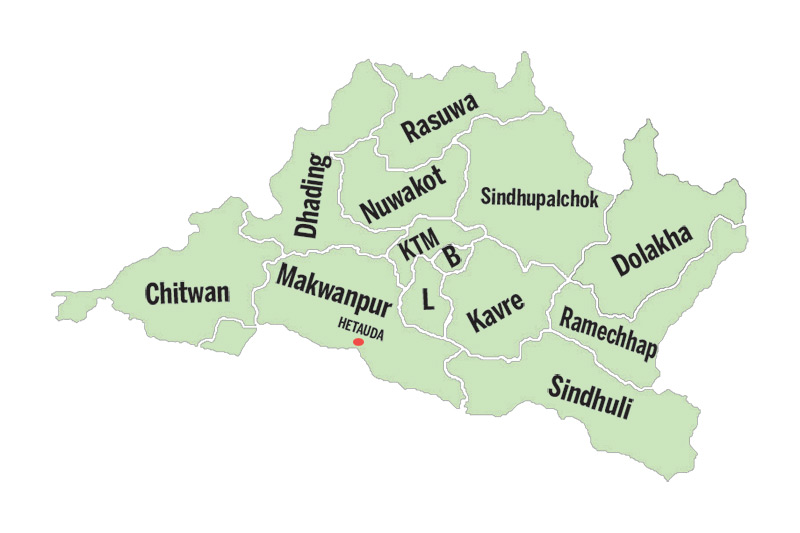
KATHMANDU, Province 3 Assembly members from the ruling Nepal Communist Party have warned the party leadership against any attempts to impose decisions on them in clear violation of the spirit of federalism. The assembly members, particularly from the districts Dolakha, Kavre, Sindhupalchok, Dhading, Kathmandu, Bhaktapur and Lalitpur, have taken particular issue with the party’s December 29 order to name Province 3 ‘Bagmati’ and continue with Hetauda as its capital. Hetauda was designated the temporary capital in January 2018. Assembly members from Makwanpur and Chitwan, however, are in favour of endorsing the party high command’s directive, leading to a sharp division in the Province 3 Parliamentary Party and party committees. According to constitutional provisions, the names and capitals of the provinces need to be endorsed by a two-thirds majority of the assembly. Though the Nepal Communist Party (NCP) commands a two-thirds majority in the 110-member Province 3 Assembly with 80 seats, the infighting could make it difficult to endorse the suggested name and capital. During a meeting of the Parliamentary Party held on January 3-5, a majority of the assembly members refused to abide by the NCP secretariat’s decision, saying that it infringes upon their sovereign right to choose the name and capital of the province. Provincial leaders, including Province 3 committee in-charge Asta Laxmi Shakya and lawmakers Narayan Dahal, Ananda Pokhrel, Rajendra Pandey and Shalikram Jamarkattel, met with the top leadership on Tuesday to communicate the reasons behind the delay in the provincial assembly meet. “We briefed the top leadership on the opinions of 64 assembly members who spoke during the three-day meeting of the Parliamentary Party,” said Yubaraj Dulal, the minister for social development. “But the leadership has told us that the decision of the party secretariat was made unanimously. Now we will try to convince all assembly members.” Experts on constitutional matters and federal affairs say that the hullabaloo in the ruling party over the leadership’s decision on the name and capital of a province showcases an even bigger problem. “This shows the federal system is failing in Nepal,” said Bhimarjun Acharya, an expert on constitutional matters. “It’s sad that parties are intervening in issues that are purely the prerogative of provincial assembly. But it was inevitable.” Acharya has long maintained a critical stance on the decision to adopt federalism, saying the system is not viable, given Nepal’s economic strength and socio-cultural diversity. But when the constitution adopted the federal system, it was a point of no return and the parties should now work for its implementation, according to Acharya. “The ongoing intervention of the ruling party has killed the spirit of federalism as envisioned by the constitution,” Acharya told the Post. With assembly members raising a serious objection, there’s uncertainty over the vote to decide the name and the capital. Immediately after the secretariat’s decision on December 29, Province 3 Chief Minister Dormani Poudel had told the Post that the decision would be made through a vote “within a week”. Ratna Dhakal, a provincial assembly member critical of the secretariat’s decision, said a group of assembly members would register a proposal to make Kavre the capital. “We don’t know how things will evolve,” Dhakal told the Post. “If the party had not made the decision, Kavre would have been an easy choice.” Only three of the seven provinces have so far decided on their names and capitals. Except for Province 2, where the Samajbadi Party Nepal and the Rastriya Janata Party Nepal together command a majority, the three other provinces without a name and permanent capital were looking up to the leadership in Kathmandu for solutions. The Nepal Communist Party leads all provincial governments except in Province 2. “The names and capitals should have been finalised long ago,” said Khimlal Devkota, an expert on federal affairs who led the Province 3 Planning Commission until July last year. “Party leaders from the provinces are showing their dual character. On the one hand, they are complaining about not getting resources, authority and power and on the other, they are asking Kathmandu to take decisions on their behalf.” According to Devkota, Nepal Communist Party leaders in Kathmandu have set a bad precedent by directing provincial leaders. “When I was in the province, I was surprised to learn how provinces used to seek suggestions and nods from central leaders to even carry out their daily work,” Devkota told the Post. According to Devkota, Nepal’s political parties have never learned from past mistakes. “Conflict over the capitals and the number of provinces was the major reason for the dissolution of the first constituent assembly,” said Devkota. “It was a mistake to not write in the constitution itself that the names and capitals must be finalised within a year [of the promulgation of the constitution]. Now it is going to be very difficult because there are so many elements fishing in troubled waters.”
HOME PAGE
With the export of everything else falling, palm oil rises to the top
A smaller inventory, increased domestic consumption and a slowing Indian economy could account for the fall in exports, say experts.
- KRISHANA PRASAIN
KATHMANDU, Export earnings from high-value products identified by the Nepal Trade Integration Strategy fell 6 percent year-on-year to Rs14.8 billion in the first five months of the current fiscal year as a smaller inventory and increased domestic consumption constricted foreign sales. A slowing Indian economy could further hurt Nepal’s exports as the southern neighbour remains the largest buyer of Nepali goods, say experts. For over a decade, Nepal’s trade performance has remained less than satisfactory, resulting in a huge trade deficit. The 2016 Nepal Trade Integration Strategy, Nepal’s third-generation trade integration strategy, has identified nine high-value products and three services to cut the deficit. In a twist of irony, while exports for all high-value products under the trade integration strategy fell, palm oil, which is not produced in Nepal, once again shot to the top of the list of shipments to India. According to the Trade and Export Promotion Centre, palm oil exports rose to Rs11.5 billion in the first five months, nearly eight times the amount shipped in the same period last year. A World Bank report attributes Nepal’s windfall in exports solely to increased demands for non-crude palm and soybean oil in India. Tariff exemptions on Nepali exports to India under the South Asian Free Trade Area agreement gave domestic traders an incredible advantage. Countries outside of South Asia are slapped with tariffs of 54 percent on palm oil and 45 percent on soybean oil. According to the Nepal Development Update, released by the World Bank in December, Nepal capitalised on this arbitrage opportunity and significantly increased exports of the two products. “However, it might not be a sustainable option in the long run,” the report said. According to the report, the export performance of products under the Nepal Trade Integration Strategy—all fabrics, textile, yarn and rope, cardamom, carpet, footwear, ginger, leather, medicinal and aromatic plants, pashmina, and tea—was dismal last fiscal year.
This was a contraction by 4.8 percent year-on-year compared with an expansion of 17.9 percent year-on-year in 2017-18. Consequently, Nepal’s export value to GDP ratio reached 1.1 percent, markedly lower than the 4 percent target set for 2020. The key reasons for the weak performance included a lack of raw materials, skilled manpower and required infrastructure like processing centres, lab testing and storage facilities, the World Bank said. According to Purushottam Ojha, a former commerce secretary, exports of Nepal’s high-value products declined mainly due to a fall in production. “And there was an increase in domestic consumption, leaving little surplus for overseas sales,” he said. As the Nepal Trade Integration Strategy’s product market is primarily India, the severe economic slowdown in the southern neighbour could also be a reason for the decline in exports, said Ojha. Bacchu Poudel, president of the Nepal Trans Himalayan Border Commerce Association, told the Post that the competitiveness of Nepali products is eroding and as a result, exports are declining with each passing year. “Due to a lack of inspection and quality checks, the finished product does not meet standards and struggles to compete in the international market,” said Poudel. Shipments of pashmina, once identified as a ‘pride product’, declined by 17 percent to Rs1 billion. Domestic traders blame the fall in sales to a lack of effective branding and promotional activities in the international market. Exports of agricultural products did not go as expected either, resulting in a decline in overall exports. Large cardamom was the only product that performed well, with exports soaring 50.7 percent to Rs1.86 billion. Shipments of all other products—ginger, tea, medicinal and aromatic plants, fabrics, yarn, textiles, rope, leather, footwear, pashmina and carpets—were down, compared to the same period last fiscal year. According to the centre, ginger exports slipped 14.65 percent to Rs236 million. Tea plunged 24.88 percent to Rs1.45 billion. Tea traders said that exports to the international market were stymied by a lack of organic certification. The government provides exporters with a 5 percent cash incentive on exports of processed tea, large cardamom, ginger, leather goods, processed medicinal herbs and oil products with value addition of at least 50 percent. According to economist Jagdish Chandra Pokhrel, the time has come to revise the list of high-value products again. The sharp rise in exports of palm oil, which has no ‘value addition’, could largely impact Nepali farmers as it could offset the demand for Nepali products. Traders will keep exploiting easy loopholes on foreign products that yield them higher profits, said Pokhrel. For example, the betel-nut industry in Jhapa collapsed after India banned imports in 2013. Nepali traders used to export betel nuts to India in volumes larger than what could have been possibly produced in Nepal. This meant that imports from third countries were being re-exported to the southern neighbour to take advantage of its low customs duty. Importing one tonne of betel nuts and re-exporting it to India would provide traders with a net profit of Rs 1.05 million due to custom tariff differences. The government has been offering cash incentives on export-oriented products that provide high revenue value to minimise trade deficit. A 3 percent cash incentive is provided to exporters of pashmina, textiles, woollen carpets and yarns.
HOME PAGE
Visit Nepal rally in Sydney condemned for being insensitive and inappropriate
Tourism Minister Yogesh Bhattarai held a rally to draw Australian tourists to Nepal while the country reels under massive bushfires across millions of hectares.
- SANGAM PRASAIN
Yogesh Bhattarai. Post Photo
KATHMANDU, Massive bushfires are currently raging across Australia, engulfing millions of hectares of land. At least 24 people have been killed and millions of animals feared dead while thousands of people are being evacuated to safer locations. Amid this apocalyptic scenario, Nepal’s Tourism Minister Yogesh Bhattarai, on Tuesday, inaugurated the Visit Nepal 2020 campaign in Sydney, the capital of Australia’s New South Wales, which bears the brunt of the fires. The reaction on social media was swift, calling Bhattarai’s decision to travel to Australia and lead a tourism campaign insensitive, ridiculous and inappropriate. “This is absolutely not [the] right way and [the] right time for such rally, [e]specially when Australia is having such a rough and tough time, that too for commercial purposes... S[h]ame on you comrade,” Pawan Raj Phuyal wrote on Twitter. The campaign in Australia attracted even more controversy after a rally of around 500 people, including the minister, was stopped by Sydney police for not having a permit. Back in July, when Bhattarai was appointed tourism minister, expectations were high. Bhattarai was seen as a young and charismatic leader who could bring new ideas to the Tourism Ministry and the Visit Nepal campaign. But his ideas have largely been seen as divisive and inappropriate, including a plan to play the national anthem at Pashupati. Bhattarai often reiterates the government’s target of increasing tourism’s contribution to the country’s GDP by 10 percent in the near future. To achieve this, Nepal’s tourism income will need to increase five-fold to Rs350 billion annually, up from the Rs73.57 billion earned in 2018-19. Tourists from Australia could contribute to this target, as after the 2015 earthquake, arrivals from down under have been increasing at a healthy rate, reaching 38,429 individuals in 2018, according to government statistics. But for many, the timing of the campaign only added insult to injury. Madan Dhaurali, a Nepali living in Sydney, told the Post over the phone that it was not the right time to promote Nepal in Australia as the entire country is mourning. “Australia has become a global headline, and it’s a nonsensical idea to promote Nepal there at this moment,” said Dharauli.
Bhattarai’s trip—and the rally to promote Visit Nepal campaign—comes the same week Australia’s national tourism body put a pause on its star-studded, multi-million dollar promotion campaign aimed at luring visitors to the country. Dinesh Pokhrel, the Visit Nepal 2020 coordinator in Australia representing the Non-Resident Nepali Association, also admitted the timing was a poor decision made by the Nepali Embassy and Consulate General of Nepal in Sydney. Pokhrel said that he had informed the consulate general and the embassy regarding the humanitarian crisis and urged that the event be postponed. “As it was a pre-scheduled trip, the embassy officials decided not to cancel it,” said Pokhrel. “The original plan was for a gala event with at least 4,000 people but we decided to make it a smaller event.” There was an open programme at the Sydney Opera House on Tuesday morning, followed by a gala dinner that night at the House of Representatives Chamber where 200 people, including 100 Australian officials, were invited, Pokhrel said. Pokhrel, however, said that news reports regarding the police stopping the tourism rally were false. “There are some restricted areas in the Opera House where people are not allowed to take flags, banners or even cameras,” he said. The Australia-based southasia.com.au news portal, which first reported the story, had said that the “Events Planning Unit of the NSW Police had explicitly asked the organisers not to conduct the ‘procession for a number of reasons’ including the fact that the event was ‘promotional and for commercial gain’ which was ‘not in keeping with the legislation regarding a right to protest’.” Hours after the news broke, Bhattarai issued a press statement saying it was all “propaganda” to defame him. But some Tourism Board officials have questioned the rationale behind promoting a country’s tourism by organising a rally on the streets. “It’s the digital era. The minister should understand that digital marketing is the appropriate channel to create, accelerate, and transmit product value to the target audience, not organising a rally at the Sydney Opera House,” said a senior official at the Nepal Tourism Board. “A rally will not work to bring tourists, neither will beating drums at Dashrath Stadium.”
MEDLEY
Horoscope
ARIES (March 21-April 19) *** The culture that you’ve been a part of hasn’t been feeling right lately. Is it time to see how the other half lives? Call up someone you know whose lifestyle is one you’d like to experience for a while. See if you it. The only thing stopping you from making a change in your life is you.
TAURUS (April 20-May 20) *** If you go too quickly through your day, you’ll miss out on fun. Forces are pushing you to go at a more rapid pace, but you should tell them you can’t. Ask them why they think you should be in a hurry. They won’t have an answer. Calling their bluff will help them understand that they need you more than you need them.
GEMINI (May 21-June 21) **** Today, take note of people you meet, because one of your newest acquaintances could turn into a very important person in future. Whether they’re your new love, your new boss, or your new neighbour isn’t going to be clear for a while, but this person will be a force to be reckoned with. New doors are opening for you.
CANCER (June 22-July 22) *** Today, one of the authority figures in your life will be all about micromanagement. That whirring sound you hear over your left shoulder? That’s them. Instead of letting their sudden interest create friction, take it as a sign that they see you as a force to be reckoned with, and possibly even a threat to their position.
LEO (July 23-August 22) **** You and your friends are a little bit out of sync with each other, but not to worry. This dissonance might create more fun than frustration. Everyone is in the mood to compromise, and one of your friends is going to come up with a great idea to help make things better than they’ve ever been. Today, you will realise how lucky you are.
VIRGO (August 23-September 22) ** Believe it or not, today your combative nature is going to help you get further in life than your compassionate nature ever could. You’ll get more attention when you let someone know that you’re expecting it. Being afraid of conflict can keep you from getting scarred, but it will tell you that you can keep it together too.
LIBRA (September 23-October 22) ** If you’re engaged in any kind of negotiation today, keep in mind that the outcome depends on your level of commitment. Determination will play a critical role in how well you fare and how much of what you want you actually get. This applies to negotiations with both family members and professionals. Don’t give up.
SCORPIO (October 23-November 21) **** When it comes to helping other people, quality is much more important than quantity. After all, you should be doing it because you want to. If you’ve got a friend who needs advice don’t do it halfway. Don’t be watching the clock, worrying about how much time you’re spending with them.
SAGITTARIUS (November 22-December 21) **** Suddenly, things are starting to get pretty interesting. It looks like something new is brewing. Are you ready? If you’re eager for more romance to come into your life, today is the day for you! Don’t be surprised if you feel a special connection getting even more special. Soak it up and enjoy it for what it is.
CAPRICORN (December 22-January 19) **** Just because your recent hunches were off the mark doesn’t mean that your intuitive skills are bad. Don’t lose confidence in your gut. You’re an excellent judge of character, and you will have a especially good eye for seeing through the charm someone is working so hard to convey to you.
AQUARIUS (January 20-February 18) *** Your dreams are becoming more than trippy or bewildering movies your mind plays at night. They can be useful tools to help you look at things from a different perspective. The odd images that have been swimming through your unconscious mind are showing you patterns, and it’s up to you to figure out what these are.
PISCES (February 19-March 20) ** The weather forecast for your day includes some fog, but you can help burn it off early if you keep a sunny disposition. Instead of letting the grey mood of grouchy folks turn you inward or sullen, let it be a challenge to you to be all the more cheerful. Spread your bright demeanour to strangers and friends alike.
NATIONAL
Sudurpaschim’s budget lacks vision and strategic plan, say tourism entrepreneurs
- MOHAN BUDHAAIR
Internal tourists trek the Khaptad region in Sudurpaschim Province. Post file Photo
DHANGADHI, The Sudurpaschim Provincial Government allocated Rs 440 million to promote tourism. But six months into the fiscal year and Visit Nepal year ongoing, tourism entrepreneurs say the budget is being spent on ambitious, poorly prepared projects of little strategic footing. The government has planned to construct a corridor to Badimali Temple, along with three other corridors. Of which, three corridors would link Sudurpaschim to Kailash Mansarovar, according to Kishore Aryal, chief of the implementation unit of the tourism development programme. Aryal said that a total of Rs130million has been allocated to those corridors which would link Kanchanpur, Dhangadhi, Baitadi, Dadeldhura and Bajhang to Mansarovar. According to Aryal, the budget would be invested in promoting tourist destinations along the way. “The plan is to promote tourism under a three-year strategic plan,” he said. “Since about half of the current fiscal is over, we are thinking of allocating budget for the recognised destinations from the ground research report.” But tourism entrepreneurs and stakeholders said the government has allocated budget without any preparation and thought. “How good is an idea that talks of constructing corridors without any feasibility study?” said Shankar Bogati, chief of Chamber of Commerce, Sudurpaschim. “The government has ignored the most important thing: to prepare a strategic plan.” Bogati also doubted whether the budget would be actually used to construct the corridors. “I think they will spend the budget in the construction of view towers, rest spots, homestays, documentary film and promotion,” he said. “I doubt the plan will materialise without the recommendation of experts and tourism entrepreneurs.” Another of the provincial government’s plan is called “A provincial visit for the elderly”, according to which, the elderly above 60 would be taken on a province-round journey “to facilitate domestic tourism,” said Aryal. Rs2.5million is allocated for this project. Likewise, budgets have also been allocated to develop adventure tourism and promotion, to establish information centres, and facelift the existing tourism destinations. But Dinesh Bhandari, a local tourism entrepreneur, said that the government’s projects are showy rather than properly planned and thoughtful. “It’s hard to assume the budget would yield desired results for the tourism fraternity,” he said. Another area of the investment of heavy budgets is the construction of temples and religious sites. According to an official at the implementation unit, the budget has been allocated to construct over 100 temples and shrines according to recommendations from political leaders and cadres. The government has allocated Rs50million for ‘religious tourism promotion’ in the current fiscal year. Bhandari says investing heavy amount to construct temples is ludicrous. “It is not that constructing temples would attract tourists in droves,” he said. “The government should identify the prime destinations, study feasibility and develop infrastructure and service.” Mayaprasad Bhatta, chief of Sudurpaschim bureau of Nepal Association of Tour and Travels Agents (NATA), said the government should, first of all, cooperate with the private sector before formulating plans. “The private sector is often oblivious of the plans and projects the government introduces,” he said. “The government should discuss with the tourism entrepreneurs about short-term and long-term projects because they might know better.” Among the critics of the government’s plan is Krishna Bahadur Mahara, member of Nepal Tourism Board, who said that plans without a strategic foundation would yield no result. “The government should first prepare the master plan to develop tourism in the Farwest—the master plan should identify destinations, study feasibility, and focus on infrastructure development,” he said. “Only that would generate the desired outcome if executed well.”
NATIONAL
Three years on, ambitious school programme fails to meet a majority of targets
Officials cite falling share of the education budget as the primary reason for decline.
- BINOD GHIMIRE
Despite an increase in enrolments, high dropout rate remains a huge challenge for school education. Post file Photo
KATHMANDU, The School Sector Development Programme, started in 2016 to boost the quality of education and promote equitable access to students, has failed to meet a majority of the targets it had set to achieve by last fiscal year. An assessment by a joint review meeting of the Ministry of Education, Science and Technology and donor agencies shows the achievement of the project is significantly lower than what it was supposed to attain three years after the programme started. The assessment shows a lackadaisical approach of the Nepal government as one of the major constraints in achieving the goals. During the inception of the programme, the government had, in principle, committed to increasing the share of education budget to 15 percent of the national budget. The report, however, shows the share of education budget has actually gone down, from 12.04 percent in the fiscal year 2016-17 to 10.69 percent in the fiscal year 2018-19. Nepal has a global commitment, which also is an international practice, to allocating 20 percent of the national budget to the education sector. Despite an increase in enrolments, the high dropout rate remains a huge challenge for school education. The programme had expected that the numbers of students completing grade 8 would reach 78.5 percent by last fiscal year. But, government intervention could take the numbers to only 71.3 percent—from 69.6 percent when the programme started. It shows that around 29 percent of students get out of the school system before completing their basic education (grade 8). The programme has poorly fared in improving the quality of education, which is the main goal. The assessment shows that the learning achievement of the students remains what it was when the programme began. The learning outcome of the eighth-graders in Science was expected to increase to 49 percent but, it remains at 41 percent, exactly the same when the School Sector Development Programme (SSDP) started. The poor show of students in grasping what they are taught in the classroom hasn’t changed even in Nepali and Mathematics. Officials at the Education Ministry claim they haven’t been able to spend enough funds in boosting the quality as the pie of the education budget hasn’t increased. Over three-fourths of the education budget goes to paying the salaries of teachers and government staff. The share of the administrative expenditure is also high. Deepak Sharma, spokesperson for the ministry, told the Post that although they have been lobbying for an increase in the share of the education budget, their demands remain unaddressed. “We don’t have the needed budget to spend for quality. That is reflected in the performance of students,” said Sharma. He, however, claimed that a majority of the indicators have improved in the past three years, although they are nowhere close to the target. Among the 30 indicators from six different sectors, targets have only been met in five. These include the share of female teachers in basic education, gender parity index in secondary school (grades 9-12) and net enrolment rate in the higher grades. Enrolment at the secondary level, which was 37.3 percent three years ago, has gone up to 46.4 percent against the target of 45 percent. The SSDP is the government’s national flagship programme supported by eight international partners, including the United Nations agencies. The reports say as much as Rs241.95 billion has been spent for the SSDP in the past three years and the Nepal government received $178.81 million from the donors over the same period. Education experts say the government’s tendency to design the programme without proper assessment and planning is the major factor for the SSDP’s dismal show. “No programme will give expected results, if implemented without proper planning and homework in place,” Binay Kusiyait, a professor at Tribhuvan University who has extensively researched on school education, told the Post.
NATIONAL
Drive to declutter utility poles blocks streets, disrupts phone and internet
Some neighbourhoods in Chabahil are dealing with patchy phone and internet services for a week while loose cable heaps remain strewn on the streets.
- ANUP OJHA
The city is removing cable clusters from utility poles as part of the Visit Nepal campaign. post PHOTO: KABIN ADHIKARI
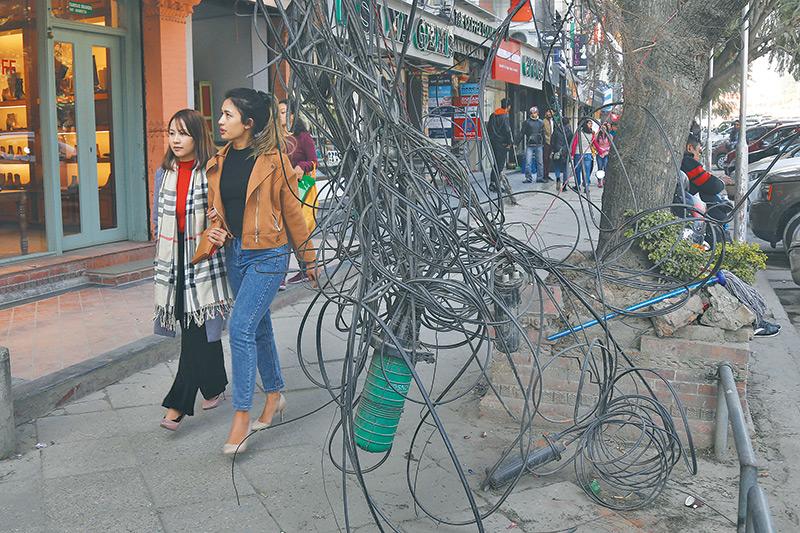
KATHMANDU, Besides potholes, pollution and traffic jams, another thing Kathmandu could do without is clusters of tangled wires hanging on utility poles. While Ishwor Man Dangol, spokesperson for the Kathmandu Metropolitan City, claims that the city office has been managing these cable snarls for the past two years, not much of an improvement has been seen so far. As part of the preparation for the Visit Nepal 2020 campaign, the city authority has ramped up its drive to clear cable tangles but seems to lack a concrete plan. Last week, city workers removed cable clutters from the Maijubahal area in Chabahil, which led to the disruption of internet service in the area for days. Furthermore, the cut cables were left on the road, hindering the mobility of people and vehicles. “We tolerated the internet service disruption. It was the loose wire tangles left on the road that caused us a great deal of inconvenience,” Laxmi Lamsal, a journalist for China Radio International, told the Post. At Shanti Goreto, another neighbourhood in Chabahil, telephone, internet and cable TV services have been irregular for the past week. The city authority had mobilised its workers to remove cable clutters without coordinating with the concerned telecom, internet and cable TV service providers. “Telephone and internet services in our area have been patchy for a week now and the street is strewn with cables,” Ajashra Dhungana, a local man, told the Post on Tuesday. When the Post contacted Suddha Kumar Dangol, chairman of Kathmandu Metropolitan City Ward No. 7, he said that his office was working to clear the street and restore the phone and internet services. “We have informed the phone and internet service providers about the issue, but they have not responded,” he told the Post. A similar problem had affected the locals and businesses in Thamel, the city’s tourist centre, in December. In the run-up to the Visit Nepal campaign, Thamel Tourism Development Council had launched a drive to remove excess cable tangles from electricity poles, but the well-intended enterprise unexpectedly ended up cutting off internet and phone services in the area, which is home to numerous hotels, restaurants, travel agencies and souvenir shops. And then there was also the problem of wire jumbles littering the streets. It took a week to clean the area. The city’s spokesperson, Dangol, says there is a lack of space to dispose of the removed wires. “We have been removing unsightly cable clusters from various parts of the city and keeping them at our garbage collection centre in Teku. There is no more space now. We cannot burn or bury these wires for the environment’s sake,” said Dangol. Part of the reason the proliferation of cable tangles has gone beyond a manageable level, according to Dangol, is the lack of responsibility on the part of internet service providers, cable TV operators, electricity authority and telecom companies. “They not only leave excess cables hanging on the poles, but they also do not bother removing the old unused cables,” Dangol said. “This problem cannot be managed effectively until the Ministry of Communication and Information Technology puts a stop to this bad work practice.” The ministry, meanwhile, blames the city authority for the visual pollution caused by cable knots and rolls that hang on utility poles across the city. “The problem continues to persist because the Kathmandu Metropolitan City is issuing permits to build new houses,” Shiva Prasad Tripathi, joint secretary at the ministry, told the Post. Min Prasad Aryal, director at the state-owned Nepal Telecommunication Authority, says consultations are ongoing with the stakeholders for a permanent solution—an underground cable system. “Currently, our priority is to manage the cables along the bigger roads and streets of Kathmandu, such as in New Baneshwor, Thapathali, Jamal and Ring Road,” Aryal told the Post. “In some places in the inner areas of the city, there are cables that are older than 20 years, and they are difficult to remove.” Nepal Electricity Authority has also been in negotiations with the Department of Roads to build an underground cable system in Kathmandu. But the ambitious project is unlikely to commence anytime soon, given the complexity and scale of the undertaking. “It would take more than three years to build an underground cable system,” Kulman Ghising, managing director of the state-run power utility, told the Post. The drive launched by the city authority to declutter utility poles for the Visit Nepal campaign comes too little, too late, Ram Manandhar, a resident of Chabahil, said. “The city office has instead polluted our streets and disrupted essential services with its ill-conceived and hasty action.”
NATIONAL
Road office says halted expansion work to continue in whatever space is available
After a Supreme Court verdict in 2017 to pay compensation before acquiring land, locals have been obstructing expansion projects in Valley.
- PRITHVI MAN SHRESTHA
Despite continued obstruction from the locals, the government has not taken the decision to collectively expand all of the roads. Instead, it has been making the decision on a case by case basis. Post file Photo
KATHMANDU, The Department of Roads will continue the road expansion drive at a number of sections in the Kathmandu Valley to the extent locals allow, putting the designs prepared for the expansion aside. A large number of road projects in the Valley are currently on hold after the Supreme Court made it mandatory for the government to pay compensation before acquiring private land for the expansion. The court on September 18, 2017, had made it mandatory for the government to compensate landowners before acquiring land for expanding the 9km Nagdhunga-Kalanki road. The decision’s implications were seen on other roads being expanded in the Valley, with people obstructing the expansion works demanding compensation. “As the government has not decided to provide compensation for acquiring land, we are preparing to improve the number of roads under the expansion project to the extent the locals allow us to do so,” said Bishow Bijayalal Shrestha, spokesperson at the Kathmandu Valley Road Expansion Project. Initially, in July 2018, the government had decided to expand the Nagdhunga-Kalanki road and the Chabahil-Sankhu road “in whatever space was available” without acquiring land from the public. According to Shrestha, the Department of Roads last month decided to expand the Dholahiti-Chapagaun-Saraswatichandra road in whatever space is available. “A recent meeting of officials at the Physical Infrastructure Ministry also concluded that Jorpati-Sundarijal road should also be expanded in a similar manner, but a formal decision has not been taken yet,” he said. “There has been consensus with the locals that the road should be expanded between 14 meters to 22 meters.” Earlier, the Road Expansion Project had sought to expand the entire road section to 22 metres. According to Shrestha, there has been minister-level decision to expand Imadol-Godawari-Lamatar Road to 16 meters, down from planned 22 meters. “Discussion has been ongoing to expand Manahari Sallaghari Road section in the available space only,” said Shrestha. However, despite continued obstruction from the locals at all other expansion projects, the government has not taken the decision to collectively expand all of the roads in available space. Instead, it has been making the decision on the case by case basis. “The reason behind taking decision one project at a time is to make effort to convince the locals for expansion of roads as per the design,” said Shrestha. Lagankhel-Satdobato, Karmanasa-Harisiddhi-Godavari Kunda, Nakkhu Khola-Bhaisepati-Bungamati, Chakrapath-Gyanjyot and Ganesh-Biddhatmarga are other road projects that need expansion. But, according to Shrestha, nothing has been discussed on these projects. Since the Supreme Court order, the government’s effort to remove 120 houses in the Harisiddhi area was obstructed by the locals as they demanded compensation for both land and houses. Likewise, the locals also protested expansion work along the Lagankhel-Satdobato road, demanding compensation for both land and houses.
NATIONAL
Community forest group obstructs felling of trees in Butwal-Narayangadh road expansion
The federal forest ministry had granted permission to cut down 46,294 trees along the section in November last year.
- NARAYAN SHARMA
The community forest users protested the move claiming ownership over the felled trees. Post Photo: narayan sharma
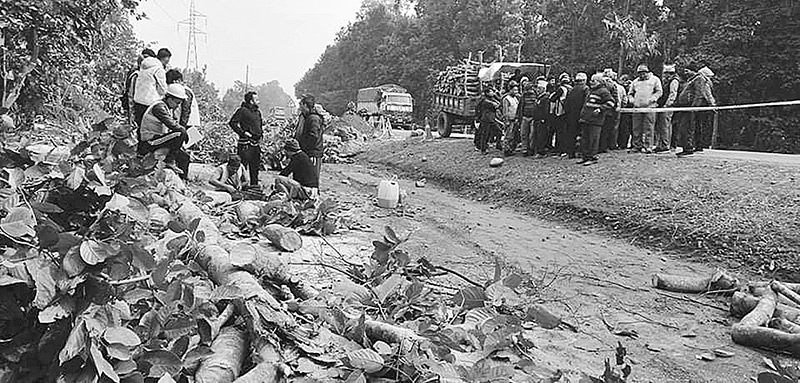
NAWALPARASI, The cutting down of trees for the expansion of the Butwal-Narayangadh section of the East-West Highway was obstructed in less than three hours after it started on Tuesday by a community forest users group and locals. The Shiva Community Forest Users Group and locals of Kawasoti Municipality Ward No. 2 obstructed the logging of the trees demanding they should be allowed to utilise the felled trees. The federal Ministry of Forest and Environment had granted permission to cut down 46,294 trees along the section to make it a four-lane street in November last year. The Department of Forest and Soil Conservation had sent a letter to the Division Road Office in Nawalparasi, allowing the cutting down of the trees. On Tuesday, the trees within the Lokaha forest area on the northern side of the road section were being felled when the local forest users group protested in the site claiming ownership over the felled trees. The community forest users group said they have reared and conserved the trees on both sides of the highway for years, and thus they possess the rightful claim over the felled trees. But the Ministry of Forest says trees within the periphery of the roads fall under its ownership. “The ownership of the trees that we have conserved should be ours,” said Ramakant Bhandari, a member of the local community forest user group. “It does not make sense to deny us the ownership of the trees that we have preserved and sell it to the Ministry of Forest.” There is a forest on both sides of the road section reared by the local community forest user groups. There are 34 community forest user groups in the 37km area between Gaidakot and Daunne. “The Department of Forest and Soil Conservation has asked us to hand over the trees to the Division Forest Office in the letter sent to us,” said Sujan Adhikari, chief engineer of the Daunne-Gaidakot section of Butwal-Narayangadh Road Expansion Project. “We have started to cut down trees accordingly.” According to Adhikari, the forest office has ownership over the trees that are within the area of the road.
NATIONAL
Siraha hospital denies postpartum women safe motherhood incentives
Ram Kumar Uma Prasad Memorial Hospital says it has not received the budget for the programme this fiscal year.
- BHARAT JARGHAMAGAR
SIRAHA, Under the Safe Motherhood Programme, new mothers and babies are eligible for free medical treatment costs, transportation allowance and cash incentives for antenatal and postnatal checkups. But the Ram Kumar Uma Prasad Memorial Hospital, in Siraha, despite running the Safe Motherhood Programme as part of a bid to ensure safe births, has failed to provide incentives and free medications to new mothers visiting the hospital. According to the hospital administration, the hospital has not received the budget for the Safe Motherhood Programme in the current fiscal year. Punamdevi Yadav, a local of Sakhuwanankarkatti, who gave birth to her son in the hospital on December 19, said her attendant had to purchase medicines, which they should have received free of cost from a nearby drug store. “My attendant had to buy an anti-D injection (one ampoule) from a drug store paying Rs 600. Although the hospital had announced free delivery services under the Safe Motherhood Programme, we have been compelled to purchase medicines from outside the hospital.” Taking advantage of the lack of free medicines in the hospital, pharmaceuticals outside the hospital are charging anywhere between Rs 500 to Rs 4,000 for one anti-D injection. “I came here because of the promised services but instead of receiving free delivery services, travel and transportation allowances we had to purchase medicines from a drug store,” said Manju Kumari Sah of Lahan Municipality, who also delivered her baby in the hospital on December 25. According to the hospital, the then-District Public Health Office used to send anti-D injection to the hospital until a year ago. Budur Bhagat, a medical recorder officer of the hospital, said the hospital has not received injection this year. “We have advised new mothers and their attendants to keep the bills of the medicines safely. If the office releases budget, we will reimburse their expenses,” said Bhagat. According to the data of the hospital, 1,654 women have given birth in the hospital in the first five months of the current fiscal year and none of them received the free services nor the allowances from the hospital. The government provides allowances to pregnant women who undergo safe delivery in health institutions. Women in the mountainous, hilly and the Tarai regions are entitled to Rs3,000, Rs2,000 and Rs1,000 respectively. Additionally, a cash bonus of Rs800 should be provided to mothers who complete all four antenatal checkups. The hospital administration has assured new mothers that they will be reimbursing their medical bills and giving them their due allowances once they receive the budget. Dr Sunil Kushwaha, medical superintendent at the hospital, said that the provincial government has not sent necessary budget for the Safe Motherhood Programme yet. “The process has been delayed, as the central level has yet to send budget to the Ministry of Social Development of the province,” said Kushwaha, adding that the ministry directly sends budget to the hospital after the removal of the District Public Health Office since the adoption of federalism.
NATIONAL
Local units in Rupandehi prioritise construction of Buddha-related structures
A total of 16 local units have started installing Buddha’s statues to promote tourism during Visit Nepal 2020.
- Amrita Anmol
Authorties have also been carrying out works to conserve Baunnakoti lake and other Buddhist Vihars and temples in the area. Post Photo: amrita anmol
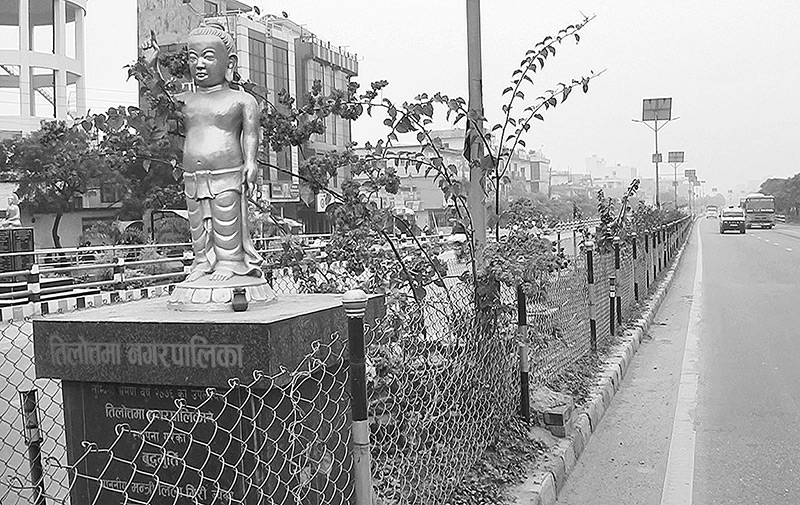
BUTWAL, Along with the preservation of historic sites, the local units in Rupandehi district have prioritised the construction of various structures related to Gautam Buddha for the tourism year 2020. As many as 10 out of the total of 16 local units have started installing Buddha’s statues and building parks to beautify their towns and promote tourism during Visit Nepal 2020. “Our main objective is to attract tourists by building structures related to Lord Buddha,” said Basudev Ghimire, mayor of Tilottama Municipality, which lies a few kilometres from Lumbini. The municipality has installed 22 statues of Buddha along the Butwal-Bhairahawa section of the Siddhartha Highway. Ghimire said the municipality has also prioritised the construction of the feeder roads connecting the Tilottama-Lumbini-Devdaha road. According to Ghimire, homestays are in operation in Semari while the local unit has been carrying out works to conserve Baunnakoti lake and other Buddhist Vihars and temples in the area. Similarly, Siddhartha Nagar Municipality has been constructing a Buddha Gate at Belhiya, a border point between Nepal and India. A life-size statue of Buddha is under construction in the Buspark area. Many statues of Buddha have been installed along the Belhiya-Lumbini road. “Siddhartha Nagar was just a pitstop for tourists travelling to and from Lumbini. But we are trying to change that now. We have launched a campaign to get benefits from the tourists visiting Lumbini,” said Mayor Hari Prasad Adhikari. According to him, the municipality has allocated a budget of Rs 200 million to promote tourism. Sainamaina, another municipality in Rupandehi that has several Buddha-era monuments, has started preserving several archaeologically important objects and places related to Gautam Buddha. The municipality has set up a temporary museum at Sirantol and kept historical statues, bricks, utensils, tools and ruins of houses believed to have been built during Buddha’s lifetime. Likewise, 11 ancient wells—including Badakuwa and Ranikuwa—have been preserved in various places in Sainamaina. “Construction work to set up a museum in the area has started,” said Mayor Chitra Bahadur Karki. The federal government has allocated Rs 100 million to set up the museum in the current fiscal year.
NATIONAL
In federal set-up, Karnali Provincial Hospital changes for the better
In the last fiscal year alone, the provincial government allocated Rs 400 million to upgrade the hospital, of which Rs 200 million was used to purchase equipment.
- CHANDANI KATHAYAT
In the last four years, the hospital has seen major improvements in terms of service and infrastructure. Post Photo: chandani kathayat
BIRENDRANAGAR, A few months ago, Saraswati Rana, a local of Dailekh, went to the Nepalgunj-based Bheri Zonal Hospital for her son’s treatment. After 15 days in the hospital, doctors suggested Rana that she should take her son to a bigger hospital, as they could not do much to improve his condition. Rana then took her son to the Karnali Provincial Hospital in Kalagaun, Surkhet, where she saw a remarkable improvement in her son’s health condition. “I took my son to Nepalgunj for treatment without much hope. Because from what I remembered, from past experience, the hospital was lacking in many respects. But my recent visit showed me otherwise,” she said. The service the hospital now provides has seen an upgrade putting the fears of service seekers like Rana at bay. “I was skeptical to go to the hospital but I’m now glad about my decision. If I had gone there earlier, I would have saved around Rs 40,000 I spent on my son’s treatment in Nepalgunj,” she says. In the last four years, the hospital has seen major improvements in terms of the service it provides to the well-equipped medical facilities it supports with increased manpower, infrastructure and equipment. The changes have been brought on after the country switched to a federal setup, giving the provincial government more scope to exercise authority in the hospital. The regional hospital was upgraded to a provincial hospital a year ago. For 14 years before that though, the then Surkhet District Hospital was a regional hospital that functioned with only three doctors. The hospital faced a shortage of doctors for almost a decade. “Auxiliary health workers and health assistants used to conduct the check-up of patients in the past. We had to go Nepalgunj or Kathmandu or other cities to receive treatment, as the health workers could not identify diseases properly,” said Udaya Shahi, a local of Kalikot, adding that they now can find specialists and receive quality treatment at the Karnali Provincial Hospital. The hospital was also functioned only as a reference point to a higher centre, as it was unable to provide health services in case of serious illnesses. Today, things are different, with patient flow surging in the hospital as of late. Every day, the hospital receives around 600 patients. The hospital data showed that around 300 patients (critical cases) are being referred to the hospital from other districts on a daily basis. In the last fiscal year alone, the provincial government has allocated Rs400 million to upgrade the hospital. “Out of Rs400 million, Rs200 million has been used to purchase modern equipment,” said Khadka, adding that they have started dialysis, ICU and CT scan services among others after managing infrastructures. Dr Dambar Khadka, medical superintendent of the hospital, said that the hospital has been able to provide effective health services after the hospital filled the necessary quota for skilled human resources and brought new technical equipment. Currently, there are 16 medical specialists and 22 MBBS doctors in the hospital. According to Khadka, construction of a 150-bed hospital with 125 posts of health workers including 77 posts of doctors has been proposed. The hospital currently has 115 beds, said Khadka. The provincial government has also decided to upgrade the hospital and run it as Karnali Medical College. “The federal government has already sent a project letter to the provincial government to operate the college,” said Dal Rawal, Minister for Social Development.
NATIONAL
Crops destroyed due to rain
Briefing
BARDIYA: Winter crops and vegetables in the district have been destroyed due to the rainfall and cold wave that occurred in the last two days. Sagar Dhakal, chief at the Agriculture Knowledge Centre in Nepalgunj, said that the rain and cold wave has affected around 50 percent of the winter crops and vegetables. He said, “Mostly peas, mustard and other legumes plants have been destroyed by the rainfall.”
NATIONAL
Ghorahi aims to become child-friendly submetropolis
Briefing
DANG: Ghorahi Sub-metropolis on Monday formulated a set of regulations in a bid to turn it into a child-friendly local unit. The overarching regulations focus on issues of child marriage, child labour, child abuse, education, health and cleanliness, among others. The sub-metropolis aims to achieve its goal in two years.
NATIONAL
Four Bhutanese, a Tibetan held from Birgunj
Briefing
PARSA: Police arrested four Bhutanese and a Tibetan national from the Nepal-India border in Birgunj on Monday night. The arrestees were held while they were entering Nepal on a bus belonging to Nepal-India friendship bus service. They were detained, as they did not possess passports and other necessary travel documents.
NATIONAL
Purbanchal Engineering Campus padlocked
Briefing
SUNSARI: Students of Purbanchal Engineering Campus in Dharan have padlocked their campus stating that the campus enrolled students in various streams without taking permission from Nepal Engineering Council. Graduated students of the campus started an indefinite protest after the council refused to register them as engineers. There are around 1,800 students studying on the campus.
NATIONAL
Police investigate two newborns deaths in Siraha
Briefing
SIRAHA: District police has launched an investigation into the death of two infants following a complaint alleging negligence by surgeons at Saptarishi Hospital, where the babies were born. Ghuran Sah, a close relative of the victims, said that the hospital administration’s delayed surgery of the babies, which is the reason behind their deaths. The hospital administration has denied the allegations.
EDITORIAL
Plight of out-migrants
It is time for Nepal to plan to bring its people home.
Nepal relies on the remittance sent home by migrant workers, that much is a well-known fact. However, in the rush to secure well-paying jobs and financial security, not to mention the health of the economy and much-needed foreign currency, many issues have been left resolved. Some of these issues have been getting more coverage and attention in recent years. The Guardian’s 2013 exposé started a chain of events that forced Qatar to abolish its exploitative Kafala system, at least on paper. Coverage by the Nepali press on Malaysia’s unfair visa regime pushed the government to confront the Southeast Asian country. Similarly, coverage of incidents have helped remove migrants from exploitative situations—such as those related to unfair wages and contract breaches. But many problems are left under-researched and unaddressed. Yet, these issues might be hampering the economy, not no mention individuals and families, in severe ways. One such issue that has come to light is the negative impact out-migration has on families—specifically, the psychological health of the children left behind. A 2019 report by the Centre for Mental Health and Counselling Nepal revealed that, among a study group of children whose parents were out-migrants, 48.2 percent had anxiety, 18.3 percent depression, 8.03 percent suicidal thoughts, and 11.68 percent behavioural problems. This is alarming, though not surprising. There are three significant ways in which parents influence their offspring: direct interaction, identification, and transmission of family stories. Whether a person is qualified to raise a child or not is another question. But an adolescent, in the absence of the guidance of one or both parents, is bound to look for a stabilising influence elsewhere. Lacking a real connection with their parents—remember, some migrant workers do not return for years—the children lack robust psychological development. Nepal issued 3.5 million labour permits between 2008 and 2017. This means that the number of families affected back home is massive. We are looking at a whole generation of children, in significant numbers, who will have struggled with development due to separation. Even after knowing that such a major problem exists, the solutions do not come readymade. And that is the most troubling aspect. The out-migrants have left their country and their homes to earn a livelihood, and Nepalis sent $8.1 billion back home in 2018. Remittance is a major contributor to the national income—it provides a larger contribution than domestic industries. In the absence of employment opportunities at home, it will remain an important income source for the foreseeable future. Ad hoc reactive measures, such as banning migrants from going abroad, will not do. As such, a move like that will only push Nepalis towards exploitative situations, as the ban on women out-migrants from working in the Gulf region showed. Both the country and the workers need the income source. However, without the government being able to promote industries and service sectors to absorb the labour force, Nepal’s out-migrants will continue to suffer. And so will their children. The federal government, in conjunction with the provinces, needs to come up with a long-term strategy to promote employment domestically. One potential area can be the ballooning tourism sector; many out-migrants could reapply the skills they have learnt abroad. Further, developing the agriculture sector would not only promote food security, but would boost a traditional sector. Many migrants could also apply the skills they have learnt to launch innovative, entrepreneurial ventures. In any case, one thing is sure—it is time for Nepal to plan to bring its people home.
OPINION
The decade of lumpen
The person to watch closely in the upcoming decade is President Bidya Devi Bhandari.
- CK LAL
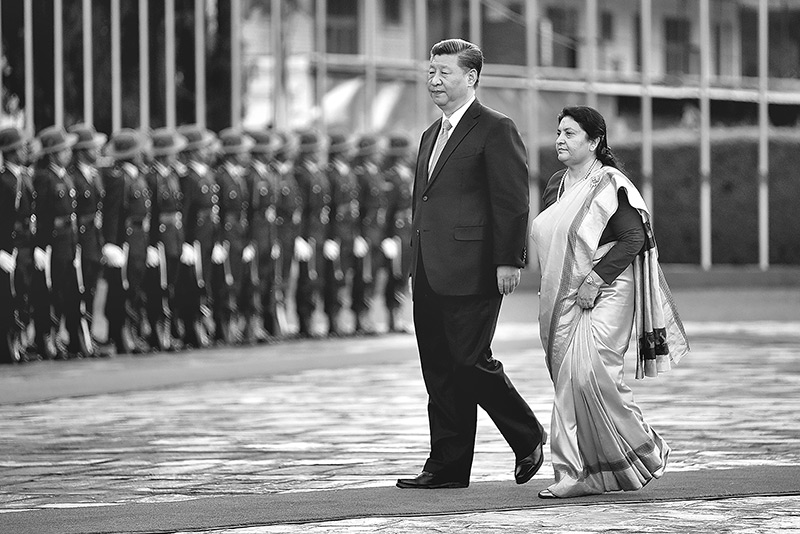
Chinese President Xi Jinping beside President Bidya Devi Bhandari at Tribhuvan International Airport in Kathmandu in October 2019. POST PHOTO: Angad Dhakal
The world looks to be on the edge of a precipice. Believed to be unpredictable, if not outright unstable, the president of the United States had the top Iranian General Qassem Suleimani killed in a targeted airstrike. A red flag has since been unfurled atop the Jamkaran Mosque in the Shiite holy city of Qom in Iran. It signifies that revenge is now the duty of the Iranian regime. There is a reason The Guardian questioned in its editorial whether the UK has gone from being a poodle to becoming a lapdog of the United States. The tone is undoubtedly harsh, but Prime Minister Boris Johnson has little moral authority to urge President Trump to ‘de-escalate’ tension when the leading Brexiter of the United Kingdom wasn’t even informed of the US decision. All eyes are on President Xi Jinping, the possible ruler for life of the People’s Republic of China. The Chinese strongman, however, is battling multiple crises such as trade war with the US, protests in Hong Kong and prosecution of Muslim Uighurs in Xinjiang. Analysts concede that the main beneficiary of the US-Iran crisis could well be Russia. But for all his diplomatic chutzpah, President Vladimir Putin needs the European Union on board to make a meaningful difference in the mess of West Asia. Closer to home, the Indian Prime Minister Narendra Modi seems to have abdicated all executive authority in his second term of office in favour of his alter ego, Home Minister Amit Shah. Premier Modi’s promise of ‘sabka saath, sabka vikas, sabka vishwas’ no longer resonates as Shah pushes the Hindutva agenda of RSS with panacea. Lynching, vigilantism and mob violence is openly condoned, if not outright sponsored, by the Hindutva establishment. All of this occurs in the name of the people. The Nepali prime minister, and the ruling Nepal Communist Party (NCP), hasn’t yet travelled as far as his Indian counterpart, but the direction and speed are unmistakable. The draconian Information and Technology Bill is clearly intended to preempt any criticism of unprecedented concentration of authority in the Prime Minister’s Secretariat. Supremo Oli had already reduced the parliament into a rubber stamp. A committed judiciary and semi-judicial powers in the hands of the executive branch of the government will complete the picture. Following in the footprints of Prime Minister Modi in India and President Gotabaya Rajapaksa of Sri Lanka, Prime Minister Oli seems fully committed to take Nepal into the realm of dystopian democracy, where naked majoritarianism rules the roost. How has the world come to this? There could be many explanations. Perhaps one of those is the extraordinary emergence of lumpen—the lumpenproletariat, the lumpenbourgeoisie and lumpen capitalists—as powerful political forces of world politics.
Astroturf movements Karl Marx correctly intuited that the ‘declassed, degraded or degenerated’ elements of the proletariat were prone to manipulation by fascists. Political sociologist Saad E Ibrahim has identified lumpen capitalists as people who ‘make money rather than earning it’, function as ‘intermediaries between international exporters and their local agents’ and are ‘neither fully productive, nor completely parasitic’. Ergo, they survive and thrive under the patronage of the regime in power. Lumpenbourgeoisie is a somewhat loose term in comparison. Dependency theorist Paul E Baran uses it to mean upper- and middle-class agents of colonial masters—the comprador bourgeoisie. Sociologist C Wright Mills grouped them into the ‘White Collar’ category. Economic historian André Gunder Frank popularised it as a near-synonym of comprador that reinforces what he illustratively calls the lumpen development. An academic synthesis of scholarly definitions lies outside the purview of a newspaper column. Suffice it to say that the lumpenbourgeoisie as a class consists of the disillusioned group of neoliberals that become xenophobic, jingoistic, chauvinistic and nationalistic in response to unexpected challenges to their cultural hegemony. A group of ‘libertarian megadonors’ in the USA cleverly used ‘White Fright’ to incite the Tea Party movement which ultimately resulted in the installation of a lumpen capitalist in the White House. The Hindutva upsurge in India began with a callisthenics televangelist and a brilliant business person masquerading as a yogi in saffron going on a hunger strike to bring back black money. The urban lumpenbourgeoisie of India roared in approval and the oppressor of minorities in Gujrat made it to the throne of New Delhi. In Thailand, the monarchist Yellow Shirts succeeded in re-establishing the primacy of royal-military supporting Siamese in national politics. Religious nationalism of militant monks has always been an influential factor in the politics of Sri Lanka and Myanmar. In Nepal, the lumpenbourgeoisie largely consists of what has come to be termed the Khas Arya supremacists.
White Shirts No two regressive political movements are exactly alike. Possibilities of the Rhododendron Revolution began to wither with the infamous Katuwal Kanda, when a ceremonial president used extra-constitutional powers to reinstate the lawfully dismissed army chief. It precipitated the unceremonious exit of the first elected prime minister of the new republic from office. The tipping point, however, was reached with the so-called peace rally in May 2010, when the lumpenbourgeoisie gathered in strength in the heart of the city in what was clearly a case of astroturfing for the restoration of Khas-Arya supremacy. Pushpa Kamal Dahal buckled, Upendra Yadav cowered, Subhas Nembang obliged his party bosses, and the dream of the promised ‘New Nepal’ died. The following decade has merely completed the last rites of the progressive imagination. In order to describe the lumpen literati invested in the perpetuation of the status quo, BP Koirala had used a Nepali term ‘sukila-mukila’, which can roughly be translated as ‘well-dressed and well-fed’. The Maoist Supremo Dahal had used the expression to deride participants of the May 2010 movement. When he realised that he couldn’t beat them, he lost little time in joining them. The rest of the decade unfolded in a predictable manner. The White Shirts—consisting largely of the lumpenbourgeoisie marshalled by the lumpen capitalists of Nepal to sideline Janajatis and keep Madhesis in their places—began to play the politics of the non-political. Politics of the non-political, however, is a complete misnomer. It implies taking a seemingly impartial position without openly declaring its political preferences. In an Orwellian twist of events, the chief justice that had declared the further extension of the constituent assembly unconstitutional became the chief executive through an extra-constitutional settlement to conduct elections for a new legislature. With predictable results, the electoral mandate was conflated with a popular mandate, a majoritarian constitution was ‘fast-tracked’ in the middle of the Gorkha Earthquake aftershocks, and Madheshi protests were ruthlessly suppressed. The dotard of Baluwatar failed to see that communist unity was the underlying theme of the 16-Point Conspiracy and meekly signed on the dotted line and paid its price in the form of his own party becoming politically irrelevant. The person of the decade of lumpen is unmistakably Supremo Oli. The person to watch in the days to come? President Bidya Devi Bhandari, the Supreme Commander-in-Chief of the Nepal Army.
OPINION
Was killing Suleimani justified?
The international rule of law depends on US officials explaining their actions.
- Peter Singer
On January 3, the United States assassinated Qassem Suleimani, a top Iranian military commander, while he was leaving Baghdad International Airport in a car with Abu Mahdi al-Muhandis, an Iraqi leader of Kata’ib Hezbollah, an Iran-backed militia. All the occupants of the car were killed. The next day, at a special press briefing, an unnamed senior US State Department official said that Suleimani had been, for 20 years, ‘the major architect’ of Iran’s terrorist attacks and had ‘killed 608 Americans in Iraq alone.’ He added that Suleimani and Muhandis had been designated as terrorists by the United Nations, and that ‘both of these guys are the real deal in terms of bad guys.’ In 2003, US intelligence about Iraq’s supposed possession of weapons of mass destruction was completely wrong. Those errors led to the invasion of Iraq, which cleared the way for the involvement of Iran and Suleimani in the country. But let’s assume that this time the facts are as the US administration says they are. Was the double assassination ethically defensible? We can begin with the presumption that it is wrong to take human life. President Donald Trump won’t deny that. A year ago, for example, he said: ‘I will always defend the first right in our Declaration of Independence, the right to life.’ Trump was addressing his remarks to anti-abortion campaigners, but a right to life that applies to fetuses must also apply to older humans. Is there an exception for ‘bad guys,’ though? Again, to keep the argument as straightforward as possible, let’s assume that the right to life protects only innocent humans. Who is to judge innocence? If we favour, as Americans often say they do, ‘a government of laws, not of men’ there must be a legal process for deciding guilt. Since 2002, the International Criminal Court has sought to apply that process globally. The ICC has had some notable successes in prosecuting perpetrators of war crimes and crimes against humanity, but the court’s scope is limited, and its reach has not been helped by the refusal of the US to join the 122 other countries that have accepted its jurisdiction. In the wake of Suleimani’s assassination, Agnès Callamard, a Special Rapporteur on extrajudicial, summary, or arbitrary executions at the Office of the UN High Commissioner for Human Rights, noted that there is no oversight of targeted killings carried out beyond a country’s borders. The Executive simply decides, without any legal due process or approval by any other branch of government, who is to be killed. Accepting such an action makes it difficult to find any principled objection to similar killings planned or carried out by other countries. That includes the 2011 ‘Cafe Milano Plot,’ supposedly masterminded by Suleimani himself, in which Iranian agents planned to kill the Saudi ambassador to the US while he lunched at a well-known restaurant in Washington, DC. The only thing the US can say in defense of its assassinations is that it targets really bad guys, and the Saudi ambassador was not such a bad guy. That puts the rule of men above the rule of law. The other justification that the Pentagon offered for the killing referred vaguely to ‘deterring future Iranian attack plans.’ As Callamard pointed out, this is not the same as the ‘imminent’ attack required to justify acting in self-defence under international law. She also noted that others were killed in the attack—reportedly, a total of seven people died—and suggested that these other deaths were clearly illegal killings. A careful reading of the transcript of the January 3 press briefing, held by three unidentified senior State Department officials, reveals the Trump administration’s real thinking. In response to repeated questions about the justification of the assassination, one official compared it to the 1943 downing of a plane carrying Japanese Admiral Isoroku Yamamoto, who was visiting Japanese troops in the Pacific—an incident that occurred in the midst of war, more than a year after the Japanese attacked Pearl Harbor. Another official said: ‘When I hear these questions it’s like you’re describing Belgium for the last 40 years. It’s the Iranian regime. We’ve got 40 years of acts of war that this regime has committed against countries in five continents.’ At one point, the official who had compared the assassination to the killing of Yamamoto burst out: ‘Jesus, do we have to explain why we do these things?’ If senior State Department officials believe that the US is engaged in a just war with Iran, as it was with Japan in 1943, the killing of Suleimani makes sense. According to standard just war theory, you may kill your enemies whenever you have the chance to do so, as long as the importance of the target outweighs the so-called collateral damage of harm to innocents. But the US is not at war with Iran. The US Constitution gives Congress the sole authority to declare war, and it has never declared war on Iran. Speaker of the House Nancy Pelosi suggested that congressional leaders should have been consulted on the plan to kill Suleimani. If it was an act of war, she is right. If, on the other hand, the killing was not an act of war, then, as an extrajudicial assassination that was not necessary to prevent an imminent attack, it was both illegal and unethical. It risks severe negative consequences, not only in terms of escalating tit-for-tat retaliation in the Middle East, but also by contributing to a further decline in the international rule of law.
—Project Syndicate
OPINION
Rediscovering Indian Gorkha cuisine
The incredibly varied menu represents their magnificently warm, distinct and rich culture.
- MAHENDRA P LAMA
There is much more to Indian Gorkha cuisine than the popular momo. Shutterstock
Food is a symbol of civilisation, and food habits are part of the cultural flow. Indian Gorkha foods have evolved over the centuries and decades with wider influences from Japanese, Chinese, Korean and other Asian countries. For instance, in the fermented food category sake (rakshi) and nato (kinema) from Japan and Xiáncài (like gundruk ko achar) of China have visible influences. From the highlands of Tibet and Central Asia and the Far East, momo and gyoza (dumpling), thukpa (pho/noodles) and tsampa (barley flour) arrived, and from nearby Bhutan, fakshapa (pork with green vegetables); from Nepal all varieties of dal, nuts and grains and spices, and from Sikkim churpi (hard cheese) made their steady entry into the Indian Gorkha cuisine. The Gorkhas, wherever they are located in India, have a long tradition of rakshi parnu (alcohol brewing) mostly in gaddikhan and also individual households. The popular tongba (locally brewed drink) is now part of the Indian Gorkha cuisine. Laurence A Waddel, a famous traveller while recollecting his Sikkim sojourn, wrote in his book Among the Himalayas: ‘After our three hours’ walk we were not sorry to find on entering the house, that Achoom, who had preceded us with the commissariat, had ready waiting for us a hot lunch, to which we did full justice. For drink we had a large bamboo jugful of the refreshing beer, that the Lepchas brew from a millet seed called murwa. The fermented grain is put into a jug formed by cutting off a joint of the giant bamboo and this jug is then filled up with hot water. The liquor is imbibed by sipping it up through a thin reedlike straw. It tastes like weak whiskey-toddy or rum-punch with a pleasant acidity, and it is milder than the mildest English beer.’
British legacy The colonial British regime left behind a solid impact on local food. From the roasted tongue and tail soup of the ox to the blood pudding of pork (rakti) to fried rice with dried fish soaked in fresh tomato sauce (bhuteko bhat ma sidrako achar) and sausage-ham-salami-cheese with toasted bread, they all are now an inevitable constituent of Indian Gorkha food. In our childhood, whenever we were unwell, my great grandmother used to prepare a special dish called fis-fash with great interest. Other cultures also have their own versions like jook (Korea), congee (China and Japan) and khichadi (India). It was a rice porridge boiled with chicken, ginger and onions. She asked us to eat this for quick recovery and as it was easy to digest. The evolution of Indian Gorkha food has been characterised by a four-way influence. Firstly, it was geography and community in the neighbourhood like the movement of people and exchange with adjoining countries and provinces. Secondly, it was the political regime and dominant foreign cultures like during the British regime in places like Darjeeling and Shillong. Thirdly, by internal dynamics of various castes including Kami, Damai, Sarki, Gurung, Rai, Limbu, Bahun, Newar, Tamang, Magar, Chettri, Thami, Sherpa and Yolmo within the Gorkha community. All these castes have rich sub-cultures of their own that relate to costumes, ceremonies, food and music. Each of them has had a substantive role in shaping what we today call Gorkha cuisine. There have been other positive ramifications. Many Indian Gorkhas were chefs, cooks and butlers in British households. So a large number of families inherited the knowledge, skill and interest in food from their great grandparents and parents. It is, therefore, common to find Indian Gorkha chefs in restaurants and hotels across many countries and cities. And finally, nature and natural endowments have determined some of the core course of Indian Gorkha food. For instance, simal tarul (tapioca), ishkush (squash), kodo (buckwheat), timur and philunge (spices), tori ko tel (mustard oil) in Sikkim and Darjeeling, nadi-kholako macha (river fish) and banana and bamboo produces in Assam and the northeast, wheat and chickpeas based babru-madra-dham of Himachal Pradesh, and imli (tamarind) based sambar and rasam of South India have had definite reflections and manifestations in Indian Gorkha food from different regions. Unlike the curry and naan of north India, dosa and idli of south India, pao bhaji, khari sing and binadaloo curry of west India and macher jhol and sukto of the east, the rich Indian Gorkha food is yet to enter both Indian and global markets. This is because there are no state and governmental agencies to promote the same, and also there are not many chefs and institutions around to popularise it. This is where this exploratory venture to introduce The Royal Gorkha Cook Book by chef Shamson Tamang acquires significant importance. In the past, we have only localised global foods and liquor, such as hamburger, pizza, fried chicken and vodka and rum. You get the same Russian salad in Gangtok and the same Coke and Pepsi of the United States in Itanagar, Bijanbari, Ilam and Tashigang in the eastern Himalaya too. Globalisation has been unidirectional. Foods like Italy’s pasta, Brazilian black chocolates, Vietnamese coffee, Korean kimchi and Peshawar’s chappal kebabs have moved from global cities to Indian townships. Why Indian Gorkha food hasn’t reached Delhi, Chennai and other cities of the world is the question that needs to be asked.
Two-way flow At the same time, how has tea produced by the same community in Darjeeling mesmerised the world for the last 160 years? Can Indian Gorkha food follow a route similar to tea to enter the global market? Only when it does so shall we be globalising locals. Then we shall have a two-way flow from Bhagshu, Dehradun, Hyderabad, Kalimpong, Namchi and Imphal to global cities like New York, Tokyo, Johannesburg and Sao Paulo. Chef Tamang and his team will thus be selling knowledge and skills along with Gorkha cuisine and the organic taste to the Indian and global community. Unlike the hard power of Indian Gorkhas symbolised by the khukuri and unparallel bravery in various wars, their food will be the soft power representing their magnificently warm, distinct and rich culture. Darjeeling restaurant in Kerala’s Varkala beach and Saino restaurant at Kamiya-cho in Tokyo are now popular joints. This will, in turn, bring technology, new knowledge, employment, income, recognition, and more seriously, a competitive spirit among Indian Gorkhas and their respective provinces in India.
OPINION
The case for a sincere investment in loss and damage
Unfortunately, the final decision on rules for carbon markets and trading emissions credits have again been postponed.
- Runa Khan
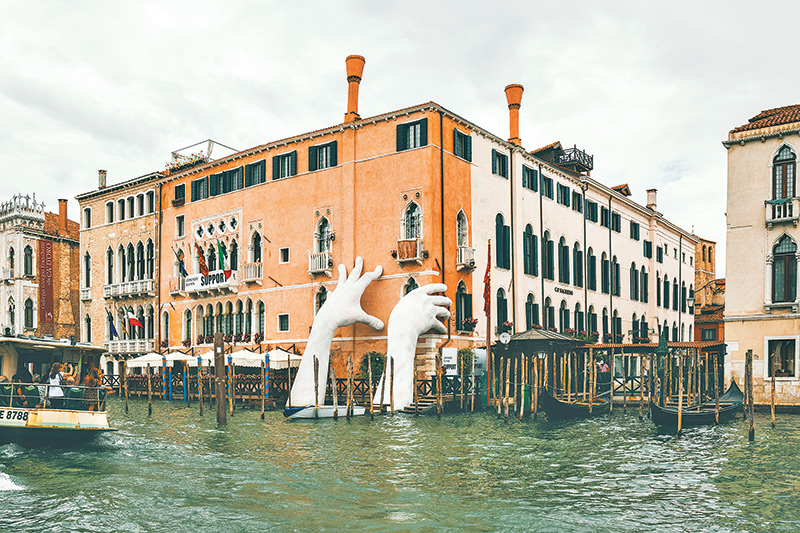
‘Support’ by Lorenzo Quinn: Gigantic hands rise from water to support the Ca’ Sagredo Hotel in Venice, Italy, a statement of the impact of climate change and rising sea levels. Alena Veasey/Shutterstock.com
On the shores of the Bay of Bengal, skirting around the Sundarbans, in a remote village called Abadchondipur in Satkhira, lives Mashkura, aged 28, the wife of a shrimp farmer. Her childhood was a happy one; she had rice to eat, fields to play in and a heart filled with hope that, in the coming years, she would be a wife and a mother. Over the four years of her marriage, her dreams were slowly shattered, with not one but three miscarriages, and the beginning of social ostracism. Mashkura was a victim of exposure to excess salinity. As sea levels rise and the coast is hit by increasingly erratic storms and tidal surges, the salinity levels of the open sea spread north into non-coastal areas, impacting the lives of millions like Mashkura. Her story is only one example of how Bangladesh pays dearly for the world’s failure to take action against climate change. This unnecessary pain is unacceptable. Even though developed countries are primarily responsible for climate change, the International Institute for Environment and Development found that the rural poor in Bangladesh were spending an average of $2 billion a year to address the impacts of climate change—more than the government and aid agencies’ spending put together. International financing covers only 4 percent of spending on climate action in Bangladesh. Thus, struggling rural communities are left to bear most of the burden of climate change themselves. World leaders agreed in 2015 at the 21st sitting of the Conference of Parties (COP21) on the importance of ‘averting, minimising and addressing loss and damage associated with the adverse effects of climate change’. Little has been achieved since then. The parties were caught in a tussle about how to define and measure the losses, while thousands like Mashkura continue to suffer. Bangladesh is a low-lying delta crammed with 170 million people, battered frequently by fierce cyclones, and threatened with submersion in a matter of decades if the world keeps warming at its current rate. There are around 35 million people currently living along the coastal belt of the Bay of Bengal, on the edge of a climate catastrophe. The immediate impacts of storms and tidal upsurges are well-known and often spoken about, but we hear less about the resulting salinity increases, and the dangers they bring. The effects are manifested in worsening crop yields, malnutrition and drastic economic effects. Diseases and miscarriages during pregnancy are major concerns. Other areas of Bangladesh are also battling climate change. The northeast faces floods every year, which are increasing both in duration and magnitude as the climate crisis intensifies. The hill tracts in the east face drastic landslides causing loss of lives and homes each year. The riverine sedimentary deltas, or ‘chars’ as they are locally known, are continually eroding, breaking up and disappearing in one place and forming in another. Millions of people live in these neglected places. Many of them have had to relocate and start anew as many as 20-30 times in their lives. Each time, they lose nearly all of their assets, becoming poorer and poorer. The char communities have long been vulnerable to floods, droughts and erosion. But now, the increasing unpredictability of these events has made life nearly unbearable. The impermanence of the land makes it impossible to have electric or gas lines, roads or permanent buildings on the chars. Traditional infrastructure is impossible in these regions, and a service delivery mechanism suited to this unique landscape is yet to be put in place. As a result, in spite of goodwill from all sides, they are, in reality, totally cut off from basic services—be it healthcare, education, legal services, financial assistance, or often even disaster relief. It was in these areas that Friendship began its journey with a floating hospital in 2002. Since then, the organisation has expanded to include more floating and land hospitals, satellite clinics, ‘community medic-aides’ and programmes for climate adaptation, economic development, education, inclusive citizenship and cultural preservation. And it is thus with the help of Friendship paramedic Sangita Boral that Mashkura has finally become a proud mother. The solution was simple: she switched to drinking water from a nearby desalination plant, which Friendship had installed a couple of years ago. But there are many more climate victims like Mashkura. They do not get any benefit from the progress of the 21st century, the growth of companies, innovations of our world, the onrush of the 4th Industrial Revolution. They only see their one life ebbing away in a state of bare survival. The government of Bangladesh and non-governmental organisations have been working on disaster preparedness in the coastal belt, and there have been massive improvements in prediction, mitigation, preparation, protocols, procedures, lifestyles, architecture, infrastructure, etc. The death rates have drastically diminished in the last few decades; however, lives are still lost, along with harvests, livestock, homes and properties. Cyclones and floods still disrupt millions of lives. Only when you die and become a statistic, are your issues addressed somewhere in the world scene; but while suffering mentally or physically, you are not a statistic and thus you remain unaccounted for, unaddressed. However, Bangladesh’s vulnerability makes it an important player in the fight against climate change. The government and many non-government agencies have worked for years to develop innovative solutions for the communities to cope with climate change issues. The work we do could help climate-impacted communities around the world. Bangladesh has learnt many lessons in climate change resilience. It is, however, impossible for us to make a difference in the world without a committed and sincere effort on the part of the international community. This is why every nation, regardless of whether they are contributing to or impacted by climate change, needed to agree to invest in averting, minimising and addressing loss and damage due to climate change. Instead, final decisions on rules for carbon markets and trading emissions credits have been again postponed to next year at COP26. Leaders have tended to treat the matter of loss and damage as compensation paid by wealthy, polluting nations to climate-impacted ones—like a yellow card to the offending team. But the reality of the situation is that there are no teams. We are all one team, on the brink of a great loss. It is true that today countries like Bangladesh are most vulnerable to climate change, and therefore pay the price for carbon emissions all over the world. But climate change is not a Bangladeshi problem, and its impacts are not going to be felt by any one country alone. As such, if the developed countries of the world invest in solutions, and even if they happen to be put into practice in Bangladesh, this is merely a test run for solutions that everyone will eventually need. We need to reframe the question of ‘loss and damage’ as a global expense, for which the sooner we start paying, the better.
This article was previously published in The Daily Star, a part of the Asia News Network.
LIFE & STYLE
5 simple ways to pursue an environment-friendly lifestyle
The battle against climate change is difficult, but you can adopt these simple changes in your lifestyle to reduce its effect.
- Post Report
photos: unsplash
Kathmandu, It is just the second week of the new year and we are already witnessing the destruction and disaster climate change can bring. The devastating bushfire in Australia and the deadly floods in Indonesia can be the prime examples of this crisis. It is obvious that the consequences of climate change can go farther if people don’t change their lifestyle and adopt environmental and sustainable changes. Having said that, it is next to impossible to completely abandon certain services or products that have been contributing to environmental pollution. But even making simple and small changes in one’s lifestyle can help in reducing the perils of climate change. So, this New Year, if you are planning to make any resolutions in taking steps for reducing your emissions and contribute your two cents in making a positive impact, here are a few simple things you can easily adopt in your life.
Make ‘reuse’ your favourite word that starts with R Do you have a special event to attend and you are planning to buy a new outfit? You can totally skip it and borrow a nice outfit from your friends or family rather than buying a new one. Fast fashion is one of the contributors to climate change. Since most of the fast fashion clothes are comparatively cheap, most people don’t give a second thought before making a purchase. Even those who are environmentally conscious seem to disregard the consequences of fast fashion. If it isn’t always feasible to buy sustainable clothes, you can always cater to your fashion needs by planning your purchase. Buying something that can be styled in different outfits can be a win-win. Remember those days when hand-me-downs from older siblings or cousins used to be a norm, its time to bring that back.
Stay away from plastic bags Plastic is unskippable in most of the cases. Although it is harmful to the environment, because of its versatility, it is widely used. Even banning the use of plastic bags hasn’t reduced their consumption. However, you can just start by carrying a cloth or jute bag when you are shopping—be it grocery or clothing. You can simply refrain from plastic usage by minimising the use of the carry-on bags. A simple habit of avoiding using one-time-use plastic bags can be a significant step towards environmental conservation.
Plants can be your best friends When we talk about plants, many urban residents only think of small potted house plants. But you don’t have to limit yourself to just that. We know that there isn’t a lot of space if you are living in a city, but there are various ways you can have a kitchen garden even in small spaces—in the terrace or a balcony. Sure, planting flowers or other decorative greens can be your starting point. But if you would like to experiment more, you can even plant easily grown vegetations like tomatoes, chilli, mint, parsley, coriander to name a few. If this goes well, you can even upgrade to other greens. Remember, Nepal has a very feasible climate to grow a number of vegetations. Its time we make use of it.
Get on the DIY trend Nepalis know how to recycle—from using a jar of used Horlicks to store achars or spices, to using a big tub of ghiu as a planter. This is just a simple example of how we have been reusing and even sometimes upcycling the available products. Although it may not be very aesthetically pleasing, it significantly reduces the requirement of buying new products, limiting the ecological damage. With a variety of resources available on the internet, we can even find ways to make these upcycling elegant to look at. You will find many articles or even YouTube tutorials to understand the know-how. Your upcycling project can range from using old sarees to make kimonos, previously worn old clothes to make tote bags or converting an old tyre into funky furnitures. Just let your creative juices flow and make things which are not just Instagrammable, but also serves an environmental motive.
Treating waste responsibly One of the major problems in every household is waste segregation. The waste isn’t separated in a proper manner and a single dustbin is used for everything. Biodegradable or recyclable waste is mixed with non-biodegradable and toxic waste. A simple step of having different dustbins will help in reducing the amount of waste that will potentially fill up the landfills. The waste dumped in these landfills not only pollutes the environment, but releases methane, a greenhouse gas, that can trap heat in the atmosphere. On the other hand, segregating waste will also give you a clear idea of the waste that can be recycled or upcycled.
LIFE & STYLE
Beauty, fashion and looking ‘hot’: YouTube’s powerful messages for girls
How do YouTubers typically construct and celebrate what it means to be a girl?
- Bernice Loh
shutterstock
On September 2018, comedian Amy Schumer posted pictures of the covers of two US magazines—Girls’ Life and Boys’ Life—on Instagram with the caption “No.” The girls’ magazine featured stories about fashion and hair. The boys’, headlined Explore Your Future, was full of interesting things to do. The post went viral. “Wow. @amyschumer I second that emotion,” responded actress Blake Lively. “Ladies, let’s not let this happen anymore …” The pressure for girls to focus on how they look or fashion themselves after adults has been much discussed. Most of this, however, has focused on “traditional” forms of media—books, magazines, TV shows—but this does not accurately depict the changing mediascapes of girls’ lives, in particular, the growing significance of YouTube. YouTube has attained a global watch time of over 500 million hours daily. Growing by 60 percent each year, it is prevalent in many young people’s everyday lives. But how do YouTubers typically construct and celebrate what it means to be a girl? In 2014, there were at least 45,000 YouTube channels that featured beauty-related content. In June 2016, there were more than 5.3 million videos that capitalise on the female appearance on YouTube.
Fashion Haul videos are one of the most popular genres uploaded by young female YouTubers. In haul videos, YouTubers typically introduce and describe the products that they have purchased, after each shopping trip. Popular American YouTuber Bethany Mota (MacBarbie07) first uploaded videos about the fashion purchases from her shopping trips back in 2009, which saw her subscribers on YouTube grow exponentially. She reportedly earns around half a million dollars a year from YouTube, just by shopping and filming what she buys. British YouTuber Zoe Sugg (Zoella)—who has over 11 million subscribers—also regularly updates her female fans on where she shops. The labels mentioned include ASOS, Topshop and H&M. According to Vogue, Sugg has become one of the biggest fashion influencers, with more than 950 million casual views today on her channel.
Beauty Besides videos on fashion, there is a growing community of YouTubers dedicated to generating beauty and makeup content. These videos range from step-by-step tutorials teaching girls how to apply makeup to sharing their everyday beauty routines. Christine’s (TessChristine) morning routine video, for instance, features herself getting out of bed, shaving her legs and applying makeup, checking social media and wearing high heels before she steps out of the house on a “casual day out”. YouTuber AlishaMarie also has a following on her “How to Look HOT” series. “How to look HOT for Back to School” is one of her most viewed videos, with over 4 million views. It is worth noting that videos of fashion and beauty on YouTube are not specifically produced for girls. In fact, videos on makeup and dress constitute a significantly different “genre” from what girls have traditionally been allowed to watch (for example teen/tween sitcoms on the Disney Channel). However, with their DIY approach and instructions on how girls should be acting or dressing, such videos have become legitimate and ready sources of information.It is also common for beauty YouTubers to provide lists of products in the information section of their videos. But how independent are these recommendations? Are some YouTubers actually sponsored, but presenting products as something they have bought because it is “quintessential” or “useful” to have them “as a girl”?
Alternative viewing There are, of course, YouTubers who create alternative content. Top Asian Australian YouTuber Wengie, for example, strikes more of a middle ground, with videos that address goals, health and personal growth for girls. There are also other Western young female YouTubers who use humour and satire to challenge ideas of popular femininity. Top Canadian YouTuber Lilly Singh’s viral video “How To Make a Sandwich” is a retaliation against the sexist comments that she receives on her channel, telling her that “women aren’t funny” and that they should be in the kitchen “making sandwiches”. Miranda Sings—who has 7 million subscribers—similarly puts on monstrous makeup to perform parody music videos, which have little or no relation to being conventionally pretty. A growing community of male YouTubers like Pewdiepie, NigaHiga and Casey Neistat have also achieved high levels of popularity with the support of fan girls. Nonetheless, those concerned about our culture’s obsession with girls’ appearances should be paying more attention to this community of YouTubers. Girls’ consumption of videos on YouTube should not be considered as a teenage fad, especially with YouTubers’ influence on young people surpassing celebrities on traditional mainstream media. In fact, celebrities today are also increasingly shifting their focus to YouTube, in order to compete with YouTubers for a share of this market.
—The Conversation/Associated Press
CULTURE & ARTS
The lieutenant’s restaurant
The story behind how one retired army man built a political and literary hub during the Rana and Panchayat regimes.
- PRAWASH GAUTAM
Krishna Bahadur Khatri Chhetri, also known as Laptan sa’ab, in military uniform. He retired as second lieutenant of Nepal Army. Photo Courtesy: Bipin Paudel KC
Every day, Krishna Bahadur Khatri Chhetri would reach his eatery by five in the morning, and at seven, after making all the preparations for the day, he would fling open the doors, welcoming all customers. Chhetri was set on making a profit and could not afford to miss out on any customers, who came to his eatery in large numbers. Even as he began taking the first orders, conversations would slowly rise among his customers. Customers at Chhetri’s eatery, known colloquially as ‘Laptan ko hotel’ and located in Dillibazar, discussed political events and literature, and planned courses of action. This being the Rana years, there was little freedom to openly discuss politics, but Laptan ko hotel provided one such avenue. Among the hundreds that patronised this little eatery in its two-decade of existence were writers like Laxmi Prasad Devkota and Bhupi Serchan, and political leaders like Tanka Prasad Acharya and Pushpalal Shrestha, and many others who would go on to leave a mark on the political and literary history of Nepal. Indeed, starting in the 40s, this eatery gained fame as a hub for politically conscious young people and literary personalities during the Rana and Panchayat regimes. Given the kind of people who patronised this eatery, its story remains well-documented in Nepal’s political and literary history. Chhetri too is well remembered by the hotel’s patrons as an enterprising man with business acumen who took courage in running such a space during repressive regimes.
Laptan’s origins Chhetri was a 48-year-old retired second lieutenant from the Nepal Army when he decided to open up a restaurant of his own. As a man of entrepreneurial spirit, he had no plans of operating a clandestine restaurant for political and literary figures—he just wanted to make a profit, according to Bipin Paudel KC, Chettri’s grandson. According to KC, his grandfather wanted to increase the prospects for profit by offering something unique. Chhetri, who was referred to as Laptan sa’ab after his military rank, had long been among a group of soldiers who stopped for tea at Tilauri Maila and Kancha dai’s tea stall in Dharahara after parades at Tundikhel. At this stall, which was then among the most popular places selling tea in Kathmandu, Chhetri saw how the proprietors were profiting from Kathmandu’s growing love affair with tea. He also saw, said KC, how this drink, which was then fairly new in the city, drew together politically conscious individuals to gather and engage in conversation. Chhetri decided that he too would sell tea in Dillibazar. “Dillibazar was the centre of Kathmandu, where the politically conscious, educated class lived,” said 86-year-old writer and historian Arbind Rimal. “It was one of the most populous localities in Kathmandu, home to middle and upper-middle classes and most vibrant in terms of politics, literature, sports and cultural activities. Laptan must’ve calculated that in Dillibazar he’d have access to people who would not only be attracted to the idea of drinking tea, but also be able to pay for it.” Chhetri was right, the residents of Dillibazar were looking for just that kind of place. Poet Pushkar Prasad Lohani, who is now 81, grew up in Dillibazar and frequented the eatery as a teenager. Just around where Laptan ko hotel first came up, there was a small shop that sold chatamari and another that sold halwai sweets. But there was no place that sold tea, he said. “Every morning, locals gathered in that chatamari shop to discuss politics,” said Lohani. “But there was no place that offered tea, so Laptan grabbed this business opportunity.” Rimal describes the restaurant in his essay ‘Dillibazar ko Laptan ko hotel’ as being on “the ground floor of a simple-looking house with a tiled roof, along the main road on the way to Putalisadak from Dillibazar”. Chettri had stuffed a few tables and chairs in the small room. In one corner, he placed a stove where he prepared a small menu of aloo tarkari, chana, chiura, biscuits and tea. Chettri had registered the eatery as Amrit Bhojan Griha and even put up a signboard with that name, according to documents that his grandson has preserved, but so imposing was his identity as an army man that it became known as Laptan ko hotel. The 40s were a politically charged time in Nepal, with burgeoning anti-Rana movements led by clandestine political parties like the Praja Parishad, Communist Party of Nepal and the Nepali Rastriya Congress. Against this backdrop, just like Chettri had anticipated, customers started flowing in, with most of them asking for tea that he offered at five paisa per glass. “Before long, Laptan ko hotel became a popular meeting hub for the conscious youths of Dillibazar,” writes Rimal in his essay. “In fact, there were uninterrupted gatherings happening from seven in the morning to seven in the evening. […] Here, politically conscious local youths […] engaged in political discussions in symbolic language.” As a meeting place for the politically conscious, the eatery naturally became a space for discussions centred around ways of directly and indirectly mobilising the youths for political change. Here, youths formed the Nepal Cultural Association which, according to Rimal, played an important role in political awareness through cultural and sports activities, and the Pragatisheel Adhyayan Mandal, an organisation that motivated youths to read and discuss ‘progressive books’ to draw them towards the nascent communist movement. These youths also planned more direct action. One of these, Rimal writes, was an “influential strike” led by students from Tri Chandra Campus during the reign of Padma Shumsher in 1947. “Almost all students who had become regular customers at the hotel participated in the movement,” he writes. “When the student protest rally that began with placards from Tri Chandra Campus reached Padma Sumsher’s palace, he […] ordered his subordinates to release non-violent protesters and soon introduce reforms.” Despite these political happenings, Chettri focused on his business. For him, compared to the numbers in his account book, all political and literary activities seemed mundane, and so, seated on a wooden chair behind the counter, he was mostly engrossed in his finances. “Tall and well-built, large eyes and a thick moustache that curled upwards, and always donning his green overcoat, Laptan sa’ab sold tea in full military style,” said Rimal. “In that simple hotel, his appearance naturally stood out as striking for the customers, and it was made somewhat mysterious by the fact that he spoke very little and always dealt with customers with a friendly face. This worked to his business advantage.” In time, with his hard work and business acumen, Chettri succeeded in not only expanding his business, but also increasing its fame as a space for political and literary meetings.
[This is the first part of Gautam’s account of ‘Laptan ko hotel’, where Nepali literary and political figures frequented in the 40s. Read the second and final part on tomorrow’s Kathmandu Post.]
Gautam is a freelance journalist based in Kathmandu.
CULTURE & ARTS
China’s farmers reap rich harvest through video-sharing apps
Creating videos has become a popular sales tactic for Chinese farmers—the clips show increasingly discerning consumers the origins of the product and provide a window into rural life.
- LUDOVIC EHRET
Chinese farmer Ma Gongzuo collecting honey at his apiary in Songyang county in China’s Zhejiang province. afp/RSS
“Do you want a piece?” beekeeper Ma Gongzuo says, looking into the camera of a friend’s smartphone before biting into the dripping comb of amber-coloured honey. The clip goes out to his 737,000 followers on Douyin, the Chinese version of popular video sharing app TikTok that has 400 million users in the country and has turned Ma into something of a celebrity. Creating videos has become a popular sales tactic for Chinese farmers: the clips show increasingly discerning consumers the origins of the product and provide a window into rural life that captures audience imagination. For some it has helped them find a way out of poverty, which the ruling Communist party hopes to eradicate by 2020. “Everyone said I was good for nothing when they saw I’d come back,” the 31 year-old says of his return to his village after a failed attempt at running an online clothing business. “They tell us that we can only get out of poverty if we study and get a job in a city,” he adds. Today, Ma drives an expensive car and has already earned enough to buy property and help his parents and fellow villagers with their homes and businesses.
‘I show my life’ In 2015, Ma took on the family honey producing business in the verdant hills of Zhejiang province, and thanks to e-commerce apps, managed to turn a yearly revenue of 1 million yuan ($142,000). But the sales began to stagnate. So in November 2018, with help from his friends in the village, he began posting videos about his life on the farm. They showed him opening up a hive surrounded by a swarm of bees, swimming bare-chested in a river, and chopping wood. “I never advertise my products. I show my daily life, the landscapes of the countryside. That’s what interests people,” Ma says. “Of course people suspect that I’m selling honey. But they decide to get in touch with me to say they want to buy some.” Like most transactions in China, where hard cash is less and less popular, the orders are paid through apps like WeChat or AliPay. Ma says he now sells between 2 and 3 million yuan ($285,000- $428,000) worth of honey each year, as well as dried sweet potato and brown sugar. “When I was young we were poor,” he recalls, adding: “At school I used to admire other kids who had pocket money, because I never had any.” Now he drives a 4x4 BMW that cost around 760,000 yuan ($108,000) and has also invested in building a B&B. “Using Douyin, that was the turning point,” he says. “Today I can buy my family what they need. I help the other villagers to sell their products too. All of the local economy benefits,” he explains.
‘It’s progress’ In China, some 847 million access the internet via their smartphone, so online apps have played a vital role in Ma’s success. “It’s progress,” his father Ma Jianchun says happily. “We old people are overwhelmed. With the money, we’ve been able to renovate our house.” China is home to the world’s largest market for live video broadcasting, according to US audit firm Deloitte. Getting in on the trend, Douyin’s parent company ByteDance says it has organised training for 26,000 farmers on how to master the art of making videos. There are other similar platforms including Kuaishou and Yizhibo. Taobao, the most popular e-commerce app in the country and owned by tech giant Alibaba, launched a project in 2019 showing farmers how to become livestreaming hosts in a bid to help them earn more. The number of people living under the poverty line in rural China has reduced dramatically —from 700 million in 1978 to 16.6 million in 2018, according to government figures. But the depopulation of the countryside continues, as many Chinese head to cities in search of better-paid jobs. “We want to be an example, to show young people that it is entirely possible to set up a business and earn money in rural areas,” explains university-educated Ma Gongzuo. “We hope that more will return, so that life and the economy can resume in the villages.” With his newfound fame, Ma says he has already received many proposals. And not just from those interested in his honey.
—Agence France-Press
WORLD
Austria’s Kurz returns as world’s youngest chancellor
- AGENCE FRANCE-PRESSE
Sebastian Kurz. AFP/RSS
VIENNA, The leader of Austria’s conservatives Sebastian Kurz was sworn in Tuesday as the world’s youngest democratically elected leader at the head of an unlikely coalition with the Greens following the collapse of his previous alliance with the far-right. Vowing to “protect the climate and the borders”, the 33-year-old has become chancellor of a government that marks the first time the Greens have been in a national government in the Alpine country. Kurz’s People’s Party (OeVP) and the Greens agreed last week to govern together after the last administration with the far-right fell apart in a corruption scandal. The alliance aims to please both sides by pushing for Austria to be carbon neutral by 2040 and also continuing previous strict anti-immigration measures.
‘Best of both worlds’ Kurz—whose conservative OeVP has been in government for more than three decades—has defended the undertaking as combining “the best of both worlds”. The OeVP has 10 ministers in the new coalition, while the Greens have four with its party chief Werner Kogler, 58, taking on the vice-chancellorship. Among the ministers being sworn in Tuesday more than half are women, including the defence minister.
WORLD
Australia’s leaders unmoved on climate action after devastating bushfires
Prime Minister Scott Morrision says Australia should be rewarded for beating its emissions reduction targets for 2020.
- REUTERS
A police car drives amidst a burnt forest during bushfire season in Lake Conjola, Australia, on Tuesday. AFP/RSS
MELBOURNE, Australia’s government is sticking firmly to a position that there is no direct link between climate change and the country’s devastating bushfires, despite public anger, the anguish of victims and warnings from scientists. Prime Minister Scott Morrison and his emissions reduction minister, Angus Taylor, say Australia does not need to cut carbon emissions more aggressively to limit global warming, even after a three-year drought and unprecedented bushfires. Instead they say Australia, which contributes 1.3% of the world’s carbon emissions but is the second-largest emitter per capita behind the United States, should be rewarded for beating its emissions reduction targets for 2020. “When it comes to reducing global emissions, Australia must and is doing its bit, but bushfires are a time when communities must unite, not divide,” Taylor said in emailed comments to Reuters on Tuesday, while he was busy at bushfire relief centres in his constituency in New South Wales state. Stepping up efforts to cut emissions would harm the economy, the government argues, especially if it hurt Australia’s exports of coal and gas. The country last year overtook Qatar as the world’s top exporter of liquefied natural gas. “In most countries it isn’t acceptable to pursue emission reduction policies that add substantially to the cost of living, destroy jobs, reduce incomes and impede growth,” Taylor wrote in The Australian newspaper on Dec. 31. “That’s why we won’t adopt (opposition) Labor’s uncosted, reckless, economy-destroying targets that will always result in a tax on energy, whether it is called that or not.” Taylor did not detail exactly how cutting emissions would raise the cost of living. Australians have complained that due to a lack of energy policy, power prices have risen substantially in recent years placing a heavy burden on household incomes, even as energy producers are gradually shifting to cheaper renewables. Taylor’s came in response to criticism Australia faced at the United Nations climate summit in Madrid for blocking ambitious action to cut carbon emissions. Environmental groups say Australia will only meet its emissions targets by including old carbon credits the government wants to count from the 1992 Kyoto Protocol. Scientists say climate change is a key factor in the destructive wildfires. “One of the key drivers of fire intensity, fire spread rates and fire area is temperature. And in Australia we’ve just experienced record high temperatures,” said Mark Howden, director of the Climate Change Institute at Australian National University. The burning forests are a double whammy for the environment, as they add to carbon emissions while also removing carbon sinks which will take decades to grow back, said David Holmes, director of the Monash University Climate Change Communication Research Hub. Australia’s bushfires since September have emitted about 350 million tonnes of carbon dioxide, equal to two-thirds the country’s annual emissions from man-made sources, estimated Pep Canadell, director of the Global Carbon Project, based on data from NASA satellites. To others, from opposition Labor to film star Russell Crowe to U.S. Senator Bernie Sanders, the link is clear between climate change and Australia’s fires which have killed 25 people, destroyed thousands of homes and razed more than 8 million hectares of land since September. “I say to those who are delaying action on climate change: look at the blood-red sky and unbreathable air in Australia because of raging forest fires,” Sanders said on social media last week. Amid an outbreak of fires in several states in November, Labor leader Anthony Albanese urged Morrison to beef up resources to prepare for, fight and prevent disasters. “The fire season is starting earlier and finishing later, and emergency leaders agree that extreme weather events in Australia will only increase in severity and frequency, due to climate change,” Albanese wrote in the Nov. 22 letter, which he posted on social media.
WORLD
Brexit in sight as British MPs scrutinise divorce deal
- AGENCE FRANCE-PRESSE
LONDON, Britain moves a step closer to a historic departure from the European Union on Tuesday, after more than three years of bitter division and political drama, as Prime Minister Boris Johnson brings his Brexit deal back to parliament without the threat of defeat, deadlock or delay. Lawmakers begin three days of debate on legislation to enshrine Johnson’s divorce deal, with few hurdles to its passing expected after he won a comfortable majority at recent elections. The air of inevitability that Brexit was finally about to happen contrasts starkly with the repeated postponements and rejections of the previous deal of his predecessor Theresa May that plunged Britain into political and economic uncertainty. The lack of anticipated drama has instead seen focus shift to potential conflict between the United States and Iran. But the Conservative leader is still up against the clock. Both the UK and European parliaments must ratify the deal before Britain’s January 31 departure date, when a so-called transition phase to the end of the year will kick in. MPs gave their initial approval to the Withdrawal Agreement Bill in a vote on December 20, a week after Johnson secured a majority of 80 in the 650-seat House of Commons. They now have three days of debate before the bill passes to the unelected House of Lords for further scrutiny next week. Opposition lawmakers and troublesome peers will try to amend the text but with such a comfortable majority, Johnson is virtually certain of getting it through on time. In a sign of his confidence, Johnson’s government announced it would hold a new post-Brexit budget vote on March 11, to “seize the opportunities that come from getting Brexit done”. The main opposition Labour party was meanwhile focused on the start of a campaign to replace veteran socialist Jeremy Corbyn as leader. His divisive leadership and ambivalence over Brexit were blamed for Labour’s stinging defeat and loss of support in its heartlands of northern England. Britons voted in the 2016 referendum to end more than four decades of integration with the EU, but it has taken nearly four years of infighting and two general elections to implement the result. Johnson now looks set to finally make it happen, even if a potentially bigger battle awaits on future ties with the EU. The British premier will hold his first meeting with the new European Commission president, Ursula von der Leyen, in London on Wednesday. Both sides are keen to prepare for talks on their future trading relationship, although these cannot start formally until Britain leaves the EU. The Brexit deal includes a transition period in which ties remain unchanged in practice until December 31, 2020, to provide continuity until a new economic partnership can be agreed. EU officials—including von der Leyen herself—have warned this is a very tight timeframe, but Johnson insists he will not opt to extend the transition period.
WORLD
NASA planet hunter finds Earth-sized world in ‘Goldilocks zone’
- AGENCE FRANCE-PRESSE
Planet TOI 700 d (shown in an artist’s illustration) is the first Earth-sized habitable-zone world discovered by NASA’s planet hunter satellite. NASA/AFP
WASHINGTON, NASA said Monday that its planet hunter satellite TESS had discovered an Earth-sized world within the habitable range of its star, which could allow the presence of liquid water. The planet, named “TOI 700 d”, is relatively close to Earth—only 100 light years away, NASA’s Jet Propulsion Laboratory announced during the annual American Astronomical Society meeting in Honolulu, Hawaii. “TESS was designed and launched specifically to find Earth-sized planets orbiting nearby stars,” said Paul Hertz, NASA astrophysics division director. TESS initially misclassified the star, which meant the planets appeared larger and hotter than they actually are. But several amateur astronomers, including high school student Alton Spencer—who works with members of the TESS team—identified the error. “When we corrected the star’s parameters, the sizes of its planets dropped, and we realized the outermost one was about the size of Earth and in the habitable zone,” said Emily Gilbert, a graduate student at the University of Chicago. The discovery was later confirmed by the Spitzer Space Telescope. A few other similar planets have been discovered before, notably by the former Kepler Space Telescope, but this is the first discovered by TESS, which was launched in 2018. TESS stabilizes on one area of the sky to detect whether objects—planets—pass in front of stars, which causes a temporary drop in the stars’ luminosity. This allows TESS to infer the presence of a planet, its size and orbit. Star TOI 700 is small, about 40 percent of our Sun’s size and only about half as hot. TESS discovered three planets in orbit, named TOI 700 b, c and d. Only “d” is in the so-called habitable zone, not too far from and not too close to the star, where the temperature could allow the presence of liquid water. It is about 20 percent larger than Earth and orbits its star in 37 days. “d” receives 86 percent of the energy that Earth receives from the Sun. It remains to be seen what d is made of. Researchers have generated models based on the size and type of star in order to predict d’s atmospheric composition and surface temperature. In one simulation, NASA explained, the planet is covered in oceans with a “dense, carbon-dioxide-dominated atmosphere similar to what scientists suspect surrounded Mars when it was young.” The planet is tidally locked to the star, meaning that one side always faces the star, as is the case with the Moon and Earth. This synchronous rotation meant that, in another model, one side of the planet was constantly covered in clouds. A third simulation predicted an all-land world, where winds flow from the planet’s dark side to its light one. Multiple astronomers will observe the planet with other instruments, in order to obtain new data that may match one of NASA’s models.
WORLD
Magnitude 6.5 earthquake hits off Puerto Rico: USGS
Briefing
WASHINGTON: A strong earthquake struck off the south of Puerto Rico early Tuesday, the US Geological Survey said, the latest in a series of tremors that have shaken the island since December 28. The shallow 6.5 magnitude quake struck 13.6 km south of the city of Ponce, USGS said. The quake struck just off the US territory’s southern Caribbean coastline at 4:24 am local time. Local news sites reported an electricity blackout following the earthquake. On social media, people in Puerto Rico wrote of being shaken awake by the force of the quake. One woman on Twitter said she had been “wrenched from sleep”, adding “Everybody is awake & scared all over.” An alert issued by the Tsunami Warning Center immediately following the earthquake was later cancelled. (AGENCIES)
WORLD
Eight killed in fire at migrant worker cabins near Moscow
Briefing
MOSCOW: At least eight people died on Tuesday after a fire swept through cabins housing migrant workers at a greenhouse facility outside Moscow, Russian news agencies reported. The fire at the facility in the Ramensky district southeast of Moscow broke out in the early hours, agencies quoted the emergencies ministry as saying. The fire spread over 240 square metres through metal cabins housing the workers, RIA Novosti and TASS reported. Interfax quoted the ministry as saying all the dead were citizens of the ex-Soviet Central Asian nation of Tajikistan. It was unclear how many workers were living in the complex. (AGENCIES)
WORLD
At least 16 dead in Peru traffic accident
Briefing
LIMA: At least 16 people including two Germans were killed and 40 others injured after a bus crashed into parked cars in the south of Peru, authorities confirmed. The accident happened early Monday on the main coastal highway used by many tour bus companies and linking the capital Lima with Arequipa in the south. In a statement late Monday the prosecutor’s office said there were two German citizens, 10 Peruvians, and four unidentified people among the 16 killed. Among the injured were two Brazilians, two Americans and one Spaniard, according to the health ministry. The crash occurred when the bus left its lane and crashed into eight vehicles parked on the side of the road. (AGENCIES)
ASIA
US exposes its ally Saudi Arabia to peril after killing of Iranian commander
Riyadh distances itself from the strike, with a Saudi official saying the kingdom was ‘not consulted’ by Washington before the killing.
- AGENCE FRANCE-PRESSE
Saudi Deputy Minister of Defence Khalid bin Salman al-Saud, arrives at the Department of State for a meeting with Secretary of State Mike Pompeo in Washington, DC, on Monday. AFP/RSS
RIYADH, The US has put its ally Saudi Arabia in Iran’s crosshairs with the assassination of a top general, leaving it bracing for retaliation just as it was working to ease tensions after a torrid 2019. American officials say the kingdom faces a “heightened risk” of drone and missile attacks after the killing in Baghdad last week of powerful Iranian commander Qasem Soleimani in a US drone strike. The assassination has sparked fears of a regional conflagration as Tehran vows to take “severe revenge”, with Saudi Arabia calling it a “very dangerous moment”. Riyadh has tried to distance itself from the US strike, with a Saudi official telling AFP the kingdom was “not consulted” by Washington before the killing. Saudi newspapers close to the regime have sought to deflect blame onto rival Doha, saying the drone that downed Soleimani took off from a US base in Qatar, glossing over the deployment of American troops in the kingdom. A Saudi delegation led by Prince Khalid bin Salman, the deputy defence minister, arrived in Washington on Monday for de-escalation talks, while King Salman has urged Iraq to take urgent measures to defuse tensions. “It’s pretty clear that the Saudis don’t welcome this crisis even though they have to be quietly delighted with the killing of Soleimani,” said Hussein Ibish, a scholar at the Arab Gulf States Institute in Washington. “They know they would be in the crossfire if war breaks out, so they are doing everything they can to bring down the temperature.” In recent months, Saudi Arabia and its arch-nemesis Iran have taken steps towards Iraq-brokered talks in a bid to defuse tensions that have brought the Middle East to the brink of war. Iraq’s prime minister, Adel Abdel Mahdi, said Sunday that he was expecting to meet Soleimani on the day he was killed, saying the general had travelled to deliver a response from Tehran to an earlier Saudi message. The outreach marks a shift from de facto Saudi ruler Crown Prince Mohammed bin Salman’s earlier aggressive stance towards Iran, which sent regional tensions soaring. Analysts had fretted that Saudi leaders, frustrated with former US president Barack Obama’s outreach to Iran and who welcomed Donald Trump’s hostile stance, would drag Washington into another intractable conflict. But Riyadh appears chastened by coordinated attacks on key oil installations last year, which were blamed on Iran, despite its denials. Washington’s seemingly tepid response after the September 14 attacks affirmed the view that the kingdom could not rely on its closest Western ally to come to its aid if a conflict erupted, analysts say. “The September 14 assault in Saudi Arabia demonstrated its inability to protect their critical infrastructure against asymmetrical attacks,” said Kristian Ulrichsen, a fellow at Rice University’s Baker Institute in the United States. “With both the Saudis and its ally the UAE gearing up for global events this year—the G20 summit in Riyadh and the Dubai Expo 2020—both will be desperate to avoid any escalation that could put them in doubt.” Riyadh has quietly tried to disentangle itself from other regional crises. It appears to have stepped up direct talks with Yemen’s pro-Iran Huthi rebels it has been fighting for almost five years, leading to a noticeable decline in attacks by both sides. Riyadh is also in talks with Qatar over ways to ease a two-year Saudi-led boycott on its neighbour. “The killing of Soleimani... threatens to upend this progress,” said Stephen Seche, vice president of the Arab Gulf States Institute in Washington. “It greatly increases the likelihood that elements within the Huthi movement close to Tehran will be tempted to... strike deep into Saudi Arabia, a move that would almost certainly scuttle the ongoing peace initiative.”
ASIA
Japan issues arrest warrant for former Nissan boss Carlos Ghosn’s wife
- AGENCE FRANCE-PRESSE
Carole Ghosn. Reuters
TOKYO, Prosecutors in Japan on Tuesday obtained an arrest warrant for Carole Ghosn, wife of former Nissan chief Carlos Ghosn, who last month jumped bail and fled the country. The warrant was issued as the fallout from the escape of one of Japan’s most high-profile criminal suspects continues, with authorities pledging tighter border controls and seizing the bail money that Ghosn forfeited by fleeing the country. He had been facing trial in Japan on charges of financial misconduct, which he denies, before fleeing the country in late December for Lebanon, where he was reunited with his wife. In a statement, prosecutors said they had obtained the warrant on suspicion that Carole Ghosn “made false statements” during April testimony to the Tokyo district court about meetings with an unnamed individual. He had been freed on bail after agreeing to strict conditions, with prosecutors arguing he posed a flight risk. The conditions included restrictions on contact with Carole, which was reportedly among the reasons he decided to jump bail and flee the country in an elaborately planned escape that has outraged Japanese officials. hosn’s second wife, Carole vocally led the campaign for her husband’s freedom, insisting on his innocence and slamming Japanese prosecutors for what she deemed ill-treatment after his shock November 19, 2018 arrest. She was initially prevented from seeing her husband, who was held in detention for more than 100 days after his arrest, and petitioned everyone from French President Emmanuel Macron to the White House in seeking his release. Ghosn, a globe-trotting auto titan who was once a giant of the industry, accuses executives at Japanese automaker Nissan of manufacturing the allegations against him in a “plot” to prevent closer integration with alliance partner Renault. The warrant for Carole’s arrest comes as Japanese authorities piece together how Ghosn was able to evade surveillance and airport security. Snippets have emerged suggesting he was aided by a security expert, and took advantage of loopholes in security at Japan’s Kansai airport.
ASIA
Digital avatar that ‘converses and sympathises’ like real people
- AGENCE FRANCE-PRESSE
Neon, a unit of Samsung, promotes a planned launch of an ‘Artificial Human’ at the 2020 Consumer Electronics Show (CES) in Las Vegas, Nevada,on Monday. AFP/RSS
LAS VEGAS, A Samsung lab on Tuesday unveiled a digital avatar it described as an AI-powered “artificial human,” claiming it is able to “converse and sympathise” like real people. The announcement at the opening of the 2020 Consumer Electronics Show in Las Vegas touted a new kind of artificial intelligence called NEON, produced by the independent Samsung unit Star Labs. The technology allows for the creation of customized digital beings that can appear on displays or video games and could be designed to be “TV anchors, spokespeople, or movie actors” or even “companions and friends,” according to the California-based unit of the South Korean giant. “NEONs will be our friends, collaborators and companions, continually learning, evolving and forming memories from their interactions,” said Pranav Mistry, chief executive of the lab. The NEON creators said the new virtual humans are the product of advances in technologies including neural networks and computational reality. According to Star Labs, NEON is inspired “by the rhythmic complexities of nature and extensively trained with how humans look, behave and interact.” The avatars “create life-like reality that is beyond normal perception to distinguish, with latency of less than a few milliseconds.” While digital avatars have long been able to be programmed for specific tasks such as role players in games, NEON goes further by enabling interactions that can incorporate human emotion. Although the artificial humans may borrow features from real people, “each NEON has his or her own unique personality and can show new expressions, movements, and dialogs,” the company said. The announcement comes amid a proliferation of AI-manipulated computer videos known as “deepfakes,” and growing concerns how they could be used to deceive or manipulate. Some analysts fear these fakes could be misused during an election campaign to exacerbate political tensions. Jack Gold, analyst at J. Gold Associates, said Samsung may be ahead of the pack if it can develop avatars that can show emotions and expressions. “We have to wait and see what this means,” Gold said. “But it has major implications for many fields like customer service, help desk functions, entertainment, and of course could also be used to ‘fake’ a human interacting with a live person for bad or illegal purposes.” Avi Greengart of the consultancy Techsponential said the avatars could be realistic but also “creepy.” “Leaving aside how impressive the technology is, will NEON be used in ways that people like, just tolerate, or actively hate?” he said. According to Samsung and Star Labs, NEON offers avatars with lifelike reality “that is beyond normal perception to distinguish.” The company envisions commercial opportunities to create avatars to be service representatives, financial advisors, healthcare providers or concierges. “We have always dreamed of such virtual beings in science fictions and movies,” Mistry said. “NEONs will integrate with our world and serve as new links to a better future, a world where ‘humans are humans’ and ‘machines are humane.’” The laboratory was launched in 2019 by Mistry, who had previously been a senior Samsung vice president and head of innovation at Samsung Mobile. He was known for developing Sixth Sense, a gesture-based wearable technology system built at the Massachusetts Institute of Technology. The India-born Mistry also worked on projects with Microsoft and Google and the National Aeronautics and Space Administration.
ASIA
‘No plan B’ to Syria cross-border aid system: UN
- AGENCE FRANCE-PRESSE
GENEVA, The UN on Tuesday urged global powers to renew a system for cross-border aid delivery to Syria that is due to expire this week, saying there was no alternative. “There is no plan B. There is this operation, which helps hundreds of thousand of people and has done so for a very long time,” said Jens Laerke, spokesman for the Office for the Coordination of Humanitarian Affairs (OCHA). “It is the only viable, sustainable method that we have for reaching these people in need so it is critical that we get renewal of the provisions,” he told reporters in Geneva. Under the current system set up by the UN Security Council in 2014, humanitarian aid is allowed into Syria through four border crossings from Iraq, Jordan and Turkey. Laerke said around 30,000 UN aid trucks had gone into Syria through the crossings since the operation began. The arrangement is set to expire on Friday. When the UN Security Council took up the matter on December 20, Russia and China vetoed a resolution that would have allowed continued aid deliveries for a year. Russia, a key supporter of the Syrian government, has said it would support only a six-month extension, involving only two passage points on the Turkish-Syrian border. Rounds of talks since then have failed to end the deadlock. Laerke said some four million people in northern Syria were supported by UN cross-border aid, including 2.7 million in northwest Syria who relied solely on it. The aid is particularly important for Idlib, an embattled opposition stronghold that has come under increasing bombardment from Syrian and Russian forces in recent weeks. “The millions of people in Idlib, they are trapped,” Laerke said, explaining that UN cross-border assistance could save lives by helping people on the ground. The UN said at least 300,000 people have been internally displaced by the fighting in the Idlib region since mid-December, bringing the total number of displacements in the region to 700,000 over the last eight months.
ASIA
Dozens killed in stampede at funeral of slain Soleimani
- REUTERS
DUBAI/BAGHDAD, Dozens of people were killed in a stampede as crowds of mourners packed streets for the funeral of a slain military Iranian commander in his hometown of Kerman on Tuesday, forcing his burial to be postponed, state-affiliated media reported. Tens of thousands of people had gathered in Kerman to pay tribute to General Qassem Soleimani, who was killed in a US drone strike in Iraq on Friday. A stampede broke out amid the crush, killing 40 people and injuring more than 200, the semi-official Fars news agency reported, citing an emergency services official. One state media agency reported 35 dead, while others reported fatalities without giving figures. Iran’s ISNA news agency said the burial of Soleimani had been postponed, but did not say how long any delay would last. “Today because of the heavy congestion of the crowd unfortunately a number of our fellow citizens who were mourning were injured and a number were killed,” emergency medical services chief Pirhossein Kolivand told state television. He did not give further details. The body of Soleimani, a national hero whose death has united many Iranians, had been taken to Iraqi and Iranian cities before arriving in Kerman for burial. In each place, huge numbers of people filled thoroughfares, chanting “Death to America” and weeping with emotion. Iran’s Supreme Leader Ali Khamenei shed tears as led prayers in Tehran on Monday. In other developments on Tuesday, a senior Iranian official said Tehran was considering 13 scenarios to avenge his killing. US and Iranian warnings of new strikes and retaliation have also stoked concerns about a broader Middle East conflict and led to calls in the US Congress for legislation to stop US President Donald Trump going to war with Iran. “We will take revenge, a hard and definitive revenge,” said the head of Iran’s Revolutionary Guards, General Hossein Salami.
ASIA
Pakistan’s parliament approves extending term of army chief
- REUTERS
ISLAMABAD, Pakistan’s parliament on Tuesday approved extending the term of the army chief for another three years despite the objections of some parties, which accuse the military of heavy-handed tactics in its anti-militant operations along the Afghan border. Pakistan has been ruled by the powerful military for about half its history and tension between civilian governments and the top generals often dominates politics. Any effort by a military chief to consolidate power is viewed with suspicion. But critics of Prime Minister Imran Khan say his government enjoys the support of the military which is why the government approved the extension for Chief of Army Staff General Qamar Javed Bajwa in August. The government cited a worsening national security situation with old rival India as justification for the extension for Bajwa at the end of the usual three-year term. But in a surprise ruling, the Supreme Court struck down the extension in November, ordering the government and army to produce legal provisions and arguments for the reappointment, pitting the judiciary against the government and powerful military. The government responded by drafting legislation which the lower house of parliament approved on Tuesday, clearing the way for the extension. It must still be approved by the upper house, which is expected. “All parties shunned their differences and stood united in the best national interest,” Information Minister Firdous Ashiq Awan told reporters outside the parliament. The two main opposition parties have a long history of clashing with the military but nevertheless backed the legislation, largely, analysts say, to avoid a damaging confrontation. Two smaller parties and some members of parliament from troubled northwestern districts along Afghan border opposed it. They accuse the military of committing rights abuses during its anti-militant operations. The army rejects such accusations.
ASIA
Top Pakistani novelist says military seized Urdu versions of his book
Briefing
ISLAMABAD: Acclaimed Pakistani novelist Mohammed Hanif has accused the country’s powerful intelligence agency of confiscating Urdu translations of his first novel, which satirises the armed forces. The alleged swoop on his publisher by the Inter-Services Intelligence (ISI) agency comes months after the long-awaited translation of his 2008 novel “A Case of Exploding Mangoes” went on sale in Pakistan—more than a decade after its English-language debut. The book chronicles the final days of hardline dictator General Zia-ul-Haq and the myriad conspiracy theories behind the plane crash that killed him in 1988, while also harshly criticising Pakistan’s military establishment. (Agencies)
ASIA
Muslims should unite after Iran commander’s killing: Malaysian PM
Briefing
KUALA LUMPUR: Muslim countries should unite to protect themselves against external threats, Malaysian Prime Minister Mahathir Mohamad said on Tuesday after describing the US killing of Iranian military commander Qassem Soleimani as immoral. The world’s oldest premier, who has in recent months stoked diplomatic tensions by speaking out on issues concerning the Muslim world, also said the US drone attack on Soleimani was against international laws. Soleimani’s killing in Baghdad last Friday has sparked fears of a broader conflict in the Middle East. Mahathir, 94, said it could also lead to an escalation in “what is called terrorism”. (Agencies)
ASIA
Duterte threatens takeover of Manila water firms
Briefing
MANILA: Philippine President Rodrigo Duterte has threatened a government takeover of the capital’s water services unless its two private utilities accept a new contract, his spokesman said on Tuesday, an ultimatum experts warned could spook investors. Duterte’s government will offer a deal to replace the one first crafted in the 1990s when Manila’s troubled water system was privatised and which the president calls a “colossal rip-off”, his spokesman Salvador Panelo said. (Agencies)
MONEY
Facebook defies China headwinds with new ad sales push
Facebook sells more than $5 billion a year worth of ad space to Chinese businesses and government agencies looking to promote their messages.
- REUTERS
A Facebook sign is seen at the second China International Import Expo in Shanghai, China. reuters
SAN FRANCISCO, Facebook Inc is setting up a new engineering team in Singapore to focus on its lucrative China advertising business, according to three people familiar with the effort, even as chief executive Mark Zuckerberg ramps up criticism of a country that blocks the social network. The team at Facebook’s Asia-Pacific headquarters is tasked with developing better ad-buying tools for Chinese customers who have to work around internet restrictions in China known as the “great firewall,” the sources said. One of the people described it as Facebook’s first significant attempt at developing regionally localized ads tools outside of its Silicon Valley headquarters, where China-related engineering work previously took place. Facebook confirmed the creation of the new team, describing it as having an “Asia-first” mission and consisting of both product and “business integrity” sub-teams. Its existence has not previously been reported. A spokeswoman said the team would serve “Asia as well as our global advertisers.” Facebook sells more than $5 billion a year worth of ad space to Chinese businesses and government agencies looking to promote their messages abroad, analysts estimate. That makes China Facebook’s biggest country for revenue after the United States, which delivered $24.1 billion in advertising sales in 2018. Zuckerberg once hoped Facebook could find a way to operate its social network in China, making a high-profile visit to the country in 2016 and vowing to learn Mandarin. Product managers went on “knowledge-exchange” trips to China, swapping expertise on app features and advertising tools with counterparts at companies like Tencent and Alibaba, one source said. The company’s China dreams were ultimately dashed by ever-more-restrictive Chinese government internet policies, compounded by political and business tensions associated with the US-China trade war. But Facebook remains eager to expand its China ad business, which boasts customers in industries including fashion, social media and gaming. With Beijing aware its businesses must operate beyond the “great firewall” to grow, Facebook is positioning itself as the conduit for them to reach global audiences. “Facebook is committed to becoming the best marketing platform for Chinese companies going abroad,” Facebook wrote in Chinese on local social network WeChat in November. Bytedance, the parent company of social media sensation TikTok, used Facebook’s advertising tools to do exactly that. In late 2018, the company surged app-install ads on Facebook’s ad network, becoming its biggest Chinese customer as it grew TikTok’s footprint, a former Facebook employee said. It cut back drastically in 2019, to nearly nothing, according to previously unreported data from research company Sensor Tower. One source said TikTok calculated it had reached most people likely to use the app, so it shifted to building an ads business to compete against Facebook’s. A TikTok spokesman confirmed the trend, saying the company “significantly scaled back spending and refined its ad strategy, resulting in an increased return on investment and stickiness among new users.” Now looking to smaller Chinese companies to grow sales, Facebook must ease access to its advertising tools and reassure customers worried about the political dynamics. “Small advertisers are wary of advertising with Facebook because Facebook is banned in China,” one of the people said, adding that second- and third-tier cities with smaller businesses are key targets for the next phase of growth. The new Singapore team was seeded in the spring with a handful of senior engineers who moved from Facebook’s Silicon Valley headquarters, according to LinkedIn profiles and the people familiar with the move. One source described the team as being in the “tens” of people, with Hao Xu, a nearly 9-year veteran of Facebook who previously worked in the Growth unit, managing the effort, according to his LinkedIn profile. Facebook is betting proximity to regional competitors and sales staff will lead to better ads features, the person said. In addition to China, Facebook does significant business in Asian countries including Vietnam, India and Thailand that have various types of internet restrictions. The company also wants its engineering outpost to spot emerging trends, having determined the world’s most interesting consumer technologies are being built in Asia, largely in China, one of the people said. Even while courting Chinese advertisers, Zuckerberg took an increasingly confrontational approach with Beijing in 2019, coinciding with scrutiny of Chinese apps in Washington and new pressures over US antitrust investigations into Facebook. In March, he pledged not to build data centers in countries with “a track record of violating human rights like privacy or freedom of expression.” By October, he specifically named China, saying “we could never come to agreement on what it would take for us to operate there.” He also drew indignation on Chinese social media after accusing TikTok, which has emerged as a major US rival, of censoring political protest, a charge the startup denies. But Facebook’s China sales operations have forged ahead. In the last year Facebook has taken at least a dozen big Chinese clients on trips to India and the Middle East, and showed them data on local consumers to encourage them to market more in those regions rather than just in the United States, one of the people said. Raggy Lau, who runs Chinese small ad agency STERRY that works with 30 startups, told Reuters he expects to increase spend on Facebook in 2020 as bigger clients vie for its users. The new engineering team, meanwhile, will aim to ease access for Chinese advertisers and improve fraud detection systems, one of the people said. Facebook requires people buying ads to have one of its signature social media profiles. Clients in China can access barred overseas sites like Facebook through virtual private networks (VPNs), which allow internet users to change their browsing location to a different country. But some Chinese businesses are concerned about creating profiles in the face of censorship rules, so building a workaround that could eliminate the need for a VPN has emerged as a key priority. Greg Paull, principal at advertising consultancy R3, said his Chinese clients use brand spokespeople and online shops differently than Western clients. Facebook could also develop e-commerce tools for Chinese advertisers to organise influencers and set up storefronts, he said.
MONEY
France and EU ready to respond to US threat of new tariffs
- ASSOCIATED PRESS
A cargo ship passes the buildings of the banking district on the river in Frankfurt, Germany. ap/rss
PARIS, France has warned it will retaliate with the full backing of the European Union if the United States imposes tariffs on up to $2.4 billion worth of French products, including Champagne, Roquefort cheese, handbags, and lipstick. The US is considering 100 percent tariffs on some French goods in response to France’s decision to tax the local digital business of major tech companies like Google and Facebook. With a decision on the tariffs expected in coming days, French Finance Minister Bruno Le Maire met Tuesday with EU trade chief Phil Hogan in Paris. “We believe that the American project of sanctions against the French digital tax is unfriendly, inappropriate and illegitimate,” Le Maire said. If US tariffs were to be imposed, “we would bring the case to the World Trade Organization and we would be ready to react,” Le Maire said. Hogan said the question of the digital tax is a “very major bone of contention with the United States.” “The EU commission will stand together with France”, he added. France has since last year been imposing a 3 percent annual tax on revenues in France of digital companies with yearly global sales worth more than 750 million euros ($830 million) and French revenue exceeding 25 million euros. France is pushing for a global agreement on how to better tax digital operations, which are typically reported in the company’s home country instead of the place where it does business. Asked about potential retaliation measures from France, Le Maire said the country is considering “all options.” He did not further elaborate. The US are expected to announce the potential tariffs by next week, but France called on the Trump administration to refrain from taking a decision while negotiations are ongoing at the Paris-based the Organization for Economic Cooperation and Development. In a phone call with US Treasury Secretary Steven Mnuchin on Monday, Le Maire said the sides had agreed “to intensify efforts in the coming days to try to find a compromise.” In talks with President Donald Trump last August, French President Emmanuel Macron vowed France would abandon its digital tax if an agreement to better tax digital businesses was found at the OECD, which comprises 134 countries.
MONEY
Investors sue Daimler for $1 billion in German court over ‘dieselgate’
- AGENCE FRANCE-PRESSE
FRANKFURT AM MAIN, Investors have filed a mass lawsuit with a German court seeking 896 million euros ($1 billion) in damages from Daimler over diesel cheating, their lawyers said Tuesday. The 219 plaintiffs accuse Daimler of hiding the fact that it was using illegal software in diesel cars to cheat emissions tests, and of not informing investors of the risks and costs linked to the scam. “The plaintiffs therefore paid too much for the Daimler shares, and we believe that Daimler is liable for compensation,” Andreas Tilp from TILP Litigation said in a statement. The suit mirrors an even larger case brought against German car behemoth Volkswagen, which kicked off the “dieselgate” scandal in 2015 when it admitted to installing “defeat devices” in some 11 million diesels worldwide. A regional court in Stuttgart agreed in December 2018 to open the collective case against Daimler, although the Mercedes-Benz carmaker disputes falling foul of its reporting obligations under the capital markets law. “We believe this case is baseless and we will contest it with all the legal means at our disposal,” Daimler said in a statement. The plaintiffs include banks, pension funds and insurance companies from the European Union, North America, Asia and Australia who bought Daimler shares between 2012 and 2018, according to the TILP law firm. Unlike Volkswagen, luxury carmaker Daimler has always denied manipulating its motors to appear less polluting in the lab than they were in real driving conditions. It nevertheless agreed to pay an 870-million-euro fine in Germany for breaching diesel emissions regulations. The Stuttgart-based firm has also been ordered to recall over a million vehicles that German authorities said contained illegal software designed to skew pollution tests.
MONEY
Uber partners with Hyundai on electric air taxi
- REUTERS
SEOUL, US ride-hailing company Uber Technologies Inc and South Korean automaker Hyundai Motor have teamed up to develop electric air taxis, joining the global race to make small self-flying cars to ease urban congestion. Global players like Germany’s Daimler, China’s Geely Automobile and Japan’s Toyota have all unveiled investments in startups that aim to deploy electric flying cars capable of vertical takeoff and landing. But there are big technological and regulatory hurdles to the plans. Uber and Hyundai, for instance, gave widely different timelines for commercialisation, underlining these challenges. “We’ve been making steady progress toward a goal of launching Uber Air by 2023,” Eric Allison, head of Uber Elevate, said at the Consumer Electronics Show (CES) in Las Vegas. Euisun Chung, Executive Vice Chairman of Hyundai, expects commercialisation of urban air mobility service in 2028, saying it takes time for laws and systems to be in place. Hyundai is the first carmaker to join Uber’s air taxi project, which also counts Boeing subsidiary Aurora Flight Sciences among its partner firms. Hyundai will produce and deploy the vehicles while Uber will provide aerial ride-share services. Uber, which has partnered with eight companies on its air taxi project, however, acknowledged it would be “unrealistic” to expect all its partners to go to market at the same time. “Our plans for our limited commercial operations in 2023 will likely involve other partners,” Sarah Abboud, Communications Manager at Uber, told Reuters. Hyundai will unveil a concept electric aircraft developed with Uber at CES, with the self-flying electric car designed to carry up to four passengers with a pilot and fly on trips of up to 60 miles (100 km). “The overall cost to produce and operate UAM (urban air mobility) vehicles should be really low enough for everyone to enjoy the freedom to fly,” Shin Jai-won, Head of Urban Air Mobility Division at Hyundai Motor, said. Air taxis come in several shapes and sizes—electric motors replace jet engines, and aircraft have rotating wings and, in some cases, rotors in place of propellers. The urban flight market will exceed the current number of commercial airplanes flying around the world—about 25,000, Hyundai’s Shin, a former NASA engineer hired by the automaker last year, estimated, without giving any timeframe. Last year, Hyundai pledged to invest 1.8 trillion won ($1.5 billion) in what it called “urban air mobility” by 2025. Boeing has said it is working with Volkswagen’s sports car brand, Porsche, to develop a concept electric flying vehicle that can transport people in urban areas.
MONEY
Construction of Dudh Koshi hydro project slated to begin this year
Officials are currently finalising the detailed design prepared by Japanese and Italian consultants.
- PRAHLAD RIJAL
A view of the proposed project site of the 635 MW Dudh Koshi storage hydroelectric project. photo courtesy: energy ministry
KATHMANDU, Energy officials plan to begin construction of the Dudh Koshi Storage Hydroelectric Project this year by declaring it a national priority project and rushing the preliminary process. Fed by the Dudh Koshi River which rushes down from the lower slopes of Everest foaming with snowmelt, the 635-megawatt scheme will not lack water to turn the turbines at full capacity even in the dry season. The river’s churning whitewater has earned it the name ‘river of milk’. Speaking to local stakeholders in Rawabesi, Khotang on Tuesday, Energy Minister Barshaman Pun said that the ministry was planning to initiate the development process by declaring the storage scheme a priority project after a detailed final design is completed. Officials are currently finalising the detailed design prepared by Japanese and Italian consultants. The approval of the final design will pave the way for the state-owned power utility to arrange finance and start building the plant located in Okhaldhunga and Khotang districts in eastern Nepal. “The project will be built without adversely affecting local lives, and the residents who will be displaced will be resettled and paid a fair compensation,” said the minister. The government has already paid out more than Rs26 billion in land compensation for the much-touted Budhi Gandaki reservoir scheme by levying a Rs5 infrastructure tax on every litre of gasoline, but the project is mired in politics and yet to get off the drawing board. The Dudh Koshi reservoir type project will produce 3,443 GWh annually, more than the expected annual output of 3,383 GWh from the proposed Budhi Gandaki scheme. As per a draft final design obtained by the Post, the total cost of the project has been estimated at $1.523 billion excluding taxes and other financial costs, and it will take six years to build the dam and other structures. The report shows that the social impact of the Dudh Koshi scheme will be less as only 162 households will be severely impacted while 1,150 households will be partially affected. “Its sound economic performance, as a possible storage hydropower project candidate, is dramatically strengthened by the negligible social impact, limited to a few tens of households,” the report said. “No potentially insurmountable impacts were identified which would necessitate a fundamental alteration of the proposed project design parameters.” The announcement comes months after the energy minister met Chinese Ambassador to Nepal Hou Yanqi and sought the help of the northern neighbour to arrange funds for the Dudh Koshi scheme. During a meeting of the Nepal-Austria energy mechanism last October, Austrian officials had also expressed interest in assisting Nepal technically and financially to build the scheme. According to Minister Pun, the Asian Developed Bank has come on board and pledged to invest Rs60 billion in the project. The government is holding consultations with potential domestic and international investors to manage the remaining funds. An updated feasibility study for the Dudh Koshi Storage Hydroelectric Project recommends building a main underground powerhouse near the Sunkoshi River with four units generating 150 megawatts each and a small 35 megawatt hydro unit near the toe of the dam. The dam will be located on the Dudh Koshi River in a gorge nearly 1 kilometre downstream of the confluence of the Dudh Koshi River and the Thotne Khola. The main dam will have a height of 220 metres and hold back 1,581 cubic megametres of water. Japanese and Italian consultants have estimated the cost of the civil works at both powerhouses at $304.42 million. The estimated spending on the electromechanical works is $169.73 million. Environmental and social impact mitigation would cost the project $104.39 million. The scheme will also build a $58.31 million high capacity transmission line and two substations which will relay power to the interconnection point at Dhalkebar substation. A 22.3-kilometre double circuit 400 kV line will run from the Sun Koshi River to the Dudh Koshi switchyard, and a 90.9-kilometre line will relay power from Dudh Koshi to Dhalkebar. The project will also build three access roads running through the Mid-Hill Highway and Dudh Koshi Valley, and restore connectivity of three routes in the Thotne Khola and Rawa Khola area. As per the feasibility study, there will also be non-energy benefits like irrigation, increased agricultural yields, improved flood control and tourism development.
MONEY
LG Display to end production of LCD TV panels by end of 2020
- REUTERS
SEOUL, South Korean panel maker LG Display Co Ltd will halt domestic production of liquid-crystal display (LCD) TV panels by the end of this year, its chief executive said on Monday, due to dropping LCD prices and a global supply glut. The suspension of domestic LCD TV production comes after the company last year chopped its spending, replaced its long-time CEO and started a voluntary redundancy programme. “We will be wrapping up our LCD TV production in South Korea by end of this year and focusing on our LCD TV production in China,” CEO Jeong Ho-young said at the annual CES trade show in Las Vegas. In October, the South Korean Apple supplier said it planned to “downsize” two of its LCD TV panel production lines in South Korea and was looking into various options. LCD TV businesses accounted for 32 percent of LG’s revenue in the July to September period, down from 41 percent the previous quarter due to fewer shipments from its LCD TV panel plants. LG Display operates two LCD TV production sites, one in South Korea and another in China. The company suffered three consecutive quarterly losses between January and October last year, but Jeong said the panel maker is expecting to see “further improvement” in its performance in the second half of this year. While terminating domestic LCD TV production, LG Display aims to shift its focus to organic light-emitting diode (OLED) technology. It expects the newer technology to account for 50 percent of revenue by 2021, up from about 30 percent in 2018. “We plan to build systems to mass-produce OLED products in our Chinese factory by end of the first quarter this year,” Jeong said. He said the company was not planning to shift the LCD TV production lines marked for closure in South Korea into OLED panel production. LG’s cross-town rival Samsung Display, a unit of Samsung Electronics Co Ltd, said in October it had suspended one of its LCD production lines in South Korea.
MONEY
Global stocks rebound as Iran fears ease
- AGENCE FRANCE-PRESSE
A trader works at the stock exchange in Frankfurt am Main, Germany. afp/rss
LONDON, Equities rebounded while oil and safe-haven gold retreated Tuesday as fears of a Middle East conflict abated, but investors remained on alert for any escalation after the US assassination of a top Iranian general. With few major developments in the crisis sparked by the killing of Qasem Soleimani last week, traders were able to turn their attention back to the global economic outlook and the US-China trade deal signing planned for January 15. Wall Street provided a positive lead, with all three main indexes reversing early losses to end in the green Monday as traders welcomed strong service sector data from the US, Europe and Britain that provided hope that the worldwide growth slowdown was easing. In European late morning deals, London stocks rose 0.1 percent, Paris gained 0.6 percent and Frankfurt climbed 1.0 percent. Asian markets were broadly higher, with Tokyo ending 1.6 percent up, Hong Kong adding 0.3 percent and Shanghai rising 0.7 percent. “Markets were in a happier mood on Tuesday as it looked like investors’ fears had subsided over an escalation of tensions between the US and Iran,” said Russ Mould, investment director at stockbroker AJ Bell. “Stocks in Europe and Asia rallied, with supermarkets, tobacco and airlines among the sectors in demand on the London market.” Observers said the limited impact on markets was also because the standoff was not expected to have a massive impact on global growth. The shift back to riskier assets saw oil prices retreat, having rallied almost seven percent in the previous two days. Gold slipped from six-and-a-half-year highs. “Putting to one side the heat and noise of the events of the last few days, and in the absence of further violence and escalations, the reality is that very little has changed,” said CMC Market analyst Michael Hewson. But analysts warned that the mood could change in a split second, with Donald Trump warning of a major retaliation if Iran carries out any revenge attacks. “It’s wait-and-see mode here,” said Steve Chiavarone, at Federated Investors. “How much, if at all, do things escalate with Iran and does it ultimately impact the global economic outlook? Right now, not so much. Could it change? Sure.” The strike on such a high-profile member of the Iranian regime has also raised the question of when and how—not if—Tehran will retaliate, which experts say will likely continue to support crude. “The US strike in Iraq last week offers up a speculator’s delight on the belief that Iran will need to muster up a sufficient response to mobilise local nationalist support,” said AxiTrader’s Stephen Innes. “But it’s the great unknowns around what form of retaliation will transpire and the unlikelihood of de-escalation that should continue to support the higher risk premiums over the medium term.” He pointed out, however, that there was a lot of production capacity around the world, including US shale, that could prevent prices from soaring.
MONEY
Boeing’s checklist of 737 Max fixes grows with wiring issue
- ASSOCIATED PRESS
A Boeing 737 Max airplane taxis for a test flight at Renton Municipal Airport in Renton, Washington. Post Photo
DALLAS, The list of items Boeing could be forced to fix before federal safety officials let the grounded 737 Max airliner fly again has grown to include a problem with electrical wiring used for the plane’s controls. Separately on Monday, the financial damage to Boeing from the airplane crisis came into sharper focus as American Airlines said it has reached agreement over compensation from the plane maker for thousands of flights it cancelled because its Max jets were grounded most of the year. American did not say how much it will receive but said it will give $30 million to employees as profit-sharing. American estimated in October that the Max grounding would cost it $540 million in pretax income for all of 2019. Aeromexico said it too settled with Boeing but declined to release details. The airline has six Max jets. The wiring issue came to light after the Federal Aviation Administration asked Boeing to audit key systems on the Max after two crashes in which new software and faulty sensors were implicated. During that review of changes Boeing is making to the plane, Boeing discovered that bundles of electrical wiring were too close together and—at least in theory—raised the potential for a short circuit that could cause pilots to lose control of the plane. “We identified this wiring-bundle issue ... and we are working with the FAA to perform the appropriate analysis,” said Boeing spokesman Gordon Johndroe. The company said, however, it is too soon to know whether it will need to make any design changes, such as moving the wiring bundles farther apart. Boeing says it believes that other safeguards, including circuit breakers and insulation around the wiring, could be sufficient to prevent a short-circuit from leading to another crash. The discovery of the wiring issue was first reported by The New York Times. Boeing built and delivered nearly 400 Max jets to airlines before the plane was grounded in March after two crashes that killed 346 people. Since then, another 400 or so Max jets have rolled off the assembly line, although they can’t be sent to airlines.
MONEY
Eurozone inflation hits 6-month high before oil price spike
- ASSOCIATED PRESS
LONDON, Inflation across the 19-country eurozone spiked to a six-month high in December even before the recent jump in oil prices in the wake of escalating US-Iran tensions, official figures showed Tuesday. Statistics agency Eurostat said prices increased across the board during December, helping the annual rate of inflation to rise to 1.3 percent from the previous month’s 1 percent. Though inflation is at its highest level since June, when it was also 1.3 percent, it remains way below the European Central Bank’s goal of just below 2 percent. The core inflation rate, which strips out volatile items such as tobacco and energy, held steady at 1.3 percent. Though below target, the core rate is above where it has been for much of the last few years, a fact that may cheer some members of the ECB’s governing council. Inflation across the eurozone has remained stubbornly below the ECB’s goal for years, prompting the central bank, now under the leadership of Christine Lagarde, to persevere with stimulus measures far longer than its peers, such as the US Federal Reserve. High unemployment, particularly in countries that were at the forefront of the region’s debt crisis last decade, has helped keep a lid on wage increases over the past few years despite a pick-up in economic growth. With growth now waning around the world, the concern is that any underlying uptick in inflation may stall. That’s especially the case should the economic outlook darken further because of growing tensions in the Middle East following the killing by the US of Iranian general Qassem Soleimani. The rise in tensions has seen the price of oil and gold jump, while stock markets have taken a hit. “Without material improvement in business confidence and the growth outlook, continued modest price growth seems the most likely scenario for the moment,” said Bert Colijn, senior eurozone economist at ING. The ECB next meets to decide on interest rates on Jan. 23, when policymakers might have a clearer idea of how things are developing in the Middle East and whether the spike in oil prices is short-lived. Even before the recent increase, energy prices were contributing to a rise in eurozone inflation. At her first policy meeting as president, Lagarde said she would lead a top-to-bottom review of how the institution sets monetary policy.
SPORTS
Himalayan Sherpa and Friends share points after a drab draw
Both sides have yet to win a single match after five outings.
- Sports Bureau
Suraj Gurung (left) of Friends Club and Bijay Shrestha of Himalayan Sherpa Club vie for the ball during their Martyrs Memorial ‘A’ Division League match at the Dashrath Stadium on Tuesday. POST PHOTO: KESHAV THAPA
KATHMANDU, Himalayan Sherpa Club and Friends Club shared points after playing out a 0-0 draw in a Martyrs Memorial ‘A’ Division League match at the Dashrath Stadium on Tuesday. The outcome of the drab affair meant both the sides’ winless streak has stretched to five matches, with their league standings unchanged. Himalayan Sherpa are third from bottom with three points after as many draws and Friends are a point behind. Saraswoti Club are at the bottom of the pile without any points. In an otherwise uneventful game, Himalayan Sherpa Club had their best chance in the stoppage time only for Tridev Gurung to waste a sitter. After dribbling past Friends’ custodian Dev Limbu, the forward released the ball to Bhison Gurung rather than pulling the trigger himself with the goal gaping. Gurung ended up firing his shot above the bar. Lamenting on the missed chances, Himalayan Sherpa coach Sanjeev Budathoki said, “Though we came up with attacking mentality, we failed to capitalise on a rare scoring chance.” The former Three Star custodian who took over the ‘A’ division outfit for the first time added: “Under pressure to win, we came into the match with a different strategy.” Friends Club threatened the Sherpa goal in the 43rd minute. Forward Uttam Gurung dribbled past Himalayan Sherpa defender but failed to give direction to a scorching shot. In the 59th minutes, Sherpa goalie Kishor Giri denied Bishwa Adhikari, punching away his freekick to safety. Himalayan Sherpa had another chance to break the deadlock in the 72nd minute, but Suraj Gurung’s strike from the area was blocked by Friends’ custodian Dev Gurung in a one-on-one situation. Friends’ Brazilian coach Marcus Dantan, had hoped of collecting three points in the match, vented anger at his players. “We could not play good football, both physically and technically. But one point is always better than losing a game,” said the Brazilian, adding that they could still finish inside top six. Sankata Club will take on Nepal Armed Police Force Club in the first match at the Dashrath Stadium on Wednesday. Chyasal Youth Club play Nepal Police Club in the other game.
SPORTS
Britain in good shape despite Murray’s absence
- ASSOCIATED PRESS
Dan Evans. Reuters
SYDNEY, Even without Andy Murray, Britain looks likely to advance to the ATP Cup quarterfinals. Britain No 1 Dan Evans outclassed Radu Albot 6-2, 6-2 to clinch the fifth-day match after Cameron Norrie beat Alexander Cozbinov by the same score on Tuesday. A 6-2, 6-3 doubles victory for Jamie Murray and Joe Salisbury over Albot and Cozbinov completed the 3-0 win’over Moldova, leaving the British in a good position to qualify for the for the quarterfinals that begin Thursday at Sydney Olympic Park. Murray announced late last month that he would not play at the inaugural ATP Cup or the Australian Open due to his continuing recovery from hip surgery. Britain could top Group ‘C’ and face Australia in Thursday’s first quarterfinal. But the British, captained by Tim Henman, are more likely to advance to the knockout stages as one of the two best pool runners-up at the season-opening 24-team event. “It would be a lot of fun if that were the case,” Henman said of the potential match against Australia. “Obviously I have a lot of history with (Australia captain) Lleyton (Hewitt) and everyone knows the team well. It would be a big challenge, but we would love that opportunity.” Unbeaten in its first two matches, Bulgaria is the favourite to top Group ‘C’ and can secure a quarter-final spot with a win over Belgium on Tuesday night in the second match in Sydney. Undefeated Australia will complete Group ‘F’ play on Tuesday night against Greece in Brisbane. Australia said earlier Tuesday it would sit out Alex de Minaur against Greece. De Minaur has won both of his singles matches at the tournament. John Millman will come into the team for the second time, with Nick Kyrgios returning from a back injury to take on Greek star Stefanos Tsitsipas. In the opening match Tuesday in Brisbane, Canada beat Germany 2-1 and will hope to advance to the quarter-finals as one of the two best second-place finishers in group play. The Canadians lost to Spain in the Davis Cup final in Madrid seven weeks ago. Canadian Denis Shapovalov handed No 7-ranked Alexander Zverev his third singles loss of the tournament with a 6-2, 6-2 win over the German player at Pat Rafter Arena. Zverev had seven double-faults in Tuesday’s match. Jan-Lennard Struff beat Felix Auger-Aliassime 6-1, 6-4 to give Germany the early lead. Auger-Aliassime and Shapovalov clinched it for Canada with a 6-3, 7-6 (4) win over Kevin Krawietz and Andreas Mies. Zverev has 31 double faults in 31 service games in the tournament. He said an off-season exhibition tour in South America with Roger Federer left him behind in his preparations. “I had like five days less than I normally have ... I didn’t practice a lot of tennis,” he said. “I think you can see that on the tennis court. There are a lot of things that I still need to improve.” At Perth, Russia clinched a quarterfinal berth with wins over Norway in both singles and tops Group ‘D’. Karen Khachanov beat Norway’s Victor Durasovic 6-2, 6-1 in the opening singles match and Daniil Medvedev beat Casper Ruud 6-3, 7-6 (6) on his second match point with an ace.
SPORTS
Arsenal toil hard to edge Leeds 1-0
- AGENCE FRANCE-PRESSE
LONDON, Mikel Arteta said he saw two sides of the Arsenal team he has inherited after a greatly improved second-half performance secured a 1-0 win over Leeds to reach the FA Cup fourth round on Monday. The Gunners made Leeds pay for their profligacy with a host of wasted first-half chances before Reiss Nelson scored the winner 10 minutes into the second period. However, Arteta was not impressed by his side’s start to the game and claimed he had learned a lot from how they reacted to beating Manchester United 2-0 on New Year’s Day to kickstart his reign. “Now I’m really pleased but we saw two different teams from the first to second half,” Arteta told the BBC. “I tried to tell them exactly what they were going to face and after 32 minutes we had won one duel. We changed our attitude, desire and organisation at half-time and then we were completely different. I saw them react when they lost against Chelsea and saw them react when they had won just one game, so I have to be on them.” Leeds will hope more regular visits to the Emirates are in store as they top the Championship. On-loan Manchester City winger Jack Harrison twice stung the palms of Emiliano Martinez either side of Patrick Bamford hitting the bar after a wonderful team move. Ezgjan Alioski then forced the best save of all from Martinez as he met a teasing Harrison cross at the back post. Arteta’s half-time team talk roused a response from Arsenal as Alexandre Lacazette also hit the crossbar from a free-kick. “He shouted a lot. He was not happy because we knew they’d play like this and we didn’t respect what he had said,” said Lacazette on Arteta’s half-time dressing down. The Frenchman was captain for the night in Pierre-Emerick Aubameyang’s absence through illness and led from the front after the break as he also had a hand in the winner. Lacazette was played in by Nicolas Pepe and his deflected cross found its way to Nelson to convert just his second Arsenal goal. Nelson was then replaced by another talented youngster in Gabriel Martinelli, who came closest to adding to Arsenal’s lead with a low shot that was well saved by Illan Meslier. However, one goal was enough to secure the Gunners a fourth round trip to Bournemouth.
SPORTS
Lukaku double keeps Inter top as Ronaldo grabs first Serie A hat-trick
- AGENCE FRANCE-PRESSE
Juventus forward Cristiano Ronaldo (centre) outruns Cagliari defenders during their Serie A match in Turin on Monday. AFP/RSS
MILAN, Romelu Lukaku scored twice as Inter Milan held on to top spot in Serie A on Monday with a 3-1 win over Napoli to keep the pressure on Juventus who earlier swept past Cagliari with Cristiano Ronaldo netting his first hat-trick in the Italian top flight. Antonio Conte’s Inter ended their 23-year wait for a league win in Naples to stay in pole position, level on points with Juventus after 18 games, but ahead on goal difference. Lazio are third, six points adrift but with a game in hand, after stretching their winning run in the league to nine matches on Sunday with a 2-1 victory over Brescia. “It’s an important victory, winning away to Napoli is never easy,” said Conte after his 100th Serie A win as a coach but first in Naples. “Napoli have in recent years always been behind Juventus, while Inter was a long way back. This year we have reduced the gap.” Inter’s three goals all came from mistakes from Napoli, runners-up the past two seasons but only eighth this term. Lukaku broke through on 14 minutes with a powerful solo run through the Napoli defence, with goalkeeper Alex Meret fumbling the second into goal in the 33rd minute. Polish striker Arkadiusz Milik pulled a goal back for Napoli four minutes before the break. But Lautaro Martinez added the third after the hour mark, following another mix-up in the Napoli defence, to give Inter their first win at the Stadio San Paolo since October 1997. “We made lots of mistakes and scored three goals on our own,” said Napoli coach Gennaro Gattuso. “The lads are worried because they are used to challenging for the Scudetto and this year it’s like this.” In Turin, Ronaldo struck for the fifth consecutive league game as the champions bounced back from their Italian Super Cup defeat by Lazio. “Amazing feeling to kick off 2020 with a hat-trick and a victory,” tweeted Ronaldo, who brought his league tally to 13 goals. Ronaldo, 34, broke the deadlock just after the interval. The Portuguese striker added a second from the penalty spot on 67 minutes then set up substitute Gonzalo Higuain nine minutes from time, before completing his hat-trick a minute later. Lukaku and Ronaldo’s goals overshadowed Zlatan Ibrahimovic’s return for AC Milan as the Swedish star came off the bench in the 55th minute in a goalless draw against Sampdoria. The 38-year-old had not played since leaving MLS side LA Galaxy in October. He came on for Poland striker Krzysztof Piatek to deafening applause from the San Siro crowd after rejoining the club last week. But there was little else to cheer for the hosts who extended their winless run to three games and remain 12th in the table. “I felt a lot of adrenaline, emotion, it brought me back nine or 10 years,” said Ibrahimovic, who was top scorer in Serie A with Milan in the 2011-12 campaign. “I wanted to get on the pitch, score a goal and then celebrate like a God! But it will happen next time.” Atalanta continued their fine form, closing to within a point of fourth-placed Roma, who lost 2-0 to Torino on Sunday, with another 5-0 rout, this time of seventh-placed Parma. Atalanta were already three goals up before the break thanks to Papu Gomez, Remo Freuler and Robin Gosens, with Josip Ilicic adding a second-half double.
SPORTS
Spinner Sushan Bhari stars in Army’s thumping victory over hosts
The 25-year-old picked up seven wickets as the Army beat MMCC Inaruwa by 10 wickets to secure a berth in semis.
- Sports Bureau
Man-of-the-match Sushan Bhari of Nepal Army Club. Photo Courtesy: Nsjf
Kathmandu, Left-arm orthodox Sushan Bhari picked up seven wickets as Nepal Army Club thumped Manmohan Memorial Cricket Centre Inaruwa by 10 wickets to secure a semi-final berth at the Manmohan Memorial one-day cricket tournament in Inaruwa on Tuesday. After losing the toss, the Nepal Army Club did not lose even a single wicket in reaching the victory target of 57 runs. Openers Kushal Malla smacked two sixes and five fours in his innings of 35 off 19 balls, while Harikrishna Jha made 20 runs off 11 balls hitting two boundaries and a six, to help their side win with as many as 270 balls to spare. Earlier, the MMCC Inaruwa lost wickets at regular intervals as five of their batsmen were out for ducks and team got bundled out for a paltry 56. Only Sushant Timilsina (15) and Sonu Mandal (13) scored in double figures as Bhari cast his mesmerising spell on the MMCC batsmen. Bhari missed a hat-trick in the sixth over of the match after trapping Ravi Roy (2) and Bibek Meheta (0) off the third and fourth balls of the over. But he came back even more strongly in the eighth over, which fetched him four more wickets, including a hat-trick. Timilsina was caught by Malla off Bhari off the second ball of the seventh over of the match, followed by the bowler catching Alfaz Mansuri off his next delivery and later trapping the skipper, Saroj Basnet (0) leg before. The last over of the ball saw Rajesh Sony being clean bowled. Bhupal Luitel, the tailender, who was out for a duck in the 20th over, was the last of Bhari’s seven wickets. Shahab Alam picked up one wicket and Hari Chauhan two, from his five overs. The win means Nepal Army Club, who finished a the top the Group ‘A’ table, advanced to the semifinals, unbeaten. Next, Karnali Province will now play against Nepal Police Club in the tournament, a fixture that’s slated for Wednesday.
WHEELS
Bajaj Dominar: Pursuit of perfection
It now gets even more premium features like upside-down forks, a larger exhaust, radially mounted brake callipers and one of the most stylish mirrors that you will find on any motorcycle.
- AJEEJA LIMBU
Photos: AUTOLIFE
If there is one thing that Bajaj is good at, it is creating powerful motorcycles that are light on the wallet. This strategy has propelled the Indian company into the upper echelons of the auto industry and cemented its place as the world’s third-largest manufacturer of motorcycles. They were the first Indian two-wheeler manufacturers to deliver 4-stroke commuter motorcycles with sporty performance for the Indian market with their Pulsar range. And the rest as they is history. But the Indian auto giant is not resting on its laurels just yet. In 2016, they launched the Dominar 400 to tap into the fast-growing premium motorcycle segment. It shook the industry by offering a powerful motorcycle at a price point that defied the laws of economics. And it wasn’t like Bajaj put cheap parts to keep costs low. It had the same engine from the KTM Duke 390 (just detuned for mileage), slipper clutch and much-hyped full LED headlamps in a package which looked suspiciously like the Ducati Diavel, a sports cruiser. It now gets even more premium features like upside-down forks, a larger exhaust, radially mounted brake callipers and one of the most stylish mirrors that you will find on any motorcycle. They even upped the power figure on the Dominar 400 by 5PS. But what’s absolutely mind-blowing is the fact that it costs even less than the outgoing model. Bajaj has priced the Dominar 400 at just Rs529,900. Bajaj gracefully allowed me to ride the new Dominar 400 for a week before it was officially launched in Nepal and this was on the same day I returned the Harley Davidson Street Rod. I was still tingling after riding the iconic American cruiser and I was shocked when I took the Dominar 400 onto the streets of Kathmandu. I thought to myself, “Is this really a Bajaj motorcycle?”. So how does it ride? In a nutshell, it’s insane. It now produces an eye-whopping 40PS (up from 35PS) and goes like a rocket thanks to the revised six-speed gearbox. The low-end torque is reminiscent of the Harley I rode earlier and gives you a kick in the gut when you twist the throttle. Power delivery is very linear throughout the entire rev band and you can easily leave everyone behind when the traffic police motions ‘Go’. The new Dominar 400 shares the same engine as the KTM Duke 390 but in a different state of tune. The 373.3cc single-cylinder, liquid-cooled, fuel-injected engine produces slightly less power but you don’t have to worry about the engine heating up in traffic, unlike its Austrian sibling. Also, I may or may not have crossed the 140kmph mark while doing a highway test run, for scientific purposes obviously. According to my GoPro footage, the speedometer hit 143kmph while the GPS data showed 131. Again, I have to reiterate, this may or may not have happened. It is normal for some margin of error in speedometer accuracy but the scary part is while Bajaj rates the top speed of the new Dominar 400 at 156kmph, some Indian YouTubers have gone as fast as 177kmph (speedo indicated). The roads in Kathmandu are not suitable for top speed runs and it’s dangerous enough going above triple-digit speeds. Riding to the office on the Dominar 400 is as natural as eating a plate of momos. Despite tipping the scales at 184kg, it is easy to manoeuvre the motorcycle in traffic. And I managed to get some gym work done while pulling the motorcycle out of the office parking lot. Vibrations are also kept to a minimum, thanks to the new DOHC system (previous version used a SOHC system). It is also equipped with twin-channel ABS on both front and rear disc brakes, which is further complemented with radial calliper mounting to provide class-leading braking performance. The seats for both rider and pillion are comfortable enough to be used on long rides. To hop onto the rear seat, I would recommend you ask your pillion to stand on rear footpeg before hopping on. The rear seat is tall enough that most people will not be able to swing their legs over without first stretching. Another thing that you will have to get used to is the wide turning radius as the Dominar 400 has a pretty long wheelbase and raked out front. But this means that the motorcycle is extremely stable at high speeds. Furthermore, the new open cartridge front forks and rear monoshock (updated with new spring rates) combine to offer a relatively smooth ride. While it's no BMW, I would not hesitate to take the Dominar 400 to Mustang and back. I mean, the Dominar 400 is the only Indian motorcycle to have successfully tamed the Trans-Siberian Odyssey which includes riding across the road of bones--310kms of dreadful terrain. And the motorcycle didn’t even break down. A truly amazing feat. The addition of upside down forks has improved the look of the motorcycle by leaps and bounds. The previous version looked like a slightly bigger Pulsar and didn’t really stand out. Now, the Dominar 400 gives you a proper ‘big bike’ feel. You can choose from two colour options, Aurora Green or Vine Black. I personally prefer the latter. Echoing a popular YouTuber, MKBHD, “Matte black everything.” The paint scheme along with the silver forks just looks stunning in the flesh and looks like a stealth fighter plane. It’s like Bajaj captured a Greek god and moulded it into the new Dominar 400. The motorcycle is chiselled in all the right places and riding one will probably raise one’s testosterone levels. The Dominar 400 also sports one of the most stylish mirrors in the market. It is a huge upgrade over the relatively ugly ones on the previous model. It gives you a good view of the rear and doesn’t vibrate at all. Bajaj has also finally added the one feature that I want on all motorcycles, a gear position indicator. But alas, they put it in the wrong location, in the tank-mounted instrument console. It’s not safe to tilt your head down or take your eyes off the road while riding just to see which gear you are in. I would have preferred to see it on the main console which has plenty of space. Put the key in, thumb the starter and listen to the new twin-barrel exhaust drop the bass. The note is amazing and makes the previous version sound like a toy. Once you pick up speed, you will hear the most curious of sounds, a whistle. You heard me, the Dominar 400 makes a whistling sound just like a Triumph motorcycle! I did not notice that on the previous version. Perhaps it's an Easter egg that Bajaj installed on the Dominar 400 and I wouldn’t be too surprised considering that Bajaj is close to entering a formal manufacturing partnership with Triumph UK. Could we be seeing a Bajaj version of the Triumph Tiger in the future? The new Bajaj Dominar 400 has gotten a raft of updates that have improved the rideability considerably and now looks like a proper big bike. It is easy to ride and provides a good stepping stone into the world of big bikes. It is in my opinion, the most value-for-money motorcycle of the decade.
This review was co-published with AutoLife, a magazine on all things automobile.