You internet speed is slow. Switch to text view mode

Switch
epaper logo
ST

Last Login:
Logout
+
Page 1
HOME PAGE

NCP highhandedness and indecision on Speaker demonstratedemocratic disconnect

By imposing decisions on elected officials, who are the representatives of the people, the ruling party is ruining democratic principles, analysts and party insiders say.
- TIKA R PRADHAN

KATHMANDU : Indecision on the Speaker candidate continued on Saturday, a day ahead of the scheduled House meeting, and the ruling Nepal Communist Party leadership decided to ask Shiva Maya Tumbahangphe to resign.
Deputy Speaker Tumbahangphe has staked her claim to the Speaker’s post, which has been vacant since early October after Krishna Bahadur Mahara stepped down following attempted rape allegations.
Though the decision to ask her to resign was taken by the party Secretariat, leaders said it came from Co-chairs KP Sharma Oli and Pushpa Kamal Dahal. According to party insiders, the way decision-making has been absolutely reserved for the two top leaders shows not only a breakdown of the democratic process in the party but it also depicts the overall democratic disconnect.
The decision on seeking Tumbahangphe’s resignation is just the latest example. The ruling party, which has been emboldened due to a weak opposition, has also created democratic chaos on other issues, including the name and capital of Province 3.
Mani Thapa, a Standing Committee member, said centralism is prevailing in the party, with decision-making failing to go through the required democratic process.
Political analysts, however, said while the top leaders are to blame, Nepal Communist Party (NCP) members and its elected representatives—both at federal and provincial levels—are complicit in ruining democratic principles.
“While the infighting over the Speaker candidate has taken Parliament hostage, a handful of leaders in the ruling party have imposed their decision on the name and capital of Province 3,” said Rajendra Maharjan, a political commentator. “And elected officials have taken it lying down.”
According to Maharjan, in a democracy, people have their voice, which is heard through elected officials, but when they act in a servile manner and grovel to the leadership, it disconnects the people from democracy.
“A functioning House means a platform where elected representatives raise concerns on behalf of the people,” said Maharjan.
“But it looks like the co-chairs of the ruling party think whatever they decide is people’s voice.”
According to Maharjan, the ruling party is trying to govern with an iron fist. “It is against street protests. It wants to control media and it wants to curb freedom of expression. All these show the ruling party wants to keep the people at bay,” said Maharjan.
The name and capital of Province 3 should have been decided by the provincial assembly, a body elected by the people. The constitution envisioned a decision on the name through the assembly members to ensure that the people’s voice is heard.
But the ruling party leaders are scared of people’s voices, said Krishna Pokhrel, a professor of political science at Tribhuvan University.
“For co-chairs of the ruling party, the Speaker’ post has now become a prestige issue,” Pokharel told the
Post. “It’s unhealthy and toxic competition. Not only Parliament, the entire democratic exercise has been held hostage by their act.” Party insiders admit privately that the real exercising of power has been limited to a handful of leaders, particularly the top two.
A Standing Committee member, who did not wish to be named, said almost all decisions are being made as per the will of the two leaders, or the two factions in the party for that matter. “And the will of the people has been completely ignored.”
Thapa said that the basic idea of federal democracy was taking the governance to the people’s doorsteps. “But the way our leaders are functioning shows they are taking democracy and governance away from the people,” Thapa told the Post. “Our leadership has failed to internalise the spirit of the federal democratic republic.”
As far as Tumbahangphe is concerned, the leadership’s reluctance to accept her as the new Speaker despite her repeated claims—she even made 12 points before the two co-chairs to prove why she deserves the post—not only shows the deeply entrenched patriarchy but also the leaders’ high-handedness.
If the leadership manages to wrest Tumbahangphe’s resignation, not only her, but the entire democratic process will be the casualty, according to the Standing Committee member.
“Decisions so far in the party have been taken for reasons of self-interest,” said Thapa. “According to the founders of communist parties, centralism in decision-making without democratic process is actually a dictatorship. And in a dictatorship, there is no democracy, because there are no people.”
HOME PAGE

New policy for foreign organisations aims to address neighbours’ concerns

Council officials say international non-governmental organisations will be discouraged to run programmes that hamper Nepal’s relations with India and China.
- PRITHVI MAN SHRESTHA

KATHMANDU : In a bid to what it calls address concerns from neighbouring countries, the Social Welfare Council is drafting a policy “to discourage” international non-governmental organisations from running programmes that can hamper Nepal’s relations with India and China.
“Nepal is a land-locked country and has two large countries
with large populations in the north and south,” states a draft of the strategy policy prepared by the council regarding the foreign non-governmental organisations’ functioning.
“Based on Nepal’s foreign policy of keeping balanced relations,
the projects that are opposed by either country will not be implemented.”
Council officials said the policy, however, is still in the draft stage and some of its provisions are expected to be addressed by a new law on the registration of non-governmental organisations.
Durga Prasad Bhattarai, an information officer at the council, said the proposed policy is aimed at addressing the concerns of the neighbouring countries regarding the activities of non-governmental organisations, particularly in the bordering regions.
“The objective of the proposed policy is to reassert that Nepal government is concerned about the strategic mobilisation of international non-governmental organisations, particularly in the bordering regions, in the name of building madrasas and monasteries,” Bhattarai told the Post.
Cross-border terrorism and criminal activities continue to be a major concern of New Delhi, while China has its issues about Tibetans’ movement via Nepal.
According to the council, madrasas in the regions bordering India are receiving funds from countries like Qatar, Saudi Arabia, and Turkey.
Indian officials in the past have said that any kind of proliferation of extremism in the madrasas may hamper Nepal’s internal security dynamics, and have repeatedly alerted Kathmandu to be cautious. However, Nepal has downplayed such concerns, saying that local and national officials regularly monitor madrasas across the country.
Rajendra Kumar Poudel, member secretary at the council, admitted that India has raised concerns, through the Home Ministry, about the large presence of madrasas in the bordering region.
“So we have stepped up the scrutiny of the source of funds and nature of programmes to be run in the madrasas while providing approval for foreign funding,” said Poudel. “We are in favour of addressing India’s concerns, but we have not taken any opinion from the Indian Embassy in Kathmandu.”
Poudel, however, was quick to add that it would be wrong to paint all the madrasas with the same brush.
“Some madrasas in Morang and Sunsari are doing well in imparting education and many others are also attracting students from across the border who live in a 5km-10km periphery of the border,” said Poudel. “We are equally sensitive about the mobilisation non-governmental organisations in the areas bordering China, so as not to have any negative effect
on our relations with the northern neighbour.”
Another official, who spoke on condition of anonymity, said the new policy is being adopted also due to concerns expressed by the neighbouring countries about the potential presence of strategic rivals in the bordering regions through the medium of national and international non-governmental organisations.
The council is drafting yet another policy aiming to discourage programmes that promote religious activities, according to officials. The new policy will make any activity that affects the country’s religious and ethnic harmony punishable, they said.
Poudel told the Post that the council has stopped approving programmes that have religious content.
In a recently revised project proposal format also, the council has made a provision that the non-governmental organisations should not propose any activities that are barred by the country’s laws.
Officials at the council said the programmes are being evaluated carefully, unlike in the past when most of the programmes would be approved without giving much thought.
“If national or international non-governmental organisations engage in religious activities going against the approved programmes, they will be punished,” said Bhattarai.
“We have made recommendations to the government accordingly,” said Bhattarai.
Although the provision has not specified any law, officials told the Post that it was made to discourage the non-governmental organisations from undertaking activities that are related to religious conversion and those which can disrupt social harmony.
The 56th annual report of the Office of the Auditor General had also blamed the Council for poor monitoring despite reports finding that some of the non-governmental organisations—both domestic and foreign—were involved in some religious activities.
According to the report, Himalayan Bible Study Academy, an NGO, was found to have run computer and sewing training programmes and business and employment generation training only for the Christian community.
The Witness Society, another NGO, was found to have spent Rs264 million for purchasing land and running religious and social activities for Christians in 15 towns and 19 wards of 11 districts, according to the report.
Nepal Christian Bal Sikshya Sangati was found to have spent Rs5.6 million on providing Bible education to children and teachers.
“The activities targeting certain religious groups could affect the religious harmony and the Social Welfare Council should take this into account while renewing their affiliation with the council,” the auditing body had stated in its report.

HOME PAGE

At this school on Capital’s outskirts, blind students are setting sights on higher goals

Prithvi Narayan Secondary School in Dahalthok caters to 14 blind students from a hostel run by a man who himself lost his eyesight at the age of 20.
- ANUP OJHA

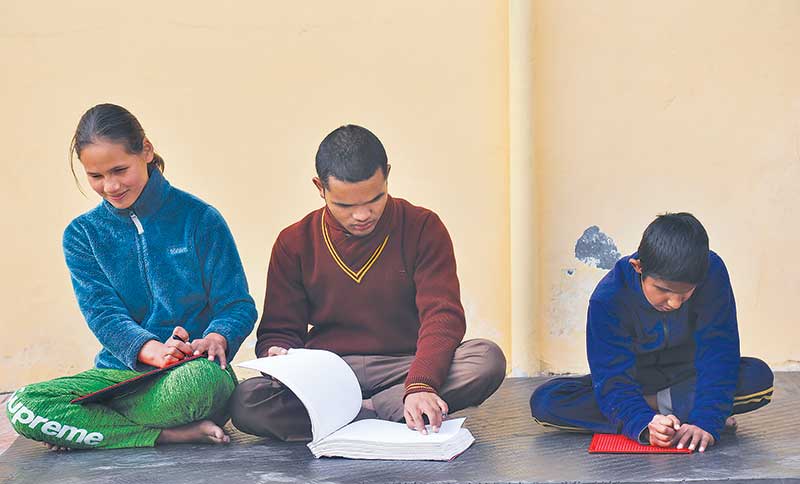
At least three visually impaired students are toppers in classes also having peers who can see.post PHOTO: KABIN ADHIKARI

KATHMANDU : Madan Rokaya is an eighth-grader at Prithvi Narayan Secondary School in Dahalthok, on the outskirts of Kathmandu. The 15-year-old boy follows almost the same routine the students of his age usually do. In a class of 45 students, he is way ahead of the pack. His teachers and classmates admire him as he is a class topper.
But that’s not what sets him apart from others. Rokaya cannot see—he
is blind.
For Rokaya, who came to Kathmandu from Mugu, a remote district in Karnali Province, competing with his classmates, who all can see, is no mean feat, his teachers say.
Rokaya lives at a hostel, along with 13 other students who are also blind, at Dahalthok in Tarakeshwor Municipality. All go to the same school. Like Rokaya, Kopila Tamang, 13, from Rasuwa, a sixth-grader, and Dipesh Upadhyaya, 10, from Humla, a fifth-grader, also are class toppers.
According to Binod Kafle, who runs the hostel—Blind Children Education Center, other students too are doing well in their studies.
Kafle started the hostel in 2013 with a view to helping blind students.
“I myself lost my eyesight when I was 20 years old,” said Kafle, who was born in Syangja but grew up in Chitwan. “I could not pursue my studies after I lost my eyesight. So I wanted to help those who cannot see. There are so many blind students who want to continue studies but lack resources.”
Prithvi Narayan Secondary School is one of the few schools that run resource classes for blind students across the country.
Data from the Center for Education and Human Resource Development under the Inclusive Education Section shows there are a total of 2,377 blind students studying in different schools across the country.
“The government runs 18 integrated programmes and 81 resource classes for blind students across the country,” said Narad Pradad Dhamala, a section officer at the Inclusive Education Section.
Kafle, however, said he doesn’t know how other blind students across the country are faring.
According to him, the children from his hostel have been able to get an education so far because of Narayan Prasad Sharma, the principal of Prithvi Narayan Higher Secondary School.
There is only one special school for blind students in Nepal—the Purwanchal Gyan Chakshu Vidyalaya in Dharan. In Kathmandu Valley, Namuna Machhindra Secondary School in Lagankhel and Laboratory School in Kirtipur also enroll blind students who study along with the students who can see.
As part of the government’s inclusive education campaign, blind students are entitled to Rs4,000 scholarship, free braille books, free audio materials, a separate teacher for each resource class and one caretaker.
Sudarshan Subedi, former president of the Federation of Disabled Nepal, however, said he was not sure if all the blind students were receiving the facility provided by the government. “Those getting accommodation, food and schooling at Kafle’s hostel are lucky,” Subedi told the Post.
Ananta Phuyal, a science teacher at the school and class teacher for eighth-graders, describes the students as sharp with the ability to grasp lessons.
“Those students who can see usually get distracted very easily, but these children who cannot see listen to lectures intently,” Phuyal said.
Phuyal, however, admits the difficulties he and other teachers face, as they have to talk to and teach the blind children separately.
“When I write or draw something on the whiteboard for other students, I simultaneously explain for Rokaya,” Phuyal told the Post. “Later, I write or draw on Rokaya’s braille notebook with the stylus so that he can read it.”
The school has also hired Bindu Neupane, 26, a blind teacher, whose help is often sought by teachers when they have to teach the blind students. Neupane often visits Kafle’s hostel as well to help the students.
“When it comes to mathematics and subjects that require drawing diagrams, it’s difficult for blind children,” said Neupane, who has got a Bachelor’s in Education. “But all of them have a hunger to learn.”
But Neupane is concerned about their higher studies, as colleges in Nepal do not have facilities to teach blind students. Neupane herself had to go through a lot of struggle to complete her bachelor’s using braille books, as there aren’t enough libraries and professors to guide blind students.
Kafle, 56, said he will try to help the students in his hostel as much as he can but is not really sure how he can assist them when they go to college.
According to Kafle, the hostel receives around Rs 700,000 a year from the government through the school in instalments.
“But the annual cost of running the hostel is around Rs2 million,” Kafle told the Post. “We are also getting support from Lions Clubs and some youth clubs. Members of the public also donate food and money. But I am still worried about the future of my students.”
In two years, Rokaya will take the Secondary Education Examination. “Since I cannot see, I cannot become a doctor or an engineer,” said Rokaya. “But I would like to join government service. If I can get into civil service, I will introduce programmes and policies aimed at blind people as well as people with disabilities in the country.”

A student reads braille.Post Photo: Kabin Adhikari

Page 2
HOROSCOPE

HOROSCOPE

ARIES (March 21-April 19)
***
Here’s a news flash: Romance is supposed to be fun, not work. If you’re working at getting closer to someone right now, stop doing it. All it adds to your life is stress, it might not be worth it. Arguments, missed dates, conflict, these aren’t just obstacles to moving your relationship forward. Step back. Give each other time.


TAURUS (April 20-May 20)
***
Every time something ends, there is a beginning. Just because you said goodbye to something doesn’t mean it still can’t inspire or affect your future. Today, take the lessons you’ve learned and apply them to your newest relationship or business role. Your latest health concern should be addressed immediately.

GEMINI (May 21-June 21)
***
Let your eyes and body language do all your talking today. A lot can be communicated with an arched eyebrow, nod of the head, or clap of the hands. This does not just apply to a romantic flirtation. Even in business meetings or other professional environments, you should try to say things with as few words as possible.

CANCER (June 22-July 22)
***
Let your outrageous impulses go wild today. Don’t rein in any instincts. Kick up your heels and get a little bit crazy. And if anyone is watching, they won’t laugh at you. If anything, they will be inspired by watching you march to the beat of your own drummer. Doing so, you have good chance to get to the real meat of the matter.

LEO (July 23-August 22)
****
Share your free time with as many different people as you can and get some juicy conversations going. If you talk to enough people, you increase your chances of inspiring someone and creating some positive changes around you. The more you mix it up with new people, the more enlightened you will feel by the end of the day.

VIRGO (August 23-September 22)
***
For special insight into your latest quandary, turn to your co-workers or classmates. You need to consult someone who is either in the same situation or has been before. Firsthand experience is good but also get different opinions so you have different perspectives. You can make the right decision, but first you need facts.


LIBRA (September 23-October 22)
****
It is time you really challenged yourself. For too long you’ve been enjoying easy success and the comfort that can only come when you know exactly what you are doing and how to do it. Find a problem that you can’t figure out. Use your brain like you haven’t used it before. Surprise yourself with your talent. You got this.

SCORPIO (October 23-November 21)
**
There will be a strong connectedness around every element of your life. You’ll see some associations between your personal life, closest family, and work that you hadn’t noticed before, and some quick decision making will help you work these links to everyone’s advantage. A delicate negotiations may come to an impasse.

SAGITTARIUS (November 22-December 21)
***
Don’t let anything go out the door without double-checking it first. Little mistakes must be caught, and you’re in the perfect frame of mind to catch them. Use your insight to stop friends or family members from taking things a little bit too far. You could save them from embarrassment.

CAPRICORN (December 22-January 19)
***
Someone who is usually a source of brightness and sunshine is feeling a bit depressed right now, and you have to lift their spirits. Your attempts at engaging them and distracting them from their troubles will be appreciated. Avoid making them feel like they’re the object of pity or sadness. Just keep communicating.

AQUARIUS (January 20-February 18)
***
It’s true that you’re a unique person, but you aren’t the only person to have ever felt the way you’re feeling right now. Reach out to someone close and tell them what’s on your mind. Chances are, they can relate. You have a lot more in common than you realise, and by sharing your confused feelings, you will feel lighter.

PISCES (February 19-March 20)
***
The only trouble about working so hard at climbing that mountainous goal is that once you get to the top, where do you go from there? After completing a big step, you may still be struggling with that question. The good news is, you will have all the inward clarity you need to answer it. Don’t stress. Take some time off.

Page 3
NATIONAL

Police nab three of the alleged perpetrators of Dhanusha tipper attack

- AJIT TIWARI

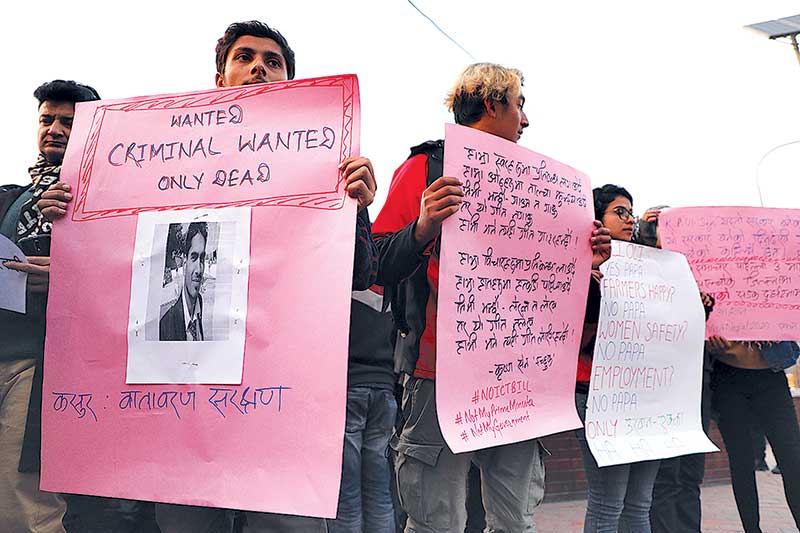
People hold placards and candles, demanding justice for young environmental activist Dilip Kumar Mahato, at Maitighar Mandala in Kathmandu on Saturday. Mahato was crushed to death by a tipper truck in Dhanusha on Friday. Post PHOTO: SANJOG MANANDHAR

JANAKPUR : The family of Dilip Mahato, who was crushed to death by a tipper truck on Friday morning, lodged a formal complaint with the District Police Office, Dhanusha, on Saturday.
Chief of Dhanusha Police, Ramesh Basnet, said that a complaint has been registered against two owners of the crusher industry, the driver of the tipper that killed Mahato, and Roshan Yadav, who was present at the accident site with Mahato.
“Preliminary investigation shows Mahato was killed intentionally by the tipper driver,” Basnet said. “Three of the alleged perpetrators are in police custody.”
Binod Mahato, one of the crusher industry owners, is currently on the run and the police have intensified its search, according to Basnet. Another owner, Bipin Mahato, was apprehended from Janakpur on Saturday morning. Bipin and Binod are brothers jointly running the industry.
Chief of province 2 police, DIG Pradhyumna Karki, said the alleged perpetrators will be charged for homicide and not with vehicular homicide, because the murder was “intentional”.
“It’s unlikely the tipper was in high speed and the killing was unintentional,” Karki said.
Meanwhile the legal procedures, previously handled by Area Police Office, Dhalkebar, have been transferred to the District Police Office.
SP Basnet said the police will conduct a detailed investigation on the incident and bring the perpetrators to book.
Dilip was killed on Friday morning while protesting the illegal mining of riverbed materials from a river beside his home at Sripur in Mithila Municipality.

NATIONAL

Medical commission ‘fails’ to enforce refund of excess fee to students

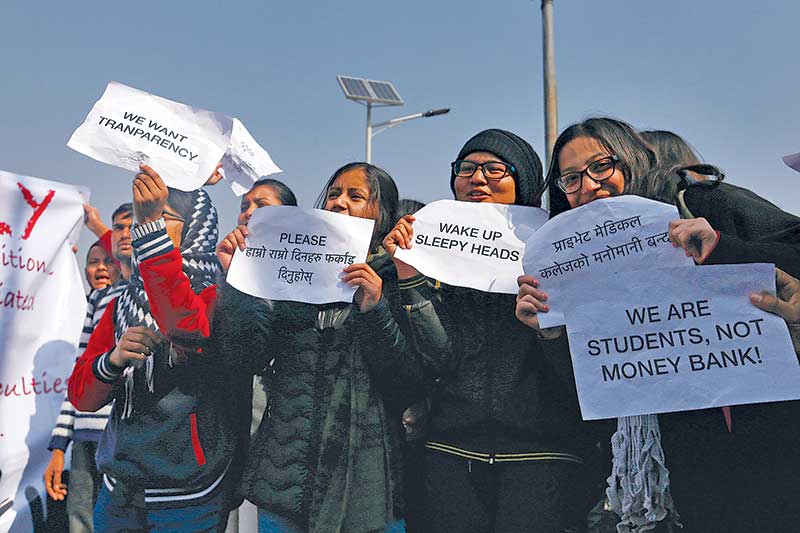
Protesting students demand a probe against the commission’s chair over an allegation that he demanded bribes.
- BINOD GHIMIRE

MBBS students participate in a rally, calling for reduction and transparency in fee structure of medical colleges. POST PHOTO: KESHAV THAPA

KATHMANDU : Despite repeated assurances and agreement with students, a majority of the medical colleges are yet to refund the additional fee they charged breaching the government ceiling.
Following the students’ recent protests, the Ministry of Home Affairs on September 23 had given a month for the colleges to either refund or adjust the arbitrary fee they had charged the MBBS and BDS students. As the medical college operators did not abide by the directives within the deadline—November 11, the ministry issued a 15-day ultimatum, directing them to disburse such amounts.
As the medical college operators did not heed to the second directive, the government on November 25 asked the Nepal Police to take actions against the college operators if they continue to deny to refund the additional fee. After being warned of police actions, the college operators on November 26 signed a two-point agreement with the Ministry of Education to start the refunding process from the very next day.
The government in October 2018 had set Rs3.8 million and Rs4.24 million to study MBBS degree in the medical colleges within the Capital and outside the Valley, respectively. However, they were found to have charged as high as Rs6 million. Medical colleges charged arbitrarily from the medical students they wouldn’t admit them if they deny paying the amount demanded.
“Most of the students haven’t got their additional fee back,” Sujan Kadariya, spokesperson for the Medical Student Struggle Committee, told the Post. “The Medical Education Commission hasn’t taken any concrete steps to implement the agreement signed with the medical colleges.”
The commission, formed to oversee the medical colleges across the nation, is responsible for resolving the problems in the sector. Kadariya said they had submitted the available receipts of the fee they paid to the commission but it had not taken any decision yet.
Dr Shree Krishna Giri, the vice-chair of the commission, said they are still studying and will take some time to conclude.
Different reports, including the one prepared by the National Vigilance Centre, an anti-graft body under the Prime Minister’s Office, have found the medical colleges to have breached the government regulations. The centre’s report showed the colleges collected over Rs3 billion in fees from the students under various arbitrary headings.
The students, who are in a protest demanding reforms in medical education, blame the commission for failing to perform its job. They say it gives room to suspect at the commission after an allegation that Giri sought bribes in millions in return to granting affiliations.
On Wednesday, Durga Prasain, owner of Jhapa-based B and C Medical College, accused Giri of demanding Rs 200 million for affiliation to his college. “This is a serious issue that needs to be investigated. The government should either take action against Prasain if his allegations are wrong or book Giri,” said Kadariya. The struggling students have issued an ultimatum to the government to form a probe committee by Monday. Giri has rejected the allegation saying it is a conspiracy to defame him.
The students also have said the commission’s inefficiency has delayed the admission of the MBBS and BDS students. Though the admission had to be completed by October, it is yet to begin. The commission’s delay in conducting counselings, allocating the seats to medical colleges and determining the scholarship quota, had pushed the entire academic session by three months. “The commission is a total failure,” Anit Sinha, general secretary of the struggle committee, told the Post.
Giri, however, said they had already sorted out the technical issues and the admission would start “very soon”.

NATIONAL

Number of burn victims rises sharply, but the country is ill-equipped to treat them

Many are dying because of lack of awareness, as burns are yet to be recognised as health priority, doctors say.
- Arjun Poudel

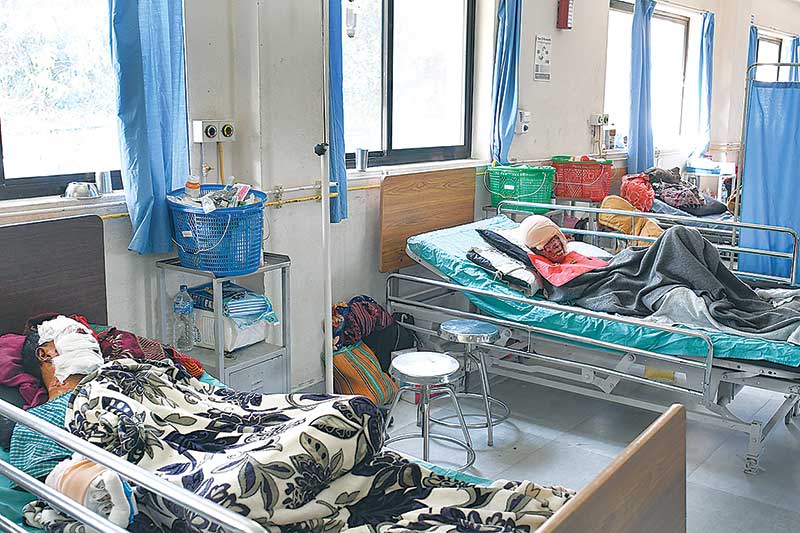
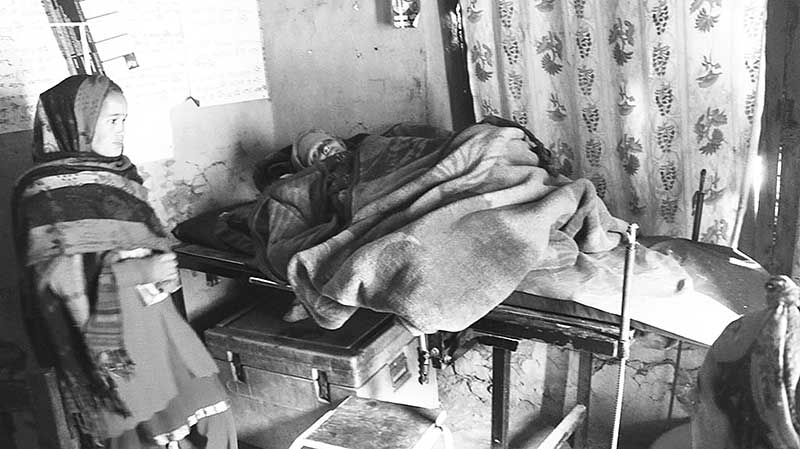
More than 40,000 people suffer from varying degrees of burns every year in Nepal, according to a study. Post file Photo

KATHMANDU : Panmati Devi was brought to Nepal Cleft and Burn Centre in Kirtipur for the treatment of burn injuries from Bara district some two weeks ago. The 60-year-old woman, a local of Chainpur in Parwanipur Rural Municipality, was first taken to Narayani Hospital in Birgunj before she was referred to Kathmandu.
Doctors at the burn centre, usually known as Kirtipur Hospital, told her relatives that she had suffered 40 percent burns to her body and needed to undergo multiple surgeries.
“My mother got the burn injuries when she was warming herself in front of a straw bonfire,” said Sunil Kumar Patel, the son. “We are waiting for our turn for the surgery.”
Like Panmati Devi, dozens of fire victims from across the country are brought to the hospital for burn injuries, as most of the health centres, private as well as state-run, throughout the country lack proper treatment facilities for fire victims.
As a result, the hospital is always crowded, and patients have to wait for days not only for surgery but also for beds.
The hospital had earlier allotted 30 beds for burn victims, but now with the surge in the number of patients, it is accommodating burn patients on beds of other wards.
“Over 60 fire victims are currently receiving treatment at our hospital,” Dr Kiran Nakarmi, head of the Burns, Plastic and Reconstructive Surgery Department at the hospital, told the Post.
“We have been extending an additional 16 beds for fire victims.”
The number of patients with burn injuries rises during the winter, as people make bonfires to keep them warm. Elderly women and under-aged children are more vulnerable to fire incidents, as they remain in the house or near fires most of the time. “Their weak immune system compared to adults makes the recovery process even more complicated,” said Nakarmi.
Burns is the second most common injury in rural Nepal, accounting for 5 percent of disabilities, according to the World Health Organization.
Dr Peeyush Dahal, dean at the National Academy of Medical Sciences, told the Post last month that according to a study carried out in the past, 40,000 people suffer from burns [minor or severe] every year in Nepal.
The country, however, is miserably ill-equipped when it comes to treating burn patients.
Dr Shankar Man Rai, a plastic surgeon at the hospital, said patients who suffer more than 30 percent burns to their body need intensive care service, but the hospital has only eight beds in the intensive care unit.
“It is becoming increasingly difficult to save people with 40 percent burns to their bodies,” said Rai. “Many die due to infection and several other factors despite our efforts to save them.”
Kirtipur Hospital’s Nepal Cleft and Burn Centre is the largest burns ward in the country.
The country’s first dedicated burn ward was established at Bir Hospital around two decades ago. But after the 2015 earthquake, it was shifted to the National Trauma Centre, which provides treatment for burn injuries but lacks a dedicated intensive care unit for burn patients.
Burn injuries in Nepal are still not a health priority. The government has neither upgraded and increased facilities nor run any awareness programmes to deal with the situation in the immediate aftermath of burn.
According to Rai, most people do not know how to respond to burn injuries. “People usually take patients to nearby health facilities which then refer them to other health centres,” said Rai. “Burn patients need enough intravenous fluids, around eight litres in 24 hours. This does not happen while transporting patients from one facility to another, which reduces their chances of survival.”
Doctors say lack of skin is another major problem in saving the lives of burn victims. Kirtipur Hospital had set up a skin bank in 2014. However, only 28 people have donated their skin posthumously to the bank.
Rai said people who suffer over 30 percent of burns need skin from others to cover the wounds and prevent infection.
“Substitute skin, available in developed countries, is too costly,” said Rai. “We have not been able to convince people to donate skin. It’s just like donating eyes after death.”
Doctors say awareness alone can substantially increase the chances of survival of burn patients.
“Many burn victims die due to ignorance or negligence,” said Nakarmi.

Page 4
NATIONAL

Government rescues hundreds of children every year but does little for their care

Children are usually put up in transit homes before they are either handed over to other shelters or their families.
- SHUVAM DHUNGANA

KATHMANDU : The National Children Rights Council rescued around 80 children from various childcare homes in the first six months of the current fiscal year.
Officials said the rescued children were found in an abject state of negligence. The shelters they were living in did not meet the minimum standards set by the government while some of them were not even registered with the council.
Every year, the council, in coordination with other social organisations, rescues hundreds of children living in childcare homes under squalid conditions. But once these children are rescued, the government organisation does little for their development and rehabilitation. The children are usually put up in transit homes for a brief period before they are either handed over to other shelters or their families, who, in the first place, had submitted their children to care homes as they were unable to raise them.
“After undergoing psychological counselling and a health check-up in transit homes, the children can return to their homes, provided that their parents are willing and capable to look after them. If not, then the children are sent to other shelters,” Namuna Bhusal, coordinator of the council, told the Post.
Oftentimes, a child rescued from one shelter ends up living in another. The council, meanwhile, acts as an intermediary body that takes the rescued child from the transit home to a new shelter. The shelters where rescued children are referred to are mostly run by social organisations on donations. The government has only one children’s shelter.
“There used to be several state-run children’s shelters in the past. But right now, there is only one in Butwal and it is not enough to house all the rescued children,” said Bhusal.
She added that the council refers rescued children to only those shelters that meet the set standards.
When the Post contacted a Kathmandu-based shelter that takes in children referred by the council, its official said that the facility was close to being overrun by children and it lacked funds and resources to accommodate them.
“Childcare homes like ours are forced to take in rescued children even when we do not have the financial wherewithal and space. The government should allocate a budget to look after the rescued children,” the official said on condition of anonymity.
Some childcare homes say the authorities foist children on their already-full shelters and at the same time expect them to maintain the standards. They say it is an impossible arrangement since the government is not offering any support.
An official at the council, however, claimed that most childcare homes generate enough funds to look after the children. “Many childcare homes bring poor children from rural areas by promising them education and a better life, and they get funds from various individuals and organisations,” said the official.
According to the council, most of the children living in childcare homes have families and, as per the government’s Operation and Management of Residential Childcare Homes Procedure-2012, only those children who don’t have their parents or are physically or mentally challenged can be kept in such facilities.
There are 533 children’s shelters operating in 46 districts of the country as of 2019. More than 15,000 children are living in these shelters.

Page 5
NATIONAL

Around 40 percent of pregnant women undergo unsafe delivery in Jajarkot

Although the Safe Motherhood Programme is run across the state to ensure safe births, few are benefiting from it.
- BHIM BAHADUR SINGH

Jenisha Khadka was first admitted to a health post after going though labour pain. She was then referred to the district hospital, and then to another hospital in Nepalgunj—adding emotional and financial distress. Post Photo

JAJARKOT : Sharmila BK, a 25-year-old pregnant woman from Kushe Rural Municipality Ward No. 7, went to Gharanga Health Post after she started suffering from labour pain. She had been in labour for two days when her condition worsened because of excessive bleeding. On January 6, due to delivery complications, the health post referred her to Jajarkot District Hospital for further treatment. Her family spent Rs 15,000 on vehicle fare to take her to the District Hospital from her village.
Jenisha Khadka, another pregnant woman from Kushe Rural Municipality Ward No. 6, was also admitted to the same health post for three days after she started labour pain. Lok Bahadur Khadka, Jenisha’s husband, said the health post referred her to the district hospital on Sunday because she had complications while delivering her baby.
“My wife could not deliver the child even in the district hospital. The
hospital referred her to another hospital in Nepalgunj,” he said.
Although the government has been running the Safe Motherhood Programme as part of its bid to ensure safe births in remote areas, only a few people are getting benefits from the programme, locals claim. Many women like Sharmila and Jenisha in remote areas cannot easily get benefitted from such programmes. Their families have to spend a lot of money to save their lives, as there are no reliable health services nearby.
The majority of delivery cases with complications are being reported from Kushe and Barekot rural municipalities and Chhedagada Municipality. Locals in remote areas have no other alternative but to charter helicopters in health emergencies. Pregnant women in critical conditions have to be airlifted to city areas, as their villages are not connected by roads and medical treatment is not available locally.
Kali Bahadur Shahi, a resident of Kushe Rural Municipality, said impoverished families cannot afford to charter a helicopter for their sick members. “Only people with connection and money can have such facilities in remote areas. Those who don’t die, as they cannot be flown out for medical treatment in time,” said Shahi.
Due to a lack of health facilities in remote areas, the majority of pregnant women tend to give birth at home. The data of the District Health Office showed that around 40 percent of women in Jajarkot still give birth at home. Health facilities in remote areas lack skilled human resources, equipment, and physical infrastructures. Tara Singh, an auxiliary nurse midwife at Gharanga Health Post, said the facility has been referring critical patients to other health facilities due to a lack of skilled human resources and infrastructures.
“In the last two months, we referred 12 patients to the district hospital,” Singh said.
Meanwhile, Narayani Shah, an auxiliary nurse midwife at Jajarkot District Hospital, said most pregnant women give birth at home due to a lack of awareness.
“The main reason for the high rate of home births in remote areas is that women do not have access to free medical services due to the remoteness of their locations,” said Shah. “Both the mother and child could be in grave danger when pregnant women do not visit health centres for prenatal checkups.”
Death during childbirth due to the lack of medical services remains one of the leading causes of women’s deaths in Nepal. According to the Ministry of Health, for every 1,000 births in Nepal, 229 women die during or after childbirth. The stats have not improved despite the availability of free services and allowances. The data also shows that only 57 percent of pregnant women seek institutional delivery. The government’s efforts to bring all pregnant women under its free health programmes to reduce and limit maternal mortality rate to 125 per 100,000 births by 2020 have remained a challenge due to factors such as a lack of proper implementation, shortage of funds and insufficient skilled human resource.

NATIONAL

Old rural marketplaces in Kailali limping back to life

The markets of Hasuliya and Bhajani were hit hard by the Maoist insurgency and were deserted until a few years ago.
- MOHAN BUDHAAIR

KAILALI : Hasuliya and Bhajani, two bustling rural markets in Kailali, were deserted during the Maoist insurgency. With the implementation of the federal system, these markets are gradually limping back to life.
The old marketplaces of Hasuliya and Bhajani had to wait for years to regain their lost glories. Although the country entered the federal process in 2006, these places had to wait for the local elections of 2017 to get back to life. Hasuliya is now the administrative centre of Kailari Rural Municipality while Bhajani Bazaar is a part of Bhajani Municipality.
“Various government offices have been established in Hasuliya and Bhajani. And those displaced businesspersons have returned with new businesses,” said Nepalu Chaudhary, the chairman of Hasuliya Market Management Committee.
Today, the markets play an important role in the lives of local residents, as farmers sell their produce in the markets and consumers throng the marketplace to buy them. But during the Maoist insurgency, Hasuliya and Bhajani were some of the areas hit hardest by the conflict. Many shop owners and farmers fled the marketplaces.
“The armed insurgency had gripped the country. The then Maoist rebels had attacked security posts in Hasuliya, and the traders had
been displaced to Dhangadhi, the district headquarters, for security reasons. The busy marketplaces got deserted overnight,” said Chaudhary.
“We had electricity and telecommunication facilities before the conflict, but these amenities were cut off at the height of the insurgency. Locals had to live in darkness for about a decade,” said Balbir Saud, a local of Bhajani.
Saud claimed that Bhajani and Hasuliya would undoubtedly have developed into big towns if they were not affected by the conflict.
“However, one and a half decades after the comprehensive peace agreement was signed in the country, business activities have increased in these old trade centres,” said Saud.
Both Hasuliya and Bhajani lie along the under-construction postal highway. The residents of the southern Kailali have benefited from the increasing business and development activities.
Ladhu Ram Chaudhary, chairman of Kailari Rural Municipality, said that the local body is preparing a master plan for the development of Hasuliya Bazaar and its vicinity.

NATIONAL

Indian side constructs unauthorised gate on no man’s land at Thadi border point

- BHARAT JARGHA MAGAR

Indian authorities have been operating a customs office on the no man’s land for yearsPost Photo: bharat jargha magar.

SIRAHA : On January 5, protests broke out in the border town of Thadi when Indian authorities started unauthorised construction of a gate a day prior on no man’s land along the Nepal-India border in Siraha district.
As the protests grew, a joint survey team of Nepal and India was formed to inspect the disputed area last week. “The construction is taking place within four metres of the no man’s-land, which violates international border rules. We have asked the Indian side to stop construction immediately,” said Umesh Kumar, chief survey officer of Province 2, who led the Nepali team during the joint inspection of the disputed structure.
Thadi is a trading point between Nepal and India, located 18 kilometres south from Lahan, the district headquarters of Siraha.
Chief District Officer of Siraha Gopal Kumar Adhikari said that the local administration called the survey team to prepare a map of the area after it was informed about the unilateral construction of the structure by the Indian side on the no man’s land. We have informed the Ministry of Foreign Affairs and Survey Department about the matter as well, he added.
According to Kumar, the map has been prepared and handed over to the local administration.
Nepali people in Thadi further complained that the Indian authorities have been operating a customs office on the no man’s land for years. “We have repeatedly requested the authorities to remove the Indian customs office but to no avail. Now people have erected around a dozen thatched-roof huts on both sides of the no man’s-land as well,” said Kanhaiya Bhatta, a local of Thadi.

NATIONAL

The only school in Chumnubri has leaking roofs and few teachers

Besides Chumnubri’s students, children from Dharche, another rural municipality, also study at Buddha Secondary School.
- HARIRAM UPRETY

The school has been in a sorry state since the 2015 earthquakes damaged its buildings.Post Photo: hariram uprety

GORKHA : If Karmal Lama, a sixth grader, wants to go to school, he has to walk for an entire day. Lama is a resident of Chumchet, a remote village where there are no motorable roads. And his school, Buddha Secondary School, is in Sirdibas—a distance of almost 20km.
Karmal’s friend Sonam Lama, of Chhekampar, has to walk more. It takes him two days to reach the school. In order to not miss school, both the boys live in a hostel in the school, away from home.
Prakash Ghimire, the headmaster of the school, says that to ensure
students come to school, they have managed to get a hostel facility up
and running. “We have in total 357 students in the school. Among them, 189 are studying under scholarship quota,” said Ghimire.
In remote Chumnubri Rural Municipality, Buddha Secondary School is the only secondary school for all seven wards. But it’s not only Chumnubri students who study at Buddha Secondary School. Children from Uhiya, Gumda, Kashigaun and Kerauja of Dharche Rural Municipality also come all the way to Chumnubri to study.
Despite the crucial role this one school plays in the lives of hundreds of children, the school lies in a dilapidated condition post the earthquakes of 2015, which destroyed much of the school’s infrastructure.
“The roofs of the building don’t hold the rain these days. Water drips from the leaking roof during rainfall. But we don’t have sufficient funds to repair the school building,” said Ghimire.
Initially after the quakes, the Indian Embassy in Kathmandu had pledged it would reconstruct 10 school buildings, including the building of Buddha Secondary School. But four years on, the embassy is yet to take any initiatives of reconstruction. Ghimire said, “The embassy has not shown interest to construct the school building on time as the rural municipality lies at geographically difficult terrain.”
Bishnu Prasad Mishra, chief at the District Project Implementation Unit Office of the National Reconstruction Authority, said that Japanese governmental agency JICA has proposed to construct more school buildings in the district. But nothing has become certain yet. “Because of that, we have not been able to grant permission to other donor agencies, as we have already provided recommendations to a certain organisation,” said Mishra.
Fourteen years ago, students from the northern part of Gorkha had to go to Arughat, Gorkha Bazaar and Kathmandu to receive higher education. But, after Buddha Secondary School, which was established 43 years ago, started secondary level classes 13 years ago, locals didn’t have to worry about sending their children far away to receive secondary level education.
But now the school lies in a sorry state. Besides it’s poor infrastructure, the school also lacks other basic facilities, like a library and
science and computer lab facilities. The school also does not have a single permanent teacher’s post at the secondary level, and is being run by four teachers appointed under relief quota.

NATIONAL

Municipality gives ultimatum to encroachers to evacuate public land by Jan 24

Briefing
- Post Report

SALYAN: Sharada Municipality has issued a two-week ultimatum to encroachers to evacuate structures built on public land in the buspark area of Shreenagar. The municipality have given the deadline of January 24. Around 100 houses and huts have been constructed by occupying public land on the banks of Suke and Bhagawati streams.


NATIONAL

Municipality employee dies in road accident

Briefing
- Post Report

DOLAKHA: An employee of Bhimeshwor Municipality in Dolakha died in a road accident in the district on Friday night. According to chief administrative officer Man Bahadur Khadka, sub-engineer Madan Thami died while he was riding his two-wheeler. Investigation is underway into the incident, said police.


NATIONAL

Female rhino found dead

Briefing
- Post Report

CHITWAN: A female rhino (around 20 years of age) was found dead in the Ghatgai Lamitale area near Kasara of Chitwan National Park on Friday. Gopal Bahadur Adhikari, assistant conservation officer of the park, said that the rhino died around 10 to 15 days ago. Within the last six months of the fiscal year, seven rhinos have died due to natural causes in the national park, as per the record of the national park.


NATIONAL

Yuba Sanjal’s chairman, secretary held

Briefing
- Post Report

UDAYAPUR: Chairman and secretary of Triyuga Nagar Yuba Sanjal were arrested on swindling charges on Friday. Superintendent of Police Bir Bahadur Budhamagar said that Chairman Suresh Gupta and Secretary Rupesh Danuwar were arrested because they swindled Rs 10,000 from the parents of Anchu Sherpa, who was arrested with drugs a month ago. According to police, Gupta and Danuwar assured to release Sherpa from police custody.


NATIONAL

Ncell’s tower torched

Briefing
- Post Report

GORKHA: An unidentified group torched a repeater tower of Ncell in Bakrang of Gorkha on Friday night. Ncell’s cell phone services have been disrupted in the area as various equipment and wires were destroyed in the arson. Investigation is underway into the case, said police.

Page 6
OPINION

Nepal’s partnership for peace with MCC and BRI

Nepal can learn a lot from Sweden’s approach to geopolitics to reassess its ties with India, China and the US.
- KATAK MALLA

Nepal at the moment is facing considerable difficulty in balancing China’s Belt and Road Initiative (BRI) and the US’s Millennium Challenge Corporation (MCC). These are two mutually opposing geopolitical programmes in Asia today. At face value, both BRI and MCC are aimed at economic development. However, they are also strategic security partnerships for maintaining the sphere of influence and countering influence in Asia and the Indo-Pacific region. Under these circumstances, it is imperative that Nepal finds a pragmatic way forward that does not involve it being aligned to any military alliance.
For Nepal, it would have been better to assess the pros and cons from a moral and ethical perspective before joining BRI and MCC. Having already been signed, a policy based on realism is the only workable strategy for Nepal to deal with the present situation. Unlike powerful states, small power countries have to be practice more cautiousness in handling realpolitik. In fact, there have been some useful experiences in the past, where the world’s small power states have successfully set priorities to protect their national interests. These experiences may be worth reviewing and sharing, even if the lessons gained by one place may not be applicable everywhere.
Although Nepal is located in a different geopolitical space than Norway, Denmark and Sweden, these three countries have also had to make similar difficult choices throughout history.
One point of reference is the reason why Norway and Denmark joined the North Atlantic Treaty Organisation (NATO), but Sweden did not. Norway and Denmark decided to be a part of NATO because of their respective domestic needs. Sweden, having different needs, did not join.
Why Sweden took this decision needs to be viewed in its historical context. For example, Sweden declined to help Finland against the Soviet attack in 1939, but historical records suggest that 8,000 Swedes volunteered in the Finnish army. The Swedish foreign policy masters could keep their country neutral during WW2 partly because of Germany’s demand for iron supply from Sweden and partly because Germany needed to gain information about the allied powers through Sweden. The moral and ethical aspects of these choices of Swedish foreign policy is debatable and outside the scope of this writing.
Another point of reference is on which ground Sweden continues to maintain its non-aligned position despite being a member of NATO’s ‘Partnership for Peace’ programme. The said partnership is a Euro-Atlantic partnership allowing individual member countries to be part of NATO as an observer and without voting rights. Even without voting rights, the observer states have a possibility to achieve their national foreign policy objectives. Sweden joined the ‘Partnership for Peace’ in 1994.
Sweden has justified its engagement with NATO-led missions by only participating in such missions that are under a UN mandate. This means that Sweden defines its engagement with NATO and finds legitimacy through the UN mandate.
The final and most important point of reference is that the Swedish parliament adopted a security doctrine in 2009, which reads, ‘Sweden is not a member of any military alliance. Threats to peace and our security can best be averted collectively and in cooperation with other countries. It is impossible to imagine military conflicts in our region that would affect only one country. Sweden will not remain passive if another EU Member State or Nordic country suffers a disaster or an attack. We expect these countries to take similar action if Sweden is affected. Sweden should therefore be in a position to both give and receive military support.’ The Swedish approach of adopting a security doctrine through parliament suggests in short that pragmatic choices can be made in critical circumstances. This may be interesting for Nepal to look more closely at.
Coming back to Nepal’s case amid the ongoing controversy over the MCC, the US has made it clear that MCC is part of the Indo-Pacific strategy, which is a security alliance. In this context, Nepal accepting MCC obligations, in general, cannot be seen as a compromise to the state sovereignty of Nepal. However, the specific clause of MCC prevailing over the national constitution (and laws) is contrary to the sovereignty principle. If Nepal’s parliament ratifies MCC, which is required, this will certainly be an acknowledgement of the supremacy of MCC over Nepal’s constitutional system. It is a difficult legal situation for Nepal, indeed. In this case, the Swedish security doctrine adopted by their parliament may be relevant.
Nepal has invested considerable resources for MCC, and a total rejection will bring more harm than good. Apart from the obvious infrastructure developments for the country, it is detrimental for the future of Indo-Nepal and the US-Nepal relations. A pragmatic solution for Nepal is, therefore, to continue with the MCC as a peace partner. Nepal’s Parliament may pass a resolution in line with the late King Birendra’s proposal of a zone of peace which suggests a ‘close friendship and an even-handed relationship with the two neighbours’ China and India, ensuring that ‘[Nepali] territory is not used by one country for hostilities against another, expecting that the territory of other countries is not used for hostilities against Nepal.’ It needs to be acknowledged that the idea of Nepal as part of a zone of peace is still relevant.
In addition to MCC and BRI, there is yet another difficulty in setting Nepal’s foreign policy on the right track. That is the Bay of Bengal Initiative for Multi-Sectorial Technical and Economic Cooperation (BIMSTEC), which is the security umbrella of the Indian government. The Nepal government initially wanted its army to join the BIMSTEC military exercise in India, as proposed in September 2018. Subsequently, Nepal Army participation was withdrawn by the government because of opposing views within the ruling and opposition parties. Finally, a pragmatic solution was found and the army joined with observer status, somewhat similar to Sweden joining ‘Partnership for Peace’
with NATO.
With regards to the MCC Compact, the December 2018 meeting between Nepal’s Foreign Minister Pradeep Gyawali and the US Secretary of State Mike Pompeo needs to be recalled. The two sides were reported to have reviewed and upgraded political and ‘strategic ties’. The very term ‘strategic ties’ points to the geopolitics in the region. There is no doubt that the MCC Compact is part of a military strategy. For Nepal to achieve its goals to remain non-aligned, it seems necessary to search for a solution based on realism. A resolution from the parliament, I believe, defining Nepal’s non-alignment to any security alliance as well as establishing a partnership for peace with both MCC and BRI. Nepal should not copy the Swedish security doctrine, as Nepal has its own past initiatives from the time of the monarchy. Whether MCC and BRI are truly non-militaristic or not, both the US and China will have to appreciate a Nepali security doctrine if it is defined and passed by the country’s parliament.

Malla holds an LLM and LLD from Stockholm University, Sweden.

OPINION

America’s sacred politics

It is unsettling to hear people at the top of the US government speak about politics in terms that rightly belong in church.
- IAN BURUMA

Charles Carroll of Carrollton, Maryland was the only Roman Catholic to sign the Declaration of Independence in 1776. Although one of the Founding Fathers, as a Catholic Carroll was not allowed to hold public office. This changed only in 1788, when the Constitution prevented Congress from establishing any religion, and religious affiliation ceased to be a test for those seeking public office.
Not everyone was happy about this separation of church and state. Thomas Jefferson was attacked by some as a dangerous infidel, and zealots believed that religion would die in America if he were elected president. To this day, there are many people who would like to put religion back into the center of public and political life. This is presumably what US Attorney General William Barr, a deeply conservative Catholic, meant when he denounced “secularists” for launching an “assault on religion and traditional values.”
Prejudice against Catholics as enemies of liberty and potential traitors (because of their spiritual allegiance to Rome) also died hard. In 1821, John Adams wondered whether “a free government [can] possibly exist with a Catholic religion.” Anglo-American freedom and democracy was traditionally associated with rugged Protestant individualism; Catholics were believed to be reactionary slaves to an ecclesiastical hierarchy. Individualistic Protestants were free-thinking, industrious, and devoted to making the best of themselves (materially, as much as spiritually), whereas Catholics were backward and not infrequently lazy.
The idea that Catholics were not fit for capitalism was promoted at the beginning of the last century by the famous German sociologist Max Weber (a Protestant). John F. Kennedy, thus far the only Catholic US President, had to state clearly during his campaign that his loyalty was to the Constitution, not the Vatican. Anti-Catholic biases also played a part in English hostility to European unification, which was sometimes seen as a Popish plot to restore the Holy Roman Empire.
The strident views of a US Attorney General are not the only sign that times have changed significantly. Only one Supreme Court justice is a Protestant (Neil Gorsuch), and even he was raised Catholic. Three justices are Jewish. The other five are Catholics (some with ties to Opus Dei, a secretive organization that began to flourish in fascist Spain in the 1930s).
The other historic change, which began in the latter half of the twentieth century, is evangelical Christians’ political alignment with conservative Catholics. For a long time, American Protestants were happy to live with a constitution that shielded their religious lives from state intervention. Spiritually neutral governments could be ceded the public sphere, as long as they left religious believers alone. This changed after the Civil Rights movements in the 1960s, which alarmed many white Christians, especially in the southern states. Today, evangelicals, like Catholic conservatives, are among President Donald Trump’s most ardent supporters. They, too, believe that family and faith are under siege from liberals and secularists.
To both groups, the fact that Trump is not known to be religious, and that his life has been anything but a model of traditional Christian morality, is irrelevant. Such figures as Energy Secretary Rick Perry believe that Trump is “God’s chosen one.” Secretary of State Mike Pompeo suggested not long ago that Trump had been “raised” to save Israel. “As a Christian,” he said, “I certainly believe that is possible.”
To call this hypocrisy is to miss the point. Reverence of this kind does not demand that a leader be morally irreproachable. Even a sinner can be an instrument of God.
Not wishing to be accused of bias, people are sometimes reluctant to point out the religious background of public figures in America. Yet it is important to understand the history of certain types of belief in order to comprehend an extraordinary era in which a sinful president is surrounded by believers who are convinced that God put him in the White House to save Israel and redeem a wickedly secular America.
Obviously, not all Catholics are reactionary. Pope Francis is not, which is why Catholics like Steve Bannon, an early ideological influence on Trump, dislike him deeply. Liberation theology, popular in South America in the 1960s and 1970s, was a movement of the radical left. And US House Speaker Nancy Pelosi, one of Trump’s main political opponents, is as much a Catholic as Barr.
But there is a strain of Catholicism, rooted in Europe, that never reconciled with the French Revolution, which broke the temporal power of the Church and overthrew the divine right of kings on which absolute monarchy rested. One of the most articulate and influential reactionary thinkers, Joseph de Maistre, believed that without the sacred authority of monarchy and church, society would descend into immoral chaos.
This line of anti-Enlightenment thinking never faded away. In France, it fueled right-wing nationalist movements, such as the anti-liberal, anti-Semitic, and anti-secular Action Française. But Catholic conservatives were not the only Christians to oppose the secularist legacy of the French Revolution. Until they merged with other denominations into a Christian Democratic Party, the main Calvinist party in the Netherlands was called the Anti-Revolutionary Party.
The attempt by contemporary Catholic conservatives and evangelicals to infuse politics with their religious beliefs obviously runs counter to the ideas of the French Revolution, which sought to uphold freedom from religion, but also of the American Revolution, which instituted freedom of religion. Both groups are targeting the carefully erected barriers between church and state.
This is dangerous, not only because it fosters intolerance, but also because it challenges, in the spirit of de Maistre, the idea that political argument should be based on human reason. Once political conflicts become clashes of faith, compromise becomes impossible. A believer cannot bargain over a sacred principle. For those who see Trump as an instrument of God, it doesn’t matter how rational his opponents’ accusations of malfeasance are. They must defend him. To call this unreasonable is to misunderstand their defense. You cannot argue with God.
It is possible that Trump’s reverential base won’t be sufficient to keep him in the White House past 2020. But such ardent faith is hard to oppose with rational plans to fix this or that problem. That is why it is so unsettling to hear people at the top of the US government speak about politics in terms that rightly belong in church. They are challenging the founding principles of the American Republic, and they might actually win as a result.
—Project Syndicate

Page 7
OPINION

Closing the border isn’t an option

There is no reason why Rohingyas will not be able to successfully integrate into Nepali society.
- MAXIMILLIAN MORCH

‘The conflation of Nepal’s stateless population with its Rohingya population, both the 600 or so already in Nepal and any future arrivals, is unhelpful.’Post Photo: hemanta shrestha

Due to hostile environments in India and Bangladesh, Rohingyas fleeing genocide in Myanmar may look to Nepal for refugee, and in order to protect Nepal’s sovereignty and national security, they should be barred from entry into Nepal, argued Prasanna Mahat in her article entitled The Rohingya in Nepal published on January 1 in this newspaper. While the situation is undoubtedly complex, the idea that Nepal should deny entry to new arrivals is a problematic argument for several reasons.
First of all, the idea that welcoming refugees fleeing persecution harms or violates a state’s sovereignty at all, let alone to any meaningful or significant degree, is a highly contested notion. Moreover, the idea that refugees fleeing genocide poses a credible security risk to Nepal is as tiresome as it is false and plays into Islamophobic tropes. In Myanmar, the Rohingya have long been linked by the military and nationalist groups to security threats of Islamic terrorism. This hate speech directly helped fuel the genocide, as was clearly stated in Gambia’s recent genocide case against Myanmar at the International Court of Justice at The Hague. We need to be careful to avoid the repetition of such tropes, and to think critically about their validity before we allow them to play a cornerstone in any policy that would bar a vulnerable population from taking refuge.

Money matters
While it is true that Nepal is a least developed country and does not have huge financial resources to allocate for refugees, it is highly unlikely the state would have to bear a significant proportion of the costs involved. As an aside, the existing Rohingya in Nepal have hardly been inundated with help and assistance from the government’s own budget; so it is unlikely any new arrivals would suddenly receive government funding.
It is also pertinent to analyse the claim that Nepal had 800,000 refugees and asylum seekers in 2013, and that, as such, the state is overburdened and at a disadvantage in dealing with new Rohingya arrivals. The figure given is slightly incorrect. According to UNHCR (United Nations High Commissioner for Refugees) figures, in December 2013, Nepal was home to only 44,530 refugees and asylum seekers. The 800,000 figure, also provided by the UN, pertains to Nepal’s stateless population.
Of the 44,530 refugee and asylum seekers, the majority were Lhotshampas. There were 29,290 Lhotshampas living in refugee camps in Nepal, all of whom were assisted by the UNHCR. Meaning the Nepal government was not responsible for this cost. The figure also included 15,000 Tibetan refugees, many of whom had been living in Nepal for decades, and had developed strong community networks and support groups. What’s more, they were not dependent on government assistance for their livelihoods. Therefore, while almost 45,000 refugees in Nepal may sound like a higher number, yet still far lower than the 800,000 quoted, it actually places little burden upon the state. Most importantly of all, this figure is now outdated and does not reflect the current refugee population of Nepal, now stated to a total of 21,406 according to UNHCR, the Lhotshampa population is also much reduced, at 7,000.
In regard to the number of stateless Nepalis, many of whom are predominately Madhesis, they are in a different socioeconomic position to the Rohingya in Nepal. While statelessness does undoubtedly place restrictions on their access to government assistance, they are able to work and secure their livelihoods. Therefore, the conflation of Nepal’s stateless population with its Rohingya population, both the 600 or so already in Nepal and any future arrivals, is unhelpful; and has little bearing on the capacity of the Nepal government to provide assistance.
Further, at a policy level, the idea to increase security on the open border to stop Rohingyas entering Nepal is unfeasible and impractical. The open border is too porous for adequate monitoring of all unofficial border crossings; and security provisos for increased scrutiny on any Rohingyas attempting to enter Nepal is likely to increase levels of harassment and discrimination at border points. This would also encourage refugees to use unsafe or irregular migration channels, placing them at risk of human trafficking.

Refugees in history
Finally, Nepal is a nation built on migration and refuge. Rajputs fleeing persecution after the Sultan of Delhi, Alauddin Khalji, conquered Mewar in the 1300s came to Nepal, founding the house of Gorkha, from which came the modern Nepali state. Kashmiri Muslims arrived in the late 1800s fleeing British persecution after the failed 1857 Sepoy Mutiny (also known as First War of Indian Independence) or more recently, Tibetans arrived after Chinese repression following the Tibetan uprising in 1959. All of these refugee populations have integrated into Nepali society. There is absolutely no reason why what is likely to be a relatively small number of Rohingyas, given the citizenship or work permits they have asked for, will also not be able to successfully integrate into and play an important role in Nepali society.
I am in agreement with the author that Nepal should do its best to protect the Rohingyas already in the country, and it is true that it is a comparatively better host than India or Bangladesh, despite not being a signatory to the 1951 Refugee convention or the 1967 Refugee protocol. Yet, as tempting to some policymakers as refusing refuge maybe, it is not a workable, pragmatic or ethical solution to what is a complex problem.

Morch is a researcher focused on regional refugee and migratory issues.

OPINION

Stage set for a battle for Delhi

Arvind Kejriwal remains the AAP’s best vote-catching face even though his party appears to have lost some of its sheen.
- PALLAB BHATTACHARYA

Anti-BJP protests in relation to India’s controversial new citizenship law and the horrific violence in Jawaharlal Nehru University on January 5 may impact the outcome of the Delhi assembly elections.

The bugle has been blown for the elections to the Delhi legislative assembly with the Indian Election Commission announcing the poll schedule on January 6. The polling will be held on February 8 and the counting of votes on February 11, setting the stage for another state-level electoral face-off between India’s ruling Bharatiya Janata Party (BJP) and a key regional satrap, Arvind Kejriwal, helming Aam Aadmi Party.
Delhi, whose assembly has a total of 70 seats, will be the fourth Indian state to go for polls in the last four months after Maharashtra, Haryana and Jharkhand. A triangular contest among the state’s ruling AAP, the BJP and the Congress sets the frame of the Delhi contest.
While Kejriwal remains the Chief Ministerial face of AAP, the BJP has not yet named its candidate for the top post, in a move many say aimed at preventing the outbreak of leadership feud within the saffron party’s Delhi unit. The BJP had burnt its finger by projecting the first female Indian Police Service (IPS) officer and political greenhorn Kiran Bedi as its Chief Ministerial candidate in the previous assembly poll in Delhi in 2015, and was stream-rolled by the AAP which won 67 of the 70 seats. The BJP managed just three seats while the Congress, which had ruled the Indian capital for 15 years under Sheila Dikshit till 2013, drew a blank.
So, the race for wooing the voters of Delhi in 2020 will witness a battle between the BJP’s biggest mascot Prime Minister Narendra Modi and Kejriwal, who shot to prominence and pushed into politics eight years ago riding piggyback on Gandhian Anna Hazare’s anti-corruption movement across the country against the then ruling Congress. One key reason for the BJP not declaring its Chief Ministerial candidate for Delhi poll could be its below-par performance in Maharashtra, Haryana and Jharkhand last year, when the party had fought the assembly elections there under Devendra Fadnavis, ML Khattar and Raghubar Das respectively. The BJP failed to renew its reign in Maharashtra, had to go for alliance in Haryana to retain power, and was comprehensively defeated in Jharkhand. In Maharashtra and Jharkhand, the BJP ran into tough challenge posed by regional powerhouses in Nationalist Congress Party (NCP) led by Sharad Pawar and an alliance led by Jharkhand Mukti Morcha.
The stage is set for a repeat in Delhi where the BJP has not been in power for two decades. A favourable verdict in Delhi assembly poll could help the BJP in putting behind it the recent losing trend (in Maharashtra and Jharkhand) and the prospect of local issues outgrowing national subjects in the electorate’ mind.
The BJP’s decision to fall back on the charisma of Modi in Delhi is expected to shape the campaign narrative which will be dominated by national and state-specific issues as it usually happens in state-level polls in other parts of India, and it will be another test for it if local livelihood issues come out triumphant. The BJP will be looking to hold onto the momentum generated by its sweeping all the seven Lok Sabha constituencies in the national elections in April-May last year, in which the AAP finished a poor third.
Kejriwal remains the AAP’s best vote-catching face even though his party appears to have lost some of its sheen after faring badly in Lok Sabha polls in Delhi and Punjab last year. However, the AAP continues to be a favourite to return to power, possibly with a reduced majority. Kejriwal hopes that his pro-poor and populist schemes like primary healthcare, quality educational facilities across Delhi, and subsidised water and electricity will deliver the electoral reward.
On the other hand, the BJP will bank on Modi’s announcement of legalising 1,200 unauthorised colonies across Delhi, mostly inhabited by the poor. It will be its trump card as it is expected to benefit an estimated 40 lakh people—a sizable portion of the electorate—out of Delhi’s total population of 2.01 crore. Besides, the saffron party will flag the issues of the Citizenship Amendment Act (CAA) and expansion of the metro rail network, a lifeline of a safe and fast public transport system in Delhi. The AAP has sought to counter it by providing free ride facility for women in state-run buses.
The BJP is pinning its hopes on a possible ‘silent’ consolidation of majority community votes post-CAA, while the AAP looks to benefit from rising anti-BJP protests across the country in relation to the controversial citizenship law as well as the horrific violence in Jawaharlal Nehru University on January 5. The Jamia Millia University in Delhi has been a nerve-centre of anti-CAA agitation.
A key determinant of the Delhi assembly poll outcome will be the Congress’ performance. The Sonia Gandhi-led party put up a surprisingly good show in national polls with vote-sharing rising from 15 percent in 2014 to 22.5 percent in Delhi last year. But the party remains hamstrung by factionalism and the absence of a local leadership face that could match that of Kejriwal and Modi. The real test for the Congress is how to tap into the perceived anti-incumbency against the AAP and the BJP and position itself as a viable alternative. A big worry for the Congress could be the voters’ response in the event of a polarised campaign. This is an issue of no less concern to the AAP, too. The party has been reticent in making a strong anti-CAA pitch for fear of backlash from the majority community. Just a few days ago, Kejriwal indicated his government may not follow the Marxist government in Kerala in getting a resolution passed in Delhi Assembly opposing the implementation of the CAA. Apparently, the coming assembly election is weighing on his mind.

This article was previously published in The Daily Star, a part of The Asia News Network.

Page 8
THE BLACKBOARD

Little superstar

- Bibhuti Bhattarai

Once upon a time, there lived a girl in a village. She was ten, and her name was Reeta. Reeta’s father used to sell vegetables on the roadside, and her mother worked as a household helper in the village. Reeta went to the only government school in her village. She was in grade 4. She liked to dance, but her parents could not afford to send her to a teacher for dance lessons. Her neighbour was an 11-year-old girl named Jessica. She went to an English medium school in the city and also attended dance school. When Jessica invited Reeta to her house to watch her dance, Reeta would memorise the songs she danced on, her dance steps, and moves. Reeta was an intelligent girl, and she even wrote down lyrics of songs she listened to at Jessica’s house. Later at her home, Reeta would practice dancing to the same songs. Whenever Jessica asked Reeta to dance, she would dance with so much happiness. As soon as Jessica put on the DVD player and played music, a huge smile would appear on Reeta’s face. Even though Reeta danced very well, Jessica would never praise her. Jessica was jealous that Reeta, who didn’t go to dance school, danced better than her.
One day, when Reeta was returning home from her school, she saw a poster on the wall. It was a call to participate in the audition for a kids’ dance competition, organised by a national TV channel. She hurried home and told her mother about it. She said, “Mom, I want to go to the audition.”
Although her mom felt that the chances of her daughter getting selected from thousands of participants were slim, she did not want to discourage her. She said, “OK, I will take you to the city for the audition. But you will need to practice hard.” Reeta was so happy to hear this from her mom.
Reeta practiced every day for several hours. On the day of the audition, when the mother-daughter duo reached the venue, they were both shocked to see a long queue of hundreds of people that had come for the audition.
Reeta was first asked to fill up a form and then asked to join the long queue. She waited in line for three hours. Then, she was invited on to the stage. Seeing the three judges made her very nervous. She had never participated in a dance competition. When asked, she told the judges that she had never attended dance class and that she learned everything herself. She also told the judges how much she loved dancing and how happy it made her.
The judges were impressed by her passion for dancing and all the hard work she had put in to prepare for the audition. They asked her to show her performance. She danced to one of her favourite songs. The lady judge, who was a famous choreographer, said, “I liked your performance. Performing this good without having taken any dance lesson is so impressive. You are in.” The two male judges agreed, and Reeta was chosen for the competition.
She was invited to the capital to take part in the competition. She went with her mother. A total of 15 contestants were invited. Some came with their mothers, while others came with their fathers. The participants and their guardians were put up in a nice hotel and fed whatever they liked to eat.
Reeta enjoyed sitting in front of the big television, attached to the wall, and watching dance shows. On the second day in Kathmandu, Reeta said to her mother, “I want to stay here forever.” Mom explained to her that after the Grand Finale all the participants would have to return to their places.
On the first day of the competition, when her name was announced, she came to the stage. She became nervous after seeing hundreds of audience waiting to watch her performance. She felt that her voice was shaking a bit while introducing herself. But, as soon as the music started, she felt better. She danced so well that her performance got a standing ovation from the judges and ‘once more’ requests from the audience.
She did excellent in all of her other performances too. She was among the top three who received the highest number of votes from the audience. After three months, she was among the top five contestants for the Grand Finale. She performed to two songs during the Grand Finale.
Her heart almost stopped when it was announced, “And, the first Little Superstar is………… Reeta Gurung!!!”. She felt as if she was on the top of the world. She was awarded a big trophy and a handsome sum of money as a cash prize.
When Reeta returned to her village, she was given a warm welcome. With the cash prize, her family built a new house and started a shop in their village.
The moral of this story is: You should always try to do whatever you think you are good at.

Bhattarai is a 5th grade student at St Mary’s Secondary School.

THE BLACKBOARD

Sometimes

- AASTHA SUBEDI

Sometimes,
My back allows me to stand.
And I walk
Trying to walk over the clouds
And shine my worth down this aisle

Sometimes,
My soul allows me to feel.
And I feel my love
Turning to a metaphor of words
And the life of meanings and feelings.

Sometimes,
My love allows me to go low.
And I sink
Thinking the limits of understanding
And the warmth of a few loving hugs.

Sometimes,
My breath allows me to live.
And I dance
Singing the melodies of loneliness
And the beats of a few heartbeats.

Sometimes,
My dream allows me to die
And I drown
Killing the cold in my soul
And the disease in my attitude.

Subedi is an undergraduate student at Institute of Medicine.

THE BLACKBOARD

My three rainy days in Chitwan

When the school announced that it would take us to Chitwan for three days, I was ecstatic. A tour to Chitwan with my friends sounded fun.
Our school gave us a confirmation slip to confirm our travel, our travel itinerary, and a list of items we would need to bring for the trip. We were then instructed to reach the school by 5:30 am.
It took us five and a half hours to reach Chitwan. Our vehicle got stuck on the Mugling-Narayangadh stretch for a while. When we reached Hotel Wildlife Camp, our hotel for the trip, we left our bags in our rooms and then went to Shashwat Dham, an important tourist destination.
It was my second time visiting this place, but I explored everything in there. We even bought some food to enjoy on the bus and returned to our hotel.
We were all very happy.
The next day, a host of activities were planned for us. We freshened ourselves in the hotel and left at 9:30 am for an elephant ride. Everyone was excited about this activity, but then it started raining, leaving us with no choice but to wait for the rain to stop. Luckily, the rain stopped after a while, and we headed out. A group of five students got on one elephant, and it carried us around the jungle for about two hours. I saw deer, one-horned rhinos and peacocks. Then it started raining again, and we had to return to the hotel.
This time, it rained for almost an hour, and when the rain finally stopped, we left the hotel for a canoe ride (a small, light, narrow boat, pointed at both ends and moved using a paddle). The canoe stopped at different places and we all got off and explored.
We also visited the Elephant Breeding Center. There was an elephant’s skull at the centre and the walls were filled with interesting facts about elephants. Some of the people at the centre were training young elephants. After we were done exploring the centre, we came back to our hotel, freshened ourselves, had our dinner and went to bed.
The next day, we had our breakfast at 7:15 am and left the hotel for Kathmandu. We had a lot of fun. While we were returning, our teachers notified us that we would be reaching Kathmandu late, so we had our lunch at 12:15 pm at Baireni in Dhading district.
At around 5pm, we finally reached our school, Rosebud, at Buddhanagar, and our parents came to take us home. It was a hectic but a fun trip.

- Bishesh Shrestha

Shrestha is a class 7 student at Rosebud School.

THE BLACKBOARD

New Year’s resolutions: Do we stick to them?

Tempus Fugit! It’s already been more than a week since we bid farewell to 2019 and welcomed 2020. Many of you have probably made long lists of resolutions. Many of you must have promised yourself to stick to the resolutions, haven’t you? You probably had made these so-called ‘resolutions’ the year before too. And now, since I have already taken you to the past, let me ask you, “Did those resolutions have any impact on your life? Did you even abide by them?”
I can say that almost all of you will be scratching your head? Now, don’t ask me how did I know? The same thing has happened to me too. I can relate to you all. The first few days are the only days and weeks when we are serious about the goals. You don’t believe me, do you? Check the gym in January and again in December. You will notice the difference. So, how do you make your resolutions fruitful and functional?
The most crucial thing that I want to share with you is, “Do not make unachievable resolutions.” Avoid such lofty resolutions. Why am I telling you all this? We tend to make them just as a trend or as a custom, don’t we? We never wholeheartedly follow them or stick to them. Make relatively smaller goals. Weekly or monthly goals are best among all to track the progress. This way, you will strictly abide by your goals. If you want to achieve something, your passion wakes you up. When you accomplish small goals, it will encourage you to continue. Perseverance is the key to accomplishing your goals.
I have seen many people obsessed with having a slim body or fair skin, and they make goals about these very things. But between these things they forget about themselves. Remember that you need to love yourself. At the end of the day, it’s all about ‘you’. Do what makes you happy, explore, and cherish every moment!
At last, happy New Year to all of you. May this year give you the utmost happiness, and may you attain all your goals.

- Anupa Khanal

Khanal is a student at Budhanilkantha School.

Page 9
CULTURE & ARTS

What the story of Medini Rai, the man who once took on Babur, tells us about biography and history

Complex life stories of men like him illuminate historical processes in ways that are missed by conventional accounts.
- Aparna Kapadia

The Mughal army storms Chanderi fort — By Painters of Babur—Baburnama. Public Domain

At the crack of dawn on Wednesday, January 29, 1528, a man known as Medini Rai, along with thousands of troops he commanded, died defending the fort of Chanderi, in present-day Madhya Pradesh, against the forces of Zahir al-Din Muhammad Babur (1483-1530), the Timurid prince who would go on to become the first Mughal emperor.
We know the details of the battle from Babur’s personal memoir, written in Chagatay Turkish, the language spoken in the wider Turko-Mongol world at the time. Babur notes that Medini and his men—4,000 or 5,000 of them—tried to prevent Babur’s armies from entering their fort. Unlike their adversaries, these warriors did not have firearms; instead, Medini’s band hurled rocks and flung fire at Babur’s forces to stop their approach. But eventually they were defeated.
Who was this Medini Rai and why did Babur come in person, all the way from Delhi to Chanderi, to fight him?
Medini Rai’s story takes us to the kingdom of Malwa, in the early decades of the 1500s. In 1510, when the new Khalji Sultan (no relation of AlauddinKhalji), Mahmud II (1510-1531) ascended the throne in the region where his ancestors had ruled for a century, he faced strong opposition. Finding himself in dire straits, Mahmud turned to a military official based in northeasternMalwa named Rai Chand Purabiya, well-known by the title, Medini Rai.
Medini Rai, according to contemporary sources, was able to recruit thousands of warriors—around 40,000 from all over India—many of whom were the best Purabiya, or Easterner, soldiers by some accounts.
They helped the Sultan out of his troubles.
Soon Medini was appointed wazir, or prime minister and with the help of his appointees and soldiers, he rapidly took over the Malwa sultanate from within. So powerful did Medini Rai become that Sultan Mahmud was forced out of his own capital and was compelled to move his base 500 km south from Chanderi to Mandu. In the meanwhile, Medini went on to ally with Rana Sanga, the Sisodiya Rajput ruler of Mewar, and fought along his side against Babur at the famous battle of Khanua in 1527.

A lost narrative
Medini Rai is one among the many remarkable and diverse cast of characters who are lost not just in popular memory but also in the grand narratives of history. There are two reasons this.
First, though Medini was a crucial part of historical transformations in northern India during the period between the fall of the Delhi sultanate and the rise of Mughals, this is an age that is much ignored as a murky “twilight zone” between empires. However, the fact is that this long “century”—1398 to 1555—was an era of creative political and cultural innovations. The basis of many ideas that made the later Mughal empire so expansive, culturally influential, and prosperous can be traced directly to this era: for instance, the Sultans of Gujarat, who ruled for over 150 years from 1407 until Akbar’s conquest of the region in 1570s, emerged as patrons of several languages including Sanskrit, and despite being Muslim kings, they also fully adopted a number of Indic traditions of kingship in their court.
Another reason that history books, particularly those intended for non-academic readers, have no place for a character like Medini is that he was an outlier. He was not the descendant of a prestigious royal or even a well-known lineage. He was simply a skilled soldier who had built a reputation of success in war and diplomacy that were vital for sustaining power in uncertain times.
The tussle between the “commoner” Medini and Babur is an important part of the re-organisation of power in the period between the empires of North India. Medini was a kingmaker because he controlled a consequential band of armed men who though small in number could make the difference between victory and defeat. In the absence of a large centralised power that could support standing armies, men like Medini Rai and his followers could take advantage of the various political contestants’ need for military resources.
What they had to offer were resources desired by all the different competing kingdoms of the era including the sultanates of Gujarat and Malwa, as well as Rana Sanga of Mewar, and the soon to be emperor of northern India, or Hindustan as it was then known, Babur.

Military entrepreneurs
This ability to gather troops, weapons, and horses expanded Medini’s own power-base, establishing him as a local warlord. Historian Dirk Kolff, who has written in detail on Medini and others like him, describes these men as “military entrepreneurs” who were operating in what can be viewed as a “military labour market”. By the 1570s, however, things would change as a new imperial order emerged under Akbar, eliminating the need for mobile power brokers such as Medini Rai who opposed and allied with Hindu and Muslim rulers alike.
The complex life stories of men like Medini Rai, illuminate historical processes in ways that conventional accounts focused on the so-called big picture miss. Richard Eaton’s study of the Deccan between 1300 and 1761 is an excellent example of how much such biographies can reveal. Consider just one of the eight lives that make up Eaton’s portrait of Deccan’s past: Mahmud Gawan (1411-1481), an Iranian horse trader who arrived on India’s western coast in 1553 and went on to become the most important statesman in the Bahmani sultanate with links to Cairo, Damascus, Herat, and the wider Perso-Arabic world. One of the greatest achievements of his 25-year-long career was a massive building complex in Bidar that originally held 3,000 volumes and multiple suites of rooms on several floors to house students and professors. The remains testify to this little-known figure’s “cosmopolitanism and devotion to scholarship”.
The most astonishing of Eaton’s biographical sketches is of the Maratha noblewoman, Tarabai (1675-1761) and her vigorously political eight-decade-long life that spanned an entire epoch of Maratha history—from the rise of the Maratha kingdom under Shivaji in 1674 to its disruption at the battle of Panipat in 1761. Married to Shivaji’s second son, Rajaram, Tarabai, at different times in her career personally directed Maratha forces to challenge the Mughals not just in the Deccan but deep into north India. Hers was the first instance of this deliberate aggressive strategy that eventually expanded to establish the Maratha confederacy over much of the subcontinent above the Vindhyas.
Medini Rai, Mahmud Gawan, and Tarabai, despite their notable lives, are precolonial figures who do not fit into the grand narratives of history. This is a problem because even the best argued grand narratives are often susceptible to an oversimplified “clash of civilisations” world view. And these ideas take over and shape public discourse in ways that were not as common in the pre-social media era. The biographical genre’s literature-like quality provides an alternative way to connect public discussion with rigorous analytical history.

Small-picture approach
In his memoir, Babur notes that anticipating their defeat at Chanderi, Medini’s troops killed their own women folk and came out to face the enemy forces head on. But it was not long after this loss that Medini’s successor, Silhadi, formed an alliance with Bahadur Shah, the Sultan of Gujarat. Together, they overpowered Mahmud Khalji, effectively bringing an end to the Khalji sultanate of Malwa. How should we understand these events? How much of these decisions were based on the individual friendships and connections built on the trust between men? What role did religious identity or pragmatic economic and political considerations play?
Close examinations of original sources most often reveal a poignant answer: almost everything depends on the context of the specific time and place. Yet the reality is that in the popular imagination these battles and alliances are now reduced to simple religious binaries. The fantasia of grand narratives flattens the entirety of our variegated pasts. Taking the “small-picture” approach, biographical histories can offer an important corrective—a much-needed reminder that at the very core of what differentiates the current din of viral “memes” from history is acknowledging and accepting the complexity of the people who shaped it.

–Dawn

CULTURE & ARTS

Rush drummer Neil Peart loses battle with brain cancer

Peart was known for his flamboyant style and very precise technique.
- AGENCE FRANCE-PRESSE

 Rush drummer Neil Peart performs in Las Vegas, Nevada in 2010.AFP/rss

Los Angeles : Neil Peart, the drummer and lyricist of the Canadian rock group Rush, has died at 67 in California of brain cancer, the group announced Friday.
“It is with broken hearts and the deepest sadness, that we must share the terrible news that on Tuesday, our friend, soul brother and band mate of over 45 years, Neil, has lost his incredibly brave battle with brain cancer, glioblastoma,” they said in a statement posted on Twitter.
Rush was founded in 1968 and Peart joined in 1974, replacing John Rutsey, alongside singer and bass player Geddy Lee and guitarist Alex Lifeson.
After starting out in hard rock and moving gradually toward jazz rock, Peart was known for his flamboyant style and very precise technique, which won him a legion of admirers among professionals and fans.
Questlove, the drummer for hip-hop group The Roots, posted a black and white photo of Peart on Instagram sitting behind his imposing drum set, sending his condolences.
Danish drummer Lars Ulrich of Metallica also said on Instagram that Peart was a big inspiration for him.Rush entered the Rock and Roll Hall of Fame in 2013. The band sold 25 million albums in the United States.

CULTURE & ARTS

Gold bar found beneath Mexico City street was part of Montezuma’s treasure

The bar was originally discovered in 1981 in downtown Mexico City, which was built on the ruins of the Aztec capital Tenochtitlan.
- David Alire Garcia

An X-ray detector scans a large gold bar found decades ago in downtown Mexico City.REUTERS

MEXICO CITY  : A new scientific analysis of a large gold bar found decades ago in downtown Mexico City reveals it was part of the plunder Spanish conquerors tried to carry away as they fled the Aztec capital after native warriors forced a hasty retreat.
Mexico’s National Institute of Anthropology and History (INAH) announced the findings of new tests of the bar in a statement on Thursday, a few months before the 500-year anniversary of the battle that forced Hernan Cortes and his soldiers to temporarily flee the city on June 30, 1520.
A day earlier, Aztec Emperor Montezuma was killed, or possibly assassinated, according to the native informants of one Spanish chronicler, which promoted a frenzied battle that forced Cortes, his fellow Spaniards as well as their native allies to flee for their lives.
A year later, Cortes would return and lay siege to the city, which was already weakened with supply lines cut and diseases introduced by the Spanish invaders taking a toll.
The bar was originally discovered in 1981 during a construction project some 16 feet (5 meters) underground in downtown Mexico City—which was built on the ruins of the Aztec capital Tenochtitlan—where a canal that would have been used by the fleeing Spaniards was once located.
The bar weighs about 2 kg (4.4 lb) and is 26.2 cm (10.3 inches) long, 5.4 cm (2.1 inches) wide and 1.4 cm (half an inch) thick.
A fluorescent X-ray chemical analysis was able to pinpoint its creation to 1519-1520, according to INAH, which coincides with the time Cortes ordered gold objects stolen from an Aztec treasury to be melted down into bars for easier transport to Europe.
Historical accounts describe Cortes and his men as heavily weighed down by the gold they hoped to take with them as they fled the imperial capital during what is known today as the “Sad Night,” or “Noche Triste,” in Spanish.
“The golden bar is a unique historical testimony to a transcendent moment in world history,” said archaeologist Leonardo Lopez Lujan, who leads excavations at a nearby dig where the Aztecs’ holiest shrine once stood.
Until the recent tests, scholars of the last gasps of the Aztec empire only had historical documents to rely on as confirmed sources, added Lopez Lujan.
A more in-depth and technical description of the tests performed on the bar is published in the January issue of the magazine Arqueologia Mexicana.
—Reuters

Page 10
WORLD

US House Speaker Nancy Pelosi to send impeachment to Senate for historic trial

Trump has swiftly signaled his intention of blocking any testimony from former national security adviser John Bolton.
- ASSOCIATED PRESS

Laura Albinson of Pasadena, Maryland, displays a message for members of the House as they leave the Capitol in Washington. AP/RSS

WASHINGTON : Speaker Nancy Pelosi said the House will take steps next week to transmit the articles of impeachment against President Donald Trump, ending a three-week standoff but confronting the Senate with only the third trial in US history to remove a chief executive.
In a letter to her Democratic colleagues, Pelosi said Friday she was proud of their ‘’courage and patriotism” and warned that senators now have a choice as they consider the charges of abuse and obstruction against the president.
“In an impeachment trial, every Senator takes an oath to do ‘impartial justice according to the Constitution and laws,’’’ Pelosi wrote. “Every Senator now faces a choice: to be loyal to the President or the Constitution.”
The trial could begin next week. The Constitution gives the House the sole power to impeach a president, but the Senate the ability to render a verdict when it convenes as the Court of Impeachment.
Pelosi was particularly upbeat on Friday as she strode through the Capitol, despite the mounting pressure on her to quit delaying the
trial. Her decision to end the showdown with Senate Majority Leader Mitch McConnell does not fully
bring closure to the question of whether the Senate will consider new witnesses, as some want, shifting pressure on senators to decide.
Trump swiftly signaled his intention of blocking any testimony from John Bolton, the brash former national security adviser who could be a wildcard witness in the trial. Bolton has said he would appear before the Senate if he received a subpoena.
At the same time, a key centrist GOP Sen. Susan Collins of Maine, whose vote is among those most watched, announced Friday she was in discussions with other Republicans on a strategy that would allow the Senate to hear new testimony.
While the rules of Senate trial remain unsettled, the outcome is not. Trump is widely expected to be acquitted of the charges that he abused power by pressuring Ukraine to investigate Joe Biden, then obstructed Congress in its investigation. No president has ever been removed by the Senate.
“Ridiculous,” Trump told Fox News’ Laura Ingraham about the speaker’s gambit. “Nancy Pelosi will go down as the least successful speaker of the House in the history of our nation,” he said.
Asked if he would invoke executive privilege to block Bolton’s testimony, Trump said, “Well I think you have to for the sake of the office.”

Senate Majority Leader Mitch McConnell, who has been working closely with the White House on strategy, said Friday afternoon that the Senate is “anxious to get started.”
Republicans have the leverage, with a slim 53-47 Senate majority, if McConnell can keep GOP senators on board with his strategy. So far, they are supportive of modeling the trial after the one used in the last presidential impeachment, of Bill Clinton, 20 years ago. It set out a path for starting the trial and voting on witnesses later.
Despite McConnell’s wishes for a speedy trial, some Republicans in his caucus have indicated that they are open to witnesses. It takes just 51 senators to set the rules, and Democrats have been trying to win over wavering GOP senators to vote with them on hearing new testimony.
“I am hopeful that we can reach an agreement on how to proceed with the trial that will allow the opportunity for witnesses for both the House managers and the President’s counsel if they choose to do so,” Collins said. “It is important that both sides be treated fairly.”
Since the House vote on Dec. 18 to impeach the president, the showdown between Pelosi and McConnell, the two power centers in Congress, has consumed Capitol Hill and scrambled the political dynamics.
The speaker declined to send the articles to the Senate until she knew there would be a fair trial with witness testimony. She also asked McConnell for details on the trial structure she could decide who to appoint as impeachment managers. McConnell rebuffed all over
her demands.

WORLD

Croatia president blames poll defeat on sexism, ‘fake news’

- AGENCE FRANCE-PRESSE

Kolinda Grabar-Kitarovic . Reuters     

zagreb : Croatian President Kolinda Grabar-Kitarovic on Saturday blamed sexism and “fake news” for her defeat in elections last week, as well as a rival who split the right-wing electorate she was counting on.
Speaking to journalists in her official Zagreb palace, Grabar-Kitarovic blasted what she saw as often politically biased media in Croatia.
“In Croatia we have not only press freedom, we have complete chaos in the media,” she said, alleging that “some criminal organisations are paying” certain outlets. She did not cite specific examples.
Leftist former prime minister Zoran Milanovic won the January 5 election and takes up the post during Croatia’s helm at the rotating EU presidency. Issues such as the European Union’s relationship with post-Brexit Britain and haggling over the bloc’s long-term budget are likely to dominate.
Grabar-Kitarovic said that, with Milanovic, she hoped media reporting in her country “will calm down a bit, because he’s a male”.
Analysts however say that Grabar-Kitarovic’s defeat owed to a poor campaign riddled with gaffes and embarrassing promises, such as one to increase monthly salaries to 8,000 euros - nearly 10 times the current average.
She also invited anger and mockery when she sang at the birthday party of Zagreb’s scandal-hit mayor and promised to bring him “cakes... in prison” if he was convicted on a slew of corruption charges.
The 51-year-old outgoing president denied knowledge of any corruption when she served in government as a minister.

WORLD

At Kremlin meeting, Germany and Russia discuss flashpoints in the Middle East

- AGENCE FRANCE-PRESSE

Russian President Vladimir Putin (right) and German Chancellor Angela Merkel speak during a meeting at the Kremlin in Moscow, on Saturday. AFP/RSS

MOSCOW : German Chancellor Angela Merkel met Russian President Vladimir Putin at the Kremlin on Saturday for talks set to focus on flashpoints in the Middle East.
Merkel and Putin shook hands at the start of the meeting which the German leader said would cover topics including turmoil in Libya and the Syria conflict as well as Ukraine’s war with pro-Russian separatists.
“There is a lot to discuss,” said Merkel, adding that “talking with one another is always better than talking about one another.”
Putin thanked the chancellor for visiting and said they would focus on “the hottest” topics. The leaders were set to give a press conference afterwards.
Germany and Russia said ahead of the talks that they would cover the confrontation between Washington and Tehran over the US killing of a top Iranian general and turmoil in Libya. The visit by Merkel was her first to Russia since May 2018 when the leaders met at Putin’s Black Sea residence.
Putin visited Syria and Turkey this week and is keen to stress his role as a regional powerbroker.
German Foreign Minister Heiko Maas, who accompanied Merkel, said a “key reason” for the meeting was the escalating crisis in Libya, where Berlin is acting as a mediator in a conflict he has warned could become a “second Syria”.
“We are involving Europe and those players who are influential there, for that we need Russia,” Maas told Germany’s NTV television. “For us, it’s not too far to fly to Moscow to discuss that with Putin.”
Merkel is to invite Putin to a Berlin conference on Libya later this month, diplomatic sources told AFP.
Putin and Turkish President Recep Tayyip Erdogan called for a ceasefire in Libya on Wednesday, although they are seen as supporting opposing sides in the conflict.
While Turkey has sent troops to support the UN-backed Tripoli government, Moscow is accused of backing mercenaries supporting strongman Khalifa Haftar in his fight against the government.
Haftar said he would fight on despite the call for a ceasefire.

WORLD

Turkey asks Russia to get Haftar to accept truce

- AGENCE FRANCE-PRESSE

ISTANBUL : Turkey on Saturday asked Russia to convince eastern Libyan strongman Khalifa Haftar to respect a ceasefire initiative by Ankara and Moscow that he has rejected.
“We are waiting for our Russian friends to succeed in convincing Haftar,” Foreign Minister Mevlut Cavusoglu told a news conference.
In a statement read by his spokesman Ahmad al-Mesmari, Haftar claimed that a revival of the political process and the country’s stability could only be assured by the “eradication of terrorist groups” and the dissolution of militia controlling Tripoli.
An adviser to Haftar later told AFP that Haftar’s position did not amount to a rejection of the ceasefire initiative, but rather “conditions that must be fulfilled” ahead of any truce.
Haftar’s forces in April launched an offensive against the capital, seat of the UN-recognised Government of National Accord (GNA).
Turkish President Recep Tayyip Erdogan and his Russian counterpart Vladimir Putin called for a ceasefire on Wednesday in Istanbul.
Cavusoglu accused “regional nations”—a reference to Arab countries backing Haftar and also to France—of opposing a ceasefire.
“France is looking for any means to sabotage any initiative of which is not party to,” he said.
Turkey last week started deploying troops in Libya to back the GNA led by Fayez al-Sarraj.
Cavusoglu also said Saturday that a new ceasefire brokered by Ankara and Moscow was due to come into force at 0001 GMT Sunday in Idlib, the last rebel bastion in Syria’s northwest.
“We hope that it will be lasting this time and that Russia will be able to control the regime forces,” he said.
Russia is a key backer of the Syrian regime of President Bashar al-Assad.
The Syrian conflict began in March 2011 and has claimed more than 380,000 lives and displaced millions.

WORLD

Bushfires bring fears of ‘new normal’ to life Down Under

- AGENCE FRANCE-PRESSE

The sails of the Opera House are lit with a series of images to show support for the communities affected by the bushfires and to express the gratitude to the emergency services and volunteers in Sydney on Saturday. AFP/RSS

SYDNEY : A grim summer of fire and smoke has sullied Australia’s outdoorsy and healthy image, and left many fearful for the future.
For the unfortunate few, three long months of bushfires have brought almost unfathomable pain—homes lost, lives destroyed, families ripped apart. But for many millions more the crisis has also shattered the long sunny days typically filled with beaches, barbecues and backyard cricket.
Sporting events were cancelled, windows shuttered against weeks of menacing toxic haze and barbecues banned to prevent even more fires.
Famed beaches like Bondi were partially blackened, as the tide washed the ash of incinerated eucalypts back to shore.
Holidays were cancelled as entire towns were shut off, highways were bumper-to-bumper with fleeing tourists and petrol stations mobbed
as fuel ran out during the largest peacetime evacuations the country has ever seen.
“We’ve seen the whole Australian way of life over summer across the continent upended,” social researcher Rebecca Huntley, who has surveyed Australia’s attitudes to the changing climate, told AFP.
“Instead of looking at the end of the year as a time to relax, (Australians) are getting quite anxious.”
Images of military evacuations and frightened families huddled on beaches under red skies have challenged many people’s previously idyllic idea of the continent.
Huntley said the severity of the fires was challenging the perception that living in Australia meant having a high quality of life, with Sydney and Melbourne long-ranked as among the most liveable cities in the world.
Now residents have become expert at reading wind forecasts and fire maps to predict whether their kids will be able to play outside tomorrow.
The Christmas dinner table featured debates about specific anti-pollution masks and air purifiers, topics often associated with daily life in New Delhi or Bangkok.
Kate Noble-Judge, whose parents were evacuated from their small New South Wales town over New Year, said the festive season turned into days of dread and worry.
“It wears you down because you feel so helpless. You can’t visit because the roads might close or the fires might worsen,” the Sydney resident told AFP. “You can’t even just go for a walk to take your mind off it because the city is always full of smoke and that eerie orange glow. All you can do is stay at home and worry.”
All the while, the warnings from scientists have been stark.
Australia is warming as a result of climate change, with new record temperatures set almost every year.
Catastrophic fire conditions that usually occur once in several decades are becoming the new normal. “Those sort of conditions will become more frequent under the climate change scenario that we are looking at,” Richard Thornton, from the Bushfire and Natural Hazards Cooperative Research Centre, told AFP. “So while they used to be spread many years apart, they’ll become more regular. There’ll be things we’ll need to do to live through the frequent arrival some these sorts of conditions.”
Many doctors say they cannot know what the impact of prolonged exposure to bushfire smoke will be.
With volunteer firefighters—the main service battling the blazes—already exhausted from months of work as climate change extends the fire season, Huntley said tackling emergencies rather than enjoying a vacation could define future summer seasons.
“It may be that Christmas might not be a time where you relax. You may have a posting in the country where you help with bushfire support,” she said.

WORLD

Pope appoints new envoy to France after abuse claims

Briefing

VATICAN CITY: Pope Francis appointed a new ambassador to France on Saturday, following the resignation of an archbishop who has been questioned by police on sexual assault claims. The new envoy is Italian Archbishop Celestino Migliore, 67, who had been serving as the Holy See’s ambassador to Russia, the Vatican said. Migliore takes up the post left empty by Luigi Ventura, who resigned in December after reaching the age limit for his post. He had been stripped of his diplomatic immunity in July in an unprecedented move by the Vatican, which is struggling with a wave of allegations of sexual abuse by clerics.(AGENCIES)


WORLD

South Africa president vows to restore reliable power supply

Briefing

JOHANNESBURG: South African President Cyril Ramaphosa on Saturday said the country’s debt-laden power utility Eskom would not be privatised and pledged to restore it to full capacity. Rolling blackouts were implemented several times last year to prevent the grid collapsing and resumed last weekend despite a government promise not to ration power during the first two weeks of January. Eskom chair Jabu Mabuza stepped down Friday in protest. “Eskom will be restored to becoming a company that can provide energy,” said Ramaphosa, speaking at the 108th birthday celebration of the ruling African National Congress (ANC) party. “We are not going to privatise Eskom,” he said.(AGENCIES)


WORLD

At least 12 dead in migrant boat sinking: Greek coastguard

Briefing

ATHENS: At least 12 people died on Saturday when a boat loaded with asylum-seekers sank in the Ionian Sea, the Greek coastguard said. “So far 12 bodies have been recovered. The search and rescue operation continues,” they said in a statement, adding that they had rescued more than 20 survivors. “Three of them are being flown by helicopter to (the nearest hospital) for emergency treatment,” the statement added. There were no immediate details on the identity of those on board. The boat, which was carrying around 50 people, took on water near the island of
Paxi during an apparent attempt to reach Italy. (AGENCIES)

Page 11
ASIA

Iran admits it shot down jetliner by mistake

Iran Revolutionary Guard commander Gen Amir Ali Hajizadeh says his unit accepts ‘full responsibility’ for the shootdown.
- ASSOCIATED PRESS

Rescue workers search the scene where a Ukrainian plane crashed in Shahedshahr, southwest of the capital Tehran, Iran. AP/RSS

TEHRAN (Iran) : Iran’s Revolutionary Guard on Saturday acknowledged that it accidentally shot down the Ukrainian jetliner that crashed earlier this week, killing all 176 aboard, after the government had repeatedly denied Western accusations that it was responsible.
The plane was shot down early Wednesday, hours after Iran launched a ballistic missile attack on two military bases housing US troops in Iraq in retaliation for the killing of Iranian Gen. Qassem Soleimani in an American airstrike in Baghdad. No one was wounded in the attack on
the bases.
Gen. Amir Ali Hajizadeh, the head of the Guard’s aerospace division, said his unit accepts “full responsibility” for the shootdown. In an address broadcast by state TV, he said that when he learned about the downing of the plane, “I wished I was dead.”
He said Guard forces ringing the capital had beefed up their air defenses and were at the “highest level of readiness,” fearing that the US
would retaliate. He said an officer made the “bad decision” to open fire on the plane after mistaking it for a cruise missile.
Iran’s supreme leader, Ayatollah Ali Khamenei, expressed his “deep sympathy” to the families of the victims and called on the armed forces to “pursue probable shortcomings and guilt in the painful incident.”
Ukraine’s President Volodymyr Zelenskiy issued a statement saying the crash investigation should continue and the “perpetrators” should be brought to justice. He said Iran should compensate victims’ families, and he requested “official apologies through diplomatic channels.”
Iran’s acknowledgement of responsibility for the crash was likely to inflame public sentiment against authorities after Iranians had rallied around their leaders in the wake of Soleimani’s killing.
Soleimani, the leader of the Guard’s elite Quds Force and the architect of Iran’s regional military interventions, was seen as a national icon, and hundreds of thousands of Iranians had turned out for funeral processions across the country.
The majority of the plane crash victims were Iranians or Iranian-Canadians. Iranian officials had repeatedly ruled out a missile strike, dismissing such allegations as Western propaganda that officials said was offensive to the victims.
The crash came just weeks after authorities quashed nationwide protests ignited by a hike in gasoline prices. Iran has been in the grip of a severe economic crisis since President Donald Trump withdrew the US from the 2015 nuclear deal and imposed crippling sanctions.
Iran’s President Hassan Rouhani blamed the shootdown of the plane in part on “threats and bullying” by the United States after the killing of Soleimani. He expressed condolences to families of the victims, and he called for a “full investigation” and the prosecution of those responsible.
“A sad day,” Iran’s Foreign Minister Mohammad Javad Zarif tweeted. “Human error at time of crisis caused by US adventurism led to disaster. Our profound regrets, apologies and condolences to our people, to the families of all victims, and to other affected nations.”
The jetliner, a Boeing 737 operated by Ukrainian International Airlines, went down on the outskirts of Tehran shortly after taking off from Imam Khomeini International Airport.
The US and Canada, citing intelligence, said they believed Iran shot down the aircraft with a surface-to-air missile, a conclusion supported by videos verified by The Associated Press.
The plane, en route to the Ukrainian capital of Kyiv, was carrying 167 passengers and nine crew members from several countries, including 82 Iranians, 57 Canadians and 11 Ukrainians, according to officials. The Canadian government had earlier lowered the nation’s death toll from 63.
“This is the right step for the Iranian government to admit responsibility, and it gives people a step toward closure with this admission,” said Payman Parseyan, a prominent Iranian-Canadian in western Canada who lost a number of friends in the crash.
“I think the investigation would have disclosed it whether they admitted it or not. This will give them an opportunity to save face.”
Iran’s acknowledgement of responsibility was likely to renew questions of why authorities did not shut down the country’s main international airport and its airspace after the ballistic missile attack, when they feared US reprisals.
It also undermines the credibility of information provided by senior Iranian officials. As recently as Friday, Ali Abedzadeh, the head of the national aviation department, had told reporters “with certainty” that a missile had not caused the crash.
On Thursday, Cabinet spokesman Ali Rabiei dismissed reports of a missile, saying they “rub salt on a painful wound” for families of the victims.

ASIA

North Korea says it will resume US talks if demands fully met

- AGENCE FRANCE-PRESSE

SEOUL : North Korea said on Saturday it had received Donald Trump’s letter wishing a happy birthday to leader Kim Jong-un, but warned it would only return to nuclear talks if Washington fully accepts its demands.
The US president and Kim have held three meetings since June 2018 but negotiations over denuclearisation have been largely deadlocked since the breakup of a summit in Hanoi last February.
Before the collapse of that meeting, Trump had said that he and Kim had an excellent relationship—and had even “fallen in love”.
Kim Kye Gwan, North Korea’s foreign ministry adviser, said on Saturday that Trump’s congratulatory letter to Kim had arrived in the
isolated state directly from the United States.
“As acknowledged by the world, it is true that the personal relations between (Kim Jong Un) and President Trump are not bad,” he said in a statement carried by the official KCNA news agency.
However, it would be “absent-minded” to expect Pyongyang to resume dialogue because of that warm personal relationship, the statement continued.
On the gridlocked nuclear talks, he said that reopening dialogue would only be possible in the case of Washington’s “absolute agreement” on the issues raised by North Korea in previous talks.
But the senior official was sceptical about the US accepting these demands, saying: “We know well that the US is neither ready nor able to do so. We know... the way we should go and will go on our way.”
At a meeting of his ruling party in December, Kim Jong Un declared an end to North Korea’s moratoriums on nuclear and intercontinental ballistic missile tests.
The self-imposed ban on such tests had been a centrepiece of the nuclear diplomacy between Pyongyang and Washington over the past two years, which has seen little tangible progress.
Saturday’s statement on KCNA came a day after South Korea’s presidential security adviser said Trump had asked Seoul to deliver his birthday message for Kim Jong Un.
North Korea has never officially confirmed Kim’s age or date of birth —but on January 8, 2014, basketball star Dennis Rodman sang him “Happy Birthday” before an exhibition match in Pyongyang.
Trump and Kim’s personal relationship, while rocky, appears to have warmed significantly since their pre-2018 animosity that saw them exchange insults and threats of war.
However, Kim Kye Gwan accused Washington of trying to manipulate any warm feelings between the pair for political gain.
“We have been deceived by the US, being caught in the dialogue with it for over one year and a half, and that was the lost time for us,” his statement said, adding that Kim Jong Un’s “good personal feelings” about Trump would not influence any future talks.
“There will never be such negotiations as that in Vietnam, in which we proposed exchanging a core nuclear facility of the country for the lift of some UN sanctions,” it added.
“There is no need for us to be present in such talks, in which there is only unilateral pressure, and we have no desire to barter something for other thing at the talks like traders.”
The adviser also warned Seoul against trying to act as a mediator between the US and the North: “The South Korean authorities had better not dream a fabulous dream that we would return to the dialogue with thankful feelings for the birthday greetings.”

ASIA

China reports first death from mystery pneumonia outbreak

- AGENCE FRANCE-PRESSE

SHANGHAI : China on Saturday said a 61-year-old man had become the first person to die from a respiratory illness believed caused by a new virus from the same family as SARS, which claimed hundreds of lives more than a decade ago.
Forty-one people with pneumonia-like symptoms have so far been diagnosed with the new virus in Wuhan, with one of the victims dying on Thursday, the central Chinese city’s health commission said on
its website.
Seven others remained in serious condition, two were discharged from treatment, and the rest were stable, it added. The episode has caused alarm due to the spectre of SARS, or Sudden Acute Respiratory Syndrome, which in 2002-2003 killed 349 people in mainland China and another 299 in Hong Kong, whose economy was hit hard by the epidemic’s devastating impact on tourism.
Chinese scientists investigating the outbreak said last week they believe the pathogen to be a previously unknown type of coronavirus, a broad family ranging from the common cold to more serious illnesses like SARS.
Scientists in Hong Kong’s Department of Health said Saturday that genetic sequencing of the virus found in one of the Wuhan patients and published online by a Chinese expert indicated it was 80 percent similar to SARS found in bats.
Speaking at a news conference in Hong Kong, they said it was too early to conclude definitively that it was a SARS strain, adding that the city needed to stay vigilant.
“We will remain alert as we believe the epidemic will continue to develop,” said Wong Ka-hing, director of the department’s Health Protection Centre.
Hong Kong authorities have taken a range of precautions including stepping up the disinfection of trains and planes, and checks of passengers.
The Wuhan health commission said the man who died had purchased goods from a seafood market in the city identified by authorities as the centre of the outbreak. It was closed on January 1.

ASIA

Taiwan’s leader reelected as voters back tough China stance

- ASSOCIATED PRESS

Tsai Ing-wen . AFP/RSS              

TAIPEI : Taiwan’s independence-leaning President Tsai Ing-wen won a second term in a landslide election victory Saturday, signaling strong support for her tough stance against China.
Tsai soundly defeated Nationalist Party candidate Han Kuo-yu with 57.2 percent of the vote to Han’s 38.6 percent, with 99.75 percent of precincts’ votes counted. She wasted no time in warning communist-ruled China, which views Taiwan as a renegade province, not to try to use threats of force against the self-governed island.
“Today I want to once again remind the Beijing authorities that peace, parity, democracy and dialogue are the keys to stability,” Tsai said.
“I want the Beijing authorities to know that democratic Taiwan and our democratically elected government will never concede to threats.”
“I hope that Beijing will show its goodwill,” she said.
Taiwan has developed its own identity since separating from China during civil war in 1949 but has never declared formal independence. Beijing still claims sovereignty over the island of 23 million people and threatens to use force to seize control if necessary.
Given China’s efforts to isolate Taiwan during Tsai’s first term, her victory will likely bring on still more deadlock and pressure from Beijing, she acknowledged.
Tsai said the results of the election proved the Taiwan people are committed to defending their democracy and way of life. Her victory will likely deepen that deadlock and ratchet up pressure from Beijing.
The mood was jubilant at the headquarters of Tsai’s Democratic Progressive Party in Taipei, the capital, with supporters cheering as the results were announced. At a gathering in Kaohsiung, where Han is mayor, it was much grimmer, with some wiping away tears. Han, 62, told disappointed supporters in the southern port city of Kaohsiung that he had called to congratulate Tsai on her victory. He vowed to return to his job as mayor with renewed vigor.
Months of anti-government protests in Hong Kong, a semi-autonomous Chinese territory, have driven home to many in Taiwan the contrast between their democratically governed island and authoritarian, communist-ruled mainland China.
While Han and the Nationalist Party have said Taiwan should be more open to negotiations with China, Tsai and the Democratic Progressive Party insisted that the Hong Kong protests showed the “one country,
two systems” approach Beijing has championed for governing both that former British colony and Taiwan is unworkable.
Chinese President Xi Jinping has sought to compel Tsai’s government to endorse Beijing’s insistence that Taiwan is a part of China. Tsai has refused to do so, maintaining that Beijing has no claim over Taiwan .

ASIA

India blows up luxury high-rises over environmental violations

- AGENCE FRANCE-PRESSE

An apartment complex is pictured during a controlled implosion ordered by the Supreme Court for violating coastal construction regulations in Kochi on Saturday. AFP/RSS

KOCHI (India) : Two luxury waterfront high-rises in southern India were reduced to rubble in controlled explosions Saturday in a rare example of authorities getting tough on builders who break environmental rules.
The 19-floor H2O Holy Faith complex of 90 flats—overlooking Kerala state’s famous lush backwaters—was the first to go down, collapsing in just a matter of few seconds.
A thick grey cloud of dust and debris cascaded down after officials detonated explosives drilled into the walls of the building, which had been occupied for several years until the Supreme Court ruled last May that it was constructed in violation of coastal regulations.
Minutes later, the twin towers of Alfa Serene tumbled down with an ear-splitting noise. The remaining two complexes will be razed on Sunday.
A crowd of onlookers who flocked to nearby terraces and roads watched the demolition, after officials in helicopters conducted aerial surveys.
India has seen a construction boom in recent years but developers have often ridden roughshod over safety and other regulations, with the connivance of local officials.
The inhabitants of the apartment blocks in the well-off Maradu district of Kochi city had bought their 343 flats in good faith and now face a lengthy legal fight to recoup their money. Some had invested their life savings.
Sirens went off on Saturday warning people gathered for the demolition to remain at a safe distance while ambulances and fire engines stood on standby.
Ahead of the work, nearby residents told AFP they were worried about the impact of the demolition on their homes.
“When they were demolishing the swimming pool, some of the houses in our neighbourhood developed cracks, we are really worried,” said Divya, who has moved into temporary accommodation.
Over 2,000 residents living in the neighbourhood were evacuated as a part of safety measures.
The demolition capped a saga that began in 2006 when a local governing body granted permission to private builders to erect the high-rises.
But last year, the Supreme Court ruled that the builders were in breach of rules about construction in an ecologically sensitive coastal
zone, calling it a “colossal loss” to the environment.
“It’s a high-tide area and hundreds of illegal structures have come up in the coastal zone,” the court ruled as it ordered the buildings razed.
On Friday the court also ordered the demolition of a resort in neighbouring Alappuzha district after its owners lost the appeal of a 2013 ruling that said the structure violated environmental regulations and must be demolished.
Kerala is famed for its brackish lagoons and lakes that run parallel to the Arabian Sea—creating an environmentally fragile region.
In 2018, the state was battered by its worst floods in almost a century that killed more than 400 people.
Experts blamed the disaster on the government’s eagerness to build houses, hotels and resorts with little regard for coastal planning regulations.

ASIA

Lebanon ‘regrets’ loss of UN voting privilege

Briefing

BEIRUT: Crisis-hit Lebanon on Saturday said it “regrets” being among seven countries stripped by the United Nations of voting privileges in the General Assembly for failing to pay their dues. The UN decision could “harm Lebanon’s interests, its prestige and reputation,” the foreign ministry said in a statement carried by the state-run National News Agency. The ministry which “regrets” the move called for a solution to be found “as quickly as possible”, saying the situation “could be corrected”. The finance ministry later said Lebanon’s arrears would be paid on Monday. It was not immediately clear how much Beirut owed the United Nations. On Friday the United Nations said seven countries have fallen behind in their financial contributions and would not be able to in the 74th session of the General Assembly.(Agencies)


ASIA

At least 15 dead in Pakistan mosque suicide bombing

Briefing

QUETTA (Pakistan): A suicide bomber targeted a mosque in southwestern Pakistan during evening prayers on Friday, killing at least 15 people and wounding 19 others, officials said. The blast took place in a satellite town of Quetta, the province’s main city. Debris and shattered glass littered the scene. Fida Mohammad, who was attending evening prayers, said about 60 people were present at the time of the attack on the mosque, which is located in a densely populated area. The explosion ripped through the front row of worshippers seconds after the prayer began, he told AFP.(Agencies)


ASIA

Blast hits US army vehicle in southern Afghanistan

Briefing

KANDAHAR: A Taliban roadside bomb ripped through a US army vehicle in southern Afghanistan on Saturday, officials said, with no immediate details of casualties. The incident took place in Dand district of southern Kandahar province, where a bomb hit a US armoured vehicle, provincial police spokesman Jamal Nasir Barkzai told AFP. “Foreign forces were patrolling near the Kandahar airport when they were hit by a blast. We don’t have the details of the casualties because they have cordoned off the area,” he said. A NATO Resolute Support spokesman in southern Afghanistan confirmed the incident and said the situation was being assessed. (Agencies)

Page 12
MONEY

GM to revive Hummer name with electric pickups and SUVs

- REUTERS

WASHINGTON : General Motors Co will revive the Hummer name to sell a new family of electric pickup trucks and sport utility vehicles and will tout the return with a Super Bowl ad featuring NBA star LeBron James,
two people briefed on the matter said on Friday.
The vehicles will be sold under the GMC nameplate. Reuters reported in October that GM planned to build a new family of premium electric pickup trucks at its Detroit-Hamtramck plant beginning in late 2021 and was considering reviving the Hummer name, citing several people familiar with the plans.
The Wall Street Journal reported GM’s decision to move forward
earlier on Friday. GM declined to comment.
The electric truck and SUV program is the centrepiece of a planned $3 billion investment in the Detroit-Hamtramck plant to make electric trucks and vans, and part of a broader $7.7 billion investment in GM’s US plants over the next four years that was part of a new contract signed with the United Auto Workers union last year.
The investment moves the automaker into a part of the EV market that is largely untested and where GM has a higher likelihood of turning a profit, analysts said.
Reuters reported GM plans to first build EV pickups in late 2021 and then an electric SUV in 2023.
Tesla CEO Elon Musk in November unveiled an electric pickup called “Cybertruck” it plans to build starting in late 2021.
Rivian, a start-up electric company backed by Amazon.com, will begin building 100,000 electric delivery vans for Amazon starting in 2021.
Hummers were rugged civilian utility vehicles with low gas mileage that were inspired by military vehicles and were popular with such celebrities as actor Arnold Schwarzenegger but derided by environmentalists as gas-guzzlers.
GM shut down its Hummer brand after a deal to sell the SUV-line to an obscure Chinese machinery maker was blocked by Chinese regulators in 2010.
Michael Harley, executive editor for Kelley Blue Book, noted “the original Hummer was ostracized out of showrooms for being heavy and ponderous with an insatiable appetite for gasoline. An all-electric powertrain essentially exonerates the truck on all charges.”

MONEY

Boeing’s ousted CEO departs with $62 million, even without severance pay

Muilenburg was fired from the job in December as Boeing failed to contain the fallout from a pair of fatal crashes.
- REUTERS

In addition to the $62 million in compensation and pension benefits, Muilenburg holds stock options that vested in 2013 worth $18.5 million, Boeing said. Post Photo

WASHINGTON : Boeing Co’s ousted chief executive officer, Dennis Muilenburg, is leaving the company with $62 million in compensation and pension benefits but will receive no severance pay in the wake of the 737 MAX crisis.
Muilenburg was fired from the job in December as Boeing failed to contain the fallout from a pair of fatal crashes that halted output of the company’s bestselling 737 MAX jetliner and tarnished its reputation with airlines and regulators.
The compensation figures were disclosed in a regulatory filing late on Friday during a difficult week for Boeing when it also released hundreds of internal messages—two major issues hanging over the company before new CEO David Calhoun starts on Monday.
The messages contained harshly critical comments about the development of the 737 MAX, including one that said the plane was “designed by clowns who in turn are supervised by monkeys.”
The 737 MAX has been grounded since March following the second of two crashes that together killed 346 people within a span of five months.
“It is incredibly heart wrenching to see the man at the heart of our loss walk away with a reward,” said Zipporah Kuria, whose 55-year-old father from Kenya died in the second crash.
Lawmakers also blasted Boeing.
“346 people died. And yet, Dennis Muilenburg pressured regulators and put profits ahead of the safety of passengers, pilots, and flight attendants. He’ll walk away with an additional $62.2 million. This is corruption, plain and simple,” US Senator Elizabeth Warren said on Twitter.
US Representative Peter DeFazio, who chairs the House Transportation Committee, said minutes of a June 2013 meeting showed that Boeing sought to avoid expensive training and simulator requirements by misleading regulators about an anti-stall system called MCAS that was later tied to the two crashes that killed 346 people.
The MAX has been grounded since the second crash in March.Speculation that Muilenburg would be fired had been circulating in the industry for months, intensifying in October when the board stripped him of his chairman’s title—although he had also twice won expressions of confidence from Calhoun, Boeing’s board chairman.
A turnaround veteran and former General Electric Co executive who has led several companies in crisis, Calhoun will receive a base salary at an annual rate of $1.4 million and is eligible for $26.5 million in long-term incentive compensation, Boeing said in a filing.
Boeing said in November Muilenburg had volunteered to give up his 2019 bonus and stock awards. For 2018, his bonus and equity awards amounted to some $20 million, according to filings.
In addition to the $62 million in compensation and pension benefits, Muilenburg holds stock options that vested in 2013, Boeing said. They would be worth $18.5 million at the closing price on Friday.
“Upon his departure, Dennis received the benefits to which he was contractually entitled and he did not receive any severance pay or a 2019 annual bonus,” Boeing said in a statement.

MONEY

Lawsuit forces Uber to stop operating in Colombia

- ASSOCIATED PRESS

Taxi drivers go on strike to pressure the government to ban the ride-sharing app Uber, in Bogota, Colombia. ap/rss

BOGOTA (Colombia) : Uber said Friday it will stop operating in Colombia following stiff opposition from taxi drivers’ unions and a lawsuit that said the ride-sharing app was breaking local transport laws.
In a statement, Uber said it will cease operating in Colombia on Feb, 1, and will comply with a December ruling by Colombia’s Superintendency for Industry and Commerce that had ordered the app to shut down.
The company said it will appeal the ruling, which it described as “arbitrary” and in violation of a free trade agreement between Colombia and the United States that protects subsidiaries of American companies.
Uber said it has more than 2 million users in Colombia as well as 88,000 drivers who make some or most of their income through the app.
The company faces legal challenges in several other Latin American countries, including Brazil, Mexico and Argentina, but said Colombia is the first country it is forced to withdraw from in the Western Hemisphere.
The app was banned from Italy in 2017.
“This is a real setback for Colombia” said Iván Enrique Rodríguez, a 29-year-old Uber driver who works eight to 10 hours each day on the app, transporting customers in Colombia’s traffic clogged capital. Rodríguez, who formerly worked as a chef, says he can make around $1,000 a month as an Uber driver, three times Colombia’s minimum wage.
“Ninety-five percent of my income comes from Uber,” he said. “So I am quite worried about what happens now.”
Taxi drivers have complained that competition from Uber and other platforms is chipping away at their income, and is unfair because Uber drivers do not pay licensing fees to work in Colombia’s cities.
Uber’s decision to leave Colombia takes place after the company lost a lawsuit presented by a taxi company that claimed the app was illegally diverting customers away from the nation’s yellow taxis, and supplying public transport without an appropriate licence.

MONEY

China’s Ctrip in talks with banks to follow Alibaba with Hong Kong listing

- REUTERS

The name of Hong Kong Exchanges and Clearing Limited in Hong Kong, China.reuters

HONG KONG/BEIJING : US-listed online travel giant Ctrip is talking to banks about a planned secondary listing in Hong Kong, putting the group at the head of a queue of Chinese companies expected to follow Alibaba in establishing an investor base closer to China.
Ctrip, also known as Trip.com Group Ltd, has approached China International Capital Corp, JPMorgan and Morgan Stanley for its planned share sale in Hong Kong, said four people with knowledge of the matter.
Ctrip, which had declined to comment earlier, late on Friday said: “The specific details of the listing reported are not true. The company does not have plans yet for a secondary listing.”
No banks have been mandated, and more banks may be involved, the sources said.
China’s largest online travel firm looks to sell at least 10 percent of its shares as early as the first half of the year, said two of the people who declined to be named as the information was private.
Based on Ctrip’s latest market value of $20.6 billion on Nasdaq, that would help it to raise at least $2 billion. But the sources said the deal was still in the early stages and the details were subject to change.
The move comes weeks after the successful $12.9 billion secondary listing of Chinese e-commerce giant Alibaba Group in Hong Kong in November, which was the city’s largest deal since 2010 and the world’s biggest ever cross-border secondary listing.
Co-founded in 1999 by Chinese businessman Liang Jianzhang, Ctrip first went public on Nasdaq in 2003, as part of an early wave of Chinese tech companies lured by high valuations overseas, at a time when domestic markets were a fraction of their current size.
Both the HKEX and its mainland Chinese counterparts have been trying to coax such companies to their home markets to give Chinese investors access to these fast-growing businesses that have traditionally opted to list in New York.

MONEY

As White House plans US-China Phase 1 ceremony, still no final deal text

- REUTERS

A file photo shows China’s Vice Premier Liu He (left) during a meeting with US President Donald Trump in the Oval Office of the White House in Washington, US.reuters

WASHINGTON : The Trump administration has invited at least 200 people to a Jan. 15 ceremony to witness the signing of the Phase 1 trade deal between the United States and China, but the two nations have not yet finalized what, exactly, will be signed, White House officials said on Friday.
On December 15, United States Trade Representative (USTR) Robert Lighthizer said a deal to end the trade war between the world’s biggest importer and largest exporter was “totally done,” minus translation of an 86-page document into Chinese.
White House officials said on Friday the translation still has not
been completed, although White House economic adviser Larry Kudlow told Fox Business Network it “is virtually complete” and the signing is “all on schedule.”
Officials are waiting “for the Chinese translation of the 86-page agreement,” White House adviser Peter Navarro told CNBC later. The deal is “in the bank,” he said.
Top officials from Beijing and US lawmakers from states affected by the 18-month trade war are expected to attend the signing in the White House’s East Room, between President Donald Trump and China’s vice premier Liu He, according to several sources.
Past trade negotiations between Chinese and US officials have been marked by last-minute upsets. In May of 2019, an expected deal was after Beijing eliminated binding legal language from the draft.
US officials said that Beijing has pledged to buy $200 billion more from the United States over the next two years as part of the deal, including some $40 billion a year in agricultural products. The US will halve tariffs on nearly $160 billion in Chinese goods in return.
Beijing has not confirmed those details, and recent government actions in the agriculture industry make the $40 billion target seem unlikely.
Chinese officials have been careful not to publicly discuss details of the Phase 1 deal, because Washington has changed its position multiple times during negotiations, three Chinese officials with knowledge of the situation said.
Beyond the signing, what matters is enforcement, one official said. For over a month, the sides have debated the text and word choice as they finalised the effective date for the agreement, the official said.
“Some minor issues” arose as translation unfolded, one US source briefed on the negotiations said on Wednesday, adding it was “nothing that would delay the deal.”
China’s minister of commerce Zhong Shan, Yi Gang, governor of the People’s Bank of China, and vice ministers of finance, foreign affairs
and industry, are among those expected to attend. Another team will watch from Beijing in real time, a Chinese official said.
US companies have paid nearly $40 billion in higher tariffs on Chinese products during the trade war, data from the US Department of Commerce shows.
Asked about Liu He’s visit to Washington at a briefing, Chinese foreign ministry spokesman Geng Shuang reiterated that both sides are in close communication on specifics pertaining to the trip.

Page 13
MONEY

Apple pushes recycling with robot, but mined metals still needed

- REUTERS

Aluminium iPhone cases are seen after being deconstructed by Daisy, an iPhone recycling robot.reuters

Texas : Apple Inc is trying to change the way electronics are recycled with a robot that disassembles its iconic iPhone so that minerals can be recovered and reused, but rising global demand for electronics means new mines will still be needed by manufacturers.
The Cupertino, California-based company says the robot is part of its plan to become a “closed-loop” manufacturer that does not rely on the mining industry, an aggressive goal that some industry analysts have said is impossible.
Inside a nondescript warehouse on the outskirts of Austin, Texas, Apple’s Daisy robot has been designed to break apart iPhones so that 14 minerals, including lithium, can be extracted and recycled.
Apple is already using recycled aluminium, tin, cobalt and rare earths in some of its products, with plans to add to that list in coming years.
Daisy, less than 20 yards in length, uses a four-step process to remove an iPhone’s battery with a blast of -80 Celsius degree air, and then pop out screws and modules, including the haptic monitor that makes a phone vibrate. The components are then sent off to recyclers for the minerals to be extracted and refined. Daisy can tear apart 200 iPhones per hour. In 2017, the robot in Austin processed 1 million iPhones, Apple said.
Apple chose the iPhone to be the first of its products that Daisy would disassemble because of its mass popularity, said Lisa Jackson, the company’s head of environment, policy and social initiatives. Apple is considering sharing the Daisy technology with others, including electric automakers. Daisy does have its sceptics, including many in the tech world who see it primarily as a public relations stunt.
“There’s this ego that believes they can get all their minerals back, and it’s not possible,” said Kyle Wiens, chief executive of iFixit, a firm dedicated to repairing rather than discarding iPhones and other electronics.
That may partially explain why the mining industry isn’t worried.
“Apple is in an enviable position, because they can do this,” said Tom Butler, president of the International Council on Mining and Metals, an industry trade group. “Not everyone else will be able to follow suit.”

MONEY

Prices of lentils, dried beans and edible oil are up by almost one-third in the last 15 days

The government is inactive in regulating the prices of daily essentials, consumer rights activists say.
- KRISHANA PRASAIN

A vendor arranges bags of lentils at Malekhu, in Dhading.Post file Photo

KATHMANDU : The prices of lentils, dried beans, edible oil and flour have increased by up to 30 percent in the last 15 days due to market anomalies, a consumer rights activist said.
Prem Lal Maharjan, president of the National Consumer Forum told the Post that the wholesalers and retailers have been increasing commodity prices on their own, on different pretexts. The prices have been particularly increasing since mid-April 2019, he added.
“By creating an artificial shortage, the traders have been increasing prices, especially of daily consumable goods,” Maharjan alleged. He also said the government is less active in controlling the price increases and has not given any attention to regulating the prices of daily essentials.
Although the government has been saying that they cannot regulate the prices of consumer goods, Maharjan said that the Consumer Act 2018 had allowed regulating prices in 29 different essential consumer goods
such as food items, garments, fuel and paper. “Why the government is not utilising the rights given in the Act,” he asked. The government bodies have not taken a single step to control the prices of goods which have a direct impact on the general public, Maharjan added.
Traders eyeing higher profits have been importing legumes from third countries and with certain processing, have been exporting them to India, a retailer alleged, citing the move as the primary reason for the price increase in lentils.
But, Rajkumar Shrestha, president of the Nepal Retailers Association said the higher domestic prices are due to fears of an international conflict as well as due to the higher cost of import of the legumes from third countries.
According to a price list provided by the Nepal Retailers Association, mustard oil which was priced at Rs150 per litre has now reached Rs160 per litre, while the price of sunflower oil has reached Rs160 per litre from Rs150 per litre. Similarly, the prices of soybean oil are up from Rs90 per litre to Rs100 per litre.
In addition, the prices for lentils are up by about 15 percent, while brown chickpeas are currently selling at Rs130 per kg, up from Rs120 per kg. The price of green peas have increased to Rs110 per kg from Rs90 per kg and wheat flour prices gone up to Rs60 per kg from Rs50 per kg. The price of chilli powder has also risen, to Rs500 per kg from Rs400 per kg.
“It has been more than 15 days since the prices increased, but we have not observed any effective market inspection,” lamented Shrestha.
Pabitra Bajracharya, former president of the association said the Department of Commerce, Supply and Consumer Protection Management should conduct a study and find out the reason for the price increases of kitchen essentials.
Netra Prasad Subedi, director-general of the Department of Commerce, Supply and Consumer Protection Management has, meanwhile, asked the wholesalers to provide reasons for the rise in consumer prices. “We have also asked them to update their prices every 15 days and inform us about their stock,” said Subedi, adding the department will soon be conducting a market inspection to find out, if traders hiked the prices of their old stock.

MONEY

Cooperatives in Chitwan venture into fodder production

- RAMESH KUMAR PAUDEL

A view of the fodder factory established by dairy cooperatives in Rapti Municipality, Chitwan. POST PHOTO: RAMESH KUMAR PAUDEL

CHITWAN : The dairy farms of Chitwan have begun operating a fodder factory at Bhandara in eastern Chitwan in a bid to provide livestock feed to farmers at lower prices.
The factory has been set up by six cooperative farms, which produce and collect milk, at a cost of Rs19 million with Rs9 million in grants from the provincial agriculture ministry.
“There are 4,500 farmers associated with the milk cooperatives in Rapti municipality and they produce 30,000 litres of milk daily,” informed Dilli Prasad Thapaliya, chairperson of Bhandara Dairy Cooperative.
“The cooperatives have come together to produce livestock feed to make it available to farmers at reasonable prices.”
According to Thapaliya, the factory can produce one tonne of fodder per hour. Farmers in the municipality purchase 60 tonnes of fodder from the cooperatives each month. After operating the mill, the cooperatives have also set their sights on selling livestock feed to farmers in neighbouring municipalities.
“I sell 15 litres of milk to a cooperative every day and use three sacks of fodder to feed my cows and buffalos in a month,” said Ambar Bahadur Paudel, a dairy farmer. “Each sack costs around Rs900.”
According to farmers, the fodder produced by the factory should be not more than the current price level.
“We aim to produce high-quality fodder and the best available feed in the market is being traded at Rs45 per kilogram in the market,” said Rameshwar Singh Oli, a cooperative farm operator. “The factory will produce the same standard of feed but will sell it to farmers at a discounted rate of Rs 40 per kilogram.
Rapti Municipality has provided raw materials worth Rs1.8 million to the cooperatives for kick-starting production of livestock feed.
And the factory operators also plan to procure maize, a raw material for producing livestock feed, from the farmers who are associated with the cooperatives.
“We have to buy maize at expensive rates and as a cost-effective measure we plan to purchase it from local farmers,” said Oli.

MONEY

Kathmandu Stock Market index jumps a critical level, braces for a short-term rally

- HIMENDRA MOHAN KUMAR

KATHMANDU : Nepal Stock Exchange (NEPSE) index jumped a critical level and rose 47 points week-on-week at the end of the second trading week of 2020 as investors bought into some of the attractively-valued microfinance and non-life insurance stocks, brokers said.
“The market is preparing for a short-term rally with the index
above 1,200. The focus of investors will now shift toward stocks that
can be held over the long-term and can generate good dividends,” a broker said.
The market index closed on Thursday at 1,213.11, up from 1,166.21 the previous week. The total turnover on Thursday rose to Rs837,035,757 from Rs532,211.211 seen on the previous Thursday.
The total traded shares stood at 3,849,722 compared to 1,660,406, a
week earlier. There were 9,656 transactions in all and as many as 177 company stocks were traded. At the end of trading last week, the total market capitalisation stood at Rs1,546,585.52 million.
Civil Bank Ltd Promoter Share was the star of last week’s trading in terms of both value and volume.
The market sentiment in recent weeks have been led by the biggest merger in Nepal’s banking sector between Global IME and Janata Bank, which got formalised recently.
On Thursday, the banking sub-index fell 0.13 percent to 1,085.01, while the trading sub-index rose 0.63 percent to 674.54. Life Insurance sub-index rose too, by 0.32 percent.
However, the manufacturing sub-index fell 0.44 percent, while microfinance rose 3.49 percent and non-life insurance was up 2.07 percent.
Market participants cite lack of liquidity as their biggest concern and the primary reason behind the domestic stock market’s
underperformance.

MONEY

Airbus surpasses Boeing with 863 deliveries in 2019

- AGENCE FRANCE-PRESSE

PARIS : Airbus said Friday it had delivered 863 planes in 2019, moving ahead of troubled Boeing for its best ever return, despite battling production problems which forced a mid-year downward revision of forecasts.
As Boeing, which had out-produced its European rivals since 2012, labours under the problems afflicting its 737 MAX model, Airbus raced ahead, revealing in a statement it had seen deliveries rise eight percent on 2018.
The US behemoth has yet to publish its own 2019 statement but had by November only made 345 deliveries to airlines—half its showing for the first 11 months of 2018.
With deliveries crucial for profitability, Airbus had initially targeted between 880 and 890 sales for 2019, but in October revised that down slightly to “around 860 commercial planes”, from 800 in 2018.
The slight fall-off came following production issues with the A321 ACF short to medium range maximum 240-seater launched last June. The issues centred on making the cabin configuration more flexible which proved more complex than foreseen compared to the earlier A320.
Airbus last year delivered 642 planes from its A320 family, including the A319neo, A320neo and A321neo, up from 626 in 2018.
A320 series, launched in 1987, has become the most-ordered series in commercial aviation history ahead of the Boeing 737, which appeared in 1967, industry experts say.

Page 14
SPORTS

Palace hold Arsenal, Aubameyang sees red

The Gunners captain put them ahead before being sent off with a VAR review following an Ayew equaliser.
- AGENCE FRANCE-PRESSE

Arsenal’s Pierre-Emerick Aubameyang (centre) in action during their Premier League match against Crystal Palace at the Selhurst Park in London on Saturday.REUTERS

LONDON : Arsenal captain Pierre-Emerick Aubameyang opened the scoring at Crystal Palace on Saturday but was later sent off as the hosts fought back to draw 1-1 at Selhurst Park. New Gunners boss Mikel Arteta was on course for a third straight win when his skipper made the breakthrough in the first half, but a deflected effort by Jordan Ayew cancelled it out early in the second period.
When Aubameyang received a red card with 23 minutes left, the experienced Roy Hodgson would have fancied his chances of gaining three points against the youngest manager in the league and but had to settle for a share of the spoils. Arsenal’s difficulties this season were highlighted by the fact this was the first time Palace were facing the Gunners after Christmas in a top-flight match with the Eagles higher in the table.
Hodgson was boosted by the return of Wilfried Zaha after he missed the defeat to Derby with a knock but new loan signing Cenk Tosun was only named on the bench. Captain Aubameyang was recalled by Arteta after sitting out the FA Cup win over Leeds and opened the scoring at Selhurst Park in the 12th minute. Mesut Ozil’s licence to roam had already caused the hosts problems and he moved inside to combine with Alexandre Lacazette, who played in his fellow forward to curl into the bottom corner for his 16th goal of the season.
It was a breathtaking Arsenal move, which started with a brave through ball between the lines by David Luiz, and Palace struggled to gain possession during the opening 30 minutes. Zaha cut a frustrated figure and it was highlighted when he shoved Nicolas Pepe into Lucas Torreira, with the visiting pair needing treatment.
The Eagles slowly settled into the London derby and Cheikhou Kouyate had their first effort of note shortly before half-time, which Bernd Leno unconvincingly parried. Arteta introduced Matteo Guendouzi at half-time, with Torreira not returning but Palace continued to win free kicks in dangerous positions after the break. Eventually they made one count, when Jairo Riedewald found Max Meyer in space down the right. His cross was poor, but Kouyate was first to it and set up Ayew, who saw his strike take a big deflection off Luiz and loop over Leno in the 54th minute.
Arsenal’s problems deepened when Aubameyang caught Meyer high on the ankle with a poor challenge by the touchline. Referee Paul Tierney showed a yellow card but VAR had a look and after a two-and-a-half minute delay, the caution was upgraded to a sending off. Aubameyang was distraught as he left the pitch in the 67th minute and Meyer had to follow him down the tunnel after failing to recover from the tackle. That allowed Hodgson to introduce Tosun for his debut, while Arteta withdrew Ozil for Brazilian forward Gabriel Martinelli.
James Tomkins almost produced a winner 12 minutes from time, but his header was cleared off the line by Sokratis Papastathopoulos and Arsenal then almost stole it. Vicente Guaita came to the rescue though, when he superbly tipped Pepe’s shot on to the post and saved Lacazette’s follow-up in the 83rd minute as it finished all square.

SPORTS

Rodgers doesn’t expect England return for Vardy

- AGENCE FRANCE-PRESSE

LONDON : Leicester manager Brendan Rodgers doesn’t expect Jamie Vardy to end his England retirement despite his prolific form this season.
Vardy has been linked with a return to international football after Three Lions captain Harry Kane ruptured a tendon in his left hamstring that requires surgery. With Vardy sitting top of the Premier League’s goal charts with 17 this season, it would be natural for England boss Gareth Southgate to consider trying to tempt the Foxes star out of his self-imposed exile.
Vardy stepped back from England duty in August 2018, but Southgate recently admitted the 32-year-old is “a ready-made player who could come in if we felt that was the right thing”. With Kane absent for the March friendlies with Italy and Denmark, it is not beyond the realms of possibility that Southgate could lure Vardy back.
Rodgers, though, does not see that happening and he said, “Jamie has made his decision on that. He has always been clear and I don’t see that changing to be honest.”
Yet Rodgers has no doubt Vardy could still do a job for the Three Lions. He added: “The question is not whether he can play for England,
he can, there is absolutely no question about that. It is whether he wants to.”
Rodgers has noticed the benefits of a fresher Vardy not being away on international duty, with the high-flying Foxes reaping the rewards this season.
“I don’t think it’s just the playing, but sometimes it’s the travelling. Sometimes when you go away internationally, you might not train as much, but it is all the travelling and everything else around it,” Rodgers said.
“It has given him a chance to refresh, spend some time with his family, do some work in isolation at the club, and obviously when
we start back he is always fit and raring to go. Any player that gets towards that stage will tell you that later on in their career, when
they come out of international football and they have that extra time to recover, that definitely helps them,” he said.

SPORTS

Karolina Pliskova enters Brisbane final

- AGENCE FRANCE-PRESSE
Karolina Pliskova

BRISBANE : World number two Karolina Pliskova will defend her Brisbane International title after edging Naomi Osaka in an epic three-set semi-final at Pat Rafter Arena on Saturday.
Pliskova triumphed 6-7 (10/12), 7-6 (7/3), 6-2 ti win in a two hour, 48 minute marathon and will play eighth seed American Madison Keys in the decider. She was forced to come from a set down, then save a match point at 5-6 in the second, before seeing off the reigning Australian Open champion. The two are no strangers to long matches against each other — Osaka edged Pliskova 6-4 in the third in the Australian Open semi-finals on her way to the title.
But few could have expected a match of this quality and length in the first tournament of the year. With both players serving exceptionally well, the first set almost inevitably went to a tiebreak, which Osaka clinched on her fifth set point. The second set was a repeat of the first with few opportunities to break until Pliskova faltered at 5-5 to give Osaka the chance to serve for the match. She came from 0-30 down to 40-30, but Pliskova rallied, saved match point and then broke Osaka to send the set to a tiebreak. Osaka then saw the third set slip away with two service breaks.
“That was one of the best matches that I’ve played on this court,” Pliskova said. “It was a great standard, and she’s always tough to play against. I think I did a good job to stay in there after a tough first set, and in the second I just kept fighting and it paid off.”
In the first semi-final, Keys held firm when it counted to defeat two tie Wimbledon champion Kvitova 3-6, 6-2, 6-3 and make her first Brisbane final. After losing the first set and being down an early break in the second, Keys began to serve more effectively and find her range with her groundstrokes against an increasingly nervous Kvitova.
From 0-2 down and staring a semi-final exit in the face, the eighth seeded Keys broke back to make it 2-2 and surged ahead to level the match. Both players struggled to hold serve in the final set — there were five service breaks in a row — but at 5-3 Keys held her nerve and from 0-30 she won four points in a row to become the first American into a Brisbane final since Serena Williams won the title in 2014.

SPORTS

Real Madrid face Atletico as imposters gatecrash Cup final in Saudi Arabia

- AGENCE FRANCE-PRESSE

Atletico Madrid’s Koke celebrates his side’s goal during the Spanish Super Cup semi-final match against Barcelona at King Abdullah stadium in Jiddah, Saudi Arabia, on Thursday.AP/RSS 

JEDDAH : Lionel Messi has predictably been the star attraction but there will be no Clasico in Saudi Arabia this weekend, as Atletico Madrid’s defeat of Barcelona set up a clash with rivals Real Madrid in the Spanish Super Cup final on Sunday.
Messi was cheered by fans at the King Abdullah Sport City Stadium from the moment he jogged out to warm up, yet Atletico were the ones celebrating at the end of Thursday’s semi-final in the competition that has been expanded and controversially shipped to a different continent, to a country with a long-condemned record on human rights. Atletico scored two late goals to beat Barca 3-2, with a derby final now to come against Real Madrid.
When the Spanish Football Federation signed a three-year contract worth 120 million euros ($133.4 million) to move the tournament to Saudi, a title showdown between Real and Barcelona would very likely have been top of the organisers’ wishlist. The draw kept the clubs apart in the semis and a new four-team format ensured Real and Atletico were able to participate at all, given they would not have qualified for the traditional two-legged showdown between league champions and winners of the Copa del Rey. Including the two other highest-placed finishers in La Liga all-but ensures entry for Barcelona and Real Madrid every year but, as this competition has shown, there is no guarantee of progress.
“The Super Cup will be decided by its guests,” read Catalan sports daily Mundo Deportivo on Friday. “Second in the league against semi-finalist in the cup.” An all-Madrid final in Jeddah offers both Atletico and Real the chance to claim a first trophy of the campaign and perhaps a valuable psychological boost too. Certainly, Barcelona and Valencia will resume in La Liga with their rhythm jolted and confidence knocked.
After seven games unbeaten, Valencia were outplayed in their 3-1 semi-final defeat by Real while Barca’s late collapse against Atletico brings doubts around coach Ernesto Valverde rushing back to the surface. Already on Friday, reports in the Spanish press were linking the club’s former midfielder Xavi Hernandez — who has been coaching in Qatar — with taking his job in the summer. “There is always instability when you lose,” admitted Valverde.
Just as defeat to a rival creates instability, victory could prove affirming for Real, who look to convert form into a lead in La Liga’s title race, and Atletico, who are trying to close a five-point gap. Atletico have been gaining momentum in the league and their victory over Barcelona will be a major boost ahead of what promises to be a tough second half of the season.
They sit third in the league table with trips to Nou Camp and the Santiago Bernabeu to come while in the Champions League they face Europe’s most feared team, Liverpool, next month. Yet even if they were on the back foot in their 3-2 win on Thursday, Atletico defied their creative problems with three goals and at least two good chances for more.
“It is important for the club, we beat the best attacking team in the world,” Atletico coach Diego Simeone said. “You saw our bite, our belief, our desire. It’s what this club is all about.”
Real Madrid, meanwhile, were a class above Valencia, making it 15 games unbeaten even without their top scorer Karim Benzema, who has a hamstring strain, and Gareth Bale, who has a throat infection. Bale could yet join up with the squad for the final on Sunday - although it remains unlikely - but there is no doubt Real will start as favourites to claim an 11th Spanish Super Cup. “I’m happy with the whole performance,” said Madrid coach Zinedine Zidane. “But it is a semi-final, we haven’t won anything yet.”
Real Madrid’s progress means they will earn around 10 million euros from the tournament, with Atletico making around six. Success on Sunday would cap a highly profitable week.

Page 15
SPORTS

Manang, Sherpa vent anger at ‘poor refereeing’ after goalless draw

Defending champions Manang and Sherpa settle for a goalless draw. Star studded Machhindra edge Jawalakhel 1-0 to replace Army at the top.
- Prarambha Dahal

Machhindra Club’s Sujal Shrestha (left) battles for the ball with Jawalakhel Youth Club players during their Martyrs Memorial ‘A’ Division League match at the Dashrath Stadium on Saturday.  Post Photo: Hemanta Shrestha

Kathmandu : Coaches of both Manang Marshyangdi and Himalayan Sherpa complained about the poor standard of officiating as the defending champions were held to a goalless draw in the Martyrs Memorial ‘A’ Division League on Saturday. Earlier in the day, title contenders Machhindra defeated Jawalakhel Youth Club 1-0 win in the day’s opening match to climb to the top of the table.
“Manang always have to play against 15 opponents on the field,” said Dhaneshwor Prajapati, coach of the defending champions. “The referees have been biased against us since the very beginning this season.” Prajapati even expressed concerns about match officials’ being harsh against his players’ movement at the bench.
Sherpa coach Sanjib Budhathoki also questioned a few refereeing decisions during the match. “One of our key players [Stephane Samir Dieubeni] was wrongly booked today. It will hurt us as he will miss our next match against Machhindra. There were a lot of poor decisions by the ref.”
“Referees should be professional while officiating their matches, everybody heard him being too bossy in the field. He just cannot disrespect the players from either side,” Budhathoki said while adding, “They should be friendly to the players and what we saw today was against the norms. It is sad.”
Playing without three players who have been suspended by ANFA for their involvement in a brawl against Machhindra in their previous match, Manang lacked their usual industry and struggled to get past Himalayan Sherpa custodian Kishor Giri. The Sherpa goalie produced some reflex saves to keep Manang at bay.
Sherpa themselves had several opportunities but were found wanting in the finishing department.
The defending champions were reduced to 10 men in the 73rd minute after Suraj Bishwokarma fouled Sherpa’s Dieubeni when the Cameroonian defender just had the Manang ’keeper to beat from outside the area. The referee brandished a straight red for Bishwokarma was for the offence.
Manang then appeared a different side as the match became an end-to-end battle. “Our players responded very late to the instructions they were provided with. Despite being a man down, we managed to create some chances. But poor coordination between our strikers meant we lost two points,” Prajapati said.
Sherpa coach Bhudathoki also rued his side’s missed chances. “Despite not being able to make the best of the opportunities we had, holding the champions for a draw is still a good result, we are happy about the improvements we have been making.”
The draw means Manang, who remain undefeated this season, missed their opportunity to go atop the standings. They are now placed third in the table with 12 points from their six matches. Sherpa, who are yet to score a win, are eleventh with four points.
Earlier in the day, Machhindra replaced Tribhuvan Army Club at the top with 13 points after a narrow win over Jawalakhel Youth. The departmental side are a point behind them but have a game in hand.
Machhindra, who are the only unbeaten side alongside Manang, scored in the 31st-minute goal through Bishal Rai to inflict the first defeat on Jawalakhel Youth this season. The Jawalakhel side are now fifth in the table with nine points.
Jawalakhel coach Naresh Thapa pointed to the missed opportunities for failing to earn points against Machhindra, who started without three key players due to ANFA suspension. Machhindra coach Prabesh Katuwal attributed the early goal to his side’s victory.
Meanwhile, Brigade Boys Club have struck a sponsorship deal worth Rs1.2 million with Nepal Investment Bank Limited.
Friends Club, second from bottom, take on fourth-placed Three Star Club in the mid-day kick-off at the Dashrath Stadium on Sunday, followed by a clash between Brigade Boys Club (eighth) and bottom-placed Saraswoti Youth Club at 3pm. Both the matches will be played at the Dashrath Stadium.

SPORTS

Sudur Paschim secure eight-wicket win over Malaysia Selection XI

- Sports Bureau
Man-of-the-match Sher Malla.

Kathmandu : Sher Malla picked five wickets while Binod Lama claimed four to help Sudur Paschim Province secure a comfortable eight-wicket win over Malaysia Selection XI in their Manmohan Memorial national one-day cricket tournament in Inaruwa on Saturday.
The Malaysian side won the toss and decided to bat first. However, Malla and Lama tore apart their batting with Virandeep Singh (22) being the only batsman for the foreign team to score in double figures. Malaysia Selection XI were bowled out for a paltry 49 runs in 22 overs with 11 of their total runs coming from extras.
Malla gave away only 11 runs in his 10 overs while Lama conceded 21 runs from his nine overs. Both the bowlers served three maidens. Bikram Thagunna took the remaining wicket.
In reply, Sudur Paschim chased the meagre target of 50 runs with 238 balls to spare. Gajendra Bohara (11) and Arun Airee (6) were their two wickets to fall. Khadak Bohara and Lokesh Bam remained unbeaten to see their side through, scoring 15 runs each. Dhivendran Mogan and Anwar Rahman shared a wicket apiece for the Malaysian team.
Sudur Paschim will next play Gandaki Province in the second match of Group ‘D’ on Sunday. Meanwhile, Nepal Army Club, Nepal Police Club and Province 3 have already secured their semifinal berths in the 50-overs-a-side tournament.

SPORTS

Nadal’s Spain set up Serbia showdown in ATP Cup

- AGENCE FRANCE-PRESSE

Rafael Nadal celebrates after defeating Alex de Minaur in Sydney on Saturday.AP/RSS

SYDNEY : Rafael Nadal and Novak Djokovic will face each other in the final of the inaugural ATP Cup after winning epic three-set matches Saturday to steer Spain and Serbia into the decider.
World number one Nadal ground down pumped-up Australian Alex de Minaur to guide the Davis Cup champions through their semi-final while Djokovic battled past Russia’s Daniil Medvedev. Under the format of the innovative team event in Sydney, the top-ranked singles players from each country play each other, ensuring the two legends clash for a 55th time since their first showdown in 2006.
World number two Djokovic leads the head-to-heads 28-26, including beating his arch-rival in the Australian Open final last year. Nadal outlasted De Minaur 4-6, 7-5, 6-1 after unflappable teammate Roberto Bautista
Agut tamed Nick Kyrgios 6-1, 6-4. Djokovic had an equally tough time against impressive fifth-ranked Medvedev, coming through a top-draw contest 6-1, 5-7, 6-4 on the back of Dusan Lajovic beating Karen Khachanov 7-5, 7-6 (7/1).
“Alex was playing at a very high level and for me my energy was a little bit lower than usual. But it has been a very emotional evening and a pleasure playing here,” said Nadal. “We know it’s going to be a super tough final (against Serbia),” he added. “Novak likes a lot to play here, he’s had a lot of great results. So let’s see. We have a good team too.”
De Minaur had a furious start, breaking Nadal in the opening game of the match and then keeping the pressure on, restricting the Spaniard’s forehand to take the first set in 46 minutes. Full of energy, his serve was on fire and he was winning the baseline rallies, but Nadal weathered the onslaught and finally won a break point, converting to take the second set. De Minaur was deflated and the fight went out of him as the 19-time Grand Slam showed him who was boss, racing through the deciding set.
Unassuming world number 10 Bautista Agut was in control and all over the groundstrokes of temperamental Kyrgios, who looked lost as he crashed 6-1 in the first set. The Australian regained some lustre in the second set. But he was broken in the fifth game, mangling his racquet in frustration, and despite saving two match points with booming aces was outplayed. “My game plan was to put him under pressure to play every point, to make him work. That’s what I tried and it went well,” said Agut.
Sixteen-time Grand Slam winner Djokovic, who is targeting an eighth Australian Open title this month, had looked on track for a comfortable win against Medvedev after sailing through the opening set and breaking in the first game of the second. But the dogged Russian, who won their last two encounters, roared back. He broke in the next game and then again for 3-1, with Djokovic smashing his racquet as Medvedev took the set to level the match.
A third set of long, high-quality rallies went with serve until Djokovic got the crucial edge in the fifth game, converting a volley to go 3-2 in front. “It was an exceptional match. Lots of rallies and very exhausting. Daniil Medvedev is one of the best players in the world and he showed today why,” said Djokovic. “He’s difficult to break from the baseline, he’s tall and has a good serve. This was the most difficult challenge I have had so far this year.”
Lajovic, who won his first ATP title last year at Umag, took a 2-0 record into his showdown with world number 17 Khachanov and produced a performance that belied his ranking of 34, displaying composure and a fine array of shots. “It was definitely one of the toughest matches for me in my career, concerning the situation, the tension and the importance of the moment,” he said. “But the crowd carried me.”

SPORTS

Xavi on top of Barca wishlist to take over the club

Briefing

DOHA: Barcelona have asked former captain Xavi to take over from the under-pressure Ernesto Valverde as head coach, Spanish media reported on Friday. The club’s sporting director Eric Abidal has reportedly spoken to the boss of Qatari side Al Sadd about arriving on a two-year-deal, with radio station Cadena Ser claiming the former midfielder could return this season if Valverde is sacked. Al Sadd’s general manager Turki Al-Ali refused to rule out a move back to Barca for Xavi. He joined Al Sadd as a player in 2015 before being appointed coach last July. Valverde’s position is reportedly under threat after the Spanish Super Cup semi-final defeat by Atletico Madrid on Thursday.(AGENCIES)


SPORTS

Strootman fires Marseille within four points of PSG

Briefing

RENNES: Kevin Strootman scored a late winner as Marseille edged out high-flying Rennes 1-0 on Friday to move within four points of Ligue 1 leaders Paris Saint-Germain. Andre Villas-Boas’ men clinched victory in a tight encounter when Dutch midfielder Strootman volleyed into an empty net after Dimitri Payet’s 84th-minute free-kick hit the post. The visitors stretch their unbeaten run to nine games and moved eight points clear of the Bretons with the win. Reigning champions PSG have two games in hand on Marseille and face Robert Moreno’s Monaco on Sunday.


SPORTS

Canadian sensation Andreescu out of Australian Open

Briefing

PARIS: US Open champion Bianca Andreescu has withdrawn from the Australian Open due to a knee injury she sustained at the end of last season. “It was a very tough decision to make as I love to play in Melbourne but I have to respect the recuperation plan for my knee and body,” the 19-year-old Canadian tweeted. “My rehab is going well, I feel better and stronger every day but after discussing it with my team and following the recommendation of the doctors, the Australian Open is unfortunately too soon in my rehab process.” Andree-scu, the world number six, injure her knee at the season-ending WTA Finals in Shenzhen ending an amazing year. She also won at Indian Wells and Toronto in 2019. (AGENCIES)

Page 16
BRUNCH WITH THE POST

Varsha Thapa: You have to let people know where you stand in your own eyes

The New York-based model talks about her arduous modelling journey, her work with Prabal Gurung and following her passion.
- PRANAYA SJB RANA
Post illustration: RABINDRA manandhar

Varsha Thapa sits in the courtyard of the Maya Manor Boutique Hotel in Hattisar, her legs crossed. I am late and she has been waiting. When she gets up to say hello, she towers over me, long-limbed and lithe. At 5 feet 10 inches, with long flowing hair, she is striking. No wonder then that she is perhaps the most internationally successful Nepali model yet.
She started her career in 2011 and in just nine years, Thapa has established the kind of resume that most models only dream about. She’s done Paris Fashion Week, Milan Fashion Week, Lakme Fashion Week; she’s been featured in Vogue, Cosmopolitan, Elle, Harper’s Bazaar; and her clients include Dolce & Gabbana, Nike, Hermes, Ralph Lauren, Bottega Veneta, Mugler and of course, Prabal Gurung.
Despite her stature and her sculpted cheekbones, Thapa is disarmingly charming. Sitting in the warm winter sun in an unexpectedly beautiful courtyard shielded on all sides by tall buildings, we talk more about her woes and struggles than her successes.
“I work almost 11 months a year and this is a time for me to relax and spend time with family,” she says, when I ask her what she is doing in Nepal. “I believe Nepal has this very maternal, loving energy. New York, London, Milan or Paris all have a very paternal energy, which is all about business and money. Nepal keeps me grounded.”
Thapa was born and raised in Nepal but she went to school in India, which is where she realised she wanted to become a model. But the qualities that make a model were also the qualities that got her bullied in school.
“I was bullied for being different and for being the tallest kid in class,” she says. “I intimidated all the guys.”
It was while watching tall models strut down the runway that Thapa felt like she’d found her tribe.
“Those models looked free and liberated,” she says. “They had barely any clothes on but they were being celebrated for who they were. I saw myself in them. I’m tall, I’m skinny, I’m beautiful. I didn’t think I lacked anything.”
But modelling was not a career choice for someone from Nepal. It was a hobby, not a profession. So she chose to do hotel management, following the plans that her mother had set out for her.
“Halfway through college, I realised that I didn’t want to work in the service industry,” she says. “It was very tough for me to quit because my mom had to work a lot of jobs and work hard to put me through school.”
Her mother gradually came around and she began applying to modelling agencies across the world. She didn’t hear back for months but eventually, she got her big break--with Wilhelmina Models in New York. After a Skype interview, they told her that they’d like to sign her and so, with a contract in hand, Thapa applied for a visa and landed in New York.
From then on, it must’ve been the high life. So I ask her what it was like, jet setting around the world, wearing the world’s most fashionable clothes, hobnobbing with celebrities. But what she tells me exposes the dark underbelly of that seemingly glamourous world.
“I was a new face and the agencies in New York are very, very clever,” she says. “There’s an apartment for models, which is two rooms with two bunk beds each and four girls in each room. Each girl was paying $1800 for rent and $200 for WiFi. And they would charge us for everything.”
As a newbie, Thapa needed headshots and photos so the agency would send her out to photographers and then bill her account. She needed comp cards, which are basically business cards for models to hand out to people, and they’d charge her for those too. Whenever she got a job, her paycheck would go towards paying off that debt. By the end of her third year in New York, she had accumulated $30,000 in debt.
“I didn’t know what to do,” she says. “I couldn’t even tell my mother because I had told her that this is what I want to do.”
She decided to move out from the model’s apartment and find a cheaper place. And she started working side jobs in retail. She worked in stores folding clothes and also worked as a greeter for Abercrombie and Fitch, where she stood at the door in a bikini and welcomed people. All the while, she was doing her modelling jobs too.
“I was doing New York Fashion Week and Paris Fashion Week but the whole time I was broke and I still had to show everyone that I was okay,” she says. “I had to look good and I had to maintain my body. It was very hard.”
In order to get a decent meal, she would go out with club promoters, who would take models out for dinner and in return, they’d have to go to their club and dance for a few hours for the club’s publicity.
“I did it because I didn’t have any other way to have a good dinner,” she says sheepishly.
But by the end of three years, she had paid off her debt and had $10,000 in cash. She was finally free and could do what she wanted to. She switched agencies multiple times and is now with the Lions, a small modelling agency that gives her more freedom to do the kinds of jobs she wants.
“It’s very stressful, I travel almost every week,” she says. “Once I got to the point where whenever I sat on a plane, my whole body would vibrate and my left arm would shake. My work was starting to affect my body and my mental health.”
I believe that I am not alone in imagining an enviable world with beautiful women and lots of champagne. What Thapa tells me pops that imaginary bubble.
“But looking back, I wouldn’t change anything because those times really gave me character,” she says. “It made me who I am today. It gave me understanding and maturity.”
For someone coming out of Nepal with no connections and no real links to the world of fashion, I don’t imagine it was easy to get jobs. Even more so since Thapa is very patently not white.
“There’s a lot of racism in the fashion industry,” she says. “Most jobs go to white girls and there’s maybe one or two slots for a black girl and an Asian girl. And even the Asian slot goes to an East Asian girl.”
Before she made it big, she was doing the leftover jobs that no one wanted to do. But a really big break for her came when Vogue India specifically asked for her. They wanted to do a cover with her and a few other girls from the region.
“They flew me to India and we shot that cover,” she says. “I met all the industry people and I stayed in India for a while, doing some of the best work. I did Lakme Fashion Week, shot for Vogue, Elle, Cosmopolitan, Harper’s Bazaar and walked for all the best designers.”
She enjoyed her time in India immensely, she says. Much more than her time in New York. But, as an international model, she needed to be in New York and so she went back. Now, she’s based out of New York but she travels all the time. All this time, there’s one thing that I really want to know--how did she and Prabal Gurung make such a pair?
“I had always wanted to meet Prabal so when I got to New York, I told Wilhelmina to connect me to Prabal and tell him that I am also Nepali,” she tells me. “He couldn’t believe that there was a girl from Nepal who is 5’10”. But we met and we spoke and I told him it would be my dream to walk his show. He wasn’t sure at first because I was so new. But eventually, he put me in his show.”
She first walked for Gurung in 2012 and since then, they’ve collaborated multiple times. They’re an iconic Nepali pair in New York: the star designer and his fabulous model.
“It was great to meet another Nepali person in the industry, especially so early in my career,” says Thapa. “We also got along so well because we’re big, big Bollywood fans. He’s a really good person and he’s very inspiring. I look up to him and everything he’s done for Nepal.”
Thapa is very proud of being from Nepal and she makes sure to showcase her Nepali roots wherever she goes. It’s the same with Gurung.
“Whoever we work with or wherever we work, it’s not just us, Nepal is coming with us. We’re representing Nepal,” says Thapa.
Thapa has conquered the modelling world so I ask her what’s next. Music, she tells me.
“I formed my band, Sita Virgin, in 2018 and we’ve done a bunch of shows,” she says. “I really want to break into the music market next. Modelling has been a stepping stone, but music is what I’m passionate about.”
Thapa is currently working on her single, Maya, with Diwas Gurung, the man behind Bartika Eam Rai’s first album.
It is clear from Thapa’s demeanour that she is not troubled by too many things. She is carefree and bright, and very adept at making one feel at ease. Is this an outcome of her many years of struggling to make it in New York, I wonder.
“If you communicate your value to people, they will reciprocate it,” she says. “You have to let people know where you stand in your own eyes.”