You internet speed is slow. Switch to text view mode

Switch
epaper logo
ST

Last Login:
Logout
+
Page 1
HOME PAGE

Conflict victims and rights activists cry foul as Sapkota is picked for Speaker post
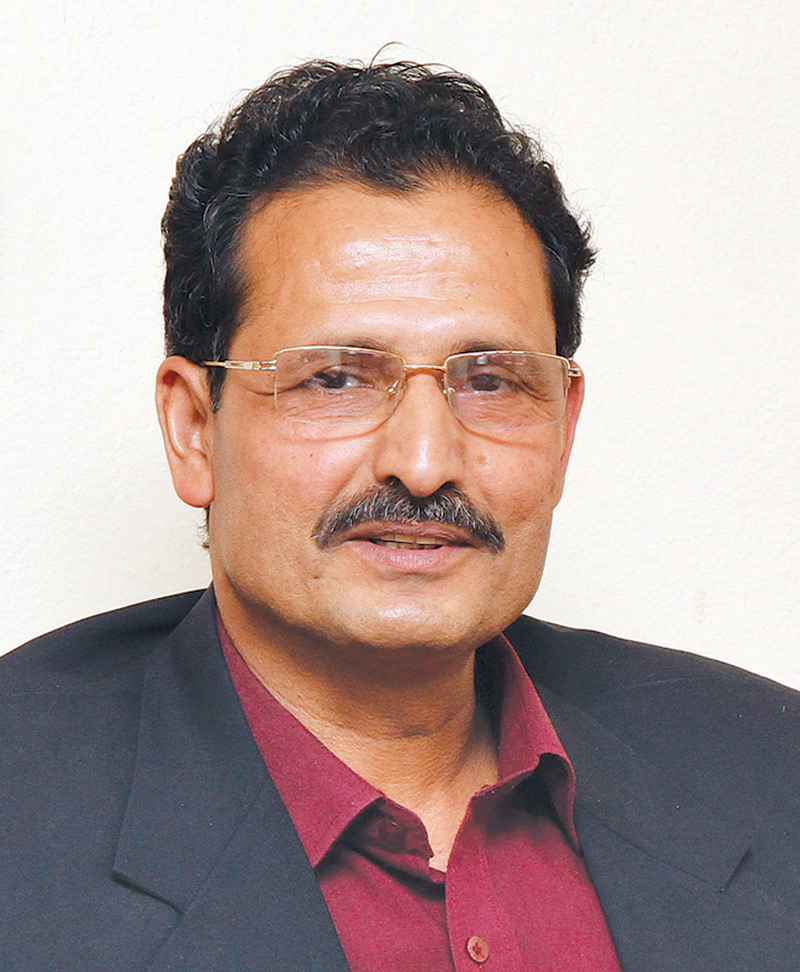
Sapkota, who faces a murder charge for an insurgency-era killing, has been proposed for Speaker by the ruling party.
- ANIL GIRI,TIKA R PRADHAN
Agni Sapkota. POST FILE PHOTO

KATHMANDU,
A Secretariat meeting of the Nepal Communist Party on Sunday decided to propose Agni Sapkota, a Standing Committee member, for the post of Speaker.
“Today’s Secretariat meeting unanimously decided to field two-time minister and lawmaker from Sindhupalchok Sapkota for the post of Speaker,” Bishnu Poudel, general secretary of the party, told the Post after the Secretariat meeting on Sunday evening.
The decision to propose Sapkota as Speaker comes a day after the ruling and opposition parties reached a deal on appointing candidates of their choice to the two transitional justice commissions that are entrusted with investigating conflict-era cases.
Sapkota is currently facing a murder charge for the killing of Arjun Lama in Kavre during the 10-year insurgency.
The Speaker post has been vacant since early October last year after Krishna Bahadur Mahara stepped down following allegations of attempted rape.
Monday’s meeting of the House of Representatives is expected to start the process of electing the new Speaker, and Sapkota is all but certain to be elected as the ruling party holds a comfortable majority.
Sapkota’s candidacy for Speaker, however, has already drawn criticism from conflict victims and rights defenders, given the murder charge.
According to activists, it is morally wrong on the part of the ruling party to propose Sapkota as Speaker given the murder charge pending at the Constitutional Bench of the Supreme Court. The bench is scheduled to hear the case on February 5.
“Since the case is pending in a court of law, legally we cannot speak on the ruling party’s decision to propose Sapkota as Speaker,” said Charan Prasai, a human rights activist and coordinator of Accountability Watch, a rights organisation. “But if we believe in the rule of law and are against impunity, he is not fit for the post.”
Sapkota has been a member of the Maoist party since 1995. A year later, in 1996, the party launched an armed rebellion against the state. Arjun Lama was kidnapped and murdered on April 29, 2005 at the height of the insurgency, allegedly by Sapkota and Surya Man Dong, another Maoist leader.
After the peace deal in 2006 ended the insurgency, Sapkota contested both Constituent Assembly elections, in 2008 and 2013, from Sindhupalchok Constituency-2 and won. He also won the 2017 parliamentary elections from Sindhupalchok-1.
Sapkota served as minister for information and communication in 2011 and minister for forest and soil conservation in 2015.

A Baluwatar meeting of the secretariat of the ruling Nepal Communist Party decided to elect Agni Sapkota as the Speaker. Photo courtesy: Prime Minister’s Press Department. Post file Photo


It was during his stint as the communication minister that a group of human rights defenders had filed a petition at the Supreme Court for the conflict-era abduction and murder of Lama. Purnimaya Lama, Lama’s wife, had also filed a separate petition after the district police refused to register her case against the Maoist leader.
Nepali human rights defenders and the international community have long been demanding that Nepal investigate the Maoists’ role in the killing and ensure justice for war-era abuses by concluding the transitional justice process.
But Nepal’s transitional justice process has been dragging on, as it has been heavily politicised, which rights defenders say will only promote impunity.
“Do we really want to end impunity? Does Sapkota’s selection reflect the true spirit of democracy?” said Prasai. “Such kinds of decision cannot be tolerated in a democracy because it is against democratic norms. Such moves will only promote impunity.”
Poudel, the ruling party’s general secretary, however, defended the Secretariat’s decision to propose Sapkota and rebuffed all charges against him as baseless.
“There is no case pending against Sapkota. He is an eligible candidate for Speaker,” Poudel told the Post on Sunday evening. “He is an elected people’s representative and he became a minister twice in the past.”
Conflict victims, who decried the political parties’ Saturday decision to place officials in the transitional justice commissions, told the Post that the ruling party has undermined constitutional practice and democratic norms by proposing Sapkota.
“The ruling party has hurt the sentiments of thousands of conflict victims and challenged the state’s commitments to human rights,” said Suman Adhikari, founding chairperson of the Conflict Victims’ Common Platform. Adhikari’s father was also murdered by the Maoists during the insurgency.
According to a ruling party leader who has close relations with Dahal, former UML leaders, including Prime Minister KP Sharma Oli, agreed on Sapkota as Speaker after Maoist leaders managed to get all those who might speak against Sapkota on board. The case against Sapkota will possibly be sent to the Truth and Reconciliation Commission, where the parties have conveniently stationed their own men, said the leader.
The next hearing of the Constitutional Bench is likely to decide whether a regular court should deal with Sapkota’s case or if it should be dealt with by transitional justice commissions.
On May 20, 2011, the Supreme Court had issued a show-cause notice to the Prime Minister’s Office and Ministries of Home and Communication why Sapkota should not be removed from the post of communications minister.
Last week, 17 civil society members, while expressing concern over the ongoing House impasse,
had cautioned the ruling party to pick an individual for the Speaker post who has high moral standing, who is trusted by the public, and is eligible under existing laws.
The next Speaker should be someone who does not have cases pending in courts and who is able to provide able parliamentary leadership, the civil society leaders had said.
The ruling party’s Sunday decision effectively put an end to the prospects of Deputy Speaker Shiva Maya Tumbahangphe becoming the Speaker.
Tumbahangphe had been staking a claim to the post of Speaker but the ruling party leadership was reluctant to give her the post and had instead asked her to resign.
Oli had long been in favour of two-time Constituent Assembly chair Subas Nembang for Speaker while Co-chair Pushpa Kamal Dahal had been making a pitch for Sapkota.


HOME PAGE

‘Power play’ among aspirants postpones appointment of Tourism Board CEO

Three candidates have been shortlisted but concerns about the top candidate’s loyalty from Baluwatar put a halt to the process, according to sources.
- SANGAM PRASAIN

KATHMANDU,
A meeting of the board of directors of the Nepal Tourism Board scheduled for Sunday evening was abruptly cancelled due to a “power play”, said sources familiar with developments. The meeting was going to appoint the chief of the country’s tourism promotional body.
The chief executive officer of the Tourism Board, which has an annual budget of more than Rs1 billion, is one of the most lucrative posts in the country due to the nature of its operations to promote Nepal in the overseas markets.
The board meeting, chaired by Tourism Secretary Kedar Bahadur Adhikari, was scheduled for 4:30pm on Sunday and the new CEO was expected to be announced by 6pm.
Multiple officials the Post spoke to said that the chief executive officer selection sub-committee had shortlisted three candidates on Sunday morning.
The sub-committee, however, has not officially unveiled the shortlisted candidates. Names that were doing the rounds in political and bureaucratic circles were Dhananjay Regmi, Deepak Bastakoti and Hikmat Singh Ayer. A member of the selection sub-committee, who spoke on condition of anonymity because he was not authorised to speak to the media, confirmed the three names to the Post. Former chief executive officer Deepak Raj Joshi did not make it to the shortlist.


After the names are recommended, the board of directors picks one as chief executive officer.
“In Baluwatar, many were complaining that Regmi, who has been given top scores, is not ‘our man’,” said an official, who also did not wish to be named. “The board meeting has been postponed until 4:15pm Monday.”
A three-member CEO selection committee led by Biplab Paudel, executive director of Pokhara’s Hotel Barahi, who also sits on the board of directors of the Nepal Tourism Board representing the private sector, had been entrusted with the task of recommending the new CEO after Joshi’s four-year term ended on December 24.
In the first week of December, the Nepal Tourism Board extended Joshi’s term by another three months in an attempt to prevent a setback for tourism in the country on the eve of the much-hyped Visit Nepal 2020
campaign. Joshi, however, did not accept the offer and reapplied for the CEO post.
The vacancy announcement was published by the selection sub-committee on December 4.
Members of the sub-committee include Ghanshyam Upadhyaya, joint secretary at the Tourism Ministry, and Krishna Bahadur Mahara, proprietor of the Hotel Devotee in Dhangadhi who sits on the board also representing the private sector.
The Nepal Tourism Board’s 11-member board consists of five representatives each from the government and the private sector, besides the CEO.
Adhikari, however, told the Post that they were unable to pick the CEO due to a tight schedule.
“The Nepal Tourism Board will get its chief on Monday,” he said.

HOME PAGE

Murder of transwoman shows that things remain perilous for the LGBTIQ community

Ajita Bhujel’s murder concerns the trans community over their safety and security.
- SHUVAM DHUNGANA
Ajita Bhujel. Photo Courtesy: Suraj Chiran thapa

KATHMANDU,
Ajita Bhujel was a carefree and open person who always put her family first. Ever since her parents died when she was a child, Bhujel had been living with her grandparents and when she grew up, she became their sole source of support, both financial and emotional.
Bhujel wasn’t always comfortable in her body though. She was 22 years old when she decided to transition from male to female, and although her grandparents were troubled at first, they came to accept her identity as a woman. But as a transwoman, Bhujel had trouble finding a job. She was forced to resort to sex work so she could keep supporting herself and her elderly grandparents.
Early Saturday morning, at around 4.30, Bhujel’s body was discovered near the Kyampadanda road in Hetauda, naked and beaten to death. She was 29.  “After seeing the dead body, locals immediately contacted the police and when we discovered she was a transgender woman, we contacted the Blue Diamond Society,” Inspector Lagan Prasad Karmi of the Hetauda police told the Post. The Blue Diamond Society is Nepal’s oldest LGBTIQ rights organisation with branches across the country.
When Suraj Chiran Thapa, coordinator for the Blue Diamond Society in Hetauda, got a call from the police saying that a transgender woman had been murdered, she went into shock. But she collected herself and began calling everyone from the transgender community in Hetauda. Everyone answered, except for Bhujel. Thapa had known Bhujel for nine years. They were friends.
“She worked as a rights activist in our organisation and we have a very good connection,” said a distraught Thapa, who is also transgender. “She used to call me ‘Aama’ and used to share everything with me.”
Thapa, who immediately went to the site of the murder, described the scene as horrific.
“The body seemed to have been thrown there and she was fully undressed,” she said. “Her gold ring and necklace were both missing. So was her phone.”
Bhujel’s body was brought to Kathmandu for a post-mortem, said Superintendent Sushil Singh Rathour, chief of the Makwanpur District Police Office. “We are interrogating people and trying to find her phone and her call details.”
Although police refused to reveal details, Thapa said that the autopsy report showed that she had been raped before being struck on the head with a blunt object and then strangled to death by a wire. Police are uncertain about the motive behind the murder, but queer rights activists are concerned about the motive being a possible hate crime.
Transgender men and women continue to face stigma and prejudice from society at large, which denies them access to traditional means of employment. With few options, they often turn to sex work, which can be dangerous. In March last year, Junu Gurung, a transgender sex worker, was beaten to death.  
But as prostitution is illegal in Nepal, they have no legal means of redress when they are mistreated or assaulted by customers. Often, they are doubly victimised by the police.
“The work she was involved in is always dangerous. People misbehave and sometimes, they even attack without reason,” said Pinky Gurung, chairperson of Blue Diamond Society. “If she was not transgender and was not involved in this kind of work, then maybe she would be alive.”
But Gurung said that the motive behind the murder could be financial.
“Nearly a week ago, she had texted me saying she had around Rs 1.2 million as savings that she wanted to build a house with,” Gurung told the Post.
“On Friday, she had texted me again saying someone wanted to borrow money from her. I advised her against it and that was our last conversation.”
Hundreds of people from the LGBTIQ community had gathered at the Hetauda police station after learning about Bhujel’s murder.
“The culprit should be behind bars as soon as possible,” said Thapa. “This incident has created fear in our community. We do not feel safe.”
For queer rights activists like Thapa and Gurung, violence against the LGBTIQ community remains a distressing reality. Until the government takes stringent measures to protect marginalised communities, these kinds of incidents will not end, they said.
Bhujel was very well-liked in the community and she had no enemies that anyone can think of. But violence against minority groups can be sudden and extreme, say activists.
Bhujel’s grandparents are distressed at losing their only grandchild, but for now, they are honouring her wishes.
“She always said that she wanted to be dressed like a bride when she died,” said Thapa. “We’re making sure
of that.”

Page 2
MEDLEY

Horoscope

ARIES (March 21-April 19)
**
There’s no such thing as a mundane responsibility when it comes to work right now. Each task that you’ve been put in charge of is an opportunity to show the people in power that you are able and ready to take on bigger and better assignments. Don’t think of your duties as boring items to cross off your to-do list.


TAURUS (April 20-May 20)
***
A healthy relationship doesn’t need constant attention. In fact, a pause here and there can bring lasting depth. Don’t fret about not getting enough one-on-one time. the two of you have a connection that’ll only grow. So long as you keep this person in your mind and heart, this relationship will grow and blossom.


GEMINI (May 21-June 21)
****
Following another person’s advice could lead you down a very interesting path today, so do what someone close to you suggests, even if it sounds silly or embarrassing. The stars say if you can let go of inhibitions, you’ll be able to have an adventure, one that could involve meeting several new people who’ll change your life.


CANCER (June 22-July 22)
**
Talking will take up a big chunk of your day today. But keep in mind that when you’re talking, you can’t be listening. Take a break every now and then and try to hear what other people are telling you. There will be a lot of subtext to decipher, and the burden of good communication rests on your shoulders.


LEO (July 23-August 22)
***
It doesn’t take a genius to understand that pennies and nickels add up to dollars, so why are you being so nonchalant about so many little expenses? Review your daily budget, and start trimming away a few trivial luxuries. Take your lunch to work. Wash your own car. Check out the sale rack before you go into the dressing room.


VIRGO (August 23-September 22)
**
Yes, you might be missing one piece of information, but you should be able to go on without it. Use your intuition. After all, even if you’re missing one piece of a jigsaw, you still get a pretty good idea of what the picture is when you’re done. Don’t delay because someone hasn’t gotten back to you with a confirmation.


LIBRA (September 23-October 22)
***
Feel free to be self-centred today. You’re in need of a rest and giving it to yourself will have an amazing effect on your ability to perceive the true meaning behind various actions. Some problems in your social life have you taking a closer look at relationships, and you can restore positive energy by treating yourself well.


SCORPIO (October 23-November 21)
***
In the past, your friends have been there for you. Today, it’s your turn to be there for them. Call up a friend who’s been feeling blue, and see what you can do to cheer them up, whether it’s a lunch date, some flowers, or even just a quick visit. You don’t have to do much to let someone know that you care.


SAGITTARIUS (November 22-December 21)
***
Ask for the authority you need to do what you want to do today, and you will get it, even from people who aren’t usually very helpful when it comes to the agendas of others. Having control over people is getting easier and easier for you to enjoy, and you have a wonderful knack for being a leader without going on a power trip.


CAPRICORN (December 22-January 19)
***
If you’ve got your romantic sights set on someone new, this is a great day to do some research into this person’s history and character. Mutual acquaintances will be very forthcoming. With a few strategic questions, you could find out much more than you bargained for. But inquire subtly. You should keep this crush on the down low for now.


AQUARIUS (January 20-February 18)
***
There are many social opportunities coming your way today, but be selective about which ones you take advantage of. You have other responsibilities that you need to take care of before you go trotting off to have fun. If you take care of all the details right now, you’ll be able to clear your mind and enjoy yourself more fully.


PISCES (February 19-March 20)
**
You usually have a great ability to see people for who they really are, no matter what kind of camouflage they use. But today, someone will confuse you quite a bit. Just who are you really dealing with here? Get comfortable with the idea that you may never truly know. Not all secretive people have something devious to hide.

Page 3
NATIONAL

Suspected Wuhan coronavirus case once again lays bare Nepal’s lack of preparedness

The patient was sent home undiagnosed after five days of hospital stay in Kathmandu.
- Arjun Poudel

KATHMANDU,
When a 21-year-old man from Kavre died of flu-like disease in a Capital hospital last March, it took health authorities two and a half months to confirm that the patient had died of bird flu.
It was the first case of H5N1 infection since February 2017, and the incident had exposed the country’s lack of preparedness to monitor and combat infectious diseases.
The Epidemiology and Disease Control Division (EDCD) had formed a rapid response team only after the World Health Organization’s Collaborating Center for Influenza in Japan, confirmed the presence of Influenza H5N1 virus.
“A lot of people would have contracted bird flu or died of it if the virus could transmit from one human to another,” Dr Baburam Marasini, a health expert, told the Post. “In that case, we must say we were lucky.”
But even after that alarming incident, the country is still not adequately prepared to stave off infectious diseases.
Last week, when a Nepali man who had returned from Wuhan city of China earlier this month visited Sukraraj Tropical and Infectious Disease Hospital in Teku with complaints of fever, sore throat and pneumonia-like symptoms, doctors were worried that he might have contracted the new strain of coronavirus.  
Dr Basudev Pandey, director at the hospital, told the Post on Friday that the man was discharged after being put under observation for five days.
But the term “under observation” did not mean that he was kept in an isolation ward. The doctors and nurses constantly came into close contact with the man, who was suspected to be carrying the mystery virus that has already killed at least two people and affected four dozen others.
“The number of visitors at the hospital increased by several folds after the rumour spread that the man had returned from Wuhan, China, where the deadly virus originated,” Dr Anup Bastola, the chief consultant on tropical medicine at the hospital, told the Post.
The hospital eventually discharged the man without confirming if he had indeed contracted the mystery virus, as it lacked the equipment to conduct tests.
“We wonder if the man had Wuhan coronavirus and we cannot say if it has been transmitted to others,” said Bastola.
The World Health Organization has already alerted all the member countries, including Nepal, about the possible risk of transmission of the deadly virus.
The hospital has collected specimens—throat swab and blood samples—of the patient and preparing to send them for a test to the WHO’s Collaborating Center in Delhi or Hong Kong.
“We were neither prepared in the past nor at present to handle any untoward situation,” said Marasini. “The Nepali man returning from Wuhan has once again exposed our preparedness to deal with emergencies.”
The EDCD, which is responsible for containing the spread of the deadly diseases in the country, conceded that it lacked isolation transport ambulance for patients suspected of carrying infectious viruses, treatment facilities, trained human resources and laboratory for conducting preliminary tests.
Meanwhile, most of the health desks, set up at the time of the Ebola outbreak in 2014 in Africa, are out of commission due to staff crunch.
“We lack even the basic facilities when it comes to dealing with emergencies,” said Dr Bibek Kumar Lal, director at the EDCD. “We cannot handle if we face a situation like in China.”
According to Lal, none of the hospitals in Nepal has an isolation facility to treat patients suffering from highly contagious diseases.
An isolation ward set up at Sukraraj Tropical and Infectious Disease Hospital at the time of avian flu
outbreak in 2010 in financial assistance of the World Bank lacks infrastructure including high-efficiency particulate air (HEPA) filter.
The EDCD had requested the WHO to determine if the ward met the required standards as per the UN health agency’s guidelines in June last year. The WHO had sent its team of experts to conduct a study, but it is yet to submit a report.
Meanwhile, the EDCD has sought help from the security agencies—Nepal Army, Armed Police Force and Nepal Police—to set up isolation wards in the hospitals they run.
“In other countries too, security agencies set up such facilities and offer help to the government for the same,” said Lal. “We are ready to provide expertise as well as other assistance if they show readiness to help.”
Brigadier General Bigyan Dev Pandey, spokesperson for the Nepal Army, said the Health Ministry had not made any formal proposal to set up isolation facilities.
“We are ready to set up such facilities,” Pandey told the Post. “We have been constructing a facility in the
airport barracks to quarantine our personnel returning from peace missions.” 

NATIONAL

Cases of daylight burglary rising in Kathmandu Valley, police say

Thieves are targeting homes and apartments of working families.
- SHUVAM DHUNGANA

KATHMANDU,
A house in Kathmandu Metropolitan City Ward No. 5 was burgled in broad daylight on January 14.
Police said the burglars broke into the house of Bishnu Bahadur Karki and made off with cash and valuables worth Rs 1.6 million.  
As most of the members in the Karki’s family are jobholders, there was no one in the house at the time of the incident.     
Karki filed a police complaint after learning about the robbery, but police say they have not found any clue about the burglars.
“It becomes difficult to identify a thief once he or she gets away without anyone noticing,” said Senior Superintendent of Police Kiran Bajracharya at Metropolitan Police Office, Ranipokhari.
The house of Rajan KC, a resident of Kathmandu Metropolitan City Ward No. 25, was also robbed on the same day as Karki’s. Again, it was a case of daylight robbery that took place while the house occupants were out.
Police said the thieves stole Rs 113,000 cash from KC’s house.
At least seven incidents of breaking and entering are reported daily, according to Nepal Police.  
“More than half of these incidents take place during the day. The trend is stark in Kathmandu Valley,
where burglars target unattended houses and rented rooms of working families during daylight,” said Bajracharya.
“Criminals have been targeting houses and rented room during office hours when the house owners and tenants are away. They usually steal cash and saleable goods like gold and electronic gadgets,” said Senior Superintendent of Police, Uttam Subedi, chief at the Kathmandu Metropolitan Police Range.
Police suggest keeping expensive belongings like jewellery and cash in bank lockers and informing one’s neighbours or police when going on a long trip.

Page 4
NATIONAL

Health workers of 21 districts to get mental health screening training this year

Last year over 1,000 staff nurses and paramedics serving in 20 districts had received screening training.
- Arjun Poudel

KATHMANDU,
After a failed effort to deploy psychiatric doctors at the state-run health facilities to screen mental health patients, the Ministry of Health and Population is preparing to mobilise trained staff nurses and paramedics for the job.
This year, the ministry has been providing training to over 1,200 staff nurses and paramedics from 21 districts.
“This is the second consecutive year we have been providing training to screen mental health patients,” Dr Phadindra Baral, chief of the Mental Health Section at the Epidemiology and Disease Control Division, told the Post. “We will train junior health workers--staff nurses, paramedics--in all 77 districts by the next fiscal year.”
Experts at Nepal Mental Hospital in Lagankhel have been imparting training to the health workers. Over 1,000 staff nurses and paramedics from 20 districts were trained last year.
The division has allocated Rs 65 million for the training of the health workers. The division has also allocated a budget to buy medicines for mental health patients.
Nepal does not have enough experts in the field of mental health. There are only around 130 psychiatrists in the country, most of whom are based in the city areas and fewer than 30 of them work for the state-run hospitals.
According to the World Health Organization, the total number of human resources working in mental health facilities or private practice per 100,000 population is 0.59. The breakdown according to the profession is --0.13 psychiatrists, 0.06 other medical doctors, 0.27 nurses, 0.02 psychologists and 0.010 other health or mental health workers.
“Production of psychiatric doctors is very low in general, and very few are serving in government service,” said Baral. “It will be very difficult to deploy mental health experts in districts. So we are training staff nurse and paramedics.”
Dr Ananta Prasad Adhikari, a consultant psychiatrist at Nepal Mental Hospital, said the training programme was an excellent initiative taken by the health ministry.
“Trained health workers can easily screen the mental health patients and refer them to advanced centres,” said Adhikari. “Patients will be diagnosed in their nearby health facilities in early-stage and get proper treatment.”
Apart from imparting training to junior health workers, the division has also included medicines of mental health on the list of essential drugs.
The division has also allocated budget for awareness programme to minimise suicide rates and for rescue and rehabilitation of the mental health patients.  
A recent pilot study by Nepal Health Research Council shows that around 13 percent population have been suffering from mental health problems--major depressive disorder, alcohol use disorder, substance use disorder and dissociative conversion disorder. The study shows that with any form of mental disorder, only 18 percent received treatment in the last 12 months.

Page 5
NATIONAL

Jhapa starts time-card system to control road accidents

- ARJUN RAJBANSHI
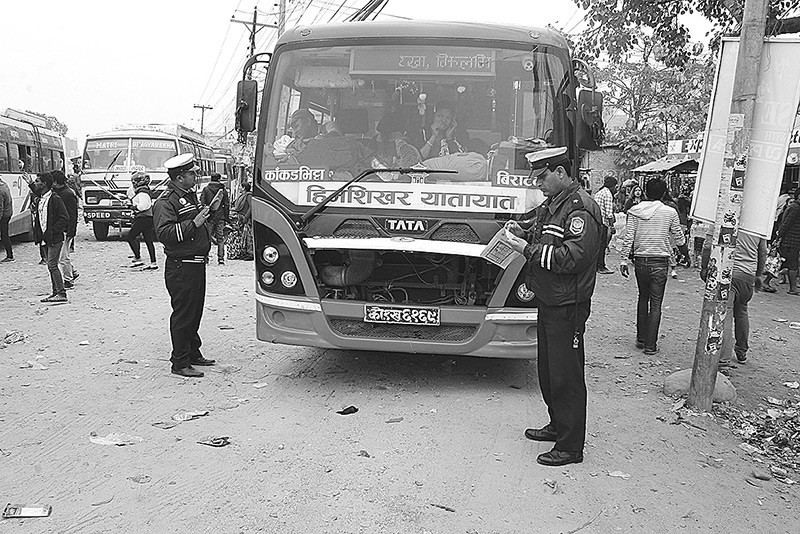
The traffic office has set up its desks in Kakadbhitta, Birtamod and Damak to issue and check time-cards. Post Photo: ARJUN RAJBANSHI

BIRTAMOD,
The District Traffic Police Office in Jhapa has introduced a time-card system with effect from Sunday in a bid to control road accidents in the district. The traffic office implemented the time-card system for vehicles running along the Jhapa section of the East-West Highway.  
According to the data of the District Traffic Police Office, a total of 203 vehicles were involved in road accidents that killed 38 people in the district in the past six months. Eighty-five people were killed in 348 road accidents in the last fiscal year.
“Overspeeding is one of the main reasons behind road accidents,” said Inspector Hom Adhikari, chief at the District Police Office. “We hope that the introduction of the time-card system will curb road accidents caused by overspeeding.”
According to the time-card system, passenger vehicles should adhere to the speed limit mentioned in the time-card while moving along the 55-kilometre road section of the East-West Highway in Jhapa. A vehicle should take at least 30 minutes to travel along the 17km-long Kakadbhitta-Birtamod road section, and an hour to commute along the 38km road connecting Birtamod to Tarabari in Damak.  
The traffic office has set up its desks in Kakadbhitta, Birtamod and Damak to issue and check time-cards.
According to Sub-Inspector Narayan Acharya, vehicles entering Jhapa should get their time cards stamped in Tarabari while the vehicles setting off from Bhadrapur, Birtamod and Shanishchare should get their time-card stamped in Birtamod.
Nara Bahadur Adhikari, a driver of a passenger bus, said the system might help in controlling road accidents.
“This is a good system if followed diligently. Everybody stands to gain from it,” he said.
The traffic police said around 2,500 vehicles move along the Jhapa section of the East-West Highway on a daily basis.

NATIONAL

Opening of track linking Taplejung to China border point elates locals

SB Elite JV Construction Company has opened a 25km track so far.
- ANAND GAUTAM
Workers use an excavator to open the track from Taplejung’s Phungling to the Nepal-China border point. Post Photo: ANAND GAUTAM

TAPLEJUNG,
Nabin Lama, who runs a rural hospital in Taplejung’s Phaktanglung, remembers the time when he could not take his elderly sick mother to the hospital when her asthma got worse.
The village at the time did not have a motorable road link and given the condition and age of his mother, Lama did not want to ferry her to the hospital on a stretcher or worse, a traditional woven basket.
When the village was linked with a motorable dirt track and a bridge over the Tamor river recently, Lama made the point of bringing his mother to the hospital, so that she could receive medical attention.
Lama’s mother Phupuphuti has been undergoing treatment at the hospital since January 14.
The opening of the motorable track has helped many people living in the remote region of Taplejung. They can now reach the nearest health facilities and markets with much ease and less time. The track has also linked the region with Phungling, the district headquarters.
For the first time in her life, Kabita Limbu of Iladaanda, a village located between Lelep and Olangchungola, had to walk just for an hour to reach her home from Phungling.
“Earlier, it would take me five-seven hours to reach my home on foot from the district headquarters,” Limbu said.
Meanwhile, shopkeepers and other business owners in Phungling are waiting for the track, which is part of the North-South Corridor Project--to be extended all the way up to Tipta-La Bhanjyang, which shares a border with China.
For the track to reach the Nepal-China border point, the construction company still needs to cut a passage through a nearly one-kilometre rocky cliff face.
From there on, Tipta-La Bhanjyang is only eight kilometres away, said Ram Bahadur Gurung, the project chief.
The project is being developed by SB Elite JV Construction Company. The company has opened 25 km of the 32 km track so far.
“Opening the track through the cliffs at Iladaanda and Sukepani is the only challenge standing in our way,” said Gurung.
Rajiv Lamichhane, the project manager of SB Elite JV, said they will have to conduct controlled blasting to open the track along the cliffs.
“We will have to bring the explosive materials after coordinating with the security agencies,” said Lamichhane. “The problem is that there is only one person who has the licence to conduct such operations and he is currently working in Phungling Municipality.”
Lamichhane informed that if there is a conducive environment for the blasting process the remaining track could be opened in two-three months.
Earlier in April 2019, Nepal and China signed the Protocol on Implementing Agreement on Transit and Transport which makes it possible for Nepal to use four Chinese seaports—in Tianjin, Shenzhen, Lianyungang and Zhanjiang—and three land ports—in Lanzhou, Lhasa and Shigatse—for third-country import. It will also allow Nepal to carry out exports through six dedicated transit points between Nepal and China.
Taplejung Chamber of Commerce and Industry Chairman Taranath Ghimire said that the government should continue prioritising the road section as it could open multiple business avenues for both nations.

NATIONAL

In Salyan, it’s mandatory for wedding cards to state age of bride, groom

The move is aimed at controlling child marriages in the district, police say.
- BIPLAB MAHARJAN
The District Police Office signed an agreement with representatives of local printing presses to enforce the move. Post Photo: BIBLAB MAHARJAN

SALYAN,  
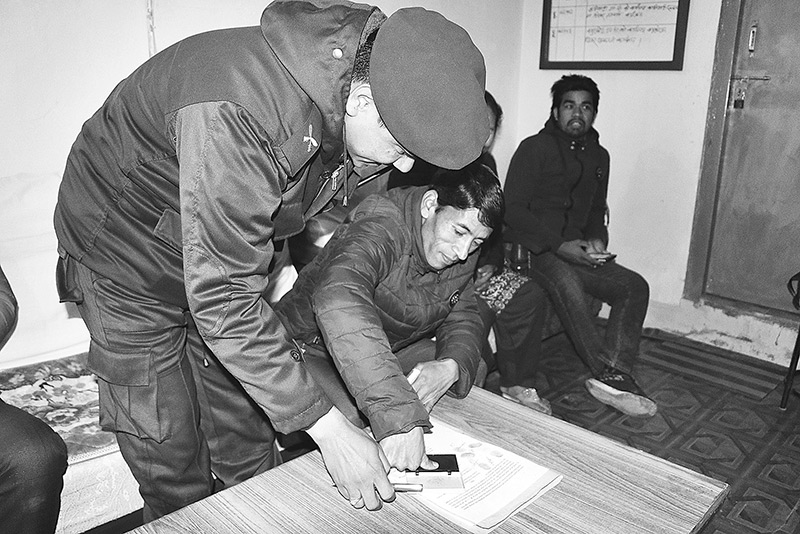
In a bid to control unchecked child marriages in the district, the District Police Office (DPO) in Salyan has come up with a plan that makes it mandatory for families to mention the age of the bride and bridegroom in the wedding invitation card.
The DPO on Friday signed an agreement with representatives of the district-based printing press to implement the move immediately.
“We hope the mandatory provision will help control child marriages,” said Deputy Superintendent of Police Dhakendra Khatiwada. “The bride, bridegroom and their relatives also have to furnish other documents like citizenship certificate, birth registration certificate and passport to the press to print the invitation cards.”
According to him, the representatives of the printing press expressed their commitment to support the police in curbing child marriages, adding the police will take action against them if they are found printing wedding invitation cards without verifying the authentic age of both the bride and the groom.
Child marriage has been illegal in Nepal since 1963. The legal age for marriage in the country is from 18 to 20. As per the existing legal provisions, parents and priests solemnising the wedding ceremony of underage couples can be sentenced to prison for up to three years and fined up to Rs 30,000 or both.
Underage marriage is a major social problem in Salyan, a hill district in Karnali Province. According to the National Census of 2011, the average rate of child marriage is 52 percent in the country. But in Salyan, it is 69.88.
Hence, the DPO and the local units have launched various awareness programmes to discourage underage marriage in the region. “We have been organising street dramas on the evils of child marriage and arranging interactions with the locals to discuss the issue,” said Khatiwada.
“We have also been pasting pamphlets in public places discouraging child marriage,” he added.
The DPO recently held an interaction with Hindu priests urging them to stand against the underage marriage as well. Around 80 priests, according to the DPO, attended the interaction. “We have been actively supporting the authorities for their campaign to stop child marriage. Now, we do not perform wedding ceremonies without verifying the authentic age of the bride and bridegroom,” said Tulsiram Sharma, a priest of Chaurgaun.
With the help of such initiatives, the DPO said it has stopped eight child marriages for the past nine months.

NATIONAL

Whereabouts of seven missing trekkers still unknown

Briefing
- Post Report

POKHARA: The whereabouts of seven people who went missing in an avalanche in the Annapurna region on Friday are still unknown. Four South Korean tourists and three Nepali high altitude workers have been missing since the avalanche struck the trekking trail between Hinku and Deurali. A team of eight rescuers returned from the area as rescue work was not possible due to adverse weather conditions.

NATIONAL

Rabi Lamichhane acquitted

Briefing
- Post Report

CHITWAN: Rabi Lamichhane, a TV show host, has been acquitted over the charge of abetting the suicide of journalist Shalikram Pudasaini. A single bench of Judge Hemanta Rawal on Sunday gave a clean chit to Lamichhane stating that evidence did not prove his involvement in Pudasaini’s suicide. The District Attorney’s Office in Chitwan had filed a charge sheet against three people for their involvement in the case.

NATIONAL

Man held with brown sugar

Briefing
- Post Report

SIRAHA: Prem Chaudhary of Saptari has been arrested in possession of brown sugar from Lahan in Siraha. Chaudhary was held with 920 milligrams of brown sugar and 200 milligrams of white sugar during a security check on Friday night, said police. Security personnel also seized Rs 107,500 and IRs 5,440 from him. 

NATIONAL

Bahrabise locals protest municipality’s demolition drive

Briefing

SINDHUPALCHOK: The residents of Bahrabise Bazaar in Sindhupalchok district have been staging demonstrations since Saturday to protest against the authorities’ demolition drive in the area. Bahrabise Municipality recently demolished houses and huts that were built by encroaching roadside areas. The protesters say the municipality unfairly demolished the structures.

NATIONAL

Dalit woman becomes Province 1 state minister

Briefing

JHAPA: Four new faces were appointed ministers at the Province 1 cabinet on Sunday, including Jasmaya Gajmer, a Dalit woman. Gajmer, the first Dalit woman in the provincial cabinet, will now take the office of Social Development Ministry as a state minister. Gajmer was elected to provincial assembly under the proportional electoral system.

Page 6
EDITORIAL

Justice as elusive as ever

The government has been leading the conflict victims in circles.

The two transitional justice bodies—Truth and Reconciliation Commission (TRC) and Commission of Investigation on Enforced Disappeared Persons (CIEDP)—have been without office bearers since April 14, 2018. Victims of the Maoist conflict have long complained that they have been neglected, and they have warned that they will not accept the transitional justice process if the new leadership in the two commissions is selected without proper consultation.
But on Saturday, showing no consideration for what the conflict victims, human rights defenders and the international community had been warning the ruling party against, the top leaders from the Nepal Communist Party and the Nepali Congress reached an agreement on appointing officials to the two transitional justice commissions.
Ganesh Datta Bhatta and Yubraj Subedi—the chosen ones to lead the truth commission and the disappearance commission respectively—are apparently known party loyalists having their allegiance to the Nepali Congress and the Nepal Communist Party. Nepal’s transitional justice process was already botched. But with these appointments, the government and other political leaders have made clear their intention to weaken war-era crimes and absolve themselves of the heinous deeds. The victims of Nepal’s decade-long civil war (1996-2006) claimed that government processes are ‘cursory’ and the recent appointments are a testament to it with the culture of impunity proving to be even more stubborn.
During the years of the insurgency, more than 16,000 people lost their lives and scores are still missing. The Comprehensive Peace Agreement had envisioned the formation of the two transitional justice mechanisms within six months of signing the peace deal. But due to political wrangling associated with the perpetrator’s fear of prosecution, it was formed only nine years later in February 2015.
Regrettably, the government has failed to learn from its past mistakes. The commitment has to come from the government to ensure accountability for human rights abuses committed during the armed conflict. While the government has made a few amendments on the legislative front, the process of transitional justice must be more inclusive. There are no second thoughts about this. What’s more, the Universal Periodic Review—a process involving a review of the human rights records of all UN Member States—is due this year in November. Given the new appointment, Nepal is bound to be grilled by the international community for its choices.
Our leaders have often touted Nepal’s peace process to be a homegrown, nationally led process. But there is nothing accommodating about the recent decision that has only shown its indifference to being inclusive in the process of ensuring justice and closure to the victims of war-era crimes. Transitional justice is associated with a society’s attempt to come to terms with past abuses, ensure accountability, serve justice and achieve reconciliation. But the latest development fails to provide meaningful hope of justice for the victims in conflict-related human rights violations as they continue to face challenges. Their uncertainties have been renewed.

OPINION

Restoring democracy back to the default

Prime Minister Oli opened too many battlefronts, now he may be succumbing to his own ambitions.
- Ajaya Bhadra Khanal
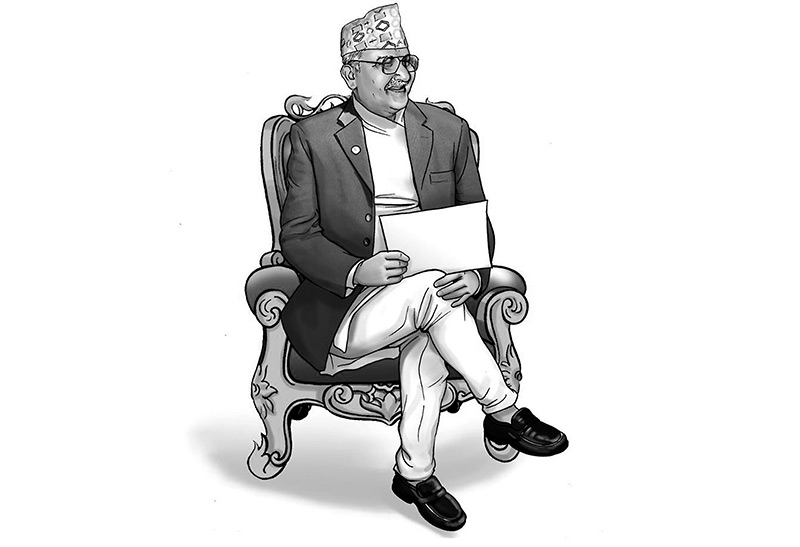
post illustration

Several significant trends are occurring in recent years that show that we should not take democracy for granted. Although we have a democratic constitution, it has only served, so far, to legitimise political malpractices. Policies and practices adopted by the government and parties are not always democratic; they consistently undercut the interests of the country and its people. Geo-political conflict is making this process even more muddled.
Recent incidents show that Prime Minister KP Sharma Oli may be succumbing to his own ambitions. If Oli is overwhelmed by the fronts he has created, things could unravel very quickly. It is, therefore, necessary for the prime minister to restore democracy’s default settings.
Only transparency, openness and vigorous debate in the public sphere can protect national interests from being undercut by vested domestic or foreign interests.

 
Inherent contradictions
While the current regime appears to value peace and stability—even dictatorships do—it has been portraying democracy as a threat to peace and stability.  
Our state and society are riddled with corruption and impunity. A democratic system, in such a situation, provides legitimacy to the ruling regime, however imperfect it may be. More importantly, it allows the ruling regime to make selective use of the rule of law to control opposition and opponents.  
The ruling party’s behaviour displays an interesting contradiction. On the one hand, it claims that the new constitution has ushered in an era of democracy and freedom and that there is no longer a need to fight for democracy. On the other hand, the government has been portraying democracy and freedom as a threat to peace and stability and is making a series of attempts to stifle transparency, freedom of expression and civil rights.  
One of Oli’s claims—also reflected in his party’s electoral manifesto—is that peace and stability is needed for economic development, which in turn is the only way to ensure long term peace and stability.  
Studies, especially those by economists like Daron Acemoglu, have now amply demonstrated the links between democracy and social unrest. In the short term, political parties selectively use redistribution to appease the voters and the intermediate classes who are crucial in propping up a political regime.  
Over the longer term, however, democracy matters. Democracy adds about 20 percent to a country’s per capita GDP and is the most effective means of maintaining social stability. Hong Kong’s experience, for example, shows that that absence of economic development may not be the only driver of social unrest.
Legislation and freedom of expression Over the course of the past year, the government has introduced several bills in the federal parliament that seek to limit the freedom and rights of Nepalis. The bills introduced recently have a common trait. All of them allow space for the government to selectively abuse ‘rule of law’ provisions to crack down on targeted individuals. One of those bills, for example, allows state agencies to spy on Nepali citizens without sufficient safeguards to control the misuse of such powers.   
Instead of state agencies pursuing investigations based on reasonable grounds that indicate violation of rule of law, their actions are now more and more guided by the need for political control.
Similarly, the government is trying to centralise authority regarding the police, media and the civil society by creating new agencies and units under the executive, rather than empowering autonomous and independent institutions.
As a result, many people in the civil society and the political parties are restraining their voices and practicing self-censorship. If the fear of retribution persists, soon there will be very few people who will be able to speak freely.

 
Is Oli toning down?
In recent years, the prime minister has opened several fronts: against the West, against civil society organisations, against political parties promoting the agenda of inclusion and identity, against political opponents, against financial interests not aligned with the ruling regime, and against India.  
Oli could, however, be toning down after a worsening medical condition. According to party leaders, he is no longer aggressively pursuing ‘rule of law’ strategies to crack down on the political rivals, especially those within his own party. At one point in the past, Prime Minister Oli had gone to the extent of dragging Nepal Communist Party leader Madhav Kumar Nepal to the Commission for the Investigation of Abuse of Authority (CIAA) in relation to a corruption scandal involving the privatisation of government land.  
He also appears to have lost the battle to appease the US without appearing to be supporting the Indo-Pacific Strategy (IPS). The government has persistently tried to frame the Millennium Challenge Corporation Compact as being separate from the IPS. But now, the ruling party is likely to endorse the compact despite clear communications by the US that although it is not a military alliance, it is a part of the IPS.
KP Oli appears to be facing more difficulties maintaining control over both the party and the government. In recent days, he appears to have relented to former Maoist leader Pushpa Kamal Dahal over party affairs as well as over the pressing issue of the election of a new speaker for the federal parliament.
Oli also appears more flexible regarding the case of the MCC, withholding of bills in Parliament, and the increased effort to maintain a working relationship with western countries including the United States and the European Union.
There’s a clear indication that Oli may have opened too many war-fronts, which are likely to overwhelm him now that his health is weak and those close to him are finding opportunities to rule by proxy.
People of a country like Nepal, which has just passed through a prolonged period of social and political unrest, should appreciate the value of peace and stability. Peace and stability in a country like Nepal, with different kinds of social and power inequalities, requires a functioning democracy.

OPINION

Climate and security

The internal and external threats of climate conflicts on national security are inseparable.
- Aisha Khan
Nicole Glass Photography. Shutterstock

The year 2020 marks the beginning of a decade witnessing the onset of many changes that will bring focus to the connection between climate change and national security.
The harsh winter spell this year and the associated deaths of more than 100 people are just one of a series of events having a spillover effect on many aspects of life. Fires, floods and drought, here or in other parts of the world, are a clear indication of the scale and scope of the challenges that we face.
Climate change is a living, dynamic and evolving threat that cannot be ignored. To be effective, every development policy and political decision must factor in the science of climate change and project its cyclical, repetitive and multifaceted impacts on social and economic indicators.
So far there is no indication that global temperature increase will be contained within one degree Celsius by 2050. The commitments made in the Paris Agreement are not legally binding; the accord, therefore, cannot be relied on as the international instrument for ensuring compliance. It appears that each country will have to deal with the climate crisis using local resources, capacities and technologies to build adaptive resilience.
The internal and external threats of climate conflicts on national security are inseparable. If left unmanaged both will create chaos and instability. Internal peace and stability depend on social harmony and economic opportunity; however, both have come under extreme stress as the effects of climate change shrink the resource base against rising demand.
In Pakistan’s context, a burgeoning population and widening gap in wealth distribution act as a threat multiplier. The decrease in per capita water availability, unsuitable cropping patterns, poor gender parity, high population growth rate and underdeveloped human capital make it difficult for the state to respond to the impacts of these exponential threat multipliers. Climate hot spots, drought, desertification, floods, disease, increased frequency of natural disasters and subsequent mass movement of people in search of livelihoods are already contributing to societal strife, pitting vested interest groups against each other as they compete for resources, leading to violent conflicts and lawlessness.
South Asia as a region has always been volatile and the recent political developments in the countries bordering Pakistan do not augur well for peace and stability. Meanwhile, Pakistan’s dependence on water sources outside its boundaries adds another layer of complexity to the already existing security threats faced by the country.
The perils to national security
emanate from different sectors, situations and circumstances, and therefore, cannot be addressed without a holistic approach. Specific attention must be paid to game-changing elements such as foreign policy, governance model, population growth rate, gender parity and quality of human resource.
Recent political and social events in many parts of the world have shown us that exclusive narratives are gaining traction, putting countries and not humanity, first. This poses a moral dilemma to rights-based approaches in finding fair solutions to these challenges.
On the other hand, hybrid warfare and invasion, and the proverbial destruction of perceived enemies, without engaging in direct military combat, are and will continue to be on the rise. Through cyberspace, social media and covert and insidious penetrations, manipulating minds to create internal disorder will only add to sociopolitical volatility at the regional and global level.
National security will, therefore, have to be built on the pillars of multi-disciplinary actions that take into account the significance of climate change and its impacts on socioeconomic and political developments at the global and national level. Natio­nal security by definition means protecting the interests and well-being of all the people living within the geographical boundaries of a country. However, with the rapidity and complexity of changes occurring as a result of global warming, it is no longer an option to presume that security is limited to external aggression or it is the exclusive domain of the military establishment and the law-enforcement agencies.
Harmonised societies with good governance, strong institutions and a proven track record in service delivery will be better placed to cope with the impact of climate conflicts on national security.
In the present climatic and security threats posed to Pakistan, people are the first line of defence. In order to secure the interests of the nation it is vital to secure the needs of the people. An empowered, intelligent and rational populace with robust social and economic indicators is the best investment in national security.


This article was previously published in Dawn, a part of the Asia News Network.

Page 7
OPINION

Space and the city

Public open spaces are no longer the central element of contemporary residential neighbourhoods.
- Rajjan Chitrakar
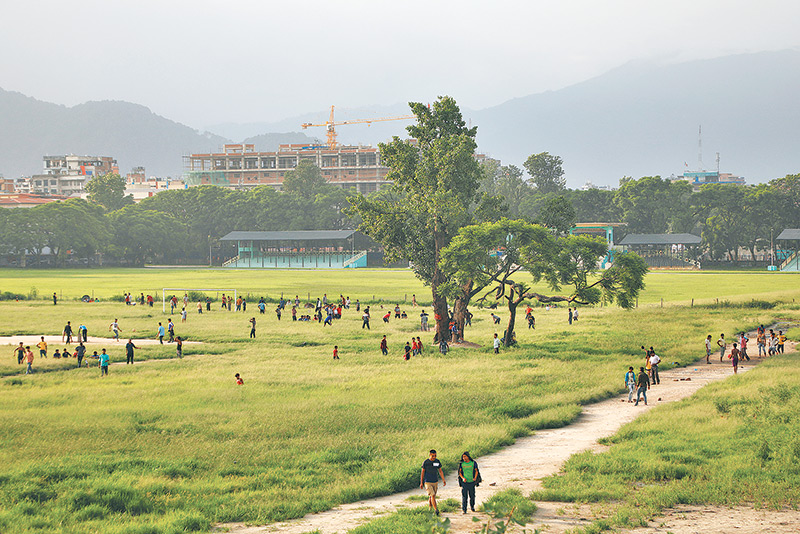
post photo: Sanjog Manandhar

In his book titled Tiered Temples of Nepal (1989), Professor Sudarshan Raj Tiwari, an eminent urban scholar and a cultural historian, offers an important insight on urban planning principles of the traditional towns of the Kathmandu Valley. Tiwari claims that the Kathmandu Valley towns exhibit a distinct set of urban squares, with a clear hierarchy of socio-cultural activities. Other scholars argue that traditional neighbourhoods are always centred around a public square.
The squares have been embedded within the urban fabric in a way that public open spaces appear in each residential neighbourhood in one form or another. But that was in the past; the present is not as exciting. The current urban development efforts have failed to deliver basic physical and social infrastructure in the new growth areas. What is most concerning at present is the loss of community spaces in the contemporary residential neighbourhoods against the backdrop of rapid and uncontrolled urban growth and change.


Change in the Valley
Over the past decades, the Kathmandu Valley’s urban landscape has been transformed dramatically, with widespread consequences on urban form and life. This can be observed in both the changing physical and social environments of the new growth areas. The current growth exhibits traces of urban sprawl, which is in sharp contrast with the traditional city cores, and where achieving social cohesion is becoming a growing challenge.
Urban transformation is also evident in the current development of residential neighbourhoods. The current pattern of neighbourhood formation is not only different, physically, from that of the traditional neighbourhoods due to the changes occurring within the context of rapid urbanisation, but there is also a considerable impact on the nature of emerging residential environments. As the most striking feature, public open spaces are no longer the central element of new residential neighbourhoods. This transformation indicates that public spaces have not received adequate consideration in the development of the new neighbourhoods, which is unfortunate.
There is a severe shortage of public facilities, including open spaces and green areas in the new neighbourhoods of the Kathmandu Valley. While community spaces average about 12 percent of the built-up area in traditional neighbourhoods, the amount of open spaces present in the new developments range from 2.5 to 5 percent of the total developed land area. This is far less than what is needed to fulfil the needs of the residents. Research has found that Kathmandu Metropolitan City, the largest metropolitan area in the Valley, comprises only 6 percent of open space. Other metropolitan regions of the world have about 10 to 20 percent of space allocated for community usage.
The residents of most new neighbourhoods find it difficult to find places where they can meet and interact with neighbours; children do not find places to play. The ongoing trend of unplanned development without public open spaces and shared amenities has not only negatively affected the quality of life but also the cultural values of the society. The loss of public space, thus, has had significant consequences on urban life and activity. If we borrow the words of Professor Tiwari, the new neighbourhoods ‘aggrandise the private spaces and demeans the public ones and shuns community living’.


Poor planning
The current growth of new neighbourhoods reflects a lack of broad vision to guide and regulate the process of residential development. The existing guidelines and requirements in the laws governing residential development are weak; government agencies have largely failed to impose them effectively. The lack of comprehensive planning standards and a proper mechanism to enforce them are thus major impediments. These shortcomings clearly overrule the need and context for proper and satisfactory development of public open spaces within the urban neighbourhoods.
The impacts of urban change are observed in the morphological shift of the Kathmandu Valley’s current urban form, with further consequences on the development of public open spaces as seen in the changing mode of their spatial configuration. It can be argued that we have lost continuity with the past and have opted not to use
traditional wisdom and mechanism in city building.
The encroachment of public land is a collective experience in most urban areas of the Kathmandu Valley, and is partially responsible for the present loss of community spaces. A report published by the Department of Land Reform and Management in 2008 consists of a record of government and public land, but there is no exact figure available to indicate how much land has been lost to individuals, including land brokers and squatters.


Can we bring the public space back?
With the loss of public open space as a platform for social interactions, the sustainability of social life has gradually emerged as a considerable challenge in the Kathmandu Valley. But can we bring the public spaces back? This is not an easy task, given the unsatisfactory nature of the ongoing urban development. However, it is never too late to take proper planning approaches in the development of new neighbourhoods and employ a comprehensive residential development strategy. The strategy should discourage haphazard development of urban land for residential purposes and ensure a better provision of necessary physical and social infrastructure, including public open spaces.
In the existing neighbourhoods that are facing the loss of open spaces, there is a challenge to identify and develop alternative places (including government and public land) as a common social venue for residents to meet and greet.
While the richness of the traditional urban environment has been lost in the current urban growth pattern, it is still possible to win back public open spaces for the well-being of the community if policymakers, urban planners and designers work towards addressing the adverse effects of the current urban growth and change.


Chitrakar is an educator and researcher with a background in architecture and urbanism.

OPINION

Putin’s meaningless coup

Putin knows his regime is on the wrong side of history—and he is dead set on keeping it there.
- REUTERS
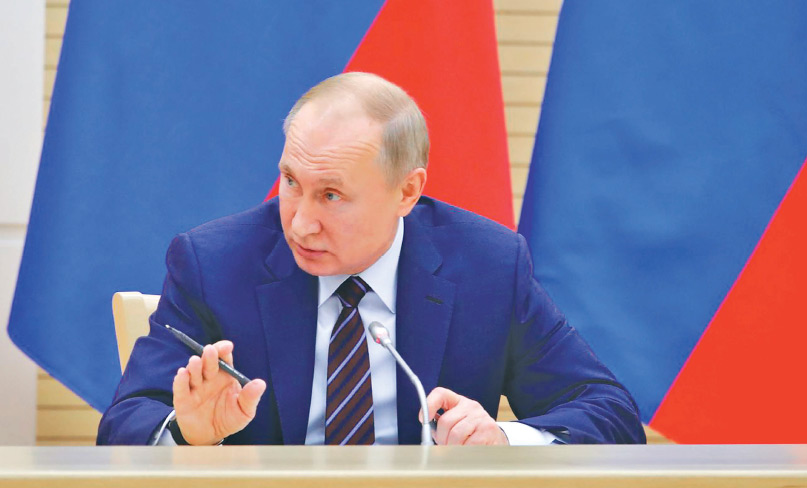
Russian President Vladimir Putin speaks during a meeting to prepare amendments to the Russian constitution at Novo-Ogaryovo state residence outside Moscow, Russia in January 16, 2020.. Sergei Guriev

Vladimir Putin may be setting himself up to remain Russia’s leader well beyond the end of his presidency, to no one’s surprise. In his annual state-of-the-nation speech earlier this week, he laid out a roadmap for overhauling Russia’s political institutions, implying a major constitutional shakeup. The entire cabinet, led by Prime Minister Dmitry Medvedev, immediately resigned.
Putin’s proposals were vague and at times self-contradictory. But they provide valuable insights into his plans for after 2024, when his second consecutive term—and legally his final one—ends. For starters, Putin would shift powers from the president to the State Duma (the parliament), and transfer substantial, as-yet-unidentified powers to a Putin-led State Council (not mentioned in the Constitution) and Security Council (mentioned but not described in the Constitution).
Other proposed changes include the suppression of constitutional checks and balances, the virtual elimination of judicial independence, the loss of autonomy for municipal governments, and the priority of Russian legislation over international obligations. The Russian Constitution is very clear that only a Constitutional Assembly may change these foundational principles of Russia’s political system. Putin said that he would not convene one. In this sense, his speech laid out an open and transparent plan for a coup, or, more precisely, what political scientists call a self-coup, or autogolpe—once a favorite tool of Latin American caudillos.
In fact, this coup is a non-event: the dramatic overhaul of political institutions implies no change in Russia’s political regime. By definition, a political regime is a set of rules, formal or informal, that determine the selection of leaders and policies. Before the coup, Putin was in charge of both. After the coup, this is still the case, and he plans to keep it that way. As Vyacheslav Volodin, Chairman of the State Duma, put it in 2014 (when he was Putin’s deputy chief of staff), ‘There is Putin; there is Russia. No Putin—no Russia.’
Of course, the country will outlast the man. Volodin was referring to the Russian political regime, which Putin created in his own image. That regime may eventually be reshaped, but probably not until after Putin is out of power.
Whether Putin will be forced from power hasn’t been a serious question in a long time. Some may have thought (or hoped) that he would choose to retire in 2024. Had that been the case, he would be preparing the ground by introducing checks and balances aimed at protecting his safety and wellbeing after he left office.
By announcing plans to dismantle checks and balances, Putin has made very clear that he intends to hold onto power, though it remains uncertain how he will structure the system. Russian elites have no doubt been discussing Putin’s options since he began his current term in 2018. For example, he could create a new union with Belarus, enabling him to restart the term-limit clock.
has chosen to follow the example of Kazakh President Nursultan Nazarbayev, who stepped down as president, but retained much of the authority he held in that role. Shortly before his resignation, Nazarbayev strengthened Kazakhstan’s Security Council and subsequently became its chairman. He was also officially appointed a ‘Leader of the Nation’ with a veto over all important appointments.
Putin also seems to be laying the groundwork to choose a loyal successor. Among his proposals is a more stringent residency requirement for presidential candidates: currently, they must have lived in Russia for ten years; Putin wants to make it 25. Moreover, he wants to exclude anyone who has ever held foreign citizenship or residence permits. Whoever Putin is attempting to target with this rule—perhaps opposition leader Mikhail Khodorkovsky, who left Russia in 2013—apparently poses too great a threat to his preferred successor.
The proposal to eliminate the primacy of international laws, agreements, and the decisions of international bodies in Russia seems to advance similar ends. The European Court of Human Rights regularly overturns the Putin-controlled judiciary’s criminal convictions of another popular opposition figure, Alexei Navalny.
In order to stave off resistance to this power play, Putin also announced an increase in annual social spending of about 0.5 percent of GDP. And he replaced the deeply unpopular Medvedev with a highly competent but low-profile technocrat, Mikhail Mishustin, who was previously in charge of tax administration.
Like Putin’s other ‘non-political’ prime ministers—Mikhail Fradkov (2004-07) and Viktor Zubkov (2007-08)—Mishustin conveniently lacks the charisma to challenge him. And while Mishustin is respected for streamlining and digitizing the tax system, his popularity is tempered by the fact that tax collection increased dramatically under his leadership.
Putin seems to have thought of everything. But the fact that he finds it necessary to go to such lengths to protect himself and his potential successor reveals how tenuous his position is. His famously high approval rating now stood at a paltry (for him) 64% in December 2019. A loyalist successor would be unlikely to reach anywhere close to that level.
So, the message of Putin’s recent speech is not that the Russian regime is going to be transformed. It isn’t—as financial markets, which didn’t budge, seem to recognise. Rather, the message is that Putin knows his regime is on the wrong side of history—and he is dead set on keeping it there.


— Project Syndicate

Page 8
ESCALATE

Why bosses should let employees surf the web at work

The term ‘cyberloafing’ may infer problematic behaviour, but it could make workers more productive.
- Stephanie Andel
unsplash

If you’re like most workers, you don’t spend 100 percent of your time at the office doing what you’re supposed to be doing.
In fact, on average, US workers spend about 10 percent of their work day surfing the internet, emailing friends or shopping online. This so-called cyberloafing costs employers up to US$85 billion a year.
But it turns out, these behaviors may not be a sign a worker is lazy or just wasting time. New research I conducted with several colleagues suggests cyberloafing can help workers cope with an exceptionally stressful work environment.


Cyberloafing and stress
Existing research on cyberloafing, a term first coined in 2002 by researchers from the National University of Singapore, typically assumes that this behavior is problematic and counterproductive.
Therefore, the majority of cyberloafing research focuses on ways to deter employees from engaging in this behavior through interventions such as internet monitoring and computer use policies.
However, more recent research has found that using the internet at work for personal purposes may also have some positive outcomes. For instance, social media use at work has been linked to higher levels of employee engagement and job satisfaction.
And other studies indicate that cyberloafing may provide a way for employees to manage workplace stress. For instance, empirical research suggest that employees surf the web as a response to boredom and unclear instructions.


Impact on employee stress
But is cyberloafing actually effective at reducing employee stress levels?
That’s the question Stacey Kessler, Shani Pindek, Gary Kleinman,Paul Spector and I wanted to answer in our new study. Our hypothesis was that cyberloafing may serve as a mini break during the workday, giving employees an opportunity to recover from stressful work situations.
To test this, we recruited 258 university students who also worked at least 20 hours per week to complete an online survey about their experiences on the job. Specifically, we asked them to rank how much time they spent doing a variety of cyberloafing behaviors such as checking non-work email and shopping, ranking them from “never” to “constantly.” We also asked participants to rank job satisfaction, their desire to quit and how often they’ve experienced mistreatment at work, such as being bullied, threatened or yelled at.
As you might expect, we found that participants who reported more workplace mistreatment had lower levels of job satisfaction and were more likely to want to leave their companies.
More interestingly, we found that cyberloafing effectively buffered this connection. That is, mistreated workers who spent more time surfing the web and checking emails reported higher job satisfaction and were less likely to want to quit than similar participants who didn’t cyberloaf as much.
This suggests that cyberloafing acts as a sort of relief valve for workers, helping them recover from stressful experiences.  
Overall, about 65 percent of participants reported spending at least some time at work cyberloafing, in mostly moderate amounts, with the most common form being the use of personal email.
While we did not directly assess how cyberloafing affects worker performance, we believe that by relieving stress this buffering effect may ultimately help employees be more productive. This fits with other recent research that suggests taking short breaks throughout the work day is indirectly associated with higher levels of daily job performance.
That isn’t to say that cyberloafing is always good. Too much time spent on non-work activities likely causes performance to suffer.


Cut ‘em some slack
All in all, managers should cut workers a bit of slack when it comes to cyberloafing.
Our results do not mean, however, that they should simply let employees cyberloaf instead of directly addressing workplace problems like bullying. If managers only focus on cyberloafing, they would be addressing a symptom rather than the root of the problem.
And of course, there are other reasons workers cyberloaf. For instance, some individuals do it to “get back” at their organisations for a perceived slight or simply because they see coworkers cyberloaf. Future research needs to be done to better understand the factors that motivate employees to cyberloaf.
But maybe, just maybe, a little bit of shopping or surfing at work could make you more productive in the long run.


—The Conversation/ Associated Press

ESCALATE

A new data reckoning in ‘The Age of Surveillance Capitalism’

Big tech corporations can profit from commodifying user data, and US companies spent US$19 billion in 2018 to acquire and analyse it.
- IVAN ATMANAGARA
The Jakarta Post

The 2010s was a decade marked by a fundamental shift in our relationship with technology. We used to envision it as a tool of emancipation: from the Arab Spring and Gezi Park to the Umbrella Movement.
As digital technology advanced, we began to realise that the force behind it isn’t really in the business of promoting social justice, let alone democratising societies. Technology is not deterministic and we’ve seen it firsthand.
The Cambridge Analytica scandal in 2016 virtually wiped out the “innocence” of social media. We lost our privacy, and our trust in the government (and each other) began to decline. Pop culture was lit with dystopian narratives such as Black Mirror, Westworld and The Handmaid’s Tale series. When Donald Trump was inaugurated in 2017 and his administration talked about “alternative facts”, George Orwell’s 1984 became a best-seller again.


How did we get here?
A Harvard professor, Shoshana Zuboff, seems to have the answer. In a new ground-breaking book, The Age of Surveillance Capitalism (2019), she dissects the business of big tech corporations that profit from commodifying user data. Capitalism has taken a new form, Zuboff argues, by “claiming human experience as free raw material for hidden commercial practices of extraction, prediction, and sales”.
Zuboff calls it “surveillance capitalism”, which centers on mining our digital data as “behavioral surplus” to predict and create personalised profiles for sale. She calls it surplus because these data are beyond what the companies actually need to improve their products and services; it’s our searches, click patterns, cursor movement, typing logs, voices and a million other things that we don’t even know about.
Advertising companies are eager to pay more for this kind of data. According to the Interactive Advertising Bureau, American companies spent US$19 billion in 2018 to acquire and analyse consumer data.

The unprecedented surge of technological innovation in the 21st century has given people the means to express themselves, although poverty and economic inequality are still major global problems. People want access to information and connect with others, but they want them for free.
Over time, this creates a gap and a vast asymmetry of power between users and tech companies.
“Privacy was the price one must pay for the abundant rewards of information, connection and other digital goods when, where, and how you want them,” Zuboff writes.
These companies don’t face much resistance from the users for two reasons. First, people like the service because it makes their lives easier, which creates dependency. Second, ignorance or lack of understanding of the industry’s business model of data extraction. We readily accept the mostly one-sided terms of service agreements (if we even read them), which states that our data can be used for any commercial purposes. In fact, data mining takes place because the users have consented to it. Some are even convinced that they’re not afraid of privacy breaches as they feel they have nothing to hide.
From an individual perspective, data mining may only seem as annoying as the coffee machine ads that follow you across Instagram or persistent promotions of hotel discounts sent to your email. However, this breach has a broader impact from a national and global standpoint.
In the Cambridge Analytica case, social media can be exploited as an engineering platform to modify users’ behavior. The data firm was able to extract behavioural data of 87 million Facebook users to create divisive and targeted political messages and misinformation. Investigations show that it has compromised the United States election and the British referendum on European Union membership in 2016.
Scholars, politicians and regulators around the world have been grappling with this issue for years. Most countries (outside the EU) still don’t have a comprehensive privacy law, although government agencies have started to impose heavy fines on tech companies for violating their privacy policies (Amazon and Google are facing antitrust complaints in many jurisdictions).
Much of the effort is laudable, but whether it can serve as deterrence to those corporations remains unclear. Even if we succeed in claiming our data, we still have no idea to what extent the data is given back and what the data was used for.
What we need as users is algorithmic transparency.


A new reckoning
Surveillance capitalism leaves us unprepared as it hides behind empowering jargon like “open internet” and “connectivity”. We also don’t have a consensus on how to figure it out. Its real practices are buried under advanced artificial intelligence and operated in discreet servers.
Surveillance capitalism is like a hyperobject, to borrow a term coined by philosopher Timothy Morton. It means that although we can’t touch and see it, yet somehow, we know that it exists, that we’re influenced by it and that we probably have to do something about it. But just like climate change, its reach is hard to grasp. To understand hyperobjects, we need a mental upgrade and heightened awareness of its existence.
The Age of Surveillance Capitalism gives us exactly that. It’s an ambitious book, which deserves a greater audience outside business leaders and policymakers. It puts a name to the face and gives us the vocabulary to recognise the challenges we’re facing.
In the dystopian novel 1984, the totalitarian power rejects any forms of freedom and privacy to ensure citizens’ total devotion to the ruler. But unlike Big Brother, big corporations are not trying to impose ideologies or terrorise people.
As opposed to totalitarianism, surveillance capitalism wields what Zuboff calls an “instrumentarian power”, the power to alter, predict, monetise and, ultimately, control our behavior. There’s also a dystopian dimension in that practice.
The book, though, doesn’t aim at providing comprehensive policy recommendations. Its argument is mainly about Western democracies and Silicon Valley. At the same time, a new trajectory is developing in nondemocratic countries like where the citizens are spied on and tracked extensively. In this case, instrumentarian power doesn’t only serve market domination and corporate gains but also—more crucially— acts as the extension of the authoritarian power. This also demands equal scrutiny and debate.
As we start a new decade, it’s time for a new reckoning. The year 2020 should be the turning point for digital capitalism. We’ve seen that seemingly emancipating technology turns us into raw materials for the revenue stream. Can we change that under robust institutional and regulatory frameworks? Or are we bracing for another Facebook election?
If the last 10 years taught us anything, we can’t afford to let our dependency become subordination.


—The Jakarta Post

Page 9
CULTURE & ARTS

Lok’s lok: Exploring an artist’s universe

This acclaimed Paubha artist believes there’s much more to learn, even after 40 years of painting.
- SRIZU BAJRACHARYA
Artist Lok Chitrakar wants people to look beyond the beautiful colours and shapes of Paubha art, to understand it. Post Photo: Beeju Maharjan

Lalitpur,
It’s a warm morning at Simrik Atelier, famed and acclaimed artist Lok Chitrakar’s school. His three disciples sit in the front room, working on their paintings, adding colourful hues to their pieces. Their hands move slowly and lightly, but not in languor—this is the very skill that makes their labour-intensive work fine and intricate. It takes months.
Even Chitrakar is occupied this morning, as a customer arrives at his Patan studio to learn about the Paubha artform.  It is evident that Lok Chitrakar is immersed in art.
“If you are buying an artwork, you need to be curious about it,” says Chitrakar, ushering the customer through his studio. “Don’t just look at it as a product, try to understand the value and depths of the artwork.”
His studio-cum-school is a world unto itself—it’s akin to entering a stark realm, animated by shapes and colour. On one wall, there are big Paubha paintings of Ganesh, Buddha, and many of Chitrakar’s unfinished works. The white backdrop makes the colours pop and gives the space vibrancy. At first glance, the untrained eye might confuse the pieces for Thangkas. But these are specific Newar form of spiritual art, originally to create discussion about the stories of Buddhist and Hindu deities. Paubhas usually feature a central deity to tell accounts of morality that tie in with spiritual significance.
When Chitrakar settles down to talk about his journey as an artist, he apologises for being so busy. Speaking to the Post is not an unfamiliar task for him, rather it’s yet another instance where a reporter has shown interest and is vying for his time. Many already know silent and peaceful Chitrakar is one of Nepal’s finest Paubha artists. His paintings have been displayed in several countries, one being Kanzouin museum in Japan, which houses 125 of paubha paintings to show the journey of various Buddhist deities, and he has won various accolades for his work, such as the Nepal Lalitkala Purashkar and Nepal Rastriya Purashkar.
Even as an artist of his calibre, Chitrakar remains humble. “I’m a self-taught artist, and I had no idea what I was getting into when I started. I was just using the skills I knew to earn money. There was nothing else I was trying to achieve,” he says. “I didn’t even know that this work was valuable, but there’s just so much more that I still need to learn.”


His current exhibition, ‘Lok’, was organised by his student Ujen Norbu Gurung and showcases one of his early paintings, of Ganesh, which he did as a 12-year-old. The art is masterful—perfectly capturing the iconography of Ganesh’s posture—and does not look like a piece done by a hobbyist—a testament to Chitrakar’s early proficiency.
For Chitrakar, his journey as an artist unravelled, rather than coming as a result of an ambitious master plan; one decision led to another and, from there, another.
“When my father passed away, my uncle took me to work at a place in Jhochhen to make paintings,” says Chitrakar, recalling his old days with a nostalgic smile. Chitrakar spent hours in the studio with other senior artists making copies of images the employer used to assign them to sell to tourists. Later, he kept doing the same kind of work, but for a former co-worker.
 “There was no value in art or creativity, what I did initially was mass-produced artworks for commercial value,” says Chitrakar.
As years passed and as people started appreciating his work, Chitrakar found himself growing attached to the meaning behind his creations—he felt he had to understand the philosophy behind what he was depicting. As a result, he found himself reading and discussing spiritual anthropology with researchers and cultural experts.
“After learning the philosophy of deities I had painted in the past, I have also gone back to those works to make corrections,” says Chitrakar. “That is why our research and creativity matters.”
To portray the gods’ tales, artists give detail to stories and characters through various metaphorical elements, which can represent diverse emotions. It’s a very different process to the style that he started off doing.  
For instance, in his painting of Cintamani Lokesvara, which has a Rs10 million price tag in his current exhibition, the bodhisattva in the artwork is seen handing over a flower from a Kalpavriksha tree (a wish-fulfilling divine tree) to a commoner. Next to him, Tara, the female consort of the bodhisattva, is seen doing the same “Along with other characters, I have also painted a Tara with the bodhisattva to show love and compassion. There are layers of information and metaphors representing various traits of the Lokeshvara’s story,” he says.
And that is possibly reason Chitrakar hopes customers understand the work on more than just face value. “You can purchase prints of Paubha anywhere today, but if you are to value the artwork, both the artist and the viewer need to study and understand the stories of the deities in the paintings,” says Chitrakar.
The 59-year-old has gone through a lot to understand the significance of his work, but when he saw his own work accredited to someone else, about 20 years ago, he learned a hard lesson.  
“I felt betrayed; it was a lesson for me from life. A person to whom I had been selling my work had been claiming my work as his. I haven’t seen him since, but such experiences have thickened my skin,” he says, reflectively.
These days, Paubha and Thangka shops in Thamel sell various mandala and Lokeshvara paintings as souvenirs to tourists, luring them with the declaration, “This is Lok Chitrakar’s brilliant work.”
“One time when I accompanied a friend to a Paubha shop in Thamel, the shopkeeper kept trying to persuade us to buy a painting saying it was my work,” says Chitrakar, laughing about it. “Of course it was not my painting, but he had no clue that it was me who was standing in front of him.”


While Chitrakar is acclaimed for his works, and has done more than a dozen exhibitions, he now understands why an artist needs exposure. Equal to that is the necessity to continue working on one’s skills—even today he hesitates and questions himself before putting up works for the public to see.
“Exhibitions are quite important for artists, and that is why we must offer something different to the audience to enjoy,” says Chitrakar. “Ujen, my student, had been talking about doing an exhibition with me for many years. However, I felt like I didn’t have much to say. But because now feels the right time, I agreed to showcase 108 Lokeshvara prints.”
The exhibition ‘Lok’, which means universe in Nepali, doesn’t just illustrate the journey of the Lokeshworas (lords of realms) but also celebrates Chitrakar’s dexterity and dedication through the years. Despite his humility, his work emits a feeling of satisfaction and gives a glimpse of the artist’s soul—one who wants nothing to do with the public’s perceived notions of achievement, and only wants to continue learning.
His continued and steadfast undertaking has made him one of the most sought after Paubha artists. Now many contemporary young artists are fusing new ideas to the traditional artform, which Chitrakar believes is logical for the artform’s progression. “There’s room for novelty, so long as you are following the ground rules,” he says.
Since he was as young as his students, Chitrakar has had to jump many hurdles. He didn’t receive formal training, he had to make ends meet, and never really had finite plans as an artist. But he no longer needs to bear financial pressures he once shouldered, he is now focused on teaching the next generation. All he asks of his students is dedication, as he paints and continues to teach them for the love of the artform.
“In the early days, my artworks were a means to earn a living, but today devoting my time in Paubha painting makes me happy and content,” he says. “And I hope people to experience the same when they see my work.”


‘Lok’ will be displayed until February 9, in Kathmandu Art Gallery, Le Sherpa.

CULTURE & ARTS

‘Simpsons’ actor says he’ll no longer voice Apu after controversy

White actor Hank Azaria’s marked accent for the role has been criticised by viewers for the past two years.
- AGENCE FRANCE-PRESSE
ap/rss

Simpsons actor Hank Azaria will no longer voice the Indian character Apu, US media reported, more than two years after accusations of racism marred the long-running animated series.
Apu Nahasapeemapetilon is the manager of the show’s Kwik-E-Mart convenience store and a mainstay of the TV comedy, which recently celebrated its 30th year on air.
He is voiced by white actor Azaria, whose marked accent for the role has been criticized by viewers, who have also accused writers of using Indian stereotypes in their treatment of the character.
“What they’re going to do with the character is their call,” Azaria told US film news website SlashFilm on Friday. “It’s up to them and they haven’t sorted it out yet. All we’ve agreed on is I won’t do the voice anymore.”
Creators of The Simpsons found themselves under fire in late 2017 with the release of a documentary by comedian Hari Kondabolu, who interviewed fellow entertainers of Indian and South Asian origin to document their feelings about the character.
Both Azaria and Simpsons creator Matt Groening refused to appear in the documentary to answer questions.
But Azaria later told a reporter from the TMZ celebrity website that Kondabolu “made some really interesting points” and “gave us a lot at The Simpsons to think about.”
The Simpsons stars Homer, the family patriarch working for a nuclear power station, his wife and voice of reason Marge, and children Bart, Lisa and Maggie.
Since it first aired in 1989, the show has won more than 30 Emmys.
In its early years, the animated comedy regularly pulled in more than 15 million viewers and had double that—33 million—for its most-watched episode in 1990.
It became so popular that references to the show have formed part of pop culture.
Declining audience figures had led to fears that it would not be renewed, but Fox committed to continue The Simpsons until at least a 32nd season in 2021.

Page 10
WORLD

US seeks to deport Honduran mum, sick children to Guatemala

- ASSOCIATED PRESS

HOUSTON,
The US government says it will deport a Honduran mother and her two sick children, both of whom are currently hospitalised, to Guatemala as soon as it can get them medically cleared to travel, according to court documents and the family’s advocates.
The family’s advocates accuse the US of disregarding the health of the children, ages 1 and 6, to push forward a plan currently being challenged in court to send planeloads of families to different countries so that they can seek asylum elsewhere.
Both children have been hospitalized in recent days in South Texas’ Rio Grande Valley. In court papers, the US government has said it intends to deport the family to Guatemala on Tuesday, pending clearance “from a medical professional.”
“The mother is desperate. She thought her baby was going to die,” said Dr Amy Cohen, a doctor who monitors the government’s compliance with a landmark court settlement governing how migrant children are treated known as the Flores agreement.
“Whenever the baby coughs, her whole body shakes,” Cohen said. “The 6-year-old looked exhausted. Everyone looked malnourished.”
According to Cohen, the family says both children were healthy when they crossed the US-Mexico border without authorization in late December.
A lawsuit  filed by the family says they were taken first to the US Border Patrol’s processing centre in McAllen, Texas, a former warehouse where migrants are held in large fenced-in pens, then to a complex of tents built at the port city of Donna, where they were held for several days longer than the Border Patrol’s own 72-hour limit to detain people.
The lawsuit blames the children’s illnesses on inadequate medical care and the food served at the Donna tents, which they describe as burritos twice a day and a sandwich at night.
The 1-year-old has diarrhoea and a fever, while the 6-year-old was diagnosed with the flu, an illness that caused the death of a 16-year-old teen held in Border Patrol custody last year.

WORLD

Germany hosts summit on Libya, seeks to halt proxy fighting

The chances of the summit producing any real progress are unclear, however.
- ASSOCIATED PRESS
German Chancellor Angela Merkel, right, greets Russian President Vladimir Putin (left) during arrivals for a conference on Libya at the chancellery in Berlin, Germany, on Sunday. AP/rss

BERLIN,
Germany brought together the key players in Libya’s long-running civil war on Sunday, seeking to curb foreign military interference, solidify a cease-fire and help relaunch a political process to stop the chaos in the North African nation.
German Chancellor Angela Merkel welcomed leaders from 12 countries as well as the United Nations, the European Union, the African Union and the Arab League to the summit at the chancellery in Berlin. Germany’s months-long diplomatic drive seeks to bolster efforts by UN Secretary-General Antonio Guterres and his envoy for Libya, Ghassan Salame, to stop the fighting in Libya.
Among those attending were Russian President Vladimir Putin, Turkish President Recep Tayyip Erdogan, French President Emmanuel Macron, Italian Premier Giuseppe Conte, British Prime Minister Boris Johnson and US Secretary of State Mike Pompeo.
Libya’s two main rival leaders, Prime Minister Fayez Sarraj and Gen. Khalifa Hifter, also came to Berlin. Merkel and her foreign minister met both men at the chancellery ahead of the summit. The chances of the summit producing any real progress were unclear, however. A truce brokered earlier this month by Russia and Turkey marked the first break in fighting in months, but the cease-fire has seen repeated violations.
Differences were in full view ahead of the meeting. Speaking Sunday in Istanbul, Erdogan said the world had failed to respond adequately to Hifter’s “reckless attacks” on Sarraj’s UN-recognised government.
“Hopes that flourish again with the cease-fire and the Berlin summit should not be sacrificed to the ambitions of the merchants of blood and chaos,” he said.
Erdogan met Putin in Berlin just before the summit. The Russian leader said “we will sincerely strive for the conflict to be resolved.”
Libya has sunk further into chaos since the 2011 ouster and killing of its longtime dictator, Moammar Gadhafi. It is now divided into rival administrations, each backed by different nations: the UN-recognised government based in Tripoli, headed by Sarraj, and one based in the country’s east, supported by Hifter’s forces.
Hifter’s forces have been on the offensive since April, laying siege to Tripoli in an effort to capture the capital. Hifter’s forces are backed by Egypt, Russia and the United Arab Emirates, while the Tripoli government has turned to Turkey for troops and weapons.
On Friday, tribal groups loyal to Hifter seized several large oil export terminals along Libya’s eastern coast as well as southern oil fields in another challenge to the Tripoli government, which collects revenue from oil production. The National Oil Corporation said the move threatens to throttle much of Libya’s oil production. Germany’s priority is to try to get the outside players that have interests in the conflict on the same page, stem the flow of weapons to Libya and ensure that the cease-fire sticks—creating space for UN-led efforts to re-establish a political process in Libya.
“At the Libya conference, we must see above all that the arms embargo is once again complied with—it has been agreed in principle at UN level but unfortunately not kept to,” Merkel said. Germany is also keen to keep the fighting in Libya from further destabilizing the region, potentially setting off new waves of migrants seeking safety in Europe across the Mediterranean Sea.
German Foreign Minister Heiko Maas, who met  Hifter in Libya on Thursday,  said the general pledged to respect the cease-fire even though he had left Moscow days before without signing a draft on the truce.

WORLD

Trump trial could be over in two weeks

- AGENCE FRANCE-PRESSE
Marcie Hanks gathers with others outside the office of Senator Mitt Romney to call on him to push for a full impeachment trial, during a rally on Thursday, in Salt Lake City. AP/rss

WASHINGTON,
Bill Clinton’s 1999 impeachment trial lasted five weeks; Andrew Johnson’s went on for three months in 1868.
If the White House and Republicans have their way, President Donald Trump’s trial will be over in two weeks, just in time for him to celebrate his expected acquittal in the February 4 State of the Union Address.
But that depends on Republicans being able to block Democrat demands to subpoena documents and witnesses that could strengthen the case against the president.
So far, Republicans, led by Trump’s tough protector, Senate Majority Leader Mitch McConnell, have the upper hand. Trump’s trial for abuse of power and obstruction of Congress opened with a solemn, ceremonial reading of the charges in the Senate on Thursday, but the rules and schedule have not been set.
That will be decided on Tuesday, with the 100 senators debating voting on procedures: the time given to opening arguments from the prosecution and defence, and questioning by the senators—the jury in the case.
Democrats are demanding that the Senate agree to subpoena crucial documents and four current and former senior White House officials to testify.
They include former national security advisor John Bolton and Trump acting chief of staff Mick Mulvaney.
Both are believed to have first-hand knowledge of what Trump is accused of: using his powers illicitly to
pressure Ukraine to help his 2020 re-election campaign by investigating his potential Democratic opponent Joe Biden.
The White House blocked the impeachment investigation in the House of Representatives from accessing the witnesses and documents, and shows no sign of giving in now.
McConnell says the issue won’t be decided until after the trial’s initial arguments and questioning take place, and has made clear he doesn’t see the need anyway. The White House signalled this week what it expects will happen: no witnesses.
“I think it’s extraordinarily unlikely it will be going beyond two weeks,” a White House official told reporters.
He said there is no need to go any longer.
“The president should be acquitted. We think it’s going to happen and going to happen readily.”
McConnell oversees a 53-47 Republican majority in the body, giving him all the power he needs to set the rules his way and deny the witnesses.
Unless four Republican senators break ranks, at the end of the arguments McConnell can defeat any motion to subpoena witnesses, and then can easily hold a vote to acquit Trump—meeting the White House timeframe.
Democrats are pressing Republicans to support a witness resolution.
“We have asked for four fact witnesses and three specific sets of relevant documents,” Chuck Schumer, the senior Democrat in the Senate, said on Thursday.
“So in the coming days, each of us, every one of us, Democrat and Republican, will face a choice about whether to begin this trial in the search of truth or in service of the president’s desire to cover it up.”
Democrats see several Republican senators as possibly willing to stand with them, but none have committed.
One, Maine Senator Susan Collins, came under heavy pressure after a video was widely circulated in the media and social networks showing her in 1999 saying about Clinton’s trial: “I need more evidence. I need witnesses and further evidence to guide me to the right destination, to get to the truth.”
In a statement on Thursday, Collins said she hadn’t decided yet.
“I tend to believe having additional information would be helpful. It is likely that I would support a motion to call witnesses at that point in the trial just as I did in 1999.”
Another possible Republican crossover, Senator Mitt Romney, told journalists: “Barring some sort of surprise I’ll vote in favour of hearing witnesses.”
No other Republican has gone that far. If four Republicans do cross over, that could add weeks to the trial—three in the Clinton case.
But McConnell has another card up his sleeve: demanding witnesses that the White House wants, even if they have little bearing on Trump’s guilt or innocence.
Republicans have said they would call Biden’s son Hunter, whose association with a Ukraine energy firm was part of what Trump wanted Kiev to investigate.
They also want to call the whistleblower whose August complaint about Trump’s Ukraine dealings set off the investigation that led to impeachment.
That would provoke a showdown.
Republican Senator Rand Paul told Politico that if Democrats get their witnesses, “my insistence will be not just one witness, but that the president should be able to call any witnesses that he deems necessary to his defence,” Paul said.
He meanwhile warned Republicans who don’t support the White House witness demands.
“If you vote against Hunter Biden, you’re voting to lose your election, basically. Seriously. That’s what it is,” he said.

WORLD

Harry, Meghan to quit royal jobs, give up ‘highness’ titles

- ASSOCIATED PRESS
In this Saturday, May 19, 2018 photo, newly married Duke and Duchess of Sussex, Meghan Markle and Prince Harry, leave Windsor Castle in a convertible car after. AP/rss

LONDON,
Goodbye, your royal highnesses. Hello, life as—almost—ordinary civilians.
Prince Harry and wife Meghan will no longer use the titles “royal highness” or receive public funds for their work under a deal that lets the couple step aside as working royals, Buckingham Palace announced on Saturday.
Releasing details of the dramatic split triggered by the couple’s unhappiness with life under media scrutiny, the palace said Harry and Meghan will cease to be working members of the royal family when the new arrangements take effect in the “spring of 2020.”
The radical break is more complete than the type of arrangement anticipated 10 days ago when the royal couple stunned Britain with an abrupt announcement that they wanted to step down. They said they planed to combine some royal duties with private work in a “progressive” plan, but that is no longer on the table.
Harry and Meghan will no longer use the titles His Royal Highness and Her Royal Highness but will retain them, leaving the possibility that the couple might change their minds and return sometime in the future.
Harry’s late mother, Diana, was stripped of the Her Royal Highness title when she and Prince Charles divorced.
They will be known as Harry, Duke of Sussex, and Meghan, Duchess of Sussex. Harry will remain a prince and sixth in line to the British throne.
The agreement also calls for Meghan and Harry to repay 2.4 million pounds ($3.1 million) in taxpayers’ money spent renovating a house for them near Windsor Castle, Frogmore Cottage. The use of public funds to transform the house’s five separate apartments into a spacious single family home for them had raised ire in the British press. They will continue to use Frogmore Cottage as their base in England.
The deal came after days of talks among royals sparked by Meghan and Harry’s announcement last week that they wanted to step down as senior royals and live part-time in Canada.
The couple’s departure is a wrench for the royal family, and Queen Elizabeth II did say earlier this week that she wished the couple had wanted to remain full-time royals, but she had warm words for them in a statement on Saturday. The 93-year-old queen said she was pleased that “together we have found a constructive and supportive way forward for my grandson and his family. Harry, Meghan and Archie will always be much loved members of my family.”
“I recognise the challenges they have experienced as a result of intense scrutiny over the last two years and support their wish for a more independent life,” Elizabeth said.
“It is my whole family’s hope that today’s agreement allows them to start building a happy and peaceful new life,” she added.
Despite the queen’s kind words, the new arrangement will represent an almost complete break from life as working royals, especially for Harry. As a devoted Army veteran and servant to the crown, the prince carried out dozens of royal engagements each year. Royal expert and author Penny Junor said the new setup will benefit both sides of the family.
“There are no blurred lines. They are starting afresh and they are going with the queen’s blessing, I think it is the best of all worlds,” she said.
It is not yet clear whether Harry and Meghan will continue to receive financial support from Harry’s father, Prince Charles, who used revenue from the Duchy of Cornwall to help fund his activities and those of his wife and sons. The duchy, chartered in 1337, produced more than 20 million pounds ($26 million) in revenue last year. It is widely regarded as private money, not public funds, so Charles may opt to keep details of its disbursal private. Much of the royals’ wealth comes from private holdings.
Though Harry and Meghan will no longer represent the queen, the palace said they would “continue to uphold the values of Her Majesty” while carrying out their private charitable work. The withdrawal of Harry from royal engagements will increase the demands on his brother, Prince William, and William’s wife, Kate, the Duchess of Cambridge.
Buckingham Palace did not disclose who will pay for the couple’s security going forward. It currently is taxpayer-funded and carried out primarily by a special unit of the Metropolitan Police, also known as Scotland Yard.
“There are well established independent processes to determine the need for publicly funded security,” it said. Harry and Meghan have grown increasingly uncomfortable with constant media scrutiny since the birth in May of their son, Archie. They married in 2018 in a ceremony that drew a worldwide TV audience.
Meghan joined the royal family after a successful acting career and spoke enthusiastically about the chance to travel throughout Britain and learn about her new home, but disillusionment set in fairly quickly.

WORLD

Kenya arrests five for suspected terrorism

Briefing

NAIROBI: Kenyan authorities have arrested five people suspected of preparing a terror attack in Nairobi, according to a police report seen by AFP on Sunday. The group comprises three men—a US citizen, a Somali and their Kenyan driver—and two Somali women who were believed to be on a reconnaissance mission for an attack in the north of the capital, the report dated Saturday said. Police received information on Friday saying that “suspected terrorists” were carrying out a surveillance operation at a pub on Kiambu Road, a spot popular for its many bars and nightclubs.Kenyan security forces have been on high alert since the Somali Al-Shabaab group, close to Al-Qaeda, stepped up attacks in the east of the country this month, threatening to target more Kenyan and US interests.(Agencies)

WORLD

Maduro says still in control, open to talks with US: Report

Briefing

WASHINGTON: Venezuelan President Nicolas Maduro said he was still comfortably in charge and open to direct negotiations with the US, in an interview published on Saturday by The Washington Post. The interview was Maduro’s first with a major US outlet since February of last year, when he abruptly ejected all Univision journalists from Venezuela. “If there’s respect between governments, no matter how big the United States is, and if there’s a dialogue, an exchange of truthful information, then be sure we can create a new type of relationship,” Maduro said. The leader said he was ready to hold talks with the US to negotiate an end to sanctions.(Agencies)

WORLD

Bodies of Ukrainian victims of downed plane repatriated

Briefing

KIEV: The flag-draped coffins of the 11 Ukrainians who died in a plane mistakenly shot down by Iran amid heightened tensions with Washington arrived in Kiev on Sunday. President Volodymyr Zelensky, Prime Minister Oleksiy Goncharuk and other officials attended the solemn ceremony at Kiev’s Boryspil airport to see the downed plane’s nine Ukrainian flight crew and two passengers being removed from the aircraft, according to live video footage. Ukraine International Airlines staff, some in tears, stood on the tarmac clutching flowers. The Kiev-bound UIA Boeing 737, crashed shortly after taking off from Tehran on January 8, killing all 176 people on board, mostly Iranian and Canadian citizens. (Agencies)

Page 11
ASIA

China reports 17 new cases of mystery virus

The virus has now infected 62 people in Wuhan with eight in severe condition, 19 recovered, and the rest getting treated.
- AGENCE FRANCE-PRESSE
Medical staff members carry a patient into the Jinyintan hospital, wherepatients infected by a mysterious SARS-like virus are being treated, inWuhan in China’s central Hubei province on Saturday. AFP/RSS

BEIJING,
China reported 17 new cases of the mysterious SARS-like virus on Sunday, including three people in serious condition, heightening fears ahead of China’s Lunar New Year holiday when hundreds of millions of people move around the country.
The new coronavirus strain has caused alarm because of its connection to Severe Acute Respiratory Syndrome, which killed nearly 650 people across mainland China and Hong Kong in 2002-2003.
Of the 17 new cases in the central city of Wuhan—believed to be the epicentre of the outbreak—three were described as “severe”, of which two patients were too critical to be moved, authorities said.
Those infected range from 30 to 79 years old.
The virus has now infected 62 people in Wuhan, city authorities said, with eight in a severe condition, 19 recovered and discharged from hospital, and the rest in isolation receiving treatment.
Two people have died so far from the virus, including a 69-year-old man on Wednesday after the disease caused pulmonary tuberculosis and damaged multiple organ functions.
Authorities said they had begun “optimised” testing of pneumonia cases across the city to identify those infected, and would begin “detection work... towards suspected cases in the city” as a next step, as well as carrying out “sampling tests”.
Scientists with the MRC Centre for Global Infectious Disease Analysis at Imperial College in London warned in a paper published on Friday that the number of cases in the city was likely to be closer to 1,700, much higher than the number officially identified.
Authorities said on Sunday that some of the cases had “no history of contact” with the seafood market believed to be the centre of the outbreak.
No human-to-human transmission has been confirmed so far, but Wuhan’s health commission has previously said the possibility “cannot be excluded”.
Three cases have also been reported overseas—two in Thailand and one in Japan. Though China has not yet reported cases outside of Wuhan, discussion about the coronavirus spreading to other Chinese cities has swelled on social media.
On Sunday evening there were more than 400 million views of the hashtag “Shanghai pneumonia” on Weibo, China’s Twitter-like social media site, while “Shenzhen pneumonia” garnered at least 340 million views.
China’s centre for disease control moved to quash speculation about the mysterious disease on Saturday, publishing a flyer that dismissed “five big rumours”.
One of them included claims about the coronavirus spreading, which China’s disease control authority dismissed by saying all cases were being treated in Wuhan.
A hospital in Guangzhou, a city in southern China, also moved to dispel rumours about suspected cases of the Wuhan pneumonia, reported state-run Global Times on Sunday.
Although there has been no official announcement of screening measures on the mainland, Wuhan deputy mayor Chen Xiexin said on state broadcaster CCTV that infrared thermometers had been installed at airports, railway stations and coach stations across the city.
Chen said passengers with fevers were being registered, given masks and taken to medical institutions. Nearly 300,000 body temperature tests had been carried out, according to CCTV.
Authorities in Hong Kong have stepped up detection measures, including rigorous temperature checkpoints for inbound travellers from the Chinese mainland.
Thailand said it was already screening passengers arriving in Bangkok, Chiang Mai and Phuket, and would soon introduce similar controls in the beach resort of Krabi.

ASIA

India, Sri Lanka seek closer military ties as China clout grows

- AGENCE FRANCE-PRESSE

COLOMBO,
Sri Lanka and India vowed to strengthen military ties and widen maritime links with neighbours after security talks, the president’s office said on Sunday, as China’s economic clout increases in the region.
China, a long-time regional rival of India, has been widening its footprint in the region, including building ports and expressways and upgrading airports in Sri Lanka and the Maldives.
India’s National Security Advisor Ajit Doval met on Saturday with recently elected Sri Lanka President Gotabaya Rajapaksa and discussed setting up a maritime research coordination centre, Rajapaksa’s office said in a statement.
It did not give details of the proposed centre, but said other nations in the region should be included as observers. It said the two countries also discussed closer military and coastguard cooperation.
The meeting followed Rajapaksa’s visit to New Delhi in late November for talks with Prime Minister Narendra Modi, who offered $450 million in aid to Sri Lanka after his landslide victory in the presidential election. Local media reports said Rajapaksa will travel to China—his second foreign visit since coming to power—while his prime minister brother Mahinda will visit India on his first overseas trip.
No exact dates have been announced, but official sources said it could happen within weeks.
Sri Lanka has traditionally been allied to India, but China invested and loaned billions of dollars to the island nation during the decade-long reign of Rajapaksa’s elder brother, Mahinda. Chinese investments grew under the previous Colombo government too.
China’s foreign minister Wang Yi held talks with President Rajapaksa on Tuesday during a brief transit stop in Colombo and the two men discussed the president’s impending Beijing visit.
“As Sri Lanka’s strategic partner, China will continue to stand by Sri Lanka’s interests,” Rajapaksa’s office quoted Wang as saying.
The visit will focus on technology, tourism and infrastructure as well as other areas, the president’s office said last week.

ASIA

Iran warns of repercussions for IAEA over European moves

- AGENCE FRANCE-PRESSE

TEHRAN,
Iran’s parliamentary speaker on Sunday warned of unspecified repercussions for the UN’s nuclear watchdog if European nations that launched a dispute mechanism against the Islamic republic act “unfairly”.
Britain, France and Germany launched a process last week charging Iran with failing to observe the terms of the 2015 deal curtailing its nuclear programme, while Tehran accuses the bloc of inaction over US sanctions.
The EU three insisted they remained committed to the agreement, which has already been severely undermined by the US exit from it in 2018 and its reimposition of unilateral sanctions on key sectors of Iran’s economy.
“What the three European countries did regarding Iran’s nuclear issue... is unfortunate,” parliamentary speaker Ali Larijani was quoted as saying by state news agency IRNA.
“We clearly announce that if Europe, for any reason, uses Article 37 of the nuclear agreement unfairly, then Iran will make a serious decision regarding cooperation with the agency,” he said.
Since May 2019, Iran has progressively scaled back some commitments under the agreement in response to the US sanctions and Europe’s inability to circumvent them.
It has stressed, however, that they can be reversed if Tehran’s interests are realised. Iran’s latest and final step in January entailed forgoing the limit on the number of machines used to make uranium more potent.
The 2015 nuclear deal—known as the Joint Comprehensive Plan of Action (JCPOA)—was struck in Vienna by Iran, the EU three, the United States, China and Russia.
It has a provision that allows a party to claim significant non-compliance by another party before a joint commission.
Articles 36 and 37 of the deal say if the issue is not resolved by the commission, it then goes to an advisory board and eventually to the UN Security Council, which could reimpose sanctions.

ASIA

Lebanon to release protesters after night of riots

- ASSOCIATED PRESS
Lebanese police arrest a protester after dispersing a protest in Beirut, Lebanon, on Saturday. AP/RSS

BEIRUT,
Lebanon’s public prosecutor ordered the release on Sunday of more than 30 people detained the previous evening, according to the National State News agency, in the worst day of violence since protests erupted three months ago.
The public prosecutor said all 34 arrested are to be released, except those with other pending cases.
The clashes took place with the backdrop of a rapidly worsening financial crisis and an ongoing impasse over the formation of a new government. The Cabinet headed by Prime Minister Saad Hariri resigned in late October.
Protesters have called for more rallies on Sunday. Riot police fired volleys of tear gas and rubber bullets in Beirut on Saturday to disperse thousands of protesters rallied outside the parliament and in downtown. The protesters, who came from the country’s north, east and Beirut, lobbed flares at security forces, metal bars, stones and tree branches.
The pitched street battles lasted for nearly nine hours and were among the worst scene of rioting since protests broke out in mid-October.
At least 220 people were injured in the clashes, according to the Red Cross. More than 80 of those as well as security force members were treated in hospitals. The clashes also took place in the courtyard and steps of a mosque downtown. The top Muslim Sunni Fatwa office called it “inappropriate” and said protesters had taken refuge inside the mosque and were taken care of.
Protesters smashed windows and the facade of the headquarters of the country’s Banking Association with metal bars. Security forces set fire to a few tents set up by protesters nearby.
Interior Minister Raya El Hassan said on Saturday that security forces were ordered to protect peaceful protests. “But for the protests to turn into a blatant attack on the security forces and public and private properties, this is condemned and totally unacceptable,” she tweeted.
However, Human Rights Watch described the security force response as “brutal” and called for an urgent end to a “culture of impunity” for police abuse.
“There was no justification for the brutal use of force unleashed |by Lebanon’s riot police against largely peaceful demonstrators in downtown Beirut,” said Michael Page, deputy Middle East director at HRW. “Riot police showed a blatant disregard for their human rights obligations, instead launching teargas canisters at protesters’ heads, firing rubber bullets in their eyes and attacking people at hospitals and a mosque.”
The protesters have rallied against the country’s political elite who have ruled Lebanon since the end of the 1975-90 civil war. The protesters blame politicians for widespread corruption and mismanagement in a country that has accumulated one of the largest debt ratios in the world.

ASIA

More than 80 soldiers killed in Yemen attack

- AGENCE FRANCE-PRESSE

DUBAI,
More than 80 Yemeni soldiers have been killed and scores injured in a missile and drone attack blamed on Huthi rebels in central Yemen, medical and military sources said on Sunday.
Saturday’s strike follows months of relative calm in the war between the Iran-backed Huthis and Yemen’s internationally recognised government, which is backed by a Saudi-led military coalition.
The Huthis attacked a mosque in a military camp in the central province of Marib—about 170 kilometres east of the capital Sanaa—during evening prayers, military sources told AFP.
A medical source at a Marib city hospital, where the casualties were transported, said that 83 soldiers were killed and 148 injured in the strike.
Death tolls in Yemen’s grinding conflict are often disputed, but the huge toll in Marib represents one of the bloodiest single attacks since the war erupted in 2014 when the rebels seized Sanaa.
The drone and missile strike came a day after coalition-backed government forces launched a large-scale operation against the Huthis in the Nihm region, north of Sanaa.
Fighting in Nihm was ongoing on Sunday, a military source said according to the official Saba news agency.
“Dozens from the [Huthi] militia were killed and injured,” the source added.
Yemeni President Abedrabbo Mansour Hadi condemned the “cowardly and terrorist” attack on the mosque, Saba reported.
“The disgraceful actions of the Huthi militia without a doubt confirm its unwillingness to (achieve) peace, because it knows nothing but death and destruction and is a cheap Iranian tool in the region,” it quoted Hadi as saying.
The president also stressed the importance of increasing military vigilance “to foil hostile and destructive plans and maintain security and stability”.
The Huthis did not make any immediate claim of responsibility and the Saba report did not give a death toll.  

ASIA

Japan’s leader vows to boost nation’s role in US alliance

Briefing

TOKYO: Japanese Prime Minister Shinzo Abe pledged on Sunday to bolster his country’s role under its security pact with the US in “outer space and cyberspace,” as the allies marked the 60th anniversary of a treaty that has been the basis for their postwar defense alliance. Abe’s grandfather, Nobusuke Kishi, who was prime minister at the time, signed the treaty in Washington on January 19, 1960, with President Dwight Eisenhower. The treaty allows for the stationing of tens of thousands of US troops and the deployment of American warships in Japan. In exchange, the US is obligated to protect Japan in case of enemy attack.  (Agencies)

ASIA

Officers beaten after police disband Hong Kong rally

Briefing

HONG KONG: Two police officers were beaten bloody by pro-democracy protesters in Hong Kong Sunday as violence erupted at a rally calling for greater democratic freedoms in the heart of the city. Trouble flared when police ordered the authorised gathering to disperse after officers conducting stop and searches on nearby streets had water bottles and paint thrown at them by angry crowds. A group of plainclothes officers who were speaking with organisers were then set upon by masked protesters, who beat them with umbrellas and sticks, an AFP reporter said.  (Agencies)

ASIA

Iraq protests swell with youth angry at slow pace of reform

Briefing

BAGHDAD: Iraqi youth angry at their government’s glacial pace of reform ramped up their protests on Sunday, sealing streets with burning tyres and threatening further escalation unless their demands are met. The rallies demanding an overhaul of the ruling system have rocked Shiite-majority parts of Iraq since October, but had thinned out in recent weeks amid rising Iran-US tensions. Protesters had feared Iraq would be caught in the middle of the geopolitical storm and last Monday gave the government one week to make progress on reform pledges. A day before the deadline expires, hundreds of angry young people descended on the main protest camp in Baghdad’s Tahrir Square as well as nearby Tayaran Square. (Agencies)

Page 12
MONEY

China’s bid to challenge Boeing and Airbus falters

State-owned Commercial Aircraft Corporation has struggled with a range of technical issues that have severely restricted test flights.
- REUTERS
A file photo shows the fifth prototype of China’s home-built C919 passenger plane taking off for its first test flight from Shanghai Pudong International Airport in Shanghai, China. reuters

BEIJING/PARIS, 
Development of China’s C919 single-aisle plane, already at least five years behind schedule, is going slower than expected, a dozen people familiar with the programme told Reuters, as the state-owned Commercial Aircraft Corporation (COMAC) struggles with a range of technical issues that have severely restricted test flights.
Delays are common in complex aerospace programmes, but the especially slow progress is a potential embarrassment for China, which has invested heavily in its first serious attempt to break the hold of Boeing and Airbus on the global jet market.
The most recent problem came down to a mathematical error, according to four people with knowledge of the matter.
COMAC engineers miscalculated the forces that would be placed on the plane’s twin engines in flight—known in the industry as loads—and sent inaccurate data to the engine manufacturer, CFM International, four people familiar with the matter told Reuters. As a result, the engine and its housing may both have to be reinforced; the people said, most likely at COMAC’s expense—though another source denied any modification.
That and other technical and structural glitches meant that by early December, after more than two and a half years of flight testing, COMAC had completed less than a fifth of the 4,200 hours in the air that it needs for final approval by the Civil Aviation Administration of China (CAAC), two people close to the project told Reuters.
COMAC, which has been developing the C919 largely in secret since 2008, rarely discloses its targets. Company official Yang Yang told Chinese state media in September that he expected certification by the country’s regulators in two to three years, without giving any further details. The company’s previous publicly stated target was end-2020. Other COMAC officials have said they are aiming for certification and delivery in 2021.
COMAC did not respond to Reuters requests for comment for this story. CFM, a joint venture between General Electric and France’s Safran, declined comment. COMAC has still not finalised the correct calculations and data to send to the engine manufacturer, which are key to ensuring that the engine does not fail under heavy loads, one of the sources told Reuters. Another said load calculations often evolve during development.
But given the uncertainty, there is no guarantee COMAC will meet Yang’s 2021-2022 target, people close to the programme told Reuters.
“Things do not always work out as planned, but I hope COMAC would slow down a bit and try not to rush things,” one of the sources familiar with the engine issue told Reuters. “Otherwise there will be tons of issues later on.”
The engine miscalculation does not reflect a lack of theoretical understanding—China has been putting people in space for almost two decades. But it does illustrate the national aerospace manufacturer’s lack of experience in designing and building commercial aircraft.
Problems have not been confined to the drawing board. COMAC found cracks in the horizontal stabilisers of some of the first few aircraft built, two sources said, although that problem has now been fixed. It also found a gearbox attached to the engine was vulnerable to cracking, which caused an engine to shut down during a test flight, three sources told Reuters, a problem that potentially affects all six C919 jets now in test flights.
Regular inspections of the gearbox to check for cracks and leaking oil have curtailed COMAC’s flight test programme, they said.
The gearbox problem, discovered in 2018 and not previously reported, was due to unexpected vibrations, two sources told Reuters. Engineers on the programme have found ways to minimise the risks, the sources said.
Unwanted vibration, which in the worst case can shred parts inside an engine, is a problem faced by even long-established aerospace manufacturers. US engine maker Pratt & Whitney revised software due to destructive vibration on some new engines, Reuters reported in October.
However, the accumulation of problems has put COMAC significantly behind schedule, which could prove costly.
The C919 is designed to compete with the Boeing 737 MAX and Airbus 320neo families. After Boeing and Airbus struck deals to take over production of rival planes made by Embraer and Bombardier, China’s COMAC is now effectively the third option in the market for planes with more than 100 seats.
Most industry forecasters now expect the prolonged cyclical boom in demand for commercial planes to fade this year, as business confidence wanes amid geopolitical tensions, meaning a plane that debuts in 2021 or 2022 will likely miss out on orders for years to come.
COMAC is aware of the time pressure. The last three of its six test flight C919s were put into the air for their first flight before the paint job had been completed, sources told Reuters.
Beijing made the C919 an integral part of its ‘Made in China 2025’ initiative, designed to catch up on sophisticated technologies and help the country become self-sufficient.
The effort has attracted the attention of US federal prosecutors, who in 2018 charged a group of Chinese intelligence officers, hackers and company insiders with breaking into the networks of 13 aerospace manufacturers around the world, including a company whose description matches CFM, in order to steal sensitive data that might help China build a jet engine. China has denied any involvement in hacking.
Beijing may not be entirely disappointed if the C919 jet fails to compete immediately in international markets, some analysts say, as the Chinese government can direct its own airlines to buy the jet.
Chinese state-owned carriers and leasing companies account for the vast majority of the 815 provisional orders COMAC says it has received for the C919. The only overseas buyer so far is the leasing company GECAS, owned by General Electric. Few of the orders have been finalised.
“The C919’s real mission is to conquer a domestic market dominated by its two foreign competitors,” said Jean-François Dufour, chief analyst of DCA Chine-Analyse. “Ten to 15 years from now, a next-generation C919, or other models developed by COMAC, may become real competitors on the global scene.”

MONEY

US homebuilding surges to 13-year high in December

- REUTERS

WASHINGTON,
US homebuilding surged to a 13-year high in December as activity increased across the board, suggesting the housing market recovery was back on track amid low mortgage rates, and could help support the longest economic expansion on record.
There was also some encouraging news on manufacturing, with other data on Friday showing production at factories increasing for a second straight month in December, indicating some stabilisation in one of the industries hardest hit by the Trump administration’s 18-month trade war with China.
Though US President Donald Trump and Chinese Vice Premier Liu He signed a “Phase 1” trade deal on Wednesday, a first step toward defusing the trade war, manufacturing is not out of the woods yet. Boeing this month suspended production of its fast-selling 737 MAX jetliner and ripple effects of that decision are already being felt, with a major supplier announcing layoffs last week.
“The shockingly large rise in home construction is likely to provide an unexpected boost to growth,” said Joel Naroff, chief economist at Naroff Economic Advisors in Holland, Pennsylvania. “However, the first quarter of 2020 it might be a lot softer.”
Housing starts jumped 16.9 percent to a seasonally adjusted annual rate of 1.608 million units last month, the highest level since December 2006. The percentage gain was the largest since October 2016.
Groundbreaking activity last month was likely flattered by unseasonably mild weather and probably overstates the health of the housing market.

MONEY

UK treasury chief: Some businesses may hurt after Brexit

- ASSOCIATED PRESS

LONDON, 
The British government has announced plans for special events on the night of Jan. 31 when the country officially leaves the European Union but the country’s treasury chief has admitted that some UK business sectors will suffer as a result.
Sajid Javid told the Financial Times in an interview Saturday that Britain’s regulations will not be aligned with the EU in the future and that those changes may hurt some businesses. Currently the EU is Britain’s largest trading partner.
“There will not be alignment, we will not be a rule-taker, we will not be in the single market and we will not be in the customs union — and we will do this by the end of the year,” he said, referring to a deadline at the end of 2020 for conclusion of what are expected to be contentious trade talks with the then-27 member EU.
Javid’s comments sparked fresh concerns among business leaders worried about that lack of clarity on the substance of the trade rules that would take effect in less than 12 months time.
Food and Drink Federation chief Tim Rycroft warned that diverging from EU rules could lead to higher food prices for consumers.
“It will mean businesses will have to adjust to costly new checks, processes and procedures, that will act as a barrier to friction-less trade with the EU and may well result in price rises,” he said. The Society of Motor Manufacturers and Traders emphasized the need to avoid high tariffs and other trade barriers once EU ties are severed. Chief executive Mike Hawes said “billions” would be added to the cost of business development unless a mutually beneficial agreement is reached.
Britain will officially leave the EU bloc on the night of Jan. 31, even though it will keep following EU rules for an 11-month transition period. It will be the first nation ever to leave the bloc. The British government plans to mark the occasion with a series of upbeat events.
British Prime Minister Boris Johnson plans to make a speech to the nation that night after holding a rare cabinet session in the north of England to emphasize his government’s plan to spread opportunity to that economically beleaguered region.
The government also plans to mark Brexit by projecting a clock onto the prime minister’s official residence at 10 Downing Street in London that will count down until 11 p.m., when the break takes place.
The entire government neighbourhood of Whitehall is to be illuminated for the occasion as part of a light show, with Union flags flown on all the poles in Parliament Square.

MONEY

Law on compulsory receipts sets Germans grumbling

- AGENCE FRANCE-PRESSE
A receipt is printed on a cash register in a late-night grocery store in Berlin. afp/rss

FRANKFURT AM MAIN,
In January it became law in Germany that retailers must print a receipt for every last transaction in a bid to fight tax evasion, but shopkeepers, customers and industry groups are already bucking against the scheme.
“Small shops’ cash registers already have electronic chips that tax officials can read any time. Why should we go back to the old system?” asked Christian Koch, owner of Hammett, a specialist crime novel shop in Berlin.
“It’s a pain, of the 50 tickets I print each day I’ll throw 49 straight in the bin,” he added.
Even bakers selling rolls for a few dozen euro cents each must now print a receipt for every transaction—even when their customer doesn’t want one. With their high numbers of small sales each day now generating reams of unwanted documentation, bakeries and snack stands are especially outraged by the change in the law.
“I’ve already emptied this once,” said a worker at Frankfurt sausage stand “Best Worscht in Town”, pointing to a bin overflowing with discarded slips of paper during the busy lunch hour trade.
“It’s a really stupid idea for the environment.”
Obligatory receipts were voted through in 2016, but the law slipped under the public radar until shortly before it came into effect on January 1.
Economy Minister Peter Altmaier asked Finance Minister Olaf Scholz to give up on the plans, especially because receipts printed on thermal paper cannot be recycled.
Since then, retailers’ federation HDE has also written to Scholz, asking him to exempt businesses that issue more than 500 receipts per day on average.
“That’s one receipt per minute for a shop open nine hours a day,” the group said in the document, seen by AFP.
Until now Scholz has resisted all such calls, saying the fight against tax evasion—estimated at around 10 billion euros by tax officials—must include preventing shops and restaurants from failing to record transactions properly.
“I don’t think small shops are really trying to get out of paying their taxes,” said Sarah, a shopper at Hammett.
“They should worry more about people like Amazon, make them pay their taxes in Germany,” she added.
German authorities hope to tighten their grip on money flows through businesses where a large proportion of payments happen in cash, making them more open to tax fraud.
In Berlin, retailers are legally required to install tamper-proof cash registers by October, and many have yet to make the switch.
“It costs close to 1,000 euros ($1,110) per device, and a lot more if you have to buy a new one,” trades association ZDH told AFP.
That represents a “prohibitive” cost for retailers, especially those like a chain of bakeries with 30 or 40 branches, for example, it added.
The finance ministry retorts that Austria, Italy, Portugal and other European countries get along just fine with obligatory receipts.

Page 13
MONEY

Federal government faces a revenue deficit of Rs 90 billion in the first half

- PRITHVI MAN SHRESTHA
shutterstock

KATHMANDU,
Government revenues took a tumble in the first half of fiscal 2019-20 due to reduced imports of key revenue generating items and slackened domestic economic activities.
The income deficit reached around Rs90 billion as of mid-January, according to the Department of Customs and Inland Revenue Department. Most of the shortfall has been attributed to a decline in revenue growth at the customs offices.
According to the Customs Department, it received only Rs180 billion against the target of Rs244 billion, resulting in a deficit of Rs64 billion. Revenue collection by revenue offices also witnessed a deficit of Rs26.31 billion compared to the target.
According to the Inland Revenue Department, it had aimed to collect Rs230.97 billion in the first half of the current fiscal, but received just Rs204.66 billion.
Government officials said they failed to meet the target which is ambitious compared to past revenue collection trends. They maintained that the collection was still good compared to past growth trends.
“Revenue collection from the customs offices was affected severely due to a fall in imports of key revenue generating items such as vehicles, fuel, gold and iron and steel and machinery, among others,” said Sishir Ghimire, information officer at the Department of Customs.
As of the first five months of the current fiscal, imports of petroleum products decreased by 13.5 percent, steel and iron imports decreased by 25.3 percent, machinery by 2.6 percent, transport vehicles and their parts by 6.3 percent and gold by 60.4 percent, according to the Trade and Export Promotion Centre, a trade promotion body under the Ministry of Industry, Commerce and Supply.
The government has discouraged imports of products like vehicles with the central bank issuing a directive to banks and financial institutions to increase the down payment on auto loans to at least 50 percent.
Officials and experts admit that sluggish economic activities also contributed to a decline in revenue collection. “At the moment, neither has the government been able to spend the capital budget nor is the private sector investing as expected,” said former finance secretary Shanta Raj Subedi.
As of January 18, capital expenditure stood at just 14.62 percent, according to the Financial Comptroller General Office. Investment by the private sector also remained sluggish.
As per the Monetary Policy 2019-20, the central bank aims to increase credit to the private sector from banks and financial institutions by 21 percent on average in this fiscal.
But as of the first five months of the current fiscal, lending had grown by just 6.2 percent. During the same period in the previous fiscal year, lending to the private sector had increased by 10.2 percent.
The private sector makes most of its investments by borrowing from banks and financial institutions. The private sector blamed the investment climate which they claim to be deteriorating due to the government’s efforts to control it instead of helping it.
Bankers pointed to the introduction of a system under which banks have to provide loans based on the borrower’s balance sheet submitted to the tax authority as another reason for the drop in investments. Businessmen are being accused of creating two balance sheets—one to submit to the tax office to pay less tax and another to banks to receive bigger loans.
Subedi said that the decreased growth in the import of construction materials and machinery showed that economic activities were slowing down in the country. “Sluggish economic activities within the country is one of the reasons why internal revenue collection also failed to meet the target,” he said.
According to Subedi, the tax authority’s failure to enforce tax laws stringently, particularly in the case of tax dues, also contributed to the revenue deficit.
The Inland Revenue Department is responsible for collecting internal revenue. As of the first half of the current fiscal year, it had failed to meet the target in all revenue headings.
Income tax, VAT and excise duty are the three major revenue sources, and the department missed the target in all three, according to the statistics from the Revenue Department.
Income tax collection stood at just 91.16 percent of the targeted amount. The government had aimed to collect Rs108.11 billion as of mid-January, but collection stood at just Rs98.56 billion.
The Revenue Department had expected to bridge the revenue gap after receiving the first instalment of corporate income tax by the first half of the current fiscal year.
Enterprises are required to pay 40 percent of the projected income tax by the second quarter of the fiscal year, 30 percent in the third quarter and the remaining 30 percent by the end of the fiscal year.
Even after receiving payment of tax dues amounting to Rs4.5 billion from Ncell, the Revenue Department was short of the collection target. It also failed to meet the collection targets for VAT, excise duty, house rent tax and tax on interest income, among others.
Bol Raj Acharya, director at the Revenue Department, said that the revenue target for his office was 41 percent of the collection in the last fiscal year, which is ambitious considering the average revenue growth of just over 20 percent in the last several years.
“As of the first half of the current fiscal year, revenue growth was 25 percent against the collection during the same period in the last fiscal year, which should be considered modest,” he said.

MONEY

Financial sector should focus on reducing inequality, IMF says

- REUTERS

WASHINGTON,
The world’s financial sector should take rapid steps to address record or near-record inequality levels within countries that new research shows could be a harbinger of a new financial crisis, the head of the International Monetary Fund said on Friday.
IMF Managing Director Kristalina Georgieva issued what she termed a “call to action”, urging a shift to facilitate more lending to small and women-led businesses, which in turn would help bolster resilience in the event of a future crisis.
“Our new research shows that inequality tends to increase before a financial crisis, signalling a strong link between inequality and financial stability,” she said, citing parallels to 1920s boom years that led to the Great Depression.
A report by IMF staff released Friday shows that expanding financial services to more low-income households, women and small businesses could serve as a powerful lever in creating a more inclusive society, but the increasing complexity of the financial sector often wound up benefitting mainly the wealthy.
“If we act, and act together, we can avoid repeating the mistakes of the 1920s in the 2020s,” Georgieva told an event at the Peterson Institute for International Economics.
The Fund would apply the lessons of the new research to its assessment and surveillance of financial sector stability, while focusing on bolstered financial literacy among less “sophisticated” populations, she added.
Georgieva, who served as the World Bank’s chief executive officer before moving to the IMF in October, has made reversing inequalities one of her top priorities.
In her speech on Friday, she said it was important to maintain high lending standards and good supervision, but work was needed to reverse widening gaps between rich and poor. Unlike the 1920s, climate change was a huge factor exacerbating inequality today, she said, citing a World Bank estimate that 100 million people could be living in extreme poverty by 2030 if current policies were not changed.

MONEY

Qatar inks deal to build $470 million solar plant

- AGENCE FRANCE-PRESSE

DOHA,
Gas-rich Qatar signed a $470-million deal on Sunday to build its first solar energy plant, capable of meeting up to one-tenth of peak national power demand.
The Al-Kharsaah plant, near the capital, is a 10-square-kilometre (4-sq-mile) joint venture with French and Japanese partners due for completion in 2022 ahead of the football World Cup.
“Eight times the solar power pledged in the World Cup bid will be produced,” Energy Minister Saad al-Kaabi told a media briefing in Doha.
Qatar’s ruler, Emir Sheikh Tamim bin Hamad Al-Thani, vowed at the United Nations last year that the tournament would be carbon neutral, but gave little detail on how this would be achieved.
“Production capacity will be around 800 megawatts and 10 percent of peak demand,” said Kaabi following a signing ceremony between Qatari state firms, France’s Total and Japan’s Marubeni.
“Eight-hundred megawatts will be the largest (solar power plant) built by Total,” said the French energy giant’s chief executive, Patrick Pouyanne.
By contrast, Abu Dhabi’s Sweihan plant, one of the world’s largest solar projects, produces 1,177 megawatts.
The capital cost of the venture is 1.7 billion riyals ($470 million), Kaabi said, with state firms taking a 60-percent stake and foreign investors 40 percent. Marubeni will take 51 percent of the minority holding, while Total will have 49 percent.
“It’s a pilot project, you have to assess how successful it is,” added Kaabi.
Gulf states, heavily depend on oil and gas, have invested tens of billions of dollars in clean energy projects, mainly in solar and nuclear.
But critics say many such projects are slow to get off the drawing board.
The United Arab Emirates said last week its first nuclear power plant would start operating within months after repeated delays to meet safety and regulatory conditions.
The UAE will have the first operational nuclear reactor in the Arab world.
Saudi Arabia, the world’s top crude oil exporter, has said it plans to build up to 16 nuclear reactors, but the projects have yet to materialise.
Critics say the addiction to oil is hard to kick, particularly when supplies remain abundant and the high costs of investment in infrastructure needed to switch to renewables.

MONEY

UK looks to offshore wind for green energy transition

- AGENCE FRANCE-PRESSE
A general view of the Walney Extension offshore wind farm operated by Orsted off the coast of Blackpool, Britain. REUTERS

LONDON,
Britain, a global leader in offshore wind energy, plans to make the sector one of the pillars of its transition to carbon neutrality in the coming decades.
The country aims to quadruple its offshore electricity production capacity by 2030 by utilising the windswept North Sea and a favourable policy environment.
“It’s more conducive to build offshore in the UK than anywhere else in Europe,” said James Brabben, of Cornwall Insight energy consultancy.
“There’s quite a consensus of support around offshore wind from the public and politics,” he told AFP.
Prime Minister Boris Johnson’s government, returned to power with a thumping majority last month, pledged in its election manifesto to increase power from offshore wind from 10 to 40 gigawatts this decade.
It wants Britain to be carbon neutral by 2050, with onshore wind, solar, hydro and biomass also set to contribute to its energy mix.
The country already produces almost 40 percent of its electricity from renewable sources, according to figures published last week for the third quarter of 2019.
Britain plans to favour the development of colossal offshore wind farms given the country’s relatively small land mass.
There were 38 operational sites comprising around 2,000 turbines at the end of 2018, according to the last available figures from the Crown Estate, the hereditary land and property portfolio of the royal family which owns most of Britain’s seabed.
Nearly 1,000 more turbines are already in the planning stages.
Two of the biggest projects are Walney Extension, in north Wales, and London Array, at the mouth of the River Thames.
The two sites are home to the highest concentration of British offshore farms, thanks to the windy weather conditions created by their geography.
Several other projects are also under way, including at Hornsea and Dogger Bank off the coast of Yorkshire, which will compete for the title of largest offshore wind turbine field in the world.
Johnson has also touted rolling out floating wind farms, which utilise cutting-edge technology still being developed, to tap into windy marine areas with deeper seabeds.
Maritime wind farms have not proved universally popular among residents when visible from the shore, while some NGOs have concerns over the impact on marine mammals and migratory birds.
The sector is also trying to account for the so-called “global cost” of building and running a wind turbine on the planet.
Danish manufacturer Vestas has estimated it takes between five and 12 months of use to offset the energy cost of a turbine, the difference depending on the model and wind conditions.
“As turbines repay their entire carbon footprint in such a short space of time, they are excellent examples of sustainable technology in action,” Robert Norris, of industry trade association RenewableUK, told AFP.
Alastair Dutton, who heads a task force at the Global Wind Energy Council (GWEC) industry group, believes bigger investment in technological innovation is needed “to further increase their sustainability”.
He expects that will allow turbine producers to “move away from carbon intensive raw earth materials and implement the highest level possible of recycling to insert wind within the circular economy”.
Offshore wind power had a record year in 2019, with the completion of projects off the coasts of China, Taiwan, Britain and the Netherlands, among others.
The International Energy Agency (IEA) has highlighted the almost “unlimited potential” of offshore wind power, as production costs fall and technological progress increases turbines’ power and efficiency.

Page 14
SPORTS

Palace hold champions to ruin Guardiola’s birthday

Manchester City share points after a 2-2 draw, Lampard’s Chelsea suffer a late 1-0 defeat to Newcastle hurting their top-four aspirations.
- AGENCE FRANCE-PRESSE
Crystal Palace’s Jordan Ayew (centre) in action with Manchester City’s Benjamin Mendy (left) and Fernandinho during their Premier League match at the Etihad stadium on Saturday. AP/RSS

LONDON,
Pep Guardiola’s 49th birthday celebrations went flat as Fernandinho’s late own goal forced Manchester City to settle for a 2-2 draw against Crystal Palace, while Chelsea’s top-four bid was dented by a surprise 1-0 defeat at Newcastle on Saturday. On a busy day of top-flight action, the pitchside VAR monitor was used in the Premier League for the first time at Norwich, with Tottenham forced to settle for a goalless stalemate at Watford and Arsenal held to a 1-1 draw by Sheffield United.
It was the drama at the Etihad Stadium that took the spotlight as Fernandinho’s last-gasp blunder left Guardiola in no mood to party after City’s faint hopes of retaining the title suffered another hammer blow. The champions trail Liverpool by 13 points ahead of the runaway leaders’ clash with rivals Manchester United on Sunday. “It was a tight game. It’s difficult to analyse when they shoot
from one corner and have no more chances,” Guardiola said. “We had many chances, unfortunately we could not win.”
Cenk Tosun marked his first league start since his loan move from Everton with his maiden goal for the Eagles, the Turkish striker netting a close-range strike from Martin Kelly’s flick in the 39th minute.
Sergio Aguero appeared to have turned the game on its head in the 82nd minute when the Argentine striker bagged his 250th goal in 360 games for the club. Aguero put City ahead in the 87th minute with a typically predatory header from Benjamin Mendy’s cross. But there was a sting in the tale for Guardiola as Fernandinho turned Zaha’s cross into his own net in the 90th minute to end second-placed City’s run of three successive league wins.
Chelsea would have cemented their grip on fourth place with a win on Tyneside, but they were unable to muster the cutting edge required to break down stubborn Newcastle and fell to Isaac Hayden’s header with just 20 seconds left in stoppage-time, losing 1-0. Chelsea’s first defeat in four league matches leaves them five points clear of fifth-placed Manchester United.
After four league games without a victory, this was a much-needed success for Newcastle, but a wasted opportunity for Chelsea to open up a bigger gap in the race to qualify for the Champions League. “We can’t work anymore in training on finishing. You need to have that killer instinct in front of goal. We need to score more goals from front-line areas if we are going to get to where we want to be,” Lampard said. “It’s quite clear from what I am saying now that we know where we need to strengthen but we shall see.”
At Vicarage Road, Troy Deeney’s 70th-minute spot-kick was saved by Paulo Gazzaniga before Tottenham’s Erik Lamela was denied a last-gasp winner by Ignacio Pussetto’s goal-line clearance. With England captain Harry Kane sidelined after hamstring surgery, Tottenham have gone three league games without scoring. Jose Mourinho’s side are without a win in four league matches since December 26 and sit eight points behind Chelsea.
Toothless Tottenham thought they had stolen the points in stoppage-time when Lamela flicked Serge Aurier’s cross towards goal, but Watford’s new signing Pussetto cleared off the line, with goal-line technology showing just 10.04mm of the ball had not gone over.
Arsenal are 10 points adrift of the top four after the Blades continued their superb first season back in the Premier League. Gabriel Martinelli, 18, broke the deadlock in first-half stoppage-time at the Emirates Stadium with a clinical finish from Bukayo Saka’s cross. But Chris Wilder’s side snatched an 83rd-minute equaliser when John Fleck lashed home after Arsenal failed to clear.
Bottom of the table Norwich’s vital 1-0 win over fellow strugglers Bournemouth saw the pitchside monitor finally used to decide a red card call. Norwich took the lead when Bournemouth defender Steve Cook was sent off after flinging himself across the goal to block Teemu Pukki’s shot with his hand. Pukki fired home the resulting penalty in the 33rd minute, but the Canaries had to survive a tense finish after Ben Godfrey was sent off in the 76th minute.
Godfrey’s foul on Callum Wilson was ruled a red card by referee Paul Tierney after he checked with the monitor, a move that followed advice to officials from Premier League chiefs this week to use the screen more often. Wolves climbed to sixth after a 3-2 win at Southampton, Everton drew 1-1 at West Ham and Brighton shared a 1-1 draw with Aston Villa.

SPORTS

Gattuso blasts Napoli after a 2-0 defeat

- AGENCE FRANCE-PRESSE

MILAN,
Napoli coach Gennaro Gattuso blasted his team as “soulless, unwatchable and embarrassing” on Saturday after a 2-0 home defeat by Fiorentina. The loss left last season’s runners-up without a league win at their San Paolo Stadium since October 19 ahead of hosting Barcelona in the Champions League in a month’s time.
“We must apologise to the fans and the city, it was an embarrassing performance, today we were unwatchable,” said Gattuso. “We have hit rock bottom and we need to understand what we are going towards, we are a soulless team.” Gattuso said the team had agreed to head straight to a training retreat before hosting Lazio in the Italian Cup quarter-finals on Tuesday and welcoming Juventus to Naples next weekend.
For Napoli, it was a third consecutive defeat and fourth in a row at home against Fiorentina. Gattuso replaced Carlo Ancelotti last month, but the former AC Milan boss has lost four of five games since then. “We have to look at each other, be together, let off steam and look for solutions. What we are doing is not enough,” added Gattuso.
Federico Chiesa and Dusan Vlahovic scored in either half to give the Tuscany side back-to-back wins for the first time in nearly three months. Chiesa opened the scoring on 26 minutes with Vlahovic curling in a second with quarter of an hour to go. The southerners are in 13th position, closer to the relegation zone than the Champions League places. Fiorentina moved up to 12th.
Ciro Immobile scored a hat-trick as Lazio thrashed ten-man Sampdoria 5-1 to consolidate third place and keep the pressure on leaders Juventus and Inter Milan.
Simone Inzaghi’s Lazio extended their club record winning streak to 11 league games as they target a first Serie A title since 2000 with Immobile the division’s runaway top scorer with 23 goals. “If we get to seven, eight, ten games from the end and we are still there, why not try to still believe? But for now the goal remains the Champions League,” insisted Immobile. “The important thing is to continue like this without getting carried away.”
Immobile is on course to overtake Gonzalo Higuain’s Serie A record of 36 goals scored for Napoli in the 2015-2016 season. “Only Higuain achieved this,” added Immobile, whose previous best was 29 goals in the 2017-2018 campaign. “But with these teammates, this crowd, this enthusiasm, we can continue to do well, and hopefully I can keep scoring.”
Sampdoria had beaten Brescia 5-1 last time out but were overrun by the Romans who move three points behind Juventus and one adrift of Inter Milan. Atalanta and Roma are ten points behind. Eight-time reigning champions Juventus host Parma on Sunday with Inter at Lecce.

SPORTS

Monfils injures hand playing computer game

- AGENCE FRANCE-PRESSE

MELBOURNE,
Gael Monfils is nursing a swollen hand after he lashed out in frustration while playing a computer game — but does not expect the bizarre injury to hamper his Australian Open.
The 10th seed from France, who faces Taiwan’s Lu Yen-hsun in his Melbourne opener on Tuesday, suffered the injury in a fit of pique last month.
The 33-year-old played in the ATP Cup at the start of the year but told reporters on Sunday that his hand is still not quite right and he cannot volley as much as he would like.
“I was playing a video game in my bedroom and I hit my right hand against the headboard (of the bed),” Monfils said.

SPORTS

Djokovic, Williams lead old guard to new decade

- AGENCE FRANCE-PRESSE

MELBOURNE,
Old stagers Novak Djokovic and Serena Williams will aim to keep the younger generation of players waiting in the wings as Grand Slam tennis enters a new decade at the Australian Open on Monday.
After recent bushfire smog largely cleared in Melbourne, the view is all too familiar with Djokovic and Williams, who is seeking a record-equalling 24th Major title, installed as the bookies’ favourites. Top seed Rafael Nadal, 33, is celebrating becoming world number one in a third decade while Roger Federer, 38, is trying to defy the ageing process and stay ahead of his rivals with a 21st Grand Slam win.
The start of 2020 is not dissimilar to 2010, when Federer and Nadal shared the four Grand Slam titles and Williams won in Melbourne and Wimbledon. Ten years later, the men’s Big Three — who have won all but two Australian Open titles since 2004 — occupy the top three rankings, and Williams is one step away from Margaret Court’s record for Grand Slam victories.
The men’s dominance is stark: since Federer won his first Grand Slam title in 2003, only five Major finals have not featured one of the Swiss, Nadal or Djokovic. Several challengers have come and gone but there is increasing hope for the men’s up-and-comers, while nine women have won Grand Slam titles since Williams, 38, claimed her 23rd in Melbourne in 2017. While Djokovic and Nadal split last year’s Grand Slams, Dominic Thiem, Daniil Medvedev and Fabio Fognini won their first Masters trophies and Stefanos Tsitsipas, 21, became the youngest ATP Finals champion in 18 years.
“They’re very close. I don’t think that’s miles, miles away maybe as it was some years ago,” Djokovic of the NextGen winning a Major title. “I think they are definitely hungry. They’re challenging. They’re knocking on the door.”
The clash between old and new will be epitomised in the first round on Monday, when Venus Williams, who turns 40 this year, plays 15-year-old rising star Coco Gauff — who wasn’t even born when her fellow American lifted her first Grand Slam trophies in 2000. Japan’s Naomi Osaka, 22, is defending a title for the second Grand Slam in a row after her repeat bid at last year’s US Open fell flat in the fourth round.
World number one Ashleigh Barty, fresh from winning the Adelaide International on Saturday, carries Australian hopes of seeing the first home-grown women’s winner since 1978. “Obviously it’s the perfect preparation. But regardless of whether I won the title or not last week, I feel like I’m well-prepared,” Barty said. “I’m happy, I’m healthy. I’m coming into the first Grand Slam of the year with a smile on my face. That’s all I can ask of myself.”
The tournament is taking place against the backdrop of a bushfires emergency that has swept the nation and ramped up fears over global warming — and billowed choking smog across Melbourne and other cities. After player anger during qualifying and practice, when several were hit by coughing fits and breathing problems, air pollution returned to ‘moderate’ levels over the weekend, with rain forecast for the start of the tournament.

SPORTS

Real make light of absentees to go top, Atletico lose

- AGENCE FRANCE-PRESSE
Real Madrid’s Casemiro (left) scores a goal in their La Liga match against Sevilla at the Santiago Bernabeu in Madrid on Saturday. REUTERS

MADRID,
Real Madrid started without their top scorer, captain and record signing on Saturday but claimed a scrappy 2-1 win over Sevilla that sent them above Barcelona and top of La Liga. Karim Benzema, Sergio Ramos and Eden Hazard were all absent at the Santiago Bernabeu but Casemiro stepped up in their place. His first double as a Real player proved the difference amid a three-goal flurry in the second half, during which Luuk de Jong had briefly pulled Sevilla level.
“Two goals for him is very unusual,” said Real Madrid coach Zinedine Zidane. His team were largely underwhelming, at times reverting to the stodgy days of last season when they struggled for goals under Julen Lopetegui, who was this time in the dug-out of Sevilla. Yet given those missing, the opposition and the performance, this might be the kind of victory that could prove crucial to Madrid winning the title in May.
Sevilla stay fourth, eight points off the top while Atletico Madrid in third are now the same margin behind after falling to a surprise 2-0 loss away at Eibar. Barca can reclaim first place on Sunday by beating Granada at Camp Nou, where Quique Setien will be overseeing his debut game since being appointed coach early last week.
Setien has said he will not be satisfied if his team win while playing badly, but Zidane is likely to be less choosy. His side are now 17 games unbeaten, a streak that included them winning the Spanish Super Cup in Saudi Arabia last weekend.
Ramos, who is still recovering from an ankle injury, paraded the club’s latest trophy on the pitch before kick-off. Benzema came on in the second half after shaking off a dead leg but Ramos and Hazard need more time to recover. Gareth Bale was not even in the squad, despite training on Friday. Bale missed the trip to Jeddah through illness. “He picked up a knock the other day,” said Zidane. “Only because of that.”
Lopetegui was back at the Santiago Bernabeu for the first time since he was sacked by Real last season, 138 days after they appointed him. “I haven’t even stopped to think about it,” Lopetegui said. “The only emotion I wanted to feel is to win here.” His Sevilla side arguably deserved more too but converting impetus into goals has been their problem all season, and so it proved again.
De Jong thought he had scored when he was given a suspicious amount of space in the area to head in from a corner and VAR showed his marker Eder Militao had been blocked, albeit only by a small, but seemingly deliberate, step from Nemanja Gudelj. Marcelo was lucky not to concede a penalty for a shirt-pull.
Sevilla were controlling the midfield and denying their opponents routes through to the front three. Yet 12 minutes into the second half, some creative brilliance saw the hosts take the lead. Sergio Reguilon, bought by Sevilla from Real Madrid last year, scuffed his clearance and after Casemiro muscled through on the edge of the area, Luka Jovic found him again with a deft backheel. Casemiro chipped the ball in and pointed at Jovic in celebration.
Sevilla could have wilted but instead they equalised, only to concede again five minutes later. First, Raphael Varane, Casemiro and Marcelo all missed tackles and after Munir El Haddadi stumbled, De Jong took over, banging the ball into the far corner. Yet parity was short-lived as Casemiro nodded in Lucas Vazquez’s cross from a standing start after being given too much space by Jules Kounde.

Page 15
SPORTS

NRT stun Armed Police Force 3-2, Friends thump Saraswoti for second win

The departmental side find themselves languishing in the relegation zone; Friends humble Saraswoti to breathe relief.
- Prarambha Dahal
Friends’ players celebrate after scoring a goal against Saraswoti Youth during their Martyrs Memorial ‘A’ Division League match at the ANFA Complex in Satdobato, Lalitpur on Sunday. Post photo: Hemanta shrestha

Kathmandu,
New Road Team stunned Armed Police Force by pulling off a 3-2 win in their Martyr’s Memorial ‘A’ Division League match at the ANFA Complex in Satdobato on Sunday.
A brace from Aashish Lama on either half had put APF ahead after they went a goal down with the 24th-minute header by NRT’s Cameroonian defender Andre Thierry Biyik.
But the departmental side’s lead was short-lived, as the NRT levelled the scoreline, courtesy of an own goal by APF’s defender Birendra Prakash Yadav.
NRT sealed their victory at the 85th minute with a goal from midfielder Darshan Gurung.
APF coach Rajendra Tamang acknowledged his side’s poor performance for the defeat.
“Our boys failed to protect the lead after coming back from a deficit,” he said. “We failed to handle the pressure of playing against foreign players who did well for the opponents.”
“Lapse in concentration has now put us in a very dangerous spot. We are concerned to be honest. We have to try and find ways to get out of the relegation zone.”
The defeat finds the departmental side 13th in the standings with five points while NRT take the fifth position with 11 points.
NRT coach Raju Kaji Shakya was pleased with his team’s performance.
 “It was a must-win match for us and we played well. It was because of minor errors that we gave away two goals. We thought it was not going to be our day, but we came back stronger,” Shakya said.
In the second match of the day, Friends Club humbled bottom-placed Saraswoti Youth Club with a 4-1 victory. Uttam Rai put Friends ahead in the fifth minute before their Brazilian recruits Saulo De Aquino and Wagner De Carmo extended their lead at the twenty-fourth and seventieth minutes respectively.
Saraswoti’s Nigerian forward Kazeem Adegoke Busari earned his team a consolation goal at the eightieth minute, but soon the opponent team responded with Rai scoring the second goal of the match.
Winless Saraswoti continue to remain at the bottom of the standings with a single point. They have now suffered six defeats in seven matches. Friends, meanwhile, have jumped to the ninth position from 13th with eight points.
On Monday, Brigade Boys Club will play Sankata at the ANFA Complex at noon. Their match will be followed by an afternoon clash between Chyasal Youth and Tribhuvan Army Club, which will be held at the Dashrath Stadium.
The Army side could extend their lead at the apex with three points if they defeat Chyasal, placed third from bottom.

SPORTS

Debutant Haaland bags 20-minute hat-trick for Borussia Dortmund

- AGENCE FRANCE-PRESSE

BERLIN,
Norwegian rising star Erling Braut Haaland came off the bench to claim a hat-trick inside 20 minutes on his Borussia Dortmund debut and inspire a 5-3 comeback win at Augsburg in the Bundesliga on Saturday—despite not being fully fit. The 19-year-old showed why Dortmund paid Salzburg 20 million euros ($22 million) for him last month when he came on in the 56th minute with his new team 3-1 down.
However, Dortmund coach Lucien Favre insisted the teen lacks full fitness following a knee knock. “He didn’t train at all in December, he had an injury, and in our training camp we couldn’t do much for three or four days,” said Favre. “He’s not quite ready to play the 90 minutes and we have another game on Friday (home to Cologne).” Haaland said he was “pretty relaxed” about his hat-trick and brushed off questions about his fitness, replying dryly “did I look fit?”. “I’m at a fantastic club with great team-mates and good people around me. I came here to score goals and it was a good debut for me.”
Dortmund’s victory left them fourth in the table, level on points with defending champions Bayern Munich and Schalke, but seven points behind leaders RB Leipzig, who opened a five-point gap at the top with a 3-1 win over Union Berlin.
Haaland needed just 183 seconds to open his Dortmund account, then added two more in quick succession for his sixth hat-trick this season having already scored 28 goals in 22 games for Salzburg. “He is still young and we would advise against expecting too much, but he brings us a lot of strength and has an incredible mentality,” said Dortmund sporting director Michael Zorc. “He has enormous speed, given his size, he’s a good overall package. He’s a raw diamond of course, he still needs to work on a few areas.”
Following Haaland’s stunning entrance, Dortmund scored two goals in as many minutes as he fired in off the post, before England winger Jadon Sancho netted from a tight angle to equalise for 3-3. Haaland put Dortmund ahead for the first time with 18 minutes left when he tapped home after Thorgan Hazard got in behind the Augsburg defence, with the goal awarded despite a VAR review for offside. Haaland completed his treble when captain Marco Reus played him into the area, slamming the ball home to make it 5-3.
It had been a vastly different game until Haaland’s stunning entrance. Augsburg deserved to be in control, taking advantage of poor Dortmund defending with the opening goal from striker Florian Niederlechner before Marco Richter’s stunning long-range strike 20 seconds into the second half.
The shock of falling two goals down woke up the Dortmund attack as Germany winger Julian Brandt fired home their first goal off the crossbar just four minutes into the second half. The game became an end-to-end affair and Niederlechner grabbed Augsburg’s third by tapping in. But it was one-way traffic thereafter as Dortmund coach Lucien Favre brought on Haaland for defender Lukasz Piszczek. “He moves well between the lines, gives us more attacking possibilities and at 19 years old, he has a huge potential for improvement, that’s the most important thing,” added Favre.
Later, Timo Werner netted twice to become the league’s top-scorer on 20 goals, one more than Bayern Munich star Robert Lewandowski, in the 3-1 win over Union. The visitors from Berlin took an early lead when forward Marius Buelter finished off a counter-attack, but Germany striker Werner struck either side of an effort by captain Marcel Sabitzer to seal Leipzig’s home win. “The first half was was rubbish from us, we deserved to be behind, but we showed good morale and turned it around,” said Werner.
South Korean Kwon Chang-Hoon and Nils Petersen scored Freiburg’s goals in a 2-1 win at Mainz which moved their side sixth. Werder Bremen kept a clean sheet for the first time this season as an own goal by Florian Kastenmeier secured a 1-0 win at Fortuna Duesseldorf. Colombian striker Jhon Cordoba scored twice as Cologne pulled further away from the bottom three with a 3-1 win at home to Wolfsburg. US international Timothy Chandler scored the winner as mid-table Eintracht Frankfurt won 2-1 at Hoffenheim.

Page 16
SPOTLIGHT

Daami Music: A Nepali song streaming mobile app is the new flavour of the season

The app has nearly 12,000 active daily listeners and more than 1,000 new subscribers are being added every month.
- KRISHANA PRASAIN
SHUTTERSTOCK

KATHMANDU,
What do you do when all of a sudden you remember ‘Kehi Mitho Baat Gara’, a song by Narayan Gopal, and want to listen to the song instantly? For music lovers, who love streaming songs on the go, Roshan Shrestha has launched — Daami Music mobile app to stream songs anytime and anywhere.
Shrestha is a co-founder of Daami Music, a concept, digitalising Nepali music. He conceptualised it when he was 28 and turned it into a reality at the age of 33 with Rajkumar Shrestha and Sudeep Pokhrel, the two other co-founders.    
Daami Music is a Nepali song streaming mobile app, where listeners can stream songs, online and can also subscribe to listen, offline.
Daami Music started its operations nearly a year ago and got officially launched four months ago.
According to Shrestha, Daami Music app has currently more than 20,000 songs, in different languages and genres and plans to add another 15,000 songs after the company has tie-ups with some of the biggest music distributors.
Daami Music has nearly 12,000 active daily listeners and more than 1,000 new subscribers are being added every month with its popularity picking up.
Customer can enjoy high-quality audio, if they take subscription packages. The company offers daily, weekly and monthly packages. The daily package cost Rs3, weekly Rs15 and monthly Rs50, plus VAT. The customer also can download songs to listen offline on subscription packages. However, the songs will be auto erased once the subscription validation expires.  
“Weekly packages are the most preferred package,” said Shrestha.
A native of Kathmandu, after completing his higher secondary, Shrestha joined music classes and completed a three-year course from Kala Nidhi Sangeet Bidhyalaya, which is affiliated to Allahabad Board since 2008. He ran a music-related magazine for six years, and continued to pursue his singing career.
Then, the thought of digitalsing Nepali music occured to Shrestha. “As the era of audio cassettes and CD players had already come to an end, Nepali music was in dire need of a digital platform.”


Working with Yonder Music as a freelancer for a few months back in 2017, helped Shrestha gain knowledge about the music business. “I got the opportunity to learn how to commercially stream the audio music,” he said.
Shrestha started off with a Rs2.5 million seed capital to make the app. “Since, I also belong to the music industry and we are a start-up company, we are getting support from many artists who are helping in making the content available.”
Shrestha is confident of growth in his business as he says people used to buy a cassette at Rs260-rs275, but now by just paying Rs50 one-time, they will have access to thousands of Nepali songs in various categories and languages. “The number of listeners has increased now and we remain hopeful about the sustainability of the business,” he said.  
Daami Music wants to go in an aggressive marketing campaign as Shrestha and his team is in financial need. The company is also preparing for karaoke feature through the same app. “Once we become economically sound, we will also partner with international music distributors for the audio content,” said Shrestha.
Daami Music also has its own radio features in the app and plans to run programmes through it, especially podcasts.
Shrestha said that most of the app users outside the country stream songs offline by downloading through subscription packages. Nepalese residing in India, Australia, the US, and Gulf countries are also using the app, he added.
The Daami Music app can be downloaded via both android and iOS operators. Shrestha claims that the app is user-friendly and one can easily subscribe to its music with easy e-payment options. “People are able to listen to unheard songs of well-known artists, whenever and wherever they want,” he said.
Most songs currently played on Daami Music app, include pop songs of the 90s and classic Nepali film songs.