NCP debates directly elected executive head once again. This time, it has the numbers
With many central members in favour of a directly elected head, the party could get the motion passed in Parliament as it has a two-thirds majority.
- TIKA R PRADHAN
KATHMANDU, The ruling Nepal Communist Party is once again considering the merits of transitioning to an electoral system with a directly elected executive head, after laying the debate to rest during the drafting of the 2015 constitution. At the concluding session of the party’s Central Committee meeting on Sunday, co-chair Pushpa Kamal Dahal said that the next meeting of the Central Committee, scheduled to take place within the next six months, will thoroughly discuss electoral and governance systems after consulting with experts. Though the issue of the electoral and governance systems was not on the agenda of the meeting, it came up when leaders discussed ways to curb corruption. During the ensuing discussion, many Central Committee members stood in favour of a directly elected executive head on the grounds that the current electoral system—a combination of first-past-the-post and proportional representation—was becoming a major cause of corruption. According to leaders, candidates have to spend large sums of money in order to win the election. “Many leaders were in favour of a directly elected executive head and ministers appointed from among experts instead of lawmakers,” said Hemraj Bhandari, a central member. “This could help reduce electoral corruption.” During the discussion, party members floated different ideas to reduce spending during elections. One was for a fully proportional system, instead of the existing dual electoral system, where only the parties contest elections for the legislature. If the proportional representation system is adopted, the country will need a directly elected executive head who will choose ministers from among experts instead of lawmakers. “If a lawmaker cannot become minister, there won’t be unhealthy competition to contest and win elections,” said Bhandari. Instead of many leaders vying for the first-past-the-post elections, one candidate from each party will fight for the executive leadership—whether the prime minister or president—with all others elected through proportional representation.
“We are in favour of a directly elected executive head at the three levels of government—federal, provincial and local,” said Devendra Poudel, a Standing Committee member. Before the promulgation of the 2015 constitution, the then CPN-UML was in favour of a directly elected prime minister while the CPN (Maoist Centre) advocated a directly elected president. But differences were settled via a 16-point deal, under which the parties agreed to continue with the existing system with a prime minister elected by Parliament and a ceremonial president. The Maoist party led by Dahal had registered a note of dissent on provisions related to the forms of government in the new constitution. Political analysts, however, say that the country is not ready to change systems so soon into federalism. “The new provisions in the constitution, including limiting the Cabinet to 25 members and restricting the motion of no-confidence for two years, were praiseworthy,” said Khimlal Devkota, a fiscal federalisation and local government analyst. “We can make some improvements within the existing set-up, but drastic changes may invite unwanted consequences.” But party members are adamant that a change is necessary in order to allow “honest leaders” to contest elections fairly. “This election system has not only crippled the parties but also our system,” said Dilu Panta, a central member. With an almost two-thirds majority in Parliament, the Nepal Communist Party (NCP) could get Parliament to amend the constitution to ensure a change in the electoral and governance systems. Both Samajbadi Party Nepal and Rastriya Janata Party, Nepal have been in favour of a directly elected executive. “If the ruling party, which has a two-thirds majority in both houses of the federal parliament, decides unanimously, it won’t need the support of any other party to amend the constitution,” said Pandey. The Samajbadi Party has long been lobbying for a directly elected executive head and Rastriya Janata Party leaders also said they could go for it. “Currently, we are for the Westminster model but if all parties including the ruling party and Samajbadi Party go for a directly elected head, our party will also go along,” said Keshav Jha, general secretary of the Janata Party. The Upendra Yadav-led Madhesi Janadhikar Forum had contested the 2007 Constituent Assembly on an agenda of directly elected president and a fully proportional electoral system. “As the saying goes, a pill for all ills—directly elected President/PM system is the cure for all ills of the country—expensive polls, corruption, crony capitalism, political horse-trading, danger of instability, irresponsible bureaucracy, parties’ syndicate etc. Let’s develop a national consensus on this! Or else,” Baburam Bhattarai, chairman of the Samajbadi Party, tweeted on Monday. Only the Nepali Congress, the principal opposition, is standing in the way. The party staunchly opposes a directly elected head, but it lacks the numbers to mount a formal challenge. “The Nepali Congress will stay away from this idea because this system will lead already autocratic communist rulers to a more authoritarian rule,” said Ramesh Lekhak, a central member of the Nepali Congress. “I knew this long ago. This move will end democracy in the country.”
HOME PAGE
Nepali officials have no plan how to handle Airbus bribery revelations
While other nations launch probes into planemaker’s local connections, Nepal doesn’t have a game plan.
- SANGAM PRASAIN
KATHMANDU, The fallout from the Airbus bribery scandal has reverberated around the world as a number of countries formally opened corruption probes following the release of settlement documents by French officials. However, Nepali officials, as of Tuesday, appeared clueless. In Ghana, a political storm erupted over accusations of Airbus payments to a relative of a government official in connection with the purchase of military transport planes, according to media reports. Sri Lankan President Gotabaya Rajapaksa has ordered a wide investigation after revelations that Airbus hired the wife of a Sri Lankan Airlines executive as its intermediary in connection with aircraft sales negotiations. In Malaysia, AirAsia Group’s CEO Tony Fernandes and Chairman Kamarudin Meranun said they would step aside for at least two months to facilitate the government’s investigation. But officials at the tourism ministry, anti-graft bodies and parliamentary committees the Post spoke to were undecided on the course of action regarding Airbus’ payment of bribes to Nepali businessmen and public officials. The payments were made for the purchase of two planes, according to a settlement document released by the French National Financial Prosecutor’s Office. The document says that the European aerospace company paid at least 340,000 euros in bribes to Nepali businessmen and officials to secure contracts for two narrow-body Airbus A320 jets for Nepal Airlines Corporation. The settlement, which alludes to a total financial commitment of $1.8 million, says that this payment is “likely to qualify as bribery of a foreign public official.” It is unclear whether the total $1.8 million, equivalent to Rs200 million, was paid to Nepali intermediaries and officials, but the 340,000 euros paid to a third-party is believed to have been routed to Nepali officials.
“We have come across this issue. We will first discuss it before launching any formal investigation,” Tourism Minister Yogesh Bhattarai told the Post. Former Finance Minister Surendra Pandey, also a member of the parliamentary Finance Committee, said that it’s a serious case and the Commission for Investigation of Abuse of Authority would launch a wider investigation. However, a high-level official at the Commission for Investigation of Abuse of Authority, the constitutional body anti-corruption watchdog, told the Post that the commission has not taken any formal decision over the issue yet. “The issue will also be raised in Parliament,” said Pandey, who was the Finance Minister in the Madhav Kumar Nepal-led government in 2009 when the process to purchase a wide-body A330-200 and a narrow-body A320 jet began. However, according to a number of government and Nepal Airlines officials, all of whom spoke on condition of anonymity, it has long been a common knowledge that Airbus provides a cut to public officials during the procurement process. “These are the issues—mismanagement and corruption that plagued Nepal Airlines— what was once the country’s largest employer and the largest earner of foreign currency,” said a Nepal Airlines official. Nepali authorities can request their French counterparts to provide them the full report which will include the names of people involved in the case and proceed with legal action, he said. Lawmaker Dharmasila Chapagain, a member of the parliamentary Public Accounts Committee, told the Post on Monday that if the report suggests bribery or the receipt of commissions in the Airbus deal, the parliamentary committee would take up the issue seriously. “We cannot keep our eyes shut if it’s a proven case of bribery. Though we have investigated irregularities while procuring two Airbus A320 jets, I don’t know where the report has gone now,” said parliamentary International Relations Committee Chair Pabitra Niraula Kharel. A retired senior government official, who closely followed the Airbus deal in 2008-09, told the Post that ambassadors from Germany, France and the United Kingdom, along with an Airbus representative, had approached then finance minister Surendra Pandey with a letter to the government clarifying that there’s no commission involved in the purchase deal. “The letter was a sham, leaving ample room to pass illicit money to officials in Nepal because it mentioned that Airbus will not directly appoint an agent in the deal,” said the official, who asked to remain anonymous so he could openly discuss his knowledge of the dealings at that time. “While the letter said that Airbus will not directly appoint an agent, it implied that an agent can be appointed indirectly,” he said, adding that the government was not convinced by their plea and the deal was cancelled. “Now, years later, my intuition appears to have been right.” The former bureaucrat said because Nepal is signatory to the United Nations Convention Against Corruption, if there is a report indicating that Nepali officials are involved in corruption, the country can immediately set up an investigation committee and look into the matter. In 2009, Sugat Ratna Kansakar, then managing director of Nepal Airlines, signed a memorandum of understanding with Airbus to purchase a wide-body (A330-200) and a narrow-body (A320) planes. As per the agreement, the A330 and A320 jets were to be delivered in two years. But the airlines paid $750,000 to Airbus as advance. Kansakar was jailed for flouting procedures and being involved in financial irregularities. Four years later, in 2013, Nepal Airlines revived the $42 million Airbus deal, which had been revised to $47 million. After the 2013 deal, none of the anti-corruption watchdogs, despite complaints of corruption, paid much attention to the deal. Sentiments ruled as the national flag carrier hadn’t purchased a single jet in two-and-a-half decades. It was around the same time that the European planemaker blipped the radar of the French, British and US authorities, who eventually investigated its books for transactions between 2004 and 2016. According to documents filed in court by French prosecutors on January 29, between February 2014 and April 2015, Airbus paid 340,000 euros to Nepali businessmen to facilitate the transmission of funds to Nepali officials. Last week, Airbus agreed to pay a record $4 billion in fines after reaching a plea bargain with prosecutors in the United Kingdom, France and the United States over alleged bribery and corruption stretching back at least 15 years. Anti-corruption investigators have described the court’s decision as the largest ever corporate fine for bribery in the world after judges declared the corruption was “grave, pervasive and pernicious.”
HOME PAGE
Consultancies, recruiting agencies subject students and workers to coronavirus tests
Neither Nepal’s nor foreign governments have asked anyone to undergo the test before applying for a visa, according to the Health Ministry.
- Arjun Poudel
Many visa applicants had reached the Teku hospital seeking coronavirus tests. Post file Photo
KATHMANDU, Ganga Bahadur Karki, a resident of Urlabari Municipality in Morang, had already acquired a contract for a job in Saudi Arabia when the overseas employment company that was sending him abroad told him that he needed to undergo a coronavirus test in order to receive a visa. Karki duly visited the Sukraraj Tropical and Infectious Disease Hospital in Teku on Tuesday for the test but was told by doctors that a coronavirus test was not necessary for a visa to Saudi Arabia. “The manpower company asked me to go to a private clinic in Kupondole but I visited the Teku hospital thinking it would be cheaper as it is a government hospital and its report more reliable,” 28-year-old Karki told the Post. “Since I am not sure if the manpower company will send me abroad without the report, I have to follow their instructions and carry out the test in a private lab.” According to Dr Anup Bastola, spokesperson for the Teku hospital, students and migrant workers are now visiting the hospital in increasing numbers seeking a coronavirus test to go abroad. “Two students, one going to Cyprus and another to the Netherlands, requested a test today,” Bastola told the Post. “They said that consultancies had asked them to furnish the test results in order to get a visa.” With the death toll from the novel coronavirus outbreak rising—as of Tuesday, 425 have died in China and one each in the Philippines and Hong Kong—countries like Israel, Russia, Italy, Australia and the United States have imposed travel restrictions, which are largely aimed at Chinese passengers or people with a recent travel history to China. There are no such restrictions on Nepalis travelling abroad due to the coronavirus outbreak, said Sher Bahadur Pun, a virologist at the Teku hospital. But according to doctors at the Teku hospital, a number of consultancies, manpower agencies and private laboratories have implemented a mandatory coronavirus test as a precondition to going abroad. Consultancies and manpower companies tend to recommend private clinics for the tests, but according to Pun, private laboratories in Nepal do not have the capacity to carry out a coronavirus test and a report produced by any private laboratory will not be valid. “Forcing students and migrant labourers to carry out such tests in private laboratories is swindling them,” said Pun. Mahendra Prasad Shrestha, spokesperson for the Ministry of Health and Population, said that a coronavirus report is not required to go abroad for foreign employment or for study. “We are not even seeking such test reports from people coming from China,” said Shrestha. “Some people are trying to take undue advantage of the emergency by forcing people to pay exorbitant prices for unnecessary things.” Bhisma Kumar Bhusal, director-general at the Department of Foreign Employment, Bishnu Gaire, president of the Nepal Association of Foreign Employment Agencies, both said there were no provisions requiring a mandatory coronavirus test and that migrants were being duped. “There are no such rules or provisions for a mandatory coronavirus test,” said Bhusal. “No country has demanded such a certificate from us.” Gaire said that the association would be taking action against any company forcing migrants to undergo unnecessary tests. “Neither any foreign government nor the Nepal government has recommended such tests,” he said. A number of private laboratories in the Capital are offering coronavirus tests for Rs 25,000, according to the Health Ministry’s Shrestha. “The Health Ministry will be forming a committee with representatives from the health and labour ministries to look into the swindle and take stern action against those found guilty,” he said. The World Health Organization has declared the coronavirus a ‘public health emergency of international concern’.
MEDLEY
Horoscope
ARIES (March 21-April 19) *** It’s a very good time for you to leap into the center of the action and grab your piece of the pie today. Nothing and no one can stop you, once you set your sights on something. Remember that when you feel some competitors breathing down your neck. Step up to the big personalities who usually intimidate you.
TAURUS (April 20-May 20) ** New relationships are exciting, but right now you need to be careful not to get too swept up in the momentum of it all. You run the risk of losing your own identity in becoming half of a pair, and that’s not good. Slow things down today and get some time to yourself for a while. You need to maintain your individuality.
GEMINI (May 21-June 21) ** You could be privy to information today that spells trouble for one of your favourite people, and you could be stuck with the dilemma of whether to tell them what you know. Do you dash their hopes and wishes prematurely? Or do you wait for the inevitable news to hit them and then pretend you didn’t really know it all along?
CANCER (June 22-July 22) *** Today, if you have a question or concern about what you’re working on, go to the source. Asking someone for answers directly is the best way to get the credible information you need. A sudden onslaught of shyness is one thing, but letting it hold you back from what you need to know is another.
LEO (July 23-August 22) *** You’ll meet up with someone from a drastically different background today, and they could have something serious to say that you should pay attention to, even if no one else wants to. This is a good learning experience for you, and when they share their ideas or thoughts with you, they are showing you that they trust you.
VIRGO (August 23-September 22) *** Good manners are always appropriate, but sharing is not. Know the difference today, because you have to be careful about giving away too much to other people just for the sake of being nice. If you share your resources in your typically generous way, you’re going to end up with the short end of the stick.
LIBRA (September 23-October 22) **** If it’s possible for you to get some one-on-one time with someone who excites and intimidates you, you should go for it without any hesitation! Whether it’s your latest crush, a famous celebrity, or the big boss, the person you’re dying to meet will suddenly be right in front of you. You need to grab this opportunity.
SCORPIO (October 23-November 21) **** If you’re trying to get closer to someone right now, keep in mind that romance is supposed to be fun. Your heart may be pounding to a frightening extent every time you talk to them, but don’t let that anxiety show! This is a good day to start something, so be confident and be relaxed!
SAGITTARIUS (November 22-December 21) ***** Today will be chock-full of simple pleasures that remind you how life can be quite delightful and sweet sometimes! Right now, all you want is a good cup of coffee and a comfortable chair where you can sit and read a book. Or a smile from an attractive stranger as they walk by you on the sidewalk.
CAPRICORN (December 22-January 19) *** Today is about exploring your creative side, and music can be a terrific catalyst. Strap on your party shoes and head out to that hot new club, or just turn on your favorite tunes and tap into your inner rock star. Either way, you’ll find a little music therapy will calm your mind and inspire your soul.
AQUARIUS (January 20-February 18) *** Your recent attempts to catch the eye of that certain someone haven’t been successful, and it’s time to realise that you should move on. The more energy you waste on someone who isn’t responsive, the less energy you have to discover new interests. Your life is about way more than getting sone to notice you.
PISCES (February 19-March 20) *** If you’re in a quandary right now about how someone feels about you, turn to someone who has insight into this person’s inner life. Ask them to act as a translator. Their insight will be invaluable in helping you decipher someone’s ambiguous statements. You’ll get a better handle on how to take things from here.
National
Chand outfit fundraiser arrested
- SHUVAM DHUNGANA
KATHMANDU, The Special Bureau of the Nepal Police on Tuesday arrested a principal fundraiser for the banned Communist Party of Nepal. Although multiple police sources confirmed to the Post that Arjun Katwal, treasurer of the Netra Bikram Chand-led party, had been arrested, they were unwilling to disclose the details of the case. “The arrest happened but further details will only be disclosed once the investigation is over,” a police official told the Post on condition of anonymity. “Katwal’s documents show that he recently visited Russia and South Korea. However, the motive behind the visits is unclear.” Earlier reports suggested that Katwal was arrested at his office in Kalanki. However, Kalanki police denied the arrest. “When members of the Special Bureau arrest someone, they are handed over to local police,” said Deputy Inspector General Shailesh Thapa Kshetri, spokesperson for the Nepal Police. “However, I do not have any information on the Special Bureau’s work as it is kept secret.” The Special Bureau, formed in March 2018, is the Nepal Police’s anti-terrorism wing. Over 1,359 people with alleged links to the Chand outfit have been arrested till date. On October 16, the Dang District Police Office in Dang arrested 21 leaders and cadres of the group in Mugretha Khola of Rajapur Rural Municipality. They were allegedly preparing a strategy to disrupt the by-elections. Similarly, on June 20, the Sarlahi in-charge of the party, 47-year-old Kumar Poudel, was killed in an alleged encounter with police in Lalbandi. “Police have been taking strict action against party members and cadres since the ban on the party’s activities,” Kshetri told the Post. The government banned the group’s activities in March last year after a series of explosions in the Capital. Though the government says it is open to talks with the group, Chand has said that he will only sit for talks if the government sends him an official invitation for dialogue, lifts the ban on his party, and releases all those arrested for being involved with the party.
National
Former vice-chancellors ask government to stop politicisation in universities
Retired chiefs see the draft bill on higher education as an attempt by the executive to centralise power.
- BINOD GHIMIRE
Former vice-chancellors at a press meet in Kathmandu. Post file Photo
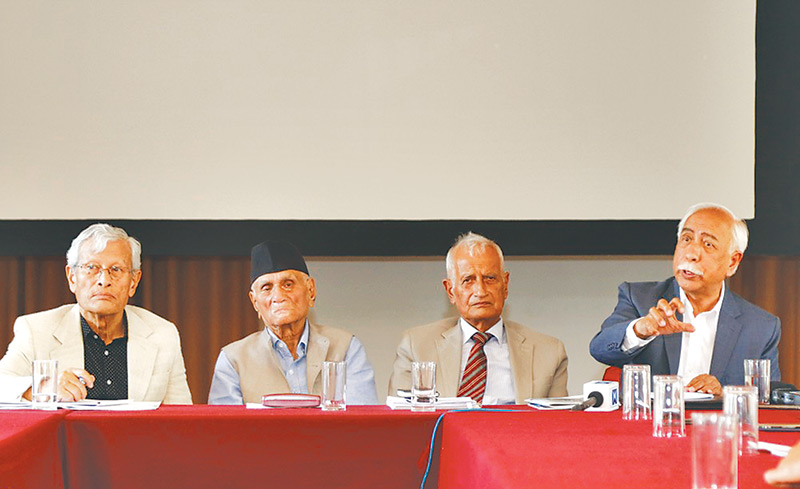
KATHMANDU, Former vice-chancellors have criticised the government’s attempt to curtail the autonomy of universities saying it will only worsen the situation of the already politicised higher education sector in the country. The government in May last year introduced a bill to amend the laws governing universities, authorising the prime minister, as the ex-officio chancellor of the varsities, to initiate a process to relieve the vice-chancellor, rector and registrar of their duties if one-fourth of senate members agree. Following the criticism from academicians, the government is hesitant to table the bill in Parliament. It is under consideration at the parliamentary Committee on Education and Health. Now the government has drafted a Higher Education Bill, which envisions the formation of a Higher Education Council led by the prime minister with education minister as vice-chairman. The retired vice-chancellors see the new bill as an attempt by the executive to centralise power. They say it is a globally accepted principle that the varsities must get to function with full autonomy and without interference. Kedar Bhakta Mathema, a former vice-chancellor at the Tribhuvan University, said the government seems to be taking a reverse course. “While there are discussions that even the colleges should be given autonomy, the government is taking one step after another to tighten its grip on the universities,” he told a press meet on Tuesday. Mathema, who is a noted education expert, said the tendency of the incumbent government to draft laws without consulting with experts in the field is a reason why many laws have got into controversy. At the press meet, six former vice-chancellors of the oldest university unanimously said any act to control the academic institutions is unacceptable to them. “We request the government to have intensive discussions with academicians and other concerned parties before formulating any policy or laws related to the education sector,” their joint statement read. They also have asked the government to appoint vice-chancellors and top executive officials to the six universities immediately on merit basis. The varsities have been headless since the third week of August and the government is struggling to make the appointments in the absence of political consensus on the matter. The Maoist faction of the Nepal Communist Party (NCP) has been demanding a respectable share while the professors’ association close to the Nepali Congress has threatened protests if they are ignored in the appointments. Nepali Congress President Sher Bahadur Deuba on Sunday met Prime Minister KP Sharma Oli to ensure that decisions on the appointments are made in consensus. “I have been told that discussions are going on to find a consensus on the names,” a leader of the professors’ association close to the ruling party, who also aspires to be a vice-chancellor, told the Post on the condition of anonymity. The government in September last year formed six committees led by Education Minister Giriraj Mani Pokharel and Usha Jha, a member of the National Planning Commission, to select the candidates. The committees had called for resumes claiming that the candidates would be picked based on merit, unlike in the past. They had shortlisted 178 candidates after sifting through the resumes submitted by 250 professors and academicians. However, they haven’t yet submitted the names in the lack of consensus. “Our higher education has been paralysed by politicisation. Appointing vice-chancellors on merit is the first step to control it,” said Maheshor Upadhyay, a former vice-chancellor at the Tribhuvan University. The vice-chancellors stand for a board of trustees to decide on appointments and actions for the officials if needed.
National
Five people arrested in Ajita Bhujel murder case
Bhujel, a transgender woman, was found dead in Kyampadanda, Hetauda, on January 18.
- SUBASH BIDARI
Police parade the suspects in the murder of Ajita Bhujel (right) at the District Police Office in Hetauda on Tuesday. Post Photo: SUBASH BIDARI
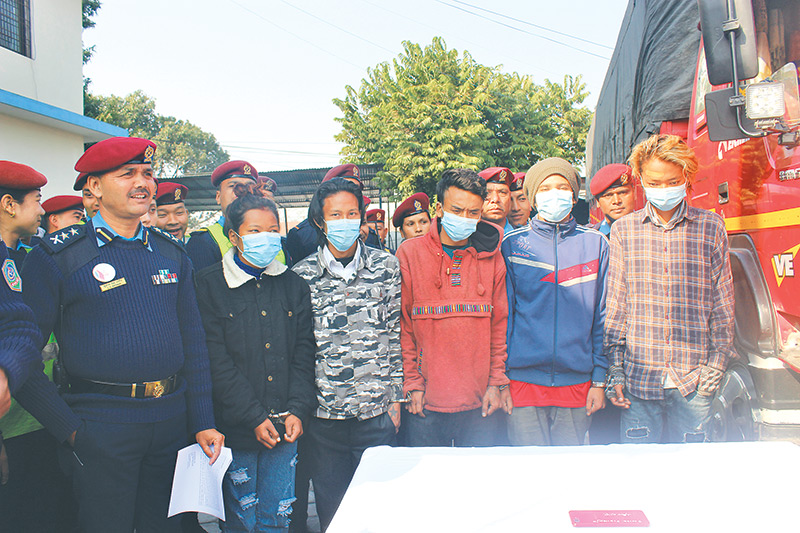
MAKWANPUR, The Makwanpur District Police Office on Tuesday arrested five people in connection with the January 18 murder of Ajita Bhujel. Police said they made the arrest after tracking the mobile phone used by Bhujel, a transwoman. The arrestees have been identified as Sushil Thapa Magar, 25, Simon Pariyar, 18, Alisha Pakhrin, 20, Ashish Bal, 24, and Buddha Lama, 21, all residents of Hetauda. Makwanpur Police chief SP Sushil Singh Rathour said that preliminary investigations showed that Pariyar, who worked as a truck conductor, met Magar and two others at a tea stall in Hetauda and agreed to pay Rs7,000 in exchange for sexual relations with Bhujel on the night of January 17. According to police, the four had consensual sex inside the truck (Na 6 Kha 6527) that Magar was driving. A dispute arose when Bhujel asked for payment and the four strangled her with a wire inside the truck. Following the murder, the four drove off in the truck and disposed of Bhujel’s body at Kyampadanda road in Hetauda. Magar also took Bhujel’s mobile phone and gave it to his friend Lama, who then passed the phone to Ashish Bal who, in turn, passed it on to his wife Pakhrin. Police were able to track the phone after Pakhrin began using it on February 3. Pariyar, in a police statement, said that he had had a dispute with the truck owner and had driven the truck on the night of January 17 with an intention to crash it. After he was not able to find an appropriate place to crash the truck, he stopped at a tea stall in the Hetauda bus park, where he met Magar. Rathour said Magar had recently been released from jail after serving three years on theft charges. Besides Pariyar and Magar, the two others involved in the murder are on the run. Police said they are the driver and his helper from another truck but have yet to establish their identities. Bhujel’s bruised and naked body was discovered on January 18. After trouble finding a job, she had resorted to sex work to support herself and her elderly grandparents.
National
Lalitpur city pilots metric street addressing system
Under the arrangement, 1,000 households in Ward No. 3 are to be given numbers, and street names to ease navigation.
- ANUP OJHA
LALITPUR, In a bid to make navigating through the city easier, Lalitpur Metropolitan City launched a metric street addressing system for one of its wards on Tuesday. Under the pilot, streets in Ward No. 3 are being named and 1,000 households receiving house numbers. Each household has been asked to pay a Rs1,000 fee to be included in the metric system. “This is a pilot project. By this year, we will expand the service to all wards in the metropolis,” said Mayor Chiri Babu Maharjan, who unveiled the new system in the presence of ward representatives, local residents and city officials. Metric street system, also known as block number-based roads network, provides a logical and understandable system to identify the geographical location of each household using a system of maps. The new system, once implemented, will help create maps of the city and maintain databases. In the absence of such a system, locating a neighbourhood or house in the city, especially for outsiders and even postmen, has been difficult. “We have used new technology to track each household with a number and given a name based on the original name of the tole (neighbourhood), alley or the chowk (junction). This method will help us to preserve ancient names associated with various places,” said Maharjan. The city, for example has named the road adjacent to St Mary’s School, Jawalakhel, Bhanimandal-Ekantakuna Marg, while the two-kilometre stretch from Pulchowk to Patan Durbar Square and Gwarko has been named Satya Mohan Joshi Marg. The Municipal Assembly of the city, in its budget for fiscal year 2018/19 allocated Rs50 million to implement the system in all of the 85,000 households in its 29 wards. According to Mayor Maharjan, the city aims to complete the job within a year. Talking to the Post, Maharjan said that from households and business enrolled in the system will have to mention the new name of their toles on their official documents as well. The city hired three a consortium of three companies, Geo-Nest-Indeco, to prepare a database of each household using stereo satellite images by employing the photogrammetry technique.“We have used drones to sketched maps. All the database will be collected in three months,” said Suresh Shrestha, head of GeoSpatial Systems, one of the consultant companies. Shrestha said the company has already taught officials at the Lalitpur Metropolitan City to track 1,000 houses. Shree Gopal Maharjan, chairperson of Ward No 3 said he was happy with the new system. “This is a basic requirement for a metropolitan city and the latest metric system will help us reach out to any house in the ward without any hassle because the house numbers and the location of the houses will be tracked through Global Positioning System,” said Maharjan.
National
Police take measures to control drug smuggling
Smugglers have been using Parsa as a transit to smuggle drugs produced in Makwanpur and Dhading to India.
- SHANKAR ACHARYA
PARSA, A police team on Sunday raided Umesh Sahani’s house in the Malahi settlement of Parsa. The security personnel seized 10kg marijuana and a cash of Rs 148,000 and IRs 20,000. Sahani is at large. The District Police Office in Parsa, in a bid to control the production and smuggling of drugs, is preparing to take the harshest measure—confiscation of Sahani’s house and property. “The legal process to confiscate the house and properties of Sahani is underway. It is possibly the strongest action to be taken on a drug case in the district. Such action will discourage other drug smugglers as well,” said Gautam Thapa, deputy superintendent of police. He asserted that the police administration will be taking strong action against drug smugglers to curb the illegal activity in the district. “Most drug smugglers run away and hide, so the next step for the police is to confiscate their belongings to deter them from committing the crime again,” said Thapa. According to Thapa, clause 6 of the Narcotic Drugs (Control) Act 1976 clearly states that the authority can seize the house and vehicle used in the smuggling and transportation of drugs. Sahani, according to police, is a notorious drug smuggler involved in the crime for the past few years. Police have charged him of smuggling marijuana and other drugs to bordering Indian markets. The cultivation and smuggling of marijuana and other drugs are unchecked in Parsa, a central Tarai district bordering with India. A security source said smugglers have been using Parsa as a transit point to smuggle drugs produced in Makwanpur and Dhading to India. Each year, the local administration launches a drive to destroy marijuana farms and detain the producers and smugglers, but to no avail. Police destroyed marijuana crops planted in 29 katthas of land, seized 392kg marijuana and arrested 25 people within the past six months. Last fiscal year, police destroyed marijuana planted in 50 katthas of land. Induced by drug smugglers, some local farmers plant marijuana in the middle of their sugarcane fields and in public land to avoid getting caught, said police.
National
Darchula women tailor their way towards financial independence
Self-employment has helped control instances of gender violence in the villages, local women leaders say.
- MANOJ BADU
Women who received tailoring training work at their shop in Darchula. Post Photo: MANOJ BADU
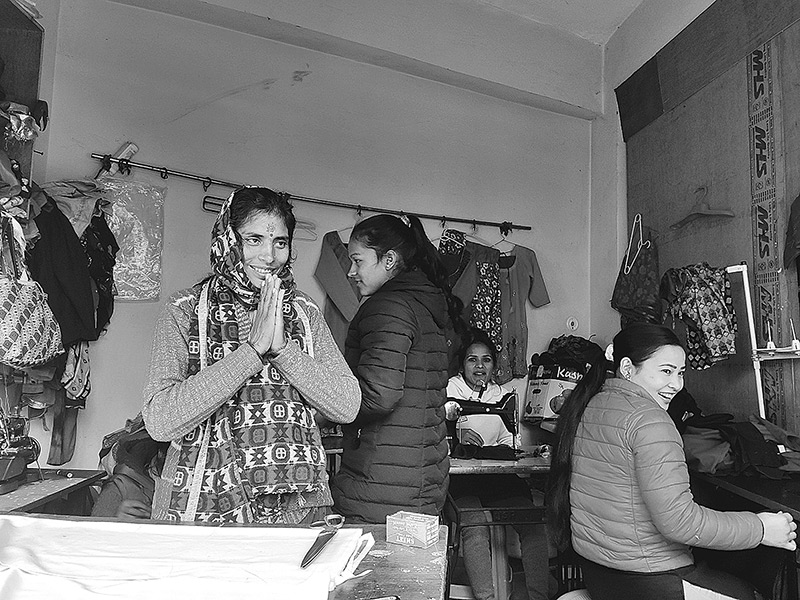
DARCHULA, Durga Joshi of Shailyasikhar in Darchula had undergone a 15-day tailoring training nearly three years ago. Now, she makes a good income from her tailoring business. “Earlier, I would have to depend on other family members to meet household expenses. But for the past two years, I’ve been making my own money,” said Joshi. “There is a lot of demand for my services in the village.” A decade ago, the involvement of women in the tailoring profession was negligible in Darchula. But today, a majority of the district’s women are involved in the profession. “Women in the city area have been in this profession for a decade,” said Joshi. “We started here only a couple of years ago. The idea of economic independence among rural women was an alien concept, but we are slowly understanding the importance of earning our own money.” Many women like Joshi, whose daily life was limited to doing household chores, are now running small tailoring businesses. Nanda Bam from Simali in Duhun has been operating Raina Sewing and Training Centre in the district headquarters, Khalanga, for the past eight years. Her centre also provides training to other women. “I have trained more than a 100 women from rural areas in Darchula so far,” said Bam. “Ten women who trained with me are self-employed in Khalanga.” Besides training, Bam has given employment to three women in her tailoring shop. “I earn around Rs 1,500 per day from my training and tailoring business,” said Bam, who started her tailoring business after it became difficult to sustain a living from traditional farming. Ramesh Singh Thangunna of Naugada encouraged his wife to learn skill-oriented training, as his income was insufficient to take care of the household. His wife, Hema, is also happy to have received a tailoring training. “I started my own business after receiving a three-month training,” said Hema. “We both now make enough money between the two of us to take care of our family.” Self-employment and financial independence have also helped control instances of gender violence in the villages, according to local women leaders. “Violence against women has decreased in the villages after women started earning their own money. Financial security is important for women since it makes them independent and empowers them to speak up against forces that threaten them,” said Yesdoda Tinkari, the spokesperson of Byasi Sauka Samaj Sewa in Darchula. Pashupati Dhami from Malikarjun also tells of being able to support her family after receiving tailoring training. “My daily life was all about household chores in the past,” Dhami said. “These days, I dedicate my afternoons to tailoring. I take orders and work from home.” Dhami is adept at tailoring coats, trousers and scarves, and knitting woollen sweaters. “Since I’m not educated, I thought I’d always have to depend on others to make a living. But now I make Rs 10,000-15,000 per month through my tailoring business,” Dhami said.
National
Bagmati Province allocates budget to build model integrated settlements
The integrated settlement programme for Gandharva, Majhi and Danuwar communities aims to promote agriculture tourism and alleviate poverty in the area.
- PRATAP BISTA
HETAUDA, With the objective to uplift the economic status of the indigenous communities—Majhi, Danuwar and Gandharva—and to help preserve their ethnic tradition and culture, the Bagmati provincial government is constructing integrated settlements in three different districts. The model settlements will carry and highlight the communities’ cultural identities. The provincial government has allocated Rs 45 million budget to construct the settlements. The government also aims to promote agriculture tourism in the proposed settlements by carrying out collective organic farming and running homestays. Under the programme, the identified local units will receive Rs 15 million each to construct a model settlement through Agriculture Development Directorate under the provincial Ministry of Land Management, Agriculture and Cooperatives. The budget will be released in two tranches. The integrated settlement for Danuwar community will be constructed for 40 households in Dudhauli Municipality Ward No. 2 of Sindhuli district while the model Majhi settlement is proposed to be built in Khadadebi Rural Municipality Ward No. 3 in Ramechhap district. There are 42 Majhi households in the settlement. The integrated Gandharva settlement will be set up for 50 families in Madi Municipality Ward No. 8 in Chitwan district. Separate agreement papers were signed by Rabindra Pradhan, the chief at the directorate, and the chief of the respective local units amidst a function on Tuesday. JN Thapaliya, the political advisor of Chief Minister Dormani Paudel, was present at the function. According to the working guidelines issued by the ministry, the local bodies will be responsible for the construction of the integrated settlements. The ministry will provide 50 percent of the total budget, while the remaining 50 percent will be contributed by the local unit and the beneficiaries. The guidelines clearly state that the houses built in the integrated settlements should be “traditional” in design with architecture depicting the identities of that particular community. “We will soon begin the construction work of the model Danuwar settlement. The houses will be built in the traditional style of the Danuwar community,” said Ghanashyam Raut, mayor of Dudhauli Municipality. “The construction will be completed in three months.”
National
Deforestation goes unchecked in Dadeldhura, locals complain
Forest officials say they are only cutting down trees that are either dead or hindering growth of other saplings .
- DR PANTA
Around 500 trees are being felled daily in Rishikhola and Mahabharat forests. Post Photo: DR PANT
DADHELDHURA, Locals have raised concern as the trees in Rishikhola Community Forest and Mahabharat Forest in Dadheldhura district headquarters are being cut down. “Deforestation has continued in these forests in the name of conservation,” said Hari Sarki, a Dadeldhura local. A local community forest work procedure called ‘katani chhekani’ directs that the trees that are either obstructing the growth of other saplings or are dead should be felled. “But what is happening is trees are being cut down haphazardly,” Sarki said. The locals have repeatedly informed the District Forest Office about the deforestation going on in the two forests, but the office hasn’t paid any heed, locals said. Officials from the District Forest Office present the example of these forests as conservation efforts, but when it comes to stopping the deforestation, they have done nothing to prevent it, said Sanjay Jairu, a member of Amargadhi Municipality’s executive committee member. According to Jairu, around 500 trees are being felled daily in Rishikhola and Mahabharat forests and the logs are being sold as firewood. “If this rate of deforestation continues, the whole community forests will be destroyed in a few years,” Rajendra Joshi, a local conservation activist, said. “The onus of conserving these forests lies on the District Forest Office to protect the forest, but it has turned a deaf ear.” Meanwhile, officials at the Division Forest Office said that the adopted work procedure was not promoting deforestation, as locals and conservationists have claimed. The division office deploys an official to supervise the programme, Pushpalata Acharya, a forest ranger, said. “We have directed the supervising officials to carry out the works according to the established criteria,” Acharya said. He added the areas where Rishikhola and Mahabharat forests lie today used to be barren before 1990 and that the community forest model had helped restore their greenery. According to data from the District Forest Office, out of the district’s total area of 153,800 hectares, about 75 percent is covered with forest.
National
Ward chairman found dead
Briefing
- Post Report
ACHHAM: Padam Bahadur Dhami, ward chairman of Panchadebal Binayak Municipality-2, was found dead under suspicious circumstances near Binayak Bazaar on Tuesday morning. Dhami’s relatives claimed that he was murdered, as he had injuries on his face.
National
Two held on abduction charge
Briefing
- Post Report
Police arrested two persons for their alleged involvement in the abduction of a 10-year-old boy in Prashtoka, Bara, on Monday. Ramesh Kumar Chamar and Raj Kumar Chamar were held on the charge of abducting the minor, police said. Security personnel safely rescued Aakash Kumar Sah from Shreepur.
National
Leopard attacks injure eleven
Briefing
- POST REPORT
KAVRE: Eleven people sustained injuries in separate leopard attacks in Panchkhal, Kavre, on Sunday and Monday. In retaliation, locals killed the leopard on Monday. Chirinjibi Thapa Magar, an assistant forest officer, said the body of the leopard has been brought to the Division Forest Office.
National
Chairman, teachers assaulted
Briefing
- Post Report
SINDHUPALCHOK: A group of seven people thrashed the ward chairman of Jugal Rural Municipality-5, Sanat Adhikari, and two school teachers, Chhanda Prasad Kafle and Pushparaj Timsina, in Sindhupalchok, on Monday. The injured have been taken to Kathmandu for treatment.
National
Time-card system imposed to control road accidents
Briefing
- Post Report
SALYAN: Salyan Police has imposed a time-card system to control the increasing incidents of road accidents due to overspeeding. The system has been implemented along the Chhinchu-Sallibazzar-Jajarkot road section. As per the system, vehicles have to adhere to the speed limit mentioned in the time card.
National
12 Nepalis return home from Kimathanka border point
Briefing
TAPLEJUNG: Twelve Nepali people working in Tibet of China returned home through the Kimathanka border point in Sankhuwasabha on Tuesday. The local administration has taken an initiative to return Nepali workers from Tibet. Security personnel and people’s representatives received those 12 Nepalis from the Nepal-China border.
EDITORIAL
Mean streets
Make sure that the street children enjoy their rights in practice.
Oftentimes, street children are casualties of poverty, domestic violence, physical and mental abuse and so on. Most are thus pushed onto the street by desperation. The case in Kathmandu and most other places in the country is no different either. The Constitution of Nepal has clearly enshrined children’s right to life, education, health and proper care and their rights against exploitation, but various media reports tell us that there are still many children deprived of basic care, love and affection. According to a report jointly published by the Ministry of Women, Children and Social Welfare and the Central Child Welfare Board in 2015 on child protection mapping, around 469 children were living on the streets in the capital, mostly begging for money. The government and non-governmental organisations have initiated various intervention programmes where children are provided with a safe space for rehabilitation. Intervention programmes further include rescuing children, counselling, protecting and reintegrating street children into society. But while some efforts become successful, at other times these efforts go to waste as the rescued children end up back on the streets. There is one thing most can agree on—that children resort to the streets owing to poverty. Once they take to the streets, their chances of getting education are affected. This, in turn, leads them to earn less as adults. Over the years, their children too are more likely to grow up in poverty, holding families and children captive in poverty for generations. It is this negative cycle that is most concerning. The emotional, social and physical development of young children has a direct effect on their overall development. This will define the kind of adult they will become. According to Demographic Changes of Nepal: Trends and Policy Implications, published in 2017, 40 percent of the country’s population is under the age of 18 years. Thus, it is pertinent to invest in children to maximise their well-being as well as that of the country. The 2015 government report found that sexual abuse was largely unreported among street children while a 2010 study conducted by CWIN showed that 75 percent of the boys living on the streets had been victims of sexual abuse. Drug peddling and addiction and involvement in crimes among street children are serious issues that are yet to be addressed. These are important issues that warrant attention from all quarters. On the legislative front, the government’s The Act Relating to Children that came about in 2018 is a welcome move. Formulating that kind of law is the first step. Now the next step should be to make sure that the children enjoy their rights in practice. Children taken off the streets are put in foster homes. These homes need to provide an environment where street children find it worth to call them their home. To attain this, the importance of creating trusting relationships and making each street child feel special, so as to enable a change in their lives, cannot be overstated.
OPINION
The quest for a conformist press
Media entrepreneurs are happy to sing along the tune of triumphant political and economic masters.
- CK LAL
Shutterstock
The metropolis of Biratnagar languidly flows down south into the Indian mainland at the border town of Jogbani in the Araria district of Bihar. The descriptive phrase ‘no man’s land’, meaning an empty strip of territory that divides two opponent forces, is clearly inappropriate to depict the dasgaja that marks the Indo-Nepal border and bustles with activity. The Eminent Persons’ Group that has reportedly suggested the regulation of the Indo-Nepal border has perhaps failed to appreciate that nothing short of a Berlin Wall, torn down in 1989, can succeed in separating the people that were divided by an arbitrary line drawn on a rudimentary map by the alien drafters of the Sugauli Treaty. An unkempt Loknayak Jayprakash Narayan Gate welcomes shoppers from Nepal into Jogbani. The dasgaja is a crowded space here. An officer of Sashastra Seema Bal, an Indian paramilitary force in charge of guarding the border, admonishes a Nepali visitor with a stern warning that photographing the edifice is prohibited, but makes no effort to erase the picture. From roadside stalls to the fancy first-floor stores in Jogbani, all shopkeepers quote their prices and accept payment in Nepali rupees. When Finance Minister Yuba Raj Khatiwada decided to impose duty upon the import of foreign books, he probably knew that very few Nepalis would come forward to criticise his whimsical step. Benefiting from the remittance economy, the neo-literate middle class of the country has jumped straight from dog-eared Shree Swasthani Brata Katha volumes to ebook consumers that scan fashionable titles without paying adequate attention to their contents.
Ignorance economy In contrast to the bustling market of Jogbani, the Rani bazaar on the Nepali side of the border wears a forlorn look. The infrastructure of the historic Biratnagar Jute Mill is falling down. The local branch of Nepal Bank doesn’t have an ATM on its premises. Rastriya Banijya Bank boasts one, but the cash dispenser has clearly been out of operation for quite a while. The Integrated Check Post a few kilometres away from the customs point was jointly inaugurated by Prime Minister KP Sharma Oli and his Indian counterpart through a video conference. Its utility, however, depends upon the vitality of industrial activity in the vicinity. In the knowledge economy, growth is dependent upon the quantity, quality and accessibility of information which then fuels innovation. It’s a widely held belief that creativity can’t realistically be taught. However, the evidence that it can be nurtured is equally strong. Freedom is the fundamental condition for the flowering of innovation. Perhaps that’s the reason unfree societies lack the imagination to lead and have to rely upon copycat attempts to unleash economic growth and social progress. The concept of ignorance economy is less well developed. Perhaps the idea has its saving graces. The unaware can learn a lot even in the process of reinventing the wheel, which many Nepali innovators love to do. The ignorance that the ruling class, however, wants to cultivate is based on the belief that to be unaware of unpleasant facts or situation leads to a cheerfully optimistic state in the populace. The sages rightly declared that to know is to suffer; and if ignorance is bliss, knowledge is clearly misery. Perhaps authoritarian governments don’t want their people to suffer. Ergo, they don’t want them to know and desire a press that purveys pleasure. That is exactly what ethnonational Supremo Sharma Oli seems to have had in mind when he decreed that the media must be loyal to the country and people. The Supremo wants the press ‘to create optimism and build confidence’. The sad part is that even some mediapersons and quite a few members of civil society seem to believe that the loyalty of the press should be to the ‘national interest’, which often stands for ethnonational interest, rather than to truth.
Innocent media When some media persons decided to take an oath of loyalty to the party in power on the Baluwatar premises, questions were raised whether such operatives would be able to maintain accuracy, balance and credibility in the future. Valid as they may appear at first glance, such doubts are inherently superfluous. Nepali journalists are self-professed nationalists almost to a person with few, if any, exceptions. The notion of nationalism is based upon the superiority of one’s language, culture and lifestyle over an easily identifiable ‘enemy nation’. Supremo Sharma Oli realised early on that the Nepali press was willing to carry the palanquin of any politician that swore to defend its ethnonational interests. Allegiance to the ideology of ethnonationalism apart, even Marxism-Leninism isn’t too well known for fostering freedom of the press. Karl Marx famously asserted that the class that was the ruling material force of society was at the same time its ruling intellectual force. In that sense, the letter-head chairperson of the ruling party Pushpa Kamal Dahal is correct in his assessment that freedom of the press is a bourgeois concept. In addition to ideology, the structure of the media too isn’t very favorable for a free press. For most media owners, the press is a property that must provide adequate return on investment. That makes successful media entrepreneurs risk-averse. They are happy to sing along the tune of triumphant political and economic masters. The predicaments of media practitioners are no less confounding. Unable to decide whether journalism is a vocation with a higher purpose or just a profession to build a career, many of them oscillate between idealism and realism with unpredictable regularity. If indeed it’s a profession, then the government has every right to regulate it, even with a licensing examination if necessary. Then there are lucrative opportunities if one chucks away idealism. The highest ambition of quite a few journalists is to become the media advisor to the president or prime minister. Lower down the food chain, there are similar opportunities in ministerial secretariats, mayoral offices, business houses, INGOS, NGOS and even with operators of the extra-legal trade. Supremo Sharma Oli knows the Nepali press too well not to laugh at their pretentions and demand a ‘responsible press’ as loyal as the ‘Godi Media’ of India which is yet to get a press conference with the chief executive of their country. Conscientious mediapersons, however, need to remember that their responsibility begins and ends with what George Seldes (1890-1995), the famous American investigative journalist, press critic and editor called the duty ‘to get the facts, and present them as truthfully as human frailty permits’. There is no paucity of purveyors of positivism in a nationalist society where the motto of ‘my nation bestest’ rules the roost.
OPINION
Leave the central bank alone
Rastra Bank should guard its independence by enhancing transparency and accountability.
- RABINDRA MAHARJAN
post file photo
Central bank independence refers to its ability to formulate and execute policies without undue influences. There are plenty of arguments in favour of central bank independence. The most important one is maintaining price stability. Various empirical studies have concluded that central banks with more independence tend to produce better results in terms of price stability without compromising on economic growth. Second, it is also believed that independent central banks reduce the scope of monetisation of government deficits. If the government controls the central bank, there is a strong chance that its money printing powers will be abused to help finance the budget deficit. Such undue political influence may tarnish the central bank’s inflation fighting credibility too. Moreover, an appropriate degree of independence is also important from the regulatory perspective. More independent central banks can maintain financial stability through prudent regulation and supervision of banks and financial institutions without being influenced by political pressure or lobbying.
Level of independence Various scholars have prescribed different ways to measure the level of independence of a central bank. They can be grouped into two broad categories—de jure and de facto measures. De jure measures give formal or statutory independence which is stipulated or guaranteed by legislation. It relies on the charter of the central bank. However, the independence granted by the charter may not coincide with actual independence due to various reasons, for example, laws may be incomplete. This provides room for interpretation and interference by other stakeholders hindering its actual implementation. Even if the law is clear and complete, poor compliance with it may affect actual independence. Besides, various structural issues may also affect the actual independence of a central bank. Thus, there is a practice to compute de facto measures of central bank independence to assess the actual level of independence. While talking about central bank independence in the context of Nepal, legislative reforms initiated in the early 2000s provided some important output. From the de jure perspective, Nepal’s central bank achieved a significant level of independence after the promulgation of the Nepal Rastra Bank Act 2002. The act has explicitly mentioned the objectives of the central bank. It has ensured a fixed tenure of five years for central bank governors, insulating them from threats that may arise due to political instability. There are provisions limiting the credit that can be given to the government to prevent it from borrowing excessively: The government cannot get an overdraft from Nepal Rastra Bank exceeding 5 percent of the revenue income in the preceding fiscal year. The total amount of debt bonds purchased by Nepal Rastra Bank from the government and taken into its ownership shall not be more than 10 percent of the revenue income of the preceding fiscal year. The Nepal Rastra Bank Act 2002 has given financial independence to the central bank by granting authority to prepare and execute its own budget. The act has also enhanced accountability, lender of last resort functions and foreign exchange related rights for Nepal Rastra Bank. From the de facto perspective too, the level of independence enjoyed by Nepal Rastra Bank has improved after 2002. Due to the strong protection provided by the charter, the turnover rate of the central bank governor has become relatively stable. The political vulnerability index, another popular method of assessing de facto independence, also seemed to be lower after 2002. Although facts and data depict that central bank independence in Nepal is improving, guarding it is not free from challenges. Globally, central bank independence is being challenged after the global financial crisis, and Nepal will not be an exception. Thus it is imperative to act seriously to guard the independence granted by law. Enhancing accountability could be a good strategy in this direction for Nepal Rastra Bank as accountability and independence are considered to be two sides of the same coin. Moreover, being a public institution, Nepal Rastra Bank should be accountable to the people. In fact, Nepal Rastra Bank is practicing accountability by promoting a certain degree of transparency in various areas, for example, by publicising its financial statement, policies and other documents.
Maintaining transparency However, there is room for improvement. Nepal Rastra Bank can improve in maintaining transparency in its governance, policies, operations, outcomes and official relations, as prescribed by the International Monetary Fund. Nepal Rastra Bank can also play a more proactive role in increasing access to finance, financial consumer protection, financial education and grievance handling issues. Moreover, the central bank should play a more pivotal role in increasing the share of the financial sector in the country’s economic growth. Such activities will enhance its credibility and effectiveness which ultimately helps to nurture its independence. Central bank independence is not and should not be a matter of interest for Nepal Rastra Bank only. All the stakeholders should be serious in guarding the independence of the central bank as a weak monetary authority is not good for the country. However, the onus is on Nepal Rastra Bank to nurture and guard its independence by enhancing central bank governance, transparency and accountability.
Maharjan is a deputy director at Nepal Rastra Bank.
OPINION
Coronavirus: the psychology of those quarantined
For those in quarantine, recognition of the stress and the fear they go through is tremendously important.
- Dr Mehtab Ghazi Rahman
Shutterstock
As the coronavirus epidemic continues to rage and threatens to become a pandemic, the world remains in a state of paranoid vigilance. The coronavirus outbreak has taken the world by shock and surprise, and all nations are rightly fearful of the consequences of the threat due to the increasing number of deaths and the lack of an effective vaccine as yet. Countries across the world have commenced the repatriation of their citizens back to their homelands. Repatriated citizens are being nursed under quarantine conditions to minimise the spread of the virus. This Saturday, February 1, saw the first contingent of around 300 Bangladeshi citizens being repatriated back from Wuhan, China; these individuals will remain under quarantine at the Ashkona Hajj Camp for 14 days, under the supervision of the Bangladesh Army. During this period, according to The Daily Star, individuals quarantined will not be allowed to meet their family members or any others. In view of the virulence of the coronavirus and in the interest of public protection, it is entirely appropriate that repatriated individuals remain under quarantine for the 14-day observation period to minimise the risk of the virus spreading. However, it is important that we remember our duty of care towards these quarantined individuals; this duty includes looking after their mental health alongside their physical health, which can otherwise be easily overlooked. When under quarantine, individuals are likely to suffer from significant psychosocial difficulties that need to be addressed from the very start of their quarantine period. Currently, many of the 300-plus individuals who remain quarantined are likely to be suffering from anxiety and fear—they will be anxious that they could be harbouring the coronavirus in their bodies, or that they may be in close proximity of another who may be infected with the virus. They would suffer feelings of guilt and the shame of being alienated from society. They are highly likely to be suffering from boredom due to isolation from their families and social networks. They would be harbouring feelings of frustration and possibly anger that they are under constant watch round the clock. Some are likely to be preoccupied with anxiety about how society would respond to them when their quarantine is terminated. They are unlikely to have adequate access to resources that provide them comfort, such as books, music and television, the lack of which will certainly add to their feelings of frustration and boredom. Indeed, the mental strain the quarantined patients are going through will be immense. Try to put yourself in the shoes of a quarantined person. These individuals will have been greeted by healthcare workers—fully covered in Hazmat suits—unable to see their faces properly. They will be subject to rigorous daily clinical examinations and tests; they will have to anxiously wait for the test results to return, and be constantly aware of any signs or symptoms that may indicate they are infected. They will be constantly hyper vigilant and on the lookout for other quarantined individuals who show symptoms suggestive of a coronavirus infection, and want to isolate themselves from the person in a state of panic. They are likely to be intensely praying that they do not become the next victim of the deadly virus. And this would certainly not be the end of their mental trauma. Research from the last SARS outbreak revealed that even individuals who were quarantined during the epidemic developed symptoms suggestive of a post-traumatic stress disorder (PTSD) or clinical depression as a result of the emotional trauma of being isolated from society for a prolonged period of time. The study showed that the longer the quarantine period, the more likely a person was likely to develop a diagnosable mental health condition in the future. When under the restrictions of quarantine, individuals undergo periods of high emotional stress secondary to the uncertainty they face about their health, which makes the need for mental health support during this period of isolation essential. Once quarantine is terminated, individuals may face societal stigmatisation; their social support structures may become avoidant towards them due to fears of contracting the illness, which in extreme cases can lead to isolation and ostracisation from society. For those in quarantine, recognition of the stress and the fear they go through is tremendously important. They should be assured that their feelings of fear and anxiety are a normal response to the situation they are in. They should be allowed a confidential space to speak about their stressors with trained mental health professionals competent in dealing with high-pressure situations. Clinicians should avoid labelling these emotions as being pathological at the first instance, and instead attempt to provide psycho-education and teach coping strategies to allow them to deal with their intense feelings in a therapeutic manner. Given the finite resources and time, healthcare professionals should try their best to provide emotional support and spend time with these individuals to reduce fear and the sense of isolation. Interventions should be put in place to enable access to the outer world through the provision of Internet and teleconferencing facilities, such as access to Skype, Viber and WhatsApp, to allow them to stay in regular touch with friends and family. Access to television and newspapers would help them maintain a sense of connection with the outside world. It is the government’s responsibility to provide accurate and evidence-based information about the coronavirus to the public in a timely manner to avoid mass panic and emotional distress. Any delays or secrecy in launching a public health campaign would undermine the belief people have in the government’s credibility in dealing with the coronavirus epidemic. The provision of clear, factual information to the public is therefore paramount. Campaigns should be consistent and easily understandable, and be clear about the risks of exposure and the actual threat of the virus on the population. Certain quarters of Bangladeshi media have the propensity to fear-monger by exaggeration of news reports that perpetuate panic within people. The public health department should, therefore, work in close alliance with the media to stop sensationalisation of the epidemic and disperse scientifically accurate and precise information to the public to maintain calm whilst the prognosis of the virus still remains uncertain. Public education about good hygiene to minimise the risk of infection should be done in a detailed, step-by-step manner using a variety of visual formats, such as infographics. The provision of mental health support to those under quarantine is not a choice but an essential component of their clinical care. Clear communication, regular updates and provision of interventions to reduce isolation whilst in quarantine will reduce emotional distress and instil hope for the future among these individuals. Timely, accurate public health communication by the government is key to reducing fear, eliminating mass hysteria and controlling the spread of infection if a positive coronavirus case emerges in Bangladesh in the future.
This article was previously published in The Daily Star, a part of the Asia News Network.
OPINION
Ending ignorance in Bangladesh
Empowering people with education and ending their ignorance is the pathway towards a democratic society.
- Syed Yusuf Saadat
dmitri Chulov/Shutterstock
In Satyajit Ray’s 1980 dystopian film Hirok Rajar Deshe (Kingdom of Diamonds), the king used several measures, such as high taxes, forced labour and brain-washing, to maintain a stranglehold on his people. In addition to these steps, when the king was apprehensive of a threat to his sovereignty, he instructed his education minister to close all the schools in the kingdom. When the education minister was initially taken aback by this decision, the king explained era joto beshi pore, toto beshi jaane, toto kom maane (the more they study, the more they learn and the less they obey). Subsequently, the education minister was obliged to order all schools to shut down immediately and permanently. In many ways, the Hirok Raja (Diamond King) was right. When people are educated, they learn about the world around them, and begin to think independently. Such free thinking may pose a serious threat to the absolute power of any totalitarian regime—as George Orwell aptly pointed out, ‘ignorance is strength’. Since ignorance is the strength of authoritarian governments, empowering people with education and ending their ignorance is the pathway towards a democratic society and a developed country. The Sustainable Development Goals (SDGs) acknowledge the vital role of education in fostering democracy and facilitating development. SDG 4 calls upon countries to ensure inclusive and equitable quality education and promote lifelong learning opportunities for all. Bangladesh has made good progress, at least quantitatively, on indicators under SDG 4. Lower secondary completion has followed a weakly cyclical upward trend since 1998. According to data from UNESCO, the lower secondary completion rate for both sexes increased from 48.8 per cent in 1998 to 58.9 per cent in 2003. However, there was a reversal of this progress in the subsequent years as lower secondary completion rate fell to 52.4 per cent in 2006. Thereafter, there were a few years of gradual improvements in the lower secondary completion rate, followed by jumps in 2013 and 2016. In 2017, the lower secondary completion rate for both sexes stood at 77.6 per cent. Interestingly, during the period of 1998 to 2017, the lower secondary completion rate has been higher for females compared to males. For example, in 1998 the lower secondary completion rate was 2.10 per cent higher for females compared to males. This difference later increased significantly, and in 2002 the lower secondary completion rate was 16.55 per cent higher for females compared to males. Apart from lower secondary completion rates, primary education completion rates also showed signs of improvement. Primary completion rate increased from 64.26 per cent in 2005 to 118.55 per cent in 2017. However, completion rates above 100 per cent are problematic since they indicate that some students may be failing their classes and repeating the same grade. In 2001, literacy rates were lower among female youth aged 15-24, compared to male youth. However, in 2011, literacy rates were higher among female youth compared to male youth. The gender parity index of youth literacy rate has been very close to, or within, the upper and lower bounds of parity since 2012. Literacy rate of the adult population, aged 15 and above, increased from 35.32 per cent in 1991 to 47.49 per cent in 2001. The youth literacy rates are higher than adult literacy rates during the period 1991-2017, which implies that there has been a steady improvement in literacy in Bangladesh over time. Youth literacy rates are higher for females, starting from the year 2007, which shows that Bangladesh has managed to improve access to education for females during the period 2007-2017. Despite the progress made by Bangladesh in achieving SDG 4, a number of key issues remain. In developing countries like Bangladesh, enforcing mandatory secondary schooling may often be difficult to implement in practice. However, research has shown that both conditional and unconditional cash transfers are conducive towards increasing enrolment rates. Nevertheless, whilst school enrolment in Bangladesh has increased over the years, ensuring quality education and preventing dropouts are challenges that need to be addressed urgently. On average, educational outcomes in Bangladesh are substantially better in private and urban schools, compared to public and rural schools. This means that the students from poor families are being deprived of high quality education. Basic education has been provided as a fundamental right, but quality education has been reserved as an elitist privilege. Such inequities in education tend to perpetuate inequalities in income and wealth as well. In the upcoming book titled, ‘Four Years of SDGs in Bangladesh: Measuring Progress and Charting the Path Forward’, the Centre for Policy Dialogue (CPD) outlines a number of recommendations for the implementation of SDG 4 in Bangladesh. These include: i) instilling good governance in educational institutions by increasing the participation of students and parents in their functioning and operation; ii) increasing funding for educational institutions in remote rural areas and educational institutions that serve left-behind communities; iii) improving means of assessment of learning so that both cognitive and non-cognitive skills are adequately tested; iv) encouraging international cooperation to strengthen university education and research; and v) improving the quality of teacher training and implementing continuous monitoring and evaluation systems to check the effectiveness of training. Bangladesh has already made great progress in ensuring access to education, and if these recommendations can be followed through properly, we will be able to move even closer towards achieving SDG 4 and ensuring inclusive and equitable quality education for all.
This article was previously published in The Daily Star, a part of the Asia News Network.
LIFE & STYLE
Old is the new ‘new’
Vintage fashion is slowly gaining a fan base in Kathmandu, with more and more people viewing it as an alternative to fast fashion.
- ANKIT KHADGI
Vintage fashion is not just sustainable, it also gives people’s fashion choices an individuality that is not possible with fast fashion. Photo courtesy: My ama wore that
Kathmandu, The earliest childhood memory Dongaa has is wearing her mother’s clothes. The clothes weren’t made her size, but she loved adorning herself with the loose-fitting apparel—they were familiar, comfortable, yet distinct. This unique sense of style got her admirers—her friends. They encouraged her to start a venture, and after years of handpicking outfits—from her travels to Japan, Australia, Bhutan, India and Thailand—she finally started a social media handle, ‘My aama wore that’, under which she started selling vintage clothes. “Every vintage piece is a story in itself,” she says. “I pick up clothes which have been passed on through generations. Clothes that are interesting, have character and are of good quality.” Like her venture, vintage clothing in recent times has been receiving attention and appreciation from fashion mongers all over the world. From Kim Kardashian West to Jennifer Aniston, everyone has been donning vintage couture in their latest outings in fashion shows and award ceremonies. Even for this year’s BAFTAs, attendees were asked to wear outfits that had been worn before or were sustainable or vintage, reflecting the fashion industry’s acceptance and advocacy for sustainable fashion and the masses’ change in attitude towards utilising vintage clothing. Just as how vintage clothing is gaining popularity globally, in Kathmandu too, it is being seen as an alternative to fast fashion clothes. According to Dongaa, who has been operating her Instagram page ‘My aama wore that’ for more than a year, there has been a striking increase recently in the number of customers who are opting for vintage clothing in Kathmandu. “From married women to girls studying in Grade 12, women from all walks of life are showing interest in buying my products. This is something I never expected,” says Dongaa. Just as Dongaa, Hana Rai too is passionate about vintage clothing, and has a store in Jyatha, Thamel. From her store, Lagom, Rai has been selling vintage clothes along with thrift clothes, which she has collected from Japan, South Korea, Italy and France. “It’s the sheer joy of collecting clothes that were made with passion without a compromise on quality that made me venture into this business,” says Rai. Unlike fast fashion clothes that are produced in bulks, her picks help those who want to express themselves through their clothing, she says. Rai also acknowledges the growing interest shown by the Nepali customers in her business. “When I started, my customers were limited to tourists who were wandering around Thamel. But now Nepalis too are curious and show up in my store or connect with me via Instagram,” says Rai, who started selling vintage clothes at her store only four months ago.
Vintage fashion choices are not just sustainable, it also gives people’s fashion choices an individuality that is not possible with fast fashion. But as the style is only just burgeoning, both Dongaa and Rai say they often receive customers who ask for styling tips. “I teach them how they can coordinate their outfits with the vintage piece of clothing so they can look chic,” says Dongaa. Another striking difference between such collections and fast fashion is that they offer unisex clothing. Believing that the gender binary concept is outdated, both Rai and Dongaa offer clothes irrespective of their gender. “Clothes are genderless. Anyone can buy whatever they prefer to wear from my store,” says Rai. However, vintage pieces come at a price, which many people may not afford since they can get fast fashion clothes at much cheaper rates. The vintage pieces on Dongaa’s online store range from Rs 990 to 14,990, whereas Rai’s collections usually start from Rs 1,550 up to 4,000. However, both Rai and Dongaa believe that their clothes are quite affordable in terms of the quality they provide, their longevity, and for their eco-sustainability. Many environmentally-conscious people opt for sustainable clothing as a replacement to fast fashion clothes, which is considered to be a major factor responsible for climate change. And while many say that sustainable clothing is a good alternative to fast fashion clothes, vintage clothing advocates say that vintage is the best alternative for those who want to make sustainable fashion choices. “The process of making sustainable clothes may be less damaging to the environment, but even they use some resources for their operation. If you want to make an effort, why not just re-use available clothes?” says Rai. And while more and more people are becoming aware of such fashion choices across the world and in Kathmandu, there aren’t enough mainstream celebrities and influencers promoting the cause in the Capital, say the two. “The so-called influencers are either selling fast fashion clothes as their side business or are promoting it on their Instagram,” says Dongaa. But for people to take up vintage fashion, it is crucial Nepali celebrities join in the global movement of making environmentally-friendly fashion choices, they believe. Despite this, both are hopeful about the future of their businesses. “It’s going to be big someday. People are becoming more aware and valuing vintage clothes and supporting them,” says Rai.
LIFE & STYLE
Small home living: Not ‘downsizing’ but ‘right-sizing’
Ways to having a home that is efficiently designed, both in terms of energy use and in terms of space.
- KATHERINE ROTH
ap
With the current trend toward decluttering and downsizing, there are plenty of books about how to winnow down possessions to the few that are truly necessary and loved. This book shows how you can live well once that’s done. In Downsize: Living Large in a Small House (2019, The Taunton Press), author Sheri Koones focuses on practical ways to live well at home once you’ve streamlined your belongings and are living more compactly. “It scares people to think of moving into a smaller space, but every single person I interviewed who has made the transition says they are so happy they did,” Koones says. “Time and again, people used the word ‘liberated’ to describe their move to a smaller space, with homes requiring far less time and money to maintain.” Koones, who recently relocated from a sprawling 6,800-square-foot house in Greenwich, Connecticut, to a 1,400-square-foot home closer to town, has experienced the transition herself. “It’s not just empty nesters anymore,” she adds. “Younger people too are in couples where they’re both working, they’re having children later, they want to be active and they don’t want to be doing maintenance on the weekends. They don’t want to be tied down to mowing lawns and doing all the other chores that come with living in a big house.” Living more sustainably and saving on energy costs is also part of the attraction of downsizing, Koones says. So is aging in place. There are people of all ages looking for features like a master bedroom on the main floor, or barrier-free showers. “Yes, older people with disabilities need them, but even younger people break a leg skiing, or have situations where they want a barrier-free shower,” she says. The book features photos and illustrations of 33 well-designed small homes in urban and rural settings in the US and Canada. It examines the features that make each home a success, with advice aimed at those building, renovating or even just organising their homes. Some of the features that Koones says can make a small home feel more spacious: - Raised ceilings, well-positioned windows and light wall colours. - Multifunctional furniture, like tiny kitchen tables that can expand to accommodate dinner guests. - Flexible rooms that can serve as office, bedroom and hobby room, for example. One house featured in the book has a garage with light fixtures and doors that open in front and back so that it doubles as an entertaining space. - Creative storage ideas, like chairs that can hang on wall pegs, hooks for bicycles, and making the best use of alcoves or space under stairs. - Fewer hallways, which allows for more livable space.
Koones details specific types of roofs (like standing-seam metal roofs), flooring (concrete) and heating systems that are more energy-efficient and low-maintenance. “The key is to have a home that is efficiently designed, both in terms of energy use and in terms of space,” she says. “I refer to it as ‘downsizing,’ but a better word for it might be ‘right-sizing.’ For most of history, houses were more modestly proportioned, and we lived quite comfortably in those smaller homes. Over time houses got too big. Now the trend is heading toward smaller again.”
Get the new year off to a wonderful start, with these recent beauty launches.
- AGENCE FRANCE-PRESSE
afp
The iconic Beautyblender makeup sponge has upped its game for 2020, following the recent launch of its new “Beautyblender Wave”, a reiterated version of its famous egg-shaped sponge that reminds users not to forget the crucial first step of wetting the tool before makeup application. The Wave features heat-activated technology to change colour when held under hot or cold water, changing from lilac to light blue. The sponge is embossed with the words “Wet Me” as an extra reminder. Makeup mogul Pat McGrath is here to make sure January is a sparkly one, thanks to the imminent launch of her brand Pat McGrath Labs’ new “Golden Opulence Collection”. The series includes a six-pan “MTHRSHP Sublime: Golden Opulence Palette” and two new “Mini Lip Gloss Trios” to ensure a hedonistic start to the year. Kim Kardashian West launched her second collaboration with her famous makeup artist, Mario Dedivanovic, in 2019, but the classic collection contains all you need to nail your beauty look in the new year. Dubbed “KKW x MARIO The Artist and Muse”, it features timeless essentials such as a 10-pan eyeshadow palette, a lipstick, blush, gloss and the “Beauty Icon Lip Liner.” If you’re thinking of taking your makeup routine vegan in 2020, then you’re in luck: cult beauty brand CoverGirl recently launched its “Clean Fresh” collection of essentials, with a focus on vegan formulas and natural ingredients. The collection’s “Cream Blush” comes in four different hues for a dewy-looking glow to kickstart the new year. Waft your way into 2020 smelling divine, with Lush’s new collection of body sprays. The sprays, which come packaged in fully recycled plastic bottles, can be used sparingly on clothes or the body for a quick freshen-up at any point during the day, or more liberally for a stronger scent. The series includes 20 new fragrances, including the jasmine-themed “Flying Fox.”
CULTURE & ARTS
Gift or keep: The afterlives of red carpet looks is a dance
Many gowns live out their days in a designer’s archives, to be lent out to museums or for other special events.
- Leanne Italie
This file photo shows Lupita Nyong’o in a pale blue Prada dress at the Oscars in Los Angeles. What happens to the duds after a big awards nightcan be a peculiar affair that depends on the relationship a celebrity has with a designer. Nyong’o, who won the Oscar for best supporting actress for 12 Years a Slave, was able to keep her gown. ap/rss
Remember the ethereal pale blue Prada dress Lupita Nyong’o wore the night she won an Oscar in 2014? How about Glenn Close’s moment in gold at last year’s Oscars in shimmering Carolina Herrera with the long, liquid cape? In a sea of red carpets, both are among top talent who got to keep their fancy duds. How a red carpet moment comes together, and what happens to the clothes after, can be a peculiar affair that heavily depends on who you are and what your relationship happens to be with the designer in question. A designer’s decision to gift or not to gift often comes after the big night is over and it’s time for stylists to pack ’em up and ship ’em back. “They’re delighted if the designer says, ‘Oh, please keep it. I made that just for her. She should have it,’” said stylist Emily Sanchez, who has dressed Laura Linney and Sutton Foster, among others. “If a designer feels they’re going to want something back immediately, they’re pretty transparent about it.” Many gowns live out their days in a designer’s archives, to be lent out to museums or for other special events, such as the Christian Siriano tuxedo gown Billy Porter wore at last year’s Oscars and recently put on again for Sesame Street. Far rarer is a celebrity buying them instead. “For Oprah, we have dresses custom made and pay for them, so she keeps hers,” said Adam Glassman, creative director of O, The Oprah magazine. These days, Sanchez said, most nominees are offered bespoke. “That’s sort of like the big honour. Typically you get to work with the designer directly. It’s such a huge press opportunity so designers are pretty excited to do that,” she said. “If you won, you probably want the dress, but I think everyone who goes to one of these events is fully prepared to give the dress back at the end of the day.” Coming at the end of the awards season, the Oscars are a mad scramble for fresh looks after an exhausting cycle of red carpets, parties and other appearances. There are fewer nominees to dress, along with presenters. Stylist Micaela Erlanger, who has worked with Nyong’o, Meryl Streep and others, said the Oscars are a mix of custom, couture or never-worn runway looks, the latter sometimes with modifications to the silhouette or colour. Generally, Erlanger strives for custom. “It’s the end of the season so you kind of have to resort to custom. So much has already been through the circuit. By the Oscars, I’ve probably seen every dress out there,” she said. When it comes to gifting, every brand is different, Erlanger said. “Some brands want to keep them for their own archives. The brand decides that and the client is happy either way,” she said. “I’d say it’s 50-50. If someone wins in a dress, generally speaking the brands are more inclined to give that as a gift because it’s very sentimental.” For the Oscars this year, she’s dressing Sigourney Weaver for the show and Diane Kruger for the Vanity Fair after-party. Stylist Chloe Hartstein will be dressing presenter Chris Rock for the Oscars. She worked with two nominees, Close and Melissa McCarthy, last year. Keeping the clothes isn’t automatic for nominees, including those who win, Hartstein said. “It’s a Cinderella moment where you wear it and then the next morning I’m there bright and early to grab it and pack it up and send it to Paris or wherever it needs to be. But there are moments where you’re lucky enough to keep them,” she said. With many thousands of dollars of work and materials at stake, along with long hours of labour, some designers are more generous than others. Jennifer Lopez kept her original Versace jungle dress of green silk chiffon that was the talk of the 2000 Grammys. Prior to Lopez making the dress with the plunging neckline among the most famous of all time, it was a runway piece that had been featured in a Versace ad campaign and was worn by Geri Halliwell and Donatella, the latter to the 1999 Met Gala. Versace made duplicates for museum display, including the Grammy Museum, and Lopez wore a reimagined version for the Versace show at last September’s Milan Fashion Week. Close enjoyed a slew of custom pieces last year with her nominations for “The Wife.” She was gifted a black velvet cape look by Armani Prive from the Golden Globes after she won for best actress in a drama. She was also gifted the white crystal Ralph Lauren suit she wore when she won a Screen Actors Guild award for the same film. This year at the Golden Globes, Close was a presenter and wore a royal blue custom gown by Armani Prive. It, too, was gifted. The Oscar de la Renta caftan she wore to the Screen Actors Guild awards wasn’t custom and went back after she presented there. “She has a beautiful relationship with Armani. She’s been wearing the brand forever,” Hartstein said. “With Glenn last season, it’s a discussion we had throughout the process.” Close has a keen interest in fashion, amassing personal looks but also costumes from her films and other projects throughout her nearly 40-year career. She donated her costume collection to Indiana University in 2017. Actress Kaitlyn Dever, who wore a soft pink strapless Miu Miu gown to the British Academy Film Awards, said her red carpet strategy is with sustainability in mind. “I borrow them,” Dever said on Sunday’s BAFTA red carpet. “I’m trying to be more green in every aspect of my life. ... I’m really trying in all areas. I think if you just try a little bit at least, that does something.” Saoirse Ronan, who’s nominated for best actress at the upcoming Oscars, said her black Gucci gown at the BAFTAs included repurposed fabric. Does she get to keep it? “No, they usually go back,” said Ronan and several others at the British awards show. Jaclyn Alexandra Cohen, the fashion and accessories editor for Harper’s Bazaar, said designers more often than not hold on to gowns. “Whether they’re pulled from the runway or created custom for a celebrity, most gowns we see at award shows are returned to the house and kept in the designer’s archive,” she said. “Many of these one-of-a-kind dresses will go down in fashion history as iconic looks.”
—Associated Press
CULTURE & ARTS
Eight films from the Sundance Film Festival you’ll want to see
As if mining a new gold rush, streaming services have tunneled into Sundance, scooping up dozens of festival titles, but here are eight films you won’t want to miss.
- JAKE COYLE
Han Yeri (from top left), Steven Yeun, director Lee Isaac Chung, Yuh Jung Youn (from bottom left), Alan Kim, and Noel Cho pose for a portraitto promote the film Minari at the Music Lodge during the Sundance Film Festival on Monday, in Park City, Utah. ap/rss
When the 36th annual edition of the Sundance Film Festival wrapped Sunday after 11 days of snow and cinema, it had ushered in an avalanche of new voices. The festival, a wintery bastion of independent film held in the ski town of Park City, has worked harder than most similar events to showcase and develop fresh talent from a wide spectrum of backgrounds. And this year, especially, the results were often enthralling. As if mining a new gold rush, streaming services have tunneled into Sundance, scooping up dozens of festival titles. For the indie and documentary film industries, it’s a welcome incursion that’s led to record sales prices. For audiences, it’s potentially good news, too. A lot of the best of Sundance is already on the way to moviegoers, in theatres or at home. Some, including the introspective Taylor Swift documentary Miss Americana, are already streaming. There were many more highlights from Sundance than these, but here are eight films you won’t want to miss.
Minari Lee Isaac Chung’s film, the winner of the both the festival’s dramatic competition and the audience award, was the standout of Sundance. An autobiographical tale, based on Chung’s upbringing, about a family of Korean immigrants (Steven Yeun and Yeri Han play the parents) who move to rural Arkansas. With them are two young children (Noel Kate Cho, Alan S Kim) and a grandmother (Yuh Jung Youn). The film, a production of Brad Pitt’s Plan B to be released by A24, is a stunningly intimate family portrait, rich in personal detail and universal in tenderness.
Boys State Jesse Moss and Amanda McBaine’s film, winner of festival’s documentary competition, is a comic, frightful and finally moving depiction of American politics in microcosm. The film, which reportedly set a record acquisition price for a doc at Sundance in its $12 million sale to A24 and Apple, is about a Texas leadership conference put on by the American Legion where some 1,000 17-year-old boys from around the country divide into rival parties and create a mock government. Many familiar elements of our political system emerge, but—thanks to a handful of memorable characters—so does some hope, too.
Never Rarely Sometimes Always Eliza Hittman’s third feature is a so artfully and delicately calibrated that it gathers a devastating force. A 17-year-old Pennsylvania young woman (Sidney Flanigan) is pregnant. Without local support, she and her cousin Skylar (Talia Ryder) travel to New York for an abortion. It’s a quiet, restrained neo-realistic drama that captures not only the charged terrain of teenage abortion but the wider fraught landscape of transactional male-female interactions. Focus Features will release it March 13.
The Truffle Hunters If a film festival is like uncovering rare delicacies, Gregory Kershaw and Michael Dweck’s documentary about the old Italian men who, with their faithful canine, gather truffles was the ultimate Sundance movie. Produced by Luca Guadagnino (Call Me By Your Name), the film chronicles the pursuit of the white Alba truffle in the forests of Northern Italy. But in Kershaw and Dweck’s deeply charming documentary, it’s the bond between truffle hunter and canine that feels priceless. Sony Pictures Classics picked up the film.
Palm Springs Max Barbokow’s “Groundhog Day”-esque twist on the romantic comedy, starring Andy Samberg and Cristin Milioti, just barely set a Sundance record with its $17,500,000.69 purchase by Neon and Hulu. The Sundance entry with the most obvious broad appeal, “Palm Springs” was also the festival’s most unabashedly fun romp. The movie, a time-loop comedy set around a California desert wedding, is a Lonely Island production, but it’s Milioti who steals it.
The Dissident A documentary and a real-life thriller, Bryan Fogel’s investigation into the Saudi assassination of Washington Post columnist Jamal Khashoggi is an immaculately assembled and massively damning non-fiction work. Fogel, whose previous film was the Oscar-winning doping documentary Icarus, fashions a shadowy international tale of intrigue into a searing indictment of not just Khashoggi’s murder but of the entire Saudi regime and all who do business with it. As its director urged at the movie’s premiere, it deserves to be seen widely.
The 40-Year-Old Version Get to know Radha Blank. She’s the writer, director and star of this festival breakout, which has been acquired by Netflix. Blank, a Harlem playwright, plays a version of herself in this funny, sharply observed, emphatically New York film about being a black middle-aged artist stuck between selling out and pursuing her passion as a rapper.
Shirley Josephine Decker’s psychological drama, starring Elisabeth Moss as Shirley Jackson, is far more caustic and compelling than anything that would typically be categorised as a “biopic.” Decker (Madeline’s Madeline) tells the tale mainly from the perspective of a young woman named Rose (Odessa Young) who has come with her aspiring-professor husband (Logan Lerman) to stay with the author of The Lottery and her husband (Michael Stuhlbarg). They aren’t the most cheerful of hosts. Rose’s increasing intimacy with the brilliant but acerbic and unhinged Jackson grows steadily more dangerous until it—mixing threads of gender roles and the creation of art— turns into something more like a warning, or a prophecy. Moss’ fury-filled performance is a standout. But the film, executive produced by Martin Scorsese, is foremost further proof of Decker’s commanding talent.
—Associated Press
WORLD
EU to overhaul process for admitting new members in bid to lift French veto
The commission hopes to persuade Paris to admit Serbia, Kosovo, Montenegro, Albania, Bosnia and North Macedonia.
- REUTERS
Polish Prime Minister Mateusz Morawiecki (right) and French President Emmanuel Macron exchange documents during a signing ceremony following their talks in Warsaw, Poland on Monday. Reuters
BRUSSELS, The European Commission will propose changes to the system for letting new countries into the EU to give existing members more say, in a bid to mollify France which has vetoed expansion of the bloc to six countries in the Balkans. In October, President Emmanuel Macron halted the process of admitting Serbia, Kosovo, Montenegro, Albania, Bosnia and North Macedonia. The Commission hopes to persuade France to lift its objections before a Zagreb summit with the Balkan states in May. Macron has become the most outspoken figure among European politicians who say the last big expansion, when Romania and Bulgaria joined in 2007, was too hasty, and caution is needed in adding more members from a region beset by corruption and crime. In November, France submitted a proposal for changes that would give leaders of member states more say over enlargement. Paris says it supports accession for the Balkans in the long term. The changes the Commission is expected to unveil on Wednesday would give existing members the power to pause the process of admitting new countries, or even force countries to restart entry talks in some policy areas from the beginning. More summits would be held in the Balkan region to give politicians more say over the process. “Macron wants to be seen as the kingmaker and we can accommodate that, because the EU’s credibility is at stake,” said a senior EU official involved in the reform. “This is political and its personal, so let’s take out the drama.” But the Commission’s proposals would stop short of meeting some French demands, including that funds for new members should come out of money set aside for poor countries already in the EU. EU officials say such a move would jeopardise support for expansion among existing poor members. One EU diplomat said it was still not clear whether France would be satisfied by the new proposals: “With Macron, we have a 60% chance of success.” All other EU governments must also agree to the new method. French officials in Paris told Reuters they had not seen the Commission proposals yet, but had held talks with European Commissioner for enlargement Oliver Varhelyi. Other countries, including the Netherlands and Denmark, have also been sceptical of expansion, but EU officials say if they can persuade France to lift its objections, those countries would probably not hold out. “Without Macron, neither the Dutch nor the Danes would alone bloc this; certainly not for North Macedonia, possibly not even for Albania,” a senior EU diplomat said.
Macron emphasises EU defence in bid to warm ties with Poland WARSAW: French President Emmanuel Macron sought to reset relations with Poland in a visit on Monday, at a time when Britain’s departure and an upsurge of nationalism are reshaping alliances and undermining confidence in the European Union. Macron stressed the importance of deeper military integration among EU states—a message likely to appeal to Poland and other former communist satellites of the Soviet Union that are unnerved by Russia’s assertiveness since it annexed Crimea from Ukraine in 2014. “I’ll be happy the day Polish people can tell each other: ‘The day I’m attacked, I know Europe can protect us’. Because that day, the sense of European belonging will be indestructible,” Macron said during a joint press conference with Polish President Andrzej Duda. Macron, whose rapprochement with Russian President Vladimir Putin in recent months has caused concern in Poland and eastern Europe, sought to offer reassurance, saying: “France is neither pro-Russian nor anti-Russian; it is pro-European.” Nearly three months after sparking controversy by calling the American-led transatlantic NATO alliance “brain-dead”, Macron declared that “European defence is not an alternative to NATO, it’s an indispensable complement”. Relations between Poland and France soured in 2016 after Poland’s nationalist Law and Justice (PiS) government scrapped a $3.4 billion helicopter deal with the European manufacturer Airbus, which France thought was largely agreed. Since then, there have been clashes over issues ranging from climate change policy, where the PiS government remains firmly wedded to coal-fired power stations, and Poland’s adherence to the rule of law - a bitter bone of contention with Brussels. Macron, a fervent European integrationist, has decried nationalist governments such as Poland’s and, along with the EU executive in Brussels, criticised efforts by PiS to bring courts and media under closer government control. Duda said he hoped Macron’s visit would mark a breakthrough in Franco-Polish relations and signalled Poland’s readiness to take part in a project to create a European tank. “Today France is definitely a power on a European scale, and France’s role after Brexit will without doubt grow,” he said. Macron said he had had a frank discussion with Duda about reforms of Poland’s justice system, and that he hoped Warsaw’s dialogue with Brussels on the issue would “intensify”. Both countries want to keep generous funding for their agricultural sectors in the next EU budget, but Paris wants the bloc to take a bigger role in managing inward migration and on the climate, while Warsaw rejects EU policies on both matters. Macron may, however, be keen to explore new alliances in Europe amid tensions with Germany over his ambitious EU reform plans, and said he wanted to hold a summit with Germany and Poland in the coming months.
WORLD
Court filing points to Trump emails on Ukraine decision
- ASSOCIATED PRESS
President Donald Trump. AP/RSS
WASHINGTON, The Trump administration says in a court filing that two dozen emails revealing details of President Donald Trump’s decision-making regarding withholding military assistance to Ukraine, which goes to the heart of his impeachment, are protected from a lawsuit under “presidential privilege.” The existence of the 24 emails was acknowledged in a late Friday filing by the Justice Department in response to a lawsuit by the Center for Public Integrity that seeks the release of the emails without redaction. In December the nonprofit organization received heavily blacked out versions of the emails. Heather Walsh, a lawyer for the White House Office of Management and Budget, told the court in the Friday filing that the emails “reflect communications by either the President, the Vice President, or the President’s immediate advisers regarding Presidential decision-making about the scope, duration, and purpose of the hold on military assistance to Ukraine.” Thus, she writes, the emails are privileged. The filing was first reported by The Washington Post. The two articles of impeachment that brought Trump to trial in the Senate stem from the president’s decision to withhold military aid to Ukraine. House Democrats allege that Trump abused his power by asking Ukraine to announce investigations of political rival Joe Biden and other Democrats in exchange for releasing the aid. House Democrats also charged Trump with obstruction of Congress for refusing to turn over documents and provide witnesses. Trump has denied doing anything wrong, disputing that the aid was part of a “quid pro quo” for investigations and contending executive privilege shielded documents and advisers from testimony. The legal team defending Trump in the Senate trial has argued that even if the aid were held up, Trump did so because of concerns of corruption in Ukraine. Additionally, the defense team has argued that even if Trump held up the aid for an investigation of a political rival, it would not amount to a valid reason for impeachment or for removal from office. Senate Republicans voted Friday to deny Senate Democrats’ demands that new evidence and new witnesses be considered during the trial. A vote to convict or acquit Trump was expected Wednesday, with acquittal all but assured in the Republican-led chamber.
WORLD
UN’s Libya envoy says military rivals ready to negotiate in Geneva
- REUTERS
GENEVA, The UN envoy to Libya said on Tuesday there was a “genuine will to start negotiating” between rival military factions as they planned to meet for the first time for talks in Geneva aimed at securing a lasting ceasefire. However, Ghassan Salame told reporters that an arms embargo was being violated by both sides and that new mercenaries and arms were still arriving “by air and by sea” in Libya, where forces loyal to eastern based commander Khalifa Haftar have been trying to take the capital, Tripoli, for the past 10 months. The talks bring together five senior military officers from Haftar’s Libyan National Army and five from forces aligned with the internationally recognised Government of National Accord (GNA) in Tripoli. Fighting has continued on the ground despite a call for a truce by Russia and Turkey starting on Jan. 12 and an international summit on Libya in Berlin on Jan. 19 aimed at reducing international interference. Haftar has had material support from countries including the United Arab Emirates, Egypt, Jordan, and Russia, UN experts and diplomats say, while the GNA is backed militarily by Turkey. Salame deplored the presence of more than “20 million pieces of weaponry” in the country and said that he had asked the UN Security Council to pass a resolution to reaffirm an existing arms embargo and pass measures to ensure it is respected. Talks between the two sides, who did not meet face-to-face in Geneva on Monday, were aiming “to bridge the gaps in their views on how the lasting, sustainable ceasefire can be organised on the ground,” Salame said. “We started yesterday to discuss with them a long list of points on our agenda, starting on an attempt to transform the truce into a more solid one, less often violated by either side and also to transform that truce into a real agreement on a lasting ceasefire,” he said. Haftar’s offensive, which upended a previous UN peace plan, deepened the gulf between loose alliances that have competed for power from western and eastern Libya since 2014. The GNA was set up in 2016 from a previous UN peace push that Haftar and his backers spurned.
WORLD
Rising populism stokes homophobic hate speech across Europe: Rights group
- REUTERS
A file photo shows helmets being sprayed in the rainbow colours for Pride March in Lublin, Poland. REUTERS
LONDON, Homophobic and transphobic rhetoric and other anti-LGBT+ hate crimes are rising across Europe, fuelled by divisive politics and socially conservative groups that also campaign against abortion access, an advocacy group said on Tuesday. Hate speech by political and religious leaders increased in 17 countries, including in countries such as Portugal, Spain and Finland, known for being LGBT-friendly. Homophobic violence also rose across the region, according to a report by ILGA-Europe. Poland’s nationalist ruling party railed against “LGBT ideology” in its re-election campaign last year, while Hungary’s parliament speaker equated gay adoption with paedophilia and Spanish and Finnish politicians criticised Pride marches. “It’s not just countries of eastern Europe where people traditionally think there is more organised opposition—the groups that are opposing LGBTI equality are popping up in more places,” said Evelyne Paradis, the executive director of ILGA-Europe. In March 2019, then-deputy prime minister of Italy, Matteo Salvini, who leads the far-right League party, spoke in Verona at the World Congress of Families, a conference that promotes the “natural family” against LGBT+ and abortion rights. “Those groups tend to be more active where there is overall insecurity and anxiety in the population, where the overall political discourse, not just on LGBTI rights, is a bit more toxic, where populist parties are very active” Paradis said. A rise in hate speech can lead to increases in violent hate crime, said Helga Eggebo, a Norwegian researcher at the Nordland Research Institute, who has studied discrimination. “There is a relationship between general negative attitudes, hate speech and violent crime against minority groups,” she said. “For example, there was a documented rise in violent hate crime against Muslim women after 9/11.” While ILGA-Europe’s report was not based on comparative, quantitative, hate crime data, Paradis said there was a “heavy trend” of increased anti-LGBT+ hate speech and violence in a majority of European countries. She noted however that there was more recognition of same-sex civil partnerships and parental rights and a growing movement to ban medically-unnecessary genital surgeries on intersex infants who are born with atypical sex characteristics. More countries, including Germany, are also considering outlawing so-called conversion therapy, which is based on the belief that being LGBT+ is a mental illness that can be cured. “It’s not all doom and gloom,” Paradis said.
WORLD
Former Kenyan president Daniel Arap Moi dies at 95
Briefing
NAIROBI: Kenya’s longest-serving president Daniel Arap Moi, whose rule was marred by corruption and torture of opponents, died on Tuesday, the office of the president said. He was 95. There was no immediate explanation for Moi’s death, but he had been in and out of hospital with breathing problems in recent months.Plaudits poured in from Kenyan politicians, but some of his victims were less forgiving. Moi died peacefully in hospital at 5:20am (0220 GMT), surrounded by his family, said his son Gideon Moi, a senator. Moi came to power in 1978, when he was serving as vice-president and the nation’s first leader President Jomo Kenyatta died. He remained in power until the end of 2002 when his constitutional term ran out. (Agencies)
WORLD
Lavrov to visit Venezuela to ‘counteract’ US sanctions
Briefing
MOSCOW: Russian Foreign Minister Sergei Lavrov will visit Venezuela on Friday in a show of support for President Nicolas Maduro, a socialist who Washington wants out of power. Russia has helped Maduro weather a political crisis as the United States has targeted Caracas with sanctions and, like dozens of other countries, recognises opposition politician Juan Guaido as Venezuela’s legitimate interim leader. Moscow has denounced the US sanctions as illegal and damaging, while Venezuela’s opposition has urged Washington to step up pressure on Russia for its economic, diplomatic and military support of Maduro. (Agencies)
WORLD
Portugal government tackles foreign trash issue
Briefing
LISBON: Reacting to people who spoke out against trash from other countries being dumped in Portuguese landfills, the Socialist government announced on Monday it would adopt urgent measures to tackle the issue. Two weeks ago, Reuters revealed that a private landfill in Sobrado was receiving waste from various European nations. Some 330,000 tonnes of “amber list” trash, which includes waste containing hazardous substances and needs prior approval, arrived in Portugal from abroad in 2018, a 53% increase from the year before. (Agencies)
ASIA
India says no plans yet to prepare a citizenship registry
- ASSOCIATED PRESS
NEW DELHI, India’s ruling Hindu nationalist-led government said Tuesday it was still weighing whether to roll out a nationwide citizenship registry, an exercise it says would weed out illegal foreign nationals, amid ongoing protests against a citizenship law that fast-tracks naturalization for some religious minorities from three neighboring countries but not Muslims. The official statement, made by lawmaker Nityanand Rai in a written reply to a question in Parliament, is a departure from comments made by Prime Minister Narendra Modi’s senior party leaders, including the home minister, Amit Shah. The BJP’s manifesto for the 2019 national elections, which the party won in a landslide victory, also promised the citizenship registry in India. Modi, however, recently backed away from the exercise after public pressure mounted with the passage of the controversial Citizenship Amendment Act. Millions of people have demonstrated in India’s major cities since the law was passed in December. Opponents of the law say it is discriminatory because it excludes Muslims and unconstitutional because it links faith to citizenship in a secular country. Critics fear the registry coupled with the new law could leave millions stateless, a fear that government officials have dismissed. Nearly 2 million people, about half Hindu and half Muslim, were excluded from a similar registry Modi’s party implemented in the northeastern state of Assam last year. They have been asked to prove their citizenship in quasi-legal tribunals or else risk being declared foreign and stripped of rights including to cast a vote. India is building a detention center for foreigners in Assam. Modi has publicly denied that there are any detention centres in the country and has downplayed the protests, saying they are orchestrated by his opponents.
ASIA
Sri Lanka scraps Tamil national anthem at Independence Day
- ASSOCIATED PRESS
Sri Lankan President Gotabaya Rajapaksa, center, hoists the national flag during an event to mark the anniversary of country’s independence from British colonial rule in Colombo, Sri Lanka, on Tuesday. AP/RSS
COLOMBO, Sri Lanka’s new government declined to sing the national anthem in Tamil, the country’s second national language, during the island’s Independence Day celebrations Tuesday, a departure from the previous government which sang the anthem in the country’s two primary languages to promote ethnic harmony in the aftermath of a decades-long civil war. President Gotabaya Rajapaksa was elected last year largely with votes of majority Buddhist Sinhalese. Minority Tamils overwhelmingly voted against him. Rajapaksa was a top defense official in the civil war and played a major role in defeating the rebel Tamil Tigers. Many ethnic Tamil civilians were killed or went missing in the war. The country’s 72nd anniversary of independence from Britain was celebrated in Colombo with military parades and air shows. Rajapaksa said in his speech that he is the president of all communities, reiterating a sentiment he made in his elections speech. “I have the vision that I must serve as the leader of the country looking after all citizens rather than serve as a political leader concerned only about a particular community,” he said. “As the President today, I represent the entire Sri Lankan nation irrespective of ethnicity, religion, party affiliation or other differences,” Rajapaksa said. Rajapaksa supporters opposed singing the national anthem in the Tamil language during the previous administration. Tamil politicians had requested Rajapaksa to continue the practice of singing the Tamil translation of the national anthem recognized by the constitution in order to give the Tamil community a sense of belonging to the country after decades of estrangement with the state. At a separate location a group of civil activists from both Sinhala and Tamil communities sang both versions of the anthem in a show of support of the Tamils. Tamil Tiger rebels fought a 26-year civil war to create an independent state for ethnic Tamils, complaining of systemic marginalization by the Sinhalese majority-controlled state since independence. Sri Lankan troops crushed the rebels in 2009 with Rajapaksa playing a key role as a defense bureaucrat in the government led by his brother, former President Mahinda Rajapaksa. According to conservative United Nations estimates, about 100,000 people were killed in the civil war. Both the government and the rebels were accused of committing serious human rights violations.
ASIA
Hong Kong records first corona virus death, taking global toll to 427
China says US should panic less, help more; Thousands stranded on quarantined Japanese cruise ship.
- REUTERS
A resident wearing mask and raincoat volunteers to take the temperature of a passenger following the outbreak of a new coronavirus, at a bus stop at Tin Shui Wai, a border town in Hong Kong, China on Tuesday. REUTERS
HONG KONG/BEIJING, Hong Kong reported its first death from the newly identified coronavirus on Tuesday, the second outside mainland China from an outbreak that has killed more than 420 people, spread around the world and raised fears for global economic growth. China’s markets steadied after anxiety erased some $400 billion in market value from Shanghai’s benchmark index the previous day, and global markets also staged a comeback after a sell-off last week, but the bad news kept coming. Macau, the world’s biggest gambling hub, said it had asked all casino operators to suspend operations for two weeks to help curb the spread of the virus. In another announcement that will compound worries about the economic impact, Hyundai Motor said it would gradually suspend production at its South Korean factories because of supply chain disruptions from the outbreak. The Hong Kong death took to 427 the toll from the virus, including a man who died in the Philippines last week after visiting Wuhan, the central Chinese city at the epicentre of the outbreak. Chinese authorities said the toll in mainland China rose by a record 64 from the previous day to 425, mostly in Hubei, the virtually locked-down province whose capital is Wuhan. Singapore reported six more cases, including four local transmissions, taking its tally of infections to 24, the health ministry said. “Though four of these cases constitute a local transmission cluster, there is as yet no evidence of widespread sustained community transmission in Singapore,” it said in a statement. The total number of infections in mainland China rose by 3,235 to 20,438, and there were nearly 200 cases elsewhere across 24 countries and China’s special administrative regions of Hong Kong and Macau. The Asian financial centre has confirmed 17 cases of the virus and its public hospital network is struggling to cope with a deluge of patients and measures to contain the epidemic. Hong Kong was badly hit by Severe Acute Respiratory Syndrome (SARS), another coronavirus that emerged from China in 2002 to kill almost 800 people worldwide. WHO figures show SARS killed 299 people in Hong Kong then. Chinese data suggest that the new virus, while much more contagious than SARS, is significantly less lethal, although such numbers can evolve rapidly. In Wuhan, authorities started converting a gymnasium, exhibition centre and cultural complex into makeshift hospitals with more than 3,400 beds for patients with mild infections, the official Changjiang Daily said. The United States said on Friday it would block nearly all foreign visitors who have been to China within the past 14 days, joining Australia, Singapore, New Zealand, Vietnam and others with similar restrictions. China accused the United States on Monday of scaremongering and said on Tuesday it would welcome its help to fight the outbreak. The White House said China had accepted its offer of U.S. experts among a WHO mission to study and help combat the virus.
WHO working on recommendations for resuming flights to China GENEVA: The World Health Organization (WHO) is having a teleconference this week with travel and tourism industry representatives to work on recommendations on protecting their crews so they can resume flights to China, a senior WHO official said on Tuesday. Sylvie Briand, WHO director of global hazard preparedness, also said that people infected with the coronavirus should wear masks, but that for other people without signs of the disease, “the masks will not necessarily protect them 100%”. Frequent hand-washing and other hygiene measures were required, she said. The outbreak, which began in the Chinese city of Wuhan, and has spread within the country and abroad, does not constitute a pandemic, but an epidemic with “multiple foci”, she said. So far 19 countries had formally notified the UN agency of measures or restrictions taken in connection with the outbreak and the WHO was seeking clarifications on their justifications, Briand said, without giving details. “Crews for those companies are really scared of being infected, when in flight they have really close contact with passengers, they feel at risk,” Briand told a Geneva news conference.
ASIA
Reform of customary laws urged to protect India’s indigenous land
- REUTERS
A group of Garo tribal men beat drums to establish a new world record ofdrum assembles at Shillong, the capital of India’s northeastern state of Meghalaya. REUTERS
SHILLONG (India), Customary laws in the northeastern states of India are failing to protect indigenous lands and must be reformed to safeguard the property of women and poorer tribal people, land rights analysts said on Tuesday. Customs related to indigenous tradition, including those on land use, are protected by the Indian constitution in four of the seven northeastern states, where land is owned and managed by tribal communities and clans without formal titles. But some states have recently introduced laws to promote individual ownership of land and give governments greater power, thereby weakening customary laws and protections, according to Walter Fernandes, a senior fellow at the North Eastern Social Research Centre, an Indian think tank. While customary laws prevents the sale or transfer of tribal land to non-tribals, there is no ban on the state acquiring such land, he added at the sidelines of a conference in Shillong in the northeastern state of Meghalaya. Power also rests with tribal elites, who are usually men and can pressure women and poorer members to consent to commercial projects, or sell their land, Fernandes said. “Customary law needs to be reformed, as it does not adequately protect the rights of women or community members from powerful members of their own community,” he said. “Without adequate protection, the formalisation of land tenure - rather than the gradual evolution of the informal - has led to conflict and alienation of indigenous land,” he said. The northeastern states are among the most heavily forested and resource-rich land in India, yet these rural areas have greater landlessness than the national average. Last year, the Supreme Court ruled that indigenous people in Meghalaya—which has constitutional protections—have full rights over the land and its resources, and that only they can grant permission for mining. Yet Arunachal Pradesh state in 2018 passed a law that granted individual ownership of land for the first time. Authorities said it would give enable tribal communities to use land as collateral for loans, and earn higher incomes. As land comes under increasing pressure for highways, dams, mines and factories, a maze of hundreds of federal, state and customary laws are sparking conflicts over land, according to the Centre for Policy Research (CPR), a think tank in Delhi. Tribal people are the worst affected: they make up less than 10% of India’s 1.3 billion population, but account for 40% of people who were uprooted from 1951 to 1990 due to dams, mines, industrial development and wildlife parks, according to the CPR. Better protections are needed for customary laws, with potential measures such as a cap on land ownership in tribal areas, and a ban on sale of all common lands, Fernandes said. But while strengthening customary laws would give additional power to tribal communities, “there is always a risk that this power is concentrated in the hands of only the tribal chieftainship,” said Kanchi Kohli, a senior researcher at CPR. “Legally, strengthening of customary laws may not ensure protection of land rights or commons. Any recognition of customary laws should come with internal checks and external balances,” she told the Thomson Reuters Foundation.
ASIA
Myanmar reimposes internet shutdown in conflict-torn Rakhine
Briefing
YANGON: Myanmar has reimposed an internet shutdown in two conflict-torn western states, after partially lifting the blackout five months ago, a leading telecoms operator said late on Monday. Norwegian mobile operator Telenor Group said in a statement the transport and communications ministry had ordered for mobile internet traffic to be stopped again in five townships in Rakhine and Chin states for three months. A months-long internet blackout in four Rakhine townships - Maungdaw, Buthidaung, Rathedaung, and Myebon - and one in Chin state had been lifted in September amid peace talks seeking to end clashes between government troops and ethnic insurgents. (Agencies)
ASIA
Singapore Airshow to go ahead with reduced attendance
Briefing
- Post Report
SINGAPORE: The Singapore Airshow, Asia’s biggest aerospace gathering, will go ahead as planned next week despite China’s virus epidemic prompting some firms to pull out, but a key meeting of aviation officials has been cancelled, organisers said on Tuesday. The trade portion of the airshow, held every two years, is set to begin on Feb. 11 under the shadow of the virus outbreak that has prompted measures by several nations, including the wealthy city-state, to contain the spread of infections. Singapore banned entry to all Chinese visitors and foreigners with a recent history of travel to China, which had raised concerns over the staging of the event. (Agencies)
ASIA
Iran to execute man for spying for CIA: Judiciary
Briefing
DUBAI: A man sentenced to death in Iran for spying for the CIA and attempting to pass on information about Tehran’s nuclear programme will be executed soon, authorities said on Tuesday, according to the semi-official Fars news agency. In another case, two people working for a charity were sentenced to 10 years in prison for spying and five years in prison for acting against national security on similar charges, judiciary spokesman Gholamhossein Esmaili said, according to Fars. Esmaili did not provide any additional information about the nationality of the convicted individuals working for a charity. Iran does not recognise dual nationality and the judiciary prosecutes dual nationals as Iranian citizens. (Agencies)
MONEY
Venezuelan banks begin storing dollars amid Maduro’s liberalisation
Euros also enter the system from government payments to contractors and weekly central bank sales.
- REUTERS
A general view of the sunset in Caracas, Venezuela. reuters
CARACAS, At least half a dozen Venezuelan banks have begun storing in vaults millions of dollars and euros accumulated in cash by businesses during an unexpected economic liberalisation by President Nicolas Maduro, according to sources. Some $1.8 billion worth has entered Venezuela in the last year, according to three senior banking sources, as Maduro quietly dismantles 16 years of socialist regulations to salve the economy in the face of US sanctions and hyperinflation. The cash comes mainly from remittances—often on trucks—by the millions of Venezuelans who have left in recent years, and from the OPEC member’s oil and gold sales to allied nations like Turkey and Russia, sometimes by plane, the sources said. The private banks’ new custodial service began discreetly in late 2019 and has not been previously reported in full. It is further evidence of how the ruling Socialist Party is allowing financial arrangements unthinkable for Venezuelans while dollar transactions were outlawed until 2018. The service is only offered to well-known firms with significant revenue and long-standing accounts, according to four finance industry senior executives. “It is a service for traditional customers,” one said. That is meant to avoid contact with companies linked to the government, which is under a broad sanctions programme by the administration of US President Donald Trump who views Maduro’s government as an illegal dictatorship. The sources asked for the banks not to be named for security reasons given the delicate context and crime problems. The custodial service is not cheap. Clients pay monthly commissions of 1 to 2 percent of the deposits—though for that they have instant access to the cash and regular security checks if they want. In fact, the bank custodial services only manage around 10 percent of all hard currency in Venezuela, two of the bank executives said, meaning the rest is in improvised storage. The government, which does not discuss how dollars and euros enter the economy, did not respond to a request for comment. Though it has stopped enforcing longstanding currency and price control regulations, many of the rules remain on the books, so the situation could change quickly should Maduro shift tack. With dollars increasingly used in routine transactions rather than the devalued local bolivar—which only has $44 million equivalent in circulation—Venezuelan pharmacies, grocery stores and other businesses are often flush. Euros also enter the system from government payments to contractors and weekly central bank sales. Large supermarket chains like the custodial services because they carry out a third of their operations in foreign currency, according to two retail executives. Transfers to same-bank clients cost 1 percent of the operation. “The commission for storage of currency in bills is high because that money cannot be lent,” said economist Leonardo Buniak. That helped send commissions’ revenue up 300 times in 2019 from the year before, according to data from bank regulator Sudeban, making them a major source of income amid decline in most other types of financing activity. Banks do not transfer cash holdings to accounts in other countries, the sources said, because US sanctions have made foreign banks nervous. That means the dollar and euro notes cannot be replaced as happens in most developing countries. “The notes do not leave the country and will deteriorate,” said one of the executives. Beyond the banks, foreign currency is stored and hidden in homespun ways. Some small-time merchants keep dollars in wooden crates, moving them on fast to pay off providers and reduce the possibility of theft. “You have to leave hard currency under a mattress because of the cost of bank services,” said Vito Vinceslao, a representative of commerce association Consecomercio in the border state Apure where foreign currency flows spike due to the bustling cross-border trade. “Many businesses have safe deposit boxes in homes or stores to protect them.”
MONEY
Google Q4 revenue grew, but not enough for Wall Street
- ASSOCIATED PRESS
The logo for Alphabet appears on a screen at the Nasdaq MarketSite in New York. AP/RSS
SAN FRANCISCO, Google’s revenue grew, but Wall Street wanted more. Parent company Alphabet’s stock fell more than 4 percent after financial results came out Monday, even as profits rose 19 percent and beat expectations for the last three months of the year. Helped by lower taxes, Alphabet said Monday it earned $10.7 billion, or $15.35 per share, more than the $12.49 a share analysts polled by FactSet were expecting. Net revenue, after subtracting advertising costs, was $37.6 billion, up 18 percent from a year ago. But analysts were looking for $38.4 billion. This was the second rocky quarter in a row for the online search leader. Its third quarter brought higher-than-expected revenue but a profit shortfall due to higher spending on new hires, data centres and other expenses. Dan Morgan, a portfolio manager at Synovus Trust Co., said Wall Street is worried that Google’s weaker than expected ad revenue results could indicate a broader slowdown in online advertising spending. While Google is still the clear leader in the digital advertising market, it is seeing growing competition from the likes of Facebook and Amazon. Google—and with it, Alphabet—makes the majority of its money from selling targeted advertising across the web, apps and Google products including its search engine and video streaming site YouTube. Investors are now also closely watching the growth of Google’s cloud business and its aspirations in the health care industry. Google agreed to buy the fitness tracker company Fitbit in November. Alphabet disclosed revenue for YouTube and its cloud business for the first time, something analysts have been seeking for years. “The information should also give advertisers valuable information about the importance of YouTube as a digital ad vehicle,” eMarketer analyst Nicole Perrin said. Alphabet said YouTube’s advertising revenue grew 31 percent to $4.72 billion, while Google Cloud revenue grew 53 percent to $2.61 billion. Though it’s still No. 3 in cloud, Google is gaining some market share from the likes of Amazon’s and Microsoft’s cloud businesses, according to Morgan, the analyst. Chief Financial Officer Ruth Porat said the quarter’s profit benefitted from lower taxes due to several years of audits. Alphabet is setting aside $33 million for income taxes in the quarter, compared with $1.12 billion a year earlier. This was Alphabet’s first earnings report with Sundar Pichai at the company’s helm, following the departure of co-founders Larry Page and Sergey Brin, the co-founders of Google, in December. Pichai was head of Google before. Shares of Alphabet fell $65.85, or 4.4 percent, to $1,416.75 in after-hours trading, after increasing 3.5 percent during the regular session.
MONEY
British aviation industry outlines plans for net-zero carbon emissions by 2050
- REUTERS
British Airways aircraft are seen at Heathrow Airport in west London, Britain. reuters
LONDON, Britain’s aviation industry has set out plans to reach a target of net-zero carbon emissions by 2050, even with the building of a third runway at Heathrow airport which is expected to drive up flight numbers. The plans were published on Tuesday by the Sustainable Aviation coalition of companies in the British sector, including engine-maker Rolls Royce, airline easyJet, BP’s aviation fuel arm AirBP and planemaker Airbus. Meeting the emissions target is likely to require several major changes in the industry, such as more efficient aircraft and a significant increase in the use of sustainable aviation biofuels, which are currently not widespread. It may appear a tough goal, given air passenger numbers are expected to grow 70 percent by 2050, pushing up the number of flights. But the industry, which accounts for around 7 percent of Britain’s emissions, says it will also offset its own emissions by funding reductions elsewhere. Carbon offset projects can include planting trees or helping to fund renewable power projects such as wind or solar in developing countries. The coalition said the emissions target could be met despite the expected business growth, adding: “This includes the opening of a third runway at Heathrow by around 2030.” However critics say offsetting emissions reduces incentives for the drastic emissions cuts needed to slow global warming and does not always bring the intended benefits; for instance, new trees may not grow as quickly as promised. The Heathrow expansions plans, which include building the first full-length new runway in the London area for 70 years, are also opposed by climate protesters and some local residents. British Prime Minister Boris Johnson has opposed Heathrow’s expansion in the past, but lawmakers approved the plans in 2018. The aviation sector’s plans are in line with Britain’s target to reach net-zero greenhouse gas emissions by 2050. It was the first G7 country to set such a goal, which will require wholesale changes in the way people travel, eat and consume electricity. EasyJet last year became the world’s first major airline to operate with net-zero carbon across its flight network by using carbon offsets. The coalition plan also expects carbon pricing—where CO2 producers pay the government for each tonne they emit—to play a role, as the cost is likely to be passed on to consumers and thus somewhat curb burgeoning passenger numbers. “A carbon price which rises to 221 pounds ($288) a tonne by 2050 will reduce demand by around 30 million passengers per year and reduce carbon emissions from UK aviation by around 4 million tonnes of CO2 per year,” the report said. The aviation sector is currently included in Europe’s Emissions Trading System, with the benchmark carbon contract trading around 23 euros ($25) a tonne. Despite Britain’s departure from the European Union, the country remains a member of Europe’s Emissions Trading System during the transition period until the end of the year. Andy Jefferson, Programme Director at Sustainable Aviation said the 2050 target for the sector was in line with recommendations made by the UN Intergovernmental Panel on Climate Change.
MONEY
US Commerce Department finalises rule to slap duties on countries that undervalue currencies
- REUTERS
WASHINGTON, The US Commerce Department on Monday finalised a new rule to impose anti-subsidy duties on products from countries that it has determined undervalue their currencies against the dollar, including potentially China. The move could provide a fresh irritant in US-China trade talks just weeks after the world’s two largest economies signed a Phase 1 trade agreement, and comes a day after Beijing accused Washington of spreading fear about the fast-spreading coronavirus that originated in China. In theory, the new rule would allow the Commerce Department to impose duties on China, even though the US Treasury Department recently removed its designation of China as a currency manipulator as part of the Phase 1 trade deal. Commerce said it would generally rely on the Treasury’s expertise in determining undervaluation, but the two processes could come to different conclusions since they resulted from different statutes. The draft rule was first published in May. It said it would only impose countervailing duties on imports of specific products that both benefit from countervailable subsidies and are found by the US International Trade Commission to injure US industries. The rule would not result in the application of such duties to all imports from a given country, because not all such imports injure US industries, it said. Commerce said the new rule was a measured response to longstanding, bipartisan calls to use existing laws to address unfair foreign currency practices, and was part of a broad push by the Trump administration to crack down on trade imbalances. “The Trump Administration is doing the right thing by confronting the problem head-on,” it said in a statement. US Commerce Secretary Wilbur Ross said the new rule marked another important step intended to “level the playing field for American businesses and workers.” Mark Sobel, a former senior US Treasury official and adviser to the London-based OMFIF economy policy think tank, said the new rule failed to address many of the concerns raised after the draft rules were published in May, and would likely be inconsistent with World Trade Organization rules. “There is no precise way to measure currency undervaluation,” he said, adding that Commerce had no responsibility or expertise in international monetary and currency matters. “This is a unilateral policy which will alienate countries around the world.” The Commerce Department said it would not normally include monetary and related credit policy in determining whether a government had acted to reduce the exchange rate of its currency to bolster its domestic industry. In addition to China, the new rule also could put goods from other countries at risk of higher tariffs, including Germany, Ireland, Italy, Japan, Malaysia, Singapore, South Korea, Vietnam and Switzerland.
MONEY
Advertisers seek clarity from the central bank on their mode of payment for social media adverts
Nepal Rastra Bank issued a circular saying any payment made outside the banking channels for social media advertisements is considered illegal.
- PRITHVI MAN SHRESTHA
The central bank also said the move is aimed at controlling the informaleconomy and bringing transparency in foreign exchange outflows. graphics courtesy: shutterstock
KATHMANDU, Nepali advertisers on social media platforms who were making payments through the informal channels are in a quandary following a circular last week by the central bank that outlawed the practice. In a written circular sent on Friday, Nepal Rastra Bank has directed them to route all such foreign exchange payments through the local banking channels. Advertisers have now sought a meeting with officials of the central bank for a greater clarity in the matter. One prominent advertiser that will be affected by the new rules is Nepal Tourism Board, a national body for promotion of tourism, which has been engaged in widespread digital marketing for the promotion of Visit Nepal Year-2020. But officials say the board has had to depend on informal payments for digital advertisements. “We make payments to the advertising agencies for digital advertising and they make payments in their own ways with US dollar cards,” said Archana KC Rana, who oversees the digital marketing department at the board. The board currently has a budget of Rs2.5 million for the current fiscal year for digital marketing, according to Rana. With advertising agencies not making payments for advertisements on social media like Facebook, Twitter and YouTube through the banking channels, Nepal Rastra Bank last week said that any payment made outside these channels for social media advertisements is considered against the foreign exchange regulation law and is punishable. The central bank also said the move is aimed at controlling the informal economy and bringing transparency in foreign exchange outflows. The central bank’s announcement has shocked the advertising agencies and website developers who have been relying on informal mode of the payments. Amid growing use of social media in the country, the advertising agencies are increasingly putting advertisements on social platforms to promote their client’s products and services. Website developers also have to make payment for purchasing space on the web and many of them are involved in boosting the social media presence. Advertising agencies said they were forced to adopt the informal mode to pay for their social media ads as there is no clarity on whether payments could be made for social media advertising and a defined threshold in US dollars for the same with the country’s banks. As per the central bank circular, the country’s commercial banks can provide up to $3,000 for service imports against payment in Nepali rupees. The banks can also provide between $3,000 to $10,000 for service imports, based on the recommendation of the regulator for the sector the company is operating in. For making payments valued higher than $10,000, the approval of the central bank is mandatory. However, the central bank directive does not specify whether the payment for advertisements on social media could be considered payment for service imports. “Due to a lack of clarity about whether it is legal to make payments for social media advertisements, we have been using informal channels such as making payment through friends and relatives living abroad,” said Santosh Shrestha, managing director of Mars Advertising and Research Private Limited. “Nepali residents who have obtained dollar cards from the Nepali banks also help in making payments when they travel abroad.” According to Shrestha, the settlement of such payments is also difficult. “Usually, such a payment is made to family members or relatives of the person who has made payments abroad on behalf of an advertising agency.” Another method has been to make payments through the advertising agencies in India. Spectrum Advertising and Media Consultant, another advertising agency, said it is making payments for social media advertisements through the Indian agencies. “We use the banking channels to pay in Indian currency to the Indian agencies by deducting TDS (Tax deducted at source),” said Raj Kumar Bhattarai, chief executive officer at Spectrum Advertising and Media Consultant. “Indian agencies charge certain commission for working as mediators.” An official of an agency based in Kupondole, Lalitpur, which is working in the field of digital marketing, also said that his co-founder, a foreign national, has been managing payments to the social media. With advertising agencies using informal channels for making the payments, officials at the central bank and commercial banks said they have no records of payments made to the foreign social media through the banking channels. “There has not been any payment through my bank to foreign social media for advertisement,” a senior official at a commercial bank told the Post on condition of anonymity, since he is not authorized to speak to the media. “‘It is probably because the central bank has not clarified whether it is legal to make payments abroad for social media advertisements.” However, the central bank officials said the bank has not prohibited payments for advertisements on social media platforms as long as the agencies here produce signed agreement papers with the social media company and pay the tax. “We treat all such payments as payment made for service imports,” said Guru Prasad Poudel, director at the foreign exchange management department of the central bank. Advertising agencies want clarity in the matter as well as want the payment threshold to be increased. “As the value of advertising on social media is increasing, the central bank should ease the process to make payment. If it is a tedious process, people seek to bypass the process,” said Shrestha. Advertising agencies say due to their compulsion to pay informally, they have not been able to show the payments made for social media advertising as expenditure in their balance sheets which has forced them to pay extra income tax to the government. But central bank officials said they want to ease the situation for the advertising agencies and website developers by enabling them to make the payments through the banking channels. “One option we have considered is allowing the commercial banks to issue low value US dollar cards for making payments for advertisements on the social media,” said Poudel. “We also want to hear from advertising agencies and others about other options. We are ready to facilitate their bigger payments without affecting the foreign exchange reserves needed for our economy.”
MONEY
Clock is ticking for companies that depend on China imports
- ASSOCIATED PRESS
A woman runs past an Apple logo coloured red in Beijing, China. ap/rss
WASHINGTON, For companies bracing for losses from China’s viral outbreak, the damage has so far been delayed, thanks to a stroke of timing: The outbreak hit just when Chinese factories and many businesses were closed anyway to let workers travel home for the week-long Lunar New Year holiday. But the respite won’t last. If much of industrial China remains on lockdown for the next few weeks, a very real possibility, Western retailers, auto companies and manufacturers that depend on Chinese imports will start to run out of the goods they depend on. In order to meet deadlines for summer goods, retail experts say that Chinese factories would need to start ramping up production by March 15. If Chinese factories were instead to remain idle through May 1, it would likely cripple retailers’ crucial back-to-school and fall seasons. “There’s complete uncertainty,’’ said Steve Pasierb, CEO of the Toy Industry Association. “This could be huge if it goes on for months.’’ Wuhan, the Chinese city where the outbreak hit hardest, is a centre of automotive production. It’s been closed off, along with neighbouring cities, isolating more than 50 million people and bringing factories to a standstill. So far, US automakers haven’t had to curb production for want of Chinese parts. But David Closs, professor emeritus at Michigan State University’s Department of Supply Chain Management, said the clock is ticking. “I would say it’s weeks at the most,’’ Closs said. “One to two to three weeks.’’ The partial shutdown of Wuhan has already harmed the production of TV display panels and raised prices, according to a report by research group IHS Markit. The city has five factories making liquid crystal displays, known as LCDs, and organic light-emitting diodes, known as OLEDs, both of which are used for television and laptop monitors. China accounts for more than half of the global production of these display panels. David Hsieh, an analyst at IHS Markit, said in a report that “these factories are facing shortages of both labor and key components as a result of mandates designed to limit the contagion’s spread,” leading suppliers to raise panel prices more aggressively. Phone-maker Motorola, which has a facility in Wuhan, said that so far, it expects little impact because it has a flexible global supply chain and multiple factories around the world. Its priority has been the welfare of local employees, Motorola, which is owned by the Chinese electronics giant Lenovo, said in a statement. Apple CEO Tim Cook told analysts last week that the company’s contractors in China had been forced to delay reopening factories that closed for the Lunar New Year holiday. Cook said the company is seeking ways to minimize supply disruptions. Some of its suppliers are in Hubei, the Chinese province at the centre of the outbreak. Most of Apple’s iPhones and other devices are made in China. In the meantime, economists are sharply downgrading the outlook for China’s economy, the world’s second-biggest. Tommy Wu and Louis Kuijs of Oxford Economics have slashed their forecast for Chinese economic growth this year from 6 percent to 5.4 percent. They expect most of the damage to be inflicted in the first three months of 2020. “But a more serious and long-lasting impact cannot be ruled out,’’ they wrote Monday. Forecasters are contending with unknowns. No one knows how long the outbreak will last, how much damage it will cause or how policymakers will respond to the threat. “We’re grasping for precedents,’’ said Phil Levy, chief economist at the freight company Flexport who was an economic adviser in the administration of President George W. Bush. Some look back to the SARS outbreak, which paralyzed the Chinese economy for the first few months of 2003. But the damage from SARS faded quickly: China was booming again by year’s end. And the world economy emerged mostly unscathed. But times have changed in ways that are not favourable to containing the economic damage. Back then, China was the world’s workshop for cheap goods—toys and sneakers, for instance. Now, China has moved up to sophisticated machine parts and electronics like LCDs. And it accounts for about 16 percent of global economic output, up significantly from just 4 percent in 2003. Levy said he was struck by how US airlines reacted to the coronavirus: They suspended flights between the United States and mainland China for weeks—American airlines through March 27, United through March 28 and Delta until April 30. The move doesn’t just affect tourists, students and business travellers. Passenger planes also carry a lot of freight. “When you see them loading those big 747s, that’s not just your luggage,’’ Levy said. “That can be pallets full of electronics and other things.’’ The coronavirus, along with fears that US-China tensions over trade and geopolitics will persist, gives them one more reason to reduce their reliance on China. Among multinational firms, there is “increasing unease that China is starting to become quite risky,’’ said Johan Gott, an independent consultant who specialises in political risks for businesses.
MONEY
Poultry producers cite drop in output and higher feed costs for price rise
- KRISHANA PRASAIN
Chicken meat now costs Rs 450 per kilo in the retail market compared to Rs 240 per kilo two months ago. Post file Photo
KATHMANDU, Poultry associations have submitted a preliminary explanation citing reduced production in the winter and increased feed prices internationally for the sharp rise in chicken prices, said Dipak Pokhrel, inspection officer at the Department of Commerce, Supplies and Consumer Protection Management. Last week, the department had written to the Nepal Feed Industries Association, Nepal Hatchery Industries Association and Nepal Poultry Federation asking them to explain why the price of chicken had suddenly shot up. The popular meat now costs Rs450 per kilo in the retail market compared to Rs240 per kilo two months ago. During the same period, the price of chicks doubled from Rs40 per bird to Rs80 per bird. “The prices of chicken and eggs have increased at source. The related associations were given until Tuesday to submit an explanation,” Pokhrel said. But consumer rights activists are not convinced by the reasons given by poultry producers. Madhav Timilsina, president of the Consumer Rights Investigation Forum, said the Nepal Hatchery Association killed more than 6 million chicks and halted production for 10 days in a bid to pressure the government to increase the prices of egg and chicken. “It is a strategy of the hatchery to hike prices,” he said. Timilsina had filed a complaint with the department against the Nepal Hatchery Association for violating the Consumer Protection Act 2018 in mid-December. As the government has not taken action against the traders, they have been encouraged to increase the prices in their own way, he said. “Due to economic influence and pressure from the state, the concerned government body is not able to take action,” he said. Nokh Bahadur Bashyal, spokesperson for the Department of Commerce, said that the matter was under investigation and they were studying it. “It will take time to reach a conclusion as there are processes to be followed. We will take action only if we do not find an appropriate reason for the price rise,” he said. Inspection officer Pokhrel said that the department had conducted a market inspection, but they could not take action against the retailers as prices had increased at source. Sabin Shrestha, owner of Upakar Chicken Cold Store at Lalitpur, said that he was buying live chickens at Rs250 per bird till Friday, but the price jumped to Rs270 per bird on Saturday. Guna Raj Bista, president of the Nepal Poultry Federation, said that poultry farms were losing money when they were selling chicken meat for Rs250 per kilo. As a result, poultry farmers stopped producing chickens, he said. Farmers break even only when the price is between Rs350 and Rs400 per kilo. Bista added that they had been racking up losses continuously, and it was necessary to increase prices. Chicken prices had hit a high of Rs400 per kilo in November 2014 due to shortages after the government culled thousands of live birds following a bird flu outbreak. According to the Department of Commerce, Supply and Consumer Protection Management, the daily requirement of chicken in the Kathmandu Valley is 300,000 to 350,000 kilo.
SPORTS
Underdog Sheffield United eye Champions League
In an unlikely story, the Blades could find themselves playing in the Europe’s most coveted competition if they keep performing at the current level.
- ASSOCIATED PRESS
Sheffield United’s Oliver McBurnie (front) in action with Crystal Palace’s Luka Milivojevic during their Premier League match at the Selhurst Park in London on Saturday. REUTERS
London, When it comes to the Premier League’s greatest underdog tale, nothing can top Leicester winning the Premier League at odds of 5,000-1 in the 2015-16 season. There’s another unlikely story brewing, however. Another “how are they doing this?” run that shows no sign of ending. It could yet culminate in Sheffield United playing in the Champions League. The club from the “Steel City” was in last place in the third division only 3½ years ago, but is now sixth in the Premier League and battling with the likes of Chelsea, Tottenham and Manchester United to secure what’s likely to be England’s fourth and final qualification spot for Europe’s top competition. It’s a team whose main starting striker has yet to score a goal this season, whose center backs—in a unique tactic—cause chaos by charging forward and often finding themselves more advanced than the midfield, and whose locally born manager was once its ball boy. The Blades, as they are nicknamed, are even receiving admiring glances from some of soccer’s deepest thinkers. “As a manager,” Manchester City’s Pep Guardiola said last month of Sheffield United, “you see some teams so you can improve. And this is the one.” United, which was widely tipped to get relegated in its first season in the top division in 12 years, is five points behind fourth-place Chelsea with a third of the league campaign remaining. After a 1-0 win at Crystal Palace on Saturday, United’s next three games are at home against Bournemouth, Brighton and Norwich—three teams fighting against relegation. Chelsea, meanwhile, is stumbling in its pursuit of the Champions League after winning only four of its last 13 games. The race for fourth feels wide open. No Sheffield United team has been this high in the standings since the mid-1970s. The club has never played in European club competition in its 131-year history. So, it was recently put to manager Chris Wilder, could the Blades soon be cutting it in Europe? “Europe and all that,” he said rather dismissively. “I guess that might be an end-of-season trip.” Wilder—United’s frank, down-to-earth, say-it-like-it-is coach—is the architect of the club’s stunning rise. A fan as a kid, he went on to play for United in two separate spells as a right back before, having been linked numerous times with becoming its manager, took charge in the offseason of 2016 after a 15-year coaching career spent in the lower or non-leagues. It was a tough start at his boyhood club for Wilder, who has a Sheffield United tattoo and a distinctive all-black look in a shiny vest over a training top. The team lost three of its first four games under him to lie bottom of League One in August 2016, its worst league position since the early 1980s. Wilder switched to a three-man defense and began to deploy an unorthodox tactic that saw the team’s wide center backs racing forward inside or outside the wing backs to cause an overlap. It led to an overload of the flanks—and therefore confusion among opposition defenses—while one of United’s central midfielders covered in behind. It’s a tactic still used to great effect by Wilder, and has been instilled into the club’s youth teams. Some of the players survive from Wilder’s first season, two of them being those overlapping center backs—Jack O’Connell and Chris Basham—and also homegrown striker Billy Sharp. They are a big part of Wilder’s journey that has seen United win promotion in two of the last three league seasons to make it to the Premier League for the first time since 2007. There’s still that humble, close-knit feel to the team, too. Before a recent away game against Liverpool, Wilder took his players to a park next to Anfield on the morning of the match for a light training session. After winning promotion to the Premier League in May last year, United’s players went to Las Vegas together. United is now under sole control of Prince Abdullah, a member of the Saudi royal family, following his High Court battle with previous owner Kevin McCabe that ended last year. With more funds available to strengthen the squad, the club has broken its transfer record five times in past eight months—most recently for Norway midfielder Sander Berge, who made his debut over the weekend—but they’ve hardly been big-name acquisitions. “We’re in a great place as a football club,” Wilder said, “With the performances we’re getting even when we’re not at our best.” Can Wilder keep the performance levels going? Can he finally get a goal out of David McGoldrick, the striker who hasn’t scored in 19 appearances—despite having 36 attempts on goal—but whose work rate makes him an important cog in Wilder’s United? Can his defense, tied for second for most shutouts, stay strong? The Premier League’s first winter break will allow United’s players to recharge ahead of the final, unlikely push for Champions League qualification. With opposition teams still seemingly unable to handle with the unusual tactics deployed by Wilder, expect United to be in the fight until the end.
SPORTS
Injury ends Sharma’s New Zealand tour
- REUTERS
A file photo shows India’s Rohit Sharma (right) playing a stroke during their Twenty20 match against New Zealand in Auckland. AP/RSS
NEW DELHI, India opening batsman Rohit Sharma has been ruled out of the rest of the tour of New Zealand after suffering a calf strain in the final Twenty20 international in Mt. Maunganui, the country’s cricket board (BCCI) said on Tuesday. Rohit retired hurt on Sunday when he was on 60 off 41 balls. He received treatment for several minutes in the 17th over but hobbled off three deliveries later and was unable to continue. “He underwent an MRI scan in Hamilton on Monday. The opening batsman has been ruled out of the upcoming ODI and test series and will be referred to the National Cricket Academy for further management of his injury,” the BCCI said in a statement. India, who swept New Zealand 5-0 in the T20 series, play three ODIs starting Wednesday in Hamilton and selectors have named Mayank Agarwal as Rohit’s replacement in the 50-overs squad. Prithvi Shaw, who was sidelined first by an ankle injury and then a doping ban last year, was named in the 16-member test squad and is expected to open with Agarwal with fellow 20-year-old Shubhman Gill as the reserve opener. Pace spearhead Jasprit Bumrah returns to the test squad after a stress fracture on his lower back kept him out of the home series against South Africa and Bangladesh last year. Quick Ishant Sharma was also named in the squad but his participation is subject to him clearing a fitness test after suffering an ankle injury during a domestic match last month. Spinner Kuldeep Yadav was left out but Rishabh Pant retained his place in the side though Wriddhiman Saha remains India’s preferred test wicketkeeper. Wellington hosts the first test from Feb. 21 and the second begins in Christchurch eight days later. India will also be without all-rounder Hardik Pandya for the test series as he recovers from a back injury. On the New Zealand team, a shoulder injury has ruled out skipper Kane Williamson from the first two one-dayers. He will be replaced by left-handed batsman Mark Chapman.
India test squad Virat Kohli (captain), Mayank Agarwal, Prithvi Shaw, Shubman Gill, Cheteshwar Pujara, Ajinkya Rahane, Hanuma Vihari, Wriddhiman Saha, Rishabh Pant, Ravichandran Ashwin, Ravindra Jadeja, Jasprit Bumrah, Umesh Yadav, Mohammed Shami, Navdeep Saini, Ishant Sharma (subject to fitness). (Reporting by Amlan Chakraborty; additional reporting by Rohith Nair and Shrivathsa Sridhar in Bengaluru; Editing by Peter Rutherford and Himani Sarkar )
SPORTS
Maxwell returns for Australia’s limited overs tour
- REUTERS
SYDNEY, Glenn Maxwell was recalled to the Australia one-day and Twenty20 squads for the tour of South Africa on Tuesday, returning to the international setup for the first time since taking a break to deal with mental health issues in October. The explosive all-rounder was not picked for the January series in India but returns for the three one-dayers and three Twenty20s in South Africa on the back of 389 runs at 43.22 in the domestic Big Bash series. “It is fantastic to have Glenn back in both squads given his brilliant form in the middle order for the Stars along with his results with the ball,” national selector Trevor Hohns said in a statement. “Glenn was one of the first picked in the most recent T20 team at the start of the summer, prior to his break from the game.” There was no place for the leading run scorer in the Big Bash, however, with Marcus Stoinis’s 612 runs at 55.63 and Player of the tournament honours not enough to end his six-month exile from international cricket. Pace bowler Sean Abbott was included in the Twenty20 squad after being forced to withdraw from the party for the India series, which Australia lost 2-1, because of injury. Batsman Marnus Labuschagne retains his place in the one-day squad after scoring 54 and 46 in his first two ODI innings on the tour of India, while off-spinner Nathan Lyon was left out. Australia start the tour of South Africa on Feb. 21 with the first Twenty20 in Johannesburg before the one-day series starts in Paarl on Feb. 29 and concludes with further matches in Bloemfontein and Potchefstroom in early March. Opener Aaron Finch will continue to captain both limited overs sides with Steve Smith and David Warner among the senior players firmly entrenched in the side. The seventh edition of the Twenty20 World Cup will be held in Australia from Oct. 18 to Nov. 15 with the hosts looking to win the only major global prize that has eluded them.
Twenty20 squad Aaron Finch (captain), Sean Abbott, Ashton Agar, Alex Carey, Pat Cummins, Mitchell Marsh, Glenn Maxwell, Jhye Richardson, Kane Richardson, Steve Smith, Mitchell Starc, Matthew Wade, David Warner, Adam Zampa
ODI squad Aaron Finch (captain), Ashton Agar, Alex Carey, Pat Cummins, Josh Hazlewood, Marnus Labuschagne, Mitchell Marsh, Glenn Maxwell, Kane Richardson, Steve Smith, Mitchell Starc, Matthew Wade, David Warner, Adam Zampa
SPORTS
Friends leave it late to beat New Road Team 2-0
Sanjog Maharjan and Brazilian forward Wagner De Carmo strike over the course of three minutes to secure all three points.
- Prarambha Dahal
Friends’ Felipe De Sauza (left) vies for the ball with NRT’s Arik Bista during their Martyrs Memorial ‘A’ Division League match at the ANFA Complex in Satdobato, Lalitpur, on Tuesday. Post Photo: keshav thapa
Kathmandu, Friends Club struck twice late in the second half for a 2-0 victory over New Road Team in their Martyrs Memorial ‘A’ Division League match on Tuesday. Both teams had their fair share of opportunities in the opening half, but poor finishing saw the session end in a goalless stalemate. Sanjog Maharjan put Friends ahead in the 78th minute following a defensive error from NRT. His left-footed shot from inside the area landed into the bottom right corner. Wagner De Carmo then doubled their lead three minutes later. The Brazilian forward beat NRT custodian Ajit Prajapati with a right-footed shot to seal the match 2-0. NRT coach Raju Kaji Shakya identified the defensive errors as the reason for his team’s loss. “I am not satisfied with the performance of the boys today. It appeared they took the opponents lightly,” said the former Nepal captain and coach. “We defended well in the first half, but made a few errors in the second and got punished.” “We have also been sloppy in our passing, giving the ball away easily for opposition forwards to score,” Shakya said, adding, “We are simply not consistent.” “We have yet to play against Manang Marshyangdi, Three Star and Himalayan Sherpa. These are tough matches, but our aim of finishing inside the top six remains intact,” he insisted. “At times, unexpected things happen in football, but we have to get over such mishaps and move on.” Marcus Dantos, the Friends Club’s Brazilian coach, appreciated his team’s effort. “The evolution of our team this season has been quite something. Of late, we have been pulling off wins against strong teams. It’s all because of the boys’ concerted effort.” “Finally the team is playing to my strategies. The growing level of understanding among players is evident on the pitch,” Dantos said. “When I initially arrived, our defence was leaking many goals. But there has been a marked improvement; we are not giving away goals easily. This is very important in football.” Tuesday’s win has lifted Friends to ninth place in the standings with 14 points from 10 matches while NRT are seventh with 15.
Thursday’s Fixtures Machhindra vs Saraswoti Youth 1130 NST Armed Police vs Tribhuvan Army 1500 NST Venue: ANFA Complex, Satdobato
SPORTS
Post reporter wins best column
Oli’s winning story highlighted the rampant creation of sports associations in the country.
- Prarambha Dahal
Prajwal Oli (centre) won the best column at the International Sports Press Association’s Sports Media Awards in Budapest on Monday. Photo courtesy: nsjf
Kathmandu, Prajwal Oli, a sports reporter at The Kathmandu Post, has won best column category at the International Sports Press Association’s Sports Media Awards. Oli had made it to the top three from among applicants from 180 countries. Oli’s winning article with the headline, “Nepal barely plays 50 different sports, but hosts nearly 200 sports associations,” was published in the Kathmandu Post last year. The story exposed how dozens of sports that were never played competitively in the country were used to create associations, and had become a vehicle for sports authorities to travel abroad under the guise of competing in international events. Accepting the award at the award ceremony in Budapest, Oli said that he was ‘stunned’ to be declared the winner. “I want to thank my entire team at The Kathmandu Post for their support throughout the duration this story was being worked on,” he said. AIPS President Giovanni Merlo congratulated Oli and said that his achievement would help uplift the standard of sports journalism in Nepal. He also assured of providing support to Nepali journalists in days ahead. “Oli’s achievement will inspire Nepali sports journalists,” said Niranjan Rajbanshi, the treasurer of AIPS Asia. Carlos Matallanas of Spain was the second runner up for his ‘Letter to Rafael Nadal’ published in the AS while Sebastian Ignacio Torok of Argentina won the second place for ‘The notebooks of tennis: Marco Trungelliti, the Argentine who challenged the mafia that fixes matches’ published in La Nacion. Oli received a winner’s trophy and a cash award of US $8,000.
Dhruba Kumar Tuladhar contributed reporting from Budapest.
SPORTS
Serena needs fresh approach to surpass Court, says coach
- REUTERS
London, Former world number one Serena Williams must rethink her approach to Grand Slams after her latest bid to win a record-equalling 24th major prize came unstuck at Melbourne Park, her coach Patrick Mouratoglou has said. The 38-year-old American, who is looking to match Australian great Margaret Court’s record, has reached four Grand Slam finals since giving birth to daughter Olympia in 2017 but failed to win any of them. She arrived at this year’s Australian Open having won the Auckland Classic title but was beaten by China’s Wang Qiang in the third round. “We have to accept the fact that it’s not working,” Mouratoglou said. “We have to face reality, but she’s positive, otherwise she probably wouldn’t be on a tennis court anymore. She’s not that far, but we have to change a few things. Maybe come back with a different angle, strategy and goals so she can make it. She does feel positive, she feels negative too because it’s a failure when she doesn’t win a Grand Slam.” Mouratoglou said time was not on Williams’ side in the pursuit of the record. “She had everything to retire, 23 Grand Slam titles ... it’s difficult to know how many chances she’ll have, I don’t know how long she’s going to be able to play, but being able to reach four Grand Slam finals says a lot about her level. Her level is good enough but we have to understand what’s going on, why she’s not able to win. There’s a big difference between reaching a final and winning one.”
SPORTS
Nepal to host first ever ODI series from February 5-12
- Sports Bureau
Nepal allrounder Paras Khadka bats at the nets at TU Grounds in Kirtipur on Monday. Post Photo: Hemanta Shrestha
Kathmandu, Nepal will begin their Cricket World Cup League 2 title quest in Kathmandu on Wednesday against Oman. Teams from Nepal, Oman and the United States of America are contesting in the 50 overs a side tournament, which will run from February 5 to 12. The World Cup League 2 tournament, which is a pathway to the Cricket World Cup slated for 2023 in India, will also be the first-ever one day international series to be held in Nepal. Nepal has played all of its six ODI matches, abroad. Nepal had debuted in the 50-over format of the sport in the Netherlands in August, 2018 where the series was tied at 1-1. They then played three ODI matches in the United Arab Emirates in January last year, where they won 2-1. Speaking on the eve of the tournament, Nepal captain Gyanendra Malla said, “We have prepared well for the series. We will try and play good cricket, there is no pressure.”
Fixtures: February 5: Nepal vs Oman February 6: Oman vs the United States of America February 8: Nepal vs the United States of America February 9: Nepal vs Oman February 11: Oman vs the United States of America February 12: Nepal vs the United States of America Venue: Tribhuvan University Cricket Ground, Kirtipur
Asian Champions League fixtures put back by coronavirus
- REUTERS
HONG KONG, Chinese clubs have had their matches in the Asian Champions League postponed until April due to the coronavirus epidemic, the Asian Football Confederation (AFC) said after an emergency meeting on Tuesday. Twice champions Guangzhou Evergrande along with Shanghai Shenhua, Shanghai SIPG and Beijing FC were due to begin their campaigns when the group phase of Asia’s most prestigious club competition kicks off next week. Guangzhou and the two Shanghai clubs will now begin their involvement in the continental competition in April, with their group matches due to be played by the end of May. Beijing’s meeting with Thailand’s Chiangrai United will go ahead as originally planned on Feb. 18 because the Chinese club were preparing for the new season camp in South Korea. “We came together in difficult circumstances to find solutions to allow us to play football while ensuring we protect the safety and security of all players, officials, stakeholders and fans,” AFC general secretary Windsor John said in a statement. “We also accept that this coronavirus is a much bigger issue than just football, and we wish all those who have been affected a speedy return to health.” More than 425 people have died and thousands have been infected with the coronavirus, which broke out in the central city of Wuhan, leading to a growing number of countries imposing bans on travellers arriving from China. The AFC last month rescheduled Champions League matches involving Chinese clubs, changing games slated to be played in China in the first half of the group phase to away fixtures. However, an Australian government ban on all arrivals from China, which only allows citizens, residents and their immediate family members to enter the country, complicated matters. As a result, Shanghai Shenhua and Shanghai SIPG, who were due to face Perth Glory and Sydney FC in their opening group games next week, cancelled plans to travel to Australia and continued their pre-season preparations in Dubai. The outbreak has already had a significant impact on Chinese football and sport more generally. The Chinese Super Cup and the start of the Chinese Super League were both postponed indefinitely, while the hosting of the qualifying tournament for the women’s competition at the Olympic Games in Tokyo later this year was shifted to Australia. In 2003 during the outbreak of the SARS virus in China, the Asian Champions League semi-final second leg involving Dalian Shide had to be postponed for four months.
SPORTS
Trippier groin surgery deepens Atletico injury crisis
Briefing
BARCELONA: Atletico Madrid’s injury crisis has deepened with Kieran Trippier set to miss up to a month after undergoing groin surgery on Tuesday. The English defender had missed three league games with a groin strain, which did not heal while he was resting. “Our right-back had been feeling pain and initially followed a conservative treatment,” said Atletico in a statement. “As the discomfort did not fully disappear, the club’s medical services decided to perform surgery on the player.” Reports in Spain say the defender will be out for around a month, missing the Champions League last-16 first leg clash with Liverpool on Feb. 18 among other games. (REUTERS)
SPORTS
Mazzarri steps down at Torino after 7-0 and 4-0 losses
Briefing
TURIN: Walter Mazzarri stepped down as Torino coach on Tuesday after his club conceded 11 goals over its last two matches, and Moreno Longo was hired as his replacement. After an embarrassing 7-0 rout at home by Atalanta, Torino lost 4-0 at relegation-threatened Lecce on Sunday to stretch its losing streak to three games. “President Urbano Cairo and coach Walter Mazzarri, after a thorough analysis of the current situation, have decided to end their professional relationship,” the club said. “Torino Football Club announces therefore the consensual resolution of Walter Mazzarri’s contract.” (AP)
SPORTS
Dembele’s return to action with Barcelona delayed
Briefing
BARCELONA: Barcelona will have to wait a little longer to count on Ousmane Dembele. The French forward left team practice on Monday complaining of muscle pain in his right leg. The club said the problem was prompted by muscle fatigue. Dembele was in the final stages of his recovery from a hamstring injury that has kept him sidelined since November. He had just recently rejoined his teammates in full practices. Barcelona has been eagerly awaiting for Dembele’s return as striker Luis Suárez has been out injured since the beginning of the year and is not expected to be back until the latter stages of the season. (AP)