You internet speed is slow. Switch to text view mode

Switch
epaper logo
ST

Last Login:
Logout
+
Page 1
HOME PAGE

Crucial meetings and projects with China pushed back after coronavirus outbreak

A number of Chinese-funded hydropower plants are likely to be delayed as Chinese workers who went home for the Lunar New Year are under lockdown.
- SANGAM PRASAIN

KATHMANDU,
As coronavirus spreads across the world, crucial governmental meetings with China scheduled for February and March, along with a number of Chinese-led infrastructure projects, hang in the balance in Nepal.
So far, four meetings with the Chinese, including one led by the Finance Ministry, have been postponed due to the coronavirus outbreak, said Sushil Lamsal, deputy chief of mission at the Nepali Embassy in Beijing.
An official at the Finance Ministry confirmed that a bilateral meeting that would discuss Chinese assistance to Nepal and the expediting of Chinese-led projects had been cancelled by the Chinese.
Government officials also told the Post that the first meeting of the Nepal-China Trade Cooperation Committee, which was agreed to during the visit of Chinese President Xi Jinping to Nepal in October, had been postponed. Similarly, a meeting on agriculture cooperation and another with the Chinese Academy of Sciences have also been postponed due to the coronavirus threat, said two government officials.
Even though no profile engagements have been affected, the postponement of the meetings is certain
to affect the timeline of the projects that they were due to discuss, said officials.
“We do not have any high-level meetings at present and no meeting is scheduled under our ministry,” said Foreign Secretary Shanker Das Bairagi.
In addition to the meetings, a number of Chinese-led infrastructure projects will also be delayed as Chinese nationals working at these projects in various capacities are stuck in China after migrating home for the Chinese New Year, said an official from the Prime Minister’s Office. China has effectively placed Hubei Province, the epicentre of the coronavirus outbreak, under lockdown and has discouraged outbound travel.
The hydropower sector, especially Chinese-funded projects, may see a large impact. The 456MW Tamakoshi Hydropower Project in Dolakha district, which has reached the final phase of completion, could be impacted by the absence of skilled Chinese workers who were heavily involved in the project, said officials.
The 140MW Tanahu Hydropower Project on the Seti River, the 111 MW Rasuwagadhi Hydroelectric Project, the 120MW Rasuwa-Bhotekoshi Hydropower Project, the 102MW Madhya Bhotekoshi Hydropower Project, and the 37MW Upper Trishuli 3B Hydropower Project are all being built by Chinese contractors.
But Pravin Raj Aryal, spokesperson for the Energy Ministry, said that they had yet to receive reports from the hydroelectricity projects regarding whether their works would be hampered due to absence of Chinese workers.
There are at least five transmission line projects being constructed by Chinese contractors—the 220kV Bharatpur-Bardaghat, Chilime-Trishuli 3B and Ramechhap-Garjyang transmission line projects, including 132 kV Bharatpur sub-station and 220 kV Trishuli sub-station projects.
In the Kathmandu Valley, the smart metering project has also been awarded to a Chinese contractor.
“Most managers from hydropower and transmission line projects who went to celebrate their holiday have not returned,” said Prabal Raj Adhikari, spokesperson for the Nepal Electricity Authority. “As of now, some projects may be delayed but they have not been significantly affected. But if the problem persists, it could be catastrophic.”
According to Adhikari, the 2015 earthquake was already damaging for many hydropower projects and now, this epidemic is causing worry.
“The private sector of independent power producers will be hit mostly as almost all of them have hired Chinese contractors,” he said. “We are following developments.”
Rajan Pokhrel, director-general of the Civil Aviation Authority of Nepal, told the Post that the ongoing construction of two international airports in Pokhara and Bhairahawa have already been affected, as half of the skilled Chinese human resource who went homes for the holiday is under lockdown and unable to return.
According to Pokhrel, out of 300 Chinese workers at the Pokhara airport project, 150 went home to celebrate the Chinese New Year. In Bhairahawa, only 40 skilled Chinese workers remain out of 80.
“We are not sure when they will return. If the coronavirus prolongs, it could be disastrous for both national pride projects,” said Pokhrel.
Replacing the Chinese workers is particularly difficult as they were skilled in building airport infrastructure, he said.
A Chinese state-owned company—China National Aero Technology International Engineering Corporation—has also won the Rs6.92 billion bid to build key infrastructure at Tribhuvan International Airport, but as the construction has not yet started, it will not significantly affect the ongoing upgradation of the Kathmandu airport, officials said.
Kerung-Kathmandu Railway and Kathmandu Metro Rail projects are also likely to suffer due to the outbreak, said officials at the Department of Railways.
Chinese consultants were scheduled to arrive in Kathmandu for a field visit at the end of February or the first week of March to ascertain the feasibility of a Kathmandu metro rail but their arrival could now be delayed, said Balaram Mishra, director-general at the Department of Railways.
Since the outbreak, movement into and out of China has been significantly curtailed and until the outbreak is fully controlled, nothing much of substance is going to happen between Nepal and China, according to a senior Finance Ministry official.

HOME PAGE

Three ex-ministers among 175 individuals indicted over Lalita Niwas land scam

Bijay Kumar Gachhadar, Dambar Shrestha and Chandra Dev Joshi face corruption charges over the illegal transfer of government land into private hands.
- PRITHVI MAN SHRESTHA

KATHMANDU,
After a nearly year-long investigation, the Commission for Inves-tigation of Abuse of Authority on Wednesday filed corruption cases against 175 individuals at the Special Court, including three former ministers, over the illegal transfer of government land at Baluwatar in Kathmandu into the hands of private individuals.
Former deputy prime minister and minister for physical infrastructure and transport Bijay Kumar Gachhadar, and two former land reforms ministers Dambar Shrestha and Chandra Dev Joshi face corruption charges over the infamous Lalita Niwas land scam.
Following the filing of a corruption case, Gachhadar, a senior Nepali Congress leader, has been automatically suspended as lawmaker as per the Corruption Prevention Act 2002. He was elected from Sunsari.
The anti-graft body, however, did not file cases against former prime ministers  Madhav Kumar Nepal and Baburam Bhattarai, despite the illegal transfers taking place during their tenures. The commission concluded that their decisions were the collective policy decisions of the Cabinet.
The commission said in a statement that it has no authority to prosecute the two former prime ministers as per Supreme Court verdict of September 24, 1996 and Article 4 of the Commission for Investigation of Abuse of Authority Act. As per the law, the authority cannot investigate policy decisions of the Cabinet. The anti-graft body has long been demanding that ‘policy decisions’ be clearly defined in the law.
“How can a decision to register the land in the name of certain individuals be considered a policy decision? A policy decision should be in the interest of all the people,” said Khem Raj Regmi, president of the Nepal chapter of Transparency International, the global anti-corruption body.
Regmi also flayed the commission’s decision to let the former prime ministers and other high-ranking officials off the hook while prosecuting smaller fry.
Those who took the decision to illegally transfer the government land into private hands were spared while those who implemented the decision are being prosecuted, he said.
Prominent names missing from the commission’s charge-sheet are ruling Nepal Communist Party (NCP) Secretary Bishnu Poudel and his son Nabin, in whose name two plots of land from Lalita Niwas have been registered.
Poudel had purchased the plots with a total area of eight anna (31.79 sq metres per unit) at Lalita Niwas from Madhabi Subedi and Uma Kumari Dhakalni in 2005. Subedi and Dhakalni had in turn acquired these two plots from Machababu Prajapati. Poudel had then registered the land in Nabin Poudel’s name.
The commission concluded that when the land came into Nabin ’s ownership, it had already changed hands twice, which exempted Poudel from any wrongdoing.
However, Regmi asked why other private individuals needed to give up their lands as per the commission’s charge-sheet but Poudel did not.
“There appear to be double standards and political biases,” he said.
The commission, however, said that cases had not been filed against Nabin Poudel and Kumar Regmi, a serving justice at the Supreme Court, as they had agreed to give up the land in question. The commission has decided to write to the Ministry of Land Management to take back plot 511, owned by Kumar Regmi, and plots 309 and 315, owned by Nabin Poudel.
As per the charge sheet, the anti-graft body has only sought the confiscation of land from 65 out of 175 people indicted in the case.
Among the indicted are former government secretaries Deep Basnyat, Dinesh Hari Adhikari and Chhabiraj Pant. Basnyat was once the chief commissioner of the  anti-graft body itself. He is the second commissioner to face corruption charges, after Raj Narayan Pathak, who was caught on videotape admitting to accepting Rs7.8 million to settle the ownership dispute at a Bhaktapur-based college.
Basnyat is also being investigated by the commission on the charge of illegally amassing property and by the Department of Money Laundering Investigation for laundering that property. The commission has also filed charges against Rukma Shumsher Rana, son of late Nepali Congress leader Subarna Shumsher Rana, the alleged middlemen in the case—Ram Kumar Subedi and Sobha Kanta Dhakal—and prominent businessman Min Bahadur Gurung, owner of Bhatbhateni Supermarket.  
Among the defendants, Subedi faces charges of financial irregularities of Rs525.14 million while Gurung faces charges of irregularities worth Rs500 million and Dhakal worth Rs392.76 million each.
Among the former ministers, Gachhadar and Shrestha face charges of irregularities worth Rs96.57 million each while Joshi is indicted for Rs70.84 million. Former chief commissioner Basnyat faces charges of irregularities worth Rs96.57 million and former secretaries Pant Rs96.57 million and Adhikari Rs70.84 million.
According to the commission, it started investigations in the case in early 2019 based on the report of a committee led by former secretary Sharada Prasad Trital that had looked into irregularities in the government, public, and guthi-owned land. The committee had discovered that 136 ropanis of government land had been illegally registered in the name of private citizens. Although these lands were initially owned by Subarna Shumsher, the late Nepali Congress leader, they were acquired by the government in the 1960s.
Those plots were illegally returned to Rana’s family after the restoration of democracy in 1990 on the grounds that the land had been occupied by the Panchayat government for political reasons, even though the land had been acquired legally by paying compensation, according to the commission. These plots were later sold and purchased in the name of different people.

HOME PAGE

Durga Nath Sharma, the man behind popular world affairs show, dies at 72

Sharma was a veteran journalist with stints in Radio Nepal, Gorkhapatra and Nepal Television, but his enduring legacy will be the Bishwo Ghatana programme.
- SAMIKSHA BARAL
Post illustration: Abin Shrestha

KATHMANDU,
Durga Nath Sharma, the venerable broadcast journalist whose voice resounded through the homes of thousands of Nepalis, bringing the most complex news from around the world through weekly foreign news programme, died on Wednesday in Kathmandu. He was 72.
Sharma died at around 11 in the morning while undergoing treatment at the Manmohan Cardiothoracic Vascular and Transplant Centre.
For many Nepalis growing up in the 1990s, Sharma’s weekly show on Nepal Television, Bishwo Ghatana, was their introduction to world affairs. In a stately voiceover, Sharma would present the week’s most significant news, ranging from conflict in the Balkans to developments in the Middle East.
“Sharma was admitted to the hospital on Tuesday evening after he complained of a chest infection. He was at the Sahid Gangalal National Heart Centre for five days before being admitted to Manmohan,” Sharma’s brother Laxminath Sharma said in an interview with Kantipur daily.
Born in Ilam in 1947, Sharma, a veteran journalist and media personality, is remembered by his friends and colleagues for his curiosity and his passion for the news. During the Panchayat era, he bounced around from medium to medium, becoming a newsreader for Radio Nepal then an assistant editor at the state-run Gorkhapatra.
“Whether it was in the press, television or radio, he was the brightest man I ever worked with,” said P Kharel, former editor of The Rising Nepal, who worked briefly with Sharma.
When Nepal Television was established in 1986, Sharma moved over to television, initially as a newsreader. He went on to become general manager of the state-run television and eventually started his hugely popular Bishwa Ghatana (World Affairs) show.
“He was already popular by the time he went to work for Nepal Television,” said Kishore Nepal, another veteran journalist who worked with Sharma at Gorkhapatra.
“But he contributed a lot to NTV by researching various ongoing affairs from across the world and presenting to the Nepali audience through Bishwo Ghatana.”
According to Nepal, Sharma took a risk by attempting a world affairs show.
Sharma worked at NTV for nearly 25 years, before retiring in 2005. Since then, he had moved on to writing books, like the Handbook of Broadcast Journalism, and teaching broadcast journalism. He was also honoured with numerous awards, including the Prabal Gorkha Dakshin Bahu.
“He always worked with dedication, which was the best thing about him,” said Nir Shah, an actor, director, and Sharma’s friend and neighbour. “He was a warm and generous person. Today, Nepal lost a stalwart in the fields of journalism and literature.”

Page 2
MEDLEY

Horoscope

ARIES (March 21-April 19)
**
When you lent a friend some money, you didn’t intend to finance an irresponsible lifestyle choice, but today it looks like that’s exactly what happened. But when you choose to give someone a gift, it’s theirs to do with what they will. There are no strings attached unless you put them there to begin with.


TAURUS (April 20-May 20)
***
Looking forward in life is a great way to aim for positive changes, and living in the moment is always good, but today it’s looking back that will offer you the most reward, entertainment, and insight. You may think that the past few months were fairly uneventful, but they weren’t.


GEMINI (May 21-June 21)
***
Feed the emotional side of your brain today. It’s hungry! Explore the music, fashion, art, or fiction that stimulates your mind and taps into emotions you don’t often get a chance to experience. This act could also serve as a convenient escape from the stresses of the day and the political machinations that are hijacking your time.


CANCER (June 22-July 22)
****
With a strong, bright energy driving the next 24 hours, you’re bound to attract more attention than usual today, so don’t you dare be shy! You should be proud to share what you think with everyone around you. People are in an usually receptive frame of mind. Use your wit and creativity to make your point.


LEO (July 23-August 22)
***
Give something a final farewell push today—a project, a relationship, or even just an old piece of furniture. It’s taking up way too much room in your life and in your heart. You’ve done all you can with it, and now it’s someone else’s duty to carry it on down the line. Take advantage of this positive energy.


VIRGO (August 23-September 22)
***
As you travel down the road today, you have to ignore the tantalising billboards that promise fascinating sights and bizarre tourist attractions. You’re on a mission, and you can’t afford to be pushed off your route. Just grab the wheel tighter and keep going. The distractions shouldn’t stop your journey.


LIBRA (September 23-October 22)
***
Feel like you’ve been through an emotional ringer lately? Take heart. You’re due for a break now. Your great attitude has made everything go very smoothly lately, so good for you! Tempers are cooling, fortunes are turning, and you’re set for a traveling opportunity.


SCORPIO (October 23-November 21)
**
If people have been disappointing you lately, have faith that things will turn around soon—because they will! Try to be more open about the fact that people are full of surprises. Sometimes when they make a kind gesture, offer up a compliment, or just smile your way, it can make your day.


SAGITTARIUS (November 22-December 21)
**
While working in a partnership today, don’t be surprised if your teammate acts a bit critical. You’re centred on tackling the more creative aspects of this task, but they aren’t. Their mind is much more focused on the small details of time, place, and budget, and this could be responsible for some increased tension.


CAPRICORN (December 22-January 19)
**
Of course you deserve a splurge or two now and then, but right now you should limit your shopping trips to the essentials. Grocery stores, and auto repair shop deserve your hard earned cash, but fancy restaurants, exclusive boutiques, and electronics stores might not, at least for now.


AQUARIUS (January 20-February 18)
***
There is no excuse for being bored today, what with all the fun ideas and invitations being tossed your way. If you’re not feeling in the mood to be social, then it would be in your best interests to fake it. Sometimes pretending you’d love to hang out with other people will help wake up your legitimate desire to be social.

PISCES (February 19-March 20)
***
To get the final inspiration you need to get through today, create a physical representation of your goals. You’ll get bonus points for utilising your famous creativity. Whether you draw a picture, write a song, or cook up a good dinner, your actions will help direct energy in the direction you desire.

Page 3
NATIONAL

Medical colleges continue to overcharge students while authorities remain passive

Students say the Medical Education Commission has not taken action despite complaints against some colleges.
- BINOD GHIMIRE
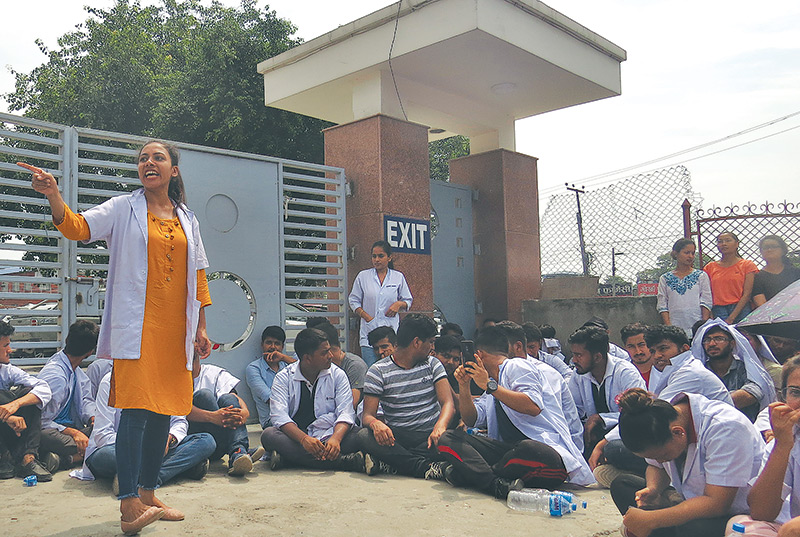
Students picket Chitwan Medical College demanding that the Medical Education Commission take action against their college. Post file Photo

KATHMANDU,
Despite receiving complaints of some private medical colleges charging exorbitant fees from their students, the Medical Education Commission hasn’t taken any action against the colleges.
Students have alleged that other than issuing statements, the commission has largely remained passive.
On Sunday, a group of students from Nepalgunj Medical College had filed a case at District Administration Office, Banke, claiming that the college had been charging them an additional fee of Rs 300,000 under the heading of internship fee and security deposit.  
Copies of the complaint were also sent to the commission and Kathmandu University. The commission had not initiated any action against Nepalgunj Medical College as of Wednesday.
“I had to pay an additional fee because the local administration in Banke and the commission took no step to enforce the fee ceiling set by the government,” a father of one of the students at Nepalgunj Medical College, told Post on condition of anonymity because he feared the college would target his son.
While the officials concerned agree that it is illegal to force the students into paying fees above the set ceiling, they feel no urgency to stop it, the concerned father added.  
Chief District Officer in Banke Kumar Bahadur Khadka confirmed to the Post that his office had received a complaint against Nepalgunj Medical College but said that he cannot initiate action unless the students press a fraud charge against the college.   
“I can proceed with the required action only if they [students and their parents] file a fraud charge,” Khadka said.
When asked whether he called the college officials to instruct them to follow the fee ceiling, the district chief replied that would not be effective.
Last year on October 18, the commission had increased the fees for the five and a half years MBBS degree programme to Rs 4.43 million (Rs 1.48 million during admission) in colleges outside the Kathmandu Valley and Rs 4.23 million (Rs 1.34 during admission) in the Valley.
However, several private medical colleges, including Nepalgunj Medical College and Biratnagar-based Nobel Medical College, have been allegedly charging additional Rs 200,000-300,000 from students at the time of admission. The students said the colleges would not admit them unless they paid the demanded fee.  
It is unfortunate that the government agencies have been unable to implement the fee ceiling, Sujan Kadariya, spokesperson for the Medical Student Struggle Committee, told the Post.  
“Instead of refunding the exorbitant fee they had charged earlier, the colleges have continued to charge additional fees from students. Meanwhile, the commission and the local administrations are mere spectators,” Kadariya said.
Following a series of protests from medical students, the government have repeatedly directed the concerned colleges to refund the additional fees they had charged in the last academic session. A majority of the colleges have not only followed the directives, but they are carrying on violating the fee regulation in this new academic session that began this month.
A report by the parliamentary committee on Health and Education showed the medical colleges had charged over Rs 2 million higher than the government ceiling in the previous academic session.
Similarly, a probe by the National Vigilance Centre showed that private medical colleges in the country extracted nearly Rs3 billion in additional fees from their students under different arbitrary headings in three consecutive academic years from 2015 to 2018.
Kadariya says the unabated ‘cheating’ from the medical colleges continues as the commission remains ineffective in performing its duty. He warned that they will resort to a protest starting next week if the commission continues to remain idle.
The commission led by the prime minister was constituted last year in the course of meeting the demands of Dr Govinda KC, who has long been campaigning for reformation in medical education and health sector.
The officials at the commission say they are working their best to make sure there is no cheating to the students.
“We have written to the respective universities to regulate the colleges under them,” Dr Shree Krishna Giri, vice-chairman of the commission, told the Post.

NATIONAL

Kantipur Conclave kicks off tomorrow

This year, the conclave takes stock of issues ranging from climate change to the MeToo movement.
- Post Report

KATHMANDU,
Kantipur Media Group will be hosting the second iteration of the Kantipur Conclave from February 7-8 at the Hyatt Regency, Kathmandu.
During the course of the event, personalities from Nepal and across the globe will discuss diverse issues facing Nepal, including solutions to propel the country forward, according to the event organisers.
This year’s conclave, titled ‘Reimagining Connectivity’, will serve as a platform for thought leaders to share innovative ideas and present solutions to deal with problems that Nepal faces. The programme features nine sessions—in both English and Nepali—and 40 speakers and moderators.
The conclave will kick off with four keynote speeches—from Prime Minister KP Sharma Oli; C Raja Mohan, director of the Institute of South Asian Studies; Bruno Macaes, non-resident senior fellow at the Hudson Institute; and Andy Mok, senior research fellow at the Center for China and Globalization.
On the second day, on February 8, a keynote speech will be given by Hussain M Elius, the CEO and Co-founder of Pathao, the Bangladesh-based ride-sharing service.
Prominent political leaders such as Pradeep Gyawali, minister for foreign affairs, and Gagan Thapa, a Nepali Congress Member of Parliament, will also participate in the sessions on Nepal’s political environment.
The first session, ‘Lessons from the East’, on Friday will see Gwen Robinson, editor-at-large of Nikkei Asian Review; Neeta Pokhrel from the South Asia Urban and Water Division of the Asian Development Bank; and Valentino S Bagatsing, president of Investment & Capital Corporation of the Philippines discussing the lessons that Nepal can learn from East Asia. The session will be moderated by Sujeev Shakya, founder and CEO of Beed Management, a management consulting firm based in Nepal.
The conclave will also discuss issues surrounding climate change where Sneha Pandey, program officer of Clean Energy Nepal will moderate the session featuring speakers like Arnico Pandey, formerly of ICIMOD; climate change campaigner Bindu Bhandari; Manjeet Dhakal, head of the Least Developed Countries Support Team and Climate Analytics; and Smriti Basnet, associate director of the South Asia regional office of Future Earth. The session ‘Mitigating Climate Change—The Big Connector’ will take place on February 8.
A session on why the #MeToo movement didn’t kick off in Nepal is also scheduled to take place on February 7. The session will talk about why the movement didn’t gather pace even though women courageously stood up against their perpetrators. The Post’s investigative reporter Bhrikuti Rai will moderate the all-women
panel featuring theatre artist Akanchha Karki, lawyer Durga Karki, and political activist Manushi Yami Bhattarai.
On the second and final day of the programme, Nepal Communist Party co-chair Pushpa Kamal Dahal will be in conversation with Kantipur Editor-in-Chief Sudheer Sharma. During the session, Sharma will speak to Dahal about his personal journey and his views on Nepal’s past, present and future.
The event has been designed to provide an opportunity to Nepali and global thought leaders to forge professional and personal relationships.
All sessions of the conclave will be live-streamed on the event’s official website, as well as on social media platforms of The Kathmandu Post and Kantipur as well as its websites.

Page 4
NATIONAL

South Korea requests for flight reschedule of workers with coronavirus symptoms

Every week, dozens of Nepali migrant workers leave for South Korea, where several coronavirus cases have been reported.
- CHANDAN KUMAR MANDAL
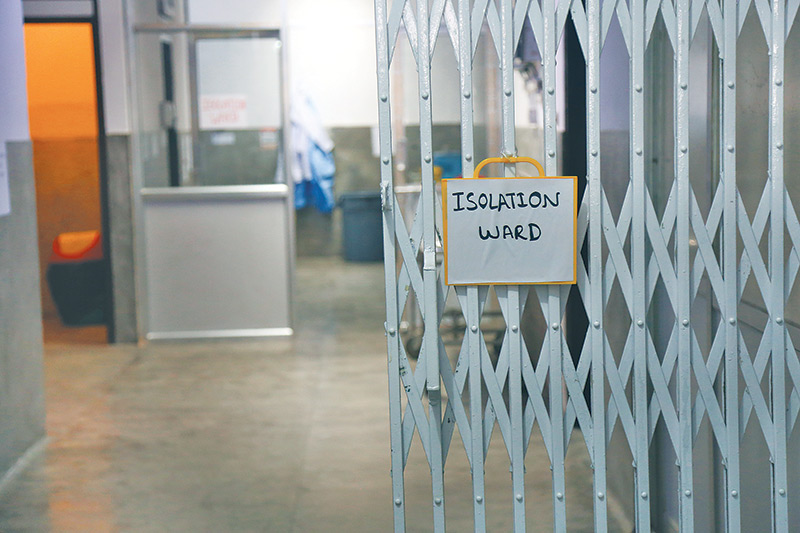
The isolation ward set up for coronavirus patients at Sukraraj Tropical and Infectious Disease  Hospital in Teku, Kathmandu. POST PHOTO: KABIN ADHIKARI

KATHMANDU,
With the coronavirus continuing to spread across countries, the global health scourge has begun to affect Nepali labour migrations.
In the wake of the possibility of spreading coronavirus, the Nepal chapter of the Human Resources Development Service of South Korea—the central South Korean organisation overseeing human resources management, including the arrival of foreign labour forces—has requested that the Nepal government not send any workers who could possibly be carrying the coronavirus.
A delegation from the South Korean agency visited the Department of Foreign Employment on Tuesday and requested Nepali officials to closely examine Nepali workers leaving for South Korea via the Employment Permit System (EPS).
“The South Korean officials have urged us to stop those workers who are suspected of showing symptoms of coronavirus,” Bhishma Kumar Bhusal, director general of the Foreign Employment Department, told the Post. “They have not asked us to completely stop the migration of Nepali workers, only those who carry symptoms similar to the coronavirus.”
Symptoms of the coronavirus include fever, cough and shortness of breath or symptoms similar to the cold or flu. The virus can spread from person-to-person through close contact, which is said to happen mainly via respiratory droplets produced when an infected person coughs or sneezes—the same way influenza and other respiratory pathogens spread.
“Coronavirus symptoms are similar to the common cold and cough. So, they have requested us to stop those who possess these symptoms,” said Bhusal. “If their flight is already scheduled, it can be rescheduled. We will ask these workers to go in for a medical examination, take rest and leave only after they are declared fit.”
According to media reports, there have been more than 20,000 confirmed cases of coronavirus in China alone, with a death toll of at least 425 and rising. The outbreak has spread internationally, infecting 170 people in more than 20 countries, including Nepal and South Korea—one of the popular labour destinations with Nepali migrant workers.
Every week, dozens of Nepali workers leave for South Korea, where at least 17 cases of coronavirus have been confirmed—the latest being a 38-year-old South Korean man who had visited Singapore from January 18 to 24 for a conference, which included guests from Wuhan.
According to Bhusal, the Nepal government will be careful while sending its workers to South Korea as this is a global public health threat.
The EPS Nepal Section—under the Department of Foreign Employment—is also introducing awareness programmes about the coronavirus, its spread and prevention in orientation training for those leaving for South Korea.
“We will anyway stop any worker who shows symptoms of coronavirus,” said Krishna Prasad Khanal, director at the EPS Nepal Section. “For now, we are asking them to use a face mask although the condition is not dangerous in Nepal, yet. The rescheduling of the flight will be done for those who are sick.”
South Korea is considered a safe labour destination for Nepali workers for it has better facilities and perks for migrant workers with a guaranteed work period for a minimum of four years and 10 months. So far, more than 60,000 Nepali workers have reached South Korea since 2008 through the EPS.
The departure of Nepali workers to South Korea are mostly scheduled on Mondays when a group of 100-150 Nepali workers leave to work in South Korea. Before their departure, these workers have to go through two rounds of medical tests—the first, soon after having passed a Test of Proficiency in Korean Language (TOPIK) and filling up of the employment form and the second, a few days before their flight, according to Khanal.
“We do not have any mechanism for testing coronavirus. Even hospitals do not do it here,” said Khanal. “So we will inform them about coronavirus during their orientation and tell them not to go if they have similar symptoms. Otherwise, they will have to return from South Korea because they have to go through a post-arrival medical examination there.”

NATIONAL

Illegal extraction of construction aggregate goes unchecked

- OM PRAKASH THAKUR
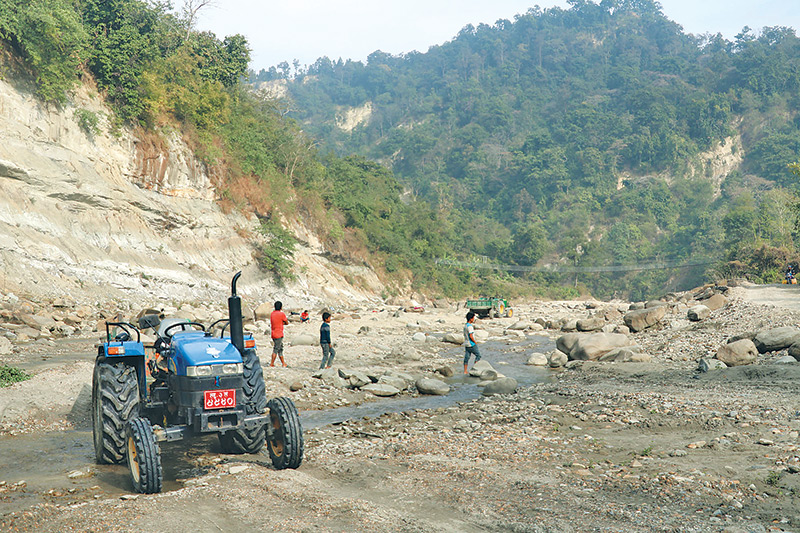
The Chure area has become a hub for illegal extraction of sand and stones ever since the authorities in Sarlahi banned aggregate mining in the district.  Post Photo: OM PRAKASH THAKUR

SARLAHI,
In a bid to control illegal mining of sand and other construction materials, the local administration in Sarlahi closed the crusher plants in the district a few months ago. But illegal extraction of construction aggregate has been continuing in the district, particularly in the Chure region.
On Tuesday, a monitoring team led by Chief District Officer Mohan Bahadur GC seized two excavators and as many tractors from a sand mining site at Patauna stream in Hariaun.
“The excavators and tractors were handed over to the concerned local level for legal action,” said GC.
According to some locals, illegal sand mining has been going on unchecked because the local units have failed to take action against illegal miners.
Following complaints of rampant sand mining and deforestation in the Chure region, a team, led by Ram Chandra Mandal, chairman of Natural Resources and Environment Committee of Province 2 assembly, had monitored the Chure area eight months ago.
The committee discovered illegal extraction of sand and stones taking place in several rivers and streams in the Chure area.
“Smuggling of sand and stone in the Chure area has worried us. Because of the remoteness of the area, it is difficult to stop the problem,” said Manoj Kumar Devkota, mayor of Ishworpur Municipality.
He, along with other municipal officials, inspected the Chure area on Wednesday. Devkota said illegal mining and smuggling of construction aggregate cannot be controlled without locals’ support.
Meanwhile, the local administration in Makwanpur is preparing to shut down 36 sand mines and six crusher plants for violating the industry regulations. The district monitoring committee had inspected the sand mines and crusher plants in various parts of the district on Monday and Tuesday.
Chief District Officer Narayan Prasad Bhatta said preparations were underway to close the sand mines and crusher plants for not adhering to the regulations enforced by the district council meeting.


(Pratap Bista contributed reporting from Hetauda)

Page 5
NATIONAL

Ward chair’s suspicious death triggers protests in Achham

Panchadewal Binayak Municipality Ward No. 2 Chairman Padam Bahadur Dhami was found dead in a cattle shed under mysterious circumstances on Tuesday morning.
- MENUKA DHUNGANA
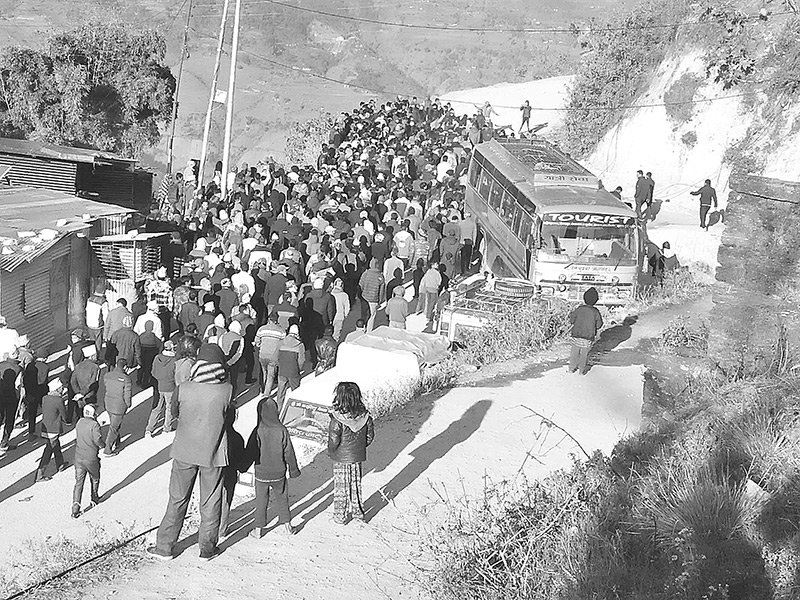
Locals protest demanding an immediate investigation into the death of Chairman Dhami. Post Photo: MENUKA DHUNGANA 

ACHHAM,
Protests erupted in Panchadewal Binayak Municipality in Achham district on Wednesday following the death of Ward No. 2 Chairman Padam Bahadur Dhami on Tuesday morning.
Locals and representatives from various political parties held demonstrations demanding an immediate investigation into the case. The demonstrators have obstructed the Mid-Hill Highway as a result of which transportation in the region has been disrupted.
The protests have thus far remained peaceful. However, authorities have tightened security measures in the wake of tensions surrounding Dhami’s death.
The bruised and bloodied body of Dhami, who had attended various programmes on Monday and was last seen leaving a local school with his colleagues at around 10 pm, was found dead in his sister-in-law’s cattle shed at about 4 am on Tuesday.
According to Ambika Chalaune, deputy mayor of Panchadewal Municipality, Dhami was accompanied by a police constable who had dropped him off at his house a little after 10 pm on Monday.
“By the looks of it, the incident does not look like a suicide, as Dhami had sustained serious head injuries and his body was covered in blood at the time of discovery,” said Chalaune. “Dhami’s body was found by his sister-in-law, who had gone to the shed to milk buffaloes in the early hours of Tuesday.”
A special team from the District Police Office and a team of investigating officers from the central level have begun an investigation into the death of the ward chairman.
Dhami had resigned as a teacher to enter politics and was elected ward chairman under the Nepali Congress ticket.
The municipality office, following the incident, had issued a statement demanding a prompt investigation into the case and action against the perpetrator/s.
Dhami’s family has refused to take the body of the deceased until further investigation into the matter is
conducted.

NATIONAL

Rautahat poorest district in Province 2, policy commission says

- SHIVA PURI

RAUTAHAT,
Rautahat is the district with most municipalities in the country, with 16 municipalities out of 18 local units. It is also a district with one of the lowest Human Development Index ratings—0.387—in the country, which is lower than that of several districts in the Karnali such as Jumla, Dolpa and Mugu. And, according to a recent report released by Province 2’s Policy Commission, it is the multi-dimensionally
poorest and least literate district in the province. It has 46.43 percent of its population under the multidimensional poverty index (MPI) and 58 percent illiterate population, including 45 percent male and 63 percent female.
According to the report, Mahottari and Sarlahi are the second and third multi-dimensionally poorest
districts, respectively, in the province. On average, the district has a multidimensional poverty index of 47.9, much lesser than the national average of 28.60. MPI takes into account multiple deprivations at the individual and household level in health, education and standard of living, among others. Among other districts in the province, Saptari has 0.437 MPI, Siraha 0.408, Dhanusha 0.431, Mahottari 0.388 and Sarlahi 0.402. Bara and Parsa have 0.386 and 0.464 MPIs. The province has an economic poverty index of 27.7 percent. This is the third poorest rating in the country. The province recently introduced a five-year plan to improve its economic poverty index to 21 percent.
Chief Minister Mohammad Lalbabu Raut said his government is using its entire resources to reduce poverty in the province.
“Going by the indexes, we have a lot to do and we are up for it,” said Raut while on a recent trip to Rautahat. Rautahat is home to one of the most underprivileged tribes in the country—the Musahars. The hundred Musahar households of Chandrapur Municipality-9 do not own any land, with most of them working at nearby brick kilns. According to Sukhal Musahar, a resident of Chandrapur, he and his neighbours work for 10 hours a day for which they get paid Rs600; the women get paid Rs500.
“We are surviving on this, but when we don’t get work, we have to sleep hungry,” he said.
Bijay Kishore Jha, a social worker, said there are many underprivileged settlements in the district whose members depend on labour work for survival.
“The people of underprivileged communities such as the Musahar engage in menial work from very early in life. They don’t have the time and resources to get an education,” Jha said, pointing to the reason behind the district’s high illiteracy rate. “Corruption is widespread in local units.”
Devprasad Timalsina, a lawmaker from the Nepali Congress, said that many drives to improve the district’s status in education and health sectors have been ineffective.
“The facilities aimed for underprivileged communities are interfered with by those with access,” he said. “Government services haven’t reached where they are intended. The condition of infrastructure is poor. Discriminations based on caste and gender are rife, and superstitions are still widespread. Given these reasons, it’s not surprising that the district fares poorly in socio-economic indexes.”
The Poverty Alleviation Fund, a state-owned body working towards reducing poverty, has invested Rs 8million in the district in the 11 years that it’s been active. The Fund had established 2,385 small committees to reduce poverty. But the drives seem to have little effect.
Ram Ekwal Rae Yadav, chair of the District Coordination Committee, said the main problem behind the growing rate of poverty in the district is unemployment.
“The district does not have enough industries. The quality of education is on the decline. Floods affect the district every year,” he said. “And lately, arable lands are left barren owing to uneven patterns of the rain.”

NATIONAL

Archaeology department yet to study ruins discovered in Dolakha

The department was informed about the findings a year ago but it has yet to respond to the local unit, say locals.
- RAJENDRA MANANDHAR
The site where the ruins have been discovered is about 30km east of Charikot, the district headquarters of Dolakha. Post Photo: RAJENDRA MANANDHAR

DOLAKHA,
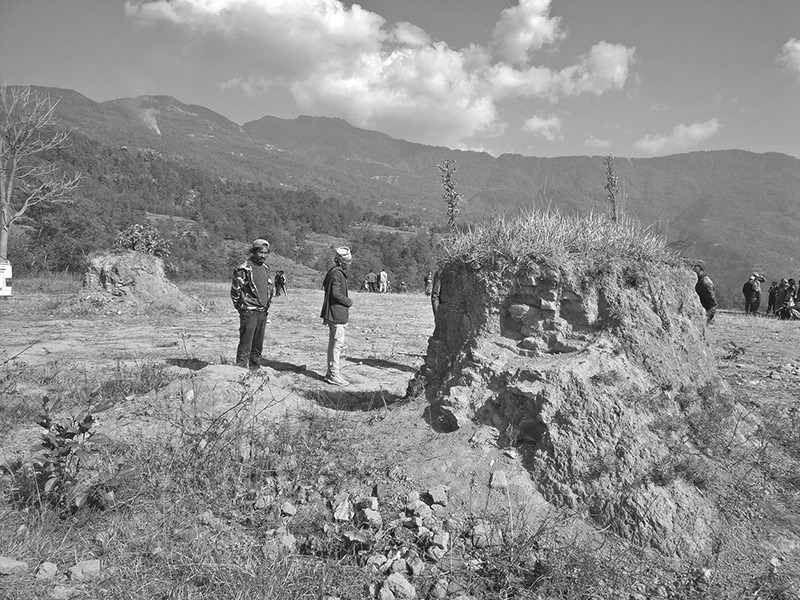
Baiteshwor Rural Municipality’s plan to construct its administrative building in Padudanda hit a snag last year when the construction team discovered the ruins of an ancient human settlement while levelling the ground. The team found structures resembling the walls and pillars of buildings, stone water spouts and ponds during the construction work.  
Keeping in view the possible archaeological significance of the ruins, the local unit halted the construction work and informed the Department of Archaeology about the findings. But the department did not respond. The local body shifted the location of the administrative building elsewhere.
“We informed the department immediately after we came across the ruins of a human settlement in Padudanda a year ago. We have yet to hear from the department,” said Chhabi Lama, the chairman of the local unit. According to him, the local body stopped the ground levelling work to protect the ruins.
Padudanda lies near Kiratichhap, a historic place in Dolakha. Noted historian Baburam Acharya had claimed that there was once a Kirati state in the Kiratchhap area since a stone inscription had been recovered there. Lama believes that the ruins of a durbar or any military structures built during the Kirat rule might still be found there.
The site where the ruins have been discovered is about 30km east of Charikot, the district headquarters of Dolakha.
Baiteshwor Rural Municipality has been protecting the Padudanda area believing that it could be a historically and archaeologically significant place. The municipality decided not to construct any structures in the area unless the department carries out a study and submits its report. The people’s representatives and the locals have urged the authorities concerned to excavate the area time and again but to no avail, said Lama.
The rural municipality wants to set up a museum in Padudanda if the archaeological study confirms its historical significance. But for now, all work is on hold for lack of response from the department.
Rabi Chandra Aacharya, the deputy chairman of the local body, said he is positive that the ruins in Padudanda belonged to a durbar or a historic fort.
Bal Kumar Dahal, a local, who also believes in the archaeological significance of the area, said, “The area remains in mystery as the authority is yet to study the ruins,” he said. “We don’t understand the delay on the department’s part.”
According to locals, the land of Padudanda had remained unclaimed for the past 400 years until it was recently handed over to the local unit by the District Land Revenue Office.

NATIONAL

Monitoring committees in local units ineffective

Members are responsible for evaluating projects but they don’t have the necessary skills.
- Ganesh Chaudhary

TIKAPUR,
Janaki Rural Municipality has around 400 projects in the current fiscal year. The monitoring committee of the rural municipality is responsible for monitoring works but it has not started the preparations on a single project since none has taken off.
“Not one project has been initiated this fiscal year,” said Uma Mahato, vice-chairperson of the rural municipality and coordinator of the monitoring committee. According to her, the monitoring and evaluation works do not seem likely to start anytime soon.
Last fiscal year, the monitoring committee of Tikapur Municipality conducted 11 meetings in one day but did not evaluate even one project. The meetings were held only to release funds for the projects.
Meen Bahadur Shahi, associate professor at Tikapur Multiple Campus, said members of the monitoring committee are busy attending functions rather than helping expedite underperforming projects.
“The Local Government Operation Act directs the committee to monitor the projects regularly but their roles have not been effective so far,” said Shahi.
Although the deputy chief or the vice-person of the local unit is authorised to monitor projects, they don’t have technical knowledge and training to monitor development works. Laxman Tharu, chairman of Janaki Rural Municipality Ward 7, said they only evaluate the works superficially as they lack proper skills.
Nabin Ojha, an engineer at Tikapur Municipality, said monitoring committee members are responsible for project evaluation but they do not know how to run the task. “Committee members are not equipped to monitor development projects since they do not have the technical knowhow,” said Ojha.
Local representatives also agree that they don’t have the skills required to monitor development projects. Keshari Bista, deputy mayor of Tikapur Municipality, said they have been facing difficulties to monitor large development projects such as road upgradation, and construction of bridges and other infrastructure. “We pass a project after technicians verify the construction works,” said Bista, calling it a complex activity.
The monitoring committee has vice-chairperson of the local unit as coordinator and chief administrative officer, two executive members and chief at the planning and monitoring section as members.

NATIONAL

Locals padlock sugar mill demanding pollution control

Briefing
- Post Report

SARLAHI: The local people padlocked the main gate of Hariaun-based Indu Shankar Sugar Mill on Wednesday. The protesters claimed that they were compelled to padlock the mill as the latter did not take any initiatives to control pollution. They padlocked the mill’s main gate for two hours.

NATIONAL

Programme to increase millet productivity

Briefing
- Post Report

GULMI: Ishma Rural Municipality has launched a programme to increase the productivity of millet. The rural municipality has fixed the price of millet Rs50 per kilo and helped farmers to send millet to Tamghas and Butwal, among other cities. The rural municipality has also promoted villagers to grow millet as a primary crop.

NATIONAL

Dry landslide disrupts transportation

Briefing
- Post Report

BAGLUNG: A dry landslide obstructed vehicular movement at Galuwa along the Baglung section of Kaligandaki Corridor on Wednesday. Dozens of vehicles have been stranded in the area after the incident. Efforts are on to clear the debris and resume transportation, said police.

NATIONAL

Common cold affects villages

Briefing

DHANGADHI: More than 100 people have been affected by the common cold in Joru of Swami Kartik Khapar Rural Municipality and Dhulachaur of Himali Rural Municipality for the last four days. According to Kuber Shahi, acting executive officer of Swami Kartik Khapar Rural Municipality, the common cold has struck down at least 110 people in Joru. Health worker Om Jung Shahi said a team of health workers have started to treat patients in Joru.

NATIONAL

Two held with drugs

Briefing
- Post Report

Police arrested Surya Bahadur Rai in possession of 4kg marijuana, from Dharan on Wednesday. The security personnel raided his room and seized the contraband. Similarly, Ritesh Dhimal of Belbari was nabbed with controlled pharmaceutical drugs. 

Page 6
EDITORIAL

A two-way street

Maintaining road discipline wont be effective if the government or motorists fail to do their part.

Collective moral behaviour and civic sense are important for societies to evolve. But the government must do its part too if it wants its citizens to live freely and safely. In its effort to maintain lane discipline, the Metropolitan Traffic Police Division decided to up its game. But thanks to the absence of lane markings on most road sections, the drive is yet to be effective.
Bad road etiquette and poor infrastructure both are to be blamed for the lack of order on the roads. Infrastructure such as zebra crossings, overhead bridges, sidewalks and so on are few and far between. Therefore, pedestrians are often forced to cross the road wherever they can. As it is, with 60 percent of the zebra crossings in the Kathmandu Valley lying discoloured for years, pedestrians crossing the road are putting their lives on the line.
According to the division office, around 200 people are booked every day for violating lane discipline in Kathmandu. To ensure road safety, the division has also notably increased the number of traffic police personnel on the roads who specifically keep a check on lane violations. Of the total 1,400 officers designated to manage the traffic in Kathmandu, 20 percent are deployed for enforcing lane discipline. While this is a commendable effort, it should equally focus on making sure the roads are marked properly.
Once this is done, the motorists, on their part, need to follow the rules and not change lanes haphazardly or drive on the wrong lane. Many motorists often break the prescribed speed limit, overtake other vehicles on the wrong side, and nonchalantly cruise on the wrong side on highways and expressways. Pedestrians too contribute substantially to the chaos on Kathmandu’s roads. Most people walk and cross the road anytime and anywhere with impunity.
Road markings are the least understood and followed concept in Nepal. No doubt, it has become a major lapse in road safety. But it is important to understand that road safety is a double-sided and complimentary exercise. Around 40 percent of road accidents happen due to the poor state of road crossings, traffic police data shows. Maintaining road discipline and ensuring road safety will bear less fruit if the government or the motorist fail to do their part.
According to a government report, the Nepal Road Safety Action Plan (2013-20), Nepal has one of the highest road fatality rates. A report published in February 2018 says around 2,000 people die every year in road accidents in Nepal. To bring a lasting solution to this problem, the traffic police must first ensure there are enough road infrastructures, like working traffic signals and properly marked lanes and zebra crossings. And if motorists still do not adhere to the rules, confiscating their licence, imposing a hefty fine and threatening violators with worse if they attempt to bribe the cops should be done. Lack of fear of the law or its enforcers has become a huge problem for road safety. The traffic police should thus lead by example.

OPINION

A name to conjure with

Naming of places is not only the prerogative of the state. Local units are choosing what they want to be called.
- DEEPAK THAPA
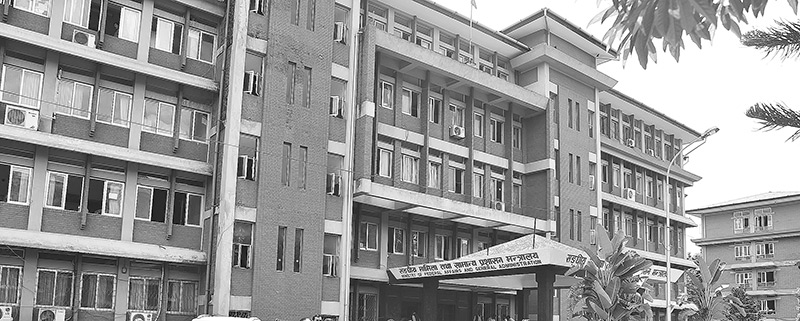
The Ministry of Federal Affairs and Local Development. Postfile photo 

The sight of the Ganesh Himal tinged orange by the late afternoon sun and perfectly framed by the two ridges flowing down from the hilltops of Nagarjun and Shivapuri provides one of the most striking views of the Himalaya from the Kathmandu Valley. In the lap of that range, lies what sounds like the aptly named Aamachhodingmo Rural Municipality in Rasuwa district. Except that the place was not known as that when Nepal was restructured into 753 local bodies. In its wisdom (or ignorance), the Local Body Restructuring Commission had decided to call the new municipality formed by amalgamating the former VDCs of Goljung, Gatlang, Chilime and parts of Haku, Parbatikund Rural Municipality, after the eponymous pond within the municipal boundaries.
I first heard about the place in 2017, when news appeared of the newly elected municipal body voting to go for a name change, a concession that had been granted under the Local Government Operation Act. Even at first blush, it felt very right, for by no stretch of imagination does the place, tucked far away into the northwestern corner of the district of Rasuwa, bordering Tibet and Dhading, appear to identify with anything called Parbati. According to the municipal profile, Tamangs comprise 95 per cent of Aamachhodingmo. The second-largest are the Ghaley (3 percent), a group that occupies the intermediate space between the Tamangs and the Gurungs to the west, and in that part of the country generally identify more with Tamangs. Apart from the mandatory Dalit women representation in each of its five wards, all the elected officials are Tamang or Ghale.
The explanation provided in the profile about why the name had to be changed said it all: ‘Since more than 90 per cent of the residents in the area are Tamang/Ghale, the rural municipality was given a name in the Tamang language. Aamachhodingmo is so called because in the Tamang language, “Parbati” (the Hindu goddess) is called “Ama” (mother) and “kund” (pond) is called “chhodingmo”.’
In the discussion on the origin of place-names, The Oxford Handbook of Names and Naming says the following: ‘Place-names [are] cultural artefacts which arise from the interaction between language and environment.’ In the case of Aamachhodingmo, the collection of information to understand precisely that crucial interaction does not appear to have been done, or the official(s) responsible for coming up with names might have been able to ‘convince’ the locals about the suitability of agreeing to the out-of-place-sounding Nepali toponym, Parbatikund.
One other early instance where the renaming was quite complete was in Udayapur. Sunkoshi Municipality was renamed Limchunbung Rural Municipality not only to distinguish itself from three other Sunkoshi Municipalities in other districts, but also to reflect its own identity. ‘Limchunbung’ refers to a flower in the local Rai language.
Given how names of places have been outright distorted or appropriated with the active connivance of the state, I thought these two changes were only the beginning of an avalanche. It has been evident since the adoption of the 2015 constitution that despite all the chest-beating, particularly by Janajati and Madhesi activists, the provinces will not bear anything but the most generic appellations, something that has been clearly borne out in the case of the four provinces named so far.
But given the greater homogeneity at the local level, I had assumed that the dynamics would be different with these bodies. As it turned out, only 38 municipalities decided to adopt a different name than had been given by the Local Body Restructuring Commission. In many cases, the change was only cosmetic, having to do with differences in transliteration, while in others, the change of name was quite definite. Not having the time to go through all the municipal profiles to understand the significance of the new names, I confine myself to a few observations.
It should be accepted at the outset that with just 38 changes required, the Commission appears to have done a pretty good job of coming up with names acceptable to the locals since some measure of consultations would have taken place. I have my reservations about some of the names though and I give but two examples. In Jhapa district, there is this municipality called Buddhashanti, which sounds perfect since it encapsulates both Buddha and peace (shanti), definitely a plus point given the growing number of ‘Buddha-was-born-in-Nepal’ fanatics in our country. Buddhashanti is derived from the two former municipalities merged to form the new one, Budhabare and Shantinagar. In doing so, however, the famous, albeit quaint and quirky, meaning of Budhabare (‘bazaar on Wednesdays’) and its long history is now in danger of being lost forever.
Likewise, in Tanahun, my ancestral village is now within Shuklagandaki Municipality, which sits astride the Seti Gandaki. ‘Shuklagandaki’ is the Sanskritised variant of Seti Gandaki and one would have thought that federalism being the means to making more people identify with the state, the authorities would come up with a name that would resonate with everyone, not only with those with a cultural affinity towards Sanskrit. Seti Gandaki Municipality would have sounded more Nepali. For that matter, the name of any of the three previous entities that the new municipality covers, Dhorphirdi, Dulegaunda and Khairenitar, could have been chosen to retain that distinctly local flavour.
There are also new names that have a very different provenance and have to do with Nepal’s recent political history. One such is the Shahidbhumi Rural Municipality in Dhankuta. The Commission had called it Khalsa Chhintang Shahidbhumi, but the elected officials opted for Shahidbhumi (land of the martyrs) in memory of the infamous Chhintang massacre of 16 people in 1979 by the Panchayat government. It might sound grander but has lost all association with the event that produced the martyrs in the first place.
Most of those killed at Chhintang were cadre of the Communist Party of Nepal (Marxist-Leninist), the main rump of the current ruling party. The other rump, consisting of the Maoists, have not been outdone at all, with a municipality that stands apart from all the rest—Sunil Smriti Rural Municipality in Rolpa. The Commission’s original choice was Subarnawati, an odd one given its strong Sanskrit overtones in a municipality where Magars form the majority. The municipal officials, dominated by former Maoists, decided that since Subarnawati had neither history nor context, they would name it after a comrade killed during the conflict. Sunil Smriti (memorial) comes from Sunil, the nom de guerre of Kim Bahadur Thapa, who was shot dead by security forces from a helicopter towards the fag end of the ‘People’s War’. He must have been quite a leader since not only does his home village carry his name, his wife, Bagmati Chhetrini, is also the Vice-Chair of the municipality.
Only the future will tell how many of these place-names will stand the test of time and whether there will be further changes demanded of these and others as well. The ‘interaction between language and environment’ mentioned above is also one that remains very dynamic.

OPINION

Dhaka needs to think big

The city should adopt a technology-led transformation of the services.
- ARIJIT CHAKRABORTI
Shutterstock

About two and a half years ago, a global e-commerce company published its plan to set up its second headquarters, and invited proposals from cities that would be interested to collaborate with them in setting this up. More than 200 cities from multiple countries submitted their proposals for the intended collaboration. The company shortlisted a few cities and finally chose a location to build the headquarters.     
Hyper-competitive cities are fast emerging to attract investors and residents, becoming preferred choices for living, working and investing. With half of the world’s population living in urban areas, this trend of cities becoming big-ticket investment destinations is going to become more common. Under these circumstances, it is important to understand Dhaka’s position with respect to the emerging trends, and the challenges and opportunities ahead. In the near future, will Dhaka stand a chance to submit a proposal to a multinational corporation for its second headquarters plan? If Dhaka gets chosen by a global corporation for setting up its global or regional headquarters, what would the reaction of the city’s stakeholders be? If a Bangladeshi company becomes a multinational company, will it shift its headquarters from Dhaka to some other international location?
Dhaka has a population of more than 20 million people today. The city area covers more than 300 square kilometres and is administered by two large municipal corporations—Dhaka North City Corporation and Dhaka South City Corporation. With rapid urbanisation, the city’s population is growing continuously. According to data published by the United Nations’ World Population Prospects, the urban population of Bangladesh has been increasing by 3.17 percent annually during the last five years. However, Dhaka’s ability to provide contemporary urban services to such a large number of people is not growing at the same pace.
The ambition of becoming a smarter city (Dhaka 4.0) in the era of the Fourth Industrial Revolution comes with many challenges. At the same time, there will be opportunities for improvement in many areas, which could be utilised towards becoming a more competitive city. To maximise the benefits from these opportunities, the city should adopt a technology-led transformation of the services provided to citizens. Such a transformational journey should address the issues around several areas including transportation, environment, citizen safety and information communication.
The Dhaka Mass Transit Company Limited (DMTCL), a government agency responsible for the development of a mass transportation system for Dhaka, has embarked on developing the metro rail system in the city. The work is in progress and the first route is expected to be operational by 2021. At the same time, a smarter city should also build an inclusive transportation framework. The residents should have enough spaces to be able to walk and ride bicycles safely and comfortably. Such facilities will reduce pollution in the city and help its residents become healthier. Additional emphasis on the adoption of electric vehicles will further help in reducing environmental pollution.
With the change in urban lifestyles, the nature of urban crimes is changing as well. The incidence of crimes committed inside households and on the internet is increasing. Incidents of domestic violence, child abuse and elder abuse are reportedly taking place in the upper floors of multi-storeyed buildings. Along with technological advancements, cybercrimes are increasing at a high rate and cybercriminals are often difficult to apprehend, as many of them operate from outside the country. Accordingly, urban policing needs to change. While patrolling the streets is important, it is equally important to monitor and prevent crimes from happening indoors and online. These situations create new challenges for law enforcement agencies. A technology-led crime prevention framework should enable the law enforcement agencies to deal with such varying kinds of crime effectively.  
The Dhaka Metropolitan Police (DMP) has set up a website with extensive information for its citizens. The DMP website also allows citizens to apply for a police clearance certificate online and track the status of the application. They also maintain a page on Facebook and have a mobile app to communicate with the public. As the next step, the department may focus on expanding digital interfaces for citizens by introducing online crime reporting, online status updates of investigations and providing a platform for secure digital interactions with individual citizens regarding their individual issues.
For a city to become smarter, it must create a plan to upgrade its communications infrastructure and foster an environment in which private enterprises can participate in the upgrading task. Adoption of next-generation technologies such as 5G will foster innovation and collaboration among stakeholders to build value-added services for the residents of the city. According to a news report, the Bangladesh Telecommunication Regulatory Commission (BTRC) is planning to roll out 5G services in the country by 2021.
Dhaka 4.0 needs to prepare itself for fulfilling its development ambitions and evolving into a hyper-competitive city. Progress has been made in many areas, resulting in the overall development of the city in recent years. A transformational goal towards becoming a hyper-competitive city will make it ready for competition in the region. Becoming a smarter city will make Dhaka ready for regional-level competition, and this preparation will be an important factor for success in the future.

This article was previously published in The Daily Star, a part of the Asia News Network.

Page 7
OPINION

Brazil needs a fresh start

The biggest obstacle to progress is inequality, which is tied to Brazil’s legacy of colonialism.
- Luciano Huck
Shutterstock

‘I pray that my family will one day attend fewer funerals and more graduations.’ These words, spoken by Douglas, a Brazilian from São Gonçalo, resounded in my ears like a gunshot. Douglas’s father died in a hail of bullets before Douglas was born; his mother was gunned down on his 11th birthday. Like so many Brazilian children his age, he was forced to drop out of school to pay the bills for his siblings.
After spending time with Douglas in São Gonçalo, one of the poorest and most violent cities in the state of Rio de Janeiro, it became obvious to me that he was a victim of the ‘zip code lottery.’ Douglas lives in one of the most
unequal cities in one of the world’s most inequitable countries. Statistically, it will take another nine generations before someone from his neighbourhood ascends to the middle class.
Douglas is not alone. As an entertainer for Brazil’s largest television network, I have spent two decades sharing the stories of people living in the country’s biggest favelas and most remote Amazonian communities. And as a social entrepreneur, I am constantly looking for new ways to unlock the potential of the tens of millions of Brazilians living in poverty.
For as long as I can remember, Brazil has been ridiculed as a country eternally waiting for the future to arrive. The biggest obstacle to progress is inequality, which is tied to Brazil’s legacy of colonialism, slavery, and exclusionary institutions, and perpetuated by Brazilian elites’ cynical disregard for the poor. Although successive presidential administrations since the restoration of democracy in 1985 have tamed inflation, expanded welfare assistance, and even reduced poverty, inequality has remained stubbornly high.
Worse, recent evidence shows that inequality in Brazil has started widening again, potentially wiping out much of the progress of the previous three decades. The primary culprit is a regressive system of taxes and subsidies that disproportionately benefits wealthier people like me. Brazil has low income- and property-tax rates relative to other OECD countries, yet it imposes a bevy of indirect taxes on the poor.
If Brazil is going to have any chance of curbing inequality, it needs drastic improvements in the coverage and quality of basic public education. While wealthy citizens receive high-quality educations, poorer ones like Douglas are routinely forced to leave school prematurely, owing to violence and crippling financial pressures. This helps to explain why there are still over 11 million Brazilians aged 15 or above who can neither read nor write.
Brazil desperately needs to improve the effectiveness of its 200,000 public schools. Instead of building new facilities, we should find ways to spend more efficiently, with a focus on teacher training and career development, early childhood education, and curricula for the twenty-first century. Recent improvements in educational outcomes in Ceará, Piauí, and Espírito Santo show that rapid progress is possible.
Brazil’s fight against inequality cannot be won unless the country’s social safety net serves all citizens. There are an estimated 43 million Brazilians currently living in poverty, more than 13 million of whom live in extreme poverty, the highest level in seven years. Fortunately, artificial intelligence and big data technologies can help improve the quality and coverage of services, and at a lower cost than at any time in the past.
But to improve education and social inclusion, Brazil will need new leadership. Today, most Brazilians are frustrated and desperate. In 2013, well before the mass protests that flared up in Chile and Ecuador, Brazil experienced one of the largest demonstrations in its history. The 2018 presidential election that brought Jair Bolsonaro and his far-right government to power revealed the extent of polarisation and dissatisfaction among the electorate. Exhausted by widespread corruption and economic stagnation, Brazilians voted for change. Needless to say, opinions are divided on whether Bolsonaro’s presidency will unify Brazilians and transform the country for the better.
For many in my generation, politics is seen as a dirty business that is best avoided. But, looking back, I now recognise that I share the blame for this outcome. Because politics does not come naturally to me, I was insufficiently involved in this critical domain.
But my generation can no longer accept things as they are. The time has come for Brazil to renew its social contract. The country needs a broad political coalition to curb inequality, borrowing the best ideas from both the left and the right. Ideological purity and uninformed policies will not resolve Brazil’s most pressing problems. Moreover, we need politicians and civil servants who are technically and ethically qualified for the job. But we cannot expect policymakers to succeed without outside help.
In 2017, these challenges prompted me to join Agora, a civic movement dedicated to mobilising a new generation of young leaders who have pledged to devote at least two years of their careers to public service. Soon thereafter, I helped launch RenovaBR, a non-partisan training school for prospective political leaders. In our first call for applications, we attracted more than 4,600 submissions from people who had never been involved in politics. They were drawn by our appeal ‘to be the candidate whom you would want to vote for.’ Of the more than 120 successful applicants, 17 were elected to federal office in 2018. In a recent call for applications ahead of Brazil’s upcoming municipal elections, we received more than 31,000 submissions.
Candidates supported by groups like Agora and RenovaBR offer an inspiring and positive vision of a more open and pluralist Brazil. They are focused on what really matters: closing the massive gap between rich and poor. Because of them, I am still bullish on Brazil. If we target inequality with the tools at our disposal, Douglas and millions of children like him will live to attend more graduations and fewer funerals.


— Project Syndicate

OPINION

A world cordoned off

Whether it is due to disease or discrimination, a picture emerges of a world wrapped in knotted barbed wires.
- RAFIA ZAKARIA
Shutterstock

While the world has been busy absorbing the terrible news from China, with individuals, governments and airlines all weighing the risks of the coronavirus, the Trump administration has issued another set of travel curbs. The new restrictions, which apply to an additional six countries, will be added to the already existing ones. Included are Nigeria, Sudan, Tanzania, Myanmar, Kyrgyzstan and Eritrea.
The total number of countries facing the US travel ban (which was held up by the US supreme court) now numbers 13. In addition to these countries, the US is also blocking travel to the country by any foreign nationals who may have visited China in recent days. Chinese citizens are still permitted to travel to the US, although it is reported that several of the country’s major airports will undertake special screenings of passengers arriving on these flights. They will be looking for increased body temperature, coughing and shortness of breath. Health personnel in the US have been schooled in special procedures should they receive any persons exhibiting these symptoms.
While these health precautions may prove temporary as China tries to contain the virus, there is a general feeling, especially in light of America’s tightening of immigration, that borders and bans are gaining an increasingly prominent place in the scheme of things. As far as the latest US travel restriction is concerned, the addition of six new countries to the list underscores the premise that certain kinds of people are particularly repugnant to the white nationalists that now control US immigration policy.
countries, which President Trump has talked about so very disparagingly, are first, followed by Muslim countries and now also some Central Asian countries. The particularities of the bans ensure that visas issued prior to Feb 22, 2020, will be valid. Student visas and some other non-immigrant visas may also still be given (although one can be sure that these too will face extra scrutiny). No immigrant visas will be granted to any citizens from these countries, leaving those who are in line to migrate to the US stuck and suspended.
While it is said that the reason for the restrictions is inadequate screening measures implemented by the countries in question, it is not a stretch to assume that the real reason is to throttle non-white immigration to the US. In addition, all of these countries, small and lacking much international clout, have virtually no means to protest against the ban. The consequence is that thousands of Nigerian Americans and Tanzanian Americans, amongst others, will suddenly face swift estrangement.
If you add these restrictions, imposed by a global superpower, to the curbs necessitated by the recent health concerns, the immediate picture is of a shrunken world wrapped in barbed wire. The toughest knots exist over regions such as Africa and South Asia, the labour exporters whose youth inevitably await visas to the western world in order to make a future and a life for themselves. With the UK out of Europe, and the US wrapped up in travel bans, the prospects for those who leave home to earn their fortunes in foreign lands is particularly bleak.
A throttled world is likely to birth even greater hatred. For instance, in the wake of the coronavirus outbreak, Asian people living in Europe and the US already report facing discrimination. At one level are the steps dictated by the reality of the disease. Many airlines are not flying to or from China to the West. China itself has imposed a mandatory quarantine on millions of its people. It is likely that many more will face a similar quarantine in the coming days if the virus spreads. At another level, while there might be valid reasons for China to check its travellers at this point, it is unfortunate that there is a tendency for such health alerts to fuel racist sentiment internationally.
The world where people moved freely, where fortunes could be sought far and wide, seems already to be a thing of the past. The more populous half, largely brown and black, faces the ignominy of visa queues, rejections and the humiliating beggary of western immigration procedures that impact relationships, lives and more. The other half sets up bans and borders with just as much persistence. The US is likely to continue to add to the list of travel-ban countries, since it does not see any point in permitting individuals from poor, black and/ or Muslim countries to cross its borders.
Whether it is pandemic or discrimination, it is the poor who will suffer. Countries such as Pakistan and India that have borders with China and lack the kind of sensitive screening equipment possessed by Western nations could be impacted.
The world of today seems a terrible one to hand to the coming generations. It is not that the world of the last millennium was much better or particularly peaceful or tolerant. But it was less beset with the current scourges of unforgiving climate change, pandemic, racial exclusion, in fact, the open persecution of any group unlucky to be a minority. Most of these are large structural problems whose solutions seem too forbidding to consider at the same time; the failure to take action is pushing us all towards a catastrophe.
Pakistan is not yet subject to a US travel ban. At the same time, Pakistanis must know that it is a distinct possibility that it could be, particularly if Donald Trump wins his re-election bid. As there is in Nigeria today, there will be an outcry; pleas to ask the US to reconsider are to no avail. The world of walls and barbed wire, of war and plagues, is here to stay.


This article was previously published in Dawn, a part of the Asia News Network.

Page 8
HEALTH & LIVING

If you’re practising self-medication, know the risks

With easy accessibility to drugstores, people are self-prescribing more often these days, but doctors say that could be dangerous.
- SRIZU BAJRACHARYA
People often buy medicines such as paracetamol, Ibuprofen, Digene, Nims and Sinex from pharmacies. But not all of these drugs fall under OTC drugs. Post file Photo

Kathmandu,
When Sunil Shrestha owned a pharmacy in PepsiCola, most of the customers that came to his shop daily would be there to buy over the counter (OTC) drugs available without a prescription. These medicines can usually be taken without the supervision of a doctor, with little or no abuse potential. But many a time, people would also come to buy antibiotics for antiviral infections like the common cold, which does not require antibacterials.
“Self-medication can be damaging sometimes, as people don’t really know how to medicate themselves or when to seek a doctor,” says Shrestha, a clinical pharmacist.  “Even some medicines, if taken for a long time, can have consequences.”
While self-medication is useful, particularly in treating mild illnesses like fever, there have been multiple studies that have revealed the risks of self-medication. Some possible risks include wrong self-diagnosis resulting in the misuse of over-the-counter medicines, delay in seeking necessary medical help, side-effects and allergies due to dangerous drug interactions.
Paracetamol, Ibuprofen, pantoprazole, Digene, ranitidine, Nims, Rhinex and Sinex are some of the many medicines that people buy from medical shops to treat fever, headaches, stomach ache, gastric and body pain. But not all of these drugs fall under OTC drugs. People are also increasingly buying antibiotics which require prescription courses from medical professionals, but before doing so doctors say people should understand what medicines they are actually taking. More importantly, they should know when to seek medical help.
“When people fall sick, they will naturally visit the medical shop first, as it’s less costly than visiting a hospital. Plus, it’s also less time-consuming,” says Shrestha, who currently works at Nepal Cancer Hospital and Research Centre. However, Shrestha believes in a country like Nepal, pharmacies have an important role to play to educate people of the use of medicine as it’s the first place patients head to for a cure.

“As we all know, there are many pharmacies and medical shops without pharmacists in the country, there can be adverse effects of the medicines that people are buying without proper administration,” he says. Pharmacies should also be able to refer to medical help when needed, but that is not the case in Nepal, according to Shrestha.


With more and more medicines becoming accessible to people, medical professionals like Shrestha believe there needs to be more health awareness as people can misuse medicines and take them even when not necessary, which can sometimes lead their bodies to become resistant to the medicine. Although oral medicine tablets include information and assistance on when to use the medicine, people still are unaware of the medicines they are taking, say pharmacists. “If we are to practise self-medication, it’s necessary for us to focus on health awareness,” says Shrestha. “And I hope in the future our Ministry of Health looks into this issue more seriously.”
During high fever, people usually take paracetamol to reduce body temperature, which is usually what doctors recommend as well. But according to doctors, the problem is when people take the same medicines over and over, for long durations or between brief intervals. Patients are also often found to be taking medicines on the basis of what they have seen work for others who have similar medical problems, say doctors.


“For example when we recommend pantoprazole to a patient with gastric pain for a certain time, that patient might recommend the same to someone having acidity, or the patient might keep taking the medicine even when not needed or when they feel acidity again in the future,” says Bijay Kiran Dahal, general physician at Norvic International Hospital. “But we prescribe medicines according to our diagnosis, and sometimes what might work for one patient might not for others,” he says.
Another reason self-medication can be risky, particularly in Nepal, is because the business is so unregulated, says Dahal. “In the US, people cannot buy strong medicines just because they are feeling unwell. The purchase of medicine, apart from over the counter drugs, requires prescription and guidance,” says Dahal.
People also tend to take Ibuprofen and paracetamol together for headaches, sometimes self-diagnosing themselves as having a migraine. They are also prone to taking painkillers like Flexon. “People medicate themselves based on assumptions of their symptoms, but many conditions could result from many other causes as well,” says Dahal.
According to doctors, high doses of paracetamol can be harmful and therefore should not be taken more than recommended by physicians and information provided on the tablet. “Paracetamol and nonsteroidal anti-inflammatory drugs are notorious for damage to the liver and kidney,” says Dahal.
However, today, when doctors discuss self-medication, many are concerned over the use of oral antibiotics, which require a proper course to treat bacterial infection. But many people are using antibiotics to treat sore throats, common cold and flu. “But common cold does not require antibiotics, and yet people use them to treat themselves and many pharma shops sell these antibiotics easily without understanding why consumers are buying them,” says Shrestha.
The unnecessary use of oral antibiotics can develop bacterial resistance in the patient. “And so when the patient really needs to use the antibiotic, it may not work for them and they might have to opt for injections,” says Dahal which is more costly. Many research works have also revealed that some antibiotics can cause side-effects such as fever, bloating and indigestion when not used properly.
While the government has regulated laws around selling medicine with narcotics and poisonous drugs that fall under the category ‘A’, which need a prescription for purchase, the same is also necessary for antibiotics which fall on category ‘B’,  say doctors. “We have seen a lot of cases aggravate because of the wrong use of antibiotics, and I think it’s a serious concern today,” says Dahal.
Both Dahal and Shrestha also believe the ayurvedic and allopathic medicine that people are taking without any medical consultation is a matter of equal concern. “Many patients come in with jaundice and their cases seem more severe because they visit the doctors too late.
A lot of them take ayurvedic medicines, and delay themselves from taking professional medical help,” says Dahal.
According to doctors, any self-medication taken for too long needs medical consultation. “People shouldn’t just take medicines because a family member suggested that it worked for someone else. The use of medicine needs care,” says Dahal.

HEALTH & LIVING

In virus outbreak, fretting over a name that might go viral

Many media outlets have been skipping the clunky 2019-nCoV and just calling it the new virus or new coronavirus, which isn’t very specific.
- Mike Stobbe
Coronavirus is the umbrella term for a large group of viruses, including ones that can cause the common cold. ap/rss

West Nile virus, Lyme disease, Ebola virus.
And now: 2019-nCoV?
“Just rolls off the tongue, doesn’t it?” said Trevor Hoppe, a researcher at the University of North Carolina at Greensboro, who has studied the history of disease names.
The name, which stands for 2019 novel coronavirus, has been assigned to the virus behind the outbreak of flu-like illnesses that started in China late last year.
Scientists are still learning about the new virus, so it’s hard to come up with a good name, Hoppe said. The current one is likely temporary, said Dr Nancy Messonnier of the US Centers for Disease Control and Prevention.
“Once people have a chance to catch their breath, it might be changed,” Messonnier said.
Many media outlets have been skipping the clunky 2019-nCoV and just calling it the new virus or new coronavirus, which isn’t very specific. Coronavirus is the umbrella term for a large group of viruses, including ones that can cause the common cold.
Since the outbreak is centered in the central Chinese city of Wuhan, others have been using Wuhan virus or Wuhan coronavirus or even Wuhan flu—even though flu is an entirely different virus.
It’s consistent with a centuries-old tradition of naming new ailments after cities, countries or regions of the world where they first popped up. West Nile was first detected in the West Nile district of Uganda; Lyme disease in Old Lyme, Connecticut, and Ebola in a village near Africa’s Ebola River.
But that can sometimes be wrong or misleading. The 1918 pandemic was called Spanish flu, though researchers don’t think Spain is where it actually started.
“Now we have a much different sensibility and tolerance about how we refer to things,” said Dr. Howard Markel, a medical historian at the University of Michigan.
In 2015, the World Health Organization issued guidelines that discouraged the use of geographic locations (like Zika virus), animals (swine flu) or groups of people (Legionnaires’ disease).
Hoppe noted that AIDS, when it first emerged in the early 1980s, was called “gay-related immune deficiency.” That was dropped as it became clear that heterosexuals were also spreading the virus. AIDS stands for acquired immune deficiency syndrome.
With the guidelines, WHO was trying to bring an end to unnecessary stigma that could ostracise people and damage business. Demand for pork plunged in 2009 with so-called swine flu, first identified in a boy who lived on a pig farm in Mexico—even though it wasn’t spread through eating pork.
Markel said he liked when diseases were named after the scientists who first described them. (Think Alzheimer, Parkinson and Tourette.) That’s problematic today with many scientists across the world working on a new ailment at the same time.
SARS was used for severe acute respiratory syndrome when another coronavirus caused a 2002-2003 outbreak. So maybe this one could be called CARS, Markel said.
“I can see why they want to name it something generic but it has to be something people use,” he said. “Otherwise the easier name will take over, and it’s naive to think otherwise.”
In the end, the WHO may have little control over what it’s called, he added.
“Wuhan virus is very catchy—no pun intended,” Markel said. “It’s a very contagious name.”


—Associated Press

Page 9
CULTURE & ARTS

How Thimi is reviving its water heritage

The local government’s initiative to restore drying ponds is not only reviving the ancient town’s water system but also its groundwater reserves.
- Shashwat Pant
The Dui Pokhari (above) after it was finally restored last year. Before the start of its restoration, the pond had been left unattended for years (below). Photos courtesy: Niranjan Shrestha

Thimi,
When the restoration work initially started at the Dui Pokhari in Thimi, in 2018, many were sceptical. Locals were not convinced that the user committee formed to restore the pond would actually have anything to show for work.
“Many previous attempts to restore the pond had failed. This was because most of the time, people who lacked skill and expertise were hired and they couldn’t complete the project,” says Prakash Sthapit, a resident of Thimi.
But to Sthapit’s surprise, the restoration work this time around was completed in a span of just two years. “I had no hope that they would do it, but I am glad they did. The place feels like it was back when I was growing up again,” says 73-year-old Sthapit.
The completion of the project wasn’t the only thing that was surprising though, he says. A few months after the pond was restored to its old glory, the wells in the vicinity that had dried up had started to fill up with water. Other sources of groundwater also started to rise.
“The sources had dried up decades ago, but they amazingly reappeared. The groundwater in the area had depleted severely for years, but after the pond was rebuilt, it also started rising,” says Sthapit. “People had been queuing for hours to get their vessels filled with water at communal taps, but that problem has stopped—to an extent. It’s like the gods are happy with us once again.”
Many of the Valley’s ponds have been lying in a dilapidated state for years. A lot of ponds in the Valley have disappeared, especially in Kathmandu where there have been few efforts to restore ponds. The neglect towards the water system started from the Panchayat era, says Padma Sundar Joshi, programme director at UN Habitat. And while there have been efforts to revive ponds in some parts of Lalitpur, it has been Bhaktapur that has been leading the way to restore dead ponds.
“Ponds started disappearing after the destruction of rajklulos (state canals),” says Joshi. Rajkulos were equivalent to today’s modern water transmission pipes. They replenished the ponds, and were the most important and ingenious design in the Valley’s water supply system, says Joshi. But as haphazard urbanisation took off, those canals started being disrupted and then they disappeared altogether. This resulted in these centuries-old ponds drying up.

Joshi says the various governments that took power since Nepal became a multi-party democracy also did not help protect and preserve the Valley’s rich water heritage. “The government seems least bothered to protect our country’s water heritage. It is evident in the way they have permitted buildings to be built over spaces where there were once ponds and stone sprouts,” says Joshi.
But in Bhaktapur, pond restoration has been the local government’s priority for a while now, ever since Siddha Pokhari was revived in 1999. “Siddha Pokhari was as good as dead. It was swampy like a quick sand. What people see now is something remarkably different. The revival of the pond gave people hope that ponds could be revived,” says Madan Sundar Shrestha, Mayor of Thimi. The pond today is a major source of tourism for Bhaktapur’s Visit Nepal 2020 campaign as well.
Of course, restoring ponds do not come cheap. But how much budget is allocated to the restoration work depends on the local government’s priorities, says Shrestha, whose government has included pond restoration as a major part of their manifesto. “We spent Rs 15 million to restore the Dui Pokhari [which means two ponds] in Thimi. I was told other governments only spend Rs 200,000. You can’t restore ponds at such a low cost,” says Shrestha.
He adds that they started the project to restore the pond because the town started to face a drinking water shortage. “Initially people were having problem drawing groundwater, after which wells started to dry up. That was enough motivation for us to start restoring ponds. When you start facing problems like these, as the local representative, you have to do something,” says Shrestha. After the Dui Pokhari was restored, the water levels rose in around 20 wells in the area, says Shrestha.
The process to restore ponds, according to Niranjan Shrestha, president of the Nu Pukhu Reconstruction User Committee, is simple. The first thing he says the committee did was clear the pond of the shrubs that had grown. After the clearing was done, the committee sought the assistance of experts on the process to restore the ponds.
“After consultation with various experts, we decided that the pond would need two layers of kalo mato (black clay), a layer of pango mato  (clay) and a layer of bricks. Doing that we were told the process would be enough to hold water in the pond ensuring seepage,” says Niranjan.
The committee then dug the pond, laid six inches of kalo mato after which they laid three inches of pango mato followed by another six inches of kalo mato. After that was done, four inches of bricks were laid on top. “We decided to stick with the traditional method of restoration,” says mayor Shrestha.
They then added water by boring it, but as monsoon arrived, the natural system of storage and seepage started, he says. The same process will be used to restore another pond in Bode, where works have already started.
Such community work has also given rise to local participation. Children as well as older people have come together and there’s an apparent awareness among people regarding water recharge systems. But Joshi feels that more needs to be done.
“I like that the local government has taken ownership to restore cultural heritage and ponds. But they need to do more. Not all local governments show the same type of zeal as Thimi has,” says Joshi. “Most youngsters aren’t interested in carrying out these projects because in a way it doesn’t concern them. They just want to leave Nepal as soon as they can, but that way we can never save our heritage.”

CULTURE & ARTS

Women at the Oscars: Often in a secondary role

Since its inception, only 15 percent women have won an Oscar.
- Jean-Philippe Chognot
Film editor Atanas Georgiev (left) with directors Tamara Kotevska and Ljubo Stefanov attend Oscar Week: Documentary at the Academy of Motion Pictures and Sciences. AFP/RSS

Since the first Oscars were awarded more than 90 years ago, there have been by far fewer women winners in all categories except costume design.
With the 92nd edition of the Academy Awards on Sunday also shaping up to be dominated by male winners, here is a breakdown of the wins for women over the years:


15 percent women winners
Since the first Oscar ceremony in 1929, just 15 percent of the golden statuettes for acting and film production have been handed to women, according to an AFP analysis of data on winners of individual awards (not overall awards given to films).
This is equivalent to 376 women from a total 2,435 winners.
The proportion of women drops to roughly 10 percent, or 201 of 2,085, when the gender-specific actor and actress awards are not included. The percentage of women winners has increased over time, but they remain largely in the minority.
For the first 10 years of the Oscars, 13 percent of winners were women—and only four percent in the categories open both to men and women. Over the most recent decade, this rose to 22 percent of overall laureates, and 17 percent in the mixed categories.
The most “feminine” Oscars were in 2016: the jury handed 11 of 30 mixed awards, or about 37 percent, to women.


No woman’s land
A woman has never won in the cinematography category.
The prestigious best director category has only gone to a woman once: to American Kathryn Bigelow in 2010 for The Hurt Locker. No woman has been nominated this year.
There has also only been one woman among the 207 winners for sound mixing: American Lora Hirschberg in 2011 for Inception.
The best visual effects award has only been handed to women twice, from a total 240 winners.
The best original score category has only seen three female winners out of 167: American lyricist Marilyn Bergman in 1984 for Yentl; English composer Rachel Portman in 1997 for Emma; and Englishwoman Anne Dudley in 1998 for The Full Monty.
They may be joined this year by Icelandic maestro Hildur Gudnadottir, who is nominated for her work on Joker.


Makeup and costumes
While still under-represented, women fare better in the categories of screenplay with 21 winners out of 279; sound editing (six of 72); production design (25 of 296); and film editing (15 of 113).
Only two categories see a strong female presence: makeup and hairstyling, and costume design.
The Oscar for makeup and hairstyling has been handed to women 30 times out of 81 (37 percent).
And costume design is the only category in which more women than men have received the golden statuette: 66 out of 112 overall, or 59 percent, rising to 77 percent for awards since 2000.
American Edith Head received the Oscar eight times between 1950 and 1974, including for All About Eve in 1951 and Roman Holiday in 1954.


Young actresses favoured
For acting, the spread of winners is equal between the genders because of the separate categories for men and women in leading and supporting roles.
But young actresses take home by far more awards than their older colleagues.
Of 92 winners for best actress, only 11 have been aged over 50. This compares to 21 for best actor.
And 32 of the women were aged under 30, which is the case for only a single male actor: Adrien Brody for The Pianist in 2003.
It means that winning male actors are, on average, seven years older than their women counterparts, a gap that has nonetheless closed to four years over the past decade.


—Agence France-Presse

CULTURE & ARTS

Top films were more diverse than ever before, study finds

But those gains haven’t been reflected in Hollywood’s awards season, which culminates Sunday with the Academy Awards.
- Jake Koyle
The data showed similar gains for female leads. Of the same films, 43 featured female leads, an increase of four films from 2018. AP/RSS

Hollywood’s awards season may not show it, but the most popular films are increasingly diverse, a new study finds.
According to new research by the University of Southern California’s Annenberg Inclusion Initiative, more of 2019’s top movies featured minority or female lead characters than ever recorded before. Analysing the top 100 films at the North American box office, USC researchers found that 31 movies had leads or co-leads from an underrepresented racial group, an increase of four films from 2018 and nearly triple the number of 10 years ago.
The data showed similar gains for female leads. Of the same films, 43 featured female leads or co-leads, an increase of four films from 2018 and more than double the number of female leads (20) in 2007.
Combined with studies released last month that showed a notable uptick in the numbers of female directors, the research paints a picture of an industry that, after years of lagging behind in representation in front of and behind the camera, is showing real signs of progress. While still falling short of an accurate reflection of the American population (51 percent of which is female and about 40 percent are people ofcolour), researchers called it “a banner year for inclusion.”
“It is clear that Hollywood is taking steps to create more inclusive stories and that those films are connecting with
audiences,” Stacy L Smith, founder of the Inclusion Initiative, said in statement.
But those gains haven’t been reflected in Hollywood’s awards season, which culminates Sunday with the Academy Awards. For the 87th time, no female filmmakers were nominated for best director. And while the much-nominated Korean drama Parasite has made history, only one person of colour (Cynthia Erivo, for Harriet) was nominated in an acting category. At the British Academy of Film and Television Awards on Sunday, only white actors were nominated.
“There is also a very obvious disconnect between what sells tickets and what garners awards points to a systemic bias at cultural institutions like the BAFTAs or the Academy Awards,” Smith said. “After another year in which the major studios increased their output of films with female and underrepresented leads or co leads, it is critical to recognise that talent is not limited by gender or race/ethnicity.”
The USC study also assessed the major distributors. Because box office is a key metric in their research, that doesn’t include releases from streaming services including Netflix and Amazon, neither of which disclosed ticket sales for most of their 2019 releases.
Universal, the only studio led by a woman (studio chief Donna Langley), led all studios with nine films featuring a female lead and eight films featuring leads from an underrepresented ethnicity.


—Associated Press

Page 10
WORLD

British police probe gun blunder by ex-PM’s bodyguard

- AGENCE FRANCE-PRESSE

LONDON,
An investigation has been launched after former British prime minister David Cameron’s bodyguard left his gun in a toilet on a commercial flight, police said on Wednesday.
The Glock semi-automatic pistol was found by a passenger before take-off on the British Airways flight from New York to London, causing a delay and scaring passengers, reports said.
The officer had also left Cameron’s passport in the loo.
The overnight flight landed at London’s Heathrow airport on Tuesday.
“We were waiting to take off when a guy started to show pictures on his phone of a gun and two passports—one was David Cameron’s—he said he’d found in the toilet,” The Sun newspaper quoted one passenger as saying.
Scotland Yard police headquarters said it was investigating.
“We are aware of the incident on a flight into the UK on February 3 and the officer involved has since been removed from operational duties,” a spokeswoman told AFP.
“We are taking this matter extremely seriously and an internal investigation is taking place.”
Former British prime ministers are automatically entitled to 24-hour armed protection.
Cameron was premier from 2010 to 2016, stepping down after the Brexit referendum in which he had campaigned to stay in the European Union.
It is not the first time a toilet-related Cameron mix-up has resulted in something important being left behind.
In 2012, Cameron accidentally left his eight-year-old daughter at the pub following a misunderstanding with his wife.
Nancy Cameron wandered off to the toilets while the premier and his wife Samantha were arranging lifts from the pub, and the couple only realised she was missing once they got home.
Cameron, 53, has largely kept a low profile since leaving office. He re-surfaced last year when his memoirs were released. Cameron was critical of PM Boris Johnson, his old schoolmate, who spearheaded the Brexit referendum campaign to leave the EU.

WORLD

Emboldened Trump gives Democrats a reason to fret

Chasm between US politicians deepens as President is on the verge of being acquitted in the Senate, opposition still consumed by Iowa caucus chaos
- REUTERS
House Speaker Nancy Pelosi tears her copy of President Donald Trump’s  State of the Union address after he delivered it to a joint session of Congress on Capitol Hill in Washington, on Tuesday.  AP/RSS 

WASHINGTON,
President Donald Trump took the stage for his State of the Union speech in an unfamiliar position: With the wind at his back.
For most of his three years in office, Trump has been surrounded by tumult, much of it of his own making, resulting ultimately in his impeachment by the House of Representatives.
Now, for the first time in a long time, things are looking up.
He is on the verge of being acquitted by his fellow Republicans in the US Senate on Wednesday. Opinion polls show his approval ratings on an upswing. And the Democratic presidential nomination race was consumed by chaos as results from the Iowa caucuses this week were delayed by a full day because the mobile app used to record the results had a coding problem.
For Trump, the timing could not be better.
Despite being impeached, he is firmly entrenched in office, after surviving the Mueller investigation into Russian electoral interference and accusations that he abused his office by pressuring Ukraine to investigate a political rival, former vice president Joe Biden.
“He has had existential political threats facing him from the moment he was elected until tomorrow,” said Texas-based Republican consultant Matt Mackowiak, referring to the impending acquittal vote on impeachment charges.
All of it brought out the showman in the former reality TV star during his State of the Union speech on Tuesday night. At one point, he choreographed a reunion between a US servicemember returning from Afghanistan and his family to cheers from lawmakers.
Along that line, for much of the speech, Trump appeared to be making an overt appeal to suburban voters who could decide his fate.
He spoke of child-care initiatives, and efforts to combat AIDS and the opioid crisis. He called for greater transparency for medical bills, and he sought to take credit for protecting Americans with pre-existing healthcare conditions, even though his administration supports a lawsuit that would gut the Affordable Care Act.
Trump also touted bipartisan accomplishments such as the US-Mexico-Canada trade deal and vowed to protect entitlement programs such as Medicare and Social Security. He pledged to protect the public from the coronavirus that is spreading in China and beyond.
But lest anyone think the combustible Trump had turned touchy-feely, he also reassured his hardline supporters by previewing what promises to be a recurrent campaign theme: accusing Democrats of supporting unlimited free healthcare to undocumented immigrants.
As he did during his first presidential campaign, he warned of the dangers of so-called “Sanctuary Cities” and detailed incidents of violent crime committed by border-crossers.
Trump, too, seemed eager to exploit divisions among Democrats as they struggle to settle on a candidate who could mount the biggest threat to him.
The early favorite, Biden, appeared to have stumbled badly in Iowa, while US Senator Bernie Sanders, a democratic socialist, was much more competitive.
At one point, Trump appeared to reference Sanders, who favors a government-run healthcare system, by declaring “We will never let socialism destroy American healthcare!”
At a campaign event in New Hampshire, Sanders drew a laugh from the crowd on Tuesday when he questioned Trump’s pledge to improve healthcare in America: “Really? How gullible do you think the American people are?” he said.
In his speech to Congress, Trump did not address the most polarizing topic in the room, the months-long attempt by Democrats to remove him from office. He avoided any temptation to take a victory lap ahead of Wednesday’s Senate vote.
“It was very smart to ignore the impeachment trial, stay above the fray and instead provide a laundry list of accomplishments along with proposals that will keep his base rock solid,” said Ron Bonjean, a Republican strategist in Washington.
That did not stop partisan tensions from running high. At the close of his remarks, Democratic leader Nancy Pelosi, who had orchestrated Trump’s impeachment in the House, tore up her copy of his speech. Earlier, Trump had refused to shake her hand upon entering the chamber.
While recent polls showed that more than 40 percent of Americans favored Trump’s conviction and removal from office on charges that he tried to persuade Ukraine to interfere in the coming election, Trump received good news from another poll on Tuesday.
The Gallup organization said he had reached his personal best in their tracking poll, hitting 49 percent approval—the highest since he took office.
That prompted nervous Democrats on social media all day to fret that Trump, after three years of non-stop drama, might be peaking at just the right time.

WORLD

UN Secretary-General Gueterres warns ‘a wind of madness is sweeping the globe’

United Nations Secretary-General Antonio Guterres speaks during a Holocaust memorial event at UN headquarters. AP/RSS
- ASSOCIATED PRESS

UNITED NATIONS,
UN Secretary-General Antonio Guterres warned Tuesday that “a wind of madness is sweeping the globe,” pointing to escalating conflicts from Libya and Yemen to Syria and beyond.
At a wide-ranging news conference, he said, “All situations are different but there is a feeling of growing instability and hair-trigger tensions, which makes everything far more unpredictable and uncontrollable, with a heightened risk of miscalculation.”
Guterres singled out Libya where he called the current offensives by the warring parties “a scandal”—coming soon after world powers and other key countries adopted a road map to peace in Berlin on Jan. 19 that called for respect for a UN arms embargo, an end to foreign interference in the fighting by rival governments and steps toward a cease-fire.
Libya has been in turmoil since 2011, when a civil war toppled longtime dictator Moammar Gadhafi who was later killed.
A weak UN-recognized administration that holds the capital Tripoli and parts of the country’s west is backed by Turkey and to a lesser degree Qatar and Italy. On the other side is Gen. Khalifa Hifter, whose forces launched a surprise offensive to capture the capital last April from their base in the country’s east and are backed by the United Arab Emirates and Egypt as well as France and Russia.
Guterres said the 55-point Berlin agreement has been repeatedly violated by fighting and continuing arms deliveries. “We are seeing more and more civilians being targeted, ... migrants in a desperate situation and all the commitments that were made apparently were made without a true intention of respecting them,” he said.
The secretary-general also expressed “enormous concern” at the escalation of attacks in Idlib, Syria’s last rebel-held province with a population of 3 million, and said the UN is “particularly worried” that the escalation now includes the Syrian and Tukish armies bombing each other. He again urged a cessation of hostilities “before the escalation comes to a situation that then becomes totally out of control.”
As for Yemen, Guterres said he was very encouraged recently to see Iranian-backed Houthi Shiite rebels stop attacking Saudi Arabia and the Saudis, who back the country’s internationally recognized government, limiting their military actions. But unfortunately, the last few days have seen “a new escalation,” he said.”
In Iraq, which has faced mass anti-government protests since Oct. 1 in which at least 500 demonstrators have been killed, the secretary-general called for the human rights of protesters to be protected.
On the decades-old conflict between Israel and the Palestinians, the secretary-general said the US peace plan unveiled last week doesn’t comply with UN General Assembly and Security Council resolutions and international law. The resolutions support a two-state solution based on 1967 borders and call all Israeli settlements in the West Bank illegal.
The secretary-general stressed that global problems “feed on each other.”

WORLD

Italy’s three-wheeled newsagent revs up against crisis

Andrea Carbini closes his three-wheeled transporter newsstand during his daily itinerary in different points of Milan. AFP/RSS
- AGENCE FRANCE-PRESSE

MILAN,
Every morning, the instantly recognisable whirr of Andrea Carbini’s three-wheeler fills this Milan square, where he throws open his mobile newsagent’s doors for a news-hungry and largely elderly clientele.
“Corriere della Sera!” “That’s two euros, have a nice day, see you tomorrow!” says Carbini, with the cheerfulness of newspaper sellers of yesteryear.
He promises a customer to put aside a newspaper, to find a certain book, he asks for news about the family.
There is so much demand that the yellow and white Ape (Bee) three-wheeled van will be late for its next rendez-vous in another nearby piazza.
“I come every day. The newspaper kiosk closed in July and fortunately the Ape has been coming for a month,” Maria Ricciardi, 77, told AFP.
“I don’t like the Internet. It may be necessary, but real culture is in books and newspapers.”
Since the local kiosk closed, “I’ve had to go for a long walk” to get a paper, notes 72-year-old Maria Malzani.
She and her typographer husband, who have always read newspapers, say the initiative is “fabulous”.
Carbini, 52, came up with the mobile newsagent’s idea to counter the disappearance of newsstands.
“Ten years ago there were still 650 in Milan, now there are only 450,” says Diego Averna of the Cisl trade union, pointing out that many are “just about surviving” thanks to the sale of public transport tickets or snacks.
The problem is national: from 2009 to 2019, Italy lost nearly a quarter of its newsagents, tumbling from 18,000 to 14,000, according to Unioncamere-Infocamere, the federation of chambers of commerce.
Simultaneously, newspaper sales are plummeting: just 2.2 million newspapers are now sold each day in Italy, down from 5.5 million in 2007, according to ADS.
Fewer sales can be blamed on the rise of digital media and a certain lack of youth interest in the press but it is “also because there is a lack of sales outlets,” said Giuseppe Ferrauto, managing director of the Cairo Editore group.
It’s a vicious circle.
“That’s why an initiative like the mobile newsstand is something that we publishers must encourage,” he told AFP.
For now, former bookshop owner Carbini has only one route, stopping in four neighbourhoods where newspaper kiosks have recently closed.
But he dreams of expanding.
“What I’m doing is a provocation and I hope young people will take over. I shook up a situation where no one was doing anything,” Carbini says of his “Edicole Quisco”.
“People tend to think that the battle is already lost. But I think newspapers, even if a shrinking market, still have a future,” he says, stressing the importance of “safeguarding press freedom and the production of culture”.
He says that by working every day and choosing your neighbourhoods well, you can earn 1,800 to 2,000 euros (2,000-2,200 dollars) a month.
The advantage over a normal newsstand is that the Ape avoids high overheads and has a high concentration of customers over a few hours.
Its clientele is mainly over 50 years old, but also includes some in their thirties and forties, and children, who come to buy figurines made by Panini, also a sponsor.
“The Ape has an extremely important symbolic value in Italy, it represents the economic boom of the 50s and 60s,” said Carbini.
“The newsagent is a neighbourhood friend. They can’t just disappear, like local shops,” lamented Marianna Saraceno, a 66-year-old retired schoolteacher.
“It’s huge loss, for culture, for sociability, for living together”.

WORLD

Irish election: Sinn Fein ahead in new poll

Briefing

DUBLIN: Republican party Sinn Fein have surged into first place with just days until Ireland goes to the polls in a general election, according to a new survey. Sinn Fein were at 25 per cent, ahead of opposition Fianna Fail on 23 per cent, the final Irish Times/Ipsos MRBI opinion poll said on Monday night. Fine Gael—the party of the incumbent government lead by prime minister Leo Varadkar—was trailing on 20 per cent in third. The election takes place on Saturday. The poll was conducted from January 30 to February 1 among 1,200 adults in every constituency. Its results suggest an historic shift in sentiment. Sinn Fein’s flagship policy is uniting the republic with the British province of Northern Ireland and dissolving a border erected in the partition of 1921. But that could be overshadowed by more immediate issues of housing, healthcare and homelessness have come to dominate the campaign.(Agencies)

WORLD

Measles vaccine group targets 45 million children

Briefing

LONDON: Vaccine group Gavi said on Tuesday it would help to innoculate up to 45 million children in countries in Asia and Africa over the next six months. Gavi, the Vaccine Alliance, will work with governments and groups including the World Health Organization and UNICEF to target children under five years old, the age group most vulnerable to the disease. Cases have surged dramatically in recent years, with nearly 360,000 cases recorded globally in 2018 and almost 430,000 cases reported for 2019, according to provisional data. “The measles vaccine is safe, effective and low-cost—there is no reason children should still be dying of this disease,” said Seth Berkley, CEO of the London-based alliance. (Agencies)

WORLD

Turkey deploys extremists to Libya, local militias say

Briefing

CAIRO: Syrian militants affiliated with groups such as al-Qaida and the Islamic State group are currently being sent by Turkey to fight on behalf of the UN-supported government in Libya, according to two Libyan militia leaders and a Syrian war monitor. Both sides in Libya’s civil war receive equipment and backing from foreign countries. But Turkey, which has long trained and funded opposition fighters in Syria and relaxed its borders so foreign fighters joined IS, has in recent months been airlifting hundreds of them over to a new theater of war in Libya. (Agencies)

Page 11
ASIA

Lebanon crisis deals blow to once-thriving press

- AGENCE FRANCE-PRESSE

Beirut,
Publications disappearing from newsstands, radio and TV channels struggling to stay on air: Lebanon’s once-flourishing media is collapsing under the weight of the worst economic crisis in decades.
The Daily Star, Lebanon’s only English-language newspaper, which suspended its print edition on Tuesday, is the latest casualty.
It comes shortly after the English-language Radio One broadcaster went off air at the weekend after nearly four decades.
Due to funding shortages in recent years, a series of prominent dailies and broadcasters in Lebanon have disappeared, undermining the country’s regional reputation as a media hub.
The situation has become more dire in recent months, as Lebanon struggles with a wide-reaching recession and a spiralling financial crunch exacerbated by political turmoil and mass protests.
To keep their heads above water, surviving organisations have had to slash salaries and lay off employees. Some have stopped paying salaries all together.
“We haven’t been paid in five months,” said an employee at the country’s oldest newspaper, An-Nahar, asking not to be named to protect his job.
The Daily Star announced on its website the temporary halt of the printing presses was a result of the economic downturn. It cited “the financial challenges facing the Lebanese press, which have been exacerbated by the deterioration of the economic situation in the country”.
It said the temporary suspension came after “a drop to virtually no advertising revenue in the last quarter of 2019, as well as in January of this year”.
In recent months, employees at the newspaper had complained of not being paid, with one departing journalist reporting in December that some were owed up to half a year in wages. The outlet will however continue to publish content on its website and social media.
The Daily Star was founded in 1952 by Kamel Mroue, then owner and editor-in-chief of the pan-Arab Al-Hayat daily newspaper.
The newspaper was bought by businessmen close to former prime minister Saad Hariri in 2010 and is co-owned by Hariri’s family, according to a report on media ownership in Lebanon by the Samir Kassir Foundation and Reporters Without Borders.
The Daily Star is just the latest media outlet linked to the former premier to be struggling.
In September last year, Hariri announced the suspension of Future TV, his ailing mouthpiece whose employees had been on strike over unpaid wages.
In January 2019, the Hariri-linked Al-Mustaqbal newspaper issued its last print version, 20 years after it was established, though it too maintains a presence online.
Saudi Oger, a once-mighty construction firm that was the basis of the Hariri business empire, collapsed in 2017, leaving thousands jobless.
Hariri stepped down as prime minister in late October under pressure from unprecedented nationwide protests against alleged official corruption and ineptitude.

ASIA

Thousands held on cruise ship in Hong Kong as authorities check for virus

Beleaguered public hospital network suffered from staff shortages and limited beds before the coronavirus outbreak.
- REUTERS
A man is transferred from the World Dream cruise ship to an ambulance at the Kai Tak cruise terminal in Hong Kong on Wednesday. AFP/RSS

HONG KONG,
Thousands of passengers and crew on a cruise ship that docked in Hong Kong on Wednesday were being kept on board while they were tested for a coronavirus as the city government said that all visitors from mainland China would be quarantined for two weeks.
The former British colony saw its first death from the coronavirus virus on Tuesday. It has confirmed 21 cases, with many that were transmitted locally, authorities said.
Hong Kong health workers have been on strike this week to demand that city authorities seal the border with China, where the virus originated last month, to block its spread.
The cruise ship, World Dream, operated by Dream Cruises, docked in Hong Kong after it was denied entry to the Taiwan port of Kaohsiung on Tuesday.
It has some 1,800 passengers and a similar number of staff on board.
Three mainland Chinese who had been on board from January 19 to January 24 were found to have had the virus, Hong Kong’s health department said, adding that most of those remaining on board were from Hong Kong. Some crew had reported symptoms including fever, health officials said.
Chief Executive Carrie Lam said that Hong Kong’s two cruise terminals, Kai Tak and Ocean Terminal, would suspend operations immediately, while all visitors from mainland China would face compulsory quarantine. “These measures are stringent,” said Lam. Dream Cruises, which is operated by Genting Hong Kong , said the three confirmed cases of the virus had disembarked in the Chinese city of Guangzhou on January 24.
The coronavirus epidemic, which began in the central Chinese city of Wuhan in December, has rekindled memories in Hong Kong of a 2003 outbreak of Severe Acute Respiratory Syndrome (SARS), another coronavirus that began in China and killed nearly 300 people in the city.
The latest virus has spread rapidly in China with nearly 25,000 people infected and 490 deaths, most in Wuhan and the surrounding province of Hubei.
Hong Kong health workers and members of other trade unions have demanded the border with the mainland be completely sealed.
“We are dangerously close to a massive community outbreak comparable to SARS,” a newly formed union called the Hospital Authority Employees Alliance (HAEA) said in a statement.
Lam has closed some border crossings and links with the mainland but she has left three open, arguing that to close the entire border would be inappropriate, impractical and discriminatory.
She said the government was allocating HK$10 billion ($1.3 billion) to fight the spread of the virus.
Thousands of medical staff have joined members of other trade unions this week and the city’s Hospital Authority has warned that emergency services are being severely hampered.
Hong Kong’s beleaguered public hospital network was suffering from staff shortages and limited hospital beds before the coronavirus outbreak.
On Wednesday, dozens of medical representatives marched to government headquarters to demand for the border to be sealed.
The health scare comes after months of at times violent anti-government protests in Hong Kong sparked by fears its autonomy, guaranteed under a “one country, two systems” formula, is being eroded by Beijing.
Beijing has denied meddling and accused foreign countries of inciting unrest. Some pro-democracy protesters have come out in support with demonstrations beginning to take on the characteristics of the pro-democracy protests.
Overnight, police fired teargas and rubber bullets to disperse a crowd in the rural New Territories after protesters denounced the government’s refusal to seal the border.

ASIA

Syria regime presses offensive despite Turkish warning

- AGENCE FRANCE-PRESSE
Rescue workers use an excavator in search for victims under the rubble of a building, hit by an air strike on the town of Ariha in the northerncountryside of Syria’s Idlib, on Wednesday. AFP/RSS

BEIRUT,
Syrian regime forces Wednesday pressed on with their offensive in the northwest that has displaced half a million people, despite heightened tensions with Turkey.
Intensive aerial bombardment and ground fighting in the jihadist-dominated Idlib region since December have killed almost 300 civilians and triggered one of the largest waves of displacement in the nine-year war.
The United Nations and aid groups have condemned the escalation and called for an end to hostilities in a region that is home to three million people, half of them already displaced from other parts of Syria.
Turkey’s President Recep Tayyip Erdogan on Tuesday warned that his country would not allow Syrian forces to gain more ground and accused them of driving “innocent and grieving people” towards the Turkish border.
But Russian-backed Syrian regime forces on Wednesday pressed on with their offensive in Idlib, where they have seized more than 20 towns and villages from rebels and jihadists over the past 24 hours, according to the Britain-based Syrian Observatory for Human Rights and state news agency SANA.
With their latest advance, Damascus loyalists have nearly encircled Saraqeb in southern Idlib and were now within one kilometre (less than a mile) of the strategic highway town which has been emptied of its residents following weeks of bombardment, the Observatory said.
Holdout rebels and jihadists can only exit from the north, with regime forces deployed on all other sides, according to the war monitor group.
A military source quoted by SANA late Tuesday said the Syrian army was giving its enemies in Saraqeb and nearby areas a “last chance,” calling on them to surrender their arms.
The Syrian government was poised this week to recapture Saraqeb. But its push hit a snag after regime forces exchanged deadly fire with Turkish troops on Monday, an escalation UN chief Antonio Guterres called “extremely worrying”.
Regime shelling of Turkish positions in Idlib killed at least five Turkish soldiers and three civilians, Ankara said.
The Observatory reported that retaliatory fire from Turkey killed at least 13 Syrian government troops.
The exchange was their deadliest clash since Ankara sent troops to Syria in 2016.
It further tested the uneasy coordination between Russia and Turkey, the two main foreign brokers in the Syrian conflict.
Under a 2018 deal with Russia, Turkey set up 12 military observation posts in Idlib aimed at preventing a full assault by Syrian forces.
Erdogan on Wednesday urged Damascus to back off those posts.
“At the moment, two of our 12 observation posts are behind the regime’s lines,” he said. “We hope the regime will withdraw from our observation posts before the end of the month of February.
“If the regime does not pull back, Turkey will be obliged to take matters into its own hands.”

ASIA

One-week ultimatum for Delhi rapists on death row

- AGENCE FRANCE-PRESSE

NEW DELHI,
Four men sentenced to death for a gang-rape and murder on a Delhi bus in 2012 that shocked the nation were given a week on Wednesday to exercise their remaining legal options.
Their brutal attack on Jyoti Singh sparked weeks of demonstrations, shining a spotlight on the dismal plight of women and alarming rates of sexual violence in 21st-century India.
The hangings have already been postponed twice and Delhi High Court judge Suresh Kumar Kait said that the men have played India’s slow legal system long enough.
“It cannot be disputed that the convicts have frustrated the process by using delaying tactics,” Kait observed, according to the Press Trust of India news agency.
He also said that they must be hanged at the same time as per the law, after the government applied for them to be executed separately.
The men were initially handed the death sentence in 2013.
A fifth, the suspected ringleader, was found dead in jail in a suspected suicide, while a 17-year-old accomplice spent three years in a juvenile detention centre.
While two of the convicts have exercised their final legal options, the remaining two have yet to do so. Their options include pleas to the Supreme Court and mercy petitions to the president.
Another law stipulates that 14 days must pass after the president rejects a mercy plea before a person can be executed.
Wednesday’s ruling comes amid widespread support for their execution within Indian society and among political parties.
The media has been full of gory details including that the nooses will be smeared with banana to soften them.
Singh, 23, was returning home from the cinema with a friend on a Sunday evening in December 2012 when they boarded a Delhi bus, thinking it would take them home.
The five men and one juvenile knocked the friend unconscious and dragged Singh to the back of the bus and raped and tortured her with a metal rod.
The physiotherapy student and the friend were then dumped on the road. Singh died 13 days later in a Singapore hospital from massive internal injuries.

ASIA

Malaysian journalist charged over China virus posts

Briefing

KUALA LUMPUR: A Malaysian journalist was charged on Wednesday with causing public alarm with Facebook posts about the deadly coronavirus outbreak in China, as authorities warned against online “rumour-mongering”. The virus has so far killed almost 500 people and infected 24,000 others in China, and spread to more than 20 countries including Malaysia, which has 12 cases. It has also unleashed a flood of misinformation online, from misleading death tolls to vaccine conspiracies, and several Asian countries have arrested people for spreading false information. (Agencies)

ASIA

Russian S-400 missile delivery to India to begin by end-2021

Briefing

MOSCOW: Russia will begin delivering S-400 surface-to-air missile systems to India by the end of 2021, agency RIA Novosti on Wednesday quoted a Russian official as saying. India signed a $5 billion deal for S-400 missiles in 2018, drawing warnings from the United States that such an acquisition would trigger sanctions as part of a wider programme against Russia. “The contract is being implemented on schedule. The first shipment is due by the end of 2021,” Deputy Director of the Federal Service for Military-Technical Cooperation, Vladimir Drozhzhov, said at Defence Expo 2020 in Lucknow, India, according to RIA. (Agencies)

ASIA

African swine fever kills hundreds of pigs in Bali

Briefing

BALI (Indonesia): Hundreds of pigs have died from African swine fever in Bali, authorities said, marking the Indonesian holiday island’s first recorded outbreak and after the virus claimed some 30,000 hogs in Sumatra. Ida Bagus Wisnuardhana, Bali’s agriculture and food security agency chief, said nearly 900 pigs succumbed to swine fever since mid-December. “The results are positive for African swine fever,” Ida said, referring to tests performed on dead animals. The string of deaths had appeared to stop over the past week, Wisnuardhana said, adding Bali would go ahead with a pork festival on Friday in a bid to ease concerns. The announcement comes after Indonesia said it would temporarily ban some livestock imports from China. (Agencies)

Page 12
MONEY

Cold Turkey: Investor exodus tests Erdogan’s economic experiment

The World Bank estimates that net foreign direct investment fell 30 percent last year.
- REUTERS
Women take a selfie by the Bosphorus as a passenger ferry arrives at Eminonu pier in Istanbul, Turkey. reuters

ISTANBUL,
A run on the lira proved a pivotal moment for Turkey’s financial markets in 2018, prompting action from Ankara that has tilted the economy inward and frightened off foreign investors.
Turkish President Tayyip Erdogan, his government and his deputies have said the measures taken, which sparked an exodus of foreign money, were needed to stabilise the economy and bolster belief in the lira, which has dropped 36 percent in two years.
But the impact on investment in what was once a darling of emerging markets has been dramatic. The World Bank estimates that net foreign direct investment, which fell 30 percent last year, will not regain 2018 levels until after 2021.
For import-dependent Turkey, some analysts say the danger is that this outflow could over time starve the Middle East’s top economy of funds and stall Erdogan’s recovery plans.
Former Turkish Treasury research associate Ugras Ulku, who now heads the Institute of International Finance’s (IIF) regional Emerging Markets research, said that “tighter control on financial markets, risks including US sanctions and Turkish borrowers’ inability to access foreign funding” mean the country may miss out on foreign cash.
Overseas investors have largely steered clear of Turkey’s sovereign bonds, despite a once-in-a-decade rally since May, while some players are reconsidering their strategies.
HSBC is considering selling its Turkish bank, sources familiar with the matter told Reuters last week, while Citigroup, one of the top foreign banks in Turkey, transferred at least two foreign exchange and rates traders to London from Istanbul last year due to the uncertainty, a source with knowledge of the move said.
Citi and HSBC both declined to comment.
The fallout has also led to losses for Goldman Sachs and other foreign firms who were burnt in 2019 when Turkey directed its banks to withhold liquidity from a key London swap market to defend the currency, two bankers familiar with trading activity said.
Goldman Sachs declined to comment.
The swap market move was one of dozens of dictats and regulations to defend the lira, from setting deposit rates at lenders to tapping the central bank’s reserves.
New rules and regulations spiked to 3,800 in 2018 from 551 in 2007, a World Bank analysis shows.
Interest rate cuts, along with a surge in public spending and a push to get state-owned banks to lend more, have helped Turkey recover from recession. But a rapid uptick in lending in an already indebted economy and a widening budget deficit risk storing up trouble, ratings agencies and economists say.
Turkey’s Treasury and its central bank each declined to comment. Erdogan’s office was not available to comment.
A government effort to boost lending a year ago, by cutting the amount of interest Turkish savers could get from their deposit account, prompted some to keep their spare cash in dollars or euros, according to bankers and central bank data.
State banks have since March tapped up to $32 billion of central bank reserves in buying up lira, a Reuters analysis of the central bank’s balance sheet shows.
The state banks then re-deposit lira at the central bank, officials and bankers with knowledge of this loop told Reuters.
An official at one state lender said Turkey’s banks are now staffed by traders at all hours, part of what some call a “national team” ready to respond to any lira weakness.
Despite this support, the lira skidded 11 percent last year, with the biggest slide between March and May, as interventions began.
Last year non-residents sold a net total of $3.3 billion in Turkish bonds, compared to purchases of $7 billion in 2017, IIF data shows. That means local investors mostly profited as Turkey’s benchmark 10-year yield dropped below 10 percent from 21 percent in May, thanks mostly to monetary easing and a drop in inflation.
The foreign flight is partly a response to the government’s approach to markets after a 2017 referendum handed Erdogan wide-ranging authority over the courts, military and economy.
The clearest signal of an intensification of this intervention came days before nationwide local elections in March 2019 that would deal a blow to Erdogan’s party, more than a dozen investors, bankers and Turkish officials told Reuters.
That was when Turkish state lenders suddenly cut short-term lira funding to the London swap market, which was popular for hedging and shorting, traders and bankers said, sending rates rocketing to 1,200 percent.
The move reversed a volatile drop in the currency, but left big European and US banks scrambling to cover positions and sell Turkish bonds, several sources have told Reuters.
Goldman Sachs was among the hardest hit, two of them said.
A person familiar with Goldman’s operations said that while the Wall Street firm faced the same tough conditions as others, it had not logged “material” losses.
Reuters could not confirm positions in the market, where bilateral trades are made privately.
The lira swap market, a source of funding for Turkish mortgages, has since collapsed, Bank of England data shows, and several foreign investors say they no longer trust it.
Since the March episode, foreigners have dumped Turkish debt even while most other emerging markets benefited from a global hunt for yield. Data from Turkey’s bank regulator shows they owned only 8.3 percent of the debt in mid-January, down from nearly 17 percent in early 2018.
“Subliminally they know that after all they have done they have beaten their guests and those guests will never come back,” a Turkish investment adviser, speaking on condition of anonymity, said.

MONEY

German car sales plunge as new pollution rules bite

- AGENCE FRANCE-PRESSE
A worker makes final checks on an e-Golf electric car at the new production line of the Transparent Factory of German carmaker Volkswagenin Dresden, Germany. reuters

BERLIN,
German car sales fell sharply in January, official data showed on Wednesday, hit by the coming into force of new EU pollution rules which had triggered a buying frenzy in the final months of 2019.
A total of 246,300 new cars hit the road last month, down 7.3 percent year-on-year, the KBA transport authority said, the first decline in five months. It comes after the later part of 2019 was marked by a flurry of sales as dealerships offered discounts to push more polluting models out the door before January 1, 2020.
“After the fireworks of the fourth quarter of 2019, comes the hangover,” said EY analyst Peter Fuss.
He expected the slump to drag on for months, “especially with vehicles that have a high CO2 output” such as SUVs.
Under new European Union legislation that came into force this year, automakers must reach average CO2 emissions across their new vehicle fleets of below 95 grammes per kilometre, or face harsh fines.
The average CO2 output of new cars registered in Germany in January stood at 151.5 g/km, the KBA said, some 4.5 percent lower than in December.
The slightly smaller carbon footprint comes as customers increasingly opt for greener engines.
According to the KBA, electric car sales climbed 61 percent in January, while those of plug-in hybrids soared more than 300 percent.
But with around 7,500 electrics and 8,600 plug-in hybrids sold, they account for only a fraction of the market for now, totalling 6.5 percent.
Fuss said he expected the trend to strengthen in the coming months as more electric models hit the market and climate awareness grows.
“Carmakers will be doing everything they can to significantly boost the sales of e-cars and plug-in hybrids—or else they risk fines and harm to their reputations,” he said.

MONEY

Vodafone takes $221 million hit from Huawei 5G curbs

- AGENCE FRANCE-PRESSE
The 5G logo is seen during the launch of Vodafone UK’s 5G mobile data network in London. AFP/RSS

LONDON,
British telecoms giant Vodafone revealed on Wednesday that it would cost about 200 million euros ($221 million) over five years to remove controversial Chinese group Huawei’s equipment from core 5G European activities.
“We have now decided, as a result of the EU (recommendations) and the UK government’s decision, to take out Huawei equipment from the core,” Vodafone CEO Nick Read said in a third quarter conference call to reporters.
“It will take around five years to implement at a cost of approximately 200 million euros,” he added, stressing that the cost would mostly apply to its European activities outside of Britain.
The UK government decided last month to exclude Huawei from core parts of the 5G network and also to cap its share of the market at 35 percent, insisting that “high risk vendors” would be excluded from “sensitive” activities.
London’s decision came shortly after Brussels said it also would allow Huawei only a limited 5G role in the European Union.
Read added Wednesday that Vodafone had a “very limited amount” of Huawei technology in core European infrastructure—but warned it would take time to remove and swap equipment without disrupting customers.
The London-listed company had already decided last year to pause Huawei usage in core systems in Europe.
“On 5G network security and supply chain resilience, I am pleased that the UK process was conducted on the basis of facts and evidence and informed by advice from the National Cyber Security Centre,” Read said.
“Vodafone UK is already largely compliant with these measures and so we have very limited financial exposure, following our decision last year to pause Huawei in the core of our networks in Europe.”
British peer BT said Thursday that it would take a £500-million ($650-million, 590-million-euro) hit over five years after London limited Huawei’s 5G role.
Washington has banned Huawei from the rollout of the fifth-generation mobile network because of concerns that the firm could ultimately be under the control of Beijing, an allegation it strongly denies.
US officials have indicated that the possibility of China using its commercial presence to spy on Britain—or even shut down the network—could force Washington to stop sharing intelligence with London.
A total ban would require huge amounts of infrastructure to be ripped out at great expense.
Vodafone CEO Read also warned that a market cap on 5G infrastructure vendors could potentially impact network quality, delay rollouts by up to five years—and push up prices for consumers.

MONEY

Trump touts stock market’s record run, but who benefits?

- REUTERS

WASHINGTON, 
Donald Trump loves to trumpet the hot US stock market as a key achievement of his presidency, and he was in full self-congratulatory mode on that front during Tuesday night’s State of the Union address.
“All of those millions of people with 401(k)s and pensions are doing far better than they have ever done before with increases of 60, 70, 80, 90 and 100 percent and even more,” Trump said in his address to a joint session of Congress.
While pensions and retirement funds were lifted by the rise in stock markets, the president has avoided talking about one key point about who really benefits when the market rallies: Most of the gains go to the small portion of Americans who are already rich.
That’s because 84 percent of stocks owned by US households are held by the wealthiest 10 percent of Americans, according to an analysis of 2016 Federal Reserve data by Edward Wolff, an economics professor at New York University. So when the stock market has a blockbuster year—such as the nearly 30 percent rise in the S&P 500 benchmark index in 2019—the payoff primarily goes to people who are already rich.
“For most Americans, a stock price increase is pretty immaterial to their well-being,” said Wolff, who published a paper about wealth inequality in the National Bureau of Economic Research in 2017.
Roughly half of Americans own some stocks through a brokerage account or a pension or retirement fund. But for most people, the exposure is too small for market gains to be life-changing or leave them feeling much better about their finances, Wolff said. “They’ll see a small increase in their wealth, but it’s not going to be anything to write home about,” he said.
What’s more, nearly 90 percent of families who own stock do so through a tax-deferred retirement account, meaning they can’t access the money until they reach retirement age, unless they pay a penalty, Wolff said.
So who owns most of the stock market? The majority of corporate equities and mutual fund shares are held by investors who are white, college educated and above the age of 54, according to an analysis from the Centre for Household Financial Stability at the Federal Reserve Bank of St. Louis.
The typical middle-class family gets the bulk of its wealth from the housing market. Households in the middle three quintiles of wealth held 61.9 percent of their assets in their principal residence in 2016, according to Wolff’s analysis. That compares to households in the top 1 percent, who held 7.6 percent of their wealth in their homes.
Because most consumers accumulate the majority of their wealth through their homes, a rise in property values can provide a more substantial boost to household wealth than a stock market rally, said William Emmons, lead economist at the St. Louis Fed’s Centre for Household Financial Stability.

MONEY

World Bank to lower global growth forecast over virus outbreak

- AGENCE FRANCE-PRESSE

WASHINGTON,
The World Bank will revise its global growth forecast downwards due to the new coronavirus, the president of the multilateral lender said on Tuesday, amid fears the epidemic in China will harm global supply chains.
The World Bank last month forecast a rebound in global growth this year after the easing of trade tensions between the US and China that had contributed to a decline in 2019.
But World Bank President David Malpass warned the virus that has killed hundreds in China and shuttered businesses and borders posed a threat to the prediction.
“There will be a lowering of forecasts for at least the first part of 2020, in part due to the China, in part due to the supply chains,” Malpass said.
“A lot of Chinese goods come out to the rest of the world in the belly of aircrafts that are carrying passengers,” Malpass said.
But as airlines worldwide have suspended flights to and from China and some of its neighbours have shut their borders “you need to adjust the supply chains in order to get the goods out to make the products that the whole world economy is operating on,” he said.
The World Bank economic outlook predicted the world economy would grow to 2.5 percent this year from 2.4 percent last year.
Malpass was discussing the economic outlook with Janet Yellen, former chair of the US Federal Reserve, who agreed the virus would take a bite out of growth.
The virus “seems certain to have a significant effect at least for a quarter or two” on China and given its economic heft, and that will surely hit the global economy, Yellen said.
The World Bank on Monday called for countries worldwide to strengthen their “health surveillance and response systems,” and said it was eyeing what resources and expertise it can contribute to fight the disease.

Page 13
MONEY

Hotel occupancy rates plummet as coronavirus outbreak takes its toll

Hotel Association Nepal said it would launch special packages after identifying potential tourist markets.
- MADHAV DHUNGANA,NARAYAN SHARMA
Tourists are seen at a hotel in Chitwan. shutterstock

BHAIRAHAWA / NAWALPARASI,
Hotels and resorts across Nepal are worriedly watching their occupancy rates plummet with potential Chinese travellers staying home due to the coronavirus outbreak and subsequent travel restrictions placed by Chinese authorities.
Hotel Association Nepal, the umbrella body of Nepal’s hotel industry, said the coronavirus was a big blow for Nepal tourism as it was not only keeping tourists from mainland China away, but also from other potential markets like India.
India is the largest source market for Nepal followed by China and the US. “The tourism sector has been affected worldwide because of the epidemic,” said Shreejana Rana, president of Hotel Association Nepal, addressing a press meet in Kathmandu on Tuesday.
The novel coronavirus outbreak in Wuhan, China in the very first month of the much anticipated Visit Nepal 2020 campaign has affected Nepal and the whole world.
The association said that hotels were being inundated with cancellations on a daily basis. The tourism and hotel industry has been hit hard by the coronavirus fear. It said that a circular had been issued to member hotels to take necessary precautions.
“Hotels in Bhairahawa are 50 percent empty,” said Mithun Man Shrestha, president of the Lumbini Hotel Association. “Advance bookings have also been cancelled now.”
There are more than 80 hotels in Lumbini that produce 4,500 room nights. “They are getting cancellations lasting till March,” Shrestha said. Foreign visitor numbers arriving through the Nepal-India border point in Bhairahawa have also decreased sharply.
“Chinese tourist arrivals have dropped to zero,” said Chandra Prakash Shrestha, president of the Siddhartha Hotel Association.
Cancellations of hotel bookings had reached more than 60 percent as of the first week of February, he said, adding that the epidemic was also keeping away tourists from South Korea, Sri Lanka and Europe. “We should be able to attract Indian tourists at this time,” he said. Hoteliers said that 10 tourist groups had cancelled their bookings at the Hotel Nirvana in Bhairahawa. “We lost groups mainly from China, South Korea and the European markets,” said Sunil Shrestha, manager at the hotel.  
According to the Immigration Office at Belhiya, 16,409 tourists had entered Nepal through the border point in December. In January, arrivals were down to 11,759.
Hotel bookings in Nawalparasi are also being cancelled at a fast rate, said hoteliers. Deepak Tiwari, manager of the Iceland Jungle Resort, said that his hotel would be fully booked by Chinese tourists at this time of the year. “As of Saturday, all rooms had been sold out. But cancellations began pouring in on Sunday.”
According to him, a group of 45 tourists who had booked the hotel for February two months ago have cancelled their trip.
Luxury resorts are also facing a similar problem. In Nawalparasi, according to the cancellation data collected from different hotels and resorts, at least 2,400 tourists have cancelled their advance bookings for March.
Chinese visitors used to be the major clients of most of the hotels in Nawalparasi which hosts a portion of the popular Chitwan National Park.
Hotel Association Nepal said that it would launch special tourism packages after identifying other sources and potential markets.
The association added that discussions with the government, airline companies and other stakeholders were in progress.
Resorts located on the banks of the Narayani River used to receive hordes of tourists at this time of the year, said Palat Chaudhary, operator of the Park View River Resort.
DB Chaudhary of Tiger Tops Jungle Lodge said that except for Chinese tourists, no tourist had cancelled bookings at their resort as of Sunday.
Tourist arrivals to Nepal slowed in 2019 after three years of solid double-digit growth, raising concerns over the country’s ability to meet the Visit Nepal 2020 target of 2 million arrivals.
Foreign tourist arrivals grew by a marginal 2 percent to 1.19 million last year, according to statistics released by the Department of Immigration. Among them, 995,884 arrived by air and 201,307 through different land routes, according to the department.

MONEY

Abu Dhabi’s long-troubled Etihad sells 38 planes for $1 billion

- ASSOCIATED PRESS

DUBAI (United Arab Emirates),
Abu Dhabi’s long-troubled Etihad Airways said on Tuesday it would sell 38 aircraft to an investment firm and a leasing company in a deal valued at $1 billion, the latest cost-cutting measure by the United Arab Emirates’ national carrier.
Etihad said it would sell 38 aircraft — 22 Airbus A330s and 16 Boeing 777-300ERs — in the deal with investment firm KKR and leasing firm Altavair AirFinance. KKR said the Boeing 777-300ERs will “be leased back to Etihad upon purchase in early 2020,” while the Airbus A330s will go to international clients.
Etihad described the move as being in line with “the third year of its transformation programme.”
“The deal offers us flexibility while ensuring we stand by our sustainability targets and maintain a fleet of the most fuel-efficient, technologically advanced aircraft,” the airline said in a statement.
Etihad’s website lists itself as having a fleet of 102 aircraft. It no longer lists its A330s among its fleet, having said it would begin phasing those aircraft out. The 16 Boeing 777s it will sell and lease back represent 15 percent of its current fleet.
Since 2016, Etihad has lost a total of $4.75 billion as its strategy of aggressively buying stakes in airlines from Europe to Australia to compete against Emirates and fellow rival Qatar Airways exposed the company to major losses.
Etihad lost $1.28 billion in 2018. It has yet to release results for 2019.
In the time since 2016, it has embarked on a cost-cutting initiative and recently announced it would restructure planned aircraft purchases from Airbus and Boeing.
The airline reported revenues of $5.86 billion in 2018, down from $6 billion in 2017. It flew 17.8 million passengers last year, down from 18.6 million the year prior.
Previously, Etihad reported losses of $1.52 billion for 2017 and $1.95 billion in 2016. It blamed “challenging market conditions and effects of an increase in fuel prices” in part for the loss in 2018.
Abu Dhabi’s rulers launched Etihad in 2003, competing with the established Dubai government-owned carrier Emirates that flies out of Dubai International Airport only 115 kilometres (70 miles) away. In 2018, Etihad began loaning pilots to Emirates under a new programme.
Both Emirates and Etihad have seen business hurt by President Donald Trump’s travel bans affecting Muslim-majority nations. That’s even with Abu Dhabi International Airport having a US Customs and Border Protection preclearance facility, allowing passengers arriving in America to immediately leave. It’s the only such facility in the Mideast.
The two airlines are government-owned carriers in the United Arab Emirates, a federation of seven sheikhdoms on the Arabian Peninsula. Both compete in the long-haul carrier market, using their nation’s location between East and West to their advantage.
Both airlines continued to fly to China amid the ongoing outbreak of the new coronavirus, even as other Western and Arab airlines stopped. On Monday, UAE civil aviation authorities halted all flights to China, except for those going to Beijing.

MONEY

Stocks, oil prices rally on tackling virus

- AGENCE FRANCE-PRESSE

LONDON,
Stocks extended a global rally and oil prices rebounded strongly on Wednesday on easing market concerns about the economic impact of the deadly China virus amid reports of a scientific breakthrough on tackling the epidemic, dealers said.
“Equity markets in Europe are driving higher on talk there has
been progress in relation to the coronavirus situation,” said David Madden, analyst at CMC Markets UK, after further gains across Asia and new record highs overnight on Wall Street.
Sky News reported that a UK research team into a coronavirus vaccine had made a “significant breakthrough”.
Professor Robin Shattock at Imperial College London told the broadcaster he was ready to begin testing the vaccine on animals next week.
“US futures and European stocks gained and Treasuries tanked as virus optimism ran wild on reports that a key breakthrough was made in the search for a coronavirus cure,” said Edward Moya, senior market analyst at Oanda trading group.
At the same time, European Central Bank chief Christine Lagarde on Wednesday said that the novel coronavirus in China and beyond presents “a new layer of uncertainty” for the European economy.
Traders however took heart from the fact that the virus’ spread outside China had not spiralled.
Moves by Chinese authorities to support mainland stocks were also providing cheer, with the central bank pumping more than $200 billion into financial markets and the government easing restrictions on equities trading.
National Australia Bank analyst Rodrigo Catril said stock market gains after virus-linked losses last week had been “spurred by China’s efforts to support its economy alongside an apparent decline in concerns over the coronavirus impact on the global economy”.
The rally in riskier assets saw investors shift out of safer investments such as gold and yen, dealers said.
Elsewhere Wednesday, sterling gained after data showed British services activity reaching a 16-month high.

MONEY

Wilted flowers, empty cafes: China’s small businesses bear coronavirus costs

- REUTERS
Florist Wang Haiyan, 41, works on flowers inside her shop as the countryis hit by an outbreak of the new coronavirus, in Shanghai, China, on Wednesday. reuters

BEIJING/SINGAPORE,
What is worrying Rao Yong more than the daily news updates of a virus outbreak gripping China is that he may soon have to shut his online handicraft store and tell the 1,400 craftswomen he employs he is no longer able to sell their work.
Rao, from eastern China’s Zhejiang province, is among millions of small business owners feeling the ripple effects of the epidemic which has killed 490 people in China and infected over 20,000.
Businesses face widespread disruption as local governments order companies to extend their Lunar New Year holidays for at least another week and curtail transport links, while would-be customers stay home for fear of contagion. Small and medium-sized enterprises (SMEs), already struggling for access to credit, are bearing the brunt of the pain. That’s posing a further threat to China’s economy, growing as it is at its slowest in three decades. SMEs contribute more than half of China’s tax revenues, two-thirds of the country’s economic output and eight out of 10 urban jobs. “It’s having a huge impact on the business,” said Rao, who buys embroidery from craftswomen in remote mountain villages. They can make about 2,000 yuan ($285) in a good month, he said.
But Rao can’t receive or send the goods due to transport restrictions. “Now the logistics stopped because that requires human contact.”
Beijing has injected more cash into the economy and ordered banks and local governments to help businesses cope, including extending loan payment dates or cutting borrowing rates.
Financial institutions have also pledged to lower rates for virus-stricken firms based in Hubei province, the epicenter of the outbreak, and more measures are under consideration.
Mall operators such as Dalian Wanda say they will temporarily waive rents and fees for commercial tenants nationwide. But major losses due to business suspensions are not fully covered by existing insurance products, and some finance sector sources say many lenders were hesitant of increasing their exposure to SMEs. “Lending out more also means shouldering more risks, we cannot cover every SME that is impacted,” said one manager at a local commercial bank in eastern China.
Other business owners told Reuters they may not have much time to wait for help or for public concerns over the virus to abate.
“Most of the SMEs like me cannot hold up too long,” said Zhou Zhen, who owns a restaurant in Shanghai which was forced to close over the lucrative New Year season. She is considering laying off part-time staff because she is having trouble getting loans from banks.
“The axe will fall on us pretty soon.”
Exporters like Zhao Zhenyu, executive director of Shenzhen Cham Battery Technology, had hoped for a better year ahead after Washington and Beijing reached an interim trade deal in early January, easing 18 months of tensions.
But his company, which makes battery parts for electric cars, is now grappling with the halting of operations and a labor shortage as many workers are unable to travel among efforts to stop the spread of the virus.
“There’ll be a huge impact on staffing and orders from overseas,” which he will struggle to fill, Zhao said.
Shanghai-based florist Wang Haiyan estimates she has already lost 10,000 to 20,000 yuan on unsold flowers as some clients canceled events or postponed weddings due to the outbreak. How she will pay her rent, suppliers and the salaries of her eight employees is a big headache. If the situation carries on, Wang said she can hold up for at most six more months. She is not optimistic for Valentine’s Day either, saying she is considering preparing less flowers for the season.
“Valentines’ Day is when florists make the most money. Now these hopes are dashed to pieces this year.”

Page 14
SPORTS

Nepal suffer defeat in first one-day international at home

With an 18-run loss against Oman, hosts Nepal are off to a sour beginning to their ICC Cricket World Cup League 2 campaign.
- Prarambha Dahal
Oman team celebrate after taking the wicket of Nepal’s Dipendra Singh Airee during their ODI at the Tribhuvan University International CricketStadium in Kirtipur on Wednesday. Post Photo: Hemanta Shrestha

Kathmandu,
Nepal suffered an 18-run defeat at the hands of Oman in their maiden one -day international match at the Tribhuvan University Cricket ground in Kirtipur on Wednesday.
The match, which was also the side’s first in the ongoing ICC Cricket World Cup Cricket League 2, saw the hosts’ batting line-up collapse to a clinical bowling attack spearheaded by the Omani captain. The 198-run target daunted the Nepali batsmen as skipper Zeeshan Maqsood claimed three scalps, and Bilal Khan and Kaleemullah grabbed two each.
The home side’s skipper Gyanendra Malla (1) and former captain Paras Khadka (3), two batsmen the team was counting on, were dismissed with only four runs on the board.
Sarad Vesawkar and Dipendra Singh Airee (36) steadied the innings for Nepal as they added 62 runs after the departure of Malla and Khadka. The partnership ended after Airee was trapped leg before by Mohammad Nadeem. Nepal then lost two quick wickets, both to the Omani captain Maqsood. While Aarif Sheikh (6) was caught and bowled, Rohit Paudel was caught by Khawas Ali.
A 43-run sixth-wicket stand between Vesawkar and Binod Bhandari (26) also could not stop Nepal from marching towards defeat. Bhandari was caught by Sandeep Goud off Ali in the 34th over. When all-rounder Karan KC was dismissed for a duck, Nepal were reeling at 124-7.
Vesawkar then found an unlikely partner in Nepal’s spin sensation Sandeep Lamichhane. The pair added 38 runs, providing a glimmer of hope for thousands of Nepali spectators present at the ground. But, Aqib Ilyas clean bowled Vesawkar, who contributed 55 runs facing 108 balls in his patient knock.
Lamichhane had the crowd cheering with his slogs, but he could not see his side home as he was caught by Ali off Maqsood. The leg spinner scored 28 runs with three fours and a six. Sushan Bhari was the last wicket to fall for the home side as they were restricted to 179 in 46.5 overs.
Earlier, despite losing early wickets, Oman ended their 50 overs with 197-9 on the board. After being reduced to 57-5 in the 19th over, Mohammad Nadeem and Sandeep Goud added 60 runs to rescue their team’s innings. Goud, who started slow, scored a composed 33 from 72 before being stumped by Binod Bhandari off debutant Sushan Bhari in the 39th over with Oman still struggling at 117-6.
The tourists then lost Badal Singh (5) three overs later. But Nadeem partnered with Naseem Khushi to resist Nepal;s attack. Khushi clubbed two sixes and hit two fours in his quickfire 28 off just 18 balls before being caught by Vesawkar off Karan KC in the 48th over. Bilal Khan (8*) carried the bat alongside Nadeem, who hit two sixes and five fours in his brisk 69 off 96 balls. Oman ended their 50 overs at 197-9.
KC was the pick of the Nepali bowlers as he picked four wickets from his nine overs giving away 47 runs. Debutant Bhari also had a great day at the office as he picked up three wickets conceding only 14 runs from 10 overs while Airee had one scalp to his name.
Nepali captain Gyanendra Malla attributed the defeat to a batting collapse. “We had a good start with the ball, but we conceded a lot of runs towards the end, the haemorrhage could have been contained,” he said adding, “In the second innings, we [Paras and Malla] failed to give a good start. After the partnership between Airee and Vesawkar, we lost wickets in quick succession, and that is where we lost the match.”
Oman captain Maqsood was elated at the win, “It was a great game. We did not have an ideal start with the bat, but the significant partnership between Nadeem and Goud lifted us as we ended up with a good total on this surface.”
Oman play the US in their second match of the triangular series on Thursday.

SPORTS

New Zealand down India in run-fest

- AGENCE FRANCE-PRESSE

HAMILTON,
An unbeaten century from veteran batsman Ross Taylor powered New Zealand to a stunning four-wicket win over India in the first one-day international in Hamilton on Wednesday. The hosts completed the second highest run chase in their history to finish on 348 for four and overhaul the imposing target set by India.
It was a morale-boosting victory for the Black Caps, who went into the match as underdogs after a 5-0 whitewash in the recent Twenty20 series, when they repeatedly squandered winning opportunities. The roles were reversed at Seddon Park, with India posting a mammoth total of 347 for four after losing the toss, including a maiden century to Shreyas Iyer and half-centuries for skipper Virat Kohli and KL Rahul. But the tourists’
bowling attack failed to prevent a match-turning innings from Taylor, who scored a 73-ball century, his 21st in ODIs, and ended the match on 109 not out.
He was supported by a quick-fire 69 from captain Tom Latham and Henry Nicholls’ hard-fought 78, although three late wickets gave India hope of rescuing the match. “It’s been a long time between drinks,” said Latham, whose side suffered a 3-0 Test series defeat in Australia before the T20 drubbing on home soil. “It’s nice to get over the line and we managed to keep our composure at the end and get there.”
Kohli was gracious in defeat, saying India produced a “decent” performance that was not good enough on the day. “You have to say that the opposition played better than us because they were more intense,” he said.
New Zealand started their chase well, reaching 147 for two after 25 overs as Taylor and Nicholls developed a promising partnership. It took a piece of fielding brilliance from Kohli to break it with India’s skipper swooping on a stay ball and tossing it underarm with skill in mid-air to run-out a diving Nicholls. But Taylor continued his assault with Latham to take New Zealand to 292 for three with 10 overs remaining and the 35-year-old remained at the crease to hit the winning run.
While Iyer’s 103 from 107 balls was the highlight of India’s innings, debutant opening batsmen Mayank Agarwal and Prithvi Shaw also performed solidly, bring up an opening partnership of 50. Iyer rode his luck at times — dropped on nine and 83 — but earned praise from VVS Laxman for the way he set about dismantling New Zealand’s attack. “I really enjoyed the way he paced his innings, a very mature knock,” the Indian batting legend said in commentary.
Laxman’s praise for Rahul, who scored an unbeaten 88, was even more fulsome, saying the wicketkeeper-batsman had cemented his spot in the Indian side after recovering from a form slump. “He’s a special talent, I’d put him in the league of Rohit Sharma and Virat Kohli,” he said.
The ever-reliable Kohli cruised to his 58th ODI half-century in a 102-run partnership with Iyer that ended when spinner Ish Sodhi clean bowled him on 51 with a deceptively flighted ball. It was a rare highlight for the New Zealand bowlers, whose inaccuracy proved expensive on the small ground. Tim Southee was the best performer with two wickets, but he conceded 8.5 runs an over taking them.
The second ODI will be played at Auckland’s Eden Park on Saturday.

SPORTS

French sports stars urge end to ‘silence’ on sexual assault

- AGENCE FRANCE-PRESSE

PARIS,
Leading French sports personalities on Wednesday published an open letter urging an end to the “silence” over the taboo of sexual assault in sports after the country was rocked by revelations from a top ice skater.
“We cannot stay silent any longer,” said the letter in the Le Parisien daily signed by dozens of French sports personalities including the judo star Teddy Riner, ice dancer Nathalie Pechalat and tennis player Tatiana Golovin. “It is time to act collectively and understand that breaking the silence is to do service to sport,” added the letter.
The letter was published following claims from former world championship bronze medallist Sarah Abitbol that she was raped by coach Gilles Beyer from 1990 to 1992, starting when she was just 15 years old. Further allegations by three other skaters against Beyer and two other coaches followed and prosecutors have opened an investigation.
The letter demanded the creation of a special unit independent of sports federations to hear complaints from victims as well as systematic checks of coaches’ records. “The first crack has been made in the wall of silence. We are disgusted but not so astonished. The isolated case multiplies and the monsters are omnipresent. How many victims are silenced by shame and fear?” they asked.
France was seen by many activists to have been slow to react to the wave of #MeToo exposure of sexual harassment that began in the film industry in the United States. However the cinema industry in France is now reeling from accusations by star actress Adele Haenel that director Christophe Ruggia had assaulted her.
Veteran essayist Gabriel Matzneff is also being investigated by French police after a leading French publishing executive alleged he abused her in a relationship when she was 14.

SPORTS

Liverpool youngsters beat Shrewsbury to reach FA Cup fifth round

- AGENCE FRANCE-PRESSE
Liverpool’s Neco Williams (left) shoots at goal during their FA Cup fourth round replay match against Shrewsbury Town at the Anfield in Liverpool on Tuesday. REUTERS

LONDON,
Liverpool’s youngest ever team proved coach Jurgen Klopp was right to rest his stars as they reached the FA Cup fifth round with a 1-0 win against third-tier Shrewsbury on Tuesday. Klopp and his entire first team were all absent for the fourth round replay at Anfield as part of the club’s winter break.
The Liverpool manager was criticised for disrespecting the FA Cup, but his youngsters proved up to the task and their mature display was rewarded when Ro-Shaun Williams headed the decisive own goal in the closing stages.
Liverpool will face Chelsea in the last 16 at Stamford Bridge in March as they remain on course for a potential treble of the Premier League, Champions League and FA Cup.
Klopp had turned over the responsibility of leading Liverpool to the club’s under-23 coach Neil Critchley, who also took charge when the Reds played an under-strength side for their League Cup quarter-final defeat at Aston Villa earlier this season. On that occasion, Klopp had a better excuse for his absence as Liverpool were in Qatar on course to win the Club World Cup. This time, it was purely his decision to ignore the FA Cup, but resting Mohamed Salah, Virgil Van Dijk and company at least gave fans a glimpse of the next generation.
With an average age of 19 years and 102 days, it was Liverpool’s youngest ever starting line-up in all competitions.
There were seven teenagers, including 16-year-old Harvey Elliott, while Pedro Chirivella was the oldest player in the team at 22. Liverpool-born teenager Curtis Jones became the club’s youngest captain at 19 years and five days.
Liverpool had blown a two-goal lead in that original meeting, but several of these youngsters had helped stun Everton in the third round and once again they showcased their potential. Despite dominating possession, Liverpool almost fell behind in the 58th minute when Shaun Whalley headed home, only to see VAR disallow the goal for offside against one of his team-mates in the build-up.
Liverpool made the most of that escape to win it in the 75th minute. Neco Williams’ long pass looked harmless but Ro-Shaun Williams tried to head back to O’Leary and, with the Shrewsbury keeper way off his line, the ball looped over him into the empty net.
“The manager sent a message prior to the game with some words of advice and support, which was fantastic,” Critchley said of his contact with Klopp. “He is delighted with the performance. There was a message at half-time and at full-time. He said Chelsea away could be an opportunity for one or two of them and they put in a performance tonight.”

Page 16
EXPLAINED

Who is the controversial swami everyone can’t stop talking about?

The self-proclaimed Swami Balyogeshwor has been implicated in multiple fraud cases and has disappeared ever since the charges became public.
- Sailendra Adhikari,SAMUEL CHHETRI
Swami Balyogeshwor, whose real name is Bijay Bhandari, had convinced Vice President Nanda Bahadur Pun (below) to inaugurate a Mahayagya in Bharatpur.  Pun refused to attend the event following reports on his activities in Kantipur daily. Post Photos: Ramesh Kumar poudel

Last week, Vice President Nanda Bahadur Pun arrived in Bharatpur to inaugurate a religious ceremony organised by the Pashupati Temple management committee. Waiting to welcome Pun at the airport was the self-proclaimed godman, Swami Balyogeshwor, whose real name is Bijay Bhandari. Pun was the chief guest at a month-long religious ceremony to take place on the banks of the Narayani River where Bhandari was the designated preacher.
Bhandari, although self-styled as a religious leader, has been outed as a fraud and conman in a series of reports published in Kantipur daily in the past month. Since being accused of defrauding people of millions of rupees, Bhandari has disappeared.
Here is all you need to know about this mysterious fraudster.


Who is Swami Balyogeshwor?
Originally from Ghurkotbasti in Gulmi, Bhandari joined a sister organisation of the Maoist revolutionaries after clearing his eighth grade exams. When the police came looking for him, he fled to Kathmandu and lived at the Aurobindo Yoga Mandir Ashram in Thankot. While at the ashram, Bhandari completed his School Leaving Certificate (SLC) from Mount Valley School but was expelled from the shelter after he was charged with stealing and selling a tyre from the ashram’s vehicle.
Ashram chief Chandra Mani Bhusal said that he had warned Bhandari, following rumours that he had been using fake business cards of the Ashram some six years ago.
“We heard he was also collecting money from people saying they would be flown to America,” said Bhusal. Bhandari has been banned for life from the ashram after a series of fraud cases came to light.
Bhandari, believed to be in his thirties, claims he studied extensively at Vrindavan and Banaras in India before he started preaching. But there is no proof that he ever studied in India, as  students from Vrindavan and Banaras do not remember Bhandari.
In his native district of Gulmi, people say Bhandari would use a translated copy of texts to preach during religious ceremonies and barred anyone from entering the podium lest his reading of translated texts be discovered.


When did Bhandari’s fraudulent activities first come to light?
Reports of fraud by Bhandari, who was then calling himself Shree Bishnu Prapanacharyaji Maharaj, were first published on September 9, 2012, by Nepal Magazine. A year before Bhandari’s fraud cases came to light, students from Sampurnanand Sanskrit University and Mangala Gauri Sanskrit University in Banaras had come to Kathmandu looking for Bhandari. As it turned out, he had raised Rs100,000 each from over 100 students to take 108 preachers to the United States for a host of religious functions.
Following the search, Bhandari disappeared from public sight and settled some of his fraud cases with the victims himself. But following news reports, Gulmi police arrested him while he was returning from home after celebrating Dashain in 2012. Bhandari was later released on bail of Rs300,000 but was soon produced at the Kathmandu District Court, where the judge handed him a prison sentence.
Bhandari served his prison term at the Central Jail in Sundhara from September 19, 2014 to March 17, 2017. Soon after his release, he took on a new title—Swami Balyogeshwor Maharaj. When asked about his new name, Bhandari said it was a result of his graduation to preaching the religious Shreemad Bhagwad text.


What are the charges against Bhandari?
Defrauding individuals by assuring them of a trip to the United States is not the only case against Bhandari, who had used tricks to be declared chief priest at the Radha Krishna Dham in Kawasoti, Nawalparasi. But after a series of fraud, he was removed from the position. Nilkantha Bastakoti, then chairman of the temple management committee, told Kantipur daily that a meeting of the committee had then ousted him. Even then, he was often dragged into controversy over pocketing donations from the several religious functions he presided over.
During one ceremony organised by the Runkhadaha Secondary School in Gulmi, Bhandari announced that he would not charge a single rupee if donations totalled Rs5 million. But according to Thakur Prasad Sharma, the former principal of the school,
Bhandari walked away with Rs4.8 million in cash and gave the school just Rs200,000. There are multiple cases in various districts, including Chitwan, Pharping of Kathmandu and his home town in Gulmi, where he has pocketed much of the money and valuables donated by devotees at religious functions. In Chitwan last year, he was given Rs2.5 million for a religious ceremony organised by Bhanu Secondary School.


Why are preachers so popular in the first place, and why do people donate to sermons?
Much of Nepali society remains deeply religious and while it all comes down to individual choice,
people do things that they value and can get happiness from. Preachers and fraudulent godmen like Bhandari tend to be charismatic people who prey on the gullible. Many believers thus end up thinking of them as messengers of god. These fraudsters propagate the belief that donations will help pacify people’s sins.


What is the new controversy all about?
The organising committee of the ongoing ceremony in Chitwan say they planned to raise Rs 250 million to establish the first ayurvedic school in Chitwan and help poor people suffering from cancer. Bhandari, who now goes by the title of Swami Balyogeshwor, managed to convince Vice President Pun to attend the opening ceremony.
But following fresh reports of his activities in Kantipur daily, Pun refused to take part in the opening ceremony fearing it would court controversy. Meanwhile, Bhandari, speaking at the opening ceremony, warned that there would be consequences for Pun for pulling out of the ceremony.
Devoting a large portion of his speech to refute all news reports about his history of fraud and arrests, Bhandari claimed that they amounted to an attack on religion. However, Bhandari has disappeared since he last preached on Monday. Public participation in the ceremony has also dwindled since the reports came out.


How did Bhandari build and misuse his political connections?
Leaders from political parties and government officials have time and again graced events organised by the controversial ascetic. On April 26, 2018, Pun attended a religious function conducted by Bhandari at the Pharping-based Tribhuvan Adarsha Boarding Secondary School. Pun’s personal secretary Milan Dangi, issuing a statement, said that Pun had been invited by the school, not the ascetic.
Foreign Minister Pradeep Gyawali and National Assembly Chairman Ganesh Timalsina are other high-level government officials who have attended Bhandari’s religious programmes at Ridi in Gulmi district. There is also a photograph on the ascetic’s Facebook page where Timalsina can be seen accepting a gift from Bhandari at a different function in Kanchanrup, Saptari.
The most recent political attendee at Bhandari’s religious event was Nepal Communist Party co-chair Pushpa Kamal Dahal, in December 2018. A religious function was organised at the Bharatpur-based Bhanu Secondary School and Bhandari insisted on inviting Dahal to the event. But it wasn’t just Dahal who attended the event. According to locals, party General Secretary Bishnu Poudel was also one of the participants.
During the 11-day religious ceremony, which started on December 16, Bhandari was also put up at the residence of Nepali Congress district member and Bharatpur Municipality-21 ward chairman Chitra Sen Adhikari.
High-profile politicians attending his events allowed Bhandari to brag about his connections. He would show photographs of him with political leaders in order to dupe his followers with false promises of sending them abroad.


Where is Bhandari now?
Following news reports about his fraudulent activities, Bhandari has stopped his sermons and is out of contact. The controversial ascetic abstained from appearing in a press meet of the organising committee on Tuesday, regarding the religious event that is underway at Narayangadh, Chitwan.
A member of the Nepal Communist Party, also a member of the organising committee, Dilip Neupane, who has close ties with Bhandari, failed to answer questions regarding the preacher’s whereabouts.
According to another member of the organising committee, the ascetic is gathering evidence against the allegations levelled against him. Meanwhile, a security official told Kantipur daily that Bhandari is in Chitwan—hiding out for fear of being arrested.
On February 3, the Kathmandu District Court issued an arrest warrant against Bhandari.