You internet speed is slow. Switch to text view mode

Switch
epaper logo
ST

Last Login:
Logout
+
Page 1
HOME PAGE

In one Nawalpur village, women are using remittance to start businesses and prevent their husbands from migrating again
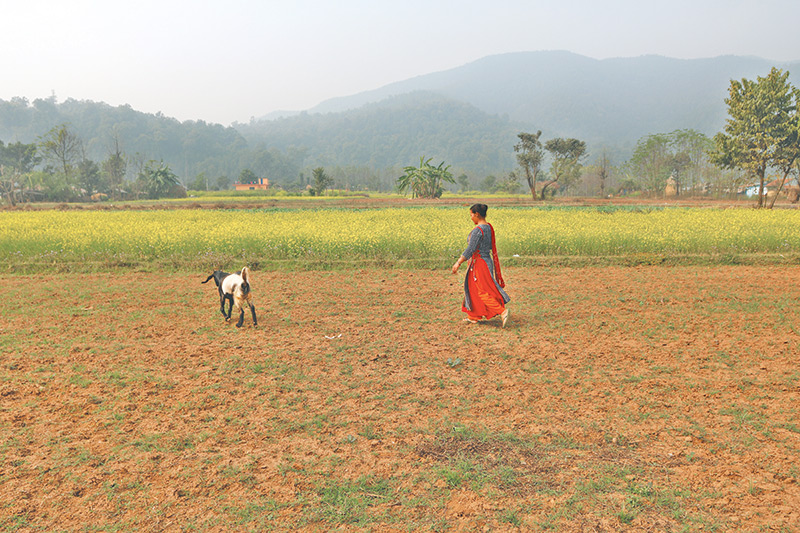
When remittance is plied into the productive sector, it can end the cycle of migration and provide a safety net for migrant families.
In the village of Jugepani in Hupsekot Rural Municipality, Nawalpur district, the majority of men work abroad. Only the women, children and elderly are left behind.

Nawalpur,
Almost a year ago, when Phumisara Thapa decided to start cucumber farming, everybody was sceptical. Some even tried to dissuade her, saying farming would cost a lot of money and she didn’t have the experience to run a commercial farm. But farming wasn’t new to Thapa; it was the only other thing she did, besides her household chores.
Thapa got married at the age of 16. As a housewife, her day began early at 4am, first cleaning and cooking, before working on the family’s small plot of land. Occasionally, she made homemade liquor, which she sold in the nearby market. But this meant that she had no time or savings of her own.
“I only had Rs5,000 and I needed Rs20,000 to start farming,” said 29-year-old Thapa. “So I decided to ask my husband to invest.”
But Thapa’s husband, who was working in Malaysia at that time, refused.
“He said that he would send me more money if what he was sending for household expenses wasn’t enough,” said Thapa. “But I remained firm on my decision, and my husband, very reluctantly, decided to invest money. As it was my first business, I was terribly nervous. I kept worrying what I would do if I lost that money.”
But by the end of the three-month cucumber season, Thapa had made a profit of Rs50,000. The money that she and her husband had invested had paid off, and Thapa was in charge of a vibrant new business. That was in April 2019. Today, she’s used the profits to invest in two other ventures—a tailoring shop and a pig farm. She makes around Rs25,000 every month.
In the village of Jugepani in Hupsekot Rural Municipality, Nawalpur district, the majority of men work in Malaysia and the Gulf. According to locals, every household has at least one member working abroad. Only the women, children and elderly are left behind.
Remittance money is the single largest contributor to Nepal’s GDP. In 2018, Nepalis working abroad sent home $8.1 billion, contributing 28 percent of the country’s GDP. Numerous studies and reports have pointed out the pitfalls of remittance, primarily the fact that it is creating an unhealthy dependence and that the money sent back is not being used productively. Most reports show that remittance is used for consumption, with some even suggesting that remittance is leading Nepalis to work less.
But in Jugepani, women like Thapa are not sitting around, waiting for their husbands to send home money. What is happening here contradicts established opinion. The women from Jugepani have been using the remittance money sent by their husbands to start businesses, helping create a thriving local economy. Some of the women have even become successful enough to convince husbands to return home.

Chinmaya Kanung depended on the money her husband sent from Malaysia for years until she started rearing livestock and tailoring.


When Thapa’s husband first left for Malaysia six years ago, his monthly salary was 1,000 Malaysian Ringgit, equivalent to Rs28,000 at the then exchange rate.
“What we grew in our fields was barely enough to feed the family. For everything else, we depended on my husband’s income,” said Thapa. “But the money he sent was not enough.”
According to labour migration experts, the majority of Nepalis who travel to countries in the Gulf and to Malaysia for work do so to provide for their family’s basic needs.
“The vast majority of them come from lower-middle-class backgrounds, and their basic  reason for opting for foreign labour is to provide food, clothing, and shelter to their families in Nepal,” said Ganesh Gurung, executive chairperson of the government’s Policy Research Institute, who has conducted extensive research on migration issues. “This is the reason why the majority of remittance money that flows into the country is used for consumption.”
In 2019, a survey by Sharecast Initiative Nepal, a non-profit distribution company, showed that 60 percent of remittance money was used to buy food, 42 percent for clothing, 36 percent for medical treatment, and 35 percent for children’s education.
But when a family spends all of the remittance money fulfilling basic needs, it leaves them with no savings to fall back on during hard times. Thapa realised this a few years ago when her grandmother-in-law fell ill and had to be hospitalised. To cover her medical expenses, the family had to take a loan of Rs130,000.
It was an understanding of this precarity that led Thapa to attend financial literacy classes provided by The Safer Migration Project, a bilateral initiative of the governments of Nepal and Switzerland, two years ago.
“Not only did the classes teach us the importance of saving money and keeping track of expenses, but they also served as an awakening from my economically unsustainable life,” said Thapa. “The classes made me realise how irresponsible it was of me to depend solely on my husband’s income to take care of the family’s needs.”
Remittance is upending gender roles in Nepali society to a large extent. As men leave the country in droves for destinations abroad, it is the women who now have to take up traditionally male jobs, according to Gurung,of the government’s Policy Research Institute .
After starting her cucumber farm, Thapa enrolled in a free government-run tailoring class and after two months of training, she started her own tailoring shop, which is located in a room in her parents’ house. The shop is sparsely decorated, but in one corner is her sewing machine, which she bought with the money her husband sent.
“Now, my husband is very happy and proud of all that I have managed to do. He has become very supportive,” she said. “A few months ago, my husband and I decided to buy some land in the village, and I contributed Rs50,000 of my own money.”

After attending a financial literacy class, and by using remittance money, Ganga Chuhan started rearing buffaloes, goats and chicken.


***
Jugepani is where Nepal’s flatlands hug the hills, giving it a unique geographical layout. To the north of the village are hills covered with sal trees. Where the hills end, the land flattens. Here, the majority of houses have been built with remittance money.
“Almost every family has at least one member working abroad,” said 41-year-old local Devi Maya Pandey.
For those living in the village, the fertile lands are one of the primary means to make a living from. At this time of the year, most of the village’s fields are blanketed with bright yellow mustard flowers. The majority of those tending the fields are women and elderly men.
But in the fields that the Pandey household owns, both Devi and her 47-year-old husband Lila Nath Pandey are working. In one section of the family’s fields, there are potatoes and a few metres away are cucumbers. Under the bamboo frames built to support the cucumber creepers, the family has planted black-eyed beans. While Devi digs potatoes from the ground, Lila carefully inspects the creepers.
This time two years ago, Lila was working for an advertising merchandise retail company in Dubai. He returned to Nepal in 2018 and hasn’t left the country since.
The first time Lila left for foreign employment was in 1999. He and Devi got married the same year, and just 21 days after the wedding, he left for Bahrain.
“I had no option. I was making just Rs1,000 a month from my teaching job, and our family’s financial condition was weak,” said Lila.
The job in Bahrain came with a monthly salary of Rs14,000. Before flying to Bahrain, Lila had already incurred a loan of Rs30,000 to pay for his passport and air tickets.
While Lila was away in Bahrain, Devi started working as a teacher to supplement her husband’s income. “I didn’t want our family to be reliant on only one source of income,” said Devi. But after she gave birth to her second daughter, juggling taking care of her daughters, household work, and a full-time job proved too challenging. She had to quit her job.
“Even though Lila always made sure I had pocket money, I didn’t like that I was now completely reliant on his salary,” said Devi. “So I decided to start a small-scale commercial vegetable farm with the money Lila sent back.”
Devi’s small farm became successful, so much that she was able to purchase more land, expand the farm, and add livestock.
In 2018, when Lila returned from Dubai, Devi asked him to stay back. She had proven that the family could earn enough money from farming and livestock rearing.
“He has paid a huge price to provide for the family. Since he could only visit Nepal for two months every two years, he wasn’t there when I gave birth to all three of our children. My daughters, aged 17 and 12,  grew up without a father figure. Every time he came home, they hesitated to open up to him. My heart used to break. So when he came home in 2018, I knew I should convince him to stay back,” said Devi.

Phumisara Thapa started a tailoring shop and a pig farm with the remittance money her husband sent. She makes around Rs 25,000 a month.


The couple now works together in the family’s fields. This year, the family made a profit of Rs300,000 from growing and selling cucumbers. Devi said that the family can comfortably make Rs500,000 to 700,000 a year from farming alone.
Remittance has been crucial in alleviating poverty in the country. According to the Multidimensional Poverty Index, published by the Nepal Planning Commission in 2018, the country reduced the percentage of people termed multidimensionally poor by 50 percent between 2006 to 2014, largely due to remittance, says Gurung. The corresponding increase in people’s purchasing power also played an important role in strengthening the country’s economy.
As much remittance helps to lift people out of poverty, it just as often ends up trapping people in a cycle of migration.
“When families end up spending all their remittance money on consumption, it leaves them in a very precarious position,” said Gurung. “In such a situation, the migrant worker gets trapped in a cycle of stint-after-stint of employment abroad. It also leaves the families in a very vulnerable position. It is therefore extremely important that families save money to invest in the productive sector.”
The loans that most migrants take to fly abroad end up accumulating interest at high rates, forcing migrants to go abroad repeatedly in order to pay off the loans. This happens because interest rates are high, and also because remittance money is not nearly enough to pay back loans while also providing for daily consumption needs. According to Nepal Living Standards Survey 2011, 79 percent of remittance money that enters the country goes into consumption while 7 percent into repayment of loans.
But by investing remittance money in small-scale businesses, women like Devi are  turning things around for them.  
In Jugepani, Devi’s husband isn’t the only one who hasn’t had to migrate again. Around a kilometre from Devi’s house lives Chinmaya Kanung. For years, Kanung depended on her husband’s remittance money.
“The money that my husband sent from Malaysia was what helped us cover the family’s expenses. I was just a subsistence farmer, but as the cost of living got higher and higher, I felt that it was important that I start working and earn money too,” said Kanung.
After attending the same financial literacy class with Phumisara Thapa, Kanung started a tailoring training centre with just one sewing machine, which she bought by selling a pig she had reared. Two years later, the centre now has five sewing machines, and Kanung has seven students learning tailoring from her.
“Business has been good, and I have invested some of my savings into pigs,” said Kanung, who said that she makes around Rs35,000 from the tailoring centre and Rs100,000 annually from rearing pigs.
Five months ago, Kanung’s husband returned from Malaysia. He has no plans of returning soon. “My husband has taken over the responsibility of the livestock and the fields, while I focus on the tailoring centre,” said Kanung. The family recently finished building a spacious goat shed and now plans to increase the number of goats and pigs they rear.

From her cucumber and blackbean farms, Devi Maya Pandey earns enough to keep her husband from leaving for labour work abroad.


***
Roughly 5 kms from Jugepani, in Srijanshil Tole of Kawasoti-3, the village’s women have taken it upon themselves to support each other in becoming more financially secure. Last march, 22 women aged 25 to 50 pooled together Rs15,000 each from the remittance they had received to start the Srijanshil Mahila Organic Krishak Samuha, an all-women organic agro-business.
The group now grows vegetables on five bighas of land it has leased. They have two spacious greenhouses to grow vegetables and a sizable pond, which is used to irrigate the farm.
Ganga Chuhan, leader of the group, admits that she wasn’t always an enterprising person. “I used to fit the stereotypical migrant worker’s wife who does nothing much except spend her husband’s money,” she said. “Every time my husband sent money, I would buy myself and my children new clothes, expensive things to eat, and as a result, I saved very little money.”
But again, a financial literacy class led her to realise the importance of saving money and being financially independent, she said. After attending the class, Chuhan started focusing on rearing buffaloes, goats and chicken, using the money that her husband was sending home.
“Now I make Rs20,000 a month by selling buffalo milk, and Rs80,000 to 90,000 a year by selling goats,” said Chuhan, who has also started
commercial vegetable farming. In two years time, Chuhan says her husband will be returning to the village for good. By that time, the Srijanshil Mahila Organic Krishak Samuha will be fully operational. She will focus on the women’s group while he focuses on the family’s farm and livestock.
Reinvesting remittance money into productive sectors not only has been providing supplemental income to migrant families but has also been helping buttress their financial strength over the long term.
But economists say that investing remittance money in the productive sector is easier said than done.
“The government needs to first identify the different categories of migrant workers sending remittance to Nepal. For example, those who work in countries like Singapore, Hong Kong and Brunei get paid better and hence send more money compared to those in the Gulf countries and Malaysia,” said economist Raghubir Bista. “The government will then have to make specific interventions tailored to specific categories of migrant workers.”
Gurung said that migrant workers in the Gulf countries and Malaysia start investing their money into productive sectors after almost 10 years of working abroad.
“That’s how long it usually takes to achieve some level of financial security for the majority of migrant workers,” said Gurung. Those who do invest, do so in very traditional sectors—farming, livestock rearing, and tailoring.
Experts say the government has a huge role to play to ensure remittance money is invested in productive sectors. According to Rajan Prasad Shrestha, executive director of Foreign Employment Board under the Ministry of Labour, Employment and Social Security, the government has identified 39 districts with high outward flow of labour migrants and has been providing them with different training programmes.
“These programmes are targeted at families of migrant workers to encourage them to invest in productive sectors,” said Shrestha. “In more than 30 districts, we provide counselling on how to follow proper legal processes while applying for jobs abroad and the kind of government protection they are eligible for.”
In 2019, the board also started providing free training in 19 different skills. This training programme prioritises returnee migrant workers, families of migrant workers, women, and those from socially and economically disadvantaged groups, said Shrestha.
“We also have another programme under which returnee migrant workers can receive a Rs1 million loan to start businesses, provided their business proposal is convincing,” said Shrestha.
Back in Jugepani, as Phumisara Thapa helps her parents till the fields near their house, she says that being financially independent has completely changed her life.
“I spent so many years of my married life limited within the four walls of my house, but after I started my small businesses, I began to find myself becoming more open and confident,” said Thapa. “Earlier, I had to ask for money from my husband for the smallest of things, but now, people come to me to ask for loans.”

Text & photos: Tsering Ngodup Lama
HOME PAGE

New Indian envoy faces growing geopolitical rivalry, border dispute in Nepal

As the interests of India, China and the US clash in Kathmandu, Vinay Kwatra will need to engage India’s soft power to showcase neighbourhood first policy.
- ANIL GIRI
Kwatra. Photo: Indian Embassy/Twitter

KATHMANDU,
As soon Vinay Mohan Kwatra, the new Indian ambassador to Nepal, presented his credentials to President Bidya Devi Bhandari on Thursday, he embarked on a marathon meeting session, hobnobbing with half a dozen political leaders in 24 hours.
Kwatra’s actions quickly drew reactions on social media, with some commending his high energy and others comparing him to Rakesh Sood, a former Indian ambassador who was known for his active diplomatic activities in Kathmandu.
Kwatra’s calls involved Vice President Nanda Bahadur Pun, Chairman of the National Assembly Ganesh Timilsina, Deputy Prime Minister and Minister for Defence Ishwar Pokhrel, former prime minister and Nepali Congress President Sher Bahadur Deuba, Foreign Minister Pradeep Gyawali, senior Nepal Communist Party leader Madhav Kumar Nepal, and Energy Minister Barsha Man Pun.
Kwatra’s spree of meetings portends that he will be an active interlocutor during his time in Kathmandu, especially at a time when China and the United States have both increased their engagement and visibility, say former diplomats and party leaders.
 It is a sign of New Delhi’s concern that India has sent a seasoned diplomat, who has worked with Indian Prime Minister Narendra Modi and is just coming off his term in Paris, France, they say.
But Kwatra will face an uphill challenge in Kathmandu, especially since there are a number of unresolved issues with India, including Kalapani.
Narayan Khadka, a senior Nepali Congress leader and shadow foreign minister, said that India has of late maintained a low profile but is likely to come forward aggressively if it feels its interests are at stake.
“They [Indians] are quietly observing China and remaining silent due to the boundary row as it does not seem like they are not adopting any aggressive stance,” said Khadka. “Another reason could be that the Indian political leadership is occupied with its own internal issues so they are not too focused on Nepal.”
Kwatra has a number of issues to deal with in Kathmandu, from implementing India’s ‘neighbourhood first’ policy to executing Indian projects and expanding New Delhi’s soft power. He will also have several opportunities to deliver because of long-standing bilateral ties with Nepal, said foreign policy analysts.
Manjeev Singh Puri, the former Indian ambassador, had pushed a number of projects, like the petroleum pipeline, postal road, integrated border check posts, and energy transmission lines. The new ambassador should push for completing the India-funded projects that remain as it is these projects that will ultimately cement ties, said Durgesh Man Singh, former Nepali ambassador to India.
“At the end of the day, people count on what’s happening on the ground, so completing India-funded projects will add more energy to bilateral ties,” said Singh. “Second, if the boundary dispute with India can be sorted out, it will be a big achievement.” To this end, we should continue with high-level exchanges, dialogue and understanding at the political and diplomatic levels.”
In his meeting with Energy Minister Pun, Kwatra had commented on positive developments in Nepal’s energy sector, especially since the formation of the KP Sharma Oli government.
“In the fields of energy, water resources and irrigation, we have made several good progress since the formation of the Oli government,” Kwatra said while expressing satisfaction over progress in the Arun III hydroelectric project and cross-border transmission lines.
However, the major issue that Kwatra will need to address remains the boundary dispute over Kalapani. In November, a new Indian political map, released to mark the split of Jammu and Kashmir after the Narendra Modi government’s decision to repeal the state’s autonomous status, had placed Kalapani, which Nepal claims, within Indian borders. This had led to a massive uproar in Nepal, with many calling on the government to take this issue up stridently with the Indian establishment. On November 20, the Oli government dispatched a diplomatic note protesting Kalapani’s placement. The Indian government replied a month later, merely expressing its readiness to sit for a meeting.
According to Nihar Nayak, a research fellow at the Institute of Defense Analysis and Studies in New Delhi, Kwatra’s primary challenges include the boundary issue and the Eminent Persons’ Group report while his opportunities are that he can pursue India’s neighbourhood first policy and showcase that Nepal is India’s priority.
“Showcasing India’s soft power towards its smaller neighbours and its willingness to work together are opportunities for the new Indian envoy in Kathmandu,” he said. “Another issue that is awaiting execution is expediting the Bangladesh, Bhutan, India, Nepal framework, where he could play a crucial role.”
The Bangladesh-Bhutan-India-Nepal framework, or BBIN, is a sub-regional concept within the framework of SAARC focusing on connectivity-related projects among the four nations.
However, much remains to be seen regarding the new ambassador, as he has only met a few political leaders. A senior Nepali politician who met with Kwatra told the Post that since he has only been paying courtesy calls, no serious issues have been discussed yet. It will take a few rounds of meetings to know how exactly Kwatra wants to advance bilateral ties and his way of functioning.
According to Bishnu Rijal,  deputy chief of the International Department of the ruling Nepal Communist Party (NCP), Kwatra was soft-spoken and used very polished language in his meeting with Madhav Nepal.
“He looked very calm but since it was the first meeting, we mainly discussed issues related to strengthening Nepal-India ties,” said Rijal. In New Delhi’s political circles, Kwatra was always seen to be the first choice of the Bharatiya Janata Party for the Nepal assignment, said a Nepali diplomat in the Indian capital.
“Kwatra was seen as someone who will be able to handle crucial issues, including the rising geopolitical competition among China, India and the United States over Nepal,” he said.
Kwatra, who brings 32 years of experience in the Indian Foreign Service, first served in Geneva. Since then, he has handled numerous portfolios across the world, including South Africa, Washington and China. He worked at the Indian Prime Minister’s Office from 2015 to 2017 before taking up the assignment in France. He is a 1988 graduate of the Indian Foreign Service with a master’s in science and a diploma in international relations.

HOME PAGE

As Covid-19 spreads to Malaysia and the Gulf, uncertainty looms over Nepali migrants’ jobs

Labour migration to South Korea has been halted but no decision has been taken yet on migrant departures to the popular labour destinations as coronavirus cases multiply.
- CHANDAN KUMAR MANDAL
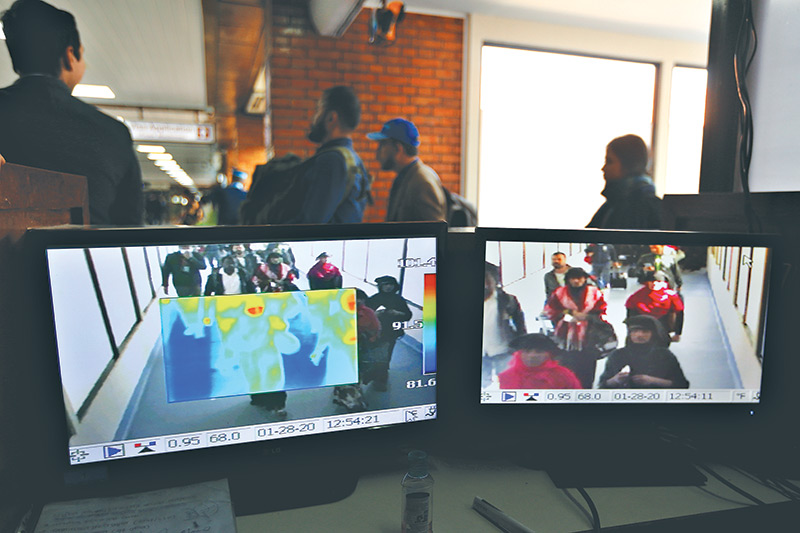
Travellers are shown on screens at Tribhuvan International Airport in Kathmandu. Post file Photo: Kiran Panday

KATHMANDU,
In late February, in response to the massive spread of Covid-19 in South Korea, the government temporarily suspended labour migration to the country. Now, as Covid-19 cases begin to spike in countries in the Gulf and Malaysia, which are primary destinations for Nepali migrants, there are concerns that the government will suspend travel to these countries too.
South Korea has been most affected, after China, by Covid-19 with over 6,280 confirmed cases and 40 deaths. Among major destinations for Nepalis in the Middle East, Kuwait has reported 58 confirmed cases, Bahrain has 49, the United Arab Emirates has 27, Qatar has 8 and Saudi Arabia has 2, so far. Malaysia too has reported 50 confirmed cases.
There are an estimated 500,000 Nepali migrants in Malaysia, the most popular labour destination, followed by Qatar with over 400,000, Saudi Arabia (334,451) and the United Arab of Emirates (224,905), according to the 2019 Migration in Nepal Report.
Even as more Nepalis ready themselves to go abroad, despite the global health panic, the government remains undecided on whether to halt labour migration to these countries.
“The ministry has been discussing various options, including whether to stop labour permits and what to do in case of a mass outbreak, in the last couple of days but no formal decision has been taken so far,” said Suman Ghimire, spokesperson for the Labour Ministry.
“As the Supreme Court has directed the government to stay alert, we need to have some early preparedness measures in place.”
The government, on Monday, issued a travel advisory asking the public to refrain from non-essential travel to countries affected by Covid-19, including China, South Korea, Iran, Japan and Italy, to prevent the spread of the disease to Nepal and Nepalis.
Nepali missions in labour destinations have also issued similar advisories asking Nepali citizens to stay safe and suggesting measures to
protect themselves from a potential infection.
But on Tuesday, there was mass confusion among migrants as numerous media reports claimed that labour permits for some countries had been temporarily stopped in the wake of the coronavirus outbreak. The Labour Ministry later clarified that no such decision had been taken.
 “The Labour Ministry is coordinating with other government agencies to discuss the matter in detail before coming out with any such decisions,” said Ghimire. “Coronavirus cases are on the rise. We need to analyse the situation thoroughly and coordinate.”
Although a decision has yet to be taken, the coronavirus outbreak is certain to affect the country’s labour migration sector. Numerous countries have placed travel restrictions and in countries severely affected severely by Covid-19, like South Korea and Japan, shops and businesses have shut down, turning cities into ghost towns. The Nepali migrant population is certainly reeling from the downturn in the economies of these cities.
Source countries like Nepal, whose labour force remains highly concentrated in a few Persian Gulf countries and East Asia, should be cautious while sending their workers to countries with reported cases of coronavirus, said Jeevan Baniya, a labour migration researcher.
“Sending out workers to those countries can have severe implications,” said Baniya, who is also an assistant director at the Centre for the Study of Labour and Mobility at Social Science Baha, a think tank. “There should be prior risk analysis as there could be political consequences if a Nepali worker spreads the virus in foreign lands. A large scale outbreak will also necessitate the rescue and repatriation of our citizens, and their subsequent treatment here in Nepal.”
The coronavirus outbreak has once again exposed the problems with Nepali labour migration and its dependence on a few destination countries for jobs. Labour analysts have often warned that any turmoil in the Middle East could have significant consequences for the migrants there, and on the Nepali economy, to which remittance is a major contributor.
“Our dependence on a handful of countries, when there are geopolitical and economic upheavals, can have serious ramifications on our labour migration sector,” said Baniya. “The global economy has been affected, so has the economy of those countries, meaning the labour demand from Nepal might see a drop in the future as well.”
The World Health Organization has so far confirmed more than 97,000 Covid-19 infections in dozens of countries, with more than 3,380 deaths.

Page 2
MEDLEY

Horoscope

ARIES (March 21-April 19)
***
Today is going to be all about speed. Whether you’re ready or not, things are going to move quickly in one of your newer relationships, and you should hang on and see where it goes. Your expectations were so specific that they might not all get met in exactly the way you want, but the overall result should make you very happy.


TAURUS (April 20-May 20)
***
An old friend has been behaving in some new ways and you’re confused. Their recent actions have felt out of character, but maybe they’ve changed. How well do you really know them anymore? You two need to reconnect as soon as your schedules allow. Go for something intimate.


GEMINI (May 21-June 21)
****
You could feel strong flirtatious energy with a surprising someone today, although nothing says that you have to take things to the next level. In fact, the stars favour flirtation more than relationships right now, so it’s wise to keep things light and breezy instead of committed and long term.


CANCER (June 22-July 22)
**
You won’t be easily guided today. No voices of authority will be loud enough to crack through your brain and change your mind. You know what you want, and no one can stop you from getting it. Although this high level of determination is going to take you places, it’s not going to make you any new friends.


LEO (July 23-August 22)
***
Ready or not, you’re entering an indecisive phase, and picking the next project, or job opportunity is going to be a bit rough. There are so many good points to all of your options. But being confused isn’t necessarily a bad thing. You should see it as an opportunity to learn how to appreciate the options on the table.


VIRGO (August 23-September 22)
***
With your cheerful energy, you can turn the most apathetic group of people into an enthusiastic crowd of positive folks today! You know that despite the tough challenges your group is facing, there is always light at the end of the tunnel. All you have to do is make sure that everyone else understands that, too.


LIBRA (September 23-October 22)
****
Your creativity is good for more than just writing cute little notes inside birthday cards, and today is a great day to explore its full potential. First, get some inspiration outside. Go for a walk to get your blood pumping and your mind working in new directions. Getting started on something new is going to get you excited.


SCORPIO (October 23-November 21)
***
A friend or close family member may be experiencing a significant change in their income.You’re happy for them, but you can expect some jealousy to creep into your attitude when they tell you about their latest purchase. Focusing on other people’s money is only going to cause you to focus on how you compare.


SAGITTARIUS (November 22-December 21)
**
You were confident everyone would love your idea for a group outing, so how come no one seems as excited as you are? If your social invitation isn’t being greeted with all the enthusiasm you’d hoped for, just wait it out. Your friends have an awful lot going on in their lives right now. You can’t take this personally.


CAPRICORN (December 22-January 19)
***
Casual conversations don’t have to be vapid conversations. That would just be a waste of your time. Make sure any small talk you have today is very brief! Don’t just yak about the weather or the latest sports scores. Cut to the chase about what is really on your mind right now.


AQUARIUS (January 20-February 18)
***
Just because you have to do some work today doesn’t mean that you can’t have a ball while you’re doing it! Let your creativity drive your day, and it will help you arrive at some amusing combinations, unusual arrangements, and interesting thoughts that can help the day go faster and be way more fun.


PISCES (February 19-March 20)
**
You don’t always need to fully understand every single detail of an idea before you can get involved with it, especially now, when any risk taking on your part is highly favoured. Besides, trying to sort through all the details could confuse and overwhelm you and give you too many reasons to chicken out.

Page 3
NATIONAL

House unanimously asks government to come up with plan to tackle virus threat

Congress lawmaker Thapa demands the government set up more quarantine facilities in view of potential outbreak.
- BINOD GHIMIRE
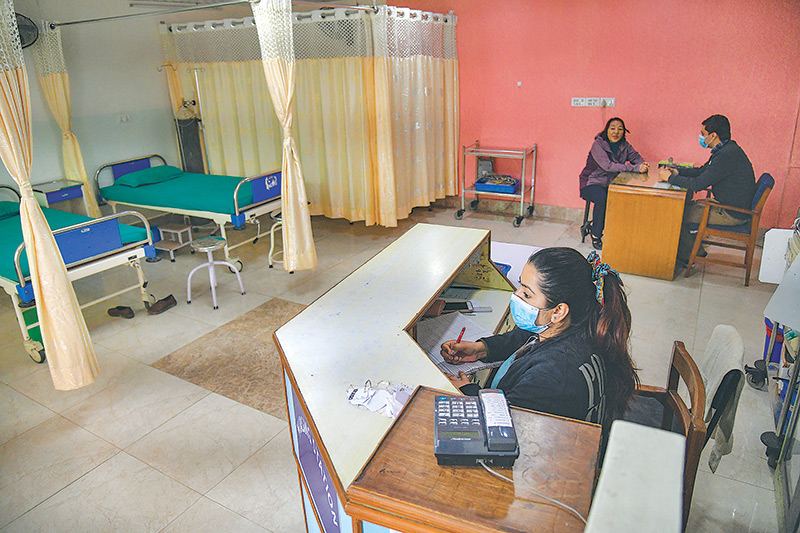
Staffers and patients wear masks as a precaution against Covid-19, at a hospital in Baneshwor, Kathmandu. Post Photo: Deepak kc

KATHMANDU,
Lawmakers have asked the government to come up with a concrete action plan for the awareness and preparedness against coronavirus. That there hasn’t been an outbreak of the Covid-19 in Nepal, over three dozen members of the House of Representatives unanimously said, doesn’t mean the threat has been averted.
Expressing their views on the proposal of public importance tabled by Nepali Congress lawmaker Gangan Thapa, they said Nepal has got a golden opportunity to ready itself to deal with an outbreak. Thapa presented the proposal seeking a united effort between the federal parliament, the three tiers of government and other agencies for effective preparation while there was no outbreak.
Presenting the proposal before the Lower House, Thapa said the World Health Organisation has placed Nepal among the countries with a very high risk of an outbreak not just because the country shares border with China, the epicentre of the outbreak.
“Our lack of ability to deal with an outbreak of high intensity is another important factor,” Thapa said. “I ask the government to roll out a concrete action plan with the needed budget for preparedness.”
He said the government must ready other places like the Nepal Electricity Authority’s training centre in Kharipati, Bhaktapur, in case there is a high demand for isolation. There could be closed hotels, apartments or government buildings where infected people and those who need quarantine may be housed, he suggested.
Thapa’s proposal says the laboratories in Kathmandu can test 1,600 to 1,700 samples a day if the government ensures they have adequate kits. The government has formed the High-Level Coordination Committee to Control and Prevent Novel Coronavirus led by Deputy Prime Minister Ishwar Pokhrel, but it hasn’t come up with its plan yet to contain an outbreak. “Every decision of the coordination committee must be known to the people,” he said.
Supporting Thapa’s proposal, ruling party lawmakers said the government has failed to ensure proper screening at border entry points. They also raised questions over the status of around 1,400 people, who have come to Nepal from five highly affected countries since the last week of February.
“There must be a proper screening facility at border points including with India,” said Nepal Communist Party lawmaker Bhim Rawal. “The open border with the southern neighbour is a real threat for the country.”
The entire meeting of the Lower House on Friday was dedicated to discussing the threat of coronavirus and the initiatives Nepal government should take.
The lawmakers suggested that the government boost the morale of health workers by increasing their allowances and insurance. “The threat of coronavirus is multidimensional. Along with health, it has long-term effect on tourism, economy and education,” said Sarat Singh Bhandari, a praesidium member of the Rastriya Janata Party Nepal. “The better the preparedness, the lesser will be
the loss.”
Bhandari said the government should coordinate with non-government agencies to mobilise volunteers for raising awareness in every part of the country.
Responding to the concerns of lawmakers, Minister for Health Bhanu Bhakta Dhakal said the government was seriously working on preparedness and to ensure minimum loss in case the country sees an outbreak.
He said the first priority of the government is to make sure no infected foreigner enters Nepal. The government is screening travellers at
37 different places to stop the contagion, he said.
Dhakal said 155 isolated hospital beds have been readied and the numbers are increasing. “All the governments, along with parliaments and assemblies, must work together to fight if there is any threat,” he said. “We need to be aware of the disease but there is no reason to panic.”

NATIONAL

Police personnel work without basic safety gear amid coronavirus scare

- SHUVAM DHUNGANA
Police personnel say they don’t have the required gear to keep them same from Covid-19. Post File Photo

KATHMANDU, 
The Nepal Police Headquarters on Wednesday issued a directive to every police station across the country to take necessary safety precautions against coronavirus.  
The directive instructed all on-duty personnel to wear face masks, avoid handshakes and wash hands.
But many officers, particularly those working in crowded areas, are still executing their duties without basic safety gear like face masks and gloves.
When the Post inquired some on-duty police officers about the safety precautions, they said they had not received any protective gear from their respective stations.
Out of fear of contracting Covid-19 while on the job, they said they had bought face masks with their own money.
“Although we have received the directive to stay safe, we are yet to receive protective gear like masks, gloves and sanitiser,” said a police inspector who did not wish to be identified. “We are using disposable masks to stay safe, but our stock is quickly running out.”
Another officer working in the Kathmandu airport said they were getting face masks from the airport authority and airlines companies.
“We have been instructed not to maintain a safe distance with others and not to touch any person until and unless it’s urgent. To keep our safe we are wearing basic surgical masks
and cloth masks provided by the airport and airlines. The Nepal Police has not provided us with any safety gear so far.”
Senior Superintendent of Police Ram Tripal Shah, however, claimed that Nepal Police has been providing masks and gloves to every police stations and beat offices.
“We have ordered additional face masks and gloves so that we do not run out stock,” Shah told the Post.  He insisted that the directive from the headquarters was being followed strictly. Superintendent of Police Jeevan Kumar Shrestha at the Metropolitan Traffic Police Division also claimed that the traffic officers on the streets of Kathmandu had enough protective gear to remain safe.
“We have provided surgical masks, gloves and sunglasses to our officers,” Shrestha said. “We have even instructed our officers not to carry out drink driving tests as it could be dangerous for them.”
Deputy Inspector General Biswaraj Pokharel, chief of the Metropolitan Police Office, Ranipokhari, said the Nepal Police was making
preparations to distribute necessary safety gear to those officers who did not have them.
“Although we have already issued the safety directive to our officers, we are yet to distribute protective gear,” Pokharel told the Post. “In the first phase, we are planning to distribute face masks. We will distribute other items like sanitisers later on.”

NATIONAL

Schools across country take measures to prevent Covid-19 from spreading

Students and their parents feel awareness programmes need to be made mandatory at all schools.
- ANUP OJHA
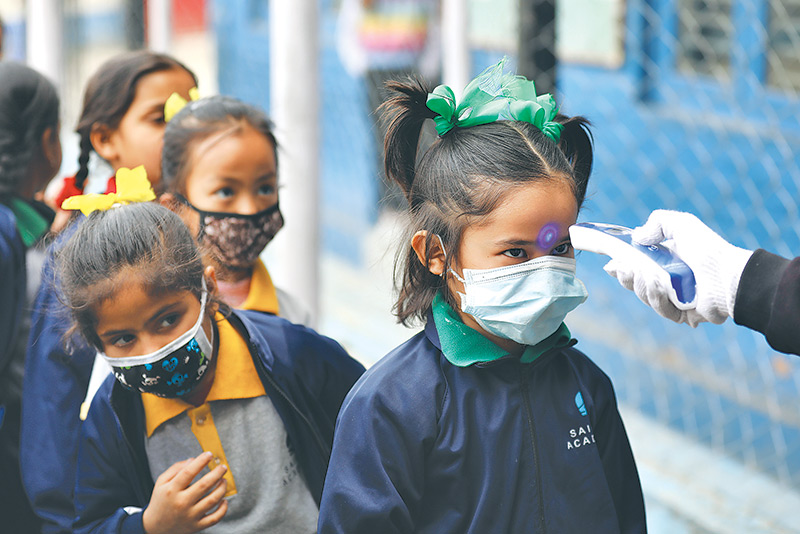
Students have their temperature taken at Saipal Academy, Sukedhara, Kathmandu on Friday. Schools have stepped up measures to prevent the spread of coronavirus. Post Photo: Elite Joshi

KATHMANDU,
Schools across the country have started taking measures to prevent the Covid-19 global epidemic from spreading.
While many schools across the country are conducting awareness programmes on washing hands and wearing face masks properly, some are taking temperatures of students and staffers and even cancelling extra-curricular activities.   
“We have bought five thermometer guns--one for each block of the school,” said Sangita Shrestha, principal of the Senior Block of VS Niketan School, Minbhawan.
“The school shall send any student of staff with fever over 100F home,” she told the Post, adding, “Luckily, we haven’t had such a case yet.”
Last week, the World Health Organisation said the coronavirus outbreak, which started in China in December, had reached a “decisive point” and it had potential to turn into a pandemic. To prevent a possible outbreak, the Ministry of Education, Science and Technology has already directed all schools to conduct their annual exam by March 18.  
Administrators at the DAV Sushil Kedia School, Jawalakhel, cancelled all extracurricular activities and field trips for its 3,000 students from Wednesday.
“We have brought in three nurses to look after the health of our students and staff,” said Vice-principal Ram Chandra Kaphle.
Adarsha Vidya Mandir, Lalitpur, encourages its students to bring hand sanitiser and face masks to schools. Several community-run schools such as Ratna Rajya School, New Baneshwor, have conducted awareness programmes for their students.  
Schools outside the Valley have also taken initiatives to prevent the spread of the respiratory disease.
Mangala Secondary School, Lamjung, has been conducting awareness classes for its students for the past four days. “We have invited health workers from our district to our school to raise awareness,” said Bishnu Hari Bastola, principal at the school which has nearly 1,000 students.
Similarly, Bal Udaya Secondary School, Rolpa, organised an interaction with a doctor from the district hospital for its 346 students on ways to prevent the disease from spreading.
“Dr Sapana Karna from the Rolpa Hospital explained to the students and teachers the symptoms of coronavirus,” said Khem Bahadur Buddha, a social activist based in the district. “We distributed 500 disposable masks and soaps to students,” he added.
The initiatives taken by the schools have been appreciated by students and their parents.
Anor Singh Karki, 74, father of  a 10th-grade student at DAV was relieved after learning about the school’s campaign.
“As parents, we are scared to send our kids to school. The school has given a holiday for the preparation of Secondary Education Examination. All schools should take strict measures to maintain the students’ hygiene,” said Karki.  
Saugat Gharti, 17, a 10th-grade student at Bal Udaya School, Rolpa, said he found the awareness programme and its message fruitful.  
“We now know the symptoms of the disease caused by coronavirus and precautions we need to take to avoid it,” he said.

Page 4
NATIONAL

Supreme Court questions government on constituency development programme

Three Nepali Congress lawmakers had filed a writ petition demanding an end to ‘discrimination’ between directly elected and proportional representation lawmakers.
- TIKA R PRADHAN
The five-member constitutional bench of the Supreme Court issued the order on Friday. Post file Photo 

KATHMANDU,
The Supreme Court has issued a show-cause to the government over regulations that govern the constituency development programme.
The five-member constitutional bench of the Supreme Court, which includes Chief Justice Cholendra Shumsher Rana, issued the order
on Friday after three lawmakers moved the court saying that members of the House of Representatives who win their seats under the first-past-the-post (FPTP) electoral system get to select projects under the constituency development fund, but those who make to Parliament under the proportional (PR)  system don’t have a say in it.
The government provides Rs 60 million to each member of the House of Representatives elected under the FPTP system for the development of their constituencies.
“The Supreme Court has issued a show-cause notice to the government,” said lawmaker Prakash Rasaili (Snehi), one of the petitioners who filed the writ on December 17. “Now authorities need to present a written response through the Attorney General’s office within 15 days.”
In their petition, Rasaili (Snehi), a lawmaker elected to the House of Representatives under the the PR system from Bajhang and Rangamati Shahi, elected under the PR system from Humla, and Prakash Pantha, a member of the National Assembly, demanded that the court issue an interim order to halt the programme until the case is finalised.
The lawmakers say that the member of Parliament elected under the FPTP system convenes the committee that decides how to use the fund, without consulting other lawmakers. This is against the spirit of the constitution which does not discriminate between lawmakers elected under different systems in the federal Parliament.
The three lawmakers filed the petition after Bhairav Bahadur Singh of Nepal Communist Party, elected on the FPTP system from Bajhang-1, used the fund without consulting members of Parliament elected under the PR system.
 In his budget speech, Finance Minister Yubaraj Khatiwada had said that working procedures governing for the programme will be revised to ensure that all lawmakers are involved in monitoring of the projects under the programme. However, the provisions were not rolled out.

Page 5
NATIONAL

Child marriage is still prevalent in Makwanpur

According to the District Public Health Office, child marriage is most widespread in Chepang communities.
- PRATAP BISTA

MAKWANPUR,
Fifteen-year-old Radhika Chepang of Katunje, a sixth-grader at Bhawani Secondary, dropped out of school this year following her marriage to Arun Chepang. Chepang, however, is not the only one from the school to get married at an early age, said Principal Balchandra Malla. In this academic session alone, eight students--all under age--of Bhawani Secondary got married. Another school, Suryodaya Secondary, in Raksirang, reported that 12 of its students got married as children this session.
“Those students who get married eventually drop out of school,” said Dipak Karki, principal of Suryodaya Secondary. “We teach students that child marriage is illegal and that it harms them on multiple fronts, but they still get married at a young age.”
Marrying early can lead to various health complications as well, said Ramesh Adhikari, chief of the Hetauda-based provincial health directive.
“Those who give birth before 20 suffer from uterus prolapse, among other reproductive health issues,” he said. “More worryingly, newly born children are exposed to long-term health risks.”
Despite multiple campaigns aiming to stop child marriage, the practice continues unabated in the district’s rural belt, with schools reporting dozens of such cases in a single academic session.
“Traditional norms, poverty and illiteracy are contributing to the high rate of child marriage in the district,” Karki said. Malla said that a majority of parents in the rural belt feel they have to marry off their children once they reach puberty.
According to data provided by the District Public Health Office, child marriage is most widespread in the semi-nomadic Chepang communities of Makwanpur.
The district’s rural municipalities report that 45 to 86 percent of children from Chepang communities get married between the ages of 12 and 18. Out of 237 marriages in Bhimphedi Rural Municipality in the fiscal year 2019/20, 58 were child marriages. Of those 58 cases, 75 percent of the couples had eloped.
“People in Chepang communities believe that marrying off their children at an early age is economical,” said Rajkumar Malla, chief of Raksirang Rural Municipality. “The families of a bride think they have fewer burdens when their girl child is married early; while for the family of a groom, marriage means extra workforce.”
Malla added that many people there don’t even know that marrying before the age of 20 is illegal.
Almost all of the district’s local units have plans and policies to curb child marriage but they have yet to effectively implement them, according to Tanka Moktan, chief of Kailash Rural Municipality. “On paper, child marriage is prohibited. But the rule hasn’t been implemented effectively.”
The federal government has announced a plan to eradicate child marriage by 2030. But the Bagmati Provincial government has an even more ambitious plan to eradicate the practice within early 2022. The local units have floated policies to work towards that.
“We will at any cost make the province child marriage free by early 2022,” Dormani Poudel, chief minister of the province, declared. “Child marriage is a matter of shame to the province and the whole country.”
Among the 13 districts in the Bagmati Province, Nuwakot has the highest rate of child marriage with 62.58 percent; Dhading has 62.9 percent; Sindhuli 62.5 percent; and Makwanpur 59.7 percent, according to a recent data by the provincial ministry of social development.

NATIONAL

Elected official accused of constructing house by encroaching on forest land

- Ganesh Chaudhary
Around 140 families have built a settlement on the forest land of Lamkichuha Municipality. Post Photo: GANESH CHAUDHARY

TIKAPUR,
An elected people’s representative in Bhajani Municipality, Kailali, has constructed his house by encroaching on forest land, said officials of Bhajani Forest Office.
According to the office, Sher Bahadur Bohara, the ward member of Bhajani Ward No. 5, encroached the land belonging to local Shanti Community Forest and started constructing a concrete house.
“We attempted to recover the encroached forest land a few days ago. But the local unit assured us it would resolve the issue by holding talks among stakeholders. The local unit has not taken any decision so far,” said Shishir Lamsal, assistant forest officer. “The forest office was preparing to evict the encroacher with the help of the police. But the local unit stopped us,” he added.
A local youth club has been protesting against Bohara after the latter started constructing a concrete house on the forest land. The forest office attempted to recover the encroached land by demolishing the structure after the club informed the office about it.
Bohara, however, refuted the allegations. “The community forest has constructed a trench to separate its land. The land where I am constructing the house is outside the boundary of the forest land. There are 15-16 other houses as well. I have not encroached the forest land,” said Bohara.
Talking to the Post, Mayor Sher Bahadur Chaudhary said that the municipal office had instructed Bohara to not construct the house on the forest land.
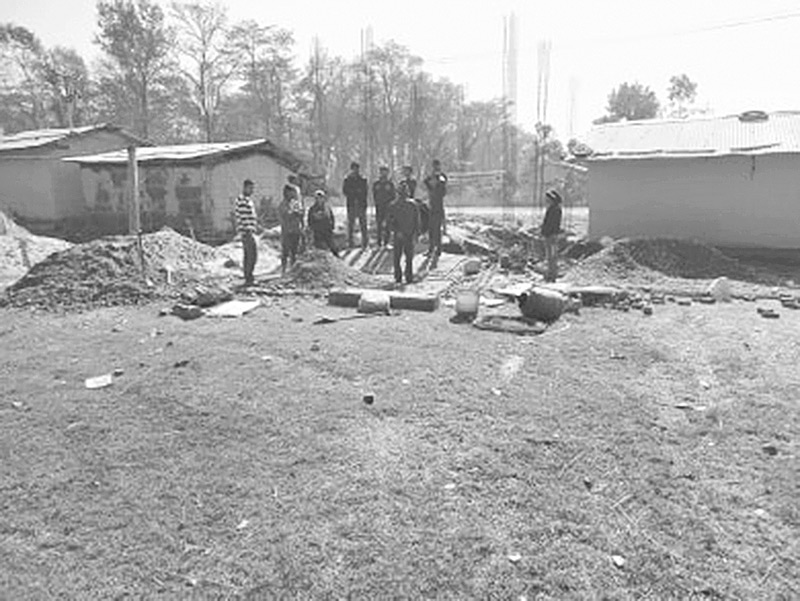
Encroachment of forest land is rampant in several places in the district. In Gorange area of Lamkichuha Municipality, around 140 families have built a settlement on forest land. Although Rani Jamara Kulariya Irrigation Project had acquired the land from by offering compensation to the locals a few years ago, the locals have still not cleared the land.
 “We urged the forest office to evict them but to the locals have refused to leave the property,” said Lalbir Chaudhary, chairman of Jamara Canal Consumers’ Committee.

NATIONAL

Dozens of rural roads have been built in Parbat, but most of them are out of use

- AGANDHAR TIWARI
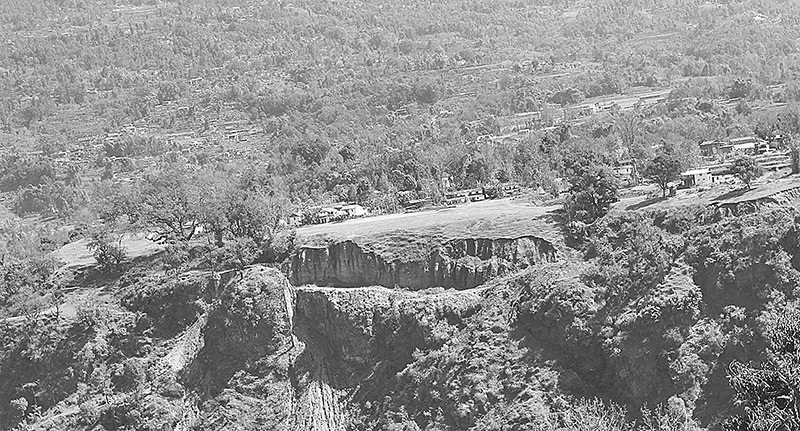
Around 1,000km of roads in Parbat are still unmotorable. Post Photo: AGANDHAR TIWARI

PARBAT,
Dozens of rural dirt tracks that were opened in Parbat district ahead of the 2017 local elections in Parbat district have become death traps.
The tracks, dug at the initiative of local leaders to woo voters, have raised the risk of landslides in many settlements.  
In some places like Upper Bachha, multiple road projects were launched at once.
“The people of Upper Baccha did not need roads. Still, three road projects were launched in the village,” said Buddhiman Gurung, a local man. “None of the roads are in good condition. They have only raised the risk of landslides.”
Since the local elections three years ago, almost every settlement in Parbat has been connected to the district’s road network. But most of the roads are in a poor state.
Even after the elections, the local governments in the district have prioritised the construction of roads, pouring more than 60 percent of their development budget in road construction.  
Khagendra Tiwari, the chairman of Painyu Rural Municipality, admitted that a majority of local governments in Parbat had indeed placed inordinate priority on road projects.    
“Other sectors such as social security, health, education, communication, agriculture, good governance and poverty alleviation have been sidelined as a result,” Tiwari said.
In Kandeni village of Modi Rural Municipality, the 7km Patichaur-Deupur road was expected to be a boon for the villagers. But even after the construction of the road, the villagers are still carrying their agricultural produce to the market on their backs.   
“The rural roads are of no use for us,” said Tulasiram Paudel, a local farmer.
Dayaram Adhikari, chief at the Infrastructure Development Office, said around 1,000km of roads in Parbat are still not motorable.
 “Around Rs 2.5 billion of budget used in road construction have gone down the drain,” Adhikari said. “Most of the rural roads are in a dilapidated condition.  Vehicles cannot move on these roads because of poor construction quality.”
Although the road has done nothing but poses landslide risks to many settlements, there’s still unhealthy competition among the local units to open roads.

NATIONAL

Ministry proposes construction of 1,000-bed hospital

Briefing
- Post Report

MAHOTTARI: The Ministry of Education Science and Technology has proposed to construct a medical college with a 1,000-bed hospital in Bardibas Municipality Ward No. 4. Devi Prasad Subedi, chief at the College Infrastructure Construction Development Project, said the project will soon prepare a detailed project report of the medical college.

NATIONAL

Tiger found dead in Parsa

Briefing
- Post Report

PARSA: A tiger was found dead at Panchamukhi Community Forest in Thori Rural Municipality on Wednesday. In the last two and a half months, two tigers have been found dead in Parsa district. There are 19 adult tigers in Parsa National Park.

NATIONAL

Bhimphedi-Kulekhani tunnel way within three years

Briefing
- Post Report

MAKWANPUR: Dubbed a provincial pride project, the Bhimphedi-Kulekhani tunnel way is expected to be completed within three years, according to Sahadev Bhandari, director at Transportation Infrastructure Directive. The construction of the 2.25km long and 11m wide road will cost an estimated Rs15 billion. A team of experts is currently carrying out the technical study of the tunnel way.

NATIONAL

Tippers carrying illegally extracted materials seized

Briefing
- Post Report

MORANG: Police have seized four tipper trucks carrying illegally extracted riverbed materials from Netachok in Gramthan Rural Municipality. The trucks were confiscated while they were carrying riverbed material to the towns for construction. The trucks have been handed over to the local unit for punishment, according to police.

NATIONAL

10-year jail for rhino killer

Briefing
- Post Report

CHITWAN: Chitwan District Court on Friday sentenced a man to 10 years in jail and fined him Rs 50,000 for killing a rhino and selling its horn. Rudramani Giri, the registrar of the court, said District Judge Hemanta Rawal handed down the order against Gopal Praja Chepang of Ichchhakamana Rural Municipality Ward No. 7, who was accused of killing the rhino around 13 years ago.

Page 6
MONEY

EU trade chief hopeful on US ‘mini-deal’, hurdles remain

- REUTERS

DUBLIN, 
The European Union is hopeful of reaching a “mini” trade accord
with the United States United in the coming weeks, but there are still
difficult issues to overcome including barriers for farm products, EU Trade Commissioner Phil Hogan said on Friday.
Hogan was speaking ahead of a visit to Washington on March 16-17 that could prove crucial in staving off a US threat of car tariffs.
“Hopefully we can reach some mini deal at least, or some understandings in the coming weeks,” Hogan told reporters in Dublin.
“We are taking slow and small steps towards a ‘mini deal’,” he said in a speech to business leaders. “There is currently momentum for both sides,” he added.
Hogan, who was promoted from the role of EU farm chief in November, has made resetting strained EU-US relations a top priority. He said the main issues were trade, technology and energy and that there could be some movement on removing barriers to agricultural trade.
“There is a long list on both sides that have been outstanding for many, many years,” he added. “There is no scientific basis for any of these impediments to agricultural trade.”
However, he said that the EU would not change food safety regulations and would not ask for any changes from Washington that required Congressional approval.
Hogan said the discussions on ‘conformity assessment’, to make it easier for companies to show their products meet the standards of either market, had slowed in recent months, but he believed the United States still wanted a deal on this.
During Hogan’s visit to Washington he will give a speech on his ideas for reform of the World Trade Organization. No meeting with U.S counterpart Robert Lighthizer is planned for now.
“I am hopeful that this speech can act as a catalyst for further action and global collaboration, particularly across the Atlantic,” he said. The Geneva-based trade body needed a “profound overhaul” and “not just tweaking at the margins”.
The European Union, he said, agreed with many of Washington’s criticisms of the WTO, such as on the WTO’s appeals process, but it was now time to find common ground. Washington has blocked the appointment of trade judges, depriving the WTO of its ability to rule in disputes.

MONEY

OPEC oil cut deal in trouble as Russia still not on board

Moscow’s decision not to back the additional curbs could undermine cooperation between the Organization of the Petroleum Exporting Countries and Russia
- REUTERS
A view shows Gazprom Neft’s oil refinery in Omsk, Russia. reuters 

VIENNA, 
Russia will not back an OPEC call for extra oil output cuts and will only agree to extending existing curbs, a Russian source said on Friday, threatening to derail a plan by OPEC ministers for deeper reductions to cope with the coronavirus outbreak.
“That position won’t change,” the high-level Russian source told Reuters as ministers from OPEC, Russia and other producers, a group known as OPEC+, gathered for crunch talks at OPEC’s Vienna headquarters as the spreading virus has hit oil demand.
OPEC ministers had said on Thursday they backed an additional 1.5 million barrels per day (bpd) of oil cuts until the end of 2020, a much bigger and more extended move than expected, but they made the proposal conditional on Russia and other non-OPEC producers backing the curbs.
Russian Energy Minister Alexander Novak has not made any public statements about the proposed extra cuts during his trips to and from Vienna this week, although Moscow has long indicated it was uneasy about any further output reductions.
“There is a problem. OPEC has no intention to cut without Russia. We need to do something or the consequences will be drastic for everyone,” a source from a Gulf producer said.
An OPEC source confirmed that Russia had rejected a deeper cut proposal during informal consultations on Friday. The informal consultations have delayed the start of the formal OPEC+ meeting by almost three hours.
Iranian Oil Minister Bijan Zanganeh, whose country is a member of OPEC but exempted from any curbs, said OPEC was still working with Russia and other non-OPEC states to reach a deal, the SHANA news agency reported.
The proposed new cuts would be on top of existing curbs of 2.1 million bpd under an OPEC+ deal due to expire in March. OPEC ministers have called for extending that deal as part of a new pact, taking total supply reductions to about 3.6 million bpd.
Moscow’s decision not to back the additional curbs could undermine cooperation between the Organization of the Petroleum Exporting Countries and Russia, an informal alliance that has propped up oil prices since 2016.
Oil prices extended their decline after comment by the high-level Russian source with Brent prices falling as much as 5 percent to below $48 a barrel.
Prices lost more than a quarter of their value since the start of the year, as the global economic outlook darkened under the shadow of the coronavirus.

MONEY

Trump says US economy could take hit from coronavirus

- REUTERS
US President Donald Trump waves to reporters as he departs for travel toScranton, Pennsylvania from the South Lawn of the White House in Washington, US, on Thursday. reuters 

SCRANTON (UNITED STATES),
President Donald Trump said on Thursday the US economy might take a hit from the coronavirus outbreak but predicted the challenge would eventually pass and defended his handling of the crisis.
Trump appeared at his first town hall meeting of the 2020 election season, an event conducted by Fox News Channel before an audience in Scranton, Pennsylvania, a battleground state that helped propel him to the White House in 2016.
The spreading coronavirus has led to a steep downturn in the stock market and fanned fears of an economic dip just as the Republican president asks Americans for a second term.
Asked if the coronavirus outbreak hurt the economy, Trump said: “It certainly might have an impact. At the same time, I have to say people are now staying in the United States spending their money in the US, and I like that.”
“It’s going to all work out. Everybody has to be calm,” he said. “We have plans for every single possibility and I think that’s what we have to do. We hope it doesn’t last too long.”
Trump repeated his assertion that the travel restrictions he imposed on China early in the crisis had helped limit the outbreak in the United States. The US death toll from the coronavirus rose to 12 on Thursday and 53 new cases broke out across the country.. More than 3,200 people worldwide have died from the respiratory illness that can lead to pneumonia.
Trump has faced criticism from Democrats for not having the country properly prepared for the possibility of a pandemic.
“I think people are viewing us as having done a very good job. What we have to do is do a professional job. Nobody is blaming us for the virus,” he said. “This started in China.”
The US Senate on Thursday passed an $8.3 billion bill to combat the outbreak, a day after the House of Representatives overwhelmingly approved it. The bill now goes to Trump for his signature.
Asked about his reputation as a germophobe and how he is responding to doctors’ recommendations to avoid shaking hands to guard against the spread of the coronavirus, Trump said nobody could operate as a politician without shaking people’s hands.
“The bottom line is I shake anybody’s hand now. I’m proud of it,” Trump said. “You know, you’re hearing a lot of stuff about trying not to shake hands. ... It hasn’t stopped me at all.”
Trump also weighed in on the race for the Democratic presidential nomination to face him in the Nov. 3 election. That contest took a sharp turn on Super Tuesday this week, with former Vice President Joe Biden surging ahead of Senator Bernie Sanders in what has become a two-man battle.
“I was all set for Bernie,” Trump said, adding that Sanders would have benefited if fellow liberal Senator Elizabeth Warren had dropped out sooner. She withdrew from the race on Thursday.
Democratic moderates, including former presidential candidates Michael Bloomberg, Amy Klobuchar and Pete Buttigieg, have rallied behind Biden in recent days amid concerns that nominating Sanders, a self-avowed democratic socialist, would harm the party’s chances in November.
Asked whether his polarizing style deepened the US political divide, Trump defended how he conducted his personal messaging through tweeting and the like.
“When they hit us, we have to hit back. I really feel that. ... I wouldn’t be here if I had turned the other cheek,” he said.

MONEY

Tax trouble: Indonesia’s luxury car ‘owners’ cry foul

- AGENCE FRANCE-PRESSE
The smuggling of luxury items such as high-end cars costs Indonesia billions of dollars in lost tax revenue each year. afp/rss 

JAKARTA,
No one was more surprised to learn that Dimas Prayitno owned a
Rolls-Royce than the 21-year-old Indonesian himself, who was baffled when told he owed $15,000 in taxes on the luxury vehicle.
But a look at the construction worker’s home in a rundown neighbourhood quickly convinced officials that Prayitno was the latest victim of tax evasion by one of Jakarta’s wealthy elite.
Rampant tax dodging costs Indonesia billions of dollars in lost revenue annually and it has taken on a renewed urgency as Jakarta moves to pass a raft of bills aimed at revving up Southeast Asia’s biggest economy and adding millions of poor to the middle class.
“I was shocked and asked them ‘what car’?” Prayitno told AFP about his visit from tax officials.
“How could I afford a car when you see me living in a house like this?”
Prayitno—whose top pay is about 150,000 rupiah ($10) a day—later learned he’d been duped by a former boss who took his government ID card ostensibly for a legitimate purpose.
But instead, the employer registered his luxury car in Prayitno’s name to dodge taxes.
About 350 Rolls-Royces, Ferraris and other top-end cars in Indonesia’s capital—punctuated by a yawning divide between rich and poor—are improperly listed in the name of low-income people like Prayitno, the tax agency said.
But it’s just a fraction of the tax evasion problem.
In December, the CEO of state-owned airline Garuda Indonesia was sacked after allegedly smuggling a Harley-Davidson motorbike and expensive bicycles into the country on a commercial plane.
He was accused of using a subordinate’s name on import papers to avoid detection—and taxes.
Days later, Indonesia’s customs office said it had foiled a separate plot to smuggle dozens of luxury cars and motorbikes in mislabelled shipping containers to dodge more than $3 million in levies.
“We’re going to crack down on this illegal activity,” finance minister Sri Mulyani said at the time.
“The contents of the shipping containers were listed as bricks but we found cars instead.”
Last year, the Global Financial Integrity Report (GFI) estimated Indonesia lost some $6.5 billion in tax revenue in 2016 due to mislabelling on goods flowing in and out of the country.
The corruption-riddled Southeast Asian archipelago of more than 260 million is also one of the world’s worst for illegal movements of funds across international borders, according to GFI.
Indonesia has one of the lowest tax-to-GDP ratios regionally and the World Bank in January called for better tax collection efforts.
The call comes as parliament debates a raft of new legislation that would cut corporate taxes while making big internet firms pay more levies, part of a broader effort to cut red tape and loosen rigid labour laws to spur investment.
But raising domestic tax revenue is also key as President Joko Widodo kicks off a second term with plans for more costly infrastructure spending, including a planned move of the capital to Borneo island from congested Jakarta.
In 2016, Jakarta offered an amnesty for tax evaders who would declare their hidden assets at home and abroad, which raked in levies totalling nearly $10 billion. But that was just a fraction of assets thought to be stashed away.
Registering a car, a company or other property in the names of low-income people and subordinates is a common scheme used by wealthy Indonesians to avoid paying tax, experts said.
“Authorities should look at the beneficial owners not the people who are used to register that wealth,” said Fair Tax Forum researcher Nurkholis Hidayat.
“It’s been a problem for a long time but if the government manages to crack down on it that could help boost tax-collection efforts.”
Recently, Jakarta tax officers started slapping a “tax not paid” sticker on offside cars in rich parts of the city.
But it is cold comfort for victims like Prayitno.
The construction worker wants to become a ride-hailing driver for steadier work, but banks refused him a loan after the Rolls-Royce affair.
“I’ve been rejected three times because of the tax problem. But they’ve all seen my home and know that I was manipulated,” he said.

MONEY

WeDoctor invites banks to lead $1 b Hong Kong IPO

- REUTERS

HONG KONG, 
WeDoctor will push ahead with a Hong Kong listing and invite pitches from investments banks next week to lead an IPO valuing the Chinese healthcare platform at up to $10 billion, two sources with direct knowledge of the matter said.
The Hangzhou-based company, which is backed by Tencent Holdings Ltd and Goldman Sachs, could look to raise up to $1 billion in the IPO, and could be among the first major Hong Kong listings since the coronavirus outbreak began.
WeDoctor has invited investment banks in Hong Kong and mainland China to a ‘beauty parade’, which will be held via video conferencing and in person at the company’s offices for bankers located in China, three sources said.
Founded in 2010 by artificial intelligence expert Jerry Liao, WeDoctor has more than 210 million registered users mainly in China for its online appointment booking, prescription and diagnosis services.
It is also linked to about 3,200 hospitals and 360,000 doctors.

Page 7
MONEY

Government issues 35-day ultimatum to non-paying casinos and hotels

The firms have been told to settle their overdue royalties and taxes totalling Rs 1.57 billion with penalty and interest.
- SANGAM PRASAIN
In April 2014, the government decided to shut down all casinos not fulfilling the Casino Regulation 2013 and scrap the licences of those defaulting on royalties. shutterstock

KATHMANDU,
The government on Friday issued a strongly worded ultimatum to non-paying casinos, mini casinos and hotel operators to clear their outstanding payments totalling more than Rs1.57 billion within 35 days or face legal action.
The defaulting firms have been told to settle their overdue royalties and taxes with penalty and interest.
The Kumari Chowk Office, which reviews the government accounts under the Office of the Auditor General, published the names of the debtors and their ancestors going back two generations in its notice published on Friday.
The office said that it took action after these casinos failed to clear the dues despite repeated reminders.
“If they do not make payment, the government will confiscate their properties and auction them off to recover the arrears,” the notice said.      As per the notice, Rakesh Wadhwa, the fugitive owner of Nepal Recreation Centre, owes the highest amount of Rs736 million. The company owns around 3.5 ropanis of land and a house at Kalimati.
Nepal Recreation Centre used to operate four casinos—Casino Nepal housed at the Hotel Soaltee Crowne Plaza, Casino Anna at the Hotel Annapurna, Casino Tara at the Hotel Hyatt Regency and Casino Everest at the Hotel Everest—all of which have shut down.
In June 2011, the government annulled the operating licence of Nepal Recreation Centre after it failed to pay taxes and royalties owed to the government.
Piyush Bahadur Amatya, chairman of The Fulbari Resort & Spa that used to house Casino Fulbari, has outstanding payments amounting to Rs339.31 million. Radhe Shyam Saraf, chairman of the Hotel Yak and Yeti that houses Casino Royale, owes Rs163.35 million to the government.
The now-defunct Casino Anna, operated by Tapta Bahadur Bista under Annapurna International, has debts totalling Rs160.83 million to the government.
A notice has been issued in the name of Dinesh Bahadur Bista, executive chairman of the Hotel Soaltee that owes Rs84.37 million, Surendra Bahadur Singh, operator of mini casinos under the name Happy Hour, owes Rs75.36 million; and RD Tuttle, who opened Nepal’s first modern casino, Casino Nepal under Nepal Recreation Centre, owes Rs18.40 million.
“We have not published the dues owed by Casino Everest that was housed at the Hotel Everest because of an ongoing court case,” said Jeevan Prakash Mahotra, chief of the Kumari Chowk Office.
“There are other casinos that have not paid royalties and taxes to the government, but we have not published their names because the Department of Tourism has not sent us the details.”
The department said the Radisson Hotel and eight mini casinos located outside the Kathmandu Valley owe the government millions in
annual royalties.
In April 2014, the government decided to shut down all casinos not fulfilling the Casino Regulation 2013 and scrap the licences of those defaulting on royalties. However, these casinos and mini casinos continue to operate taking advantage of the Supreme Court’s interim order that allows them to remain open.
As per the regulation, casino operators have to pay a Rs20 million fee to obtain a casino operating licence. They are also required to renew the licence annually by paying 50 percent of the operating licence fee.
Casino operators must pay the government an annual royalty of Rs30 million set by the Financial Act.
Moreover, they are required to deposit an amount equivalent to a year’s royalty fee at the Tourism Ministry as bank guarantee. The money must be deposited within two months of the start of a new fiscal year.
According to department officials, the interim order allows the gaming houses to operate under the old regulation, but they are legally required to pay the annual royalty fixed by the Financial Act.
Casino Royale run by Surendra Bahadur Singh under Gilt Investment operates under the old regulation since the Supreme Court issued the interim order on March 28, 2016.
Casino Rad operated by Kishore Silwal, Kausal Silwal and Usha Thapa Silwal under Rock International has paid only Rs12.5 million, and owes millions in taxes to the government, officials said. The owners have been operating the casino under the court’s ruling since May 2016.
As per the notice, four mini casinos housed at the Hotel Sweet Dream in Mahendranagar, Hotel Lacoul in Bhairahawa, Hotel Sneha in Nepalgunj and Hotel Dhaka in Kakarbhitta have been carrying on business without paying the annual royalty.
Four other mini casinos under Rock International are housed at the Hotel Sathai in Dhangadhi, Hotel Nans in Bhairahawa, Hotel Suraj in Birgunj and Riya’z Hotel in Kakarbhitta.
Dandu Raj Ghimire, director general of the department, said that there were a few other casinos, besides those named by the Kumari Chowk Office, that have not cleared their royalties and taxes. “We are studying the details,” he said, adding that a committee had been formed to assess the amount of arrears they owe to the government.

MONEY

Nissan pushes on with new vehicle plan at UK factory despite Brexit warning

- REUTERS

LONDON, 
Nissan is pushing on with plans to build its new Qashqai sports utility vehicle at its British factory despite warnings over Brexit, announcing on Friday a 52-million pound investment in a new press line at the site.
The Japanese carmaker has said that if Britain’s departure from the European Union leads to tariffs, its European business, which also includes a plant in Barcelona, would be unsustainable.
It said it would build the new Qashqai at its northern English Sunderland site in 2016 after government reassurances that Brexit would not hit
competitiveness, reflecting how far in advance investment decisions are made for a vehicle due around the start of 2021.
“Our team in the UK continues to set the standard for productivity and quality,” said Chief Operating Officer Ashwani Gupta.
Globally, Nissan is grappling with the need to accelerate cost-cutting and rebuild profits, repair its partnership with France’s Renault and handle the fallout from former boss Carlos Ghosn’s arrest.
It currently builds the LEAF, Qashqai and Juke models in Britain, where it directly employs more than 7,000 people, but it axed premium Infiniti vehicles last year, cutting output, and has been hit by a slump in diesel demand.
The new extra-large press line is part of a 400 million-pound ($520 million) investment for the vehicle on top of the 100 million pounds spent for the new Juke, which entered production last year and has reached an output of 35,000.
Nissan’s Sunderland site, Britain’s biggest car plant, built nearly 350,000 vehicles in 2019, down almost a third since a recent high of over 500,000 cars in 2016.
Although Britain formally left the bloc in January, trading terms with Europe will remain unchanged until the end of the year after which a new partnership, which has yet to be negotiated, will come into force.

MONEY

Global markets extend slump as coronavirus crisis deepens

- AGENCE FRANCE-PRESSE
People wearing protective face masks walk past a screen showing Nikkei index, following the outbreak of the coronavirus, outside a brokerage inTokyo, Japan. reuters

LONDON,
Stock markets collapsed Friday and oil tumbled on heightened panic over coronavirus and its predicted devastating damage to global economic growth, dealers said.
Haven investments gold and the yen surged as the World Health Organization (WHO) warned that the epidemic must be taken seriously.
In midday deals, the Paris stock market tanked 4.1 percent, Frankfurt dived 3.9 percent, London shed 3.4 percent, Madrid lost 3.6 percent and Milan tumbled 3.8 percent in a fierce global markets selloff that began about two weeks ago.
With no end in sight to the spreading COVID-19 disease, Tokyo stocks shipped 2.7 percent by the close, Shanghai fell 1.2 percent and Hong Kong erased 2.3 percent on heightened investor panic.
Oil, already slumping on virus-linked demand fears, extended losses to more than 5.0 percent on reports Russia wants to delay deeper output cuts recommended by its OPEC allies.
“Stocks are on the back foot once again, with markets tumbling amid continued growth in the coronavirus crisis,” said analyst Joshua Mahony at IG trading group.
“The stimulus-led rebound in global stocks has been short-lived, with fears over an escalation of the coronavirus crisis providing yet another bout of selling across European markets.”
While governments and central banks have unleashed or prepared to roll out stimulus measures, the rapid spread of the disease and rising death toll are putting a strain on economies and stoking concerns of a worldwide recession.
The US Federal Reserve sprang a surprise half-point interest rate cut on Tuesday in an attempt to stem devastating fallout.
But as coronavirus continues its rapid spread—almost 100,000 people in 85 countries have now been infected—investors are fleeing risk assets such as stocks for financial havens.
“With the economic impact of coronavirus large and rising, policymakers in advanced economies are being forced to react,” said economist Adam Slater at research group Oxford Economics.
“But conventional monetary and fiscal options like the US Federal Reserve’s recent emergency rate cut, may not be enough.”
WHO chief Tedros Adhanom Ghebreyesus, meanwhile, warned that “this is not a drill” as outbreaks surged in Europe and the United States, where medical workers warned over a “disturbing” lack of hospital preparedness.
With dealers flocking to safety and yields on US Treasuries at record lows, gold has rocketed more than five percent this week to sit at more than seven-year highs.

MONEY

India’s Yes Bank plunges 60 percent, depositors rush to withdraw funds

- REUTERS
People wait outside a Yes Bank branch to withdraw their money in Ahmedabad, India, on Friday. reuters

BENGALURU/MUMBAI/NEW DELHI, 
Shares in India’s Yes Bank Ltd plunged 60 percent on Friday as panicky depositors rushed to withdraw funds after the central bank took control in a dramatic late-night move and limited withdrawals from the troubled lender.
The shock move by the Reserve Bank of India (RBI) followed months of steady deterioration in the financial position of the country’s fifth-largest private lender and growing concerns over governance.
Shares of Yes Bank plunged as much as 85 percent to wipe out more than $1 billion of market value, marking the biggest intra-day fall in an Indian blue-chip stock. By early afternoon, the stock was down 60 percent after paring losses.
As thousands of customers rushed to pull out funds and tempers flared at overcrowded branches nationwide, police deployed in some states to help control the crowds.
Many business owners feared the central bank’s move would hit their operations too, as the lender, with 1,000 branches across India, has many commercial clients.
“I will struggle to pay salaries to my staff, or pay any of my vendors, because of the restrictions,” said Chintan Patel, a building contractor in the western city of Ahmedabad.
Many customers took to social media to complain that the bank’s online system was down, preventing fund transfers, while payment apps, such as PhonePe, which use Yes Bank to help process transactions, were also affected.
“Effectively, Yes Bank should have no equity value left,” said Sandip Sabharwal, a Mumbai-based fund manager. “Ideally, trading should be suspended till formal restructuring is announced.”
The rout of Yes Bank sent the broader market and the banking index into a tailspin.
As global markets reeled from uncertainty over a coronavirus outbreak, the debacle sent the NSE Nifty 50 tumbling as much as 3.9 percent to its lowest since last September. The Nifty Bank Index was down 4.65 percent by 0630 GMT.
The RBI placed Yes Bank under a moratorium on Thursday, and said it would swiftly work on a revival plan.

MONEY

Coronavirus fears spark panic buying nationwide as government urges calm

- KRISHANA PRASAIN

KATHMANDU,
The government said on Friday that it has a sufficient amount of essential goods like petroleum, food and medicines after fears of the coronavirus sparked panic buying at retail shops across the country.
Industry Minister Lekh Raj Bhatta said that there are no shortages of essential goods in the market but buyers are still stocking up.
“It’s because we have a weak supply chain and lack coordination among government bodies that often causes panic among consumers to stockpile goods.”
Chandra Ghimire, secretary at the ministry, said that the government has been working on regulating and inspecting the market actively. “If traders are found involved in unfair trade practices to earn a quick buck to take advantage of a crisis period, they will face action,’’ he said.  
Surendra Poudel, general manager at Nepal Oil Corporation, said liquefied petroleum gas plants are supplying 30,000 gas cylinders daily in the Kathmandu Valley. However, long lines can be seen as consumers rush to secure a cylinder.  
Similarly, the government is also planning to operate a hotline number so that consumers can complain if they face any problem in getting essential goods and the inspection team will work immediately off their tip, Bhatta said.
Bhatta said that the report from Food Management and Trading Company, Salt Trading and traders shows that there is enough stock of daily essential items to last six months, with enough liquid petroleum gas to last a month.
Rather than fearing and panic buying, consumers need to be aware and stay alert, said Bhatta.
“The government has done the necessary preparation for smooth supply and distribution of essential goods with the resources that we have,” he said.
“The Indian government has also informed suppliers of essential drugs and if a problem in supply arises, we will try to solve it diplomatically,” he said.
In terms of market inspection, all ministries will be coordinating with all the related departments and local government. “The Indian government has said that they will not halt the supply of essential goods,” said Bhatta.
The ministry said it would request the Finance Ministry to provide a custom waiver on the import of masks and sanitisers to ensure smooth transport.
Baikuntha Aryal, secretary at the ministry, said that a memorandum of understanding has been signed between Salt trading and Trading Corporation of Bangladesh for direct trade on essential goods.

Page 8
Page 9
MONEY

The forgotten town of Handigaun

One of the Valley’s oldest urban settlements, Handigaun is now almost forgotten, remembered only during its jatras.
Locals believe the Bhuteshwor Bhairav temple is buried underneath this structure in the middle of the road at Bhuteshwor, Handigaun.

Text: Srizu Bajracharya
Photos: sanjog manandhar

Kathmandu,
It’s overcast as Bijay Karmacharya takes a walk around his hometown of Handigaun. Although it’s just 1.6 km northwest from urban Kathmandu, the town’s milieu is calm and quiet. A quick walk around reveals that the town’s façade is made up of almost all commercial businesses and restaurants—only faint traces of its almost 2000-year-old history remain.
“Despite its history, Handigaun doesn’t have the aura of a cultural, historical town. The houses are concrete and the roadway cleanly pitched,” says 45-year-old Karmacharya, a priest of Tudaldevi Mandir, an important temple of Handigaun.
There is nothing evidently quaint about Handigaun: there is not much farmland left, the settlement is all but concrete and roads have replaced temples. Unlike other Newar towns, like Bungamati, Sankhu, Khokhana and Patan, it doesn’t readily demonstrate a cultural lifestyle—its character is uncertain.
Historians, however, have traced the city’s history back to the Lichhavi period, which dates back to around 250 AD. But the few remnants of this rich history are difficult to trace here, given how its distinctive identity has suffered at the hands of urbanisation.

Concrete structures have been constructed around the Vaishnavi Devi Temple.
Going down with history
Handigaun never received its due glory for a couple of reasons, says Karmacharya. “One, the concerned authorities neglected Handigaun’s heritage for too long, even the Nepal Tourism Board,” says Karmacharya. “Two, Handigaun, despite having tourism potential, hasn’t been explored much. Three, even locals have never shown much interest in conserving the old, although they were continuing the age-long traditions faithfully. Four, our numbers are too small to make much effort for conservation,” he adds.
During the two major festivals, Gahana Khojne Jatra and Satya Narayan Jatra, also known as the Kahi Nabhaeko Handigaun Jatra, the town recaptures its spirit, however. There is baaja playing in the streets, the air is filled with the smell of charred choila and incense, sallis are filled with aila—reminding people of the city it once was. The younger generation invigorates the festive mood too, but once celebrations recede, Handigaun loses its charm once more.  
“These festivals are centuries old, even older than the ones celebrated in the Valley’s other towns and they are celebrated with much opulence, through support from the Guthi Sansthan and local communities,” says Surya Lal Prajapati, a local of Dathutole, Handigaun. More than five generations of Prajapati’s family have lived in Handigaun. “However, besides the fame of the jatras, Handigaun’s history is forgotten. And much of it is because people are chasing after the new. There is so much potential for Handigaun but visitors rarely come,” says Prajapati.
Over the years, a lack of communal concern and government apathy have led to the decline in conservation efforts of this ancient town. Another reason Handigaun lost much of its architecture was because of  earthquakes, says Prajapati. “The people of Handigaun were displaced multiple times, once, due to an uncontrolled fire, during the reign of Raja Radhav Deva in 879,  and then later due to devastating earthquakes, in 1344 and 1465. It is believed it was during the earthquake that we lost the palace, Kailashkut Bhavan,” says Prajapati, who is also the former chairman of Ward no 5.
In Handigaun, almost every local knows the town’s rich history, and the uniqueness that the country has failed to acknowledge. In tales shared by the elderly, the young know by heart the story behind the Jatras. One tale is of a woman who suffered labour for 12-years straight for disrespecting Narayan (Vishnu). Unable to see the misfortune of the woman, the locals of Handigaun tried to persuade Lord Narayana to lift the curse through a celebration like no other, which became the Kahi Nabhayeko Handigaun Jatra.

Elders find themselves caught in changing times.


Another long tale that never gets old among the locals is of Tudaldevi losing her jewels in Gahana Pokhari while swimming with her sisters Mahalaxmi, Manamaiju, and Nuwakotdevi—the reiteration of the story every year became the Gahana Khojne Jatra. Many also know of the Lichhavi lineage of Handigaun, of the missing Kailashkut Bhawan built by Lichhavi King Amshuverma and of the many deities sculpted during the period.
“The evidence is that the sculptures of deities don’t bear any articulate features like those built during the Malla era,” says Karmacharya. “It was during the Licchavi era that this town’s culture, architecture and socio-political structure developed, which was
continued in the Malla period more skillfully,” he says.
And while the history of the Mallas remains fresh in people’s mind, with some of the Malla architecture still intact, the history of the Lichhavi period has been forsaken, says Prajapati. “It wasn’t deliberate of course, and it just became so because there isn’t much that remains from the Lichhavi period,” he says.  
Through the years, Handigaun’s original name also changed with time. “It is said the name of Handigaun was originally ‘Hari’ gaun, meaning Narayan’s village, which went on to become Handigaun. Many also say the name could have come from the earthen pot makers, the Prajapatis, who are believed to be the original inhabitants of the place. They used to make ‘handi’ and people say the name might have come from there,” says Karmacharya. “Some also used to call the place Nardes, Narayan’s country.”
According to Sudarshan Raj Tiwari, a cultural historian, Handigaun is one of the earliest known urban settlements of the Kathmandu Valley. Once upon a time, it used to be the capital of the Valley too, he says. The place also houses one of the oldest shrines, Satya Narayan Temple, with a domed design, a prevalent feature in the Lichhavi monuments. In the Amshuverma inscription that is now placed at the Handigaun Dabali, right before the stairs that takes one to the Satya Narayan temple, the engraving reads the daily routine of the King besides also establishing the names of the important deities.
“The inscription’s presence itself is evidence the Kailashkut Bhavan was somewhere in Handigaun,” says Prajapati.
At Handigaun there’s also a significant number of shivalingams, showing how the town is inherently a Hindu community. There the courtyard-style bahal, where Newar communities live, is called ‘nanhi’, and instead of chaityas, one will find Shiva lingas, an iconic representation of the Hindu deity Shiva. But with time, the landscape of these nanhis too have changed—they are less brick and more concrete.

In the past few decades, the neighbourhoods of Handigaun have completely changed.


Resurgence of Handigaun’s history
According to Professor Hari Sarmah who has worked in the tourism sector for three decades, a place’s tourism potential can only be explored when the local community is involved and driven in establishing the place as a destination of value. “Without the contribution of the local community, you cannot plan a tourism product. Because it is the local participation that pushes the government and necessary authorities to make initiations,” says Sarmah. “Look at how Thimi has developed in just a decade with the participation of the locals there.”
Today, Handigaun locals have realised what they had and lost. With a renewed vibrancy to revive and protect their tangible and intangible heritage, in support of the provincial government system, Handigaun is amending its ways.
“The community has become more involved to protect its culture and inheritance,” says Karmacharya. “And the timing is just right because the government also sees a potential in Handigaun today, and the Kathmandu Metropolitan City, Department of Archaeology, along with Handigaun Sampada Samaj, has been working to restore the important monuments of this historic town.” Many also believe once researchers will be able to track the ancient palace, Kailakut Bhavan, Mangriha, the place will itself regain its lost recognition. “While that work goes on, alongside, we have been creating travel brochures and tourism related literature, because we also need to connect with other tourism institutions to promote the town,” says Tiwari, author of The Brick and the Bull: An Account of Handigaun, the Ancient Capital of Nepal.

Tundal Devi’s palanquin near Handigaun’s Dabali.


At present, many construction projects on Handigaun’s temples are underway. “We are restoring and mending important
monumental structures of Handigaun, like the Gorakhnath temple, Dhana Ganesh temple, Satya Narayan Mandir, and Mann Maneshwori temple,” said Ramesh Dangol, chairman of Ward No. 5, Handigaun. The organisation has already started constructing four entrance doors to Handigaun near Gahana Pokhari, Kotatol, Bhuteshwor Mandir, and one at the south-west Dathku chowk. And locals believe this will help mark the place with cultural significance.
And with the strengthening of revival projects, the locals have also gotten into action to reinstate Handigaun. The recent uproar during the ongoing restoration of Panche Dhara says much about the awakening they have undergone in the past few years. “There was some misunderstanding; the contractor’s men dismantled the five hitis without understanding what they meant, culturally and historically. And people were angry about how the concerned authorities let that happen,” said Dangol. The concerned authorities, however, have now taken things into consideration and have made sure that the old iconic structures will be handled with care during all construction.
“There is so much cultural experience Handigaun can give, and maybe in the future we will be able to do that. But for now we need more support than ever from the concerned authorities and from the locals,” says Karmacharya, as he ends the walk at Gahana Pokhari where men are busy cleaning the pond for the upcoming Gahana Khojne Jatra. “We don’t want people just to remember us for our festivals, surely not just for the urban proverb, ‘Kahi nabhaeko, Handigaun ma [Nowhere else but in Handigaun],” he says.

Locals of Handigaun have been faithfully continuing age-long traditions.

Licchavi-era stone sculptures continue to be neglected and encroached upon.

Page 10
EXPRESSION

Holi: Once upon a time

The fesitval of colours, without fear and only freedom.
Students celebrate Holi at Silgadhi in Doti in 1967.

Nepal is set to be painted all shades of the rainbow in the next few days, as people take to the streets to throw and smear colour on each other, despite viral concerns over Covid-19.
Phagu Purnima or Holi, the festival of colours, is upon the country once more, and will be celebrated in the Kathmandu Valley and the hilly region on Monday and in Tarai on Tuesday.
Though all ages participate in the celebrations, the festival is most dear to children who can be found gathering in the streets, carrying packets of colours, lola (paint-filled plastic packets), and buckets of water—no one is safe from the kaleidoscopic onslaught.
While every year the festival is celebrated with great fervour, this year’s revelry will likely be affected by the fear of the Covid-19 outbreak, as Kathmandu District Administration Office has urged the public to refrain from gathering in large groups. The plea comes as the death toll from the virus, which was first detected in Wuhan, China, has killed more than 3,200 people in 85 countries.
So, for this edition of our once upon a time series, the Post brings you photos of Holi celebrations taken in the 1960s and 70s across Nepal.

This photo essay is part of our Once Upon a Time series, featuring photographs taken by US Peace Corps volunteers in the 1960s and 70s. To see more photo essays in the series, visit tkpo.st/eka-deshma

Photos: nepal history project/ us peace corps


Holi celebration at a school in Gulmi in 1966.


Villagers at Biruwa Guthi in Parsa celebrate Holi in 1967.


Tharu boys stop traffic at the East-West highway during Holi in 1967 in Chitwan.


Children and youths in Matepani, Pokhara, throw abir in air as part of Holi celebrations in 1964.


A peace corp volunteer takes a picture of children in Pokhara in 1963.


Children celebrate Holi in Kathmandu in 1964.


Children with abir on their faces at a village in Lamjung in 1966.


Tharu girls dance on the Rapti River Road stopping traffic during Holi in 1967.  


Boys with drums and peacock feathers dance on the Rapti River Road in Chitwan during Holi festival in 1967.


Holi celebration at Bharse High School, Gulmi, in 1966.


Children at a water pump play Holi in Gadhimai, Bara, in 1969.


Children of Bhadrapur High School in Jhapa pose for a photo in 1966.


School girls in Dhankuta during Holi in 1967.

Page 11
AS IT IS

Communist manifestation

Should we redefine communist principles and politics or is our communist movement doomed to failure?
- Mohan Guragain
shutterstock

In the first parliamentary elections after the restoration of democracy in 1990, communists did not emerge as the biggest party in Nepal. But they made their first impressive presence—as people’s representatives. One mass meeting, supplemented with cultural performances, was capable of turning a whole village into communist sympathisers.
In the very early years of democratic restoration, however, communists were misconceived. Still remembered vividly for their Jhapa Naxalite movement, for lynching feudal landlords, there were many who feared them.
But in many rural villages of Nepal, many leftist cultural workers had mingled with people so well that even in night vigils after puja, people sang and danced to revolutionary songs. Local communist literature or works that had been translated into Nepali from other languages made for popular reading. The popularity of the firebrand communist leader Madan Bhandari was soaring: on social gatherings villagers played loud the recordings of the communist general secretary’s speeches.
New leadership emerged after Bhandari’s tragic, mysterious death in a car accident in his heyday. Meanwhile, for the Congress-led government, two-and-a-half years had made the party of prime minister Girija Prasad Koirala greatly unpopular. This turned the tide in favour of the Unified Marxists Leninists.
The revered communist leader Manmohan Adhikari then became the prime minister. To counter popular misgivings, he introduced old-age allowances and implemented the immensely popular ‘develop your own village’ programme. This minority government of the largest party only lasted nine months but its fame lives till date, 25 years on. In fact, the impressions it made on the popular psyche have not been removed even by the communist government of today that commands a nearly two-thirds majority in Parliament and has been around for more than two years.
But today, the communists no longer inspire the masses. They have set all the bad examples. They are demonstrating the very traits that they had so painstakingly fought against during the party-less days. They have stopped living by the ideals they instilled in their followers.
They have made public mockery of their ideals and principles. Take for instance, how politicians, who were defeated in popular vote, were directly nominated for National Assembly seats one after another. Then there is the talk of amending the constitution so that the discredited Bamdev Gautam can go to the upper house and ultimately be appointed prime minister.
Our communists today are embroiled in almost unimaginable crimes and malpractices—land scams, trade in education and health, commissions, corruption, immorality, indulgence in wealth, pomp and love for the rhetoric rather than work. While they get into controversies for all the wrong reasons, they have also grown highly intolerant of criticism.
The very charismatic Puspa Kamal Dahal, or Prachanda, who could once mobilise masses with one speech, has perhaps been the biggest disappointment. His rebel militia, who would once have given their life for him during the decade-long Maoist insurgency, now view the same Prachanda with hatred for his life of luxury. Prachanda today roams around in a helicopter and takes refuge in resorts whenever he is in need of some solace after a hectic schedule. Prime Minister Oli’s self-proclaimed aversion to corruption only sounds like lip-service when he is widely perceived to be surrounded by a corrupt bunch of people who command party and state affairs.
These activities have greatly discredited the communist party, whom people showed great trust by giving it an overwhelming majority. Even party cadres are openly criticising their leadership for this blatant violation of principles.
Our communist movement has been so badly exposed that even the ordinary farmer or factory worker can’t trust the government. The common citizen is no longer assured that s/he can get their children good affordable
education and they can have accessible healthcare. Since there is no investment in rural areas, people are being robbed of their livelihoods and compelled to migrate.
At this rate, should we redefine communist principles and politics or is our communist movement doomed to failure? Have we spared the political process through which a little known figure can rise and demonstrate great mobilising skills? Or will we revise our costly electoral system to save public faith in democracy?
From grassroots level, people today are running after the communist party not because they love its principles but because they have vested interests. This affiliation can bring to them profitable opportunities. At the higher level too, people are engaged in politics so they might get lucrative state positions. How will this relation of sheer greed for money and power leave politics for the new generation?
This erosion of ideals will only alienate the common people from politics and lead them to view their leaders with scorn and suspicion. When people harbour feelings that the rulers are not serving their interests, politics no longer represents the ground reality. It only becomes a hoax. Politics, even that of communists, loses steam when it no longer has the backing of the common folk.
Not driven by the manifesto anymore, what communist politics has come to symbolise in Nepal is deeply distressing.


The writer tweets @GuragainMohan

AS IT IS

One of the many

Why did we stick with them? Why did we wait for the end to come? One of us felt we had no choice. Maybe we hoped things would change.
- Sachi Mulmi
shutterstock

In the years we’d known them, we had never seen them exchange a single kind word. They were like two strangers, together for a reason unbeknown, as if destiny had played a cruel joke on them and they were tethered together, with no respite at sight. It would get uncomfortable seeing them. If there were more subscribers of this strange association, we would have started a tabloid and tattled like old wives. It used to get unbearable at times, to see the mere sight of them. Together, they functioned like an old radio going off frequency. Only an occasional smack could remind them of who they were and for a brief moment, the melody would air as it should. But it took no time for them to go off the rails.
Separate, though, things were different.
She was a well thought-out, organised machine. Every other week, a new project knocked on her doorsteps with such an emergency that it would put the White House to shame. She went through her to-do list as if there was nothing else she wanted to finish more. Tomorrows were excuses for yesterdays. She was designed in a way that she would plan out the execution before readily accepting the orders and requests. She made others of her kind look like those pale knock-offs.
In a way, this was a curse. She was to work alone, for her existence reminded them of what they lacked and what they never could be. And really, who wanted that? It seldom bothered her, for when things went south, her first reaction was to solve it. She didn’t complain. She never had to. All she wanted to do was move ahead in life and fulfil her destiny. She would, she believed, and the things written in the stars would come to be. So, she existed in isolated perfection. As did he.
Technically, we can’t say that he was that different from her. He was a fixer. At his workplace, he wanted the rules followed. When it wasn’t, he made the rules. At his abode, he nudged and put his silver tongue at play. Maybe he wasn’t a charmer in the traditional sense, but he appealed to the senses, whoever had it. Rules were his religion; his workplace, the temple, much to everyone’s, especially her, chagrin.
There wasn’t a problem they couldn’t solve together because people weren’t foolish enough to go to them with a problem. We never saw them sit down and talk about a situation in a civil way. There weren’t any fistfights, either. Only silence. And that somehow made it worse. We worried about our fate which they carried in their closed hands that never knew compromise nor compassion.
They stood at opposite ends of a subject, both painfully aware that one would have to bend the knee for them to move ahead. At those times, the palpable tension used to choke us, too. Unfortunately for us, there was no escape. We were to witness the outcome, whatever it may be, and bear the consequences, together as a team.
It occurred to me a few times that maybe it was time to leave. When people become bigger than the problems they have to solve, everyone is doomed. Being young, I knew that if I did go, options would be limited. Little experience and walking out on people who would have written a great reference for me meant relapse, one that would throw me off. At least here, I had a roof, even if it leaked.
Why did we stick with them? Why did we wait for the end to come? One of us felt we had no choice. Maybe we hoped things would change. But the real reason was that they had brought us in when we were nothing. They were the reason why we were what we were. Strangers helping strangers. The purity of their faith when we were nonentities, the way they mould us into capable humans made us feel like we had to have faith in them and this institution.
Who knew at the end, faith would be the currency that could be bankable?
When I had almost come to the decision to leave, however, things started to change. In little ways that one could barely notice. We caught them having tea one morning. Just sitting with their trademark silence, the benign sun spilling on their sombre faces. Another time, they shared a desk as they stared at the screen. One thought they were sharing earphones, too, and we hurried to witness the unbelievable historic event. But the hullabaloo shook them out of the trance and we had to run to our spots for cover.
The cold war didn’t quite stop, but the addition of such moments slowly reinstated our belief in them. And for years after, we have come to know of their companionship so much better. They managed to keep the boat floating in the worst storm known. Even if in silence, they had stood by together and had held the fort.
Their bond is not the kind that is proudly displayed in motion pictures and written about in songs. Nor the type that’s flashy and reveals itself in the gifts showered on special days. Maybe having an arranged marriage fixed by your supposed well-wishers is a challenge to start off a life-long relationship, even though it was the norm then. But what do I know of love? Especially of those that are as difficult to identify as a needle in a haystack? Yet to be written. But I now know a little.
I’d say it was better for it to have snuck upon us. This makes one think twice,  and so many times about what love really means. Roses are only one of the four million species of flowers found. Maybe we do have to look harder for what we want. Or maybe wait for what we want to spring on us. But without good team work, however, not all the luck in the world is going to make it.


Mulmi is a writer based in Kathmandu.

Page 12
BOOKS

‘Enough critical discussion is not taking place’

Bidur Dangol, owner of Vajra Books, talks about the publishing industry, the reading culture in Nepal, and all things books.
post photo: Elite Joshi

Bidur Dangol’s life has always revolved around bookstores. The earliest memory he has of one is his five-year-old self walking through shelves of books, picking up anything that looked interesting and sitting down in a corner with it for hours on end. His family owned one of the few bookstores in the city, back in the 70s, and every evening after school got over, he’d rush to the bookstore.
“I had nowhere else to go,” says Dangol, owner of Vajra Books, a bookstore and publishing house in Thamel. “It was good for me though. I was introduced to the business of books very young.” His family then went on to open another bookstore, the popular Mandala Book Point, before he started his own venture in 2003, with Vajra Books. The Post’s Marissa Taylor recently caught up with the publisher to talk about the publishing industry, the reading culture in Nepal and all things books. Excerpts:


How did you come to love books?
I was born into a joint family with limited financial resources. At that time, many people didn’t send their children to school, but my parents did, despite their limited means. My family had a bookstore in Ghanta Ghar, called Himalayan Book Store, where I’d spend entire days amongst books. Then my eldest brother, Madhav Lal Maharjan, opened Mandala Book Point, where I worked from 1989 till 2003. I think I developed my passion for the book business while I worked there, which is why I decided to open Vajra.


And did you always want to get into publishing?
If you run a bookstore long enough, you want to get into publishing. I realised my dream of becoming a publisher in 2004 with the publication of Martino Nicoletti’s book Riddum: The Voice of the Ancestors. Since then, I’ve published over 200 works—mostly academics. Another book we published that is special to me is From Goddess to Mortal, a story told by Rashmila Shakya, a Kumari, to the writer Scott Berry. It puts to rest various superstitions regarding Kumaris, and talks about how Rashmila lived a regular ‘normal’ life, got married, and had a family.


You publish works that are mostly in English, and mostly non-fiction, particularly on Buddhism and the social sciences. Why is that?
Vajra mostly specialises in Buddhism, Himalayan studies, history, anthropology and cultural studies. Most of my customers are international students and scholars, and the same could be said of my authors. The majority of my customers speak English, thus my primary focus has been on producing English language publications. But besides English, I also publish works in Nepali, French, and Tibetan. I’ve published about 10 books in the Nepali language, most of which are fiction.


How do you select books to publish?
We publish around 10-12 books every year from our publication house. We don’t have an editorial board as such, but I do consult scholars and published authors about the manuscripts I go through and to help with editorial work. An example of a hugely important work is the two-volume Kathmandu Valley: The Preservation of Physical Environment and Cultural Heritage. Another book that I felt needed to be published was Man and his house in the Himalayas: Ecology of Nepal by the French anthropologist Gérard Toffin. Among more recent works, Mustang in Black and White is something I really liked. It features photographs by Kevin Bubriski and text by Sienna Craig. Boudha: The Great Stupa, with photos by Mani Lama and text by Mimi Carol Durham, is another treasure we recently published.


What are you currently reading? How do you select books to read?
Currently, I am reading the Joy of Living: Unlocking the Secret and Science of Happiness, by Erix Swanson and Yongey Mingyur Rinpoche. I am also reading the Joy of Wisdom, by Joy Nandy.
When it comes to selecting books to read, I depend a lot on reviews. The internet has made our lives so much easier. Whenever I chance upon an interesting book, I first look up reviews online before I start reading it. I also go through international best seller lists and then decide on a new book. Recommendations from my more literary friends are also always welcome.


Who are your favourite writers?
In fiction, I like the works of Haruki Murakmi. But I mostly read non-fiction, and David Gellner is perhaps one of my favourite writers. Among Nepali writers, I like the works of Karna Shakya. I am also looking forward to reading Bhim Bahadur Pandey’s Tyas Bakhat ko Nepal.


What is one book that has inspired you?
The Art of Happiness, by the Dalai Lama. This is one book that has motivated me to read more, do more and live more.


How do you evaluate the present state of the reading culture in Kathmandu?
Definitely. While I was growing up, few people actually read. There was no reading culture, particularly before 1990. With political changes and now with the advent of technology, people are so much more aware and read up on cultures far and wide.
However, despite the many bookstores across the city, and the many book launches that take place and the book discussions and panels that are organised by communities like Martin Chautari, enough critical discussion is not taking place. There is still room for learning.

BOOKS

Pottermania, Anglophilia, and minimal enchantments

Keshava Guha’s debut novel, ‘Accidental Magic’, attempts to delve into the murky ground between the virtual and the real.
- Richa Bhattarai

Indian emigrant Kannan has read no other book except his course books—until he chances upon the Harry Potter (HP) series. In the US, the mediocre student’s life becomes entangled with Grimmet, an elderly chat show host with a special love for HP and England. Back in Madras, India, young Malathi scours the city for the latest HP book before organising a quiz for children based on the series. Meanwhile, in Boston, a heartbroken Harvard graduate, Rebecca, turns to HP for solace. At an event, she hears 13-year-old Ezra Miller claiming the HP series is “the most important books of our time.” From j ust reading the books as a distraction, she eventually seeks permission to enter the HP4BK website—Harry Potter for Big Kids—thus stepping squarely into fandom.
Keshava Guha’s debut novel, Accidental Magic, attempts to delve into the murky ground between the virtual and the real, literary and literal, the mind in solitude and its transformation within a clique. For a work of art that circumnutates the fantasy world created by the seven-part HP series (of which only four are published at the time the book is set), the novel (and/or its characters) displays practical and quite routine objectives: (a) To establish HP as the great literature of our time; (b) To debate the pros and cons of fan fiction; (c) To dissect friendships and relationships built around HP; (d) To take forward the Harry/Hermione (H/H) ship; (e) To explore ways to sneakily integrate HP in every life around the earth; (f) To examine and analyse Anglophilia, particularly in the context of the Indian who was previously oppressed by the British, but in an example of Stockholm syndrome, seems obsessed with the race, their productions, and the country; and (g) To demonstrate a love-hate relationship with Harvard and all that the Ivy League stands for.
An interesting start for a thesis or HP 101, certainly, but a novel? The story runs away with itself. It’s quite bizarre and wild and inexplicable—to be lauded for its fresh approach, but eventually a botched experiment. Accidental Magic defies description, which could be an absolute brownie point for a novel, but here it works in the opposite way. The writer commands his words to his will, the novel itself is perceptive and overflowing with knowledge of the human mind in the .com era, yet it does not all come together as a seamless whole.
To base an entire novel on minute details and spin-offs of HP, a kind of breathless and adolescent exaltation that can be dense and incomprehensible to non-HP readers, is a risk. While the author has mentioned time and again that reading (or not reading) HP has nothing to do with the novel, it does have everything to do with the novel. You cannot choose a setting for your work of literature, and then deny its overbearing strands hanging from every corner. For ardent HP-lovers, especially, the work is a puzzle, wrapped up so deeply and completely in its clubs and bonding that a reader may scarcely peep in. Just like Rebecca doesn’t quite ‘get’ Kannan, it is quite a task to ‘get’ this book.
It is easy to love the novel when it starts out. Nostalgia hits you hard, even if you weren’t a 70s kid growing up in India. “Back in Bangalore, in the last year at engineering college, it had been Kannan’s habit of bunking class on Friday with his friends Vinay and Ashok in favour of a morning show at the cinema, Tamil or Hindi if they had to, but ideally Hollywood, and to lunch at the Tao Fu Bar and Restaurant, consisting of Chicken Manchurian and rum or whisky with Pepsi, at retail price.” Kannan is a knock-off version of his brother Santhanam (now Santa C. Nam), the imitation “as pitiful as a low-budget Tamil remake of a Hollywood action film.” Endearing as this is, it is quite a challenge for a novel on a migrating Indian to be different—loss, attachment, unbelonging, forgetting, embracing—so much has already been discussed these last many decades.
The novel veers off the emotional path by introducing something quite new—a friendship that starts with a mutual love for Harry Potter, such a telling story of our time. A young adult tumbling precariously into manhood and an eccentric radio presenter old enough to be his father bond over a HP purchase, creating a background for what could be an exciting examination of literary relationships. Alas, it never arrives, instead ending with characters vying to lay themselves at the feet of Kannan. Kannan, whose growth arc does not deserve any of this, who has to be one of the most irritation-inducing and ungrateful characters to exist, who displays no agency except penning a few lines over a relationship in HP. In fact, none of the characters draw you to them except for Malathi, a warm and sensible presence who suffers from the hands of the thoughtless (troubled, some might see him as) Kannan.
There are issues embedded deep into the novel that are certainly on the minds of many, many people: how lonely we are in the midst of a burgeoning crowd, how our virtual friendships rarely translate into fulfilling relationships, how the real and the virtual are so mixed up in our minds we lose context. But there is little coherence or clarity in dealing with any of these. The novel ends up being too preppy, too niche, overflowing with literary references and inside ‘philosophies.’ Rebecca’s father, a professor, treats her thus: “When, as a freshman, she had threatened to concentrate in social anthropology, he sent her a paper by Martha Nusbaum denouncing cultural relativism. The news that she was dating a final-club jock was met with a selection from Heloise’s letters to Abelard, and her decision to join IvyEdge by Marx’s Economic and Philosophical Manuscripts of 1844 and On the Jewish Question.” The same father also treats us to a sudden and irrelevant sermon on menstrual syncing. We get it, it’s a satire on the extremely pedantic, but it is still quite unnecessary to the plot.
There is also a constant need to validate Harry Potter and ‘protect’ its reads – comparing it to Shakespeare’s work and justifying its ‘mystery’ when Harold Bloom disses it for not being ‘a literary genius in the classical sense.’ This novel, it must be repeated, is not a thesis on the virtues of the HP series, nor need a novel, at regular intervals, harp on the wonderful world created by the HP’s fan fiction.
This is a novel that happens completely in the author’s mind (like all works of fiction), perhaps gives the author a great deal of pleasure for being able to get the HP theme off his chest, but is unable to translate the idea into the actual pages (unlike the lively, enchanting and refreshing fiction it could be). 

Accidental Magic

Author    :    Keshava Guha
Publisher    :    Harper Collins Publisher India
Pages    :    240

Page 13
WORLD

Need to take the virus more seriously: WHO

The World Health Organization warned that a many of countries were not showing political commitment needed to “match the level of the threat we all face”.
- Laurent Thomet
Medical staff wearing protective suits prepare to evacuate Indonesian crew members from Diamond Princess cruise ship, in Kertajati Airport, Majalengka, Indonesia. REUTERS

BEIJING,
World health officials have warned that countries are not taking the coronavirus crisis seriously enough, as outbreaks surged across Europe and in the United States where medical workers sounded warnings over a “disturbing” lack of hospital preparedness.
Global markets tumbled again over concerns about the impact on the economy and as countries took more drastic steps to prevent contagion of a disease that has killed more than 3,300 people and infected nearly 100,000 in about 85 nations.
Cases soared in Italy, France, Greece and Iran, while a cruise ship was held off the Californian coast to test passengers showing symptoms of the disease—echoing a harrowing episode in Japan several weeks ago that saw hundreds infected on a luxury liner.
The epidemic has wreaked havoc on international business, tourism, sports events and schools, with almost 300 million students sent home worldwide.
Even religion is affected: The Vatican said Pope Francis may change his schedule, Bethlehem was placed under lockdown, and Saudi Arabia emptied Islam’s holiest site in Mecca to sterilise it.
Fears about the economic fallout caused stock markets in Asia to sink on Friday.
China—where the virus emerged late last year—still accounts for the majority of cases and deaths, but infections are now rising faster abroad, with South Korea, Iran and Italy major hotspots.
The World Health Organization warned Thursday that a “long list” of countries were not showing political commitment needed to “match the level of the threat we all face”.
“This is not a drill,” WHO chief Tedros Adhanom Ghebreyesus told reporters, calling for “aggressive preparedness”.
“This is not a time to give up. This is not a time for excuses,” he said.
“This is a time for pulling out all the stops.”
In the United States, the largest nursing union said a survey of thousands of nurses at hospitals showed “truly disturbing” results.
“They show that a large percentage of our nation’s hospitals are unprepared to safely handle COVID-19,” said Jane Thomason, a hygiene specialist with the union.
Nurses are working without necessary personal protective equipment and lack education and training for handling the disease, said National Nurses United director Bonnie Castillo.


Emergency spending
The US Congress passed an emergency $8.3 billion spending bill to combat the coronavirus Thursday as cases surged in the country’s northwest and deaths reached 12.
More than 180 people are infected in the US. But President Donald Trump has downplayed the risk, saying the WHO’s report of a 3.4 percent mortality rate was “false”.
Admiral Brett Giroir, the assistant secretary of health, estimated the death rate at “somewhere between 0.1 percent and one percent”—closer to the seasonal flu—due to a high number of unreported cases.
A helicopter dropped test kits on the deck of the Grand Princess cruise ship off the coast of San Francisco to determine if any of the nearly 3,500 guests and crew had contracted the new coronavirus.
Health officials sounded the alarm after two passengers who had been on board during a previous voyage later fell ill, and one of them died.
The ship belongs to Princess Cruises, the company that operated a coronavirus-stricken vessel held off Japan last month from which more than 700 people tested positive and six died.

 
China imports cases
Cases in China have gradually fallen as tens of millions of people remain under strict quarantine to contain the virus, which first emerged in the central city of Wuhan in December.
But fresh infections increased for a second consecutive day on Friday, with 143 new patients, and the number of imported cases from abroad to 36.
China’s death toll rose to 3,042, with over 80,500 infections.
Anger at the government’s handling of the epidemic has not waned in Wuhan, as videos circulated of residents haranguing an official touring an apartment complex.According to Chinese media, the outcry was against the community’s property management, who were allegedly only pretending to have volunteers deliver food to inhabitants in the locked down towers.
Other countries are facing a growing epidemic.
South Korea has the second biggest number of cases outside China, with over 6,000 infections and 42 deaths, prompting the country to extend school breaks by three weeks.
Japan imposed a quarantine on arrivals from South Korea and China, angering Seoul which summoned the Japanese ambassador to protest the “irrational” move.
Italy, which has the biggest outbreak in Europe, has ordered schools and universities shut until March 15, and on Thursday reported a sharp rise in deaths, bringing the total to 148.
France also reported a steep jump in cases, bringing its total to 423 with seven deaths.


—Agence-France Presse

WORLD

Critics of India’s Modi government face sedition charges

Official data reveal as many as 332 people were arrested under the sedition law between 2016 and 2018.
- SHEIKH SAALIQ
Indians hold placards and shout slogans during a protest against the sedition case filed by police against a school after a play preformed bystudents denouncing a new citizenship law. AP/RSS

NEW DELHI,
Sharjeel Imam was a little-known research scholar and a student activist until Indian police launched a manhunt across five states to nab him for a protest speech he gave calling for a month-long road blockade in the county’s northeast.
“Create debris on the railway tracks and roads,” Imam told the crowd, exhorting them to cut off the northeastern state of Assam from the rest of the country.
Massive protests had broken out in Assam and elsewhere in India in December after a law was passed that fast-tracks naturalization for some religious minorities who immigrated illegally from some neighbouring countries but excludes Muslims.
In the wake of his speech, some leaders of Prime Minister Narendra Modi’s Bharatiya Janata Party labelled Imam a “secessionist.” A lawmaker from Modi’s party said that people like him “should be shot dead publicly.”
In January, the 31-year-old was arrested and charged as an enemy of India under a British colonial-era sedition law. Modi’s government has increasingly brandished the law to silence critics, intellectuals, human rights activists, filmmakers, students and journalists, with police arguing that words or actions of dissent make them a threat to national security.
Official data reveal as many as 332 people were arrested under the sedition law between 2016 and 2018, though only seven were convicted, suggesting that police have struggled to gather evidence against the accused.
Nevertheless, India’s notoriously slow criminal justice system ensures that the movement and speech of the accused are severely hamstrung as long as cases remain pending. While charged, people can’t obtain passports or government jobs, and must show up to court as required.
“The real punishment is in the trial where a person has to spend days, sometimes even months, to try and prove innocence,” said Chitranshul Sinha, an Indian lawyer who has written a book on the history of the sedition law.
“This is enough to harass or silence people,” he said, calling it an “oppressive, black law.”
In the case of Imam, India’s burgeoning pro-government news channels were quick to paint him as a raging Islamist who was out to destroy the country.
“The law is used to label dissenting citizens as disloyal toward their country through media trials instead of legal processes,” said Ayesha Pattnaik, a researcher who has analysed India’s sedition law, brought in and used by the British to repress India’s freedom fighters before its independence in 1947.
The government only began collecting data on the number of sedition cases in 2015, but researchers and other experts say there has been an increase in its use under the Modi government. Last month when Modi’s law minister, Ravi Shankar Prasad, was asked if India was becoming less tolerant of the free expression of dissent, he told reporters that use of the sedition law to silence dissent would be an “abuse of power.”
Prasad said people have the right to criticize Modi, his party and the government but the law was needed because there were “forces in the country out to weaken India.”
Government spokesman Kuldeep Dhatwalia declined to comment on accusations that the law is being used to target critics.
India’s sedition law, like its equivalent in other former British-ruled countries, offers a legal framework to categorize a citizen as a threat to the state. Globally, it is increasingly viewed as a draconian law and was revoked in the United Kingdom in 2010. Its use to silence critics in India isn’t new. During previous governments, people were charged with sedition for liking a Facebook post critical of the administration, criticizing a yoga guru, cheering a rival cricket team, drawing political cartoons, and not standing up in a movie theatre for the national anthem, which is often played before films.
But under Modi, critics say, India is growing notoriously intolerant, its crackdown on critics unprecedented in scale.
Last year, Indian police filed a case of sedition against 49 people, including well-known movie stars, for writing an open letter to Modi expressing concerns over hate crimes targeting minority communities. After public outcry, the charges were dropped.
More recently, police investigated those involved in a school play that voiced opposition to the citizenship law and arrested a primary school teacher and the mother of a student for sedition. The students, aged 9 and 10, were interrogated by police over several days for participating in the play. The charges were later dropped. Leaders of Modi’s party routinely label critics as “anti-national.” The government has rejected demands from civil society and opposition to repeal the law, which carries a maximum penalty of life in prison.
Last summer, New Delhi police filed a sedition case against political activist Shehla Rashid for tweets that alleged the Indian army tortured people in disputed Kashmir days after India revoked the region’s semi-autonomy and put the Muslim-majority region under lockdown.Shehla alleged that Indian soldiers tortured four Kashmiri men while placing a microphone next to them “so that the entire area could hear them scream, and be terrorized.”
The Indian army refuted the allegations. A criminal complaint followed seeking Shehla’s arrest on the grounds that she had spread fake information against the government and the army.
Shehla said the allegations of torture were proved true after reports of army abuse were published in the independent media, including The Associated Press.
Still, for months, she has been legally tackling the case that left her with “considerable financial implications” and had, what she calls, “chilling effects on her freedom of speech.”
“The cost of speaking up in this country is a lot,” said Shehla. “You are effectively criminalized the moment you speak up against the government.”


  – Associated Press.

Page 14
SPORTS

Mane expects Liverpool will recover from defeats

Watford ended the runaway leaders’ unbeaten run in the Premier League last week. They were also beaten by Chelsea 2-0 in the FA Cup in midweek.
- AGENCE FRANCE-PRESSE
A file photo of Liverpool players during a training session in Madrid. Liverpool will take on Bournemouth in their Premier League match on Saturday. Reuters

LONDON,
Sadio Mane has urged Liverpool to use the worst week of their season as fuel to power the Premier League leaders a step closer to the title when they face Bournemouth on Saturday.
Jurgen Klopp’s side crashed to a stunning 3-0 defeat against struggling Watford last weekend that ended their hopes of going unbeaten through the entire league campaign. The Reds’ limp display at Vicarage Road was followed by another underwhelming effort on Tuesday as Chelsea knocked them out of the FA Cup with a 2-0 fifth round victory.
Klopp was willing to sacrifice the FA Cup to rest several of his players, even if it prolonged Liverpool’s slump. Mohamed Salah, Roberto Firmino, Trent Alexander-Arnold and Alisson Becker were among the stars missing from the starting line-up at Stamford Bridge. Whether that proves a wise gamble will become clearer over the course of the next week.
With Liverpool’s 1-0 Champions League last 16 first leg loss at Atletico Madrid having triggered this unexpected dip, the European champions have now endured three defeats from their last four games in all competitions. Even their lone win in that sequence was hardly convincing as they needed a blunder from West Ham keeper Lukasz Fabianski to spark a come from behind 3-2 success.
Liverpool have been so dominant in the league—winning 18 successive games before the Watford debacle—that it is understandable if they have lost a little intensity with the title almost in their grasp. They are 22 points clear of second-placed Manchester City and need just four more wins to end their 30-year wait to be crowned kings of English football.
Atletico are due at Anfield for the decisive second leg on Wednesday, but Liverpool winger Mane knows it is important to get back on track domestically before turning to their defence of the Champions League. “We have another important game on Saturday and then on Wednesday, so we will be ready and we will be back again,” Mane said. “This can happen in football and we are used to it. We just have to keep working hard and keep going if we want to be great champions.”
Third-bottom Bournemouth are desperate for the points as they battle to avoid relegation. They will look to exploit a suddenly leaky Liverpool defence that has conceded seven goals in their last three games. The absence of injured Jordan Henderson has robbed Liverpool of the midfielder’s energy and leadership, in turn leaving the Reds defence more exposed to the kind of counter-attacks that led to goals for Watford’s Ismaila Sarr and Chelsea’s Ross Barkley.
“It’s little things, but little things make the difference,” Klopp said. “The boys are strong, they have showed a wonderful reaction so many times, and now we have to show that again.”
At Old Trafford, Manchester United badly need a third derby win against Manchester City this season as they battle to qualify for the Champions League. Fifth-placed United are three points behind fourth-placed Chelsea, who host Everton on Sunday. Ole Gunnar Solskjaer’s team stumbled when a blunder from keeper David De Gea forced them to settle for a draw at Everton last weekend.
City, in contrast, are on a high after beating Real Madrid in the Champions League last 16 first leg, then retaining the League Cup against Aston Villa on Sunday and advancing to the FA Cup quarter-finals on Wednesday. United have defeated City twice already, but were beaten by them at Old Trafford in the League Cup semi-finals. City could be without the influential Kevin De Bruyne due to a shoulder injury.
Tottenham, in seventh place, travel to Burnley hoping the fall-out from Eric Dier’s astonishing row with a fan in the stands after their FA Cup loss to Norwich does not prove a damaging distraction to an increasingly troubled campaign.

SPORTS

Women’s football icon Megan Rapinoe adjusting to life in the spotlight

- AGENCE FRANCE-PRESSE
Megan Rapinoe of the United States in action against England during their SheBelieves Cup match in Orlando, Florida, on Thursday.  AFP/RSS

ORLANDO,
Megan Rapinoe’s life has changed before her very eyes. Eight months after helping the United States win a fourth women’s World Cup crown, Rapinoe is in high demand, on and off the pitch.
The 34-year-old swept the individual prizes at the World Cup, scooping the Golden Boot for top-scorer and the Golden Ball for best player. She wrapped up 2019 by winning the women’s Ballon D’Or and the FIFA Best Women’s Player awards, an unprecedented clean sweep of honours in a single year. The openly gay striker has also enhanced her reputation as an unflinching advocate for social justice off the field, whether it is demanding equal pay and conditions for the United States’ women’s team or sparring with President Donald Trump.
She made headlines again last year when she was honoured as one of Glamour magazine’s “Women of the Year”. Rapinoe used her acceptance speech to draw attention to the cause of Colin Kaepernick, the former San Francisco 49ers quarterback who ignited controversy in 2016 after kneeling during the US national anthem in a protest against racial injustice.
Rapinoe admits her new life as a global sports icon has taken some getting used to. “It’s changed dramatically,” said Rapinoe of her life since the World Cup. “It’s not in a completely different way, there are just 10 times more of everything. It’s been something to get used to, but I do feel I’m getting a better handle on it now. It was all a little overwhelming in the Fall if I’m honest.”
“I don’t have too many photographers following me around, but the demands on my time are much greater and that is something that I initially struggled with. The opportunity for financial success right now is far greater than it was but that means more days on shoots, it means more days been given to other people and it’s less days focusing and committing to the game and my craft. You’ve got to roll with it, you can’t get too stressed out about it. I have an amazing team, helping me, not just the US soccer team, but also an agency that looks after the other areas of my business. That helps.”
The midfielder has a plethora of options - and wealth - available to her upon retirement, a scenario which, according to Rapinoe herself, will be analyzed at the end of this summer’s Olympic Games where a second gold medal is the aim. “First and foremost, I want to remain a footballer, most definitely,” she told reporters in Florida as she prepares for this week’s SheBelieves Cup “I’m not looking to retire any time soon. I’m fully focused on the Olympics and making sure I’m prepared for that. After that, we will assess things and see where we go from there.”
For now, Rapinoe is firmly focused on this week’s challenges against World Cup semi-finalists England, 2015 World Cup finalists Japan and emerging force Spain. Speaking of the USA’s intense rivalry with England, Rapinoe says the American women have got used to being the team everyone wants to beat. “I think we approach every game like that,” Rapinoe said.
“We’re the ones that have the number one on our back, and the big target, but we understand that every team is gunning for us as one of their biggest games of the year.”
Rapinoe and her team-mates are approaching the SheBelieves Cup with the same sort of steely determination that marked their World Cup victory last year. “It’s two things, once you’re preparing and getting into your season, we don’t really want to give any team anything, ever,” Rapinoe said. “It’s important for us to not only give a good performance but to get the result that we want, as well.”

SPORTS

Mancheser City’s Euro glory won’t be problem for UEFA president Caferin

- AGENCE FRANCE-PRESSE

LONDON,
UEFA president Aleksander Ceferin claims it would “not be a problem” if Manchester City won the Champions League this season despite the club’s two-year European ban.
City have been suspended from the Champions League and Europa League for the next two years by UEFA after being found guilty of breaching the European governing body’s Financial Fair Play regulations. City deny any wrongdoing and are appealing against the judgement to the Court of Arbitration for Sport.
That has created the potentially embarrassing situation of City lifting the Champions League trophy in the Istanbul final while their legal battle is ongoing.
Pep Guardiola’s side beat Real Madrid 2-1 in Spain in the last 16 first leg to put themselves in pole position for a quarter-final berth. But Ceferin said the Premier League champions are still an “asset” to the European game despite their off-field issues and insisted there would be no red faces at UEFA if they win the tournament.
“First of all, before Court of Arbitration for Sport decides, we shouldn’t comment on that,” Ceferin told Sky Sports News on Thursday.
“But whoever wins Champions League, it’s good. Any club wins, I like it. It’s not a problem. I would like to see a fantastic final in Istanbul. That’s all I care. They are our asset, I respect them, they are our club.
I don’t want to say that ‘now we don’t like Manchester City’. We like them, they are our club. But this process is a separate thing, that I don’t interfere.”
The case could lead to a fierce legal battle between UEFA and City, who are financed by their billionaire owner Sheikh Mansour. Asked if UEFA was “up” for a fight, Ceferin said: “We are not fighting anybody. We professionally defend our position. I don’t like that we speak about Manchester City only. We punished five to 10 clubs per season. It’s a regular procedure. Let’s see.”
Ceferin believes it is unlikely the issue could be resolved out of court. “I don’t want to comment but I doubt it’s possible,” he said.
FFP, with its break-even clause, has been criticised in some quarters because it prevents direct investment in clubs by owners such as that at City from Sheikh Mansour. Ceferin admits mistakes may have been made in its implementation and changes could be made, but he defends the concept.
“It was established to stop the losses in European football and it was successful. But in the future, I think we will have to adapt it, will have to change some things,” he said. “I don’t know if mistakes have been made. Probably, yes, everywhere, mistakes have been made. It’s not that we are changing something because it’s not working but, for competitive balance, probably we would need more and different measures.”

Page 15
SPORTS

Australia to battle for supremacy in final

India have proved a thorn to Australia in global tournaments. The home team will bid for a record-extending fifth title.
- REUTERS
Members of the Australian team celebrate after defeating South Africa during their Women’s T20 World Cup semi-final in Sydney on Thursday. ap/rss

MELBOURNE, 
Having won a slew of major trophies on foreign shores, champions Australia will look to triumph in front of home fans at the Melbourne Cricket Ground on Sunday when they meet maiden finalists India in the Women’s Twenty20 World Cup decider.
Meg Lanning’s Australia, long the benchmark in women’s cricket, will bid for a record-extending fifth T20 World Cup title after a rocky ride to their sixth final. Beaten by India in their tournament-opener, Australia lost talismanic all-rounder Ellyse Perry to injury in the quarter-finals and prayed for the rain to clear in Sydney on Thursday before completing their semi-final win over South Africa.
Harmanpreet Kaur-captained India arrive at the MCG undefeated and without having bowled a ball in the rained-out semi-final against England. For organisers, the final is a dream matchup promising a big crowd at the 100,000-capacity stadium and a TV audience of millions tuning in from cricket-crazy India. Only about 3,000 fans turned up the last time Australia’s women played a global final on home soil, when the hosts beat England for 1988 one-day World Cup at the MCG.
Former England stalwart Jan Brittin, who played in the match, described the hulking, virtually empty stadium as a “very large and a very lonely place”. Times have changed, and organisers hope Sunday’s crowd might better the 90,185 that saw the United States beat China on penalties in the 1999 final of the soccer World Cup at the Rose Bowl in Pasadena.
The Rose Bowl attendance is regarded the biggest ever for a women’s sporting event, though the unofficial 1971 Women’s World Cup final between Mexico and Denmark in Mexico City has long been credited with an apocryphal crowd estimate of 110,000. Record or not, cheap tickets for general admission, a favourable weather forecast and entertainment by American pop star Katy Perry will at least ensure a buzzing atmosphere for a decider scheduled on International Women’s Day.
The global spread of the coronavirus has seen sports events cancelled or postponed in a slew of countries to try to contain the disease but Australian health authorities are yet to take such measures. Australia will hope the MCG curator has prepared a pitch to blunt India’s spin bowling, especially after the home batswomen were bamboozled by legspinner Poonam Yadav who took 4-19 in the tournament opener at the Sydney Showgrounds.
“Hopefully they’ve prepared something (at the MCG) that will suit us a bit more,” Australia opener Beth Mooney said. “The Showground probably wasn’t ideal for our batting and bowling. But that game is done now. The slate is wiped clean ... it’s about who comes to the party on the day.”
India have proved a thorn in Australia’s side at global tournaments, knocking them out of the semi-finals of the 2017 one-day World Cup and inflicting their only loss during their run to the 2018 T20
World Cup title in the Caribbean. Inspired by the lead-off firepower of 16-year-old batting sensation Shafali Verma, India may be poised to step out of the shadow of the nation’s idolised men’s team in a country which has been slow to embrace the women’s game.
“We are hoping that we should (win) it because everybody’s looking very positive about women’s cricket at this moment,” said captain Kaur.

SPORTS

More banners likely in Bundesliga match

- AGENCE FRANCE-PRESSE

BERLIN,
When Hoffenheim kick off at Schalke in the Bundesliga on Saturday many eyes will be on the fans behind the goals rather than the players on the field.
Last week, away to Hoffenheim, Bayern fans unveiled a banner with 17 minutes to go which halted the match. When the players returned, they played keep-ball for the rest of the game, which hardly mattered as league leaders Bayern were six goals up. The key word in the banner was the German for “son of a bitch” which has become a code for Dietmar Hopp, Hoffenheim’s 79-year-old billionaire owner.
The majority of Bundesliga clubs are, in theory, fan owned and supporters are hostile to the rich owners who have transformed English, French and Italian football. Bayern fans were showing support for the ultras at their great rival Borussia Dortmund, who used the inflammatory phrase to describe Hopp and were then banned by the German football federation (DFB) from travelling to games away at Hoffenheim.
Banners insulting Hopp and criticising the DFB for attacking terrace culture were also unveiled by Cologne and Union Berlin fans. The latter led to their game against Wolfsburg being interrupted. The previous week, the match between Borussia Moenche-ngladach and Hoffenheim was halted when home fans unveiled a banner showing Hopp in rifle crosshairs.
On Wednesday, when Schalke hosted Bayern in the German Cup, home fans unfurled a banner asking their opponents if they tried the same insult “will you stop playing so we’ll get a penalty shootout?” Bayern won 1-0. Fans of second-division Bochum, a neighbour of both Schalke and Dortmund, moved the debate in a fresh direction in their draw with Sandhausen.
After Arsenal loanee Jordi Osei-Tuti scored they revealed a banner that said: “A son of a bitch is insulted: all of Germany is shocked - Racism on a daily basis: nothing happens.” In February, Hertha’s Jordan Torunarigha was sent off after throwing bottles in rage after being racially abused in a German cup game, at Schalke.
On its website, explaining to Hoffenheim fans, who have chanted their support for their owner with often robust language, how to get to Veltins Arena, Schalke made clear banners would be allowed. “Fans do not require permission to bring flags with a pole that is up to two metres in length or fence banners.”
Schalke are enduring another season of unfulfilled promised, mired in sixth but already 10 points off the Champions League places. Hoffenheim are two points and two places further back, heights that would have been unthinkable 15 years ago. Many will be anticipating the banners more than the mid-table action.
Borussia Dortmund have won four games in a row while conceding just one goal - scored by Neymar. They warm up for the return against Paris Saint-Germain with a potentially pivotal visit to Moenchengladbach.

SPORTS

No fans, top athletes in Olympics test event

- ASSOCIATED PRESS

TOKYO, 
Despite the spreading virus, Tokyo Olympic organizers have finally held a test event.
The recent outbreak of the coronavirus has forced them to rearrange or postpone several. But they allowed a sport climbing event on Friday to go ahead, with a few restrictions: no fans and no top athletes. Instead they used amateurs to test the climbing facility. Almost all sports events and large gatherings have been shut down in Japan.
Schools are also closed across the country. The International Olympic Committee and local organizers say the Olympics will open as scheduled on July 24. The Paralympics are set for Aug. 25.
Virologists, however, say it’s impossible to tell if the spreading virus will allow that to happen, and a cancellation or a postponement are possible. Twelve deaths in Japan have been attributed to the virus.

SPORTS

Ighalo double denies Rooney as Man United enter quarters

- AGENCE FRANCE-PRESSE
Derby’s Wayne Rooney (front) duels for the ball with Manchester United’sBruno Fernandes during their FA Cup match at the  Pride Park in Derby, England, on Thursday. ap/rss

DERBY,
Ole Gunnar Solskjaer has challenged Manchester United to compete on three fronts after they moved into the FA Cup quarter-finals with a 3-0 win at Wayne Rooney’s Derby on Thursday.
Solskjaer’s side were never in danger of a shock fifth round exit against the second tier Rams as Luke Shaw’s opener and Odion Ighalo’s double booked a quarter-final trip to Norwich. Rooney, United’s record goalscorer, is back in English football after moving to Derby from DC United in January and he was twice denied by Sergio Romero in his first meeting with his old club since 2018.
But United were always on top and extended their unbeaten run in all competitions to nine games ahead of Sunday’s derby showdown with Manchester City at Old Trafford. They remain in the hunt for the FA Cup, the Europa League and still have a chance of qualifying for the Champions League via the Premier League.
United are fifth, three points behind Chelsea, and Solskjaer has urged his players to keep their foot on the gas as they look to turn a troubled season into a memorable finale. “Today was the highest priority because we’re not going to pick and choose games or competitions. We have to go for everything, that’s what it is to be at Manchester United,” Solskjaer said.
“It’s another away draw, we’re use to that now. Is it a seventh in a row? We’ll have to do it the hard way if want to go all the way. We’ve got a chance now. I’m very pleased with the performance and to go through. You never know, away from home, being the favourites and having City on Sunday how it’ll affect their mindset, but it was professional. We’ve found form and defended well, we’ve had seven clean sheets in those nine games,” Solskjaer added.
United are chasing a record-equalling 13th FA Cup triumph. They took control at Pride Park after 33 minutes when Shaw scored just his second career goal, his volley bouncing over Kelle Roos via a deflection off Jesse Lingard. Nigerian Ighalo, signed on loan from Shanghai Shenhua, got the second goal seven minutes later.
Martyn Waghorn went close for Derby after the break but Ighalo ended the contest when he fired home to complete his double with 20 minutes left. “He’s doing what he says on the tin and what we asked for when we signed him. I’m very happy with him. That type of striker is vital for a team.,” Solskjaer said of former Watford forward Ighalo. “There’s more to come. He’ll improve and get sharper and more used to us. I’ve got no doubt he’ll only get better.”
Former England star Rooney, who left United to rejoin Everton in 2017, almost grabbed a consolation but Romero produced an excellent stop to turn his late free-kick over. Rams boss Phillip Cocu said: “If the first free-kick goes in, sometimes it defines a game. You have to be really effective and on that side they were much better than we were. I’m quite satisfied with the performance.”

SPORTS

Ronaldinho not to face prosecution over fake passport

- AGENCE FRANCE-PRESSE

ASUNCION,
Former Brazilian football star Ronaldinho and his brother were “deceived” and will not face prosecution for traveling to Paraguay on false documents, officials said Thursday.
Prosecutor Federico Delfino said he had recommended not pursuing Ronaldinho and his brother Roberto de Assis Moreira. “But on the condition of admitting committing the crime of which they are accused, in this case the use of false documents,” he said.
Ronaldinho’s lawyer had earlier denied that he and his brother had used fake passports to enter Paraguay. “We have proceeded to charge several people,” Delfino told the press. “Ronaldinho and his brother Roberto contributed relevant information to the investigation” and were then removed from the case. The brothers were acting in “good faith” in receiving the falsified Paraguayan documents, he said.
“The information that they provided is very useful in disrupting a criminal organization dedicated to the production of false documents,” he said.
Brazilian authorities withdrew Ronaldinho’s passport in November 2018 after he failed to pay a $2.5 million fine for environmental damage incurred during the building of a property in Porto Alegre, in southern Brazil. The World Cup winner and his brother were questioned for more than seven hours in Asuncion.
Ronaldinho had been invited to the Paraguayan capital by a foundation for needy children, and to promote his new book. The 39-year-old and his brother went to the prosecutor’s office in the morning alongside Paraguayan lawyer Adolfo Marin. “They decided voluntarily to stay and submit themselves to the public prosecutor’s investigations,” said Marin.
According to the inspector leading the investigation Gilberto Fleitas, Ronaldinho was given a fake passport by Brazilian businessman Wilmondes Sousa Lira, who has been arrested. Marin said Ronaldinho had told the public prosecutor that the documents in question were given to him a month ago in Brazil. Former two-time world player of the year Ronaldinho and his brother were detained on Wednesday at their hotel.

SPORTS

Nepal, Singapore match in Thailand gets washed out

Briefing

KATHMANDU: Nepal’s last remaining match against Singapore during the ACC Eastern Region Qualifiers was washed out without a ball being bowled at the Terdthai Cricket Ground in Bangkok, on Friday. Nepal, who went into the tournament as favourites, finished fourth in a five-team contest, with three points. Singapore wrapped up the campaign finishing in the top position with seven points, maintaining an unbeaten run. Nepal lost their first two matches of the campaign against Malaysia and Hong Kong to eventually crash out of the race for Asia Cup Qualifiers due to take place in Malaysia, in August. Nepal’s only win in the tournament came against Thailand on Wednesday. Hong Kong, who defeated Malaysia in the late match of the day, also qualified for the Qualifiers as the runners up. The tournament offered the top two sides a place for Asian Cup Qualifier. (SB)

SPORTS

Monaco’s Martins banned six months for referee push

Briefing

PARIS: Monaco winger Gelson Martins received a six-month ban from French football’s disciplinary committee Thursday for twice pushing a referee in a Ligue 1 defeat at Nimes last month. The Portuguese international had been banned indefinitely following the incident on February 1, after he reacted angrily to the dismissal of team-mate Tiemoue Bakayoko. Martins shoved referee Mickael Lesage after Bakayoko was sent off during the first half of a 3-1 loss to Nimes. He was then shown a red card himself for his reaction and pushed the official a second time. (AFP)

SPORTS

Premier League drops handshake over Covid-19 fears

Briefing

LONDON: Premier League players and officials will not take part in traditional pre-match handshake from this weekend over fears about the spread of the coronavirus. Teams have been told by Premier League chiefs that they will still line up as usual before kick-of, but the home team will walk past the away side without shaking hands. The measure is in respond to the threat of the potentially deadly virus, with more than 90,000 cases reported in 87 countries. (AFP)

Page 16
DESTINATIONS

Rautahat: one that encompasses the heart, soul and spirit of the Tarai plains

On your visit to the district, start with Nunthar and other lesser-known destinations.
- SHIVA PURI
Devotees at Nijananda Dham in Najarpur village. The village has been included in the list of religious tourist destinations of Province 2.  Post Photos: Shiva puri

RAUTAHAT,
The purpose of a traveller’s visit to Nepal is to view high mountains, tangled hills, and rivers racing from high ground gradually losing their force in gentle meanders towards the southern plains. Most stop at that and are on their way out of the country. But if they continue on their journey south, they will see the other picture of Nepal—that of Tarai rich with vast sweeping landmass, wetlands, grasslands, and lowlands inhabited by the indigenous people from various cultural backgrounds.
Rautahat district in Province 2 is one that encompasses the heart, soul and spirit of the Tarai region. One doesn’t have to travel very far from Chandranigahapur, the
district headquarters, to get a Rautahat experience.
For instance, only about 16km North-East of Chandranigahapur, lies Nunthar, a small settlement of great religious significance for the locals.
Situated at the border of Rautahat, Makwanpur and Sarlahi in the lap of Chure forests, Nunthar plays host to religious pilgrims who come to pay their respects at the Shiva Temple. The temple is believed to be more than 100 years old with legend and lore woven into its story. On the southern side of the temple is a deep well of sour water. The locals believe that the water in the well has healing properties and pay regular visits to the temple to peruse the water from the well.
Nunthar sees scores of domestic tourists from neighbouring districts of Sarlahi, Dhanusha, Mahottari, Bara, Parsa and Makwanpur. Tapping into the footfall the local administration has stepped up to develop the area into a major tourist destination. Ram Kumar Bhattarai, chairman of Nunthar Area Development, said, “We organise a month-long cultural fair in Nunthar in mid- July every year. The committee has spent Rs 10 million so far to build a children’s park and dedicated picnic spots, and fishing spots and boating facilities in the Bagmati river.” According to Bhattarai, the location and the climate of Nunthar make it the perfect spot to develop it as a tourist destination.
Curiously, a suspension bridge over the Bagmati river that connects Sarlahi has of late gained popularity among visitors. Laxman Neupane, a Nunthar-local, said, “The suspension bridge was built four years ago and of late people from neighbouring districts who come to visit Nunthar go to the bridge and take photos. The bridge has become a popular spot for selfie enthusiasts.”
Sarendra Sapkota, the chairman of the District Coordination Committee, Rautahat, said, “A campaign has been started for the publicity of all tourist destinations in the district. We would like tourists to come to Rautahat and experience the beautiful district.”
Another spot to visit while in Rautahat is Junge Jharana. Situated about 16km west of  Nunthar, the jharna is about 20-minute walk from the banks of Marpha in the Hattidamadar Forest Area. Since waterfalls are rare in the Tarai plains, this jharana is popular among the locals but is yet to gain popularity with outsiders. Locals say that Junga Bahadur Rana, the first Rana Prime Minister, used to spend his time by the jharana on his visits to the district. “There are very few waterfalls in the province, so this waterfall can be developed as a major attraction,” said Yubaraj Bhattarai, a local. “Only the locals know about it so far. We need to develop the infrastructure to bring visitors from outside to this site.”

 The suspension bridge over the Bagmati river has become a popular spot for selfie enthusiasts.


According to Bhattarai, the jharana still does not make it to the list of famous places to visit in Rautahat because of a lack of motorable roads for four-wheelers.
Teknath Pokhrel, a local, who is also the chairman of Hattidamar Area Tourism Development Committee, said, “Despite having huge potential for attracting more visitors, Junge jharana lacks publicity.”
Framing the Junge jharana is the Junge forest. The diverse flora of the forest makes it an ideal habitat for a variety of birds and animals such as peacock, ghoral, chittal, deer, wild boar, porcupine and bear, among others. The forest sees flowers such as Parijat bloom in rich splendour come spring.
“The municipality has allocated Rs 4 million for the development of the area in the current fiscal year,” said Pokhrel. “The budget is going to be used for building
a motorable road leading up to the waterfall.”
Next stop is the Musahar Settlement in Chandranigahapur which made the news because it was built by the famous Dhurmus Suntali duo. The model settlement built by the Dhurmus Suntali foundation saw visitors from far and wide come to Rautahat to take a tour of the settlement. A view tower has been built inside the settlement which gives a 360-degree view of the surrounding hills. Visitors have to pay a fee of Rs 100 to climb the tower.
Every day 200 visitors visit the settlement, according to locals. A drive along a 7km pitched road from south of Chandranigahapur will take you to the settlement.
Another famous spot in Chandranigahapur is the BP park. The park is a favourite among picnickers since it offers a scenic view of the surrounding forests and ample space to relax. Dhana Lal Thokar, a local, believes that the park should be highlighted in all tourism activities undertaken by the district authorities. “The local economy will also get a boost if the park is managed well,” he said. “The park is a beautiful spot and its preservation and promotion should be prioritised,” said Thokar, who is also a Province 2  assembly member.
Among other wetlands in the district, the closest to the district headquarters is Mardhar Wetland located about 4km south of the East-West Highway. The vast expanse of the wetland plays host to Siberian birds, who migrate from the cold mountains to a warmer climate in the southern plains. Since the wetland is rich in biodiversity, it often features in educational tours for students.
“The wetland spread over 30 bighas is visited by students who come for educational tours,” said Bidhya Sapkota, the founding chairman of Mardhar Watershed Conservation and Development Committee. “We are in the process of developing the infrastructure of the park to facilitate more visitors. We want to introduce leisure activities too,” said Sapkota.
Another fascinating destination in the district is the Najarpur village. The village is most famous for Nijananda Dham, which houses a temple dedicated to Lord Krishna. The second reason for the village’s fame is its adoption of vegetarianism. Every villager is a vegetarian.
Located 7km south of the East-West Highway, the Najarpur village built 55 years ago, has been included in the list of religious tourist destinations of Province 2.
“The Krishna Pranami temple inside the dham also runs a school, an old age home and a dharmashala,” said Dataram Dahal, the chairman of the Temple Committee. “The temple adds to the identity of the village as one-of-its-kind in the entire country.”
In another location, in Maulapur Madhani, the ruins of a 1,000-year-old temple were discovered by archaeologists in September last year, according to engineer Gopal Jha. “The temples are believed to have been built between the 12th and 13th centuries,” said Jha.
A mahayagya was organised in Pataura, Maulapur last month to celebrate the findings. “The area is an archaeological heritage site. It has the remains of palaces and temples,” said Jha.
Tourists visit the area to see the ruins, said Rina Devi Sah, Mayor of Maulapur. "It will be an important tourist destination in the near future," said Sah. "The area has a unique significance for the history it carries."