You internet speed is slow. Switch to text view mode

Switch
epaper logo
ST

Last Login:
Logout
+
Page 1
HOME PAGE

Supreme Court to review decision by bench comprising Chief Justice Rana
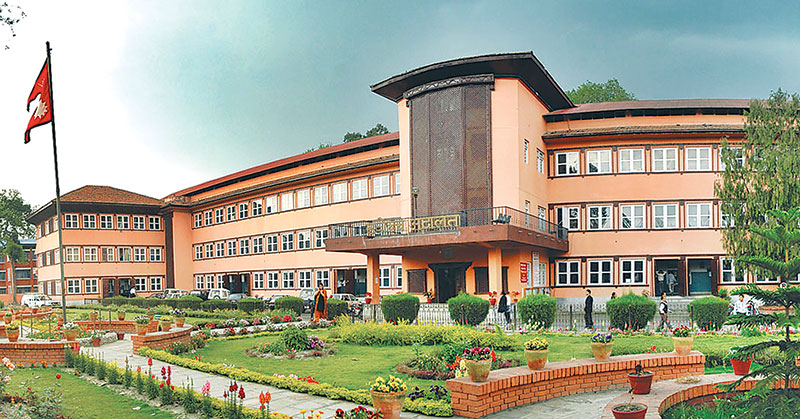
Three-justice bench questions rationale behind Cholendra Rana and Tej Bahadur KC’s verdict to commute Ranjan Koirala’s life sentence to eight and a half years.
- TIKA R PRADHAN
Post file Photo

KATHMANDU,
The Supreme Court on Sunday decided to review the judgment passed by Chief Justice Cholendra Shumsher Rana and Justice Tej Bahadur KC to cut short the punishment for Ranjan Koirala, a former deputy inspector general of the Armed Police Force, who was serving a life term on the charge of murdering his wife, Gita Dhakal.
Koirala was released on July 23, after a division bench of Rana and KC said on June 29 that he could be released after serving eight years and six months in jail arguing that the life imprisonment was too high, as the incident seemed accidental.
Koirala was handed down a life term by the Kathmandu District Court in January 2012, and the decision was upheld by the then Patan Appellate Court.
On behalf of the Office of the Attorney General, Hareram Dhakal, father of Gita Dhakal, the first informer of the case, filed the petition at the Supreme Court on July 23, saying that employing the use of No. 188 of the Muluki Ain was not appropriate, and the assumption that the incident was accidental and was provoked by his wife and was committed mens rea–the intention or knowledge of wrongdoing that constitutes part of a crime–was wrong.
No. 188 (chapter on court management) of Muluki Ain gives discretionary powers to justices to reduce the punishment on criminal charges.
The provision has been done away with in the new criminal code that came into force on August 17, 2018. On June 29, the division bench of Rana and KC had decided to cut the life sentence of Koirala to eight and a half years while annulling the decision of the Kathmandu District Court and Patan Appellate Court to send him to life in prison and confiscate his property.
Koirala killed his wife Gita in February 2012. Her half-burnt body was found at Matrang of Tistung in Makwanpur district. After the review petition was filed, the Supreme Court constituted a  three-justice bench of Bam Kumar Shrestha, Prakash Kumar Dhungana and Kumar Regmi.
The bench on Sunday agreed to review the decision taken by the division bench of Rana and KC.
“Koirala was found to have refused the crime and there is no condition to assume that the incident was accidental... or it happened in normal circumstances as he had attempted to hide the body,” states the decision of the three-justice bench.
“The decision to use No. 188 of Muluki Ain seems to go against the principle set by a number of Supreme Court decisions… so this court allows a review of its decision of June 29 as per Clause 11 (2) of the Judicial Administration Act 2073.”
With the decision of the three justices, the case against Koirala will now resume as “a regular case”, said senior advocate Chandra Kanta Gyawali.
“The case will now be reopened with Ranjan Koirala and Tara Regmi as defendants and the case will remain sub judice until final decision,” said Gyawali.
The Office of the Attorney General has made Koirala and Tara Regmi, who is said to be his girlfriend, as the defendants. According to an official at the Attorney’s office, the review petition, however, does not mean Koirala has to return to the prison until the Supreme Court comes up with a final decision.
As Shrestha, Dhungana and Regmi on Sunday decided to give the nod for the review of the decision taken by Rana and KC to commute the sentence for Koirala from life imprisonment to eight and a half years, they cannot hear the review petition.
“Accepting to review the case in itself is the acceptance by the Supreme Court that the verdict is, prima facie, erroneous,” said Bhimarjun Acharya, a constitutional lawyer who is also the author of the book ‘Judicial Review’. “Now after going to the regular hearing process, the court will decide whether the decision of the division bench [of Rana and KC] was correct or not.”
Chief Justice Rana-led bench’s decision to reduce the sentence for Koirala has prompted protests on the streets, with demands that the chief justice be impeached.
Acharya said whether the decision will be reversed or not is a different matter but that there have already been protests and that a review petition has already been accepted could obviously be understood as some moral pressure on the chief justice.
“It’s quite a common process in the court of law when such decisions are reversed,” Acharya told the Post. “The issue here is Rana faces a moral question.”
According to Sanjiv Raj Regmi, spokesperson for the Office of the Attorney General, cases are reviewed all the time but rarely do the judgements by the chief justice draw review petitions.
The most recent review petition by the Office of the Attorney General, which was accepted by the Supreme Court, was around a year ago about a banking fraud which is still sub judice.
Rana himself was involved in one of the cases in the capacity of a Supreme Court justice that was reviewed earlier in 2015.
A division bench of then chief justice Ram Kumar Prasad Shah and Rana on June 21, 2015 had awarded ownership of 15 ropanis of land at Chhauni to Prerana Rajya Laxmi Singh, daughter of former king Gyanendra, as she had claimed to have received it as dowry.
The decision was later revoked by a full bench of another chief justice Sushila Karki and Justices Deepak Kumar Karki and Sapana Pradhan Malla in January 2017 through a review process, saying the land belonged to Nepal Trust as the properties of the former kings were transferred in the name of the state after the abolition of the monarchy in 2008.
“There are many cases in which the decisions of the Supreme Court’s justices have been revoked through review processes,” said Regmi. “But there are only a few cases where a review is filed in relation to cases decided by chief justices.”

HOME PAGE

How continued EU ban on Nepali carriers denied Nepal Airlines opportunity to earn during pandemic

Nepal was close to getting rid of the ban but problems in ruling party resulted in sudden prorogation of Parliament, putting bills to split up the Civil Aviation Authority in limbo.
- SANGAM PRASAIN
Nepal Airlines jets failed to cash in on the opportunity of conducting chartered rescue flights. Post file Photo

KATHMANDU,
On June 2, the European Commission updated the “EU Air Safety List”– the list of airlines that are subject to an operating ban or operational restrictions within the European Union for not meeting international safety standards. The commission maintained its ban on Nepali airlines as well.
The EU has been off-limits for Nepali carriers for the last seven years, and the next time when it will update the list in December, Nepal is likely to remain on its bad books.
Because Nepal has not yet accomplished its commitment: splitting the Civil Aviation Authority of Nepal into two entities–regulator and service provider–a prerequisite for getting Nepal removed from the “EU air safety list”.
As a result of the ban, Nepal Airlines, the national flag carrier, missed a big opportunity to cash in on the million-dollar chartered flights business during the Covid-19 lockdown as hundreds of flights were conducted all over the world for evacuation purposes.
An industry insider said there was a business to the tune of Rs10 billion in the four-month period, which was mostly gobbled up by foreign airlines.
Two draft bills–Civil Aviation Authority of Nepal and Air Service Authority of Nepal–to split the aviation body were in the final process of being approved by the National Assembly during the budget session of the federal parliament that ended on July 2. The bills had already got the nod from the Legislation Management Committee of the Assembly. The government’s abrupt decision to prorogue Parliament, which was largely guided by internal problems in the ruling Nepal Communist Party (NCP), however, left the two bills in limbo.
“The good thing is that the Legislation Management Committee of the Upper House has already passed the draft bills,” said Rajan Pokhrel, director general of the Civil Aviation Authority of Nepal. “We were expecting that the bills would pass, but it didn’t happen. We hope that the upcoming winter session of Parliament will approve them.”
The government has been working on the proposed legislation for the last nine years, but it was plagued by bureaucracy at every step.
Following pressure from a number of global aviation watchdogs, the Cabinet had given the go-ahead to the Tourism Ministry in July last year to draft two separate bills to split up the Civil Aviation Authority.
The Civil Aviation Authority has been functioning as both the regulator and service provider from the same office, and there is no clear demarcation between its duties and organisational structure.
In December 2013, the European Commission imposed a blanket ban on Nepali airlines from flying into the 28-nation bloc after the September 2012 crash of Sita Air Flight 601 at Manohara River, near Kathmandu airport minutes after take-off. Nineteen people, including seven British citizens, died in the crash.
The commission became more concerned after that fatal crash and prevented airlines from Nepal from entering the continent as Nepal had been reporting a spate of air crashes over the years.
Between 2008 and 2012, Nepal reported at least two air crashes a year.
The European Union, however, has been watching Nepal’s air safety development process closely.
Veronica Cody, EU ambassador to Nepal, who wrapped up her three years of tenure in Kathmandu and left for Brussels on Saturday, told the Post last week that the EU had recommended that the Nepal government ensure functional separation of the Civil Aviation Authority of Nepal. Accordingly, the two bills were drafted.
“We think that progress has been made. During the three years I was here I have seen the aviation standard improved,” Cody told the Post in an interview. “The draft legislation was supposed to be passed in the summer session but because of Covid-19, and other pressing matters, it is yet to be passed.”
According to Cody, the Tourism Ministry “has informed” her that the bills will be tabled at the next session of Parliament.
Cody hoped that the legislation would be in place soon.
“Then, the officials of the Civil Aviation Authority of Nepal, will probably visit Brussels to discuss among other issues how the new organisation will function and how it will strive for improving the safety standards,” she said. “After that, officials from Brussels will make a site visit to Nepal.”
Cody said she is optimistic that when she comes back to Nepal some day, sooner rather than later, it will be on a European flight.
The aviation sector worldwide has borne the brunt of the Covid-19 pandemic and for Nepali carriers, getting to fly to EU countries would be a boon when flights resume.
Nepal has said it will open international flights starting August 17.
“Direct flights between Nepal and European countries will allow more tourists to visit Nepal, increase
bilateral business opportunities and allow competition among airlines,” Cody said.
As Nepal moves to break the aviation body with a clear demarcation of its powers and responsibilities because its dual functions give rise to a conflict of interest and hamper safety, the Asian Development Bank has provided a renewed $50 million policy-based lending to the government to finance the “civil aviation sector improvement programme”.
The agreement signed between the Finance Ministry and the multilateral funding agency on July 9 aims to strengthen the aviation safety oversight capabilities and operational efficiencies of Nepal.
The scope of the programme includes setting up of legal and implementation framework of civil aviation sector reforms and establishment and functionalisation of civil aviation related agencies including the Civil Aviation Authority of Nepal and Air Service Authority of Nepal.
“It’s not that we didn’t lobby for chartered flights with EU countries and the US, but Nepali airlines were not allowed to rescue European and American tourists stranded in Kathmandu because of the restriction,” said an official at the Tourism Ministry, who wished to remain anonymous. “We had even held several discussions with the American embassy to use Nepal Airlines flights. But it could not happen as Nepal airlines have to fly over the EU territory to reach the US.”
From March 24, when Nepal imposed a lockdown, to July 25, at least 482 international chartered flights have taken place to fly out stranded foreigners and bring Nepalis home, according to the statistics of the Tribhuvan International Airport.
Overall passenger movement crossed 50,000 (34,000 inbound and 16,000 outbound) and 1.65 million tonnes of cargo was flown in the four-month period.
“Flights to Europe and America would put Nepal Airlines, which is teetering into bankruptcy, into a comfortable financial position,” said an airline official, who spoke on the condition of anonymity.
Airlines charged as much as $3,000 for a one-way Kathmandu-London chartered flight ticket. Nepal Airlines has its own standard rates—$18,000 per hour--for a chartered flight.
“There was nothing in our hands. We tried to get the business that otherwise would have been over Rs5 billion to our two long-haul Airbus A330 jets, but as there were other powerful dealings and players in the market, we simply failed,” said the official.
“One key reason was the EU Air Safety List. It could have been dealt with through a proper diplomatic channel, but no one showed interest.”

Page 2
MEDLEY

Horoscope

ARIES (March 21-April 19)
****
Try to pay more attention to young adults or teenagers in your life right now. You make a very good role model, and you have some interesting ideas that they would benefit from. If all the kids you know live far away, send a message or thoughtful gift. Just make sure that you’re integrated into their lives in some way.


TAURUS (April 20-May 20)
***
There’s a certain enlightening combination of facts, fiction, and circumstance that only you are privy to today. That means you’ll be in a power position, and you should use it wisely. Keep your cards close to your chest and don’t spill too much information. Others may try to pry some secrets out of you.


GEMINI (May 21-June 21)
****
Sometimes when someone’s behavior rubs you the wrong way, the friction can be stimulating! Seek out contrary, opinionated voices today. Get into a conversation with the friend who loves that actor who annoys you and challenge them to change your mind. Or have someone try to sell you on the virtues of a food you dislike.


CANCER (June 22-July 22)
***
Use your ears today and they won’t fail you! Take extra time to listen People around you
are talking, and they are not watching what they say. This is a wonderful time to gain extra insight and get the information you need to see the bigger (and better) picture.


LEO (July 23-August 22)
***
While they’re basking in the limelight, are you stuck stewing in sour grapes? The universe advises against jealousy, because it will only create more negativity. Try to see their victory as fair. Someone else’s achievement does not have anything to do with you, so it makes no sense to take it that way.


VIRGO (August 23-September 22)
****
If you haven’t managed to schedule some “me” time, make sure you do it today. Pick out the next book you’ll read, or decide on a future travel destination. Even if you can’t actually take any time away right now, committing to doing something will give you a temporary lift that can carry you through the coming days.


LIBRA (September 23-October 22)
***
Are you feeling pressured to be active when you really don’t want to be? Listen to yourself and follow your mood, despite what other people may say. After all, one person’s lazy is another person’s relaxed. It all depends on your point of reference. Don’t listen to folks who are focused on things that don’t really matter to you.


SCORPIO (October 23-November 21)
***
Ideas are flowing out of you right now, but it’s going to take concentrated effort on your part to shape them into something practical. Your new thoughts are lumps of clay, full of potential but in need of a strong vision to transform that potential into reality. Look for that strong vision in the experiences you have today.


SAGITTARIUS (November 22-December 21)
***
A friend’s tale of woe may have you taking out the tissues and formulating a revenge plan today. Hold off on moving forward, because there are three sides to every story. What you know right now is only part of the picture, and new information will be coming that will change how you feel today.


CAPRICORN (December 22-January 19)
****
Having a rich fantasy might be just the ticket right now to keep you energized. You can control everything in your imagination, so give it a try! Exercise your power by imagining yourself the way you want to be. Amuse yourself with images of how things would be if you were in charge.


AQUARIUS (January 20-February 18)
***
Surrounding yourself with too many like-minded people isn’t a good idea, and doing so is going to really limit your creativity right now. You don’t need sycophants who agree with everything you say. Instead, you need more of an edge in your life. Seek out people who think and act differently than you.


PISCES (February 19-March 20)
***
For special insight on your latest quandary, turn to your co-workers or friends today. You need to consult someone who either is in the same situation as you or has been there before. Firsthand experience informs their advice. Keep in mind that they might be leaving out some details for your own good.

Page 3
NATIONAL

Government may reimpose lockdown if coronavirus infections continue to spike

The government’s failure to expand the test range and an increase in public mobility post lockdown have raised the infection risk, Health Ministry officials say.
- Arjun Poudel

KATHMANDU,
Even as the risk of the spread of coronavirus grows across the country and lockdown has been reimposed in Biratnagar and Inaruwa in Province 1 due to resurgence of infections,  the number of tests has not gone up since the lifting of the countrywide lockdown last week.
Authorities in Biratnagar said following the cases suggesting community transmissions in the provincial capital and the town of Inaruwa, lockdown orders were issued in both places on Sunday.
“Challenges have increased for us to protect health workers and security personnel deployed in the front line to prevent the spread of the virus and to serve the people,” Dr Roshan Pokhrel, chief specialist at the Health Ministry, told the Post.
Twenty-one police men in Biratnagar regional police office, four at police headquarters, 20 personnel from the Armed Police Force office in the town of Kakadbhitta  on the Nepal-India border in Jhapa district and six in Ilam in recent days have tested positive for the coronavirus infection, authorities said.
Around 150 health workers across the country have also contracted the virus since the start of the pandemic.
While lockdown orders have been reimposed only in towns and districts along the Nepal-India border, the upward infection trend in recent days suggests that the government could reimpose a countrywide lockdown.
“We will have to enforce another lockdown if the number of positive cases spikes fast,” said Dr Sameer Kumar Adhikari, joint spokesperson at the Health Ministry.  
There has been an exponential rise in cases in India since the lockdown was lifted there a few weeks ago, according to Johns Hopkins University coronavirus tracker. Although 700 to 900 people have been entering Nepal from India everyday, as per the data of the Ministry of Home Affairs, elected representatives in the border districts claim that many more people are entering the country through illegal border crossings.   
Although public health experts had called for the need to increase the test numbers after the lockdown was lifted, according to Ministry of Health and Population data, only 15,322 tests were performed in four days after the lockdown was lifted, with an average of about 4,000 tests a day.
The number of tests four days before the lockdown was 15, 251. The most number of tests on a single day across the country stands at around 7,000 during the lockdown. Meanwhile, three youths are on a hunger strike for the past nine days demanding the fulfilment of the government’s promise to raise the test to 10,000 per day.
“The Health Ministry’s recommendation on increasing the number of tests alone is not enough,” said a senior Health Ministry official requesting anonymity because he is not authorised to talk to the media. “There are other factors involved.”
He said the recommendation of the Health Ministry is not taken into account while the Cabinet makes its decision. Those outside the government point out that the government has lessened its focus on containing the spread of the virus.
“Earlier, the entire government was focused in the fight against Covid-19. But with the end of the lockdown, responsibility of containing the disease has come mainly to the Health Ministry,” said Dr Senendra Upreti, a former health secretary.
Public health experts say that an increase in the number of tests and active surveillance was the only way to contain the spread of the virus after the lockdown was lifted, but that is not happening.
Government officials are aware of this as conceded by a member of the Covid-19 Crisis Management Centre.
“The concerned authorities seem to be indifferent when it comes to regulating public movements and conducting active surveillance,” a government official told the Post requesting anonymity.
At present only those who have come in close contact with an infected person, those who have a history of travelling to the coronavirus hotspots and those with all Covid-19 symptoms are being tested.
Unless the government changes the guidelines to test all symptomatic cases and conduct active community surveillance, test numbers will not increase, which means there is increased risk of spread of the virus, according to infectious disease expert Anup Subedee.
But the public needs to be vigilant too. “The ockdown was lifted thinking that people have been aware of the risk of infection and would take safety measures, but the size of crowds in markets show that this has not happened. We seem to have expected too much from the public,” said joint spokesperson Adhikari.

NATIONAL

Biratnagar shuts all non-essential services while Inaruwa goes under lockdown as infections rise

- MADHAV GHIMIRE,DEO NARAYAN SAH

BIRATNAGAR,
Biratnagar Metropolitan City has decided to shut all services, except for essential ones, until further notice from Monday.
The decision comes on the heels of the health unit of the city office confirming community transmission of the virus.
Fourteen people with no travel history to coronavirus hotspots have tested positive for the virus in the last few days.
Ramesh Karki, chief at the health division of the city office, said the local governments in Morang district have also decided to take strict measures to curb the spread of the virus in communities.
“No one will be allowed to go out without wearing face masks in public spaces. They will have to follow strict measures if they are to step out of their homes,” said Karki.  “We are in discussion with the Chief District Officer to look at the possibility of closing down government offices.”
Biratnagar city authority has also intensified swab collection and contact tracing in local communities to stem the virus from spreading further. “We have requested the provincial government to widen the range of swab collection. We aim to collect swab samples of at least 150 to 200 people daily,” said Karki.
Meanwhile, Dr Suresh Mehata, chief at the public health division of Social Development Ministry in Province 1, said it was still too early to determine the extent or the severity of the virus transmission at the community level.
“We cannot confirm community transmission of coronavirus just yet. The PCR test results of the collected swab samples will determine the extent of the spread,” said Mehata.
Among the latest coronavirus-infected patients in Biratnagar are 20 police personnel based in Province 1 Police Office. The office was sealed on Thursday after the infection was detected.  
“Swab samples of 150 security personnel were collected on Thursday and sent to the lab for testing. On Saturday 19 of the samples came back positive for the virus. Infection in one officer was confirmed a few days earlier,” said Dipak Pokharel, the spokesperson at the provincial police office.  
One of the police officers who tested positive for the virus is a native of Mahendrachok of Inaruwa in Sunsari.
Since he had visited his home regularly in the past few weeks, local authorities in Inaruwa have reimposed a lockdown from Sunday.
“We collected swabs of 12 members of the officer’s family and of 29 others who had come in his contact,” said Inaruwa Mayor Rajan Mehata.
In Ilam, six security personnel deployed at a quarantine facility set up in the building of the District Coordination Committee in Ilam Municipality  tested positive for the coronavirus on Sunday.
A man staying at the facility, a municipal employee and a local of Mai Municipality have also tested positive, taking the number of infections in Ilam to 38.
In Jhapa, 20 Armed Police Force personnel deployed at the Indo-Nepal border in Kakadbhitta have also tested positive for coronavirus infection.  
“The infected security personnel have been taken to a Covid-19 treatment hospital in Morang” said Jivan Chamlagain of the District Health Office in Jhapa.


(Arjun Rajbanshi from Jhapa and Biplaw Bhattarai from Ilam contributed reporting)

NATIONAL

Recruiting agencies decry government directive on repatriation of migrant workers

- CHANDAN KUMAR MANDAL

KATHMANDU,
The government plan of bringing home Nepali workers using the Migrant Workers Welfare Fund has hit a new roadblock as recruiting agencies seem to be shirking from their responsibilities as mentioned in the repatriation guidelines.
The new directive on repatriation of stranded Nepali workers says that it is the responsibility of the recruiting agencies to take the initiatives for ensuring these workers get air tickets, salary and other benefits from their employers.
However, Nepali recruiting agencies, hiring and supplying workers for foreign companies, have expressed their dissatisfaction over such provision. They say the government has put unwanted burden on their shoulders.
“Since the pandemic began, we have been requesting the government agencies to repatriate Nepali workers who had lost their jobs and living in miserable conditions. But the government went the other way and started rescuing the workers who could pay for their flights,” said Sujit Kumar Shrestha, general secretary of Nepal Association of Foreign Employment Agencies. “Now, the government wants us to ensure whether workers got their air tickets and salaries or not. This is beyond our capacity and we cannot do this.”
Following the Supreme Court interim order, asking the government to repatriate Nepali workers who had migrated after receiving labour permits and contributing to the welfare fund, the government had come up with the directive for their repatriation.
As per the guidelines, only those stranded workers who do not get air tickets from their employers, host nation government, recruiting agency or any other sources will be entitled to the government’s financial support. The long-verification process, which has been criticised for further delaying the overall repatriation process, also seeks the role of recruiting agencies in helping workers get tickets from their employers.
However, the recruiting agencies say they cannot take ownership of the guidelines since they were not consulted while drafting the document.
“Recruiting agencies, a major stakeholder in the foreign employment sector, were not even consulted. They have come up with forced measures on us,” said Shrestha. “The directive is also against the notion of the Supreme Court interim order which was about utilising the fund to bring home stranded workers, not about transferring responsibility on us. For a crisis like this, it is the responsibility of the state.”
According to Shrestha, recruiting agencies have been rescuing stranded Nepali workers who had lost jobs and not received facilities as mentioned in the contract before the government enforced lockdown and stopped labour migration.
“Nepal government has labour agreements with labour destination countries where there are also Nepali embassies. The state mechanism should be mobilised for getting air tickets from employers in those countries,” said Shrestha. “The pandemic has caused a global economic slowdown and employers might not follow us.”
Tens of thousands of Nepali migrant workers remain stranded in Malaysia and Gulf countries even after months of Covid-19 pandemic. Without enough money and jobs, they have been looking up to the state for returning home. But lack of coordination among stakeholders is likely to further extend their wait for returning home.
“Nepal’s Foreign Employment Act, 2007 and also the UN Guiding Principles on Business and Human Rights clearly say both employers, as well as recruitment agencies, have their responsibilities during such an adverse situation,” said Jeevan Baniya, a labour migration researcher. “Recruiting agencies can help the repatriation process by facilitating ticket purchase and other facilities from the employers and also identifying the vulnerable workers who are stranded and require immediate repatriation.”
The directive also says the employers who will not provide tickets to stranded workers will be blacklisted from hiring Nepali workers for five years.
According to Rajan Prasad Shrestha, executive director with the Foreign Employment Board, which manages the welfare fund, recruiting agencies’ initiation in getting tickets from the employers was required since the amount in the fund would not be enough to repatriate a large number of workers.
“The directive was brought so that all the concerned agencies can work together to help workers languishing abroad. All stakeholders act as per the directive,” said Shrestha. “Employers should be made responsible first and for this recruiting agencies need to take initiation. With joint efforts, we can rescue our workers.”  
While recruiting agencies look hell-bent on defying the government’s directive, experts like Baniya say the current situation is also an opportunity for them to help these workers. “Both employers and recruiting agencies should be made accountable in dealing with the crisis. If recruiting agencies step forward to help needy workers, it can be a historic achievement for these agencies as well,” said Baniya, who is an assistant director of the Centre for the Study of Labour and Mobility (CESLAM) at Social Science Baha, a non-governmental think tank.
“Recruiting agencies should have rather created a basket fund for contributing to repatriation of stranded workers.”

NATIONAL

Two women arrested for duping people of their money by promising to take them to the US

- SHUVAM DHUNGANA

KATHMANDU,
Police on Friday arrested two women from Butwal for their alleged involvement in duping people of their money on the pretext of taking them to the US.
A team from Kathmandu Metropolitan Crime Division, Teku, arrested Kopila Sharma, 27, and Amisa KC, 19, on charge of defrauding Rs 6.6 million from various people.
SP Ishwar Karki, spokesperson for the division, said Sharma and KC, who hail from Baglung district, are accused of posing as US Diversity Visa holders and luring their victims with the promise of marrying them and taking them to the US.  
“They were found using social media, like facebook and Tiktok, to get in touch with the victims,” said Karki.
The two women, who were based in Bhaktapur, were found hiding in Butwal.
“We tracked their location from their cell phones. They were arrested and brought to Kathmandu for investigation,” said Karki.
Fraud cases have been rising in the country, with police receiving hundreds of complaints every year.
According to the data maintained by the Nepal Police headquarters, there were 368 cases of fraud across the country in the fiscal year 2016-17. The number rose to 542 in the fiscal year 2017-18. In the fiscal year 2018-19, police registered 627 cases related to fraud.

Page 4
EDITORIAL

Regulate acid sale

The chemical has become a weapon for jilted lovers to disfigure the beloved who couldn’t be theirs.

In September last year, Muskan Khatun lost her smile when she was attacked with acid when returning home from school. She may have recovered from the immediate burns, but the scars—on her body and in her mind both—remain, to memorialise the injustice a woman has to face when she hurts a criminal man’s fragile ego. Had Muskan been the first and the last survivor of acid attack, what she suffered could have been considered an aberration. But hardly has she recovered from the attack when she has had to return to the Burn Centre at Kirtipur Hospital, where she was treated last year, to support Pavitra Karki, who was attacked with acid late last week.
Between Muskan and Pavitra, it was Ram Raja Thapa and Bedamati Devi who survived acid attacks. And before them, it was Jenny Khadka, Seema Basnet and Sangita Magar. In a majority of such cases, the criminal is a man taking vengeance on a woman who has rejected his romantic or sexual overtures. A smaller number of women have also used acid to disfigure men. In the past seven years alone, 19 women and three men have become survivors of acid attacks.
The fact that acid is easily available at hardware and jewellery shops makes it a go-to weapon for criminals. Criminals in several such attack incidents are reported to have bought the acids from either of these shops. The sale of acid by hardware shops as toilet cleaners should be criminalised. There are dozens of other less harmful substances available in the market that can be used as toilet cleaners. Though acids have an unquestionable scientific purpose, it is perturbing why the government fails to pay heed to the fact that its open sale continues to put citizens at risk. That a substance that is so dangerous to human lives should be available easily in the market speaks of the criminal negligence on the part of the authorities. A weapon so handy for criminals should not be available in the market so easily. The government must ban the sale of acid at such shops immediately and limit its use only to licence holders.
The Supreme Court in August last year ordered the government to regulate the sale of hydrochloric and sulphuric acids, but the latter is yet to heed order. A government that does not regulate the sale of a substance is so detrimental to the safety of citizens, especially women, is effectively a partner in the crime. One wonders if acids would be so easily available if it was mostly used by women as a weapon against men, for it is mostly the men who call the shots in the government. And the answer is a big no.
The burn scars on the faces of those who have had to live as acid attack survivors are, in fact, a scar on the conscience of the Nepali society, especially successive governments that have failed to act. As the government busies itself in finding Ram’s janmabhoomi within the country, it would do well to also consider turning the ideals of Ramrajya where no citizen who has knowingly or unknowingly hurt someone’s bloated ego has to live with the fear of being attacked with acid.

OPINION

The MCC Compact is not a significant issue

The public is tricked into following the wrong issue. The real issue is the mishandling of available funds.
- JAGADISH PRASAD BIST
Shutterstock

A grant contract worth $500 million between the US’s Millennium Challenge Corporation (MCC) and the Nepal government has been left unendorsed by Parliament, even though this was a prerequisite built into the contract itself. The Nepal Communist Party, the ruling party, failed to reach an internal consensus to endorse this contract, which has resulted in this failure.
It is not that the current government did not want this MCC Compact to be ratified. In fact, the current government had left no stone unturned to reach bipartisan support for this project. However, not convinced with some of the articles, some of the lawmakers from the majority party itself have created a clear obstruction, stating that the sovereignty of the nation is at stake.
The debate surrounding the MCC Compact has reached a new level of ubiquity. Every person in Nepal seems to have taken a side over it. The supporters, mostly economists, are stating that this contract is nothing more than a typical grant, with no correlation to the country’s sovereignty. The critics, however, are not convinced, and claim that some of the articles and provisions in the Compact are unconscionable. Some go so far to attack the duration of the agreement—meaning that the Millenium Challenge Corporation can work in Nepal for eternity—or the very fact that it requires parliamentary ratification to make it legitimate.
The polarisation has reached a point that we can see some arguing that the MCC Compact is the only key to development while others see it only as a legal and political attack on national sovereignty. Of course, every coin has two sides; this contract also has both positive and negative aspects. While an argument as to why this Compact is important has been thoroughly covered before, it is also important to dissect this grant with a comparison to another common form of foreign funding—debt.

No free lunch
Debts and grants are two instruments of external support used in the course of the development process. But they are very different from each other. Developing and developed countries use debt to finance their projects. On the other hand, poor countries seek grants to a larger extent. It is because the grant is perceived as a free source of funds from developed nations. However, there is an aphorism in economics which states that ‘there is no such thing as a free lunch’.
Both the debts and grants have their own costs associated, but grants most of the time have more implicit or hidden costs. Debts are loans that governments take from foreign counterparts, with explicitly stated added remuneration expected, known as interest. Grants on the other hand, do not have any explicit returnable amount attached to them. But the conditions imposed on the approval or acceptance of the grant can be viewed as a cost. When such implicit costs are there, we are no freer to make our own decisions. Yet, it is solely up to the receiver whether to accept such clauses or not.
The problem here in Nepal is that debt has not been understood rationally. Policymakers have notoriously misused available debt so far. This has caused hesitation among the public, particularly when they see figures for debt per capita published. But, in reality, debt is one of the most ingenious inventions that has come from the field of economics. Had there been no debt, the world would not have grown at the pace that it has.
In the case of Nepal, we have a larger room to flourish with debt. The country’s debt to GDP ratio is considerably low. According to the World Bank, Nepal’s public debt is about 30 percent of GDP. Out of it, only 17.4 percent is external debt. Similarly, the IMF Debt Sustainability Analysis (DSA) shows that Nepal’s debt sustainability is very strong. These statistics show that Nepal has a larger room available to finance development projects. This means that, compared to African countries that have been ensnared in a debt trap, Nepal has much more room to accept more financing. Nepal outperforms countries currently facing a debt trap in most development indicators, be it the case of human development indicators and intellectual capital, the natural resources, the investment possibility, political system, among others.
Debt only becomes a headache for the development process when policymakers start botching it, as is currently the case in Pakistan. Yet, used appropriately, debt not only uplifts the economy but also keeps national interests intact.

Targeting the wrong issue
At this point, many may begin to wonder whether grants are needed at all, particularly if external sources of financing are available. To answer this, we have to analyse our political and economic system.
Without foreign capital investment and an inflow of technology and knowledge, it is difficult for Nepal to grow as targeted. Yet, it is not that Nepal does not have the ability to develop without grants. Take the MCC Compact for example. This grant contract, worth $500 million, amounts to 1.7 percent of Nepal’s GDP and to 4 percent of the budget for the current fiscal year. Therefore, on paper, Nepal is economically sound enough to fund the projects under question using taxpayer money or by issuing public bonds.
But the question is whether Nepal can manage this fund without supervision at all, and execute and implement important projects. In recent history, the country has failed to utilise vast funds effectively, unscrupulously distributing billions of rupees through the Prime Minister’s Employment Programme or through constituency development funds allocated to each federal and provincial lawmaker. Similarly, the current report from the Financial Comptroller General Office has reckoned that the government’s unaccounted transactions reached a whopping Rs664 billion last year. This is as high as 21 percent of the GDP. What can be construed from these statistics is that the poor development in Nepal is not due to the unavailability of funds, but rather the misuse of available resources.  
It does not matter whether a development fund is coming in the form of a debt or a grant. Unless strong control mechanisms are deployed, Nepal will continue to stagnate. The entrenched syndicates, a major source of the sustained corruption, need to be uprooted, and politicians must be held accountable for their support of, or opposition to, any form of investment or support. The MCC Compact is not the game changing grant it has been made out to be. Neither is it particularly harmful. Nepal must focus on direct investment opportunities, and must not be afraid to take on more debt. But most importantly, it needs to understand the real cause behind its underdevelopment, which is not centred around external support.
 

Bist is a Kathmandu-based freelance researcher and writes on finance, economics and socio-political matters.  

OPINION

Opening the tech sector to Africa’s women

Given gender gaps in African education, extra attention must be paid to ensure that girls are not left behind.
- Palesa Libe
Shutterstock

From Women in Tech conferences to Girls Who Code programmes, initiatives aimed at enabling girls and women to enter the so-called STEM fields (science, technology, engineering, and mathematics) have proliferated in recent years. But change has been slow to arrive: while the percentage of women in the labour force has gradually increased, it remains significantly lower in the tech sector. Given that sector’s central role in driving the Fourth Industrial Revolution, this amounts to a major drain on economies’ potential.
The problem is particularly pronounced in Africa. In Sub-Saharan Africa, for example, the overall female labour-force participation rate has reached 61 percent, yet women constitute only 30 percent of professionals in the tech industry. More fundamentally, although internet usage in Africa is growing at the world’s fastest rate, the digital gender gap has widened since 2013. A quarter fewer women than men use the internet.
In today’s digital economy, women’s relative lack of connectivity undermines their capacity to reach their economic potential. Even women with their own ‘analogue’ businesses, such as dressmakers or hairdressers, suffer when they cannot advertise online, let alone use technological tools to monitor, measure, and optimise their operations.
These women can often afford to buy mobile phones and data. It would be easy for mobile providers to offer basic digital-literacy workshops, showing users how to perform basic online tasks such as creating email accounts. (Think of the myriad functionalities of, say, a Google account, from tracking business activity to creating advertisements.) As women-owned businesses become more productive, the entire economy—including those mobile operators—would benefit.
But learning how to use existing digital tools is just the start. Women need and deserve opportunities to innovate. Men may work hard, but women—including those with full-time paid employment—still perform the bulk of unpaid labour. This leaves them with little time or space to engage in creative work—and that is exactly what innovation is.
Moreover, pervasive gender bias means that men often take women innovators less seriously. Women-only clubs or social-media groups could help to push back against these forces, by giving women the chance to share their ideas, get feedback, and form their own professional networks.
Boosting women’s digital literacy today would have far-reaching inter-generational implications. In Africa, as in much of the world, women are more likely to be their children’s primary caregivers, which means that they are uniquely suited to prepare younger generations to participate in the digital economy.
But women can fulfil this role only if they have the right knowledge and tools. To that end, African governments should create computer literacy programmes, targeting women from rural areas, in particular. Improving access to information and communications technologies (ICT), especially Internet-enabled mobile phones, would go a long way toward supporting these efforts.
Initiatives aimed directly at African primary- and secondary-school students—such as computer coding and robotics courses—are also needed. But, given enduring gender gaps in education—as well as the gender-based social pressures that perpetuate them—extra attention must be devoted to ensuring that girls are not left behind.
In fact, the Lesotho chapter of Africa Code Week—where I am a trainer and ambassador—has found that girls perform much better in coding when they are separated from boys. That is why girl-focused initiatives—including weekend coding workshops and coding marathons (hackathons)—are so important in enabling girls to innovate freely.
At tertiary institutions, it is up to research centres and innovation hubs to take up the baton of empowering young people—and especially young women—to innovate. In general, programmes that allow students to pitch their ideas directly to investors could prove very valuable. Beyond giving great ideas a chance to shine, this would foster linkages between education and employment that could ensure that all students were acquiring the right skills to fill jobs in the tech sector.
Here, again, special attention must be given to girls. Science and technology faculties tend to be populated overwhelmingly by male students. For example, only 20 percent of those admitted to the University of Pretoria—one of Africa’s top research institutions—between 2015 and 2020 were girls.
In such male-dominated environments, even those girls who are admitted may struggle to reach their full potential. One way to help them would be for women who do advance in STEM fields to act as mentors, offering practical advice and confidence-boosting support.
The dynamics are complex and the barriers are high. But the benefits of empowering women to participate in the digital economy are obvious. The key to success will be concrete initiatives to teach digital literacy and expand access to ICT, as well as efforts to boost the confidence of women and girls, who have long been discouraged from competing against their male peers. Only if all Africans have the tools and support to achieve their potential can the continent thrive in the new economy that the Fourth Industrial Revolution is ushering in.


Libe, a co-founder of the NGO Green Tech, is an Africa Code Week trainer and ambassador in Lesotho.
—Project Syndicate

Page 5
NATIONAL

Body of Chepang youth taken to Kathmandu for postmortem

The deceased’s family has accused Nepal Army personnel of fatally assaulting the youth last week inside Chitwan National Park.
- RAMESH KUMAR PAUDEL
Raj Kumar Chepang. Post Photo

CHITWAN,
Body of Raj Kumar Chepang, who died on July 22 from what is believed to be the injuries inflicted by the Army personnel after he was caught inside Chitwan National Park, was sent to Kathmandu for postmortem on Sunday.
“The decision was taken based on the suggestions of Raj Kumar’s family,” said Dr Shreeram Tiwari, medical superintendent of Bharatpur Hospital.
The Nepal Army has been accused of fatally assaulting Raj Kumar, 24, of Rapti Municipality-2 on July 16. Raj Kumar’s father, Bishnu Lal, filed a complaint at the District Police Office on Friday, claiming that his son was tortured by the Army patrol, which led to his death. He has demanded an impartial investigation into the incident and punishment to the guilty.
On July 16, Raj Kumar and six of his friends, including two women, were detained by the Army patrol inside the park. They had gone to collect Ghongi, a species of snails considered a delicacy, in the Jyudi river inside the park. They were released on the same day. Bishnu Lal claimed Raj Kumar was taken ill since the day he was released and died a couple of days later on July 22.
Raj Kumar’s family had not let the authorities conduct a postmortem, demanding action against the guilty and compensation to the family. The bereaved family agreed for the postmortem after the Lothar Bufferzone Consumers Committee assured them of Rs 100,000 as immediate relief.
“An agreement was reached on Saturday evening during a meeting held at the District Administration Office. Rs 100,000 will be given to the deceased’s family to conduct the funeral and mourning rituals,” said Man Bahadur Syangbo, the chairman of Lothar Bufferzone Consumers Committee. “We will sort out other issues gradually.”
According to Deputy Superintendent of Police Surya Thapa, the body was taken to TU Teaching Hospital in Maharajgunj for postmortem.
“Raj Kumar’s father and security personnel were sent along with the body,” said Thapa, adding that there would be further investigation into the case after the postmortem report comes out.
Santa Lal Praja, who was detained along with Raj Kumar, said he and his friends, except for the two women, were beaten by the soldiers. He said they were also forced to carry heavy wooden logs and do 100 pushups.
Nepal Army officials admitted to arresting the youths but denied any allegations of manhandling or torturing them.

Page 6
MONEY

Government defends licences issued to firms engaged in ‘networking business’

Networking businesses in the past had swindled billions by illegally expanding their network in a pyramid style.
- KRISHANA PRASAIN
The department charges a fee of Rs 200,000 for a licence.  shutterstock

KATHMANDU,
With the government mired in controversy after issuing licences to firms engaged in ‘networking business’, the Department of Commerce, Supplies and Consumer Protection Management has defended its action, saying the licences were issued under the ‘Direct Sales Commodity Act’.
But consumer rights activists said they don’t believe that and the licences issued to these companies meant that the same people who used to operate a pyramid structure networking business in the past, will be allowed to do so again.
It is illegal to operate such business in Nepal.
The department has granted licences to iboss Global International, Chabahil; Nature Herbs International, Kumaripati; New Bibek Enterprises, Ekantakuna; Healthy Living Nepal, Battisputali; Care Matters International, Chabahil; Uturn International, Tokha and Global Orients Nepal, Balaju.
Madhav Timilsina, president of Consumer Rights Investigation Forum said that the government has granted licences to the same people who were involved in operating networking businesses in the past and had swindled billions by illegally expanding their network in a pyramid style.
“It’s the same business under a new guise. The same people are doing the business in the name of direct sales of the commodity now,” he said, adding that they are taking advantage of the Covid-19 situation as many people have lost jobs, said Timilsina.
“When we observed their websites, they seemed to be transacting goods and services based on a networking structure.”
Unity Life International, Herbo International, Gold Quest International, Crystal Vision International, Best World Business Link and Robious International duped billions of rupees of the people in the name of networking business a decade ago. Unity Life International duped around Rs4 billion alone.
The Supreme Court in May 2010 had issued a verdict declaring networking business illegal and ordered the government to scrap the Directives on Network Marketing of Commodities. However, the government moved the Supreme Court, seeking an annulment of its decision.
The apex court on March 28, 2012, however, upheld the government’s decision, declaring multi-level marketing business illegal.
“As there are no proper mechanisms to check this kind of business, these firms can cheat people as they did a decade ago,” said Timilsina.
The Direct Sale of Goods (Management and Regulation) Act, 2018 and Rules 2019 have been promulgated to protect the rights and interests of consumers by making any business related to the direct sale or distribution of goods reliable, transparent and competitive, according to the department.
The department said that it started issuing licences for direct sales and distribution of goods from the end of the previous fiscal year, based on the new regulation.
The department charges a fee of Rs200,000 for a licence.
“There is a legal requirement for companies intending to sell goods directly to obtain permission from the department to do business. Although it has been in use internationally since Germany in 1883, the subject
of direct sales is a new trade practice in the context of Nepal,” the department said.
Netra Prasad Subedi, director general at the department said pyramid based networking business is illegal.
“There is a provision of fines and imprisonment for operating business in a pyramid style, ‘’ he said.
“We too are concerned that the people from the network business have come into operation and we will clear the speculation soon,” he said.
Subedi said that while conducting business, the provisions of the relevant laws should be fully followed and the department is fully aware of preventing any business activities against the protection of consumer interests which is against the law.

MONEY

China imported more oil from Saudi than any other country in June

- REUTERS

BEIJING, 
China’s crude oil imports from Saudi Arabia rose 15 percent in June from a year ago, as refiners ordered record volumes of the fuel in March and April when oil prices tumbled, cementing the kingdom’s position as the top oil supplier to China.
Imports from Saudi Arabia rose to 8.88 million tonnes in June, or 2.16 million bpd, in June, according to data from the General Administration of Customs on Sunday.
That was in line with May’s volumes, but well above 1.89 million bpd during the same period last year.
The record imports follow a price war between Saudi Arabia and Russia, the world’s top oil exporters, during March and April when the coronavirus pandemic dampened demand and caused a global fuel glut.
Shipments from Russia were at 7.98 million tonnes last month, or 1.95 million barrels per day (bpd), up around 7 percent from 1.82 million bpd in May and 1.73 million bpd in June 2019.
Saudi, however, delivered bigger oil cuts from June and raised crude prices as a plunge in oil prices weighed on the kingdom’s budget.
China, the world’s biggest crude oil importer, took in a record 53.18 million tonnes last month, according to customs data. China also boosted inflows from Brazil, Norway and Angola, said Emma Li, analyst from Refinitiv. Analysts expect China to see another record amount of crude imports in July as some May-loading cargoes are still underway while swelling oil inventory at major Chinese ports slows new arrivals.

MONEY

Macau casinos see deepening losses as virus slams China travel

- REUTERS

HONG KONG, 
Casinos in the world’s biggest gambling hub Macau are staring at heavy losses for the second quarter, with “not much hope” for a near-term recovery as a resurgence in coronavirus cases muddies the outlook for when China will reinstate travel visas.
Visitors from greater China make up for over 90 percent of Macau’s tourists, but given travel has dried up amid the health crisis, Morgan Stanley warns casinos in the special administrative region could rack up losses of $1 billion over April to June.
The Las Vegas Sands unit, Sands China said it flipped into the red with a $549 million loss, setting the stage for a dire quarter for Macau casinos that have been operating with almost no income and no visitors since February.
Even after easing curbs for some travellers, Macau saw only 2,000 visitors per day in July, a tiny fraction of the 108,000 daily average in 2019, as the individual travel scheme through which visitors from the mainland gain entry remains suspended.
“Without the individual visitation scheme being resurrected, there’s not much hope for the casinos to come back,” said Rob Goldstein, president of Las Vegas Sands, which operates properties including the Venetian and Parisian in Macau.
Sands China’s revenue was almost wiped out in the second quarter. Other operators, Melco Resorts, Wynn Macau, Galaxy Entertainment, MGM China and SJM Holdings, will report in the coming weeks.
A Reuters calculation shows Macau casino operators came into 2020 with a cumulative cash position of just over $12 billion, providing a solid buffer to survive the coming months.
But anything longer could spell trouble as they continue to bleed millions of dollars in daily operating costs. Macau has not had a new local coronavirus case for over 100 days, while Hong Kong and some parts of the mainland have seen a sharp spike in infections.
Ferry services between Hong Kong and Macau remain halted, further hurting the casino business.
Four casino operators have issued or said they plan to issue new debt, worth a total $4.2 billion, in the past two months, highlighting the challenges they face even as they cut costs and streamline operations.
Operational expenses in the second quarter dipped 5 percent from the prior three months, noted Praveen Choudhary, an analyst at Morgan Stanley, Hong Kong. This could help the industry’s earnings before interest, taxes, depreciation, and amortization break even in the third quarter, he added. Macau’s gambling industry is crucial for the Chinese-ruled territory where the sector employs about three quarters of its 600,000 population, either directly or indirectly.
The government has mandated casinos to safeguard employment for local staff, prompting operators to find ways other than job cuts to reduce costs such as offering staff unpaid leave.
“There is nothing else we can do at this point,” a senior casino executive said. “We thought it [restrictions] would be done by April, then May, then June, then July. Now this year we say is not going to be a good year,” he added on condition of anonymity as he was not authorised to speak to media.

MONEY

Alibaba, Jack Ma summoned by Indian court on former employee’s complaint

- REUTERS
Jack Ma, founder of Chinese e-commerce giant Alibaba, speaks during the launch of Alibaba’s office in Kuala Lumpur, Malaysia. reuters

NEW DELHI, 
An Indian court has summoned Alibaba and its founder Jack Ma in a case in which a former employee in India says he was wrongfully fired after objecting to what he saw as censorship and fake news on company apps, documents seen by Reuters showed.
The case comes weeks after India cited security concerns in banning Alibaba’s UC News, UC Browser and 57 other Chinese apps after a clash between the two countries’ forces on their border.
Following the ban, which China has criticised, India sought written answers from all affected companies, including whether they censored content or acted for any foreign government.
In court filings dated July 20 and previously not reported, the former employee of Alibaba’s UC Web, Pushpandra Singh Parmar, alleges the company used to censor content seen as unfavourable to China and its apps UC Browser and UC News showcased false news “to cause social and political turmoil”.
Civil Judge Sonia Sheokand of a district court in Gurugram, a satellite city of India’s capital, New Delhi, has issued summons for Alibaba, Jack Ma and about a dozen individuals or company units, asking them to appear in court or through a lawyer on July 29, court documents showed.
The judge has also sought written responses from the company and its executives within 30 days, according to the summons.
UC India said in a statement it had been “unwavering in its commitment to the India market and the welfare of its local employees, and its policies are in compliance with local laws.
We are unable to comment on ongoing litigation”.
Alibaba representatives did not respond to requests for comment from the Chinese company or on behalf of Jack Ma.
Parmar, who worked as an associate director at the UC Web office in Gurugram until October 2017 and is seeking $268,000 in damages, referred Reuters queries to his lawyer, Atul Ahlawat, who declined to comment saying the matter was sub judice.
The court case is the latest hurdle for Alibaba in India after the Indian government’s app ban, following which UC Web has started laying off some staff in India.
Before the apps were banned, the UC Browser had been downloaded at least 689 million times in India,
while UC News had 79.8 million downloads, most during 2017 and 2018, data from analytics firm Sensor Tower showed.
India has said it banned the 59 apps after it received “credible inputs” that such apps posed a threat to India’s sovereignty. Its IT minister said the decision was taken to safeguard citizens’ data and public order.
In more than 200 pages of court filings, reviewed by Reuters, former employee Parmar included clippings of some posts showcased on the UC News app that he alleged were false.
One post from 2017 was headlined in Hindi: “2,000-rupee notes to be banned from midnight today”. Another headline of a 2018 post said: “Just now: War broke out between India and Pakistan” and contained description of firing across the disputed border between the countries.
Reuters could not independently verify the veracity of the claims in the court filing. India did not ban its 2,000-rupee currency note and no war occurred between India and Pakistan in 2018.
The lawsuit also contains a “sensitive words list” with key words in Hindi and English like “India-China border” and “Sino-India war” that the court filing alleges were used by UC Web to censor content on its platforms in India.
“In order to control any news related content to be published against China was automatically/manually rejected by an audit system evolved for this purpose,” the filing said.
The Chinese Embassy in New Delhi and China’s foreign ministry in Beijing, as well as India’s IT ministry in New Delhi, did not respond to requests for comment.

MONEY

Joint EU debt must not become a regular thing: Germany’s Weidmann

- REUTERS

BERLIN, 
A decision by European leaders to issue joint debt to finance coronavirus aid for weaker member states should remain an exemption and not serve as a blueprint for future budget challenges, Bundesbank President Jens Weidmann said on Sunday.
European Union leaders on Tuesday clinched an historic deal on a massive stimulus plan for their coronavirus-throttled economies following a fractious summit lasting almost five days. The agreement paves the way for the European Commission, the EU’s executive, to raise up to 750 billions euros on capital markets on behalf of all 27 states, an unprecedented act of solidarity in almost seven decades of integration.
“It’s important that the EU has proven its capability to act in the crisis,” Weidmann told Funke media group in an interview, adding that showing solidarity also in financial terms was the right thing to do in the current crisis.
But Weidmann added the agreed debt mechanism should remain an exemption and that strict conditions had to be attached to the financial aid.
“Control mechanisms are needed to ensure that funds are used sensibly and efficiently,” Weidmann said.
“Generally, I think joint debt for extensive transfers is questionable. At the very least, the package should not serve as a springboard for large-scale EU debt for regular household financing,” he said.
The central bank chief also pointed to the current developments in the United States, an important trading partner for Germany.
“The US loosened some of its measures early on and is now tightening them up again in some places. This stop-and-go is certainly difficult for the economy,” Weidmann said.
“In any case, this shows how important it is to stay vigilant, to closely monitor the infection process and to prevent a flare-up.”
Turning to Germany, Weidmann said Europe’s largest economy had passed the peak of the pandemic as well as the low point of the economic crisis. Retail sales were picking up again and production was also increasing.
“Overall, the data shows that the economy bottomed out in spring and is now gradually recovering,” Weidman said.

Page 7
WORLD

Modi says coronavirus risk persists in India even as recoveries rise

India has so far recorded 1.4 million cases—more than 48,000 in the past 24 hours—and more than 30,000 deaths.
- REUTERS
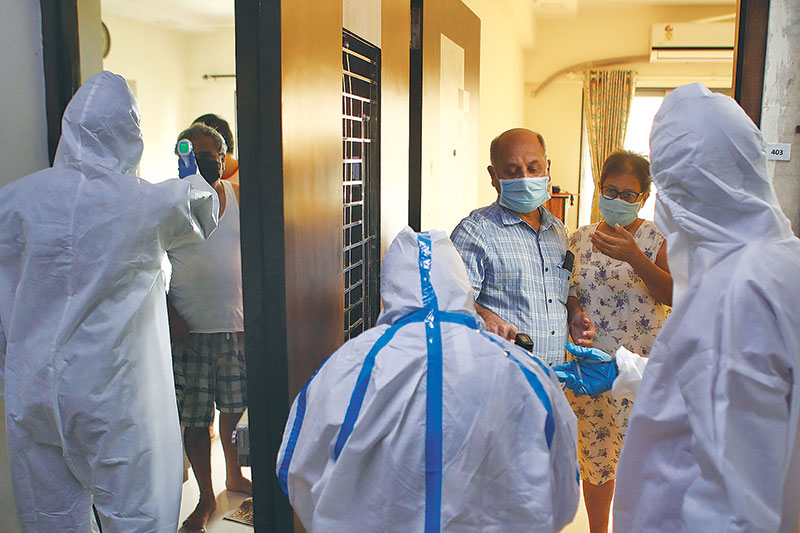
Health workers check the temperature and pulse of residents during a screening for Covid-19 in Mumbai, India on Sunday. REUTERS

MUMBAI,
India needs to be “extra vigilant” as the novel coronavirus threat persists, Prime Minister Narendra Modi said in a public address on Sunday, even as the country registered a record number of patient recoveries in a day.
Infections from the coronavirus have risen rapidly in India, the world’s second most populous country, with more than 48,000 cases recorded in the last 24 hours. India has so far recorded nearly 1.4 million cases and more than 30,000 deaths.
On Sunday, the Indian government said 36,145 patients had recovered and been discharged in the last 24 hours, marking a record number of single-day recoveries.
At the same time, a record number of tests in a single day—more than 440,000—were conducted, it added.
Modi, in his monthly radio broadcast to the nation, sounded caution, saying it was important to practise social distancing and wear masks to fight the virus.
“The danger of corona is far from being over. At many places, it is spreading fast,” Modi said. “We need to be extra vigilant.”
In recent weeks, coronavirus infections have spread further into the countryside and smaller towns. Experts say case numbers will rise significantly in the coming months
as testing increases, straining a healthcare system already pushed to the brink.
The western state of Maharashtra is the worst-affected, having recorded more than 360,000 cases, of which roughly 60 percent were reported in the country’s financial capital, Mumbai, and its satellite towns.

WORLD

We are safe, Spain insists as British quarantine decision dismays travellers

- REUTERS

MADRID/LONDON,
Spain is safe for tourists and Spaniards, the government insisted on Sunday after Britain abruptly imposed a two-week coronavirus quarantine on travellers returning from there, a decision that filled holidaymakers with dismay.
The Madrid government is also trying to persuade Britain to exclude the Balearic and Canary islands from the quarantine measure, Foreign Minister Arancha Gonzalez Laya said.
She added that the prevalence of the virus in those destinations was much lower than in the United Kingdom.
“Spain is safe, it is safe for Spaniards, it is safe for tourists,” Gonzalez Laya told reporters.
Last year, Britons made up more than a fifth of foreign visitors to Spain, which relies on heavily on tourism revenues.
The quarantine, coming just as the Spanish tourism sector emerges from months of lockdowns and travel restrictions, upset the plans of many people either on holiday or planning to take one and caused more disruption for airlines and tour companies.
“It ruins plans for everybody,” Emily Harrison, from Essex, as she prepared to fly back home from Madrid’s Barajas airport and faced two weeks of self-isolation. “Everyone is now panicking.”
Foreign minister Dominic Raab called the measure a “real-time response” to a jump in coronavirus cases in Spain.
“We can’t make apologies...we must be able to take swift, decisive action,” he said on Sky News.
The government announced it was taking Spain off a safe-travel list late on Saturday and the move took effect just hours later, leaving travellers with no time to dodge it or plan ahead.
It also advised against all but essential travel to mainland Spain, leaving the islands out of the advice but including them in the quarantine measure.
The opposition Labour Party’s health policy chief, Jonathan Ashworth, slammed Prime Minister Boris Johnson’s government for its “frankly shambolic” handling of the measure.
TUI, Europe’s biggest holiday company, said it would cancel all holidays to mainland Spain up to Aug. 9, while maintaining flights to the Balearic and Canary islands.

WORLD

North Korea declares emergency in border town over first suspected Covid-19 case

- REUTERS

SEOUL,
North Korean leader Kim Jong Un declared an emergency and a lockdown in a border town after a person suspected of being infected with the novel coronavirus returned from South Korea after illegally crossing the border, state media said on Sunday.
If confirmed, it would be the first case officially acknowledged by North Korean authorities.
Kim convened an emergency politburo meeting in response to what he called a “critical situation in which the vicious virus could be said to have entered the country”, the North’s KCNA state news reported.
A person who defected to South Korea three years ago returned across the fortified border that divides the two Koreas to the town of Kaesong this month with symptoms of Covid-19, the disease caused by the virus, KCNA reported.
“An emergency event happened in Kaesong City where a runaway who went to the south three years ago, a person who is suspected to have been infected with the vicious virus returned on July 19 after illegally crossing the demarcation line,” KCNA said.
KCNA did not say if the person had been tested, but said an “uncertain result was made from several medical check-ups of the secretion of that person’s upper respiratory organ and blood”, prompting officials to quarantine the person and investigate anyone he may have been in contact with.
One analyst said the announcement was important, not only because North Korea was for the first time reporting a suspected coronavirus case but also because it suggested it was appealing for help.
“It’s an ice-breaking moment for North Korea to admit a case,” said Choo Jae-woo, a professor at Kyung Hee University.
“It could be reaching out to the world for help. Perhaps for humanitarian assistance.”
North Korea is under economic pressure because of international sanctions over its nuclear programme.

WORLD

Putin says Russian Navy to get hypersonic nuclear strike weapons

- REUTERS
Russia’s President Vladimir Putin, Defence Minister Sergei Shoigu and Commander-in-Chief of the Russian Navy Nikolai Yevmenov inspect warshipson the Neva river during the Navy Day parade in Saint Petersburg, Russia, on Sunday.  REUTERS

MOSCOW,
Russian President Vladimir Putin said on Sunday the Russian Navy would be armed with hypersonic nuclear strike weapons and underwater nuclear drones, which the defence ministry said were in their final phase of testing.
Putin, who says he does not want an arms race, has often spoken of a new generation of Russian nuclear weapons that he says are unequalled and can hit almost anywhere in the world. Some Western experts have questioned how advanced they are.
The weapons, some of which have yet to be deployed, include the Poseidon underwater nuclear drone, designed to be carried by submarines, and the Tsirkon (Zircon) hypersonic cruise missile, which can be deployed on surface ships.
The combination of speed, manoeuvrability and altitude of hypersonic missiles, capable of travelling at more than five times the speed of sound, makes them difficult to track and intercept.
Speaking in St Petersburg at an annual naval parade that showcases Russia’s best ships, nuclear submarines and naval aviation, Putin said the navy’s capabilities were growing and it would get 40 new vessels this year.
He did not specify when it would receive new hypersonic weapons, but suggested that day was drawing closer.

WORLD

Hanna’s rain remains biggest threat to virus hot spot Texas

- ASSOCIATED PRESS
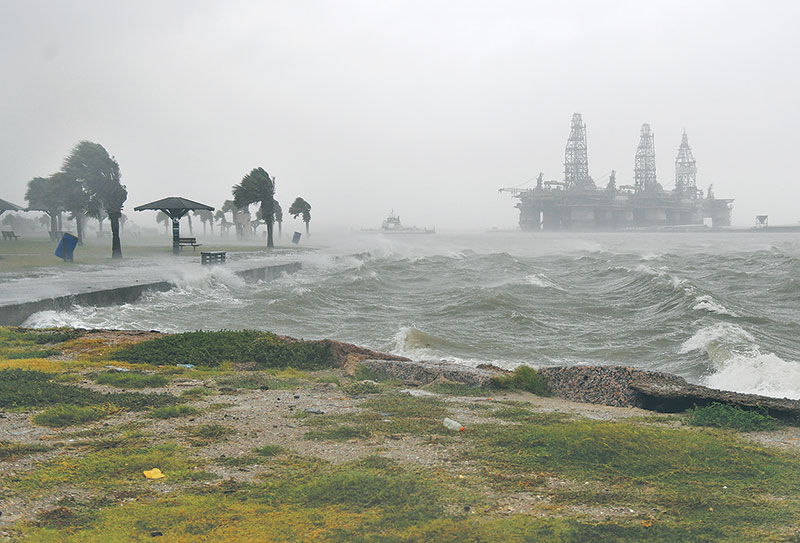
The Corpus Christi Channel experiences wind and choppy waters ahead of Hurricane Hanna, in Port Aransas, Texas. AP/rss

CORPUS CHRISTI, Texas,
South Texas braced for flooding Sunday after Hanna roared ashore as a hurricane the day before, bringing winds that lashed the Gulf Coast with rain and storm surge to a part of the country trying to cope with a spike in cases of the coronavirus.
The first hurricane of the 2020 Atlantic cyclone season made landfall twice as a Category 1 storm on Saturday afternoon within the span of little over an hour. The first landfall happened at around 5 pm about 15 miles north of Port Mansfield, which is about 130 miles (209 km) south of Corpus Christi. The second landfall took place nearby in eastern Kenedy County. Hanna came ashore with maximum sustained winds of 90 mph.
Forecasters downgraded Hanna to a tropical storm early Sunday. The storm had maximum sustained winds at 60 mph (95 kph), the National Hurricane Center said in a 4 am advisory.
Many parts of Texas, including areas near where Hanna came ashore, have been dealing with a surge in coronavirus cases in recent weeks, but local officials said they were prepared for whatever the storm might bring.
Chris Birchfield, a meteorologist with the National Weather Service in Brownsville, said residents needed to remain alert. Hanna’s winds weakened, but the storm’s real threat remained heavy rainfall.
“We’re not even close to over at this point,” Birchfield said. “We’re still expecting catastrophic flooding.”
Forecasters said Hanna could bring 6 to 12 inches of rain through Sunday night—with isolated totals of 18 inches—in addition to coastal swells that could cause life-threatening surf and rip current conditions.
Some areas in South Texas had already reported receiving up to 9 inches of rain, including Cameron County, which borders Mexico and where Brownsville is located.
Rainfall totals were expected to rise throughout the evening and into Sunday.
“It’s been all day,” Melissa Elizardi, a spokeswoman for Cameron County Judge Eddie Treviño, said of the rainfall. In a tweet, President Donald Trump said his administration was monitoring Hanna, along with Hurricane Douglas, which was heading toward Hawaii in the Pacific Ocean.

WORLD

100 Days: Trump faces headwinds as Election Day draws near

- ASSOCIATED PRESS
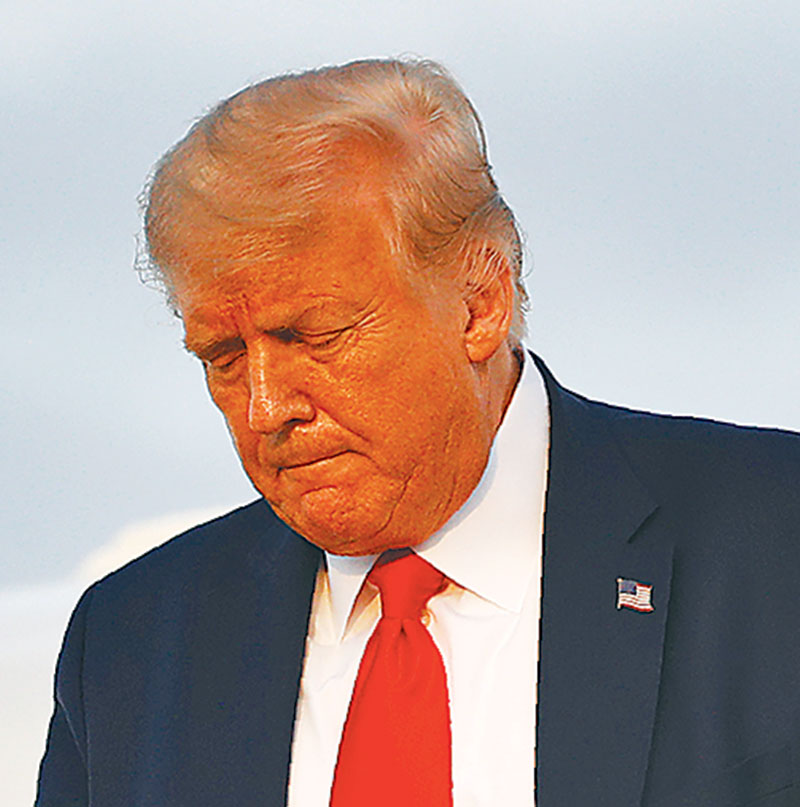
Donald Trump. AP/rss

WASHINGTON,
With the November election 100 days away, more Americans say the country is heading in the wrong direction than at any previous point in Donald Trump’s presidency, putting the incumbent in a perilous position as his reelection bid against Democrat Joe Biden enters a pivotal stretch.
A new poll from The Associated Press-NORC Center for Public Affairs Research also finds Trump’s approval for his handling of the Covid-19 pandemic falling to a new low, with just 32 percent of Americans supportive of his approach. Even Trump’s standing on the economy, long the high water mark for the president, has fallen over the past few months after seeming ascendant earlier this year.
Those political headwinds have sparked a sudden summer shift in the White House and the Trump campaign. After spending months playing down the pandemic and largely ignoring the virus’ resurgence in several states, Trump warned this past week that the situation is likely to get worse before it gets better.
After repeatedly minimising the importance of wearing masks to limit the spread of the virus, Trump urged Americans to do exactly that. And after insisting he would press forward with a large campaign convention in August, the president announced that he was scrapping those plans.
Trump’s abrupt about-face underscores the reality of the situation he faces just over three months from Election Day. Even as he tries to refocus his contest with Biden on divisive cultural issues and an ominous “law and order” message, Trump’s reelection prospects are likely to be inextricably linked to his handling of the pandemic and whether voters believe the country will head back in the right direction under his leadership.
The AP-NORC poll makes clear the challenge ahead for Trump on that front: 8 in 10 Americans say the country is heading in the wrong direction. That’s more than at any point since Trump took office. The poll also finds just 38 percent of Americans say the economy is good, down from 67 percent in January, before the pandemic upended most aspects of everyday life.
Biden’s campaign is eager to keep the final months of the campaign focused squarely on Trump, confident that the former vice president can emerge victorious if the contest is a referendum on whether the current commander in chief has succeeded during his four years in office.
“People are sick and tired of a government that is divided and broken and unable to get things done,” said Kate Bedingfield, Biden’s deputy campaign manager. “What people feel like they’re getting from Trump right now is a hodgepodge mess of self-interested political talk.”
The past few months have proved to be beneficial for Biden’s campaign. He managed to swiftly consolidate the Democratic Party in ways Hillary Clinton, the party’s 2016 nominee, struggled to do. Biden’s fundraising, a weakness for him in the primary, has surged, allowing his campaign to build out infrastructure and start ad spending in both traditional battleground states and more aspirational targets, including Texas and Georgia.
Biden has also benefited from Trump landing on the wrong side of the public in his initial reactions to the pandemic. For example, 3 in 4 Americans back requiring people to wear masks in public, which Trump initially dismissed.
Another test for the president lies ahead in August and September, as Trump and his administration aggressively try to sell a sceptical public on reopening schools. The poll finds that about third of Americans are opposed entirely to the idea, while close to half say major adjustments to instruction will be required. The limitations the pandemic placed on the candidates’ ability to travel and hold large rallies have also played more to Biden’s strengths. While Trump relishes headlining rallies at packed arenas, Biden is less adept in those settings.

WORLD

Police corral crowds as movers leave US Consulate in China

- ASSOCIATED PRESS

CHENGDU,
Moving trucks and vehicles with diplomatic plates pulled out of a US Consulate in southwest China on Sunday, as its impending closure over rising bilateral tensions drew a steady stream of onlookers for the second straight day.
People stopped to take selfies and photos, jamming a sidewalk busy with shoppers and families with strollers on a sunny day in the city of Chengdu. A little boy posed with a small Chinese flag before plainclothes police shooed him away as foreign media cameras zoomed in.
The capital of Sichuan province, along with Houston in Texas, has found itself in the limelight of international politics as China and the US exchanged tit-for-tat orders last week to close each other’s consulates in the two heartland cities.
Police in Chengdu have shut the street and sidewalk in front of the consulate and set up metal barriers along the sidewalk on the other side of the tree-lined road.
Uniformed and plainclothes officers kept watch on both sides of the barriers after scattered incidents following the Chengdu announcement on Friday, including a man who set off firecrackers and hecklers who cursed at foreign media shooting video and photos of the scene. A man who tired to unfurl a banner or sign late Sunday that he called an open letter to the Chinese government was quickly taken away.
Earlier, a bus left the consulate grounds and what appeared to be embassy staff spoke with plainclothes police before retreating back behind the property’s solid black gates. It wasn’t clear who or what was on the bus. Three medium-size trucks arrived and left a few hours later, and cars with diplomatic plates departed in between.
China ordered the closing of the Chengdu consulate in retaliation for a US order earlier in the week to close the Chinese Consulate in Houston.
The US alleged that the Houston consulate was a nest of Chinese spies who tried to steal data from facilities in Texas, including the Texas A&M medical system and the University of Texas MD Anderson Cancer Center in Houston. China said the allegations were “malicious slander.”
The consulate closings were a significant escalation in the tensions between the two countries over a range of issues, including trade, technology, security and human rights.

WORLD

Vietnamese city reimposes distancing after local infections

Briefing
- AGENCIES

HANOI: Vietnam reintroduced social distancing measures in the central city of Danang on Sunday after the country reported four locally transmitted coronavirus cases over the past two days, the first in more than three months. The Southeast Asian country was back on high alert after the government on Saturday confirmed its first community infection since April, and another case early on Sunday, both in the tourism hot spot of Danang. The two new cases included a 17-year-old boy in Quang Ngai province and a 71-year-old woman in Danang, the government said late on Sunday, bringing the total number of reported cases in the country to 420.

WORLD

Prince Harry took offence at brother’s advice, says book

Briefing
- AGENCIES

LONDON: Britain’s Prince Harry took offence at what he thought was Prince William’s “snobbishness” when he advised his brother to “take as much time as you need to get to know this girl” when he was dating Meghan Markle, a new book says.Harry and his wife, Meghan, have distanced themselves from the book called “Finding Freedom”, saying they were not interviewed for the biography being serialised by The Times and The Sunday Times newspapers and made no contributions to it. The book documents, citing sources, a time when Harry and Meghan were dating and William wanted to make sure the American actress had the right intentions, The Sunday Times said.

WORLD

Senior UN official skips Pakistan visit, citing flight issue

Briefing
- AGENCIES

ISLAMABAD: The incoming president of the United Nations General Assembly announced Sunday that he was postponing a scheduled visit to Pakistan “due to some technical flight problems.” Turkish diplomat Volkan Bozkir was elected president of the 75th session of the United Nations General Assembly last month and was scheduled to arrive in Islamabad on Sunday. But in a Twitter post, he said the visit to Pakistan’s capital would have to wait. Pakistan’s foreign minister Shah Mahmood Qureshi tweeted in response to Bozkir that
“I look forward to welcoming you to Pakistan soon for a constructive and fruitful visit.”

Page 8
CULTURE & ARTS

‘Photography is about patience’

On his way to becoming a photojournalist, Min Ratna Bajracharya pushed his boundaries and made the world accessible by communicating his ideas and waiting on opportunities to make moments worthwhile.
- Post Report
Photo courtesy: Min Ratna Bajracharya

Kathmandu,
As Min Ratna Bajracharya rides through Budhanilkantha, his locality, his hand leaves the steering wheel to point to directions where he thinks there are important stories to inspect.
“There! There, do you see that?” he points to a building far away, beyond a green field. “I used to think why throngs of people went out there. I later found out that that’s where Ram Bahadur Bomjon, the Buddha Boy, stayed for some time,” says Bajracharya, who moved to the place from Masangalli after the 2015 earthquake.
Wherever he goes, Bajracharya follows stories. He has been doing so for the past 37 years. But at 55, as he looks to retire from photography, he looks to the younger generation to continue documenting stories and capturing moments.
“My time has gone now; I am retiring,” he says. “But I have no apprehension about it or any insecurity. The younger generation’s finesse is incomparable, and they are fast with technology. And the truth is, I cannot keep up with them even if I wanted to,” says Bajracharya, one of the most revered photographers of his time.
A free spirit, Bajracharya learned his way into photojournalism, he says. As a teenager, Bajracharya used to help his uncle in a curio shop in Swayambhu, where he marketed postcards and spent hours talking to tourists, in his broken English, about photography. Whenever someone would ask what he wanted to be in those days, he would proudly but casually say, “Fo-tahh-graphher”, he says.
However, after finishing high school, he was tailoring clothes at Seaybak in Makhan tole. And for many years, even after he had discovered photography, he worked at Human Fit Tailor, designing different types of apparels for people. “I probably would have been a popular designer if not a photographer,” he says, jokingly.
But things took a turn when he met Lea Ponton, an Australian Navy Captain who Bajracharya used to take around to places whenever he used to visit the country. “Ponton was an honest man. He said to me my education qualification was not good enough to get into a college in Australia. Still, he said the visit would help me to learn something about life,” says Bajracharya. “And it really did, he tutored me on life and the ways of life,” he says.
Over the years, of marketing postcards and immersing in the visual framing of landscapes and architecture to tourists, Bajracharya had unknowingly picked up one of the most fundamental instincts of making a photograph—thinking in frames.
“They said my framing was like that of a  professional photographer and I was so happy and I think that moment really fuelled me with passion,” he says. Then, Roma Roland, Ponton’s cousin, to encourage his photography practice, gifted him his first camera, an automatic single-lens Minolta.
But his first break, “if you can call it that,” he says, came when one of his friends challenged him to take a photograph to see if he really can take a picture. “The accused perpetrators of an attempt to kill a journalist, Padam Thakurathi, were going to be brought to Charkhaal court, and he wanted me to take a shot of the event, and if it was good it would be published in The Commoners newspaper. And so, I went to take that shot, feeling the need to validate my skill as a photographer ,” he says.
The photo was published on July 17, 1987, in The Commoners, after which he found himself bound to photojournalism. Today, Bajracharya writes the number, ‘17’ behind his name, as a reminder of his awakening to his passion.
Another important moment for his career came in 1988, when during a raging storm, Bajracharya ran to Bir Hospital after hearing the sounds of ambulances speeding to the hospital. In one of the hospital’s rooms, Bajracharya witnessed the result of the fatal stampede at Dashrath Stadium during a football tournament. Dozens of dead bodies were lined up at the place. Aghast, Bajracharya hurriedly took a few shots before being caught by the authorities and ran as fast as he could to ‘The Commoners’ office.
“I needed to get it in print, as it would have been seized if they had found it at the time. And when Gopal Das Shrestha saw the picture, he was impressed and he then taught me more about photojournalism,” he says.
After that, there was no stopping, Bajracharya had found his calling and he immersed himself in the journey, asking pertinent questions everywhere he went, breaking stereotypes and running at the forefront of political events.
In a way, Bajracharya also set trends. When he was working for Ruprang entertainment magazine, he proposed to feature and promote new faces alongside actors like Rajesh Hamal and Shree Krishna Shrestha. People weren’t keen on the idea. “But then, I got my chance. And I took Manisha Koirala’s photo, which became the cover page of the magazine. After that people started talking about her and soon enough she was offered her first movie role,” says Bajracharya. “Of course, the movie being offered was not my doing, but things fell into place is what I mean,” he says smiling joyfully.
But through all in and out, Bajracharya stayed loyal to the people who gave him opportunities and never hesitated to put forward his views.
“I believe, it’s honesty, integrity and conviction that will take us a long way. It’s not just the skills but a deeper understanding of things that help us become a better photographer,” he says.
In 1990, Bajracharya was running along with the crowd in the people’s movement to cover the event, without any affiliation to any media. “It was a crucial time, and I felt like I should be covering this monumental movement,” he recalls.  
Bajracharya is still known for his iconic photograph of Durga Thapa leaping up in the air during a victory rally of the people’s movement in 1990. During the event, Bajracharya was striving to take a panoramic picture of the crowd to show the participation of the people, and when Thapa jumped up in the crowd to say, “long live democracy!” he seized his most powerful moment as a photojournalist.
“Photography is about patience and seizing the moment, it’s not just but clicking the shutter but having a sense of the frame,” he says.
After that, Bajracharya spent years following Ganesh Man Singh, the leader of the democratic movement of 1990. Singh is referred to as the iron man of Nepali politics and Bajracharya hoped to document his life in photographs to publish a photo book. Over the years, Bajracharya was also coordinating Singh’s meetings and appointments, and spending time observing Singh’s life behind the public eye alongside Prem Lal Singh who was managing Ganesh Man Singh’s public relations.
But the book never came to be, as Singh passed away in 1997. And Bajracharya went on to work for Himal Magazine. “I started working at Himal in 2000 I think, and for about 17 years, but except for the assignment photographs, I was free to contribute my photographs to other wires as well,” says Bajracharya. “And that clarity of freedom I guess was what helped my journey, I was free to pursue stories on my will and my inkling besides my assignments,” he says.
Things, however, slowed down a few years back when Bajracharya was diagnosed with knee osteoarthritis, which meant he wouldn’t be able to run around freely. Today, he has difficulty sitting down and getting up; his strides now need more time. The pain has been more severe this past year, and now he treads carefully and chooses work that allows him to take time.
These days, Bajracharya spends his days reading and arranging his archives. He is also thinking of getting back to his photographic book about Ganesh Man Singh. Last year, he was also acknowledged with a lifetime achievement award by the National Forum of Photo Journalist.
“I am grateful for the journey I have had,” he says. “And now I want to be able to share my work and my knowledge with younger photographers, to encourage them in their journey.”