You internet speed is slow. Switch to text view mode

Switch
epaper logo
ST

Last Login:
Logout
+
Page 1
HOME PAGE

Experts warn of community spread as Valley reports 53 new Covid-19 cases
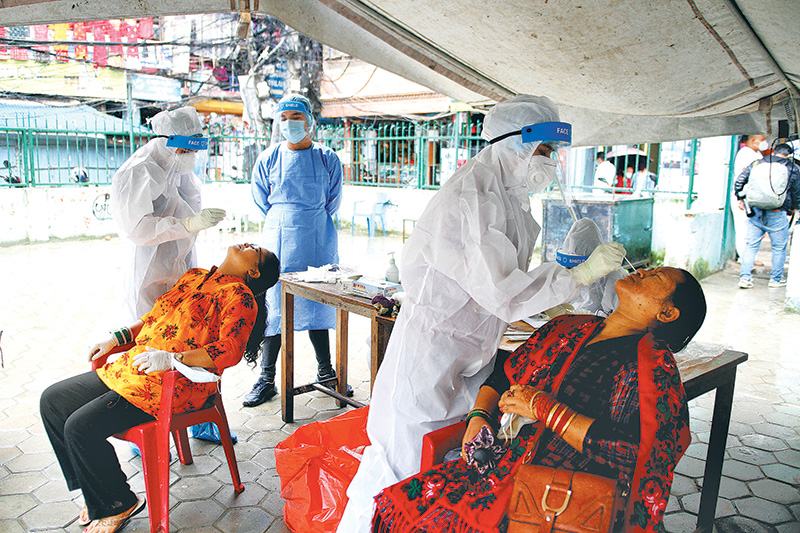
With the restrictions over and increased public movement, doctors say contact tracing will be more difficult, and Kathmandu could turn into a Covid-19 hotspot.
- Arjun Poudel
Health workers collect swabs for Covid-19 testing at Mahabouddha in Kathmandu on Tuesday. Post Photo: Beeju Maharjan

KATHMANDU,
The Ministry of Health said on Tuesday that 53 new Covid-19 cases were reported in Kathmandu Valley, the highest for a single day, raising an alarm, as public health experts warned of community spread of the virus.
Of the 48 cases reported in Kathmandu district, 27 are Nepal Police personnel, according to the ministry. Four cases were reported from Lalitpur and one from Bhaktapur.
Four people who tested positive for Covid-19 had come in contact with the police personnel infected with the virus, according to Dr Basudev Pandey, director at the Epidemiology and Disease Control Division. Likewise, 13 others who tested positive for the virus had entered the Valley recently.
Public health experts said the Valley could become a new hotspot for various reasons–it is densely populated, people’s movement is not regulated and safety measures are not being followed.
“Rise in the number of positive cases in Kathmandu Valley is very alarming,” said Dr Baburam Marasini, former director at the Epidemiology and Disease Control Division. “Negligence coupled with some immature decisions on the part of authorities concerned could lead to a disaster.”
With 53 new cases, the number of positive cases in Kathmandu Valley has now reached 477. The Covid-19 national tally so far has reached 19,063, with 49 deaths.
When the government on July 21 decided to lift the four-month-long lockdown, there were concerns that the decision might have been taken in haste.
Public health experts have for long alleged that the government failed to utilise the lockdown period to improve quarantine facilities and expand polymerase chain reaction tests.
“Kathmandu Valley can become a new Covid-19 hotspot in the coming days,” Marasini told the Post. “The government has neither increased the number of tests nor enforced safety measures properly.”
Though the government has allowed public transport to resume only within the Valley, data suggests people in thousands of numbers are entering Kathmandu every day.
According to the Ministry of Home Affairs, over 5,000 people enter the Valley every day using emergency vehicles and cargo trucks and by taking special permissions.
“The rise in the number of cases is something I was expecting,” said Dr Sher Bahadur Pun, chief of the Clinical Research Unit at Sukraraj Tropical and Infectious Disease Hospital. “Public movement has increased like in the pre-lockdown phase. This is also an indication of what is going to happen in coming days.”
According to Pun, failure to break the chain of infections could spell a disaster, as the virus could rapidly spread to the community.
“We can’t say what will happen then,” said Pun.
Since the end of the lockdown on July 21, a total of 28,072 PCR tests have been conducted, compared to 30,096 tests performed in the seven days leading to the lockdown.
Doctors have long been asking the authorities to expand tests, conduct contact tracing, improve quarantine centres and raise awareness among the public.
With the highest number of infections for a single day recorded in the Valley, authorities on Tuesday were scrambling to trace people who may have come into contact with those who have tested positive.
Of the 53 who tested positive for the virus in the Valley in the last 24 hours, the contacts of nine people are yet to be traced.
According to Pandey of the Epidemiology and Disease Control Division, contact tracing of the infected people has already begun.
“We are working to find the contacts of all the infected people and their travel history.”
Contact tracing, however, is not easy given the increased movement of people after the lifting of the lockdown.
“During the lockdown, people stayed put in their houses and even if there was movement, it was limited to their own locality. This meant they would come in contact with a limited number of people,” said Pun. “Since the end of the lockdown, we are behaving as if there is no threat of the virus. This will make contact tracing even more complicated.”
After the government lifted the lockdown, public experts had told the Post that the threat level was still high.
Doctors said that their suggestions were overlooked while taking the decision to end the lockdown and resume public transportation as well as other businesses.
“We had asked the government to lift restrictions in areas where the risk was low,” Dr Senendra Upreti, a former health secretary, told the Post. “But without taking the  consequences into consideration, the government ended the lockdown at one go throughout the country.”
The Ministry of Health itself is anticipating the number of positive cases to rise, but it has shifted its responsibilities to the shoulders of the people.   
“The number of cases will go up in the coming days if we keep violating the safety rules,” said Jageshwor Gautam, spokesperson for the Ministry of Health. “What can we do if people don’t follow safety instructions?”
Public health experts say while it is incumbent on people to follow safety protocols–wear masks, maintain social distancing and hygiene, avoid visiting crowded places and limit their movement–authorities need to play a bigger role.
Marasini said that the local administration can play an important role in regulating public movement, making masks mandatory in public places and enforcing social distancing rules.
Pun said the writing was on the wall when authorities were too slow to recognise the virus threat.
“First we made a mistake by underestimating the risk, and now we are repeating the mistakes that some countries like India and the US made,” said Pun. “Contact tracing will become more challenging in the coming days. If we fail to act now, we are headed for a disaster.”
HOME PAGE

High drama in ruling party as both Oli and Dahal factions make their moves

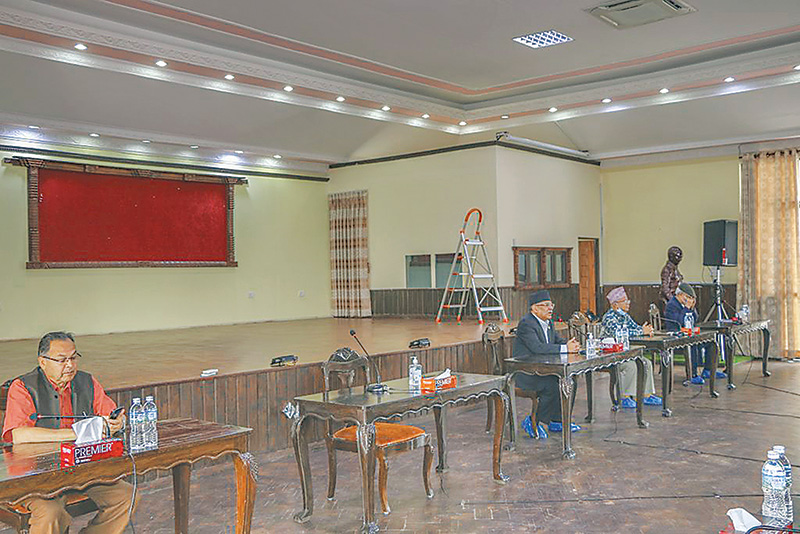
After Pushpa Kamal Dahal convenes the meeting with a majority of Nepal Communist Party Standing Committee members, Oli is in a frantic bid to cultivate some senior leaders, including Bamdev Gautam.
- TIKA R PRADHAN,ANIL GIRI
The Standing Committee meeting convened by Pushpa Kamal Dahal at Baluwatar on Tuesday. Photo courtesy: Cmprachanda.com

KATHMANDU,
There was high drama in the ruling Nepal Communist Party on Tuesday, as factions led by chairs KP Sharma Oli and Pushpa Kamal Dahal attempted to achieve dominance.
After Oli postponed the scheduled Standing Committee meeting, Dahal went ahead with the meeting. Both factions alleged each other that their moves were unilateral.
Party insiders said the conflict now has reached a new height.
As many as 29 of the 44 Standing Committee members and two invitee members—Amrit Bohora and Bishnu Pukar Shrestha—were present in the meeting.
The meeting concluded that Oli’s sudden and unilateral decision to
stall the Standing Committee was “inappropriate” and against the “party system”.  
“Dahal had urged Oli not to stall the meeting, but he took the decision unilaterally. The Standing Committee members have concluded that such a unilateral decision was against the party system and procedures,” said Narayan Kaji Shrestha, party’s spokesperson. “Oli also rejected Dahal and [Jhala Nath] Khanal’s request to join the meeting.”
The Dahal faction, backed by senior leaders Madhav Kumar Nepal and Khanal, is demanding that Oli step down as party chair.
The Dahal-Nepal faction wanted the Standing Committee meeting on Tuesday at any cost as part of their strategy to employ the majority against Oli.
“By holding the meeting of the majority of the Standing Committee members today, we wanted to give a message that Oli’s unilateral decisions will not work now onwards,” said Gokarna Bista, a Standing Committee member, who is close to Nepal. “We have taken it as the continuation of the ongoing meeting, as it was decided by last Tuesday’s Standing Committee meeting.”
Insiders say Oli’s position has now become tenuous, as he is running out of options. In a desperate bid to save his position, Oli, however, could take some stern measures which could result in a party split, they say.
After the Dahal-Nepal faction convened the meeting at Baluwatar, Yogesh Bhattarai, a ruling party leader and minister in the Oli Cabinet, warned of an accident.
“A disaster is imminent. Let’s exercise restraint. Let’s talk,” Bhattarai wrote on Twitter.
Leaders close to Oli said the prime minister is prepared for “any kind of move” to save his position, including the party split if the Dahal-Nepal faction tried to take action against him through majority votes.
Later in the evening, Oli was pulling out all the stops to secure a majority in party committees as well as the Parliamentary Party.
Oli on Tuesday evening met with vice-chair Bamdev Gautam at the latter’s residence.
On Tuesday morning, Gautam issued a six-point proposal for party chairs to maintain party unity. Gautam has suggested that Oli should lead the government for the full term while Dahal should be handed over chairmanship with full executive power until the general convention. Gautam has also suggested a Cabinet reshuffle.
While speaking at the Baluwatar meeting, Gautam said that Oli had failed to run the party and the government.
Gautam is a crucial figure in the nine-member Secretariat. The meeting with Gautam at the latter’s residence is seen as Oli’ overtures to win over him. A leader close to Oli told the Post earlier on Tuesday that Oli wants a strong commitment from Gautam, as he has flip-flopped in the recent past.
Even though the Dahal-Nepal faction appears to hold a comfortable majority in the Standing Committee, some including former Maoist leaders are fence sitters, and this gives Oli an edge. Lekhraj Bhatta, Top Bahadur Rayamaji and Mani Thapa, all former Maoist leaders, did not attend Tuesday’s meeting.
Two Standing Committee members from Dahal and Oli factions told the Post that since Tuesday, internal dispute in the party has deepened further and meetings of both party committees–Secretariat and Standing Committee–have become uncertain now.
A member close to Dahal said Oli has seen Tuesday’s meeting in his own backyard despite his call to postpone it as a big threat.
“Now the message is clear that the Dahal faction can take any decision on majority basis,” said the member who spoke on condition of anonymity. “This has prompted Oli to cultivate some influential leaders so that he can prove his majority in party committees.”
There are concerns in the Dahal-Nepal faction that Oli might take some stern measures such as issuing an ordinance to split the party or dissolving the House.
Standing Committee members close to Oli, however, made light of Tuesday’s meeting, questioning its validity, and the Dahal-Nepal faction’s moves.
“The party will now move towards the general convention as they have decided to hold meetings in consensus with Oli,” said Prithvi Subba Gurung, a Standing Committee member close to Oli.
“The general convention should decide the party chair.”

Page 2
MEDLEY

Horoscope

ARIES (March 21-April 19)
***
Turn all of your attention toward business today. You don’t necessarily have to focus on stocks, bonds, or investments. Instead, you might really want to deal with anything that requires official meetings with professionals. Move forward in your negotiations, but act conservatively.


TAURUS (April 20-May 20)
****
No one expects you to go through anything tough alone, so if you’re feeling overwhelmed, underwhelmed, or just plain old blue, call up a friend for a chat and a giggle. Pick someone who knows you inside and out so you’ll feel totally at ease and uninhibited.


GEMINI (May 21-June 21)
****
You have always had a gift for tact, but lately you may have been feeling that those who use a sledgehammer approach are getting further than you ever did with well-chosen words. In reality, you still have the upper hand. If you feel a confrontation coming today, have confidence to get exactly what you want.


CANCER (June 22-July 22)
***
Celebrate what is sure to be a good day. Each time you can make someone laugh, you’ll get another dose of empowering energy. You can leave them rolling in the aisles by the end of the day. Use your ego to plow through the challenges you’ll encounter over the next few days and weeks.


LEO (July 23-August 22)
***
Be very careful with your impulses today. It’s not that you want to ignore what your gut is telling you, but take special care not to act too quickly. You should still listen to your instincts, but also feel empowered enough to take your own time. Moving too quickly could cause some carefully perched ideas to fall off the shelf and break.


VIRGO (August 23-September 22)
***
Your mind is extremely sharp today, and you’re eager for some disorder, not to create havoc, but so you can put things back together again in an organised way. Welcome new ideas, say hello to changes in plans, and get ready to have one of the most challenging—and thus rewarding—days you’ve had in a very long time.


LIBRA (September 23-October 22)
***
Sometimes you don’t need to know every single detail before getting involved in something new. And in some cases, it could be much better if you don’t know too much ahead of time. Too many details could confuse you, overwhelm you, or give you reasons to back out of something that you should dive into.


SCORPIO (October 23-November 21)
****
Your new and improved take-charge attitude is starting to work today. Results are still coming in slowly, but people are getting behind you. No one else sees things like you, and that is working in your favor. Resist taking on any more right now. Instead, take the path of least resistance and wait for others to follow.


SAGITTARIUS (November 22-December 21)
***
Not everyone knows when to step back and give someone else their time in the limelight, but you sure do! When the praise starts getting heaped up on you, make sure everyone gets their fair share. You’re secure enough not to feel threatened when the people you work with get some credit, too.


CAPRICORN (December 22-January 19)
***
Kindness will play a major role in your day. You’re meant to find a new understanding about reciprocation. Give to others what you want to get from them, and everything will work out the way you need it to. If you’ve felt alienated by anyone lately, today is the day to reach out and try for a connection.


AQUARIUS (January 20-February 18)
****
You’ll be very curious about how things work today, and you should do what you can to satisfy your curiosity. Do the research you need. Ask the people who can give you the insight. Feeding your mind with new input to understand the world is a very healthy thing, although initially things could be quite confusing.


PISCES (February 19-March 20)
****
It can be hard to be totally objective when feelings are at stake, but if you can separate your emotions from what you need to do right now, you will be able to swing it with little difficulty. Organisation could be a helpful aid. It will help you get a complete overview of what you’re dealing with.

Page 3
NATIONAL

Lalitpur to install 669 smart electric street lamps on three city routes

This is a first in the country, but it could be expanded to other areas depending on local interest, says Kul Man Ghising .
- ANUP OJHA
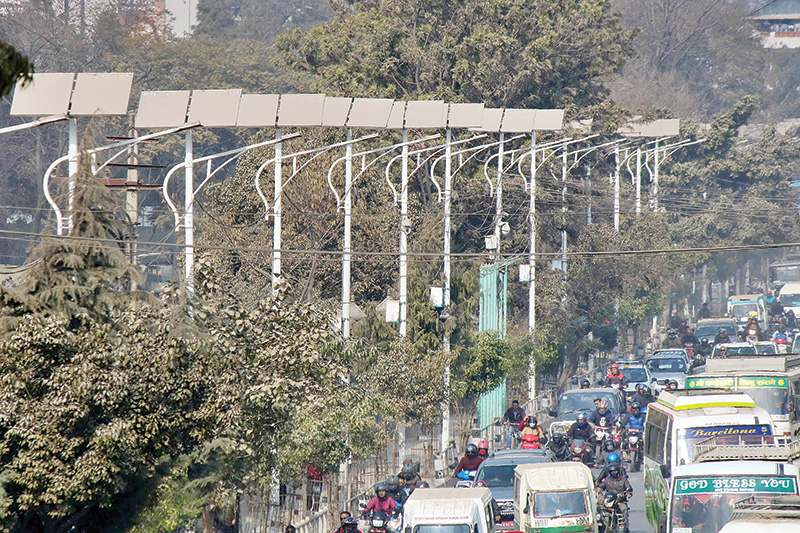
Kathmandu Metropolitan City installed solar street lamps at different locations over the past few years, but most of them are now out of repairs, officials say. Post file Photo: Anish Regmi

LALITPUR,
Learning a lesson from its own  inability to maintain solar street lamps, Lalitpur Metropolitan City has started an initiative of installing smart electrically-powered street lamps on three different routes with the technical support of Nepal Electricity Authority.
The city Tuesday announced it would install 669 lamps within two months at a cost of Rs 52 million.  
“These lamps will run under a centralised control system and this is the first step we have taken to make Lalitpur a smart city,” said Chiri Babu Maharjan, the city mayor.
The new street lamps are based on radio controlled signals, where a central power control module would control the lights via the internet. If  a certain lamp is not working, the central control would be able to sense it so that the problem can be addressed.
“The new street lamps can be made dim when there is no need for light,”said Kulman Ghising, managing director of Nepal Electricity Authority. “This is of its kind system in Nepal,” said Ghising.
He said the current model of solar lamps were not durable as they have a lifespan of only five years, after which their batteries need recharging.
The city has announced to pay the electricity bill to the authority annually.
 “With the new electric lights we will be able to control the consumption of electricity, as they could be made dim after midnight when there is less human mobility,” said Maharjan.
In 2016, the city had installed 940 solar lamps at a total cost of Rs 90 million, of which Rs 60 million was invested by the central government.
The contractors have been given 45 days to install the new lamps.
“Over 80 percent of the solar lamps in Lalitpur are of no use now,” said Maharjan.
According to Sagar Gnawali, assistant manager at the NEA, one street lamp can be installed for about Rs 30,000 to Rs  40,000, while the cost of installing a solar lamp is at least Rs 130,000.
Lalitpur plans to install 50, 80 and 120 (watts) poles depending upon the human mobility in the area on three routes— Kupondole to Satdobato; Bakhundol to Patan Dhoka; and Pulchowk to Gwarko via Mangalbazar.   
Meanwhile, the solar-powered street lamps in Kathmandu are also more or less defunct.
Kathmandu Metropolitan City had installed 1,285 solar street lamps under a public-private partnership model, in which the private company, BK Traders and Supply, had invested Rs 227 million in 2016.
It was a 10-year deal with the private company as per which the traders could use the electricity poles for advertising but had to maintain the lights. Four years since the deal, and many of these solar lamps do not work due to a lack of regular maintenance.
Earlier, the Kathmandu city authority had installed 1,600 solar lamps as part of Kathmandu Ujyalo Programme in  2014 with support from the Asian Development Bank. Over the years, many of these lamps have fallen into disrepair.
After the failure of solar lamps,the city last year had allocated Rs 50 million to install 6,000 electric street lamps at various road sections.
Electricity bills for these street lights remain unpaid.
“The municipalities in Kathmandu Valley have accrued a hefty amount of unpaid electricity bill due to a lack of proper billing system. NEA does not know how much the arrears is. But with this new system, computers will show the amount of electricity consumed,” said Gawali of the NEA.   
Ghising further said the NEA is working to install the centralised control street lamps in all local units, as they are cost effective and more efficient. He said Bharatpur Metropolitan City is planning to install such lights in the future.
“But Kathmandu Metropolitan City has so far shown no interest,” said Ghising.
When the Post contacted the Department of Roads to inquire the present status of the street lamp it didn’t have exact data. “All the street lamps in the Valley are installed by the local governments, but none of  them are properly functioning,” said Shiva Hari Sapkota, spokesperson at the department.
“Those solar lamps were installed when the country was reeling under load-shedding. The situation is different now, electric lamps are way better than solar lamps,” said Sapkota.

NATIONAL

Study abroad business takes a hit as pandemic stops students from leaving

As plans of thousands of students to study abroad have been either postponed or shattered due to Covid-19 related travel restrictions, and suspension of visa services education consultancies and airliners are also affected.
- ADITI ARYAL,ELISHA SHRESTHA

KATHMANDU,
When Mahesh Shrestha received an admission offer from Drexel University in mid-March for the fall session, he hoped that by July, he would be ready to leave for the US on a student visa. But, with the Covid-19 outbreak, things have not gone as planned.
“The university postponed the start of the session until September, and launched a few online courses in July. Right now, I am enrolled in one such course,” said Shrestha. However, I don’t know how I can pay for the college fees if I stay in Nepal,” said Shrestha.
Like Shrestha, thousands of students preparing to go abroad to study have been either forced to postpone their plans or completely abandon them due to Covid-19 travel restrictions.
But it’s not only the students who are affected. Other businesses such as airline companies, and educational consultancies that depended on the mobility of the students have also seen their revenues decline.
Before the lockdown, Nepal students used to spend billions on airfares every year, say airline operators. “During the 2018/19 fiscal, Nepalis spent almost Rs 41 billion on air travel. But due to the pandemic, the figure dropped to Rs 25.2 billion in 2019/20,” Gunakar Bhatta, spokesperson of the Nepal Rastra Bank, told the Post. “Students who leave around this time of the year (June/July) used to make up a significant proportion of travellers.”
Education consultancies are also facing the brunt due to a halt in student departures. Santosh Pyakurel, chair of the National Education Consultancies’ Association, said such businesses have registered heavy losses and many are on the verge of shutting down.
Pyakurel said that around 4,000 education consultancies that guide students to get admission in foreign universities were in operation in Nepal before the lockdown. Although official figures from the Ministry of Education, Science and Technology show that 1,473 consultancies and language institutes operate legally in the country.
“Before the lockdown, the consultancies and language institutes contributed billions of rupees to the country’s economy. However, due to lack of business following the lockdown, around 20 percent of consultancies have shut down completely,” said Pyakurel. The possibility of them getting back to business soon is bleak, he said.
Many students also prefer to study abroad because they can take up part-time jobs to earn their living, pay their fees, and also send some money home to their families in Nepal.
In July, a student in the United States had told the Post on the condition of anonymity that he was working part-time illegally to support his education and also sent around $3,000 (Rs 357,000) home. The pandemic cost him his job, and dashed hopes of sending money home. Similar to him, youths studying in other countries also send money to their families.
According to Asmod Karki, an economist, in 2016 alone, remittances received from the United States, one of the most-preferred destinations for Nepali students, amounted to Rs 110.03 billion. “A huge chunk of this is sent by students,” he added.
Once the pandemic is over and travel restrictions are lifted, the students are expected to join their universities abroad. “The setback we are seeing could be temporary. Once they rejoin the job market, after graduation or during their study period, they will start sending money again,” he said.
As for Mahesh Shrestha, he hopes international flights, along with visa services for the US, resume soon so that he can make it to his new college by fall. “I worked really hard to get a placement in this master’s programme. I will be really disappointed if my admission gets cancelled due to the circumstances created by Covid-19,” said Shrestha.

NATIONAL

Social Welfare Council’s plans to build convention centre draws criticism

Earlier, Kathmandu Metropolitan City had proposed building a multi-purpose commercial hall at Bhrikutimandap.
- PRITHVI MAN SHRESTHA
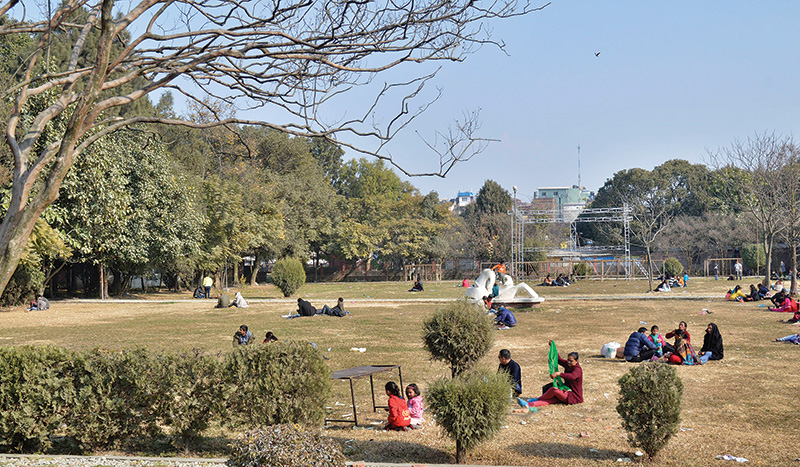
The Social Welfare Council on July 16 announced plans to build a convention centre in Bhrikutimandap. Post file Photo

KATHMANDU,
The Social Welfare Council is planning to develop an international convention centre in Bhrikutimandap, just a month after it vociferously denounced a similar plan proposed by Kathmandu Mayor Bidya Sundar Shakya.
The council, which has been running exhibition and convention centres in the government-owned land, had earlier  refused to vacate the property for the city authority to build a multi-purpose commercial building, arguing that the venue centres were its chief source of income.  
Even urban planners and conservationists had strongly protested Mayor Shakya’s plan to develop over few remaining open spaces in the Capital city.
Now it is the council that wants to build in the space, inviting concerns from conservationists and urban planners.
On July 16, the council announced a plan to build an international convention centre in 214 ropanis of land by issuing a notice calling for proposals from interested developers to prepare a master plan within 30 days.
The council has defended its plan amid criticism from conservationist groups who say the city needs the open space for clean air.
Durga Prasad Bhattarai, information officer at the council, said that the council’s plan will occupy far less space than what the Kathmandu Metropolitan City had proposed.
“There will also be a children’s park within a greenery belt,” he said. “But how exactly the space will be utilised will be based on what types of designs are presented by experts.”
But heritage conservations say that the council’s plan mirrors that of Kathmandu Metropolitan City.
The city authority plans to build a multi-purpose commercial building over 26.6 acres of land, with six meeting rooms, three conference halls, an auditorium and an exhibition centre. The Rs 12 billion plan also included a parking space for 1,000 cars, a food court and restaurants.
“We have been opposing the city’s plan and now we are opposing the plan unveiled by the Social Welfare Council,” said Alok Siddhi Tuladhar, a heritage conservationist. “We need open space at the core area of the city because it is difficult to get clean and clear air at the centre of the city.”
Bhrikutimandap is the only remaining open space in the heart of Kathmandu. The two other spaces, Tundikhel and Khula Manch, have already been encroached upon.
The Khulla Manch area has been converted into a bus park after the previous bus park area was vacated for the purpose of remodelling it. The remodelled bus park is supposed to have a 29-storey view tower among many other amenities. The city authority had awarded the contract to Jaleswar Swachhand Bkoi Builders.
Several years have passed since the contract was awarded, but the contractor has still not completed the project.
Over the years, the Khula Manch area, which was originally supposed to be a temporary bus park, has been encroached upon by shopkeepers and other business operators. Sanjaya Adhikari, who often files public interest litigation for the preservation of nature, culture and heritage, told the Post that the plan to construct buildings in Bhrikutimandap by disregarding the need for open space violates the constitutional rights of people to live with dignity and in a clean environment.
Article 30 of the constitution has made a clean environment a fundamental right.
Both Adhikari and Tuladhar said that the government does not have the authority to use the land for purposes other than providing public open space, as they were first acquired from the people with the same promise.

Page 4
EDITORIAL

Go local

The government must create a support system for local farmers rather than continue to import agro products.

Despite a 15.63 percent drop in overall imports owing to pandemic-induced restrictions, Nepal’s imports of agricultural products continue to grow, totalling Rs250 billion in the fiscal year 2019-20. With this, the share of agro products reaches 21 percent of the total imports. Cereals top the list at Rs56.88 billion, almost a fifth of the total agriculture import bill. Rice and maize form a bulk of the cereal imports, at Rs22.23 billion and Rs14.75 billion respectively. The products that follow cereals include edible oil, vegetables, fruits and nuts and seeds. Nepal spent Rs14.75 billion on animal fodder. The country continues to spend Rs14.75 billion on animal fodder and millions more on things as rudimentary as flowers.
Although 65 percent of the population depends on agriculture, the farm sector contributes only 27 percent to the gross domestic product. For all its claims about being an agricultural country, Nepal’s agro imports have jumped almost six-fold from Rs44.43 billion in the past 10 years. Nobody takes that claim seriously anymore, but for students who have to rote-learn lessons to pass their exams, and political leaders who have to please their voter base. But beyond the facade of the archaic claim lies a dirty picture that reveals decades of systemic failures of successive governments to modernise the country’s agricultural sector and make it self-sufficient if not export-oriented. However, the government, rather than focusing its efforts towards minimising imports, it is intent upon collecting duties levied on such imports.
This was evident in the government’s continuous import of vegetables from India during the coronavirus-induced nationwide lockdown even as Nepali farmers’ produce rotted in the fields for want of market. Ultimately, farmers were compelled to spill their milk or vegetable products onto the streets, as was seen especially in places like Chitwan as the government failed to facilitate their sale owing to the coronavirus-induced lockdown. If they follow the right approach, local levels are also in a position to minimise the role of third parties and facilitate direct transactions between producers and consumers. Even as it focuses on modernising agricultural production, it is by re-introducing the age-old concepts of haat bazaar that the local agricultural market can be re-energised, and producers and consumers brought together without the mediation of a third party.
The government must, thus, focus on creating local markets for the sale and purchase of agro products. But it likes to talk big on agricultural revolution more than take concrete steps. What we need is a sustainable market to support the needs of farmers and consumers both. It is not that the government does not give grants at all. But they go to the rich and the powerful. So, a strict regulation of the agricultural grants to make them accessible to the needy would help groom new agricultural entrepreneurs.
For long, the Nepali agricultural sector has also suffered from labour shortage and resultant increase in the cost of production owing to outmigration of the working population. But that might change for the good in the post-pandemic scenario as a large number of the youth have returned home or are likely to return in the immediate future. The government can, with the right approach, cash in on the skills learnt by foreign returnees and begin re-energising the agricultural sector. The local levels are in a position to give a new outlook to the agricultural sector if their resources are put to use wisely. Ultimately, what use are the 753 local units if they do not put any effort towards realising the need to re-energise the agricultural sector from the ground level?
Local governments must also implement the policy of discouraging people from leaving their agricultural lands arid so as to increase local production. This helps bring down unemployment at the local level and increase the collection of taxes. It is the local levels that should begin an agricultural revolution from the bottom up. Local levels are best positioned to identify the production capability of the land in local areas. Local levels can take the lead in identifying the agricultural possibilities and capabilities of their areas, and work towards making local markets self-sufficient if not export-oriented.

OPINION

Another failed India-China platform

Member countries may have had great hopes for the BCIM Corridor, but apprehensions killed it from the outset.
- MAHENDRA P LAMA
Shutterstock

Even after two decades of lively discourse and debate, 12 rounds of Track II Bangladesh-China-India-Myanmar (BCIM) Forum meetings during 1999-2015 and the setting up of the Bangladesh-China-India-Myanmar Economic Corridor (BCIM-EC) Study Group, this grouping remains far from being formalised. Started as the Kunming Initiative in 1999, it is still a living idea that has huge potential, surrounded by uncanny scepticism and inexplicit non-acceptance by the ‘member countries’ themselves. The last BCIM Forum was held in Myanmar in 2015. From the very beginning, Bangladesh, China and Myanmar were represented by senior government officials whereas in the case of India the delegations mostly consisted of think tanks, business persons and former officials-diplomats. India never participated openly and directly. Even when there have been major events like the Car Rally in 2013 and the Kolkata-Kunming (K2K) meetings, which had visible support of the Government of India, the actual official participation never happened.
 
India’s camouflaged participation
As against Indian camouflaged participation, China consistently maintained the spearheading by Yunnan, a relatively less developed southwestern province of China, with its high officials as the pivot. India’s apprehensions range from history to national security, the legacy of conflict, Chinese economic dominance to socio-cultural disturbances and, more critically, a subliminal level of trust and confidence. The fear of wanton exploitation of the rich natural resources and biodiversity of the Eastern Himalayas, dislocation of traditional relations based on bilateralism and loathing that it will invite the permanent presence of China are impinging upon this project. India’s North-East—a key region for this grouping to succeed—is an insurgency prone region, and India’s suspicions of foreign interference in this area have always been an insurmountable block.
Against this backdrop, India’s official announcement of joining the BCIM-EC in 2013 came as a major departure in its foreign policy. How and why the idea of BCIM-EC was brought forward still remains a question. Among many attributions, two plausible reasons emerge upfront. First, it provided appropriate fitting in China’s grand scheme of the Belt and Road Initiative announced in 2013. This could be a major entry point for China—a non-Indian Ocean country—to this strategic oceanic geography of 68.56 million sq km that provides
access to the Pacific through Strait of Malacca and the Atlantic, via the Mediterranean, through the Red Sea and the Suez Canal.
Then, there is the apprehension that the hurriedly built Hambantota Port in Sri Lanka in 2010 with a massive Chinese loan by the China Harbour Engineering Company, a state-owned enterprise, had already started facing severe underutilisation of its operational capacity. Even after the decree of the government ‘that ships carrying car imports bound for Colombo port would instead offload their cargo at Hambantota to kick-start business there, only 34 ships berthed at Hambantota in 2012, compared with 3,667 ships at the Colombo port’. By 2017, Sri Lanka figured among the top 50 recipients of external debt from China and was identified as one of the 23 countries for which the risk of debt distress could be quite high. When Sri Lanka finally handed over the port and 15,000 acres of land around it or a 99 years lease to China in 2017, it partly substantiated this unexplained rationale of the proposed economic corridor.  
The proposed ports, if built in Kyaukpyu (Myanmar) and Chittagong (Bangladesh) in the East Indian Ocean under the BCIM-EC, could durably feed the Hambantota and substantially upgrade its capacity utilisation. Since this would be a much shorter route to viable markets, it could even attract the Greater Mekong Sub-region of Laos, Vietnam, Cambodia and Thailand to use this route and connect with China’s Belt and Road. However, connecting with these new ports around the Indian Ocean, considered to be a traditional Indian stronghold, would clearly provide a permanent thread to China in accomplishing what the US calls the ‘string of pearls’ strategy. This apprehension has been one significant reason to explain India’s position against the Belt and Road and the BCIM as well.  
 
China’s overkill
BCIM-EC will ‘advance multi-modal connectivity, harness the economic complementarities, promote investment and trade and facilitate people-to-people contacts’. This Corridor would run from Kunming in the east to Kolkata in the west, broadly spanning the region, including Mandalay, Dhaka and Chittagong and other major cities and ports as key nodes. With the linkages of transport, energy and telecommunication networks, the Corridor will form a thriving economic belt that will promote common development of areas along it. Myanmar is the bridge in this ‘amphibious’ route. This is where the BCIM Corridor evolves to have cascading ramifications, including the encirclement of the Indian Ocean and the littoral states.
At the same time, since 2013, there have been confusing developments and contradictory postures within the group. A clear image of the BCIM and where does it actually stand has been reflected in various bilateral joint statements and speeches by leaders of these countries in various forms. The oscillating trend is quite typical of India-China relations. The intricacies within the BCIM have become more complex; suspicions have deepened and individual country’s stands have turned ambiguous. The initiative seems to have lost purpose, ownership and direction. India stopped mentioning the BCIM after 2015 and Myanmar after 2016. Myanmar, while highlighting its border of over 2000 kilometres and special relationship with China, moved forward with the bilateral venture labelled the China-Myanmar Economic Corridor (CMEC) since 2019.
The first meeting of the joint study group, held in Kunming in December 2013 decided that a third meeting had to take place in India in 2014 to adopt the final report and to sign the intergovernmental cooperation framework. However, the third meeting was
only held in Kolkata in April 2017. Since then, there has been no visible movement.
Since China is the only country in the BCIM which has had a protracted experience of building such cross-national corridors, with an outward foreign direct investment flow of $118 billion in 2019 alone and foreign exchange reserves of $3.40 trillion in 2020, the fear that China would move towards bilateral relationships after the joint study group report was accepted seems to have been felt by all other potential members of this grouping. The CMEC agreement in April 2019 proved this right. In the Leaders’ Roundtable of the 2nd Belt and Road Forum for International Cooperation held in Beijing in April 2019, the BCIM was formally dropped from the list of 35 BRI projects.


Lama participated in several BCIM Forum Meetings from the Indian side.

OPINION

An inside account of Nepal

It is all about power, who did what and ended up getting what in reciprocation.
- ATUL K THAKUR
Shutterstock

As Nepal is not stopping to surprise even its keen observers, out of necessity, it is highly recommended that they read senior journalist Sudheer Sharma’s The Nepal Nexus. In long-form though, it’s a sort of prescription for all what ails the country, but keeps it moving with a complex background and foreground. He looks back on Nepal’s painful political transition and gives an inside account of the ‘Maoists, the Durbar and New Delhi’ calling it ‘Nepal Nexus’.
At the outset, his insightful contribution was cited solely for knowing the nature of Nepal’s democracy, the statecraft and its eccentric ways of functioning. It is all about power, who did what and ended up getting what in reciprocation. The Maoists came to centre stage and benefited before it lost its way with factions in the party and fell prey to the grand design of ‘communist unification’ propounded by Oli and his camp. The Durbar ceased to function with the ‘royal massacre’ and an inconclusive follow-up to that; what remained in the form of succession lasted too early and on a disappointing note. The third important component, the capital of the friendly neighbour ‘New Delhi’ continues to stay in the public imagination, but mostly for satisfying the instant gratification of the political classes who otherwise could be held accountable for pursuing corruption and incompetence that led to endless misery for the masses of the homeland.   


Ignorance is bliss
Recently, Prime Minister Oli made a series of statements with Machiavellian traits, successfully diverting the minds from the humanitarian crisis that is in full swing in Nepal and the world at large with the outbreak of the novel coronavirus and long lockdown. The leadership is endangered in most democracies today. Nepal is no exception and people are sentimentally captivated to take whatever is offered through home-grown demagogues. While the country is facing a public health failure, the collapse of industrial activities, mass unemployment, starvation, reverse migration and an uncertain future, the people are being forced-fed ‘unnatural nationalism’ that justifies ‘ignorance is bliss’.  
It would be wrong to say that a country like Nepal, that has no history of colonial occupation and external aggression, needed a new reckoning on sovereignty and patriotism, and the long-pending matter of the boundary dispute with India was not something that deserved such a hurried and shocking response. Was it an easy scheme of things for Oli to let India-Nepal bilateral ties see an unprecedented low? What made him so compelled to not offer condolences for the 20 unarmed Indian soldiers killed by Chinese forces?
Since Sudheer Sharma has artfully tried to cover ‘Nepal’s Nexus’ that is more about the past than the present, it is to be wished that the next print run of his book enables him to write about Nepal’s ‘New Nexus’. No matter what happens tomorrow, the current Nepali establishment’s neighbourhood policy sends the message loud and clear. It is not about just exercising the choices or maintaining a balance between India and China, it is about manipulating a troubling equation between two countries with nuclear capabilities and very large economies. In the process, the danger lies where Nepal could emerge as a flashpoint for a geo-economic tussle between India and China.  
Sadly, in the absence of consultation and rumination, Nepal is faring poorly by entering into a vicious spiral of mistakes. It needs to be known that it is not the ‘Indian virus’ that is deadlier than the ‘Chinese virus’, what in fact is deadlier is leading the country into a risk zone rather than towards normalcy after the global breakdown. The bid for a new nexus has flashed out brighter possibilities and put a question mark on the communist unification in Nepal that was never believed to be on ideological lines.


The enforced camaraderie  
‘Standing on the blood shed by tens of thousands of patriots, we are not willing to bow down before any foreign master’.
Possibly without knowing it would become fateful, Sudheer Sharma has meaningfully quoted Pushpa Kamal Dahal from the latter’s public announcement of his resignation from the prime ministership in 2009. In the changed times, would he like to recall this? Irrespective of how long he continues with the current arrangement on the organisational front, the onus is on Dahal to give a re-think on enforced camaraderie. He will be at a loss for turning his eyes back from the upturns in the geostrategic scenario that clearly is not in favour of Nepal. China is not altruistic with its Belt and Road Initiative and other cheap offerings. Its imperial intention can easily be understood. Nepal will do better without negating conventional wisdom and pursuing absolute non-alignment in international affairs.
As the political process is worrisome and the economy is facing a major contraction, Nepal surely has to look within. Instead of keeping petty political considerations and the urge to overstay at the helm, the political classes must think about reviving the level of discourses and make them development-centric. Baburam Bhattarai, once a comrade-in-arms of Dahal and an old rank Maoist, is someone who certainly has a clear view on the economy and the credentials to fix it. History will be kinder to Dahal and his estranged comrades if they can come together again in the mainstream democratic left framework and rescue Nepal and its people from a phase of deep troubles and uncertainties. An unscientific and irrational position on matters of national interest, if prolonged, will be troublesome. The ‘nexus’ serves the purpose of a lexicon, it should not be relied on beyond the trifling texts.   

Thakur is a policy professional and writer based in New Delhi.

Page 5
NATIONAL

Coronavirus patients sent home as Parsa’s Covid-19 hospital runs out of beds

All 50 beds in Gandak Hospital are occupied, which has led the hospital to send 26 infected patients home to self-isolate.
- SHANKAR ACHARYA
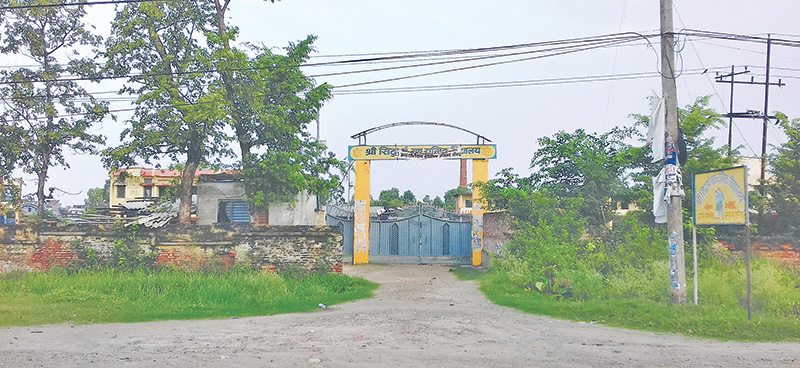
An isolation ward set up at a school building in Birgunj about a month ago has not come into operation as it still lacks proper infrastructure.Post Photo: Shankar Acharya

PARSA,
As many as 26 coronavirus infected people in Parsa have been sent home to self-isolate after Gandak Hospital, the only Covid-19 treatment facility in the district, exceeded its bed capacity.
Seventeen other patients have been kept at isolation wards in four different quarantine facilities in Birgunj, Parsagadhi, Sakhuwaprasauni and Thori.
The Birgunj-based hospital is overwhelmed after a sudden spike in the number of coronavirus patients in recent days, according to the hospital.
“We are unable to admit new patients. We are currently treating 58 coronavirus patients,” said Dr Udaya Narayan Singh, the coordinator of the hospital.
There is an increased risk of coronavirus spreading in communities if the patients who have been self-isolating at their homes are not careful, Singh warned.
“We know that a lot of the patients may not be able to practice self-isolation in its true sense,” said Singh. “For patients who live in small homes, there is an increased risk of them infecting their immediate family members who, in turn, could infect the people in their communities.”
The hospital has exceeded its 50-bed capacity and so have other quarantine centres. Singh said they had no option but to tell the patients to observe self-isolation at their homes.
Meanwhile, the hospital authority is also dealing with the challenge of preventing the infection among the staff and other patients.
“A doctor, a junior health worker and a maintenance staff have already contracted the infection while many non-Covid patients have recently developed symptoms like breathing difficulty, sore throat, body ache, fever and diarrhoea,” said Singh.
Health officials have said the district needs to expand its treatment and quarantine facilities in order to stem the spread of the virus.
An isolation ward set up by the Nepal Army at a school building in Birgunj about a month ago has not come into operation as it still lacks proper infrastructure, medical equipment and human resources.
“The isolation ward cannot be run in its current state,” said Singh.
After Birgunj metropolis saw a spike in the number of coronavirus cases, the district administration has imposed a prohibitory order in the city for an indefinite period from Saturday. However, many people doubt that the infection rate is going down by restricting public mobility when coronavirus infected patients are being sent home to self-isolate.
“The infected individuals have already come in contact with their families and the family members have met with people outside their immediate circle,” said Hari Panta, a resident of Birgunj.
The office of Birgunj metropolis, however, claims that the situation in the city is under control. Mayor Bijaya Kumar Sarawagi said that the city office has been coordinating with other government agencies in the fight against Covid-19.
“We plan to conduct polymerase chain reaction tests of at least one member of every family in Birgunj. We will be covering around 50,000 households in the city,” said Sarawagi.
As for the infected patients being sent home to self-isolate, the mayor said his office has entrusted the responsibility of treating the patients visiting Gandak Hospital to Narayani Hospital administration some three months ago.
 “The administrations of these two hospitals should seek solutions to accommodate the patients, instead of asking patients to self-isolate at home. The mayor’s office cannot make a decision regarding the number of beds in hospital,” said Sarawagi.  
Dr Madan Kumar Upadhyay, medical superintendent at Narayani Hospital, does not agree with the mayor.
“Gandak Hospital does not have the kind of infrastructure that will allow us to increase the bed capacity .The local government should set up more isolation wards in quarantine centres to ease the burden on the hospital. They could also set up other hospitals in the city to accommodate more Covid-19 patients,” he said.
According to Lalit Kumar Basnet, the assistant chief district officer of Parsa, the number of Covid-19 patients staying in quarantine facilities and those self-isolating at home has reached 43 in the past one week.
“We have asked some infected people to self-isolate at home. In the meantime, we are also preparing to use Narayani Hospital and National Medical College to treat Covid-19 patients,” he said.
A total of eight people—four from Parsa and four from other districts—have succumbed to Covid-19 in Birgunj so far. Parsa, a central Tarai district in Province 2, has 291 positive cases as of Tuesday.

NATIONAL

Snakebite victims are dying in Taplejung in need of immediate medical attention

For eastern hill and mountain districts, the only snakebite treatment centre is in Charali, Jhapa, which could take days to reach for those living in remote regions.
- Aananda Gautam
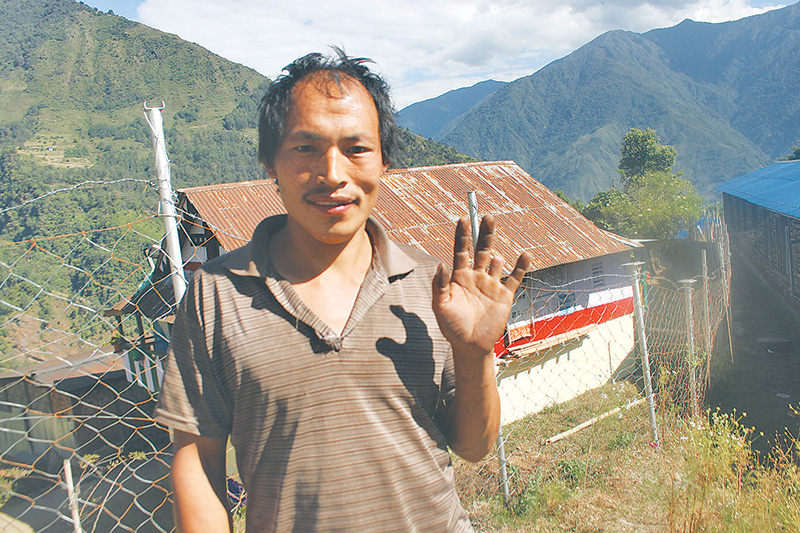
Dhan Bahadur Mabohang of Ikhabu village shows the finger that he lost to a snakebite. Post Photo: ANANDA GAUTAM

TAPLEJUNG,
Dhanmaya Mabo was bitten by a green pit viper, a venomous snake locally known as Hareu, when she was weeding the grass around her house in Tapethok Samling village in Phaktalung Rural Municipality, Taplejung, on July 12. The 52-year-old died 14 hours later.
Ram Limbu, Dhanmaya’s neighbour, said she lost her life because she could not get immediate medical attention.
“The incident happened at around 2pm. The nearest health post is four hours walk away in Lelep. We could not take Dhanmaya to the health post because there were  no youths in the village to carry her to Lelep. She died the next morning,” Limbu said
Dhanmaya’s husband, Buddapal, had called a Fedangwa, a faith healer, to treat his wife, but the faith healer couldn’t save her.
“Hareu (green pit viper) and Gurbe (mountain pit viper) are common snakes found in Taplejung,” said Dhan Bahadur Mabohang of Ikhabu village in Phaktalung Rural Municipality.
Mabohang, who lost his three-year-old son to snakebite eight years ago, said there are many snakebite fatalities in Taplejung, most of the victims die due to the lack of timely medical intervention.  
On June 2, Pannalal Bamjan, 68, of Deblinge village in Phungling Municipality-1 died after he was bitten by a venomous snakebite while he was out to use the outhouse at night.
Deblinge is not far from Fungling Bazaar, the district headquarters, where the district hospital is located. However, Bamjan’s family could not take him to the hospital because vehicles were not available due to the coronavirus lockdown.   
Although locals say that snakebite-related deaths are common in Taplejung, the authorities have not kept any record.   
Deputy Superintendent of Police Mahendra Shrestha said the district police does not keep data of snakebite fatalities because most deaths go unreported.
“Since the people do not report snakebite-related deaths, it is difficult to maintain a database,” he said.
Durga Prasad Bhattarai, of snakebite treatment centre in Charali, Jhapa, said snakebite deaths in mountain districts like Taplejung may be high mainly because health facilities are far away and people’s preference for alternative medicines and faith healing over medical science.
“There is a tendency of people seeking treatment with faith healers instead of going to health facilities for snakebite or any other medical emergencies,” said Bhattarai.
Even if people visited the health facilities, treatment for snakebites is far from guaranteed since the whole of Taplejung does not have a dedicated snakebite treatment centre.
The nearest snakebite treatment centre is in Charali, Jhapa, run by the Nepal Army. For people living in remote areas of Taplejung, it could take up to five days to reach Charali.
Dhan Bahadur, who had lost his son eight years ago, himself was bitten by a snake in 2015. He had gone to the district hospital in Fungling the next day, only to be referred to the snakebite treatment centre in Charali.
He took a public bus to Charali from Fungling Bazaar and reached the snakebite treatment centre only on the third day of the incident. By that time, his condition had become serious and he was sent to BP Koirala Institute of Health Sciences in Dharan, Sunsari. Doctors managed to save his life by amputating the finger where he was bit by the snake.
Snakebite victims of Panchthar, Tehrathum and Ilam also go to Charali for treatment for a lack of snakebite centres in their respective districts.
According to Bhattarai, there has been nearly a 50 percent increase in the number of patients visiting the centre from hill and mountain districts in recent years.
“Around 1,500 people visit the treatment centre for treatment annually,” he said. The treatment centre charges Rs 500 from a patient if s/he is to be admitted at the centre for a few days. The anti-snake venom is provided free of cost but the patient has to buy other medicines.

NATIONAL

Three dead, seven missing in separate landslides in Kalikot and Rukum (West) districts

Authorities say continuous rainfall has hampered the search and rescue operation.
- Tularam Pandey,HARI GAUTAM

KALIKOT / RUKUM (WEST),
Three people have died and seven others gone missing in separate landslides triggered by incessant rains at Kalikot and Rukum (West) districts on Monday.
A landslide at Banphikot Rural Municipality in Rukum (West) claimed the lives of a 22-year-old man and a 16-year-old youth of Syala. A 15-year-old from Raskot Municipality in Kalikot district was also killed in the same incident.
Meanwhile, five people of a single family were swept away by a landslide that occurred at Badoltala of Raskot Municipality on Monday.
One more person has gone missing following another landslide that occurred at an under-construction road section at Lalu of Naraharinath Rural Municipality.
Likewise, a 50-year-old woman of Dahan in Khadachakra Municipality was swept away by the flooded Takulla Khola at Tilagufa Municipality on Tuesday.
Kalikot District Police Chief DSP Shyam Babu Oliya said adverse weather conditions are affecting the search and rescue operations.
Similarly, four houses were swept away by floods and landslides at Potmara in Sani Triveni Rural Municipality and Shantighat in Raskot Municipality. A bailey bridge built by the Nepal Army in Phugad along the Karnali corridor road section was also swept away by the floods.

Page 6
MONEY

Firms are upbeat about getting credit under refinance facility

The central bank has adopted a lenient policy in terms of both amount and loan conditions to hasten recovery.
- PRITHVI MAN SHRESTHA
The new monetary policy allows banks and financial institutions to provide credit in bulk without having to submit separate proposals from borrowers to the central bank. SHUTTERSTOCK

KATHMANDU,
The Nepali business community is feeling good about getting cheap and easy credit under Nepal Rastra Bank’s refinance facility after it enlarged the refinance fund and simplified procedures.
The refinance facility allows firms to borrow money at a lower interest rate than the going rate.
The central bank has adopted a lenient policy in terms of both amount and loan conditions in a bid to hasten recovery of pandemic hit sectors after Covid-19 battered businesses.
As per the monetary policy, business entities can get refinance up to five times the amount of currently available resources. This means the central bank can ensure refinance up to nearly Rs200 billion as the refinance fund amounts to around Rs38 billion.
The central bank has opened a separate window to provide refinance of up to Rs1.5 million for micro, small and medium enterprises which were badly hit by the virus but cannot afford expensive loans. They can borrow funds at a maximum interest rate of 5 percent.
Tourism and hospitality, aviation and exports are among the sectors which have been particularly hit by the pandemic, and they will get credit under the refinance facility at a maximum £ percent interest.
The new monetary policy allows banks and financial institutions to provide credit in bulk without having to submit separate proposals from borrowers to the central bank.
It has fixed the limit for refinance credit provided under bulk refinance by banks and financial institutions at Rs50 million. The upper limit for loans extended after evaluating each borrower has been set at Rs200 million.
The monetary policy has asked each bank branch to provide at least five loans under this facility.
“I think the maximum amount of credit that can be offered to each enterprise under the refinance facility will enable them to get cheaper loans,” said Shakti Golyan, managing director of Tricot Industries, a readymade garment producer. The garment industry, which is dependent on exports, can get credit at a maximum 3 percent interest rate under a special refinance facility. Golyan has been borrowing funds under the refinance facility for the last few years.
But his bank has refused him credit under this facility several times saying that the quota given to them by the central bank had been used up with many loans going to large enterprises.
“We cannot be sure that such a situation will not arise again due to the Rs50 million credit limit set per enterprise,” he said.
“This will help small and medium enterprises to get cheaper loans.”
A few months ago, Kiran Dangol, proprietor of Lotus Paper Crafts, waited for the central bank’s clearance to get credit under the refinance facility after submitting the necessary documents. Under the previous provision, the paperwork related to each borrower needed to reach the central bank separately.
The handicraft producer said his application was turned down for incomplete paperwork. “The process of putting together all the documents is time consuming and complicated,” he said. It was his first attempt to obtain refinance credit and he was unsuccessful.
With the central bank allowing banks and financial institutions to deal with refinance facilities in bulk, he expects to get decisions on refinance faster. The business community has long been complaining about the complicated procedure to get the refinance facility.
As a result, firms have not been able to utilise the entire amount made available by the central bank under the facility even though it has been around for the last several years.
As of the first 11 months of the last fiscal year 2019-20, the outstanding refinance amount extended to enterprises stands at just Rs.11.82 billion. Out of this, general refinance amounts to Rs9.99 billion and export refinance totals Rs220.02 million.
This is just a fraction of the Rs38 billion available with the central bank for refinancing.
The refinance facility announced for earthquake-affected people largely remained unused, and Nepal Rastra Bank ended it two years ago. The amount of outstanding loans extended to quake-affected people as of mid-June stands at Rs1.61 billion.
“One of the reasons behind the low credit flow under the refinance facility is lack of knowledge about it among entrepreneurs,” said Golyan.
“I am among the first from the readymade garment sector to get loans under this facility, and many people still don’t know about it,” he said.
The central bank has made a provision requiring each bank branch to extend loans to five firms under the refinance facility, and officials believe that this will help to spread awareness among potential borrowers.
“It is also aimed at allowing enterprises based in all parts of the country to get cheap credit,” said Rastra Bank spokesperson Gunakar Bhatta.
He added that the provision of allowing banks and financial institutions to provide credit under the refinance facility in bulk would help firms to get credit faster after they submit their application.

MONEY

Gold drops off record high, dollar gets respite

- REUTERS

LONDON/SYDNEY, 
Gold hit a record high on Tuesday before the sheer scale of its gains drew a burst of profit-taking, which in turn helped the dollar from two-year lows and kept equity markets steady.
The precious metal had risen almost $40 higher at one point to reach $1,980 an ounce. A wave of selling pushed back to $1,915 in volatile trade.
Gold is still up over $125 in little more than a week as investors bet the Federal Reserve will reaffirm its super- accommodative policies at its meeting this week, and perhaps signal a tolerance for higher inflation in the long run.
“Fed officials have made clear that they will be making their forward guidance more dovish and outcome-based soon,” wrote analysts at TD Securities. “The chairman is likely to continue the process of prepping markets for changes when he speaks at his press conference.”
One shift could be to average inflation targeting, which would see the Fed aim to push inflation above its 2 percent target to make up for years of under-shooting.
The retreat in gold took some steam out of stocks, but Europe’s STOXX 600 eked out a 0.2 percent rise after MSCI’s broadest index of Asia-Pacific shares outside Japan ended up 0.8 percent.
Japan’s Nikkei closed lower, but Chinese blue chips rose 0.8 percent and E-Mini futures for the S&P 500 were steady after a 1.7 percent rebound from the Nasdaq on Monday helped Wall Street higher.
The dollar has been falling almost across the board, reaching a two-year low against a basket of currencies at 93.416 before recovering to 93.975.
The euro dropped back to $1.1710 after rising to its highest in two years at $1.1781.
The dollar touched its lowest against the Swiss franc since mid-2015. It also fell to a four-month low of 105.10 against the Japanese yen before last trading at 105.57.
The reversal in the dollar combined with the uncertainty over Covid-19 and the prevalence of negative real bond yields has propelled gains by precious metals.
Silver rose as high as $26.16 at one point, the highest since April 2013 and a gain of 33 percent in seven sessions.

MONEY

In China, airlines plug ‘all you can fly’ deals to pierce coronavirus clouds

- REUTERS
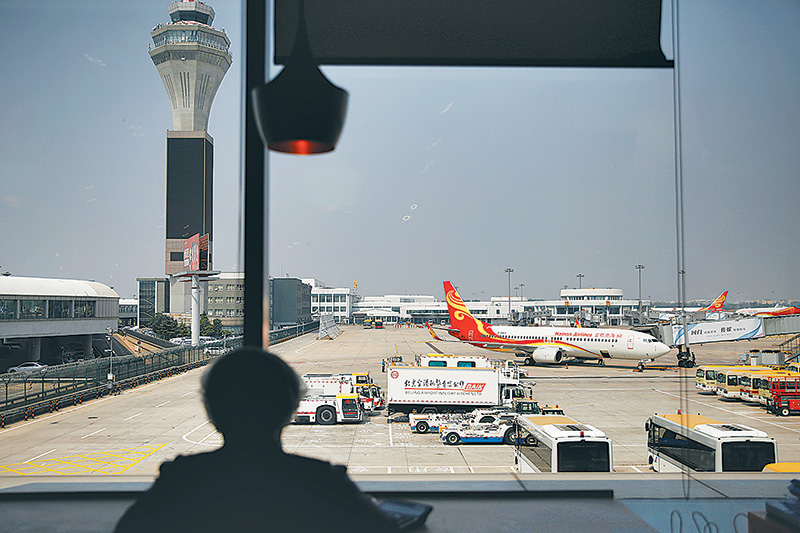
A Hainan Airlines aircraft is seen at the Beijing Capital International Airport following the global coronavirus disease outbreak, in Beijing, China. reuters

BEIJING, 
China Southern Airlines on Tuesday rolled out an ‘all you can fly’ pass, becoming the latest in a fleet of cash-strapped carriers to join a promotional craze that analysts say has helped revive a coronavirus-ravaged air travel market.
At least eight of China’s dozens of airlines have introduced similar deals since June, often priced around $500 for in some cases unlimited flights. Industry watchers say the packages have been a shot in the arm, with costs offset by otherwise empty seats being filled in a country where daily flights last month recovered to 80 percent of pre-coronavirus levels.
The global aviation industry is keenly eyeing China as a pilot for air travel recovery trends, as the country reopened its economy months earlier than other places after managing to bring the pandemic mostly under control—at least for now.      
But Luya You, transportation analyst at BOCOM International, said these promotional packages—ranging from unrestricted flights to an array of terms and conditions—can only stimulate demand when coronavirus risks are already sufficiently reduced.
“While these packages may work in domestic markets, we do not expect similar rollouts for outbound routes anytime soon,” she said.
The “Fly Happily” deal launched by China Southern, the country’s biggest carrier by passengers, allows buyers to use passes for as many flights as they wish for destinations across the country from Aug. 26 to Jan. 6 for 3,699 yuan ($529.03).
As with other deals, passholders also pay a small tax to the airline—about 50 yuan—per flight.  
Meanwhile China Eastern Airlines’ 3,322 yuan “Fly as you wish” deal, launched in June, only applies to weekend travel. Hainan Airlines’ 2,699 yuan package is only valid on flights to or from Hainan province.
China Eastern has sold over 100,000 passes, state media reported. That helped boost passenger loads on its domestic routes to over 75 percent on recent weekends, according to aviation data provider Variflight.
“I’m going to Changsha this weekend and Guangzhou the next weekend,” said Elaine Shen, a Shanghai-based insurance professional just back from an eight-day trip in the country’s northwest using the China Eastern pass.
“The experiences are great,” Shen said. “I would not be flying this much if it weren’t for this pass.”
It’s not just Chinese airlines that have jumped on the deals bandwagon to revive the travel industry.
The Marriott Group said it was aiming for a fresh promotional campaign in August 2020 in the wake of a successful April deal giving buyers the chance to eat a month’s worth of buffet breakfasts in any of its 146 China hotels for 588 yuan.

MONEY

European tourism faces turbulence only weeks after restart

- ASSOCIATED PRESS

BERLIN,
Europe’s tourism revival is running into turbulence only weeks after countries reopened their borders, with rising infections in Spain and other nations causing increasing concern among health authorities over people bringing the coronavirus home from their summer vacations.
European countries started opening up to each other’s tourists in mid-June, but recent events have shown that the new freedom to travel is subject to setbacks.
Over the weekend, Britain imposed a 14-day quarantine on travellers arriving from Spain, Norway ordered a 10-day quarantine for people returning from the entire Iberian peninsula, and France urged its citizens not to visit Spain’s Catalonia region.
In Austria, the lakeside resort town of St. Wolfgang shortened bar opening hours after an outbreak was detected on Friday. By Monday, 53 people had tested positive, including many people working in the tourism industry.
In Germany, officials decided last week to set up testing stations at airports to encourage people arriving from a long list of countries deemed high-risk—including popular destinations such as Turkey—to get tested. They will also allow people to get tested elsewhere for free within three days of arrival.
Bavaria’s governor, Markus Soeder, said he is worried about travelers returning from vacation. Referring to the Austrian ski resort that was an early European hot spot in March, he said: “My worry is not that there will be one big Ischgl, but that there will be many mini-Ischgls.”
Later Monday, Health Minister Jens Spahn said he had decided to make obligatory the testing of returning vacationers from risky areas, and that the new regulations should come into effect within the next week, the dpa news agency reported.
“We need to prevent travellers from infecting others without it being detected and starting new infection chains,” he said.
New infections in Germany have been creeping higher from a low level.
The tourism industry employs 2.6 million people in Spain and generates 12 percent of the country’s economic activity.
Juan Molas, the head of a national association of tourism companies, Mesa del Turismo, said Spain’s tourism sector has on average lost 5 billion euros ($5.8 billion) a week since March.
Tourism Minister Reyes Maroto said the Spanish government is trying to persuade Britain to exempt the Balearic Islands, which have a low infection rate, from the quarantine rule. “We’re living alongside the virus. That doesn’t mean we can’t travel. We can, if we are careful,” Maroto said.
The Catalonia and Aragón regions have Spain’s most worrying virus clusters, prompting authorities to tighten restrictions in Barcelona, in a rural area around Lleida and in Zaragoza that were relaxed only a month ago.
Catalonia is facing “the 10 most decisive days of this summer,” regional leader Quim Torra said, warning that it is in everyone’s hands to prevent a “critical situation” from worsening.
Elsewhere in Europe, authorities in Belgium said Covid-19 cases are growing at an alarming rate amid a surge of infections in Antwerp. Greek authorities said they are likely to extend the mandatory use of masks at churches and shopping malls.
And in North Africa, Morocco banned most travel to and from some major cities—including Tangier, Casablanca and Marrakech, usually a popular tourist destination—to stem a small spike in cases.
In the Asia-Pacific region, many countries are still essentially banning foreign travellers or, if they do allow them to enter, requiring them to submit to tests and strict quarantine. That includes Australia, where the premier of Victoria state, Daniel Andrews, said the biggest driver in the region’s outbreak is people continuing to go to work after showing symptoms.
The crossing of borders was linked to other outbreaks in Asia. South Korea said 16 of the 25 new cases it confirmed Monday were tied to people arriving from abroad.
Over the past few days, the country reported dozens of cases among crew members of a Russia-flagged cargo ship and hundreds of South Korean construction workers airlifted from Iraq.
A tally by Johns Hopkins University shows about 16.3 million confirmed cases of Covid-19 worldwide and around 650,000 deaths. The actual numbers are thought to be much higher because of limits on testing and the many minor cases that have gone unreported.
The World Health Organization said the pandemic continues to accelerate, with a doubling of cases over the past six weeks.
The UN health agency’s emergencies chief, Dr. Michael Ryan, stressed the need to “keep pressure on the virus.”
“Every single country where pressure has been lifted on the virus, where virus is still at community level, there’s been a jump back in cases,” he said.

MONEY

Samsung launches ‘Mega Exchange Offer’

Bizline
- Post Report

KATHMANDU: Samsung has launched their ‘Mega Exchange Offer’ where customers can bring in their old smartphone and upgrade to the latest Galaxy S20 or Galaxy S20+ and get amazing offers. Customers can choose between a 32-inch Samsung LED TV or instant cash back of Rs 22,000 for their exchange on the Galaxy S20+, reads the press release issued by the company. Customers can get a whopping cashback offer of Rs 19,000 when exchanging their old smartphone for the Galaxy S20. The offer is valid till July 31, 2020 only. Galaxy S20 series comes with several world first camera innovations allowing stunning image and video quality. They are designed to change the way we capture our lives and tell our stories. Galaxy S20 and Galaxy S20+ have a 64MP camera. Both smartphones come with larger sensors for great photography and can zoom up to 30X.

Page 7
WORLD

New cronavirus cases continue to rise in China’s Xinjiang

Beijing also reported its first case of domestic transmission in more than two weeks.
- ASSOCIATED PRESS
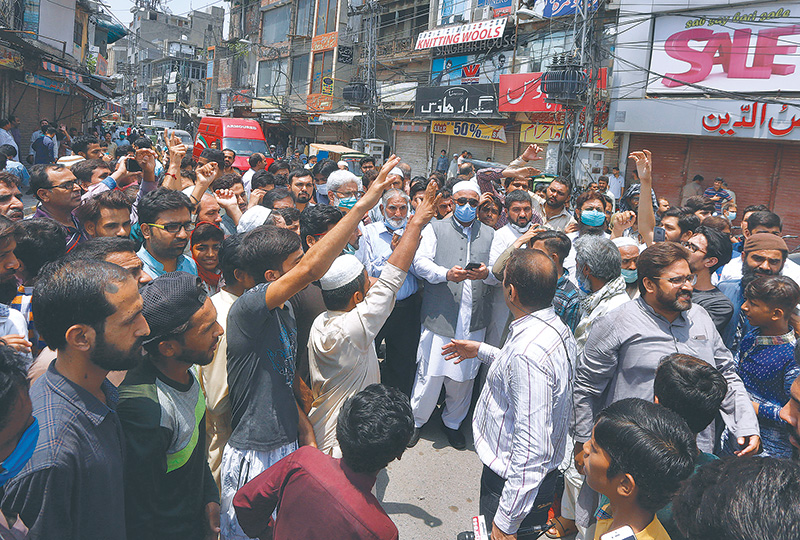
Shopkeepers protest at a market demanding the government allow them to reopen their
businesses on the occasion of the upcoming Muslim Eid al-Adha holiday, in Lahore, Pakistan. AP/rss

Beijing,
New coronavirus cases continue to rise in China’s northwestern region of Xinjiang, with 57 reported on Tuesday.
Beijing also reported its first case of domestic transmission in more than two weeks, while the northeastern province of Liaoning added another six cases in its local outbreak. Another four cases were found among Chinese travellers arriving from outside the country, bringing the daily total over the past 24 hours to 68.
Despite the new clusters, China appears to have largely contained the virus and the death toll remains at 4,634 among 83,959 cases.
Xinjiang’s outbreak has centred on the region’s capital and largest city, Urumqi, where authorities have restricted public transport, isolated some communities and ordered testing among those considered at risk of infection.
Across the country, the wearing of masks and temperature checks remain the norm, while most foreigners are barred from entering and Chinese citizens must undergo two-week quarantines upon returning home.
In Pakistan, the daily Covid-19 infections has dropped below 1,000 for the first time in three months. The country on Tuesday counted 936 new cases reported in the last 24 hours throughout the country of 220 million people. Dr Zafar Mirza, special assistant to Prime Minister Imran Khan, tweeted praise for Khan urging Pakistanis to wear masks as the “most effective practice to reduce the transmission of the disease.” Khan on national television Monday demonstrated the proper use of masks and explaining that shutdowns will result if the disease spikes again. Medical professionals and Khan’s political opponents have criticized him for reopening the economy. He has said a total shutdown would hurt the poorest and instead pursued what he called “smart” lockdowns narrowly targeted at the hot spots of infection. Still Mirza warned there was no room for complacency particularly as Pakistan readies to celebrate the Muslim holiday of Eid al Adha at the end of the month.
Vietnam has locked down its third-largest city for two weeks after 15 cases of Covid-19 were found in a hospital. Public transport into and out of the central city of Da Nang was cancelled. Over the weekend, thousands of mostly Vietnamese tourists had to end their summer holidays in the popular beach destination. Authorities estimated several thousand people would be stranded by the transportation shutdown and asked hotels to shelter them. The government on Sunday had ordered social distancing and closing nonessential businesses in the city of 1.1 million population. The outbreak was detected in patients and health workers at Da Nang hospital.
Australia’s coronavirus hot spot Victoria state is restricting non-urgent surgeries so that hospital nurses can be transferred to aged care homes where most Covid-19 deaths are occurring, Victoria Premier Daniel Andrews said. Victoria reported 384 new infections and six deaths on Tuesday, down from a record 532 cases on Monday. Andrews said aged care residents would be moved to hospitals if they were not being adequately protected from the pandemic. “Some of the stories we’ve heard, some of what’s gone on in some of these settings is simply not acceptable,” Andrews said, without elaborating.

WORLD

Head of China CDC gets injected with experimental vaccine

- ASSOCIATED PRESS

Beijing,
The head of the Chinese Center for Disease Control and Prevention says he has been injected with an experimental coronavirus vaccine in an attempt to persuade the public to follow suit when one is approved.
“I’m going to reveal something undercover: I am injected with one of the vaccines,” Gao Fu said in a webinar Sunday hosted by Alibaba Health, an arm of the Chinese e-commerce giant, and Cell Press, an American publisher of scientific journals. “I hope it will work.”
The Associated Press reported earlier this month that a state-owned Chinese company injected employees with experimental shots in March, even before the government-approved testing in people—a move that raised ethical concerns among some experts.
Gao did not say when or how he took the vaccine candidate, leaving it unclear whether he was injected as part of a government-approved human trial. He did not respond to requests for comment.
The claim underscores the enormous stakes as China competes with U.S. and British companies to be the first with a vaccine to help end the pandemic—a feat that would be both a scientific and political triumph.
China has positioned itself to be a strong contender. Eight of the nearly two dozen potential vaccines in various stages of human testing worldwide are from China, the most of any country. Gao declined to say which of the vaccines he was injected with, saying he didn’t want to be seen as “doing some kind of propaganda” for a particular company.
Last month, Gao was a coauthor on a paper introducing one candidate, an “inactivated” vaccine made by growing the whole virus in a lab and then killing it. That candidate is being developed by an affiliate of state-owned SinoPharm.
The company previously said in an online post that 30 employees, including top executives, helped “pre-test” its vaccine in March, before it was approved for its initial human study. Scientists vehemently debate such self-experimentation, because what happens to one or a few people outside a well-designed study is not usable evidence of safety or effectiveness.
Chinese state media have also reported that employees of state-owned companies going abroad are being offered injections of the vaccine. Gao said he took the injection to instill public confidence in vaccines, especially amid a tide of rising mistrust that has fueled conspiracy theories and attacks on scientists.
“Everybody has suspicions about the new coronavirus vaccine,” Gao said. “As a scientist, you’ve got to be brave. … If even we didn’t do it, how can we persuade the whole world—all the people, the public—to be vaccinated?”
Andrew Rennekamp, an editor at Cell and one of the moderators of Gao’s webinar, said, “This is a brave thing to do, and it shows his faith in what he believes is the safety of the vaccine and his commitment to the science and to public health.”
Even as China is among the leaders in the global race for a vaccine, it is also striving to overcome years of drug scandals—the latest coming in 2018 when authorities recalled a rabies vaccine and later announced that batches of children’s DPT vaccines, for diphtheria, pertussis and tetanus, were ineffective.
Gao himself had also been under heavy scrutiny for the China CDC’s initial handling of the coronavirus outbreak, both at home and abroad. He largely vanished from public view for months, resurfacing again in an interview with state media in late April. Recently, Gao has been involved in research on the coronavirus.
As vaccine research continues, China’s CDC is now looking into potential immunization programs, trying to figure out whether to prioritize children, the elderly or healthcare workers, he said.

WORLD

Najib sentenced to over a decade in jail in first 1MDB graft trial

- REUTERS

Kuala Lumpur, 
Malaysia’s former leader Najib Razak was found guilty of corruption and sentenced on Tuesday to 12 years in jail in the first trial over a multi-billion-dollar scandal at state fund 1MDB that stretched to the Gulf states and Hollywood.
In a case widely seen as a test of the southeast Asian nation’s resolve to stamp out corruption and which could have big political implications, high court judge Mohamad Nazlan Mohamad Ghazali sentenced Najib to 12 years and a fine of 210 million ringgit ($49.40 million) on a charge of abuse of power.
Najib, 67, also received 10 years in jail on each of three charges of criminal breach of trust and three charges of money laundering for illegally receiving nearly $10 million from SRC International, a former unit of the state fund.
“After considering all evidence in this trial, I find that the prosecution has successfully proven its case beyond a reasonable doubt,” Mohamad Nazlan said. He ordered the jail terms to run concurrently, but Najib’s lawyers immediately sought a stay of execution of the sentence.
Najib had pleaded not guilty, and flagged his intent to appeal to Malaysia’s Federal Court if convicted.
The nearly $10 million involved in the SRC case is a fraction of the funds Najib is alleged to have misappropriated from 1Malaysia Development Berhad (1MDB), the state fund.
Prosecutors say more than $1 billion of 1MDB funds made its way into Najib’s personal accounts, and over which he faces a total of 42 criminal charges.
US and Malaysian authorities say a total of $4.5 billion is believed to have been stolen from 1MDB, a fund Najib founded to promote economic development, and used across the world by his associates to buy art, a superyacht and fund the “Wolf of Wall Street” movie.
Prosecutors have also said $27 million was used to buy a pink diamond necklace for Najib’s wife, Rosmah Mansor, and some of the money went into warchests for Najib’s election campaigns. Former US attorney-general Jeff Sessions described the scandal as kleptocracy at its worst.
Allegations of corruption over 1MDB have hung over Najib for more than five years.

WORLD

Kim boasts of his nukes amid stalled talks with US

- ASSOCIATED PRESS

Seoul,
North Korea leader Kim Jong Un said his country’s hard-won nuclear weapons were a solid security guarantee and a “reliable, effective” deterrent that could prevent a second Korean War, state media reported on Tuesday.
Kim’s comments before war veterans marking the 67th anniversary of the end of the 1950-53 Korean War again show he has no intention of abandoning his weapons as prospects dim for resuming diplomacy with the United States.
North Korea has previously ratcheted up fiery rhetoric or conducted weapons tests to wrest outside concessions. But some experts say Pyongyang will likely avoid serious talks with Washington before the US presidential elections in November as there is a chance for a US leadership change.
Kim said in his speech Monday his country has tried to become “a nuclear state” with “an absolute might” to prevent another war and that it has now built such a deterrent, according to the Korean Central News Agency.
“Now, we’ve changed to a country which can defend itself reliably and unwaveringly against high-intensity pressures and military threats and blackmailing by imperialistic reactionaries and hostile forces,” Kim said.
“There won’t be any war on this land again and our national security and future will be guaranteed firmly and permanently because of our reliable, effective self-defensive nuclear deterrent,” Kim said.
Kim’s speech followed recent remarks by both North Korean and US officials suggesting they were reluctant to engage in a new round of diplomacy on the North’s nuclear program anytime soon.
US Secretary of State Mike Pompeo had said President Donald Trump would only want to engage with Kim if there were real prospects of progress. Kim’s sister and senior ruling party official, Kim Yo Jong, said a new summit would be “unpractical” for North Korea and that Pyongyang won’t gift Trump a high-level meeting that he can boast as a foreign policy achievement.

WORLD

US-China spats rattle the world, prompting calls for unity

- ASSOCIATED PRESS
In this December 4, 2019 photo, US President Donald Trump, centre, walksby French President Emmanuel Macron, left, and German Chancellor AngelaMerkel, right, prior to a group photo of NATO leaders during a NATO leaders’ meeting in England. AP/rss

Beijing,
Antagonisms between the United States and China are rattling governments around the world, prompting a German official to warn of “Cold War 2.0” and Kenya’s president to appeal for unity to fight the coronavirus pandemic.
Global trade already was depressed by the two-year-old tariff war between the world’s two biggest economies. That rancour has spread to include Hong Kong, Chinese Muslims, spying accusations and control of the South China Sea. Caught in the middle, other governments are trying to defend their own interests.
Chancellor Angela Merkel’s government wants to preserve trade and cooperation on global warming but says a security law tightening Beijing’s control over Hong Kong is a “difficult issue.” The Hong Kong security law’s potential disruption of the autonomy Beijing promised to the former British colony is no reason to stop talking but is “a worrying development,” Merkel said. Europe’s biggest economy has yet to take a final position on Chinese tech giant Huawei despite US pressure to exclude its equipment from next-generation telecom networks as a possible security risk. “China is an important partner for us but also a competitor,” Foreign Minister Heiko Maas said in a statement after a video conference on Friday with his Chinese counterpart, Wang Yi.
Peter Beyer, the government’s coordinator for trans-Atlantic cooperation, expressed alarm in an interview with the RedaktionsNetzwerk Deutschland newspaper group. “We are experiencing the beginning of a Cold War 2.0,” Beyer said. He criticised both sides but said, “the US is our most important partner outside the EU, and that is how it will stay.”
President Emmanuel Macron calls President Donald Trump “my friend” but is trying to avoid riling Beijing. France has not echoed Trump’s criticism of Beijing’s handling of the coronavirus, but legislators applauded Foreign Minister Jean-Yves Le Drian last week when he condemned abuses of minority Uighurs in China’s northwest. Le Drian mentioned “mass arrests, disappearances, forced labour, forced sterilisations, the destruction of Uighur cultural heritage.” He said France has asked that the camps be closed. “All these practices are unacceptable,” the minister said. “We condemn them.” Trump’s ambivalence toward US allies and flouting of diplomatic norms has alarmed France.
“Sino-American tensions don’t benefit France,” said Valerie Niquet of the Foundation for Strategic Research, a think tank. “We share the same interests as the United States towards China, we adopt more or less the same positions, so it doesn’t bring us any positive element.”
Europe’s “strategic relations” with China will be an issue for the European Union while Germany holds the rotating presidency of the 27-nation bloc, Merkel said this month. EU foreign ministers have not managed to agree on a common position on China. Regarding Hong Kong, options include closer scrutiny of exports of sensitive technology to the territory and changing visa policies for its residents. But there is no talk of economic sanctions or targeting Chinese officials with penalties. “The message is that the recent actions change the rules,” said the top EU foreign policy official, Josep Borrell. “This will require a revision of our approach and will have an impact on our relations.”
South Korea is squeezed between its main military ally and its biggest trading partner. In 2016, Beijing destroyed supermarket operator Lotte’s business after it sold a plot of land in South Korea to the government for an anti-missile system over Chinese objections.

WORLD

Iran’s paramilitary fire missile at mock aircraft carrier

Briefing
- AGENCIES

TEHRAN: Iran’s paramilitary Revolutionary Guard fired a missile from a helicopter targeting a replica aircraft carrier in the strategic Strait of Hormuz, state television reported on Tuesday, an exercise aimed at threatening the US amid tensions between Tehran and Washington. The drill, in a waterway through which 20 percent of all traded oil passes, underlines the lingering threat of military conflict between Iran and the US after last summer saw a series of incidents targeting oil tankers in the region. In January, a US drone strike killed a top Iranian general in Baghdad and Tehran responded by firing ballistic missiles targeting American forces in Iraq.

WORLD

Floods, coronavirus hobble two of India’s poorest states

Briefing
- AGENCIES

MUMBAI: Floods caused by heavy monsoon rains in two of India’s poorest states have displaced or affected 8 million people and killed 111 since May, authorities said on Tuesday, at a time when coronavirus cases have swelled there. The Brahmaputra river in the northeastern state of Assam is flowing above the “danger level” in many places, while heavy rains that began this week in Bihar in the east will last until Wednesday, officials say. Since the start of the monsoon season on June 1, Assam has received 15 percent more rainfall than a 50-year average and Bihar 47 percent more, according to the country’s weather department.

WORLD

Lebanese PM urges caution as Israel vows to defend itself

Briefing
- AGENCIES

BEIRUT: Lebanese Prime Minister Hassan Diab said on Tuesday Israel had violated his country’s sovereignty with a “dangerous military escalation” along the frontier on Monday and urged caution after a rise in border tensions. Israeli Prime Minister Benjamin Netanyahu said his country would do “everything necessary” to defend itself, a day after saying Israeli forces had thwarted an attempt by Hezbollah to infiltrate across the frontier. The Iranian-backed Shi’ite group denied this. A Reuters witness in Lebanon counted dozens of Israeli shells hitting the disputed Shebaa Farms area on Monday. No casualties were reported on either side of the frontier.

Page 8
LIFE & STYLE

Lack emotional intelligence? We got you covered.

What does it take to be emotionally intelligent? Here’s how you can score well in the emotional intelligence department, according to experts.
- ANKIT KHADGI
Shutterstock

Kathmandu,
A year ago, Susmita Baskota was a different person. An introvert, she would prefer to suppress her emotions rather than express it, which eventually affected her, she says. However, after attending a session on emotional intelligence last March, organised by Rotaract and facilitated by My Emotion Matters, a social enterprise working on emotional intelligence, things are different for her now.
“The session opened doors for me. It made me realise I should acknowledge my emotions rather than hold them back,” says Baskota, 24, who, since the session, has been trying to understand more about her emotions and how she feels so she can channelise them in a positive direction.
Although not widely acclaimed or considered a significant ability, emotional intelligence has, over the years, been gaining attention from all spheres of life. But few understand its significance.
According to Sagar Satyal, co-founder of My Emotion Matters, emotional intelligence simply means being smart with your feelings, so that you can solve interpersonal problems. “Emotional intelligence means having the ability to identify and understand what both I and the other person is feeling, and to think through how I might respond in a way that creates a win-win in my relationship with the other person instead of making things worse,” says Satyal.
Several studies have also shown that emotional intelligence has a direct link with the mental health of a person. According to Bina Shrestha, a psycho-social counsellor at Transcultural Psychosocial Organization Nepal, the more emotionally intelligent a person is, the better their mental health will be.
A report published by the World Economic Forum ranked emotional intelligence as one of the most desired qualities employers will be looking for in 2020. Likewise, even during the current pandemic, leaders who have great emotional intelligence have proven to handle the situation more effectively.
So, what does it take to be emotionally intelligent? Here are a few ways through which people can follow to develop their emotional intelligence.


Acknowledging and accepting your emotions
According to Satyal, self-awareness and acknowledgment of emotions is the first and foremost step of building emotional intelligence. “When we are aware of how we are feeling, we then choose how to respond to that emotion,” he says.
However, although it may sound good in paper, acknowledgment isn’t as easy it sounds, says Satyal. “Unfortunately, many people aren’t even aware when they are in the
grip of their emotions and hence tend to make things worse through their blind reactions,” he says.
To keep blind reactions at bay, there are few steps that people can adopt. According to Shrestha, expression of emotions is the key to acknowledgment. “Even if we express what we are feeling in a filtered way, sharing how we are feeling with others can help us to open up our emotions,” she says.
However, she says, accepting emotions is equally important. “People have the habit of acknowledging their emotions, only if it makes them happy. We need to accept the emotions of sadness as well,” says Shrestha.
Satyal recommends keeping a journal to note down one’s reactions, as it can help
people to improve self-awareness. He even stresses the need to become fluent in the language of emotions by building one’s emotional vocabulary.


Developing the habit of responding to emotions rather than reacting to it
If one wants to be emotionally intelligent, one thing Satyal recommends is cultivate the habit of responding rather than reacting to emotions. However, it’s not as easy as it sounds. “It is hard to think rationally when we are in the grip of an emotion,” says Satyal. “Emotions draw us to the short term. When feeling angry, it is hard to think rationally about long-term consequences. This is also called ‘emotional hijacking’.”
According to Satyal, as many people react to emotions rather than responding to them, it can lead people to lash out at their colleagues and partners, which eventually they later regret. And this is why Satyal believes responding to emotions should come in the picture. “Responding to emotion means recognising that you are experiencing it. We don’t
have to deny that we are angry with our colleagues or partners. But instead of acting on the emotions blindly, we can take a pause and then express our anger in a thoughtful way,” he says.
Likewise, Satyal also stresses the need for people taking the responsibility of their anger rather than resorting to blaming, judging, or diagnosing the other person. “Making space every day to reflect on our reactions can be helpful in gradually getting better at responding rather than reacting,” he says.


Motivating thyself so thou can bounce back from adversity
One thing that makes most people vulnerable to their emotions is that they think that their problems and adversities are permanent. Although the struggles can be difficult for people to bear at times, as life is filled with stress, according to Shrestha, people should be encouraged to develop a positive outlook, which she believes can be achieved through motivation.
“People should look back at the good things that have happened to them. This way, they can feel motivated that life is not always going to be sad, helping them to overcome the difficult situation,” says Shrestha.
Shrestha believes that self-motivation can be a great coping strategy for the people, as it can help them to stay calm, give them strength to bounce back from adversities as well as navigate their emotions positively. And to build up the confidence of self-motivation, Shrestha says friends can play a great role.
“When we share and talk about our problems and how we are feeling with our friends who are really supporting, then they can motivate us,” says Shrestha.


Focusing on active listening instead of ‘hearing’
Despite the many technological avenues that exist for people to communicate, people are more focused on hearing than listening to each other, which experts believe can be a drawback when it comes to emotional intelligence.
“People have a deep need to feel seen and heard. But unfortunately listening is not something we try hard to get better at,” says Satyal. According to him, listening is not just about paying attention to the words which the other party speaks. It’s also about the feelings and the needs of the other person, which he believes that people should focus on.
“If we can develop the understanding that everything we humans do is in the service of our needs, then no matter what is said on the surface, we can learn to dig deep into the underlying needs of the other person. This can help us connect better not just with others but also with ourselves,” he says.
Likewise, Shrestha also believes that active as well as empathetic listening can be a great way of developing emotional intelligence, as it can help people to understand each other in an effective way she says.


Practising empathy as a way of life
Satyal believes that one of the core components of emotional intelligence is practising empathy. “We cannot resolve differences in our relationships without the ability to relate to the feelings and needs of the other person,” says Satyal. “We don’t always have to agree with others but we can always approach our differences with a mindset of seeing other people as people who have their own needs, challenges, and objectives.”
“When we approach our relationships this way, we are naturally more helpful to others. This helps us find creative solutions to our problems and enhance our relationships”, he says.

LIFE & STYLE

Transition from work-at-home novice to pro

For many of us, it’s been months of working from home. But have we managed to find a balance between work and home?
- SEAN PYLES
Shutterstock

Months into working from home, it’s time to check in with yourself. How is your work-life balance? Have you figured out when and how you work best? And when did you last shower?
As work and home life meld, it’s difficult to maintain boundaries, stay productive and take care of your mental health amid the pandemic.
Since work from home orders are likely to stick around for those lucky enough to do their jobs away from their workplace, now is a good opportunity to professionalise your work habits and find a sustainable setup for the coming months.

 
Know yourself and work accordingly
You may instinctively know when you’re at your peak performance and what conditions you need to achieve it. Some people are at their best right after they’ve had their morning coffee and settled in at a desk. Others might sleep in and then start work while still in bed.
Clearly defining when and how you work best helps you set clear expectations for yourself and your colleagues.
Keep track of your routine, record everything in a spreadsheet or a notebook, detailing meetings, lunch breaks, blocks of time dedicated to heads-down work, and stretches when you don’t get much done. This will reveal when you’re productive and when you might be better served taking a break, going for a walk or taking a power nap.
Next, think about conditions that help you focus.
Some need to sit in a specific spot to accomplish anything. Others might just need an internet connection, wherever that may be. Bari Tessler, a financial therapist who has worked from home for two decades, says that only you know how you work best. “Every day is different and you have to go with the flow,” says Tessler. “You just have to know who you are.” Ignore prescriptive guidance about not working from bed or getting dressed like you’re going into the office. Create the conditions you feel most comfortable with.

 
Structure—and communicate—your balance
Use your insights about how and when you work best to flesh out your idea of work-life balance or something close to it. Then bring that plan to your colleagues for a candid conversation.
“I always look at the equation of time, money, energy, family and health, and I make all my decisions from that,” Tessler says.
Finding your personal balance might mean being more deliberate about what you’ve already been doing, or making changes.
For example, if you found you’re not particularly productive during regular working hours, think of ways to mix it up. You might want to block out time midday to run errands or meditate. Or maybe you can work alternative hours, outside of the typical 9-to-5. This might be a necessity for parents as some school districts plan to start the school year with virtual learning.
You might have to make compromises, depending on job requirements, but you’ll be working from a good starting point.

 
Give yourself a break
You may have seen social media posts saying, “You’re not just working from home, you’re working from home in the middle of a global pandemic.” While that might come across as a little melodramatic, it’s true.
Between managing personal and financial fears around the coronavirus pandemic and grappling with the national conversation around racial inequity, having to face your job as if everything is normal can be exhausting.
If you’re feeling burned out by work or overwhelmed by the news, look into taking time off if your work situation allows. An internet-free staycation can help you unplug, centre yourself and return to work refreshed.


—Associated Press