You internet speed is slow. Switch to text view mode

Switch
epaper logo
ST

Last Login:
Logout
+
Page 1
HOME PAGE

Poor to miss out on inoculation as rich nations have hoarded vaccines

Amnesty and other groups urge action to ensure that intellectual property of vaccines is shared widely.
- REUTERS

PARIS,     
Rich countries have secured enough coronavirus vaccines to protect their populations nearly three times over by the end of 2021, Amnesty International and other groups said on Wednesday, possibly depriving billions of people in poorer areas.
Britain approved Pfizer’s Covid-19 vaccine this month, raising hopes that the tide could soon turn against a virus that has killed nearly 1.5 million globally, hammered the world economy and upended normal life.
Amnesty and other organisations including Frontline AIDS, Global Justice Now and Oxfam, urged governments and the pharmaceutical industry to take action to ensure intellectual property of vaccines is shared widely.
The World Health Organisation has also called on governments repeatedly this year to make a vaccine protecting against Covid-19 a “public good”. The WHO has backed a global vaccine programme scheme known as COVAX, which seeks to ensure equitable distribution of vaccines and 189 countries have joined. But some countries such as the United States have not signed up, having secured bilateral deals.
COVAX hopes to deliver some 2 billion doses by the end of 2021 but that would still only represent about 20% of the populations of countries that are part of the mechanism.
“Nearly 70 poor countries will only be able to vaccinate one in ten people against Covid-19 next year unless urgent action is taken,” Amnesty International said, based on recent calculations.
“Updated data shows that rich nations representing just 14 percent of the world’s population have bought up 53 percent of all the most promising vaccines so far,” it said.
Amnesty said Canada was the country that had bought the most shots when considering the size of its population with enough doses to vaccinate every Canadian five times.
The organisation urged support for a proposal made by South Africa and India to the World Trade Organisation Council to waive intellectual property rights for Covid-19 vaccines, tests and treatments.

HOME PAGE

Europeans not impressed by Nepal’s efforts to improve aviation safety yet

Breaking up the civil aviation authority is a prerequisite to getting the country removed from the European Union’s Air blacklist, which runs into the eighth straight year.
- SANGAM PRASAIN
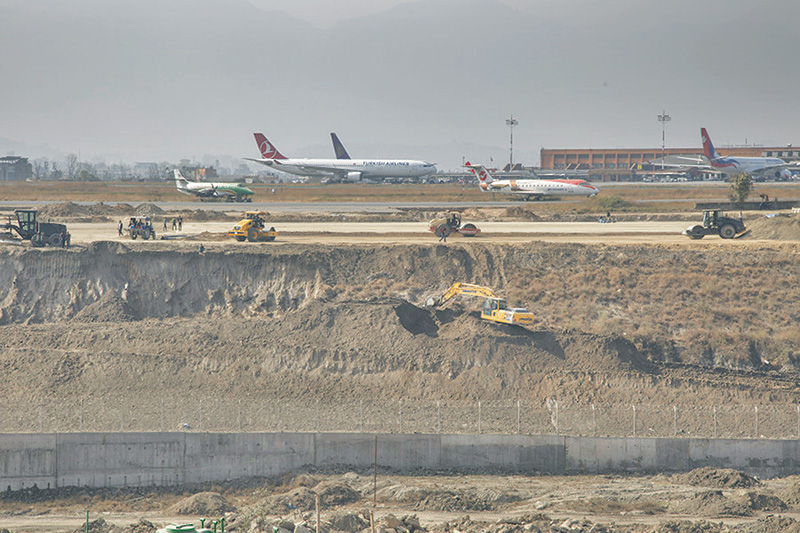
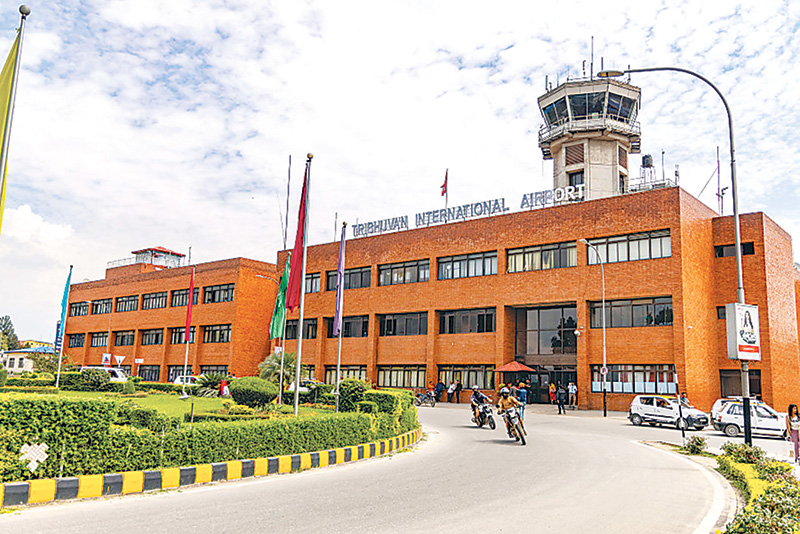
On December 5, 2013, the European Commission imposed a blanket ban on all airlines from Nepal from flying into the European Union. Post file Photo

KATHMANDU,
While the European Union applauded the Nepal government’s firm commitment to improving its air safety mechanism, the lawmaking body—the European Commission—has questioned the issuance of air operator certificates to new Nepali carriers without sufficient compliance with international safety standards.
The ban on airlines from Nepal from flying to Europe for their failure to adhere to safety standards has entered its eighth year.
On December 7, coinciding with International Civil Aviation Day, the EU said that the Commission was aware of the efforts made by Nepal, notably with regard to a new aviation bill before Parliament.
“It would be key for this legislation to be adopted by Parliament and subsequently implemented,” said the Delegation of the European Union to Nepal in a statement. “This would allow the Commission to advance with the process of eventually removing Nepal from the EU Air Safety List.”
Based on this announcement, Tourism Minister Yogesh Bhattarai was quick to say that Nepali carriers will soon be removed from the EU Air Safety List as there has been progress in splitting the Civil Aviation Authority of Nepal into two entities–regulator and service provider.
Nepal has yet to fulfil its commitment to breaking up the civil aviation body, a prerequisite to getting the country removed from the EU Air Safety List.
On June 2, the Commission had questioned the ability of Nepal’s aviation regulatory body to enforce sufficient safety compliance.
It requested the Civil Aviation Authority of Nepal on April 22 to provide a list of all air operator certificate holders certified in Nepal as part of its continuous monitoring activities.
On May 3, the civil aviation regulator informed the Commission that the air operator certificate of Air Kasthamandap had been revoked, and that new carriers Heli Everest and Kailash Helicopter Services had been certified.
“They also reported that Muktinath Airlines had changed its name to Prabhu Helicopters,” according to the EU’s official journal.
“Since the Civil Aviation Authority of Nepal has not demonstrated a sufficient ability to implement and enforce the relevant safety standards, the issuance of air operator certificates to those new air carriers does not guarantee sufficient compliance with international safety standards,” the journal stated.
“In accordance with the common criteria set out in the Annex to Regulation (EC) No 2111/2005, the Commission, therefore, considers that with respect to air carriers from Nepal the list of air carriers which are subject to an operating ban within the Union should be amended to include Heli Everest and Kailash Helicopter Services in Annex A to Regulation (EC) No 474/2006 and to remove Air Kasthamandap from that Annex.”
At least two sources at the Civil Aviation Authority of Nepal said they were unaware of the developments.
The European Commission has continued its ban on Nepali airlines for eight consecutive years through an updated EU Air Safety List published on December 2.
On December 5, 2013, the Commission had imposed a blanket ban on all airlines from Nepal from flying into the EU.
Raj Kumar Chettri, spokesperson for the Civil Aviation Authority of Nepal, said they were not aware of the June report, but that there had been significant progress on the safety front. “We are confident of being removed from the air safety list within a few months,” he said.
The European Commission had asked that Nepal’s civil aviation body be fragmented with a clear demarcation of its powers and responsibilities because its dual functions gave rise to a conflict of interest.
The Civil Aviation Authority of Nepal Bill and the Air Service Authority of Nepal Bill, proposing to separate the aviation body, were at the final stages of being passed by the National Assembly during the budget session of the federal parliament that ended on July 2.
The bills had already been okayed by the Legislation Management Committee of the Assembly. But the government’s abrupt decision to prorogue Parliament, which was largely guided by internal problems in the ruling Nepal Communist Party (NCP), left the two bills in limbo.
Officials at the civil aviation body said that the Legislation Management Committee of the upper house had already passed the bills, so it will not take much time to register them at the lower house for deliberation and approval. The two pieces of legislation will become law after they are signed by the President.
The government has been working on the proposed legislation for the last 10 years, but it was plagued by bureaucracy at every step.
Following pressure from a number of global aviation watchdog groups, the Cabinet had given the go-ahead to the Tourism Ministry in July last year to draft two separate bills to split up the Civil Aviation Authority.
“We are hopeful that Parliament’s winter session will begin this month, and that the bills will be passed by both houses,” said Chettri, the spokesperson. “We expect it will take at least 60 days for the two pieces of legislation to be approved.”

HOME PAGE

Chand party’s killing of school principal is a grim reminder of the Maoist conflict

Analysts say the government appears to be failing in its approach to deal with the Communist Party of Nepal, which has been involved in violent activities for long.
- BINOD GHIMIRE

KATHMANDU,
The brutal killing of a school teacher in Morang after abduction by the Netra Bikram Chand-led Communist Party of Nepal has raised the spectre of a renewed conflict in the country.
The Chand outfit is a splinter of the Maoist party that led a decade-long war against the state, leaving over 13,000 dead, 1,333 disappeared and hundreds of thousands displaced by the time it ended in 2006.
The KP Sharma Oli administration in March last year had branded the Chand-led party a criminal outfit and banned its activities. The move followed two blasts in the Capital and the death of a person.
Four people lost their lives when bombs planted by the party went off in five places in Kathmandu and Lalitpur on May 26, 2019.
Though the Oli government had invited the Chand-led party for talks, the outfit refused, demanding that the ban be lifted first and it be recognised as a political party.
The outfit’s act to brutally kill Rajendra Kumar Shrestha, 54, “in retaliation”, however, has raised a question over its claim that it is a political force.
The Mechi-Koshi bureau of the outfit had abducted Shrestha from his home in Miklajung Rural Munici-pality-1 before killing him on Tuesday.
Shrestha was working as the principal of Saraswati Basic School in Ramite of the rural municipality.
“A group of four to five unidentified people abducted Shrestha from his house, took him about a kilometre away before killing him and fled,” said Deputy Inspector General Ishwar Babu Karki, the Province 1 police chief.  “Shrestha’s hands were tied. His body was found in a nearby forest with a slit throat.”
Issuing a statement on Tuesday night, the party’s Mechi-Koshi bureau said that the party “took action” against Shrestha “for working as an informant” for the police.
Analysts and former security officials say people had taken some blasts and violent acts by the Chand-led party as isolated incidents but Tuesday’s killing of a school principal has unleashed terror and generated fear if the country is going back to the era of the armed conflict.
“A political force doesn’t kill an individual in such a brutal manner,” said Hemant Malla, a former deputy inspector general.
But somehow, according to Malla, it has become apparent that the government failed to deal with the outfit in an effective manner.
Chand had deserted the Pushpa Kamal Dahal-led Maoist party in 2012, along with Mohan Baidya and Ram Bahadur Thapa, saying that the party had left the “people’s war” halfway. Chand formed his own Communist Party of Nepal in 2014 to launch what he calls “unified people’s revolution” alleging that Dahal’s Maoist party abandoned the revolution after it joined mainstream politics in 2006.
Two years later, Chand parted ways with Baidya and Thapa; the latter returned to the Dahal’s Maoist party in 2016. In 2018, Thapa was appointed home minister in the Oli Cabinet.
Thapa has since taken a tough stance against Chand. The administration has so far arrested around 500 Chand-party members. Since its formation, the party has been involved in violent activities, including attacks on some private companies, and extortions.
Immediately after the Chand outfit was branded a criminal group, it had vowed to retaliate.
In May last year, Thapa said that the party had “four military companies”.
Analysts say the government either underestimated the Chand-led party or kept on using excessive force, rather than making constant efforts to bring it to the talks table. On a couple of occasions, security personnel killed Chand-party cadres after arrests.
According to Geja Sharma Wagle, who writes on political and security matters for the Post’s sister paper Kantipur, the government failed to make a proper assessment of the political and security dimensions of Chand’s party.
“If the government thought it could contain the outfit by force, it should have mobilised security forces accordingly,” Wagle told the Post. “It looks like the authorities completely lost the plot; it failed to devise a proper plan—neither politically nor security-wise—to find a solution to the problems posed by the group.”
Though Chand’s Communist Party of Nepal does not use the “Maoist” tag anymore, its activities are similar to those of the Maoist party that led the decade-long war.
Fourteen years after the peace deal, conflict victims are still awaiting justice, while none involved in committing serious crimes during the war has been booked. There are now concerns if failure to conclude the transitional justice process and to bring even a single individual to book for war crimes is prompting the Chand-led party to resort to violence and killing.
After Tuesday’s incident, Home Minister Thapa on Wednesday called a meeting of the Security Committee which consists of the chiefs of Nepal Police, the Armed Police Force and the National Intelligence Department.
According to officials, the meeting concluded that Chand’s activities are becoming serious.
“The committee directed the police to control the violence of Chand’s outfit but also to exercise restraint while doing so,” said an official at the Home Ministry who wished to remain anonymous because he was not allowed to speak with the media.
Indrajit Rai, a security adviser to Home Minister Thapa, said the Chand-led outfit had so far been resorting to some violent acts, prompting the government to ban its activities.
“But Tuesday’s killing is a terrorist act,” Rai told the Post. “If such incidents continue, either the Cabinet or the prime minister should take a concrete step to deal with the outfit.”
Shrestha’s killing on Tuesday also comes as a reminder of one of the most gruesome acts of violence carried out by the Maoist party when it killed Muktinath Adhikari, also a school teacher, in January 2002.
The Oli administration in August 2018 had constituted a Political Dialogue Committee led by Nepal Communist Party (NCP) leader Som Prasad Pandey to hold dialogue with various disgruntled groups, including the Chand-led party.
“But this group is divided; some leaders want dialogue and others do not,” Pandey told the Post. “I have not been in touch with this outfit lately, even though I had tried to establish contacts informally for some time after the committee’s term ended.”
The committee’s tenure ended in March last year.
Pandey said during his talks with government officials and Chand’s outfit—as the chair of the committee and after the committee’s term ended as well—he always stressed that dialogue was the only solution.
The formation of the dialogue committee, according to Malla, the former police official, was a right step by the government.
“But after its term ended, no sincere initiatives were taken to bring the Chand-led party to the negotiating table,” Malla told the Post. “Now the government seems to be lacking the strategy to deal with the problems posed by the outfit.”
The same month the term of the dialogue committee ended last year, the Oli administration had signed a deal with CK Raut’s Alliance for Independent Madhesh. It was seen as a major feat of the Oli government for being able to make Raut quit his secessionist campaign. Days later, the Oli government branded Chand-party a criminal outfit, in what looked like a coercive method to make it renounce its armed struggle.
Malla said there is no alternative to dialogue and the government should not give up on its efforts to bring the Chand-led party to talks.
“There seems to be a lack of coordination between the Home Ministry and the Prime Minister’s Office,” Malla told the Post. “It’s ultimately the general public who will suffer if the government tries to contain the outfit with force.”

Page 2
NATIONAL

Chand-led Communist Party of Nepal claims responsibility for murder of school principal

The party said it took action against Rajendra Kumar Shrestha for being an informant to police and helping them arrest its cadres.
- MADHAV GHIMIRE,BINOD BHANDARI
Shrestha was abducted from his house in Miklajung Rural Municipality, Morang on Tuesday. He was later found murdered in a nearby forest. Photo courtesy: Saroj Pokharel

BIRATNAGAR,
The Netra Bikram Chand-led Communist Party of Nepal has claimed responsibility for the murder of a school principal in Morang.
According to DIG Ishwar Babu Karki, police chief of Province 1, Rajendra Kumar Shrestha, 54, was abducted from his residence at Barkhe in Miklajung Rural Municipality-1 and subsequently murdered on Tuesday. Shrestha was the principal of Saraswati Basic School in Ramite of the rural municipality.
“A group of four to five unidentified people abducted Shrestha from his house, took him about a kilometre away and killed him,” said Karki. “Shrestha’s hands were tied and throat slit when his body was recovered in a nearby forest.”
Issuing a statement on Tuesday night, the party’s Mechi-Koshi bureau said that the party ‘took action’ against Shrestha as retaliation for being an informant to the police and helping them in the arrest of party leaders and cadres.
The party, in its statement, has accused Shrestha of being an informant to the police for a long time and not heeding to the warnings issued by the party. The statement further says that Shrestha was responsible for the arrest of two party members on October 28.
The statement, signed by Mechi-Koshi Bureau in-charge Pratap, claims that Shrestha was killed because he attacked some party members who had reached his house to talk with a weapon.
The Chand-led party has been active in Ramite, a remote area in Miklajung Rural Municipality that shares its borders with Ilam, Panchthar and Dhankuta districts, in recent times owing to its geographical location and almost no presence of security forces. The nearest security forces are stationed in Urlabari which is some 30 kilometres from the rural municipality.
“We have time and again asked the Home Ministry to set up a police station in Ramite but our pleas have gone unheeded. Tuesday’s incident would not have taken place if the government had listened to us,” said Province 1 lawmaker Kul Prasad Limbu.
There are seven houses in Barkhe, a remote hill settlement in Morang that is yet to be connected with the national road network. The entire settlement is terrorised by Tuesday’s incident.
“Villagers are living in fear; they have not come out of their houses after Shrestha’s killing,” said Nar Bahadur Rai, the ward chief of Miklajung-1.
According to him, the villagers have been demanding that security personnel be deployed in the area.                                                               
Meanwhile, police are still searching for the people responsible for the crime.
“Search for the culprits is underway. We are yet to ascertain the identity of the people involved in the murder,” said Superintendent of Police Santosh Khadka. According to him, security teams from the provincial police office and the district police office of Morang, Dhankuta, Ilam and Panchthar have been mobilised to search for the culprits. “We have sealed off the Miklajung area and have initiated a manhunt.”
SP Khadka admitted that there’s a poor security presence in the northern part of Morang, including Ramite. “We are preparing to set up a police post in the area,” said Khadka.
Miklajung Rural Municipality was formed by merging the then Remitekhola, Madhumalla, Tandi and Jante VDCs. Shrestha had been living there with his wife, as he was the headteacher at a local community school. He is survived by a wife, a son and a daughter.
Shrestha’s son and daughter-in-law live in Rachana of Tandi, which is about a five-hour walk from Ramite. According to Devi Acharya, chairman of the local unit, Shrestha’s wife Dhan Kumari moved to her son’s residence on Tuesday.
Shreshta’s body was taken to Dharan-based BP Koirala Institute of Health Sciences on Tuesday for postmortem.
“We are preparing to bring the body to his son’s home by Wednesday night and perform his funeral rites at Nunsarighat in the Bakraha stream on Thursday,” said Acharya.

NATIONAL

Water supply projects in Sudurpaschim left incomplete due to lack of funds

Over a hundred drinking water projects have not received additional budget.
- MOHAN BUDHAAIR

DHANGADHI,
Construction works on dozens of drinking water projects in Sudurpaschim Province have remained incomplete for the past decade. Mohan Kunwar, chief engineer at the Drinking Water and Sanitation Division Office in Dhangadhi, said works on most of the projects have been delayed due to a lack of budget.
“Large scale projects don’t get enough budget to continue with their work,” said Kunwar.
Over a hundred drinking water projects that were handed over by the federal government to the provincial government have not received additional budget.
“At this pace, the construction of these projects will take 20 more years,” said Kunwar.
The government’s 15th plan to supply drinking water to 40 percent of the province’s population does not seem likely to happen, officials at the Drinking Water and Sanitation Division Office in Dhangadhi say.
According to the Office, drinking water projects in the province have not gained momentum due to limited budget allocation.
Minister for Physical Infrastructures Pathan Singh Bohara blames the federal government for being
negligent in overseeing the projects’ completion.
While the projects of the federal government have remained incomplete due to budget shortage, the provincial government has been initiating separate drinking water projects on its own.
“The provincial government has been adding new projects every year despite there being several incomplete projects on the pipeline,” said Kunwar, adding that the new projects of the provincial government also lack sufficient budget.
The data of the Drinking Water and Sanitation Division Office showed that out of 59 drinking water projects of the provincial government, 22 are new ones. But the total budget allocation for such projects is just Rs 230 million.
“Each of the projects costs Rs 50 to Rs 100 million. In the current fiscal year, only five to 10 percent of the total projects can move forward,” Kunwar said. “This is why these projects will also take more than a decade to complete.”

NATIONAL

Ghunsa folk staying back this winter due to Covid-19

- ANANDA GAUTAM
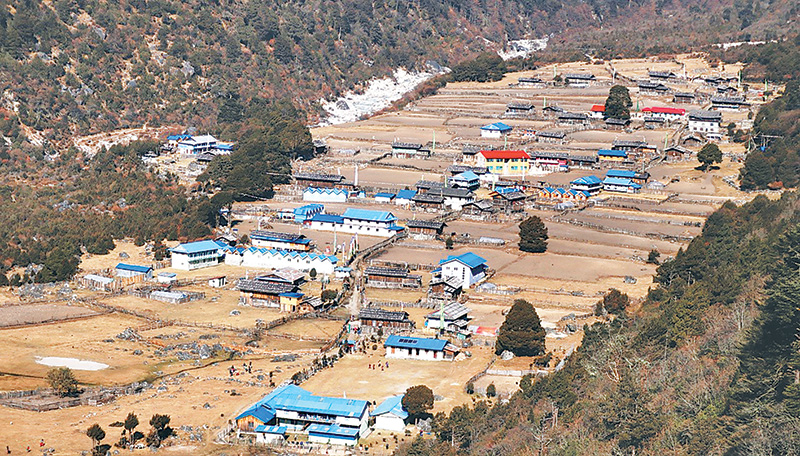
Villagers from high-altitude settlements migrate to warmer areas every winter to avoid the cold. Post Photo: ANANDA GAUTAM

TAPLEJUNG,
Every year, Ghunsa residents migrate to warmer places to avoid the bitter cold during winter. But this year, around 75 percent of the total population have stayed back in their villages because of the Covid-19 pandemic and a lack of income.
Sonam Sherpa of Phaktanglung Rural Municipality Ward No. 7 in Ghunsa, Taplejung, is not leaving the village this year. In the previous years, he would go to Phungling, the district headquarters of Taplejung, or to Kathmandu to get away from the cold. But this year, he does not have the money to make the journey and to fund his stay in the cities.
“The pandemic has affected every sector, especially tourism,” said Sonam Sherpa. “We will have to survive this winter somehow.”
The temperature in Ghunsa has been recorded between four to eight degree Celsius in the past few days, says Yangjom Sherpa, chairman of Ghunsa Foundation.
Ghunsa, a settlement that lies at an altitude of 3,100 metres, is a picturesque area that attracts many tourists. Tourists make their way to Kanchenjunga via Ghunsa, which allows the local population to earn their living through tourism. This year, however, there was no tourist footfall and the local people could not earn much.
“The temperature is dipping by the day. The streams have ice water and surviving the winter looks difficult,” said Pembaphuti Sherpa of Phaktanglung. “We have had no income in the past year. Tourists did not come to Ghunsa due to the pandemic.”
Most families in Ghunsa run homestays and those who don’t rear chauris and yaks. “But this year, we haven’t been able to sell either our livestock or dairy products since Tiptala Bhanjyang, the border with China, has been closed amid Covid-19 fears,” said Pembaphuti.
Pemba Chhembel Lama, chief at the gumba in Ghunsa, reached Kathmandu a few days ago. Lama, who has five family members, has rented a room in Bouddha, Kathmandu. He is paying Rs 18,000 per month as rental for a one-bedroom flat.
“My family stays in Kathmandu for three to four months and the rest of the year we lock up the room. I plan to return to Ghunsa by mid-February since my brother is staying alone in the village,” he said. “I usually stay longer.”
Until four years ago, all the houses in Ghunsa would get padlocked from mid-December. But since the establishment of the Border Police Office in Ghunsa, some of the families stay back. Last winter, 12 families had stayed in Ghunsa.
“This year, 30 to 32 families have stayed back. So far, five houses have migrated to warmer areas; another three to four families are preparing to leave,” said Tansi Sherpa, a representative of the Kanchanjunga Conservation Area.
Currently, there are 46 families in Ghunsa.
According to the local residents, they have to spend at least Rs 200,000 to Rs 300,000 for a two-month stay outside of Ghunsa.
“When we migrate, we have to factor in house rent, food and other expenses. With no income this year, we couldn’t afford to move out of the village during the winter,” said Tashi Sherpa, a resident of Ghunsa.
Similarly, the local population of Mustang in Gandaki Province have decided to stay put in their villages due to Covid-19 fears. Most of them plan to spend the cold winter days preserving gumbas, chhorten and mani in the villages.
“Only those people who have houses in Pokhara and Kathmandu left the villages. All other villagers have stayed back this winter,” said Raju Bista, chairman of Loghekar Damodarkunda Rural Municipality.
Most residents of Mustang descend to the lower altitude for four months starting from November each year. But this winter, the global pandemic has made their yearly move infeasible.
“We used to descend to the lower altitude to avoid the cold and engage in mobile trading. We could not do so this year due to the coronavirus pandemic,” said Namgyal Gurung of Lomanthang Rural Municipality Ward No 5.


Ghanashyam Khadka in Myagdi contributed reporting.

Page 3
NATIONAL

Several holes in new foreign policy document, leaders and experts say

Policy should have been prepared with wider consultations to address pertinent global issues, observers point out.
- ANIL GIRI

KATHMANDU,
Foreign Minister Pradeep Gyawali unveiled the government’s new foreign policy on Sunday, more than a year after work on the document began.
Even after preparing the document without consulting experts both within the government and in major political parties, Gyawali said the dossier is a  “consensus” document prepared by major stakeholders.
Party leaders and foreign policy observers and experts say the new policy has several shortcomings and holes and questioned the government’s capacity to implement the policy.
“We have former prime ministers in the party and we have a separate foreign affairs department. We have former foreign ministers as well as members of Parliament,” said Former Prime Minister Madhav Kumar Nepal, who heads the ruling Nepal Communist Party’s foreign affairs department. “None of us was aware of the policy document.”
While making the policy public on Sunday, foreign minister Gyawali had said that its fundamental objective is to protect and promote the country’s national interest. Nepal needs such a policy that can define Nepal’s role in the changed geopolitical, regional and global context, said the minister referring to conclusions from the National Dialogue on Foreign Policy organised last year by the ministry.
Senior Nepali Congress leader and shadow foreign minister Narayan Khadka raised several questions about the new policy saying that the new policy sounds like an essay written by  a political science student. “It has several holes and shortcomings,” he added.
The document states Nepal faces around 20 foreign policy challenges. “But can we cope with those challenges?” asked Khadka. “What was the urgent need to make it public?”
According to two joint secretaries at the Ministry of Foreign Affairs, the idea of drafting a new foreign policy was conceived after the national dialogue on foreign policy. Later, a team of joint secretaries headed by Ramkaji Khadka was formed to complete it.
Before the Cabinet approved the text on October 20, the policy draft was sent to various ministries for their inputs. The ministry said it also consulted some former ambassadors and experts.
The ministry took into account whatever party representatives said during the one-day seminar organised by the ministry last year, and did not consult even leaders from the ruling party.
Shadow foreign minister Khadka said that though the foreign minister claimed that the document is a consensus policy document, the main opposition Nepali Congress may not own it.
“Why do we need such lengthy foreign policy dossiers at a time when alliance between the US and India is growing and there are attempts to corner China? Where do we stand?” asked Khadka.
“Does the Foreign Ministry have that profile or strength to cope up with these challenges?  What are the resources at its disposal?” questioned the Congress leader. “The foreign ministry has no role to play even when the prime minister meets diplomats without prior notice. So how can we believe the ministry is capable of dealing with the challenges ?”
The policy broadly talks about Nepal’s engagement with its neighbours, major powers and its commitment towards multilateral organisations such as the UN, Saarc and others.
It has also emphasised economic and track-two diplomacy to resolve disputes, amend bilateral treaties and collaborate with friendly nations to pursue Nepal’s interests.
Commenting on the new policy, former foreign secretary Madhuraman Acharya tweeted, “ It would have been better to introduce [a] mechanism of integrating the foreign policy with national security and economic policies. Reference to “small” countries could have been avoided, as we don’t merit that. Would be better to have [our eyes on the] post-LDC policy scenario.”
The Oli government is now halfway through its tenure. Analysts say instead of strengthening its foreign policy over the last two and a half years, it has left it in a disarray. With the Foreign Ministry working on a new foreign policy document, it’s a good time to orient it towards meeting domestic needs and promoting and defending the national interest.
The policy has touched upon a wide range of dimensions of foreign policy, including emerging issues of economic diplomacy, public diplomacy, labour diplomacy, climate change, soft power and track-two diplomacy to make it comprehensive, Geja Sharma Wagle, who writes on foreign policy and strategic issues for Kantipur Daily, the Post sister’s publication said.
But the new policy lacks a substantive vision and ideas to deal with the multidimensional geopolitical and daunting strategic challenges of the 21st century vis-à-vis the face-off between the US and China.
“It, therefore, is a new document that continues the traditional approach Nepal has been adopting for centuries. It is to some extent, a traditional, incomplete, and abstract document with some political colour,” he added.
The much-touted political slogan of Prime Minister Oli (“Prosperous Nepal, Happy Nepali”) is mentioned twice in the policy and this is ridiculous and bizarre, said Wagle.
Despite its shortcomings, the new document envisions some policies, strategies and tactics to achieve its goal and objectives, Wagle told the Post. “But there is an absence of the much-needed coherence among policies, strategies and tactics as proposed in the document.”
The Oli administration has faced criticism for its lopsided foreign policy, with critics saying it lacks orientation. Nepal’s foreign policy has traditionally revolved around neighbours India and China.
While ties with Delhi were at a historic low due to Nepal’s move to publish a new political map by incorporating territories administered by India, Beijing has been making inroads into Nepal, observers say. The Oli government is also in a fix when it comes to its position on matters related to the United States, largely because of the ways leaders in the ruling party look at Washington.
Foreign policy or international relations keep changing, so this policy will change as time goes on, said Prof Khadga KC, former head of the Department of International Relations at Tribhuvan University said.
“Having a single and integrated policy is good. But besides holding one national dialogue on foreign policy, the foreign ministry should have organised one more wider consultation so that policy would get wider acceptance and ownership,” said KC.

NATIONAL

Phase-III trial of favipiravir starts in Kathmandu and Pokhara

- Arjun Poudel

KATHMANDU,
Nepal Health Research Council has decided to test antiviral medicine favipiravir on Covid-19 patients admitted to hospitals in Kathmandu and Pokhara.
The drug, which is being administered under a phase-III trial, will be given to 600 patients with mild or moderate symptoms of the contagious disease.
“Yes the trial has started in Kathmandu and in Pokhara,” a doctor involved in the study, told the post, asking not to be named, Favipiravir, originally made to treat flu in Japan, is being manufactured by Deurali-Janta Pharmaceuticals Pvt. Ltd in Nepal.
“The Department of Drug Administration has decided to allow the use of the drug to treat patients infected with novel or re-emerging influenza infections,” Hari Bhakta Sharma, executive director at Deurali-Janta Pharmaceuticals, told the Post. “But we have manufactured it for use in the treatment of the Covid patients in Nepal.”
According to Sharma, favipiravir has shown significant activity against several RNA viruses for which  effective treatment is yet to be found. Covid-19 is also an RNA virus. He said that the drug is already being used in Japan, China, India, Turkey, Bangladesh, Canada,Thailand, Indonesia and other countries to treat Covid-19 patients.
“We started producing the drug after the outbreak of coronavirus in Wuhan,” Sharma said. “Infected patients need to be administered 122 tablets for 14 days for them to fight the infection.”
However, the drug is not free of controversy.
Doctors say patients can fight coronavirus naturally in 14 days even if they don’t take any medicine. That the drug manufacturing company said patients need to be administered the drug for 14 days sounds unconvincing, they said.
“Yes there is controversy surrounding the use of the drug. That’s why we are conducting the trial to test the effectiveness of the drug,” a doctor involved in the clinical trial told the Post. “The study should be taken positively as we have not said the medicine works perfectly.”
He claimed that countries like India and many others have been using the said medicine while treating infected patients.
The drug can’t be used on pregnant women, as it is known to have adversely affected the foetus.
Earlier, the medical council had conducted trials for another antiviral drug remdesivir. Contrary to the findings of Solidarity Trial, an international clinical trial carried out by the World Health Organization, the council had claimed that remdesivir showed mixed results in Nepal and was effective in treatment of serious cases of Covid-19.
The UN health agency however, in its interim result said that remdesivir, along with other three drugs, have ‘little or no effect’ on overall mortality, initiation of ventilation and duration of hospital stay in the hospitalised patients.
A doctor actively taking part in the study told the Post that they have also been assigned to compare the efficacy of the favipiravir with that of remdesivir.

NATIONAL

Authorities consider change in rules to check people leaving on visit visas to work

- CHANDAN KUMAR MANDAL
Besides English language skills, the Department of Immigration has also proposed that anyone going abroad on a visit visa must buy insurance worth Rs2 million. Post file Photo

KATHMANDU,
To stem the illegal flow of Nepali migrant workers to foreign countries on visit visas, the government has proposed some changes in its labour migration laws, which includes English language communication capacity for travellers.
In the last several weeks, there has been an unprecedented increase in the number of Nepalis going abroad on visit visas allegedly to stay there as undocumented workers.
This trend caught the attention of various law enforcement agencies and raised alarm.
The concerned government bodies are now considering some changes in the migration rules to discourage the people who try to leave the country for overseas jobs by dodging the labour migration laws.
Among several changes proposed by the Department of Immigration in the labour migration laws is mandatory English language communication proficiency, a rule that is already being criticised by some labour migration experts.
The proposed requirement for passengers to exhibit some level of English communication capacity might have been proposed with a sincere intention but it lacks logic, and it may not yield the expected results, experts say.
“The rule sounds as if those without the knowledge of English language cannot travel abroad,” said Jeevan Baniya, assistant director at Centre for the Study of Labour and Mobility.
He noted that it was against the constitution to restrict an individual’s right to free movement.
“Telling someone not to travel because they cannot communicate well in English is plain irrational.”
Ramesh Kumar KC, director general of Department of Immigration, said while they expected some level of English language fluency for passengers visiting abroad, the English requirement law was not at all intended to trample on an individual’s right to movement.
“We have been hearing that people have been flying abroad on visit visas so that they could work there. We have been trying to make some changes in the laws to make the process stricter, safer and well-managed,” KC told the Post.
“In a difficult situation, the government can make some changes with the view of protecting its citizens.”
KC added changes to the existing Immigration Procedures, 2008 have been proposed in order to check the trend of people flying abroad on visit visas with the intention of working there.
Rameshwar Nepal, South Asia director of Equidem Research, a UK-based human rights research organisation, said the proposed changes in migration laws intended at curtailing the incidents of fraud and malpractice still needed some finetuning.  
“The intention seems right. But if the government were to impose the English language law, then only a few thousands might be able to go abroad,” Nepal said. “Such a law could also drive people to travel via India to reach the labour destination countries of their desire, which could invite more problems.”
KC, director general of the Department of Immigration, however, contended that English language skill was not the only deciding factor.
“We only expect for a person to at least say where they are going as it has been found that several passengers didn’t even know about the destination country,” KC told the Post. “Knowledge of English is not a compulsory rule. If a person who cannot communicate in English is travelling with a family member who can, then it does not mean that the person won’t be allowed to fly.”
Besides English language skill, the Department of Immigration has also proposed that anyone visiting abroad on a visit visa must have an insurance scheme of Rs 2 million and prove their relations with the relatives they are visiting abroad.
As of now, a person going abroad on a visit visa only needed a valid visa, two-way tickets, accommodation arrangements and currency equivalent to US$1,000 as travel expenses.
The immigration department is currently deliberating on the changes to be made in the Immigration Procedures, 2008 and it is expected to be finalised within a couple of weeks.
Labour migration experts say the use of visit visas to send people abroad for jobs is a practice that is by and large associated with foreign employment agencies and that the government should introduce laws to regulate and monitor dishonest agencies rather than individuals.
“The so-called airport setting, where workers are sent abroad on visit visas in collusion with immigration officers, airport staff and recruitment agencies, is a known issue in the foreign employment sector.
The government has formed task forces to investigate this issue and several lawmakers and ministers have talked on the record about the prevalence of this collusion,” said Nepal of the Equidem Research. “When these cases are recorded, the government authorities should prosecute the concerned recruitment agencies who exploit innocent and desperate workers who could not find jobs at home.”
Only recently, the Department of Foreign Employment raided several recruiting agencies and seized hundreds of passports of aspirant migrant workers who were reportedly being sent to the Gulf countries on visit visas.
While the incident may have spurred the Department of Immigration to propose changes in the Immigration Procedures, 2008, labour migration experts say that before proposing changes in the law, the concerned government agencies should have investigated why many Nepali citizens are using visit visas to go abroad for work and who is facilitating their movement.
Baniya, the assistant director at the Centre for the Study of Labour and Mobility, said many people are desperate to go abroad for jobs due to the lack of employment opportunities at home and the situation has gone worse because of the Covid-19 pandemic.  
“For several months, workers have not been able to go on foreign employment and are now desperate to migrate as labour migration has finally resumed. Even recruiting agencies are under financial pressure to do their business, so in this rush, they are luring unwitting clients and trying to send them abroad for jobs on visit visas,” he said.
Baniya added, “The government should rather effectively monitor those agencies which facilitate such illegal migration of workers.”

NATIONAL

Sit-in protest demanding resettlement, compensation

Briefing

GORKHA: Local residents affected by Budhigandaki Hydropower Project in Gorkha have been staging a sit-in for the past one week demanding for their resettlement and release of compensation amount for their land acquired by the project. The protesting residents started the sit-in in front of the project’s office in Siurentar under the banner of Budhigandaki Hydropower Project National Concerned Committee from December 2. “We have requested lawmakers representing Gorkha and Dhading to take the initiative to address our demands. We will launch Kathmandu-centric protests if our demands are not addressed within three weeks,” said Hareram Dhakal, the committee’s coordinator.

NATIONAL

Indian SSB men obstruct culvert construction

Briefing

PARASI: Personnel from the Indian Shasatra Seema Bal have obstructed construction of a culvert in Ward No. 6 of Pratappur Rural Municipality in Nawalparasi (West). The construction work of Postal Highway has come to a halt since Monday due the obstruction of the SSB men. Deepak Thapa, a representative of the contractor company, said, “The Indian security personnel did not allow us to continue our work citing that the culvert falls on no-man’s-land.”

NATIONAL

Electric buses to be operated within nine months in Bagmati

Briefing

HETAUDA: Bagmati provincial government has been prepared to operate electric buses in major cities of the province within nine months. The Ministry of Physical Infrastructure Development has formed a board for the operation and management of electric buses in the cities. Rameshwor Phuyal, Minister for Physical Infrastructure Development, said the electric buses will gradually replace other vehicles in the cities.

NATIONAL

Mayadevi Temple in Lumbini opens for visitors

Briefing

LUMBINI: Mayadevi Temple, the birth place of Lord Buddha, has been opened for visitors. Tourism Minister Yogesh Bhattarai entered the historic site on Sunday and announced that the temple was open for devotees and visitors. The government had closed the temple on March 24 amid fears of Covid-19 spread. According to Lumbini Development Trust, visitors should follow health security protocol while entering the temple area.

NATIONAL

Four crushers in Gorkha found operating illegally

Briefing
- AGENCIES

GORKHA: Four crusher plants have been found to have been running against government rules  in Gorkha, a recent study by the District Administration Office shows. Devi Pandey Khatri, assistant chief district officer, said they have sent the details of the crushers to the Ministry of Home Affairs. On Sunday, the administration had also notified respective local governments to close illegal crusher plants.

Page 4
EDITORIAL

Schools or lives

Reopening schools requires a thorough assessment of the implications.

As Nepal’s seroprevalence survey shows, 13 percent of the country’s population has been exposed to Covid-19 until September. According to officials, Province 2 tops the list at 23 percent followed by Bagmati at 13 percent. In the Kathmandu Valley, 17 percent of those who participated in the survey had antibodies against the virus. These are alarming figures; epidemiologists warn that a lot more could have been infected by now. Results of seroprevalence surveys conducted in different countries show that their numbers are on the lower side—less than 10 percent.
While the government is undecided whether to conduct a second round of seroprevalence survey, the number of Covid-19 cases, according to the Ministry of Health and Population, has been low; but the number of tests has also taken a dip. As such, we do not know the true scale of the spread of the virus. This raises questions as to whether the decisions made by the government stem from a rational decision-making process rooted in science and vetted by epidemiologists. And this is also the case for opening schools, with which the government is going ahead sans extensive testing, tracing and quarantining.
Lives are still at stake, but the Oli administration is making reckless decisions, one after another, in contrast to what popular wisdom and science would suggest. While we do not have a clear picture to what extent the public gatherings, festivals and public mobility that were unloosed after restrictions were relaxed have contributed to the surge, what is clear is that there is a complete lack of coordination between different tiers of government to contain the pandemic.
Following the cabinet decision last month, various schools across the country including in the Kathmandu Valley have restarted operations after months of closure. While schools and local governments claim they have the safety protocols in place, doctors have warned that reopening schools could be disastrous, especially for senior citizens because children who have a relatively low risk of developing a severe form of infection could act as a medium for the virus to pass on to their grandparents.
As of December 7, around 60 percent of people who died due to Covid-19 were above 60 years of age, and 27.5 percent of the people who died of the infection fall in the 40 to 60 age group. If the government had paid any heed to what epidemiologists had long been warning, these deaths could have been prevented. We need to understand that our Covid-19 situation is fundamentally different from countries which have been able to contain the pandemic in layers and planned reopening of schools in stages.
In Europe and the United States, new cases of infection have spiked after reopening of schools, forcing officials to shut them again. Last month, district officials in Humla were forced to close all educational institutions after 32 students at a school tested positive. Reopening schools, given our fragile situation, requires a thorough assessment of the implications. Congregating thousands of students and teachers for a prolonged period in classrooms is not safe. There is also little confidence that safety protocols can be maintained in schools which are usually crowded. These risks of transmission and a potential outbreak shouldn’t be underestimated because we know by now how dangerous the implications can be for all of us.
If the World Health Organisation’s recommendations make any sense, we should hold back on reopening schools until the rate of positive test results is below 5 percent for two consecutive weeks. The positive test rates should guide the decision-making process.

OPINION

Language jingoism

The selective outrage of ruling party leaders on the use of English terms and letters shows their hypocrisy.
- DEEPAK THAPA
Shutterstock

I had made an allusion to the ever-ready Nepali-language jingoism in my last column. As it turns out, it was not one made too soon. I refer here to a recent intervention by Bedu Ram Bhusal, member of the National Assembly, during a parliamentary debate. It appears that the Honourable Bhusal was quite irked by the use of English terms in an amendment bill to the Standard Measurement and Weight Act, currently under deliberation at the Assembly’s Legislation Management Committee of which he is a member.  
‘There is an ongoing attempt to displace Nepali language through the law’, thundered Bhusal, according to a news report, before continuing rhetorically, ‘Why don’t we use Chinese from neighbouring China? Why not Hindi? Why does it always have to be English’. The focus of his ire were four words in the bill, namely, ‘kilogram’, ‘ampere’, ‘candela’ and ‘Kelvin’. Bhusal demanded that the Nepali forms of these four be found and inserted into the bill before it would be taken up. That seemingly patriotic gesture apparently received whole-hearted support from other MPs present, and the committee chair actually instructed the concerned ministry to not only find appropriate translations but also ferret out all other similarly offensive English words in the bill and do likewise.
With 50 of the 60 National Assembly parliamentarians, including Bhusal, belonging to the ruling Nepal Communist Party (NCP), one can be quite certain that like the chairperson those supporting him were his party colleagues. That a party which never misses an opportunity to associate the word ‘scientific’ with everything it professes to believe in is also home to a whole bevy of individuals with nary an understanding of basic science is epic. Not one honourable member present was seemingly capable of enlightening Bhusal and the chairperson on the fact that the words that have them seeing red are units of measurements that are universally known thus. That Nepal adopted the same terms in those very forms under the act they were discussing more than half a century ago. Or that even if someone were to try it would not be possible to translate terms such as ‘ampere’ and ‘Kelvin’, named as they were after scientists who contributed to our understanding of the respective phenomena in which they are used.
One could certainly attempt a translation of something like ‘kilogram’ since all it means is ‘1000 grams’, with the latter being simply a Greek-Latin-French derivative for ‘small weight’. Delving into Sanskrit, a Nepali concoction that stands for ‘one thousand small weights’ is certainly possible but to what purpose. Even Hindi, a language in which translations are at a far more advanced stage than Nepali has not gone so far as to translate measurement units. Hence, ‘kilogram’ is still kilogram in Hindi as are a watt, a metre, or a second. The name of India’s national TV channel may be Doordarshan (a literal translation of ‘television’) but everyone still calls the idiot box ‘teevee’ in Hindi. The same is true for the telephone; no one uses the translation, doorbhas.
Bhusal, by the way, is not some run-of-the-mill, opportunist NCP politician. He is a member of the powerful standing committee and well respected within party circles and without. He is also someone with a zest for knowledge, having completed all his higher studies while in jail and also evidenced by his perseverance in striving for and receiving a doctorate at the age of 66. That could be the reason why his fellow MPs showed deference to him and his supposed wisdom. It all seems to have been for effect though. Otherwise, Bhusal should also have been banging his desk to demand that Nepal Television be given a Nepali name. Next, he should be out calling for his own party’s name to be changed to Nepal Samyabadi Dal (NeSaDa). Then, leading a movement to subject Nepal Telecom to the same treatment. The list is endless.
Actually, if Bhusal and like-minded others are really serious about indigenising foreign terms, it is very simple. Given that Hindi and Nepali share the same Sanskrit derivatives, all they have to do is borrow from Hindi since practically every English term used in the humanities and the sciences, whether natural sciences or social, has already been translated into the language. But that would perhaps defeat the whole purpose of privileging Nepali over others, especially if it meant borrowing from Hindi, the use of which in Nepal generally drives our comrades into paroxysms of nationalist fervour.
The same news article cited above had asked Nepali language grammarian Sharad Chandra Wasti his opinion on the National Assembly debate. While Wasti missed the opportunity to dismiss the clearly frivolous demand to translate standard units, he did point out the tendency of people to champion the Nepali language on a whim and then forget about it in a jiffy. He could not be more right since just the other day the government came up with a new immigration provision that anyone going abroad on a ‘visit visa’ (as opposed to a ‘student visa’ or a ‘work visa’) would either have to produce an SLC certificate or be able to converse in English. So far, there has not been a squeak from anyone, neither Bhusal nor his comrades, over such an outright affront to speakers only of the Nepali language.
This patently unfair rule, introduced ostensibly to curb human trafficking, has not seen any reaction so far even from something called the Nepali Language Teachers Council. It is this same council which had objected to the use of Roman letters and Arabic numerals in the new standardised licence plates being issued for motor vehicles in Nepal, going to the extent of calling it ‘a conspiracy against Nepali language and culture’. Even Prime Minister KP Oli got involved in this supposed debasement of Nepali, after the chancellor of the Nepal Academy complained to him that the number plates were going to sport non-Devanagari characters. That the country’s prime minister was unaware of an issue that had done the round of the courts and has been all over the papers says something about which world he inhabits. In any case, as is his wont in his current pseudo-imperial avatar, Oli apparently gave the order to put a stop to it. Like most of his orders, it seems this one, too, has been quietly ignored and the process of distributing the number plates has continued unhindered. But that is between him and the government agencies under him. Worrying is that in a simple convention common to practically the entire world, language jingoists saw the handiwork of dark forces. Yet when the government led by Oli announces a language test that would discriminate against Nepali-speakers, there is silence. Talk of misplaced priorities.

OPINION

Reflecting on the past years

Our political class should feel ashamed for having let down the Nepali people for so long.
- MOHNA ANSARI
Shutterstock

Coinciding with the end of my six years on the National Human Rights Commission, it is good to have some time to reflect on the achievements and challenges of those years. Among the many positive and critical aspects, two things stand apart.
Firstly, the harsh reality that five years into our new constitution, caste and gender-based discrimination is as pervasive as ever. So is the discrimination against the poor and vulnerable. It almost seems like Nepal is determined to hang on to all the diverse ways of discrimination it has practised over the centuries. Discrimination over citizenship seems to be the most discussed element of the new constitution. There has been no relief for excluded communities even after the Comprehensive Peace Agreement (CPA) in 2006 promised to end all forms of discrimination—caste, ethnicity, religion, region, gender, sexual orientation. All those destined for the dustbin of history in 2006 are still alive and kicking in 2020.

 
What will we tell them?
Ending any form of discrimination takes a long time, and legislation is only one part of the story. Still, it is disappointing to see that there are not even any signs of an emerging momentum for implementing Nepal’s promises. I wonder how this will play out when Nepal has its next Universal Periodic Review at the UN in Geneva, where all nations are invited to give an account of their progress on upholding rights over the previous four years.
The other thing that jumps out at me is the plight of the victims of the conflict. Fourteen years after the CPA promised them truth, justice, reparations and reforms to prevent repetition, the victims still have nothing more than the empty words of the government.
This was brought home to me again this week with the publication by Advocacy Forum and Human Rights Watch of No Law, No Justice, No State for Victims, a new report on the state of transitional justice since 2006, an X-ray of our rule of law. This is, in fact, a sad portrait of a nation stuck in injustice, where justice being denied is routine. Unfortunately, we have become a country that is unable to learn the lessons of a decade of disastrous conflict.
It is a well-researched report, but it is also depressing. Obviously, the main focus is on how successive governments since 2006 have failed to deliver on their promises on justice. If I had to pick one of them, it is the commitment to clarify the whereabouts of the more than 3,000 or so ‘disappeared’ Nepalis wrenched from their homes and families, never to be seen again. The families are denied justice while the signatories to the CPA had committed to revealing their fate within 60 days. To be precise, what happened to all these innocent people was to be made clear before the monsoon of 2007. We are ending 2020, and no progress has been made so far. No proper compensation has been provided to the relatives of the disappeared who were left behind, except bits of ‘interim relief’ given in a tokenistic manner.
The same is true about the commitments to proper transitional justice more generally. It took our political class eight years just to set up the Truth and Reconciliation Commission. Six years have passed since then with no further progress. All this doesn’t look accidental. In 2015, the Supreme Court ordered the government to amend the act creating the Transitional Justice Commission to bring it in line with our constitution and international standards. No progress has been made so far. The report should make our political class feel a little ashamed for having let down the Nepali people so much for so long, for failing to give us justice and a police system we deserve as a basic right.
The problem with the lockdown is that perhaps it has given us a bit too much time for introspection, as I have also been thinking about what this says about the National Human Rights Commission, human rights non-governmental organisations, victims’ groups and civil society in general. Could we not have done more to bring about a satisfactory closure to transitional justice? I think that if we had found a bit more unity around some basic common demands, we could have had more impact.
Why was unity so elusive when the needs were so common to us all? Why could we not set aside personal and party interests to fight for the common good—an end to impunity? No one is safe. Not during the war, and not now, 14 years later. It might be the primary responsibility of the various governments, but was there really nothing more that civil society could have done? Remember, we still claim that it was civil society that ended the war, and brought the republic and democracy. Yet the processes that led to this peace are left incomplete.

 
Take a good look
Nepal’s international friends, too, should take a look at the impact of all their funding on access to justice and other programmes around transitional justice. Is there anything that they can learn from the experience of the past 14 years? I think that, in particular, they should review how they fund civil society groups. Some feel that there is a tendency, unintended, to create an unhealthy competition between the groups looking for funds. Supporting transitional justice is not easy. It is a delicate issue and there is resistance from groups who see their interest in maintaining the status quo. But transparency is essential if trust is to be built. An honest self-critique of the impact so far cannot be avoided if progress is to be made.
It is time to assess coldly and take stock of what we have done with the peace that cost us so much. It is time to see if we can do better from now on. It is hoped that, in another 14 years, this article will seem like the arguments of a distant past. Nepal and Nepalis should not continue to make the same old mistakes. Let’s try and make the regrets mentioned here irrelevant—as soon as possible.


Ansari is a lawyer, human rights advocate and former commissioner of the National Human Rights Commission.

Page 5
MONEY

Lumbini starts entrepreneur development programme for unemployed people

Beneficiaries will receive easy loans and grants to start their own businesses.
- Amrita Anmol
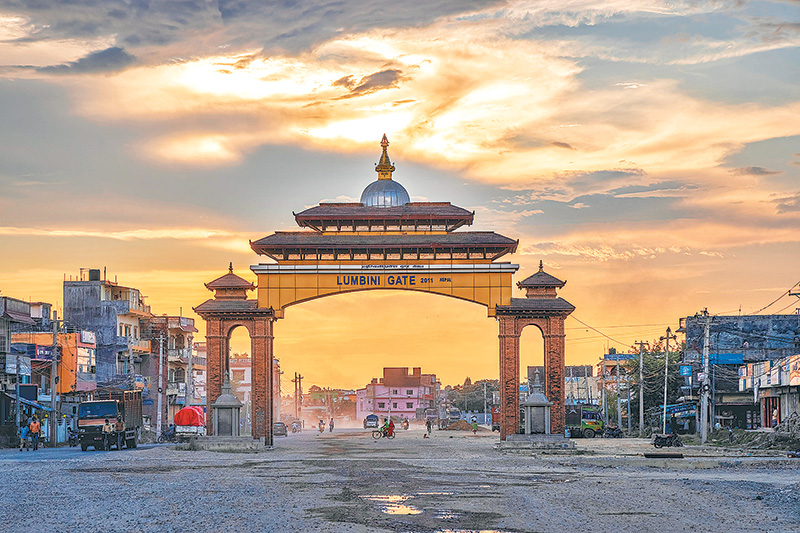
A view of the Lumbini Gate in Bhairahawa.  SHUTTERSTOCK

BUTWAL,
The Lumbini provincial government has started an entrepreneur development programme for unemployed youths and recent returnees migrant workers affected by the Covid-19 pandemic.
The provincial government has declared that it will provide beneficiaries with easy loans and grants to start their own businesses.
According to the Ministry of Industry, Tourism, Forest and Environment, recent returnees from India and overseas who lost their jobs due to the pandemic, disabled people, conflict victims, single women and people from marginalised communities will be prioritised for the programme.
The ministry has said that it will provide the beneficiaries with loans and pay their interest for three years.
On Friday, the ministry and the provincial office of Nepal Bank Limited signed an agreement to implement the programme. According to the agreement, around Rs430 million will be mobilised for the entrepreneur development programme in the province.
An agreement has also been made to submit Rs100 million to the bank through the Entrepreneur Development Fund in the current fiscal year. According to authorities, 1,300 individuals will benefit from the programme in the current fiscal year.   
As per the plan, the ministry will provide Rs300,000 to Rs1 million as loan to aspiring entrepreneurs on the basis of the businesses they establish. The ministry will also pay the loans of such amounts for three years.
“We aim to utilise our labour force in our own province and create employment opportunities through the entrepreneur development programme,” said Lila Giri, minister for Industry, Tourism, Forest and Environment of the province. “The ministry will add more funds in the next fiscal year after evaluating the programme’s effectiveness.”   
To receive the grant, a registration certificate of a business in the fiscal year 2020-21, a recommendation from the Cottage and Small Industries Office, a self declaration citing they have not received a grant from any government agency and a Nepali citizenship certificate are necessary. The bank will provide loans after evaluating these documents.
Pasang Dhwaj Sherpa, manager at the provincial office of Nepal Bank Limited, said the bank’s branch offices in all districts of the province will give out loans after inspecting and verifying the documents.
“The interest will be stagnant for three years. Loans will be provided as per the demand and need of the entrepreneurs,” Sherpa said.
Rajan KC, secretary of the ministry, said, “Under the programme, a fund of Rs19.1 million has been
allocated for Rupandehi, Rs12.4 million for Kaplivastu and Rs12 million for Dang district. Beneficiaries
are going to be selected from the bank itself rather than from the ministry.”

MONEY

Australia to make Facebook, Google pay news outlets for content

- REUTERS

SYDNEY,
Australia finalised plans on Tuesday to make Facebook Inc and Google pay its media outlets for news content, a world-first move aimed at protecting independent journalism that has been strongly opposed by the internet giants.
Under laws to go to parliament this week, Treasurer Josh Frydenberg said the Big Tech firms must negotiate payments for content that appears on their platforms with local publishers and broadcasters. If they can’t strike a deal, a government-appointed arbitrator will decide for them.
“This is a huge reform, this is a world first, and the world is watching what happens here in Australia,” Frydenberg told reporters in the capital Canberra.
“Our legislation will help ensure that the rules of the digital world mirror the rules of the physical world ... and ultimately sustain our media landscape.”
The law amounts to the strongest check of the tech giants’ market power globally, and follows three years of inquiry and consultation, ultimately spilling into a public row in August when the US companies warned it may stop them offering their services in Australia.
Facebook Australia managing director Will Easton said the company would review the legislation and “engage through the upcoming parliamentary process with the goal of landing on a workable framework to support Australia’s news ecosystem”.
A representative for Google declined to comment, saying the company had yet to see the final version of the proposed law.
Until recently, most countries have stood by as advertisers redirect spending to the world’s biggest social media website and search engine, starving newsrooms of their main revenue source and bringing widespread shutdowns and job losses.
But regulators are starting to test their power to rein in the two mega-corporations, which take more than four-fifths of Australian online advertising spending between them, according to Frydenberg.
Google said in October it plans to pay $1 billion to publishers globally for their news over the next three years.
The new product called Google News Showcase will launch first in Germany, where it has signed up German newspapers including Der Spiegel, Stern, Die Zeit, and in Brazil with Folha de S.Paulo, Band and Infobae.
Google last month said it had also signed copyright agreements with six French newspapers and magazines, including national dailies Le Monde and Le Figaro.
“It’s both very ambitious and very necessary,” said Denis Muller, an Honorary Fellow at University of Melbourne’s Centre for Advancing Journalism, referring to the Australian law.
“Taking their news content without paying for it, in exchange for a very questionable reward of ‘reach’, seems to be a very unfair and uneven and ultimately democratically damaging arrangement.”
News Corp Australia executive chairman Michael Miller said the law was “a significant step forward in the decade-long campaign to achieve fairness in the relationship between Australian news media companies and the global tech giants”. In May, News Corp stopped printing more than 100 Australian newspapers, citing declining advertising.
In changes to draft legislation announced earlier this year that might favour the tech companies, the final version of the law would not affect news content distributed on Facebook’s Instagram subsidiary or Google’s Youtube. Facebook and Google would also be allowed to include in the negotiations the value of clicks their platforms directed to news websites.

MONEY

Boeing suffers more cancelled orders for its 737 Max plane

- ASSOCIATED PRESS
A Boeing 737 MAX 7 conducts an evaluation flight at Boeing Field in Seattle, US.  REUTERS

WASHINGTON,
Boeing Co reported more cancellations for its 737 Max jet, which this week is scheduled to carry paying passengers for the first time since the planes were grounded 21 months ago after two deadly crashes.
Boeing said orders for 88 of the planes were cancelled in November, pushing the total to 536 for the year.
The company reported 27 orders for the plane, although 25 were a new order by Virgin Australia that replaced an earlier, larger order for 48 Max jets that was scrubbed, accounting for a majority of the month’s cancellations. The November figures don’t include Irish carrier Ryanair’s announcement last week that it will order 75 more Max jets.
Boeing said it delivered seven commercial jets during November, mostly cargo planes to UPS, FedEx, DHL and others, bringing total deliveries in 2020 to 118. European rival Airbus delivered 64 planes in November and 477 for the year.
An analyst for financial-services firm Cowen, Cai von Rumohr, called Boeing’s latest report on orders and deliveries “weak on both sides of the ball.”
Shares of Chicago-based Boeing were down less than 1 percent in afternoon trading. They closed Monday down 27 percent for the year to date, but they have been rising since early November on expectation that the Federal Aviation Administration would let the Max fly again.
The FAA issued an ungrounding order on Nov. 18 that laid out required steps for airlines to resume using the plane, which was grounded in March 2019 after two crashes that killed 346 people.
On Wednesday, Brazilian airline Gol plans to operate the first flight on a Max with paying passengers since the grounding. American Airlines plans the first US flight on December 29.

MONEY

Ethiopia’s war risks leaving fledgling manufacturing sector in tatters

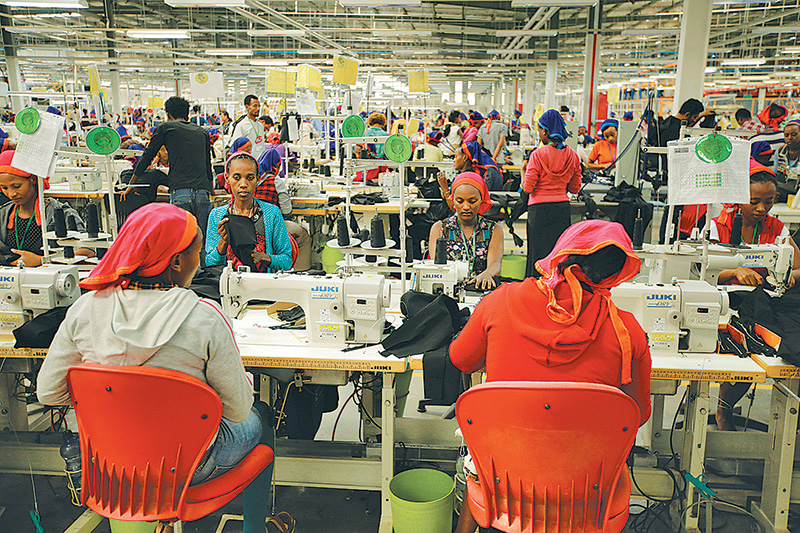
A file photo shows workers sewing clothes inside the Indochine Apparel textile factory in Hawassa Industrial Park in Southern Nations, Nationalities and Peoples region, Ethiopia. REUTERS
- REUTERS

ADDIS ABABA,
When Bangladeshi textile firm DBL set up shop in Ethiopia two years ago, the African nation was the garment industry’s bright new frontier, boasting abundant cheap labour and a government keen to woo companies with tax breaks and cheap loans.
Last month, as fighting raged in the northern Tigray region, DBL’s compound was rocked by an explosion that blasted out the factory’s windows, radically altering its business calculus.
“All we could do was to pray out loud,” said Adbul Waseq, an official at the company, which makes clothes mainly for Swedish fashion giant H&M and is one of at least three foreign garment makers to have suspended operations in Tigray.
“We could have died,” Waseq told Reuters.
For over a decade, Ethiopia has invested billions of dollars in infrastructure such as hydro-electric dams, railways, roads as well as industrial parks in an ambitious bid to transform the poor, mainly agrarian nation into a manufacturing powerhouse.
By 2017, it was the world’s fastest growing economy.
A year later, Prime Minister Abiy Ahmed took office, pledging to loosen the state’s grip on an economy with over 100 million people and liberalise sectors such as telecoms, fuelling something akin to glasnost-era headiness among investors.
But for two years Ethiopia has been pummelled by challenges: ethnic clashes, floods, locust swarms and coronavirus lockdowns.
Now, fighting which erupted on November 4 between the army and forces loyal to Tigray’s former ruling party, and fears it could signal a period of prolonged unrest, have served investors with a harsh reality check.
Any hesitation by investors could spell trouble as the country’s manufacturing export push isn’t yet generating enough foreign currency either to pay for all the country’s imports or keep pace with rising debt service costs. Even before the pandemic, the International Monetary Fund (IMF) had warned that Ethiopia was at high risk of debt distress.
Abiy’s government said that, amid the crises it’s facing, Ethiopia was pushing ahead with reforms that will build the foundations for a modern economy.“Despite the unprecedented shock from Covid and continued insecurity in different parts of the country, the Ethiopian economy showed remarkable resilience,” Mamo Mihretu, senior policy adviser in the prime minister’s office, told Reuters.
Ethiopia is a relatively small textiles producer with exports in 2016 of just $94 million compared with $29 billion for Vietnam and $253 billion for China in the same year, World Bank trade data showed. Its top exports are agricultural, such as coffee, tea, spices, oil seeds, plants and flowers.
But Ethiopia’s push into the textile industry over the past 10 years has been emblematic of its manufacturing ambitions. As fighting neared Tigray’s regional capital, Mekelle, textile companies began shutting down and pulling out staff.
“It seemed that the conflict was getting closer to the city, and our worry was that we wouldn’t be able to leave,” Cristiano Frati, an electrician evacuated from a factory run by Italian hosiery chain Calzedonia, told an Italian newspaper.
Calzedonia said on November 13 it had suspended operations at the plant, which employs about 2,000 people, due to the conflict. It has declined to comment further.
DBL, meanwhile, has flown its foreign staff out of Ethiopia.
“Everything has become uncertain,” its managing director M A Jabbar said. “When will the war end?”

MONEY

Fears of chaotic Brexit rise as British PM Johnson heads for last supper in Brussels

- REUTERS

LONDON, 
British Prime Minister Boris Johnson heads to Brussels on Wednesday for talks with European Commission President Ursula von der Leyen in a push to avoid a tumultuous Brexit without a trade deal in three weeks’ time.
With growing fears of a chaotic no-deal finale to the five-year Brexit crisis when the United Kingdom finally leaves the EU’s orbit on December 31, the meeting over dinner is being cast as a chance to unlock the stalled trade talks.
A British government source said a deal may not be possible, as did EU chief Brexit negotiator Michel Barnier. Ireland also signalled it was pessimistic about the prospects.
“The EU has to move,” Michael Gove, a senior minister in Johnson’s government dealing with Brexit issues, told Times Radio.
While Gove refused to give odds on a deal, he said that often a one-on-one meeting between leaders could result in a breakthrough.
He said a compromise could be possible on fishing in British waters—one of the toughest issues so far.
German Chancellor Angela Merkel, Europe’s most powerful leader, said there was still a chance of a deal but that the integrity of the EU’s market had to be preserved.
Failure to secure a deal would snarl borders, shock financial markets and sow chaos through supply chains across Europe and beyond as the world faces the vast economic cost of the Covid-19 pandemic.
A measure of expected price swings in the pounds known as overnight implied volatility jumped 25 percent to the highest since late March.
EU chief negotiator Barnier said on Tuesday he believed a ‘no-deal’ split in ties with Britain at the end of the year was now more likely than agreement on a trade pact, EU sources said.
A diplomat and an official in Brussels, speaking on condition of anonymity, said Barnier made the remark at a meeting with the European affairs ministers from the 27 EU states. Barnier added that it was time for the bloc to update its no-deal contingency plans, they said.
Britain said on Tuesday it had clinched a deal with the EU over how to manage the Ireland-Northern Ireland border, and would now drop clauses in draft domestic legislation that would have breached a Brexit withdrawal agreement signed in January.

Page 6
WORLD

US virus deaths hit record levels with the holidays ahead

Virtually every state is reporting surges with per day infection cases at more than 200,000.
- ASSOCIATED PRESS
Critical care nurses and respiratory therapists flip a Covid-19 patient upright at North Memorial Health Hospital in Robbinsdale, Minnesota. ap/rss

IDAHO/WASHINGTON,
Deaths from Covid-19 in the US have soared to more than 2,200 a day on average, matching the frightening peak reached last April, and cases per day have eclipsed 200,000 on average for the first time on record, with the crisis all but certain to get worse because of the fallout from Thanksgiving, Christmas and New Year’s.
Virtually every state is reporting surges just as a vaccine appears days away from getting the go-ahead in the US
“What we do now literally will be a matter of life and death for many of our citizens,” Washington Gov Jay Inslee said on Tuesday as he extended restrictions on businesses and social gatherings, including a ban on indoor dining and drinking at restaurants and bars.
While the impending arrival of the vaccine is reason for hope, he said, “at the moment, we have to face reality, and the reality is that we are suffering a very dire situation with the pandemic.”
Elsewhere around the country, North Carolina’s governor imposed a 10 pm curfew, and authorities in Southern California and the San Joaquin Valley sent a mass cellphone text alert Tuesday telling millions about the rapid spread of the virus and urging them to abide by the state’s stay-at-home orders.
The virus is blamed for more than 285,000 deaths and 15 million confirmed infections in the United States.
Many Americans disregarded warnings not to travel over Thanksgiving and have ignored other safety precautions, whether out of stubbornness, ignorance or complacency. On Saturday night, police in Southern California arrested nearly 160 people, many of them not wearing masks, at a house party in Palmdale that was held without the homeowner’s knowledge.
Before his death Friday from complications of Covid-19, 78-year-old former Alabama state Sen. Larry
Dixon asked his wife from his hospital bed to relay a warning. “Sweetheart, we messed up. We just dropped our guard. ... We’ve got to tell people this is real,” his friend Dr David Thrasher, a pulmonologist, quoted him as saying.
Although Dixon had been conscientious about masks and social distancing, he met up with friends at a restaurant for what they called a “prayer meeting,” and three of them fell ill, Thrasher said.

WORLD

UK warns people with serious allergies to avoid Pfizer vaccine

- REUTERS

LONDON: Britain’s medicine regulator has advised that people with a history of significant allergic reactions do not get Pfizer-BioNTech’s Covid-19 vaccine after two people reported adverse effects on the first day of rollout.
Britain began mass vaccinating its population on Tuesday, starting with the elderly and frontline workers National Health Service medical director Stephen Powis said the advice had been changed after two NHS workers reported anaphylactoid reactions associated with getting the shot.
“As is common with new vaccines the MHRA (regulator) have advised on a precautionary basis that people with a significant history of allergic reactions do not receive this vaccination, after two people with a history of significant allergic reactions responded adversely yesterday,” Powis said.“Both are recovering well.”
Pfizer UK and BioNTech were not immediately available for comment.

WORLD

Emissions hit new high, put world on track for 3 degrees Celsius warming, UN says

- REUTERS
Meltwater from the Laohugou No 12 glacier, flows though the Qilian mountains, Subei Mongol Autonomous County in Gansu province, China, in this photo taken on September 27.  REUTERS

LONDON,
Greenhouse gas emissions reached a new high last year, putting the world on track for an average temperature rise of 3 degrees Celsius, a UN report showed on Wednesday.
The report by the United Nations Environment Programme (UNEP)—the latest to suggest the world
is hurtling toward extreme climate change—follows a year of sobering weather extremes, including rapid ice loss in the Arctic as well as record heat waves and wildfires in Siberia and the US West.
On Monday, researchers at Europe’s Copernicus Climate Change Service said last month was the hottest-ever November on record.
“The year 2020 is on course to be one of the warmest on record, while wildfires, storms and droughts continue to wreak havoc,” said Inger Andersen, UNEP’s Executive Director.
The annual “emissions gap” report measures the gap between anticipated emissions and those consistent with limiting the global temperature rise this century as agreed in the 2015 Paris Agreement.
Under the global climate pact, nations have committed to a long-term goal of limiting the average temperature rise to below 2 degrees Celsius above pre-industrial levels and to pursue efforts to limit it even further to 1.5C.
Emissions have, however, grown by an average 1.4 percent per year since 2010, with a steeper increase of 2.6 percent last year due, partly due to a large increase in forest fires. Total 2019 emissions of carbon dioxide equivalent (GtCO2e) hit a new record of 59.1 gigatonnes.
This year, there has been a temporary emissions dip as economies slowed due to the coronavirus
pandemic.
The resulting drop in travel, industrial activity and electricity generation are likely to work out at a 7 percent reduction in emissions, the report said. That translates to only a 0.01C reduction in global warming by 2050.
Green investment under government stimulus packages to pull economies out of the pandemic-induced slump could cut up to 25 percent off emissions predicted in 2030.
Such packages could put emissions in 2030 at 44 GtCO2e - within the range that gives a 66 percent chance of holding temperature rises to below 2C, but still insufficient to achieve the 1.5C goal.
The United Nations and Britain are holding an online event on Saturday to mark the fifth anniversary of the Paris Agreement, and governments are under pressure to come forward with tougher climate targets before the end of the year.
A growing number of countries have committed to net zero emissions by mid-century but these need to be translated into strong near-term policies and action, the UNEP report said.
“The levels of ambition in the Paris Agreement still must be roughly tripled for the 2C pathway and increased at least fivefold for the 1.5C pathway,” it added.

WORLD

Big data ‘turbocharged’ repression in China’s Xinjiang: Rights group

- AGENCE FRANCE-PRESSE

BEIJING,
Muslims in China’s Xinjiang were “arbitrarily” selected for arrest by a computer programme that flagged suspicious behaviour, activists said on Wednesday, in a report detailing big data’s role in repression in the restive province.
The US-based NGO Human Rights Watch said leaked police data that listed over 2,000 detainees from the Aksu prefecture was further evidence of “how China’s brutal repression of Xinjiang’s Turkic Muslims is being turbocharged by technology.”
Beijing has come under intense international criticism over its policies in the resource-rich territory, where rights groups say as many as one million Uighurs and other mostly Muslim minorities have been held in internment camps.
China defends the camps as vocational training centres aimed at stamping out terrorism and improving employment opportunities.
Surveillance spending in Xinjiang has ballooned in recent years, with facial recognition, iris scanners, DNA collection and artificial intelligence deployed across the province.
Human Rights Watch said it had obtained the list—which detailed detentions from mid-2016 to late 2018.
The group gave an example of a “Mrs T”—detained for “links with sensitive countries” who was listed as having received a number of calls from a foreign number which belonged to her sister. Researchers at the NGO spoke to the woman and learned that police had interrogated her sister in Xinjiang, but she has had no direct contact with her family in the province since.
The people were flagged using a programme called the Integrated Joint Operations Platform, which collected data from surveillance systems in Xinjiang, before officials decided whether to send them to camps, according to Human Rights Watch.
But the NGO said its information suggests the “vast majority” of people were flagged to
authorities for legal behaviour, including phone calls to relatives abroad, having no fixed address
or switching off their phone repeatedly.

WORLD

India government looks for ways to tweak new agriculture laws to mollify farmers

- REUTERS
Farmers attend a protest during a nationwide strike against the newly passed farm bills at Singhu border near Delhi, India, on Tuesday. REUTERS

NEW DELHI,
Indian government officials looked for ways to tweak new laws liberalising the agricultural sector on Wednesday, as they put off a second day of talks with farmer organisations that have mobilised mass protests, government officials said.
Farmers have been demonstrating since late last month over reforms enacted in September that loosened rules around the sale, pricing and storage of farm produce, and had protected farmers from an unfettered free market for decades.
Small growers, in particular, fear that they will be at the mercy of big business if they are no longer assured of floor prices for staples such as wheat and rice sold at government-controlled wholesale markets.
Unhappy with Prime Minister Narendra Modi’s liberalisation, farmers have set up protest camps and blocked roads surrounding the capital New Delhi, and on Tuesday they mounted a nationwide strike.
In response, the government decided against rushing into a planned second day of talks without first coming up with some proposals that could mollify the angry farmers, a federal government spokesman said.
“We’re open to amendments, but a complete withdrawal of the laws is just plain impossible,” said a senior government official in the agriculture ministry in New Delhi, who declined to be identified.
A second senior government official said they were working on a fresh proposal to “fine tune” the three laws, which would  be presented to the over 30 farmer unions actively involved in the protests.
Farmer leaders want the government to retain mandatory government purchases, and said that
buyers at private markets should pay the same tax as at state-run markets.
Hannan Mollah, the general secretary of All India Kisan Sabha (All India Farmers’ Union), said his members would discuss intensifying resistance to the new laws.
The protests, led by influential farming groups from the grain-producing states of Haryana and Punjab, pose a major challenge to Modi as he seeks to reform the vast agriculture sector, which makes up nearly 15% of India’s $2.9 trillion economy and employs around half of its 1.3 billion people.
Opposition parties have criticised the reforms, saying they will benefit big business and be disastrous for the rural economy, and are due to meet President Ram Nath Kovind, the country’s ceremonial head of state, to discuss the controversial laws.

WORLD

Ethiopia rejects independent probes into Tigray conflict

Briefing
- AGENCIES

NAIROBI: Ethiopia’s government is rejecting calls for independent investigations into the deadly conflict in its Tigray region. The declaration comes amid international calls for more transparency into the month-long fighting between Ethiopian forces and those of the fugitive Tigray regional government that is thought to have killed thousands. A senior government official told reporters on Tuesday that Ethiopia will invite others for assistance only if it feels that “it failed to investigate.”

WORLD

Explosion damages Polish store near Amsterdam

Briefing
- AGENCIES

THE HAGUE: An explosion damaged a Polish supermarket in a Dutch town near Amsterdam on early Wednesday morning. Police said the explosion happened at a store in the town of Beverwijk. Nobody was injured, but the store was badly damaged. Dutch media reported that the owner of the store also owns another Polish supermarket in Aalsmeer that was gutted by an explosion and fire early Tuesday. The same night, another explosion hit a Polish supermarket in the town of Heeswijk-Dinther.

WORLD

Johnson jets in to Brussels in bid to save Brexit deal

Briefing
- AGENCIES

LONDON: Prime Minister Boris Johnson was Brussels-bound on Wednesday, with Britain’s fading hopes for a post-Brexit trade deal hanging on crisis talks with EU chief Ursula von der Leyen. Johnson’s dash back to the city where once he made his name as an EU-bashing newspaper reporter marks the last chance of a breakthrough before Britain leaves the EU single market. Talks are blocked over the issue of fair competition, with Britain refusing to accept a mechanism to allow the EU to retaliate swiftly if the UK business regulations change in ways that put European firms at a disadvantage.

WORLD

Russian citizen charged with espionage in Denmark

Briefing
- AGENCIES

COPENHAGEN: A Russian citizen residing in Denmark has been charged with espionage on suspicion of having provided information about Danish energy technology to the Russian intelligence service, the Danish public prosecutor said on Wednesday. The Russian has been in custody since July 2020, the prosecutor said.

Page 7
SPORTS

Man United exit as racism row interrupts PSG game

Requiring just a point to advance, the English giants trail 3-0 heading into the final quarter against Leipzig before losing the Champions League match 3-2.
- AGENCE FRANCE-PRESSE
Leipzig’s Justin Kluiver (left) scored the third goal as they beat Manchester United to advance into the knockout stage of the Champions League. Ap/RSS

PARIS,
Manchester United were knocked out of the Champions League after a 3-2 defeat by RB Leipzig on Tuesday, while Paris Saint-Germain’s qualification for the last 16 was overshadowed by a racism row involving a match official that caused their game against Istanbul Basaksehir to be suspended for 24 hours.
Cristiano Ronaldo scored two penalties as Juventus blew away Lionel Messi’s struggling Barcelona 3-0 to wrest first place in Group ‘G’ away from the Spanish giants.
Lazio also secured a spot in the knockout rounds for the first time in two decades following a tense 2-2 draw at home to Club Brugge in the pouring rain in Rome.
Requiring just a point to advance, Ole Gunnar Solskjaer’s side fell behind to an Angelino goal inside two minutes in Germany. Amadou Haidara soon added a second and United and were trailing 3-0 heading into the final quarter after a Justin Kluivert strike.
Bruno Fernandes’s penalty and a deflected Paul Pogba header gave United a lifeline but Leipzig, who reached the semi-finals last term, held on to move top of Group ‘H’ on 12 points.
“We started too late. We showed great spirit to come back again, but you can’t give a team a 3-0 lead and expect to come back,” said Solskjaer.
Leipzig must wait until Wednesday to find out whether they finish first or second in the section, after the contest between last season’s runners-up PSG and Turkish champions Basaksehir was interrupted with the score 0-0 in the 14th minute.
Players walked off in Paris amid allegations of racism by fourth official, in an unprecedented incident in Europe’s elite club competition.
The row erupted after Basaksehir assistant coach Pierre Webo, the former Cameroon international, was shown a red card during a fierce row on the touchline with staff from the Turkish club appearing to accuse the official of using a racist term.
Television microphones picked up a furious Webo repeatedly asking why a racist term had been used to describe him. Turkish President Recep Tayyip Erdogan said he “strongly” condemned the incident, while UEFA announced it would open a “thorough investigation”.
In a statement, UEFA confirmed the game would, “on an exceptional basis”, restart from where it was stopped on Wednesday at 1755 GMT, “with a new team of match officials”.
PSG, who advanced following United’s loss, will claim top spot with victory.
Andrea Pirlo’s Juventus avenged a 2-0 home loss to Barcelona in October when Ronaldo was sidelined with Covid-19, edging their opponents on head-to-head record and heaping more pressure on Ronald Koeman.
“We’re very happy. We knew it was almost mission impossible (to come top),” Ronaldo told Movistar. “It was a difficult task but we played well. The key was to start the match well and from there we saw it was possible.”
Weston McKennie scored in between Ronaldo’s two spot-kicks at the Camp Nou as Barca, off to their worst La Liga start in 33 years, were denied a sixth win from six in Europe.
“Frankly, I was surprised at how we started, as if we weren’t really hungry to win the match,” said Koeman.
Denys Popov’s header earned Dynamo Kiev a 1-0 victory over their former star Serhiy Rebrov and Ferencvaros in the group’s other game, offering them a place in the Europa League.
Borussia Dortmund striker Youssoufa Moukoko, aged 16 years and 18 days, became the youngest player in Champions League history as he came off the bench in a 2-1 victory away to Zenit Saint Petersburg.
Cameroon-born Moukoko, who made his European debut as a 58th-minute substitute in Russia, broke the previous record of Celestine Babayaro, who was 16 years and 87 days when he played for Anderlecht in November 1994.
Dortmund, who had already qualified for the last 16, equalised within minutes of Moukoko’s introduction, with Lukasz Piszczek cancelling out Sebastian Driussi’s first-half goal before Axel Witsel scored the winner.
Jorginho spared Chelsea’s blushes as his penalty rescued a 1-1 draw against Krasnodar in Group ‘E’ following Remy Cabella’s opener in London.
Frank Lampard’s side were already assured of finishing top, while goals from Jules Kounde and two Youssef En-Nesyri eased Sevilla to a 3-1 victory at Rennes.

SPORTS

South Africa to play Test, T20 series in Pakistan

- REUTERS

CAPE TOWN,
South Africa will tour Pakistan next month for the first time in 13 years to play two Tests and three Twenty20 Internationals, officials confirmed on Wednesday.
The five-day matches form part of the ICC Test Championship and will be staged in Karachi (January 26-30) and Rawalpindi (February 4-8), before T20 fixtures at the same venues and Lahore, ending on February 14.
International cricket has returned to Pakistan in the past 15 months following a militant attack on the Sri Lanka team bus in Lahore in 2009 that killed six policemen and two civilians.
The country has hosted Sri Lanka, Bangladesh and Zimbabwe since September 2019, while England recently announced a short two-match 20-over series in October next year in the build-up to the T20 World Cup in India. England’s recent One-Day International series in the South Africa tour was postponed owing to Covid-19 pandemic.
“It’s pleasing to see so many countries making a return to Pakistan – a proud, cricket-loving nation,” South Africa’s director of cricket, Graeme Smith, said in a statement.
 “I would like to thank the Pakistan Cricket Board (PCB) for the hospitality and transparency they showed our security contingent when they travelled over there a few weeks ago. The report on their findings and recommendations gives us confidence as an organisation that all of our team’s security, playing and accommodation needs will be met, and that the wellbeing of the team will be the top priority.”
Pakistan captain Babar Azam said that aside from the thrill of playing at home, the tour will also be a chance for his side to test their progress across the two formats.
“I am delighted that South Africa have confirmed their tour to Pakistan and look forward to captaining my country for the first time in a home Test,” Azam said in a media release from the PCB.
“Looking at the calendar of international cricket in 2021, I am pleased we are playing more against the sides which are ranked above us. This is critical to not only our learning and development, but also an opportunity to improve our rankings across all formats,” he added.

SPORTS

Ronaldo says ‘no rivalry’ with Messi

- REUTERS

LONDON,
They defined the ‘El Clasico’ rivalry between Real Madrid and Barcelona for the past decade but Cristiano Ronaldo said he has always got on well with Lionel Messi and never saw him as a rival.
Ronaldo, now playing for Juventus, scored two penalties to help the Italian champions secure a 3-0 win over Messi’s Barcelona in the Champions League on Tuesday. It was the first meeting between Ronaldo and Messi since the Portuguese forward left Real Madrid for Juventus in 2018. Between them the pair have won the Ballon d’Or in 11 of the past 12 years.
“I have always had a cordial relationship with Messi,” Ronaldo told Movistar. “As I have said before, for 12, 13, 14 years [I have been] sharing prizes with him. I never saw him as a rival. He always tried the best for his team, and I tried the best for mine. I always got on well with him. I am
sure he will say the same if you ask him. But we know in football, people always look for a rivalry to create more excitement.”
Ronaldo is hoping the win could provide an “injection of confidence” for Juventus, who are currently fourth in the Italian Serie A standings. Barcelona are also looking to recover from a below-par start to their domestic league campaign.
“Messi is the same as ever [on the pitch],” Ronaldo said. “Barcelona are in a difficult moment, but they are still Barca. I am sure they will come out of it. All teams have bad runs, but Barcelona are a very good team.”

SPORTS

CAF fines Aubameyang for social media outburst

Briefing
- AGENCIES

CAIRO: Pierre-Emerick Aubameyang has been fined $10,000 for social media posts that tarnished the “honour and image” of the Confederation of African Football after his Gabon team spent the night on an airport floor ahead of an African Cup of Nations qualifier last month. Aubameyang and his team mates were stuck at the airport in the Gambia after arriving for a qualifying game. They were not allowed to leave as officials argued over Covid-19 testing. The Arsenal striker posted pictures of players sleeping on the airport floor and wrote: “Nice job CAF, it’s as if we were back in the 1990s.” CAF’s disciplinary committee said the content was offensive and degrading. African football’s governing body also fined Gambia’s FA $100,000, half of which was suspended for 24 months.

SPORTS

Former Argentina coach Sabella dies aged 66

Briefing
- AGENCIES

BUENOS AIRES: Alejandro Sabella, the coach who took Argentina to the World Cup final in 2014, has died aged 66 after years of battling with cancer and heart problems. Sabella’s death came less than two weeks after the passing of Diego Maradona, who played with Sabella for the Argentine national side in the 1980s. Maradona died from a heart attack in Buenos Aires on November 25, aged 60. He became the manager of Argentine club Estudiantes in 2009, leading the provincial side with Juan Sebastian Veron in midfield to their fourth Copa Libertadores title. Sabella’s success there led to a position as coach of the national team in 2011. After losing 1-0 to Germany after extra time in the World Cup final in Rio de Janeiro, Sabella retired and, increasingly beset by health problems, never returned to the sidelines.

SPORTS

Indian captain Kohli rules out Pandya for Australia Tests

Briefing
- AGENCIES

MELBOURNE: All-rounder Hardik Pandya will not be considered for India’s Test series against Australia starting next week despite starring with the bat in the white-ball series, captain Virat Kohli said. Pandya was named man-of-the-series after the three Twenty20 matches and scored two half-centuries in the preceding one-day series against the hosts. But the explosive 27-year-old only bowled a handful of overs in the second ODI as he continues building to peak fitness following back surgery last year. Pandya was overlooked in India’s initial squad for the four-Test series starting at Adelaide Oval next week, and Kohli said he would not be picked as a specialist batsman alone. The four match Test series will begin on December 17.

MEDLEY

Horoscope

ARIES (March 21-April 19) ***
You are getting tighter with someone who really gets you all hot and bothered, which is wonderful and exciting. But things might be going too quickly. Today, you should turn down the heat a little bit. Resist the urge to spend every minute with them.

TAURUS (April 20-May 20) *****
When you encounter arrogance, you usually get angry. But when you come across someone who thinks they invented the world, your first response probably won’t be anger. It will be amusement. Enjoy the fun.

GEMINI (May 21-June 21) ***
Today, a jolt of new life could be injected into one of your less pleasant relationships. You’ll suddenly start to see this person in a new light, and you might even discover that the two of you have something unique in common.

CANCER (June 22-July 22) ***
Going over your budget every once in a while is fine, so don’t beat yourself up if a recent credit card statement has you hyperventilating. After all, you can’t avoid splurging every now and then. It is okay to spend on yourself.

LEO (July 23-August 22) ****
Are you feeling a frosty chill from someone who’s usually warm and sweet? Ask them if something is wrong, and if they tell you “nothing,” don’t push it. Respect their boundaries and let them come talk to you when they want to.

VIRGO (August 23-September 22) ***
If a friend tells you that you need to learn to be more flexible, it’s probably just because they want you to do what they want to do. You are smart enough to know just how far to bend over backward without losing your credibility.

LIBRA (September 23-October 22) **
It’s good to keep your hopes high, but you also have to know when it’s time to admit the reality of a situation. It’s time for you to get real and start putting your energy and thoughts toward something that’s more possible.

SCORPIO (October 23-November 21) ***
You’re working with a power player right now, but guess what? They could say the same about you. Try to understand that the rest of the world sees you as a powerful person, too! It’s time to step into that role with more confidence.

SAGITTARIUS (November 22-December 21) ***
Group travel is in your future, so start brainstorming a few ideas about where you want to go (with everyone else’s input, of course). You can ask all your people and see what kind of an adventure everyone’s in the mood for.

CAPRICORN (December 22-January 19) ***
You’ll get the credit you deserve, although someone else might be wondering why they weren’t singled out as well. While you might have sympathy for their situation, you can’t take on this battle for them.

AQUARIUS (January 20-February 18) ***
Take a second before you act on any of your impulses today. It’s not that your gut is telling you something wrong; it’s just that if you act too quickly right now, you could end up regretting it. Things haven’t completely gelled just yet, wait.

PISCES (February 19-March 20) ***
In your professional life, it’s time for you to step away from the corner and push yourself into the forefront. Speak up and add your ideas to the mix more often, starting today! Don’t worry that your boss won’t like what you say.

Page 8
CULTURE & LIFESTYLE

How this duo is boosting the creative sector—one recruitment at a time

Established by Sampada Malla, a film writer, and Subhas Pradhan, a music artist, Srijana Sutra is a creative recruiting agency that has been able to find jobs for more than 100 people even during the pandemic.
- ANKIT KHADGI
shutterstock

Kathmandu,
When Shristi Khadgi was applying for a job as a newsreader back in June, she was apprehensive. She was not sure about the credibility of the portal through which she had found the job vacancy, she says.
“I had never applied for a job online. I thought it was a hoax since the jobs we find through online aren’t always reliable. But I was free at home, not involved in anything, and so I applied,” says Khadgi, 24, who had found the job through Facebook. She landed the job and has been working as a newsreader at Dharma Television since.
“It was a completely new experience for me. Even if in the beginning I was doubtful, now I feel the experience was worth it, as I was able to get a job that I was interested in,” says Khadgi, who had experience working as an emcee at events.
Khadgi is among the many people seeking to work in the creative sector, recruited through Srijana Sutra, a Kathmandu-based job recruitment platform that solely focuses on helping people like her who are interested to work in the creative field.
Established in February this year, by Sampada Malla, a film writer, and Subhas Pradhan, a music artist, Srijana Sutra has a simple plan: to create a space where creative enthusiasts can turn their passion into a job.
“Our country lacks corporatisation of the creative industry due which it isn’t systematic. That’s why we were very clear that we would focus only on finding creative jobs, as we saw a lack of such platforms in Nepal,” says Malla.
Both Malla and Pradhan have devoted many years to their respective creative fields. While movies and a television career in Mumbai kept Malla occupied, Pradhan was engaged in the music scene, where he worked as a singer, composer, music video director and also a celebrity manager.
But both of them shared a common vision—to build a platform where emerging creative talents could find jobs that could help them showcase their talent as well as earn money and strengthen the creative industry.
“While we knew each other for years, it was during one workshop where we got to know that we shared a common vision,” says Pradhan. “And that’s when we decided to join hands together and start a platform that could support the creative enthusiasts and the emerging talents,” he says.
For six months, taking time out from their busy schedules, the two of them started working on creating the platform, setting its goal and expanding its networking.
“We wanted to give our platform a name that could carry the essence of our goals and values,” says Malla. “That’s why we decided to go for Srijana Sutra, which was suggested by my father, Ashesh Malla, a Nepali playwright, as it embodied what we wanted to with our platform—to create a space, where creativity finds its connection.”
But establishing a company of this nature came with challenges, and one of the biggest challenges was to convince people that the creative industry was as lucrative as other fields like engineering, banking, and medicine.
“People are so unaware of the scope that creative jobs could offer that many parents
kill the passion of their children even before they try to make a career in the creative field,” says Malla. “We wanted to dismantle such misconception.”
But for Malla and Pradhan, starting Srijana Sutra wasn’t just to fill the gap in the market and create a niche platform that could help them earn money. They were rather driven with the motive of helping people like them, who are interested in joining the creative field, but lack guidance about the prospects, they say.
“In our country, we don’t have people guiding artists about their careers, due to which many people, even before starting their careers, leave because they get pressured from their family members, who think there’s no money in this field,” says Pradhan.
“This was one of the main reasons why we thought there was a dire need to start this platform, so people could get jobs, which would eventually help the creative industry to grow.”
With just an investment of Rs 25,000, they started the company, operating through their website and social media accounts. However, even when they were clear about their vision and were experienced, they had their fair share of struggles.
“Registering the company was a chaotic experience, as it was difficult for us to explain about our company since this was the first-ever recruitment agency that only catered the service of helping creative people to find jobs,” says Malla.
Likewise, just a month later, the lockdown was announced, which severely affected the creative industry, as the gathering of masses were strictly prohibited due to which creative works had to take a backseat for a while since it needs collaboration of many people.
Yet, the two from Srijana Sutra persevered and in the nine months of its establishment, even during a pandemic, it has been able to find jobs for more than 100 people, with them getting salaries ranging from Rs 20,000 to Rs 100,000, say the founders.
“Because of the pandemic, we expected there would be no job opportunities. However, we were surprised to find that the demand for jobs in the creative field was still the same, helping us to understand its significance even in the current scenario,” says Malla.
At present, Srijana Sutra is associated with many renowned production houses, advertising agencies, and corporate houses. From graphic designers to content writers, actors, photographers, illustrators, screenplay writers, copywriters, models, the platform helps people from all creative fields to find jobs. Currently, they have been receiving 1,000 applicants on average every month.
But their role isn’t limited to working as a mediator between employees and employers only. When their associate partners approach them, they not only post job openings but also conduct interviews for them, shortlisting the best applicants.
“We conduct several interviews with the applicants, trying to understand them as well as building their morale by motivating them. For us, every applicant is important and we try our best to find jobs even if they have been rejected in a few places,” says Pradhan.
For their service, Srijana Sutra charges 10 percent of the first-month salary of the applicants.
But to make it big in the creative industry in Nepal is not possible with only talent. Connections and good networking are equally important to survive in the creative field. And that’s an area Srijana Sutra aims to work in, bridging the gap between the employers and those people who are interested to work in the creative field but have no formal connections.
“Our creative industry still is connection driven due to which newcomers and emerging talent don’t get a platform easily. That’s why our main focus and vision is giving a common platform, where anyone would have equal access and get work based on their skills, even if they don’t know anyone beforehand or have connections which eventually will uplift the whole creative industry,” says Pradhan.
And things have started to change, as more and more skilled based manpower are getting employed, receiving attractive paychecks, making the founders believe that the future of their venture is promising.
“Right now the biggest challenge we as a company are facing is that we haven’t been able to fulfil the high demand, since many people are now interested to employ creative people. That’s why I believe it’s a golden age and the best time to be in the creative sector in Nepal as people are investing more money than before, understanding its capabilities and paying the creative people the price, they deserved, ” says Malla.

CULTURE & LIFESTYLE

Indian couple help traditional artisans get back to business

With markets and exhibitions closed by the pandemic, many local, traditional Indian artists had no way to reach customers.
- RISHABH R JAIN,RISHI LEKHI
Ram Soni, a paper cutting artist, works at home in Alwar some 160 kilometres from New Delhi, India. AP/RSS

NEW DELHI,
‘Sanjhi’, the ancient Indian art of paper-cutting using nature-inspired motifs, is how Ram Soni puts food on the table. It’s also a carefully preserved skill passed down through generations in his family.
Using special scissors given to him by his parents, who taught him the craft at an early age, he patiently carves out intricate pieces from folded paper to create complex stencils that stand out against contrasting coloured paper.
Soni’s sales dipped to zero as India went into a prolonged lockdown earlier this year to try to contain the coronavirus pandemic.
The 49-year-old Soni is just the sort of artisan New Delhi-based designer Sheela Lunkad and her architect husband, Rajeev Lunkad, aim to help with their ‘Shilp se Swavlamban’, or ‘Empowerment through Craft’, campaign to provide craftspeople an online platform for collaboration, displaying and selling their works.
The Lunkads set up a company called Direct Create in 2015, aiming to bring down exorbitant prices for traditional Indian handicrafts by connecting artisans with buyers, cutting out middlemen and swanky retailers.
Most artisans live in far-flung parts of vast India. With markets and exhibitions closed by the pandemic, many had no way to reach customers. Now they can register on the Direct Create platform to showcase their work. They can also collaborate to custom-design products for their clients. The new online platform now features works by more than 2,500 artisans.
“Because of Direct Create, we have been able to give them a whole lot of marketing outreach and discoverability,” Sheela said. “People have reached out to them asking for various kinds of things which they have loved and appreciated during this time.”
Collaborations can lead to fusions across cultures, like a traditional, colourful Rajasthani storytelling-box, or ‘Kavad’, depicting a Romanian folk story that was made to order by a local artisan for a German storyteller and teacher.
Direct Create does not profit from sales on its platform, though 4-5 percent of the income from each sale goes toward packaging, shipping and providing online payment gateways to craftsmen who usually are not adept at arranging online payments.
It’s been a lifeline for papercutting artisan Soni, who initially had to lay off all his workers and even considered giving up his art. He now lists his paper cutting craft on the online platform and says it has helped him work on a collaborative design project.
“The thought behind Direct Create is very good for new artists,” said Soni, whose work has won him a national award and recognition from UNESCO. “We get to earn money, but we also earn respect.”
Sanjay Chitara, an expert of ‘Mata Ni Pachedi’, or block and hand-painted pieces of cloth that usually depict stories of Hindu gods and goddesses, says Direct Create enabled him to restart his business after he shut down during the pandemic.
“After I started displaying my work on the websites, a lot of my old clients could view my current work,” said Chitara, who lives in the western state of Gujarat. “It is beneficial because if they like our work, clients contact the artists directly.”
There’s another indirect benefit from the initiative.
The shift toward shopping online to limit possible exposure to the coronavirus has made people more curious and careful about what they are buying and whether it is made sustainably, Sheela said.
“Industrial products had flooded the market,” she said. “The pandemic and the digital space has now allowed people to actually view products on their desktops and phones. They can make a discerning choice today. ‘Do I buy this industrial product from maybe Amazon or a couple of others, or do I look at picking up small, interesting things which actually make a difference to the livelihood and equitability of the craftsmen?’”

— Associated Press

CULTURE & LIFESTYLE

Christopher Nolan calls Warner’s streaming plan ‘a mess’

Nolan, one of Warner Bros’ most important filmmakers, has come out strongly against the company’s decision to debut its films on HBO Max and in theatres in 2021.
- LINDSEY BAHR
Christopher Nolan. AP/RSS

New York,
Christopher Nolan, one of Warner Bros.’ most important filmmakers, has come out strongly against the company’s decision to debut its films on HBO Max and in theatres in 2021. The Tenet filmmaker told The Associated Press Monday that it’s not a good business decision and criticised how the company handled it.
“It’s a unilateral decision that the studio took. They didn’t even tell the people involved,” Nolan said. “You have these great filmmakers who worked with passion and diligence for years on projects that are intended to be feature films with fantastic movie stars. And they’ve all now been told that they’re a loss-leader for a fledgling streaming service.”
The company announced last week that its 2021 film slate, including the new Matrix movie, Dune and In the Heights would debut on its streaming service and in theatres simultaneously in the US, rattling Hollywood and resulting in doomsday predictions about the future of the movie theatre.
“I’ve never seen everybody so upset about one particular decision,” Nolan said.
AMC theatres chief Adam Aron condemned the move last week, but no in-house filmmaker has spoken out on the record until Nolan, one of the studio’s marquee names. Nolan has worked with Warner Bros on every film since 2002’s Insomnia in a profitable and critically acclaimed run that’s included The Dark Knight trilogy, Inception and Dunkirk.
“It’s not right. And it’s not a good business decision,” Nolan said. “It’s all a bit of a mess.”
The studio declined to comment.
Tenet, his time-bending sci-fi thriller starring John David Washington, is not following suit and heading straight to HBO Max. It is being released on DVD, Blu-ray and digital on December 15. Nolan said he’s “very glad” his film “isn’t caught up in the mess that they’ve made.”
“We will be accessible through Roku and Amazon Prime and iTunes and be everywhere all at once for people to enjoy,” Nolan added.
Tenet was the first and only major blockbuster to test the waters opening in theatres in early September after they had been closed for nearly six months because of the pandemic. With major markets like Los Angeles and New York closed, domestic ticket sales fizzled, and Warner Bros. and other studios responded by delaying the year’s remaining major films. But internationally Tenet has made over $300 million.
“That sends a very optimistic message about when theatres can open, as long as there are films for them to show, people are going to come back,” Nolan said. “I think everybody in this business completely understands that long term people are always going to want to go to the movies. I think that a lot of short-term thinking is going on right now, which is maybe inevitable in such a terrible situation.”

 — Associated Press