You internet speed is slow. Switch to text view mode

Switch
epaper logo
ST

Last Login:
Logout
+
Page 1
HOME PAGE

Congress holds mass rallies to proclaim it’s back in business. But is it?
Analysts say it’s already too late for it to focus on raising issues from the House and work as an effective opposition party that can really hold the government to account.
- ANIL GIRI
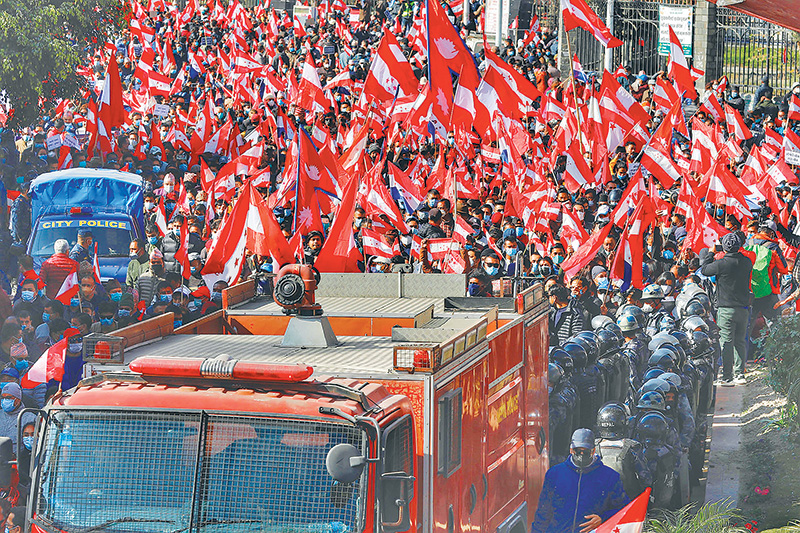
The party organised mass demonstrations in all 77 districts on Monday to, what it said, expose the Oli administration’s failures and hold it to account. POST PHOTO: ELITE JOSHI

KATHMANDU,
The last few days have been busy for Bishwo Prakash Sharma, the spokesperson for the primary opposition Nepali Congress. From disseminating information on the demonstrations planned for Monday through various mediums, including social media like Twitter, to correcting the Nepal map on his social media video in which he was making a case for the rallies and calling on his party members to join, Sharma was doing all he could to make the Congress protests successful.
The party organised mass demonstrations in all 77 districts on Monday to, what it said, expose the Oli administration’s failures and hold it to account.
As Congress leaders were allotted different districts to address Monday’s rallies, Sharma was in Hetauda.
“Don’t try to tease a sleeping tiger,” Sharma roared.
A Twitter user was quick to react.
“So the spokesperson is admitting that they were sleeping,” the user wrote on the microblogging site.
The one charge the main opposition has been facing over the last three years is that it went into a deep slumber. Even as the Oli administration failed on multiple fronts, the opposition was barely seen, except for a handful of leaders on some occasions thundering at Parliament, making any impact.
But after the government prorogued the budget session on July 2, the party lost even that platform from where it could have questioned the executive.
Observers say the main opposition should have taken into consideration the Covid-19 threat and avoided mass demonstrations and instead pressed the government for the House session. Many say the Congress party seems to be taking a queue from some pro-monarchy, pro-Hindu forces that were on the streets recently.
“In just about two weeks, the House session will convene as per the constitutional provisions,” said Damannath Dhungana, a former Speaker. “I wonder why it has chosen to hold street protests. If it has indeed realised its mistakes, it can call out the government and hold it to account from Parliament.”
A divided house in itself, the Congress party has been struggling to get back on its feet ever since it faced a drubbing in 2017 elections.
The party’s decision to protest against the Oli government was largely prompted by an incident in Tanahun on December 3 when its senior leader Ram Chandra Poudel was detained for three hours.
The Congress described the arrest of a senior leader, who had formerly served as House Speaker and deputy prime minister, showed the Oli administration’s authoritarian streak.
This was arguably for the first time the Congress party spoke publicly against the Oli administration, accusing it of trying to impose authoritarianism, even though the Oli administration since it came to power has been using different means to curtail freedom of speech, shrink civic space, curb the media and centralise power.
Most of the leaders who addressed rallies in different parts of the country on Monday censured the Oli government for trying to impose totalianarism, promoting corruption and impunity, failing to contain the coronavirus and attacking the system.
A political commentator said by holding mass rallies in the midst of the pandemic, the Congress party has actually prepared a readymade excuse for the Oli government should the coronavirus cases rise.
“Over the last six months, the Congress party never bothered to demand resumption of the House session,” said Puranjan Acharya, a political analyst who closely follows Congress politics. “Calling the House session should have been the major demand of the Congress party rather than going out on the streets. If Covid-19 cases spike, it can be easily blamed.”
Analysts earlier this month had told the Post how the Congress party lost the plot and became an ally to the Oli government–not only by failing to hold the executive to account but also by being hand in glove in some of its actions that were against the constitution.
Congress leaders themselves admit that the party is divided along different factions and hence it has been unable to perform the duty of the main opposition. The party has yet to decide on its general convention, which will elect a new leadership so as to guide the party during the elections which will be held in about two years.
Ahead of Sunday’s mass demonstrations, the party had given clear instructions to leaders on the issues to speak. They included exposing the Oli administration’s failure in handling the Covid-19 pandemic, rising cases of corruption, bad governance and issues related to public concerns and livelihoods.
None, however, spoke about the plight of the sugarcane farmers who are currently protesting in Kathmandu demanding that the Oli administration implement the agreement reached last year and ensure that their due payments from sugar mill owners are paid.
Very few leaders spoke about summoning the House session.
“We are sorry to say that we have been forced to come to the streets in the midst of the pandemic,” said Gagan Thapa, a central leader, while addressing the party gathering in Dhangadhi. “The government is escaping from calling the House session. We will keep on taking to the streets until the Oli government amends its working style.”
Speaking in Makwanpur, Congress President Sher Bahadur Deuba accused the Oli administration of promoting corruption, mishandling of the Covid-19 pandemic and politicising the judiciary.
He even questioned if the Oli government has been backing the pro-monarchy organisations which have been holding rallies in different parts of the country demanding the reinstatement of monarchy and Hindu state.
“Some people are on the streets today demanding reinstatement of monarchy. The Oli government is responsible for this,” said Deuba. “The Congress is not for monarchy. We have to implement this constitution and make the current system democratic.” Even as Deuba stressed implementing the current constitution, one of his party leaders, Shashanka Koirala, talked about holding a referendum on Hindu state.
“Once the Congress party forms the government after the elections, it will call a referendum for a Hindu state,” said Koirala at a press meet in Biratnagar.
Nepal abolished monarchy in 2008 and subsequently, in 2015, the country through the new constitution shed the tag of being a Hindu state.
“The opposition party should seek redressal of pertinent national and political issues from the House floor,” said Dhungana. “Some elements are resorting to violence, some forces are demanding reinstatement of monarchy and Hindu state. And in such times, the opposition is on the
streets instead of demanding the House session.”
According to Dhungana, the Congress party should have pressed the government for resumption of Parliament long ago.
“I wonder what prompted the party to seek solutions to the problems from outside Parliament,” Dhuganal told the Post.
A Congress leader told the Post that the problem with the party is that the leadership is confused.
“Our leadership is not clear whether we want more street protests or a Parliament session,” said the central member who did not wish to be named, saying he did not want to appear to be one who is against Monday’s rallies. “I wonder why Deuba is not taking the initiative to call the House session.”
According to the central member, there are concerns within the party about the party president’s proximity with Prime Minister KP Sharma Oli and some “tacit understandings” between them.
“Why is he looking for shares in constitutional bodies? Why is he negotiating with Oli without sharing details to the top party leadership?” the leader told the Post. “It’s high time our party acted as a strong opposition force.”
HOME PAGE

Judicial custody of former anti-graft body chief raises questions over appointments

Unless appointments are made in a transparent way without political motivations, the trend of choosing a person lacking qualifications will continue, observers say.
- PRITHVI MAN SHRESTHA

KATHMANDU,
The Special Court order to send Deep Basnyat, former chief commissioner of  the Commission for Investigation of Abuse of Authority, to judicial custody on the Baluwatar land grab case has once again raised questions over why people like Basnyat are appointed to lead the anti-graft body in the first place.
Basnyat, a long-time bureaucrat, was appointed chief commissioner of the anti-graft agency after Lok Man Singh Karki was disqualified for the job by the Supreme Court in January 2017.  
A person needs to have high moral character to be appointed as chief commissioner or commissioner of the anti-graft body as per the constitution.
The Special Court, which looks into cases related to corruption, refused to release him on bail as he had been accused of a serious offence--of creating fake tenants as well as transferring government lands in their names, according to Pushpa Raj Pandeya, spokesperson of the Special Court.
Basnyat is not the only one who, despite having a poor track record, still managed to head the anti-graft body.
Ignoring massive protests within political parties, Karki was appointed as chief commissioner in 2013  as a consensus candidate of the parties despite his history of allegedly playing a key role in suppressing people’s movement in 2006 and promoting gold smuggling during his bureaucratic career.
The integrity of Raj Narayan Pathak had also been questioned before his appointment as commissioner at the anti-graft body. He is also facing corruption charges from the commission itself after he was caught on videotape admitting to accepting Rs7.8 million to settle the ownership dispute of a Bhaktapur-based college when he was an incumbent commissioner.
“Officials of the commission being dragged into corruption case has smeared the image of the anti-graft body,” said Surya Nath Upadhyay, a former chief commissioner of the commission. “These cases have also raised serious questions over the intention of those who appointed them to run the commission. They should take first the biggest responsibility for controversial figures taking charge of the anti-graft body.”
He said that the political leadership’s tendency to choose a person who is close to a particular political party or political leader, instead of one’s qualification and integrity, has resulted in the appointment of controversial figures.
“This has also been the reason why the anti-graft body has been embroiled in controversy,” Upadhyay added.
As per the Article 238 (2) of the constitution,  the President appoints chief commissioners and commissioners of constitutional commissions based on the recommendation of the Constitutional Council.
The council is headed by the prime minister and has the chief justice, the speaker of the House of Representatives, chairperson of the National Assembly, the leader of the main opposition party and deputy speaker of the House of Representatives as members. It is therefore, essentially, political leaders taking key roles in appointments.
While making recommendations, the council needs to consider a host of factors including his/her social prestige, moral character, honesty, public attitude toward him/her and his/her previous service, if any, and professional experience, according to the Constitutional Council Act.
But experts say that these provisions are hardly followed.
Om Prakash Aryal, the advocate whose writ petition against the appointment of Lok Man Singh Karki turned to be crucial to end his tenure, said that sound academic qualification and track record are required to be appointed in constitutional bodies, including the anti-graft body, but political leaders hardly care about those requirements and the appointments are made  based on power sharing deals and collusion with the interest groups.
“For example, Lok Man Singh Karki was appointed based on collusion as he was a consensus candidate among the major political parties of that time,” he said. “As long as the motive of those who have the responsibility to make appointments is malafide, legal provisions are not followed in their true spirit to appoint the best possible person.”
He said that people like Karki, Basnyat and Pathak might have been appointed by taking certain benefits from them or with a view to benefit from their appointments in future.
After Nabin Kumar Ghimire retired from the post of chief commissioner at the Commission for Investigation of Abuse of Authority in mid-September for age limit, the post as well as three posts of commissioner remains vacant. Acting chief commissioner Ganesh Raj Joshi and commissioner Sabitri Thapa Gurung will also retire early next year.
Amid talks about fresh appointments, concerns are also being raised whether Prime Minister KP Sharma Oli, who heads the Constitutional Council, will pick the right candidate as envisioned by the constitution and law as corruption scandals have emerged involving his ministers and political appointees.
There have also been reports of a deal having been made between Oli and president of Nepali Congress and leader of the main opposition Sher Bahadur Deuba over appointments.
The meeting of the Constitutional Council, scheduled for Sunday, was postponed after Deuba said he was not attending as his party organised anti-government rallies across the country on Monday. 
Experts and observers say the indications are not right with legal provisions being made to shield political leaders from corruption cases.
According to a bill to amend the Corruption Prevention Act registered at the National Assembly, corruption cases have to be filed within five years since an alleged case of corruption has taken place. The existing law allows the anti-graft body to prosecute public officials any time. The bill to amend the law on the Commission for Investigation of Abuse of Authority has the provision that it cannot investigate into policy decisions of provincial governments too. At present it cannot investigate policy decisions of the federal government.
“Such laws are being introduced under the influence of interest groups and political leaders have a close nexus with them,” said advocate Aryal.
According to Aryal, when the political leadership engages to profit from nexus with an interest group, how can appointments of the right person at the commission can be expected irrespective of how good legal provisions are made.
Gauri Bahadur Karki, former chairperson of the Special Court, also points out the trend to award people who are controversial.
“We saw former chief commissioner Nabin Ghimire rewarded for outstanding works with medals from the President right after his retirement even though he decided to suspend investigation on former communication minister Gokul Baskota and no case was filed against son of Finance Minister Bishnu Poudel, after he promised to return the land of Lalita Niwas, Baluwatar while many others were made defendants,” he said.  
Poudel is also the general secretary of the ruling Nepal Communist Party and close ally of Prime Minister Oli.
Ghimire was one of 594 recipients of titles and honours, decorations and medals, many of them controversially, distributed to those making “outstanding contribution to various walks of national life” on the occasion of Constitution Day in September.
Experts and observers said a transparent process for making appointments in the anti-graft body was required so that people’s faith in it could be restored.
 Karki suggested that a board of independent people could be formed to select the potential candidates and public hearing of those who are selected could be conducted to examine whether anybody has any fault.
Even though there is the provision of parliamentary hearing of those who are chosen by the Constitutional Council, the parliament committee has often become a rubber stamp to approve persons picked by the council.
Advocate Aryal said a vetting process could be introduced by making provision that the candidates require to declare their qualifications and qualities and making anybody who has made a false declaration ineligible.   
“Even though the motive of  political leadership remains central in making appointments in the
constitutional bodies, such a checklist may also help choose better candidates,” he said.  
Upadhyay, the former chief commissioner of the Commission for the Investigation of Abuse of Authority, also said that the proper vetting by the parliamentary hearing committee could help pick a good candidate.
“It should be able to tell the Constitutional Council to reconsider the selection of any person who it finds not fit to hold the position based on evidence collected during the hearing process,” he said.

HOME PAGE

Mission impossible: Sherpa from Nepal to lead 55-member K2 winter expedition

Despite over 30 attempts to climb the world’s second highest mountain in winter, given the extreme weather and the difficult route to summit, none has been successful.
- SANGAM PRASAIN
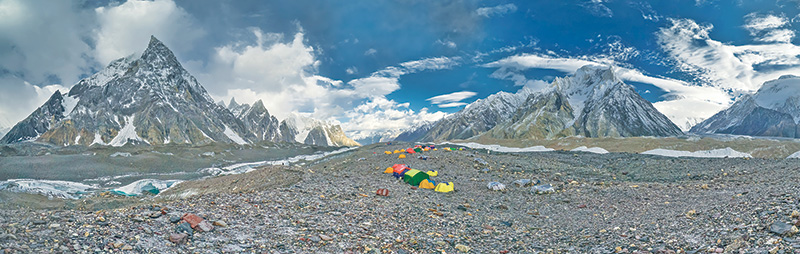
The base camp of K2 (pictured) is reached after a week’s trek on a glacier. shutterstock

KATHMANDU,
Thirteen of the world’s 14 peaks taller than 8,000-meters have been climbed in winter. But one still remains unclimbed—the 8,611 metres (28,251 feet) K2, the world’s second tallest that straddles Pakistan and China.
Climbers say that avalanches are an ever-present risk, and in winter temperatures can fall to -50C (-58F). Winds blow up to 200km/h (124mph) that’s equal to cyclone Fani, the most severe storm that travelled more than 900 kilometres (570 miles) from the Indian state of Odisha and blew nearly two dozen tents at Everest’s Camp 2, at 6,400 metres in May last year.
It is also considered to be a technically very difficult mountain to climb and has been dubbed “killer mountain” for the sheer number of climbers that have lost their lives on the mountain.
“It’s the planet’s toughest and most dangerous mountain to climb,” said Kami Rita Sherpa, who has climbed Everest a record 24 times.
Eighty-four climbers have died attempting to climb K2, and only 306 have reached its summit. The death and success ratio is roughly one death for every three successful climbs.
In contrast, 6,507 mountaineers have climbed Everest from the Nepal side since Tenzing Norgay Sherpa and New Zealander Edmund Percival Hillary first set foot atop the world’s highest peak in May 1953.
In the summer of 1954, Italian climbers Achille Compagnoni and Lino Lacedelli became the first persons to reach the summit of K2.
“K2 is 237 metres lower than Everest, but it is much challenging to climb even in the best conditions. That’s in summer,” said Kami Rita. “The weather in winter is beyond imagination. The weather is good only for 2-3 hours a day.”
Kami Rita, who had climbed the K2 in the summer of 2014, said as far as K2 is concerned he is retired.
But now a massive 55-member group of climbing veterans from around the world, including 27 Sherpas from Nepal, has set its sight on one of the most daring missions on the planet, which many mountaineers still call an “impossible project”.
The extreme mission, that may cost more than Rs200 million, is being handled by Kathmandu-based Seven Summit Treks, which also devised the expedition. Chhang Dawa Sherpa, the youngest mountaineer to have climbed all the 14 highest peaks, is leading the K2 winter mission.
Spanish climber Sergi Mingote, who has been attempting to climb all eight-thousanders without supplemental oxygen within 1,000 days, is the co-leader of the expedition. Mingote’s plan had come to a halt, after seven successful summits, due to Covid-19 related restrictions.
Nepali climber Nirmal “Nims” Purja, who smashed the record for taking the shortest time to climb all 14 of the world’s 8,000-meter-high mountains and had also announced his plans to climb bid K2 in the winter of 2020-21, has joined the group. Through his website nimsdai.com, he has described K2 winter ascent as “the last great mountaineering challenge.”
The Post’s attempt to contact Purja went unsuccessful.
Other climbers include Noel Hanna from Britain, Arnold Coster from the Netherlands, Atanas Skatov from Bulgaria, Waldemar Kowalewski from Poland, Antonis Sykaris from Greece and Luis Carlos Garranzo Ibanez from Spain. Slovenian, Romanian, Swiss, Italian, Chilen, American and Finnish mountaineers are also part of the 55-member mission.
The two-month-long expedition will begin from December 21 and ends by February 28.
“Ten Sherpa climbers left for Pakistan on Sunday,” said Thaneshwor Guragain, manager of Seven Summit Treks. “The remaining 17 climbers from Nepal are scheduled to join them on December 18 and others from around the world will join the expedition by December 20.”
The bid to climb K2 in the winter has attracted mountaineers for long.
The mountain has been attempted more than 30 times in winter but all expeditions have been unsuccessful with the highest point reached being 7,400 metres.
Last winter, Spanish mountaineer Alex Txikon, led one of the two expeditions to K2 comprising mostly Sherpa climbers. But it was unsuccessful. Several expeditions have failed in past years, mainly because of unstable climate, mountaineers said.
“The K2 winter feat is very tough. If any member of the team climbs, it will be another milestone in the mountaineering history—the first winter ascent of the world’s second-tallest mountain,” said Kami Rita. “Even Sherpas who have climbed Everest multiple times are scared to climb K2.”
K2 is a rocky mountain up to 6,000 metres and beyond it becomes an ocean of snow, according to Seven Summit Treks. “It’s difficult even to reach the base camp of K2. We have to trek on the glacier for a week to reach the base camp and there aren’t any lodging and fooding facilities on the way up,” said Kami Rita, who has plans to lead two expeditions on Everest in spring next year.
According to Kami Rita, one spot in particular is infamous in K2. That’s Bottleneck, a perilous couloir
about 300 metres below the summit, which was the site of a 2008 tragedy in which 11 people were killed in an avalanche.
“Winter brings with it a whole different level of danger and challenge. Numerous teams have attempted since 1987-88, but all have fallen short, Purja writes in his website describing it as a personal project.
“Not only do the sheerness of the slopes and overall exposure create a technically challenging climb, but the weather is also always the great opponent on K2 all year round.”

Page 2
NATIONAL

Government plans ambitious water project for Birendranagar

It is projected to be the biggest drinking water project in the country after Melamchi.
- CHANDANI KATHAYAT
The Surkhet Valley Drinking Water Project will be funded by the federal, provincial and local governments. Post Photo: CHANDANI KATHAYAT

BIRENDRANAGAR,
The government has come up with an ambitious plan to lift water from the Bheri River and supply it to Birendrnagar, the provincial headquarters of Karnali.
Anticipating a possible population growth in Birendranagar, authorities are all set to initiate the Surkhet Valley Drinking Water Project by lifting water from the nearby Bheri River. The project is estimated to supply drinking water to Birendranagar for at least 30 years.
“The construction work of this project will begin soon. We plan to complete the work within three years,” said Suryaraj Kandel, the deputy director-general at the Department of Water Supply and Sewerage. “We will install modern devices to control the flow of water and its distribution.”
While speaking at an interaction programme in Birendranagar on Monday, Kandel said that the Surkhet Valley Drinking Water Project is projected to be the biggest drinking water project in the country after the Melamchi Water Supply Project.  
The project will be funded by the federal, provincial and local governments.
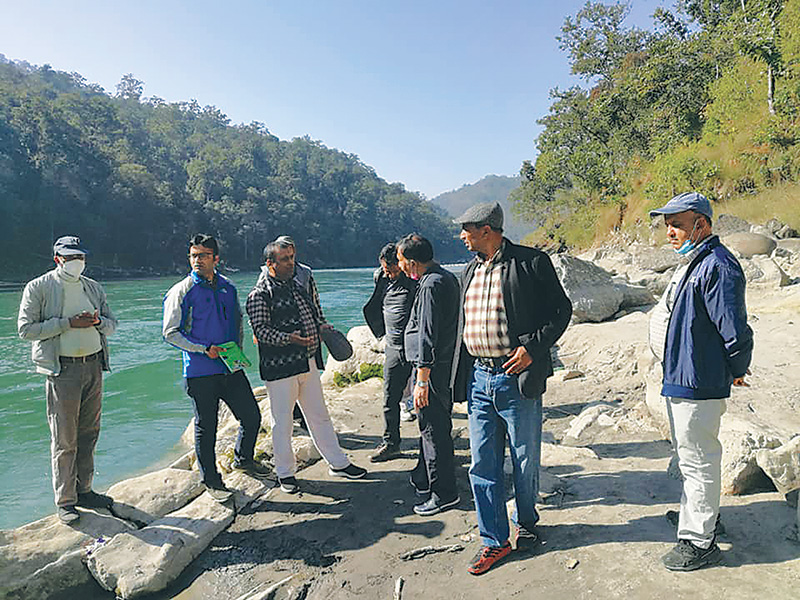
A team of technicians and experts from the department recently visited the project site and identified the possible location to make an intake to lift water. According to Prashant Malla, the intake will be constructed 574 metres upstream from the confluence of the Bheri River and Jhupra stream in Birendranagar.
“Water from the Bheri River will be lifted to a treatment plant around 400 metres above and supplied to the main reservoir tank in Amritdanda, which is around seven kilometres from the treatment plant,” said Malla. “We are still discussing the number of water lifting machines that should be installed.”
The drinking water project plans to supply water to each house in Birendranagar.
“Structures and pipelines that are already in use will also be utilised for the project. Pipelines will be installed in some areas with the possibility of human settlement in future,” said Malla.
The estimated cost of the mega project is around Rs 6.67 billion. According to Kandel, water distribution will cost around Rs 4.63 billion.
“We will soon begin the tender bidding process for the construction of the drinking water project after studying the possible sources that could be managed by three different governments,” he added.
The construction of the water lifting project was supposed to start three years ago. The construction of the intakes began in the last fiscal year but it was affected as floods swept away the structures.
The federal government had allocated Rs 60 million budget in the last fiscal year of 2019/20 and Rs 20 million in 2018/19 for the project. The Karnali Province government had also issued Rs 500 million in the last fiscal year. But all the amount froze, as the authorities could not initiate construction work.
Keeping in view the possible shortage of drinking water in Birendranagar in the near future, the provincial government has also kept the water lifting project in its priority list.
“We have prioritised the Surkhet Valley Drinking Water Project through an integrated development plan of Birendranagar,” said Prakash Jwala, the provincial minister for financial affairs and planning. “Our budget froze in the past, as the project work could not be initiated. We won’t let the budget freeze this time.”
Birendranagar is an emerging city of Karnali Province. According to the data available at Birendranagar Municipality, the population of Birendranagar is around 200,000 who require nearly 560 litres of water per second.
“But we can currently supply only 152 litres of water per second. Moreover, the water supply is reduced by nearly 50 percent in the dry season,” said Kulmani Devkota, chairman of Surkhet Valley Drinking Water and Sanitation Corporation.
It is projected that the population of Birendranagar will reach around 384,000 within 30 years.
“The water lifting project can supply water as per the need of Birendranagar residents for the upcoming 30 years,” said Devkota.

Page 3
NATIONAL

Schools hopeful Supreme Court will clear confusion over new curriculum for grade 11

Government-run schools have switched to the new curriculum, which private schools have refused to adopt.
- BINOD GHIMIRE
Schools started grade 11 classes a month after the National Examination Board on August 17 published the results of the Secondary Education Examinations. Post file Photo

KATHMANDU,
Padmodaya School in Putalisadak, Kathmandu, started grade 11 classes based on the new curriculum prepared by the Curriculum Development Centre from the last week of September.
Classes were running smoothly until the Supreme Court on November 4 issued an interim order halting the implementation of the new curriculum until its final verdict.
“The interim order has confused us,” Narayan Gautam, principal at the school, told the Post. “We are currently teaching the contents that are common in both the curricula. However, we haven’t been able to run the classes in a full-fledged manner since we are not sure what verdict the court is going to announce.”
The hearing on the case, originally slated for November 11, has already been rescheduled thrice. The latest rescheduled date for December 21, and schools across the country expect the Supreme Court to give its final verdict on the matter this time.  
Following the government’s decision to replace the old curriculum in January, all government-rub higher secondary schools switched to the new curricula prepared by the Curriculum Development Centre.
Private schools, however, are opposed to the decision. They have been saying that it is wrong to enforce the new curriculum at the time of crisis.
While the Supreme Court’s interim order may have offered respite to private schools, it has also caused confusion among government-run schools, where around 70 percent of the higher secondary school students are enrolled.  
“The delay in the final verdict has hampered the classes,” said Heramba Raj Kandel, principal of Bishwo Niketan School at Kathmandu’s Tripureshwor. “We are okay with the old curriculum as well, but the court’s final verdict has come to come.”
Private school operators also say they want the final verdict on the matter  to clear the confusion.
Lok Bahadur Bhandari, general secretary of Higher Institutions and Secondary Schools’ Association Nepal, said they expected the Supreme Court to issue its final verdict on December 21.
“The Supreme Court had rightly issued the interim order to halt the implementation of the new curriculum. We expect its final verdict will also be in the same line.”
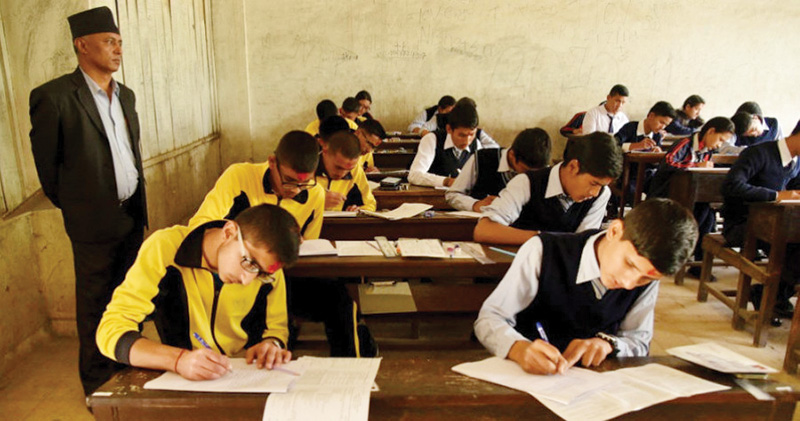
Schools started grade 11 classes a month after the National Examination Board on August 17 published the results of the Secondary Education Examinations (SEE). Among 482,986 students who had registered for the grade 10 national exams this year, 472,078 were promoted to grade 11 based on internal evaluation, as the SEE could not take place due to the pandemic.
Months of education disruption caused by the pandemic has led the government to truncate the academic year. It is one of the reasons why private schools are reluctant to adopt the new curriculum that has raised the subject numbers to six from the existing five.  
According to the new curriculum, students will have to study six subjects each in grades 11 and 12 instead of the present five. Three of these are compulsory — English, Nepali and Social Studies in grade 11 and Life Skills Education in grade 12 — and three others elective subjects.
The new curriculum, according to the Curriculum Development Centre, has been designed to switch to the single-track curriculum for grades 11 and 12 from the system of four disciplines where students after passing grade 10 chose Science, Management, Humanities or Education stream.

NATIONAL

Odd-even rule on traffic movement hasn’t checked spread of virus

The rule has led to overcrowding in public transport and experts say its efficacy should have been reviewed earlier.
- Arjun Poudel

KATHMANDU,
On September 5, following the three weeks of prohibitory orders in August, the government decided to enforce an odd even-rule for vehicular movement in Kathmandu Valley hoping that this would discourage people coming out of their homes and the spread of the virus would be checked.
Unfortunately, that did not happen. Instead, exactly the opposite has happened.
On  September 5, the number of positive cases across the country stood at 45,277. In Kathmandu Valley this figure stood at 7,900.
As of Monday, the number of positive cases stood at 249,244 nationwide and 116,023 in the Valley, or 203,967 more in the country and 108,213 more in Kathmandu Valley than September 5, according to data from the Ministry of Health and Population. The nationwide death toll on Monday stood
at 1,716.  
Public health experts have questioned the ad-hoc decision of enforcing odd even rules for vehicles and maintain that this decision is partly responsible for the spread of coronavirus.
“I don’t understand how it will be possible to maintain social distancing by forcing people to board crammed vehicles,” Dr GD Thakur, former director at the Epidemiology and Disease Control Division, told the Post.
With businesses and offices open, people have since September 5 been travelling on public buses which ply based on the odd-even rule.  
“The decision has not only been giving trouble to the people, but has been also proved counterproductive,” said Thakur.
On the other hand, traffic police have also been impounding private motorcycles and vehicles on an ad-hoc basis if they are found to be flouting the odd-even rule.  
“We are quite aware about the public’s grievances over the odd-even rule,” said Kali Prasad Parajuli, chief district officer of Kathmandu.
But three months since the decision, there has been no review of the effect of the decision on the spread of the virus.
In the pandemic, authorities concerned are supposed to conduct daily, weekly and monthly review of the situation and the decision taken to handle the pandemic, according to Thakur.
“Had the authorities reviewed the effects of the odd-even rule enforced on vehicles, they would have scrapped the decision long ago,” Thakur told the Post. “Some decisions may not work, but they should be replaced by new decisions.”
This passivity on the part of the authorities is also a reflection of how serious they are about controlling the spread of the coronavirus, experts say.
“Continuation of the decision, taken months ago, which has only helped spread the infection, shows how seriously we are working to contain the spread of the infection,”said Thakur.
The Home Ministry, under whose orders the police enforce the odd-even rule on vehicular movement, said that it cannot do anything, as the decision was taken by the Cabinet.  
“We don’t know if the decision to enforce odd even rules is working or not,”Chakra Bahadur Budha, spokesperson for the Home Ministry, told the Post.
Of late, the number of new cases have declined after the authorities stopped providing free testing in October. Although the government was forced to resume free testing following a Supreme Court decision, contact tracing has all but stopped since October 17.
Meanwhile, most of the public places have opened and more and more schools are opening both across the country and in Kathmandu Valley.
Doctors said that the continuation of the odd even rule in the vehicles, which only gathered crowds could bring disaster in the days to come.
“It is impossible to maintain social distancing in the public vehicles,” Dr Sher Bahadur Pun, chief of the Clinical research Unit at the Sukraraj Tropical and Infectious Disease Hospital, told the Post. “The odd-even rule will be effective only if the movement of the public is low.”
Spread of highly contagious coronavirus can be halted only by completely halting public movement and it is impossible at the time when all business has resumed like during the pre-pandemic period, according to Pun.
Even as authorities have enforced odd-even rules in Kathmandu Valley, it has been unable to prohibit protests and rallies of different political parties, which pose serious risk of spreading the coronavirus.
Following pro-monarchy protests in different parts of the country in the past weeks, on Monday the Nepali Congress party organised anti-government protests in all 77 districts of the country, including Kathmandu Valley, a decision that political analysts have called misguided.
“We are not the agencies to contain the rallies of political parties including motorcycle rallies,” Janak Bhattarai, senior superintendent of police at Metropolitan Traffic Police Division, told the Post. “We are tasked to enforce the odd even rules and this we are implementing.”
Until a new decision is made, the odd-even rule is set to continue. According to the Ministry of Home Affairs, it is the local administration who makes the decision on this.
“The district administration is responsible to enforce and lift the odd even rules,” said ministry spokesman Budha. According to Parajuli, the chief district officer of Kathmandu, the decision will be reviewed soon.
“We are going to hold a meeting  of the chief district officers of the valley soon to review the effect of the decision,” he told the Post.
But the decision whether to continue with or lift the odd-even rule on vehicular movement will not be made by the three chief district officers of Kathmandu, Bhaktpaur and Lalitpur.
“We will recommend after reviewing the decision to the Covid-19 Crisis Management Center after the meeting,” Parajuli said.
The Covid-19 Crisis Management Committee is headed by Deputy Prime Minister Ishwor Pokharel. But its role has been limited to making recommendations to the Cabinet.

NATIONAL

Health workers, doctors to be trained to deal with mental health issues

Nepal faces a severe shortage of mental health professionals, especially at the grassroots, as it only has 130 psychiatrists, most of whom are based in Kathmandu and urban centres.
- Arjun Poudel
The National Mental Health Survey-2020  showed that 10 percent of the adult population has suffered  from mental health problems in their lifetime and 4.3 percent currently have mental disorders. Post file Photo

KATHMANDU,
After all its efforts to deploy psychiatrists at the grassroots failed, the Ministry of Health and Population has started providing mental health training to health workers.
According to the Non-communicable Disease and Mental Health Section at the Epidemiology and Disease Control Division, medical doctors, health assistants, paramedics and staff nurses of 21 districts will get mental health training in the ongoing fiscal year.
“We have also planned to train female community health volunteers serving at the local level in mental health,” Dr Phanindra Prasad Baral, chief of  the section, told the Post. “We hope that the training provided to the female community health volunteers will help find and treat people suffering from mental health problems.”
Nepal does not have enough experts to treat and cure mental health problems. There are only around 130 psychiatrists in the country, most of whom are based in the Kathmandu Valley and other urban areas. The Health Ministry said that less than 30 psychiatric doctors serve in state-run hospitals.
“It may take years to deploy psychiatrist doctors at the grassroots, so we decided to train medical officers, paramedic and staff nurses,” added Baral.
The Ministry of Health and Population has already trained around 1,000 paramedics and staff nurses of 20 districts to address mental health problems.
“A lot of mental health patients, who are deprived of treatment, will get treatment at their nearest health facilities, if we could train local health workers,” Dr Basudev Karki, a consultant psychiatrist at Nepal Mental Hospital, told the Post. “Female community health volunteers, who work at the grassroots will recommend people for treatment, if they are provided with mental health training.”
According to Karki, a study carried out in the past showed that of the 100 people recommended by trained female community health volunteers, 64 were found suffering from some form of mental health problems.
Mental health is one of the major public health issues in Nepal. The National Mental Health Survey-2020  showed that 10 percent of the adult population has suffered  from mental health problems in their lifetime and 4.3 percent currently have mental disorders.
The study was carried out on 15,088 people from across the country from January 2019 to January 2020.
Doctors say mental health problems have increased several folds due to the effect of ongoing coronavirus pandemic. A lot of people have been compelled to remain in isolation, have lost their jobs and family members and incurred losses due to the pandemic.
The Health Ministry provides 11 different types of psychotropic medicines from state- run health facilities throughout the country.

NATIONAL

Temporary camp established to investigate Miklajung incident

Briefing

BIRATNAGAR: A temporary operation camp has been established in Miklajung Rural Municipality, Morang, to investigate the abduction and killing of school principal Rajendra Kumar Shrestha in Miklajung Rural Municipality in Morang district. The Netra Bikram Chand-led Communist Party of Nepal has claimed responsibility for the murder. Currently, there are 36 security personnel from the Armed Police Force and 15 from Nepal Police at the incident site. Santosh Khadka, superintendent of police in Morang, said, “The team members of the operation base camp are patrolling the area.”

NATIONAL

Nepal Army to reconstruct Bayalkanda fort

Briefing

SURKHET: Nepal Army is all set to reconstruct Bayalkanda fort in Birendranagar Municipality-14, Surkhet, in coordination with the local government. The historic fort is believed to have been constructed by Bahadur Shah during his Nepal unification campaign. The army said that design of the fort was being prepared following an interaction with experts and stakeholders. “We will initiate reconstruction work immediately after the design is approved by the Department of Archaeology,” said Bigyan Dev Pandey, chief of the Nepal Army’s North-Western Division.

NATIONAL

444 fugitives arrested in four months

Briefing

NEPALGUNJ: Banke District Police Office has arrested a total of 444 fugitives in the past four months. According to Superintendent of Police Om Rana, police have launched a drive to arrest fugitives who were sentenced by the court. “We detained some fugitives who were at large for the past two decades. Search is on to nab other fugitives,” said Rana. According to him, there are around 500 fugitives convicted on various charges, including rape and murder. 

Page 4
EDITORIAL

Bitter pill

The government must ensure that sugarcane farmers are paid in full immediately.

Most farmers often don’t have much reason to visit Kathmandu as they spend their lives toiling in their fields. More so for sugarcane farmers, who would have no reason to stay away from their fields in the thick of the harvesting season. But like last year, they are in the capital city again. The industrious farmers are leaving their work behind to visit Kathmandu as they are duped time and again—by the sugar mills they sell their crop to, and the government that is supposed to support them—as the factory owners fail to pay them their dues that run into hundreds of millions.
According to the Ministry of Industry, Commerce and Supplies, Shree Ram Sugar Mill owes farmers Rs260 million, Indira Sugar Mill around Rs40 million, Lumbini Rs80 million and Annapurna Sugar Mill Rs170 million. There are over 6,000 farmers in Sarlahi district alone that await payment for their sales. What is alarming is that the mill owners are paying small amounts to the farmers, especially to those who are more vocal, so that they stop asking for their payments and their joint agitation goes into disarray. Not to mention that the mills have failed to pay the farmers according to the schedule fixed during the previous negotiations.
Left in the lurch by the government after its repeated promises to help them, the sugarcane farmers are now torn between selling their product to the same non-paying mills or finding new mills that are more likely than not to turn out to be yet other defaulters. Such is the precarious position they are in as the KP Oli administration has done little to help their cause even after repeated requests and protests. The government has been too lenient when it comes to making the sugar mills accountable. The mills, meanwhile, continue to dupe the farmers even after making repeated promises that they would pay the outstanding dues that run into hundreds of millions.
Their demand is for the five-point agreement the sugar mill owners reached with the government in January 2020 to be honoured. They had planned to visit Kathmandu in March itself but held back due to the increase of the Covid-19 pandemic. The farmers would have no reason to leave their work behind and hold a march on Kathmandu if their demands had been met. Hundreds of farmers from Sarlahi had visited Kathmandu last year to pressurise the government to help them get the money the sugar mills owed them. The farmers had withdrawn their indefinite protests in a week following the government’s assurance that it would get the sugar mills to pay their outstanding dues by January 21. But most of the farmers remained unpaid.
It is high time the government addressed the demands of the farmers once and for all. It cannot expect them to stay silent even if the mills continue to default on the payment schedule. The government must take immediate steps to facilitate a negotiation between the farmers and the mills and penalise the mills that fail to clear the dues for years.

OPINION

The business of foreign affairs

As Nepal shows a renewed focus on foreign policy, it needs to think about possible transformative changes.
- SUJEEV SHAKYA
Shutterstock

Last week, the government released the 31-page Nepal Foreign Policy 2077 document. While it is no doubt interesting that the government has finally thought to bring forward a seemingly comprehensive policy direction in an area much neglected, I continue to question the basics surrounding its release. With no official English translation released, it seems like the document was meant for the domestic audience. But how can people who do not read Nepali understand it? If it were to have been released in the six official UN languages, Hindi and Bengali, it would have been a groundbreaking effort that would cover most of our neighbourhood and the countries strategically important to us.
Whenever Nepalis look to reimagine issues, we get stuck building on the past rather than looking ahead. It is like trying to find new ways to fix the fax machine when most of the world has moved on to better forms of communication. Nepal needs to continuously have a futuristic perspective on managing the fundamentals, rather than trying to repair a broken past. In this regard, we can focus on some key areas.
First, we need to think of the large population of Nepalis around the world and the services that they need. A survey that we ran, when I was visiting the US regularly in the early 2000s, told us that people of the diaspora were willing to pay as much as $100 to get a birth certificate (and other important administrative documents) attested and sent back to them. I had proposed to the Nepal Embassy in the US how this service could be thought of as a profit centre—a point from where the Ministry of Foreign Affairs or individual embassies could gain a large chunk of much-needed revenue. Yet, the thought was considered too disruptive back then.
Perhaps the time has come to revisit this idea, particularly considering how some countries gain back the cost of building new embassy buildings from just the visa fees and services sold from those individual embassies. The five million-odd Nepalis around the world who have to jump through hoops to avail of consular services would undoubtedly appreciate it. Embassies, at the same time, would not be pressured to handle mundane issues that arise when a service-oriented system is not in place. And, such a service provided through the embassies wouldn’t be as exploitative and problematic as some of the private, outsourced companies that other countries are known to employ.
Second, we need an institution that focuses on the selective study of countries and regions from around the world. Global events can be held, and collaborative projects can be undertaken. Such an institution would then mould academics that could make better policy recommendations, particularly foreign policy. Hundreds of well-trained Nepalis who have studied international relations from a top institution will be more than happy to serve their own country; they will bring not only their experience, but also the connections they have fostered through global links. For a young Nepali who aspires to contribute to Nepal’s transformation, this would be an essential institution. The revenue gained from providing effective service through embassies could fund this institution.
Third, we need to reimagine how the government connects with its diaspora. The Non-Resident Nepali Association (NRNA) was created in 2003 when there were less than half a million Nepalis (besides the Nepalis residing in India) living abroad. Today, when there are more than five million. This necessitates recalibration. I had personally spent a couple of years helping NRNA to create its Vision 2030 and implement transformation, but politics has dominated the discourse.
The associations that dominate the lives of the diaspora have become vote banks; even the newer political groups in Nepal see them that way. It seems the transformation of non-resident contribution through the NRNA seems complicated, while the second generation of non-resident Nepalis feels disconnected from the ancestral home. Perhaps an independent entity within the Foreign Ministry or the NRNA can lead the necessary changes. The issues that need dire attention are the provisioning for dual citizenships, helping Nepalis invest or grow their businesses abroad, and unleashing Nepal’s soft power. The latter can focus on Nepal’s rich endowment of nature, heritage and the diversity of its art, culture, music and culinary experiences. If the government sought help, there would be hundreds that would volunteer.
Finally, what will be required is the change in the old mindset of cronyism and nepotism. Nepal needs to reimagine its diplomacy. It has to move away from politics. If it is to succeed, it would be better to run the system like a business—with a CEO at the helm that delivers the triple bottom line; namely, surpluses from services, high impact unleashing of Nepal’s soft power and happy citizens who are genuinely proud of their country.

OPINION

Building an EU-Africa partnership of equals

- CARLOS LOPES
The relationship must be rethought and
reshaped—beginning at the upcoming mini-summit. Hairem/Shutterstock.com

This was supposed to be the year Europe and Africa redefined their relationship. In March, the European Commission unveiled its vision for a ‘comprehensive strategy with Africa’, intended to kick-start a six-month consultation process, which would culminate at the European Union-African Union summit in October in an agreement on a new blueprint for relations—one that would give Africa significantly more agency. Then Covid-19 arrived.
Even without the pandemic, the road to a stronger, more equal EU-Africa partnership would have been difficult. When the year began, tensions were high in many parts of the world, raising serious geopolitical and security risks. Moreover, the strategic competition between the United States and China had escalated into a trade war. Multilateralism was faltering.
As challenging as these conditions were, they also encouraged progress, by highlighting how high the stakes had become. Africa’s resolve was evident: a series of AU summits and meetings had indicated that the continent was committed finally to implement the African Continental Free Trade Area (AfCFTA), to reform regional bodies, and to move onto a more ambitious development path. Such initiatives implied an overhaul of the tenets of any partnership with the continent.
The Covid-19 crisis threw a wrench into plans to engineer such an overhaul with Europe. But it also underscored the need for one—not least because the EU is Africa’s main trade and investment partner.
The pandemic has demonstrated the practical implications of inequality; revealed the excessive dependence of critical value chains on certain economies, particularly China; and exposed the vulnerabilities of the international finance system. It has also shown the limits of current modes of global cooperation, even in the face of shared crises.
As a result, the desire to ‘return to normal’ has increasingly given way to calls to ‘build back better’. Progress on the European Green Deal reflects policymakers’ determination to take advantage of the current upheaval to advance real change. Africa should follow suit—beginning by accelerating the implementation of the AfCFTA.
An integrated continental market could have cushioned the blow of declining international trade during the Covid-19 crisis, saving jobs and livelihoods. Instead, Africa is struggling to revive its economies, despite having been significantly less affected by the virus than many other parts of the world. The continent’s leaders must ensure that, when the next crisis strikes, Africa is ready.
Given the likelihood of another health crisis—experts warn that pandemic risks are rising—this means, among other things, ensuring stable supplies of critical medical equipment. Early restrictions on medical-supply exports and more recent ‘vaccine nationalism’ on the part of a handful of countries show just how quickly countries can resort to protectionism. It is thus in Africa’s interest to promote production of strategic supplies and create robust value chains for pharmaceuticals and medical equipment on the continent. The AfCFTA would facilitate these efforts.
But the AfCFTA’s implementation will need to go hand in hand with broader international engagement, especially with the EU. During the Covid-19 crisis, Africa needed large-scale debt relief and increased access to liquidity, so that countries could implement economic-support measures on par with the advanced economies. It hasn’t gotten them—at least not to the necessary extent.
Of course, it is far from ideal for Africans to assume that others will rescue them. But this is not a choice; it is a systemic problem. As it stands, some African countries—especially those with very limited monetary-policy space—need external support, particularly from the International Monetary Fund, to be able to respond to exogenous shocks. The EU can and should play a key role here.
Such cooperation must extend beyond short-term imperatives to address medium- to long-term structural challenges. For example, while debt relief is important, and the sustained push for it by several G20 countries is welcome, it will not be enough to reinvigorate African economies. Rethinking financing approaches for infrastructure investment, to support the implementation of the AfCFTA, would have a greater long-term impact.
Building a stronger, more strategic partnership with Africa will also require EU countries to abandon their fixation on the migration ‘threat’, and recognise the continent’s strategic importance. A candid debate about the expansion of legal pathways to ensure mobility, including circular migration, would help.
The idea of returning to ‘normal’ after the Covid-19 crisis may still tempt many people. But, when it comes to the EU-Africa relationship, it is simply not an option. The partnership must be rethought and reshaped. To that end, both sides must abandon the unbalanced, piecemeal approach of the past, and work toward creating an effective joint-governance mechanism.
At the upcoming ‘mini-summit’, EU and AU leaders have an ideal opportunity to catalyse this process. By the time the full summit takes place next year, they should be able to put forward a clear vision of a partnership fit for the 21st century.


Lopes, Professor at the Nelson Mandela School of Public Governance at the University of Cape Town, is African Union High Representative for Partnerships with Europe.
—Project Syndicate

Page 5
MONEY

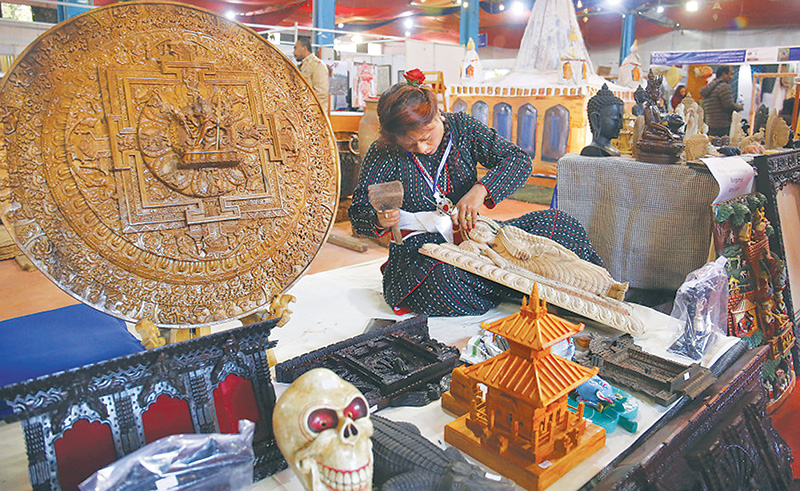
Handicraft Year 2021 announced to revive curio industry

The sector contributes around Rs20 billion to the national economy annually, according to the Federation of Handicraft Associations of Nepal.
- KRISHANA PRASAIN
The online marketplace, which can be an appropriate platform for handicraft products, has not been able to promote locally produced goods. POST FILE PHOTO

KATHMANDU,
Handicraft makers and traders have announced dedicating the coming year to revitalising the industry left in tatters by the coronavirus. Lack of sales and new export orders has brought distress to the thousands of Nepalis that depend on the sector for their livelihoods.
The Federation of Handicraft Associations of Nepal said on Sunday that it was declaring next year as Handicraft Year when they would work to promote the business and lobby with the government for policy reform to make Nepali products accessible and competitive in the international market.
Speaking at the federation’s 48th anniversary function, its president Surendra Bhai Shakya said that the Handicraft Year was intended to restore the industry affected by the coronavirus pandemic.
The federal, provincial and local governments should provide skill-based self-employment training and national and international market management training to protect and promote the declining handicraft industry, he said. Government offices should also use Nepali handicraft products to help the industry get back on its feet, he added.
The federation said that funding should be provided by giving priority to the clear objective of becoming self-reliant by creating self-employment.
Parbat Gurung, Minister for Communications and Information Technology, said that the government was ready to make policy reforms to promote handicrafts and make exports competitive.
The government is going to make policy reforms for the promotion of Nepali handicrafts which have been playing an important role in enlarging export trade, creating jobs and publicising Nepal’s identity in the international market, he said.
Gurung urged the federation to recommend policy reforms to make exports competitive and boost the handicraft business amid the slowdown brought about by the pandemic.
Gurung added that the ministry was ready to facilitate online marketing of Nepali handicrafts.
The online marketplace, which can be an appropriate platform for handicraft products, has not been able to promote locally produced goods, according to entrepreneurs.
E-commerce has been growing steadily in Nepal, but because of lack of proper linkage between e-retailers and producers, many homemade goods produced by small and medium-sized enterprises do not find a market even though they provide a livelihood for many families.
Motilal Dugad, Minister of State for Industry, Commerce and Supplies, said that the ministry would help reduce production costs for export promotion. As the country has not been able to export handicraft products as expected, diversification of handicrafts should be emphasised by reducing production costs, he said.
Baikuntha Aryal, secretary at the Ministry of Industry, Commerce and Supplies, said that emphasis should be laid on quality products while reducing production costs. “The government can help bring down production costs, but entrepreneurs should work to produce quality products,” he said.
“Nepal has not been able to make good use of the United States concession on 77 items,” said Aryal.
This year, the association will implement the collective trademark for the material genre scheme, launch programmes to integrate interior designing with handicrafts to promote tangible and intangible art culture, provide identity cards to artists and organise art exhibitions, officials said. The federation will also expand its footprint in all seven provinces by merging with more and more commodity federations and district federations across the country.
Other initiatives in the annual programme include urging the government to carry out timely policy modification and remove procedural hassles, operating the SAARC Handicraft Development Centre and establishing a handicraft village.
The federation also plans to implement the Handicraft Development Policy, develop the competitive concept of Made in Nepal and Make in Nepal, and make timely use of business and business networks.
According to the Federation, the handicraft industry has been directly and indirectly involved in the national economy by creating employment, earning foreign exchange through export trade and contributing around Rs20 billion to the national economy annually through exports and domestic consumption.

MONEY

EU chief negotiator still sees hope to clinch EU-UK deal

- ASSOCIATED PRESS

BRUSSELS,
European Union chief negotiator Michel Barnier said on Monday he still has the firm belief that a Brexit trade agreement is possible, and whittled the outstanding disputes to be settled ahead of the New Year to just two.
Barnier said that the nine-month negotiations had come down to finding settlements on fair-competition rules and fishing rights, no longer mentioning the issue of legal mechanisms for resolving future disputes that also long dogged the negotiations.
“Two conditions are not met yet,” he said as he entered a meeting to brief the 27 EU nations on progress in the talks. He is expected to continue negotiations with his UK counterpart David Frost later on Monday. “This deal, it is still possible,” he added.
Both sides are teetering on the brink of a no-deal Brexit departure, but have committed to a final push ahead of January 1, when a transitional period following Britain’s January 31 departure from the bloc is to end.
On Sunday, British Prime Minister Boris Johnson and EU Commission President Ursula von der Leyen ditched a self-imposed deadline and promised to “go the extra mile” to clinch a post-Brexit trade agreement that would avert New Year’s chaos and costs for cross-border commerce.
Barnier is willing to accept British trade with no tariffs or quotas, but only if the UK respects the rules and regulations that have made the EU’s single market of almost 500 million consumers so successful. “Free and fair competition, fair and free, equitable and open, the two go together,” Barnier said.
Johnson, however, says he does not want British business to be hemmed in by EU restrictions, especially if those restrictions would have to be progressively adapted to mainland standards in the future.
On fisheries, Barnier demanded “an agreement that guarantees a reciprocal, I insist, reciprocal access to markets and waters.” It highlighted that just as EU fishermen crave to continue working in British waters, the UK seafood industry is extremely dependent on exports into the 27-nation bloc.
Johnson has made fisheries and UK control over its waters a key demand in the long saga of leaving
the EU. It has been four-and-a-half years since Britons voted narrowly to leave the EU and—in the words of the Brexiteers’ slogan—“take back control” of the UK’s borders and laws.
Johnson said over the weekend that the “most likely” outcome was that the two sides wouldn’t reach a deal and would trade on World Trade Organization terms, with the tariffs and barriers that would bring.

MONEY

Tata Sons expected to submit initial bid for state-run carrier Air India: Sources

- REUTERS

NEW DELHI,
Tata Sons, India’s autos-to-steel conglomerate, is expected to submit an initial bid for state-run carrier Air India ahead of the auction’s deadline on Monday evening, sources aware of the matter told Reuters.
Prime Minister Narendra Modi’s government in January renewed its push to sell its entire interest in the loss-making airline, which has been kept aloft by a bailout since 2012.
An effort to auction a majority stake almost two years ago drew no bids, forcing the government to ease
terms. It has also extended the deadline multiple times this year due to Covid-19 and further eased the terms to attract bidders.
The airline industry around the world has been hammered by a slump in travel due to restrictions aimed at containing the novel coronavirus.
A Tata spokesperson declined to comment.
Tata already operates two airlines in India—full-service carrier Vistara, which is in partnership with Singapore Airlines, and budget airline AirAsia India along with Malaysia’s AirAsia Group.
A successful bidder would win control of Air India’s 4,400 domestic and 1,800 international landing and parking slots at domestic airports, as well as 900 slots at airports overseas.

MONEY

China ups Internet sector scrutiny, fines deals involving Alibaba, Tencent

China ups Internet sector scrutiny, fines deals involving Alibaba, Tencent
The Alibaba Group logo is seen at its headquarters in Hangzhou, Zhejiang province, China. REUTERS

SHANGHAI/BEIJING, 
China warned its Internet giants on Monday that it would not tolerate monopolistic practices and to brace for increased scrutiny, as it slapped fines and announced probes into deals involving Alibaba Group and Tencent Holdings.
The State Administration of Market Regulation (SAMR) said it would fine Alibaba, Tencent-backed China Literature and Shenzhen Hive Box 500,000 yuan ($76,464) each, the maximum under a 2008 anti-monopoly law, for not reporting past deals properly for anti-trust reviews.
It said it would also look into a merger between game livestreaming firms Huya Inc and DouYu International announced in October. Tencent is a major investor in both and the Chinese tech giant had pushed the deal, Reuters has previously reported.
In addition, the SAMR said it will review and investigate other deals based on tip-offs that some firms had cornered a lot of operating power in certain sectors—a process it expects will be lengthy and involve a large number of companies.
“The fines of the three cases are a signal to society that anti-monopoly supervision in the Internet field will be strengthened,” the SAMR said even as it acknowledged the fines were relatively small.
“The Internet industry is not outside the oversight of anti-monopoly law,” it added in a separate statement.
Hong Kong-listed shares of Alibaba and Tencent fell after the news, with Alibaba closing down 2.6% and Tencent’s shares ending 2.9% lower in their worst day since November 30.
China Literature said it had received SAMR’s notice and would carry out relevant compliance work. Alibaba and Tencent did not immediately respond to requests for comment. This is the first time that Beijing has fined any Internet company for violating the 2008 anti-monopoly law by not properly reported deals for anti-trust vetting.
The SAMR warned that companies should not adopt a “wait-and-see” attitude before reporting deals, saying some had failed to do so even after reminders. Beijing issued draft rules last month aimed at preventing monopolistic behaviour by internet firms, marking China’s first serious regulatory move against the sector.
The issue has also become a priority for China’s top leadership. A politburo meeting chaired by President Xi Jinping said last Friday that Beijing would step up its anti-trust efforts.
Alibaba’s financial affiliate Ant Group, founded by billionaire Jack Ma, has been a target of the heightened scrutiny. Its $37 billion listing, scheduled to be the world’s largest, was abruptly halted last month after regulators warned its online lending business faced tighter scrutiny.
The deals the SAMR fined on Monday include Alibaba’s $692 million investment in Intime in 2014 and the e-commerce giant’s $2.6 billion bid in 2017 to privatise Intime.
China Literature was fined for failing to report its 2018 New Classics Media acquisition. Shenzhen Hive Box, whose backers include logistics giant SF Holding Co, was rapped for its acquisition of China Post Smart Logistics.

MONEY

Falling plane values, e-commerce rise fuels boom in converting passenger planes to freighters

- REUTERS
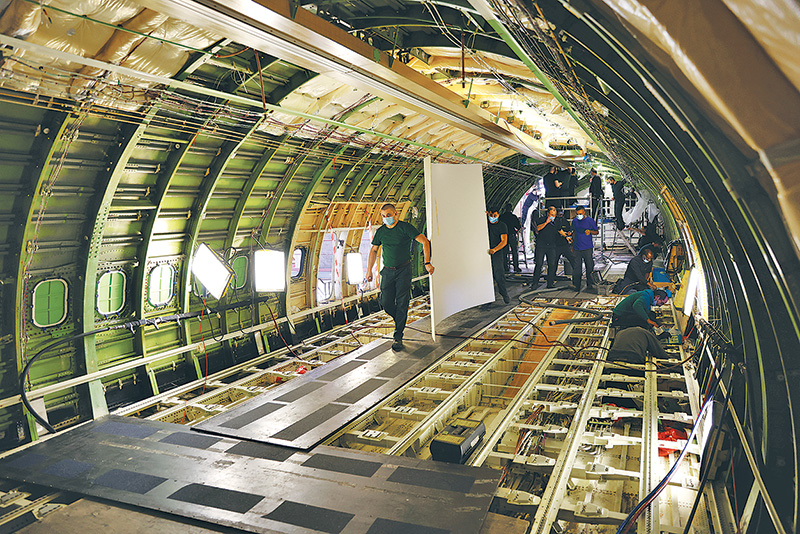
Labourers work inside and around a passenger plane as they convert it into a cargo plane at Israel Aerospace Industries site in Ben Gurion International Airport, Lod, Israel. REUTERS

SYDNEY/JERUSALEM/MONTREAL,
From Air Canada to China’s CDB Aviation, airlines and leasing firms are rushing to permanently convert older passenger jets into freighters, betting on a boom in e-commerce as the value of used planes tumbles amid the pandemic.
That has created a huge opportunity for passenger-to-freighter (P2F) conversion companies, including Singapore Technologies (ST) Engineering Ltd, Israel Aerospace Industries (IAI) and US-based Aeronautical Engineers Inc.
Aviation analytics firm Cirium expects the number of P2F conversions globally will rise by 36 percent
to 90 planes in 2021, and to 109 planes in 2022.
“We estimate that most slots are sold for 2021 and at least 40 percent for 2022,” Cirium Head of Market Analysis Chris Seymour said. “There is an increase in newer-generation programmes, notably the 737-800 and A321 as well as the A330, although older types like the 767 continue to see strong demand, driven in the past few years by Amazon building their own fleet.”
The market value of 15-year-old planes has fallen by 20 percent to 47 percent since the start of the year depending on the model, according to advisory firm Ishka, which makes freighter conversions more attractive.
Air Canada is looking to convert several of its Boeing Co 767s, Russia’s S7 Group is acquiring its first 737-800 converted freighters from lessor GECAS, and lessor CDB Aviation has ordered two Airbus SE A330 conversions from ST Engineering’s EFW joint venture with Airbus.
The P2F conversions are a step beyond the cheaper temporary conversions many airlines have implemented during the pandemic, which remove passenger seats to carry more cargo.
Permanent conversions are a financial bet that air freight demand, which was weak before Covid-19, will remain strong for years to come as shoppers turn to e-commerce. The airline industry estimates it will take until 2024 for passenger traffic to recover to 2019 levels.
Freight markets are notoriously volatile, however, and have been beset by extended downturns; shortage can quickly turn into overcapacity, analysts warn.
Normally about half of the world’s cargo is carried in the bellies of passenger planes, but the hit to demand has left the world more reliant on dedicated freighters.
“2020 has seen record high freighter aircraft utilisation, and our view is that the pandemic has accelerated the long-term structural shift towards increased e-commerce demand,” said CDB Aviation chief executive Patrick Hannigan.
Boeing said cargo yields had risen by 40 percent through September because of the pandemic-related passenger disruptions, and it forecasts more than 60 percent of freighter deliveries over the next 20 years will be conversions rather than new widebody freighters like the 777. Narrowbody freighters are almost all conversions.
The conversion boom is also helping aviation maintenance, repair and overhaul groups offset some of the lost business from the decline in passenger flights.
Such conversions generally cost millions of dollars on top of the cost of the aircraft and take three to four months, said ST Engineering Aerospace president Jeffrey Lam said.
His company is ramping up capacity, with plans to convert at least 18 A321 planes next year, rising to around 25-30 annually in the future, up from single digits this year.
“We are all booked out for 2021 for aircraft conversions,” Lam said. “The first slots are well into 2022.”
ST Engineering also may add converted freighters to its leasing business, which has focused on passenger planes, he said. IAI can convert 18 or more 767s a year and produces most of those used by Amazon.com Inc.
“We are investing a lot of effort to meet the market demand,” said Yosef Melamed, general manager of IAI’s aviation group, which is also working on the first-ever P2F conversion of the larger 777-300ER as part of a 15-plane contract with GECAS.

MONEY

Khukri launches ‘Khukri Music Nation’ contest

Bizline

KATHMANDU: Khukri is lauching the ‘Khukri Music Nation’ contest to continue the legacy of Nepali music and mark the grand start of New Year 2021. Khuri Rum will be holding a contest via its website, where applicants will be able to submit their musical talents by uploading a video. The contest will be judged by the biggest music stars, Bipul Chhetri, Sambriddhi Rai and Sabin Rai states the press release issued by the company. The top 16 will be announced via Khukri Music Nation’s live musical show on January 1, 2021. Due to the current Covid situation, Khukri Music Nation will not be a physical show but it will be the first of its kind and largest online concert in Nepal.

Page 6
WORLD

Japan, South Korea fret as surging Covid cases undermine leaders’ support

Singapore approves Pfizer-BioNTech’s vaccine and says it expects its first shots to be administered by end of the month.
- REUTERS
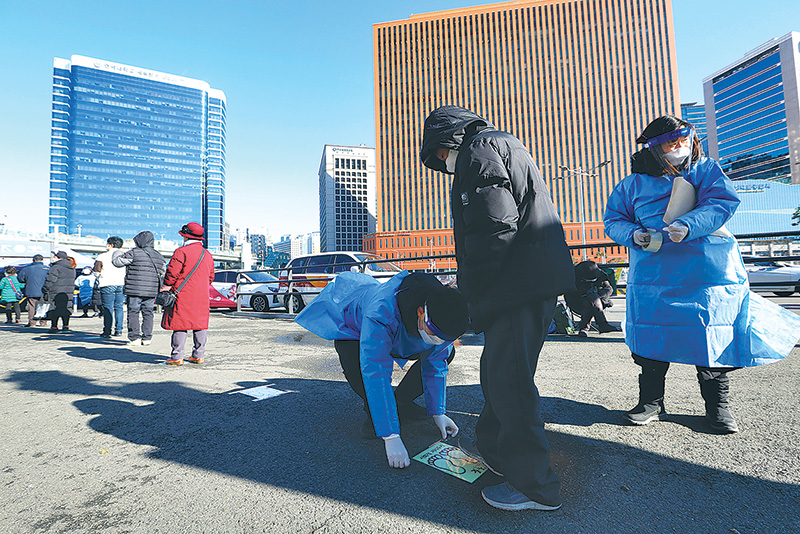
A worker attaches a social distancing sign on the road as people wait for their Covid-19
testing at a makeshift clinic in Seoul, South Korea, on Monday. AP/rss

Tokyo/ Seoul,
Japan and South Korea grappled with surging coronavirus cases and growing public frustration on Monday, with Japan suspending a contentious travel subsidy programme and South Korea closing some schools and considering its toughest curbs yet.
Japan reported more than 3,000 new cases on Saturday, yet another record as winter set in, with infections worsening in Tokyo, the northern island of Hokkaido and the city of Osaka.
But Japan, with a focus on the economic costs, has steered clear of tough lockdowns. It tackled its first wave of infections in the spring by asking people to refrain from going out and for businesses to close or curtail operating hours.
The government also launched a subidy programme called “Go To Travel” to encourage domestic tourism and support businesses but critics said encouraging people to travel had helped spread infections.
Prime Minister Yoshihide Suga had ruled out halting the programme, citing economic considerations, but that changed after weekend polls showed his support being eroded over his handling of the pandemic.
The programme would be suspended nationwide for two weeks from December 28, media reported.
Across the sea in South Korea, President Moon Jae-in also faces sliding ratings as clusters of new infections fuel criticism over what many see as slack containment.
Moon has warned of the possibility more stringent curbs.
“Our back is against the wall,” he said. “This is a crucial moment to devote all our virus control capabilities and administrative power to stopping the coronavirus.”
South Korea reported a new daily record of 1,030 infections on Sunday, a big worry for a country for months held up as a mitigation success story but still a fraction of the tallies being seen in some European countries and the United States, where vaccines are being rolled out.
Few Asian countries expect to get significant amounts of coronavirus vaccines in coming weeks as they manage distribution schedules, allow time to check for any inoculation side effects elsewhere or run their own late-stage trials.
Instead, they are counting on the methods that have largely kept infections in check for months - ahead of the curve testing, stringent travel curbs, strict social distancing and masks. China, for instance, where the virus emerged almost a year ago, has managed to limit new cases with tough, sweeping action.
It locked down an area of more than 250,000 people after half a dozen cases were confirmed near the Russian border in the province of Heilongjiang, the Associated Press reported on Monday.
Singapore, which has reported only a handful of local cases over the past two months, said it was easing restrictions and would soon allow up to eight people to gather. It also approved Pfizer-BioNTech’s vaccine and said it expected its first shots by the end of the month.
New Zealand, which has been particularly successful in tackling the pandemic, said it had agreed to open a “travel bubble” with Australia in the first quarter of 2021.
South Korea ordered schools to close in its capital, Seoul, and surrounding areas and warned that restrictions may be raised to the highest Phase 3 level, which would essentially mean a lockdown for the first time in Asia’s fourth-largest economy.
Last month, the government banned year-end parties and it has ramped up testing to more than 22,000 people a day, compared with about 16,000 a day in September.
In Japan, which is hoping to stage the postponed summer Olympics next year, testing has remained relatively low, peaking at about 50,000 in one day recently. Testing in Tokyo, which has the capacity for more than 60,000, is now about 9,000 a day.
“Whether a country or region is doing enough testing should be assessed based on the positivity rate and not on the number of tests,” said Fumie Sakamoto, infection control manager at the St Luke’s International Hospital in Tokyo.
“The positivity rate for Tokyo is now over 6 percent, so we should be doing a bit more testing to bring the number down.”

WORLD

Protesting farmers call for second strike in a week in India

- ASSOCIATED PRESS

New Delhi,
Tens of thousands of protesting Indian farmers called for a national farmers’ strike on Monday, the second in a week, to press for the quashing of three new laws on agricultural reform that they say will drive down crop prices and devastate their earnings.
The farmers are camping along at least five major highways on the outskirts of New Delhi and have said they won’t leave until the government rolls back what they call the “black laws.” They have blockaded highways leading to the capital for three weeks, and several rounds of talks with the government have failed to produce any breakthroughs.
Scores of farmer leaders also conducted a token hunger strike on Monday at the protest sites. Heavy contingents of police in riot gear patrolled the areas where the farmers have been camping.
Protest leaders have rejected the government’s offer to amend some contentious provisions of the new farm laws, which deregulate crop pricing, and have stuck to their demand for total repeal.
At Singhu, a protest site on the outskirts of New Delhi, hundreds of farmers blocked all entry and exit routes and chanted anti-government slogans. Some of them carried banners reading “No farmers, no food.”
About two dozen leaders held a daylong hunger strike at the site, while a huge communal kitchen served food for the other protesters.
“It’s the government’s responsibility to provide social benefits (to people.) And if they don’t give those, then people will have to come together” to protest, said Harvinder Kaur, a government employee who came from her home in Punjab state to help at the kitchen.
Another protester, Rajdeep Singh, a 20-year-old student who helps his farming family back home in Punjab, said the protest would continue until their demands are met.
Farmer leaders have threatened to intensify their actions and have threatened to block trains in the coming days if the government doesn’t abolish the laws.
The farmers filed a petition with the Supreme Court on Friday seeking the quashing of the laws, which were passed in September. The petition was filed by the Bharatiya Kisan Union, or Indian Farmers’ Union, and its leader, Bhanu Pratap Singh, who argued that the laws were arbitrary because the government enacted them without proper consultations with stakeholders.
The farmers fear the government will stop buying grain at minimum guaranteed prices and corporations will then push prices down. The government says it is willing to pledge that guaranteed prices will continue.
With nearly 60 percent of the Indian population depending on agriculture for their livelihoods, the growing farmer rebellion has rattled Prime Minister Narendra Modi’s administration and its allies.

WORLD

Scientists focus on bats for clues to prevent next pandemic

- ASSOCIATED PRESS

Rio De Janeiro,
Night began to fall in Rio de Janeiro’s Pedra Branca state park as four Brazilian scientists switched on their flashlights to traipse along a narrow trail of mud through dense rainforest. The researchers were on a mission: capture bats and help prevent the next global pandemic.
The November nighttime outing was part of a project at Brazil’s state-run Fiocruz Institute to collect and study viruses present in wild animals—including bats, which many scientists believe were linked to the outbreak of Covid-19.
The goal now is to identify other viruses that may be highly contagious and lethal in humans, and to use that information to devise plans to stop them from ever infecting people—to forestall the next potential global disease outbreak before it gets started.
In a highly connected world, an outbreak in one place endangers the entire globe, just as the coronavirus did. And the Brazilian team is just one among many worldwide racing to minimize the risk of a second pandemic this century.
It’s no coincidence that many disease scientists are focusing attention on bats, the the world’s only flying mammals. Bats are thought to be the original or intermediary hosts for multiple viruses that have spawned recent epidemics, including SARS, MERS, Ebola, Nipah virus, Hendra virus and Marburg virus.
A 2019 study found that of viruses originating from the five most common mammalian sources—primates, rodents, carnivores, ungulates and bats—those from bats are the most virulent in humans.
“The secret is that bats have unusual immune systems, and that’s related to their ability to fly,” said Raina Plowright, an epidemiologist who studies bats at Montana State University.
Plowright and other bat scientists believe evolutionary tweaks that help bats recover from the stress of flying, when their metabolic rate rises sixteen-fold, also give them extra protection against pathogens.
Probing the secrets of bat immune systems may help scientists understand more about when bats do shed viruses, as well as providing hints for possible future medical treatment strategies, said Arinjay Banerjee, a virologist at McMaster University in Canada.
Increasing destruction and fragmentation of habitats worldwide—especially biodiverse areas like tropical forests—means “we are seeing higher rates of contact between wildlife and humans, creating more opportunities for spillover,” said Cara Brook, a disease ecologist at the University of California, Berkeley.
In India, a National Mission on Biodiversity and Human Well-Being has been pending since 2018 and will likely be launched next year. A core part of the plan is to set up 25 virus surveillance sites across the country.
One approach that won’t help, scientists say, is treating bats as the enemy—vilifying them, throwing stones or trying to burn them out of caves. An attack along those lines took place this spring, when villagers in the Indian state of Rajasthan identified bat colonies in abandoned forts and palaces and killed hundreds with bats and sticks.
Scientists say such tactics are likely to backfire.
Bats also play vital roles in ecosystems: They consume insects like mosquitos, pollinate plants like agave, and disperse seeds.
A better approach to minimise disease risk, Frank said, is simply to minimise contact between wild bats and people and livestock.
In Australia, bats transmitted a virus to horses, which in turn infected people. First identified in 1994 and named Hendra virus, it is highly lethal, killing 60 percent of people and 75 percemt of horses infected.
To potentially reverse the movement of bats, Montana State University’s Plowright and colleagues based in Australia are studying restoring the bats’ original habitat.

WORLD

TV executive held in India

Briefing
- AGENCIES

SRINAGAR: Indian police have arrested the chief executive officer of a media group that owns a polarizing television news channel on charges of rigging the ratings system, a major component in determining what a channel can charge advertisers. Police arrested Vikas Khanchandani, the chief executive of ARG Outlier Media, on Sunday at his home in Mumbai, India’s financial capital, Republic TV, which is owned by ARG, announced during a broadcast. Republic TV, which broadcasts in English and Hindi, aggressively supports Prime Minister Narendra Modi and his nationalist policies. Republic TV denounced the arrest. “I know he will go in and come out with his head held high,” the news channel’s co-founder, Arnab Goswami, said of Khanchandani on his firebrand nightly show. The arrest is part of a police investigation that began in October into some TV channels in the western state of Maharashtra, of which Mumbai is the capital, over accusations that they rig the ratings scores system.

WORLD

Trump raises China concerns as reason to veto defence bill

Briefing
- AGENCIES

WASHINGTON: President Donald Trump offered a new rationale on Sunday for threatening to veto the annual defense policy bill that covers the military’s budget for equipment and pay raises for service members: China. He did not outline his concerns. Republican and Democratic lawmakers say the wide-ranging defense policy bill, which the Senate sent to the president on Friday, would be tough on China and must become law as soon as possible. Both the House and Senate passed the measure by margins large enough to override a potential veto from the president, who has a history of failing to carry out actions he has threatened.

WORLD

US agencies hit by cyberattack

Briefing
- AGENCIES

WASHINGTON: The US government issued an emergency directive to federal agencies in the wake of a major cyberattack, as multiple media outlets reported at least two departments —including the Treasury—had been targeted by hackers with ties to Russia. In a statement on Sunday, the Cybersecurity and Infrastructure Security Agency (CISA) said it had ordered federal agencies to immediately stop using SolarWinds Orion IT products following reports that hackers had used a recent update to gain access to internal communications. “The compromise of SolarWinds’ Orion Network Management Products poses unacceptable risks to the security of federal networks,” said CISA Acting Director Brandon Wales. “Tonight’s directive is intended to mitigate potential compromises within federal civilian networks... we urge all our partners to assess their exposure,” he added.

Page 7
SPORTS

Arsenal’s crisis deepens after Burnley defeat

The Gunners drop to 15th position after crumbling to fourth straight home league defeat for the first time since 1959.
- AGENCE FRANCE-PRESSE
Arsenal’s Pierre-Emerick Aubameyang (centre) is waiting for his first league goal from open play since new contract extension in September. AP/RSS

LONDON,
Arsenal slumped to a fourth consecutive home league defeat for the first time since 1959 after Pierre-Emerick Aubameyang’s own goal handed Burnley a 1-0 win on Sunday.
The Gunners were again undone by indiscipline as Granit Xhaka’s needless sending-off just before the hour mark turned the game in Burnley’s favour. Aubameyang is still waiting for his first league goal from open play since signing a lucrative new three-year contract in September, but scored at the wrong end when he flicked in Ashley Westwood’s corner 17 minutes from time.
Victory takes Burnley out of the relegation zone, while Arsenal creep ever closer to the drop zone as they sit 15th, just five points above the bottom three. “We need to put the ball in the net, that’s what is missing. What we did and what Burnley did there is no comparison,” said Arsenal manager Mikel Arteta.
The Spaniard was hailed for his instant impact in leading Arsenal to the FA Cup last season, just eight months into his first senior managerial role.
However, Arteta is now under mounting pressure with little sign his side can turn things around and high-flying Southampton, Everton, Manchester City in the League Cup and Chelsea to come in their next four games.
It was a familiar tale for Arteta’s men as they failed to take their chances and were then undone by a red card and one moment of sloppy defending. England international Nick Pope repelled the home side before half-time with saves from Kieran Tierney, Aubameyang and Bukayo Saka. However, Arsenal’s momentum was lost when Xhaka was shown the third red card of his career at the Emirates for grabbing Westwood by the throat.
At the Craven Cottage, Mohamed Salah spared Liverpool blushes with a late penalty which rescued a 1-1 draw against struggling Fulham. Jurgen Klopp’s side were punished for a sloppy first half display when Bobby Decordova-Reid gave Fulham a shock lead. But Salah rescued the Premier League champions after Aboubakar Kamara handled with 11 minutes left. Liverpool remain in second place and sit behind leaders Tottenham on goal difference.
“If they had to wake up I don’t know, but I cannot write a book and throw it on the pitch for them to read. But I wanted us to shake up the game,” Klopp said.
Crystal Palace’s late equaliser in their 1-1 draw against Tottenham just before Liverpool kicked off had given the Reds a chance to go top if they won in west London.
Instead, they will have to wait until Wednesday’s summit meeting with Tottenham, who are now unbeaten in 11 league games, at the Anfield for their next chance to knock Jose Mourinho’s team out of pole position. Liverpool are unbeaten in their last eight league games.
Adding to Klopp’s concerns, Joel Matip suffered a back injury that saw him join the long list of Liverpool injuries which already included his fellow centre-backs Virgil van Dijk and Joe Gomez.
Meanwhile, Leicester took advantage of slip ups by the top two to close to within one point of the leaders as James Maddison scored twice in a 3-0 rout over Brighton. Maddison was back to his best after a series of injury problems with two brilliant finishes either side of Jamie Vardy’s 12th goal of the season.

SPORTS

New Zealand beat West Indies to sweep Test series

- REUTERS

WELLINGTON,
New Zealand took a little over an hour to wrap up a comprehensive innings and 12 runs victory in the second Test against West Indies on the fourth day at the Basin Reserve on Monday to seal a 2-0 series sweep.
The tourists resumed on 244-6 with captain Jason Holder on 60 and Joshua Da Silva on 25 but were dismissed for 317 midway through the first session, still 12 runs from making the hosts bat again after they scored 460 in their first innings. New Zealand dismissed the visitors for 131 in their first innings early on Sunday and captain Tom Latham had little hesitation in enforcing the follow on. The home side also won the first Test in Hamilton by an innings and 134 runs. The victory put New Zealand level with Australia on 116 points at the top of the International Cricket Council Test rankings and they moved to third in the table for the World Test Champion-ship final at Lord’s next year.
“Clinical is probably the word to use,” Latham told reporters. “The way we were able to set the game with the bat on the back of Henry’s innings was outstanding. On the back of that ...to put a team back in twice in two matches was not going to be easy for the bowlers ... but they kept coming time and again and did the job with the ball. So, yeah, clinical is a good word for it.”
The start of play on Monday was delayed for 20 minutes due to light rain falling in central Wellington but Tim Southee and Neil Wagner picked up the four wickets required, while Da Silva scored his first Test half century. “When we batted in the first innings we didn’t set up the game very well,” Holder told reporters as to why his side had lost the game. We always say the first innings is really important to set the match up and we didn’t do that in this Test match.”

SPORTS

Messi saves Barcelona, Sociedad back on top

- AGENCE FRANCE-PRESSE

BARCELONA,
Lionel Messi saved Barcelona from another embarrassing result by scoring the decisive goal in a 1-0 win over lowly Levante, while Real Sociedad returned top of La Liga on Sunday.
Messi struck with 14 minutes remaining of a lacklustre display from Barca at the Camp Nou which will do little to ease fan fears following their 3-0 hammering at the hands of Juventus midweek.
Ronald Koeman’s side are still way off the pace in the title race, nine points behind Sociedad who reclaimed first place despite only drawing 1-1 with Eibar. Barcelona do however have two games in hand on the Basque outfit. Atletico are level on 26 points with Sociedad and also have two games in hand while Real Madrid are now just three points behind the leaders having played one less after beating their local rivals 2-0 on Saturday.
“The team is working well, they gave the maximum,” said Koeman. “We still lack a little confidence in ourselves, in our game, but we had a lot of chances, and I have nothing to say about the attitude of the players in this match.”
Barca managed to force several saves from Aitor Fernandez, with the Levante goalkeeper doing particularly well to push away a stinging shot from Martin Braithwaite in the 16th minute and Antoine Griezmann’s header five minutes later.
Earlier Ander Barrenetxea gave Real Sociedad the lead in San Sebastian with a thumping strike in the 20th minute, but Sergi Enrich turned home with 25 minutes remaining to send his team 10th on 15 points. Sociedad would have had a bigger gap between them and Atletico had Igor Zubeldia’s 80th-minute tap-in not been ruled out by VAR for an extremely tight offside.

SPORTS

Bhurtel guides Rapti to one-wicket victory

- Sports Bureau

KATHMANDU,
Rapt clinched a one wicket win over Narayani in the last league match of the Gautam Buddha Cup twenty20 cricket tournament played in Bharatpur on Monday.
Kushal Bhurtel cracked 65 runs off 41 balls as Rapti chased 139 runs target with a ball to spare. Bhurtel, who came as one of the openers, hit four fences and six sixes before being bowled out by Kishore Mahato in the 11th over.
Both sides have already secured berths in the three-team round-robin league finals after defeating national team skipper Gyanendra Malla-led Bagmati in their first matches.
Monday’s match outcome means Rapti secured first position in the round-robin league finals. The same teams will vie in the finals on Tuesday.
Kamal Singh who came to bat at number eight remained unbeaten at 24 runs while Asif Sheikh and Sumit Maharjan contributed 14 and 12 runs respectively. Narayani captain Karan KC claimed three wickets while Kishore Mahato and Sushan Bhari grabbed two wickets each.
Narayani, which elected to bat first, made a shaky start and lost four wickets for 28 runs. But they managed to reach 138-8 with contributions from lower middle and tailender batsmen. Sushan Bhari, who came to bat at number seven, contributed 18 runs before skipper KC and Mahato played 59 runs for the eight wicket.
Mahato contributed unbeaten 36 runs, the highest score for Narayani, which included two boundaries and four sixes in his 14-ball knock. KC scored 32 off 22 deliveries.     
Rapti bowlers Surya Tamang and Abinash Bohara grabbed two wickets apiece while Jitendra Mukhiya, Kamal Singh and Basant Karki picked one each.

SPORTS

AC Milan stay unbeaten in Italy

Briefing
- AGENCIES

MILAN: Theo Hernandez scored twice to help AC Milan recover from two goals down to draw 2-2 against Parma on Sunday and preserve their unbeaten league record. Hernani fired Parma into the lead in the 13th minute and doubled their tally with Jasmin Kurtic’s header in the 56th. However, Hernandez headed Milan back into the match two minutes later and scored the equalizer in stoppage time. Milan remained top of Serie A but had their advantage cut to three points above second-place Inter Milan after the Nerazzurri scored three goals late on to win 3-1 at Cagliari. Nicolo Barella, Danilo D’Ambrosio and Romelu Lukaku scored in the final 15 minutes after Riccardo Sottil had given Cagliari the lead shortly before halftime. Elsewhere, Cristiano Ronaldo marked his 100th Juventus match by scoring two penalties to help his side win 3-1 at Genoa, while Napoli remained level on points with Juventus after beating Sampdoria 2-1. Roma was two points further back after thrashing Bologna 5-1. Atalanta beat Fiorentina 3-0.

SPORTS

Dortmund sack coach Favre

Briefing
- AGENCIES

BERLIN: Borussia Dortmund have sacked manager Lucien Favre following Saturday’s 5-1 loss at home to promoted VfB Stuttgart that saw them drop to fifth. The Swiss, who had taken over in 2018, was seen as the ideal candidate to break Bayern Munich’s stranglehold on the Bundesliga title. But in his 2-1/2 seasons in charge he failed to win a German league or Cup title. Dortmund, who last won the Bundesliga title under Juergen Klopp in 2012, also failed to challenge Bayern last season. Favre’s three-year contract was due to run out at the end of the season. Dortmund’s bad run in the Bundesliga this season has meant they have dropped to fifth place. Assistant coach Edin Terzic took charge of the team and will remain at the helm until the end of the season.    

MEDLEY

Horoscope

ARIES (March 21-April 19) ****
People will treat you the way you deserve to be treated today—singing your praises and patting you on the back. That means that it’s a particularly good time to use all the goodwill that’s coming your way to get people to help you start something new.

TAURUS (April 20-May 20) ***
It’s wise for you to rethink your health regimen today, but it’s unwise to set goals that are too ambitious. You have to be realistic about what you can do and how quickly you can do it or you’ll only get frustrated.

GEMINI (May 21-June 21) ****
There’s a fight about to bust out today, and you’ll be lucky enough to have a front row seat for all the action! The two warring parties, in your humble opinion, are equally in the wrong, so this should be an interesting battle to witness!

CANCER (June 22-July 22) ***
Someone close to you could be going through some issue with their home life. The drama in their private life is leaking into your relationship. You’re getting frustrated by their lack of concentration, and that’s understandable.

LEO (July 23-August 22) ***
One of your friends has been acting immature lately, but today it looks like they’ve decided to grow up. But is it too little too late? This relationship has been a mixed blessing in your life, and it might be time to decide once and for all if you want it to continue.

VIRGO (August 23-September 22) ****
You’ve got a much more focused energy than you’ve had for a while, and you can almost instantly make a molehill out of any mountain! The tallest, toughest obstacles will melt into minor setbacks and your plan for fun won’t have to be delayed by one minute.

LIBRA (September 23-October 22) ***
Don’t let your flirting skills get rusty! Even if you’re in a long-term, committed relationship, flirting should still be a part of your life. After all, it’s not a big commitment or infidelity. It is (or it should be) harmless.

SCORPIO (October 23-November 21) ***
Have the past few days been dragging along too slowly for you? If so, today will probably be no different. Time feels like it’s crawling right now, but in reality you’re just moving too quickly for it! So slow down the pace of your life.

SAGITTARIUS (November 22-December 21) ***
You can feel free to kick back and just have fun today. Go ahead and let yourself get distracted by the silly, the inane, and the downright goofy. If you have children in your life, this is the perfect day to get down on their level and have a play date.

CAPRICORN (December 22-January 19) ****
The challenges you face at your job or school are not only adding stress to your life, they’re also causing some disruption in the lives of your closest friends and loved ones. Today, try to make sure your two worlds stay separate.

AQUARIUS (January 20-February 18) ***
Today, let people into your life a little bit more. Open yourself up and they’ll show you the best that they have to offer. Encourage them to be confident and you’ll be putting yourself in a strong leadership position.

PISCES (February 19-March 20) ***
Getting caught up in the past isn’t something you should be doing right now. There are too many important opportunities in front of you, and you can’t afford to be distracted by things that have already happened and don’t really matter anymore.

Page 8
CULTURE & LIFESTYLE

The unemployed and small business owners turn to ride-sharing apps to pay their bills

Many who have lost jobs or are incurring losses have joined the gig economy to earn a living, with a majority of them opting to work as riders on ride-sharing platforms.
- TSERING NGODUP LAMA
shutterstock

Kathmandu,
Sitting on his parked motorbike beside an upscale restaurant in Lazimpat, Uttam Kumar Rai, his head bowed, stares intermittently at his smartphone’s Pathao app, a ride-sharing app.
It’s almost noon, and Rai has just completed a ride request from Boudha to Lazimpat. And until he gets a new ride request on the app, all Rai can do is wait.
After around 10 minutes of waiting, a ride request pops up. Rai is quick to accept it, and he speeds away.
On any given day, Rai, a full-time Pathao rider, takes anywhere between 12 to 15 rides. He starts early, around 8 am every day, and by the time he gets home in his rented accommodation in Kapan, it’s usually 7 pm.
Until a few months ago, Rai’s daily routine was completely different. He held a 9-5 job at a financial investment company, and it was only during his free time that he worked as a Pathao rider to make extra money.
But in February this year, says Rai, a disagreement with the company’s HR left him with no option but to quit. “I was told by the company’s HR that upon completing two years at the company, I would get a better contract. But when the time came, the HR reneged on the promise,” said Rai. “I felt disrespected and unappreciated, and I decided to resign.”
After putting in his papers, Rai started applying for jobs but before he could land one, the pandemic hit, and for months, Rai was left without a source of income.
When the lockdown loosened, Rai left for his village in Khotang and returned to Kathmandu only a month ago, and he has since been working full-time as a Pathao rider.
Rai’s case isn’t an outlier.
Ever since the lockdown loosened, many who have lost jobs and owners of small businesses that have been hit hard by the pandemic have joined the gig economy to earn a living, the vast majority of them opting to work as riders on ride-sharing platforms.
Data from ride-sharing apps like Pathao and Tootle show a huge surge in the number of new applicants wanting to sign up and work as riders in the midst of a pandemic.
Starting from June, Pathao, says the platform’s senior manager Shashank Shumsher Thapa, was inundated with queries from people wanting to sign up on the platform.
The situation was similar at Tootle.
“We were seeing anywhere between 80 to 100 new applicants daily,” said Sixit Bhatta, co-founder of Tootle.
But during the first few weeks following the lockdown, with many people reluctant to step outside their homes, demand for rides on ride-sharing platforms was low.
“Given the low demand, it didn’t make sense for us to accept new applicants because that would mean existing riders on the platform would end up getting much fewer rides,” said Thapa.
But soon, Pathao, says Thapa, started receiving messages from people saying how they have lost jobs, their businesses have suffered immensely and that they desperately need the gig as a rider to make a living with.
“So for the first few weeks after the lockdown, we decided to screen and accept riders on a case-by-case basis to ensure that those who were financially struggling due to the pandemic have a chance to get on board the platform and at the same time not significantly disrupt the supply-demand balance,” said Thapa.
When the nation-wide lockdown was announced in March, Roshan (name changed) didn’t think it would last that long. In January, he and his friend had started a small restaurant. “We spent Rs 400,000 in setting up the place and business was doing okay and we were hoping that things would pick up,” said Roshan. “When the lockdown hit I wasn’t very worried because I thought things would return to normalcy in a few weeks and the whole thing would just be a minor setback.”   
But as the lockdown stretched for months, fear and worry began to creep in.
“Despite remaining shut for four months and with no business at all, we still had to pay rent, and that crippled us financially. When the lockdown loosened in July, we reopened but business was very slow,” said Roshan.
In September, out of desperation, Roshan started working as a rider for a ride-sharing platform.
“Last year, I signed up on Tootle and Pathao and worked as a rider for a few months. But when my mother came to know about it and she got worried and asked me to quit,” said Roshan.
But this time, Roshan says he has no option but to work as a rider and keep it hidden from his family.
Roshan now divides his time between his restaurant and ride-sharing platform.
Until 9 am, Roshan helps his partner at the restaurant in getting things ready for the day, and by 10 am, he is out ferrying passengers on the back of his scooter.
“I make sure I am back at the restaurant before six in the evening because things get slightly busy at the restaurant around that time,” said Roshan. “I manage to do around eight to 10 rides in a day and after my expenses, I save around Rs 700.”
Since the lockdown loosened, says Thapa, riders on Pathao are also taking twice the number of rides they used to before the pandemic.
“This trend clearly shows that the number of riders who rely on the platform for their livelihood has increased significantly,” said Thapa.
Both Rai and Thapa say that they are grateful that ride-sharing platforms are providing many like them a source of income at such an economically volatile time in their lives.
“To be honest, I am making more money working as a rider than I used to work at the financial investment company. My salary then was Rs 19,000 a month. But now I make that amount in around 20 days,” said Rai.
But it’s a hard job, says both Rai and Roshan.
“Riding a motorbike in this cold isn’t easy and after riding for hours, in the evening, your back hurts a lot,” said Roshan.
For Rai, the biggest drawback of working in the gig economy as a rider is the risks involved.
“When you are riding for hours on a daily basis, you are obviously more predisposed to auto accidents. And if a rider injures himself/herself, they are on their own. That’s a huge risk for riders,” said Rai. “But then in the present scenario, those who are doing it full time are doing so out of desperation. The bills have to be paid.”

CULTURE & LIFESTYLE

Artists, activists rush to save Black Lives Matter murals

To preserve expressions of anger and pain born of outrage over racial injustice, artists have begun painting intricate murals and spray-painting raw messages of anguish.
- CHRISTINE FERNANDO
Leesa Kelly (left) walks past plywood mural boards as she and Kenda Zellner-Smith (background right) and volunteers meet at a warehouse in Minneapolis. Ap/rss

INDIANAPOLIS,
Neither woman could bring themselves to watch the video of George Floyd’s final moments, his neck pinned under a Minneapolis police officer’s knee.
But as their city grieved, Leesa Kelly and Kenda Zellner-Smith found much-needed comfort in the messages of anguish and hope that appeared on boarded-up windows as residents turned miles of plywood into canvases. Now, they’re working to save those murals before they vanish.
“These walls speak,” said Zellner-Smith, who said she was too numb to cry after Floyd’s killing. “They’re the expressions of communities. We want these feelings, hopes, calls to action to live on.”
Together, the two Black women formed Save the Boards to Memorialize the Movement, part of a push to preserve the ephemeral expressions of anger and pain born of outrage over racial injustice that triggered weeks of protests across the country.
Some artists began painting intricate murals, but many spray-painted raw messages of anguish. Zellner-Smith started with the simple pieces.
“Some of these boards aren’t pretty,” she said. “There is collective pain and grief in each board, and each one tells a different aspect of this story. And now we get to tell that story to everyone.”
One is the word “MAMA” scrawled hastily onto the side of an abandoned Walmart. The word was among Floyd’s last. Now it’s part of a database of protest art called the Urban Art Mapping George Floyd and Anti-Racist Street Art database.
“The art was changing quickly, and these raw, immediate responses were being erased and painted over,” said Todd Lawrence, an associate professor of English at the University of St Thomas in St Paul, Minnesota, and one of the database’s creators. “We want people to see the full range of responses, the complexity, the multitude of voices.”
Lawrence and art history professor Heather Shirey were part of a research team already documenting street art. When the streets of countless cities became temporary galleries after Floyd’s death, they set out to capture the art before it disappeared.
Although many of the 1,600 artworks in the crowdsourced database come from Minneapolis, Shirey says they hope to expand to pieces from around the world.
“Oppression and racial violence is unfortunately universal, so art is responding to it around the world,” she said.
Similar work is going on across the country as groups take measures to keep the art alive.
In New York City, the Soho Broadway Initiative worked with local arts groups to get permission for murals and provide artists with materials. As murals started coming down, the organisation returned 22 artworks to artists and collected 20 more waiting to be returned.
In Indianapolis, organiser Malina Jeffers is unsure about the future of the Black Lives Matter street mural stretching across Indiana Avenue. The mural is wearing down from traffic, and with winter will come weather damage and snowplows.
But the mural will live on in prints and T-shirts created by the local Black artists behind the original mural. More than 1,000 shirts have been sold. Vinyl banners representing 24 other murals painted in the downtown area are displayed at the city’s Central Library.
“All of us know the mural won’t be there forever,” Jeffers said. “So we all wanted a piece of it to hold onto.”
For Seattle’s Black Lives Matter street mural, Mexican American artist Angelina Villalobos, aka 179, mixed her mother’s ashes into the bright green paint she used for the letter A. City workers scrubbed the mural from the asphalt after it began chipping, but one worker collected paint from each letter, which Villalobos plans to keep on her mother’s altar in the kitchen.
“I’m getting my mom back, but she’s been transformed,” she said. “It’s like ... a time capsule of that mural experience and all the work and thought and pain that went into it.”
The original artists have repainted the mural, planning to touch it up again in five years.
Designers at the Seattle architecture and design firm GGLO are using a different approach to preserve protest art by creating an augmented reality art show that allows visitors to use smartphones to view works scattered around the city. The show includes a digital version of the “Right to Remain” poster by local artist Kreau, 3D graffiti honoring victims of police brutality and digital tears pouring over Seattle’s skyline.
Gargi Kadoo, a member of the design team, says much of the protest art around Seattle was removed. Street art has been erased in many other cities, including Tulsa, Oklahoma, where workers in October removed a Black Lives Matter painting at the site of the Tulsa Race Massacre where in 1921 a white mob attacked a prosperous African American district, killing an estimated 300 people. Other cities such as Indianapolis and New York City have seen their Black Lives Matter murals vandalised.
“This is our homage to the art that is gone,” she said. “It’s trying to keep the message alive virtually, in a form that no one can take down or hose off.”
In Oakland, California, community arts organisations are preserving and cataloging more than 700 murals. The team is discussing plans including a December outdoor exhibition, a 2021 indoor exhibition, and high school lesson plans centering the artwork, said Jean Marie Durant, president of Oakland Art Murmur Board of Directors.
The Black-led Black Cultural Zone has a leading role in the project.
“We’ve been living this story, this trauma for a long time,” CEO Carolyn Johnson said. “That gives us a perspective that others may not have. We know how to best tell this story.”
Back in Minneapolis, Save the Boards is working with researchers Lawrence and Shirey as well as the Minnesota African American Heritage Museum and Gallery to document, archive and plan an exhibition in May 2021, the anniversary of Floyd’s death.
Museum co-founder Tina Burnside says the initiative hopes to preserve the murals in a way that continues dialogue on systemic racism, provides context and allows for public access. “It’s an important chapter in the fight for racial justice in this country,” she said. “We’re documenting history.”
Kelly and Zellner-Smith have filled their warehouse space to capacity. They started out by hoarding boards in their garages. Now, they have 537 in a warehouse. They say watching the space fill up was surreal.
“Being surrounded by these boards that encompass this pain and grief and hope, it was spiritual,” Kelly said.
The group’s next steps are to catalog the boards, do 3D scans and build a virtual gallery.
But while Kelly and Zellner-Smith created a GoFundMe to raise money for the project, funds have quickly dwindled.
“They all need to be saved,” Zellner-Smith said. “They all matter, and we want to keep collecting. We’re just a little stuck right now. But the work is far from over.”

— Associated Press