Gyawali’s overhyped Delhi visit turns out to be a damp squib
There were no concrete outcomes from the visit on the border row or vaccine procurement. It just marked a resumption of bilateral engagements between Nepal and India.
- ANIL GIRI
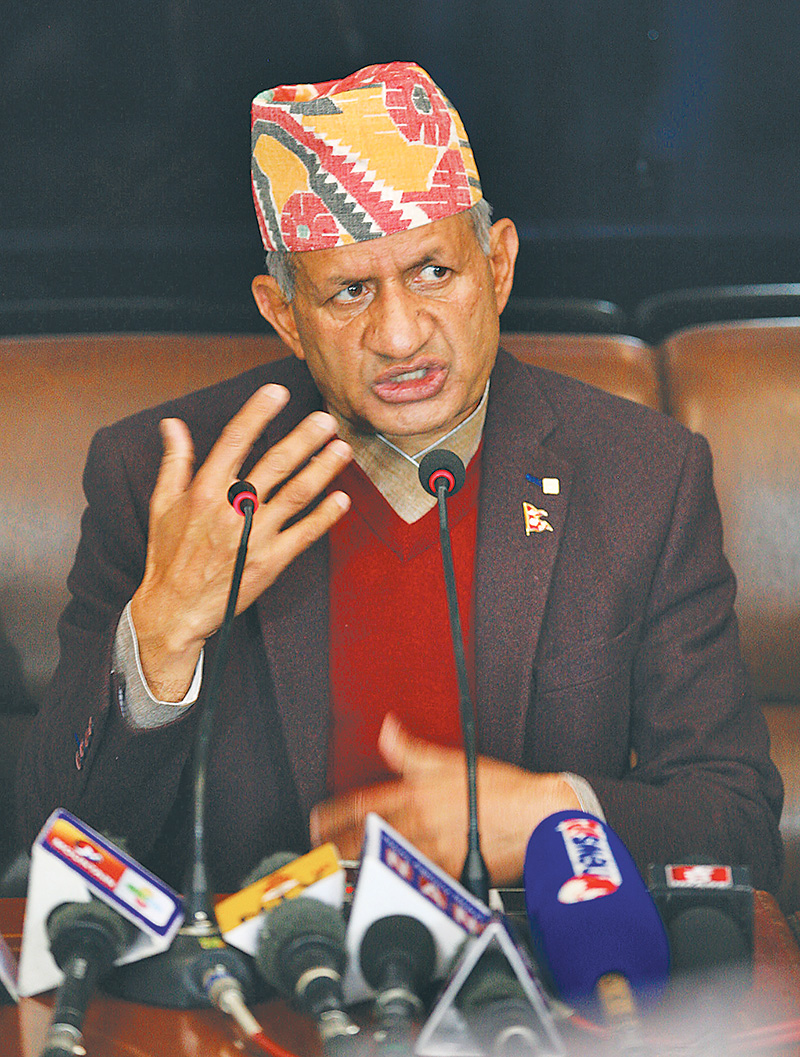
Foreign Minister Pradeep Gyawali. Post Photo
KATHMANDU, When Foreign Minister Pradeep Gyawali left for India on Thursday, hopes were high that there would be a concrete discussion on border row, a whirlwind of meetings with the Indian leadership, including Indian Prime Minister Narendra Modi, and a substantive agreement on procurement of Covid-19 vaccines. When Gyawali returned home on Saturday, he had nothing as such to show. India made it clear on the day Gyawali reached Delhi that it was not keen on holding talks on the border dispute. Discussions were held on the procurement of Covid-19 vaccines with India’s support, but there was no agreement on its modality. Gyawali did meet Indian Defence Minister Rajnath Singh on Saturday morning, but Modi “could not manage time” for a meeting because of his busy schedule. After waiting a while at his hotel for a word on a meeting with Modi, Gyawali then took a 2pm Nepal Airlines flight for Kathmandu. Many say though Gyawali’s visit does hold some significance in terms of improving ties with the southern neighbour, as it marks the first high-level visit from Kathmandu in over a year, nothing much was achieved in substance. Upon his arrival in Kathmandu, Gyawali told reporters at Tribhuvan International Airport that his India visit has helped strengthen ties between the two countries. Gyawali was in New Delhi for the sixth meeting of the Nepal-India Joint Commission, the highest level political mechanism between the two countries mandated to review the status of bilateral ties in a periodic manner. Before heading for Delhi, Gyawali had said he expected “some progress” in resolving the boundary dispute, some kind of agreement on procuring Covid-19 vaccines and re-establishing the relations at the political level which were fractured by the boundary dispute. After a gap of bilateral engagements for almost a year, India showed signs of rapprochement with Nepal starting in October when it sent its foreign spy chief to meet with Prime Minister KP Sharma Oli. In November, Indian Army chief and foreign secretary visited Kathmandu and held a series of meetings with the Nepali leadership, including Prime Minister Oli and President Bidya Devi Bhandari. The flurry of visits from India set the stage for Gyawali’s visit to New Delhi. Gyawali’s visit to Delhi took place at a time when Nepal is in a political crisis—courtesy of Oli, as he on December 20 dissolved the House of Representatives and declared snap polls for April 30 and May 10. “In diplomacy, what we must be careful about are timing, purpose and clarity,” said Ramesh Nath Pandey, a former foreign minister. “For a high-profile visit like Gyawali’s, it needs maturity in preparations. The Indians did well; their diplomacy was on the spot. Ours was immature.” The start of the visit itself was awkward, according to many who pointed at how the Indian side was too late in announcing Gyawali’s visit and how India, just hours after Gyawali landed in Delhi, hinted that border talks were unlikely. Even though there is a practice of announcing bilateral visits simultaneously by the two countries, India’s Ministry of External Affairs made an announcement only Thursday—hours before Gyawali boarded the plane for Delhi. The statement was too brief and said nothing, except his arrival and departure and the Joint Commission meeting on Friday. As soon as Gyawali landed in Delhi, the Ministry of External Affairs said that India’s position on boundary issues is well known and that the “Joint Commission and boundary talks are two separate mechanisms,” thereby clearly ruling out any possibility of talks on the boundary row at the official level. That came as a setback, as rhetoric was at its fever pitch before the visit. While addressing the upper house last week, Oli had explicitly talked about Gyawali’s visit to Delhi, saying he would strongly raise the issue of Kalapani, Lipulekh and Limipiyadhura during his talks with his Indian counterpart S Jaishankar. During a restricted meeting between Gyawali and Jaishankar ahead of the Joint Commission meeting, the Nepali side had raised the boundary issue, according to a member of the Nepali delegation. “But the Indian side said that they were surprised and shocked at Nepal’s move of publishing a new map including Kalapani, Lipulekh and Limipiyadhura,” said the official. “We were not expecting such a reaction.” According to the official, the Indian side said that since the two countries now have two different maps, claiming the same territories as their own, it would take a while before the issue is handed over to the foreign secretary level mechanism to deal with. In 2014, during Modi’s state visit to Nepal, prime ministers of both the countries had directed and mandated their foreign secretaries to work on the outstanding boundary issues, including Kalapani and Susta, and receive required technical inputs from the Boundary Working Group and a mechanism led by survey generals of Nepal and India. But the mechanism at the foreign secretary level has not met even once in the last seven years. After India published its new map in November 2019 including Kalapani within its borders, bilateral relations started to sour. Ties deteriorated further when Nepal included the disputed areas in its new map in May in response to India’s inauguration of a road link via Lipulekh to Kailash Mansarovar in the Tibet Autonomous Region of China. At least two Nepali officials who attended the Joint Commission meeting on Friday told the Post that India instead sought a mandate from the prime ministerial level and instructions for resolving the boundary dispute between the two countries. Back home on Saturday, Gyawali told reporters that both sides have committed to resolving the border dispute at the earliest possible. “Both sides have agreed to find a solution to boundary-related disputes,” said Gyawali. Diplomatic sources told the Post that Gyawali’s meeting with Modi did not materialise because of the latter’s busy schedule on Saturday. Modi on Saturday launched India’s Covid-19 vaccination drive, the world’s largest inoculation exercise against the virus. Political situation in Nepal has also been viewed as a reason why there was no meeting between Gyawali and Modi. Oli’s move of dissolving the House has divided politics in Nepal, according to sources. Political parties in Nepal have been protesting against Oli’s House dissolution move, calling it unconstitutional. A former Indian ambassador to Nepal said Modi not meeting with Gyawali could be an indication from Delhi that it does not want to involve itself in Nepal’s domestic politics and that it just wants partnership in the economic sector, trade, commerce and other areas. “A meeting could have become a talking point, and there might have been some concerns that Delhi could face the blame for indulging in Nepal’s internal matters,” said the former diplomat. A former Nepali diplomat, however, said there is not much to read into Gyawali’s failure to hold a meeting with Modi. “It would have been better had he met with Modi,” said Madhuraman Acharya, a former foreign secretary and ambassador. “But such meetings do not happen at times, as they depend on various factors.” According to Acharya, various foreign ministers of Nepal in the past have returned without meeting the Indian prime minister. Gyawali’s failure to meet with Modi has been criticised on social media as well. Social media users mostly hinted at the recent visits from India, when officials usually meet with a wide range of political leadership in Kathmandu, including the prime minister and the President. Indian Foreign Secretary Harsh Vardhan Shringla in November had met with President Bhandari, Prime Minister Oli and Foreign Minister Gyawali after holding bilateral talks with his Nepali counterpart Bharat Raj Poudyal. “It is true that we have been exercising some uneven kind of tradition... like any Indian foreign secretary who comes to Kathmandu on an official visit does call on the head of state and government head,” said Acharya. “But if Gyawali could not meet the Indian prime minister, there is nothing new. Such incidents have happened in the past as well.” According to Acharya, the meeting may not have happened also because Gyawali is representing a caretaker government in Nepal. “But what is more important, at least for me, is whether we could secure Covid-19 vaccines or not,” said Acharya. “This I think should have been the primary interest of Nepal during this visit.” The Nepali side has requested India to supply around 12 million doses of vaccines, as the government plans to inoculate 6 million people in the first phase. Sources said India has given assurances to that effect. India has said some doses will be made available within January but the amount was not revealed, according to the sources. Covid-19 vaccine was one of the top agendas of Gyawali’s visit, apart from the boundary issue. Since not many political meetings took place, Gyawali used every other platform to justify Oli’s House dissolution move. On Friday, addressing a function at the Indian Council of World Affairs, Gyawali said the House was dissolved to seek a fresh mandate to “make the people of Nepal sovereign”. On Saturday also, speaking to the Indian media, Gyawali defended the House dissolution, terming it an action in response to the problems faced by the Oli government for a long time. “The government had been facing troubles for long so the House dissolution came as a result of that. In the parliamentary system, if a prime minister elected by a majority vote thinks that he should go for a fresh mandate, as per globally established norms, it is correct to dissolve the House,” he said. At yet another programme on Saturday, Gyawali said that the [upcoming] elections will provide an important opportunity for the people [of Nepal] to make their choice and strengthen the foundation of democracy. All in all, observers say, the visit can be seen as a sign of the resumption of bilateral engagements which had taken a back seat for a while. “There was hardly any surprise for the Indians, as we had already made public our strategy,” said Pandey. “How can we expect a concrete outcome from a visit when preparation for the same was utterly lacking. The visiting minister and the prime minister had already made a lot of noise about the visit.”
Suresh Raj Neupane contributed reporting from New Delhi.
HOME PAGE
Has Oli accepted the constitution has flaws and it needs amendments?
In his House dissolution recommendation, Oli has said snap polls are required to revise the charter. But analysts wonder if he has any other sinister motive, as there’s no certainty that elections, if they happen, will give him such a majority.
- BINOD GHIMIRE,TIKA R PRADHAN
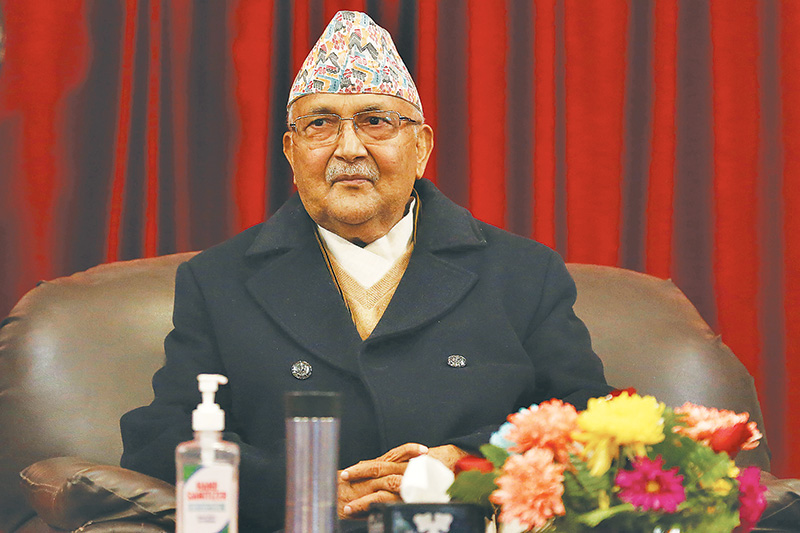
Prime Minister KP Sharma Oli. Post Photo
KATHMANDU, If there is any political figure in Nepal who has always demonstrated a strong position against amendments to the constitution, it is Prime Minister KP Sharma Oli. He has maintained a consistent position over the years that the constitution can be amended based on the rational and necessity. After securing a thumping victory in the 2017 general election, Oli became prime minister in February 2018. On May 28 that year, he signed a two-point agreement with then Sanghiya Samajbadi Forum Nepal, agreeing to amend the constitution “on the basis of mutual agreement”. The Upendra Yadav-led Sanghiya Samajbadi Forum joined the Oli government, while then Rastriya Janata Party decided in March that year to extend its support from outside in hopes that the constitution would be amended. However, that didn’t happen. Both the parties withdrew their support to the government in 2019. Oli had even rejected the proposal of Yadav, who was a deputy prime minister, to form an expert panel to make recommendations for the amendments. Yadav, along with Mohammad Istiyak Rai, who was minister for urban development, quit the government in December 2019. The Rastriya Janata Party had already withdrawn its support in March 2019.
But when Oli decided to dissolve the House of Representatives on December 2o last year and call snap polls, he argued that he needed a majority government to accomplish, among other things, constitutional amendments. “Since political parties too have been demanding an amendment to the constitution time and again and timely amendments have not been possible due to the lack of a two-thirds majority for the ruling party, a majority government is essential,” states the letter undersigned by Prime Minister Oli, recommending that the President dissolve the House and declare snap poll for April 30 and May 10. “Also, to implement the decision to bring back its land included in the country’s map, a two-thirds majority government is needed.” Oli’s argument has raised many an eyebrow, as it comes as his admission that the constitution does need an amendment, an action that he was reluctant to perform. But why? Observers and political leaders say more than the realisation that the constitution needs an amendment, it is Oli’s political (election) tactic to woo some constituencies. “I don’t believe Oli, who has even rejected the idea of forming a taskforce to study the need for amendments, actually wants to revise the constitution,” Bipin Adhikari, former dean at Kathmandu University School of Law, told the Post. “This is his tactic to woo the people [mainly from the Tarai/Madhes] who have long been demanding revision to certain provisions of the charter.” According to Adhikari, Oli will never go for any constitutional amendments. Oli’s House dissolution move has attracted widespread opprobrium, with political parties, experts on constitutional affairs and civil society members calling the action unconstitutional and an attack on the constitution. The Janata Samajbadi Party, which was born out of a merger between the Sanghiya Samajbadi Forum Nepal and Rastriya Janata Party, which had once protested against the constitution promulgation, has taken to the streets demanding that the constitution must be protected as Oli has made a brutal assault on it. Chandra Dev Bhatta, a political commentator for the Post’s sister paper Kantipur, said Oli through the reasons presented for the House dissolution has accepted that the constitution needs a revision for its wider acceptability. “Though many things remain unclear, this is fact that Oli now has accepted there are some issues in the constitution that need to be fixed,” Bhatta told the Post. “He might have realised the fact that an amendment to the charter could only give it a wider acceptability.” Like Adhikari, Bhatta also believes that Oli might also be trying to give his image a makeover, as he is known as a leader who is intolerant of Madhes and the Madhesi people. Though the House dissolution move is being heard by the Supreme Court, Oli has been claiming that elections would take place on the declared dates. Lately, Oli has been delivering speeches in such a way as if he is on an election trail. A few weeks ago, Oli ordered the leaders of his party’s youth wing to organise what they called a “dhoti rally”, bringing the people of Tarai/Madhes to Kathmandu. Observers had branded it as a farce, calling it Oli’s futile attempt to win over some constituencies in the plains. Shree Krishna Aniruddha Gautam, a political analyst, said Oli knows he needs to please the Madhesi and marginalised communities when he goes for elections and that’s why he has now accepted that the constitution needs a revision. “It’s not that Oli did not know that the constitution needed amendments as some sections of the society were raising their voices for the same,” Gautam told the Post. When Oli returned to power, he had majority votes in Parliament because his CPN-UML and Pushpa Kamal Dahal’s Maoist Centre had merged to form the Nepal Communist Party. But the House dissolution has cleaved the Nepal Communist Party in two. A sizeable number of leaders and cadres are with the other faction of the Nepal Communist Party which is now led by Dahal and Madhav Kumar Nepal, Oli’s arch-rival in the then UML party. Many say Oli has, in the letter recommending the House dissolution, has also argued that he needs “a two-thirds majority government” to work in favour of the country without any hurdles, conclude the peace process and address the problems facing the country in an effective manner. But it is unclear how snap polls can guarantee a majority government in a country which has seen a hung parliament for decades. Until Friday, it was not known to the public what reasons Oli had presented while recommending the House dissolution. But since the letter has surfaced in the media, many are now wondering if Oli has some sinister motives, as he has stressed the need for a two-thirds majority government to amend the constitution. Hari Roka, a political economic commentator, said the amendment issue has been raised mainly by those people who are for strengthening federalism. “However, Oli has always worked against federalism. So it looks like his amendment calls are guided by his intent against the federal set-up,” said Roka. “I don’t think Oli dissolved the House to hold the elections. In case he holds elections and goes for an amendment, his aim will be to attack federalism.” Yadav, chairman of the Janata Samajbadi Party, said the constitutional amendment argument is nothing but Oli’s political stunt. “He commanded a two-thirds majority but he was afraid to even form a panel to study if amendments were required,” Yadav told the Post. “We had joined the government on the condition that the Oli government would amend the constitution. Since he refused, we decided to walk away.” According to Yadav, Oli’s arguments are inconsistent. “There is no coherence in his arguments,” said Yadav. “He says he needs a two-thirds majority and for that he dissolved the House. How does he know he will win a two-thirds majority in the midterm polls, when his party also has split.” But some say Oli might have worked out some kind of deals with some sections of the political parties, including the Nepali Congress and the Janata Samajbadi Party. According to Shyam Shrestha, a political analyst who has followed Nepal’s leftist politics for decades, Oli might be under the impression that he could garner support of the Congress, Janata Samajbadi Party and Rastriya Prajatantra Party. While the Congress has refused to join the Dahal-Nepal faction and Janata Samajbadi Party for a joint protest, Rastriya Prajatantra Party, a pro-monarchy, pro-Hindu party, has welcomed Oli’s decision to call snap polls. “The way Sher Bahadur Deuba, the Congress president, has made some statements and some pro-monarchy, pro-Hindu lawyers have rushed to defend Oli in the court also shows there could be some kind of deals,” said Shrestha. That said, according to Shrestha, it will be wrong and premature to assume that Oli would get a two-thirds majority if elections do happen. “His confidence could be misplaced also. Confidence in politicians comes from three factors—popularity because of good governance, foolishness, and excessive self belief that they can take people for a ride easily,” Shrestha told the Post. “In Oli’s case, the latter two factors seem to be working.”
HOME PAGE
Mission possible: Ten Nepalis become first to climb Mt K2 in the dead of winter
For the last three weeks, around 60 mountaineers had battled high winds, heavy snowfall, rockfall and chilling cold to achieve what many had long believed to be impossible.
- SANGAM PRASAIN
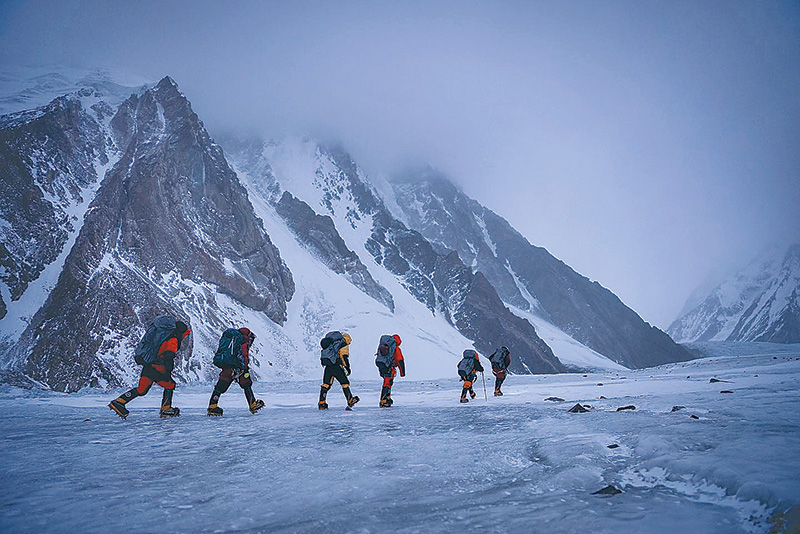
The final push for the summit was 16 hours long and began at 1am on Saturday. Photo Courtesy: Nirmal Purja
KATHMANDU, Ten Nepalis have scripted mountaineering history by standing atop the world’s most difficult and dangerous high mountain—K2—in the dead of winter for the first time. The 8,611 metres (28,251 feet) K2, or Chhogori, the world’s second-tallest peak that straddles Pakistan and China, was climbed at 17:00 (local time) Saturday for the first time in winter, Chhang Dawa Sherpa, the leader of the K2 expedition, told the Post over the phone from the mountain’s base camp in Pakistan. “WE DID IT, BELIEVE ME WE DID IT- JOURNEY TO THE SUMMIT NEVER DONE BEFORE,” he wrote in his Facebook post. “The Karakorum’s ‘Savage Mountain’ been summited in most dangerous season: WINTER [sic].” Thirteen of the world’s 14 peaks taller than 8,000 metres had already been climbed in winter—except K2. “This is the greatest achievement in the history of mountaineering, this is a good example of teamwork. Thanks to the mountain for granting this climb, if the mountain lets you climb, no one can stop you,” Chhang Dawa, the youngest mountaineer to have climbed all of the 14 highest peaks, wrote from K2 base camp. All 10 climbers gathered 10 metres below the summit and formed a group to get to the top together. “A very special moment. The whole team waited 10m below the summit to form a group then stepped onto the summit together whilst singing our Nepalese National Anthem. We are proud to have been a part of history for humankind and to show that collaboration, teamwork and a positive mental attitude can push limits to what we feel might be possible,” Nirmal “Nims” Purja, who smashed the record in 2019 for taking the shortest time to climb all 14 of the world’s 8,000-metre-high mountains, wrote on his Facebook page, two hours after he reached the summit. For the last three weeks, around 60 alpinists from a dozen countries have battled high winds, heavy snowfall and chilling cold in an attempt to achieve what many in the mountaineering community have long believed impossible. But on Friday came a piece of good news when four Sherpas reached Camp 4 (7,800 metres), the highest altitude on the mountain humans have reached in winter. The team then descended to Camp 3 (7,200 metres) where the other six members joined them. The final push started at 1:00am local time Saturday. The team reached the summit after 16 hours, enduring temperatures of up to -50 degrees C (-58 degrees Fahrenheit). While the climbers were making bids to the summit, there was bad news at the base camp. Spanish climber Sergi Mingote, who was the co-leader of the K2 winter expedition, died on Saturday. He, however, was not part of Saturday’s climbing team. Chhang Dawa, the leader of the K2 expedition, told the Post over the phone from the K2 base camp that the veteran climber suddenly fell down to advanced base camp (5,600 metres) from Camp 1 (6,075 metres) while descending to base camp. “We sent a medical team from the base camp but unfortunately could not save him,” Chhang Dawa said. “He was critically injured with both legs broken.” Mingote, who has been attempting to climb all eight-thousanders without supplemental oxygen within 1,000 days, was the co-leader of the expedition. Mingote’s plan had come to a halt, after seven successful summits, due to Covid-19-related restrictions. “It’s a great loss for the mountaineering fraternity,” said Chhang Dawa. According to Chhang Dawa, in 1987-1988, the Polish-Canadian-British Expedition had ended their K2 winter mission at 7,300 metres. In 2002-2003, a Polish expedition team had reached 7,650 metres in winter and in 2011-2012, a Russian expedition had reached 7,200 metres. The men atop K2 on Saturday were Mingma David Sherpa, Mingma Tenzing Sherpa, Mingma Gyalze Sherpa, Sona Sherpa, Galjen Sherpa, Pem Chiri Sherpa, Dawa Temba Sherpa, Dawa Tenjin Sherpa, Kili Pemba Sherpa and Nirmal Purja, according to Seven Summit Treks, the agency handling the expedition. Mingma Gyalze Sherpa had planned to climb K2 without using supplemental oxygen but it is not immediately clear whether he did so or not. According to Chhang Dawa, as all climbers had taken supplement oxygen bottles with them, it has not been confirmed who used it or who did not. The climb to the top, however, had not been straightforward When everything was going smoothly, the team on January 11 had to face a multi-day storm, which affected their plans to some extent. At Camp 2 situated at 6,760m (22,178 ft), the team was battered by heavy winds and its tents were completely ripped apart. “Our team reached Camp 2 today [January 11] and it was a wreckage site. We found that both our tents and all equipment that we had left here for the summit plan are [sic] all destroyed and swept away by the wind,” said Purja on his Facebook post on January 11. “We have lost everything including all our kits; sleeping bags, mattresses, heated shoe insoles, summit gloves, summit base layers, paragliding equipment, cooking equipment etc. I am devastated to be breaking this news. Now, I have to reassess and replan everything.” There are around two dozen foreign climbers, professional and non-professional, waiting for their bids to the summit. According to Chhang Dawa, they will decide whether to carry on with the remaining mission or not within a few days. Big winds are forecast to return after Saturday, he said. Winds on the mountain have speeds of up to 200km per hour (124mph) that’s equal to cyclone Fani, the most severe storm that travelled more than 900 kilometres (570 miles) from the Indian state of Odisha and blew nearly two dozen tents at Everest’s Camp 2 at 6,400 metres in May last year. The winter expedition was planned from December 21 until February 28. K2 is also considered to be a technically difficult mountain to climb and has been dubbed “killer mountain” for the sheer number of climbers that have lost their lives on the mountain. Eighty-four climbers have died attempting to climb K2 and only 306 have reached its summit, giving it a fatality-success ratio of roughly one death for every three summits. On August 1, 2008, a disaster occurred on K2 and swept away 11 mountaineers. The main problem was reported as an ice avalanche occurring at “the Bottleneck”, which destroyed many of the climbers’ rope lines. The Bottleneck, a perilous couloir about 300 metres below the summit, is the most dangerous section of the mountain. On 8am Saturday, Chhang Dawa wrote from the K2 base camp: “Team crossing bottle neck [sic] in Mt. K2.” That was the last obstacle.
NATIONAL
Congress undecided regarding no-confidence motion filed against Chief Minister Poudel
The Congress leaders are of the opinion that the party is undecided, as the ruling Nepal Communist Party is yet to be split officially.
- SUBASH BIDARI
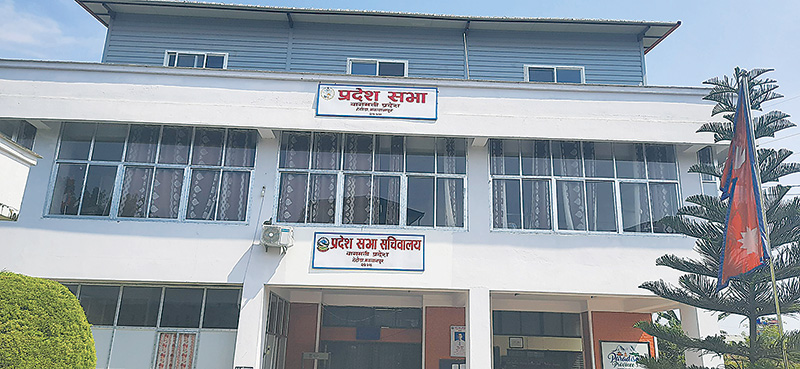
The motion will be tabled in the upcoming seventh session of the provincial assembly scheduled for January 20. Post Photo: Subash Bidari
MAKWANPUR, The Nepali Congress, the main opposition party in the Bagmati Provincial Assembly and the decisive force in the changed political situation, is still undecided regarding the no-confidence motion filed against Chief Minister Dormani Poudel. The power equation in the Bagmati Province government is uncertain, as the Nepali Congress is yet to take its official decision on whether to vote in favour of the no-confidence motion or not. The main opposition party has become a decisive force in the Bagmati Province government with the possible split of the ruling Nepal Communist Party. The Dahal-Nepal group of the ruling party had registered the no-confidence motion against Chief Minister Poudel, an atalwart of Prime Minister KP Sharma Oli, on December 25. As many as 45 provincial assembly members of the faction filed the motion against Poudel. As per Article 188 (4) of the constitution, one-fourth of the total number of the assembly members may table in writing a motion of no-confidence against the chief minister. The motion will be tabled in the upcoming seventh session of the provincial assembly scheduled for January 20. “The no-confidence motion filed against Chief Minister Poudel will be decided by the upcoming province assembly session. The business advisory committee will fix the date and decide the motion through voting,” said Sanu Kumar Shrestha, speaker at the Bagmati province assembly. Both Poudel and his rival faction need support of the Nepali Congress. The no-confidence motion can be foiled only if the Nepali Congress votes against it. The Dahal-Nepal group’s ambition to elect Ashta Laxmi Shakya as the chief minister by removing Poudel is not possible without the support of the main opposition party. In the 110-member Bagmati Provincial Assembly, the Nepal Communist Party has 80 seats. But after the party’s split, 46 assembly members are with the Dahal-Nepal faction while 36 are with the Oli faction. The Nepali Congress has 22 members, Bibeksheel Sajha has three while Rastriya Prajatantra Party and Nepal Majdoor Kisan Party have two members each. One is an independent member. Both the rival factions of the Nepal Communist Party have been cajoling the Nepali Congress into lending them its support. But the Congress is still undecided on its next move. The Congress leaders are of the opinion that the party is undecided, as the ruling Nepal Communist Party is yet to be split officially. “The Nepal Communist Party has not split officially. As a result, we’re having a technical problem in making a decision,” said Nima Lama, the secretary at the Nepali Congress parliamentary party. According to political analysts, the provincial assembly can be dissolved if the no-trust motion is approved but the Congress does not support any group to form a new government. Indra Bahadur Baniya, the parliamentary party leader of Nepali Congress, said that the party has been holding talks with both the Oli and Dahal-Nepal factions. “The Congress won’t take immediate decisions. The party’s central committee meeting is scheduled for Tuesday. The parliamentary party meeting will be held as per the decision and the instruction of the party’s central committee,” said Baniya. He, however, asserted that the party would take a decision before the provincial assembly session. The Dahal-Nepal group has assigned its province in-charge Narayan Dahal, assistant in-charge Ashta Laxmi Shakya and provincial assembly member Shalikram Jammakattel to hold talks with the Nepali Congress and other small parties to garner support to pass the no-trust motion and form a new government. Similarly, CM Poudel and the chief whip of the Oli group Keshavraj Pandey are busy holding discussions with other parties for the latter’s support in the changed political situation in the country.
NATIONAL
More than 50 different items are needed for polls, Election Commission says as preparations begin
Even if Supreme Court decides Oli’s dissolution was constitutional, dispute in Nepal Communist Party has to be settled before polls are possible.
- PRITHVI MAN SHRESTHA
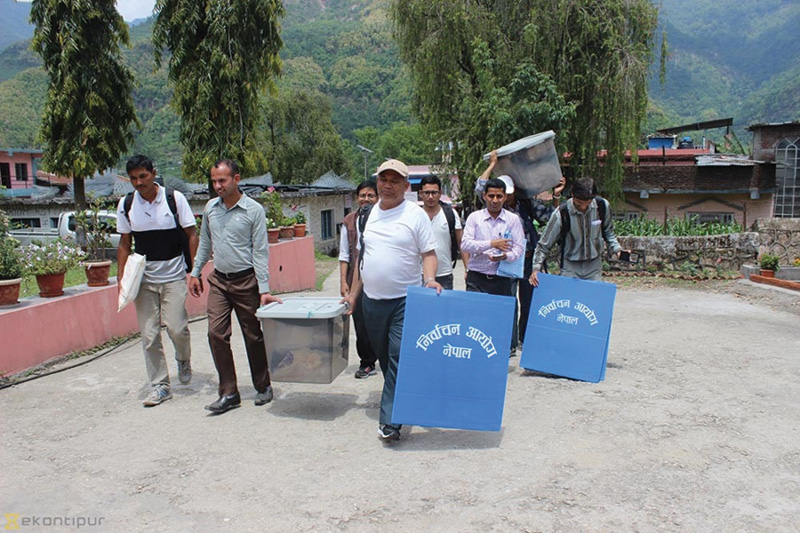
Ballot boxes, ballot papers, vehicles, ink, voter lists, calculators andglue sticks are some of the items the commission needs for holding the elections. Post file Photo
KATHMANDU, If the Supreme Court reinstates the House of Representatives Prime Minister KP Sharma Oli dissolved on December 20, general elections slated for April 30 and May 10 will not take place. But the Election Commission is legally bound to prepare for polls once the government announces the dates, according to Chief Election Commissioner Dinesh Thapaliya. And preparations have started. As part of it, it has been examining the situation of the logistics, budget, human resources for holding the polls. Ballot boxes, ballot papers, vehicles, ink, voters’ list, stamp pad, pen, scale, ballot box stickers, medicines, papers, thread, calculators, glue sticks are among the items it has to have for holding elections. In the last parliamentary elections over 50 types of the election materials were used, according to the commission. The election body expects to manage most of the necessary election materials by mid-March. “We have to start transporting the election materials to various districts after mid-March,” said Raj Kumar Shrestha, spokesperson at the commission. The most important of the materials is the ballot box and the Election Commission has said that it has around 90,000 ballot boxes from the last general elections in 2017 and this number should be enough provided they are fit and in proper condition. “We are currently examining whether they are fit and in proper condition,” said Komal Prasad Dhamala, assistant spokesperson at the commission. The stock of different election materials after completion of polls in 2017 have been kept at the stores at the commission’s head office and its district offices across the country. The commission expects that only around 45,000 ballot boxes will be required considering that there will be about 20,000 polling booths across the country, if the last general elections is anything to go by. “The required ballot boxes were estimated based on one ballot box for the first-past-the-post electoral system and one for the proportional electoral system,” said Dhamala. Of the 275 seats in the House of Representatives, 165 will be elected through the first-past-the-post system while 110 will be chosen through the proportional representation system. In the last federal and provincial elections, there were a total of 19,809 polling booths. Both federal and provincial elections were held on the same day in November and December 2017 and voters had to drop ballots in four boxes, two for federal parliament and two for provincial assemblies. The commission expects to get some of the election materials from the donors too, according to Dhamala. In the last local elections held in 2017, India had donated several vehicles and China had provided many other materials for the elections like calculators, punching machines, rubber mat, stamp pads, glue stick among other things. The most important of the materials required after the ballot boxes is probably the ballot paper and the commission has already begun discussions with the government-owned Janak Education Material Centre for printing ballot papers and other the election materials needed like posters for voter education. “On Wednesday, there had been discussion regarding the printing of the election materials including the ballot papers. We are ready to print the voters’ list, ballot papers and other election materials,” said Chitra Achayra, spokesperson at the centre. During the discussions, the commission had notified the centre that around 35 million ballot papers might be printed. According to the commission, there will be an estimated 16.5 million voters for the planned elections. Double the ballot papers of total potential voters will be required based on the assumption that separate ballot papers need to be printed for the first-past-the-post candidates and proportional representation candidates. “We can complete printing these ballot papers in 20-25 days,” said Acharya. Besides logistics, the commission is also calculating the cost for holding the elections. “We have not reached any conclusion regarding the budget. But, Rs7-8 billion might be required based on expenditure in the past elections,” said Dhamala. In the last federal and provincial elections held in 2017, the commission had spent over Rs7.7 billion. Another Rs10 billion was spent for security arrangements, according to the Finance Ministry. Besides preparation for logistics and budget estimates, the commission is also preparing to update the list of the voters. “We are updating the voters’ list by keeping December 20 last year as the cut off date,” said Dhamala. “Updated list will be published on January 28 and people will get time for a week to make claims regarding the list--if somebody has been missing in the list and even dead persons have been included.” Elections were announced on December 20. Despite these preparations, the commission officials said that they are more concerned about the political situation as the ballot papers cannot be printed without solving the dispute in Nepal Communist party. The faction of Nepal Communist Party led by Prime Minister Oli has been asking the commission to continue election preparations while another faction led by Puspa Kamal Dahal and Madhav Kumar Nepal to stop election preparations terming the house dissolution and announcement of elections unconstitutional. Also, as both factions are practically split, both are claiming that they are the legitimate party and the commission has not been able to decide that as neither side is following the party’s statute to claim legitimacy. Chief Election Commissioner Thapaliya said that holding elections amid dispute in Nepal Communist Party would be challenging. “We hope that the situation will be clear regarding the dispute in due course of time. We are not the only entity that is looking into the dispute regarding the elections,” Thapaliya told the Post. The constitutional bench of the Supreme Court is hearing the case of the constitutionality of the dissolution of the lower house. If the court scraps the House dissolution and reinstates it, the preparations and resources spent could be wasted. But Shrestha said that expenditure would not be huge in the initial phase of preparations for elections and total expenditure for poll preparations would depend on how long the Supreme Court takes to give verdict on house dissolution issue. “Election materials purchased now could be used in the future elections even if elections don’t happen in April and May,” he said.
NATIONAL
Elephantiasis survey planned in 12 districts in mountains
The 2020 deadline to eliminate the disease has been extended to 2028.
- Arjun Poudel
KATHMANDU, The Epidemiology and Disease Control Division has been preparing to carry out transmission assessment surveys for lymphatic filariasis in mountainous districts to assess the prevalence of the disease in those areas. Lymphatic filariasis, generally known as elephantiasis in Nepal, is a mosquito-borne parasitic disease. The disease caused by filarial worms is transmitted by different species of mosquitoes, including Culex, Anopheles, and Aedes. “We will collect blood samples of 300 people from each of the 12 mountainous districts and see if the people of the area are infected with the disease or not,” Lila Bikarm Thapa, a senior public health administrator, at the division, told the Post. “We will launch a mass drug administration programme in the area if the study shows a high prevalence of the disease.” Doctors say the disease may be acquired during childhood whereas its visible manifestation may occur only later in life. The disease can lead to temporary or permanent disability, pain, and social stigma. “So far we have not studied the prevalence of the disease in the mountainous districts,’’ Thapa added. To eliminate the disease, the Ministry of Health and Population launched a mass drug administration programme in 2003. Under the programme diethylcarbamazine and deworming tablet, albendazole is given to all healthy people above five years of age. Five rounds of the mass drug administration programme was held in most of the districts and the disease has been so far controlled in 53. However, in some districts, the disease has not come under control even after the 12 rounds of mass drug administration. “We are going to launch a mass drug distribution programme in 12 district this year including in Bara and Kapilvastu, where we have already run the programmes 12 times,” Sishir Panta, an entomologist at Vector-Borne Disease Research and Training Center in Hetauda, told the Post, over the phone. “Due to the low coverage of the programme in some districts, we have been unable to achieve the target despite several additional rounds of medication campaigns.” According to Panta, lack of awareness, rumors about side effects of medicines, and the prevalence of floating populations were among the reasons for poor coverage and failure of the programmes. “We have started asking people to take the medicine in front of the health workers after the disease did not come under control even after seven-eight rounds of mass medication,” Panta added. “We found that people carried the medicine home but did not take it.” The Health Ministry, which had committed to eliminating the disease by 2020, has extended the deadline to 2028 due to its failure to eliminate the disease in some districts. Districts on which mass drug administration will launch from March 13 this year are Jhapa, Morang, Bara, Dhankuta, Lamjung, Baglung, Parbat, Kapilvastu, Dang, Banke, Bardia, and Kilali.
NATIONAL
Use of electronic goods continues to grow but there’s no policy for its disposal
Most of the e-waste generated in the country comes from television sets, computer display monitors, and refrigerators. More people are also disposing of their phones.
- CHANDAN KUMAR MANDAL
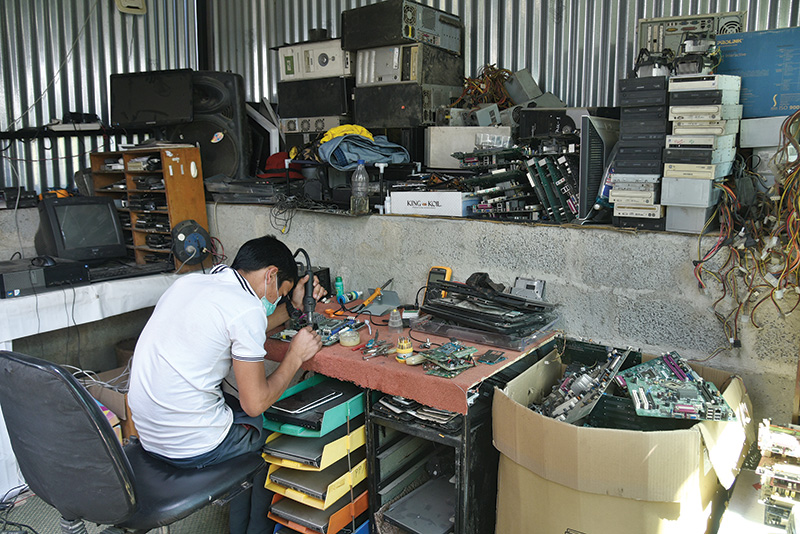
Unsafe handling of used electronic devices and e-waste can lead to serious harm to human health and the environment. Post file Photo
KATHMANDU, In the absence of dedicated policies to regulate and properly manage them, electronic waste (e-waste) has emerged as yet another menace for the country where more and more people are buying electronic gadgets such as smartphones. Environmentalists, government officials, and experts on waste management have expressed concerns as people are using more and more electronic gadgets to meet their daily needs. Such items, once discarded, turn into e-waste. “From our morning alarm to the moment we go to bed, we are surrounded by electronic gadgets either at home or outdoors,” said Jyoti Giri, assistant professor at Tri-Chandra Multiple College, during a virtual interaction organised by Tech Journos’ Forum. Step Initiative, an international organisation seeking solutions to e-waste issues, says e-waste refers to all electrical and electronic equipment and their parts that have been discarded by owners as waste without the intent of re-use. According to the Global E-waste Monitor 2020, which said a record 53.6 million tonnes of e-waste was generated globally in 2019, Nepal produced 28 metric kilotons of e-waste in the same year. Despite the massive generation of e-waste and its hazardous impact on public health and the environment, e-waste management has not blipped on the government’s radar. “There is a lack of legislation for addressing e-waste-related problems and bringing the private sector in the e-waste recycling business. We also don’t have adequate technology for its proper management,” said Giri, who also researches on electronic and plastic waste. “E-waste collection and its disposal is happening in the informal sector. Although Nepal is a signatory to the Basel Convention, which bars transboundary movement of hazardous waste and its disposal, e-waste is being sent to India through illegal channels.” The unsafe handling of used electronic devices and e-waste can lead to serious harm to human health and the environment. Open-air burning and disposal of e-waste, which also contains toxic materials, can pollute soil, water and air. Such practices can expose workers to high levels of contaminants such as lead, mercury, cadmium, and arsenic, leading to irreversible health effects, including cancers, miscarriages, neurological damage, and diminished IQs, according to the Environmental Protection Agency of the US. “What we need to do is follow the sustainable and smart practice of 3R—reduce, reuse, and recycle. First, buy fewer electronic gadgets, repair them if broken, and recycle them if nothing can be done. Also, we can send them for re-design, making something new from the waste.” Indu Bikram Joshi, deputy director of the Department of Environment, the regulatory body overseeing waste management and environmental pollution, admitted that not much has been done to deal with e-waste issues. According to Joshi, also the spokesperson for the Department of Environment, the government body has been studying other countries’ practices for dealing with chemical and hazardous e-wastes to learn what could be done to manage our e-waste effectively. Participants of the discussion also highlighted the need for creating a waste-based economy for utilising e-waste before its haphazard dumping. “Before dumping e-waste, dismantling can be done, and valuable materials like gold, silver, copper and platinum extracted. This waste can be a resource,” said Giri. “In Nepal, some companies like Doko Recyclers are already doing this.” According to the Global E-waste Monitor 2020, released by International Telecommunication Union and International Solid Waste Association, raw materials in the global e-waste generated in 2019 were worth approximately $57 billion. Iron, copper, and gold contribute mostly to this value. Joshi, the government official, also pointed out that the country has been selling valuable resources at low prices. Most of the e-waste generated in the country comes from television sets, computer display monitors, and refrigerators. According to a study by the Department of Environment on e-waste generation in 2016, cathode ray tube (CRT) desktop monitors (31 percent) and television sets (30 percent), refrigerators (16 percent) and washing machines (10 percent) were among the items discarded as waste. However, experts argue that mobile phones, liquid-crystal display (LCD) televisions, and laptop computers will constitute large volumes of e-waste in the future. “Mobile users and internet users have grown exponentially in the last decade. In the first four months of the fiscal year, 520,000 handsets have entered Nepal every month,” said Min Kumar Aryal, director of the Nepal Telecom Authority. Former science and technology minister Ganesh Shah said there has to be an extensive discussion on policies and laws required for regulating e-waste in the country. “Since there is no comprehensive policy, there should be consultation among stakeholders for drafting the policy,” said Shah.
OPINION
Clash of dreams in politics
There are silent communities in Nepal whose dreams are ignored in the hegemonic structure of power.
- ABHI SUBEDI
Shutterstock
The clash of dreams in politics has begun to assume more meaning to me now than it ever did before. The reasons are several, some of which are discussed in this short essay. Here it would be appropriate to introduce the concept of a dream not least in the context of its semantics in relation to the idea of politics and the nation. Dream connotes both figural and quotidian meanings. Some countries use the term ‘dream’ more productively than others. I can cite the example of ‘American dream’ here. But I have begun to feel today that the American dream as epitomised in the character of the famous American novel The Great Gatsby was perhaps the genesis of the academic programme that we also introduced at university. The somersaults of the values espoused and disseminated by America have left me a little bewildered today when I read and watch how America is putting those values to test. But I frequently come across the expression American dream even in these changing times. We can find the dream metaphor in American literature as well as political writings, not least in the memoirs of the politicians. The former American president Barack Obama’s memoir is on my desk now. The title is A Promised Land (2020), which is, as claimed in the tome, ‘extraordinarily intimate and introspective—one man’s bet with history’. The evolution of political consciousness in Nepal intrigues me these days. It is getting confusing and almost bewildering by the day. Though the beginning was good, Nepali politics is showing signs of waywardness in recent times. Though such experience is not unique to any country, especially like Nepal, a few things indicate that perhaps the clash of dreams in Nepali politics is showing some quaint surrealistic order. The clash of dreams among the leaders of the ruling Nepal Communist Party is creating new confusions these days. The clash among the dreamers within the ruling party, and their efforts to define the dreams is thrown in patterns on the political screen of Nepal. Never have we realised that the main problem in Nepali politics is the question of the leadership or the existence of one or two persons who are reliable, trusted and capable of commanding the respect of the citizens. If you sample their rhetoric and the burden of their theories you begin to see that a certain burlesque is taking the better of the serious political debate. A clash of dreams of those who come to power or aspire to come to power has always remained a very important but ignored factor of Nepali politics. In one sense the existence of multiple political dreamers is an indication of a plural, democratic practice. Different dreamers walk the streets today. The erstwhile king and his followers walk by scattering their dreams; the erstwhile revolutionary communists walk declaring their dreams of prosperity and the confusing utopian agendas; Nepali Congress has democratic dreams to scatter if they like; others who would like to see the revival of the traditional values too scatter their dreams. But there are silent communities the marginalised groups, poor farmers and workers, disenfranchised groups, women, Dalits and ethnic communities whose dreams are ignored in the hegemonic structure of power, do not find it easy to introduce their dreams let alone articulate them properly. Dreamers who are in power do not necessarily command the people’s respect and generate trust in their plans. Leaders in other countries of South Asia too are experiencing similar problems. To tackle that, they resort to various populist methods. For that, they use various ploys such as religion, nationalism, and even conspiracy theories of political order. Such is surely the order of the day. The trend has local, regional as well as global character. Quest of the icons or metaphors of a common dream is the order of the day. Big or small, rich or poor, all countries seek such metaphors. To return to Nepal, what dreams, and whose dreams to follow, have posed problems for us. That is generated by a situation when no trusted persona is in the picture. Politics has lost its power to attract people. In this situation, political parties and leaders are making efforts to make up their images. But ironically, they are losing their faith among the people who are familiar with the methods they use—like creating factions, giving in to temptations of material gains, and creating uncanny networks with people holding crucial positions of power. What is at stake is the faith in the leaders who are supposed to generate trust and hope among the people. A general atmosphere of indolence, frustration and even anger pervades everywhere. What I find more dangerous, no lesser in intensity than the dictatorial inklings of the government and its leaders, is the general climate of mistrust and indifference. It’s certainly true to say that the Nepali political leadership cannot be characterised in the same way as Obama. Reading BP Koirala’s diary of 1951-1956 that is published under the rubric Story of Courage & Freedom (2020) one could get the impression that it could be the story of one man’s bet with history. But with the times, that no longer remained the reality. Except for some populists and elected demagogues, we do not find a leader that can lead the country to freedom and prosperity. That is the reality. I want to end with a note of hope: Nepali politics has tremendous loktantrik energy, and that energy is with the people who can bring it back to track with their power of resilience. The other energy is that Nepali political parties, irrespective of all the drawbacks, are guided by a deep faith in the power of democracy and people’s power of resistance. The media is strong, and people have a voice on equality, freedom and justice. The evidence is everywhere. There are strong writers who can analyse the situation. The level of awareness and freedom among the people is very high. Given these accoutrements, we can say with confidence that the clash of dreams will lead to the victory over the confusions created by that, and open new avenues of freedom.
OPINION
Things forgotten
Those who never lived under fascism probably don’t get how serious are the times we live in.
- Greta Rana
Shutterstock
In an era when humanity has learned how to make even prehistoric bones speak, tell them of eras past and other wonders, it’s surprising how much they forget what is closer at hand. The current generation is puzzled, for example, when the Berlin Wall is mentioned by their elders. Do they even remember a time before the birth control pill or mobile phones? Leave aside the internet or Skype. Who would have believed in the latter half of the 20th century that one could attend a meeting virtually, launch a book or manage a business without the benefit of physical presence? It’s frightening in a way. The Greeks believed that man is the measure of all things, but perhaps man has over-reached. Perhaps Covid-19 teaches us that. Here we are and a mindless, brainless virus is defeating us; or, is it teaching us? Well, what could it possibly teach? Perhaps to stop being so greedy, to stop exploiting the planet. Maybe, as it says on Star Trek, it’s time to follow a prime directive and not interfere in others’ existence, particularly the creatures that share this planet with us. Independent airwaves are full of news reports of demonstrations across Belarus calling for the resignation of Alexander Lukashenko, who has been in power too long. Many of this generation do not remember the time before the Berlin Wall came down and democracy became the name of the political game. Totalitarianism was all too prevalent, and one wonders whether it ever left us. Lukashenko is a case in point. Those who never lived under the boot of fascism probably don’t get how serious are the times we live in. Everywhere, governments that wish to do so can enforce absolute obedience on citizens by using the fear of Covid-19. Fear has been used by despots since time immemorial; and should humanity forget this, they will do so again. The first thing, of course, is the control of information. Has humanity forgotten the use of disinformation in the past? Has it forgotten Adolf Hitler and how his propaganda machinery convinced the German people that Jews were destroying their nation? Today, it’s called fake news; but it’s still there. In Virgil’s Aeneid, that ancient poet reminds us of the power of rumour. It should not be forgotten. Clever revolutionaries have used it throughout history. Humanity should take care that revolutions in the future are about the right things. If it does not, freedom will end; and isn’t freedom what every human being desires? When the Berlin Wall stood, it was so easy to see the difference between a democratic state and a totalitarian one. Totalitarian states often called themselves democratic while tightening the leash on their citizens. The younger generation has no experience of this. They don’t even remember a time when there was no birth control pill. The only caution against profligate sexual exploits was the fear of AIDS, and even that has been lessened by improved medicine! Today, a laser beam can operate on the human body without invading it, there are gamma knives and laser knives, and soon the surgeon will not need to cut anyone open. Admirable, but scary as this might make humanity over-confident. Something will come along to warn them. Something that can’t be controlled. Is that something Covid-19? Certainly forgetting the past leaves no building blocks for the future. Consider what is remembered, who are the great figures of the past whose names were to live for eternity? Heroes of the Mahabharata, such as Arjun and Krishna, come to mind. Achilles is remembered because everyone has an Achilles’ heel. The surprising name is that of William Shakespeare; would he ever have guessed that people would still be reading him, watching him, giving school examinations about him and making conjectures about his sex life in the 21st century? Ben Jonson wrote on his tombstone, ‘Thou art not for an age but for all time’, and maybe he is. Maybe he’ll be one of the things not forgotten, who knows? Well, what else is forgotten? Certainly the horrors of war judging by how many wars rage throughout the earth. ‘Nation shall speak peace unto nation’ as told by an ancient prophecy, but too often peace is not the intent. Sadly, the desire for money plays to the greed of the arms trade. To keep that trade going, there must be wars. Humanity has forgotten the wisdom of the Gita when Krishna lectures Arjun when the latter hesitates to fight; ‘War is futile / War is inevitable / It is the duty of the warrior to fight’. This cry seems to have lasted the ages, and warriors are still fighting. The desire for peace is all too soon lost. Humanity soon forgets the horrors of war. World War II was supposed to be the war to end all wars, and look where it got the world. Left with unresolved issues that only war seems to resolve. Forget the torture and bloodshed, humanity wants power and money. Right now, the demonstrations against Lukashenko in Minsk and the rest of Belarus show that people are not content with the old ways. Maybe it’s time for the younger generation to take over. We need people who don’t just hanker for a seat of power and squabble to become prime ministers. Maybe we need people who govern rather than rule. People who are prepared to let the ballot box speak. That can only happen through the next generation. The current one has too many cobwebs it has not swept away. That holds true for Nepal as well as the rest of the world. If to decode the pro-monarchy demonstrations in different cities in Nepal, we have to see two institutions of the monarchy and democracy in the present rattled form in comparison—and judge how often incompetency of the present opens up the door for an old system based on its merit. However, in general, the old men and women are considered unfit for the 21st century. We should remember this no matter what things are forgotten. The past speaks, so let it teach.
Rana is a writer based in Kathmandu.
MONEY
Thamel businesses offer packages to attract Nepalis to stay afloat with mixed success
The perception that Thamel is only for tourists is keeping potential domestic customers away, business owners in the area say.
- TSERING NGODUP LAMA
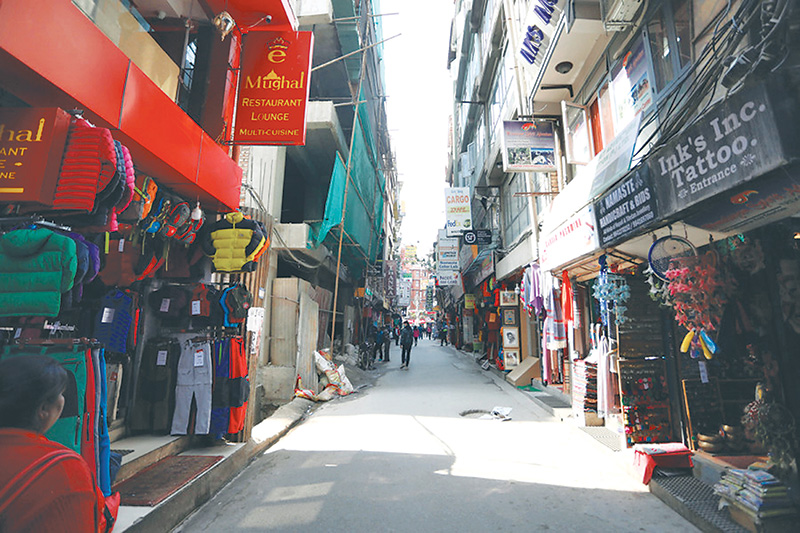
To survive in a much-changed market, many businesses in Thamel have been focusing on the domestic market. POST FILE PHOTO
Kathmandu, This time last year, Dom Himalaya Hotel, at Thamel, was bustling with people. In the mornings, the hotel’s restaurant had guests queuing up for the buffet breakfast, and throughout the day, there was a continuous flow of guests coming in and going out. Rooms at the hotel were selling at more than $70 per night and the daily occupancy was anywhere between 85 to 100 percent. But a year later, things are completely different. These days, except for a handful of guests, the hotel is eerily quiet. Even though rooms now sell for less than half the price a year ago, the hotel’s average occupancy is only around 30 percent. Dom Himalaya Hotel’s case is not an outlier in Thamel, Kathmandu’s tourist hub. Before the pandemic, 98 percent of the hotel’s clientele was foreigners. The same is the case with the majority of the businesses in the area, and with tourist arrivals hitting rock bottom, businesses have had to repurpose and adapt as they attempt to stay afloat amidst the biggest crisis businesses in the area have ever seen. The government opened the country for tourists from December 13, 2020, but there are quarantine restrictions and as such the flow of tourists is minimal. Last year saw the worst tourist arrivals in the country in 34 years. “When the government announced nationwide lockdown in March last year, many foreign tourists who were in Nepal got stuck in Kathmandu and couldn’t leave,” said Mandip Raj Giri, Dom Himalaya Hotel’s director. “Many of these foreign tourists ended up in Thamel staying at hotels like ours. The last of those guests left our hotel in June.” Giri knows he was one of the fortunate ones to still have some revenue coming in despite the nationwide lockdown. Like most businesses in the country, Black Olives Cafe, a multi-cuisine restaurant located in Thamel’s Chaksibari and catered primarily to foreigners, closed on March 23, 2020, the day before the nationwide lockdown. Even though many restaurants in different parts of Kathmandu had already started opening from September, Black Olives Cafe reopened only from November 2020. “We chose to remain closed because there were simply no foreigners in Thamel,” said Shankar Neupane, the restaurant’s owner. “Opening with no business only meant incurring operational costs.” But by November, when Neupane realised that the situation wasn’t going to get any better, he decided to open and do something his business had never done before—target the domestic market. The first thing Neupane did was to come up with a new menu, one that’s designed specifically for the domestic market and started promoting his restaurant on social media. To survive in a much-changed market, many businesses in Thamel have also been focusing on the domestic market. By October, many hotels in Thamel had already started offering their properties as quarantine facilities for Nepalis returning from abroad. One of the hotels to do so was Hotel Himalayan Suite. “We decided to offer our hotel for quarantine because we had to generate revenue in every way possible,” said Amrit Sapkota, the hotel’s director. In November, said Sapkota, he started offering rooms to people who have tested positive for Covid-19 and are looking for rooms to isolate. “We had to discontinue this service a few weeks later after our staff and neighbours raised safety concerns,” said Sapkota. Many hotels in Thamel are also now offering staycation packages to attract customers. Hotel Himalayan Suite has an ongoing staycation offer that includes room, breakfast with complimentary use of steam, sauna, and jacuzzi for two people at just Rs3,500. Dom Himalaya Hotel also has several packages designed specifically for the domestic market. “Our bed and breakfast package starts at just Rs2,500. And we have also slashed our in-house restaurant’s menu price by 50 percent. We are now seeing an average daily occupancy of 30 percent,” said Giri. “The aim is to be able to cover our operational costs and stay afloat until things get better.” But in the midst of a pandemic, attaining break even has been anything but easy for most businesses in the area. Ever since Black Olives Cafe reopened in November last year, business has been dismal. “Our daily sales used to be anywhere between Rs150,000 to Rs200,000 during peak tourist seasons, and during off-seasons, we used to make a minimum of Rs50,000 in daily sales,” said Neupane. “But now our daily average sales is around Rs10,000. What we make now is not even enough to pay our rent. We just make enough to pay our staff’s salary. We had 32 staff but now we only have five.” Negligible business and high operational costs are the reasons many businesses have continued to remain shut, said Neupane. “Many hotels in our locality haven’t opened for months because it just doesn’t make sense to remain open and incur more losses,” said Neupane. Sharing Neupane’s sentiment is Rajan Prasad Kadel, who runs a trekking gear shop in Thamel’s Satghumti. “To this day, around 30 percent of businesses in Thamel are still shut. Because when you open, your landlord starts asking you for rent, and rent in Thamel is really high, and in this business climate, it is next to impossible to fork out such exorbitant rent,” said Kadel. For years, Thamel’s high rent didn’t faze many businesses, says Kadel, because the area sees a lot of foreigners. “During peak trekking seasons, I used to make around Rs90,000 in daily sales,” said Kadel. “But things have changed completely. These days, making even Rs5,000 in daily sales is tough.” To attract more customers and generate revenue, Kadel says he has resorted to selling his merchandise at cost price. In November last year, Kadel started focusing on online sales. “We are still operating at a loss. What I make now is not even enough to pay rent,” said Kadel. To help businesses in Thamel stay afloat, Thamel Tourism Development Council’s (TTDC) vice-president Bhabishwor Sharma says that the council has been working with different stakeholders to promote Thamel as a destination for Nepalis to stay, dine, and shop. But selling Thamel—which has built its reputation as a tourist hub—as a destination to the domestic market, says business owners in the area, is going to be tough. “For years, the preferred destinations in Kathmandu for people visiting from other parts of Nepal have been Gongabu and Sundhara,” said Giri. “Convincing them to come and stay in Thamel instead isn’t going to be easy.” The same is with Thamel as a dining destination, says Neupane. “Because the majority of restaurants, barring a few, in the area have always catered to foreign tourists, Thamel has never been a go-to place for dining among Kathmandu residents,” said Neupane. But the council’s Sharma believes that one of the major reasons Nepalis avoid Thamel is because many think it is an expensive destination. “The truth is Thamel has everything from budget restaurants and hotels to high-end ones,” said Sharma. “And these days, many hotels and restaurants in Thamel are offering attractive discounts to Nepalis and people are beginning to stay and dine in Thamel.” The pandemic, says Giri, has given his business an opportunity to better understand the domestic market and its nuances. “This is the first time we are catering to the domestic market but the market has responded well to our attractive packages and so far this has helped us to pay our rent and the salaries of our limited staff,” said Giri. But for many businesses in Thamel, it isn’t the case. “Many businesses are doing what they can to tap the domestic market but are still operating at a loss,” said Kadel. “Given how things are going, the future looks very uncertain.”
MONEY
EU looks at vaccine certificates to help summer tourism
- ASSOCIATED PRESS
BRUSSELS, The European Union is looking at a common vaccine certificate to help get travellers to their vacation destinations and prevent tourism from suffering another disastrous year due to the coronavirus pandemic. European Commission President Ursula von der Leyen said the certificates for individuals who have been vaccinated could be combined with Covid-19 tests for those awaiting shots to allow as many people as possible to travel during the summer, which is vital for warm weather Mediterranean destinations like Greece, Italy and Spain. The issue will likely be discussed during a video meeting of EU leaders next week. Europeans have been concerned residents might be split into two camps—those with vaccine certificates permitting them to travel and others who remain limited in where they can go. But von der Leyen said such discrimination is unnecessary because “you can always combine either a certificate or a negative Covid test, if you did not have access to a vaccination so far.” “So there are possibilities to find a fair and equal balance,” she said during a visit to Portugal’s capital, Lisbon, on Friday. Nations that depend heavily on tourism are worried that a second consecutive summer holiday season impacted by the pandemic would hit their tourism industries even harder than the first one. Prime Minister Antonio Costa of Portugal, which holds the EU’s rotating presidency and has some of Europe’s most popular Atlantic beaches, said that “tourism is particularly important to our economies,” hence the need for the most unfettered travel possible.
MONEY
Pandemic-striken airlines face more turbulence before vaccine relief
- REUTERS
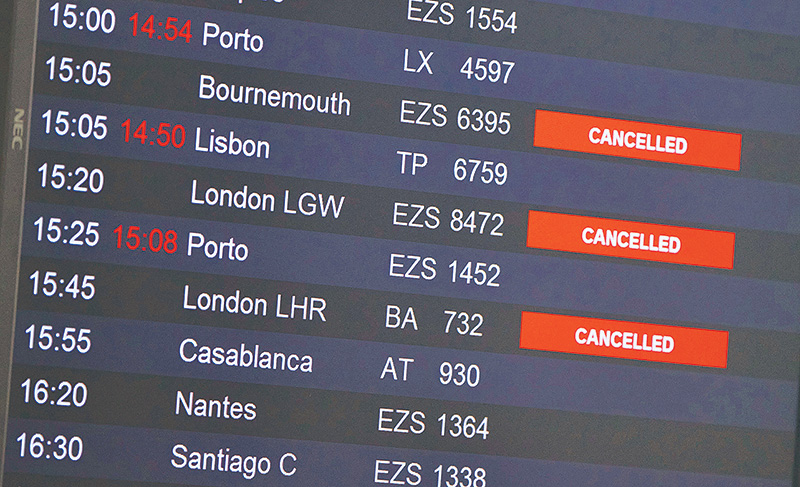
Flights from Britain are announced cancelled at Cointrin airport in Geneva, Switzerland. REUTERS
PARIS/LONDON, For a year expected to mark a turning point for pandemic-stricken European airlines, 2021 is off to a rough start. A resurgence of Covid-19 lockdowns has killed off a fragile bookings upturn, executives and analysts said, as insolvent Norwegian Air finally axed its long-haul operations on Thursday. The setbacks deal a blow to airline hopes that the promise of vaccines would put the worst of the crisis behind them, and set the stage for a summer rebound. New outbreaks and travel restrictions—some designed to curb the spread of a highly infectious virus variant detected in Britain—have hit forward bookings that are usually relied upon to bring in vital cash during the thin winter months. Global airline industry body IATA believes a return to positive cash flow “might not arrive before the end of the year,” Chief Economist Brian Pearce said. “Meanwhile the cash burn is going to continue” and may even in increase in Europe, Pearce told an online conference on Wednesday. Some carriers may yet run out of cash, he added. For bailed-out airlines like Air France-KLM and Lufthansa, a longer slump increases both debt and the likelihood more support will be needed. Europe faces the worst relapse—although hitherto buoyant Chinese and Russian domestic bookings have also been weakened by new restrictions. Intra-European bookings for the first half of the year stand at 22 percent of their level 12 months ago, Olivier Ponti of aviation data specialist ForwardKeys said. That compares with 36 percent for US domestic bookings and 48 percent for flights within China. Airlines have responded by cancelling yet more services. Ultra-low-cost carrier Wizz Air, which has been expanding its fleet and network during the crisis, is suspending most UK routes and sees January capacity down 75 percent. “The lockdown puts strains on demand, and we’re adjusting capacity according to demand,” Chief Executive Jozsef Varadi told Reuters. “It’s going to be a difficult quarter.” Data provider OAG, which tracks airline schedules, predicted “carnage in Europe” after airlines slashed western Europe capacity by a quarter. “A loss of some 1.5 million seats in a week is staggering,” analyst John Grant said. With another 580,000 dropped in eastern Europe, “expectations for the next few months are grim”. Recovery hopes have driven a share rebound for European airlines since the first vaccine breakthrough in November, before lockdown setbacks pared average gains to 30 percent, based on the Stoxx Europe airlines index. More bullish investors may be getting ahead of themselves, some analysts caution.
MONEY
Biden’s $1.9 trillion rescue package offers bridge for hard-hit economy
- REUTERS
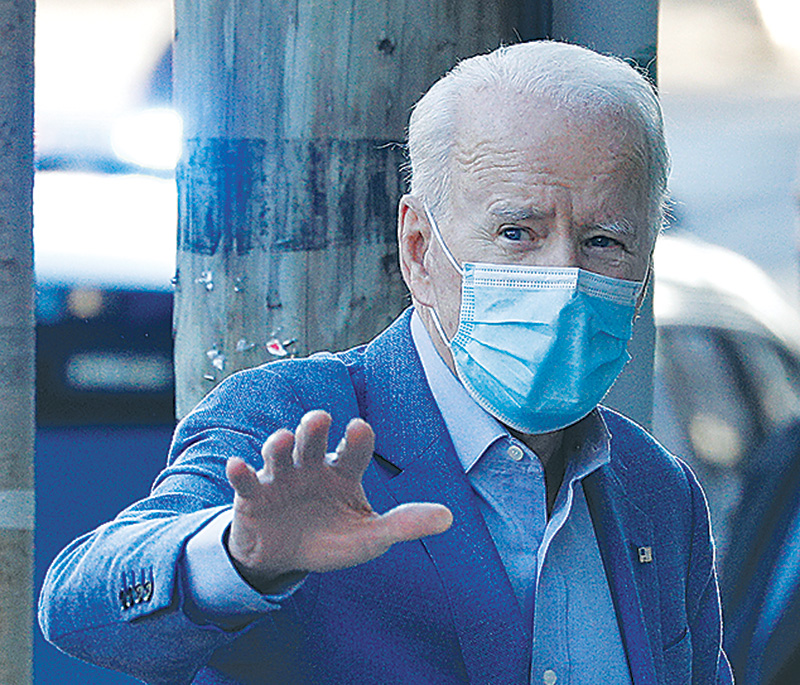
US President-elect Joe Biden. REUTERS
WASHINGTON, US President-elect Joe Biden’s proposal to pour $1.9 trillion into a hobbled economy could lay the foundation for a surge in jobs and spending that many economists say is needed to avoid long-term damage from a record-breaking pandemic recession. Analysts had already begun marking up their forecasts for economic growth this year after last week’s elections in Georgia delivered control of both houses of Congress to Democrats. Many, though, had pencilled in smaller packages, more along the lines of the $892 billion stimulus passed in December. Spending big on vaccine rollout, testing, and to shore up state and local governments on the frontlines of those efforts could help bring a swifter end to the country’s healthcare crisis, which remains at the root of the economic crisis. The incoming Democratic administration’s proposed package provides targeted aid that economists say delivers the most effective economic boost, including an increase to the current extra weekly benefit to the unemployed, to $400 from $300. It would also direct $170 billion toward reopening schools, the closure of which in many parts of the country has forced millions of workers, particularly women, to leave their jobs. And it would put an extra $1,400 into the hands of most Americans—money that can be spent on rent or food for those who need it, or saved for a splurge on travel or dining out later in the year once wider vaccine distribution allows everyday life to get back closer to normal. The new spending comes at a critical time for the world’s largest economy. A winter resurgence of Covid-19 sent a partially recovered labour market into reverse last month as employers shed 140,000 jobs, especially low-income positions in restaurants, bars and other high-touch service industries. All told the new package, which must still be voted on by Congress, would bring to $5.2 trillion the total fiscal stimulus delivered to the US economy since the crisis began, equivalent to about a quarter of US annual economic output.
MONEY
Costly food starves economic rebound in Turkey
- REUTERS
ISTANBUL, Food has become so expensive in Turkey that some people are spending what money they have to stock up on rice and pasta to avoid swallowing even higher prices in the months ahead. Parents have switched to discount baby biscuits, the cost of eggs has nearly doubled in a year, and a mock photo is circulating on Twitter in which a man on bended knee offers a woman a can of cooking oil instead of an engagement ring. “We are buying only the absolute necessary and cheapest brands out there. All food prices are rising but especially baby formulas,” said Huseyin Duran, 43, an Istanbul father of three and security guard receiving partial state pay for lost work. “I worry about my kids,” he said. “We can only meet our rent, groceries and loan payments.” In a world of near zero inflation and economic fallout from the coronavirus, Turkey stands out with annual consumer prices climbing to 15 percent, second only to Argentina among emerging markets and by far the highest in the OECD. Rising oil and fertilizer prices and dry weather are part of the reason food inflation jumped more than 20 percent in a year. But economists also point to government policy decisions which saw the lira dive to record lows last year, hiking import costs on some $9 billion in food. Turkish President Tayyip Erdogan has reluctantly accepted sharp interest rate hikes that will slow an economic rebound just as Covid-19 vaccines are rolling out. With surveys showing pantries are thinning out, Erdogan may need to do more about basic living costs even after installing a new central bank chief who in November pledged to tame inflation. One policymaker told Reuters the government expects inflation to be difficult in 2021 and must be monitored. Turkey is “mired in a painful stagflation” even amid coronavirus curfews and high borrowing costs, said Yesenn El-Radhi, senior sovereign analyst at Capital Intelligence Ratings.
WORLD
India begins mega-rollout of Covid-19 vaccine
First dose was administered to a sanitation worker at the All Indian Institute of Medical Sciences in the capital.
- ASSOCIATED PRESS
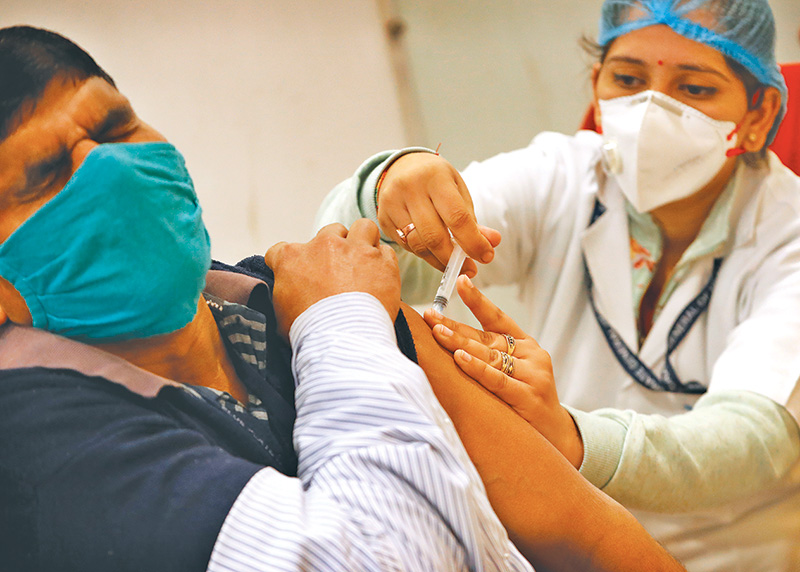
A health worker administers a Covid-19 vaccine to a person at a hospitalin New Delhi. India has started inoculating health workers in what is likely the world’s largest vaccination drive. ap/rss
New Delhi, India started inoculating health workers on Saturday in what is likely the world’s largest Covid-19 vaccination campaign, joining the ranks of wealthier nations where the effort is already well underway. India is home to the world’s largest vaccine makers and has one of the biggest immunization programs. But there is no playbook for the enormity of the current challenge. Indian authorities hope to give shots to 300 million people, roughly the population of the US and several times more than its existing program that targets 26 million infants. The recipients include 30 million doctors, nurses and other front-line workers, to be followed by 270 million people who are either over 50 years old or have illnesses that make them vulnerable to Covid-19. For workers who have pulled India’s battered healthcare system through the pandemic, the shots offered confidence that life can start returning to normal. Many burst with pride. “I am excited that I am among the first to get the vaccine,” Gita Devi, a nurse, said as she lifted her left sleeve to receive the shot. “I am happy to get an India-made vaccine and that we do not have to depend on others for it,” said Devi, who has treated patients throughout the pandemic in a hospital in Lucknow, the capital of Uttar Pradesh state in India’s heartland. The first dose was administered to a sanitation worker at the All Indian Institute of Medical Sciences in the capital. New Delhi, after Prime Minister Narendra Modi kickstarted the campaign with a nationally televised speech. “We are launching the world’s biggest vaccination drive and it shows the world our capability,” Modi said. He implored citizens to keep their guard up and not to believe any “rumors about the safety of the vaccines.” It was not clear whether Modi, 70, had taken the vaccine himself like other world leaders as an example of the shot’s safety. His government has said politicians will not be considered priority groups in the first phase of the rollout. Health officials haven’t specified what percentage of India’s nearly 1.4 billion people will be targeted by the campaign. But experts say it will almost certainly be the largest such drive globally. The sheer scale has its obstacles. For instance, India plans to rely heavily on a digital platform to track the shipment and delivery of vaccines. But public health experts point out that the internet remains patchy in large parts of the country, with some remote villages entirely unconnected. Around 100 people were to be vaccinated in each of the 3,006 centers across the country on the first day, the Health Ministry said. News cameras captured the injections across hundreds of hospitals, underscoring the pent-up hopes that vaccination was the first step in getting past the pandemic that has devastated the lives of so many Indians and bruised the country’s economy. India on Jan. 4 approved emergency use of two vaccines, one developed by Oxford University and U.K.-based drugmaker AstraZeneca, and another by Indian company Bharat Biotech. Cargo planes flew 16.5 million shots to different Indian cities last week. But doubts over the effectiveness of the homegrown vaccine is creating hurdles for the ambitious plan. Health experts worry that the regulatory shortcut taken to approve the Bharat Biotech vaccine without waiting for concrete data that would show its efficacy in preventing illness from the coronavirus could amplify vaccine hesitancy. At least one state health minister has opposed its use. In New Delhi, doctors at Ram Manohar Lohia Hospital, one of the largest in the city, demanded they be administered the AstraZeneca vaccine instead of the one developed by Bharat Biotech. A doctors union at the hospital said many of its members were a “bit apprehensive about the lack of complete trial” for the homegrown vaccine. “Right now, we don’t have the option to chose between the vaccines,” said Dr Nirmalaya Mohapatra, vice president of the hospital’s Resident Doctors Association. India’s Health Ministry has bristled at the criticism and says the vaccines are safe, but maintains that health workers will have no choice in deciding which vaccine they will get themselves. According to Dr SP Kalantri, the director of a rural hospital in Maharashtra, India’s worst-hit state, such an approach was worrying because he said the regulatory approval was hasty and not backed by science. “In a hurry to be populist, the government (is) taking decisions that might not be in the best interest of the common man,” Kalantri said. Against the backdrop of the rising global Covid-19 death toll—it topped 2 million on Friday—the clock is ticking to vaccinate as many people as possible. But the campaign has been uneven. In wealthy countries including the United States, Britain, Israel, Canada and Germany, millions of citizens have already been given some measure of protection with at least one dose of vaccines developed with revolutionary speed and quickly authorized for use. But elsewhere, immunisation drives have barely gotten off the ground. Many experts are predicting another year of loss and hardship in places such as Iran, India, Mexico and Brazil, which together account for about a quarter of the world’s Covid-19 deaths.
WORLD
China says latest Covid-19 outbreak caused by imported cases
- REUTERS
SHANGHAI: China’s recent Covid-19 outbreaks in the northeast have come from travelers entering the country or contaminated frozen food imports, the National Health Commission said on Saturday. NHC Minister Ma Xiaowei made the comments at a government meeting, where he also said the virus was spreading to rural areas and that the handling of the recent situation had exposed how prevention and control measures had been relaxed. “Since Dec. 2020, epidemic clusters have occurred in Beijing, Sichuan, Liaoning, Hebei and Heilongjiang,” a statement posted on the NHC’s website said citing the briefing by Ma. “They mainly have the following characteristics. Firstly, they are all imported from abroad, caused by travelers from overseas, or contaminated cold-chain imported items.” Total case numbers remain well below what China saw at the height of the outbreak, but concerns about a new wave are growing with the Lunar New Year a month away. This surge comes as a WHO-led team of investigators are in quarantine in the city of Wuhan, where the disease was first detected.
WORLD
Damaged roads, lack of gear hinder Indonesia quake rescue efforts
- ASSOCIATED PRESS
Mamuju, Damaged roads and bridges, power blackouts and lack of heavy equipment on Saturday hampered rescuers after a strong earthquake left at least 46 people dead and hundreds injured on Indonesia’s Sulawesi island. Operations were focused on about eight locations in the hardest-hit city of Mamuju, where people were still believed trapped following early Friday’s magnitude 6.2 quake, said Saidar Rahmanjaya, who heads the local search and rescue agency. Cargo planes carrying food, tents, blankets and other supplies from Jakarta landed late Friday for distribution in temporary shelters. Still, thousands of people spent the night in the open fearing aftershocks and a possible tsunami. National Disaster Mitigation Agency spokesperson Raditya Jati said rescuers had so far recovered the bodies of 37 victims in Mamuju and nine in neighboring Majene district. At least 415 houses in Majene were damaged and about 15,000 people were moved to shelters, Jati said. Bodies retrieved by rescuers were sent to a police hospital for identification by relatives, said West Sulawesi police spokesperson Syamsu Ridwan. He said more than 200 people were receiving treatment in the Bhayangkara police hospital and several others in Mamuju alone. Another 630 were injured in Majene. Among those pulled alive was a young girl who was stuck in the wreckage of a house with her sister. The girl was seen in video released by the disaster agency Friday crying for help. She was being treated in a hospital. She identified herself as Angel and said that her sister, Catherine, who did not appear in the video, was beside her under the rubble and was still breathing. The fate of Catherine and her other family members was unclear, officials said. The quake set off landslides in three locations and blocked a main road connecting Mamuju to Majene. Power and phone lines were down in many areas.
WORLD
Pandemic reduced migrants by 2 million
- ASSOCIATED PRESS
United Nations, A new UN report estimates that the Covid-19 pandemic reduced the number of international migrants by 2 million by the middle of 2020 because of border closings and a halt to travel worldwide—an estimated 27 percent decrease in expected growth. Clare Menozzi, principal author of the report by the UN Department of Economic and Social Affairs’ Population Division, told a news conference Friday that for the second half of 2020 “we have a sense that it will be probably comparable, if not more so.” She said international migration had been projected to grow by 7 to 8 million between mid-2019 and mid-2020. But the border closures and travel clampdown starting in March, as the pandemic circled the globe, meant zero growth for four months, and an estimated 2 million reduction in the expected number of international migrants, Menozzi said. By August 2020, Population Division Director John Wilmoth noted, “there had been more than 80,000 travel restrictions imposed by 219 countries or territories across the world.” Over the last two decades, growth in the number of international migrants has been robust. Wilmoth said that according to the latest estimates, “the number of international migrants worldwide reached 281 million persons in 2020, up from 173 million in 2000,” They account for just 3.6 percent of the total global population, he said. Liu Zhenmin, undersecretary-general for economic and social affairs, said, “The report affirms that migration is a part of today’s globalised world and shows how the Covid-19 pandemic has impacted the livelihoods of millions of migrants and their families” and undermined progress on achieving UN development goals for 2030. The economic fallout from the pandemic is expected to reduce remittances from people working abroad to low- and middle-income countries from $548 billion in 2019 to $470 billion in 2021, according to projections by the World Bank. Wilmoth said the data confirmed that nearly two-thirds of all international migrants were living in high-income countries. According to the report, the United States continued to top the destination list with 51 million international migrants in 2020, representing 18 percent of the global total. Germany was second, hosting around 16 million international migrants, followed by Saudi Arabia with 13 million, Russia with 12 million and the United Kingdom with 9 million, it said. India topped the list of countries with the largest diasporas in 2020, with 18 million Indians living abroad, followed by Mexico and Russia, each with 11 million outside the country, China with 10 million, and Syria with 8 million, the report said. In 2020, it said, women and girls comprised 48 percent of all international migrants, and refugees accounted for 12 percent of international migrants, up from 9.5 percent in 2000.
WORLD
President Trump to leave town early on Wednesday before Biden inauguration
- AGENCE FRANCE-PRESSE
Washington, By the time Joe Biden is sworn in as the 46th US president Wednesday, his scandal-tainted predecessor Donald Trump will already be far away, having helicoptered out of the White House a last time earlier that morning, an official said on Friday. Trump will be the first president in a century and a half to snub the inauguration of his successor. An official who asked not to be identified said Trump would go to his Mar-a-Lago golf club in Florida, which is his legal residence and will become home after the White House. He is expected to be out of town well before Biden is sworn in on the steps of the Capitol building at exactly noon. After spending more than two months trying to overturn the results of the November election, pushing false conspiracy theories about fraud, Trump’s presence had not been expected at the inauguration. The final straw came on January 6 when Trump gathered a huge crowd of supporters on the National Mall and once more claimed that they had to fight to stop a fraudulent election. A mob then stormed Congress, halting proceedings underway to certify Biden’s win. For longer than anyone can remember, outgoing presidents have stood by their replacement on the Capitol steps, watching them take the oath — and in so doing showing visible support for the peaceful transfer of power. Trump, who was impeached for a record second time in the wake of the Congress storming, has also broken with more discreet protocol by refusing to invite Biden and his wife Jill Biden to the White House for a traditional cup of tea in the Oval Office. On Friday, Vice President Mike Pence did make the gesture of telephoning his incoming counterpart Kamala Harris, a source said. Although this came only five days before inauguration day—and more than two months after the election—- The New York Times said Pence offered his congratulations and belated assistance to Harris.” Trump’s extraordinary exit adds to the nervous atmosphere around an inauguration that was already set to be like no other. In the wake of the Congress attack, thousands of National Guard troops have taken up position around central Washington. And even before the security nightmare, organizers had been forced by Covid-19 safety measures to nix the traditional big crowds and long guest lists. For Biden, the subdued ceremonies will quickly be followed by a mammoth To Do list. His administration faces multiple crises on day one, including the stumbling national Covid vaccination project, a precarious economic recovery and Trump’s looming impeachment trial in the Senate. At the same time, Biden will have to cajole the Senate into rapidly confirming his cabinet appointees, allowing him to form a government and bring stability back to the country. Incoming White House press secretary Jen Psaki told reporters on Friday that the Senate is fully capable of juggling the impeachment trial along with the urgent confirmations. “The Senate can do its constitutional duty while continuing to conduct the business of the people,” she said. “Our expectation and hope and belief is that we need to walk and chew gum at the same time.”
WORLD
Myanmar police scuffle with nationalist monk’s followers
Briefing
- AGENCIES
YANGON: Myanmar police scuffled on Saturday with dozens of followers of Buddhist nationalist monk Ashin Wirathu at a demonstration calling for him to be put on trial more than two months after he handed himself in to face sedition charges. Protesters, many of them monks, gathered outside the Insein Prison in Myanmar’s main city of Yangon, where Wirathu has been held since November last year. Police said they had not set out to break the protest up but had been provoked and has arrested one protester. “We were trying to negotiate and that man talked back rudely and started fighting,” Tin Latt, the head of Insein police station, told Reuters by phone.
WORLD
Iran fires long-range missiles into Indian Ocean
Briefing
- AGENCIES
DUBAI:Iran’s Revolutionary Guards on Saturday fired long-range ballistic missiles into the Indian Ocean on the second day of a military exercise, state media reported. The drill, which comes in the waning days of high tensions with US President Donald Trump’s administration, was conducted in the country’s central desert region. It followed Friday’s testing of surface-to-surface ballistic missiles and locally manufactured new drones in the same area. “One of our most important defence policy goals is to use long-range ballistic missiles against enemy warships, including aircraft carriers and warships,” state media quoted Guards commander Hossein Salami as saying.
WORLD
Laschet becomes leader of Merkel’s CDU party
Briefing
- AGENCIES
BERLIN: Germany’s Christian Democrats elected Armin Laschet as chairman on Saturday, aiming to unify their divided party behind a new leader who they hope can succeed Angela Merkel as chancellor when she steps down after federal elections in September. Laschet, the premier of the western state of North Rhine-Westphalia-Germany’s most populous—won a runoff vote against Friedrich Merz, securing 521 votes against 466 for his arch-conservative rival, according to a ballot of 1,001 party delegates. At the helm of the CDU, he replaces Europe’s predominant politician.
SPORTS
APF off to flying start in PM Cup
The departmental side set a target of 244, and in reply bowled out Province 1 for 108.
- Sports Bureau
Abinash Bohara scalped five wickets to help APF beat Province 1 by 135 runs on Saturday . POST PHOTO: Hemanta Shrestha
KATHMANDU, Nepal Armed Police Force Club made a flying start to their Prime Minister Cup National one-day cricket tournament campaign with a 135-run win over Province 1 at the TU cricket grounds in Kirtipur on Saturday. Put to bat first, the departmental team scored 243 runs in 48.4 overs losing all the wickets. In reply they bowled out Province 1 for 108 runs in 42.4 overs. Opener Asif Sheikh contributed the highest 59 runs for APF while national player Basanta Regmi scored 40 runs. Sundeep Jora was another major contributor for the departmental side scoring 30 runs. APF made a solid start to their innings as openers Subash Khakurel and Sheikh played a 71-run partnership for the first wicket. The 20-year-old Sheikh played a quickfire 59 off 32 runs before he was caught by Josak Khadka off Dipesh Kandel. He cracked six fences and five sixes. APF lost the next three batsmen cheaply—captain Sharad Vesawkar for 20 runs, Pradeep Airee for seven runs and Sumit Maharjan for 14 runs—as they were left to struggle at 126-5. But Jora and Regmi played a 66-run partnership for the sixth wicket to lift the innings. Regmi, the next batsman to fall, hit four boundaries and two sixes in his 52-ball knock. He was caught by wicketkeeper Rajan Magar in the 39th over. Jora returned to the pavilion in the following over scoring 30 off 39. He hit four boundaries before being caught by Khadka off Sarwan Yadav. APF lost Bhuvan Karki and Kamal Airee in quick succession with seven and five runs under their belt respectively. Kishore Mahato contributed 19 runs while Abinash Bohara remained unbeaten on six runs. Province 1 bowlers Firdosh Ansari, Dipesh Kandel, Hemant Rai and Sarwan Yadav grabbed two wickets apiece. The provincial team’s run chase never took off as they lost wickets at a regular interval. Openers Deepak Paswan and Minash Thapa, Ansari, Kandel and Khadka were the only batsmen to touch double figures. Opener Thapa was the highest scorer with 18 runs under his belt. Paswan scored 13 runs while Ansari contributed 17 runs. Tailender duo Kandel and Khadka scored 16 and unbeaten 12 runs respectively. APF’s Abinash Bohara was the most successful bowler with five wickets in his kitty. The man-of-the-match conceded 18 runs in his 10-over spell with six maiden overs. Spinner Regmi grabbed two wickets. He gave away 15 runs in his 10 over bowling with three maiden overs. There will be two matches on Sunday with Nepal Police Club taking on Bagmati Province at the TU grounds while Army will vie with Karnali Province at the Mulpani grounds.
SPORTS
Rain frustrates Australia on day two in Brisbane
- REUTERS
BRISBANE, A heavy downpour frustrated Australia on day two of the fourth Test decider in Brisbane on Saturday, with play abandoned after tea and India spared from resuming on 62 for two in reply to the home side’s first innings 369. India number three Cheteshwar Pujara was eight not out, with stand-in captain Ajinkya Rahane on two at the teabreak before a storm broke over the Gabba. With more rain forecast over the remaining days, Australia may have little time to bowl India out twice and seal the series 2-1. Home captain Tim Paine betrayed his displeasure in an animated discussion with the field umpires after they inspected the field and called off proceedings. “No doubt disappointing to the spectators,” Australia assistant coach Andrew McDonald told reporters. “It would have been nice to get some play there...but the decision was made by the officials and that’s their role.” India will have been more than happy to turn in early. The tourists only need to draw the Test to retain the Border-Gavaskar Trophy, two years after their breakthrough 2-1 series win in Australia in 2018/19. To emerge with a tied series would be a massive achievement for Rahane’s side, which has battled a mounting injury toll throughout and lacked a single first-choice bowler to call on in Brisbane. They are already a man down in their pace attack, with Naveep Saini having suffered a groin injury on day one. Australia, thwarted by India’s wounded batsmen in the drawn Test in Sydney, are likely to ponder another lost opportunity on day two, having resumed in the morning on 274 for five. Paine (50) and all-rounder Cameron Green (47) were in good shape to help set a platform for a much bigger total but surrendered in a collapse when three wickets fell in four runs. Paine was caught in the slips by Rohit Sharma off paceman Shardur Thakur, with Green following after being bowled by all-rounder Washington Sundar, one of two Test debutants in the Indian side. Pat Cummins (2) became the third victim when trapped lbw by Thakur. Playing his 100th Test, Lyon soaked up the acclaim of the home crowd, pushing Australia past 350 before he was bowled by Sundar for 24 off 22 balls. Starc chipped in a valuable unbeaten 20 before paceman T Natarajan (3-78), the second of India’s Test debutants but the pick of their bowlers, wrapped up the innings by bowling Josh Hazlewood for 11. India’s reply began shakily after lunch, with the relentless Pat Cummins having opener Shubman Gill caught in the slips for seven. Rohit and Pujara built a 49-run partnership before the former threw away his wicket for 44 when he attacked Lyon and top-edged to Starc at long-on. Rahane and Pujara then took no chances, adding only two runs to India’s total in six overs to tea before the rain came. “I thought we stuck to our plans,” said Rohit. “If we bat well tomorrow, you never know, anything can happen.”
SPORTS
Rooney calls time on playing career, becomes Derby boss
- AGENCE FRANCE-PRESSE
Rooney had been interim manager at Derby since Phillip Cocu was sacked in November. reuters
LONDON, Wayne Rooney’s incredible success as Manchester United and England’s record goalscorer should provide a sturdy foundation as the iconic striker takes his first managerial role with Derby. Rooney’s remarkable achievements on the pitch have given him an education money cannot buy. Now the 35-year-old must transfer his wealth of experience into rescuing Championship strugglers Derby from the threat of relegation to League One. The early signs are encouraging as Rooney, who was officially confirmed as permanent boss on Friday, oversaw three wins and four draws from nine matches as interim boss. Having announced his retirement as a player at the same time his appointment was revealed, Rooney can focus solely on the latest intriguing step in an always eventful career. “It’s a new chapter for me. Of course I’ll miss playing but time doesn’t suffer no man. I’ve had my time,” Rooney said. “Standing on the touchline during a game or when you put a plan in place, which the players execute, it’s a completely different buzz.” Rooney fulfilled a childhood dream by breaking through the ranks at Everton. He quickly earned a reputation as the most talented teenager in English football, announcing his arrival with a sensational strike to beat then-champions Arsenal five days before his 17th birthday. International recognition soon followed and when Rooney scored four times in the group stages of Euro 2004, England had a new national hero. But the teenager limped off midway through the first half of the quarter-final loss to Portugal after suffering a broken bone in his foot. Without him, England suffered another heartbreaking exit on penalties and, rather than acting as a springboard, that was as close as Rooney ever came to winning an international tournament. His performances helped earn him seal a £27 million ($37 million) move to Manchester United weeks later. Rooney soon started paying that fee back, scoring a hat-trick on debut in the Champions League against Fenerbahce. It took until his third season at the Old Trafford to win the Premier League, by which point Rooney had struck up a deadly partnership with Cristiano Ronaldo. Together, Rooney and Ronaldo won three consecutive Premier League titles, the Champions League in 2008. Rooney’s most prolific seasons came once Ronaldo departed, scoring 34 goals in both 2009/10 and 2011/12. He also won two more league titles and reached the Champions League final again, only for United to be outclassed once more by Barca in 2011 despite a Rooney goal in the final at the Wembley. Despite becoming his country’s all-time top scorer, inopportune injuries often prevented Rooney carrying his club form into international tournaments. Rooney’s solitary World Cup goal could not prevent England’s elimination in Brazil 2014 after just two of their three group games and the last of his 53 England goals came from the penalty spot in a humiliating Euro 2016 exit to Iceland. He retired from international football a year later, shortly after sealing a return to his beloved Everton, but only after also surpassing Charlton as United’s top scorer with 253 goals in a 13-year career. His Goodison return did not prove the fairytale ending Rooney had hoped for. On the pitch, Everton’s struggles saw Ronald Koeman sacked just two months into the campaign and Rooney’s playing time was limited under Sam Allardyce before a brief sojourn in America with DC United. Rooney joined Derby as a player-coach last January before succeeding sacked by Phillip Cocu. Now he will aim to prove the second act of his football life can be as successful as his first.
SPORTS
West Brom sink Wolves to give new boss Allardyce first win
Briefing
- AGENCIES
WOLVERHAMPTON: West Bromwich Albion won for the first time under new boss Sam Allardyce as Matheus Pereira’s penalty double clinched a 3-2 Premier League victory at local rivals Wolves on Saturday. Allardyce had failed to win any of his first five matches since replacing the sacked Slaven Bilic. But the former England manager was finally able to celebrate after a pulsating Black Country derby at Molineux. Pereira put Albion ahead from the spot before goals from Fabio Silva and Willy Boly put Wolves in the driving seat at half-time. Semi Ajayi equalised after the interval and Pereira’s second penalty sealed West Brom’s first win in eight league games.
SPORTS
Sri Lanka fight back after Joe Root’s double century
Briefing
- AGENCIES
GALLE: England captain Joe Root scored a double-century, but Sri Lanka began a spirited fight-back to close day three of the first Test in Galle on 156 for two in their second innings, trailing the visitors by 130 runs. Opener Lahiru Thirimanne anchored the Sri Lanka innings with an unbeaten 76 and will resume on Sunday morning with Lasith Embuldeniya, who has yet to score as they chase down England’s first innings total of 421. Kusal Perera (62) was the first wicket to fall, before out-of-form Kusal Mendis caught by wicketkeeper Jos Buttler for 15. It was a memorable day for Root as he brought up his fourth Test double-ton with a score of 228. He was the last man out, caught on the mid-on boundary off spinner Dilruwan Perera (4-109). England resumed the third morning on 320 for four as Root and Buttler (30) scored 52 runs in quick time. Seamer Asitha Fernando (2-44) removed Buttler and Curran in successive balls, before Dom Bess was run out in a mix-up with Root as the visitors lost three wickets for 10 runs. Perera then removed the final three batsmen as the home side picked up six wickets for 101 more runs in the morning session.
SPORTS
Lazio thrash Roma 3-0
Briefing
- AGENCIES
ROME: Two goals from Luis Alberto helped Lazio earn a 3-0 victory over third-placed AS Roma in the city derby on Friday. Lazio made a lightning start and went ahead after 14 minutes, with Ciro Immobile capitalising on a woeful error from Roger Ibanez to score his 12th league goal of the season. Roma looked stunned as Lazio kept committing plenty of players forward, and the pressure told as Luis Alberto swept home a well-taken second in the 23rd to double the advantage. Luis Alberto’s second put the game to bed in the 67th minute.
MEDLEY
Horoscope
ARIES (March 21-April 19) **** Someone you know fairly well is giving off a new vibe, and you wouldn’t be out of bounds if you considered it romantic! If the idea of taking this relationship into a new realm appeals to you, then make sure you encourage the way things are going.
TAURUS (April 20-May 20) *** Your confidence is at an all-time high right now, but don’t be too righteous about how you know what is right and no one else does. People don’t like preachers, and the last thing you want is for someone to think that you assume you know it all.
GEMINI (May 21-June 21) **** Your ego may have been beaten up a bit lately, but it will survive. Give it the first aid it needs and then get moving. To help yourself shift back into the action of normal life today, call up a friend and see what’s going on in their life.
CANCER (June 22-July 22) *** When you’re making a list of all the good deeds you’re going to do, be sure to toss in one or two selfish acts too! Treat yourself to a favourite food or buy yourself a little gadget you’ve wanted for a while. The people in your life will heartily approve.
LEO (July 23-August 22) *** Everyone makes mistakes, and you’re now ready to forgive someone who has wronged you. This phase will continue for a while, enabling you to stay calm if someone steals your parking spot and just let it go if someone says something thoughtless.
VIRGO (August 23-September 22) **** If you’re feeling stressed, turn to your imagination for a lifeline. Just close your eyes, take a deep breath, and pretend that you’re a leaf drifting along a lazy stream on a sunny day. Relax and just go with the flow. Don’t worry about where you end up.
LIBRA (September 23-October 22) *** If your ex just came back on the scene, your heart could be in a state of confusion. You need to be careful. Give yourself time to get used to them being back in your life, and don’t try to rebuild anything between you.
SCORPIO (October 23-November 21) *** If you find yourself in a dead end, you probably got there because you were led along by others. You need to be in control of where you go in your life. Your preferences and goals, not the wishes of others, should dictate what you do.
SAGITTARIUS (November 22-December 21) *** Exploring isn’t wise today. Save the risky business for a day when you really need a new experience to get your blood pumping. Doing something new just for the sake of it is a waste of your time now. Be smart.
CAPRICORN (December 22-January 19) **** There is a big disconnect between what people are saying and what they’re doing now. But don’t make a big deal about it. After all, when you point a finger at someone else, there are four more fingers pointing back at you.
AQUARIUS (January 20-February 18) *** If you’re working as a member of a group, let caution be your guide. You’re very community oriented and ready to collaborate, but that isn’t the case with everyone. Some people will be tossing out obstacle after obstacle to keep the group from moving forward.
PISCES (February 19-March 20) *** The universe is about to unload some serious good luck on you, but you won’t know you have it until it hits. Instead of running right out and buying a thousand lottery tickets, just wait. Before the end of the day you could be given a golden opportunity.
THE BLACKBOARD
Time to sanitise our thinking
In our present Nepali society, stereotypes have created an intimidating, hostile and humiliating environment for survivors of abuse.
- Prakriti lama
SHUTTERSTOCK
Girls and women, raise your voice against any form of abuse.” Every time I hear someone say this, a question pops in my mind: Will our hostile society ever let them to do so? In our present Nepali society, myths and stereotypes have created an intimidating, hostile and humiliating environment for survivors of abuse. In the long-term, the suffering of silence is not limited to a victim but to a whole society, as it slowly detaches humanity from humans. One (spectator or listener) who contemplates and knows about wrongdoings and yet chooses to remain silent makes the victim suffer more torment and the perpetrator to believe social disgrace like harassing is acceptable. But is it? Are you part of it too? If yes, then it’s high time to sanitise your thinking followed by action. To the ones who belittle such issues: Have you ever processed in your brain before commenting/posting abusive remarks on social media and thought for a sec about the trauma one goes through because of such sensitive misconduct? The toll on a person’s well-being. Be it physical, cognitive or mental. Your conservative thoughts are not acceptable for even a second anywhere. You carry out such misconduct in the public places where all eyes are on you then what can we expect from you to do in behind the closed doors? The soaring and alarming cases of domestic violence depicts the reality of our developing country. It has been reported that one in every three women suffer different forms of violence in her lifetime. Almost 66 percent cases of sexual violence to abuse goes unreported. And 90 percent out of reported cases are concealed, in the name of saving social prestige, which shows how we are subtly encouraging ill deeds. How miserable! One should get the facts straight that it isn’t the darkness of the night that concerns women and girls but it’s the darkness embedded deep inside the character, morals and indecent behaviour of perpetrators which do. Even the workplace is no exception, Amidst all these, one in five women report fear losing the job or occupation they are in because of the narrow mindset of society. As they have built the raging courage to speak and aware us about such pathetic individuals. Can’t we build courage to support them at least? A wave of change on our confined mentality and dissemination of support to the sufferer of such abuse is what we need now. Let’s be humans in the real sense by creating an environment where concealed stories will be divulged one after another, where the situation of victims will be understood as we uproot misconceptions from our mind. A place where there will be no space for ignorance, tolerance nor endurance, where brushing off and belittling the issue which tends to harm individual dignity and self respect are discouraged. There should be more strength and power to each woman who speaks out and takes a firm stand—for being the epitome of change, strength and courage. It’s never too late to express your opinions. Subsequently, influencing other women to speak up, whose voices are subdued, is a fundamental change for good. We as individuals do have the responsibility and that is by standing along with voice raisers. Let our voice be raised for empowering uplifting and encouraging others. We need to stigmatise the perpetrator and should not let them play the politics of re-victimisation. Together we need to cease all forms of assault and for that creating a wholesome environment in the home and workplace are prerequisites. It makes the difference and it starts with you. Change for a better environment and world starts with one individual but it can be achieved with the cooperative effort of everyone.
Lama is a class 12 student at Kathmandu Model College, Kathmandu.
THE BLACKBOARD
Memories
- Anupa Khanal
SHUTTERSTOCK
As the tiny little droplets touched her soul, The memories regained their life, The memories that she had stranded, Found her way back to her—the only place they belonged.
Maybe he wasn’t meant to be hers, Maybe she couldn’t get what she wished for, They parted ways but the time never stopped, And neither did they,
But it is all she is left with, The memories of ‘them’, ‘He’ and ‘she’ are completely different subjects now, Who once shared a common name.
The short meeting in the journey called life, Left her with memories and taught her, Sometimes parting ways is necessary, For she would have not found her love for solitude!
Khanal is an A-Levels student at Budhanilkantha School, Kathmandu.
FICTION PARK
Maiya
The ignition lures me in a trice. As I see the burning flame, I experience a sentiment of profound pleasure.
- Sayujya Raj Ghimire
SHUTTERSTOCK
I lie in my bed, quietly. The herringbone parquet floor makes me feel jittery as my mind becomes caged with baffling thoughts as though I am trapped inside a casket. I see numerous wooden blocks placed on the floor in perfect order… in a pattern that resembles a puissant gesture, the gesticulation of two palms joining in unison. The floor greets me in euphoria, but surprisingly it drags me into an abyss. I try to stand on my feet, but my legs become a feast for the exquisite woodwork. My trembling feet make me a mortal marionette as I become blind to my ghoulish being. With a drunken gait, I reach my table and gasp for air. I cannot fathom why a short, five-meter stroll causes me to pant, but I sense something fishy about myself. I see numerous crumpled plastic bottles, all empty, lying haphazardly on the table. This time, on the spur of the moment, my laboured breathing slowly metamorphoses into an intense desire to quench my unforeseen thirst. As I reach the peak of my disoriented state, my neck begins to experience a colicky pain. I cannot find water to help my burning throat, but my eyes find something spooky that lay in between those crushed water flasks. I recognise the object immediately. I see a small paper box containing minute wooden sticks, proximally coated with a black combustible powder that burns by abiding the frictional law. A spare matchbox? I mumble and eye the box incessantly. A sudden desire to ignite the matchstick devours me as I steadily lift the box. I may try to defend myself by giving a preposterous alibi, even though it fails to deviate my activity from being demonic. I slowly begin to acknowledge my growing fondness for the matchstick. In extreme furore, I give a to and fro stroke on an inscribed mosaic layout with my sickly hand. The ignition lures me in a trice. As I see the burning flame, I experience a sentiment of profound pleasure. I no longer fight for breath, nor do I crave for water. As I look deeper into the combustion, the fire quenches my undying thirst and heals me completely. But the first ignition snuffs out anon. With the dying flame, my body again starts experiencing excruciating pain. I have no other option than to light another matchstick and pacify myself. Now that I come to my senses after freeing myself from all the cooped up ideologies, I realise a blood-curdling fact about myself and my uncanny obsession with fire. All I see now is my emotion binding itself with the perilous flame, and my sentiment taking a path of horror and havoc.
I won’t call myself a pious man. As a matter of fact, there is nothing pious about me. I don’t even pray to God with all my heart, but my wife insists on me. She is a lovely lady with raving beauty as if God himself embellished her with miraculous qualities. I dote on her, without even letting her know, hoping that she would clandestinely deluge me with her unending ardency. I like her chops and countenance. Almost every day, I revere her with soothing remarks and tell her how beautifully she flaunts her organic charisma. She is a woman of peculiar dynamism. Having an unambiguous Lilliputian stature of not more than four feet ten, she is characteristic of her fair skin tone. But today, as I wake up from my slumber, I call her name in despair. I shout, “Maiya, eh maiya!!” as I struggle to lift the latch, unable to open the door. I keep on igniting the matchstick, even though the reason behind my eerie, seesaw hand strokes is obscure. Whenever I get the taste of that fiery warmth, I soak myself with a superhuman emotion. I repeatedly shout, “Maiya, eh maiya!!” But I get a laconic reply, not with actual syllables, but with an idiosyncratic aroma coming from outside the door. As I use my fist to bang the door continually, the nut disjunctions from the bolt and resonates with a creaking sound. Putting an end to my curiosity, I open the door and scan the façade discreetly. I see her. I see my maiya. But what I don’t comprehend is the paradox she holds. I can undoubtedly describe how she blushes whenever I admire her. But today, she looks different. As I see her sleep in tranquillity, I cannot discern the fact of her adorning herself with a tattered nightgown covering her newfangled dark skin tone. I just eye her continuously. To be honest, I am a man of passion. But unbeknownst to me, it leads me somewhere into a different dimension. This passion, which is merely a composite of vacant thoughts, favourably creates a whirlpool of manic desires. I always fancied maiya’s velvety hair and lusty gaze, even when she was not around and have always thought of delving into the zenith of her charm through my passion. As I eye her in utter dismay, I compare her body with fire, her curves with the exotic curves of the flame, and I no longer see her unruffled hair. I stand there alone; all by myself, with my maiya’s long gone grace. I once again take out a wooden stick from the box and give a stroke, persistently, to take hold of something devilish I put myself into. I see her flaunting herself in a pugilistic attitude as my passion comes to a standstill. She smells like ash, her body all charred like a beacon. Seeing her inert body, my conscious being experiences an utmost gratification, instead of swirling myself into a pit of guilt. What have I done? I mutter under my breath without lamenting my odious act. I love my maiya, of course, I do with all my heart. But my passion renders me with something bizarre and satisfying at the same time. I see two used gasoline cans that lie adjacent to my maiya’s protruding left iliac spine. As I give close attention to the menacing locale, I find numerous objects scattered incoherently leaving major pieces of evidence undisguisedly. To my surprise, I find a crumpled piece of article from the local daily that was left half burnt. Anxiously, I pick it up and pore over the paper in silence. At that very moment, I successfully clear all the doubts that were tormenting me since the beginning. It reads: A pyromaniac with ‘history of violent behaviour’ escapes from Naxal Mental Hospital, leaving everyone terrorised.
Ghimire is a final year MBBS student at Dhaka University, Bangladesh.