You internet speed is slow. Switch to text view mode

Switch
epaper logo
ST

Last Login:
Logout
+
Page 1
HOME PAGE

High vaccine acceptance among above 65 population encourages officials
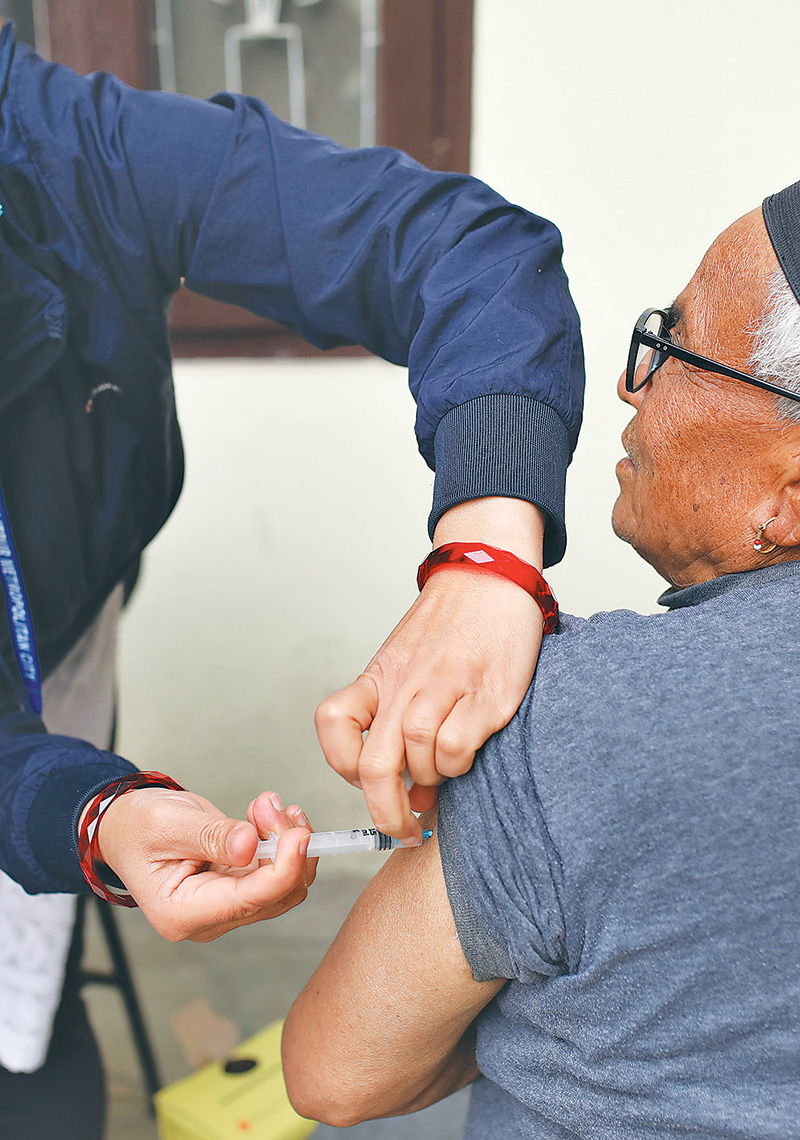
More people are seeking jabs in the second phase, surpassing authorities’ expectations, but arranging vaccines is still a challenge.
- Arjun Poudel
At this pace, the first round of second-phase drive may conclude within next five days. Post Photo

KATHMANDU,
On Sunday, Bishnu Prasad Phuyal, a resident of Kageshwori-Manohara Municipality on the outskirts of Kathmandu, took Covid-19 vaccine at Allapot Health Post, near his home.
Phuyal, 65, said he did not face much hassle in the process.
“My turn came after waiting for a while,” Phuyal told the Post. “I am happy to get vaccinated against the disease that scared us the whole of last year.”
Phuyal is among citizens over 65 years of age for whom the government on Sunday launched the second phase of Covid-19 vaccination.
He said he is now holding consultations with doctors to get his 89-year-old mother, who has some pre-existing conditions—high blood pressure, diabetes and thyroid—vaccinated.
“My wife is 64, so she could not get the vaccine this time,” said Phuyal, who hopes to get her vaccinated as soon as the next round of the campaign begins.
Like Phuyal, 65-year-old Philemon Khadka Chhetri from Sukedhara, Kathmandu is planning to take the vaccine at a vaccination centre near his house.
“I have a meeting to attend on Thursday of our local organisation of which I am the executive director,” he said. “If I cannot make it on Thursday, I will get it on Friday.”
Those involved in the ongoing vaccination drive say there has been an overwhelming response in the second phase compared to the first.
“Participation of the people in the second phase of the campaign is encouraging… it’s more than we had expected,’ Dr Jhalak Sharma, chief of the Child Health Section at the Family Welfare Division under the Department of Health Services, told the Post. “If the immunisation programme goes at the existing pace, we will be able to conclude this first round of the second phase within next five days.”
Nepal launched its vaccination drive on January 27, becoming one of the first countries in the world to start inoculating its citizens.
In the first phase, frontline personnel—health workers, ambulance drivers, sanitation workers, female community health volunteers, security personnel deployed for managing the bodies of people who die due to complications related to coronavirus infection as well as prisoners, people residing in old age homes and journalists were vaccinated.
Of the 430,000 people estimated to be vaccinated in the first phase, only 184,857 took the jabs. Authorities then announced that journalists, staff of diplomatic missions and financial institutions, officials at local and provincial governments and elected representatives of provincial and local governments could take the jabs.
The initial target could not be met for a number of factors like vaccine hesitancy among health care workers, lack of access to the immunisation centres, failure of the authorities to take targeted population into
confidence, and apathy for launching awareness campaigns and wrong estimation.
Officials say there, however, has been a high acceptance of Covid-19 vaccine among the above 65 population. According to the Ministry of Health, at least 686,554 people were inoculated until Tuesday evening (in three days).
The number of people administered with the vaccine could be more, as some health facilities were yet to update data, according to ministry officials.
“There were some health workers who were hesitant to take the vaccine, but members of the public, especially the elderly, have not shown any kind of apprehension,” said Sharma. “Maybe because of Nepal’s
good immunisation records, there has been a positive attitude towards vaccination campaigns among the public.”
For many Nepalis, the arrival of Covid-19 vaccines so early itself was a surprise. Just as countries around the world struggled to inoculate their populations, Nepal managed to launch its vaccination drive exactly a year after the country reported its first Covid-19 case. But the early arrival of the vaccine also raised doubt, with some suspecting if the vaccine could have long-term side effects.
Officials say suspicions about the vaccine could have been the reason for the first phase of vaccination not being as satisfactory as expected, as vaccine hesitancy is not an issue in Nepal.
After receiving 1 million doses of vaccine from India under grant assistance on January 23, with which the country launched its vaccination drive, the government on February 16 approved the advance payment to procure two million doses from the Serum Institute of India.
The Indian company’s Covishield vaccine was supplied to Nepal by India.
Half the total order was delivered on February 21.
Nepal received another 348,000 doses of vaccine, provided under the COVAX facility on March 7.
The government has also requested the Serum Institute of India to sell an additional five million doses to Nepal. However, due to worldwide shortages, no deal has been reached so far with the manufacturing company.
Officials at the Health Ministry said that the manufacturing company, which sold the vaccine at $4 per dose earlier, is reluctant to sell more doses for the same price.
“We have reached a deal to purchase each dose at $5.5, but disagreement remains on paying an additional 10 percent, which we have to bear,” Dr Roshan Pokhrel, chief specialist at the Health Ministry, told the Post. “We are requesting the company to sell the product directly to the Nepal government.”
While officials are upbeat about an overwhelming response during the second phase, there are concerns if the country could face vaccine shortages.
Some districts have been forced to halt immunisation for the lack of sufficient doses of the vaccine.
Officials say the Health Ministry has already directed for reverse supply (supply in the places that lacked the vaccine from places which have more doses) so that the immunisation drive can run without glitches.
“The existing stock of the vaccine will be over in the next few days,” Dr Shyam Raj Upreti, coordinator of the Covid-19 Vaccine Advisory Committee, told the Post. “We don’t know how long it will take to bring the additional doses.”
Nepal needs to vaccinate 72 percent of its 30 million population against Covid-19. The remaining population is under 14 years in which age group coronavirus vaccines have not been trialled yet.
Vaccines provided under the COVAX facility would cover 20 percent of the population. So the government will need around 45 million doses.
Public health experts say the way the over-65 population is reaching vaccination centres to get the jabs is an encouraging sign and that authorities must make additional efforts to acquire enough vaccines so as to maintain the momentum.
Vaccine acceptance is not an issue; the problem is securing enough vaccines for the rest of the population, according to them.
“Vaccine acceptance rate has always been high in Nepal,” said Dr Baburam Marasini, former director at the Epidemiology and Disease Control Division.
According to Marasini, Nepali people have never questioned the quality of vaccine and even in 1816 acceptance rate of the smallpox vaccine was high.
“As we have already decided to immunise all people, officials should make extra efforts,” said Marasini, “to complete inoculating everyone at the earliest by acquiring the required number of doses.”
HOME PAGE

Speaker under scrutiny as much rests with him to keep the House in order

Parliament is set to turn into a battleground and Agni Sapkota must demonstrate tactical acumen to maintain the dignity of the chair he holds, observers say.
- BINOD GHIMIRE
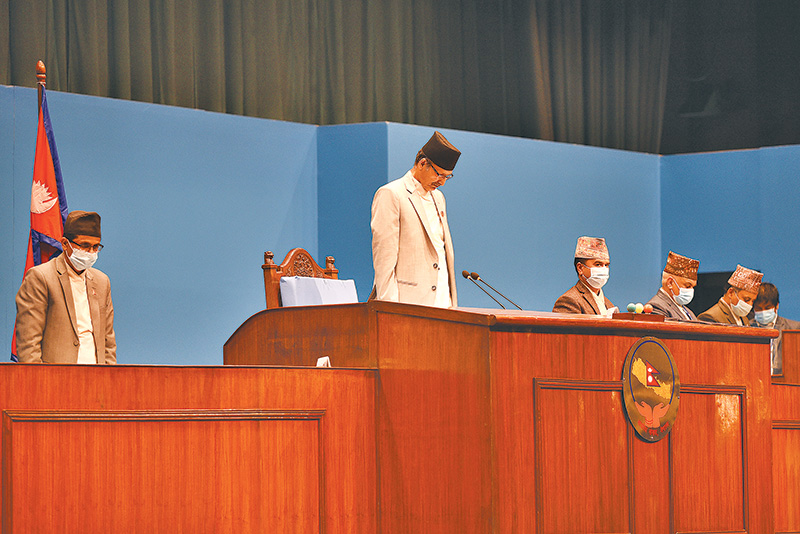
On Wednesday, the House meeting convened but it ended after passing a condolence motion. Post Photo: Angad Dhakal

KATHMANDU,
The first meeting of the House of Representatives on March 7 after the Supreme Court ordered its reinstatement on February 23 saw sloganeering and obstructions. The government could not present the ordinances, as many as eight, before the House due to obstructions from the opposition parties—the Nepali Congress and the Janata Samajbadi Party. Speaker Agni Sapkota adjourned the House meeting until March 10 (Wednesday).
On Wednesday, the House meeting convened but it ended after passing a condolence motion on the deaths of two lawmakers from the present Parliament and 12 from the past.
The meeting has been rescheduled for Tuesday.
Sapkota, however, did not call the meeting of the Business Advisory Committee, neither on Sunday nor on Wednesday. The committee meets just before the House meeting to discuss its agenda and sort the differences among the parties, if there are any.
Hours before Sunday’s House meeting, the Supreme Court scrapped the Nepal Communist Party (NCP) and revived the CPN-UML and the Maoist Centre.
The court decision has completely changed the country’s political landscape and the House is set to see tussles between political parties.
Analysts say Speaker Sapkota’s role in such times will be crucial to keep the House in order. But as morning shows the day, according to them, Sapkota’s reluctance to call even a meeting of the Business Advisory Committee has raised concerns. According to them, the committee and all-party meetings, if necessary, are strong tools for the Speaker to narrow down differences among the parties.
The committee, which generally has a law minister, chief whips and whips, basically has a responsibility to finalise the daily agenda for the House and find a middle path if the parties have any differences.
However, Sapkota hasn’t felt it necessary.
Shreekrishna Aniruddh Gautam, a political commentator, said it was known that the first meeting wouldn’t be pleasant, but the Speaker wasn’t seen playing a proactive role.
“Sapkota had ample time to hold a series of meetings to ensure a smooth meeting,” Gautam told the Post. “He failed to demonstrate the skills a House Speaker needs to.”
When it comes to running the House, Sapkota does not have much experience. He was elected Speaker in the third week of January last year after a weeks-long tug-of-war between KP Sharma Oli and Pushpa Kamal Dahal, chairs of then Nepal Communist Party (NCP).
Sapkota’s election was seen as a victory for Dahal. A long-time Maoist leader, Sapkota had been a close ally of Dahal during the “people’s war”.
However, Oli suddenly prorogued the House on July 2. Between the third week of January and July 2, Sapkota did not get a chance to preside over even 10 meetings.
But Sapkota’s performance has come into question not because of his lack of experience but because of his failure to work as a non-partisan leader.
When Oli dissolved the House, Sapkota did not hide his allegiance to the faction led by Dahal and Madhav Kumar Nepal then. It was apparent that he was siding with Dahal, his long-time master.
He was quick to criticise the House dissolution saying it was unconstitutional.
“Article 76 of the Constitution of Nepal has a clear provision that the House of Representatives cannot be dissolved as long as there is the possibility of forming a government,” said Sapkota in a statement on December 23, three days after the dissolution. “Once again, there is the need for high-level understanding among the political parties to protect the constitution.”
That move was unprecedented.
Sapkota, as the head of the legislature, had gone into direct confrontation with the head of the executive.
There were even talks about Sapkota calling “a House meeting” even as Oli’s House dissolution move was being tested by the Supreme Court for its constitutionality.
Experts on parliamentary affairs and former Speakers say it was wrong on the part of Sapkota to issue a statement on a decision by the executive, constitutionality of which was subject to test by the court of law. It was against the norm to take a position by the Speaker who holds a non-partisan office, according to them.
Oli’s House dissolution move was the first after the country adopted the new constitution in 2015. The Supreme Court now has already termed his move unconstitutional. In the past, between 1994 and 2002, four prime ministers had attempted to dissolve the lower house under the 1990 constitution.
But on no occasion did the House Speaker issue an statement, taking any position.
Two attempts were upheld while two were overturned by the court.
Taranath Ranabhat, who was Speaker when then prime minister Manmohan Adhikari in 1995 dissolved the lower house, said there was no need for him to take a position—for or against a decision taken by the head of the executive.
Ranabhat was elected the House speaker from the Nepali Congress while Adhikari was prime minister from the CPN-UML.
“No matter what party one belonged to, once elected to the post of Speaker, he or she must maintain neutrality,” Ranabhat told the Post. “Sapkota failed to maintain the dignity of the chair by taking a position. The Speaker has to be neutral and this should be demonstrated in his or her activities.”
Sapkota also became the first Speaker to challenge the heads of the state, the executive and the judiciary in the court of law.
On February 5, Sapkota filed a writ petition against Prime Minister Oli, Chief Justice Cholendra Shumsher Rana and the Office of the President over appointments to the constitutional bodies as per a December 15 Constitutional Council meeting.
The council is chaired by Oli and Chief Justice Rana is a member. Sapkota himself is a member of the Council. He had filed the writ saying he was not informed about the meeting that made the recommendations on December 15.
Constitutional experts say such writs are reserved for private citizens and not for someone who holds a public position. And by filing the writ, he had overstepped his jurisdiction.
After the Supreme Court on February 23 overturned Oli’s decision to dissolve the House, its meeting was scheduled for March 7.
The government was under a constitutional and legal obligation to table the ordinances. However, that couldn’t happen because the then Dahal-Nepal faction, Nepali Congress and the Janata Samajbadi Party created obstacles.
Article 114 (2) of the constitution requires an ordinance to be presented at the first meeting of the House. Rule 93 (1) of the Regulation of the House of Representatives says the ordinances issued as per Article 114 should be presented at the first meeting of the House session.
The CPN-UML, which was revived on Sunday, has criticised Sapkota for failing to perform his duty as the Speaker.
“Isn’t it clear that the Speaker has failed to perform his job?” Bishal Bhattarai, chief whip of the UML, told the Post. “It is up to the Speaker how he corrects the mistake of breaching the constitutional provision and parliamentary regulation.”
The Oli administration had issued eight ordinances including the one related to the Constitutional Council (Functions, Duties and Procedures) Act-2010 on December 15.
Officials from Sapkota’s Secretariat, however, say even if Sapkota didn’t call a meeting of the Business Advisory Committee, he made every attempt for negotiations among the parties.
“It’s the Speaker’s prerogative whether to call the meeting or not,” Shreedhar Neupane, press adviser to Sapkota, told the Post. “The Speaker was constantly in touch with cross-party leaders. They refused to budge from their positions.”
But parties do have disagreements, say analysts and those who have closely watched Parliament meetings work.
“That’s why there is a presiding officer called Speaker who has to maintain an image that’s free from any political leanings,” said Surya Kiran Gurung, former general secretary at the Parliament Secretariat. “The main responsibility of the Speaker is coordination. If the Speaker fails to do so, it clearly means he is not a good performer.”

HOME PAGE

It is spring, and the political games have begun, again

As parties start talks on government formation, they are weighing each other up before forming an alliance.
- ANIL GIRI

KATHMANDU,
Four major parties in the House of Representatives have launched hectic negotiations over government formation, as Prime Minister KP Sharma Oli’s fate now hangs in the balance.
The CPN-UML, led by Oli, the Nepali Congress, the main opposition, the Maoist Centre and the Janata Samajbadi Party, which has emerged as the kingmaker in the new political dynamics, on Wednesday were busy holding meetings.
As of now, Oli continues to enjoy the majority, as the Maoist Centre has not withdrawn its support. Oli was elected prime minister in February 2018 with the support of the Maoist Centre, which was revived on Sunday by the court.
But in May 2018, the UML and the Maoist Centre had merged to form the Nepal Communist Party (NCP), which was scrapped by the court order.
Sources said before Wednesday’s House meeting, which was adjourned immediately after passing a condolence motion on deaths of 14 present and former lawmakers, Samajbadi Party leaders Mahantha Thakur and Rajendra Mahato held separate talks with UML leaders, including Bishnu Poudel, the finance minister, Subas Nembang, deputy leader of the UML Parliamentary Party, and Rajan Bhattarai, Oli’s foreign relations adviser.
With 34 members (two suspended) in Parliament, the Samajbadi Party holds the key.
If Oli can secure Janata Samajbadi Party’s support in the case of the Maoist Centre pulling out its support, he will continue to lead a majority government.
“We are in touch with all the parties but we are not in a race for a power-sharing deal because the Oli government is in majority,” Nembang told the Post.
“We are in touch with Nepali Congress leaders as well.”
But the Congress, Maoist Centre and Samajbadi Party are also exploring the possibility of forming a coalition government of their own by unseating Oli.
A leader close to Oli said that the prime minister is clear about his future steps.
“If the Maoist Centre withdraws its support, he will seek a vote of confidence,” the leader who spoke on condition of anonymity told the Post. “He will cultivate the Nepali Congress and the Samajbadi Party to bring them on board. He is ready to address the grievances of these two parties.”
When it comes to grievances, the Janata Samajbadi Party has more of them than the Congress, which according to many, is willing to lead the government or go for an early election.
“Oli does not have reservations about Congress party’s wish for early polls,” another leader from Oli’s orbit told the Post.
“We will need more homework to convince the Samajbadi Party.”
The Janata Samajbadi Party, born out of a merger between the Sanghiya Samajbadi Forum and the Rastriya Janata Party in April last year, has made its bottom line clear. It wants its lawmaker Resham Chaudhary released, cases against some of its cadres withdrawn and constitutional amendments.
Chaudhary is in jail over the 2015 Tikapur violence.
“It’s complicated when it comes to addressing the Samajbadi Party’s demand that Chadhary be freed,” said the leader.
For Oli, cultivating the Samajbadi Party will be the best bet, as he can offer some ministerial portfolios and even the post of deputy Speaker and easily secure a majority in the House.
With leaders like Madhav Kumar Nepal and Jhala Nath Khanal already back into the UML fold after Sunday’s court order to scrap the Nepal Communist Party (NCP), the party controls 120 seats in the lower house. Oli will just need 15 seats to stay afloat, as he will have to win 135 votes in the existing 270-member House.
But Nepal and Khanal, who were with Dahal until Sunday, are pressing for a broader unity among the leftist forces so as to ensure a strong communist government. Nepal and Khanal, both former prime ministers who were until a few days ago bent on unseating Oli, have now made concessions and are making a pitch for continuity of the Oli government.
On Wednesday, the Nepal group of the UML held a gathering of its leaders.
“Both Nepal and Khanal told the gathering that their priority is forming a leftist government,” said Raghuji Pant, a leader close to Nepal. “Their focus was on forming a larger left unity.”
It is not immediately clear what they are aiming for. But many say the statements could be an attempt to appease Oli who holds grudges against them as they had sided with Dahal.
“There is no alternative to forming a left government and Prime Minister Oli’s role is very important in this respect,” said Pant. “Though a new situation has emerged after the Supreme Court’s verdict, we have decided to work to strengthen the UML.”
Nepal and Khanal’s statement also indicates that they want to stop Oli from roping in the Nepali Congress and rather push for unity with the Maoist Centre.
The UML and Maoist Centre’s unity in May 2018 was out of convenience rather than conviction. Oli’s arrogance and Maoist Centre chair Pushpa Kamal Dahal’s ambitions led to the split in the Nepal Communist Party (NCP), which had emerged as the strongest communist force in the country. The party hence was divided into two factions—one led by Oli and the other by Dahal, who was backed by Nepal and Khanal.
The Dahal-Nepal faction was working to unseat Oli after the Supreme Court overturned the House dissolution move. But Sunday’s court order reviving the UML and the Maoist Centre upset the apple cart.
Insiders in both the UML and the Maoist Centre say possibilities are being explored if both the parties could be brought together again.
The Nepali Congress, which was until a few days ago waiting for a split in the Nepal Communist Party (NCP), is now startled by the court decision to revive the UML and the Maoist Centre. Such a split in the communist force was not something the Congress was expecting.
Though Dahal has approached Deuba to seek his support in unseating Oli and forming a new government, the Congress party has not opened its cards yet.
Congress President Sher Bahadur Deuba said on Wednesday that his priority is to become the party president again, not the prime minister.
In a meeting with some Adivasi and Janajati leaders, Deuba said that he is not in a race to become the prime minister.
Congress spokesperson Bishwa Prakash Sharma said senior leaders are in touch with leaders of various parties. “There is nothing to say at this time,” Sharma, who is close to Deuba, told the Post. “In principle, there should be a new government of the Nepali Congress, Maoist Centre and Samajbadi Party. But nothing is clear yet.”
The Samajbadi Party as of now has said it is not going to support Oli.
Analysts closely following political developments say the recent turn of events has given rise to uncertainties.
“It started with Oli who sowed the seeds of uncertainty and the Supreme Court did the rest, complicating the situation even further,” Shyam Shrestha, a political commentator, told the Post. “It is up to the political parties and their leadership to clean up this mess.”
Much depends on how the Nepali Congress and the Janata Samajbadi Party make their moves, according to Shrestha.
“Major parties in Parliament must not forget that the responsibility to protect the system also rests with them,” Shrestha said. “The House is a place where political parties engage in tussles and compete with each other. But the political parties must work together also to not let the system derail and take the country’s politics in the right direction.”

Page 2
NATIONAL

Police in Kapilvastu develop school curriculum to raise awareness on cybercrime

The courses have been launched in 80 schools of two local units in the district.
- MANOJ PAUDEL
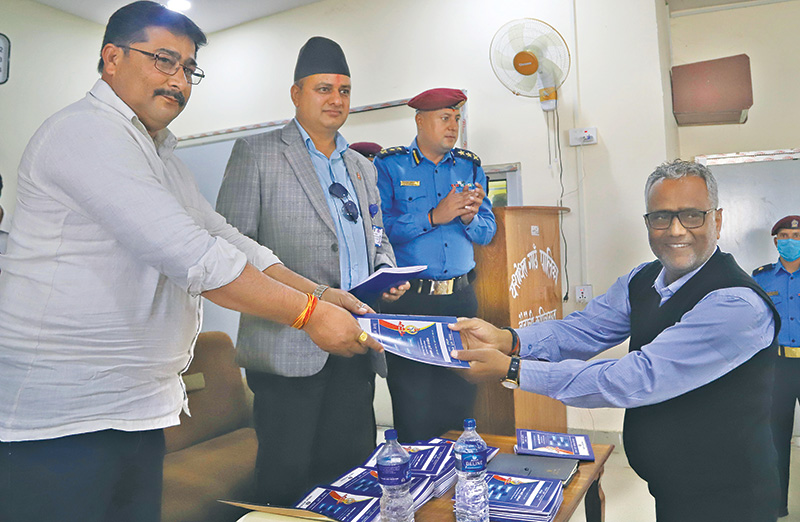
The district police has been distributing textbooks on cybercrime and various other social evils to school students. Post Photo: Manoj Paudel

KAPILVASTU,
Supriya Mishra, a 10th grader at Aniruddha Public Secondary School in Kapilvastu, is learning how to use social media safely.
“I am understanding about cyber crime and have started to differentiate criminal and non-criminal activities in cyberspace,” said Mishra from Baidoli in Yashodhara Rural Municipality.
Keeping in view the rise in cybercrime cases of late, the District Police Office in Kapilvastu has started developing a new curriculum to aware students about cyber crime and safe internet use.
The student-targeted curriculum has been launched in 80 schools of Kapilvastu Municipality and Yashodhara Rural Municipality, police said.
Anita Chaudhary, a 10th grader at Kanakmuni Secondary School in Ward No. 9 of Kapilvastu Municipality, says she has learnt from the curriculum about safe internet usage.
“I have even learnt how to find educational materials from the internet. This has been very helpful,” Chaudhary said.
According to the District Police Office, this School Police Partnership Programme will help children be aware of risks associated with the use of the internet and protect them from such crimes.
“This will eventually help the children grow into responsible citizens,” said Superintendent of Police in Kapilvastu Nawaraj Adhikari.
The District Police Office has distributed textbooks to the schools. The book aims to educate students on various issues like drug abuse, smoking, alcohol consumption, cyber crime and the use of social media in a safe way.
Several social issues like child marriage, witchcraft accusation, dowry system, crimes incurred on children and sexual misbehaviour on children have been included in the text book. Similarly, the book gives information about legal punishment on rape conviction, criminal record system, retaliation against gender violence, drug addiction, human trafficking, cyber crime and traffic rule awareness. The safety measures to protect from snake bite and fire incidents are also incorporated in the book along with the positive and negative aspects of using social media.
The book will be distributed among the students from grade 5 to grade 12. The District Police Office is planning to launch the book in all 10 local units of Kapilvastu district.
“We will expand the book distribution programme to all the local units within a month. Police officers will take classes as a guest teacher if need be,” said Superintendent of Police Nabaraj Adhikari.
Ramesh Pandey, principal at Anirudra Secondary School in Baidoli, expressed his hope that the book would be helpful to make a responsible citizen out of the students.
“The book will be helpful in maintaining peace and security in the society,” said Pandey. “Students can prevent themselves from being a victim of various social crimes with the help of the course.”
At present, the book distribution scheme is a pilot project of the police administration. The administration says the book will be further revised and distributed widely in the future.

NATIONAL

Itahari takes initiatives to end gender, sexual violence in community schools

The sub-metropolis has arranged for a gender focal person in each community school.
- Pradeep Menyangbo

SUNSARI,
Itahari Sub-metropolitan City in Sunsari district has taken initiatives to keep in check the rising incidents of sexual violence in community schools.
The sub-metropolis has arranged for a gender focal person in each community school whose primary responsibility is to raise awareness about sexual violence among students, help them identify inappropriate behaviour and show them the legal course of action in case they fall victim to sexual harassment.
“The sub-metropolitan city has come up with a yearly work plan to appoint a gender focal person in each community school. We expect that the plan will help control gender and sexual violence in schools and the community,” said Laxmi Gautam, deputy mayor of Itahari Sub-metropolis.
There are a total of 36 community schools in Itahari Sub-metropolitan City.
A teacher, preferably a woman, will be appointed as the gender focal person. The designated persons, according to Gautam, are responsible to get information about incidents related to gender and sexual violence and proceed to take legal action against the perpetrators.
The focal persons will study the reported incidents and inform the ward office, sub-metropolis office or police as per the nature of the incident.
“All gender focal persons have been provided with the necessary training so that they can provide counselling to the victims, teach children to protect themselves from such violence, launch awareness classes and inform the authorities in case of any incidents,” said Gautam. The sub-metropolis last week provided a two-day training to the teachers appointed as gender focal persons.
The focal persons appointed in schools have committed to play an active role in keeping in check the incidents of gender and sexual violence.
“I will actively work to end gender violence in our school and community. We will also be launching an awareness campaign against such forms of violence and harassment,” said Srijana Basnet, a teacher who has been appointed as the gender focal person at Madan-Ashrit Basic School in Itahari-13.

Page 3
NATIONAL

More funds released for social security allowances

Single women below 60, partially disabled and pensioners of foreign government services are among those who will benefit from the funds.
- PRITHVI MAN SHRESTHA
Following changes to regulations guiding the implementation of the Social Security Act in March last year, the government had stopped providing the allowance to women aged below 60 if they were receiving pensions from foreign governments. Post file Photo

KATHMANDU,
Single women below 60 and the partially disabled who stopped receiving financial assistance after mid-November last year will now receive their social security allowances.  
The Department of National ID and Civil Registration, the agency responsible for coordinating the distribution of social security allowances, this week released an additional fund of Rs 3.97 billion to 152 local governments to distribute the allowances to previously left out groups, including single women below 60, partially disabled people, and senior citizens receiving pension from foreign governments.
The local governments were previously allocated Rs11.18 billion. With the addition of funds, local officials now have a total of Rs15.16 billion to distribute a social security allowance.  “Other local governments are also expected to demand an extra budget to distribute as social security allowances. So, social security spending will grow significantly this year,” said Jitendra Basnet, director-general at the department.
The 753 local governments in the country are responsible for distributing social security allowances to individual beneficiaries.
Following changes to regulations guiding the implementation of the Social Security Act in March last year, the government had stopped providing the allowance to women aged below 60 if they were receiving pensions from foreign governments and were not found to be in serious need of assistance .
But, the new regulation invited strong protests from the affected as well as lawmakers. It forced the government to continue providing allowances as before. Earlier, the Security Security Act-2018 had made provisions of denying them the allowance. The provision came into implementation in March last year after the regulation was introduced.
After the government agreed to continue the scheme, officials had provided cash in the form of financial assistance to groups who have been bereft of the social security allowance for the last four months of the last fiscal year 2019-20 and first four months of the current fiscal year 2020-21 as a stop gap measure. The assistance provided was equivalent to the allowance they were receiving earlier.
To continue providing social security allowance, the government introduced an ordinance in late last year. Based on the ordinance, the department is currently sending the budget to local governments.  
“Those who were left out from the social  security allowance following the introduction of the regulation, will now get the allowance as usual,” said Basnet.
The government’s move to continue to provide allowance has delighted concerned stakeholders. “Even though partially disabled people had received the fund equivalent to their allowance in the form of financial assistance the last time, continuation of the allowance under the same name has provided an assurance,” said Raju Basnet, general secretary at the National Federation of Disabled-Nepal. “But, we had to fight for it. As we are demanding an allowance for all he disabled based on the degree of their disability. Depriving the people of the allowance for several years dealt a huge blow to people with disability.”
While distributing allowance in the form of financial assistance, senior citizens receiving pension from foreign government services (around 50,000 people), had denied the allowance as they had an alternative source of income. But after the introduction of the ordinance, they will be entitled to receive the allowance as in the past.
From this fiscal year, the government has added around 500,000 children aged below five years on the list of beneficiaries of social security allowance, according to the department.
Children from 15 districts with low human development status were made beneficiaries of cash transfers in 2018-19. The number of such districts has gone up to 26 this fiscal year.
With the addition, the number of child beneficiaries has reached 1.3 million, according to the department.
As the number of beneficiaries and the amount needed for the social security allowance continue to grow, officials and experts have been questioning its sustainability.
According to the department, the number of people receiving cash transfers as social security allowances has nearly doubled in the last decade, thereby increasing pressure on the state coffers.
The number of beneficiaries reached 3.06 million during the last fiscal year 2019-20 compared to 1.56 million in 2010-11, the department said.
“If the number doubles every 10 years, it will create a huge challenge for the country’s economy,” states the department’s annual report for 2019-20. In addition to the growth in the number of beneficiaries, the amount to be provided to each beneficiary has also increased over the years.
Former Auditor General Bhanu Acharya told the Post in early January that  the social security scheme must be tied to the state’s capacity to bear long-term liability. “It is not a question of whether social security allowances should be provided, but it’s whether the state is capable of sustaining its growth,” Acharya, also a former finance secretary, had told the Post.

NATIONAL

Grants under People’s Housing Programme are insufficient

- Amrita Anmol

BUTWAL,
Last year, Pabitra Pariyar of Sainamaina Municipality received a grant under the People’s Housing Programme.
Pariyar’s six-member family was relieved to be moving out of the shed that they called home. But to Pariyar’s dismay, the aid afforded by the government could not cover the total construction cost of the house.
According to Pariyar, the government had granted the family Rs 336,000 under the housing programme but the amount was insufficient to complete the house’s construction. Halfway through the construction work, she ran out of money and had to borrow Rs 150,000 from her neighbour to complete her house.
The family has now moved out of the shed but Pariyar is facing difficulties to pay back the loan.
“My husband is ill and my children are young. I do not have the means to pay back the loan to my neighbour,” she said.
In 2013, the government had announced the People’s Housing Programme under which it would build houses for impoverished Dalit families. Under the programme, authorities had planned to construct 20,000 houses every year. But in the last eight years, only 20,000 houses have been constructed across the country. The programme has not met its target due to a lack of necessary budget and delay in administrative works, said Dil Bahadur Gurung, a member of the Planning Commission.
In the fiscal year 2018/19, the programme initiated by the federal government was handed over to the provincial government.
In Lumbini Province, 3,428 houses were constructed under the People’s Housing Programme in the last three years, according to the data of the Ministry of Physical Infrastructures Development. After the programme was handed to the provincial government, the province had permitted 7,416 families for new housing.
“The beneficiaries—impoverished minorities and Dalits—should have land plots to get housing grants under the programme. But most don’t have their own land. This has led to difficulties in reaching the target of the programme,” said Sushilchandra Tiwari, secretary at the ministry.
“There’s no management of budget and human resources for the programme,” Chitra Bahadur Karki, mayor of Sainamaina Municipality, told the Post. “Local units are not involved in the programme since it falls under the provincial government.”
Under the People’s Housing Programme, the government had pledged to provide Rs 336,000 each to the recipient families to construct a two-room house.
“The plan is not suitable for those with a large family. On the other hand, the allocated budget is not sufficient to build a house with a toilet. This is why many houses are left incomplete,” said Dhurba Dhital, contact officer of the People’s Housing Programme, also an engineer at the ministry. “Impoverished families have to take loans to complete the construction of their houses. Most of them have left their homes incomplete since they don’t have the means to pay back the loans.”
The situation in Province 2 is also similar.
“The federal government did not allocate a budget as per the target. We don’t even have the budget to monitor and conduct inspection” said Ramadhar Sah, secretary at the Ministry of Physical Infrastructures in Province 2. “The programme could be effective if local units were made responsible to select impoverished households and mobilise budget.”

NATIONAL

A family’s fight for compensation after losing their sole breadwinner in Kuwait

- CHANDAN KUMAR MANDAL
Rishi Raj Trital.  Photo courtesy: Bishwanath Rijal

KATHMANDU,
After a failed work stint in Qatar, Rishi Raj Trital was ready to try his luck one more time. This time in Kuwait—another popular destination in the Persian Gulf for Nepali migrant workers.
In November 2011, Rishi, originally from Jhapa, migrated to work as a driver for a waste collecting and recycling company in Kuwait.
“There were outstanding loans from his job in Qatar, where he had stayed only for one-and-a-half years,” Yog Raj Trital, Rishi’s father, told the Post from Goldhap of Haldibari Rural Municipality in Jhapa. “We were weighed down by loans. Even feeding the family was a struggle.”
The new job was expected to salvage the Trital family, for whom younger son Rishi was their only hope.
It had been 27 months since Rishi left his family in Nepal and flew to Kuwait for the job when tragedy struck.
“It was Saturday afternoon when I got a phone call from a person who was also in Kuwait. He asked me if I had had my lunch and I immediately knew there was something wrong with my son,” said Yog Raj. “The man on the phone told me that Rishi had got into a road accident.”
Rishi died on March 16, 2014. He was 27.
A day before the fatal accident, he had called his parents back home.
“He talked to all of us for nearly one and a half hours. He told us not to worry about the loans,” recalled Yog Raj. “My son had also told me that he had bought a new mobile phone for me and would send it soon. Only his body came back in a coffin.”
It’s been nearly seven years since the Trital family lost their sole breadwinner, and their struggle to manage their bare necessities continues. The family members say they have not received any amount in compensation from anywhere.
The Tritals have continued to fight for the compensation they think they deserve for their loss.
According to Yog Raj, he had received Rs172,000, which friends, well-wishers and Nepali communities had collected as a relief amount for the family.
“Besides that, we have received nothing from the Nepal or Kuwait government. Even my son’s employer has not offered anything,” he said. “We have knocked all the doors but to no avail .”
Rishi had been working for Kuwait Waste Collection and Recycling Co. His family claims that he was on duty at the time of the accident, making his family entitled to the compensation.   
“Nothing can compensate for the loss of a son, who was young and healthy and was taking care of his family,” said Bishwanath Rijal, another family member and brother-in-law of the deceased. “The family got nothing. Even the vehicle given by the government for transporting the body of deceased migrant workers was not free of charge.”
According to Rijal, who has been reaching out to concerned agencies, documents show that his family must get compensation from the employer.
A letter sent by the Kuwaiti employer to the Nepal-based recruiting agency Vision & Values Overseas Pvt Ltd, which had supplied Rishi to the company, mentions that the company would cover the workers’ medical facilities and workplace insurance.
“In the last seven years, I have reached out to concerned ministries, government offices and labour rights groups in Nepal and have also approached the Nepali embassy in Kuwait,” said Rijal. “All I have got in response is that they are working on the case. No one seems sincere when it comes to addressing the plight of migrant workers and their families. We can imagine the situation of tens of thousands of migrant workers in those countries and their families back home.”
Every year, hundreds of Nepalis die in foreign labour destination countries. Families of migrant workers who die working abroad receive compensation from the Nepal government only if they had migrated through formal channels and their labour permits are still valid.
A recent development has given some hope to the Trital family.
“The Nepali embassy in Kuwait had told me that they would be filing an appeal in April for claiming the compensation. All these years, even the embassy was careless,” said Rijal. “Even after all these years, we are hopeful that the family would receive whatever the amount it may be as Rishi had lost his life while working for his employer. We have got all the documents.”
If nothing works, Rishi’s father Yog Raj plans to go on a hunger strike, according to Rijal.
Yog Raj laments his decision to send his son for foreign employment. But the family had no option as they were under the burden of a loan that was taken at a high interest rate.
“Poor families like ours do not have choices. We are compelled to send [our dear ones] abroad the risks involved,” he said. “He was the only person taking care of us. We hoped he would earn, pay the loans and the family would live happily.”
The Tritals say they are still in debt which amounts to nearly Rs150,000.
Yog Raj, now 55, cultivates a piece of land to feed his family. What bothers him apart from the ever-mounting loan is the condition of his house. He wants to replace the roof of his house in Jhapa.
“When it rains, the roof leaks as the zinc sheets have got old and rusty. There are several holes,” said Yog Raj.

NATIONAL

1,000 chickens die in Jajarkot

Briefing

JAJARKOT: Around 1,000 chickens died at a poultry farm in Syala, Ward No. 3 of Bheri Municipality in the past week. Farm owner Bina Pun said that she suffered a loss of around Rs 600,000 after all the chickens in her farm died due to bird flu.

NATIONAL

Two dead in truck plunge

Briefing

DHADING: Two persons were killed when a truck swerved off the road and plunged into the Trishuli river in Benighar Rorang Rural Municipality-10. Police identified the deceased as driver Bishnu Ghimire of Kavre and his assistant Suman Sanjel of the same place. The vehicle was carrying cement.

NATIONAL

Rhino, tiger found dead in Chitwan National Park

Briefing

NAWALPARASI (EAST): A male rhino of around 30 years was found dead in the western part of Chitwan National Park on Monday. Lokendra Adhikari, the information officer at the national park, suspects that the rhino might have died in a fight with another rhino. Its horn and hoofs were intact, he added. As many as 26 rhinos died in the protected area in the past one year.

Page 4
EDITORIAL

Turning the tide

The fight now should be about how we can stop making democracy a zero-sum game.

The months-long drama emanating from the ruling Nepal Communist Party’s internal politics for power-grabbing has now given way to the same business of political brinkmanship yet again. With the Supreme Court invalidating the amalgamation of the KP Oli-led Communist Party of Nepal (UML) and the Pushpa Kamal Dahal-led Maoist Centre, the two communist parties have returned from the dead. And with it, the old tricks of parliamentary politics that the people had hoped were gone for good after the last parliamentary elections have returned as well.
The citizens’ quest until the end of February was about saving democracy from the authoritarian tendencies of Prime Minister KP Sharma Oli. After the reinstatement of Parliament, though, it is all about saving that very democracy from parliamentary politics. The clash of the political titans has returned to Parliament, as the battle now is on who forms the next government. All eyes are on Article 76 of the constitution, to see which political equation hits the majority mark to stake its claim to a new government.
The Maoist Centre may seek the support of the Nepali Congress and Janata Samajbadi Party to form a government; the CPN-UML, though a fractured party, may seek the support of either the Nepali Congress or Janata Samajbadi Party for the same; the Nepali Congress, as the second largest party in Parliament and the rightful claimant to the position of the opposition, is itself in the race to lead a government if such an opportunity presents itself. Suddenly, every party in Parliament looks like a kingmaker; but it is very much likely that none turns the king, leading to mid-term polls. Amidst this imbroglio, ambitions for power grabbing should not turn the hard-earned democracy into a shipwreck.
One of the most important tasks of political leaders in a multi-party parliamentary system is to champion democratic consciousness among the citizens and stand in defence of democracy. However, as they go back to politicking in Parliament, the very ideals of parliamentary democracy risk eroding one attack at a time. But for sporadic attempts by political parties at course correction in the event of a major rupture in democratic politics, Nepal’s parliamentary democracy is more or less an uninterrupted race for power grabbing. Every political party has its fair share of opportunists who will go to any extent to grab power and position.
To change this, there is a need for a paradigm shift in the way Nepal’s parliamentary democracy is exercised. There is a need for major stakeholders of this system to contemplate how we can stop making parliamentary democracy a zero-sum game and make it work towards uplifting the lives of the people. The current cohort of leaders show no such inclination. Sparing a few exceptions, the second generation leaders across the political spectrum show no such inclination either. That, perhaps, is the saddest part of the future of democracy in Nepal.

OPINION

Death and remembrance

Remembering three extraordinary people who have lost their lives recently.
- PRAMOD MISHRA
Unsplash/Prateek Gautam

Three men I had known died recently. Deb Chan was our elder in my Morang village. Dr Shankar Uprety was Buwa for his son’s friends; and Hillis was none other than the J Hillis Miller, known the world over as the American proponent and practitioner of literary deconstruction.  
Obituaries came out the world over for Professor Miller, and in the Nepali media for Dr Uprety. And Professor Miller’s memorial will be held in places where he worked and lived. But there is no tradition of holding memorial service among the Hindus and indigenous groups. Video clips were sent to me of the dhemali performed for our village elder. Had I been in the village, I, too, would have given dhemali for him. I, too, would have donned white loincloth and prostrated and rolled over in the courtyard mud, made of turmeric powder, yoghurt and the earth.   
While Hindus hold elaborate final rites and rituals for the departed, all are ostensibly geared toward propitiating the departed soul so it can cross bhavasagar (the ocean of the world) and find an abode in heaven, which is nothing but freeing the soul from the cycle of births and deaths and achieving oneness with the eternal soul (permatman). No river of wine nor harem of virgins for the heaven-goer here, nor any milk or honey.  
The emphasis is on the hereafter, not here. The world of the flesh is concerned only with purification from pollution caused by the deceased person’s body. In this configuration, the body is polluting because it is flesh and subject to decay and the soul is pure because it is eternal.  But the soul carries the karma of the body to be rewarded with moksha (salvation) or condemned to repeat the cycle of births and deaths. Hindus, unless they are political stars in whose name airports, hospitals and educational institutions are named, do not formally hold memorials to offer eulogies to the departed. We make offerings to ancestors, do penance and hold purification rituals.
But given the material turn in the Hindu world, it is time we held formal memorials to recount the deeds the departed performed from cradle to cremation. This practice might improve the workings of public figures and private individuals. In this spirit of a memorial, I speak here of the three men.  
I don’t exactly remember when I first went to his Big Yard, but I couldn’t stay away from it. The cause was his nephew, Karak, my childhood friend. I had shed Bhojpuri, violent manners and abusive tongue and taken to Rajbanshi and Karak’s friendship. My first baby tooth had come off while eating Karak’s guava and to my mother’s disappointment, I had broken the vow of Kabirpanth and become an omnivore. She had hoped that I would inherit the mantle of her forsaken family’s monkhood—a substitute perhaps for the permanent loss of family and clan.  
But my transgression freed me to catch fish and crabs all year round. Bamboo rods and nightcrawlers came from the village groves and dung heaps and cotton thread and hooks from Bucchi’s shop. Alas, crabs and fish could never compare to goat meat, neither in taste nor in status.  Twice a year (on Dashain in October and New Year in April) when Karak’s family butchered their fattened wether, a member from each meat-eating household gathered at Karak’s Big Yard. One helped in boiling the water. Another lighted the fire. The third wielded the sword and split the head of the animal from its body while two men held the hind legs and one held a rope tied to the head. Deb Chan presided over this ritual of turning the goat into meat.
At age five (and six and seven), I watched all this with apprehension. I couldn’t contribute anything to the ritual. I had no claims nor age. When the time came to divide the pile, Deb Chan obviously kept the bulk and others got their shares, marking their status. Sometimes I would get my quarter ser, but other times I returned empty-handed. ‘What else can you do if you can’t get even a quarter ser meat?’ my mother would yell and called the villagers names—heartless hoarders, brutes, Godless. She then went to Karak’s Big Yard, raising her voice and Deb Chan gave the quarter ser from his own share. Deb Chan rose in my eyes like one of those wish-granting gods in the epic shows.
Deb Chan in time married Dhakni bai (sister), Pradhan’s daughter, from our courtyard and became my brother-in-law.  
As a teenager, Deb Chan had danced and sang in the Bidyapat naach in the village. Having seen the wealthier Rajbanshis of nearby villages host Mahabharat drama troupes from the borders, Deb Chan called us boys and became the director of our own drama troupe.  The rehearsals, however, lasted only a few months because he saw that we had little talent for acting and dialogue delivery. He was the hardest working of the three brothers, like Wang Lung in The Good Earth, pushing back adversity by working with his field hands sunup to sundown all season long.  
We lived in fear of the dacoits from across the borders. He soon bought a shotgun and defended the village. He took to hunting and became a figure of courage, romance, adventure and ambition. In later years, I called him Seth Ji as an honour for his hard work to hold on to his land and property at a time many other Rajbanshis were losing it all. In my trips home over the years, I always stopped by to see my sister and talk to him. And I had hoped I would do the same this summer.  
I first met Buwa in Sanischare, in the 1980s, where he ran a private healthcare clinic for 45 years. He served the needy without charging fees.  But in subsequent years, while visiting my friend Sanjeev at his house, I got to know Buwa more. He was a conversationalist, lacing his talk with wit and humour. I remember two things he told me. He said he advised his nephew to stop having children after two daughters, arguing that sons and daughters were the same. He said he stopped after his first child. Had a daughter been born instead of a son, he would have been happy with only a daughter. I had never heard of such talk from anyone even from my own generation, let alone my father’s generation. I also remember his advice about frugality. You must always save one-fourth of your income; you will never suffer from penury. I must admit I have time and again fallen short on both counts but my efforts to do better continues. In the winter of 2019, I spent a few days with him at his house as a guest. Even in frail health and receding memory, his sense of humour never deserted him.
About Hillis, remembering him in words would amount to name dropping. I never took a class with him but he gave me a letter of introduction after our first meeting at his talk in Kathmandu. Only later would I know who he was in English Studies. He invited me to attend Derrida’s seminar at the University of California Irvine, and did his best to get me admitted there but couldn’t due to California’s funding restrictions on admitting international students at the time. I have met and worked with many noted scholars in my field but as a teacher, Hillis Miller will remain an inspiration—somebody every teacher needs to aspire to for those who come to them for learning and guidance.  
May their legacy remain alive for generations.

OPINION

Recovery strategy required

Countries are working to lure back tourists, and Nepal needs to act to not get left behind.
- Sanjit Shrestha
post file photo

As several Covid-19 vaccines roll out, Nepal’s devastated tourism industry is seeing light at the end of the tunnel. But the government does not seems to have a recovery strategy, and this worries businesses. Despite opening up the country to vaccinated individuals, the government is yet to methodically act on best practices that are recommended and used by other countries as recovery strategies.
The Nepal government was unable to insulate the tourism industry with subsidies and grants after the lockdown started in March 2020 which resulted in the sector suffering immensely with businesses finding it difficult to repay loans and many workers losing their jobs. As the tourism industry is characterised by many small and medium scale enterprises, these businesses aren’t big enough to handle a crisis situation this prolonged. And because they haven’t received enough support from the government, many are in danger of going bankrupt unless the industry recovers soon.
Although the circulation of the vaccine does build optimism, the government cannot be reticent anymore and needs to create a plan to revive the tourism industry and gain a crucial competitive advantage in the post-pandemic environment. Here are a few strategies that the government can utilise to navigate this uncharted terrain.

Destination image
The most important factor for reviving the tourism industry is marketing Nepal as a safe place to travel. In the post-pandemic tourism industry, safety will be an indispensable aspect of the tourism experience, and those countries that can guarantee this will benefit from the first wave of outbound tourists from all over the globe. For this, the government needs to build protocols, run campaigns and convey purity of destination to ensure Nepal remains a key destination for the pent-up tourism that has built up in the last year. The consequences of the inability to ensure destination purity was shown in Africa, where Ebola affected inbound tourism throughout the continent despite the disease being prevalent in only a few locations.
Travellers will need to be reassured of the safety of travelling, and the Nepal government needs to collaborate with the private sector to put in place new standards in terms of safety, hygiene, testing and procedures. To ensure this information is available to all potential tourists, the government will not only need to circulate timely information through official websites, but also encourage all private companies to provide information through their websites. If tourists can obtain data easily and not be uncertain regarding their predicaments once they travel, confidence can be restored and demand stimulated. Equally, the government needs to take steps to ensure that destination communities are comfortable that the benefits associated with the return of visitors outweigh any concerns over potential health risks.
Tourism requires a dovetailing of many industries; and for a seamless experience, many facets of the industry need to be functioning simultaneously. This has to be delivered by the government and the private sector to ensure whoever travels to Nepal initially will reward the country with excellent reviews which could be the word of mouth social proof that can entice more people to travel to the destination. If one facet of the industry isn’t working, the opening up of the industry might result in disgruntled customers and hinder any further promotional campaigns. Thus, the government needs to ensure adequate supply is present for tourists to enjoy an effortless experience.

Seamless experience
In this regard, president of the Pokhara City Tour Guide Association Krishna Bharati said that many guides switched to other occupations for their livelihood because of the non-existent support of the government during the pandemic. If this trend continues, Nepal might lose the supply of skilled human resources that is necessary for a seamless experience for tourists. The government needs to create a plan to generate adequate supply before inviting tourists to the country.
It is of utmost importance that the government undertakes these strategies to accelerate the recovery in Nepal’s tourism industry. The post-pandemic tourism environment will present new challenges for the industry, and the government cannot rationalise indecision in this regard as it may cause the recovery to be weak, resulting in a grave situation for many entrepreneurs in the country. As other inward tourism destinations are promoting their country as a safe haven for travellers, the Nepal government needs to proactively seek counsel from the private sector and policy experts to initiate a coherent recovery strategy. This will raise the chances of a tremendous recovery by absorbing the pent-up tourism that is currently building up all over the world. Inaction can have severe consequences when most other competing countries are improving their odds of success.


Shrestha is pursuing a master’s in development studies at the Kathmandu University School of Arts.

Page 5
MONEY

Study over for extending oil pipeline to Chitwan

As per the report, the proposed pipeline will be 62 kilometre long and will cost Rs4 billion.
- KRISHANA PRASAIN
The government says it plans to stretch the pipeline to Kathmandu eventually. POST FILE PHOTO

KATHMANDU,
Nepal Oil Corporation has completed a feasibility study for extending the Amlekhgunj oil pipeline to Chitwan, officials said. The 69-km cross-border pipeline, which brings gasoline from Motihari in India to Amlekhgunj, became operational nearly one and a half years ago.
The government says it plans to stretch the pipeline to Kathmandu eventually.
A joint technical study group of Nepal Oil Corporation and its supplier Indian Oil Corporation prepared the feasibility study. The plan is to lengthen the pipeline from Amlekhgunj to Lothar, Chitwan, according to company officials.
The study report has been submitted to the Ministry of Industry, Commerce and Supplies.
As per the report, the proposed pipeline will be 62 km long and cost Rs4 billion. The entire project, which includes building associated infrastructure, is estimated to be worth Rs14 billion.
Binitmani Upadhyaya, spokesperson for Nepal Oil Corporation, said they had started discussions regarding the investment and construction modality with the ministry as they don’t have the technical expertise to build the project on their own.
Nepal imported petroleum products worth Rs215.76 billion in the fiscal year 2018-19, which dropped to Rs163.70 billion in 2019-20 due to Covid-19 related restrictions that kept vehicles off the roads and brought factories and development projects to a halt for nearly four months from March-end 2020.
According to a report of the Central Bureau of Statistics released in 2019, Nepal’s gasoline consumption almost doubled in the last five years, leading to a yawning trade deficit besides causing environmental
consequences.
Nepalis consumed 90 percent more fuel than they did five years ago.
The country’s petroleum demand has been increasing by 10 percent annually despite regular supply of electricity, officials of the state-owned monopoly said.
Considering the growing requirement, the government has planned to extend the pipeline to the capital in the future. Prem Kumar Shrestha, joint secretary of the ministry, said a decision regarding the construction and financial modality may be made next week. “The cabinet will decide the financial modality.”
The sooner the project is completed, the sooner Nepal Oil Corporation will be able to save on freight charges as it will not have to seek the services of tanker trucks anymore, he added.
Shrestha said that the financial and construction modality was under discussion. One option is to award the project to the same company that built the first phase of the Motihari-Amlekhgunj pipeline.
“Or it can be awarded to any other experienced company through an open bidding process. In terms of financial modality, Nepal can build the project itself. A decision, however, has not been made,” Shrestha said.
In January, an Indian delegation visited Amlekhgunj oil depot in Bara to study the possibility of extending the pipeline to Lothar.
A team from Indian Oil Corporation, which built the Amlekhgunj pipeline as a gift to Nepal, also conducted a survey for a potential pipeline connecting Nepal Oil Corporation’s depot at Charali, Jhapa with Siliguri, which lies across the eastern border in West Bengal, India.
The initial survey has shown that 35 km of pipeline will be laid in Indian territory and 15 km on the Nepal side of the border.
According to Upadhyaya, along with the pipeline, they also plan to construct a modern depot in Lothar for oil storage. Corporation officials said the depot in Lothar would have a capacity of more than 100,000 kilolitres.
Currently, the corporation’s total storage capacity across the country amounts to 71,000 kilolitres, enough
to meet its requirement for less than a week.
Following the obstruction in petroleum supply during the four-and-a-half-months-long Tarai unrest in 2015, the government announced it would expand the country’s fuel storage capacity to meet domestic demand for at least three months.
“With the extension of the pipeline, there will be huge savings in terms of transportation costs,” said Upadhyaya.
The corporation has estimated that the construction of the Motihari-Amlekhgunj pipeline has allowed it to save Rs1.50 billion in freight charges so far. The pipeline currently brings diesel only, and the corporation plans to bring petrol too through the pipeline this year.
“The pipeline also helps in reducing petroleum leakage, theft and adulteration,” Upadhyaya said. According to the corporation, it spends around Rs6 billion on transporting petroleum products through oil tankers annually.
“The extension of the pipeline will further reduce oil transportation charges that the corporation pays to private tankers,” said Upadhyaya.

MONEY

Bitcoin mania triggers fundraising rush by large and small Chinese players

- REUTERS
A collection of bitcoin tokens are displayed in this picture illustration. REUTERS

SHANGHAI/HONG KONG,
Bitcoin mania has fuelled a surge in fundraising by Chinese companies seeking to expand their cryptocurrency operations or move into the red-hot sector.
From large listed companies tapping public markets to smaller players raising funds from venture capitalists, a jump in cryptocurrency prices and signs of growing acceptance of the technology by mainstream institutions have fed the market boom.
Chinese bitcoin mining machine manufacturer, Ebang International Holdings, which debuted on Nasdaq in June, conducted two fundraising rounds in February alone, raking in $170 million, even after a previous offering in November.
Newcomer Code Chain New Continent Ltd, a Chinese waste recycling company, raised $25 million in February through a share placement to fund a foray into bitcoin mining.  In private markets, “competition is white hot and filled with sharp elbows,” said Jehan Chu, managing partner at Hong Kong-based blockchain venture capital firm Kenetic Capital. “Every good-quality funding round is oversubscribed within a week of it being announced.”
The market has flourished despite complicated official attitudes towards cryptocurrencies in China.
Cryptocurrency exchanges are banned and mining frowned upon, but there is strong official support for developing blockchain technology, which underpins cryptocurrencies such as bitcoin, but is also key to
new innovations in areas such as trade finance, supply chain management and anti-counterfeiting.
This has contributed to the emergence of attractive crypto projects in China, say investors, although many companies still list and raise money overseas.
Ebang plans to use its new capital to expand into cryptocurrency mining in its own right, to open cryptocurrency exchanges in Singapore and Canada, and to launch a Robinhood-style platform for bitcoin trading. “Ebang’s growth story is very attractive to institutional investors ... fundraising by all industry players is getting busier thanks to the bitcoin bull,” said Guo Yi, COO at Univest Securities, which underwrote the deals, and has helped raise money for several other Chinese crypto players.
Canaan Inc, another Nasdaq-listed Chinese maker of bitcoin mining machines, is also expanding into mining, where powerful computers are used to verify bitcoin transactions and compete for a bitcoin reward.
Bitcoin, the world’s largest cryptocurrency, has surged over 300 percent in value since the fourth quarter of last year.
“Bitcoin prices present us with a unique opportunity to establish mining operations,” said David Feng, co-CEO of newcomer Code Chain, which has ordered 10,000 bitcoin mining machines.
The Chinese rush comes as Coinbase, the biggest US cryptocurrency exchange, filed last month for a Nasdaq listing. Regulatory approval would represent a landmark victory for cryptocurrency advocates seeking mainstream endorsement.
“Everyone can feel this euphoric atmosphere in the market, and Coinbase’s listing would lift the mood further,” said Jiang  Changhao, co-founder and chief technology officer of Beijing-based Cobo a crypto custodian and wallet service provider.
Cobo plans to launch a new round of venture capital funding this month to finance international expansion, aiming for tens of millions of dollars because, Jiang said, “the market is bullish and our business is growing very, very rapidly.”
Kenetic Capital’s Chu said official backing for blockchain, and the use of the technology in major initiatives by giants like Ping An and Ant Financial, were a factor in the number of high quality blockchain and crypto projects in China.
But the recent price surge had “poured napalm” on to competition in the sector, he said. Still, the entry of some Chinese firms into the crypto space has raised investor eyebrows.  Last month, short-sellers Hindenburg Research and Culper Research alleged Chinese blockchain firm SOS Ltd, had made false claims about its cryptocurrency business, allegations SOS said were “distorted, misleading and unsubstantiated”.Guo of Univest Securities said the market has zero-tolerance toward cheating, but there’s nothing improper about Chinese companies jumping on to the bitcoin bandwagon.  “If people don’t point figure at (Tesla founder) Elon Musk for endorsing bitcoin, what’s wrong with Chinese companies embracing it?” 

MONEY

Australia to offer subsidised domestic flights to support tourism

- REUTERS

CANBERRA, 
Australia will subsidise 800,000 domestic flights, help its two main airlines and offer cheap loans to small tourism operators as part of A$1.2 billion ($921 million) package to revive the travel sector, Prime Minister Scott Morrison will say on Thursday.
Tourism is one of Australia’s biggest industries, worth more than A$60 billion and employing about 5 percent of the country’s workforce. But the sector was crippled when the country shut its international borders in March 2020 to curtail the spread of Covid-19—leaving tens of thousands of people on the country’s wage-subsidy scheme.
Seeking to prop up the industry when the subsidy scheme ends this month, Morrison will pledge another stimulus package for the travel sector, according to extracts of an announcement seen by Reuters.

MONEY

Facebook launches Instagram Lite for Android devices in 170 lower bandwidth countries

- REUTERS

JERUSALEM,  
Facebook said on Wednesday it was launching a “lite” version of Instagram in 170 countries that will enable people with poor internet to access the photo and video sharing social networking service.
Instagram Lite will be available for Android-based phones and require less bandwidth than the traditional version.
The app itself requires just 2 megabytes (MB)—versus
30 MB for Instagram—and runs even on slower 2G
networks, allowing customers in parts of India, Africa, Asia and Latin America with older internet infrastructure to access the service.
“These are the markets where there is the greatest need,” said Tzach Hadar, director of product management at Facebook in Tel Aviv, where the app was largely developed.
“It uses a lot less data so if you have a small data package you are not going to run out when you use the service. But the aim is for us to give the same breadth of experience you get on Instagram,” he told Reuters.
Hadar, who heads Facebook’s R&D in Israel, said 170 countries did not represent a full global launch, but “it’s a step on the way.”
He noted that other than TV and reels—for creating and sharing short video clips—Instagram Lite retained most key features of Instagram.
A lite version of Facebook itself has been available globally for five years.
In addition to the lite versions, Facebook in Tel Aviv also developed the Express WiFi service to bring
internet access to some 20 countries in Africa, Asia, and South America.
Hadar said his team was now working on a digital wallet for Facebook. “You have close to 2 billion people that have no access or limited access to banks and financial services and there are tens of billions of dollars being spent just for fees for migrants wanting to send money back to their families,” he said.
Another initiative, he said, was Facebook Shops for small businesses to sell products online.  
Facebook’s R&D centre in Tel Aviv opened in 2013 after it bought Israeli mobile app-maker Onavo for an estimated $150-$200 million.

MONEY

Miss Universe Nepal 2020 launches Anshika Education Welfare Foundation

Bizline

KATHMANDU: Miss Universe Nepal 2020, Anshika Sharma, has invested her 10 Lakh prize money to open her own foundation to support 14 children from her hometown, Jhapa, so that they can continue to receive a quality education. The Anshika Education Welfare Foundation’s fund will be used for school fees, clothes, curricular materials, nutritious food, accommodation, travel, medicinal support for girls’ health-related issues, and other primary requirements to access quality education. In the future, the foundation also aims to encourage facilities such as toilets and clean drinking water and skill training for students, reads the press release issued by the foundation.

MONEY

Himalayan Bank contributes Rs10 million to restore temples at Patan Durbar Square

Bizline

KATHMANDU: Himalayan Bank Limited has contributed Rs10 million under its CSR initiative towards restoration of Patan Durbar Square in association with Kathmandu Valley Preservation Trust (KVPT). The Chairman of the Bank Tulasi Prasad Gautam handed over the Cheque as a contribution to Rohit K Ranjitkar, Country Director, KVPT amidst a function held at the corporate office of Himalayan Bank Limited, states the press release from the bank. Along with the Chairman of the Bank, Chief Executive Officer Ashoke SJB Rana, General Manager Sushiel Joshi, Anup Maskay, Assistant General Manager Bipin Hada and Director of KVPT Pratima Pande were present in the function.

Page 6
WORLD

Pfizer wants to make vaccine in India if faster clearance, export freedom assured

It had pulled its application last month after the drug regulator declined its request to skip a small local safety trial.
- REUTERS
This file photo shows vials of Pfizer-BioNTech vaccine for Covid-19, stored in a super freezer of the hospital in France. AFP/rss

New Delhi,
Pfizer Inc has told the Indian government it wants to produce its coronavirus vaccine locally if assured of
faster regulatory clearance and freedom on pricing and exports, two sources with direct knowledge of the matter told Reuters.
The US company pulled an application last month seeking emergency approval for its product in India after the drug regulator declined its request to skip a small local safety trial. That has kept its vaccine, developed with Germany’s BioNTech SE, out of one of the world’s biggest drug markets.
Pfizer was the first company to apply for emergency use authorisation in India, proposing to import doses from its US and European facilities instead of producing locally.
“US companies want to produce vaccines in India under joint ventures,” said one of the sources, citing Pfizer and fellow US drugmaker Moderna Inc.
“They want faster approvals for clinical trials and emergency authorisation use. They fear the government will introduce price control policies.”
Another source confirmed Pfizer was interested in manufacturing in India but Reuters could not find a second confirmation on Moderna.
The companies did not immediately respond to requests for comment. India’s health ministry directed Reuters to the foreign ministry, which did not immediately respond to emailed queries.
While withdrawing its application in early February, Pfizer said it would again seek emergency use approval to launch its Covid-19 vaccine in India, potentially a market of 1.35 billion people, and would provide more data as it becomes available.
On the government’s demand to manufacture in India, the company earlier told Reuters: “Once the pandemic supply phase is over and we enter a phase of regular supplies, Pfizer will evaluate all additional opportunities available.”
A Indian official told Reuters in January the government had held discussions with Pfizer and Moderna, both of which have reported more than 90 percent efficacy for their vaccines—to make the shots in India given its large pharmaceuticals capacity. The Serum Institute of India, the world’s largest vaccine maker, is already bulk-manufacturing the Oxford University/AstraZeneca product and plans to start producing the Novavax Inc shot from next month.
India’s government has not allowed it to sell on the higher-priced private market, however, and is also controlling exports. Pfizer and Moderna, whose shots are more expensive than the AstraZeneca one being used in India’s immunisation campaign, are not comfortable with price and export restrictions, one of the sources said.

WORLD

UK Covid-19 variant has significantly higher death rate, study finds

LONDON:  A highly infectious variant of Covid-19 that has spread around the world since it was first discovered in Britain late last year is between 30 percent and 100 percent more deadly than previous strains, researchers said on Wednesday.
In a study that compared death rates among people in Britain infected with the new SARS-CoV-2 variant, known as B.1.1.7, against those infected with other strains, scientists said the new variant had “significantly higher” mortality.
The B.1.1.7 variant was first detected in Britain in September 2020, and has since been found in more than 100 countries.
It has 23 mutations in its genetic code—a relatively high number of changes—and some of these have made it far more able to spread. UK scientists say it is about 40 percent-70 percent more transmissible than previously dominant circulating coronavirus variants.
In the UK study, published in the British Medical Journal on Wednesday, infection with the new variant led to 227 deaths in a
sample of 54,906 Covid-19 patients, compared with 141 among the same number of patients infected with other variants. “Coupled with its ability to spread rapidly, this makes B.1.1.7 a threat that should be taken seriously,” said Robert Challen, a researcher at Exeter University who co-led the research. (Reuters)

WORLD

Indian state scales down vaccinations

NEW DELHI: Rajasthan, a big northwestern Indian state, said on Tuesday it had started limiting Covid-19 vaccinations to its major hospitals due to a shortage of doses, despite an assurance from the federal government that supplies were adequate. The federal government said after a meeting chaired by Prime Minister Narendra Modi’s principal secretary that there was no shortage of vaccine doses in the country and that there should be no stockpiling or hoarding by any state.
India, the world’s biggest vaccine maker, is donating or selling vaccines to more than three dozen countries, drawing some criticism for not expanding its own immunisation campaign. “It is said that the central government will be able to provide more doses in 5-7 days only, which may cause problems in vaccinations,” Rajasthan Chief Minister Ashok Gehlot said. “In view of this uncertainty, vaccination was continued only in medical colleges, district hospitals and private hospitals,” and the drive was stopped in some rural health facilities, he said.  (Reuters)

WORLD

Sri Lanka invites foreign minister of Myanmar junta

- AGENCE FRANCE-PRESSE

Colombo,
Sri Lanka has invited the new foreign minister of Myanmar’s junta to a regional meeting next month, sparking accusations on social media that Colombo is tacitly endorsing the military coup.
There has been no formal international recognition of the regime which toppled Aung San Suu Kyi on February 1 although Wunna Maung Lwin, the junta’s newly appointed foreign minister, has met virtually and physically with some regional counterparts.
Myanmar’s junta and the envoy sent by its toppled civilian government have also launched contradictory claims over who represents the country at the United Nations.
Sri Lanka’s invitation, seen by AFP, is for an April 1 virtual meeting of the foreign ministers of Bangladesh, Bhutan, India, Nepal, Sri Lanka, Myanmar and Thailand under the Bay of Bengal Initiative for Multi-Sectoral Technical and Economic Cooperation (BIMSTEC).
“The 17th ministerial meeting will greatly benefit from your Excellency’s valued participation, and I look forward to our close engagement over the course of the meeting,” Sri Lankan Foreign Minister Dinesh Gunawardena says in the letter.
Several Myanmar activists bombarded the Sri Lankan foreign ministry’s social media platforms to slam the decision.
“Shame on you!!!,” said Twitter user SweZtun.”You invited a member of the Burmese Military Terrorist group to your BIMSTEC meeting...
You are shamelessly legitimising Terrorist group...”
“Sri Lanka supporting to terrorist group is the worst shameless behaviour after China,” said another Twitter user identifying as Hein Min Htay.
There was no immediate comment from Sri Lanka’s foreign ministry. The two countries have close religious ties, both following the same branch of Buddhism.
Dozens of Sri Lankan activists meanwhile staged a demonstration outside the Myanmar embassy in Colombo Wednesday denouncing the military coup, in a protest planned before the announcement of the invitation.

WORLD

In message to China, Biden to meet Australia, India, Japan leaders

- AGENCE FRANCE-PRESSE

Washington,     
US President Joe Biden will hold first-ever joint talks on Friday with the leaders of Australia, India and Japan, boosting an emerging four-way alliance often cast as a bulwark against China.
It will be one of the first summits, albeit in virtual format, for Biden, who has vowed to revive US alliances in the wake of the disarray of Donald Trump’s administration.
“That President Biden has made this one of his earliest multilateral engagements speaks to the importance that we place on close cooperation with our allies and partners in the Indo-Pacific,” White House press secretary Jen Psaki told reporters Tuesday.
The meeting of the so-called “Quad” comes amid rising tensions with China, which is seen as flexing its muscle both in trade and security realms. Australian Prime Minister Scott Morrison said Biden was “taking this to another level.”
“It will be an historic moment in our region and it sends a strong message to the region about our support for a sovereign, independent Indo-Pacific,” Morrison told reporters.
China struck a cautionary note over the nascent alliance taking shape in its backyard.
The Quad “should conform to prevailing trends of peaceful development and win-win cooperation,” foreign ministry spokesman Zhao Lijian told reporters in Beijing.
Both Psaki and India, which earlier announced the participation of Prime Minister Narendra Modi, said the talks would take up climate change and the Covid-19 pandemic -- two key priorities for Biden.
“The leaders will discuss regional and global issues of shared interest, and exchange views on practical areas of cooperation towards maintaining a free, open and inclusive Indo-Pacific region,” the Indian foreign ministry said in a statement.
The talks, also involving Japanese Prime Minister Yoshihide Suga, will touch as well on promoting maritime security and “ensuring safe, equitable and affordable vaccines” to fight Covid-19 in Asia, the Indian statement said.
Japan said Suga spoke separately Thursday to Modi and voiced alarm about China’s “unilateral attempts to change the status quo in the East and South China Sea” as well as the status of rights in Xinjiang and Hong Kong.
State Department spokesman Ned Price told reporters the Quad was well-equipped to deal with the world’s “urgent challenges” but, asked about China, said, the format is “not about any single competitor.”
The summit follows talks on February 18 among the foreign ministers of the Quad when they pressed jointly for a restoration of democracy in Myanmar after the military ousted democratic leader Aung San Suu Kyi on February 1.
US officials cast the meeting as a key way of exerting pressure as India and Japan enjoy closer relationships with Myanmar’s military -- which has historically counted on China as its main source of support.

WORLD

Royals’ comments raise race issue in Commonwealth nations

- ASSOCIATED PRESS
This file photo shows a man reading a newspaper with coverage of the two-hour appearance of Britain’s Prince Harry and Meghan with Oprah Winfrey, in Nairobi. AP/rss

Cape Town, 
In countries with historic ties to Britain, allegations by Prince Harry and Meghan that an unnamed member of the royal family had “concerns” over how dark their unborn baby’s skin might be have raised a thorny question: Do those nations really want to be so closely connected to Britain and its royal family anymore?
It was expected the interview would expose more rifts in the royal family. Now it seems to be risking divisions within the “family” of the Commonwealth—an association of 54 countries, most of them former British colonies.
After the TV interview, shown in the US on the eve of Commonwealth Day, former Australian Prime Minister Malcolm Turnbull cited it as another reason for the country to sever its constitutional ties to the British monarchy.
The value of the Commonwealth has been debated before, with critics questioning if countries and people once colonised—and even oppressed—should remain in such an association with a former coloniser. Its stated aim is to improve international relations, but Britain’s relationship with the members has been clouded by diplomatic missteps and the legacy of empire.
Charismatic royals like Harry and Meghan have been deployed in the past to Commonwealth-related events with young people, businesses and volunteer groups.
But their interview this week “opens our eyes further” on the merits of the Commonwealth, wrote Nicholas Sengoba, a newspaper columnist in the former colony of Uganda.
Meghan, who is biracial, had said in the interview that an unidentified member of the royal family had raised “concerns” about the colour of her baby with Harry when she was pregnant with her son, Archie, and that the palace failed to help her when she had suicidal thoughts.
Reaction to the interview was especially fierce in Africa. It was encapsulated by one Twitter user in South Africa who wrote: “It’s Britain and the royal family. What did you expect? They oppressed us for years.”
Meghan and Harry traveled to South Africa in 2019, where their impending split with the royal family became clearer and they even spoke of possibly living there.
Mohammed Groenewald, who showed them around at a mosque in Cape Town, was still digesting the interview, which was only shown in South Africa on Monday. But he said that, more than anything, it sparked memories of “colonial racism.”
The interview was not shown on TV in India, the Commonwealth’s most populous member country with 1.3 billion people, but it still was covered by the media and drew negative reactions from the public toward the royals. “Behind that whole elegant facade are thoughts that are not so elegant.” said fashion writer Meenakshi Singh.
Lawyer Sunaina Phul said the Commonwealth “is relevant to the royal family, of course, because it shows that they ruled so many places. I don’t know why we are still a part of it.”
Meghan and Harry’s complaints of racism show that it is time for her country to end its relationship with the royal family, said a retired professor in Kingston, Jamaica.
“What it should mean for us is that we should jump up and get rid of the queen as the head of state,” Carolyn Cooper said. “It’s a disreputable institution. It’s responsible for the enslavement of millions of us who came here to work on plantations.”

WORLD

Royal family contests racism claims

LONDON: Britain’s royal family has begun a fight back against explosive racism claims made by Prince Harry and his wife Meghan, indicating the couple’s comments will not go unchallenged as the country divides into partisan camps.
A keenly awaited statement from Queen Elizabeth II issued Tuesday was conciliatory towards her grandson and his mixed-race spouse after they had an interview with US chat show host Oprah Winfrey. But it also stressed that “some recollections may vary”, as the Buckingham Palace vowed to look into the couple’s assertion that an unidentified royal had asked how dark their unborn son Archie’s skin would be. The row is being watched worldwide, in the US where the couple now live and across the multi-racial Commonwealth, which the queen heads, dragging Britain’s most famous family further into a debate about racism and the country’s colonial past. (Reuters)

WORLD

Malaysia court overturns ban on use of ‘Allah’

Briefing
- AGENCIES

KUALA LUMPUR: A Malaysian court on Wednesday overturned a decades-old government policy barring non-Muslim publications from using the word “Allah” to refer to God, in a landmark ruling on an issue that has fanned religious tensions in the mainly Muslim country. The decision by the Kuala Lumpur High Court, which was confirmed by a lawyer in the case and reported by media, including national news agency Bernama, was part of a case brought by Jill Ireland, a Malaysian Christian, who sought a declaration that her constitutional rights had been violated. Authorities in 2008 seized Malay-language religious books and compact discs from Ireland at Kuala Lumpur airport, based on a 1986 home ministry directive banning Malay-language Christian publications from using the word “Allah”.

WORLD

Hawaii declares emergency due to floods, orders evacuations

Briefing
- AGENCIES

HAWAII: Hawaii Governor David Ige declared an emergency in the US state after heavy rains brought floods, landslides and fear of dam failures, and authorities ordered the evacuation of several thousand people from communities threatened by rising waters. The move came after a dam overflowed on the island of Maui, forcing evacuations and destroying homes, with the dam’s “unsatisfactory” condition leading to it being scheduled for removal this year, the land department has said.

WORLD

China, Russia agree to build lunar research station

Briefing
- AGENCIES

BEIJING: China and Russia said they will build a lunar research station, possibly on the moon’s surface, marking the start of a new era in space cooperation. A statement said the International Lunar Research Station would also be open to use by other countries, but gave no timeline for its construction. It described the project as a “comprehensive scientific experiment base.” The station would be “built on the lunar surface and/or on the lunar orbit that will carry out ... scientific research activities such as the lunar exploration and utilisation, lunar-based observation, basic scientific experiment and technical verification,” the statement said. (AGENCIEs)

Page 8
SPORTS

Police enter Mayor’s Cup final

The departmental team beat Mayor’s XI by 103 runs to become the first to reach the final.
- Sports Bureau
Nepal Police Club’s Dipendra Singh Airee picked three wickets against Kathmandu Mayor’s XI in Mayor’s Cup one-day cricket tournament. Post Photo: Elite Joshi

KATHMANDU,
Nepal Police Club registered a thumping 103-run win over Mayor’s XI to enter into the final of Kathmandu Mayor’s Cup one-day cricket tournament at the TU grounds in Kirtipur on Wednesday.
Put into bat first, Police garnered 197-10 in 47.4 overs. In bowling, Pawan Sarraf claimed four wickets for
the departmental teams as they bowled out the Sandeep Lamichhane-led Mayor’s XI for 94 runs in 31.2 overs.
With the outcome, Police moved to top the standings with six points and guaranteed a top two finish after playing all four group matches. They also became the first team to secure a place in the final as only the top two teams at the end of the league book tickets for Saturday’s final.
Nepal Armed Police Force (APF) Club are in second place with four points while Tribhuvan Army Club, Bagmati Province and Mayor’s XI are third to fifth respectively with two points each in their kitty. The bottom three teams are separated by net run rates.
If APF win their Thursday’s last match against Mayor’s XI, they would be assured of a place in the final, sending the remaining three teams out of the race for summit clash. But if APF lose their match, the door will open for three teams including APF, Mayor’s XI and the winners between Bagmati and Army. In such a situation, APF, Mayor’s XI and the winning side between Bagmati and Army all will have four points apiece and the team finishing with better net run rate would qualify as the second finalists.
Police middle order batsman Yogendra Singh Karki scored the highest 40 runs off 55 balls. He hit four fences before being stumped by Khadak Bohara. The departmental team openers Kushal Bhurtal contributed 34 runs and Sunil Dhamala hit 22 runs as the duo put a 56-run partnership for the first wicket before the latter was dismissed.
Bhurtel cracked three boundaries and sixes each in his 29-ball knock before he was stumped by Bohara off Hari Shankar Shah. Police batsmen Dipendra Singh Airee and Pawan Sarraf were other remarkable contributors scoring 24 runs and 28 runs. Dilip Nath scored 12 runs.
Mayor’s XI bowlers Bipin Khatri, Harishankar Shah and captain Lamichhane grabbed three wickets each. While Lamichhane conceded 35 runs in his 10-over bowling, Shah conceded 28 runs with two maiden overs in his 9.4 over spell. Khatri gave away 54 runs in his nine overs bowling with a maiden over.
Mayor’s XI made a shaky start to their innings as they lost their first five batsmen without touching double digit figures as the score read 5-33 on board. Lower middle order players Krishna Karki, captain Lamichhane and Siddhant Lohani were the only players to touch two digit figures. Karki scored 19 runs, Lamichhane contributed 26 runs, the highest in the innings and Lohani made 18 runs.
Sarraf was the pick of Police bowling with four wickets under his belt. He gave away 16 runs in his 6.2 bowling overs with a maiden over. Dipendra Singh Airee grabbed three wickets while Lalit Rajbanshi claimed two.
There will be two matches on Thursday with Bagmati taking on Army at the TU grounds while APF will vie with Mayor’s XI.

SPORTS

Pulchowk relegated to third division

- Sports Bureau

KATHMANDU,
Pulchowk Sports Club were relegated to third division after they lost their final match of the Martyrs Memorial ‘B’ Division League football tournament 2-1 against Nayabasti Youth Club at the ANFA Complex, Satdobato, on Wednesday.
To keep their chances afloat of remaining in the second division, Pulchowk must have won the match and Jhamsikhel Youth Club played a draw or faced defeat in their last match on Thursday.
The outcome meant Pulchowk finished at the bottom of the standings with five points. They have won one and drawn two matches while losing eight matches. The defeat also gave relief to Jhamsikhel, the second from the bottom side, who have six points and were the other team struggling to avoid relegation. Nayabasti finished ninth with 15 points.
Ashok Tamang and Bibek Gurung scored in either half for Nayabasti while Shyrab Lo Tamang was on target for Pulchowk. Nayabasti opened the scoring in the 19th minute through Ashok Tamang. Shyrab Lo Tamang equalised for Pulchowk in the 58th minute before Gurung ensured the victory for Nayabasti with a 63rd minute goal.
Earlier, in the kickoff match at the same venue, Khumaltar Youth Club (KYC) registered a thumping 4-0 win over Bansbari Club (BC) to finish runners up in the league. Aadhil Hamid put Khumaltar ahead in the 13th minute and they went into the break with a 2-0 lead after Prashan Awasthi scored their second four minutes before the half time. Ayush Ghalan widened the goal margin in the 48th before Mahesh Rai sealed the victory in the 77th minute.
With the outcome, Khumaltar came level on points with champions Satdobato Youth Club on 25 points. Satdobato were already assured of the crown and promotion to second division with two matches in hand and they could finish three points clear in the standings if they win their last fixture on Thursday. Bansbari finished third with 21 points.

SPORTS

Three years, three European failures: What now for Ronaldo and Juventus?

- REUTERS
Juventus belived Cristiano Ronaldo’s arrival would take them one step further but defeat by Porto marked the first time the Old Lady have goneout at the last-16 for two seasons in a row. AP/Rss

ROME,
Juventus suffered an evening of agonising deja vu on Tuesday.
The Italian champions’ last-16 second leg against 10-man Porto provided enthralling entertainment for the neutral. But after 120 minutes of breathless action, the outcome was another early Champions League exit for Juve.
Their elimination by Olympique Lyonnais at the same stage last season effectively cost Maurizio Sarri his job, while a year earlier Massimiliano Allegri’s side were beaten by underdogs Ajax Amsterdam in the quarter-finals.
Although Andrea Pirlo, Juve’s third coach in three years, will accept some responsibility for this latest debacle, the front page of Wednesday’s Corriere dello Sport summed up where much of the post-match fury has been directed: “Betrayed by Ronaldo”, it read.
Replays of Sergio Oliveira’s 115th minute free-kick showed Ronaldo breaking the wall and turning his back as the ball was fired low to beat Wojciech Szczesny.
“Ronaldo already turned before the ball was kicked; that is a serious error,” former Juventus manager Fabio Capello told Sky Italia. “If you’re in the wall, you know that you can be hit by a hard shot. This is an unforgivable error and he has no excuses.”
The incident topped off what was already one of the 36-year-old’s worst performances for the Turin club, as his ratings in the major Italian newspapers went no higher than 4.5/10.
Much of the disappointment in Ronaldo stems from the fact that the 100 million euros ($118.85 million) Juventus spent to sign him from Real Madrid in 2018 was made specifically with Champions League glory in mind.
Juve had lost two finals in four years before the Portuguese’s arrival and believed that signing the competition’s all-time top scorer would take them one step further.
But defeat by Porto marked the first time Juve have gone out at the last-16 for two seasons in a row in Europe’s top competition.
Ronaldo single-handedly saved Juve from a last-16 exit in his debut campaign, scoring a hat-trick against Atletico Madrid to overturn a first leg defeat. He scored twice against Lyon last season.
Individual masterclasses in Europe were expected from him when Juve agreed to a lucrative four-year contract, but there was no sign of one against Porto.
Ronaldo earns a reported 31 million euros per year net at Juventus, 23 million euros more than their next highest-paid player Matthijs de Ligt.
Speculation is already circulating about whether Juventus will cash in on Ronaldo this summer, when he enters the final year of his deal, after concerning financial figures were announced by the club last month.
Juve recorded a loss of 113 million euros from July-December 2020 amid the Covid-19 crisis, compared to 50.3 million euros in the same period a year earlier.
If Ronaldo does go, it’s clear where the future lies. Federico Chiesa scored a superb double against Porto and the 23-year-old has enjoyed an impressive debut season in Turin since his move from Fiorentina.
With the likes of De Ligt (21 years old), Weston McKennie (22) and Dejan Kulusevski (20) also featuring regularly under Pirlo, the spine of a youthful Juventus team is already in place for when they decide to move on.

MEDLEY

Horoscope

ARIES (March 21-April 19) ***
You’re happiest when you’re in motion and getting a project underway. Sunday’s skies see to it that you hop into “action mode,” as the moon glides through capable Capricorn.

TAURUS (April 20-May 20) ***
You’re craving a change of scenery under Sunday’s skies, Taurus. After yesterday’s lazy, action-absent landscape, you’re ready to experience some excitement and a change of pace. Sunday’s skies provide just that.

GEMINI (May 21-June 21) ****
Sunday’s skies deliver a busy day on an internal level, Gemini. The moon marches into
responsible Capricorn, focusing your attention on any unspoken feelings concerning intimate relationships.

CANCER (June 22-July 22) ****
For Cancer, Luna’s link with electric Uranus colors the day with exciting social interactions or changes of plan, while her nightly meet-up with sweet Venus offers a deeply romantic, cozy space to embrace.

LEO (July 23-August 22) ****
Sunday’s skies offer you the chance to bring fresh insights and ideas to your workflow, as the responsible Capricorn moon aligns with Uranus. Come evening, the atmosphere softens putting your focus on intimacy.

VIRGO (August 23-September 22) ***
Sunday’s skies urge you towards creative action, as the moon marches through capable Capricorn. Luna’s supportive link with electric-insight Uranus helps you pull new ideas down and apply them towards creative passion projects.

LIBRA (September 23-October 22) ****
It takes a lot of energy to be a conscientious person, but you show a knack for it today. You know how to make everyone else feel comfortable. If you are meeting somebody for the first time, you’ll be able to make a great impression.

SCORPIO (October 23-November 21) ***
The moon roams through dream-inspired Sagittarius all day, and this lack of action makes for a low-energy, low-impact day all around—so, despite your desire to be productive. Instead, focus your attention on up-keep.

SAGITTARIUS (November 22-December 21) ***
Are you obsessed with time? Always checking your watch or scheduling your day down to quarter-hour increments? If you’re feeling rushed in your life right now, it’s probably because you give the clock so much power.

CAPRICORN (December 22-January 19) ***
Take a break from frivolous things. Relying on the tried and true isn’t boring. It’s comforting. Visit a museum or an online vintage clothing site to gain an appreciation for an era when things were made to last.

AQUARIUS (January 20-February 18) ***
As an Aquarius, you require equal parts alone time and social interaction. Today’s skies work to focus your attention on the current state of your friendships and involvement in your community.

PISCES (February 19-March 20) ***
You are focused on putting your bigger goals in motion but you are finding it difficult to get anything off the ground. It’s best to devote your energy to the upkeep of projects already underway, rather than start something new

Page 9
CULTURE & LIFESTYLE

From the eyes of a woman

Open for public viewing since International Women’s Day, the exhibition ‘Inspired’ displays the works of nine women artists who have laid bare their stories, culture and perspectives on canvas.
- ANKIT KHADGI
An onlooker looks at the artworks displayed at the exhibition titled ‘Inspired’ at the Nepal Art Council, Babarmahal.  Post Photos: beeju maharjan

Kathmandu,
Just as you enter the first floor of the Nepal Art Council, you see various pops of colours. There’s bright red, parrot green, sky blue. All of them are displayed in the paintings of Namrata Singh, which are inspired by Mithila art. All of them immediately draw the attention of the viewers.
Singh’s paintings are part of the ongoing exhibition ‘Inspired’. Opened for public viewing since International Women’s Day at the premises of Nepal Art Council, the exhibit by Higher Ground Nepal is a rare, women-only exhibition presenting the works of nine artists.
In each artwork, simple or complex, all artists have presented their own stories, views, culture, and perspectives, reflecting their experiences. While every artist deserves applause for their efforts, only a few of them through their artworks make an impact, and one such artist is Singh.
Singh brings the culture and art of her Mithila heritage alive through her works. For instance, in her painting ‘Warmth’, we see two lovers embracing themselves. The man, who is wearing a turban, is resting his head on the shoulder of a woman, who has her head covered with a bright blue ghoonghat (headscarf). In the clothes they’re wearing, we see fine details and patterns of various things like fish, elephant, birds, which are commonly used motifs of Mithila art.
The painting is aesthetically pleasing to look at. And through the fine little details, Singh elevates its quality.
Another equally poignant work in the exhibition belongs to Sangee Shrestha. Unlike other artworks, her paintings demand time from the viewers. Rather intriguing motifs are placed on the canvas, which the onlookers need to understand by giving all of their attention to the paintings.
For instance, in her painting ‘Identity’, with the help of intriguing motifs, Shrestha tries to convey the message that an individual should always have a unique identity. While the message isn’t exactly clear, through the help of geometric mosaics and colours, she succeeds in achieving her intentions.
In the lower part of the painting, Shrestha paints a curve shaped-structure in dark colours. On top of that structure, another geometric mosaic structure stands, which is filled with light colours. And through this contrast of colours, Shrestha tries to depict the striking difference between individuals who have their own identity and those who don’t.
In the painting, those individuals who have their own unique identity are represented by the standing structure. The bright colours of the structure resemble their bright personalities, and their placement in the painting is a testament to their positioning in society.
Similarly, the curve-shaped structure is a representation of those people who don’t have an identity of their own and through its juxtaposition in the painting, Shrestha is able to depict the lazy and laid back nature of such people.


One of the most powerful, underlying motifs, however, in her artworks is the representation of the faces of people. Although the motifs are not overtly evident, it is a recurring theme, which is presented in all of her paintings that are in the exhibition. Through such small details, she gives a human touch to her works that otherwise feature only geometric shapes and have no deep meaning on their own.
Sabita Dangol’s artworks are also intriguing. Dangol uses familiar motifs in most of her works. For instance, she mostly uses combs in her artwork, which is a metaphor for the solution to untangling life’s mess. In the works presented in this exhibition as well, Dangol does the same. Yet, despite how recurring the theme is, because of how aesthetically pleasing her works are, her works are fascinating.
Take for example her work ‘Conjugal Life’. In it, Dangol creates a beautiful painting that has her signature motif, a comb, as well as faces of a man and a woman, who are lovers. Playing with the hues of red and pink, through the help of these colours, she tries to depict the passion, the playfulness, and the love between two people who are in love and have decided to spend their lives together.
Similarly, we also see various kinds of patterns that she incorporates in the comb. A bird and a mythical animal are also juxtaposed on the faces of a couple, giving an enigmatic feel to her work.
Making nature the theme of her artistic creations, Reeta Manandhar’s ‘Nature’ series in the exhibition is also visually engaging. Although a few of her works feel very ordinary, works we have been seeing for ages, like the ‘Nature V’, a landscape painting of snow-capped mountains and lush green hills, it’s her other works that can make a great impression on the visitors.
For instance, in ‘Nature-I’, Manandhar paints an alluring painting, where we see a confluence of different colours mainly green and white. Although it’s not clear what Manandhar is trying to paint, one can imagine that in the painting she is depicting the tides of the ocean, which strikes whatever comes its way.
And that’s the beauty of her artworks that are displayed in the exhibition. It’s difficult to understand what she has painted, as there are no definite shapes, yet her painting’s gravitational force is so strong that one is immediately drawn to have a look at it and get lost to the beauty of nature, which can be anything, as per their imagination.
Meanwhile, both Pradhi Rana and Sunita Rana artworks are also good to look at, however, they lack enough substance to hold the attention or leave a big impact.
In the exhibition, details or information—except the title—about the artworks are not provided. For a viewer, this lack of information can diminish the effect the artworks can leave. More than that, it can lead to misinterpretation of the artwork.
For instance, in the artwork ‘Purification Bath’ by Jasmine Rajbhandari, the artist depicts the customary bath that is performed on the day of Rishi Panchami by Hindu women. This custom, which is inherently sexist and stigmatises menstruation, includes women taking a bath with an intention to ‘purify’ their body with a belief that they will be forgiven for their ‘mistakes’ committed during their menstrual cycle. In Rajbhandari’s work, we see the artist has painted four women taking a bath. Likewise, there are various motifs present in the painting, like amala, peepal and other medicinal plants which are used in real-life by women while performing the tradition as well.
Although the artist did say that through her artwork, she is trying to question such traditions to some extent, however, the artwork feels more like a depiction rather than a criticism of such sexist norms. In the painting, we neither see any motifs nor use of colours that signify the denouncement of such discriminatory tradition. Rather it feels like a representation, which can unconsciously or even consciously help normalise such misogynistic behaviour because of the reproduction of knowledge through the artwork.
Even if the artist had other intentions, to be honest, her artwork for many viewers can be regressive. And since there is no information about the artwork, except the title, the chances of misinterpreting the artwork, even if the artist had other intentions, is very high.
And this is where the curator could have done things differently. It’s always fascinating to understand how the minds of the artist work, and how they connect with their own work. Maybe a few lines that conveyed the artist’s intentions and the emotions they went through while creating the artwork could have elevated the art-viewing experience, making it a memorable one. Likewise,
since the whole floor is filled with paintings, the curator of the exhibition could have also given space to installation art, or any other medium of art, to break the monotony.


The exhibition will be held until March 17 at Nepal Art Council, Babarmahal, Kathmandu.

CULTURE & LIFESTYLE

Dumped British TV host Morgan pours more scorn on Meghan suicide, racism claims

The morning after the Oprah Winfrey interview was aired on US television, Morgan said on Good Morning Britain, among a torrent of other criticisms, that he did not believe a word Meghan had said.
- Estelle Shirbon
Journalist and television presenter Piers Morgan smiles as he steps out of his house, after he left his high-profile breakfast slot with the broadcaster ITV, following his long-running criticism of Prince Harry’s wife Meghan, in London, Britain.  Reuters

LONDON,
Piers Morgan, the pugnacious British TV presenter who lost his  job over his attacks on Prince Harry’s wife Meghan, said on Wednesday he still did not believe what she had said during her Oprah Winfrey interview.
Morgan, 55, left ITV’s Good Morning Britain on Tuesday after a backlash against his comments on Meghan’s interview with Winfrey, in which she revealed she had felt suicidal while living as a royal in Britain.
“On Monday, I said I didn’t believe Meghan Markle in her Oprah interview. I’ve had time to reflect on this opinion, and I still don’t. If you did, OK,” Morgan said in a combative Tweet on Wednesday morning.
“Freedom of speech is a hill I’m happy to die on. Thanks for all the love, and hate. I’m off to spend more time with my opinions,” he told his 7.8 million Twitter followers. He added a photo of Winston Churchill with a quote on free speech.
In an interview that has embarrassed Britain’s tradition-bound monarchy, Meghan, who married Prince Harry in 2018, said the royal family had rejected her pleas for mental health support.
The American actress, who is mixed race, also said that someone in the royal household had raised questions about the colour of her unborn son’s skin.
The morning after the interview was aired on US television, Morgan said on Good Morning Britain, among a torrent of other criticisms, that he did not believe a word Meghan had said. In a Tweet, he called her “Princess Pinocchio”.
The next morning, he stormed off the set of the live programme when challenged by a co-presenter about his stance. Later that day, ITV said he was leaving. Monday’s programme attracted more than 41,000 complaints to Britain’s media regulator, the second highest in its history.
Morgan’s detractors said his attitude towards Meghan seemed to be partly driven by personal animus because, by his own account, he had got on “brilliantly” with her when he had first met her but she had later dropped contact with him.
Susanna Reid, who co-presented Good Morning Britain with Morgan and frequently disagreed with him on air, described him on Wednesday’s programme as “outspoken, challenging, opinionated, disruptive”.
Morgan said on Tuesday he thought Meghan’s interview had damaged the monarchy and Queen Elizabeth at a time when her 99-year-old husband Prince Philip was in hospital.
“If I have to fall on my sword for expressing an honestly held opinion about Meghan Markle and that diatribe of bilge that she came out with in that interview, so be it,” he said.

— Reuters

CULTURE & LIFESTYLE

Bangladesh TV hires country’s first transgender news anchor

- JULHAS ALAM
Bangladesh’s first transgender news anchor Tashnuva Anan Shishir reads the news bulletin, in Dhaka, Bangladesh. AP/RSS

DHAKA,
A Bangladeshi satellite television station has hired the country’s first transgender news anchor, saying it hopes the appointment will help change society.
Tashnuva Anan Shishir, who previously worked as a rights activist and actress, debuted on Dhaka-based Boishakhi TV on International Women’s Day. She read a three-minute news bulletin, and after finishing cried as her colleagues applauded and cheered.
“I was very nervous, I was feeling so emotional, but I had in my mind that I must overcome this ordeal, this final test,” Shishir, 29, said in an interview Tuesday.
Born Kamal Hossain Shishir, she said she found in her early teens that she was stuck in a man’s body and behaved like a woman. She said family members, relatives and neighbours started teasing her and she was bullied and sexually exploited.
She started feeling that it was impossible to continue living and attempted suicide, she said.
“I left home,” she said. She moved from her family’s house in a southern coastal district to live a solitary life in the capital, where she underwent hormone therapy, worked for charities and acted with a local theatre group.
Bangladesh officially has more than 10,000 transgender people. Since 2013, the government of Prime Minister Sheikh Hasina has allowed transgender people to identify themselves as a separate gender. They were given voting rights in 2018. Some changes are already visible.
In November, a charity group opened Bangladesh’s first Islamic school for the transgender community. Boishakhi TV said it wanted to be part of the changes and has hired a second transgender person in its drama department.

— Associated Press