You internet speed is slow. Switch to text view mode

Switch
epaper logo
ST

Last Login:
Logout
+
Page 1
HOME PAGE

Government issues a slew of orders amid threat of a second wave
More than 25 people cannot gather at one place; schools and places of worship among others closed till May 14. Testing and treatment made free.
- Arjun Poudel
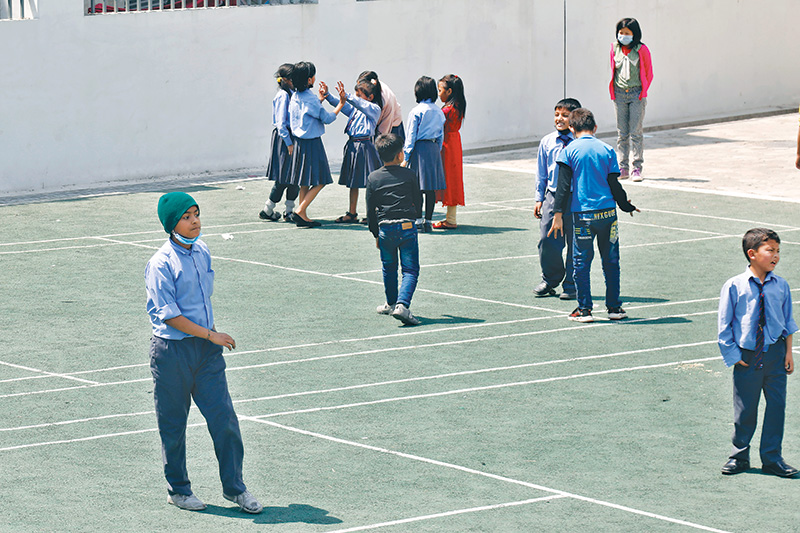
Schools in urban areas have been ordered to close until May 14 to stem the spread of Covid-19. Post Photo: Elite Joshi

KATHMANDU,
Amid a sharp rise in new cases of the new variant of Covid-19, the Cabinet on Monday announced a slew of restrictions and directed provincial and local governments to take different measures to check the spread of the disease.
According to the Ministry of Health and Population, 1,277 new cases were recorded in the last 24 hours of which 98 are in children. Kathmandu Valley recorded 634 cases—505 are from Kathmandu, 97 from Lalitpur and 32 from Bhaktapur.
Eight people have died of the coronavirus infection in the last 24 hours. Active cases stand at 7,254 as of Monday.
Monday was the second consecutive day that the number of cases crossed the 1,000 mark. The last time the country had recorded more than 1,000 cases in a single day was on December 10 last year, when more than 1,200 cases were confirmed.
Intensive care unit beds allocated for Covid-19 patients are filling up across the country.  
Health facilities in the Kathmandu Valley have been occupied by seriously infected people, as people are seeking treatment only after their health conditions start to deteriorate, according to doctors.
The number of people admitted in the intensive care units reached 148. Seriously ailing 43 others are on
ventilator support.
Among the decisions made on Monday, the Cabinet has asked to shut down schools and other academic institutions in Kathmandu, Lalitpur, Biratnagar, Birgunj, Bharatpur and Pokhara metropolitan cities; Itahari, Dharan, Janakpur, Hetauda, Butwal, Ghorahi, Tulsipur, Nepalgunj and Dhangadhi sub-metropolitan cities; all municipalities in Kathmandu, Lalitpur and Bhaktapur districts; and Mechinagar, Birtamod, Damak, Rajbiraj, Banepa, Dhulikhel, Siddharthanagar, Birendranagar and Bhimdatta municipalities.
They can, however, hold pre-scheduled examinations.
Cinemas, banquet venues, dance bars, dohori places, dancehalls, clubs, health clubs, gyms, swimming pools and futsal courts have been shut; assemblies, political rallies, and participation in stadiums have been banned; and only ritual worships by priests are allowed at temples, gumbas, churches and mosques until May 14.
No more than 25 people are allowed to gather at festivals, weddings, other life rituals and funerals, as well as in meetings that must be held face to face if they can’t be held virtually.
Passengers are not allowed to stand in public transport and all must wear masks.
If passengers don’t have masks, the conductor or the driver must make one available at no more than Rs 10 per piece. Public transport must have sanitisers as well. All means of public transport must be disinfected every day.
Shops and offices too have to make masks available for customers and service seekers at a maximum price of Rs 10 and without masks they are not allowed entry.
Hotels and restaurants can open only from 8 am to 8 pm and must observe health safety protocols like seating at two metres distance, and not allowing entry to anyone without masks.
Public and private services providers should manage electronic methods to provide service as far as practicable. Nepal Rastra Bank should facilitate the implementation of electronic payment systems at all the banks and financial institutions.
The Cabinet has also directed the Ministry of Health and Population to come up with a plan to prevent, control and treat Covid-19.
The ministry has also been directed to make arrangements with hospitals to allocate a specific number of beds for Covid-19 care, and make agreements with hospitals—private and public—as well as medical colleges for the treatment of those infected.
The Cabinet has fixed prices for different levels of treatment per day: Rs 2,000 for institutional isolation, Rs 3,500 for hospital isolation, Rs 7,000 for treatment of medium complex cases, and Rs 15,000 for complex cases requiring ventilator support.
Hospitals will be reimbursed these amounts by the government on a weekly basis.
The Ministry of Health also has to reimburse local governments of costs needed for case investigation and contact tracing and provincial governments for operating health desks and screening people entering the country as well as for expenses for transporting the infected and institutional isolation.
Designated hospitals and laboratories must test and treat for Covid-19 for free as per the guidelines and treatment protocol of the Ministry of Health.
The government has tasked the Covid-19 Crisis Management Center with the setting up of holding centres of 1,000-person capacity near border points with India—Gaddachauki, Gauriphanta, Jamunaha, Krishnanagar, Balahiya, Birgunj, Rani, Kakarvitta and other border points and near the other border points and international airport in coordination with provincial governments.
The Cabinet has directed provincial governments with 10 different tasks like operating holding centres and isolation centres, and testing and treatment of the infected to check the spread of the disease.
It has also directed local governments for tasks like conducting antigen tests and monitoring public transport. The general public has been asked to follow safety protocols like staying in home quarantine until they get their test results if they have come in contact with the infected.  
A Cabinet meeting presided by Prime Minister KP Sharma Oli on Monday morning took these decisions issuing a 30-point order, which is nine pages long, as per the Infectious Disease Act 1964.
The Cabinet has given the authority to the chief district officers to enforce the decision and take action as per the Infectious Disease Act 1964 against anyone not following the government directives.
Local administrations have also been given the authority to enforce additional restrictive measures if the number of active cases crosses 1,000 in metropolitan cities, 500 in sub-metropolitan cities and 200 in municipalities and rural municipalities.
HOME PAGE

Schools close again but there have been no preparation for virtual learning

Distance learning was not effective last year and as the virus may not go away soon, a long-term policy is required rather than seeking ad-hoc solutions, experts say.
- BINOD GHIMIRE
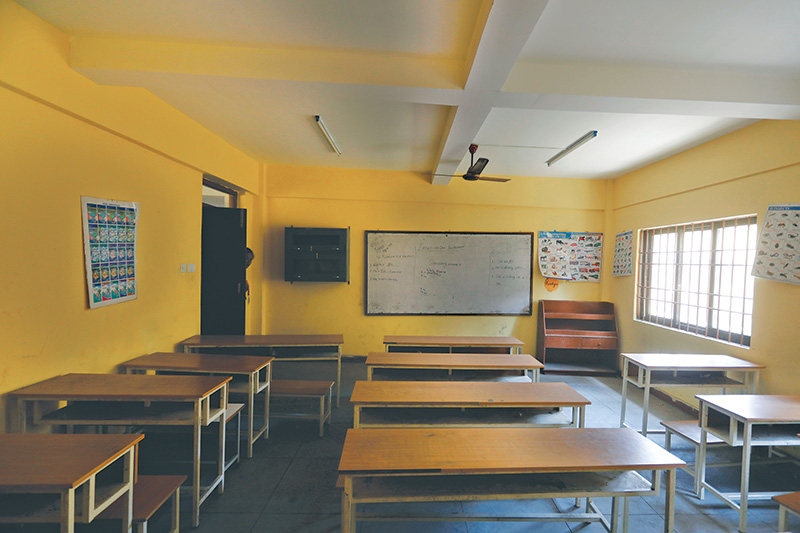
Education experts are worried that learning achievements might be affected with schools shut in cities across the country. Post Photo: Elite Joshi

KATHMANDU,
Tenth grader Sudip Kumar Thakur, who is  preparing for the Secondary Education Examination scheduled for June, is worried.
“Schools have been closed again forcing us to opt for the online class again,” said Thakur. “I took the online classes for months [last year] but I couldn’t understand the lessons as the curriculum demanded. It is going to be the same now.”
During the in-person classes that he attended for around five months, after they were allowed from September by the federal government, his school had to revise the course covered during the earlier online classes as most students hadn’t grasped the course content well.
“The face-to-face learning that started a few months back had given me confidence that I would have good performance in the Secondary Education Examination,” he said. “Now I am doubtful.”  
On Monday the Cabinet decided to close the schools in cities until May 14 and run online classes. These include schools in Kathmandu, Lalitpur, Biratnagar, Birgunj, Bharatpur and Pokhara metropolitan cities; Itahari, Dharan, Janakpur, Hetauda, Butwal, Ghorahi, Tulsipur, Nepalgunj and Dhangadhi sub-metropolitan cities; all municipalities in Kathmandu, Lalitpur and Bhaktapur districts; and Mechinagar, Birtamod, Damak, Rajbiraj, Banepa, Dhulikhel, Siddharthanagar, Birendranagar and Bhimdatta municipalities.
The decision came after the Ministry of Health recommending closure of schools in 14 districts including Kathmandu, Bhaktapur, Lalitpur, Kaski, Rupandehi, Chitwan, Banke, Parsa, Kailali, Morang, Dang, Surkhet, Bara and Baglung, where the number of cases have been surging of late.
Health experts and officials have been concerned that a growing number of children are getting infected this time round. While only 4 percent of the total infected were children last year this time it is in double digits and estimated at 14 percent.
But like Thakur, for hundreds of thousands of students online classes or classes through the radio and television have not been a good one as far as teaching is concerned although it may have been done to protect their health.
Different studies suggest that the virtual learning conducted online and through television and radio was largely ineffective.
They had pointed out different reasons for the ineffectiveness: lack of student’s access to the virtual learning platform, the inability of the teachers to deliver properly through those platforms and lack of interaction, mainly through the television and radio.
A study by the National Campaign for Education, an umbrella body of over 300 organisations working in the education sector, published in December last year showed virtual learning was ineffective for 64.3 percent of students surveyed. The survey carried out among the students, guardians and teachers from different districts in the seven provinces suggested that virtual learning didn’t yield satisfactory results.
While students in cities may have the  luxury of online classes, in rural Nepal teaching learning had taken place through the radio.
Jit Bahadur Raskoti Magar, an eighth grader from Deependra Hom Jun Secondary School in Gadhawa Rural Municipality Dang said he only has access to the radio for the virtual learning but it was boring.
He said he seldom ‘attended’ classes conducted via radio last year because he couldn’t grasp much.
“I had learnt nothing until my school started classes in our physical presence,” he told the Post over the phone. “I have heard about the closure of the schools again but haven’t heard anything from our teachers.”
A survey report by UNICEF Nepal in August found that more than two-thirds of schoolchildren in Nepal are deprived of distance learning opportunities. The Child and Family Tracker Survey, carried out among 7,500 households also show that the poorer the household the less likely it is that children have access to or use distance learning.
After an assessment that the students couldn’t get to study properly through the virtual learning platforms, the government pushed the ongoing academic session till June, which otherwise ends in April, despite reducing the curriculum load by 30 percent. While the face-to-face learning in most of the schools commenced from September, some local governments had resumed it as early as July.
Education experts are worried that not only will learning achievement be affected as schools have shut in cities, but last year’s problems are still here and nothing has been done to address them.  
“All tiers of government have failed to learn from last year. No concrete measures have been taken to better the situation of virtual or alternative learning,” Binay Kusiyait, a professor at the Tribhuvan University who has conducted several researches on the school education, told the Post.
While the federal government limited its role to just producing the contents for virtual learning platforms, the local and provincial government mostly did nothing other than airing the contents, according to experts.
“The government’s focus has been on non-interactive means as they are more accessible,” Basudev Kafle, a professor at the Tribhuvan University who was a member of the High Level National Education Commission that the present government had formed in August 2018, told the Post. “However, the student’s learning achievement is poor through the non-interactive medium.”
Teachers agree that interactive learning is more effective but its spread across the country is not even as most students lack access to the broadband internet. Efficacy of distance learning will not improve even with another lockdown unless the government comes up with a strong plan to equip schools and the students with digital technology.
“We could have done a lot in one year but we wasted it,” Baburam Thapa, chairperson of Nepal Teachers’ Federation told the Post. “We have urged the government to allocate adequate budget and come up with necessary policies to increase access to the online study in the upcoming budget.”
With no end to the ongoing Covid-19 pandemic in sight and the present surge in cases in the country evidence that a lull even in future could only be a sign of the virus hitting back more ferociously, investment in technology is the only long term solution.
“One after another wave of the coronavirus has shown digital learning is the future and therefore, all tiers of government should give due focus to it,” said Kafle. “I have found teachers’ adaptability to online teaching has increased with last year’s experience. However, that is meaningless unless students have access to the internet-based learning platform.” Government officials, however, claim that they are in a better position to impart virtual learning compared to last year.
“We have learnt from last year’s experience. So we are better prepared this time,”  Keshav Dahal, spokesperson at Centre for Education and Human Resource Development, the government body to oversee the school education, told the Post. “We have proposed an adequate allocation of the budget for virtual learning in the new budget.”
But for students from rural areas like Magar it will be some time before the budget is approved, and his studies may be virtual.
In the immediate future if his school closes he doesn’t think he will ‘attend’ classes held through the radio.  
“The teaching might start through FM radio now,” he said. “However, I find study from the radio boring. I don’t think I will study from the radio.”
Experts on the other hand say that a consistent long-term policy is required rather than a reactive one.
“Our system runs on ad-hocism which never yields good results,” said Kusiyait.

Page 2
NATIONAL

Gandaki Province ill-prepared for fire incidents

Delayed response, insufficient fire engines, shortage of workers and lack of water refilling stations make disaster mitigation difficult.
- PRAKASH BARAL
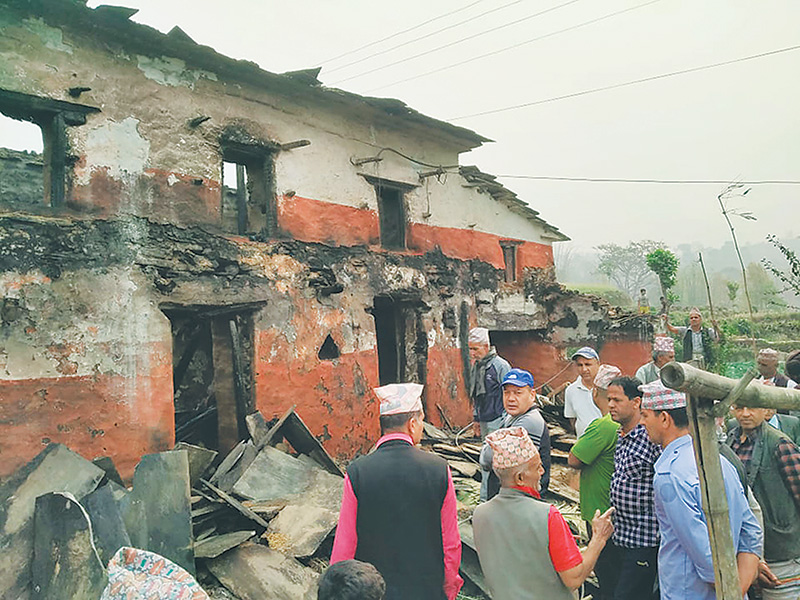
Forest and house fires are common occurrences in Nepal during the dry season. Post Photo: Agandhar Tiwari

BAGLUNG,
Saraswati Harijan, owner of Srijana Furniture in Baglung Municipality, woke up at 2am on April 11 to find her factory alight in flames. In no time was she out of bed and outside her factory calling for help from her neighbours.
“My house is just next to the factory. I woke up and rushed outside. The factory and the shop was engulfed in a huge inferno,” said the 35-year-old. “We informed the police and with their help tried to control the fire from spreading. The fire engine from Baglung Municipality arrived an hour later. It was too late by then.”
By the time two more fire engines from Beni in Myagdi and Kushma in Parbat reached the scene, Harijan had lost properties worth around Rs 2.2 million.
Forest and house fires are a common occurrence in Nepal during the dry season, which starts from November-December and continues until the onset of monsoon in June-July. This fiscal year, with low rainfall recorded from December to February, Nepal witnessed an unusually drought-like situation and an increase in house and forest fires in almost all 77 districts.
Incidents of inferno—both house fire and forest fire—were high in several districts of Gandaki Province.
However, despite the rise in the number of fire incidents, all levels of governments in the province were found to have made inadequate preparations for fire-related disasters. The local and district level administrations are struggling to manage even basic firefighting services such as rapid incident response and timely dispatch of fire engines.  
Delayed response, insufficient fire engines, shortage of trained firefighters and fire engine drivers, and a lack of water refilling stations coupled with narrow and rough roads are making rescue operations difficult in most districts of Gandaki.
According to the Fire Brigade Operation Working Guidelines, it is the responsibility of the respective local unit to own, maintain and regulate fire trucks while the District Police Office is responsible to take action in case of fire.
Baglung Bazaar, the district headquarters of Baglung, witnessed four massive fire incidents in the past two months. As first responders, the security personnel of Nepal Army, Nepal Police and Armed Police Force and the local people were involved in dousing the fire in two places. They carried buckets of water to the incident sites in the absence of a fire engine to control the infernos.
Of the total 10 local units in Baglung, only Baglung Municipality has a fire engine. The fire engine, which was purchased six years ago, is unreliable for it has remained unused and has become rusty for a lack of maintenance, say local people.
“We call for the fire engine whenever a fire breaks out but more often than not they tell us that it is out of order,” said Bidesh Kumar Shrestha of Baglung Bazaar, the furniture factory owner’s neighbour. “But even when the fire engine arrives, it’s only half filled. The local people then have to run helter-skelter to manage water for the fire engine.”
The municipality in its defence says its response to fire incidents has been poor because there’s only one qualified driver for the fire engine.
“We have only one post for a fire engine driver. It takes time to find him and send him to the incident site,” said Yukta Prasad Subedi, the planning officer at Baglung Municipality.
The District Administration Office in Baglung admits that fire fighting efforts have been dismal in the district.
“It is our responsibility to contain fires and rescue victims but we have failed to do so,” said Shiva Kumar Karki, chief district officer of Baglung. “We will coordinate with the local units to be better prepared for such disasters.”
Two weeks ago, a forest fire spread into a human settlement at Paiyu Rural Municipality Ward No. 6 in Parbat, destroying 20 houses and several animal sheds.
On April 12, Lil Kumari Subedi, aged 54, of Kushma Municipality Ward No. 2 lost her house to a fire caused by a short-circuit. There was no fire engine to save her house.
Mayor of Kushma Municipality Ramchandra Joshi says the office could not send the fire engine to Subedi’s house since they received the information late.
“Many places within the municipality do not have road access which makes it difficult for the fire engine to reach the incident sites on time,” said Joshi.
While Kushma Municipality has been providing firefighting services to the local people for the past four years, the other local units in Parbat say they are not interested in purchasing a fire engine. They cite poor road networks, high expense to purchase and maintain a fire engine and a lack of skilled firefighters and fire engine drivers as reasons for their decision to not install a fire engine in their local units.
“We have not yet bought a fire engine because we have to invest around Rs 10 million to buy and operate the vehicle,” said Padampani Sharma, the mayor of Phalebas Municipality. “The best we can do is coordinate with another local unit and pool in our resources to buy one fire engine for the use of both local units.”
In Myagdi district, out of the six local units, only Beni Municipality has a fire engine. The fire engine at Beni Municipality is limited to only urban centres given the poor road conditions in rural villages.
“Fire engines need wide roads. We can’t take the engine into narrow streets and small dirt roads. Many places even within the municipality do not have wide roads. Therefore, we provide services only in places where the truck can run,” said Narayan Garbuja, the fire engine driver. “Most of the time, the truck remains unused.”
In Lamjung, all eight local units have prepared a disaster management plan and formed disaster mitigation committees but purchasing fire engines is not on their agenda.
The only municipality with a fire engine in Lamjung is Besisahar. But the fire engine is used for purposes other than fighting fire.  
A hardware store in Danaiphant of the municipality caught fire on April 10. The fire engine arrived at the scene some 45 minutes after the first call was made.
“The fire engine was driven by police personnel and there wasn’t enough water in the tanker,” said Dolraj Bista, a local resident of Danaiphant. “We somehow managed to bring the fire under control on our own.”
According to Inspector Om Prakash Pun of the District Police Office in Lamjung, a police personnel was forced to drive the fire engine due to the unavailability of a fire engine driver.
Ramesh Kumar Pandey, the mayor of Madhyanepal Municipality, says the local unit doesn’t have the budget to buy a fire engine.
Sundarbazar Municipality Mayor Janak Raj Mishra shared a similar sentiment.
“We can’t take the burden of hiring a driver and technicians for the fire engine,” he said.
Local units in Tanahun too have shown no interest in purchasing fire engines, citing challenges in the management and operation of firefighting services.
“Most local units in the district are reluctant to buy a fire engine because of the high costs of purchase and management of the truck,” said Gangalal Subedi, chief administrative officer at Shuklagandaki.
As of now, only Byas Municipality and Bandipur Rural Municipality in Tanahun have fire engines. However, only one of the fire engines can be put to use while the other lies unused for a lack of maintenance and management.
Bandipur Chief Administrative Officer Mahesh Subedi said, “The rural municipality has not been able to operate the fire engine to its full capacity since we don’t have skilled fire engine drivers.”
In Kaski district, Pokhara Metropolitan City has four fire engines. However, Emergency Service Sub-Division Incharge Ramji KC said that the metropolis is not in a position to operate all four fire engines at the same time.
“It requires five people to operate one fire engine. In case of multiple fire incidents, we do not have the manpower to operate all the fire engines at the same time,” KC said.
The metropolis’ fire brigade has three fire engine drivers and 10 firefighters but only two staff members are on duty at a time.
The metropolis saw a total of 128 instances of fire in the current fiscal year.
Annapurna Rural Municipality Chairman Yuvaraj Kunwar said that the local unit also cannot afford to buy a fire engine.
“We do not have enough budget for a fire engine,” he said. “Even if we bought one, we wouldn’t be able to dispatch the truck to rural parts of the local unit for a lack of wide motorable roads.”
Rupa Rural Municipality relies on the fire fighting services of Pokhara metropolis.
“A fire line has been drawn and water pipelines have been installed in all seven wards of the rural municipality,” the local unit Chairman Nawaraj Ojha said. “For now, we call for firefighters from Pokhara in case of fire incidents. But we plan to purchase our own fire engine soon.”
Without a fire engine, far-flung Madi and Machhapuchre rural municipalities depend on local resources to fight fire incidents.
There are a total of 13 fire trucks in Gandaki Province. Kaski has four fire engines, Syangja has two while Baglung, Myagdi, Parbat, Tanahun, Lamjung, Gorkha and Nawalparasi (East) have one each. Manang and Mustang do not have a fire engine, leaving the local people to deal with fire incidents on their own.


(Agandhar Tiwari in Parbat, Ghanshyam Khadka in Myagdi, Aash Gurung in Lamjung, Samjhana Rasaili in Tanahun and Pratiksha Kafle in Kaski contributed reporting)

Page 3
NATIONAL

Poorly performing local governments may see federal grant slashed

The Ministry of Federal Affairs and General Administration has introduced a working procedure to evaluate performance of local governments.
- PRITHVI MAN SHRESTHA

KATHMANDU,
Federal grants to the local governments could be reduced for performing poorly as the federal government is introducing rules and measures to evaluate fiduciary risks at the local level.
Amid reports of increased irregularities at the local level, the Ministry of Federal Affairs and General Administration came up with a ‘Working Procedure on Evaluation of Risk to Financial Discipline at Local Level’ aiming at evaluating governance of the local governments.
“The result of the evaluation will be considered as an indicator of how good the local governments are in financial governance,” the working procedure states. “The results of evaluation could be the basis for providing financial grants to the local governments concerned.”
As per the working procedure, District Coordination Committees will be responsible for conducting evaluation of the local governments. The status of governance will be evaluated based on 100 indicators which are related to governance related risks in the areas of process management, results and fiscal discipline.
“We have informally discussed with the National Natural Resources and Fiscal Commission about tying up the grant with results of the evaluation report,” said Gopi Krishna Khanal, joint secretary at the Ministry of Federal Affairs. “The commission will take the final decision in this regard.”
He added that the ministry has not made any concrete recommendation about how to increase or decrease the funding based on the evaluation of the performance in governance.
The federal government introduced the working procedure at a time when the Commission for the Investigation of Abuse of Authority has been receiving an increasing number of complaints about irregularities at the local level.
According to the anti-graft body’s annual report for 2019-20, complaints related to the Ministry of Federal Affairs, which is the contact ministry for local governments, were the highest (30.07 percent) followed by the Ministry of Education (16.36 percent) and the Ministry of Land Administration (8.29 percent).
Most complaints related to the Ministry of Federal Affairs are about local governments, according to the commission.
This is also evident from the fact that in 2013-14, when the elected local governments had not been formed, only 14.6 percent of the total complaints filed at the CIAA were related to the erstwhile Ministry of Local Development, which is now known as the Ministry of Federal Affairs and General Administration.
The anti-graft body’s data show that complaints about irregularities at the local level were highest in 2018/19 when 26.87 percent of the complaints were related to the Ministry of Federal Affairs. And in 2017/18, the ministry’s share in such complaints was 18.2 percent, according to the commission.
A survey report titled ‘Study on Corruption at the Local Level,’ unveiled by the anti-graft body in January last year, showed that more than 50 percent of the survey respondents said that corruption at the local level either remained as it was in the past or is thriving.
However, Khanal claimed that the working procedure was not designed with perceived issues of corruption at the local level. “In fact, the working procedure was introduced to identify the shortcomings at the local level and how the centre could help bridge the gap to ensure good governance,” said Khanal.
“Governance at the local level might have been affected not only due to irregularities or corruption but also due to the lack of human resources, expertise and other resources. Our intention is to unearth the issues and to correct undesired practices affecting good governance.”
He said that the indicators were determined based on the recommendation of the anti-corruption agency, Office of Auditor General and Financial Comptroller General Office.
The indicators related to process management have got the weight of  53 percent while indicators related to result will have weight of 13 percent and  the indicators related to financial discipline will have weight of 34 percent.
The local governments scoring lower than 40 will be judged very poor in maintaining good governance, those scoring 41-80 percent will be categorised as medium level and those scoring over 81 percent will be judged good in ensuring good governance, according to the working procedure.
Some of the key indicators include: whether the local government presented budget on time and got it endorsed;  whether the list of projects to be implemented were prepared after ensuring resources; and whether the development plan were prepared based on land use policy, transportation master plan, environment plan, local infrastructure development master plan and local economic and social development plans.
Likewise, the evaluators will observe whether the concerned local government has taken fiscal discipline measures such as collecting revenue and spending budget based on financial act and the budgetary provisions and whether fiscal equalisation grant has been used for meeting administrative expenditure.
Likewise, the evaluators will also see whether the budget allocated for capital expenditure has been transferred to recurrent expenditure.
They will also study whether a local government has been able to fund its administrative expenditure from its own resources, whether a meeting of the local executive body has been held at least once a month and whether public procurement law and rules have been properly followed.  
Likewise, whether any local body has provided financial assistance to political parties and their sister organisations and whether there has been internal and external audit in time are other bases of evaluation.
Other issues to be overseen during the evaluation are whether a local government unit has spent over 80 percent of the capital budget, whether the local government has spent conditional grant on specified sectors and whether the consumer committees receiving any contract, have sub-contracted their work.
Whether elected representatives received perks and benefits based on  the provincial law, whether elected representatives submitted the details of their property and that of the family members to relevant offices on time and whether a fully electronic bidding process has been implemented for awarding  contracts will also be
evaluated.
Khanal said the District Coordination Committees, whose role has been largely invisible under the federal set-up, would evaluate the performance of the local governments and would submit it to concerned local government, the provincial government and the federal affairs ministry in the centre.
“At a time when the District Coordination Committees are complaining that they have not been given any work responsibilities, it will be a huge responsibility for them,” said Khanal.
But the local government officials are of the view that even though the move taken by the federal government was good, the involvement of the federal government in preparing the working procedure was not a good idea.
“As per the constitution, the District Coordination Committee has the jurisdiction of evaluating the performance of the local governments,” said Ashok Byanju Shrestha, president of the Municipal Association of Nepal, a grouping of municipalities. “Instead of empowering them to prepare working procedures and monitoring the performance of the local governments, the federal government is getting involved in all these tasks does not send a good message with regard to the implementation of federalism in the country.”

NATIONAL

Overflowing sewer, dug-up road greet patients at some of Capital’s big hospitals

- ANUP OJHA
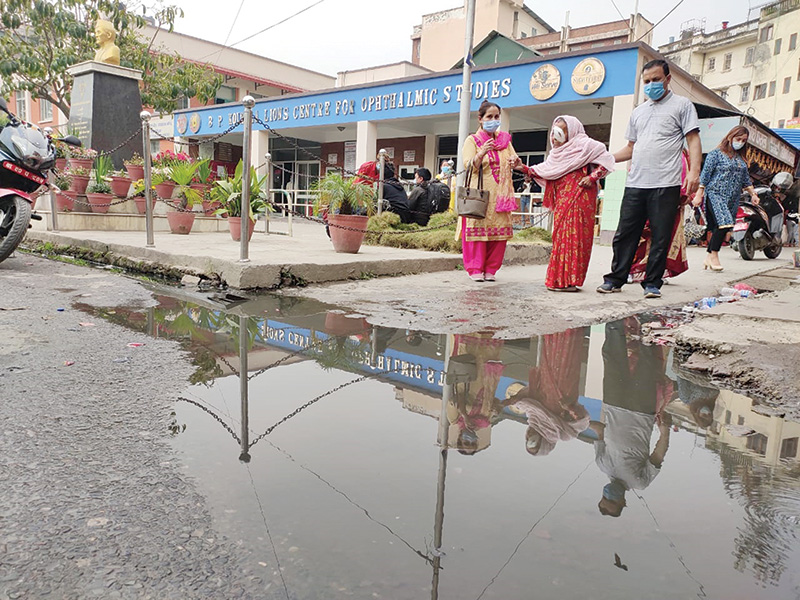
Urban planners say hospitals themselves should manage drainage and garbage problems on their premises. Post Photo: Anup Ojha

KATHMANDU,
On Friday Bishnu Khanal, 46, took his mother-in-law Narayani Nainawasti, 86, for her eye surgery to the TU Teaching Hospital, Maharajgunj, but when he stopped the taxi in front of the BP Koirala Lions Center for Ophthalmic Studies, he was shocked to see the overflowing sewage at its gates.
“It’s stinking sewage, and I had to be very careful in crossing the leaked sewage as she could barely see what was there,” said Khanal.
Like Khanal, hundreds of patients,  dozens of doctors and hospital staff are compelled to put up with the foul smell and need to be extra careful while walking on the road. Not only for eye patients, the leaked sewage has troubled those who need to visit the emergency ward.
“People go to the hospital for treatment but the foul smell and this mismanagement makes normal people irritated. This is so embarrassing to see the stinking sewage on the premises of such a big and reputed hospital,” said Khanal who came from Dhobhichaur.
It’s not only Khanal, Babulal Lama, 50, who has been running canteen on the premises of the eye hospital for the past seven years said the leakage of drain has been taking place for the past four years and the hospital administration has done nothing to resolve the problem.
Urban planners say that the drainage and garbage problem on the hospital premises should be managed by the hospital itself. “The hospital should be more sensitive about the issue,” said Kishor Thapa, a former government secretary and an urban planning expert.  
“Because of the foul smell, people hardly come to my canteen. Even doctors and staff are facing this problem but nobody bothers to repair the system,” said Lama.  
When the Post contacted Kamal Ghimire, administration chief of the Ophthalmic Studies, he acknowledged the problem and said the problem is beyond the hospital’s capacity to solve. “We all are suffering, we are trying our best to solve this issue but we have failed about it,” said Ghimire.
He blamed the Bhat-Bhateni Superstore, which has been constructing an annex at the hospital, for the sewage overflow. “Bhatbhatani has been constructing an emergency building for TU Teaching Hospital, but it didn’t consider the management of drainage, until Bhatbhatani opens it, the problem won’t be solved,” said Ghimire.
When the Post contacted Min Bahadur Gurung, the chairman and managing director of Bhat-Bhateni Group to inquire about the problem, he said the accusation is baseless. “As per our charity efforts, we are constructing a building for the hospital and have allocated  Rs 150 million for the work, do you think we do not consider the drainage system?” said Gurung. “That is why there is no working condition in Nepal,” Gurung added.    
This is not only the case of the TU Teaching Hospital, the sewage problem has been a perennial problem for Bir Hospital, the country’s oldest hospital. With multiple complaints from the general public, doctors and staff from the Trauma Center and Bir Hospital, the Kathmandu Metropolitan City and Kathmandu Upatyaka Khanepani Limited had said they had sorted out the problem a few months ago.
“But when it rains, the roads in front of the Bir Hospital and Trauma Centre get waterlogged with drain water,” said Nanda Lal Sah, 40, who runs a juice shop below the overhead bridge that links the Khula Manch and the Bir Hospital. When the Post reached the area on Sunday, still the western side of the road, that is linked with Bir Hospital and Trauma Centre’s footpath and up to New Road Gate, one could see the sewage with foul smell on the roadside.
“Now summer has come. It will be really difficult to breathe here if this sewage problem is not addressed properly,” Shah said.
When the Post contacted Dr Peeyush Dahal, dean at the National academy of Medical Sciences, at Bir Hospital he said this problem was a genuine concern. “This problem should be solved permanently as it is very sensitive. Local, federal and central governments should work together to solve this problem,” said Dahal.
Meanwhile, the road that leads to Prasuti Griha from Thapathali Chowk has been dug for over a month, and has been left full of dirt.
Samjhana Dhungana, whom the Post met at the maternity hospital’s gate who was  discharging her niece who gave birth on Saturday, said she was shocked to see the bumpy road section and the trouble faced by the pregnant women visiting the hospital.
“Last week when we brought my niece during night-time for child delivery, it was raining and the road was bumpy and was slippery at the same time, and now it’s sunny and it’s too dusty. Imagine its impact on pregnant women and the newborn,” said Dhungana, 30, who came from Kapan.
Apart from the bumpy and dusty road, leaking sewage in front of the Norvic Hospital is a perennial problem and though Norvic is taken as a hospital for VVIP people, its entry gate stinks of the sewage and the road has been left bumpy for over a month.
Krishna Prasad Pandey, 40, who has been running Palpali Bhojanalaya for the past 14-years in the area said his business has gone down due to the dusty road. “People refuse to come here to eat because of the dust, also we can’t live without masks, more than of the coronavirus, we are fed up with the dust,” said Pandey.
“If the road that leads to the country’s two finest hospitals seated in juxtaposition has not been maintained for over a month, you can imagine other places,” said Pandey. He said he is fed up with cleaning his eatery every morning with water as a pile of mud gets inside with the little customer who comes.
When the Post contacted ward-11 chairperson Hiralal Tandukar under whose jurisdiction the construction work has been taking place at Thapathali, to inquire about the treacherous road condition, he admitted of being late. “It’s because we need to be very conscious while digging the area as there are  underground telephone cables, Melamchi water pipe lines and electricity lines, this area is very complicated,” said Tandukar.
He said a total of Rs 30 million has been allocated for repairing the inner road from Thapathali to Babarmahal, and for overall management work such as laying the drainage pipe and maintaining and widening the footpaths.  
“There is a separate committee formed that includes the traffic police, and officials from Norvic Hospital and Prasuti Griha to coordinate the work. We will complete this work as soon as possible,’ said Tandukar.
However, the local shop owners say the road section is the most vulnerable, and that gets dug time and again under various pretexts and left in a sorry state.
Urban planners say that hospital areas are sensitive zones, therefore the local governments and the hospital administration themselves should be extra cautious.
“If there is a drainage issue inside the hospital premises, the hospital administration should look into the problem, and in case of Thapathali and Bir Hospital, it’s the local body that should work on it without any delay,” said Thapa.
After the local election in 2017, it’s the local government’s responsibility to look after the city’s infrastructure and its maintenance, but the Kathmandu Metropolitan City has been saying that it’s the Kathmandu Upatyaka Khanepani Limited’s Department of Water Supply and Sewerage which should look into the issue and there is a blame game going on.  
“For the problem at Thapathali it’s KMC’s responsibility, but for the Bir Hospital KUKL is responsible, but the KMC has been voluntarily helping to resolve the problem at Thapathali,” said Ram Thapa, Chief of Physical Infrastructure Department at the city.
Meanwhile, Milan Kumar Shakya, acting manager at KUKL says it has already installed a bypass drain line. “The logged water might have leaked from the drinking water pipe. I will send our official to inspect the area,” said Shakya. “Last time we solved the problem because the whole blame was put on us though the city office is equally responsible for it, we are committed to addressing this problem.”
There has been a lot of commitment from the officials in the bureaucracy towards solving the issue. Before being elected as the city’s new mayor in May 2017, Bidya Sundar Shakya in his election manifesto had pleaded to solve Kathmandu’s drainage problem as his first priority, but the problem is intact even after three years.  
Another urban planner Suman Mehar Shrestha says such a tendency among government officials shows how weak our bureaucracy is at the implementation level.
“Everyone knows that hospitals are sensitive locations, doctors keep on lecturing about personal hygiene but looking at the hospitals and the mismanagement of their surroundings and the infrastructure shows how backward we are in practical approach,” said Shrestha.   
“If the problem of hospital’s drain or hygiene is not addressed on time, this may someday cause another pandemic; this is a serious issue and it should be addressed without delay,” said Shrestha.

NATIONAL

Office building remains unused in lack of access road

Briefing

MYAGDI: Although the construction of a building of the survey office at Beni, the district headquarters of Myagdi district, was completed five months ago, the building has remained unused in lack of an access road. Tulasi Paudel, chief at the office, said, “The survey office has been paying Rs 40,000 in monthly rent for its existing office. The building is ready for use but we cannot move there due to a lack of an access road. We are planning to construct a road soon and move to the new building.”

NATIONAL

Seized sal timber decaying at forest offices

Briefing

RAUTAHAT: Around 6,000 cubic feet of sal timber seized from various parts of Rautahat district during the last one decade have started to decay at the forest offices. According to the Division Forest Office in Rautahat, illegal timber seized from various parts of the district have been
kept at the forest offices for a long time. Ram Prasad Sah, assistant division forest officer, said, “We cannot sell or do anything with the timber until the related court cases are finalised. Forest offices are trying their best to auction off the timber.”

Page 4
EDITORIAL

When lightning strikes

Technology and research is crucial to enabling an early warning system that can save lives.

Lightning kills more people than floods and landslides in Nepal, but lack of preparedness and precaution, disaster experts say, continues to kill and injure hundreds of people besides electrocuting livestock and incurring damage to property worth millions every year. According to meteorologists, thunderbolts are also turning deadlier every year with the increased intensity of storms. For such a major disaster that kills hundreds and despite readily available technology to provide real-time data on cloud movements and other atmospheric activities, lightning doesn’t receive the attention it should.
Between 1971 and 2019, some 1,927 people were killed, and 20,569 others were affected due to lightning strikes, according to a recent study which looked into lightning incidents, fatality rates and economic loss. The latest analysis revealed that the overall countrywide lightning fatality rate for the period was 1.77 per million per year. That’s two deaths in every million people attributed to lightning, with the fatality rates highest in Dolakha followed by Okhaldhunga, Ramechhap, Nuwakot and Makwanpur. Previously available data also shows that the Chure and Mahabharat hill ranges are highly vulnerable, and districts like Makwanpur, Rukum (West), Dang, Udayapur and Ilam are major hotspots that report the highest number of thunder strikes and fatalities.
Lightning incidents usually occur during the pre-monsoon period, and they do not draw the same attention as do floods and landslides with their scale of damage and mass casualties. However, if we crunch the numbers, we will find that lightning is the second deadliest catastrophe in the country after the Gorkha earthquakes, killing some 9,000 people. The latest data with the National Disaster Risk Reduction and Management Authority shows that at least 70 people and 717 head of cattle were killed in 247 lightning incidents last year, and property damage due to lightning is estimated at Rs7.2 million.
There are three things the government must immediately pursue parallelly to increase our level of preparedness and prevent tragedies and damage. There are only nine lightning detection network sensors at different airports of the country, and only one weather radar in Surkhet, which are not fully functional. Lightning detection stations and weather radars provide real-time data, which would be crucial to enabling an early warning system that can save lives. The government must not delay installing the two more weather radars as planned and must assess hotspot data to identify if more sensors are necessary. It must do this sooner and utilise the existing technology at the optimum level so that meteorologists can provide life-saving data to the public. Investment in research and technology will go a long way for the country as extreme weather events become the new normal.
Second, the Nepal National Building Code requires installing earthing systems or lightning protection devices in private and public buildings. Ward offices could strictly implement this provision if they make it mandatory before issuing a building permit and certificate of completion. Third, the government must communicate effectively to ensure that the public adheres to the building code and knows what to do when lightning strikes. Like the earthquake drill, the 30-30 rule of lightning, which recommends that one head indoors and stay put for the next 30 minutes after the last clap of thunder, can help save many lives.

OPINION

Building institutions

The focus on the individual must be replaced by a culture of institution-building.
- SUJEEV SHAKYA
Shutterstock

A couple of years ago, an international agency awarded our institution a contract, but they insisted that the contracts and payments will be done to individual consultants and not the institution itself. We did not agree and we decided to forgo that contract. They were perplexed and rather insisted we should change our ways. We responded that if international agencies in Nepal are propagating this, it is no wonder that there are few institutions being built in Nepal.
In Nepal, besides banks and a few international agencies, every sector is run through individuals, not institutions. In the development sector, the practice is even more common where the design is to promote a culture of individual consultants rather than consultant organisations. The procurement processes are designed to promote the hiring of individuals rather than organisations. These are so visible from all the job vacancies posted publicly. Many times, I have been asked to sign off as an individual consultant; that apparently would make procurement processes easier. We also hear about organisations who bill their people individually, ask them to collect the money individually and give it to the promoter of the organisation.  
We hear of many great individuals in many fields. But what of the organisations these individuals have built? How have they ensured that the knowledge repository is institutionalised? In a country of 40,000 NGOs, why is it that we cannot even name ten that have been exemplary institutions? Dr Bhekh Bahadur Thapa decades ago managed to secure endowment money for the Institute for Integrated Development Studies (IIDS). That has ensured the institution builds on the endowment and institutionalises it. Currently, Swarnim Wagle is trying to continue to build  IIDS.
There are many lessons to learn from global institutions that have built endowments for sustainability and carried on for centuries. Harvard University has existed for four hundred years, and the or University of Heidelberg for more than six hundred. Even in Nepal, at the Hiranyavarna Mahavihara in Patan, the institutional management of the temple has been passed down from generation to generation for more than nine centuries. In contrast, so many Buddhist vihara institutions established by monks in the 20th century have already
disintegrated.
Just a year ago, I wrote about the need to reform these religious institutions. The United States has transformed in the past two centuries based on the concept of institutions. So, Apple exists after the death of Steve Jobs and Microsoft survives even after Bill Gates stepped down.


Corporates should show the way    
My wife and I both grew up in the corporate culture at the offices of the Soaltee Hotel, where the late Prabhakar Rana was leading the first corporatisation effort in Nepal. We learnt the concept of corporation ownership being different from the management. We learnt how corporation management comprises of many individuals, where no single one is indispensable and succession planning is key. Three decades later, we are grappling to teach others these simple issues.
For clients, we need to continually tell them how it is important to hire a company rather than an individual. Deliverables in a company can be handled by a succeeding employee, but such deliverables come to a halt if an individual contractor is sidelined by an emergency. We insist on having non-poaching clauses in our contracts, since we find that some clients find it easier to poach one of the team members than hire the company. In a country where such basic corporate culture has not seeped in, we jumped to the concept of Corporate Social Responsibility (CSR) to better use available funds when donors have allotted it. Hopefully, we will find some development partners interested in pushing this corporatisation culture in Nepal and perhaps their operations also promote the culture of organisation building rather than the easy way out of working with individuals.
We have seen the weak corporate culture in Nepal making business leaders reluctant to open up the Nepali economy for international firms, as they will have to compete with corporates with deep global institutional knowledge and competencies. Even in large business organisations, it is difficult to name one or two exemplary professionals in their management team. This has been reflected in many private sector institutions in Nepal.
I have pointed out how it is important to build a strong secretariat like the Chambers and Private Sector Federations in many countries and even offered to volunteer to handle such reforms. But anything that is to do with institutionalisation, there continues to be tremendous reluctance. When I was working on reform of the Non-Resident Nepalese Association (NRNA), I had some hope of recalibration, but was proven wrong; building strong secretariats is what people do not want, as the focus moves from the individual to the institution.
The politics in Nepal is a result of the lack of institutional accountability. If the greater politics is to change, the focus will have to shift to building institutions and people leading institutions have to sacrifice their greed of wanting to be the centrepiece at the cost of the organisation. I am always open to working with those that have the drive to strengthen their institutions for the long run.

OPINION

Britain’s benefit madness

The UK’s income-support scheme reflects a welfare ideology that fails to distinguish fantasy from reality.
- ROBERT SKIDELSKY
1000 Words/Shutterstock.com

Mahatma Gandhi probably never said, ‘The greatness of a nation can be judged by how it treats its weakest member.’ But that doesn’t make it any less true. And nowadays, the United Kingdom is in danger of receiving a failing grade.
According to the Joseph Rowntree Foundation, 14.5 million people, or 22 percent of the UK’s population of 65 million, live below the ‘poverty line’ (defined as less than 60 percent of median income). Of a working-age population of 42 million, some 5-6 million, or about 12 percent, are either unemployed or underemployed (working less than they want to). About eight million working-age citizens, or 20 percent of the total, qualify for what the British call ‘benefit,’ whereby all or part of their income is paid by the state.
These figures are approximate, and some of the details are disputed. But the broad picture is that, even setting aside Covid-19, the UK’s capitalist system normally cannot provide a living wage for about one-fifth of the country’s working-age population.
This represents a huge change from the late 1940s, when Britain established its redoubtable welfare state. The philosophy that inspired it, reflected in the 1942 Beveridge Report held that the state would guarantee full employment, that work would provide the income for a decent life, and that the welfare system would deal with ‘interruptions’ to work caused by unemployment, sickness, and maternity.
By the 1960s, the interruptions had become much more frequent, not because unemployment had risen, but because the number of claims for so-called national assistance (benefits not covered by insurance) rose faster than the working-age population. The initial growth stemmed largely from an increase in the number of single mothers and an additional entitlement to disability benefits. Later increases in the number of claimants, including in the early 1980s, were fueled by a rise in unemployment and precarious work.
The current situation, with about 20 percent of the working-age population ‘living on the state,’ has existed since the 1990s. The growing numbers inevitably resulted in the spread of means-testing and conditionality, which, together with demands to simplify an increasingly fragmented system, led to the introduction of the current Universal Credit regime, whose long rollout began back in 2011. The new scheme consolidated six benefits for working-age people, in or out of work, into a single monthly payment.
But the key move had come earlier, in 1995, when the UK’s then-Conservative government replaced the unemployment benefit with a Jobseeker’s Allowance. In contrast to the era of Keynesian full-employment commitments, claimants would receive the allowance in return for undertaking a mandatory ‘job search,’ defined as ‘work activity.’ Every claimant had to prove that they were spending 35 hours a week—the equivalent of a full-time job—looking for work. Failure to engage in the necessary ‘work activity’ would result in their allowance, or ‘wages,’ being docked or cut off.
The philosophy behind this parody of the work contract was clearly explained by Neil Couling, a senior civil servant at the UK’s Department for Work and Pensions (DWP), in his evidence to the House of Lords Select Committee on Economic Affairs in March 2021. ‘The system does require the 2.5 million people on universal credit to engage with work search as a condition of receiving universal credit,’ Couling said. ‘You have to look for a job if you are going to get a job.’
As the DWP explained, ‘deliberately mirroring a contract of employment, the claimant commitment makes clear that welfare is no different from work itself.’ This means that ‘just as those in work have obligations to their employer, so, too, claimants have a responsibility to the taxpayer.’
Pronouncements like this one reveal that insanity—the inability to distinguish fantasy from reality—has taken over a system. It is true that you have to look for a job in order to get one. But you will not find one, even if you search over time, if there are none available. The fantasy behind the scheme (which also underpins neoclassical economics) is the assumption of full employment, with unemployment being simply a consequence of able-bodied workers’ preference for leisure.
Likewise, the UK’s benefits system assumes, insanely, that all claimants are digitally literate. The moving film I, Daniel Blake, about an unemployed carpenter who had recently had a heart attack, portrays Blake’s increasingly desperate efforts to submit a benefits claim online. Although his cardiologist has said he is unfit for work, the authorities say he lacks enough ‘points’ to qualify for disability benefits. So, Blake has to apply for a Jobseeker’s Allowance, which means he is forced to attend a CV workshop and be coached to apply for jobs that he is medically unfit to do.
Blake, who is digitally illiterate, goes to a public library to use the computer there. When the librarian tells him to ‘run the mouse up the screen,’ he takes the mouse and moves it across the monitor.
He then writes a CV by hand and gives it to various employers, who tell him that there is no work to be had. But the officials at the Jobseeker’s Allowance office are unimpressed. ‘That’s not good enough, Mr Blake—how do I know you’ve actually been in contact with all these employers?’ says one. ‘Prove it.’ This is pure Kafka, the algorithmic grinding of a senseless machine.
There is of course a method in the madness: Universal Credit can be seen as a deliberate tool to shape a currently redundant segment of the workforce into the forms required by low-skilled labour markets. But the disease is misdiagnosed: the problem is aggregate under-demand for labour, not a surplus supply of the wrong kind of labour.
The only escape from such a system is to replace fantasy with reality. If the UK’s private sector cannot in normal times provide decently paid jobs for all those willing and able to work, the state should step in with a public-sector job guarantee. That would immediately halve the number of Universal Credit claimants ‘searching for work’ and, by eliminating Marx’s ‘reserve army of the unemployed,’ substitute upward for downward pressure on wages.
Community-provided work, however dire, is more rewarding than a soul-destroying slog from firm to firm in search of nonexistent jobs. Work is the ultimate escape from poverty, but the futile sort demanded by the UK’s benefits contract puts many of society’s weakest members on a path to nowhere.

 
Skidelsky, a member of the British House of Lords, is Professor Emeritus of Political Economy at Warwick University.
— Project Syndicate

Page 5
MONEY

Import controls go as foreign exchange reserves swell

Experts say that Nepal should increase earnings from other sources and not depend too much on remittance.
- PRITHVI MAN SHRESTHA
US one hundred dollar notes are seen in this picture illustration. REUTERS

KATHMANDU,
The government and the central bank have progressively removed controls on foreign exchange spending with currency reserves rising to comfortable levels.
Experts say that tossing out import restrictions is the right thing to do now, but authorities should keep an eye out for possible disruptions to remittance inflows due to Covid-19, what with tourism knocked out and export incomes reduced to a trickle.
Foreign aid and foreign direct investment are the two other major sources of foreign exchange. While foreign aid to Nepal has been on the rise, foreign direct investment has remained at a crawl.
As a start, the cabinet on October 8 last year lifted restrictions on the import of foreign alcohol and luxury vehicles costing more than $50,000 for the official and personal use of foreign diplomats, diplomatic organisations and foreign officers.
In March, the freedom to import such fancy automobiles was extended to all, and the government also allowed the import of betel nuts, peas, peppercorns and dried dates by imposing quantitative limits.
Furthermore, Nepal Rastra Bank lowered the daily import quota of gold to 20 kg from 10 kg, and permitted commercial banks to issue dollar cards for the procurement of foreign goods and services.
Authorities had placed controls on the import of these items in April last year in a bid to conserve foreign exchange following concerns that Nepali migrant workers might lose incomes with the pandemic potentially spreading in the labour destinations.
When the impact of the virus outbreak on remittance was less than expected, the government started loosening the purse strings last year. As of the first eight months of the current fiscal year, the country’s foreign exchange reserves stood at $12.37 billion, sufficient to import merchandise and services for11.3 months.
“The main reason behind relaxing import controls on a number of items is the comfortable foreign exchange situation lately and revived economic activities,” said Prakash Dahal, joint secretary at the Ministry of Industry, Commerce and Supply. “Why should we restrict the import of these items without any reason?”
The ministry had proposed to relax imports of luxury vehicles, betel nuts, peas, peppercorns and dried dates. “Constant pressure from importers as well as potential revenue collection from the import of these items are other factors.”
When the restrictive measures were applied last year, the Commerce Ministry was not even consulted even though it is responsible for proposing to impose or remove such restrictions. The government had placed controls on the import of these items last year at the Finance Ministry’s behest.
Remittance inflows had shrunk in the early months of the lockdown which started on March 24 last year.
Contrary to expectations of a steep drop in remittance, inflows dipped by a marginal 0.5 percent in the last fiscal year 2019-20.
Even though the popular labour destinations in the Gulf Cooperation Council countries and Malaysia were severely impacted by the Covid-19 pandemic that left millions of expat workers with no choice but to pack their bags and leave, money continued to flow into the country.
In April last year, the World Bank had projected remittances to go down by 14 percent. The Central Bureau of Statistics too had forecast a reduction of Rs163 billion, or more than 18 percent.
Experts were pleasantly surprised to see remittance starting to swell with the start of the new fiscal year. As of the first eight months of the current fiscal year, remittance increased by 8.6 percent to Rs642.14 billion.
Apart from comfortable foreign exchange reserves that encouraged the government to do away with import controls, the Commerce Ministry was under pressure from different stakeholders including other government agencies to be kinder, officials said.
“Various stakeholders asked us why we were continuing to restrict the import of these items when economic activities were going on normally,” said Dahal.
“Even the Customs Department was dissatisfied with the import controls as it saw import duties as a way for the government to boost revenue when it was facing a resource crunch.”
Immediately after the government removed the restrictions, traders thronged the Department of Commerce and Supply Management to apply for approval to import
betel nuts, peas, peppercorns and dried dates.
The massive demand prompted the department to suspend the issuance of import quotas to traders.
Central bank officials believe that the relaxation of import restrictions on these items will not strain the country’s foreign exchange reserves.
“Immediately, there is no risk to the foreign exchange reserves even after the recent import relaxations on a number of products as remittance inflow has been growing and the level of foreign exchange reserves is very good,” said Dev Kumar Dhakal, spokesperson for Nepal Rastra Bank.
He said that even though the new wave of coronavirus pandemic could affect jobs in the Middle East and other labour destinations, the possibility of a steep drop in remittance is unlikely considering last year’s experience.
The central bank not only lifted restrictions on the import of certain products but also allowed banks to issue dollar cards.
“While the availability of adequate foreign exchange is one reason behind allowing firms and individuals to make payment through dollar cards, it was also necessary as such payments were taking place informally.”
He said that this measure had not affected foreign exchange reserves much.
Experts say that it is not necessary for the government and central bank to control the flow of foreign exchange as long as the country has sufficient reserves.
“Having a large amount of foreign exchange is unutilised resources,” said Nara Bahadur Thapa, former executive director of the central bank.
“At a time when economic activities are slowing and the economy has contracted, allowing utilisation of foreign exchange is a good idea. It helps create jobs and helps the growth of the economy.”
According to experts, it is a sensible idea for the government to seek to raise more revenue from the import of previously restricted goods, given the increasing resources needed.
“Obviously, some traders have started to benefit from the removal of the ban on the import of betel nuts, peas, peppercorns and dates dried,” said senior economist Keshav Acharya. “A majority of the imported goods are re-exported to India which has been helping Nepal to earn Indian currency as its requirement is high, but the country often faces a shortage.”
The central bank has enlarged the list of goods that can be imported by paying US dollars. Nepal has also been purchasing Indian currency by selling US dollars for a long time.
Experts say that Nepal should not forget the fact that the source of foreign exchange earnings is limited, even though the recent relaxation in foreign exchange spending may have cheered individuals and firms.
Remittance is the biggest source of foreign exchange earnings, and any setback in the economy of the labour destinations could affect Nepal’s foreign exchange earning capacity as the country’s export earnings are limited and the recovery of the tourism sector is uncertain amid the new wave of the coronavirus pandemic.
“Even though we should not worry about foreign exchange reserves because of increasing revenue, we should also seek to increase the contribution of other sources of foreign exchange such as exports,” said Thapa.
According to a recent report of the World Bank, Nepal has untapped export potential worth an estimated $9.2 billion.
The multilateral funding agency said Nepal could boost its exports twelvefold, which represents an opportunity to create around 220,000 new jobs, the report titled Development Update says.
“This shows that we can earn more from exports than remittance,” said Thapa. “We have to make efforts to realise this potential. If we make an effort, we can boost exports to a certain level in the short run and realise the full potential in the long run.”

MONEY

Australia-New Zealand travel bubble opens with joy, tears

- ASSOCIATED PRESS
Passengers arriving from Sydney at the Wellington International Airport hug loved ones in New Zealand. AP/RSS

WELLINGTON,
As the passengers walked a little dazed through the airport gates, they were embraced one after another by family members who rushed forward and dissolved into tears.
Elation and relief marked the opening of a long-anticipated travel bubble between Australia and New Zealand at the Wellington Airport on Monday. Children held balloons and banners and Indigenous Maori performers welcomed the arrivals home with songs.
The start of quarantine-free travel was a long time coming for families who have been separated by the coronavirus pandemic as well as to struggling tourist operators. It marked the first, tentative steps toward what both countries hope will become a gradual reopening to the rest of the world.
Danny Mather was overcome to see his pregnant daughter Kristy and his baby grandson for the first time in 15 months after they flew in from Sydney for a visit on the first flight after the bubble opened. What did they say to each other?
“Not a thing,” he said, laughing. They just hugged. “It’s just so good to see her and I’m just so happy to have her back.”
Kristy Mather said it was overwhelming to be reunited with her family and it was amazing the bubble had opened.
“I wished it had happened earlier, but it’s happened now,” she said. “I just wanted to get on that first flight because you never know, it may go south. Let’s hope it sticks around.”
Danny Mather said he wanted to keep New Zealand safe from the virus but also thought the time was right to open the bubble.
The idea of a travel bubble between Australia and New Zealand had been talked about for months but faced setbacks because of several small virus outbreaks in both countries, which were eventually stamped out.
To mark the occasion, Wellington Airport painted an enormous welcome sign near its main runway and Air New Zealand ordered some 24,000 bottles of sparkling wine, offering a complimentary glass to adult passengers.
Air New Zealand’s Chief Operating Officer Carrie Hurihanganui said the carrier had previously been running just two or three flights a day between the two countries but that jumped to 30 flights on Monday carrying 5,200 passengers.
She said the day marked a turning point and people were excited.
“You can feel it at the airport and see it on people’s faces,” she said.
The leaders of both countries welcomed the bubble, saying it was a world-leading arrangement because it aimed to both open borders and keep the virus from spreading.
“Today’s milestone is a win-win for Australians and New Zealanders, boosting our economies while keeping our people safe,” Australian Prime Scott Morrison said.
New Zealand Prime Minister Jacinda Ardern said her country was welcoming the new arrivals.
“The bubble marks a significant step in both countries’ reconnection with the world and it’s one we should all take a moment to be very proud of,” she said.
Travellers who lined up at Sydney and Melbourne airports early Monday said they were excited or relieved to finally fly to New Zealand after more than a year. Some were visiting family and friends, while others were attending funerals.
Both countries have managed to keep out the virus by putting up barriers to the outside world, including strict quarantine requirements for travellers returning from other countries where the virus is rampant.
“They did very well with the precautions and everything, better than the entire world. Everywhere else cannot go anywhere safely,” said Ameera Elmasry, who was at the Wellington airport to greet her son Shady Osman, a doctor who she hadn’t seen in 16 months. “It’s very good what’s happened now.”

MONEY

India may build new coal plants due to low cost despite climate change

- REUTERS

NEW DELHI,
India may build new coal-fired power plants as they generate the cheapest power, according to a draft electricity policy document seen by Reuters, despite growing calls from environmentalists to deter use of coal.
Coal’s contribution to electricity generation in India fell for the second straight year in 2020, marking a departure from decades of growth in coal-fired power. Still, the fuel accounts for nearly three-fourths of India’s annual power output.
Environmental activists have long rallied against India adding new coal-fired capacity. Solar and wind energy prices are falling to record lows, which would help the world’s third-largest greenhouse gas emitter cut emissions.
US Special Presidential Envoy for Climate John Kerry this month said India was “getting the job done on climate, pushing the curve,” as he began talks with government leaders aimed at cutting carbon emissions faster to slow global warming.
But a 28-page February draft of the National Electricity Policy (NEP) 2021—which has not been made public—showed India may add new coal-fired capacity, though it recommended tighter technology standards to reduce pollution.
“While India is committed to add more capacity through non-fossil sources of generation, coal-based generation capacity may still be required to be added in the country as it continues to be the cheapest source of generation,” the NEP draft read.
All future coal-based plants should only deploy so-called “ultra super critical” less polluting technologies “or other more efficient technology”, it added.
State-run NTPC Ltd, India’s top electricity producer, said in September it will not acquire land for new coal-fired projects. Private firms and many run by states across the country have not invested in new coal-fired plants for years saying they were not economically viable.
A source with direct knowledge said a government panel of various power sector experts and officials will discuss the draft and could make changes before seeking cabinet approval. India’s power ministry did not immediately respond to a request for comment on Sunday.

MONEY

Chip shortage casts shadow over China’s auto industry recovery

- REUTERS

SHANGHAI, 
A global shortage of semiconductors is hitting autos production in China, jeopardising hopes the world’s biggest car market might spearhead a recovery in the sector, industry executives warn.
Automakers around the world have had to adjust assembly lines due to the shortages, caused by manufacturing delays that some semiconductor makers blame on a faster-than expected recovery from the coronavirus pandemic.
Volkswagen AG, China’s biggest foreign automaker which hopes to sell over four million vehicles in the country, said the situation had not improved in the second quarter.
The German group’s China chief, Stephan Woellenstein, told reporters on Sunday it was hard to gauge how much production Volkswagen might lose week to week, or even month to month because of the chip shortage.
“It’s really like fire-fighting ... In some cases, we have switched to another chip so we changed suppliers,” he said, ahead of the Shanghai auto show which opens on Monday.
“It is like a perfect storm,” BMW’s China chief Jochen Goller said at Shanghai show, adding the shortage had put pressure on BMW’s purchasing. However, he said BMW had not lost production due to the issue, as it made early orders of chips.
William Li, chief executive of Nio Inc, told Reuters on Monday he expected a “relatively big impact” from the chip shortage on its electric vehicle production in the second quarter.
China, where over 25 million vehicles were sold last year, has been a ray of hope for automakers, including Volkswagen and General Motors, after the global industry was hit hard by the pandemic.
But China is also where news of the chip shortage first emerged last year. The problem was worsened by a fire in Renesas Electronics’ chip factory in Japan in March. In 2019, automotive groups accounted for roughly a tenth of the $429 billion semiconductor market, according to McKinsey, with NXP Semiconductor, Germany’s Infineon and Renesas.

Page 6
WORLD

India’s capital to lock down amid devastating virus surge

Ambulances catapulted from one hospital to another, trying to find an empty bed over the weekend.
- ASSOCIATED PRESS
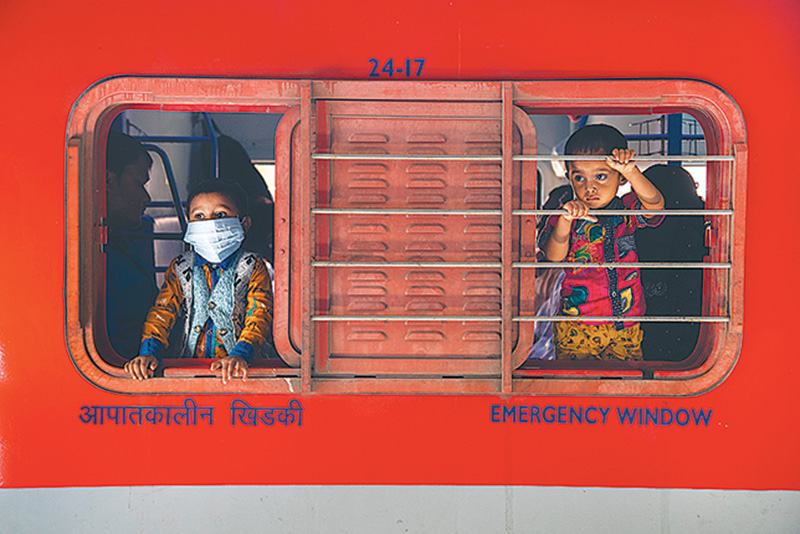
A boy wearing a face mask looks through the window of a train at a railway station in Gauhati, India, on Monday. AP/rss

NEW DELHI,
New Delhi imposed a weeklong lockdown Monday night to prevent the collapse of the Indian capital’s health system, which authorities said had been pushed to its limit amid an explosive surge in coronavirus cases.
In scenes familiar from surges elsewhere, ambulances catapulted from one hospital to another, trying to find an empty bed over the weekend, while patients lined up outside of medical facilities waiting to be let in. Ambulances also idled outside of crematoriums, carrying half a dozen dead bodies each.
“People keep arriving, in an almost collapsing situation,” said Dr. Suresh Kumar, who heads Lok Nayak Jai Prakash Narayan Hospital, one of New Delhi’s largest hospitals for treating COVID-19 patients.
Most desperately need oxygen, Kumar said. But the city is facing shortages of oxygen and some medicine, according to Chief Minister Arvind Kejriwal, who told reporters that the new stringent measures being imposed were required to “prevent a collapse of the health system,” which had “reached its limit.”
Just months after India thought it had seen the worst of the pandemic, the virus is now spreading at a rate faster than at any other time, said Bhramar Mukherjee, a biostatistician at the University of Michigan who has been tracking infections in India.
The surge is devastating for India and has weighed heavily on the global efforts to end the pandemic since the country is a major vaccine producer but has been forced to delay exports of shots abroad, hampering campaigns in developing countries, in particular. In a sign of the high stakes, the chief executive of Serum Institute of India, the world’s largest maker of vaccines, asked U.S. President Joe Biden on Twitter last week  to lift the U.S. embargo on exporting raw materials needed to make the shots.
The rise in cases comes amid setbacks in the worldwide vaccination campaign and deepening crises in many places beyond India, including Brazil and France. Over the weekend, the global death toll from the coronavirus passed a staggering 3 million people Saturday.
India reported over 270,000 infections on Monday, its highest daily rise since the pandemic started. It has now recorded more than 15 million infections and more than 178,000 deaths. Experts agree that even these figures are likely undercounts. Amid the rise in cases, British Prime Minister Boris Johnson called off a trip to New Delhi.
The city of 29 million people has fewer than 100 beds with ventilators, and fewer than 150 beds available for patients needing critical care. Similar strains can be seen in other parts of the vast country, where the fragile health system has been underfunded for decades and a failure to prepare for the current surge has left hospitals buckling under the pressure of mounting infections.
In the Himalayan Jammu state in India’s north, the weekly average of COVID-19 cases has increased 14-fold in the past month. In Telengana state in southern India, home to Hyderabad city where most of India’s vaccine makers are based, the weekly average of infections has increased 16-fold in the past month.
Meanwhile, election campaigns are continuing in West Bengal state in eastern India, amid an alarming increase there as well, and experts fear that crowded rallies could catalyze the spread of the virus. Top leaders of the ruling Bhartiya Janta Party, including Prime Minister Narendra Modi, have campaigned heavily to win polls in the region.
By contrast, in New Delhi, officials have begun to impose stringent measures again. The Indian capital was shut down over the weekend, but now authorities are extending that for a week: All shops and factories will close, except for those that provide essential services, like grocery stories. People are not supposed to leave their homes, except for a handful of reasons, like seeking medical care.
They will be allowed to travel to airports or train stations—a difference from the last lockdown when thousands of migrant workers were forced to walk to their home villages.
That previous harsh lockdown last year, which lasted months, left deep scars. Politicians have since been reticent to even mention the word. When similar measures were imposed in Mahrashtra state, home to the financial capital of Mumbai, in recent days, officials refused to call it a lockdown. Those restrictions are to last 15 days.
Kejriwal, the Delhi official, urged calm, especially among migrant workers who particularly suffered during the previous shutdown, saying this one would be “small.”
But many feared it would spell economic ruin. Amrit Tripathi, a laborer in New Delhi, was among the thousands who walked home in last year’s lockdown.
“We will starve,” he said, if the current measures are extended.

WORLD

India to fund capacity boost at Serum Institute as vaccines run short

NEW DELHI: India is set to accept the Serum Institute of India’s (SII) request for a 30 billion rupee ($400 million) grant to boost its capacity to make the AstraZeneca Covid-19 vaccine, a government source with knowledge of the matter told Reuters. SII, the world’s biggest vaccine maker, sought the funds to increase its monthly capacity to more than 100 million doses by the end of May, from up to 70 million currently. “We are clear that we will give whatever support is necessary to develop and boost the availability of vaccines in the country,” the source said on Sunday, declining to be identified as he was not authorised to speak publicly on the matter. Given the surge in domestic demand, any funding from the government is unlikely to help alleviate a slump in vaccine exports. India has delayed big shipments this month, exporting only about 2 million doses compared with 64 million doses between late January and March. A finance ministry spokesman declined to comment. SII, which will soon also start making the Novavax Covid-19 vaccine, did not respond to a request for comment.

WORLD

EU sanctions 10 Myanmar junta officials, two firms

- AGENCE FRANCE-PRESSE

BRUSSELS,
The EU on Monday imposed sanctions on 10 Myanmar junta officials and two conglomerates linked to the military over the coup and bloody crackdown on protesters, European officials said.
“The military regime is continuing its course of violence and manoeuvring the country into a dead end. That is why we are increasing the pressure to bring the military to the negotiating table,” German Foreign Minister Heiko Maas said after virtual talks with his EU counterparts.
“In addition to the listing of individuals, two economic conglomerates that are attributed to the military are also affected,” he added.
European diplomats said the two firms hit with asset freezes and visa bans were the Myanmar Economic Corporation (MEC) and Myanmar Economic Holdings Ltd (MEHL) which dominate sectors including trading, alcohol, cigarettes and consumer goods.
The officials targeted are mostly members of the ruling State Administration Council seen as responsible for undermining the democracy in the southeast Asian nation, diplomats said.
The measures—which will go into force when they are published in the EU’s official journal—come after the bloc hit junta chief Min Aung Hlaing and 10 other senior officials with sanctions last month over the February 1 seizure of power and bloody suppression of protests.
Western powers are seeking to increase pressure on Myanmar’s new leadership by targeting their key moneymakers.
The US and Britain have already imposed sanctions on the MEC and MEHL, and Washington has hit Myanmar’s state gem company as well.
Myanmar has been in turmoil since the military seized power from civilian leader Aung San Suu Kyi, triggering a massive uprising that the junta has sought to quell using lethal force.
The military has ramped up its attempts to crush dissent following mass demonstrations, with at least 737 civilians killed and the press increasingly under attack.

WORLD

China, US agree on need for stronger climate commitments

- REUTERS

SHANGHAI/WASHINGTON, 
China and the United States agree that stronger pledges to fight climate change should be introduced before a new round of international talks at the end of the year, the two countries said in a joint statement on Sunday.
The statement came after a meeting between Chinese climate envoy Xie Zhenhua and his US counterpart, John Kerry, in Shanghai on Thursday and Friday, China’s environment ministry said.
“The United States and China are committed to cooperating with each other and with other countries to tackle the climate crisis,” their joint statement said. The two countries will continue to discuss “concrete actions in the 2020s to reduce emissions aimed at keeping the Paris Agreement-aligned temperature limit within reach.”
Kerry arrived in Shanghai on Wednesday night under tight Covid-19 protocols and was transferred to a secluded hotel not open to the public. He subsequently traveled to Seoul.
His stop in Shanghai was the first high-level visit to China by a Biden administration official since the new president took office, and followed a contentious exchange between officials from the two countries in March in Alaska.
The talks also mark a resumption of climate dialogue between the world’s two biggest greenhouse gas emitters. Bilateral discussions ground to a halt during the administration of Donald Trump, who withdrew from the 2015 Paris agreement after claiming it unfairly punished U.S. businesses.
The United States is expected soon to deliver a new pledge to reduce U.S. greenhouse gas emissions in a bid to win back trust from foreign allies. Biden brought the United States back into the Paris climate accord.
Li Shuo, senior climate adviser for the environmental group Greenpeace, said China could soon respond to a new U.S. pledge with one of its own, building on the “momentum” of the Shanghai talks.
“The statement in my view is as positive as the politics would allow: It sends a very unequivocal message that on this particular issue (China and the United States) will cooperate. Before the meetings in Shanghai this was not a message that we could assume,” Li said. Biden will hold a virtual summit for dozens of world leaders this week to discuss climate change, to be livestreamed for public viewing. Global climate talks are scheduled November 1-12 in Glasgow.
The statement said the two countries also agreed to discuss specific emission reduction actions including energy storage, carbon capture and hydrogen. They said they would take action to maximise financing for developing countries to switch to low-carbon energy sources.
The Paris agreement encourages countries to submit more ambitious climate pledges if they are able to
do so. China has already promised enhanced actions as it tries to meet its goal to become “carbon neutral” by 2060.

WORLD

Xinjiang actions could meet criteria for crimes against humanity, rights group says

- REUTERS
Ethnic Uighur demonstrators take part in a protest against China, in Istanbul, Turkey last October. REUTERS

BEIJING,     
US human rights group Human Rights Watch (HRW) laid out in a report on Monday how China’s actions in Xinjiang could meet criteria for crimes against humanity, calling for coordinated investigations into “widespread” abuses in the region.
It said there was evidence of ongoing rights abuses targeting Turkic Muslims, which include Uighurs, Kazakhs and Kyrgyz people. China has consistently denied all accusations of abuse in Xinjiang.
“Given the gravity of the abuses against Turkic Muslims, there is a pressing need for concerned governments to take strong, coordinated action to advance accountability,” HRW said.
The report was compiled with the assistance of Stanford Law School’s International Human Rights and Conflict Resolution Clinic and provides a legal framework for how Beijing’s actions in Xinjiang could meet the criteria for crimes against humanity as defined by the Rome Statute of the International Criminal Court (ICC). UN experts and rights groups say China has detained over a million Uighurs and other ethnic minorities in Xinjiang since 2017 as part of a broad crackdown in the region.
In December, the ICC said it would not pursue an investigation into the mass detentions because the alleged crimes took place inside China, which is not party to the court. China has said it will not join the court because its statutes violate national sovereignty and its processes are open to political interference.
However, the HRW report says that national government prosecutors could individually or collectively conduct preliminary investigations similar to the ICC, and facilitate sanctions or prosecutions against individuals involved.
It encouraged states to utilise universal jurisdiction laws, sanctions on companies linked to Xinjiang and UN complaints mechanisms to pressure Beijing based on their findings.
It also recommended the launch of a UN-mandated commission of inquiry to investigate China’s policies in the region.
Several Western governments have levied sanctions over alleged rights abuses against China, which has said it will not allow an independent investigation into its programmes in Xinjiang.
Chinese officials initially denied the mass detentions, but have since said people were participating in voluntary vocational training and de-radicalisation programmes, and they have since “graduated”.
In March, the European Union, United States, Britain and Canada imposed sanctions on Chinese officials over alleged human rights violations in Xinjiang. China responded with corresponding sanctions on several lawmakers, researchers and institutions.
HRW cited instances of enforced disappearances, labour transfers, sexual violence and other abuses based on evidence including witness testimonies, government documents and media reports.
Beijing has called Uighur witnesses abroad “actors” and says efforts to investigate Chinese policy in Xinjiang are led by “anti-China forces”, primarily in the United States.

WORLD

Rwandan report says France ‘bears significant responsibility’ over genocide

Briefing
- AGENCIES

KIGALI: France “bears significant responsibility” for enabling the genocide in Rwanda and still refuses to acknowledge its true role in the 1994 horror, said a report commissioned by Kigali that was released on Monday. “It is our conclusion that the French government bears significant responsibility for enabling a foreseeable genocide,” concluded the nearly 600-page report into France’s role in the pogrom that saw some 800,000 people killed between April and July 1994. The years-long investigation by US law firm Levy Firestone Muse said France knew a genocide was coming but remained “unwavering in its support” for its Rwandan allies.

WORLD

Hunger-striking Navalny to go to prison hospital, officials say

Briefing
- AGENCIES

MOSCOW: Russian opposition leader Alexei Navalny, who is in the third week of a hunger strike, will be admitted to a hospital in another prison, the Russian state penitentiary service said on Monday, after the politician’s doctor said he could be near death. The prison service, FSIN, also said that Navalny had agreed to take vitamin therapy, but an ally of the 44-year-old Kremlin critic cast doubt on that and the hospital transfer, saying his lawyers should confirm both. The service said in a statement that Navalny would be transferred to a hospital for convicts located in a penal colony in Vladimir, a city 180 kilometres east of Moscow.

WORLD

Pakistan Islamists free 11 abducted police

Briefing
- AGENCIES

ISLAMABAD: Islamist radicals in Pakistan on Monday released 11 police abducted during violent anti-blasphemy protests against France over the weekend, the interior minister said as his government opened negotiations with the group after a week of violence. All main businesses, markets and shopping malls and public transport were closed in major cities in response to a strike call by the Tehrik-e-Labaik Pakistan (TLP), prompting the main KSE-100 stock index to open more than 500 points lower. The police were kidnapped during clashes outside the TLP’s headquarters in the eastern city of Lahore.

Page 7
SPORTS

Openers Bhurtel, Sheikh guide Nepal to emphatic win

The duo share century stand for the second match in a row as the hosts crush Malaysia by nine wickets to pull second victory from as many matches.
- Sports Bureau
Kushal Bhurtel (right) and Aasif Sheikh run between the wickets during the Tri-Nations T20 Series against Malaysia at the TU cricket grounds. Post Photo: Hemanta Shrestha 

KATHMANDU,
Openers Kushal Bhurtel and Aasif Sheikh once again shone for hosts Nepal as they registered an emphatic nine-wicket win over Malaysia in the Tri-Nations T20 Series at the TU cricket grounds in Kirtipur on Monday.
The duo, who marked their T20I debuts in the Series opener against the Netherlands with half-centuries each on Saturday, shared a century stand for the first wicket. The 25-year-old Bhurtel scored an unbeaten 61 run and became the first Nepali player to score back-to-back T20I half centuries as Nepal pulled off their second victory from as many matches.
His opening partner Sheikh contributed 42 runs as Nepal surpassed the 110-run target in 12.1 overs losing one wicket. Medium pacer Karan KC gave Nepal a perfect start with a three-wicket haul as Malaysia was bowled out for 109 runs in 16.5 overs.
The outcome assured Nepal top position in the standings with four points after the completion of first round matches. The Netherlands and Malaysia are second and third with two points each but the Dutch side stand second on the basis of superior net run rate.
“The important thing is that we won the game,” said Bhurtel when quizzed about his back-to-back half-centuries. “It’s a nice feeling to win both matches in a convincing way,” he added, who shared a record 116-run first wicket partnership with Sheikh in their nine-wicket victory over the Netherlands.
“I played a pressure free game against the Netherlands as it was my debut match. I had worked really hard for this moment and I did not want to miss this opportunity,” said Bhurtel, adding that he and Sheikh had fulfilled the role they were assigned by the team. “I have been playing as an opener for a couple of years now and it is not that tough job.”  
Put into bat first, Malaysia made a shaky start to their innings and kept on losing wickets at regular intervals. Opener Anwar Aurdin was the first wicket to fall as he was caught by wicketkeeper Binod Bhandari off Karan KC with eight runs under his belt.
While other opener Syed Aziz scored 27 runs off 24, the highest in the innings, skipper Ahmad Faiz and Virandeep Singh were next two batsmen to be removed cheaply for three and six runs respectively. Faiz was run out while Singh, who scored 87 against the Netherlands on Sunday, was bowled by Sompal Kami. Aziz was the fourth wicket to fall as he was caught by Sheikh off Dipendra Singh Airee in 7.5 overs.  
Sharvin Muniandy was the second best scorer for Malaysia with 20 runs off 15 deliveries. He was caught by Bhurtel off KC in 15.3 overs. Wicketkeeper batsman Shafiq Sharif, who scored 15 runs, was the other batsman to score in double digits. He was bowled by leg spinner Sandeep Lamichhane.     
Nepal used seven bowlers including Kushal Malla who replaced Aarif Sheikh in the starting lineup in comparison to the last match against the Netherlands. KC was the pick of the bowling claiming three wickets in his three-over haul conceding 17 runs. The medium pacer was named the-man-of-the-match.
Leg spinner Lamichhane grabbed two wickets in his 3.5 overs bowling and conceded 25 runs. Dipendra Singh Airee, Shahab Alam, Kushal Malla and Kami pocketed one wicket each. Abinash Bohara bowled an over and conceded eight runs.
Nepal made a solid start to their run chase as Bhurtel hit a six to Pavandeep Singh in the second ball of the innings and collected eight runs in the first over.  He hit three fences and five sixes in his unbeaten knock of 41 balls.
His opening pair Sheikh cracked four fences and a six in his quickfire knock of 29 balls. He shared 102-run partnership for the first wicket with Bhurtel before being caught by Anwar Rahman off Virandeep Singh in 11.1 overs. Dipendra Singh Airee, who contributed six runs, finished the chase as he smacked Anwar Rahman four in the first delivery of the 13th over as Nepal reached 113-1.
Nepal’s newly appointed coach Dav Whatmore, who was taking charge of the team in an official match for the first time since his appointment in December, said: “It is nice to win the game. The performance has been extremely strong in the two games we have played so far.”
About his openers, the Australian coach said: “Both of them were pretty good and they both were fighting for one spot in the team. Paras’ (Khadka) injury ensured that they made it to the starting lineup. Having faith in themselves, good wickets and strong batting lineup gave confidence to those two boys.”
Nepal will play against the Netherlands in their next fixture on Tuesday.
Meanwhile, Cricket Association of Nepal (CAN), issuing a statement on Monday, said that spectators would not be permitted in the remaining matches of the Series. The cricket governing body took the step as per the decision of the Council of Minister owing to the surge in the number of Covid-19 infections in the country.

SPORTS

Tottenham sack Mourinho

- REUTERS

LONDON,
Jose Mourinho was sacked as manager of Tottenham Hotspur on Monday after 17 months in charge of the London club and six days before they will appear in the League Cup final.
Tottenham confirmed in a statement that the Portuguese had left along with his coaching staff. “The Club can today announce that Jose Mourinho and his coaching staff Joao Sacramento, Nuno Santos, Carlos Lalin and Giovanni Cerra have been relieved of their duties,” it said.
The 58-year-old former Porto, Chelsea, Inter Milan, Real Madrid and Manchester United manager Mourinho had been in charge of 86 games at the club, having replaced the popular Mauricio Pochettino in November 2019. Having taken charge with the club in 14th place in the Premier League, they finished in sixth spot last season.
His first full season in charge began well with the club beating Manchester United and Manchester City and topping the table in December. But they have since slumped with fans disgruntled by the style of football and mystified by the lack of game time given to the likes of Gareth Bale and Dele Alli.
Tottenham have also become overly reliant on the goals of Harry Kane who took his tally to 21 for the season in the league with a double against Everton on Friday, but who is being linked with a move away from the club. The 2-2 draw at Everton left Tottenham in seventh place and they have won only one of their last five league games, all but ending their top-four hopes. They also suffered an embarrassing Europa League last-16 exit against Dinamo Zagreb, losing the away leg 3-0 having won the first leg 2-0.
The timing of Mourinho’s sacking denied him the chance of landing Tottenham’s first trophy since 2008 as he had taken the club to this Sunday’s League Cup final against Manchester City.
Tottenham chairman Daniel Levy turned to Mourinho as the man to do the same for Tottenham but has consistently fallen short on the pitch.
However, results and performances have tailed off alarmingly this season and since the end of January Tottenham have won only five of 14 Premier League matches.
Mourinho has always been known for his pragmatic style and the steely mentality of his teams but Tottenham have dropped 20 points from winning positions this season.
Tottenham said former midfielder Ryan Mason will be in charge of the first team on Monday.
RB Leipzig manager Julian Nagelsmann is tipped as one of the favourites to take over from Mourinho, although he is also touted to replace Hansi Flick at Bayern Munich.

SPORTS

UEFA blasts ‘disgraceful’ Super League plan, threatens clubs with ban

- REUTERS

MANCHESTER, 
European football’s governing body UEFA on Monday said clubs and players joining the proposed breakaway Super League could be banned from all of its competitions and the World Cup as it condemned a “disgraceful and self-serving proposal”.  
The US investment bank JP Morgan is financing the new league, which includes clubs such as Real Madrid and Manchester United and is a rival to UEFA’s established Champions League competition.
Addressing an emergency meeting the day after 12 of Europe’s top clubs announced the breakaway, UEFA president Aleksander Ceferin launched a scathing attack on the plan, which has been widely condemned across the game and beyond.
“We’re still assessing with our legal team but we will take all the sanctions that we can and we will inform you as soon we can,” he said. “My opinion is that as soon as possible they have to be banned from all our competitions and the players from all our competitions.”
“UEFA and the football world stand united against the disgraceful and self-serving proposal we have seen in the last 24 hours for a select few clubs in Europe motivated by greed. We are all united against this nonsense of a project,” Ceferin said.
JP Morgan is providing a 3.5 billion euro ($4.21 billion) grant to the founding clubs to spend on infrastructure and recovery from the impact of the Covid-19 pandemic.
The bitter battle for control of the game and its multi-billion dollar revenues entered a new phase with a letter sent by the 12 clubs to UEFA on Monday in which they said they would take legal steps in unnamed courts to protect their interests as they set up the league.
The breakaway has been heavily criticised by football authorities, fan organisations and politicians across Europe who say it entrenches the wealth and power of a small elite of clubs.
The breakaway clubs will be guaranteed annual places in the competition - in contrast to the current UEFA Champions League, which requires teams to qualify via their domestic leagues.
While having guaranteed spots in the league goes against long-standing tradition in European football, the clubs argue the Super League will create a more sustainable financial model.
“The formation of the Super League comes at a time when the global pandemic has accelerated the instability in the existing European football economic model,” the clubs said in their founding statement.

MEDLEY

Horoscope

ARIES (March 21-April 19) ****
You’re quickly becoming aware of certain changes that need to be made, Aries. Today’s first quarter moon in expressive Leo has you becoming aware of the present tension existing between your raw talents and your ability to put them on display.

TAURUS (April 20-May 20) ***
Can you feel the rush of fresh energy emerging around you, Taurus? It’s important that you ride that wave and let it reinvigorate you.

GEMINI (May 21-June 21) ****
Your quiet Twin reigns supreme this time of year, Gemini. Let it guide you inward, where you can begin to shine a light onto painful blockages and damaging cycles that inhibit your growth

CANCER (June 22-July 22) ***
This is the time of year when your goals begin to gain traction, Cancer. You’ve worked so hard to get here, let yourself enjoy the elements of your efforts.

LEO (July 23-August 22) ***
No one can dim your shine this time of year, Leo. No one except yourself. That’s the critical lesson emerging under today’s first quarter moon in your sign.

VIRGO (August 23-September 22) ****
As a Virgo, you’re great at looking at the world through a micro lens. You’re talented at seeing all the details of life and how they function, but it can be difficult for you to step back and absorb the big picture.

LIBRA (September 23-October 22) ***
You’re becoming increasingly more aware that before you can move forward with your goals, you have to fearlessly face some deep inner work, Libra.

SCORPIO (October 23-November 21) ***
We can’t go through life alone, Scorpio. You’re beginning to focus your attention on the authenticity of the exchanges in your closest one on one relationships.

SAGITTARIUS (November 22-December 21) ***
It’s likely that tensions are stirring between your day job and the big-picture vision you have for your life, Sagittarius.

CAPRICORN (December 22-January 19) ****
How can you get closer to the passions in your heart, Capricorn? That’s what this time of year is all about. Today’s skies bring the first quarter moon in heart-centered Leo to life, helping you deep dive into this story.

AQUARIUS (January 20-February 18) ***
This time of year submerges you into the deepest levels of your being, Aquarius. It’s important for you to explore the unturned stones of your past and feel whatever feelings come up.

PISCES (February 19-March 20) ***
It’s becoming increasingly important that you start speaking your truth, Pisces. This time of year helps you find a confidence in your self-expression that has long since felt absent.

Page 8
CULTURE & LIFESTYLE

Sony Xperia: Technologically impressive but narrow market

Despite Sony smartphones’ innovative features, they’ve struggled to stay relevant in the highly competitive smartphone market.
- PRAJESH SJB RANA
Xperia Pro, Sony’s latest smartphone offering, boasts top-of-the-line features. Photo courtesy: Sony

KATHMANDU,
The smartphone landscape has changed exponentially since the 2000s and many of the market leaders of the dumb phone era such as Nokia, Sony Ericsson and Motorola are husks of their former selves losing major market share to companies like Samsung, Apple and Chinese upstarts like Xiaomi and OnePlus.
During the 2000, Sony Ericsson mobile phones were all the rage due to the company’s focus on multimedia and innovative designs. Phones like the Walkman phones delivered expectational audio quality for the time, with some popular models featuring up-to four speakers. The company was also known for their innovations in smartphone camera systems with many non-Sony phones, even today, equipped with Sony’s smartphone sensors. Sony Ericsson was also one of the first smartphone companies to embrace the Android ecosystem where the likes of Nokia and Blackberry resisted the mobile operating system for a long time.
In 2010, Sony bought out Ericsson’s share in the company and rebranded the company as Sony Mobile and since then we’ve seen some great devices from the company that have continued to push the smartphone industry further.
The Xperia line of phones were one of the first few phones that had an IP rating with waterproofing and Sony smartphones have always offered exceptional audio quality through their implementation of HiRes Audio since their 2015 Xperia Z5 flagship. The Xperia line has also incorporated many of Sony’s display technologies as well with the Bravia Engine augmenting their smartphone displays since 2012.
But even with all of these innovations behind Sony smartphones, they’ve struggled to stay relevant in the smartphone market, with Sony’s smartphone sales dropping from 11.9 million in 2014 to a mere 0.6 million in Q3 2020. An embarrassing number to say the least since many other manufacturers like Apple and Samsung achieve those numbers in a few weeks after launch.
Sony’s flagship phones have always been impressive. They offer good specifications and I am a fan of their utilitarian, no-nonsense business look. Sony flagships have also offered some really high density displays for a very long time. In 2019, the company revamped their Xperia line of phones with an easier naming scheme. This rebrand started with the Xperia 1 in 2019 and continued with the Xperia 1 II in 2020. Sony also offers smaller and cheaper versions of their phones although they are very premium priced devices.
Both the Xperia 1 and the 1 II are some seriously impressive devices. The Xperia 1 II uniquely offers a very tall aspect ratio at 21:9. The tall nature of the phone while fitting more comfortably in your hand, also offers larger screen real estate while using the phone. The screen is also one of the very few smartphones with a 4k OLED HDR display. It comes equipped with a top-of-the line Snapdragon 865 SOC with 256GB of storage and either 8 or 12 GB of RAM. While the horsepower under the phone is flagship level, Sony has also done some interesting things with their camera module. The Xperia 1 II is equipped with a quad camera setup at the back with three 12 MP sensors at wide (24mm), telephoto (70mm), and ultrawide (16mm) and a 0.3 MP depth sensor all equipped with Zeiss optics.
Sony also released their Sony A7S III last year, their full-frame mirrorless camera that has been arguably considered one of the best cameras to come out in 2020. For the Xperia 1 series, Sony has managed to port the A7S’ system into the smartphone so you get almost all of the software features of the A series cameras through Sony’s Pro apps—Photo Pro and Cinema Pro.
These apps not only provide granular control over your camera settings but also come with advanced features like focus tracking, object and eye tracking, histograms, metering modes to mention a few. Even in the Cinema app, the Xperia shoots at 4k videos with wide dynamic range with support for colour profiles, audio tracking and manual focus tracking too.
Considering everything on paper, the Xperia 1 II is an exceptional device but this year, Sony launched the Xperia Pro, an even more professional device with the capabilities of using the smartphone’s 4K HDR screen as a monitor for the A7S or other professional camera setups while also providing cutting-edge 5G technology to enable live-streaming from the phone and camera setup itself. The phone also has a 4,000 mAh battery and can reverse charge the camera as well. Unsurprisingly, this monster of a professional phone goes for $2500.
Which brings us back to Sony’s declining market share. The revamped Xperia phones are really good to say the least, but with the refresh it feels like Sony just slapped a fresh new coat of paint on their already exclusive products. While the new phones are seriously impressive, they’re designed for a very niche market of professionals who, in many cases, already have professional gear that they would prefer over the Xperia. And while yes, having a multi-purpose device that you can depend on for professional work does add to the appeal of the devices, they cater to a very small segment of the market. Sony phones are also expensive, with the Xperia 1 II running for over $1000.
Considering Sony’s focus on professional tools, it was surprising to see how normal non-pro users are neglected in the feature set. Basic smartphone functionality like Night mode is missing on the Camera app, meaning that users of the device will have to go into the Pro app and fix settings manually for a decent
low-light photo. Even the front-facing selfie camera is an unceremonious 8 MP sensor with very little bells and whistles.
Non-pro features such as these would be far more important for regular smartphone customers than external monitor support and full creative freedom during normal photo shoots or selfies.
The new Sony smartphones are really impressive technologically, but in a sense, it feels like the company is further drawing themselves into a corner by focusing solely on a very small and niche segment of the market. But even if you are a creative professional, the Xperia phones are difficult to recommend since as a professional, the phone would definitely come in handy from time-to-time but in many cases, you have dedicated equipment that will overshadow the Xperia. Even though the company is losing market share, they haven’t stopped innovating and pushing the industry forward.