You internet speed is slow. Switch to text view mode

Switch
epaper logo
ST

Last Login:
Logout
+
Page 1
HOME PAGE

Nepal’s health system cracks under the strain of rising Covid-19 cases
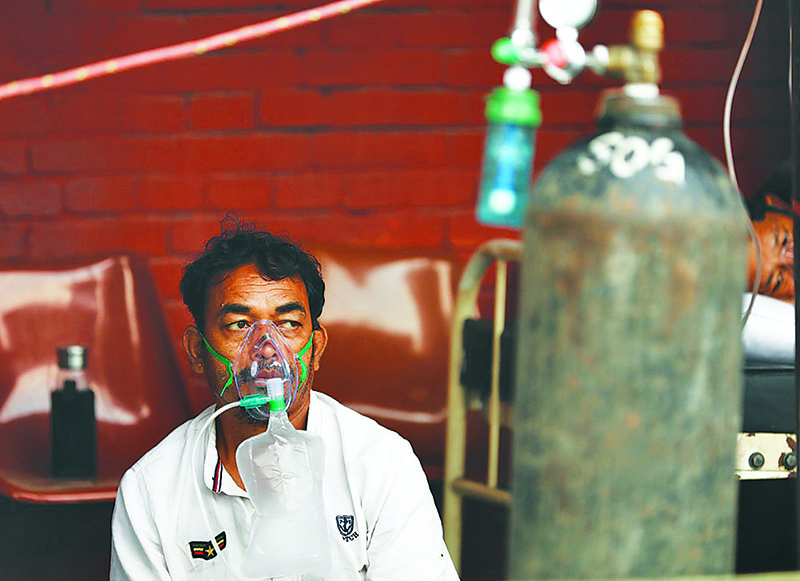
More people are in dire need of oxygen, but plants are falling short of production, as hospitals say they cannot take new patients for lack of the life-saving gas.
- SHUVAM DHUNGANA,PRITHVI MAN SHRESTHA

A Covid-19 patient is treated outside the emergency ward of Sukraraj Hospital in Kathmandu.Post Photo: SANJOG MANANDHAR 

KATHMANDU : Two days after he said that the Covid-19 situation in Nepal was under control in an interview to the CNN, which invited widespread ridicule, Prime Minister KP Sharma Oli reached out to the international community on Monday. This time he seemed to be in damage control mode for his earlier chest-thumping.
In an opinion piece for the The Guardian newspaper titled, “Nepal is overwhelmed by Covid. We need help”, Monday Oli wrote, “Nepal’s history is one of hardship and struggle, yet this pandemic is pushing even us to our limits. The number of infections is straining the healthcare system; it has become tough to provide patients with the hospital beds that they need.”
He went on to claim that his government has “tried to make sure that those needing interventions such as oxygen support and ICU care get access to the treatment they need.”
Those attempts of the Oli government so far seem to have fallen flat. Oli, however, is right in saying Nepal’s healthcare system has collapsed.
Suraj Shrestha, 32, was admitted to Vayodha Hospital, Balkhu for Covid-19 treatment two days ago, but as his oxygen level sharply dropped, the hospital asked his family to get oxygen for him.
According to Shrestha’s friend Sanjeev Dhakal, they have been trying hard to get oxygen but without success.
“We tried to contact oxygen distributors on numbers we got from social media but no one responded,” Dhakal told the Post. “When we tried to reach out to the government through their helplines, the numbers were constantly busy. When someone finally picked up the call, the patient’s information was asked and we were told they would get back to us.”
But there has been no response since then, he said.
On Saturday, the Ministry of Health and Population directed 10 manufacturers not to sell or distribute oxygen without the government’s recommendation. The ministry said the step was taken to curb the ongoing shortage of oxygen cylinders and make an equitable distribution.
Hospitals, however, say that they have not been getting enough oxygen.
On Tuesday, Jorpati-based Nepal Medical College published a notice telling its Covid-19 infected patients to get discharged from the hospital as it was short of oxygen and the government has been informed of the decision.
“The hospital does not have an adequate amount of oxygen supply and it’s not getting oxygen from anywhere,” it said in a statement.
Kathmandu’s premier private hospital, Nepal Mediciti Hospital, is also facing a shortage of oxygen.
“The hospital needs 450-500 oxygen cylinders a day. However, the government has allocated only 100 cylinders,” said Dr Raj Rana, medical superintendent and spokesperson for the hospital. “The oxygen allocated by the government is not enough to treat the admitted patients, and with limited supply, hospitals cannot admit more patients.”
According to a statement the hospital issued Tuesday, it is providing treatment to over 120 Covid-19 patients and of them, 40 are on ventilator support.
Nepal Medical College is treating 16 Covid-19 patients, said Dr Qamran Ansari, a medical officer at the hospital. “Every day we get innumerable calls to admit virus-infected patients, but we can’t, as we are facing trouble to supply oxygen even to those who are already admitted,” said Ansari.
Relatives struggle in panic trying whatever way they can.
Suraj Raj Pandey, one of the founders of Covid Connect Nepal which connects assistance seekers and providers, said since the government’s decision on the need for recommendation, the number of people demanding oxygen has soared.
“We have over 357 oxygen requests on our site but we can’t assist them as the government has ordered manufacturers not to provide oxygen without its permission,” Pandey told the Post. “The government’s helpline numbers are busy most of the time. If anyone is lucky, they pick up, but they obviously won’t provide you ICU beds or oxygen anytime soon.”
The government has been operating a Covid-19 hotline to assist the general public. As per the Health Ministry, people can reach out to 1133 round-the-clock, while 1115 from 6am to 10pm, and 9851255834 and 9851255837 from 8am to 8pm for support.
When the Post tried to reach out on these numbers, they were either busy most of the time or not reachable. After several attempts, 1115 received the Post’s call. When asked how to get oxygen, the operator directed to 1140 or 01-4271730, hotline numbers of the Covid-19 Crisis Management Committee.
The Covid-19 Crisis Management Committee, or CCMC as it is known, has been managing the oxygen-related issues since the Health Ministry’s decision Saturday.
“If a hospital needs oxygen supply, it can visit the CCMC website and fill up the demand form and send an email,” said the operator who answered the hotline 1140. “The CCMC will give permission to the hospital and they will receive the required amount of oxygen from the suppliers everyday.”
Even individuals who are in home isolation need recommendations from hospitals and respective District Covid-19 Management Centres, according to him, who refused to provide his name.
“The process of getting oxygen is time-consuming,” he admitted, nonetheless.
On its website, the CCMC has listed names of 83 hospitals and the amount of oxygen they are receiving everyday.
According to the official who answered the CCMC hotline, the amounts allocated were determined after evaluating the need of the hospitals per day.
“Oxygen is a life-saving component at these difficult times,” said Dr Sher Bahadur Pun, chief of the Clinical Research Unit at the Sukraraj Tropical and Infectious Disease Hospital. “If only we can ensure high flow oxygen therapy, we can save over 50 percent of the people who are at risk.”
Nepal on Tuesday reported 9,317 new infections, the highest-ever single day spike, taking the nationwide tally to 413,111. Of these 97,008 cases are active. The Health Ministry said there were 225 deaths. The figure includes deaths from the last few days and has been updated with data from the Nepal Army which manages the funeral of those who died of the disease.
According to Samir Kumar Adhikari, joint spokesperson for the Health Ministry, more than 100 died in the last 24 hours.
The country’s death toll stands at 4,084.
With the government’s failure to check the spread of the virus as well as make arrangements for the supply of oxygen and treatment since the second wave hit the country in mid-April, the Supreme Court on Tuesday told authorities to ensure oxygen supply, medicines and well-equipped hospitals with adequate human resources immediately.
“To manage facilities which are directly related to human life, an interim order has been issued in the name of defendants [federal and provincial governments] to ensure that people’s problems are effectively resolved even if there is need to form a working committee including all the stakeholders,” states the interim order issued by a single bench of Justice Bam Kumar Shrestha.
However, there seems to be no plan in place to ensure the smooth supply of oxygen as cases and deaths continue to rise exponentially. A number of health officials the Post spoke to said they were not sure exactly how much oxygen is needed now or will be needed in future.
“The current production has been insufficient and there must be a significant rise in availability of oxygen,” said Dr Jageshwar Gautam, spokesperson for the Health Ministry.
Of the 185 hospitals in the country, only 26 have their own oxygen plants and many of them are not operating, including the one at Tribhuvan University Teaching Hospital, one of the big hospitals visited by many Nepalis for treatment at a lower cost. Those whose plants are functioning, cannot produce enough.
Hospitals and, by extension, patients have been forced to reach out to oxygen manufacturers.
But they simply do not have the capacity to meet the demand even though they are running their plants round-the-clock.
“For example, Patan Hospital used to demand around 50 cylinders a day in normal times, but it is demanding over 700 cylinders a day,” said Narayan Timilsina, chairperson of Sagarmatha Oxygen Nepal Limited.
Its daily capacity is 800 cylinders, but it also has several other hospitals as clients.
According to Gaurav Sharda, president of the Oxygen Industries Association of Nepal, Kathmandu-based oxygen plants have the capacity of producing 8,000 cylinders a day while those outside have a combined capacity of producing 9,000 cylinders a day. There are 24 private oxygen plants nationwide, according to the Oxygen Industries Association of Nepal. Kathmandu-based oxygen plants have 80,000 cylinders but that is not enough.
In talks with the government on April 22, oxygen manufacturers said they needed 20,000 more cylinders.
On Tuesday, a Nepal Airlines plane brought 400 oxygen cylinders–about 27 tonnes—from China.
China has said it would provide 3,500 cylinders in grants, but they will take three weeks to arrive, as cylinder valves in Nepal and those available in the Chinese market are not compatible and new valves need to be designed and manufactured.
The government plans to bring 2,000 cylinders by air and 1,500 by land.
But additional cylinders are not likely to solve the problem of oxygen scarcity in the country as manufacturers cannot simply fulfil the demand.
“The arrival of 400 cylinders will not solve the current oxygen crisis,” said Gautam, the spokesperson for the Health Ministry. “But it will give some respite to the hospitals which are struggling to get sufficient oxygen for a growing number of patients.”

(Anup Ojha contributed reporting).
HOME PAGE

Country faces political crisis on top of a deepening virus crisis

With political turmoil ignited by Oli, parties are now in the number games, which look like a futile exercise, given their strengths and internal feuds in UML and Janata Samajbadi.
- ANIL GIRI

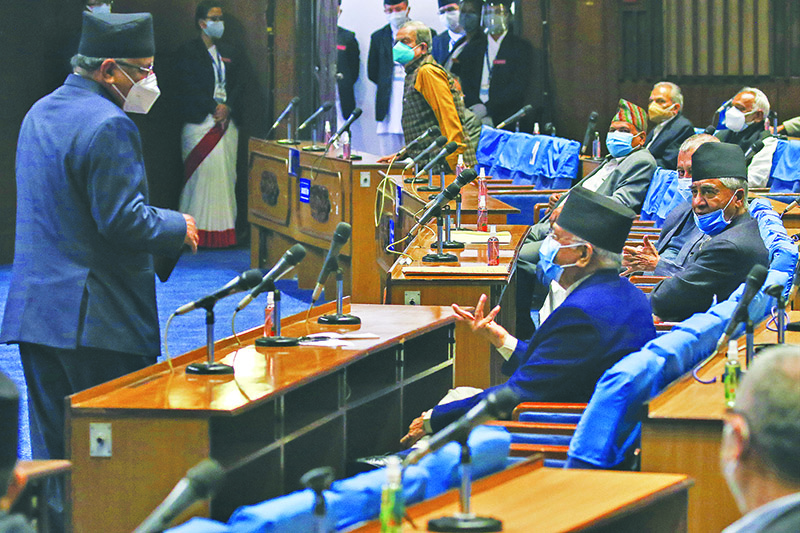
There seems to be no clear way for the opposition leadership to put together a government.Post Photo: Hemanta ShresthA

KATHMANDU : Amid a raging coronavirus crisis, the country has fallen into a fresh political mess, and while KP Sharma Oli, who was reduced to a caretaker prime minister, closes his eyes to the rising number of cases, opposition parties are busy with their arithmetic.
The Nepali Congress’ plan to stake claim to a coalition government after Oli lost his confidence motion on Monday, however, seems to have hit a snag. A section of the Janata Samajbadi Party, led by Mahantha Thakur, has made its position clear—that it won’t participate in any government formation process. The Thakur-led faction holds around 16 votes in the House of Representatives.
It was largely believed that the Congress, which has 61 votes, backed by the Communist Party of Nepal (Maoist Centre), which has 49 votes, would take the lead in forming a new government after President Bidya Devi Bhandari on Monday evening asked parties to initiate the process to replace the Oli government.
The Congress-Maoist Centre alliance has the support of around 15 lawmakers from the Upendra Yadav-led faction of the Janata Samajbadi Party. But together they can ensure just 125 votes—11 short of the required 136 in the 271-strong House to form a coalition government.
A meeting of the current and former office bearers of the Nepali Congress on Tuesday decided to hold talks with the Madhav Kumar Nepal-Jhala Nath Khanal faction of the CPN-UML before Thursday.
The President has given until 9pm Thursday to stake claim to a coalition government.
“We will hold talks with the Janata Samajbadi Party as well as the Nepal-Khanal faction of the UML,” said Congress Vice-president Bimalendra Nidhi.
The Thakur faction, however, has already made it clear that it would be an affront to the Madhes movement and tantamount to abandoning the party’s agenda if it took part in the government formation game.
“We have already communicated with Congress President Sher Bahadur Deubaji about our position,” said Surendra Jha, a leader close to Thakur. “There has been no communication from Deuba for talks with our chair Thakur. But anyway, there is no point in holding talks now regarding our support.”
According to Jha, his party, however, has wondered why the Congress has not approached it with an offer for Thakur to lead the government.
If the Congress and the Maoist Centre fail to convince Thakur, they will have to look to the Nepal-Khanal faction as the last resort.
The Nepal-Khanal faction, which is fighting its own battle against Oli within the UML, up until Monday morning had warned that its lawmakers would resign en masse.
But at a meeting on Monday morning, hours before the House session commenced to vote on Oli’s confidence motion, the faction decided to remain absent.
Accordingly, 28 lawmakers from the faction did not vote. Oli could garner just 93 votes. As many as 124 votes were cast against Oli, while 15 lawmakers, all from the Thakur side, stayed neutral.
There were 232 lawmakers present during Monday’s voting. Two lawmakers from the Maoist Centre, as many from the Janata Samajbadi and 28 from the Nepal-Khanal faction were absent.
Of the 28 lawmakers from the Nepal-Khanal faction, 20 are directly elected and eight were elected under the proportional representation system.
A Congress leader said if lawmakers from the Nepal-Khanal faction resign, even if only 20, the equation could change in the House.
In that case, the strength of the House would come down to 251 and the Congress-Maoist Centre alliance would need 126 votes.
With Yadav’s 16 lawmakers, the number is achievable, say Congress leaders.
But why would the Nepal-Khanal faction leaders sacrifice their lawmakers’ posts to help the Congress lead the government is the question.
As the Nepal-Khanal faction is fighting against Oli, there are two distinct lines within the group.
Some leaders say since their fight is against Oli, they should collectively focus on cutting Oli down to size, instead of helping other parties to form the government. But for some leaders, including Nepal, the fight against Oli has reached a new level, according to insiders.
A group of leaders within the faction wants to see Oli unseated, say insiders.
Leaders like Ghanashyam Bhusal, Yogesh Bhattarai and Gokarna Bista have been saying that they should not pay attention to the government formation process. But some others still believe that they should resign as lawmakers.
“We are now waiting for Oli to respond to our demands,” said Jeevan Ram Shrestha, a lawmaker close from the Nepal faction. “If Oli continues to ignore us then we are ready to resign en masse which could help the opposition parties secure a majority.”
The Nepal-Khanal faction has been demanding that Oli take the party to the pre-merger stage, just what the Supreme Court ordered, and start the party from there. The group is saying Oli must withdraw the March 12 decision of inducting some Maoist Centre members into the Central Committee and initiating action against its leaders.
“We are ready to sacrifice our lawmakers’ posts and have handed over our signatures to Madhav Nepal,” said Metmani Chaudhary, a lawmaker close to Nepal. “Our leaders are discussing the next move. But we have yet to take a final decision.”
With no clarity in the Nepal-Khanal faction, the Congress is left with no option than to wait.
Meanwhile, Oli has been making all efforts to block the opposition from achieving the number in the House to form a coalition government. Even though the Nepal-Khanal faction decided to remain absent during voting on the confidence motion moved by him, Oli has not taken any action against them or ousted them as lawmakers. In the party, Oli has authorised himself to oust any lawmaker he wishes to.
Insiders say Oli knows that move will be counter-productive, as removing the Nepal-Khanal group’s lawmakers would mean helping the opposition parties replace his government.
If the Nepal faction does not make any move and the Thakur group of the Janata Samajbadi sticks to its position, a new government under Deuba is almost impossible.
In that case, the President will invoke Article 76 (3), asking a party that commands the highest number of members in the House to form a minority government. That will squarely mean calling on Oli, who is the leader of the UML with 121 members, to stake claim to the government.
For Oli to prove a majority, he will need the support of the Nepal-Khanal faction. “For us, right now our internal struggle against Oli is more important,” said Som Prasad Pandey, a leader close to Nepal. “We want to focus on our internal dispute.”
Recent developments have taken the fight within the Janata Samajbadi to a tipping point and the party is on the verge of a split.
A Janata Samajbadi leader told the Post that Baburam Bhattarai, the chair of the party’s federal council, on Tuesday attempted to hold a meeting of senior leaders to persuade Thakur and Rajendra Mahato to support Deuba to form a coalition government.
“Both Thakur and Mahato declined the offer,” said the leader who did not wish to be named. “After Monday’s voting, our party is facing a serious crisis, as both factions are threatening to initiate action against each other.”
The Janata Samajbadi Party was born of a merger between the Sanghiya Samajbadi Party, led by Yadav and Bhattarai, and the Rastriya Janata Party, led by Thakur and Mahato.
It was a dramatic merger on the midnight of April 22 last year after Oli introduced an ordinance on Political Parties Act, easing the provisions for a party split and formation of a new party.
Leaders in the Janata Samajbadi admit that it is an irony that the party was formed because of Oli a year ago and Oli now is the catalyst for its possible split.
Given the parties’ strengths and particularly the factional feuds in the UML and the Janata Samajbadi, many say the current numbers game is just a futile exercise and that the country would sooner or later head towards early polls.
If the Congress-Maoist Centre alliance fails to form a government under Article 76 (2), Oli too is most likely to fail to form a government under Article 76 (3) if the Nepal-Khanal faction lawmakers stay absent.
That could lead the President to invoke Article 76 (5), which actually is an extension of Article 76 (2).
Article 76 (2) says in cases where no party has a clear majority in the House of Representatives under clause (1), the President shall appoint as the Prime Minister a member of the House of Representatives who can command a majority with the support of two or more parties represented in the House of Representatives.
There is no way a Congress-Maoist Centre alliance could form a minority government under Article 76 (5) after failing to form a coalition government under Article 76 (2).
Once all provisions related to the government formation are exhausted, the House would automatically get dissolved as per Article 76 (7).
But Congress leaders are hoping against hope that the Nepal-Khanal faction could make a move soon.
“There is no confusion about the Maoist Centre extending support to us. We hope that the Janata Samajbadi Party will remain united,” said Congress Joint Secretary General Prakash Sharan Mahat. “We hope that the Nepal faction will also reach a conclusion by Thursday. It’s too early to rule out a new government under the Congress leadership.”

Page 2
NATIONAL

Desperate to return home, people are making arduous journeys on foot

Authorities in Gorkha district do not have any record of people returning and leaving Gorkha amid Covid-19 restrictions.
- HARIRAM UPRETI

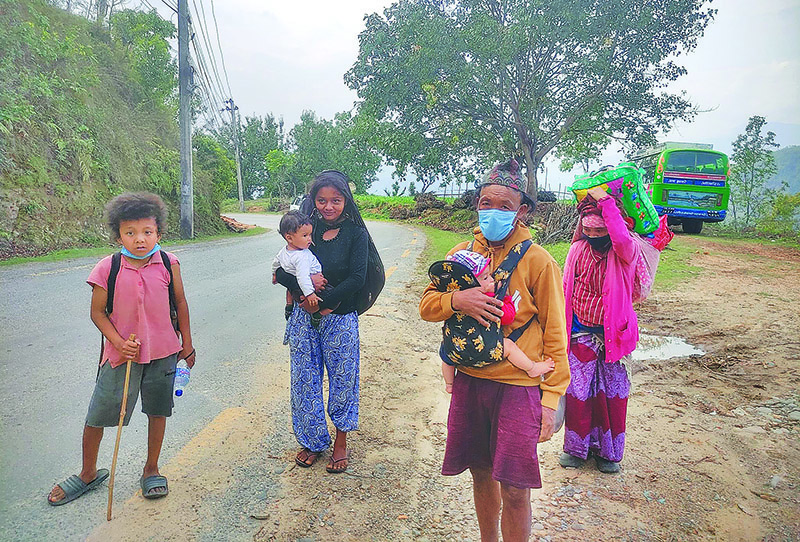
A family heads for their home village in Gorkha district on foot during the Covid-19 lockdown.Post Photo: Hariram Upreti

GORKHA : Kanchhi Gurung, who is in her early forties, and her family reached Gorkha on Friday. It took them two days to reach the district from Pokhara on foot. Now, the family needs to
walk for three more days to reach their home in Chumnubri Rural Municipality-3 of the district.
The Gurung family, who used to work as daily wage earners in Pokhara, said they decided to walk home as they lost their work due to the prohibitory orders imposed by the local authority.
“We set off from Pokhara early on Thursday and stayed at Damauli that night. It is very difficult to walk a long distance carrying an infant,” said Sadiksha Gurung, Kanchhi’s daughter-in-law who was holding an infant. Her husband, also a daily wage worker, stayed back in Pokhara.
According to Sadiksha, some drivers stopped their vehicles and gave them a lift but only for a short distance. “We are very tired and hungry. We ate some bread and biscuits that we bought on the way,” she said.
Like the Gurung family, many daily wage earners have started returning to their hometowns on foot after they lost their jobs due to the Covid-19 pandemic.
During the lockdown last year, hundreds of people who worked in cities had returned to their villages on foot. The same is happening during this lockdown as well.
Dozens of workers who came to Gorkha to work in various development projects have also started leaving for their home districts after the district administration office in Gorkha imposed an indefinite prohibitory order last Wednesday.
A group of five workers, who were involved in the reconstruction of earthquake-ravaged houses in Gorkha Municipality, were found heading for Surkhet on foot on Friday.
“We could not find any vehicles so we decided to walk. We are also carrying blankets with us so we will sleep wherever the night meets us,” said Netra Bahadur Nepal, one of the workers returning home to Surkhet. He said that it could take them around 10 days to walk home to Itram in Surkhet district. “Me and my friends decided to set off on foot as we lost our job after the prohibitory orders were imposed.”
Ram Chandra Paswan of Parsa also plans to walk home after a few weeks. “We will work in the Manakamana area for the next two weeks and then return home,” said Paswan, who was in Manakamana with five of his friends.
The authorities, however, do not have any record of workers who returned to and from Gorkha on foot in recent days.
“We have asked Majhuwa Police Post, which is at the entry point to Gorkha, to inform the District Police Office if people are found walking home. We are planning to coordinate with the respective districts and local units to ease the movement of workers returning homes,” said Deputy Superintendent of Police Prakash Dahal.
The District Administration of Gorkha says it has decided to continue construction works even during the lockdown period.
“We haven’t decided to halt the ongoing construction projects. The workers might have left the district fearing Covid-19 infection,” said Harka Roka, an officer at the District Administration Office.

Page 3
NATIONAL

Housemaids and elderly hit hard by prohibitory orders in Kathmandu

The lockdown has not just put many domestic helps out of their jobs, elderly people have also lost their caregivers.
- ANUP OJHA

KATHMANDU : Until recently, Manju Thapa worked as maid at a house at Sanobharyang in Kathmandu. But two days after the prohibitory orders were imposed in the Kathmandu Valley her employer handed her some money and a sack of rice and asked her to stop coming to work until the restrictions were in place.
The government imposed prohibitory orders in the Kathmandu Valley from April 29 following a sharp rise in Covid-19 infections and deaths. On Tuesday, the prohibition was extended till May 27.
“For the first two days, the lockdown was not strict so I went to work. But after the restrictions became tighter, I stopped going,” said Thapa, 27, a mother to two kids aged 6 and 12.
She said her employer was equally worried about the household contracting the coronavirus and asked her to stop coming to work.
“Also, going to work would put me at risk of contracting the virus and I could also transmit the virus to my family,” said Thapa. Her husband, who used to work as a security guard at a private school nearby is jobless since the schools are closed due to the pandemic.
Thapa lives at Banasthali and had been working as a housemaid for the employer for the past ten years.
Although she is worried about her family’s safety during the pandemic, she is more concerned about the household finances. Now that both the husband and wife are jobless, Thapa is praying for the lockdown to be lifted. “If the restrictions on movement continue for long, people like us could die from hunger than from the coronavirus,” she said.
But Covid-19 infections and deaths have continued to soar setting new records. On Tuesday, Nepal reported a record 9,317 infections in the past 24 hours and 225 fatalities.
Chief District Officer of Kathmandu Kali Prasad Parajuli has indicated that the prohibitory orders could continue until the infections and deaths start slowing down.
Amid this uncertainty, thousands of lower-middle class families especially those working in the unorganised sector have been affected.
But another housemaid who identified herself only as Anju said she has been regularly going to work despite the lockdown. “My job involves cleaning the house, cooking and operating the washing machine. I am going to work although I am aware of the risk of virus transmission,” said Anju, who is 37, and works in the Bakhundole area.
She said all six members of the family where she works are down with fever and cough. “They have not gone for Covid-19 test but everyone is ill. There is no one to help the family so I do the cooking, dishes, laundry and everything,” said Anju, a single mother of an 18-year-old-daughter.
“My daughter is on medication for depression and there is house rent to pay, so I can’t afford to quit work,” says Anju, who receives Rs 10,000 per month in salary.
The prohibitory orders have not only distressed the domestic workers, their absence has created more troubles to the ailing elderly people living alone in their houses in Kathmandu Valley and other cities across the country. Most households with their children settled overseas are completely dependent on domestics.
One such couple is Umesh Nath Sigdel, 75, and his 62 years old wife Shailaja Sharma.
“I have told my housemaid not to come at least for a week but she is kind and said she would just clean the house without entering my room. I could not say no,” said Shailaja Sharma, 62, a lawyer and mother of two children both of whom are abroad.
Her husband Umesh Nath has an early stage of Parkinson’s. He had his first Covid-19 jab a month ago but has not got the second dose yet. “They say elderly people are more prone to the coronavirus infection, but if we don’t have our maid to help us, life will be hell,” said Sharma who lives at Bakhundole, Ward-1.
Maha Prasad Parajuli, president of Senior Citizen Struggle Committee, says the situation of elderly people whose children are abroad and live by themselves are at risk without their carers.
Recently, an 80-year-old woman who lived alone at Babarmahal died of Covid-19.
“All her children were in America. She lived on the top floor of the house and the bottom floors were rented out,” Parajuli said. “She died alone. It was only after four days that people learnt about her death.”
The 2011 census states that there are around 2.1 million people aged over 60 or above in the country.
“Many elderly people are completely dependent on domestics for all household chores, so the pandemic and the restrictions on movement have created huge problems for such people,” said Parajuli.
Kamal Thapa, the owner of Housemaid Service Kathmandu, a private company that supplies housemaids and janitors in Kathmandu, said the prohibitory orders have made hundreds of housemaids and janitors jobless.
“In the Kathmandu Valley about 60 percent households had part time housemaids. But after this pandemic started, many households are hesitant to hire maids fearing the virus,” said Thapa, whose office has supplied over 4,000 housemaids in the Kathmandu Valley in the past seven years.
Besides housemaids, many people have lost cleaning jobs as offices and businesses have placed cleaners and janitors on unpaid leave, according to Thapa.

NATIONAL

Pandemic further pushes already 14-month longacademic session

School board exams and MBBS entrance tests uncertain.
- Post Report,BINOD GHIMIRE

Education experts say the government lacked plans to conclude the academic session in time.   Post file Photo

KATHMANDU : The government in February extended the ongoing academic session by two months till June making it a 14-month long session.
The decision was taken to compensate the time lost due to the Covid-19 pandemic as students didn’t get to study properly owing to the months-long lockdown imposed by the government in an attempt to contain the spread of coronavirus. Normally the academic session concludes in April.
The government had decided to hold the Secondary Education Examination from May 27 and grade 12 board examinations from June 6 as per its decision to extend the academic session by two months.
It had also slashed the prescribed study hours and reduced the course load for students by 30 percent to conclude the academic year by June.
However, the National Examination Board on Monday decided to postpone the two national level tests until further notice.
Similarly, except for some city centric private schools, a majority of the schools across the nation haven’t held the final examinations for other grades as well as the most part of the country is under prohibitory orders following a spike in the infections in the second wave of the coronavirus. The government which decided to postpone the tests is not sure when they would be conducted.
“It’s hard to say when those tests would be conducted,” Keshab Dahal, spokesperson at the Centre of Education and Human Resource Development, told the Post. After deciding to postpone the tests until further notice, the examination board said the new dates will be announced at an appropriate time. Janga Bahadur Aryal, spokesperson at the examination board, said as per the decision of the Cabinet, their priority is on conducting the examinations in person.
The examination board has already readied the question papers for the Secondary Education Examination for in-person tests. After an assessment that the schools inflated the obtained marks in the SEE last year when they were allowed to give marks to the students based on internal evaluation, the Cabinet in January had decided that in-person tests would be conducted this year. As many as 517,000 students have registered for the examination this year. Around 7 million students study up to grade 10 while around a million study in grade 11 and 12.
The continuous spike in the coronavirus cases and extension of the prohibitory orders show conducting in-person tests is not possible anytime soon increasing concerns among the students and the guardians that the already lengthy academic session would be postponed further. On Tuesday, the chief district officers of the three districts in the Kathmandu Valley have decided to extend the prohibitory orders till May 27. Nepal on Tuesday reported 9,317 new cases, the highest single day spike, in 24 hours and 225 deaths.
“The uncertainty about the test has worried me,” Samyak Gautam, an SEE examinee from Padmodaya School, Putalisadak told the Post. “The government should give an alternative if in-person tests are not possible.”
Educational experts say the present uncertainty of the academic year is the result of ill preparation on the part of the government. They say it paid no attention towards preparing alternative plans for timely conclusion of the academic year. “The government failed to learn from last year’s crisis,” Dhananjaya Sharma, a former principal of Gyanodaya School, Bafal, told the Post. “It could have prepared an alternative plan to wrap up the academic session on time.”
He said the government should have invested in preparing infrastructure for virtual platforms and separate plans for different parts of the country based on the severity of the infection.
Guardians say the delay in concluding the school session affects the entire academic calendar up to the university level. Last year, the grade 12 tests that are normally held in May were pushed to November and the results were published only in January this year. This led the Tribhuvan University’s Institute of Medicine to push the entrance tests for the MBBS that are conducted in November, to May. The prohibitory orders have again led to its postponement until further notice. “It seems those preparing for the MBBS entrance will lose a year,” Deependra Kumar Neupane, father of a daughter who wants to pursue an MBBS degree, told the Post. “The policy makers should be aware that one year loss costs hugely in the career of a student.”

NATIONAL

Guidelines ready for sending Nepali carers to Israel

Nepal and Israel had signed a deal in September last year for sending 500 Nepali caregivers.
- CHANDAN KUMAR MANDAL

KATHMANDU : Months after Nepal and Israel signed
a deal that will allow Nepalis to take up jobs in Israel, the government has finalised a working procedure that will guide the overall process of sending Nepali workers.
The new working procedure prepared by the Ministry of Labour, Employment and Social Security will facilitate the overall labour migration to Israel under the agreement signed in September last year.
As per the understanding signed between the two countries, Israel agreed to hire 500 Nepali workers—both male and female—for its nursing sector. After the framework agreement in September, the two sides had later signed the Implementation Protocol in January, formally paving the selection and recruitment process for Nepali caregivers.
“With the drafting of the working procedure, the remaining process will move ahead for sending Nepali workers to Israel,” Dipak Kafle, the spokesperson of the Labour Ministry, told the Post. “The guideline will be implemented and a timeline will be followed for sending Nepali workers.”
The new working procedure guides the worker demand verification process, criteria for candidates, application procedures, and the process of selecting candidates, among other aspects.
Nepali citizens between 25-45 years of age, who meet other criteria set by Israel, can apply for the caregiver jobs. An eligible candidate should weigh at least 45kg, be no less than 1.5 metres tall, be physically and
mentally fit with specified educational qualifications.
Candidates with ten years of schooling will need to have a 15-month pre-diploma course such as community medicine assistant (CMA) or auxiliary nurse-midwifery (ANM). Candidates who have passed plus two school exams will need to have three months of caregiver training.
According to the working procedure, candidates are required to have completed their courses from an institution affiliated with the Council for Technical Education and Vocational Training (CTEVT) or caregiver training from an institute registered with the Department of Foreign Employment.
Besides, the candidates should exhibit knowledge of the English language and decent character.
The worker will have to bear all the expenses including airfare, insurance, medical examination, contribution to the Foreign Employment Welfare Funds and labour permit.
However, there is still uncertainty about when the workers will start migrating to Israel as it has already been seven months of inking the agreement. Even in March, government officials told the Post that preparations for sending Nepali workers to Israel were in the final phase.
“Due to the current pandemic and restrictions, the process will be somehow affected,” said Kafle. “Although there will be some impacts, applications for the jobs will be accepted online so that the process will move ahead. The Department of Foreign Employment will decide when to announce online applications.”
In Nepal, the Department of Foreign Employment, the central government body overseeing the foreign
employment sector, will be responsible for hiring the caregivers and sending them to Israel. Likewise, the Population and Immigration Authority is the line agency in Israel.
According to Krishna Prasad Dawadi, director-general of the department, preparations for the syllabus for English language test and examination modality are underway.
“A sub-committee has been formed for overseeing syllabus development and an online portal where candidates can apply for jobs,” Dawadi told the Post. “As it is not feasible to accept applications in person due to the pandemic, we have arranged an online application system, which will be ready in a
week or so.”
But Nepali workers will start flying to Israel only after the government receives demand from the Israeli side. As per the working procedure, when the Nepali Embassy in Israel receives demand from Israel, it will verify the demand document and forward it to the department in Nepal.
“Upon receipt of the demand documents, the department, within 14 days, will publish job offers on its website and national newspapers with an application deadline of a minimum of 21 days,” said Dawadi. “On our side, work on software development for online applications and syllabus development are in the final stage. Now we will have to wait for worker demand from Israel.”

NATIONAL

Leopard killed in ‘retaliation’

Briefing
- Post Report

BARDIYA: A leopard was killed in retaliation by two persons in Gulariya Municipality Ward No 10, Bardiya, on Sunday. According to the locals, Idrisi Behana, 50, and Safik Behana, 28, encountered the leopard in their
corn field. The victims said they fought against the beast as it attacked them in the field. Both of them, who sustained injuries, are receiving treatment at the district hospital.


NATIONAL

Covid-19 hospitals set up

- Post Report

PARSA: Birgunj Metropolis has started operating a 200-bed Covid-19 hospital and isolation centre at Gopal Mandali Dharamshala in Birgunj. Pradeep Niraula, chief administrative officer of Birgunj Metropolitan City, said, “There are 100 beds with oxygen supply on the first floor and 100 isolation beds on the ground floor of the building.” A Covid-19 hospital has also come into operation at Kamalamai Municipality-6 in Sindhuli. The
hospital has 50 beds with oxygen. The hospital cost Rs 35 million to build, said Pralhad Pokharel, the hospital management committee chairman.


NATIONAL

Virtual trials in Makawanpur

- Post Report

HETAUDA: The District Court in Makawanpur has started trials online, as the district is currently under prohibitory orders. Amrit Ghimire, acting registrar of the court, said, “Four employees, including a judge of the court, recently tested positive for Covid-19, so we started court hearings online.”

Page 4
EDITORIAL

Oh, what a fall it was

Oli will be remembered in Nepali politics and society for all the wrong reasons.

Prime Minister KP Sharma Oli lost the vote of confidence in the House on Monday, but that is just an arithmetical manifestation of the moral-political legitimacy he had already lost in December last year after he dissolved Parliament. At a time when he should have shown utmost humility and humanity to rescue the nation out of the pandemic-induced crisis, all he did was debilitate democratic politics and enable the dance of death.
No other leader has squandered as big an historic electoral mandate and established that the practice of democracy in Nepal is a zero-sum game. This is not to overlook the role of Oli’s friends and foes in Parliament and the ruling party who have fished in the water muddied by Oli. But the largest piece of the stale cake of notoriety should automatically go to Oli, as he has been at the helm for the past three years, and is the primary architect of the project to weaken democracy for personal reasons.
KP Sharma Oli will be remembered as someone who attempted to break all boundaries of ethics, values and integrity in Nepal’s democratic politics, intoxicated as he was with greed for absolute power. He has little to show in terms of strengthening constitutionality, federalism and secularism. On the contrary, he played a pivotal role in eroding the utility and meaning of those concepts altogether.
Perhaps the greatest crime Oli committed against Nepali citizens is that he sowed in their minds the seeds of suspicion about the utility of democracy. It will take years, even decades, for the suspicion to fade away. He single-handedly drove democratic politics to the brink when his attempts at emerging as the absolute authority faced challenges. He exhibited how democracy can become a dangerous weapon when it falls into the hands of an unrestrained demagogue.
KP Sharma Oli will go down in history as a leader who crushed the dreams of a generation of Nepalis to see the country leave behind a troubled past and carve out a democratic and prosperous future for itself. He exhibited in himself a great combination of ineptitude in governance and arrogance in partisan politics. He showed how one person’s lust for power can turn democratic politics into a loss-making enterprise.
When Nepali citizens entrusted Oli with the reins of a young federal democratic republic, the expectation was that he would keep his personal bias against federalism, secularism and marginalised communities at bay, and help the people realise their dreams of peace, prosperity and justice. With great power comes great responsibility, and it was hoped he would honour what he was entrusted with. He did quite the opposite.
KP Sharma Oli was given a rare chance to lead Nepal into the future, but he showed how far a democratically elected leader could go to buttress his image, consolidate his authority and prolong his rule at the cost of democratic values. His rise and fall in Nepal’s democratic politics should serve as a cautionary tale of how not to practise democratic politics. A section of those who elected him to power three years ago are perhaps eager to see him head to the exit today, for he has killed their hopes and dreams.

OPINION

It’s time to go, El Supremo

Oli considers the amoral pragmatism of Marxism-Leninism and Maoism to be the guiding principle of his political life.
- CK LAL

The farce of Premier Khadga Prasad Sharma Oli seeking a vote of confidence from Pratinidhi Sabha is over with predictable results. Supremo Sharma Oli did not trust Parliament to do his bidding and had it dissolved in December 2020 on a whim. The House has now reciprocated in kind by unequivocally expressing that it
had no confidence in his ability to govern anymore.
The whole exercise was pointless, if not downright harmful, in the middle of the raging Covid-19 pandemic. Determined to stay at Baluwatar come what may, the verdict of Parliament holds little meaning for the self-styled El Supremo of the ruling party. The Constitutional Bench of the Supreme Court had declared the dissolution of the House unconstitutional early this year and reinstated it through a landmark verdict. Premier Sharma Oli should have resigned immediately after the humiliating defeat. Instead, he showed his disdain for the restored Parliament by not attending any of its sittings.
While seeking the vote of confidence, Sharma Oli spoke with his characteristic arrogance reeking of hubris. He dismissed all allegations of opposition leaders with haughty superciliousness. Soon after the Speaker announced the result, the supremo was seen on television screens cracking his fingers with a sigh of relief. He seems to be in no mood to honour the verdict and vacate Baluwatar without a fight.
Erstwhile supporters of the supremo in the media, the intelligentsia and the civil society ignore the fact that he hasn’t done anything that he wasn’t capable of doing, or intended to do, once he had managed to
orchestrate a ‘state capture’ with their active collusion.

Moral vacuum
In the ethical standards of the constitutionally christened Khas-Arya community, Brahmins sit at the top of the Hindu hierarchy and aren’t answerable for their actions to anyone other than themselves. That is the reason why Brahmins have traditionally been considered unsuitable to be rulers. Having imbibed those values at an early age, it is quite natural that Sharma Oli takes his supremo position of being the ethical as well as temporal leader of the society seriously.
It is said that Marxism is a theory which is logically ‘a scientific, objective and free science, without value judgements’. Leninism is a pragmatic doctrine of state capture by a revolutionary vanguard. The argument that the hyphenated ideology of Marxism-Leninism amounts to yoking the horse of European capitalism with Asiatic despotism has proven to be true in many developing countries.
A complete disregard for ‘bourgeois morality’, however, is the common thread of all communist ideologies. It is unclear whether it was the lack of moral convictions that made a young Sharma Oli adopt Naxalism or he became amoral only after being inducted into the Jhapali campaign of beheading class enemies. What is apparent, though, is that he considers the amoral pragmatism of Marxism-Leninism and Maoism to be the guiding principle of his political life.
Through a complex process of religious upbringing, social conditioning and political schooling, Sharma Oli has developed a complete disregard for constitutional propriety. A 14-year jail term with hardened criminals perhaps made him realise that victory in any contestation is its own justification. Fragility of personal health may have hastened his resolve to grab power through any means and be at the helm till the end.
Once the ethical foundations and the moral structure of the evolution of the ethnonational chieftain is understood, the path he has chosen for the political economy of his regime begins to make sense. The gold-plated jalhari of Pashupati costing over a billion rupees was meant to buttress his communal credentials. The fictional formation of Ayodhyapuri in Madi is a transparent attempt to project his religious identity.
On the political front, Sharma Oli perhaps feels that it was the 1990 constitution that prepared the ground for his phenomenal rise in national politics. That could be why he vehemently contested constituent assembly, opposed republicanism tooth and nail, rejected federalism out of hand, resisted the idea of inclusive governance till the last moment and has failed to to accept the fact of Nepal being a multi-national state. He has little, if any, attachment to the 2015 constitution despite his steering role in its promulgation through the 16-point conspiracy. The charter was for him just a stepping stone for the seemingly legitimate act of ‘state capture’.
On the foreign policy front, Sharma Oli has adroitly kept himself out of the Millennium Challenge Corporation (MCC) controversy. The Xi Jinping Thought was meant to boost his bargaining power. Over the last five years, he has let loose more abuses at New Delhi than all other prime ministers put together but has no hesitation in seeking India’s help to entrench himself in power. Come what may, Sharma Oli is extremely unlikely to go on his own unless the force of circumstances makes him do so.

Pragmatic choices
Once, Tulsi Giri, a Nepali Congress turncoat and one of the architects of the Panchayat regime, had quipped that he was not at all concerned with the judgement of history. Considering the way Sharma Oli has handled Madhesi, Janjati and Dalit issues, it is perhaps right to assume that he belongs to the nihilist school of the late Giri. His obsession with the hubristic erection of Dharahara, however, shows that the supremo is not completely ambivalent about his ethnonational legacy.
Among all the dramatis personae of the political drama that is likely to unfold at Shital Niwas from Thursday, May 13, the character of Nepali Congress chairman Sher Bahadur Deuba appears to be most uninspiring. He has been a collaborator of Sharma Oli for far too long to claim the right of being an alternative. Maoist Centre chairman Pushpa Kamal Dahal helped Sharma Oli become what he is and thus appears equally unacceptable for the same reason.
Most rumours in Kathmandu turn out to be true. But if Janata Samajbadi Party co-chair Mahantha Thakur is under the impression that the Hindutva regime in New Delhi can push him to the top with the help of a relentless demagogue, then he is in serious delusion. When speaking in his own defence in Parliament, Sharma Oli refused to even pronounce the term Madhes altogether.
Desperate times call for desperate measures. Hard as it may seem to accept, only the CPN-UML leader Madhav Kumar Nepal seems to have the cultural capital, social sagacity, political heft and diplomatic credibility to force Sharma Oli fade away from the political scene with dignity. A coalition government of the CPN-UML and the Janata Samajbadi Party under the leadership of acrobatic dealmaker Madhav Kumar Nepal, with the outside support of the Maoists, appears to be the least unacceptable proposition at this juncture.
But for that to happen, some CPN-UML lawmakers such as Subash Chandra Nembang or Bishnu Paudel need to gather the moral courage and repeat what the Conservative backbencher Leo Amery once told his own parliamentary leader: ‘You have sat too long here for any good you have been doing. Depart, I say, and let us have done with you. In the name of God, go.’
On that resigned note, greetings of Eid-ul-Fitr: May the Almighty lead us all from political strife to social amity.

OPINION

Everyone must be counted

The inhabitants of the greater Kalapani area must be enumerated by virtual means.
- BUDDHI NARAYAN SHRESTHA

The Central Bureau Of Statistics (CBS) had almost completed the preparatory works to conduct the 12th nationwide population census from June 8-22, but the government has decided to postpone it for an indefinite period due to the surge in coronavirus cases. The aim of the census is to ensure that ‘no one should be left out and no one should be repeated’. It is important that the enumeration be reliable. The slogan for Census 2021 is ‘My census, my participation’. The term census implies that each individual should be counted within the territory of the nation.
During the decennial census, every household in the country should be visited, and a headcount of those living in the country be taken. It means that authorities will also have to depute enumerators to count the people living in the greater Kalapani area, which is part of Nepali territory. It has been forcefully occupied by India for the last six decades. During the forthcoming census, the area up to Limpiyadhura has to be incorporated since it is the westernmost part of Nepal, as per the new constitutionally adopted map published on May 20 last year. However, the government agency responsible for conducting the census is not sure whether enumerators will be able to visit the households in encroached areas.
Indian authorities have been prohibiting Nepalis from going to the Kalapani area. After the publication of the new map by Nepal, even Indian nationals need to produce their identity cards, and they are interrogated when they enter the area. However, Nepalis who have family relations with people in the greater Kalapani area are allowed to visit occasionally during funerals and rituals in Chhangru and Tallo Kawa villages. In the given context, it is physically impractical to hold a census by sending enumerators to the area which is under the complete administrative control of India. But there is a probability of incorporating it by virtual means.

Three options
Given the situation, there might be three options to conduct the national census in that area. First, it can be done by counting the number of local inhabitants’ houses using virtual means. While counting the number of houses with the help of Google vertical image and terrestrial oblique photographs, 161 houses have been identified (90 house in Gunji, 28 in Navi and 43 in Kuti) besides the barracks of the Indian Army and the Indo-Tibetan Border Police at Gunji and Navi. Assuming that there are five to six members in each household, that makes near about 900 people in the greater Kalapani area. There are no local inhabitants at Tilsi (presently Kalapani) and Nabhidang, only soldiers. The people were driven to Chhangru, Tallo Kawa and Garbyang after the occupation by India.
The second option is to ask the people of Chhangru informally. They might know the name of the head of the household and the number of children of their relatives in the Gunji and Navi areas, as they occasionally visit their kith and kin during social events. They could ask the relatives about the number of inhabitants who reside in the Gunji area. For example, Sanam Nabiyal, head of the Navi local body, may be a relative of the Nepali people in Chhangru. If it is done unofficially through the inhabitants of Chhangru, Sanam may give the number of people in the area by mentally counting the number of houses and their owners.
Third, the total figure can be computed on the basis of Indian Census Report 2011. According to this report, the population of Gunji is given as 335, Navi 78 and Kuti 363, which makes a total of 776 people. During the 1991 Nepal census, Byas, a village development committee in Darchula district in Sudurpaschim Province, had a population of 723 living in 150 individual households.

Government role
The government likely favours conducting a population census in the Kalapani area. In order to make the operation happen, it must issue a concrete decision and clear instructions to the CBS to hold the census in the greater Kalapani area when the nationwide enumeration is held after the Covid-19 pandemic subsides. The area is located at ward 1 of Byas Rural Municipality in Darchula district, as per the Nepal Gazette, volume 66, number 58, dated March 10, 2017.
After the Indo-China border war in October-November 1962, Nepalis were driven to the Tallo Kawa and Chhangru areas. The Nepali inhabitants who remained were forcefully turned into Indian citizens by providing them with ration card facility, basic ID card, free schooling for their children and yearly monetary allowance.
During the census conducted in June 1961, then census officer Bhairab Risal (now a senior journalist) had conducted a census of Nabhidang, Tilsi (now Kalapani), Gunji, Navi and Kuti by deputing one Kharidar-level enumerator whose surname was Duwadi and some local employees. Theer Bahadur Rayamajhi was the chief superintendent of the statistics department. Gopal Sing Bohara has written in the book Kalapani Saga and Sorrow that the villagers of Kuti, Navi and Gunji would pay land tax to the Nepal government.
Against this background, the population of the greater Kalapani area, that constitutes Lipulekh, Nabhidang, Kalapani, Gunji, Navi, Kuti, Zolingkang and Limpiyadhura, must be incorporated for the territorial integrity and sovereignty of Nepal. There is proof that censuses were taken physically in 1961 and virtually in 2011. It is said that during Nepal’s first general election in 1959, the people of these areas had enjoyed voting rights. So the inhabitants of the greater Kalapani area must be enumerated by virtual means within ward 1, Byas rural municipality during the forthcoming population and housing census, after the lockdown ends and the coronavirus situation has normalised to a large extent.

Shrestha is a former board member of the Institute of Foreign Affairs.

Page 5
MONEY

Kalimati fruits and vegetables market stops retail sales

Consumer rights activists say that without a proper distribution system in place, this could lead to price hikes.
- KRISHANA PRASAIN

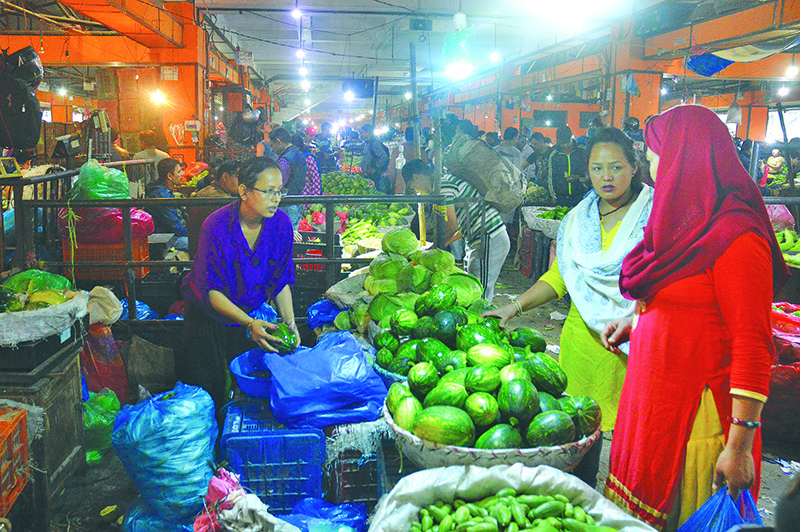
The Kalimati wholesale market caters to most of Kathmandu Valley’s vegetable needs.Post file Photo

KATHMANDU : Retail sales of fruits and vegetables have been banned from Thursday at the Kalimati produce bazaar in a bid to comply with social distancing rules. The crowds were getting too big during the morning shopping window, raising fears of infections spreading with all the jostling, officials said.
The agriculture market has been closed as of Tuesday. Wholesalers will remain open from 1 to 9 am, but they are allowed to sell pre-packaged produce only.
Consumer rights activists said that without a proper distribution system in place, shutting down the market could lead to artificial price hikes.
The Kalimati market is the country’s largest vegetable and fruit bazaar which keeps Kathmandu’s homes supplied with fresh produce.
The Kalimati Fruits and Vegetables Market Development Board said it decided to pull down the shutters after the District Administration Office expressed concern over the large number of shoppers gathering at close quarters during an inspection visit.
On Tuesday, the District Administration Office announced that the lockdown in the Kathmandu Valley was being extended by 15 days. It said the time provided to Kathmandu residents to buy daily consumable goods was being lengthened by one hour till 10 am.
Binaya Shrestha, deputy director of the Kalimati Fruits and Vegetables Market Development Board, said the retail and agriculture market would remain closed for the duration of the lockdown as ordered by the District Administration Office.
“We expect that this step will help to minimise crowds and make wholesale trade safe amid the ongoing pandemic,” he said.
Observing the throngs of shoppers in the market, the board published a notice on Tuesday saying that the retail and agriculture market would be closed, and that the wholesale market should be operated by closely following social distancing and health and safety protocols.
“Crowds have increased at the retail market so the board decided to close it,” he added.
The Kalimati market has also banned the entry of motorbikes, bicycles and pushcarts onto the premises. Shrestha said vehicles bringing vegetables would be allowed to enter the market all day.
Consumer rights activists said closing down the market without proper management of distribution could lead to artificial price hikes in fruits and vegetables.
Madhav Timilsina, president of the Consumer Rights Investigation Forum, said that if only wholesale trade is allowed in the big vegetables and fruits market, it will create artificial price hikes. “Only a few traders and people have access to the wholesale market as many consumers rely on the retail market,” he said.
“Rather than making distribution systems easy and reliable, the government, without proper planning, comes with such decisions which ultimately hit the consumer,” Timilsina said. “This will not only impact consumers, but there are chances that farmers’ products will also rot in the fields like last year.”
Despite the fall in prices in recent days with the arrival of seasonal vegetables, Valley residents are hardly able to get most vegetables and fruits for less than Rs100 per kg.
Timilsina said that with sufficient rains recently, the production of green vegetables is good currently, but retail prices are going up every day.
According to Shrestha, the market is receiving 400-500 tonnes of vegetables daily in recent days as it is difficult for truckers to deliver vegetables due to the restriction order. “Supply has declined as consumption has also weakened,” he said.
Rajita Dhital, a resident of Kuleshwor, said that she had to pay Rs170 for a dozen bananas while the wholesale price was Rs100 at the Kalimati market on Tuesday.
Shutting down the Kalimati market during the lockdown last year to control the spread of the coronavirus, the board in coordination with Kathmandu Metropolitan City had planned to open outlets to sell vegetables and fruits at 11 places around the city. “But it did not become successful,” Shrestha said.
Timilsina said that the government could have supplied vegetables from vans or huge army trucks in different areas in the valley.

MONEY

Clock is ticking for EU vaccine certificates as summer looms

- ASSOCIATED PRESS

A tram is reflected in a puddle after the city is almost empty shortly after the end of the curfew in central Frankfurt, Germany, on Tuesday. AP/rss

BRUSSELS : As strict lockdowns are loosened across Europe and many EU citizens dream about holidays in the sun, the 27-nation bloc has yet to agree on how to quickly implement a virus certificate scheme to boost summer travel and tourism.
European affairs ministers gathered Tuesday in Brussels to assess progress in discussions with European lawmakers. A deal between the Parliament and EU countries is required in May to ensure the system will be up and running by the end of June, but several sticking points remain.
When it proposed the scheme in March, the EU Commission said coronavirus certificates would be given to EU residents who can prove they have been vaccinated or those who tested negative for the virus or have proof they recovered from it.
EU lawmakers and nations agree on that, but the Parliament insists that Covid-19 certificates should be enough to allow EU citizens to move about freely and that EU countries shouldn’t be allowed to impose extra restrictions on certificate holders such as quarantines, tests or self-isolation measures. That’s a major roadblock, since border controls are a national responsibility.
A senior EU official, speaking anonymously as is custom before Tuesday’s meeting, said EU nations had different opinions on the topic and the bloc was working to find a universal solution. The official said the pressure was on since vaccinations were increasing across Europe and more and more people wanted to travel.
The European Commission hopes that about 70 percent of the EU’s adult population will be vaccinated by the end of the summer.
The Parliament has also raised concerns about the price of the PCR coronavirus tests that could be included in the certificates, which will be available in a digital or paper format with a QR code. EU citizens will get the pass for free but the price of tests vary widely across the bloc.
EU lawmakers said member states should “ensure universal, accessible, timely and free-of-charge testing” to avoid discrimination against those who have yet to be vaccinated.
Lawmakers agreed with the European Commission that all vaccines approved by the European Medicines Agency, the EU’s drug regulator, should be automatically recognised.

MONEY

Samsung sees pandemic-led appliances boom

- REUTERS

SEOUL : A pandemic-driven boom in home appliance sales will last longer than previously anticipated and extend into the second half of the year, Samsung Electronics Co Ltd’s head of the business said.
Lee Jae-seung, president of the South Korean company’s digital appliances business, told Reuters in an interview that he had originally expected the boom to subside after the first quarter of this year.
But extended travel restrictions despite vaccine rollouts and consumers being flush with cash due to economic stimulus measures of governments plus limited spending avenues for them had stretched the boom, Lee said. A buoyant demand outlook from one of the prominent global home appliances makers brings supply-chain issues to the fore, specifically a shortage of semiconductors that has hurt many industries, particularly the automobile sector.
Lee acknowledged that the global chip shortage is weighing on Samsung too, but said the appliance business has “secured enough to respond”.
It has done this by swapping chips to 12-inch wafer ones from 8-inch ones, undertaking software workarounds, and diversifying chip sourcing firms to two or more per chip from countries such as Japan, Taiwan and China, he said. “When all market players are buoyed by rising demand, supply competitiveness is crucial in occupying the market early,” Lee said
Samsung saw first-quarter home appliance sales jump in all markets, including a 144 percent surge in vacuum cleaner sales in North America, a 79 percent increase in dishwashers in Europe and a 12-fold jump in robot vacuum sales in Brazil.
Samsung is also globally expanding its ‘Bespoke’ brand customised appliances. For example, Korean fridge customers can choose from 360 colours for each door. Higher personalisation has led Samsung to increase subcontractor outsourcing similar to the auto industry, Lee said, which also allowed Samsung’s appliances production to rise around 30 percent-50 percent without extensive investment.
Samsung, though, is also in the process of adding new lines in most factories including in Mexico, the United States and South Korea to meet rising demand.

MONEY

Second Covid-19 wave could crimp India’s long-term growth

Deeper stresses in economy could lead to more severe erosion in fiscal strength.
- REUTERS

MUMBAI : India’s severe second wave of coronavirus infections will slow near-term economic recovery and could weigh on longer-term growth dynamics, rating agency Moody’s Investors Service said in a note on Tuesday.
“Deeper stresses in the economy and financial system could lead to a more severe and prolonged erosion in fiscal strength, exerting further credit pressure,” said Gene Fang, Moody’s Associate Managing Director.
India’s Covid-19 crisis showed little sign of easing on Tuesday, with a seven-day average of new cases at a record high and international health authorities warning the country’s variant of the virus poses a global concern. Moody’s, which rates India at “Baa3” with a negative outlook, the lowest investment grade, expects the surge in the virus to contribute to a marginal shortfall in government revenues and a redirection towards healthcare and virus response relative to the government’s budget estimates in February.
“The reimposition of lockdown measures will curb economic activity and could dampen market and
consumer sentiment. However, we do not expect the impact to be as severe as during the first wave,” Moody’s note said.
The agency said at this point it expects the negative impact on economic output to be limited to the April-June quarter, followed by a strong rebound in the second half of the year.
Moody’s now forecasts real GDP growth will fall to 9.3 percent from 13.7 percent for the fiscal year ending March 2022 and to 7.9 percent from 6.2 percent in fiscal 2022-23. Over the longer term, it expects growth of around 6.0 percent.
“The second wave has been driven by a highly contagious variant, putting significant strain on India’s healthcare system with hospitals overrun and medical supplies in limited supply,” the agency wrote.
Moody’s anticipates a wider fiscal deficit of about 11.8 percent of GDP in 2021-22, compared with its previous forecast of 10.8 percent and an estimated 14 percent in 2020-21.
It also said it expects the combined impact of slower growth and a wider deficit to increase the general government debt burden to 90 percent of GDP in 2021-22, gradually rising to 92 percent in fiscal 2022-23.

Page 6
WORLD

Bodies float on Ganges as India virus deaths near 4,000 daily

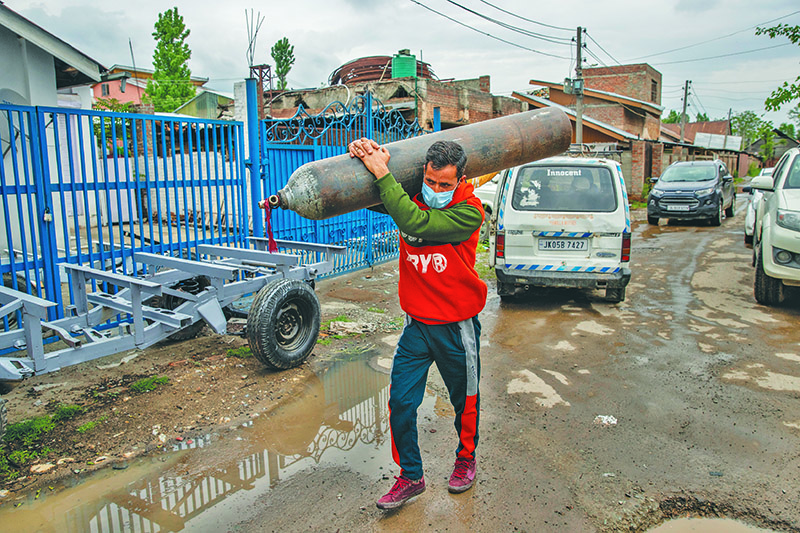
India now accounts for one in three reported deaths from coronavirus around the world.ap/rssA man carries an oxygen cylinder to get it refilled in Srinagar, Indian controlled Kashmir.
- REUTERS

A man carries an oxygen cylinder to get it refilled in Srinagar, Indian controlled Kashmir.ap/rss

LUCKNOW : Scores of bodies are washing up on the banks of the Ganges as Indians fail to keep pace with the deaths and cremations of around 4,000 people a day from the novel coronavirus.
India currently accounts for one in three of the reported deaths from coronavirus around the world, according to a Reuters tally, and its health system is overwhelmed, despite donations of oxygen cylinders and other medical equipment from around the world.
Rural parts of India not only have more rudimentary healthcare, but are now also running short of wood for traditional Hindu cremations.
Authorities said on Tuesday they were investigating the discovery of scores of bodies found floating down the Ganges in two separate states.
“As of now it is very difficult for us to say where these dead bodies have come from,” said M P Singh, the top government official in Ghazipur district, in Uttar Pradesh.
Akhand Pratap, a local resident, said that “people are immersing bodies in the holy Ganges river instead of cremation because of shortage of cremation wood”.
Even in the capital, New Delhi, many Covid victims are abandoned by their relatives after cremation, leaving volunteers to wash the ashes, pray over them, and then take them to scatter into the river in the holy city of Haridwar, 180 km (110 miles) away.
“Our organisation collects these remains from all the crematoriums and performs the last rituals in Haridwar so that they can achieve salvation,” said Ashish Kashyap, a volunteer from the charity Shri Deodhan Sewa Samiti.
The seven-day average of daily infections hit a record 390,995 on Tuesday, with 3,876 deaths, according to the health ministry.
Official Covid-19 deaths, which experts say are almost certainly under-reported, stand at just under a quarter of a million.
The World Health Organization said on Monday that it regarded the coronavirus variant first identified in India last year as a variant of global concern, with some preliminary studies showing that it spreads more easily. Late that day, 11 people died in the government SVR Ruia hospital in the southern city of Tirupati because a tanker carrying oxygen arrived late.
“There were issues with oxygen pressure due to low availability. It all happened within a span of five minutes,” said M Harinarayan, the district’s senior civil servant.
Vaccines are also running short, especially in Maharashtra state around the financial centre of Mumbai, and in the capital, Delhi, two of India’s hardest-hit regions.
“We are ready to buy doses, but they are not available right now,” Maharashtra health minister Rajesh Tope told reporters.
India’s second wave of the pandemic has increased calls for a nationwide lockdown and prompted more and more states to impose tougher restrictions that have hurt businesses and the wider economy.
Production of the Apple iPhone 12 at a Foxconn factory in the southern state of Tamil Nadu has slumped by more than half because workers have been infected with Covid-19, two sources told Reuters.

Prime Minister Modi to skip G7 meet in Britain due to crisis
MUMBAI: Indian Prime Minister Narendra Modi will not travel to Britain for the Group of Seven (G7) summit next month because of the coronavirus situation in the country, the foreign ministry said late on Tuesday.
“While appreciating the invitation to the Prime Minister by UK Prime Minister Boris Johnson to attend the G7 Summit as a Special Invitee, given the prevailing Covid situation, it has been decided that the Prime Minister will not attend the G7 Summit in person,” the ministry said in a statement.
Modi has been criticised for allowing huge gatherings at a religious festival and holding large election rallies during the past two months even as cases surged.
Official Covid-19 deaths, which experts say are almost certainly under-reported, stand at just under a quarter of a million.
US President Joe Biden is expected to join other leaders at a G7 summit chaired by Britain’s Johnson in Cornwall, southwestern England, on June 11-13.

WORLD

China posts slowest population growth in decades, census shows

- Post Report,AGENCE FRANCE-PRESSE

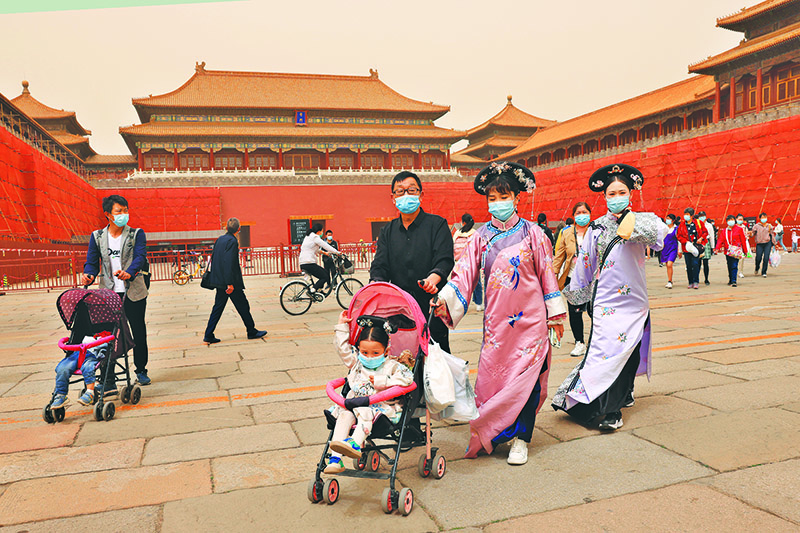
Residents dressed in traditional costumes visit the Forbidden City in Beijing.ap/rss

BEIJING : China’s population has grown at its slowest pace in decades, reaching 1.41 billion, census results showed on Tuesday.
The growth of 5.4 percent since the last census in 2010 reflects fears of a looming demographic crisis amid an ageing society and slowing birthrates, with a sharp drop in the number of working-age citizens in the world’s second biggest economy.
The growth rate was the slowest since the 1960s, according to official data. Beijing changed family planning rules in 2016 to allow families to have two children amid fears grew about China’s fast-ageing population and shrinking workforce.
“The adjustment of China’s fertility policy has achieved positive results,” said Ning Jizhe, an official from the National Bureau of Statistics.
But he added that the “ageing of the population imposed continued pressure on the long-term balanced development of the population in the coming period.”
The number of people aged between 15 and 59 population dropped nearly seven percent, while those aged over 60 was up more than five percent.
China’s birthrate has been in steady decline since 2017, despite the relaxation of the decades-old “one-child policy”.
This is partly due to falling marriage rates in recent years, couples struggling with the high cost of raising children in major cities, as well as women naturally delaying or avoiding childbirth due to their growing empowerment.
The average size of a family is now 2.62 people, the data showed, down from 3.10 people ten years ago.
“The family households continued to downsize because of increasing population mobility and the fact
that young people after marriages lived separately from parents with improved housing conditions,”
said Ning. In a stark sign of the changing face of Chinese society, the urban population grew to 236.4 million—nearly 15 percent more than in the previous census. More than 63 percent of people now living in urban areas.
However, nearly 500 million are part of what Beijing calls the “floating population”—migrant workers who live in places other than their official household registration.
China conducts a census every ten years to determine population growth, movement patterns and other trends. The sensitive data plays a major role in government policy planning.

WORLD

Rockets kill 2 Israelis as strikes kill 26 in Gaza

- ASSOCIATED PRESS

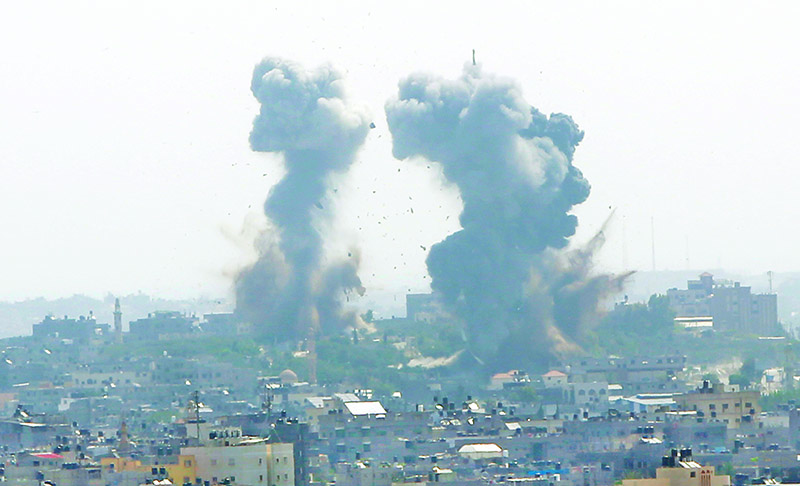
Smoke rises after an Israeli forces strike in Gaza in Gaza City on Tuesday. ap/rss

GAZA CITY : Israel unleashed new airstrikes on Gaza early Tuesday, hitting a pair of high-rise buildings believed to be housing militants, as Hamas and other armed groups bombarded southern Israel with hundreds of rockets. The escalation was sparked by weeks of tensions in contested Jerusalem.
Since sundown Monday, 26 Palestinians—including nine children and a woman—were killed in Gaza, most by airstrikes, Gaza health officials said.
The Israeli military said at least 16 of the dead were militants. During the same period, Gaza militants fired hundreds of rockets toward Israel, killing two Israeli civilians and wounding 10 others.
In a further sign of rising tensions, Israel signalled it is widening its military campaign. The military said it is sending troop reinforcements to the Gaza border and the defence minister ordered the mobilization of 5,000 reserve soldiers.
But, in a potentially positive sign, officials said Egypt was working on brokering a cease-fire.
The barrage of rockets and airstrikes was preceded by hours of clashes between Palestinians and Israeli security forces, including dramatic confrontations at Jerusalem’s Al-Aqsa Mosque compound, a sacred site to both Jews and Muslims.
The current violence, like previous rounds, including the last intifada, or uprising, has been fuelled by conflicting claims over Jerusalem, which is at the emotional core of the long conflict.
In a sign of widening unrest, hundreds of residents of Arab communities across Israel staged overnight demonstrations—denouncing the recent actions of Israeli security forces against Palestinians. It was one of the largest protests by Palestinian citizens in Israel in recent years.
Israel and Hamas, an Islamic militant group that seeks Israel’s destruction, have fought three wars and numerous skirmishes since Hamas seized control of Gaza in 2007. Recent rounds of fighting have usually ended after a few days, often helped by behind-the-scenes mediation by Qatar, Egypt and others.
An Egyptian official confirmed that the country was trying to broker a truce. But the official, speaking on condition of anonymity because he was discussing sensitive diplomacy, said Israeli actions in Jerusalem had complicated those efforts. A Palestinian security official, also speaking on condition of anonymity, confirmed the cease-fire efforts.
Israeli Prime Minister Benjamin Netanyahu, meanwhile, has warned that fighting could “continue for some time.” Lt Col Jonathan Conricus, an Israeli military spokesman, told reporters Tuesday that the military was in “the early stages” of strikes against Gaza targets that it had planned well in advance.
Israel carried out dozens of
airstrikes, including two that targeted high-rise buildings where militants were believed to be hiding.
At midday, an airstrike hit an apartment building in central Gaza City. Local media said an unknown number of militants had been killed. But the force of the blast sent terrified residents, including women and children who were barefoot, running into the streets.

WORLD

AIDS virus used in gene therapy to fix ‘bubble baby’ disease

- ASSOCIATED PRESS

Washington : A gene therapy that makes use of an unlikely helper, the AIDS virus, gave a working immune system to 48 babies and toddlers who were born without one, doctors reported Tuesday.
Results show that all but two of the 50 children who were given the experimental therapy in a study now have healthy germ-fighting abilities.
“We’re taking what otherwise would have been a fatal disease” and healing most of these children with a single treatment, said study leader
Dr Donald Kohn of UCLA Mattel Children’s Hospital.
“They’re basically ‘free range’—going to school, doing normal things,” without the worry that any infection could become life-threatening, he said.
The other two children who weren’t helped by the gene therapy later had successful bone marrow transplants. Doctors say it will take longer to know if any of the 50 are cured, but they seem to be well so far.
The children had severe combined immunodeficiency syndrome, or SCID, which is caused by an inherited genetic flaw that keeps the bone marrow from making healthy versions of the blood cells that form the immune system. Without treatment, it often kills in the first year or two of life.
It became known as “bubble boy disease” because of a case in the 1970s involving a Texas boy who lived for 12 years in a protective plastic bubble to isolate him from germs. It’s now called “bubble baby disease” because roughly 20 different gene defects, including some that affect girls as well as boys, can cause it.
A bone marrow transplant from a genetically matched sibling can cure the disorder, but most kids lack a suitable donor and the treatment is risky -- the Texas boy died after one.
Patients now are treated with twice-weekly doses of antibiotics and germ-fighting antibodies, but it’s not a permanent solution.
Doctors think gene therapy might be. They remove some of a patient’s blood cells, use a disabled AIDS virus to insert a healthy version of the gene that the kids need, and return the cells through an IV.
Josselyn Kish, now 11 and living in Las Vegas, had it at UCLA when she was 3. As a baby, she suffered rashes, painful shingles and frequent diarrhoea, said her mother, Kim Carter.

Page 7
SPORTS

Rai’s extra time goal sends Dhangadhi FC into Nepal Super League final

The midfielder scores in the 18th minute of the additional half an hour as they beat Kathmandu Rayzrs 2-1.
- Sports Bureau

Dhangadhi FC’s Bishal Rai (centre) celebrates with his teammates after scoring a goal against Kathmandu Rayzrs during the first qualifier match of the Nepal Super League.Post Photo: Keshav Thapa

KATHMANDU : Dhangadhi FC came from a goal. down to beat Kathmandu Rayzrs FC 2-1 in extra time and secure a place for the final of Nepal Super League, the first ever franchise football tournament in the country, at the Dasharath Stadium in Tripureshwor on Tuesday.
Midfielder Bishal Rai netted the decisive goal 18 minutes into the additional half an hour after a 1-1 draw in the regular time for Dhangadhi, who became the first to enter into the final. Tej Tamang had given a lead to the Bal Gopal Maharjan coached Kathmandu midway in the second half but midfielder Pujan Uparkoti cancelled it shortly, driving the match into extra time.
Kathmandu and Dhangadhi came into the first qualifiers as the winners and runners up in the round robin league and the tournament format offered a direct final spot for winners among them. Despite the defeat, Kathmandu will get yet another chance to secure a place in the final. They will meet the winners between third placed Lalitpur FC and fourth placed Butwal Lumbini FC in the second qualifiers set for Thursday. Lalitpur and Butwal Lumbini will clash on Wednesday.
The entertaining match saw Kathmandu excel in ball possession and pile pressure on the national captain led Kiran Limbu’s Dhangadhi in the first half while the second half remained more balanced. Dhangadhi, who rested their prolific forward Oladipo Olawale Afeez in their last match due to a hamstring injury, started with the Nigerian pairing him with Darshan Gurung upfront. The Nigerian, second highest scorer of the tournament, however, was not at his best and made little impact on the match.
Kathmandu threatened Dhangadhi in the 15th minute when the tournament’s top scorer Messouke E Oloumou rattled the bar with his long range strike. They threatened yet again calling goalie Limbu into action in the 37th to deny Sudil Rai’s close range scorcher at the near post.
Kathmandu finally broke the deadlock in the 75th when Tej Tamang was allowed for a free header inside the crowded area to convert an acute cross by Cameroonian Oloumou. But Kathmandu’s hope of avenging the 3-0 defeat in the league round evaporated three minutes later as Pujan Uperkoti restored the parity with a spectacular back volley from the crowded zone. The midfielder quickly gave a finishing touch after he got a ball headed by Cameroonian defender Franklin KueteTalla when a ball parried by goalie Bikesh Kuthu moving out of position dropped on him.
“We had to concede the goal due to errors by the goalkeeper and defenders three minutes after getting on the scoresheet,” lamented coach Bal Gopal Maharjan. “We came into the match with the ambition of securing a place in the final. But we are still not out of the final race and we will try to perform better in the next match.”
Maharjan, however, praised his team’s performance. “The boys performed really well and they executed the match plan of possessing the ball. There were also injury problems in the team,” he said.
Dhangadhi came closer to scoring their second goal in the 89th minute when Afeez collected a through pass from Saujan Rai before the Nigerian forward was denied in a one-on-one situation by goalie Kuthu. The forward then required treatment after sustaining a hamstring injury before the regulation period finished. He was replaced at the start of second half of the added 30 minutes by defender Ramesh Dangal.
Kathmandu wasted a golden scoring chance as Tej Tamang failed to connect Anjan Rai’s cross in the six-yard box, sending the ball wide with a feeble touch. Dhangadhi finally scored the winning goal in the 18th minute of the added time as their marquee player Bishal Rai made an easy tapping from the close range beating an offside trap in Dangal’s header pass. He did not even celebrate his goal, suspecting if it was offside before the referee signaled it as a goal.
Kathmandu squandered yet another scoring opportunity six minutes from time when Anjan Rai ended up firing high above the post in Stephen Binong free kick.
Dhangadhi coach Fuja Tope said he tested defender Dangal in place of forward Afeez and that turned fruitful. “The main reason for starting injured Afeez was to put pressure on opponent defenders. But we replaced him after he was unable to continue playing because the defender has good quality in playing aerial ball and we were successful in that.”
Dhangadhi’s Soujan Rai was named the emerging player and his teammate Franklin KueteTalla won the super player award. Rai was rewarded with Rs10,000 and Talla got Rs25,000.

SPORTS

Fulham relegated from Premier League after one season

- ASSOCIATED PRESS

LONDON : Relegation, promotion, and now relegation again.
Fulham’s rollercoaster ride between the top two divisions of English football has taken the London club back out of the Premier League, their fate sealed by losing to Burnley 2-0 on Monday.
Fulham joined Sheffield United and West Bromwich Albion in going down to the Championship, wrapping up the Premier League’s relegation battle at the earliest ever stage — with three rounds still to go.
“I’m bitterly disappointed, I’m hurt, I’m gutted,” said Fulham manager Scott Parker, who also presided over the team’s relegation two seasons ago when he was in charge on an interim basis. “While it’s been looming over us for some time now, there’s no words I can put together other than I’m gutted we haven’t been successful this year.”
Burnley were one of four clubs — along with Brighton, Newcastle and Southampton — still mathematically not safe heading into the match at Craven Cottage. After first-half goals from Ashley Westwood and in-form striker Chris Wood, Burnley were able to celebrate the prospect of playing a sixth straight season in the lucrative top flight — a stunning achievement by manager Sean Dyche given the budget he works under and the fact his team had just two points after seven games.
The kind of stability Dyche has brought to Burnley is something Parker craves.
“The highs and lows and the rollercoaster of the journey that is, we need to work out exactly what we need to do now to try to keep a level about us,” the former England midfielder said. “Over the coming weeks, we need to have a discussion and work out what we need to do to move forward and try to get off the rollercoaster we are on.”
Parker said he was committed to staying at the club, though that will ultimately be a decision for owner Shahid Khan, whose portfolio of sports teams also includes the NFL’s Jacksonville Jaguars.
Khan also faces a period of introspection, with Fulham’s board overseeing another offseason of questionable recruitment, especially how late in the transfer window the club decided to bring in some of the new signings.
Fulham, who are 10 points from safety with three matches remaining, have been near the bottom of the league all season, the team’s porousness at the back initially the biggest flaw.
Parker was able to shore up the defence by the middle of the season — helped by the impressive displays of loan signings Joachim Andersen, a centre back from Lyon, and Alphonse Areola, a goalkeeper from Paris Saint-Germain — but that came at the expense of their attacking fluency.
Fulham have just 25 goals in 35 games, better only than last-placed Sheffield United. “In between both boxes, we have had our moments and looked a good side,” Parker said. “Where we have fallen short is the other side of that.”
After beating Liverpool 1-0 at Anfield on March 7, Fulham were tied on points with fourth-to-last Brighton but haven’t won any of their seven games since.
“We cracked under the pressure a little bit,” said Fulham striker Aleksandar Mitrovic, the team’s star striker who has scored only three times this season.
“We weren’t good enough, brave enough. We work hard, but we don’t have the quality at both ends.”

SPORTS

Iniesta renews Vissel Kobe deal

Briefing

TOKYO: Former Barcelona midfielder Andres Iniesta said on Tuesday he has extended his contract with Vissel Kobe by another two years and wants to keep working towards making the Japanese side the best in Asia. Spanish World Cup winner Iniesta, who also celebrated his 37th birthday on Tuesday, signed a three-year contract with Kobe in 2018 after leaving Barcelona, where he won nine La Liga and four Champions Leagues titles. Since Iniesta joined the J-League team, Kobe won their first silverware at the Emperor’s Cup last year and also qualified for the 2020 AFC Champions League for the first time in their 55-year history. “I will keep persisting with taking on this challenge with the same passion and drive I felt three years ago,” Iniesta said at a news conference announcing the extension.(AGENCIES)

SPORTS

Goalie Buffon to leave Juventus

Briefing

TURIN: Juventus goalkeeper Gianluigi Buffon says he will leave the club when his contract expires at the end of the season but could still join another team if he receives a suitable offer. The 43-year-old first joined the Turin club from Parma in 2001 and has been there ever since, with the exception of one season at French side Paris Saint-Germain in 2018-19. “My future is clear. This year I will definitively end my long and beautiful experience at Juventus,” Buffon told beIN Sports. “I will either retire or find a situation that motivates me, a different experience to take into consideration.” Considered one of the greatest goalkeepers of all time, Buffon has won 10 Serie A titles and four Coppa Italia trophies with Juve, as well as achieving FIFA World Cup glory with Italy in 2006. Buffon has served as a backup to Pole Wojciech Szczesny since returning from Paris in 2019 and has made 12
appearances in all competitions this season.(AGENCIES)

SPORTS

Mendy ruled out for season

Briefing

MADRID: Real Madrid’s injury crisis dragged on when left back Ferland Mendy was on Tuesday ruled out for the rest of the season with a shin problem, leaving coach Zinedine Zidane without all four of his first choice defenders. A medical report published by Real said the Frenchman, Real’s first choice left back, had been diagnosed with shin splints. The report did not state when he would return although newspaper AS said he would be out for three weeks, meaning he will miss Real’s final three games in the La Liga title run-in. Real missed the
chance to go top of the standings when they drew 2-2 at home to
Sevilla on Sunday and they trail leaders Atletico Madrid by two points after 35 games. (AGENCIES)

HOROSCOPE

HOROSCOPE

ARIES (March 21-April 19) ****
Let yourself embrace Wednesday’s uplifting vibe, Aries. The moon departs from practical Taurus and slides forward into playful Gemini, prompting you to find mental and verbal outlets for your creative self-expression.

TAURUS (April 20-May 20) ***
It’s easy to feel good under Wednesday’s cosmic landscape, Taurus. The sensitive moon leaves your sign and moves forward into logical Gemini, pointing your focus towards financial matters and productive efforts.

GEMINI (May 21-June 21) ****
As a Gemini, you look to the quick-thinking planet, Mercury, for guidance. Wednesday’s skies find Mercury in a supportive connection to stabilizing Saturn, helping you ground down and become increasingly realistic about your vision.

CANCER (June 22-July 22) ***
It’s time to retreat into your shell, Cancer. You’re in no mood for public interaction, social dealings, or labour today. The moon crawls into reflective Gemini and merges with pleasure-seeking Venus, giving you full reign to indulge yourself and keep it low-key.

LEO (July 23-August 22) ***
You can make it all happen today, Leo. The moon glides into playful Gemini, turning your attention toward your long-term aspirations and your involvement in friend groups. Luna’s union with sweetener Venus makes it an ideal day for patching up connections.

VIRGO (August 23-September 22) ****
You’ve got momentum with your ambitions, Virgo. Don’t stop now! The moon glides into quick-thinking Gemini and spends the day merged with beneficial Venus, attracting positive circumstances to your career realm.

LIBRA (September 23-October 22) ***
A sense of levity is returning to you, Libra. You’re shifting gears today, as the moon glides out of melancholic Taurus and parades into rational Gemini. Luna’s union with your ruler, lover Venus, makes it easy to feel good and restore balance emotionally.

SCORPIO (October 23-November 21) ***
As a Scorpio, you crave intimate encounters that offer you authentic connections. This natural craving runs high today, as the story-telling Gemini moon merges with lover Venus. It’s an ideal day to confide in a lover or seal the deal on joint collaborations.

SAGITTARIUS (November 22-December 21) ***
Wednesday’s skies are deliciously romantic, Sagittarius. Don’t miss out on the opportunity for an ideal date night, as the playful Gemini moon merges with bond-building Venus.

CAPRICORN (December 22-January 19) ****
Today’s the day to put yourself out there, Capricorn. If you’ve been waiting for the right moment to submit a job application, launch a work project, or have a smooth-running conversation with a boss—look no further!

AQUARIUS (January 20-February 18) ***
Monday’s skies help you reconnect with the things in life that bring you joy, Aquarius. The moon glides into playful Gemini and merges with sweet Venus, creating a light and romantic atmosphere to indulge in.

PISCES (February 19-March 20) ***
Reconnect with your home base today, Pisces. The moon glides into reflective Gemini, turning your attention towards family dynamics and the state of your living space. Luna’s union with Venus makes it an ideal day for bonding.

Page 8
CULTURE & LIFESTYLE

Asian American health workers fight virus and racist attacks

Asian Americans and Pacific Islanders have faced a tide of harassment and attacks in many settings during the pandemic.

Dr Michelle Lee, left, a radiology resident, and Ida Chen, right, a physician assistant student, unfold a banner Lee created to display at rallies protesting anti-Asian hate.AP/Rss

NEW YORK : Medical student Natty Jumreornvong has a vaccine and protective gear to shield her from the coronavirus. But she couldn’t avoid exposure to the anti-Asian bigotry that pulsed to the surface after the pathogen was first identified in China.
Psychiatry patients have called her by a racist slur for the disease, she said. A bystander spat at the Thai-born student to “go back to China” as she left a New York City hospital where she’s training.
And as she walked there in scrubs Feb. 15, a man came up to her, snarled “Chinese virus,” took her cellphone and dragged her on a sidewalk, said Jumreornvong, who reported the attack to police. The investigation is ongoing.
For health care workers of Asian and Pacific Islander descent, “it seems like we’re fighting multiple battles at the same time—not just Covid-19, but also racism,” says Jumreornvong, a student at the Icahn School of Medicine at Mount Sinai.
Asian Americans and Pacific Islanders have faced a tide of harassment and attacks in many settings during the pandemic. But those in health care are feeling the particular, jarring anguish of being racially targeted because of the virus while toiling to keep people from dying of it.
“People in my community have gone from being a health care hero to, somehow, a scapegoat,” said Dr Michelle Lee, a radiology resident in New York. She rallied 100 white-coat-clad medical workers in March to denounce anti-Asian hate crimes.
“We’re not bringing you the virus,” said Lee, who recalls strangers on the street spitting on her twice in the last year. “We are literally trying to help you get rid of the virus.”
People of Asian and Pacific Islander descent make up about 6 percent to 8 percent of the US population but a greater share of some health care professions, including around 20 percent of non-surgeon physicians and pharmacists and 12 percent to 15 percent of surgeons, physical therapists and physician assistants, according to federal statistics.
Before the pandemic, studies found that 31 percent to 50 percent of doctors of Asian heritage experienced on-the-job discrimination ranging from patients refusing their care to difficulty finding mentors. That’s a lower proportion than Black physicians, but higher than Hispanic and white doctors, according to a 2020 study that reviewed existing research. In a separate 2020 study of medical residents, all those of Asian heritage said patients had quizzed them about their ethnicity.
Columbia University medical student Hueyjong “Huey” Shih recalls being confronted with “a lot of assumptions, all boiled into one very inappropriate question” from a colleague in a hospital: Was Shih an only child because of China’s former one-child policy?
The Maryland-born Shih, whose family hails from Taiwan, said the colleague apologised after being set straight. Writing in the health news site Stat, he and medical students Jesper Ke and Kate E. Lee implored health institutions to include Asian Americans’ and Pacific Islanders’ experiences in anti-racism training.
For generations, Asian Americans have contended with being perceived as “perpetual foreigners” in a country with a history of treating them as threats. Officials wrongly blamed San Francisco’s Chinatown for an 1870s smallpox outbreak, barred many Chinese immigrants under the 1882 Chinese Exclusion Act and forced Japanese Americans into internment camps even as tens of thousands of their relatives served in the US military during World War II.
During the pandemic, former President Donald Trump repeatedly called Covid-19 the “China virus” and by other terms that activists say fanned anger at Asian Americans.
Police reports of anti-Asian hate crimes in 26 big US cities and counties shot up 146 percent last year, while hate crimes overall rose 2 percent, according to California State University, San Bernardino’s Center for the Study of Hate and Extremism. The advocacy group Stop AAPI Hate fielded nearly 3,800 reports of assault, harassment and discrimination from mid-March 2020 through the end of February—before a gunman killed eight people, including six of Asian heritage, at Atlanta-area massage businesses in March.
The statistics don’t break out health care workers among the victims.
The escalation “makes racism seem a lot scarier than the virus” to Dr Amy Zhang, an anesthesiology resident at the University of Washington’s hospitals.
“It’s a constant fear. You never know when you’re going to get targeted,” she says.
Early in the pandemic, she came face-to-face with the risk of
Covid-19 while intubating patients. And face-to-face with racism when a white man on the street muttered a vulgarity at her about China and “giving us smallpox,” then started following her while yelling racial epithets and sexual threats until she got inside the hospital, she said.
“Despite the fact that I clawed myself out of poverty to chase the American dream, despite the fact that I can and have saved lives under stressful conditions, none of this protects me from racist vitriol,” Zhang wrote in Crosscut, a Pacific Northwest news site. She’s a daughter of Chinese immigrants who worked long hours for low wages. These days, New York physician assistant student Ida Chen carries pepper spray all the time, sets her cellphone to let all her friends know her location and doesn’t roam far alone. For a time, she hid the roots of her dark brown hair under a hat so only the dyed blonde ends would show.
She started taking those precautions after a man biked up to her on a Manhattan street in March 2020 and sneered that he’d be “into you, but I don’t want to get the coronavirus,” then followed her while hollering slurs until she called 911, she said.
“I went into medicine thinking: I treat people with the best intention possible,” said Chen, who has Chinese heritage. “It hurts that someone’s not reciprocating that kind of empathy and good intentions.”
Chen and some others say the Georgia shootings propelled them to speak out about what they see as longtime minimisation of anti-Asian racism.
“The whole reason I became a doctor is to help my community,” says Lee, a daughter of South Korean immigrants with no other physicians in the family. “If I don’t speak up for my community, what have they sacrificed—done everything they’ve done—for?”
Jumreornvong, who identifies as queer, said she had experienced discrimination before. But it felt different to be targeted because of her race, and in a country where she pictured the American dream as trying “to make it a better place for everyone and yourself.”
“For a moment, I was a little pessimistic about whether or not the people want me here,” she said. But she focused on how colleagues rallied around her, how the hospital expressed support, how patients have shown appreciation for her work.
“I still do believe in the best of America,” she said.

- By JENNIFER PELTZ 
— Associated Press