War of words between Oli and Nepal continues as they drift apart
The future of UML is in the hands of the Supreme Court as its decision on House dissolution will indicate how factions led by the two leaders make their next moves, insiders say.
- ANIL GIRI
KATHMANDU, A tug-of-war has been going on in the CPN-UML for months. Party chair KP Sharma Oli, also the prime minister, has not only criticised and humiliated senior leader Madhav Kumar Nepal but also on one occasion ousted him from the party. Nepal, who leads a faction within the party, has at times threatened to form a separate party, but he has not done so yet. The two adversaries, however, continue to remain in the same party, even though they do not miss a single opportunity to lash out at each other. But if some recent developments are anything to go by, according to insiders and observers, a split in the UML is just a matter of time. Some second-rung leaders have been making a last-ditch effort to keep party unity intact, but the basis has weakened and the bitterness between the leaders has only grown, they say. On Monday, Oli took on Nepal over the latter’s statement that he was offered the post of prime minister. “Nepal has become a tail of Dahal. A few days back he said I have offered the post of prime minister to him. Am I bitten by a mad dog?” said Oli, evoking derisive laughter from his party members. Nepal, along with 22 other UML members, is currently backing the opposition alliance which has pitched Nepali Congress President Sher Bahadur Deuba as prime minister. The alliance has filed a petition at the Supreme Court demanding House restoration and appointment of Deuba as prime minister. “Madhav Nepal claims to be a senior UML leader, but how can a leader who is supporting the opposition party leader as prime minister be a UML leader?” said Oli. “Madhav Nepal is destroying the communist movement.” Later in the day, Nepal responded to Oli’s remarks at a different function. “Oli’s language is worth pondering. Please keep that on record. The prime minister is at the top when it comes to violating basic civility.” Oli’s scathing remarks against Nepal come days before a meeting of the UML aimed at taking the party to the stage it was before May 18, 2018. This will mean a broader call to the Nepal faction to decide if it wants to be under the UML party which existed before its merger with the Communist Party of Nepal (Maoist Centre). “The UML will dissolve the national convention organising committee of the party and revive the Central Committee,” said Rajendra Gautam, who is close to Oli. “We will announce a roadmap for keeping the party united. Those who are interested can join.” But many say things have escalated badly and that the likelihood of Oli and Nepal remaining under the same party has diminished. A member who spoke on condition of anonymity said leaders like Nepal, Jhala Nath Khanal, Bhim Rawal, Asta Laxmi Shakya, Ram Kumari Jhakri and Rajendra Kumar Rai are unlikely to join hands with Oli. Nepal so far has expressed his commitment to backing the opposition alliance, but given his nature of being risk-averse and indecisive, not many are convinced. Nepal had aligned himself with Pushpa Kamal Dahal in the then Nepal Communist Party (NCP) to create a force against Oli. But on March 7, the Supreme Court invalidated the Nepal Communist Party (NCP) and revived the UML and the Maoist Centre. Even though Nepal has said on multiple occasions that he would form a party of his own, he has not yet broken his ties with the UML. In joint statements of the opposition alliance, Nepal signs as “senior leader of the CPN-UML.” With Oli’s position becoming untenable, the Nepal faction now appears to be preparing to desert the UML. And much depends on the Supreme Court decision on Oli’s May 21 House dissolution. As many as 23 lawmakers, including Nepal, from the dissolved Parliament have signed the petition filed by the opposition alliance led by Deuba against the House dissolution. Leaders close to Oli say he will make utmost efforts to stop Deuba from becoming prime minister if the House is reinstated. For that, according to UML leaders, Oli has two options–either make sure that the Nepal faction comes into his fold, or strip all the leaders from the Nepal faction of their lawmaker positions. If Oli passes the trust vote with the support of the Nepal faction, he will stay on for a year and a half and if he loses it, the House would be dissolved again, according to people from Oli’s orbit. “The present situation [in the party] is quite complicated after the Supreme Court’s order [to invalidate the national convention organising committee],” said Pradeep Gyawali, spokesperson for the UML. “We are on a wait and watch mode.” According to Gyawali, there is little chance of Nepal returning to the UML fold, as “he has been lured by the Nepali Congress and the Maoist Centre”. “We have heard about a merger of different forces led by Nepal, Dahal and Upendra Yadav. We have also heard about pre-electoral alliances,” said Gyawali. “But the way the activities of Nepal and the opposition alliance are directed, I see a larger party unity within UML with Nepal and other leaders as impossible.” Gyawali, however, believes that “some leaders” might come to Oli’s fold. One of the leaders who deserted the Nepal faction to return to the Oli camp is Bishnu Rijal. “If the Supreme Court reinstates the House, there will be pressure on Oli for party unification. In that scenario, he might even offer the post of party chair to Nepal,” said Rijal. “If the court passes an order to restore the House and appoint Deuba as prime minister, Oli will have to remove the leaders of the Nepal faction as lawmakers.” According to Rijal, the UML’s unity fate largely depends on the Supreme Court’s verdict. Nepal faction leaders, however, are not optimistic about Oli accommodating them in the UML. “Oli’s calls so far have been an eyewash,” said Som Prasad Pandey, a leader close to Nepal. “Our leadership has already squandered the opportunity that we had to start afresh. There is very little chance of going with Oli now.” But whether Oli will indeed accommodate Nepal and his faction’s leaders or oust them from the party, thereby relieving them of their lawmaker positions if the House is restored is still up in the air. Hari Roka, a political commentator, said it won’t be easy for Oli to sack lawmakers, given a recent Supreme Court ruling on the removal of four provincial lawmakers of Karnali that the party’s National Convention Organising Committee’s decision is not valid and only that of the Central Committee is valid. “Oli is left with limited options and alternatives after a series of Supreme Court orders in the recent past,” said Roka. “If Oli removes Nepal faction leaders, it will be illegal. And he is not going to offer the post of party chair to Nepal. Oli is taking the country towards a disaster.”
HOME PAGE
Nepal wants to be an agriculture-driven economy but future of the sector is in crisis
Share of agriculture in the country’s economy has been plummeting. Although 60 percent of Nepalis still depend on agriculture, it accounts for just 25 percent of the GDP.
- SANGAM PRASAIN
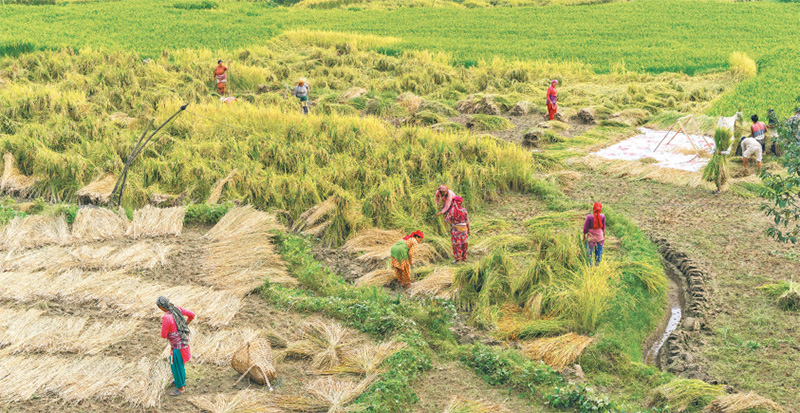
Low returns from agriculture is the key reason behind its falling allure among youths. Post file Photo
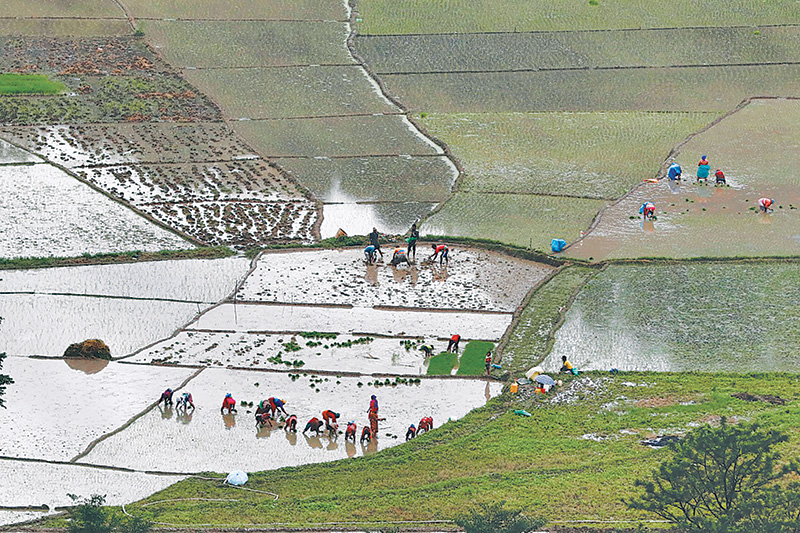
KATHMANDU, Tuesday is Asar 15. It is celebrated as National Paddy Day and is a photo opportunity for the agriculture minister to soil his hands and plant some paddy saplings. In the national imagination and the government’s wishful thinking, Nepal’s agricultural sector is the basis of its economy. But figures tell a different story. Agriculture made up 66.9 percent of the gross domestic product (GDP), in 1970. But since then its share has been gradually decreasing and was a mere 25 percent in 2018, according to an analytical report published by the Central Bureau of Statistics recently. “This means, the agriculture sector has not performed well and other sectors like tourism and manufacturing have taken over it,” said Hem Raj Regmi, deputy director general at the bureau, the central agency for the collection, consolidation, processing, analysis, publication and dissemination of statistics in Nepal. “Clearly, we can now say Nepal has shifted from an agriculture-driven economy to remittance-driven economy.” But, while agriculture has a multiplier effect in the economy in the creation of jobs and supporting other sectors, remittance doesn’t directly contribute to the economy despite the huge amount of money it generates for the economic activities, particularly consumption, in Nepal, according to economists. “Obviously, this is a cause for alarm,” Regmi told the Post. According to the World Bank’s Migration and Development Brief, remittances to Nepal stood at $8.1 billion in 2020, a fall of about 2 percent compared to the previous year largely due to the pandemic as international flights were suspended for months. The report said the contribution of remittances to the economy is equivalent to 23.5 percent of the GDP. On the other hand, agriculture has been regarded as the mainstay of economic prosperity for its contribution to the GDP and livelihood of the population, according to the 15th Five-year Plan from fiscal year 2019-20 to fiscal year 2023-24. The 15th Plan targets to transform the agriculture sector into a competitive, climate-resilient and export-oriented industry. “But that’s only on paper,” said Yam Kanta Gaihre, a soil scientist. “The agriculture programmes and policies of Nepal are so good but they cannot get implemented.” Economists say low returns from agriculture is the key reason behind its falling allure among Nepali youths. Internal factors affecting Nepal’s agriculture sector growth are insufficient public investment, inadequate irrigation infrastructure, poor agriculture-related marketing policies, and climate vulnerabilities. Then there are external factors. These include excessive economic liberalisation and zero tariffs on agricultural products. “It’s easy to buy and eat rather than grow and eat,” said Gaihre, “Because the production cost is so high.” Nepal has brought various plans and policies to increase agricultural production and productivity but this never materialised. With agricultural productivity remaining stagnant, millions of youths have no option but to travel abroad in search of jobs. Economists put forth several reasons for why agriculture is no longer the engine of economic growth. The economic liberalisation of the 1990s and greater openness to trade has led to a reduction in the economic potential of the rural sector and cheap imported goods, including agricultural produce, has displaced the locally-produced goods, said economist Keshav Acharya. “With rapid global technical change and increasingly integrated markets, prices fell faster than the increase in yields in Nepal,” he said. In Nepal’s case, it was thought that there would be an agricultural revolution resulting in increased production which in turn would support industry and manufacturing. “While many countries in Asia had followed the path, in Nepal, despite economic graduation, there was a jump to the service sector,” said Acharya. “There was no development in manufacturing and industry. This is a sign of unsustainable economic transformation.” The manufacturing sector as a proportion of the economy has in fact declined as in 2000 its contribution to the GDP was 10 percent but has now dropped to less than 6 percent, according to him. After economic liberalization, the integration of rural with urban areas began and young people started moving out of agriculture and headed to towns and then abroad. The latest development of this trend, according to Acharya, was the rapid development of the road network across the country. “The value of land, due to the massive road building, has gone up so high that there is no value in cultivating in the same land,” said Acharya. “It’s a trading asset both in urban and rural areas.” He said that a bigha (0.67 hectare) of land costs Rs10 million in rural areas with road connectivity but if it is sold and the money is deposited in a bank under a fixed deposit scheme, the annual earning is three times higher than what a farmer’s income would be. “And it’s easier to buy goods with that income than farm,” said Acharya. But according to Gaihre, although farmers’ income sources may have diversified and they are able to buy and eat, the country has lost a mode of production. “Farming holds no charm anymore,” he said. An effect of the lower income from farming due to the low production is that Nepal’s agricultural goods import bill continues to expand, ballooning to an all-time high of over Rs250 billion in the fiscal year 2019-20. The country’s import-promoting policies, high production costs and change in consumer behaviour are also reasons for this. The agricultural goods imports bill in 2009-10 was just Rs44.43 billion. In 10 years, it has grown by almost six times. While the country’s overall imports dropped by 15.63 percent to Rs1.19 trillion in the last fiscal year, ending mid-July, due to Covid-19 pandemic-related restrictions, agricultural goods imports continued to increase. The share of agro products in the total import bill has swelled to 21 percent. It is not that there is no market for agricultural produce as evident from Nepal’s soybean oil exports to India which hit a staggering Rs42.34 billion in the first 11 months of the current fiscal year, a four-fold jump from Rs10.12 billion in the same period in the previous fiscal year, making it the country’s number one export commodity. It exported 246,376 tonnes of processed soybean oil in the same period. Nepal produces very little soybean oil of its own, in fact, just 31,567 tonnes of raw soybean annually, which is not enough to meet the requirement of even a fraction of its own population. This is possible because Nepal traders import soybean oil exploiting loopholes in the zero-tariff privilege given to Nepal as a least developed country and then export it to India. Despite such potential, the government has never encouraged farmers to produce soybean but instead encourages traders to import and export the produce to generate revenue, according to economists. But as the GDP rises and the share of agriculture typically decreases, the question is how important these multiplier effects are, especially when significant levels of poverty remain in the agriculture sector which still employs over 60 percent of the population, Acharya said. “Even as the demand for agricultural produce increases its importance is declining in the overall economy,” said Regmi of the government’s Central Bureau of Statistics.
NATIONAL
Several settlements in hill districts of Lumbini at high risk of landslides
Haphazard construction of roads using heavy machinery is also one of the leading causes behind landslides, officials say.
Road expansion works have put several settlements in Palpa district at risk of disasters, according to officials. Post Photo: MADHAB ARYAL
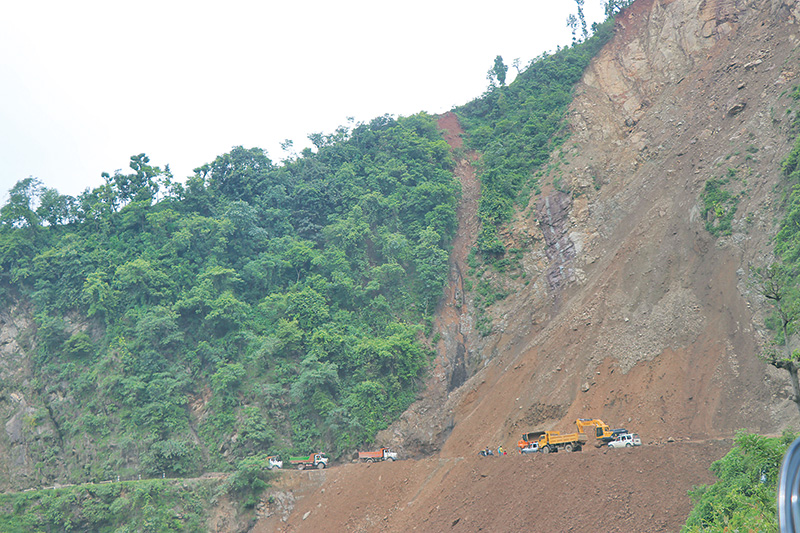
PYUTHAN, Junga Bahadur Pun, the ward chairman of Gaumukhi Rural Municipality-3 in Pyuthan, has been staying in an animal shed for the past one year. He says he and his family started living in the shed, as his village is at risk of landslides. “The Khara settlement is gradually sinking. My house’s walls have developed cracks due to landslides. So we have been staying in the cowshed,” Pun said. “Many houses in my settlement are tilted with cracks now.” According to him, 13 families in the settlement take shelter either in their animal sheds or relatives’ houses every monsoon due to fear of landslides. The buildings of Khara Secondary School, a local community school, and the ward office of Gaumukhi-3 are also at risk of landslides. A massive landslide erupted just below the settlement last year, displacing Pun and 12 other families. According to Pun, a team of geologists, with the assistance of the Lumbini Province government, came to Khara to conduct a field study five months ago. “The geologists studied the landslide-prone settlement but did not give any information to the ward office. I am worried that a landslide will sweep away my settlement,” Pun told the Post. Not only Khara but several settlements in Gaumukhi Rural Municipality are at risk of water-induced disasters. The settlements of Paiyupata, Harjakhola, Thulakharka and Lekhchhahara are at high risk of landslides. The local unit said at least 10 houses in Thulakharka should be relocated to safer locations at the earliest due to erosion caused by Jhimruk river. “Similarly, the households in Lekhchhahara settlement of Gaumukhi Rural Municipality Ward No. 2 also need to be shifted to a safer place,” said Dor Bahadur Rana, the ward chairman of Gaumukhi-2. Despite the risk of landslides, the relocation process is yet to commence. “There is no safer place nearby to relocate the settlements and the villagers do not want to leave their ancestral settlements,” said Bishnu Kumar Giri, the chairman of Gaumukhi Rural Municipality. Of the nine local units in Pyuthan district, Gaumukhi and Naubahini rural municipalities are prone to floods and landslides. As many as 53 people in the area had been killed due to floods and landslides in 2016. “There are streams flowing below several settlements. The streams erode the banks each year, risking the settlements to landslides,” said Shivaraj Rijal, the chairman of Naubahini Rural Municipality. According to him, residents of Kurtibang, Syaulibang and Khabang settlements of Ligha need to be shifted to safer locations. Rolpa, another hill district of Lumbini Province, is also affected by landslides every year. According to the District Natural Disaster Management Committee, many settlements in Sunchhahari, Thabang and Tribeni rural municipalities are prone to landslides. “The villagers cannot sleep well in the rainy season due to fear of landslides. The topography in the area is very fragile. Furthermore, the haphazard construction of roads by using dozers leaves the settlements at high risk of landslides,” said Sher Bahadur Gharti of Seram in Sunchhahari Rural Municipality. The local people complained that the local unit and other authorities concerned have failed to take concrete steps to control landslides and relocate the villagers to a safe place. No preparations have been made to mitigate the risk of disasters, said Gharti. “Around 30 percent of settlements in the rural municipality are at risk of water-induced disasters,” said Pabitra Ghartimagar, the vice-chairperson of Sunchhahari. “Some efforts have been made but they are not enough to mitigate the risk of the disaster.” Gulmi is also one of the districts worst hit by water-induced disasters. Musikot and Resunga municipalities and Satyawati, Malika, Dhurkot, Madane, Chandrakot, Satyawati, Chhatrakot, Ruruchhetra, Kaligandaki, Gulmidarbar and Isma rural municipalities in the district are at high risk of landslides. “We are formulating an action plan to prevent any untoward incidents in the future. We have kept our team on standby to take necessary actions,” Chief District Officer of Gulmi Rudrawati Sharma. According to Sharma, the risk of landslides is high in the hills due to their fragile topography. “Haphazard construction of roads using heavy machinery in rural areas is also one of the leading causes behind landslides,” said Sharma. Road expansion works have increased the risk of landslides in Palpa district as well. Expansion works along the Tansen-Harthok road, Harthok-Chhahara road, Aryabhanjyang-Rampur road and the Siddhartha Highway, among other road sections in Kaligandaki Corridor, have put several settlements at risk of disasters, says Chief District Officer of Palpa Yogendra Prasad Pandeya. “The settlements in Rampur, Madiphant, Argali, Banstari, Jhadewa, Tinau, Arunkhola, Nisdi and Purbakhola Taar can face possible inundation this monsoon while there’s a threat of landslides in Jalpa, Devinagar, Jhadewa, Madanpokhara, Dovan and Tansen Sammobari,” Pandeya said. According to the District Disaster Management Committee in Palpa, over 200 families in the district are at risk of landslides and more than 225 families could be displaced due to monsoon-related disasters this year. Meanwhile, in Arghakhanchi, 24 families displaced by last year’s landslide in Shitaganga Ward No. 12 have yet to return to their settlement, as the risk of landslide is still there and the authorities have failed to relocate them to a safe place. A massive landslide had erupted at Kothiya Maidan in Shitaganga in September, 2020.
(Kashiram Dangi in Rolpa, Madhav Aryal in Palpa and Birendra KC in Arghakhanchi contributed reporting.)
NATIONAL
March organised against caste discrimination
Briefing
Post Photo
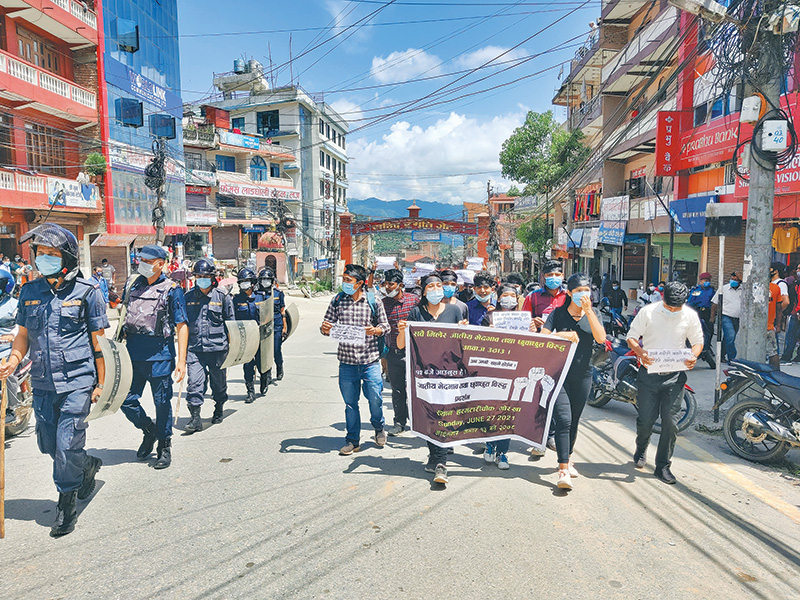
GORKHA: Local youths took out a rally in Gorkha district headquarters on Sunday against caste-based discrimination and untouchability. The Samyukta Sachet Dalit Sangharsha Samiti staged demonstrations, demanding self-dignity and justice for the Dalit communities. The demonstrators urged the authorities to effectively implement prevailing laws against caste-based discrimination and untouchability.
NATIONAL
Eight taken ill from consuming toxic mushroom
Briefing
KASKI: Eight people, including six members of a family, were taken ill after consuming toxic wild mushrooms in Pokhara Metropolitan City-33 on Saturday. According to the Provincial Police Office in Pokhara, Gothe Pun, his wife, four children and two neighbours fell ill on Saturday evening after consuming wild mushrooms that they had collected from Dharapani Community Forest. The victims, who are receiving treatment at Gandaki Hospital, are out of danger, said police.
NATIONAL
Ribdikot decides to run online classes
Briefing
PALPA: Ribdikot, a rural municipality in Palpa, has decided to run online classes in all its community schools from Wednesday. According to Mani Prasad Khanal, the health unit chief, the local unit decided to run online classes for grade 9 and 10 in the first phase after holding discussions with the stakeholders. “There is no alternative to online classes as physical classes are not possible anytime soon,” said Khanal.
NATIONAL
House dissolution case doesn’t fall within ambit of Constitutional Bench, Attorney General argues
Claims the petitions registration process itself was flawed.
- TIKA R PRADHAN
KATHMANDU, Lawyers of the defendants in the ongoing House dissolution case started presenting their arguments before the Constitutional Bench of the Supreme Court from Monday. Attorney General Ramesh Badal, who was the first to plead on behalf of the defendants, said the House dissolution case does not fall under the jurisdiction of the Constitutional Bench. “This case does not fall under the jurisdiction of the Constitutional Bench. As per Article 137, for this case to come to the bench there must be a conflict between the federal and provincial governments or the federal and local governments. Unfortunately there is no such dispute hence this case should not proceed,” Badal argued. “They have put the court in confusion. The Chief Justice could have referred the case to the Constitutional Bench as per 137(3), but that did not happen.” He argued that the bench must tell whether the case followed the right procedure. “Although we have accepted the jurisdiction [of the bench] the legal provisions don’t. This is something beyond the jurisdiction of the bench. Petitioners brought the case to trick the court,” Badal said. “Since the process of registration of the petitions was flawed, the bench’s decision will not have validity. So the petitions brought to trick the court must be annulled.” Article 137(2) states that the bench formed under clause (1) shall originally try and settle the following cases, in addition to the petitions filed in accordance with clause (1) of Article 133: (a) Disputes relating to jurisdiction between the federation and a province, between provinces, between a province and a local unit and between local units, (b) Disputes relating to election to members of the Federal Parliament or Provincial Assembly and matters relating to disqualification of a member of the Federal Parliament or of the Provincial Assembly. During the previous hearing, Chief Justice Cholendra Shumsher Rana had forwarded all the petitions to the Constitutional Bench as per Article 137(3) but this time the petition of 146 members of the House of Representatives including Congress President Sher Bahadur Deuba was registered directly at the Constitutional Bench. Article 137 (3) states that notwithstanding anything contained in Article 133, if it appears that any case sub judice in the Supreme Court involves a question of serious constitutional interpretation, the Chief Justice may appoint such case to be tried by the bench under clause (1). But the petitioners’ lawyers including senior advocate Chandra Kanta Gyawali have claimed that the issue of jurisdiction of the Constitutional Bench was resolved during the first House dissolution of December 20. Attorney General Badal countering senior advocate Satish Krishna Kharel, who had said on Sunday that a single person cannot become prime minister utilising all the provisions of the constitution, argued that Oli did no wrong in staking claim to government formation under all provisions of the constitution. “Janata Samajbadi Party did not support a government proposed as per Article 76(3) but it supported the one under Article 76(5). Oli had paved the way for forming a new government after realising that the existing government did not have the confidence of parliament,” Badal told the bench. “If Deuba, Janata Samajbadi Party and Maoists had wished they could have laid claim to form a government as per Article 76(2). How can they say Oli cannot lay claim to form a government as per Article 76(5)?” During the hearing Justice Ishwar Khatiwada had asked Badal what was the basis for the President to accept or reject the claims for prime minister. “The basis was the support of the political parties,” Badal replied. He said the difference between Article 76(2) and Article 76(5) was that any member of the House can claim prime ministership as per clause 76(5) with the support of independent members of the parliament like the one practiced in the Gandaki Province. “In Gandaki [province], Krishna Chandra Nepali became chief minister as per Article 168(5) with the support of independent assembly member Rajib Gurung,” he said. But the petitioners’ lawyers had pleaded that Article 76(5) was meant for individual lawmakers and not political parties and that it was incorporated in the constitution with a view to giving as long a life as possible to the House, given the past experiences of frequent dissolutions whenever the prime minister wanted. He claimed that the President had rejected the claims of both Prime Minister Oli and Sher Bahadur Deuba because they were suspicious, controversial and untrustworthy. Later Chief Justice Rana had also asked a similar question to Badal. “What is the basis for the President to accept or reject a claim for prime minister?” Rana asked. “Should the president examine whether a claim is suspicious, controversial or not trustworthy? If yes, what should be the basis for it?.” Badal did not respond. Attorney General Badal said the Bench did not object when the petitioners’ lawyers made disapproving comments giving examples that presidents and the prime ministers were murdered in the past and kept on berating them. While pleading on behalf of the petitioners, senior advocate Raman Shrestha had said even kings used to be beheaded in the past. Badal claimed that the parties wanted to establish a party-less system when they said party whip would not apply for party lawmakers supporting a prime ministerial candidate under Article 76(5). “How can someone elected from one party support the prime ministerial bid of an opposition party lawmaker? And how can they plead to the court to endorse their decision?” he argued. He said the law does not allow lawmakers to support an opposition party candidate for prime minister. “What will happen if a member of the House of Representatives elected from a particular party goes on to support an opposition party lawmaker for prime minister--will it mean the lawmaker doesn’t belong to any party or he has abandoned his party, or what?” he asked. “Do they have legal standing in a court of law?” On May 21 Deuba had laid claim for prime minister with the signature of 26 lawmakers of the Madhav Nepal-led faction of the CPN-UML and 12 lawmakers of the Upendra Yadav-led faction of the Janata Samajbadi Party. Earlier, Prime Minister Oli had expressed his disappointment over the poor performance by the government defence team led by the then Attorney General Agni Sapkota during the court hearings on the December 20 House dissolution. Kharel later resigned his post and was replaced by Badal. “It’s not appropriate for a lawmaker elected on a particular party’s ticket to say they do not recognize the party,” Badal told the bench. “If their demands are implemented many articles of the constitution will become inactive.” Badal also claimed that it was Oli’s compulsion to dissolve parliament and the court should not enter into the political issue. The three defendants—President’s office, the Prime Minister and the Speaker have been allotted a total of 15 hours but the Attorney General argued for 3.5 hours and provided only one hour to the Speaker’s lawyers on Monday.
NATIONAL
Lockdown further relaxed in Valley with shops and public vehicles allowed to operate
Health experts say restrictions are being eased without any preparations and this could cause virus surge.
- ANUP OJHA
KATHMANDU, Prohibitory orders that have been in place in three districts of Kathmandu Valley since April 29 have been extended by a week starting Tuesday with further relaxation of restrictions. A meeting of the Valley’s three chief district officers on Monday announced to extend the prohibitory orders by introducing further relaxation measures like allowing public transport vehicles having more than 25 seats to operate under odd-even number rule and opening shops until 6pm. A notice published by the District Administration Office, Kathmandu on its website on Monday states that public vehicles which will be allowed to operate under the odd-even number rule between 6am and 7pm while shops can open until 6pm. “We made the decision after consulting public health experts and other stakeholders. If the number of infections increases, we will once again increase the level of restriction,” said Kalpana Ghimire, assistant chief district officer of Kathmandu. Transport operators had been urging the authorities to lift the restriction on public vehicles. On Friday, three transport operators’ groups, including the Federation of Nepalese National Transport Entrepreneurs, had reached the local administration office with a request to end the restriction on public vehicles. Yogendra Karmacharya, chairman of the federation, said authorities agreed to lift the restriction on public transport after repeated requests. “We had requested the authorities to fully lift the restriction because the odd-even number rule will only cause crowding, increasing the risk of coronavirus spread,” said Karmacharya. Some health experts have said it is too early to relax the restrictions. “There is still risk. Majority of the people have not been vaccinated. By lifting the restrictions, the mobility of people will increase, increasing the risk of virus spread,” said Dr Sher Bahadur Pun, a virologist at the Sukraraj Tropical and Infectious Disease Hospital, Teku. Nepal so far has vaccinated 8.3 percent of its 30 million population, but only 2.4 percent of the population has received both doses. Dr Baburam Marasaini, former director at the Epidemiology and Disease Control Division, said the three district administration offices of Kathmandu Valley are easing the lockdown without any preparations. “During the lockdown period, the Health Ministry could have developed a system to reduce the risk of the virus transmission but it did nothing,” said Marasaini. After a second wave of the coronavirus hit the country, Kathmandu Valley authorities had imposed strict prohibitory orders from April 29. Over the past weeks, the authorities have been gradually easing the lockdown as the number of cases has started to decline. But experts say the threat is not over yet, and a third wave could strike the country very soon. “It seems the government has not learnt from last year’s mistake,” Dr Pun said about the way the authorities have been handling the pandemic. As of Monday, the nationwide Covid-19 infection tally stood at 635,188 with 1,505 new cases. In the past 24 hours 42 people died of the virus with a countrywide death toll reaching 9,051. Of the total cases Kathmandu Valley recorded 514 new infections: 355 cases in Kathmandu, 112 in Lalitpur and 47 in Bhaktapur district. Experts have attributed the decline in new daily infections to the prohibitory orders. But with the restrictions relaxed, they have warned the cases could go up again.
NATIONAL
Monsoon also means police have to cope with the rains and this affects their work
- SHUVAM DHUNGANA
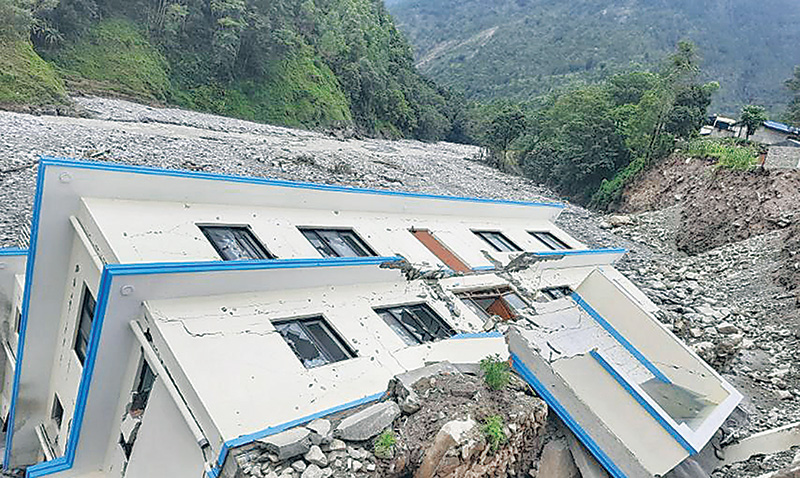
The destroyed office building of Area Police Office Helambu. Photo courtesy: Sunil Kumar Thapa
KATHMANDU, On the evening of June 16, Sub-Inspector Sunil Thapa of Area Police Station, Helambu had just returned after warning people residing near the Melamchi river of possible floods as there had been incessant rainfall for several hours. “There were nine of us in the office,” Thapa remembers. Soon after a while the office building was suddenly hit by the wave of muddy water which was surprising for the officers. “Our office was not very close to the river; however, as the water level had increased drastically it entered the office,” said Thapa. The area police office had already started getting calls for rescue from villagers hit by the floods. However, as all of their rescue equipment was inside the building they were helpless. “Our officers started taking out rescue equipment, furniture, files, computers and other stuff,” Thapa told the Post over the phone from Helambu. Two days later, on June 18, fresh flash flood triggered by a heavy rainfall in Helambu Rural Municipality of Sindhupalchok district swept away the whole station. “We are currently working from small rooms provided by villagers,” said Thapa. “Local residents have helped us by providing five rooms in different homes, where we have kept all the office stuff.” According to Thapa, as the available space is not enough for the staff, they are thinking about working from tents. “But during the monsoon, it’s not possible to work from a tent due to the rain,” Thapa told the Post. Police officers stationed at the Area Police Station, Helambu are now busy clearing the roads damaged by floods and landslides while also distributing relief materials. They don’t know how long they will work without a proper office. “We are collecting data of total damage in the area, clearing roads in coordination with local residents, distributing relief materials to the victims and other regular policing work,” Thapa said. The monsoon which began on June 10 has already wreaked havoc across the country damaging property worth millions and displacing hundreds of families. This means more work for the police who are already implementing prohibitory orders amidst the Covid-19 pandemic. But resources are limited which means more challenge. Many police stations across the country are still operating from tents since the April 2015 earthquakes. This is not only the case in the rural hinterland, but even in the Capital. Kathmandu Metropolitan Police Range has been conducting its day to day work from tents for the past six years. According to Senior Superintendent Ashok Singh, chief of Kathmandu Metropolitan Police Range, there are 11 tents in its office premises at Teku. “It is fine during other seasons but there are major problems during the monsoon when tents start leaking. The tents have undergone major wear and tear,” said Singh. “Officers often have to clear the water collected on the roofs of tents as well as inside as there is no proper drainage. ” According to him, rooms where applications for various police business are registered, consultation rooms, interrogation rooms and sleeping quarters are in tents. Although the construction of a new building of Kathmandu Metropolitan Police Range is underway at Teku, the progress has been slow because of Covid-19 pandemic. “It will take another one and half years for the building to be completed and till then there is no choice other than working from tents,” Singh told the Post. According to the data provided by Nepal Police, 143 police offices damaged by the earthquake are still under construction although 180 police stations were built over the six year period. “Without proper drainage, water enters the tents, which we have to clean every time it rains,” said an officer at Kathmandu Metropolitan Police Range on condition of anonymity. Senior Superintendent Basanta Bahadur Kunwar, spokesperson for the Nepal Police, said he is well aware of the fact that police officers are facing difficulties operating from tents. He said office buildings were being constructed and their troubles will end very soon. But across the country, work is not being expedited, by his own admission. “Due to the limited resources, construction of police stations has been moving slowly,” Kunwar told the Post. “However, it has not affected policing as they have been carrying out their responsibilities from rented offices at different places across the country.” But for Thapa and the officers under him in Helambu, the situation is difficult to manage. “As many rooms are filled up with office belongings, there is very little space to sleep. It is a bit difficult,” said Sub-Inspector Thapa. “The office building was newly built but now it has been destroyed. We don’t know when another will be built and how long we will have to manage this way.”
EDITORIAL
Alternative assessments
TU must understand that conducting sit-in exams is not the best option now.
These are unprecedented times for the education sector, but the decision by Tribhuvan University to conduct sit-in exams instead of proven alternative assessments amid the threat of the Covid-19 Delta variant just shows how archaic the institution has become. A second year into the pandemic, Nepal is only emerging out of a deadly second wave that crashed the health system and brought the country to a standstill for almost two months. The threat of a third wave looms large in Nepal, which is struggling to secure vaccine doses. Be it opening our schools, offices and factories or congregating thousands of students for sit-in exams, every decision we make today needs to be mindful of the implications on the health and wellbeing of the citizens. Now is not the time to be complacent. The reckless announcement to conduct sit-in exams next month, which once again exposes the lack of coordination between different government agencies, must immediately be corrected and revised to reflect our epidemiological situation. Of the 77 districts, 75 districts are under some form of restrictions with a total ban on mass gathering. Congregating thousands of students and invigilators for sit-in exams is no different from opening schools, which are currently closed considering the fragile situation we are yet to come out safely from. In the wake of the pandemic last year, the education sector moved online. In a welcome decision, the government also approved internal assessments for schools, and various universities have also conducted virtual exams successfully. A rough analysis of the age-wise breakdown of Covid-19 infections and deaths shows how these decisions have been pivotal to prevent infections and save lives. We must ensure the academic progression of students, but it is criminal to do so at the cost of lives and incalculable risks to society. Tribhuvan University has 1,124 affiliate and 61 constituent colleges with over 415,000 final year students under 125 programmes at the bachelor’s and master’s levels. However, the total number of examinees exceeds 500,000, considering the number of students who will retake the exams. One would think that the country’s oldest and largest hub of academia makes rational decisions after learning from the blunders last year, and swiftly offer alternative assessments like open-book exams, take-home exams or online exams; but like last year, the university last week published exam schedules for the stalled exams of the first and second years under different faculties of the bachelor’s level programmes. It is an irrational and unwarranted decision by the university administration when the daily positive rate of new infections is way higher than the permissible limit of 5 percent. There should be no room for miscalculation and missteps, considering that a large chunk of the population is unvaccinated. Tribhuvan University officials need to understand that conducting sit-in exams will see a massive movement of students and officials as they travel and gather indoors. It doesn’t take an epidemiologist to figure out that this is not safe and could be a super spreader event with the Delta variant that can make the epidemic curve exponentially. How many people must die or acquire the infection before the government starts to make Covid-appropriate decisions?
NATIONAL
The difference between communism in China and Nepal
Three decades of existence has shown us that Nepali communists have misguided priorities.
- SUJEEV SHAKYA
Shutterstock
Last week, as part of the celebrations of the hundred year anniversary of the Communist Party of China, a high-speed train was inaugurated from Lhasa to Nyingchi, just 17 kilometres from the border of the state of Arunachal Pradesh in India. There will be more such projects announced by China as it would like to take the opportunity to share its economic success story with the world. During the early days of the pandemic, when the world was grappling with how to deal with the pandemic, China just pushed containment. And now, with vaccination, it proudly claims that it has jabbed a billion doses at home and exported around 400 million. So, it is very strange that Nepal, which has in the past three decades seen different forms of communist government and currently remains the only country ruled by a communist party in South Asia, lags behind so much. In Unleashing The Vajra, I talk about how the communist parties in Nepal were modelled around the Indian communist parties especially with strong influence of the parties in West Bengal. It was all about rent-seeking on poverty, talking about land rights, disrupting businesses through labour unions, considering wealth to be something bad and the wealthy to be inherently evil. It was always about hypocrisy, where one talks about the Red Book during the day and drinks Red Label at night. Communists leaders and their children got rich by winning elections talking about poverty. Unlike in China, where the aim was to become a global superpower, communists in Nepal and West Bengal ensured they exploited and extracted, by calling superpowers imperialists and expansionists. If they were to become a superpower then they would have fewer avenues to extract undeserved wealth; therefore, poverty became a great weapon.
No institution building One of the most admirable systems of the Chinese Communist Party has been the way they groom leaders from the grassroots level and they move up to manage different portfolios and then are promoted like in an efficiently managed corporation or organisation. A leader would have gone through many positions where they would have stood out before getting to the top. In Nepal, like in India, the organisation did not matter. Therefore, leaders would take up being part of the king’s party or move lock stock and barrel to another party. When so many communist parties in Nepal worked towards federalism and the new constitution, not a single party has till now created a structure where grassroots leaders would then grow in stages to become national leaders like in China. In the recent power grab perpetuated by Prime Minister KP Oli, it seems ‘horse trading’ (a very popular word used in the Indian democratic system) became the way to manage communist factions rather than to build organisations. Therefore, communist leaders in Nepal do not at all agree with the China model of party building. As one communist leader shared in private, there are too many Xis and no Xi doctrine in this country. The fact that Nepali communist parties have not shown a leadership development processes, means they have very low credibility in front of some of the key thinkers within the Chinese Communist Party. Therefore, the Nepali leaders have no access to the key Chinese ones.
Lack of global ambition Apart from sending children abroad to study or settle down, there has been no global ambitions of Nepali communist leaders, unlike their Chinese counterparts. When was the last one heard of a Nepali communist leader presenting papers on a credible international platform? Where do you see them during their foreign trips apart from being at their some old cadre’s house in some country eating masu-bhaat? China’s growth has been about setting global ambitions. Today, global companies look at how Chinese companies act and use that inspiration, whether in e-commerce or technology. Nepali communist leaders think globalisation and capitalism are against their political interests and equate anything that they cannot achieve with these. For instance, if we talk about how dirty Kathmandu is or how bad our urban planning is, they quickly refer to cleanliness and good city plans being a capitalist concept and throw it away. They do not want to compete with the world, and competing with the known for them is an easier path to stay in power. The hundred years of the Communist Party of China will surely bring about more news on the progress of our northern neighbour. At the same time, we will get to hear views on what they have gone wrong with. For the Nepali communist, its just time to think and act like them rather than mimicking the failed Indian communist model they have continuously being modelled around.
OPINION
How to feed ourselves
Climate change is accelerating, biodiversity is plummeting, and poverty is skyrocketing.
- Gilbert F Houngbo
Lesia Povkh/Shutterstock.com
Humanity is drifting into increasing danger. Climate change is accelerating; biodiversity is plummeting; hunger and extreme poverty are rising; and the gap between rich and poor is widening. These trends threaten not only human health and livelihoods, but also global peace and stability. Reversing them will require a shared effort to rebuild, and even upgrade, the systems on which we all depend—beginning with the global food system. Even before the pandemic, our food systems were being disrupted by increasingly severe and frequent extreme weather, such as droughts, and by declining biodiversity. But they were also contributing to these disruptions, because the way we produce and distribute food accounts for more than 30 percent of global greenhouse-gas (GHG) emissions. While the 2015 Paris climate agreement includes targets for reducing these emissions, the world is currently not on track to meet them. Likewise, in 2015, United Nations member states agreed to the Sustainable Development Goal to end hunger, improve nutrition, and achieve food security (SDG 2) by 2030. Yet hunger has been on the rise for five years—a trend that the Covid-19 pandemic has accelerated significantly. In 2019, an estimated 690 million people were hungry, up by ten million from 2018 and by 60 million since SDG 2 was adopted. And at least three billion people cannot afford healthy diets. Today, 41 million people are on the brink of famine. Rural livelihoods have also been under severe strain. Small-scale farmers generate half of the world’s food calories and are critical to household and community food security. Yet millions of small-scale producers and rural workers in the developing world are living in poverty. The pandemic affords us with a valuable opportunity to rethink the world’s food systems so that they can nourish the world’s population—which is expected to reach 9.7 billion people in 2050—and provide smallholder farmers with a decent living now and in the future. Any blueprint for such systems must place sustainability and equity at its foundation, and rural populations at its center. According to the Food and Land Use Coalition, established in 2017 by leading NGOs and advocacy organisations, the world could make considerable progress within just a decade. A concerted reform agenda to transform food systems could deliver up to 30 percent of the emissions reductions needed to achieve the Paris climate agreement’s targets, while largely eliminating undernutrition, accelerating income growth for the bottom 20 percent of the rural population, and significantly increasing food security (among many other objectives). Of course, all of this would cost money—an estimated $300-350 billion per year until 2030. But there is no doubt that it would be money well spent: an investment of less than 0.5 percent of global GDP would generate a social return of around $5.7 trillion annually. Estimates by Ceres2030, an international research project working to advance progress toward SDG 2, paint a similar picture. They show that ending hunger, doubling the incomes of small-scale farmers, and limiting agricultural emissions in line with the Paris climate agreement will demand that donor governments double the amount they currently provide for food security and nutrition—an additional $14 billion per year, on average—until 2030. Low-and middle-income countries would also have to contribute an additional $19 billion per year from their own budgets. To maximise the impact of these funds, they should flow directly to rural populations. And they should be complemented by efforts to enable the rural poor to seize economic opportunities not only in food production, but throughout food value chains, such as in processing, packaging, marketing, and services to the rural economy. Beyond official assistance, public development banks must better align their financing—which represents 10 percent of all global investment—with the Paris climate agreement and the SDGs. And the private sector, for its part, must invest more in sustainable and equitable food systems. Meaningful partnerships between small-scale farmers and bigger agribusinesses will be essential. Innovative financial solutions should also be developed, with the goal of driving investment toward rural areas. Booming demand for impact-investment vehicles proves that such solutions can make a difference. At the same time, rural populations need far easier access to targeted financial services, so that they can save, invest, and empower themselves to improve their livelihoods. This will require a major push from financial institutions: as it stands, only about 60 percent of rural people have access to a bank account, but this doesn’t necessarily translate into the use of savings or credit services. The good news is that the world is waking up to the importance of investing in sustainability. Governments have already begun to ‘green’ their public expenditures, and companies are slowly adjusting their business models—including their sourcing decisions—to align with sustainability imperatives. Now, we must capitalise on these trends to direct far more investment toward building knowledge-based, climate-resilient, diversified, and equitable agricultural systems in developing countries. The upcoming Food Systems Summit, convened by UN Secretary-General António Guterres, presents a critical opportunity to kick-start this process. For the first time ever, governments, farmers, companies, and civil society from around the world are coming together to discuss ways to transform the way we grow, process, and consume food. At the summit, these discussions should culminate in concrete commitments by all relevant actors in every step of this process, from farm to fork. We can build food systems that feed a global population of 9.7 billion. We can build systems that work for those who make them work, from the small-scale farmer to the supermarket employee. And we can build systems that are environmentally sustainable. The sooner we take up the challenge, the sooner humanity can start steering in a safer direction.
Houngbo is President of the International Fund for Agricultural Development. — Project Syndicate
MONEY
Restaurants say they will open dine-in service from next week
The latest prohibitory order allows restaurants to provide only take away service.
- KRISHANA PRASAIN
There are 3,300 registered restaurants in the country and the industry provides 60,000 jobs, most of which disappeared during the lockdown. POST FILE PHOTO
KATHMANDU, Restaurants say they will defy government orders and open dine-in service from next week, as it has restricted them to providing take away service even while greatly easing lockdown regulations in other sectors. The latest prohibitory order issued by the District Administrative Office on Monday allowed restaurants to reopen after a two-month closure, but only for take away service. The directive permits markets to open daily and motor vehicles to ply according to the odd-even rule, under which odd and even numbered automobiles are allowed on the roads on alternate days. “We were hopeful that after two weeks of take away service the government would allow us to operate dine-in service by adhering to health protocols; but it did not happen. If the government does not come up with any provision for restaurants, we will be compelled to gradually start dine-in service by maintaining proper health and safety standards,” said Araniko Rajbhandari, president of the Restaurant and Bar Association of Nepal. Shovan Malakar, owner of Trisara Restaurant, concurred, saying that the government had been neglecting the problems of the restaurant business. “The government should either pay our rent as our landlords are taking full payment, or let us operate by respecting health protocols,” he said. Restaurant owners said that the government should implement strict safety standards instead of making decisions that hurt business. Even during last year’s prolonged lockdown, restaurants started reopening on their own as the government delayed issuing guidelines for them. “The government has allowed the markets and public transportation to reopen, and it is disappointing that it did not publish any operating rules for the restaurant sector which has suffered greatly from Covid-19,” Rajbhandari said. Hotels and restaurants are among the hardest hit by the pandemic. Following a reduction in Covid-19 caseloads late last year, the restaurant business had been on the way to recovery. “In order to retain the staff, we should start dine-in service otherwise they will change jobs,” he said. “As the infection and mortality rate was high during the second wave of the pandemic, we were afraid to resume operations at first; but we cannot take in any more losses,” he said. “Successive governments have also failed to address the problems created by the pandemic in the sector.” Malakar said the government was not doing enough to vaccinate the people, reduce infections and revive the economy. According to the Restaurant and Bar Association of Nepal, there are 3,300 registered restaurants in the country. The industry provides 60,000 jobs, most of which disappeared during the lockdown. Rajbhandari said take away made up only 10 percent of total sales, and that too only at some major restaurants in the valley. The odd-even rule for motor vehicles has also greatly reduced sales, he added. “Compared to dine-in, take away service provides 20 percent of our revenue,” Malakar said. Only restaurants that can survive on take away service are doing it; for others, it is very difficult. Of the total restaurants associated with the Restaurant and Bar Association of Nepal, around 10 percent have shut down while 15 percent have sold their business to others, according to Rajbhandari. “We have been 100 percent affected by the pandemic, and till now we have laid off 35 percent of our staff,” Malakar said. “As the third wave is expected to hit, it is becoming challenging to remain in business.” Malakar said it was difficult to operate in the varied ways decreed by the government. Well-known restaurant chain Bakery Cafe was forced to close down four of its 10 outlets in Kathmandu as it struggled to cut costs amid falling revenues during last year’s lockdown. According to a follow-up survey conducted by Nepal Rastra Bank in April, the transactions of the hotel and restaurant sector had recovered to 41 percent from 7 percent in June last year compared to pre-pandemic days. In November, their transactions were 18 percent of pre-Covid levels.
MONEY
Indian commerce minister: ‘Arrogant’ US ecommerce giants flout our laws
NEW DELHI, Indian Commerce Minister Piyush Goyal has ratcheted up the heat on US ecommerce giants like Amazon and Walmart, accusing them of arrogance and of flouting local laws by indulging in predatory pricing practices. Goyal said companies were using their scale and access to large pools of low-cost capital to indulge in predatory pricing practices “to the detriment of mom-and-pop stores.” “A number of these large ecommerce companies have come into India and very blatantly flouted the laws of the land in more ways than one,” he told a virtual event late on Saturday. “I’ve had several engagements with these large companies, particularly the American ones, and I can see a little bit of arrogance,” he said. Goyal did not directly name Amazon.com or Walmart Inc’s Flipkart—the two dominant ecommerce players in India—or specify which laws had been flouted. But his comments come at a time of growing clamour from small Indian traders and retailers, who accuse the US giants of circumventing Indian consumer protection laws and competition laws. Amazon and Flipkart did not immediately respond to requests for comment on Goyal’s scathing criticism. The two companies have denied the allegations levelled against them by the traders. Goyal also criticised companies for indulging in “forum shopping” in courts and failing to comply with an investigation launched by the Competition Commission of India (CCI). Flipkart and Amazon have appealed against the CCI’s bid to restart an investigation into their business practices, after a judge this month dismissed the companies’ original pleas. “To my mind, if they have nothing to hide, if they are doing honest business practices, why don’t they respond to the CCI?” Goyal said at the virtual event organised by the Stanford India Policy and Economics Club. His comments came days after India unveiled a new set of ecommerce regulations that could dent both Amazon and Flipkart’s ambitions in India, and force the duo to review certain business structures. Separately, in a letter to Prime Minister Narendra Modi on Sunday, the Confederation of All India Traders, accused ecommerce companies of treating India like a “banana republic” with weak laws. The body urged the government to ensure that the proposed e-commerce rules were not diluted, despite the lobbying efforts of ecommerce giants. The US-India Business Council, a top US lobby group, described India’s proposed new ecommerce rules as concerning in an internal memo this week.
MONEY
As coronavirus infections fall, Nepal relaxes restrictions for arrivals
- SANGAM PRASAIN
KATHMANDU, Nepal has eased travel protocols allowing fully vaccinated arrivals to isolate at home and has also cut the mandatory 10 days hotel quarantine to seven days for those who have not been vaccinated. Nepal has also allowed a limited number of scheduled international flights following a drop in the Covid-19 cases in the country. Nepal on Monday reported 1,509 new coronavirus cases in the last 24 hours down from a high of 9,317 on May 11. “The new rules approved by the Cabinet on June 21 has been implemented and are applicable for both Nepalis and foreigners entering Nepal,” Pratap Babu Tiwari, general manager at the Tribhuvan International Airport, told the Post. He said that fully vaccinated travellers should stay in home isolation for 10 days. According to him, all travellers to Nepal need to submit a photo attached barcode or quick response (QR) code, including a negative PCR report from within 72 hours before departure, at the check-in counters. These codes are based on a combination of data and information submitted by the users themselves. However, if the country of origin does not issue a photo attached barcode or QR code documents, it should follow the rules of the country by coordinating with the Nepalis diplomatic mission abroad. Travellers coming to Nepal have to fill up details in the Abroad Returnee Management System at the Covid-19 Crisis Management Centre (CCMC) website. In case it is not possible to fill the details before check-in, the concerned airlines in coordination with Nepal’s Tourism Ministry should arrange to fill the relevant form at the Tribhuvan International Airport before the health screening test upon landing in Nepal. Upon arrival, incoming passengers, provided they get through the health screening, have to spend seven days in quarantine at government-listed hotels and rooms must be booked prior to arrival. Returning Nepali migrant workers who have no hotel booking should mandatorily stay at the quarantine facilities made available by the government. Nepali nationals need to do a PCR test on the seventh day of quarantine at their own expense and if the report is negative they are allowed to go home. They, however, have to stay an additional four days in home isolation. In the case of Nepalis who have been deported, are returning home after being released from jail or who don’t have enough finances, Nepali diplomatic missions will investigate and recommend them for government support. They will be kept in quarantine in government facilities and all expenses related to their trip and PCR test will be borne by the government. Those coming for mourning will be allowed to go home after a negative antigen test but need recommendation of the local government or the Coovid-19 Crisis Management Centre. But they have to do a PCR test 11 days after arrival. People with disability, sickness and other long-term illness, or chronic health conditions and their carers [maximum of two], will be sent for 10 days’ home isolation or hospital after an antigen test if they have the necessary health reports. Those above 70 years, children below 5 and their travelling carers are allowed to go home if their antigen test is negative. After spending 10 days in home isolation, they have to do a PCR test on the 11th day of arrival. Those coming for mourning, the disabled or ill, those over 70 years and below 5 years and their carers will be sent to the government isolation centres or hospitals if their antigen test is positive. Members of the diplomatic community and international organizations and their family members, are allowed to spend 10 days at quarantine arranged by their respective offices or organizations. They are allowed to work after 10 days if they tested negative. The government has not allowed foreigners entry from the land points. However, 13 land entry points have been opened for returning Nepalis. The government has announced prohibitory orders in most parts of the country at the end of April to help check the spread of the virus as the second wave of the pandemic hit Nepal. Prohibitory orders continue to be in place but have been relaxed since last week to allow movement of people and operation of businesses following health protocols.
MONEY
China starts Baihetan hydro project, biggest since Three Gorges
- REUTERS
SHANGHAI, The giant Baihetan hydropower plant on the upstream branch of China’s Yangtze river has begun generating electricity for the first time on Monday, state broadcaster CCTV reported. The project’s first two 1-gigawatt (GW) turbines will start operating after a three-day trial, CCTV said. The project will eventually consist of 16 such units, making its total generation capacity second only to the Three Gorges Dam once it is completed in July next year. Baihetan was built by the China Three Gorges Corporation and is located on the border between the southwestern provinces of Yunnan and Sichuan. Though the Three Gorges Corporation said it was one of China’s biggest and most challenging engineering projects, with a dam height of 289 metres (948 feet), it has taken only four years to build.
SPORTS
Ecuador hold Brazil to reach Copa quarters
Facing the specter of an early exit, Mena scores the equaliser in the 53rd minute to secure 1-1 draw against the holders.
- AGENCE FRANCE-PRESSE
AP/RSS Ecuador’s Jhegson Mendez (front) and Brazil’s Everton Ribeiro battle for the ball during their Copa America match in Goiania, Brazil, on Sunday.
GOIANIA, An Ecuador side fighting to keep their Copa America hopes alive managed to hold a previously perfect Brazil—playing without a resting Neymar—to a 1-1 draw Sunday and reach the quarter-finals. Peru meanwhile defeated Venezuela 1-0 in the other Group B match to send the Covid-decimated “Vinotinto” team packing from the South American championships. Seeking to extend a 10-match winning streak, Brazil came out pressuring in Goiania on the group’s final match day. Coach Tite opted to rest Paris Saint-Germain star Neymar, but the “Selecao” still dominated the first half. A free kick in the 37th minute set up Eder Militao, who headed the ball at a sharp angle into the top right corner of the net, well clear of Ecuador keeper Hernan Galindez’s outstretched arm. But facing the specter of an early exit, Ecuador came out fighting in the second half. They got the equaliser in the 53rd minute, as Brazil tried to clear a corner kick. Enner Valencia managed to head it back the other way, setting up Angel Mena, who sprinted in to fire the ball past Brazil’s Alisson. “We played a good first half where we managed to impose our style of play. The first half was much better than the second,” said Brazil defender Marquinhos. “Now we’re in the decisive part, the knock-out stage, so we have to work on playing our best football for the full match.” Peru meanwhile finished the group stage on a high note after a spectacular turnaround. The Incas opened the tournament with a 4-0 thrashing by Brazil. But they went on to defeat Colombia, then battle back from 2-0 down against Ecuador Wednesday to secure a draw. They added three more points Sunday thanks to Andre Carrillo, who capitalized on Venezuela’s clumsy failure to clear a corner in the 48th minute in Brasilia. “Peru shouldn’t give up what we’ve been working on. I think we’ve shown our ability to fight back throughout the Copa America,” said Argentine coach Ricardo Gareca. Brazil finished the group stage as heavy favourites with 10 points from four matches—three points clear of runners-up Peru in Group B. Colombia finished third with four points and Ecuador fourth with three. Venezuela joined Group A side Bolivia as the two teams eliminated from the group stage.
SPORTS
Sri Lankan suspend players over Covid-19 bubble breach
- AGENCE FRANCE-PRESSE
COLOMBO, Sri Lanka suspended three players on Monday, including vice-captain Kusal Mendis, and withdrew them from the upcoming one-day international tournament in England over a breach of their bio-secure Covid bubble. Mendis and Niroshan Dickwella were seen smoking in the streets of Durham, where they are based ahead of this week’s first one-day international at Chester-le-Street on Tuesday. In a second video on social media, opening batsman Danushka Gunathilaka is seen joining the pair, violating the coronavirus rules of their stay in England, where they are not allowed to roam freely. Sri Lanka Cricket said the three players were suspended from all forms of the game until an inquiry was completed. “This decision was taken following a preliminary inquiry conducted over a video posted on social media in which the said three players can be seen outside their designated hotel,” the board said. A cricket board source told AFP that none of the players were supposed to go out of their hotel unescorted. “The three players have been asked to return home today,” the cricket board source told AFP. “They can no longer return to the bubble because that could be a risk for other players.” England pace bowler Mark Wood admitted the Sri Lanka breach showed top level sports people must stay focused to avoid putting their game at risk. “It’s disappointing from them, and they’re pretty good players as well unfortunately. But we are going to have to make sure we are doubly on it now because little slips like this can put the whole thing in jeopardy,” Wood said. “We were told that in Durham the Covid levels are particularly high, so we have to back off a little bit. We weren’t allowed in restaurants, coffee shops or anything like that. Not even sitting outside or anything like that. So we stripped it right back. I don’t know what their team measures are, what they have been told. I don’t know if theirs is more lax than ours - every team is different - but we have taken this very seriously and actually appointed a Covid security officer who tells us what we can and can’t do. At times, it is hard for some of the lads because they want to get out and do things but in a hotspot like Durham we have to be a little bit more rigid,” Wood added. Sri Lanka are due to play three ODI matches against hosts England. Sri Lanka were swept 3-0 by England in the Twenty20 series that concluded Saturday with the hosts cruising to a thumping 89-run victory in Southampton. Disgruntled fans launched a campaign to shun the team on social media after they slumped to a dismal fifth consecutive Twenty20 series defeat. The hashtag #unfollowcricketers began to trend on Facebook on Sunday as thousands of fans boycotted the social media pages of Mendis and Gunathilaka, reports said. Fans were also sharing memes asking each other not to watch the national team on television. There was no immediate reaction from any of the senior players, but some observers posted that the performance in England was one of the team’s worst in three decades.
SPORTS
World T20 to be shifted in UAE
- AGENCE FRANCE-PRESSE
NEW DELHI, The Twenty20 World Cup will be moved to the United Arab Emirates from India due to the coronavirus pandemic, an Indian cricket board official told AFP on Monday. The Board of Control for Cricket in India (BCCI) said it had told the International Cricket Council, the sport’s world body, of its decision to host the event in the UAE in October and November. “We have told the ICC about the decision to shift the World Cup to UAE. We were left with no option as the Covid situation is not clear and the travel restrictions remain,” the BCCI’s treasurer, Arun Dhumal, said. “The dates will more or less be the same and we will work out the details soon.” The ICC had given the BCCI a deadline of the end of June to decide the host country for T20’s showpiece event due to the high number of Covid-19 cases in India. BCCI vice-president Rajeev Shukla said the qualifiers may take place in Oman while the rest of the matches will be at three UAE venues in Dubai, Abu Dhabi and Sharjah. The BCCI had already moved the suspended Indian Premier League to the UAE in September-October after the T20 tournament was halted on May 4 due to a number of players and team officials being infected with Covid-19. The UAE has been a preferred destination for cricket as the Pakistan Super League was completed last week in the Gulf nation. The T20 World Cup originally scheduled in Australia in 2020. India was handed the hosting rights in 2021 and Australia was chosen as host for the 2022 edition.
SPORTS
Djokovic off to winning start, Tsitsipas knocked out
- AGENCE FRANCE-PRESSE
LONDON, Novak Djokovic overcame an early scare as Third seed Stefanos Tsitsipas became the first big name to exit Wimbledon on the first day of play Monday. The world No 1 Serb started his bid for a sixth Wimbledon and record-equalling 20th Grand Slam title off to a winning start as rain brought havoc to the schedule, one year after the tournament was cancelled due to the Covid-19 pandemic. Tsitsipas made an early exit losing 6-4, 6-4, 6-3 to Frances Tiafoe of the United States. It was quite a contrast in fortunes for the Greek who only a fortnight ago lost in five sets to Djokovic in the French Open final. Tsitsipas has now lost in the first round at Wimbledon on three occasions. Tiafoe, the world number 57, goes on to face either Vasek Pospisil or Roberto Carballes Baena for a place in the last 32. Defending champion and world number one Djokovic, looking to become just the third man in history to complete a calendar Grand Slam, claimed a 4-6, 6-1, 6-2, 6-2 win over Britain’s 253rd-ranked Jack Draper. However, the 34-year-old Serb struggled on the slippery Centre Court surface with the roof closed above it due to the rain. Left-handed Draper, playing just his fifth match on the main tour, saved seven of seven break points in the opener to stun the top seed. But Djokovic soon snuffed out any danger of him becoming only the third defending champion to lose in the first round, by sweeping through the remainder of the tie. He finished with an impressive 25 aces and 47 winners as his 19-year-old opponent, who grew up just six miles (9.5km) from the All England Club, wilted. “He’s a youngster and I hadn’t seen him play too much prior to Queen’s and he played pretty well, won matches against high-ranked players,” said Djokovic. “Walking onto Wimbledon Centre Court for the first time, he’s done extremely well.” It was the 34-year-old Djokovic’s first match on the court since his epic five-set win over Roger Federer in the 2019 final, the longest title match in tournament history and where he saved two championship points. His match on Monday was preceded by a standing ovation for Professor Sarah Gilbert, one of the key scientists behind the Oxford Asra-Zeneca Covid-19 vaccine who was a special guest in the Royal Box. Wimbledon looks very different with Covid-19 protocols in place and a 50% capacity until finals day, but one familiar feature was the summer rain. Play on the outside courts started five hours late with 16 of the day’s scheduled 64 matches cancelled until Tuesday. Belarus second seed Aryna Sabalenka had the honour of being the first winner at the tournament in two years when she downed Romanian qualifier Monica Niculescu 6-1, 6-4 under the roof of Court One. Sabalenka fired 48 winners past Niculescu. Players are confined to a hotel ‘bubble’ in central London this year. However, there have already been two virus-related withdrawals.
MEDLEY
Horoscope
ARIES (March 21-April 19) **** Spend some time in solitude today, Aries. You’re in desperate need of a recharge and should refrain from involving yourself in any taxing social situations. Luna’s presence in peace-seeking Pisces makes it an ideal day for rest and recuperation.
TAURUS (April 20-May 20) *** Send your focus toward your sense of community today, Taurus. What friends do you need to reach out and reconnect with? Which of these friends are no longer fitting the bill for you? Today explore your relationship with your social circle.
GEMINI (May 21-June 21) **** Push ahead with your career plans today, Gemini. The moon meanders through soulful Pisces all day, directing your focus toward the state of your ambitions. Tuesday’s skies bring a fresh dose of inspiration and insight into what needs shifting.
CANCER (June 22-July 22) *** Escape the mundane today, Cancer. Tuesday’s cosmic landscape pushes you to escape your routine and comfort zone, as the moon cruises through deep-feeling Pisces. It’s an ideal day to get lost in a good book and learn something new.
LEO (July 23-August 22) *** As a Leo, you’re not always one for sharing your vulnerable feelings. The universe is encouraging you to share these shrugged-off emotions and bring them to the light as the healing Pisces moon encourages you to share yourself with a trusted confidante.
VIRGO (August 23-September 22) **** Send your focus towards your close one-on-ones today, Virgo. What projections are getting in the way of honest relating? The deep-feeling Pisces moon asks you to explore what needs changing in the partnership arena.
LIBRA (September 23-October 22) *** Pour yourself into your workflow today, Libra. You’ve got all the energy and inspiration you need to do something with your craft and make your abilities shine. The moon’s presence in soulful Pisces can stir up rich inspirations from the deep.
SCORPIO (October 23-November 21) *** Let yourself break into new terrain on the relationship front today, Scorpio. If you’ve been holding back on having an important conversation, especially one that involves active changes, look no further than Tuesday’s skies.
SAGITTARIUS (November 22-December 21) *** Reconnect with your roots today, Sagittarius. You’re always on the go and searching for the next adventure. Aim to be present today—especially as the sentimental Pisces moon pulls you into a reflective, past-oriented headspace.
CAPRICORN (December 22-January 19) **** Send your focus towards your mental health today, Capricorn. What can you do to free up space? The deep-feeling Pisces moon encourages you to engage in meaningful conversations that help you get your story told.
AQUARIUS (January 20-February 18) *** Your talents are looking to be put to good use today, Aquarius. Lean into the special set of skills that only you possess. The soulful Pisces moon pushes you to engage in productive activities, making it easy to apply yourself to any looming workloads.
PISCES (February 19-March 20) *** Tend to yourself first and foremost today, Pisces. The moon’s presence in your sign encourages you to ground back down into your body and openly share any unexpressed feelings. Luna’s presence here increases your sensitivity.
EURO2020
Spain outclass Croatia 5-3 in knockout thriller
Late goals from Orsic and Pasalic help Dalic’s side force the extra period but Morata and Oyarzabal strikes send the La Roja into quarters.
- AGENCE FRANCE-PRESSE
Spain’s Mikel Oyarzabal (right) celebrates after scoring his side’s fifth goal during the Euro Championship 2020 round of 16 football match against Croatia at the Parken Stadium in Copenhagen on Monday. Spain hadnot won a major tournament knockout match since thrashing Italy in the Euro 2012 final. Ap/Rss
COPENHAGEN, Spain reached the quarter-finals of Euro 2020 after an epic 5-3 extra-time win over Croatia on Monday. Spain had looked to be cruising into the quarter-finals at the Parken Stadium in Copenhagen thanks to goals from Pablo Sarabia, Cesar Azpilicueta and Ferran Torres which had put Luis Enrique’s side 3-1 ahead with 13 minutes remaining in normal time. However substitute Mislav Orsic pulled one back following a chaotic goalmouth scramble in the 85th minute and then supplied the cross from which Mario Pasalic headed Croatia level in the second minute of stoppage time to take the match to the additional half-hour. Spain eventually prevailed -- after some scares -- in a thrilling contest with a fine finish from under-fire forward Alvaro Morata and Mikel Oyarzabal’s breakaway strike giving Luis Enrique’s side the win their overall play deserved. Spain had not won a major tournament knockout match since thrashing Italy in the Euro 2012 final. Spain should have been a goal ahead in the 16th minute when Koke was put clean through by an inch-perfect Pedri pass, but with the goal at his mercy the Atletico Madrid man could only shoot straight at Livakovic. Then three minutes later Morata, who was selected by Luis Enrique despite poor form in the group stage which led to abuse by Spain fans of him and his family, saw his point-blank range header blocked by Domagoj Vida. Almost immediately afterwards disaster struck for Spain through Pedri’s own goal, which came after goalkeeper Unai Simon allowed his bobbling backpass to bounce over his foot and gently roll into the net. From nowhere Croatia all of a sudden had their tails up and Nikola Vlasic and Mateo Kovacic both fired off efforts which troubled Simon even though they didn’t hit the target. Spain were rattled by the opening goal but quickly recovered to carry on dominating the ball and got a deserved leveller seven minutes before the break through the enterprising Sarabia, who lashed home on the rebound after Jose Gaya’s shot was well saved by Croatia goalkeeper Dominik Livakovic. The second half got off to a slower start but Croatia continued to offer little and Spain had the lead in the 57th minute through Azpilicueta, who couldn’t miss with his close-range header from Ferran Torres’ well-flighted cross after a burst into the area from the impressive Pedri. Simon made up for his earlier howler in the 67th minute when he got down low very quickly to keep out Josko Gvardiol’s close-range shot at his near post. And with 13 minutes remaining Torres put Spain two ahead with a classy piece of finishing. The Manchester City attacker perfectly read the flight of substitute Pau Torres’ raking long pass from near the halfway line to the edge of Croatia’s area, and he easily swept past Gvardiol before slotting home a calm finish. With the match looking as good as over Orsic sparked the large Croatian support in the Parken back to life when he prodded home following confusion in the Spain penalty area. And then with time running out for Croatia the stands erupted as Pasalic met fellow substitute Orsic’s cross to take a match which had previously looked dead to extra time. It was Croatia who were intially the more threatening after the restart but Morata, who had up to then looked lost up front, put Spain back in front nine minutes into extra time when he deftly controlled Dani Olmo’s cross and lashed a rocket of a shot past Livakovic. Oyarzabal then finally made sure of Spain’s passage into the quarters three minutes later thanks to another superb Olmo cross which allowed the Real Sociedad playmaker to rattle home a close-range finish and definitively put the tie to bed.
EURO2020
Portugal better at being hunted than hunter
- REUTERS
SEVILLE, Portugal set out to defend their Euro title with a far better squad than five years ago in France but this time they ultimately proved less adept at chasing games than grinding out results. Fernando Santos’ side bowed out of Euro earlier than they would have liked in losing 1-0 to Belgium in the last-16 but they did not go out quietly, peppering Thibaut Courtois’ goal with shots until the end and hitting the post. Yet they lacked a cutting edge which might have disappointed fans given the assortment of world stars they had on the pitch, including Manchester United talisman Bruno Fernandes, 126-million-euro man Joao Felix and Cristiano Ronaldo. As in their 4-2 defeat to Germany in the group stage, they were incapable of finding their way back into the game and mainly resorted to hopeful long-range efforts, only troubling Courtois a couple of times despite having 23 shots. Critics can certainly point the finger at Santos, a reactive coach who built his reputation in international football by helping Greece punch above their weight. After leading Portugal to their first major trophy with often cagey tactics and astute game management, his side never really took a step forward and looked uncomfortable once they were no longer the underdogs. They also seemed to lack the unity and work rate of their predecessors, as Santos alluded to after the heavy defeat to Germany when he remarked: “That was not the Portugal we all know”. In the group stage alone, Portugal conceded more goals than in their victorious Euro 2016 campaign. But to be fair to Santos, his side was given a far harder draw this time around, meeting the last two world champions in France and Germany in Group F in addition to gritty Hungary. They could only finish third and had to face Belgium, who are 2018 World Cup semi-finalists and ranked number one in the world. Their unforgiving path contrasted with 2016, when they met Iceland, Austria and Hungary in their group and then faced Poland, Croatia and Wales in the knockout stage before riding their luck in the final to beat hosts France 1-0 in extra-time. Their winning goal in Paris was a hit-and-hope shot from Eder and five years on in Seville, the shoe was on the other foot as Thorgan Hazard’s piledriver proved the difference, ending Portugal’s reign as European champions.
EURO2020
Players to Watch
Briefing
Kai Havertz (Germany)
Havertz scored the winner for Chelsea against Man City in the Champions League final and cemented his status as a rising star. The 22-year-old rescued Germany scoring key goals in a 4-2 win over Portugal and the first equaliser in the fightback against Hungary. The Chelsea midfielder is blessed with the talent to effortlessly ghost into dangerous scoring situations without seeming to break sweat.
Jordan Pickford (England)
Pickford was one of England’s heroes of an unexpected run to the World Cup semi-finals three years ago. A series of high-profile errors have followed since at club level for Everton, but Pickford has impressed on the rare occasions he has been called into action. And Gareth Southgate’s faith in Pickford has been rewarded as England have yet to concede a goal at Euro 2020.
EURO2020
England-Germany history will count for little
- REUTERS
LONDON, While all the reminders of past encounters, penalty shoot-outs and ‘curses’ ahead of England’s last-16 meeting with Germany resonate with many, for those who will play at Wembley on Tuesday it is ancient - and largely irrelevant—history. England have lost to Germany in their last three knockout meetings at major tournaments, in 1990, 1996 and 2010, with the first two coming after penalty shoot-outs in the semi-finals being particularly painful. Gareth Southgate, the England manager, famously missed the crucial spot kick in the Euro 96 loss but 12 members of his squad were not even born at that time and the oldest member of his squad, Kyle Walker, was only six. “I don’t really think about the past, whatever has happened has happened - the only thing we can do is be in the present,” said England winger Raheem Sterling, who has scored both of his team’s goals in the tournament so far. “I don’t really get caught up in the rivalry at all,” he added. “At the end of the day we’re going to play football and the objective is to win and for me it’s to score and enjoy it”. Full-back Kieran Trippier was a little cheekier in his positive take on a question about the history of the fixture. “As you look back down the years on games against Germany, the one that stands out to me was when we won 5-1 in Germany itself,” he said. That game, a World Cup qualifier in 2001, with Michael Owen scoring a hat-trick in Munich, proved to be a false dawn and there is a fear among some England followers that the excitement around Southgate’s crop of talented young players may end in similar disappointment. Certainly, England have yet to sparkle in this tournament. 1-0 wins over Croatia and the Czech Republic and a draw with Scotland were enough to secure progress but hardly set the pulses racing. For all the hype around this last-16 encounter, this has not looked like a vintage German team either. They were unimpressive in their opening loss to France and were six minutes from defeat against Hungary and an exit from the tournament in their final group game. In between though was one of the best displays anyone has produced in Euro 2020—a 4-2 thrashing of defending champions Portugal, a performance that Southgate and his staff will be studying closely. The England manager has yet to settle on a starting line-up and faces some key decisions about his creative players with Jack Grealish pushing for a start, Phil Foden hoping for a recall and Mason Mount possibly in contention when he comes out of isolation after coming into contact with Scottish player Billy Gilmour who tested positive for Covid-19. Germany coach Joachim Loew, who stands down after this tournament, had looked to rejuvenate his squad after their disappointment in the World Cup in 2018 but there is still an experienced core to his team. The midfield pairing of Ilkay Gundogan, who won the Premier League with Manchester City and Real Madrid’s Toni Kroos will look to dictate the rhythm and tempo with Bayern Munich’s Thomas Mueller operating in front of them. England have never won a knockout match at the Euros in 90 minutes—four of their games have gone to penalties, with England progressing only once, against Spain at Wembley at Euro 96.
CULTURE & LIFESTYLE
Banking on experimentation
Encouraged by the success of his band’s song Maicha, a modern Newa song, Ujan Shakya now wants to introduce new genres in Newa music.
- Ankit Khadgi
Photo courtesy: Ujan Shakya
Last year when Ujan Shakya, the lead singer of Emerge (a musical band) wrote, composed and sang Maicha, a Nepalbhasa song, it was one of his first attempts at a modern Newa song. The 23-year-old artist had not in his wildest imagination thought the song would go on to become a massive hit. The song, which was uploaded on YouTube in June last year, has already amassed more than 4.5 million views, and thousands of people have already used the song on TikTok, making Shakya’s Maicha one of the most popular Nepalbhasa songs of recent times. “I had never imagined the song would become a huge hit. I just wrote and composed it to give something new to the audience,” says Shakya. Even after a year of the song’s release, Shakya says that he still finds the song’s success hard to believe. “Everything still feels dreamlike,” says Shakya. Maicha, a modern Newa song, is a departure from the conventional Nepalbhasa songs, majority of which are usually written and composed in a similar way. “There’s a dearth of experimentation in Nepalbhasa songs,” says Shakya. Maicha, says Shakya, was his band Emerge’s attempt to bring something new to the table. For Shakya, music has always been a passion, and even as a child, he says he enjoyed performing in front of a crowd, no matter how big or small. In 2015, Shakya got together with his two childhood friends and formed Emerge. And until last year, only very few people were aware of the band’s existence. In 2017, Emerge released its first-ever original song, ‘Tesaile Chadai Aau’, which was in Nepali. They even regularly performed various gigs around the capital but that stopped after the Covid-19 pandemic hit the country last year. A month before releasing Maicha, the band released another Nepalbhasa song titled ‘Thau Kane’, which Shakya had written, sung and composed. But it was Maicha that proved to be the band’s breakthrough song. And since then, there has been no turning back for the band. “We have been working extra hard to better our craft,” says Shakya. There were two things, says Shakya, that led him to create Maicha. “My parents always wanted their musician son to sing and compose a song in our language. By creating Maicha, I fulfilled their long-held wish. The second reason was, as an artist, I have always believed in experimentation. And in Newa music, there’s only one type of genre available for the audience, Maicha was my attempt to show that experimentation is possible with Newa music,” says Shakya. The biggest challenge Shakya faced while creating Maicha was writing the song’s lyrics. “Although I can speak and understand Nepalbhasa, my written Nepalbhasa wasn’t very good. Thankfully, my father and my aunt helped me in writing the lyrics,” says Shakya. Shakya’s hard work paid off as Maicha went viral within a few days of its release. Not only was the song appreciated by the Newa community but it was also well received by other communities. This positive response and appreciation that came the band’s way motivated Shakya to produce more songs. Since Maicha’s release, Shakya has already sung and composed three songs: two in Nepalbhasa and one in Nepali. Two weeks ago, he released his song ‘Matina’, a Nepalbhasa song, on YouTube. The song has already been viewed more than 99,000 times. “Matina is special because I have experimented with several genres. The song is sort of an in-between of two genres—mellow pop and lo-fi,” says Shakya. “My attempt with this song is to show the possibilities of experimenting with different genres in Newa music.” Shakya says he wants to write and compose more Nepalbhasa songs in the future. “In the past one year, my written Newa has improved as well, so writing lyrics in Newa is not that big of a challenge as it once was,” says Shakya. However, as an artist, he says he doesn’t want to limit himself within one language. “I would love to produce songs in Nepali and English language as well. Currently, I am even working on three songs in the Nepali language. As an artist, I want to explore my talent and skills of writing and composing in languages that I know,” says Shakya. But what is important for him, he says, is to use his imagination and experiences to tell stories through his songs. “There are many factors that influence me when I sit down to write or compose a song. It’s important to me that my songs tell some kind of story. Whatever inspires me, I make sure to use that inspiration in such a way that I can use it to narrate a story with my songs,” says Shakya. Shakya believes he still has a lot to learn and he looks forward to learning as much as he can about music. Besides writing and singing, he also wants to focus on music production. “As an artist, I am still learning,” says Shakya. “I am more curious than ever to learn about different music genres and I want to make experimental songs. I want to venture into new musical territories.”
CULTURE & LIFESTYLE
Offices after Covid: Wider hallways, fewer desks
Steelcase has divided one of its lobbies into cozy meeting spaces of varying sizes, separated by plant-filled partitions.
Christopher Koetke, head chef of Ajinomoto, a global food and pharmaceutical company, prepares a meal at the office customer engagement center in Itasca, Illinois. AP/rss
GRAND RAPIDS, The coronavirus already changed the way we work. Now it’s changing the physical space, too. Many companies are making adjustments to their offices to help employees feel safer as they return to in-person work, like improving air circulation systems or moving desks further apart. Others are ditching desks and building more conference rooms to accommodate employees who still work remotely but come in for meetings. Architects and designers say this is a time of experimentation and reflection for employers. Steelcase, an office furniture company based in Grand Rapids, Michigan, says its research indicates half of global companies plan major redesigns to their office space this year. “This year caused you to think, maybe even more fundamentally than you ever have before, ‘Hey, why do we go to an office?’” said Natalie Engels, a San Jose, California-based design principal at Gensler, an architecture firm. Not every company is making changes, and Engels stresses that they don’t have to. She tells clients to remember what worked well—and what didn’t—before the pandemic. But designers say many companies are looking for new ways to make employees feel safe and invigorated at the office, especially as a labour crunch makes hiring more difficult. That’s what drove food and pharmaceutical company Ajinomoto to overhaul the design of its new North American headquarters outside Chicago last year. Ajinomoto’s employees returned to in-person work in May to a building with wider hallways and glass panels between cubicles, to give them more space and try to make them feel more secure. To improve mental health, the company transformed a planned work area into a spa-like ‘relaxation room’ with reclining chairs and soft music. A test kitchen is wired for virtual presentations in case clients don’t want to travel. And a cleaning crew comes through twice a day, leaving Post-it notes to show what’s been disinfected. “Maybe it’s over the top, but maybe it provides comfort to those that have sensitivities to returning to an in-person work environment,” said Ryan Smith, the executive vice president of Ajinomoto North America. Smith estimates 40 percent of the new headquarters design changed due to Covid-19. Shobha Surya, an associate manager of projects and sales at Ajinomoto, is energised by the space. “The office gives you a balance of work and home life,” she said. “You are more focused here and don’t have any distractions.” Surya said she’s also thrilled to be working alongside her co-workers again. She’s not alone. Surveys show the thing employees miss most about office work is socialising and collaborating with colleagues, said Lise Newman, workplace practice director at architecture firm SmithGroup. Companies are trying to encourage that rapport by building more social hubs for employees. Some mimic coffee houses, with wood floors, booth seating and pendant lamps. “Companies are trying to create the sense that this is a cool club that people want to come into,” Newman said. Steelcase has divided one of its lobbies into cozy meeting spaces of varying sizes, separated by plant-filled partitions. Mobile video monitors can be wheeled in so that people working remotely can be included in discussions. But after a year of working from home, some employees crave privacy, so Steelcase added more glassed-in booths for private calls and cocoon-like cubicles with small sliding doors. Mark Bryan, a senior interior designer with Columbus, Ohio-based M+A Architects, expects a more fluid office culture in the future, with different places to work on any given day. Introverts might choose a small, private room; extroverts, a table in the office café. Some office changes reflect a new commitment to hybrid work. Valiant Technologies, which provides tech support and other services to businesses, is letting its employees work primarily at home but has them reserve a desk for the days they want to come to the office. The New York company has removed rows of desks and put more space between the remaining ones. Employees leave their keyboard, mouse and headsets in lockers. Megan Quick, a sales associate with Valiant, said she appreciated the company allowing her to ease back into office life this month. “It will take a lot of time for us to readjust,” she said. “Valiant letting us set our pace for returning makes me feel safe.” Not every design change will stick. Last summer, when Steelcase started bringing back some workers, they pushed tables in the cafeteria far apart from each other and only allowed one person per table. It made the space so depressing that no one wanted to sit there, Steelcase CEO Jim Keane said. “An important lesson is that, yes, it has to be safe, but also has to be inspiring,” he said. “People are actually going to expect more from offices in the future.”