Calls grow for Kathmandu to speak on Afghan crisis, but can it?
Some say Nepal as SAARC chair should take the lead, but observers say there’s not much scope, as even world powers are struggling to figure out how to deal with the new rulers.
- ANIL GIRI
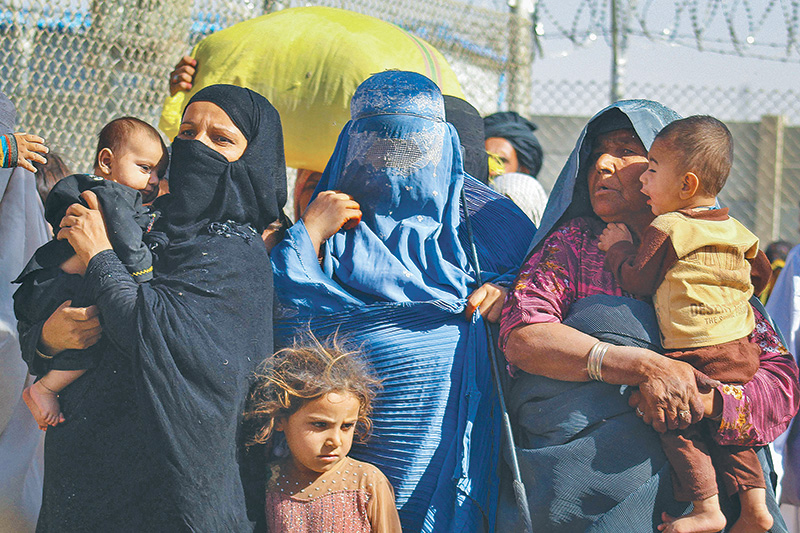
Afghan nationals arrive in Pakistan through the Pakistan-Afghanistan border crossing in Chaman on Tuesday following Taliban’s military takeover of Afghanistan. AFP/RSS
KATHMANDU, Nepal does not have a direct stake in Afghanistan. It doesn’t even have an embassy in Kabul. Nepal, however, has a couple of connections. Afghanistan is the youngest member of SAARC, of which Nepal is the current chair, and there are many Nepalis working there. As the country has fallen to the Taliban—the Islamic militants made rapid advances and took control of Kabul on August 15–the South Asian country is in flux. The Taliban takeover of Afghanistan can threaten regional peace and change geopolitical dynamics. Its impacts on Nepal cannot be ruled out. Amid sporadic calls that Nepal, in the capacity of the chair of SAARC (South Asian Association of Regional Cooperation), take initiatives to start dialogue with member countries, at least five former ambassadors on Tuesday issued a statement, making a similar pitch, stressing the need for addressing the emerging challenges in Afghanistan. “The political advancement of the Taliban in Afghanistan is indeed a subject of concern to all SAARC member countries,” the ambassadors who have served in India, China, Russia, the United States of America and the United Kingdom in different times, said in the statement. “The evolving situation in Afghanistan can have a far-reaching consequences on the region’s socio-economic, migration and security realms.”
But questions remain. Given the magnitude of the crisis unfolding in Afghanistan where the United Nations and the world’s powerful nations are concerned and engaged and struggling, how much impact Nepal can make. And if Nepal indeed makes a move, what kind of template should it build and follow? Diplomats and foreign policy observers say that it is highly unlikely that Nepal will make such a move, despite the fact that the Taliban takeover of Afghanistan can trigger geopolitical flux and threaten regional peace and security. The SAARC charter itself does not allow any member state to speak on internal matters of any other member, according to them. “We also need to understand that SAARC does not have a security and political mechanism like other regional bodies like the European Union or the African Union,” said Madhuraman Acharya, a former foreign secretary and ambassador. “Though Afghanistan is in South Asia, the recent takeover is a global crisis and major powers and the United Nations are already deeply concerned and engaged.” According to Acharya, when SAARC itself is in a moribund state, any role Nepal can play is just far-fetched. “The regional bloc’s charter clearly bars discussions on security, domestic and political issues of any member state,” said Acharya. The refrain that Nepal should “do something” started immediately after the Taliban returned as in charge of Afghanistan. On Saturday, a group of civil society members and human rights activists said that Nepal should initiate an emergency regional consultation to address the humanitarian and security issues of Afghan citizens and prospective refugees. In a statement, they said that Nepal must, if necessary, be prepared to give asylum to the fleeing Afghans irrespective of their religion and gender. The Taliban’s return to power has instilled fears among many Afghans, and scenes have emerged from Afghanistan of people trying to flee the country. Some horrific videos have appeared showing Afghans clinging to the outside of planes just as they revved up to take off. Suresh Chandra Chalise, who has served as an ambassador to the United States and the United Kingdom, says since the SAARC charter does talk about the well-being and stability in the region, Nepal, as the chair, has the obligation to take initiatives. “Nepal can at least express concerns before the member states to discuss how we can maintain regional peace,” Chalise told the Post. Chalise is among the ambassadors who issued the statement on Tuesday. Others are Nepal’s former ambassadors to India Deep Kumar Upadhyay and Durgeshman Singh, Nepal’s former ambassador to Russia Hiranyalal Shrestha, and Dr Mahesh Maskey, Nepal’s former ambassador to China. “The security situation, the socio-economic impact and migration issues are going to be a huge challenge for the region in the days to come,” said Chalise. “Nepal as the SAARC chair has not consulted with the secretary general of the bloc yet about the emerging situation in Afghanistan. It’s high time Nepal figured out a way and called member states for consultations.” Nepal so far has said its utmost priority is evacuating Nepalis out of Afghanistan. Kathmandu has not made any official statement pronouncing the Taliban. “Currently our priority is bringing back our citizens from Afghanistan,” said Sewa Lamsal, spokesperson for the Foreign Ministry. “On Afghanistan and recent developments, we have already made our position clear.” As of Tuesday, a total 770 Nepali nationals have been evacuated out of Afghanistan, according to the ministry. “We have requested all our friendly nations to help evacuate our citizens,” said Lamsal. Two days after the Taliban took control of Afghanistan, the Ministry of Foreign Affairs on August 17 said that the government of Nepal has been closely following the recent developments in Afghanistan. “Nepal wishes to see lasting peace and stability in Afghanistan, a fellow member of SAARC, and the continued progress and prosperity of the friendly people of Afghanistan,” read the Foreign Ministry statement. Officials last week told the Post that Nepal will pursue a “neutral” position on Afghanistan, in an indication that it will assess the situation before taking a decision on recognising the Taliban as the new rulers. Even almost two weeks after the takeover, the Taliban themselves appear to be in a state of confusion. Reports suggest they are holding discussion on government formation, as a smooth power transfer could not take place because Ashraf Ghani, the Afghan president, fled just as the Islamic militants took control of Kabul. Government officials say the calls for Nepal to make a move at a time when Afghanistan itself is in transition is a bit premature. A joint secretary at the Foreign Ministry said that Nepal’s immediate priority is to rescue Nepali citizens who are trapped in Afghanistan. “Besides that we do not have any immediate priority when it comes to the developments in Afghanistan,” the joint secretary told the Post, asking not to be named. “There clearly is a vacuum in Afghanistan. The elected regime has collapsed. There are new rulers with whom we have no contacts. We have to wait and see what kind of government is formed there and how the international community responds.” Though the government has said it “will do what it requires” to evacuate Nepalis out of Afghanistan, it’s easier said than done. There is no data on the number of Nepalis in Afghanistan. Since most of the Nepalis are believed to be working with various foreign missions based in the country, the government, according to officials, has established contacts with the missions to help rescue its citizens. There, however, are some Nepalis who reached the country illegally and that makes the evacuation more complicated. With the Taliban warning of “consequences” if the United States extends its evacuation plan beyond August 31, concerns are growing over Nepalis’ safety in the war-torn country. A senior Foreign Ministry official, who also spoke on the condition of anonymity, said that despite knowing that the situation is grave, there is not much Nepal can do at this point of time. “The government does not act just because some ‘self-enlightened’ individuals have some ‘wishful thinking’,” said the official, taking a jibe at the call of former ambassadors, all of whom were political appointees. “They must understand the fact that the SAARC charter does not allow any member state to speak on internal matters of any other member state.” According to the official, even if Nepal makes a call for a broader discussion, there are chances some member states could refuse to participate or stay quiet. “Anyway, the idea of Nepal asking member states to speak up is ridiculous,” said the official. “Did any member state raise the issue of the Maoist insurgency that lasted for a decade in Nepal? How can we be so oblivious to our own context?” But even if, hypothetically, Nepal does call upon the member states to discuss the emerging situation in Afghanistan, there are questions–how to invite a country that has just been taken over by Islamic militants, who are yet to be officially recognised as the new rulers. “Even if we invite the Taliban, what are we going to tell them?” said Arjun Bahadur Thapa, a former foreign secretary who also served as secretary general of SAARC from 2014 to 2017. “If the Taliban refuse to listen to the proposal of Nepal, if it has any, what are we going to tell them?” According to Thapa, if the Nepal government does call for a consultation, it must have something concrete to suggest. “There are so many issues…calling member states for consultation is not as easy as some believe,” Thapa told the Post. “Have they thought how embarrassing it would be for Nepal if any of the member states rejects the idea?”
HOME PAGE
All you need to know about Nepal’s vaccination status
As of August 23, the country has received 13,227,590 doses of vaccine, 16.47 percent of the population have taken the first doses and 12.85 percent have been fully vaccinated.
- SHUVAM DHUNGANA,Arjun Poudel
Post File photo
KATHMANDU, The 1.6 million doses of the AstraZeneca vaccine–the final consignment of which arrived on Monday–come as a shot in the arm for Nepal, as it continues to struggle to secure doses to vaccinate at least 72 percent of the 30 million population at the earliest. The government also plans to purchase 6 million doses of Pfizer-BioNTech vaccine for children aged 12 to 18 years. But the initial priority is to vaccinate the population above 14 years of age, which makes up around 22 million. The 1.6 million doses of the AstraZeneca vaccine from Japan, which were received in four tranches, are required to administer the second doses to those 1.4 million people aged 65 and above who took their first shots in the second week of March. After the second wave from April that quickly slid into a devastating crisis, claiming more than 6,000 people, cases have gradually declined but with the start of the festive season, public health experts have warned of a sudden surge of infections. Vaccination is the only sure shot method to control the disease as of now, apart from taking precautionary measures and following health safety protocols. Here is what you need to know about Nepal’s vaccination status.
How many people have been vaccinated so far? As of Tuesday, 4,943,732 people (16.47 percent) have taken their first dose of vaccine and 3,857,598 people (12.85 percent) have been fully vaccinated, either with the AstraZeneca vaccine (manufactured in India, Japan, and Europe), Vero Cell, developed by China’s Sinopharm, and Janssen by Johnson and Johnson of the United States of America.
How many doses Nepal has received so far and from where? As of Monday (August 23), the country has received 13,227,590 doses of vaccines–AstraZeneca, Vero Cell and Janssen. Nepal launched its vaccination campaign on January 27 with the 1 million doses of Covishield received in grant assistance from India. Covishield is the AstraZeneca type vaccine manufactured by the Serum Institute of India. In the first week of March, COVAX, an international vaccine-sharing scheme backed by the United Nations, supplied 348,000 doses of Covishield. At the end of March, 800,000 doses of Vero Cell were brought in from China, which Beijing had provided under grant assistance. An additional 1 million doses of Vero Cell under Chinese grant then arrived again in June. On March 28, the Indian Army had provided 100,000 doses of Covishield to the Nepal Army. The doses were used to vaccinate Army personnel and their dependants. On July 12, a little over 1.5 million doses of the single-shot Johnson & Johnson vaccine (Janssen) landed in Kathmandu. The vaccine was provided by the United States through COVAX. On August 6, the government of Bhutan delivered 230,000 doses of the Astrazeneca vaccine to Nepal. On August 7 and 8, Japan shipped 513,420 doses and 333,900 doses, respectively, to Nepal as part of its commitment to providing 1.6 million doses through COVAX. Then on August 21, as many as 208,060 doses were supplied to Nepal. Two days later, the remaining 559,360 doses were delivered.
How many doses has Nepal bought? The government in February signed a deal with the Serum Institute of India to buy 2 million doses of Covishield. In the same month, the Serum Institute supplied 1 million doses but stopped shipment of additional doses, citing the coronavirus crisis in India. The remaining 1 million doses have not arrived yet. From China, Nepal has purchased 10 million doses of Vero Cell. Of them, 4 million doses of the vaccine were bought in June under a non-disclosure agreement with the Chinese company and an additional 6 million doses were purchased a few weeks ago, and the delivery has already started. On August 19, China delivered 1.6 million doses of the 6 million doses. Nepal has so far received the delivery of 7.4 million doses of Vero Cell out of which 5.6 million were bought while 1.8 million were received on grants from China. China has promised an additional 1.6 million doses of Vero Cell in grant.
What is the country’s current Covid-19 status? After 2,020 new coronavirus cases were reported on Tuesday, the nationwide infection tally has reached 751,001 with 38,250 active cases. The Covid-19 death toll stands at 10,568.
Are more vaccines coming? Earlier this month, the government said over 42 million doses of vaccine will arrive by mid-February next year. The Ministry of Health and Population has confirmed that it has been working to purchase an additional 6 million doses of the Vero Cell vaccine from China. The government has already paid for 4 million doses of the Moderna vaccine through the World Bank to the US manufacturer of the vaccine, and delivery is expected by mid-February. Also expected by mid-February is 11 million doses from COVAX under a cost-sharing mechanism, which means the government will pay COVAX the amount equivalent to what COVAX paid to the manufacturing company. The government says it has also initiated the process to procure 6 million doses of Pfizer-BioNTech vaccine which it says will be administered to children between 12 to 17 years.
How many people Nepal needs to vaccinate? Around 78 percent of the 30 million population–or around 25 million people need to be vaccinated, as per the government’s new plan to also vaccinate those aged between 12 and 14. The government earlier planned to vaccinate only those aged above 14 years. Since around 4-5 million people are said to be living abroad, the government needs to vaccinate around 19-20 million people. For this, the country needs a little over 40 million doses of double-shot vaccine. As COVAX has committed to providing around 13 million doses, enough to vaccinate 20 percent of the population, the government needs to manage around 30 million doses on its own.
HOME PAGE
‘Time is running out’: Desperation grows among Nepalis stuck in Afghanistan
Amid reports that the Taliban are tracking down those who worked for Western countries, there are concerns about the safety and security of Nepalis in the war-torn country.
- ANUP OJHA
Poorna Gurung and his friends are holed up inside the office of the UN mission in Afghanistan in Kabul. Photo Via facebook
KATHMANDU, For the past one week Kabita Gurung has not slept well. She spends most of the time taking updates on Kabul, the Afghan capital, which fell to the Taliban on August 15. She is worried about her husband, Poorna, who is stuck there. “I have not been able to sleep properly. Even if I fall asleep, I wake up in the middle of the night. Various things cross my mind and I cannot sleep thereafter. I am extremely worried about my husband,” Kabita, 51, told the Post over the phone on Tuesday from her home in Tanahun. “My husband says he and his friends are safe until now, but scenes of chaos and panic in Kabul make me extremely terrified for his safety.” Poorna from Damauli Bazar of Vyas Municipality has been working in the Afghan capital for the last nine years. “Every time I turn on the TV or look at Facebook posts, I see gun-toting Taliban fighters in the streets. The scenes from airports are not reassuring at all,” said Kabita. The Islamist fighters, who had been making rapid advances over the last few weeks, on August 15 took control of the Afghan capital at a lightning speed, to the surprise of the United States and its allies, after Washington announced a complete pullout of its troops after 20 years of occupation. With the Taliban warning of “consequences” if the US extended the August 31 evacuation deadline, Kabita’s worries have multiplied. On Tuesday, leaders of the Group of Seven countries were set to discuss whether to seek an extension to the August 31 deadline for the evacuation of thousands of people trying to flee Afghanistan and whether to recognise or sanction a Taliban government. Poorna, now 55, retired from the Indian Army about a decade and a half ago after 24 years of service. After working as a security guard in Iraq for two years, he applied to work at the United Nations mission in Afghanistan through IDG Security, a security firm, in 2013. For nearly a decade, Poorna used to visit home every year. The last time he was home was in 2019, as he could not visit his family last year due to the Covid-19 pandemic. “As many as 507 Nepalis and 50 Indian nationals, who came to Afghanistan through IDG security, are stuck here,” Poorna told the Post on Monday night via Facebook messenger. “Till now we have not felt any security threat from the Taliban, but we want to get out of the country as soon as possible.” There is no exact data on the number of Nepalis in Afghanistan. The Nepal government, according to Nepali officials, has already established communications with most of the foreign missions and UN agencies and requested them to help repatriate Nepalis working with them. As many as 579 Nepalis were said to be working at the US embassy in Kabul. Officials say as per the records available to them, 60 Nepalis are working in the German embassy, 87 in the United Kingdom embassy and 62 in the Japanese embassy. Nepal has evacuated 770 Nepalis from Afghanistan ever since the militants’ takeover of the country. The Department of Foreign Employment records show that in the last fiscal year, ending mid-July, 1,073 Nepalis had obtained permits to work in Afghanistan. The department’s records show that in the last seven years, more than 8,000 Nepalis have been issued labour permits to Afghanistan. But it is estimated that there could be more than 14,000 Nepalis who are stranded. The Sher Bahadur Deuba government has said it “will do what it requires” to bring Nepalis home. But it is easier said than done, as there could be many Nepalis working in Afghanistan illegally. Nepal does not have an embassy in Afghanistan and the Nepali embassy in New Delhi is accredited to deal with matters related to the country. An official at the embassy last week told the Post that evacuation has become complicated because of the lack of data on the number of Nepalis in Afghanistan, not to say of those who had reached the country through illegal channels. With reports surfacing that the Taliban are trying to track down those who worked for the Western countries, concerns are growing over the safety and security of Nepalis in Afghanistan. Nepal had imposed a ban on Nepalis working in Afghanistan in 2016 after 13 Nepalis were killed in Kabul in a suicide bomb attack. But the ban was lifted after four months. It is only the US military that is managing flights inside the airport to evacuate staff. Outside the airport, everything is under the control of the Taliban force. Poorna said he and his friends whose duty was to provide security to high-ranking UN officials are now weaponless and in need of security. “For nearly a decade, we provided security to UN officials. Now we need their support to be evacuated out of this country,” Poorna told the Post. According to him, no one has stepped out of their office compound over the last 10 days. “But we have seen chaos and pandemonium outside on TV, especially at the airport,” said Poorna. Poorna has two daughters aged 25 and 17. His elder daughter is abroad and the younger one is in Kathmandu for studies. He said he is currently inside the UN office in Kabul along with 31 Nepalis. “We have been told others will be brought here from other cities like Kandhar, Herat and Jalalabad. Our agent has said around 100 of us would be evacuated on Wednesday, but we are not sure,” he said. “There are just assurances. We are not sure.” He said he is worried about several other Nepalis who are stuck in Afghanistan, as there is no clarity how the situation will unfold in the country after the Taliban takeover. “I have heard that there are many Nepalis who have come here through illegal channels after paying hefty amounts of money,” said Poorna. “I have heard many either did not have jobs or they lost jobs. They too need to be evacuated out of the country at the earliest.” Poorna is well aware of the Taliban warning against extension of the US evacuation plan beyond August 31, as it is nearing a new dangerous phase. He says anything can happen to Nepalis and despite their big numbers, they can’t protest there or speak up. His concerns are not unfounded. Concerns have started to grow over human rights violations in Afghanistan since the Taliban takeover. Michelle Bachelet, the top UN human rights official, said on Tuesday that she had received credible reports of serious violations committed by the Taliban in Afghanistan, including summary executions of civilians and restrictions on women and on protests against their rule, according to Reuters. Poorna said though nothing untoward has happened—or at least he has not heard of it—to any fellow Nepali citizens, the situation in Afghanistan is volatile. “You never know, the situation could suddenly turn worse after August 31, and the Taliban do not usually backtrack on their words,” said Poorna. “The Nepal government must make efforts to get in touch with all Nepalis and rescue them at the earliest. Time is running out.”
NATIONAL
Number of critical Covid-19 patients on the rise in Kanchanpur district
Patients have to be referred to other districts, as all intensive care unit beds at Mahakali Provincial Hospital are occupied, officials say.
- BHAWANI BHATTA
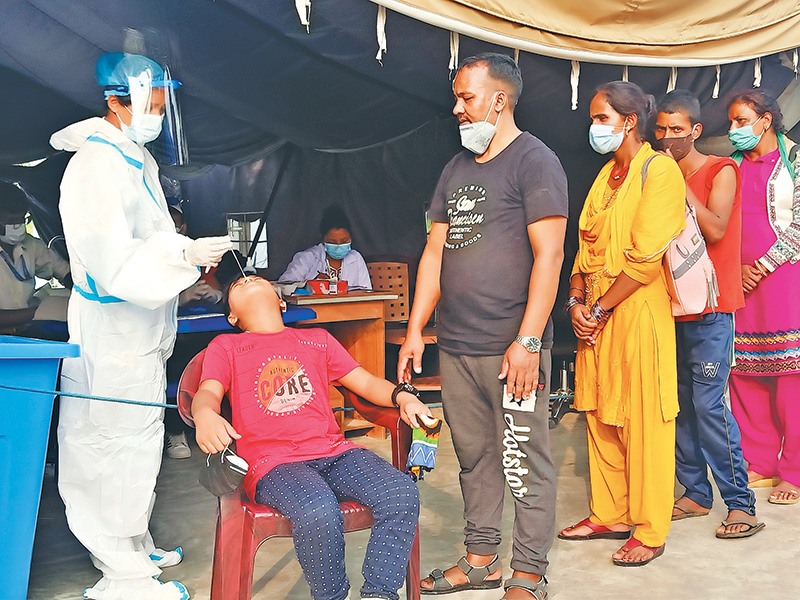
Twenty people tested positive for Covid-19 in Kanchanpur on Tuesday. Post Photo: Bhawani Bhatta
KANCHANPUR, The number of critically ill Covid-19 patients is on the rise in Kanchanpur, a Tarai district in Sudurpaschim Province that borders India. Positive cases are also soaring in the district, officials say. Five critical patients of coronavirus were receiving treatment at the High Dependency Unit (HDU) of Mahakali Provincial Hospital, a Covid-19 designated hospital in Mahendranagar, on Monday. According to Gobinda Rokaya, the Covid-19 focal person at the hospital, all Intensive Care Unit (ICU) beds in the hospital are occupied by patients of other chronic ailments. The hospital has six ICU and 18 HDU beds. “The number of critical Covid-19 patients has been increasing for the past few days. We have referred three patients in need of ICU beds to Dhangadhi in the last two weeks,” said Rokaya. According to the hospital administration, the death rate of Covid-19 patients during the second wave was high, as people were brought to the hospital only after their condition had worsened. The health authorities are urging people to visit health institutions at the earliest for treatment and consultation. Around 100 Covid-19 patients died in Mahakali Hospital alone during the second wave that gripped the country since April this year. Rokaya said the high death toll can be attributed to the fact that most patients visited pharmacies and health clinics for treatment instead of going to the hospital. According to the District Health Office in Kanchanpur, 12 individuals tested positive for Covid-19 in Kanchanpur on Monday. Among them, seven were from Bhimdatta Municipality, three from Dodhara Chandani and one each from Suklaphanta and Punarbas municipalities. Kanchanpur has 147 active cases of Covid-19 at present. Until mid-August, the number of active cases stood below 100 in the district, the data of the District Health Office showed. On Tuesday, 15 people tested positive for Covid-19 through PCR tests and five others through antigen tests in Kanchanpur district. Twelve people tested positive for the virus in the district on Monday. According to Mahakali Provincial Hospital in Mahendranagar, around 20 to 25 individuals arrive in the hospital for PCR testing on a daily basis. The hospital has a capacity to conduct over 150 PCR tests a day.
NATIONAL
House panel directs government to conduct grade 12 exams in person
- BINOD GHIMIRE
KATHMANDU, Two weeks after the government’s decision to postpone the grade 12 exams over Covid-19 fears, a parliamentary committee on Tuesday directed the government to conduct the exams in person without delay. The parliamentary committee on Health and Education said it was wrong to postpone the grade 12 tests while all other exams were going on smoothly. The National Examinations Board, following the directives of the Covid-19 Crisis Management Centre (CCMC) and the Education Ministry, had postponed the grade 12 exams indefinitely on August 7, citing Covid-19 risks. The exams were originally scheduled for May before they were postponed to August 15. The decision to postpone the exams was made after hundreds of students and others concerned took to social media platforms like Twitter, Facebook and Instagram to express their displeasure over the government’s plan to conduct in-person exams. They had called on the authorities to either cancel, postpone or find alternative ways to conduct the exams. “It was wrong on the part of the CCMC and the Education Ministry to postpone the exams,” said committee chair Jayapuri Gharti. “The committee has directed the government to immediately conduct the exams after administering Covid-19 vaccines to the students and by maintaining health and safety protocols.” The committee has concluded that further delaying the exams will hamper the academic calendar and the students could lose an entire year. While the grade 12 exams were postponed, college-level exams under the Tribhuvan University were not. Last year, the grade 12 exams were held in November and the results were published two months later, in January-end. In normal times, the grade 12 results are published by October. Meanwhile, some examinees have said that there was no point postponing the exams in the first place if the board is to conduct the exams in person. “The threat of Covid-19 is still prevalent. If we have to sit for in-person exams now, the earlier postponements were just a waste of time,” Bhesh Raj Upadhyay, a grade 12 student from Vishwa Niketan School, Tripureshwar, told the Post. “It’s necessary to conduct the test as early as possible but through a virtual medium.” There are 374,000 grade 12 students across the country. The parliamentary committee has asked the government to administer Covid-19 vaccines to all students aged 18 years and above who are appearing in their final exams. But a large number of twelfth graders have not reached 18 yet. “Students who haven’t got the vaccines are asking us if they can take the tests,” Narayan Gautam, acting principal at Padmodaya School, told the Post. “If the in-person tests are to be held, those who haven’t been inoculated will be at risk.” Education experts say while the concerns of the parliamentary committee about the loss of the academic session is valid, it should have recommended the government to opt for virtual exams. They say though a year and a half have passed since the pandemic, the government hasn’t made any significant investment to increase internet access and improve information technology. “The instruction of the parliamentary committee to conduct in-person tests means there is no pressure on the government to invest in increasing internet connectivity,” Binay Kusiyait, a professor at Tribhuvan University, told the Post. “The parliamentary committee must be sensitive to the health risks of the students.”
NATIONAL
Number of blacklisted firms nearly doubled last fiscal year
Contractors of many sick projects were added to the blacklist. Some of the blacklisted firms are owned by politically-connected individuals.
- PRITHVI MAN SHRESTHA
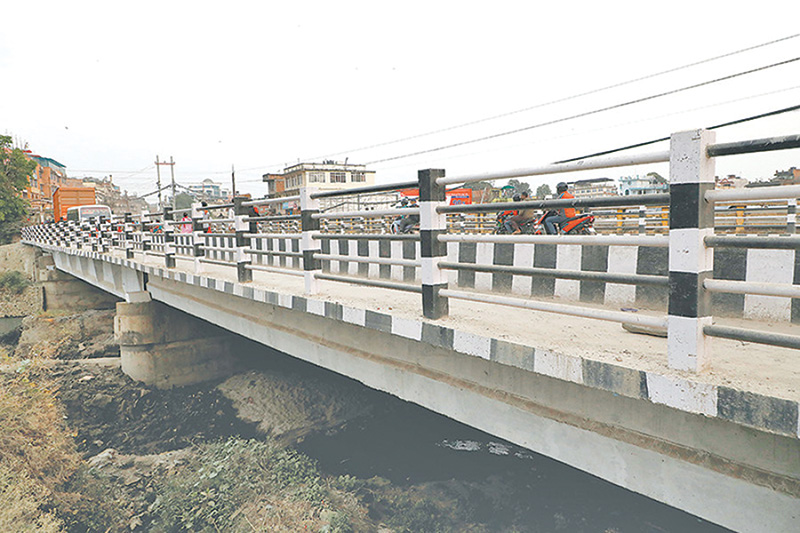
A bridge over Bishnumati river in Teku, Kathmandu built by Pappu Construction. Post file Photo
KATHMANDU, The Public Procurement Monitoring Office blacklisted more than 100 contractors and suppliers in the last fiscal year 2020-21. The number is almost double what it was a year earlier. The procurement monitoring office, which monitors the public-sector procurements, also blacklisting firms that are found to be violating the public procurement law and such firms are barred from participating in public procurement for a certain period. According to its Annual Report 2020-21 released late last week, the monitoring office blacklisted 104 firms—contractors and suppliers to the public entities—for failing to work as per their contract agreements, failing to sign agreements after being awarded contracts, and for other breaches. In the fiscal year 2019-20, only 54 firms had been blacklisted. This is the first time over 100 firms were blacklisted—and so many in a year—since the monitoring office started blacklisting firms in 2007, when only six had been blacklisted. “One of the main reasons behind the surge in blacklisted firms is that about two dozen firms were associated with sick projects,” said Rajesh Kumar Thapa, director at the procurement monitoring office. “A number of contractors and suppliers also failed to complete their work owing to the pandemic but such firms also have been blacklisted.” As per the Public Procurement Act-2007, a blacklisted firm can be barred from one year to three years from participating in public contracts. Chakravarti Kanth, joint secretary at the procurement monitoring office, said the new public procurement regulations have set a limit on the number of times a contract can be extended so several firms were blacklisted because they could not complete their work within their last extended deadlines. According to the 10th amendment to the public procurement regulations, the government offices were allowed to extend the contract deadline by a year in the case of the contracts signed before April 27, 2020, and such contractors and suppliers had sought deadline extensions. But, contractors have been asking for further extension of the deadline citing the unforeseeable situation created by the Covid-19 pandemic. In the last fiscal year, some of the contractors and suppliers who are known for their political connections were also blacklisted. For example, Omni Business Corporate International, Pappu Construction and Shailung Enterprises are some of the enterprises whose promoters have direct political connections but still have been blacklisted. But, as per the order of the Supreme Court, the procurement monitoring office removed Omni from its blacklist. “This was also the year when relatively more contractors and suppliers with political connections have been blacklisted,” said Thapa. Omni was controversially awarded a contract for the delivery of medical goods from China despite quoting prices higher than the government’s own cost estimate and that of rival bidders. Despite having no prior experience of supplying medical goods, Omni was chosen to supply the goods because of its alleged close relations with the then Prime Minister KP Sharma Oli. The deal landed in controversy after it emerged that prices quoted by the company were much higher than what its rivals had proposed and on April 1 last year, the Department of Health Services terminated the contract. The department and Omni had signed the contract on March 27 last year to deliver the medical goods worth $10.03 million in three phases even though the cost estimate of the department was $9.07 million. After the termination of the contract, Omni moved the Patan High Court challenging the government decision and the case is sub judice. The company also moved the Supreme Court challenging the government decision to blacklist it and secured an interim order in its favour on September 23 last year. After the company was blacklisted for just one year, questions were raised as to why it wasn’t blacklisted for three years. But officials at the procurement monitoring office said the company could have been blacklisted for three years only if the Department of Health Services said the goods supplied by Omni were of inferior quality. But a report of the Nepal Health Research Council had concluded that the rapid test kits supplied by Omni were of inferior quality. The 75,000 rapid diagnostic test kits procured by the government through Omni are only able to detect the presence of the coronavirus antibodies 50 percent of the time, the council’s report had said. Questions were also raised about the quality of the polymerase chain reaction (PCR) machines supplied by the firm. Likewise, two joint venture companies associated with Pappu Construction were blacklisted last fiscal year. Pappu-Nepal Pragati JV was blacklisted for failing to construct the bridges across the Khangsang and Sokhukhola streams along the Khurkot-Ghurmi road in July last year. Likewise, ZIEC-Pappu was blacklisted for failing to construct a bridge at Teku, Kathmandu across the Bishnumati River as per the original design. Although the contractor completed the bridge, the Department of Roads has yet to take over the bridge over quality concerns. Pappu is notorious for defaulting on construction deadlines and quality. Its founder Hari Narayan Rauniyar was a lawmaker of the House of Representatives from the erstwhile Sanghiya Samajbadi Forum-Nepal and he was suspended from the lawmaker position after being charged with corruption by the Commission for Investigation of Abuse of Authority for a substandard construction of a bridge across the Babai river in Jabbighat, Bardiya. Shailung Enterprises, which has been blacklisted by the procurement monitoring office, is owned by Sharada Prasad Adhikari, the landlord of CPN (Maoist Centre) Chairperson Pushpa Kamal Dahal. Shailung was blacklisted on the recommendation of the government-owned Krishi Samagri Company. The Krishi Samagri Company had awarded three contracts to Shailung on different dates last year to supply a total of 80,000 tonnes of urea fertiliser. But, it failed to supply the fertiliser on time and this caused a shortage during the peak paddy planting season. The Krishi Samagri Company had terminated the first contract with Shailung in early September, the second in late November last year and the third in early January this year. On March 5, the company was blacklisted for a year for breaching one of the contracts and on July 5, it was blacklisted for one and two years separately for failing to supply fertilisers as per two other contracts. Besides Shailung, Honiko Multiple Pvt. Ltd was blacklisted for a year on March 5 this year for failing to supply 25,000 tonnes of urea while Muktinath Krishi Company was blacklisted for two years on July 5 for failing to supply diammonium phosphate (DAP) and urea under two separate contracts. The company was supposed to supply 50,000 tonnes of fertilisers. Muktinath was awarded two separate contracts for supplying 25,000 tonnes of urea and 25,000 tonnes of DAP by December 3 and December 4 respectively last year. “As all the companies failed to supply the fertilisers one after another, we initiated the process of penalizing them at the earliest,” said Bishnu Prasad Pokharel, spokesperson at the Krishi Samagri Company. “All three companies were new in the fertiliser supply field and this could be the reason for their failure to perform as per the contracts.” After terminating the contracts, the company invited fresh tenders and brought 280,000 tonnes of fertilisers later last year.
EDITORIAL
Celebrating festivals wisely
It may sound all too pessimistic, but the need of the hour is to exercise caution. We can accurately categorise Nepal as not just a land of scenic beauty, but also a land of festivals with no fewer than 50 annual events taking into account various regions and ethnicities. Each of them presents a logistical nightmare for the authorities—the hurdles in managing them smoothly, without hurting the sentiments of those celebrating them, and more importantly, by keeping the public safe from the cyclical effects of the dreaded Covid-19 pandemic. For many of us, jatras—or street festivals—might just be spectacles we have observed from a distance or on a television screen in the comfort of our homes. But, for those that participate, it conjures up deep emotions and religious significance. A repeat of the high-handed approach to handling last year’s Rato Machhindranath Jatra is certainly not what we expect from the authorities. However, the organisers need to be aware of the fragile situation the pandemic presents. Organisers and authorities need to work out the nitty-gritty of hosting such an event without adversely affecting public safety. If not, the spill-over effects of such an event can be disastrous for the public at large if ill-managed. It’ll be all too early to assume that the pandemic has waned. With the vaccination drive still at its nascent stage—as per reports submitted to the World Health Organisation, about 8.2 million doses (taking into account the first and second doses) have been administered, which accounts for about 28 percent of the population. If we inoculate 150,000 people a week, it will only be towards the end of the year when we reach the 50 percent mark—still falling short of the 70 to 85 percent threshold to achieve herd immunity. Therefore, the authorities need to earnestly push for speedier vaccination of the populace to alleviate any cause for concern for the next festival that awaits us. We have recently celebrated Janai Purnima, observed Gai Jatra, and will soon be celebrating Teej and Indra Jatra—all occasions for big gatherings. The disappointment of not being able to celebrate them in the usual way can be disheartening, to say the least. You may have to cope with the upheaval of emotions ranging from anger to grief which is entirely understandable. The need of the hour is to accept the reality of the situation around us, and understand that things will not return to normal anytime soon. It may sound all too pessimistic, but it’s not all doom and gloom—the need of the hour is to exercise caution. The bigger picture is the safety of our loved ones; hence the most precious gift we can give them is good health, ensuring their protection and marking the occasion joyously but differently. Communicating with family members and friends and finding alternative ways to celebrate the festivities should require particular attention. As things stand today, and going by reports, we are still expecting a third wave sometime in mid-October, right on time for Dashain. Without a doubt, the authorities are treading on a tightrope—“damned if you do and damned if you don’t” would justify the precarious nature of the situation. With festivities such as Dashain, Tihar and Chhath around the corner, and streams of people moving within the country and across the border with India, it is time for the authorities to think outside the box and relay information, paying paramount importance to the welfare of the public.
OPINION
Climate code red: Nepal at the frontline
High growth in Nepal can be green, resilient and inclusive if the right investments and policies are put in place.
- Nicola Pollitt
Shutterstock
As the monsoon rain poured down over the weekend, I had a chance to catch up on the new Intergovernmental Panel on Climate Change special report on the impacts of global warming. As the most comprehensive and evidence-based assessment of climate change, it paints a terrifying picture of what a future without ambitious climate action would look like. Scientists from around the world agree that we, humans, are causing global warming at a rate faster than our planet has ever experienced. We are locked into a temperature rise of at least 1.5 degrees Celsius. Without action, this could rise to 5 degrees Celsius. As a result, floods, droughts, heat waves and wildfires are becoming more frequent. The report has also highlighted, for the first time, the impacts of climate change on the Himalayas where temperatures are rising twice as fast as in the plains, and glaciers are retreating at unprecedented rates. As a result, vulnerable communities are having to deal with more catastrophic floods, droughts, landslides and new diseases.
Impacts and actions So “Code Red” is not an exaggeration, especially for Nepal with 60 percent of its population vulnerable to climate change. That is why COP26 President-Designate Alok Sharma visited Nepal earlier this year—to see first-hand the impacts and actions being taken to help the most affected. “Protecting the most vulnerable is a priority for the UK’s COP26 Presidency. World leaders must heed the science and work together to adapt to our changing climate” was the message from the United Kingdom’s Resilience Champion for COP26, Anne-Marie Trevelyan. That is why the UK is working with the government of Nepal to support climate action on the ground and increase Nepal’s ability to respond to future shocks through 100 million pounds worth of support for climate resilience and disaster preparedness. I am glad to have had the opportunity to discuss these issues with President Bidya Devi Bhandari last week. Our discussion included the new analysis which underpins Nepal’s Long-Term Strategy on Climate Change and the potential for even more ambition. That analysis looks at how to reduce the loss and damage costs from climate change, and new opportunities for reducing future emissions through forestry by accelerating investment in clean energy trade. This new analysis demonstrates that Nepal does not face a trade-off between growth and the environment. On the contrary, high growth in Nepal can be green, resilient and inclusive if the right investments and policies are put in place. For example, incentives to support the large-scale uptake of electric cooking would reduce the burden on women collecting firewood whilst also providing a market for clean hydropower. Removing tariffs on electric vehicles would reduce reliance on imported fuel, and converting coal-fired brick kilns to electric heating would reduce pollution in Nepal’s choked cities. Nepal must also continue to invest in its forests, fields and river flows, to create jobs and revenues, and find ways to reduce the impacts of floods and droughts without losing the habitats that are needed to attract sustainable tourism revenues. The development of Nijgadh airport is a good example—where valuing the existing forests and biodiversity of the area against what could be gained by constructing the airport would provide useful data to base decisions on. Coping with Covid-19 will remain a short-term priority. This is true for the UK as well. But recovery from the pandemic has also been an opportunity. For example, as part of the recovery plan, the UK has set out how it will reduce emissions by 68 percent and create up to 2 million green jobs by 2030. In order to help Nepal identify similar opportunities, the UK is working with development partners, the private sector and the government to invest in a green, resilient and inclusive recovery. Nepal’s development partners have identified an additional $4.2 billion to support its green recovery and ensure future development does not increase emissions, but increases resilience and benefits all.
Global leader Nepal has so much to say on these issues, building on an already impressive foundation in the forestry, clean energy, disaster preparedness and climate adaptation sectors. But it can do more. With additional measures, and support from its development partners, Nepal can be a global leader at COP26, demonstrating how its economy can flourish, based on even more ambitious emissions targets and increased investment in protecting its natural resources, which will, in turn, protect Nepalis from future shocks. If Nepal chooses to ramp up its ambition, it will be a shining light at COP26. In doing so, it can act as an example to those in the region and beyond—in particular, leading the call to champion mountain issues alongside other countries of the Hindu Kush Himalaya. As COP26 President-Designate Alok Sharma said, “We can do this together, by coming forward with ambitious 2030 emission reduction targets and long-term strategies with a pathway to net zero.” As the Intergovernmental Panel on Climate Change makes clear in its ‘Code Red’ report, the time for ambitious action is now. And action is possible.
Pollitt is the British Ambassador to Nepal.
OPINION
Students are returning to school
With anxiety, grief and gaps in social skills, will there be enough school mental health resources?
- SANDRA M CHAFOULEAS,AMY BRIESCH
Shutterstock
Even before Covid-19, as many as one in six young children had a diagnosed mental, behavioural or developmental disorder. New findings suggest a doubling of rates of disorders such as anxiety and depression among children and adolescents during the pandemic. One reason is that children’s well-being is tightly connected to family and community conditions such as stress and financial worries. Particularly for children living in poverty, there are practical obstacles, like transportation and scheduling, to accessing mental health services. That’s one reason school mental health professionals—who include psychologists, counselors and social workers—are so essential. As many kids resume instruction this fall, schools can serve as critical access points for mental health services. But the intensity of challenges students face coupled with school mental health workforce shortages is a serious concern.
Key issues As school psychology professors who train future school psychologists, we are used to requests by K-12 schools for potential applicants to fill their open positions. Never before have we received this volume of contacts regarding unfilled positions this close to the start of the school year. As researchers on school mental health, we believe this shortage is a serious problem given the increase in mental health challenges, such as anxiety, gaps in social skills and grief, that schools can expect to see in returning students. Anxiety should be expected given current Covid-related uncertainties. However, problems arise when those fears or worries prevent children from being able to complete the expected tasks of everyday life. Meanwhile, school closures and disruptions have led to lost opportunities for students to build social skills. A McKinsey & Co. analysis found the pandemic set K-12 students back by four to five months, on average, in math and reading during the 2020-2021 school year. Learning loss also extends to social skills. These losses may be particularly profound for the youngest students, who may have missed developmental opportunities such as learning to get along with others. And it’s important to remember the sheer number of children under 18 who have lost a loved one during the pandemic. A study published in July 2021 estimates that more than one out of every 1,000 children in the U.S. lost a primary caregiver due to Covid-19.
Hiring more school psychologists Hiring more school psychologists may not be simple. The National Association of School Psychologists recommends a ratio of one psychologist for every 500 students. Yet current estimates suggest a national ratio of one-to-one, 211. It’s like having to teach a class of 60 instead of 25 students. Shortages are particularly severe in rural regions. There are also not enough culturally and linguistically diverse school psychologists. Scarcity of school mental health personnel affects important student outcomes from disciplinary incidents to on-time graduation rates—especially for students attending schools in high-poverty communities. To address these shortages, legislators have proposed federal bills that aim to expand the school mental health workforce. Meanwhile, local school districts and state education agencies are using American Rescue Plan funds to increase mental health training, hire additional mental health staff or contract with community mental health agencies.
Preparing all school personnel We believe increasing the number of mental health providers in schools is important. Workforce increases, however, must be coupled with attention to readying all school personnel to cope with students’ anxiety, grief and gaps in social skills. For example, when it comes to anxiety, schools can help students build both tolerance of uncertainty and coping skills through strategies such as seeking support, positive reframing, humor and acceptance. School mental health professionals can train other staff members on simple strategies to use in a nurturing relationship. Long-term benefits such as sense of belonging can happen when each student has an informal mentoring relationship that offers emotional nurturance and practical help. More schools have adopted social-emotional learning curriculums in recent years. However, additional time may be needed to teach and reinforce basic skills such as taking turns and sharing. In addition, school mental health personnel can assist with defining a clear process for identifying who needs help, and be ready to share resources about grief and how kids respond to loss.
Partnering with families and communities Even with these efforts, schools cannot be expected to identify and meet all young people’s mental health needs. Strong partnerships with families and communities are critical. Seeking input from families may offer valuable information about student experiences. This might be done, for example, by adding questions to beginning-of-the-year student forms. Knowing how families are experiencing loss or insecurities, for example, can help school mental health personnel plan for and target supports. The youth mental health crisis requires a comprehensive response. We believe the priority should be ensuring equitable access to a mental health professional through school settings.
Chafouleas is Professor of Educational Psychology at University of Connecticut and Briesch is Associate Professor of School Psychology at Northeastern University. — The Conversation
MONEY
Project working to produce hydrogen fuel in Nepal
Hydrogen is economically feasible and environmentally wise, and will help to reduce fossil fuel dependency, say experts.
- KRISHANA PRASAIN
Hydrogen fuel can be used as an alternative to petrol, diesel, liquefied petroleum gas and coal. Shutterstock
KATHMANDU, For a country that imports more than Rs200 billion worth of oil annually, and where consumption is rising by the year and the trade deficit is ever widening, producing hydrogen fuel can be the best way to achieve energy self-sufficiency, experts said, but this can happen only if the government makes it a national agenda. The production of hydrogen fuel is economically feasible and environmentally wise, and will help to reduce fossil fuel dependency, said academicians and researchers engaged in Green Hydrogen Lab funded by Nepal Oil Corporation. “Whether hydrogen fuel will be feasible and economical all depends on government policy,” said Biraj Singh Thapa, assistant professor at the Department of Mechanical Engineering at Kathmandu University and also the team leader of Green Hydrogen Lab. “We have electricity and water, the major components required to produce hydrogen fuel. Investment in physical infrastructure is all that is needed to produce hydrogen fuel in the country,” Thapa said. Hydrogen fuel can be used as an alternative to petrol, diesel, liquefied petroleum gas (LPG) and coal. It can even power hydrogen generators for electrification and utilisation that run on fossil fuels. “Firstly, the production of hydrogen fuel will play a key role in lessening the trade deficit that is caused by the import of petroleum products,” he said. “Secondly, it has become important to think about Nepal’s energy security as it is totally dependent on petroleum products from India. And thirdly, rising pollution in recent times has become a huge challenge for the country, and hydrogen fuel is a boon to eliminate pollution.” Green Hydrogen Lab’s vision of Nepali industries specialised in producing, storing, transporting and using green hydrogen energy on a commercial level resulted in a project named Technology Transfer and Local Adaptation for Developing NOC as a Hydrogen Fuel Producing and Distributing Company, which was funded by a Rs50 million research grant from Nepal Oil Corporation. Under the two-year project, Kathmandu University will be producing hydrogen and also working on storage and end-use systems. It will convert gasoline powered internal combustion engine vehicle to hydrogen fuel cell vehicle for demonstration purposes. The project will also provide recommendations to the government for policy guidelines for green hydrogen, emphasising production, storage and end-use of green hydrogen as a future fuel for Nepal. Producing 1 kg of hydrogen fuel requires approximately 50 units of electricity, and it allows a car to run for 60-70 km depending on the condition. This is comparable to diesel in terms of efficiency and cost, as per Thapa. “If the electricity tariff is reduced, the price of hydrogen fuel will drop automatically,” he added. “Utilising surplus electricity at a subsidised rate, we can produce hydrogen at a cost of $1 per kg,” Thapa said. “This is economically feasible, it can be produced within the country and is environmentally friendly.” The country needs policy, regulation, pilot projects and private businesses willing to invest in it as capital running into billions is needed to build hydrogen plants, storage facilities, refuelling stations and vehicles that run on hydrogen, Thapa said. “It might require a huge investment to create a value chain for hydrogen fuel, and it also takes time,” he added. “The government should start working on this now, and gradually decrease the dependency on petroleum products by investing in hydrogen fuel.” According to the import data of the Trade and Export Promotion Centre, Nepal imported petroleum products worth Rs175.53 billion in the fiscal year 2021-21 while the import bill stood at Rs164 billion in the fiscal year 2019-20. The import of petroleum products was impacted in these two fiscal years with the government imposing lockdowns at different times to control the spread of the virus, leading to a decline in consumption. The country imported petroleum products valued at Rs216.42 billion in the fiscal year 2018-19. Nepalis consume 90 percent more fuel than they did five years ago. The country’s petroleum demand has been increasing by 10 percent annually despite regular supply of electricity. Petroleum products are one of Nepal’s largest imports, and the country is totally dependent on India for its fuel requirement. Nepal also imported coal worth Rs25.78 billion in the last fiscal year. Surendra Kumar Paudel, managing director of Nepal Oil Corporation, said, “It depends on how successful the project is, and it will take time to produce alternative fuel. The project is targeted at the next 15 years, and the growth in the use of fossil fuel will not go down.” Paudel added, “We do not have a policy by when hydrogen fuel will replace fossil fuels, and nobody can guarantee it. The consumption of diesel and petrol will not decline before 2040 globally, even though the growth rate may go down some.” “We will see growth in the use of diesel and petrol till 2035, and it will be constant after that,” he said. Paudel cited electric vehicles as an example, explaining that these cars entered the country many years ago, but their numbers on the streets are still very small. “In the case of hydrogen fuel cell cars, the conversion of our vehicles will be gradual as it costs more,” he said. “But instead of planning for alternative fuel, the government is doing just the opposite by investing in projects to import more gasoline which shows its focus is not on reducing dependency on fossil fuels,” insiders said. In July 2019, the Amlekhgunj-Motihari pipeline, a 69.2-km-long Nepal-India cross-border petroleum pipeline, was launched. It currently transports only diesel. Nepal Oil Corporation has been working on extending the oil pipeline from Amlekhgunj to Chitwan. The corporation is planning to develop a second cross-border petroleum pipeline linking Siliguri and Jhapa. It has also proposed to build an oil storage plant and gas bottling plant. Thapa said that many nations have introduced hydrogen energy road maps, but Nepal has not even started discussing energy transition. As India brings hydrogen energy, the road map has introduced an action plan for less carbon zero goals. But the Nepal government does not have clear answers to reach net carbon zero emission by 2050 as opting for electric vehicles only is not going to help in achieving the target, he added. “Nepal signed the initiative in 2015, but it does not have any plan to achieve it,” he added. According to Thapa, except in clause number 14 that says hydrogen can be used for vehicles in Environment Policy 2019, hydrogen has not been recognised at the policy level. For this to happen, a long-term vision policy is required, and there should be a stable government to implement it.
MONEY
UK businesses fear for Afghan rug weavers after Taliban takeover
- AGENCE FRANCE-PRESSE
HEBDEN BRIDGE (UNITED KINGDOM), Overseas businesses selling colourful handwoven rugs and vivid handblown glass from Afghanistan are concerned for their suppliers as the Taliban’s takeover of the country threatens those with links to the West. British businessman James Wilthew has built up close ties with Afghan rug weavers and sellers, buying the sought-after carpets directly from the northern provinces, where the industry is traditionally based. The ex-serviceman sells the carpets at his shop in Hebden Bridge in Yorkshire in northern England and estimates that his company, The Afghan Rug Shop, supports about 200 families. A share of the proceeds goes to Afghanaid, a British charity supporting people in Afghanistan. Now he is battling to fly out contacts he believes will be Taliban targets due to their association with a former NATO base in the region. “As a result of that, they are now in immediate danger,” as they do not fall under the British government criteria for evacuation, Wilthew told AFP. He said he was frustrated by the British government’s response, despite an emotive emergency debate on the crisis in parliament and urgent calls for help. “Nothing happens, there’s been no action,” he said, warning: “Government bureaucracy will result in the death of thousands of people.” The former RAF officer worked in Afghanistan in 2004 on the UK Provincial Reconstruction Team, set up to help development projects. Asked if Islamist hardliners could target those who worked with him due to his UK military background, he said: “Yes, of course”. The Taliban could say, “You’ve been working for Mr James”, he said. “It’s just the association.” “I’m not necessarily how sure the Taliban will go with these things: we just don’t know what the spectrum of danger is.” Afghan rugs are a major commodity and the country’s second largest non-agricultural export, according to the World Trade Organization. Textiles are by far the most significant Afghan import to the UK, worth some £2.4 million ($3.3 million, 2.8 million euros) per year, government figures show. The ancient carpet trade existed under the previous Taliban regime, which ruled Afghanistan with an iron fist from 1996 until they were ousted in the US-led invasion in 2001. The uncertainty and chaos since the return of the hardline Islamists was “a temporary issue”, said Wilthew. “Under the Taliban regime, that trade (in textiles) will continue, they need the tax from that business, the employment,” he added. “It’s their export commodity, it’s how they make an income.” Most Afghan carpets are exported via neighbouring Pakistan, but Wilthew is unusual in dealing directly with artisans and traders inside the country.
MONEY
German GDP rebounds in Q2
- AGENCE FRANCE-PRESSE
FRANKFURT, Germany’s GDP recovered more in the second quarter than first estimated, according to data released Tuesday, but global supply chain issues continue to weigh on the outlook for Europe’s largest economy. After shrinking in the first quarter, German GDP grew 1.6 percent between April and June this year, according to the national statistics agency Destatis, up from an initial estimate of 1.5 percent. The figure was significantly higher compared with the same period last year—by 9.8 percent—when coronavirus restrictions shut down large swathes of the economy. Nonetheless, the indicator remained below pre-crisis levels, down 3.3 percent in comparison with the three months before the start of the pandemic.
MONEY
Renewed recovery optimism provides further boost to stocks, crude
- AGENCE FRANCE-PRESSE
HONG KONG, Equities and oil prices rose again on Tuesday, extending a global rally fuelled by renewed optimism over the recovery outlook after Washington gave full approval to Pfizer-BioNTech’s vaccine and an increase in US Covid infections appeared to be peaking. A call by China’s central bank for more economic support and a move to keep borrowing costs down also provided some cheer to the region, while hopes that Beijing’s clampdown on the private sector was adding to the buoyant sentiment. Investors are also keenly awaiting a policy speech later in the week by Federal Reserve boss Jerome Powell. Markets have enjoyed a strong start to the week, further helped by bargain-hunting following a recent sell-off caused by worries including the fast-spreading Delta variant and expectations the Fed will soon begin tapering financial support. New York’s three main indexes shot higher Monday—with the Nasdaq hitting a new record—as traders cheered news that the Food and Drug Administration had fully approved the Pfizer-BioNTech shot, which is expected to help push up vaccinations. Around 52 percent of the population has been double jabbed but the rate has slowed owing to hesitancy among many people. The FDA move “now paves the way for many companies and government agencies to enforce vaccine mandates”, said OANDA’s Edward Moya, adding that making them mandatory “could move the needle here in getting the US closer to herd immunity”. Analysts said data suggesting that a recent spike in infections in the United States was tailing off was also lifting spirits as figures dropped in the original hotspots and new cases slowed in Florida and Louisiana. China’s apparent success in taming a worrying flare-up in the world’s number two economy also lifted the mood on trading floors. The positive news lifted optimism over the global recovery, which had taken a knock this month as some governments were forced to reimpose lockdowns or other containment measures. Hong Kong jumped more than two percent with under-pressure tech leading the charge, as observers pointed to a lack of fresh measures from China after a recent spate of rules as part of a regulatory crackdown on the sector and other industries. Tencent and Alibaba were each up more than eight percent as investors picked up bargains following their recent rout. And ecommerce giant JD.com powered around 15 percent higher after a forecast-beating earnings report showed its resilience to Beijing’s latest moves. Shanghai, Seoul and Manila added more than one percent, while there were also healthy advances in Tokyo, Sydney, Singapore, Wellington, Taipei, Mumbai and Bangkok. London, Paris and Frankfurt edged up in early trade. The rally was mirrored in oil markets, where both main contracts extended the previous day’s surge of more than five percent, which marked the best daily performance in nine months as recovery hopes lifted demand expectations. The commodity, like equities, had been suffering hefty losses in August owing to worries about the Delta spread, but observers forecast prices will get back on track. “The crude demand outlook will get a boost... now that the Delta variant appears to be peaking in the South and as China lowers local Covid cases to zero,” Moya added. West Texas Intermediate “should be supported going forward as the selloff was overdone and as stockpiles continue to shrink”. Investors are now fixated on Powell’s speech to central bankers and finance chiefs this week in Jackson Hole, Wyoming, hoping for some guidance on monetary policy as speculation swirls that the Fed is planning to taper its bond-buying programme by year’s end. The issue has been a key driver of market sentiment for much of this year, with hawks calling for an earlier tightening to prevent an economic overheating and doves calling for patience to allow the recovery to take hold. However, the impact of Delta on the growth outlook has muddied the waters and led to questions about whether any action now would be wise.
MONEY
Airbnb offers free housing to 20,000 Afghan refugees
- AGENCE FRANCE-PRESSE
PARIS, Online accommodation platform Airbnb offered on Tuesday to house 20,000 Afghan refugees for free around the world, as people flee Kabul following the Taliban takeover. “The displacement and resettlement of Afghan refugees in the US and elsewhere is one of the biggest humanitarian crises of our time,” Airbnb chief executive Brian Chesky wrote on Twitter. “We feel a responsibility to step up,” he said. Airbnb has made it possible for hosts to offer temporary housing to people fleeing conflict and natural disasters through its Open Homes platform since 2012. The cost of the stays for Afghan evacuees will be funded through contributions from Airbnb and Chesky as well as donors to the Airbnb.org Refugee Fund, the company said in a statement. “I hope this inspires other business leaders to do the same. There’s no time to waste,” Chesky said. About 50,000 foreigners and Afghans have fled the country from Kabul’s airport since the Taliban swept to power on August 15.
WORLD
US ramps up Afghan evacuations after Taliban warn of ‘red line’
President Joe Biden is under increasing pressure to go beyond an August 31 deadline he set to pull out American forces.
- AGENCE FRANCE-PRESSE
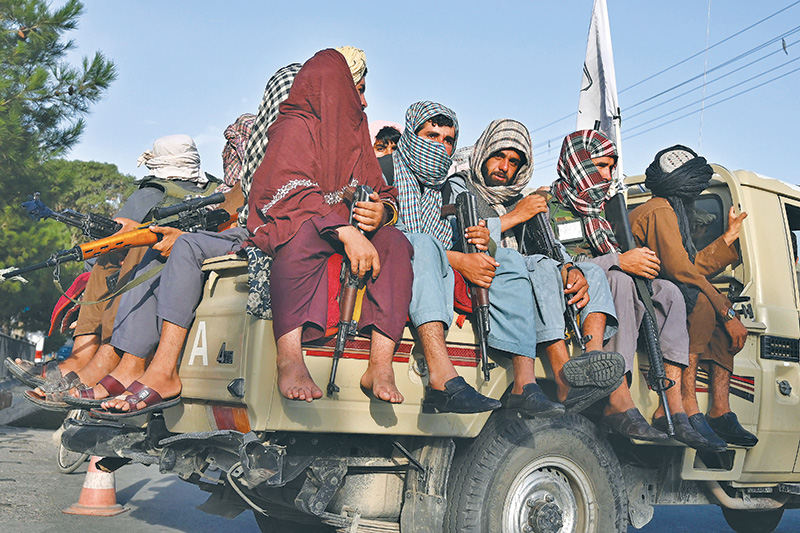
Taliban fighters in a vehicle patrol the streets of Kabul on Monday. Afp/Rss
KABUL, US troops ramped up efforts Tuesday to airlift thousands of people out of Kabul, after the Taliban warned they would not allow the United States to extend next week’s deadline for a complete withdrawal. President Joe Biden is under increasing pressure to go beyond an August 31 deadline he set to pull out American forces, with Britain to lobby at a virtual G7 summit on Tuesday for a longer presence. About 50,000 foreigners and Afghans have fled the country from Kabul’s airport since the Taliban swept into power 10 days ago, according to the US government. But crowds continued to mass outside the airport, with Afghans terrified of facing life under the Taliban. Many fear a repeat of the brutal interpretation of sharia law that the Taliban implemented when first in power from 1996 to 2001, or retribution for working with the US-backed government over the past two decades. “The Taliban are the same as they were 20 years ago,” Nilofar Bayat, a women’s rights activist and former captain of Afghanistan’s wheelchair basketball team, said after fleeing and arriving in Spain. “If you see Afghanistan now, it’s all men, there are no women because they don’t accept women as part of society.” The Taliban, who ended two decades of war with an astonishingly swift rout of government forces, had been publicly tolerant of the evacuation effort. But on Monday they described next week’s cut-off date as a “red line”. “If the US or UK were to seek additional time to continue evacuations -- the answer is no... there would be consequences,” spokesman Suhail Shaheen told Sky News. He said any foreign military presence beyond the agreed deadline would be “extending occupation”. The Taliban achieved their stunning victory thanks to Biden pulling out nearly all American troops from Afghanistan, following through on a deal struck with the Taliban by then-president Donald Trump. However Biden was forced to redeploy thousands of troops after the fall of Kabul to oversee the airlift. Biden and his top aides have repeatedly insisted they are aiming to stick to their August 31 deadline. “The goal is to get as many people out as fast as possible,” Pentagon spokesman John Kirby told reporters on Monday. “The focus is on trying to do this as best we can, by the end of the month.” But European leaders are calling for more time. British Defence Secretary Ben Wallace said Prime Minister Boris Johnson would raise the issue at the G7 virtual summit. Germany also said it was in talks with NATO allies and the Taliban to keep Kabul’s airport open for evacuations beyond August 31, while France said “additional time is needed to complete ongoing operations”. The rush to leave Kabul has sparked harrowing scenes and left at least eight people dead. Some have been crushed to death and at least one, a youth football player, died after falling off a plane. The German defence ministry said Monday an Afghan soldier was killed and three others wounded in a firefight with unknown assailants. The Taliban are currently working on forming a government, but two sources within the movement told AFP there would be no announcement on a cabinet until the last US soldier has left Afghanistan. The Taliban have repeatedly claimed to be different from their 1990s incarnation, and have declared an amnesty for government forces and officials. But an intelligence assessment conducted for the United Nations said militants were going door-to-door hunting former government officials and those who worked with US and NATO forces. In the capital and other cities, the former insurgents have enforced some sense of calm, with their fighters patrolling the streets and manning checkpoints. “We assure the people there are no security issues, if anyone faces any security problem they should come to us,” an armed Taliban guard told AFP in the eastern city of Jalalabad. The Taliban are also intent on quashing the last notable Afghan military resistance to their rule, made up of ex-government forces in the Panjshir Valley, north of the capital. The Panjshir has long been known as an anti-Taliban bastion. One of the leaders of the movement, named the National Resistance Front, is the son of famed anti-Taliban commander Ahmad Shah Massoud. Another is Amrullah Saleh, a vice president and head of intelligence in the fallen government. The Taliban have said they have massed forces outside the valley, but would prefer a negotiated end to the stand-off.
WORLD
CIA chief held secret meeting with Taliban in Kabul, report says
WASHINGTON: US Central Intelligence Agency chief William Burns held a secret meeting in Kabul with Taliban co-founder Mullah Abdul Ghani Baradar, the Washington Post reported on Tuesday. The Monday meeting, which if confirmed will have been the highest-level encounter between the Islamist group and the Biden administration since the militants’ return to power, came as efforts to evacuate thousands of people from Taliban-controlled Afghanistan became increasingly urgent. Burns is one of US President Joe Biden’s most experienced diplomats; while Baradar, who headed the Taliban’s political office in Qatar, is one of the top leaders in the regime that has taken power in Kabul. A spokesperson for the CIA would not confirm the meeting to AFP. The Washington Post, which cited anonymous US sources for the meeting, said it was likely that the meeting was held to discuss delays in the deadline for the United States to finish evacuations at the airport of the Afghan capital, where thousands of Afghans, terrified by the return of the Islamists, are still massed with the hope of fleeing the country. (AFP)
WORLD
WHO says it has medical supplies in Afghanistan for only a week
- REUTERS
CAIRO, The World Health Organization only has enough supplies in Afghanistan to last for a week after deliveries of medical equipment from abroad were blocked by restrictions at Kabul airport, a senior regional WHO official said on Tuesday. The UN agency was also concerned the current upheaval in Afghanistan could push up Covid-19 infections, with testing dropping by 77 percent in the past week and vaccinations also down, officials from the WHO’s Eastern Mediterranean office said. The WHO officials, in an online briefing, said 95percent of health facilities in Afghanistan remained operational but that some female staff had not returned to their posts and some female patients were now afraid to leave their homes. “We rapidly distributed lifesaving supplies to health facilities and partners in Kabul, Kandahar and Kunduz but WHO now only has enough supplies in country to last for one week. Yesterday 70 percent of these supplies were released to health facilities,” said WHO regional director Ahmed Al-Mandhari. Deliveries from Dubai of more than 500 tonnes of medical supplies including surgical equipment and severe malnutrition kits have been held up because of restrictions at Kabul airport, the WHO says. The agency was encouraged by feedback by countries offering flights to bring the supplies in and was hoping for progress this week, said Richard Brennan, the WHO’s regional emergency director. “We’re in negotiations with three or four countries ... I think we will be able to secure flights,” he said. After a major scaling back the WHO was stabilising its operations, Brennan said. “We have had some encouraging signs and encouraging communications, that the Taliban authorities have made it clear that they want the United Nations to stay, that they want the continuity of health services,” he said. “We remain cautiously optimistic that we will be able to get our operation back at increasing scale over the coming weeks.” Kabul airport has been overwhelmed by chaos and violence since the Taliban seized the Afghan capital on August 15. More than 18 million people, over half Afghanistan’s population, need humanitarian aid to survive, the UN says. “These needs are increasing daily,” Mandhari added.
WORLD
US review of Covid-19 origin unlikely to solve vexing questions
- REUTERS
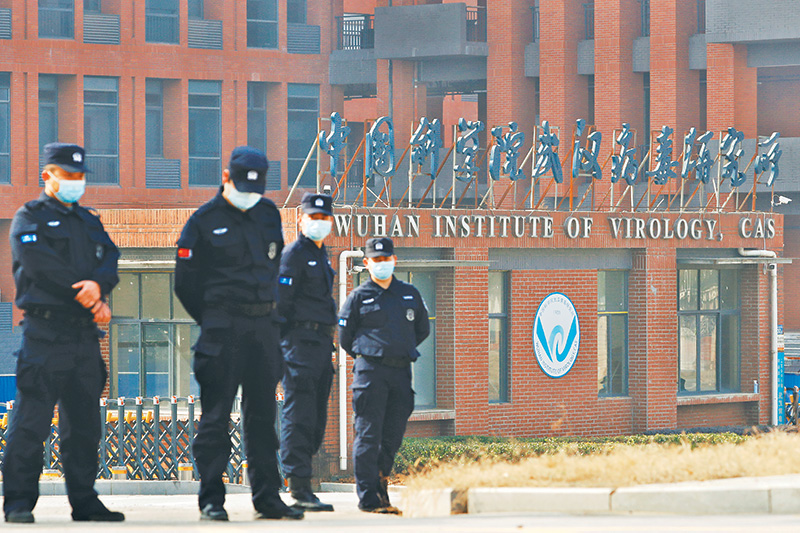
In this file photo, security personnel keep watch outside Wuhan Institute of Virology during the visit by the World Health Organization team to investigate the origins of coronavirus. REUTERS
WASHINGTON, President Joe Biden is set to be briefed on the US intelligence community’s investigation into how Covid-19 started, with the report likely to disappoint in delivering clear answers about the deadly pandemic’s origin in China. Biden in May ordered aides to work to resolve disputes among intelligence agencies examining rival theories about how the novel coronavirus started, including a once-dismissed theory about the possibility of a laboratory accident in China, as well as that the virus originated naturally with animals, such as bats or birds. A 90-day intelligence review the president ordered is due on Tuesday, according to White House press secretary Jen Psaki, with the release of unclassified portions likely to take a few days longer. Yet three US government officials and a fourth person familiar with the scope of the investigation said they did not expect the review to lead to firm conclusions after China stymied earlier international efforts to gather key information on the ground. Instead, one official said the report would likely point to additional lines of inquiry that officials could pursue, including demands of China that are likely to further ratchet up tensions with Beijing at a time when the country’s ties with Washington are at their lowest point in decades. “It’s basically impossible to have a proper investigation if one of the main parties doesn’t want to cooperate,” said Thomas Wright, Brookings Institution senior fellow and co-author of “Aftershocks,” a book about the pandemic with Biden’s Under Secretary of Defense Colin Kahl. “We need to proceed as if both hypotheses are true.” The report also comes as the US intelligence agencies have come under pressure from within the administration and Congress over issues related to the handling of Afghanistan after the fall of Kabul to the Taliban came faster than many US intelligence, defense and diplomatic analysts predicted. Covid-19 has killed 4.6 million people worldwide, according to a Reuters tally, but its precise origins remain shrouded in mystery. The first known cases emerged in the central Chinese city of Wuhan in December 2019 and US agencies started looking into the origins shortly afterwards. US spy agencies initially strongly favored the explanation that the virus originated in nature. A team led by the World Health Organization (WHO) that spent four weeks in and around Wuhan in January and February said the virus had probably been transmitted from bats to humans through another animal. But their March report, which was written jointly with Chinese scientists and concluded that the lab theory was “extremely unlikely,” did not satisfy Washington. People familiar with intelligence reporting have said that there has been little corroboration over recent months that the virus had spread widely and naturally amongst wild animals. Meanwhile, China has refused to give US researchers the kind of access to the Wuhan lab and officials there that the US believes it would need to definitively try to determine the virus’ origins. The WHO’s director-general, Tedros Adhanom Ghebreyesus, has said the group has not ruled out any hypothesis. The Geneva-based organisation is set to impanel a new group to further examine the origins of the virus causing Covid-19. For its part, China has ridiculed a theory that Covid-19 escaped from the state virology lab in Wuhan and pushed fringe theories including that the virus slipped out of a lab in Fort Detrick, Maryland, in 2019. A White House spokesperson declined to comment.
WORLD
Indian troops kill two rebel commanders, three others in Kashmir
Briering
- AGENCIES
SRINAGAR: Indian government forces killed two senior rebel commanders and three other militants in two separate counterinsurgency operations in disputed Kashmir, police said on Tuesday. The killings come during an intensified government offensive against anti-India rebels in Kashmir, which is divided between nuclear-armed India and Pakistan and claimed by both. Rebels have also killed several members of India’s governing party in the region and carried out attacks on Indian troops. Police and soldiers raided a village in the northwestern Sopore area late Monday and engaged at least three militants hiding in a house in a gun battle, police said.
WORLD
Harris rebukes China in speech on Indo-Pacific vision
Briefing
- AGENCIES
SINGAPORE: US Vice President Kamala Harris delivered a sharp rebuke to China for its incursions in the South China Sea, warning its actions there amount to “coercion” and “intimidation” and affirming that the US will support its allies in the region against Beijing’s advances. “We know that Beijing continues to coerce, to intimidate and to make claims to the vast majority of the South China Sea,” she said in a foreign policy speech on Tuesday in Singapore. “Beijing’s actions continue to undermine the rules-based order and threaten the sovereignty of nations.” Harris declared the US stands with our allies and our partners in the face of threats from China.
WORLD
Fighting in Syria’s Daraa displaces 38,000, UN says
Briefing
- AGENCIES
BEIRUT: Fighting between government forces and former rebels in the Syrian province of Daraa has displaced more than 38,000 people over the past month, the United Nations said on Tuesday, as truce talks falter. Daraa, retaken by government forces in 2018, has emerged as a new flashpoint in recent weeks as government forces tightened control over Daraa al-Balad, a southern district of the provincial capital that is considered a hub for former rebel fighters. Clashes between the two sides since late July have marked the biggest challenge yet to the Russian-brokered deal that returned the southern province to government control but allowed rebels to stay on in some areas. Russian-sponsored truce talks launched in the wake of the latest fighting have made little headway as the government has stepped up its campaign to root out remaining rebel fighters from Daraa al-Balad.
SPORTS
England face tough task against India
Joe Root’s side have a heavily depleted bowling attack while batting lineup is out-of-form and unstable.
- ASSOCIATED PRESS
England skipper Joe Root (left) and coach Chris Silverwood during a netssession ahead of their third Test cricket match against India. The match begins at Headingley on Wednesday. Ap/Rss
LEEDS, Test match cricket returns to Headingley this week for the first time since Ben Stokes made that astonishing, series-saving century in the Ashes in 2019. Two years later and England again find themselves in a sticky predicament in Leeds—and can’t fall back on their star allrounder to bail the team out this time. A heavily depleted bowling attack. An out-of-form and unstable batting lineup. A 1-0 deficit against a fired-up opponent. The Indians’ 151-run victory in the second Test was secured on a dramatic final day at Lord’s when England were bullied into submission in a fractious environment that saw lots of sledging from both teams. There might be plenty of respect for their respective abilities as batsmen, but there’s clearly no love lost between England captain Joe Root and his Indian counterpart, Virat Kohli. “There’s the theater and everything else surrounding the game. We’ve got to make sure that we play the game how we want to play and we look after that as best as we can, and not get too distracted or drawn into anything that’s not honest,” Root said in a video call after arriving at Headingley. Getting hounded into defeat at the home of cricket wasn’t a good look for England, and Root acknowledged making mistakes on Day five as he got caught up in the intensity of the occasion, with his team’s discipline and tactics suffering as a result. Root said he will learn lessons from that Test but his resources are getting thinner by the week and England are facing a tough task to recover. Their bowling department was already stretched—because of the injury-enforced absences of Jofra Archer, Stuart Broad, Olly Stone and Chris Woakes—before Mark Wood was also ruled out Monday with a shoulder injury sustained at Lord’s. England will again have to squeeze plenty out of 39-year-old paceman Jimmy Anderson, who will lead an inexperienced attack that still does not include Stokes, who is taking some time away from cricket for mental-health reasons. Stokes’ presence in the team—with both bat and ball, and also in the field—is being sorely missed. He often comes up with big, game-changing moments, none more so than at Headingley in 2019 when he made an unbeaten 135 in a scarcely believable chase of 359 that included a last-wicket partnership of 76 runs with Jack Leach. England’s batting lineup looks flaky, with Root at No 4 almost single-handedly keeping it together. Dawid Malan, now a limited-overs star, has been recalled in place of Dom Sibley and will bat at No 3 in his first Test in three years, with Haseeb Hameed set to jump up the order to opener. India might be able to call upon paceman Shardul Thakur, who was absent at Lord’s because of a hamstring injury, for the team’s first Test match in Leeds since 2002. However, with spin likely to play a bigger part than it has so far this series, offspinner Ravichandran Ashwin may be in line for a recall after missing out at both Trent Bridge in the first Test and again at Lord’s.
SPORTS
National men’s football team trimmed down
- Sports Bureau
KATHMANDU, Nepal national men’s football team were trimmed down to 25 members after forward Abhishek Rijal, goalkeeper Arpan Karki and defender Sishir Lekhi were excluded from the squad on Tuesday. National team’s Qatari coach Abdullah Almutairi left out the trio from the 28 players from closed camp training underway in Pokhara. The final squad will have 23 players. Nepal are preparing the team for two friendly matches against India to be held at the Dasharath Stadium and SAFF Championship to take place in the Maldives. The friendlies are scheduled for September 2 and 5 and the biennial Championship will be played from October 1 to 16 in Male. In the championship, Nepal will play against hosts Maldives in the opening match on October 1, Sri Lanka on October 4, India on October 10 and Bangladesh on October 13. Among the seven members of SAFF, Bhutan and Pakistan are not competing in the event. The top two finishers of the league stage will compete in the final on October 16. All the games will be played at the National Football Stadium in Male.
KATHMANDU, Seven new faces have made the final cut in the Nepali national squad announced by head coach Gary Phillips on Tuesday for AFC Women’s Asian Cup 2022 qualifiers. The Australian coach left out five players among 28 undergoing closed camp training at the ANFA Complex in Satdobato. The qualifiers are set to take place from September 18 to 24 in Tashkent, Uzbekistan. Among the new faces in the squad are defenders Bimala BK, Nisha Thokar and Srijana Singh, midfielders Preeti Rai, Rajani Thokar, Sabita Rana and forward Rashmi Ghising. Experienced defender Anchali Waiba, forward Sarmila Thapa, Amisha Karki, Hima Chaudhary and Manisha Raut have been left out from the final list of 23 players. Nepal are drawn in Group ‘F’ in the three-team group along with Hong Kong and the Philippines. Nepal are set to open their qualifiers campaign against the Philippines on September 18 before taking on Hong Kong on September 21. The Philippines and Hong Kong will vie in the last group match on September 24. The group winners among three teams will secure a place in the AFC Women’s Asian Cup India 2022 set to take place from January 20 to February 6. Earlier, Nepal were confirmed as the hosts of Group ‘F’ before the Asian Federation Confederation (AFC) shifted the tournament away owing to the Covid-19 pandemic.
LONDON, Michail Antonio’s record goal for West Ham was sealed with a kiss. The fun-loving striker became the London club’s all-time leading scorer in the Premier League era, moving onto 49 goals by netting twice in a 4-1 win over 10-man Leicester at the Olympic Stadium on Monday. Antonio’s first—a close-range shot on the turn to make it 3-1 in the 80th—moved him past Paolo Di Canio’s previous record mark of 47 and he celebrated by running to the sideline and raising aloft a cardboard cut-out of himself. Spinning around to cheers from a packed crowd, Antonio—whose goal celebrations often provide amusement—finished his routine by planting a kiss on himself before tossing the cut-out to the ground. He said the celebration was based on 2001 movie “Save The Last Dance” and was pre-planned, having placed the cut-out behind West Ham’s dugout before kickoff. “I’ve not been celebrating of late because of VAR,” Antonio said. “I was like, ‘If I’m making history, I’ve got to do something special.” Antonio still had time to add a second goal, stretching to prod home a finish in the 84th after controlling a right-wing cross. It wrapped up West Ham’s second straight victory to open the season. David Moyes’ side are one of five to be on a maximum six points after two rounds, and are in first place on goals scored. “I’ve challenged the players to find that extra two points that could have been enough to get us in the Champions League,” Moyes said, referring to his team finishing in sixth place last season—two points behind fourth-place Chelsea. West Ham haven’t started a top-flight season with two straight wins since 1997. They have eight goals so far, having beaten Newcastle 4-2 last weekend. Algeria winger Said Benrahma set up Pablo Fornals for West Ham’s 26th-minute opener before scoring himself to put West Ham 2-0 ahead. Antonio played a key role in Benrahma’s goal, intercepting a back pass by Leicester defender Caglar Soyuncu before playing the ball across the area for his teammate to convert. That meant Benrahma repeated his goal and assist from the win at Newcastle. Youri Tielemans pulled a goal back in the 69th minute for Leicester, who lost attacking midfielder Ayoze Perez to a straight red card in the 40th for a lunge at the ankle of Fornals. No foul was given initially, but referee Michael Oliver changed his mind after reviewing the incident on a pitchside monitor. Perez appeared to lose his balance just before the foul as a result of a tackle from behind by West Ham defender Aaron Cresswell. “If you look in isolation at the contact, it doesn’t look good,” Leicester manager Brendan Rodgers said. “But if you look back, there’s a foul on him, he gets clipped. If he goes down, he gets a free-kick. Because he’s clipped he’s stretching and makes the tackle.” Leicester opened with a 1-0 win over Wolverhampton.
MEDLEY
Horoscope
ARIES (March 21-April 19) **** Wednesday’s skies help you ground back down, Aries. The moon’s presence in your sign encourages you to focus on your physical health and appearance—making it an ideal day to reconnect with an exercise routine or pamper yourself.
TAURUS (April 20-May 20) **** Hide from the tribulations of the real world today, Taurus. The moon’s presence in individualistic Aries encourages solitude, recharging through nature, or reconnecting with your sense of spirituality. Devote your energy to making career goals.
GEMINI (May 21-June 21) ***** Your extroverted Twin is taking centre stage today, Gemini. Let yourself reconnect with your sense of community, as the moon cruises through excitable Aries. It’s an ideal day to meet with friends in person or reconnect with your social network.
CANCER (June 22-July 22) *** Cancer, you look to the nurturing, feeling-fueled moon for cosmic guidance. Wednesday’s skies witness the moon’s presence in fearless Aries, where she directs your focus towards getting ahead with career matters.
LEO (July 23-August 22) **** Leo, you tire easily of mundane routines and obligations. Let yourself breathe fresh life into your own fire today, as the moon treks through adventure-hungry Aries. The day may prompt frustration around communication styles in partnerships.
VIRGO (August 23-September 22) **** Wednesday’s skies call for quiet contemplation and intimate connections, Virgo. The moon slides through solitary Aries, sending your focus towards unresolved feelings that need acknowledgement. It’s an ideal day to journal or dive deep into therapy.
LIBRA (September 23-October 22) **** Libra, you learn about yourself through the intimate exploration of relationships. Wednesday’s skies hone in on this story, as the moon floats through your opposite sign of individualistic Aries. The day will intensify your awareness of partnership matters.
SCORPIO (October 23-November 21) **** You’re ready to sharpen your focus and get productive today, Scorpio. The moon cruises through go-getter Aries, helping you cross things off your to-do list quickly and efficiently. It will be easier to regain emotional equilibrium at home.
SAGITTARIUS (November 22-December 21) ***** Wednesday’s skies light up your creative fires, Sagittarius. Give yourself an outlet to pour your excitable energy into, as the fearless Aries moon urges you towards self-expression. Don’t be shy about calling attention towards yourself.
CAPRICORN (December 22-January 19) *** You tend to keep your eyes focused on the future and less on the past. Wednesday’s skies momentarily pull you into a deeper awareness of your foundations, family connections, and living space, as the moon floats through solitary Aries.
AQUARIUS (January 20-February 18) **** Let yourself seek the movement you crave today, Aquarius. The moon cruises through self-assertive Aries all day, encouraging you to share your voice and seek out fresh perspectives in your local environment. Today, it will be easy to stay focused.
PISCES (February 19-March 20) **** Send your focus towards the current state of your finances today, Pisces. The moon glides through initiative-taking Aries today, encouraging you to re-examine your resources and to balance out your budget. The day may bring unresolved relationship issues.
CULTURE & LIFESTYLE
The revered month of Gunla
During the holy month of Gunla, age-old traditions and rituals adapt out of necessity and a need for convenience.
- Shranup Tandukar
People from the Newa community play traditional music as they observe the month-long Gunla festival at Swayambhu stupa in Kathmandu. Post Photo: Beeju Maharjan
LALITPUR, For Newa Buddhists, Gunla, which is the tenth month of the lunar calendar Nepal Sambat, is the holiest month in the entire year. Gunla this year started from August 9 and will end on September 7. A typical day during Gunla starts with the echoes of traditional Newa musical instruments like dha baja (a drum-like musical instrument), animated crowds of people forming a procession, and melodies of Buddhist hymns and chants wafting through every nook and corner of bahas and bahis. “As a child, I used to notice an increase in the number of devotees at bihars as well as an increase in religious sermons during a particular month. That’s how I knew about the month of Gunla,” says Deepak Bajracharya, a 54-year-old priest and member of Hiranya Varna Mahabihar (The Golden Temple). Since last year, due to the Covid-19 pandemic, the intensity and fervour usually abundant during Gunla month has died down; the dha baja remains unplayed, the scriptures unread, and only the essential rituals carried out. However, the change in age-old traditions and rituals during Gunla aren’t only due to the recent pandemic, they have also slowly been altering for convenience.
Behind the festivities and into the origin There are two differing opinions about the celebration time period of Gunla; some regard it as the ninth month while others regard it as the tenth month. Alok Siddhi Tuladhar, a heritage conservationist, believes that this confusion stems from the fact that ‘gu’ means ‘nine’ and ‘la’ means ‘month’ in the Nepalbhasa. However, the lunar calendar of Nepal Sambat designates Gunla as the tenth month. He adds, “The origin of Gunla celebration may be related to the ancient practice of Buddhist priests and monks spending a month in a forest for meditation and spiritual growth. The common people who weren’t able to spend a month inside the forest would instead meditate and celebrate Buddhist rituals during this month which may have started the celebration of Gunla.” One of the other theories for the origin of this month-long celebration is connected to the agrarian history of Kathmandu Valley. Patan resident and Dha baja performer Shital Shakya says, “I heard from gurus and priests that in the past, before urbanisation of the Valley, Shrawan month signified a lull in field and farm works. During this month, the society filled with farmers had free time to devote to religious practices and spiritual awakening.”
Significance of Gunla Narayan Mulik, a priest of Bikramsila Mahabihar in Thabahil, says that Gunla is an auspicious month which is not only important for Newa Buddhists but “all Buddhists from different ethnicities and castes.” Celebrations during the Gunla month are as abundant as the bahas and bahis in the alleyways of Kathmandu Valley. Culture expert Satya Mohan Joshi in his book ‘Legends of Lalitpur and Related Tales’ writes that “The continuous flow of interrelated festivals during Gunla is literally a way of life for the Newa communities of Lalitpur. These festivals, unique in their own way and picturesque at all times, are based on mythology and religion and tinged with local characteristics.” Buddhist priests around Patan also believe that Gunla probably became the holiest month because of the different festivals and celebrations that fall on it. Swayambhu, the focal point of Newa Buddhism, also plays a vital role during the Gunla month. The Swayambhu stupa, regarded as one of the most sacred Buddhist sites in the Valley, hustles and bustles with throngs of devotees during this month. For the Newa Buddhists unable to visit Swayambhu, a visit to their local bihars during the Gunla month is the next best option. At the crack of dawn every day of Gunla, Gyani Maharjan makes a trip to Bikramsila Mahabihar from her residence in Lainchaur. She says that she hasn’t been able to visit Swayambhu for ten years due to old age and she has settled on visiting nearby bihars instead. “Gunla is a very important month for Buddhists. There are lots of celebrations with music and festivities all around during this month and I enjoy taking part. However, I cannot read the scriptures myself so I visit bihars and listen to the religious sermons and hymns.”
Some of the popular celebrations during Gunla Festivals and traditions during Gunla are varied; some are celebrated far and wide while some can even be limited to a specific locality or baha or bahi. One of the popular festivals of Gunla, Panchadaan is celebrated on the thirteenth day of the waning moon near the end of Gunla in Kathmandu. In Patan, Panchadaan, which fell on August 16 this year, is celebrated earlier than in Kathmandu and Bhaktapur. During Panchadaan, households showcase their statue of Dipankara Buddha and donate five grains—paddy, rice, wheat, green peas, and soybean—along with salt to incoming priests and monks while the priests and monks bless the Dipankara Buddha statues. Shital fondly remembers the past Panchadaan celebrations in her locality. “The Dipankara Buddha statues in front of every house looked like personal spiritual guardians. I believe that donating the grains during Panchadaan signifies the revered Buddhist tradition of altruism.” During the celebration of ‘Bogiwanegu’ or ‘Baghi’, which starts from the beginning of Gunla month, devotees visit all the stupas and Buddhist monasteries similar to the activity in Matya, which is derived from the words ‘mata’ meaning light and ‘ya’ meaning festival. During Matya, devotees wake up early in the morning around 4 am and visit almost every stupa and sacred area in Patan’s different bahas and bahis within a day with a procession of music and festivity. The devotees offer candles and butter lamps to stupas and Buddha statues. Deepak shares that “devotees visit almost 1,000 stupas in Patan area.” Tuladhar believes that this tradition acts as a way to conduct an ‘annual census’ of Buddhist monuments. “It might have been a rudimentary method of noting down the condition of all the stupas,” says Tuladhar. Patan-based priest Deepak agrees that Matya celebration allows devotees to gauge the condition of stupas and plan for renovations if needed. Unlike Matya, Bogiwanegu is only carried out during the night so the festival spans several days. For Bogiwanegu, Deepak shares that the nightfall timing of the pilgrimage is due to the deep reverence of Buddhists towards stupas. He says, “The stupa structure is so sacred during Gunla that even stepping on the shadows of the stupa can be considered immoral so during the ‘baghi’ festival, devotees make pilgrimage only during the night to avoid shadows. When the sun comes up, they stop their pilgrimage and when the sun goes down, they continue their pilgrimage.”
Evolution of the month-long festival “It was a question of survival[for the celebration of Gunla] but now there is no such worry,” says Tuladhar. He reminisces about a worrying trend during his teenage years when he would be accompanied by just two to three friends while going to the Swayambhu during Gunla. But now, he cheerfully says that he has noticed a positive trend of increased youth participation during the recent years. Hem Ratna Bajracharya, a charya dance instructor and priest of The Golden Temple, says that musical instruments and dancing entice youths to join these religious and cultural celebrations. “Some people only join charya classes for dancing. It’s not a bad thing though.” He says that he incorporates the religious and cultural origin and significance of these dances during classes so that the youths also have a taste of religion and culture. A need for convenience also became a pressing matter for adaptations. The tradition of devotees walking to Swayambhu accompanied by playing of musical instruments and reciting of hymns during early dawn is slowly adjusting to modern alternatives. Bhagwan Shakya, a resident of Itum Baha, shares that people have now started to rent out microbuses so that the whole community can reach Swayambhu together conveniently. During Panchadaan, most households would showcase a statue of Dipankar Buddha, give alms, and receive blessings. But Tuladhar laments that this tradition has been moulded into a joint activity in areas like Ason where individual houses band together and create a communal donation area instead. “In the name of convenience and necessity, we might be forgetting the meaning of the festival,” says Tuladhar. The recent pandemic has also forced these traditions and celebrations to adapt—the extent differing from baha to baha, bahi to bahi, and family to family. Almost all of the bahas in the Valley are devoid of the sweet melody of musical instruments and the essential rituals are being performed in a toned down scale. In Itum baha, Kathmandu a daily chant of Buddhist hymns can be heard early in the morning during Gunla. A crowd of around 15 people gather in the baha, start chanting hymns and verses from thin photocopies of Buddhist scriptures, then move on to encircle the whole community while reciting hymns. Bhagwan, also one of the members of this crowd, says, “Last year, we didn’t do anything because of the pandemic. But this year, we decided to at least continue with our daily gatherings in the morning.” The baha comes alive during the morning but as the morning gives way to the day, the small crowd of people start to dwindle along with life in the baha. “If we do not give continuity to our culture and traditions, then people who come looking to know about our culture will return empty-handed,” he says. “If we do not continue, who else will?”