You internet speed is slow. Switch to text view mode

Switch
epaper logo
ST

Last Login:
Logout
+
Page 1
HOME PAGE

Covid-19 antibodies in large chunk of population may not mean immunity
Experts say the hurried statement on seroprevalence study could create confusion, as it’s premature to conclude Nepal is close to reaching herd immunity.
- Arjun Poudel
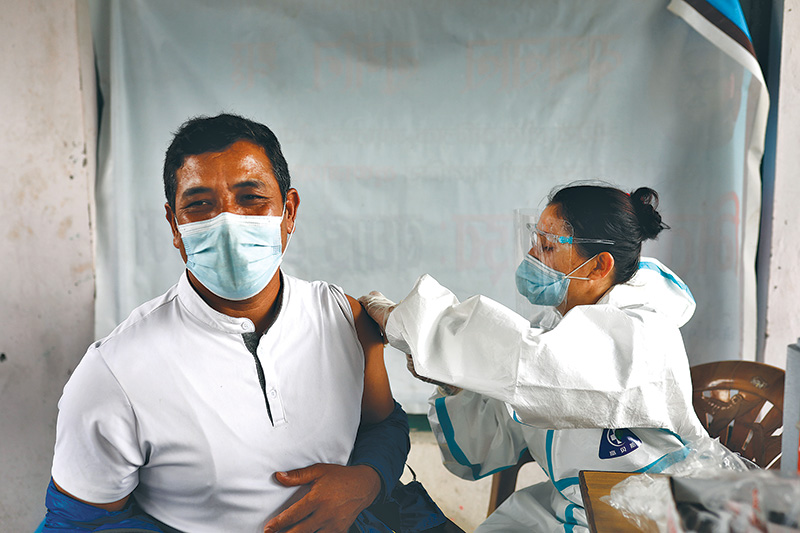
Doctors say vaccination is the best way to protect against the SARS-CoV-2 infection. Post file Photo

KATHMANDU, 
Preliminary findings of a new nationwide seroprevalence study by the Ministry of Health and Population show that 68.6 percent of the country’s population has already developed antibodies against Covid-19.
The latest findings of the study, the detailed report of which is yet to be released, indicates that SARS-CoV-2 has spread rampantly in the communities and measures taken to break the chain of transmission are inadequate and ineffective as over two-thirds of the country’s population has already been infected before August 14.
Carrying out such a large-scale survey among the general population offers public health agencies a picture of the spread of infection in communities, especially during a pandemic that killed over 10,700 people.
But on Sunday, a statement by the Health Ministry outlining preliminary findings of antibodies and vaccine efficacy has given room for misinterpretations, according to public health experts who say it would be dangerous to make a hasty conclusion.
“We don’t know the percentage of the antibodies... or if it is effective against the Delta variant of the virus circulating in communities at present,” Dr Dipesh Tamrakar, an assistant professor at the Kathmandu University, who served under the Community Medicine Department at Dhulikhel Hospital, told the Post.
In its statement on Sunday, the Health Ministry also said that similar levels of antibodies had been found in people residing in all seven provinces, all three geographical areas–mountain, hills and the Tarai, villages and towns, all genders, professions and groups.
Officials at the Health Ministry say that the recent decline in new cases could be a reason for two-thirds of the population already infected with the virus and that the risk of a massive explosion of new infections remains low.
Doctors, however, say that it is impossible to develop a similar level of antibodies in the people residing in all seven provinces throughout the country and all three geographical areas, towns and villages and people of all ages.
“Development of similar levels of antibodies in all age groups has not happened anywhere in the world,” said Tamrakar. “Studies show it (development of the antibodies level) varies according to age, and it is a proven fact.”
Some countries, including the United States, have decided to give a third dose as a booster shot to those with compromised immunity.
“We also do not know whether or not the antibodies work against the new variant of the virus,” Dr Prabhat Adhikari, infectious disease and critical care expert, told the Post. “For that, a neutralising test is required, which we have not done yet.”
A neutralising antibody is an antibody that is responsible for defending cells from the pathogen, which are organisms that cause diseases.
They are produced naturally by the body as part of its immune response, and their production is caused by both infection and vaccination against infections.
According to the World Health Organisation, available scientific data suggest that in most people, immune responses remain robust and protective against reinfection for at least six to eight months after infection (the longest follow up with strong scientific evidence is currently approximately eight months).
Individuals with mild or asymptomatic infection tend to have lower antibody levels than those with severe disease. Some studies have suggested that waning of antibody levels occurs
within several months after infection in some individuals.
After the ministry statement on the seroprevalence study, some have been quick to say that the country is close to reaching herd immunity, a situation when a large portion of a community (the herd) becomes immune to a disease, making the spread of disease from person to person unlikely.
Experts disagree.
“We are nowhere close to reaching a herd immunity level, as a huge number of the population is yet to be fully vaccinated,” Dr Sher Bahadur Pun, a virologist and chief of the Clinical Research Unit at Sukraraj Tropical and Infectious Disease Hospital, told the Post.
Going by the ministry statement, doctors say 10 percent of the fully vaccinated population and 20 percent of those who have taken the first dose do not have antibodies. This, according to them, means there is a chance of getting infected–severely–and even death.
Though vaccination is the best way to protect against the SARS-CoV-2 infection, some studies show the existing vaccines are less effective against the Delta variant, and discussions are being held to administer booster shots.
The Health Ministry said that the Delta variant of the virus is responsible for the ongoing infection throughout the country. Whole-genome studies carried out in the past also showed that the Delta variant of the virus, which is highly infectious, is circulating throughout the country.
“The study shows people in all three geographical areas and all seven provinces have similar levels of antibodies,” Dr Samir Kumar Adhikari, joint spokesperson for the Health Ministry, told the Post. “The study indicates a large number of people have antibodies which may mean we may not see a large-scale outbreak immediately.”
Adhikari, however, concedes that immunity developed by natural infections wanes after a certain period and public health measures are still relevant.
So far, 5,317,483 people have taken their first dose of the vaccine (17.7percent), and 4,396,402 (14.65 percent) have been fully vaccinated.
“As the coronavirus keeps mutating, immunity developed from one variant may not protect an individual against another deadly variant,” said Pun. “Risk has not lessened at all. Authorities concerned should still focus on preventive measures.”
The World Health Organisation’s chief scientist Dr Soumya Swaminathan recently said that Covid-19 in India may be entering some kind of endemic stage, where there is a low or moderate level of transmission.
Doctors say the situation will be different in Nepal if the virus enters the endemic stage in India.
On Monday, 1,902 people tested positive from 11,892 polymerase chain reaction tests, and an additional 393 people tested positive in 4,341 antigen tests.
The positivity rate is around 16 percent.
Doctors say the decline in tests could be the reason for the less number of new cases. Currently, thousands of healthy people going abroad are undergoing tests every day. The Health Ministry, in its daily report, also includes the test results of those people who seek tests for getting “negative reports” required for flying abroad for studies or work, thereby creating confusion about the actual Covid-19 situation.
“Infection rate has remained almost constant for months, and the positivity rate has hovered around 15 percent,” said Pun. “We don’t know the exact scale of the spread, but Covid-19 may become endemic in our country too.”

HOME PAGE

Nepal caught in virus geopolitical games as US and China spar over origin

Kathmandu should maintain a neutral position, as Covid-19 crisis is not over yet and it cannot afford to antagonise any friendly nations, analysts say.
- ANIL GIRI

KATHMANDU,
The Embassy of China in Kathmandu on Monday morning issued a statement, attributed to its spokesperson, on Covid-19 Origin-Tracing Report released by the United States government which has stated that Beijing is trying to hold back international investigation and rejecting calls for transparency.
The statement further says that more than 80 countries, including Nepal, have written to the World Health Organisation director-general, issued statements, or sent diplomatic notes to voice their objection to the politicisation attempts and call for the Joint Report by the WHO-China joint study team to be upheld.
Nepal is now in a bind.
This is the first time Nepal has been dragged into a larger geopolitical game between the West versus China.
Washington and Beijing are at loggerheads over lab leak conspiracy theories. The United States, earlier under Donald Trump and now under Joe Biden, has pushed for a origin-tracing investigation.
However, after rejecting the calls for a fresh origin-tracing investigation, China has launched a new theory that the virus was leaked from an American military lab.
The Chinese push that Nepal make a position makes it difficult for Kathmandu.  
Both the US and China are Nepal’s good allies, and Kathmandu cannot afford to antagonise either. Nepal is now under pressure to take a side on the proposed second phase of investigation into the origins of Covid-19.
Both the countries’ support and assistance to Nepal have been immense in the fight against the pandemic.
China so far has provided the largest number of vaccine doses either in grants or under commercial deals.
China has delivered more than 7.4 million doses of vaccine to Nepal through grant assistance or commercial purchase, and this makes it the largest vaccine supplier to Nepal until now.
The US, on the other hand, has also supplied vaccine doses and other medical assistance and promised more jabs.
Neither the government of Nepal nor the Ministry of Foreign Affairs has made public any official position yet.
But officials in the know say Mani Bhattarai, Nepal’s permanent representative to the United Nations in Geneva, has submitted a note verbale to Dr Tedros Adhanon Ghebreyesus, the director general of the World Health Organisation in Geneva.
According to officials in Kathmandu, the note verbale that Nepal has submitted at the WHO headquarters echoes Nepal’s stated position that it calls for scientific evidence and research.
Repeated attempts to speak to Bhattarai went unanswered.
A senior government official who is familiar with Nepal’s position on the matter told the Post that the remarks made by the Chinese Embassy in Kathmandu which stated that Nepal objects to the politicisation of the Covid-19 origin, was in fact from March and not recent.
After the US insisted on the second proposal to carry out the investigation, the Chinese side made yet another request to make its position clear, officials say.  
After the Chinese request to Nepal to make a position, the Ministry of Foreign Affairs communicated to its Geneva-based Permanent Representative about Nepal’s position some two weeks back, according to Sewa Lamsal, spokesperson for the Foreign Ministry.
Nepal, however, appears to be caught between a rock and a hard place.
In its statement, China has minced no words to explain its cooperation to Nepal.
“Since the outbreak of the Covid-19 pandemic, China and Nepal have always helped and supported each other, setting a good example of international cooperation in the fight against the pandemic,” said the Chinese embassy.
“China thanks Nepal for always adhering to an objective and fair position and giving China valuable support on the issue of origin-tracing.”
The embassy also said that China will continue to strengthen anti-pandemic cooperation with Nepal, provide more vaccines to Nepal within its capacity, and work together with Nepal to resist the headwind of politicisation of origin-tracing and safeguard the sound atmosphere of global anti-epidemic cooperation.
China has rejected the WHO’s next-phase origin-tracing work proposal saying that it is not based on scientific evidence gathered from the first-phase study jointly conducted by Chinese and foreign experts in Wuhan, central China’s Hubei Province, earlier this year, from where the first coronavirus cases were reported.
“We have not supported the Chinese rejection to carry out the second investigation. Nor have we fully supported the calls made by the US,” said another Foreign Ministry official who did not want to be named. “We understand the geopolitical rivalry tied to this issue and we don’t want to be dragged into all this.”
After the second Covid-19 wave, which slid into a devastating crisis, as around 6,000 people died of the virus within weeks from mid-April, Nepal feels it is in a precarious situation. India, the southern neighbour, with a population of more than 1.3 million, is predicting the third wave, and if it strikes there, Nepal cannot remain untouched. In such a situation, Nepal’s priority right now is to stay safe and vaccinate as many people at the earliest.
But Nepal does not have enough doses and it is to secure vaccines from wherever it can get. With India, considered the vaccine powerhouse, itself struggling, Nepal sees the US and China as the best options who could supply the jabs.
The rivalry between the two countries and Nepal’s entanglement into that, however, could make it more difficult for the country when it comes to fighting the pandemic.
A senior government official said Nepal’s principled position is that it will follow any scientific research backed by the WHO.
“It’s not in our interest to get into any lab-leak theories… no matter whichever country is talking about it,” said the official requesting anonymity as he was not authorised to speak to the media on the matter. “We are not going to take sides. We have reiterated our position based on internationally accepted principles.”
Dr Roshan Pokhrel, secretary at the Health Ministry, said that Nepal is against politicisation of the virus, but the ministry has not sent any notes to anyone on the issue so far.
Former diplomats say it is difficult for Nepal to make a public position on the issue, as it is tied with geopolitical ramifications. Nepal needs to tread carefully, according to them.
Shambhuram Simkhada, Nepal’s former permanent representative to Geneva, said that Nepal should pursue and stress scientific research on the origin of the virus so that the information can be useful in the future as well.
“A vast majority of the scientific community has ruled out the lab-leak theory so I have doubts over it. And politically, it is very difficult for Nepal to make a position,” Simkhada told the Post. “It would be better for Nepal to follow and consult close neighbours like India, Bangladesh and Sri Lanka, to name a few. Their positions may help us understand how we should move ahead in such a sensitive matter.”
Some experts see the US-China virus blame-game as a new “cold war”. Nepal should pursue its old non-aligned foreign policy so as not to affect its quest for more Covid-19 vaccines, according to them.
“Nepal should keep itself far from the rivalry between major powers,” said Khadga KC, who teaches international relations and diplomacy at the Tribhuvan University. “The origin of the virus and conspiracies surrounding it are something to be dealt with by scientists.”
According to KC, Nepal should focus on how it can secure more vaccines sooner.
“Our focus should be on inoculating as many people as possible at the earliest,” said KC. “We are in the midst of a pandemic. While saying that Nepal is always for evidence-based studies, Nepal should maintain a neutral policy. It’s not the time to antagonise anyone. Definitely not our friendly nations.”

Page 2
NATIONAL

Floods, landslides continue to wreak havoc

Three persons died, two others have gone missing in Duhun Rural Municipality of Darchula district in the past 24 hours.
- MANOJ BADU
Seven houses were buried in a landslide at Jyotinagar Bamghat in Butwal on Monday.  Post Photo: Amrita Anmol

DARCHULA,
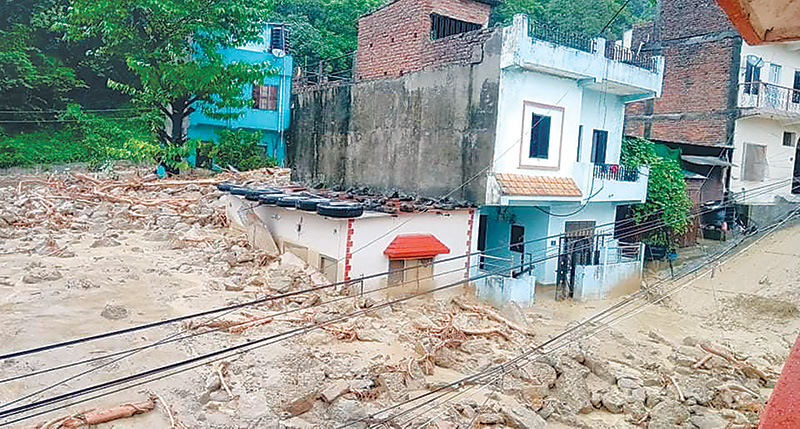
At least three people died and two others went missing over the past 24 hours as heavy rainfall triggered landslides and floods in Darchula.
Police said a landslide buried a house at Baspali in Duhun Rural Municipality, killing a 76-year-old man and his 66-year-old wife on Sunday night. Similarly, an 84-year-old man died while his wife and another local man were injured when floods in the Kalagad stream inundated the Dulla area in the same rural municipality. The injured were airlifted to Kathmandu in a Nepal Army helicopter on Monday.
In a separate incident, Sher Singh Karki and his brother Harak Singh Karki of Duhun Rural Municipality went missing from a local water mill in the Nijaggad stream on Monday morning. Security personnel and local residents suspect that the Karki brothers might have been swept away by the rain-swollen stream.
“Search is underway to find the missing brothers,” said Bhatta. “The flooded Nijaggad stream has swept away six water mills in the area.”
Heavy rainfall has triggered landslides and floods in various places of Darchula.
“Floods and landslides have damaged lives and properties in several places. Security personnel are yet to assess the damage caused by the disasters,” said Deputy Superintendent of Police Manohar Prasad Bhatta.
It has been raining heavily in Darchula since Sunday.
Floods in the Kalagad and Nijaggad streams have caused huge damages in riverside settlements.
“Human casualties were prevented as the local residents evacuated their homes after the Kalagad stream started overflowing at around 10pm on Sunday,” said Mansingh,  a local resident. According to him, a dam formed at Simar stream after landslide blockage burst, causing huge damage to downstream settlements.
The floods in Kalagad also swept away two micro-hydropower projects, disrupting power supply to six villages. At least 10 families have been displaced in the area, police said.
“Security personnel, people’s representatives and locals have been mobilised to rescue and provide relief to the victims. Relief work has been affected, as the floods swept away bridges and pathways,” said Pulendra Bahadur Karki, the chairman of the local unit. According to him, floods and landslides have completely destroyed six houses and partially damaged 22 houses in the local unit. Forty other houses are at risk.
The floods in the Nijaggad river also swept away 10 houses in Duhun-3 and Ward No 1 of Mahakali Municipality.
According to police, the flooded Nijaggad stream swept away a motorable bridge along the Darchula-Tinkar road, two suspension bridges and a post of Api-Nampa Conservation Area.
Similarly, floods in the local streams of Api Himal Rural Municipality-6 swept away two suspension bridges and some water mills and wooden bridges in the area.
In Butwal, seven houses were buried in a landslide at Jyotinagar Bamghat in Butwal Sub Metropolitan City-3 on Monday. However, no human casualties have been reported so far, according to police.
According to Madan Kunwar, deputy superintendent of police at the Area Police Office in Butwal, 50 other houses in the city have been affected by the landslide.
“The landslide has not stopped. We have requested local residents to stay alert,” Kunwar said.
Some displaced families are taking shelter at Butwal Multiple Campus while others are staying at their relatives’ houses, said Kunwar.
Since 4pm on Monday, vehicular movement in Daunne section of Bardaghat-Dumkibas road along the East-West Highway has been obstructed due to multiple landslides in Khursani Khola, three kilometres west from Dumkibas bazaar.
“Vehicles have been stranded in the Bardaghat area since Monday afternoon,” said Hari Paudel, a resident of Gaindakot.
Chief District Officer of Nawalparasi (East) Manamaya Pangeni said dozers have been mobilised to clear the road blockage.  
For the last five days, transportation has remained disrupted in the Gaindakot section of the East-West Highway due to landslides.


(With inputs from our correspondents in Lumbini and Gandaki provinces.)

NATIONAL

Dakhakwadi residents struggle to keep sandalwood smugglers at bay

More than a dozen sandalwood trees were stolen from the Pyuthan village in the past six months.
- SHAMSHER BIKRAM GC
Dakhakwadi village in Pyuthan is considered a pocket area of sandalwood groves.  Post Photo: SHAMSHER BIKRAM GC

PYUTHAN,
Local farmers of Dakhakwadi in Pyuthan Municipality-1 are having a tough time protecting their sandalwood trees from smugglers.
“Smugglers enter the sandalwood grove at night to steal the trees,” said Gobinda Pokharel of Dakhakwadi. Two of his sandalwood trees, approximately 35 years old, were stolen from his field on August 6 and August 9 respectively. “I took great care of those trees over the years. These trees are our only source of income and we haven’t been able to save them from being stolen.”
Pokharel has around 10 sandalwood trees in his field, which is around two kilometres from his house.
“My field is near the forest. It’s not possible for us to guard the field throughout the night,” he said. “We have asked the local authorities to look into the matter and provide security in the area to control theft.”
According to him, he has incurred a loss of approximately Rs 150,000 after two of his sandalwood trees were stolen.  
Dakhakwadi is considered a pocket area of sandalwood groves. There are around 150 households and each household has 10-12 sandalwood trees on average.
According to the local people, more than a dozen sandalwood trees were stolen from the area in the past six months.
“Thieves cut down our trees and take away precious wood at night. If this continues, there won’t be any sandalwood trees left in the village,” said Narayan Dhami of Dakhakwadi. He also recently lost his 30-year-old sandalwood tree to smugglers.
According to Dhami, the local people have filed complaints at the District Police Office and the Division Forest Office about the theft on numerous occasions but neither of the offices has so far taken any concrete initiatives to address their issue.
“We have filed complaints at the Division Forest Office to find the culprits involved in this illegal trade. We have also requested the authority to secure our trees,” Dhami said.
In February this year, 15 sandalwood trees were stolen from the fields of Dakhakwadi in a single night. According to local residents, the stolen sandalwood trees were worth Rs 1 million market value. Currently, sandalwood is priced at Rs 7,000 per kilo in the market.
The last reported theft of sandalwood trees in Dakhakwadi was seven to eight years ago, say local residents. Since then, there had been no such incident until February. Incidents of sandalwood tree theft have become a regular occurrence now.
“We don’t know who the smugglers are since they’ve never been caught,” said Gir Bahadur Dhami, a resident of Dakhakwadi. “The smugglers made away with two of my sandalwood trees in February.”
With no means to stop the trees from being stolen, Dakhakwadi residents have started cutting down premature trees in order to sell them for whatever little profit they can make.
Sandalwood trees can be felled only after taking permission from the Division Forest Office in Pyuthan.
A few months ago, the Division Forest Office arrested three individuals on the charge of smuggling red sandalwoods from the district.
Deepak KC, assistant forest officer at the Division Forest Office in Pyuthan, said, “None of the individuals had received permission to cut down sandalwood trees in Pyuthan. However, 172.93 kilograms of illegal sandalwood have been seized from various parts of the district.”

Page 3
NATIONAL

Government saw a drop in dividend income from public enterprises last fiscal year

The Covid-19 pandemic and deferral of loan repayments affected profitability of banks, officials say.
- PRITHVI MAN SHRESTHA

KATHMANDU,
The partially state-owned Agricultural Development Bank had paid the government Rs1.08 billion in dividend in the fiscal year 2019-20 but this dropped to Rs 640 million in the last fiscal year 2020-21.
Other public enterprises also reported decreased profits and paid smaller dividends to the government in the last fiscal year 2020-21 apparently due to the Covid-19 among other things, according to the Public Debt Management Office, which keeps records of dividends received by the government from public enterprises.
According to the office, the total dividend received by the government from public enterprises decreased
significantly to Rs6.75 billion in the last fiscal year from Rs14.09 billion a year earlier.
“The dividend received by the government dropped sharply in the last fiscal year. I don’t know the real reason but the Covid-19 pandemic might have affected the profitability of many state-owned enterprises,” said Deepak Gautam, undersecretary at the office.
In the case of the banks, the government and central bank’s policy of allowing pandemic-hit businesses to delay their loan instalment payments by up to a year also affected the profits of banks in the last fiscal year.
For example, many of the borrowers from the worst-affected sectors, which were supposed to pay the loan instalments by mid-July 2020 could pay their loan instalments by mid-July 2021 only.
Similarly, borrowers from the moderately impacted sectors were allowed to delay their loan instalments payment by nine months until mid-April 2021 and those facing mild impact of the pandemic were allowed to delay their instalments payment by six months, until mid-January 2021, according to the monetary policy 2020-21.
“The main reason for the decline in the government’s dividend income is the pandemic, which hit the banks’ profits,” said  Himalal Paudyal, spokesperson at the Agriculture Development Bank Limited. “We are continuing to provide extra Rs320 million to the government against its preference shares in the bank.”
He said that the deferral of loan payments affected the interest income and principal recovery in the last fiscal year affecting the bank’s profitability. However, the bank’s overall profit has slightly gone up in the last fiscal year. According to the financial statement of the bank for the last fiscal year, its overall profit has improved slightly but interest income has dropped.
Its net profit in the last fiscal year was Rs3.69 billion up from Rs3.33 billion in the previous fiscal year. But its interest income dropped to Rs14.51 billion in the last fiscal from Rs15.82 billion in the previous fiscal year.
The dividend income from the Rastriya Banijya Bank also went down to Rs315 million in the last fiscal year compared to Rs1.08 billion a year earlier, according to the Public Debt Management Office.
Its net profit in the last fiscal 2020-21 was Rs3.79 billion down from Rs4.37 billion in the previous fiscal year, according to its financial statement.
Likewise, Nepal Telecom, which has remained as one of the largest dividend contributors to the government over the last several years also paid a smaller dividend in the last fiscal year than a year earlier.
According to the Public Debt Management Office, the telecom giant paid the government Rs5.48 billion in dividend in the last fiscal year compared to Rs6.17 billion a year before.  
Likewise, the dividend payment by the Nepal Stock Exchange also decreased to Rs87.9 million in the last fiscal year from Rs117.3 million a year before, and Nepal Oil Corporation’s slumped to Rs188.1 million from Rs5.15 billion. The government received Rs29.8 million from the Butwal Power Company and Rs995 from Sajha Sewa in dividend payments in the last fiscal year, according to the Public Debt Management Office.
Despite huge investments by the government in public enterprises in the form of shares or loans, the returns have remained insignificant.
As of the fiscal year 2019-20, the government has invested a total of Rs519.55 billion in public enterprises including share investments worth Rs288.65 billion. The dividend received by the government in fiscal 2019-20 was just 4.88 percent of the total share investment.

NATIONAL

Coalition partners ask Deuba to release report on Dhami disappearance case

Prime Minister Deuba seems to be trying to dismiss the incident in order not to offend India, analysts say.
- TIKA R PRADHAN

KATHMANDU,
Leaders of the ruling coalition on Monday expressed dissatisfaction at the government delay in releasing
the investigation report on the disappearance of Jaya Singh Dhami in the Mahakali river last month.
The leaders, at a meeting called by Prime Minister Sher Bahadur Deuba at Baluwatar to discuss Cabinet expansion and government plan to replace the past government’s budget ordinance, urged the government to release the report at the earliest.
Dhami, a youth from Darchula, went missing in the Mahakali river on July 30 after the Indian border security personnel allegedly dismantled an improvised cable crossing across the river when he was attempting to cross the river.
Monday’s was the first meeting of the coalition partners after the split in the CPN-UML and the Janata Samajbadi Party with the help of the ordinance to amend the Political Parties Act 2017.
“At the meeting I told the prime minister to make public the investigation report on Dhami’s disappearance and resolve the issue through talks with the Indian side,” said Janata Samajbadi Party leader and former prime minister Baburam Bhattarai.
Besides Bhattarai, the party’s chairman Upendra Yadav was also present at the meeting.
Leaders of the Communist Party of Nepal (Maoist Centre) Narayan Kaji Shrestha and Dev Prasad Gurung, and leader of the newly-registered CPN (Unified Socialist) Beduram Bhusal had also questioned the prime minister about the government’s delay in releasing the probe report and resolving the issue, which they said is linked to Nepal’s national interests.
One of the leaders, who demanded that the government release the report without delay, told the Post that the government is not taking the issue seriously.
“The setting up of the probe panel itself seems to be a perfunctory act of the government,” the leader told the Post. “It seems that Deuba is trying to dismiss the incident. If that is the case, it won’t be acceptable.”
Although the prime minister told the meeting that the report would be released soon, an official at the Home Ministry said the report should be released on Tuesday but no preparations have been made yet.
“I don’t think the report will be out tomorrow,” said the official, asking not to be named.
Joint secretary at the Home Ministry Janardan Gautam, who leads the probe panel, could not be reached for a comment.
Formed in the first week of August, the investigation team had initially been given ten days and later seven more days to submit its report.
Instead of releasing the report, the Deuba government had announced a Rs1 million compensation for Dhami’s family.
Meanwhile, some political analysts and observers say dissatisfaction is brewing among the coalition partners over the performance of the Deuba government and they are using the Dhami disappearance issue to put pressure on the
prime minister.
“It seems that Deuba doesn’t want to offend India by remaining silent about the Dhami case,” said Jhalak Subedi, a political analyst. “But the left parties in the coalition will find such a stance untenable amid growing public criticism of the government inaction.”
Others, however, say the issues raised by the coalition partners are genuine and the government’s poor handling of such a sensitive issue would adversely affect the image of the coalition.
“Actually, they wanted to show that coalition partners were sensitive about the disappearance,” said Krishna Pokharel, a professor of political science at Tribhuvan University. “But nothing is going to happen unless India cooperates
in the investigation.”
Another political analyst Puranjan Acharya also said the coalition leaders were fed up with the lacklustre performance of the new government.
“The people are anxious over the government’s inaction and sluggish nature and so are the coalition partners,” said Acharya. “It’s a common move on the part of the coalition leaders to create pressure on their government because it is a very sensitive issue.”

NATIONAL

Thamel’s night business operators submit keys to their shops to CDO

They have accused the government of letting other businesses open and restricting only theirs.
- ANUP OJHA
Over 30,000 people who were employed by various nighttime businesses at Thamel have lost their jobs since the pandemic. Post file photo

KATHMANDU,
On Sunday, a group of night business owners from Thamel submitted the keys to their stores and businesses to Kathmandu Chief District Officer in protest of prolonged Covid-19 restrictions.
Authorities have still not allowed pubs, restaurants, clubs and other places of nighttime entertainment to operate, even though they have largely lifted the restrictions on other businesses. The prohibition has greatly affected the nighttime businesses of Thamel, Kathmandu’s tourist hub.   
“Everything is open now. It’s only our business that the government wants closed,” said Subash Gharti Chhetri, a club owner at Thamel.  
Chhetri was part of the delegation that handed over the keys to more than one  hundred shops and businesses to Kathmandu CDO along with a memorandum.  
Thamel has been wearing a deserted look ever since the first wave of Covid-19 hit the country and Nepal went under a lockdown on March 24 last year. Although the nighttime businesses resumed after the lockdown was lifted, they were shut again after the authorities enforced prohibitory orders in late April when the second wave of infection gripped the country.  
According to Thamel Tourism Development Council, Thamel has over 200 nighttime businesses with average daily turnover of Rs50 million. The Covid-19 pandemic and subsequent restrictions have upended these businesses.   
Things have been particularly hard for business owners like Chhetri, the club owner. The 33-year-old said he had only just opened the club when the pandemic hit the country.  
“I had invested Rs80 million in the club. The business had to be closed after just three months,” he said.  
The restrictions on nighttime businesses in Thamel have also caused many job losses.
Chhetri said he had to let go of over three dozen staff employed at his club.  
The councils’ report shows that the night businesses at Thamel employed over 30,000 people, but all are unemployed now; 60 percent of them were laid off after the first lockdown last year.
Sahara Khadka runs Kathmandu’s first openly LGBTIQ-friendly restaurant and bar at Thamel.
She said besides financial hardship, the ongoing restrictions have also denied safe space for many LGBTIQ people.  
“If the government is collecting taxes from businesses, it should also allow businesses to operate,” she said. “The government has kept the entertainment industry on its lowest priority but it should understand that many lives depend on it.”
She said if the government intends to keep the nighttime businesses closed indefinitely, it should come up with a plan to compensate them.  
Ashok Thapa, secretary of Night Business Association and a bar owner at Thamel, said the nighttime public movement was markedly low these days and that safety should not be an issue if the nighttime businesses were allowed to reopen.
“We are ready to follow the health and safety protocols to run our operations safely,” said Thapa.  
He said because of the pandemic he was forced to lay off half of the staff at his bar.  
Earlier, the delegation of Thamel-based nighttime business operators had submitted a letter to the Ministry of Tourism, demanding that all businesses at Kathmandu’s tourist district be allowed to operate without any restrictions.  
“We have been informed that the ministry has already written to the Covid-19 Crisis Management Centre and it has also directed Kathmandu’s CDO to do the needful. But so far our concern remains unaddressed,” said Thapa.
Kathmandu CDO Kali Prasad Parajuli said his office was considering the matter.
“The current prohibitory orders will expire Wednesday. We will decide what to do when we meet again to review the prohibitory orders,” said Parajuli.

NATIONAL

Bailey bridges connect Jajarkot-Dolpa road

Briefing

JAJARKOT: Two bailey bridges have been constructed over Nalagad Khola and Jhumre Khola along the Jajarkot-Dolpa road. Vehicular movement along the Jajarkot-Dolpa road has been eased after the construction of the bridges, according to local residents. Sarita Singh, a resident of Nalagad, said, “Vehicles can be operated on the bridges. We won’t have to wade across the streams now.”

NATIONAL

Four patients die of scrub typhus in Kavre

Briefing

KAVRE: Four people, three children and an elderly man, died of scrub typhus in Kavre in the past two weeks. According to health workers, cases of scrub typhus—a mite-borne bacterial infectious disease—are on the rise in the district lately. “Three to five children suffering from scrub typhus visit the paediatric department on a daily basis,” said Dr Anish Joshi, a paediatrician at Dhulikhel Hospital. High fever, headache, abdominal pain, backache, joint and muscle pain, dull red rash, nausea and vomiting are some of the symptoms of scrub typhus infection.

NATIONAL

Police destroy 1,000 litres of hooch in Jajarkot

Briefing

JAJARKOT: The District Police Office in Jajarkot, in coordination with the people’s representatives and social organisations, has launched a campaign to destroy illegally brewed alcohol in the district. Security personnel on Monday destroyed around 1,000 litres of hooch at Gairikhali, Srijanatol and Ranagaun of Bheri Municipality, according to Deputy Superintendent of Police Madhu Kumar Thapa. 

Page 4
EDITORIAL

Much fuss about nothing

The Health Ministry’s statement on seroprevalence study has left us with more questions than answers.

The Ministry of Health and Population issued a statement on August 29 about a seroprevalence study conducted in Nepal. Over 13,000 people were randomly chosen for the survey between July 5 and August 14, and the samples were tested at the National Public Health Laboratory. The statement reflects on the report that concluded that over two-thirds (68.6 percent) of the country’s population had developed antibodies against the coronavirus. The government had conducted a similar study in September 2020 but did not disclose the findings due to insufficient sample size. The statement based on the latest report has again failed to shed light on important questions on the purpose of this study, leaving us with more questions to quibble about than clarifications it intended to provide.
It is not every day that we come across a phrase such as Covid-19 seroprevalence study. It is basically a study to determine the percentage of people in a population who have antibodies against the coronavirus. Experts have stated that unless a detailed report on the study is issued, nothing meaningful or material can be established.
There seems to have been no distinction between pre- and post-vaccination tests on the sample of the populace selected for this study. This distinction would have generated a more accurate report on the type of antibodies created. The serology tests conducted look for immunoglobulin M (IgM), the antibody usually produced when a person is administered a vaccine or immunoglobulin G (IgG), the antibody usually first produced when the virus attacks the body. Despite both these antibodies developing either from contracting the virus or through vaccination, a distinction in the report could provide a more targeted approach to tackling the vaccination response. The Ministry of Health failed to divulge details on the methodology of the study.
As per the statement, the study does reveal the level of antibodies found in the vaccinated individuals--80 percent in those who have been administered a single dose and 90 percent in those who have received both doses. But it fails to reveal the number of people selected from the total sample size of the vaccinated population.
Sweeping generalisations have been made of the percentage of people who have the antibodies without divulging any facts and methodologies, making it difficult to decipher its meaning and effectiveness. It begs the question: Why conduct these studies? The futility of such an exercise is there for all to see. Until the full report is published, it would be inconsequential to talk about vaccine efficacy.
We are still in the dark when it comes to the potency of the antibody. The number of cases may have dropped, but the positivity rate still stands at 17 percent. The ever-changing nature of the virus means that precaution needs to be exercised, and we have to push on with the vaccination drive to achieve meaningful results. These studies are necessary and the efforts involved in conducting them should be lauded in order to formulate future strategies to control the disease, but we certainly do not need a meaningless statement based on a report that is open to misinterpretation which seems to be an end in itself rather than a means to an end.

OPINION

Unsavoury soup of cooked books

The disgraceful picture portrayed by the auditor general’s report reflects lack of accountability.
- ACHYUT WAGLE
Unsplash

The Office of the Auditor General presented the 58th Annual Report 2021 to President Bidya Devi Bhandari on August 21. The report of the country’s supreme auditing institution has covered 5,462 public institutions and offices. Out of the audited amount of Rs5.33 trillion, Rs644.4 billion or 12.69 percent remains as a “yet to be updated, or unsettled” amount. With a fresh addition of Rs104.38 billion in the last fiscal year ended mid-July, a total of Rs418.85 billion stands as beruju or irregular account. According to Section 2(r) of the Financial Procedures Act 1999, irregular amount (beruju) means “such a transaction indicated or found on audit as a transaction carried on without fulfilling such requirements as to be fulfilled in accordance with the prevailing law or a transaction of which such accounting as to be maintained has not been maintained or a transaction which has been carried on in an irregular or unreasonable manner”.
Of the audited books, such impropriety or irregularity amounts to 2.86 percent, 2.74 percent and 5 percent of the federal, provincial and local government expenses respectively. The irregular amount in state-owned enterprises, institutions and committees stands at 7.74 percent. The report reveals that some state-owned enterprises have not even audited their accounts for the last eight to 10 years. These facts and figures directly correlates with the policy question surrounding the rationale behind maintaining loss-making public entities at the expense of taxpayer money, and more importantly, the economic efficiency and quality of fiscal governance at sub-national federal units.


Tip of the iceberg
The disgraceful picture portrayed by the auditor general’s report, like other annual reports which are constitutionally required to be produced by all constitutional bodies including the judiciary, Commission for the Investigation of Abuse of Authority (CIAA), National Human Rights Commission and National Natural Resource and Fiscal Commission, among others, manifests the gravity of the absence of accountability in public administration, in every aspect of appropriation to expending of public funds. Although they may only be the tip of the iceberg given the widespread practice of doctoring and cooking of the books of accounts to siphon away the public funds, when these reports are out, they make a sort of annual feat, raise some eyebrows, serve as peg for news stories for a week or so and end up as a storm in a teacup. But, in effect, the irregularities, defalcation of public funds and spending impropriety continue to pile up year-after-year only to make every successive report more voluminous.
Not that these bodies do not recommend “measures” to correct these anomalies, but the erring parties do not even pay passing attention to them. The verdicts of the Supreme Court, too, go unenforced. CIAA orders to take action against public officials is often shelved by the bureaucracy. The concerned government agencies hardly care about admonitions from the Human Rights Commission. Federal ministries and related agencies are more inclined to flaunt than uphold guidelines from the Resource and Fiscal Commission on operationalising fiscal federalism. These burgeoning improprieties and irregularities are, in fact, the cumulative outcome of the comprehensive failure of the nation’s accountability framework.
These recommendations are only “recommendatory” and not mandatory or legally binding on policymakers and account managers. The absence of any credible system of reward and punishment has only served as an abetment to public servants with the decision-making authority and discretion. There are a number of structural issues that the state, in its utter leniency, has left unattended for years.
At the crux of all forms and manifestations of financial irregularities is the pervasively flawed public procurement practices. The federal restructuring of the Nepal, at least in theory, has devolved powers of fiscal governance up to the municipal (local) level. But, a deep-rooted centralist mindset is still impeding the decentralisation of public procurement practices in the true federal spirit. Therefore, despite being amended 10 times, the Public Procurement Act 2007 has essentially failed to enhance transparency and accountability in all small and large public biddings and final procurements across the country.
The pretension of singly managing and monitoring all public procurements of the nation including those by the local governments by one Kathmandu-based Public Procurement Management Office is an outright farce. This overstretching has provided incentives to local executives to go around “distant” laws, and also prevented sub-national legislatures from enacting locally suitable laws for the purpose, which ideally would have augmented a sense of policy ownership and public awareness about transparency in the process.
The extent of impropriety or irregularity at the local level (Rs40.83 billion or 5 percent of the audited amount), double that at the federal or provincial government level, is certainly a serious cause for concern. But to assume that all unsettled amounts have accrued due to mala fide intentions or corruption would be preposterous. A large chunk of the irregularities has also surfaced due to lack of skills in both fiscal planning and account management among the elected executives and civil servants posted in the majority of local units. Or, government officers were hardly posted to many local units, those who got posted barely reported, they were quickly transferred, and above all, those who assumed their posts were scarcely trained in budget making, project planning and public accountability mechanisms.


Bribery in many forms
Capacity building trainings for local government employees, mainly in public procurement and technology-based accounting applications like Sutra developed by the Financial Comptroller General’s Office, are sparse and fragmented. There are also chronic concerns over the efficacy, integrity and consistency of the auditors assigned by the Office of the Auditor General. The practice of bribery in many forms—from greasing the palm to drinking parties to please the visiting auditors by the hosting offices—is rampant and an open secret. There is no set audit calendar for the offices.
It is still not clear why this impoverished nation would like to keep a large number of (18 of them now) public enterprises that have been running in the red for several decades. Twelve of them have failed to carry out their financial audits on a regular basis. Therefore, such incessant misuse of the nation’s treasury should not be a mere fleeting concern but needs a systematic approach to correct the course. Putting in place a national accountability framework that conforms to the federal division of state authority could be the most advisable first step.

OPINION

Taking the sexual health of older adults seriously

There is a need for social campaigns to make it easier for older people to talk about it.
- OJO MELVIN AGUNBIADE
unsplash

Globally, older people’s voices and experiences tend to be left out of discussions on sexual health and well-being. Their sexual health needs are stereotyped as insignificant beyond the reproductive periods of life. Yet sexual activity is, of course, happening among older adults and between older and younger adults—making them vulnerable to sexually transmitted infections.
Where access to essential sexual health services is limited—as in many countries in Africa—this vulnerability is a concern. Research around sexually transmitted infections (STIs) in adults older than 50 is growing gradually, with evidence of new cases and delays in diagnosis. The evidence also predicts a future increase in cases among older adults in developed and developing countries. Some evidence has already confirmed that older adults in African countries are vulnerable to new cases of sexually transmitted infections. Gonorrhoea, syphilis and HIV are at the top of the list.
Despite the emerging evidence, sexually active older adults are confronted with systemic, cultural and individual barriers in accessing the services they need. And it starts with a conversation on their sexual health. Among the barriers are the stigma around contracting STIs, poor attitudes of health professionals and unavailability of age-appropriate health services.
Existing research shows a lack of strategies to promote open communication on sexual health needs in African countries. In addition, there is little contextualised research on the unmet need for sexual health communication in later life.
Our research sought to identify some of the common sexual health needs and concerns among older adults in Nigeria. We also explored barriers to communicating these needs and how these barriers could be removed.
We found that older adults and their healthcare providers are sometimes overwhelmed by other health needs. Conversations on their sexual health needs are relegated to the background. Tensions and contradictions around personal beliefs, subjective well-being, cultural expectations and health system responsiveness also emerged as critical constraints.


Needs and concerns
We conducted 16 focus group discussions with adults over the age of 50 in two cities (Ibadan and Lagos) in Nigeria. We used a story about sexual behaviours in old age within the Yoruba cultural context to stimulate the discussion. The aim was to explore how older adults conceived of sexual health concerns and shared them with their peers and those they felt could be of help or support to them. Participants’ sexual health concerns differed by gender.
Most men were concerned with the use of their penises for sexual activities. They were interested in enhancing their sexual pleasure and that of their partners during sex. In their view, any decline in the functioning of the penis in old age was a serious concern. Erectile difficulties, low libido, premature ejaculation, and slower arousal were common concerns among older males.
Women were more conscious of the changes to their bodies and the need to adjust accordingly. The female participants believed that their bodies were fragile and unable to cleanse themselves, which could lead to illnesses. Some felt sexual intercourse should be minimal in old age because of perceived consequences such as developing fibroids and the likelihood of contracting a sexual infection. The women were also concerned about vaginal dryness, vaginal bleeding, STIs, and low sexual urge.
Stigma and name calling dissuaded older women from sharing their sexual concerns. Often, they preferred talking about menopausal issues. In this sense, older females believed that low sexual desire and disengagement were signs of “sexually ageing well”.
Participants spoke about how they discussed sexual concerns with nurses. Here too there were differences between men and women. Women acknowledged that they could get help from healthcare providers but preferred to ignore their problems.
Men preferred to express their sexual health concerns and seek help or solutions from restricted spaces, such as private rooms in health facilities or one-on-one interaction with their physicians. Older men were worried about losing their social respect. They believed they would be labelled as perverse if they decided to open up about their sexual health concerns during hospital visits.
Older males compared notes with peers and close associates on sexual performance. Such conversations sometimes provided cues on medical and non-medical measures that could stimulate sexual desire and enhance their sexual performance. A few older female adults expressed unwillingness to share their sexual concerns with their peers.
In some ways, both women and men appeared willing to share their sexual health concerns with others. However, they emphasised “trust” and “safe spaces” for discussion as major considerations.
The participants said they did have sexual health concerns—including how to satisfy partners sexually. But they felt constrained from sharing these concerns openly with nurses, physicians or relatives. Spaces to seek care, and opportunities to discuss such needs, are limited. There is a need for social campaigns around sexual health communication to make it easier for older people to talk about it.


Opening up the conversation
Studies on sexual health communication among older adults are urgently needed. Healthcare providers and systems must be able to act on emerging sexual health needs and diseases. The need is partly being shaped by the risk of reversing the gains achieved made in addressing STIs among young people. Dating and sexual activity takes place between age groups.
Counselling, testing, and treating everyone without bias or discrimination is a cardinal strategy in mitigating the stigma attached to STIs and achieving age-friendly sexual healthcare services.

 
Agunbiade is senior lecturer at African Population and Health Research Center.
— The Conversation

Page 5
MONEY

Coronavirus delays construction of integrated check post in Nepalgunj

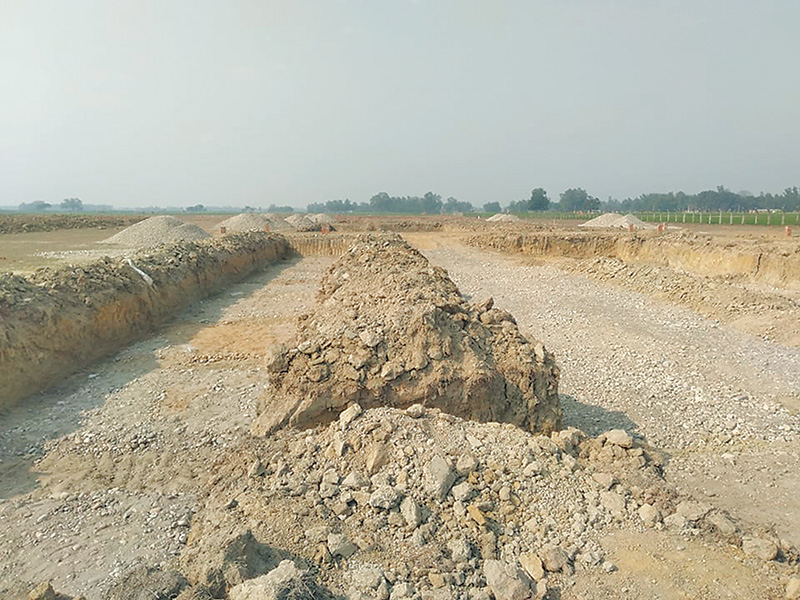
The Rs2.35 billion project, being built with Indian financial aid, has made only 12 percent progress in the last 10 months.
- THAKUR SINGH THARU
An access road under construction at Jayeshpur of Nepalgunj on the Nepal-India border.  Post Photo: Thakur Singh Tharu

NEPALGUNJ,
The Covid-19 pandemic has put the brakes on the construction of Nepal’s third integrated check post at Jayeshpur, Nepalgunj on the border with India.
The Rs2.35 billion project, being built with financial support from the Indian government, has a completion period of two years. But there has been only 12 percent progress in the last 10 months.
When ready, the check post in Nepalgunj will be the third such facility in the country after Birgunj and Biratnagar. These check posts here launched in April 2018 and January 2020 respectively.
Nepal and India had signed an agreement in 2005 for the construction of integrated check posts in Birgunj, Biratnagar, Bhairahawa and Nepalgunj on the Nepal side of the border; and twin facilities in Raxaul, Jogbani, Sunauli and Rupaidiha respectively on the Indian side to facilitate trade and transit between the two countries.
As per the accord, the Indian government will bear the entire construction cost while Nepal will provide the land required for the check posts. The facility allows customs and immigration clearance paperwork to be processed under a single roof to provide hassle-free service to traders.
In Bhairahawa, the government has acquired 52 bighas of land at the construction site of the proposed facility.
The integrated check post in Nepalgunj will have export and import cargo handling facilities. It will offer warehousing including refrigerated cargo facilities; medical, plant and animal quarantine areas; amenities for drivers and passengers; CCTV and other security systems; 24/7 power backup and wastewater treatment system.
The facility aims to help save time, reduce inconvenience to visitors, and lower overall transaction costs in cross-border trade and commerce.
In the last fiscal year 2020-21 ended mid-July, Nepal’s total trade amounted to Rs1.68 trillion with imports of Rs1.53 trillion and exports of Rs141 billion, according to the Department of Customs statistics.
Of the total trade, the commerce that passed through Nepalgunj Customs was valued at Rs68.94 billion.
Engineer Hom Nath Bhusal at the Urban and Building Division Office, Nepalgunj has been monitoring the project’s construction work. “The integrated check post has been accorded top priority; but due to the pandemic, it may not meet the completion deadline.”
The Nepal section of the facility will occupy 61.5 hectares and the construction was assigned to a Pune-based company under the supervision of state-run RITES International. A portion on the Indian side is being built at Rupaidiha by the Lands Ports Authority of India, and work started in May 2020.
“The overall progress of the project has reached 12 percent in almost a year,” said Bhusal.
The project has been building the foundation work. “Once the foundation is completed, the project’s work will be intensified,” Bhusal said.
“As the construction of the project is being done with Indian investment, Nepali authorities cannot exert pressure on them. Both the investment and the contractor are from India. But we have requested the Indian side to complete the construction work within the stipulated time.”
Bhusal said that the project could still achieve its target. The government has exempted customs duty on goods and vehicles brought from India for the construction of the check post.
The project sites in India and Nepal will be connected by a 2.2-km long and 60-metre wide highway to facilitate Nepal-India vehicle movement.
The integrated check post project was mooted one and a half decades ago. It stalled due to lack of interest from the Indian side. According to project officials, railway service will be extended to the integrated check post. Due to lack of modern customs facilities, the general public and traders have been facing problems as they are stopped at multiple places for security checks.
The check post, which is closer to the Indian capital of New Delhi than other border points in Nepal, will make export and import easier besides reducing hassles and time, project officials said. India is Nepal’s largest trading partner, accounting for 64 percent of Nepal’s total foreign trade. In the last fiscal year, India accounted for Rs1.07 trillion out of Nepal’s total trade value of Rs1.68 trillion.

MONEY

Singapore’s Shopee changes the game in Brazil’s e-commerce sector

- REUTERS
A signage of Shopee, the e-commerce arm of Sea Ltd, is pictured at its office in Singapore. REUTERS

SINGAPORE,
Sea Ltd’s Shopee took just two years to become Brazil’s most-downloaded shopping app, winning users to its low-cost marketplace with its game-changing approach to e-commerce: in-app mini-games offering coupons to winning users.
The Singapore-based company has combined online shopping with the gaming nous of its separate mobile game arm Garena—creator of “Free Fire”, Brazil’s most-downloaded title for eight consecutive quarters—to generate sales analysts estimated at almost a third of local champion Magazine Luiza SA.
Back home, Shopee only needed five years to become Southeast Asia’s most-visited e-commerce website, overtaking the likes of Lazada, backed by China’s Alibaba Group Holding Ltd, and Tokopedia, backed by Japan’s SoftBank Group Corp.
“Shopee has a track record in Southeast Asia of coming into the market late, looking at how others have solved existing problems and then building a system to leapfrog those issues,” said analyst Jianggan Li at advisory firm Momentum Works.Shopee’s early surge highlights the space left for foreign entrants to grow in a sector once dominated by regional firms like Magazine Luiza and Argentina’s MercadoLibre Inc.
To be sure, the startup’s timing was fortuitous, launching in Brazil just as the Covid-19 pandemic drove consumers away from physical stores, pushing up 2020 e-commerce sales by 44 percent to $42 billion, showed data from Brazilian payments company EBANX.
Shopee—akin to Alibaba’s AliExpress, carrying Chinese-made knick-knacks—emerged as Brazil’s top app by downloads and time spent in use, showed data from analytics platform App Annie.
Yet, in pursuit of growth, Shopee is still losing money, propped up by Sea’s profitable gaming division. In the second quarter of this year, Garena posted an adjusted earnings before interest, tax, depreciation and amortization (EBITDA) of $740.9 million even as the e-commerce arm lost $579.8 million.
“Money being generated by one side of the business, which is a cash cow, is being reinvested aggressively in Brazilian e-commerce—with success,” said Itau BBA analyst Thiago Macruz.
Sea’s Brazil foray is just one element of its global ambition. Investment arm Sea Capital is also considering putting money into startups in Latin America and beyond, said a person with knowledge of the matter, who was not authorized to speak with media and so declined to be identified. The firm has also taken Shopee to Chile, Colombia and Mexico where, unlike Brazil, it has no locally based staff and so has partnered social media influencers to increase brand awareness, said two people familiar with the matter.
Sea, whose shareholders include Chinese gaming leader Tencent Holdings Ltd, declined to comment.
The firm has disclosed little data about Shopee Brazil, but Itau BBA analysts estimated the value of goods and services sold on the platform last year hit 12 billion reais ($2.27 billion).
The average price on its marketplace is 40 reais, other estimates showed, less than a third that of e-commerce leader MercadoLibre, which often carries higher-value branded products.
Sea’s biggest challenge for Shopee Brazil is delivery in such a vast country. It reduced its reliance on the local postal system this year in favour of private carriers, but is still competing against rivals with proprietary delivery services.
Shopee aims to have one main logistics partner per country in the region, a company source told Reuters.
The company itself expects e-commerce growth in the region to spawn more delivery partnerships, as happened in Southeast Asia, Sea executives told analysts on a call this month.
On the same call, Group Chief Corporate Officer Yanjun Wang called Brazil “a good market for continued investment.”

MONEY

Cambodia’s oil export ambitions sink with ‘stolen’ tanker standoff

- REUTERS

PHNOM PENH/SINGAPORE,
When Cambodian officials commemorated the start of the country’s first oil project in June by preserving the first drops of production at a high profile ceremony, they heralded the country’s emergence as a budding oil exporter at the heart of Asia.
But instead of reaping royalties, Cambodia’s government has filed a theft complaint against the crew of the tanker that stored the crude, after they sailed away with the oil amid a payment dispute with the oil field’s developer.
Singapore-based KrisEnergy, which owns a 95 percent stake in the offshore Apsara field in the Gulf of Thailand, was forced into liquidation shortly after production began in December 2020. Cost overruns and poor oil yields from the project had left the company unable to repay debt.
KrisEnergy’s collapse also ended hopes of further oil sale proceeds for the Cambodian government, which owns the remaining 5 percent stake. All operations were halted and are deemed unlikely to resume given poor extraction rates, according to a local media report citing the Cambodian Ministry of Mines and Energy in July.
That’s likely to be a major disappointment to Cambodian authorities, who had anticipated roughly $500 million in tax and royalty revenues over the project’s lifetime.
The output stoppage means all there is left to show for Cambodia’s oil production efforts now lies in the belly of the MT Strovolos, the 300,000-barrel tanker that had stored the oil produced at the site until it was forced to divert last month in search of a fresh crew and has now been detained by the Indonesian navy.
The Cambodian energy ministry, KrisEnergy and its liquidators did not respond to requests for comment.
With the fully-laden vessel now impounded in Batam, and KrisEnergy’s liquidation proceedings still under way, lawyers who have been tracking developments predict a lengthy dispute over who owns and can sell the oil.
“I expect that if the Cambodian Government wants to detain the cargo and have it shipped back to Cambodia, there may arise competing claimants who are saying they are lawful owners of the cargo, potentially including the liquidator of KrisEnergy,” said Peter Doraisamy, managing partner at PDLegal LLC.
“It is likely to take several years at the very minimum depending on which jurisdiction is seized of the case, and there is possibility that cases may be brought in more than one jurisdiction and by different parties.”
A key fundamental question is who actually owns the crude cargo, currently valued at around $20 million, now that KrisEnergy has become insolvent.
“The ship owner may not actually know who owns the cargo, and he’s not a party to any of those contracts, he just gets told what to do by the charterer,” said Leon Alexander, partner at Clyde & Co.
“But the shipowner owes a legal obligation to that person who is the cargo owner, he’s got to look after and care for the cargo. And he’s not allowed to deliver the cargo to the wrong person or act in a manner inconsistent with the rights of the cargo owner, or he faces a legal claim in conversion.”
Indonesian authorities have taken steps to secure the vessel and its contents for investigation, Laode Muhamad, a spokesman for the Indonesian Navy told Reuters.

MONEY

Indian auto parts makers’ shares gain on report of talks with Tesla

- REUTERS

BENGALURU, 
Shares of Indian auto parts suppliers rose as much as 14 percent on Monday following a report electric-vehicle maker Tesla Inc was in talks with at least three companies to source critical parts for its planned entry into the country.
Tesla, which is looking to set up a factory in India if it is successful with imported vehicles, is holding early talks with some companies for the supply of components such as
instrument panels, windshields, differential gears, brakes and power seats, the Economic Times reported on Sunday.
Bharat Forge Ltd, Sona BLW Precision Forgings Ltd and Sandhar Technologies Ltd are understood to be among the Indian companies already supplying components to Tesla, according to the report.
Shares of the three Indian firms rose as much as 6.2 percent to 13.7 percent on Monday.
India’s auto component makers want Tesla’s potential entry to benefit the country’s suppliers, and one way to achieve that is for the company to manufacture locally, the head of an industry body said earlier in August.

MONEY

Australia mulls new laws for digital wallets

- REUTERS
A smartphone with the Apple Pay logo and Google Pay logo is seen in this illustration. REUTERS

SYDNEY, 
The Australian government is considering new laws that would tighten the regulation of digital payment services by tech giants such as Apple and Alphabet’s Google.
Treasurer Josh Frydenberg said he would “carefully consider” that and other recommendations from a government-commissioned report into whether the payments system had kept pace with advances in technology and changes in consumer demand.
Services such as Apple Pay, Google Pay and China’s WeChat Pay, which have grown rapidly in recent years, are not currently designated as payment systems, putting them outside the regulatory system.
“Ultimately, if we do nothing to reform the current framework, it will be Silicon Valley alone that determines the future of our payments system, a critical piece of our economic infrastructure,” Frydenberg said in an opinion piece published in the Australian Financial Review newspaper.
The report recommended the government be given the power to designate tech companies as payment providers, clarifying the regulatory status of digital wallets.
It also recommended the government and industry together establish a strategic plan for the wider payments ecosystem and that a single, integrated licensing framework for payment systems be developed.
The Reserve Bank of Australia, which is currently in charge of designating who is a payment services provider, reported that payments through digital wallets had grown to 8 percent of in-person card transactions in 2019, up from 2 percent in 2016.
The Commonwealth Bank of Australia, which has estimated digital wallet transactions more than doubled in the year to March to A$2.1 billion, has urged regulators to address “competition issues” and consider the safety implications of their use.

Page 6
WORLD

IS claims rocket attack on Kabul airport as US troops pull out

The regional Islamic State-Khorasan group, rivals of the Taliban, pose the biggest threat to the withdrawal.
- AGENCE FRANCE-PRESSE
A US Air Force aircraft takes off from the airport in Kabul. Rockets were fired at Kabul’s airport on Monday where US troops were racing to complete their withdrawal from Afghanistan and evacuate allies under thethreat of Islamic State group attacks. AFP/rss

KABUL,
The Islamic State group claimed a rocket attack on Kabul airport on Monday, as US troops raced to complete their withdrawal from Afghanistan and evacuate allies under the threat of further violence.
President Joe Biden has set a deadline of Tuesday to withdraw all US forces from Afghanistan, drawing to a close his nation’s longest military conflict, which began in retaliation for the September 11 attacks.
The return of the hardline Islamist Taliban movement, which was toppled in 2001 but took back power a fortnight ago, triggered an exodus of terrified people aboard US-led evacuation flights.
Those flights, which have taken more than 122,000 people out of Kabul airport, will officially end on Tuesday when the last of the thousands of American troops pull out.
US forces are now focused chiefly on flying themselves and American diplomats out safely.
The regional Islamic State-Khorasan group, rivals of the Taliban, pose the biggest threat to the withdrawal, after carrying out a suicide bombing outside the airport late last week that claimed more than 100 lives, including those of 13 US troops.
Then on Monday, they claimed to have fired six rockets at the airport. A Taliban official said the attack was intercepted by the airport’s missile defence systems.
The United States meanwhile said it had carried out an air strike on Sunday night in Kabul on an IS-prepared car bomb.
The White House confirmed there had been a rocket attack directed at the airport, but said airlift operations there were “uninterrupted”.
“The President... has reconfirmed his order that commanders redouble their efforts to prioritise doing whatever is necessary to protect our forces on the ground,” the White House statement said.
An AFP photographer on Monday took images of a destroyed car with a launcher system still visible in the back seat.
A Taliban official at the scene said he believed five rockets had been fired.
A suspected US drone strike had hit the car, about two kilometres (1.2 miles) from the airport.
While there were no reports of fatalities or airport damage from the rocket attacks, they caused greater anxiety for locals already traumatised by years of war.
“Since the Americans have taken control of the airport, we can’t sleep properly,” Abdullah, who lives near the airport and gave only one name, told AFP.
“It is either gun firing, rockets, sirens or sounds of huge planes that disturb us. And now that they are being directly targeted, it can put our lives in danger.”
The United States said the air strike on Sunday night had eliminated another threat from the Islamic State jihadists.
However, it may have also have killed civilians.
“We are aware of reports of civilian casualties following our strike on a vehicle in Kabul today,” Captain Bill Urban, a US Central Command spokesman, said in a statement.
“We would be deeply saddened by any potential loss of innocent life.”
In recent years, the Islamic State’s Afghanistan-Pakistan chapter has been responsible for some of the deadliest attacks in those countries.
They have massacred civilians at mosques, public squares, schools, and even hospitals.
While both IS and the Taliban are hardline Sunni Islamists, they are bitter foes -- with each claiming to be the true flag-bearers of jihad.
Last week’s suicide bombing at the airport led to the worst single-day death toll for the US military in Afghanistan since 2011.
The IS threat has forced the US military and the Taliban to co-operate in ensuring security at the airport in a way unthinkable just weeks ago.
The Taliban have already started taking over areas vacated by US forces. The Taliban have promised a softer brand of rule compared with their first stint in power, which the US military ended because the group gave sanctuary to Al-Qaeda.
But many Afghans fear a repeat of the Taliban’s brutal interpretation of Islamic law, as well as violent retribution for working with foreign militaries, Western missions or the previous US-backed government.
Western allies have warned many thousands of at-risk Afghans have not been able to get on the evacuation flights.
On Sunday, the Taliban revealed their supreme leader Hibatullah Akhundzada was in southern Afghanistan and planning to make a public appearance.
“He is present in Kandahar,” said Taliban spokesman Zabihullah Mujahid, referring to the movement’s spiritual birthplace.

WORLD

Lawyers seek ICC probe into alleged war crimes in Yemen

- ASSOCIATED PRESS

THE HAGUE, NETHERLANDS,  
Human rights lawyers representing hundreds of victims of Yemen’s civil war are calling on the International Criminal Court to open an investigation into war crimes and crimes against humanity allegedly committed by the Saudi Arabia-led coalition during the devastating conflict.
British lawyer Toby Cadman filed the request Monday, highlighting three separate incidents—an August 2018 airstrike that destroyed a school bus and killed dozens; a missile attack in October 2016 that killed at least 110 people; and allegations
of torture and murder of civilians being held in prisons in the south of Yemen.
The filing came a day after a missile and drone attack, blamed on the Houthi rebels, on a key military base in Yemen’s south killed at least 30 troops.
The civil war in Yemen erupted in 2014, when the Iranian-backed Houthis swept across much of the north and seized the capital, Sanaa, forcing the internationally recognised government into exile. The Saudi-led coalition entered the war the following year on the side of the government. All sides are accused of atrocities in the yearslong conflict.
Lawyer Almudena Bernabeu, representing victims of the school bus attack, said that the coalition said it would investigate the deadly strike and bring those responsible to justice.
“Of course, they did no such thing,” Bernabeu said in a statement. “As the court of last resort, victims and families have no choice but to call on the International Criminal Court to ensure justice is done.”
A spokesman for the Saudi-led coalition did not respond to phone calls seeking comment.
Yemen is not a member state of the court and nor are key coalition members Saudi Arabia and the United Arab Emirates. However, in a 212-page written submission, the lawyers argue that the court should exercise jurisdiction because some members of the coalition are ICC member states.
A written submission filed by the lawyers says Jordan deployed fighter jets to the coalition, Senegal provided troops, while the Maldives supported it diplomatically.

WORLD

India’s Covid-19 vaccine supply jumps, raising export hopes

- REUTERS

NEW DELHI,
India’s rising output of Covid-19 vaccines and the inoculation of more than half its adult population with at least one dose are raising hopes the country will return as an exporter within months, ramping up from early next year.
After donating or selling 66 million doses to nearly 100 countries, India barred exports in the middle of April to focus on domestic immunisation as infections exploded, upsetting the inoculation plans of many African and South Asian countries.
India’s daily vaccinations surpassed 10 million doses on Friday, with national vaccine production more than doubling since April and set to rise again in the coming weeks. New production lines  have been set up, a vaccine developed by Cadila Healthcare won recent approval, and commercial production of Russia’s Sputnik V is starting in India.
The Serum Institute of India (SII), the world’s biggest vaccine maker, is now producing about 150 million doses a month of its version of the AstraZeneca shot, more than twice its April output of about 65 million, a source with knowledge of the matter said.
“No fixed timeline on exports but the company hopes to restart in a few months,” said the source, who declined to be named without approval to talk on the matter.
SII, which has previously indicated exports could resume by year-end, did not respond to a request for comment.
Global vaccine sharing platform COVAX hopes India will restart foreign sales sooner than later.
“With successful national vaccination and the arrival of more products, we are hoping that Indian supply to COVAX will resume as quickly as possible,” a spokesperson for the platform’s co-lead GAVI told Reuters in an email.
India, a major international producer of many other vaccines, could play a “similarly transformative role in the global response to Covid-19,” the spokesperson said.
India’s health ministry and the foreign ministry, which coordinates vaccine exports, did not respond to a request for comment.
Bharat Biotech, the maker of India’s first domestically developed Covid-19 shot, on Sunday inaugurated a new factory with a production capacity of 10 million doses a month. It said it was “marching towards” a goal of a total annual capacity of about 1 billion doses of the drug, Covaxin.
Infections, meanwhile, are again rising in India after an explosive outbreak in April and May. But the country has administered more than 633 million vaccine doses, with at least one dose to 52 percent of its 944 million adults and two doses to more than 15 percent.
A government source told Reuters in June the US experience showed that vaccinations tend to slow down after a big majority of people get their shots. That might give SII a chance to export excess output, said the source.

WORLD

Haiti’s hunger crisis bites deeper after devastating earthquake

- REUTERS
People affected by the August 14 earthquake wait for food provided by the World Food Programme at a school in Port Salut, Haiti. REUTERS

NAN KONSEY, 
In a tent encampment in the mountains of southern Haiti, where hundreds of villagers sought shelter after a powerful earthquake flattened their homes this month, a single charred cob of corn was the only food in sight.
“I’m hungry and my baby is hungry,” said Sofonie Samedy, gesturing to her pregnant stomach.
Samedy had eaten only intermittently since the 7.2-magnitude earthquake on Aug. 14 destroyed much of Nan Konsey, a remote farming village not far from the epicentre. Across Haiti, the quake killed more than 2,000 people and left tens of thousands homeless.
In Nan Konsey, the earth’s convulsions tore open the village’s cement cisterns used to store drinking water and triggered landslides that interred residents’ modest subsistence farms.
Since then, Samedy and the rest of the community have camped alongside the main highway, about a 40-minute walk from their village, hoping to flag down the rare passing truck to ask for food and water.
“I’m praying I can still give birth to a healthy baby, but of course I’m a little afraid,” she said.
Haiti, the poorest country in the Americas, has long had one of the world’s highest levels of food insecurity. Last year, Haiti ranked 104 out of the 107 countries on the Global Hunger Index. By September, the United Nations said 4 million Haitians—42 percent of the population—faced acute food insecurity.
This month’s earthquake has exacerbated the crisis: destroying crops and livestock, levelling markets, contaminating waterways used as sources of drinking water, and damaging bridges and roads crucial to reaching villages like Nan Konsey.
The number of people in urgent need of food assistance in the three departments hardest-hit by the earthquake—Sud, Grand’Anse and Nippes—has increased by one-third since the quake, from 138,000 to 215,000, according to the World Food Programme (WFP).
“The earthquake rattled people who were already struggling to feed their families,” Lola Castro, WFP’s regional director for Latin America and the Caribbean, said in a statement.
“The compound effects of multiple crises are devastating communities in the south faced with some of the highest levels of food insecurity in the country.”
Just off the highway leading to Nan Konsey, a few dozen men gathered at a goat market, where they sold off their remaining livestock to secure cash to feed their children or to pay for family members’ funerals.
Before the quake, farmer Michel Pierre had tended 15 goats and cultivated yams, potatoes, corn, and banana trees. He arrived at the market with the only two animals that survived the earthquake.
With his crops also buried beneath landslides, he hoped to earn about $100 from the sale to feed himself, his wife and his children.
When that money runs dry, he said, he isn’t sure what he will do. He is still in debt from when Hurricane Matthew ravaged Haiti in 2016.
“Day by day, it’s getting harder to be a farmer,” he said. “I am in the hands of God.”
Haiti was largely food self-sufficient until the 1980s, when at the encouragement of the United States it started loosening restrictions on crop imports and lowered tariffs. A subsequent flood of surplus US crops put droves of Haitian farmers out of business and contributed to investment in the sector tailing off.
In recent years, climate change has made Hispaniola—the island Haiti shares with the Dominican Republic—increasingly vulnerable to extreme droughts and hurricanes. Spiralling food costs, economic decline and political instability have worsened the shortages.
For Gethro Polyte, a teacher and farmer living north of the town of Camp-Perrin, the earthquake decimated his two main sources of income: levelling the school where he taught fourth grade, and submerging his crops and livestock in an avalanche of earth.
Before the disaster, he and his family had been able to pull together two meals a day and draw water from underground springs, he said. But since then, his food supplies have dwindled down to a few yams and bananas, and the water has been contaminated with silt.
Polyte doubted the school would be rebuilt for classes to start in September and for him to receive a paycheck, given the chaos following the assassination of President Jovenel Moise in July. And with bank loans still to pay off, he doubted he’d be able to secure money to invest in rebuilding his farm.
“We are living now by eating a little something just to kill the hunger,” he said. “And, of course, things will only grow worse in the coming days.”

WORLD

Japan considers October 17 election as PM ratings plunge

Briefing
- AGENCIES

TOKYO: The Japanese government is considering holding a general election on October 17, Kyodo news said on Monday citing government sources, even as public support for Prime Minister Yoshihide Suga hits record lows in two new opinion polls. Suga has failed to capitalise on delivering the Olympics for the country, currently being hit hard by a fresh wave of coronavirus infections. The Mainichi newspaper poll showed public support for Suga had slid below 30 percent for the first time, to a dismal 26 percent. The Nikkei daily put his ratings at 34 percent, in line with a record low hit in its survey last month.

WORLD

UN hails end of leaded gas use in cars worldwide

Briefing
- AGENCIES

BERLIN: Leaded gasoline has finally reached the end of the road, the UN environment office said on Monday, after the last country in the world to use it stopped selling the highly toxic fuel. Algeria halted the sale of leaded gas last month, prompting the UN Environment Agency to declare the “official end” of its use in cars, which has been blamed for a wide range of human health problems. “The successful enforcement of the ban on leaded petrol is a huge milestone for global health and our environment,” UNEP’s executive director, Inger Andersen, said in a statement.

WORLD

Palestinian president, Israeli defence minister hold rare talks

Briefing
- AGENCIES

RAMALLAH: Israel’s defence minister has met Palestinian president Mahmud Abbas for a rare high-level meeting, but a source close to Prime Minister Naftali Bennett insisted on Monday his government had no plans to reboot peace talks. Defence Minister Benny Gantz met Abbas in Ramallah late Sunday for what were reportedly the first direct talks between an Israeli cabinet member and the 86-year-old Palestinian leader in several years. The meeting, which Gantz’s office said focused on “security policy, civilian and economic issues”, came just hours after Bennett returned from Washington where he met US President Joe Biden. Biden had said he would urge Bennett to find ways “to advance peace and security and prosperity for Israelis and Palestinians”. 

Page 7
SPORTS

Greenwood’s goals well timed before Ronaldo’s return

The 19-year-old striker has now scored in all three matches but the Portuguese’s return to the Old Trafford has raised questions over his development at Manchester United.
- ASSOCIATED PRESS
Mason Greenwood’s 80th-minute goal earned Manchester United a 1-0 win over Wolves. Reuters

LONDON,
Mason Greenwood is making sure Manchester United don’t neglect his scoring abilities when Cristiano Ronaldo returns.
The 19-year-old striker—who is almost half Ronaldo’s age—has now scored in all three matches for United at the start of the season.
The latest goal ensured an underwhelming United performance at Wolverhampton still ended in a 1-0 victory on Sunday. It was set up by Raphael Varane, a former teammate of Ronaldo’s at Real Madrid, on the defender’s United debut.
But it is the frenzy over Ronaldo’s unexpected return to Old Trafford that has lit up this transfer window, with the 36-year-old star completing his move ready for a second debut after the international break.
United are in need of increased firepower up front. While Greenwood’s first goal of the campaign was in a 5-1 rout of Leeds, last week’s was required to salvage a draw at Southampton.
The winner at Wolves only came in the 80th minute and after United required David De Gea’s sensational double save with about 20 minutes to go to thwart Romain Saiss.
“I think we were below (par) today, we didn’t play too well,” the goalkeeper said. “But it’s a massive win for us.”
While United moved onto seven points, the only team with a perfect record after three games are Tottenham. All three wins have been 1-0, the latest against Watford clinched by Son Heung-min’s free kick—which beat goalkeeper Daniel Bachmann—on his 200th Premier League appearance.
Burnley striker Chris Wood scored the 30,000th goal since the inception of the Premier League in 1992 but the northwest club were denied a
first win of the season against Leeds after Patrick Bamford recovered a 1-1 draw. Burnley had never even played in the Premier League when Ronaldo left United in 2009. In fact, half of the teams currently in the Premier League were not in the top flight when he completed a third title-winning season before heading off to Madrid.
Now the 36-year-old Ronaldo is rejoining from Juventus in an attempt to help United win their first Premier League title since 2013.
“Cristiano has evolved as a player, he used to play wide right, wide left, up front, he’s more of a centre forward for me at the moment, definitely,” United manager Ole Gunnar Solskjaer said, speaking to media for the first time since Friday’s announcement of Ronaldo’s return.
“But there will be games where we play with two up front, three up front. I want him in the box, I want him scoring goals. We’ve always been watching Cristiano, that one day he would move and we would be interested. We never thought that he was going to leave Juventus this season, when he did we had to speak to him of course.”

SPORTS

Indian football team arrive for Nepal friendlies

- Sports Bureau
Sunil Chhetri will captain India in the friendlies, to be played on September 2 and 5. Photo Courtesy: ANFA

KATHMANDU,
The Indian national football team arrived in Kathmandu on Monday to play two international friendly matches against Nepal. The friendlies are scheduled for Thursday and Sunday at the Dasharath Stadium in Kathmandu.
Both the sides are playing to finetune their preparations for the SAFF Championship set to take place in the Maldives from October 1 to 16. The 25-member Indian team is led by captain Sunil Chhetri and their Croatian coach Igor Stamic.
The India team came to Nepal after a two-week training since August 15 in Kolkata. Unlike India, Nepal national team have been in training camp for almost two months.
The national team under the captaincy of Kiran Kumar Limbu are currently under closed camp training in Pokhara and are scheduled to return to Kathmandu on Saturday. Kuwaiti coach Abdullah Almutairi has been training the Nepali team.
It will be the first assignment of the controversial Kuwaiti coach on home turf. Earlier through his Facebook posts, he had twice threatened to quit the hot seat.     
This is the first occasion the Indian national football team has visited Nepal to play friendlies. The last time India visited Nepal was in March 2015 in the second-leg of World Cup qualifying playoffs, which ended in a 0-0 draw.
India hold a superior head-to-head record against their South Asian rivals. The two sides have so far played 19 matches starting from 1985. While India have won 13 matches, Nepal have won two and four ended in draws.

SPORTS

Messi era begins at PSG

- ASSOCIATED PRESS
Lionel Messi made his Paris Saint-Germain debut replacing Neymar in the 66th minute. Ap/Rss

PARIS,
The Lionel Messi era has begun at Paris Saint-Germain, without a goal for the Argentine superstar but plenty of adulation and fanfare.
Messi made his debut for PSG on Sunday after coming off the
bench midway through the second half in a 2-0 win at Reims in the French league. Messi replaced his friend and former Barcelona teammate Neymar in the 66th minute and they shared a hug.
After years of glory for Messi at the 99,000-capacity Camp Nou stadium in Barcelona, the record six-time Ballon d’Or winner and four-time Champions League victor made his first PSG appearance at the modest 20,000-seater Stade Auguste Delaune.
Such is Messi’s star factor that the home fans chanted “Messi, Messi” while a smiling Reims goalkeeper Predrag Rajkovic took a photo of Messi holding a child after the game.
PSG coach Mauricio Pochettino was touched by the reception for Messi, pointing out that supporters of both teams were delighted to see him play.
“The welcome he got was something beautiful to see and hear, on the part of our fans but also the Reims fans,” Pochettino said. “Messi was very happy about it. His presence generates more enthusiasm, everyone can feel it and it has an effect on the other players.”
Before the match, hundreds of fans gathered for a glimpse of Messi as he descended the team bus and he waved back at them. They wanted to see one of the all-time greats, along with Pele and the late Diego Maradona, who Messi adored.
Messi’s incredible skill, close control, grace, vision, dancing feet, astute passing, speed of thought and execution have thrilled fans for years. He netted 672 goals for Barca and won 35 trophies for the Spanish giant, including the 2015 Champions League alongside Neymar. That was the last time Messi won Europe’s elite trophy and, somewhat ironically, his last goal for Barca in the Champions League was a brilliant strike away to PSG last season in the round of 16.
The 34-year-old Messi, who led his nation to the Copa America title last month, joined PSG three weeks ago after his new contract with Barcelona fell through.
Striker Kylian Mbappe was named in the starting lineup. Mbappe had already scored both goals before Messi came on. He headed in Angel Di Maria’s cross in the 15th minute and then turned in Achraf Hakimi’s cross in the 63rd for his 135th goal since joining PSG in 2017.
“No, I wasn’t surprised by his enthusiasm,” said Pochettino, who did not comment on Mbappe’s immediate future.
For it remains to be seen whether it’s his last for PSG, who have started the season with four straight wins and have 12 points.

SPORTS

Diallo sidelined for six weeks

Briefing
- AGENCIES

MANCHESTER: Manchester United winger Amad Diallo has suffered a thigh injury and will be out for six weeks, putting his planned loan move to Dutch side Feyenoord on hold, the Premier League club said on Monday. The 19-year-old Ivory Coast international, who joined United from Italian side Atalanta in January, has made eight appearances for the club, scoring one goal. “Amad has sustained a thigh muscle injury in training and is likely to be out for six weeks,” United said in a statement. “Unfortunately, this happened just before his planned loan move to Feyenoord. Amad will remain at United and rehabilitate back to full fitness.”

SPORTS

Dias extends Man City contract

Briefing
- AGENCIES

MANCHESTER: Manchester City defender Ruben Dias has signed a six-year contract extension until 2027, the Premier League club said on Monday. Dias, 24, joined City from Benfica last year and was a mainstay of Pep Guardiola’s defence as he helped the club win the Premier League title and reach the Champions League final. The Portugal international was named the Premier League Player of the Season as well as England’s Footballer of the Year in a stellar debut campaign.

SPORTS

Norwich sign Normann on loan

Briefing
- AGENCIES

NORWICH: Norwich City have signed Norway midfielder Mathias Normann on a season-long loan deal from Russian club FC Rostov, the Premier League outfit said on Sunday. City have the option to make the deal for the 25-year-old, who has seven caps, permanent at the end of the season. Normann has spent the past three seasons in the Russian Premier League, making 52 appearances and scoring twice. Promoted Norwich have started the top-flight season with three straight defeats and sit second-bottom above Arsenal, having scored one goal and conceded 10.

SPORTS

Sri Lanka recall Chandimal for South Africa series

Briefing
- AGENCIES

COLOMBO: Sri Lanka on Monday recalled former skipper Dinesh Chandimal into a 22-member squad led by Dasun Shanaka for a six-match series against South Africa. Chandimal, 31, was dropped after a disappointing tour of the West Indies in March. He missed series against England and India. Sri Lanka have also added the uncapped Pulina Tharanga and Maheesh Theekshana for the tournament starting September 2 with three one-day internationals. The last of three Twenty20 games will be on September 14. All six matches are to be played at the Premadasa stadium in Colombo without spectators because of Covid-19 health guidelines.

MEDLEY

Horoscope

ARIES (March 21-April 19) **
It’s hard to tell which direction you’re going in today, Aries. While you’re feeling driven to get things done and dusted, you may find yourself confused and passive when it comes to fine-tuning your aim and goals. Work on a can-do attitude to achieve your goals.

TAURUS (April 20-May 20) ****
Return to the crafts you love today, Taurus. What talents have been sitting on the back burner, waiting for activation? Today’s skies see the moon’s presence in versatile Gemini, encouraging you to reconnect with any underutilized abilities.

GEMINI (May 21-June 21) ***
You’re often lost in the maze of your mental world. Tuesday’s skies remind you to reconnect with your body and soul on the earthly plane as the nourishing moon spends time in your sign. Prioritise your wellbeing and protect your ability to self-assert.

CANCER (June 22-July 22) ***
Cancerians need ample time spent alone to process their abundant feelings. Tuesday’s skies encourage you to withdraw into a world of your own. Luna’s square with irritable Mars can create a strange mix of stimulation and exhaustion.

LEO (July 23-August 22) ***
The universe is pushing you to define your goals, Leo. Are you carving out enough time to see those dreams through? Tuesday’s skies highlight this ongoing story as Luna gets locked into an uncomfortable encounter with hyperactive Mars.

VIRGO (August 23-September 22) ***
This time of year is all about returning to the self, Virgo. Are you honoring your own needs apart from everyone else’s demands? Tuesday’s skies find the moon’s presence in idea-juggling Gemini, briefly sending your focus towards you career.

LIBRA (September 23-October 22) **
You may find yourself longing for distant lands today, Libra. The playful Gemini moon pushes you to step back—are you pleased with the current trajectory, or are there small steps that could be incorporated to help you change pace?

SCORPIO (October 23-November 21) ***
As a Scorpio, you’re naturally drawn towards deep diving to the bottom of things. Tuesday’s cosmic landscape encourages this natural approach to your world as the moon paces through thought-juggling Gemini. Send your focus towards unhealed wounds.

SAGITTARIUS (November 22-December 21) ***
What’s taking place in your closest partnerships? Have you devoted too much or too little time to your cherished relationships? Tuesday’s skies highlight this ongoing story as the playful Gemini moon calls attention towards pressing romantic matters.

CAPRICORN (December 22-January 19) ***
You’re in the mood to take care of business today, Capricorn. The moon wanders through multi-tasking Gemini all day, pushing you to check off any outstanding errands on your to-do list and take on multiple missions at once.

AQUARIUS (January 20-February 18) **
Tuesday’s skies encourage you to pull away from productive efforts. The giddy Gemini moon encourages you to engage with your cherished creative pursuits. Luna’s hard square with motivated Mars makes it hard to send energy in any one direction.

PISCES (February 19-March 20) ***
Spend some time tucked away at home today, Pisces. The reflective Gemini moon pushes you to seek connection with your family. Luna’s hard square with go-getter Mars and daydreaming Neptune makes for a usual stop-and-go flow to the day.

Page 8
CULTURE & LIFESTYLE

Decline of gaming cafe culture in Nepal

Gaming cafes still receive a respectable amount of gamers but that is just a smouldering remnant of the once vibrant and active gaming cafe culture.
- Shranup Tandukar
A lone gamer is engrossed in his game at PowerPlay gaming cafe in Bhotahiti, Kathmandu, one of the few surviving gaming cafes in the country. Post Photo: Keshav Thapa

KATHMANDU,
In the heart of Jhamsikhel, surrounded by the bright neon lights of bars and cafes and hidden behind a convenience store and a restaurant sits Amol Cyber, one of the oldest gaming cafes in Nepal. The cafe was once a staple name among gamers from Lalitpur to Kathmandu.
“I started this business in 2001. Back then, it wasn’t a cyber but a gift shop and a video-rental place and I had only one computer,” says Ram Krishna Magar, owner of Amol Cyber. “Back in 2001, computers or access to the internet wasn’t as common as it is today. I saw a business opportunity and within six months of opening my gift shop and video-rental place, I added four more computers. By 2010, in my neighbourhood alone, there were around eight to nine gaming cafes. Today, all of them have already shut down and we are the only gaming cafe still operating.”
Two decades after opening its doors, Amol Cyber now stands as a hollow shell of its former self, a testament to the thriving gaming cafe culture of the past. There are still rows upon rows of computers, and the gaming cafe still welcomes a small crowd of gamers every day. However, among the 40 or so computers, only 15 are in working condition. And even from the working computers, frequent slangs and insults can be heard from the gamers as some of the Personal Computers (PCs) freeze and stutter unexpectedly between intense in-game team fights.
Until a few years ago, gaming cafes were a lucrative business in the Kathmandu Valley. There were dozens of cafes and young people would throng these cafes from the mornings to late evenings. Between 2006 to 2016, when Nepal was seeing upto 16 hours of power cuts daily, Amol Cyber was thriving because it was one of the few cafes that had a fuel-operated electricity generator.
“During the cafe’s peak business years, there would be crowds of kids behind each computer, eagerly waiting for their turn,” says Magar.
As gaming PCs started becoming more affordable, the internet connectivity becoming more accessible, hours of load-shedding started getting phased out, and more and more gamers started getting their own PCs and internet connection, gaming cafe culture slowly started losing relevance.
The Covid-19 pandemic and subsequent lockdowns further aggravated the already crumbling gaming cafe culture, forcing many gaming cafes to shut down for good. The few remaining gaming cafes still receive a respectable amount of gamers but that is just a remnant of the once vibrant and active gaming cafe culture. As casual gamers retreat into the confines of their own homes, many gaming cafe owners are diversifying into other businesses.
Bikesh Shrestha, a veteran esports player says that the peak point of gaming cafe culture was between 2008 and 2009. He shares that during that time, gamers would still come to the gaming cafe even if they had their own PCs at home. “Gaming cafes didn’t just provide access to computers for gamers. They were also a place where gamers could play and have fun together with their friends,” says Shrestha.
Magar also asserts that the sense of community provided by gaming cafes was one of its main selling points. “But as more and more gamers got internet and PCs at home and games started to go online from single-player and LAN multiplayer, the gamers could use voice chat in online games to recreate that same community feeling online,” says Magar dishearteningly.
When PC esports gaming started gaining popularity in Nepal in 2018, the Valley’s few remaining gaming cafes found themselves suddenly becoming relevant, providing these businesses with a lifeline. For competitive PC esports players, the optimal environment for growth is a boot camp—a space where gamers could practice, live, and play together—which is expensive. Gaming cafes became a cheaper alternative where gamers could practice together with their team members at an affordable rate, without needing to rent out their own floor or a whole house.
“When common people have a dispute, they say ‘I will see you in court’, whereas when gamers have a dispute, they say ‘I will see you in LAN[gaming cafe or tournament stage],” says Dipesh Tuladhar, owner of PowerPlay, a gaming cafe in Bhotahiti which opened in 2009. He shares that his gaming cafe would be fully-booked during the day for weeks before local, national, and international tournaments by teams for their practice sessions. However, this resurgence in game cafe culture was nothing in comparison to the days of loadshedding during which Tuladhar says that “his gaming cafe would be packed literally 24 hours a day.”
Gaming cafes and esports have a symbiotic relationship; gaming cafes provide a safe haven for hopeful players and teams to play and practice together while a thriving esports scene births a new hopeful gamer each new day.
Tuladhar says that the PC esports scene in Nepal started to develop rapidly after Nepal Esports Association(NESA) hosted the first national esports competition in 2018. He says that in 2019, there were four major national competitions for PC games such as Counter-Strike Global Offensive (CS:GO) and Dota 2 which showed a glimmer of a potential career path for PC gamers. As gamers started to become serious about competitive gaming, they started to swarm gaming cafes.
However, the pandemic and subsequent lockdowns meant that gaming cafes were forced to close and national and international tournaments were cancelled. Tuladhar shares that during lockdown with no other alternative, he even loaned his gaming cafe computers to regulars to take home so that he could collect a small revenue. His gaming cafe was one of the few fortunate ones to survive the brutal lockdowns.
If there is a common thing among most existing gaming cafes in the Valley, they are all, Amol Cyber included, located in their owner’s own homes.
“The gaming cafes which have closed down after 2020 probably did due to not being able to pay rent,” says Tuladhar, whose PowerPlay is also situated on one of the floors of his own home. “After all, which gaming cafe can keep paying rent when there are literally no customers for months on end?”
Nirmal Limbu shares that he was forced to close his Kumaripati branch of Cloud 9 gaming cafe as he couldn’t bear the rent fees during lockdown and he shifted this branch to Ason instead, where he has to pay less rent. The Nakhipot branch of his gaming cafe, which was opened in 2017, meanwhile is located in his relative’s house where he says that “late rent can be negotiated easily.”
But even a rent-free provision may not be enough to sustain a gaming cafe in the coming future. Gaming cafe owners are diversifying into other business ventures while some gaming cafes themselves offer additional services.
Amol Cyber acts as a Western Union agent location and also provides photocopy and printing services to supplement its income from the gaming cafe. Meanwhile, Tuladhar says that he is looking to invest in other business ventures to complement his income. He is one of the founding members of WASD Arena, an online gaming platform. Through WASD Arena, he also sells gaming peripherals such as keyboards, mouses, graphics cards and so on.
For Limbu, the gaming cafe has been a passion project. “I have been involved in the IT sector for a long time. Even now, my primary source of income is the IT sector while my gaming cafe is secondary,” says Limbu. He adds, “In this environment, no gaming cafe owner can realistically hope to achieve a compounding income from gaming cafes.”
Game Planet, a gaming cafe in Kalimati that reopened recently after the second lockdown, has been seeing only a handful of visitors. The cafe started operations in 2005. “College students made up a majority of my customer base. But now that colleges have remained shut down, there aren’t many people here,” says Kabil Byanjankar, the owner. “I was thinking of getting a corporate 9-5 job somewhere but that’s not feasible. There’s no one else to look after my gaming cafe besides me.”
The cafe’s computer rooms look desolate and dreary. There are hardly five gamers at a time but the main server room looks warm and bright, adorned with trophies and mementoes from tournaments won by teams sponsored by Game Planet.
“I never intended to achieve commercial success by opening a gaming cafe. I believe that Nepali gamers are as skilled as their international counterparts. I just hope that Nepal’s esports scene can develop and make a name for itself on the international stage soon,” says Byanjankar with hopeful eyes as giant trophies gleam behind his back.