Court stays rule of resignation by local representatives seeking re-election
Election code says officials seeking re-election must resign before nomination for upcoming elections.
- TIKA R PRADHAN
KATHMANDU, The Supreme Court has issued an interlocutory interim order to the Election Commission not to implement a rule that requires local government officials seeking re-election to resign their posts before filing candidacy. A single bench of Justice Bam Kumar Shrestha issued the order on Tuesday after hearing the writ petition registered on Sunday by Nima Gyaljen Sherpa, chairman of Helambu Rural Municipality of Sindhupalchok. “The Supreme Court has issued an interlocutory interim order to the Election Commission not to implement the provision [in the Election Code of Conduct] that restricts local representatives from filing candidacy without resignation until the court’s further decision,” said Bimal Poudel, spokesperson of the Supreme Court. The Supreme Court has also invited both the plaintiff and the defendant on March 27 for discussions on the issue. The Election Commission has set the nomination date for the candidates of local representatives for April 24-25 for the May 13 polls. The new rule in the Election Code of Conduct issued on March 17 had courted controversy with the main opposition CPN-UML and many local representatives opposing it. Sherpa moved the court with the petition on Sunday demanding a court order to quash the new rule. In his petition Sherpa, the chairperson of the Helambu Rural Municipality, had argued that the law says the resigning chair should submit his/her resignation to the vice-chair and vice versa, so this provision creates a legal problem because who will one submit his/her resignation if the other has already resigned. He also pointed out that the code of conduct discriminates against local representatives because representatives in the provincial and federal governments are not required to resign for fighting elections. Justice Shrestha ordered the election body not to implement Clause 36 of the Election Code of Conduct 2022. During the regular press briefing on Monday, Commission’s spokesperson Shaligram Sharma Paudel had reiterated the commission’s commitment to implementing the Election Code of Conduct. Paudel had also said the court would invalidate the candidacy of those who were still holding a position of profit if someone filed a case against such candidates. “If anyone, quoting this provision, lodges a writ petition against a candidate who has filed candidacy without resigning his post, then the court can invalidate such candidacy,” said Paudel. He was referring to the Annex 1 of the Local Level Election Regulations 2017, which states that a candidate while filing candidacy must declare that s/he is not holding any office of profit whose remuneration or financial benefits are funded by the state. The main opposition party CPN-UML and the local representatives have been opposing the election body’s rule which was published in the Nepal Gazette last Thursday saying that it would be unconstitutional for anyone to resign before the completion of their five-year terms. On Monday, CPN-UML chair KP Sharma Oli also lashed out at the Election Commission for ‘targeting’ UML because the party had won the largest number of local units in the 2017 local elections. Local level representatives have welcomed the decision of the Supreme Court saying that the move of the Election Commission was against the spirit of democratic practices. “My concern is that the Election Commission’s decision would create a vacuum in the local levels which will seriously affect service delivery,” said Kabita Dhungana, deputy mayor of Belkotgadhi Municipality, Nuwakot. “If we resign before our terms expire, the public will be deprived of all the services including crucial legal services.” She said there could be several ways to prevent misuse of state resources by local representatives during the elections, but forcing them to resign should not be one of them. “But this issue must not be politicized like some parties are trying to do,” she said. Also, the chairperson of the Municipal Association of Nepal, Ashok Byanju, said the association has taken the court order positively and that the court should issue its final verdict soon. “When prime ministers, ministers and chief ministers contest elections without resigning, why should the local representatives seeking re-election be relieved of their responsibilities?” Byanju said. However, experts have said a system should be set this time because during previous polls there were no elected representatives and therefore what the election body has tried to set was right. “We should set an example now and the polls body has said the same rule was there in place earlier as well,” said Khimlal Devkota, an expert on fiscal federalism and local government analyst. “I don’t think a gap of some two weeks will affect service delivery as government employees can do the job until new representatives take over.” Devkota, who is currently a member of the National Assembly, said there must be a level playing field for all candidates of local elections. “There are reports that local representatives have started spending on development projects to woo voters,” Devkota said. “There is no mechanism to check such activities. The election body’s code of conduct could be useful to check them to some extent.”
HOME PAGE
This is poll season and party-hopping is rife
Quitting one party to join another is not unusual but an upward trend points to rise of opportunism, observers say.
- BINOD GHIMIRE
CPN-UML chair KP Sharma Oli welcomes Karishma Manandhar to the party on Tuesday. RSS
KATHMANDU, Prem Bahadur Singh started his politics from the Nepal Majdoor Kisan Party in Kalikot district during the Panchayat period. He was considered an influential leader in the party representing Karnali. After the restoration of democracy in 1990, Singh quit the party to join the CPN-UML. He was a National Assembly member from the UML in 1991. In the 1999 general elections he won a House of Representatives seat from Kalikot on the UML’s ticket. In 2005, when king Gyanendra usurped power, Singh was quick to welcome the move. When the House of Representatives was reinstated following the second people’s movement in 2006, the UML excluded him. He quit the party and formed his own Samajbadi Janata Party. He was a member of both constituent assemblies under the proportional representation system. His party couldn’t win a single seat in the 2017 general elections. Well aware of the fact that his party’s prospects in the upcoming elections are slim, Singh on Tuesday rejoined the UML. He said he has returned home after 15 years. “Everyone who has joined the UML will get a respectable position in the party,” said UML chairperson KP Sharma Oli at a function held to welcome the leaders and cadres from different parties. “No one will have to regret their decision to join the UML.” Along with Singh, Karishma Manandhar, a movie actor who was once with Baburam Bhattarai’s Naya Shakti, Loktantrik Samajbadi Party leader Shiva Patel and Namgel Sherpa, a former Central Committee member of the CPN (Maoist Centre), among others, also joined the UML. As 2022 is the year of elections and the local elections are inching closer, the trend of leaders and cadres deserting one party to join another has increased. Some have even switched parties in the span of a month. Rajesh Man Singh, a leader of the Loktantrik Samajbadi Party, announced to have joined the UML last month. However, on Monday he left the UML and joined the Janata Samajbadi Party. He quit the UML after Vijay Sarawagi, a mayor of the Birgunj Metropolitan City and his rival, took the party’s membership. The trend of joining the parties isn’t limited to the UML. Kedar Chhetri was an aspirant for chairperson for the UML’s Sindhupalchok district committee. A member of the party’s Provincial Committee, Bagmati, he quit the party and joined the Nepali Congress on March 8, as he didn’t get the position he had aspired to. Number of cadres of the CPN-UML and Nepali Congress joined the CPN (Maoist Centre) on February 21. Not just in the major parties, the trend of changing parties has been seen in fringe parties like the Rastriya Prajatantra Party as well. While which party to choose is within the prerogative of individuals, the trend shows politicians are leaving one to join another for their personal benefits, observers and analysts say. According to them, ideological issues have nothing to do with such people who hop to another party. Tula Narayan Shah, a political commentator, says generally there are three types of politics: politics of struggle, politics of elections and the politics of power. “Only the politics of struggle is guided by ideology and principle,” Shah told the Post. “Now the major focus of the leaders is the politics of elections and power.” Party-hopping is not a new trend and it is not only limited to Nepal. Democracies in developing countries, where corruption is rampant, often see middle-ranked politicians switching parties frequently, observers say. According to Shah, there has been a trend of quitting one party to join another just ahead of the elections, mainly when the country adopts a new political set-up. That happened in 1990 and during 2006-2007. Though the country adopted an entirely new political set-up before the 2017 elections, there wasn’t such a trend because some of the parties were still protesting and elections had happened amid confusion, according to him. The Sanghiya Samajbadi Party and the Rastriya Janata Party hadn’t participated in the first and second phases of local elections demanding amendments to some of the provisions in the constitution that was promulgated in September 2015 amid reservations from some sections of society. This year, Nepal will be holding three tiers of elections for the second time under the new constitution. Experts say the current trend of defections also depicts the rise of opportunistic politics in the country. “Opportunists don’t have an ideology or a principle. These people can quit one party to join another at the drop of a hat if the move serves their personal interests,” said Meena Vaidya Malla, a former professor of political science at Tribhuvan University. “This is the bane of the country and the political system.” According to Malla, in Nepal, no one seems to be bothered about politics of principle. “Politics has become a career for some for self-gain,” she said. “The leaders who are welcoming these defectors must not forget that if they can desert other parties then they can do so with their parties too.” Observers say the UML may be seen as a party that’s welcoming more politicians from other parties because “it has more vacancies,” ahead of the local polls slated for May 13. A section of leaders led by Madhav Kumar Nepal in August split from the UML and formed a new party—CPN (Unified Socialist). At present, the UML is also the largest party. “It is too early to predict if the UML will benefit in the upcoming elections from the recent entries of politicians from other parties,” said Shah, the commentator. “Much will depend on how pre-poll alliances are formed.”
HOME PAGE
Beijing mission is a priority, but Nepal has had no envoy there for 5 months
Nepal’s political parties have made ambassadorial posts a tool to appoint people of their choice disregarding ethical and political principles.
- ANIL GIRI
KATHMANDU, Foreign missions, which are the country’s face in the respective countries, for years have become a tool for Nepali political parties to “manage” and “adjust” leaders and others close to them. This is why, every new government almost without fail has recalled ambassadors appointed by the previous government. On September 22, the Sher Bahadur Deuba government recalled as many as 12 ambassadors who were appointed by the erstwhile KP Sharma Oli government under the political quota, leaving 23 out of 33 missions abroad vacant. One of the ambassadors to be recalled was Mahendra Bahadur Pandey from China, who was appointed by Oli after recalling Leela Mani Paudyal. Though the government has appointed ambassadors to India, the United States and the United Kingdom, it has yet to decide on who to send to Beijing. Experts, observers and politicians say Nepali leadership’s failure to appoint an ambassador to China does not go in line with the importance they attach to the northern neighbour. “Beijing is a priority of course, as is New Delhi,” said a Nepali Congress leader. “The government, however, has not been able to appoint an ambassador to China because two communist parties—CPN (Maoist Centre) and CPN (Unified Socialist)—in the coalition have failed to reach a deal.” Traditionally, ambassadors for the countries like the US, the UK and India have been picked under the Congress quota while leftist parties choose the ambassador for China. The government has appointed Shankar Sharma, Gyan Chandra Acharya and Sridhar Khatri as ambassadors to India, the UK and the US, respectively. Government and party sources say the Maoist Centre has staked claim to the position in Beijing. Paudyal, who was recalled in March, 2020, senior Maoist Centre leader Lilamani Pokhrel and human right activist Bishnu Pukar Shrestha are some of the names being considered for the post. “It is actually quite embarrassing that we don’t have our ambassador in Beijing at a time when the Chinese foreign minister is visiting Nepal,” said Milan Raj Tuladhar, who advised former prime minister Jhala Nath Khanal on foreign relations issues. “Keeping an important mission without an ambassador may send a negative message to the host country.” Chinese Foreign Minister and State Councillor Wang Yi is arriving in Kathmandu on a three-day visit on Friday. Since Pandey was recalled from Beijing, just around six diplomatic and non-diplomatic staffers are serving at the Beijing mission. A Nepali diplomat who had served at two different missions said that in the absence of a dedicated ambassador, it is difficult to get access to several ministries including the foreign ministries of the host countries. “Even if parties divide the ambassadorial positions among themselves, they should do it on time so as to ensure that missions do not remain vacant for a long time,” said the diplomat. “Some ambassadors have been recalled in six months. Some missions are run by officials. This trend has not sent a good message about our country.” Of the 20 missions that are vacant, the Foreign Ministry has demanded that career diplomats be sent to at least seven. This leaves coalition partners —Congress, Maoist Centre, Unified Socialist and Janata Samajbadi Party—with 13 missions to divide among themselves. “Political parties’ preference to their people over capable people and unstable politics are some of the reasons that Nepal has failed to send ambassadors on time,” said Bhekh Bahadur Thapa, a former foreign minister who is also a former ambassador. After political parties failed to maintain the sanctity and dignity of the ambassadorial posts, the Supreme Court in April 2018 issued a writ of mandamus to the government, ordering it to fix the criteria for ambassadorial appointments and follow it in letter and spirit. It also directed the government to maintain transparency while making such appointments, ensuring that only capable people are selected. In early 2019, the Oli government did issue a criteria for ambassadorial appointments. Even the Oli government did not follow it. Foreign Ministry officials say some ambassadors appointed under the political quota often fail to stick to the protocol. “Most of the time, instead of reporting to the foreign secretary or the division head at the ministry, some ambassadors directly reported to their political bosses,” said a Foreign Ministry official who wished to remain anonymous. “Some ambassadors tend to be accessible and helpful only to those organizations which are close to the party that appointed them.” Pradyumna Bikram Shah, a former ambassador, said appointing ambassadors under the political quota is fine but the way the posts are split among parties has made a mockery of diplomatic appointments. “The government has developed the criteria. It should stick to it,” Shah told the Post. “Political leadership should stop treating foreign missions as their fiefs where they can send their cadres and members at will. Diplomacy needs finesse. It needs careful handling.” Thapa, the former ambassador, said Nepali leadership has failed to pay heed to the fact that frequently recalling ambassadors sends a negative message and such moves could hurt bilateral relationships. “The Nepali leadership should understand diplomacy is a serious matter,” Thapa told the Post. “Leaders must make a strong commitment that ambassadors will be allowed to complete their terms and no ambassadors will be recalled prematurely. For this, we need to be careful about the appointment process.”
NATIONAL
Increasing wildlife attacks are driving people from their homes in Salyan
Families living in settlements near the Banke National Park say life has become unbearable as they cannot work in the fields or go to forests even during the day.
- BIPLAB MAHARJAN
Ten out of 40 families in Haukhola settlement have already migrated to other places due to the fear of wild animals. Post Photo: BIPLAB MAHARJAN
SALYAN, The residents of Haukhola, Aambas, Batule, Yang and other settlements of Kalimati Rural Municipality-7 in Salyan district have started leaving the villages due to the growing threat of wild animals. According to the victims, the wild animals–mainly tigers, bears and wild boar–enter human settlements from the Banke National Park and attack humans and livestock, and damage crops. Salyan, a hill district in the Karnali Province, borders the Banke National Park situated in the Lumbini Province. Many people have started leaving their villages for good amid increased tiger attacks on their cows, goats and even humans. More than 200 locals in four settlements of Kabhrechaur in Kalimati-7 have been affected. They said while tigers kill their cattle, monkeys and wild boar destroy the crops. According to Nayansingh Rana, the ward chairman of Kalimati-7, around 100 families have already left their villages in the past three years owing to increased attacks by wild animals. The locals complained that they are afraid to go to the forest for fodder and firewood even during the day due to frequent sightings of tiger, bears, boar and monkey troops. “The increasing number of wild animals in the national park has made life difficult for those living in the buffer zones. School-going children are also not safe as wild animals roam the settlements day and night. There has been no attack on humans so far but animals enter our houses and kill our cattle. I am not sure for how long humans are safe,” Maan Singh Sunar, a local of Haukhola. “Last week, a group of women who were going to the forest for fodder and firewood were chased by wild animals. They somehow managed to save themselves. People have completely stopped going to the forest and nobody stays outside the house after dark,” said Sunar. There were 40 families in Haukhola settlement but 10 families have already migrated to another place due to the fear of wild animals. “Humans are not allowed to kill any park animals because it is illegal. But now people are finding it unsafe to even work in their fields and the monkeys and boars destroy the crops. So how will we survive if we cannot grow food? And we are not allowed to fight back,” said Sunar. “We are also planning to leave this place after I heard around half a dozen people were killed by tigers in the neighbouring Banke. Maybe the animals come to villages in search of food. I lost my four goats to wild animals in the past one year. But the authorities concerned ignore our problems in the name of protecting wild animals,” said Nandaram Oli, another local. According to Oli, a couple of days ago, a pair of tigers were roaming near the settlement and they killed our two goats. “We could hear our goats downstairs screaming for help but we could not do anything. We were upstairs and helpless.” “Due to the current situation nobody goes outside at night, not even to the front yard. In case of a medical emergency at night, it is very difficult to venture out,”said Dhan Bahadur Budha, a local of Yang settlement. “The locals are too scared to work in the fields and live in constant fear even at home owing to the fear of park animals,” said Nayan Singh Rana, Ward Chairman of Kalimati Village Municipality-7. According to him, there are more than 500 households at Ward No 7 of Kalimati Rural Municipality. But they are all affected the wild animal terror. Locals said it will be difficult to even feed themselves if the animal terror continues. “We cannot control the menace at the local level. We asked the Banke National Park and Division Forest Office, Salyan to do the needful to end the wild animal terror, but they have not done anything so far,” said ward chief Rana.
NATIONAL
Curfew to ease in Letang
Briefing
BIRATNAGAR: The district security committee in Morang has decided to ease the curfew in Letang from Wednesday. The committee’s meeting held on Tuesday decided to lift the curfew from 6am to 10am and 4pm to 6pm. The district administration had imposed a curfew in the area on Monday following a violent clash between the security personnel and the locals at Kheruwa on Sunday. Police constable Urmila Shrestha died in the clash that erupted when the security personnel reached the area to detain a school teacher accused of sexual harassment.
NATIONAL
School buildings completed after 11 years
Briefing
TAPLEJUNG: The construction of two buildings of Namuna Secondary School at Sinim in Sirijangha Rural Municipality-1, Taplejung has been completed after 11 years. The buildings with a total of 42 rooms were constructed by the Department of Urban Development and Building Construction, Jhapa, with the support of the Indian Embassy, at a cost of Rs 30 million, according to school principal Mahendra Prakash Gautam.
NATIONAL
Rape-accused man on the run
Briefing
RAUTAHAT: A woman from Sitapur Phatuwa Bijaypur Municipality-2 in Rautahat was raped by her 21-year-old neighbour on Monday night. According to Ram Narayan Yadav of the Area Police Chief, the accused is on the run after the incident. “The victim has been sent to the district headquarters for a medical check-up,” said Yadav.
NATIONAL
Community schools in Namkha to get internet
Briefing
HUMLA: An agreement has been reached between Nepal Telecommunication Authority and Namkha Rural Municipality to make broadband internet connection available in 17 community schools of Namkha. “These schools have been selected as the polling centres for the local level election on May 13,” said Dharmaraj Neupane, chief administrative officer of the rural municipality.
NATIONAL
Gear up for yet another hike in bus fares
As the government prepares to hike long-route bus fares by 11 percent, consumer rights activist decries plan.
This will be the second increase in less than a year.
- ANUP OJHA
KATHMANDU, For the second time in less than a year, the government is planning to hike the bus fare for long distance routes. As plans are afoot to increase the fares by 11 percent, consumer rights activists have criticised the government for ignoring the interests of consumers. After protests last week by transport entrepreneurs who threatened to stop operating the long route last week demanding revision in fares following the huge hike in fuel prices, the government is preparing to hike the fares, according to officials. Transport operators have given the government until Thursday to revise the fares. “Despite the fuel price hikes, it will be unwise to hike the fares because the consumers are already suffering from massive inflation. The government should instead be working to make public transport affordable for all,” said Jyoti Baniya, chairperson of the Forum for Consumers’ Rights Nepal. “When it comes to public service, the state should not look at profit and loss. It is the state’s basic responsibility to make public services affordable,” he added. Last year in mid-January the government had jacked up bus fares on inter-provincial routes by a sharp 28 percent. Namaraj Ghimire, director general at the Department of Transport Management said that a committee formed to review bus fares has already prepared a report recommending adjustments. “On Tuesday, we will send the report to the ministry. If the ministry gives its nod, new fares will be implemented,” said Ghimire. He said the adjustment to the fares will be made on the basis of the fuel price hikes over the past few months. “We have developed a model for fare adjustment. If the fuel price comes down, then the bus operators will have to reduce the fares accordingly,” said Ghimire. Baniya, however, disagrees with the government’s suggestion saying it would be impractical to adjust the fares every now and then. “Since transport fare hikes impact the entire economy, the government should be extra sensitive before making any revision,” said Baniya. He also said the government should work to promote other modes of transportation to reduce the reliance on conventional fossil fuel-based mobility. The cost of diesel has increased by 48 percent in the past year. The data of the Nepal Oil Corporation Limited show that last year on January 18, the cost of diesel was Rs93 and coming to present day it has increased 20 times and has reached Rs138 per litre. Last week, on March 16, the Corporation had increased the per litre price of diesel to an all-time high of Rs143 from Rs138 and petrol to Rs150 from Rs155. A BBC report on March 7 said that the petrol prices have hit another record high as oil and gas costs soared amid fears of a global economic shock from Russia’s invasion of Ukraine. It stated that Oli jumped to $139 a barrel at one point, the highest level for almost 14 years. “For weeks, we have been operating our buses at a loss, and many bus operators have garaged their buses owing to higher fuel costs and falling passenger numbers,” said Yogendra Karmacharya, president of the federation. He said they had planned to halt services from Sunday, but postponed the plan after the government promised to revise the fares. “If there is no adjustment by Wednesday, bus operators will start protesting from Thursday,” said Karmacharya.
NATIONAL
5-11-year-olds likely to get jabs from COVAX
Health Ministry officials say they will wait a few days for official confirmation for the vaccine supply for the age group.
- Arjun Poudel
A nurse holds a vial of the Pfizer Covid-19 vaccine for children aged 5-11 (right) and a vial of the vaccine for adults, which have different coloured labels, in Mississippi in February. Ap
KATHMANDU, The COVAX facility, the United Nations-backed international Covid-19 vaccine sharing scheme, is most likely to provide vaccines for children between five and 11 years old in Nepal. Officials at the Ministry of Health and Population said that they have been asked to wait for a few days for an official confirmation for the supply of the vaccine for the said age group. “They had sent a message last week too asking us to wait for a couple of days for official confirmation,” an official at the Health Ministry told the Post, asking not to be named as he is not authorised to speak to the media. “They have told us they are seriously considering the possibility of providing vaccines to children between five and 11 years in Nepal.” The government has decided to inoculate children between five and 11 years with Covid-19 vaccine with the vaccination drive taking off in April. However, no deal to purchase the vaccine has been reached so far. “Officials at the Global Alliance for Vaccine and Immunisation have assured us about the possibility of supplying vaccines for children between five and 11 years,” Dr Bibek Kumar Lal, director at the Family Welfare Division, told the Post. “We do not have to procure vaccine syringes and diluent if the Covax facility provides us the vaccine.” Nepal has yet to vaccinate children between five and 11 years against Covid-19. As the Covid-19 infection rate has dropped significantly of late, the process to procure vaccines for the said age group has not gained momentum. Officials at the Department of Health Services; however, claim that they have already forwarded a proposal for procuring the vaccine to the Health Ministry, which has sent the proposal to the Cabinet. “The file has been sent to Cabinet for the approval of terms and conditions of the proposal to procure vaccines for children between five and 11 years,” said Dr Surendra Chaurasia, chief of the Logistic Management Section under the Department of Health Services. “Once the Cabinet okays the proposal, a deal to purchase the vaccine will be signed.” The government is planning to procure 8.4 million doses of the Pfizer-BioNTech vaccine to inoculate children between five and 11 years old. To purchase Covid vaccines, the government also signed an agreement for a concessional loan of $18 million with the World Bank on Friday. There are two types of Pfizer-BioNTech Covid vaccines for children—one is for those between five to 11 years, and another for those aged 12 and above. Nepal has already used Pfizer vaccines on its people—on those with comorbidities and on children between 12 and 17 years. The Department of Health Services has also sought emergency use authorisation for the Pfizer-BioNTech vaccine for children in Nepal with the Department of Drug Administration. Lal said that his office has requested officials at the Global Alliance for Vaccine and Immunisation to inform about the possibility of supplying vaccine doses at the earliest as the government cannot stop the already started process to procure the vaccine. “Government procedures take time so we cannot stop the process even if there is the possibility of Covax supplying us with the needed vaccines,” said Lal. “If we get the confirmation about vaccine supply from COVAX and a tentative date, we can stop the process to purchase vaccine doses right away. That will be a huge relief to the government.” However, if the COVAX facility is unable to supply all the required doses, the government will go ahead and purchase the required doses to inoculate all the children between five and 11 years, according to Lal. The Pfizer-BioNTech vaccine is the only jab recommended by the World Health Organisation for use in children of the said age group. The American Association of Paediatrics has recommended administering 10 microgram doses in a gap of 21 days to children between five and 11 years. The dose, 0.2ml, is one-third of what is administered to adolescents and adults. The vaccine vial for children in the said age bracket comes with an orange cap while the other vial is purple-capped. Each vial with 10 doses needs 1.3 millilitres (ml) of diluent under Pfizer’s preliminary plan. The vaccines can be stored for six months in an ultra-cold freezer or 10 weeks in a normal refrigerator, under Pfizer’s proposal. The US Food and Drug Administration in October authorised emergency use of the Pfizer-BioNTech Covid-19 vaccine for children between five and 11 years. Several countries have already started administering the vaccine to children of the said age group. But if some reports are anything to go by, there could be a setback. According to a large data collected by US’ New York state health officials, the Pfizer-BioNTech Covid-19 vaccine is less effective in children aged between five and 11 than in adolescents and adults. In the study released recently, six New York state public health scientists analysed cases and hospitalisation rates from December 13, 2021 to January 30, 2022 among 852,384 fully vaccinated children aged 12 and 17 years and 365,502 fully vaccinated children aged five and 11 years. Vaccine effectiveness against testing positive declined from 66 percent to 51 percent among children aged 12 and 17 years. In the younger group, effectiveness dropped from 68 percent to 12 percent. The study was carried out during the Omicron variant surge but was made public at a time of rapidly dropping cases and hospitalisations in New York and elsewhere. Health Ministry officials said that they will not stop the process to procure the vaccine unless the World Health Organisation’s Strategic Advisory Group of Experts on Immunisation recommends otherwise, as there is no other vaccine for children of a smaller age group. Experts say that vaccination is the only proven intervention to lessen the severity and deaths from Covid-19 infection, now and in future. Meanwhile, the Health Ministry said that the COVAX facility will supply 1.5 million doses of Pfizer-BioNTech vaccine for people above 18 years on March 25 and 28. The doses are part of 9.2 million doses promised by the facility. Officials said that the facility will supply 1.5 million doses by October. Likewise, the government has planned to send a plane to China on March 25 and 27 to bring four million doses of Sinovac-CoronaVac Covid-19 vaccine offered by the northern neighbour in grant. Nepal so far has received 47,882,800 doses of Covid-19 vaccines—Astra-Zeneca, Vero Cell, Moderna, Janssen and Pfizer-BioNTech. As of Monday, 18748,545 people or 64.2 percent of the total population have been fully vaccinated.
EDITORIAL
Happy about what?
Happiness, for Nepalis, has remained a dream deferred for quite long.
“One must imagine Sisyphus happy,” writes Albert Camus of his tragic hero whom he has left at the foot of the mountain once again. Having defied gods, Sisyphus has been punished to roll a rock uphill, an impossible task that ends in the rock rolling back to the foothill, from where he has to start again. What makes Sisyphus a hero is his zeal to make each step of his journey meaningful notwithstanding the failure that is to follow, and his attitude that “all is well”. Like Sisyphus, Nepalis also seem to be imagining themselves happy, as per the World Happiness Report published by the United Nations Sustainable Development Solutions. Nepal is the 84th happiest among the 150 countries surveyed, and fares better than other countries in South Asia—Bangladesh (94th), Sri Lanka (127th), and India (136th), although it lags behind China (72nd). Comparisons are dangerous things, for they give us a false sense of superiority or inferiority in relation to others. The results of the survey seem to be dubious if we see where we really stand today. The survey focused on six categories in particular: gross domestic product per capita; healthy life expectancy; social support; freedom to make life choices; generosity of the general population; and perceptions of internal and external corruption levels. The survey included about 1,000 respondents from each country, irrespective of the country’s population, which itself seems to be a problematic way of gauging the subjective experiences of a diverse population. But a few indicators are enough to show where we really stand vis-à-vis the idea of happiness. Nepal is a country where 18.7 percent of the population lives below the poverty line, the unemployment rate stands at 4.4 percent, gross domestic product is among the lowest in the world, and the government seems to be working for everyone except the people. Who are these people who said they were happy when they knew that the government did little to assuage their pain when they were struggling to secure an oxygen cylinder or a hospital bed or a couple of meals a day during the Covid-19 pandemic? Why are they happy when their government is always keen to betray them during difficult times? The only valid explanation for this could be that Nepalis are used to responding with “theek chha” to every “ke chha?” by strangers and acquaintances alike, and hardly ever a “theek chhaina”. They are used to saying “all is well” even when a government that comes with the promise of “Prosperous Nepal, Happy Nepalis” dupes them by robbing them of their rights to dignity and democracy. They are perhaps used to imagining themselves happy to assuage their pain, because they are used to thinking that nothing is going to change for the better. Happiness, for Nepalis, has remained a dream deferred for quite long. As elections come near, political parties and politicians will once again encourage people to imagine themselves happy, and will prod them to dream of a happier future. Rather than celebrate such dubious claims, Nepalis must start questioning why they or their fellow countrymen continue to lack access to a dignified life, the most fundamental of all indicators.
OPINION
Nepal Rastra Bank’s misguided focus
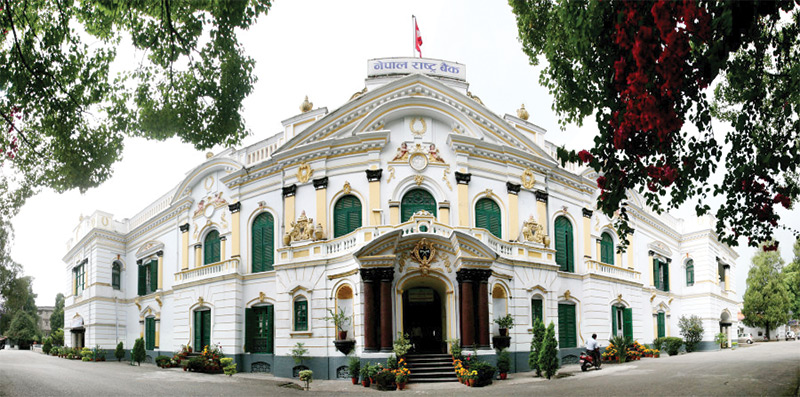
There is a need to balance the environment and development, but it’s not the central bank’s job. Post file photo
- PABAN RAJ PANDEY
The Swedish Riksbank, established in 1668 with a charter to lend the government funds and act as a clearing house for commerce, is recognised as the world’s first central bank. In 1694, the Bank of England was founded. Besides funding the government’s debt, these pioneer central banks engaged in banking activities themselves. Because they held the deposits of other banks, they became the lender of last resort in times of crises. In 1913, the United States Federal Reserve was created with a mandate to provide a uniform and elastic currency and to serve as a lender of last resort. As they were bound by their adherence to the gold standard, price stability was their primary commitment, but not the stability of the economy. This began to change post-World War I, as employment became a top concern. In 1931, England suspended the gold standard. Three years later, the US revalued the metal from $20.67 per ounce to $35, enabling it to massively expand the money supply; come 1971, then president Nixon ended the direct convertibility of dollars into gold, and the era of fiat money was born. Inflation gradually began to go rampant; this was eventually tamed by Paul Volcker’s Fed. His successor Alan Greenspan, who assumed office shortly before the October 1987 stock market crash, essentially widened the Congress-mandated goals of price stability and maximum employment. Financial stability by default became the third mandate. Greenspan’s successors—Ben Bernanke, Janet Ellen and now Jerome Powell—went along with this. Central bankers today do not rein in stock market and housing booms/bubbles but are quick to respond to busts with loads of liquidity. After the 2007-08 financial crisis, quantitative easing—an unconventional policy using the balance sheet—became the norm. The Fed is spreading its tentacles wider. It has joined the Network of Central Banks and Supervisors for Greening the Financial System, which was launched in December 2017 to develop recommendations for central banks’ role for climate change. In a subsequent financial stability report, the Fed explored climate change for the first time.
Acting beyond mandates The risk in this is that central bankers are spreading themselves too thin. These are institutions with immense power and will probably serve their purpose better by staying closer to their mandates. Climate change is a noble goal, but it is a slippery slope. Nepal Rastra Bank, Nepal’s central bank, is at risk of committing this error. In February, it unveiled a checklist on climate risks for banks and financial institutions to complete before financing any projects. Global temperature is rising. A drought-prone area today could very well be flooded in 20 years. Experts struggle to assess the magnitude of man-induced climate change. Banks, which have professionals on the payroll to assess these risks, do not need to be told what to do. As per its mandate, the Nepal Rastra Bank Act 2002 states that (1) The objectives of the bank are: (a) To formulate, and manage, monetary and foreign exchange policy needed to maintain price and balance of payment stability for the achievement of economic stability and sustainable development of the economy; (b) To raise public confidence toward the banking and financial system by making the sectors stable and by increasing access to financial services; (c) To develop a secure, healthy and efficient payment system. (2) The bank, without adversely impacting the objectives outlined in subsection 1, will extend cooperation to the government of Nepal in the implementation of economic policy. One can argue that climate change has the potential to adversely impact economic stability; hence it falls within the purview of Nepal Rastra Bank. As a case in point, in the last harvesting season a year ago, yarsagumba, an expensive caterpillar fungus harvested in the high altitudes for its supposed aphrodisiac properties and which is in high demand in China, collectors returned empty-handed. Lots of livelihoods in remote districts such as Dolpa depend on this income. Last year, the yarsa was not fully mature. Of late, the Himalayan region has gotten routinely hit by erratic monsoons and warmer weather. Snowlines have receded and glaciers have shrunk, increasing the danger of floods downstream.
Climate change no-brainer To many, climate change is a no-brainer. It is happening right in front of us. Studies showed how reduced emissions of nitrogen oxides due to Covid-19 lockdowns in the early months of 2020 apparently caused a global drop in ozone pollution. This highlights the extent of pollution generated by human industry and transportation. At the same time, global warming is a touchy subject. Not everyone buys it. And not everyone is affected equally. There are zealous sceptics, as there are fanatic believers. There are scientists—including Nobel laureate Ivar Giaever—who do not completely pooh-pooh the notion of global warming, but claim that the data is not nearly as compelling as the anti-carbon crowd would have us believe. Sadly, the issue has become political. In countries like Norway, belief in climate change spans political parties. But in the US, it is politically divisive. There is little common ground between Democrats and Republicans on what causes it, let alone how to solve it. Donald Trump, who referred to global warming as a “hoax”, withdrew from the Paris Climate Agreement in 2017. Republican Trump’s Democrat successor Joe Biden recommitted the US hours after being sworn in as president in January 2021. It is these politicians that appoint officials like Fed Chair Powell, a Republican, who joined the Network of Central Banks and Supervisors for Greening the Financial System in December 2020. Therein lies the problem. At the risk of oversimplification, liberals and conservatives see climate-related matters through different lenses. Change in political leadership hence can entail change in policy. Understandably so, as, let us say, the Communist Party of Nepal (UML) and the Nepali Congress—the leading two parties in Nepal—operate on different political philosophies. Hence the need for institutions like Nepal Rastra Bank to be able to focus on its mandate no matter who is in power. A wider focus makes it vulnerable to political intervention. Climate change is real. Nationally, there is a need to create a right balance between environment and development. But this is not a central bank’s job.
Pandey talks markets, money and macroeconomics on hedgopia.com.
OPINION
Oil price shock
There is no way to know how long the factors driving higher fuel costs will last.
- SCOTT L MONTGOMERY
Shutterstock
The world is in the grip of an oil price shock. In just a few months, prices have risen from US$65 a barrel to over $130, causing fuel costs to surge, inflationary pressure to rise and consumer tempers to flare. Even before Russia’s invasion of Ukraine, prices were climbing rapidly because of roaring demand and limited supply growth. Price shocks aren’t new. Viewed historically, they are an integral part of oil market dynamics, not anomalies. They have occurred since the birth of the industry. Many factors can trigger oil price shocks. They include large shifts in either demand or supply anywhere in the world, since oil is a global commodity. Shocks can also result from war and revolution; periods of rapid economic growth in major importing nations; and domestic problems in supplier countries, such as political conflict or lack of investment in the oil industry. Overall, the worst spikes have combined two or more of these factors—and that’s the situation today.
Fifty years of ups & downs Global oil production began in the mid-1800s and grew rapidly in the first half of the 20th century. For much of that time, oil majors—companies like Chevron, Amoco and Mobil that were created after the Supreme Court ordered the breakup of Standard Oil in 1911—operated effectively as a cartel, maintaining production at levels that kept oil abundant and cheap to encourage its consumption. This ended when Iran, Iraq, Kuwait, Saudi Arabia and Venezuela formed the Organization of Petroleum Exporting Countries in 1960, nationalising their oil reserves and gaining real supply power. Over the following decades, other nations in the Middle East, Asia, Africa and Latin America joined—some temporarily, others permanently. In 1973, Arab members of OPEC cut their oil production when Western countries supported Israel in the Yom Kippur War with Egypt and Syria. World oil prices shot up fourfold, from an average of $2.90 per barrel to $11.65. In response, government leaders in wealthy countries introduced policies to stabilise oil supplies. These included finding more oil, investing in energy research and development, and creating strategic oil reserves that governments could use to mitigate future price shocks. But six years later, oil prices more than doubled again when Iran’s revolution halted that country’s output. Between mid-1979 and mid-1980, oil rose from $13 per barrel to $34. Over the next several years, a combination of economic recession, replacing oil with natural gas for heating and industry, and shifting to smaller vehicles helped to mitigate oil demand and prices. The next major shock came in 1990 when Iraq invaded Kuwait. The United Nations imposed an embargo on trade with Iraq and Kuwait, which raised oil prices from $15 per barrel in July 1990 to $42 in October. The US and coalition troops moved into Kuwait and defeated the Iraqi army in just a few months. During the campaign, Saudi Arabia increased oil production by more than 3 million barrels per day, roughly the amount previously supplied by Iraq, to help dampen the increase and shorten the period of higher prices. More disruptive price shocks occurred in 2005-2008 and 2010-2014. The first resulted from increased demand generated by economic growth in China and India. At that time, OPEC was unable to expand production due to long-term lack of investment. The second shock reflected the impacts of Arab Spring pro-democracy protests in the Middle East and North Africa, combined with conflict in Iraq and international sanctions that Western nations placed on Iran to slow its nuclear weapons programme. Together, these events pushed oil prices above $100 per barrel for a four-year stretch—the longest such period on record. Relief finally came via a flood of new oil from shale production in the US. A perfect storm in 2022Today, multiple factors are raising oil prices. There are three key elements: a) Oil demand has grown more rapidly than expected in recent months as countries emerged from pandemic lockdowns. b) OPEC+, a loose partnership between OPEC and Russia, has not raised production at a commensurate level, and neither have US shale oil companies. c) Countries have drawn on stocks of oil and fuel to fill the supply gap, reducing this emergency cushion to low levels. These developments have made oil traders worry about looming scarcity. In response, they have bid oil prices up. It’s worth noting that while consumers often blame oil companies (and politicians) for high oil prices, these prices are set by commodity traders in venues such as the New York, London and Singapore stock exchanges. Against this backdrop, Russia attacked Ukraine on February 24, 2022. Traders saw the potential for sanctions on Russian oil and gas exports and bid energy prices even higher. Unexpected factors also have emerged. Major oil companies including Shell, BP and ExxonMobil are ending their operations in Russia. Spot market buyers have rejected seaborne Russian crude, probably for fear of sanctions. And on March 8, the US and UK governments announced bans on imports of Russian oil. Neither country is a major Russian buyer, but their actions set a precedent that some analysts and traders fear could lead to escalation, with Russia reducing or eliminating exports to US allies. In my view, this set of conditions is unprecedented. It reflects not just increased complexity in the global market, but also an imperative for energy firms—which already are under pressure from shareholder climate activists—to avoid further reputational damage and leave one of the most oil-rich countries in the world. Some companies, such as BP, are abandoning assets worth tens of billions of dollars.
What could ease this shock? As I see it, the key players that can help curtail this price shock are OPEC—mainly, Saudi Arabia—and the US. For these entities, holding back oil supply is a choice. However, there’s no evidence yet that they are likely to change their positions. Restoring the Iran nuclear deal and lifting sanctions on Iranian oil would add oil to the market, though not enough to greatly reduce prices. More output from smaller producers, such as Guyana, Norway, Brazil and Venezuela, would also help. But even combined, these countries can’t match what the Saudis or the US could do to increase supply. All of these uncertainties make history only a partial guide to this oil shock. Currently, there is no way to know how long the factors driving it will last, or whether prices will go higher. This isn’t much comfort to consumers facing higher fuel costs around the world.
Montgomery is Lecturer at Jackson School of International Studies, University of Washington. — The Conversation
MONEY
Everest base camp to have high-speed connectivity
Ncell plans to build five BTS towers in Thame, Somare Pari Hill, Dingboche, Thukla Hill and Pyramid Hill to provide 4G telecommunication service.
- KRISHANA PRASAIN
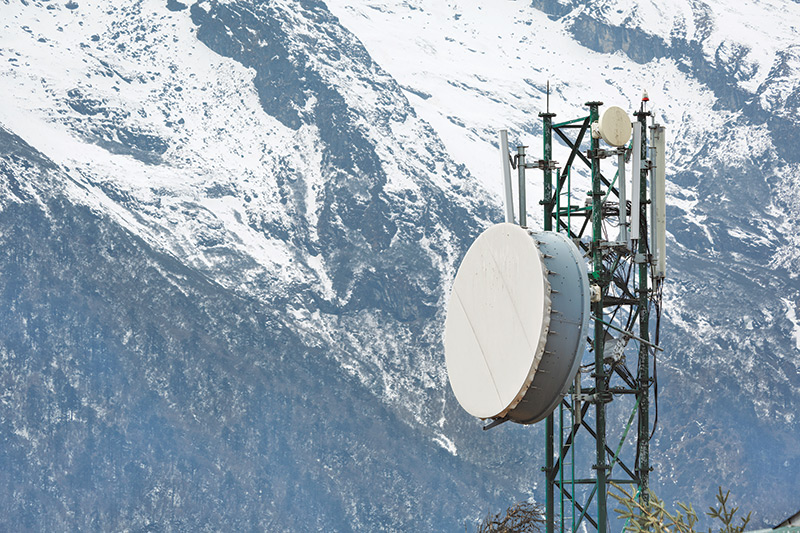
A mobile network station in Namche Bazaar. Shutterstock
KATHMANDU, Private sector telecommunication company Ncell is building the world’s highest cell phone tower at an altitude of 5,200 metres on Mt Everest, which will provide dedicated ultra fast 4G connectivity, officials said. The company will erect base transceiver stations (BTS) in at least five locations in the Everest region, ranging in elevation from 3,830 to 5,204 metres above sea level, to serve mountain communities. “If things go as per our plan, we will have our 4G live in the area by the fourth quarter this year,” Ncell told the Post in an email. “Access to high-speed mobile broadband in the area will support multiple sectors including tourism. With 4G access, people from remote areas of the Everest region can take advantage of the opportunities that high-speed mobile connectivity brings. Tourists can share the excitement of their visit to the region and stay connected with their loved ones,” it said. “Once there is reliable connectivity, it contributes to creating innovative experiences for consumers, adding values for the tourism sector.” On March 14, the Ministry of Forests and Environment issued a seven-day notice inviting feedback on the environmental impact assessment (EIA) report of the project entitled BTS Sites for Everest Base Camp Trekking Route. “The purpose of the announcement is basically to make project documents public and obtain comments and suggestions,” said a joint secretary at the Ministry of Forests and Environment. “The approval of the EIA depends on how it has addressed environmental impacts.” If the EIA process is successful, it identifies alternatives and mitigation measures to reduce the environmental impact of a proposed project. According to the EIA, the project will last three months, and after 4G service becomes available in the Everest region, there will be a tremendous improvement in mobile service with the highest mobile internet speed and broadband network availability. According to Ncell, an initial report has shown that 4G signal can be received on the Everest summit at 8,848.86 metres. It said the exact result would be known after the test is successful. Everest base camp already has 4G service but there is no dedicated infrastructure. Improved internet service will also help in disaster risk management and minimisation as the Sagarmatha or Everest region is located in a geographically remote area, the report said. The Everest region receives nearly 60,000 trekkers and mountaineers annually. It is a high revenue generating segment of the tourism industry because of the allure of the world’s highest peak. Everest climbers need to spend $35,000 to $90,000 per person depending on the extent of support needed in terms of guides and supplies. This amount includes the cost of the climbing permit of $11,000. China has successfully tested 5G at the base camp on the northern side of Everest. The study began in April 2020. “In the old days, climbers and trekkers used to carry satellite phones, which were expensive and required permits,” said Ang Tshering Sherpa, former president of the Nepal Mountaineering Association. “It was a big hassle.” With 4G service, communication up to the summit will be enhanced. Foreign adventure seekers will not be the only ones benefiting from this scheme. It will also create a positive impact on locals in the remote mountainous region, particularly in search and rescue efforts. “Indeed, it’s welcome news,” said Sherpa. The EIA report said that the fastest internet service available will also bring a positive impact on the conservation of Sagarmatha National Park. “The expansion and level uplift of mobile telecommunication technology will increase the effectiveness of public services,” the report said, adding that it would also improve the infrastructure by increasing the capacity of the service and facility. The plan will help to encourage the use of mobile telecommunication in the area. The proposed project will be implemented in Solukhumbu district of Province 1, Khumbu Pasang Lhamu Rural Municipality Ward Nos 4 and 5. The project will cover 753.55 square metres of Sagarmatha National Park. Five BTS towers 7 metres in height will be erected. They are planned to be built in Thame, Somare Pari Hill, Dingboche, Thukla Hill and Pyramid Hill. According to the EIA draft, 27,495 users will be able to use the service per hour with each tower serving 5,499 users per hour. The service will be available 24/7 and four out of the five towers will be powered by solar energy. The project site in Thame will be managing electricity produced by Khumbu Electricity Company. Each BTS tower will be equipped with a 1,000 ampere hour battery, and 33 solar panels will be installed at each site to produce power. Ncell Axiata Limited (previously Ncell Private Limited) has a 16.84 million customer base with 8.34 million mobile broadband users in Nepal. Among its 14.48 million users, 6.14 million are 4G users. Ncell has extended 4G to all seven provinces. Currently, Ncell provides 2G and 3G services in Namche Bazaar, Thamu, Thyangboche, Gorak Shep, Everest View Hotel, Khumjung, Phakding and Lukla.
MONEY
IFC, Nepal Stock Exchange continue tie-up to promote gender equality
- Post Report
Photo: IFC
KATHMANDU, For the second consecutive year, IFC joined the Nepal Stock Exchange (NEPSE) to ‘Ring the Bell for Gender Equality,’ an annual global event that highlights how the private sector can spur women’s participation in the global economy and promote sustainable development. Accelerating the pace of gender parity could lead to important economic, environmental, social, and governance gains in emerging and frontier markets. If women fully participated in formal labour markets, the global gross domestic product (GDP) would increase by $28 trillion, according to the Sustainable Stock Exchanges Initiative. “For the second year in a row, we join hands with IFC and the UN Global Compact Nepal for the ‘Ring the Bell for Gender Equality event,’” said Krishna Bahadur Karki, CEO of NEPSE. “We recognise that stock exchanges can play a key role by nudging listed companies to do more to promote equality.” A growing body of research shows a range of business benefits associated with gender diversity on corporate boards and in senior leadership. It also underlines the positive influence of gender-diverse management and boards on a company’s sustainability profile, including improved financial performance and shareholder value, and rising investor confidence, among others. “With countries gradually recovering from the global pandemic, this is the right time to push for increased participation of women to accelerate the recovery process,” said Pradeep Man Vaidya, president of United Nations Global Compact Network Nepal, in a statement. In Nepal, the number of women on corporate boards is extremely small. An IFC study in the country’s power sector shows that out of 132 board members from 20 companies, only 12 (9 percent) are women. Despite Nepal’s Companies Act requiring at least one or more female shareholders, only three out of 10 public companies have women on their boards.
MONEY
Stocks climb, oil steadies on Ukraine-Russia peace hopes
- AGENCE FRANCE-PRESSE
LONDON, Stock markets advanced and oil prices steadied on Tuesday as investors eyed possible progress in talks between Russia and Ukraine aimed at halting military action. Crude futures had soared more than seven percent Monday on supply worries as European leaders debated banning imports from Russia. Some members are pushing to ramp up pressure on Russian President Vladimir Putin with more sanctions, though others, including Germany—which still relies on Moscow’s fuel —have been reluctant to target key sectors. Adding to the pressure, Saudi Arabia warned that Yemeni rebel attacks on its oil facilities pose a “direct threat” to global supplies, after Red Sea facilities belonging to giant Saudi Aramco were targeted. “The oil market remains one of the most volatile,” noted Walid Koudmani, chief market analyst at XTB. Soaring oil prices have been a driver of turmoil on world markets in recent weeks as demand surges also as economies reopen from pandemic lockdowns. That, along with a spike in the cost of other key commodities, such as metals and wheat on the Ukraine conflict, has sent global inflation rocketing and caused central banks to hike interest rates. There is a growing fear that the global economy could endure a period of stagflation whereby prices soar but growth stalls.
MONEY
Canadian Pacific, union agree to end work stoppage
Briefing
OTTAWA: Canadian Pacific locomotive engineers, conductors, train and yard workers were to head back to work midday Tuesday after their union and the railway giant agreed to binding arbitration to end a work stoppage. CP chief executive Keith Creel said in a statement an agreement has been reached with Teamsters Canada “to enter into binding arbitration and end this work stoppage.” “This agreement enables us to return to work effective noon Tuesday local time to resume our essential services for our customers and the North American supply chain,” he said. (AFP)
MONEY
Libya reopens airspace after two-week shutdown
Briefing
TRIPOLI: Libyan authorities reopened the war-torn country’s skies for domestic flights on Tuesday, an aviation official said, two weeks after they were grounded amid a tense political standoff. “Air traffic resumes today and the domestic airspace is open between Mitiga (the main airport in the western capital Tripoli) and airports in eastern and southern Libya,” a source from Mitiga’s security directorate told AFP. Flights between Mitiga and other Libyan airports had been suspended since March 7, after the country’s eastern-based parliament appointed a rival government in a challenge to unity premier Abdulhamid Dbeibah. (AFP)
WORLD
Ukrainian plea as more bombs hit besieged Mariupol
Ukraine, with rich soil, is one of the world’s biggest exporters of grain, and the war has caused global prices for staple foods to surge to record levels.
- REUTERS
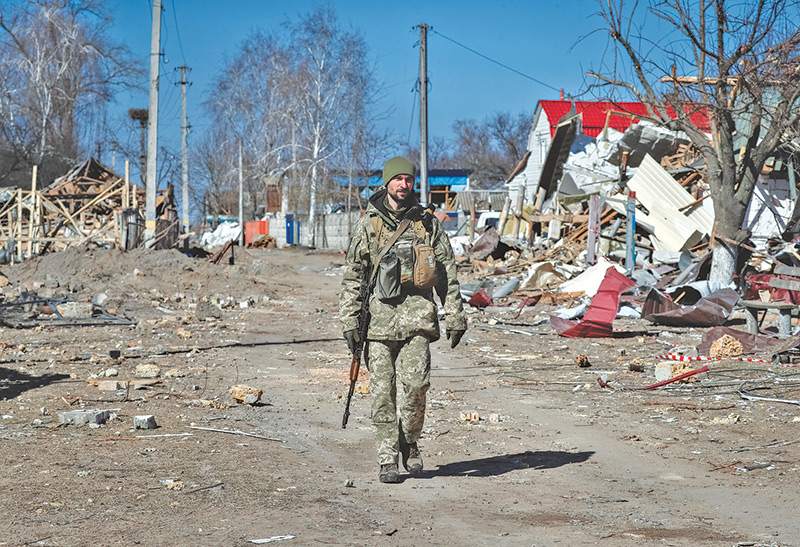
A Ukrainian soldier walks, as the Russian invasion continues, in a destroyed village on the front line in the east Kyiv region, Ukraine on Monday. REUTERS
LVIV/KYIV, Russia is pounding the besieged Ukrainian port of Mariupol into the “ashes of a dead land”, its local council said on Tuesday, describing two more huge bombs that fell on the city that has been sealed off for weeks. The plight of Mariupol, a city of 400,000 before the war, has been the most urgent humanitarian emergency since Russia invaded Ukraine nearly a month ago. Hundreds of thousands of residents are believed to be trapped inside under near constant shelling, with no access to food, water, power or heat. “There is nothing left there,” Zelenskiy said in a video address to the Italian parliament on Tuesday. The city council gave no details of casualties or damage from the latest bombing. No independent journalists have been operating inside the Ukrainian-held parts of the city for at least a week, during which Ukraine says Russia struck a theatre, an art school and other public buildings, burying hundreds of women and children sheltering in cellars. “Once again it is clear that the occupiers are not interested in the city of Mariupol. They want to level it to the ground and make it the ashes of a dead land,” the council said in a statement. Russia denies targeting civilians. Ukraine says Moscow has blocked daily efforts to send in relief convoys with food and other supplies for civilians, or buses to bring them out. Russia demanded the city surrender by dawn on Monday, an ultimatum that Kyiv defied. “We demand the opening of a humanitarian corridor for civilians,” Ukraine’s Deputy Prime Minister Iryna Vereshchuk said on Ukrainian television on Tuesday. “Our military is defending Mariupol heroically. We did not accept the ultimatum. They offered capitulation under a white flag. This is manipulation, a lie.” Russia calls the biggest invasion in Europe since World War Two a “special military operation” to disarm Ukraine and protect it from “Nazis”. The West calls this a false pretext for an unprovoked war against a democratic country. Mariupol is the biggest city still held by Ukraine in the Donetsk region, which Russia has demanded Kyiv cede to Moscow-backed separatists. Russian media quoted a separatist official on Tuesday as saying half of Mariupol was now captured. A part of Mariupol now held by Russian forces, reached by Reuters on Sunday, was an eerie wasteland of windowless charred apartment blocks. Bodies wrapped in blankets lay by a road. A group of men dug graves in a patch of grass. US President Joe Biden said recent accusations by Moscow that Ukraine held chemical and biological weapons were not merely false, but a sign that President Vladimir Putin might be planning to use such weapons himself. “Now he’s talking about new false flags he’s setting up including, asserting that we in America have biological as well as chemical weapons in Europe, simply not true,” Biden said at a business event on Monday. “They are also suggesting that Ukraine has biological and chemical weapons in Ukraine. That’s a clear sign he’s considering using both of those.” Nearly a month into the war, Russian troops have failed to capture a single major city and their advance has been halted on nearly all fronts by Ukrainian defenders. Moscow has instead turned to bombarding cities with artillery, missiles and bombs. In an address overnight, Zelenskiy drew attention to the death of Boris Romanchenko, 96, who survived three Nazi concentration camps during World War Two but was killed when his apartment block in besieged Kharkiv was shelled last week. “With each day of this war, it becomes more obvious what ‘denazification’ means to them,” said Zelenskiy. In killing Romanchenko, “Putin managed to ‘accomplish’ what even Hitler couldn’t,” Ukraine’s Defence Ministry said on Twitter. The conflict has forced nearly a quarter of Ukraine’s 44 million people from their homes, including more than 3.5 million refugees who have fled the country, half of them children, in one of the fastest exoduses ever recorded. Ukraine, with rich black soil, is one of the world’s biggest exporters of grain, and the war has caused global prices for staple foods to surge to record levels. “The most terrible thing will be the famine that is approaching for some countries,” Zelenskiy said in his speech to Italian lawmakers. “Ukraine has always been one of the largest food exporters, but how can we sow [crops] under the strikes of Russian artillery?” Within Russia, independent media have been effectively shut down, and referring to the “special operation” as a war or invasion is banned. But there are some signs of dissent. One of the best-known Russian state TV news personalities, Zhanna Agalakova, a foreign correspondent and former Channel One news reader, announced at a news conference in Paris on Tuesday that she had quit in protest against the war. “When I spoke to my bosses, I said I cannot do this work any more,” she said. Dmitry Muratov, who won the Nobel Peace Prize in December for fighting for free speech as editor of Novaya Gazeta, one of Russia’s last independent newspapers, announced he would auction his medal to raise money for Ukrainian refugees.
WORLD
Biden calls India ‘shaky’ in Russia confrontation
WASHINGTON: US President Joe Biden said on Monday that India was an exception among Washington’s allies with its “shaky” response to the Russian invasion of Ukraine. Biden lauded the US-led alliance, including NATO, the European Union and key Asian partners, for its united front against President Vladimir Putin. This includes unprecedented sanctions aimed at crippling Russia’s currency, international trade and access to high-tech goods. However, unlike fellow members of the Quad group—Australia, Japan and the United States—India continues to purchase Russian oil and has refused to join votes condemning Moscow at the United Nations. Addressing a meeting of US business leaders in Washington, Biden said there had been “a united front throughout NATO and in the Pacific.” “The Quad is, with the possible exception of India being somewhat shaky on some of this, but Japan has been extremely strong—so has Australia—in terms of dealing with Putin’s aggression.” Biden said that Putin was “counting on being able to split NATO” and instead, “NATO has never been stronger, more united, in its entire history than it is today.” Indian oil refiners have reportedly continued to purchase discounted Russian oil, even as the West seeks to isolate Moscow. An Indian government official said last week that the world’s third-biggest consumer of crude relies on imports for almost 85 percent of its needs, with Russia supplying a “marginal” less than one percent of this. (AFP)
WORLD
Wallets, IDs but no survivors found in China Eastern crash
Plane was about an hour into flight, at 29,000 feet, when it entered a steep, fast dive around 2:20 pm, data from FlightRadar24.com showed.
- ASSOCIATED PRESS
In this image taken from a video footage, debris is surrounded by policetape at the crash site in Tengxian in Guangxi Zhuang Region. Ap/Rss
WUZHOU, Mud-stained wallets. Bank cards. Official identity cards. Poignant reminders of 132 lives presumed lost were lined up by rescue workers scouring a remote Chinese mountainside on Tuesday for the wreckage of a China Eastern flight that one day earlier inexplicably fell from the sky and burst into a huge fireball. No survivors have been found among the 123 passengers and nine crew members. Video clips posted by China’s state media show small pieces of the Boeing 737-800 plane scattered over a wide forested area, some in green fields, others in burnt-out patches with raw earth exposed after fires burned in the trees. Each piece of debris has a number next to it, the larger ones marked off by police tape. Search teams planned to work through the night using their hands, picks, sniffer dogs and other equipment to look for survivors, state broadcaster CCTV reported. The steep, rough terrain and the huge size of the debris field were complicating the search for the black boxes, which hold the flight data and cockpit voice recorders, CCTV and the official Xinhua News Agency said. Drones were being used to search the fragments of wreckage that were scattered across both sides of the mountain into which the plane crashed, state media reported. As family members gathered at the destination and departure airports, what caused the plane to drop out of the sky shortly before it would have begun its descent to the southern China metropolis of Guangzhou remained a mystery. The crash left a deep pit in the mountainside about the size of a football field, Xinhua said, citing rescuers. Chen Weihao, who saw the falling plane while working on a farm, told the news agency it hit a gap in the mountain where nobody lived. “The plane looked to be in one piece when it nosedived. Within seconds, it crashed,” Chen said. China Eastern flight 5735 crashed outside the city of Wuzhou in the Guangxi region while flying from Kunming, the capital of the southwestern province of Yunnan, to Guangzhou, an industrial centre not far from Hong Kong on China’s southeastern coast. It ignited a fire big enough to be seen on NASA satellite images before firefighters could extinguish it. No foreigners were on board the lost flight, the Foreign Ministry said, citing a preliminary review. Dinglong Culture, a Guangzhou company in both mining and TV and movie production, said in a statement to the Shenzhen stock exchange that its CFO, Fang Fang, was a passenger. Zhongxinghua, an accounting firm used by Dinglong, said that two of its employees were also on the flight. The crash site is surrounded on three sides by mountains and accessible only by foot and motorcycle on a steep dirt road in the semitropical Guangxi region, famed for some of China’s most spectacular scenery. Rain fell on Tuesday afternoon as excavators dug out a path to make access easier, CCTV said. The steepness of the slope made the positioning of heavy equipment difficult. A base of operations was set up near the crash site with rescue vehicles, ambulances and an emergency power supply truck parked in the narrow space. Soldiers and rescue workers combed the charred crash site and surrounding heavily dense vegetation. Police restricted access, checking each vehicle entering Molang, a village near the crash site. Five people with swollen eyes walked out of the village, got into a car and left. Onlookers said they were relatives of the passengers. Family members gathered at Kunming and Guangzhou airports. People draped in pink blankets and slumped in massage chairs could be seen in a traveller rest area in the basement of the one in Kunming. Workers wheeled in mattresses and brought bagged meals. A security guard blocked an AP journalist from entering, saying that “interviews aren’t being accepted.” In Guangzhou, relatives were escorted to a reception centre staffed by employees wearing full protective gear to guard against the coronavirus. At least five hotels with more than 700 rooms had been requisitioned in Wuzhou’s Teng county for family members, Chinese media reported. Workers in hazmat suits set up a registration desk and administered Covid-19 tests at the entrance to one hotel, outside of Molang. A sign read, “The hotel is requisitioned for March 21 plane accident emergency use.” At another hotel, a group of women, some wearing vests with Red Cross markings, registered at a hotel desk set up outside. The nation’s first fatal plane crash in more than a decade dominated China’s news and social media. World leaders including Great Britain’s Boris Johnson, India’s Narendra Modi and Canada’s Justin Trudeau posted condolences on Twitter. Boeing Chief Executive Dave Calhoun said that the company was deeply saddened by the news and had offered the full support of its technical experts to assist in the investigation. “The thoughts of all of us at Boeing are with the passengers and crew members ... as well as their families and loved ones,” he wrote in a message to Boeing employees. The plane was about an hour into its flight, at an altitude of 29,000 feet, when it entered a steep, fast dive around 2:20 pm, according to data from FlightRadar24.com.
WORLD
Pakistani PM urges Islamic nations to mediate in Ukraine war
- ASSOCIATED PRESS
ISLAMABAD, Pakistan’s prime minister on Tuesday urged foreign ministers from Muslim-majority nations to help end Russia’s war in Ukraine, appealing also on China’s top diplomat to join the effort. Imran Khan spoke at the start of a two-day gathering in Islamabad of the 57-member Organization of Islamic Cooperation, which for the first time saw the attendance of China’s foreign minister, Wang Yi, as a special guest. The war in Ukraine “could have great consequences for the world,” Khan warned and added that the rest of the planet is “already suffering,” with surging prices of oil, gas and wheat from a region known as the breadbasket of the world. He urged the ministers to “mediate, try to bring about a cease-fire and an end to the conflict.” Wang’s attendance underscored China’s increasing influence among OIC countries — as well as the Islamic organisation’s readiness to overlook charges of widespread attacks by Chinese authorities on the country’s minority Muslim Uyghurs. Khan, who has made fighting Islamophobia a top priority, has refused to condemn China over allegations of abuse against the Uyghurs. Pakistan has signed a multi-billion dollar road and energy project that will link its Arabian Sea port of Gwadar to China in the north. Pakistan’s Foreign Minister Shah Mahmood Qureshi met separately with his Chinese counterpart, the ministry said. The two “discussed the situation in Ukraine and reiterated the need for a solution through sustained dialogue and diplomacy,” the ministry said. Michael Kugelman, deputy director of the Asia Program at the US-based Wilson Center, tweeted that it was “rather ironic” to see Wang at the conference. “It’s also a reminder of the high value that the OIC states place on their commercial relations with Beijing,” Kugelman said. Khan also reiterated his plea for the international community to help neighbouring Afghanistan, which has been struggling with an economic meltdown and severe shortages of food and medicines since the Taliban takeover in mid-August. “A stable Afghanistan is the only way that we are going to tackle international terrorism from Afghan soil,” said Khan. “It is extremely important that we help the people of Afghanistan.” At a meeting in December Pakistan tried to rally Muslim countries to reach out to Afghanistan’s new rulers as they transition from insurgency and war to governing. However, none of the OIC countries have officially recognised the Taliban government in Afghanistan. The international community is suspicious the Taliban could impose similarly harsh measures as when they were first in power in Afghanistan in the 1990s. The Taliban did not send their top envoy, Amir Khan Muttaqi, to the meeting but a lower level Taliban official. On Monday, Pakistan announced the establishment of a humanitarian trust fund for Afghanistan, which will be operated by the Islamic Development Bank and funded through donations from OIC member states, Islamic financial institutions, donors and international partners.
WORLD
Sri Lanka softens terror law after EU trade pressure
Briefing
- AGENCIES
COLOMBO: Sri Lanka’s parliament amended a controversial anti-terror legislation on Tuesday after a European Union threat to withdraw lucrative trading status, but opposition lawmakers said the changes would not stop abuses under the law. The EU last year warned the island nation could again lose its generalised system of preferences (GSP Plus) designation—a favourable trade scheme to encourage developing nations to respect human rights—if Colombo did not improve its rights record. Tuesday’s vote to tweak the Prevention of Terrorism Act comes after President Gotabaya Rajapaksa told a delegation from Brussels in October that he had committed to urgent reforms of the law.
WORLD
Ukraine leader calls on Pope to mediate in conflict
Briefing
- AGENCIES
KYIV: Ukrainian President Volodymyr Zelensky called Tuesday on Pope Francis to mediate in his country’s conflict with Russia to help alleviate human suffering, nearly one month into Moscow’s invasion. Zelensky said he had held a telephone call with the pope and that he had “told His Holiness about the difficult humanitarian situation and the blocking of rescue corridors by Russian troops.” “The mediating role of the Holy See in ending human suffering would be appreciated,” Zelensky wrote on Twitter following the call. Negotiators from Moscow and Kyiv have held talks aimed at ending nearly four weeks of fighting, but have failed to announce any progress.
WORLD
Greek minister wants to lead aid mission to Mariupol
Briefing
- AGENCIES
ATHENS: Greek Foreign Minister Nikos Dendias said on Tuesday that he wants to lead a humanitarian mission into the besieged city of Mariupol in Ukraine where thousands of ethnic Greeks live. Ukraine appealed to Russia on Tuesday to allow humanitarian supplies into Mariupol and to let civilians out of the city, which President Volodymr Zelenskiy said had been devastated by Russian bombardments. Russia denies targeting civilians and blames Ukraine for the repeated failure to establish safe passage for civilians out of Mariupol.
SPORTS
Khadka, Bhandari named players of the decade
Jagat Tamata is declared coach of the decade and table tennis player Elina Maharjan wins peoples’ choice award at the NSJF Pulsar Sports Award.
- Sports Bureau
Winners of the NSJF Pulsar Sports Award pose for a group photo at the end of the award ceremony at the Nepal Academy Hall in Kathmandu on Tuesday. Post Photo: Keshav Thapa
KATHMANDU, Former national cricket team captain Paras Khadka and star woman footballer Sabitra Bhandari were honoured with male and female player of the decade respectively at the annual NSJF Pulsar Sports Award held amidst a grand function at the Nepal Academy Hall in Kathmandu on Tuesday. Cricket coach Jagat Tamata was named coach of the decade at the ceremony that awarded male player, female player and coach on account of their performances and achievements during the past decade unlike the previous editions that recognised the players on the basis of their performance of the past calendar year. The award organiser Nepal Sports Journalists Forum, the umbrella organisation of sports journalists in the country, had already announced that they would reward the sports personalities in three categories reviewing their performance of the past decade instead of last Nepali calendar year considering that very few sports events were held due to the Covid-19 pandemic. Table tennis player Elina Maharjan won the peoples’ choice award that was decided through e-sewa voting, Facebook likes, points allocated by coaches and sports journalists among the five nominees. She secured 47.8 percent votes. National women’s football team goalkeeper Anjila Tumbapo Subba, shuttler Prince Dahal, cricketer Kushal Bhurtel and long distance runner Santoshi Shrestha were other nominees for the peoples’ choice category. “I had already felt like a winner when I was nominated for the award,” said national women’s table tennis team member Maharjan, who is the double bronze medal winner at the South Asian Games (SAG). Khadka, the most accomplished cricketer Nepal has ever had, announced his surprise international retirement last year in August. The all-rounder led Nepal’s elevation from a Division 5 team, the lowest tier of international cricket, in 2010 to their status as a one-day international (ODI) nation, the highest tier, in 2018—a rare achievement for any country in such a short period. The middle-order batsman Khadka, who also bowled medium pace, enjoyed an illustrious career ever since he forayed into cricket. Khadka represented the country in the Under-19 World Cups in 2004, 2006 and 2008 while also being a part of the senior side. He took over the senior side in 2009 when he was 22 years old. He is also the first Nepali player to hit a one-day international hundred when he slammed 115 runs against the United Arab Emirates in 2021, besides scoring a T20I century. “The credit for this award goes to my teammates as I am nothing without them. I thank my teammates and coaches for the award. I will remain involved in the game though I have announced retirement,” said cricketer Khadka. Bhandari, the goal machine of the national women’s football team, is regarded as one of the best forwards of the current generation of players at the South Asian level. She is the two-time silver medallist in Women’s SAFF Championship and holds the record as the highest international goal scorer for Nepal with 38 goals from 40 games. The 25-year-old has scored far more goals than her highest scoring male counterpart’s tally of 13 goals. She played a key role in Nepal’s runner-up finish in the Nadezhda Cup in Kyrgyzstan in 2019 and second-placed finish in Hero Cup in India the same year. Bhandari had scored both goals against India in their 2-1 win as Nepal achieved their first ever victory over their mighty opponents. She was also one of the key players for Sethu FC and Gokulam Kerala FC in 2019 and 2020 season and guided the teams to I-League titles. Tamata was the coach of the national team when they gained ODI status in 2018. He mentored the team when Nepal qualified for U-19 World Cup in 2012 and 2016. He played a crucial role as a coach in guiding the team to the U-19 World Cup quarter-finals, the highest place Nepal has ever made to, among seven appearances in the global age group tournament. He also led the women’s team to a bronze medal in the 2019 South Asian Games. “The credit for the award goes to players and the success we achieved was the result of their hard work and dedication. I have been in cricket for the past 42 years and I promise to remain in the game my whole life,” said Tamata. Long distance runner Pushpa Bhandari was honoured with performer of the year award for winning Dhaka Marathon last year. She was among a handful of Nepali athletes to participate in international competition in the year marred by Covid-19 pandemic. Para-athlete Sarita Thulung got a par-athlete honour. The 37-year-old plays multiple games including athletics, swimming and wheelchair basketball. She became a victim of polio in her childhood. Dr Ajay Rana was given a special award while the national men’s football team that won Three Nations Cup last year in Kathmandu was conferred the team of the year award. Kuwaiti sports journalist Satam Al Sehali was handed the Asian Sports Journalist Award. He is the president of AIPS-Asia, the international organisation of Asian sports journalists. AIPS-Asia general secretary Amjad Aziz Malik received the award on his behalf. The winners of male, female, coach and peoples’ choice awards were given a Pulsar motorbike each while the winner of all other categories carried home a purse of Rs50,000 except the journalist award.
Aaward winNers Award Category - Winner Male player of decade - Paras Khadka (cricket) Female player of decade - Sabitra Bhandari (football) Coach of the decade - Jatat Tamata (cricket) Lifetime achievement - Late Sharad Chandra Shah Special award - Dr Ajay Rana Peoples’ choice - Elina Maharjan Performer of the year - Pushpa Bhandari (athletics) Para-athlete honour - Sarita Thulung (athletics, basketball, swimming) Team of the year - Men’s football team Asian Sports Journalists - Satam Satam Al Sehali (Kuwait)
SPORTS
Late Shah receives golden salute
KATHMANDU: Sports administrator the late Sharad Chandra Shah was conferred the golden salute lifetime achievement award. Shah, who died in July 2012, is credited for introducing modern approach to Nepali sports and construction of major sports infrastructure in the country during his 11-year tenure from 1977 to 1988 as National Sports Council member secretary. Saha’s wife Renu Shah received the award. Shah introduced the National Games in Nepal and was also a mastermind behind the birth of the sub-continental South Asian Games (SAG). It was under Shah’s leadership the first ever SAG known as South Asian Federation Games (SAFG) then took place in Kathmandu in 1984. Apart from National Games, he also initiated Inter City Sports in the country and played a key role as executive head of National Sports Council (NSC) in constructing covered halls in all 75 districts of the country. It was under his tenure that the country saw construction of stadiums in all five development regions of the country. In the 1988 Seoul Olympics, Nepal sent 17 athletes in the Games in comparison to six in the Tokyo Olympics last year and his tenure in sports is considered a golden period in Nepali sports. He resigned on moral ground in 1988 after a stampede at Dasharath Stadium claimed the lives of at least 72 people during a football match. He, however, was a controversial figure in Nepali politics. (SB)
SPORTS
Nepal wrap up UAE Series with a victory
- Sports Bureau
KATHMANDU, Nepal bounced back from heartbreaking losses against hosts United Arab Emirates to thrash Papua New Guinea (PNG) by seven wickets at the Dubai International Cricket Stadium on Tuesday. Kushal Bhurtel and Aarif Sheikh scored a half-century each and Rohit Paudel was unbeaten on 44 as the Rhinos chased down the target of 174 runs in 37 overs to conclude the triangular series of the ICC Cricket World Cup League 2 with two wins. Nepal’s batting had come under the spotlight after capitulating in two successive losses against the UAE, including Monday’s 99-run humiliation that also saw Nepal score their lowest ever one-day international total when they were skittled for just 103 runs. Nepal’s top order misery appeared to continue when Bhurtel’s opening partner Aasif Sheikh–reinstated to the starting XI–was bowled out by Kabua Morea for just 2 runs in the fourth over. But Bhurtel remained unconquered until halfway anchoring Nepal’s innings with his second career ODI fifty. He shared an 87-run partnership with Aarif Sheikh for the second wicket. Bhurtel, stumped on 50, scored four boundaries and one six in his 64-ball knock. Dipendra Singh Airee was the next quick casualty, out for a duck in the second ball, caught by Chad Soper off Charles Amini. Player of the match Aarif (59) then partnered with Rohit Paudel (44) for an unbroken 77-run stand to guide Nepal to victory, their second over PNG in the Series. It was Aarif’s first career ODI fifty that included four fours. Paudel smacked five fences. Earlier, sent to bat first after losing the toss, PNG batted through 50 overs and made 173 losing eight wickets. PNG lost opener Tony Ura cheaply for six when Karan KC had him caught behind. They were 33-2 when the wicketkeeper batsman’s opening pair Lega Saika fell for 20 in the 10th over, also caught behind off Sompal Kami. Captain Assad Vala came at number three and top scored for PNG smacking 45 off 96 balls but Amimi (13), Riley Hekure (1) and Sese Bau (19) all failed to find rhythm before Vala also departed in the 33rd over, also caught behind off Pawan Sarraf. Soper (22 not out), Norman Vanua (18) and Morea (17) then guided PNG to the moderate total. Nepal captain Sandeep Lamichhane and Sompal Kami took two wickets each while Aarif and Dipendra also picked a wicket apiece. Nepal remain in sixth on 12 points after six wins and draws each. PNG are at the bottom managing only one win in 15 matches. Oman lead the table with 36 points from 28 matches and the UAE are second on 22 points from 18 matches.
MEDLEY
Horoscope
ARIES (March 21-April 19) **** Spiritual peace and optimism will find you this morning. Use this energy to engage in some radical self-love by looking for ways to boost your confidence and sense of self. The day will put you in the mood to socialize.
TAURUS (April 20-May 20) *** Healing will find you on a deep level. Take some time to get a meditation session in before work to make the most of these sacred vibes. Use this cosmic climate as an excuse to indulge in a bit of retail therapy for yourself.
GEMINI (May 21-June 21) **** The day can bring healing to your heart, blessing you with creativity and grace. Use this energy to communicate your professional visions since it helps you get ahead. You’ll also have the power to inspire and move people today.
CANCER (June 22-July 22) *** Today’s vibes will bring a rush of activity to the sector of your chart that rules spirituality. You’ll have a unique opportunity to visualize your future with great detail, as the universe illuminates the path ahead.
LEO (July 23-August 22) *** Use today’s energy as an excuse to unapologetically be yourself, and the universe will reward you for it. Things could get interesting in the love department. These vibes are perfect for building yourself up, embrace a hobby.
VIRGO (August 23-September 22) **** Today’s planetary alliance will bless you with a dreamy vibe, perfect for escaping reality. Just try not to float away from your responsibilities, or you could get stuck playing catch up later. This is ideal for relaxation and self-care.
LIBRA (September 23-October 22) *** Take some time to share a few kind words with yourself and your loved ones this morning. You’ll find that positivity holds a special weight right now, making it important that you embrace and promote optimism.
SCORPIO (October 23-November 21) *** Give yourself permission to move a bit more slowly today. These vibes are also perfect for brainstorming on your goals, making it essential that you give yourself space to dream without abandoning logic.
SAGITTARIUS (November 22-December 21) *** Don’t hide from your sassy side today. This cosmic climate will ask you to embrace your authentic self, bringing a sparkling exuberance to your aura. You’ll be motivated to put action behind your words this afternoon.
CAPRICORN (December 22-January 19) **** Take some time to lean into stillness this morning. These vibes can bring peace and healing to your soul. You’ll have an opportunity to break free from any behavioral patterns that have been holding you back this afternoon.
AQUARIUS (January 20-February 18) *** A dreamy vibe will fill your reality today. Try to find beauty in the mundane while tapping into your gratitude, as it will help you feel lighter and more connected to the universe.
PISCES (February 19-March 20) *** Your words will carry poetry today. Use this energy to share your ideas and dreams for the future, as others will be willing to support your vision. These vibes are also ideal for connecting with the other side.
CULTURE & LIFESTYLE
Daddy Yankee says he’s retiring: ‘I see the finish line’
The musician is one of the biggest idols in Latin music.
- ASSOCIATED PRESS
AP/RSS
NEW YORK Daddy Yankee surprised his fans by announcing his imminent retirement from music with an album and a farewell tour, more than three decades after starting a career that put reggaeton on the world map with hits including “Gasolina”, “Somos de Calle”, “Con Calma” and “Despacito.” His success has made him one of the biggest idols in Latin music and a winner of six Latin Grammy Awards. “This career, which has been a marathon, at last I see the finish line,” the 45-year-old Puerto Rican star said. “This genre, people tell me that I made it global, but it was you who gave me the key to open the doors to make this genre the biggest in the world. “Today I announce formally my retirement from music by giving you my best production and my best concert tour,” added Yankee, who in 1995 released his first album, “No Mercy,” and reached international stardom a few years later with the iconic “Barrio Fino.” Yankee, whose real name is Ramón Luis Ayala Rodríguez, will release “Legendaddy” on Thursday night, which he defined as “a collector’s item” that will include all the styles that have defined him. “’Legendaddy’ is struggle, party, war, romance,” he said of the album, his first in a decade since 2012’s “Prestige.” In the summer, he will launch “La Última Vuelta”, a 41-date tour kicking off August 10 in Portland, Oregon that will take him across the US, Canada and Latin America, ending on December 2 in Mexico City. “I always worked not to fail you, not to look for any problems, with a lot of discipline, to be able to inspire children to be leaders, to dream of growth, to not think about limitations, and to work for their families and their people,” said the singer. “In the neighborhoods where we grew up, most of us wanted to be drug dealers. Today, I go down to the barrios and small villages and most of them want to be singers. That means a lot to me.” He concluded by expressing his gratitude to his fans, his colleagues, producers, broadcast media and press.
CULTURE & LIFESTYLE
‘Chiso Ashtray’ does everything except tell a satisfactory story
The film is artistic with its stunning visuals and dazzling costume designs but it’s missing basic elements of storytelling.
- Shranup Tandukar
Screengrab via youtube
LALITPUR Among the 42 poems in ‘Ghumne Mech Mathi Andho Manche’, a poem collection by Bhupi Sherchan, one particular poem stands out as an unflinching scrutiny of Kathmandu city. Comparing the city to a cold ashtray, the poem ‘Chiso Ashtray’ laments that Kathmandu turns hopeful new immigrants into broken people with crushed dreams. ‘Chiso Ashtray’ film, named after the eponymous poem by Bhupi Sherchan, raised high expectations when its trailer was released three weeks ago. The trailer has stunning visuals accompanied with upbeat background music, but it was all over the place—lacking an emphasis on the actual underlying story. The trailer looked like it was confused about its own identity and that was a harbinger of the major flaw in the recently released film. There’s a sequence in Chiso Ashtray where the ‘good guys’ consisting of the lead character Madan(played by Divya Dev) and his two friends, Rooney(played by Nikun Shrestha) and Jacky(played by Nabin Lamsal), play a game of pool against the ‘bad guys’ consisting of the ring leader Bikki and his two sidekicks, Bhukka and Mukka. There’s a decent chunk of money at stake, an arbitrarily agreed upon amount of Rs 20,000 between Jacky and Bikki. The whole sequence gets drawn out—the camera pans round the characters, Jacky and Bikki keep scoring, and the camera keeps on showing glimpses of other character’s anxious faces. The tension in the scene keeps building up but it all culminates into nothing. Jacky gets provoked and becomes aggressive so Bikki, after teasing Jacky and having his fun, walks away from the game without any repercussions. The whole buildup in the scene, the rise in tension, and the expectation of a confrontation fizzles out into nothing. It feels like there was no point to the whole sequence. Much like the entire film. Madan is a young man who arrives at Kalanki from his village with fire in his eyes. His backstory and history remains an enigma throughout the film as he never discloses anything about himself prior to his arrival at Kathmandu. When he is asked about the name of the village, he replies “gau ko ni kaha naam huncha ra? Only cities have names.” (Villages don’t have names, do they? Only cities have names.) One fateful night, Madan rescues Bobby dai, played by Robin Tamang, who gets into a car accident. In return, Bobby dai gives a Toyota car to Madan which he then uses as a taxi to earn some side money. While he calls himself a taxi driver, Madan only picks up passengers when he is in a mood to do so but seemingly never runs out of money. Madan gawks at fancy stores at Durbar Marg with envy; he wants to change himself to become ‘modern’. He becomes infatuated with Salinta, played by Shristi Shrestha, a cafe owner and performance artist who goes around sticking white butterflies on electric cables, trees, and streets of Kathmandu (which was inspired by Milan Rai’s artwork with butterflies). Madan comes across Rooney, a live music singer, when he picks him up in his taxi after Rooney’s gig at Thamel. Rooney dozes off in his drunken stupor and doesn’t give his home address to Madan so Madan brings Rooney to his own rented flat for the night. Soon after, Madan and Rooney become fast friends and Rooney coaxes Madan to try smoking weed. Rooney finds out that Madan writes poems in cigarette packets and proposes a plan to make a music video with Madan’s lyrics and Rooney’s music. For the third person who will oversee all the production aspects of the music video, the two friends reach out to Jacky, an old-time friend of Rooney. Jacky, an avid pool player, apparently spends his time going to the gym and earning money winning bets on pool games. After the three bond together with the help of drinks, dances, and drugs in the bars of Thamel, Jacky also agrees to join the music video production. The three friends agree to invest one lakh each but that won’t be enough to create a ‘Hollywood-style’ music video so Jacky proposes to try their luck at a casino. And without much effort, they win big at the casino and now have a duffel bag full of notes. While the plot moves along, the rival gang of Bikki (played by Sushil Raj Pandey) appears often in scenes ominously looking at the three friends from afar. While the makers may have thought that showing Bikki keeping a close eye on Madan will build suspense, all it does is reduce Bikki’s character to a hackneyed scarecrow. The second half of the film that deals the climax is also pitiful; the shooting of the music video gets derailed, friendships shatter and splinter, and Madan realises the cost of trying to be ‘modern’. The filmmakers describe the film as a “postmodern drama about an innocent village guy freshly arrived in the capital city.” But while the first half of the film deals with Madan trying to find his place in the glitz and glamour of Kathmandu, the second half simply becomes a clichéd love story where the male lead character finds out that one of his close friends has harassed Salinta and he must now redeem himself in the eyes of his love interest. The flaw with the whole film is simple: We do not feel for the lead character Madan at any point in the film. Not when he is getting beat up by the thugs, not when he narrates seemingly profound poetry lines, and certainly not when he transforms himself from ‘modern’ to ‘simple’ for his love interest. Madan’s history and his aspirations remain an enigma throughout the film. He never struggles to become a part of the bustling Kathmandu; he has a steady source of income, and he has a posh rented place. He walks, talks, acts, appears, and lives as a Kathmandu native from the beginning so how can we ever empathise with his sentiments of being an outsider? A few flashbacks to his early days arriving in Kathmandu with simple clothes simply don’t warrant an outsider label. Only Rooney has a semblance of a character arc. As a singer who only ever performs in live gigs in Thamel, he dreams of making his own music video soon. That will be his ticket to the limelight. He is not a saint by any means; he is the one who peer pressures Madan into using soft and hard drugs. But still, he has a purpose and when his dreams shatter, we do feel bad for him. Watching ‘Chiso Ashtray’ is a bittersweet experience. The first time you watch it, you become frustrated with the pointlessness of the film and the lack of any real story. The second time you watch it, you can sort of understand what the makers were trying to do with the film. The cinematography by Ujjal Baskota is topnotch; the acting of everyone except Shristi Shrestha is decent and natural; Sujan Pariyar, the costume designer, successfully layers meanings with the costume changes; Uttam Neupane, the sound designer, uses background music with innovation; but the effort of all the crew comes to naught when director, writer, and one of the editors, Dins Palpali fails to string together a purposeful story with a relatable character. Critics have pointed out time and again how Nepali films’ major weakness is their scripts and ‘Chiso Ashtray’ rises up as yet another case study to that reasoning. Imagine: you hire a contractor to build a small one-storied house. The contractor imports branded raw materials from abroad, hires the best local artisans and designers, spends years on the project, and turns the interior into a work of art. However, they fail to put up a roof and a ceiling for the house. That’s exactly what watching the film feels like. It’s a work of art but it’s simply not a film worth spending your hard-earned money to watch in a theatre hall.
CULTURE & LIFESTYLE
Warhol painting of Marilyn Monroe expected to fetch $200 million
- Christine Kiernan
Reuters
NEW YORK A portrait of actress Marilyn Monroe by 1960s pop icon Andy Warhol will go up for auction in May with an estimated value of $200 million, which would set a record, Christie’s announced on Monday. The work, “Shot Sage Blue Marilyn,” “is poised to be the most expensive painting of the 20th century ever sold at auction,” said Alex Rotter, of Christie’s. The 1964 likeness of Monroe’s face screenprinted with bright yellow hair, a pink face and light blue eyeshadow is one of five paintings Warhol made of Monroe. The work comes from the Thomas and Doris Ammann Foundation in Zurich. All the proceeds of the sale will benefit the foundation, which is dedicated to improving the lives of children around the world. “The sale of this single painting will constitute the highest-grossing philanthropic auction since the collection of Peggy and David Rockefeller in 2018,” said Christie’s American Chairman Marc Porter. Christie’s says the highest price paid for a Warhol was for the painting “Silver Car Crash (Double Disaster),” which sold for $105 million in 2013.
— Reuters
CULTURE & LIFESTYLE
Surprise hit ‘Flee’ tells human story of refugees
The documentary has been nominated for three Academy Awards.
- Camille Bas-Wohlert
COPENHAGEN An Oscar-nominated Danish documentary chronicling a gay Afghan refugee’s perilous journey to Europe tries to show that being a refugee is what happens to you, not who you are, its director told AFP. “Flee”, an animated film which is up for three Academy Awards, is in the spotlight ahead of Sunday’s Oscars ceremony as the world witnesses another mass exodus, the millions of Ukrainians fleeing the war in their country. “I really hope that we can give some nuance and some perspective,” director Jonas Poher Rasmussen told AFP on the eve of Russia’s invasion of Ukraine. “Being a refugee is not an identity. It’s a circumstance of life.” In 2015, “we had Syrian refugees on the highways here in Denmark, and all over Europe. And I felt a need to give these people a human face”, he said. The idea for the documentary stemmed from a conversation between the 40-year-old director and his childhood friend, dubbed “Amin” in the movie to protect his identity.
A secret identity Amin arrived as a teenage refugee in Rasmussen’s small village near Copenhagen in 1996. “The story is told from inside a friendship,” Rasmussen said. In the beginning, “I didn’t think about making a political film.” But his perspective changed over the 10 years between the film’s conception and the start of production. Combining 2D, sketch animation and archive newsreel footage, “Flee” is as much a reflection on the agony of a refugee’s flight as the universal theme of man’s quest for a place in the world. “I think people can really relate to the universality of the story,” Rasmussen said. “Most people at some point of their life look for that place where they feel they can be, honestly, who they are”. The film also evokes parallels with the Taliban’s seizure of power again in Afghanistan last summer. As a young boy and teenager in the 1980s and 1990s, Amin donned his sister’s dresses and later fantasised about secret crushes, such as Hollywood muscleman Jean-Claude Van Damme. But he was not able to freely express his homosexuality. His situation grew even more untenable with the Taliban’s seizure of power in Afghanistan in 1990s.
Unexpected success “It’s really a story about someone who’s had to flee himself all his life,” said Rasmussen. It is “about looking for a place in the world where you can be who you are, with everything that entails, with your sexuality, with your past, and everything else”. Amin spent years not daring to speak about his past and his secrets, building up walls that prevented him from opening up to others. Now married, he is thrilled that animation allowed him to tell his story incognito, without everyone he meets having to know his personal traumas and his innermost secrets, the director said. “Flee”, which won the Sundance festival’s jury prize, has been nominated for three Academy Awards: best international film, best documentary, and best animated feature. Ironically, Denmark is known for its ultra-restrictive immigration policy, even if it has eased its curbs during the Ukraine crisis. Rasmussen said he was surprised by the success of “Flee”. A former radio documentary-maker, he has made several other films but the success enjoyed by his Danish contemporaries Lars von Trier and Thomas Vinterberg has thus far eluded him. This is his international breakthrough. “At the beginning ... our criteria for success was going to be a national TV broadcast here (in Denmark). And then the project grew and grew and grew and all of a sudden here we are with three nominations for the Academy Awards.”
— Agence France-Presse
CULTURE & LIFESTYLE
Russian artist and Ukrainian collaborate on message of unity
- Sultan Anshori
Reuters
NORTH KUTA, Indonesia A Russian artist and a Ukrainian owner of a villa complex on the Indonesian island of Bali have come together to promote peace and unity through a giant work of art. The piece of calligraphy - spanning 960 sq m across the rooftops of nine buildings spells out “United World” in six languages: Russian, Ukrainian, English, Chinese, French and Indonesian. “This work is not a political statement, it’s a cultural statement, it’s a social statement, about people and the way ... we can unite together to create a future in harmony,” Russian calligraphy artist Pokras Lampas told Reuters. Lampas, who has been in Bali since December, said the idea was developed with a group of Ukrainian friends before the war started, but now the work has taken on even more meaning. Lampas, who describes his style as “Calligrafuturism” and says it encompasses modern calligraphy and elements of street art, spent three weeks creating the work. Alex Shtefan, the Ukrainian running the villa complex, said the art work matches his values and sent an important message. “We can show in our villas to the world our idea that (the) world needs to be united,” said Shtefan, who has been living in Indonesia for six years. “If we can find a way to stop it and find a peaceful way to negotiate, we need to make it now,” Lampas said. Even though the two countries have their own cultures, “Russia and Ukraine always was like a brother, we are always ... close, we always help each other and even we look similar,” said Shtefan, 35.