You internet speed is slow. Switch to text view mode

Switch
epaper logo
ST

Last Login:
Logout
+
Page 1
HOME PAGE

Panel to investigate youth’s death in prison

Legal experts say the probe team must be independent. Sundar Harijan, who was behind bars instead of a real criminal, died in Rolpa jail under suspicious circumstances.
- TIKA R PRADHAN
Sundar Harijan.  File Photo

KATHMANDU,
The Home Ministry on Saturday formed a five-member committee to probe the death of Sundar Harijan, a prisoner who allegedly killed himself by hanging at Rolpa Prison.
The committee is led by Jharendra Prasad Chapagain, director of the Department of Prison Management.
“A five-member probe panel has been formed to investigate the suicide of Sundar Harijan at the prison in Rolpa at 6:30pm on May 16,” the ministry said in a statement.
“A proper ground investigation report on what exactly had happened when Harijan committed suicide should be submitted to the Department of Prison Management.”
The move follows a report by the Post’s sister paper Kantipur.
Kantipur on Saturday published a detailed report on the imprisonment of Harijan for a crime committed by another person and Harijan’s death under suspicious circumstances.
Harijan was sent behind bars instead of Bijay Bikram Shah.
Shah was sentenced to five years for extortion while Harijan faced a jail term of one year after getting convicted of theft. Harijan was 17 years and three months old when he was convicted. He was sent to the jail instead of the juvenile correction centre. Convicted children below 18 years of age are sent to the correction centres instead of prison.
The committee has been asked to submit a report within 10 days.
Legal experts, however, have questioned the government’s move of forming the panel under a director of the Prison Department when the jailor of the Rolpa District Court faces questions for swapping the prisoners.
“The probe panel must be independent, led by a former judge with a forensic doctor, a civil servant and a lawyer as members for judicial inquiry to ascertain the cause of death,” said Balaram KC, a former justice of the Supreme Court. “There will be a conflict of interest as the jailor of the concerned prison is under the scanner as the prisoners have been swapped.”
KC said this is just a perfunctory act of the government to show that the government “is doing something”.
“The probe panel could hide the truth instead of revealing it,” KC told the Post. “There must be an independent team to investigate such a serious crime which is not possible without the involvement of the jailor, police and other concerned authorities.”
The Home Ministry also said in its statement that there will be reforms so as to prevent such incidents in future, after the panel submits its report.
But experts are sceptical.
Former chief justice Anup Raj Sharma said the legal aid system of the country should be strengthened to ensure that deprived communities also get justice.
“It’s the duty of the state to save the lives of its citizens but the situation is pathetic,” said Sharma. “We need to strengthen the existing legal aid system, which is limited to pleading at the courts now.”
He said the Nepal Bar Association should also be involved in the legal aid.
According to Sharma, neither the judges of the courts nor the police administration looks into national issues seriously.
“There is an urgent need for reforms in the existing prison administration which still functions the way it did during the Rana regime,” Sharma told the Post. Human rights activists say this is a well-orchestrated case to release Shah.
In its verdict, the Banke District Court specifically ordered that Harijan be released on September 3, 2020, the day his one year jail term completed. However, he wasn’t released but was transferred to Rolpa Prison on November 23 the same year.
“The verdict to send Harijan to Rolpa Prison instead of a correction centre as well as his prison transfer are suspicious,” Mohna Ansari, a former member of the National Human Rights Commission, told the Post. “Now the case should be investigated, and the jailer should be suspended immediately.”
Former justice KC said that the incident of impersonation is a new trend in Nepal and no law has been drafted to address such crimes yet.
“Besides a separate panel to investigate the jailor of Rolpa Prison where the prisoners were swapped and Harijan died, a law should be drafted to deal with the impersonation of prisoners,” said KC. “All those involved in this case must be brought to book.”

(Binod Ghimire contributed reporting.)

HOME PAGE

Budget day: Concern is rising inflation and economists warn against bloated plan

Experts call for a budget that addresses current economic challenges while avoiding populist tilts in the election year.
- PRITHVI MAN SHRESTHA,KRISHANA PRASAIN

KATHMANDU,
Sanju Shrestha is worried about rising inflation.
Shrestha, 43, is a homemaker who lives in Tahachal, Kathmandu.
“I have been spending increasingly a lot on household essentials in recent days,” she told the Post on Saturday afternoon as she shared her anxiety about the coming days. “I hope the budget will address this issue.”
The Sher Bahadur Deuba government is set to present its budget for the fiscal year 2022-23 on Sunday.
Like Shrestha, Nepalis who are hit hard by inflation are looking forward to some measures that address their day-to-day lives.
“All I expect from the government is that the budget should address the issue of rising prices by bringing relief packages and some subsidies or tax waivers on essential goods like edible oil and cooking gas, among others,” said Shrestha.
According to the latest Nepal Rastra Bank monthly report on the country’s macroeconomic and financial situation, inflation grew 7.28 percent year-on-year, hitting a 67-month high.
Prices of oil, both edible and non-edible, are already at record levels. Transport fares, cargo charges, vegetable prices, restaurant bills, and the cost of milk, lentils and rice are already at all-time high. Inflation affects the people who have fixed earnings as every rise in inflation means their real income goes down.
Fuel, food items and metal prices are rising across the world due to the Russia-Ukraine war, and Nepal as an import-dependent country is feeling the heat.
While the massive import is contributing to inflation in the country, it has also been the cause of depleting foreign exchange reserves and a ballooning balance of payment deficit.
The balance of payment refers to the comparison between the money going out of the country and the money coming in. And, there is a worry if  the country is heading in the direction of Sri Lanka—an island nation in South Asia that has been unable to buy daily essentials and pay foreign loans due to an acute shortage of foreign currencies in the country.
Economists say that the new budget should address the challenges the economy is currently facing while looking into the problems faced by the poor and middle-income groups, like Shrestha.
They insist on a “right size” of the budget and measures to increase domestic production with the focus on reducing reliance on imported goods.
“The budget size must be modest,” said Nara Bahadur Thapa, former executive director of Nepal Rastra Bank. “It is necessary to control inflation.”
The proposed government expenditure ceiling for the next fiscal year 2022-23 beginning July 17 is around Rs1.74 trillion, about 7 percent higher than in the last budget, according to Ram Kumar Phuyal, a member of the National Planning Commission.
Thapa said that the government should avoid widening the budget deficit and should utilise the available resources by re-prioritising the sectors of investments.  
“The tendency to print money to meet the resources gap will also increase inflation,” he said, referring to what the Colombo government did leading to the economic crisis in Sri Lanka.
Besides rising inflation, external sector of Nepal’s economy has been in a vulnerable situation, which forced the government to impose a complete ban on some of the “luxury” items like vehicles, alcohol, cigarettes and tobacco products, snacks like Lay’s potato chips and Kurkure, diamonds, and expensive mobile phones and television sets until the end of the current fiscal year.
“The country is in a crisis-oriented situation and the budget should address it,” said Govinda Nepal, an economist. “The upcoming budget should introduce policies that make the country self-reliant on certain basic products,” added Nepal, who is also a former member of the National Planning Commission.
According to Nepal, the country, at least, should ensure import substitution of certain agricultural products because it can be done at least in the short term.
According to a study conducted by the National Planning Commission, the country imported agricultural goods worth over Rs200 billion in the fiscal year 2019-20, which could be produced within the country. Most agricultural goods came from India, according to the study titled ‘Status of Export and Import of Agriculture Goods.”
The government appears to have responded to this call. As per the government’s policies and programmes for the next fiscal year, it will introduce a decade-long campaign titled “Domestic Production and Consumption Increment Campaign” to expand the market for Nepali goods.
“Where there is good domestic production of agricultural products, the budget should increase tariffs to make imported goods expensive within the limits set by the World Trade Organisation,” Nepal, the economist, told the Post.
He suggested continuing to discourage import of luxury items either through a ban or hiking taxes massively “at least for a year”.
The private sector, however, has been insisting on hiking duties on the import of goods defined as luxury items, instead of imposing a complete ban, arguing that bans could cause distortions in the market by giving rise to smuggling which would affect the government’s revenue.
Nepal, however, said that except finished consumer goods, the import of capital goods (machineries) and intermediate goods (raw materials and other goods  which are used to produce final products) should not be discouraged because their imports would help increase domestic output and help boost the economy.
Speaking in Parliament on Saturday, Nepali Congress General Secretary Gagan Thapa warned against taking any decision that would further squeeze the foreign exchange reserves.
Nepal’s foreign exchange reserves have been declining since the beginning of the current fiscal year, dropping 18.2 percent to $9.61 billion in mid-April 2022 from $11.75 billion in mid-July 2021, according to the central bank’s statistics.
Petroleum products, whose prices are skyrocketing, have not only contributed to the massive trade deficit but also fuelled inflation in the country.
The government has announced through its policies and programmes for the next fiscal year that it will encourage consumption of electricity in transportation and kitchen. In fact, the policies and programmes talk about reviewing the electricity tariff to promote its use in the kitchen.
But making Nepalis move to electric cooking is easier said than done, given a lack of uninterrupted power supply.
Economist Nepal said that the policy must be implemented to ensure mass adoption of electricity in the kitchen.
“For this, electricity can be diverted to households from the industries during cooking hours while allowing industries to operate fully at other times to push for wider adoption of electric cooking,” he said.
The country will save foreign currency being spent on fuel, which is Nepal’s largest import item, with wider adoption of electricity in the kitchen.  
During the first 10 months of the current fiscal year, Nepal imported petroleum products worth a staggering Rs243 billion, including cooking gas (Rs52 billion).
Despite worrying economic indicators, the country has not yet reached the level of the Sri Lankan crisis, but a narrative is building up that the country is on the verge of facing a huge crisis.
Economists say though the foreign exchange reserves are depleting fast, Nepal is in a “doable” situation. Nepal’s external debt is not as alarming as that of Sri Lanka which reached 119 percent of the Gross Domestic Product (GDP) in 2021, according to the International Monetary Fund.
According to the Public Debt Management Office, Nepal’s debt to GDP ratio is just over 40 percent as of the second quarter of the current fiscal year, and unlike Sri Lanka, Nepal’s external debt is dominated by soft loans which have longer repayment periods with minimal interest rates.
According to the Economic Survey 2021-22 unveiled on Saturday, there has been a slight decline in the government’s debt to GDP ratio to 38.1 percent as of mid-March this fiscal. The government’s total debt as of mid-March stands at Rs1,848.19 billion. But, according to the report, the share of foreign loans has been rising in foreign aid compared to grants.
“My concern is the government policy might be guided by the wrong narrative that Nepal has already become another Sri Lanka,” said Thapa, the former NRB official. “By putting too much emphasis on the Sri Lankan crisis, we should not make a mistake of squeezing our own economy by stopping economic activities.”
He, however, said that Nepal must learn from Sri Lanka’s crisis, which is an outcome of multiple factors like reduced tourism income and remittances, massive cuts in taxes and unplanned drive to move towards organic farming.
Since Nepal is in its election year, economists are also worried about some populist programmes by the government which they say could spell disaster.
Signs are already visible. Kantipur, the Post’s sister paper, on Saturday reported that the government is preparing to lower the eligibility age for the elderly allowance to 68 years from the current 70 years.
The Nepali Congress in its election manifesto has promised to bring down the eligibility for getting the elderly allowance to 65 years.
“In an election year, political interests often guide economic policies,” Jagadish Chandra Pokharel, an economist, told the Post in a recent interview.
The government will, however, find it hard to manage necessary resources to fund populist programmes because its revenue will be affected when imports are discouraged. Economists have warned of long-term consequences of increasing social security expenditures without linking them with the country’s economic growth.
As the government is not in a position to generate enough revenue, economists suggest cutting on administrative expenses, which is on the rise by the year.  
“The government can implement the recommendations of the Public Expenditure Review Commission, which has suggested the areas where costs can be reduced,” said Nepal, the economist.
As the whole world grapples with inflation, Nepalis are concerned about the possible rise in taxes on daily essentials, which could make life more difficult for a majority of the population.
Abhisha Oli, a 26-year-old college student, still remembers last year’s protest against the alleged hike in taxes on sanitary pads and diapers.
“The government is levying a high tax on sanitary pads and diapers making it costly and most of the time unaffordable for many girls,” Oli, who lives in Gurjudhara, Kathmandu, told the Post. “Price hikes in such products also impact the lives of many.”
After last year’s protest, the government clarified that no change had been made in taxes, but the government only incentivised domestic pad making companies.
Amid inflation concerns, many are wondering if the government would enlarge the budget, as such move could also lead to price rises. If the budget is big, the government needs to find resources, which could lead to tax-inflation.
For Thapa, the former central bank official, one way of increasing the government revenue is ending tax exemptions being given to different businesses.
“The government should end the practice of tax exemption,” said Thapa. “The government can facilitate the businesses by improving transport logistics and providing incentives in electricity and water.”
According to him, the policy of tax cuts has not yielded desired results so far.
“There is no industrialisation in the country, nor has the trade deficit narrowed,” said Thapa. “It’s high time the government made prudent decisions.”

HOME PAGE

Why the statute of limitations on rape cases is against fundamental rights

There is renewed debate on removing the limit while reporting cases of sexual violence.
- AAKRITI GHIMIRE
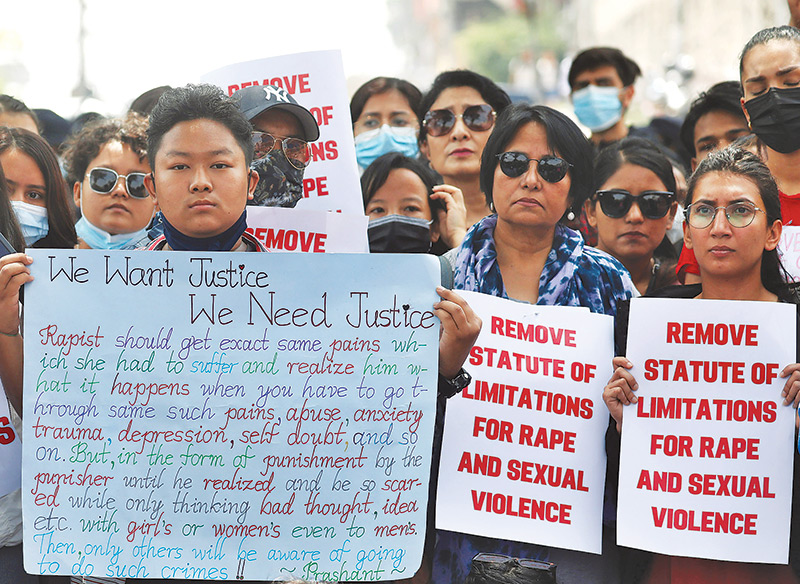
There have been protests seeking justice for sexual abuse survivors following new revelations.  POST PHOTO: SANJOG MANANDHAR

Kathmandu,
A former child actor and model’s accounts of alleged sexual violence—recounted in 20 video clips that were shared widely across social media—have stirred Nepalis, leaving them angry and frustrated with the country’s legal system.
Detailing multiple incidents of rape and sexual violence she suffered at the hands of multiple people, as early as 2014 when she was just 16 and starting her modelling career, the woman, now 24, decried the statute of limitations as a major barrier to accessing justice.
The statute of limitations on rape states that complaints must be filed within a year from the date of the incident. This time limit for seeking legal remedy, as legal experts have pointed out, is restrictive, unconstitutional and against fundamental principles of human rights.
On May 24, four days after the woman opened up about the violence she endured, a group of six female lawyers filed a petition at the Supreme Court demanding a complete removal of the statute of limitations on rape.
Here’s what you need to know about the statute of limitations and how it is a barrier to justice for survivors of sexual assault in Nepal.

What is the statute of limitations?
In legal terms, the statute of limitations is a law that sets the time frame within which parties involved in any dispute have to initiate legal proceedings. The clock starts ticking from the date of the alleged offence for any dispute, whether civil or criminal.
According to Section 292(2) of the National Penal Code, a plaintiff can file a complaint only within a year of being raped.
The same time limit has been set for filing complaints of sexual harassment and child sex abuse.
In addition, where an offence is committed against a person held in detention, taken under control, kidnapped or taken hostage, any legal proceedings can be brought only within three months from the date of release from such detention, control, kidnapping or hostage-taking.
However, according to Section 292(2) of the Code, there is no statute of limitations in cases related to incestual rape.

How has the statute of limitations changed over time?
In July 2008, the Supreme Court issued a directive order in the name of the government to make legal provisions to increase the statute of limitations for cases of sexual violence in order to ensure justice to the victims.
Sapana Pradhan Malla, who is currently a justice at the Supreme Court, had filed the petition claiming that the statute of limitations for cases involving sexual violence had encouraged impunity.
But successive governments did not heed the apex court’s ruling. It was only in 2015, the year when the new constitution was promulgated, that the Gender Equality Act 2006 was amended repealing discriminatory provisions and the limit of 35 days for filing rape cases was extended to six months.
Then in 2017 when the government drafted the new penal code amending the existing Muluki Ain, under Muluki Criminal Code 2017, the statute of limitations was increased to one year.
This came into effect in May 2018.
On May 24, 2022, six young female lawyers filed a petition at the Supreme Court demanding the removal of the statute of limitations for rape, in light of the former child actor’s accounts of rape and sexual violence that occurred eight years ago.

Why is it necessary to repeal the statute of limitations?
Various reports on sexual violence have stated, time and again, that the statute of limitations perpetuates the culture of impunity in Nepal.
Victims, in almost every case, have to face stigma, shame, intimidation, trauma, damage, continuous threats and fear from the perpetrators.
Reports have also pointed out that, in the context of childhood sexual violence, violations might not even be recognised as such by the victim until many years later. In other instances, such as coercive domestic violence or intimate partner situations, victims often face a plethora of barriers to recognising the crime, and deciding to seek a legal remedy.
Additionally, for victims of conflict-era rape, political violence or social disturbance, many social and political barriers do not create a conducive environment for filing complaints.
Survivors of rape committed during Nepal’s civil war have been systematically denied recognition or justice.
In these instances, the statute of limitations imposes an unfair and overwhelming burden on victims and allows the perpetrators to evade justice.
It creates a procedural barrier to accessing justice.
Access to justice is a fundamental right. According to basic principles of the rule of law, justice is every person’s indispensable need. No individual can be barred from seeking justice or exercising their rights.
By impeding access to justice for victims of such heinous crimes, the statute of limitations also violates the fundamental human rights of the
citizens.

How is it in violation of the constitution?
Under the Constitution of Nepal, 2015, there are two provisions that guarantee the right of a victim of crime—in Article 21 and the rights of women against any forms of violence in Article 38(3).
Clause (1) of Article 21 states, “a victim of crime shall have the right to get information about the investigation and proceedings of a case in which he or she is the victim.” Clause (2) states: “a victim of crime shall have the right to justice including social rehabilitation and compensation in accordance with the law”.
Moreover, Article 38 (3) states that “no woman shall be subjected to physical, mental, sexual, psychological or other forms of violence or exploitation on grounds of religion, social, cultural tradition, practice or on any other grounds. Such an act shall be punishable by law, and the victim shall have the right to obtain compensation in accordance with the law.”
The statute of limitations, by hindering victims’ access to justice, keeps them from exercising their constitutional rights.
Despite the constitutional right of women who have been raped to demand justice, such limitation goes against the values of the constitution.

How does the statute of limitations leads to double-victimisation?
Individuals who have suffered sexual abuse and violence might be unable to seek legal remedy immediately after such abuse for various reasons. Later, when they finally make up their mind to reach out to law enforcement agencies for justice, it might be too late, given the one-year limit for reporting the crime.
Such legal clauses further add to the woe, stigma, shame, trauma and damage the victim endures.
By not allowing the victim to seek legal remedy, the justice system further victimises the victim.

What is the international practice on statute of limitations for rape laws?
In February 2020, Hollywood mogul Harvey Weinstein was convicted of felony sex crime and rape for crimes committed within the past 30 years.
Closer to home, in India, following the sexual conduct allegation made by Priya Ramani, a journalist, against the then minister of state for external affairs and renowned journalist MJ Akbar, the Delhi High Court ruled that a woman has the right to put her grievances even after decades.
The court ruled that “women cannot be punished for raising their voice against the sexual abuse on the pretext of complaint of defamation”.
There are statutes of limitations imposed on crimes as heinous as rape in countries like the UK, the United States, Canada and Australia.
Various international organisations, such as the International Commission of Jurists (ICJ), Amnesty International, Human Rights Watch, Equality Now, and the Convention on the Elimination of All Forms of Discrimination against Women (CEDAW), have all called for repealing the statute of limitations on rape, time and again.
On Thursday, Amnesty International and Human Rights Watch sent dispatches demanding urgent removal of the statute of limitations on cases of rape and other sexual violence through amendment saying it is a major obstacle to justice.

Page 2
NATIONAL

Delay in supply of textbooks affects coursework

The new academic year in many mountain districts kicked off over 10 days ago but the lack of textbooks has rendered lessons ineffective, teachers say.
- KRISHNA PRASAD GAUTAM
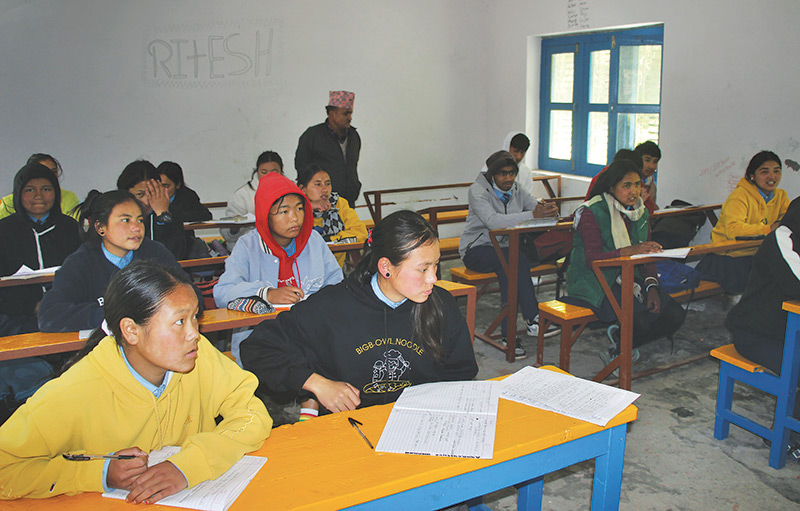
Geographical remoteness and the local elections delayed the supply of textbooks to remote mountain districts, suppliers say. Post Photo: Aash Gurung

SURKHET, 
Dilesangmu Tamang is currently enrolled in grade five of Buddha Secondary School in Magrigau, Mugu. She passed her fourth grade exams relying on old books passed on to her class by the senior students.
It has been eleven days since the new academic year began in the mountain districts of Karnali but students are yet to receive their textbooks. Thirteen-year-old Dilesangmu is disappointed and says going to school without textbooks has dampened her excitement about starting in the new grade.
“Last year too, I had to use old, torn and tattered books. I wasn’t happy about it but at least we had books,” she said. “This year we don’t even have old books to refer to in class.”
According to Dilesangmu’s mother, Chitu Tamang, the last time her daughter received brand new textbooks was in 2018. “Since then, the school hasn’t distributed new books. My daughter says she doesn’t feel like studying anymore,” said Chitu.  
Tika Prasad Upadhyaya, the principal of Buddha Secondary School, said the lack of books has affected the coursework of students of all grades. The school runs classes from grades one to 10 with a total of 472 students.
Schools in another mountain district, Humla, have also not received textbooks for this academic year.
There are two basic schools at Limi in Namkha Rural Municipality-6, Humla that have about 100 students enrolled but there are never enough books for all of them.
The remoteness of the area and the difficult terrain make access to Limi difficult. To reach Limi from the district headquarters, Simkot, one has to cross Nara and Nyalu highlands, which is at an altitude of about 5,000 metres. Due to heavy snowfall, the road to Limi gets closed for about six months every year. In the other six months, teachers who go to the district headquarters carry some school textbooks for the students but the individual effort of the teachers is not enough to ensure each student gets his/her own textbooks.
Kailash Rokaya, a teacher at Balmandir Secondary School in Humla, said he is worried about the completion of the coursework this year.
“I don’t know how we will manage without books. Some students did not return the used books so we are short of even old textbooks,” he said.
The lack of textbooks has increased absenteeism among students, says Rokaya. “Students do not come to school regularly because there are no books. The curriculum of 4th, 7th and 9th grades has changed this year but we don’t have any books for reference.”
“We downloaded the new syllabus on our phones but it doesn’t help much,” he said. “We give the students classwork and homework in accordance with the syllabus but since they don’t have textbooks, they can’t complete their work.”
In Shey Phoksundo Rural Municipality, Charkatangsong Rural Municipality and Dolpobuddha Rural Municipality in Upper Dolpa, students have to go through their academic years without textbooks due to the difficulty in transporting books to the region.
“Expecting school textbooks to arrive at our doorsteps is only going to lead to disappointment. This is a place where even food grains aren’t supplied on time,” said Pemba Lama of Dolpobuddha Rural Municipality-4. “Most of the schools in Upper Dolpa do not have enough textbooks.”
Schools in Mugu have also not received textbooks. There are around 500 students enrolled in the Mahakali Secondary School in Gamgadhi, the headquarters of Mugu district, and most of them don’t have textbooks. They go to school carrying only their pens and notebooks.
According to Rup Bahadur Malla, a resident of Chayanath Rara Municipality-2 in Mugu, despite the federal government’s policy of delivering textbooks to schools a month before the start of the academic session, schools in the mountain districts never get books on time.
“Students are forced to refer to old books even when they go to a new class. Even last year, traders used the coronavirus pandemic as an excuse and this time they say it’s the election that has caused the delay in the supply of books,” said Malla.
According to Surya Khatri, chief of the Education Development and Coordination Unit in Mugu, 141 community schools in four local units of Mugu are yet to receive textbooks for this academic year.
Jayalakshmi Bham, the owner of Jaya Lakshmi Bookstore that delivers school textbooks to schools in Chhayanath Rara Municipality, said the delay in the supply of textbooks was caused due to the local level elections held across the country on May 13.
“The elections derailed all the supply systems this year,” he said. “We should be able to send textbooks to Chhayanath in the next 20 days.”
According to the Ministry of Social Development of Karnali, there are 657,000 students enrolled in 5,774 community schools in the province. The ministry has supplied about 900,000 books to the province’s schools so far, according to Janak Education Materials Centre, Surkhet. The centre distributes textbooks for grades 4 to 12 while books for grades 1 to 3 are supplied by a private supplier.
According to Dhan Bahadur KC, the provincial chief, the complete set of books for grades four, seven and nine has been sent to Surkhet while a few sets of books for grades five, eight and 10 are yet to be sent.
“Around 400 sets of books were dispatched to Namkha, Simkot and Kharpunath of Humla on Tuesday,” said KC.
“We only had 66 percent of the total cost for transportation. The airlines said the amount was not enough to cover the cost of transporting the books. That is why we have sent textbooks to Humla from Mugu via mules. The books should reach the region within three days,” said Kc.
Similarly, new textbooks are yet to reach Manang, a mountain district of Gandaki Province. Students have complained that their studies have been hugely affected in the absence of books.
“We don’t have books. The old books are of no use as our curriculum has been changed this year. It is very difficult to follow what the teachers teach us in class and to do homework as well,” said Jayaraj Thapa, a ninth-grader at Lokpriya Secondary School in Chame.
The new academic year began in all 26 community schools of Manang in April. But teaching-learning activities have not been effective due to the shortage of textbooks.
“Most of the students do not come to school regularly as they do not have books,” said Jagaram Bishwokarma, the headmaster at Thonche-based Prakash Jyoti Secondary School.  The Education Development and Coordination Unit in Manang claims that it has been pressuring the authorities to supply textbooks immediately.
“I call the Pokhara office of Janak Education Material Centre almost every day, urging them to dispatch the books soon. The office has assured us to manage books within a few days,” said Matilal Chapai, chief at the unit.
The shortage of textbooks has hit Sudurpaschim Province as well with students having to study without books even after two weeks of the academic session’s commencement. According to Dhrubaraj Panta, chief at Sudurpaschim Province office of the Janak Education Material Centre, around 2.4 million copies of textbooks are required for students from grades 4 to 12 in the province.
“Only 600,000 copies have arrived so far. Efforts are underway to distribute textbooks to all the students by mid-June,” said Panta. He said the available books have been dispatched to remote districts like Bajhang and Bajura.   
The Janak Education Material Centre, a government holding company, is yet to print around 3.5 million copies of textbooks. According to the centre, out of the 19.8 million copies of books it was supposed to print, it could print only 16.3 million copies of books so far.
Anil Kumar Jha, managing director at the centre, claimed that all the textbooks could not be published on time due to the shortage of paper caused by the Russia-Ukraine war.
“Printing of ballot papers and the local elections also delayed the printing of school textbooks. Papers have arrived and the printing of books is going on in full swing. All required textbooks will be published by June third week,” said Jha.


(Raj Bahadur Shahi in Mugu, Chhapal Lama in Humla, Aash Gurung in Manang and Mohan Budhaair in Dhangadhi contributed reporting.)  

Page 3
NATIONAL

Health Ministry preparing to roll out Covid jabs for children aged 5–11 years

COVAX will supply 8.4 million Pfizer doses for the age group from next month.
- Arjun Poudel
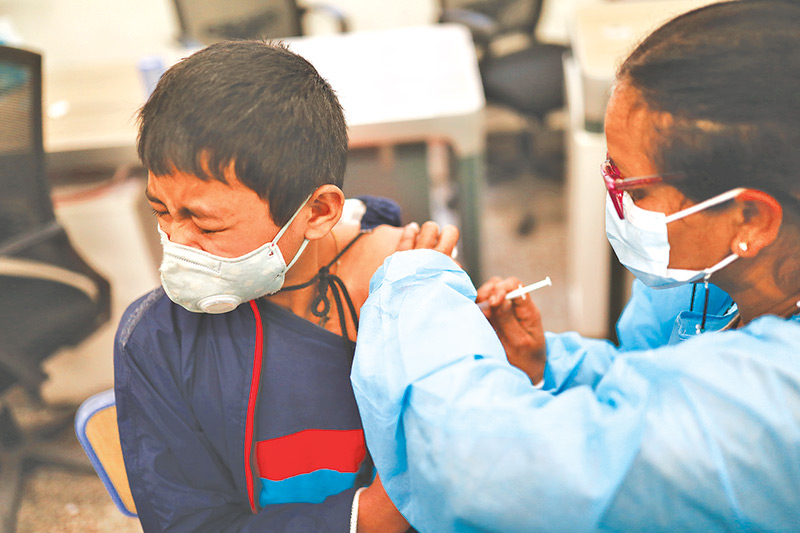
The Pfizer-BioNTech vaccine is the only jab recommended by the World Health Organisation for use in children between five and 11 years old.  Post Photo: SANJOG MANANDHAR

KATHMANDU,
As paediatric doses of the Covid-19 vaccine for 5-to-11-year-olds are all set to arrive in the country, the Ministry of Health and Population has started preparations to roll out the jabs.
The Department of Health Services has already secured emergency use authorisation from the Department of Drug Administration for the Pfizer doses, provided master trainer training to health workers in all districts, and is working on the vaccine rollout plan, according to officials.
“Today [Tuesday] health workers from 56  districts received master trainer training on Pfizer vaccination for children. Health workers from 21 districts have already received such training,” Dr Bibek Kumar Lal, director at the Family Welfare Division of the department of Health Services, told the Post. “We have also started other preparations to roll out the vaccine once doses are supplied.”
Master trainer training is an advanced level training for health workers who will impart the training to other health workers in the respective districts on the ways to administer the jabs.
Officials said that Nepal will receive 8.4 million pediatric doses of the Pfizer-BioNTech vaccine free of cost. The United States government has to bear the cost of the vaccine doses, which will be supplied through the COVAX facility, the United Nations backed international vaccine-sharing scheme. The USAID had facilitated the process, officials say.
“Nepal is among the countries receiving pediatric doses of Covid-19 vaccine free of cost from COVAX,” said Lal. “COVAX has also asked about our storage capacity, and logistic supply conditions, among other things.”
Officials said that vaccine doses will be supplied in several consignments as the government does not have enough freezers to store all the doses at once.
The Health Ministry said that it can store only around 2 million doses of the Pfizer-BioNTech vaccine at one time in its central store in Kathmandu. The vaccine doses need to be stored at minus 80 degrees Celsius in ultra cold freezers, and can be kept in normal temperatures (2 to 8 degrees Celsius) for up to 31 days.
There are two types of Pfizer-BioNTech Covid vaccines for children—one is for those between five and 11 years, and another for those aged 12 and above. Nepal has already used Pfizer vaccines on those with comorbidities and on children between 12 and 17 years.
The Pfizer-BioNTech vaccine is the only jab recommended by the World Health Organisation for use in children between five and 11 years old.
The American Association of Paediatrics has recommended administering 10 microgram doses in a gap of 21 days to children between five and 11 years. The dose, 0.2ml, is one-third of what is administered to adolescents and adults. The vaccine vial for 5–11 year olds comes with an orange cap while the other vial is purple-capped.
Each vial with 10 doses needs 1.3 millilitres (ml) of diluent under Pfizer’s preliminary plan.
The US Food and Drug Administration in October authorised emergency use of the Pfizer-BioNTech Covid vaccine for children between five and 11 years. Several countries have already started administering the vaccine to children.
Earlier, the government had decided to inoculate children between five and 11 years with the Covid-19 vaccine from April. For that the Health Ministry had also decided to purchase 8.4 million doses of the vaccine and also signed an agreement for a concessional loan of $18 million with the World Bank to procure the doses.
But with the Covid-19 infection rate dropping significantly of late, the process to procure vaccine doses for the said age group has been put on the back burner. Officials said that plan to procure the vaccine doses halted after they saw a chance of getting vaccine doses free of cost.
Nepal so far has received 53,381,570 doses of Covid vaccines of various brands—AstraZeneca, Vero Cell, Moderna, Janssen, Sinovac-CoronaVac, and Pfizer-BioNTech.
As of Saturday, as many as 19,825,343 people or 67.9 percent of the total population have been fully vaccinated in the country, according to the Ministry of Health and Population.

Page 4
OPINION

Tokha’s untapped tourism opportunities

Tokha is an open museum of artistic houses, temples, sculptures, traditional dances and music.
- CHANDRA P BHATTARAI
Post File Photo: Milan Adhikari

If anyone is interested in knowing about a place with all the prospects for the development of the tourism industry but has been deprived of its real-life benefits, Kathmandu Valley in Nepal could be a convincing example.
This valley, comprising the three major ancient cities of Kathmandu, Lalitpur and Bhaktapur, has the quality to be one of the most popular destinations for heritage and cultural tourism in the world. Originally inhabited by the Newar community, this place is home to the renowned Newar culture and heritage. Its ancient wood, metal and stone architecture; numbers of Hindu temples and Buddhist monasteries, year-round festivals, unique cultural dances and a rich tradition of exclusive Newar food and drinks collectively have the power to attract tourists from all corners of the world. There are several satellite towns with rich Newar culture in the valley, Tokha is one of them.

Kathmandu civilisation
With a history of over 1,500 years, Tokha is home to the ancient Kathmandu civilisation dating back to the Lichchhavi dynasty. Historians consider the Lichchhavi period as the golden era in Nepal for its good governance system and optimal enrichment of the arts, culture, language, literature and architecture. The settlement’s name Tokha is the combination of two Newar words tu and khya meaning sugarcane and field respectively. As sugarcane used to be produced in abundance locally, Tokha has been historically famous for chaku, a vital immunity-building food item consumed in winter. Made from sugarcane juice, it is a sweet ingredient in the delicious and healthy Newar dish yomari.
This ancient town now forms two of the present-day Tokha Municipality’s 11 wards. Several surrounding villages, all having social and economic characteristics
different from that of Tokha proper, have been incorporated to make the municipality’s other wards. As such, though the ancient town is obviously a small part of the newly formed municipality, its importance in terms of culture and heritage is not small at all.
Tokha is an open museum of artistic houses, temples, sculptures, traditional dances and old-fashioned musical instruments. Like in any other ancient settlement in the valley, it has several beautiful houses built in a well-planned way even then. Its temples are both in the pagoda and stupa styles. The temple premises of goddess Chandeshwori are known as yagyasthal of Daksha Prajapati where Satidevi was believed to have jumped into the fire. Likewise, the temples of Saraswati, Masankali at Bhutkhel Chaur, Taleju, Bhimsen, Sapan Vinayak and several other gods and goddesses are evidence of the town’s religious history. Bhutkhel Chaur is believed to have been a battleground of demons and gods in earlier days. Like Kathmandu, Tokha also has its own living goddess Kumari.
During festivals, one can see the lakhey dance, a unique and popular cultural dance performed on the streets and squares not only in Kathmandu Valley but also in other towns of Nepal inhabited by Newars. During the Gai Jatra, Indra Jatra, Biska Jatra and Krishnashthami festivals, dancers dressed in traditional lakhey costumes and masks dance beautifully. The classical snake dance is another attraction of Tokha. Several beautiful ponds and antique stone spouts (dhunge dhara), public places (dabali) and stone inscriptions (shilalekh) add value to Tokha’s culture and heritage.
An important characteristic of ancient Nepali society, particularly in Newar settlements, is the management of temples and other community groups through the guthi established for specific purposes. This practice is still distinctly visible in Tokha. Local community groups known as khala are supported by the municipality in the preservation of traditional dances and musical instruments. Traditional instruments like the dhimay, flute, dhaa and bhusyaa played during jatra times are integral parts of the local culture. However, this ancient settlement has not been able to benefit economically from its rich culture and heritage. At a distance of hardly 10 km from the heart of the national capital, Tokha has immense scope for the development of domestic and international tourism.
Each of the village development committees merged lately to create Tokha Municipality has its particular strengths in tourism. This industry’s beautiful characteristic of vast backward and forward linkages with several other economic sectors clearly justifies the development prospects in Tokha. The local agriculture, horticulture, livestock, trade, manufacturing, handicrafts and transportation sectors will grow together with tourism. The trekking trail from Chandeshwori to Baudeshwor along the border of Shivapuri National Park, if developed properly, can contribute significantly to the economic prosperity of the surrounding Tamang, Newar and other settlements.

Income generation
While the existence of natural, historical, archaeological or economic assets is a necessary condition for the tourism industry to flourish in any particular area, it is not a sufficient condition. The process of linking these opportunities to employment and income generation and subsequent local economic growth requires adequate knowledge of the industry, proper management skills, and motivated and committed entrepreneurship in the community. Though there have been some efforts at the local level to preserve Tokha’s centuries-old artistic and cultural treasures, any effective mechanism to link them with income generation activities in the community is grossly absent.
Tokha is not alone in possessing such untapped potential. There are several other places with similar backgrounds in and around Kathmandu Valley. Neither the communities nor the local governments have the proper realisation of their own huge strength for sustained local economic development through the promotion of tourism. The private sector obviously has the driver’s role in the transformation process. The municipality as the resourceful and powerful local entity has the greatest responsibility to facilitate it. A long-term vision for the development of local tourism should be in place first. It paves the way for achievable mid-term plans, realistic programmes and private-public partnership in needy areas. Any journey is meaningful only when the destination is clearly known to the travellers beforehand.


Bhattarai is a development economist and executive chairman of the Centre for Research in Tourism.

OPINION

How rivers change their course

Climate change is already increasing flooding and washing sediments into rivers.
- VAMSI GANTI
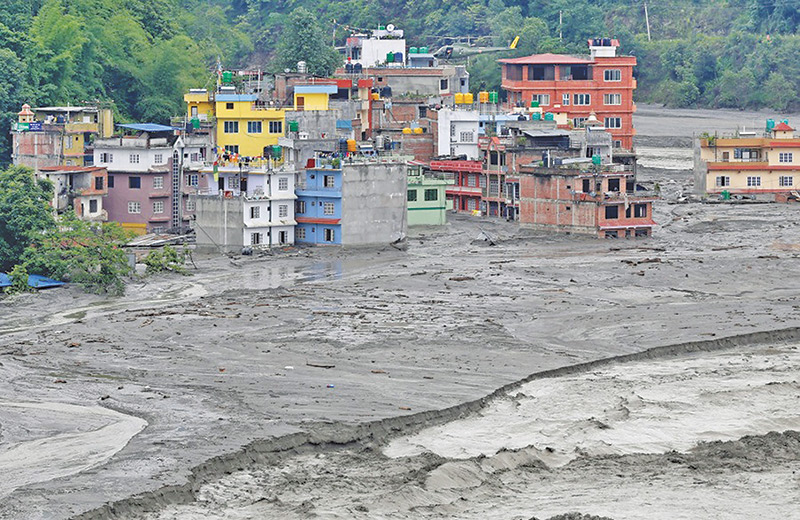
Post file photo: Elite joshi

Throughout history, important cities around the world have flourished
along river banks. But rivers can also be destructive forces. They routinely flood, and on rare occasions, they can abruptly shift pathways.
These “channel-jumping” events, which are called avulsions, have caused some of the deadliest floods in human history. Avulsions on China’s Yellow River killed over 6 million people in the late 19th and early 20th centuries. Similar events have been linked to the decline of Mesopotamian civilisation along the Tigris and Euphrates rivers in what is now Iraq, Kuwait, Turkey and Syria.
In a newly published study, I worked with colleagues to map the global distribution of avulsions on river fans and deltas. We used satellite images of over 100 rivers from 1973 to the present, providing a half-century of bird’s-eye views of global river evolution.
We discovered 113 river avulsion events in temperate, tropical and dry climates. Of these events, 33 were on alluvial fans. These land forms develop when rivers flow out of mountains or canyons onto an open plain or into the ocean and spread out, depositing dirt and gravel in a triangle-shaped area.
The other 80 events occurred on river deltas—fertile, low-lying regions where slower-moving rivers branch into many channels that empty into lakes or the ocean, creating networks of wetlands. We used this novel data set to answer a simple question: What determines where avulsions happen?

Water seeks the lowest path
Avulsions occur because of sediment deposition. Over time, rivers deposit sediment at the avulsion site, choking up the river with sediment. Water always flows downhill, so as its current course becomes increasingly blocked, it eventually jumps to a new location.
Much like earthquakes, river avulsions happen periodically in the same places. They disperse sediment and water across the rivers’ flood plains, producing these formations’ characteristic triangular shape.
One recent example occurred in 2008, when the Kosi River in India shifted its course by over 60 miles (100 kilometres) in a matter of days, displacing over 3 million people.
In the US, the Mississippi River has changed course many times over the past 7,000 years. Today, a multi-dam control structure in central Louisiana keeps it from jumping its banks and joining with the Atchafalaya River, but scientists have warned that a mega-flood could overwhelm these barriers, causing widespread economic damage across southern Louisiana.
A river may not change course more than once over many decades, or even centuries. Scientists’ understanding of where these events occur is poor, and rests largely on a handful of detailed observations on large deltas, plus laboratory and computer models.

Three kinds of avulsions
Our global database revealed three distinct types of avulsions. First, the 33 avulsions on alluvial fans occurred when the rivers exited canyons. Once the rivers no longer flowed through confined valleys, they were able to spill over to one side or another toward the lowest ground.
The 80 avulsions that happened on deltas were influenced by forces in their backwaters. A river’s backwater is the zone where the speed of the current is affected by the presence of the ocean or lake at the river’s end. In this zone, the river current either slows down or speeds up in response to changing flood conditions. Scientists can estimate the backwater length from the size and slope of the river.
For example, the Mississippi River has a backwater length of nearly 300 miles (480 kilometres), which means that the speed of its flow is affected by the Gulf of Mexico all the way to a point north of Baton Rouge, Louisiana. Steeper rivers can have a backwater length scale as short as 0.6 miles (1 kilometre).
When a river is flowing normally, it slows down in its backwater stretch and drops sediment onto the riverbed. However, when floods occur, the larger volume of faster-moving water erodes the riverbed.
This effect starts at the river’s mouth and moves upstream, in the opposite direction from the water’s flow, erasing some of the sedimentation that has built up prior to the flood. Ultimately, this interplay between sedimentation and erosion causes the river to choke up with sediment at a location that roughly coincides with the backwater length.
Our database showed that 50 of the 80 avulsion events that occurred on deltas happened approximately at the backwater length. For example, the Catatumbo River in South America changed course in 1982 about 6.5 miles (10.5 kilometres) inland from the point where it flows into Venezuela’s Lake Maracaibo—close to its backwater length, which is 8.5 miles (13.7 kilometres).

Some change course far upstream
However, we also discovered a new class of avulsions on deltas that did not reflect either valley confinement or the backwater length. These rivers changed course far upstream from the point where they were affected by the lakes or oceans at their mouths.
These deltas were either on steep tropical islands like Madagascar and Papua New Guinea or in desert environments such as Eritrea. In these places, rivers carry exceptionally large quantities of sediment during floods.
When the rivers flood, they erode their beds starting at their mouths and working backward far upriver, similar to large rivers like the Mississippi. However, the combination of long typical flood durations and exceptionally high sediment loads during floods enables the erosion to progress far upstream. As a result, these rivers can change course well above the backwater zone where avulsions happen in large coastal rivers.

More water, more sediment
Our description of these three types of avulsions provides the first framework for predicting where rivers will change course on fans and deltas worldwide. These findings have crucial implications, especially for river deltas, which are home to some 340 million people around the world.
Most deltas are only a few feet above sea level, and some are very densely populated, such as the Mekong and Ganges-Brahmaputra deltas. Our results show that avulsion sites on deltas can move from their historic locations to new areas. Rapid sea level rise can move avulsion sites inland on deltas, exposing new communities to catastrophic flood risks.
We also found that rivers in our second group—those where avulsions occur in the backwater zone—can shift into the third group, where avulsions happen significantly farther upstream. We find that this can happen if the typical duration of flooding on a river or the river’s sediment supply changes.
Climate change is already increasing flooding in many parts of the world and washing more sediments into rivers. Land use changes, such as converting forests to farmlands, also are increasing sediment loads. In my view, it is imperative to understand how such changes can affect dynamic, volatile river systems—and the people who live around them—well into the future.

 
Ganti is Assistant Professor of Geography at the University of California Santa Barbara.
— The Conversation

Page 5
MONEY

‘Nepal has made reforms and it is getting more investments’

CEO and Asia head of British International Investment on BII’s future investment plan in Nepal and the current investment climate.

Nick O’Donohoe is the CEO of British International Investment (BII), formerly CDC Group, the UK’s development finance institution and impact investor. Srini Nagarajan is BII head of Asia.
BII has big plans and has committed investments aimed at boosting clean and sustainable economic growth in South Asia, including Nepal. It has been investing in Nepal for over four years with its investment totalling to $100 million. It established its office in Nepal in 2020.
Between 2019 and 2021, BII has made six direct and indirect investments across Nepal’s key sectors, including clean infrastructure, financial services and telecommunications. The investments include providing capital through a $15 million loan to NMB Bank, a $12 million investment with WorldLink, $21.9 million in the Upper Trishuli Hydropower Project, $40 million first close of Dolma Impact Fund II and $25 million loan to Global IME Bank. BII’s investments are meant to help increase access to clean energy, improve connectivity, and boost jobs and other economic opportunities.
The Post’s Krishana Prasain talked to Nick and Srini about the BII’s future investment plan in Nepal and the current investment climate. Excerpts:


How is BII supporting Nepal? Is Nepal on your priority list for South Asia?
Nick: We are helping Nepal get new capital and we have brought here $100 million in the last three years. We invested $25 million in Global IME Bank last year at a time when the banking sector was under stress due to Covid-19 and the uncertainty created by it. This is an example of how we are trying to help Nepal. We invest in some countries that are bigger than Nepal. In the last three years, Nepal has got more than a proportionate share of our investment and we would like to continue that. We have an office here and we have offices in 7-8 countries. This shows the importance of Nepal as a priority market for BII.     

What challenges have you experienced in the Nepali market?
Srini Nagarajan: The Nepal government has made a lot of reforms and it is getting more investments. But there are a few things they could do. One is ensuring tax exemption for lenders who are looking for longterm access to foreign currencies. The structure for withholding tax should be different from the one of those for short-term credit finance. We do longer term investment.
Secondly, hydropower sector can be enhanced by three things: one is the ability to create a welcoming environment for investors. For example, India has established facilities for solar parks to evacuate power to transmission lines on a reverse (electronic) bidding process. This reverses the tariff, which is comparatively low by the international standards. So, if you put a much more comparative structure through which hydropower bids are awarded then you see a lot more investors participating.
Nick: The investment forums have lots of choices including development finance organisations for investing their money. It’s our job to invest in countries like Nepal. We have lots of other countries that we can go to, so it is really important for the country to be competitive in terms of standards, policies, and consistency of policies. The government introduced a three-year holding period on IPO. Now companies like Worldlink, if they are successful, they will ultimately move on to an IPO and people would be willing to invest in those companies but they are locked for three years. Those are some policy decisions that do have an impact on where that money flows.    

Nepal has a lot of potential for clean and green energy. How should Nepal tap this opportunity?
Nick: Nepal has a huge opportunity in hydropower. The Indian government has worked to make it easy for developers and financiers to develop solar plants with government support and a transparent procurement process. I think these are the things Nepal needs to do to achieve its ambition for growth in the hydropower sector. I think Nepal has 2 gigawatt power at the moment and is planning for 5GW in the next three years. If you get the export market, you could have 10 or 15 GW for which you need to arrange for the capital and we could make that easy.    

What is driving BII to expand into the Nepali market?
Nick: Our purpose is to be a development finance organisation. The British government does not give us money because they want a return. They think early return is important. If you invest in the company and go bankrupt it is not going to help anybody so that discipline is important. But it is our job to go to these countries where we think development is needed and also where governments are focused on supporting the private sector in getting capital.  
Srini: I think a country like Nepal has to attract a lot more long-term foreign investors. I think institutes like the BII have got more ability to provide capital in the process. We have become a capital force. We have invested in Worldlink and we have put the standards together on sustainability, governance, which can attract the return of the capital.      

How do you plan to approach the Nepali private sector?
Nick: Our principle approach is having people on the ground, building relationships, and networks. We are very lucky to have the UK government as our shareholder because through their networks they can bring to us—and help us identify—opportunities. We have not got a specific target. In the last three years, we have committed $100 million and I would be disappointed if we could not at least double the investment in the next three years.    

Is there any new investment plan in Nepal?
Nick: We do not talk about any specific investment that is being negotiated. But we definitely have them in the pipeline. The areas we are looking at are hydroelectricity, financial institutions, venture capital, technology, and infrastructures, which have significant potentiality.

The volatility in petroleum prices sheds light on the importance of increasing investment in renewable energy. What has been your strategy so far in Nepal?
Nick: We have the biggest opportunities in hydropower, we have capital to provide to huge projects and we would like to do more. And we think there are some opportunities in solar energy and we are looking for some opportunities now.

How do you assess Nepal’s financial market?
Nick: I think the financial sector in Nepal is doing pretty well. The capital ratio is good, the banks function visibly well. There is a need for consolidation of banks as there are too many banks. The opportunities for these banks is to attract more capital from development institutions like BII. In order to do that, they have to set and address some of the standards that development financiers look for in terms of social governance and maintaining transparency. All the development financier institutions have invested in the same banks here and there is a message.
Srini: The concept of neo banking is getting popular in other markets and I think this can be one area that the Nepali banking sector can explore because digitisation is continuing to expand. Neo bank is a concept where there is a digital framework going through artificial intelligence which will help in credit rating for customers based on reports and everything is done completely digitally. It’s very cost effective and it can provide loans to small scale SME customers. Though banks might not be ready for neo banking now it can be the next step in Nepal and there is no option but to adopt it.
Nick: If you wait for the existing banks to adopt changes to the way they operate, that’s a difficult thing to do. It’s challenging to operate in completely new models in other countries as well. In Nepal, banks say it is really difficult to lend money to SMEs. So you need a whole new solution and that’s the technology and AI that give them access to credit.    

Nepal’s private sector growth has not been encouraging. What’s hampering them?
Nick: The economy has suffered due to Covid-19, a situation comparable to an economic crisis while inflation has become a major issue.  
Srini: We got top layers of entrepreneurs who are the old business houses doing business in a certain way but you need the next level of entrepreneurs as Nepal has got a young population, intelligent people wanting to go to the next level. We encourage this next level of entrepreneurship.

MONEY

Cash-strapped Sri Lanka gets Russian oil to ease shortages

- AGENCE FRANCE-PRESSE

COLOMBO,
Cash-strapped Sri Lanka took delivery on Saturday of Russian oil—which could soon be subject to a European embargo—to restart operations at the country’s only refinery,
the energy minister said. The island nation is suffering its worst economic meltdown
since independence, with shortages of fuel and other vital goods making life miserable for its 22 million people.
The state-run Ceylon Petroleum Corporation (CPC) refinery was shuttered in March in the wake of Sri Lanka’s foreign exchange crunch, which left the government unable to finance crude imports.
The Russian crude delivery had been waiting offshore of the capital Colombo’s port for over a month as the country was unable to raise $75 million to pay for it, energy minister Kanchana Wijesekera said.
Colombo is also in talks with Moscow to arrange direct supplies of crude, coal, diesel and petrol despite US-led sanctions on Russian banks and a diplomatic outcry over Russia’s invasion of Ukraine.
“I have made an official request to the Russian ambassador for direct supplies of Russian oil,” Wijesekera told reporters in Colombo.
“Crude alone will not fulfil our requirement, we need other refined (petroleum) products as well.”
  Around 90,000 tonnes of Siberian light crude will be sent to Sri Lanka’s refinery after the shipment was acquired on credit from Dubai-based intermediary Coral Energy.
Wijesekera said Ceylon Petroleum Corporation (CPC) was already in arrears of $735 million to suppliers and no one came forward to even bid for its oil tenders.
He added that the Siberian grade was not an ideal match for the refinery, which is optimised for Iranian light crude, but no other supplier was willing to extend credit.
The Sapugaskanda refinery on Colombo’s outskirts will resume work in about two days.
European Union leaders are meeting on Monday in an effort to negotiate a fresh round of sanctions against Russia over the Ukraine conflict, including an oil embargo.

Page 6
WORLD

Harrowing new accounts emerge from Uvalde’s school shooting survivors

Ten-year-old Samuel Salinas was sitting in his classroom when the shooter barged in saying: ‘You’re all going to die.’
- AGENCE FRANCE-PRESSE
Children run to safety during a shooting at Robb Elementary School wherea gunman killed 19 children and two adults in Uvalde, Texas. REUTERS

UVALDE, United States,
Fresh harrowing accounts emerged on Saturday of the ordeal faced by survivors of the school shooting in Uvalde, Texas, fanning public fury over the massacre even as the deeply traumatised town prepared for a visit Sunday by US President Joe Biden.
The haunting stories told by young students who were forced to play dead as a heavily armed gunman continued a methodical spree—killing 19 students and two teachers—have been underscored by accounts of the slow reaction by police during the drama.
Ten-year-old Samuel Salinas was sitting in his fourth-grade classroom when the shooter, later identified as Salvador Ramos, 18, barged in with a chilling announcement: “You’re all going to die.”
Then “he just started shooting,” Salinas told ABC News.
Texas authorities belatedly admitted on Friday that as many as 19 police officers were in the school hallway for more than an hour without acting, thinking the shooter had ended his killing.
“From the benefit of hindsight... it was the wrong decision, period,” said Texas Department of Public Safety director Steven McCraw.
Ramos, who carried two assault-style rifles, was finally killed by police.
Uvalde survivors have described making desperate, whispered pleas for help in 911 phone calls during his assault. Many played dead to avoid drawing the shooter’s attention.
Eleven-year-old Miah Cerrillo even smeared the blood of a dead friend on herself as she feigned death.
Samuel Salinas said he thinks Ramos fired at him, but the bullet struck a chair, sending shrapnel into the boy’s leg. “I played dead so he wouldn’t shoot me,” he said.
Another student, Daniel, whose mother would not provide his last name, said he saw Ramos fire through the glass in the classroom door,
striking his teacher.
The bullets were “hot,” he told the Washington Post, and when another bullet ricocheted and struck a fellow student in the nose, he said he could hear the sickening sound it made.
Though his teacher lay on the floor bleeding, she repeatedly told the students, “’Stay calm. Stay where you are. Don’t move,’” Daniel recalled.
He was finally rescued by police who broke the windows of his classroom. Since then, he has had recurrent nightmares.
President Joe Biden will visit Uvalde on Sunday to again make the case for gun control, as activists set about galvanizing voters on the issue in the run-up to November’s midterm election.
Despite the scourge of mass shootings, efforts at nationwide gun control have repeatedly failed, though polls show broad support from Americans.
Speaking at a University of Delaware commencement on Saturday, Biden—himself a grieving father twice over—evoked the image of parents preparing to bury their children in Texas, and lamented “too much violence. Too much fear. Too much grief.”
“We have to stand stronger,” he told the graduates at his alma mater.
The Uvalde shooting was the deadliest since 20 children and six staff were killed at the Sandy Hook school in Newtown, Connecticut in 2012.
McCraw revealed a series of emergency calls—including by a child begging for police help—that were made from two adjoining classrooms where the gunman was barricaded.
But he said the on-scene commander believed at the time that Ramos was in there alone, with no survivors, after his initial assault.
“I’m not defending anything, but you go back in the timeline, there was a barrage, hundreds of rounds were pumped in in four minutes, okay, into those two classrooms,” McCraw said.

WORLD

UN rights envoy defends contentious China visit

- AGENCE FRANCE-PRESSE

BEIJING,
The UN rights envoy on Saturday said her contentious visit to China was “not an investigation”, and insisted she had unsupervised access during meetings in Xinjiang, where Beijing is accused of widespread human rights abuses.
Michelle Bachelet’s long-planned trip this week has taken her to the far-western region, where Beijing is accused of the detention of over a million Uyghurs and other Muslim minorities, forced sterilisation of women and coerced labour.
The United States has labelled China’s actions in Xinjiang a “genocide” and “crimes against humanity”, allegations vehemently denied by Beijing which says its security
crackdown was a necessary response to extremism.
Bachelet has come under fire from rights groups and Uyghurs overseas, who say she has stumbled into a six-day Communist Party propaganda tour, including a meeting with President Xi Jinping in which state media suggested she supported China’s vision of human rights.
Her office later clarified that her remarks did not contain a direct endorsement of China’s rights record.
Speaking at the end of her trip while still inside China, Bachelet framed her visit as a chance for her to speak with “candour” to Chinese authorities as well as civil society groups and academics.
“This visit was not an investigation,” she told reporters, later insisting she had “unsupervised” access to sources the UN had arranged to meet in Xinjiang.
It is the first trip to China by the UN’s top rights envoy in 17 years and comes after painstaking negotiations over the conditions of her visit, which the UN says is neither a fact-finding mission nor a probe.

WORLD

Ukraine says Russian advances could force retreat in part of east

- REUTERS

KYIV, 
Ukrainian forces may have to retreat from their last pocket in the Luhansk region to avoid being captured, a Ukrainian official said, as Russian troops press an advance in the east that has shifted the momentum of the three-month-old war.
A withdrawal could bring Russian President Vladimir Putin closer to his goal of capturing eastern Ukraine’s Luhansk and Donetsk regions in full. His troops have gained ground in the two areas collectively known as the Donbas while blasting some towns to wastelands.
Luhansk’s governor, Serhiy Gaidai, said Russian troops had entered Sievierodonetsk, the largest Donbas city still held by Ukraine, after trying to trap Ukrainian forces there for days, though adding that Russian forces would not be able to capture the Luhansk region “as analysts have predicted”.
“We will have enough strength and resources to defend ourselves. However, it is possible that in order not to be surrounded we will have to retreat,” Gaidai said on Telegram.
Gaidai said 90 percent of buildings in Sievierodonetsk were damaged with 14 high-rises destroyed in the latest shelling.
Speaking to Ukrainian television, Gaidai said there were some 10,000 Russian troops based in the region and they were “attempting to make gains in any direction they can”.
He said several dozen medical staff were staying on in Sievierodonetsk but that they faced difficulty just getting to hospitals because of the shelling.
Reuters could not independently verify the information.
President Volodymyr Zelenskiy said Ukraine was protecting its land “as much as our current defence resources allow”. Ukraine’s military said it had repelled eight attacks in Donetsk and Luhansk on Friday, destroying tanks and armoured
vehicles.
“If the occupiers think that Lyman and Sievierodonetsk will be theirs, they are wrong. Donbas will be Ukrainian,” Zelenskiy said in an address.
The General Staff of Ukraine’s armed forces said on Saturday Ukrainian forces had repelled eight assaults in the Donetsk and Luhansk regions in the previous 24 hours. Russia’s attacks included artillery assaults in the Sievierodonetsk area “with no success”, it said.
Analysts at the Institute for the Study of War, a Washington-based think tank, said while Russian forces had begun direct assaults on built-up areas of Sievierodonetsk, they would likely struggle to take ground in the city itself.
“Russian forces have performed poorly in operations in built-up urban terrain throughout the war,” they said.

WORLD

Russia shows off Zircon hypersonic cruise missile

Briefing
- AGENCIES

MOSCOW: Russia successfully test-fired a hypersonic Zircon cruise missile over a distance of about 1,000 km, the defence ministry said on Saturday. The missile was fired from the Barents Sea and hit a target in the White Sea, it said. Video released by the ministry showed the missile being fired from a ship and blazing into the sky on a steep trajectory. President Vladimir Putin has described the Zircon as part of a new generation of unrivalled arms systems. Hypersonic weapons can travel at nine times the speed of sound, and Russia has conducted previous test-launches of the Zircon from warships and submarines in the past year.

WORLD

15 dead, 3 missing after torrential rains in China

Briefing
- AGENCIES

BEIJING: At least 15 people have died in torrential rains across southern China, state media reported on Saturday. Eight died in two building collapses from landslides in Fujian province, near China’s east coast, the official Xinhua News Agency said, citing the Wuping county information office. Five others died and three were missing in Yunnan province, about 1,200 kilometres away in southwestern China, state broadcaster CCTV said in an online report. Three children were swept away by floodwaters Friday in Xincheng country in the Guangxi region, authorities said. Two died and one survived. The storm damaged roads, bridges and telecommunications and power facilities in Yunnan’s Qiubei county, which is about 130 kilometres north of the border with Vietnam. In Fujian, five victims were found in a collapsed factory building and three others in a collapsed residential building on Friday, Xinhua said.

WORLD

Monsoon rains likely to hit India in 2-3 days

Briefing
- AGENCIES

NEW DELHI: Monsoon rains are likely to hit India’s southern Kerala coast in the next two to three days, the weather office said on Friday, marking the start of the four-month rainy season that is forecast to be average this year, helping the farm sector. “Conditions are becoming favourable for the onset of Southwest Monsoon over Kerala during the next 2-3 days,” the state-run India Meteorological Department said on Friday. It had already said on May 13 that monsoon rains were likely to reach Kerala on May 27, five days earlier than usual. That would provide some relief after Kerala like other parts of India has been hit by a heatwave recently. India, one of the world’s biggest producers and consumers of farm goods, relies on monsoon rains for watering nearly 50 percent of its farmland that lacks irrigation.

MEDLEY

Horoscope

ARIES (March 21-April 19) ***
Today is a good day to find ways around any behavioral patterns, people, or situations that may be holding you back from your highest potential, especially where occupational matters are concerned.

TAURUS (April 20-May 20) ***
Take a moment to connect with your spirituality this morning. The day could open you up to messages from beyond the veil, so you may want to keep your eyes peeled for synchronicities and signs from the universe as well.

GEMINI (May 21-June 21) ****
Take a moment to recall your dreams this morning if you can. Your cosmic climate could usher in messages from beyond the veil, especially if you've been struggling internally over the last few days.

CANCER (June 22-July 22) ****
You'll feel inspired to share your heart with the world today. The day can also help you intensify your bonds with someone special, so be sure to touch base with anyone you've been wanting to grow a relationship with.

LEO (July 23-August 22) ***
You'll feel motivated to get organised for the work week ahead this morning. Use the momentum of this cosmic climate to balance your schedule and run errands, anything that might help you feel prepared for the week.

VIRGO (August 23-September 22) ****
If you're artistically inclined, you should look for ways to engage with your craft this morning. Your cosmic climate can help you reach new depths within your creative work while feeding your soul.

LIBRA (September 23-October 22) ***
You'll feel inspired to purge your space this morning. Use the momentum of this cosmic climate to roll up your sleeves and get to work, thoroughly going through each closet, drawer, cabinet, and nook of your space.

SCORPIO (October 23-November 21) ****
Deep conversations could manifest within your love life this morning. If you're currently single, use this energy as an excuse to say nice things to yourself, as the universe encourages you to practice radical self-love.

SAGITTARIUS (November 22-December 21) ***
Give yourself permission to financially invest in your health and wellness. Your cosmic climate provides the perfect excuse to buy organic foods, or indulge in some luxury sheets to help you get a good night's rest.

CAPRICORN (December 22-January 19) ***
Your aura will carry a strange power and magnetism today. Use this energy as an excuse to throw your weight around a bit if you need to, but try not to push too hard where there is resistance.

AQUARIUS (January 20-February 18) ***
Take some time to seriously nurture your emotions this morning. You could also find yourself in a quiet and contemplative mood, so don't feel guilty if you need to cancel plans in order to focus on yourself.

PISCES (February 19-March 20) ***
Intense conversations could manifest over brunch with your buddies this morning. Don't be afraid to go deep with the people you care about right now, as their advice and insight can help to evolve your perspective.

Page 7
SPORTS

Nepal off to US for League 2 series

Captain Sandeep Lamichhane says that the performance will be vital to shape the path for World Cup Qualifiers.
- Sports Bureau
Nepal national cricket team departed for the United States on Saturday to participate in the US Triangular Series of the ICC World Cup League 2, scheduled from June 6–16.  Photo Courtesy: CAN

KATHMANDU,
National cricket captain Sandeep Lamichhane on Saturday said that the US Triangular series of the ICC World Cup League 2 was an important step to shape their path for the 2023 ICC World Cup Qualifiers.
“Rather than the US visit, the performance of the series will be key to shape our future for World Cup Qualifiers,” said Lamichhane at a farewell organised in Kathmandu ahead of their departure for the US. “We have a balanced side and our ambition is to earn maximum points from remaining games of the League 2 to keep afloat our World Cup ambition. We are yet to play 24 matches in the series.”
The series involving Nepal, US and Oman will be played from June 6 to 16 in Huston, Texas. Each team will play double-header matches. Nepal are sixth in the standing among seven teams which also include the United Arab Emirates (UAE), Scotland, Papua New Guinea (PNG) and Namibia.
Oman lead the standings with 40 points from 32 matches while Nepal are sixth with 12 points from as many games. Scotland are second with 24 points from 16 games, UAE third on 22 points (18 games), Namibia fourth on 14 points (14 games), US fifth on 14 points (16 games) and PNG seventh on two points (20 games). The sides finishing on top three positions at the end of the league cycle, where each team will play 36 games, will secure berths for ICC World Cup Qualifiers in Zimbabwe next year while the bottom four sides will enter World Cup Playoffs.
Nepal’s Canadian coach Pubudu Dassanayake said that the goal for the US tour was to climb up in the standings. “We have been working rigorously for the past few weeks. We have good talents in the youth team and our ambition is to climb to fourth or fifth position in the standings,” he said.
Cricket Association of Nepal (CAN) president Chatur Bahadur Chand said that he was optimistic Nepal would progress into the next stage in materialising the World Cup dream. “The US series will also be vital for keeping our One-Day International (ODI) status intact. I hope the players will perform their best and move a step closer to the next round,” said Chand.
Minister for Youth and Sports Maheshwar Jung Gahatraj urged the team to amend the past weaknesses and perform to their level best. “Though there is dispute in the domestic arena I urge the players to forget this,” Gahatraj said, referring to Everest Premier League’s writ petition against CAN and the cricket governing body’s first ever official T20 league.    
Nepal are scheduled to begin the campaign taking on Oman on June 9, and the USA on June 11. They will vie against Oman on June 14 before taking on hosts the following day. They will also play a practice match against Nepali All Stars team comprising former Nepali national and other players on June 2 and against locals Houston Hurricanes two days later.

SPORTS

Final squad named for U-19 Women’s World T20 Qualifiers

- Sports Bureau

KATHMANDU,
Nepal have announced a 14-member squad for the upcoming ICC U-19 Women’s T20 World Cup Asia Qualifiers, scheduled to take place in Malaysia from June 3 to 9.
The U-19 team captained by Kritika Marasini will not include leg spinner Hiranmayee Roy, who made her senior debut in the five-match T20I home series against Uganda last week.
Nepal will compete against hosts Malaysia, the United Arab Emirates, Thailand, Bhutan and Qatar for a spot in the 2023 World Cup to be hosted by South Africa.
The team finishing atop the group will qualify for the finals of the inaugural global event.
Nepal begin their qualifying campaign against Qatar on June 3, before facing the UAE on June 4, Bhutan on June 6, Thailand on June 7 and hosts in the last match on June 9.
The U-19 team are also expected to play a practice match against the senior women’s team before departing for Malaysia.


SQUAD
Kritika Marasini (c), Sneha Mahara, Shristhi Jaisi,
Manisha Upadhyaya, Manisha Rana Magar, Alisha
Yadav, Sana Praveen, Ranju Shrestha, Aasma Pulami Magar, Sanu Rajbanshi, Kiran Kunwar, Anjali BK,
Anu Kadayat, Sushmita Bhusal

SPORTS

Swiatek cruises into French Open last 16

The Pole defeats Danka Kovinic of Montenegro 6-3, 7-5 at the Roland Garros to rack up her 31st consecutive victory.
- AGENCE FRANCE-PRESSE
Iga Swiatek’s winning streak is the best on tour since Serena Williams’s run of 34 successive victories in 2013.   Ap/Rss

PARIS,
World number one Iga Swiatek racked up her 31st straight win to reach the French Open last 16 on Saturday.
Swiatek, the 2020 champion in Paris, dropped serve three times against 95th-ranked Danka Kovinic of Montenegro before sealing a 6-3, 7-5 victory. Kovinic recovered from 1-4 down in the second set to lead 5-4 but the Pole steadied with a hold and a break before serving out for victory.
Swiatek will next face Chinese teenager Zheng Qinwen, who beat France’s Alize Cornet 6-0, 3-0.
Swiatek’s winning streak is the best on tour since Serena Williams’s run of 34 successive victories in 2013.
World number two Daniil Medvedev also eased into the fourth round, defeating Serbian 28th seed Miomir Kecmanovic 6-2, 6-4, 6-2. Medvedev, a quarter-finalist in 2021, will play former US Open champion Marin Cilic or 37-year-old Frenchman Gilles Simon for a place in the last eight.
In early action, Mackenzie McDonald, the 60th-ranked American, slipped to defeat to Italian 11th seed Jannik Sinner. Sinner triumphed 6-3, 7-6 (8/6), 6-3 and will face seventh-seeded Andrey Rublev for a last eight spot. Rublev, also a quarter-finalist two years ago, defeated Chile’s Cristian Garin 6-4, 3-6, 6-2, 7-6 (13/11).
Leolia Jeanjean’s run ended when the 227th-ranked wildcard was defeated 6-1, 6-4 by Irina-Camelia Begu of Romania. Jeanjean, once one of France’s greatest hopes before her career was derailed by a succession of knee injuries, had knocked out former world number one Karolina Pliskova in the second round.

Djokovic, Nadal roll
Novak Djokovic and Rafael Nadal closed in on a blockbuster clash at the French Open as both reached the last 16, while 19-year-old Carlos Alcaraz became the youngest man to make the second week in Paris since 2006.
Reigning champion Djokovic and 13-time winner Nadal are on course to meet in the quarter-finals, with the Spaniard seeded outside the top four at Roland Garros for just the second time.
World number one Djokovic strolled to a 6-3, 6-3, 6-2 win over Slovenia’s Aljaz Bedene and Nadal eased past Dutch 26th seed Botic van de Zandschulp 6-3, 6-2, 6-4.
The 35-year-old Serb is aiming to become the oldest men’s singles champion in Paris in the Open era as he chases a record-equalling 21st Grand Slam title. Next up for Djokovic, who was also French Open champion in 2016, is a match-up with Argentina’s Diego Schwartzman, the 15th seed.
Nadal, the 21-time major champion, improved his record at Roland Garros to 108-3 after seeing off 2021 US Open quarter-finalist Van de Zandschulp. He has now reached at least the fourth round in 17 of 18 visits to Roland Garros, with the exception of 2016 when he withdrew in the third round with a wrist injury.
Nadal plays Canadian ninth seed Felix Auger-Aliassime for a place in the last eight.
Alcaraz defeated US 27th seed Sebastian Korda 6-4, 6-4, 6-2. The Spanish teenage star is the youngest man in the Roland Garros fourth round since Djokovic 16 years ago.
Alexander Zverev, the third seed and 2021 semi-finalist, ended the run of American Brandon Nakashima, winning 7-6 (7/2), 6-3, 7-6 (7/5).
Amanda Anisimova, the 27th seed and a 2019 semi-finalist, advanced to the last 16 as injury-plagued Karolina Muchova retired down 6-7 (7/9), 6-2, 3-0 after falling and twisting her ankle midway through the second set.
Last year’s US Open runner-up Leylah Fernandez beat Olympic champion Belinda Bencic of Switzerland 7-5, 3-6, 7-5, while Aliaksandra Sasnovich defeated three-time Grand Slam winner Angelique Kerber 6-4, 7-6 (7/5).
Coco Gauff, the youngest player left in the French Open, made the last 16 with a straight-sets win over Kaia Kanepi, the oldest woman in the tournament at 36.
Sloane Stephens, runner-up in 2018, ended the run of French teenager Diane Parry in straight sets, while Swiss 23rd seed Jil Teichmann overcame two-time former Australian Open winner Victoria Azarenka 4-6, 7-5, 7-6 (10/5).

Page 8
BLACKBOARD

The medicine of fear

How my first visit to the psychologist gave me useful insights into my mental well-being and more.
- Prasan Rai
unsplash

It was a bright sunny day. The branches of trees in the hospital’s premises were swinging and swaying. The birds perched on those branches were chirping merrily. Through the hallway’s glass window, I could see flowers blooming outside. But inside the waiting hall, the mood was quite the opposite. The air was cold and the people waiting were all gloomy and their faces were devoid of smiles. I don’t know since when but hospitals surely have become one of my favourite places. I feel a sense of belonging in hospitals, and they remind I am not the only one facing problems in life. Whenever I visit hospitals, I often talk to fellow patients or visitors and then I immediately compare the magnitude of their illness and problems with mine. It made me happy when their problems were bigger than mine.
But that day at the hospital, there was nobody to talk to, and I was losing my cool. It had already been an hour since I had started waiting in the hall but my turn to see the doctor was yet to come. It was my first time meeting a psychologist in person. I was very annoyed by the fact that my doctor, a veteran neurologist, had referred me to a psychologist.
“I don’t think I have mental problems. Maybe it’s just some neurological disorder,” I told my neurologist in my last-ditched attempt to convince him not to refer me to a psychologist. The last thing I wanted to do was to visit the psychologist upstairs. The neurologist wrote something on my medical card and told me to see the psychologist.
While waiting in the hall, I tried to read what the doctor had written on my medical file, but his handwriting was incomprehensible. Suddenly, I heard someone say, “Prasan Rai, it’s your turn.”
I got up and headed to the psychologist’s room. I opened the door and went inside. There were just two of us in the room, and I sat down on a chair without waiting for her permission to do so. The psychologist was a woman in her early 30s named Ramika (name changed). She went through my file and said, “Well, Prasan ji, tell me something about yourself.”
I told her the name of my college, what I study, and my hobbies.
She replied, “You seem like an interesting guy, Prasan ji. You are a multitalented person; You always come first in your class; you are interested in literature; and you play guitar and drums. But tell me, Prasan ji, do you have something that keeps worrying you?”
Without taking even a second to think, I replied, “No.”
She then went on to ask, “When did you first start experiencing headache, dizziness, dullness, and blurry vision?’
I thought for a minute and said, “I was in grade 8 when I started experiencing them. They got worse when I started preparing for SEE when I was in grade 10.”
With a serious yet friendly look on her face, she said, “I think you worry a lot about maintaining your good grades. This constant stress must be difficult for you.”
I said, “Yes, but my physical problems are not in any way connected with my studies at all.”
She replied, “Maybe you are not aware of your situation”.
I kept my silence.
Then she asked, “Do you have a girlfriend, Prasan ji?”
I replied, “No.”
“Did you have one?” she asked again.
I didn’t want to answer her question, but not cooperating with her would mean a waste of the Rs 600 I had paid for the consultation. So, I said, “Yes, I did have a girlfriend. But a month ago, she left me for another guy.”
“Does this fact hurt you?” she asked.
I wanted to say, “Of course it does, you stupid woman.”
But all that came out of my mouth was, “Yes, it hurts a lot.”
We then went on to talk about a few more things. She then asked me about my habit of biting nails. It had been two years since I had last used nail cutters. That was how much I bit my nails. She pointed out that I developed the habit because I am always easily worried and tensed.
She then went on to say, “Prasan ji, I don’t know since when but you are suffering from anxiety. You are very anxious, but this is nothing to be ashamed of. The breakup with your girlfriend has made your anxiety worse. But, I don’t want to suggest you take any medicine because I believe in your potential. All you need is self-motivation. You don’t have any other problems.”
I immediately replied, “Well, my neurologist once prescribed me this medicine, and it really helped me. Maybe I have some other problems.”
She smiled and answered, “It’s not like that. I don’t think you have any physical problems. It’s your emotions and, let’s say, some hormones that are making you suffer. I want to hand you an assignment. Next time you get anxious, take a pen and a piece of paper and write down the place’s name, the time and the situation you are in. Also, try to analyse why you are experiencing anxiety. Come see me after three weeks, and do bring those notes.”
I said, “Ok”, and left the room. As I was coming downstairs, I said to myself, “She could have just given me some medicines. That would have made me well.”
Even though the psychologist had suggested not to continue with the meds I was having, I went to the pharmacy to purchase the medicine prescribed by my neurologist. I had to wait since a middle-aged man was purchasing medicines for his sick father. As I waited for my turn, I started listening to the conversation between the pharmacist and the middle-aged man. The pharmacist was telling him how to take the medicines. Suddenly, I heard the pharmacist say, “This medicine will help keep your fears at bay.”
The sentence caught my attention, and I immediately leaned forward to see what kind of medicine it was that controlled fear. I looked at the pharmacist’s hand, and the medicine looked very familiar.
Upon close inspection, I saw the name of the medicine. It was Paxidep CR-25, the same I had been taking for almost a year.
Almost 12 months ago, when I first came to the hospital and got checked by my neurologist, he prescribed Paxidep CR-25 to me, and I had been taking it for a year.


Rai is a student at Kathmandu University School of Arts.

BLACKBOARD

TikTok’s toxicity

The hugely popular app is fun to use, but it is important to be aware of its dark side.
- Dibya Dahal
unsplash

In August 2018, a video streaming and sharing app named Musical.ly crossed more than 100 million users. This app offered users a plethora of dialogues, soundtracks, and music, and users could make entertaining dance videos or just lip-sync.
The same year, this widely popular app was taken over by a Chinese company called Byte Dance, and all Musical.ly users, which had already reached 200 million, were shifted to a new app called TikTok. Musical.ly accounts were automatically moved to this entirely new startup. Dedicated to short-form videos, TikTok was created to provide its users with fun-filled entertainment content. However, over the years, there have been major changes in the way people use this platform.
With TikTok having now become one of the most popular social media apps, we can now see how the app’s users have been using the app. A lot of influencers with a steady audience on the app are making content by giving advice and tips on beauty, fashion, cooking, and personal growth. It is no longer an app limited to just users making videos of them lip-syncing or dancing to popular tracks. Besides that, the app has also attracted a number of professionals like doctors, lawyers, and activists who have been using this platform to educate, aware, and inform people on various topics.
However, not everything about the app is positive. There is a dark side to TikTok, a side that promotes hatred, toxicity, racism, and bullying.
Once you begin to scroll through the app, you will be surprised to see that every few minutes, you end up coming across atleast one toxic video. Gen Z has transformed this platform into an entirely unacceptable space where videos that promote body shaming and hypersexualisation thrive. The app is no longer a safe platform to post lighthearted and funny short clips without having to worry about being judged. Women and girls who use the app often receive degrading comments just because they do not 'fit' into the so-called ‘ideal body shape’ or a certain 'beauty standard'. The responses in TikTok are so demeaning and pessimistic that people have begun becoming extra conscious and hyperaware before posting videos on the app.
The problem with the app is that once you start watching certain kinds of video, the same kind of content is what the app’s algorithm keeps suggesting. This can become very addictive and keep you hooked on the app. Besides being one of the most popular video streaming apps, TikTok is highly responsible for harming people’s mental health. It is getting difficult for users to accept and embrace themselves due to all the hate comments they receive on the app. There are instances where TikTok’s own community guidelines have been responsible for making people insecure about their appearances. In the past, many reports have surfaced criticising the app for removing content created by plus-users. This just goes on to show how TikTok's community guidelines of TikTok are completely unjust and
promote fat phobia.
Given how popular the app has become, one of the major challenges now is not letting young children get exposed to the platform. Although the founders of this app take great pride in how the app is widely enjoyed by users from a wide range of groups, we cannot deny how the app exposes innocent minds to racism, misogyny, and discrimination.
These days, there are a lot of young children who use the app regulalry and even idolise some awful influencers who promote harmful beauty standards,
reckless decisions, and unhealthy eating habits. There is a greater risk of children incorporating a harmful mindset from the platform.
The POV (Point Of View) videos are currently trending on the app. POV videos are where users share their traumatising life experiences. Many have shared their experiences of being bullied, sexually assaulted and racially discriminated against. While the trend is definitely empowering to survivors of such experiences, but given that there are many such videos circulating on the platform, it makes me wonder whether this trend might end up normalising such stories. Many survivors have also come forward and shared that going through such videos on TikTok has been a traumatising experience that has forced them to recall their own experiences.
The criticism doesn’t end here. The platform has also been accused of collecting an immense amount of personal data from its users. The moment you start using the app, it collects your personal data. Studies have found that TikTok tracks its users’ data more than any other social media apps. The information TikTok collects from the users is generally the make of their phones, screen resolution, current operating system, phone number, email address, location, and contact list.
All these factors should definitely make people think twice before getting into the world of TikTok. The app can be cute at times, but we cannot turn a blind eye to the toxic side of it.


Dahal is a business studies student at Global College Of Management, Kathmandu.