You internet speed is slow. Switch to text view mode

Switch
epaper logo
ST

Last Login:
Logout
+
Page 1
HOME PAGE

Top court quashes all decisions related to Nijgadh airport
In a 3-2 ruling, the Supreme Court, however, keeps options open for building an international airport, with strict conditions of minimal environmental damage.
- SANGAM PRASAIN,BINOD GHIMIRE,TIKA R PRADHAN
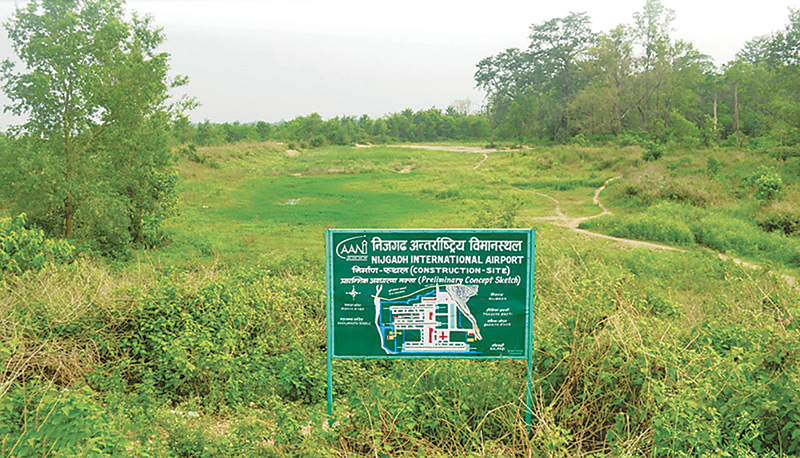
The airport planned in Nijgadh, Bara, lies 175 kilometres south of the Capital. Post File Photo

KATHMANDU, 
A 3-2 ruling of the Supreme Court has quashed all government decisions made earlier for the development of a mega international airport in the southern Tarai plains.
The top court, however, has kept options open to construct the international airport, an alternative to Kathmandu’s Tribhuvan International Airport.
The full text of the verdict on the Nijgadh International Airport by an extended full bench comprising justices Hari Krishna Karki, Bishowambhar Prasad Shrestha, Ishwar Prasad Khatiwada, Prakash Man Singh Raut and Manoj Sharma was released by the court on Wednesday. The preliminary ruling was issued on May 26 after concluding the hearing process.
Shrestha, Khatiwada and Raut have ordered the authorities to build the airport by conducting a proper environmental impact assessment ensuring that the environmental damage is minimal.  
The justices, however, have not specified where the new facility should be built.
The airport planned in Nijgadh, Bara, 175 kilometres south of the Capital, was deemed an alternative to Kathmandu’s Tribhuvan International Airport.
“While it is natural for any development activities to cause environmental degradation, every possible attempt must be made to find alternatives to minimise such degradation,” says the court order.
The government, on different occasions, had made three crucial decisions.
In March 2015, the Cabinet gave a go-ahead to the Tourism Ministry for demarcation of the boundary of the long-planned then Second International Airport in Nijgadh. The ministry had proposed delineating an area of 8,045.79 hectares [80 sq-km] for the proposed second international airport with two runways.
The government then began the process for environmental and social impact assessment.
The environmental and social impact assessment report submitted to the Tourism Ministry in February 2017 envisaged cutting more than 2.4 million small and large trees to build the airport.
The proposed airport in Bara, slated to become the largest in South Asia in terms of area, had been embroiled in a storm over its environmental impact.
Environmentalists then suspected the motive of the government months after it was found that the environmental impact assessment report was flawed. Some parts of the report had a hydropower component which later was exposed as “copied and pasted”.
The third key decision was made in September 2017 after the completion of the environmental and social impact assessment report.
The Civil Aviation Authority of Nepal, the project executing body, had assigned the Nepal Army to build access and perimetre roads and clear trees at the proposed construction site. The government had allocated Rs1.5 billion for this purpose. The court has found the Environmental Impact Assessment report approved by the Ministry of Forest and Environment on May 23, 2018 to be erroneous and said the decision to fell trees on 8,045.79 hectares and other decisions taken as per the report were faulty.
The order doesn’t rule out the necessity of the construction of another international airport.
It, however, says while implementing such a mega project, the concepts of sustainable development, intergenerational justice and biodiversity protection should not be overlooked or undermined. The selection of the area for the construction of the airport should be objective and logical, the court’s ruling reads.
While the environmental impact assessment should follow due legal procedures, the size of the airport and its capacity should be determined through proper consultations with environmentalists, wildlife experts, airport management experts, economists, sociologists and administrative experts with all possible alternatives to reduce damage and losses, according to the ruling. Justices Karki and Sharma, however, have observed the need for building the airport within the Nijgadh area by ensuring minimal damage to the environment.
“It is a concurring verdict,” Bimal Poudel, spokesperson for the Supreme Court, told the Post. “The two justices have different opinions only in providing alternatives for the airport construction.” Karki and Sharma, similar to the ruling, have said there has to be a minimal damage to environment and biodiversity while constructing the airport.
However, while the verdict doesn’t say where the airport should be constructed, they have suggested that the airport can be constructed in the same place with some changes in alignment so that fewer trees need to be felled.
“Conduct the study prioritising that the forest area remains intact by constructing the facility on public land, to the south of the proposed area that incorporates Tangiya basti [settlement],” reads their opinion. “If it is still necessary to chop trees from the jungle area, ensure that new saplings are planted as prescribed by the law and they are protected until they grow up.”
One of the three justices told the Post that the detailed order is clear in itself.
“Our observation is that initial decisions by the government could be detrimental to the environment. That’s why those decisions have been quashed,” the justice told the Post on condition of anonymity. “The judgement does not say an airport should be built in Nijgadh or not. What the judgement says is that the existing study is not enough.”
“What we have said is, first conduct the study by using all necessary experts and then build the airport wherever it is appropriate. This is what we have said [in the verdict],” added the judge.
“We, however, have said the way the land was allocated for the project was wrong. Since the government has allocated more forest land where more trees than necessary would have to be felled, we have annulled the decision for the reason that biodiversity would be adversely affected and the environment damaged,” he said.
“We cannot determine the alternative, which should be done by the experts. We have just said necessary technical experts should study and make the right decision. We have not said that an airport must not be built at Nijgadh if it is the best alternative to other places. But allocating an unnecessarily large jungle area was wrong. The condition is that the experts must find out the place where the environmental damage will be the least,” said the justice.
On December 6, 2019, Supreme Court Justice Tanka Bahadur Moktan had issued a stay order asking the government to immediately stop the felling of trees at the site, which a division bench of Chief Justice Cholendra Shamsher Rana and Justice Kumar Regmi upheld on December 22 that year. Nine individuals, including environmentalist Ranju Hajur Pandey and former secretary Dwarika Nath Dhungel, had filed the writ petition.
The Investment Board Nepal decided to move ahead with the project regardless of the court ruling and invited potential bidders to submit proposals, insisting that the court order only prevented them from felling trees and did not say that all work should be stopped.
In September 2019, the government shortlisted Zurich Airport International AG as a single company to work on a public-private partnership model for the construction of the airport.
The board had received letters of intent from eight companies based in seven countries, including Nepal. On January 17, 2020, the board formally asked Zurich Airport to submit a business proposal.
Under the public-private partnership modality of build, own, operate and transfer, the Swiss company would fully fund the construction.
Zurich Airport was required to state in the business proposal for how long it would operate the airport before handing it over to Nepal.
The last date for submitting the document was September 30, 2020; but following the court order, Zurich International Airport AG asked for a time extension. The Swiss company made no further official communication after that.
An advocate who participated in the hearing says it is a landmark verdict towards the protection of the environment.
“The court doesn’t say the airport is not required,” senior advocate Dinesh Tripathi told the Post. “It only says don’t construct it in the proposed spot which may cause a huge loss to the environment and biodiversity.”
The airport can be shifted towards Simara or towards the south of the proposed area, he said.
“It’s a welcome decision,” said Sanjiv Gautam, former director general of the Civil Aviation Authority of Nepal.
“The 8,000 hectares is not required to construct the facility as proposed by the government. A modern facility could be constructed on 2,000 hectares which can host at least three runways if required in the future.”
“So, if the government opted to shift the airport to the south, it would reduce 75 percent of damage to the jungle in Bara,” said Gautam.
“That means, the number of trees that need to be felled would come down to a maximum 500,000 [around 200,000 big trees and 300,000 pole sized trees] from the earlier plan to cut 2.4 million,” said Gautam. “That will be justice for the environment too.”
Gautam said that as the public has almost “no trust” in the government, it should be ensured that compensatory tree plantation takes place before the airport is constructed.
The fate of the $3.45 billion Nijgadh International Airport [in three phases] had been hanging in the balance for years, with successive governments pushing for it and environmentalists resisting it equally fervently, citing massive damage to the environment, biodiversity, local communities and wildlife that the touted project would cause.
The first phase of the project is estimated to cost Rs120 billion as per the internal assessment of the Civil Aviation Authority of Nepal.
The proposed construction site lies adjacent to the Parsa National Park, which is a forest corridor for big wildlife like tigers and elephants, and home to rich biodiversity. The entire area is blanketed in dense forests of Shorea robusta trees, also known as sal or sakhuwa.
The government has poured more than Rs2 billion into the project so far. According to Civil Aviation Authority officials, nearly Rs800 million has been distributed in compensation to the project-affected people.
Last year, the Civil Aviation Authority spent Rs300 million to prepare a revised master plan. The master plan too was drafted when the project’s future was in limbo causing huge losses to the government.
In 2018, the Civil Aviation Authority had started work to prepare an airport master plan and detailed design of the first phase of Nijgadh airport, but the scheme landed in controversy over potential misuse of around Rs700 million. It was then suspended as officials feared it might attract the attention of the anti-graft agency.
Again in January 2020, the national pride project under the authority invited expressions of interest from potential consultants for preparing an updated master plan for the airport.
But this time, the authority decided not to include the detailed design component. The detailed design is normally prepared by the company that wins the project contract. The plan too fell apart.
However, the Civil Aviation Authority prepared the master plan at Rs300 million last year taking advantage of Covid-19 when the entire nation’s attention was transfixed on the pandemic, according to the sources privy to the matter.
With this master plan, currently the government owns two documents. One document prepared by a South Korean company, however, remains unopened because the government has to pay for it to own it.  
In April 2012, Landmark Worldwide Company of South Korea conducted a detailed feasibility study for the airport at a cost of $3.55 million and submitted its report to the government.
The costs, if added with inflation, currently would hover to more than Rs700 million, according to the Tourism Ministry sources.
In 1995, the government initiated discussions to construct a second international gateway in the plains as an alternative to Nepal’s only international airport in Kathmandu.
The decision followed two deadly aviation disasters involving Thai Airways and Pakistan International Airlines in the hills surrounding Kathmandu in 1992. This gave momentum to discussions on an alternate airport and how the difficult topography of Kathmandu poses a challenge for even experienced pilots to land.
The project remained on the drawing board for two decades, and gained renewed urgency after a Turkish Airlines aircraft skidded off the runway in Kathmandu in March 2015, causing the airport to remain closed for four days.
Legal experts say the judiciary has the authority to check the legal compliance and the Supreme Court has rightly done so in this airport’s case.
“The verdict is balanced, corrective and prescriptive,” Bipin Adhikari, a professor and former dean at  Kathmandu University School of Law, told the Post. “It hasn’t intervened in the executive’s authority to decide where to construct the airport. It has only said due legal process needs to be followed strictly.”
HOME PAGE

Bhattarai faction frets as Yadav goes solo with Cabinet reshuffle proposal

Deuba calls for consensus proposal. Observers say JSP dispute could impact the coalition.
- ANIL GIRI
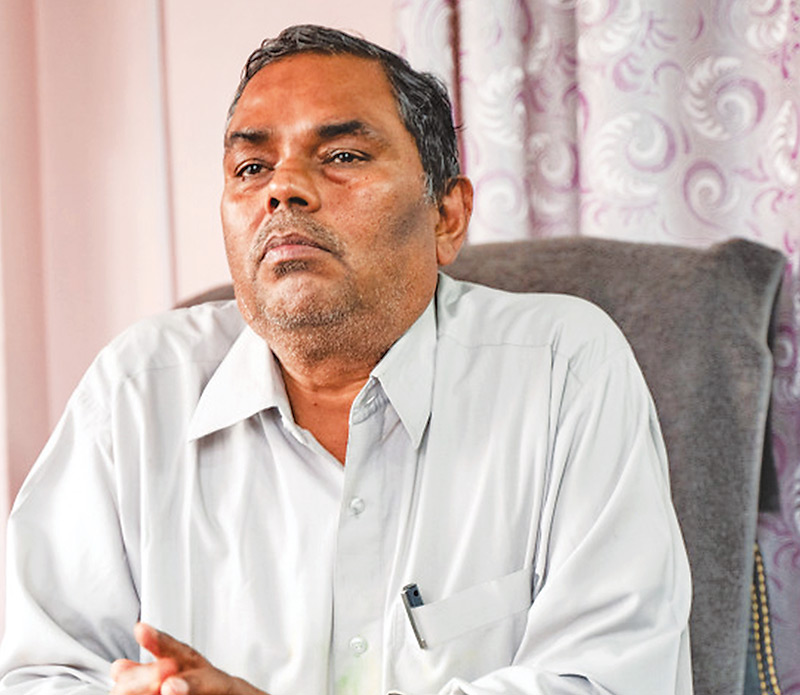
Upendra Yadav.  Post file Photo

KATHMANDU,
On Monday night, Janata Samajbadi Party chair Upendra Yadav held a meeting of the party’s central executive committee and decided to change the current set of ministers in the Sher Bahadur Deuba government. Party’s federal council chair Baburam Bhattarai and senior leader Ashok Rai, among others, were not invited.
With the decision of the majority members of the party central executive committee, Yadav informed Prime Minister Deuba about his intent to recall the ministers and send new faces.
The Bhattarai faction has rejected the unilateral decision taken by Yadav.
The development comes as a clear indication of deepening crisis in the Janata Samajbadi with Yadav and Bhattarai, who joined hands three years ago, drifting apart.
Amid growing rift in the JSP, a constituent in the current coalition, Prime Minister Deuba, according to party leaders, has conveyed to Yadav to reach an understanding with Bhattarai before recommending the names of the ministers.
With this, a Cabinet reshuffle has been stalled for now. The JSP wanted to change its ministers on the heels of a similar decision by the CPN (Unified Socialist), another partner in the ruling coalition, on Sunday.
Out of the 33 members in the central executive committee, Yadav has a majority with 22 members, and in the 503-strong central committee also, he commands a majority. The party has 19 lawmakers in the House of Representatives.
A few days ago, sensing that Yadav could decide on changing the ministers, Bhattarai had urged Deuba not to act on any unilateral decision by the party chair. On June 15, Bhattarai met with Deuba and asked him not to consider any unilateral decision taken by Yadav. But Deuba did not commit much at that meeting with Bhattarai, according to leaders.
Bhattarai and Rai have been demanding a formal meeting of the central executive committee to take a decision on changing the ministers. Yadav has ignored their demand.
The party has four ministers in the Deuba Cabinet—Mahendra Rai Yadav as agriculture minister, Renu Kumari Yadav as physical infrastructure and transport minister, Rajendra Shrestha as federal affairs and general administration minister and Ramsahay Prasad Yadav as forest and environment minister.
Of them, only Agriculture Minister Yadav is close to Bhattarai.
On Wednesday, Yadav called a meeting of the Parliamentary Party to discuss ways of settling the dispute in the party. Bhattarai, Agriculture Minister Yadav and lawmaker Raj Kishore Yadav were not present at the meeting.
Some party leaders told the Post that unity between Bhattarai’s Naya Shakti and Yadav’s Sanghiya Samajbadi Forum-Nepal in 2019 was “technical and not organic,” hence there always was a “crisis of confidence.”
Bhattarai’s Naya Shakti and Yadav’s Sanghiya Samajbadi Forum-Nepal had merged in May 2019 to form the Samajbadi Party Nepal.
A year later, the Samajbadi Party merged with the Rastriya Janata Party in April 2020 to form the Janata Samajbadi Party. It, however, split in August last year, after a dispute. After the Election Commission decided to hand over the party to Yadav and Bhattarai, Mahantha Thakur formed the Loktantrik Samajbadi Party.
“Three ministers, except Agriculture Minister Yadav, have given their consent to step down,” said Arjun Thapa, a leader close to Yadav. “The chairman took the decision to send new ministers after taking the consent of the prime minister.”
Time is running out for the JSP to change its ministers.
Prime Minister Deuba is under pressure to announce general and provincial elections, which are due later this year. But the way the crisis is deepening in the JSP, it may take some more time for the party to replace its ministers. And, if the Yadav faction takes a decision in a unilateral way, the Bhattarai group will oppose it and will object to the prime minister, said a leader close to Bhattarai. Such a situation could lead the party towards a vertical split.
In principle, the prime minister cannot have a view on the internal matter of a party, according to Bishwa Prakash Sharma, general secretary of the prime minister’s party Nepali Congress.
“If [JSP] ministers are changed now, just days after changing the ministers from the Unified Socialist, there will be pressure [on the prime minister] to make more reshuffles,” said Sharma. “Such moves could impact the coalition.”
Some Congress lawmakers also have been showing interest to join the government after the recent change made by the Unified Socialist, according to Sharma.
The crisis in the Unified Socialist recently over changing the ministers had also taken the party close to an implosion, which could have imperilled the current coalition.
Prime Minister and Nepali Congress President Deuba has been playing his cards carefully so as not to let the coalition break. The Unified Socialist, however, managed to avoid the crisis, even though seeds of discord remain.
The crisis in the JSP now has come as a new headache for the coalition.
Until a few days ago, the Bhattarai camp was in a comfortable position to build pressure on Yadav, as it had a majority of lawmakers on its side. But now Yadav appears to have turned the table on the Bhattarai camp.
“The informal meeting of the party’s central executive committee has entrusted the party chairman with the task of taking a decision on changing the ministers,” said Pramod Sah, a JSP lawmaker.
Yadav’s plans have put the Bhattarai faction on the back foot. Some lawmakers like Mohammad Ishtiyaq Rayi and Pradip Yadav who were with the Bhattarai faction appear to have switched sides.
A party split, however, is not likely in the immediate future because of the existing law that says any faction wishing to split the party must have the backing of 40 percent members of the Parliamentary Party and 40 percent members of the central committee.
“Currently some leaders who aspire to become ministers are sitting on the fence, even though they were earlier in our faction,” said a leader close to Bhattarai. “Once the decision on changing ministers is taken, it will become clear who stands where.”
Those who are closely following JSP politics said that it is Yadav’s working style that has created trouble in the party. Tussle between Bhattarai and Yadav was brewing long before the local polls.
“One of the major reasons behind the present tussle inside the JSP is Upendra Yadav and his working style,” said Tula Narayan Shah, a commentator who closely follows Madhes politics.
According to Shah, since Yadav is a senior political figure, he should be open and liberal.
“He should have used the social capital of Baburam Bhattarai who is a former prime minister and is known as a public intellectual due to his academic credentials,” said Shah. “If the ongoing crisis in the JSP is not addressed on time, JSP will head for a disaster.”

Tika R Pradhan contributed reporting.

HOME PAGE

Expanding NATO squares up to Russia threat

NATO welcomes Sweden and Finland as invitees to join the alliance and US President Joe Biden announces new deployments of US troops, ships and planes.
- AGENCE FRANCE-PRESSE
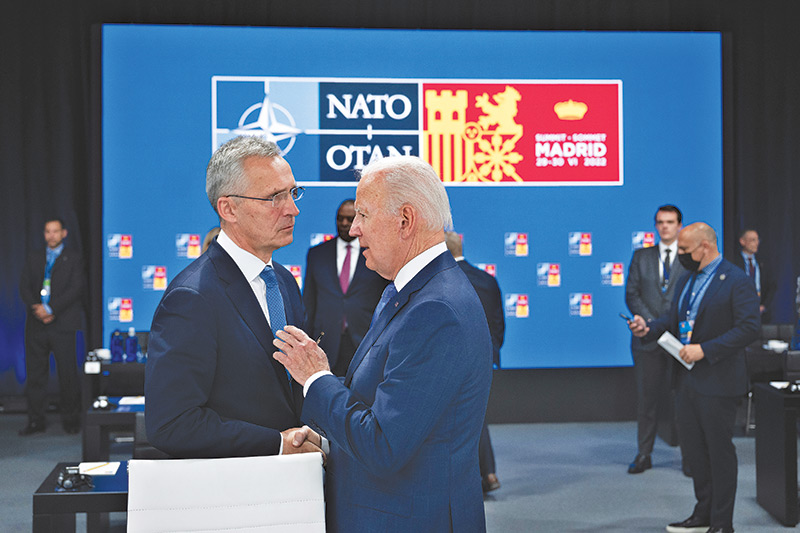
NATO Secretary General Jens Stoltenberg (left) and US President Joe Biden in Madrid, Spain. AP/RSS

MADRID,
The United States vowed on Wednesday to shore up Europe’s defences in the wake of Russia’s invasion of Ukraine, as NATO declared Moscow the West’s greatest threat.
Meeting in Madrid, alliance leaders said Russia “is the most significant and direct threat to allies’ security and to peace and stability in the Euro-Atlantic area”.
This came as NATO welcomed Sweden and Finland as invitees to join the alliance and US President Joe Biden announced new deployments of US troops, ships and planes.
Biden boasted the US announcement was exactly what President Vladimir Putin “didn’t want” and Moscow, facing fierce resistance from Ukrainian forces equipped with Western arms, reacted with predictable fury.
Deputy Foreign Minister Sergei Ryabkov denounced the US military build-up, and warned NATO members that the shifting balance of power “would lead to compensatory measures on our part”.
“I think that those who propose such solutions are under the illusion that they will be able to intimidate Russia, somehow restrain it—they will not succeed,” he said.
NATO leaders have funnelled billions of dollars of arms to Ukraine and faced a renewed appeal from President Volodymyr Zelensky for more long-range artillery.
“Ukraine can count on us for as long as it takes,” NATO chief Jens Stoltenberg said, announcing a new NATO strategic overview that focuses on the Moscow threat.
“We cannot discount the possibility of an attack against allies’ sovereignty and territorial integrity,” the document, updated for the first time since 2010, said.
In a summit statement, they said: “Russia’s appalling cruelty has caused immense human suffering and massive displacements, disproportionately affecting women and children.”
Zelensky had earlier addressed the NATO chiefs by videoconference, calling for stricter economic sanctions, but afterwards his foreign minister Dmytro Kuleba thanked Ukraine’s western friends.
“Today in Madrid, NATO proved it can take difficult but essential decisions. We welcome a clear-eyed stance on Russia, as well as the accession for Finland and Sweden,” he said.
“An equally strong and active position on Ukraine will help protect Euro-Atlantic security and stability.”
As Western leaders met in Madrid, in Ukraine officials complained that Russian missiles had hit civilian housing and businesses in and around the cities of Dnipro, Mykolaiv and Kharkiv, leaving at least seven dead and 14 wounded.
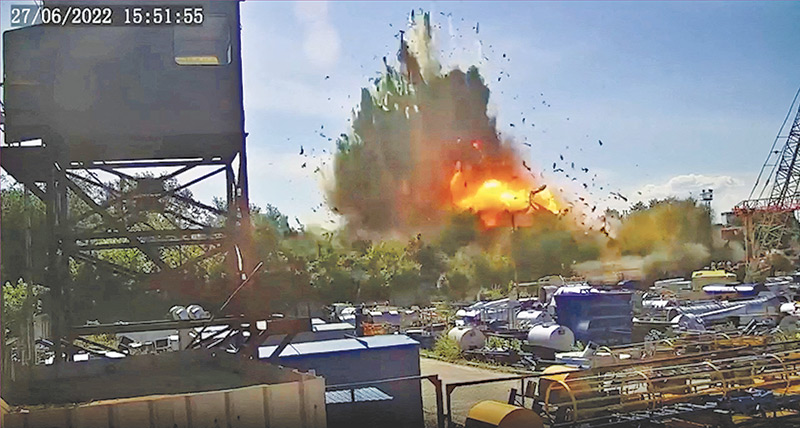
In Kremenchuk, the town where a Russian missile on Monday destroyed a shopping centre and—according to local officials—killed at least 18 civilians, clearing operations continued. A giant crane was working near the site of the impact and in the rubble-strewn parking area shopping trolleys piled with clothes and household goods lay abandoned.
Western leaders have dubbed the Kremenchuk strike a war crime, and Zelensky has demanded that UN investigators visit. Russia says it hit a depot storing Western arms.
The Russian defence ministry said it had inflicted severe casualties on Ukrainian troops defending the town of Lysychansk, in the eastern Donbas region, and said the Kharkiv attack had hit Ukrainian command centres and a training base for foreign “mercenaries”.
Moscow’s February 24 invasion of pro-Western Ukraine triggered massive economic sanctions and a wave of support for Zelensky’s government, including deliveries of advanced weapons.
At NATO, two formerly military non-aligned European countries—Sweden and Russia’s north-western neighbour Finland—will be accepted as candidates and Washington has announced that it will shift the headquarters of its 5th Army Corps to Poland.
An army brigade will rotate in and out of Romania, two squadrons of F-35 fighters will deploy to Britain, US air defence systems will be sent to Germany and Italy and the fleet of US Navy destroyers in Spain will grow from four to six.
“That’s exactly what he didn’t want but exactly what needs to be done to guarantee security for Europe,” Biden said, of Putin’s efforts to roll back Western influence and re-establish influence or control over territories of the former Russian empire.
Sweden and Finland’s path to NATO membership was opened after Turkey’s President Recep Tayyip Erdogan agreed to lift his threat of a veto—the ally accuses Stockholm and Helsinki of harbouring wanted Kurdish militants.
Turkey announced on Wednesday that it would request the extradition of 33 alleged “terrorists” under the terms of the agreement signed on Tuesday with Sweden and Finland to allow them to make membership bids.
A sanctions task force of leading Ukraine allies has frozen more than $330 billion in financial resources owned by Russia’s elite and its central bank since Moscow’s invasion, it announced on Wednesday.
The Russian Elites, Proxies, and Oligarchs Task Force (REPO) said the allies had blocked $30 billion in assets belonging to Russian oligarchs and officials, and immobilised $300 billion owned by the Russian central bank.
Norway said it would donate three multiple-launch rocket systems to Ukraine, following similar decisions made by Britain, Germany and the United States.

Page 2
NATIONAL

East-West Highway disrupted, settlements at risk of inundation by Narayani River

The Department of Hydrology and Meteorology issued a notice on Wednesday appealing to the residents of Kawasoti, Danda and Giruwari areas to exercise caution.
- NARAYAN SHARMA
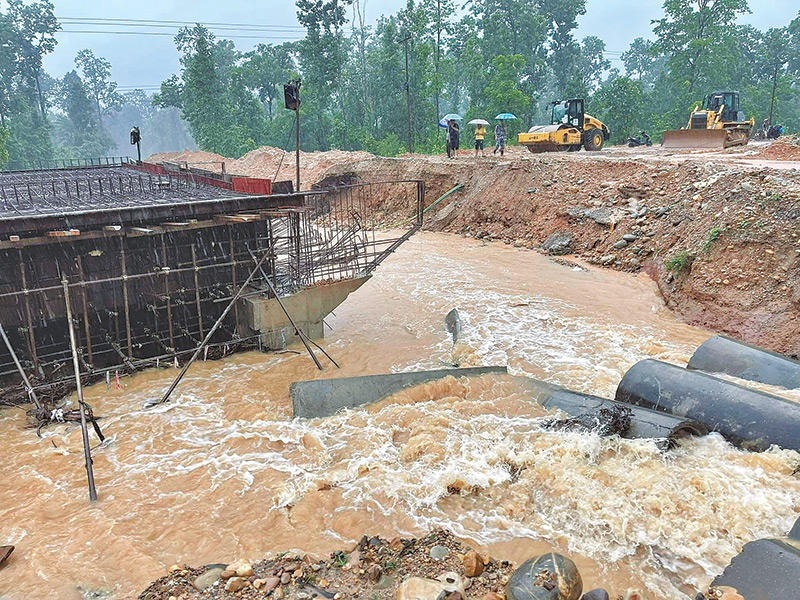
Flooded streams have swept away road diversions in three different places along the highway.  Post Photo: NARAYAN SHARMA

NAWALPARASI (EAST),
The Arunkhola-Dumkibas section of the East-West Highway has been disrupted as flooded streams swept away road diversions in three different places. Transportation came to a halt at 5am on Wednesday and is yet to resume.
According to Prabin Thapa, a consultant engineer of China State Engineering Corporation which is carrying out Narayanghat-Butwal road expansion work, vehicular movement could not be resumed along the road stretch on Wednesday. Hundreds of passengers have been stranded due to road obstructions.
“Efforts are underway to resume transportation by installing hume pipes. But the continuous rains have affected work,” said Thapa. The rains briefly stopped in the afternoon but it started again at 4pm.
Road widening work along the 114km Narayanghat-Butwal section, one of the busiest road stretches along the East-West Highway, is underway. Diversions have been made at several places for the construction work. According to the locals, these diversions are often swept away during monsoon as there is no proper water outlet system.
“There aren’t proper water outlets for the floodwaters. So the diversions are often damaged when it rains in the area,” said Laldhwoj Shrestha of Arunkhola.
Assistant Chief District Officer Khimraj Bhusal said it was uncertain when vehicular movement along the highway would be resumed. “We are working in the field. Efforts are on. But the continuous rains have affected the road repair work,” said Bhusal.
Meanwhile, the water level in the Narayani River has risen in the last 36 hours following continuous rainfall in the district. Several settlements from Gaindakot to Trivenidham near the river are at risk of flooding and inundation.
The Department of Hydrology and Meteorology issued a notice on Wednesday appealing to the residents of Kawasoti, Danda and Giruwari areas to exercise caution since the water level in the Gandak Barrage in Triveni has risen sharply.
According to the Water Measurement Centre, the water level at Triveni Barrage has reached 227,000 cusec litres.
Chief District Officer of East Nawalparasi Suman Ghimire said that an emergency situation could arise in the surrounding areas if the water level in the Narayani River crosses the danger mark.
The Centre in Devghat warned that the water level in the Narayani River had already crossed the six-metre mark by Wednesday evening. Water level above seven metres is considered very dangerous.

Page 3
NATIONAL

Government mulls mechanism to transport clinical samples of infectious diseases

- Arjun Poudel

KATHMANDU,
The Ministry of Health and Population has been working to devise a special mechanism to ensure proper handling and transport of clinical samples of infectious diseases in all provinces throughout the country.
Officials said that a special mechanism is needed to deal with the growing risk of many emerging and reemerging diseases including highly contagious viruses like coronavirus and monkeypox.
“We are working on a mechanism for proper handling, transport and management of the clinical samples of infected patients,” said Dr Amrit Pokhrel, an official at the Epidemiology and Disease Control Division. “We will forward a
proposal to the ministry for further discussion and approval.”
Officials say the ministry has started consultations with all stakeholders, including representatives from the laboratories.
Samples collected for microbiological testing require proper handling at all stages from collection to transportation, storage and processing, doctors say. Health workers involved in the collection of clinical samples, throat swabs in case of Covid, should be trained to minimise the risk of contamination and spread of infection in the communities, its proper storage and safe transportation.
The Health Ministry said that the lack of a mechanism for proper handling, transport and management of the samples does not, however, mean that the samples are not being transported at all.
“Samples collected at the local level and provinces are being transported to the laboratories in Kathmandu following certain rules and guidelines,” said Pokhrel. “We are working to set up a proper mechanism for an even better handling of clinical samples.”
Experts say proper handling of the samples of the suspects is not only important to lessen the spread of the infections in communities but also helps to get accurate results, which ultimately helps in taking timely decisions.
“Clinical samples of suspects are being transported from local units to the district hospital, and from provincial laboratories to the central lab,” said Dr Shrawan Kumar Mishra, chief of Provincial Public Health Laboratory of Madhesh Province. “Formation of such a mechanism also helps to make the authorities concerned more accountable.”
Agencies under the Health Ministry collected swab samples of people infected with Covid from across the country.
In the initial stage, swab samples of suspects were sent to the World Health Organization’s collaborating centres in Hong Kong and India for the confirmation of the virus. The Ministry continued to send swab samples of the infected people abroad for whole-genome sequencing until the National Public Health Laboratory started carrying out testing within the country.
Likewise, the Ministry of Health and Population has decided to send clinical samples of suspected monkeypox cases to the World Health Organization’s collaborating centres in India for confirmation.
Apart from these, dozens of specimens are being transported every day.
“Not all health workers are trained on the techniques for handling samples,” said Mishra. “But they should be trained to avoid exposure to deadly microbes—which could be life threatening in some cases or could easily spill over to communities. They should be provided with necessary equipment and be made accountable.”

NATIONAL

Prolonged court cases delay transmission line projects

The 400kV Hetauda-Dhalkebar-Inaruwa Transmission Line Project is in limbo for over three years due to delays by the top court in deciding on a petition.
- PRITHVI MAN SHRESTHA

KATHMANDU,
It has been more than three years since the Supreme Court issued an interim order to prevent the construction of seven pylons at Padariya, in Lahan municipality of Siraha district under the 400 kV Hetauda-Dhalkebar-Inaruwa transmission line.
In January 2019, Sarita Giri, a politician and former minister, had filed a petition at the Supreme Court demanding a change in the route of the transmission line in the Padariya area and the court had issued an interim order accordingly.
“But after issuing the interim order, the Supreme Court has not conducted even a single hearing on whether to continue the order,” said Shyam Kumar Yadav, chief of the Nepal-India Electricity Transmission and Trade Project, under which the 400 kV Hetauda-Dhalkebar-Inaruwa and the 200 kV Bharatpur-Bardaghat transmission lines are being constructed.
According to him, the case was in the daily cause list of the Supreme Court on June 27. “The court on June 27 sought relevant documents from us and we submitted the documents on Wednesday,” Yadav said, adding that the court has scheduled a
hearing for July 5.
With the court delaying hearing on the writ petition along with continued obstruction from locals in a few other locations, construction of one of the most important high capacity transmission lines has been affected, according to NEA officials.
Besides Padariya, locals have been obstructing the NEA’s effort to construct pylons in Hatiya of Makawanpur and Jiyajor of Lalbandi Municipality in Sarlahi.
“As a result, we have so far completed constructing 704 pylons out of the total 792 of the Hetauda-Dhalkebar-Inaruwa transmission line,” said Yadav. The total length of the transmission line is around 282km.
The importance of this project is that it is currently the only 400kV capacity project under construction for domestic power transmission through which 2,000MW power can be transported. The Dhalkebar-Muzaffarpur transmission line is the only completed project of 400kV capacity, but it is being used for export and import of electricity between Nepal and India.
The construction of the 400 kV Hetauda-Dhalkebar-Inaruwa and 220 kV Bharatpur-Bardaghat transmission lines had started in 2011 and both were supposed to be completed by 2016.  
But a number of factors including local obstructions and disputes with the contractor delayed these projects, according to NEA officials.
As a result, the key financier of these two projects—the World Bank—discontinued its funding in November last year, according to the NEA.
Before withdrawing its funding, the World Bank had extended the project deadline several times. Obstructions from locals and legal cases against the projects, however, led to continued delays, said officials.
“If all the obstructions are removed immediately, we can complete the Hetauda-Dhalkebar-Inaruwa Transmission Line by 2023,” said Yadav.
Not only in the case of the Hetauda-Dhalkebar-Inaruwa transmission line, it took more than a year for the Supreme Court to vacate its own interim order on halting the construction work on two pylons or the 220 kV Bharatpur-Bardaghat Transmission Line.
In April last year, the Supreme Court had issued an interim order not to build two pylons of the 74km transmission project as demanded by the locals of the Dumkibas, Nawalparasi.
As a result, the project remained incomplete even though the Nepal Electricity Authority has already completed erecting 244 of the
246 pylons.
On June 27, a joint bench of Prakash Kumar Dhungana and Ishwar Prasad Khatiwada vacated the earlier interim order paving the way for erecting the two remaining pylons.
On Tuesday, the NEA charged electricity in part of the Bharatpur-Bardaghat Transmission Line, just a day after the Supreme Court vacated the interim order.
According to the state-owned power utility, it charged electricity on a 56km section—from Aptari substation in Bharatpur to Arun Khola substation in Nawalparasi—of the 74km 220kV transmission line on Tuesday. From Arun Khola, power was transmitted on the old 132kv transmission line to Bardaghat.
Currently, there is a 132kV transmission line from Bharatpur to Bardaghat which can carry a maximum 80MW only, according to the NEA. “With the construction of the 220kV transmission line, the NEA will be able to take the power to western parts of the country and this will help reduce power imports from India through the Tanakpur area,” NEA Managing Director Kul Man Ghising said, according to an NEA press statement issued on Tuesday.
Locals of Dumkibas had moved the Supreme Court against the transmission line project demanding higher compensation for their land acquired for the project.
Now that the Supreme Court has vacated the interim order, the NEA plans to distribute compensations to the land owners.
“As only 4-5km section of the transmission lines remains to be constructed, it will not take much time to complete the project if the locals cooperated,” said Dirghyu Kumar Shrestha, chief  of Transmission Directorate at NEA.
Officials and experts say that prolonged court process has been one of the major obstacles to completing the important development projects in the country for long.
“For any delay, the NEA has to pay fines to the contractors and additional interest on the loans to creditors. Also the power produced by several hydropower projects goes to waste if the transmission line is not completed on schedule,” said Former Energy Secretary Anup Upadhyay. “The court needs to understand the losses the nation suffers for the delay in issuing a verdict.”
He said that the court should not take long to give its verdict on the land acquisition dispute. “They just need to decide whether compensation has been provided and it is reasonable,” said Upadhyay.

NATIONAL

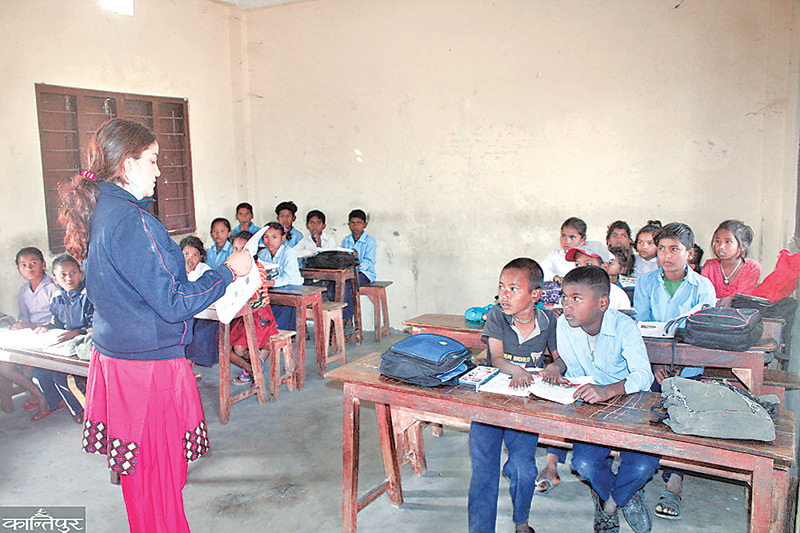
Official raises some hackles by saying local units are unfit to handle school education

During grilling by a parliamentary panel over delay in federal education bill, the education secretary said local units don’t have capability and expertise to ensure quality of education.
- BINOD GHIMIRE
The constitution allows local units to take necessary measures to manage school-level education within their jurisdictions.  Post File Photo

KATHMANDU,
Amid the backlash over the government’s failure to draft a federal education bill, the claim last week by the education secretary that it was a mistake to give authority to local governments to handle the educational affairs up to secondary level, has created quite a stir among officials.
Answering queries from lawmakers in a parliamentary committee, Secretary at the Ministry of Education, Science and Technology Yadav Koirala on Tuesday said that the local governments are not capable of managing the secondary level education despite being given such an authority by the constitution. He claimed that the local governments neither have the capability nor the expertise to ensure quality of secondary level education and monitor the effectiveness.
“The constitutional provision allowing local governments to manage school education up to the secondary level was a mistake,” he told the Health and Education Committee of the lower house.
The committee had summoned Education Minister Devendra Poudel and senior officials at the ministry including Koirala to draw their attention to the delay in bringing the crucial federal education bill.
Local officials, who were also present at the meeting, took a strong exception to the statement and demanded that Yadav withdraw his statement and apologise. They termed Yadav’s statement as demeaning.
“The statement is irresponsible,” reads the letter submitted by local officials to Yadav. “It has undermined the morale of hundreds of education officers working under local governments throughout the country.”
The education officers said such a rash statement by federal officials who should be supporting local governments will not be helpful.
“It is his responsibility to support the local units if they are not capable,” Nawaraj Puri, an education officer at Panchakanya Rural Municipality in Nuwakot, told the Post.
The newly elected local level representatives also have taken a serious exception to Yadav’s statement saying it has only portrayed the centralised mindset of federal officials. “His statement is condemnable,” Bhim Prasad Dhungana, the mayor at Nilkantha Municipality in Dhading who is also the general secretary of the Municipal Association Nepal, told the Post. “Only those who are against federalism can make such a statement.”
Schedule 8 of the constitution gives local governments explicit authority to handle school education. It allows them to take necessary measures to manage school-level education within their jurisdictions.
Dhungana claimed that officials like Koirala, who are guided by centralised mindset, are responsible for the delay in the bill.
An Act and regulations are prerequisites for the implementation of the constitutional provision. In the absence of the law, local governments have not been able to exercise their constitutional authority yet.
The constitution makes it mandatory to have the laws related to the fundamental rights in place within three years since its promulgation. It also said the existing Acts that contradict the constitution must be revised within a year since the first meeting of the federal parliament. The government prepared the laws within the constitutional deadline. However, as there is no such constitutional deadline for the promulgation of federal laws, successive governments have become negligent in discharging their duty.
The parliamentary committee directed the ministry to present the Federal Education bill in parliament at the earliest. Minister Poudel has agreed.
Poudel is the fifth education minister since the promulgation of the Constitution of Nepal and third since the last general elections. And every minister has made similar promises. However, no minister has made good on their promises to have the Act in place.
“The local governments have been deprived of exercising constitutional authority in lack of an Act. They have already completed a five-year term,” said Dhungana. “We want the Act to be promulgated from the ongoing session of parliament.”

Page 4
EDITORIAL

Power sans responsibility

Rather than a sense of security, the presence of the police strikes fear in people’s hearts.

The brutal thrashing of a doctor who was walking home after finishing his shift has brought forth public claims that a repressive mindset is still operational within the police force. Dr Kul Bahadur Ghishing was viciously attacked on his way home from the hospital by a constable on the pretext that he had been walking at night. This is not the first case wherein the security apparatus has shown severe abuse of power. However, it is alarming that the confidence to act brazenly emerges possibly in the complete absence of training concerning the rights of citizens and the limitations of power accorded to the security apparatus.
Even if we are to consider this particular issue as a one-off wanton behaviour of an individual in uniform, the attitude displayed by the constable and the group of other policemen present at the scene clearly shows their ability to abuse the powers vested in them in the knowledge that there will be no severe repercussions. Or, on a bleaker note, one that is usually hidden from the public eye—such abuse of power is often left unaddressed, which is taken as tacit approval by those lower down the security apparatus that is in constant touch with the public.
Cases of police brutality are a common occurrence in Nepal. Baton charging and physical violence at demonstrations are often justified to control the protestors. Such events quickly spiral out of control with the presence of armed police who resort to using guns, which tends to aggravate the situation by adding fuel to the fire. And instead of reaching an amicable end, demonstrations, more often than not, result in more deaths and suffering. Instead of inculcating a sense of security among the public, the presence of the police strikes unnecessary fear in people’s hearts; this ongoing image makeover has no other design than to inculcate fear among the ordinary populace.
Another matter of concern is the rising incidences of custodial death in Nepal. As we recently witnessed in the case of Sundar Harijan, who is alleged to have hanged himself. Despite concerns from the United Nations and domestic and international human rights organisations, custodial deaths in Nepal have continued with little progress in investigating them. Ignoring such matters does little in projecting the image of the police force as benevolent. And the authorities have done precious little to ensure investigation at the earliest.
Redefining the image that projects the police as a brutal force leads to nothing but the erosion of trust between the public and the security apparatus, which will undoubtedly have graver consequences for the state’s security as a whole if the trust deficit is allowed to widen. There needs to be an instant overhauling of the training practices and procedures to ensure that those assigned to protect the public do not violate their power and responsibility in carrying out their duties. No impunity should be granted to those that stand to abuse the trust accorded in good faith.

OPINION

Maoist castaways

The party and its leadership have moved on to mundane pursuits like power and money.
- DEEPAK THAPA
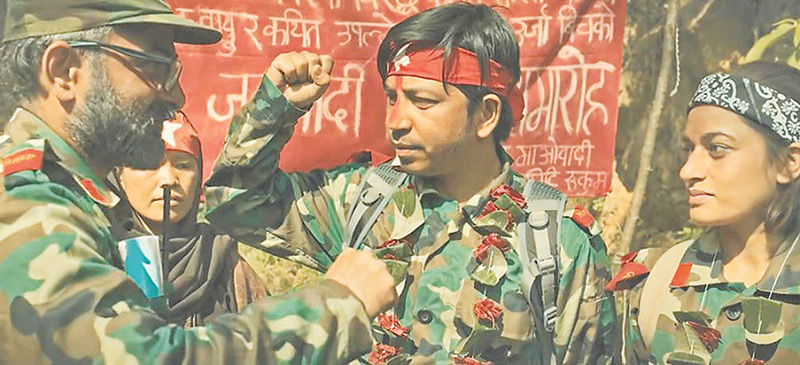
Screengrab via youtube

The subject of this piece is somewhat dated, but since it is one that had affected me somewhat deeply, and as it is also one that defies temporality, I have decided to present it nonetheless.
I am referring to Prakash Saput’s music video, “Pir”, which unleashed a furore of sorts when released a few months ago.

Taking a stand
In a sign of growing assertion after the 1990 political change, different social groups began taking issue with how their communities have been presented in popular culture. Among the first such instance was the row in the mid-1990s raked up by some in the Kirat community who were none too happy with Bishweshwar Prasad Koirala’s novel, Sumnima (1969), and its characterisation of the eponymous Kirat protagonist. Then there was the controversy over singer Kumar Basnet’s song “Dalli Magarni”, which by its very connotation was denigrating of the vertically challenged and equally so of Magars.
Basnet’s most famous song is arguably “Kathmandu ki Newarni”, in which he extols the beauty of women of some select ethnicities. In his defence, one can argue that he was simply lauding their comeliness. Yet, it is hard to deny that by simply referring to them in his opening and closing lines in a song about unrequited love, he manages to “other” them. Not to mention how he also succeeds in sexualising women from communities not his own.
One now cringes at the lyrics to those songs and many others we grew up listening to and humming along with many of these now-objectionable tunes since we simply believed that was the norm. Just some years later, we realised how wrong we were, and that just because it was okay at some point in time does not mean it should be acceptable forever. Stereotypical portrayals continue even today, but thankfully growing rarer over time. And when it does happen, there is a strong enough constituency that calls out the creator to ensure some kind of correction.

Toe the line
Disrespect toward entire groups of people, whether identified in terms of gender, caste/ethnicity, language, or religion, in artistic or any other expression is despicable and needs to be condemned. But such outrage can hardly be justified when it comes to speech in general, as in the case of Saput’s video.
That songs are a powerful way to capture the imagination of the public is well established. The Nepali communist ballad, “Gaun, gaun bata utha”, that aimed to rouse people to revolt against the status quo was used most effectively by the party that has now become the UML. Perhaps that explains why the same folks were so incensed to the point of violence a few years ago when singer Pashupati Sharma came up with his catchy “Lootna sakay loot kanchha”, a satire on how the state coffers were beginning to serve as the ruling elite’s personal account. The powers that be did not quite appreciate a commonplace sentiment being put to music, and unleashed their minions to force poor Sharma into taking down the song from his YouTube channel.
The story in Saput’s song is similarly not uncommon. It details the daily struggles of a husband-and-wife couple Maoist fighters in post-2006 Nepal while juxtaposing it against a leadership who continue to reap the benefits of the sacrifices of their cadre. The song was roundly condemned by the Maoists. A section of the latter even charged Saput with having outdone “reactionary political forces who are now trying to present themselves as advocates of a federal, democratic republic”. The singer was warned to take down the video and issue an apology. That, he duly did, but as the rest of us know, the only mistake he made was to show the reality of what has happened to the vast majority of those who put their lives on the line for the sake of a New Nepal.
As someone who tears up at even the most melodramatic scenes in Hindi films, it was natural for the video to evoke strong emotions in me. It was not the melodrama though that moved me. Rather, it was the memories of having met or read about those like the male protagonist in the video, a battle-hardened Maoist who still believes in the word despite the circumstances he finds himself in.

The forgotten
One that I remember well is Kesh Bahadur Batha Magar. He headed the Rolpa committee of the breakaway Mohan Baidya-led CPN (Maoist) when I met him in 2014. After denouncing the path taken by his erstwhile comrades and having tried to convince us that Baidya’s line was true Maoism, he started talking about his personal life. It turned out both his sons had taken part in the “People’s War”. At the time of our meeting, one was in Qatar while the second had similar aspirations but could not qualify because he had lost an eye in battle. He was struggling as a security guard somewhere in Kathmandu.
Hemanta Prakash Oli was in the news not so long ago quite recently as a top leader of Netra Bikram Chand’s faction of the Maoists (from which he has since been ejected). In an interview, he mentions how, when he was with the Prachanda Maoists, following the collective decision of doing away with private property, he handed over all he owned to the party. “There was a proposal [within the party] to proletarianise. Believing that to be truly the case, I gave everything. Others did not. I have nothing to my name now.”
Given that Oli’s erstwhile boss, Prachanda, is building a house for himself in Chitwan, I can bet he was among those who did not give all to the cause he himself was leading. Whether one agrees with Oli or not, everyday reminders such as this must be quite a letdown to the aspirations held by thousands for the dictatorship of the proletariat.
Take also the example of Laxmi Pun, an underground reporter for the Maoists. She once told me that due to her Indian education, her English was good and she was much valued in her party during the insurgency. She has written about an incident that foreshadowed Saput’s song by many years. Waiting at the gate of Prachanda’s then residence at Lazimpat, she was with a former guerrilla couple and their daughter. Upon being suddenly informed that there would be no further meetings that day, the wife started crying. One can only imagine with what high hopes they had hoped for an audience with their supremo. Just then a sleek car carrying a rich woman politician—who was not a Maoist—arrived. The gates swung opened and shut, leaving out those on whose backs Prachanda had vaulted himself to power.
There is this one scene from Saput’s video that stayed with me for long. When the male character drops off his wife at the airport on her way to “Arab”, just before they part, they exchange a furtive, albeit tentative, lal salaam. Despite the raw deal they have received, this couple has not given up on the human instinct for justice. I wonder how many continue to delude themselves with that hope even as the party and its leadership have long moved on to more mundane pursuits like power and money.

OPINION

How heat waves hit women farmers

Heat waves are concerning from a gender perspective, as research in Nepal, India and Bangladesh shows.
- EMILY M L SOUTHARD,HEATHER RANDELL
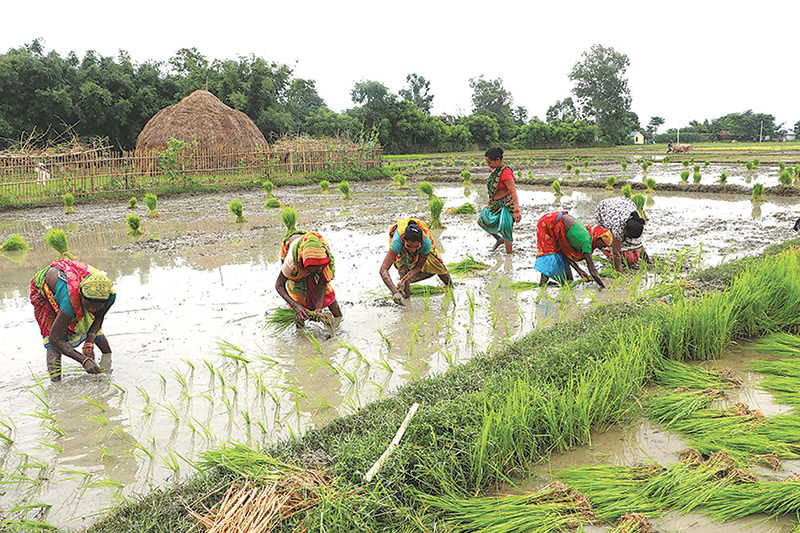
Post file photo

Sitting in a semi-circle in the yard outside of a village school in Nepal, a group of farmers share their concerns about the future. They discuss how the rain is unreliable—droughts and floods are both becoming more common. The heat is overwhelming before the rains come.
In April, May and June, extreme heat makes it harder to work, crops wilt and sometimes die, and livestock get sick. All of the young farmers in this schoolyard are women, most in red saris. The few men present are elderly. Young men don’t live here anymore. As the crops fail more often, the men take contracts for migrant work, handing over papers and passports to recruiters who organise travel to nearby cities or faraway countries.
As climate change, and particularly heat waves, worsen for South Asia’s farmers, women are increasingly left to try to make crops grow in the oppressive heat.
We are sociologists who study how climate change influences health and well-being, with a particular focus on women and children, including communities like this one in South Asia. We are also interested in how interventions by governments and aid groups can alleviate these negative impacts.

Record-breaking heat
According to the Indian Meteorological Department, 2021 was the fifth-warmest year in India since 1901, and it capped the hottest 10-year span on record in the country. In 2022, the region has seen record-breaking and unrelenting heat from March through June, with temperatures reaching 47 degrees Celsius (116 F) in India and 51 degrees Celsius (124 F) in Pakistan.
Researchers predict that even under an optimistic scenario in which the world takes bold enough steps to keep global warming to 1.5 degrees Celsius  (2.7 F) compared with preindustrial times, South Asia will experience more frequent bouts of deadly heat. Some areas in the region have already experienced temperatures outside of the range for human productivity and into dangerous territory for human survival.
These thresholds occur at wet-bulb temperatures of around 32 degrees Celsius (89.6 F) and 35 degrees Celsius (95 F), respectively, and can be lower. Wet-bulb temperatures take into account both the air temperature and relative humidity. Hot and humid conditions lead to a greater risk of heat stress, as humans are less able to cool their bodies through sweating.
Some of the hardest-hit areas have been agricultural regions such as the Indian states of Punjab, Uttar Pradesh and Madhya Pradesh. There, crop losses affect household food supplies as well as income. The crop damage is especially troubling as these are wheat-producing regions that are seeing yields drop by 50 percent at the same time that the conflict in Ukraine raises concerns over wheat shortages for 2022. India banned wheat exports in May 2022 in an effort to control domestic prices.

Why gender matters
All these trends are particularly concerning from a gender perspective, as our research in India, Nepal and Bangladesh shows.
As heat rises, women are more likely to work in agriculture. We find that this is particularly true for women with little education, and previous research suggests impoverished women are most likely to take agricultural work, because of a lack of other opportunities. While men can migrate for work, norms about women’s responsibilities to stay at home and care for children and the elderly leave them with few other opportunities to make a living.
Because of rural people’s dependence on agricultural work and the outdoor exposed nature of that work, women face exceptional health risks because of heat exposure. Yet compared with urban areas, rural areas tend to have less access to air conditioning, health resources and other tools that could combat heat dangers.
Farmers also face more stress than other workers when their income is threatened by heat, because agricultural success is intrinsically linked with climate. Agricultural failures are associated with farmer suicide, post-traumatic stress and other mental health concerns.
In situations where farmers are providing food for their own families, agricultural failures also mean decreased food security. Women-headed farming households have been found to be particularly vulnerable to food insecurity, as they have more limited access to land, education, financial resources, weather information and modern agricultural technologies than farms headed by men. Thus, climate change in rural areas is becoming an increasingly gendered problem.
Heat certainly remains a concern for urban dwellers. Yet urban economies are more diverse and less climate dependent, and urban areas are better equipped with resources to combat heat risks. Public health officials worry that those in rural areas lack knowledge about heat risks and what they need to do to prevent heat-related illness.

Solutions big and small
To help south Asia’s female farmers, governments and aid groups need to understand the particular risks they face. Researchers are making strides in mapping out hot spots in India where gender and agricultural conditions make female farmers more vulnerable.
Governments and aid organisations can help those groups in a variety of ways, from mitigating heat’s effects on humans and agricultural production to providing new economic opportunities for rural women. Nongovernmental organisations are already working to spread simple solutions that can help rural farmers stay cooler, like covering roofs with solar-reflective paint to keep homes from heating up.
Scientists in India have also developed a heat-resistant wheat variety. Elsewhere, scientists are working on “climate-proofing” other crops and looking to traditional practices that enhance agriculture’s resilience to climate change, such as growing a more diverse mix of crops and using farm byproducts like manure as fertiliser.
Additional efforts include crop insurance to help support farmers when heat does decrease yields. Crop insurance has low adoption rates among the poor in low- and middle-income countries. Small-scale farmers may not qualify for insurance because of their farm’s small size or because their crops are grown primarily to feed their family. Some strategies that have been used to increase its use include expanding insurance beyond cash crops to include crops families eat and lowering thresholds for coverage. Insurers must also be willing to recognise women as farmers. Many female farmers have struggled to receive agricultural assistance because of gender bias.
More broadly, efforts to slow climate change on a global scale are what is most needed to help South Asia’s female farmers. As the world is increasingly likely to surpass a 1.5 degrees Celsius warming scenario in the near future, it becomes critical to reduce global greenhouse gas emissions to avoid the most harmful heat scenarios.

 
Southard is PhD candidate in Rural Sociology and Women, Gender, and Sexuality Studies at Penn State University. Randell is Assistant Professor of Rural Sociology and Demography at Penn State University.
 — The Conversation

Page 5
MONEY

Dark Matter forges ahead in game development sector

The Nepali game developing community is still small and lacks motivation, according to industry insiders.
- PAWAN PANDEY
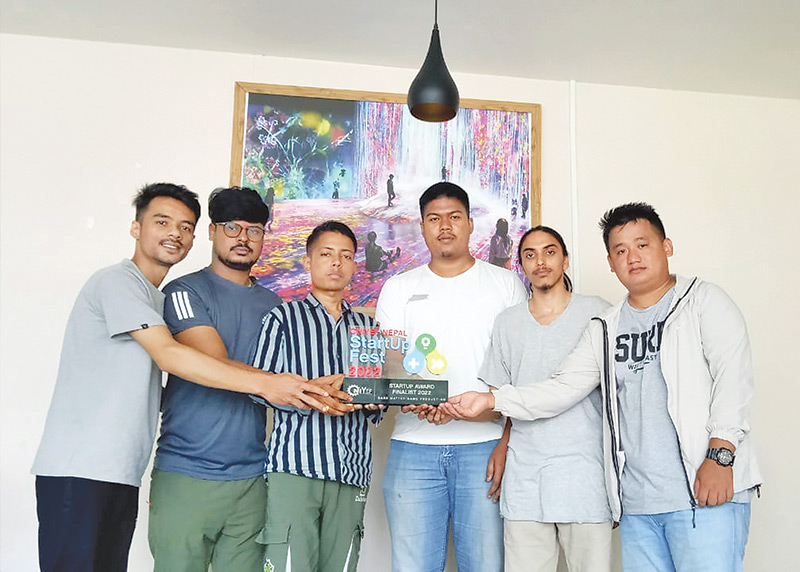
Dark Matter has launched two games so far—Sprite Ninja: Ninja Hattori and Sprite Ninja: Ninja Hattori Vancouver. Photo Courtesy: Dark Matter Game Production

KATHMANDU,
Two friends, 23-year-old Asim Basnet and 21-year-old Prakash Shrestha, have enjoyed playing video games ever since they were
children.
“We played every game we could get our hands on,” Shrestha, who is awaiting his final results in Electronics and Computer Engineering from Paschimanchal Campus in Pokhara, told the Post over the phone.
Their love for video games led the two childhood friends, born and brought up in Chitwan in south central Nepal, to seek a career in game development.
The duo had often wondered why there were no Nepali game developers despite a large base of gamers. “So after grade 12, we were almost certain that we wanted to be professionals in the gaming field,” said Shrestha. “I joined electronics and computer engineering to learn game development.”
Since 2018, they have pursued game development and have gradually improved their skills through trial and error. The two friends developed their first game which was similar to Subway Surfer. The game, which was developed on a Lenovo V310 laptop, was launched on Google Play in 2020.
Basnet, who is currently studying computer engineering at United Technical College in Chitwan, says they decided to dedicate their time to their vocation and thought about expanding the team. “We decided to register a company and hire some people who were as passionate about gaming as we were,” he said.
Subsequently, Dark Matter Game Production was registered as a company in December 2021.
Currently, the Dark Matter team comprises five members—Himal Timilsina, UI/UX designer; Prabin Gurung, database and server handler; Aakash Prasad Gupta, UX developer/engine programmer; Monika Mahato, concept artist; and Asbhin Adhikari, 3D modeller/texture artist—excluding Basnet, game designer and 3D modeller; and Shrestha, lead developer.
“We need to hire a sound artist, animator, designer, VFX artist and developer in the coming days,” said Basnet.
Dark Matter has launched two games so far—Sprite Ninja: Ninja Hattori and Sprite Ninja: Ninja Hattori Vancouver. The two games have been downloaded more than half a million times and 50,000 times, respectively.
“We completed our first game production phase this year and released the beta version of our first game which currently has over half a million downloads on the Google Play Store,” they wrote to the Post. “Our next plan is to complete the post-production of this game and release its final version.”
After releasing the final version, Basnet hopes to start earning a minimum of $10,000 monthly.
Seven of the top 10 start-ups were able to secure investment pledges totalling Rs245 million at the CNIYEF Nepal Start-Up Fest
2022, organised by the Confederation of Nepalese Industries Young Entrepreneurs Forum last Saturday.
Among the seven, Dark Matter Game Production received an investment pledge of Rs15 million, according to Basnet. “We are super excited. We presented our plans for the coming days at the start-up fest, and the investors loved it,” he said.
“The projects which made it to the final selection were given an opportunity for presentations,” the organisers said in a press statement.
“After the presentations, the investors, in the presence of Baikuntha Aryal, secretary at the Ministry of Communication and Information Technology, made a preliminary agreement to make an equity investment in the projects.”
The other six start-ups which received investment pledges are Voxcro, Skill Sewa, Team Veda, Kheti, Digital Age Nepal and Doctors on Call. The investors are Team Ventures, Global Equity Fund, Aadhyanta Fund Management, Himalayan Capital and Televenture Partner, according to the statement. Shrestha believes lack of funds is one of the reasons why there are only a few game developers in Nepal.
“I used to wonder why Nepalis did not develop video games. But now that I am in this business, I understand that funding, or lack thereof, is one of the major reasons,” he said. “I think that lack of sufficient funds, equipment and skills are the reasons behind the small number of game developers in the country.”
When Basnet and Shrestha started on their journey as game developers, they had to rely on their families for the initial investment. “Our families provided us with Rs500,000 each,” said Basnet. “We bought some pieces of equipment to upgrade the game we had launched earlier.”
The gaming market was valued at $198.40 billion in 2021, and it is expected to reach a value of $339.95 billion by 2027, according to Mordor Intelligence, a market intelligence and advisory firm.
Despite significant strides in the game development field, the Nepali game developing community is still small and lacks motivation, according to industry insiders.
“There are only a handful of game development companies in Nepal because there is almost no motivation for developers in
educational institutions,” said Rahul Subedi, publisher of Pokhara-based Yarsa Games. “Most of the game developers in Nepal are self-driven.”
That’s why among those equipped with information technology (IT) knowledge, only a few choose game developing, Subedi says. “There is a shortage of skilled manpower in this sector mostly because people think there are no avenues available for career development,” Subedi told the Post.
“This is a vicious circle. Lack of motivation in educational institutions regarding game development causes fewer individuals to enter this field. Lack of manpower results in fewer start-ups pursuing game development. This leads to the production of only a few games which strengthens the view that there are no opportunities in game development,” said Subedi. “We need to break this circle.”Subash Adhikari, vice-chairperson of the recently formed Kathmandu Chapter of the International Game Developers Association (IGDA), seconds Subedi.
In Nepal, according to Adhikari, one does not get enough time and opportunities to hone the skills required to become a professional game developer.
“Game development is not new in Nepal,” said Adhikari, who is a software developer by profession but has a passion for game development. “Many Nepali developers have been involved in outsourcing projects as well.”
Despite the hurdles, some of the games made by Nepalis have gained success, according to Subedi. Ludo, developed by Yarsa Games, has been downloaded more than 50 million times on the Google Play Store.
“If we could develop games targeting the right audiences, especially in neighbouring countries like India within a similar demographic, Nepali developers can make money doing what they are good at,” Subedi said.
Although their achievement in the gaming world is commendable, Basnet believes they still have a long way to go.
“We want to launch our games on platforms other than Android. We will also localise our products in different markets in the respective languages,” he told the Post.
“We are currently working on a game centred on role playing for the Android mobile platform. We will continue our production on different platforms and genres in the coming days,” Basnet said.

MONEY

Nepal, Bangladesh get $1 billion to boost regional trade and connectivity

- Post Report

KATHMANDU,
The World Bank on Wednesday approved $1.03 billion of financing to help improve regional trade in Nepal and Bangladesh by reducing trade and transport costs and transit time along the regional corridors.
The Accelerating Transport and Trade Connectivity in Eastern South Asia (ACCESS) Programme Phase 1 will help the respective governments address the key barriers to regional trade—manual and paper-based trade processes, inadequate transport and trade infrastructure, and restrictive trade and transport regulations and processes, the world bank said in a statement.
The Phase 1 programme will help replace lengthy manual and paper-based trade processes with digitised automated solutions in Bangladesh and Nepal. The automation will enable faster border crossings and install electronic tracking of truck entry and exit, electronic queuing, smart parking, and CCTV cameras. The programme will also help improve selected road corridors and upgrade key land ports and custom infrastructure while ensuring a green and climate-resilient construction. This will help the integration of landlocked Nepal and Bhutan with the gateway countries of Bangladesh and India.
“Regional trade offers enormous untapped potential for the countries of South Asia. Today, regional trade accounts for only five percent of South Asia’s total trade, while in East Asia it accounts for 50 percent,” said Hartwig Schafer, World Bank Vice President for South Asia. “South Asia can boost economic growth significantly and create opportunities for millions of people by increasing regional trade and connectivity.”
The $753.45 million financing for the ACCESS Project in Bangladesh will upgrade the 43km section of the two-lane Sylhet-Charkai-Sheola to a climate-resilient four-lane road, connecting the Sheola Land Port with the Dhaka-Sylhet Highway. This will cut down travel time by 30 percent.
The project will support digital systems, infrastructure, and more streamlined processes at Benapole, Bhomra, and Burimari land ports, the three largest land ports in Bangladesh handling approximately 80 percent of land-based trade. It will also support the modernisation of the Chattogram customs house which handles 90 percent of all import/export declarations in Bangladesh.
“While the trade between Bangladesh, Bhutan, India, and Nepal grew six times from 2015 to 2019, the unexploited potential for regional trade is estimated at 93 percent for Bangladesh,” said Mercy Tembon, World Bank Country Director for Bangladesh and Bhutan. “The project will help Bangladesh improve regional trade and transport and automation of processes will build resilience to crises like the Covid-19 pandemic.
The $275 million ACCESS Project in Nepal will upgrade the 69km two-lane section of Butwal-Gorusinghe-Chanauta road along the East-West Highway to a climate-resilient four-lane highway, with a focus on ensuring better road safety. This is expected to reduce travel time by 30 percent, thus providing better access to India’s western seaports.
The project will construct at least three market areas along the highway with dedicated areas for women entrepreneurs and traders to ensure they benefit from the enhanced opportunities, the World Bank said. The market areas will be equipped with separate toilets for women, free Wi-Fi, and digital bulletin boards with timely trade and market information. It will also support capacity building to enhance trade and customs processes at Birgunj and Bhairahawa. The project will help advance Nepal’s preparedness and the Motor Vehicle Agreement’s implementation.
“Nepal has large untapped potential for regional trade and exports. Low regional trade is often a result of the high cost of connectivity,” said Faris Hadad-Zervos, World Bank Country Director for Maldives, Nepal, and Sri Lanka. “The project will help unlock Nepal’s economic potential through better connectivity and trade, both between the provinces as well as regionally among Nepal and other countries to support a green, resilient, and inclusive development.”
It is highly critical to ensure trade growth, long-term sustainability and resilience of investments, while minimising actual degradations on the environment, wildlife and ecosystems along with Nepal’s road network, which carries 90 percent of passengers and goods movement,” said Oceane Keou, World Bank Task Team Leader of the Nepal Project and co-Task Team Leader of the Programme.

MONEY

Mahindra unveils all-new Scorpio-N in Nepal

KATHMANDU: Mahindra & Mahindra Ltd, pioneers of the SUV segment in Nepal, unveiled its much awaited SUV, the all-new Scorpio-N. The company also unveiled its new visual identity including a brand-new logo that will differentiate its SUV portfolio. This is a first ever simultaneous unveil with India by Mahindra, reads the press release issued by the company. The All-New Scorpio-N has been designed to redefine the D-segment SUV category with its dominating presence, head-turning design, commanding driving position and well-appointed, interiors. (PR)

Page 6
WORLD

Russian missiles rain down on Ukraine as West pledges enduring support

Russia would set its sights on other countries, Zelenskiy warns, saying Moscow wanted to ‘enslave’ Lithuania.
- REUTERS
A view of the explosion as a Russian missile strike hits a shopping mallamid Russia’s attack on Ukraine, at a location given as Kremenchuk, in Poltava region, Ukraine in this still image taken from handout CCTV footage released on Tuesday.   CCTV via Instagram @zelenskiy_official via REUTERS

KYIV, 
Russian forces struck targets in the Mykolaiv region of southern Ukraine on Wednesday and intensified attacks on fronts across the country as NATO members met in Madrid to plan a course of action against the challenge from Moscow.
Ukrainian President Volodymyr Zelenskiy told the NATO leaders his country needed more weapons and money to defend itself against Russia, warning that Moscow’s ambitions did not stop at Ukraine.
At the summit, President Joe Biden announced additional US land, air and sea deployments across Europe, including a permanent army headquarters in Poland, in response to threats from Russia.
The mayor of Mykolaiv city said a Russian missile strike killed at least three people in a residential building there, while Moscow said its forces had hit what it called a training base for foreign mercenaries in the region.
In the east, the governor of Luhansk province said there was “fighting everywhere” in the battle around the hilltop city of Lysychansk, which Russian troops were trying to encircle.
The governor of Kryvyi Rih in central Ukraine said Russian shelling had increased there too in the past few days.
“Several villages have been wiped from the face of the earth,” Kryvyi Rih governor Oleksander Vilkul said.
The stepped-up attacks—following a missile strike on a shopping mall killed at least 18 people in central Ukraine on Monday—come as Russian President Vladimir Putin’s forces make slow but relentless progress in a war now in its fifth month.
Nonetheless, Western analysts say the Russians are taking heavy casualties and running through resources, while the prospect of more Western weapons reaching Ukraine, including long-range missile systems, made Moscow’s need to consolidate any gains more urgent.
Far from the fighting, leaders of NATO countries were meeting in the Spanish capital Madrid to thrash out policy in response to Russia’s actions.
Zelenskiy, in a video link-up from the capital Kyiv, demanded more weapons from the West and said Ukraine needed $5 billion per month for its defence and protection.
Russia would set its sights on other countries, he warned, saying Moscow wanted to “enslave” NATO-member Lithuania.
“This not a war being waged by Russia against only Ukraine. This is a war for the right to dictate conditions in Europe—for what the future world order will be like,” he said.
The new US Army headquarters in Poland announced by Biden at the summit, with an accompanying battalion, would be the first permanent US deployment on NATO’s eastern flank.
Biden’s plans also include sending extra warships to Spain, fighter jet squadrons to Britain, ground troops to Romania, air defence units to Germany and Italy, and a range of assets to the Baltics.
The Atlantic alliance would “defend every inch” of its territory: “We mean it when we say an attack against one is an attack against all,” he told reporters.
The NATO summit will also welcome membership applications from formerly neutral Sweden and Finland, which overcame objections from Turkey.
Russia has long complained about a perceived expansion of Western blocs towards its borders, but its invasion of Ukraine—which it calls a “special military operation”—has served to give new impetus to NATO. The European Union has also awarded Ukraine candidate status in light of the invasion.
In Moscow, Russian Deputy Foreign Minister Sergei Ryabkov said NATO’s expansion was “destabilising” and did not add to its members’ security.
Mykolaiv mayor Oleksandr Senkevych said eight Russian missiles had struck the city, including hitting an apartment block. Photographs showed smoke billowing from a four-storey building with its upper floor partly destroyed.
Russia’s defence ministry said its forces carried out strikes on a military training base for “foreign mercenaries” near the city and also hit ammunition fuel storage. Reuters was not able to independently verify the reports.
A river port and ship-building centre just off the Black Sea, Mykolaiv has been a bastion against Russian efforts to push West towards Ukraine’s main port city of Odesa. Governor Vitaliy Kim said Russian shelling had increased and mostly civilian buildings were being hit.
“It is dangerous in Mykolaiv now, more dangerous than three weeks ago,” he said.
Wednesday’s Mykolaiv strikes took place just two days after a Russian missile hit the shopping mall in Kremenchuk. Rescuers there were still searching for dozens of missing on Wednesday.

WORLD

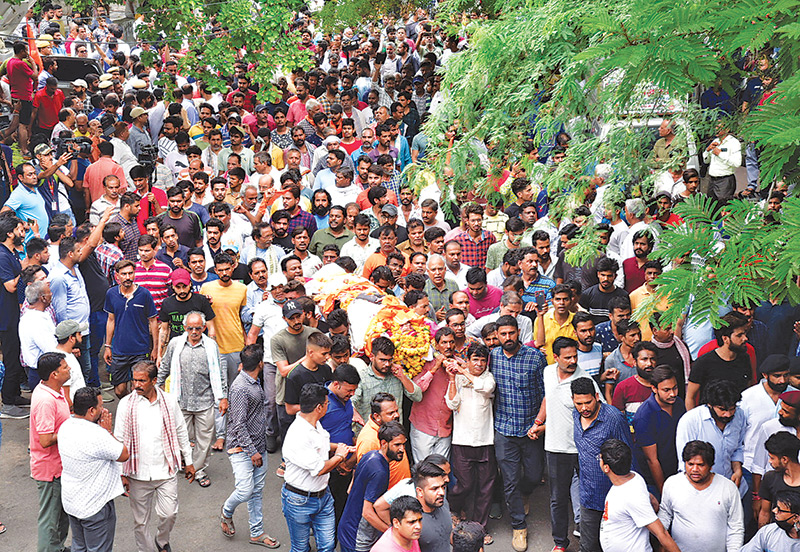
After Hindu slain, police in India ban gatherings, suspend internet

In another video clip posted online, one of the assailants also went on to threaten Prime Minister Narendra Modi.
- REUTERS
People carry the body of a Hindu man for his cremation, a day after two Muslim men posted a video claiming responsibility for slaying him, in Udaipur, India on Wednesday.  REUTERS

MUMBAI, 
Fearing outbreaks of religious violence, police in the Indian state of Rajasthan banned public gatherings and suspended Internet services a day after two Muslims posted a video claiming responsibility for slaying a Hindu tailor in the city of Udaipur.
Two suspects were being interrogated by federal investigators on Wednesday, while state police were on guard against any unrest in the northwestern state.
“We are under strict orders to prevent any form of protests or demonstrations scheduled to condemn the murder,” Hawa Singh Ghumaria said, a senior police officer in Rajasthan told Reuters, adding that the crime had sent “shockwaves through the country.”
Brandishing a meat cleaver, two bearded men said in the video that they were avenging an insult to Prophet Mohammad caused by the victim.
They also alluded to Nupur Sharma, a former spokeswoman for the ruling Hindu nationalist Bharatiya Janata Party (BJP), whose remarks about the Prophet earlier this month triggered domestic and international outrage.
India’s Home Minister Amit Shah said in a tweet that federal police had taken over the investigation into “the brutal murder” of Kanhaiya Lal Teli, giving the victim’s full name.
“The involvement of any organisation and international links will be thoroughly investigated,” Shah said.
Two assailants slashed Teli’s head and throat in an attack while the tailor was taking measurements, according to Bhawarlal Thoda, a city administrator in Udaipur.
According to Thoda, the tailor had been detained over a social media post in support of the BJP spokeswoman that was traced to his mobile telephone, and that after being released Teli had told police on June 15 that he was being threatened by some group.
“Terrorists executed my father in the most shocking way, the country must stand with our family to demand justice,” the victim’s son, Yash, told Reuters after his father’s body was cremated on Wednesday.
He said the culprits should be tried and sentenced to death, and denied that his father has made any remarks that would be offensive to other religions.
Politicians and prominent Islamic preachers condemned the killing.
“The incident has shocked followers of Islam, the heinous act committed by two men is absolutely un-Islamic,” said Maulana Ahmed Siddiqui, a Muslim cleric based in Udaipur.

WORLD

In seizure effort, $30 billion from Russian oligarchs frozen

Programme is designed to drain Russia of its resources.
- ASSOCIATED PRESS

WASHINGTON, 
A multinational task force designed to seize Russian oligarchs’ wealth has blocked and frozen $30 billion in sanctioned individuals’ property and funds in its first 100 days in operation, the Treasury Department reported on Wednesday.
That’s on top of the yachts, other vessels and luxury real estate that have been impounded as well as $300 billion in Russian Central Bank funds that have been immobilised, the department said.
“We continue to increase Russia’s cost of its war,” Treasury said of the REPO task force, short for Russian Elites, Proxies and Oligarchs. The programme is designed to drain Russia of its resources as President Vladimir Putin continues his invasion of Ukraine, but civil rights advocates have raised concerns about potential overreach.
Treasury Secretary Janet Yellen and Attorney General Merrick Garland convened the REPO task force in March in conjunction with a number of other countries, which work together to investigate and prosecute oligarchs and other individuals allied with Putin.
The European Commission has set up its own Freeze and Seize Task Force to work in conjunction with the REPO group.
The collective has worked to impound bank accounts, assets and properties.
For instance, earlier this month, the US announced sanctions on God Nisanov, one of the richest men in Europe, and Alexey Mordashov, one of Russia’s wealthiest billionaires, along with his wife and two adult children.
“REPO members will continue to track Russian sanctioned assets and prevent sanctioned Russians from undermining the measures that REPO members have jointly imposed,” Treasury said.
With sanctions increasing, there are growing concerns that seizures are being carried out on non-Americans outside of the judicial review process, with big consequences for sanctioned individuals who may not be able to challenge the seizures. Attorney Tom Firestone, who specialises in international investigations for business clients, said seizures “can have consequences for innocent people who have nothing to do with the war—we need to be careful not to penalise innocent people.”
“We’ve seen a tremendous expansion of the sanctions,” Firestone said. “The US government is going after a variety of targets. There is a lot of uncertainty about where it is all going.”

WORLD

Hong Kong in limbo 25 years after British handover to China

- ASSOCIATED PRESS
A file photo shows a protester waving Hong Kong British colony flag during pro-democracy rallies in Tamar Park, Hong Kong.  AP/RSS

HONG KONG, 
When the British handed Hong Kong to Beijing in 1997, it was promised 50 years of self-government and freedoms of assembly, speech and press that are not allowed on the Communist-ruled Chinese mainland.
As the city of 7.4 million people marks 25 years under Beijing’s rule on Friday, those promises are wearing thin. Hong Kong’s honeymoon period, when it carried on much as it always had, has passed, and its future remains uncertain, determined by forces beyond its control.
Before the handover, many in Hong Kong worried that life would change when Beijing took over. Thousands rushed to obtain residency elsewhere and some moved abroad. For the first decade or so, such measures looked overly dramatic – this bustling bastion of capitalism on China’s southern coast appeared to keep its freedoms, and the economy was booming.
In recent years, Beijing has been expanding its influence and control. Those moves appeared to be hastened by mass pro-democracy protests in 2014 and 2019. Now, schools must provide lessons on patriotism and national security, and some new textbooks deny Hong Kong was ever a British colony.
Electoral reforms have ensured that no opposition lawmakers, only those deemed to be “patriots” by Beijing, are in the city’s legislature, muting once lively debates over how to run the city. China has installed John Lee, a career security official, as the successor to Chief Executive Carrie Lam.
Freedom of the press has come under attack and pro-democracy newspapers openly critical of the government, such as Apple Daily, have been forced to close. Its publisher Jimmy Lai has been jailed.
Hong Kong also has banned annual protests marking China’s June 4, 1989, crackdown on the pro-democracy movement centred on Beijing’s Tiananmen Square, with authorities citing pandemic precautions. The city’s tourism and businesses are reeling from its adherence to stringent Covid-zero policies enforced on the mainland.
Alex Siu, a building services engineer, was born in Hong Kong and only left in 2020—his parents had ensured he’d have the option by getting him a British National Overseas passport years earlier.
Siu moved to Manchester, England, with his girlfriend after getting fed up both with Hong Kong’s work environment and the political situation. He’s homesick for the food, friends and family, but isn’t planning to go back.
 “I believe there is no hope because the government holds absolute power,” Siu said of the deteriorating political freedoms in Hong Kong. “Us little citizens, we don’t have much power to oppose them or change the situation.”
Kurt Tong, former US consul general to Hong Kong and managing partner of consultancy The Asia Group, said the changes reflect growing dissatisfaction in Beijing with the freewheeling semi-autonomous region. The consternation deepened when some of the millions of Hong Kong residents who marched in peaceful pro-democracy protests in 2019 stormed the city’s legislative complex and at times violently clashed with police.
 “The things that China found irritating about Hong Kong started to become more prominent, and the things that it found attractive about Hong Kong started to be less prominent, and friction built up over time,” he said.

WORLD

Shopping centre bombing the latest ‘barbarous’ attack: Pope

Briefing
- AGENCIES

VATICAN CITY: Pope Francis on Wednesday called the bombing of a shopping centre in Kremenchuk the latest in string of “barbarous attacks” against Ukraine. Ukraine said at least 18 people were killed and about 60 injured on Monday by a Russian strike. Russia’s defence ministry said it had hit a legitimate military target, and that the shopping centre was not in use. “Every day, I carry in my heart dear and martyred Ukraine, which continues to be flagellated by barbarous attacks like the one that hit the shopping centre,” Francis said in St Peter’s Square.

WORLD

South Korea approves first homemade Covid-19 vaccine

Briefing
- AGENCIES

SEOUL: Health officials in South Korea on Wednesday approved the country’s first domestically developed Covid-19 vaccine for people 18 years or older, adding another public health tool in the fight against a prolonged pandemic. In clinical trials involving some 4,000 participants in South Korea and five other countries, SK Bioscience’s two-dose SKYCovione vaccine appeared to be more effective than the broadly used AstraZeneca shots in building immunity against infections, officials at South Korea’s Food and Drug Safety Ministry said. 

WORLD

Migrants in Libya forced into rape for food: UN

Briefing

GENEVA: Migrants detained in Libya face horrific abuse, with women especially facing sexual violence, and often forced to submit to rape in exchange for food, UN investigators said on Wednesday. In a fresh report, the Independent Fact-Finding Mission on Libya reiterated that the worst crimes under international law were likely being committed in the country, with women suffering some of the worst abuse.

Page 7
SPORTS

Serena’s career at a crossroads after Wimbledon loss

The 40-year-old American, who lost against world number 115 Harmony Tan 7-5, 1-6, 7/6 (10/7) in the first round, brushes off any talk of retirement.
- AGENCE FRANCE-PRESSE
Since the Australian Open title in 2017, Serena Williams has reached four Grand Slam finals, including two at Wimbledon, but has lost each time.  Ap/Rss

LONDON,
With her 41st birthday just months away and without a Grand Slam
title since 2017, Serena Williams faces searching questions over her future after a painful first-round Wimbledon exit.
The American was back on Centre Court on Tuesday after a year away from singles tennis but it was a miserable return to the scene of some of her greatest triumphs. The 23-time major winner was cheered as she entered the court and supported throughout by a crowd desperate to see her recapture former glories against unseeded Harmony Tan of France.
But she looked a pale shadow of her former self, making 54 unforced errors in an uncharacteristically sloppy display that ended with a tame forehand dumped into the net. Despite her lack of form and fitness, Serena, who lost 7-5, 1-6, 7-6 (10/7), looked to have the match in her grasp at various points.
She served for victory when 5-4 up in the decider and even in the tie-break raced into a 4-0 lead before her game fell apart.
Putting a brave face on her defeat, the American said it was “definitely better than last year”, when an ankle injury forced a tearful exit in her first-round match against Aliaksandra Sasnovich.
The 40-year-old only returned to tennis last week, teaming up with Ons Jabeur in the doubles at Eastbourne.
Asked if she might have played her final Wimbledon, she said she was unsure.
“I don’t know,” she said. “Who knows? Who knows where I’ll pop up?”
Questioned as to whether she would be happy if the defeat by 115th-ranked Tan was her final memory of Wimbledon, she said: “Obviously not. You know me. Definitely not. But today I gave all I could do. Maybe tomorrow I could have given more. Maybe a week ago I could have given more. But today was what I could do.”
The former world number one, handed a wildcard to compete at the All England Club, first won Wimbledon way back in 2002. But despite her bitter disappointment she sounded motivated to play on, even though she is nearly twice as old as world number one Iga Swiatek.
The US Open, which starts in August, is firmly in her sights.
Williams’s win there in 1999 was her first singles Grand Slam triumph, launching her stellar career in the majors—which has featured periods of near-total dominance.
Williams’s place in the pantheon of all-time greats is already assured but she remains agonisingly one singles title short of Margaret Court’s all-time Grand Slam record of 24.
The American, who has also won multiple major doubles titles with her sister Venus, last won a Grand Slam title at the Australian Open in 2017, giving birth later that year to her daughter, Olympia.
Since then she has been in four Grand Slam finals, including two at Wimbledon and two at the US Open, but has come up short each time.
Williams, who has won 73 singles titles in her career overall, has plummeted to 1,204th in the world after her year out of the game.
It must look a long way back to the top for a once-dominant player as she considers her future in the game.
 
Nadal progresses
Earlier, an off-key Nadal, already halfway to a calendar Grand Slam after winning the Australian Open and French Open, dug deep to beat Francisco Cerundolo 6-4, 6-3, 3-6, 6-4.
The two-time Wimbledon champion, who has not played at the tournament since 2019, thanked the crowd for their wholehearted support.
The 36-year-old Spaniard appeared to be coasting to victory when he took a two-set lead but his Argentine opponent found a new level, winning the third set and going a break up early in the fourth.
But from 4-2 down the second seed found an extra gear, winning the next four games to seal the match in a little over three and a half hours, roared on by the Centre Court crowd.
The 22-time Grand Slam champion played the entire French Open with his troublesome left foot anaesthetised but he has received treatment since then and was moving well on Tuesday.
Canada’s Felix Auger-Aliassime, who took Nadal to five sets at the French Open, crashed out of the tournament at the hands of American Maxime Cressy. The sixth seed lost 6-7 (5/7), 6-4, 7-6 (11/9), 7-6 (7/5), removing another potential obstacle in the path of Nadal, who next faces Lithuania’s Ricardas Berankis.
Men’s fourth seed Stefanos Tsitsipas beat Swiss qualifier Alexander Ritschard in four sets.
There were straightforward wins in the women’s draw for 2019 champion Simona Halep and fourth seed Paula Badosa.

SPORTS

Lyon bags five in spin battle at Galle

- AGENCE FRANCE-PRESSE

GALLE,
Nathan Lyon’s five-for helped Australia bowl out Sri Lanka for 212, before the hosts hit back with three wickets in a fast-moving opening Test on Wednesday.
The tourists reached 98 for three at stumps after Sri Lankan spinner Ramesh Mendis struck twice, including David Warner’s key wicket for 25, on a turning pitch at the picturesque Galle stadium.
Steve Smith was run out on six after a mix up with opener Usman Khawaja, unbeaten on 47, and returned to the pavilion waving his hands in dismay.
Khawaja and fellow left-hander Travis Head, on six, were batting with Australia still trailing by 114 runs in their first innings.
Mendis, an off-spinner, trapped Warner lbw after the left-handed opener hit five boundaries in an attacking stay at the wicket.
Marnus Labuschagne was out to an attempted reverse sweep but it was Smith’s wicket that brought the home crowd alive. The former captain was turned down midway for a quick single by Khawaja and failed to make the crease despite a desperate dive.
Khawaja, who survived a missed stumping by wicketkeeper Niroshan Dickwella, kept up the fight till close of play.
Earlier, Dickwella made a defiant 58 before the Sri Lankan innings folded in the third session following the hosts’ decision to bat first at the start of the two-match series.
Lyon, who bagged his 20th five-wicket haul in Tests, combined with fellow spinner Mitchell Swepson, a leg-spinner who took three wickets, to rattle the opposition batting.
Fast bowlers Pat Cummins and Mitchell Starc struck early with a wicket each as Sri Lanka took lunch at 68-2. The spinners soon took charge on a pitch traditionally known to assist the slow bowlers.
The left-handed Dickwella counter-attacked during his 59-ball stay at the crease and put on key partnerships, including a 54-run stand with Mendis, who made 22, for the seventh wicket.
Dickwella reached his fifty off 42 balls in the second session but Lyon finally got him out, also sending back Mendis after tea.
Lyon got his fifth wicket in Lasith Embuldeniya and Swepson, who was on a hat-trick denied by Dickwella, ended the innings after 59 overs.
Angelo Mathews also contributed to the Sri Lankan total with his 39 and stood with Dickwella in a 42-run stand broken by Lyon.
The island nation, which won the one-day international series against Australia 3-2, is battling an unprecedented economic crisis,
with people across the country struggling to pay for food, fuel and other necessities.

SPORTS

Police, APF register second victories

- Sports Bureau
Players of New Diamond Academy block a shot during their Bagmati Province New Diamond Club Open Women’s Volleyball Tournament match against APF Club in Kirtipur on Wednesday. Photo Courtesy: NSC

KATHMANDU,
Departmental teams Nepal Police Club and APF Club racked up their second successive victories at the Bagmati Province New Diamond Club Open Women’s Volleyball Tournament on Wednesday.
Police defeated Paropakar Girls Hostel in straight sets of 25-6, 25-6, 25-11 at the Kirtipur Multipurpose Covered Hall to accumulate six
points from two games. Paropakar had lost to APF 23-11, 25-4, 25-3 on the opening day.
New Diamond Academy are also winless in the round-robin competition after they succumbed to a 25-12, 25-20, 25-14 defeat at the hands of APF. The hosts had lost their first match 25-16, 25-15, 25-15 against Police.
A second win in as many matches means APF also have six points.
The two favourites, Police and APF, will lock horns against each other in their last group matches on Thursday, looking to secure top position in the four-team standings. The teams finishing in the top two positions will advance to the final.
Both the departmental sides and New Diamond are without their senior players, who are in the national closed camp at Dasharath Stadium in Tripureshwar, preparing for the delayed Asian Games. A total of 24 players are training at the camp.
New Diamond will host Paropakar in the other action of the day.
The final will take place on Saturday.
The champions will win a purse of Rs500,000 while the runners-up will get Rs250,000. The third-placed and fourth-placed teams will take home Rs125,000 and Rs75,000, respectively. The player-of-the-tournament will receive Rs25,000 while the best five players and best coach will be rewarded with Rs10,000 each.
The tournament has been organised with aims to collect funds for building a volleyball court for the New Diamond Academy. The teams will need to return 20 percent of their prize money as support for the construction, according to the organisers.

MEDLEY

Horoscope

ARIES (March 21-April 19) ***
Take a few moments to appreciate silence this morning. This cosmic climate can help calm your psyche, as long as you’re willing to invite in peace. Watch out for strained moods and irritable behaviors around the office this afternoon.

TAURUS (April 20-May 20) ***
You’ll feel tempted to float away on a cloud of fantasy this morning. These vibes could cause you to feel especially attracted to your phone right now, though you should avoid spending too much time scrolling through social media feeds.

GEMINI (May 21-June 21) **
Though you’ll be focused on financial gain today, try not to push your luck when it comes to business negotiations this afternoon. This cosmic climate also cautions against revealing too much of yourself or your emotions online.

CANCER (June 22-July 22) ***
Managing professional responsibilities while maintaining healthy boundaries with your career could feel like a challenge today. This cosmic climate will ask you to analyze the true cost of success.

LEO (July 23-August 22) **
Today’s cosmic climate could cause you to shut down emotionally, especially if you’ve been stressed or overworked recently. Rather than ghosting your sweetie in favor of solitude, be sure to let your beloved know where you’re at.

VIRGO (August 23-September 22) ***
If you’ve outgrown some members of your social circle, you could be forced to confront it today. This cosmic climate could bring through emotional triggers, especially if you’ve felt politically divided amongst your peers.

LIBRA (September 23-October 22) ***
A lack of compassion or understanding within your love life could cause the passion between you and your sweetie to fizzle out today. This cosmic climate could also cause you to feel unmotivated or uninspired.

SCORPIO (October 23-November 21) **
You may feel as though others aren’t giving you the respect you deserve today. While your words may not carry much weight with your family or colleagues, staying optimistic can help you move through any anxiety or discomfort that finds you.

SAGITTARIUS (November 22-December 21) ****
Your home will feel like a therapeutic retreat this morning. Use this energy as an excuse to move at your own pace, taking time for
gratitude work, positive mantras, and a bit of meditation.

CAPRICORN (December 22-January 19) **
You may feel more emotional and irritable than usual today. This cosmic climate could cause you to lash out at your loved ones, especially if you’ve been spending too much time catering to the needs of others.

AQUARIUS (January 20-February 18) ***
Today’s cosmic climate could bring out the perfectionist that lives within you, which could cause you to unfairly criticize or judge your colleagues. It’ll also be important that you keep a compassionate disposition towards yourself.

PISCES (February 19-March 20) ***
Take a few moments to appreciate yourself while reinforcing your confidence this morning. These vibes are perfect for embracing your most authentic self, even if you tend to swim against the tides.