Says he was just exercising his constitutional right to free speech.
- Post Report
KATHMANDU, Kathmandu Metropolitan City Mayor Balendra Shah has claimed his remark about a Supreme Court ruling cannot be termed as contempt of court. Furnishing his written clarification to the court on Tuesday, Shah said freedom of expression is a constitutional right of citizens which allows them to have critical views on any issue. “Right to expression and opinion has been guaranteed by Article 17 (2) of the constitution. The judiciary itself is a custodian of the constitution,” Shah wrote. “It would be wrong to conclude that exercising constitutional rights can lead to contempt of court. One can have a critical opinion on any action by a state agency.” Expressing his disappointment over the Supreme Court’s interlocutory interim order against the metropolis to halt demolition at Norvic Hospital, Shah on August 10 wrote a Facebook post: “I would like to request for an amendment to the constitution to give the Supreme Court all the authority related to approving the building design and taking action against illegal constructions.” Advocate Deepak Raj Joshi filed a contempt of court case against Shah claiming that his reaction in the public forum amounted to contempt of court. After a preliminary hearing on August 29 the court issued a show-cause notice to Shah, asking him to submit a written response to the court. On August 9, the City had attempted to demolish an illegally constructed structure of the Norvic International Hospital in Thapathali by issuing a 24-hour ultimatum. But it backtracked on its step and formed a probe committee to investigate the alleged encroachment. Later, the committee was forced to stop its work after the Supreme Court issued an interlocutory order not to remove the structures built by the hospital. Mayor Shah took to his official Facebook to express his displeasure over the order.
HOME PAGE
Conflict victims on tenterhooks with House term on the verge of expiry
They fear the bill to amend Transitional Justice Act may not be endorsed by Parliament, allowing for an ordinance.
- BINOD GHIMIRE
KATHMANDU, The government on Tuesday rolled back its decision to give continuity to the term of the House of Representatives until the first meeting of the lower house elected after the November 20 elections. The rollback did not necessarily sit well with everyone, conflict victims most notably. Following widespread criticism, it withdrew the provisions to fix the terms of the lower house and provincial assemblies through amendments in electoral laws. While ministers in the Sher Bahadur Deuba Cabinet claim there is no clarity on how long the existing House can function, the Election Commission and experts on constitutional and parliamentary affairs say it cannot hold meetings after the filing of Proportional Representation (PR) nominations. Going by their claim, the lower house can function until September 16 as the parties will have to submit the closed list of candidates under the PR system on September 17 and 18. With hardly 10 days to the deadline, there are concerns over the future of vital bills including the one related to the amendment to Enforced Disappearance Enquiry, Truth and Reconciliation Commission Act, 2014. The bill that was registered in Parliament on July 15 is under deliberation in the Law, Justice and Human Rights Committee. The parliamentary committee tasked with finding a meeting point among political parties started discussions with lawmakers only on Wednesday. It plans to consult the victims of the Maoist insurgency on Thursday and with other stakeholders thereafter. “We want the ongoing parliamentary session to endorse the bill after a consensus among the parties and are working accordingly,” Krishna Bhakta Pokhrel, chairperson of the committee, told the Post. “However, we are running out of time.” The bill first needs to be endorsed by the House committee and then the entire House. It also needs to get through the National Assembly and consequently be authenticated by the President after the Speaker certifies it, which is a time-consuming process. The victims say while it is welcome that the committee is holding broad consultations, they fear the bill won’t be presented in the lower house before the expiry of its term. “We want the House to endorse the bill after a revision,” Janak Raut, a former general secretary of the Conflict Victims Common Platform, told the Post. “If it isn’t endorsed by this House, the government can issue an ordinance with handpicked provisions.” Raut said there could be corrections if the bill is discussed and endorsed by Parliament but the government has the luxury to issue an ordinance of its liking. The government on July 14 decided to extend the terms of the Commission of the Investigation on Enforced Disappeared Persons and the Truth and Reconciliation Commission until October 17. A revision in the Act is a must to keep the two transitional justice mechanisms alive after mid-October. If the existing parliament doesn’t endorse the amendment bill, which envisions extending the terms of the two commissions by a maximum of two years, the government will have to issue the ordinance. “We don’t want the Act to be revised through an ordinance as the government will definitely insert amnesty provisions in it,” Geeta Rasailee, vice-chairperson of the Conflict Victims National Women’s Network, told the Post. In addition to conflict victims, national and international human rights organisations, rights activists and the lawmakers, mainly from the main opposition CPN-UML, have objected to several provisions in the amendment bill, arguing that they are targeted at shielding perpetrators of grave rights violations from prosecution. They are lobbying for a revision to the list of non-amnestiable crimes, setting up separate investigation units with the commissions, removing the statute of limitations in insurgency-era crimes and clearing hurdles in appealing the decisions of the Special Court, which is to be formed in the Supreme Court to hear war-era cases of atrocities. They have also questioned the fairness in the appointments of judges to the Special Court and non-inclusion of the issues of child soldiers used during the insurgency. The bill says “cruel murder”—murder after torture, rape, enforced disappearances and inhumane or cruel torture committed against unarmed or ordinary people during the insurgency are serious human rights violations—are non-amnestiable. It, however, doesn’t list war crimes and crimes against humanity under serious human rights violations. The bill has opened the door for amnesty for murder by stating that only “cruel murder” will be non-amnestiable, thus providing a loophole to define all murders as non-cruel, say the victims. On Wednesday, conflict victims put their concerns before Abeer Hashayka, who looks after the Nepal desk at the Office of the High Commissioner for Human Rights, Geneva, on her recent Nepal visit. “Hashakya said her office was closely following the developments in Nepal and promised to convey a clear message to the Nepal government through appropriate channels,” said Raut, who was also present in the meeting.
HOME PAGE
Big problems bedevil Nepal’s biggest university
Political interference is at the root of Tribhuvan University’s most recent troubles.
- NISHAN KHATIWADA
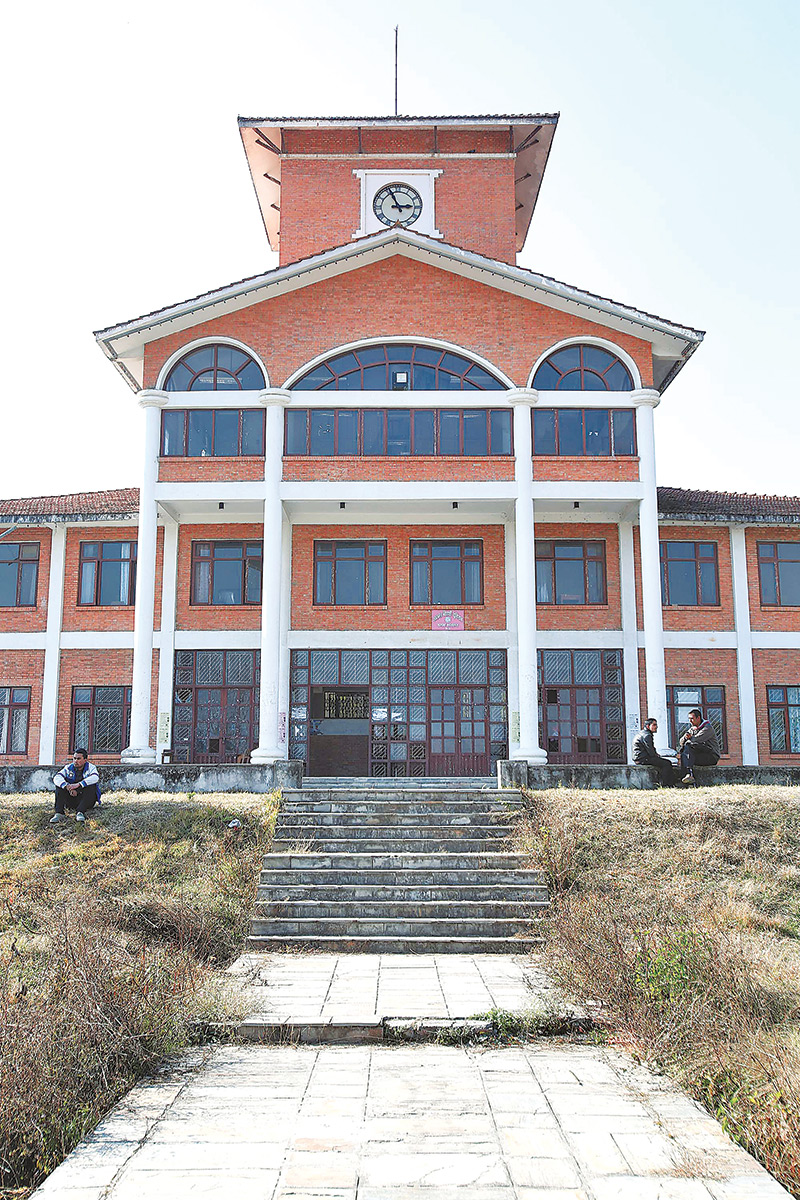
Protests have paralysed the university. Post File Photo
KATHMANDU, Tribhuvan University, Nepal’s oldest, has now been padlocked for months. Frequent protests by student organisations, including those close to the ruling parties, to press their demands including action against corrupt officials, have affected day-to-day operations of the university and classes. What’s more concerning is, these protests are unlikely to end soon. A snapshot The Nepal Students’ Union (NSU), an organisation close to Nepali Congress, vandalised the vice-chancellor’s office inside the university premises at Kirtipur on August 24. Protesting students barged into the vice-chancellor’s office, placed a garland of shoes in his chair and tore down his nameplate. The NSU has accused TU officials of concealing an investigative report on a question-paper leak. The union leaders are demanding that the university make the report public. In June this year, question papers of the MA Economics third semester and Political Science first semester were repeated in TU exams. Following the June incident, the All Nepal National Independent Students Union (Revolutionary), which is affiliated to the CPN (Maoist Centre), launched protests by padlocking the Economics and Political Science departments. The union withdrew its protest after the university formed a committee to investigate the incident. But the university, citing security reasons, did not make public the committee’s report and said it has initiated action against those responsible for the repetition. Then the NSU resumed its protests on July 11, accusing university officials of carelessness in conducting exams and padlocked several offices of the university. In the course of their protests, NSU leaders on August 26 broke into the TU executive council meeting at Hotel Yellow Pagoda at Durbar Marg and seized the minutes. The meeting was held at the hotel as the students had padlocked the university registrar’s office, according to officials. After the incident, TU Section Officer Ratna Maharjan tried to file a complaint against the NSU leaders at the Durbarmarg Police Circle. However, the police refused to register the complaint, officials say. The student leaders have reportedly handed over the seized documents to Education Minister Devendra Poudel. Following continuous protests by student leaders, the TU administration organised a press conference on August 28. Vice-chancellor Dharma Kanta Baskota complained at the conference that there is no working environment at the university. “The university’s various offices have been padlocked for a total of over 300 days. There are complaints of various groups at the university demanding donations and money in the name of economic help. Such groups have even beaten up teachers and staff,” he said. Ahead of the press meet, a police officer and two students were injured in a clash between the protesting Nepal Students’ Union activists and those from the ANNFSU who had staged a counter-protest. The ANNFSU is the student wing of the main opposition CPN-UML. Meanwhile, the Maoist Centre-affiliated ANNISU-R launched a weeklong ‘Save the TU Campaign’ on August 31 to put pressure on the university administration to introduce reforms. Their demands included removing the padlocks at the offices, resumption of all classes, and improvement in amenities including drinking water and lights. The NSU has locked the registrar’s office for around a month. This has disrupted the payment of staff salaries, utility bills and voluntary retirement packages. Many political leaders have also expressed their concerns over the matter. In the House of Representatives on August 29, the UML accused the government of supporting the illegal activities of the NSU, the Congress’ student wing. “The university chancellor is the prime minister himself. What will happen if the government itself promotes gangsterism at the university?” said Pradeep Gyawali, a UML leader, speaking in Parliament. The university has already asked the Home Ministry to provide security at the university. Despite requests by TU officials to Prime Minister and chancellor Sher Bahadur Deuba to intervene to stop the protests, the padlocking continues. Speaking at a function in Kathmandu on Friday, Prime Minister Deuba said that the problems at the university cannot be resolved through strikes and padlocking. “Creative deliberations are needed to solve the problems,” he said.
Student organisations’ discontent Student organisations like the NSU are dissatisfied with the TU leadership since the appointment of Baskota as vice-chancellor. NSU leaders say the way he was appointed was wrong as he was not a suitable candidate based on rank and seniority. According to NSU leaders, Baskota was appointed by then-prime minister KP Sharma Oli and problems started soon after. “The university started facing problems after he took office—the management has gotten weaker and students’ problems and issues have been largely ignored,” said Ganesh Bhandari, acting president of the university NSU committee. Since the beginning, they have been submitting memorandums, conducting hunger strikes, and padlocking the university’s offices demanding reforms. “But the TU leadership has always lent a deaf ear,” Bhandari told the Post. The NSU leaders accuse the vice-chancellor of politicizing the administration to serve his vested interests. In the initial days, their demands included conduct of elections for the Free Students’ Union, implementation of the TU calendar as well as the agreements reached between the students and the TU. Now, they are demanding that the report of investigation into the question of paper repetition be made public and action be taken against the officials involved. “We are ready to sit for talks to resolve the issues, but the administration has been ignoring our demands,” said Bhandari. Pancha Singh, the ANNISU-R president, said they have realized that padlocking and disturbing day-to-day operation is a blunt instrument with which to put pressure on the administration. Despite the padlocking and protests, TU officials have not held talks with any of the protesting student unions, according to her. “The university should arrange to end the practice of students from remote districts needing to come to Kathmandu for certificates, red-tapism at the university, and take action against those involved in question paper repetition, among other things,” she told the Post on Friday. “Through our ‘Save the TU campaign,’ we also want to give a message that the ongoing padlocking and disruptions are not proper ways of protest.”
TU officials’ defence University officials, however, say they have already punished the perpetrators involved in the question-paper repetition and allege that the student organisations’ other demands such as a share for them in university appointments are unjustified. “Those guilty in the question paper leak have been barred from preparing questions for three years,” said a TU official requesting anonymity. However, their names cannot be made public, for security reasons, according to the official. According to the official, a group within the NSU is continuously involved in creating disturbances through vandalism and protests.
What experts say Experts claim that political influence is a major reason behind the current problems at the university and steady decline in the study environment. Medin Lamichhane, an education expert, said political interference is one of the biggest problems at the university. “There are so many problems including the delay in the publication of exam results and issues related to question papers. With such problems, what type of manpower will it produce?” he questioned. According to him, the major obstacle is political interference in university leadership and appointments. “Obviously, those appointed through such a process will be loyal to the respective political parties and this affects the selection and appointment of lecturers. The political effects will trickle down to all lower levels including the students. This is what is happening at the TU at present,” he said. Meena Vaidya Malla, a professor and former head of the Department of Political Science at TU, said the current state of Nepal’s oldest university is pitiable. “Political interference has badly hit the quality of its education and services. Political affiliations influence every appointment. Academic people should be neutral and should have academic objectives,” she told the Post. Resorting to padlocking and violent protests is wrong and will benefit no one, experts say. “Student unions backed by political parties engage in such activities as a show of their power and influence,” added Lamichhane. According to Malla, the problem at the university is a national issue and should be sorted out with utmost urgency.
HOME PAGE
Evidence builds against Sandeep Lamichhane, CAN reluctant to act
A 17-year-old girl, in the presence of her guardian, filed a complaint against the national cricket team captain at Gaushala Police Circle on Tuesday accusing him of rape.
- PURUSHOTTAM POUDEL
Sandeep Lamichhane. Post File Photo
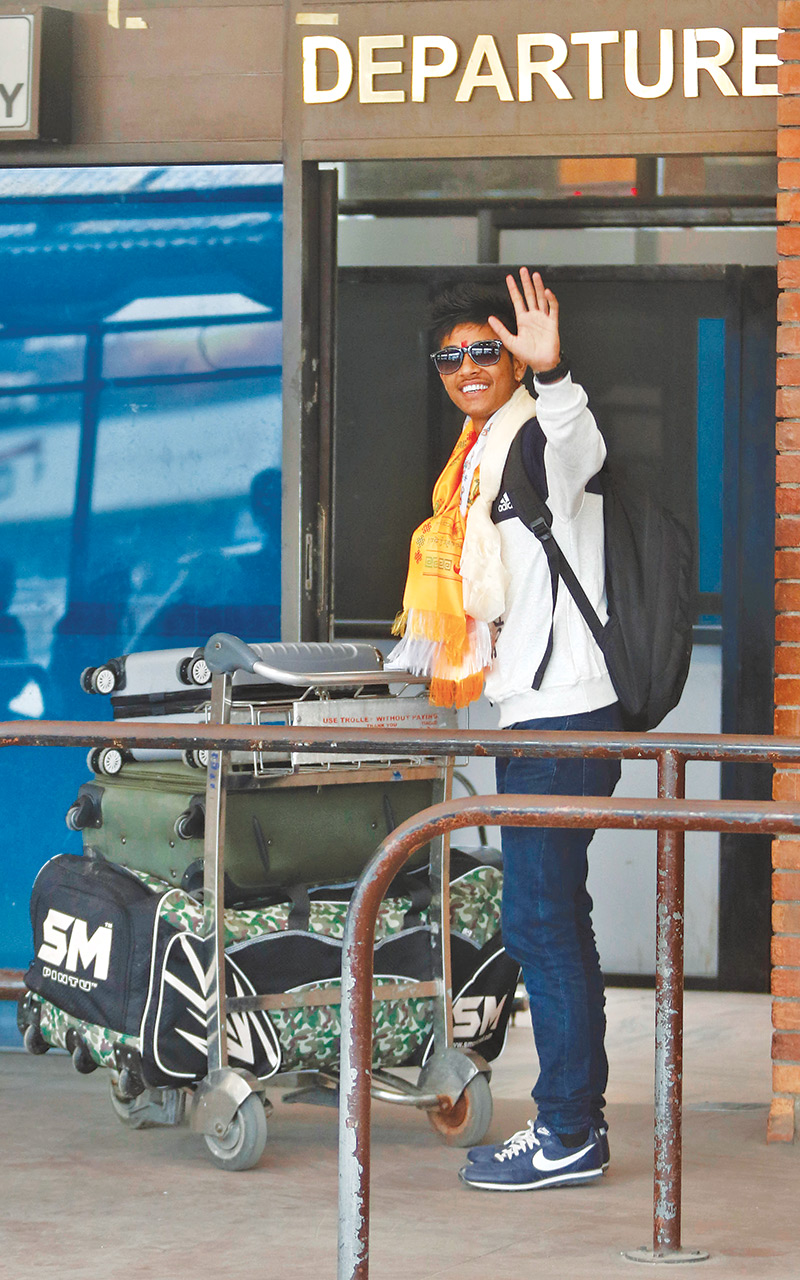
KATHMANDU, On Wednesday, the District Police Range Kathmandu through its official Facebook page informed that a rape complaint had been filed against Sandeep Lamichhane, captain of Nepal’s national cricket team. Not only did the District Police Range disclose the details on the location of the alleged crime but also revealed the name of the lab where the victim’s vaginal swab sample was taken for testing. Some have questioned the police’s approach of going public with the details of the case including Mohna Ansari, a former member of the National Human Rights Commission. “The way that the location of the hotel where the incident took place and the time at which it occurred has been mentioned in the post can lead to tampering of evidence, which is vital to take the case forward,” said Ansari. “It challenges the case itself.” Disclosure of the incident’s details subjects the case to various social and political pressures, raising questions about ethics and fairness in the investigation, experts say. “The hotel is a crime scene. With the disclosure of the crime scene, the police have risked tampering with crucial evidence,” said Rashtra Bimochan Timalsena, assistant director of the National Law College. However, the spokesperson for the District Police Range Kathmandu, Dinesh Raj Mainali, says the police mentioned the location of the hotel where the alleged crime took place to move police procedure ahead. “We disclosed the location of the hotel to notify which range of metropolitan police is responsible for handling the case,” Mainali told the Post. According to Tek Prasad Rai, spokesperson for Nepal Police, a 17-year-old girl, in the presence of her guardian, registered a complaint at the Gaushala police circle on Tuesday, alleging Lamichhane of forcing her to have sex with him. The District Police Range Kath-mandu, through a Facebook post, stated that the victim was taken for a medical examination by the police at a crisis management centre. The medical report was yet to come as of Wednesday evening. “A minor has filed a rape case with the police against Nepali national cricket team captain Sandeep Lamichhane. The police took her for a medical examination following the complaint,” Rai said. According to police, the victim and Lamichhane met on the social media platform ‘Snapchat.’ They struck up a friendship following which Lamichhane asked the 17-year-old to meet him. As per the complaint filed with the police, on the evening of August 21 Lamichhane picked the victim up in a private vehicle; the duo then left for Nagarkot. While in Nagarkot, the victim repeatedly asked to be taken back to her hostel in Kathmandu, the complaint states. They left Nagarkot for Kathmandu later that night and checked into a hotel in Kathmandu as the hostel where she was staying was closed. According to the victim, Lamichhane sexually abused her at the hotel where they stayed after coming back to Kathmandu. The police took CCTV footage from the hotels in Nagarkot and Kathmandu where cricketer Lamichhane and the victim had stayed on August 21. Senior Superintendent of Police (SSP) of the District Police Range Kathmandu, Bharat Bohara, confirmed that Lamichhane along with the victim had checked into the hotel. “CCTV footage shows that Lamichhane was with the girl who has accused him of raping her in the hotel room,” Bohora told the Post. “Our investigating team travelled to Nagarkot and visited the hotel there as well as in Kathmandu where the alleged crime took place,” said Bohara. “We are now focussing on evidence collection. The owners of the hotels in Nagarkot and Kathmandu are being interrogated.” The 22-year-old leg spinner is the most sought-after Nepali cricket player having featured in mega international crickets like the Indian Premier League (IPL), Australia’s Big Bash League (BBL), the Caribbean Premier League (CPL), and Global T20 League of Canada, among other international franchises. Whatever the outcome of the current investigation, the allegations could jeopardize his cricket career, with both the national team as well as the various T20 outfits he plays for around the world. Cricket governing body the Cricket Association of Nepal (CAN) declined to comment if it would take action against the national captain. While CAN President Chatur Bahadur Chand could not be reached for comment, General Secretary Prashant Bikram Malla said on late Wednesday evening that President Chand had just arrived in Kathmandu from Dhangadhi and they would discuss the matter later in the evening. Lamichhane is in Trinidad & Tobago to play in the Caribbean Premier League. He was part of the national team that played ODI and T20 series against Kenya. The national team skipper had left Nepal on August 22. According to the complaint, the incidents took place the night before and in the morning of the day he left for Kenya.
NATIONAL
Doctors of Karnali Health Academy resign en masse citing insecurity
A doctor was physically assaulted by a young patient’s father last month.
- DB BUDHA
JUMLA, Sixty doctors working at the Karnali Academy of Health Sciences have resigned en masse, citing insecurity. There are 100 doctors currently employed at the Academy. The agitating doctors wrote a letter to Dr Mangal Rawal, the vice-chancellor of the Academy, on Wednesday and announced their group resignation. The letter was also CC’d to the district administration. They halted all the health services at the Academy except emergency ones. “The attack on Dr Karan Sah, a medical officer working at the Academy’s emergency unit, and the situation in the aftermath is quite fearful. We are compelled to resign,” reads the letter submitted to Rawal. The agitating health workers claimed attempts were made to frame Shah by filing false accusations against him. They also expressed their concerns that some local residents had attempted to create a confrontation. On August 18, Dhan Bahadur Shahi, an administrative employee at the Academy, attacked Dr Sah while the latter was working in the emergency unit. CCTV footage shows Shahi punching and kicking Sah for ignoring the treatment of his six-year-old son Prithak Bikram Shahi. The Academy suspended Shahi for 45 days. An investigation is underway by forming a three-member probe led by the Academy’s director Dr Pujan Rokaya. The boy’s mother, Aasha Hamal also lodged a complaint at the District Police Office in Jumla on August 29 stating that Dr Sah meted out violence against the child during his treatment. Following the complaint, the Jumla district court also issued an arrest warrant against Sah.
NATIONAL
Dengue infection overshadows Covid and other diseases
Doctors suspect another dengue serotype might be responsible for the surge in new cases. People having comorbidities are at high risk of getting severe and dying due to dengue.
- Arjun Poudel
KATHMANDU, On Wednesday morning, a 35 year-old-man from Dhading, infected with dengue virus died at Sukraraj Tropical and Infectious Disease Hospital. Doctors at the hospital said that the deceased was referred by a local health facility in Dhading on Tuesday evening and had been suffering from liver disease. “Along with dengue infection, the man had other health complications also,” said Dr Manisha Rawal, director at the hospital. Doctors say dengue infection has overshadowed Covid and other diseases, and like in Covid, people having other health issues are at risk of getting severe and dying if infected with the dengue virus. “Dengue cases have overshadowed Covid and other diseases,” said Dr Sher Bahadur Pun, chief of the Clinical Research Unit at Sukraraj Hospital. With the new death on Wednesday, the number of deaths from the dengue virus has reached at least five. The Health Ministry, however, has confirmed only two deaths from infection by the virus. Officials said that other people who died of dengue infection had other health issues also. Dengue is transmitted by female Aedes aegypti or Aedes albopictus mosquitoes, after they bite a person. The same vector also transmits chikungunya, yellow fever, and Zika viruses, according to the World Health Organisation. So far, 6,707 people have been infected with the dengue virus that has spread to 75 districts of the 77 throughout the country. Hospitals in the Kathmandu Valley have reported a massive surge in dengue cases. With a significant rise in dengue cases throughout the country, blood banks in the Kathmandu Valley have been struggling to meet the growing demand for platelet components. According to the Central Blood Transfusion Service, popularly known as the blood bank, there are demands for 150 to 200 pints of platelet-rich plasma and platelet concentrate every day. Of the total infections, over 70 percent are in 10 districts, including Lalitpur, Kathmandu, and Makawanpur , according to officials. They say office-goers and school children have been infected in large numbers. Doctors say another serotype of dengue might be responsible for the current surge in new dengue cases, as the country witnessed a massive dengue outbreak in 2019. At least six people died and over 17,000 were hospitalised with dengue fever. The outbreak, which had started in the pre-monsoon period from Dharan, spread to 68 districts. Doctors suspect another serotype of dengue virus might be responsible for the current spike in new cases. “All four serotypes of dengue virus have been found in Nepal, and some patients who have been infected with the virus reported that they were infected earlier too,” said Pun. “Test also confirmed immunoglobulin G (IgG) in the same patients, which means the patients were likely infected with dengue virus in the past.” Mosquitoes that cause dengue breed in clean water and infect people in daylight. Uncovered water tanks and discarded plastic cups and bottles could also shelter dengue-carrying mosquitoes. According to doctors, mild to high fever, severe muscle pain, rashes, severe headache, pain in eyes, and vomiting are some of the symptoms of dengue. Abdominal pain, vomiting, bleeding from the gums and nose, vomiting blood and blood in stool, tiredness, and restlessness are symptoms of severe dengue. Severe dengue is the leading cause of serious illness and death, doctors say. Disposing of solid waste properly, covering or emptying water storage containers, using personal household protection such as window screens, and wearing long-sleeved clothes are some measures to prevent infection. With the massive outbreak of dengue infection, the Health Ministry has urged all the agencies concerned to carry out awareness and dengue search and destroy drives. “We held meetings with physicians serving in major hospitals in the Kathmandu Valley and over 100 hospitals outside Valley and told them about the ways of treatment and diagnosis,” said Dr Gokarna Dahal, chief of the Vector Control Section at the Epidemiology and Disease Control Division. “As the dengue epidemic is at its peak, we told the doctors that laboratory confirmation is not necessary in all cases and clinical diagnosis can be carried out to start the treatment.” Meanwhile, the Health Ministry said that it has been preparing to carry out a nationwide seroprevalence survey of the dengue virus with the technical assistance of the World Health Organisation. A seroprevalence survey is a study carried out to determine the extent of infection in the general population. Officials said they are also preparing to carry out vector surveillance of dengue spreading mosquitoes in all seven provinces. Nepal has witnessed outbreaks of dengue in the pre-monsoon, monsoon, and post-monsoon seasons, although the post-monsoon period is considered a high transmission season for the virus. As the monsoon is still continuing and the post-monsoon season is yet to start, health officials say the dengue infection rate could go up in the coming days. The dengue-spreading mosquitoes survive up to 45 days and their entire generation gets infected with the virus, meaning that they can transmit the same virus. The UN health agency says there is no specific treatment for severe dengue, but early detection and access to proper medical care can lower the fatality rate.
NATIONAL
Eye treatment centre in Hima
Briefing
JUMLA: Hima Rural Municipality has become the first local unit to establish an eye treatment centre in Jumla district. According to Laxman Bahadur Shahi, municipal chairman of Hima, the number of eye patients has been increasing in the local unit because of dust pollution. “Local residents had to go to Khalanga, the district headquarters of the Jajarkot, to seek treatment for even common eye problems,” said Shahi. “Now they can get treatment in Hima itself. Himalayan Eye Hospital, Pokhara, will provide equipment for the centre,” said Shahi.
NATIONAL
Postal Highway section riddled with potholes
Briefing
MAHOTTARI: The Maisthan-Gaushala-Samsi section of the Postal Highway is in a dilapidated condition. The five-kilometre stretch is full of potholes. “The local people have been facing difficulties while travelling due to the poor condition of the road,” said Jina Khatun of Samsi Rural Municipality-2. “We requested the authorities concerned to repair the road, but to no avail.” The local people have warned they would launch a strong protest if their demand is not heeded urgently.
EDITORIAL
Un-presidential ambitions
The constitution does not envision for the president the kind of discretionary powers she seems to want.
President Bidya Devi Bhandari was well within her rights to send back the bill to amend the Citizenship Act to Parliament for reconsideration. The constitution allows her to do so. The reason behind giving the President such residual powers over important bills is to correct, when necessary, the legislature’s errors of judgment. The President has the luxury of calmly thinking through important topics away from the hustle-and-bustle of parliamentary politics. But what the constitution does not allow her to do is to try to influence the other organs of the state in any shape or form. Yet that is precisely what she seems to be doing with the citizenship amendment bill. She is reportedly consulting legal experts to work out ways to scuttle it. Those who have offered Bhandari legal counsel say she is in a rather combative mood and is intent on not endorsing the bill as it is. But, constitutionally, that is what she must do now that Parliament has sent her the bill for the second time. Nowhere does the constitution envision for the President the kind of broad discretionary powers she seems to want. She is reportedly even consulting senior army personnel on the issue. Bhandari is clearly acting in the interest of CPN-UML, the party she formerly belonged to, and to which she still apparently owes allegiance. This is not the first time she has championed UML’s cause from the President’s Office. Bhandari, for instance, had no constitutional ground to authenticate former Prime Minister KP Sharma Oli’s dissolution of the lower house—twice. Yet she felt no compunction in doing so. Now that the main opposition is vehemently opposed to the citizenship amendment bill, she is again helping her former party stall it. The President’s Office argues that the bill, in its current form, is not in national interest. But that is besides the point. By once returning the bill to the federal Parliament, she has already made her point clear. Now she must realise that she can do no more without seriously jeopardising the sanctity of her institution and endangering the hallowed democratic principle of check and balance. She is apparently slighted by Parliament’s ignoring of her concerns over the bill. Again, that is fine so long as she keeps her displeasure to herself. But to openly express her dissatisfaction by overstepping her legal bounds is uncalled for. The 2006 political uprising did away with the hereditary monarchy and installed a ceremonial head of the state in its place because the former seemed to be acting like law unto himself, amassing more and more power, openly trampling on the national charter, and trying to play an overtly political role. President Bhandari’s activities are eerily reminiscent of those of the entitled erstwhile monarchs. As the head of the state assumes a more political role, people’s frustrations with the new post-2006 setup will grow. Many rightly question why the ceremonial head of the state leads a lavish life and openly breaches constitutional bounds. Moreover, she is setting a troubling precedent for future occupants of the office. The risk of it being used to serve political agendas will increase. The President’s duty is to ensure compliance and protection of the constitution, not to violate it.
OPINION
High and mighty
We should debate whether we need VIPs flashing their status to our faces every opportunity they find.
- DEEPAK THAPA
Shutterstock
Jeevan Ram Shrestha must be kicking himself. Having furiously unleashed the force of the government, the Minister for Culture, Tourism and Civil Aviation did not even have time to wallow in the satisfaction of having taught a lesson to a lowly security guard for daring to stand up to him. Like many who first came across the shocking news of the guard’s arrest, I was convinced this would end quite badly—for the minister, that is. And so, it did. In no time, Shrestha found himself in the eye of a storm of criticism that appeared almost physical in its intensity. Besides the issue being raised in Parliament, where a member even called on him to issue a public apology, his action drew the ire of netizens that appears quite unprecedented in scale. One metric is the Facebook entry of Kantipur, where the story had elicited nearly 4,000 comments at the time of writing, with a cursory look showing all to be denouncing the minister. Given the current climate of antipathy towards politicians, one wonders how tone-deaf the minister could have been to take such an unwarranted action. Granted that this condition of being out of tune with public opinion seems to permeate the government itself, as was evident in the attempt—and subsequent backtrack—to extend the tenure of the House of Representatives. Even so, when a minister pits himself against a guard for doing his duty, despite all his protestations justifying his retaliation, it is always going to be the minister who comes off the worse. The irony, of course, is that Minister Shrestha is a member of the Communist Party of Nepal (Unified Socialist), ostensibly an entity whose very raison d’être is to uplift the condition of workers. But anyone who knows how communist parties have operated in the more than 100 years since the first “workers’ paradise” came into existence in the form of the Soviet Union would find it quite normal. Most infamous was how the nomenklatura, as the bigwigs in the Communist Party of the Soviet Union were known, monopolised all the comforts of life to the extent of even having a separate lane for themselves on a major road in Moscow. Thus, a communist minister throwing his weight around would be par for the course. Just as how the post-Soviet Russian elite have casually adapted to using the special lane themselves, things have remained more or less the same in Nepal as well. That is especially jarring since the current polity claims among its achievements to be the ouster of the monarchy and concomitantly certain prerogatives that were the birthright of the royalty. We have read about or experienced the traffic disruptions every time the President ventures out of her residence in a style reminiscent of the kings of yore. Security officials, attuned to the earlier ways of royal pomp, could not conceive of operating differently. To their credit, both our Presidents thus far have been known to have expressed contrition over how their travel plans affect ordinary folks but apparently have bowed to the argument of the imperative for security. To even conceive of our heads of the state adopting the ways of the bicycling monarchies of Scandinavia and the Netherlands would not only be idealistic but naïve as well. The backlash against Shrestha was likely accentuated further because of the prevailing mood in a population feeling quite badly let down by the political class over the past five years and more. But the vehemence of the sentiments against “VIP culture” that has gradually entrenched in our lives is also an indication of how people feel about personages of the state arrogating extraordinary privileges. Take, for instance, the innumerable characters who zip around with blaring sirens and flashing lights from the pilot cars escorting them around the capital. There seems to be no established protocol on who is allowed to do what. Hence, we see everyone from the Prime Minister down to the chiefs of the army, armed police and police hogging the road, and both lanes at that where they exist, with the accompanying security detail menacingly flagging other users of the road to give way. Much of what we learn comes from India, including this sense of aggrandisement among state officials that comes with heralding their movement in public thoroughfares. At a time when no more than 1,200 colonial civil servants administered the expanse that was India, including present-day Bangladesh and Pakistan, and with many of them being Britishers, such a distinction perhaps would not have been out of place. Unfortunately, after independence, India continued with the practice, and any and everyone went around with flashing lights. The misuse of this sign of authority had reached such heights that a public interest litigation was filed with the Indian Supreme Court. The top court agreed that the lal batti (red light) (and the sirens that were part and parcel) was a “menace to society”. “How can citizens be treated differently?” the court asked and ordered the government to rectify the situation immediately. Despite the court order, it took another four years before the Indian government began taking action. But, when it did, the symbols that were “ridiculous and synonymous with power” were also out. Apparently, the Ministry of Roads argued for retaining the lights for five offices—President, Vice-President, Prime Minister, Chief Justice of India, and Speaker of Lower House of Parliament—but the proposal was shot down. Leading by example on his own court’s order, the Chief Justice removed the red light from his vehicle long before the deadline. “How can citizens be treated differently?” is a question we would like to pose our own authorities. Perhaps it is time we learnt from India again. We all know that the number of security personnel assigned to any one individual is directly linked to that person’s proximity to the high and mighty of the land. But is there any kind of professional threat assessment conducted periodically to determine who gets the right to shoo the public from their path? Given human nature, the threat of violence is everywhere, and there are crackpots who are capable of anything. Yet I cannot imagine there being a physical threat to anyone in Nepal, with the exception perhaps of Pushpa Kamal Dahal ‘Prachanda’. And that, too, for having led the Maoists and their violent insurgency from the very beginning, not because he is a former prime minister. We, as a society, should start questioning whether we need VIPs flashing their status to our faces every opportunity they find. Granted, doing away with sirens and lights will not make much of a dent on the VIP culture. It would be a good way to start, though.
OPINION
Saving the future of young Pakistanis
Pakistanis need emergency help to prevent a further loss of learning among children.
- Yasmine Sherif,GORDON BROWN
Shutterstock
Following this year’s catastrophic flooding in Pakistan, millions of young Pakistanis’ life opportunities are hanging by a thread. The floods caused more than $10 billion worth of damage, and emergency support is urgently needed to rebuild. The crisis will be top of mind as United Nations Secretary-General António Guterres and 120 national leaders gather later this month in New York for the Transforming Education Summit. The roughly 16 million children who have been displaced by the floods are merely the latest of Pakistan’s young people to lose out on education, joining an already huge population of 22.8 million children who are out of school. Worse, as landslides follow the floods, the threat of famine is increasing. Around 45 percent of the country’s agricultural land has already been destroyed. The humanitarian situation is rapidly deteriorating to dangerous levels. In recent years, we have visited many of the areas of Pakistan that are now underwater—where more than 1,100 people have now been killed, one million homes have washed away, and 33 million Pakistanis have been affected. With some provinces having had five times more rainfall than the 30-year average for this time of the year, 66 districts have been declared “calamity hit,” including 31 in Balochistan, 23 in Sindh, nine in Khyber Pakhtunkhwa, and three in Punjab. Four million acres of crops and 800,000 livestock have already been wiped out. As with previous disasters in Pakistan—from the 2005 earthquake to the 2011 floods—the most immediate need is for food, tents, and tarpaulins. But as participants in the Transforming Education Summit will hear, Pakistan is far from the only country where a combination of climate change and conflicts are dramatically increasing the number of children at risk of missing out on an education. The Education Cannot Wait fund’s replenishment conference is not until February, which is too far off. Today’s humanitarian disasters are hitting children the hardest, demanding an immediate increase in emergency funding. In Pakistan alone, at least 18,000 schools have been damaged or destroyed by the flooding, including 15,842 in Sindh, 544 in Balochistan, and 1,180 in Punjab. Several thousand more schools have become unsafe, and 5,500 have had to be requisitioned to accommodate people displaced from their homes. Moreover, these figures are almost certainly an understatement of the scale of the damage that will need to be repaired. Continued rainfall and high water levels prevent proper appraisals, but one rapid-needs assessment of ten districts of Balochistan found that 977 classrooms were completely destroyed and 975 damaged, while 577 schools could not be used because they had been converted to temporary shelters. Pakistanis need emergency help to prevent a further loss of learning among children who already missed out on months of education during the Covid-19 pandemic. Such support would go to establish temporary learning centres (TLCs) and alternate learning modalities in flood-affected districts, where educators will need to rely on emergency teaching aids such as “school-in-a-box” sets, school tents, and other teaching and learning materials. After that, dewatering, cleaning, and disinfecting schools will require further funding, as will the provision of psychological and social support for some pupils following this summer’s traumas. Fortunately, the response has already begun in some places. Around 30 TLCs for 3,600 children—including 1,100 girls—have been established in Pishin, and one TLC is now operating in Lasbela, Balochistan. Additional teaching materials will soon reach 35,000 children in Sindh and Punjab. But this support costs money. That is why the UN Education Sector Working Group is requesting $10.2 million in additional funds to establish temporary learning spaces, distribute materials, and clean up schools. Moreover, in addition to the $2 million that Education Cannot Wait is now investing in Pakistan’s flood response, some of the funding that it has set aside for multiyear humanitarian-development programmes will also be redirected to Pakistan. Other crisis-hit countries, including Afghanistan, Ukraine, and Ethiopia, urgently need emergency assistance as well. With their needs in mind, two of the big requests at the Transforming Education Summit will be for countries facing emergencies to increase their education budgets, and for countries subject to International Monetary Fund programs to be exempted from education budget cuts. With tens of millions of children already trying to catch up after the pandemic, all international organisations should be doing everything they can to expand financial support for education. We must not let the talents and potential of this generation of young people go to waste as a result of our own neglect. No one should forget the promise enshrined in Sustainable Development Goal 4: “Ensure inclusive and equitable quality education and promote lifelong learning opportunities for all” by 2030. That goal can still be achieved; but only if we focus on the needs of crisis-affected, refugee, and displaced children and young people.
Sherif is Director of Education Cannot Wait. Brown, a former prime minister of the United Kingdom, is Chair of Education Cannot Wait’s High-Level Steering Group. — Project Syndicate
MONEY
Australia tightens application rules for Nepali students
Stricter document verification is likely to bring departures down even as Australian authorities announce schemes to retain international students.
- PAWAN PANDEY
According to government data, 43,537 Nepali students received No Objection Certificates to pursue higher education in Australia from mid-February to mid-June this year. SHUTTERSTOCK
KATHMANDU, Despite Australian authorities announcing various schemes to retain international students for a longer period, the number of Nepali students migrating to the country is likely to decrease in the coming days because of strict document verification procedures adopted in the past few weeks. “In the three months from March to May this year, Nepal became one of the top countries applying for visas for one particular country,” said Prakash Pandey, president of the Educational Consultancy Association of Nepal. “This raised suspicions among the authorities if people were crossing into Australia with fake documents.” According to government data, 43,537 Nepali students received No Objection Certificates (NOC) from the Nepal government to pursue higher education in Australia from mid-February to mid-June this year. The certificate is granted by the government for Nepali students to study abroad. Brendan O’Connor, skills and training minister of Australia, recently said that as part of the Australian government’s retainment policy, the government favoured lifting the income threshold for some temporary migrants, according to international media reports. “The government last Friday announced it would lift its intake of permanent migrants to 195,000 this financial year, from July 1 this year to June-end next year, up by 35,000, to help businesses with staff shortfalls and ease reliance on short-term workers,” reported Reuters.Minister O’Connor has also said the government would examine raising the income threshold for temporary skilled migration, which has been around Rs4.62 million [Australian $53,900] since 2013. Australia’s jobless rate now stands at a near 50-year low of 3.4 percent. The new development stands to benefit Nepali students already in Australia with opportunities to work longer hours but the correspondingly stricter verification process will hamper Nepali students aspiring to go to Australia for education, according to Pandey. Over the years, the country has become the most favoured destination for Nepali students. Of the 116,595 NOCs Nepali students got in the last fiscal year, 66,636—more than 57 percent—were issued for Australia, according to government statistics. “The number of students applying for visas for Australia skyrocketed in the past five-six months,” said Pandey, president of the Educational Consultancy Association of Nepal. “Between December last year and June, around 15,500 individuals received student visas for Australia.” Generally, around 40 percent of students who receive the NOC from the Ministry of Education, Science and Technology go abroad, Pandey had told the Post earlier. Then the Australian Department of Home Affairs, which grants visas, started asking for supporting documents to verify the standard documents, Pandey added. “Though there have been instances of Australian authorities intensifying the document verification process in the past, this is the most strict they have ever been,” said Pandey. “The verification of income and tax records of applicants is being carefully analysed.” Australia has witnessed a massive surge in the arrival of international students after opening its borders earlier this year after nearly two years of strict lockdown to curb Covid infections.The early indicators reveal that the country would welcome a record number of students in 2023, according to media reports. An expert in international education market trends told the Australian Financial Review, a daily newspaper, that the rebound in visa applications in the first six months of this year was surprising. “Visa applications from Nepal were double for higher education and triple for the vocational education sector compared to 2019 when working hours were capped at 40 in a fortnight,” Jon Chew, global head of insights and analytics at Navitas, told the paper. However, Chew added that the Morrison government’s move to uncap the number of hours international students could work was possibly driving interest from some countries, including India and Nepal, using student visas as a backdoor to access the right to work. According to Pandey from the Educational Consultancy Association of Nepal, students who have not been able to provide supporting documents have been withdrawing their visa requests. “Stringent student visa policies being adopted by Australia at the moment will help filter students who want to genuinely pursue higher education and those who want to go to Australia for purposes other than education,” said Pandey. “This policy encourages interested and qualified students to apply for student visas to seek quality education.” Former Australian Prime Minister Scott Morrison in May last year had lifted the 40-hour-a-fortnight working limit for international students taking up jobs in the tourism and hospitality sector. In January this year, the government extended the full-time working hour provision to every student visa holding worker, according to reports. “There is a possibility that the temporary arrangement made during Morrison’s tenure will continue until June-end next year,” said Pandey.The strict monitoring and inspection of documents and demand for supporting documents have dampened the spirit of aspiring students without the financial means to go abroad. “Students have been facing difficulties because of the strict verification process of the Genuine Temporary Entrant (GTE) requirement in recent weeks,” said Abhinav Shama who works at Global Approach, an educational consultancy at Putalisadak, Kathmandu. “To avoid hassles for aspiring students, the colleges should proactively vet the documents submitted by the students before sending them to the high commission. This will ensure that students wouldn’t have to wait until the final moment to know their acceptance and visa status.”The GTE requirement is an evaluation to consider if an application for a student visa is valid and accurate. “The financial documents are an integral part of this assessment,” said Sharma. “The Nepali and Australian authorities should proactively discuss the matter to make it less difficult.” Nepalis have been spending billions to go to foreign countries on student visas. The amount students spent on foreign education increased by 171.2 percent to Rs67.7 billion in the last fiscal year compared to the fiscal year 2020-2021, according to the Nepal Rastra Bank data. According to the Department of Home Affairs of Australia, 131,830 Nepalis were living in the country as of June 2020, almost five times the figure in June 2010. “The authorities have also announced to increase the duration of the post-study work visa in some sectors from two to four years to three to six years,” said Pandey. “However, the announcement is yet to come into implementation.”
MONEY
China’s export growth sinks in August, imports shrink
Booming trade momentum expected to weaken as country’s export growth hits single digits, misses forecast.
- ASSOCIATED PRESS
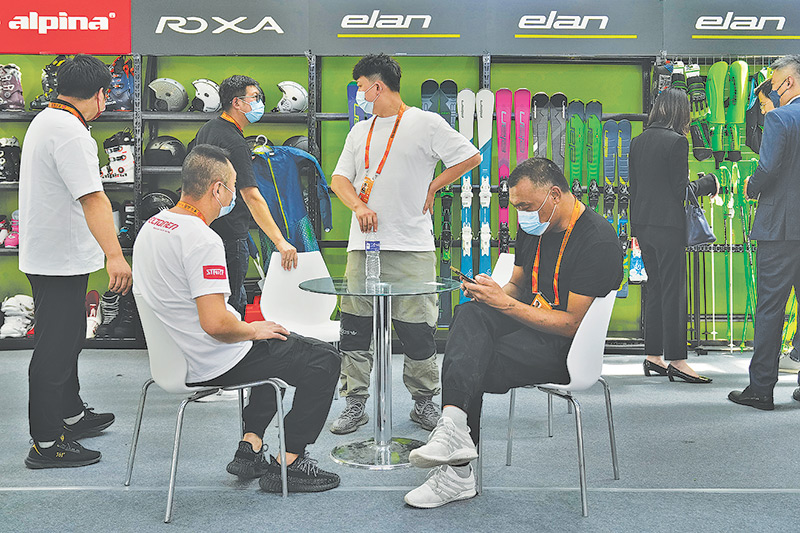
Exhibitors attend visitors at their booth promoting winter sports equipment at the China International Fair for Trade in Services in Beijing. AP/RSS
BEIJING, China’s trade weakened in August as high energy prices, inflation and anti-virus measures weighed on global and Chinese consumer demand, while imports of Russian oil and gas surged. Exports rose 7 percent over a year ago to $314.9 billion, decelerating from July’s 18 percent expansion, customs data showed on Wednesday. Imports contracted by 0.2 percent to $235.5 billion, compared with the previous month’s already weak 2.3 percent growth. Demand for Chinese exports has softened as Western economies cool and the Federal Reserve and central banks in Europe and Asia raise interest rates to contain surging inflation. At home, repeated closures of Chinese cities to fight virus outbreaks has weighed on consumers’ willingness to spend. “The slowdown in China’s export sector is adding to headwinds for the Chinese economy,” said Rajiv Biswas of S&P Global Market Intelligence in a report. Lack of import growth highlights “continued weakness of Chinese domestic demand.” Growth in the world’s second-largest economy fell to 2.5 percent in the first half of 2022, less than half the ruling Communist Party’s 5.5 percent annual target, after Shanghai and other industrial centres were shut down to fight virus outbreaks. Factories have reopened, but restrictions more recently in areas including the southern business centre of Shenzhen weighed on activity. So has a dry summer that left reservoirs in the southwest unable to generate hydropower and disrupted river shipping. The International Monetary Fund and private sector forecasters have trimmed their already low growth forecasts. Exports to the United States sank 3.8 percent from a year ago to $49.8 billion while imports of American goods declined 7.3 percent to $13 billion. The politically sensitive trade surplus with the United States that helped to spark a tariff war narrowed by 2.4 percent to $36.7 billion. President Joe Biden has left in place tariff hikes imposed by his predecessor, Donald Trump, in a fight over Beijing’s technology development tactics. Beijing retaliated by raising its own import duties and told Chinese companies to stop buying American exports. Imports from Russia, mostly oil and gas, surged 59.3 percent to $11.2 billion as China appeared to take advantage of discounts offered by the Kremlin to attract buyers in the face of Western sanctions over its war on Ukraine.
MONEY
Ireland fines Instagram a record $400 million
Briefing
DUBLIN: Ireland’s data privacy regulator has agreed to levy a record fine of 405 million euros ($402 million) against social network Instagram following an investigation into its handling of children’s data, a spokesperson for the watchdog said. Instagram plans to appeal against the fine, a spokesperson for parent Meta Platforms Inc said in an emailed statement. The investigation, which started in 2020, focused on child users between the ages of 13 and 17 who were allowed to operate business accounts, which facilitated the publication of the user’s phone number and/or email address. “We adopted our final decision last Friday and it does contain a fine of 405 million euro,” said the spokesperson for Ireland’s Data Protection Commissioner (DPC), the lead regulator of Instagram’s parent company Meta Platforms Inc. (REUTERS)
MONEY
Departing Hong Kong residents took $269 million from pensions in Q2
Briefing
HONG KONG: Residents leaving Hong Kong for good withdrew a total of HK$2.114 billion ($269.31 million) from their pension accounts in the second quarter of 2022, up 0.9 percent from a year earlier, government data showed on Wednesday, a sign that more people were moving out of the financial hub. Curbs to control the spread of Covid-19 are partly blamed for a net outflow of 113,200 people from Hong Kong between mid-2021 and mid-2022, according to government estimates. The city had a population of around 7.29 million at mid-2022, as compared to 7.41 million at mid-2021. (REUTERS)
MONEY
Indonesia regions told to curb transport costs to contain inflation
Briefing
JAKARTA: Indonesia’s President Joko Widodo said on Wednesday he had ordered provincial governments to use their budgets to rein in transportation costs and counter the inflationary impact of last week’s fuel price hike on the economy. Under pressure to control a swelling energy subsidy budget, Widodo, popularly known as Jokowi, hiked subsidised fuel prices by 30 percent on Saturday, sparking protests across the nation of 270 million people. “The calculation by my ministers was [inflation will] rise by 1.8 percentage points. But that’s if we do nothing. I don’t want to do nothing, we have to intervene,” Jokowi said, referring to the knock-on inflationary impact of fuel prices. (REUTERS)
WORLD
Putin casts doubt over Ukraine grain deal and gas supplies to Europe
Europe has accused Russia of weaponising energy supplies in retaliation for Western sanctions imposed on Moscow.
- REUTERS
A file photo shows a grain terminal at the sea port in Odesa, Ukraine. REUTERS
KYIV, President Vladimir Putin said on Wednesday he wanted to discuss reopening a UN-brokered deal that allows Ukraine to export its grain via the Black Sea and threatened to halt all energy supplies to Europe if Brussels caps the price of Russian gas. In a combative speech to an economic forum in Russia’s Far East region, Putin made little reference to his invasion of Ukraine, but said in answer to a question that Russia would not lose the war and had strengthened its sovereignty and influence. On the ground, Ukrainian officials remained guarded about how a counter offensive they began late last month was faring but a Russian-installed official in eastern Ukraine said Ukrainian forces had attacked a town there. The grain pact, facilitated by the UN and Turkey, created a protected export corridor via the Black Sea for Ukrainian foodstuffs after Kyiv lost access to its main export route when Russia attacked Ukraine via land, air and sea. Designed to help ease global food prices by increasing supplies of grain and oilseeds, the agreement has been the only diplomatic breakthrough between Moscow and Kyiv in more than six months of war. But Putin said the deal was delivering grain, fertiliser and other foodstuffs to the European Union and Turkey rather than to poor countries whose interests he said were the pretext for the deal and added that he wanted to discuss changing its terms. “It may be worth considering how to limit the export of grain and other food along this route,” he said, while also saying that Russia would continue to abide by its terms in the hope that it would fulfil its original goals. “I will definitely consult the President of Turkey, Mr Erdogan, on this topic because it was he and I who worked out a mechanism for the export of Ukrainian grain first of all, I repeat, in order to help the poorest countries.” His comments raised the possibility the pact could unravel if it cannot be successfully renegotiated or might not be renewed by Moscow when it expires in late November. Ukraine, whose ports had been blockaded by Russia after it invaded in February, said the terms of the agreement, which was signed on July 22 for a period of four months, were being strictly observed and there were no grounds to renegotiate it. “I believe that such unexpected and groundless statements rather indicate an attempt to find new aggressive talking points to influence global public opinion and, above all, put pressure on the United Nations,” said Mykhailo Podolyak, a presidential adviser. The deal threw a lifeline to Kyiv, giving a much-needed source of revenue to an economy devastated by war. It does not say anything about which countries Ukrainian grain should go to and the UN has stressed it is a commercial—not humanitarian—operation that will be driven by the market. According to data from the Istanbul-based coordination group which monitors the deal’s implementation, 30 percent of the total cargo, which includes that earmarked for or routed via Turkey, had gone to low and lower-middle income countries.
WORLD
Pakistan looks ‘like a sea’ after floods, Sharif says
The United Nations has called for $160 million in international aid to help the flood victims.
- REUTERS
SEHWAN, Parts of Pakistan seemed “like a sea”, Prime Minister Shehbaz Sharif said on Wednesday, after visiting some of the flood-hit areas that cover as much as a third of the South Asian nation, where 18 more deaths took the toll from days of rain to 1,343. As many as 33 million of a population of 220 million have been affected in a disaster blamed on climate change that has left hundreds of thousands homeless and caused losses of at least $10 billion, officials estimate. “ You wouldn’t believe the scale of destruction there,” Sharif told media after a visit to the southern province of Sindh. “It is water everywhere as far as you could see. It is just like a sea.” The government, which has boosted cash handouts for flood victims to 70 billion Pakistani rupees ($313.90 million), will buy 200,000 tents to house displaced families, he added. Receding waters threaten a new challenge in the form of water-born infectious diseases, Sharif said. “We will need trillions of rupees to cope with this calamity.” The United Nations has called for $160 million in aid to help the flood victims. Many of those affected are from Sindh, where Pakistan’s largest freshwater lake is dangerously close to bursting its banks, even after having been breached in an operation that displaced 100,000 people. National disaster officials said eight children were among the dead in the last 24 hours. The floods were brought by record monsoon rains and glacier melt in Pakistan’s northern mountains. The raging waters have swept away 1.6 million houses, 5,735 km of transport links, 750,000 head of livestock, and swamped more than 2 million acres of farmland. Officials in Sindh expect the waters to recede in the next few days, said provincial government spokesperson Murtaza Wahab.“Our strategy right now is to be prepared for wheat cultivation as soon as the water recedes,” he added. But with more rain expected in the coming month, the situation could worsen further, a top official of the United Nations’ refugee agency (UNHCR) has warned. Already, the World Health Organisation has said more than 6.4 million people need humanitarian support in the flooded areas.
WORLD
Liz Truss’s cabinet is Britain’s first without white men in top jobs
- REUTERS
LONDON, The new British Prime Minister Liz Truss has selected a cabinet where for the first time a white man will not hold one of the country’s four most important ministerial positions. Truss appointed Kwasi Kwarteng—whose parents came from Ghana in the 1960s—as Britain’s first Black finance minister while James Cleverly is the first Black foreign minister. Cleverly, whose mother hails from Sierra Leone and whose father is white, has in the past spoken about being bullied as a mixed-race child and has said the party needs to do more to attract Black voters. Suella Braverman, whose parents came to Britain from Kenya and Mauritius six decades ago, succeeds Priti Patel as the second ethnic minority home secretary, or interior minister, where she will be responsible for police and immigration. The growing diversity is in part thanks to a push by the Conservative Party in recent years to put forward a more varied set of candidates for parliament. British governments have until a few decades ago been made up of mostly white men. It took until 2002 for Britain to appoint its first ethnic minority cabinet minister when Paul Boateng was appointed chief secretary to the Treasury. Rishi Sunak, whose parents came from India, was Kwarteng’s predecessor in the finance job and the runner-up to Truss in the leadership context. “Politics has set the pace. We now treat it as normal, this diversity,” said Sunder Katwala, director of non-partisan think-tank British Future, which focuses on migration and identity. “The pace of change is extraordinary.” However, the upper ranks of business, the judiciary, the civil service and army are all still predominately white. And despite the party’s diversity campaign, only a quarter of Conservative members of parliament are women and 6 percent from minority backgrounds. Nevertheless, the Conservatives have the best track record of political firsts among the main political parties, including appointing the first Jewish prime minister in Benjamin Disraeli in 1868.
WORLD
German parliament honours Gorbachev
- ASSOCIATED PRESS
BERLIN, Germany’s parliament paid tribute to Mikhail Gorbachev on Wednesday, holding a minute of silence for the former Soviet leader who paved the way for German reunification 32 years ago. Flags at the parliament’s Reichstag building in Berlin were lowered to half-staff as lawmakers opened the day’s session, one of the first since Gorbachev’s death last week, with the tribute. “He made possible what for decades seemed impossible—ending the Cold War peacefully and overcoming the division of our country and our continent,” speaker Baerbel Bas told lawmakers. “We Germans have much to thank Mikhail Gorbachev for.” “He changed the history of our country and the lives of millions of people,” Bas said. “His courage and his stance were decisive in the recovery of our unity.” Gorbachev’s drive for reform and increasing openness set the scene for the peaceful collapse of communism—and one of its key moments, the fall in November 1989 of the Berlin Wall. Less than a year later, Germany was reunited as member of NATO and with a promise that Soviet troops would be withdrawn. Gorbachev remained enduringly popular in Germany, a contrast with how he was viewed in Russia. As they remembered Gorbachev last week, German leaders pointed to the contrast with today’s relations with Russia, which are icy following Moscow’s invasion of Ukraine. Germans for too long “overlooked, or perhaps didn’t want to believe, that Russia under [President Vladimir] Putin had long since and radically turned away from Gorbachev’s aims,” Bas said.
SPORTS
Pakistan women make emotional comeback at SAFF
Pakistan, playing their first major tournament since 2014, suffer a 3-0 defeat against India in their opening game of the SAFF Women’s Championship.
- Sports Bureau
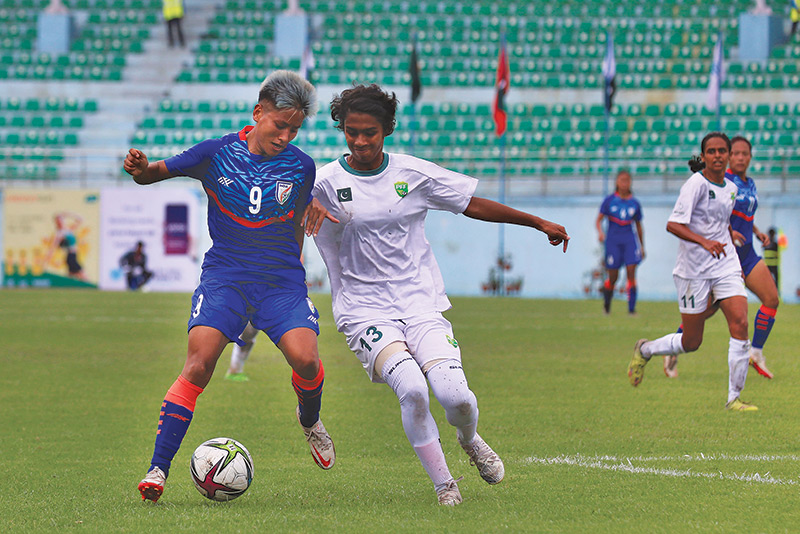
India’s Anju Tamang and Pakistan’s Nizalia Siddiqui (right) battle for the ball at the Dasharath Stadium in Tripureshwar on Wednesday. Post Photo: Hemanta Shrestha
KATHMANDU, Pakistan women football team made an emotional comeback to international football after eight years vying against India in the sixth SAFF Women’s Championship at the Dasharath Stadium in Tripureshwar on Tuesday. Pakistan, though lost the match against defending champions and South Asian giants India 3-0, the outcome mattered less than the return of the country’s football at international stage. Pakistan, who faced two bans from international football governing body FIFA for around eight years owing to infighting at the Pakistan Football Federation, were playing their first international tournament after the ban was lifted on July 1. The men’s team, however, were allowed to play in the 2018 Asian Games and SAFF Championships. Captain Maira Jamila Khan hugged her teammates with ‘tears of joy’ despite the defeat against archrivals India. “Today we showed the world what Pakistani women’s football has to offer,” said Pakistan captain Maria Jamila Khan. “It is about representing the country and it’s about honour. It is a privilege for all women of the team to represent the team. The whole team is emotional and every player of the team is a fighter which you saw today of the women of the team.” The Pakistan women’s team played their last tournament during the 2014 Championship in Islamabad where they crashed out of the group stage. Pakistan’s coach Adeel Mirza Rizki was equally satisfied with his side’s performance. “They have done a good job returning to international football after eight years. I am super proud of them. The idea is to grow from here and develop football in the country,” said Rizki. Not just the Pakistani side participated in the tournament to show their presence at international stage, but also threatened giants India on a couple of occasions. “We were playing against tough opponents that are ranked inside the top 50,” said Rizki referring to India’s 58th ranking in world football. India, the winners of all previous five editions, were dominant throughout the match and kept Pakistan defenders busy. They got the breakthrough in the 21st minute after captain Jamil Khan turned the ball inside her own net. Midfielder Dangmei Grace, adjudged the most valuable player, added another two minutes later before India sealed the victory with a stoppage time goal through Soumya Gaguloth as India extended their unbeaten run to 27 matches in the Championship. Unmarked Grace netted second goal after she collected Anju Tamang’s pass and fired it at the near post as India went into the break with a 2-0 lead. Forward Guguloth, the 65th minute replacement of Renu, sealed the victory with a smart finish tapping in Ranjana Chanu from the close range stunning Pakistani defenders and goalie Shahid Bukhari. India coach Suren Kumar Chhetri said that playing the first match is always tough. “We won the game 3-0 and that is what matters for us and the team. Scoring three goals is the positive side of the team. However, there are areas we need to improve and come back stronger,” said Chhetri. India will play their next match of Group ‘A’ against Maldives on Saturday.
Khatun double gives Bangladesh 3-0 win over the Maldives Captain Sabina Khatun struck twice for Bangladesh in the late fixture of the Group ‘A’ as they saw off the Maldives 3-0 at the same venue. Bangladesh struck all three goals inside 10 minutes in the first half with Masura Pravin also getting on the scoresheet. Bangladesh dominated the game from the onset but were made to wait for more than half an hour to break the deadlock. Forward Khatun made the breakthrough in the 32 minutes unleashing a 35-yard strike after being fed by Sanjida Akhtar. Pravin doubled the advantage two minutes later, capitalising on a poor defending of the Maldives players. Khatun made it 3-0 after a second successive strike after she collected a ball blocked by goalie Aminath Leeza that fell in the way of Khatun. Bangladesh will play their next game against Pakistan on Saturday. The next match of the Championship will see Bhutan vying against Sri Lanka on Friday.
SPORTS
Khachanov sets up Ruud semi-final
- AGENCE FRANCE-PRESSE
NEW YORK, Karen Khachanov set-up a US Open semi-final duel with Casper Ruud on Tuesday when he battled past Nick Kyrgios in a big-hitting five-setter, shattering the Australian crowd-pleaser’s dreams of a maiden Grand Slam title. Russian 27th seed Khachanov triumphed 7-5, 4-6, 7-5, 6-7 (3/7), 6-4 over the Wimbledon runner-up to make the last-four at a major for the first time. Norwegian fifth seed Ruud defeated Italy’s Matteo Berrettini 6-1, 6-4, 7-6 (7/4) to make his second Slam semi-final of 2022 having finished runner-up to Rafael Nadal at the French Open. Ruud reached the US Open semi-finals for the first time after breaking Berrettini five times while saving seven of nine break points. He raced through the first two sets Berrettini stopped the rot with a break for 2-0 in the third. At 2-5 down, Ruud saved two set points before recovering and going on to dominate the tiebreak.
Jabeur, Garcia advance In women’s singles, Tunisia’s Ons Jabeur became the first African woman in history to reach the semi-finals of the US Open on Tuesday as France’s Caroline Garcia ended the hopes of American teenager Coco Gauff to advance to the last four. Jabeur, who also claimed a notable first in July as the first woman from Africa to reach the final at Wimbledon, scored a 6-4, 7-6 (7/4) win over Australia’s Ajla Tomljanovic. Jabeur will now face Garcia in the semi-finals after the 17th seed dispatched the 18-year-old Gauff 6-3, 6-4 in Tuesday’s other quarter-final. Garcia reached the first Grand Slam semi-final of her career after an ultimately emphatic win over American hope Gauff.
SPORTS
Chelsea part company with Tuchel after poor start to season
The Blues’ performances have been unconvincing with defeat at Leeds and Southampton in Premier League and Tuesday’s 1-0 loss at Dinamo Zagreb.
- REUTERS
LONDON, Chelsea sacked manager Thomas Tuchel on Wednesday the day after his team suffered a shock 1-0 defeat away by Dinamo Zagreb in their opening game of the Champions League. The Premier League club confirmed on its website that they had parted company with the German coach who guided Chelsea to Champions League glory in his first season. “On behalf of everyone at Chelsea FC, the Club would like to place on record its gratitude to Thomas and his staff for all their efforts during their time with the Club,” the club said. “Thomas will rightly have a place in Chelsea’s history after winning the Champions League, the Super Cup and Club World Cup in his time here.” While Chelsea have not started the season especially well, having lost two of their opening six Premier League games, Tuchel’s exit is still a surprising move. He made an instant impact when replacing club great Frank Lampard in January 2021, reviving the team’s Premier League season and taking them to the Champions League final where they beat Manchester City. Under Tuchel Chelsea also won the UEFA Super Cup and FIFA Club World Cup last season. Chelsea finished third in the Premier League last season as their expected challenge to Manchester City and Liverpool’s domestic dominance failed to materialise. They also reached the FA Cup and League Cup finals, losing to Liverpool on penalties on each occasion. Tuchel, formerly manager of Paris St Germain and Borussia Dortmund, is the first managerial casualty since new American owner Todd Boehly took over the club. “As the new ownership group reaches 100 days since taking over the Club, and as it continues its hard work to take the club forward, the new owners believe it is the right time to make this transition,” the statement said. The club backed Tuchel to the tune of 250 million pounds ($286.18 million) in the summer transfer window with the likes of Raheem Sterling and Kalidou Koulibaly arriving. But performances have been unconvincing with defeats at Leeds United and Southampton in the Premier League and Tuesday’s 1-0 loss away to Croatia’s Dinamo Zagreb. After the Southampton defeat Tuchel accused his players of “not being tough enough”. Tuchel leaves with a win percentage of 60% but Chelsea won only seven of their last 16 Premier League matches and the new owners clearly felt it was a trend that could not continue. Attention will now turn to Tuchel’s successor with Brighton & Hove Albion manager Graham Potter and former Tottenham Hotspur and PSG manager Mauricio Pochettino amongst the early front runners for the west Londoners.
Tuchel’s record at Chelsea Appointment: January 26, 2021 Premier League seasons: 3 Games: 100 Wins: 60 Draws: 24 Losses: 16 Goals scored: 168 Goals conceded: 77 Win percentage: 60 Trophies: 2020-21 UEFA Champions League 2021 UEFA Super Cup 2021 FIFA Club World Cup
Champions League Results Dinamo 1-0 Chelsea Salzburg 1-1 AC Milan Celtic 0-3 Real Madrid Leipzig 1-4 Shakhtar Dortmund 3-0 Copenhagen Sevilla 0-4 Man City PSG 2-1 Juventus Benfica 2-0 Maccabi Haifa
MEDLEY
Horoscope
ARIES (March 21-April 19) *** The day asks you to set healthy boundaries with your social media feeds, needy friends, and colleagues. It could also highlight injustices occurring in your neighborhood or community, inspiring you to look for ways to elicit change.
TAURUS (April 20-May 20) *** A strict energy could shake up the vibe for you. Try not to butt heads with any authority figures who have the power to make your life. On the plus side, this day will provide you with an opportunity to reclaim your own power.
GEMINI (May 21-June 21) **** Today’s skies could cause you to awaken from your slumber well before your alarm sounds. Look for ways to practice compassion and rake in good karma points. Focus on your career goals and emotional boundaries later tonight.
CANCER (June 22-July 22) *** Today, set some serious boundaries with yourself and others. This cosmic climate will illuminate the reality of your current situation, forcing you to make changes or accept defeat in any battles you’ve been fighting internally.
LEO (July 23-August 22) *** Don’t feel guilty if you need to take a step back from your romantic interests. Use these vibes to check in with your own heart and mind, taking a moment to process new feelings while focusing on stock of your happiness.
VIRGO (August 23-September 22) *** Your loved ones may require some extra support from you today. Though you’re typically happy to lend a hand when someone is in need, try not to overexert yourself by nurturing others who might not return the favor.
LIBRA (September 23-October 22) *** You could get hit with an unexpected ego bruising early this morning. Luckily, it will allow you to reclaim your dignity, helping you brush off any conflict or embarrassing snafus that may have plagued the start of your day.
SCORPIO (October 23-November 21) *** You may want to tread lightly in your romantic life this morning. The cosmic climate could cause you to temporarily close off. Luckily, you’ll begin to feel relaxed and like yourself later, reassuring you of your own identity.
SAGITTARIUS (November 22-December 21) *** Watch your words this morning. This cosmic climate could stir up issues within your romantic life if you speak hastily. Luckily, you’ll feel much more in control of your psyche and voice, helping you snap out of any weird vibes.
CAPRICORN (December 22-January 19) **** Avoid comparing yourself to others today. Today’s skies will bring a sensitive energy to your ego, making it important to focus only on people and activities that elevate your sense of self. Speak with emotional transparency.
AQUARIUS (January 20-February 18) *** Your emotions could get a bit erratic. Situations that you’ve been enduring but unhappy with could suddenly push you to a breaking point, potentially causing you to lash out. Luckily, it will help you pull it together before work.
PISCES (February 19-March 20) *** Be careful what you wish for this morning. These vibes could also usher in strange dreams, but try not to read into any odd encounters you had while asleep. Luckily, you’ll have a chance to restore order to your psyche later.
CULTURE & LIFESTYLE
Watch ‘Radha’ for Shristi Shrestha’s performance
A few days after its release, the team behind ‘The Secrets of Radha’ pulled the film from theatres and said it would soon launch it on an OTT platform.
- ABHIMANYU DIXIT
The review contains spoilers of the film. As I write this review, ‘The Secrets of Radha’, Subarna Thapa’s latest film, is no longer playing in cinema halls. The film’s production team withdrew the film from theatres across the country, citing a lack of show slots. Director Thapa, producer Devaki Bista, investor Saugat Malla, and actor Shristi Shrestha confirmed the withdrawal in a recent press conference. A visibly irritated Thapa claimed that the film released on September 26 to around 40 shows, a low number. But, by August 29, the number of shows had already gotten lower, even when reviews and audience feedback of the movie were overtly positive. “We now have 15 shows all over Nepal. This is a multiplex-targeted film, and theatre chains like QFX cinemas have only given us only three shows,” Thapa, also the film’s writer, said at the press conference. Now, it looks like the film will be released on an OTT platform, and you will have to make do with watching it on your smartphone. I watched the film in a cinema hall, and it is one of the most visually striking Nepali films released this year. A smartphone screen will not do justice to Narendra Mainali’s cinematography or Kala Sangraula’s art direction. Their work immerses you into the story and makes the film’s world believable. For example, the titular character, Radha, is often filmed in crowded spaces. But because of Mainali’s framing and Sangraula’s art, you can spot Radha from far away, never losing focus. Special mention ought to be given to the team for creating the set of a burnt village house, an absolute treat of a scene. The film’s audience would have also been able to experience the film’s full-fledged international quality audio with the background score by Christophe Héral, and sound designed/mixed by Frédéric Maury. The film’s screenplay requires you to pay close attention in the first half. So, maybe the pause and rewind button of your OTT platform can assist you in the task. The screenplay jarringly jumps the timeline without any warning. The film begins with Radha living with her ill mother-in-law (Sharada Giri). Basudev (Saugat Malla), Radha’s husband, has been missing for a few months. To calm her mother-in-law’s anxieties, Radha hires a caricature artist, Sundar (Khagendra Lamichhane), to talk to them in Basudev’s voice. After her mother-in-law dies, Radha receives a letter claiming that Basudev has been found. Radha teams up with Sundar and travels to Kathmandu to find Basudev. In Kathmandu, Radha learns that Basudev has died, but when she goes to receive his coffin, the dead body is not of her husband. The secret of what happened with Basudev and how Radha uncovers the truth is the crux of the film’s plot. The film feels like a modern-day retelling of the Satyavan-Savitri story from Hindu mythology. In that story, Savitri, a devoted wife, through sheer willpower and devotion, saves her husband from the god of death, Yamaraj. Radha, the character, is also cut from the same cloth. Radha is a few months pregnant, yet she is determined to leave the comfort of her home to venture into the unknown. Before the end credit appears, Thapa dedicates the film to ‘the resilient spirit of women’. This is Thapa’s second woman-centric film--the first being Sungava (2012). Now, whenever Thapa makes women-centric films, he does something very peculiar. Both ‘Sungava’ and ‘Radha’ end with the lead characters becoming mothers, and they are shown alongside a child. In ‘Sungava’, a story about two lesbians, Thapa kills one (Nisha Adhikari) and spares the other (Deeya Maskey) because she is now a mother. In ‘Radha’, Thapa begins with Radha’s pregnancy and ends with an image of Radha with her child. By ending the two films in such a way, it’s almost as though Thapa is suggesting that a woman’s ultimate goal is to become a mother. When Nepali men write women-centric films, they tend to overcompensate. While writing women-centric stories, male writers put women characters on an extremely high pedestal, almost mythologising them. They tend to turn women into great human beings just because they can give birth and glorify raising children as sacrifices worth taking. Narratives such as these constantly reinforce the notion of women as mothers and hurt women. The film’s screenplay, also written by Thapa, tries to negate glorification by attempting to humanise Radha. Thapa introduces us to a patriarchal world where Radha is constantly asked where her husband is. Radha lies and makes up stories to shut people out. In the opening scene, when a Mata (Sangeeta Urao) tells Radha that her fate is unclear, she scratches her palm to draw up her own fate, telling us how arrogant this person is. Radha longs for love, she cries, she shouts, and seeks help, just like a real person. As real as she is written, all would have been for nought had Thapa not found the perfect actor to play Radha. One of actor Shristi Shrestha’s smartest career moves has been to collaborate with director Thapa for this film. Shrestha is perfectly cast. She is so good in the movie that we couldn’t have imagined anyone else playing the role. To say Shrestha’s previous films have been rather disappointing would be an understatement. Before ‘Radha’, watching Shrestha act was a struggle. First, she disappointed you with her choice of film projects. She has been a part of some terrible projects like ‘Poi Paryo Kale’ (2019), a film that had no qualms with blackfacing actors. Her cameo role in ‘Mah’ (2022) was cringy at best. In ‘Michael Adhikari’ (2022), she plays a loud surrogate mother. The film’s treatment is so cliche that it reminds us of the distasteful television series of the 90s. When the films were decent, Shristi’s performance would be the most underwhelming aspect of that project. ‘Chiso Ashtray’ (2022), another of Shristi’s releases this year, was a decent film lauded for its cinematography and acting. But Shristi was singled out as the film’s weakest link. She seemed dazed, confused, and unbearable in the film, leaving us feeling disconnected. But in ‘Radha’, it’s like Shristi has magically transformed into Nepal’s best female actor of her generation. Shristi outperforms everyone in the film, and mind you, the film boasts of the who’s who of Nepal’s cinema landscape. The cast boats of veterans like Sunil Pokharel, Dayahang Rai, Buddhi Tamang, Aashant Sharma, and Shrestha’s contemporaries Menuka Pradhan, Nischal Basnet, Khagendra Lamichhane, Saugat Malla, Lokendra Lekhak, and Divya Dev to name a few. I just hope Shristi builds on this performance and chooses the right roles from hereon. And whenever a good script arrives, I really hope she doesn’t go back to being dazed and confused. Thapa claims that his team is now working on a new distribution pattern to reexhibit the film, but there is no concrete plan so far. It looks as though cinema halls are no longer an option for ‘Radha’. This is an unfortunate development because a film like ‘Radha’ should be experienced on a 34-foot wide screen, the way it was initially intended, and not on a six-inch smartphone screen.
Dixit is a filmmaker, film educator and film campaigner based in Kathmandu.
CULTURE & LIFESTYLE
Gulf states demand Netflix pull content deemed offensive
- REUTERS
Films featuring same-sex relationships have in the past been banned in Gulf countries.
DUBAI Gulf Arab states have demanded that US streaming giant Netflix remove content deemed offensive to “Islamic and societal values” in the region, Saudi Arabia’s media regulator said on Tuesday. It did not specify the content, but mentioned that it included content aimed at children. Saudi state-run Al Ekhbariya TV, in a programme discussing the issue, showed blurred out animation clips that appeared to show two girls embracing. The Riyadh-based General Commission for Audiovisual Media statement said the content violated media regulations in the Gulf Cooperation Council, which groups Saudi Arabia, the United Arab Emirates, Bahrain, Oman, Qatar and Kuwait. Netflix did not immediately respond to a Reuters request for comment. The UAE issued a similarly worded statement regarding Netflix content on Tuesday, saying it would follow up on what the platform broadcasts in coming days and “assess its commitment to broadcasting controls” in the country. Same-sex relationships are criminalised in many Muslim-majority nations and films featuring such relationships have in the past been banned by regulators in those countries, while others with profanity or illicit drug use are sometimes censored.