Impeachment committee to summon people named by Rana
More questions await the suspended chief justice, besides 43 he’s answered.
- Post Report
KATHMANDU, The Impeachment Recommendation Committee has decided to summon the people named by suspended chief justice Cholendra Shumsher Rana during an interrogation by the panel. The committee formed to probe the allegations against Rana in the impeachment motion asked him 43 questions on five days including on Tuesday. In response, Rana accused his colleagues, former Supreme Court justices, lawyers and politicians of corruption and conspiring against him. He claimed that they organised protests against him demanding his impeachment because he refused to serve their interests. Rana has claimed that he rejected the proposal of some of the lawyers to appoint their wives as judges, and former chief justices ganged up on him because the wishes of some of them to head the National Human Rights Commission were not fulfilled. “Rana had named many people. The committee will invite some of them whose statements matter, to substantiate the allegations against Rana,” Min Bishwakarma, a member of the committee from the Nepali Congress, told the Post. “The committee’s meeting on Wednesday will list out the names of those to be summoned.” On Tuesday, the committee asked Rana eight questions from its bank of 43 questions. Now, he will be invited to answer supplementary questions—most probably on Thursday. Rana, on Tuesday, reiterated that all the allegations against him are baseless and meaningless. “He claimed that the allegations alone do not provide sufficient grounds to impeach him,” said Rekha Sharma, a member of the committee from the CPN (Maoist Centre). The committee members had asked him about the charges that he amassed wealth through “irregularities” and that demanded a share in the Cabinet. Rana had allegedly demanded a ministerial position in the Sher Bahadur Deuba Cabinet and Gajendra Hamal, his relative, was appointed as the minister for industry, commerce and supplies in October last year. Hamal, however, resigned within a few days after widespread controversy. Rana appearing before the committee rubbished the claim and rather insisted that he had requested the prime minister not to appoint Hamal as minister after learning about the appointment through the media. The committee members say they are putting in all their efforts to submit their report before the term of the House of Representatives expires on September 18. “We are also writing the report while also continuing the questioning,” Laxmi Gautam, secretary of the committee, told the Post. “The committee’s meeting on Wednesday will decide its further move.”
HOME PAGE
High risk of dengue spread to villages during festive travels
Doctors suggest local governments take preventive measures urgently. Health Ministry mulls fogging.
- Arjun Poudel
KATHMANDU, Amid a rapid surge in new dengue cases in Kathmandu Valley and other big cities, public health experts warn of the risk of a massive outbreak of the disease in the rural areas after the Dashain festival, which falls next month. Hundreds of thousands of people residing in big cities including in the districts of the Kathmandu valley will return to their villages in Dashain to celebrate the festival with their families. “The vector of the dengue virus is already present in most of the districts,” said Dr Meghnath Dhimal, an expert member of the World Health Organisation-South East Asia Regional Expert Group on Environmental Determinants of Health and Climate Change. “What is necessary for the vector to spread the virus is an infected person which will be fulfilled once infected people return to their villages.” Cases of dengue infection have already been reported from 75 out of the 77 districts across the country. What concerns doctors in health facilities in the rural setting is the lack of human resources to deal with emerging problems. “The risk of a massive spread of the disease grows once people start returning to their villages from dengue hotspots,” said Dr Sher Bahadur Pun, chief of the Clinical Research Unit at the Sukraraj Tropical and Infectious Disease Hospital. “Local governments should take measures to prevent situations like in Kathmandu.” So far, around a dozen people have succumbed to dengue and more than 10,000 infections have been reported from across the country. Experts say reported cases of dengue could be just the tip of the iceberg, as around 90 percent of the infected people do not show any symptoms. The deadly virus has been detected every month since January. The viral disease has already become endemic to Nepal, public health experts say. Dengue is a mosquito-borne disease transmitted by female Aedes aegypti and Aedes albopictus mosquitoes. The same vector also transmits chikungunya, yellow fever, and Zika viruses, according to the World Health Organisation. Although the post-monsoon period is considered a high transmission season for dengue, Nepal has witnessed outbreaks of the deadly disease since the beginning of the year and in the pre-monsoon, monsoon, and post-monsoon seasons. Asymptomatic people can easily spread the disease through vectors [disease-carrying mosquitoes], according to experts. Mild to high fever, severe muscle pain, rashes, severe headache, and pain in the eyes are some of the symptoms of dengue, according to doctors. Lalitpur and Kathmandu top the list of districts severely affected by the dengue virus. Lalitpur has reported over 4,000 cases as of Tuesday, according to Satish Bista, chief of the Health Office, Lalitpur. “Three deaths from dengue have been reported in our district (Lalitpur). Two of the deaths were confirmed by hospitals and we have been working to verify the cause of the third death,” said Bista. Launching awareness campaigns on the risk of infection, and search and destroy drives are among the measures taken by authorities concerned to lessen the spread of dengue. Meanwhile, the Epidemiology and Disease Control Division said it is mulling insecticide fogging in the highly affected areas like Kathmandu Valley to lessen the spread of the virus. “We have been discussing if insecticide fogging would be effective to control the spread of infection in the highly affected areas, but no decision has been taken so far,” said Dr Gokarna Dahal, chief of the Vector Control Section, at the division. “We have requested local governments to launch awareness and search and destroy drives in their jurisdictions regularly.” Experts say insecticide fogging is a more technical and costly technique and instead suggest focusing on the elimination of mosquito breeding sites. Dahal concedes the risk of a massive spread of the virus in rural areas after Dashain but said that unless local authorities and communities themselves shoulder the responsibility to destroy breeding sites of the virus spreading vectors, it will be difficult to control the ongoing epidemic. “The disease may not come under control until Dashain, and we could see a massive surge after Dashain,” said Dahal. In 2019, at least six people died and over 17,000 were hospitalised with dengue fever. The outbreak, which had started in the pre-monsoon period from Dharan, spread to 68 districts. The World Health Organisation says there is no specific treatment for severe dengue, but early detection and access to proper medical care can lower the fatality rate.
HOME PAGE
Chinese Speaker inquires about left unity, commits to reopening borders
Li was also keen to know about the status of the MCC Compact and commended Nepal’s stand on the SPP.
- PURUSHOTTAM POUDEL
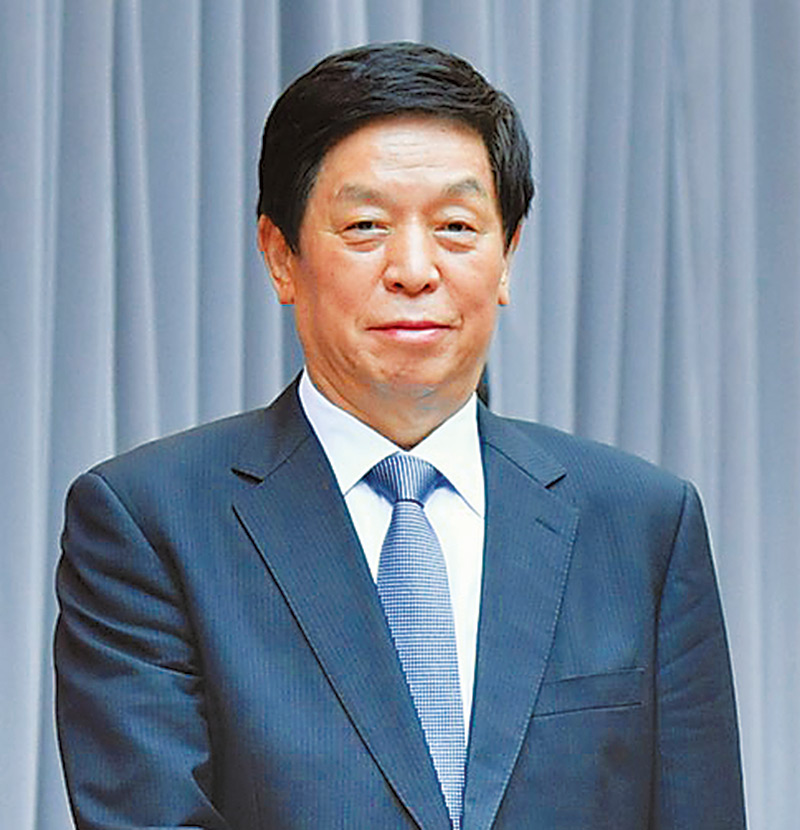
Li Zhanshu. Photo Courtesy: Parliament secretariat
KATHMANDU, As expected, Li Zhanshu, the Speaker of the Chinese National People’s Congress, enquired about the possibility of a left unity in Nepal during his meetings with top communist leaders on the second day of his Nepal visit on Tuesday. Whether he also encouraged the left parties to unite or forge a pre-poll alliance is unknown. “Li seemed eager to learn about the current dynamics among Nepal’s left parties,” a Maoist Centre leader who chose to remain anonymous told the Post. During his meeting with top communist leaders, Li also discussed the status of the Millennium Challenge Corporation (MCC) compact, which was ratified by Nepal’s Parliament on February 27 despite strong Chinese reservations, as well as the US State Partnership Program (SPP). Nepal in July had declined to be a part of the SPP after concerns from various quarters that the country should not join any military alliance. “Besides the possibility of a communist unity, the Chinese Speaker also seemed concerned about the MCC,” the Maoist Centre leader said. Li’s last concern was about the outcome of the general and provincial elections scheduled for November 20, according to leaders. “The Chinese Speaker’s desire to know more about the MCC and the SPP suggests that China fears that Nepal could join the Western camp,” says foreign policy analyst Shambhu Ram Shimkhada. “China would prefer to have a strong and united communist front in Nepal, if only to check what it sees as rapid Western advances here,” Shimkhada added. “The Chinese Speaker’s visit is part of the same calculus.” During his meeting with the Chinese Speaker Li, Maoist Centre chair Pushpa Kamal Dahal reaffirmed Nepal’s commitment to one-China policy. CPN-UML Chairman KP Oli did the same during his earlier meeting with Li on the same day. Asked by the Post whether Li also raised the issue of left unity with Oli, UML Head of Foreign Affairs Department Rajan Bhattarai replied that party politics were not discussed. Before Speaker Li came calling, on July 10 Liu Jianchao, the head of the International Liaison Department of the Chinese Communist Party, was in Kathmandu on a four-day visit. During Liu’s talks back then with both Dahal and Oli, say UML and Maoist Centre insiders, he had repeatedly inquired about the possibility of reviving the left alliance ahead of the general elections. On June 23 and 24, Liu held video calls with the chairs of the Maoist Centre and the UML. Coming back to Chinese Speaker Li’s current Nepal visit, during his meeting with UML Chair Oli, “the Chinese leader committed to implementing previous agreements between Nepal and China,” Bhattarai told the Post. According to him, Li stated China’s desire to expand bilateral ties. “He further wished that Nepal, a free and sovereign nation, would choose its own foreign policy course.” In his discussion with Chinese leader Li, UML chair Oli reaffirmed Nepal’s commitment “not to allow its territory to be used against China or other friendly nations,” said Bhattarai. UML Chairman Oli also stressed the importance of implementing agreements under the Belt and Road Initiatives. The Chinese National People’s Congress Speaker called on Prime Minister Sher Bahadur Deuba on Tuesday evening. During the meeting, the two dignitaries discussed matters of mutual interest including bilateral trade, investment, connectivity, return of Nepali students to China, resumption of passenger flights, and reopening of border ports, reads a release from the Ministry of Foreign Affairs. “The Chinese side appreciated Nepal’s stand on One-China policy and its commitment not to allow the Nepali territory to be used against the core interests of China,” reads the statement. A close aide to Deuba informed that Li, the Chinese delegation head, appreciated Nepal’s principled stand on the SPP during his meeting with Prime Minister Deuba. “Li also seemed pleased with Foreign Minister Narayan Khadka’s China visit at the height of the Taiwan crisis.” Meanwhile, Li also assured Nepali leaders that China would reopen the long-closed border points shortly after controlling the Covid-19 contagion in Tibet, which they would do before the start of Dashain. Border closure has been causing big problems for the Nepali traders ahead of the festive season. The Chinese delegation said it would step up efforts to implement Chinese-assisted projects in Nepal. In response to Nepal’s request, the Chinese side agreed to support Nepal’s smooth and sustainable graduation from the LDC status. Foreign Minister Khadka, during his meeting with Li at Soaltee Hotel on Tuesday evening, reiterated the government’s earlier stand that Nepal would still like China to extend grants to complete the BRI projects and the country was not in a position to accept loans, according to a close aide of Khadka who chose to remain anonymous. Li also met with Chairman of the National Assembly Ganesh Prasad Timilsina. According to Timilsina’s secretariat, the Nepali side stressed three key points in the meeting. “The Nepali side emphasised building bilateral ties and reaffirmed our support for One-China policy. The Nepali delegation asked that the border between the two nations be opened before Dashain.” The Chinese side, led by Li, is committed to reopening the border, said Timilsina’s secretariat. The Chinese side also requested that Nepal speed up implementation of Chinese projects, according to the Assembly chair’s office. Li’s visit comes ahead of the 20th National Congress of the Communist Party of China which is set to confirm President Xi Jinping’s appointment as the party general secretary for a record third time. It also comes only two months before Nepal’s own federal and provincial polls.
HOME PAGE
Tourism hamstrung as government delays passing twin aviation bills
Nepal needs to split the Civil Aviation Authority into service provider and regulator to get out of the European Commission’s air safety list.
- SANGAM PRASAIN
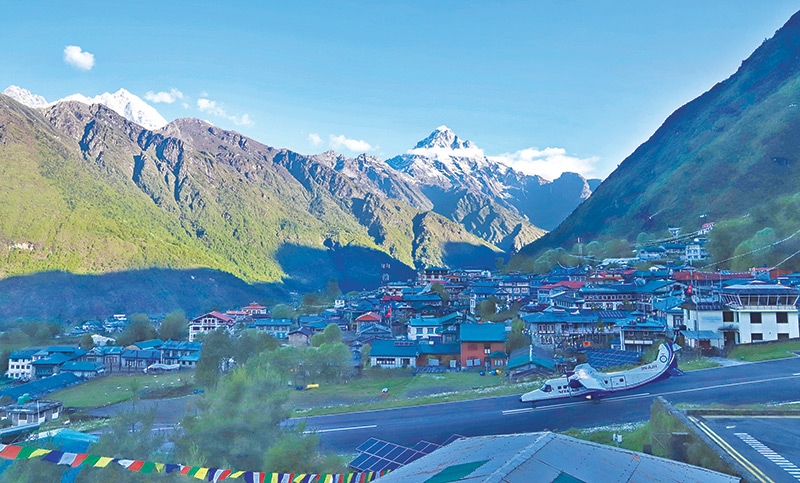
Nepal’s image in international aviation remains tarnished because of its poor safety record. Post File Photo
KATHMANDU, Nepal’s tourism and aviation sectors are dejected that Parliament’s five-year term is ending on September 18 without passing long-pending civil aviation bills that could severely impede their growth and do long-term damage. Insiders say the hospitality industry has been pouring billions into new properties amid post-Covid optimism that tourist arrivals would take off, but failure to pass the bills could stop recovery in its tracks. Passing legislation to split the Civil Aviation Authority of Nepal into two entities—service provider and regulator—will fulfil a key requirement of the European Commission. This will hasten Nepal’s removal from its air safety list, allowing Nepali airlines to fly to Europe and bring more tourists, but the government is unwilling to break up the aviation agency and loosen its grip on it, insiders say. Nepal’s image remains tarnished in international aviation because of its poor safety record. An audit team of the European Union Aviation Safety Agency (EASA), an agency of the European Union (EU) with responsibility for civil aviation safety, will be conducting an internal audit of Nepal’s aviation. “The team is scheduled to begin the audit from October 5,” said an unnamed top official at the Civil Aviation Authority of Nepal. “The recent development shows Nepal will remain on the air safety list for more years, as Nepal has wilfully declined requests by various global aviation watchdogs to end the ongoing conflict of interest at the Civil Aviation Authority of Nepal that has been performing a dual role and hampering safety. This will cost Nepal in the long run.” He did not give further details or disclose the plan of the audit team. In August, the United Nations aviation watchdog International Civil Aviation Organisation too had formally asked Nepal to split the civil aviation body into two entities. The separation is a crucial organisational reform agenda which has been a work in progress for the last one and a half decades. Successive tourism ministers and political leaders have been constantly pledging to the diplomatic community that Nepal will pass the bills and start the process to have the country removed from the bad books of the European Commission. In December 2013, the European Commission imposed a blanket ban on Nepali airlines from flying into the 27-nation bloc after the September 2012 crash of Sita Air Flight 601 at the Manohara river near Kathmandu airport. Nineteen people, including seven British citizens, died in the disaster.
A top official of a private airline said that if Nepal continued to remain on the “air safety list” of the European Commission after the audit, after 10 years, it would spell a disaster for the entire tourism industry. “If the ban remains in place, we don’t have any option other than to retaliate against the government, whose mandate is to have Nepal removed from the air safety list or the EU ban. The government should feel ashamed that we have been on the air safety list for 10 years.” Kathmandu-based diplomatic missions are too concerned. Recently, high-level officials from the American and Australian embassies met Pradeep Adhikari, director general of the Civil Aviation Authority of Nepal, in his office and asked him about the current status of the bills. “Adhikari has no answer. Instead, he has been complaining about the EU ambassador to every delegate he meets. That’s weird,” the official said. “Adhikari has even rejected outright the request to attend a meeting held by the EU at Nepal’s Foreign Ministry recently. The delegation of the European Union to Nepal had invited Adhikari to speak on the civil aviation bills.” The Tourism Ministry and the Civil Aviation Authority are on the same wavelength and both seem least bothered to pass the bills. The proposed pieces of legislation to separate the organisation have been gathering dust in Parliament for four years for reasons unknown. “Someone has to give us a logical answer why they have been kept on hold. What’s the reason behind it,” said the airline official. Amid the ongoing controversy, civil aviation chief Adhikari flew off to Brussels, Belgium to take part in SAFE 360° (Safety in Aviation Forum for Europe 2022) on Sunday morning. Few people in the industry know about his trip, which is particularly based on offering an all-round perspective on aviation safety. “The chief has informed a few members of his office that the objective of his visit is to convince the European Commission to lift Nepal from the air safety list. But he is lying. Actually, he has no agenda,” said another top official at the civil aviation authority who spoke on condition of anonymity. Most officials aren’t willing to speak against the director general because of possible repercussions. “He has kept the office and the industry in a tight grip,” the official said. The Post was unable to establish contact with Adhikari. After the SAFE 360° meeting, Adhikari is scheduled to take part in the 41st ICAO triennial assembly beginning on September 27 in Montréal, Canada. “At both these meetings, Adhikari will need to speak on the progress made in the country’s aviation safety issues. But he seems to be in a tight spot as he is not in favour of splitting his organisation to ensure safety,” the official said. Former civil aviation director generals say the government’s decision not to pass the bills is a “crime against public safety”. The government first announced the proposal to split the civil aviation body in its Three Year Interim Plan 2007-08 to 2009-10, which stated, “In the context of the completion of the study on the institutional strengthening of the Civil Aviation Authority of Nepal, which has been working as the service provider in civil aviation, airport operator and regulator; implementation of doable recommendations suggested by the report are being considered.” Since then, every periodic plan and policy, including the annual budget for this fiscal year, has accorded priority to separating the civil aviation body. But the plan has never been implemented. “That’s sheer negligence. It’s been 10 years since Nepal’s aviation safety has been questioned, but no one is bothered,” said Sanjiv Gautam, former director general of the Civil Aviation Authority of Nepal. “Who will lose? The minister will not lose. The director general will not lose. It’s the country that will lose.” The bills were passed by the upper house on August 2, 2021. On August 2, 2021, the upper house or the National Assembly unanimously passed two bills—the Civil Aviation Authority of Nepal Bill and the Air Service Authority of Nepal Bill. On March 1, 2022, the Parliament Secretariat included the two aviation bills in the agenda for a meeting of the lower house scheduled for March 2. There was a stunning overnight twist as the then tourism minister Prem Bahadur Ale stopped them from being tabled in the lower house for discussion. In June, the coalition government appointed Jeevan Ram Shrestha as the new tourism minister. Days after his appointment, the new minister too spoke that the “time has not arrived to split” the Civil Aviation Authority of Nepal into regulator and service provider. “That’s a strange remark. The minister even did not take a second opinion,” said the official at the civil aviation body. The tourism industry has started to feel the repercussions. “Nepali airlines are banned in EU nations. Although Nepali airlines don’t fly directly to the EU, tourists, particularly in the high-end segment, are reluctant to travel to countries that have been flagged by the aviation watchdog,” said Basanta Mishra, a senior tourism entrepreneur. The ban also prevents direct flight connectivity plans from European countries to Nepal and from Nepal to Europe. Even the United States and Australia have been questioning the civil aviation agency about the status of the bills. “That’s worrisome. It will kill tourism in the long run,” said Mishra. “The repercussions are already being felt.” According to him, it will take years for China to allow its citizens to travel. “We can’t be dependent on the Asian market only.” The private sector has invested billions in the tourism industry. “Connectivity is a major concern. If there is no direct connectivity with the US, Europe and Australia, how can we think of bringing tourists in big numbers?” While Tourism Minister Shrestha has made it clear that establishing a regulatory body to ensure safety is not his priority, he has come up with an ambitious plan to host 3.5 million tourists annually by announcing Tourism Decade starting in 2023. Shrestha has pledged facilitation and reforms at the policy level for the development and promotion of the tourism sector. Binayak Shah, senior vice-president of Hotel Association Nepal, says there is no any base—in terms of policies, plan and promotion—to bring so many tourists. “It looks that the decision has been made in haste.” Nepal received 1.19 million tourists in 2019. In 2020, Nepal had just launched an ambitious Visit Nepal Year campaign with much fanfare, aiming to attract at least 2 million tourists, only to have to abandon the programme after the incipient pandemic exploded into worldwide proportions. The disastrous year ended with 230,085 arrivals. Following a difficult end to 2020, Nepal’s tourism suffered further setbacks as countries tightened travel restrictions in response to new virus outbreaks. In 2021, the number of foreign visitors entering the country totalled 150,962. Nepal’s tourism industry in 2021 sank to its lowest in four and a half decades and revenues hit rock bottom, making a big dent in the country’s economy. As of August, Nepal had received 326,667 tourists. The figure is expected to touch half a million by the end of this year. Now, the government has planned to attract 3.5 million tourists annually from next year. “It’s a lofty promise which Nepali politicians are habituated to making,” said Mishra. “The government needs to fix the problems first if it wants to bring tourists in big numbers.”
NATIONAL
Shuklaphanta National Park running out of space to accommodate growing blackbuck population
The national park has built a special sanctuary on 59.8 hectares of the park land in Hirapur Phanta, which is home to 203 blackbucks.
- BHAWANI BHATTA
KANCHANPUR, The Shuklaphanta National Park has made great strides in increasing the number of blackbucks (Antilope cervicarpa) in the Hirapur area over the last few years. However, the national park is currently facing space constraints to accommodate the growing blackbuck population. The national park has built a special sanctuary in a predator-proof enclosed area on 59.8 hectares of land in Hirapur Phanta. Between 2012 and 2015, a total of 42 blackbucks were translocated to the national park—22 from Nepalgunj Mini Zoo, six from the Central Zoo in Lalitpur, and 14 from Blackbuck Conservation Area in Bardiya. The total number of blackbucks in the national park currently stands at 203, which includes 67 male, 87 female and 49 calves, according to the national park. According to Lakshmiraj Joshi, head of the Shuklaphanta Conservation Programme of the National Trust for Nature Conservation, the protected enclosure in Hirapur Phanta can provide a comfortable sanctuary for the existing blackbucks but will not be able to accommodate more. “The grazing area is just about enough for the current population of blackbucks. We have managed additional feed for them but it is now time to think about expanding the area of the enclosure to accommodate the growing population,” said Joshi. Hirapur Phanta is located near Arjuni Postal Office on the East-West Highway. Kishore Kumar Mehta, chief conservation officer of the national park, said that in the initial years of blackbucks translocation, there wasn’t much improvement in their numbers mostly due to infighting among the males leading to critical injuries and death of the animals. “We also lost some blackbucks to ringworm infection,” said Mehta. “But over the past few years, things have improved and we have seen a massive increase in their population. It is overall good news for the conservation of the critically-endangered animals. But now we must make plans to provide them with bigger space.” According to Mehta, management plans for the blackbucks are being made in coordination with the Department of National Park and Wildlife Conservation (DNPWC). “We also need to focus on expanding our medical support services for the blackbucks to control disease outbreaks,” said Mehta. “We need to allocate a separate area for breeding and increase surveillance and expand their enclosure to give them access to the wider grasslands.” The blackbucks must either be released into the wild or translocated elsewhere. Releasing the blackbuck population inside the national park, which has an area of only 305 sq km and is surrounded by farmlands and settlements, may not be practical. Mehta says discussions are to translocate the blackbucks to conservation areas in other parts of the country. “First priority is to expand their territory within the Shuklaphanta National Park, but if that doesn’t work then we must think about translocating some of them to other national parks and protected areas,” he said. Blackbucks were once found in several parts of the Tarai, but mainly in Kanchanpur, Bardiya and in the floodplains of the Rapti River in Banke. Owing to gradual deforestation and the shrinking of grasslands, the blackbuck population dwindled drastically during the late 1950s and early 1960s due to habitat loss and poaching, according to the records of the Department of National Park and Wildlife Conservation. By the early 1970s, the blackbuck was considered extinct in Nepal before nine of the species were spotted in 1975 in Khairapur of Bardiya. The Nepal government started conservation and preservation of the animal’s natural population by declaring an area of 172 hectares in Khairapur, Bardiya as the Blackbuck Conservation Area in 2009.
NATIONAL
Lack of a tripartite deal and transmission line may delay power export to Bangladesh
Nepal and Bangladesh recently agreed to request India for signing a trilateral energy sales and purchase agreement.
- PRITHVI MAN SHRESTHA
KATHMANDU, Although Bangladesh has shown interest to import Nepali electricity, it will not be easy for Nepal to export power without an official nod from India. As Nepal and Bangladesh do not share borders and India lies between the two countries, India’s cooperation will be crucial to enable trading of electricity between Nepal and Bangladesh. Experts say a tripartite agreement is essential for this. Bangladeshi Prime Minister Sheikh Hasina, during her state visit to India last week, formally requested India for passage to import electricity from Nepal. As per the joint statement issued on September 7 at the conclusion of the visit, the Bangladeshi side asked India to provide passage for the import of power from Nepal and Bhutan. And the Indian side replied that the guidelines for the same are already in place in India, the joint statement reads. Nepali officials and experts say at least two factors—legal foundation and infrastructure—would be necessary to pave the way for export of power to Bangladesh from Nepal. “Based on the joint vision statement on energy between Nepal and India, the southern neighbour appears willing to provide wheeling services to enable power trading between Nepal and Bangladesh,” said Posh Raj Pandey, executive chairperson of South Asia Watch on Trade, Economics and Environment (SAWTEE), a think tank based in Kathmandu. “But trading of power with a third country based on bilateral foundation will only be transactional. A trilateral agreement is a must to ensure smooth trade of electricity between Nepal and Bangladesh.” He also suggested the need for signing a protocol to such a trilateral agreement, which will determine the terms and conditions of electricity exports to Bangladesh. Currently, Nepal and India are trading electricity with each other while India and Bangladesh are also trading electricity between them. But there is no trilateral agreement on power trade between the three countries. Nepal and Bangladesh recently agreed to request India for signing a trilateral energy sales and purchase agreement. During the secretary-level Joint Steering Committee (JSC) meeting on energy cooperation between Nepal and Bangladesh in Kathmandu last month, the Nepal Electricity Authority and the Bangladesh Power Development Board decided to request India’s NTPC Vidyut Vyapar Nigam (NVVN) for a trilateral energy sales and purchase agreement. They plan to trade power using the Baharampur-Bheramara cross-border power transmission line, which links India and Bangladesh. The transmission line inaugurated in 2013 facilitates the exchange of 500MW of electricity. Nepal and Bangladesh had decided to request India to allow Nepal to export 40-50MW of electricity to Bangladesh in the initial phase. In line with the understanding reached in Kathmandu, Bangladesh raised the issue at the highest level in New Delhi last week. In response, India said it already has the Guidelines for Export/Import (Cross Border) of Electricity-2018, which has opened the door for a trilateral agreement and power trade between Nepal and Bangladesh. Likewise, as per the Joint Vision Statement on Power Sector Cooperation issued in early April during Nepali Prime Minister Sher Bahadur Deuba’s India visit, the two countries aim to expand cooperation in the power sector to include their partner countries under the Bangladesh, Bhutan, India and Nepal (BBIN) framework, subject to mutually agreed terms and conditions between all involved parties. “The vision statement talks about power cooperation in the BBIN region and Indian officials have also been assuring us that it would provide transmission access to enable energy trade between Nepal and Bangladesh,” Kul Man Ghising, managing director of the Nepal Electricity Authority (NEA), told the Post in April. Officials said there is a possibility of Nepal exporting a certain amount of electricity to Bangladesh in the next rainy season. “If India’s NTPC Vidyut Vyapar Nigam agrees to the request of the Nepal Electricity Authority and Bangladesh Power Development Board for a trilateral energy sales and purchase agreement, it will convey the message that India alone is not our export market,” said Madhu Bhetuwal, spokesperson for the energy ministry. The NVVN is the nodal agency of India to deal with cross-border power trade with both Nepal and Bangladesh. Bangladesh has already decided to buy 500MW of electricity from the 900MW Upper Karnali Hydropower Project to be developed by India’s GMR Group, which has set up GMR Upper Karnali Hydropower Limited to develop the plant in Nepal. During the fourth Joint Steering Committee meeting on energy cooperation in August, Bangladesh informed Nepal that it would be concluding the deal to buy 500MW electricity from the Upper Karnali Hydropower Project by September. But there is concern over transmission connectivity between the project and Bangladesh. There is currently no high capacity transmission line close to the site of the proposed Upper Karnali Hydropower Project. “So it is necessary that the NEA, which has a nationwide transmission network, should be ready to provide open access to the GMR to enable it to sell its electricity to Bangladesh,” said Gokarna Raj Panth, secretary at Electricity Regulatory Commission. “The government should decide whether to adopt an open access policy or not.” There’s also no cross-border transmission line close to the Upper Karnali project. There has been talk between Nepal and India to build the Lamki-Bareli cross border transmission line, according to the NEA. The country currently has single high capacity transmission line—the Dhalkebar-Muzaffarpur Transmission line which can carry around 1000MW of electricity. “Until more cross-border transmission lines are built, there is not much space left in the Dhalkebar-Muzaffarpur line to enable export of more power,” said Panth. “It will be difficult to accommodate the 500MW power of GMR in this transmission line.” Pandey said that political factors may also hinder smooth supply of electricity to Bangladesh from Nepal. “Electricity to be exported by Nepal to Bangladesh will either go through West Bengal, Bihar or Uttar Pradesh which are also facing prolonged electricity shortages every year,” he said. “Supply of electricity to India through these states which face power shortages every year, may invite political blackclash and hamper smooth export of electricity from Nepal to Bangladesh.”
NATIONAL
Traffic jams amid Chinese Speaker’s visit trouble Valley commuters
- ANUP OJHA
KATHMANDU, On Monday, Rabindra KC left his Satdobato home at 9:30am for Putalisadak, where he was to take a ‘mock test’ of the Pearson Test of English (PTE) at 11am. The distance between the two spots is about seven kilometres and on a regular traffic day, it takes 20-30 minutes on a vehicle to reach his destination. KC had thought he would reach the exam venue early on his scooter, so as to buy time for some last-gasp preparations. Little did he know that he’d get stuck in a traffic jam at Lagankhel and have to use an alternative route. KC took the inner alleys from Lagankhel to Krishna Mandir at Patan amid the hustle and bustle of rush hour. He finally managed to reach Kupondole, where he was stuck in another traffic jam—this time, for nearly two hours, he said. “When I finally managed to reach the centre, it was already 12pm,” KC said. Dejected, KC returned home after requesting a rescheduling of his test for Friday. Like KC, thousands of commuters in Kathmandu on Monday faced traffic jams throughout the day. The immediate reason behind the jams might have been the visit of the Chinese Speaker Li Zhanshu, but it exposes, once again, the failure of city authorities to manage the Valley’s notorious traffic. Although Valley Traffic Police Office said it had published the schedule of jams expected from 9am to 4pm in different areas of Kathmandu, many were unaware of it. The police office had published the notice on its Facebook page at 9am, at the time when many were preparing for office. “If only such a message was relayed on Monday, I would have left home quite earlier,” said 23-year-old Radha Paudel, who was stuck in a jam while travelling to Teku Hospital for a check-up from her home in Kirtipur. “I was suffering from fever and body pain and was exhausted, but the bus I boarded got stuck at Balkhu for over an hour. The whole experience was a nightmare.” Senior Superintendent Rajendra Pradad Bhatta, spokesperson for Kathmandu Valley Traffic Police, said the circulation of the message was delayed “for security reasons.” “We immediately published the route of the Chinese delegates’ motorcade after getting clearance from the Home Ministry,” he said. Bhatta added that if they had received the information about the high-profile movement on Monday, the commuters wouldn’t have to go through the ordeal. “It was for security reasons,” he said. “We were not allowed to give that information.” Although the Valley Traffic Police said there would be traffic jams only at Tinkune, New Baneshwar, Singha Durbar, Thapathali, Teku, Kalimati and Soaltee Hotel and Ravibhawan areas at around 11:30am, their knock-on effect had spread throughout the Valley. The Chinese delegation’s movement and authorities’ inability to manage the traffic troubled many from dawn to dusk. Many commuters took to social media to complain about the traffic havoc. Nischal Basnet, a film director, posted a picture of an ambulance stuck in a jam on his Facebook wall. “Someone should convey to those foreign VIPs that our VIPs have kept even the life of a patient writhing in pain inside an ambulance at stake,” he wrote. “No matter how high-profile the visit is... it should not be more important than human life.” According to the Valley Traffic Police Office, the number of vehicles that ply the Valley roads at present is a staggering 1.75 million. “The traffic jam continued in Kathmandu throughout the day because we could not manage the flow,” Bhatta said. He recalled the Chinese President Xi Jinping’s visit to Kathmandu in October, 2019 when the government had announced a public holiday for the second day of the Premier’s state visit. “But this time there is no holiday, and this visit is also very sensitive.” The traffic chaos could have been solved easily if the authorities had exercised prudence, said Bhim Prasad Dhakal, a former chief of Kathmandu traffic police who was in charge during Xi’s visit. “We published the VIP movement routes two days before the trip, and asked the public to take alternative routes,” Dhakal said. “Also we put restrictions on heavy and public vehicles entering the inner city from the Ring Road. Even the Chinese delegates thanked the Valley traffic for our traffic management skills.”
EDITORIAL
Beyond grand promises
We can dream of a better future if quality education is made an accessible fundamental right.
The 58th Children’s Day is being observed across the country today to celebrate children. However, just as in years past, it is going to be yet another day of false promises and rosy pictures for 40 percent of the total population. Each year, officials make grand announcements without doing anything concrete to solve the existing problems. They have repeatedly vowed to shoulder responsibilities and each time failed to keep their promises. But who has the time to pause and consider what the children need and want? And who would have the zeal to work for them to bring about a fundamental change in their situation? Be it in the failure to deliver textbooks on time, misuse of mid-day meals, errors in question papers or creation of the digital divide, the government has failed the kids in terms of providing quality education. A joint study by the Ministry of Education, Science and Technology and the World Food Programme found that mid-day meals help students stay in school, preventing them from dropping out. While the programme is helpful for young students, its implementation is questionable as the budget allocated for meals is being spent on the salaries of teachers hired on need basis. The Post reported earlier that lack of textbooks affected regular classes in Parbat until last month. The academic year is already at the end of its fifth month, and the negligence in delivering books on time has affected the education system already made fragile by Covid-19. Children’s reading habits have suffered as a result, and some have quit school or stopped taking their studies seriously. Again, they are forced to suffer due to the government’s failure to invest adequately in education. Further, instances like errors in question papers prepared by the local governments show how hostile Nepal’s education system is towards children. Additionally, children have been kept away from quality education due to the digital divide, which was exacerbated during the pandemic. It has had a lasting effect on their educational opportunities and driven up the cost. Public school students and children from underprivileged communities suffered the most out of the estimated 8.2 million students who were denied access to education during the pandemic. The children, who are the country’s future, have been victims of deep social divides right from the beginning. To its credit, the government did come up with a specific guideline to bridge the digital divide during the pandemic; but again, its implementation was nothing to be proud of. Children deserve more than grand promises from the government. It should take responsibility for the mess it has created and draft the Federal Education Act immediately to improve the education sector and assist children in overcoming the difficulties they have faced without systematic education plans. The authorities should assess what good they have done for the children, what goals they have met, and whether or not their commitments have translated into action. The best gift the officials can give the kids on this day is to start working towards making quality education an easily attainable fundamental right and not a privilege. Only by fulfilling this responsibility today can we dream of a better tomorrow.
OPINION
Pathos of collective humiliation in Madhesh
The struggles of Madheshis will have to continue to establish themselves as ‘the People’.
- CK LAL
POST FILE PHOTO: Hemanta shrestha
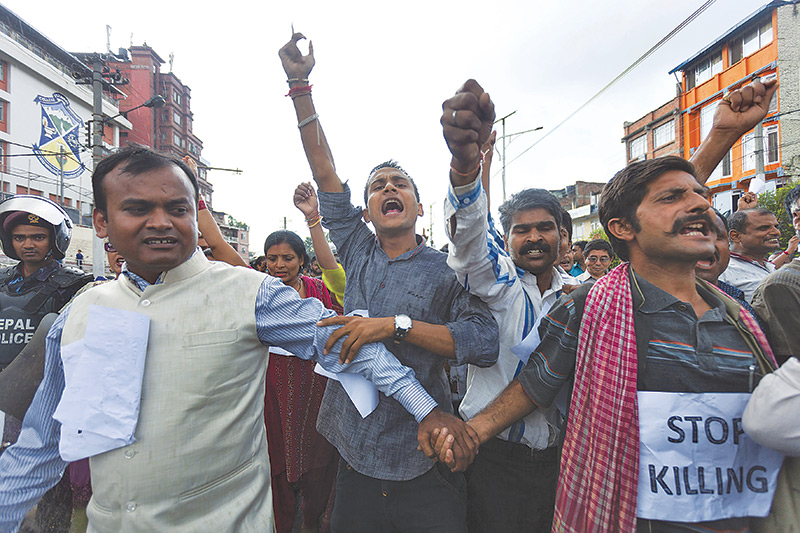
The second general elections, scheduled for November 20 has begun to heat up the Kathmandu air. Sher Bahadur Deuba knows better than everyone else that no Maoist or Marxist vote will come to his candidates. He needs them to keep the communist side divided at the polls. Pushpa Kamal Dahal knows that supporters of the Nepali Congress are extremely unlikely to vote for the Maoists, but he wants to prevent communal Khas-Arya votes from going to the party of the ethnonational supremo Khadga Prasad Sharma Oli. Madhav Kumar Nepal and Upendra Yadav have no other intention of being in the desperate five-party alliance other than remaining in the ruling coalition and maintaining their perks and privileges for the elections. Sharma Oli is anxious, but not fearful of the polls. He already has the entire conservative parties at his mercy. His own ethnonational base remains more or less intact. In addition, he has many fringe parties knocking on his door for moral support. In all this melee of electoral calculation, the melancholia of Mahanth Thakur is most saddening. He spent his entire life in democratic politics, but his parent party—the Nepali Congress—is unwilling to share its base in Madhesh. Yadav comes from a communist background where the formal second-in-command of the party has to agree to be number four in the power hierarchy, leaving all three at the top for the lackeys of the supremo. It’s understandable that he doesn’t want to have a challenger from Madhesh in the same coalition. Supremo Sharma Oli also may not be very enthusiastic about accommodating Thakur because both their political outfits share the same caste-base of Brahman-Baniya in Madhesh. Even if Sharma Oli agrees to admit Thakur in the ethnonational coalition of Khas-Arya supremacists, the electoral loss and gain will probably cancel out each other, leaving the monk of Madhesh in a political limbo. The loneliness of Thakur captures the story of the failed Madhesh Uprising of 2015 like nothing else. Almost all his political companions have made peace with the status quo. The professionals of Madhesh have moved on with the meagre gains of the movement in their pockets. The middle class has lost all hopes of betterment. The masses have to face the consequences of a failed uprising as best as they can. Thakur fights, falls, grovels, compromises, collects his wits, rises up, fights again, falls again, but never loses hope. But can the indefatigable soldier of Madheshi dignity succeed in saving the embers of the failed uprising for another day as the ethnonational regime keeps pouring sand and water upon its ashes? Some questions have no clear answers.
Collective humiliation In the fortnight of forebears called Pitri Paksha, adherents of Hinduism make ritual offerings to all their long-past ancestors. Sometimes a mere Tarpan—offering of water sanctified with the stalk and leaves of the Kush reed—is considered to be enough. The purpose of Pitri Paksha is to show symbolic gratitude towards those who made us what we are. But how does one offer Tarpan to a young boy of 14 who was shot dead by the security forces of the state on the suspicion of being one of the protestors demonstrating against a controversial constitution? It has been seven years since “The 9/11 in Madhesh” and motivators of the Third Madhesh Uprising have failed to find a collective mourner for the victims of the attack upon their life, liberty and dignity. A day after the massacre, this newspaper reported in a matter-of-fact and completely detached manner: “At least five people, including a 14-year-old boy, died and scores others were injured when security forces opened fire at the supporters of Samyukta Loktantrik Madhesi Morcha who were demonstrating against the proposed seven-state federal set-up in several Tarai districts on Friday.” The tone, tenor and intent of the report was indicative of the coverage of police atrocities between August and September 2015 in the mainstream media when Madhesh mourned in grief while the rest of the country celebrated its victory of promulgating a statute of its desire by lighting lamps and igniting firecrackers. The triumph of “Us true Nepalis”, ethnically defined as pure HAMNSA (Hindu, Aryan, Male Nepali Speakers), over “them Madheshi aspiring Nepalis” was thus established through the combined effort of a vengeful state machinery and ethnonational civil society. Most politicos of Samyukta Loktantrik Madhesi Morcha realised that they had been roundly defeated when local elections were announced in 2017 without their consent. Yadav decided to go for whatever was available in the “take it or leave it” offer. Thakur chose to hold on to his position in the fond hope that something would come out of nothing, and constitutional amendments would be made to bring him on board. He had been mistaken before in his assessments; he erred once again and lost considerable political ground. The first general elections after the promulgation of the statute proved that polls seldom resolve fundamental issues of political contestations. Two political parties—Nepali Congress and CPN-UML—that had changed sides between the ruling and opposition benches since the 1990s retained their dominant position. The Maoists managed to be in the third place. The two main Madhesh-based parties trailed in the fourth and fifth places. The hope of addressing Madheshi aspirations through constitutional amendments vaporised with the announcement of the final results. Social scientist Albert O Hirschman argues convincingly that the defeated have to choose between “Exit, Voice and Loyalty”. It has been seven years since 2015 and most Madheshis have chosen the first option. The working class has been voting with their feet for ages, now even middle class Madheshis have joined the exodus. Many exist in the country outside the system. The rewards may be meagre, but loyalty is the easiest way of making a living. Madheshi politicos preparing to participate in the forthcoming polls are doing so out of the compulsion of saving themselves. The voice of Madheshis has become so weak that it’s barely audible anymore. For the media and civil society in Kathmandu, the rules of the game have become unchangeable. Now it’s only the players that interest them.
Chauvinistic society Often it’s deep-seated inferiority and intense anxiety about one’s existence that give rise to chauvinistic and xenophobic attitudes. Harvard anthropologist Stanley J Tambiah described Sinhalese as a “majority with a minority complex’’ way back in the 1980s because as soon as the dominant majority looked up to Tamil Nadu, it trembled in fear of its own minority Tamils. The self-styled “thoroughbred Nepalis” harbour similar dread of Madheshis that look like Indians, talk like Indians, but ask to be treated as bona fide Nepalis. This is the constituency that President Bidya Devi Bhandari has been trying to please by delaying the authentication of the Citizenship Amendment Bill, re-endorsed by Parliament, even at the risk of violating the letter and spirit of the constitution. The imagination of Nepal as a “nation-state” implies that homogeneity continues to be the foundational belief of the new-found Federal Democratic Republic. Modelled after the constitutions of the United States and France, most republican charters claim to be made of, by and for “We the People”. Elections may come, elections may go, but the struggles of Madheshis will have to continue to establish themselves as “the People”.
OPINION
Taking Indra Jatra to the world
The globalisation of the festival is natural since many Newars commemorate it worldwide.
- SANYUKTA SHRESTHA
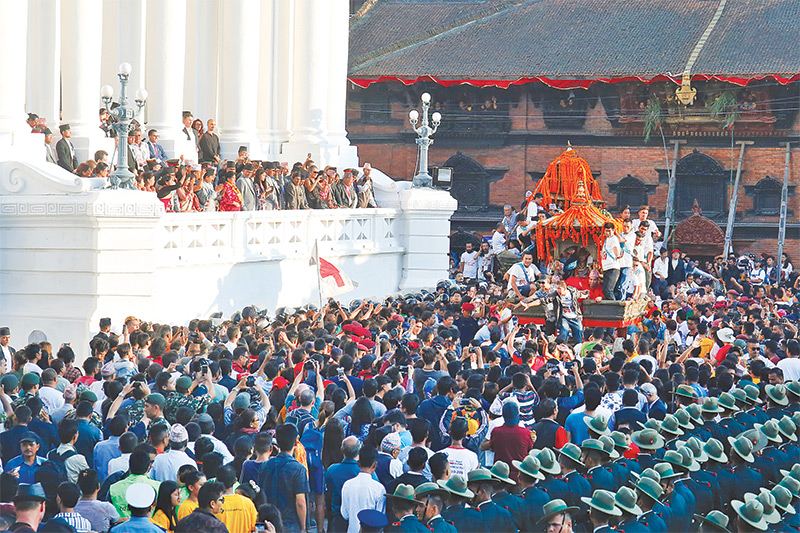
POST FILE PHOTO
Last Wednesday, the office of the Kathmandu Metropolitan City (KMC) made a welcome announcement of a campaign to internationalise the Indra Jatra festival, with invitations sent to 18 of its sister cities worldwide. The metropolitan city is internationalising the festival in economic terms. But in terms of heritage, and as a consequence of internationalisation, it would eventually lead to the globalisation of the festival. The verdict for the globalisation of cultural heritage cannot be universal but on a case-by-case basis; whether it is right or wrong depends on how it is carried out. It is of utmost importance for cultural globalisation to maintain a required level of negotiation with local traditions, indigenous knowledge and natural landscape. When it comes to intangible heritages like the Indra Jatra, it is equally important to consider the cultural landscape constituted by people’s memories, the dynamicity of the built architecture, and the local heritage management practices. In the history of Hindu festivities, erecting a flagstaff dedicated to Lord Indra is a popular practice, documented in epics like the Ramayan and the Mahabharat. It is still carried out by several indigenous communities and cultural hubs in South Asia, like those in India and Tibet. However, Nepal commemorates it with an unmatched spectacle, the backdrop of Kathmandu’s mediaeval royal architecture adding to its grandeur and authenticity. Nepal is often proudly portrayed as the country where Hindu and Buddhist faiths have historically co-existed. This remarkable social fabric is prominent in the Kathmandu Valley, where this aspect of dual religion is deeply rooted in most of its customs, rituals and festivals. While some western researchers like Michael Baltutis from the University of Wisconsin have projected Indra Jatra mostly as a Hindu festival, the fact remains that one of the core entities of the festival—the living Goddess Kumari—is traditionally selected from a Buddhist Shakya family affiliated to a selected list of bihars. Furthermore, the primary worship is also conducted by a Vajrayana priest to date. Regarded as the biggest festival of Kathmandu and locally known as YenYaa, it runs for eight days with dance performances of various Buddhist tantric deities. One of the known challenges of Asian heritage management is the complexity offered by multiple faiths practised by their local communities. They come with well-defined worldviews that mostly do not comply with the Western principles of archaeology and monument-based heritage conservation. The Newar sensibility of heritage is no exception, as it focuses mainly on spiritual rather than material aspects. In the last decade, Neel Kamal Chapagain from Ahmedabad University argued that the Buddhist notion of impermanence, among others, guides the indigenous practice of heritage management in Nepal. Through historical accounts of the evolution of Indra Jatra, renowned French ethnologist Gerard Toffin also noted as early as 1992 that this 10th-century festival from the Lichhavi period got integrated with newer segments like Kumari Jatra and Shvet Bhairav only during the Malla and Shah periods, respectively. Whether showcasing Indra Jatra as a tourism package will add the risks of freezing the managerial and creative flexibilities of the local communities is a question worth considering. A good plan for globalising ancient cultures like that of Indra Jatra should be free from the risks of museumification and commodification of living cultures. According to the Jatra management team, the audience is proportionately growing with the increasing population of the city. While it is essential to document the local management practices and their challenges, some research on easy scalability and even modelling a crowd simulation can be helpful as a preparation for the anticipated tourism gain. Besides concerns related to rapid economic progress, Getty Conservation Institute emphasised recognising the living nature of Asian heritage in 1995. Later, in 2003, Article 1 of the UNESCO Convention defined intangible cultural heritage also as “practices” and “representations” that “provide the communities with a sense of identity and continuity”. Many facets of the Indra Jatra, including the practice of enshrining a living Goddess Kumari, have great potential to be listed as the next UNESCO-recognised intangible cultural heritage, eventually strengthening the globalisation agenda. Globalisation is a straightforward means for the economic sustainability of Nepal’s heritage management, but there are ample instances of such projects going counterproductive to the core agenda of conservation. Although UNESCO has started recognising the nuances of Asian heritage management in the last two decades, countries like Thailand and Japan were the world leaders in formulating their heritage governing policies leading to the Thai Charter and Nara Document of Authenticity, respectively, which preceded the response to intangible cultures from the West. Nepal is rich in indigenous knowledge and community festivals, but it has failed to recognise its heritage management traditions, which in turn has the potential to influence the modern heritage discourse. Inadequate documentation and failure to build a robust research community have been a letdown. Nepal should overcome this lacklustre stage with an aim for simultaneous particularisation and universalisation, as did Japan with dochakuka in the late 1980s, later theorised in 1992 as glocalisation by the late Roland Robertson from Aberdeen University. An essential aspect of Indra Jatra is its strong affiliation with state power. Even after the abolishment of the monarchy, presidents of the Republic of Nepal have maintained their official visits to the festival. While republican principles contest this patronage, there is relatively lesser political clarity among the majority of the Nepalese population taking pride in State sanctioning. This is also comparable to how Denis Byrne from Western Sydney University noted in 2014 that the Taiwanese people consider the state recognition of some Mazu temples as an acknowledgement of the goddess’s divine status and power. It proves the popularity of this pattern among the believers of what he terms a popular religion. Given that this social pattern is a potential attraction for globalisation prospects, it is likely to continue even without any direct political appropriation. Sikkim, where Indra Jatra was first observed outside Nepal in 2000, welcomed its governor, Ganga Prasad Chaurasia, as the year’s chief guest. Besides KMC’s noble attempt this year, the globalisation of Indra Jatra is a natural phenomenon since many Newar communities commemorate it globally. While the earliest commemoration beyond South Asia occurred in the USA in 2011, Canada, Australia and the UK are some other countries where it has been observed. It can be interesting to project a global map of Indra Jatra that locates active regions, documents adaptations and celebrates globalisation.
Shrestha is a researcher of Nepali cultural history based out of London, UK, and the president of the World Newah Organisation.
MONEY
Indian states step up relief measures for households battling inflation
- REUTERS
NEW DELHI/KOCHI, At least 10 Indian states have announced over 1 trillion rupees ($12.6 billion), mainly in cash transfers and electricity subsidies, for households to combat inflation, according to government officials. Local politicians are worried about the impact of sharp increase in prices on household essentials. For example, food inflation, which accounts for nearly 40 percent of the CPI basket, rose 7.62 percent year on year in August compared to a revised 6.69 percent in July, the National Statistics Office said on Monday. The Southern Indian State of Kerala distributed a package of free food items costing about 450 rupees ($5.70) each to over 8 million families during the Onam festival earlier this month. Also a 1,000 rupee additional rural job guarantee programme for over 500,000 workers was announced. In the northern state of Punjab and national capital Delhi, the ruling Aam Aadmi Party recently announced 300 kilowatt hours of free electricity per household and free travel for women on state buses, while promising such measures in other states if it comes to power in state elections later this year. Last week, in the state of Rajasthan, ruled by the Congress party, the state government announced a jobs guarantee programme for urban poor as part of its relief measures for households. Also, “The state government has announced free electricity supply of 50 units every month to all households,” Ashok Gehlot, the state chief minister, said on Saturday, citing increasing economic stress due to rising prices. Many other states, including Uttar Pradesh ruled by Prime Minister Narendra Modi’s Bharatiya Janata Party, have also cut electricity tariffs and announced cash transfers for poor households. A study by the research department of the Reserve Bank of India (RBI) in June estimated that nine states in their annual budget this year said that 0.1 percent to 2.7 percent of state gross domestic product went to free items and services for citizens. The study warned that fiscal conditions of some debt-ridden states could deteriorate in coming years due to increased spending on subsidies. Opposition leaders said that despite an increase in interest rates by the central bank and fuel tax cuts by the federal government earlier this year, nearly half of the country’s 1.4 billion population are facing a surge in living costs amid little growth in income. “We have cut down the use of cooking gas and vegetables due to rising prices,” said Jessy George, 40, a housewife in the Kottayam district of Kerala. Cooking gas prices have more than doubled in the last two years, while transport costs rose more than 40 percent, but she said that her husband’s income has remained the same. Gireesh Kumar, 38, a mason with a wife and two school-age children, said he had to borrow 10,000 rupees this month as he failed to save sufficiently due to rising prices. “I am planning to shift my children from private school to government school as I will not be able to afford the fees,” he said. Annual consumer inflation rose to 7 percent in August, remaining above the tolerance band of the Reserve Bank of India’s 2 percent-6 percent for a ninth straight month, and is projected to remain above 6 percent until March 2023. Indian opposition political parties launched a five-month 3,570 kilometre cross-country protest march on foot earlier this month to mobilise people to seek more relief. “Common people need urgent relief. It is essential for every government to help them,” said Prasanna Acharya, a leader of Biju Janata Dal, ruling the state of Odisha.
MONEY
Ncell’s Dashain recharge bonus
Briefing
KATHMANDU: Ncell Axiata Limited on Tuesday launched a recharge bonus offer on the occasion of the upcoming Dashain festival. Customers recharging Rs100 or more on a daily basis can enjoy a bonus of up to Rs40, the company said in a statement. “In this scheme, customers topping up Rs100 will get a Rs10 bonus balance valid for a day,” reads the statement. “The recharge amount can be of any denomination and customers get a bonus every day on the basis of the recharge amount.” If the accumulated amount reaches Rs150 on the same day or customers recharge Rs150, they get a total of Rs20 as bonus with a three-day validity. Similarly, in case of customers topping up their main balance with Rs200 or the accumulated recharge amount reaching Rs200 or more, they receive a Rs40 bonus having seven days of validity. Recharge performed via any medium is eligible for receiving the bonus balance.
MONEY
Germany drawing up new China trade policy
Briefing
BERLIN: Germany’s economy minister said on Tuesday the government was working on a new trade policy with China to reduce dependence on Chinese raw materials, batteries and semiconductors, promising “no more naivety” in trade dealings with Beijing. Sources told Reuters last week the economy ministry was considering a raft of new measures to make business with China less attractive. This is the first time the minister has made clear the tougher line was being translated into policy measures. (Reuters)
MONEY
Thailand approves more energy support, wage hikes
Briefing
BANGKOK: Thailand’s cabinet on Tuesday agreed to extend a diesel tax cut and energy subsidies, as well as a minimum wage increase, to help mitigate the impact of high energy prices and living costs with inflation hitting a 14-year high, the government said. The tax cut on diesel by 5 baht ($0.1379) per litre will be extended for two months to November 20, government spokesman Anucha Burapachaisri told a briefing. The power subsidy worth 9.1 billion baht ($250.90 million)will be offered until the end of 2022, he said, adding a 300 million baht cooking gas subsidy would be offered between October and December. The government also approved an increase in minimum wages from October 1, he told a briefing. The wage hike, by 5 percent on average, was the first in more than two years. (Reuters)
WORLD
World in ‘wrong direction’ as climate impacts worsen: UN
Says current worldwide climate policies put Earth on course to warm 2.8C by 2100.
- AGENCE FRANCE-PRESSE
PARIS, Humanity is “going in the wrong direction” on climate change due to its addiction to fossil fuels, the UN said on Tuesday in an assessment showing that planet-warming emissions are higher than before the pandemic. The UN’s World Meteorological Organization and its Environment Programme warned catastrophes will become commonplace should the world economy fail to decarbonise in line with what science says is needed to prevent the worst impacts of global heating. They pointed to Pakistan’s monumental floods and China’s crop-withering heatwave this year as examples of what to expect. “Floods, droughts, heatwaves, extreme storms and wildfires are going from bad to worse, breaking records with alarming frequency,” said UN Secretary-General Antonio Guterres. The UN warned last month that the drought gripping the Horn of Africa and threatening millions with acute food shortages was now likely to extend into a fifth year. “There is nothing natural about the new scale of these disasters. They are the price of humanity’s fossil fuel addiction,” said Guterres. The UN’s United in Science report underscores how, nearly three years since Covid-19 handed governments a unique opportunity to reassess how to power their economies, countries are ploughing ahead with pollution as normal. It found that after an unprecedented 5.4 percent fall in emissions in 2020 due to lockdowns and travel restrictions, preliminary data from January-May this year shows global CO2 emissions are 1.2 percent higher than before Covid-19. This is largely down to large year-on-year increases in the United States, India, and most European countries, the assessment found. “The science is unequivocal: we are going in the wrong direction,” said WMO Secretary-General Petteri Taalas. “Greenhouse gas concentrations are continuing to rise, reaching new record highs. Fossil fuel emission rates are now above pre-pandemic levels. The past seven years were the warmest on record.” Last week the European Union’s Copernicus climate monitor said that summer 2022 was the hottest in Europe and one of the hottest globally since records began in the 1970s. Tuesday’s report said there was a 93 percent chance that the record for the hottest year globally—currently, 2016—will be broken within five years. It warned the continued use of fossil fuels meant the chance of the annual mean global temperature temporarily exceeding 1.5 degrees Celsius above pre-industrial levels in one of the next five years was roughly even (48 percent). Keeping longer term temperatures below 1.5C is the most ambitious goal of the 2015 Paris Agreement. Despite more than three decades of UN-lead negotiations, rich polluters show little sign of being willing to make the kind of swingeing emissions cuts that would keep the 1.5C goal in play. The UN’s Environment Programme, in an update to its annual “emissions gap” assessment following new pledges made at last November’s COP26 summit in Glasgow, said Tuesday that even these promises were far from adequate. In fact, it said the ambition even in countries’ most recent pledges would need to be four times greater to limit warming to 2C, and seven times higher to make 1.5C. All told, current worldwide climate policies put Earth on course to warm 2.8C by 2100, UNEP said.
WORLD
50 Armenian soldiers killed in fierce clashes with Azerbaijan
- AGENCE FRANCE-PRESSE
YEREVAN, Armenia said on Tuesday that nearly 50 of its soldiers had been killed in the worst clashes with Azerbaijan since their war two years ago, but Russia said it had convinced the historic rivals to agree to a rapid ceasefire. After several hours of fierce border fighting overnight, Armenia appealed to world leaders for help, saying Azerbaijani forces were trying to advance on its territory. The fighting was the worst since the end of a 2020 war between the ex-Soviet republics over the contested Nagorno-Karabakh region that left more than 6,500 killed on both sides. It came with Yerevan’s closest ally Moscow—which deployed thousands of peacekeepers in the region after the war—distracted by its six-month invasion of Ukraine. Russia said it had succeeded in bringing the clashes to a halt, with the foreign ministry in Moscow saying a ceasefire had been agreed from 9:00 am Moscow time (0600 GMT). “We expect that an agreement reached as a result of Russian mediation on a ceasefire... will be carried out in full,” the ministry said in a statement, adding that it was “extremely concerned” by the uptick in fighting. Armenia’s defence ministry said later that clashes had subsided but that the situation on the border “remains extremely tense”. Armenian Prime Minister Nikol Pashinyan addressed parliament on Tuesday morning, after calling French President Emmanuel Macron, Russian President Vladimir Putin and US Secretary of State Antony Blinken to demand “an adequate reaction” to “Azerbaijan’s aggressive acts”. “For the moment, we have 49 [troops] killed and unfortunately it’s not the final figure,” Pashinyan told lawmakers.
WORLD
Angry over past, India indifferent to UK queen’s death
- ASSOCIATED PRESS
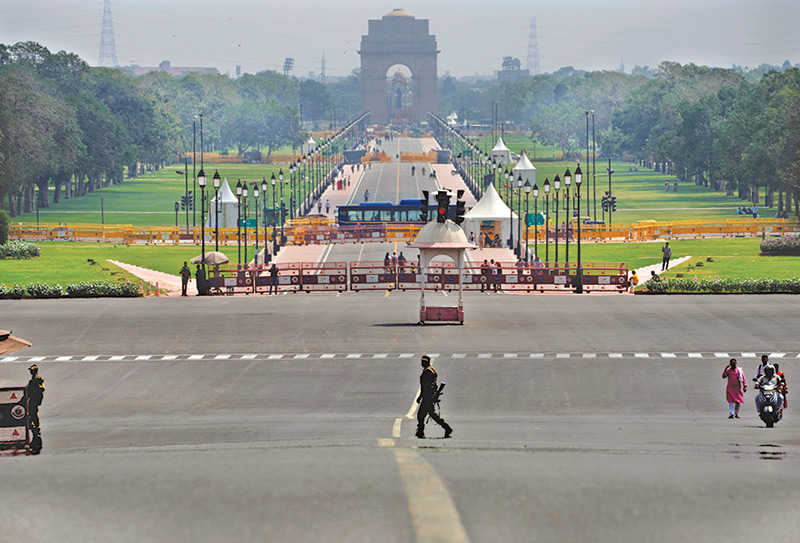
A paramilitary force soldier walks across Rajpath that was renamed Kartavya Path in New Delhi, on Sunday. Ap/Rss
NEW DELHI, Just hours before news of Queen Elizabeth II’s death spread, Prime Minister Narendra Modi delivered a fiery speech urging India to shed its colonial ties in a ceremony to rename a boulevard that once honoured King George V. Rajpath, formerly called Kingsway, was a “symbol of slavery” under the British Raj, he said. Instead, under the newly named Kartavya Path that leads to the iconic India Gate, “a new history has been created,” Modi beamed. His speech last Thursday was the latest in a concerted drive to purge India of its colonial relics. It was also a clear sign that the country, once the largest of Britain’s colonies that endured two centuries of imperial rule, has moved on. The renovated avenue now boasts a black granite statue of Indian freedom fighter Subhas Chandra Bose, in the place where a mould of King George V, Elizabeth’s grandfather, once stood. The queen’s death provoked sympathies to a deeply respected figure from some while for a few others, it jogged memories of a bloody history under the British crown. But among most regular Indians, the news was met with an indifferent shrug. The British monarchy “holds precisely zero relevance to Indians today — they are of no importance,” said Kapil Komireddi, author of “Malevolent Republic: A Short History of the New India.” British rule shaped the country in significant ways, but India has since overtaken the British economy in size. “The country has come into its own ... As a rising power, India can gain a lot from the UK but the UK can gain a whole lot more from India,” Komireddi added. On Thursday, Modi penned a heartfelt note, calling the queen “a stalwart of our times,” while the government declared a day of mourning. But for most Indians born a generation after independence from the British in 1947, there is little attachment to the queen or the royal family. Sankul Sonawane, 20, was at home when he heard the news, which had “no impact” on him. “We have no sense of emotional connection with the queen. She was a monarch and I don’t believe in the idea of a monarchy.” Dhiren Singh, a 57-year-old entrepreneur in New Delhi, felt the same way. “I do not think we have any place for kings and queens in today’s world, because we are the world’s largest democratic country,” he said. Elizabeth visited India three times during her reign and was the first monarch to tour the newly freed country, cementing the start of fresh ties with Britain. After her coronation in 1953, she arrived in the capital New Delhi in 1961, where she addressed a massive crowd and nearly a million people lined up along streets to catch a glimpse of her and her husband, Prince Philip. Darshan Paul was 10 or 11 years old when she stood along a road in New Delhi and waved an Indian flag at the queen. “I remember her gloved hand waving back at me and was so impressed,” Paul, now 71, said. There was abundant excitement and curiosity around her visit, Paul recalled, as she and her friends poured over newspaper photos of the queen and were dazzled by the gowns she wore. But it was a different time then, Paul said, as she acknowledged that the traditional bond some Indians once held with the royal family has morphed dramatically since. “To young Indians today, they seem like any other high-profile celebrity family—you might follow news of them because you want to know what is happening behind closed doors. But beyond the glamour and celebrity allure, they don’t hold any significance any more.” If her son, who was formally proclaimed King Charles III over the weekend, were to make an official visit to India, “it will certainly not matter as much,” Paul added. The queen’s last visit in 1997 was tinged with controversy when she travelled to a memorial dedicated to hundreds of unarmed Indians who were killed by British colonial forces in 1919, amid calls for an apology over the Jallianwala Bagh massacre.
WORLD
Russia announces ‘massive strikes’
- AGENCE FRANCE-PRESSE
KRAMATORSK, Ukraine, Russia said on Tuesday it was carrying out “massive strikes” across the Ukrainian front line and accused Ukrainian soldiers of abusing civilians in territories recaptured in a dramatic counter-offensive. Moscow’s retaliation came after it was forced to pull back its troops from swathes of the northeast, particularly in the Kharkiv region, following Kyiv’s lightning assault to wrest back terrain. The territorial shifts marked one of Russia’s biggest setbacks since its troops were repelled from Kyiv in the earliest days of the nearly seven-month war, yet Moscow signalled it was no closer to agreeing to a negotiated peace. “Air, rocket and artillery forces are carrying out massive strikes on units of the Ukrainian armed forces in all operational directions,” the Russian defence ministry said in its daily briefing on the conflict. “High-precision” strikes have also been launched on Ukrainian positions around Sloviansk and Konstantinovka in the eastern Donetsk region, it added. The Kremlin accused Kyiv’s army of abusing civilians in territory it had recaptured. President Vladimir Putin’s spokesman said that in the Kharkiv region, reports were emerging of “outrageous” treatment of civilians. “There are a lot of punitive measures... people are being tortured, people are being mistreated and so on,” Dmitry Peskov told journalists.
SPORTS
Bangladesh inflict first SAFF defeat on India
Choton’s side outplay the champions of all previous five editions to pull off a 3-0 victory and finish on top of Group ‘A’.
- Sports Bureau
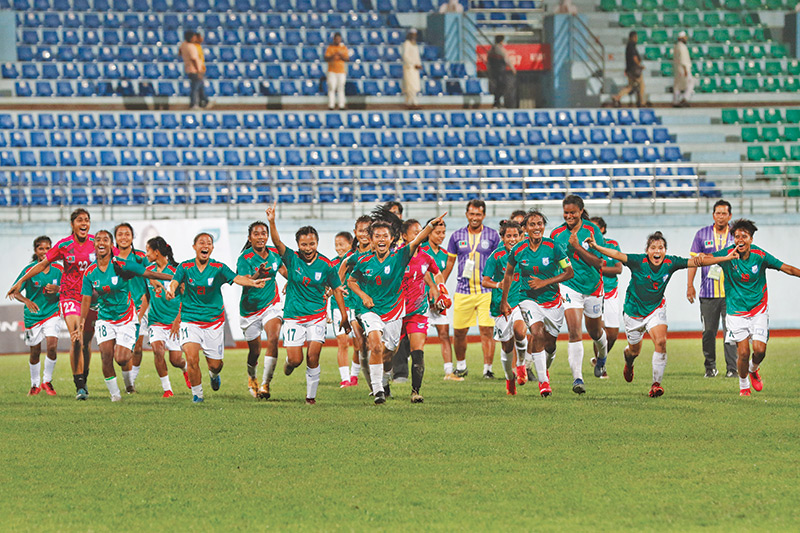
Players of Bangladesh celebrate after defeating India 3-0 in their SAFF Women’s Championship 2022 Group ‘A’ football match at the Dasharath Stadium in Tripureshwar, Kathmandu on Tuesday. The outcome snapped India’s 29-match unbeaten streak in the biennial competition. Post Photo: Keshav Thapa
KATHMANDU, Bangladesh edged India 3-0 to inflict on the champions their first ever defeat at the SAFF Women’s Championship and wrap up the group stage on top at the Dasharath Stadium in Tripureshwar on Tuesday. MS Jahan Shopna struck in either halves before Srimoti Sarkar added second goal for Bangladesh who also registered their first win over India in six matches of SAFF and overall 10 encounters. Their best outcome against India was a 0-0 draw during the group stage of the 2016 Championship. The outcome also snapped India’s unbeaten run after 29 matches at women’s SAFF. India are also the winners of all five previous editions of the tournaments. Following the victory, Bangladesh finished with maximum nine points in Group ‘A’ winning all three matches while India wrapped up the group stage as runners up with six points. Already assured of semi-final spots before coming into the game, the group topper Bangladesh will meet Bhutan and India will vie against hosts Nepal for place in the final on Friday. Bangladesh looked like a deserving winner from the onset and piled pressure on the South Asian giants until the final whistle. They came up with well-coordinated passes and outplayed India in all departments. “I want to congratulate Bangladesh. They played a very good game and were full of energy. They had the hunger to win,” India coach Suren Kumar Chhetri said after the match. He also ruled out it was a bad day for India. “We played very badly but we are still in the race. There are lots of areas we need to improve.” Bangladesh, who have been playing with almost the same team for almost half-decade, opened the scoring in the 12th minute through Shopna after she found a through pass from Sarkar in the area and beat goalie Aditi Chauhan with a low strike. India tried to reply in the 17th through Priyangka Devi Naorem but the midfielder’s strike from the left side of the area was grabbed by goalie Rupna Chakma without any difficulty. Bangladesh doubled the tally in the 22nd through Sarkar who applied a quick low ball strike from close range after being fed by Shopna. Shopna then made it 3-0 eight minutes into the second half after the forward collected a through pass from captain Sabina Khatun and guided the ball at the back of the net with a sliding strike. Bangladesh coach Golam Robbani Choton was full of praise for his players following the win. “Salute to our girls. They really worked hard for this day for the past four-five years and they created a history,” said Choton, who has been in charge of the women’s team for more than a decade. “Bangladesh football is gradually improving and every individual of the team has worked together for a long time.” He also said that he was confident of the team’s performance. “They played very well in the last two matches against Pakistan and Maldives,” Choton said. “I wanted them to maintain the same level of performance and avoid a strong opponent in the semi-final.”
Pakistan sign off with thumping win Pakistan women’s team, who are making comeback to international football after eight years, signed off with victory, registering a thumping 7-0 win over Maldives in the early kickoff at Dasharath Stadium. Nadia Khan struck four goals for Pakistan in the dead rubber match as both the sides were already out of the race following defeats against India and Bangladesh in the four team team group. Pakistan went into the break with a 1-0 lead after Rameen Fareed’s opener. Khadija Kazmi and Anmool Hira were also on the scoresheet for Pakistan. Not only was it the first victory for Pakistan at the dead rubber affair, but they also registered their biggest ever win at international football. Their previous highest score win came against Bhutan during group stage of 2014 SAFF when they pulled off a 4-1 win in the group stage. Prior to that, Pakistan had defeated Maldives and Afghanistan with identical 3-0 scores in the 2010 and 2012 editions, respectively. Pakistan coach Adeell Mirza Rizki said that it was not an easy task to beat Maldives despite a big margin outcome. “It was not easy to do what we did today. We wanted to play a good brand of football and attacking game,” said Rizki. “We have our plans for the future and the team will continue to play and we want to play more opposition.” Pakistan had lost 3-0 to India and 6-0 to Bangladesh in their last two matches. “Every opponent is different and we faced strong opponents in the last two matches,” Rizki said. “But we want to make a new start from this point.” Khan, who struck four goals, said that she was proud of the win. “I feel very much proud and excited,” she said. “We played united as a team and I hope we can do better in the future.”
SPORTS
Bhari five-for gives Army second straight victory
The departmental team demolish Lumbini by nine wickets.
- Sports Bureau
KATHMANDU, Off-spinner Sushan Bhari’s five-wicket haul guided Tribhuvan Army Club to a nine-wicket win over Lumbini in men’s T20 cricket at the Ninth National Games on Tuesday. Sent to field first after losing the toss, Army restricted Lumbini to 85-9 in the stipulated 19 overs thanks to Bhari’s match figures of 5-13 that also included a hat-trick. Hari Chauhan grabbed two wickets to polish Army’s destructive bowling. Lumbini gambled at the TU Cricket Ground electing to bat but they found themselves in trouble early after Sompal Kami and Bhari removed openers Prajjwol Thapa for 3 and Dev Khanal for 13. Bhari then combined with Chauhan, who took two wickets, to flatten Lumbini’s batting order. Sandeep Rijali hit two fours and one six in his 16-ball 15 knock but Chauhan cut short his stay after having him caught by Bhim Sharki in the seventh over. Chauhan also sent back Saurav Khanal for nought. Lumbini’s top scorer captain Krishna KC fought hard with unbeaten 28 to push the score to a respectable total. But merciless Bhari hit back with a hat-trick removing Basir Ahamad (13), Tul Bahadur Thapa and Dhan Shahi in the first three balls of the 15th over. Anil Kharel was the last casualty, caught behind off Aakash Chand. Chauhan also shone with the bat in the run chase, scoring a quick-fire 35 off 20 balls that included four fours and two sixes, and put on a 47-run stand for the first wicket with Arjun Saud who chipped in not out 28. Sharki contributed 18 runs facing 14 deliveries as Army comfortably reached the target in 10.3 overs. The win sends Army level with Nepal Police Club on six points at top of group ‘A’. The departmental rivals meet each other in Kirtipur on Wednesday in a match that could decide the group winner. Earlier at the same venue, Karnali Province defeated Madhesh Province in a low-scoring thriller to pull off their first win of the tournament. Despite Mohammad Aadil Alam taking five wickets and opener Harishankhar Shah smashing 48, Madhes fell flat against the Karnali resistance. Sent to bat first after losing the toss, Karnali were skittled out for just 114 after medium pacer Adil Alam’s lethal bowling troubled Karnali from the start. Adil Alam took the scalp of opener Nischal Rawal (4) to cause early damage. The 18-year-old bowler also took three wickets in the 16th over removing Suwash Ayer (5), Prakash Jaishi (19) and Diwan Pun (0) in the second, fifth and sixth deliveries, respectively. Madhesh’s only standout batter Shah also pocketed two wickets to restrict Karnali to a low total. Shah stood his ground cracking three fours and one six in his 42-ball 48 knock in the run chase but other batters failed to offer support to Shah as Madhesh could only manage 111-9 and succumbed to a second straight loss. Dinesh Adhikari returned the match figures of 3-16 while Diwan Pun and Rabindra Shahi picked two wickets each.
APF, Bagmati bow out without playing a match APF Club and Bagmati Province bow out of semi-finals contention without playing a match after all four of their fixtures were abandoned due to rain. APF were scheduled to play Sudurpaschim Province at Mulpani Cricket Ground on Tuesday but the match was called off due to rain. The game between Nepal Police Club and Gandaki Province, also scheduled at Mulpani, was also cancelled. All 11 matches of the men’s T20 cricket scheduled at Mulpani have so far failed to yield results. The National Sports Council (NSC) had held a meeting with the participating teams, their coach and captain on Tuesday evening to discuss the rain-affected tournament and explore the possibilities of rescheduling the cancelled fixtures. However, after Army’s opinion contradicted with other nine teams who had agreed to date adjustment, the NSC decided to continue the game as per the schedule and the Cricket Association of Nepal (CAN) and International Cricket Council (ICC) regulation. NRNA Sports Academy did not participate in the meeting. It means, NRNA, who have five points, and Sudurpaschim, who have four points but are second in the five-team group ‘B’ due to superior run rate over APF and Bagmati, have qualified for the semi-finals. Province 1, who have three points, have also exited the tournament.
MEDLEY
Horoscope
ARIES (March 21-April 19) **** Today’s skies give you permission to indulge in a bit of luxury as long as it doesn’t sabotage your long-term plans. Consider what you’d like your financial future to look like, as the stars align to help you achieve success.
TAURUS (April 20-May 20) *** You’ll awaken with an optimistic feeling about what the future holds today. However, this planetary disposition will require that you work for any goals you may have set recently, though it’s okay to move at a steady pace.
GEMINI (May 21-June 21) **** Mistakes from the past could bring disruption to your psyche this morning. Luckily, you’ll also have an opportunity to find closure within these circumstances, as long as you forgive yourself and make the decision to let go.
CANCER (June 22-July 22) *** Look for opportunities to grow your network of contacts today. The relationships you invest in now will remain a constant in your future. However, you’ll want to stay on guard for anyone who might try to hold you back.
LEO (July 23-August 22) *** Doors could begin to open within your professional life today. Don’t be afraid to step into your power and assert your authority. However, you’ll need to make sure that you’re not taking on more than you can chew today.
VIRGO (August 23-September 22) **** Today’s planetary disposition can provide guidance for the future from beyond the veil. Blessings may strike in unusual ways later in the afternoon. Unfortunately, the energy today may threaten to put you in a sour mood.
LIBRA (September 23-October 22) *** You’ll feel ready to step into the responsibilities that are required of you in order to move ahead. This day will encourage you to take destiny into your own hands, though you shouldn’t feel rushed to produce results.
SCORPIO (October 23-November 21) *** Your thoughts will be filled with romance and fantasies of what the future may have in store. While this planetary disposition can help you make headway within your love life, try to keep your eyes peeled for red flags today.
SAGITTARIUS (November 22-December 21) *** The universe will ask you to take an organized approach to the future this morning. Use this cosmic climate as an opportunity to think your plans through, outlining the steps you need to take in order to actualize these goals.
CAPRICORN (December 22-January 19) **** Today’s skies will allow you to feel supported within your personal ambitions, making it a good time to advocate for your dreams. Do your best to go with the flow, and avoid indulging in retail therapy if you begin to feel emotional.
AQUARIUS (January 20-February 18) *** Take a moment to invest in your emotional health this morning. This cosmic climate will accentuate the value of self-care, making it a good time to support your heart through soft stretches, sunrise meditations, or positive mantras.
PISCES (February 19-March 20) *** This cosmic climate will require you to use your voice, making it important that you speak up for your dreams. Watch out for rocky waters, threatening to curse you with mental blocks or stir up insecurities and fear.
CULTURE & LIFESTYLE
‘Succession,’ ‘Ted Lasso’ repeat as winners of top Emmy awards
‘Succession’ wins the best drama series, while ‘Ted Lasso’, claims best comedy for the second straight year.
- Lisa Richwine,Danielle Broadway
Jason Sudeikis accepts the award for Outstanding Comedy Series for ‘Ted Lasso’ at the 74th Primetime Emmy Awards in Los Angeles, on Monday. REUTERS
LOS ANGELES Media dynasty drama “Succession” and feel-good comedy “Ted Lasso” took the top trophies at the Emmy awards on Monday, and a “Squid Game” actor landed a major acting prize as Hollywood handed out the highest honours in television. “Succession” was named best drama series, an award the HBO show had won in 2020. The show, which secured four trophies overall, tells the story of the wealthy and back-stabbing Roy family as members jockey for power.Apple TV+ series “Ted Lasso” also was a repeat winner, claiming best comedy for the second straight year for its tale of an American football coach leading a British soccer team. Its stars Jason Sudeikis and Brett Goldstein were second-time winners of best comedy actor and supporting actor. Likewise, voters honoured “Euphoria” star Zendaya as best drama actress and Jean Smart of “Hacks” as best comedy actress. It was the second win for each of those categories. One newcomer to break through was Lee Jung-Jae, who was named best drama actor for his role in South Korean thriller “Squid Game.” The dystopian story about cash-strapped contestants risking their lives for wealth became a global sensation after its release on Netflix a year ago. The actor thanked the team behind “Squid Game” for “making realistic problems we all have to face come to life so creatively on the screen.” The most-lauded show of the night was HBO’s “The White Lotus.” It won 10 awards including best limited series and acting trophies for Jennifer Coolidge and Murray Bartlett. Those wins helped HBO and streaming service HBO Max lead all other networks with 38 honours overall. Host and “Saturday Night Live” star Kenan Thompson kept a celebratory tone throughout the show, saying it was a time to appreciate one of the world’s favourite pastimes.“What would we do without television, read books?” he joked. Winners largely steered clear of politics or world events. One exception was “Succession” creator Jesse Armstrong, who joked that it was a big week for “successions,” referring to King Charles taking over the British throne following the death of his mother, Queen Elizabeth. Singer Lizzo earned an Emmy award for competition series for “Watch Out for the Big Grrrls.” The musician said that as a little girl she had always wanted television to feature “someone fat like me, black like me, beautiful like me.” “I’m going to go back and tell a little Lizzo something ... you’re going to be that person,” she said. Among other winners, Michael Keaton was named lead actor in limited series for playing a small-town doctor who becomes addicted to painkillers in “Dopesick.”
– Reuters
CULTURE & LIFESTYLE
‘Museums reflect who we are as communities and countries’
Naman P Ahuja, the chief curator of Lumbini Museum, on what curating means to him, his vision for the museum, and the challenges of curating in a region as diverse as South Asia.
Naman P Ahuja is also a professor of South Asian Art History and Dean ofthe School of Arts & Aesthetics at Jawaharlal Nehru University, India. Post Photo : Keshav Thapa
A week ago, Lumbini Museum shared its plan to open its doors to a global audience in 2024. As the name suggests, the museum is located in Lumbini, the birthplace of Buddha. Work for the current incarnation of Lumbini Museum began in 2018, and once completed, it aims to become a ‘state-of-the-art museum’. And heading the project is a diverse team of people. Sumnima Udas is the museum’s executive director; Naman P Ahuja, a professor of South Asian Art History and the Dean of the School of Arts & Aesthetics at Jawaharlal Nehru University, India, is the chief curator; and Bijoy Jain, the internationally-acclaimed architect, and Norman R Foster, a visiting professor at Yale University, are the chief architects.
Why Lumbini? For years, people have touted Lumbini’s potential to become a major tourist destination in Nepal. And given Lumbini’s cultural significance, it gets an average of 1.5 million visitors annually, but government records have repeatedly shown that the vast majority of these visitors spend only a few hours in the town. And this fact is intertwined with the idea behind Lumbini Museum, which aims to improve the experience of visiting Lumbini and inspire people to explore the many historically important and lesser-known Buddhist sacred sites in and around Lumbini, including Kapilavastu, and better understand the communities living in the Tarai region. The Post’s Pinki Sris Rana sat with the museum’s chief curator, Naman P Ahuja, to talk about his curation, the state of museums and art galleries in South Asia, and most importantly, his vision for Lumbini Museum.
The interview has been edited and condensed for clarity.
How would you define the role of a curator, and what do you think are the qualities a curator must possess? The word curator comes from the Latin word ‘cūrāre’, which means someone who takes care of. So, a curator is someone who takes care of something, but their job isn’t just limited to that. A curator has to have the capacity to reach out to diverse audiences while crafting a narrative that makes the audiences feel represented. As a curator, one must not only respect the art one is working with but also be respectful in understanding what society needs to see and cater accordingly. I think a curator must have four qualities: first, crafting a narrative that shapes the opinions of people; second, designing and displaying and doing them as aesthetically as possible; third, taking care of the objects as a keeper and conserving it for years to come; and fourth, predicting the value of artefacts for the future generations.
As someone who has studied art history, you have said that it is important for a curator to focus on history and make it relevant in contemporary times. Why do you think so? History helps us understand who we are. I believe it’s almost impossible to imagine creating an identity without being aware of our background. As a curator, one’s responsibility is not just to conserve a 200-year-old artefact but also to provide the space so that the contemporary community can interpret the artwork in their own way. When choosing artworks, a curator needs to predict what could be required in the future and curate with a long-term vision. That is why I believe history will always be relevant in contemporary times, perhaps not in the exact same way with the same interpretation, but the relevancy will always be there.
What do you think about the current scenario of museums and exhibitions in South Asia? You also talk about paradigm shifts curators should be aware of. What are the shifts that are taking place globally, and where does South Asia stand? South Asia’s museum sector had remained stagnant for several decades, and it was only in the last five to 10 years that the region’s museum scene started seeing a shift. I think the popularity of social media played a huge role in that. Social media made us understand the importance of visual communication, and museums are great places to visually communicate to the world who we are as communities and countries. In the past one decade, we have also become aware that so many of the stolen artefacts from South Asian countries are displayed in many Western museums and how they have taken such good care of our artefacts. When we started asking for our stolen artefacts, we realised that our museums need to level up to be able to take care of the returned artefacts. So, the change is definitely happening.
South Asia has a diverse demographic that is culturally rich. How challenging is it for a curator to work in such a diverse region? Yes, curating in a region as diverse as South Asia is challenging. We have multi-ethnic and multi-religious communities, and curators must make it their priority to ensure that their works make the diverse communities feel represented. When you talk about Nepal, the country has 123 ethnic languages, right? Suppose a curator is doing a linguistic exhibition in the country. In that case, it becomes the person’s curatorial responsibility to develop a narrative that represents the whole linguistic diaspora in Nepal while making each ethnic community belong to the museum.
What will be your focus as a chief curator of Lumbini Museum? Since the museum is located at the birthplace of Buddha, it will most definitely exhibit ancient Buddhism and its relevance in contemporary times. But it is our priority to focus equally on the region’s history, the land of Tarai, the fragile and important ecosystem, the cultural geography, and the people. With the help of community-based communication, Lumbini Museum will be a public museum in its truest sense.
CULTURE & LIFESTYLE
Human skin stood up better to the sun before there were sunscreens
There is no preserved skin from thousands of years ago for scientists to study, but we can infer from the effects of sun exposure on modern people that the damage was similar.
- Nina G. Jablonski
Shutterstock
Penn State University Human beings have a conflicted relationship with the sun. People love sunshine, but then get hot. Sweat gets in your eyes. Then there are all the protective rituals: the sunscreen, the hats, the sunglasses. If you stay out too long or haven’t taken sufficient precautions, your skin lets you know with an angry sunburn. First the heat, then the pain, then the remorse. Were people always this obsessed with what the sun would do to their bodies? As a biological anthropologist who has studied primates’ adaptations to the environment, I can tell you the short answer is “no,” and they didn’t need to be. For eons, skin stood up to the sun.
Skin, between you and the world Human beings evolved under the sun. Sunlight was a constant in people’s lives, warming and guiding them through the days and seasons. Homo sapiens spent the bulk of our prehistory and history outside, mostly naked. Skin was the primary interface between our ancestors’ bodies and the world. Human skin was adapted to whatever conditions it found itself in. People took shelter, when they could find it, in caves and rock shelters, and got pretty good at making portable shelters from wood, animal skins and other gathered materials. At night, they huddled together and probably covered themselves with fur “blankets.” But during the active daylight hours, people were outdoors and their mostly bare skin was what they had. During a person’s lifetime, skin responds to routine exposure to the sun in many ways. The surface layer of the skin—the epidermis—becomes thicker by adding more layers of cells. For most people, the skin becomes gradually darker as specialized cells kick into action to produce a protective pigment called eumelanin. This remarkable molecule absorbs most visible light, causing it to look very dark brown, almost black. Eumelanin also absorbs damaging ultraviolet radiation. Depending on their genetics, people produce different amounts of eumelanin. Some have a lot and are able to produce a lot more when their skin is exposed to sun; others have less to start out with and produce less when their skin is exposed. My research on the evolution of human skin pigmentation has shown that the skin colour of people in prehistory was tuned to local environmental conditions, primarily to local levels of ultraviolet light. People who lived under strong UV light—like you’d find near the equator—year in and year out had darkly pigmented and highly tannable skin capable of making a lot of eumelanin. People who lived under weaker and more seasonal UV levels—like you’d find in much of northern Europe and northern Asia–had lighter skin that had only limited abilities to produce protective pigment. With only their feet to carry them, our distant ancestors didn’t move around much during their lives. Their skin adapted to subtle, seasonal changes in sunlight and UV conditions by producing more eumelanin and becoming darker in the summer and then losing some pigment in the fall and winter when the sun wasn’t so strong. Even for people with lightly pigmented skin, painful sunburns would have been exceedingly rare because there was never a sudden shock of strong sun exposure. Rather, as the sun strengthened during spring, the top layer of their skin would have gotten gradually thicker over weeks and months of sun exposure. This is not to say that the skin would have been undamaged by today’s standards: Dermatologists would be appalled by the leathery and wrinkled appearance of the sun-exposed skin of our ancestors. Skin colour, like the levels of sun itself, changed with the seasons and skin quickly showed its age. This is still the case for people who live traditional, mostly outdoor, lives in many parts of the world. There is no preserved skin from thousands of years ago for scientists to study, but we can infer from the effects of sun exposure on modern people that the damage was similar. Chronic sun exposure can lead to skin cancer, but rarely of the variety—melanoma—that would cause death during reproductive age.
Indoor living changed skin Until around 10,000 years ago—a drop in the bucket of evolutionary history—human beings made their living by gathering food, hunting and fishing. Humanity’s relationship with the sun and sunlight changed a lot after people started to settle down and live in permanent settlements. Farming and food storage were associated with the development of immovable buildings. By around 6000 B.C. many people throughout the world were spending more time in walled settlements, and more time indoors. While most people still spent most of their time outside, some stayed indoors if they could. Many of them started protecting themselves from the sun when they did go out. By at least 3000 B.C., a whole industry of sun protection grew up to create gear of all sorts—parasols, umbrellas, hats, tents and clothing—that would protect people from the discomfort and inevitable darkening of the skin associated with lengthy sun exposure. While some of these were originally reserved for nobility—like the parasols and umbrellas of ancient Egypt and China—these luxury items began to be made and used more widely. In some places, people even developed protective pastes made out of minerals and plant residues—early versions of modern sunscreens—to protect their exposed skin. Some, like the thanaka paste used by people in Myanmar, still persists today. An important consequence of these practices in traditional agricultural societies was that people who spent most of their time indoors considered themselves privileged, and their lighter skin announced their status. A “farmer’s tan” was not glamorous: Sun-darkened skin was a penalty associated with hard outdoor work, not the badge of a leisurely vacation. From Great Britain to China, Japan and India, suntanned skin became associated with a life of toil. As people have moved around more and faster over longer distances in recent centuries, and spend more time indoors, their skin hasn’t caught up with their locations and lifestyles. Your levels of eumelanin probably aren’t perfectly adapted to the sun conditions where you live and so aren’t able to protect you the same way they might have your ancient ancestors. Even if you’re naturally darkly pigmented or capable of tanning, everyone is susceptible to damage caused by episodes of sun exposure, especially after long breaks spent completely out of the sun. The “vacation effect” of sudden strong UV exposure is really bad because a sunburn signals damage to the skin that is never completely repaired. It’s like a bad debt that presents itself as prematurely aged or precancerous skin many years later. There is no healthy tan—a tan doesn’t protect you from further sun damage, it’s the sign of damage itself. People may love the sun, but we’re not our ancestors. Humanity’s relationship with the sun has changed, and this means changing your behaviour to save your skin.
This article is republished from The Conversation under a Creative Commons license. – The Conversation