Minimum cash subsidy ranges from 4 to 8 percent as per revised guidelines.
- KRISHANA PRASAIN
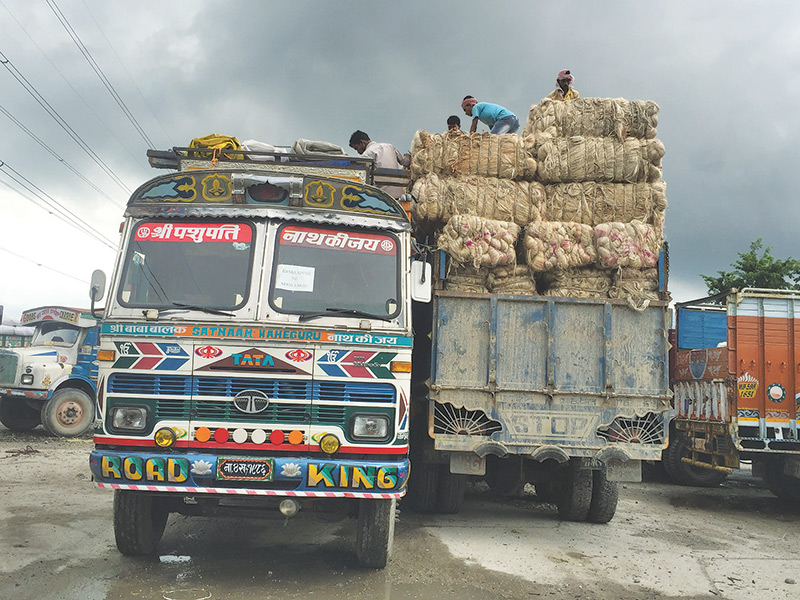
According to Department of Customs, Nepal’s export value soared by 41.74percent year-on-year to Rs200 billion in the fiscal year 2021-22. Post File Photo
KATHMANDU, The government has increased the cash subsidy given to exporters in a bid to liven up Nepal’s moribund export trade. Exporters will get a minimum cash subsidy of 4 to 8 percent as per the Export Subsidy Work Procedure 2018 which has been put through a major overhaul, officials said. “Any product whose export value exceeds Rs500 million annually and contains value addition as determined by the government is subject to an 8 percent subsidy. There is no list of eligible products,” Gobinda Bahadur Karki, joint secretary at the Ministry of Industry, Commerce and Supplies, told the Post. The government has announced cash incentives of up to 8 percent for products like clinker, cement, steel, footwear and processed water besides information technology-related services and services related to business process outsourcing in the budget statement for the current fiscal year. “The amended Export Subsidy Work Procedure 2018 will come into force after it is approved by the Cabinet and is published in the Nepal Gazette,” Karki said. “The revamped work procedure contains a provision to provide an extra 1 percent export subsidy depending on three criteria. These products are subject to an extra 1 percent export subsidy: One, products having a collective trademark like tea or pashmina. Two, listed farm products whose domestic value addition exceeds 30 percent and listed industrial products whose domestic value addition exceeds 50 percent. Three, products whose export volume increases by 30 percent year-on-year,” he said. Domestically produced textiles, readymade garments, carpets and woollen goods, Chyangra pashmina and other goods produced from it, jute and jute goods, gold and silver jewellery, semi-processed leather, medicines, felt products, polyester, fibre viscose, acrylic and cotton yarn and copper goods, handicraft goods, worshipping and decorative goods including utensils are subject to a cash subsidy of 4 percent. The subsidy was 3 percent previously. The export subsidy on agricultural products like processed tea, coffee, handicraft and wooden craft goods, processed leather and related goods, handmade paper and related goods, processed herbs and oil, processed stone and stone jewellery, goods produced from allo and mineral water remains unchanged at 5 percent. Goods like turmeric, vegetable, flower, processed honey, processed large cardamom, and processed ginger that are exported to third countries are also subject to an export subsidy of 5 percent. Listed agricultural products should have value addition of a minimum of 50 percent. If value added is less than 30 percent, the product is subject to a 3 percent export subsidy. If value addition of a listed industrial product is more than 50 percent, it is subject to a 5 percent export subsidy. “Manufacturers of cement and iron and steel have started exporting their products. They say that if they get a cash subsidy, they will be able to export their products to neighbouring countries,” Karki said. “We expect that the amended Export Subsidy Work Procedure and programmes inserted in the budget statement will increase exports.” Trade experts say that even though the government has announced export incentives in the past, these inducements failed to yield the desired results as the country’s reliance on imports continued to grow. Products like carpets and ready-made garments should also be subject to incentives of 8 percent, they say. According to the Department of Customs, Nepal’s export value soared by 41.74 percent year-on-year to Rs200 billion in the last fiscal year 2021-22. Imports swelled by 24.72 percent to Rs1.92 trillion in the same period. Nepal’s trade deficit increased by 23 percent to Rs1.72 trillion in the last fiscal year compared to the previous fiscal year 2020-21. “The export subsidy given in the past did not contribute to export growth, and this modality does not look like increasing exports either as nothing much has been changed,” said former commerce secretary Purushottam Ojha. “Export subsidies should be granted on goods that have Nepali value addition, are produced domestically and generate employment. I think the time has come to go for a smart subsidy that supports production,” he said. “Production subsidies can be given on inputs like transportation of raw materials. It will also help to control misuse of government subsidies,” he said. “Industry and trade entrepreneurs in Nepal are using loopholes to obtain the most benefit from subsidies, and the export of edible oils, betel nuts and legumes, among other products, is an example of this practice. So it has become important to go for a fool-proof system which does not have any loopholes.”
HOME PAGE
As Nepal’s dengue fatalities hit 45, risk grows of Zika, chikungunya outbreaks
Health ministry has started Zika and chikungunya testing on samples of patients infected with the dengue virus.
- Arjun Poudel
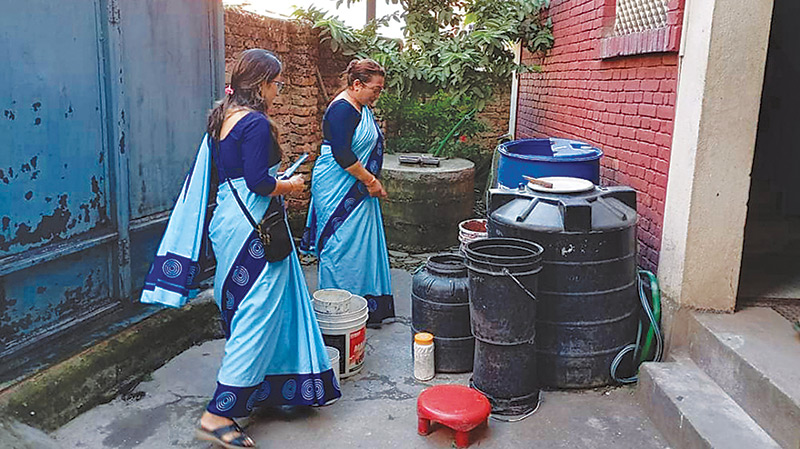
Health workers inspect households for possible sites of mosquito breeding in Lalitpur. Post File Photo
KATHMANDU, Amid a massive spread of the dengue virus across the country, public health experts have warned of the risk of an outbreak of Zika and chikungunya viruses as well. At least 45 people died and over 37,000 people tested positive for the dengue virus in Nepal this year alone, according to the Ministry of Health. The mosquitoes that transmit the dengue virus are present in all 77 districts and can transmit the other two viruses as well. “A lot of people with dengue-like symptoms are testing negative for dengue, but we are not carrying out further tests to identify the cause of the ailments,” said Dr Sher Bahadur Pun, chief of the Clinical Research Unit at Sukraraj Tropical and Infectious Disease Hospital. “Those people might have been infected with chikungunya and the risk of Zika outbreak is also high.” Nepal has recorded cases of chikungunya in the past. A risk assessment survey carried out with technical and financial support from the World Health Organisation in 2018 showed that Nepal was a high-risk country for dengue and Zika outbreaks. Two experts deployed from the UN health agency then in Nepal had inspected various localities in the Kathmandu Valley and warned of the risk of the outbreaks. Researchers warn a new outbreak of the Zika virus is quite possible, with a single mutation potentially enough to trigger an explosive spread. The disease caused a global medical emergency in 2016, with thousands of babies born brain-damaged after their mothers became infected while pregnant. Female Aedes aegypti and Aedes albopictus mosquitoes that transmit the dengue virus also transmit chikungunya, yellow fever, and Zika viruses, according to the World Health Organisation. “Since the vectors have already spread across the country, the only thing now missing is an infected person with the Zika virus and we are in a state of very high risk due to global mobility,” said Pun. “The neighbouring India, which shares a long open and porous border with Nepal, recorded cases of Zika infection in the past.” In 2021, health authorities in Kerala state of India declared a state of alert in all districts following the detection of 14 cases of Zika infections. In Rajasthan of India, 94 people including 24 pregnant women were infected with the deadly virus in 2018. Bangladesh recorded Zika infection cases in 2016. Zika causes microcephaly, a condition in which babies are born with underdeveloped heads and brain damage. Zika is also linked to Guillain-Barre syndrome, a condition in which the immune system attacks the nerves causing muscle weakness and sometimes paralysis. People infected with the Zika virus show mild symptoms like fever, rashes, and red eyes. Studies show that pregnant women and their foetuses are at high risk. Zika virus was first identified in Uganda in 1947 in monkeys, according to the UN health agency. It was later detected in humans. Brazil saw the worst outbreak of the virus in 2015 and it has then spread to 24 other countries. The WHO declared Zika outbreak an international health emergency in 2016. Chikungunya also shares some clinical signs similar to dengue and Zika. Common signs and symptoms include muscle pain, joint swelling, headache, nausea, fatigue and rashes, according to a World Health Organisation factsheet. Doctors blame the ongoing dengue spread to the apathy of the authorities. They say that for controlling dengue, Zika, and chikungunya viruses, vectors spreading such viruses must be controlled, but the authorities have taken no serious initiatives to this effect. Meanwhile, the Ministry of Health and Population said that it has started Zika and chikungunya testing on samples of patients infected with the dengue virus. For that, the WHO has provided 3,500 testing kits. “Sukraraj Hospital and Patan Hospital have been chosen as testing sites,” said Dr Gokarna Dahal, the chief of the Vector Control Section at the Epidemiology and Disease Control Division. The division said that the spread of dengue infection has been on a declining trend for the last couple.
HOME PAGE
JSP-UML electoral alliance shows politics makes strangest bedfellows
Bonhomie between Janata Samajbadi, a party advocating Madheshi rights, and CPN-UML, its ideological nemesis, suggests a decline of agenda-based politics, experts say.
- PURUSHOTTAM POUDEL
KATHMANDU, Despite their polar opposite stances on the bill to amend the Citizenship Act-2006, the CPN-UML and the Janata Samajbadi Party (JSP) have forged an alliance for the federal and provincial elections. When President Bidya Devi Bhandari last month snubbed her constitutional duty by refusing to authenticate the amendment bill that had been endorsed by both houses of Parliament, the JSP was a partner of the five-party ruling coalition and had criticised the President’s move as a blatant violation of the constitution. But the UML backed the President’s move. Last week, however, the JSP took an abrupt turn and chose to forge an electoral alliance with the UML. Analysts say the JSP locked an alliance with the UML purely for electoral advantage, but as the party appears to have relinquished its key political demand, constitution amendment, it may not be able to reap the expected benefits. However, the JSP leaders stress that they have not given up on their demand for a constitution amendment. “We just agreed to have a harmonious electoral partnership with the UML while keeping our differences intact,” the leaders said. “We still have our ideological differences but we agreed to forge a partnership to improve our electoral prospects,” JSP spokesperson Manish Kumar Suman told the Post. The cooperation with UML, according to Suman, is limited for the duration of the election and would only continue if the two parties reach a point of convergence after the elections. According to the agreement reached between the two parties, the UML supports the JSP in 17 lower house seats while the JSP backs the UML candidates in 35 seats. The JSP quit the Congress-led alliance on October 7 voicing its dissatisfaction over the number of seats on offer and reached out to the UML just in time for candidate-nomination. The ruling alliance had offered the JSP 16 lower house seats against its demand for at least 20 seats. While some observers say the UML’s stance on the citizenship bill might cost the party votes in Madhesh, others argue that agenda-based politics has become secondary in Nepal. “I see little prospect of the citizenship bill issue being pushed as an electoral agenda. Therefore, JSP cooperating with the UML in the elections won’t have a significant difference in the election results,” political analyst CK Lal told the Post. “The issue of Madhesh is on the verge of extinction. As the election results will be determined based on the clout of individual candidates, the two parties’ differences over citizenship will not matter much.” He is also of opinion that the 16-point agreement made by the four parties—Nepali Congress, UML, UCPN-Maoist and the Madhesi Janadhikar Forum-Democratic—in the run-up to the promulgation of the constitution in 2015 put an end to agenda-based politics and gave rise to opportunistic tendencies. The citizenship bill is not the first case where the JSP had a disagreement with the UML. On December 24, 2019 Upendra Yadav had quit the KP Oli Cabinet following differences over amending the constitution. In his resignation, Yadav, then deputy prime minister and law minister, had stated that he decided to resign after the government rejected his proposal to amend the charter in favour of Madheshis. Madhesi leaders often accuse the major parties of ignoring Madhesh-related issues. However, the Madheshi parties themselves are often blamed for political malpractice and rank opportunism. Madheshi parties have no option but to forge electoral partnerships with big parties as the former have lost a considerable amount of political support, says Chandra Kishore, a political commentator. “When they were in government, the Madheshi parties were unable to address the pressing issues of Madhesh and as a result their support has shrunk. And now electoral partnerships have become a compulsion for them,” he told the Post.
HOME PAGE
No matter who climbs Beijing’s ranks, Xi rules
If he plays his cards right, says an observer, Xi’s iron rule could ultimately steer China away from collapse and avert the fate of the Soviet Union.
- ASSOCIATED PERSS
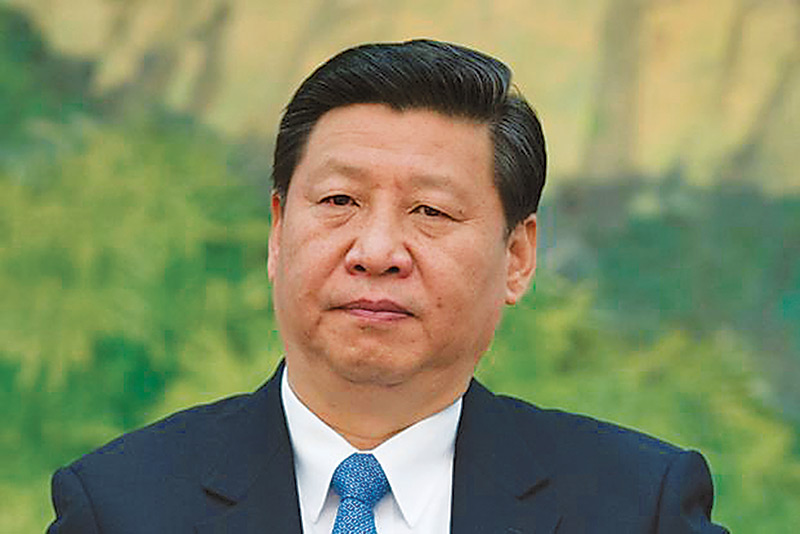
China’s new leaders are likely to be handpicked by Xi based on their competence and loyalty. Afp
GREAT NECK, NY, For decades, Ho Pin made accurate predictions about China’s next leadership lineup—no small feat, given the black-box nature of Beijing politics. But now, days before the opening on Sunday of China’s most important political meeting in a decade, the New York-based journalist said there’s little point, given the power amassed by leader Xi Jinping. “It’s not about who’s going to be in the Standing Committee any longer,” he said, referring to the handful of people who will be named to lead the ruling Communist Party for the next five years. “No matter who they are, they all have one thing in common: They all have to listen to Xi.” It’s a sharp contrast from an earlier era, when jostling factions leaked salacious details to the foreign media, and a reflection of a consolidation of power that has swept away competitors and stifled internal dissent. Ten years ago, scandal after scandal rocked Beijing’s political establishment in the run-up to a Communist Party congress, the one that brought Xi to power. Most damaging was the murder of a British businessman by the wife of Bo Xilai, a brash and rising political star. Bo was expelled from the party and sentenced to life in prison for bribery and corruption—eliminating a chief rival to Xi. The run-up to this party congress, by comparison, is hushed. Gone, Ho said, are the factions, pluralism and open political differences that once existed within China’s one-party system. “Chinese politics is entering a completely new stage,” he said. Even in the days of Chairman Mao Zedong, who founded communist China in 1949, there were competing factions. Politicians were purged, then rehabilitated, then purged again, as Mao encouraged factional struggle to enhance his own power. After Mao’s death, leader Deng Xiaoping loosened controls dramatically, sparking an economic boom and some liberalisation. He also instituted term and age limits for party leaders, meant to prevent the rise of another strongman like Mao.
But Xi has swept those rules aside. The party has loosened age restrictions, stopped naming obvious successors to the Standing Committee, and scrapped term limits for China’s presidency—paving the way for Xi to retain power for a third five-year term, and possibly indefinitely. That has made it more difficult to guess new appointments, Ho said. The previously formulaic rules of succession helped Ho forecast China’s leadership lineup four times since 2002 by analysing officials based on their age, education, work experience and relationship with other leaders. Now, he said, China’s new leaders are much more likely to be handpicked by Xi based on their competency and loyalty, unconstrained by past precedent and with little of the factional wheeling-and-dealing that used to take place. But former Hong Kong journalist Willy Lam and other analysts such as Derek Scissors at the American Enterprise Institute say Xi could still be forced to compromise and keep or promote people with different views on China’s governance. Reliable information on who might be appointed has become extremely hard to come by under the state’s tightening grip, said Alfred Wu, a Singapore-based professor who rubbed shoulders with China’s leader decades ago as a journalist, when Xi was governor of Fujian province. “It’s very hard to have substantive conversations,” he said of his former contacts. “They know it’s not good to talk about politics.” Ho was born in China and got his start at a state-run broadcaster in the 1980s. When pro-democracy protests came to Beijing’s Tiananmen Square in 1989, Ho was there, writing for a Hong Kong paper, with access to high level officials. He left days before soldiers opened fire on protesters, convinced that bloodshed was inevitable. After slipping across the border to Macao, Ho moved to Canada, then the United States, settling in Great Neck, a suburb of New York with a sizeable Chinese population. After a stint working for a Taiwanese paper, he started a Chinese-language media group, Mingjing—which means “The Mirror”—that now runs news websites, magazines and bookstores in Taiwan and the US. He mingles with sources and emigres in Chinese restaurants and at his office in Great Neck, which has shelves stacked with books and a picture of him with Tibet’s leader in exile, the Dalai Lama. At times, he offers scathing criticism of the Communist Party, and said he has no plans to go back. Despite that, Ho refers to China as his motherland, not America. His publications and YouTube channel are in Mandarin for a Chinese audience. In contrast to many dissident Chinese overseas, Ho often takes a dim view of American politics and blasts failures and flaws in the US system just as he criticises the Chinese government. But the one thing Ho does appreciate about the US is the freedom to speak openly. “There’s no police knocking at your door here,” he said. Many of Ho’s competitors in Chinese-language media overseas peddle conspiracy theories, driven by sheer opposition to Beijing. One, a journalist linked to the Falun Gong sect, spread rumours of a coup in China last month that turned out to be false. Ho’s media group, in contrast, is generally grounded in fact, though it is heavy on Chinese political gossip. He has made a prediction for who will make up China’s next generation of leaders, but instead of making it public, he has set up a game that allows his audience to make predictions themselves—a way of keeping them engaged. Ho is scathing about Xi’s crackdown on press freedoms, and said that Beijing’s stiff propaganda and assertive diplomacy have ruined China’s global reputation. But contrary to many Western observers, he suggested Xi still has a chance to be a great leader. If he plays his cards right, Ho said, Xi’s iron rule could ultimately steer China away from collapse and avert the fate of the Soviet Union. “It is very different from the China I imagined 30 years ago,” he said, “but it isn’t a simple reversion back to the Cultural Revolution, nor a move towards Western democracy.” Though some businesspeople and intellectuals dislike Xi, he still enjoys widespread support, Ho said. Many people have benefited from his programs to expand the social safety net, and agree with his nationalistic stance pitting China against the West. Many Chinese have gone abroad, only to find that the West isn’t all that great, he said. America’s aging subways and struggling railways stand in stark contrast to China’s gleaming new infrastructure. Chinese contrast the chaos of elections in the West, Ho said, with the stability under Xi’s rule. “The younger generation in China has a strong sense of national pride,” he said. “That’s a very strong foundation for Xi Jinping.” The biggest danger, Ho said, is that Xi rules for life, surrounded by “yes men.” If the question of succession is not resolved, he said China could fall into chaos, as it did in the final years of Mao’s rule. It’s a question of how Xi’s power is handed over, and who inherits it. “If he becomes a lifelong dictator, it will be a disaster for the world, and a disaster for China,” Ho said.
NATIONAL
Two arrested in connection with death of a girl in Kathmandu
- Post Report
KATHMANDU, Two people have been arrested in connection with the death of a girl, who sustained fatal burn injuries at a Naxal-based hotel in Kathmandu. Police said a 23-year-old girl, a resident of Chabahil, died of burn injuries on Monday. She had received the burn at Hotel Crown Plaza in Naxal. Padam Kumar Shrestha, 37, of Golanjor Municipality in Sindhupalchok and Keshav Rijal of Jitpur Simara Sub-Metropolitan City in Bara were detained for investigation, said police. Shrestha is one of the employees of the hotel. Police informed that the girl had sustained burn injuries at the hotel and Rijal had taken her to Bir Hospital for treatment. “Bir Hospital later referred the victim to Nepal Cleft and Burn Centre at Kirtipur where she breathed her last,” said Superintendent of Police Dinesh Mainali, the spokesperson at the Kathmandu Police Circle. Mainali said Shrestha was held for investigation as he attempted to conceal the incident by not informing the police. Police suspect that Rijal was a guest at the hotel and was involved in the incident. Preliminary investigation by police shows that the girl might have been set on fire using petrol. The Kathmandu District Court has remanded both the detainees to custody for investigation. Mainali said further investigation is underway into the incident and the suspects. The girl’s body was taken to Tribhuvan University Teaching Hospital on Monday for postmortem.
NATIONAL
35 dead, 20 missing in Karnali floods and landslides
The disasters set off by heavy rains over the past week have displaced 2,889 families across the province. Sixty families moved to safety, police say.
- CHANDANI KATHAYAT,Tularam Pandey
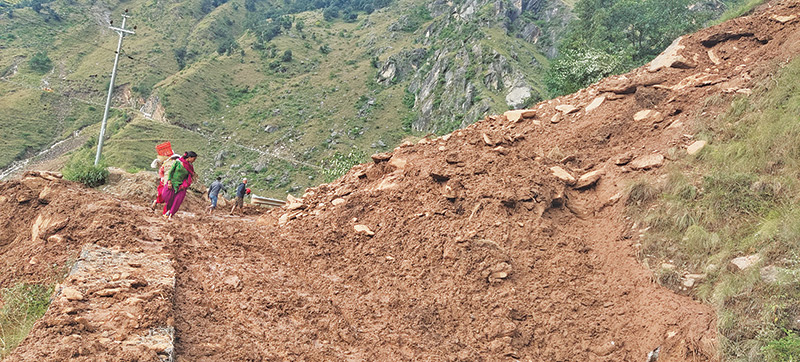
Travellers are seen picking their way through a landslide-hit section of the Karnali Highway in Kalikot this week. Post Photo: Tularam Pandey
BIRENDRANAGAR / KALIKOT At least 35 people have died and 20 others are missing after floods and landslides triggered by heavy monsoon rains lashed various districts of the Karnali Province over the past week. According to the Karnali Province Police Office in Surkhet, 10 people in Jumla, eight in Mugu, five in Kalikot, four in Humla, three in Jajarkot, two each in Dolpa and Salyan and one in Dailekh lost their lives in separate incidents of rain-induced disasters. The police office said 20 people, including a police constable, are missing in the disasters. Twenty-three people are injured, some critically, in the province. The unseasonal rainfall wreaked havoc in several districts across the nation. The Karnali Province was hit the hardest by the disasters. According to the Karnali Province Police Office, as many as 480 houses have suffered damage while 2,889 families have been displaced in various districts of Karnali, including 1,113 in Jumla, 700 in Mugu, 511 in Dailekh, 344 in Kalikot, 155 in Humla, 45 in Surkhet, 11 in Rukum (West) and 10 families in Jajarkot. Police said 60 other families in various villages have been shifted to safer places after their houses were inundated. The Karnali provincial government has mobilised security personnel from the Nepal Army, the Nepal Police and the Armed Police Force for rescue and relief operations in the affected area. Two injured were medevaced to Province Hospital in Surkhet and Kohalpur Medical College on Wednesday alone. Landslides blocked the Karnali Highway and other road sections in the province disrupting vehicular movement, police said. More than 90 landslides have descended on the Surkhet-Jumla section of the Karnali Highway, the lifeline of the Karnali Province, since October 5. According to the District Police Office in Kalikot, as many as 73 landslides occurred in the Kalikot stretch of the highway. The obstruction of the highway has made life difficult for the local people of Kalikot, Jumla, Mugu and Humla. The locals have to walk for hours if not days to reach their destinations. “I arrived here in Manma [the district headquarters of Kalikot] on the third day,” Sagar Thapa, a resident of Bhairabi Rural Municipality-3 in Dailekh. “I don’t know when I will reach Jumla.” He said he was on his way to Jumla from his residence to fill up a form for his recruitment in the Nepal Army. Kalikot’s Chief District Officer Ramhari Sharma said efforts are under way to clear the debris and resume transportation. “It will take at least one week to resume transportation,” Sharma said. Meanwhile, in Kalikot, landslides of huge magnitudes occurred at Hulma, Serighat, Sunarkhola, Tadi, Hernebhir, Galli, Chheka, Maulakatiya, Molpha, Simlagad, Pili, Serawada, Takulla, Bali, Bhaisegauda, Rachuli, Timurebhir, and Galje, among other places. The road has been swept away in various places. Similarly, Karnali corridor has also been disrupted at several places due to the recent floods and landslides. “The Karnali corridor is completely blocked at several places and there is not even a way for pedestrians,” said Laxman Bahadur Bam of Palla. The Karnali corridor passes through five local units of Kalikot connecting the Kolti area of Bajura and the western parts of Mugu and Humla districts.
NATIONAL
No room for experts in Nepali politics
Experts say the problem with Nepali leaders is most of them consider themselves ‘Mr know all’ and ignore expert advice.
- ANUP OJHA
KATHMANDU, In the third week of June, the social media was abuzz with optimistic comments when environmentalist Arnico Panday announced that he was all set to contest for a lower house seat as an independent candidate from Lalitpur-3. At the time, Panday had aggressively launched a publicity campaign, even updating his public profile on Linkedin, a professional networking site, identifying himself as a candidate for federal parliament. Many had taken to social media to welcome Panday’s plan to contest elections touting it as a beginning of a change in Nepali politics. But within weeks he changed his mind. On October 9, the nomination day, Panday announced that he wouldn’t be running for election this year, and endorsed another candidate in the constituency. Similarly, urban planner and former government secretary Kishore Thapa, who had contested for mayor of Kathmandu Metropolitan City in 2017 from Sajha Party, didn’t show any interest to contest in November polls. Although Thapa lost the local election five years ago, he had garnered 18,496 votes—the fourth highest number of votes among the competitors. Given his academic, professional bureaucratic credentials, many had expressed optimism over his entry in politics. But this time Thapa showed no interest in contesting elections. “I didn’t see any point filing candidacy this time because there is no space for experts like us in Nepali politics,” said Thapa. “Because we stick to principles, ethics and believe in delivery all of which the present political parties and their leadership consider unimportant,” said Thapa. Like Thapa, many other former bureaucrats also showed interest to join politics. Former finance secretary Rameshore Khanal is regarded as one of the few bureaucrats who have left their mark in Nepal’s bureaucracy. Some leaders of the Nepali Congress wanted to engage him in the party. But some influential leaders in the party didn’t want him. Then, former prime minister Baburam Bhattarai included him in his core team when he quit the Maoist party and launched the Naya Shakti Party in 2016. But within a year Khanal quit the party. Similarly, two months ago, agriculture expert Madan Rai also ended his seven years journey with Bhattarai. These are a few anecdotes of how some of the experts, who had succeeded to make an impact in their fields, tried their luck in politics but failed. Experts and political commentators say although entry of experts in politics would do better for society as they can play important roles on the policy making front, Nepali polity has failed to embrace them with an open heart. “The problem with our political leadership is that most of them consider themselves as ‘Mr know all’ and ignore expert advice,” said Rajendra Maharjan, a political commentator, “That is why they don’t want experts in their organisations and the election process.” “The wrong notion among our so-called political leaders is they think experts are inferior to them and should work under their command,” said Maharjan. This time, some experts like Swarnim Wagle, who is an internationally acclaimed economist, also tried their best to get tickets but the political leadership didn’t nominate them as candidates. Wagle, who is close to the ruling Nepali Congress and held important positions like vice-chair of the National Planning Commission (NPC) and proved his mettle, was denied a ticket. Former secretary Thapa said the way the present political situation is driven, it is clear the country isn’t headed for development and prosperity. “The parties are focussed mainly on managing their cadres, collecting funds for their organisations, and shoring up the leaders,” said Thapa. He accused political parties of distributing tickets to criminals and goons. In a sarcastic note, Thapa said political leaders wouldn’t give any priority to experts because they were never jailed, never involved in vandalism, arson nor did they kill people. Political commentator Maharjan is of the view that political schooling is lacking in the country. “Arnico has done comprehensive research on air pollution in Kathmandu and his contribution would be immense in the sector if he reaches the policy making level. From that perspective, he is a perfect candidate,” said Maharjan. “But he didn’t have any influence at the grassroots level, which is needed to win an election, and could be the reason behind his reluctance to be a candidate.” Maharjan however is encouraged to see the eagerness of new people like Panday, Khanal, Thapa and Wagle to join politics. Jhalak Subedi, a political observer, says that we don’t have a trend of accepting experts in politics because of the party’s political dynamics as the experts don’t command any influence at the grassroots level. “Wagle is a well-known figure among educated people but he lacks appeal among the party rank and file and the ordinary public,” said Subedi. Subedi says parties should use the proportional representation system to induct experts like Panday and Wagle to parliament. “And they should be given ministerial berths based on their expertise. But alas, this does not happen in Nepal.”
NATIONAL
Hundreds of candidates withdraw from race
As many as 2,412 candidates are now in the race for seats in the lower house and 3,224 in provincial assemblies.
- Post Report
KATHMANDU, Chakra Snehi, a CPN-UML leader from Dadeldhura, withdrew his candidacy for the upcoming elections on Wednesday. His party has instead decided to support Karna Malla, the chairperson of Nepali Congress (BP) who is challenging Prime Minister and Nepali Congress President Sher Bahadur Deuba. The UML and Malla’s party had partnered in the recent local elections. However, the Congress had managed to retain its hold in the district, Deuba’s native. The incumbent prime minister is a common candidate of the five-party alliance for the upcoming House of Representatives elections. The Election Commission, which registered candidacies for the lower house and provincial assembly elections on Sunday, had slated Wednesday for the aspirants to withdraw their bids if they wished. The UML had initially fielded its candidates in 139 House constituencies; later, it withdrew candidacies from three constituencies, including in Dadeldhura. As per the party decision, Sindhu Jalesha Budhathoki, the UML candidate from Nawalparasi (West)-1, rolled back her candidacy to support Hridayesh Tripathi, chairperson of the Janata Pragatishil Party. Budhathoki’s withdrawal has made Tripathi’s battle against Nepali Congress candidate Binod Chaudhary easier. In the 2017 federal election, Tripathi had won as an “independent” candidate from the constituency with the UML’s electoral symbol. The UML also ordered its candidate from Chitwan-3, Ram Prasad Neupane, to withdraw his candidacy, as the party decided to support Dinesh Koirala, a rebel candidate from the Congress. The UML is not alone in ordering its candidates to call off their bids. Imdad Hussain Khan of the CPN (Maoist Centre) on Sunday had registered his candidacy in Rupandehi-3 that would pit him against Congress leader Bal Krishna Khand. On Wednesday, however, he withdrew his bid and announced he’ll support Khand, the common candidate of the alliance. The UML is supporting Deepak Bohora of the Rastriya Prajatantra Party in the constituency. Though the Congress, the Maoist Centre, the CPN (Unified Socialist), the Rastriya Janamorcha and the Loktantrik Samajbadi Party decided to contest the House of Representatives and provincial assembly elections under an alliance, dozens of party leaders had filed their candidacies, violating the agreement. The parties in the alliance on Tuesday asked the rebel candidates to walk out from the race or face the music. After the party’s mandate, Yogendra Basnet from Okhaldhunga duly withdrew his candidacy to support Congress candidate Ram Hari Khatiwada. Madhabi Bhatta, a dissident candidate from the Nepali Congress, too, withdrew her candidacy from Gorkha-2, where Maoist Centre chair Pushpa Kamal Dahal is a common candidate of the ruling alliance. Following the party line, Raju Mandal Rajbanshi, a Loktantrik Samajbadi Party candidate from Morang-6, too, has withdrawn his candidacy. He will be supporting Shekhar Koirala of the Congress. The ruling alliance has also decided to support UML rebel candidate Prabhu Sah in Rautahat-3. Sah refused to contest from the UML expressing his dissatisfaction over the party’s decision to partner with the Janata Samajbadi in the upcoming elections. Rabindra Patel of the Maoist Centre withdrew his candidacy to support Sah. As many as 119 candidates for the House of Representatives and 257 for the provincial assemblies have withdrawn their candidacies, according to Shaligram Sharma Poudel, spokesperson for the Election Commission. That has left a total of 2,412 candidates contesting for the lower house and 3,224 for provincial assemblies.
NATIONAL
Dang factories deprived of power after landslide damaged transmission pylon in Lamahi
Disrupted power evacuation from Darchula-based power projects resumes after repair of damaged transmission tower.
- PRITHVI MAN SHRESTHA
Landslides caused by incessant rainfall have disrupted supply of electricity to factories. Post Photo
KATHMANDU, Industrial units that consume high energy in Ghorahi and Lamahi may have to wait for up to a month to get electricity supply after a landslide damaged a transmission tower in Lamahi. The landslide caused by incessant rainfall damaged a transmission tower at Beldangi of Lamahi Municipality-6 on Friday, disrupting the supply of electricity to high energy consuming industrial units such as cement factories. “The work to remove the debris brought by the landslide is undergoing,” said Dirghayu Kumar Shrestha, chief of transmission directorate at the Nepal Electricity Authority. “Once we assess the degree of damage caused in the tower, we can say how long we have to stop supplying electricity to those factories.” According to Shrestha, it will take at least a week to erect a tower in the same place if the foundation of the tower has not been damaged. “Otherwise, it will take about a month to erect a new tower by laying a new foundation,” he said. According to NEA, it has arranged electricity for the residents of Lamahi and Ghorahi for household use from the Hapure-based 33kV substation. “High energy consuming factories may have to wait for more days,” said NEA’s Managing Director Kul Man Ghising. The capacity of the transmission line should be raised to supply power to the high energy consuming industries. Likewise, damages caused to another transmission tower at Attariya, Kailali obstructed the evacuation of power from some hydropower projects in far-western Nepal, including 30MW Chameliya Hydropower Project, 8.8MW Naugarh Gad Hydro Electric Project and 8MW Upper Naugarh Gad Small Hydro Electric Project based in Darchula, for two days. The transmission tower under the 132 kV Blanch-Atariya transmission line was damaged on Sunday, according to the NEA. “As a result, evacuation of electricity from hydropower projects including Chameliya and projects of the Api Power Company has been obstructed,” said Shrestha. Chameliya is the NEA-owned project while Naugarh Gad and Upper Naugarh Gad were developed by Api Power Company, a private company. “Now, evacuation of power has resumed from our hydropower projects,” said Guru Neuapne, founder of Api Power Company. According to the NEA, the transmission tower that was temporarily repaired after the massive damage last year was brought down again by the new landslide. “We have already installed a new transmission tower at a nearby location after the damages to the existing tower last year which will help evacuate the power again,” said Shrestha. Landslides, thunderstorms and storms set off by incessant rains have damaged transmission lines, towers, distribution towers and transformers, affecting electricity supply in the districts including Rupandehi, Arghakhanchi, Palpa and Dang, the NEA said.
NATIONAL
Poll body seeks clarification from Maoist chair
Briefing
Kathmandu: The Election Commission has sought clarification from CPN (Maoist Centre) chair Pushpa Kamal Dahal for allegedly violating election code of conduct. The commission has said Dahal’s move to use panchebaja (local musical band) when he reached the office of the election returning officer in Gorkha-2 on Sunday goes against the code of conduct. The commission said it took the action based on the videos of the event that were circulated on various media.
NATIONAL
Mother, two children found dead
Briefing
BARA: A 25-year-old woman and her two children were found dead with their throats slit and abandoned on the bank of the Dora stream in Prasauni Rural Municipality-5, Bara, on Wednesday. Police said they have identified the victims as Sujata Chaudhary, her four-year-old daughter Tahira and 16-month-old son Rajbir. Police have detained Sujata’s husband, Dipendra Chaudhary, age 35, for investigation. Acting on a tip-off, the security personnel tracked Dipendra while he was undergoing treatment at Narayani Hospital in Birgunj. He had sustained serious injuries after falling off his bicycle in Birgunj on Tuesday night.
NATIONAL
Local unit bids to reduce child marriage
Briefing
SINDHULI: Marin Rural Municipality has kicked off its drive to distribute cash and bicycles to female students in a bid to reduce child marriage. Bimarsh Moktan, chair of the local unit, said his office has started providing Rs1,00,000 to girl students who pass graduation before marriage and bicycles to girl students who enrol in grade 11 after SEE. “The number of female students attaining higher education is low and the rate of early marriage has increased,” Moktan said, “so the cash programme will be effective for every female student who passes the graduation level before marriage.” After passing the graduation level, more support will be provided to the female students to study higher classes or to do any other business, Moktan added.
NATIONAL
Paul Shah’s hearing postponed for the third time
Briefing
TANAHUN: The Tanahun District Court has postponed the hearing of Purna Bikram Shah, the actor popularly known as Paul Shah who has been imprisoned on the charge of molesting a minor. This is the third time the court postponed Shah’s hearing; it was first postponed on August 31 and then on September 18. According to Harishchandra Gautam, information officer of the Tanahun court, the hearing of Shah on Wednesday was postponed due to preparations for the upcoming elections.“Since the judge and the public prosecutor are engaged in election work, Wednesday’s hearing was stopped after the public prosecutor’s office sent a letter to postpone it,” Gautam said, adding the hearing is yet to be rescheduled.
EDITORIAL
Honour the code
The idea of enforcing a code of conduct is to ensure that everyone takes ownership of the electoral process.
Hardly had the aspirants for the November 20 parliamentary and provincial elections filed their candidacies than they began flouting the election code of conduct. The Election Commission’s code allows candidates for the House of Representatives and Provincial Assembly elections to campaign only from November 3, giving them 17 days of campaigning before polling day. As part of the code of conduct, the candidates are barred from organising marches, gatherings, media campaigns or door-to-door campaigning. However, many candidates seem to be in a hurry to influence people and lock in their votes, any way they can. Candidates across the country, including those from the major political parties as well as independents, are reported to have begun canvassing for votes, failing to respect the most fundamental etiquette of participatory democracy. Those flouting the code seem confident that their wrongdoings will go unpunished, for the Election Commission has in the past failed to take action against such offenders. Nor are they worried that the people will mind their misconduct. After all, the culture of violating the code is so rampant across parties that people often cannot distinguish between good and bad actors. What the candidates are doing, though, is dishonouring the very system that allows them to participate in the democratic process. The commission recently revealed that it was taking action against public officials who showed open support for certain electoral candidates. The poll body has made it clear that it is scrutinising social media, among other public platforms, to ensure that those expected to remain neutral in the electoral process are not canvassing for a candidate or a political party. Fair enough. But there are more important problems that merit the commission’s attention. The flouting of the code of conduct is not limited to organising public programmes before time and amassing “likes” on social media. There are other ways in which candidates obstruct the process of fair elections, including by giving away money and goodies. In the past, candidates have also used children during canvassing, and blocked public transport when they organised gatherings. The biggest fraud that candidates do is lie about their campaign expenditures, a problem that has kept the electoral process out of the reach of common Nepalis. It is an open secret that many candidates easily cross the Election Commission spending threshold. As they use informal channels to fund their campaigns, there is often no record of how much they get and how much they spend. Most of them also don’t submit their expenditure details to the commission—in the most recent local elections, 40 percent of the candidates failed to disclose their spending details, attracting huge fines from the poll body. An election code of conduct is there not just for formality. It is a document that ensures free, impartial and transparent elections. It is thus vital that all stakeholders—candidates, observers, government officials, non-governmental organisations and voters alike—abide by it. Ultimately, the idea of enforcing a code of conduct is to ensure that each party concerned takes ownership of the process for the election’s broader legitimacy. In the spotlight of the electoral process, the candidates have a greater responsibility to adhere to the code. Yet they are the ones who are seen breaking the rules most of the time. This, in turn, adds to the public’s scepticism of the electoral process, and with it, the whole democratic system.
OPINION
Positioning for the future
China’s new Politburo Standing Committee will expect leaders that align with the current leadership.
- HINDU SANSKRITI KARKI,ASHIS ADHIKARY
Shutterstock
All eyes rest on the upcoming 20th National Congress of the Chinese Communist Party (CCP). The CCP Politburo Central Committee meeting on August 30 affirmed the National Congress on October 16. The National Congress, responsible for electing the CCP’s leadership for the next five years, will make it explicit through their votes in Congress. Political pundits assert that the world should expect the coronation of party General Secretary Xi Jinping for a third five-year term. Apart from the nomination of the presidential candidate, the next thing to watch is the reshuffling of China’s Politburo Standing Committee (PSC). With the assembly nearing, the challenge is whether or not China glues itself to the “seven up, eight down” rule to continue with the PSC membership. If it decides to follow this procedure, any PSC member 68 years old or above during the National Congress is entitled to retire, and any individual 67 years or younger is eligible for another term. Although this modus operandi can’t challenge the current leadership, it can shape the composition of the other members of the PSC. Of the seven PSC members, Li Zhanshu (72), Han Zheng (68) and Xi Jinping (69) have reached the age limit, except Zhai Leji (65). At the same time, Li Keqiang (67), Wang Huning (67) and Wang Yang (67) are still eligible for membership. If the existing age provision isn’t modified, the PSC will have a new composition of political leadership. Ultimately, the question persists, who will be the passers-by and the settlers?
The roundtable gambit Potentially, the new PSC will have space to accommodate two new members as replacements for Li Zhanshu and Han Zheng. However, there is a possibility of a third replacement. This analysis comes after Li Keqiang’s announcement to retire from the premiership at the closing session of China’s annual National People’s Congress in March. As premier, Li can serve only two terms. Although he is eligible to serve another term as a PSC member, it is implausible for him to continue the membership with a demoted designation. Under current circumstances, his likelihood of occupying the top position is impossible. Observers also cite Li’s waning influence, an outcome of the shift from collective leadership to concentrated leadership, as the reason for stepping down from the PSC. If Li quits the PSC, there is a high possibility of Hu Chunhua (59) filling this position not only as a PSC but also as the new premier of the CCP. The number gambit positions Hu Chunhua, Ding Xuexiang and Chen Miner as the only politburo members of the remaining 18 eligible candidates to serve two terms. Hu currently serves as one of the four vice-premiers of the CCP. He is also known for his association with Hu Jintao and is a member of the Communist Youth League, a faction overshadowed after the rise of Xi. Moreover, he has the authority to recommend the next premier to be appointed by the president. Therefore, it is thinkable that Premier Li could be making way for an official from the Communist Youth League to the PSC to counterbalance the Xi faction. Although China’s singly-party system doesn’t witness multiparty politics, factional politics is part of its history. In this regard, the next two anticipated faces could be supporters of Xi. The remaining politburo members eligible for two terms are known to be confidants of Xi. However, Chen Miner’s (62) profile positions him as the leading contender for a coveted seat on the PSC over Ding Xuexiang (59). Working with Xi in the Zhejiang provincial standing committee for five years, Chen’s political career advanced from becoming a deputy to party secretary of Guizhou in three years. This south-western province, known as China’s big data valley, constitutes a modern-day “Third Front” of techno-industrial projects significant to the national development strategy. Undoubtedly, Chen has contributed significantly to its facelift. Besides, Chen is also known for bridging the old and new cohorts of President Xi. Identified as one of the members of the Zhejiang army—the officials who worked under Xi’s provincial leadership in 2007—Chen has become the catalyst in mobilising the Guizhou connection. Likewise, Chen’s ardent support for Xi’s Three Strict and Three Honest policy earned him the post of party secretary in Chongqing in 2017. Widely acclaimed for his work in Chongqing, his chances of being showered with noble responsibilities are higher. Among the other senior members of the politburo with a single term, the new PSC might attract Cai Qi. Working closely with Xi during his term as the party secretary of Zhejiang province and governor of Fujian, Cai has experienced extraordinary growth from being the deputy head of Xi’s National Security Council to the top municipal rank in Beijing. Strikingly, in 2017, President Xi made an exception by appointing Cai as party secretary in Beijing, a position only allotted to a politburo member. Like Chen, Cai’s political progress can also be linked to the Zhejiang army that championed Xi and his policies. However, analysing Cai’s current position in Beijing, Xi might want to retain his closest aide. If that happens, it will open the gateway for Chen Quango, Huang Kunming, Li Hongzhong, Li Xi and Li Qiang—the remaining politburo members—with a single promotion. Among the bidders, prospects are high that Huang Kunming (65) might take the trophy home. Currently serving as the head of the publicity department of the Central Committee of the CCP, Huang has worked closely with Xi in Fujian and Zhejiang.
The influencing action Under the patronage of President Xi, the CCP has witnessed the rise of a new power-seeking action. In 2017, the party voted to enshrine Xi Jinping’s thoughts in the constitution that, elevated his status to that of the founding father of China, Chairman Mao. Thus, the new PSC will expect leaders that align with the current leadership. It is evident that during Xi’s administration, China encountered multiple challenges on its security front. Concurrently, this has positioned China’s need to secure its national interest, particularly in Hong Kong, Xinjiang, Taiwan, the South China Sea and the Indian Ocean. Accordingly, the PSC could expect leaders that would contribute to strengthening China’s security apparatus. Likewise, the ongoing trade war with the United States, the Ukraine crisis and the effects of Covid-19 have forced China to rethink its economic reform policies. Under such circumstances, Xi’s decision will also focus on sustaining China’s global position as the world’s second-largest economic power. Consequently, the new PSC might witness a more conventional composition of leadership driven by a nationalistic ideology, encompassing Xi’s reformatory policies to rejuvenate China.
Karki holds a PhD in international politics from Fudan University, China, and Adhikary is a lecturer in international relations at Kathmandu School of Law.
OPINION
Digital hoarding: An increasing problem
The potential of serious mental health impacts from digital hoarding is a real possibility.
- DARSHANA SEDERA,SACHITHRA LOKUGE
Shutterstock
As data storage has become more accessible than ever, the amount of digital “stuff” we all have stashed away is on the rise, too—for many of us, it’s becoming more unwieldy by the day. In a recent paper published in the journal Information & Management, we have investigated a rising phenomenon called “digital hoarding”—the need to acquire and hold onto digital content without an intended purpose. The way we interact with digital content through easily available smartphones, social media and messaging apps only exacerbates the behaviour. Social media platforms especially encourage us to hoard, as our emotions get entangled with the digital contents we share with others, such as photos with lots of shares or likes. If it can take up to 25 or more selfies before seeing a “winner”, the sheer volume of content creation raises an important question: How do we plan to manage this morass of data?
Taking clutter into the digital era Hoarding is defined as a persistent difficulty in discarding one’s possessions, and can be either a disorder on its own, or a symptom of another mental health issue such as obsessive-compulsive disorder. A person with hoarding disorder experiences distress at the thought of getting rid of the items. They end up with an excessive accumulation of stuff in their home, regardless of actual value. We propose that digital hoarding happens when an individual constantly acquires digital content, feels difficulty in discarding it, and accumulates digital content without an intended purpose. Digital hoarding can quickly spiral out of control, too—perhaps even more quickly than in the physical world, due to several reasons. First, the digital hoarder is less likely to notice the space limitations in the digital world. While the boundaries of a physical space are clear, such boundaries are less prominent in digital spaces. Second, hoarding of physical objects happens in fixed boundaries, while digital spaces are “expandable”—you can get additional digital storage with minimum effort at very little or zero cost. Third, to hoard physical items, a person needs to expend some effort, such as purchasing them. By contrast, most digital contents are either self-created, free, or available on a subscription basis. Fourth, compared with physical stuff, digital contents can be multiplied (for example, by making copies) with very minimal effort. Overall, having various formats of digital content, an endless capacity to expand storage, increasing emotional attachment, and the lack of a sophisticated retrieval system may all make an individual nervous to delete this digital content—showing the potential signs of digital hoarding.
Defining digital hoarding We define digital hoarding based on these three criteria: Constant acquisition of digital contents, discarding difficulty, and a propensity for digital content clutter. Constant acquisition refers to the constant gathering of digital content, without much consideration of its value, purpose or utility. With most communications taking place electronically, we tend to keep any and all digital content without discrimination—just in case! This includes emails, images, videos, bills and receipts. In our research sample, some people had gathered more than 40 terabytes (TB) of digital content over time. Acquisition refers not just to photos you have in storage devices, for instance, but also ones uploaded to social media. Difficulty of discarding digital content is the second characteristic of digital hoarding. Think about the last time you meticulously deleted old emails, for example. Theoretically, an individual with compulsive hoarding disorder tends to place high value on the contents they have, and as a result, they feel great difficulty discarding them. Clutter propensity is the third characteristic of digital hoarding. It refers to how abundant digital contents, often unrelated, are stored in a disordered fashion. As most digital contents can be stored in any digital device, individuals tend to save such content without much organisation and think they can sort it out later. This often leads to a feeling of being disorganised and cluttered in digital spaces.
Curbing digital hoarding In our survey of 846 respondents representing the general population, we found that digital hoarding can lead to higher levels of anxiety. Statistically, 37 percent of one’s total level of anxiety, measured using an established depression, anxiety, and stress scale, was explained by digital hoarding. Our research also showed females are 27 percent more likely to feel the negative impacts of digital hoarding, compared with their male counterparts. Not surprisingly, the number of data storage devices someone owned worsened the impact of digital hoarding. For example, if someone owns multiple hard drives or cloud storage, digital hoarding impacts can increase. In the modern world, it is inevitable that digital content plays an important role in our lives. Therefore, the potential of serious mental health impacts from digital hoarding is a real possibility. If you think you’re holding onto too much digital content, here are some tips. Consider doing a “spring clean” every year, and schedule a time to spring clean your digital footprint, reduce unnecessary digital content, and come up with simple mechanisms to organise your files, emails, pictures and videos. Reassess the importance of many social networks, including groups in many communication apps, and retain only those essential to you. However, if you find these issues particularly difficult or confronting, consider speaking to your doctor or a mental health specialist.
Sedera is Associate Dean at Southern Cross University. Lokuge is Lecturer in Information Systems at the School of Business at the University of Southern Queensland, Australia. — The Conversation
MONEY
IMF warns against ‘costly’ tax cuts to fight inflation
- AGENCE FRANCE-PRESSE
WASHINGTON, Soaring food and energy prices are raising the risk of social unrest but attempting to tame costs through tax cuts, subsidies and price controls would be too costly, the IMF said Wednesday. The fund’s comments, in its latest Fiscal Monitor report, come as food prices have surged by half since 2019 while energy bills have soared in the wake of Russia’s invasion of Ukraine. “Countries all around the world are facing more pressing and more painful trade offs,” Vitor Gaspar, director of IMF’s fiscal affairs department, told AFP. The combination of inflation along with food and energy price surges point to a cost-of-living crisis, he said. The global economy has been hit by multiple shocks in the past year. Countries spent heavily to protect their economies during the pandemic, then faced supply chain issues as they emerged from Covid lockdowns. Inflation soared further after Russia invaded Ukraine, with food and energy prices going through the roof. “Households are struggling with elevated food and energy prices, raising the risk of social unrest,” the IMF report said. But, it added, “fiscal policy trade-offs are increasingly difficult, especially for high-debt countries where responses to the Covid-19 pandemic exhausted their fiscal space.” As governments operate within tighter budgets, prioritizing policies and programs becomes vital, the report said, adding that key goals are ensuring access to affordable food and protecting low-income households from inflation. But with long-lasting supply shocks and broad-based inflation, attempts to cap surging costs through price controls, subsidies or tax cuts will be “costly to the budget and ultimately ineffective,” the IMF warned. Officials should instead allow prices to adjust and provide targeted cash transfers to the most vulnerable.
MONEY
Pound, UK bond yields climb on Bank of England uncertainty
- AGENCE FRANCE-PRESSE
LONDON, The pound rallied and UK government bond yields rose Wednesday, with the Bank of England accused of fuelling markets uncertainty. The BoE said it would Friday end a short-term programme of bond-buying support aimed at quelling volatility triggered by a debt-fuelled UK budget. The Financial Times earlier said the BoE stood ready to intervene further. On Wednesday, the yield on the government’s 30-year bond returned above a relatively high level of five percent. The UK government’s higher borrowing costs are a reflection of market unease regarding the affordability of upcoming tax cuts aimed at supporting Britain’s recession-threatened economy. The pound rose against the dollar as traders bet on more aggressive interest rate hikes from the BoE on concerns the budget of uncosted tax cuts would further fuel sky-high UK inflation. “Markets have gyrated overnight and this morning, following seemingly conflicting messages purportedly from the Bank of England in relation to the time-line of the current temporary UK government bond purchases,” noted BNP Paribas analyst Chris Lupoli. London’s benchmark FTSE 100 index dropped slightly, with sentiment dampened by news that the UK economy unexpectedly shrank in August.
MONEY
Striking French refinery workers defy government threats
- AGENCE FRANCE-PRESSE
PARIS, Striking French oil refinery employees voted Wednesday to maintain blockades now in their third week, despite a government order for some of them to return to work in a bid to get fuel supplies flowing. The industrial action to demand pay hikes has paralysed six out of the seven fuel refineries in France, leading to shortages of petrol and diesel exacerbated by panic-buying from drivers. Having previously threatened to use emergency powers enabling them to order essential workers back to the job, the government announced Wednesday that it would put them into use as the strikes entered their third week. Personnel at a fuel depot at the Gravenchon-Port-Jerome refinery in northwest France, owned by US giant Esso-ExxonMobil, will be the first to be requisitioned, an official at the energy ministry told AFP. “Faced with the continuation of the strike by some of the personnel at Port-Jerome in Normandy, the government is launching the requisitioning of essential workers at the depot,” the official said. Workers who refuse the summons will risk fines or jail time. The government also said it would hold an emergency meeting on the crisis toward midday, as long queues of motorists desperately seeking fuel again blocked streets in Paris and other major cities. As of Tuesday evening, 31 percent of stations across the country lacked at least one grade of fuel, a figure that stood at 44 percent in the greater Paris region. Esther Berrebi, a home health aide in the capital, was hoping to find petrol at the third station she had tried since 7:00 am. “I’m very angry, and very worried,” she told AFP. “I understand they want higher salaries but I don’t understand how they can halt an entire country.” The hard-left CGT union that is leading the stoppages had said Tuesday that any requisitioning would be “not necessary and illegal”, raising the spectre of legal challenges. It is seeking a 10-percent pay rise for staff at TotalEnergies, retroactive for all of 2022, and says management had refused to engage in talks. “It would have been easier to requisition our CEO and bring him to the negotiating table,” said Germinal Lancelin, the CGT leader for ExxonMobil at the Gravenchon-Port-Jerome refinery. On Wednesday, TotalEnergies said it would meet with all union representatives, having previously insisted it would meet only those who accepted to end the blockades. Until now, the government had been reluctant to inflame the conflict, but in recent days officials have had to acknowledge the growing frustration and economic damage caused by drivers spending hours to fill up. “Petrol is too important for us. It’s been a nightmare for a week,” Santiago, a delivery driver, told AFP in Paris. And even if key personnel are ordered back to get oil refineries working again, “it will take at least two weeks” to restore fuel supplies already under strain, said Gil Villard, a CGT representative for Esso at the refinery in Fos-sur-Mer, outside Marseille. The crisis comes at a time of high energy prices and inflation, while TotalEnergies’ bumper profits have also caused anger, leading to calls for the group to face a windfall tax. The stand-off could add impetus to a march planned by left-wing political parties on Sunday against the policies of President Emmanuel Macron and the high cost of living. “I hope this is the spark that begins a general strike,” leading Greens party parliamentarian, Sandrine Rousseau, told Franceinfo radio Wednesday. The standoff also comes as Macron is preparing to push through a contentious pension overhaul by the end of the winter, despite warnings from some allies about the risk of widespread resistance. Labour unions and left-wing political parties have vowed to try to block the reform, which would see the pension age raised to 64 or 65 for most people, from 62 currently.
MONEY
Household wealth to fall as inflation surges
Briefing
FRANKFURT: Household wealth is set to fall over two percent worldwide in 2022 after three years of strong growth, a turning point caused by soaring inflation, German insurance giant Allianz said Wednesday. Last year, global financial assets grew by 10.4 percent, reaching 233 trillion euros ($226 trillion), according to Allianz’s annual report that examines household wealth in almost 60 countries. The growth in household wealth—which includes cash deposits, pensions savings and other investments—was driven by bullish markets. But in 2022, rampant inflation including soaring energy prices fuelled by the Ukraine war, and rising interest rates will hit households hard. (AFP)
MONEY
China needs $17 trillion in investments to meet climate goals, World Bank says
Briefing
WASHINGTON: China needs up to $17 trillion in additional investments for green infrastructure and technology in the power and transport sectors to reach net-zero emissions by 2060, a new World Bank report on China’s climate and development challenges found. The report, one of a new series of Country Climate and Development Reports, said China would need private investment to cover the immense price tag and unleash the needed innovations. Climate change poses a significant threat to China, especially its densely populated and economically critical low-lying coastal cities, and unabated climate change could cut its economic output by 0.5 percent to 2.3 percent as early as 2030, it said. (Reuters)
MONEY
German chemicals giant BASF unveils cost-cutting plan
Briefing
BERLIN: German chemicals giant BASF on Wednesday announced cost savings worth 500 million euros ($485 million) a year in 2023 and 2024 on the back of “significantly weaker earnings in Europe”. The programme will focus on “Europe and particularly Germany”, said the group, adding that “cost savings possible in the short term will be implemented immediately”. As Germany’s largest consumer of gas, BASF has been hit hard by the energy crisis Germany has been facing as a result of the war in Ukraine. The group’s Ludwigshafen plant in western Germany is the world’s largest chemical production plant, employing some 39,000 people and is seen as particularly exposed to the consequences of a gas shortage. (AFP)
WORLD
West meets to pledge more arms for Ukraine as Washington hails gains
Asked how realistic he believed it’d be for Putin to use tactical nuclear weapon, Biden says: ‘Well, I don’t think he will.’
- REUTERS
A general view of a meeting of the Ukraine Defence Contact Group during aNATO defence ministers meeting at the Alliance's headquarters in Brussels, Belgium on Wednesday. REUTERS
KYIV/BRUSSELS, More than 50 Western countries met on Wednesday to promise more weapons for Ukraine, focusing on its need for air defences after Moscow launched its most intense missile strikes since the start of the war. Opening the meeting of the Ukraine Defense Contact Group at the headquarters of NATO in Brussels, US Defense Secretary Lloyd Austin said Russia’s huge wave of missile attacks this week had laid bare the “malice and cruelty” of its war. Ukraine had shifted the momentum in the conflict since September with “extraordinary” gains, but would need more help to keep fighting, he said. “These victories belong to Ukraine’s brave soldiers. But the Contact Group’s security assistance, training, and sustainment efforts have been vital,” Austin said. Russian attacks using more than 100 missiles have killed at least 26 people across Ukraine since Monday, when President Vladimir Putin ordered what he called retaliatory strikes against Ukraine for an explosion on a bridge. Air raid sirens sounded across swathes of Ukraine for a third day on Wednesday and there were reports of some shelling, but no sign of a repeat of the intensive countrywide strikes of the previous two days. The missiles have mostly targeted civilian electricity and heating infrastructure, while some hit busy roads, parks and tourist sites, including in the centre of Kyiv. NATO Secretary-General Jens Stoltenberg said Russia’s missile attacks were a sign of weakness. “The reality is that they’re not able to make progress on the battlefield. Russia is actually losing on the battlefield,” Stoltenberg said. Since Monday’s attacks, Germany has sent the first of four planned IRIS-T SLM air defence systems, while Washington said it would speed up the delivery of a promised NASAMS air defence system. EU energy ministers were also meeting in Prague to work out ways to cope with an energy crisis caused by the war. On Wednesday, Polish pipeline operator PERN said it had detected a leak in one pipe in the Druzhba system that carries oil from Russia to Europe, though it said the cause was probably an accident. Russian Deputy Prime Minister Alexander Novak said the leak appeared to have been eliminated. Global attention has been focused on the security of Russian energy pipelines to Europe since the main undersea gas pipelines were damaged by suspected sabotage last month. Western countries have not said who they blame for huge explosions that blew holes in the two Nord Stream 1 pipelines and one of two pipes that make up the new Nord Stream 2 project, but have implied they believe it was Russia. Putin said on Wednesday gas could now be delivered through the remaining undamaged Nord Stream 2 pipe, but it was up to Europe to allow it. The new pipeline, completed but never opened, has been suspended by Germany since the invasion. Gazprom boss Alexei Miller said fixing the damaged pipes would take more than a year. As his forces have lost ground on the battlefield since September, Putin has escalated the conflict, ordering the call-up of hundreds of thousands of reservists, proclaiming the annexation of occupied Ukrainian territory and repeatedly threatening to use nuclear weapons to protect Russia. US President Joe Biden said on Wednesday he doubted Putin would use a nuclear weapon. Putin is a “rational actor who has miscalculated significantly”, Biden said in a CNN interview, saying he believed the Russian president wrongly expected his invading troops to be welcomed. Asked how realistic he believed it would be for Putin to use a tactical nuclear weapon, Biden responded: “Well, I don’t think he will.” NATO’s Stoltenberg told reporters in Brussels on Tuesday the military alliance had not noticed any change in Russia’s nuclear posture. With air raid sirens sounding over Kyiv for a third consecutive day, residents cleaned up after the earlier strikes. “It is not that they are fighting the military, they are just driven by the desire to destroy, destroy, to destroy us,” said Yulia Datsenko, a 38-year-old paramedic, as she surveyed the damage to her apartment. Pope Francis denounced the “relentless bombings”, part of what he described as a “hurricane of violence”. In the latest reports from the battlefield, the Ukrainian governor of partially occupied Donetsk province said seven people were killed in Russian shelling of a market in the frontline town of Avdiivka. Ukraine’s military said its forces consolidated control of several settlements recaptured from Russian troops on the west bank of the Dnipro River, near the Russian-occupied town of Beryslav in the Kherson region.
WORLD
Two women killed in India as ‘human sacrifice’
- AGENCE FRANCE-PRESSE
NEW DELHI, Indian police said on Wednesday they have arrested three people including a man claiming to be an occult practitioner for allegedly killing two women as human sacrifices in the belief they would become rich. A couple in financial difficulties paid Mohammed Shafi 300,000 rupees ($3,640) to “arrange” two victims who he then “brutally abused and killed” in separate rituals three months apart, police spokesman Pramod Kumar told AFP. Shafi told the couple, Bhagaval Singh and wife Laila from the southern state of Kerala, that the “human sacrifice was the way to great riches”, police said. Shafi, described by police as a “sexual pervert” who was previously accused of rape, “enticed” the first victim to Singh’s home in June on the pretext of a role in a local movie. Investigators say Shafi then convinced the couple to take part in a second sacrifice in September after they complained their fortunes had not changed. “We were already investigating the case of the first missing woman when we found that the last mobile phone location of [another] woman who went missing in September was also around the couple’s home,” Kumar said. Both women made a living selling lottery tickets door-to-door. Their mutilated bodies were buried in the couple’s compound. Police are now investigating if Shafi was also involved in other cases. Neighbours of Singh, who described himself as a traditional healer, told the Hindustan Times newspaper that “it was difficult for them to believe he was a party to gory murders”. “Many people used to come here for treatment for fractures, bruises and other such ailments. We never suspected anything foul and he was well mannered as well,” Gopan K told the daily. Experts say belief in witchcraft and the occult remains widespread in many tribal and remote areas of India, where occasional incidents of human sacrifice have been reported. Earlier this month two men were arrested for allegedly killing a six-year-old child in New Delhi, reports said. The construction workers told police they were under the influence of cannabis and murdered the boy as a sacrifice to god Shiva to get rich.
WORLD
Human brain cells implanted in rats offer research gold mine
- AGENCE FRANCE-PRESSE
TOKYO, Scientists have successfully implanted and integrated human brain cells into newborn rats, creating a new way to study complex psychiatric disorders such as schizophrenia and autism, and perhaps eventually test treatments. Studying how these conditions develop is incredibly difficult—animals do not experience them like people, and humans cannot simply be opened up for research. Scientists can assemble small sections of human brain tissue derived from stem cells in petri dishes, and have already done so with more than a dozen brain regions. But in dishes, “neurons don’t grow to the size which a human neuron in an actual human brain would grow”, said Sergiu Pasca, the study’s lead author and professor of psychiatry and behavioural sciences at Stanford University. And isolated from a body, they cannot tell us what symptoms a defect will cause. To overcome those limitations, researchers implanted the groupings of human brain cells, called organoids, into the brains of young rats. The rats’ age was important: human neurons have been implanted into adult rats before, but an animal’s brain stops developing at a certain age, limiting how well implanted cells can integrate. “By transplanting them at these early stages, we found that these organoids can grow relatively large, they become vascularised (receive nutrients) by the rat, and they can cover about a third of a rat’s (brain) hemisphere,” Pasca said. To test how well the human neurons integrated with the rat brains and bodies, air was puffed across the animals’ whiskers, which prompted electrical activity in the human neurons. That showed an input connection—external stimulation of the rat’s body was processed by the human tissue in the brain. The scientists then tested the reverse: could the human neurons send signals back to the rat’s body? They implanted human brain cells altered to respond to blue light, and then trained the rats to expect a “reward” of water from a spout when blue light shone on the neurons via a cable in the animals’ skulls. After two weeks, pulsing the blue light sent the rats scrambling to the spout, according to the research published Wednesday in the journal Nature. The team has now used the technique to show that organoids developed from patients with Timothy syndrome grow more slowly and display less electrical activity than those from healthy people. The technique could eventually be used to test new drugs, according to J. Gray Camp of the Roche Institute for Translational Bioengineering, and Barbara Treutlein of ETH Zurich. It “takes our ability to study human brain development, evolution and disease into uncharted territory”, the pair, who were not involved in the study, wrote in a review commissioned by Nature. The method raises potentially uncomfortable questions—how much human brain tissue can be implanted into a rat before the animal’s nature is changed? Would the method be ethical in primates? Pasca argued that limitations on how deeply human neurons integrate with the rat brain provide “natural barriers”. Rat brains develop much faster than human ones, “so there’s only so much that the rat cortex can integrate”. But in species closer to humans, those barriers might no longer exist, and Pasca said he would not support using the technique in primates for now. He argued though that there is a “moral imperative” to find ways to better study and treat psychiatric disorders. “Certainly the more human these models are becoming, the more uncomfortable we feel,” he said. But “human psychiatric disorders are to a large extent uniquely human. So we’re going to have to think very carefully... how far we want to go with some of these models moving forward.”
WORLD
Ukraine’s Zaporizhzhia nuclear plant loses external power
Briefing
- AGENCIES
KYIV: Russian missile attacks caused a crippled nuclear plant in Ukraine to lose all external power for the second time in five days, increasing the risk of a radiation disaster because critical safety systems need electricity to operate, Ukraine’s state nuclear operator said Wednesday. On-site monitors from the UN’s atomic energy watchdog reported the last remaining outside line to the Russian-occupied Zaporizhzhia Nuclear Power Plant was restored about eight hours later. The war-related interruption nonetheless highlighted “how precarious the situation is” at Europe’s largest nuclear plant, the head of the International Atomic Energy Agency said. The nuclear scare came amid a flurry of developments in Russia’s 7 1/2-month invasion of Ukraine. Russia’s main domestic security agency said eight people were arrested over an explosion on a bridge that links Russia to the Crimean Peninsula.
WORLD
Graft convictions extend Suu Kyi’s prison term to 26 years
Briefing
- AGENCIES
BANGKOK: A court in military-ruled Myanmar convicted the country’s ousted leader Aung San Suu Kyi on two more corruption charges Wednesday, with two three-year sentences to be served concurrently, adding to previous convictions that now leave her with a 26-year total prison term, a legal official said. Suu Kyi, 77, was detained on Feb. 1, 2021, when the military seized power from her elected government. She has denied the allegations against her in this case, in which she was accused of receiving $550,000 as a bribe from a tycoon convicted of drug trafficking. Corruption cases comprise the biggest share of the many charges the military has brought against the 1991 Nobel Peace laureate. Suu Kyi has been charged with 12 counts in total under the anti-corruption act, with each count punishable by up to 15 years in prison and a fine. Suu Kyi had already been sentenced to 23 years’ imprisonment after being convicted of illegally possessing walkie-talkies.
WORLD
India halts production at medicine factory linked to Gambia deaths
Briefing
- AGENCIES
MUMBAI: Indian authorities on Wednesday halted production at a pharmaceutical factory under investigation over the deaths of 66 children in The Gambia, according to local media. The World Health Organisation last week warned that four cough and cold remedies manufactured by Maiden Pharmaceuticals in the northern state of Haryana could cause acute kidney injury. Laboratory testing found “unacceptable amounts” of potentially life-threatening contaminants, the WHO said, adding that the products may have been distributed beyond the West African country. “We have ordered that all drug production at this unit be stopped with immediate effect,” Haryana state health minister Anil Vij was quoted as telling Indian news agency PTI on Wednesday. The minister added that a preliminary inspection found 12 violations at Maiden’s facility in the town of Kundli, about 40 kilometres from the capital New Delhi.
WORLD
Spanish baby gets first intestinal transplant
Briefing
- AGENCIES
MADRID: A 13-month old baby girl received the world’s first intestinal transplant, Spanish health authorities have announced. The baby “has already been discharged and is in perfect condition at home with her parents”, said the statement from Madrid’s La Paz hospital, issued on Tuesday. The baby received the organ via asystolic donation—from a donor at the end of their life. This method of donation means “the organ to be transplanted does not deteriorate”, said the statement. The technique had not previously been used for the intestine because it was not thought to be possible for this organ “despite the fact that 30 percent of the candidates die on the waiting list”, said the hospital. “The intestine is a lymphoid organ closely linked to the person’s immune system which, under normal conditions, is colonised by multiple germs,” the statement added.
WORLD
UK hospitals told to prioritise blood due to stock shortage
Briefing
- AGENCIES
LONDON: British health officials on Wednesday warned that non-urgent hospital operations could be cancelled due to a shortage in blood stocks, calling for more supplies. The warning came as NHS Blood and Transplant (NHSBT), which collects blood and other tissues, issued its first “amber alert” warning. “Asking hospitals to limit their use of blood is not a step we take lightly,” said the service’s interim chief executive, Wendy Clark. “This is a vital measure to protect patients who need blood the most,” she added, apologising to patients whose surgery could be cancelled. The amber alert will last for an initial four weeks to allow stocks to be replenished, particularly of O-type blood—the most common.
SPORTS
Bagmati win team foil gold
The side overcome Army 45-35 to secure top finish in men’s category in fencing event.
- Sports Bureau
Bagmati fencers celebrate with their gold medals after winning the men’steam foil event in fencing at the Ninth National Games on Wednesday. Post Photo: Hemanta Shrestha
KATHMANDU, Bagmati Province secured team foil gold in the senior men’s category of fencing at the Pokhara Covered hall on Wednesday. Bagmati edged Tribhuvan Army Club 45-35 to secure top finish. Sudurpaschim and Province 1 walked away with bronze. In the semi-final, Army edged Sudurpaschim 4-1 and Province 1 was defeated 3-2 by Bagmati. On Tuesday, the second day of the fencing, APF’s Rajendra Gajurel had secured men’s sabre gold while Rama Singh of Army had won women’s foil gold and Omkar Singh of Bagmati had claimed men’s epee gold. Bagmati have won three fencing golds among seven decided so far. Army have won two, while APF and Far Western Region have claimed one gold medal each. Fencing offers a total of 12 golds.
Police enter women’s T20 semis Nepal Police Club registered a thumping 118-run win over Province 1 to enter semi-final with second victory in the women’s Twenty20 cricket at the Ninth National Games while Lumbini pulled off their first win of the campaign after the second match in Pokhara, Kaski, on Wednesday. Samjhana Khadka cracked a half century for the departmental team. Sent to bat first, they posted a challenging total of 158-3 before restricting Province 1 at 40-8. In the late fixture, Lumbini stormed to a 104-run win over Karnali Province to pull off their first win after the second match and send the latter crashing out following their second defeat in a row. Lumbini posted 127-6 before bowling out Karnali for 23 runs in 8.3 overs. The second victory lifted Police to the top of Group ‘B’ with four points and also assured them at least top two finish in the four team group while Province 1 are third with one point after equal two matches. Lumbini are second with three points in the group while Karnali are yet to open accounts and are languishing at the bottom of the table. Only the top two teams at the completion of league rounds will progress to the semi-final. Police batters Khadka and Kabita Kunwar put up a 77-run stand for the second wicket against Province 1, creating the base for the huge total. Player-of-the-match Khadka cracked 60 off 43 that included 10 boundaries before she got run out as third wicket. Kunwar contributed 38-ball 37 that included three fences and a six before she ran out as second wicket. Apsari Begam was not out on 21 runs while captain Rubina Chhetry remained unbeaten on 16 runs. Province 1 bowler Nisha Shah claimed one wicket. In the run chase, Province 1 opener Lakita Rajbanshi and captain Sanu Rajbanshi were the only batters to touch double digit figures scoring 11 runs apiece. Hiranmayee Roy was the pick of Police bowling claiming three wickets. She gave away six runs with a maiden over in her three-over spell. Sabnam Rai, Kabita Kunwar and Kabita Joshi picked one wicket each. In the late fixture, Lumbini opener Laxmi Chaudhary contributed 31 runs, the highest score of the match against Karnali. Trapped leg before by Anju Gurung, Chaudhary hit three fences in her 38-ball knock. Saraswati Ganga Magar was another remarkable scorer for Lumbini scoring 30 off 52. Sushma Bajgai and Madhu DC contributed 12 runs each with the latter remaining unbeaten. Karnali bowler Gurung pocketed two wickets in her four-over spell conceding 20 runs. Karnali were never off the mark in the run chase and were dismissed for just 23 runs in 8.3 overs. Four batters of Karnali failed to open their account while opener Kiran Kunwar’s five-run was the highest score for the team. Madhu DC was the highest wicket taker for Lumbini with four wicket haul. She gave away 11 runs in her four-over spell. Kritika Marasini picked two. APF are scheduled to play against Gandaki and Madhesh will lock horns against Sudurpaschim on Thursday.
SPORTS
Real Madrid and Man City advance
The La Liga and the Premier League champions qualify after earning draws against Shakhtar and Copenhagen respectively.
- AGENCE FRANCE-PRESSE
Antonio Rudiger equalised in the fifth minute of injury time to rescue a1-1 draw for Real Madrid at Shakhtar Donetsk in the Champions League onTuesday. Ap/Rss
PARIS, Real Madrid and Manchester City both found the going tough in the Champions League group stage on Tuesday night but battled through to draws that were enough to qualify for the knockout stages. Paris Saint-Germain and Benfica also moved closer to the last 16 with a draw at Parc des Princes, after Maccabi Haifa had earlier upset Juventus in the same group. On a bad night for Italian titans, AC Milan played almost the whole match with 10 men as they lost at home to Chelsea. In Copenhagen, City’s Riyad Mahrez wasted a 25th minute penalty and five minutes later defender Sergio Gomez was sent off. Pep Guardiola had rested several starters, including Erling Haaland, with an eye to the weekend’s meeting with Liverpool, and his team failed to score for the first time in 24 games, but the coach was content. “To play one hour like that is tough. The players gave absolutely everything,” Guardiola said. Neither Copenhagen nor Sevilla has won a game yet in Group G and when the Spaniards drew 1-1 in Dortmund in the later match, it ensured Manchester City would advance. Carlo Ancelotti, the Real Madrid coach, also had an eye on a big upcoming league game, the Clasico against Barcelona on Sunday, and rested several starters against Shakhtar Donetsk in Warsaw. They almost paid. Oleksandr Zubkov gave the Ukrainian club the lead at the start of the second half. The game had entered the last of five minutes added time when Antonio Rudiger leapt to reach a long ball forward and got to it just before goalie Anatoliy Trubin. As the two men fell to the ground bleeding, the ball went in on a post to secure Real a 1-1 draw and a last 16 spot. “We did not play well, but this team never gives up,” Ancelotti said. “We are in the last 16, on a night that looked bad.” RB Leipzig climbed to second in Group F, four points behind Real, with a 2-0 win over Celtic in Glasgow. Kylian Mbappe scored from the penalty spot but Paris Saint-Germain were held to a 1-1 draw by Benfica in a game overshadowed by reports claiming the France star is so unhappy at the club he wants to leave in January. PSG’s football advisor took the unusual step of speaking to television just before the kickoff to deny reports Mbappe wanted to leave. “I am with Kylian Mbappe every day and he has never spoken to me about leaving in January,” said Luis Campos. Joao Mario levelled from the penalty spot for Benfica just after the hour mark. The result leaves PSG and Benfica five points clear of their two Group H rivals after Maccabi shamed Juventus, 2-0, in Haifa with two goals from Omer Atzili. “I’m ashamed of what’s happening right now,” Juventus president Andrea Agnelli told Sky Sport Italia. His coach agreed. “Agnelli is right when he says we must be ashamed,” said Massimiliano Allegri. AC Milan started well against Chelsea, but the game turned when Fikayo Tomori fouled his former Chelsea youth team-mate in the 18th minute Tomori was sent off and Jorginho converted the penalty. Pierre-Emerick Aubameyang added a second. “I definitely don’t think the referee has had one of his better evenings,” said Milan coach Stefano Pioli. Graham Potter, the Chelsea manager, seemed less than convinced by the red card. “It was a big moment, we still felt that we could do enough with 11 v 11 but the referee made a decision and we have to get on with it,” he said. Chelsea overtook Salzburg at the top of Group E after the Austrians drew 1-1 against Dinamo Zagreb in Croatia.
MEDLEY
Horoscope
ARIES (March 21-April 19) **** A flirtatious vibe will find you early today. Use this energy to send a message to your latest crush, though there may already be a note lurking in your inbox. An opportunity to heal will find you as the day comes to a close.
TAURUS (April 20-May 20) **** You may want to get an early start with your agenda today. This day will awaken the efficient worker that resides within. It will also help you garner attention around the office, getting the respect of your colleagues and superiors.
GEMINI (May 21-June 21) **** Your mind will be riddled with creative ideas and playful fantasies. Do yourself a favor and take a moment to journal any moments of brilliance that find you. The day will elevate your intuition and ability to connect with others.
CANCER (June 22-July 22) *** You'll be in a quiet yet thoughtful mood this morning. This celestial exchange will trigger a curiosity of the heart, making it a great time to be vulnerable with someone you trust. Carve out some time for quiet introspection.
LEO (July 23-August 22) **** You'll have an opportunity to gain notoriety within your friendship circle and social media pages. An opportunity to fortify your love life will manifest, as long as you are careful about both lowering and maintaining boundaries.
VIRGO (August 23-September 22) **** You will feel stable and capable within your professional agenda. Don't be afraid to speak up under today’s skies. Good vibes will continue to flow, allowing you to see both financial opportunities and the path to reach them.
LIBRA (September 23-October 22) **** Today’s cosmic climate will ask you to refine your image without losing touch with the things that make you unique. Healing will come to your heart under today’s planetary disposition, which also stands to benefit your love life.
SCORPIO (October 23-November 21) **** Your consciousness will travel deep into your psyche this morning. This cosmic climate will allow you to see yourself more clearly, helping you identify your strengths. It will help you tap into your pragmatic side without losing hope.
SAGITTARIUS (November 22-December 21) **** Don't be ashamed to access your flirtatious side this morning. This cosmic climate will help you navigate your social circle to prioritize your most valued friendships. Cut out some time for creativity as the day comes to a close.
CAPRICORN (December 22-January 19) **** This cosmic climate can help fine-tune your efficiency, though you'll need to be completely aware of your responsibilities in order to navigate them with ease. Your hard work could lead to financial gain, under today’s skies.
AQUARIUS (January 20-February 18) **** Don't be afraid to ask the universe for what you want this morning. This cosmic climate will elevate your mood and manifestation skills. Consider indulging in a creative outlet or journaling session before the day comes to a close.
PISCES (February 19-March 20) *** Your words will have the power to change minds this morning. However, you'll need to speak from the heart if you want to make an impact. It can also help you overcome any negative thought patterns you've been harboring.
CULTURE & LIFESTYLE
Reading helps us sharpen our analytical skills
Shaguni Singh Sakya, a hotelier and art enthusiast, on how reading books on art, history and heritage has helped her deepen her understanding of Nepal’s history.
Shaguni Singh Sakya is the executive director of Kathmandu Guest House by KGH Hotels. Photo Courtesy: Shaguni Singh Sakya
Shaguni Singh Sakya, the executive director of Kathmandu Guest House by KGH Hotels, grew up in an environment where reading was highly encouraged. She believes reading has allowed her to understand herself and the world better. In this interview with the Post, Sakya shares the genres she enjoys reading, how reading has helped her, and her favourite books.
Excerpts:
What kind of reader are you? Do you prefer to read in one go or like to take your time finishing a book? It all depends on what I am reading. Most fiction can be read in one go if you have the time to do so. But I don’t have the time nowadays, so even the most gripping novels take a few days.
Did you grow up in an environment that encouraged reading? Yes, we are a family of bookworms, and our discussions always revolve around books of history, art, philosophy, and politics. Our favourite thing to do whenever we meet is to read and discuss books.
Could you name one interesting thing you learned from a book you recently read? These days, I read a lot about Nepali art. I’m learning about the development of various art genres and styles in Nepal. One interesting thing I learned recently is that in a land of mountains and such beautiful landscapes, we started painting them only in the 19th century, after the Sugauli Treaty in 1816. The first British ambassador to Nepal was also an artist, and he taught landscape painting to Nepalis. Before that, we only painted Gods and Goddesses.
Do you think your reading habit has helped you in your professional career? Reading helps us sharpen our analytical skills. It also calms the brain. Easy access to information nowadays has made us very restless, and reading helps to understand a subject in depth and enables us to think about issues more rationally. All the knowledge you acquire through reading somehow always ends up helping you.
Which genres do you enjoy reading the most? And which do you avoid? I love reading anything that touches upon the history of a subject—historical fiction novels, art history, history of the world, the historical development of science, philosophy, politics, and fashion. Basically, I enjoy reading anything that has to do with history. I avoid reading self-help books. I feel those who are unsure about themselves and constantly need external guidance read such books.
Could you name a few books that left a lasting impression on you? ‘Raj’ by Gita Mehta ‘The Great Gatsby’ by F Scott Fitzerald ‘Taj’ by Colin de Silva ‘Ram Chandra Series’ by Amish Tripathi ‘Shiva Trilogy’ by Amish Tripathi
Do you have a favourite book by a Nepali author? I have read all of Samrat Upadhyaya’s novels and those written by Manjushree Thapa. I love Greta Rana’s ‘The White Tiger’ (English translation of Seto Bagh). I recently read ‘All Road leads North’ by Amish Mulmi and ‘Between Queens and the Cities’ by Niranjan Kunwar. I find books by Nepali English authors absolutely gripping as you can better relate to the local subject and sense what the author is feeling.
Could you name one book that you never tire of recommending and why? The first has to be Amish Tripathi’s Ram Chandra series—Ram, Sita and Ravan. These three are the most interesting characters of all time. There’s so much we can learn from how the author has interpreted the story and the characters.
CULTURE & LIFESTYLE
Film modelled on Shinzo Abe shooting draws controversy
The film ‘Revolution+1’ depicts how the 42-year-old suspect Tetsuya Yamagami made a gun and used it.
- The Japan News
TOKYO A film modelled on the suspect in the fatal shooting of former Prime Minister Shinzo Abe three months ago is drawing controversy as it was screened at some theatres on the day of his state funeral. One theatre ended up cancelling the planned screening after receiving a wave of protests against the film based on the 42-year-old suspect Tetsuya Yamagami. The film “Revolution+1” was directed by Masao Adachi, an 83-year-old former member of the now-defunct Japanese Red Army, which carried out terrorist attacks around the world in the 1970s and 1980s. It depicts how the main character, modelled on Yamagami, made a gun and used it. This time, a special 50-minute version of the movie was released that was filmed in eight days from late August. The full-length version of the film is scheduled to be completed in November and to be shown at theatres across Japan. Abe was gunned down while delivering a campaign speech in Nara on July 8. The special version was to be screened at 13 theatres, but the plan was shelved at one theatre due to a series of threatening phone calls and emails. “I wonder what had forced Yamagami into a corner,” Adachi said in an interview. “I wanted to depict the background of one young man, instead of seeing him as a hero.” Adachi also said the special version contained a message of protest against the state funeral, which was held in Tokyo on September 27 amid divided public opinion. Kenta Yamada, professor of speech law at Senshu University in Tokyo, said that “there should be no obstruction to the screening of films in terms of freedom of expression even if strong voices are raised against different principles and claims.” Mafumi Usui, professor of social psychology at Niigata Seiryo University in Niigata, said that the production side “should have been a little more careful before releasing the film” as the shooting incident is still under investigation. “The feelings of bereaved family members should also be considered,” he said.