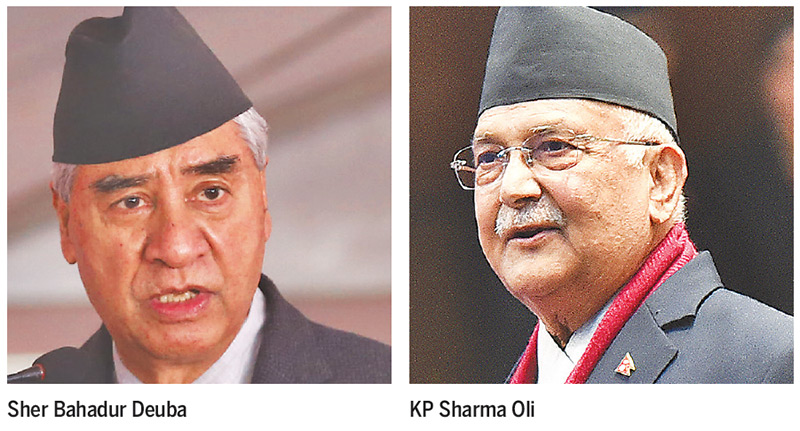
Oli accuses Deuba of straining ties with neighbours when in power
When Deuba was the PM, Parliament had ratified the MCC Nepal Compact, a $500 million American aid to Nepal.
- Post Report
KATHMANDU, Former prime minister and CPN-UML Chairman KP Sharma Oli has accused the previous government led by Sher Bahadur Deuba of straining relations with neighbouring countries. Speaking at an orientation programme organised by the party’s Department of Foreign Affairs on Friday, Oli said the Deuba government had unnecessarily disturbed relations with India and China. But Oli did not offer any concrete proof to back his claim. “In trying to get close to one country, relations with the other country were unnecessarily strained,” Oli said. Oli as prime minister in 2020 had issued a new political map of Nepal by incorporating Kalapani, Lipulek and Limpiyadhura, the Nepali areas on the western frontier also claimed by India. Oli’s was a tit-for-tat move after India unilaterally issued a new map by including the three areas within its borders. “Our foreign policy was conducted in a very controversial fashion. We also experienced irresponsible tendencies like favouring one country over another… The new government will conduct its foreign policy as per the domestic needs and policies,” said Oli. The orientation was organised for various party committees and members. Oli said the Pushpa Kamal Dahal-led government would bring Nepal’s foreign relations back onto the right track. UML’s Bimala Rai Paudyal is the new foreign minister in the Dahal-led government.
The present government will maintain balanced, credible, and trustworthy foreign relations, said Oli. “We should not discriminate between the neighbours and treat them both equally,” he said. “Earlier, an artificial tension was created with neighbouring countries. It was done at someone else’s behest…such behaviour is very dangerous for a country like ours which is in a geopolitically sensitive location,” said Oli without giving further details. He said Nepal will not play one neighbour against another and will aim to be a good neighbour. “We don’t play any cards against the neighbours. We want balanced and credible relations, we don’t say one thing and do something else… We want to be a good neighbour and will not harm our neighbours’ interests,” said Oli. He stressed the need for conducting foreign policy so as to reduce the country’s ballooning trade deficit, and resolving boundary disputes, among other things. Oli is also the head of the high-level political committee that advises and works with the Pushpa Kamal Dahal-led government on key political matters. When Deuba was the prime minister, Nepal’s parliament ratified the Millennium Challenge Corporation Nepal Compact, a $500 million American aid to Nepal, with tacit support of the UML. But the Deuba government rejected the State Partnership Program of the US government. The Deuba government also endorsed China’s Global Development Initiative while expressing its reservations over China’s Belt and Road Initiative and China’s Global Security Initiative (GSI). As Chinese officials and politicians have been urging Nepal to support the GSI, Nepali officials have made it clear that as per country’s stated policy, Nepal cannot support any alliance that has military, security or strategic component. Oli said Nepal will not allow its land to be used against any neighbours and asserted that the country will not be part of any military alliance. “We will not allow anyone to set up their army barracks [here]. We will not allow anyone to carry out their military activities inside our country. If any country tries to install such military barracks, it is an attack on our sovereignty and goes against our national interest,” said Oli. “We will not compromise on sovereignty and independence and we will maintain relations based on mutual benefit and respect. Amity with all and enmity with none will be the cornerstone of our foreign policy.”
HOME PAGE
RSP, RPP chip away at Madhesh parties’ bargaining power
- NISHAN KHATIWADA
Parties like Janata Samajbadi and Loktantrik Samajbadi find themselves ignored in power-sharing negotiations.
KATHMANDU, The newcomer Rastriya Swatantra Party’s unexpected success and the Rastriya Prajatantra Party’s impressive comeback in the November elections has sharply curtailed the Madhesh-based parties’ bargaining capacity in the ongoing power-sharing negotiations. Among the Madhesh-based parties, so far only the Janamat Party has joined the government led by Pushpa Kamal Dahal, and the party too is not happy with its share in the Cabinet. Janamat Party chair CK Raut’s public statements, including his speech in a parliamentary meeting also reflects that the regional parties feel ignored in power-sharing deals. Addressing the lower house meeting on Thursday, Raut questioned what type of national consensus the government was seeking by keeping Madhesh-based parties out, and stressed the need for including various ethnic-based groups in governance. While Raut’s party has joined the Dahal-led Cabinet, two other traditional Madhesh-based parties are yet to come on board. The Janata Samajbadi Party has said it will join the government only if it is given the post of Vice-president, and the Loktantrik Samajbadi Party, which was haggling for ministries until recently, has joined the Congress-led opposition camp. Loktantrik Samajbadi voted against the CPN-UML’s Speaker candidate during a vote in parliament on Thursday. “The attitude and behaviour of the government towards Madhesh-based parties, particularly towards the Loktantrik Samajbadi Party, was not right,” complained Keshav Jha, a Loktantrik Samajbadi leader. According to Sohan Sha, a Madhesh observer, even though some Madhesh-based parties have joined the government at the centre and in provinces, they are disenchanted and highly sceptical as there is no guarantee whether the current ruling alliance will sustain. The situation in the past was not the same, though. Madhesh-based parties held key Cabinet positions as major players in almost all governments in recent years. Since the 2008 Constituent Assembly elections, the Madhesh-based parties have been an integral part of the central government. It was with the backing of new Madhesh-based parties that the Maoists formed the government in 2008. They almost substituted the traditional parties in Madhesh after 2008. They won 87 seats. Until 2013, they witnessed repeated splits. But in the 2013 Constituent Assembly elections, Madhesh-based parties were limited to 12 federal seats. And in 2017, major Madhesh-based parties contested the elections jointly and won 34 seats in total. Now, they have only 23 seats in the federal parliament—the Janata Samajbadi Party’s 12, Janamat Party’s six, and Loktantrik Samajbadi Party’s five seats. After the 2017 elections, both the Oli-led and Deuba-led Cabinets included Madhesh-based parties giving them key Cabinet positions. But, in the last November’s elections, the Madhesh-based parties fared poorly and have markedly lost their influence in power-sharing negotiations. The emergence of the new Rastriya Swatantra Party and a strong comeback of the Rastriya Prajatantra Party are key reasons for this, say political experts. The pro-monarchy Rastriya Prajatantra Party that won just one parliamentary seat in 2017, bagged 14 seats in the elections last November. Chandra Kishore, a political commentator, said Madhesh-based parties have been losing their bargaining power gradually since 2008. “And, with the Rastriya Prajatantra Party and Rastriya Swatantra Party emerging as more powerful parties through the recent elections, they got major ministries,” said Jha. However, the Rastriya Swatantra Party and the Rastriya Prajatantra Party didn’t win more seats due to the weakening of the Madhesh-based parties. In Madhesh, the Congress and the UML performed better in the latest elections. “But Madhesh-based parties have lost their bargaining power in the number game in parliament owing to their poor show in the elections,” he added. Sha, the Madhesh observer, thinks Madhesh parties would have better bargaining power if there was a clear polarisation between the ruling and opposition alliances in parliament. But Prime Minister Dahal passed the floor test on January 10 with a thumping majority with even the main opposition Nepali Congress voting in his favour. “Now the situation is such that every party in parliament is willing to join the government for power. And since the Madhesh-based parties have fewer seats, they have become largely insignificant in the power-sharing talks,” said Sha. The new Janamat Party won six seats in its first attempt at parliamentary elections and became a national party. Now, it has joined the Dahal-led cabinet with one ministry—the Ministry of Water Supply. But the party is insisting that it should get one more, either the Ministry of Agriculture or the Ministry of Industry. The other two Madhesh-based parties performed poorly in the recent elections and lost their bargaining power, said Jha, the Loktantrik Samajbadi Party leader, echoing Kishore and Sha. But that is not all, said Jha. “The large parties think if they can achieve a majority by including like-minded parties of yes-men, why bother pleasing parties with regional bases that have been raising difficult demands. Why bring in rebels?” Jha told the Post.
HOME PAGE
ANFA misused Qatar World Cup tickets
Nepal’s football governing body passed the tickets on to AFC officials to gain ‘favour’.
- PRAJWAL OLI
KATHMANDU, Jan 20 All Nepal Football Association (ANFA) is found to have misused Qatar’s FIFA World Cup tickets that Nepal obtained from the world football governing body FIFA. According to documents obtained by the Post, ANFA received at least 290 World Cup tickets in the capacity of non-playing member association of FIFA for the global showpiece held in Qatar from November 20 to December 18. Among the 290 tickets, top office bearers of ANFA distributed 75 to the office bearers of Asian Football Confederation (AFC) to gain ‘unwanted favour.’ The purpose of providing such tickets to member association’s Football Association (FA) is to prioritise the citizens of respective countries in obtaining such tickets, but ANFA distributed them free of cost to AFC office bearers. ANFA spokesperson Suresh Shah and general secretary Kiran Rai on Wednesday confirmed that Nepal had received 290 tickets. Shah, in a news article published on BBC Nepali News portal on November 15, 2022, was quoted as saying that Nepal had received only 215 tickets and the AFC took the remaining 75 tickets. But when asked on Wednesday, exactly a month after Lionel Messi’s Argentina lifted the World Cup crown on December 18, about the recipient of tickets allocated to Nepal, both Shah and Rai were reluctant to answer and said they were preparing the list of buyers. “We are in the process of preparing a list of buyers,” said Rai. “It will take a few more days for us to finalise the buyers list.” He also said that they distributed some tickets to their wellwishers. But they declined to state who the well wishers were. When quizzed if they were AFC officials, he said: “Some of them may be employees at the AFC who have been lending a helping hand to us.” ANFA officials, including ANFA President Pankaj Nembang, German citizen Nabin Pande, who is adviser to Nembang, and Rai distributed the tickets to AFC office bearers, including deputy general secretary Vahid Kardany, said a source who did not want to be identified. Apart from Kardany, other AFC office bearers and employees were also the recipients of tickets, according to multiple sources. AFC’s communication chief Ravi Kumar did not respond to the Post, despite repeated attempts to know why AFC took the 75 tickets allocated to Nepal. According to the list of 290 tickets received by the Post, Nepal had got 10 tickets of the final match between Argentina and France, out of which ANFA distributed five to AFC office bearers. Same was the ticket distribution proportion of the semi-final between the world champions and Luka Modric’s Croatia. Of the total 10 tickets Nepal obtained for the opening match between hosts Qatar and Ecuador, ANFA was generous enough to distribute six tickets.
Why did ANFA distribute tickets? The football governing body of Nepal distributed tickets to pay off the favour they received from AFC, because the Asian football body paid for the tickets to FIFA at a time when ANFA was not in the situation to pay the cash totalling US$116,922.96. However, the condition was that ANFA reimburse the equivalent amount to AFC, according to documents obtained by the Post. “President Nembang has filed candidacy for member in the upcoming AFC Executive Committee election to be held on February 1. It seems that he wants to get favour in the election from office bearers of AFC and its employees,” said Dirgharaj KC, one of the vice presidents of ANFA. “We will raise the issue why ANFA gave Nepal’s tickets to AFC at the upcoming meeting.” AFC President Salman bin Ibrahim Al Khalifa has retained the top job unopposed. Another ANFA vice president Dipak Khatiwada said that ANFA decided to give the tickets to AFC because they have been supporting and helping Nepali football whenever needed. “There were also some discussions at ANFA on whether to give tickets to AFC or not. But the leadership decided to give away the tickets as they had been supporting us,” he said. The policy of Nepal’s central bank requires mandatory approval for foreign exchange due to the country’s depleting dollar reserves. A letter sent by ANFA general secretary Kiran Rai to AFC general secretary Datuk Seri Windsor John dated 30 June, 2022 had clarified the situation of Nepal requesting AFC to make payments on their behalf. “We are not in the position to purchase World Cup tickets due to our Nepal Government’s foreign currency transaction policy. We humbly request you to pay on behalf of ANFA and we will compensate an equivalent amount in AFC account immediately,” Rai had stated in the letter. Two weeks after the letter, AFC’s general secretary Windsor John confirmed to Rai that AFC would make the ticket payments. “Due to the restrictions of the foreign exchange policy of the Nepalese Government, we hereby confirm that AFC shall pay for the listed tickets to be purchased by ANFA and the payment will be made directly to FIFA,” stated the correspondence on the official AFC letterhead. “We also note your guarantee to transfer the US dollar equivalent for the ticket cost into the ANFA dedicated Enhanced bank account by 31 October 2022,” the letter further added. Advisor Pande later wrote to AFC deputy general secretary Vahid Kardany: “Thank you very much for your effort to pay on behalf of ANFA. …Also let me know how many tickets you may require. We have the possibility to request for more tickets, in case you need them,” Pande had written. Pande was appointed as the international relations head of ANFA on June 22 last year, two days after the Nembang-led committee was elected to lead Nepal’s football governing body. He was later assigned to be the president’s adviser on August 11 the same year, stripping him of his previous responsibility.
Treasurer Joshi in dark about payment Apart from ticket distribution, the Nembang-led ANFA needs to pay $116,922.96 for the tickets. But ANFA treasurer Rabindra Joshi says he does not know if the amount is to be paid or not. “I don’t know all things about payments,” Joshi said on Thursday and suggested that General Secretary Rai may have the answers. Rai, however, did not give a clear reply. “We are in the process of making payments. We have paid some amount and some amount is yet to be paid,” he said at the ANFA headquarters on Wednesday. “It could take four or five days more to come up with exact figures of the payments we have made.”
NATIONAL
Kathmandu Metropolitan City slammed for lacking clarity on digital billboards
Last September, the City launched a crackdown on such billboards, but they have returned as a case is sub judice.
- ANUP OJHA
A giant digital advertisement board at the United World Trade Centre overlooking the Tripureshwar crossroads pictured on Friday evening. Somepeople claim such billboards distract motorists. Post Photo: Keshav Thapa
KATHMANDU, When the Kathmandu Metropolitan City in the first week of September announced its intentions to remove all illegally-installed digital advertisement boards from the City and switched off the digital billboard screen at the World Trade Centre at Tripureshwar as a starter of the drive, urban planners and heritage activists appreciated it. City spokesman Nabin Manandhar told the Post at the time that it took action as the digital hoarding boards were installed without taking City’s permission. Similarly Shiva Raj Adhikari, the chief of the KMC’s Revenue Department said that the KMC was planning to remove all digital hoarding boards including those at Durbarmarg, Kathmandu’s high-end business district. However, the City’s decision was not lasting. The digital screen at the United World Trade Centre at Tripureshwar came back into operation just after a few weeks, and some more bigger digital boards came into operation in Thapathali, Kalimati, Jadibuti, Koteshwar, Jamal and Durbarmarg areas. “The crackdown did not last because of an immature decision by the City,” said Kishore Thapa, an urban planner and former government secretary. “No one knows the actual policy on hoarding boards in Kathmandu,” said Thapa. He blamed the City for not making any clear laws regarding the visual boards, which, the traffic police say, are a factor in causing road accidents. Adhikari, the chief of the KMC’s Revenue Department when asked why the City recanted from its earlier decision on digital hoarding boards, said the City could not take action as the issue is currently in the court. “The Patan High Court has given a stay order, that is why it could not take any action,” said Adhikari. “Once the court’s verdict comes out, we will go for action,” he added. According to officials at the City’s Revenue Department, only 49 digital boards have got permission from the City. “We have not kept a tab on the others, if they are installed, they are all illegal, and we will remove them,” said Adhikari. Meanwhile, the City spokesperson Manandhar said the City only gives permission to digital boards covering less than 800 square feet. When asked how the new hoarding boards in Thapathali, Jamal and Koteshwar emerged, he didn’t have an answer. “The KMC’s legislative committee is working on a draft for a separate law on hoarding boards or display boards. Once the new law comes out it will be easier for us to work,” said Manandhar. Although the City could not keep its word on digital hoarding boards which it had earlier branded illegal and has also announced to remove them; it is aggressively removing small signboards at grocery stores, stationery shops, restaurants and other small businesses. Shopkeepers complained they are being unfairly targeted. “I don’t understand why the City is targeting the signboards at small shops when huge digital signboards and screens have been allowed to operate illegally,” said Asmita Khanal, 45, who runs a grocery shop at Dhobichaur. She said the board above her shop is not a billboard but a name board telling people about what kind of goods the shop deals with. “They allow big billboards of big businesses because the City earns a lot of money from the boards. The authorities are biassed towards big businesses and are cracking down on smaller ones,” alleged Khanal. According to KMC’s revenue department, it annually earns Rs50 million in revenue from digital hoarding boards. It’s not only planners and heritage activists who see digital display boards as visual pollution in the historical city like Kathmandu, traffic police too have for long been expressing concerns over their impacts on riders, drivers and pedestrians. “Digital hoarding boards distract drivers, and are one of the contributors to road accidents,” said Rajendra Prasad Bhatta, spokesperson at Kathmandu Valley Traffic Police Office. “The bright lights of digital hoarding boards are great distractions in places where there are traffic lights,” said Bhatta. The Advertising Board Promotional Material Regulation Policy 2013 of the KMC states that it is illegal to install commercial hoarding boards and advertising materials on additional frames on the rooftops, and balconies of private and public buildings. In 2019, the KMC had announced plans to clear all hoarding boards from the streets, only allowing digital ones, but there was no monitoring. Unhappy with the presence of visual pollutants around the city, senior advocate Padma Bahadur Shrestha had filed a writ petition in 2014 demanding removal of all such hoarding boards and digital screens from public places. Responding to the petition, the Supreme Court had first issued an interim order to the local authorities and the government to make the city clean. The final verdict, issued on September 2, 2015, ordered the authorities concerned to maintain the civilised appearance of the city and remove visual pollutants from core city areas. The court’s verdict, however, went unimplemented for a long time.
NATIONAL
Home Minister Lamichhane directs Nepal Police to arrest ‘fugitive’ lawmaker Koiri
- Post Report
Despite being on the police wanted list, Laxmi Mahato Koiri visited Parliament and voted in favour of Prime Minister Dahal during the floor test on January 10. Post Photo
Kathmandu, The Ministry of Home Affairs has directed the Nepal Police Headquarters to arrest CPN-UML lawmaker Laxmi Mahato Koiri, who is accused of murder. In a statement on Friday, the Home Ministry said it was seriously concerned as police have not arrested the fugitive lawmaker despite repeated verbal directions by Deputy Prime Minister and Home Minister Rabi Lamichhane. The Home Ministry has written to the Nepal Police Headquarters directing it to arrest Koiri and take action as per the law immediately, reads the statement signed by Fanindra Mani Pokharel, spokesperson for the Home Ministry. Despite being on the police wanted list, Koiri attended the House meeting on January 10 and voted in favour of a trust motion tabled by Prime Minister Pushpa Kamal Dahal. He had also attended the oath-taking ceremony for new lawmakers. Koiri, who was elected to the House of Representatives from Mahottari-1, has been accused of murdering Assistant Sub-inspector Thaman Bishwakarma during the Madhesh protest. Koiri is accused of dragging the officer from a police van and killing him on September 11, 2015. The Dhanusha District Court had freed Koiri on a bail of Rs100,000. But the Janakpur High Court had issued an arrest warrant against him after overturning the decision of the district court. Responding to a question raised by Nepali Congress lawmaker Ram Hari Khatiwada, Home Minister Lamichhane told Parliament on Thursday that the ministry would not do anything going against the rules and procedure.
NATIONAL
Four in-laws get life terms for murdering woman
District Digest
HETAUDA: Makawanpur District Court has convicted four persons in the June 2020 murder of 24-year-old Sushmita KC. A single bench of justice Shree Prasad Sanjel on Friday sentenced KC’s father-in-law Prakash Thapa, his daughters Durga and Sita Thapa and son-in-law Arun Karki to 25 years in prison for the murder. Sushmita’s mother-in-law was sentenced to 10 years in prison for being an accomplice to the murder. Sushmita was found beaten to death at home. Her husband, Rupendra Thapa, died on October 10, 2019, in a road accident. According to police, the family killed Sushmita so that they could claim Rupendra’s insurance policy.
NATIONAL
Eight cows killed, homes gutted in two fire incidents
District Digest
SAPTARI: A fire that started from a cowshed on Friday left five cows dead and gutted two adjoining houses in Tirahut Rural Municipality-4. Similarly, eight cows were killed when another cowshed caught fire in Rupani Rural Municipality-1 on Thursday night. According to Abhinarayan Kafle of the district police, both shed fires were accidental.
NATIONAL
Chief minister passes floor test
District Digest
BIRENDRANAGAR: Karnali chief minister Raj Kumar Sharma on Friday secured a vote of confidence in the provincial assembly. Sharma secured 25 votes in the 40-member assembly. Thirty-nine members were present during Friday’s vote. Thirteen members from the CPN (Maoist Centre), nine from the CPN-UML, and one each from the Rastriya Prajatantra Party, the CPN (Unified Socialist), and an independent member voted in favour of Sharma, while 14 Nepali Congress assembly members voted against him.
NATIONAL
Two rhinos found dead in Chitwan with horns missing
District Digest
EAST NAWALPARASI: Two rhinos were found dead with their horns cut off on the banks of the Narayani River at Madhyabindu Municipality-2 inside the Chitwan National Park (CNP), on Friday. Ganesh Prasad Tiwari, information officer of the park suspects it was an incident of poaching. An investigation is underway, said Tiwari.
NATIONAL
Humla sees season’s first snow
District Digest
HUMLA: Humla, a mountain district in Karnali, witnessed the season’s first snowfall on Thursday night. Continuous snowfall since then has brought life to a standstill in the villages. According to Sita Pariyar, chief district officer, the district has been experiencing extreme weather conditions for the past few days which has led to an increase in patients suffering from cold and fever. Flights and vehicular movement have been disrupted due to snowfall.
NATIONAL
Ruling coalition fails to ensure inclusiveness in Cabinet
Political parties won’t ensure inclusion, unless it’s made mandatory by amending the constitution, says expert.
- TIKA R PRADHAN
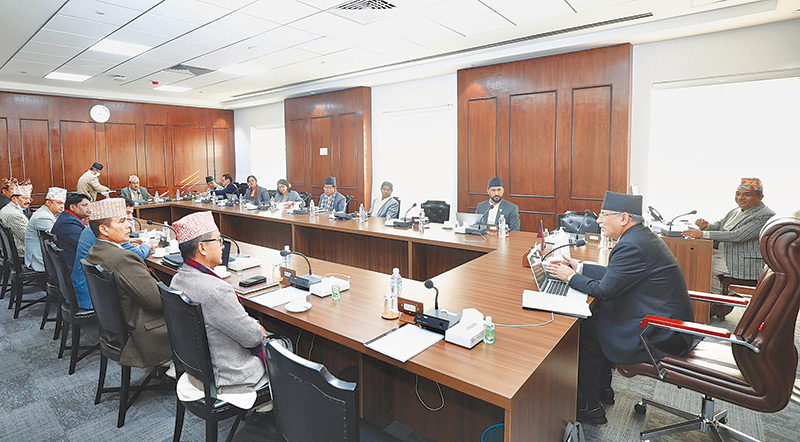
Prime Minister Pushpa Kamal Dahal chairs a Cabinet meeting on Wednesday. Photo: Prime Minister’s Secretariat
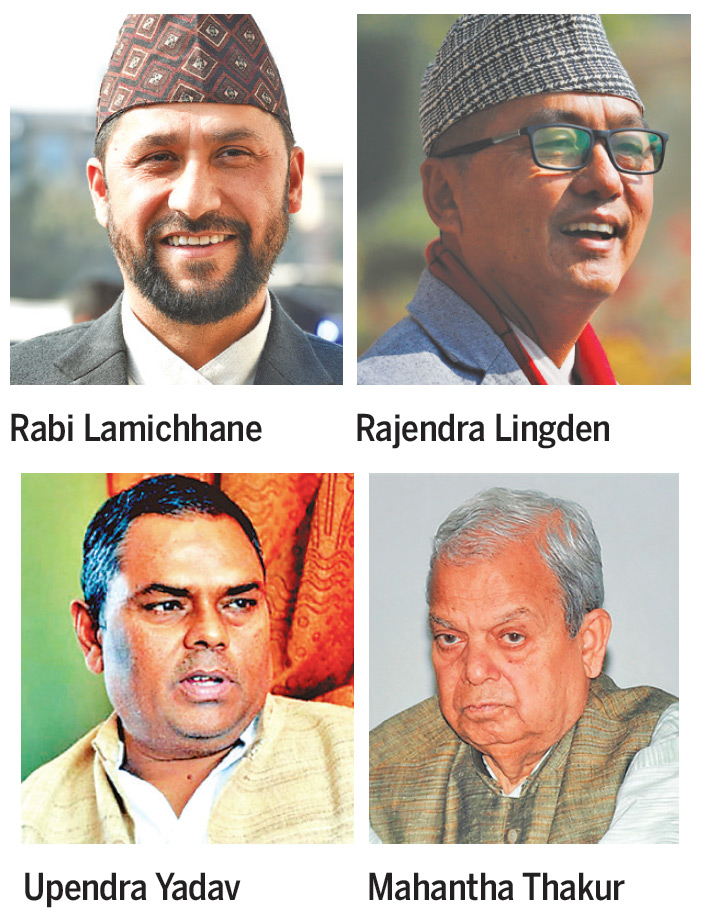
KATHMANDU, Prime Minister Pushpa Kamal Dahal inducted 15 ministers and state ministers to his Cabinet on Wednesday, but failed to honour the constitutional spirit of inclusiveness. Now the Dahal-led Council of Ministers has 20 ministers, including the prime minister and three ministers of state, but the coalition partners failed to make it inclusive. As Dahal leads a government involving many parties, he could have asked the coalition partners to make the Cabinet inclusive. The Cabinet, as the top executive body of the country, should be inclusive and have at least 33 percent women, but among the 20 full ministers, who take part in Cabinet meetings, only four, or 20 percent, are women, and there is no Dalit. “To ensure proportional representation in all government bodies, we need to amend the constitutional provisions,” said senior advocate Chandra Kanta Gyawali, who is also an expert on constitutional law. “Our constitution says all the government bodies should be inclusive, but the political parties never heed the constitutional spirit.” Dahal has appointed four deputy prime ministers, all male. Even the parties have failed to make the Cabinet inclusive in terms of geographical region. As a gesture of inclusion, of the two women ministers of state, Sushila Sirpali Thakuri represents the Dalit community. But ministers of state do not have an influential role in decision-making as they don’t attend Cabinet meetings. There were expectations of some progressive initiatives including inclusive representation from the new Rastriya Swatantra Party led by journalist-turned-politician Rabi Lamichhane, but to no avail. The 23-member team of Dahal has 13 members from the Khas-Arya group and five from the Aadibasi Janajati group besides two from Tharu and one each from the Muslim and Madheshi communities. Among the UML ministers, two represent the Khas-Arya community while one each comes from Janajati, Tharu and Madhesi communities. From Prime Minister Dahal’s party, two represent Khas Arya—Dahal and Rekha Sharma—while one is Janajati [Sudan Kirati], another is Tharu [Aman Lal Modi] and Sushila Sirpali as minister of state represents the Dalit community. The CPN (Maoist Centre) that is leading the government has a more inclusive team, compared to other parties in the coalition. “We have given the most inclusive list of ministers, but you cannot force other parties in the coalition to make their picks inclusive,” said Hitraj Pande, chief whip of the Maoist Centre. “Though there is no constitutional provision of proportional inclusiveness in the Cabinet, the Dahal-led council is more inclusive, compared to previous ones.” The government has eight ministers from the UML, five from the Maoist Centre, four each from the RSP and the RPP and one from the Janamat Party. A Janamat leader, Abdul Khan, who is the only Muslim member in the Cabinet, is unhappy after the coalition assigned him the Ministry of Water Supply against his party’s wishes. Even the RSP, a new party, has sent all its four ministers from the Khas-Arya group. They are Rabi Lamichhane, Sishir Khanal, Dol Prasad Aryal and minister of state for health Toshima Karki. Among its 20 lawmakers, three are from Janajati, two from Madheshi and one each from Tharu and Muslim communities. But the Lamichhane-led party didn’t bother to make its Cabinet team inclusive. The Rastriya Prajatantra Party has two ministers—Bikram Pande and Dipak Singh—from Khas-Arya group, and Rajendra Lingden and Dhruba Bahadur Pradhan from Janajati communities.
NATIONAL
Swatantra Party’s Magar and Congress’ Yadav in deputy Speaker race
- Post Report
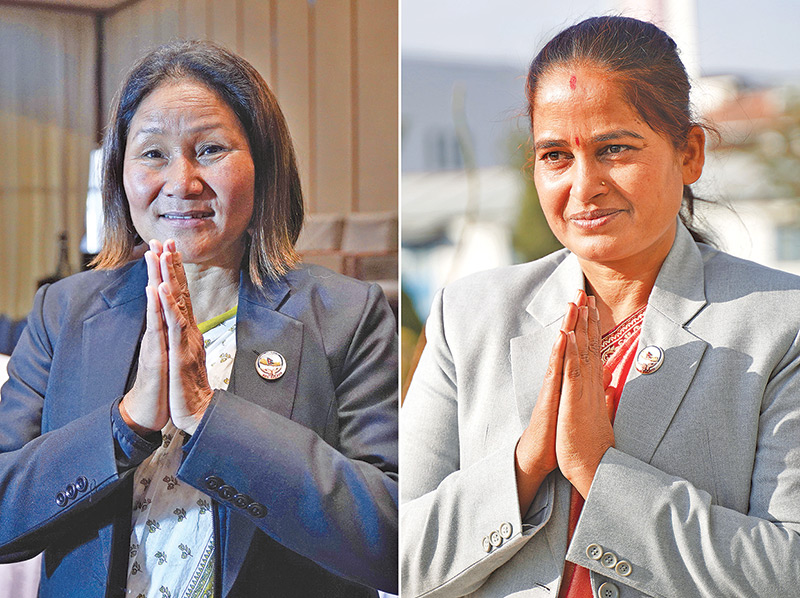
Indira Rana Magar Mukta Kumari Yadav Post Photos
KATHMANDU, The ruling coalition led by CPN (Maoist Centre) and CPN-UML has fielded Rastriya Swatantra Party lawmaker Indira Rana Magar for the deputy Speaker election in the House of Representatives. On the other hand, the opposition alliance led by Nepali Congress fielded Mukta Kumari Yadav of the Congress for the post on Friday. Both Magar and Yadav filed their nominations at the parliament secretariat. Magar’s nomination was proposed by Rastriya Swatantra Party lawmaker Sobita Gautam and was seconded by CPN-UML’s Krishna Gopal Shrestha, CPN (Maoist Centre) lawmaker Narayani Sharma and Rastriya Prajatantra Party lawmaker and Deputy Prime Minister Rajendra Lingden. She is their common candidate. Congress, the CPN (Unified Socialist), Loktantrik Samajbadi Party and Rastriya Janamorcha have fielded Yadav as the candidate of the alliance. Yadav’s nomination was proposed by Congress lawmaker Badri Prasad Pandey and seconded by Unified Socialist’s Metmani Chaudhary and Loktantrik Samajbadi Party’s Sarbendra Nath Shukla. Yadav, a central committee member of Nepali Congress, is a former member of the National Assembly. The House of Representatives is conducting a vote on Saturday. The House elected UML’s Dev Raj Ghimire the Speaker on Thursday. He defeated Ishwari Neupane of the Congress. Since the ruling coalition commands a majority in the House, Rana Magar is set to win.
NATIONAL
Government hikes salaries of judges and others left out in previous announcement
The pay increase comes six months after salaries of government employees were raised.
- PRITHVI MAN SHRESTHA
KATHMANDU, The government has increased the salary of the office bearers of judicial services, constitutional bodies, and those of some other state and government agencies by 15 percent effective from mid-July 2022, the start of the current fiscal year. The government said the salaries of these office bearers were increased in line with the pay rise of civil servants effected at the beginning of the current fiscal year. In the budget for the current fiscal year, former finance minister Janardan Sharma had increased the basic salary of government employees by 15 percent effective from July 17, 2022. Sharma had claimed that the move was aimed at enhancing the service spirit by motivating all government workers including civil servants, the army and police personnel, and teachers, among others. He, however, had not mentioned increasing the salaries of office bearers of the judiciary, constitutional bodies and various other agencies. As per the notice issued by the government in the Nepal Gazzate on Thursday, the chief justice and justices of the Supreme Court, judges of high courts and district courts, members of judicial councils, attorney general, officer bearers of the National Planning Commission, officer bearers of constitutional bodies, general secretary and secretaries of federal parliament and office bearers of the National Information Commission were notified of the pay hike. With the new hike, the chief justice will now receive Rs102,293 per month, up from Rs88,950 earlier. Supreme Court justices will receive Rs85,043 per month, up from Rs73,950. Chiefs of constitutional bodies will get Rs80,707 per month, up from Rs70,180. The general secretary of federal parliament will now take home Rs77,211 per month, up from Rs67,140 earlier. Ritesh Shakya, chief of the budget division at the Finance Ministry, said that the salaries of all these office bearers were increased in line with the salary increases of other government employees. Since the government had earlier not specifically mentioned the aforementioned services and officials in its pay hike decision, they had not enjoyed salary hikes. “That’s why the salary has been increased now through a separate decision,” Shakya said. The government is yet to take a similar decision on hiking the salary of President, Vice President and the prime minister equivalently, according to Finance Secretary Toyam Raya. “The budgetary provision, however, is applicable to all of them,” he said. Officials said as the salaries of judges and others had not been hiked despite the budgetary provision, there was a confusion about on what basis should the pension documents for retiring judges and others be prepared. On the other hand, the new government announced in late December that the Cabinet ministers would not take a pay rise. Deputy Prime Minister and Finance Minister Bishnu Paudel had announced on December 27 that the Council of Ministers decided not to increase salaries for the members of the Council of Ministers due to the country’s precarious economic situation. After hiking salaries by 15 percent this year, the government now aims to further adjust upwardly the salaries of the President and the Vice President. In late August last year, the government formed a High-Level Salary and Benefits Commission led by former chief secretary Leela Mani Paudyal with a mandate to review the minimum salary, allowances, wages and perks and benefits of government employees and workers. The panel was also asked to recommend appropriate salary and other benefits for officials of state and government agencies. Poudyal told the Post that the commission was continuing its study on the matter and aimed to make recommendations within the next one month. “We are studying our paying capacity based on revenue collection trends, the status of salaries of public officials in neighbouring countries, how much salary is needed for a decent living and what was recommended in the past regarding the salary structure of the public officials,” he said.
NATIONAL
Students of Hulakdanda see no recourse but to quit studies after Grade 8
The closest secondary school from Manthali Municipality Ward 6 is at least three hours walk and daily commute is impossible, students say.
- TIKA PRASAD BHATTA
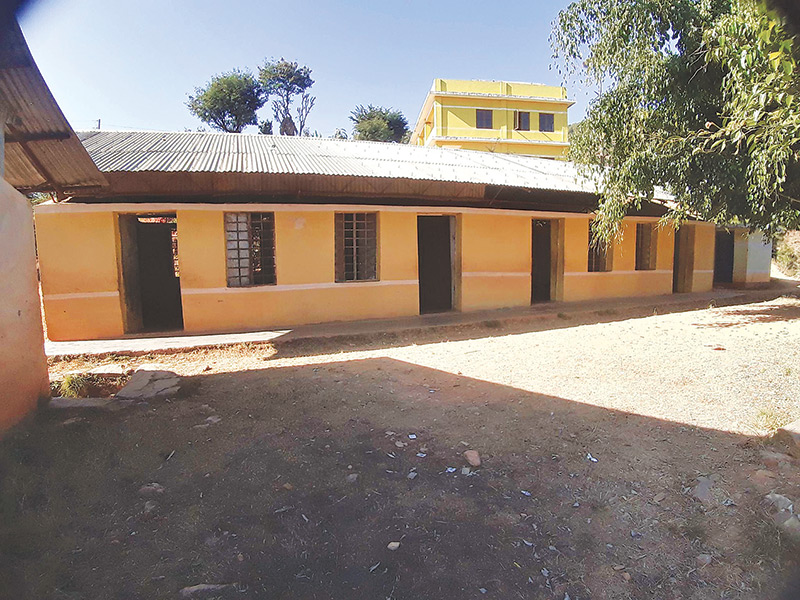
The school building is dilapidated and there are no sufficient desks or even teachers. Post Photo
RAMECHHAP, Ishwar Shrestha, a 13-year-old eighth-grader at the Hulakdanda Basic School in Hulakdanda, Manthali Municipality-6, is worried about his secondary education as there are no schools in the village that provide education above the eighth grade. One has to walk at least three hours to reach the nearest secondary school in Bhangeri. Hulakdanda is situated in a difficult geography; it takes several hours to go from one village to another. After completing grade eight, students of the local school are compelled to go to Khurkot in Sindhuli or Bhangeri in Ramechhap for the remaining school years. But not all families can afford to send their children outside Hulakdanda for studies. “Our family’s financial condition is not good,” Ishwar said. “I have only two options before me if I am to continue with my studies—walk for six hours every day to and from the school in Bhangeri or quit studies altogether because I can’t afford to rent a room near the school.” Hulakdanda Basic School was established in 2017. Its principal, Bhakta Bahadur Thapa, says that for a lack of infrastructure, and low student numbers and enrollment rate, the school does not have plans to upgrade to a secondary-level school. “After completing primary and basic level education, we advise our students to join higher secondary schools in other districts,” Thapa said. “Our school is not equipped to upgrade to a higher level of education. The building is dilapidated and there are no sufficient desks or benches or even teachers.” From Early Childhood Development grades to grade eight, there are 95 students in the basic school. In grade eight, there are only ten students. According to Bharat Bahadur Bhattarai, head of the education unit of Manthali Municipality, basic schools must obtain approval to upgrade to secondary-level education from the local unit. “The office can approve the upgrade only if there are more than 22 students in grade eight, but in Hulakada Basic School there are only ten,” said Bhattarai. According to Thapa, every year, four to five students drop out of school and go to cities like Kathmandu to join the labour force after completing their basic education. “Only some parents who can afford to rent a room for their wards send them to other districts for higher education,” said Thapa. Most guardians say they would want to see their wards pursue higher studies if there were higher educational institutions in the village itself. “If there was a secondary school in the village, my son would continue his education,” said Sabitra Shrestha, Ishwar’s mother. “But he plans to drop out because we won’t be able to finance his education elsewhere.” Dawa Tamang, chairman of the school management committee, is aware of the fact that students are quitting their studies due to the lack of a secondary school in the village. But he says he is yet to devise a plan to solve the problem. “We don’t have any tangible plans as of now but we will soon find a way to resolve this issue,” he said. Mandira Shahi, whose son dropped out of school last year, says her financial situation did not support sending him to the secondary school in Khurkot or Bhangeri. “We can’t send our children to another place without renting a room and providing other essentials,” she said. “So my son is planning to discontinue his studies.”
NATIONAL
Maoist Centre leader Pun discharged from hospital
Briefing
KATHMANDU: Barsha Man Pun, deputy general secretary of CPN (Maoist Centre), was discharged from the hospital on Friday after a weeklong treatment for jaundice. Pun was airlifted to the Lalitpur-based Sumeru City Hospital from Rolpa on Saturday after his health condition suddenly worsened. Doctors attending to Pun discharged him from the hospital following an improvement in his health condition, asking the leader to be in close contact with medics. Doctors have suggested the leader undergo liver transplant, as he is suffering from acute liver disease. Doctors have said that a transplant is the only cure for him now, as around 80 percent of his liver has stopped functioning. Pun, who is also a former finance and energy minister, had gone to China on December 2 for follow-up treatment at the Shenzhen-based Third People’s Hospital and returned to the country on December 20. His health issues—insomnia, skin itching, coughing, lack of appetite and vomiting—were reported to have resolved after treatment.
NATIONAL
Nepali Congress issues whip to vote for deputy Speaker candidate Yadav
Briefing
KATHMANDU: The Nepali Congress has issued a whip to its lawmakers to vote for Mukta Kumari Yadav, the party’s candidate for the deputy Speaker of the House of Representatives. NC Chief Whip Ramesh Lekhak issued the whip on Friday to the party’s parliamentarians to be compulsorily present in the meeting, not to remain neutral and to vote in favour of a motion calling to elect Yadav as the deputy Speaker. He also directed the lawmakers to vote against a motion to elect Indira Rana Magar, a common candidate of the ruling alliance. A motion related to the election of the deputy Speaker would be tabled in the House meeting scheduled for 1pm, Saturday.
NATIONAL
Nepali Embassy in Dhaka organises painting competition
Briefing
KATHMANDU: The Nepali Embassy in Dhaka on Friday organised a painting competition among school students as a part of the events held to mark the 50 years of diplomatic relations between Nepal and Bangladesh. The competition was held in collaboration with the Bangladesh-Nepal Friendship Society and Bangladesh Book Club to provide an opportunity for the students to explore new dimensions of Nepal-Bangladesh relations through their artworks, the embassy said in a statement. Broadly based on the theme of connecting the Himalayas and the Bay of Bengal, the participants portrayed mountains and cultural heritages of Nepal and Bangladesh in their paintings. Around 300 students from 25 schools in Dhaka participated in the competition.
NATIONAL
Speaker Ghimire takes oath of office
Briefing
KATHMANDU: Newly elected Speaker of the House of Representatives Dev Raj Ghimire has taken the oath of office and secrecy. Ghimire was sworn in by President Bidya Devi Bhandari at the President’s Office on Friday. CPN-UML’s Ghimire was elected the House Speaker, defeating Ishwari Neupane of the Nepali Congress on Thursday. Out of the 268 parliamentarians in attendance, 167 voted in favour of Ghimire. Neupane received 100 votes while one lawmaker from Nepal Majdoor Kisan Party abstained. Ghimire, who won the November 20 elections from Jhapa-2, is a Standing Committee member.
MONEY
Fewer farmers growing sugarcane due to payment hassles
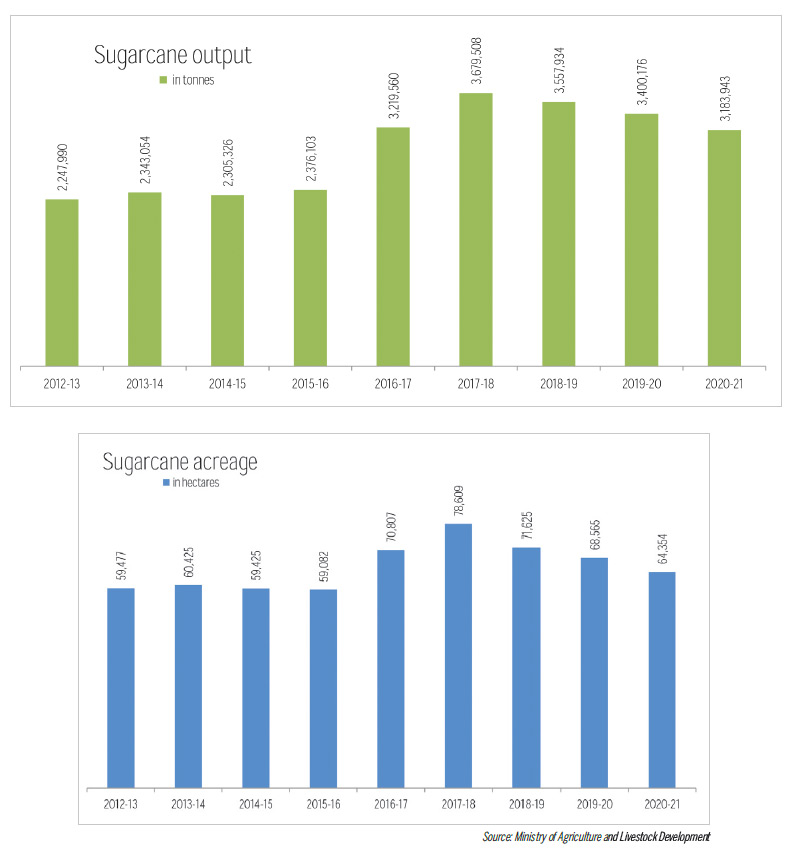
The sugarcane acreage has decreased from 78,609 hectares in 2017-18 to 64,354 hectares in 2020-21, government data show.
- KRISHANA PRASAIN
Source: Ministry of Agriculture and Livestock Development
KATHMANDU, Sugarcane farmer Ashok Yadav of Rautahat used to plant the cash crop on 10 bighas till a few years ago, but now he does it on 1 bigha only. The constant hassle of getting payment from the sugar mills for his harvest has made him disinclined to plant sugarcane, he says. “I produce lentils, wheat and other vegetables on my farm now,” he said. “We don’t get much return from these crops, but at least we get cash unlike sugarcane which we always have to sell on credit.” He said that Rautahat district used to produce 300,000 tonnes of sugarcane annually, but output has now shrunk to 50,000 tonnes. In Mahottari, according to the Sugarcane Producers Farmers Association, five years ago there were 13,000 farmers who cultivated sugarcane, now there are only 7,000. Naresh Kushawa, president of the association, says the sugarcane acreage has decreased from 15,000 bighas a few years ago to 7,000 bighas. The statistics of the government too show that sugarcane production and acreage have become smaller in the last four years. Sugarcane production has been in continuous decline from 2017-18. According to the Ministry of Agriculture and Livestock Development, Nepali farmers grew 3.67 million tonnes of sugarcane on 78,609 hectares in 2017-18. Output dropped sharply to 3.18 million tonnes and the acreage shrank to 64,354 hectares in 2020-21. The ministry says that production has been declining due to the high cost and increasing market risk. Sugarcane farmers say that difficulties in getting payment from the mills and chemical fertiliser from the government have discouraged them from planting the cash crop. “Sugarcane farmers have to wait for months to get their money, and so most of them have switched to other crops,” said Kapil Muni Mainali, president of the Federation of Sugarcane Producers Association. “There is a good return from sugarcane,” Kushawa said. The government has been unable to set an appropriate price for sugarcane, and farmers say they are up to their necks in debt as a result. “Farmers prefer to grow cash crops like hybrid paddy, mustard and maize,” Mainali said. “Some farmers have dug big ponds on their farms to raise fish.” The price of sugar has swelled by 30 percent this year, but the government has increased the price of sugarcane by a mere Rs20 per quintal. “The cost of growing sugarcane has increased by 30 percent,” said Mainali. Rakesh Mishra, a farmer from Sarlahi, said the government never consults with the farmers before setting the minimum support price. Sugarcane farmers are unhappy with the latest rate. The government on Wednesday raised the floor price of sugarcane by Rs20 per quintal to Rs610 per quintal for this year’s harvest. Mishra complained that the government has set the price two months after the harvest season. “Even then the price is lower than the cost of production. It looks like the government does whatever businessmen say,” he said. “The labour cost is up, there is a shortage of farm hands, there is a shortage of chemical fertiliser every year and the price of diesel is very high. Farmers have to buy fertiliser illegally. We have to pay Rs3,000 for a 50-kg bag when it used to cost around Rs1,500,” said Mishra. “The cost of hiring a tractor to transport sugarcane to the mill is more than Rs3,000. It used to cost Rs1,200 two years ago. The government always promises to support farmers, but in the end the lofty promises remain unfulfilled, “ said Nirmal Timilsina, a farmer from Bardibas-8, Mahottari. Timilsina, who used to plant sugarcane on 10 bighas, has reduced the acreage by half as he doesn’t want to haggle over the price every year. “I planted sugarcane by taking a loan, but the sugar mill is always delaying to make payment for my crop. Now, I have switched to mustard and vegetables.” Prakash Kumar Sanjel, joint secretary of the Agriculture Ministry, says the government works as a mediator between sugar mills and sugarcane farmers while setting the minimum support price. “The sugar mills say they will not be able to run the factory if they have to buy the cane at hiked rates. On the other hand, farmers say the rate does not cover even the cost of production,” he said. “We conduct field reports in different districts before analysing the price. The minimum support price was set at Rs540 per quintal, adding the cost of production, profit and transportation. The government then provides farmers a subsidy of Rs70 per quintal so that both mills and farmers get a fair deal,” Sanjel said. “The price is set after a joint agreement between sugar mill owners, farmers’ representatives and the government,” Sanjel said. Decreased cultivation of sugarcane has led to an increase in the import of sugar. According to the Agriculture Ministry, a Nepali is estimated to consume 4-6 kg of sugar annually. On the basis of consumption, the country’s sugar requirement stands at 260,000 tonnes annually. Of the total sugar produced in the country, 65 percent is used by households and 35 percent is used for industrial purposes. There are 13 sugar mills in Nepal and their annual production capacity is 463,950 tonnes. But since most of them are unable to operate at full capacity, domestic production fulfils only 71 percent of the requirement. According to the ministry, sugarcane is a major cash crop in Nepal, but it faces obstacles in production and marketisation. There is a high possibility of producing quality sugarcane by expanding sugarcane farming commercially across the country. But there is no proper policy to promote the crop.
MONEY
Court orders removal of illegal structures built by Silver Heritage Investment
- Post Report
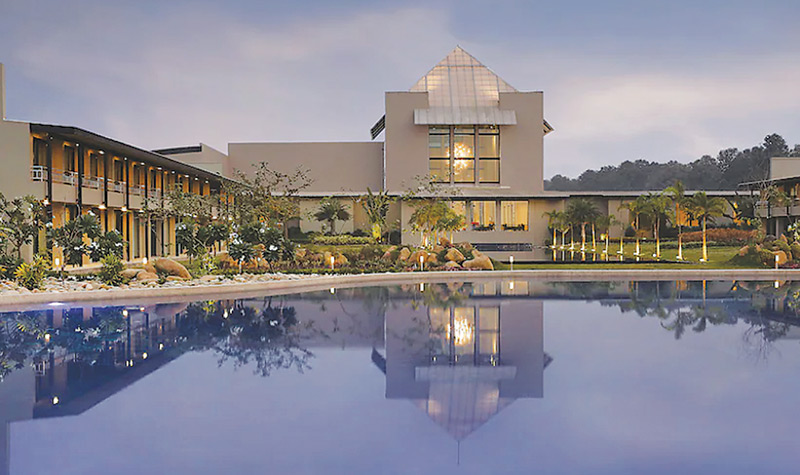
Tiger Palace in Bhairahawa is spread over 17 bighas. Photo Courtesy: Tiger Palace Resort
KATHMANDU, Rupandehi District Court has ordered gaming operator Silver Heritage Investment, which operates the five-star Tiger Palace Resort, to remove all structures it constructed on government, public and community land. Judge Krishna Murari Siwakoti passed the verdict to this effect on Thursday. On July 4, 2019, the Lumbini Nalkul Water Consumers’ Association, Rupandehi, a Bhairahawa-based groundwater users group, filed a writ demanding the recovery of 9 kattha (3,205 square metres) of public land. The association has accused the resort of encroaching on plot numbers 120, 148, 152 and 190 belonging to a public canal and plot number 73 belonging to the government. Petitioner Lekhnath Pokhrel told the Post that the full text of the order would be released in a month. “With Thursday’s verdict, Silver Heritage Investment, however, can appeal to the high court.” According to him, structures built on 12 kattha [4,056 square metres] of land have been deemed illegal. This will partially affect the casino floor, swimming pool, one villa in front of the swimming pool and one room in the resort. Similarly, six kattha of land, which is 10 metres ahead on the left side from the main entrance gate, has been deemed as an illegal possession by Silver Heritage Investment. Silver Heritage Investment is the locally registered subsidiary of the Silver Heritage Group. The group debuted in Nepal in 2015 with the opening of The Millionaire’s Club & Casino at the Shangri-La Hotel in Kathmandu. In 2017, it opened the 100-room Tiger Palace Resort in Bhairahawa, which is the first integrated five-star casino resort in South Asia. On July 5, 2019, the court issued an interim order to Tiger One and Silver Heritage Investment of Tilottama Municipality-7, forbidding it to sell shares or build anything on the plot where the five-star Tiger Palace Resort stands, pending a full verdict on a writ petition charging encroachment on public land. In November 2021, the court slapped gaming operator Tiger One and Silver Heritage Investment with a fine of Rs3,000 for contempt of court. It was found the defendants have conducted the purchase and sale of shares, undergone agreements and constructed physical structures including a new house and party hall on the land. According to the documents seen by the Post at that time, the sale and purchase agreements of the shares and properties of Silver Heritage Investment were completed on August 3, 2021. The documents showed that the buyers were United States-based Manhattan Heights Group, Bhusal Investment of Bhairahawa and Kathmandu-based Samrat Group. Built at a cost of Rs6 billion, the Tiger Palace Resort has been valued at Rs3.97 billion. The Silver Heritage Group has put its property on the market several times. In August 2019, non-resident Nepali Indra Bahadur Thapa offered to buy the Tiger Palace Resort in Bhairahawa at an enterprise value of $33.9 million. But the deal fell through after Thapa failed to come up with the money. At that time, three Nepali business houses—Chaudhary Group, IME Group and Vishal Group—were in the fray to buy the resort after the Silver Heritage Group put it up for sale or partnership. The 100-room property is the first integrated five-star casino resort in South Asia. Silver Heritage had planned to offer 400 guest rooms in the second phase. It was awarded a five-star rating by the Department of Tourism in November 2017.
MONEY
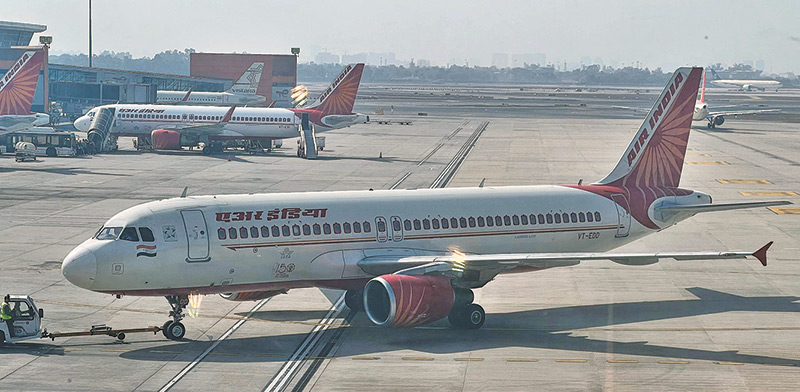
Air India fined $37,000 for unruly passenger incident
- REUTERS
AFP/RSS
NEW DELHI, Air India has been fined 3 million Indian rupees ($37,000) for its handling of an unruly passenger on one of its flights in November, India’s aviation regulator said on Friday. The licence of the pilot-in-command on the New York-New Delhi flight, where the incident took place, was also suspended for three months while a penalty of 300,000 rupees was imposed on Air India’s director-in-flight services, the regulator added in a statement. The ruling on the Tata group-owned airline followed from an incident on a November 26 flight in which a male passenger, while apparently inebriated, allegedly urinated on a female co-passenger. Air India, on Friday, said it was studying the regulator’s order on the matter, but acknowledged that there were “gaps” in the airline’s internal reporting and assured the “relevant steps” were being taken to address them. “We are also strengthening our crews’ awareness of and compliance with policies on the handling of incidents involving unruly passengers,” said a spokesperson. India’s aviation regulator had earlier issued formal paperwork, named show cause notices, to some Air India staff, including the pilots and cabin crew of the flight involved in the incident, asking why enforcement action should not be taken against them. Air India had also issued show cause notices and de-rostered one pilot and four cabin crew as part of its investigation. The airline, on Thursday, also imposed a flying ban for four months on the passenger.
MONEY
Nepali jeweller Kajal Naina opens store in Hong Kong
Bizline
KATHMANDU: After four years as an online-first jewellery business, Hong Kong-based Nepali designer Kajal Naina has opened her first physical store, at Harbour City’s Ocean Gallery. Naina’s creations have drawn a following globally, with selected items sold online and through stores in markets including Nepal, Australia, the UK and Singapore. Flying Solo in New York City to stock the brand from March. A second standalone store is planned for Kathmandu, Nepal, late this year. The brand targets an elegant and affluent predominantly female demographic aged 30 to 55, who are “modern, sophisticated, independent, passionate, and health-conscious”, reads the press release issued by the company. (PR)
MONEY
Google parent cuts 12,000 jobs in latest blow to tech sector
Bizline
CALIFORNIA: Google’s parent Alphabet Inc is eliminating about 12,000 jobs, or 6 percent of its workforce, the company said Friday, in the latest cuts to shake the technology sector. Sundar Pichai, Alphabet’s CEO, said in a staff memo shared with Reuters that the company had rapidly expanded headcount in recent years “for a different economic reality than the one we face today.” “I take full responsibility for the decisions that led us here,” he said. The cuts come days after rival Microsoft Corp said it would lay off 10,000 workers. Alphabet’s job losses affect teams across the company including recruiting and some corporate functions, as well as some engineering and products teams. The layoffs are global and impact US staff immediately. (REUTERS)
MONEY
India backs Sri Lanka to secure IMF bailout plan amid crisis
Briefing
COLOMBO: India’s foreign minister said on Friday his country has given financial assurances to the International Monetary Fund to facilitate a bailout plan to help neighbouring Sri Lanka emerge from its worst economic crisis, in a first formal announcement from one of the island nation’s creditors. India’s Foreign Minister S Jaishankar announced the support while on a two-day visit to Sri Lanka, where he met with President Ranil Wickremesinghe and other Cabinet ministers. “We felt strongly that Sri Lanka’s creditors must take proactive steps to facilitate its recovery. (AP)
SPORTS
Tsitsipas, Swiatek shine at Australian Open
The men’s third seed beats Griekspoor 6-2, 7-6(5), 6-3. Top seed and women’s favourite sees off Bucsa 6-0, 6-1.
- REUTERS
Iga Swiatek of Poland waves after defeating Cristina Bucsa of Spain during their third round match at the Australian Open in Melbourne on Friday. Ap/Rss
MELBOURNE, Stefanos Tsitsipas and Iga Swiatek dazzled in bright sunshine to make short work of their third-round opponents on Friday as some normalcy returned to the Australian Open after scheduling woes, wild weather, upsets and late finishes hogged the headlines. Third seed Tsitsipas, the top surviving seed in the men’s draw, checked his phone after a 6-2, 7-6(5), 6-3 win over Dutchman Tallon Griekspoor and reflected on the beautiful day after hours of tennis were lost this week to the heat and stop-start rain. “Fair crack of the whip mate, I mean, it was great,” Tsitsipas said “I think my placement on the serve was exceptional today, I didn’t have a lot of rallies on my serve, which helped a lot.” Tsitsipas has still not dropped a set in the tournament as he chases his maiden Grand Slam, with his chances boosted by the exits of holder Rafa Nadal and second seed Casper Ruud and an injury cloud hanging over favourite Novak Djokovic. But the 2021 French Open runner-up came close, saving a set point in the second set before doubling his advantage following a tiebreak to pave the way for a comfortable win to delight his supporters on Rod Laver Arena. Tsitsipas will next take on Italian Jannik Sinner in what could be a tricky test. Top seed and women’s favourite Swiatek was equally dominant in her 6-0, 6-1 victory over Cristina Bucsa as she bids to add to her two French Open wins and US Open crown. “A couple of years ago when I was in the fourth round I was really exhausted, and right now I feel this is the right place to be,” Swiatek said. “Hopefully I’m going to continue to playing solid.” Up next for Swiatek is Wimbledon champion Elena Rybakina who battled past last year’s Melbourne Park runner-up Danielle Collins 6-2, 5-7, 6-2. Jessica Pegula was also in a hurry to wrap up her match, as the third-seeded American swatted aside Marta Kostyuk 6-0, 6-2 to make it seven straight victories in 2023 after a loss to Petra Kvitova in the United Cup. Seventh seed Coco Gauff faltered on two matchpoints and then double-faulted before easing her nerves to save a breakpoint and dismiss left-hander Bernarda Pera 6-3, 6-2 in a battle between Americans. Nadal’s conqueror Mackenzie McDonald could not continue his run however, as the unseeded American fell to Japan’s Yoshihito Nishioka who won 7-6(6), 6-3, 6-2, though fellow Americans Sebastian Korda and Frances Tiafoe are all in action later in the day. No male US player has captured a Grand Slam title since Andy Roddick at the 2003 US Open, but the country’s hopes had been rekindled with eight players in the third round. Organisers will hope the swift victories continue in the evening having defended their scheduling following a late finish to the previous day after former world number one Andy Murray beat Thanasi Kokkinakis in a five-set epic. That match finished at 4.05 am (1705 GMT on Thursday) and Murray described the late finish as a “joke.” Tournament director Craig Tiley ruled out immediate changes after Murray said tennis must aim to avoid late finishes. “At this point there’s no need to change the schedule,” Tiley said. “We’ll always look at it, when we do the debrief—like we do every year. “But at this point, at what it is, we’ve got to fit those matches in the 14 days, so you don’t have many options.” Sinner provided the drama on an otherwise smooth day, as the Italian 15th seed overcame a poor start to his encounter against Marton Fucsovics losing the first two sets before outlasting his Hungarian opponent 4-6, 4-6, 6-1, 6-2, 6-0. The 15th seed is among the game’s brightest names having made the quarter-finals of all four Grand Slams without going further and showed his class in the last three sets playing superior tennis against a fading Fucsovics. Former French Open winner Barbora Krejcikova, a quarter-finalist at Melbourne Park in 2022, also went safely through with a 6-2, 6-3 win over Anhelina Kalinina and meets Pegula. Sixth Felix Auger Aliassime also advanced with a 6-1, 3-6, 6-1, 6-4 win over Francisco Cerundolo.
SPORTS
Sudurpaschim and Province 1 to meet in PM Cup title showdown
Bindu Rawal’s side thrash Madhes by 114 runs. Rubina Chhetry’s team trounce APF by eight wickets.
- Sports Bureau
Sudurpaschim’s Kabita Kunwar scored 70 that included 12 boundaries and one six. Photo Courtesy: CAN
KATHMANDU, Sudurpaschim Province and Province 1 will face each other in the Sunday’s final of the Prime Minister Cup National Women’s T20 Cricket Tournament following their big semi-final wins. Sudurpaschim thrashed Madhesh Province by 114 runs to reach the final, thanks to brilliant half centuries from captain Bindu Rawal and Kabita Kunwar at the Janata Cricket Park in Itahari. Rawal scored an unbeaten 60 off 52 balls and Kunwar made 70 off 54 balls as Sudurpaschim, who opted to bat first, posted a big total of 180-2. Rawal smashed nine fours and Kunwar cracked 12 boundaries and one six in their solid 128-run partnership. Kunwar was caught by Saraswati Kumari off Bhumi Singh off the fourth delivery of the 16th over. Joshi then joined Rawal, and added 32 runs to leave Madhesh with a huge task—chase the tournament’s highest total. But Madhesh faltered in the run chase, losing wickets at regular intervals, and could only manage 66 runs, losing eight wickets. Ratima Sah top scored for Madhesh with 19 runs. Seema Kunwar contributed 16 and Alisha Yadav scored 14 runs as seven batters departed without crossing two runs in a frustrating chase. Manisha Chaudhary and Rita Kanoujiya took two wickets each for Sudurpaschim. Kabita and Sneha Mahara also pocketed a wicket each. In the second semi-final, Province 1 produced a brilliant performance to trounce departmental team Armed Police Force (APF) Club by eight wickets to book a clash with Sudurpaschim. Province 1 bowlers Sangita Rai and Sabnam Rai hunted in a pair and accounted for five wickets to demolish the APF top order after they were asked to field first. Sangita was the player-of-the-match for her 3-9, with opener Jyoti Pandey falling for a cheap five, Roma Thapa for a duck and Mamta Chaudhary for 4. Sabnam removed opener and captain Sita Rana Magar for 10—AFP’s top scorer of the match—and Indu Barma for 7 as APF were in serious trouble at 32-6 within eight overs. Alisha Khadiya did the rest of the damage, returning figures of 3-9 as the departmental side crashed to 45 all out, the second lowest total of the tournament. This is the first time APF have failed to reach the final of a domestic tournament. In reply, opener Kajal Shrestha departed making just nine runs. Province 1 captain Rubina Chhetry scored an unbeaten 20, facing 23 deliveries and Apsari Begam added nine not out to guide their side to 46-2 off just nine overs.
SCORECARD PM Cup Women’s T20 Cricket Janata Cricket Park, Itahari 1st semi-final Toss: Sudurpaschim, elected to bat first. Sudurpaschim: 180-2 K Kunwar 70 (54), B Rawal 60* (52) S Praveen 1-23 Madhesh: 66-8 (20 overs, Target: 181) P Sah 19 (18) M Chaudhary 2-12, R Kanoujiya 2-16 Sudurpaschim win by 114 runs. Player of the match: Kabita Kunwar
2nd Semi-final Toss: APF, elected to bat first. APF: 45 S Rana Magar 10 (4) Sangita 3-9, A Khadiya 3-9 Province 1: 46-2 (9/20 overs, Target: 46) R Chhetry 20* (23), A Begam 9* (6) Province 1 win by eight wickets. Player of the match: Sangita Rai
SPORTS
Bhandari wins Dhaka marathon, setting new national record
- Sports Bureau
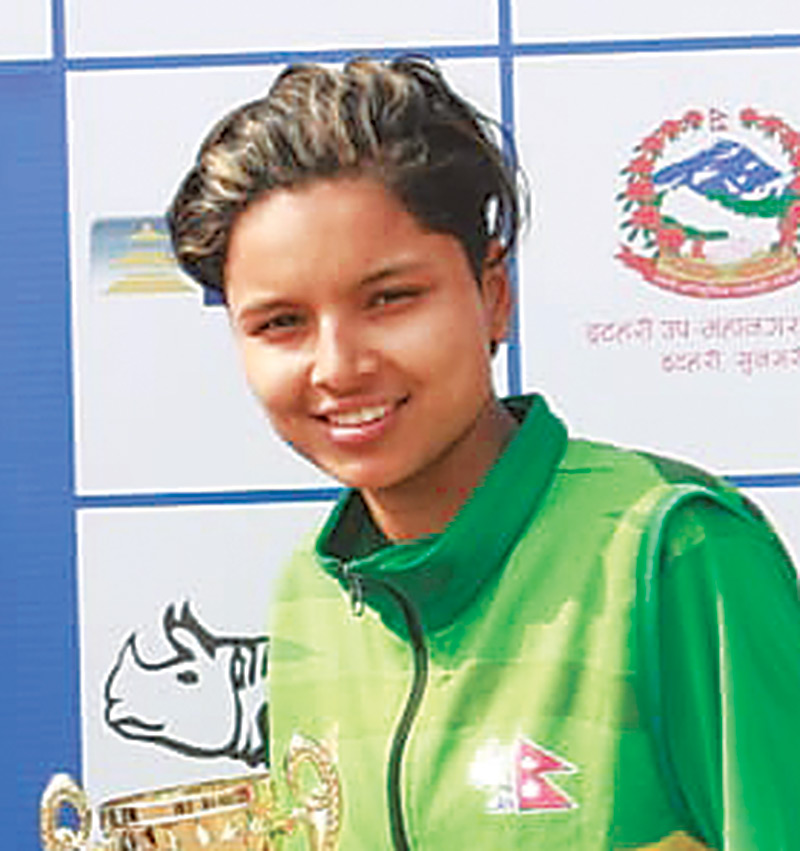
KATHMANDU, Pushpa Bhandari won the Bangabandhu Sheikh Mujib Dhaka Marathon 2023. In doing so, Bhandari set a new national record. The marathon was run in Dhaka, Bangladesh on Friday. Bhandari completed the 42.195 kilometre distance in the women’s marathon in 2 hours 48 minute and 2 seconds to shatter her own previous record of 2:50:11 set at the 13th South Asian Games, which had fetched her a silver medal. Nepal’s Bindra Dhanake Shrestha clinched the bronze, timing 2:52:32. Sri Lanka’s Madhumali Perera won the silver medal, taking 2:48:22. India’s Bangriya Vikram Bharatsinh won the men’s marathon, clocking 2:18:28. Bharatsinh’s compatriots Anil Kumar Singh (2:20:30) and Sher Singh (2:20:35) won the silver and bronze medals. Nepal’s Santosh Bikram Bista took 2:24:03 to finish fourth.
SPORTS
Khumaltar and Friends to open A-Division League
- Sports Bureau
KATHMANDU, Newcomers Khumaltar Youth Club will play Friends Club in the inaugural match of the Martyrs Memorial A-Division League 2023 at the Dasharath Stadium on March 3. The All Nepal Football Association (ANFA) released the fixtures of the first five rounds of the league on Friday. Holders Machhindra Club will begin their title defence against Jawalakhel Youth Club on March 5, while the last season’s runners up, Tribhuvan Army Club, will meet Sankata Club. Manang Marshyangdi Club will aim to assert their dominance by taking on Himalayan Sherpa Club on March 4, while the newly-promoted Church Boys will face their test from Nepal Police club. Fourteen teams will play a total of 182 games in a home and away format this season. The matches will also be played at the Chyasal Stadium and ANFA Complex.
MEDLEY
Horoscope
- Post Report
ARIES (March 21-April 19) **** Be sure to set intentions to help you forge new alliances, break through boundaries, and revolutionize your world. An element of luck will come into play.
TAURUS (April 20-May 20) *** The spirits will be by your side, use the energy to honor your ancestors and higher power, asking for guidance and assistance where you need it most. Good vibes will flow today.
GEMINI (May 21-June 21) **** Today will be both empowering and intense, as the stars push you toward personal evolution. Be sure to set intentions around your hopes and dreams.
CANCER (June 22-July 22) *** A transformative energy will linger in the air today. It is perfect for embracing self-care in order to release that which no longer serves you, though opportunities to straighten your romantic entanglements.
LEO (July 23-August 22) *** The universe will push you to break unhealthy habits today, to set intentions around maintaining balance, though love or beauty magick will also go over well under this lunation.
VIRGO (August 23-September 22) **** You’ll feel unstoppable this morning, push yourself to move boldly and decisively toward your goals. It will help you transform into a more refined version of yourself, helping you make headway on your quest for success.
LIBRA (September 23-October 22) *** A cleansing energy will fill your home, by lighting incense, decluttering, and bringing a spiritual element into your space, allowing good vibes to flow through your four walls. An energizing and elating energy will find you later.
SCORPIO (October 23-November 21) *** Your voice will be your greatest asset this morning Work with it by advocating for yourself, though you should also be open to evolving the way your mind thinks. An auspicious energy will fill your home this afternoon.
SAGITTARIUS (November 22-December 21) *** The power of money will be pronounced today. Use it to meditate on your financial goals, asking the universe to guide you toward them. An uplifting and chatty energy will manifest later.
CAPRICORN (December 22-January 19) **** Today will bring power and intensity to your aura, Work with it by unapologetically pursuing your goals and throwing your weight around if needed.
AQUARIUS (January 20-February 18) *** The vibe may feel a little intense this morning, give yourself permission to work through any thoughts or feelings that pop into your psyche, allowing yourself to release any baggage you’d rather not carry around.
PISCES (February 19-March 20) *** Consider updating your electronics, while also purging them of unwanted files and unused apps. Today is perfect for acknowledging and breaking free from patterns that are holding you back.
CULTURE & LIFESTYLE
Behind the Madoff Ponzi scheme
Netflix’s recently released documentary covers the infamous financial serial killer.
- Amulya Bashyal
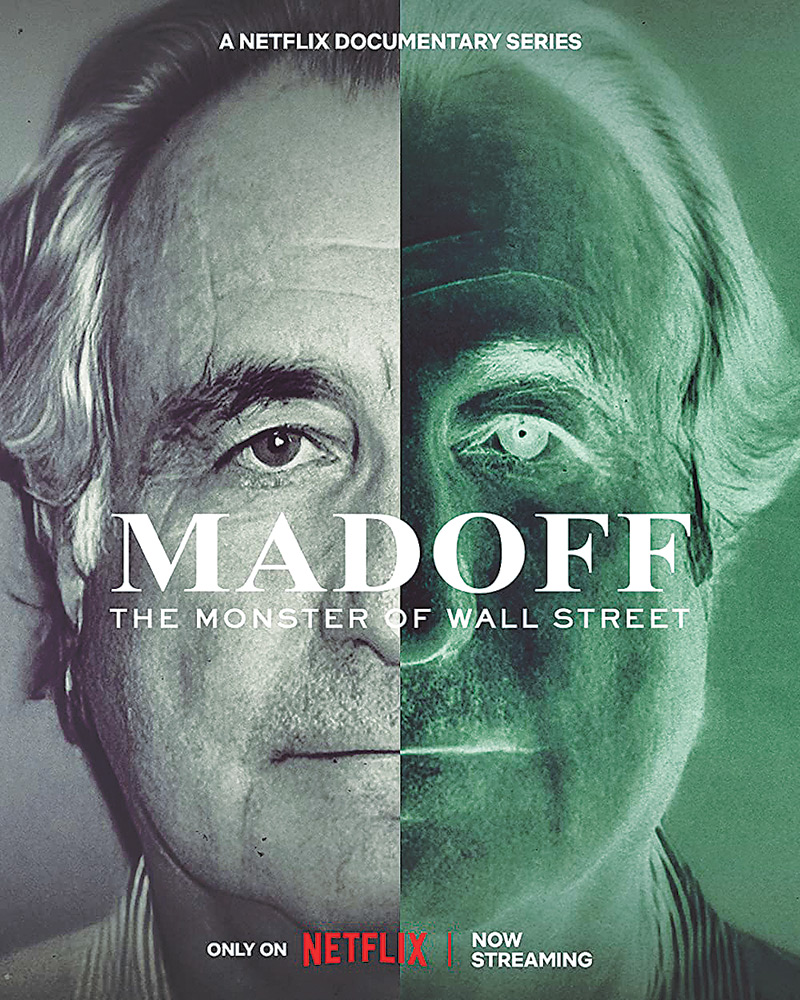
Netflix has recently released a docu-series on Bernie Madoff, Madoff: The Monster of Wall Street. While some of us are not very familiar with this name, for the ones who know about Madoff, the launch of this series has reignited interest in the infamous financial serial killer. As you prepare to delve into the world of Madoff and his Ponzi scheme, allow me to provide a brief overview (or a refresher for people who know his work) of the man responsible for bilking billions from unsuspecting investors. The docu-series is like a financial thriller (judging by the first episode at least), but for me, Madoff's tale is not just one of greed and deception; it is also a cautionary tale of the dangers of blindly trusting those in positions of power and influence. The Madoff Ponzi scheme serves as a reminder to always conduct due diligence and to be vigilant in protecting one's financial interests. Bernie Madoff is a name that has become synonymous with financial fraud and the Ponzi scheme, a fraudulent investment scheme that involves paying returns to earlier investors with the investments of more recent investors. Madoff masterminded a Ponzi scheme that defrauded thousands of investors out of a total of $65 billions of dollars. The scale of the fraud and the number of people affected by it had a significant impact not only on Madoff's victims but also on the financial markets and public trust in the investment industry. In this article, we will delve into the background and rise to prominence of Bernie Madoff, the mechanics of the Ponzi scheme he ran, and the events leading up to and following the unravelling of the scheme. Bernie Madoff was born in New York in 1938 and started working in the finance industry in the 1960s at his father-in-law's brokerage firm. He later started his own brokerage firm, called Bernard L. Madoff Investment Securities, in the 1970s, focusing on market-making, which is when you match buyers and sellers of securities to make trades. Madoff quickly built a reputation as a trusted and successful trader, and his firm became one of the largest market-makers on Wall Street. In addition to his brokerage business, Madoff also managed investments for wealthy individuals and institutions through his investment advisory firm, which he claimed used a proprietary trading strategy to achieve consistent returns for its clients. As Madoff's reputation grew, so did his client list, which included banks, hedge funds, and individuals with a high net-worth. Madoff was able to gain the trust of these clients through a combination of his personal charm and the aura of exclusivity surrounding his investment advisory business, which was invite-only and required a minimum investment of $10 million. In addition to his professional successes, Madoff was also active in philanthropy and held leadership roles in various industry organizations, further solidifying his image as a respected and successful businessman. Madoff’s Ponzi scheme was a complex web of fraud that spanned decades and defrauded thousands of investors out of billions of dollars. Madoff was able to convince investors to give him their money by presenting himself as a trusted and successful investor who used a proprietary trading strategy to achieve consistent returns. He also cultivated a sense of exclusivity around his investment advisory business, which was invite-only and required a minimum investment of $10 million. To make it appear as though he was generating returns for his investors, Madoff used a number of fraudulent tactics. He created fake account statements that showed impressive returns and used his position as a market-maker to manipulate the prices of securities. Madoff also engaged in "cherry-picking," selectively choosing the trades that he reported to investors and hiding the losing trades. His family and associates also aided Madoff significantly. His brother and two sons were all employed at the firm. His brother, Peter Madoff, served as the chief compliance officer at Madoff's firm while his sons, Mark and Andrew, were in investment advisory. Madoff also had a number of employees who aided in the execution of the fraud, including the creation of fake account statements and the maintenance of the illusion of a legitimate investment enterprise. Essentially, Madoff convinced investors to give him their money, committed various forms of fraud to create the appearance of generating returns, and utilised the assistance of his family and associates to both perpetrate and conceal the scheme. Little did Bernie Madoff know that the global financial crisis was going to be the end of his Ponzi scheme. In the latter part of 2008, the global financial crisis made it challenging for Madoff to sustain his scheme due to a lack of liquidity, as he was unable to continue paying returns to his investors. In December of that year, Mark and Andrew confronted Madoff about the legitimacy of the investment advisory business, to which Madoff admitted it was a giant Ponzi scheme that had been in operation for years. On December 11, 2008, the FBI arrested Madoff and charged him with securities fraud. The revelation of the scheme caused a stir in the financial industry and left Madoff's victims, many of whom lost their life savings, devastated. In March 2009, Madoff pleaded guilty to 11 federal felonies related to the Ponzi scheme and was sentenced to 150 years in prison. The aftermath of the scheme saw efforts to reclaim assets for Madoff's victims. The court-appointed trustee managing the bankruptcy proceedings recovered billions through lawsuits against banks, hedge funds, and other institutions that had profited from the Ponzi scheme. However, many of Madoff's victims have not yet recovered their full losses. The Madoff Ponzi scheme had a lasting impact on the financial industry and on the trust that investors place in financial institutions. The Madoff Ponzi scheme serves as a cautionary tale as well as a reminder of the importance of conducting due diligence and being cautious about blindly trusting financial advisers. It also highlights the need for strong regulatory oversight and the role that individuals can play in preventing financial fraud by reporting suspicious activity.
Bashyal is currently doing his MBA from Apex College and working as an Investment Associate at Avasar Equity Limited.
CULTURE & LIFESTYLE
The man behind Chandler
Matthew Perry from ‘Friends’ may have been the cause of our laughter on screen but he dealt with horrific things off screen.
- Janak Raj Bhatta
Friends, Lovers, and the Big Terrible Thing: A Memoir Author: Matthew Perry Publisher: Flatiron Books
"So no one told you life was gonna be this way Your job's a joke, you're broke Your love life's DOA It's like you're always stuck in second gear When it hasn't been your day, your week, your month Or even your year, but I'll be there for you."
You may remeber these are lyrics from the title song of "Friends," one of the most popular sitcoms of the television era, which went on to create a pop culture renaissance of sorts in the mid-90s and continues to be loved by millions of fans around the world including me. (We all have tried to imitate the way the cast talks at one point, haven't we?) Even now, after 28 years of its release, Chandler, Monica, Joey, Rachel, Ross, and Phoebe continue to make me smile, no matter what mood I am on. I feel like I am friends with them in real life. I can watch any episode of the show at any time, and it makes me smile right away as if I am watching clips from my own story. But I digress. This is not a Friends review. So I will put my love for the show aside and let us all focus on our main topic—Chandler Bing. Not just the charecter from the series but also the real-life person behind him, Matthew Perry. Matthew Perry published his memoir few weeks ago and as soon as I heard about it, I knew I had to read it. After finishing the book in 72 hours, here I am trying to process Chandler by writing about him. ‘Friends, Lovers, and the Big Terrible Thing’ is a very fun memoir. I have to admit that it is the first book I finished reading in one sitting in a long time. (I have literally become the Friends characters in that I start books and just leave it after reading a few pages.) As a big fan of the show and Chandler, I expected the book to be a laugh riot and was shocked when Perry starts it with these sad yet powerful lines: "Hi, my name is Matthew, although you may know me by another name. My friends call me Matty. And I should be dead." In his 250-page-long memoir, Perry bares to us his life-long battle with alcoholism, opiates, and emotional issues as an 'abandoned fella' in horrific detail. In his Chandler-style conversational prose, he “explains” how he spent over $7 million in his series of attempts to stay sober, attended 6,000 AA (alcoholics anonymous) meetings, detoxed 65 times, spent almost half of his 52 years in rehabs and healthcare, had 14 surgeries, had an “explosion” of the bowel, and was in coma for 14 days. Could there be any more vehement self-confessions? So, finally did someone have the balls to tell us what life behind fame, money, and a phobia against commitments looks like? It becomes special when you remember the series episode by episode; the book feels like Chandler is whispering his memories out loud to you, in his ever-frustrated and despondent way of talking. "I think now I'm at the point with opiates where it's the same situation. There are just not enough. I took 1800 milligrams of opiates in Switzerland per day and wasn't high. So, what am I gonna do? Call a drug dealer and ask for all the drugs?" The book has a lengthy description of his guilt trips of both past and present events—expressed parallely—from how he was abandoned by his father and mother, how he ended up in Los Angeles and his self-imposed notions of impotence to how he acquired the role of Chandler Bing, a hilarious detail of his flirty encounter with Julia Roberts, his bromance with Bruce Willis, his attempts to fill the 'holes of life' with uncountable women and fame, and his attempts to try something other than Friends. "Oh, that Julia Roberts. Even in moments like this, the jokes flew by. Craig would have said it faster, but he wasn't there. She laughed that Julia Roberts laugh, the one that could launch a thousand ships." I have to mention that this book could trigger you if you are sensitive to topics like drugs, alcoholism and addiction in general. The memoir has graphic descriptions of a being full-time drug addict, how Perry spent all his time mingling with drug dealers, managing doctors, making excuses of pain and anxiety to drink or take pills, and on and off trips with rehabs. The actor brutally confesses how it becomes more and more impossible for him to quit drugs. "That's when the bad behavior started — I got shitty grades, I started smoking, I beat up Pierre's son (an eventual prime minister himself) Justin Trudeau. (I decided to end my argument with him when he was put in charge of an entire army.)" My biggest takeaway from the book has been how the character of Chandler in many ways represents the personal life of Perry in many ways—his personality traits, his childhood, and the way he talks. "Two weeks later, I was driven to the set of Friends by a technician from Malibu. I married Monica and got driven back to the treatment center—at the height of my highest point in Friends, the highest point in my career, the iconic moment of the iconic show—in a pickup truck helmed by a sober technician." For me, this book changes my entire perception of the show and of life to a degree too. Now, I am very conscious about Chandler and keep thinking about how Perry was either high on drugs or alcohol and bearing an unthinkable amount of pain while making others smile with his quick and witty humorous one-liners while rewatching the show. His truce with God, craving for real relationships, respect for human emotions, admiration for family members, and eagerness to live a life expressed at the end of the book gives me hope that things will be alright in the future. Also, knowing he had been sober for quite some time when he appeared at the Friends Reunion last year makes me glad he is finally happy and recovering. "Addicts are not bad people. We're just people who are trying to feel better, but we have this disease. When I feel bad, I think, Give me something that makes me feel better."
Janak Raj Bhatta is a communications practitioner for numerous national and international organizations.
CULTURE & LIFESTYLE
The agony of a stateless citizen
Being without a citizenship at 21 has cost me my ambitions that I had dreamed of since I was 16.
These lines are from Desh Nikala, a song included in Bartika Eam Rai’s album Si Ma Na. Although this may sound like it could be applied to anyone’s life, they possess literal meaning in my life. I operate limited banking services in my mother’s name as banks won’t allow me to open an account. If you are wondering, no, I have not been blacklisted by the banks. I cannot open an account of my own because my 21-year-old self does not have a yellow card—citizenship. This also means that I do not have a state—I am stateless. My relationship with telecom companies is the same, in the shadows of my parents. It has been like this for the past five years. I am also invisible to government bodies issuing driving licences, permanent account number cards, passport and voter identity cards, and conducting public service exams. Fortunately, my university is yet to question my visibility. But I am sure, I will become invisible to it too, after the convocation of my batch in about three years. No matter how profoundly skilled I become, no corporations or business establishments would hire me as I am not a citizen. When I thought I was a step closer to obtaining my citizenship, it was shattered by the Head of the State, twice. The House of Representatives and the National Assembly passed the Nepal Citizenship Act (2006) First Amendment Bill 2022, twice. The bill, in accordance with the Constitution, resolves my situation of being stateless and of about 500,000 others, an unofficial figure that lawmakers cite and the Ministry of Home Affairs stipulates. You may ask, “If both your parents are Nepali citizens, how come you do not have citizenship?” In answer to that I ask you, “Do you know how many types of citizenship the Nepali state provides?” My father holds citizenship by birth (Janmasiddha) because my grandfather did not have citizenship. If he did, then my father would have gotten citizenship by descent (Bansaj). My grandfather did not have citizenship because he never needed it. He would go in search of work in India, for months, and come home before the farming season arrived. That worked well for him. Little did he know then that his descendants would suffer the consequences of his seemingly inconsequential action. Citizenship by birth was introduced in the Nepal Citizenship Act 2006 to resolve the statelessness of people like my father. However, the Act fails to mention what citizenship the children of those ‘citizens by birth’ individuals would be eligible for. Fortunately, the Constitution promulgated in 2015 facilitates the situation in Article 11(3) under Part 2. Article 11(3) states, “A child of a citizen having obtained the citizenship of Nepal by virtue of birth prior to the commencement of this Constitution shall, upon attaining the age of majority [having aged 16], acquire the citizenship of Nepal by descent in case the child’s father and mother both are citizens of Nepal.” My mother holds citizenship by descent. However, the unequal citizenship laws of our nation do not allow for the transfer of citizenship to children through their mothers alone. The monopoly on authority is vested in fathers, whether living or deceased. Not much has been done to deauthorise the monopoly of fathers and empower mothers.
The cost I have paid for being stateless Astayeka Chahna Ajhai Pani Sangli Arukai Yo Peti Ma Aafno Auchitya Khojekai Chhu Quoting from the same song again, being stateless has cost me the ambitions that I, then 16, dreamed of since completing my Grade 10. I went from wanting to apply for Delhi University’s School of Journalism to being forced (by my situation) to pursue an undergraduate degree in Journalism at a government campus in Kathmandu. From wanting to practice reporting and storytelling passionately and being trained as a successful journalist to not getting hired by the media outlets. From wanting to apply for national and foreign embassy-based scholarships to struggling to apply for my campus scholarships. From wanting to fly abroad and gain exposure in my field to being confined within the territory of the country. Recently, I had to back myself off the Global UGrad Exchange Program that was offering a student to enrol in a United States university for one semester, fully-funded. When it comes to excellence, whether in academics or at the work I am assigned, I leave no stone unturned and strive to stand out as the best performer. I acknowledge this characteristic of mine and feel proud of myself, because of it. However, all of it will be just rhetorical as long as I cannot capitalise on this very excellence. I come from a lower-middle-class family with no generational wealth or property. My father, 50, is the first-ever graduate in my bloodline, followed by me as an undergraduate. His job as an accountant provides for my family. Reservations among political parties over the married naturalised citizenship provisions, influenced by hypernationalism and patriarchal stand to unequal citizenship rights to women, have obstructed the provision that would resolve my issue. No amount of public condemnation has affected this case in any way. The elections are over, and I can only hope that one of the newly-appointed leaders will recognise and solve this issue. The Head of State will get a new face in a few months. The ruling parties, who seemed to have understood the issue of being stateless and showed the urgency to resolve it, will supposedly run the government. They seemed pretty conscious while considering the contenders for the Head of State. Let’s see what the new House does to solve my case and that of others who are facing a similar issue. Until then, I shall remain invisible in the eyes of the entities that demand a yellow card to acknowledge my being and sing, Ek Din Aaunchha Sifaris Liyera Yama Bata, Bhrama Bata.
CULTURE & LIFESTYLE
B8eight’s second innings
After a four-year hiatus, the immensely popular band of the mid-2010s, is back.
- Rukusha Giri
Kathmandu In January 2014, when a relatively unknown boy band named B8eight released their song ‘K Yo Maya Ho’, none of the group’s five members had imagined that their lives would go on to change forever. Within a matter of few days, the song had already managed to become a huge hit and anthem of sorts for youngsters. Post ‘K Yo Maya Ho’, the band released multiple songs that further helped the group cement its name in Nepal’s rapidly growing pop music landscape. The members travelled across the country and abroad for shows. The members were living the high life. After making music for over six years, the band decided to take a break. What was a supposed to be a two-year hiatus stretched to four because of the pandemic, and the band finally released its comeback song, ‘Oh Na Na’ in September 2022. The comment section of the song’s YouTube video got bombarded with fans reminiscing how B8eight’s music played an important role in their lives growing up. After ‘Oh Na Na’, which has amassed over 500,000 views to date, B8eight released ‘Mayako Ghar’ in December 2022 which has over 400,000 views. Now in its second innings as a band, the members admit that they are treading a completely different music landscape, one that is crowded with so many musicians that the audience has no dearth of options. It was the love for music that got the five young boys to come together to form B8eight. In the year was 2009, Amit Dangol; Gyurmey Dorjee Lama, aka Cupid; Thujey Ngetup; Rajeev Chitrakar, aka Kim; and Samden Norbu Lama, aka Ice, met in a music studio and decided to come together to form a band. Most of the members were still in highschool then. “We all came from different backgrounds, but what we shared in common was our love for music which led us to form the band,” says Rajeev Chitrakar. But success didn’t come easy for the band. Its debut song, ‘Missing You’, got released in December 2010, and failed to gain any traction. It was the same case with the other tracks they released in the following years. According to Chitrakar, at one point, the band members seriously thought about quitting the band altogether. “But after discussing the issue, we decided to continue making music as a group,” says Chitrakar. The decision to carry on proved to be right for the band’s turning point was just around the corner. Their 2014 song ‘K Yo Maya Ho’ made them immensely popular. And post their first hit, everything the band touched turned into gold. “We were quite young when our songs started becoming huge hits. Now when I look back, I realise that none of us were prepared for the fame and we did not handle things well,” says Kim. Between 2014 to 2018, the band members performed in Australia, Dubai, Japan, and India. In Nepal, they also started doing back-to-back shows and it soon the hectic lifestyle began taking a toll on the young members. “We were so focused on pleasing our audience that we completely neglected our personal lives. We were doing too many shows, and our personal life and commitments took a backseat,” says Amit Dangol. The band’s busy schedule also started impacting the member’s studies. “In a country like Nepal, it is next to impossible to make a career just out of music, so, focusing on our studies was equally important if we were to continue following our passion of making music. This fact was something we were very well aware of,” says Thujey Ngetup. “One of the reasons we decided to take a break in 2018 was to focus on our studies.” Ngetup is now in Australia and studying IT. During the four-year break, other members also went on to complete their Bachelor’s and Master’s degrees. In the same period, some of the band members even released solo songs, but none of them came close to getting the kind of love the band’s songs did. At the time of the release of ‘Oh Na Na’, was trending on no 7 on YouTube. However, the two songs the band has released in the last five months are yet to rack up the kind of numbers their songs used to a few years ago. And most of the group’s songs that trend on social media platforms these days are also ones released before their hiatus. While ‘Oh Na Na’ sounds a lot like the band’s previous songs, the other new track they released, ‘Mayako Ghar’, is a pop-folk fusion, a completely new genre for them. “As there are many new audiences listening to our music for the first time, we’re also experimenting with new genres, and we are liking the change,” says Gyurmey Dorjee Lama. The band’s old fan have received its comeback very well. “Duringour break, many fans would write asking us to release new music. When we released two songs last year, many of those fans showed us so much love. We are very happy to see that our audience have stuck with us,” says Samden Norbu Lama. The band now has plans to release new songs very soon and they are exploring various genres on these tracks. “The music industry has changed a lot in the last few years. We are not here to compete with other musicians. We are here to give do what we love, that is to make music,” says Gyurmey Dorjee.