You internet speed is slow. Switch to text view mode

Switch
epaper logo
ST

Last Login:
Logout
+
Page 1
HOME PAGE

Ruling coalition homes in on a power-sharing deal

Prime Minister Dahal will expand his Cabinet by Wednesday, if not Tuesday, say his close aides.
- TIKA R PRADHAN

KATHMANDU,
After struggling for weeks to expand the Cabinet, the prime minister and top leaders of the major ruling coalition partners are now closing in on a power-sharing deal.
If the officials at the prime minister’s secretariat are to be believed, Prime Minister Pushpa Kamal Dahal will expand his Cabinet by Wednesday, if not Tuesday.
According to them, Dahal is now for inducting ministers at least in key ministries, even if he fails to give the Cabinet a full shape.
Currently in charge of 16 ministries, Dahal is running the government with the help of five ministers and a minister of state. Of them, five are from his own party and one is from the Janamat Party.
To expand the Cabinet, the prime minister has called a meeting of the ruling coalition on Tuesday afternoon, based on an understanding reached with the top leaders of the major coalition partners at a meeting on Monday.
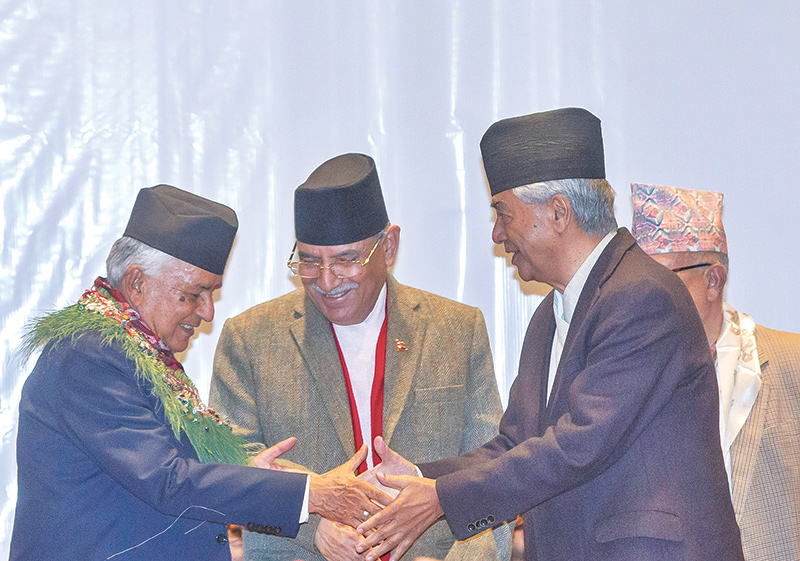
Dahal, on Monday, held discussions over power-sharing with the Congress President Sher Bahadur Deuba and CPN (Unified Socialist) chair Madhav Kumar Nepal, at Baluwatar.
According to members of the prime minister’s Secretariat, Dahal wanted to expand his Cabinet at the latest by Tuesday, if all the coalition partners agreed to a broader power-sharing deal agreed among the top leaders. But not all coalition partners are convinced with the proposed deal as they are demanding not only more ministries but also the portfolios of their choice.
“We discussed the Cabinet expansion today, but things are yet to be settled,” Madhav Kumar Nepal, chair of the CPN (Unified Socialist), told the Post after a tripartite meeting on Monday. “I think it will take two or three more days for the prime minister to expand his Cabinet.”
But the chief advisor to the prime minister, Haribol Gajurel, claimed that the Cabinet will be expanded by Wednesday, if not Tuesday.
“Though the coalition partners have been demanding more ministries, the top leaders are close to an understanding,” said Gajurel. “The prime minister is working to expand the Cabinet by finalising which ministries would be headed by which parties.”
According to Gajurel, the prime minister is planning to call a meeting of the coalition partners to settle the issue. However, some ruling coalition leaders are blaming the Unified Socialist apart from the Congress for the delay, as the former is struggling to finalise its nominees for ministers.
The Unified Socialist, which has only 10 seats in the House of Representatives, has been demanding three ministries, including one among Home, Finance and Physical Infrastructure and Transportation. Other coalition partners don’t want the party to be given so much weight. The Unified Socialist has also failed in becoming a national party by garnering only three percent of the total valid votes cast under the proportional representation category in the last parliamentary elections.
There are also other contenders. The Congress and the Maoist Centre, for instance, have locked horns over the home and finance portfolios.
Senior vice-chair of the ruling Maoist Centre, Narayan Kaji Shrestha, organised a press meet on Monday to make public his activities as the deputy prime minister and the minister for Physical Infrastructure and Transportation, hinting at his possible exit from the ministry to take up another portfolio.
Shrestha, however, told reporters that it is untrue that he is set to become the next Home Minister. He said it was the prime minister who takes the decision and he would abide by whatever decision is made.
Although the Nagarik Unmukti Party chair Ranjita Shrestha had told the Post recently that her party wouldn’t join the government, its general secretary Ratan Thapa claimed that the party was recommending party chair Shrestha to join the government at the prime minister’s request.
“Yes, our party will join the government as the ruling coalition is committed to fulfilling our party’s demand of releasing our patron Resham Chaudhary,” Thapa told the Post. The prime minister was preparing to expand his Cabinet after formulating the coalition’s Common Minimum Programme (CMP). But he is now prioritising Cabinet expansion as the preparation of the CMP could take some time.
On Sunday, the Unified Socialist chair Nepal had also said that the Cabinet will be expanded only after the CMP is ready. According to Congress leaders, party president Sher Bahadur Deuba is preparing to send party vice president Purna Bahadur Khadka to the government as Finance Minister, leading the party in the Cabinet, while Prakash Sharan Mahat could become Foreign Minister.
“Though the former home minister Khadka wanted the same ministry this time as well, the Maoist Centre was insistent on the ministry’s retention,” said a Congress leader, asking not to be named. “With the Home portfolio not up for grabs, Khadka hopes to get Finance, in which case he could get the foreign ministry.”
However, a Congress leader close to Mahat claimed that Khadka is likely to lead the party as deputy prime minister and defence minister while Mahat will lead the finance ministry.
Possible Congress ministers include Dig Bahadur Limbu and Sita Gurung from Koshi Province, Ramesh Rijal or Teju Lal Chaudhary from Madhesh, Mahat and Mohan Basnet from Bagmati, Dhan Raj Gurung or Jivan Pariyar from Gandaki, Kishor Singh Rathaur from Lumbini, Khadka from Karnali and Bir Bahadur Balayar or NP Saud from Sudurpaschim.
The prime minister has been insisting on keeping the home ministry and the ministry for communication and information technology for his own party.
As matters stand, Shrestha, the current deputy prime minister, is expected to be appointed as new home minister. The party’s leader Rekha Sharma already leads the communication ministry and is also the government’s spokesperson.

HOME PAGE

Efforts on to criminalise loan sharking

Six months after the government’s last commitment, a fresh promise is made to take action against loan sharks and ease the woes of their victims.
- PRITHVI MAN SHRESTHA

KATHMANDU,
The government said that it has begun preparations to introduce a law to address the concerns of the loan shark victims who organised a protest march in front of Kathmandu’s Khula Manch on Monday. The victims, who are from various districts of the Tarai, arrived in the Capital on Sunday after travelling for 11 days on foot.
The protestors marched in front of the Khula Manch demanding legal actions against loan sharks. They also asked the government to provide them loans at lower interest rates, bring laws against unscrupulous lending and scrapping of personal mortgaging contracts known as Tamasuk.
Although they tried to enter the Khula Manch, police deployed by the Kathmandu Metropolitan City stopped them, leading to a scuffle.
The protestors returned to Kathmandu six months after signing a five-point agreement with the government in September last year after which they had ended their protest. The government said it is now in the process of introducing the law that would criminalise loan sharking.
“We are at an initial stage of drafting a law criminalising loan sharking in coordination with the home ministry,” said Phanindra Gautam, joint secretary at the Ministry of Law, Justice and Parliamentary Affairs. “We are discussing the possibility of listing loan sharking in the criminal code.”
Once it is categorised as a criminal offence, the state will register a case and conduct legal fights against loan sharks.
Currently, loan sharking is essentially categorised as an offence under the civil code though acts such as blackmailing, extortion and other exploitations fall under criminal offences. In this condition, the victims have to fight the deep-pocketed loan sharks alone.
According to a report prepared by a task force formed by the government last year to curb unscrupulous lending, the loan sharks tend to file court cases based on the documents borrowers signed on terms dictated by loan sharks.
The loan sharks were found to have registered cases against the victims to recover their loans while the victims were often denied access to the court process.
Even though the state has guaranteed people’s access to legal services for free by introducing a law, the loan shark victims are unaware of such provisions, according to the report.
Given this context, the Home Ministry had suggested bringing the practice of loan sharking under the criminal code. “We have sent our recommendations to the Law Ministry that Criminal Code (Act) 2017 should be amended in order to bring the practice of loan sharking under the criminal code,” said Rudradevi Sharma, joint secretary at the planning, monitoring and evaluation at the Home Ministry. “If we do so, the state will take responsibility for the legal fight against the loan sharks.”
She said that it has been difficult for the victims to launch such legal fights as they have to fight individually without adequate legal support as they cannot hire good lawyers.  
The task force’s report had also pointed out the provision of the National Civil Code (Act)-2017 that allowed people to file cases at the court directly on disputes over monetary exchanges (lenden) was only being used by educated people or those who had sound legal knowledge.
The loan sharks prepare documents stipulating loan amounts that are higher than the actual loans, and they also take lands as collateral like banks and financial institutions.
The report has called for legal action against loan sharks who prepare multiple versions of their transactions and charge higher than reasonable interest rates.  
According to the task force’s report, other factors also made the legal fight against loan sharks challenging for the victims.  
The victims signing documents prepared by loan sharks; victims putting up lands as collateral or transferring their ownership in the name of loan sharks to get a loan; the lender not giving receipt of loans that had been paid back; the victims’ fear of court procedures; weak defence by victims in the court on the accusations made by the loan sharks; and the proxies
of the loan sharks accepting to buy collateralised lands while the lands are auctioned off—they are all challenges against ensuring justice for the victims.
Gautam of the law ministry, however, said that even though bringing loan sharking under the criminal code was a necessity, it was also important to ensure normal civil financial transactions are not treated as criminal offences.
“The state needs to take a balanced approach so that borrowers also would not bargain with the lenders by threatening to file a case under criminal offence even in the case of normal civil financial transactions,” he said. “The long-term implications of any legal provision must be factored in.”
The government has taken this initiative after the victims launched another protest stating that the government failed to implement the five-point agreement reached with them in September last year.
The two sides had agreed to probe the properties of the loan sharks, and the government has also pledged to make arrangements to compensate the victims who died from the torture meted out by the lenders.
If it is proven that the mortgaged land of the victims was captured by loan sharks even after the victims paid back the loan along with
interest, a legal mechanism would be set up to take back the land, as per the agreement. The government had also agreed to fulfil the victims’ other demands through a Cabinet decision by coordinating with other authorities, as recommended by the task force.   
Sharma, the joint secretary at the Home Ministry, said that the government continues to get complaints against loan sharks.
According to her, the District Administration Offices (DAOs) of 35 districts have so far received 3,351 complaints against loan sharks. Of them, the DAOs have cleared 346 complaints. As many as 774 are under
discussions at the DAOs, 525 complaints are under the jurisdiction of the courts, the police are dealing with 850 complaints while no action has been taken on the remaining 1,181 complaints.
After the victims launched another round of protests, the Home Ministry on Friday issued a circular in the name of DAOs to deal with the complaints against loan sharks.  According to Sharma, the DAOs were told to give priority to such complaints, continue to receive the complaints and help victims to gather evidence against loan sharks.
Experts say a real solution to this problem will emerge only when the reasons behind the public’s overreliance on loan sharks is properly understood.
According to the task force’s report, victims took out loans in order to meet their urgent monetary needs for they lacked properties that could be converted into cash immediately or did not have collateral acceptable for banks and financial institutions.
Nara Bahadur Thapa, former executive director of Nepal Rastra Bank, said easing poor people’s access to finance and providing easier legal options for loan shark victims would help resolve the problem to a large extent.
“As microfinance institutions that were supposed to ease financial access to the poor have also been blamed for charging exorbitant interest rates, time has come to rethink the functioning modality of these microfinance institutions as well,” he said.

HOME PAGE

India asks Nepal to help nab separatist leader

Officials say they have no information of Amritpal Singh hiding in Nepal, but have asked border police posts to remain on the lookout for him.
- ANIL GIRI
Amritpal Singh (centre) in this undated photo.  AFP Files

KATHMANDU,
Is pro-Khalistan leader Amritpal Singh hiding in Nepal?
While some Indian media reports claimed that Singh may have sneaked into Nepal by disguising himself as a sadhu (holy man), the Indian Embassy in Kathmandu wrote to two Nepal government agencies on Saturday asking them not to allow Singh to travel to a third country via Nepal.
“The Embassy of Republic of India in Nepal presents its compliments to the Ministry of Foreign Affairs, government of Nepal, and has the honour to inform that Amritpal Singh, an Indian national who is on ‘lookout circular’ in India, may try to escape through Nepal on an Indian passport or fake passport of any country,” the embassy’s letter to one of the government agencies read.
“Amritpal Singh is currently hiding in Nepal,” the embassy has categorically mentioned in its correspondence sent to the Department of Consular Services through the Ministry of Foreign Affairs. A copy of the letter was also shared with the Director General of the Department of Immigration.
Senior officials at the Ministry of Home Affairs and Nepal Police, however, said they do not have information of Singh hiding in Nepal.
“No, we have no such information,” Nepal Police spokesperson DIG Poshraj Pokharel said, adding, “Also, no instruction has been given to any police unit by the headquarters to conduct a search for him.”
“A week ago also, we had received similar kind of communication and correspondence from the Indian side expressing suspicions that Singh could be hiding in Nepal,” a senior security official said.
“Now they have sent another letter asking us not to allow him to flee from Nepal.”
Nepal Police has already alerted its units in bordering areas, for example in the Sudurpaschim Province, to be on the lookout for Singh.
“In coordination with their Indian counterparts, some of our security units have already launched a manhunt particularly in western part of the country,” a senior security official said.
Some Indian media outlets have even reported that Singh might have already fled to Thailand.
A week after the Punjab Police launched a crackdown against Singh and his supporters, some Indian media reports are now speculating that the pro-Khalistan leader may now try to enter Nepal.
According to Livemint, an Indian news website, an alert has also been issued along the international border and reports suggest that the fugitive leader was last seen in Uttar Pradesh.
According to an India Today report, the radical preacher was last seen in Lakhipur Kheri area in India’s Uttar Pradesh state on March 23.
CCTV footage that emerged on Saturday—purportedly from Patiala—also showed Singh and his key associate Papalpreet Singh walking through the streets while talking on a mobile phone.
“Based on inputs from intelligence agencies that Amritpal can enter Nepal, we have issued an alert on the border. Posters with their pictures have also been put up on the border in Rupaidiha. We are closely monitoring the movement of people along the border,” a Livemint report quoted a Sashastra Seema Bal commandant as saying on Friday.
Prakash Mani Poudel, director general at the Department of Consular Services and Jhalakram Adhikari, director general at the Department of Immigration, confirmed to the Post that they had received the communication, passport details and photographs of Singh.
“As per the request of the Indian Embassy, we have already put his name on the ‘alert list’ at the immigration department and alerted the immigration offices concerned,” Adhikari told the Post, while adding that Nepali officials have no information of Singh hiding in Nepal.
Along with the letter, the Indian Embassy has also provided a few images of his possible looks and Indian or foreign passports that Singh can use to travel outside Nepal. According to the embassy, Singh is 30 years old, looks fair wheatish and above six feet tall.
“The esteemed ministry is requested to inform the Department of Immigration, government of Nepal not to permit Amritpal Singh to travel through Nepal for any third country and arrest Amritpal Singh if he attempts to escape from Nepal using Indian passport or any fake passport under intimation of this mission,” the embassy said in the letter.

Page 2
NATIONAL

Simultaneous works on three road sections disrupt lives of locals

Disruptions in roads linking Janakpur with several villages affect local businesses, farmers, and labourers.
- SHYAM SUNDAR SASHI
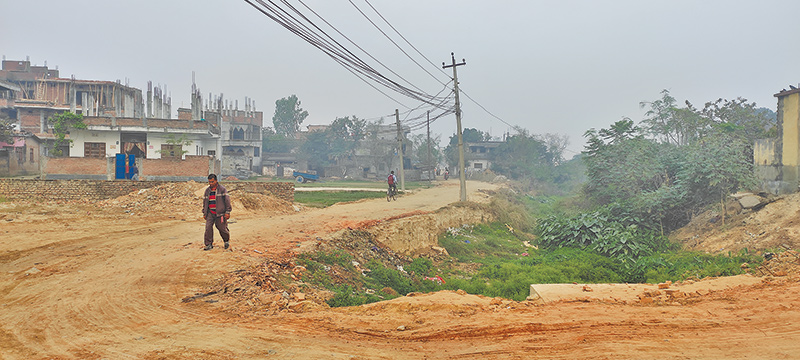
People living in several villages surrounding the Janakpur city have been forced to take lengthy and costly detours after three road sectionsconnecting the city have been disrupted by construction works.  POST PHOTO: Shyam Sundar Shashi

DHANUSHA,
Sobhit Sahani, a 60-year-old farmer from Hansapur Municipality Ward 2, sells vegetables near the Janakpur railway station every day. He commutes on his bicycle through the Simradi-Janakpur road section covering a distance of around 10km.
But for the past week, Sahani has been taking a different route by bus to his place of business at the railway station since his usual route has been disrupted by road upgrade work.
The Simradi-Janakpur road section falls under the Postal Highway. The Postal Highway project has demolished two bridges—Pulchowk bridge under the Janakpur-Simradi road section in the Janakpur sub-metropolitan city and the Kadamchowk bridge under the Janakpur-Lagma road section from Kamala Municipality—and dug up several metres of the road for upgrade work on the Postal Highway.
Similarly, the Federal Planning Implementation Unit under the Department of Urban Development and Building Construction has simultaneously started work on the Janakpur-Kapileshwar road section for the construction of sewer mains.
The three road sections are the major routes connecting a majority of villages in Saptari and east Dhanusha to Janakpur.
“For the past week, I have been using the bus to travel to and from Janakpur. I am spending at least Rs200 per day just on transportation,” said Sahani. “I used to make a profit of Rs500 to Rs1,000 every day selling vegetables. Now I am spending a considerable chunk of my profit on transport fare.”
The disruption of the three major road sections has created several challenges for the locals, farmers, daily wage workers and businesses.
According to Dinesh Sah, owner of Bishwakant Furniture at Kadamchowk, the footfall in his shop has seen a significant decline since the road construction began. “Work on all three road sections is estimated to be completed in four months,” said Sah. “I don’t know if my business will be able to sustain without customers for so long.”
More than 150 to 200 local businesses at Kadamchowk have been affected by the disruption in road connectivity.
“Before demolishing the bridges and disrupting the roads, both authorities should have constructed an alternative road to Janakpur, but they did not. Now people have to take a detour of 60km to 80km to reach Janakpur from the villages. Earlier they needed to travel 10km-15km to reach Janakpur,” said Shah.
Lack of coordination between the Postal Highway project and the Department of Urban Development led to both the projects being implemented simultaneously. “Road upgrade work and construction of sewage tunnels started at the same time a week ago. The authorities did not think before starting work on these projects together and the impact it would have on the lives of the locals,” said Shah.
“The locals are furious because all three roads are blocked at once. The bridge should have been demolished only after constructing an alternative road,” said Bharat Sah, a bicycle dealer at Pulchowk in Janakpur-1.
According to officials of Sugam Construction Company, which has been contracted to construct the two bridges, the bridges will be ready by the end of the current fiscal year, which is mid-July.
Laxman Yadav, Divisional Engineer of the Federal Planning Implementation Unit, says their department was unaware of the Postal Highway’s plans to construct the bridges in the two major road sections leading to Janakpur. He expects their project to also finish by the end of the current fiscal year.
Similarly, according to divisional engineer Krishna Dev Mahato of the Postal Highway project, they too were unaware of the Federal Planning Implementation Unit’s project. An all-party meeting was held at the district administration office (Dhanusha) before the bridges were demolished. According to the decision of the meeting, with the aim of completing the construction by the end of the fiscal year, both roads were demolished simultaneously.
“We couldn’t create an alternate route before starting the upgrade work, but we will try to complete the project as soon as possible,” said Mahato.
“This is the season to sell wheat grains and I am having difficulty reaching the markets owing to the road construction work,” said Sahani. “It will soon be time to plant paddy, so farmers in Siraha and eastern Dhanusha are worried because road disruption will hamper the supply of seeds, workers and machinery.”

NATIONAL

Nepal reports 69 new Covid-19 cases in four days

Briefing

KATHMANDU: Nepal on Monday reported 25 new PCR-confirmed coronavirus cases in a total of 488 tests, taking the nationwide infection tally to 1,001,248. Meanwhile, as many as 44 people tested positive to the virus in a total of 778 antigen tests, according to the Health Ministry. The ministry released the data on new infections over the last four days in its daily situation report on Monday. No Covid-19 related death was recorded in the last 24 hours, the ministry said.

NATIONAL

Army personnel defuse mortar shells

Briefing

EAST NAWALPARASI: A bomb disposal team of the Nepal Army on Monday defused explosives that were found buried in a field in Binayi Triveni Rural Municipality-5 in East Nawalparasi. The locals recovered nine shells used in an 81 mm mortar gun while digging a field in Sardi. According to the district police office, the local people recovered the shells four days ago. Security officers suspect the shells could be from the Maoist insurgency era (1996-2006).

NATIONAL

Province to provide cash relief to Padam Limbu’s family

Briefing

BIRATNAGAR: Koshi province government has decided to provide Rs300,000 as immediate relief to the family of Padam Bahadur Limbu (Lajehang), who died on March 24 while undergoing treatment for injuries sustained during a protest in Biratnagar on March 19. The provincial cabinet on Monday decided to provide the relief amount to Limbu’s family and facilitate the committee formed by the federal government to investigate the incident. The government had on Saturday formed a six-member committee headed by joint secretary of the Home Ministry Ram Bandhu Subedi to probe Limbu’s death. On March 19, clashes ensued between security personnel and demonstrators protesting against the naming of the province as Koshi after the protesters breached a prohibited zone. The police allegedly baton-charged protesters, during which Limbu sustained serious injuries to his head. Limbu, 42, of Dharan-15, was the central co-commander of the Limbuwan Volunteers affiliated to Sanghiya Loktantrik Rastriya Manch led by Kumar Lingden.

Page 3
NATIONAL

What good are the sister wings of Nepal’s political parties?

Sister organisations of political parties are forgetting their roles and gradually losing their relevance, observers say.
- NISHAN KHATIWADA

KATHMANDU,
The country’s largest political party, Nepali Congress, is yet to hold the long-pending general conventions of its sister organisations and give a complete shape to their central bodies. Factionalism has trickled down to each of its wings and the demands to revive the sister organisations remain unheard as of now.
The main opposition, CPN-UML, has held conventions of its sister organisations but has failed to effectively take them to the grassroots to address the people’s issues and concerns. Maoist Centre has been repeatedly criticised for paying no heed towards reviving its organisations while fully focusing on the notorious power games at the centre. Other parties, too, have been no different in this matter.
The relevance and effectiveness of the wings of the political parties have come under question of late. Experts have argued that the political dominance, collusion and the vested interests of the politicians have always acted as a headwind against the delivery of the student organisations. Sister wings need to be separated from the political parties, so that they can work effectively in their respective sectors, they say.
To further complicate matters, the leaders of the sister organisations have been mired in infightings. Ahead of the student union elections, there were instances where even the leaders of the same student organisations resorted to violence against their patrons.
In the Nepali Congress, for instance, giving a full shape to its sister organisations has turned into a major bone of contention of late. “We have been urging the party leadership to resolve the issues related to the sister organisations and make them functional,” said Min Bahadur Bishwakarma, a Nepali Congress leader.
Wings of the Nepali Congress include Nepal Women Association, Nepal Tarun Dal, Nepal Student Union, Nepal Prajatantra Senani Sangh, Nepal Peasants Association, Nepal Dalit Association, Nepal Bhutpurva Sainik Sangh, Nepal Aadivasi Janajati Sangh, Rastriya Loktantrik Apanga Sangh, Nepal Muslim Association, Nepal National Magar Association and Nepal Thakur Samaj.
Voices have surfaced within the UML to rethink the functioning of its sister organisations. Speaking at a programme a few months back, CPN-UML chair KP Sharma Oli had said that the committees had been vague with jumbo bodies. He expressed his dissatisfaction with the performance of the party’s organisations.
The UML-associated sister organisations are All Nepal Peasants Federation, All Nepal Women Association, All Nepal National Free Student Union, National Apangata Sangathan Nepal, Loktantrik Aadiwasi Janajati Mahasangh, Nepal Uddhyog Byabasaya Mahasangh, Nepal Sports Federation, Nepal Trade Union Federation, Peshagat Mahasangh, Press Chautari Nepal, National Youth Association and Rastriya Swasthyakarmi Mahasangh Nepal.
Sister organisations of major parties should be engaged in recognising the problems entangling different sections of society, holding creative discussions and finding a way out to mitigate such problems, but instead, their role is confined to producing party cadres, says Rajendra Maharjan, a political analyst. “Sister organisations have forgotten their roles, leading to a deterioration in their relevance,” Maharjan said. “They should exert pressure on the leadership to think about the issues of different sectors they are related to. For instance, the plight of the loan shark victims—mostly the farmers—could be one such issue.”
As their names suggest, sister wings of political parties are each supposed to carry their respective agendas. Student wings should speak up for educational reforms, the peasants wings should be the vocal advocates for farmers, and so on. Ideally, they should have worked independently, unafraid to critique their own party’s policies, says Rajesh Gautam, a political historian.
“But unfortunately, they have been used to fulfil the vested interests of the key leaders of  political parties,” Gautam said. “Even though they are a unit of the political parties, they should have worked independently.”
Purushottam Dahal, a senior journalist who is close to the Congress, says Nepal’s sister organisations lack schooling. “Political parties control and intervene in their organisations unnecessarily,” he said. “The sister organisations lack discipline as well.”
Apart from UML and Congress, all other political parties, except those newly emerged ones, have formed sister organisations. Sister organisations of Maoist Centre are ANNISU (Revolutionary), All Nepal Women’s Association Revolutionary, Press Centre Nepal, All Nepal Trade Union Federation (Revolutionary), Nepal National Civil Servants Employees Association and Newa Rastriya Mukti Morcha, Nepal.
Rastriya Prajatantra Party’s student wing is the National Democratic Students Union Nepal. National Democratic Youth Front is its youth wing and its women’s wing is called the National Democratic Women’s Union. Similarly, the Madhesh-based parties also have sister organisations such as the Samajbadi Bidhyarthi Union of the Janata Samajbadi Party and Bidhyarthi Janamat Sangh of the Janamat Party.
Some newly formed parties, however, have completely sidelined the idea of forming sister organisations. The Rastriya Swatantra Party, with a strong supporter base among youths, has decided to not have any sister organisation. It is the fourth-largest party in the House of Representatives with 19 seats.
Party leaders allege that the sister organisations have only been exploiting the resources and because of their ineffectiveness, the public’s hatred towards the term ‘politics’ has only intensified over time, as they have been dividing the society. “A single leader gets engaged in multiple organisations and exploits the resources,” said Kabindra Burlakoti, joint general secretary of Rastriya Swatantra Party. “Meanwhile, students in politics have been deteriorating the quality of education, while they are supposed to improve it.”
Sister organisations are only necessary if the main organisation cannot work in a certain sector, Burlakoti argues. “There are instances where the main organisation and its sister organisations engage in infighting among themselves,” he said. “The main organisations have been playing dirty games and intervening unnecessarily, preventing the student organisations from working.”
It was not always the case, however. During the Panchayat system, political parties working underground led to a fertile ground for the wings of the political parties to expedite their activities over the ground to exert pressure on the system of the day. But soon, the political manoeuvring and lust for power infiltrated the political parties’ wings—so much so that their very relevance has now come under question.
Political historian Gautam added that sister organisations had played an important role in the major political movements when the political parties could not operate openly. “They played a key role in establishing democracy and later, the republic,” he said. “For instance, the peasant movement in the past was the pioneer in planting the seeds of change. In countries the world over, sister organisations have played a crucial role in social and political changes.”
But in Nepal now, sister organisations focus to appease the party leadership to grab power, Gautam said. “The burning issues in the various sectors of society have not been their priority.”
The Nepali Congress at first was less focused on the sister organisations or wings than the communist parties, but gradually, it too started forming sister organisations as it started turning from a mass-based party to a cadre-based party, Maharjan, the political analyst, said.
“The communist party controls its wings openly, they decide the leadership, how to mobilise them in the party’s interest and set their
agendas. The Congress has slowly started doing the same,” he said. “See the impact. It could not hold the long-pending convention because the party leadership has not given the green signal.”

Page 4
OPINION

Unfinished political reform

The practice of internal democracy in our major political parties is essentially absent or a sham.
- ACHYUT WAGLE
  Post Photo: Prakash Chandra Timilsena

Political reform is generally a continuous, incremental process of institutionalising the “post-revolution” radical change in regime, ideally, from an undemocratic to a democratic set of political forces and rulers. For legendary American political scientist of the 20th century, Samuel P Huntington, political reform meant “the peaceful—hence gradual, hence usually negotiated—enhancement of liberty, justice, equality, democracy, and responsibility in politics”. Political reform is often synonymous with promoting and consolidating the “democratisation” of the state.
Nepal, during her seven-plus decade-long modern history, witnessed at least five instances of radical change in the political system. In 1951, a democratic revolution overthrew the 104-long Rana oligarchy. In 1960, King Mahendra, through a coup d’état deposed the first democratically elected government led by BP Koirala and banned political parties. Then, an absolute monarchy ruled the nation for the next 30 years. In 1990, a popular revolt reinstated multi-party democracy and rendered the king a ceremonial head of the state. Another revolt in 2007-08 deposed the monarch and made the country a republic. A new constitution in 2015 implemented federalism and restructured the erstwhile unitary state with significant devolution of power to the subnational units.
Despite so many changes in regime, Nepal’s destiny as an impoverished nation with perennial crisis of governance, poor public service delivery and elusive prosperity does not seem to have fundamentally altered.

Missing links
What went wrong? What are the missing links between these ostensibly bold political changes and the feeble socioeconomic outcomes? There may not be a straight answer to these questions, but history shows that Nepali politics focused more on changing the
regime than curing “chronic” ills in the affairs of state. Political reform to institutionalise democracy and create socioeconomic transformation remained ignored.
The agenda of political reform is absent in the national discourse or in the manifestos of the political parties. Political reform would warrant the reorganisation of the governing system as per the objective of the party’s ideology. But in the post-modern “politics of pragmatism”, ideology is being seen as an obsolete and unnecessary burden on the electorate. The idea is that the basis of governance and policymaking should bedemand-driven and evidence-based. This approach perhaps explains the rise of new forces like the Rastriya Swatantra Party with vowed dispensability of political metanarratives as party ideology. Since Nepal has failed to take any meaningful step in political reform, the debate over ideology is, therefore, spurious.
Political reform is an infinitely broad concept that may encapsulate all aspects of desperation, statecraft and the outcome of governance. Nevertheless, in Nepal, four key components of reform—internal democracy in the parties, representation in policymaking, federal devolution and good governance—are essential for political stability and efficiency of the state.
The practice of internal democracy in any major political party is essentially absent or is a mere sham. A platform to deliberate on the country’s societal and economic problems to reach a democratically formed viewpoint which has institution-wide ownership is conspicuously missing among the parties. The chieftains of the so-called democratic parties, including the Nepali Congress, CPN-UML and CPN (Maoist Centre), exercise absolute decision-making power. Major decisions on forming alliances or taking strategic steps are barely taken through open deliberations. Parliamentarians only obey the instructions from these “bosses” instead of contributing to “free and open” legislative debates. Alternative points of view are severely and selectively penalised in all political parties. Extreme centralisation of power, often in a single person, remains a common intent and practice. In the absence of internal democracy
in the parties, their distinguishable features have ceased to exist, and a common identity of “identitylessness” has been fortified.
True representation of marginalised minorities, women, Dalits and the voiceless in policymaking opportunities is persistently being compromised despite several constitutional and legal arrangements. Nepotism, favouritism and clientelism have marred the very spirit of true representation. “Body representation” of a nemesis from the excluded group to meet the obligatory criteria has defeated the essence of “issue representation”.

Federal hegemony
Federal devolution of state power to provincial and municipal bodies has not only been extremely tardy, but also often exhibits recentralisation of the intents of the political and bureaucratic elites. Its adverse impacts on the functional aspect are mirrored in poor public financial management and pathetic growth outcomes year after year. The subnational governments seem to be lost in the haze of federal hegemony when it comes to executing fiscal federalism, enacting their own laws and recruiting personnel to implement development projects.
The most excruciating toll of the delayed political reform is exhibited in poor governance in every aspect of national life. Corruption is rampant and even more alarming is the growing impunity. Meritocracy takes a backseat. Conflict of interest at the highest decision-making levels is pervasive. The “ethical economy” takes a volte-face. The most telling impact of slow reform is on public service delivery, particularly in far-flung areas. Therefore, only replacing the political superstructure through revolution-like upheavals without systematically changing the state mechanism through comprehensive reform will not ensure democratic stability nor economic prosperity. Meaningful political reform must begin somewhere, now.

OPINION

Advancing pluralistic healthcare

The injustice done to traditional medicine must be rectified through its nationwide expansion.
- BAMDEV SUBEDI
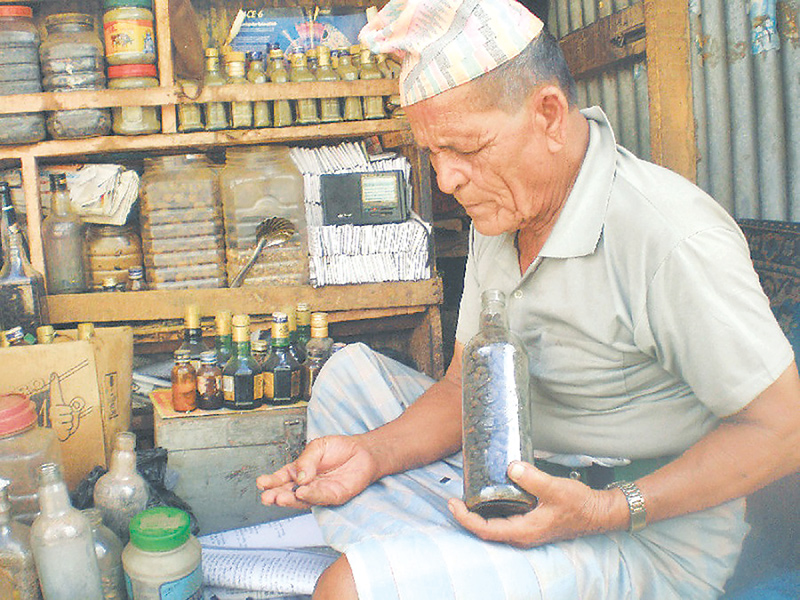
Post File Photo

Nepal has a long history of traditional systems of medicine including ayurveda, yoga, naturopathy, Unani, sowa-rigpa, and homoeopathy, as well as health traditions of jadi-buti and traditional healing. However, our healthcare system is dominated by biomedicine, marginalising traditional medicine methods and their legitimacy. The country, therefore, has not fully embraced medical pluralism.
Diverse forms of medicine and therapeutic traditions coexist in a pluralistic healthcare system. People can choose medicine based on their preferences, cultural backgrounds and their specific illnesses. It is the government’s responsibility to advance a pluralistic healthcare system to meet the diverse healthcare needs of the people.

Undemocratic pluralism
In the Indian context, medical pluralism, according to Ritu Priya, professor of social medicine at Jawaharlal Nehru University, is “undemocratic” because only one medical system (biomedicine) wields power and controls the state’s resources and authority. This is also true to Nepal. Biomedicine is like a massive tree under which traditional systems of medicines look like shrubs and herbs deprived of water and sunlight. Despite the official legitimacy, conventional medicine systems fall far behind in budgetary allocation, service delivery, educational institutions, and human resources for health.
Traditional medicine receives a meagre health budget. For instance, the Ministry of Health and Population received Rs32,954,405,000 in 2017-18, of which Rs643,173,000 (1.95 percent) went to the Department of Ayurveda and Alternative Medicine, which is responsible for the management of traditional and alternative medicine services.
In Nepal,  with 201 hospitals, 189 primary healthcare centres, and 3,794 health posts, 4,184 public health facilities provide biomedicine-based healthcare. However, only 382 public facilities provide ayurveda services, including two hospitals, 14 Zonal Ayurveda Dispensaries, 61 District Ayurveda Health Centres, and 305 Ayurveda Dispensaries. Only one public hospital and one dispensary provide homeopathy and Unani services.
In terms of educational institutions, 22 medical colleges offer bachelor courses (MBBS) with a total intake of around 2,000 seats, whereas only three ayurveda medical colleges offer bachelor courses (BAMS) with a total intake of around 120 seats. A college affiliated with Lumbini Buddhist University has started offering a Bachelor of Sowa Rigpa Medicine, and Kathmandu University has begun Bachelor in Yogic Sciences and Wellbeing with limited seats but there are none for Naturopathy, Homeopathy and Unani. Similar is the situation with the number of colleges and enrolment capacity for certificate-level courses. According to the 2021-22 annual report of the CTEVT, the total enrolment capacity in certificate/diploma programmes was 17,372. But the total intake capacities for traditional systems of medicine was just 440 (ayurveda 320 seats, homoeopathy 40, yoga and naturopathy 40 and acupuncture, acupressure and moxibustion 40 seats).
The National Strategy for Human Resources for Health 2021-30 gives a figure of 267,891 registered human resources for health, of which only 5,544 are registered traditional medicine practitioners (5,071 ayurveda, 71 naturopathy and yoga, 174 acupuncture, and 228 homoeopathy and Unani), which is just around 2 percent of the total health workforce. The total sanctioned human resources under the Ministry of Health and Population is 31,592, of which only around 1,500 are with DOAA.

Rectifying injustice
Injustice towards traditional medicine systems must be rectified by increasing funds, developing human resources, establishing educational institutions, and expanding traditional medical facilities nationwide. In the public sector, there are only a few ayurveda hospitals outside Kathmandu valley, and none exists for other traditional systems of medicine. The number of traditional medicine facilities has not increased significantly during the planned development period. For example, before the beginning of the first plan in 1956, there were 343 ayurveda facilities, and now, even after the end of the 14th plan in 2019-20, there are just 382 ayurveda facilities. Similar is the case with homoeopathy and Unani, just one hospital in the last 70 years and that too now struggling to survive. Though state policy, as stipulated in the Constitution of Nepal, is to protect and promote ayurveda, naturopathy and homoeopathy systems. However, no public facilities are available for naturopathy and homoeopathy outside Kathmandu valley.

Watering one plant, expecting another to grow
Often, people consult multiple medical practitioners even for a single episode of illness. They may, for example, combine home remedies, local healings or ayurvedic medicine with biomedicine. Though pluralistic healthcare provides more choices and options for everyone, it does not benefit everyone equally; some benefit while others do not. Many people find it difficult to select appropriate care for their problems, resulting in treatment failure, complications, increased cost, and suffering. The solution to this problem is not monistic healthcare but the quality of medicine with an informed choice. People must have access to high-quality medicine, whether biomedicine, traditional medicine, or even folk medicine. The quality of traditional medicine must be improved by increased funding for training, education, research, and validation. It is absurd to water one plant and complain about the undergrowth of another. These systems also need water and sunlight to grow.

Integrating traditional healers
Even today, what is available as a traditional medicine to the rural masses is not the official ayurveda, homoeopathy and Unani but the local healing services the traditional healers provide. Less than one-third of Ayurveda practitioners practice in rural areas (urban 3,600 versus rural 1,630). In many rural settings, traditional healers serve as the primary source of care and, for some, the only source of care.
Traditional healers, now defined as paramparagat upacharak, such as herbalists, traditional vaidyas, amchis, spiritual healers and traditional midwives) whom a significant number of people consult for various reasons, have been practising informally, without getting registered. As an exception, 19 traditional healers are registered with Nepal Ayurveda Medical Council. The Department of Ayurveda and Alternative Medicine has recently drafted a Standard for the registration of traditional healers as per Article 22 (3) of the Public Health Service Act 2018. The Draft Standard requires traditional healers to be registered with the local governments to provide traditional treatment services. Traditional healers serving as informal providers must be brought under the regulatory framework by establishing standards for registration, certifying their practices, delimiting their roles, and building mechanisms for capacity-building activities.
Nepal appears to be moving toward a pluralistic healthcare system.  Despite official commitments to advance ayurveda and other alternative medicines, the state of traditional systems of medicine is dismal. Nepal must expand traditional medicine services and integrate traditional healers into the national healthcare system in order to advance a pluralistic healthcare system.


Subedi is a doctorate from the Center of Social Medicine and Community Health, Jawaharlal Nehru University.

OUR VIEW

Ruction in provinces

The current provincial governments are no more than offshoots of federal-level politics.

The seven provinces are the beating heart of the country’s new federal system. We often forget that Nepal has always had central and local level governments. If the goal was only to strengthen them, as some advocates of a “two-tier” federal setup would have it, there would have been no need for a federal system. Provinces are the glue that holds the other two other tiers together. Yet the provinces of the new federation have been consistently undermined. They are not adequately equipped in terms of staff and other resources. Nor do they have the requisite laws to function autonomously, as envisioned by the new constitution, in what is a big error in judgement on the part of the national parties and their leaders.
But the provincial political leaders have not helped their own cause by always blaming the federal government for their ills while often not doing even the bare minimum to justify their existence. One reason for this dysfunction is the paucity of institutional memory—after all, the provincial governments came into being only in 2017. A lot of learning is simply a matter of trial and error. Another reason is the centralised mindset of the ruling class, both at the centre and out in the provinces.
The recent unravelling of the Maoist Centre-UML coalition in Kathmandu sent ripples of instability down to the provinces. Their governments will now also change, barely two months after the last change. This goes to show that the current provincial governments are no more than offshoots of federal-level politics. The leaders of the big parties have not trained their provincial-level operatives to think for themselves. They are rather trained to be servile to the central leaders. Another problem is the absence of strong regional parties to keep the national parties honest. It is not surprising that the province where the regional parties are the strongest, Madhesh, also enjoys the most autonomy.
But what we saw in the Sudurpaschim Province a couple of months ago was heartening. At the start of February, the UML-led government in the province fell when the Nagarik Unmukti Party, a regional ethnicity-based outfit, refused to give the UML chief minister its vote of confidence. If regional parties can have such a decisive role, their power will grow over time and the provinces they govern can achieve more autonomy. There is no reason that similar regional parties cannot emerge over time in other provinces. For instance, the ongoing protests in the Koshi Province over regional identity could very well morph into a strong political movement tomorrow.
Even in India, provincial politics took a long time to take hold after the departure of the British in 1947. The early days of the republic were dominated by what was largely a single party rule of the Indian National Congress across the length and breadth of the country. But, over time, regional parties started coalescing around issues of language and ethnicity and challenging the Congress rule. This is thus not a time to despair about Nepal’s weak provinces but to nurture the spirit of the federal rule in order to develop strong provinces in the long run.

THEIR VIEW

Beware of methane leaks!

Excessive concentration of methane in Dhaka demands proper scrutiny.

It has been known for some time that Bangladesh, one of the countries most vulnerable to climate change, has also been a major contributor of methane, a greenhouse gas about 80 times more potent in its first two decades in the atmosphere than carbon dioxide. Bangladesh has some of the highest methane emissions in the world that can be detected by satellites, according to a 2021 analysis. A new study by the well-known scientific journal Environmental Research Letters has now supported this finding, suggesting that methane emissions in Dhaka are well in excess of those of the surrounding regions. In the study, which was based on satellite observations over nearly four years, Dhaka ranked second in a list of 61 cities responsible for the highest methane emissions in the world.
There have been three major contributing factors—untreated garbage, wastewater and leaks in gas connections—which, together, form a deadly combination that is not only contributing to the global warming but also making life in Dhaka quite vulnerable. Each of these sources deserve appropriate scrutiny. Apparently, 47 percent of Dhaka’s methane emissions is caused by garbage. The study identifies 13 dumps where garbage is left in the open and decomposed leading to methane emissions. Moreover, constant pollution and contamination of water sources is also causing this. The other source identified—leaks in gas connections—is due to negligent handling of Titas Gas connections, which has been responsible for some recent building fires and explosions.
The findings of this study make a compelling argument in favour of taking a critical look at Dhaka’s waste disposal system and utility services. Reportedly, Dhaka produces about 10,000 tonnes of waste every day. The city corporations collect and dump about half of them, while the rest is left littering roads, open spaces and water bodies. Often, buildings are constructed on wetlands by filling them up with waste and earth. Add to this the questionable electrical and structural safety of most buildings. Excess concentrations of methane—which is a highly combustible gas without colour or odour—thus produced can lead to explosions, when it comes into contact with fire or electricity. One may recall that methane leaks, among other reasons, were blamed for the recent Science Lab blast or the 2020 explosion in a Narayanganj mosque, which went on to claim 34 lives. In Narayanganj alone, at least 82 people died in gas explosion-related fires over the last three years.
The risks for Dhaka, Narayanganj and other congested cities are clearly two-fold: Through increasing methane concentration, we are not only compromising our long-term future and that of the earth, but also causing a very real and immediate threat to the survival of city-dwellers. Lack of awareness and indifference to the build-up of methane are primarily to blame for this situation. The methane menace, however, is only symptomatic
of what residents in general have to go through on a daily basis, with poor air, poor-quality food and water, poor waste disposal (without treatment), and poor services in all other aspects. We, therefore, urge our city fathers to take the methane study as a reminder of the massive reforms that Dhaka needs to improve its quality of life. Residents deserve to live without a threat to their life every other day.

— The Daily Star/ANN

Page 5
Page 6
MONEY

Value-added services in telecom sector to be regulated

Contents provided through third-party services like ringback tone, mobile advertising and voting polls are value-added services, officials say.
- KRISHANA PRASAIN
According to the draft working procedure, service providers wishing to provide digital value-added services need to be listed with the authority.  SHUTTERSTOCK 

KATHMANDU,
The Nepal Telecommunications Authority has prepared a draft
working procedure for the implementation of Digital Value-Added
Services 2023 which provides a specific regulatory framework for the
extra services provided by telecom companies in addition to their basic services.
“Contents provided through third-party services like ringback tone, mobile advertising and voting polls, among others, by telecom service providers are value-added services,” said Ambar Sthapit, director of the Nepal Telecommunications Authority.
“There is a provision for value-added services in our general licensing guideline, but we have created the working procedure to provide a specific regulatory framework for these services. It will be amended as per the needs of the time,” he said.  
Value-added services can be live streaming, location-based services, missed call alerts and voice, among others.
“Currently, we are not considering over-the-top contents like messaging apps such as Messenger, Viber, WhatsApp and other third-party services for now,” Sthapit said. “We will conduct a study and also look at international trends, and plan accordingly,” he said.
“Such services will be brought under regulation in the future, but not immediately,” he said. “Bringing such services under regulation requires the service providers to be registered in Nepal. And if they are not able to register, thousands of service users will be impacted.”
According to Sthapit, India recently tabled a Telecom Bill which has provisioned regulating messaging services like WhatsApp, Viber, Messenger and others. “We will observe that as well.”
Developments in technology have allowed telecom companies to provide other services besides their regular services. So, a draft working procedure has been prepared to manage such extra services effectively, and to provide reliable and standard service by inspecting and determining a competitive environment and an appropriate price, according to the Nepal Telecommunications Authority.
“We are trying to bring such services under the regulatory framework through the working procedure,” said Sthapit.
“For instance, a digital payment service provider obtains approval from Nepal Rastra Bank, but as the authority is not involved in any process, we cannot give any kind of direction,” he said.
“With this procedure, there will be network security in certain things. And if any problems occur in the services, the authority will also assist them. We have posted the working procedure publicly on the authority’s official website for discussion so we can get feedback from stakeholders,” Sthapit said.      
According to the draft working procedure, service providers wishing to provide digital value-added services need to be listed with the authority.
“It is necessary for the concerned authority to regulate such service providers,” said Santosh Sigdel, founder chairman of Digital Rights Nepal, an advocacy group working to strengthen civic space and digital rights.
“The draft has not clearly mentioned third-party contents, and this can create confusion. The draft needs to be clear on this. The draft working procedure also does not say anything about protecting and maintaining the principles of human rights, freedom of expression, data protection and privacy, which are important,” Sigdel said.
To operate a digital value-added service, service providers need to submit an application including the required documents like a copy of the company registration certificate, VAT certificate, work plan to operate digital value-added services and a copy of the agreement with the telecom service provider. The authority will provide approval after inspecting the application and other paperwork, the draft says. Digital value-added service operators also need to submit the details of services and service charges to the authority for its approval.
  According to the draft, the operation validity of digital value-added services is two years, and service providers need to apply for renewal three months before expiry.
The authority will conduct an inspection to determine whether the digital value-added service providers have followed the conditions or not as per the working procedure.

MONEY

Government to start telemedicine services for migrant workers from Wednesday

While some doctors say it is a welcome step, others doubt its effectiveness.
- PAWAN PANDEY

KATHMANDU,
The Foreign Employment Board has decided to provide telemedicine services to Nepali migrant workers from Wednesday.
While some doctors said it is a welcome step, others doubt its effectiveness when the authorities have failed to implement the service within the country.
“The service will begin from 10 am on Wednesday,” a statement issued by the board, a government agency responsible for the welfare of migrant workers, said. “It will be provided during office time, except for public holidays.”
Nepali migrant workers seeking the service will have to call at 9851345701 or 9851345702 through Whatsapp, Viber or IMO.
Rajan Paudel, information officer at the Foreign Employment Board, said that currently three health professionals–a medical officer, a health assistant and a staff nurse–will handle the calls, provide initial counselling and prepare reports for recommending if a worker requires a specialist’s attention.
“A specialist’s counselling will be provided on Fridays and Sundays, when workers get their weekly-off in most of the destination countries,” said Paudel.
The workers will get the counselling services for free. The board, which has signed an agreement with Bir Hospital in Kathmandu to provide the service, will bear all the cost, said Paudel. “But the workers will have to pay for the medicine.”
Dr Yagya Prasad Timalsina, chief operation officer at Danphe Care, said the availability of a  genuine service is a welcome move. Danphe Care in cooperation with Non-Resident Nepali Association provided teleconsultation services between the first and second waves of Covid-19. Though Danphe Care examined around 200 cases during that period, Timalsina does not consider it to be a success.
“Though it was much publicised during the pandemic, it only lasted for around four months,” Timalsina said.
“We received calls from Nepali workers as well as residents in countries like Japan, Malaysia, United Arab Emirates, Qatar, United Kingdom and United States of America in the period,” said Timalsina. “There were scenarios when workers had health insurance, but were unable to get treatment facilities in destination countries.”
“The NRNA had formed various wings in destination countries to prescribe medications,” said Timalsina. “We consulted with such wings.”
But Timalsina argued the government needs to focus on implementing telemedicine services in the rural parts of the country as well.
“Though most of the agendas in our country are widely promoted in the beginning, they get neglected in the long run,” said Timalsina. “Their continuity and sustainability are important for their success.”
Dr Mingmar Gyalzen Sherpa, former director general of Department of Health Services, doubts if the telemedicine service will be effective for migrant workers.
Though they might receive advice from doctors in Nepal, they need to be treated under the observation of a health worker, Sherpa said.
“Telemedicine is not a service which a doctor is supposed to provide directly to a patient,” said Sherpa. “It is actually to connect doctors and health workers, especially in a rural setting, with a specialist for consultations to treat a patient.”
“The government could have collaborated with hospitals in destination countries to impart the service more practically,” Sherpa added.
In 2011, Sherpa was the focal person when the telemedicine service was inaugurated at Patan Hospital. Around 25 hospitals of remote districts of Nepal used to consult the Lalitpur-based Patan Hospital for telemedicine services. “But, the service has been defunct ever since my retirement in 2013,” said Sherpa.
The telemedicine services can benefit a large number of patients in Nepal, but the government has failed to understand its importance, according to Sherpa. “The federal government has totally neglected it.” Health and safety issues of migrant workers have largely remained unaddressed.
“In the fiscal year 2021-22, as much as 1,395 Nepali migrant workers were reported to have died, with most deaths certified as having occurred due to ‘natural causes’,” says the Nepal Labour Migration Report 2022. “More than 150 cases of deaths of Nepali migrant workers have each been reported annually in Malaysia, Saudi Arabia, Qatar and the UAE from 2019-20 to 2021-22.”
Hundreds of young and healthy Nepalis have been losing their lives
in foreign lands, but no one knows exactly why. Migrant rights activists told the Post in 2020 that healthy men going to destination countries and suffering cardiac arrests did not constitute ‘natural deaths’.
The report also says that a significant number of Nepali migrant workers return home with mild to severe injuries and illnesses. “The health risks migrant workers face are linked to their exposure to occupational safety and health hazards, poor working and living conditions, lack of access to social protection, including medical/health services, language and cultural barriers, and forced overtime labour among others.”
Paudel from the Foreign Employment Board said that their priority right now is to provide timely advice and counselling to address the health issues of migrant workers.
“We plan to evaluate the effectiveness of the programme after some months and add more services, if necessary,” Paudel said.

MONEY

Alibaba founder Jack Ma returns to China

- REUTERS

HONG KONG/BEIJING, 
Alibaba founder Jack Ma has returned to China, ending a more than year-long stay overseas that was viewed by industry as reflecting the sober mood of China’s private businesses and troubled policymakers trying to spur the economy.
The return of China’s best-known entrepreneur may help to quell the concerns of the country’s private-sector businesses after a bruising two-year regulatory crackdown.
His public reemergence provides support for the government’s
softening tone toward the private sector as leaders try to shore up an
economy battered by three years of Covid curbs.
Online discussion saying that Ma was in China began emerging on Chinese social media early on Monday and his return was confirmed by a school he had visited and the Alibaba-owned South China Morning Post newspaper.
Ma, a former English teacher, discussed topics such as artificial intelligence-powered chatbot ChatGPT and also said he hoped to return to teaching one day during his visit, the Yungu School said on its official WeChat account.
The school was founded by Ma and other Alibaba founders in the e-commerce giant’s home city of Hangzhou in 2017.
He returned to China last week, two sources with knowledge of the matter said. Reuters was not able to establish how long he plans to stay in China this time round.

MONEY

Xiaomi 13 Lite launched in Nepal

Bizline

KATHMANDU: Xiaomi, the global technology leader, announced the launch of the featherweight Xiaomi 13 Lite on Monday. Xiaomi is offering a flagship camera system with dual front cameras. The silky-smooth curved edges and immersive curved display add comfort to its featherweight slim design, reads the press release issued by the company. It also has a dedicated Lite-style heat dissipation solution, with improved cooling capacity and extra cooling for the dual front cameras. Its large 4,500mAh battery and 67W wired turbo charging are equally powerful, which can get power-hungry users through the most demanding days. The device is available in two variants 8+128GB and 8+256GB and comes in two colours: Lite Blue and Lite Pink. Pricing starts from Rs54,999. (PR)

MONEY

Parts of Twitter source code leaked online

Bizline

NEW YORK: Some parts of Twitter’s source code—the fundamental computer code on which the social network runs—were leaked online, the social media company said in a legal filing on Sunday that was first reported by The New York Times. According to the legal document, filed with the US District Court of the Northern District of California, Twitter had asked GitHub, an internet hosting service for software development, to take down the code where it was posted. The platform complied and said the content had been disabled, according to the filing. Twitter also asked the court to identify the alleged infringer or infringers who posted Twitter’s source code on systems operated by GitHub without Twitter’s authorisation. Twitter, based in San Francisco, noted in the filing that the postings infringe copyrights held by Twitter. (AP)

MONEY

Malaysia, Cambodia sign pacts on Cambodian workers

Bizline

PHNOM PENH: Malaysia and Cambodia signed two agreements on Monday on the employment of Cambodian migrant workers, as Malaysian Prime Minister Anwar Ibrahim made his first visit to Phnom Penh since becoming his country’s leader in November. Anwar was accompanied by his ministers of foreign affairs, religious affairs and human resources, Malaysia’s foreign ministry said ahead of his one-day trip. He held talks Monday morning with Cambodian Prime Minister Hun Sen and was to meet with King Norodom Sihamoni and top lawmakers later in the day. The two governments signed agreements on the recruitment, employment and repatriation of Cambodian workers in Malaysia. Malaysia, one of Southeast Asia’s richer countries, employs low-wage workers from Cambodia, one of the region’s poorer nations.  (AP)

Page 7
SPORTS

England, Portugal stay perfect

- ASSOCIATED PRESS

LONDON,
England and Portugal made it two wins out of two at the start of European Championship qualifying, helped by their star players continuing their record-breaking streaks.
Harry Kane struck a record-extending 55th goal for his country to help England beat Ukraine 2-0, while Cristiano Ronaldo netted twice in his 198th appearance for Portugal in a 6-0 win over Luxembourg.
Slovenia were the other team with a perfect start to qualifying for Euro 2024 after two matches as they beat San Marino 2-0.
Defending champions Italy got their first win of the qualifying campaign as they beat Malta 2-0.
After surpassing Wayne Rooney as England’s outright leading scorer with his penalty in Thursday’s 2-1 win against Italy in Naples, Kane extended his record streak at Wembley.
The England captain struck in the 37th minute of the Group C game, converting Bukayo Saka’s cross at the far post.
Saka deservedly got on the scoresheet himself three minutes later when turning on the edge of the area and curling a shot into the top corner.
Italy bounced back from their opening defeat to England with victory in Malta, with Mateo Retegui netting again.
The Argentina-born forward, who has Italian citizenship through his maternal grandmother, headed in a corner for the Azzurri’s opener in the 15th minute.
The Azzurri doubled their tally in the 27th minute when Matteo Pessina tapped in a low cross from Emerson.
Ronaldo, the all-time scoring leader in men’s football, took his career tally for Portugal to 122 goals in 198 games.
The 38-year-old Ronaldo opened the scoring and netted his team’s fourth goal just after the half-hour mark as the 2016 champions easily won in Luxembourg.
Joao Felix, Bernardo Silva, and substitutes Otavio and Rafael Leao added goals for Portugal.
Also in Group J, Aron Gunnarsson netted a second-half hat trick as Iceland beat Liechstein 7-0 and Slovakia beat Bosnia-Herzegovina 2-0.
Rasmus Hojlund continued his impressive start to his international career with another two goals but couldn’t prevent Denmark surprisingly losing 3-2 at Kazakhstan.
Hojlund, who scored a hat-trick against Finland on his international debut on Thursday, netted another two goals in the first half to put Denmark in control.
However, Baktiyor Zainutdinov pulled one back from the penalty spot in the 73rd minute and Askhat Tagybergen levelled with four minutes remaining before Abat Aimbetov stunned everyone with the winner in the final minute.

SPORTS

Koshi inch closer to final

The national captain Rubina Chhetry-led side thump Sudurpaschim by nine wickets to move up to second with a match in hand in the Lalitpur Mayor Women’s T20 Cricket.
- Sports Bureau
Koshi captain Rubina Chhetry (right) and Alisha Khadiya react during theLalitpur Mayor Women’s T20 Cricket Championship match against Sudurpaschim in Kirtipur on Monday.   Post Photo

KATHMANDU,
Koshi Province inched closer to the final with a resounding nine-wicket victory over Sudurpaschim Province in the Lalitpur Mayor Women’s Cricket Championship at the TU Ground in Kirtipur on Monday.
Sent in to bat first, Sudurpaschim were bowled out for 82 runs in 18.5 overs after they lost seven wickets in quick succession. Chasing the target, national captain Rubina Chhetry-led Koshi Province scored the winning total, losing only  one wicket in 15.3 overs in the 20 overs format.
After their second win, Koshi replaced Sudurpaschim in the second spot on net run rate despite having an equal four points. But Sudurpaschim have completed all their four matches while Koshi are yet to play their last match against Madhesh Province on Monday.
If Koshi win, they will set up a title clash against Nepal Armed Police Force (APF) Club, who are already assured of a place in the final with six points from three matches. But a defeat would mean Koshi, Sudurpaschim and Madhesh will all have four points each and the group runners up will be determined on the basis of net run rate. The top two sides at the end of the round robin league would play the final in the five-team contest.
Sudurpaschim captain Bindu Rawal scored 30 runs off 45 balls, the highest of the innings, studded with four hits to the fence before she was bowled by Apsari Begam. Samjhana Khadka contributed a 19-ball 16 and Ritu Kanoujiya contributed 13 runs off 18 balls.
But the departure of Kanoujiya with 80-4 on board led to a dramatic collapse of the innings as they lost their next five batters adding just
two runs.
Koshi captain Chhetry and Begam claimed three wickets each. Chhetry gave away only 11 runs in her four overs. Begam conceded 10 runs in her 2.5 overs.
Chasing the target, Koshi openers Kajal Shrestha and Chhetry made light work of the Sudurpaschim bowling, sharing a 73-run partnership for the first wicket. Shrestha played an unconquered innings of 40 runs, facing 50 deliveries. She slammed five boundaries while Chhetri contributed 28 runs off 41 balls. Shrestha hit two boundaries and was adjudged the player-of-the-match. Apsari Begam remained unbeaten on four runs.
Kabita Joshi claimed the only wicket of Koshi.  


Lalitpur Mayor XI finish winless
Hosts Lalitpur Mayor’s XI finished without a single win after they lost to Madhesh Province by one wicket with four balls to spare in their last league game.
Opting to bat first, Lalitpur scored 96-5 before Madhesh won by scoring 98-9 in 19.2 overs.
With their fourth straight defeat, Lalitpur bowed out without opening their account on the points table while Madhesh kept afloat their slim hopes for the final. They have two points from three matches and the second finalist will be determined only after the outcome of the game against Koshi Province on Tuesday.
Sony Pakhrin top scored for Lalitpur, contributing 34 runs off 43 balls before Kabita Gautam trapped her leg before wicket. Laxmi Chaudhary (23 runs) and Shristi Jaisi (15 runs) were other notable contributors for Lalitpur.
Madhesh bowler Saraswati Kumari took two wickets.
In the run chase, Saraswati Kumari contributed an unbeaten 32 runs off 33 balls. The player-of-the-match scored three hits to the fence. Opener Alisha Yadav hit 16 runs off 20 balls and Seemak Kunwar contributed a 12-ball 15 for Madhesh. Lalitpur also conceded 13 extra runs.
Laltipur’s Sony Pakhrin and Kritika Marasini took two wickets each.

SPORTS

Nepal face Bhutan today

- Sports Bureau

KATHMANDU,
The national men’s football team will play against Bhutan on Tuesday in the last group match that would determine the finalists of the Prime Minister Three Nations Cup football tournament.
The home team having won their opening match 2-0 against Laos on Tuesday will be in a comfortable situation while the visitors, who lost 2-1 against Laos, will be in a do-or-die situation to enter the final.
Nepal and Laos both have three points each and Bhutan is yet to open their accounts on the points table. Laos have already played both their games.
Nepal and Bhutan will play in their second and final group match.
A draw or even a two-goal margin defeat against Bhutan will send Nepal to the final but Bhutan is in a must win situation to make it to the final. While a defeat or a draw will send Bhutan out of the final scheduled for Friday, a victory over Nepal (by one or two goals margin) will send Laos packing home. But should Bhutan defeat Nepal by more than a three goal margin, the final will become a Laos-Bhutan affair.
“Hopefully Nepal wins the next match and we go through to the final,” Laos coach Michael Weiss said following his side’s victory over Bhutan on Saturday.
But Bhutan’s coach Pema Dorji, following his team’s defeat to Laos, said: “Though we are playing against the home team, we cannot predict who is going to win the game because the ball doesn’t have an eye.”
He admitted that Nepal will have the advantage of being the home team on the home ground. But he was adamant that his team would give their best against Nepal.

SPORTS

Former captain Khadka feted

- Sports Bureau
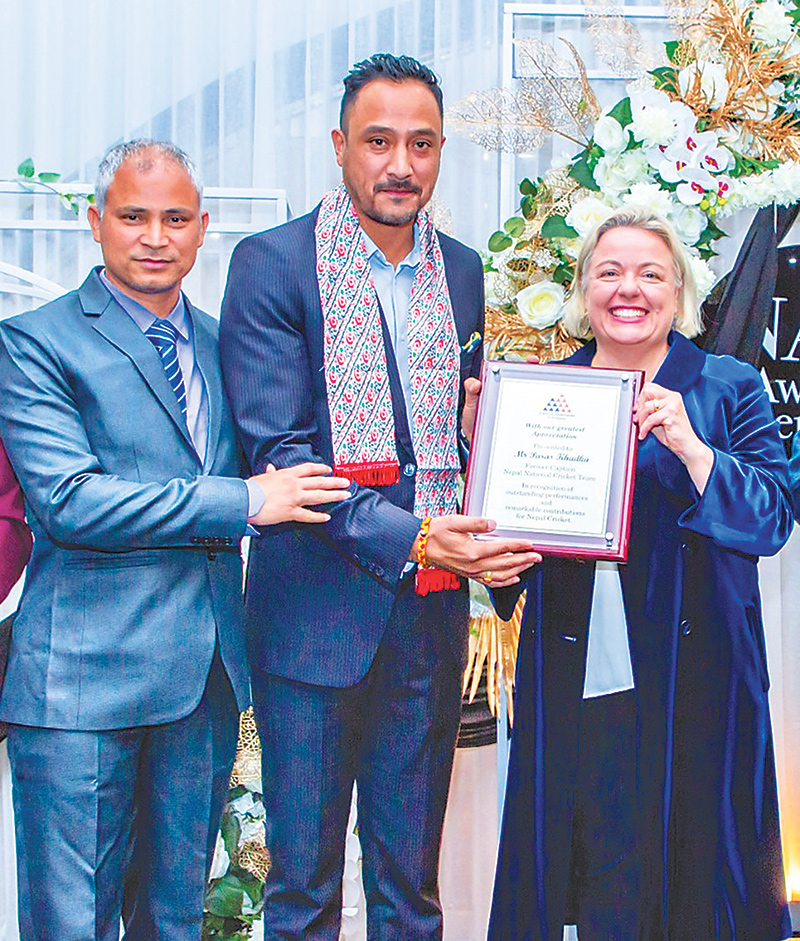
Victorian Legislative Assembly member Kathleen Matthews-Ward (right) andNepalese Association of Victoria President Prem Raj Upreti (left) present a letter of felicitation to former national cricket captain Paras Khadka in Melbourne, Australia on Monday.  Photo: Courtesy of NAV

KATHMANDU,
Former national cricket captain Paras Khadka was honoured by the Nepalese Association of Victoria (NAV) in Melbourne, Australia on Sunday.
Khadka was feted for his contributions as a national cricket captain by NAV president Prem Raj Upreti, Victorian Legislative Assembly Members Kathleen Matthews-Ward and Trung Luu, and MaxiMax Education Consultancy Director Shankar Dharel, among others.
“We must credit Khadka for taking Nepal’s cricket to this height,” Upreti, who had played domestic tournaments in Nepal alongside Khadka, said.
“He played a key role both as a member of the squad and the captain for the growth of Nepali cricket.”
He added that honouring Khadka was a matter of pride not only for the Nepali community of Melbourne but also the whole Victoria State.
Meanwhile, Binod Pandey, sports journalist of the Post’s sister publication Kantipur daily, was also feted on the occasion.
Thanking the organisers for the honour, Khadka asked the NAV and Nepali community in Melbourne to work together to create an
environment for Nepali cricketers to play in Australia.
Khadka, who started his international career in 2002 during ACC U-15 Asia Cup, played almost two decades for the country before he retired in 2021.
Under his captaincy, Nepal elevated to ODI status from ICC World Cricket League Division-5.

MEDLEY

Horoscope

ARIES (March 21-April 19)
You’ll feel particularly in touch with your emotions when you awaken this morning. These vibes will invigorate you if you honor your heart, helping you find strength as you navigate the day from a place of compassion and peace.

TAURUS (April 20-May 20)
Your heart, mind, and body will work together today. These vibes are all about putting movement behind your ideas, making it important to follow through on any plans you’ve set for yourself recently. Luckily, you will feel stable in your ambitions.

GEMINI (May 21-June 21)
Try to hit the ground running when you awaken this morning. This cosmic climate is all about planting seeds that will grow into stable foundations, and  will allow you to feel secure within the level of success you’ve created so far.

CANCER (June 22-July 22)
You will cozy up to passionate that will fire you up for a great day. Allow your passions and creativity to guide you right now, lending yourself a small reprieve from mundane responsibilities to put yourself first.

LEO (July 23-August 22)
You’ll be in a private yet motivated headspace this morning. The secrets you keep right now will also conjure a strange thrill, so don’t feel guilty about working from behind the scenes. Today will  push you to find your strength.

VIRGO (August 23-September 22)
Your compassionate nature will feel elevated this morning. Meanwhile, you will conjure passion from within, especially when it comes to fighting for the betterment of our world. Opportunities to strengthen your love life could come into play.

LIBRA (September 23-October 22)
You’ll feel strong in your sense of authority without abandoning compassion. Toady your ambitions will be supported though you should feel motivated to carve out new levels of success. Though hard work will pay off more than luck or chance will.

SCORPIO (October 23-November 21)
Allow your intuition to guide and motivate you, following any signs the universe lays at your feet today. Luckily, today will remind you of your resilience and natural charisma, elevating your confidence and sense of personal authority.

SAGITTARIUS (November 22-December 21)
Personal accountability will be the key to changing your life this morning. This cosmic climate can inspire you to make major strides in your personal evolution, though you may be required to admit what is not working first.

CAPRICORN (December 22-January 19)
A sweet yet passionate energy will linger in the air when you awaken this morning. Lean into these good vibes by squeezing your sweetie extra tightly, while any single Sea-Goats should consider romancing themselves. People will be eager to hear your words.

AQUARIUS (January 20-February 18)
You should feel energized and motivated to live your best life this morning. These vibes are all about embracing wellness while upgrading your efficiency and understanding that healthy habits are the cornerstone to feeling good and working well.

PISCES (February 19-March 20)
The stars will ask you to express yourself boldly and freely this morning. A helping hand will galvanize you to take action toward your personal goals, and strengthen your resolve and sense of self. Pay attention to your thoughts today.

Page 8
CULTURE & LIFESTYLE

Leaving your comfort zone

Do you feel that you want to change, and yet find yourself repeating the same unwanted behaviour day after day?
- Sujina Manandhar
Shutterstock

Is it just me, or is taking that first step so difficult? Do you also feel that you want to change, and yet, find yourself repeating the same unwanted behaviour day after day? Do you get the feeling that you know what you should be doing and even want to do it, yet somehow you just can’t seem to get started? Do you often ask yourself what is stopping you from taking that action? Is it motivation you need to improve? Is it the absence of willpower? Or are you stuck, despite everything?
What makes you hold back your true potential and hold you captive against your wish? Well, the answer is you. Now, don’t get defensive yet, and hear me out: our brains have been evolutionarily designed to seek safety and comfort for survival. So, while rationally, we understand what needs to get done and what needs to change, but the more primitive part of our brain seeks that safety and comfort stopping us from taking action toward anything that is new. Because new is unknown, and unknown is scary.
The brain asks, “Why take that risk and go out into the world when we have this comfortable couch and warm fuzzy blanket where we can be endlessly entertained by our new digital best friend?” Thus, even when provided with a big list of logic and rationality, we stop ourselves from taking that action, especially if the action is something we have never tried before.
In the comfort zone, everything is predictable. This predictability makes you feel safe and in control. When you think of leaving that comfort zone, you are met with uncertainty. And in our minds, this uncertainty is interpreted as danger, which makes you fearful. The fear will eventually make you resist the change and drive you into self-sabotage. It will make your own mind deceive you into believing things like: “Why try? I can’t do it anyways.” But this will only hold you back from doing what you know needs to be done.
So what’s wrong with a little comfort? you may ask. Well, while it is perfectly natural, and nothing wrong with staying in the comfort zone, making it a habit of only doing things inside it will make you more and more afraid of leaving it, and you ultimately risk missing out on the life that you have the potential to live. It won’t lead you where you want to go. Because comfort and growth can’t go hand in hand.
But are you destined to be stuck there forever? Of course not. While it may require some willpower and a shift in mindset to learn how to step out of your comfort zone, and it won’t be easy, each step you take to expand outside of it will lead to personal development, learning, and success. And here are a few things that you may find helpful in your journey toward change.

Say ‘NO’ to a boring life
Because this is where your comfort zone will lead you to. You have heard something along the lines of ‘it’s not the things that you do that you do that you regret the most, but rather the things you choose not to do’. At the end of the day, there will always be things we will miss out on, that’s just inevitable. Yet, isn’t it better to keep that list short and live life with fewer regrets? You owe it to yourself to rise above mediocrity and live a life that isn’t boring by any means.
Find what you want to achieve: Are you currently living the life of your dreams? Are you currently your ideal self? Or is there something else you want to achieve and someone you want to become? If the latter is true for you, write down how your current situation and your current self are making you feel, and what you would like to change.
The problem with most of us who are trying to change is that though we know what we want to change, and some even know how to change, very few have a clear ‘why’. Having a clear reason for why you want to do what you want to do can make all the difference. Not only does it provide you with the initial motivation, but it is what keeps you moving forward toward the goal. So while setting that goal and planning the change, make sure you also look out for your ‘why’.

Stop analysing and take action
One of the problems that I personally face when anticipating change is thinking and analysing too much. While it is basic human nature to try and minimise errors by making the next steps as predictable as possible, we fail to recognise that this can sometimes cause our brain to go into that familiar overthinking mode, leading us to feel overwhelmed and eventually procrastinate the entire task just to feel comfortable again. Acknowledge the fact that no matter how much you think and plan, there will never be a perfect time to begin. Just take that single step you see in front of you, and consider each step you take to be a sign of your personal growth.

Dip your toes before you swim
We often wait to gather enough motivation before getting started; and when we do find it, we try to get a lot of work done all at once. But, trying to change too much too soon, on the other hand, might be an overwhelming experience because it creates a lot of uncertainty which leads to a lot of discomfort. It may then backfire as the farther you go from your comfort zone, the stronger it will pull back. So, even though there is just so much you want to achieve and so much piled-up work to complete, just take smaller steps and expand your comfort zone before you take that big dive into change.

Manandhar is a mental health advocate. She also provides psychosocial counselling.

CULTURE & LIFESTYLE

Good vibes from Japan

Sinbad, one of ten films screened at the Japanese Film Festival 2023, brings back memories of childhood.
- Mimamsha Dhungel
A still from the movie Sinbad.

Kathmandu
The Embassy of Japan in Nepal and Japan Foundation organised the Japanese Film Festival on March 25 and 26 at National Theatre, Jamal. March 25 also marked Japan Day. The programme featured unique things from Japanese culture, such as donning Japanese clothing such as yukata and happi coats, calligraphy writing, origami making, and playing traditional games on the venue grounds. Visitors could also take photos in a Japanese-style photo booth at the site. The best part of the event was that you could see the movies while dressed in Japanese attire.
“The Japanese Cinema Festival is a yearly event hosted by the embassy. The purpose of this film festival is to share Japanese culture and cinema with the Nepali audience,” said the cultural secretary at the Japanese Embassy in Nepal. The Japanese Film Festival 2023 was also held in Pokhara in February. The festival screened ten films in Pokhara and Kathmandu and was a huge success, receiving an overwhelming response from the audience. Sinbad was one of the films screened at this year’s festival.
Regardless of your age, some films revive the youthful zest and passion you once had. Sinbad was one such film that brought back memories of my hopeful childhood when movies inspired and instilled adventurous dreams in me. The movie is loosely based on ‘The One Thousand and One Nights’ and tells the story of Sinbad, a young boy who lives with his mother, Latifa, in an unnamed Middle Eastern seaside city. The boy’s father was a sailor who was never seen again after leaving on a voyage. Sinbad makes a living by selling fish in the local market, but deep down, he longs to be a sailor, exploring the oceans to discover what lies beyond the horizon. Sinbad comes across a strange sight one day–a girl riding a flying horse pursued by men on flying carpets. The men appear to be malicious, and the girl is fleeing. Sinbad is noticed by Captain Razzak while attempting to rescue the girl, who introduces him to the crew of the ship, the Behr, cabin boy Ali, first mate Najib and other members.

Attendees practising Japanese calligraphy on Saturday.

Meeting the crew members of the Behr strengthens Sinbad’s resolve to become a sailor, and he embarks on a journey. The fates of Sinbad and the mysterious flying girl entwine once more. The crew takes the helpless girl in, and she reveals her identity as Sana, the last princess of the sorcerers. Captain Razzak promises to take Sana to the long-lost land where the sorcerers first appeared. However, there are those who wish to prevent Sana from ever reaching her goal, and Sinbad swears that he will assist Sana in reaching her goal—even if it means never seeing her again.
Sinbad is actually part of a trilogy titled ‘The Sinbad Trilogy’: ‘A Flying Princess and A Secret Island’, ‘The Magic Lamp and the Moving Islands’ and ‘Night at High Noon and the Wonder Gate’. The plot develops organically across all three films, with each film picking up where the previous one left off. Sinbad, the movie shown in the festival, is actually a mix of all three films.
The film’s plot is inspired by the popular story of Sinbad the Sailor from the popular Middle Eastern folk anthology ‘One Thousand and One Nights’. It’s interesting to see how these characters inspired by the Middle East are communicating so seamlessly in Japanese. The story is a lighthearted adventure animation that is suitable for younger audiences as well as anyone looking for a comfort movie. While the story is enjoyable in its own right, the background art and creature designs elevate this trilogy. The characters have unique designs that give a lot of authenticity to the plot. The visual aspect of the film was stunning, with consistent and beautiful animation. The film talks of the archvillain Galpi who wishes to misuse ‘magical science’ developed by Sana’s parents. Magical science is mentioned frequently in the film, and the plot contains many elements of magical realism.
The creatures in the movie are quite imaginative–flying wooden horses, fishes that carry islands on their back, and mammoths. Historical locations like Petra and ancient Greece have inspired the sorcerers’ dwellings, and the animated scenery was indeed beautiful. What will keep you hooked throughout the end is the film’s impeccable soundtrack. The music playing in the background of each scene adds a lot of life to the animated characters. Whether an action-packed sequence or an emotional confrontation, the film has music befitting each scene.
Speaking of the drawbacks, the movie does feel a bit stretched, and for someone who does not enjoy animated films, it can also get boring at times. Although the plot is simple and easy to follow, it will often feel like a heterogeneous mixture of One Piece, Alladin and Doraemon.  The film has a silly, slapstick kind of humour, which might not be everybody’s cup of tea. If you are looking for a deep, introspective film that will make you think for hours, Sinbad may not be for you. But, if you are searching for a refreshing break from all the complexities in life, the film will give you a back-to-school experience. The film had English subtitles—if you are not used to watching movies with subtitles, you will miss a lot of punch lines. Overall, Sinbad was a good experience. It will rejuvenate your childhood memories while teaching you a simple yet profound lesson of never giving up on your dreams and chasing them against all odds.

SINBAD
Language:     Japanese
Subtitle:     English
Duration:     114 minutes
Genre:     Animation, adventure
Director:     Shinpei Miyashita
Studio:     Nippon Animation
Released:     2015