You internet speed is slow. Switch to text view mode

Switch
epaper logo
ST

Last Login:
Logout
+
Page 1
HOME PAGE

Around 1 million children above five years deprived of Covid vaccine

Recorded infections could just be the tip of the iceberg, with active case hunt yet to start.
- ARJUN POUDEL

KATHMANDU, 
Amid a rise in new cases of the coronavirus, concerns have grown about hundreds of thousands of children above five years old who have not yet been vaccinated against Covid.
Officials at the Ministry of Health and Population estimated that there could be around one million children above five years old who have
not received even a single dose of the vaccine.
“Hundreds of thousands of children throughout the country, who were below five years of age and were not covered by the Covid vaccination campaigns have now become eligible for the vaccine,” said Dr Abhiyan Gautam, chief of the Immunisation Section at the Family Welfare Division under the Department of Health Services. “We have started preparations to bring pediatric doses of the vaccine for children of the said age group.”
Children between five and 11 years were jabbed with paediatric doses of the Pfizer-BioNTech vaccine after the Covax facility, the UN-backed international vaccine sharing, supplied around  8.4 million doses last year.
As health authorities failed to inoculate all eligible children at the time, thousands of vaccine doses expired. But tens of thousands of children, who reached five after the vaccination campaigns stopped, remain unvaccinated.
Infectious disease experts as well as virologists have asked parents to take extra precautions to protect their children as the chances of Nepal getting pediatric vaccine doses in the midst of the ongoing new Covid wave are slim.
“The good thing is most schools are currently closed for year-end vacation,” said Dr Anup Subedee, an infectious disease expert. “So children of unvaccinated children should ensure that their children take all necessary precautions against Covid like wearing face masks, using hand sanitisers and avoiding crowds. And if their children show Covid-like symptoms, parents should isolate them and take them for Covid test.”
Nepal on Sunday recorded 38 new cases of Covid—37 from 185 polymerase chain reaction tests and one from 516 antigen tests. This shows the positivity rate of PCR tests is 20 percent.
On Saturday 38 people tested positive for Covid. The number was 142 on Friday.
Doctors say the ongoing rise in Covid cases is a clear sign that a new virus variant has penetrated communities. As authorities concerned have not started active case findings, reported positive cases could be just the tip of the iceberg.
Lately, India has been reporting a sharp rise in coronavirus cases. The country on Saturday recorded five deaths and 3,824 fresh coronavirus infections, the biggest single-day rise in the last six months, according to media reports.
Several states and territories of India, including Delhi, Maharashtra, Gujarat, Tamil Nadu, Uttar Pradesh, Bihar, West Bengal, Uttarakhand and Telangana saw a surge in new cases. Uttar Pradesh, Bihar, West Bengal and Uttarakhand are states bordering Nepal.
Scientists in India say that a new sub-variant of Covid, XBB.1.16, is responsible for the recent surge in cases. They, however, say people in India have developed a hybrid immunity due to vaccination and natural infection, so the current Covid variant will not lead to hospitalisations and severity. The Indian government has advised people to wear face masks, avoid crowds and complete their vaccination doses if they haven’t already done so.
Experts link the uninterrupted cross-border movement for the rise in cases in Nepal. Thousands of people from both countries enter each other’s territories every day on top of the large number of those who use unregulated points along the porous border.
“XBB.1.16 which is considered responsible for the massive surge in infection in India might be responsible for the surge in cases in Nepal,” said Dr Sher Bahadur Pun, chief of the Clinical Research Unit at Sukraraj Tropical and  Infectious Disease Hospital. “More people could get infected in the coming days, as the new sub-variant of Omicron is more infectious.”
Health Ministry officials said that they have already alerted the agencies concerned about the risks, asking them to step up surveillance. Officials believe that even if new cases surge in the coming days, they will not increase the severity rate and hospitalisation, given that both vaccine coverage rate and immunity derived from natural infection are high.
However, it has already been a year since many people were administered with booster shots. Several studies, including one carried out in Nepal, show that the immunity level achieved from vaccination or natural infection wanes after six months of the vaccination or natural infection.
“Vaccine must be brought at the earliest and all eligible people should be administered second booster shots,” said Pun. “If the government does not have sufficient doses for all risk groups especially elderly people and those having comorbidities should be inoculated first with second booster shots.”
So far, Nepal has used Covid vaccines developed by the University of Oxford and the pharmaceutical giant AstraZeneca, manufactured in various countries of Europe, India and Japan, the Chinese Vero Cell, and the US-made Janssen, Moderna, and Pfizer-BioNTech.
Government records show as many as 12,020 Covid-related deaths have been reported in Nepal.
HOME PAGE

Unified Socialist can’t keep key leaders after poll debacle

Two senior leaders abandon party while many, including third-ranked Mukunda Neupane, express dissatisfaction.
- TIKA R PRADHAN

Kathmandu,
The CPN (Unified Socialist), which was formed less than two years ago by splitting the CPN-UML, the country’s largest communist party, is gradually weakening as its leaders and cadres are ditching it and drifting back to the mothership.
The party has been further weakened with several senior leaders quitting it after the recent presidential elections. The resignations came after party chair Madhav Nepal declined the CPN-UML’s offer to become the country’s President.
The Unified Socialist is a member of the current 10-party coalition.
The ‘two-line struggle’ (difference of opinion regarding a party’s official line in the top leadership) in the Unified Socialist has been viewed as meaningful at a time when the UML is trying to become the largest party in the House of Representatives by merging the splinter party into it. The UML leaders claim that once they merge the Unified Socialist and the election results of the April 23 bypolls are out, their party will emerge as the largest in the lower House. And, that could bring about drastic changes in national politics.
Those leaving the party to join the mother party say the Unified Socialist would reach nowhere by joining hands with the Nepali Congress, which espouses a completely opposite ideology.
Leaders unhappy with the goings on in the party have been urging the Unified Socialist leadership to expedite talks with other communist parties including the UML for a merger.
UML Deputy General Secretary Prithvi Subba Gurung, who was one of the key architects of the UML-Maoist alliance formed after last November’s elections, recently told the Post that Madhav Nepal did not even discuss Oli’s proposal on presidency with Unified Socialist leaders.
“I don’t know what stopped Nepal from presenting the UML proposal at his party’s meetings for endorsement,” Gurung said.
Gurung hinted that many Unified Socialist leaders wanted to see Nepal as President and that would have allowed a new leadership to emerge in the party on the one hand, and on the other, helped unite fragmented communist parties.
Gurung also said that it wouldn’t be a surprise if Nepal becomes a new prime minister from the UML after a merger of the two parties, as, according to him, ‘cordial discussions’ have started between the two parties.
However, UML insiders say Oli’s new strategy is to bring back all major leaders and cadres of communist parties including the Unified Socialist and the CPN (Maoist Centre) ‘by hook or by crook’ while leaving behind their top leaders.
Given his growing hostility towards Madhav Nepal and Pushpa Kamal Dahal, the UML chair is not ready to wholeheartedly welcome them in the party, the UML insiders said.
Some Unified Socialist leaders suggest that Oli’s offer to Nepal to become President was not serious to begin with.
“Since Oli didn’t respond to Nepal’s earlier proposal to revive the Nepal Communist Party, it is clear that the former’s offer to the latter to become President was not genuine,” a Unified Socialist leader said.
As soon as Madhav Nepal proposed Nepali Congress senior leader Ramchandra Paudel as the candidate for the President, two Unified Socialist leaders—Vice-chair and Bagmati provincial in-charge of the party Kedar Neupane and Standing Committee member Chudamani Jangali—tendered their resignations to the party chair. The resignations were approved by the party’s 55th Central Secretariat meeting held on March 28.
Also, there is deep dissatisfaction in the Unified Socialist with the party’s performance in last November’s elections—it could not even become a national party. Besides, party rank and file have also raised concerns over the working approach of their top leaders.
“As requested by us, the UML chair offered Nepal to become President as that would have created an environment of trust and helped unite our parties,” Jangali told the Post, adding, “But Nepal declined Oli’s proposal and we don’t know why.”
Soon after Nepal decided to back Congress’ candidate for President, we put in our papers, he said.
“We realised we don’t have a future in the Unified Socialist as it lacks coherence as a party and most leaders are dissatisfied,” Jangali told the Post. “I don’t think this party will remain intact for long.”
Besides Jangali and Neupane who are no longer with the party, another leader Mukunda Neupane, who comes third in the party hierarchy after Madhav Kumar Nepal and Jhalanath Khanal, is also not happy with the party’s decision to partner with the Congress.
Earlier, Neupane had presented a 33-point dissent at the party’s central committee meeting urging the party to pursue a broader left unity including the UML and warned that failure to do so could result in the party’s collapse. But the Unified Socialist leadership dismissed the idea.
After the party’s poor show in the polls despite forging an electoral alliance with the Congress and the Maoist Centre, Neupane started saying that Unified Socialist would implode if it continued to remain in the Congress-led coalition.
“I don’t think the party can compete against biggies like the Congress and the UML in the next elections,” he said.
Neupane was criticised by Unified Socialist top leaders after he began publicly criticising the party’s decisions.
Unified Socialist leaders have reportedly sought a clarification from Neupane, for speaking up in defiance of party discipline, to which Neupane reacted: “That is nothing but a ploy to put off other leaders from speaking up.”
“Now, it’s time for me to seek clarification from the party chair for making false statements,” Neupane told the Post. “Party chair Nepal had told me that my public statements could embolden other leaders but I said I won’t stop speaking.”
UML leaders, meanwhile, claimed that they are in regular talks with dissidents in the Unified Socialist.
“Yes, we are in touch,” said Thakur Gaire, a UML lawmaker, who was close to Madhav Nepal before he split the party.
Dissident leaders said the two top leaders—Nepal and Khanal—have no political vision beyond appointing their trusted aides to ministerial positions on the quota set aside by the Congress.
Unified Socialist ministers Beduram Bhusal and Prakash Jwala are the picks of party chair Nepal and senior leader Jhalanath Khanal, respectively.
Meanwhile, UML central committee member Bishnu Rijal said discussions with several Unified Socialist are going on an individual basis as “the party’s leadership has been deceived” by the promises of the Congress and the Maoist Centre.
“It seems that the Unified Socialist top leaders are happy to have two ministers instead of President,” said Rijal, a long time confidant of Nepal until the party’s split.
Rijal even argued that the UML’s offer of national presidency to a small party with just 10 seats was ‘generous.’
Although Unified Socialist Secretary Ram Kumari Jhakri refused to talk to the Post about her dissatisfaction and her discussions with UML leaders including party chair Oli, UML leaders said she is among the leaders who have been in constant touch, seeking unity between the two parties.
Jhakri’s image of holding Madhav Nepal’s hand and leading him to the Election Commission to register a new party had become viral in the media two years ago. But now Jhakri is among those most dissatisfied with the split.
“I think only those who have landed state positions of benefit including ministership are happy now,” said an office bearer of the Unified Socialist. “Our party will cease to exist wherever we go, be it with the Maoist Centre or the UML.”
Amid growing dissatisfaction in the Unified Socialist brass, the UML has launched the “mission grassroots campaign” to lure back the Unified Socialist cadres all across the country.

HOME PAGE

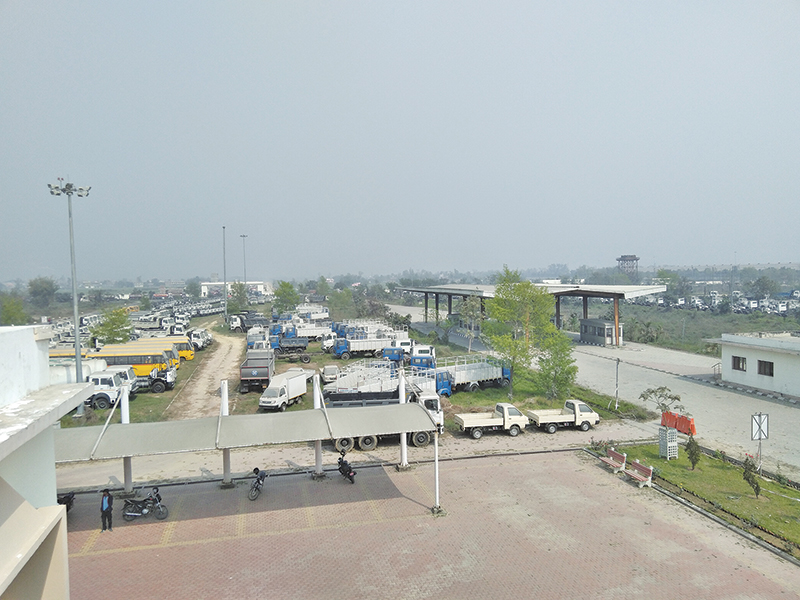
Dozen school bus drivers booked for rules violation

Since August last year, over five dozen school drivers have been punished for drink-driving, an ‘unforgivable’ crime.
- Post Report
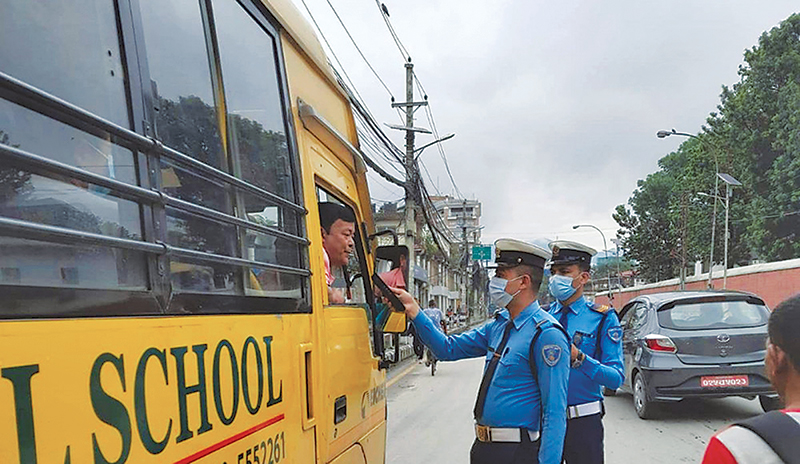
Some violated the directives, which say buses carrying students should be painted yellow. Post File Photo

KATHMANDU,
The Kathmandu Valley Traffic Police Office on Friday issued fine tickets to a dozen school bus drivers in Kathmandu Valley for violating traffic rules and ignoring School Bus Directives.  
The traffic police office issued a statement saying of the 12 drivers one was booked for not installing guard rails on windows and the rest were booked for violating traffic rules and also disobeying the School Bus Directives 2074.  
In November last year a school boy of Samakhushi, Kathmandu died after being hit by a tree as he had pulled his head out of the bus window.
Many people blamed the school’s negligence for the death while others accused traffic police for poor inspection of school buses.
“We have been more rigorous with inspections after that incident,” said Senior Superintendent Rajendra Prasad Bhatta, spokesperson for the Kathmandu Valley Traffic Police Office.
“Because school buses carry students, traffic police have to be extra careful to ensure that the buses follow the rules,” said Bhatta.
Meanwhile, Bhatta said the other 11 bus drivers were nabbed for violating basic traffic rules and not following the School Bus Directives 2074.  
The directives state that buses that carry school children must be painted yellow, and if schools have hired buses for ferrying children then such buses should have stickers reading “On School Duty” pasted on the front and rear. The directives also require that the windows have guard rails and bus crew while on duty should avoid alcohol and smoking.   
However, in August last year when the traffic police started checking school bus drivers for drink-driving, five school bus drivers were arrested for driving under the influence.
Officials said since then over five dozen school drivers have been booked for drink-driving, which the Guardian’s Federation Nepal and other stakeholders say is an ‘unforgivable crime’.
The traffic police have started a campaign against drink-driving since December 2011, and it has resulted in visible reduction in road accidents.

Page 2
NATIONAL

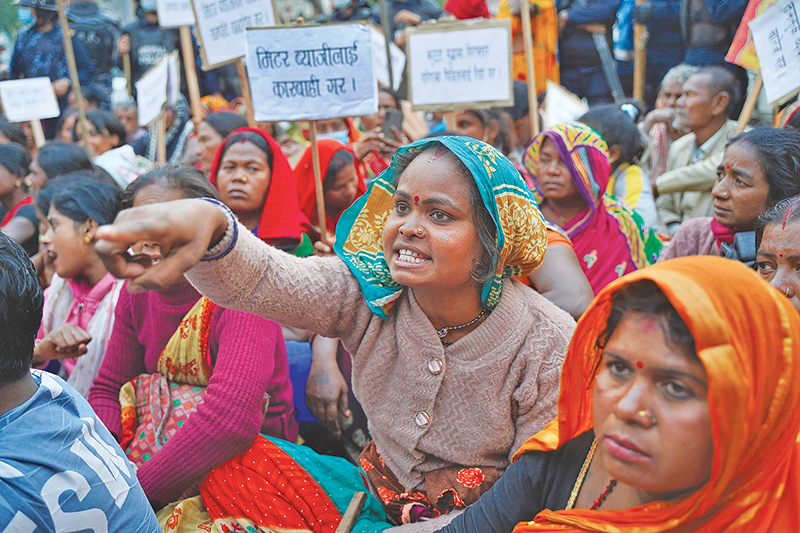
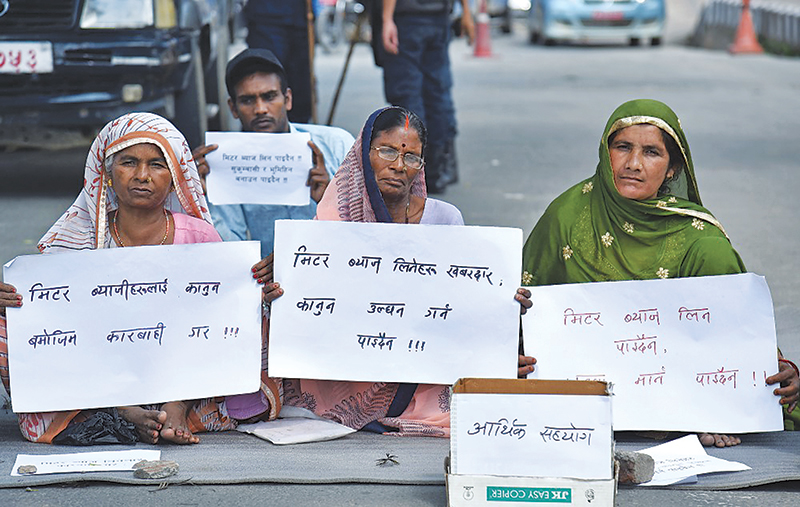
Concerns over implementation of agreement between the government and loan shark victims

Another group of people who are victims of unscrupulous lending announce a separate protest programme.
- PRITHVI MAN SHRESTHA
Loan-shark victims pictured at a protest programme in Kathmandu late last month.  Post Photo: Angad Dhakal

KATHMANDU,
A day after a group of loan shark victims signed a five-point agreement with the government to end their protests, another group of victims criticised the deal, arguing that it would only put them in more trouble.
The group of the victims coming from the eastern Tarai on Saturday decided to call off their agitation after the government promised to form a high-powered commission to solve their problems.
But another group of loan shark victims who had signed a similar agreement with the government in September last year  said the formation of the commission would only prolong the problems instead of solving them.
Issuing a statement on Sunday, Farmers-Workers Struggle Committee against Loan Sharking and Frauds, which had signed a similar agreement with the government last year, criticised the decision of forming the commission instead of introducing the law against the lenders charging exorbitant interest rates.
“The lands of the farmers are being auctioned off in the absence of the law,” the statement says. It also stressed the need for declaring the documents signed by borrowers to receive loans from such lenders as illegal, freezing all the cases filed by the loan sharks against the borrowers and reviewing the court verdicts that favoured the money lenders.
This struggle committee representing the victims mainly from western Tarai also announced the protest of its own starting on Monday.
As per the agreement signed with the victims hailing from eastern Tarai on Saturday, the government will expedite the process to amend the laws to criminalise unscrupulous lending.
It was also agreed to recommend to the government the formation of a district-level coordination/facilitation committee led by the chief district officer to address complaints related to loan-sharking. The committees will have police personnel, district government attorneys, heads of land revenue and survey offices, representatives of banks and financial institutions and representatives of loan victims as members.
Such committees will facilitate the works of the commission, register complaints and grievances from victims, help in evidence gathering, provide legal aid and conduct awareness activities.
The deal has not convinced lawmakers either. Speaking at the House of Representatives on Sunday, CPN-UML MP Thakur Gaire criticised the government’s decision to form a commission as an attempt to confuse the victims and save the lenders.
“The victims of loan sharks have been deceived once again,” he said. “Another commission has been formed after shelving the report of a similar body.”
Responding to the concerns of the lawmakers on the matter, Deputy Prime Minister and Home Minister Narayan Kaji Shrestha said the government was determined to give the victims justice by penalising the loan sharks.
He said the next Cabinet meeting would introduce a bill to amend the law to criminalise loan sharking and initiate legal action against the lenders and form a high-powered commission to study the complaints. “Based on the commission’s recommendation, necessary action will be taken against the loan sharks,” he said.
Even though the government had promised legal amendments to criminalise loan sharking in September last year, it has failed to do so. The new government said it has initiated internal discussions on amending the Criminal Code to criminalise unscrupulous lending after the new protests erupted.
There is the history of many reports of commissions not being implemented, giving room for doubt if the government’s move is just a ploy to confuse the victims and perpetuate the problem.
Former Special Court chairperson Gauri Bahadur Karki, who had headed a few high-level commissions formed by the government, said such panels are formed mostly to pacify the immediate anger instead of solving problems.
Karki, who had headed the commission formed to probe the operations and possible irregularities in cooperatives about a decade ago, said the government only partially implemented the commission’s recommendation.
“We had recommended the introduction of a new Cooperative Act but some weaker regulatory provisions than our recommendations were introduced,” he said, adding that few efforts were made to ensure the recovery of depositors’ money.
Karki ,who also headed the high-level commission probing irregularities in medical education in July 2018, had recommended action against 43 individuals including top Tribhuvan University officials, former Nepal Medical Council officials and senior doctors and professors for their dubious roles in granting affiliations to medical colleges, conducting entrance examinations, setting up fee structures, allocating seats and inspecting colleges.
But the report was not made public for years while hardly any action was taken against the accused. “We had suggested removal of TU vice-chancellor Tirtha [Raj] Khaniya but no action was taken against him given his political connections,” said Karki. “In this backdrop, it is only natural to suspect the government’s intent as regards the issue of loan shark victims.”

NATIONAL

Dalit man insulted for joining feast for ‘upper-caste’ guests

- DEEPAK PARIYAR

POKHARA,
Police on Sunday arrested two people on charge of perpetrating caste-based discrimination in Kaski district. The duo, who had been absconding since a complaint was filed against them two weeks ago, surrendered to the police on Sunday.
Kaski police detained Ramji Lamichhane, who is also an elected ward member, and Sarita Lamichhane of Machhapuchchhre Rural Municipality-5 for investigation. According to Deputy Superintendent of Police Shrawan Kumar BK, the two surrendered to the District Police Office in Kaski.
Police had earlier arrested two other locals—Santosh Pariyar and Sujan Lamichhane—on the same charges.
On March 9, Narayan Pariyar of Pokhara Metropolitan City-29 went to his ancestral village in Ribhan of Machhapuchchhre Rural Municipality to attend a Bratabandha ceremony. After attending the Bratabandha of the sons of his relative, Santosh Pariyar, Narayan proceeded toward the feast venue.
Sarita, who was deployed in the kitchen, inquired Narayan about his caste. Stating that there was a separate kitchen for the Damai community, to which Narayan belongs, she intercepted him some 20 metres from the kitchen. Narayan stood his ground and entered the kitchen Sarita was manning.
Ramji, who was also in the kitchen when the altercation between Sarita and Narayan took place, toppled the dishes with rice, curry and lentil soup citing that the food was now “impure” since Pariyar had entered the kitchen. Another local named Sujan also chided him for touching the Brahmin’s kitchen, informs Narayan.
“The ward member dumped all the prepared foods when I said there is no caste-based discrimination in modern times,” Narayan said. “Even my Dalit relatives favoured the non-Dalilt and scolded me. I felt so humiliated.”
The episode did not end there.
Santosh telephoned Narayan in the evening that day and forced him to bear financial expenses for all the food destroyed after he entered the kitchen. According to Narayan, Santosh, who is also a Dalit, forced him to bear Rs150,000 spent in managing foods that were destroyed. “He also accused me of insulting his non-Dalit guests and making the entire Bratabandha ceremony of his sons unsuccessful,” said Narayan.
On March 20, Narayan filed a complaint at the District Police Office in Kaski against Santosh, Ramji, Sujan and Sarita on a caste-based discrimination charge. He demanded legal action against the accused and compensation as per Caste-based Discrimination and Untouchability (Offence and Punishment) Act 2011. The district police detained Santosh and Sujan on March 26 for investigation. They are still in police custody for investigation.
Various political parties, their sister organisations and several social organisations deplored the incident and demanded legal action against the guilty. Similarly, various ethnic organisations including Mukti Samaj, Nepal Dalit Sangh, Nepali Dalit Mukti Morcha, Dalit Mahila Sangh, Bishwakarman Samaj, Mijar Samaj, Dalit Sanjal Kaski jointly issued a statement on Saturday denouncing the incident. They strongly demanded justice for the victim and action against the perpetrators. The Gandaki chapter of the Informal Sector Service Centre (INSEC) expressed its solidarity with the demands of the social organisations.

NATIONAL

Son-in-law caught taking SEE test for mayor

Mayor of Dewahi Gonahi Municipality allegedly asked his son-in-law to sit the exam as his proxy.
- SHIVA PURI

RAUTAHAT,
Prem Lal Sah Kanu, mayor of Dewahi Gonahi Municipality in Rautahat, was caught fielding another person in his stead to appear for the Secondary Education Examinations.
According to Chief District Officer Dharmendra Kumar Mishra, an exam monitoring team visiting the exam centre at Laxminiya Secondary School in Maulapur Municipality on Sunday nabbed one Kamal Sah of Pothiyahi in Garuda Municipality in the district while he was appearing for the SEE in place of Kanu.
Sah, an engineer by profession, is Kanu’s son-in-law.
Kanu had enrolled in grade 9 at the Pathabudhram Secondary School in Maulapur last year. However, he had not attended any classes at the school.
Rajesh Patel, the school’s principal, confirmed that the mayor has not attended a single class at the school.
“Not just Mayor Kanu but there are other students from the school who are appearing for the SEE without attending a single class,” said Patel.
Kanu did not answer multiple calls made by the Post throughout Sunday.
Dewahi Gonahi Municipality Chief Administrative Officer Sikinder Sah said that he had also heard reports of the mayor using a proxy to appear for his SEE. “The mayor did not come to the office,” said Sah. “It seems he is stressed out.”
Mishra informed that an investigation is underway into the case.
A security official said that action will be taken against the mayor based on his son-in-law’s statement.
Advocate Bipin Gautam said there is a legal provision that both the examinee and the proxy can be imprisoned for up to six months, fined up to Rs100,000 or both.

NATIONAL

Locals disrupt road after child hit by bus dies

District Digest

BAJHANG: Agitated relatives and locals disrupted the Chainpur road section of the Jaya Prithvi Highway on Sunday after a bus killed a three-year-old boy from Surma Rural Municipality-3. The accident occurred at around 2pm at the entrance bridge of the province in Surma Rural Municipality on Saturday. The victim died on his way to the hospital. According to inspector Ramesh Awasthi of the district police office, the people disrupted vehicular traffic the whole day, demanding justice and compensation for the bereaved family. “The driver is being investigated in police custody and he will face action as per the law,” said Awasthi.

NATIONAL

755 receive land ownership certificate

District Digest

SURKHET: At least 755 squatters and people from the Dalit community received their land ownership certificates in Surkhet in the past one year out of 57,000 applications. According to the data of the National Land Commission, people from five local units of the district received their certificates. “This number can be taken as an achievement because the whole process was challenging, from collecting data to verifications to distribution, among other things,” said Shrawan Kumar Poudel, chairman of the National Land Commission in Surkhet. “Applicants who have been verified and have not received their certificates yet will get them soon.”

Page 3
NATIONAL

Lower house passes its regulations without curtailing Speaker’s powers

Regulations authorise deputy Speaker to commence and end House meetings with Speaker’s consent.
- Post Report

KATHMANDU,
The House of Representatives on Sunday endorsed its regulations through majority votes after the ruling parties agreed to withdraw some of the provisions that aimed at curtailing the powers of the Speaker, a
UML nominee.
The ruling party lawmakers including the Nepali Congress and the CPN (Maoist Centre) had earlier registered proposals to amend the draft regulations to require the Speaker to seek consent of the parliamentary Business Advisory Committee (BAC) for every decision.
The committee fixes up and controls the time and handles the routine of discussion in parliament and is headed by the Speaker with chief whips, whips of various parties and a few lawmakers. Its role is to resolve the differences regarding the House proceedings if there are any.
Most of the proposed amendments stated that the Business Advisory Committee decides in advance all the tasks to be carried out by the Speaker. The ruling party lawmakers said they sought a revision of the draft regulations after getting hints that the Speaker could function ‘arbitrarily’.
Dissatisfied with the move, Speaker Devraj Ghimire had consulted top leaders of the major parties including Prime Minister Pushpa Kamal Dahal who also is the chair of the CPN (Maoist Centre). After several rounds of discussions, an agreement was reached to withdraw the amendment proposals on condition that the Speaker convenes BAC meetings regularly.
“We have reached a consensus to accept the amendment proposals, but with changes,” said Nepali Congress chief whip Ramesh Lekhak, who addressed the House on behalf of the Regulations Drafting Committee.
Instead of the amendment proposal that seeks to make it mandatory for the Speaker to seek BAC’s permission for each and every action, we have agreed on ensuring that the BAC meets regularly, said Lekhak.
The Congress and the Maoist Centre lawmakers agreed to withdraw their amendments following Lekhak’s commitment. It took two and a half months for the lower house to endorse its regulations following differences among cross-party lawmakers over different issues including curtailing the Speaker’s authority.
The process for the formation of the House committees, which are considered as the mini parliaments, will commence with the endorsement of the regulations. The next meeting of the lower house has been slated for Thursday.
As per the new regulations any lawmaker who faces judicial custody or is absconding in a criminal offence will remain suspended until the final verdict is out. Now impeachment motions against the President and Vice-president must be concluded in three months, and within five months if the motions are against the chief justice, justices, members of the Judicial Council and constitutional commissions.
However, impeachment motions brought during the lower house’s last five months of the tenure will be carried over to the succeeding parliament. Earlier there was no time limit for concluding impeachment motions and the law was unclear whether the motion transfers to the new parliament. As a result, the impeachment motion against former Chief Justice Cholendra Shumsher Rana could not be concluded as the House couldn’t put the motion to vote for months.
For the first time, the regulations have authorised the deputy Speaker to commence and end House meetings with the consent of the Speaker or when the Speaker is unable to attend the meeting. Earlier, the  authority to commence and adjourn the House meeting was only with the Speaker.
The regulations have also cleared the legal hurdles for conducting plenary sessions (when all members are present) of lower house and House committees virtually in situations when it is not possible to hold such meetings in person. The Speaker will call a virtual meeting if one fourth of the lawmakers demand, in situations like national disaster or a pandemic, according to the regulations.

NATIONAL

CIAA charges retired civil servant with corruption

- Post Report

KATHMANDU,
A corruption case was filed against former non-gazetted first class staffer (nayab subba) Raghunath Ghimire at the Special Court on Sunday.
The Commission for Investigation of Abuse of Authority (CIAA) filed the case against Ghimire demanding imprisonment and Rs21,446,657 fine for illegally amassing wealth while holding a public office.
Ghimire had earlier been accused of involvement in the alleged manipulation of tax rates in the federal budget through outsiders in collusion with then-finance minister Janardan Sharma.
It had become a big scandal when it was leaked that the tax rates given in the annual budget were manipulated at the behest of some businesspeople in the midnight of May 28, 2022. Ghimire had reached the finance minister in the midnight as a representative of the businesspeople in coordination with then finance minister Sharma.
The next day, Minister Sharma unveiled the government’s annual budget in Parliament. Sharma had to resign the ministerial position on the same charge.
Ghimire had joined the government service on November 14, 1995. He resigned on February 13, 2019, while still working at the Customs Department.
On Sunday, the anti-graft body filed the chargesheet on a separate corruption case against him that stated Ghimire spent Rs73,962,984.67 during his service while his income during the period was Rs52,516,327.44.
The CIAA has demanded that the property exceeding his income be classified as illegal and sought Rs21,446,657 as fine and confiscation of the movable/immovable properties amassed through unauthorised means. CIAA spokesperson Bhola Dahal said that a case has been filed against the accused demanding a fine and confiscation of illegal assets as revealed by the investigation.
Ghimire’s wife Sharda Gautam, who was working as a customs agent, has also been made a defendant. Gautam, a permanent resident of Arghakhanchi, currently lives in Kalanki.
Sources privy to the investigation said Ghimire made his wife a customs agent, misusing his position to amass property.

NATIONAL

Congress and Loktantrik Samajbadi to support Upendra Yadav in Bara-2 by-election

Briefing

KATHMANDU: The Nepali Congress and Loktantrik Samajbadi Party have decided to support Janata Samajbadi Party’s candidate in Bara-2 in the April 23 by-election. The Congress on Sunday endorsed a proposal by the party’s President Sher Bahadur Deuba to support Janata Samajbadi Party’s candidate, according to Jeevan Pariyar, a joint general secretary of Congress. Meanwhile, the Loktantrik Samajbadi Party also has decided to support the candidate of Janata Samajbadi Party in the constituency. The Janata Samajbadi Party is preparing to field party chairman Upendra Yadav in the by-elections for the House of Representative seat. Senior leader Rajendra Mahato of Loktantrik Samajbadi was an aspirant for the Bara-2 seat. However, he has now quit the race. Mahato told the Post that he will not contest the election as the party has decided to support the candidate of the ruling alliance. Also, another party the Maoist Centre has decided to support the Janata Samajbadi candidate. Congress, Maoist Centre, Janata Samajbadi and Loktantrik Samajbadi are partners in the ruling coalition. Yadav, who was defeated in the elections held in November last year from Saptari-2 with a huge margin to the Janamat Party chair CK Raut, appears prepared to go to any length to make his comeback to the lower house. Raut’s party has announced to challenge Upendra Yadav in Bara-2. The Rastriya Swatantra Party is set to field former senior police officer Ramesh Kharel. The seat was vacated after Ramsahay Prasad Yadav was elected Vice President last month.

Page 4
OPINION

Something is rotten

Protests reflect a deeper societal issue: The system is not functioning effectively.
- AVASNA PANDEY
Post file photo: Angad Dhakal

Now that the elections and the making and breaking of governments are well past us, it is time to consider the problems around us. Everywhere in Nepal today, there seem to be a million mutinies erupting at the street level. The media has been reporting a select few such instances, but we are failing to read between the lines. In February, for instance, transport providers held a protest against the “stringent” traffic police regulations and Kathmandu Metropolitan City’s decision to restrict long and medium distance public transportation trucks from parking anywhere other than the New Bus Park at Gongabu. The demonstration escalated into violence as disgruntled individuals ransacked a mall nearby, looting mobile phones and vandalising public property, and even setting two police vans on fire. We were too quick to call out the protestors for violence, but paid little attention to why they did what they did.
Hundreds of loan shark victims recently protested nationwide for a month, including an all-women-led walkathon from the Tarai to Kathmandu, before cancelling their protest after Prime Minister Pushpa Kamal Dahal committed to providing relief. Lest we forget, a man named Prem Prasad Acharya in January committed suicide, unable to bear the burden of long-standing debts. These are just a few instances of the individual mutinies going on in the country today as the state, engulfed as it is in political and economic crises of one form or another, continues to fail the Nepalis on a daily basis.

Political interests
Even when the media has reported on the struggling economy, including a liquidity crisis and inflation, little has been done on the policy front to address these issues. Unfortunately, the ruling coalition government is focused on its own political interests; the Ministry of Finance, as with many other ministries, remained without a minister for a month before it finally got Prakash Sharan Mahat. Political parties are more concerned with personal gain than ensuring financial stability and rebuilding public confidence in the economy. The political parties have overlooked the fact that the protests and conflicts we are witnessing are a direct consequence of the economic issues that affect people’s daily lives, and are not just isolated incidents in their petty struggles.
Protests serve as a gauge of the well-being of a country’s political or economic landscape, revealing the dynamic between its populace and governing bodies. Economic crises have been linked to numerous adverse social consequences, including a rise in incidents of violence. The reasons for this may vary, from heightened stress and financial pressure to limited access to resources and a breakdown in social cohesion and trust.
There has been a recognised correlation between economics and social unrest, supported by both theoretical and empirical evidence. Various economic factors, including poverty, inequality, unemployment and inflation, have been found to have a substantial impact on the emergence of societal upheaval. One prominent theory that explains this relationship is the relative deprivation theory. According to this theory, individuals or groups are more likely to engage in social unrest if they perceive their position in society as relatively inferior to others. For instance, if workers’ wages remain stagnant while executives receive significant bonuses, they may feel relatively deprived and may be more inclined to engage in strikes or protests.
Other theories emphasise the role of economic shocks, such as recessions or economic crises, in instigating social unrest. During these times, people may experience heightened levels of economic insecurity, leading to a sense of desperation and hopelessness. This can then escalate into protests, riots or other types of social unrest. For instance, during the 1930s Great Depression, people struggled to find jobs and support their families, which resulted in significant protests and unrest in many nations. Similar to this, economic issues including high unemployment and rising food costs were a contributing factor in the 2010 Arab Spring uprisings.
In 2022, more than 12,500 protests related to the increasing cost of living were reported in 150 countries, according to data collected by the Armed Conflict Location & Event Data Project (ACLED). These protests are not only a response to high prices, but also a reflection of discontent with political leadership that allows prices to rise without taking action. They occur when people believe that they can make a difference through effective protest, and that it can bring about positive changes in political decision-making.
Since Russia’s invasion of Ukraine in February last year, there has been a steady rise in prices of essential commodities such as food, gasoline and transportation due to increased energy costs resulting from the conflict. Furthermore, Nepal’s import-dependent economy was significantly impacted by the strengthening of the United States dollar, leading to higher input costs. According to Nepal Rastra Bank, inflation was recorded at 4.24 percent in October 2021, but it escalated to 8.5 percent in October 2022. Inflation continued to increase consistently, reaching 6.04 percent in November 2021 and 7.11 percent in December 2021, with no indication of a slowdown anytime soon.
Data from the central bank indicates that the annual average rate of consumer price inflation for food and beverages declined from 5 percent in 2020-21 to 5.69 percent in 2021-22. However, prices for ghee and oil surged by 26.13 percent, while beans and legumes increased by 9.92 percent, and alcoholic beverages and tobacco goods rose by 8.57 percent. In the non-food and services category, transportation costs increased by 15.82 percent, education by 8.78 percent, furniture and home furnishings by 7.09 percent, and recreation by 6.68 percent.
In a report titled “Food, energy & cost of living protests, 2022’’, Naomi Hossain and others say that an increase in inflation means a decrease in purchasing power in real-time, urging people to seek higher income immediately. As it leads to difficulty in planning for the future, saving and investing, inflation also results in increased social and familial stress. When a country experiences both high inflation and sluggish income growth, it can be particularly challenging for consumers, as a sustained rise in prices of goods and stagnant incomes create hardships for the people.

Loan sharks
As households struggle to make ends meet amidst rising prices for essentials such as fuel and food, unlicensed lenders are taking advantage by offering loans to the desperate at exorbitant interest rates. These individuals, who are in dire need of financial assistance, become easy targets for exploitation by lenders who impose arbitrary terms, require little to no paperwork, and demand repayment at an excessively high rate. Recent protests across the country against loan sharks serve as an example of this exploitation. The high level of economic inequality has led many to perceive the economic system as biased and unfair, particularly when social mobility is limited, and the economic elite seems disconnected from the concerns of the wider population. Protests, whether they occur locally or nationally, reflect a deeper societal issue: The system is not functioning effectively.
To address this problem, the government should take decisive action against loan sharks and improve access to affordable credit. This could involve increasing funding for microfinance institutions, expanding access to government-backed loans, and implementing more stringent regulations on lending practices. It is also crucial to provide financial education and assistance to borrowers to help them manage their finances and avoid falling into debt traps. The government should acknowledge that inflation and protests are not narrowly economic concerns, but rather indicators of a dearth of social unity and trust within society. If left unchecked, these problems could erode the ruling class’ authority and impose significant pressure on it, as demonstrated by global examples.

INTERVIEW

China will be a different kind of power than the US

In the Chinese view, the world is a single entity, which is not how Westerners see it.
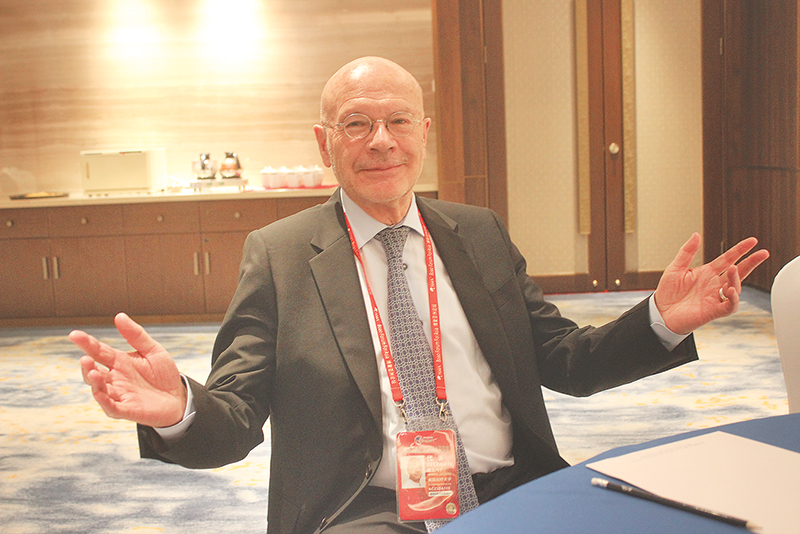
Martin Jacques, British journalist and academic
Post Photo: Purushottam Poudel

British journalist and academic Martin Jacques is best known for his 2009 book When China Rules the World. An unapologetic champion of China’s rise as a “civilisational” power, Jacques believes the Westerners, who have a “very poor” understanding of China as a civilisational state, often fail to understand the reasons behind China’s recent successes. Post’s Purushottam Poudel recently caught up with him on the sidelines of the BOAO forum in Hainan, China, to discuss the various facets of China’s role and place in the modern world. Excerpts.    

Most Westerners tend to be harsh critics of China. What makes you such a staunch supporter of the country?
What China has achieved in a short time is remarkable. A country of 1.4 billion people has become the world’s second-largest economy. China has lifted 800 million out of poverty over 40 years, more than the rest of the world combined. This is a considerable contribution not only to China but to the world. Since 2007 China has become the biggest contributor to global growth.

In your 2009 book When China Rules the World you had projected China to overtake the US as the world’s leading economic power by 2027. Has the impact of the Covid-19 pandemic and the fast changing geopolitical climate made you change your mind?
I can’t exactly remember what I wrote in the book. However, I must have said China’s economy will decline over time as it is not possible to always carry out economic development at the same pace. When a country moves up the ladder of development, it is not possible to maintain the same tempo.
Covid-19 has impacted not only China but also the rest of the world. The economic growth of China in the year 2020 was nearly 2 percent. The following year it grew by 8 percent and this was a bounce-back. However, last year its economy grew by 3 percent. On average, in the past three years, China’s economy grew by 4 percent, which is a decline if we contrast it with the normal years. However, this is not the derailment of China’s growth.
Do I still think China will maintain its growth? This year the estimated growth rate of China is 5.3 percent, which is a conservative estimate. The geopolitical situation, and the American attitude towards China, will have some effect but I cannot say how much.

How do you describe the Chinese approach to world politics?
First, to understand China, you need to think in Chinese and the kind of philosophy that informs China. The ancient Chinese writings are extremely moral. How leaders should be, how they should act, and how a leader should conduct himself. Positivity and moral tone are embedded in China’s ancient philosophy. Confucius says that a leader should model himself as a father in the family. But the tragedy is that most of Western world does not know about Confucius. So they apply Western individualism to analyse China. If one cannot understand this paradigm one cannot understand China. If you read Chinese President Xi Jinping’s speeches you can still feel the fabric of morality in the way of looking at things.

You have of late been talking a lot about Chinese modernity. How does it differ from modernity as understood in the West?
The Western conception of modernity started in Britain and spread across western Europe and later in eastern Europe. The concept has gone through various iterations. Its philosophy and attitude to the rest of the world in my view are based on which is essentially a colonialist perspective.
China has a different view on modernity. For China, modernity starts in developing countries, which is the reason it has forged the concept of the Belt and Road Initiative (BRI). Modernity in the West and China has different meanings because they are the product of two different histories and two different stages of development. They have a distinct conception of the world. In the Chinese view, the world is a single entity, which is not how Westerners see it. For them, the starting point is the nation-state which was created much later after the Treaty of Westphalia.
The profound philosophical difference between the Western and Chinese attitudes is evident in recent Chinese concepts of the Global Civilisation Initiative (GCI), the Global Security Initiative (GSI) and the Global Development Initiative (GDI). These all contain the view of the world, a global system. This also suggests the country which will lead the world in the coming days will be quite different to the one which is leading the world right now.

Are you suggesting that these initiatives China has forged are the tools for creating a new world order under its leadership?
I think there are several ways to look at this. The way China works is the one way. Second, China only started taking itself seriously as a global power since the rise of Xi Jinping; the country’s presidents before that by and large abided by Deng Xiaoping’s philosophy. The Belt and Road is a fascinating initiative. No other country could have imagined such a mega project. The BRI projects the priority of development under China’s leadership. It is a reflection of China’s global priorities.

China recently brokered dialogue between Iran and Saudi Arabia, two sworn enemies in the Middle East. How did you see this evolution in Chinese diplomacy?
It is indeed a very interesting development. China has entered one of the troublesome regions and a region where American influence is considered high. The agreement came almost out of the blue. One of the long conflicts in the Middle East has been frozen. It shows the potential of China as a conciliator for the developing world. It was also interesting to know that both Iran and Saudi trusted China. This also shows Saudi Arabia moving away from America, and is an illustration of the declining American power. I won’t be surprised if the Iran-Saudi incident creates a ripple of its own in the Middle East.

The Global Civilisation Initiative (GCI) was forwarded by Chinese President Xi Jinping on March 15 during the World Leader Summit. Some say it is aimed at alienating the US, which does not have much history as a civilisation, unlike, say India or China. Is this the right understanding?
There are lots of ways to describe civilisation. We can say civilisation is the long-term notion of history and culture. China has been talking about the notion of inclusive civilisation before this, so in this sense this is not a new idea. If so, what is the GCI about? In my view, it is an alternative to the age of the West. The West only recognised one legitimate culture or civilisation. The Western view of modernity is singular. Everyone who respects history and culture should take the same root of modernity developed by the West.
The Chinese approach is different. There are many cultures and modernity cannot have a singular approach. This is a great dividing line between Chinese and Western thinking. Due to the Western colonisation, many countries lost their histories, owing to which they could not decide who they were. Therefore the GCI is the retrieval of different cultures and histories. This is the major philosophical statement of the future world.
China never thought of itself primarily as a nation-state. It started doing so towards the end of the 19th century when it became weak. It had to adopt some norms accepted by the Western countries. But that was not the essence of China. China emerged as a civilisation some 3,000 years ago and has seen itself as a civilisation since. Therefore China is primarily a civilisation state and only then a nation-state.

Rush Doshi’s famous book The Long Game: China’s Grand Strategy to Displace American Order to Paul Kennedy’s The Rise and Fall of Great Power along with your own book suggest that American power is declining. Asian scholars like Kishor Mahbubani to Parag Khanna are in the same boat. However, it feels like scholars are only considering the economic or military might of America. American dominance in the world is also because of its soft power. When claiming that China will surpass America, what kind of soft power does China have to compete against America?
The American soft power is a long historical project which started in Britain. Though China also has a magnificent history, its soft power is weak compared to that of America. That said, Chinese soft power is increasing. Chinese soft power is like a new kid in the school, it only got formulated in 1978, if a date has to be given. Because of its long history, America is very familiar with the world. America also had the leverage of European history.
The world should not underestimate the extent to which China can influence the world in terms of its soft power. The often-asked question about China concerns its governance style. But then there are as many admirers of its system as there are critics. Importantly, in the past few decades, the Chinese government has been able to transform its promises into a reality.

China’s rise to superpower status is not uncontested, as it faces multiple foes today, especially from the democratic world. How do you see this phenomenon?
China is going to replace the US as the most influential country in the world. But when it comes to the longevity of that status, I am not sure. Even if China becomes the most influential country, it also has to decline someday. Democracy is narrowly conceived. It is a post-Second World War phenomenon. We cannot say the West was essentially democratic in the past, it was unstable and dictatorship was a major characteristic of it. The remarkable thing about China is that for a long time, it was one of the most advanced civilisations in the world. Then it declined and is now reinventing itself. And one day it will decline again. Here you can ask me what Chinese civilisation is all about. It is about reinventing itself over a long historical period.

How do you view the growing polarisation between the US and China over the idea of democracy?
Though I do not buy American President Joe Biden’s “Democracy versus Autocracy” narrative, it is true that countries have started to polarise along ideological lines. But more than democracy it is a propaganda contest.

OUR VIEW

Action over word

Is it the case that those who join politics through “lateral entry” are often too ambitious and impatient?

The decision of noted economist Swarnim Wagle to quit Nepali Congress and join the Rastriya Swatantra Party has sparked a new debate. Are traditional parties like the Congress too hide-bound and reluctant to embrace and promote experts in various fields? Are they run like fiefs, as Wagle has accused the “Deubas” of doing with the Congress party? Or is it the case that those who join politics through “lateral entry” are often too ambitious and impatient?
When it comes to promotions and ticket distribution, shouldn’t they abide by the rules that apply to the rest of the party rank and file?
It is clearly not the case that Nepali political parties do not value academic merit. A PhD holder occupied the prime minister’s chair not so long ago. In major parties, too, there are plenty of PhDs in different domains. Even ageing office bearers and standing committee members of political parties are studying for higher degrees or to acquire some new professional expertise. This is the case even with those who once boycotted “bourgeois education”. Increasingly, there is a trend in political parties of appointing experts in the respective party departments, for instance those dealing in health and education. Even in Wagle’s case, he was appointed the vice-chairman of the National Planning Commission in recognition of his knowledge and acumen. From the CPN-UML Yubaraj Khatiwada got to become the finance minister largely because of his academic excellence.   
But the accusation that Nepal’s major parties are controlled by a handful of leaders and it is difficult for those outside their cliques to move up the party ladder is hard to refute. For instance, Nepali Congress President Sher Bahadur Deuba has tried to completely sideline the rival faction in his party, be it in the appointment of the party’s top non-elected office-bearers or in the pick of Cabinet ministers. Whatever your academic pedigree or however high your public standing, if you are in the bad books of top leaders, you will find it infernally hard to move up the party ranks: In one telling example, Ghanashyam Bhusal, the party ideologue who was always critical of the CPN-UML leadership, had to ultimately leave the mother ship.
The insecurity of the top leaders is also evident in their reluctance to groom successors. Whether it is Deuba in the Congress, KP Oli in the UML or Pushpa Kamal Dahal in the CPN (Maoist Centre), they would ideally like to remain the party head for the rest of their life. Yet, in the long run, these leaders won’t be able to stop the growing trend of political parties being influenced by various kinds of experts and lateral entrants. In the end, perhaps we will also do well to consider that just like the rest of us, the experts are humans too. And just like the rest of us, they are experts in only narrow fields. It is not necessary that a top-notch economist or a fantastic bureaucrat will be a good politician as well. Those who wade into politics should be judged based on their actions not their promises.  

Page 5
MONEY

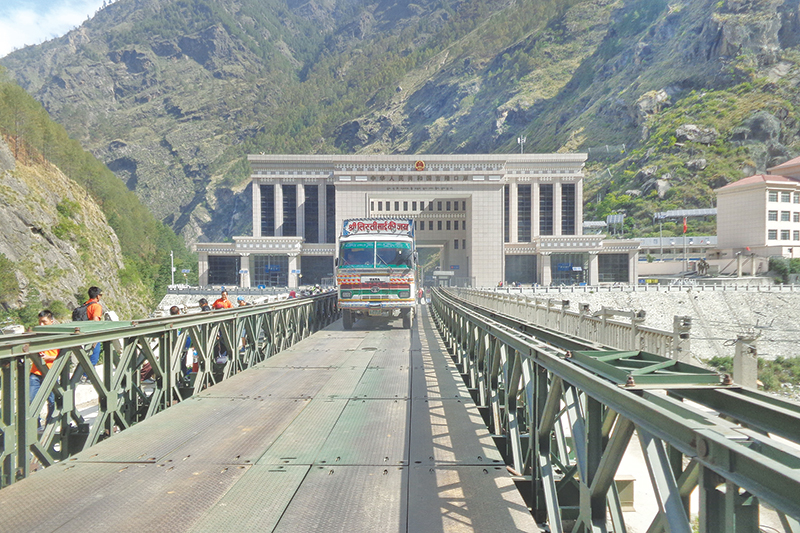
Nepali traders laud reopening of Rasuwagadhi-Kerung border point

Some traders say that Chinese border points have a habit of opening and closing randomly, causing them much distress. They have called for a consistent trade and transit policy.
- KRISHANA PRASAIN,JANAK BAHADUR SHAHI
Traders say China has reopened trade at a time when demand for goods is slow.  RSS

KATHMANDU & HUMLA
Nepali traders are delighted by China’s decision to reopen the northern border that has remained closed for three years, but insiders say it may be too soon to celebrate as Beijing’s policy has been inconsistent.
Following a meeting of the Nepal-China border trade mechanism in Lhasa on March 29, China on Saturday decided to fully open the Rasuwagadhi-Kerung border point.
Located directly north of Kathmandu, the Nepali check post
of Rasuwagadhi is 24 km from Kerung in China.
“It’s a big relief for Nepali traders. It will help save import-export costs and time,” said Ashok Kumar Shrestha, president of the Nepal Trans Himalayan Border Commerce Association. “We expect that there will be no hassles in the trade in the coming days,” he said.
Some traders say that Chinese border points have a habit of opening and closing randomly, causing them much distress. They have called for a consistent trade and transit policy.
“As people’s movement has also been allowed, it will help small traders to bring goods as per their capacity,” Shrestha said.
Traders say that shipments dispatched from Guangzhou to Nepal over the northern overland route normally arrive in three weeks.
According to Shrestha, cargo sent by sea to India for transit to Nepal takes seven weeks. Officials say that 14 containers are arriving in Nepal daily. “We expect that the number will go up now.”
Trade economist Posh Raj Pandey said, “The hassles at the border were caused mainly by the Covid pandemic; and now that trade has resumed, it’s good for Nepal.” Pandey added, “It looks like China works from a long-term perspective and has prioritised the Rasuwagadhi trade point. But the infrastructure on the Nepali side is out of order.” He said, “Nepali freight carriers should be allowed to transport goods to the warehouse in China. Easing visas and entry permits will help Nepali traders do hassle-free trade with China.”
According to him, the Nepal government needs to build a lab to issue sanitary and phytosanitary certificates and sign an agreement with China on mutual recognition of major exportable goods from Nepal.
On April 1, Chinese Ambassador to Nepal Chen Song twitted: “Passengers’ clearance at the Jilong (Rasuwa) port has been resumed from today. I believe this will further deepen the bilateral cooperation and people-to-people exchange.”
Madhu Kumar Marasini, secretary of Nepal’s Ministry of Industry, Commerce and Supplies tweeted, “We are equally hopeful that this reopening will reflect in improved bilateral trade, tourism and passenger movement and help further deepen bilateral collaboration.”
Shrestha said they had been informed that the Tatopani border point would also come into full operation from May 1. “We have been informed that the trading point will be fully opened, but people’s movement at Tatopani point is expected to be delayed.”
Traders say China has reopened trade at a time when demand for goods is slow.
“Trade demand is subdued. There are no large orders for Chinese goods at this time because of high bank interest rates and inflation,” said Shrestha. “There is no demand at all.”
Narayan Prasad Bhandari, chief of the Rasuwa Customs Office, said 25 containers loaded with exportable goods crossed the border on Saturday while 32 empty goods carriers reached Kerung to take on import cargo. “The export goods consist of statues, carpets, bamboo products, handicrafts and copper decoration items,” Bhandari said.
Readymade garments, rubber, footwear, electronic goods, hydropower equipment and other goods are imported from China. “There has been no passenger vehicle movement,” Bhandari said. “Rasuwa residents will receive a pass to cross the border like before. Chinese officials have said that two-way trade will be allowed through the Tatopani border point from May 1.” Nepali and Chinese officials have also agreed to fully open the Hilsa border point in Humla district from May 1. Bijay Lama, a tourism entrepreneur in Humla, said the border point would be fully opened for two-way trade and movement of people. “But the movement of third-country nationals will be restricted at the border point,” Lama said. Humla residents who used to travel to Taklakot in Tibet for trade hope the opening of the transit point next month will help revive the commercial activities stalled by the pandemic.
Min Lama, president of the Humla chapter of Hotel Association Nepal, says the decision has provided hope for the revival of trade and tourism in the district.
“However, they have not mentioned passenger movement through the border point,” said Dayananda KC, chief of the Tatopani Customs Office.
“Around 10 Chinese containers are arriving at the border point daily, and 80 percent of the goods arriving through Tatopani customs are apple and garlic,” KC said. “The number of containers coming to Nepal was around six, but it increased after January.”
According to the Rasuwa Immigration Office, Chinese authorities issued permission letters to 250 people on Saturday after a break of 38 months. Chinese officials have said that there will be no hassles in trade and passenger movement at the Rasuwagadhi border point. Antigen tests of container drivers, workers and traders are being done. According to the Department of Customs, imports from China to Nepal declined by 21.68 percent to Rs145.78 billion in the first eight months of the current fiscal year ended mid-March. Nepal imported goods worth Rs264.78 billion in the last fiscal year 2021-22.
Last December, China decided to resume two-way cargo movement through the Rasuwagadhi-Kerung-Jilong port in January. But exports from Nepal were allowed to pass only on a fortnightly basis. After Nepal’s repeated requests, the Chinese side in July agreed to resume two-way trade through the border point.
Nepal’s exports to China fell by 4.85 percent to Rs519.36 million in the first eight months of the current fiscal year.The country exported goods worth Rs808.75 million in the last fiscal year. Nepal’s trade deficit with China reached Rs145.26 billion in the first eight months of the current fiscal year.
Nepali traders, who suffered huge losses due to the disruption in cargo movement, have long been demanding full-fledged resumption of exports and imports through the Rasuwagadhi-Kerung-Jilong and Tatopani-Zhangmu border points.
Initially, China closed the border point in early 2020 because of heavy snowfall and the Lhosar festival.
After the coronavirus outbreak was declared a pandemic by the World Health Organisation on March 11, 2020, countries were compelled to close their borders and impose lockdowns to prevent the disease from spreading.

MONEY

Thousands protest in Portugal over housing crisis

Portugal is one of Western Europe’s poorest countries.
- REUTERS

LISBON,
Thousands of people took to the streets of Lisbon and other cities across Portugal on Saturday in protest against soaring rents and house prices at a time when high inflation is making it even tougher for people to make ends meet.
“There is a huge housing crisis today,” Rita Silva, from the Habita housing group, said at the Lisbon protest. “This is a social emergency.”
Portugal is one of Western Europe’s poorest countries, with government data showing more than 50 percent of workers earned less than 1,000 euros ($1,084) per month last year. The monthly minimum wage is 760 euros.
Rents in Lisbon, a tourist hotspot, have jumped 65 percent since 2015 and sale prices have sky-rocketed 137 percent in that period, figures from Confidencial Imobiliario, which collects data on housing, show. Rents increased 37 percent last year alone, more than in Barcelona or Paris, according to another real estate data company, Casafari.
The situation is particularly hard on the young.
The average rent for a one-bedroom flat in Lisbon is around 1,350 euros, a study by housing portal Imovirtual showed.
The Socialist government announced last month a housing package that, among other measures, ended the controversial “Golden Visa” scheme and banned new licenses
for Airbnb properties but critics say it is not enough to lower prices in the short term.
At the protest, which was organised by the movement “Home to Live” and other groups, 35-year-old illustrator Diogo Guerra said he hears stories about people struggling to access housing every day.
“People who... work and are homeless, people are evicted because their house is turned into short-term accommodations [for tourists],” he said.
Low wages and high rents make Lisbon the world’s third-least viable city to live in, according to a study by insurance brokers CIA Landlords. Portugal’s current 8.2 percent inflation rate has exacerbated the problem.
“With my salary, which is higher than the average salary in Lisbon, I cannot afford renting a flat because it’s too expensive,” said Nuncio Renzi, a sales executive from Italy living in the capital.

MONEY

Kailash Terminals JV to operate integrated check post in Birgunj

- SHANKAR ACHARYA
Madhav Prasad Baral, chief executive officer of Kailash Terminals JV, said local jobs have been prioritised at the integrated check post.   POST FILE PHOTO

PARSA,
Kailash Terminals JV has won the contract to operate the integrated check post at Birgunj for the next five years.
The check post came into operation in April, 2018. The private company quoted Rs1.8 billion for the project. The minimum rental amount was
set at Rs685.7 million when the bids were invited.
Nepal Intermodal Transport Development Board, the regulator, had invited international competitive bidding to operate the integrated check post on July 27 last year.
Kailash Terminals is a joint venture between Nepal’s Bindabasini Logistics Private Limited, India’s TRS Lift and Shift Services Private Limited and Apeejay Shipping Limited. Of the two integrated check posts each at Birgunj and Biratnagar and five dry ports at Bhairahawa, Kakarbhitta, Tatopani, Chobhar and Sirsiya under the ownership of the board, only Chobhar dry port is still operated by the board itself.
With the objective of facilitating trade between Nepal and India by providing all services from one place under the one-window system, an agreement was made to build an integrated border check post at Biratnagar, Birgunj, Bhairawa and Nepalgunj border points with financial and technical support from the Indian government.
The integrated check posts have customs, immigration, animal and plant quarantine, necessary parking for customs, laboratory, authorised barracks, security barracks, electricity substation, petrol pump, fire truck, two entrances, security wall, water tank, seed house, warehouse, bank, among others.
During the interaction organised by Kailash Terminals JV on Saturday, Indian customs officials said they were ready to cooperate with Nepali officials. Rajendra Prasad Chudal, chief of Birgunj Customs Office, asked Kailash Terminal JV not to increase the service charge.
“An environment should be created to run the customs office from early in the morning to prevent the crowd of service seekers during the day,” said Chudal.
Madhav Prasad Baral, chief executive officer of Kailash Terminals JV, said local jobs have been prioritised at the integrated check post.

MONEY

Chinese lithium producers set price floor as demand evaporates

The move comes as lithium prices plunge on a significant slowdown in demand for electric vehicles in China.
- REUTERS

BEIJING,
China’s top lithium producers agreed this week to set a floor price of 250,000 yuan ($36,380) per tonne of lithium carbonate, six people familiar with the matter said, in an effort to slow a plunge in the price of the battery raw material.
The price was agreed on Tuesday by around 10 companies including Tianqi Lithium and Ganfeng Lithium that met on the sidelines of a conference in Nanchang in southern China, said one person who attended the meeting and five others briefed on the discussions.
The people declined to be named because of the sensitivity of the
topic, which was discussed in a closed-door meeting.
Ganfeng said in a response to Reuters that no discussions on a floor price had taken place.
“Ganfeng always insists that product prices should be determined by the market, and will never take the initiative to control prices to influence the market,” a company representative said in an email.
It added that no company in the industry has such capabilities.
Tianqi declined to comment.
Zhicun Lithium, one of the top lithium carbonate producers in China, was also represented at the meeting, said four of the people, but could not be reached for comment.
The move comes as lithium prices plunge on a significant slowdown in demand for electric vehicles (EV) in China, the world’s largest EV market.
Spot prices have slumped by more than 60 percent since their peak in late November, with the decline picking up pace in recent weeks on a growing price war in China’s auto market.
It is not clear how long the companies, which account for over half China’s lithium carbonate output, will follow the floor price.
Spot prices dropped to 220,000 yuan a tonne on Friday, according to a weekly price assessment by Fastmarkets, down from 260,000 yuan a week earlier.
Offers as low as 150,000 yuan were also heard in the market this week as traders sought to offload mounting stocks, said a buyer for a battery manufacturer who did not attend the meeting of lithium producers.
“Setting a floor price should strengthen the market sentiment and hold the prices from falling further,” said the person who attended the
meeting.
However, some buyers were sceptical that producers would stick to the floor price, given the sluggish demand.
“If we don’t buy, someone will eventually drop the price,” said a lithium carbonate buyer briefed on the decision.
Participants at the meeting also discussed the planned launch later this year of lithium carbonate futures on the Guangzhou Futures Exchange, according to two of the people, another move that could help stabilise prices.

MONEY

Business women honoured

Bizline

KATHMANDU: Open Space Network organised Apex College Presents Summit Woman of the Year 2023 to recognise and honour businesswomen below the age of 30. Arushree Sharma, co-founder of Avani Nepal, a natural high-quality skincare, haircare and personal care brand based in Nepal won the title of ‘Summit Woman Of The Year 2023’ along with Rs100,000 as a cash prize and Nikita Jalan, co-founder of Petmama Nepal, the first professional pet grooming parlour in Nepal was awarded ‘Vaidya Organisation Innovation Prize 2023’ and Rs50,000 in cash prize. Summit Woman was created to provide a platform outside of the workplace to educate, encourage and inspire women to achieve their career and personal goals, reads the press release issued by the organiser. (PR)

MONEY

LG launches New Year campaign

Bizline

KATHMANDU: Nepal’s largest-selling brand LG has released its New Year campaign, ‘Subhakamana Naya Barshako Sambandha Jeevanbharko,’ for New Year 2080. This campaign offers attractive cashback and guaranteed gifts on purchasing any LG product. Under this scheme, CG Electronics, Nepal’s authorised distributor for LG will provide up to 35 percent cash back and guaranteed gifts on purchasing LG home entertainment and home appliances, reads the press release issued by the company. (PR)

MONEY

India extends export curbs on gasoline, diesel

Bizline

MUMBAI: India has extended restrictions on the export of diesel and gasoline, the government said in a notification, as New Delhi tries to ensure the availability of refined fuels for the domestic market. The government had imposed the curbs on gasoline and gasoil exports through the end of the financial year on Friday. The latest notification, issued late on Saturday, did not specify how long the curbs would remain in the place. It asked refiners to commit to selling 50 percent of their annual volume of gasoline exports and 30 percent of their diesel exports in the domestic market. (REUTERS)

Page 6
WORLD

Ukrainian official offers series of steps after reclaiming control of Crimea

Moscow annexed Crimea from Ukraine in 2014, but most of the world does not recognise it as Russian territory.
- ASSOCIATED PRESS
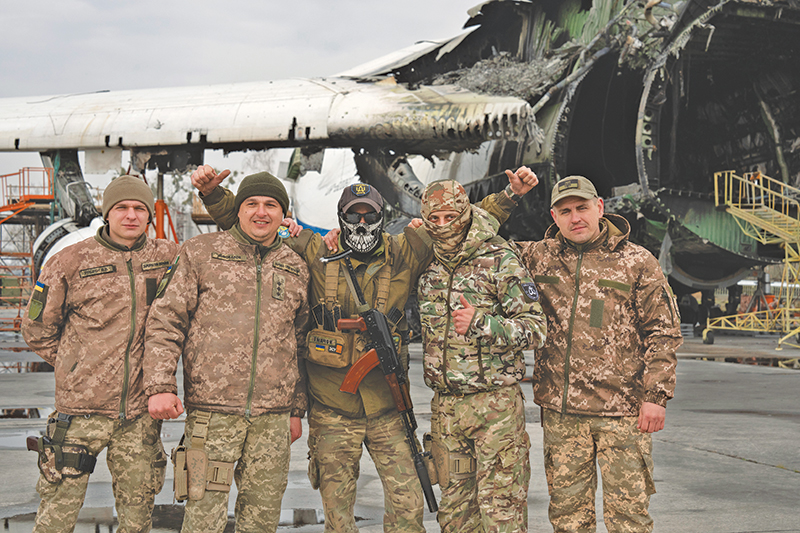
Ukrainian soldiers pose for a photo at the Antonov airport, in front of the gutted remains of the Antonov An-225, the world’s biggest cargo
aircraft,destroyed during fighting between Russian and Ukrainian forces, in Hostomel, on the outskirts of Kyiv, Ukraine on Saturday.   AP/RSS

KYIV, 
A top Ukrainian official on Sunday outlined a series of steps the government in Kyiv would take after the country reclaims control of Crimea, including dismantling the strategic bridge that links the seized Black Sea peninsula to Russia.
Oleksiy Danilov, the secretary of Ukraine’s National Security and Defence Council, published the plan as Ukraine’s military prepares for a spring counteroffensive in hopes of making new, decisive gains after more than 13 months of war to end Russia’s full-scale invasion.
Moscow annexed Crimea from Ukraine in 2014, but most of the world does not recognise it as Russian territory. The peninsula’s future status will be a key feature in any negotiations on ending the current fighting.
The Kremlin has demanded that Ukraine recognise Russia’s sovereignty over Crimea and acknowledge other land gains made by Moscow as a condition for peace. Kyiv has ruled out any peace talks with Moscow until Russian troops leave all occupied territories, including Crimea.
Danilov suggested prosecuting Ukrainians who worked for the Moscow-appointed administration in Crimea, adding that some would face criminal charges and others would lose government pensions be banned from public jobs.
All Russian citizens who moved to Crimea after 2014 should be expelled, and all real estate deals made under Russian rule nullified, Danilov wrote on Facebook.
As part of the plan, he also called for dismantling a 19-kilometre bridge that Russia built to Crimea. A truck bomb severely damaged the bridge, Europe’s longest, in October. Moscow blamed Ukrainian military intelligence for the attack.
Russia has repaired the damaged section of the bridge and restored the flow of supplies to Crimea, which has served as a key hub for the Russian military during the war. Ukraine did not claim responsibility for the bomb, but Ukrainian officials had repeatedly threatened to strike the bridge in the past. Danilov also argued for renaming the city of Sevastopol, which has been the main base for the Russian Black Sea Fleet since the 19th century. He said it could be called Object No. 6 before the Ukrainian parliaments chooses another name, suggesting Akhtiar after a village that once stood where the city is now.
The Moscow-appointed head of Sevastopol, Mikhail Razvozhayev, shrugged off Danilov’s plan as “sick.”
“It would be wrong to seriously treat comments by sick people. They must be cured, and that’s what our military is doing now,” Razvozhayev told the Russian state news agency Tass. Danilov published his plan as Ukrainian troops prepared to use newly supplied Western weapons, including dozens of battle tanks, to break through Russian defences and reclaim occupied areas in a counteroffensive expected as early as this month.
Russian troops are trying to capture the key Ukrainian stronghold of Bakhmut as part of their efforts to take all of Donetsk province, which is part of Ukraine’s eastern industrial heartland of the Donbas. The 8-month campaign for Bakhmut is the longest and potentially deadliest battle of the war.
Russia’s latest rocket and artillery attacks killed 4 civilians and wounded 15 others since Saturday, according to the Ukrainian military.
The war that has dragged into the 14th month has destroyed entire cities to ruins and killed tens of thousands.
Ukrainian Sports Minister Vadym Huttsait said the death toll included 262 Ukrainian athletes, reaffirming Kyiv’s call to bar Russia from the Olympics.
Vitalii Merinov, a four-time world kickboxing champion, was among the Ukrainian athletes who were killed in the war. Merinov, who joined the Ukrainian military, died on Friday of wounds sustained in action, according to the mayor of the western city of Ivano-Frankivsk.

WORLD

Uptick in activity at North Korea nuclear complex, report says

- REUTERS

WASHINGTON,
Satellite images show a high level of activity at North Korea’s main nuclear site, a US think tank reported on Saturday after the North Korean leader ordered an increase in production of bomb fuel to expand the country’s nuclear arsenal.
The Washington-based 38 North North Korea monitoring project said the activity it had spotted, based on images from March 3 and 17, could indicate that an Experimental Light Water Reactor (ELWR) at the Yongbyon site was nearing completion and transition to operational status.
The report said the images showed that a 5 megawatt reactor at Yongbyon continued to operate and that construction had started on a support building around the ELWR. Further, water discharges had been detected from that reactor’s cooling system. New construction had also started around Yongbyon’s uranium enrichment plant, likely to expand its capabilities.
“These developments seem to reflect Kim Jong Un’s recent directive to increase the country’s fissile material production to expand its nuclear weapons arsenal,” the report added, referring to the North Korean leader.
On Tuesday, North Korea unveiled new, smaller nuclear warheads and vowed to produce more weapons-grade nuclear material to expand its arsenal, while denouncing stepped up military exercises by South Korea and the United States.
Its state media said Kim had ordered the production of weapons-grade materials in a “far-sighted way” to boost the country’s nuclear arsenal “exponentially.”
It is unclear whether North Korea has fully developed miniaturised nuclear warheads needed to fit on smaller weapons it has displayed and analysts say perfecting such warheads would most likely be a key goal if it resumes nuclear testing for the first time since 2017.
South Korea and the United States have warned since early 2022 that North Korea may resume nuclear testing at any time.

WORLD

The US leads the world in weather catastrophes. Here’s why

- ASSOCIATED PRESS
A file photo shows the bridge leading from Fort Myers to Pine Island, Florida heavily damaged in the aftermath of Hurricane Ian.  AP/RSS

WASHINGTON,
The United States is Earth’s punching bag for nasty weather.
Blame geography for the US getting hit by stronger, costlier, more varied and frequent extreme weather than anywhere on the planet, several experts said. Two oceans, the Gulf of Mexico, the Rocky Mountains, jutting peninsulas like Florida, clashing storm fronts and the jet stream combine to naturally brew the nastiest of weather.
That’s only part of it. Nature dealt the United States a bad hand, but people have made it much worse by what, where and how we build, several experts told The Associated Press.
Then add climate change, and “buckle up. More extreme events are expected,” said Rick Spinrad, head of the National Oceanic and Atmospheric Administration.
Tornadoes. Hurricanes. Flash floods. Droughts. Wildfires. Blizzards. Ice storms. Nor’easters. Lake-effect snow. Heat waves. Severe thunderstorms. Hail. Lightning. Atmospheric rivers. Derechos. Dust storms. Monsoons. Bomb cyclones. And the dreaded polar vortex.
It starts with “where we are on the globe,” North Carolina state climatologist Kathie Dello said. “It’s truly a little bit ... unlucky.” The US is by far the king of tornadoes and other severe storms. “It really starts with kind of two things. Number one is the Gulf of Mexico. And number two is elevated terrain to the west,” said Victor Gensini, a Northern Illinois University meteorology professor.
Look at Friday’s deadly weather, and watch out for the next week to see it in action: Dry air from the West goes up over the Rockies and crashes into warm, moist air from the Gulf of Mexico, and it’s all brought together along a stormy jet stream.
In the West, it’s a drumbeat of atmospheric rivers. In the Atlantic, it’s nor’easters in the winter, hurricanes in the summer and sometimes a weird combination of both, like Superstorm Sandy.
“It is a reality that regardless of where you are in the country, where you call home, you’ve likely experienced a high-impact weather event firsthand,” Spinrad said.
Killer tornadoes in December 2021 that struck Kentucky illustrated the uniqueness of the United States.
They hit areas with large immigrant populations. People who fled Central and South America, Bosnia and Africa were all victims. A huge problem was that tornadoes really didn’t happen in those people’s former homes, so they didn’t know what to watch for or what to do, or even know they had to be concerned about tornadoes, said Joseph Trujillo Falcon, a NOAA social scientist who investigated the aftermath.
With colder air up in the Arctic and warmer air in the tropics, the area between them—the mid-latitudes, where the United States is—gets the most interesting weather because of how the air acts in clashing temperatures, and that north-south temperature gradient drives the jet stream, said Northern Illinois meteorology professor Walker Ashley.
Then add mountain ranges that go north-south, jutting into the winds flowing from west to east, and underneath it all the toasty Gulf of Mexico.
The Gulf injects hot, moist air underneath the often cooler, dry air lifted by the mountains, “and that doesn’t happen really anywhere else in the world,” Gensini said.

WORLD

Presidents of Taiwan, Guatemala visit Mayan pyramid

- ASSOCIATED PRESS
Taiwan’s President Tsai Ing-wen (centre left), and Guatemala’s PresidentAlejandro Giammattei, during their visit to the Mayan site Tikal, in Peten, Guatemala on Saturday.   AP/RSS

GUATEMALA CITY, 
Taiwanese President Tsai Ing-wen and the Guatemalan President Alejandro Giammattei toured the archaeological site of Tikal on Saturday during a trip by Tsai that aims to shore up the self-governing island’s ties with its remaining allies in Central America.
The Taiwanese leader will visit Guatemala and Belize, the island’s only two remaining allies in Central America, where Honduras, Nicaragua, El Salvador, Panama and Costa Rica have all switched their support to China. Honduras broke relations with Taipei a week ago.
Under a blazing sun on Saturday, Tsai and Guatemalan Foreign Minister Mario Búcaro, representing Giammattei—who suffers from multiple sclerosis – climbed one of the Mayans’ most important pyramids: Temple II, also called Temple of the Masks. With incense, a Mayan invocation ceremony, a Mayan ball game and an exchange of gifts, Tsai and Giammattei talked as they enjoyed the central square of Tikal archaeological park. The day before, in a joint message, the leaders spoke of unity, solidarity and the values shared by Guatemala and Taiwan.

WORLD

Mozambique works to contain cholera outbreak

More than 19,000 cases of cholera confirmed across eight of Mozambique’s provinces as of March 27.
- ASSOCIATED PRESS
A file photo shows a mother preparing a meal for her family in a displacement camp on the bank of a flooded rice paddy near the village of Nicoadala, Zambezia province, Mozambique.  AP/RSS

QUELIMANE,
Weeks after massive Cyclone Freddy hit Mozambique for a second time, the still-flooded country is facing a spiraling cholera outbreak that threatens to add to the devastation.
There were over 19,000 confirmed cases of cholera across eight of Mozambique’s provinces as of March 27, according to UN Office for the Coordination of Humanitarian Affairs, a figure which had almost doubled in a week.
Freddy was likely the longest-lived cyclone ever, lasting over five weeks and hitting Mozambique twice. The tropical storm killed 165 people in Mozambique, 17 in Madagascar and 676 in Malawi. More than 530 people are still missing in Malawi two weeks later so that country’s death toll could well exceed 1,200.
Freddy made its second landfall in Mozambique’s Zambezia province, where scores of villages remain flooded and water supplies are still contaminated.
At a hospital in Quelimane, Zambezia’s provincial capital, National Institute of Health director general Eduardo Sam Gudo Jr reported there were 600 new confirmed cases a day in Quelimane district alone, but said that the real number may be as high as 1,000.
At least 31 died of cholera in Zambezia and over 3,200 were hospitalised between March 15 and 29, according to data from the Ministry of Health.
Cases are highest in the neighbourhood of Icidua on the city outskirts, where most residents live in bamboo or adobe mud huts and fetch water in buckets from communal wells. Flooding brought by the cyclone has exposed many of these wells to water contaminated with sewage overflow and other sources of bacteria. Cholera spreads through faeces, often when it gets into drinking water.
But until water pipelines ruptured in the floods are repaired, these wells are the only source of water for those in Icidua and communities like it. For now, temporary solutions offer the only hope of stemming the outbreak.
Volunteers go from house to house distributing bottles of Certeza, a local chlorine-based water purifier. Each bottle should last a family for a week, but supplies are running low as local production struggles to keep pace with demand.
There are also not enough people to distribute the Certeza, even if greater supplies could be procured, Gudo said.
In the meantime, health workers are struggling to treat the infected with many clinics and hospitals badly damaged.
“The cyclone destroyed the infrastructure here,” said José da Costa Silva, the clinical director of the Icidua health centre. “We are working in parts of the hospital that were not destroyed. Some colleagues are working outside in the open because there’s not enough space available for everyone.”
Eighty health centres in total were affected by Freddy’s two landfalls in Mozambique, according to INGD, the country’s disaster management agency.
Although cyclones do occur in southern Africa from December to May, human-caused climate change has made tropical cyclones wetter, more intense and more frequent.

WORLD

Rahul Gandhi to appeal two-year jail sentence

Briefing
- AGENCIES

MUMBAI: Indian opposition leader Rahul Gandhi will appeal a two-year jail sentence in a defamation case brought against him by lawmaker from Prime Minister Narendra Modi’s Bharatiya Janata Party (BJP), local media reported on Sunday. Gandhi, the 52-year-old scion of the Nehru-Gandhi political dynasty and leader of the Congress party, was found guilty of defamation by a court in the western state of Gujarat over comments he made in a speech in 2019. Gandhi has filed a plea in the Surat sessions court against the magistrate order, the Indian Express newspaper reported, while a senior Congress party official, who declined to be named, told Reuters the court is scheduled to hear the plea on Monday.

WORLD

Pope Francis leads Palm Sunday service

Briefing
- AGENCIES

VATICAN CITY: Pope Francis led a Palm Sunday service the day after he was discharged from hospital following a bout of bronchitis, and urged the world to take better care of the poor, the lonely and the infirm. Thousands of people waved palm and olive branches as Francis was driven into St Peter’s Square sitting in the back of a white, open-topped vehicle before the start of the Mass, which lasted two hours. “I thank you for your participation and also for your prayers, which intensified during these past days. Thank you,” he said at the end of the service in an apparent reference to his recent illness, drawing loud applause from the crowd. The pope, 86, was taken to Rome’s Gemelli hospital on Wednesday after complaining of breathing difficulties, but recovered quickly following an infusion of antibiotics and returned to his Vatican residence on Saturday.

WORLD

Forest fire in central Seoul forces evacuation of 120 homes

Briefing
- AGENCIES

SEOUL: A forest fire raged in central Seoul on Sunday, forcing the evacuation of at least 120 homes in the densely populated capital, authorities said. The fire, which started on a mountain in the middle of Seoul at around 11:53 am (0253 GMT), razed forests the size of some 30 soccer fields before it was nearly extinguished as of 5 pm (0800 GMT), according to officials. No casualties were reported. Smoke billowing from forests was seen across the city as firefighters battled to put out the fire with water-bombing aircraft. Multiple helicopters were seen flying over the Han River in an apparent effort to supply water to extinguish the fire, a Reuters witness said.

WORLD

Heavy rain brings flash flooding to Sydney, prompts rescues

Briefing
- AGENCIES

SYDNEY: Heavy rain brought flash flooding to Australia’s largest city Sydney on Sunday, prompting rescues and residents to sandbag houses, as authorities warned of bad weather ahead. Emergency authorities received 50 calls for assistance, mostly for sandbagging of properties and help plugging leaking roofs, from residents in Sydney, the capital of New South Wales state, due to Sunday’s deluge. It comes after Sydney in 2022 notched its wettest year in 164 years, as Australia’s east coast endured a rare third straight year of the La Nina weather phenomenon, associated with increased rain. A NSW State Emergency Service spokesperson told Reuters two people were pulled safely from cars that become stranded in floodwaters in Sydney’s inner suburbs.

Page 7
SPORTS

Rajasthan thump Hyderabad by 72 runs

- ASSOCIATED PRESS

HYDERABAD,
Rajasthan Royals showed plenty of batting muscle at the top of the
order while Yuzvendra Chahal grabbed 4-17 in a resounding 72-run victory over Sunrisers Hyderabad in their opening Indian Premier game
on Sunday.
Jos Buttler plundered 54 off 22 balls inside the batting powerplay while his opening partner Yashasvi Jaiswal (54) and captain Sanju Samson (55) also scored heavily to contribute to Rajasthan’s strong total of 203-5.
Hyderabad finished on a disappointing 131-8 after Trent Boult (2-21)
dismantled the home team’s batting by claiming two wickets in his first over before conceding a run and Chahal later ran through the
middle-order, claiming the key wickets of Harry Brook (13) and Mayank Agarwal (27).
Chahal raised his wicket tally in the IPL to 170—joint second most with Sri Lankan Lasith Malinga—when he had Adil Rashid stumped and then clean bowled Bhuvneshwar Kumar with a perfect googly.
“We knew 200 was a good score on this wicket,” Chahal said. “My plan was to vary my pace and bowl stump to stump. It is always my strength. I am doing nothing new and I am just backing my strengths.”
Hyderabad were in danger of getting bowled out for less than 100 before Abdul Samad remained unbeaten on run-a-ball 32 and Umran Malik played a cameo of 19 not out with two sixes and a boundary.
Earlier, Buttler smacked seven boundaries and three sixes in a whirlwind half century inside the first six overs before he played onto Afghan fast bowler Fazalhaq Farooqi as Rajasthan stormed to 122-1 in the first half of their batting innings.
Hyderabad bounced back despite Jaiswal and Samson cracking fine half-centuries with fast bowler Thangarasu Natarajan (2-23) stemming the flow of runs and Farooqi also making good in his return spell to finish with 2-41.
Farooqi broke the half-century stand between Jaiswal and Samson when he had the former caught at deep square leg and Natarajan deceived Samson with a slower delivery that had him caught at deep square leg in the penultimate over as Hyderabad conceded 81 runs in the last 10 overs.
“It is the first match of the season and there is a lot to improve,” Hyderabad skipper Kumar said after the fast bowler conceded 36 runs in his three overs against Buttler’s onslaught.
“We need to execute our plans and hopefully we will get better.”

SPORTS

Arsenal respond to title pressure in style

Jesus scores in his first start since returning from injury as Arsenal beat Leeds 4-1 to remain eight points clear at top.
- AGENCE FRANCE-PRESSE
Arsenal’s Gabriel Jesus was sidelined for three months after picking up a knee injury at the World Cup.  AP/RSS

LONDON,
Manchester City thrashed Liverpool 4-1 on Saturday but remain eight points adrift of Arsenal at the top of the Premier League after Gabriel Jesus scored twice in the Gunners 4-1 win over Leeds.
In the clash between the two sides that have dominated English football over the past five years, City were a class apart despite the absence of Erling Haaland due to injury.
Liverpool went in front through Mohamed Salah’s 23rd goal of the season but were blown away in the second half after Julian Alvarez brought City level before the break.
Pep Guardiola’s men needed less than a minute in the second period to go in front as Kevin De Bruyne tapped home Riyad Mahrez’s cross.
Ilkay Gundogan slammed home the third before Jack Grealish rounded off his best performance in a City shirt with a fine finish for the fourth.
City still have a game in hand on Arsenal and the two meet in a potential title decider at the Etihad later this month.
A sobering defeat is another blow to Liverpool’s hopes of a top-four finish as the Reds slip to eighth in the table.
Arsenal did not feel the pressure of City briefly cutting the gap before kick-off at the Emirates as Jesus marked his first league start since November with a double.
Bukayo Saka was handed a rare rest by Mikel Arteta and Jesus took responsibility from the penalty spot in his absence to open the scoring 10 minutes before half-time.
Jesus was sidelined for three months after picking up a knee injury at the World Cup but the former City forward’s return for the run-in could deny his old club a fifth title in six years.
The Brazilian fired home his second goal of the game after Ben White doubled Arsenal’s lead early in the second half.
“He’s been working so hard the last four or five months with a lot of support obviously from the team and the staff,” said Arteta on Jesus’ impact. “Today he deserved the chance to start and he grabbed the opportunity.”
Rasmus Kristensen pulled a goal back for Leeds, but Granit Xhaka rounded off the scoring as Arsenal made it seven consecutive league wins for the first time under Arteta.
Brighton and Brentford shared the points after a thrilling 3-3 draw at the Amex.
Three times Brentford led through Pontus Jansson, Ivan Toney and Ethan Pinnock. But the Seagulls grabbed a deserved point thanks to Alexis Mac Allister’s late penalty after Kaoru Mitoma and Danny Welbeck also equalised in the first half. A point apiece sees both sides edge above Liverpool and within six points of the top four.
Aston Villa are also making a late push for Europe as their superb form under Unai Emery continued with a 2-0 win at Chelsea. Ollie Watkins and John McGinn scored for the visitors at Stamford Bridge, who moved above Chelsea into ninth.
Roy Hodgson’s return at Crystal Palace delivered the Eagles’ first victory of 2023 as Jean Philippe-Mateta’s 94th minute goal beat Leicester 2-1 at Selhurst Park.
Following the defeat that dropped the Foxes to relegation zone, Leicester parted company with manager Brendan Rodgers as
Bournemouth came from behind to beat Fulham 2-1 thanks to goals from Marcus Tavernier and Dominic Solanke. Nottingham Forest and Wolves remain outside the bottom three after a 1-1 draw.

SPORTS

Corporate golf on April 22

- Sports Bureau

KATHMANDU,
Baahrakhari Media is set to organise the sixth edition of the Baahrakhari Golf and Economic Symposium at the Gokarna Golf Course in Kathmandu on April 22.
The golf tournament will see participation of 110 golfers from the corporate sector, the organisers said at a press conference on Sunday.
“The tournament will be followed by the Economic Symposium at Gokarna Golf Resort on the same day,” said Prateek Pradhan, the chairman and editor of Baahrakhari.
The Symposium will see participation of around 400 people including prime minister, finance minister, corporate experts, and bankers, among others, said the organisers.
The game will be played over 18 holes under stableford format and the winner will get a one-tola (11.66 grams) golf ball among others.
The gross, senior and women category winners will also be rewarded.

SPORTS

Pumse League in the offing

- Sports Bureau

KATHMANDU,
Nepal Taekwondo Association (NTA) is organising the first NTA Open Taekwondo Pumse League in Kathmandu on April 12.
The event is being organised to prepare and identify talents and prepare Nepali players for upcoming Hangzhou Asian Games, said Bhand Bahadur Chand, the vice president of NTA and president of the organising committee.
The League will have four categories—senior, junior, cadet and super cadet—and seven age groups. The players will vie for a total of 35 gold medals.
The League will be organised every month and the top players in each category at the end of the year will be picked for the national championship.
“Even if a player misses one championship, they will get a chance to compete in other events as it is an open competition,” said Bablu Shiwakoti, event coordinator.

MEDLEY

Horoscope

ARIES (March 21-April 19)
Take care to stay grounded. Do not over-invest in your social media feeds as it may cause you to drift even further from your center. Luckily, you’ll have a chance to snap out, so treat yourself by indulging your senses.

TAURUS (April 20-May 20)
You may feel restricted for the next couple of days. Try to sprinkle some fun in your day this afternoon urging you to shake up your routine. Mark the perfect excuse to indulge your creative passions or invest in self-care.

GEMINI (May 21-June 21)
Don’t be surprised if you find yourself in a quiet and contemplative mood today. You might seek to evolve and heal your spirit. Lean into the idea of change and transformation to make the most of this cosmic climate.

CANCER (June 22-July 22)
It may be difficult to hold your tongue this morning. Do your best to mind your manners and maintain a sense of decorum. Try not to take the bait if someone attempts to conjure conflict. Take time to connect with your friends.

LEO (July 23-August 22)
Stay grounded as it will be easier to set boundaries. It may be wise to prioritize self-care as well. These vibes could also trigger miscommunications within your love life, so be sure to think your words through before sharing them.

VIRGO (August 23-September 22)
Give yourself plenty of time and space to move through your routine, and try to breathe through frustrations as they arise. You should also be sure to find a healthy balance between the mystical realms and your everyday life.

LIBRA (September 23-October 22)
Your thoughts will shift toward personal evolution and releasing that which no longer serves you. Make it important that you maintain a positive internal narrative. Mark the perfect excuse to draw a cleansing salt bath.

SCORPIO (October 23-November 21)
Keep tabs on your relationship with electronics this morning. Shift your focus to matters of the heart and maintain personal balance. A flirty and unpredictable energy will manifest this afternoon which can bring more romance to your life.

SAGITTARIUS (November 22-December 21)
The universe will ask you to get organized while prioritizing mental wellness today. Don’t feel guilty if you need a few days to start moving in a new direction. You may need to move away from your typical habits or routines.

CAPRICORN (December 22-January 19)
Your emotions could feel slightly overwhelming as the day kicks off. Take care to nurture yourself with some extra love and TLC, and consider meditating before starting work. Open your heart to love and possibility.

AQUARIUS (January 20-February 18)
Try to keep your thoughts positive when you awaken this morning. Honor your emotions searching for beauty which can help you escape this shadow. You’ll have a chance to shake off this funk in any restless whims that pop up.

PISCES (February 19-March 20)
Ground in your thoughts throughout the coming weeks making it important that you’re willing to face your shadow and release that which no longer serves you. Work with positive mantras. A romantic and flirty ambiance will manifest later.

Page 8
CULTURE & LIFESTYLE

The persistent painter

Artist Pramila Bajracharya talks about her love for the feminine form, abstract cityscapes and how she can’t help but paint every day.
- Urza Acharya
Pramila sitting next to a painting she is currently re-working.
Post Photos: Urza Acharya

Kathmandu
The dust here is ruining my paintings. I’m thinking of moving my works elsewhere,” says Pramila Bajracharya as she shows me the large canvases she’s painted over the years. The studio, which also doubles as a space for art classes, is unassuming. It is right at the corner most junction of Bakhundole, Lalitpur—the newly gentrified hub for cafes and restaurants. It’s a small house. And it’s a small space. Below her art space is a bakery run by her nephew called ‘Sami Crossiant’, where some of her paintings are hung on walls. But the dust has marred the works of their colour. At 11am in the morning, on a sluggish spring day, Bajracharya is still optimistic. For her art. For her future.
“I’m somebody who has to paint every day, and before Covid, my studio was in Hattisar. But during the lockdown, I couldn’t paint cause there was nothing at home. I’d never felt so lost before,” she recalls, adding that she somehow arranged for some canvases and paints to be brought over at home so she could paint. Now, Pramila doesn’t take any chances. She paints wherever she can.
Looking around the quaint studio, the body of work she has painted over the years is impressive. Paintings adorn almost every wall there is; big and small canvases are piled up, leaning against each other, hoping for some recognition—some movement.
And most paintings have one thing in common—Pramila’s women. Long, elongated, androgynous faces; above them lie sharply drawn eyes that know every little of your secret and, of course, the thin, modest lips that are at once a smile and a frown. These women are what drew me to Bajracharya’s studio. Their faces are so elusive one can’t help but wonder what they are thinking or feeling. “Do you know the painting ‘Three Girls’ by Amrita Sher-Gil?” I ask her.  It’s easy to notice some parallels in both artists’ work because the women in their paintings are beautiful yet melancholic. “I’ve heard of her but never seen the painting,” she says as I show her the painting on my phone.

(Left) A section of Pramila’s studio. On the floor lies a recently completed painting from the women series and one of her earliest abstract cityscapes. (Right) Pramila with a painting she completed in Chennai, India, back in February.

“But why women?” I prod. “I don’t know. I just do. I can’t help it,” she says, smiling. In 1994, Bajracharya recalls visiting Patan to draw and sketch with the newly formed Kasthamandap Art Group. Midst all the architectural marvels, the movement and the chaos, somehow, Pramila was always attracted to the women. “The Newa women wearing haku-patasi, the way their body curves carrying gagris on their waist. There was something so intoxicating about it,” she says.
I’m still not satisfied with her answer. A mere appreciation for the feminine form doesn’t explain why the entire studio is filled with the elusive gazes of Pramila’s women. I ask her about her childhood. “My father brought me up like a boy,” she says. Growing up in a business family in Wangot Tole, Gahabal, in Lalitpur,  her father was a strict man. He made jewellery. “My sisters used to stay home and work. But he always sent me out to collect money from our buyers.”
Pramila is the fifth child. She has four older sisters and one young sister, and two brothers after her. I point out that perhaps her parents must have wanted a son. “Well, that was what society was like back then,” she says.
Except for her eldest sister, all the siblings in the family completed their education. “I was already good at drawing, so my father agreed to send me to art school,” she says, revealing how she got into the Lalit Kala Campus in 1993. “But art was still secondary at home. I could only leave after I finished all the chores,” she says.
Pramila’s passion for art was often a topic of disagreement between her and her father. As she neared her mid-twenties, the pressure to get married was surmounting heavily. “There were days I’d come home late after my classes and studio work and get into an argument with my father,” she recalls. “Sani used to bring me dinner whenever I refused to eat.”
“Who’s sani?” Pramila’s face lights up. “Sani was a young girl who used to work for my family. She was one of my earliest muses. I wonder where she is now,” she says.
From how Pramila speaks of her past, despite the hardships, it feels like it was a simpler and more pleasant time. She was part of the Kasthamandap group—started by Prashant Shrestha. Well-known artist Erina Tamrakar is her contemporary and friend. “I knew getting married would restrict me from becoming somebody. So, I held on for as long as possible,” she says.
Pramila has indeed come a long way. Her art career started back in 1991 with her show at the Goethe Institute. Since then, she’s participated in over 100 group exhibitions. She also has had fourteen solo exhibitions: more notable ones being ‘Images of Landscapes’ at Siddhartha Art Gallery in 2002 and ‘Passing Through…” at Park Gallery in 2008. Her works were also up at the Himalayan Arts Festival in September last year.
“My women series are popular, but I’m also drawn to landscapes and city spaces,” she tells me. Her scapes are abstract—I can make out a faint hint of windows and electricity poles from the paintings she’s now showing me. “At night, it’s the silhouette of the buildings or the shape of the windows we see. We don’t have to draw something just as it is,” she says.
I ask her if her mood ever affects the colour palette of her works. “Oh, absolutely. Just look at the painting I drew during the lockdown,” she points to the wall behind me. Pramila’s women are there, but this time some have masks on their faces. And the blue is darker and moody. One thing about Pramila’s paintings is that the light is natural, and her colours are sombre and calm. I sensed a hint of abstract impressionism in her scapes. “Yes, when I first showed my paintings to a colleague, he told me my works reminded him of Paul Gauguin,” she recalls. “At the time, I didn’t even know what impressionism or post-impressionism was. I just drew instinctively.”
Pramila’s fervour for art took her far (and continues to), more so than her female contemporaries. But at the age of 30, she finally gave in. In 2002, she got married to a doctor. As of now, she has a teenage daughter who wants to follow in her mother’s footsteps. “My husband was very supportive, so I could continue painting even after marriage,” she says. But surely, it couldn’t have been easy. A Nepali woman wears many hats—one of a daughter, a wife, a daughter-in-law and all these hats somehow end up crushing the one that we actually want to wear. “Of course, I want to do more. I wish I could’ve done more. But I don’t look back in regret,” she says.
The same thing can be said about Pramila’s women. They are trapped in a four-cornered canvas, limited in form, their faces unrevealing. And yet, there is grace. There is warmth, pleasantness, and acceptance. Because like art historian Yasodhara Dalmia writes of  Sher-Gil’s ‘Three Girls’—“Women for her were not sensual products of nature, but rather those who had suffered great handicaps and were capable of a brave new world. Amrita’s (and perhaps Pramila’s) women were those who were aware of their forlorn fate but also knew that they were capable of transcending it.” And one can’t help but agree.

CULTURE & LIFESTYLE

Cerebral palsy explained

Inclusion Coach Rama Karki breaks down this motor disorder and how inclusive education can help the children diagnosed with it.
- Apecksha Gurung
Children with cerebral palsy compete in a race at Nepal Cerebral Palsy School in Dhapakhal, Lalitpur in this file photo.   Post File Photo

Kathmandu
Although cerebral palsy is a common motor disorder that affects 1 in 345 children, many individuals are still unaware of this disorder that affects an individual’s ability to move. In this interview, Inclusion Coach Rama Karki breaks down what cerebral palsy is and how inclusive education can help children with this disorder and adapt to society better. Karki is currently pursuing a PhD in cerebral palsy, so she is on course to becoming the first Nepali woman to earn a doctorate in the subject.

What is cerebral palsy? What causes it?
Cerebral palsy is a child disability that occurs when the mother has an infection during pregnancy or if the child gets infected after birth. In this case, there is a lesion in some parts of the brain, like the cerebellum or cerebrum. Cerebral palsy, according to studies, is not hereditary, but it has not been researched well in Nepal.
If a child gets cerebral palsy, their cerebrum, cerebellum or medulla oblongata gets affected due to lack of oxygen, which affects their motor and sensory organs.

How is cerebral palsy diagnosed? What are its symptoms?
Children with this condition lose voluntary movement in their hands and legs as they grow, resulting in barriers to many bodily functions—including motor and sensory functions. Corresponding to the symptoms, even six months after birth, the child may not be able to stand, which results in them developing weak muscles. If they can’t walk even after some more months, it will permanently disrupt
their mobility. All of this is suggestive of cerebral palsy.

How long do children with cerebral palsy live? Where can one get its treatment?
Children with cerebral palsy can live a qualitative life for about 20 years. We cannot just study cerebral palsy through a medical model. We need to work on the treatment and education programme together, which means its treatment needs to apply social and holistic models.  Treatment for cerebral palsy is available here in Nepal at the Dhapakhel (Kathmandu) based institute, Selfhelp Group for Cerebral Palsy (SGCP).
Some individuals with cerebral palsy will have to undergo a surgery called Selective Dorsal Rhizotomy (SDR) to cure it. It is the latest neurosurgical procedure—mostly practised in Australia and America.
Neurosurgeon Dr Basant Pant, who considers cerebral palsy as a neurological disability, has started performing this procedure in Nepal too. He has already performed it successfully on four patients at Annapurna Hospital, Maitighar.
SDR is not a dangerous surgery, but it may take upto 5 to 6 hours. I have coordinated with the team at Annapurna Hospital. We have screened 40 children to date, but only four were in need of surgery. Everyone doesn’t need it.
Schools need to adopt inclusive education to integrate children with cerebral palsy into the environment effectively.

Rama Karki with her team at Annapurna Neurological Institute, Maitighar, Kathmandu. Photo: courtesy of rama karki


What are some assumptions related to cerebral palsy?
I’m happy to share that a lot of people are aware of cerebral palsy today, and it is being covered in the media too. However, there are still some stereotypes and false assumptions about it commonly believed by many. People assume cerebral palsy is similar to developmental delay and children’s disabilities which isn’t true.

What is inclusion education?
Inclusion education helps schools to form inclusive alliances with everyone in an effective way. UNICEF defines it as ‘the most effective way’ to provide real learning opportunities for groups who have traditionally been excluded—to not only children with disabilities but speakers of minority languages too.

Does Nepal practice inclusive education?
Our country’s education policy does mention inclusion education. However, many private schools still refuse to enrol children with disabilities. So, the government should take this matter seriously and train more teachers to ensure these children’s conditions are treated with respect.

How has your experience working as an inclusion coach been so far?
I have had some truly wonderful experiences with people from all walks of life through my work. One patient I remember vividly is Amrita Gyawali, the first wheelchair model in Nepal. I can still call back our working with her and now, she is in Japan, happily married and living well.

How do children with cerebral palsy suffer mentally?
A child plagued by cerebral palsy already suffers a lot physically. On top of that, they do not get accepted into schools and get next to zero support from friends. The lack of stringent government policy makes the matter even worse.
We can learn more about how differently-abled individuals’ experiences through Jhamak Kumari Ghimire’s book, ‘Jiwan Kada Ki Phool’.

What role can the government play in supporting individuals with cerebral palsy?
An individual suffering from spinal cord injury gets a monthly allowance of Rs100,000 from the government. However, a person with a disability gets only Rs4,000 every month. So, the first thing our government should do is increase the allowance given to individuals with disabilities.
The government should also work on spreading information about this condition to as many people as possible.