Dahal commits to getting to the root of fake refugee scam
The prime minister hints of undue pressure to spare politicians named in fake refugee documentation.
- ANIL GIRI
Post Photo: SANJOG MANANDHAR
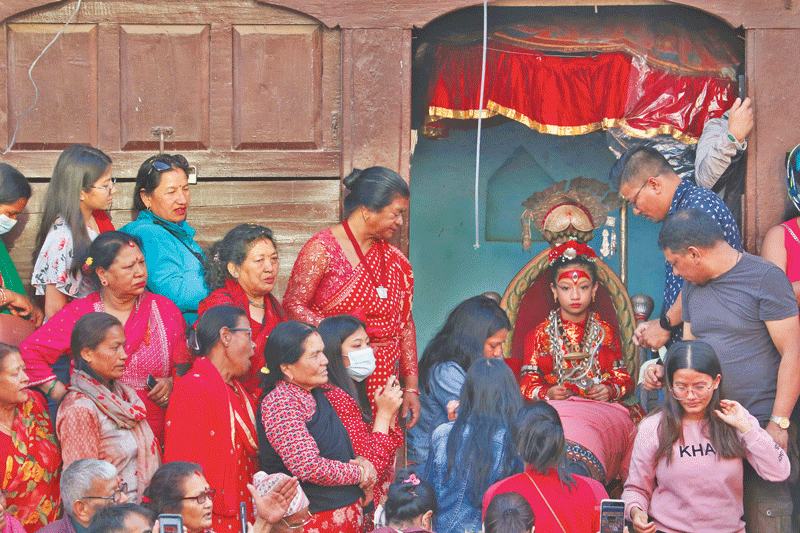
People receive blessings from the Kumari of Patan during the Rato Machhindranath chariot pulling festival at Lagankhel, Lalitpur on Saturday.
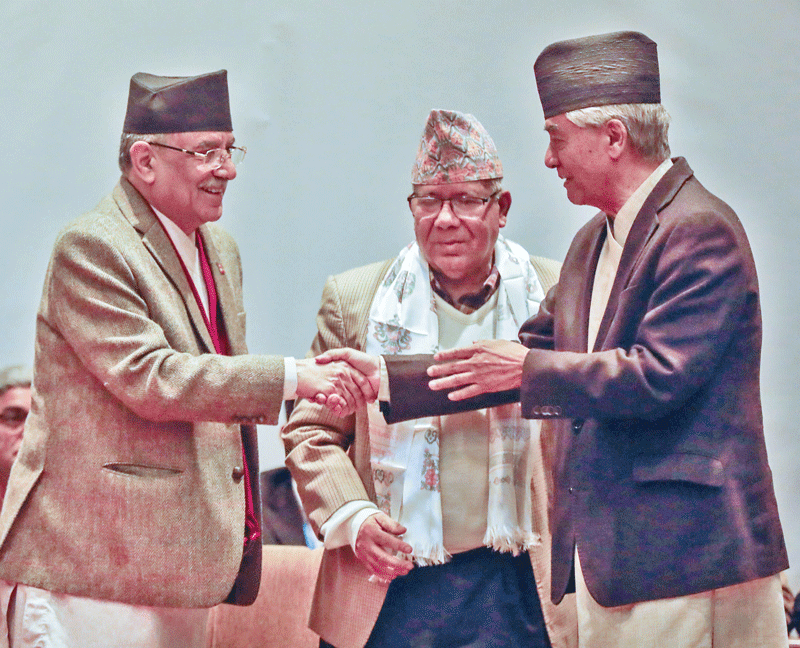
The unfolding scam over the creation of fake Bhutanese refugees has shaken the highest echelons of Nepali politics. On Saturday, CPN-UML chair KP Sharma Oli met Prime Minister Pushpa Kamal Dahal, in his second such meeting in three days, to discuss ongoing investigation into the issue. Some individuals including former home secretary Tek Narayan Pandey, and Indra Jeet Rai, former security adviser to home minister Ram Bahadur Thapa, have been arrested. Nepal Police has now broadened its investigation into the scam. The government hopes that when the Parliament session resumes on Sunday and lawmakers prominently raise the issue of fake refugees, investigators will get a morale boost to press ahead with their probes without any bias, a senior CPN (Maoist Centre) leader told the Post. The matter was discussed during a meeting of the ruling parties on Saturday evening, after Deputy Prime Minister and Home Minister Narayan Kaji Shrestha briefed them on the latest developments. “The action against those involved in this scam is an effort to promote good governance and strengthen nationality,” Hitraj Pandey, chief whip of the CPN (Maoist Centre), said. “Leaders at the meeting also stressed stern action against all those involved.” Oli twice met Dahal after the Kathmandu District Court issued an arrest warrant against former deputy prime minister and UML Secretary Top Bahadur Rayamajhi, who is absconding. Dahal, after meeting with Oli, hinted that the UML chief had raised the issue of Rayamajhi. The government will move ahead steadfastly to take action against those who engage in corruption, said Dahal after his meeting with Oli. “The campaign against corruption will continue and the government will move ahead as per the law.” Besides Rayamajhi, Oli is also concerned about possible involvement of other party leaders and the head of a constitutional body whose name has also been dragged in the case. “As more UML leaders and officials are connected with this case, Oli is repeatedly meeting Dahal,” an official at the prime minister’s private secretariat said. Pandey, Rai, Sandeep (Rayamajhi’s son), and some other individuals have been taken into custody for preparing fake refugee documents in collusion with government officials. They had allegedly accumulated millions of rupees from 875 individuals aspiring to go to the United States in the guise of refugees. As per the statements recorded by some individuals, former home minister and Nepali Congress leader Bal Krishna Khand is also connected to the case. Khand issued a statement on Saturday claiming that the media reports alleging his involvement had no factual basis. “I have not visited the place mentioned in some reports. I ask all to refrain from creating confusion and assassinating a person’s character,” Khand said. Some media reports stated that Khand was also involved in the case and that he had visited Jhapa with the individuals who are now in police custody. “He did not go to Jhapa. He had visited other districts in the course of taking stock of floods and landslides,” Ram Hari Khatiwada, a Nepali Congress lawmaker, said. Prime Minister Dahal has vowed to take action against all those involved. “This campaign will not stop… I will not bow down before any kind of pressure,” said Dahal. There is clear instruction from the top political level not to spare anyone, a senior home ministry official said. “As the police have already opened the file and several people have been arrested, it won’t be easy for the government to backtrack in the case,” the official added. “Oli-ji expressed his concern about the matter in the previous meeting and also in today’s meeting,” said Dahal, “but he didn’t seek Rayamajhi’s protection either.” For his part, Oli has claimed that he was not trying to protect those accused in the Bhutanese refugee scam and refuted allegations that he was repeatedly meeting the prime minister to protect the culprits. “Do you believe that I am working to protect the culprits? These are rumours spread by those with bad intentions,” said Oli. He, however, didn’t reveal what he discussed with the prime minister. Oli said he was not in contact with Rayamajhi. UML Secretary Rayamajhi, who is also a federal lawmaker from Arghakhanchi, is on the run after an arrest warrant was issued against him. Asked about the whereabouts of the absconding Rayamajhi, Oli replied that perhaps journalists could find him. “He is not in contact with me,” said Oli. “Some people are making a noise that I am protecting [him]… but we are not protecting anyone.” Dahal also warned political leaders not to undermine his prime ministership on the ground that his Maoist party has only 32 seats in the House of Representatives. Addressing a function of the Maoist Dalit organisation, he said that his party has the potential to win majority seats and “capture the state”. Dahal warned that the government action in the refugee scam was only the start as the government had only begun “opening corruption files”. “Now the files of the corrupt will be opened. Corruption cannot be overlooked on any pretext… We will not spare anyone,” he said.
HOME PAGE
Don’t drop the guard against Covid-19, experts caution after WHO downgrade
The pandemic’s ‘global health emergency’ status may be over, but vulnerable groups in Nepal continue to be at risk.
- ARJUN POUDEL
On Thursday, a 30-year-old man died at Seti Provincial Hospital in Dhangadhi from Covid-related complications. He had been admitted to the hospital on April 30 following vascular problems. Hospital officials said a polymerase chain reaction test carried out on the man’s swab samples showed he was infected with Covid-19. Two days later, he also tested positive for the dengue virus. Apart from that case, 11 other people have died due to Covid since April 11. They are among the 12,031 people who have succumbed to the virus in Nepal so far. The World Health Organisation on Friday declared that Covid-19 no longer constitutes a public health emergency of international concern. But the virus isn’t going anywhere, infectious disease experts and virologists in Nepal say. They say that coronavirus has already become endemic and will keep circulating in communities. Dr Prabhat Adhikari, an infectious disease expert, warned against lowering the guard against the risk of Covid infection. “The battle against Covid-19 might have been won but the war against the virus continues,” he said. WHO Director-General Dr Tedros Adhanom Ghebreyesus said that he had accepted the advice to declare an end to Covid-19 as a global health emergency. The recommendation had been made by the 15th meeting of the International Health Regulations and the Emergency Committee held on Thursday. On 30 January 2020, the UN health body had declared Covid-19 a public health emergency of international concern, the highest level of alarm under international law. Tedros said that almost seven million Covid-related deaths worldwide have been reported to the WHO, but the true figure was likely several times higher, at least 20 million. The pandemic disrupted health systems throughout the world, depriving millions of people of essential health services, including lifesaving vaccination for children. In Nepal, the second wave of the pandemic triggered by the Delta variant of Covid-19 overwhelmed health facilities, forcing health authorities to request people to go to the hospital only after they had fainted. Many people died at home for want of healthcare services. The second wave claimed the lives of over 8,000 people. Compared to the initial stage of the pandemic, the infection rate, severity and deaths from coronavirus have declined, notes Dr Sher Bahadur Pun, chief of the Clinical Research Unit at Sukraraj Tropical and Infectious Disease Hospital. “But that doesn’t mean the virus has gone from Nepal—it is still circulating in the communities,” Pun said. “People are still getting infected, many critically, and dying from it.” The UN health agency cites several factors that have brought down Covid-19-related deaths, hospitalisations and admission to intensive care units—“high population-level immunity from infection, vaccination, or both, consistent virulence of currently circulating SARS-COV-2 Omicron sub-lineages compared to previously circulating Omicron sub-lineages and improved clinical case management”. Experts say even if the severity and death rates from the infection have declined, time has not yet come for dropping the guard. Pun suggests that active surveillance should be continued and safety measures such as washing hands, maintaining distance, and wearing face masks must be followed. “We must not forget that elderly people, those with compromised immunity and others suffering from chronic diseases are always at a high risk of severe coronavirus infection,” he said.
HOME PAGE
Nepali cricket sees fast-paced success. Why can’t stadium-building catch up?
Infrastructure development lags even as successive governments make big promises.
- PRAJWAL OLI
POST PHOTO: KESHAV THAPA
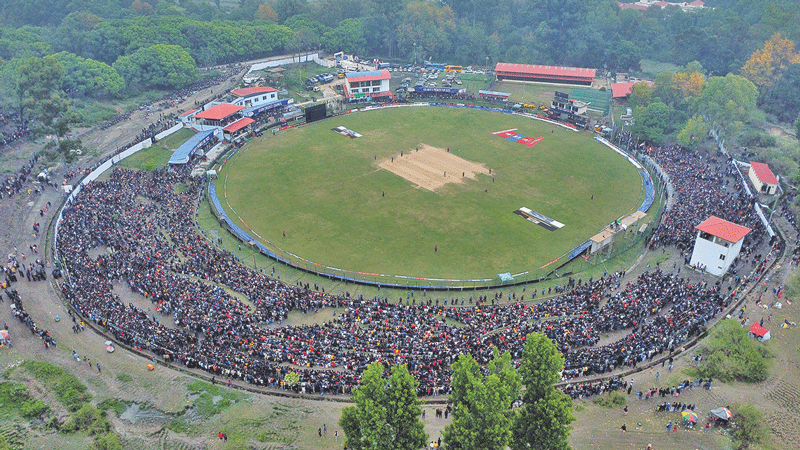
TU cricket ground often draws huge crowds but there are no proper seats.
Nepalis living in and out of the country euphorically celebrated their team’s victory over the United Arab Emirates (UAE) on Monday, May 2. The victory in the ACC Premier Cup final ensured Nepal will play against cricketing heavyweights India and Pakistan in the ACC Asia Cup. The final match of the One Day International (ODI) was extended over two days due to the downpour on Sunday. The game witnessed a rare scene—thousands of spectators huddled under open umbrellas, which made the front page of most broadsheet dailies. It was pleasing to see a huge crowd wait for the match to resume. But the game was called off midway for the day due to unplayable pitch conditions. The devotion of Nepali fans was heartening, but the hard reality was that they had nowhere to take shelter in the stadium. Nepal does not have a single stadium of good standards, although cricket has gained unprecedented popularity in the country over the past two decades. The game was introduced in Nepal in the 1920s, according to the governing body Cricket Association of Nepal (CAN), which was registered with the National Sports Council (NSC) in 1961. The men’s team first competed in an official international game in 1996 during the ACC Trophy in Malaysia while the women’s team marked their international debut in 2007. Since then the men’s team have made waves in the shortest format of the game, appearing in the 2014 World T20 in Bangladesh. The team got elite cricket team status in the ODIs in 2018 for four years, which was extended by a year due to the Covid-19 pandemic. The team recently retained their ODI status after taking the cricketing world by storm, securing 11 victories in their last 12 games of the ICC World Cup League 2. Nepal exceeded their own expectations by retaining the ODI status.
Only two Nepali grounds—the TU ground and the Mulpani ground—hosted the recently played ACC Premier Cup. While the TU ground was the venue for its first international event in ACC Trophy in 1998, it was the first occasion that Mulpani had held an international event. Prior to the ACC Trophy, the Asian Cricket Council (ACC) had set a mandatory requirement of four grounds to host the event. The CAN had constructed two grounds at Pulchowk Engineering College and one at St Xaviers, apart from the TU ground. Twenty-five years after hosting the ACC Trophy, the CAN hosted a similar tournament at TU, but almost all facilities and the infrastructure there remain the same. Tribhuvan University ground The TU cricket ground, originally meant for football, took the current shape after Indian Zee TV came to Nepal looking for space to develop a neutral venue for India-Pakistan games, recalls former CAN president Binay Raj Pandey. “The India-Pakistan games would normally take place in Sharjah of the UAE and they came looking for land in Nepal in 1992. Initially, in 1994, the CAN acquired the land on lease for five years from Tribhuvan University. Construction was started the same year and the ground was ready to host the 1998 ACC Trophy. Zee TV gave the ground its current shape and design in ordination with us,” said Pandey, the general secretary of CAN from 1995 to 2002. “I think they later changed their mind after the Maoist insurgency broke out in Nepal. They might have thought it was unsafe,” said Pandey, who also served as CAN president from 2005 to 2010. “Before TU ground, Tundikhel was the only proper place to play cricket. We developed two grounds, one at the Pulchowk Engineering College, and the other at St Xavier’s for the 1998 ACC Trophy within a span of two years,” said Pandey. Following the team’s victory over the UAE last week, a Cabinet meeting decided to allocate the budget to upgrade the TU ground to international level. But a roadmap for the project is yet to be finalised. “I discussed the matter with Prime Minister Pushpa Kamal Dahal after Nepal’s win over the UAE in the final. A Cabinet meeting has decided to allocate the required funds for upgrading the facilities at the TU grounds, which means it will get priority at the policy level and at the National Planning Commission,” said Tanka Lal Ghising, member secretary of the National Sports Council. “We have already started a study on the upgrade. It will be announced in the budget for the next fiscal year.” Mulpani ground The construction of Mulpani Stadium began as early as 2006, but remains incomplete in what is one of Nepal’s longest incomplete infrastructure projects. Should construction be completed as per the masterplan, the stadium will have a 30,000 seating capacity along with other facilities, including changing rooms, a media zone, an academy, a gym and a swimming pool. Once a dumping site, the land owned by the NSC is spread ovre 296 ropanis of land. According to RK Bista, a local and also the coordinator between National Sports Council (NSC), Ministry of Youth and Sports, CAN, the local government and Kageshwari Manohara Municipality for stadium construction, at current pace, the construction will take a decade to complete. “As per the master plan of the stadium, only 40 percent of construction work is complete,” said Bista, appointed coordinator in 2013. Planning for the Mulpani ground started in 2002 after the International Cricket Council (ICC) wanted to build a Global Cricket Academy in Nepal. But the Mulpani project was later shifted to the UAE owing to security reasons. In 2006, the CAN initiated construction with the support of Asian Cricket Council (ACC) and the government of Nepal, according to former CAN president Pandey. “The ACC had initially supported us with Rs10 million and the government had also invested around Rs40-Rs50 million between 2006 and 2010. The current CAN headquarters and the work of levelling the ground were completed in 2010,” said Pandey. Since 2011, the Nepal government has injected millions of rupees but construction has progressed at snail’s pace. According to the NSC, the executive sports body of the country, construction has now reached the second phase. While the first phase got a budget of Rs178.5 million, Rs288.4 million was set aside for the second phase. The NSC blames small instalments of budget allocation for delays. According to Pasang Sherpa, the chief of the financial department at NSC, a budget of Rs22 million was allocated in the last fiscal and Rs70 million in the current fiscal year. “This outlay is way too slow,” said member-secretary Ghising. While Rs40 million was allocated in the fiscal year 2070-71 BS, the outlay reached Rs50 million in each of the next two fiscal years. Likewise, Rs20 million was given in 2074-75, Rs10 million in 2075-76, Rs100 million in 2076-77 and Rs10 million in 2078-79 BS. “We have written to the Ministry of Youth and Sports and the Ministry of Finance to ensure a budget of Rs1.25 billion, so that we could speed up construction,” added Ghising. “With sufficient allocation, the whole Mulpani project could be completed in 24-30 months.” Among the two grounds in Mulpani, Nepal hosted some matches of the recently-held Premier Cup at the upper ground, which also houses CAN offices. According to CAN acting secretary Durga Raj Pathak, the ACC and the Kageshwori-Manohara Municipality supported them in upgrading the facilities for the Premier Cup. But the CAN is currently working on the lower Mulpani ground. Dhurmus-Suntali Stadium The Gautam-Buddha International Stadium, initiated by actors Sitaram Kattel and his wife Kunjana Ghimire in March 2018, should have been completed by 2021. The proposed site that sprawls over 20 bigha and six kattha land at the Forestry University premises in Bharatpur was to be handed over to Bharatpur Metropolitan City upon its completion. The estimated budget was Rs3 billion. But the actor duo’s Dhurmus-Suntali Foundation withdrew from the project in July 2021 citing a financial crunch. They also publicly appealed to the Bharatpur Metropolitan City to take ownership—the metropolis has not. As per the government’s valuation, only 14 percent of construction had been completed while Kattel claims 32 percent of the work has been done. The Office of the Auditor General says Rs620 million has been spent on the project; a private audit report shows Rs580 million in expenditures. The stadium project is currently in limbo with only security guards appointed by the foundation looking after the site. Why the delay Sports and sports infrastructure have never been a priority of Nepali policymakers and governments, says senior sports journalist Ajay Phuyal. “Every finance minister in the past decade and half has vowed to give the Mulpani stadium top priority in their budget speech,” he added. “The political leadership competes to congratulate players when Nepal wins international fixtures. They heap praises and even announce lucrative cash prizes. But shouldn’t they first ensure that Nepali players have good grounds to play on?” Phuyal also points out flaws in the CAN’s leadership. “The CAN, as an authorised body, should have been able to make policymakers and leaders understand the game’s value and lobbied accordingly. If the state mechanism and leadership are serious, building a couple of stadiums is not a big deal,” he says.
NATIONAL
Nepali, Indian stakeholders stress joint effort to curb human trafficking
Human trafficking that was rife after the 2015 earthquakes further increased during the pandemic.
- RAJESH MISHRA
Post Photo
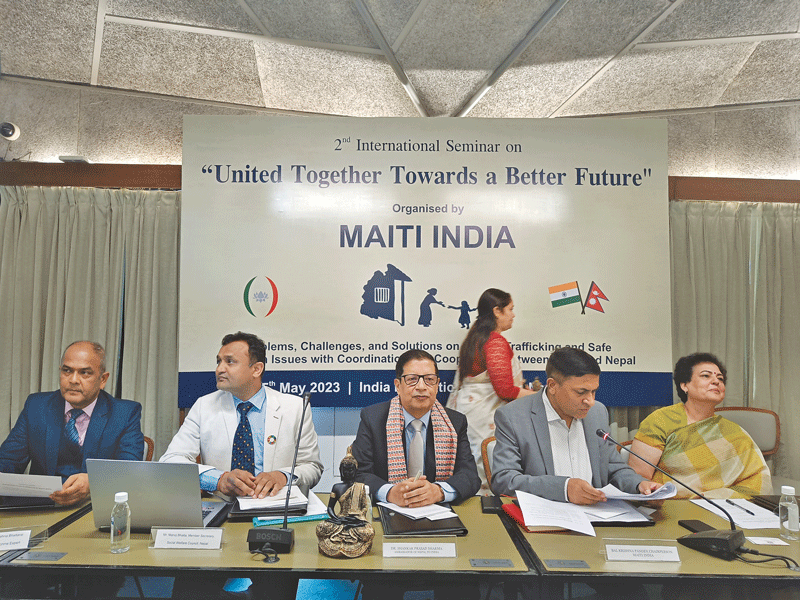
Stakeholders at the function organised by Maiti India in New Delhi on Friday.
Trafficking of Nepali people to India and the third countries through India remains rife and only a few cases, after the victims are rescued by security agencies or social organisations, are made public, stakeholders said at a function in New Delhi on Friday. The stakeholders from both Nepal and India expressed their concerns about the challenges of controlling human trafficking. Speaking at the function organised by Maiti India in New Delhi, they stressed the need for joint efforts of the security authorities and organisations of both Nepal and India. Rekha Sharma, chairperson of the National Commission for Women in India, said the incidents of human trafficking that were rife after the 2015 earthquake in Nepal further increased during Covid-19 pandemic. She added that even the family members of some trafficked victims handed over their daughters to the traffickers for money. Poverty and illiteracy are the root causes behind human trafficking, she said. “Girls, women and youths in remote Nepali villages are vulnerable to trafficking,” Sharma said. “The data shows it. So the government authorities and social organisations should be active in such areas to control human trafficking.” Nepal and India share approximately 1,800 km of open border. The traffickers easily take the victims to India through the porous border, luring them of good jobs in India or other countries. Nepali ambassador to India Shankar Prasad Sharma said that the Nepal government has been working to alleviate poverty and enhance literacy as they are the leading causes behind human trafficking. He underscored the need for collaboration between the government authorities and non-governmental agencies of both Nepal and India to combat trafficking. Joint Commissioner of Delhi Police Chhaya Sharma, DIG of Seema Suraksha Bal Suresh Subramaniam, Senior Superintendent of Nepal Police Uma Prasad Chaturvedi, Chairman of Maiti India Balkrishna Pandey were also present in the function.
NATIONAL
Man arrested on charge of raping a minor
District Digest
- Post Report
BARDIYA: Police arrested a 27-year-old man on charge of raping a minor, aged 13, in Jogipur of Rajapur Municipality-9 in Bardiya district. According to Deputy Superintendent of Police Prakash Sapkota, Shaniram Chaudhary allegedly raped the adolescent on Wednesday night. Police made the suspect public on Saturday. The victim, whose parents are currently in India, had been staying with her grandfather. The accused barged into the victim’s home by breaking a hole into the rear wall of the mud-and-thatch house at around midnight, police said. Another person, Radheshyam Chaudhary, 26, was also taken into police custody for abetting the crime.
NATIONAL
APF on-duty officer assaulted with Khukuri
District Digest
- Post Report
KANCHANPUR: A group of about 10 assailants attacked and injured an Armed Police Force officer on duty at Dodhara Chandani Municipality-7 on Friday night. According to Deputy Superintendent of Police Prakash Dangi, APF Sub-Inspector Narendra Singh Chaisir posted at the border outpost in Kanjabhoj sustained injuries in his left arm as the miscreants assaulted him with a Khukuri. “The assailants have been identified. Search is on to nab them,” said Dangi.
NATIONAL
Nepalgunj to formulate policy to control dowry system
District Digest
- Post Report
NEPALGUNJ: Nepalgunj Sub-Metropolitan City in Banke has decided to formulate necessary policy and form a task force to control the dowry system in the local unit. According to women development officer Manju Pandey, the municipality decided to endorse policy regarding dowry system in the upcoming municipal council meeting and form the task force under the chairmanship of Deputy Mayor Kamaruddin Rai. Dowry is a serious social problem in Banke, a Tarai district of Lumbini Province.
NATIONAL
Government need not seek trust vote, ruling coalition’s meeting concludes
The ruling partners draw the conclusion even though constitutional experts are divided on the issue.
- Post Report
Photo: courtesy of PM secretariat
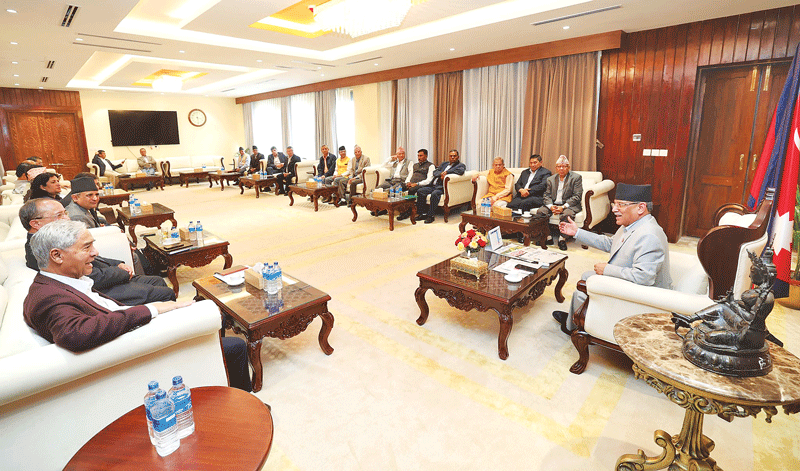
Prime Minister Pushpa Kamal Dahal chairs the meeting of the ruling coalition held at Baluwatar on Saturday.
At a time when a debate has started on whether the prime minister should seek a vote of confidence following the Rastriya Swatantra Party’s decision to withdraw its support to the government, the ruling coalition has drawn a conclusion that the floor test is unnecessary. The ruling partners, at a meeting of the coalition on Saturday, drew the conclusion even though constitutional experts are divided on the issue. “The constitution states that withdrawal of support by the party that has only backed the government without joining the Cabinet does not require a vote of confidence,” said Hitraj Pande, chief whip of the CPN (Maoist Centre). Pande said the RSP supported the government without joining the Cabinet and therefore the leaders present at the meeting said there is no need to seek a vote of trust. Article 100(2) of the Constitution of Nepal states that the prime minister shall table a motion for a vote of confidence in the House of Representatives if the party which the prime minister represents is divided or the party in the government withdraws its support. RSP, the fourth largest party in the House of Representatives, had initially joined the government with three ministers and a state minister but later it decided to quit the government after the prime minister refused to reinstate the party’s president Rabi Lamichhane as home minister. Lamichhane, who had resigned following the Supreme Court’s decision to scrap his citizenship certificate, had wished to be reinstated as home minister after reacquiring the citizenship certificate. When Prime Minister Dahal sought a vote of confidence for the second time on March 20, the RSP backed the government. After failing to reach an agreement with the prime minister, the new party’s joint meeting of the central committee and the parliamentary party on Friday decided to withdraw its support to the government.
NATIONAL
New President can authenticate citizenship bill, legal experts say
Prime Minister Pushpa Kamal Dahal seeks suggestions from representatives of Nepal Bar Association on the bill’s status.
- Post Report
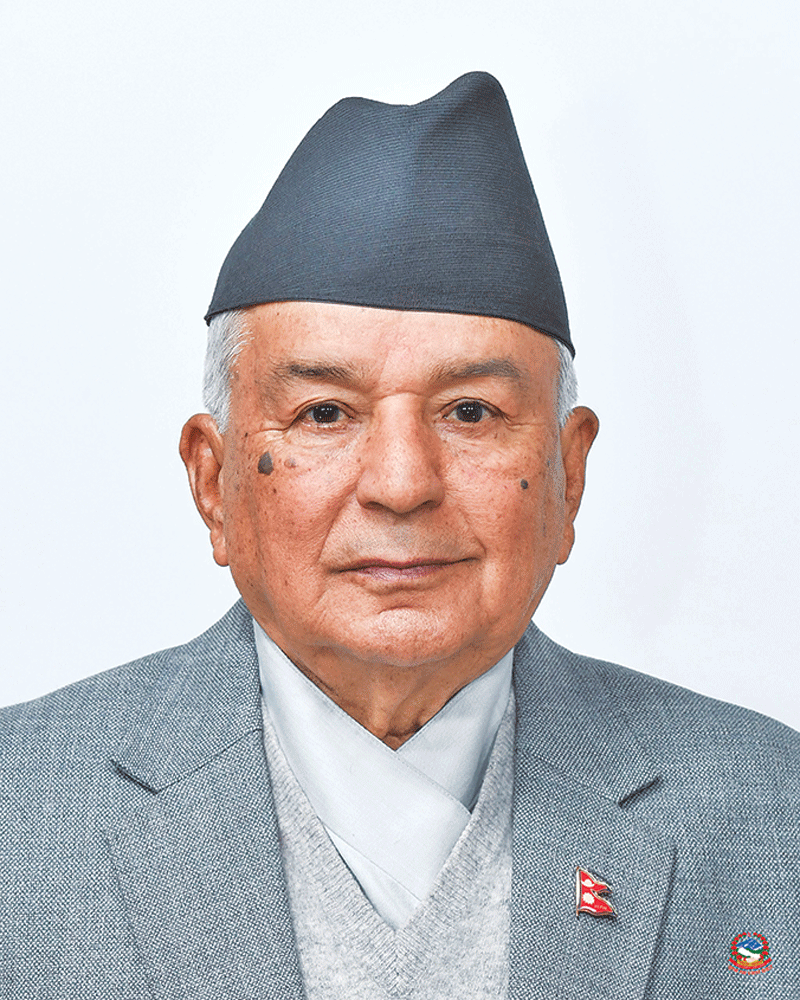
President Ramchandra Paudel
Lawyers’ representatives have suggested that President Ramchandra Paudel can authenticate the bill to amend the Citizenship Act which former President Bidya Devi Bhandari had repeatedly refused to endorse. Ahead of the second session of the new Parliament set to commence on Sunday, Prime Minister Pushpa Kamal Dahal had invited representatives from the Nepal Bar Association to seek suggestions on the status of the bill. The office-bearers of the umbrella body of lawyers suggested that as Parliament had accomplished its task by endorsing the bill twice, it is now up to the President to decide the matter. “As Parliament has already endorsed the bill twice, it cannot go back again,” Gopal Krishna Ghimire, chairperson of the Bar Association, told the Post. “We suggested that the President has every authority to authenticate the bill.” Former President Bhandari had refused to authenticate the amendment bill twice. On August 14 last year, Bhandari had returned the amendment bill to the House of Representatives for a review with her 15-point concerns and suggestions. Both the chambers of federal parliament endorsed the bill as it is, without considering Bhandari’s suggestions. When the bill was sent to the President’s Office for authentication for the second time, Bhandari sat on it, letting the 15-day deadline pass, which constitutional experts say was unconstitutional. The constitution allows the President to return the bill to the parliament for reconsideration once. Article 113 (3) states that except in the case of a money bill, if the President thinks that a bill needs reconsideration, it may be sent back to the House where it originated along with a message within 15 days of receiving it. But the constitution says the President has to endorse it the second time. “In case any bill is sent back along with a message by the President, and both Houses reconsider and adopt such a bill as it was or with amendments and present it again, the President shall authenticate that bill within 15 days of such presentation,” Article 113(4) of the constitution says. The decision was challenged in the Supreme Court. Five different writ petitions were lodged by advocates seeking the Supreme Court’s intervention against Bhandari’s refusal to authenticate the bill that was twice endorsed by the House and the National Assembly. Responding to the petition, the court had issued a show cause notice against the President’s Office to explain the reasons behind President Bhandari sitting on the bill without authenticating it. The final verdict is yet to be made. As President Bhandari retired on March 9 without authenticating the bill, now the government wants to get it endorsed by President Paudel, who was elected with the backing of the ruling coalition.
NATIONAL
Nepal, Bangladesh seek to bring India on board to help power trade between the two countries
Development of Sunkoshi-3 Hydropower Project and dedicated transmission line through India are among the issues on agenda for next bilateral meeting.
- PRITHVI MAN SHRESTHA
Nepal and Bangladesh are scheduled to discuss how to jointly take India on board for using Indian transmission lines to enable power trade between Nepal and Bangladesh, a senior official of Nepal’s Ministry of Energy, Water Resources and Irrigation said on Saturday. The two sides are scheduled to discuss forging trilateral cooperation involving Nepal, Bangladesh and India during the fifth meeting of the joint-secretary level Joint Working Group and secretary-level Joint Steering Committee meetings scheduled to be held on May 15-16 in Bangladesh. “One of the items on the agenda of these meetings is how to take India on board to use existing transmission lines and a dedicated transmission line through the Indian territory to enable electricity trade between the two countries,” said Madhu Bhetuwal, spokesperson at the energy ministry. As Nepal and Bangladesh are not geographically connected, Nepal can sell its electricity to Bangladesh only through the Indian territory. The southern neighbour has been ‘positive’ on trilateral cooperation for energy trade in recent years. “As India has started a green grids initiative—One Sun One World One Grid—to introduce a transnational electricity grid that supplies power and has a neighbourhood first policy, forging connectivity between Nepal and Bangladesh will help India’s own initiative,” Bhetuwal said. Indian Prime Minister Narendra Modi had first proposed the initiative during the assembly of the International Solar Alliance in 2018. The initiative aims to provide power to about 140 countries through a common grid that will ensure the transfer of clean and efficient solar power. Nepal and India intend to widen collaboration in the power sector and include partner nations under the Bangladesh, Bhutan, India and Nepal framework (BBIN), according to the Joint Vision Statement on Power Sector Cooperation between the two countries issued in April last year. Another agenda of the discussion with the Bangladeshi side is to sell Nepal’s 40 MW-50 MW of electricity to Bangladesh through the existing transmission line of India. During the fourth JWC and JSC meeting held in August last year, Nepal and Bangladesh had decided to request the southern neighbour to allow export of 40 MW-50 MW of electricity from Nepal to Bangladesh in the initial phase, by utilising the high-voltage Baharampur-Bheramara cross-border power transmission link. As per last year’s understanding, the state-owned Nepal Electricity Authority (NEA) and the Bangladesh Power Development Board would request India’s NTPC Vidyut Vyapar Nigam for a trilateral energy sales and purchase agreement, utilising the power line. In line with the agreement reached with Bangladesh, the NEA has sent a request to the Indian authorities through the NTPC Vidyut Vyapar Nigam, a nodal agency for bilateral electricity trade. During the 10th joint secretary-level Joint Working Group and the secretary-level Joint Steering Committee between Nepal and India held in February this year, India has agreed to grant its approval once Nepal submits the proposal along with the project whose power will be sold to Bangladesh, according to Nepal’s energy ministry. Based on an understanding reached between Nepal and India, the NEA has sent a request to the Indian authorities to allow the power generated by the 52.4MW Likhu-4 project to Bangladesh through India’s existing transmission infrastructure. Located on the border of Okhaldhunga and Ramechhap districts, the project started commercial production last year. Nepal and Bangladesh in August last year had decided to request the southern neighbour to allow the export of 40 MW-50 MW of Nepali electricity to Bangladesh in the initial phase by using the high-voltage Baharampur-Bheramara cross-border power transmission link. “Bangladesh has also discussed with India on taking supply of 40 MW-50 MW electricity from Nepal,” said Bhetuwal. Another topic of bilateral meetings between Nepal and Bangladesh is the development of the 683 MW Sunkoshi 3 hydropower project which the two countries had agreed to develop through a joint venture investment during the fourth meeting of the working group and a joint steering committee held in late August. “We have sent the feasibility study report and environment impact assessment report of this project to the Bangladeshi side,” said Bhetuwal. “We have received certain feedback from the Bangladeshi side and the discussions are underway.” He said that further discussion on the project will be carried out during the next high-level meeting. Even though Nepal and Bangladesh have moved forward to develop this project jointly, a senior official of the energy ministry said that India’s involvement in the project would be helpful in ensuring trilateral cooperation in the power trade. “We have not yet consulted with Bangladesh about the possible involvement of India in this project. But that will ease transmission of power to Bangladesh,” the official added. Bhetuwal said Nepal and Bangladesh will also share their experiences in the development of hydropower and solar energy, respectively
NATIONAL
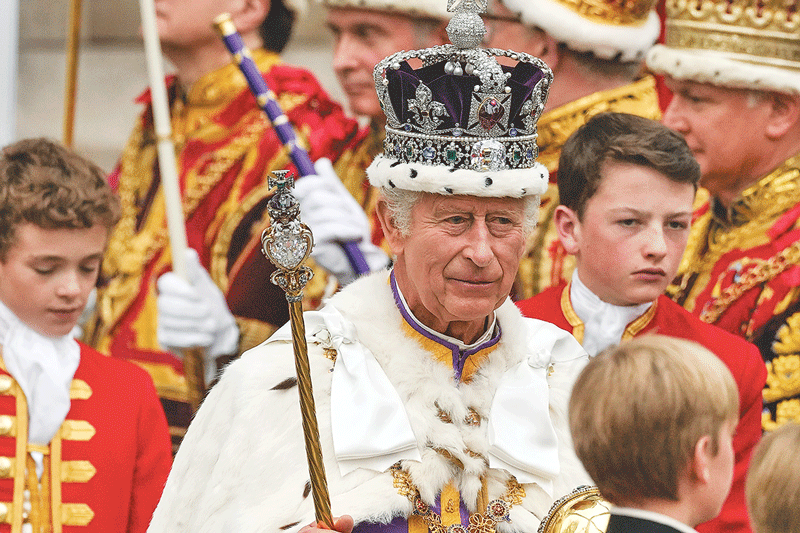
President Paudel, Prime Minister Dahal congratulate British King Charles III on coronation
Briefing
- Post Report
KATHMANDU: President Ramchandra Paudel and Prime Minister Pushpa Kamal Dahal on Saturday congratulated British King Charles III on his coronation. In his message, President Paudel mentioned the valuable works of the King in the past as the Prince of Wales on important global agendas such as environmental conservation and sustainable development. The Ministry of Foreign Affairs in a statement said the president stated that the spheres of cooperation between the two countries have been growing over the years to encompass multiple areas of mutual interest. The President has also recalled the King’s connection with Nepal, especially the number of visits paid to Nepal as a Prince, according to the statement. In a separate message, Prime Minister Dahal extended congratulations and best wishes to King Charles III on behalf of the people and the government. The prime minister has recalled the kind personal gesture from the King when Nepal faced the devastation of the 2015 earthquakes. Citing that this year marked the centenary of the Nepal-UK Friendship Treaty of 1923, the prime minister has stated that the relations between the two countries are characterised by goodwill, mutual respect and cooperation, the foreign ministry said.
NATIONAL
Health ministry records 76 new Covid-19 cases
Briefing
- Post Report
KATHMANDU: Nepal recorded 76 new Covid-19 cases in the last 24 hours. The new cases were confirmed through 1,603 tests—55 through RT-PCR and 1,548 through antigen—performed during the period, the Ministry of Health and Population said on Saturday. According to the ministry, one PCR-confirmed coronavirus case was reported in the last 24 hours, taking the nationwide infection tally so far to 1,003,082. A total of 75 people tested positive for the virus through antigen tests, the ministry said in the daily report. With no Covid-related death in the last 24 hours, the nationwide death toll since the pandemic began stands unchanged at 12,031. According to the ministry, 990,914 infected people have recovered from the disease so far, 26 of them in the last 24 hours. The number of active cases stands at 137. A total of 10 people are receiving treatment in the Intensive Care Unit, four in High Dependency Unit and one in the general ward, the ministry said. On Friday, Nepal had reported 17 new Covid-19 cases.
NATIONAL
Coalition partners discuss budget’s principles and priorities
Briefing
- Post Report
Kathmandu: Top leaders of the ruling coalition on Saturday discussed the principles and priorities of the government’s annual budget for the upcoming fiscal year. Hitraj Pandey, chief whip of the CPN (Maoist Centre), said the meeting dwelt on how to present themselves during the budget session of the Parliament starting on Sunday. “The budget session of the federal parliament will start tomorrow. Leaders discussed ways to make it organised,” said Pandey. As per the constitution, the annual budget must be tabled in Parliament on Jeth 15 [May 29 this year]. Pandey claimed that there is no need for the prime minister to take a vote of confidence immediately. He said that the meeting also discussed how to proceed with the parliament’s thematic committees and the appointment of the chief justice.
OPINION
Of political parties and leaders
The binary of democrats and communists is the most commonly used expression in Nepali political parlance.
- Post Report
Post File Photo Prakash Chandra Timilsena
I would use the word calculation to characterise the politics of Nepal today. In a little different idiom current in recent times, we may even call it the algorithm of Nepali politics. Power sharing political parties of the ruling alliance work out the mathematics of occupying the ministerial posts commensurate with the number of seats they have won in Parliament. We wake up each day to stories of the quotas of ministerial posts for different parties making up the ruling alliance. The power of each party is calculated in terms of the leverage it will have on the vote of confidence for the government. The operation of a hung Parliament should be understood in a simple process. But the Nepali political parties have charged the mathematics with haste, short-sightedness, individual angst and the sense of insecurity of some prominent leaders made more complex by the visions of the nascent leaders. From the academic point of view, the binary of democrats and communists is the most commonly used expression in Nepali political parlance. The binary of Congress and communists, however, appears to be slowly losing its monopoly with the emergence of smaller parties whose bargaining power in government formation has become a subject of common discussion in Nepali politics these days. It would be appropriate to evoke the theory of a French philosopher named Jacques Derrida who said the so-called fixed binaries “always already” get deconstructed. In Nepal, the old structural pattern is similarly getting deconstructed. The old Congress-communist binary is split into several factions. The Nepali Congress has a history of breaking and uniting. But the present Nepali Congress has clearly two factions within what is seen as a monolithic party structure. The party draws its strength from the democratic and socialist ideals of BP Koirala, the revolutionary spirit of Ganesh Man Singh and the Gandhian idealism of Krishna Prasad Bhattarai.
Important difference One communist leader named Man Mohan Adhikari (1920-99) made some important difference albeit the period of his leadership in the communist government was short. I think it would be appropriate for me as an academic to recall a few stories related to him. It would be important today to dwell on this politician’s leadership of the Nepali government. Adhikari gave a bit of a surprise to the Western press when he became one of the few democratically elected communist party leaders to serve as head of government. He became prime minister representing the Communist Party of Nepal (Unified Marxist-Leninist) from 1994 to 1995. Adhikari visited Britain as prime minister in April 1995. He addressed a meeting at Lancaster House at that time. The British newspaper The Economist wittily wrote about Adhikari: A communist no longer remains a communist when he becomes the prime minister of Nepal. That was a clever news story made to characterise Adhikari’s successful projection of his image as a free democratically elected prime minister. My British friends wrote to me at that time how they were surprised to find a Nepali prime minister maintaining the dignity and standard of a prime minister. But a question arises: Did Adhikari cease to be a communist after becoming the prime minister of Nepal? The answer is no, he did not. I want to add another story related to Man Mohan Adhikari becoming the first elected communist prime minister. Prominent American Marxist literary critic, philosopher and political theorist Fredric Jameson (1934) made a detour to Kathmandu while he was on a lecture tour in India. He did so at the request of our Literary Association of Nepal, which is still active under the name LAN. As president of that association, I invited most of the prominent Nepali Marxist thinkers and writers to attend Jameson’s lecture organised at the Campus of International Languages. As Jameson is a very complex theorist, several of the attendees could not appreciate his “Marxist discourse”. We arranged a meeting between Jameson and Man Mohan Adhikari. Jameson always wanted to see a communist become the prime minister of Nepal and form the government. When I asked Jameson what he thought about the meeting, he said he was very pleased by his conversation with Adhikari. Jameson hoped Adhikari would become the prime minister of Nepal. The failure of Indian communists to get enough seats in Parliament to form a government despite their long history and wide network of organisation was a subject of disappointed for Jameson. I don’t know if Jameson has written any articles on the subject. That was a certain day in the month of November 1993. Jameson’s prediction came true; Man Mohan Adhikari became the prime minister of Nepal in November 1994 exactly one year after that conversation.
Jamesonian satisfaction When I told Man Mohan Adhikari about it at one chance meeting after his government had failed in 1995, he was very pleased. Adhikari asked me about Jameson; he also wanted me to remain in contact with him. I could not do so because as a free person and academic, I did not want to be seen as a member of his party though I had great respect for him whom I knew even as a school boy in Tehrathum because of my brothers’ political associations. The leaders of the communist parties of India were very pleased after Adhikari became the first communist prime minister of Nepal. One could understand the anxiety of Jameson and the Indian communist parties who chose electoral politics as their modus operandi. EMS Namboodiripad, Indian communist politician and theorist, met Adhikari at a very old age during his Delhi visit as prime minister in April 1995 to express what I would term as the Jamesonian satisfaction. These short episodes that I have presented here by alluding to the events of Man Mohan Adhikari’s life help to see the position of the erstwhile two parties Nepali Congress and Nepali communists. Pushpa Kamal Dahal, alias Prachanda, leader of the CPN (Maoist Centre) does not represent the communist force of the binary, neither does KP Oli, leader of the second largest party in Parliament the CPN (United Marxist-Leninist). The disgruntled factions of the communist Maoists and the UML do not represent a single force in the binary either. Similarly, Nepali Congress president Sher Bahadur Deuba does not appear to represent a unified Nepali Congress, the other force in the binary. Deuba is overtly dealing with a strong faction of his comrades in opposition within the party. Prachanda and his comrades call themselves “Maoist” that, in linguistic terms, has now become a mere tautology. Baburam Bhattarai was the first to recognise that. But the Nepali Congress and the communist parties still represent what theorist and writer Walter Benjamin would call a “Messianic” time in Nepali history. Let us hope they make the best use of that time before it is too late.
OPINION
King Charles III and UK-Nepal friendship
The diverse languages and cultures of the UK at The King’s coronation mirror Nepal’s own diversity.
- Nicola Pollitt
The Coronation of His Majesty King Charles III in Westminster Abbey on Saturday marked a historic occasion for the United Kingdom and its people. I was thrilled to host hundreds of our friends from Nepal, the British community and beyond over the weekend to celebrate this occasion together. Watching The King’s Coronation and celebrating with friends here served as a reminder of King Charles’ personal connection to Nepal. As well as being Commander in Chief of the Gurkhas, His Majesty The King has visited Nepal three times. He has walked the trails above Pokhara and the hills above Dharan and I know that he recalls the incredible beauty of Nepal, as well as warmth of its people. King Charles has put his passion for youth, community, diversity, and sustainability at the heart of the Coronation celebrations. Primary schools across the UK are being sent wild flower seeds to help children learn more about the importance of biodiversity and improve biodiversity in school grounds. The Coronation emblem represents The King’s love of the natural world, depicting the flora of the four nations of the UK in the shape of St Edward’s Crown. If you watched the Coronation you might also have heard five different languages as part of the service. In Nepali terms of course, that is still very few—but the symbolism of Welsh, Celtic, Scots Gaelic and Irish is a powerful reminder of the value of diversity in language. For the first time in the UK’s history women bishops also played a key role in the crowning of the monarch, and in a demonstration of the diversity of religion in the UK, Buddhist, Hindu, Jewish, Muslim and Sikh leaders took part in the ceremony. This mix of history, diversity, sustainability and modern values in the coronation ceremony resonates deeply with our shared values and with what I think lies at the heart of the UK-Nepal relationship. The diverse languages and cultures of the UK at the coronation mirror Nepal’s own diversity and the strong constitutional freedoms for all that are admired internationally. These are the values that not only underpin our deep bonds of friendship, but also our partnership. Our strong people-to-people links, the invaluable contribution of the Gurkhas, and initiatives to tackle climate change, promote the rights of women and girls, support education, boost trade, and economic development clearly demonstrate this partnership in practice. This year also marks 100 years since the signing of the Nepal-UK Treaty of Friendship, recognising Nepal’s independent sovereignty and further cementing our 207 years of bilateral relations. As we celebrate the coronation of King Charles III with our Nepali friends, we are proud of our modern partnership and confident about the next 100 years of friendship. Our two nations have much to gain from this including in tackling climate change, increasing trade and investment, strengthening democracy and our work to support Nepal’s development as it graduates from Least Developed Country status. We are proud to stand with Nepal as it works towards a more prosperous, secure, and democratic future, and we look forward to building on the many successes of our partnership. Over the last three and a half years I have travelled widely across Nepal. I have tried to learn at least one of Nepal’s many languages and I have met people from the many diverse communities in all seven provinces. As I come to the end of my time in this incredible country, the coronation and the centenary of our Friendship Treaty are an opportunity to celebrate our partnership and our deep bonds of friendship, and to look forward to the next 100 years. I am confident that those shared values of diversity, sustainability, and democracy will continue to strengthen our relationship, benefiting our peoples for generations to come.
Pollitt is the British Ambassador to Nepal.
OPINION
Eruption of Dalit rage
Political parties have little interest in resolving the pressing problems of the Dalit communities.
- MITRA PARIYAR
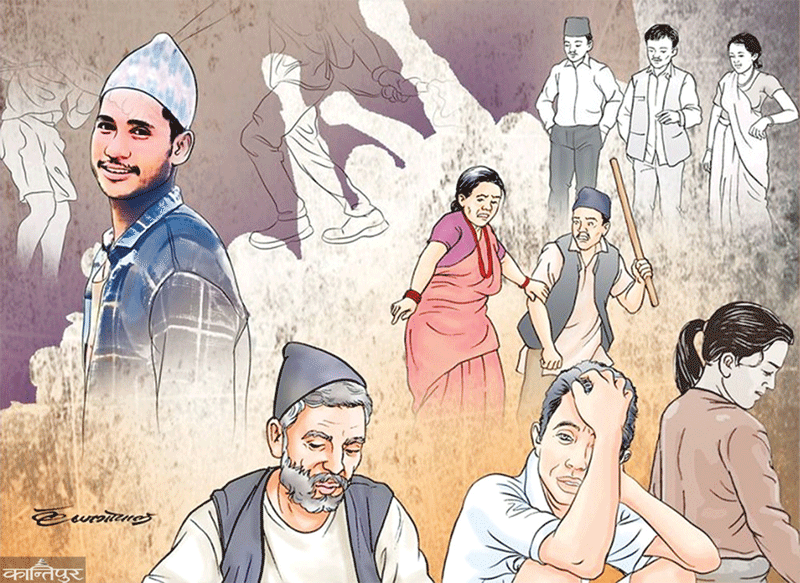
In a metaphorical sense, the Dalit community is an active volcano that has remained dormant for hundreds of years. But now, it is likely to explode. Plenty of hot and boiling magma is gathering underneath, and the upper crust won’t be able to suppress it for long. It isn’t sure where and on what scale the lava of immense anger, deep frustrations, and discontents will start spilling out. People say that Dalits have been fighting for their dignity and rights for over 70 years, but it is a myth. I would argue that Nepal has never seen a Dalit movement—not one that aims to truly liberate them. I don’t mean here to discredit our brave Dalit warriors of the past decades or disown their accomplishments and achievements thus far. They did what they could under the circumstances, and Dalit lives have indeed changed in many ways. We should thank them for that. The real blame for the current conundrum goes to party politics. It is ironic that the very political parties that helped Dalits organise and fight for their freedom in the past have now become the citadels of conservative politics that actively promote rigid Hindu cultures and customs, including, of course, caste hierarchy. They call themselves democrats or communists, but their behaviour reflects neither. At the moment, none of the parties thinks about, let alone takes any action for, structural change in society. Nobody seems bothered by the persistent problems faced by 6 million citizens on the basis of the ancient laws of Manu. None of the governments has made a substantial effort to enforce anti-caste laws and free Dalits from everyday humiliation, hatred, and violence. We often see the unsightly pictures of Prime Minister Pushpa Kamal Dahal—who in the past destroyed temples and slaughtered cows and fed beef to the Brahmins as an act of resistance on behalf of the suppressed minorities—publicly performing Hindu rites and worships. His attitude toward Dalits today seems no different from that of KP Sharma Oli, Sher Bahadur Deuba, and other upper-caste leaders. Prachanda’s actions can’t be pardoned as a mere attempt to please the voters. As the leader of the country or as an opposition leader in Parliament, he has shown no political will to change the status quo. Notwithstanding the fact that he has achieved so much, it is primarily due to the sweat and blood of the oppressed masses. Instead, party leaders, including Dahal, have been allegedly protecting criminals involved in caste violence. Few Dalit killers go to prison. The dead body of Ajit Mijar from Kavre, who was allegedly murdered for marrying an upper-caste woman, has been languishing in the mortuary of the TU Teaching Hospital for seven years. His parents and relatives have refused to cremate the body until a proper legal investigation is reopened. But the government takes no notice of their call for justice. Nor does any party or human rights organisation! Many party figures, including veteran communist leaders of smaller communist parties, vociferously criticise Christian conversion, but they show no interest in eradicating the Hindu beliefs and practices that perpetuate caste separation and hatred. Hindu nationalism has badly corrupted Nepali politics, even Marxist or socialist politics. It wouldn’t be an exaggeration to state that the parties big and small, leftists and rightists, republicans and monarchists, have zero interest in resolving the pressing problems of the Dalit communities. In the meantime, as alluded to above, the Dalit movement has lost its steam. This is because, invariably led by upper-caste Hindus, mainstream or fringe political forces have effectively appropriated the Dalit movement. Dalit leaders and activists are tightly bound to the upper castes, both organisationally and ideologically. Their role has been limited to serving their upper-caste masters to help them get elected and stay in power. Dalit activists, therefore, lack the independence and resources to rejuvenate their struggle. High-caste politicians have sapped Dalit power. For instance, the Nabaraj BK murder in May 2020 precipitated impressive street protests in Kathmandu and some other towns. Initially, these demonstrations appeared to raise the hopes of many ordinary Dalits. But soon, their hopes were dashed when the protests collapsed. The leading cause of the failure was, as in other instances, Dalit activists’ allegiance to upper-caste politicians. As the street demonstrations became promising, party leaders pulled out the main players. In the eyes of many Dalits, including the parents and relatives of the murder victims in West Rukum, as well as Dalit rights activists, the major parties rendered the struggle ineffective. And they, especially the Maoists, apparently played a role in derailing the legal process. Hence, there is no sign of punishing any criminals, even in this notorious case of three villagers lynching six helpless young men. Above all, I would argue that the Dalit movement’s stranglehold is what Columbia University Professor Gayatri Chakravorty Spivak called “epistemic violence.” The upper-caste elites totally control what Dalits know and how they know it. As a result, Dalits have been unable to generate new knowledge about their history, current situation, and possible freedom routes separate from party politics. Even some prominent Dalit figures, for example, deny the role of religion in suppressing Dalits. There is no radical thinking on the way forward. Unsurprisingly, most Dalit activists speak the language of upper-caste politicians and simply blame lack of education, poverty, etc., for the persistent plight of Dalits. They have no clue as to how to raise the Dalit struggle in a post-monarchical, post-People’s War period. But there is hope. This hope of a new wave of Dalit struggle arises not from the educated and relatively well off middle class but from those below. From the population that the Maoists initially sensitised and mobilised during the insurgency, but have now been forgotten by everybody. Thousands of Dalits continue to suffer separation, verbal abuse, intimidation, beating, and rape every day. They have little experience of dignity and equality stated in law books. Most of these incidents never make it to the media, and the victims do not find support anywhere. Thus, a potential Dalit revolution is silently brewing at the grassroots. Even many Dalits long associated with parties have been deeply frustrated. They have begun to realise that party politics alone isn’t going to solve their problems. And, importantly, there’s a growing size of young Dalits that have been educated in English medium schools and colleges, that have gained knowledge of the wider world through social media—and that haven’t yet been brainwashed by the upper-caste politicians. Seeds of true Dalit liberty are found among the common men and women.
A graduate of Oxford University, Pariyar is a Dalit rights activist who has worked in universities in Australia and England.
MONEY
Farming sector reels from problems despite significant government investment
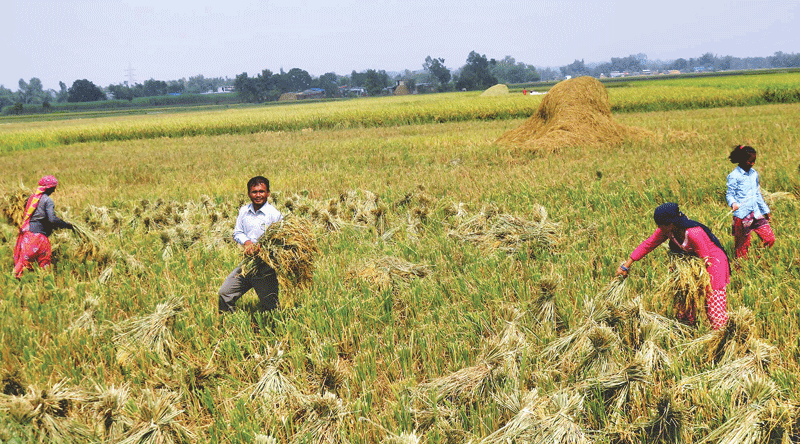
Over half of the arable land in Dadeldhura, Doti, Achham, Baitadi, Darchula, Bajhang and Bajura has turned into pastures.
- DR PANT
POST FILE PHOTO
Khem Joshi, a researcher at the Rural Development and Research Centre, says the culture of haphazard distribution of grants and faulty
agriculture policy has put the agriculture sector in far-western Nepal in total disarray.
At this time of the year a decade ago, fields on the banks of the Satmola, Ganik and Sunarya rivers in Sudurpaschim province would be crawling with farm hands harvesting winter crops. Cereals, lentils and green vegetables covered thousands of hectares. The farmers also raised dairy cattle, and they produced enough crops and milk to export to New Delhi, India. But now a severe labour shortage has crippled the farm sector. Thousands of hectares of land in the breadbasket of far western Nepal lies barren. Youths can hardly be seen in the villages, and the old people can do no more. More than half of the arable land in Dadeldhura, Doti, Achham, Baitadi, Darchula, Bajhang and Bajura, which once produced high-value crops like soybean, lentil and millet, has now turned into pastures. According to the Directorate of Agricultural Development of Sudurpaschim province, arable land makes up 220,194 hectares out of the 1.52 million hectares in the seven hill districts of the province. However, less than 100,000 hectares is utilised, and irrigation is available on only 34,630 hectares. Lack of manpower and irrigation has made farming unattractive in the province. Locals can make more money by migrating to India seasonally to work. “The land on the banks of the rivers was most fertile. But it has been left uncultivated due to the absence of manpower,” said Krishna Joshi, a local farmer in Dadeldhura. “The district used to supply farm produce to other regions. Nowadays, farmers buy food from neighbouring districts.” Joshi said the district was self-sufficient in the production of wheat and mustard oil until a decade ago. “Those days are gone. The district now imports most of its agricultural needs.” But government records show increments in agricultural output every year. The land lies uncultivated, but the government has upgraded the crop output data, farmers say. “We don’t know how this is possible,” said Joshi. The three tiers of governments are also spending huge amounts of money on the agriculture sector. There are more than three dozen ongoing agriculture projects in the seven hill districts of the province. Each district has an agriculture knowledge centre, training centre, soil and fertiliser testing centre, plant protection laboratory, seed laboratory and nearly four dozen government-controlled farms. Around 21 percent of the total budget of the local bodies is spent on agriculture. The provincial government, too, has the second highest spending in agriculture after physical infrastructure development. The federal government also has provided the highest amount of conditional grants for agriculture in the province. Despite these investments, the farmlands have turned into barren lands. In the last decade, the province has seen a massive exodus of people. The local government has been frequently increasing the grants and incentives to promote farming, but no one is interested, farmers say. Tek Bahadur Bista, the senior agricultural technician, said that agricultural productivity has been increasing despite the decrease in the acreage. “This is because of modern technology, improved varieties of seeds, increase in government investment and commercialised farming system.” He said that various studies, too, have shown that the average productivity has increased. “In Kailali and Kanchanpur, farm productivity has increased sharply,” added Bista. The Directorate of Agricultural Development in Dipayal said that around 515,772 tonnes of crops need to be grown annually to feed the 27.49 million people in Sudurpaschim province. The official data shows that the province is facing a food deficit to the tune of 48,000 tonnes. The province imported agricultural goods worth more than Rs4 billion via the Gauriphanta customs point in the first seven months of the current fiscal year. The figure could be higher if imports through unofficial channels are counted, insiders say. According to the statistics, Sudurpashchim province’s annual production of paddy amounted to 218,997 tonnes while it produced 265,879 tonnes of wheat and 63,366 tonnes of maize. The province’s annual millet output totalled 13,836 tonnes. Even then, imports have been rising alarmingly. The province is also one of the biggest importers of fruits and vegetables. Khem Joshi, a researcher at the Rural Development and Research Centre, says the culture of haphazard distribution of grants and faulty agriculture policy has put the agriculture sector in far western Nepal in total disarray. Joshi says that local leaders and bureaucrats collude with each other and spend most of the budget to benefit their near and dear ones. Government officials, too, admit that the data about farmlands and agricultural productivity is wrong. Yagya Raj Joshi, chief of the Directorate of Agricultural Development, said, “There is a difference between government records and the ground reality.” According to Joshi, there is a mismatch between the records maintained by various government offices. “We cannot trust anyone. The provincial government has spent more than Rs12 billion on agriculture in the last five years. However, if we calculate the rate of return, the reality might be frightening,” said Joshi. Officials claim that actual farmers hardly have any access to state subsidies and grants. “We don’t believe in the rosy data,” Joshi said. “Food imports have more than doubled despite billions of rupees being invested in the farm sector. There is a need for good governance system to improve the agriculture sector.”
MONEY
Global gold demand fell in the first quarter of 2023, WGC says
- REUTERS
Global gold demand fell in the first three months of 2023 as large purchases by central banks and Chinese consumers were offset by reduced investor buying, the World Gold Council (WGC) said on Friday. Total demand amounted to 1,081 tonnes, down 13 percent from the first quarter of 2022, the WGC said in its latest quarterly demand trends report. Around half of gold demand comes from jewellers, with investors and states responsible for most of the rest. Bullion is seen as a safe asset and investors often buy more during times of economic instability. Demand shot to an 11-year high in 2022 thanks to the biggest central bank purchases on record. Gold prices, meanwhile, are near record highs above $2,000 an ounce. Among the bright spots during the first quarter, central banks bought 228 tonnes of gold, more than in any January-March period in data going back to 2000, the WGC said. China’s jewellery demand was 198 tonnes, the most for any quarter since Q1 2015, as the end of Covid-19 controls unleashed consumer spending. US buyers worried about banking and economic turmoil meanwhile bought 32 tonnes of gold bars and coins, the highest in any quarter since 2010. On the other hand, purchases of gold bars and coins fell in Europe, Indian jewellery demand slipped to a three-year low and exchange traded funds (ETFs) storing bullion for investors sold gold, the WGC said. Investment demand was already picking up in March as bank failures spread fear through markets and analysts anticipated the end of US interest rate increases. The WGC said investment demand would likely grow this year and central bank buying would remain strong, albeit below last year’s high.
MONEY
Apple stakes future growth on emerging markets, starting with India
- REUTERS
REUTERS
A file photo shows Apple CEO Tim Cook gesturing during the inauguration of India’s first Apple retail store in Mumbai, India.
When Apple Inc surprised investors this week with a rise in iPhone sales despite a slump in the global smartphone market, Chief Executive Tim Cook credited emerging markets like India where the company is luring away Android phone users. Cook is betting that those markets will provide more opportunities for growth, with their youthful populations and relatively few iPhones. Shares of Apple rose more than 4 percent on Friday, putting the world’s most valuable company on track for gains of around $120 billion in market capitalisation. Apple said iPhone sales rose 1.5 percent to $51.3 billion for its fiscal second quarter even as global smartphone shipments fell 13 percent in January to March, according to research firm Canalys, whose data showed Apple gained market share from Android phones. Apple said it set sales records in several countries across South Asia, Latin America and the Middle East. India is perhaps Apple’s biggest focus. The company recently opened its first two retail stores there, in Mumbai and Delhi, and while Apple does not disclose revenue for the country, Cook told investors that it set a quarterly record and percentage growth was in very strong double digits year-over-year. “There are a lot of people coming into the middle class, and I really feel that India is at a tipping point, and it’s great to be there,” Cook said on the conference call. For Apple, selling an iPhone in an emerging market represents more than just the sale of one device—it represents the chance to get consumers hooked on Apple devices and services over time. Customers who start with an iPhone might later add an Apple Watch or AirPods or sign up for subscription services. Cook said he saw opportunities for Apple in India in services but said that average revenue per user—a metric known as ARPU in the subscription business—would take time to catch up to Apple’s other markets. Part of the reason that Apple has been able to gain market share in both emerging and developed markets is the emergence of a booming market for used iPhones. Sales of refurbished iPhones rose 16 percent in volume globally during 2022. India led the growth with a 19 percent jump, according to Counterpoint, with iPhones accounting for 11 percent of secondary smartphone sales in India. In an interview with Reuters on Thursday, Apple’s Cook said little of Apple’s direct iPhone revenue comes from refurbished devices. However he said the company has tried to bolster the used iPhone market by offering trade-in deals on its iPhones and building them sturdy enough to last several owners.
MONEY
Young entrepreneurs seek support
They are hopeful the government will ensure support in the next fiscal year’s budget.
- Post Report
POST PHOTO
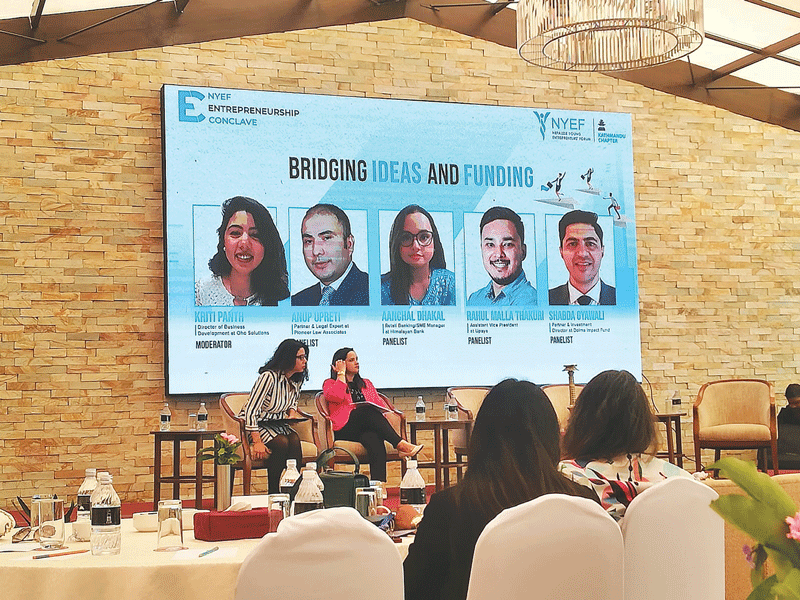
The entrepreneurs said nearly 40 percent of the total population of Nepal constitutes youth and the government should prioritise bringing them into the mainstream of the economy
Young entrepreneurs say the government has failed to implement policies and programmes targeting youth entrepreneurship. Chirag Goyal, president of Nepalese Young Entrepreneurs’ Forum, Kathmandu Chapter said the government’s laxity and weak implementation of policies and programmes is a major problem. Speaking at the Nepalese Young Entrepreneurs’ Forum Entreprene-urship Conclave in Kathmandu on Saturday, Goyal said the programmes included in the budget for youth entrepreneurs in the current fiscal year had not been implemented so far, which shows the government’s lack of seriousness towards youth entrepreneurship. For instance, the budget programme envisages that the youths can get loans from the banks, using their study degree as collateral, but the banks are not providing them loans. “But, it’s not the fault of the banks as there is a problem in implementation from the government side,” Goyal said. Goyal also said that women entrepreneurship is not being taken seriously and they are not being encouraged to not give up after a few failed attempts. The youth entrepreneurs said nearly 40 percent of the total population of Nepal constitutes youth and the government should prioritise bringing them into the mainstream of the economy. “We tried to make ‘Make in Nepal’ a movement more than a campaign which was a government campaign as well, but the allocated budget for this movement was less. “We are seeking support for this movement from the government in the budget of the next fiscal year,” said Ritesh Lamichhane, president of the national governing council, Nepalese Young Entrepreneurs’ Forum. “Even though I have experience as a Member of Parliament, this is my first experience as a minister and I am trying to understand many things. But I assure the youths that I am ready to provide all the support the young entrepreneurs are looking for,” said Ramesh Rijal, minister of industry, commerce and supplies. “I am also ready to provide support to the youth entrepreneurs so that they decide against going to work in foreign countries. I request the forum that they keep in continuous contact with me,” said Rijal. He added: “The government is trying to stop the youths from going to foreign countries and I assure you that the policies and programmes for the upcoming budget will address this.” Nepal is graduating from Least Developed Country status in 2026 and is expected to become a developed economy in 2043 and it will be possible only with the economic growth of the country, Lamichhane said. Nepalese Young Entrepreneurs’ Forum has become an apex body of young entrepreneur organisations in the country, Lamichhane said. The Forum was founded in 2003 with the aim to stop youths from going to foreign countries in search of employment by creating employment opportunities within the country, said Lamichhane. “The forum’s focus remains the same.” According to the Nepalese Young Entrepreneurs’ Forum, it has a presence in all seven provinces, 11 chapters, 800 plus members and is providing employment to approximately 30,000 people. The forum works on four core values, namely, hunger for learning, growth, making a mark and putting the nation first. Sobita Gautam, a member of parliament from the Rastriya Swatantra Party said the government has not worked sufficiently to give impetus to the private sector. “Youth interference in politics as well as in the economy is important and this is happening gradually,” said Gautam. “As Nepal will be graduating from LDCs in 2026 and will be kept away from the facilities on trade, it has become even more important to focus on youth entrepreneurship,” she added.
MONEY
Poco X5 Pro 5G pre-booking opens in Nepal
Bizline
- Post Report
KATHMANDU: Poco has launched the most awaited Poco X5 Pro 5G in Nepal which will exclusively launch on Daraz. Pre-booking has started and will last till May 10 on Daraz. The phone will be shipped from May 11. The company has now refreshed its mid-range X-series which has incredible performance, great display technology, powered by a 5000mAh battery that supports 67W fast charging. It is available in three colour option: Blue, Black, and Yellow. Poco X5 5G is priced at Rs39,999 and Rs42,999 for 6GB+128GB, 8GB+256GB variants respectively.
MONEY
India agency searches Jet Airways’ premises in fraud case, source says
Bizline
- REUTERS
BENGALURU: India’s federal investigating agency is searching the premises of Jet Airways and the residence of founder Naresh Goyal in Mumbai as part of a probe into a 5.39 billion rupee ($66 million) bank fraud case, a Central Bureau of Investigation (CBI) source said on Friday. The searches came days after Canara Bank filed a complaint against the airline, Goyal, his wife and a former airline director for “causing wrongful loss” to the lender, according to a May 3 first information report seen by Reuters. Canara Bank alleged that funds were diverted for purposes unrelated to the airline’s operations. Once India’s biggest private airline, Jet ran out of cash in April 2019 and filed for bankruptcy.
MONEY
Russian carmaker files third lawsuit against Volkswagen
Bizline
- REUTERS
MOSCOW: Russian carmaker GAZ has filed a lawsuit worth 15.6 billion roubles ($200.5 million) against Volkswagen, court records show, adding to two others filed earlier this year. The lawsuit, details of which have not been published, was filed with the Nizhny Novgorod Regional Arbitration Court on Friday. Earlier this year, GAZ filed two lawsuits against the German carmaker seeking a total of around $545 million in losses and damages, saying VW’s moves to exit the Russian market had put its interests at risk. It initially persuaded a court to freeze Volkswagen’s assets in Russia pending court proceedings—a decision the court reversed in April. Volkswagen is preparing to sell its Russian assets, including its flagship plant in the city of Kaluga that has annual production capacity of 225,000 vehicles, but no decision has been made and Russian government approval is pending.
MONEY
UBS chief draws up Credit Suisse leadership shortlist
Bizline
- REUTERS
ZURICH: UBS Group AG’s Chief Executive Sergio Ermotti has shortlisted the Credit Suisse Group AG’s executives most likely to become part of the management team, the Financial times reported on Saturday, citing people familiar with the plans. Dixit Joshi, chief financial officer, Francesca McDonagh, chief operating officer, and André Helfenstein, head of the Swiss business, are most likely to remain a part of the Swiss bank’s executive team, the report said.
SPORTS
Anjan Bista hat-trick lifts CBU to top
The Nepali international scores second half hat-trick to seal 4-1 win over NRT as they open three points lead on top.
- Sports Bureau
Post Photo: Hemanta shrestha
Anjan Bista (left) of Church Boys United became third player to score a hat-trick in the ongoing Martyrs Memorial ‘A’ Division League after he achieved the feat against New Road Team on Saturday.
A hat-trick from Anjan Bista gave Church Boys United (CBU) 4-1 victory over New Road Team (NRT) as they moved three points clear atop the table in the Martyrs Memorial ‘A’ Division League at Chyasal Stadium on Saturday. The Nepali international struck a second half hat-trick after Sushil Shah broke the deadlock late in the first half. Dipesh Ale Magar hit back the consolation in the dying moments for NRT. The seventh victory in the league lifted CBU on top of the table replacing Jawalakhel. CBU have 27 points and Jawalakhel 24 points after playing equal 15 games. NRT are 10th with 17 points in the 14-team contest, which will see bottom two sides relegated to second division. Shah put CBU in the driving seat in the 40th minute with a free header to convert Kamal Shrestha corner. National team forward Bista doubled the advantage seven minutes into the second half after he headed from near post to turn in Shrestha’s corner. Bista netted his second individual goal in the 61st after he beat an offside trap to collect a through pass from Sushil Shah and then dribbled past the goalie before beating Sanam Limbu with his low strike. Bista completed his hat-trick in the 85th from the spot after teammate Gangadeep Singh’s strike landed at NRT captain Bikram Dhimal’s hand inside the box. He also became the first Nepali player to score a hat-trick in the current season of the league. Machhindra Club’s Olawale Afeez and FC Khumaltar’s Setpahne Binong are other players to net hat-trick in the season. NRT hit back in the third minute of the six minute stoppage time when he back volleyed Kritish Ratna Chhunju’s corner from the tight angle. Manang Marshyangdi Club and Satdobato Youth Club played to a 0-0 draw at the Dasharath Stadium while the late fixture between Three Star and Friends Club also ended at a goalless draw in the same venue. MMC are eighth in the standings after their fifth draw. They are tied on 19 points with Nepal APF Club. Satdobato, who played their sixth draw, are fourth with 23 points. Three Star are third in the standings and level on points with second-placed Jawalakhel on 24 points. But Three Star are behind their neighbours on head-to-head record. Friends climbed one spot up to 14th with 16 points in their kitty. They have lost seven matches, won four and drawn four.
SPORTS
Urawa beat Al Hilal to win Asian Champions League
- AGENCE FRANCE-PRESSE
Japan’s Urawa Red Diamonds won the Asian Champions League after beating Saudi Arabian defending champions Al Hilal 1-0 in Saturday’s final second leg for a 2-1 aggregate win. An own goal by Al Hilal’s Andre Carrillo early in the second half gave Urawa their third Asian title in front of almost 55,000 home fans in Saitama, north of Tokyo, following a 1-1 draw in last week’s opening leg in Riyadh. “This is a scene I had only ever dream of before—I can’t believe it,” said Urawa captain Hiroki Sakai. The Japanese side had to withstand fierce first-half pressure from Al Hilal, who were looking to win a record fifth continental title and a third in four seasons. The decisive moment came when Carrillo turned a header from Urawa’s Marius Hoibraten into his own net amid strong wind in the 48th minute, before a determined rear-guard effort from the home side saw out the result and sent the crowd into delirious celebrations. “They put us under constant pressure right from the start and it was a difficult game,” said Urawa striker Shinzo Koroki, who scored his team’s goal in the first leg. “But in the second half we started to push them back and although we didn’t have so many chances, we made it count when we did.” The two teams were meeting in the final of Asia’s premier club competition for the third time in six years. Urawa won in 2017 but Al Hilal came out on top two years later. Al Hilal were without injured captain Salman Al Faraj and suspended star winger Salem Al Dawsari, who was sent off late in the first leg for kicking out at Urawa’s Ken Iwao. Al Hilal manager Ramon Diaz made three changes from the first leg, dropping Malian striker Moussa Marega and bringing in experienced Peruvian Carrillo, while Urawa were unchanged. The Saudi side had an early chance when Odion Ighalo broke clear in the box, only for Urawa defender Alexander Scholz to block his shot on the line. Al Hilal’s Michael also had a scent of goal midway through the first half, but Urawa goalkeeper Shusaku Nishikawa got down quickly to parry his shot. Urawa came even closer to opening the scoring against the run of play when Shinzo Koroki, who scored his team’s goal in the first leg, hit the bar with a flying volley on the half-hour mark. Nishikawa again had to be alert to keep out a long-range Carrillo effort with the first half winding to a close, before Urawa’s Yoshio Koizumi pulled a shot wide of the post at the other end. Urawa made the perfect start to the second half when a floated free-kick from around the half-way line found Hoibraten, whose wind-assisted header found its way over the line via Carrillo’s boot. The Japanese side enjoyed far more possession from then on and Atsuki Ito almost added a second goal when he shot just wide of the post with the goalkeeper beaten. Al Hilal posed far less attacking threat in the second half and Nishikawa was on hand to deny Ighalo when the Saudi side did create a chance late in the game. The final was taking place more than a year after the Asian Champions League season began, with delays because of the winter World Cup in Qatar and travel complications arising from the Covid pandemic.
SPORTS
‘Baby Malinga’ leads Chennai to big IPL win over Mumbai
- AGENCE FRANCE-PRESSE
Sri Lanka’s Matheesha Pathirana led an inspired pace attack to help Chennai Super Kings hammer Mumbai Indians by six wickets in a clash of IPL heavyweights on Saturday. Pathirana, who is called “Baby Malinga” for his slinging action similar to former Sri Lankan pace ace Lasith Malinga, returned figures of 3-15 to limit five-time winners Mumbai to 139-8 in Chennai. New Zealand opener Devon Conway made 44 as MS Dhoni’s Chennai—four-time IPL champions—romped home with 14 balls to spare. Dhoni praised Pathirana, saying, “People who don’t have any clean action, batsmen have a difficult time picking it. But his consistency, pace makes him special.” Dhoni advised the youngster to stay away from Test cricket and concentrate on playing “only ICC tournaments with ODIs”. The left-handed Conway put on a strong opening stand of 46 with Ruturaj Gaikwad and moved second in the batting chart with 458 runs behind Royal Challengers Bangalore skipper Faf du Plessis (466). The 41-year-old Dhoni hit the winning run at Chennai’s MA Chidambaram Stadium as fans, who are coming in numbers to cheer the superstar cricketer in what it is expected to be his last IPL season as player, went wild. Shivam Dube hit an unbeaten 26 off 18 balls as Chennai jumped a spot to second behind table-toppers Gujarat Titans in the 10-team table. Chennai’s bowlers set up victory after they rattled the Mumbai top-order including the key wickets of Cameron Green, out for six after opening the batting, and skipper Rohit Sharma, dismissed for a second successive duck after coming at number three. The opening pace duo of Deepak Chahar and Tushar Deshpande reduced Mumbai to 3-14 inside three overs before Nehal Wadhera (64) and Suryakumar Yadav (26) attempted to rebuild in their stand of 55. Left-arm spinner Ravindra Jadeja sent back Suryakumar and the 20-year-old Pathirana, who has played one T20 for Sri Lanka, bowled Wadhera with a yorker—his main weapon—to take the steam out of the Mumbai batting. Pathirana with a unique celebration of his hands in front of his chest and eyes in meditation said, “I’m a die-hard fan of Cristiano Ronaldo and have modelled my celebration after him.” Wickets kept tumbling as the dangerous Tim David fell for two off Deshpande and Pathirana got South African batsman Tristan Stubbs for 20.
CULTURE & LIFESTYLE
The shadow at the end of the stairs
She was a determined writer. The abandoned house was the ideal setting for her next horror novel.
- Pratik Mainali
The house on Jamunkhadi had always instilled a feeling of unease in its neighbours. Most people were deterred from approaching the building by its dilapidated exterior and neglected lawn. However, Sarmila viewed the home as a challenge and an opportunity to demonstrate her worth. The home was the ideal setting for her next horror novel. And she was a determined writer. As soon as she stepped through the front door, the odour of mould and rot overwhelmed her. The interior was as neglected as the exterior, with cobwebs hanging from the ceiling and dust coating every surface. But Sarmila didn’t let it deter her. She was determined to make the home hers, if only temporarily. She spent the first day exploring, creating mental images of each room, and taking notes. Sarmila could not help but ponder what had prompted the previous owners to abandon the house, as it was evident that it had been vacant for some time. As the sun set, she ascended to the second floor, where she intended to spend the night. As she settled into the master bedroom, she couldn’t escape the feeling that she was not alone. Sarmila had always been somewhat anxious, but this was different. There was a prolonged feeling that someone or something was watching her. But as it was getting late, she discounted the sensation as mere nerves and went to bed. But sleep was difficult to come by that night. Every creak and groan of the old house seemed to be amplified, leaving Sarmila on alert. She was on the verge of falling asleep when she heard a sound that caused her blood to flow cold. It was the sound of slow, deliberate footfall ascending the stairs. She held her breath and listened attentively as the footsteps approached. Sarmila became paralysed with fear as they stopped just outside the bedroom door. She attempted to convince herself that she was imagining things, but her guts were telling her that someone or something was standing just outside the door. Suddenly, the door opened with a loud creak, and Sarmila was confronted by a dark figure. She couldn’t quite make out what it was. It was tall, with long limbs and legs, and its head appeared disproportionately large to its body. In the darkness, its eyes glowed, and Sarmila could feel its gaze penetrating her. She attempted to shriek, but her throat prevented her from doing so. Sarmila could feel the figure’s draining aura as it stepped closer. She shut her eyes, expecting the worst. Instead of attacking her, however, the figure vanished into thin air. Sarmila opened her eyes, expecting to see the creature before her, but nothing was there. She was alone once again. The remainder of the night passed without incident, but Sarmila’s unease persisted. As soon as the sun began to rise, she packed her belongings and left the house. She had gathered all the information she needed for her novel, and she no longer wanted to remain in that spooky old house. However, as she descended the front steps, she saw something that caused her pulse to stop. The indistinct figure from the previous night was at the base of the stairs. It stood still, its eyes fixed on her. She attempted to run, but her feet were rigid and immobile. She appeared to be anchored to the ground by the shadow’s gaze. She shut her eyes in fear. She suddenly heard footfalls approaching her. She turned around and observed a figure standing at the end of the corridor. It was a man wearing a black suit and a headgear that concealed most of his face. She could not see his eyes but knew he was observing her. She inquired, “Who are you?!” The man did not respond. He simply stood there and stared at her. She began to feel apprehensive, and her heartbeat accelerated. She retreated, but the man remained still. “What do you want?” she cried once more. The man remained silent. He simply stood there. She felt like he was assessing her like a predator deliberating whether to attack its prey. The man took a sudden step forward. And then one more. Then another. His form seemed to blur and distort each stride as if he were made of smoke or shadows. Sarmila turned and ran as quickly as possible, her heart thumping in her chest. She had no idea where she was going but knew she needed to flee from that creature. As she dashed down the corridor, her feet pounded the old wooden flooring. As she fled, she could hear the man’s footsteps approaching. She rounded a corner and noticed a door at the end of the corridor. She pushed the door open and dashed inside before shutting the door shut behind her. Sarmila scanned the room while attempting to recover her breath. It was a tiny room with a bed and a dresser in opposite corners. On the opposite wall was a small window, but it was too high for her to reach. Sarmila felt confined. She had no idea how she would escape the situation. She detected a subtle scratching sound from the door and knew the man was attempting to enter the room. Her eyes scanned the room for something she could use as a weapon. There was, however, nothing. On a second look, she saw that on top of the dresser, there was an ancient, rusty lamp. The scratching ceased abruptly. Sarmila held her breath as she awaited the man’s entrance through the door. However, there was no sound. She waited for what seemed like hours, unable to move out of fear. She eventually gathered the fortitude to approach the door, slowly reaching and turning the doorknob. The door opened with a groan to disclose an empty hallway. No trace of the individual in the black suit could be found. Sarmila walked down the hallway with a racing pulse. There was always the risk that the man was hiding in the shadows, ready to attack. With each step she took, the air grew chilly, and the darkness grew closer. However, she could not stop now, as she was so near the bottom of the stairs. She reached the bottom and scanned the area, but the shadow was nowhere to be found. She took several deep breaths to calm herself before exploring the room. The ceiling was covered in cobwebs, and the walls were made of moist stone. The only source of illumination was a small fissure in the ceiling through which a thin shaft of moonlight shined through. As she moved further into the room, she observed a tiny wooden chest in the far corner. It was ancient and worn, with rusted hinges and a lock that looked like it had been tampered with. She approached the container and opened the lid. There was only one item inside—a compact silver key. Sarmila picked it up and attentively examined it, but nothing was remarkable. She could not shake the feeling that the key held some type of power, despite something about it being unique. However, as she approached the stairs, a frigid hand wrapped around her ankle. She attempted to escape, but the hold was too powerful. She gazed down and saw the shadow rising from the darkness once again. She shrieked and attempted to flee, but the shadow restrained her. Its hold was as frigid as ice, and she could feel it spreading throughout her body. She struggled and fought but to no avail. Sarmila suddenly remembered the key in her hand. She twisted around and thrust the key into the shadow’s chest with all her might. There was a blinding explosion of light, followed by total darkness. She awoke to find herself lying on the stone steps. The shadow had vanished, and the chest had been shut. She got up and took one step forward before her legs gave out, and she collapsed to the ground. Sarmila lay there for several moments, attempting to recover her breath and calm her racing heart. Once she felt stable enough, she stood up and surveyed the room. The key was nowhere to be found, and the chest remained sealed. She glanced at the old house as she stepped out into the moonlight from the front door. She would never forget the silhouette at the bottom of the stairs or the key that had saved her life.
CULTURE & LIFESTYLE
4:20 am
- Sneha Joshi
I always wanted the rainbow, I always wished that I make more discharges where I could write, ‘patient is improving and being discharged with the following advice’ That is me reflecting my optimism in my profession. Here I am at 4:20 am, Making another death certificate. Did I sign up for this? I wanted to conclude the discharge sheet with good goodbyes But I am bidding my last goodbyes to my patient with ‘may their soul rest in peace’ Did I sign up for this?
So this patient in particular, before going to bed He says, “Doc, it looks like I will not make it till tomorrow.” And my optimism seeps in, “He will make it!” I tell myself And he didn’t after 4:20 am. I had seen patients make it for many days without any food, for so many days No matter how much we have seen I guess we can’t predict what life holds for us It has always been heartbreaking to see how one diagnosis and that tag of cancer changes people’s life and the life of their loved ones. Someone who was always trekking to mountains is now bound to the bed and those IV lines. Someone who was always playing chess, even in their head, is now playing a scenario of his death and how their family is going to be after his demise, like he is waiting for the ticking time bomb, which has a timer set, but no one knows when the time will run out Suffering is so inevitable Is life pointless?
Are meant to suffer till the end? Am I living in another human hypocrisy, Where I am letting Yin overpower the Yang Can I ignore the happiness I felt during the good goodbyes? Those times when patients would search for me and wait just to say “Goodbye, doctor, I am going home!” That small gesture of family members who are happy to see me When people get discharged to their homes and leave the diagnosis at the hospital How modern medicine has helped patients live their lives despite cancer. The rounds where I ask about their bodily discharges, talk about mundane stuff and sometimes giggle. It has been a pleasure to connect with patients and their families and have all those conversations.
I had always dreaded oncology, I never wanted to deal with sadness But it has taught me Suffering is inevitable, and it is important to accept it like we accept happiness That life is short So never take anyone, any opportunity, anything for granted And that when I am taking morning and evening rounds, I don’t just ask how the patients are That I must ask how the family members are too Working as a doctor in oncology taught me the ‘human side of cancer’
Joshi is a medical officer at National Cancer Hospital and Research Center, Lalitpur.
CULTURE & LIFESTYLE
Retrospectives of Dior
- Post Report,Akira Miura
The Japan News
A display from ‘Christian Dior: Designer of Dreams’.
An exhibition on the history of fashion designer Christian Dior is currently underway at the Museum of Contemporary Art Tokyo in Kiba, Tokyo, but not for long. ‘Christian Dior: Designer of Dreams’, which opened in December last year, is entering its final phase with May 28 as its closing day. But I hope members of the general public will go see the exhibition, not just fashion industry folks and fashion lovers. Retrospectives of Dior have been held in Japan many times, but none on such an extensive scale. The futuristic exhibition space was designed by architect Shohei Shigematsu, who successfully added a contemporary tone to the history of Dior. Plus, the retrospective also uses innovative display methods. Dior is often discussed as a worthy rival of Chanel. They share many points in common, like having charismatic founders who made great contributions to fashion history. Both established a maison de haute couture, enjoy strong sales in cosmetics and have sensational “it bags”: Chanel’s chain wallets and Lady Dior handbags. Since both brands make big profits in cosmetics, they spend a staggering amount on advertising. As a result, they have acquired an overwhelmingly popular appeal among high-end brands. Bernard Arnault, chairman and CEO of luxury brand conglomerate LVMH, purchased Dior in 1984. It was the first brand he bought before becoming LVMH’s major shareholder in 1989. Sure enough, Arnault’s personal attachment to Dior is extraordinary. Such sentiment is strongly felt in Tokyo’s Dior exhibition. The show’s successful run started at the Musee des Arts Decoratifs in Paris, followed by London, Shanghai, China’s Chengdu, New York and Doha. Since opening on Dec. 21, the Tokyo leg of the exhibition has won major acclaim. Would-be attendees were sometimes unable to enter due to its popularity. Apparently, it was bustling during the spring school holidays because the exhibition offers free admission to students up to high schoolers. Even luxury brands have no future unless they let young people know how interesting fashion can be and how wonderful the brands are.