The accused and other suspects may face additional charges based on new revelations in the case.
- ANUP OJHA
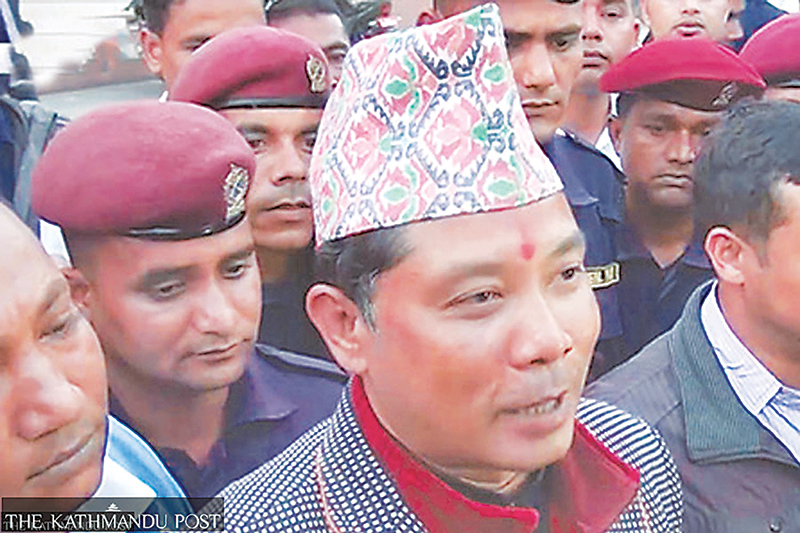
KATHMANDU, Police on Thursday said their investigation into the high-profile Bhutanese refugee scam continues even after the District Attorney Office Kathmandu prosecuted 30 persons including former ministers and top officials at the District Court, Kathmandu on Wednesday. The prosecutions were based on a police investigation report the attorney’s office received on Monday. “Our investigation is not over,” Kathmandu Police Range Chief Senior Superintendent of Police Dan Bahadur Karki told the Post, adding those interrogated earlier have named more names. Police officials said they may submit a supplementary investigation report based on the new investigation. On Monday, police submitted the investigation report with a recommendation to prosecute 33 individuals including former deputy prime minister Top Bahadur Rayamajhi and former home minister Bal Krishna Khand in connection with the scam. Based on the report, the district attorney office filed cases against 30 individuals (the addresses of three suspects could not be ascertained). Of those accused, 16 including former deputy prime minister Rayamajhi, former home minister Khand and suspended government secretary Tek Narayan Pandey are already in police net, while the other 17 are on the run. Karki told the Post that his office has stepped up vigilance all across the country. “Police are on the hunt for those on the run,” he said. According to the attorney’s charge sheet filed at the court on Wednesday, those in judicial custody have taken the names of several other high-profile individuals while recording their statements in the course of police investigation. These names include the sitting chief of the Commission for the Investigation of Abuse of Authority Prem Kumar Rai, wife of former home minister Manju Khand, former home minister Ram Bahadur Thapa’s wife Naina Kala Thapa, some members of the secretariat of CPN-UML chair KP Sharma Oli, and several others connected to top politicians. Questions have even been raised about the role played by Nepal Police chief Basanta Bahadur Kunwar while dealing with the suspects in the initial days of investigation. According to SSP Karki, a team from the investigation section of the Kathmandu District Range has been working in coordination with police offices across the country. The District Attorney Office Kathmandu on Wednesday charged the 30 accused with four types of crimes—treason, organised crime, fraud and forgery. Officials at the district attorney said they have sought additional punishment for the public office holders including former ministers, secretaries and political appointees at government offences, and government employees for working against national interest and for tarnishing the country’s image. “We have sought additional punishment for public office holders for treason,” Mahesh Prasad Khatri, district attorney at the District Attorney Office, told the Post. According to the attorney office’s charge sheet, besides Rayamajhi and Khand, others prosecuted include Indrajeet Rai, security advisor to former home minister Ram Bahadur Thapa, suspended government secretary Tek Narayan Pandey, former lawmaker Ang Tawa Sherpa, Bhutanese human rights leader Tek Nath Rijal, Rayamajhi’s son Sandeep, middlemen Keshav Prasad Dulal, Sanu Bhandari, Sandesh Sharma, Ram Sharan KC, Shumsher Miya, Tanka Kumar Gurung, Sagar Rai, Narendra KC, and Govinda Chaudhary. All of them are in judicial custody. Likewise, the accused on the run who were prosecuted on Wednesday include Prateek Thapa (son of former home minister Thapa), Keshav Tuladhar, Laxmi Maharjan, Dhiren Rai, Mohan Raj Rai, Deepa Humagain, Sunil Budhathoki, Binita Saoden Limbu, Niranjan Kumar Kharel, Hari Bhakta Maharjan, Ashok Pokharel, Rajesh Aryal, Niraj Rai and Ashish Budhathoki.
HOME PAGE
Energy deals expected during Dahal’s India visit, says Foreign Minister Saud
Both sides reportedly working to find entry route via Indian skies to ease flights from Bhairahawa international airport.
- ANIL GIRI
KATHMANDU, As Prime Minister Pushpa Kamal Dahal prepares to travel to India for his first foreign state visit in his third term in office, the two sides have entered the final stage of negotiations, discussing draft agreements to be signed and announced during the visit as well as the text of the joint communiqué that would conclude his visit. The two sides will formally announce on Saturday the state visit of Dahal to New Delhi from May 29-June 3 at the invitation of Indian Prime Minister Narendra Modi. Foreign Minister NP Saud told the Post on Thursday that “preparations for the prime ministerial visit are in the final stage.” With the visit agenda and logistics like the size of the delegation being finalised, Nepal’s Ambassador to India Shankar Sharma met India’s External Affairs Minister S Jaishankar in New Delhi on Thursday. According to Saud, “a host of issues, including on water resources, energy cooperation, trade, commerce, transit and infrastructure, will be discussed and some agreements will be signed.” Officials privy to the developments said that some agreements, some memoranda of understanding and some ground-breaking ceremonies will materialise after delegation-level June 1 talks between Dahal and Modi in New Delhi. More than half a dozen agreements and memoranda of understanding will be signed and announced, two Nepali officials—one from the Prime Minister’s Office and the other from the Ministry of Foreign Affairs—informed. The agreements will likely include subscribing to a digital payment mode that would ease cross-border payments using e-wallet and building of bridges in Chandani-Dodhara and the Jhulaghat areas across the Mahakali River in Kanchanpur and Darchula districts respectively, if it’s agreed to by both sides. “Nepal is also seeking Murrah buffalos from India,” an official at the Ministry of Agriculture said. “There is no agreement on the number, but negotiations are underway,” he added. A further extension of the India-funded petroleum pipeline inside Nepali territory, construction of integrated check posts in Bhairahawa, Chandani-Dodhara and Nepalgunj, developing the Phukot-Karnali hydroelectric plant with an installed capacity of 480 megawatts, handover of the new 17-km expanded railway line to Bijalpura in the Jayanagar-Kurtha-Bijalpura-Bardibas railway section could also be announced during the state visit, officials said. “The trial run of the new railway line was carried out successfully,” a senior official at the Ministry of Transportation and Physical Infrastructure said, adding, “during the visit, this railway line will be handed over to the Nepali side.” Similarly, talks are on to receive the Biratnagar-Bathnaha (India) railway line, said the ministry officials. Besides handing over these two railway lines, the Indian side will provide the detailed project report of the Kathmandu-Raxaul railway, they added. During a recent meeting of the railway officials, the Indian side had only briefed its Nepali counterpart on the detailed project report, rather than handing it over. “The Indian side is also expected to share the detailed project report of the Raxaul-Kathmandu railway for our consideration,” the ministry of transportation official said. “On the air entry route via the Indian skies to facilitate international flights at Bhairahawa airport, officials on both sides are working on some alternatives. There could be some development by the end of the visit,” an official at the Ministry of Culture, Civil Aviation and Tourism said. The boundary issue, too, will be “touched upon” during the bilateral talks, said an aide to the prime minister. “First, it will be discussed at the political level and then it will be given to some mechanism for resolution. It could be at the foreign secretary level or at a lower level, but the boundary matters will certainly be taken up during the visit,” he added. Officials said that other possible agreements are related to biodiversity, supply of chemical fertiliser by India and cross-border energy cooperation, including energy trade and construction of the transmission line between Butwal and Gorakhpur. There could also be a deal on the interconnection service agreement of the Butwal-Gorakhpur cross-border transmission line. The state-owned Nepal Electricity Authority and the Power Grid Corporation of India have signed an agreement to develop the 400KV Butwal-Gorakhpur Cross-Border Transmission Line on the Indian side with joint investment. Nepal will, however, develop the section of the proposed cross-border transmission line on its side. As things stand, around 120km of the line’s 135 km length would lie in Indian territory. One energy ministry official said that “talks are going on for the development of the 679MW Lower Arun Hydropower Project in eastern Nepal.” The $1.3 billion project, the single biggest carried out with foreign investment, as per the 2017 cost estimates, is located in Sankhuwasabha and Bhojpur districts. This will be the second mega-project undertaken by the southern neighbour after the $1.04 billion 900-MW Arun-3 hydroelectric project on the Arun River. “Negotiations are still on between the two sides, so we cannot say what will happen by June 3,” the official added. The Nepali side is also pitching for long-term energy trading with India where the Nepal Electricity Authority doesn’t have to take approval for the trade with India on a piecemeal basis, the official at the energy ministry said. There is also a proposal on the table regarding the amendment in Nepal-India Bilateral Transit Treaty and officials hope that an agreement on it can be reached before the joint communiqué is made public. “The major takeaway of the visit would be cooperation in energy and hydropower sectors,” said Saud, the foreign minister. “The sides have reached agreement on some issues, while some issues are still being discussed.”
HOME PAGE
UN peacekeeping on 75th anniversary: Hits and misses
In early 1990s, there were 11,000 peacekeepers. By 2014, 130,000 were serving in 16 far-flung peace missions.
- ASSOCIATED PRESS
UNITED NATIONS, Over the past 75 years, the United Nations sent more than 2 million peacekeepers to help countries move away from conflict, with successes from Liberia to Cambodia and major failures in former Yugoslavia and Rwanda. Today, it faces new challenges in the dozen hotspots where UN peacekeeping has operations, including more violent environments, fake news campaigns and a divided world that is preventing its ultimate goal: successfully restoring stable governments. The organisation marks the 75th anniversary of UN peacekeeping and observing the International Day of United Nations Peacekeepers on Thursday. There will be a ceremony honouring the more than 4,200 peacekeepers who have died since 1948, when a historic decision was made by the UN Security Council to send military observers to the Middle East to supervise implementation of Israeli-Arab armistice agreements. The current commander of that mission, which became the United Nations Truce Supervision Organization, will be at a Security Council meeting. In a message, UN Secretary-General Antonio Guterres called peacekeepers “the beating heart of our commitment to a more peaceful world,” pointing to their support for communities rocked by conflict and upheavals. UN peacekeeping operations have grown dramatically. At the end of the Cold War in the early 1990s, there were 11,000 UN peacekeepers. By 2014, there were 130,000 in 16 far-flung peacekeeping operations. Today, 87,000 men and women serve in 12 conflict areas in Africa, Asia, Europe and the Middle East. There have been two kinds of successes, UN peacekeeping chief Jean-Pierre Lacroix said in an interview on Wednesday with The Associated Press. Those are the long list of countries that have returned to a reasonable degree of stability with the support of UN peacekeeping, including Liberia, Sierra Leone, Ivory Coast, Mozambique, Angola and Cambodia, and the countries where peacekeepers are not only monitoring but preserving cease-fires like in southern Lebanon and Cyprus. As for failures, he pointed to the failure of UN peacekeepers to prevent the 1994 Rwanda genocide that killed at least 800,000 ethnic Tutsis and Hutus and the 1995 massacre of at least 8,000 mostly Muslim men and boys at Srebrenica during the war in Bosnia, Europe’s only acknowledged genocide since the Holocaust during World War II. The UN’s reputation has also been tarnished by numerous allegations that peacekeepers charged with protecting civilians sexually abused women and children, including in the Central African Republic and Congo. Another high-profile blunder was the cholera epidemic in Haiti that began in 2010 after UN peacekeepers introduced the bacteria into the country’s largest river by sewage runoff from their base. Despite that, Richard Gowan, the International Crisis Group’s UN director, said “UN peacekeeping has a surprisingly decent track record.” While many people understandably focus on the Rwanda and Srebrenica disasters, he said, “the UN has done a good job of tamping down crises, protecting civilians and rebuilding broken states in cases from the Suez crisis in the 1950s to Liberia in the 2000s”. Looking ahead, the UN’s Lacroix said the major challenge peacekeeping is facing is the divided international community and especially divisions in the UN Security Council, which must approve its missions. “The result of that is that we’re not able to achieve what I call the ultimate goal of peacekeeping—to be deployed, support a political process that moves forward, and then gradually roll down when that political process is completed,” he said. “We cannot do that because peace processes are not moving, or they’re not going fast enough.” The result is that “we have to essentially be content with what I call the intermediate goal of peacekeeping—preserving cease-fires, protecting civilians, we protect hundreds of thousands of them … and doing our best, of course, to support political efforts wherever we can,” the undersecretary-general for peace operations said. Lacroix pointed to other challenges peacekeepers are facing: The environment in which they are operating is more violent and dangerous and attacks are more sophisticated. Fake news and disinformation “is a massive threat to the population and the peacekeepers.” And old and new drivers of conflict—including transnational criminal activities, trafficking, drugs, weapons, the illegal exploitation of natural resources, and the impact of climate change exacerbating competition between herders and farmers—are also having an “absolutely massive influence.” The UN needs to better address all the challenges, he said. And it needs to keep improving the impact of peacekeeping and implement its initiatives on performance, combating fake news, improving safety and security, and recruiting more women to be peacekeepers. The Crisis Group’s Gowan told AP it’s pretty clear that the UN is “trapped” in some countries like Mali and Congo where there aren’t enough peacekeepers to halt recurring cycles of violence. Some African governments, including Mali, are turning to private security providers like Russia’s Wagner Group to fight insurgents, he said. “I think we should be wary of dumping UN operations outright,” Gowan said. “We have learned the hard way in cases like Afghanistan that even heavily armed Western forces cannot impose peace. The UN’s track record may not be perfect, but nobody else is much better at building stability in turbulent states.”
NATIONAL
Five killed, 11 hurt in West Rukum jeep accident
Preliminary investigation suggests the vehicle crashed after a brake failure, police said.
- MAHESH KC
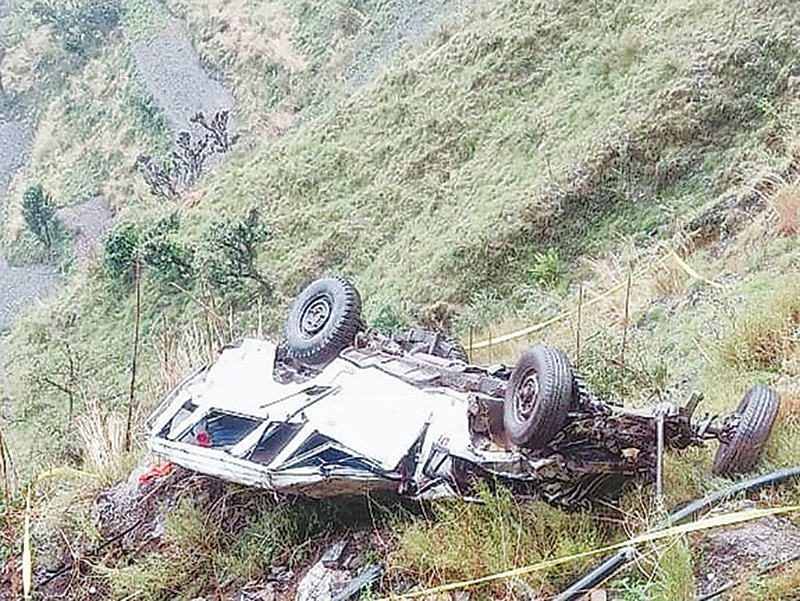
The mangled jeep after Thursday’s accident. Photo: courtesy of District Police Office
RUKUM WEST, Five people died while 11 were injured in a jeep accident in Tuli, Banphikot Rural Municipality ward 8 of West Rukum, on Thursday morning. The vehicle, with 16 people on board including the driver, was travelling towards Musikot from Ghiudhunga in Sanibheri Rural Municipality when it crashed. According to Namaraj Bhattarai, head of the district police office, the deceased have been identified as Karna Batha Magar, 70, Deochan Khatri, 48, and 23-year-old Sitala Kusari from ward 5 of Sanibheri. Twenty-two-year-old Rekha Khatri from Banphikot Rural Municipality-8 and her infant son were also among the deceased. Bishnu Prasad Shrestha, information officer at the district police office, said that the seriously injured have been airlifted to Nepalgunj Medical College Teaching Hospital in Kohalpur by a Nepal Army helicopter, while the other injured were taken to the District Hospital in Salle for treatment. Two people with minor injuries were discharged from the district hospital on Thursday evening. “Preliminary investigations have revealed that the cause of the accident might be brake failure,” said Bhattarai. “The road the vehicle was travelling on is narrow and the driver lost control of the vehicle. The vehicle plunged some 500 metres from the road.” Bhattarai added this road section, which sees heavy local traffic, is risky for vehicles trying to manoeuvre sharp bends and turns. Road accidents occur frequently in West Rukum district where the topography is difficult. According to the data of the district police office, in the last two years, 35 people have died and 16 people have been injured in road accidents in the district.
NATIONAL
Eastern hill districts are ill-equipped to fight growing fire incidents
Of the eight local units in Panchthar district, only Phidim Municipality has fire trucks, which also serve neighbouring districts.
- LAXMI GAUTAM
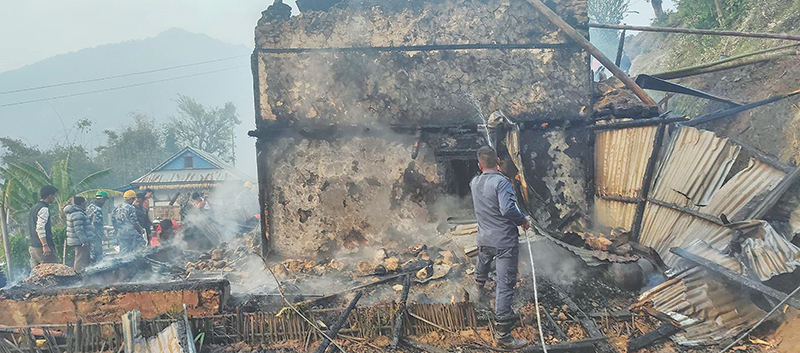
Police and locals battling a fire in a village in Panchthar district in this recent photo. Forest fires are increasingly threatening settlementsin many hill districts in recent years. Post Photo
PANCHTHAR, All family members of Prem Nemwang, residents of Nawamidanda in Panchthar’s Phalgunanda Rural Municipality, went to work in the fields on May 11 leaving his disabled son Man Kumar at home. Thirty-two-year-old Man Kumar, who cannot walk, would often be left at home when the family members are busy in the fields. On that day, a fire broke out in the nearby Laksebung forest at around 2:30pm. A spark from the wildfire caught the thatched roof of Prem’s house. Soon the house was on fire and Man Kumar, who was trapped inside died before villagers could rescue him. “The fire had already engulfed the house when we reached there. We saw Man Kumar struggling for life, but we could not save him. He died while we were trying our best to contain the fire,” said Hom Bahadur Angdembe, the ward chairman of Phalgunanda Ward 1. The same day, Dil Kumari Bhujel, 50, and her 14-year-old son Bhupendra died in a forest fire in ward 3 of Chhathar Rural Municipality in the neighbouring Tehrathum district. The fire at Gadhi Community Forest had entered the settlement. “The blaze injured the mother and son while they were working in the fields near the forest,” said Inspector Hemraj Oli at Area Police Office in Basantapur. Four other villagers sustained injuries in the course of fighting the forest fire. On May 10, a forest fire at ward 4 in Pathibhara Community Forest of Chhathar Jorpati Rural Municipality in Dhankuta spread to the settlement, destroying two houses belonging to Netra Bahadur Bishwakarma and Krishna Bishwakarma. On February 13, two boys aged five and four died when a fire destroyed a house belonging to Prem Panthak at ward 7 of Hilihang Rural Municipality Ward 7 in Panchthar district. On the same day, a forest fire entered Chuhandanda of Aathrai Rural Municipality in Tehrathum, destroying 14 houses. On January 4, Aasan Thebe, 23, and her sister-in-law Mamata Gurung, 22, died when their house caught fire in Phidim Municipality ward 8 of Panchthar. Two other family members sustained injuries in the inferno. These are some representative cases of fire that destroyed lives and properties in various eastern hill districts of Koshi Province. Fire incidents, both house fires and wildfires, cause a huge loss of lives and properties in Panchthar, Ilam, Taplejung, Sankhuwasabha, Dhankuta, Khotang, Tehrathum, Okhaldhunga and Bhojpur districts each year. A total of 842 incidents of fire were reported in Koshi Province over the past eight months, killing 15 people and injuring many others. According to records at the Provincial Police Office, fire destroyed a total of 445 houses and 182 sheds, displacing at least 141 families in the province. A total of 1,211 domesticated animals were also killed in the fire incidents. Properties worth approximately Rs757 million were ravaged by fires in the province, said police. In Panchthar alone, five people died in a total of 80 incidents in the past eight months. According to the District Police Office, 15 of the incidents were caused by forest fires. Fire incidents occur every dry season, but the local units are always caught unprepared. Of the total eight local units in Panchthar, only Phidim Municipality has two fire trucks. One is kept at the municipality’s office while the other is at the district police office. The same trucks are mobilised to fight fires even in the neighbouring Tehrathum and Taplejung districts. “We receive calls from Panchthar, Taplejung and Tehrathum. We always keep the trucks and the personnel on standby,” said Deputy Superintendent of Police Hari Khatiwada. The wildfire season in Nepal generally starts in November-December and continues until the onset of monsoon, which hits the country in mid-June. Though forest fires are classified as natural disasters, only a fraction of them occur naturally. The majority of incidents result from human causes—poachers set fire to forests to disorient wild animals and farmers start fires to clear land for farming. Discarded cigarette butts are also among the biggest causes of fires. Locals inform the police personnel, who are usually the first responders, only after the fire goes out of control. “Damage is already done by the time we reach the sites which are far from the district headquarters. The locals light fires in the forest to chase away wild animals and clear the bushes. It is quite difficult to control fires as villagers try to protect the guilty,” said Khatiwada.
NATIONAL
1,075 complaints against loan sharking in Parsa
Dsitrict Digest
PARSA: The Parsa District Administration Office (DAO) has received 1,075 complaints against loan sharking until Thursday afternoon. According to Bhimkanta Paudel, assistant chief district officer, the DAO has received complaints online from all 14 local units of the district and most of the complaints are related to financial transactions and land. The deadline for filing complaints has also been extended until May 28. On April 3, the government formed a commission under the leadership of former chairman of the Special Court Gauri Bahadur Karki to address the demands of loan shark victims. The complaints will be forwarded to the commission to resolve the problems of loan shark victims. The commission, formed as per a five-point deal reached between the government and loan shark victims, has been given three months to recommend solutions to resolve the problems of loan shark victims.
NATIONAL
Five-year-old killed in a road accident
District Digest
TAPLEJUNG: A five-year-old son of Sagar Gurung, a resident of Phungling Municipality ward 6, died in a jeep accident on Thursday. According to DSP Rajan Limbu, the vehicle belongs to the deceased’s uncle, and the driver, Krishnaman Gurung, also got injured in the accident. The cause of the accident has not been revealed yet, and further investigation is ongoing, said Limbu.
NATIONAL
East-West Highway obstructed after river damages diversion
District Digest
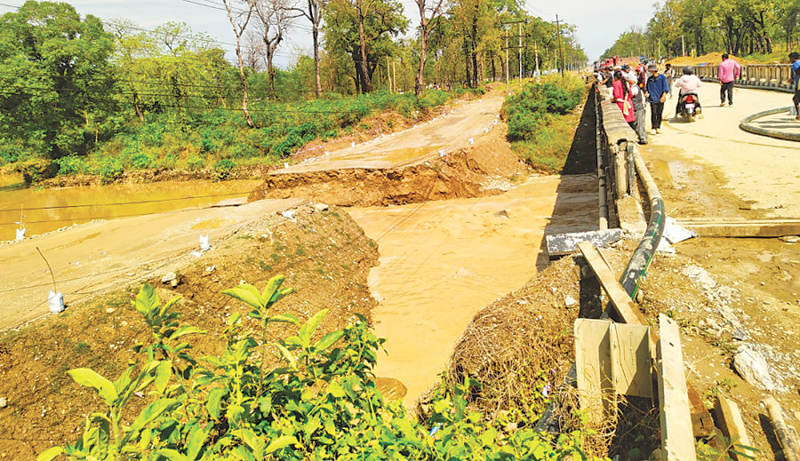
WEST NAWALPARASI: A rain-swollen river washed away a diversion at Sunwal Municipality-1 of Nawalparasi West district on Thursday, obstructing traffic along the East-West Highway. According to DSP Bhoj Raj Pandey of the district police office, hundreds of people travelling along the highway were stranded after the Somanth River swept away the diversion, which was constructed in the course of the ongoing Narayanghat-Butwal road expansion drive. “Authorities are having a hard time repairing the diversion due to continuous rainfall. They have informed us that the repair work will start once the water level in the river recedes,” said Pandey. The widening work along the 114km section, one of the busiest road stretches along the East-West highway, was initiated with Rs17 billion loan assistance from the Asian Development Bank.
NATIONAL
Government working on Republic Day pardon for Resham Chaudhary
Chaudhary has been serving life term after being convicted in the 2015 Tikapur massacre.
- TIKA R PRADHAN
There have been a number of attempts by successive governments to release Chaudhary, who won the 2017 election while still in hiding. Post Photo
KATHMANDU, The government has asked the President’s Office to release Resham Lal Chaudhary, the jailed leader of the Nagarik Unmukti Party, through presidential pardon on Republic Day next week. The government made the request on Wednesday. Former lawmaker Chaudhary has been serving a life term at the Capital’s Dillibazar prison after being convicted of masterminding the 2015 Tikapur massacre. It was only on May 16 that the Supreme Court convicted Chaudhary in the Tikapur massacre where seven security personnel and a toddler were killed. Chaudhary’s spouse and lawmaker Ranjita Shrestha, who heads the party, is currently minister for Land Management, Cooperatives and Poverty Alleviation. “A proposal seeking pardon for Resham Chaudhary landed at the President’s office yesterday. Officials are studying it,” said Baburam Kunwar, a legal adviser to the President. “After studying the proposal, it will be sent back to the home ministry, which will then forward it to the Cabinet for a decision.” After receiving the opinion of the President’s Office, the ministry will present the proposal at the Cabinet meeting and that will be sent to Sheetal Niwas for presidential pardon along with other individuals who are on the list pardon recipients on the occasion of the Republic Day on May 29. Prime Minister Pushpa Kamal Dahal called on President Ramchandra Paudel on Tuesday and discussed issues including pardon for Chaudhary and the citizenship bill. “During his meeting, the prime minister had informed the President about the government’s proposal to grant presidential pardon to Resham Chaudhary,” said a member of the prime minister’s secretariat, asking not to be named. “The President was positive about the proposal.” There have been a number of attempts by successive governments to release Chaudhary, who won the 2017 election while still in hiding after being accused in the Tikapur incident. In December last year, the government even brought an ordinance to release Chaudhary and other inmates jailed in the course of political agitations, but later decided to drop the idea. Earlier the Nagarik Unmukti Party, which has four lawmakers in the House of Representatives, had refused to join both the provincial and federal governments putting Chaudhary’s release as a precondition, but the party later decided to join the government after top leaders of the ruling parties including the prime minister promised to release him by employing appropriate approaches. After the Supreme Court on May 16 upheld the conviction of Chaudhary by the Dipayal High Court, Chaudhary said he respects the court’s decision. Rejecting Resham’s plea for a clean chit, a division bench of Supreme Court justices Anand Mohan Bhattarai and Nahakul Sudedi concluded that he should face life imprisonment. Resham, along with ten others—who were convicted by the Kailali District Court on March 6, 2019, and by the Dipayal High Court on December 18, 2020—had moved the apex court. Earlier on May 11, the government registered an amendment to the Muluki Criminal Code 2017 seeking to withdraw cases against Chaudhary and other leaders and cadres affiliated to CK Raut-led Janamat Party and Nepal Communist Party led by Netra Bikram Chand. The government has registered a proposal to amend section 116(1) of the Criminal Code 2017 adding subsection (a) to facilitate the withdrawal of cases. Seven police personnel, including a Senior Superintendent of Nepal Police, and a toddler were killed during violent protests in Tikapur on August 24, 2015 in the run-up to the promulgation of the constitution. The Kailali District Court slapped a life sentence on Chaudhary identifying him as the main accused, and the verdict was later endorsed by the Dipayal High Court. He surrendered before the Kailali district court in February 2018 and has been serving a life sentence at the Dillibazar prison.
NATIONAL
Court clears way for RSP’s Kansakar to become lawmaker in place of Shrestha
Dhaka Kumar Shrestha had moved the court against his party’s decision to sack him.
- Post Report
Dhaka Kumar Shrestha Bindabasini Kansakar
KATHMANDU, The Supreme Court has cleared the way for the appointment of Bindabasini Kansakar as a member of the House of Representatives, replacing Dhaka Kumar Shrestha. A division bench of justices Kumar Regmi and Nahakul Subedi, on Wednesday, refused to issue an interim order in Shrestha’s writ petition against the Rastriya Swatantra Party’s decision to strip him of the lawmaker position. Shrestha had demanded scrapping of the party’s move, arguing that the decision to expel him was illegal. “As necessary decisions on the petitioner’s demand will be made in the final decision, it is not necessary to issue an interim order on the petition,” the apex court said in its ruling. Kansakar will now become a lawmaker after being administered the oath by the Speaker. The fourth-largest party in Parliament had on April 12 expelled Shrestha from the party after a leaked audio featuring a voice, allegedly Shrestha’s, could be heard demanding Rs 20 million from the controversial medical entrepreneur Durga Prasai, so that Shrestha could become health minister in the federal government. Prasai is the owner of the Birtamod-based B & C Medical College and Teaching Hospital. The party subsequently decided to nominate Kansakar to replace Shrestha. Nearly two weeks after its recommendation, Speaker Dev Raj Ghimire on April 25 announced in the House that Shrestha was no longer a member of the lower house starting April 25. However, Shrestha challenged the decision in the Supreme Court before Kansakar assumed her office. On May 8, the court, issuing an interlocutory interim order, directed the authorities not to implement the decision of the Rastriya Swatantra Party to make Kansakar a member of the House of Representatives. The single judge bench of Justice Til Prasad Shrestha took that decision following which the Supreme Court listened to both sides before deciding not to issue the interim order. Shrestha became a member of the lower house of parliament under the proportional representation system in the Janajati quota. He allegedly asked for money from the controversial businessman, saying the party had decided to pick him as a minister for health and population and he needed the money to pay the party in exchange for the position. He promised to support medical entrepreneur Prasai when he would become the health minister. Though his party joined the Pushpa Kamal Dahal-led government, Shrestha couldn’t become a minister. The Commission for Investigation of Abuse of Authority has been investigating the matter. A complaint was lodged with the constitutional anti-graft watchdog, demanding an investigation into the alleged attempt by the Shrestha to ‘buy’ for himself the post of health minister. Shrestha has been living a controversial life for a long time. Shrestha was running a hospital in Pokhara, although he had acquired a licence to operate only a medical store. He also used to run the Sathi Kisan Krishi Cooperative Limited, which has courted controversy for refusing to return the money of its depositors, for months. Shrestha had left the organisation last year, handing over its leadership to one Shani Pathak. But the new leadership of the cooperative could not start working as the previous leadership had reportedly failed to maintain proper books of account.
OPINION
Managing waste sustainably
Federal and provincial governments should collaborate with local levels to address the problem.
- GANESH PAUDEL
Post File Photo
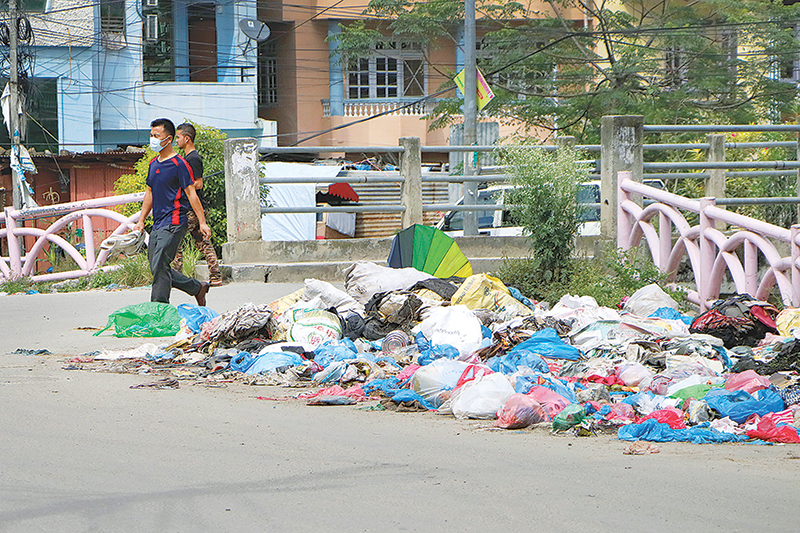
With the rise in living standards, the waste problem in Kathmandu has become ever more complex. Depending on the socioeconomic and cultural conditions, cities can have different varieties of waste. However, they can broadly be classified into four categories: Municipal solid waste, sewage waste, waste from production processes and commercial waste, and construction and demolition waste (C&D waste). To date, C&D waste is barely a problem for municipal governments in Nepal because it can be easily dumped nearby or has a certain value that can be traded for economic gain. Sewage waste is not treated and managed properly and is directly sent into rivers in Kathmandu, which has profound environmental effects and requires a huge investment to tackle it. The third type is waste from production processes and commercial waste, which are more hazardous and should be treated with special care. Unfortunately, municipal and federal governments seem unaware about the proper treatment of this waste. As a result, they are mixed up with municipal solid waste, collected, and disposed of. The fourth type is municipal solid waste, which contains household, organic, packaging, bulky, and commercial waste. They are mixed, collected, transported and dumped either openly or at landfills. Among the various types of waste, municipal waste is undoubtedly the largest in the world due to its complexity and the intensity of resources required to manage it. The negative impacts of municipal waste are pervasive and affect every economy, regardless of socioeconomic conditions. This pollutes our rivers, clogs sewers, transmits diseases, emits harmful gasses, increases air pollution, excretes leachate, pollutes soil, and affects the nation’s economic progress. However, this effect is more pronounced in developing countries like ours than in developed ones, and many factors can be blamed for it. Ineffective use of technology, unavailability of technical staff, lack of knowledge, and inadequate resource allocation are the main causes of the waste management problem. Thus, there is a growing need for intelligent and effective solutions to decouple economic growth from finite resources. And only a prudent leader with a multidimensional vision can achieve the result.
Waste separation challenges In June 2022, the Kathmandu Metropolitan City Office issued a notice for waste segregation in biodegradable and non-biodegradable categories. The city office even threatened its residents with a fine if they were found violating the notice. However, the city authorities seem to be avoiding the general principle of the rule of law, i.e., no law shall be introduced retroactively, causing its citizens to lose confidence in the government. Furthermore, it is the duty of the city government to analyse the principle of proportionality before introducing any decree or law. For better results, the city government should answer questions about legitimacy, suitability, necessity, and adequacy before formulating laws. Waste separation itself is a vast topic, as municipal waste contains a wide variety of the waste that can be separated and used. As per the World Bank Report 2018, municipal solid waste in low-income countries consists of 53 percent organic waste, 6 percent paper, 7 percent plastic, and the rest are textiles, metals, glass, and other categories. The organic waste, if separated properly, can be turned into compost or thermally recovered; the paper can be recycled; plastic and glass can be reused and recycled; textiles can be reused; and metals have value. Seeing the nature of its scale and the intensity of resources required, no local bodies can manage it solely. That is why the federal and provincial governments should work hand-in-hand with local governments across the country to deal with it sustainably. For example, the federal government can work on policy formation, the provincial government should allocate potential sites for waste management, and the local government can sort, transport, and dispose of the waste.
Problem with our mindset There is no proper allocation of resources, identification of appropriate waste management sites, treatment procedures after segregation, long-term planned horizon, environmental impact analysis, or economic impact analysis. Yet we make decisions that may have short-term solutions that will have severe implications in the long run. Either we do not have enough knowledge or we are in a state of self-proclaimed expertise, claiming to know all. Among all, the long-term planned horizon is one of the critical processes that helps confine the decision-making process, making it less scattered, especially in unstable political circumstances like ours. A proper plan envisions the probable problem in the future and foresees the solution to it. So a long-term plan is a must for a permanent solution to the perennial waste problem. Furthermore, the allocation of sufficient resources ensures the smooth operation of the system. The waste management site provides an alternative for treatment and disposal; a long-term planned horizon confines the decision-making process, making them less scattered, especially in unstable political circumstances. The environmental impact analysis highlights the potential threat to the environment and suitable compensation for it. An economic impact analysis provides insight into the economic viability of the project.
Deposit refund system This scheme is widely used across developed nations, Germany being considered a pioneer. Under this scheme, consumers pay a deposit when purchasing bottle items, depending on the type of product, which is returned when the bottles are returned to a retail shop. For example, imagine buying a bottle of water from a retail grocery store in Kathmandu that costs Rs20 (12–13 rupees at wholesale price). The consumer consumes the water in it, and the bottle is now a waste. Imagine that the government formulated a policy that states that the cost of a water bottle is Rs20, but it also includes the cost of an empty bottle, which is Rs2. Will you see a bottle on the street now? Obviously, there should be a mechanism to return the bottles, and corporate social responsibility funds (CRS funds), which are mostly wasted by creating artificial turf-like structures in Lainchaur, can be mobilised for it. This is just an example of how waste can be managed. As every country has a unique situation and problem, the solution should also be sought locally, and proper research should be done before implementing it. Because of the intensity and complexity of the problem, no solution can be a panacea. It would be unjust and imprudent to say that the technology and solution that are successful in one context will have the same result in another. However, there is no harm in learning the technology and methods used to solve the problem. In fact, it can be used as guidance in finding context-based solutions. Policymakers and stakeholders should consider innovative solutions.
Paudel is pursuing a master’s degree in sustainable urban development at the Technical University of Darmstadt, Germany.
OPINION
The reign of private interests
A system that does nothing about conflict of interest is likely to foster corruption, inefficiency, and moral decline.
- BASANTA K POKAHREL
Post Illustration
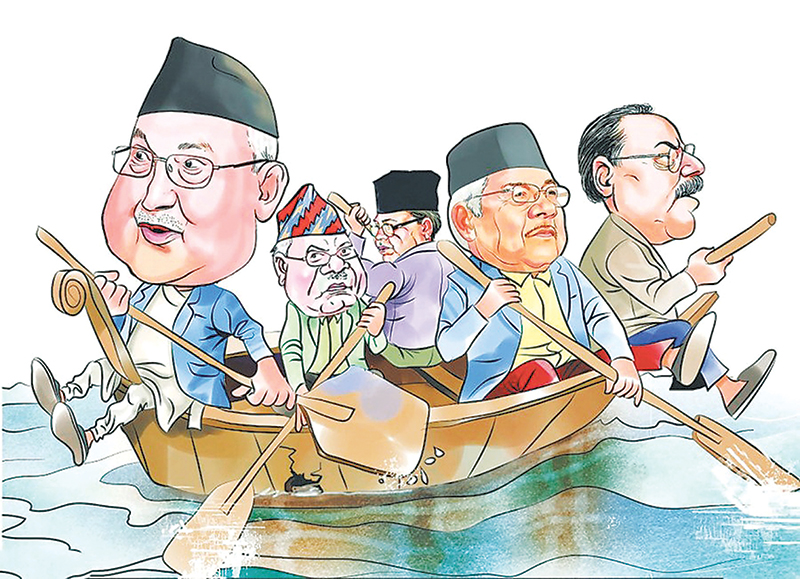
“In Nepal, honesty cannot get you anywhere, but nothing is impossible for the crooked.” Quotes often represent our way of life, reminding us of a growing ecosystem that nurtures the corrupt and sycophants. The apathy of decision-makers in Parliament and the government in treating conflict of interest is remarkable and aptly fits the quote. Controlling corruption is necessary, but it cannot happen without our ability to detect and manage conflict of interest. We have reached a stage where public funds made available to party cadres in a false pretence have become normal. A former prime minister or a president does not hesitate to defend state-sponsored health tourism. A manager of a blacklisted construction company who repeatedly delays projects and varies costs is often seen with a prime minister. We have forgotten when we last heard about higher-level appointments based on merit rather than party loyalty. Moreover, the recent announcement of the formation of the 10 thematic committees in the federal Parliament was wrapped in controversy due to the clear conflict of interest of the members. The list goes on to show how the private interests of public officials routinely topple the interests of the state. There is a great “mystery” shrouded in conflict of interest incidents (leading to corruption) in Nepal. All of them recede after a few weeks of roaring sound bites. On a more profound reflection, strong bureaucracy-political patronage protects such acts. Even the unfolding Bhutanese refugee-human trafficking incident signals a potential link with former prime ministers. It says a lot about our current ability to manage conflicts of interest. Perhaps the popular wish list for transparency is inadequate to let public officials carry out their duties fairly. Most public sector decisions involving money, contracts, and appointments are driven by self-interest, so it requires nothing less than a broader legal-ethical framework as soon as possible. It is unlikely to happen without continuous popular pressure. Despite the deep rot, we are not in a hurry to improve our ability to nip conflict of interest in the bud, or before it is morphed into corruption. A system that does nothing about conflict of interest is likely to foster corruption, inefficiency, and moral decline. Besides, doing something about conflict of interest protects civil servants from defamation risks. Because the conflict of interest is almost unavoidable in the public sector, we also do a disservice to “honest” public officials. When approached for an opinion on the likely legal route for Nepal in managing the conflicts of interest, a retired Commission for the Investigation of Abuse of Authority (CIAA) official said, “Do you think the law will work? How do you tackle policy corruption?” Policy corruption mostly takes place for impunity and to legitimise conflict of interest. It is the use of policy for steering the resources to private interests (away from where it was originally intended). We can find plenty of examples also in international aid and the private sector. Acting against policy corruption is a complex work, as recipients are often agency or department leads and their networks. It also means laws set up principles and define processes, but they cannot work alone. A response thus must navigate provisions and structures that are built to deter the application of the law, such as the provision that protects cabinet decisions from judicial scrutiny. It can undercut the power of conflict of interest laws. Whatever the rationale for this, the provision is now possibly the most used instrument for corruption in recent times. The creation of a “task force” in the refugee-human trafficking case is the type of structure used to mask corruption. This “effective” federal provision could soon find takers in other jurisdictions. A former finance minister says modernising law enforcing and procuring ministries with technology could help. Of course, using online mediums for property declaration, procurement bidding, and conflict of interest declaration can certainly ensure heightened public scrutiny. However, we still need to learn much about how digital technology is misused to mask conflict of interest and provide opportunities for corruption. We also must be mindful that corruption occurs not only while formulating policies and awarding contracts but also during implementation and monitoring. In order to address this problem, we need political allies. We cannot expect high-level political leaders to join hands to act against conflict of interest on their own. Electoral constituencies must put pressure on them to act. Some initiatives in this direction are urgent. But we must be careful as citizen platforms are increasingly hijacked by emerging or failing politicians, so the protests falter and rarely turn red hot to affect change. Young parliamentarians can play a constructive role in taking the debate further and should be approached as allies. But the concern is how they can overcome the barrier of toeing the party lines in parliamentary affairs. A long-term consideration should be finding ways to change our behaviours so that officials can stop making such decisions. But attitudinal and behavioural change must swell up from the roots. This requires structural improvement in school education, public education, civil service, the media, soap operas, and our folk and pop songs. After all, as the adage goes, we are likely to choose leaders who are like us. Finally, we don’t have to reaffirm that unattended conflict of interest in the public sector is a problem and needs to be managed systematically and comprehensively. We should focus more on forming alliances with like-minded young politicians and citizen groups and the type of required political, legal, and administrative arrangements. There are no two ways about the need for it.
Pokharel is the Executive Director of Niti Foundation.
OUR VIEW
Travesty of eminence
The prime ministers of Nepal and India should have the courtesy to jointly receive the EPG report.
Perhaps “Waiting for Godot” sounds too cliched a phrase to represent the desperate wait for an official release—acceptance, rather—of the report prepared by the Eminent Persons Group formed to review Nepal-India bilateral relations and recommend a way forward. But literary enthusiasts would concede that the wait has been nothing short of a wait for a favourite author’s novel—say, Vikram Seth’s A Suitable Girl, which never seems to see the light of the day since it was announced in 2009. Well, the A Suitable Boy author can be excused for having a prolonged “writer’s block”, leaving his readers waiting. But what has stopped New Delhi’s “South Block” from accepting and making public the EPG report? After all, the four eminent persons it employed to write the report, apart from the equinumerous eminent persons from Nepal, did not toil for the report to be ultimately hidden away as if it were an unwanted child. When it finally gets released, chances are that it will have nothing extraordinary. At most, it reiterates what has been a matter of debate from people’s drawing rooms to street corners to diplomatic corridors: The 1950 Peace and Friendship Treaty should be revised, if not scrapped together. In fact, this bit has already made sporadic public appearances, primarily in Nepali media, with one eminent person or another from the Nepali side seeming to find it too difficult to keep the secrets any more. The Indian side of the EPG has made public its displeasure with the leakage. Could it also be that the Babus in New Delhi’s Raisina Hill are unhappy about the content of the report itself? The way the report has been lingering in the shelves for five years points to Indian Prime Minister Narendra Modi’s reluctance to accept its findings. There is no other way the imbroglio can be persuasively interpreted unless the Indian side offers one. What makes the whole fiasco conspicuous is that no party is legally, even morally, bound to implement the recommendations therein. And this includes what is possibly the most prominent bone of contention between India and Nepal for decades: The 1950 treaty. Having been the so-called bigger beneficiary of the treaty, India would not want to cede the privileges it is already enjoying. But such pettiness does not make India the “Viswaguru” that it aims to become, as allegedly envisioned by Prime Minister Narendra Modi. A real test of India’s commitment to its “neighbourhood first” policy would be its ability to maintain an equal, respectful relationship with its neighbours. That, though, is not on the cards as India shows little interest in receiving—forget implementing—the report jointly produced by “eminent” persons from the two countries. As Prime Minister Pushpa Kamal Dahal gears up for his desperately awaited official visit to India, he is expected to raise this issue strongly one last time. There is no reason why two friendly neighbours should remain sulky about a report whose recommendations are not even mandatory. Rather than let the report be a secret source of conspiracy theories and disinformation, the two heads of government should accept it together and decide what to do with it. That would be the best way to “take Nepal-India relations to a newer height”, as they are invariably going to claim in their post-visit press meets.
THEIR VIEW
Monkeypox alert
This week, two cases of the virus were \reported in Pakistan, taking the tally to five.
Pakistan’s current economic realities and the state of its health infrastructure fly in the face of lofty claims about healthcare and disease control. It is clear that this country can ill afford another health emergency; this time monkeypox. This week, two cases of the virus were reported in Pakistan, taking the tally to five. Although too few to set alarm bells ringing, the figure is sufficient to put intense awareness and precautionary steps in motion. The disease is not new to the world; it dates back to 1970 and has since risen from time to time. Last year, when Britain threw up the highest number of cases in the world, WHO had rolled out a detailed list of symptoms—skin rash, lesions, swollen lymph nodes, fever and others—stating that mpox is spread through contact with infected humans, animals and surfaces and the smallpox vaccine can be used as a protective measure. In August, the organisation reported over 18,000 cases from as many as 78 countries, and another 23 cases were recorded in India in December. Disregarding the contagious nature of mpox, Pakistan’s preventive actions have been inconsequential. An outbreak can be averted with informed communities and health personnel so that hazards are confronted capably. Consequently, task forces at airports to halt transmission and an overseeing body to screen vulnerable groups—health workers, the young and the poor—isolation and diagnostic facilities, are ample moves to keep safe. Although the virus does not present mass fatal danger as it passes away of itself in two to four weeks, the WHO did flag its fatality with 3,413 deaths recorded till July. Therefore, free provision of smallpox vaccination is an almost fail-safe move as it is 85pc effective in pre- and post-exposure to the infection. Far-reaching deterrents are necessary for children, those with poor health and complications and to save large swathes of the population from a painful, epizootic condition.
— Dawn (Pakistan)/ANN
MONEY
Start-up loans scheme loses its shine
The Department of Industry said it had received 425 proposals. Among them, half, or 213 applications were disqualified.
- KRISHANA PRASAIN
Some startup entrepreneurs who applied for the subsidised loan said theynever received the money, alleging that while such a scheme is announced every year, it never really materialises. SHUTTERSTOCK
KATHMANDU, The government received a substantially lower number of proposals for concessional loans meant to help start-up enterprises. Half of those applicants’ proposals, however, have been disqualified. The Department of Industry said it received 425 proposals. However, half of them or 213 applications did not qualify. The government is providing subsidised loans of up to Rs2.5 million at 3 percent interest, for the start-ups. On May 15, the department issued a notice, informing the unqualified applicants. They also have been informed about the reasons for their non-selection in the scheme. “Most of the applicants do not have innovative business ideas that we sought. As a result, they were not selected,” said Khagendra Bahadur Basnet, director of the department. “It will take more than a month to evaluate the applications that have passed the first screening,” Basnet added. On March 30, the department invited start-ups with innovative knowledge, idea, skill and capacity to submit proposals by April 19. This followed the approval of the Start-up Enterprises Credit Fund Working Procedure by the Industry Ministry on February 22. A budget of Rs250 million has been allocated for the programme. “As the procedure has not precisely defined the innovative business ideas, we are working on preparing standard operating procedures to evaluate the applications that have qualified,” Basnet said, adding that the evaluation team is preparing the standard operating procedure. “The applicants will be shortlisted without any bias,” said Basnet. The evaluation committee consisted of a nine-member team from the government, including the private sector like the Federation of Nepalese Chambers of Commerce and Industry, Federation of Women Entrepreneurs’ Association and Federation of Small and Medium Enterprise in Nepal. He said that there would be no limit on the number of startups who seek the loan. “We have to allocate the fund by mid-July, before the end of this fiscal year,” said Basnet. The department has requested for the allocation of human resources with the Ministry of Industry, Commerce and Supplies for a temporary period to fast-track the process. The insiders, however, said that as always, the government has brought the proposals hastily. They said it is highly unlikely that the government will complete the selection process by the end of the fiscal year in mid-July. “Why did the government announce the scheme without any proper preparation,” questioned Kavi Raj Joshi, founder and managing director of Next Venture Corp. “The department should have started their internal preparation after the scheme was announced, “ said Joshi. “It shows the government’s unplanned decision-making and lack of priority.” He said the lower number of applications received by the government for loan schemes shows that it has lost the credibility and the trust of entrepreneurs. “If a small startup competition is organised, there will be more than 1,000 enterprises,” said Joshi. According to the latest credit scheme unveiled by the Industry Department, the repayment period starts after three years and should not extend more than seven years. The successful applicants will receive the money in two instalments, half in the initial phase and half later. The sectors eligible for the subsidised loan as determined by the work procedure are—businesses related to agriculture and livestock, forest (herbs), tourism promotion, entertainment and hospitality, information technology and communication, health services, and education. Other sectors are transportation and goods carrier services, infrastructure construction, automobile, traditional technology, production and services, mine and food production and processing, and management of waste and environment. The start-ups registered before the publication of the notice, and those that had not crossed seven years of operations were eligible to apply for the subsidised loan. According to the work procedure, a paid-up capital start-up applying for a subsidised loan should not exceed Rs5 million, and their annual gross income too should not exceed Rs 5 million. Their fixed capital (except home and land price) should not exceed Rs20 million, and the number of full-time workers should not exceed 10. To apply for the subsidised loan, the start-ups were provisioned to submit documents such as a copy of the company registration certificate, permanent account number, certificate of tax clearance and the citizenship certificate of the authorised person of the company. In May 2020, the National Planning Commission announced a similar scheme where they provisioned to provide Rs5 million at 2 percent interest. The agency that frames the country’s plans and policies had received more than 600 proposals, but it never moved ahead. Start-ups say the government duped them. Some startup entrepreneurs who applied for the subsidised loan said they never received the money, alleging that while such a scheme is announced every year, it never really materialises.
MONEY
Nvidia close to becoming first trillion-dollar chip firm
- REUTERS
CALIFORNIA, For Nvidia Corp, the boom in generative artificial intelligence (AI) is everything, everywhere, all at once. The chip designer’s shares extended their rally this year on Thursday, soaring 25 percent after a stellar forecast showed that Wall Street has yet to price in the AI potential of the company that has already doubled in value in 2023. Nvidia, whose stock hit an all-time high in premarket trading, was set to swell its market valuation by about $189 billion to $945 billion. The rosy earnings also sparked a rally in the chip sector and AI-focused firms, lifting stock markets from Japan to Europe. In the US, companies including Alphabet Inc, Microsoft Corp and AMD rose between 2 percent and 8 percent. Analysts rushed to raise their price targets on Nvidia stock, with 21 lifting their view on the idea that all roads in AI lead to the company as it provides the chips used to power ChatGPT and many similar services. “In the 15+ years we have been doing this job, we have never seen a guide like the one Nvidia just put up with the second-quarter outlook that was by all accounts cosmological, and which annihilated expectations,” said Stacy Rasgon of Bernstein. Nvidia, the fifth-most valuable US company, on Wednesday projected quarterly revenue more than 50 percent above Wall Street estimates and said it would have more supply of AI chips in the second half to meet a surge in demand.
MONEY
Foodmandu launches ‘first bite’ campaign
Bizline
KATHMANDU: Foodmandu, the leading online food delivery platform in Nepal, has launched its new campaign “first bite”. With a focus on enticing young palates and culinary explorers, this campaign offers an exclusive perk for new customers. They can enjoy a discount of 25 percent up to Rs500 on their first online order from Foodmandu. Ankita Joshi, Senior Brand Marketing Executive at Foodmandu, said the campaign goes beyond simply bringing young food enthusiasts on board. “It’s about appreciating their passion for discovering new flavours and culinary experiences and inviting them to embark on a delicious and long-lasting journey with us.” New users can easily avail themselves of the “first bite” campaign discounts by entering the coupon code “FIRSTBITE” during checkout. (PR)
WORLD
Head of Russian private army Wagner says his forces are handing control of Bakhmut to Moscow
Top Ukrainian presidential adviser Mykhailo Podolyak said on Thursday that Ukraine’s counteroffensive was already underway.
- ASSOCIATED PRESS
Medics give first aid to wounded Ukrainian soldiers at a medical stabilisation point near Bakhmut, Donetsk region, Ukraine on Wednesday. AP/RSS
KYIV, The head of the Russian private military contractor Wagner claimed on Thursday that his forces have started pulling out of Bakhmut in eastern Ukraine and handing over control to the Russian military, days after he said Wagner troops had captured the ruined city. Yevgeny Prigozhin, Wagner’s millionaire owner with longtime links to Russian President Vladimir Putin, said in a video published on Telegram that the handover would be completed by June 1. There was no immediate comment from the Russian defence ministry. It was not possible to independently verify whether Wagner’s pullout from the bombed-out city has begun after a nine-month battle that killed tens of thousands of people. Ukraine’s deputy defence minister said on Thursday that Wagner units have been replaced with regular troops in the suburbs but Wagner fighters remain inside the city. Ukrainian forces still have a foothold in the southwestern outskirts, Deputy Minister of Defence Hanna Maliar said. Prigozhin’s Bakhmut triumph delivered a badly needed victory for Putin, whose invasion of Ukraine in February 2022 has lost momentum and now faces the possibility of a Ukrainian counteroffensive using advanced weapons supplied by Kyiv’s Western allies. Top Ukrainian presidential adviser Mykhailo Podolyak said on Thursday that Ukraine’s counteroffensive was already underway, cautioning that it should not be anticipated as a “single event” starting “at a specific hour of a specific day.” Writing on Twitter, Podolyak said that “dozens of different actions to destroy Russian occupation forces” had “already been taking place yesterday, are taking place today and will continue tomorrow.” Prigozhin has a long-running feud with the Russian military leadership, dating back to Wagner’s creation. He has also built a reputation for inflammatory—and often unverifiable—headline-grabbing statements that he later backtracked on. During the 15-month war in Ukraine, he has repeatedly and publicly chastised Russia’s military leadership, accusing them of incompetence and failure to properly provision his troops as they spearheaded the battle for Bakhmut. Wagner’s involvement in the capture of Bakhmut has added to Prigozhin’s standing, which he has used to set forth his personal views about the conduct of the war. “Prigozhin is … using the perception that Wagner is responsible for the capture of Bakhmut to advocate for a preposterous level of influence over the Russian war effort in Ukraine,” the Institute for the Study of War, a Washington think tank, said. His frequent critical commentary about Russia’s military performance is uncommon in Russia’s tightly controlled political system, in which only Putin can usually air such criticism. His flat statement of what he would do over the next week in Bakhmut came a day after he again broke with the Kremlin line on Ukraine. He said its goal of demilitarising the country has backfired, acknowledged Russian troops have killed civilians and agreed with Western estimates that he lost more than 20,000 men in the battle for Bakhmut. Meanwhile, Russian unleashed a barrage of Iranian-made Shahed 36 drones against Kyiv in its 12th nighttime air assault on the Ukrainian capital this month but the city’s air defences shot down all of them, Ukrainian authorities said on Thursday. The Kremlin’s forces also launched 30 airstrikes and 39 attacks from multiple rocket launchers as well as artillery and mortar attacks across Ukraine, the Ukrainian military said. At least one civilian was killed and 13 others were wounded in Ukraine on Wednesday and overnight, the Ukrainian presidential office said on Thursday. In Russia, meanwhile, the Foreign Ministry announced on Thursday that five Swedish diplomats are to be expelled from the country. According to the statement, the decision is a response to Stockholm’s “openly hostile step” to declare five employees of Russian foreign missions in Sweden “personae non grata” in April. Moscow additionally announced its decision to close its consulate in Goteborg in September, as well as its “withdrawal of consent” to the activities of the Swedish consulate in St Petersburg.
WORLD
Russia signs deal to deploy tactical nuclear weapons in Belarus
MOSCOW: Russia and Belarus signed a deal on Thursday to formalise the deployment of Russian tactical nuclear missiles on Belarusian territory, a step Moscow said was driven by rising tensions with the West. “In the context of an extremely sharp escalation of threats on the western borders of Russia and Belarus, a decision was made to take countermeasures in the military-nuclear sphere,” TASS news agency quoted Russian Defence Minister Sergei Shoigu as saying. The deployment of the missiles was first announced by President Vladimir Putin in March. Since invading Ukraine last year, Putin has said repeatedly that Russia would be ready to use nuclear weapons if needed to defend its “territorial integrity”. NATO said at the time it did not see any need to adjust its own nuclear posture, though it said Putin’s nuclear rhetoric was “dangerous and irresponsible”. Ukraine said Russia’s ally Belarus had been “taken hostage” by Moscow. Moscow will retain control over the weapons and any decisions on their use, Shoigu said. (REUTERS)
WORLD
War and economy push immigration to Britain to record high in 2022
- ASSOCIATED PRESS
LONDON, The number of people moving to Britain reached a record high of more than 600,000 in 2022, government figures showed on Thursday, sparking renewed debate about the scale of immigration and its impact on the UK. Net migration—the difference between the number of people arriving and those leaving—was 606,000 for the year, according to the Office for National Statistics. A total of 1.2 million people moved to the UK in 2022, while 557,000 left. The net figure is up from just under 500,000 in 2021. The total UK population is about 67 million. The statistics office said the record level was due to a “series of unprecedented world events throughout 2022 and the lifting of restrictions following the coronavirus pandemic.” It said the number of arrivals appeared to have levelled off in recent months. As well as people coming to Britain to work, the figure includes tens of thousands of international students and more than 160,000 people who have arrived under special programmes for people fleeing war in Ukraine and China’s clampdown in Hong Kong. Prime Minister Rishi Sunak said the immigration figure was “too high,” but he did not say what an ideal number would be. “We’ve got to be sensitive to the needs of the [health service], the economy, but fundamentally the numbers are too high—I’m bringing them down,” he told broadcaster ITV. The high figure revived debate about Britain’s departure from the European Union, which was motivated in part by the arrival of hundreds of thousands of people from across Europe in the years before the 2016 Brexit referendum. Supporters of Brexit said leaving the EU—which gives citizens of any member country the right to live and work in all the others—would allow the UK to control its borders. Many who voted for Brexit thought immigration would fall, but the opposite has been true. The UK still issues tens of thousands of work visas a year to fill jobs in hospitals, nursing homes and other sectors.
WORLD
Kurds fear Erdogan win amid sharper nationalist rhetoric
- REUTERS
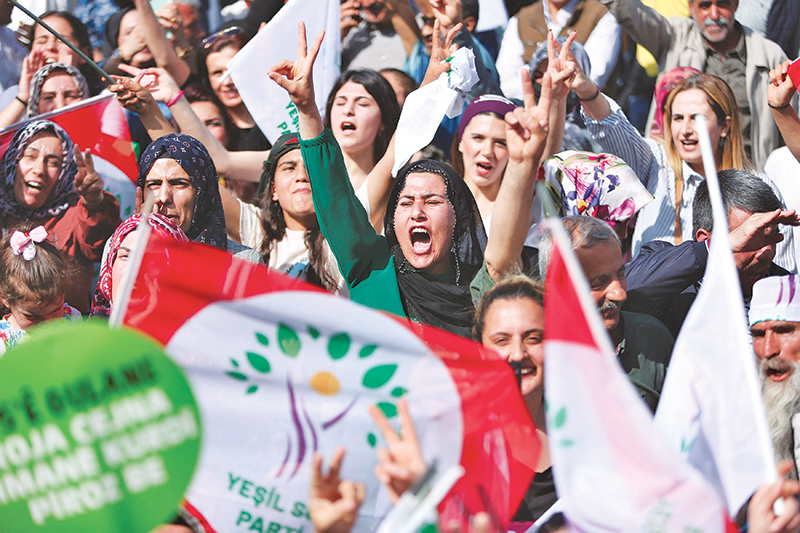
A file photo shows pro-Kurdish Green Left Party supporters in Diyarbakir, Turkey. REUTERS
ISTANBUL/DIYARBAKIR, Kurds opposed to President Tayyip Erdogan fear victory for him in Turkey’s presidential election could reinforce a crackdown the state has been waging against them for years, alarmed by a surge in nationalist rhetoric ahead of Sunday’s vote. Kurds, who make up around a fifth of Turkey’s population, have been seen as potentially crucial to the opposition’s hopes of ending Erdogan’s 20 years in power—a reign in which he first courted but then cracked down hard on Kurdish groups. But the momentum is with Erdogan going into Sunday’s vote after the first round gave him a lead over the opposition’s Kemal Kilicdaroglu, who trailed despite the backing of six parties and the endorsement of the pro-Kurdish HDP party. For some Kurdish voters, the stakes couldn’t be higher as Erdogan dials up his nationalist tone in a bid to win more votes ahead of the runoff. “Voting is a matter of life and death now. Erdogan hardened his stance on Kurds during the election campaign,” said Ardelan Mese, 26, a cafe owner in the mainly Kurdish city of Diyarbakir in the southeast who is urging his friends to vote. “I can’t imagine what he will be capable of after declaring victory.” The HDP won 61 percent support in Diyarbakir in the May 14 parliamentary election, while Erdogan’s AKP got 23 percent. Nationwide, HDP support was 8.9 percent. The issue of HDP support for Kilicdaroglu has this week been complicated by his deal with an anti-immigrant party that HDP said was “against universal democratic principles”. The HDP was expected to issue a statement on the issue on Thursday. In his early years in power, Erdogan expanded political and cultural rights for Kurds, a stateless group scattered between Turkey, Iran, Syria and Iraq. He removed restrictions on using the Kurdish language and oversaw a peace process with the Kurdistan Workers Party (PKK), which took up arms against the state in 1984 and is viewed as a terrorist group by Turkey and its Western allies. But after a ceasefire collapsed in 2015, he changed course, with the authorities waging a crackdown that led to the arrest of thousands of HDP members, typically on charges of militancy, with many of its lawmakers and mayors unseated and jailed. Seizing on the HDP’s support for Kilicdaroglu, Erdogan has repeatedly accused the opposition of siding with terrorism. The HDP denies accusations of militant ties. Erdogan also repeatedly drew attention to a doctored video to accuse Kilicdaroglu of ties to the PKK, which has been waging an insurgency in which more than 40,000 people have been killed. Kilicdaroglu called the accusation slanderous. But Erdogan’s stance has won the endorsement of Sinan Ogan, a hardline nationalist who came third in the first round. Ogan has said the endorsement was based on a principle of “non-stop struggle [against] terrorism”, referring to pro-Kurdish groups. The sloganeering marks an effort to tap deep-running nationalist sentiment—a powerful force in Turkish politics which has been hardened by factors including years of hostilities with Kurdish militants and the influx of millions of refugees from Syria since war began there in 2011. Critics say Kilicdaroglu has also struck a more nationalist tone since a disappointing first round, vowing to repatriate all refugees. Turkey hosts some 5 million migrants, of whom 3.4 million are Syrians, according to Interior Ministry data. He has also noted Erdogan “sat at the table with terrorist organisations” - a reference to the failed peace process. Tayip Temel, a senior HDP official, expressed fear that Erdogan had achieved his desired goal through “black propaganda” alleging links between Kilicdaroglu and terrorists. “Erdogan’s victory will consolidate one-man rule and pave the way for horrible practices, bringing completely dark days for all parts of society,” Temel, HDP deputy co-chair, said. He also noted Kilicdaroglu’s switch to “a more nationalistic discourse” which he said could cost him some Kurdish support. Reha Ruhavioglu, director of the Diyarbakir-based Kurdish Studies Centre, believes many Kurdish voters have lost the will to vote ahead of the runoff, blaming the shift in the tone adopted by Kilicdaroglu. “Demotivation stems from the CHP’s political discourse which shifted from reconciliation to security politics. The HDP should motivate its base by saying, ‘If Kilicdaroglu loses, we lose too’,” he said.
WORLD
Hong Kong-flagged vessel briefly runs aground in Egypt’s vital Suez Canal, later refloated
Briefing
- AGENCIES
CAIRO: A Hong Kong-flagged ship briefly ran aground on Thursday in Egypt’s vital Suez Canal, though authorities said they were able to refloat it after it momentarily disrupted the waterway. The Xin Hai Tong 23 ran aground at the southern mouth of the Suez Canal, the body that oversees the waterway said in a statement. The ship was being towed to another area by three tug boats after an “emergency malfunction,” it said, that caused it to stop sailing. The Suez Canal Authority said that traffic flow had returned to normal in the canal, which connects the Red Sea to the Mediterranean Sea. Leth Agencies, which oversees traffic in the canal, had said that four other vessels were stopped in line behind it after it ran aground.
WORLD
Taiwan says software problems delaying new F-16 deliveries
Briefing
- AGENCIES
TAIPEI: Software problems are delaying the delivery to Taiwan of 66 advanced new F-16V fighter jets from the United States but the island still expects the full order to arrive by 2026, Defence Minister Chiu Kuo-cheng said on Thursday. The United States in 2019 approved an $8 billion sale of Lockheed Martin Corp F-16 fighter jets to Taiwan, a deal that would take the island’s F-16 fleet to more than 200 jets, the largest in Asia, to strengthen its defences in the face of a stepped up threat from China, which claims Taiwan as its own. Chiu earlier this month said the 66 F-16Vs had been delayed due to supply chain disruptions, but on Thursday further explained the problem was linked to flight control software issues and they were working to address this with the United States.
WORLD
Chinese hackers spying on US critical infrastructure, Western intelligence says
Briefing
- AGENCIES
WASHINGTON: A state-sponsored Chinese hacking group has been spying on a wide range of US critical infrastructure organizations, from telecommunications to transportation hubs, Western intelligence agencies and Microsoft said on Wednesday. The espionage has also targeted the US island territory of Guam, home to strategically important American military bases, Microsoft said in a report, adding that “mitigating this attack could be challenging.” While China and the United States routinely spy on each other, analysts say this is one of the largest known Chinese cyber-espionage campaigns against American critical infrastructure. Chinese foreign ministry spokesperson Mao Ning said on Thursday the hacking allegations were a “collective disinformation campaign” from the Five Eyes countries, a reference to the intelligence sharing grouping of countries made up of the US, Canada, New Zealand, Australia and the UK.
WORLD
Iran says it has successfully test-launched ballistic missile
Briefing
- AGENCIES
DUBAI: Iran successfully test-launched a ballistic missile with a potential 2,000-km range on Thursday, state media said, two days after the chief of Israel’s armed forces raised the prospect of “action” against Tehran over its nuclear programme. Iran, which has one of the biggest missile programmes in the Middle East, says its weapons are capable of reaching the bases of arch-foes Israel and the United States in the region. Despite US and European opposition, the Islamic Republic has said it will further develop its “defensive” missile programme. “Our message to Iran’s enemies is that we will defend the country and its achievements. Our message to our friends is that we want to help regional stability,” Iranian Defence Minister Mohammadreza Ashtiani said.
SPORTS
CBU held, Friends thrash Satdobato
Maharjan’s men play out a 0-0 draw against Manang.
A 4-0 rout of Satdobato moves Friends out of drop zone.
- Sports Bureau
Players of Manang Marshyangdi Club and Church Boys United (red) compete during the Martyrs Memorial A-Division League at the Chyasal Stadium in Lalitpur on Thursday. Post Photo: Hemanta Shrestha
KATHMANDU, Church Boys United missed their chance to stretch the gap on top of the Martyrs Memorial A-Division League standings after they played out a goalless draw against Manang Marshyangdi Club at the Chyasal Stadium in Lalitpur on Thursday. Second-placed Machhindra Club and the third-placed Jawalakhel Youth Club had played for a 0-0 stalemate on Wednesday to hand Bal Gopal Maharjan’s CBU the edge in the title race. A win would have moved CBU five points clear at the top, but they drew a blank against the record eight-time champions. The stalemate also means the exciting title race is going down to the wire and shaping up to be a three-way race as the season closes in towards the final rounds. Machhindra are looking to clinch their third consecutive trophy in as many seasons, while CBU are aiming to win the country’s top-tier league in their debut season. Jawalakhel are bidding to lift their maiden trophy. The outcome leaves CBU just three points above Machhindra, who have 35 points, and four clear of Jawalakhel. Satdobato are fourth with 29 points. The relegation battle is also hotting up after the Friends Club thrashed Satdobato Youth Club 4-0 to climb out of the bottom two. Torric Jebrin scored a quick double after Rafiq Aminu and Prakash Budhathoki netted at the ANFA Complex as Friends ended their four-match winless streak. Friends moved up to the 12th position and are one-point away from Sankata, who have 23 points. Khumaltar are at the bottom of standings with 21 points. Pressure is piling on Manang as well after a seventh straight draw left them limping in the 11th position. They have 25 points from 21 matches, meaning they are in danger of being relegated to the B-Division League for the first time in their history.
SPORTS
Djokovic, Alcaraz in same half of French Open draw
- AGENCE FRANCE-PRESSE
PARIS, Novak Djokovic could face world number one Carlos Alcaraz in the semi-finals of the French Open after both players were placed in the same half of the draw on Thursday. Djokovic is chasing a record 23rd men’s Grand Slam title in the absence of the injured Rafael Nadal, who will miss the tournament at Roland Garros for the first time since his 2005 title-winning debut. The third-seeded Djokovic, Roland Garros champion in 2016 and 2021, meets 114th-ranked Aleksandar Kovacevic of the US in the first round in Paris—the first French Open since 1998 without Nadal or the now retired Roger Federer. The 24-year-old Kovacevic is making his Grand Slam main draw debut. Djokovic, who turned 36 on Monday, has been bothered by a recurrence of a right elbow injury which has disrupted his clay-court season. He failed to go beyond the last eight at any of the three events he played on clay this spring, losing his number one spot to Alcaraz. Djokovic has also fallen behind Daniil Medvedev in the rankings after the Russian succeeded him as Italian Open champion last weekend. US Open champion Alcaraz and Medvedev both start their Roland Garros campaigns against a qualifier or lucky loser. Alcaraz is also on track to play 2021 French Open runner-up Stefanos Tsitsipas in the quarter-finals. Reigning women’s champion Iga Swiatek begins her title defence against Spain’s Cristina Bucsa, the world number 67 who was beaten by the Pole in the third round of this year’s Australian Open. The top-ranked Swiatek, bidding to become the first back-to-back women’s champion at the French Open in 16 years, is coming off a thigh injury which forced her to retire in Rome. She is seeded to meet 2022 runner-up Coco Gauff in the quarter-finals and could face Wimbledon champion Elena Rybakina, last week’s Italian Open winner, in the last four. Aryna Sabalenka, who won her maiden Grand Slam crown in Melbourne, plays Marta Kostyuk of Ukraine in round one. Sabalenka has never got beyond the third round in Paris despite making at least the semi-finals at all of the other three majors. Third seed Jessica Pegula has a tricky opening match against fellow American and 2022 Australian Open finalist Danielle Collins, while Rybakina gets a qualifier or lucky loser first up. Ons Jabeur, seeded seventh, is a potential quarter-final opponent for Rybakina, who defeated the Tunisian in the 2022 Wimbledon final.
SPORTS
Inter eye Champions League after Cup success
Nerazzurri will be aiming for one more trophy when they face Man City in the Champions League final on June 10.
- ASSOCIATED PRESS
Inter Milan fought back to defeat Fiorentina 2-1 and win their second consecutive Italian Cup title at the Stadio Olimpico in Rome on Wednesday. Ap/Rss
ROME, Take note, Manchester City: the bigger the match, the bigger the performance from Lautaro Martinez lately. After scoring key goals against Benfica and city rivals AC Milan to help secure Inter Milan a spot in the Champions League final, Martinez netted twice as the Nerazzurri produced a 2-1 comeback win over Fiorentina to defend the Italian Cup trophy on Wednesday. It’s the second trophy that Inter have won this season after also beating Milan in the Italian Super Cup in January—when Martinez also scored. After a couple of matches to finish up Serie A, Martinez and Inter will be aiming for one more trophy when they face City in the Champions League final on June 10 in Istanbul. “In all honesty, I am moved, because for a couple of years we have been bringing trophies to this great club and we’ve got to continue this way,” said Martinez, who also played a big role when Inter won Serie A in 2021. “I want to keep contributing for Inter, because that’s what matters.” Martinez now has a career-best 27 goals across all competitions for Inter this season, having also helped Argentina win the World Cup in December. He’s also the only player to have appeared in all 54 of Inter’s matches this season. The match at the Stadio Olimpico was lively from the start as Nicolas Gonzalez put Fiorentina ahead three minutes in following a lapse by Inter’s defence. A cross from Jonathan Ikone was allowed to float across the area for Gonzalez to knock in at the far post. Then Martinez took over to put Inter ahead before the break. First, a perfectly placed through ball from Marcelo Brozovic set up the equaliser as Martinez ran onto the pass and scored with an angled shot into the far corner for his 100th goal with Inter. Then Martinez produced an acrobatic volley to redirect in a pass from Nicolo Barella. Martinez also nearly produced another goal when he set up Edin Dzeko with only the goalkeeper to beat but Dzeko’s shot sailed high over the bar. Fiorentina will play West Ham in the Europa Conference League final on June 7. “We were hoping for a different result but this will serve as experience and preparation for what to expect on a mental level and how to handle the match for the Conference League final,” Fiorentina coach Vincenzo Italiano said. It’s the ninth Italian Cup title for Inter, while Nerazzurri coach Simone Inzaghi has now won seven of his eight finals as a manager. “We started poorly and had the wrong approach, which is rare for us, but the guys did well to stay in the game anyhow and then turn it around,” Inzaghi said. “The team are improving match by match.”
MEDLEY
Horoscope
ARIES (March 21-April 19) You’ll have no issues focusing on fun instead of work. However, an unbalanced connection later in the day could put you in a morose and quiet mood. You’ll sense a shift later tonight asking you to devote your weekend.
TAURUS (April 20-May 20) An unbalanced connection later in the day could put you in a rather dim mood. You will sense a shift later tonight asking you to devote your weekend toward pursuing wellness goals and perhaps some spring cleaning.
GEMINI (May 21-June 21) You will want to be extra supportive of your body and mind during this time. Try not to fall into a daze later this afternoon which could cause lines to blur within your professional and social spheres.
CANCER (June 22-July 22) Give yourself permission to move slowly and spend a little extra time under the sun. Try to ground in the present when navigating these vibes, understanding that your only job at the end of the workday is to enjoy the weekend.
LEO (July 23-August 22) The moon continues its journey through your sign today, amplifying your energy levels and desire to be seen. Just try not to demand too much of yourself, as too much stress could lead to emotional meltdowns you didn’t see coming.
VIRGO (August 23-September 22) Take as much space as you need today. Try not to exhaust yourself by banging against walls when there might be another way around. Make sure to give yourself permission to slip away into the realms of self-care.
LIBRA (September 23-October 22) People may look to you for comic relief or glimmers of hope today. Try not to jump to any conclusions if you’re feeling defensive. Focus on your physical needs and what’s left on your to-do list later in the afternoon.
SCORPIO (October 23-November 21) Try not to let your confidence waiver, which could play tricks on your ego. Luckily, you’ll have a chance to ground later tonight, inspiring you to socialise just in time for the weekend to kick off!
SAGITTARIUS (November 22-December 21) Plan on laying low at home later in the day, bringing to you a sleepy energy to the table. You will sense a shift tonight, bringing out your responsible side throughout the next two days and perhaps more.
CAPRICORN (December 22-January 19) You won’t have much patience for nonsense or phony exchanges today. Move away from people or situations you’ve outgrown, though you’ll want to avoid coming off as snobby or pretentious. Your thoughts may feel clouded later in the afternoon.
AQUARIUS (January 20-February 18) Love will be on your side today. Unfortunately, a few rough diamonds could ripple your good vibes, but try not to get caught up in a fight not worth the effort. A surreal energy will take hold later in the day.
PISCES (February 19-March 20) There will be plenty of distractions to get caught up in today. You’ll need to be proactive about maintaining an organised and efficient agenda. A clumsy vibe will manifest later in the day, so be sure to watch your head.
CULTURE & LIFESTYLE
Three Everest passes in ten days
We had planned a back-to-back trek through Kongma La, Cho La and then the Renjo La Pass.
- Binaya Guragain
Photo: Binaya Guragain
We began the Khumbu trek on May 4 from Lukla. The weather in Lukla, the gateway to Mt Everest, on the morning of May 4 was pleasantly mild. We took a flight (to Lukla) from Ramechhap as that is easier than getting a direct flight from Kathmandu. Although most trekkers stay at Phakding, the first camp on the route, we decided to move ahead and try to reach Namche the same day because we wanted to explore the bazaar thoroughly. Despite the locals warning us not to move towards Namche, we were determined to get there the same day, so we pushed ahead, reaching the bazaar by mid-afternoon. On the second day of our trek, we reached Chukhung village, the base station for the Kongma La Pass in Khumbu, Solukhumbu. We had planned a back-to-back trek in an anti-clockwise route, hoping to cross Kongma La, Cho La and then the Renjo La Pass. The three Everest passes are considered one of the most exciting treks to the Base Camp, known for being tricky and steep. So the fact that were going to attempt trekking anti-clockwise was something of a challenge and opportunity. The hike from Chukhung to Kongma La Pass was considerably tough and steep. Fellow trekkers had warned us that crossing Kongma La (5540 m) without proper rest in Chukung was a risky decision. But we took a risk and reached Lobuche crossing Kongma La safely late in the morning of May 8. When we reached Base Camp, we learned that there were over 500 climbers there and at Camp 1 to ascend Mt Everest. The ropes from Camp 2 were not fixed, and the climbers had to wait till the afternoon of May 9. Tendi Sherpa of TAG Nepal Treks told us that May 15 would be the most likely date to begin the Everest summit. We walked around Base Camp, observed scenarios, met Sherpas and porters, took some pictures and returned to Gorkshep the same day. We hiked to Kalapathhar (5554 m) the next morning. Dzongla is a beautiful settlement on the foothills of Chola Tse Peak—a great location for an overnight stay while crossing Cho La (5420 m). As we were planning to reach Gokyo by the next day, we checked out from the hotel at 5 am. Cho La is quite beautiful, but it is less scenic than Kongma La. We enjoyed it all the same. We reached Gokyo on the evening of May 11. Gokyo was undoubtedly the most beautiful sight we saw during the entire trip. the next morning, we hiked to Fifth Lake and enjoyed the majestic sight of Mt Everest from the base of Cho Oyu. The Fifth Lake is situated near the top of Ngozumpa Glacier, the longest (36 km) glacier in the Himalayas. You have to cross some parts of the glacier to reach Gokyo from Thangnak after the Cho La pass. I found walking on the glacier the most tiring and dullest endeavour of the entire trek. We met trekkers who were ascending Gokyo Ri to observe a range of Himalayas. We, however, skipped the peak because we wanted to see Mt Everest from Fifth Lake, which is known to provide a unique view of Everest. Also, we had plans to cross Renjo La the next day, and the view from Rejo La and Gokyo Ri is considered identical. The morning of May 13 was sunny and beautiful. We reached to Renjo La (5360 m) around 10 am and enjoyed the spectacular 360-degree view of Mt Everest, Mt Makalu, Gokyo Lake, and a number of surrounding peaks from the Himalayas range. Reaching Renjo La meant it was time for us to end the trip and get back to our everyday lives. The moment was a little emotional for me. This was my second longest trek after the Annapurna half circuit and Tilicho trek I completed in October 2021. We devoured the breakfast we’d packed and brought with us on the pass—spending over an hour chatting amongst ourselves and admiring the stunning view around us. Then, we descended the steep snow-covered trail and reached Thame, where we stayed overnight. The next morning we reached Namche Bazar, had breakfast there and then trekked to Phakding, where we stayed the whole of May 14. We spent a chill day on May 15 at Lukla and flew back to Kathmandu (thankfully, directly this time) on May 16. The Khumbu trek was a challenge. It was pretty expensive too. Anyone wishing to complete the journey needs to be fit, self-disciplined and able to cope with high altitudes. But the overall experience—walking the beautiful trails, meeting other trekkers, admiring the landscape, observing the lives of highlanders and breathing in the fresh unpolluted air—gave me an experience I won’t forget in this lifetime.
Guragain is the executive director of Antenna Foundation Nepal.
CULTURE & LIFESTYLE
Albatross: More than just a band
Once an underground metal outfite, Albatross today is a rock sensation, synonymous with the music genre in Nepal.
- AYUSH GURUNG
(From left) Avaya Siddhi Bajracharya, Sunny Manandhar, Sirish Dali and Kismat D Shrestha. Photos: Courtesy of Albatross
KATHMANDU In April of 2004, four young boys, in their early twenties, entered a recording studio in Lainchaur to record a few of their originals. Little did they know, the album would go on to become a rage amongst Nepali music listeners. What started as an impromptu decision propelled the band into fame. Formed in 1998 as a three-piece school band, Albatross is a Kathmandu-based Nepali rock band celebrated for their distinct sounds and relatable lyrics. A household name, synonymous with rock music in Nepal, the band comprises four members—Sirish Dali, Sunny Manandhar, Avaya Siddhi Bajracharya and Kismat D Shrestha. While most consider their 2005 release ‘Jo Jas Sanga Sambandhhit Chha’ to be their debut album, the band had released an album—‘Hi: Fly’—prior. But that album was far from what listeners today relate the sound of Albatross to. The 1999 release was a heavy rock/metal album. ‘Hi: Fly’, however, was reflective of the band back then. Albatross was a prominent underground metal band during the late 90s and early 2000s. It was only after the return of Dali, the lead vocalist, from the US in 2002 that the band developed the sounds they are widely celebrated for today. Bajracharya, the band’s bassist, shares that Dali’s return opened a new realm of musical possibilities, allowing them to experiment with sounds other than metal. “After Sirish returned, we were able to try various styles of music other than metal. His melodic voice and pitch made it possible for us to try and create songs that appealed to many,” said Bajracharya. “We were mostly doing covers before he [Dali] joined us,” shared Manandhar, the band’s guitarist. “We focused on originals after his return, eventually creating ‘Jo Jas Sanga Sambanddhit Chha’.” However, the band did not create the five-track anthology with the intention of releasing it for the masses. They only gave in to the idea of releasing the album after the family members of the band’s former drummer, Dipesh Hirachan, listened to the songs and insisted they release the album. “Our journey as a band was never planned. Neither the genre nor the number of years we would be active for,” says Dali. “We were just four boys with a shared passion for music.” Even after the band decided to release the album, the process remained in limbo. The songs eventually made their way to the listeners, as a result of ‘piracy’, and fast spread amongst the masses via Bluetooth sharing. “Back then, we didn’t have easy access to the internet. Bluetooth sharing was how most of us discovered and listened to new music. That’s how I also found Albatross,” shared Shrestha, who joined the band in 2012 after the departure of the band’s former drummer Niraj Bajracharya. Despite the frequent changes in the lineup in the initial days, the band has managed to maintain relevance and relatability among music listeners. The band has been able to release consistent music, in quantity and quality, invariably for more than two decades since its inception. The four-piece credit their strong bond and relationship with each other for the longevity of the band. “Albatross is more than just a band. We’re friends first and band members later,” said Manandhar, who instituted the idea of ‘Albatross’ along with Bajracharya.
The veteran guitarist also ascribes the crew members who work behind the scenes to bring the band’s vision to life. Like their sound engineer Sagun Shrestha, who has been with the band for over a decade. “We love doing live shows, which also happens to be a huge part of our journey. Sagun’s expertise and inclusion in our shows has helped better both ours and the audiences’ concert-going experience.” As for Dali, he believes that their authenticity is what keeps them relevant. “Often artists limit themselves, in terms of sound and expression, to cater to the demands of their audience. We, as a band, don’t conform to that belief,” shares Dali. “We want our audiences to accept us for who we are. That, I think, is the reason for our longevity.” Now in their 25th year, the band recently released their fourth official studio album, ‘Raat Ko Rani’, which was launched at a concert in Purple Haze, Thamel on May 13. Unlike traditional albums, a majority of the songs from ‘Raat Ko Rani’ were released as singles over the years leading up to the official release. This, the band says, was a calculated move. “People don’t have the time to sit down and listen to an entire album in one go. That’s become an old-school practice,” Shrestha said. Each song has its own story to narrate. Releasing songs in bulk deprives the listeners of enjoying each song for what it is, the band members say. With only one song from the nine-track album yet to be released, Dali believes that publishing the songs as singles has allowed the listeners to understand the essence of each song. Shrestha calls the anthology well-balanced. One that can appeal to people from all walks of life. “There are heavy-rock genre songs on the album, like ‘Hell’s Kitchen 2.0’, then there are much lighter ones, like ‘Asha Nirasha’.” But that alone isn’t why the band considers their fourth studio album well-rounded. The title in itself is a clever wordplay, they say. “The nighttime is often associated with wrongdoings. There is an unwelcoming aura that the night carries. The title denotes people who come out at night, people like us [artists] who mostly work after dusk,” Dali said. On the other hand, ‘Raat Ko Rani’, the Nepali word for night-blooming jasmine, is also a flower that exudes an embracing aura, Dali further adds. “Like the title, the album is also a mixed bag of stories and sounds.” From their journey as an underground metal band to a globally recognised one, the band has been bestowed with numerous accolades. Among others, Albatross is also the only Nepali band to play at South by South West (SXSW) in Austin—an achievement the band wears proudly on its sleeves. However, for the band members, the accolades fade in comparison to the love they receive from their loyal fanbase. “We look at international festivals, like SXSW, as experiences rather than achievements,” says Dali. “Art without an audience is incomplete. So, to be relevant and relatable to our fans is our biggest achievement.” Over the years, the band has garnered a sizable following worldwide, allowing them to perform internationally. For Shrestha, being able to represent Nepal globally is also one of the biggest achievements. “We’ve toured eleven countries so far. I believe that being able to represent Nepal internationally is also one of our biggest achievements. I hope we can continue to do that.” Whatever the future may hold for the quartet, they will continue to make music and experiment with the sounds. That they are sure of. For the time being, the band is busy with national and international tours. They are all set to perform in major cities in Australia, the US, and the UK this June and July.
Albatross will conclude the Nepal leg of the album tour with an acoustic set at Moksh Bar, Jhamsikhel on May 26, Friday.
CULTURE & LIFESTYLE
Queen of Rock ‘n’ Roll, Tina Turner, dies at 83
She was among the first celebrities to speak candidly about domestic abuse, becoming a symbol of resilience to all.
- HILLEL ITALIE
PHOTO: AP/RSS
New York, US Tina Turner, the unstoppable singer and stage performer who teamed with her husband Ike Turner for a dynamic run of hit records and live shows in the 1960s and 70s and survived her horrifying marriage to triumph in middle age with the chart-topping ‘What’s Love Got to Do With It,’ has died at 83. Turner died Wednesday, after a long illness in her home in Küsnacht near Zurich, according to her manager. She became a Swiss citizen a decade ago. Few stars travelled so far—she was born Anna Mae Bullock in a segregated Tennessee hospital and spent her latter years on a 260,000 square foot estate on Lake Zurich—and overcame so much. Physically battered, emotionally devastated, and financially ruined by her 20-year relationship with Ike Turner, she became a superstar on her own in her 40s, at a time when most of her peers were on their way down, and remained a top concert draw for years after. “How do we say farewell to a woman who owned her pain and trauma and used it as a means to help change the world?” Angela Bassett, who played Turner in the 1993 biopic ‘What’s Love Got to Do With It’ said in a statement.