Policies, programmes pass Parliament after PM pacifies UML
Main opposition obstructed House after allegations by a Maoist MP of misappropriations in gold used in Pashupati.
- BINOD GHIMIRE
Post Photo: SANJOG MANANDHAR
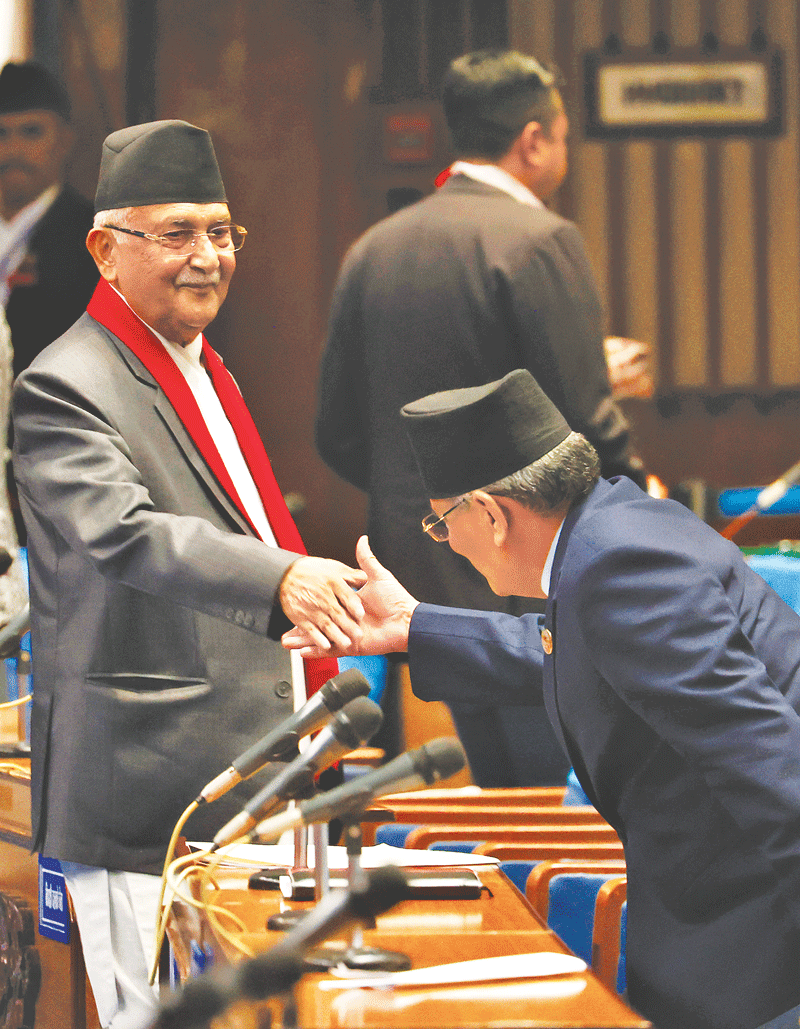
UML chief Oli meets PM Dahal in the House.
Countering his party lawmaker’s statement, Prime Minister and CPN (Maoist Centre) chair Pushpa Kamal Dahal argued on Saturday that it was wrong to drag the leader of the main opposition in the controversy relating to the jalahari installation in Pashupatinath temple. Addressing a meeting of the House of Representatives, Dahal said as the Commission for Investigation of Abuse of Authority was probing the alleged irregularities, it was unnecessary to blow up the issue in Parliament. Following the agreement, the UML lifted its obstruction of Parliament, which later endorsed the government’s policies and programmes with majority votes. The National Assembly had endorsed it earlier on Tuesday. Now the government can unveil its annual budget for the upcoming fiscal year, which is presented every year on Jestha 15 [May 29 this year] as per a mandatory constitutional provision. “The Pashupati Area Development Trust was the sole authority to decide how to use gold in jalahari. It is wrong to drag the leader of the opposition into it,” he said. “The statement claiming brass was used instead of gold in jalahari can be expunged from parliamentary record.” The UML had on Friday obstructed the House objecting to the statement from Lekh Nath Dahal, a Maoist Centre lawmaker, who had claimed that brass was used instead of gold in the jalahari installed during the prime ministership of KP Sharma Oli. He had indirectly blamed Oli for irregularities when the UML chief led the government. Jalahari is the foundation on which the Shivalinga stands and from where the water and milk offered by devotees flow out. The UML had demanded an apology from the Maoist lawmaker and clarification from the prime minister on the matter. Several meetings among the cross-party leaders on Friday failed to resolve the matter. But on Saturday, the top leaders from three major parties reached an agreement to end the House obstruction. The understanding was reached at a meeting of the Nepali Congress, the CPN-UML, and the CPN (Maoist Centre) held at the Prime Minister’s Office in Singha Durbar. According to UML Chief Whip Padam Giri, the agreement was possible after Prime Minister Dahal assured the UML that the allegations and remarks by Maoist lawmaker Lekh Nath Dahal would be expunged from Parliament’s records. Based on the agreement, Speaker Devraj Ghimire directed the Parliament Secretariat to erase the particular wordings from Lok Nath Dahal’s statement in the record. Then prime minister Oli, after an hour-long special puja at the temple on January 25, 2021, had announced that the government would provide necessary funds for the procurement of gold for the jalahari. Then, despite much criticism, the jalahari was installed on February 25, 2021 after a special puja by then President Bidya Devi Bhandari. The Supreme Court had issued an interim verdict to halt the installation after much of the work had been done. The petitioners back then had argued that the government’s decision to install the jalahari went against the Ancient Monument Preservation Act-2013, which states that structures over 100 years old must be preserved in their original design. The constitutional anti-graft body is investigating the alleged case of corruption. A total of Rs800 million was spent on buying 103.755 kg gold that was supposedly used. The report states that 96.822 kg gold was used for the foundation of shivalinga while 10.976 kg was said to have been used in the rings of the jalahari. However, the auditor general’s report points to the lack of details to prove that the said quantity of gold was used in the rings. The report mentioned that 2.89 kg copper, 1.249 kg silver and 12.75 gram zinc was mixed with the gold.
HOME PAGE
PM’s India visit: Some agreements, soft-pedalling of contentious issues
Kathmandu and New Delhi officially announce the visit, which is Pushpa Kamal Dahal’s first official trip since assuming office in December last year.
- ANIL GIRI
Leading a delegation of four dozen ministers, officials and journalists, Prime Minister Pushpa Kamal Dahal will visit India on May 31-June 3. On Saturday, Kathmandu and New Delhi officially announced the visit, which is Dahal’s first official outing since assuming office in December last year. In a statement on Saturday, Nepal’s Ministry of Foreign Affairs said Dahal would be leaving for India on May 31, at the invitation of his Indian counterpart. Dahal will embark on the trip along with his daughter, Ganga Dahal, and various dignitaries and high-ranking officers. “The prime minister’s entourage will comprise ministers, secretaries, and senior officials of the Government of Nepal,” the statement said. A slew of agreements, memoranda of understanding and ground-breaking ceremonies are lined up following delegation-level talks between Prime Minister Dahal and his Indian counterpart on June 1 in New Delhi. There were some contentious issues that Nepal and India put on the table during delegation-level talks and all eyes will be on how Dahal and Narendra Modi will resolve them. As always, India could bring up security concerns and issues related to delays in implementation of India-funded projects in Nepal. There are calls from some political sections that Dahal should take up issues like the boundary dispute with India, particularly New Delhi’s control of the Kalapani, Lipulekh and Limpiyadhura areas of Nepal, receiving the report of Eminent Persons’ Group on Nepal-India relations, plus air entry points through the L626 Mahendranagar route and Nepalgunj to facilitate aircraft movement to two newly-built international airports in Bhairahawa and Pokhara. The main purpose of the visit is to build trust between Nepal and India which sank to a low in the past, prime minister’s chief political adviser Haribol Gajurel told the Post. He does not expect much in terms of boundary dispute resolution, as it could be a time-consuming process. Some deals on economic cooperation between the two countries including long-term energy export to India and Bangladesh will be agreed upon during the visit. “Such deals would ease our import burden,” said Gajurel. “On the boundary front, the solution is a bit complex and time-consuming. There is no reason to overhype the boundary issue. We need to gradually build trust and resolve differences, and only then embark on resolving boundary matters.” One official from the Ministry of Land Management said there could be an understanding between Nepal and India on holding the meeting of the Boundary Working Group (BWG) that is mandated to clear the no-man’s land, install boundary pillars as per the agreed strip maps, and renovate and maintain old border pillars. The BWG was constituted by the governments of Nepal and India in 2014 to carry out works in the fields of construction, restoration and repair of boundary pillars including clearance of ‘no-man’s land’ and other technical tasks but its meeting has been pending since 2019. “Once we settle other outstanding issues, then we can move towards resolving the boundary dispute,” said Gajurel. On receiving the EPG report which was prepared in 2018 to provide a blueprint for Nepal-India relations, Gajurel said it was up to the Indian side. Prime Minister Dahal, during a question-answer session in Parliament last week, had said whether the EPG report is received would be known only after he discusses the matter in India. “It is a joint report, so we will listen to what the Indian side says,” he said. An eight-member panel of Nepal and India had prepared the joint report in June 2018, which is yet to be received by the two sides. There is a possibility of getting a new air route, Dahal told Parliament on Saturday. “Issues related to border and EPG will also be discussed on this visit.” On the air entry route, Gajurel hinted that Nepal could get a route via Nepalgunj. Though the recent talks between officials from Nepal and India in New Delhi could not yield results on the air entry route via India, Gajurel is hopeful that India will provide the route via Nepalgunj. Some agreements and memoranda of understanding will be signed after delegation level talks between Dahal and Modi on June 1, said officials from the Ministry of Foreign Affairs. During the visit, crucial agreements on cross-border energy cooperation and trade are expected. Agreement on a common digital payment, construction of a dry port in the Chandani-Dodhara area of Nepal, inauguration of the integrated check posts in Nepalgunj and setting up a new integrated check post in Bhairahawa are all parts of a likely agreement, said an official at Ministry of Culture, Tourism and Civil Aviation. Also on the agenda are inauguration of the rail yard in Biratnagar; construction and extension of two petroleum pipelines; allowing the broadcast of Nepal Television in India; energy trading between Nepal and Bangladesh via India; agreement on electricity trading between two state-owned agencies for 25 years so as to avoid frequent approvals. The construction of Lower Arun and Phukot Karnali by the Indian developers, cross-border transmission line, and chemical fertiliser supply to Nepal are other possible items of bilateral agreements. Prime Minister Dahal will call on President Droupadi Murmu and Vice President Shri Jagdeep Dhankhar of India and hold extensive talks with Prime Minister Modi to discuss diverse areas of partnership between the two countries. Other Indian dignitaries will call on Dahal, India’s Ministry of External Affairs said in its statement. Dahal will also address the Nepal-India Business Summit in New Delhi, to be jointly organised by the Federation of Nepali Chambers of Commerce and Industry (FNCCI) and the Confederation of Indian Industry (CII), the ministry said. “In addition to the official engagements, Prime Minister Dahal will also be visiting Ujjain and Indore as part of his visit,” the release from the Indian side read. During his special trip to Ujjain in the state of Madhya Pradesh, Dahal is scheduled to visit the revered Mahakaleshwar temple dedicated to Lord Shiva, according to some Indian media reports. The temple holds immense significance as one of the 12 jyotirlingas, or sacred abodes, of Lord Shiva, and the prime minister’s visit will underscore the spiritual bond between Nepal and India. The ‘temple diplomacy’ between Nepal and India is flourishing. In April last year, then-prime minister Sher Bahadur Deuba worshipped at the famous Kal Bhairav and Kashi Vishwanath temples in Varanasi during his India visit. In May, 2022, Indian Prime Minister Modi visited Lumbini and performed puja at the Mayadevi temple. This is Dahal’s fourth visit to the southern neighbour in his three terms as the country’s premier.
HOME PAGE
Nepal’s reactive approach to dealing with disasters
Among the most common are landslides, thunder strikes, flooding and outbreaks of water-borne and vector-borne diseases.
- ARJUN POUDEL
Post file Photo
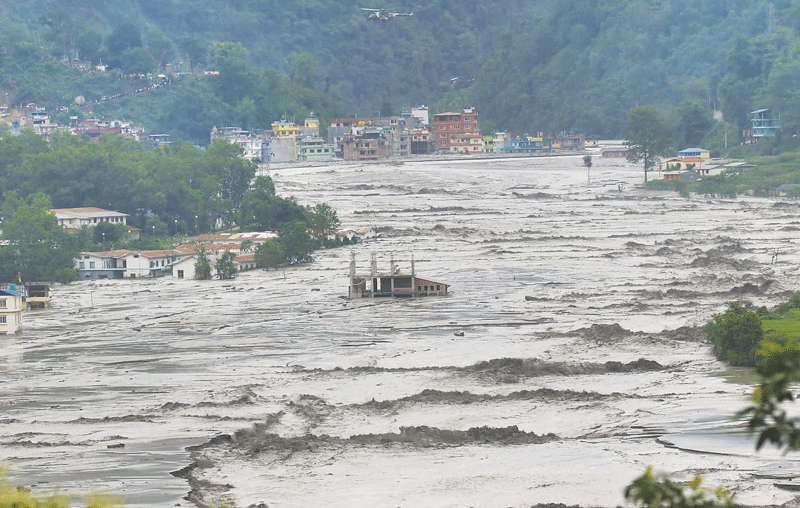
A flood deluged the Melamchi Bazaar in Sindhupalchok district in June, 2021.
The onset of monsoon is imminent. Along with the rains, the season brings natural disasters—landslides, floodings, inundations, embankment breaches, thunderstorms, snakebites, and a host of water-borne diseases. This year, the country is likely to witness below-average rainfall in the monsoon season, according to a forecast by the Department of Hydrology and Meteorology. But that does not mean all areas across the country will see equal rainfall, experts say. As climate disasters fuelled by erratic weather patterns become more frequent and pronounced, the country could witness more incidents of disasters during the monsoon, weathermen warn. Some places could witness massive rainfall, others may face drought, while dry-spell-like conditions could be seen in other places. Accordingly, the National Disaster Risk Reduction and Management Authority has estimated that at least 1.5 million people will be affected by natural disasters during the monsoon. The authority has directed all those concerned to start preparations accordingly. Experts, however, are sceptical of the country’s capacity to handle large-scale disasters as the relevant agencies have not learned from the past disasters or accidents. They warn that the continuation of the reactive approach (springing into action only after disasters) will cause huge losses to the people as well as the country. Here’s a look at Nepal’s disaster vulnerability and the country’s preparedness to deal with disasters: Nepal’s vulnerability to natural disasters Nepal is highly vulnerable to natural disasters. In the spring, the country witnessed incidents of massive forest fires. At least five people died and dozens were injured in fire-related incidents. The fires not only burnt forests, they also damaged ecology, affected wild and endangered animals and worsened the air quality, which severely impacted human health. And, within the next three weeks, the monsoon will arrive. Rain usually doesn’t come alone. It brings in its wake multiple incidents of natural disasters—landslides, floods, inundations, embankment breaches, thunder strikes, snakebites, and water- and vector-borne diseases. Hundreds of people die each year and thousands get injured and displaced in the aftermath of disasters. Thousands get infected with vector-borne diseases such as dengue, kala-azar and diarrhoea.
Landslides, thunder strikes and flooding Heavy rainfall triggers landslides in the districts of hilly regions and several districts in the Tarai region get inundated every monsoon. Landslides and flooding not only inflict damage to private and public properties, they also kill scores of people every year. During last year’s monsoon, 102 people—53 male and 49 female—died and 19 were reported missing in landslides. According to the National Disaster Risk Reduction and Management Authority, 96 people were injured in various incidents of landslides, 2,004 families were affected, 1,017 private houses were partially damaged while 865 houses were destroyed by landslides. Likewise, 100 people—61 male and 39 female—were killed and 330 others injured in thunder strikes in the last rainy season. Altogether, 590 families were affected by thunderbolt incidents. “Nepal is ranked fifth among the most-affected countries in the world in incidents of thunderbolts and the losses they cause,” said Dhurba Bahadur Khadka, spokesperson for the authority. “Deaths of 100 people from thunderbolts is no small matter.” Similarly, 19 people—11 male and 8 female—died in flood-related incidents last year. The authority said as many as 15 people are still missing, 17 were injured and at least 160 families were directly affected by floods.
The season of epidemic Monsoon is considered an epidemic season with the country witnessing massive outbreaks of water- and vector-borne diseases. Nepal is highly vulnerable to water-borne diseases, including diarrhoea, dysentery, typhoid, hepatitis, and cholera, with thousands of people falling sick every year. Poor sanitation and hygiene conditions are also to blame. Last year, the Kathmandu valley, too, witnessed a massive cholera outbreak in which at least 77 cases were confirmed. Hundreds of people suffered from diarrhoea, cases of which continued to be found for months. Likewise, vector-borne diseases—dengue, kala-azar, malaria, and scrub typhus, among others—are recorded during the monsoon season. Last year, at least 88 people died and more than 54,000 were infected by the dengue virus, which spread to all 77 districts of the country. Hospitals in Kathmandu Valley were overwhelmed by dengue patients and even the seriously ailing ones were deprived of beds for treatment. Apart from an uptick in the outbreaks of water- and vector-borne diseases, cases of snake bites too, increase during monsoon. Scores of people die from venomous snake bites.
Displaced people are more vulnerable Experts say when people get displaced in disasters—landslides, flooding and inundation—they become more vulnerable to multiple problems—water-borne diseases, vector-borne diseases, snake bites, and cold-related ailments. Displaced people are often sheltered in makeshift buildings in generally unsafe conditions and their sanitation, too, is compromised. Due to the lack of nutritious food and absence of healthcare services, the displaced, especially pregnant women and new mothers, suffer.
Nepal’s handling of disasters Every year, floods and landslides cause huge losses of life and property, but the country’s disaster preparedness is still poor. Over the past few years, it has been receiving more rainfall in short durations—an abnormal phenomenon that is slowly becoming the new normal. However, many incidents of disasters in the past exposed the government’s lack of preparedness. Displaced people had been compelled to live in makeshift shelters set up after the disasters, some built near the damaged houses in risky zones. Many are still living in such shelters. According to officials at the National Disaster Risk Reduction and Management Authority, of the 865 families displaced from last year’s landslides, only around 300 have taken the second instalment of the relief provided by the government to rebuild houses, which means the remaining ones have not even started reconstruction works. Dozens of displaced families need to be relocated to safety but they are compelled to live in areas prone to landslides, the officials concede.
The state of preparations The National Disaster Risk Reduction and Management Authority, the central resource body for disaster management, said it has prepared a response plan for the upcoming monsoon. Such a plan needs to be made with a bottom-up approach involving every ward, municipality, disaster response authority in the districts, as well as the provinces and federal government agencies. “As the local government units are first responders to any natural disaster, they should do risk mapping and planning first,” said Khadka, spokesperson for the authority. “However, we [a federal government agency] did our risk mapping first, as the local and provincial government agencies took much time to carry out their risk mapping. It would have been more scientific had the local and provincial agencies done their planning first.” Officials say agencies under 10 ministries, including the Ministry of Home Affairs, Ministry of Health and Population, Ministry of Urban Development, and Ministry of Water Supply, which are generally involved in disaster response, have been preparing. The UN agencies also play an important role by providing aid and assistance. Such agencies have been instructed to keep relief logistics ready in all seven provincial stores.
Expert’s take Experts say the government’s responsibility goes beyond formulating policies and guidelines. When disasters strike in far-flung and remote areas, rescuers cannot reach there immediately and local residents work as first responders. But they lack training and are ill-equipped. That leads to loss of lives and property that could be prevented, they added. “Most agencies under local units are ill-equipped and lack the expertise to handle disaster-related incidents,” said Santona Devkota, a disaster risk reduction trainer. “Such agencies should get training, equipment and funds. We tend to wait until the disaster strikes. We cannot cut losses through such a reactive approach.” After casualties and loss of properties, the agencies spring into action. And then after a few months, everyone forgets. Experts say only an effective monsoon preparedness plan can save lives and properties. “Besides arranging for necessary things, federal government agencies should also coordinate among the agencies under local and provincial governments,” said Devkota. “Early warning systems should be made effective and attention should be given to raising awareness of the risks.” Local units are advised to work proactively to respond to disaster-related incidents. For that, they can stockpile goods, train volunteers, organise simulations and develop early warning systems. “Each and every agency—Army, Police, Armed Police, non-governmental organisations—and agencies under the ministries have their own responsibilities,” said Devkota. “Those agencies should act proactively.”
NATIONAL
Prolonged delay in road widening work worsens dust pollution, traffic jams
According to officials at the Butwal-Narayanghat Road Project, only around 35 percent of the work has been completed even after repeated deadline extensions.
- NARAYAN SHARMA
POST PHOTO: NARAYAN SHARMA
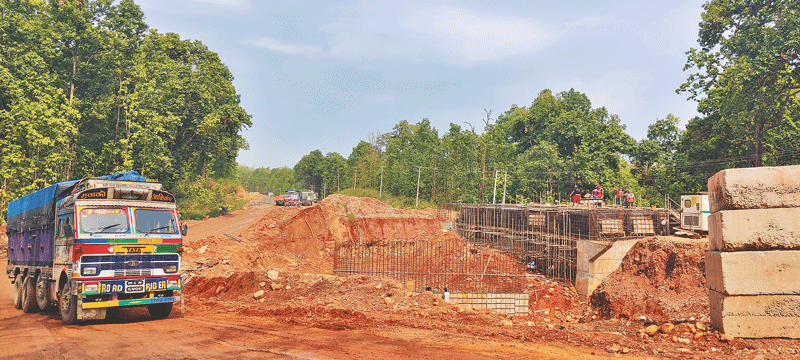
An under-construction Kawasoti section of the East-West Highway in East Nawalparasi, pictured recently. Locals and businesses have long been complaining of dust pollution caused by the construction work.
The widening work of the Butwal-Narayanghat section of the East-West Highway has been moving at a snail’s pace. The road expansion project was initiated around four years ago with a plan to complete the work in three years. According to officials at the Butwal-Narayanghat Road Project, only around 35 percent of work has been completed so far. “Around 15 km section of the 114 km Narayanghat-Butwal has been blacktopped as of now. The blacktopped section is 7 to 10.5 metres wide,” said Rakesh Jha, a consultant engineer at China State Construction Engineering Corporation. In February 2019, the Department of Roads had signed an agreement with China State Construction Engineering Corporation to implement the road project. As per the project agreement, the existing two-lane road has to be widened to six lanes in market areas, four lanes in forest areas and three lanes in the Daunne hill areas. The contractor had divided the Narayanghat-Butwal road into two sections—48 km Daunne-Gaindakot section and 66 km Daunne-Butwal section. The road widening work along the Butwal-Narayanghat stretch, one of the busiest sections along the East-West Highway, was initiated with Rs17 billion loan assistance from the Asian Development Bank. The project deadline, which was extended for a second time, expires on September 8 this year. It is almost certain that the project will miss the deadline, according to officials. They said that the Chinese construction company has started lobbying for a third extension of the project deadline. Engineer Jha admits that delay in the project has inconvenienced the public. According to him, the construction company wants to extend the deadline by a year and a half. The delayed expansion work has disrupted vehicular movement along the busy road stretch. The road project has diverted vehicular traffic at various places for the construction of bridges and road-widening work, causing hours-long traffic jams. With numerous potholes along the road caused mainly due to the road widening work, the Butwal-Narayanghat section has become accident prone. Nine big bridges and 21 smaller ones have to be constructed along the Daunne-Butwal stretch while 44 bridges, including 12 major ones, need to be constructed along the Daunne-Gaindakot section. Work on most of the bridges has yet to be completed. “Construction of all minor bridges will be completed by the end of the current fiscal year that ends on July 16,” Jha claimed. Settlements along the roadside are covered in thick layers of dust due to the widening work. The local residents complained that people living along and near the highway are hugely affected by the dust along the Butwal-Narayanghat road section. Educational institutions, businesses and other community offices also complained of the dust pollution. “We have been suffering from dust since the road widening work began some three years ago,” said Lila Ballav Bhattarai, a resident of Kawasoti. “The locals are exposed to various diseases due to dust. We don’t know how long we will have to suffer this way.”
NATIONAL
Water supply cut off for not paying tariff
District Digest
- Post Report
PANCHTHAR: The authorities concerned started cutting off drinking water supply to the consumers who have not paid drinking water tariff for a long time in Phidim, the district headquarters of Panchthar. “We have no alternative to cut off drinking water supply as some consumers do not pay water tariff for months,” said Prakash Gurung, chairman of Phidim Drinking Water and Sanitation Consumers’ Committee. “We started cutting off drinking water supply to the customers who have not paid tariff for more than three months or amount more than Rs10,000.” The committee has been supplying drinking water to the houses and offices of 2,600 consumers. The Panchthar District Court, according to the committee, has not paid Rs352,000 water tariff.
NATIONAL
‘1.1 million people deprived of citizenship certificate’
District Digest
- Post Report
PALPA: Deputy Speaker of the House of Representatives Indira Rana has said that around 1,100,000 Nepali people are deprived of citizenship certificates for various reasons. Speaking at a programme organised in Palpa’s district headquarters Tansen on Saturday, Rana said those people who were born in this country are living like refugees as they do not have citizenship certificates. According to her, more than 700,000 children are deprived of citizenship certificates as they could not acquire citizenship from their mother’s name. The deputy speaker stressed the need to resolve the issue by formulating necessary laws at the earliest.
OPINION
Climate services for a resilient Everest economy
As risks grow for mountaineering, tourism stakeholders must act urgently to build the region’s resilience.
- ANU KUMARI LAMA & TENZING CHOGYAL SHERPA
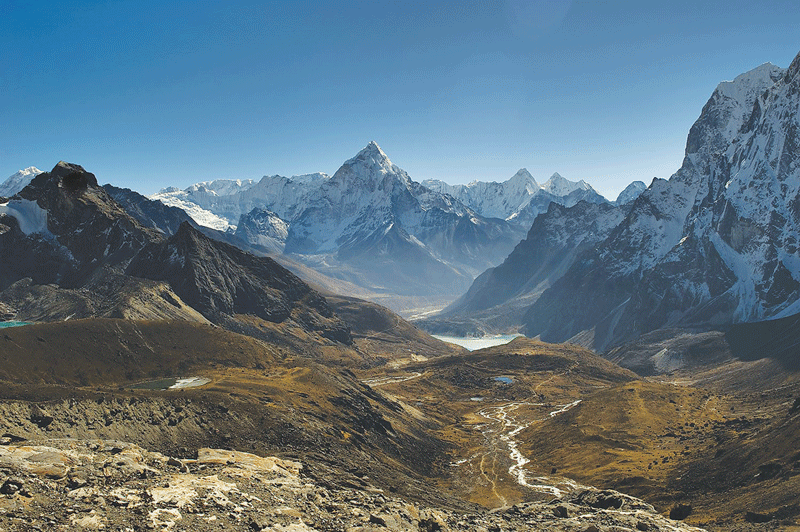
Photo: courtesy of Alex Treadway/ICIMOD
This year marks the 70th anniversary of the first successful ascent of Everest, the world’s highest mountain. As of April 2023, 396 individuals received permits to climb Everest this climbing season. In the last three decades, the total number of summiteers has reached around 6,978. This tremendous growth in the number of climbers, which surpassed only six people summiting Everest in 1965, is due to the commercialisation of mountaineering and the explosive growth in expeditions in the region. Given that mountains are hotspots for climate change impacts, the environmental and socioeconomic risks are growing for the mountaineering community and expeditions. Climate services—providing climate information, data and tools to support decision-making and planning—are essential for supporting mountain communities, tourism enterprises and tourists. These services form the backbone of a resilient Everest economy in the face of increased climate extremes. The installation of weather stations on Everest has been a game changer in providing vital climate services. These services provide weather forecasting to ensure early warning and preparedness and thereby foster safe and successful expeditions. They also facilitate rescue operations. Taking informed action in response to weather and climate extremes is imperative in making the Everest expedition economy safe, secure and sustainable.
Economics of expeditions Everest expeditions today are a major economic source for the Nepal government as well as associated private sectors and local communities. The Everest expedition economy generates multiple co-benefits to various supply chain actors, including the Department of Tourism (permit and liaison office), expedition companies (those based inside and outside of Nepal) and expedition support staff (climbing Sherpas, expedition guides and cooks). This year, Everest has already generated a revenue of around $4.2 million through sales of climbing permits. There are over 1,500 companies registered with the Nepal Mountaineering Association; of these, 25-30 provide regular expedition services. Each company charges around $35,000 per client for an expedition package. Foreign-based companies account for 25 percent of the expedition market share and charge around $100,000 per client for their expedition packages. Currently, roughly 90 percent of the Everest climbers are guided clients. For an expedition comprising 15 climbers, a supply chain comprising 109 members are deployed as support staff.
A changing climate The Everest region is experiencing rising temperatures. Glaciers surrounding the mountain are thinning, and the region is losing ice at an accelerated pace. Increased incidences of avalanches and landslides have endangered mountaineering communities. Hazards such as avalanches and falling ice represent the largest category of deaths on Everest. Avalanches form one of the major causes of fatalities, with Everest reporting around 27 percent. They are also attributed to 66 percent of all deaths that occurred between 1953 and 2016 in the Everest region, Khumbu, and its eponymous glacier. Similarly, changing weather is reported as one of the major causes for the increased death toll of climbers in the “death zone”. The economic costs of increased disasters are also enormous. While 16 lives were lost to the 2014 avalanche in the Khumbu icefall, the shutdown of the remainder of the climbing season in its aftermath also took a toll on those who depended on the climbing season for their earnings. Increasingly, poor weather is resulting in expedition failures. While this has immediate negative impacts (psychologically and economically), the weather may also deter climbers from attempting to summit Everest in the future. This will have grave economic consequences.
Climate services Climate services encompass data collection, analysis, modelling and dissemination of climate information. Weather and climate information are an essential service in mountaineering. They help avert, minimise and address loss and damage and make mountaineering expeditions, communities and economies more resilient. Automated Weather Station (AWS) networks installed on the slopes of Everest are delivering important climate services, including weather forecasting, real-time weather information and data on the mountain’s atmospheric conditions. These services enable expedition teams to make informed decisions about their ascent, enhance awareness about weather hazards, and interpret and use information for safe and successful expeditions. Conducting efficient and effective rescue operations is another important use of such services. Furthermore, low-bandwidth web portals designed for expedition climbers are providing all the crucial parameters for real-time weather conditions. As the network continues to expand, the scope of its benefits will continue to grow, and it will undoubtedly prove to be a vital tool for climbers and rescue teams in the years to come.
Resilient Everest economy Climate services effectively address the risks of climate change impacts on the mountaineering community (climbers and supply chain actors) and economy from various angles, as they typically involve collaboration between meteorological agencies, climate scientists, policymakers and other stakeholders. As the risks continue to grow for the mountaineering community and expeditions on Everest, tourism stakeholders must act urgently to build the region’s resilience. Greater access to improved climate services is vital for the mountaineering community and expedition economy. To that end, there is an urgent need to improve and scale up climate services on Everest and across the Hindu Kush Himalaya. We call on international research, funding and mountaineering communities to invest in climate services for more resilient lives and a sustainable economy across the region.
Lama is a tourism specialist and Sherpa a remote sensing and geoinformation associate at the International Centre for Integrated Mountain Development.
OPINION
Embrace women’s diversity
The experiences of women of historically marginalised groups aren’t discussed.
- SANGMO YONJAN-TAMANG
For the past few years, officials have been correcting me whenever I state my name. “How can you continue using your last name Yonjan after getting married to a Thokar?” they say. “Now you are also a Thokar.” I am neither astonished nor enraged by such statements because I am not the first woman in my family to go through this. These incidents happened to my mother too because she continued to use her own surname, Moktan, rather than her husband’s. As I become adamant about keeping my surname, they either belittle me for not following the “Nepali” tradition or condemn me for fighting patriarchy. Not only are these comments disrespectful, offensive and inconsiderate, but they also go against my culture, heritage, right to self-identification and dignity. This elucidates how unkind and ignorant Nepali authorities are about the country’s cultural diversity. Traditionally, women from the indigenous Tamang community have enjoyed greater socio-cultural and economic independence than women from the Hindu caste groups. One of the unique features of Tamang tradition is that a married woman continues using her maiden name. Contrary to the practice among Hindu caste women, a Tamang woman’s surname does not change after marriage. There are a number of significant reasons for this. There is no ritual known as kanyadan (literally “girl donation”) like in a Hindu wedding where the father gives away the bride to the groom. In the Tamang community, the bride’s family keeps the ryuisyal (surname) which is symbolic of her bone. During the wedding ceremony, the tamba (spokesperson) from the bride’s side declares, “We have given only our daughter’s flesh and blood to you, not her bone.” This implies that the bride’s parents have rights and obligations towards their daughter, and her rights are perpetually safeguarded in her natal family. This allows the daughter to visit her parents’ home whenever she likes and stay there for as long as she wants. The parents can’t go against her decision to leave her husband and must allow her to stay at their home. In the event of her death, the husband’s family cannot move her body without the consent of her natal family. This tradition ensures that a Tamang woman doesn’t have to submit to her spouse and his family, and shields her from violence, abuse, mistreatment and domination by her husband’s family.
Identity in crisis The identity of Tamang women has been in crisis for decades. They are in a vulnerable situation. The domination, subordination and prejudice which non-Hindu ethnic groups like Tamang have been subjected to for centuries have affected Tamang women immensely. One, they are oppressed and underrepresented in socio-economic and political spheres as a result of historical marginalisation. Two, they are severely impacted by Hindu patriarchal cultural beliefs, values and norms. Their socio-cultural rights have been eroded by laws and policies based on Hindu ideals. For instance, my grandmother’s surname is the same as her husband’s in official documents. The administration under Hindu control purposefully altered her last name Bajyu to that of her husband when she got her citizenship certificate. Since she and her husband officially shared the same last name, Yonjan, they were shamed in the community. Tamang culture forbids marriage to someone with the same surname, and the practice is frowned upon and stigmatised. Several Tamang women have experienced such incidents in the past, and many still do today. The dowry system prevalent among Hindu communities in the Tarai doesn’t exist in the Tamang community. This system under which a bride’s family provides the groom’s family with material possessions (cash and valuable goods) as a condition of marriage has remained an underlying cause of domestic violence against women. Tamang women have the tradition of jho, personal property that originates from her own earnings. She undertakes economic activities while growing up at her parents’ house and continues to do so at her husband’s house. Her parents and husband don’t have any right to her property. Having this economic right not only gives her financial independence but also liberates her from her husband’s domination. Another important aspect of the jho tradition is that the assets are passed on from mother to daughter. Nevertheless, the tradition has been affected with the introduction of laws that ensured sons’ right to parental property. As a consequence of the state’s assimilation policy, Tamang women began following many Hindu practices created by a patriarchal value system, including segregation during menstruation, dowry system, preference for sons, use of vermilion powder, and celebration of festivals like Teej and Rishi Panchami. Tamangs do not believe that menstrual blood is a source of pollution. For this reason, Tamang women have remained psychologically and emotionally strong, and do not have to face the dangers of the chhaughot where menstruating Hindu women are confined. Therefore, there is no point in Tamang women adopting this tradition.
Distinct identity Women belonging to historically marginalised groups have distinctive experiences; however, their issues aren’t discussed within the dominant gender discourse. The state’s current laws and policies concerning women do not recognise the distinct identity and status of indigenous women and their rights as ensured by international conventions. The mainstream women’s movements in Nepal have continued to homogenise women regardless of caste, ethnicity, religion, region, language and sexual orientation. Apart from being oblivious to the issue of traditionally marginalised women, the movement has also been reluctant to promote the rich gender-friendly traditions of various ethnic groups. While the movement continues to cite international instances of gender equality, it is hesitant to identify local indigenous examples of gender practices that support women’s economic, social and cultural advancement. There is nothing wrong with creating a space for women who have lost their social and cultural identities to share their experiences and engage in dialogue with other women. It’s imperative that these women be educated about and motivated to adhere to their original traditions. The women’s movement needs to consider these factors to become truly progressive and inclusive. It is also crucial for the state to formulate and put into action comprehensive policies to better safeguard, uphold and promote the socio-cultural rights of women from historically underrepresented groups.
Yonjan-Tamang has a master’s degree in conflict, peace and development studies.
NATIONAL
Agitation against Koshi nomenclature escalates, government issues prohibitory order
Congress demands dialogue with groups agitating against the renaming of Province 1 as Koshi.
- TIKA R PRADHAN
Post File Photo
Demonstrations were staged also in the federal Capital against the nomenclature of the province.
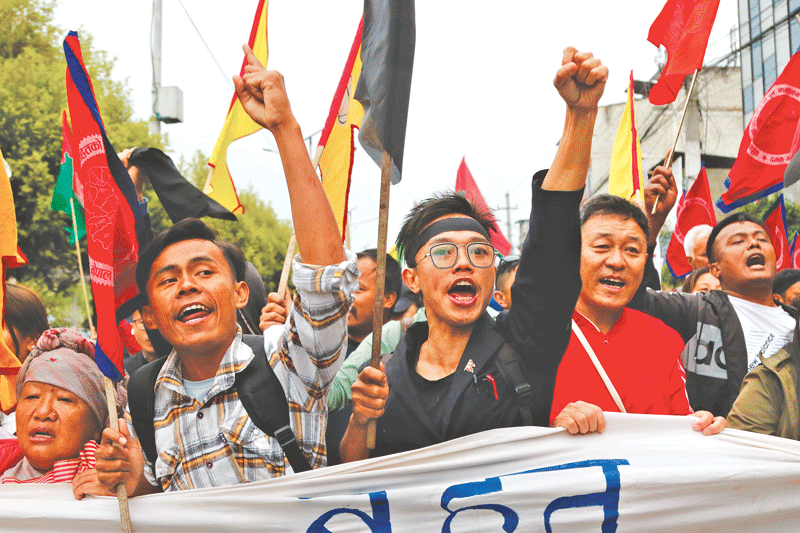
To prevent the ongoing protests against the renaming of Province 1 as Koshi from turning violent, the District Administration Office of Morang has issued a prohibitory order urging people not to get involved in protests and demonstrations at some crucial places. Issuing the order as per the Section 6 (3A) of the Local Administration Act 1971, Chief District Officer of Morang Birendra Kumar Yadav has restricted the movements at places including the premises of the offices and residences of the chief minister, ministers, provincial chief and the district administration office. The prohibitory order was issued to stop the movement of protesters, who have announced plans to disrupt the budget session set to start on Sunday. As the struggle resumed with the call for the budget session without discussing renaming the province, the provincial committee of the Nepali Congress has demanded a talks team to address the protesters’ concerns. “We would like to draw the attention of the provincial government to address the valid demands of the protesters by forming a talks team at the earliest,” said Udwab Thapa, provincial president of the Congress. The party has also demanded that the government stop arresting protesters, imposing curfews, firing bullets, charging them with batons, and misbehaving with the activists and cadres of the groups that have been demonstrating against the provincial assembly’s decision to name the province Koshi. The protesters want a name that, they say, reflects the dominant ethnic identity in the province. The party has also urged all sections of society to seek a peaceful solution to the problem instead of suppressing the protesters while at the same time asking the protesters to express their demands peacefully, without violating people’s rights. Koshi is the only province where the main opposition in the federal parliament—CPN-UML—has been leading the government. In the province, federal coalition partners, the Congress and the Maoist Centre, have failed to topple the administration. The UML is the largest party in the province with 40 seats; the Rastriya Prajatantra Party, which has six seats, has been supporting it. The Congress-Maoist coalition has 47 seats combined (adding one seat of the Speaker). With the support of major parties including the Congress, the UML and the Maoist Centre, the assembly on May 1 named the province Koshi. However, as soon as the provincial assembly decided to name the province Koshi, indigenous groups including the Rai and Limbu communities took to the streets, protesting against the naming. They have demanded that the province be given a name that reflects the identity of the major indigenous ethnic communities residing in the region. Their struggle turned violent as they targeted the leaders of major parties—especially Chief Minister Hikmat Karki and some others representing indigenous groups such as Indra Aangbo of the Maoist Centre. With the provincial assembly’s budget session starting on Sunday, protesters from across the parties and indigenous organisations have announced they’d concentrate their agitation around the provincial assembly, based in Biratnagar. According to Prem Yekten Limbu, one of the coordinators of the Joint Struggle Committee against the nomenclature, a 151-member central committee of Youths for Identity was formed to lead the struggle throughout the 14 districts of the province. The Youth for Identity group, led by Bhim Rai as coordinator and Biraj Aangdembe as joint coordinator, demonstrated in Biratnagar on Friday. “We have requested all the provincial members to obstruct the assembly, demanding a renaming process and they have given a positive response. As they obstruct from inside, we will continue our protests from outside,” said Yekten over the phone from Biratnagar. “We have decided to strengthen our struggle and make our peaceful movement more systematic with the help of the Youths for Identity.” Asked what if the political parties including the UML who have been warning counter-attacks against the agitators, Yekten said that any such move would bolster their struggle. “We are raising people’s voices and most of the leaders from all the parties including UML have said they were positive towards our demands,” said Yekten. Protesters pelted stones at the vehicle of UML chair KP Sharma Oli during his visit to Jhapa last month. Oli later challenged the protesters to change the province’s name by garnering the required majority in the assembly. Article 295 (2) of the constitution states that the names of the provinces shall be decided by a two-thirds majority of the total number of members of the assembly concerned. According to protesters, the budget session was called, defying their demand for a new session to take up the agenda of renaming the province. Provincial Assembly members of the Congress have criticised the indigenous communities for demanding an identity-based province while helping the UML emerge as the largest party in the province. “How can you expect an identity-based name by voting for a party lobbying for Koshi?” asked Bhupendra Rai, a Congress lawmaker. “Nothing is going to happen unless we garner a two-thirds majority in the assembly. We will continue to raise the issue nonetheless.”
NATIONAL
Ill intention evident right from task force formation on Bhutanese refugees, watchers say
Government authorities had gone ahead with their plan despite the UNHCR’s clarification that third-country resettlement of the refugees left behind would not happen.
- PRITHVI MAN SHRESTHA
Post Photo: Angad Dhakal
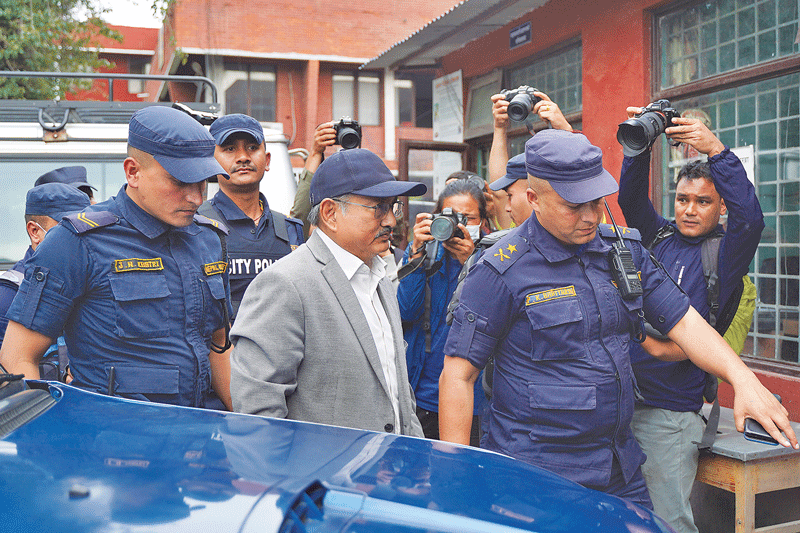
Former home minister Bal Krishna Khand being produced in court in this recent photo.
A malafide intention is visible from the very beginning of the formation of a task force meant to manage Bhutanese refugees who were left behind after the third country resettlement programme ended, say officials and experts. The United Nations High Commissioner for Refugees had closed the chapter on resettling the Bhutanese refugees in a third country in December 2016 after most of the Bhutanese refugees left for western countries. “We cannot assume that the state was unaware of the impossibility of a third country resettlement of the Bhutanese refugees left behind in Nepal,” said Achyut Neupane, chief of the Kathmandu District Attorney’s Office, which filed the criminal cases against 30 individuals, including former deputy prime minister Top Bahadur Rayamajhi and former home minister Bal Krishna Khand, on May 24. “A malafide intention of some of the state actors who colluded with the racketeers is clearly visible here.” In 2016, the UNHCR had announced cessation of the programme, which started in 2007, after resettlement of 113,500 Bhutanese refugees in eight Western countries. Of them, the United States alone received more than 90,000. In 2019, the then government led by KP Sharma Oli had formed a task force under then-Home joint-secretary Bal Krishna Panthi to recommend ways to manage the Bhutanese refugees who remained in Nepal after the third-country resettlement programme ended. The taskforce submitted the report by including 429 Bhutanese refugees who had been left behind. Later, the racketeers, in collusion with some top officials, prepared another report and added hundreds of other people to the list of Bhutanese refugees. But long before this task force was formed, collection of money from Nepalis aspiring to migrate as Bhutanese refugees appears to have begun. Sanu Bhandari, one of the defendants in the case filed by the prosecutor in Bhutanese refugee scam, has claimed in his statement that he himself was a victim of false promises made by former deputy prime minister Top Bahadur Rayamajhi and his son Sandeep. He claimed that he had given more than Rs6.96 million to Rayamajhis—both father and son—during the period between April 17, 2017 and April 13, 2018 in several instalments as they promised him and his family members that they would be sent to the US as Bhutanese refugees. Right after the formation of a task force headed by Panthi, Bhandari had started collecting money from people who were interested in going to the US in the guise of Bhutanese refugees, according to the chargesheet. It said that Bhandari had made efforts to influence the task force members by taking them to various places on trips and spending money on them. Questions were raised about the verified list of the Bhutanese refugees prepared by the Pathi-led taskforce. Some of the senior officials of the home ministry had even made efforts that the report prepared by the task force headed by Panthi should not be implemented, questioning the integrity of the report, according to the chargesheet. Phanindramani Pokharel, joint-secretary at the Home Ministry, said in his statement that during the investigation, he had heard rumours of a conspiracy to take Nepalis to the US as Bhutanese refugees and he had also received information from the informal sources that even those verified 429 Bhutanese refugees required re-verification. Then, some of the home ministry officials including Pokharel had hinted to the then home secretary Tek Narayan Pandey that a new task force should be formed to re-verify the 429 refugees as a tactic to delay the implementation of the Panthi-led report. Pandey is among the high profile defendants in the case filed by the District Attorney Office, Kathmandu on the scam. Then another task force was formed through a secretary-level decision on September 30, 2021 under the leadership of Chomendra Neupane, assistant chief district officer of Jhapa, to verify the list attached to the Panthi-led report. As the new taskforce did nothing for months, the term of the panel was extended by two months through a ministerial-level decision on June 10, 2022, with a mandate to add the names of the refugees left behind. After rumours spread about the conspiracy to send Nepalis in the guise of Bhutanese, the UNHCR had even issued a public notice, warning not to be duped by elements promising Bhutanese refugees that they would be sent to a third country for resettlement, according to Neupane. In an undated letter attached with the chargesheet, the UNHCR said that the resettlement of the Bhutanese refugees had continued for a decade until 2016. “The resettlement programme concluded in 2016 and it will not resume,” the UNHCR letter, which appears to be a notice, stated. As per the letter, the UN body has also clarified that Bhutanese refugees who are living in Nepal and are not in the resettlement process should not expect that they will be resettled in a third country through the UNHCR. “The people inside the [Bhutanese refugee] settlements or outside can argue otherwise. They have either received wrong information or are spreading rumours,” the UNHCR said. After Nepal’s efforts to repatriate the refugees to their home country failed, Nepal and the international community, including the UN refugee agency, had explored a third-country resettlement option. Of around 120,000 refugees staying in camps in eastern Nepal since the 1990s, as many as 113,500 were resettled in various Western countries during the decade-long process. Around 8,500 Bhutanese refugees were estimated to have remained in the camps after the closure of the third-country resettlement process in 2016. Police said the UNHCR, during the investigation, had notified them that they had informed the refugees about the closure of the resettlement chapter. “In response to our queries, the UNHCR had written a letter to us saying that it had earlier issued a public notice that the chapter of a third country resettlement of Bhutanese refugees was over,” Kathmandu Police Range Chief Senior Superintendent of Police Dan Bahadur Karki told the Post. According to former deputy inspector general of police Hemanta Malla, malafide intention was clearly visible from the very beginning when the task force headed by Panthi was formed and subsequent task forces were constituted. “I can’t say whether Panthi was aware of any malafide intention behind the formation of the task force,” Malla said. “But repeated formation of such panels and forgery of the main report submitted by the Panthi-headed team indicated bad intention.”
NATIONAL
Dahal vows bigger action against corruption
The prime minister says the government’s crackdown may cause more ripples in society.
- Post Report
Prime Minister Pushpa Kamal Dahal said the government is preparing to take more actions like in the fake Bhutanese refugee scam that could create ripples in the society. The prime minister was hinting at opening more corruption files in the days to come that could even affect his party, CPN (Maoist Centre). Speaking at the 19th annual general meeting of Press Centre Nepal, the journalist’s wing of CPN (Maoist Centre), and the 21st memorial day of late senior journalist Krishna Sen ‘Ichchhuk’ at Sankhu, on the outskirts of Kathmandu on Saturday, Prime Minister Dahal said he has launched actions on corruption cases like the way he did while starting the people’s war. “Bigger actions are in the offing that may become public after some days which is sure to cause more ripples [in the society],” said the prime minister addressing the function. He said there was a risk in launching such an aggressive campaign against the corrupt people. “This is also a kind of war in which we can be trapped in an ambush anytime.” Nepal Police has so far arrested 17 suspects and investigated 30 individuals including former ministers, senior government officials and middlemen involved in the fake Bhutanese scam. Based on the police investigation, the District Attorney Office Kathmandu has filed cases against the accused in the Kathmandu District Court. The racketeers had collected millions of rupees from hundreds of people promising to send them to the United States as Bhutanese refugees. During the same function, government’s spokesperson Rekha Sharma said the government was under attack from all directions due to its move against corruption. Sharma, who is also minister for communication and information technology, said those who were enjoying power in the past have been attacking the government. The two-day-long annual general meeting of the Press Centre Nepal will conclude on Sunday issuing the Shankharapur declaration.
NATIONAL
Nepal exports electricity to India after a gap of over five months
Regular exports will depend on the rainfall, says the state-run Nepal Electricity Authority.
- Post Report
The state-run Nepal Electricity Authority exported electricity to India on Friday for the first time in over five months as the domestic power production surged amid rainfall. The utility said it had sold 100 megawatts (MW) of electricity to India for six hours in the evening. But the exports were discontinued on Saturday. “We can again sell power to India if the rainfall continues,” said Suresh Bhattarai, NEA’s spokesperson. Since November 2021, Nepal has been selling electricity to India’s power exchange market during the wet season. The wet season lasts from June to November, when the hydropower projects produce electricity to their installed capacity. The country also has to import power during the dry season (December-May) when the domestic power production drops due to reduction in water levels in the rivers. Since most of Nepal’s hydropower projects are built on the run of the river model, their generation capacity depends on the water levels in the river. During the dry season, the run of the river hydro projects produce less than half their installed capacity. But during the wet season, the NEA witnesses power spillages and needs export markets to expend its surplus energy. Nepal expects to generate enough power for domestic consumption by the winter by 2026, according to NEA. Bhattarai said the NEA had also stopped importing power from India from Friday. Possible future imports from India would depend on the rainfall, he added. Nepal expects to export more power during the current year’s wet season as the installed power capacity of the country has grown substantially, while the domestic demand has not grown on par with the rise in production capacity. According to the NEA, the country’s power generation capacity has already reached 2,650 MW, while the projected peak domestic demand for power in the current fiscal year is 2,036 MW. By the end of the current fiscal year in mid-July, the country’s power generation capacity is expected to rise to 2,853 MW. By mid-July 2024, Nepal’s electricity generation capacity is expected to rise further, to 4,507 MW and to 5,251 MW by mid-July 2025. Nepal’s domestic demand for power is expected to grow to 2,280 MW in mid-July 2024 and 2,568 MW in mid-July 2025, according to the state-owned utility. As matters stand, Nepal is in urgent need to boost its export, particularly to India and possibly, to Bangladesh as well. For now, India has allowed Nepal to sell up to 452.6 MW from 10 hydropower projects, which won’t be enough to ensure a market for all the surplus energy to be produced in the country during this year’s wet season. “We have sought approval for power to be exported from an additional 15 or 16 hydropower projects, whose combined capacity is more than 800 MW,” said Bhattarai. Nepal and India had agreed to increase the volume of power that can be transmitted via the 400kV Dhalkebar-Muzaffarpur transmission line to 800 MW from the current 600 MW during the meeting of the 10th Joint Secretary-level Joint Working Group and the Secretary-level Joint Steering Committee held in Jaipur, India, in February. Electricity has emerged as one of the biggest export items of the country from last year. According to the NEA, it exported power worth over Rs11 billion in the last wet season.
MONEY
Without promoting infrastructure, no one will go there
Sudhir Mittal says the government should not operate the Gautam Buddha International Airport and let the private sector do that instead.
- Post Report
Post FILE Photo
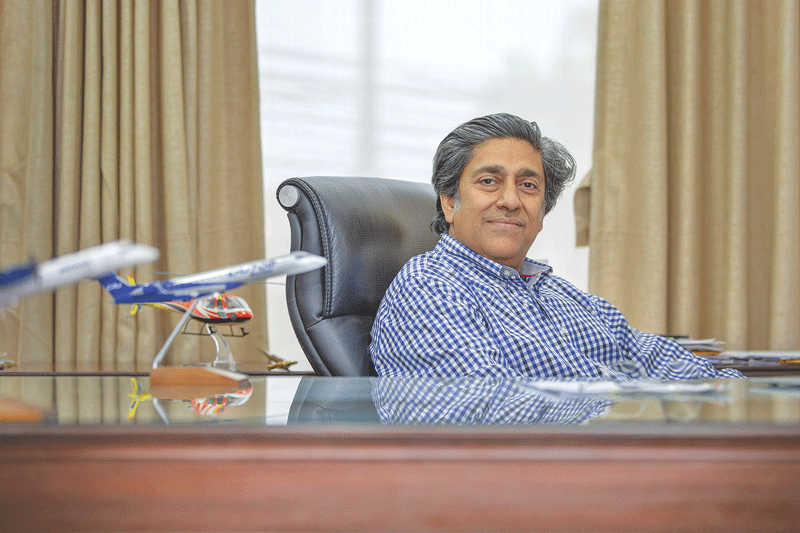
Sudhir Mittal, chairman of Shree Airlines.
Sudhir Mittal is chairman of Shree Airlines, one of the pioneers among Nepal’s private airlines. The firm diversified into fixed-wing aircraft in 2016 and had set an ambitious plan to connect Southeast Asian markets in the second phase, but Covid came as a spoiler. Shree Airlines has revived the plan now that the pandemic is gone. The Post’s Sangam Prasain talked to Mittal about the company’s plans and the industry’s current scenario. Excerpts:
The airline industry saw the fastest growth in terms of passenger traffic. Last year, there were 4.46 million domestic passengers, up from 1.75 million in 2016. Is there room for more growth? Yes, I concur. Passenger numbers are growing at a fast rate, but the important point is whether this growth matches airline incomes. The airline industry has recovered but it’s still struggling to generate revenue. Nepal’s domestic airlines were among the most affected during the Covid pandemic, but the monetary policy did not include the airline industry for refinancing and rescheduling schemes. This shows the discriminatory policy towards us. We were forced to keep our machines, costing millions of rupees, idle for months. It’s a huge loss. After Covid-19, we again became a victim of fuel prices. Oil prices increased sharply following the Russia-Ukraine war. They almost doubled in early 2022 as compared to the 2019 level. The prices are at low levels now. But still, we pay double. Fuel expenses are a major component of any airline. And if fuel prices are not coming down, airlines will not be able to make a profit and survive. Amid fuel prices and Covid came the civil aviation regulator tariff policy. The civil aviation body more than doubled the passenger service charge, and landing and parking charges, too, have been raised. The combined effects show that despite rising passenger numbers, airlines are incurring losses because there is competition.
The minimum fare even on the shortest route is Rs5,000 despite the fierce competition. If tickets are so expensive, why are passenger numbers growing? In the airline business, you never know when you will go bankrupt. We have seen many examples in recent years. In Nepal, nowadays, it is a compulsion to travel via air because of the poor road infrastructure. Today, it takes 12 hours to reach Pokhara from Kathmandu as roads are being upgraded. It takes only 20 minutes to reach Pokhara via air. So, logically, passengers will pay for 20 minutes. Roads are being upgraded in the eastern and western regions too. There are too many hassles to travel by surface route. Once you start travelling by air, it becomes a habit. Nowadays, people consider time, not money. And this is the factor behind why the number of passengers is increasing despite high airfares.
Why is air travel, both domestic and international, not affordable in Nepal? In Nepal, air transport is not a luxury. We don’t have robust infrastructure, either in the Tarai or the mountains, to make travel hassle-free. The government has not prioritised the airline industry. Today, Nepal Oil Corporation makes a large profit on the fuel sold to airlines. The profit earned from aviation fuel is used to cross-subsidise other fuels like cooking gas. The government has no policy to subsidise electricity and reduce liquefied petroleum gas consumption. Nepal Oil Corporation today makes profits in the millions by selling oil to airlines. But in reality, its transaction is in billions. So by making a small profit on fuel sold to airlines, it is making travel expensive. Today, Nepal’s airport is one of the most expensive airports in the world because of the subsidy policy which is neither good for promoting domestic industry or attracting tourists. The burden of high fuel costs is passed on to the flyers.
We already have two international airports. But why are there no flights? How can we call them international airports if there are no routes to fly into them? India has not given route clearance, mainly to enter through their airspace and connect these new airports. Who is responsible? The airports also depend on how we market them. We have Gautam Buddha International Airport in a perfect location to attract tourists. But foreign airlines will not consider that fact. They will see the business and its returns. It’s true the government will not conduct promotional activities for the airport, and without promoting the new infrastructure, no one will go there. I mean to say that the government should not operate the airport and get the private sector on board. There is a book…that defines the differences between government and privately run infrastructures in India. Two decades ago, the Indian government took total control of the energy sector--power generation, distribution and production--saying that it was an essential sector. It considered the mobile phone industry a luxury sector and allowed the private sector to deal with it. Look at the mobile phone markets and their contribution to India’s economy, and look at the energy sector. Today, India has both the cheapest and the most luxurious mobile phone sets and services. India’s energy, today, controlled by the government, is one of the worst-performing sectors. This shows that the government should not do business. This example perfectly suits Gautam Buddha International Airport. Delays mean more losses. Nepalis nowadays travel to bordering airports and fly to third countries because of the cost factors. This is a very serious issue and the government should consider these facts seriously before it is too late.
Nepal’s then largest helicopter operator Shree Airline diversified into fixed-wing operations by acquiring three small jets in 2016. It had plans to operate internationally as well, mainly connecting Indian cities. Where is the plan now? We are on track. We have planned to go international by the last quarter of 2024 or the first quarter of 2025. We have planned to acquire two 150-seater Airbus A220s. We have a plan to connect Southeast Asia in the first phase and all Indian cities. Our main objective is to bring pilgrims from Indian cities.
Is the government policy too rigid for investors? The policy, whether for foreign or domestic investors, is too rigid in Nepal. Why should we obtain a licence if we need an air operator certificate, which is very difficult to obtain? If an investor wants to open an airline business in Nepal, it has to face multiple hassles right from the beginning. Why should we put Rs1 billion as paid-up capital in the bank to run the airline? If an investor says that he wants to open an airline business, the government has no provision to assist them. Investors who wish to open international airlines have to wait for the government to invite bids. They have to compete in the bidding process to obtain a licence. And after the licence is obtained, which takes months or years, another hectic process begins at the Civil Aviation Authority of Nepal to obtain an air operator certificate. The Civil Aviation Ministry’s role is to assist investors, but the existing policy discourages potential investors. It’s the aviation regulator’s job to monitor and assess whether the airline project is feasible or not. Why do we need a licence when we have to complete five phases to obtain the air operator certificate?
MONEY
Portugal close to banning Chinese suppliers from 5G
- REUTERS
POST PHOTO: GHANSHYAM KHADKA
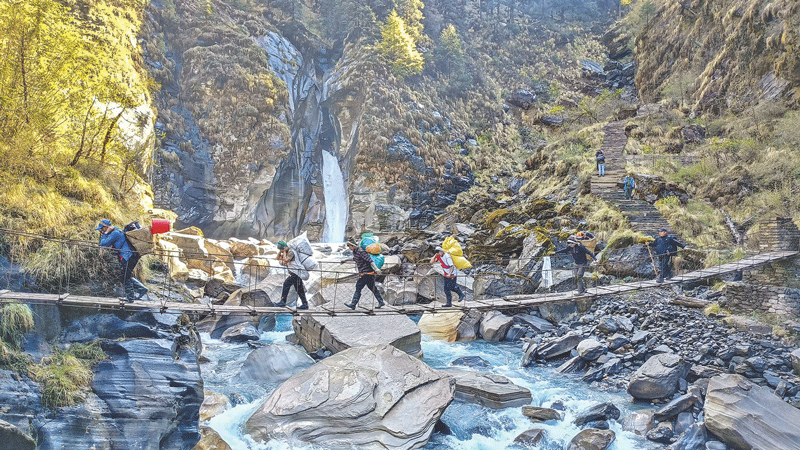
People transport goods on their backs across a wooden bridge with the Phutphute waterfall in the backdrop, in Myagdi in this recent photo.
Portugal’s cybersecurity council CSSC has issued a resolution that could formally bar telecom operators from using Chinese equipment in their high-speed 5G mobile networks as well 4G platforms on which the new technology is based. The CSSC is the prime minister’s consultative body and its document, dated May 23, is another blow to efforts by Chinese technology giant Huawei to enter the 5G market in Portugal and possibly extend existing contracts. Under a law approved last August, the government can determine “the exclusion, restrictions on use, or the cessation of use of equipment or services” of telecom companies, setting conditions and deadlines for operators to comply. The government had no immediate comment. The country’s main operators, Altice, NOS and Vodafone have already said they will not use Huawei’s equipment in 5G core networks, amid European and US concerns that Chinese involvement in critical infrastructure could compromise security. Beijing and Huawei reject such suggestions. Portugal’s existing 5G networks are not standalone and still largely based on 4G technology and equipment. Without mentioning China or any Chinese suppliers by name, the CSSC warned of a “high risk” to security from suppliers or providers that “are headquartered in a country where the government exercises control, interference or pressure on its activities in third countries”. Its opinion is based on an undisclosed report that evaluated the safety of equipment in public electronic communications networks involving 5G technology. It also cited security risks when the country where a supplier is based has no agreements on data protection, cybersecurity or protection of intellectual property with Portugal or the European Union, or when it is not an EU, NATO or OECD member.
MONEY
Preparatory work for Rs7.34 billion Siddhababa tunnel project begins
Around 421 travellers have lost their lives so far in the road section over the last 10 years, which is a landslide and rockfall-prone area.
- MADHAV ARYAL
Post Photo: MADHAV ARYAL
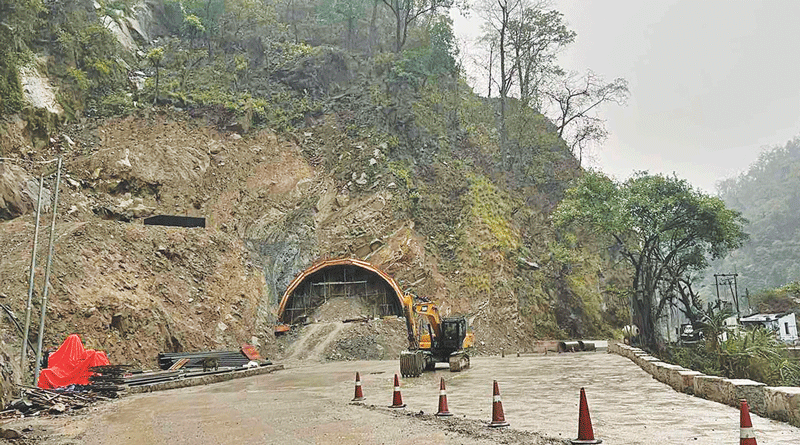
The tunnel starts at Ramapithecus Park on the northern side and ends near Siddha Baba Temple in the south.
The preparatory works of the Rs7.34 billion Siddhababa tunnel project have started, although its design is yet to be approved. The 1.12-kilometre tunnel project lies along the Butwal-Palpa road section on the Siddhartha Highway, which is a landslide-prone and stoneslide-prone area. Around 421 travellers have lost their lives and many others have sustained injuries in several accidents in the road segment over the last 10 years, according to the District Traffic Office, Palpa. More than 10,000 vehicles ply on the road section every day. The China State Construction Engineering Corporation signed the contract in March last year to complete the project. The project completion deadline is five years. The project is being constructed under the engineering, procurement and construction (EPC) model, according to senior divisional engineer, Dip Barahi of the Department of Roads. Under an EPC contract, a single contractor takes responsibility for all components like design, engineering, construction and procurement. The contract binds the contractor to deliver the project by the stipulated time frame and at the predetermined price, regardless of any possible cost overruns. Barahi said that the project has moved forward, despite the non-approval of the design, after an agreement between the Department of Roads and the Swiss consultant to approve the design, in phases. As per the contract, the Chinese developer had to submit the design within nine months. “The contractor has submitted the design to us, which is under review,” said Barahi. “The contractor has also begun the preparatory work at the northern end of the tunnel after its design has been given a green signal by the Swiss consultant and the Department of Roads.” “The contractor has received Rs580 million in advance to begin the work,” Barahi added. He said the preparatory works include making a portal and slope stabilisation. “It will take some time to begin the construction of the tunnel,” said Barahi. “The contractor has requested approval to get explosives in order to make the tunnel. We have yet to give such an approval.” Barahi said they have set a target to completely finish the design approval in a month and a half. “Our strategy to approve the design in a phase-wise manner is to prevent any delay in the construction.” The Nepal government will oversee the construction of the project. The project is also in the process of hiring a dedicated consultant. “We have completed a technical evaluation for the hiring of a consultant,” said Barahi. “It might take another two months.” As per the Detailed Project Report prepared with assistance of the Swiss Agency for Development and Cooperation, the 1.12-kilometre tunnel will have double lanes with a width of 8.5 metres along with sidewalks. The Siddhababa-Dovan road section is the main link between more than a dozen districts in the plains and the hills such as Palpa, Gulmi, Arghakhanchi, Syangja, Kaski, Parbat and Baglung. While the project’s office has been established at Naya Gaau in Rupandehi district, the construction company has set up the site camp in Dobhan in Tinau rural municipality-2. The tunnel starts from Ramapithecus Park on the northern side and ends near Siddha Baba Temple in the south. The section, from Dobhan Bazaar to Lower Siddhababa at Tinau Rural Municipality-3, is perilous due to the hairpin bends and unpredictable round-the-year rock slides. The road sections—Chidiya Khola to Upper Siddhi Baba Temple and Ramapithecus Park to Dobhan—will also be upgraded. Around 500 metres-long rock shed, for diverting rock slides from the stretch to the river as a safety measure for motorists and pedestrians, will also be made along the highway, according to Barahi.
MONEY
Poland to raise minimum wage twice in 2024, minister says
Briefing
- REUTERS
WARSAW: Poland plans to raise the minimum wage twice in 2024 to help people cope with high inflation, Family and Social Policy Minister Marlena Malag said, as the ruling Law and Justice (PiS) party prepares for a parliamentary election later this year. The cost of living has been growing significantly in recent months, with inflation in February reaching its highest in more than a quarter of a century at 18.4 percent year on year. “The minimum wage next year will be above 4,200 zlotys ($1,015),” Malag was quoted as saying by state-controlled news agency PAP. She said that, like in 2023, next year the minimum wage will be raised in two steps—from January 1 and July 1.
MONEY
China, South Korea agree to strengthen talks on chip industry, Chinese ministry says
Briefing
- REUTERS
BEIJING: China and South Korea have agreed to strengthen dialogue and cooperation on semiconductor industry supply chains, amid broader global concerns over chip supplies, sanctions and national security, China’s commerce minister said. Wang Wentao met with South Korean Trade Minister Ahn Duk-geun on the sidelines of the Asia-Pacific Economic Cooperation (APEC) conference in Detroit, which ended on Friday. They exchanged views on maintaining the stability of the industrial supply chain and strengthening cooperation in bilateral, regional and multilateral fields, according to a statement from the Chinese Ministry of Commerce on Saturday.
MONEY
World Bank approves $300 million financing to help poor people in Lebanon
Briefing
- ASSOCIATED PRESS
BEIRUT: The World Bank approved a $300 million additional financing to Lebanon’s poor, providing cash payments to help families struggling through the country’s historic economic meltdown, the institution said in a statement on Friday. The new financing comes two years after the World Bank approved a $246 million loan to Lebanon to provide emergency cash assistance to hundreds of thousands in the tiny Mediterranean nation of 6 million people.
SPORTS
Sankata stun table toppers CBU
They grab a 1-0 win as leaders fail to capitalise on slip-up of rivals Machhindra, Jawalakhel.
- Sports Bureau
Post Photo
Sanish Shrestha (left) of APF FC and Bishal Tamang of Jawalakhel Youth Club in action during their Martyrs Memorial ‘A’ Division League match in Tripureshwar on Saturday.
Leaders Church Boys United (CBU) failed to capitalise on slip-up of title rivals Machhindra Club and third-placed Jawalakhel Youth Club as they succumbed to a 1-0 defeat against relegation strugglers Sankata Club in the Martyrs Memorial ‘A’ Division League at the Dasharath Stadium on Saturday. A solitary goal from Lebanon midfielder Youssef Atriss in the second half gave a vital win for Sankata in the late fixture and denied CBU a golden opportunity to extend their lead by five points atop the table. The outcome of day’s early match involving second-placed Machhindra, also the reigning champions, who were made to sweat for a 1-1 draw by Tribhuvan Army FC and a 2-0 defeat of third position Jawalakhel Youth Club by APF FC meant CBU went into the match hoping to strengthen their hold on title before Sankata poured cold water on their ambition. CBU, gearing up to become the second team after Manang Marshyangdi Club to claim top tier title in debut season, who suffered their fourth defeat of the season have 38 points. They are two points ahead of the second-placed Machhindra and four ahead of third-placed Jawalakhel after equal 22 matches. The victory came as a big relief to underperforming Sankata studded with Nepali international stars Manish Dangi, Ayush Ghalan and Suraj Jeu Thakuri along with five overseas players. They climbed two spots up to 11th on 26 points. However, they are still under threat of dropping to second division with four matches yet to play. The competitive match saw CBU come close to scoring in the 61st minute before Ranjeet Singh Pandre squandered a sitter. The forward ended up finishing inches wide when captain Ananta Tamang’s back header in Anjan Bista cross landed straight to him just outside the six yard box. Sankata’s Atriss punished CBU in the 69th in a counter attack after Cameroonian forward Junior Nkengue sprinted the ball and laid to the Lebanese who put the ball at the back of the net beating goalie Yves Priso with a low finish. The previous fixture of the day saw early pacesetters Jawalakhel Youth Club fail to win for the fifth time in a row at the same venue. First half goals from Armand Beadoum and Awas Lamichhane became sufficient for the departmental side to overcome Jawalakhel, who were off to a flying start in the league campaign and finished the first leg on top of the 14-team standings. But they have earned only four points from their last five games, settling for a draw in four. The outcome of these five games dealt a huge blow to Jawalakhel’s ambition who were chasing their first league title. APF climbed to sixth position and are tied on 29 points with fifth-placed Satdobato and seventh Himalayan Sherpa Club. But the latter two have a match advantage each over the departmental side. APF came closer to scoring in the 20th minute as Beadoum’s bouncing header in the Nabin Lama corner bounced above the bar. But the Mali forward amended his mistake three minutes later with a spectacular finish as he applied a low acrobatic from the area to convert Sharan Basnet through pass despite being under marking by Jawalakhel defender. He also took his scoring tally to eight goals. Forward Lamichhane doubled the advantage in the third minute of first half stoppage time with a quick finishing touch when he found a loose ball inside the area after Jawalakhel defenders stopped Beadoum and Yubraaj Khadka in a close encounter before the ball fell on his path. At the Chyasal stadium, Army took a 17th minute lead through Dinesh Henjan and thought they would walk away with three points. But Youdha Shahi struck at own net during an hour mark only to share a point each. Army are fourth on 30 points.
SPORTS
11th Bundesliga for Bayern
The champions needed a win and hope their closest rivals Dortmund slip in their last match of the top tier league.
- AGENCE FRANCE-PRESSE
Bayern Munich have won their 11th straight Bundesliga title, a 90th minute goal from Jamal Musiala sealing a late 2-1 win at Cologne after Borussia Dortmund were held 2-2 at home to Mainz. With Bayern needing a win to overtake Dortmund, the England-raised Germany forward hammered home with the clock winding down, ensuring the Bavarians keep their grip on the title for another season. Dortmund knew a win would guarantee a title, but were 2-0 down after just 25 minutes, with striker Sebastien Haller also having missed a penalty. Dortmund scored two second half goals to draw the game but the point was not enough, Bayern winning the title on goal difference. Heading into the final matchday, with Dortmund two clear atop the table, Bayern knew only a win would give them hope of a title, while hoping for a Dortmund collapse. France forward Kingsley Coman struck after eight minutes to set down the gauntlet to Dortmund, playing one hour to the north. Despite a bright start, Dortmund soon found themselves behind 1-0 after 15 minutes, Andreas Hanche-Olsen tapping in from a corner. Dortmund were handed a lifeline when Raphael Guerreiro was brought down in the box, but Sebastien Haller failed to convert the penalty. Mainz doubled their lead shortly after, Karim Onisiwo heading in from close range as the visitors began tearing up the home fans’ script. The home side, who had scored 15 goals in their past three home games, grew nervous and lacked potency in front of goal, while Mainz grew bullish and had several chances on the counter. With time winding down, Guerreiro gave the home side hope, scoring with 20 minutes remaining. Word filtered around the ground that Cologne had equalised with ten minutes remaining, Dejan Ljubicic converting from the spot, but Musiala’s strike again took Bayern atop the table. Niklas Suele added another in the sixth minute of injury time, but Dortmund were unable to conjure the comeback which would have broken Bayern’s hold on the German title. One bright spot for the disappointed home side was that arch rivals Schalke were relegated, after a 4-2 loss at RB Leipzig. Schalke had fought back to equalise from two goals down, but Leipzig scored twice in the final ten minutes to secure Schalke’s fate. Elsewhere, Union Berlin secured Champions League football for the first time with a 1-0 home win over Werder Bremen. Union captain Rani Khedira scored a goal with nine minutes remaining, ensuring victory for the home side and keeping alive a remarkable fourth season in the top division. Also on track for a first ever Champions League berth but needing Union to slip up, Freiburg lost 2-1 away at Frankfurt. Leading 1-0 after a Vincenzo Grifo strike, Freiburg conceded two goals in the last 10 minutes and will instead play Europa League next season. Stuttgart’s 1-1 draw at Hoffenheim means they finish third last, ensuring a shot at staying in the second division through the relegation playoff. Bochum’s 3-0 win at Leverkusen also ensures they will play top division football for another season, taking them from second last to the safety of 14th. A ten-man Augsburg lost 2-0 at Borussia Moenchengladbach but will also stay up, having finished 15th. Relegated Hertha Berlin won 2-1 away at Wolfsburg, denying the hosts a chance at leapfrogging Leverkusen into Europe.
SPORTS
Dhoni’s Chennai face red-hot Shubham Gill in IPL final
Agence France-Presse
- Post Report
Barring a surprise, Chennai Super Kings skipper MS Dhoni will step out as a player for the last time when his side take on holders Gujarat Titans in the IPL final on Sunday. The cricketing great is widely expected to retire—he has only said he will decide on his future later this year—and the spotlight will be on him with Chennai eyeing a record-equalling fifth title at the world’s biggest cricket stadium in Ahmedabad. Standing in Chennai’s way will be Gujarat opener Shubman Gill, fresh from smashing a century—his third in the IPL—in the final playoff on Friday at the same venue. Gill’s three IPL tons have all come in his last four innings, his latest a brutal 129 off 60 balls to demolish five-time winners Mumbai Indians. Gujarat Skipper Hardik Pandya said the 23-year-old “will be a superstar in international and franchise cricket.” And former India batsman Sanjay Manjrekar, on the ESPNcricinfo website, called Gill a “once in a generation player”. Gill leads this season’s batting chart with 851 runs after surpassing Bangalore skipper Faf du Plessis (730) in the final playoff and Gujarat will look to him for a starting flourish. Gujarat have extended a fairytale journey which began with a title in their debut season last year, when Pandya raised the Cup in Ahmedabad in front of a record 101,566 fans. With home advantage, betting odds make the team the slightest of favourites to repeat the feat on Sunday, but Pandya remained cautious about their chances. “We have to play good cricket, put in our 100 percent,” he said. “Knockouts could go either way.” Afghanistan spin ace Rashid Khan and pace spearhead Mohammed Shami have been key to the team’s success with 55 wickets between them in 16 matches. Shami has bagged 28—one more than Rashid—and the fight for the purple cap for the highest wicket-taker in the tournament goes down to the wire. Dhoni’s Chennai took second spot after the group stage behind table-toppers Gujarat but beat the defending champions in the first playoff earlier this week to bag a spot in the final. The 41-year-old Dhoni is a master tactician dubbed “Captain Cool” for his calm under pressure. “You see the wicket, you see conditions, and you keep adjusting the field,” Dhoni said. “I can be an annoying captain because I change the field every time. It can be annoying but I believe in my gut feel. That’s why I keep telling the fielders to keep an eye on me.”Called “Thala”—meaning “leader” in Tamil—the former India captain has attracted huge crowds across venues in what is believed to be his last playing season. But Dhoni said he would always be available in any capacity for Chennai, a team he has captained since the start of the IPL, which began in 2008 and is the world’s richest T20 tournament. Openers Devon Conway (625 runs) and Ruturaj Gaikwad (564) have provided Chennai with good starts, and all-rounder Ravindra Jadeja came into his own in the team’s last win. Indian fast bowler Tushar Deshpande and Sri Lankan quick Matheesha Pathirana have led the bowling charge with 21 and 17 wickets. Pathirana, called “Baby Malinga” for his ability to bowl yorkers with a slinging action similar to former pace ace Lasith Malinga, has been Dhoni’s go-to bowler at the back end.
CULTURE & LIFESTYLE
On shuffle
A few years older, and I would be part of the Walkman generation. But the iPod shuffle was the best matchmaker for my rather passive pursuit of the right melody.
- Sarans Pandey
The world was a lot more simple when ‘Mp3’ implied a music device and not just a file extension. Had I been a few years older, I would have been part of the Walkman generation. As a matter of fact, I did use my sister’s for a bit, but in the 90s, innovation was hitting full steam, and music had to bid goodbye to the first revolutionaries in quick succession. The Walkman required us to use disks, and VCDs as they were called, and you’d have to buy an album from selected shops found mostly around the Maha Boudha area. Of course, your upper-middle-class relatives who owned computers could devise a playlist of sorts—a process known as burning a disk—but that would be quite a hassle. By the time my interest in music was kindled, the Walkman was half obsolete. If memory serves right, they were a thing of the past overseas, but because Nepal tends to be a few years behind, the realisation hadn’t yet struck. The times were changing, and the Apple insurrection had beckoned. Had my mother not travelled back and forth from America, and if my sister didn’t pester her for some switch or slide phone she saw on Lizzie McGuire, I, too, wouldn’t have been aware of what was going on on the other side. Teenage was still a few years away, so my imagination could only grasp chocolates, Spiderman costumes and action figures as gifts, but seeing my elder sibling make bigger demands, I too started dreaming about something cooler. It, however, wasn’t an Apple product I ended up asking for. It was a Game Boy Advance. And mind you, the ‘Advance’ part of the terminology was very important, and I made repeated attempts to ensure my mother understood that. Because without it, it would just be a Game Boy, and I wouldn’t be able to play the latest edition of Pokemon with it. Anyways, once she came back to Nepal, all of what was ordered, minus the switch phone or slide phone, much to my envious delight, managed to enter the borders of the country. And it was perhaps to compensate for the switch or slide phone, she brought with her an iPod shuffle. The iPod shuffle was a white elongated stick-like device that you could plug directly into computers—laptops weren’t a thing, and Windows Vista had yet to grace us. It wasn’t much different from a pen drive in its appearance, although a bit larger than most. Anyways that was the first music device I got my hands on. After I finished my Pokemon adventure, I found myself using the shuffle more often than my Game Boy Advance. I was at an age where I still didn’t know the process through which humans multiplied, so any habits of mine were mostly those imposed on me and the overwhelming preferences were unapologetically copied from my older siblings. I would listen to the songs they’d listen to, play the games they’d play, watch the sports they’d watch, and support the teams they’d support. My sister had an eclectic taste in music, of which I was into Green Day more than anyone else. Over time I switched to my cousin’s camp, which was dominated by Linkin Park. Back then, the demarcations were quite clear, and a simultaneous best-of-both-worlds approach wasn’t a trend. For instance, you could either be wearing a ‘Punk Not Dead’ t-shirt with tattered jeans or a G-Unit cap with DC shoes. There was no half and half. True to its name, the iPod shuffle would randomly play a song from the library, and because there was no screen on the device, one never knew what melody awaited next. I could keep pressing the button until my preference came up, but the library was quite vast, and I was quite lazy. As a result, I ended up listening to music by Bob Dylan, Bob Schneider, Amy Lee, Nirvana, The Police, and Bruce Springsteen well before I started admiring them. Some of those relationships were like finding love by the way of an arranged marriage. Because I’d have to take a detour through genres before getting to my camp, I’d also unintentionally save myself from the tempting spiral of repetition by which I mean listening to a favourite song over and over again to the point that it becomes nauseating. Back then, falling in love with a song wasn’t a frequent occurrence, and to be honest, it made them even more romantic. Youtube wasn’t in existence, and there were no rewind buttons on TVs and radios. As such, even if you did hear a melody you liked blaring out of some public loudspeaker, you’d have to turn into Sherlock Holmes to figure out the name of the song, like the name of your crush you were trying to find. The process was like this. Sometimes, when on a bus or a cafe, you’d hear a chorus that immediately got you hooked, and you’d find yourself making attempts to memorise a few lines that you could Google, courtesy of a dial-up connection your parents warned you never to use for particularly these type of purposes. If you were lucky, you’d find the right one. If not, you’d approach your friends for a guessing game, looking like an idiot until the melody slowly morphed and disappeared from your mind, until the day you’d hear it again at random, leaving you with the prospect of love revived. But I was always more into a romance of convenience. Running around barging into obstacles merely to meet the right one didn’t make sense to me. I thought such a conquest would confuse the love for the climb with the love of the mountain. Therefore I found the iPod Shuffle to be the best matchmaker to my rather passive pursuit of the right melody. The library might have been big, but I had plenty of time to go through them all. And more than anything else, it was simple, as life is supposed to be. There was only one rule when listening to the iPod shuffle. If the bad ones came first, rest assured the good ones would follow.
Pandey is an Economics graduate from Macquarie University, Australia.
CULTURE & LIFESTYLE
‘Artificial intelligence school’ finds momentum in Kathmandu
The 11-day event hopes to ensure that knowledge and resource surrounding AI are accessible to students and professionals in Nepal.
- Rose Singh
Artificial intelligence (AI) has been developing rapidly—exciting some while worrying others. Nepal Applied Mathematics and Informatics Institute for Research (NAAMII), a scientific research organisation, is conducting its fourth annual Nepal ‘Artificial intelligence school’ to ensure that knowledge and resource surrounding AI are accessible to students and professionals in Nepal. The event started on May 22 and will continue till June 1. “There is a lot of talent in Nepal who require an interactive environment to develop their skills instead of leaving for abroad,” says Prasuma Rawal, partnership, growth and outreach manager at NAAMII. NAAMII’s area of focus is divided into three niches—academic, research, and industrial. The academic department is responsible for conducting this 11-day-long AI school. With 150 participants and 26 speakers, the event brings students from universities across Nepal along with a delegation from the United Kingdom. Prakash Poudyal, assistant professor at Kathmandu University School of Engineering, says the current domain of AI in Nepal requires professionally updated knowledge. Although AI is not a new concept for Nepal, its adoption is largely limited to private spheres, creating a dent in governmental areas. “The government’s data, if released, can help make AI more efficient and reduce a significant workload,” adds Poudyal. According to him, as AI continues to expand its reach globally, the necessity for extensive research and adoption of its modules becomes imperative. “An opportunity such as this is great for students to understand the developments taking place outside and work towards it,” said Ashutosh Modi, keynote speaker from IIT Kanpur. Along with the lecture series, the event also provides business knowledge to participants to expand their ventures. NAAMII, along with Diyo.AI, also provides lab sessions for participants under its project ‘Hackathon’. By embedding participants with practical knowledge, the organisation seeks to support innovation, generate revenue and provide funds for the ideation of innovative projects. The primary objective behind conducting an event like this is to institutionalise the process of research and development that is extremely necessary to flourish innovation. “It is necessary for even government members, experts of different fields, academicians, and legal professionals to participate and learn the changes happening around them,” says Poudyal. Conducting science and technology research in low-income nations like Nepal becomes an additional challenge due to insufficient funding, a lack of experts in various fields, and a lack of infrastructure and policy. Via its ‘Hackathon’ program, the organisation is also trying to adapt participants to the current landscape and provide venture development for startups. “Government funding isn’t significant in promoting an ecosystem required by start-ups. There is a necessity to move away from donor mentality and enhance funding in R&D to grow the country,” says Kaushal Wagle, incubation manager at Kings College. The current status of AI-related education in institutions across Nepal are heavily motivated to produce good scores in examination instead of looking at the subject as a learning arena. This has limited the education pedagogy of Nepal to rote learning more than it has fostered creativity. AI doesn’t only affect people involved in the technical fields, but rather it will affect every person. The paradigm shift in the reach of technology means everyone needs to understand its impact. This can make one question the utility of the current education system. “It is no doubt that the education system across the world needs to be revamped,” adds Modi. Currently, there aren’t many organisations that are involved in such programs. AI-related skills and education are limited to private organisations that provide such knowledge to their employees for skills enhancement. The general population doesn’t quickly get to access such opportunities. Therefore, initiatives such as these break apart from the gate-keeping mentality to seek to disseminate information to all. “The courses in AI need to be updated in universities, and such programs help all professionals understand the current worldwide trend and quickly get on the innovation wagon,” says Poudyal.
CULTURE & LIFESTYLE
Srichchha Pradhan crowned Miss Nepal 2023
Raina Majgaiya becomes Miss Nepal Earth, while Prasiddhy Shah bags the title of Miss Nepal International.
- Post Report
POST PHOTO: KESHAV THAPA
The Kathmandu Post Miss Intellectual, Aishworya Shrestha, receives a cheque from Biswas Baral, the editor of the Post at the
Miss Nepal finale on Saturday.
Srichchha Pradhan was crowned Miss Nepal World 2023 in the grand finale of the pageant on Saturday, beating out 23 other contestants. Raina Majgaiya and Prasiddhy Shah won the titles of Miss Nepal Earth and Miss Nepal International, respectively, at the 27th edition of the pageant, held at the Godavari Sunrise Convention Centre, Lalitpur. Besides the main titles, The Hidden Treasure (THT), which has been organising Miss Nepal since 1994, gave out 12 other titles this year. Aishworya Shrestha bagged two titles—The Kathmandu Post Miss Intellectual and Dabur Honey Miss Fitness Queen. Grishma Adhikari won Berger Miss Glamor, Pragya Bajracharya won Brij Cement Miss Confident, Suhani Khadka Chhetri won JMusic Miss Multimedia, Unnati Gurung won Yeti Airlines Woman with Wings, Pritika Khadka won Creative D Studio Miss Photogenic, and Aayushma Baral won the highly coveted, THT Beauty with a Purpose title. All three main title holders also won other titles. Pradhan was named Farmasi Face of the Year and Miss DHI, while Majgaiya won Cetaphil Miss Healthy Skin. Shah was declared Miss Popular Choice which directly earned her a spot in the Top 11. Pradhan, 25, holds a bachelor’s degree in Environmental Studies from Bennington College in Vermont, US. In the final round of the competition, she gave a short speech on ‘Women Entrepreneurship’. Pradhan, who is the founder of Deego Pranali, called female entrepreneurship “the secret to a flourishing economy” for Nepal. Majgaiya, a pilot from Dang, delivered a poignant speech on ‘Beauty and Positivity’ for the final. She talked about how being beautiful and positive comes from an individual’s mindset. 25-year-old Shah—who is the daughter of the first ever Miss Nepal, Ruby Rana Shah—spoke on ‘Tourism Development Possibilities’ in the last round. She emphasised the need to promote places in Tarai as tourist destinations to further Nepal’s tourism. Adhikari and Shrestha also made it to the Top 5, and they spoke on the topics ‘Global Warming and Climate Change’ and ‘Feminism and Gender Equality’, respectively, during the final round. The finalists were flaunting custom Manish Rai gowns and jewellery from RB Diamonds. Miss Nepal World 2020 Namrata Shrestha, the Editor-in-Chief of Kantipur Television Dilbhushan Pathak, actress Aanchal Sharma, and cricketer Gyanendra Malla were on the judges’ panel for the event. The president of Hidden Treasure, Diwakar Rajakarnikar, announced the names of the final winners while Miss Nepal Earth 2010 Sahana Bajracharya was the main host of the evening. Miss Nepal World 2022 Priyanka Rani Joshi, who is participating in the Miss World 2023 pageant happening later this year in UAE, revealed that her video for the ‘Beauty with Purpose’ segment of the competition will focus on a community build-up project. Popular singer Abhaya Subba and a dance troop from Nritya Aagan performed during the show. The entire show was broadcast live on Kantipur Television.