Experts call for a special mechanism for judicial reform
Chief justice himself should take initiative as the charter doesn’t allow the government to do so, they say.
- TIKA R PRADHAN
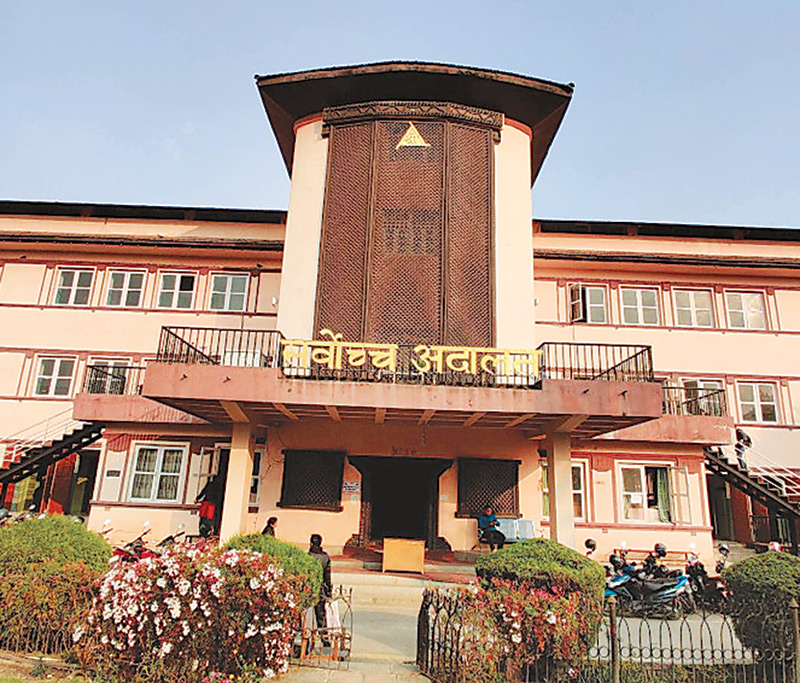
Post File Photo
KATHMANDU, After Prime Minister Pushpa Kamal Dahal said he will form a special high-level mechanism to investigate the assets of those in power since 1990, legal experts say a similar mechanism is necessary to bring reforms in the judiciary. Some of them say the effort should be made by the chief justice himself as the government cannot do so, as that could be a breach of the notion of separation of power. As Nepal’s judiciary has seen several upheavals in the recent past, legal experts and observers alike suggest that political parties and state take the initiative to restore the sanctity of one of the most important state organs. “The judiciary has gone through various stages of anarchy due to repeated political interference,” said Gauri Bahadur Karki, former chair of the Special Court. “Now the government should take the initiative to form a powerful high-level mechanism through a full court to ensure necessary reforms. Implementation of its recommendations could instil hope among the people and restore trust in the judiciary.” Claiming that ‘over-politicisation’ had crippled state organs, the new government led by Dahal formed with the support of the CPN-UML and the Rastriya Swatantra Party in its common minimum programme (CMP) unveiled in January had promised a high-level commission to bring structural change and reforms in the judiciary to ensure quick and fair justice. However, the CMP unveiled after the prime minister joined hands with the Nepali Congress omitted the issue of the high-level commission. Some other legal experts, however, said that though such a commission or mechanism is essential to cleanse the judiciary, which is gradually losing the public trust, the government cannot form such a mechanism as that would be a breach of the constitution. The statute’s Article 136 has clearly stated that the Chief Justice shall have the ultimate responsibility to make effective the administration of justice by the Supreme Court, subordinate courts, specialised courts or other judicial institutions. “If the government formed the commission, that would breach the notion of separation of power,” said Balaram KC, a former justice of the Supreme Court. “I agree there is an urgent need for such a mechanism to address the existing problems, but that initiation can be taken by the Chief Justice alone.” KC said the government can help the Chief Justice in this effort. Even if the government’s intent was noble, he added, the ruling leaders failed to recognise the constitutional provisions on the separation of power. “The hangover of forming ‘royal commissions’ [during the time of the king’s rule] is still there, and therefore the government didn’t bother to read the constitution,” KC told the Post. With rampant political manoeuvrings in the appointment of justices, there have been concerns that major decisions of national importance could be influenced. Therefore, observers are in favour of changing the existing system of appointing justices and setting up an independent body free of political influence for the purpose. In 2017, a group of newly appointed judges visited the CPN-UML headquarters in Balkhu to “express their gratitude” to politicians. The way justices were being appointed at the Supreme Court based on political parties’ recommendations had many wondering if the top court was losing its credentials, but the judiciary has managed to recover to some extent lately, says senior advocate Chandra Kanta Gyawali. “We all know how Cholendra Shumsher Rana asked for his share in the Cabinet,” said Karki, former chair of the Special Court. “What can we expect from such a judiciary?” Karki said political leaders are often afraid of reforming the judiciary fearing that could go against them. He said a small panel led by either the incumbent justice or former justice of the Supreme Court can be formed through the full bench. Some senior advocates have also pointed out the need for such a mechanism to be formed by the full court, but that is yet to materialise. “The acting chief justice has not even implemented his own report. What more can we expect?” said senior advocate Gyawali. “The full court can decide to form a commission and ask the government for the necessary budget.” As per the recommendations of acting Chief Justice Hari Krishna Karki-led panel’s report, the Supreme Court has adopted a lottery system for case management, but has failed to introduce an automated system despite Karki himself being elevated to the top of the judiciary.
HOME PAGE
Church Boys United cap fairytale run with ‘A’ Division League crown
They won the ‘C’ Division title in their first attempt in 2021 and the ‘B’ Division League the following year.
- DIL KUMAR ALE MAGAR
KATHMANDU, Church Boys United (CBU) wrote one of the most extraordinary tales in the history of Nepali domestic football on Tuesday as they clinched the Martyrs Memorial ‘A’ Division League title to become the only second team to win ‘C’, ‘B’ and ‘A’ divisions in consecutive seasons after Manang Marshyangdi Club. CBU played a goalless stalemate with Three Star Club at the Dasharath Stadium and that was enough to hand coach Bal Gopal Maharjan’s side the historic prize with a match in hand. They have 45 points from 12 wins, nine draws and four defeats. Eight time champions Manang had achieved a similar feat when they won the trophy in their first appearance in the league in 1986. The outcome meant that Machhindra Club—who still have two games remaining—will not be able to overtake CBU, who now have a six-point lead and boast a better head-to-head record against Kishor Kumar KC’s men. But the dark side of CBU’s storied season is their ineligibility to take part in the 2023-24 AFC Cup preliminary round one in the capacity of domestic league champions as they are yet to obtain AFC Club licence which is mandatory for participation in the AFC tournaments. “We came to learn during the middle-part of the league that we would not be eligible to play the AFC Preliminary Cup even if we win the trophy. It feels bad because we have worked really hard for this success,” said CBU forward and Nepal international Anjan Bista, who has scored seven times for his side this season. CBU’s disqualification means Machhindra—who surrendered the title race to CBU after losing 2-1 to Nepal Police Club on Sunday—are the favourites for the AFC spot. Machhindra have 39 points from 24 matches. Third-placed Police are also in the race. Police recovered from a one-goal deficit to play a 1-1 draw against Tribhuvan Army Club at the ANFA Complex after Ahmad Hijazi’s 39th-minute strike cancelled out Dinesh Henjan’s second-minute lead for Army. The result moved Police one place up to the third spot with 38 points, while Army are seventh with 31 points. “Machhindra are likely to qualify for the AFC Cup preliminary round. Whoever progresses to the Preliminary Cup, they will be representing Nepal and I wish them all the best.” Bista added. Still, it is a fitting climax to the Balkumari-based side who, after getting promoted to the premier division, signed the likes of the country’s top footballers in Anjan, Ananta Tamang and Arik Bista. The new champions started their season perfectly under coach Pradip Humagain, winning three games in a row. But after four consecutive draws, American citizen Humagain left the club due to issues with work permit. And the appointment of Maharjan, one of Nepal’s most successful coaches, was a perfect choice. “I am elated to win the league. The credit goes to each and every member of the team including players, management and all others involved. Teamwork, hard effort of the players and their zeal were instrumental in our success,” said Maharjan, who also won his first ‘A’ Division League trophy as a coach. The former Three Star and Manang coach Maharjan had won the league in 2004 as a player with Three Star. “The combination of discipline, tactical and technical aspects, understanding between overseas and domestic players, motivation factor and sound management helped us get to this height,” said Maharjan. “It was really challenging to win the league played in the home and away format [double leg]. To win the trophy with a match in hand is really exciting, and all credit goes to our teamwork.” Following their qualification in the ‘C’ Division League in 2019, CBU have never looked back. They won the ‘C’ Division title in their first attempt in 2021 and ‘B’ Division League the following year. Now, they have established themselves as a new powerhouse in domestic football.
Relegation scrap With the champions crowned four days before the conclusion of the league, the attention will now turn to the relegation battle with around half of the sides in the 14-team contest in danger of falling into the second-tier competition. For three-time champions Three Star, the draw is a hammer blow to their hopes of saving the season. Their winless run has now stretched to 14 matches and they now risk being relegated to the ‘B’ Division for the first time in the club’s history. Three Star have 29 points from 25 matches—two points above the drop zone, meaning, they must beat Jawalakhel Youth Club in their last match and pray for other results to go in their favour to have any chance of survival. Jawalakhel—who fell off the title battle after losing to CBU 3-0 on Saturday despite flapping their wings inside the top two for most of the season—lost 1-0 against Satdobato Youth Club in the day’s late fixture at the Dasharath Stadium after Sardorbek Matmuratov’s 74th-minute strike proved decisive. The win secured Satdobato’s stay in the premier division league with 35 points. Other newcomers Khumaltar Youth Club survived to fight another day after they defeated Armed Police Force Club 3-1. Messouke Oloumou scored twice in the first half and Stephane Binong bundled in the third six minutes after the restart that moved Khumaltar one position up to 13th with 27 points. Sanish Shrestha scored the consolation goal for APF in the third minute of the second half stoppage time. Friends sit at the bottom of the 14-team standings with 26 points but have played a game less. Friends play Sankata on Wednesday.
HOME PAGE
Local governments seek male participation to enhance safe motherhood initiatives
The awareness campaign targeting pregnant women, new mothers and would-be fathers is mostly conducted at the initiation of female elected representatives.
- Amrita Anmol
Shutterstock
BUTWAL, “Dear Papa, My mother’s womb is my home; I get nourishment from what she eats. If she is hungry, I am hungry. Please provide mum with nutritious food so that I too can grow healthy. After my birth, weigh me regularly and immunise me. I am the future of the nation and if I am healthy, I can grow up to contribute to the country. Please read this letter aloud to my grandfather and grandmother as well. With love, Your future and dreams.” The Gulmi Durbar Rural Municipality in Gulmi sent a letter to this effect to all would-be fathers in the local unit with the objective to have fathers play a bigger role in the well-being of their pregnant wives and unborn children. Women, once they conceive, are expected to take the entire responsibility of caring for their children while in the womb and after birth. The local unit is working to dispel this long-held practice, especially in rural areas by having not just the fathers but also other male members of the family to actively participate in the child-rearing process right from the pre-natal stage. As part of the campaign, a team of people’s representatives, health workers and female community health volunteers visit the homes of pregnant women and hand over the letter to the expectant father. If the father is away, the letter is dispatched to where he is. The letter aims to educate the father about his duty to care for his expecting wife, provide her with nutritious food, take her for regular health check-ups during pregnancy and after delivery and fully immunise the newborn. The rural municipality started the awareness campaign at the start of the current fiscal year. After identifying a pregnant woman’s residence, elected representatives of the local unit put up a green flex board at the house. On their visit, they congratulate the woman on her new beginning as a mother. The health workers then inform the expecting mother about the importance of regular health check-ups with at least eight mandatory visits to the health centre since conception. They encourage the women to go for institutional birth; give them lessons on how to take care of themselves and their newborn, among other vital information.
Gulmi Durbar Rural Municipality has paid visits to at least 173 expecting parents and their families since the start of the campaign. It has also arranged for ambulance services for pregnant women free of cost. The local unit provides 36 eggs to pregnant women during pregnancy and 30 more during the postpartum period. Post delivery, the female community health volunteers conduct 60 mandatory visits to the new mother and her newborn until the child turns two. “We have launched the campaign with the objective to ensure safe motherhood. This is an attempt to create an atmosphere of responsibility towards expecting mothers and new mothers to safeguard the rights of mothers and their newborn,” said Tara Thapa Dhenga, the vice-chairperson of Gulmi Durbar Rural Municipality. The awareness campaign targeting pregnant women, new mothers and would-be fathers is mostly conducted at the initiation of female elected representatives in several local units across the country. Barekot Rural Municipality in Jajarkot in Karnali province also initiated a similar campaign some three years ago wherein the local unit dispatches “awareness” letters to expectant fathers underlining the core message of safe motherhood . “The rural municipality launched the ‘Vice-chairperson with Pregnant Woman Programme’ to promote safe motherhood and institutional birth rate. The carers of pregnant women are frequently counselled for the safe future of children,” said Mahendra Bahadur Shah, former chairman of Barekot Rural Municipality. According to him, the institutional birth delivery rate has jumped to 81 percent from 50 percent over the past three years in Barekot. Gandaki Rural Municipality of Gorkha in Bagmati province started providing Rs4,200 to each pregnant woman as a nutrition allowance from this fiscal year. Several local units have launched similar programmes to provide support to pregnant women and postpartum mothers. The federal government provides allowances to pregnant women who undergo safe delivery at health institutions. Women in the mountainous, hilly and Tarai regions are provided Rs3,000, Rs2,000 and Rs1,000 respectively. Additionally, a cash bonus of Rs800 is provided to mothers who complete all four antenatal checkups. “Most of the local units started providing additional allowances and other benefits to pregnant women. Women from poor economic backgrounds have benefited from the programme,” said Laxmi Pandey, chairperson of the National Federation of Rural Municipalities. She reiterates that it is the basic right of each woman to get safe motherhood and reproductive health services in the country. Article 38 of the constitution of Nepal affirms that every woman shall have rights to safe motherhood and reproductive health. Safe Motherhood and Reproductive Rights Act 2018 was enacted to make health services safe, qualitative and accessible for safe motherhood. The maternal mortality rate is gradually decreasing apparently due to effective safe motherhood programmes launched at the local level. As per the national census carried out in 2011, the maternal mortality rate was 239 per 100,000 live births. It was reduced to 151 in the latest national census of 2021. Experts, however, argue that the maternal mortality rate is still high in the country. The government is committed to achieving the UN’s Sustainable Development Goals (SDGs). The health target under the SDGs is to reduce the maternal mortality rate to 75 for every 100,000 births by 2030. People working in the reproductive and maternal health sector say to achieve further improvement in reproductive health, and maternal and infant mortality rates, it is important to change the perspective of how reproductive health is still perceived in Nepal in that the responsibility of giving birth to a healthy baby should not fall only on the mother. Sabin Shrestha, executive director of the Forum for Woman, Law and Development, stressed the need for enhancing the roles of men to improve the overall quality of reproductive health in Nepal. “Reproductive health should not be viewed only as a woman’s issue. Every member of the family should participate in taking care of the mother and her baby,” said Shrestha.
NATIONAL
Maoist Centre withdraws support to UML-led Koshi Province government
Minister for Physical Infrastructure Development Durga Prasad Chapagain and Minister for Tourism, Forest and Environment Jeevan Acharya tendered their resignations to the chief minister Tuesday.
- DEO NARAYAN SAH
MORANG, Two CPN (Maoist Centre) ministers in Koshi Province resigned from their posts on Tuesday, following the party’s decision to withdraw its support to Chief Minister Hikmat Kumar Karki. Minister for Physical Infrastructure Development Durga Prasad Chapagain and Minister for Tourism, Forest and Environment Jeevan Acharya tendered their resignations to the chief minister. Chapagain and Acharya were appointed as the provincial ministers on January 9. Earlier on Tuesday, the meeting of the Maoist’s parliamentary party decided to pull out of the Koshi government and recall the party’s ministers. With the decision, the provincial government led by CPN-UML leader Karki has fallen into minority. Article 188 (2) of the Constitution of Nepal states that in case the political party the chief minister represents is divided or a political party in a coalition provincial government withdraws support, the chief minister shall table a resolution in the provincial assembly for a vote of confidence within 30 days. In the 93-member provincial assembly in Koshi, the UML has 40 seats, the Nepali Congress 29, the Maoist Centre 13 including the Speaker, the Rastriya Prajatantra Party (RPP) 6, the CPN (Unified Socialist) 4, and the Janata Samajbadi Party (JSP) one seat. The UML-led government has only the support of the RPP. On May 31, the JSP pulled out of the Koshi government and also withdrew its support to the chief minister. Nirmala Limbu, the party’s sole representative in the provincial assembly, was the health minister in the provincial government. The Nepali Congress-led central coalition has been mulling ways to form a new government in Koshi based on the power equation in Kathmandu. However, it is not easy to form a new government by a Congress-led coalition in Koshi Province, according to constitutional experts. Both the Congress-led bloc and the UML-RPP alliance have 46 seats each, adding to the difficulty of crafting a ruling coalition. What further complicates the matter is that the UML is the largest party in the province and a Speaker can cast his/her vote only when there are equal votes for and against a motion. Along with the political uncertainty triggered by the changed power equation, the province is also marked by political unrest. Some ethnic groups have been staging protests, demanding the name of the province be changed based on the identity of the major ethnic communities in the region. Province 1 was named ‘Koshi’ on March 1. Since then, protests have intensified with hundreds getting injured in clashes, and there is no sign of a let up in protests against the nomenclature. Instead, activists advocating for an identity-based name have intensified their agitation. Kirat Yakthung Chumlung, Kirat Rai Yayokkha and the Nepal Federation of Indigenous Nationalities have been coordinating protests organised by the Province 1 Renaming Joint Struggle Committee.
NATIONAL
Bodies of two missing CTEVT officials found
- RAJ KUMAR KARKI
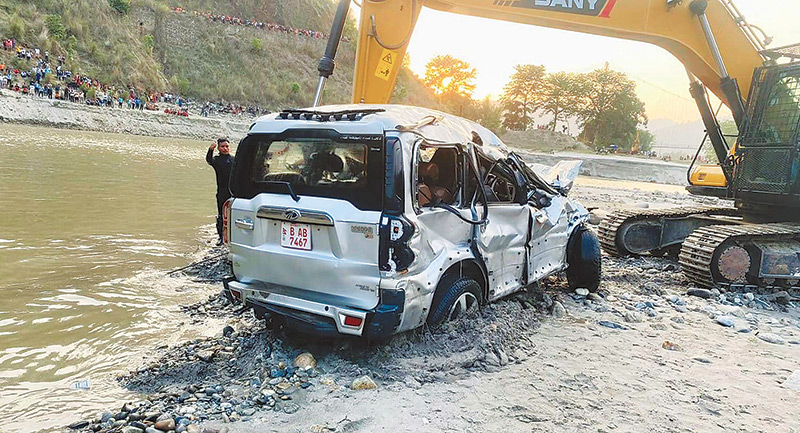
Rescuers also recovered the Mahindra Scorpio jeep from the Sunkoshi River on Tuesday. Post Photo
SINDHULI, The bodies of two officials of the Council for Technical Education and Vocational Training (CTEVT) and the jeep that were missing in the Sunkoshi River following a road accident on Friday have been recovered on Tuesday. Superintendent of Police Rajkumar Silwal of the District Police Office, Sindhuli said that a jeep and a dead body were found on the bank of the river about 200 metres downstream from the incident site. Silwal informed that divers from the Nepal Disaster Management Training School, Kurintar of the Armed Police Force under the command of Inspector Subas Thapa pulled out the vehicle and the bodies from the river at around 6:15pm on Tuesday evening. Police said that the bodies are yet to be identified. The car and the bodies were found after the flow of the river was diverted to reduce the water level. The CTEVT office jeep was heading to Khotang from Bhaktapur when the accident occurred at Laukun of Galjor Rural Municipality along the Khurkot-Ghurmi road section of the Mid-Hill Highway on Friday afternoon. Director of administration branch of CTEVT Krishna KC, 57, of Bhanu Municipality in Tanahun district, Director at the Planning Division Yam Prasad Bhurtel, 56, of Pragati-7 of East Nawalparasi, and Bhanu Paudel, 32, an electrical technician from Ilam, had gone missing following the accident. The driver of the jeep, Krishna Chaudhary, of Dang, had managed to escape the incident by jumping out of the vehicle’s window.
NATIONAL
Nepal for disarmament of WMDs, says upper house chair Timilsina
District Digest
KATHMANDU: National Assembly Chairman Ganesh Prasad Timilsina on Tuesday said Nepal is in favour of disarmament of all types of weapons of mass destruction (WMDs). “Disarmament of all types of weapons has remained an important aspect of Nepal’s foreign policy,” said Timilsina during a courtesy call paid by Robert Floyd, executive secretary of the Comprehensive Nuclear-Test-Ban Treaty Organisation. “Nepal is against the arms race and will continue to advocate for the time-bound and complete disarmament of all types of weapons of mass destruction. It also expresses solidarity with international efforts.” Timilsina said the Parliament will enter the process for ratification of the Comprehensive Nuclear-Test-Ban Treaty if the government presents the treaty after the budget endorsement. He added Nepal is encouraged by the significant number of countries that have signed and ratified the treaty. Floyd stated that many countries in West Africa and Southeast Asia have ratified the treaty and expressed his confidence that Nepal will follow suit.
NATIONAL
Couple found dead in West Nawalparasi
District Digest
WEST NAWALPARASI: A couple was found dead in West Nawalparasi on Tuesday. Fifty-year-old Tilakram Vediyar and his wife, Nirmala Vediyar, were found dead in Majuwa of Pratappur Rural Municipality-8, said Deputy Superintendent of Police Bhoj Raj Pandey, spokesperson of the District Police Office. The bodies were recovered from near the couple’s buffalo shed with wounds from a sharp object, police said.
NATIONAL
Five, including two teenagers, arrested for attempted rape of minors
District Digest
DANG: Police have arrested five people including two minors for allegedly attempting to rape two minor girls in Dang. According to the police, two minors, both aged 16, Dilshan Ahmad, 18, of Gadhwa Rural Municipality-6, Suhail Khan, 20, of Gadhwa-5, and 30-year-old Jadib Ali Nau, a permanent resident of Maithawa in Shivaraj Municipality who currently lives in Gadhwa Rural Municipality-6, have been arrested on charge of attempting to rape two girls aged 12 and 14. DSP Rajan Kumar Gautam, the spokesperson at the District Police Office, said that the arrests were made after a complaint was filed against the accused on May 28. Gautam said that the girls were taken to a room of one of the boys at Lamahi Municipality-5, where they attempted to rape them. Gautam informed that the District Court has extended the custody of the arrestees for five days and investigations into the matter are underway.
NATIONAL
Mahat denies involvement of any unauthorised person in the budget making process
Prakash Sharan Mahat had succeeded Bishnu Poudel, UML vice-chair, as the finance minister.
- Post Report
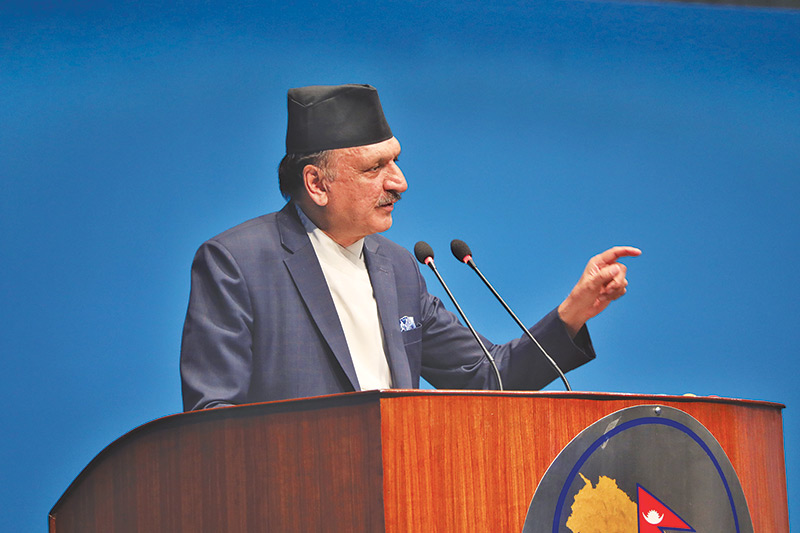
Finance Minister Prakash Sharan Mahat answers questions raised by lawmakers in Parliament on Tuesday. RSS
KATHMANDU, Disputes between the ruling and opposition parties over whether an unauthorised person was allowed in the budget making process disrupted the parliamentary proceedings on Tuesday. The House of Representatives was supposed to start theoretical discussions on the national budget at 11 am. The meeting couldn’t commence on time after the CPN-UML, Rastriya Swatantra Party and Rastriya Prajatantra Party decided not to allow the House to function until the finance minister clarified the matter and a parliamentary probe committee was formed. Following hours of discussions among the parties, the house commenced at around 2 pm on the condition that Minister for Finance Prakash Sharan Mahat will clarify the matter. Before Mahat presented his clarification, lawmakers of the UML and the Swatantra Party asked why a retired finance ministry staff member was involved in the budget making process. Giving a reference that 1,100 electric vehicles were imported just a few days before the budget day, they also asked who leaked the tax rates. Mahat told the House that there was no external influence in the budget making process. He said only the finance minister and officials authorised by the law were involved in the budget making process. “There is a law to guide those who are involved in finalising the budget. I say with authority that no additional persons were present while finalising the budget, including tax rates,” said Mahat. Ram Krishna Shrestha, a retired finance ministry worker, was employed just for uploading data and budget typing. Mahat said his predecessor had hired Shrestha, who has knowledge of harmonised codes, as an expert. “His responsibility was to type the budget and enter the harmonised code. He has been doing the job for decades and is regarded as a competent person with high integrity,” said Mahat. Mahat had succeeded Bishnu Poudel, a UML vice-chair, as the finance minister. Addressing the House, Mahat also clarified that the tax rates for electric vehicles with the capacity below 100 watts were increased to harmonise with the ones with higher power. “I cannot say why hundreds of electric vehicles were imported close to the budget day. However, I can assure this House that the tax rates were not leaked,” he added. Presenting its views after Mahat’s clarification, the main opposition said it was not fully convinced as there are instances of import just before the budget presentation of some of the goods whose tax rates were hiked. “Yet, we give the benefit of doubt to the government,” said UML Chairman KP Sharma Oli, who is also the leader of the opposition. Oli, however, blamed the government for discouraging the agriculture sector and claimed that the government’s aim of a six percent economic growth in the next year was impossible to meet. The UML and other opposition parties had demanded a parliamentary committee to investigate the involvement of the unauthorised person. However, they gave up their demands after Mahat agreed to clarify the matter in the House. This is not the first time that the government has been accused of allowing unauthorised persons in budget making and revising the tax rates at the behest of some business houses. A parliamentary probe committee was formed to investigate whether then-finance minister Janardan Sharma allowed unauthorised persons in the budget making process. The committee later gave a clean chit to Sharma.
NATIONAL
Congress may hold its policy convention in September
Dissidents have big hopes from the gathering, but the party establishment is unfazed.
- Post Report
KATHMANDU, If everything goes as per the plan, Nepali Congress is all set to hold its policy convention in mid-September. The convention has been due since December, 2021 when the party concluded its 14th general convention. Citing the Covid pandemic, the general convention only elected new party leadership and deferred policy discussion. Now, according to the party’s one of the general secretaries, Gagan Thapa, they are planning to hold the policy convention by mid-September. “It should have been held much earlier,” said Thapa, adding, “we are going to take some important decisions to revamp the party.” With the emergence and rise of new political parties like the Rastriya Swatantra Party, the grand old party is feeling the heat as lots of Nepali Congress cadres at the grassroots have started leaving the party and joining others. Thapa who is vocal and critical of the party leadership, particularly of the party president Sher Bahadur Deuba, has been advocating for revamping the party and wants to replace the leadership. To replace the party leadership, at least 25 percent of the party’s elected delegates should ask the party’s central working committee to call a special convention of the party. Besides regular convention, a special convention can replace the party leadership with majority votes. Nepali Congress has over 4,500 elected delegates, who elect the party’s leadership. Besides Thapa, there is another section of party leaders that is currently interacting with party cadres across the country to gauge the mood of the grassroots. Although the section is close to senior party leader Shekhar Koirala and Thapa, the two have not joined the campaign. Gururaj Ghimire, one of the leaders involved in the campaign who is currently in Surkhet, told the Post that there is widespread disenchantment at the grassroots with the Congress leadership. “Policy convention is not a remedy for what is going on with the party leadership and the disillusionment among grassroots cadres,” said Ghimire, “Over eighty percent of cadres want a change in leadership.” “We are about to complete the first round of our nationwide campaign, and so far we have found strong calls for a change in leadership and reforms. The party is currently facing both external and internal challenges. In order to keep our voter base intact, we need to plan something big,” said Ghimire. As per the Nepali Congress charter, the policy convention should have been organised within six months of the general convention, but it has already been more than a year since the general convention. According to leaders who have been pressing the party to organise the policy convention, they expect the party to make its position clear on its ideology and policies including economic and foreign through the convention. Deuba, who is leading the country’s grand old party for the second term, has been facing growing challenges from within the party this time. Despite lack of numbers, party vice president Dhanaraj Gurung, general secretaries duo Thapa and Bishwa Prakash Shamra, among others, have been questioning the competence of the party leadership especially in the wake of the party’s poor show in last year’s general elections as well as the recent by-elections in which Congress lost its traditional bastions to the new Rastriya Swatantra Party. Thapa said that the party should call its Mahasamiti meeting as per the party charter which will turn into a policy convention. As per the party charter, the Nepali Congress should call the meeting of the party’s highest policy-making body, the Mahasamiti, every year. Deuba, meanwhile, has failed to fill vacant office bearer positions in the party’s sister organizations and various departments, among others. The Koirala-Thapa camp has been repeatedly attacking the party chief over the issue. Recently Deuba criticized the party leaders who have been asking him to take an early retirement. “Only criticizing the party leadership does not make the party strong,” Deuba said at a function in Lalitpur, “I ask them to connect with the people. Go and get connected with the general public.” Meanwhile, Congress publicity department chief Min Bishwakarma, who is close to Deuba, said the upcoming central working committee of the party will decide about the policy convention. “The policy convention won’t make a big difference in the party, but some changes will be made in the party’s charter, said Bishwakarma, adding, “It is not easy to oust the party leadership.”
NATIONAL
As KMC jumps into action, schools rush to provide scholarship details
The provision, if implemented strictly, would benefit nearly 15,000 students from 515 schools.
- ANUP OJHA
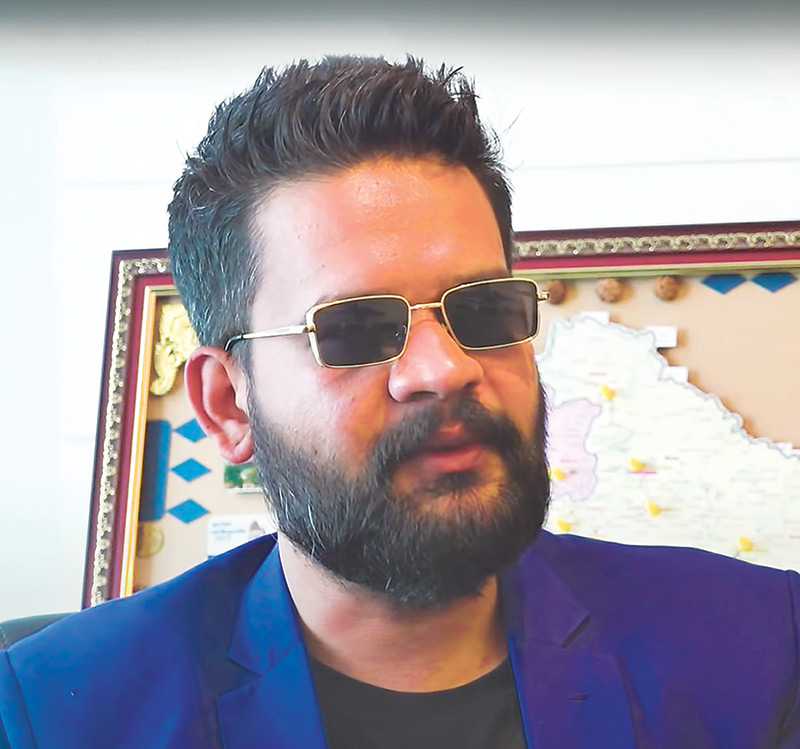
Mayor Balendra Shah. Post File Photo
KATHMANDU, JUNE 6 The Kathmandu Metropolitan City on Tuesday morning published the names of 342 private schools within the metropolis that failed to provide details of the scholarships they have given to students up to grade 10. This is the second time the City published a notice regarding the scholarships. Earlier, on May 24, it had published a notice seeking details. However, out of 515 schools within the metropolis, 342 had not submitted the name list as of Tuesday morning. According to Moti Khanal of the education department of the KMC, around 149,000 children are currently studying in private schools within the city. Nearly 15,000 students can benefit from the scholarship scheme. As the schools didn’t abide by its directive, the City office published the notice naming them. Kathmandu Mayor Balendra Shah subsequently posted the long list of schools on his social media platforms. Afterwards, the defaulting schools started to respond because the City had warned of scrapping the permits granted to the schools based on the Education Management Regulation-2018. As a result, as many as 208 schools submitted their scholarship details through email by Tuesday afternoon. They informed the KMC that they have been providing scholarships for poor and needy students. Educationists, guardians’ associations and other stakeholders have welcomed Mayor Shah’s action but are doubtful of school administrators providing scholarships to genuinely needy students. “This is a good initiative from the KMC. All the 753 local units should seek the information and monitor it strictly,” said Suprabhat Bhandari, chair of the Nepal Guardian Federation. “But we have found that the school administrations provide scholarships to those who have a political link. The KMC should strictly monitor those malpractices as well.” It’s not only KMC’s Education Management Regulation but Rule 151 of Education Rules 2002 also requires schools to provide scholarships to at least five percent of the total students including girls, children from poor backgrounds, those living with disability and members of oppressed groups. “In more than two decades, even these rules have not been implemented,” Bhandari said. “We can’t be assured of the KMC decision’s implementation without strict monitoring.” Rule 58 of Chapter 10 of the KMC’s Education Management Regulation 2074 (2018) published in the local gazette states that schools should provide scholarships to 10 percent of the students, mainly to those who are from poor economic backgrounds, disabled, from a marginalised community, insurgency victims, and children of martyrs. Fifty percent of the scholarships should go to women. Also, Rule 59 of the regulation states that all schools should make public the age, names, and parents’ names of the students who are given scholarships on their website and the list should also be sent to the Kathmandu Metropolitan City. “If you look closely, none of the poor or marginalised students has got the scholarships as mentioned in the law,” said educationist Binay Kumar Kushiyait. “The KMC should make its monitoring mechanism strong.” He expressed concern over the possibility of private school organisations pressuring the KMC against implementing the decisions. “It’s yet to be seen if the City can break the monopoly of organisations under which the schools are grouped, or the City may even get threats from them,” said Kushiyait. DK Dhungana, chair of the Private and Boarding Schools Organisation Nepal (PABSON), however, ruled out the possibility of his organisation pressuring the KMC. “We will help the KMC in its initiative,” Dhungana told the Post. As many as 180 schools within the City are associated with PABSON. “We didn’t know about the KMC’s notice earlier,” Dhungana said. “But I have instructed all the schools under PABSON to provide the details of scholarships to the City office.” As there are questions and doubts over how the KMC would check the lists provided by the schools, Sita Ram Koirala, chief of the Education Department of the metropolis, said his office has already formed a team to examine the scholarships to see if they meet the criteria. Koirala said the city has made a five-member taskforce that comprises the chair of the ward where the school is located, principal of the school, representative of the guardians’ association, municipal official and a representative of school management committee. However, the City still appears unclear about the procedure for choosing the recipients of scholarships.
OPINION
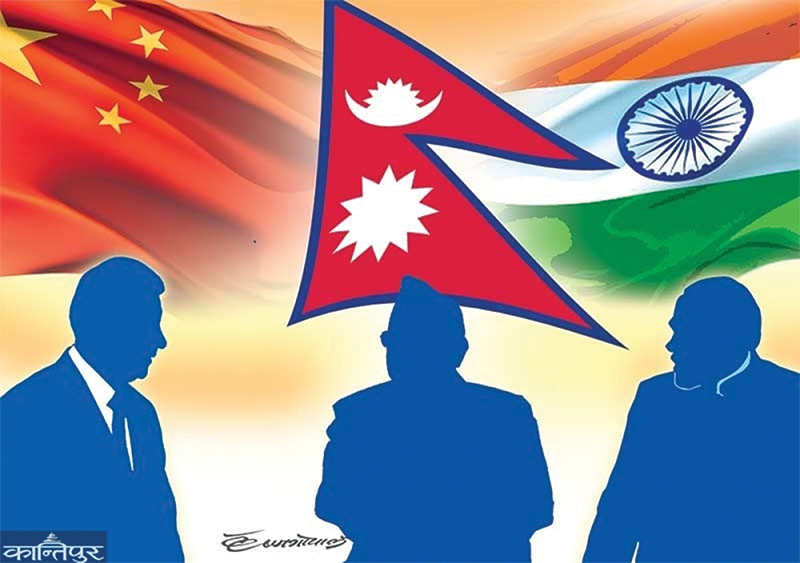
A circuitous route to Beijing
Many strategists in New Delhi often choose to ignore that China is an integral part of South Asia.
- CK LAL
Post illustration
Prime Minister Pushpa Kamal Dahal has come back from New Delhi with a bagful of assurances. In tangible terms, he has nothing to show for his long-awaited trip other than a herd of 15 Murrah bulls for seeding better quality water buffaloes. In a way, it is just as well since the divergence of priorities between Nepal and India hasn’t narrowed enough for settlement of longstanding issues on the basis of mutual give and take. Just as in life, there is no such thing as a free lunch in bilateral negotiations. Prime Minister Dahal lacked the political capital, personal will or public support back home to commit anything substantial in order to elicit a commensurate response from his hosts. He had to grab what was on offer without asking too many questions. Routine agreements such as the ones for the construction of a fertiliser plant in Nepal, laying a second intra-country petroleum pipeline, conclusion of a revised trade and transit agreement and announcement of a few joint hydropower projects could have easily been done at the level of the concerned authorities of the two countries. Even the much-touted power trading agreement or the use of Indian territory for electricity export to Bangladesh didn’t require a summit meeting between two heads of government. The roots of anti-Indian sentiments run deep among a section of Nepalis. A Hindu Nepal against Muslim Muglan was one of the foundational principles of the Gorkhali Chieftain. Once the East India Company started recruiting mercenaries, it found it convenient to cultivate the feeling of superiority among the so-called martial races to rally their gullible warriors against the more populous, peaceful and prosperous principalities of the Ganga plains. After World War II, Nepal became a loyal ally of the United States without formally being a partner in any alliance while Indians gravitated towards the Soviets. Propagandists of the West covertly fuelled the anti-Indian attitude of the established and aspiring elite in Kathmandu to strengthen their stranglehold over public opinion in a strategically located country. The resentment against Nepal in the corridors of power in New Delhi goes even deeper. From the early 1980s to throughout the noughties, almost every official interlocutor in or from the Indian capital that this columnist interacted with voiced the same grouse: “What we consider as favours to a friendly country is interpreted as entitlement in Kathmandu.” At least two former foreign secretaries—MK Rasgotra of the early 1980s and Shyam Saran in the mid-noughties—echoed Prime Minister Indira Gandhi in their complaint: “The ruling elite of Nepal are untrustworthy.”
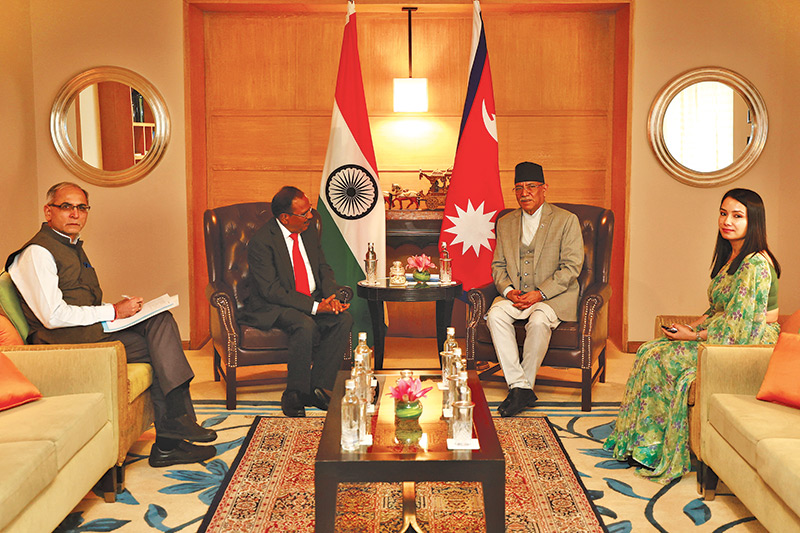
Dissonant discourse Invocations of Rudraksha-based or Ramayan-circuit civilisational ties, incantations of wide people-to-people connections and the clichéd chant of “Roti, Beti and Roji-Roti” relationships are all very well. However, what really matters for now is an open acceptance of fundamental divergence over political priorities between two asymmetrical powers that happen to be geographically close, culturally intimate but aspirationally far apart. Irrespective of their political persuasions, the ruling elite of Nepal considers the treaty of 1950 to be a document of humiliation that was forced upon an enfeebled ruler of Ranarchy just before its fall. For geopolitical strategists in New Delhi, the foundational document of “special relationship” is sacred and emphasis has to be placed upon better connectivity through the HIT (highways, info-ways and trans-ways) formula to further bind the political economies of the two countries. Deep-seated insecurities of the ruling elite in the two capital cities are equally responsible for the erratic relationship that has seen several ups and downs between the high points of 1951 and 1990 to the low end of 2020 when a constitutional amendment formalised an area under Indian control to be the sovereign territory of Nepal. Forget the political and administrative elite, even the bourgeoisie in New Delhi refuse to realise that their well-meaning embrace is often interpreted as a suffocating and patronising gesture in most neighbouring countries. Prime Minister Narendra Modi is extremely fond of hugging foreign dignitaries and appeared to be positively elated when Papua New Guinea’s Prime Minister James Marape touched his feet. Such a gesture of showing respect will be considered a social and electoral hara-kiri for any politico of Nepal. Premier Dahal perhaps knew that his obligatory pilgrimage to the Indian capital was merely a traditional ritual to sanctify the atmosphere for his more important trip to Beijing. As such, members of the ministerial team that landed in New Delhi had no clue about their roles and responsibilities. Only his daughter was present when Premier Dahal had his definitive meeting with the decisive duo of the Indian diplomatic establishment—National Security Adviser Ajit Doval and Foreign Secretary Vinay Mohan Kwatra. Everything after that crucial meeting, including the one-on-one between the two prime ministers, was meant for optics.
Middle Kingdom Many strategists in New Delhi often choose to ignore that China is an integral part of South Asia. China shares land borders with five out of the eight member countries of the dormant South Asian Association for Regional Cooperation (SAARC)—Afghanistan, Pakistan (through the contested territory of Kashmir), India, Nepal and Bhutan. Other than India and Bhutan, it has had friendly relations with all South Asian countries including the Maldives, Sri Lanka, Bangladesh and Myanmar. In comparison to the Middle Kingdom, India has had strained relations at some point in time with all its proximate neighbours. It has fought wars with China and Pakistan, intervened militarily in the Maldives and Sri Lanka, squabbled with Bangladesh over supposed “infiltration” and applied coercive tools of economic diplomacy over Bhutan and Nepal. It is natural for the political elite of South Asia to look towards Beijing whenever they feel that they have been given short shrift by New Delhi. That has prompted China to contemplate its own alternatives to SAARC and Bay of Bengal Initiative for Multi-Sectoral Technical and Economic Cooperation (BIMSTEC) without India in it. For Sino-Indian interactions, there are other frameworks such as the BRICS grouping, the Asian Infrastructure Investment Bank (AIB) and the Shanghai Cooperation Organisation (SCO) among various other forums. After bombing Afghanistan to the stone age, the US left the country at the mercy of the Taliban, their ruthless associates of the Soviet era. In addition to providing substantial humanitarian assistance, the Chinese are contemplating to extend the $60 billion China-Pakistan Economic Corridor (CPEC) to Afghanistan. Beijing already has its toes in the Arabian Sea through the Gwadar seaport, a foothold in the Indian Ocean through Hambantota international port and is about to dip its fingers in the Bay of Bengal through the Kyaukphyu deep seaport in Myanmar. There are numerous reasons for advocating closer ties between Kathmandu and Beijing, but the long and short of it is that the neighbouring superpower is a juggernaut of political economy that either one climbs or on be ready to be left behind in the emerging global order of the 21st century. Preparations for Premier Dahal’s expedition to Beijing, however, require special precautions and more hard work. Somewhat like estranged cousins, Indians quickly get angry over minor issues and then forget and forgive just as fast. The imperial and impassive strategists of Beijing just show indifference towards peripheral states to express their disapproval. Premier Dahal needs to begin preliminary preparations for his China visit irrespective of its proposed date.
OPINION
All is not well
Genuine grievances continue to haunt Nepal-India ties, but our institutional lapses must be fixed first.
- ANURAG ACHARYA
Prime Minister Office, Nepal via REUTERS
The moment Prime Minister Pushpa Kamal Dahal stood in front of cameras alongside Indian Prime Minister Narendra Modi at New Delhi’s Hyderabad House, there were indications that the two leaders may have had a difficult conversation. While Modi managed to shrug off the tensions by making a statement laden with his usual poetic analogies, Dahal’s expressions and body language gave a lot away. We may not know exactly what transpired between the two leaders during this visit, besides what the official statement says. But all is definitely not well between the two governments.
The fallout When Narendra Modi came to power in 2014, Nepal-India ties were already strained due to New Delhi’s active interest in Nepal’s constitution drafting process. India’s role in mediating the 12-point understanding between the then CPN-Maoists and seven political parties, which paved the way for the peace process in Nepal, emboldened South Block and the Indian mission in Kathmandu to assume a more vocal role. To be fair, the sensitivity of the open borders justified India’s concerns regarding the genuine grievances and interests of the Madhesis and the Tharus, despite the fact that New Delhi’s closest ties were forged with those inside Kathmandu’s corridors of power. However, the exhausting and complicated domestic bargains involving several political parties, Madhesi Morcha, Tharuhat activists, and the cross-party Janajati caucus, among others, meant that Modi’s predecessor Manmohan Singh or his senior cabinet members did not have the political appetite to engage on a day-to-day basis. As a result, there was bureaucratic meddling instead of genuine diplomatic engagement from India. And the change of administration under Narendra Modi simply provided continuity to that arrangement. Interestingly, among the voices in Nepal who have pointed at Indian meddling, the loudest were of those who have historically wielded state powers and privileges, and benefitted from politically disempowering Madhesis, Janajatis and Tharus. There are people within various political parties, the media, civil society, security institutions and bureaucracy who have taken such a hardline. It is as much due to them, as it is due to India’s failed Nepal policy, that there has been a rise in “anti-India” sentiments across Nepali society. And this has had an unfortunate bearing on efforts from both sides to normalise relations. The fact that the Indian side is still sulking over KP Sharma Oli’s misadventures and remains suspicious of Pushpa Kamal Dahal was quite obvious in the lack of warmth the Nepali delegation (including the media) felt in New Delhi last week. For too long, our politicians and diplomats have tried to give the impression that they are best buddies with their Indian counterparts. They are not. And the sooner we acknowledge this, the quicker we as a nation can start thinking about how we plan to reset this relationship on our end. Let them worry about what they wish to do on their side.
No reset button There is obviously no reset button to troubleshoot a plethora of issues that have shrouded bilateral ties. So, instead of trying to achieve everything, prioritising what we can take up during future bilateral exchanges makes more sense. For instance, complex and contested issues like border claims and the Eminent Persons Group report that encompass long-term agendas and require closer engagements at the top level must not be rushed when the level of trust between the two sides isn’t quite high. It is easier for chest-thumping nationalists to demand “tougher negotiation” from our visiting delegation, but they forget that there has to be a willingness on the other side to engage on those issues. One of the reasons why our delegation falls short on its delivery is due to a lack of pre-agreement with the host government(s) on the agenda of discussion. It is not what we wish for, but what our mutual interests with the host government(s) allow for, that should drive our bilateral initiatives. Deeper physical connectivity and cooperation on energy with the neighbourhood, for example, is an agenda both Nepal and India seem to be prioritising in their foreign policies. Even during Dahal’s visit, the Indian side was more willing to discuss prospects of increasing energy trade, building bridges and oil pipelines, extending railway lines and easing electronic payment system between the two countries. These issues are equally crucial for Nepal, and there is no reason why we should not be happy prioritising them. On energy, the Indian prime minister has publicly spoken about facilitating electricity trade between Nepal and Bangladesh. The prospects of this happening was not bright even a few years ago, according to our domestic experts. Let us then acknowledge that we have made progress. Although, we have to gradually negotiate with the Indian side and argue against unfeasible conditions they have set with regards to selecting the projects they want to import power from. It is up to both sides to create a conducive environment where they can negotiate on more contested issues, including those pertaining to disputed borders and past treaties. Creating a mutual incentive to engage on these issues is integral to that process.
The next step Most countries that have successfully maintained their international relations have functioning institutions and well-articulated foreign policies that guide external engagements and negotiations. In our case, we have neither built trustworthy institutions, nor have we been able to domestically agree on the tenets of our foreign policy especially vis-à-vis our close neighbours and development partners. As a result, a degree of ad hoc-ism drives the foreign policy of every new government that takes over at Singha Durbar. It is amazing that having worked as a foreign policy observer for over a decade now, I do not recall being consulted by a single government before it visits abroad or hosts a foreign delegation. I have regularly interacted with peers from my generation, and they have similar disappointment. It is as if our government or the parliamentary committee that advises the government on international affairs has little appetite for research or informed expertise. The results were once again visible in the lack of preparations and presentation in New Delhi. Finally, if we have to get over the present ad hoc mentality and instill a functioning system that guides our foreign policy thinking, we also have to improve our public and media discourse. The way the Millennium Challenge Corporation saga unfolded in the Nepali media, the way we continue to discuss our border disputes with India, and the way we react domestically to international developments, show we must institutionalise our domestic discourse and ground it on informed analyses and not on political ranting. This will not only help counter disinformation, but also make public discourse more robust and, hopefully, restore trust in our institutions and processes.
Acharya is director at Policy Entrepreneurs Inc, which conducts policy research on governance, aid and foreign policy.
OUR VIEW
Got the guts?
RSP lawmakers have a chance to set a sterling precedent by rejecting CDF funds for its lawmakers.
That the Local Infrastructure Development Partnership Programme, infamously known as the Constituency Development Fund, is nothing but an agent of inefficiency and corruption needs no explanation today. From the Auditor General’s report to the admissions of a few responsible lawmakers, everyone who has a sense understands its futility. If there is only one ground that still wants the controversial programme to continue, it is the greedy lawmakers and their foot soldiers who want to misuse the fund. Financial corruption is only one of the myriad problems the programme brings. It allows for a haphazard allocation of funds for infrastructure development, now known across the country as bulldozer bikas. Spent by the lawmakers at their whim, the funds help build roads that lead nowhere and bridges that do not withstand torrents. And yet, Finance Minister Prakash Sharan Mahat chose to bring from the dead a sorely unnecessary programme that punches a hole in the state coffers in these financially desperate times. While Mahat’s Nepali Congress and other major political parties have failed to oppose the programme that undercuts the idea of financial prudence, the Rastriya Swatantra Party has been an outlier in this issue. The novice party, which made the fight against corruption one of its main electoral agendas and hit the right chord with the people, has rightly moved a resolution motion in the Parliament Secretariat to scrap the controversial programme. The biggest statement the party can make in this regard, though, is that its lawmakers will forthrightly reject the Rs50 million each that they would get to spend on the projects of their choice. Doing so will prove that the party is not opposing the programme for public consumption but is seriously concerned about righting what is sorely wrong. As of now, senior RSP officials have failed to specify whether the party’s lawmakers will unanimously decide to reject the fund if their resolution in Parliament does not get through. The directly elected lawmakers who, in their electoral speeches, made tall claims about bringing development to their constituencies would find themselves hard-pressed to advocate scrapping the fund, as they have promises to keep. But if the RSP does take a strong principled stand, it not only stands to win the hearts of the people but also claim the moral high ground in contemporary Nepali politics, often characterised by the betrayal of the people’s mandate. Other political parties will then be under pressure to reject the fund too. After all, the forceful entry of the RSP into Nepali politics from the November general elections has made it clear that undermining people’s concerns is not an option anymore. The most important thing that the RSP must do, though, is to establish that the programme has no relevance in contemporary Nepal. Started in 1994 with a sum of Rs250,000 per constituency under a monarchical, unitary political system, the programme has now become irrelevant, as it has become financially unviable in federal Nepal. What is outrageous is that provincial levels, which came into existence as decentralised alternatives to the centre, have now emulated the wrongdoings of the centre itself. At a time when local development has already been established as the prerogative of the local level, the idea of providing funds to lawmakers is not just an affront to the idea of federalism but also technically wrong, as it leads to haphazard and unplanned development. Moreover, although there is no constitutional ambiguity about the role of lawmakers, they have often presented themselves as agents of development. Lawmakers should focus on making laws rather than manufacturing lies about their public roles. Over to Rabi Lamichhane and company then.
THEIR VIEW
Populist budget?
The upcoming budget will be more a test of the govt’s resolve to restructure the economy.
There couldn’t have been more challenging times than the present ones for preparing the national budget. The uncertainties related to elections and foreign funding required to cover the massive external account financing gap of about $25bn during the next financial year, amid deepening domestic political crises and unfavourable global economic circumstances, mean that our fiscal authorities would be budgeting this year on hope rather than tangibles. Add to that the strong compulsion the PML-N-led government must be feeling to appease voters as the monthly price inflation hits another record high of 38pc days before Budget 2024, and it becomes obvious that the present rulers really have their work cut out for them before the next general polls. It will not be surprising if the Shehbaz Sharif dispensation decides to give a ‘populist’ budget, including a large fiscal stimulus in the shape of development allocations to recoup some of its lost political capital. But this will be disastrous for an economy on the brink of default. The government has already choked the economy to avoid a default as foreign funding dries up thanks to slumping relations with the IMF. A populist—or what Finance Minister Ishaq Dar has described as a “welfare-oriented, pro-investment and business-friendly”—budget will be fraught with the risk of Pakistan being pushed deeper into economic depression and away from multilateral and bilateral lenders. With the country confronting stagflation—marked by flattening economic growth, soaring unemployment and spiking inflation—there has never been a more compelling case for a budget that focuses on fiscal, governance and structural reforms for longer-term economic recovery and sustainability. Pakistan needs foreign financing, including loan rollovers, of more than $77bn to meet its external debt payments over the next three years. That will not be possible without the IMF on board. A fiscally irresponsible budget can make a new deal with the Fund even more difficult. Domestic revenue resources also remain scarce—they are insufficient to cover debt-servicing costs, let alone finance development, defence, salaries, pensions, etc. That makes the proposed fiscal stimulus and ‘relief’ to the common man, aimed at wooing back voters, impractical unless the government is prepared to throw all caution to the wind and resort to drastically increasing domestic borrowing and accumulating more debt, bringing greater misery to the public. The upcoming budget will be more a test of the government’s resolve to stay the course and restructure the economy to steer it through uncertain conditions rather than provide temporary relief to people and businesses for short-term political gains. Sadly, the indications so far are that the government is more likely to follow the fiscally imprudent path rather than follow through with the reforms it has promised its lenders to ensure longer-term economic stability.
— Dawn (Pakistan)/ANN
MONEY
Demand for Nepali tea rises to fill India’s output gap
Indian tea estates are going through a lean period as the tea bushes there have reached the end of their life cycles, traders say.
- PARBAT PORTEL
Nepal produces about 26,379 tonnes of green tea leaves annually and exports nearly half of it. Post File Photo
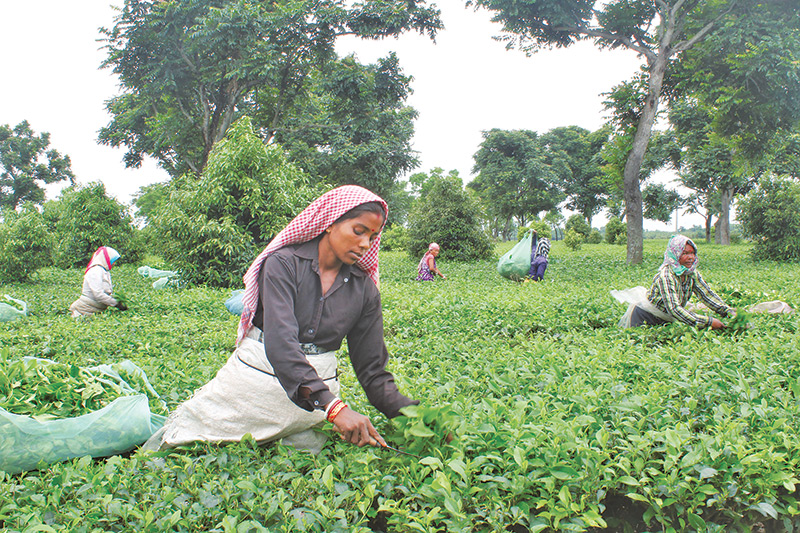
JHAPA, Demand for Nepali tea is rising in the Indian market as production has slipped across the border. Nepali tea traders say Indian tea estates are going through a lean period as the tea bushes there have reached the end of their life cycles. Most of the plants are 80 years old, and some are more than 100 years old. As these bushes have been uprooted, the acreage and output have dropped sharply, they say. Udaya Chapagain is executive director of Gorkha Tea Estate in Ilam which exports Nepali orthodox tea to Europe and the United States. He says there is massive demand for tea in India, and Nepali tea growers should make good use of the opportunity. India is the second largest tea producer in the world after China. Indian teas like Assam, Darjeeling and Nilgiri teas are valued for their strong flavour and intense aroma, and are considered to have the finest flavours in the world. India is the fourth largest exporter of tea and accounts for 12 percent of global shipments. Kenya (28 percent), China (19 percent) and Sri Lanka (14 percent) are first, second and third, in that order. India’s tea exports were valued at $704.36 million in the fiscal year 2020-21. “India is the second largest producer of tea but its tea market today is being kept up by Nepali tea,” said Chapagain. Last October, India lifted an 11-month-old ban on blending Darjeeling tea with other teas, raising the spirits of the Nepali tea industry which greatly depends on exports to the southern neighbour. Indian tea producers can now mix Nepali tea with their products, but they are not permitted to use the name “Darjeeling” on the mixture. The Indian directive to restrict foreign teas proved to be counterproductive as domestic buyers such as Tata Consumers Products largely remained absent in auctions to procure Darjeeling tea which is blended in their popular Tata Gold pack, according to media reports. Nepal produces about 26,379 tonnes of green tea leaves annually and exports nearly half of it. According to the Department of Customs, Nepal exported 14,784 tonnes of tea worth Rs3.34 billion in the first 10 months of the current fiscal year ended mid-May. Of the total shipments, India accounted for 14,449 tonnes valued at Rs2.99 billion. As per official statistics, nearly 98 percent of the tea produced in Nepal is exported to the Indian market. There is great demand for both types--crush, tear, curl (CTC) and orthodox. Several reports showed that some Indian tea producers in Darjeeling are bringing green leaves from estates across the border in Nepal and selling them as Darjeeling tea, thereby jeopardising the geographical indication value of Darjeeling tea. Russia, Germany and the US are the largest markets for Nepali tea after India. “There is high demand for orthodox tea in Europe. If we can match shipments with demand, it will help Nepal to boost its foreign currency reserve,” said Buddha Tamang, a tea entrepreneur from Ilam. India exports 70 percent of its tea. An Indian tea entrepreneur said that tea imported from Nepal was sustaining its internal market. Most of the tea produced in India is grown in the states of West Bengal, Assam, Sikkim, Nagaland, Himachal Pradesh, Tripura and Arunachal Pradesh. “Although tea is produced in more than 10 states in India, Indian traders nowadays prefer to import Nepali tea,” said an Indian trader. “This is because of the quality and low price.” Recently, according to Indian media reports, tea production in India has declined as a result of climate change, labour problems, low productivity and low profitability. “When tea production in India declines, demand for Nepali tea soars,” said Aditya Parajuli, a tea entrepreneur from Bhadrapur. “Demand for Nepali tea jumped in India during the Covid-19 pandemic when Indian production fell,” he said. This year too Nepal is likely to set a record in tea exports in terms of value because of the drop in production in India. Anshuman Kanoria, president of the Indian Tea Exporters Association, says demand for Darjeeling tea in Europe has dropped by about 15 percent. Germany, the largest importer of Indian tea, is going through a recession. The export of Indian tea to Japan has also decreased. According to the Indian Tea Exporters Association, India exported more than 3,000 tonnes of tea last year. The production of Darjeeling tea has been gradually declining, the association said. In 2016, output came to about 8,000 tonnes. Kanoria said disruptions caused by the Gorkhaland movement in 2017 hurt the tea sector. He says there is no initiative from the government to promote Darjeeling tea in the global market. There are more than 70 tea gardens in Darjeeling. Nepal grows two types of tea: Camellia assamica or CTC tea which grows at lower altitudes and in the hot and humid plains of Nepal, primarily in Jhapa district. This tea accounts for almost 95 percent of domestic consumption owing to its lower cost of production. Camellia sinensis or orthodox tea is grown at altitudes of 900 to 2,100 metres. Four districts in the eastern hills are known for producing quality orthodox tea—Ilam, Panchthar, Dhankuta and Tehrathum. Orthodox refers to a traditional production process where the plucked tea leaf is partially dried (withered), rolled and then fermented to give a light colour, unique aroma and fruity flavour. It usually fetches a higher price than CTC tea in view of its quality, demand in the market and higher cost of production. Nepal has a long history of growing tea. The first tea estate, Ilam Tea Estate, was launched in 1863 in the hills of Ilam district.
MONEY
Sri Lanka to reduce drug prices by 16 percent as crisis eases, minister says
- REUTERS
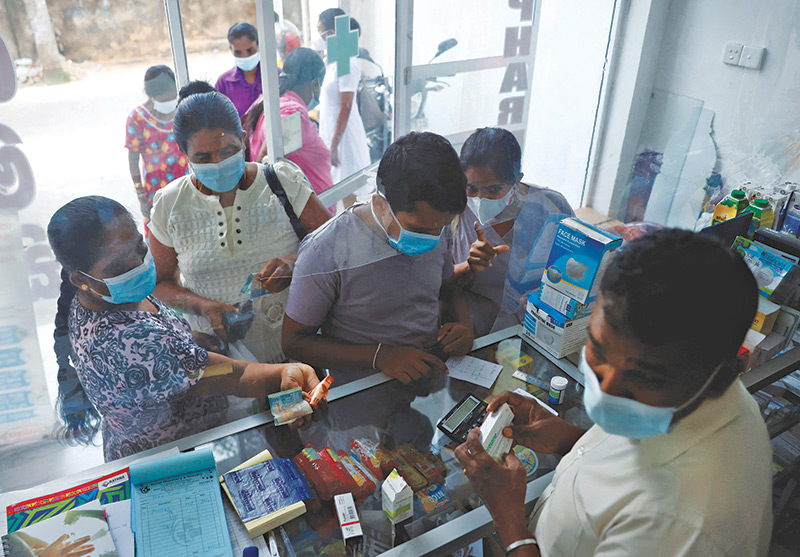
Customers stand in line to buy medicine at a pharmacy in Colombo on August 16, 2022. REUTERS
COLOMBO, Sri Lanka will slash the price of 60 essential drugs by 16 percent from June 15, the Health Minister said on Tuesday, as the country sees a glimmer of relief from its worst financial crisis in decades. The island off India’s Southern coast plunged into crisis last year as its foreign exchange reserves ran out, food and energy prices spiralled and protesting mobs forced the ouster of the country’s then president. But its fortunes have improved over the last nine months as Sri Lanka secured a $2.9 billion bailout from the International Monetary Fund (IMF), moderated its once soaring inflation and embarked on rebuilding foreign exchange reserves. The rupee has appreciated about 24 percent this year, allowing the government to reduce the price of 60 essential medicines, including those used to treat diabetes, heart disease and high blood pressure, Health Minister Keheliya Rambukwella said. “During the height of the crisis we had to raise prices. There was no choice. Some drug prices were increased by 97 percent. There were shortages of important drugs but now the currency has appreciated so we are passing that benefit onto consumers,” he told reporters at the weekly Cabinet briefing. Sri Lanka’s healthcare costs moderated to 27.3 percent in May from 35.4 percent in April but remained slightly higher than overall headline inflation of 25.2 percent last month, government data showed. Helped by a stronger currency, Sri Lanka will also begin rolling back import restrictions on 300-400 items from this week, as per a statement from the finance ministry which gave no further details. The island introduced import bans on multiple items including vehicles, cosmetics and alcohol in March 2020 but has gradually eased them since last year. The IMF expects Sri Lanka’s economy to shrink by around 3 percent this year after a 7.8 percent contraction last year.
MONEY
Asian refiners to cut July Saudi oil imports
- REUTERS
A file photo shows a fisherman rowing his dinghy past oil refineries near port terminals in Singapore. REUTERS
SINGAPORE, Asian refiners are likely to take less oil from Saudi Arabia for July and buy more spot cargoes such as those from the United Arab Emirates after the world’s top exporter unexpectedly raised prices and pledged to cut output, traders said on Tuesday. Saudi Arabia raised the July official selling price (OSP) of its flagship crude Arab Light to Asian buyers to a six-month high, a day after unilaterally volunteering to cut output by a further 1 million barrels per day (bpd) in July at the OPEC+ meeting on Sunday. Saudi’s output would drop to 9 million bpd in July from around 10 million bpd in May, the biggest reduction in years. By contrast, the United Arab Emirates was allowed to raise output targets by around 200,000 bpd to 3.22 million bpd, keeping supplies from Abu Dhabi National Oil Co (ADNOC) ample in Asia. The switch in supplies could boost spot prices and improve demand for grades such as ADNOC’s flagship Murban and Upper Zakum crude which make up the bulk of the emirate’s exports, traders said. Saudi Aramco has set the OSP for flagship Arab Light crude $2 a barrel higher than the Dubai benchmark, a trader with a North Asian refiner said, defying expectations of price cuts. The price for Saudi’s Arab Extra Light crude is about $1 a barrel higher than the OSP for similar quality Murban, the trader said. Asian buyers are likely to reduce the volume of Arab Medium crude and also possibly Arab Light when nominating July-loading supplies, traders said, which would be in line with Saudi Aramco’s pledge to deepen its production cuts. Higher prices for Saudi crude, which accounts for more than a fifth of Asia’s imports, could further dent refining margins for Asian oil processors. Profits at a typical Singapore refinery processing Dubai crude averaged $4.78 a barrel in May, less than half of the $10.42 a barrel in January.
MONEY
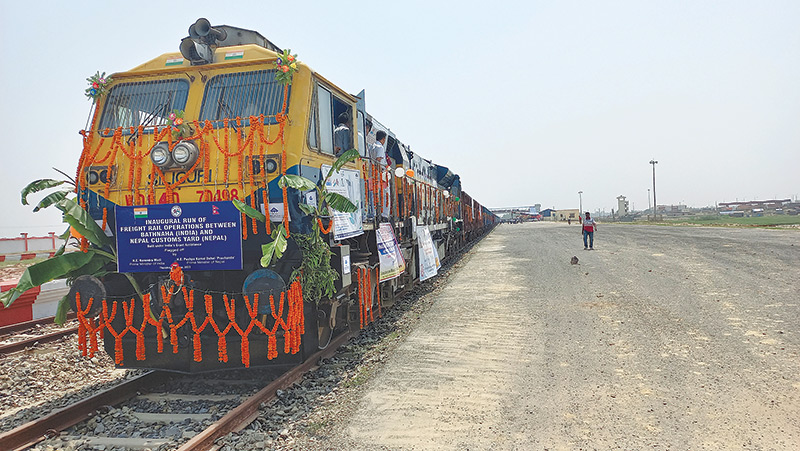
Bathnaha-Biratnagar freight train cheers traders
The train operations would decrease the cost of production and boost manufacturing in the region, traders say.
- BINOD BHANDARI
The railway service came into operation last Thursday. Post File Photo
BIRATNAGAR, The arrival of a cargo train in the Biratnagar customs yard has brought cheer among the industrialists of the Sunsari-Morang industrial corridor. The locals said the industrialists, who had abandoned their industries citing higher transportation costs, are likely to come back given the train connectivity to Biratnagar, one of the key trade routes between Nepal and India. Rakesh Surana, president of the Chamber of Industries, Morang, said that the operation of the railway will significantly reduce the cost of production and lower the end user price for the customer too. “This would boost industrial activities in the region if the government gives continuity to the railway operations,” added Surana. According to Surana, the cost of transporting goods from Kolkata to Biratnagar in container trucks is INR3 per kg. However, the cost to bring in the same goods from Kolkata by railway would cost INR1.95 per kg. The railway service covering an eight-kilometre distance from Bathnaha in India to Biratnagar in Nepal came into operation last Thursday. Around 500 industries of small and large scale are in operation in the Sunsari-Morang industrial corridor. “In addition to the decrease in transportation costs, the railway operations will also decrease the cost charged by shipping liner companies. As well, there will be reduced hassles at the Kolkata port as the shipping containers will be available at Biratnagar customs yard for exports,” said Nabin Rijal, president of Morang Merchants Association. With the operation of the cargo rail, the traders of Biratnagar will no longer have to bring in goods via Birgunj customs as they will have direct access to Visakhapatnam port in south India as well. However, the customs yards lack the material holding equipment which might be problematic for loading and unloading the goods transported by rail, said Rijal. Daily, around 4,500 tonnes of goods in more than 300 container trucks come into Nepal from Kolkata and other Indian cities through the Biratnagar customs point. Of the total imports, around 80 percent is from India while the rest is from third countries. With the cargo rail coming into operation, 60 percent of the imports from India and 100 percent of the goods from the third countries will come via rail, the traders said. Chuda Mani Bhattarai, executive director of the Chamber of Industries Morang, said that according to a study by the chamber, the rail operations would save around Rs6.048 million, daily, in transportation costs for the industries in Biratnagar. Officials are also hopeful of an uptick in government revenue after the start of the operation of cargo rail. Gyanendra Dhakal, chief of the Biratnagar customs office, said, “The volume of transactions via this customs point will increase after the operation of the railway. It’s economical and time-saving as compared to other customs, hence, an increase in the revenue.” The Biratnagar Customs had set a target of collecting Rs60.03 billion of revenues in the current fiscal year. However, it had only been able to collect 56.02 percent of the target by the end of May.
MONEY
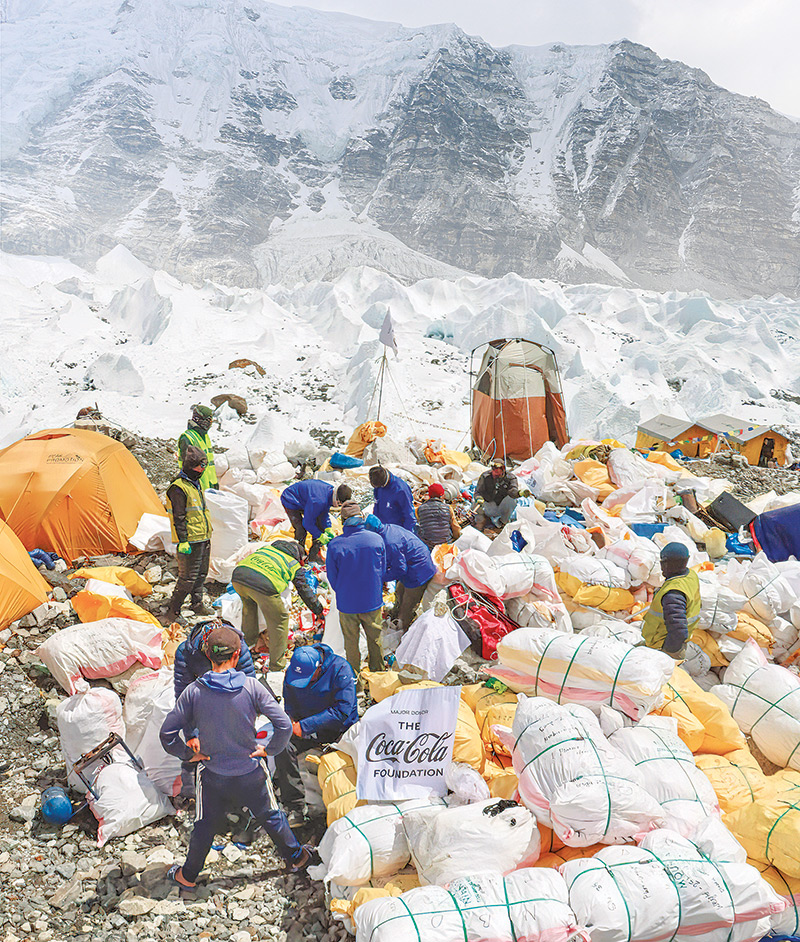
Mountain clean-up campaign concludes successfully
Bizline
KATHMANDU: The fourth edition of the Mountain Clean-Up Campaign 2023, led by the Nepali Army in collaboration with various government institutions and donor organisations, recently concluded successfully. Building on the previous year’s achievement of collecting over 33 tons of waste, this year’s campaign surpassed expectations with a collective determination to bring down 35 tons of waste from the mountains. The campaign, which commenced on March 28, had focused on cleaning up four mountains—Everest, Lhotse, Annapurna and Baruntse. A team of 97 members, including personnel from the Nepali Army and Sherpa supporters, had undertaken the task. The team collected 35,708 kg of waste, which was transported to Kathmandu. The waste would undergo thorough verification and be handed over to the recycling partner Creasion for segregation, recycling and proper management.
MONEY
EU agrees economic weapon in face of China trade spat
Bizline
BRUSSELS: The European Union on Tuesday agreed to create a trade tool aimed at punishing countries that seek to put pressure on one of its member countries, after China targeted Lithuania. The new weapon would allow the 27-nation bloc to impose tariffs, restrict investment and limit access to public contracts for nations seen as engaging in economic blackmail. “This sends a strong signal that the EU rejects all forms of economic coercion,” said EU economy commissioner Valdis Dombrovskis. “We’ll be more assertive in defending our legitimate rights and interests.” The push to bulk up the EU’s economic muscle was given impetus by a row with China over trade restrictions imposed on EU member Lithuania after it strengthened ties with Taiwan, which Beijing claims as its territory. The EU has started action against leading trade partner China at the World Trade Organization over the restrictions. Beijing has denied taking coercive measures. The new instrument was agreed between EU member states and lawmakers after a year of negotiation. It is now expected to enter into force later this year after it is formally approved by the parliament and 27 EU countries. “It is one more tool at the service of our strategy for a less naive European trade,” said France’s trade minister Olivier Becht. (AFP)
WORLD
Collapse of major dam in southern Ukraine triggers emergency as Moscow and Kyiv blame each other
The damage could hinder Ukraine’s counteroffensive in south and distract its government, while Russia depends on the dam to supply water to Crimea.
- ASSOCIATED PRESS
This satellite image provided by Maxar Technologies shows an overview ofthe Kakhovka dam in southern Ukraine on Monday. Ukraine on Tuesday accused Russian forces of blowing up the major dam and hydroelectric power station in a part of southern Ukraine they control, threatening a massive flood that could displace hundreds of thousands of people. AP/RSS
KYIV, The wall of a major dam in southern Ukraine collapsed on Tuesday, triggering floods, endangering Europe’s largest nuclear power plant and threatening drinking water supplies as both sides in the war scrambled to evacuate residents and blamed each other for the destruction. Ukraine accused Russian forces of blowing up the Kakhovka dam and hydroelectric power station on the Dnieper River in an area that Moscow controls, while Russian officials blamed Ukrainian bombardment in the contested area. It was not possible to verify the claims. The potentially far-reaching environmental and social consequences of the disaster quickly became clear as homes, streets and businesses flooded downstream and emergency crews began evacuations; officials raced to check cooling systems at the Zaporizhzhia Nuclear Power Plant; and authorities expressed concern about supplies of drinking water to the south in Crimea, which Russia illegally annexed in 2014. Both Russian and Ukrainian authorities brought in trains and buses for residents. About 22,000 people live in areas at risk of flooding in Russian-controlled areas, while 16,000 live in the most critical zone in Ukrainian-held territory, according to official tallies. Neither side reported any deaths or injuries. The dam break added a stunning new dimension to Russia’s war in Ukraine, now in its 16th month. Ukrainian forces were widely seen to be moving forward with a long-anticipated counteroffensive in patches along more than 1,000 kilometres of front line in the east and south. It was not immediately clear whether either side benefits from the damage to the dam, since both Russian-controlled and Ukrainian-held lands are at risk. The damage could also hinder Ukraine’s counteroffensive in the south and distract its government, while Russia depends on the dam to supply water to Crimea. Although Kyiv officials claimed Russia blew up the dam to hinder the counteroffensive, observers note that crossing the broad Dnieper would be extremely challenging for the Ukrainian military. Other sectors of the front line are more likely avenues of attack, analysts say. Even so, Nigel Gould-Davies, a senior fellow for Russia and Eurasia at the International Institute for Strategic Studies, said the alleged Russian destruction of the dam “betrays a lack of confidence, a lack of confidence, a profoundly defensive measure, the lack of confidence in Russia’s longer-term prospects” in the war. Experts have previously said the dam was in disrepair, which could also have led to the breach. David Helms, a retired American scientist who has monitored the reservoir since the start of the war, said in an email that it wasn’t clear if the damage was deliberate or simple neglect from Russian forces occupying the facility. But Helms also noted a Russian history of attacking dams. Authorities, experts and residents have expressed concern for months about water flows through—and over—the Kakhovka dam. After heavy rains and snow melt last month, water levels rose beyond normal levels, flooding nearby villages. Satellite images showed water washing over damaged sluice gates. Amid official outrage, Ukrainian President Volodymyr Zelenskyy said he convened an urgent meeting of the National Security Council. He alleged Russian forces set off a blast inside the dam structure at 2:50 am (2350 GMT Monday) and said about 80 settlements were in danger. Zelenskyy said in October his government had information that Russia had mined the dam and power plant. But Kremlin spokesman Dmitry Peskov called it “a deliberate act of sabotage by the Ukrainian side … aimed at cutting water supplies to Crimea.” Both sides warned of a looming environmental disaster. Ukraine’s Presidential Office said some 150 metric tons of oil escaped from the dam machinery and that another 300 metric tons could still leak out. Andriy Yermak, the head of Ukraine’s President’s Office, posted a video showing swans swimming near an administrative building in the flooded streets of Russian-occupied Nova Kakhovka, a city in the Kherson region where some 45,000 people lived before the war. Other footage he posted showed flood waters reaching the second floor of the building. Ukraine’s Interior Ministry urged residents of 10 villages on the Dnieper’s right bank and parts of the city of Kherson downriver to gather essential documents and pets, turn off appliances, and leave, while cautioning against possible disinformation. The Russian-installed mayor of occupied Nova Kakhovka, Vladimir Leontyev, said it was being evacuated as water poured into the city. Ukraine’s nuclear operator Energoatom said via Telegram that the damage to the dam “could have negative consequences” for the Zaporizhzhia Nuclear Power Plant, which is Europe’s biggest, but wrote that for now the situation is “controllable.” The UN’s International Atomic Energy Agency said there was “no immediate risk to the safety of the plant,” which requires water for its cooling system. It said that IAEA staff on site have been told the dam level is falling by 5 centimetres (2 inches) an hour. At that rate, the supply from the reservoir should last a few days, it said. The plant also has alternative sources of water, including a large cooling pond that can provide water “for some months,” the statement said. Ukrainian authorities have previously warned that the dam’s failure could unleash 18 million cubic metres of water and flood Kherson and dozens of other areas where thousands of people live. The World Data Center for Geoinformatics and Sustainable Development, a Ukrainian nongovernmental organisation, estimated that nearly 100 villages and towns would be flooded. It also reckoned that the water level would start dropping only after five-seven days. A total collapse in the dam would wash away much of the broad river’s left bank, according to the Ukraine War Environmental Consequences Working Group, an organisation of environmental activists and experts documenting the war’s environmental effects.
WORLD
Khartoum islanders ‘under siege’ as Sudan fighting rages
- AGENCE FRANCE-PRESSE
KHARTOUM, Battles raged in Sudan’s war-torn capital of Khartoum on Tuesday, witnesses said, and the residents of an island in the Nile reported being “under siege” amid desperate shortages. Eight weeks of fighting have pitted army chief Abdel Fattah al-Burhan against his former deputy Mohamed Hamdan Daglo, who commands the powerful paramilitary Rapid Support Forces (RSF). A number of broken ceasefires have offered brief lulls but no respite for residents of the city, where witnesses again reported “the sound of heavy artillery fire” in northern Khartoum. Witnesses also said there were “clashes with various types of weapons” in south Khartoum, where “the sound of explosions shook our walls”. In the city centre, at the confluence of the White Nile and Blue Nile rivers, the island of Tuti is “under total seige” by RSF forces, resident Mohammed Youssef told AFP. Paramilitaries have blocked the only bridge to the island and prevented residents from going by boat to other parts of the capital. “We can’t move anyone who’s sick to hospitals off the island,” Youssef said. “If this continues for days, stores will run out of food.” Since the fighting began on April 15, more than 1,800 people have been killed, according to the Armed Conflict Location and Event Data Project. The United Nations says that more than a million and a half people have been displaced, both within the country and across its borders. For those still in Khartoum and the western region of Darfur—which together have seen the worst of the fighting—the situation is growing increasingly dire. “We face a massive humanitarian crisis that is only going to get worse with the collapse of the economy, collapse of the health care system,” the International Federation of Red Cross and Red Crescent Societies (IFRC) warned on Tuesday. The danger will increase with “the flood season fast approaching and the looming hunger crisis and disease outbreaks that now are becoming more inevitable”. Sudan’s annual rainy season begins in June, and medics have repeatedly warned that it threatens to make parts of country inaccessible, raising the risks of malaria, cholera and water-borne diseases. Some 25 million people—more than half the population—are now in need of aid and protection, according to the UN. More than 425,000 people have fled to other countries—more than 100,000 west to Chad and 170,000 north to Egypt. “There’s an urgent need for a massive injection of funds” to support those fleeing the violence, according to the IFRC. The UN has also appealed for financing, as the fighting shows no signs of abating.
WORLD
UNESCO hails $2.9-bn Australian plan to protect Great Barrier Reef
- AGENCE FRANCE-PRESSE
PARIS, UN’s cultural agency UNESCO welcomed on Tuesday commitments from Australia to protect the Great Barrier Reef, with the government pledging 4.4 billion Australian dollars ($2.9 billion) to safeguard the natural wonder. The fate of the reef has been a recurrent source of tension between UNESCO and Australian authorities in recent years, with the UN agency threatening to put the world’s largest coral system on a list of “in danger” global heritage sites. Behind-the-scenes diplomacy from Australia has averted such a move while fresh commitments from the government of Anthony Albanese drew praise from the organisation on Tuesday. “UNESCO welcomes Australia’s decision to implement urgent new measures to safeguard the Great Barrier Reef recommended by UNESCO,” UNESCO said in a statement sent to AFP. Australian Minister Tanya Plibersek announced on Monday that gillnets—vertical nets that can be up to kilometre long—are to be phased out by 2027 in a bid to conserve fish populations and prevent the deaths of turtles and dolphins. In a letter sent to UNESCO chief Audrey Azoulay last week, Plibersek also pledged “combined investment of 4.4 billion Australian dollars” ($2.9 billion) from the state Queensland and federal governments to protect the reef. “Our governments are pleased to further commit substantial actions to secure the future of the Reef,” Plibersek wrote on May 25. Albanese’s government, which ended nearly a decade of rule in May last year, has implemented a series of ambitious policies to protect the environment and commit Australia to more demanding climate change targets.
WORLD
Iran unveils a hypersonic missile able to beat air defences amid row with US
- ASSOCIATED PRESS
DUBAI, Iran claimed on Tuesday that it had created a hypersonic missile capable of travelling at 15 times the speed of sound, adding a new weapon to its arsenal as tensions remain high with the United States over Tehran’s nuclear programme. The new missile—called Fattah, or “Conqueror” in Farsi—was unveiled even as Iran said it would reopen its diplomatic posts on Tuesday in Saudi Arabia after reaching a détente with Riyadh following years of conflict. The tightly choreographed segment on Iranian state television apparently sought to show that Tehran’s hard-line government can still deploy arms against its enemies across much of the Middle East. “Today we feel that the deterrent power has been formed,” Iranian President Ebrahim Raisi said at the event. “This power is an anchor of lasting security and peace for the regional countries.” Gen Amir Ali Hajizadeh, the head of the paramilitary Revolutionary Guard’s aerospace programme, unveiled what appeared to be a model of the missile. Hajizadeh claimed the missile had a range of up to 1,400 kilometres. That’s about mid-range for Iran’s expansive ballistic missile arsenal, which the Guard has built up over the years as Western sanctions largely prevent it from accessing advanced weaponry. “There exists no system that can rival or counter this missile,” Hajizadeh claimed. That claim, however, depends on how manoeuvrable the missile is. Ballistic missiles fly on a trajectory in which anti-missile systems like the Patriot can anticipate their path and intercept them. Tuesday’s event showed what appeared to be a moveable nozzle for the Fattah, which could allow it to change trajectories in flight. The more irregular the missile’s flight path, the more difficult it becomes to intercept. Iranian officials did not release footage of a Fattah successfully launching and then striking a target. Hajizadeh later said that there had been a ground test of the missile’s engine. A ground test involves a rocket motor being put on a stand and fired to check its abilities while launching a missile with that rocket motor is much more complex. Hypersonic weapons, which fly at speeds in excess of Mach 5, or five times the speed of sound, could pose crucial challenges to missile defence systems because of their speed and manoeuvrability. Iran described the Fattah as being able to reach Mach 15—which is 15 times the speed of sound. China is believed to be pursuing the weapons, as is America. Russia claims to already be fielding the weapons and has said it used them on the battlefield in Ukraine. However, speed and manoeuvrability isn’t a guarantee the missile will successfully strike a target. Ukraine’s air force in May said it shot down a Russian hypersonic Kinzhal missile with a Patriot battery. Gulf Arab countries allied with the US widely use the Patriot missile system in the region. Israel, Iran’s main rival in the Mideast, also has its own robust air defences. In November, Hajizadeh initially claimed that Iran had created a hypersonic missile, without offering evidence to support it. That claim came during the nationwide protests that followed the September death of 22-year-old Mahsa Amini after her arrest by the country’s morality police. Tuesday’s announcement came as US Secretary of State Antony Blinken is to begin a visit to Saudi Arabia.
WORLD
Harry testifies tabloids ruined his childhood, fails to recall specific stories
- ASSOCIATED PRESS
Prince Harry arrives at the High Court in London, on Tuesday. AP/RSS
LONDON, Prince Harry stepped into courtroom witness box on Tuesday to hold Britain’s tabloid press accountable for its “destructive” role throughout his life. But he soon found himself being held to account by a newspaper’s lawyer for how he could blame his anguish on articles he couldn’t remember reading. The Duke of Sussex became the first senior member of the royal family to testify in over a century as he held a Bible in his right hand and, in a soft voice, swore to tell the “whole truth and nothing but the truth” in the High Court in London. Harry accuses the publisher of the Daily Mirror of using unlawful techniques on an “industrial scale” to score front-page scoops on his life. Sitting in the witness box, dressed in a dark suit and tie, Harry told Mirror Group Newspapers attorney Andrew Green that he had “experienced hostility from the press since I was born.” The prince accused the tabloids of playing “a destructive role in my growing-up”. Harry was forced almost immediately to acknowledge that he wasn’t sure he could recall the 33 specific articles he was complaining about from the thousands he said had been written about him. “Is it realistic, when you have been the subject of so much press intrusion by so many press, both domestic and international, to attribute specific distress to a particular article from 20 years ago, which you may not have seen at the time?” Green asked. “It isn’t a specific article, it is all of the articles,” Harry said. “Every single article has caused me distress.” The case dates from 1996 to 2011—a period when phone hacking by tabloid journalists was later discovered to be widespread. It led to later revelations of more intrusive means such as phone tapping, home bugging and obtaining bank and medical records by deception. Harry said the articles caused him to become depressed and paranoid, distrustful of friends, who he feared were feeding information to the media. His circle of friends shrank, relationships fell apart and he felt constantly in the glare of the journalists who were shaping the narrative of his life. “I genuinely feel that in every relationship that I’ve ever had – be that with friends, girlfriends, with family or with the army, there’s always been a third party involved, namely the tabloid press,” Harry said in a written witness statement released on Tuesday. Green asked Harry to identify what evidence he had of phone hacking in specific articles, and Harry repeatedly said he’d have to ask that question of the journalist who wrote it. He continually insisted that the manner in which information had been obtained was highly or incredibly suspicious. He said some of the journalists had been known for hacking or that there were invoices to third parties, including private investigators known for snooping, around the time of the articles. When asked how reporters could have hacked his phone for an article about his 12th birthday—a time when he admitted he didn’t have a mobile phone—he suggested they may have hacked the phone of his mother, the late Princess Diana. “That’s just speculation you’ve come up with now,” Green suggested. The attorney then pointed out that a reference in the same article to him taking his parents’ divorce badly was obvious. “Like most children, I think, yes,” Harry said. But the prince said it was not legitimate to report such information and “the methods in which it was obtained seem incredibly suspicious.” Green then pointed out that his mother previously made public comments to reporters about the difficulties her children faced after the divorce. The 38-year-old son of King Charles III is the first senior British royal since the 19th century to face questioning in a court. An ancestor, the future King Edward VII, appeared as a witness in a trial over a gambling scandal in 1891. Harry has made a mission of holding the UK media to account for what he sees as their hounding of him and his family. Setting out the prince’s case in court Monday, his lawyer, David Sherborne, said that from Harry’s childhood, British newspapers used hacking and subterfuge to mine snippets of information that could be turned into front-page scoops.
SPORTS
Sabalenka, Muchova reach first French Open semis
The Belarusian beats Svitolina of Ukraine 6-4, 6-4 to set up a last four clash against the Czech, who sees off Pavlyuchenkova of Russia 7-5, 6-2.
- ASSOCIATED PERSS
Karolina Muchova reacts after winning a point. Ap/RSS
PARIS, Aryna Sabalenka and Karolina Muchova are in the French Open semi-finals for the first time. The second-seeded Sabalenka overpowered Elina Svitolina 6-4, 6-4 on Tuesday to set up a semi-final against the unseeded Muchova. The Czech beat 2021 runner-up Anastasia Pavlyuchenkova of Russia 7-5, 6-2. Muchova and Sabalenka had never progressed beyond the third round in Paris. Svitolina was booed by some sections of the crowd because she snubbed the Australian Open champion after the final point, instead of shaking her hand at the net. Sabalenka walked up to the net, and leaned on the top of it with both hands, looking at Svitolina as she walked. Svitolina did not look in her direction and went straight to the sideline. Sabalenka is from Belarus, and Svitolina—playing in her first major since becoming a mother—is from Ukraine. Belarus aided Russia in its invasion of Ukraine in February 2022, and the war continues. Like other players from Ukraine, including Sabalenka’s first-round opponent last week, Svitolina has not been shaking hands with players from Belarus or Russia after matches. Sabalenka’s all-risk tennis paid dividends despite 37 unforced errors. Her aggressive returns and deep groundstrokes put Svitolina on the backfoot from the start. Under pressure at the beginning of the second set and 2-0 down, Sabalenka raised her game to win four games in a row and sealed the match with a forehand winner.
Sabalenka has yet to drop a set in the tournament. Pavlyuchenkova played for more than three hours in her previous match and appeared tired as she got off a sluggish start and gave away too many easy points. She tried to fight back using her powerful groundstrokes but her hopes of a comeback were dashed when she went down 4-1 in the second set after another big forehand bounced wide. Pavlyuchenkova missed most of the 2022 season with a knee injury. Ranked number 333, she was the lowest-ranked woman to reach the Roland Garros quarter-finals in the Open Era, and the lowest at any Grand Slam since 2017. Muchova has also been slowed by an injuries as an abdominal problem forced her to rest for six months after the 2021 US Open. She damaged an ankle during her third-round match at Roland Garros last year. Muchova will be playing her second semi-final at a major after making it that far at the Australian Open two years ago.
SPORTS
Amateur Tamang off to flying start
The 13th SAG twin gold medallist cards nine-under 63 on the opening day.
- Sports Bureau
Subash Tamang Photo: Courtesy of NPGA
KATHMANDU, Amateur golfer Subash Tamang was off to a flying start in the Surya Nepal Premier Golf Championship campaign, opening a five-stroke lead on top at the par-72 Gokarna Golf Club in Kathmandu on Tuesday. The 13th South Asian Games (SAG) twin gold medallist Tamang carded nine-under 63 after the first round of the eighth and final event under the Surya Nepal Golf Tour 2022-2023. Pro Toran Bikram Shahi is behind him at four-under 68. Jayram Shrestha and Shivaram Poudel are jointly in the third position at three-under 69. Amateur Sadbhav Acharya played a card of two-under 70 for the fifth position while Nepal No 1 pro and defending champion Sukra Bahadur Rai, Krishna Man Rajbahak and Dinesh Prajapati shared the sixth position at one-under 71. Pros Surya Prasad Sharma, Bhuvan Nagarkoti, Dal Bahadur Lama, Rabi Khadka and Rajendra Thapa Magar were tied in ninth place at even-par 72. Leader Tamang carded four-under 32 on the front nine and shot five-under 31 on the back nine. He birdied on the first three holes and added two more on the fifth and ninth holes but dropped a shot on the eighth hole. After taking the turn, Tamang played birdies on the 10th, 12th and 14th holes along with an eagle on the 11th. Shahi carded two-under 34 on both halves. Despite opening with a bogey, he bounced back with birdies on the third, seventh and ninth holes. After taking the turn, he carded birdies on the 12th and 16th holes. Shrestha carded two-under 34 on the front nine and one-under 35 on the second half. He carded five birdies—on the first, fifth, seventh, 11th and 13th holes against bogeys on the fourth and 15th holes. Poudel carded three-under 33 on the front nine and shot even-par at the back nine. He birdied on the first, second, fifth and 11th holes before a bogey on the 17th hole. A total of 50 golfers—41 pros and 9 amateurs—are taking part in the event that carries a purse of Rs1.52 million. Top 21 pros and at least six amateur players will make the cut after the second round. Top three pros will get cash prizes of Rs270,000, Rs170,000 and Rs120,000, respectively.
MEDLEY
Horoscope
ARIES (March 21-April 19) Today, the energy at play may feel a bit overstimulating, so be sure to move slowly and gently as you prepare for the day ahead. Avoid making any impulsive deacons, or you may head down a messy path.
TAURUS (April 20-May 20) The vibe will be erratic and strange this morning. Watch out for obstacles, emotional upheaval, romantic tension, and power struggles, as the energy at play is sure to stir a few pots. Remember to set boundaries when you need to.
GEMINI (May 21-June 21) You’ll act as a beacon of light for those around you. Unfortunately, a series of harsh aspects overhead will cause others to feel more wound up and temperamental than usual, and you may be called to step in and support your peers.
CANCER (June 22-July 22) Your mood may feel a bit prickly this morning. Meanwhile, a series of harsh aspects overhead will rock the collective, and your patience for other people’s drama is likely to wear thin. Though you’ll be trigger more easily than usual.
LEO (July 23-August 22) Your mind will shift to matters of the heart this morning. Unfortunately, a series of tense aspects overhead could lead you to feel insecure or emotional within your entanglements, and you’ll want to watch out for power struggles with your sweetheart.
VIRGO (August 23-September 22) Confusion, disorganisation, and miscommunications could pop up at any turn this morning. Try not to think too many steps ahead, choosing instead to check boxes off your to-do list one at a time. Consider taking a few minutes for breathwork.
LIBRA (September 23-October 22) Today will ask you to drown out negativity and overstimulating noise. Though your confidence may falter under this cosmic stress, positive mantras and leaning into the support of your community can help lift you out of any funk that finds you.
SCORPIO (October 23-November 21) Try not to let your emotions get the better of you this morning. Though tension may bubble up for you right now, making the choice to release frustrations as they emerge can help you overcome them. Try not to take the bait.
SAGITTARIUS (November 22-December 21) Your mind will be a busy place, though a series of harsh aspects overhead could cause you to feel overstimulated at times. Do yourself a favour and allow thoughts to pass through quickly, and avoid replaying conversations in your head.
CAPRICORN (December 22-January 19) Your foundations may shake a bit this morning. Though you won’t feel very patient when it comes to small talk, gossip, or petty drama, avoid the temptation to get snappy with anyone who rubs you the wrong way.
AQUARIUS (January 20-February 18) Today will elevate your popularity, spirit, and energy levels. Rather than trying to do it all, take a step back and prioritise your agenda in order to stay focused and ahead of the curve. A passionate energy will emerge this evening.
PISCES (February 19-March 20) It’s okay if you want to hide under the covers this morning. This energy will be particularly difficult to navigate if you’re dealing with disorganisation, so you may want to prioritise getting your affairs in order first and foremost.
CULTURE & LIFESTYLE
Revisiting ‘Jhola’: Social commentary done right
Released in 2013, the film steered away from the didactic tendencies of social dramas to reveal the complexities of the ‘sati’ tradition and its effect on women.
- Kshitiz Pratap Shah
Screengrab via YouTube
Kathmandu Jhola’ has a special place in the history of Nepali cinema. Almost unanimously revered and even nominated as Nepal’s Oscar submission in 2014, it is seen as an outlier in its unique addressing of a dated yet complex social issue. When I first watched it as a 13-year-old (almost a decade ago), it created a stellar impression in my mind. What ‘Jhola’ did in comparison to other movies on social issues is introduce nuances to its subject matter and make us question whether we place the blame on the right entities for such social evils. Instead of leaning into melodrama and simplification, the movie, for me, was a way of questioning a linear, black-and-white way of thinking back then. Now, when I rewatched the film nearly after a decade, I still feel that a great part of that authentic, even challenging essence of the movie still remains. ‘Jhola,’ based on Krishna Dharabasi’s short story of the same name, follows a small family from the rural hilly region of Nepal in the 1940s. Our protagonist (Garima Panta) is identified not by her name but simply referred to as Kanchhi. Her husband (Deepak Chhetri) is nearly thrice her age and is on his deathbed. Kanchhi also has a young son (Sujal Nepal), who often acts as the audience’s surrogate in the movie. Between father and son, Kanchhi is shown as the all-caring mother, responsible for everyone’s well-being. In fact, we get to see this family dynamic for nearly a third of the film and focus on the love given to Kanchhi by these two. We are concerned not only for her well-being, or due to a moral obligation, but also because we realise how the ‘sati’ tradition—which mandated that a woman burn along with her dead husband—immediately and permanently breaks familial bonds apart. Kanchhi’s husband insists on not letting Kanchhi go to ‘sati.’ He understands just how young she is and presents this wish to her and his young son personally. Yet, this idea, constantly appealed to by the son during the funeral, feed into deaf ears. The cultural links associated with the system are entrenched to the point of being detrimental. ‘Jhola’ thus showcases how even the perpetrators of the ‘sati’ tradition are merely enacting a deep-set norm in the social conscience, which reveals that the issue of ‘sati’ transcends personal morality. One of the few moments where the movie falters is during the death of the father. While we know enough about Kanchhi and the issue at hand to feel sympathetic towards her, the funeral scene, in particular, relies more on telling rather than showing. We see the sister-in-law (Laxmi Giri) side with Kanchhi while consoling Ghanashyam, the son. Yet, her complaints about the hypocrisy of the ‘sati’ tradition feels like a modern insertion, something added in hindsight. While theoretically valid and poignant, the movie rarely visualises her ideas until the end, where we see the extent of the tradition through violence on another ‘sati’ victim. However, ‘Jhola’ remains personal and grounded for the most part. A large part of this is due to the acting of the two leads. Panta as Kanchhi is toned down, but it works great. She seems not merely a victim but also someone capable of carrying the familial weight on her shoulders. She plays Kanchhi as someone experienced and emotionally stable beyond her years. This doesn’t mean her character doesn’t emote at all—there are scenes where she gives her all. Her crying after the death of her husband is one such moment, a rare instance where Kanchhi breaks down, dismantling the shield she has constructed so well so far. Similarly, Sujal Nepal brings relatability to the character of Ghanashyam. His character shows compassion and loyalty to Kanchhi, but he rarely overplays his part. The screenplay uses metaphors, flashbacks and dream sequences to its advantage. The dying father’s dream of seeing himself in fire foreshadows the burning of his wife and the sudden change it brings to his family. Yet, these additions also break the monotony of the present and justify character motivations in a refreshing way. Most importantly, though, the movie structures itself to be constantly linked to the present, as we see the story of Kanchhi and Ghanashyam play merely as a flashback to the turmoils of suspicion, doubt and unjustified violence in the middle of the Maoist insurgency. Dharabasi, the author of the short story, also makes an appearance, largely to remind us how contextual such discriminatory social evils still are in our society. In fact, the dowry system, chhaupadi and witch trials still happen in Nepal. The ending is bitter-sweet (and perhaps even ironic), as Dharawasi pays homage to Chandra Shumsher, who allegedly abolished the ‘sati’ tradition but led an oppressive regime that was plagued by other forms of exploitation. This juxtaposed ending ultimately does a great job of leaving the audience at an edge—forcing us to come to terms with the deep-set rot of injustices lodged into our social systems.
Jhola Language: Nepali Released: 2013 Available on: YouTube, with English subtitles Duration: 1 hour 30 minutes Director: Yadav Kumar Bhattarai Cast: Garima Panta, Desh Bhakta Khanal, Sujal Nepal, Laxmi Giri and Deepak Chhetri
CULTURE & LIFESTYLE
Fighting the climate battle
ActionAid International Nepal officially kicked off its ‘Climate Justice Campaign’ on Monday.
- Post Report
PHOTO: Courtesy of ActionAid International
Kathmandu ActionAid International Nepal has officially kicked off its ‘Climate Justice Campaign’ with a special program held in Nepal Academy Hall, Kathmandu. The campaign, inaugurated on June 5, aims to address the pressing issue of climate change and promote climate justice across the country. To ensure widespread participation, the campaign will continue till June 10 across 11 districts, including Tehrathum, Siraha, Mahottari, Parsa, Chitwan, Makwanpur, Palpa, Kapilvastu, Bardia, and Doti. On ‘World Environment Day,’ participants in the program highlighted the need for global unity in tackling climate change. During the program, speakers shared their experiences of the detrimental impact of climate change on the agricultural sector. They highlighted the challenges farmers face due to changes in rainfall patterns, leading to many latent problems. To address these challenges, they called for climate-friendly agricultural practices and increased support for farmers to build climate resilience. Sujita Mathema, Executive Director of ActionAid International Nepal, revealed that it is Nepal and marginalised communities within the country that bear the brunt of climate change’s multidimensional effects. Pointing out that Nepal is particularly vulnerable due to the actions of wealthier nations, Mathema stressed the need to demand compensation for the damages caused.
CULTURE & LIFESTYLE
Eczema explained
Dr Uma Keyal, a dermatologist, talks about the symptoms, causes and prevention of the skin condition.
- Rukusha Giri
Shutterstock
Kathmandu As the largest organ in our body, our skin has to deal with various issues, both minor and significant ones, that can negatively impact its health. Therefore, it is crucial to take good care of our skin. During the summer, the skin can get unexpectedly dry, which results in eczema. Eczema is a group of skin conditions that cause inflammation and dryness. Discoid eczema is another type of eczema that results in circular or oval lesions on the skin. Eczema is a common allergy, so it is essential we are aware of its causes, prevention and cure. Dr Uma Keyal is a dermatologist and aesthetician who specialises in treating issues related to skin, hair, and nails, including sexually transmitted infections. She holds a PhD in dermatology and has conducted extensive research in this field. In this interview with the Post, Dr Keyal covers everything a person needs to know about eczema.
What is eczema? Eczema is not a single condition but rather a group of diseases that can be caused by various factors such as dryness, allergies, gunas, and sudden triggers. This skin condition, also known as dermatitis, is characterised by inflammation. In short, eczema encompasses all these circumstances that can lead to skin inflammation and allergies. Acute eczema is the kind of eczema that has developed recently. If the eczema continues for an extended period, it is called chronic eczema. The skin condition also varies in these two types of eczema. In acute eczema, the skin condition is very red and dry, flaky, with visible white scales. But when it gets chronic, a bunch of blisters form on the skin, and it starts looking red and inflamed. This is painful, and the skin also develops hyperpigmentation.
Causes of eczema Eczema is caused due to various factors, including sun, air and water. Usually, eczema has multiple causes, which can be minor or significant. Sometimes eczema can be triggered due to excessive contact with things like sand, soapy water, cement, leather or rubber band, metal allergies, and food dermatitis, among other things. Eczema is more common in children, women and older individuals. It is more common in women because they are more involved in household chores and in children because of vaccines and antibiotics. It is also seen in older people as their skin is dry, leading to roughness, scaling and itchiness. But other than this, a person’s genes and their environment play a role in them getting eczema, and anyone can have it.
The symptoms The first sign—acute eczema—is characterised by intense itching. Other symptoms include dry and cracked skin, small raised bumps on brown or black skin, thickened skin that oozes and crusts, darkening of the skin around the eyes, raw and sensitive skin due to scratching, and rashes on swollen skin that changes colour depending on your skin tone. Chronic eczema can cause both dryness and itchiness in the affected area. This condition can result in cuts on the skin, worsening the allergic reaction. While some people may only have a few small patches of dry skin, others may experience widespread skin inflammation. The colour of the inflamed skin can vary depending on the individual’s skin type—appearing red on lighter skin and darker brown, purple, or grey on darker skin.
How can we cure eczema? Eczema is not a life-threatening condition, but it is a troublesome one. It can be difficult to treat and often recurs even after it appears to have been cured. While some relief from symptoms may be possible, it seems that there is no guaranteed cure for this condition. It’s important to seek medical advice if you’re dealing with eczema to get the best possible treatment and management plan. If you treat it after a while, eczema might be difficult to cure. The thick moisturiser is a must in the process of curing eczema. Eczema can be prevented by maintaining good hygiene and a healthy lifestyle. It’s important to use antibiotics only when necessary and as prescribed by a healthcare professional to avoid contributing to antibiotic resistance. If the city you live in has the facilities to treat eczema, you should visit a dermatologist for a cure. But as in Nepal, there are many places with no dermatologist clinic, many individuals have to treat it by themselves—which is possible. To treat it at home, you must first know where the allergy comes from. Then, you should avoid the activity that triggers your eczema. That is a surefire way to prevent and cure eczema. Also, anyone with eczema must wear a sunblock of SPF more than 50.
CULTURE & LIFESTYLE
My podcast picks
Rashana Bajracharya
Bajracharya is an artist whose works are informed by social issues—mainly the different prejudices that mark women’s life. She also works as a designer at the Supreme Court.
Why Be An Artist When There’s AI?
This podcast runs on a YouTube channel called ‘Draftsmen.’ Any innovation comes with both pros as well as cons. As an artist who is living in a generation where people have started using AI art generators like DALL-E, and Mid-Journey, I am always curious how these innovations will affect artists and creators.
Ted Talks Daily
Ted Talks are always a source of inspiration, and they motivate me to do something. The story of somebody you can relate to, as well as their ideas, struggles and their achievements, help me keep myself moving when I am feeling low.
The Great Women Artist
As a female artist myself, I am always looking to understand the journey of other women artists. This podcast brings stories of different female artists from around the world—their inspirations, strength, working styles, the ways they handle their failures and how they balance their work and family.
Psychology & Art
This podcast helps me to understand the relationship between art and psychology. I love learning about how one can use art to understand the mind. It tells us ways we can use art as a tool for improving mental health.