You internet speed is slow. Switch to text view mode

Switch
epaper logo
ST

Last Login:
Logout
+
Page 1
HOME PAGE

Crucial disputes linger as Constitutional Bench fails to act

Chief justice-nominee Hari Krishna Karki is skipping the bench to avoid upsetting political parties ahead of his confirmation hearing in Parliament, experts allege.
- BINOD GHIMIRE
Post Illustration

KATHMANDU,
The Constitutional Bench of the Supreme Court on Wednesday was supposed to start the final hearing on the writ petitions challenging the appointments made in around a dozen constitutional commissions. These appointments were made by amending the Constitutional Council Act through an ordinance in 2020.
The weekly cause list (list of cases to be heard) of the top court had
prioritised five different petitions relating to the appointments for hearing. However, when the daily cause list was published for Wednesday, there was no mention of the Constitutional Bench. The hearing of the crucial petitions was postponed yet again.
Last week, on May 31, the bench was supposed to hear the petitions against CPN (Maoist Centre) Vice-chair and former Speaker Agni Sapkota, who is accused of murder after the enforced disappearance of Arjun Lama from Sindhupalchok district.
However, the court administration did not form the bench that day
as well. Previously, there was a practice of constituting a Constitutional Bench twice a week—on Wednesdays and Fridays. Although the number of petitions in the bench has been increasing, the court administration started having the bench only on Wednesdays and that too has not been happening regularly.
Article 137 of constitution envisions a five-member Constitutional Bench led by Chief Justice to mainly settle disputes related to jurisdictions between the federation and provinces, between provinces, between a province and local units, and between local units. It is also entrusted with giving verdict in cases that call for interpretation of the constitution. The bench also decides most of the writ petitions which are complex in nature.
However, its sluggishness has left dozens of crucial petitions like the one challenging the 52 appointments including chairpersons and members of various constitutional commissions sub judice over the years.
There are around 250 petitions in the bench’s docket.
Court officials cite the busy schedule of acting Chief Justice Hari Krishna Karki and other senior justices as the reason for not constituting the bench. “The Acting Chief Justice is currently monitoring lower courts in the Kathmandu Valley while some other justices are in different districts on similar monitoring missions,” Devendra Dhakal, information officer at the Supreme Court, told the Post.
The constitution envisions up to 21 justices including Chief Justice for the apex court. However, only 16 of them are available as five positions remain vacant. Among them, only nine justices have been regulars in the court for the past one week. Karki himself hasn’t taken part in any hearing since June 1.
The Constitutional Bench, which is led by Karki, usually has four other senior justices—Bishowambhar Prasad Shrestha, Ishwar Prasad Khatiwada, Ananda Mohan Bhattarai and Anil Kumar Sinha—as members. However, Karki and Shrestha have not been attending court proceedings for over a week now.
Legal experts say Karki is deliberately avoiding the Constitutional Bench, which is supposed to pass verdicts on crucial petitions, to avoid creating adversaries.
“Karki is doing that as his parliamentary hearing is round the corner. He doesn’t want to antagonise the political parties,” Gopal Krishna Ghimire, president of Nepal Bar Association, told the Post.
 The Parliamentary Hearing Committee on May 30 solicited complaints from the public against Karki, who was nominated for chief justice on May 8.
He can become the chief of the judiciary only after he gets through the 15-member hearing committee which has lawmakers from both the Houses of federal parliament.
Om Prakash Aryal, constitutional and human rights lawyer, said the way the Supreme Court is functioning under Karki gives ample room to suspect its impartiality and competence. “Who is benefitting from the repeated deferral of crucial petitions like the one challenging appointments in constitutional commissions?” said Aryal, who is among the petitioners challenging the appointments.
“We protested against Cholendra Shumsher Rana for his partiality and incompetence. But the new leadership seems no better. It must be answerable to the way the apex court is functioning these days.”
Not just under the present leadership, the performance of the Constitutional Bench has never been very effective.
For instance, the Madhesh government challenged the then KP Sharma Oli government’s  decision of June 2019 to bring the Sagarnath Forest Development Project under the Timber Corporation of Nepal.
The government of the Madhesh Province, then called Province 2, challenged the decision arguing that the federal government had breached the jurisdiction of the province. It has filed five other petitions challenging the federal government.
However, except for issuing an interim order, no verdict has been reached in any of the cases.
“The court’s performance is tiringly sluggish. This cannot continue,” said Aryal.

HOME PAGE

Measles breaks out in Valley’s Aarubari

Four students of a monastery-run school in Gokarneshwar have tested positive. Their health is said to be normal.
- ARJUN POUDEL

KATHMANDU,
The threat of measles now looms over Kathmandu Valley.
Measles outbreak has been confirmed in ward 9 of Gokarneshwar Municipality in the valley.
Of the five blood samples of students of an Aarubari-based Buddhist school run by a monastery, four tested positive for the measles virus, according to municipality officials.
“Yes, an outbreak of measles virus was confirmed today [Wednesday] in our municipality,” said Hari Prasad Upadhyaya, health coordinator of the municipality. “The conditions of all infected children are normal.”
Measles is a highly contagious viral disease transmitted through fluids from the nose, mouth or throat of an infected person. It can be potentially deadly for the unvaccinated people.
Nepal had committed to eliminating measles by 2023 after missing the earlier deadline of 2019. To declare measles as eliminated, the number of cases should be less than five per 1,000,000 people throughout the year.
However, the deadly virus was reported in over 14 districts across the country at the start of 2023. At least one child died and hundreds of others were infected with the disease.
And now an outbreak of the virus has been confirmed in the Kathmandu Valley, which shows a significant gap in Nepal’s routine vaccination programme. A recent report of the Nepal Demographic and Health Survey-2022 carried out by the Ministry of Health and Population shows that four percent of children in the 12-23 month age group have received no vaccination.
This figure was just one percent in 2016, and the rapid surge in the number of unvaccinated children poses a serious threat to the country’s achievements in immunisation made over the years through huge investments, child health experts warn.
The Ministry of Health and Population has now extended the deadline of measles elimination to 2026.
According to Upadhyaya of Gokarneshwar Municipality, blood samples of infected children were tested at the National Public Health Laboratory, which confirmed measles.
At least 15 children under 15 years of age, living in the school’s hostel, have measles symptoms. Those with symptoms have been isolated, according to officials.
As many as 560 people—students, teachers and helpers—live in the hostel. Most students pursuing Buddhist studies come from districts outside the Valley, municipality officials said.
Health officials say most of the infected children are unvaccinated—either they have never received any vaccine or not completed routine vaccination.
Child health experts say a low vaccination coverage, floating population, lack of public awareness about the importance of vaccines and apathy of the government agencies concerned to plug the loopholes are some reasons behind the regular outbreaks of measles in different parts of the country.
Doctors say people of all age groups are vulnerable. Underage children, pregnant women, elderly people and those with weak immunity such as HIV-infected people are highly susceptible to measles.
Early measles symptoms, which usually appear 10-12 days after infection, include high fever, runny nose, bloodshot eyes and white tiny spots inside the mouth. Several days later, rashes develop on the face, upper neck and other parts of the body.
Some people may suffer from severe complications, such as pneumonia and encephalitis, and these diseases may also lead to death.
Measles was endemic in Nepal and an average of 90,000 cases were recorded every year from 1994 to 2004. Routine measles vaccination began in the country in 1979, starting with three districts. The campaign was made nationwide after 10 years. Still, measles continues to stalk children across the country.

Page 2
NATIONAL

16 families living near Likhu-2 hydropower project relocated after suspected tunnel leak

Locals blame the project for water seepage in surrounding settlements. The cause of the seepage is yet to be determined.
- TIKA PRASAD BHATTA
Forty-two families in ward 1 of Pakernas of Umakunda Rural Municipality are reportedly in high risk after a suspected leak in the Likhu-2 tunnel.   Photo Courtesy: Rajendra Ghimire

RAMECHHAP, JUNE 7
Bimala Karki, a local of Pakernas in Umakunda Rural Municipality-1, who has a family of three, has lived in fear ever since the land around her house started turning muddy due to water seepage. Her house is located downstream of the Likhu-2 Hydropower Project.
On Monday, the Karki family was relocated to Koryam settlement, locally known as Thado Khola in Umakunda-1, along with 15 other
families who were at high risk of landslides and erosion due to water seepage.
The locals suspect a leak in the tunnel of the hydel project as the reason. On May 11, the tunnel underwent a test, after which the surrounding settlements have been suffering from seepage.  
According to Sher Bahadur Sunuwar, chairman of Umakunda Rural Municipality, a total of 42 families in Pakernas and the vicinity are at high risk due to the leak.
Forty-two families are still living in high-risk areas. The local unit is waiting for a report from the technical team to find out the reason behind the seepage and to conclude whether a leak in the tunnel is responsible.
“After the testing on May 11, water started seeping out from the ground and slopes. This has never happened before. My family is in a safer place, but the remaining 23 families are still living in constant fear of a landslide if the tunnel work continues,” said Karki.
Twenty days ago, 24 families who are at risk of disaster filed a petition against the project, demanding their relocation to a safe area. But the project dismissed the allegation of the locals that the project was responsible for the seepage.  
Project officials claimed that the water was not seeping from the tunnel but from natural sources and, thus, did not see the need for relocating the people. After the failed petition, the agitated locals padlocked the powerhouse and the project’s office to press their demand for relocation. The padlock was later removed on May 26 following an intervention by the district administration office.  
Sunuwar, who inspected the site after complaints from the villagers, said that he believes the tunnel leaked during the latest testing causing the water to seep. “Water is seeping in several places where there were no water sources, and the amount of water is increasing every day,” said Sunuwar. “While the project refused to help, we had to request the district administration office to intervene.”  
According to Anita Niraula, the chief district officer of Ramechhap, even after repeated requests from the district administration office, the hydropower project did not stop sending water to the tunnel.
“They also refused the request of the district administration office to relocate locals and pay compensation, after which the district administration office asked the Department of Electricity Development for help,” said Nirauala.
Following the instructions of the department, the project stopped sending water to the tunnel on June 1. The project has called two teams of experts to inspect the tunnel and the project site and they have yet to submit their report.  
The district administration office held a meeting with project officials on June 3, where Dipak Sharma, a representative of the hydropower company, agreed that they would close the tunnel and help relocate 16 families that were at higher risk to safer places.
Another team of technicians from the Nepal Electricity Authority and Department of Electricity Development reached the site on Monday and started their investigation on Tuesday, said Niraula. “We have requested the team to submit a preliminary report within three days of inspection. We are constantly coordinating with the locals and the project to resolve the issue as soon as possible,” she added.
The 55-megawatt project, constructed by Dugar Group using the water of the Likhu River that flows through the border of the Ramechhap and Solukhumbu districts, is in its final stage of construction.

NATIONAL

Mahesh Chaudhary, former minister of state for local development, dies

- Post Report

KATHMANDU,
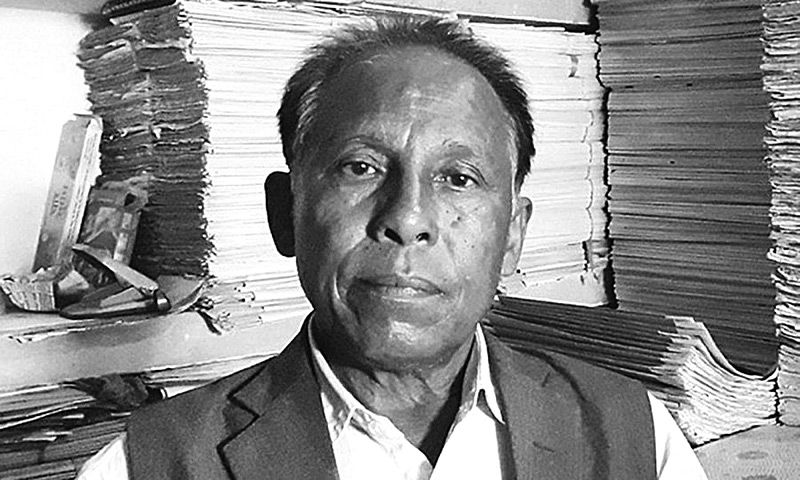
CPN-UML central committee advisor and former minister of state for local development Mahesh Chaudhary passed away on Wednesday. He was 72. Chaudhary breathed his last at the Ghorahi-based Rapti Academy of Health Sciences in the course of treatment.
The former minister of state, who suffered from hernia and liver-related ailments, was admitted to the medical institute on Wednesday morning after his health deteriorated. Originally hailing from Baiwang in Dangisharan Rural Municipality-4 of Dang, Chaudhary had been residing in Belbhar in ward 17 of Ghorahi Sub Metropolitan City.
He was elected a member of the National Assembly in 1991 and served as the minister of state for local development in 1997.
Chaudhary had an avid interest in culture and history and had published several write-ups, in Nepali and English, published under his name. Chaudhary is survived by his wife, two sons and a daughter.
His body will be kept at the UML office in Ghorahi on Wednesday evening. His funeral rites will be performed in Dangisharan-based Babaighat on Thursday, said UML District Secretary Manohar Budhathoki.

NATIONAL

Main accused of killing Anil Pariyar arrested

District Digest

CHITWAN: Police have detained the main suspect in a year-old murder of Anil Pariyar of Krishnapur in Bharatpur Metropolitan City-7. According to Deputy Superintendent of Police Bijaya Raj Pandit, Ashok Bhandari, aged 38, of Bharatpur-26 was detained from Belhiya in Rupandehi on Monday night. He was nabbed while he was returning home from India. Police presented him at the district court on Wednesday. Pariyar, an activist of the Nepali Congress, was hacked to death on the eve of the local election in May last year.

NATIONAL

Institutional schools closed for week due to heat

District Digest

BIRENDRANAGAR: All institutional schools in Surkhet district have been closed for a week starting Wednesday because of high temperatures that have gripped especially Tarai districts for the past few days. The Surkhet chapter of the Private and Boarding Schools’ Organisation Nepal decided to close classes as the scorching heat could severely affect the children’s health. The organisation said the schools would reopen from June 14.

NATIONAL

Protest of school employees in Bardiya continues

District Digest

BARDIYA: A protest started by the Nepal Public School Employees’ Council, Bardiya, from June 3 is still continuing. Administrative staff at public schools in the district staged a sit-in at the Education Development and Coordination Unit of the district on Wednesday, demanding better pay and retirement benefits on par with civil servants. According to Ram Shankar Chaudhary, leader of the council, they have submitted an 8-point demand to the Education Development and Coordination Unit and threatened stringent protests if the demands are not heeded.

Page 3
Page 4
OPINION

US and democracy in South Asia

As recent history has shown, it is people who bring change, not any external power.
- SMRUTI S PATTANAIK
Shutterstock

The recent announcement by the United States that it will be able “to restrict the issuance of visas for any Bangladeshi individual believed to be responsible for, or complicit in, undermining the democratic election process in Bangladesh” has led to a belief that it is interested in promoting democracy and is committed to protecting human rights. Though promotion of democracy has been part of US foreign policy for a very long time, it has used it selectively. History shows that the US has rather stood by military dictators and authoritarian regimes. Many of the regimes which are US allies are also accused of trampling democracy and human rights. Within the region, there are several examples of US condoning autocratic regimes, and this policy continues.
In the recent past, one has seen that US policy has significantly differed in Sri Lanka and Pakistan where people have risen up against the government for bad governance and economic distress. In Sri Lanka, the US took an active interest in Jana Aragalaya and was not against the change of government. This is not the case in Pakistan. It is important to recognise that the people’s movement in Sri Lanka was completely led by Sri Lankans and left political parties that decided to bring the Gotabaya government to task.
It is interesting to note that in Pakistan, where the military plays a dominant role, there is no such visa ban. The US has used this visa policy to retain influence over the Pakistan military that remains a major ally in spite of China being the largest exporter of weapons to Pakistan and an all-weather friend.
It is the US which undermined the legitimacy of Afghan governments to negotiate a peace deal with the Taliban as part of its exit strategy, notwithstanding the fact that the Taliban has always expressed disdain for democracy and has no space for women in public life. Though the Taliban government is yet to be recognised by the international community, hardly anything has been done to improve the situation and the US is not bothered about the democratic downturn.

Why Bangladesh?
Bangladesh visa ban issue comes as a curious case. Earlier, the US had banned the Rapid Action Battalion for human rights violation, and it did not invite Bangladesh to Biden’s democracy conference when known autocrats and dictators were invited. Therefore, this visa ban does not appear to be aimed at protecting democracy. There are other geopolitical reasons behind this policy. Though many in Bangladesh assume that this visa ban will work more than US sanctions, it is likely to backfire as Sheikh Hasina has already accused the US of regime change. One has also seen how the pressure on Myanmar has not worked.
It is known that the US has been lobbying Hasina’s government to be part of the Indo-Pacific Strategy. The government has been extremely careful as China is a significant investor in Bangladesh. China has always been openly expressing its views against Bangladesh joining the US piloted Indo-Pacific Strategy. There has been a flurry of visits by high ranking US officials this year to woo Bangladesh to join it. China and India are keenly watching the US relationship with Bangladesh. After the US imposed the visa ban, one saw the visit of the Chinese foreign minister, perhaps reassuring Dhaka of its support.
Since the Awami League came to power, Hasina and the US have been at loggerheads over several issues. Some of the Western countries also gave a call to the Bangladesh Nationalist Party to disassociate itself from Jamaat Islami, the largest Islamic party in Bangladesh which was believed to be behind the street violence that saw more than 100 people burnt alive through the use of petrol bombs. This did not happen and it was Jamaat that took a tactical decision to move away from the Bangladesh Nationalist Party.
US-led Western countries took the lead to back the military-backed caretaker government that took over power on January 11, 2007 after a civil war-like situation arose in Bangladesh. The question is whether such intervention helps the cause of democracy in the long run.

Rise of people’s power
The response to authoritarian governments needs to come from within as one saw in the context of Sri Lanka’s Aragalaya. That was a significant message that the people had sent to say that while elected governments do have the mandate of the majority, they cannot remain unaccountable after the election. Though the change in Sri Lanka has not brought much democratic dividends, it was an attestation of the people’s power to force change.
The same can be said about Nepal where People’s Movement I and II demonstrated that the people’s will and desire for change ultimately triumphs. Bangladesh has also witnessed such changes in the past, especially the anti-Ershad movement and the 1971 movement.
While pressure is important and has often been used by those countries that wield leverage, it does not result in democratisation. The institutionalisation of democracy is an internal process. The erosion of institutions happens due to a corrupt elite that benefit from it. The weakness of the opposition due to various reasons is one of the major causes of the degradation of democracy. Therefore, the selective policy of the US of using democracy as an instrument of foreign policy to apply pressure lacks legitimacy. The visa ban will affect both the ruling party as well as the opposition as one really does not know what the US means by democracy. Is it free and fair election? Is it providing space to the opposition to engage in politics? And if it is political space, what is the contour of this space and who determines it?
Externalising domestic politics will not help the opposition in any country. Political battles need to be fought on the ground. Isn’t it Bangladeshis who rose against the Pakistan Army spontaneously? Can the draconian digital security act undermine the indomitable spirit of the Bengalis? As the Sri Lankans in 2021, Nepalis in 2007 and Pakistanis in 2008 showed, it is people who bring change, and not any external power. The final push has to come from the people.

OPINION

NRB’s role in fueling inequality

The ever-increasing loanable fund crisis may drastically affect the livelihoods of the poor.
- PRADIP KAFLE
Post File Photo

The summer of Kathmandu, quite scorching these days, has recently witnessed the pork barrelling of the budget for the upcoming fiscal year 2023-24. The lucky escape from the fall into the abyss of economic quandary a year ago, nudged by the prudent central bank of the country—Nepal Rastra Bank (NRB)—via import restrictions policy, should have rung the bells for a much-needed structural intervention. But our castle of expectations has, once again, fallen.
The troika of economic disasters—the Covid-19 pandemic, global inflationary pressures and loanable fund crisis—has increased inequality in Nepal. But the concerns of inequality are unheard of and overlooked. The rural-urban divide, digital divide and class divide have all weakened the social fabric to a new low. This unabated inequality will be messier if not treated now.
Regarding inequality, the government is not the only agency to blame for this dilly-dallying; the central bank’s number crunchers should share the pie too. Independent central banks are acknowledged as overseeing price stability and external sector stability to support sustainable economic growth, but they blatantly ignore externalities such as inequality and poverty. Some of these issues, which indicate the NRB’s high hand in raising inequality, are explored in this write-up.

Poor getting poorer
The paradox of our times is that the financial system charges absurdly high-interest rates to the poorest people, who lack sufficient assets/income to pledge as collaterals and minimal rates to the wealthy ones. Citing reasons such as risk-based pricing, credit history, and collateral-based pricing, interest rates charged on credits forwarded to marginalised people are significantly high.
The NRB has broadly classified banks and financial institutions into four classes: A, B, C and D; they form commercial banks, development banks, finance companies and microfinance institutions, respectively. Their scope of operation narrows, and their rural penetration broadens while moving from A to D in the hierarchy. But the cost of funds from A-class banks, mostly relying on urban areas, is low vis-à-vis the cost of funds from B, C and D-class banks, which mostly cater to the rural clientele.
Furthermore, the central bank’s conceptualisation of “intermediary of the intermediaries (banks)” in the name of microfinance institutions (MFI) adds insult to injury. Though the NRB has barred them from charging interest rates greater than 15 percent per annum, the effective interest rate, including upfront fees like service charges, renewal fees and indirect costs (cost incurred in reaching the MFI’s physical premise for service), are exorbitantly high, ranging from 25-30 percent per annum. It shows that the central bank’s conceptualisation of the current banking and financial institutions’ structure is outrightly assembling inequality. This should never have been the case for the so-called “socialism-oriented economy”.

Capturing concessional loans
One of the most painful facts being witnessed in recent times is big business houses misusing concessional agricultural loans allocated for poor farmers. The NRB has mandated A-class banks to forward at least 11 percent of their credit to the agricultural sector by mid-July 2023. Though credit flows to the agricultural sector have already exceeded the set benchmark in terms of figures, they have merely contributed to the gross domestic product. A huge chunk of credit has been directed to the agricultural sector, but the annual growth of the agricultural sector has averaged only 2.95 percent for the last 10 years (CBS, 2023). This clarifies the misuse of the funds. The trend of establishing a subsidiary, digging a pit, throwing a thousand baby fish in a pool, getting a couple of crores of concessional loans, and misappropriating funds in real estate has been the real riddle of the entire system.
Similarly, the subsidised women entrepreneurs’ loan, advanced by the central bank’s provision, has been captured by the elites who do not necessarily need the loan. The credit flowed to clients without a proper need assessment. Also, it lacked strict provisions for routine inspection to ensure the proper utilisation of the realised funds. The same has been true of subsidised credit provided to trekking guides, released immediately after the Covid-19 pandemic. So, when the central bank does not stringently regulate these concessional credits, state-of-the-art policies often tend to become counterproductive and a burden, further widening the inequality gap in the process.
    
Rural deposits, urban credits
A significant factor reinforcing the rural-urban divide has been the excessive investments of rural deposits in urban areas. Remittance inflow has significantly increased in rural areas, increasing deposits in the rural branches of banks. As banks must maintain an overall credit-deposit ratio of 90 percent, they disburse credit based on the overall volume of deposits collected nationally.
However, branches in the rural sectors are just like deposit collection centres. The proportion of credit flowed by rural branches in the local area is minimal in most cases. Citing the reasons for an insufficient collateral base/income level, credits are not disbursed in the rural sectors, from where deposits have been collected. The officers of private banks often cite the low demand for credit from rural areas as the cause of this unequal disbursement of funds. However, some provisions, though flexible ones, should be introduced to maintain branch-wise or region-wise credit-deposit ratios.

Hitting the poor hard
Prior studies have shown that high inflation hits the poor harder since businesspersons and industrialists can increase the price of their outputs in line with inflation, but the labour wage rate takes much more time to adjust. Next, the poor mostly spend all their incomes on necessities, which is mandatory for their survival, and a rise in the price level means a fall in the number of goods consumed. But the rich can easily curtail their consumption of luxury items for some time. Furthermore, the compensation of government employees seldom increases on par with price level, citing the inflationary impacts on the economy. This creates a huge pay gap between private and public institutions. This means that if the NRB fails to limit inflation within the target range, it will fuel inequality.
Being an independent central bank, the NRB must take a great leap to transform the structural inequality ingrained in the existing financial system. The central bank should reassess the existing classification of banks and financial institutions and ensure a low cost of funds for the marginalised. Next, it must develop a stringent supervision mechanism to guarantee the optimal utilisation of concessional loans. They also should study whether the lack of credit flowing in rural areas is causing massive de-ruralisation and make policy interventions accordingly. Lastly, if the NRB seriously dedicates itself to its all-time objective—taming inflation—it would help the poor live a decent life. The over-concentration of credits in urban cities must be checked if we aim for rural development.      

 
Kafle is an assistant director at the Nepal Rastra Bank.

OUR VIEW

The Koshi crisis

Provincial representatives of parties must get the centre’s full support to come to a settlement.

It has been over three months since Province 1 was officially named “Koshi”, a name the provincial assembly approved with a thumping majority. The years-long dispute could be resolved only after the Nepali Congress, the CPN-UML, the CPN (Maoist Centre) and the Rastriya Prajatantra Party all stood in favour of the new name. The second Constituent Assembly, while promulgating the constitution in 2015, had left the key tasks of fixing provincial capitals and naming the provinces unfinished, entrusting the concerned assemblies to do the needful. The naming of the Koshi province (the last of the seven to be named) was celebrated as the conclusion of the two major unfinished tasks of federalism.
But the celebration couldn’t last long. Various ethnic communities of the region immediately took to the street to protest against the new name. They said the province name should reflect the ethnic identities of the region’s dominant communities. Since they started the agitation, the protests have at times turned violent. Padam Bahadur Limbu succumbed to head injuries he had sustained during a police assault. Scores of other demonstrators have been injured.
The protests that were initially confined in provincial headquarters of Biratnagar have spread to other districts. As the situation got complicated, the provincial government on Wednesday formed a team comprising three provincial ministers to talk to the agitating groups. But this is too little too late. The government should have done this much earlier. As things now stand, the dialogue team simply doesn’t have the mandate to resolve what is a serious political problem.
With the CPN (Maoist Centre) quitting the Cabinet on Tuesday, the UML-led provincial government has fallen into a minority. Another coalition partner Janata Samajbadi Party had also pulled out a week ago. As the UML-led coalition, which is now backed only by the Rastriya Prajatantra Party, loses its majority in the assembly, the Congress and the Maoist Centre are competing to lead the new government. So, while the province is burning, the parties have again started jockeying for power.
The big parties have failed to deal with the matter with the sensitivity it deserves. Some of our politicians even tried to sow ethnic divisions for their vested interest, which is playing with fire. Though all the major political parties including the Congress, the UML, the Maoist Centre and the RPP joined hands to endorse the new name on March 1, some including the Maoist Centre immediately changed their stance. It had been a mistake to compromise on the party’s once strong stand in favour of identity-based nomenclature, the party later clarified. The UML had taken the initiative to finalise the new name, as it was heading the provincial government at the time. The agitating groups are thus particularly angry with the UML leaders including its chair KP Sharma Oli, a vocal critic of ethnicity-based federalism.
Delineating and naming the provinces was easily the toughest of all agendas that had to be resolved during the seven combined years of the constituent assemblies. Those closely involved in the constitution-making process, including nearly all top leaders in the country today, understand the gravity of the matter. Only if they are serious will this issue be resolved. For one, the provincial representatives of political parties must get the centre’s full support and be given the mandate to come to a negotiated settlement. Otherwise, if this spark lit in eastern Nepal is allowed to spread, it could burn down the whole federal edifice.

THEIR VIEW

Bring them back

Over 18,000 closed non-government primary schools need assistance to reopen.

We are alarmed to learn of the number of non-government primary schools that have been closed in the last two years. Reportedly, some 18,465 schools closed their doors for good in 2021 and 2022 because their owners could not bear the cost of running them. With the shutting down of these institutions, thousands of teachers lost their jobs, while lakhs of students had to drop out or go through other challenges. Data from the Directorate of Primary Education (DPE) shows that a total of 1,14,429 teachers of non-government primary schools left the profession since 2020, while a staggering 14.5 lakh students left primary schools—a large number of them privately run—between 2020 and 2021. This needs urgent attention from the authorities.
While educationists have long been asking the government to take remedial actions and invest more in education to recover from the pandemic-induced learning loss—which has affected an entire generation of students—there has been little indication that it took those suggestions seriously. Its education budgets of the last few fiscal years made it very clear. And it has disappointed us again this year by proposing a record-low allocation of Tk 88,000 crore for education, which is only 1.76 percent of the GDP.
At a time when the government should have made desperate attempts to bring the missing students back to schools—by providing them stipends, mid-day meals, financial incentives for poorer households, etc.—we have not seen much effort in this regard. Moreover, struggling non-government primary schools also didn’t get the help they deserved. Reportedly, the owners of these schools—NGO-run, kindergartens, etc.—sought financial assistance, soft loans, and waiver of utility charges during the pandemic, which they were denied.
Needless to say, such schools have been playing a significant role in ensuring education at the primary level. The government, therefore, must come up with proper incentives and plans to help them reopen and also to bring their teachers—many of whom may have remained unemployed till now—and students back to the classrooms.

— The Daily Star (Bangladesh)/ANN

Page 5
NATIONAL

Around 14,000 Kathmandu residents skipped cholera vaccine

Authorities had launched a cholera vaccination drive in wards 11, 12 and 13 of Kathmandu Metropolitan City.
- Post Report

KATHMANDU, 
Around 14,000 people from wards 11,12 and 13 of the Kathmandu Metropolitan City who were administered the first dose of the cholera vaccine missed the second dose.
According to the Epidemiology and Disease Control Division, over 37,000 people from the said wards were administered with first doses of the vaccine in May first week.
“Of them, only 23,473 people have taken the second dose of the vaccine,” said Bhola Adhikari, an official at the division. “The remaining others might be migrants and we guess they were not in the Valley at the time of administration of the second dose.”
The division had planned to administer the oral cholera vaccine to over 95,000 people above one-year-old from wards 11,12 and 13 of the Kathmandu Metropolitan City. Officials say that during the second round of vaccination, 18,000 people took their first doses.
“This shows that less than half the target population took the vaccine in the first round,” said Sajina Maharjan, an official at the Kathmandu Metropolitan City. “Thousands of people who took the vaccine in the first round did not come for their second doses.”
Health officials say that low uptake of vaccines, whether they are routine vaccines or Covid vaccines or those against cholera, is not a new thing in the Kathmandu Valley, especially in the Kathmandu Metropolitan City which does not even have a record of  migrant population. Officials have also found many children in Kathmandu have not received even a single dose of routine vaccines.
The cholera vaccination campaign aims to lessen the risk of an outbreak of the deadly contagion and severity of infection in the upcoming monsoon, officials say.
Authorities had urged everyone above one year of age in the said wards to take the cholera vaccine.
Health Ministry officials say wards 11,12 and 13 were selected for vaccination against cholera, as they have been considered high-risk wards of the metropolis owing to poor drinking water and sanitation conditions.
Last year, the Kathmandu Valley witnessed a massive cholera outbreak in which at least 77 cases were confirmed. Hundreds of people suffered from the diarrheal infection that continued for months. Vibrio cholera 01 Ogawa serotype was confirmed in stool samples of the victims at the time.
Cholera is a highly infectious disease that causes severe diarrhoea and vomiting, and leads to dehydration and even death within a few hours if left untreated.
Cases of cholera were reported at Bagbazar, Dillibazar, Balaju, Balkhu, Sanepa, Kapan, Naikap, Kageshwari Manohara, Bhaktapur, and Jaisidewal areas in the Valley. Public health experts had said the number of reported cases could be just the tip of the iceberg, as only around 10 percent of the people infected with cholera develop severe symptoms such as watery diarrhoea and vomiting.
Along with vaccination, health authorities have also been running water, sanitation and hygiene programmes with the support of the World Health Organisation, Unicef and other agencies. They had also been collecting drinking water samples for testing.
A study carried out by the health ministry following the outbreak last year showed that nearly 70 percent of drinking water samples in Kathmandu Valley were found to have been contaminated with E coli and faecal coliform.
The cholera outbreak was blamed on contaminated water with the increase in rainfall and disruption in garbage collection in Kathmandu Valley. Several other factors, including the condition of supply pipes, water storage, and pollution in water sources affected the quality of water supplied to households, officials said.
Due to poor sanitation and hygiene conditions, Nepal is highly vulnerable to water-borne diseases, including diarrhoea, dysentery, typhoid, hepatitis, and cholera, with thousands of people falling sick every year.
In October 2021 also, a cholera outbreak in several local units of Kapilvastu killed at least six, including three minors and infected hundreds of people. Health authorities had launched a ring vaccination programme in the affected areas.
Doctors say launching awareness drives against water-borne diseases and ensuring safe drinking water are the only ways to save people from dying from water-borne diseases, including cholera. A combination of surveillance, water and sanitation measures, hygiene practices, social mobilisation, and treatment are required to contain the spread of the infection, according to them.
The World Health Organisation says cholera is a global threat to public health and a multifaceted approach is key to controlling the disease and reducing deaths.

NATIONAL

Dharan sub-metropolis hit by severe water shortage amid continued heat wave

The BP Koirala Institute of Health Sciences postpones its classes for a week due to the crisis.
- ARJUN POUDEL,ARJUN SUBEDI
Mayor Harka Sampang dismisses the BPKIHS’s claims of reduced supply of water. He said it was supplied 2.1 million litres of water Tuesday.  Post Photo

KATHMANDU & SUNSARI
On Tuesday, the Dharan-based BP Koirala Institute of Health Sciences postponed all classes for a week because of a severe water crisis. The institute does not have an adequate water supply for the hospital and its college buildings.
“There is an acute shortage of water in the hospital, and college and hostel buildings. The medical science students have been given a weeklong break so that the daily hospital services won’t be affected much,” said Prof Dr Sanjib Sharma, acting vice-chancellor at the BPKIHS.
He said the decision to postpone classes will not affect the curriculum. According to Sharma, the students also requested the institute in writing to close classes for a few days.
According to the BPKIHS, the hospital alone needs around 1.5 million litres of water daily. The institute said the drinking water management board of the sub-metropolis has been supplying just 500,000 litres of water daily, although the agreement is to supply 1.5 million litres.
Mayor Harka Sampang, who is also the chairman of the board, dismissed the institute’s claims of reduced supply. Sampang claimed that the board supplied 2.1 million litres of water to BPKIHS on Tuesday “but the institute is hell-bent on defaming the sub-metropolis.”
It isn’t only the BPKIHS that has been affected by the water crisis. Residents of the sub-metropolis have said water shortage has severely affected their daily lives. The scarcity, coupled with scorching heat and heat waves, has made Dharan locals miserable, says Shyama Regmi, 65, a local of ward 1.
A severe heat wave that has hit several places in the Tarai region since Friday has triggered a water crisis in many places, including Dharan.
“It is too hot here in Dharan and we do not have water,” said Regmi. “We get water from the public tap once in four days and that too only for a few minutes, which is not even sufficient for drinking.”
With the rising mercury and heat waves, health authorities have urged people to stay hydrated, take baths regularly and stay indoors. But the locals question the logic behind the request since they do not have water to take a bath even once a day.
“We have a serious water crisis in our area,” Rita Sundas, municipality council member from the sub-metropolis’s ward 1, told the Post. Officials at the sub-metropolis held a meeting of stakeholders on Tuesday and discussed the worsening water crisis.
“Today [Tuesday], we held a discussion about the water crisis in our area and have decided to better manage the water distribution,” said  Yagya Mani Acharya, chair of ward 1 of the sub-metropolis.
Daytime temperatures in several Tarai districts have been hovering around 40 degrees Celsius in recent days. The Meteorological Forecasting Division of the Department of Hydrology and Meteorology said that many places in the region have been witnessing heat waves since Friday.
A heat wave occurs when the maximum and minimum temperatures at a location are unusually high over a three-day period. Met officials said that there is a chance of rainfall in the western and midwestern regions which could break heatwave conditions.
According to the latest weather update, on Wednesday, Simara of Bara and Janakpur recorded 41.7 degrees Celsius and 42.2 degrees Celsius, respectively; Bhairahawa logged 41.8 and Nepalgunj 41.6 degrees Celsius, respectively. Likewise, Biratnagar recorded 41.0 and Dharan recorded 39.3 degrees Celsius, respectively.
Birendranagar recorded 38.9 degrees Celsius, according to the Met division. The maximum temperature in Kathmandu during the day was 32.1 degrees Celsius. The Met Office said that the monsoon is likely to be delayed by a few days this year.
The monsoon season in Nepal generally starts on June 13 and ends on September 23. Last year, however, it entered the country eight days ahead of schedule.
Normally, after the arrival of monsoon, it takes one week for the clouds to spread across the country.
Globally, extreme weather events are increasing in frequency, duration and magnitude. Scientists blame climate change for the early onset of summer and intense heat.
The average annual maximum temperature of Nepal rose by 0.056 degrees Celsius between 1971 and 2014, according to a study conducted in 2017 by the Department of Hydrology and Meteorology (DOHM).
Meteorologists have forecast below-average rainfall in the upcoming monsoon season. The department’s climate section, which forecast weather conditions for four months (June 1 to September 30), said that most parts of the country are likely to experience an above-average maximum temperature due to the El Nino conditions, a climatic pattern that generally brings dry weather.
Nepal is one of the world’s most vulnerable countries to the climate crisis and has witnessed frequent extreme weather events over the past decade and a half.

NATIONAL

Cabinet approves Mayor Balendra Shah’s Belgium visit

KATHMANDU: The government has decided to approve Kathmandu Metropolitan City Mayor Balendra Shah’s visit to Belgium. The Cabinet meeting on Wednesday gave approval to Mayor Shah to participate in the Metropolis World Congress and Brussels Urban Summit 2023 to be held in Belgium from June 12-15. Minister for Communications and Information Technology Rekha Sharma informed that the Cabinet meeting has appointed Madan Bhujel, joint secretary at the Ministry of Industry, Commerce and Supply, as the chairman of the Kalimati Fruit and Vegetable Market Development Committee. The meeting also decided to make the industrial village in Panchkhal Municipality of Kavrepalanchok district into a special industrial village for women entrepreneurs. Minister Sharma informed that a decision has been taken to issue an order prohibiting the strike of essential services as per Section 3 (1) of the Essential Services Operation Act, 1957, and publish its notice in the Nepal Gazette. Similarly, the government has also decided to allow Upper Mailung Khola Hydropower Limited to use and remove trees from the national forest area in Rasuwa and Nuwakot districts for the construction of towers and the right of way for the project. (PR)

NATIONAL

Lawyers of defendants in fake Bhutanese refugee scam claim selective prosecution

They claim some high-profile suspects were not prosecuted despite being named by defendants as beneficiaries of the scam.
- Post Report

KATHMANDU,
Lawyers representing the defendants in the Bhutanese refugee scam started a debate on Wednesday questioning the ‘selective’ prosecution in the case.
After government lawyers concluded their arguments on Tuesday on whether to remand the defendants in the Bhutanese refugee scam, those representing the defendants presented their arguments.
They argued that the defendants have been charged without adequate evidence and only based on the statements of a select few people.
They also argued that the accused were selectively prosecuted with some of top leaders who were accused of involvement in the scam were not prosecuted.
“Some people have been prosecuted because the accused named them while others have not been prosecuted even though they were also named by the accused in the scam,” said Shiva Prasad Rijal, a senior advocate who argued on the behalf of Sanu Bhandari, one of the accused.
Recently, an audio tape appeared on social media that suggested former prime minister Sher Bahadur Deuba’s wife Arzu Rana also allegedly received cash from racketeers attempting to send fake Bhutanese refugees to the United States.
Ajaya Kranti Shakya, adviser to former prime minister KP Sharma Oli, also allegedly received Rs10 million as per the statement of a defendant. They have not been made defendants in the case.
On May 24, the Kathmandu District Attorney’s Office filed criminal cases at the Kathmandu District Court against 30 individuals including former deputy prime minister Top Bahadur Rayamajhi and former home minister Bal Krishna Khand, accusing their involvement in the refugee scam. Of them, 18 have been arrested while the others continue to be at large.
Rijal said the separate charge sheets should have been registered based on alleged offences and degree of offences which could not happen.
The defendants have been charged with four types of crimes—treason, organised crime, fraud and forgery.
Rijal also questioned why Gajendra Budhathoki, who registered the complaints on the behalf of 61 victims, was not prosecuted as he himself was involved in collecting money from the victims.
Budhathoki had registered complaints stating that defendants including Sandesh Sharma, Keshav Prasad Dulal and Sanu Bhandari had collected as much as Rs97.8 million from him and other 60 people known to him.
After the lawyers debating on the behalf of defendants conclude their argument, Achyut Neupane, chief of the Kathmandu District Attorney’s Office, will respond to arguments of the defendants’ lawyers, leaving the court to take the decision.
The district court has set June 14 as the tentative date for issuing an order on whether to remand the defendants. District Court Judge Prem Prasad Neupane has been conducting the hearings on the case.
Earlier, the government lawyers had argued on the behalf of the prosecutor.
Neupane said they argued that the hearings in the case should be continued, keeping the defendants in police custody because of the seriousness of the offences they have been charged with.
Government lawyers including Mahesh Prasad Khatri, Janak Prasad Ghimire, Sitaram Aryal, Dinesh Bhattrai, Prakash Ghimire and Sur Bahadur Pariyar, Nirmala Marasini and Hira Lal Bholon argued against the accused. Some private lawyers including Swagat Nepal also argued against the accused.
The defendants have been chargesheeted for collecting Rs288.17 million from 115 victims—ranging from Rs200,000 to Rs4.8 million per person—promising them to send them to the US in the guise of Bhutanese refugees.
In the court, many defendants have given statements contradictory to what they had told the police. Rayamajhi and Khand said a conspiracy was hatched against them to destroy their political careers while rejecting the charges against them.
In his statement, Khand claimed that he neither had a part in the offence as mentioned in the chargesheet nor did he instigate anyone to get involved in the offences. “All the charges against me are false,” he said.
The charge sheet also names the former deputy prime minister Rayamajhi as the mastermind of the scam. He allegedly played a key role in the disappearance of the actual report of the task force led by Balkrishna Panthi, a former joint-secretary, and replacing it with a fake one. Rayamajhi had even sought the help of another defendant, the Bhutanese refugee leader Tek Nath Rizal.
Even though Rayamajhi said that he had known the Bhutanese rights leader Tek Nath Rizal, he rejected Rizal’s claim that he was involved in the scam. Rayamajhi said he met Rizal only once and claimed that Rizal might have taken his name in order to hide his own crime.
The racketeers had bribed politicians and government officials to include the names of many Nepali nationals on a proposed list of Bhutanese refugees eligible for a third-country resettlement.
After Nepal’s efforts to repatriate the refugees failed, international organisations including the UN refugee agency had explored the third-country resettlement option. Of the around 120,000 refugees staying in camps in eastern Nepal since the 1990s, nearly 113,500 were resettled in various Western countries in a decade-long process. The US alone took in more than 90,000 of them. Around 8,500 Bhutanese refugees were estimated to have remained in the camps after the closure of the third-country resettlement process in 2016.

Page 6
MONEY

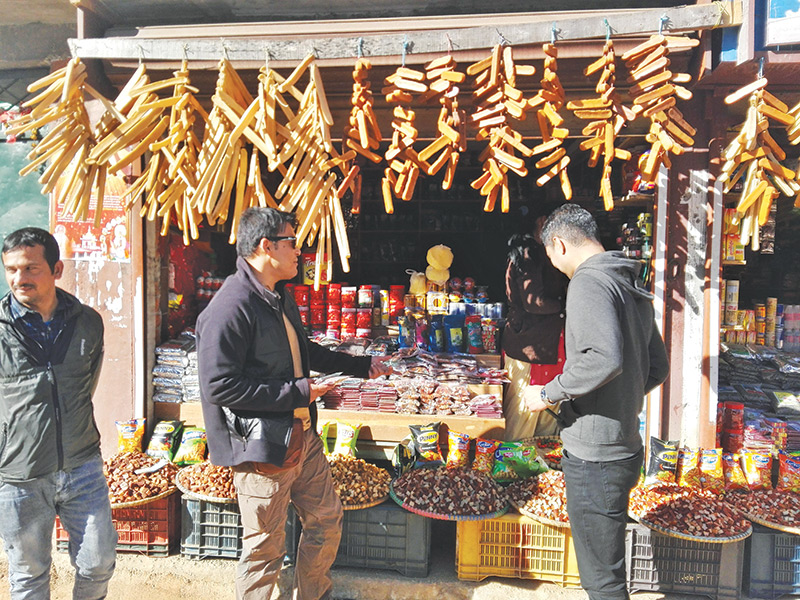
Dog chew exports likely to hit Rs3 billion this fiscal

The hard cheese is prepared from yak milk and at high elevations, which makes it widely popular, insiders say.
- KRISHANA PRASAIN
Most of the tea and dog chew exported from Nepal are produced in the eastern hill district of Ilam.  Post File Photo

KATHMANDU,
Dog chew made in the eastern highlands has become an unlikely contender for Nepal’s top export.
American and Canadian pooches love the hard cheese made of yak milk, and traders can barely keep up with demand, officials say. Dog chew exports are neck-and-neck with Nepal’s tea shipments which have traditionally been a major foreign currency earner.
Most of the tea and dog chew exported from Nepal are produced in the eastern hill district of Ilam.
Insiders say demand for dog chew rose sharply in the United States and Canada after people bought more pet animals when they were forced to stay home during the Covid-19 lockdowns.
The statistics of the Department of Customs show that exports of dog chew jumped by 38 percent to 1,744 tonnes in the last fiscal year 2021-22. The export value swelled by 48 percent to Rs2.91 billion.
In the first 10 months of the current fiscal year ended mid-May, dog chew shipments totalled 1,346 tonnes worth Rs2.53 billion. The figure was Rs2.30 billion in the same period of the previous fiscal year.
Going by the flow of export orders, traders are optimistic that dog chew shipments will cross Rs3 billion by the end of the current fiscal year.
Exports have shot up by 240 percent in the last five years. Manufacturers and exporters say Nepali dog chew is prepared from Himalayan yak milk and at high elevations, which has made it widely popular.
The dog chew contains no added preservatives, colours or chemicals. It is prepared manually with milk and natural products using traditional techniques.
The process of making the hard cheese, or chhurpi, involves boiling the milk, separating the whey and then shaping and drying the remaining curd. The resulting hard cheese is then sliced into sticks and let dry and smoke for a month.
“The dog chew does not contain any artificial ingredients. It is fully natural which makes it unique for pet feed compared to other products available in the international market,” said Shreska Acharya, business development manager of Lekali Himalayan Dog Chew, one of the largest manufacturers of Himalayan chew in Nepal.
Acharya says they export 30 to 50 tonnes of dog chew monthly. They bring unprocessed cheese and process it in Godavari. Nepali dog chew does not have problems like staining and odour compared to other pet food, she added.   
According to manufacturers and exporters, 90 percent of the dog chew produced in the country is exported. The rest of the hard cheese is consumed locally by people. Nepalis do not feed it to their pets due to the high cost.
“Export inquiries are coming gradually,” said Dhurba Raj Regmi, director and CEO of Native Nepali Agro Suppliers, another commercial dog chew producer.

Regmi says dog chew is preferred as it contains more than 60 percent protein, calcium and vitamins. The dog chew is made of 99 percent milk from yaks and cows. Other ingredients like lime juice and salt are also used in its preparation.
“The high fat content in dog chew leads to indigestion in dogs, so manufacturers have been lowering the fat content,” Regmi said.
Native Nepali Agro has been exporting dog chew for the last six years.
The company said it has been producing around 5,000 kg at its plant and outsourcing the production of another 5,000 kg.
Regmi says demand for dog chew in the global market increased by 10 percent in the last fiscal year, and as a result, demand for Nepali dog chew has risen. Native Nepali Agro exports 100 tonnes of dog chew annually. The company said it has an annual turnover of Rs20 million.
Niranjan Dairy in Fikkal, Ilam has been producing dog chew for the last four months.
“We produce around 4,500 kg of dog chew in a month. It takes 20 days to a month to produce dog chew,” said Khagendra Adhikari, proprietor of Niranjan Dairy.
Manufacturers say demand for chew has increased at a fast rate but milk production has remained static.
Nepali dairy industries have requested the government to lift the restriction on imports of milk to avert possible shortages in the domestic market.
“There is a shortage of milk. Besides, the price has been rising,” Adhikari said.
 Adhikari sells the dog chew to Kathmandu-based exporters for Rs1,250 per kg. The price was Rs1,150 per kg before the price of milk
went up.
Regmi says the export price of dog chew is around $14 per kg.
According to Regmi, dog chew is mainly produced in Taplejung, Ilam and Panchthar.
The major buyers are the US, Canada, the UK, Japan and Hong Kong, as per department data.
“There is great demand for dog chew in Europe, but Europe does not allow the entry of dairy products from Nepal,” said Regmi. “If the government can ensure quality, there is huge potential for Nepali dog chew exports to Europe.”
Traders say unhealthy market competition has risen due to lack of proper guidelines.
Nepal’s multi-million dollar carpet industry collapsed due to unhealthy competition, and the dog chew business could face a similar fate if it is not monitored in time, they say.
There is no authentic data, but exporters say the country produces 3,000 tonnes of dog chew annually, half of which is exported.  
“The government needs to grade the dog chew produced in the country to ensure its quality,” Regmi said.

MONEY

OECD slightly raises world GDP growth forecast

- AGENCE FRANCE-PRESSE

PARIS,
The OECD slightly raised its growth outlook for the world economy on Wednesday as inflation eases and China has dropped Covid restrictions, but it warned the recovery faces a “long road”.
The Paris-based organisation forecast an economic expansion of 2.7 percent, up from 2.6 percent in its previous report in March, with upgrades for the United States, China and the eurozone. But it is still under the 3.3 percent growth recorded in 2022.“The global economy is turning a corner but faces a long road ahead to attain strong and sustainable growth,” OECD chief economist Clare Lombardelli wrote in the OECD’s Economic Outlook.
“The recovery will be weak by past standards,” Lombardelli wrote.
The growth forecast for 2024 remains unchanged at 2.9 percent, the Organisation for Economic Co-operation and Development said.
A drop in energy prices, the untangling of supply chain bottlenecks and China’s sooner-than-expected reopening are contributing to the recovery, the OECD said. Among its 38 members—an eclectic group ranging from the United States to Germany, Mexico, Japan and New Zealand—inflation is expected to slow to 6.6 percent this year, after soaring to 9.4 percent in 2022.
But core inflation, which strips out volatile energy and food prices, is higher than previously expected, according to the OECD.
“Central banks need to maintain restrictive monetary policies until there are clear signs that underlying inflationary pressures are abating,” Lombardelli said.
At a press conference, Lombardelli said central banks faced a “delicate balance”. “Obviously they shouldn’t tighten too much to the point that it would have a greater impact on growth than it is necessary,” said the OECD’s new chief economist, who took her post last month.

MONEY

India raises crop prices as Modi woos farmers ahead of election

- REUTERS
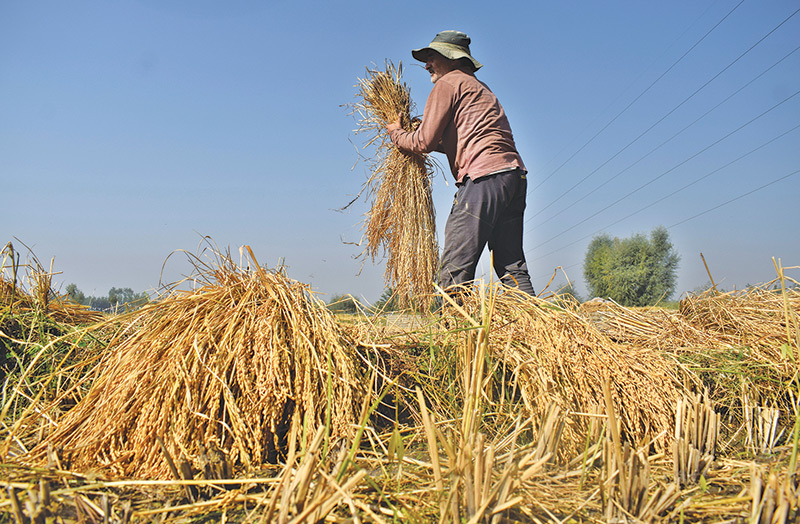
A file photo shows a farmer bundling his paddy crops on the outskirts of Srinagar, India.   Reuters

NEW DELHI, 
India on Wednesday raised the government-mandated price for summer-sown crops such as rice and cotton by the most in five years as Prime Minister Narendra Modi looks to woo millions of farmers ahead of a general election next year.
The country announces support prices for more than a dozen crops each year to set a benchmark. But analysts say the bigger than usual hike could hit government finances and stoke inflation.
India has raised the price at which it will buy new-season common rice paddy from farmers by 7 percent to 2,183 rupees ($26.45) per 100 kg, trade minister Piyush Goyal told reporters after a cabinet meeting chaired by Modi. The government is keen to boost rice output after it banned exports of broken rice in September and imposed a 20 percent tax on exports of various grades to calm domestic prices, which had surged after below-average rainfall limited planting.
This year, government sources told Reuters that the ban on broken rice exports and a 20 percent tax on overseas shipments of white rice would be maintained as the world’s biggest exporter of the grain tries to keep a lid on prices. “The hike in paddy prices would lift rice export prices by $30 per tonne. India might become uncompetitive in the world market unless government scraps 20 percent duty on exports,” said BV Krishna Rao, president, Rice Exporters Association of India.

MONEY

Rolwaling Valley witnesses return of trekkers

- KEDAR SHIWAKOTI
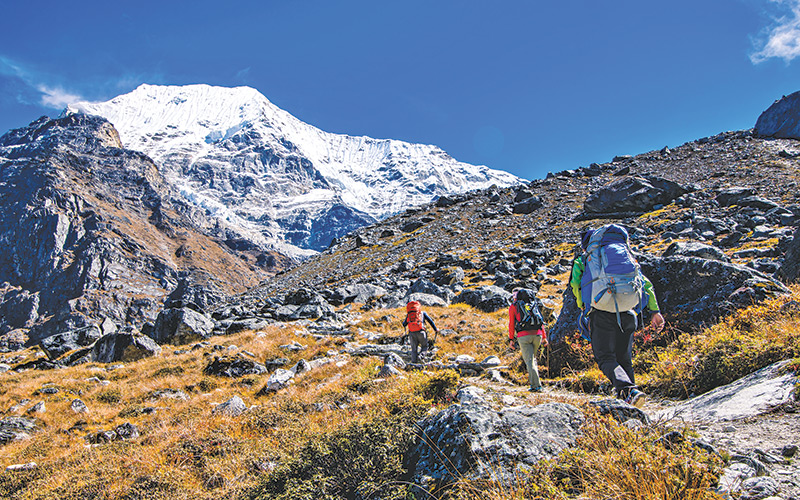
Both, domestic and foreign tourists are trekking to Tsho Rolpa, one of the biggest glacial lakes in Nepal at an altitude of 4,580 metres.   SHUTTERSTOCK

DOLAKHA,
Rolwaling Valley in the northeast of Dolakha has started drawing tourists after three years.
Both, domestic and foreign tourists are trekking to Tsho Rolpa, one of the biggest glacial lakes in Nepal at an altitude of 4,580 metres.   
The rise in the number of trekkers in the area has created a buzz in the area after a lull in tourist numbers post pandemic. The trekker numbers in the valley had fallen to almost zero after the Covid pandemic.
According to Bikash Khadka, a local, around 50 trekkers are coming daily. The Rolwaling Valley trek is a five-seven long trek preferred mostly by the young crowd.
The area started coming to the notice of trekkers, mostly beginners after it started featuring on social media platforms through individual content creators, said Khadka.
Arjun Dahal, a solo traveller, says the trek is popular among the young crowd mostly because it is budget-friendly unlike other trekking destinations in the country. “I didn’t have to worry about having to pay for expensive accommodation,” he said. “There are several budget lodges catering to trekkers in the area.”
Hotel owners say that the number of local travellers, especially youths, has increased, boosting their business prospects. Its affordability is the main reason behind the trekking destination’s popularity, they say.
According to Dahal, it costs up to Rs15,000 for an individual to trek the Rolwaling trail. Dawa Tshering Sherpa, a local hotel owner, who is excited to see tourists returning, said, “It is good to see tourists after three years,” he said.
The availability of local buses from Charikot, the district headquarters, to Chyochyot in Bigu Rural Municipality-1 where the Rolwaling trail begins, has also contributed to the popularity of the trekking route.
On the first day of the trek, visitors can walk up to Simi Gaun or Surmuche for a night stay.
The next day’s trekking passes through Kyalche, Dongkhang, and Thangding to reach Beding—a village famous for producing the most number of Everest climbers.
There are around one and a half dozen of hotels of both small and large sizes in Beding village.
On the third day, visitors can trek to Tsho Rolpa and stay at Na village for the night.  The number of hotels and lodges in Na village is
also increasing as the number of travellers rises.
“Previously, we were reliant only on foreigners for our business, but nowadays, we receive hordes of domestic tourists,” said Sherpa.
According to Sherpa, around 3,500 domestic tourists visit the Rolwaling Valley yearly. The trail also leads travellers to mountains such as Yalung Ri (5,630 metres), Ramdung (5,925 metres) and Pharchem (6,000 metres) which are now open for climbing.
They can also trek to Dudh Kunda from Tsho Rolpa.
Mid-March to mid-June and mid-September to mid-December is considered the trekking season on the Rolwaling trail.
The number of foreigners trekking from Rolwaling to Mount Everest via the Tashi Lapcha pass is increasing as well. The government in March made it mandatory for the trekkers to take a guide along with them on the trip effective from April. The locals are hopeful of an increase in employment by the government’s new rule.
The majority of the locals in Beding work as tourist guides.
According to the Gaurishankar Conservation Area, around 327 foreigners and 28 visitors from the SAARC nations have visited the conservation area starting from mid-March. There are no records of domestic visitors.  
“Even though we have attempted to keep the records of the domestic tourists, it’s difficult to keep track of them as they start the trail from the unofficial points,” said Tulasi Prasad Dahal, information officer of the Conservation Area.
“Since the beginning of the trekking season, the number of tourists in the area has increased,” added Dahal.

MONEY

Samsung launches Galaxy F54 in Nepal

Bizline

KATHMANDU: Samsung has added the Galaxy F54 to their already impressive smartphone lineup in Nepal. The newest addition is a powerful, tech-packed 5G device, equipped with an impressive 108MP main camera with OIS and premium Galaxy signature design, reads the press release issued by the company. The massive 6.7-inch vivid super AMOLED plus display gives an immersive experience with both smooth viewing and scrolling, thanks to its 120Hz refresh rate. The device comes with 8 GB RAM capacity, and has an internal storage of 256 GB. The phone is powered by best in class monster-like 6000mAh battery. The Galaxy F54 is available in two stunning colours—Silver and Dark Blue. The Galaxy F54 will be available through all retail outlets across the country at an all-inclusive price of Rs52,499 for the 8+256 GB memory variant. (PR)

MONEY

Turkish lira declines to record lows following start of Erdogan’s new term

Bizline

ANKARA: The Turkish lira tumbled to a fresh record low on Wednesday, extending its slide against the US dollar since President Recep Tayyip Erdogan started his third term. The lira weakened by more than 6 percent on Wednesday hitting 23.15 against the dollar. The decline took the currency’s loss since the appointment of Erdogan’s new government to 8 percent. The currency has weakened by around 20 percent since the start of the year. The Turkish currency has declined in value since 2021 due to what economists say is Erdogan’s insistence on keeping borrowing costs low to stimulate growth despite skyrocketing inflation. Analysts say Erdogan’s government propped up the lira in the run-up to Turkey’s presidential and parliamentary elections last month. (AP)

MONEY

Batman wins EU trademark dispute with Italian designer

Bizline

BRUSSELS: Caped crusader Batman won a trademark fight with an Italian clothing retailer on Wednesday after Europe’s second-top court sided with an EU patent office, ruling that the Batman logo is distinctive enough to warrant its EU trademark. Warner Bros Discovery’s DC Comics, which registered the Batman logo with the European Union Intellectual Property Office (EUIPO) more than two decades ago, faced a challenge from Commerciale Italiana Srl in 2019. The Italian company had asked EUIPO to annul the trademark for clothing and carnival items, saying that it lacked a distinctive character. After EUIPO rejected its application, Commerciale Italiana Srl took its grievance to the Luxembourg-based General Court. Judges backed the EU trademark body. (REUTERS)

Page 7
SPORTS

Machhindra secure second spot as relegation drama continues

Kumar KC’s side overcome Sherpa 3-1 to book their place in the AFC Cup preliminary round. APF, Three Star, Friends and Khumaltar are still fighting for survival.
- Sports Bureau
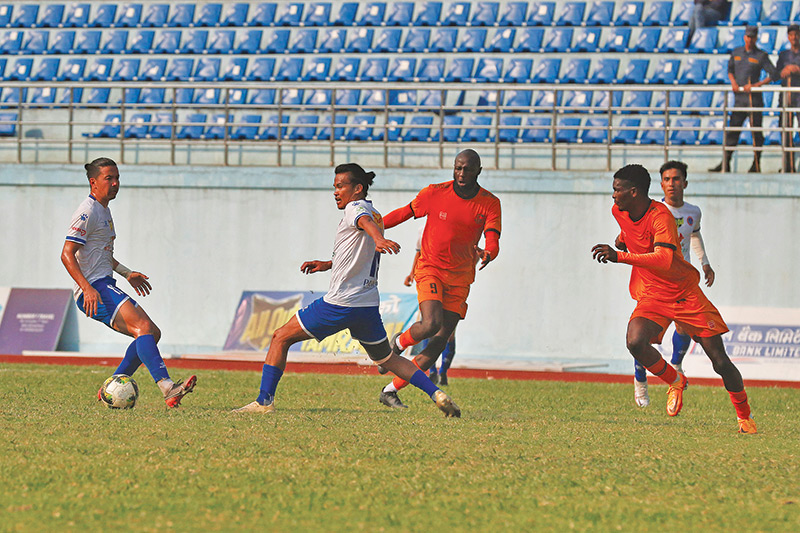
Players of Machhindra Club and Himalayan Sherpa Club battle during their‘A’ Division League match at the Dasharath Stadium on Wednesday.   Post Photo: Hemanta Shrestha

KATHMANDU,
Machhindra Club guaranteed a second-position finish in the Martyrs Memorial ‘A’ Division League with a 3-1 victory over Himalayan Sherpa Club in a bad tempered match at the Dasharath Stadium on Wednesday.
Machhindra’s hopes to win a third consecutive trophy ended on Tuesday after Church Boys United drew with Nepal Police Club 0-0 to clinch their historic title in their debut season. CBU also matched Manang Marshyangdi Club’s record of 1986 by winning ‘C’, ‘B’ and ‘A’ divisions in consecutive seasons.
Despite lifting the crown, CBU became ineligible to participate in the 2023-24 AFC Cup preliminary round in the capacity of domestic champions as they are yet to obtain AFC Club licence which is mandatory for participation in the AFC tournaments.
That left Machhindra something to fight for.
Bimal Gharti Magar opened the scoring in the 26th minute with a header off a cross from Pujan Uperkoti.
Machhindra doubled their lead in the 68th minute when Olawale Afeez, who was left unmarked, headed from close range after Yuta Suzuki set him up with a cross from the left.
League’s top scorer Afeez then won a penalty and sent Sherpa goalkeeper Krishal Mokktan the wrong way to add his 21st goal of the season and his team’s third of the game. Machhindra were awarded a penalty after Abayomi Oluwaseun Fakunle badly challenged Afeez inside the box.
Tempers ran high toward the end of the second half after Machhindra goalkeeper Bishal Shrestha came out of the box and tackled Fakunle, who was at full speed and aiming to complete a Sherpa counter attack.
Sherpa players protested claiming for a penalty and goalkeeper Shrestha, who was initially shown a yellow card, was sent off after referee Umesh Bidari changed his mind.
But a brawl erupted between Machhindra’s Omolaja Nurain Kareem and Sherpa’s Nisan Limbu after the Nigerian slapped the latter. Limbu ended up being sent off for his aggression while Kareem escaped with a yellow.
The match saw a total of nine yellows and two reds.
Pistone Vunyoli Mutamba took the resulting free kick and his shot hit the crossbar before finding its way past makeshift goalkeeper Nabin Silwal.
Machhindra ended the match on a position note securing their spot in the AFC Cup preliminary round with a match in hand.
In spite of the loss, Sherpa, who have 31 points, secured their stay in the country’s premier division league after Friends played a 1-1 draw against Sankata Club in the day’s late fixture, also at the Dasharath Stadium.
Friends took the lead in the 53rd minute when Torric Jebren danced past four Sankata defenders and launched his venomous strike into the back of the net leaving Sankata goalkeeper Tikendra Singh Thapa helpless.
But Junior Onguene equalised in the 70th minute with a solo effort saving Sankata from relegation. With the draw, Sankata now have 31 points from 25 matches.
New Road Team are also out of threat after Dipesh Ale Magar’s goal proved decisive in their 1-0 victory over Manang Marshyangdi Club. NRT moved up to sixth position with 33 points.
Wednesday’s outcomes leave Khumaltar Youth Club (14th position), Friends (13th), Three Star (12th) and Armed Police Club (11th) still in the survival battle that has gone down to the last round.
Three Star, on 29 points, can secure their safety with a win over Jawalakhel Youth Club.
Khumaltar, who are in action against champions CBU, are the most vulnerable among the four sides.
Bottom-placed Khumaltar (27 points) must defeat CBU and hope Three Star and Friends, who are in action against APF, lose to have any chance of survival.
APF need only a draw against Friends but their opponents are in a do-or-die situation.

SPORTS

Amateurs Acharya, Tamang share lead

Acharya cards seven-under 65 on Day II to go level with Tamang, who plays even-par 72, at nine-under 135.
- Sports Bureau

KATHMANDU,
Amateur golfers Sadbhav Acharya and Subash Tamang shared the lead after the second round of Surya Nepal Premier Golf Championship—the eighth and final event—at the par-72 Gokarna Golf Club on Wednesday.
Acharya carded seven-under 65 on the second day to go level with Tamang, who played even-par 72, at nine-under 135.
Acharya and Tamang are three strokes ahead of pros Neeraj Tamang and defending champion Sukra Bahadur Rai, who are tied for third at six-under 138.
Neeraj Tamang produced the best card of the day, carding eight-under 64, while Nepal number one pro Rai carded five-under 67.
Money-leader Bhuvan Nagarkoti and Toran Bikram Shahi shared the fifth position at four-under 140. Nagarkoti carded four-under 68 and Shahi played even-par 72 in the second round.  Jayram Shrestha and Shivaram Poudel were tied on seventh at three-under 141 after both the pros played even-par 72.
Surya Prasad Sharma is ninth at two-under 142 after he carded two-under 70, while Dinesh Prajapati (72) is 10th at one-over 143.
Co-leader Acharya carded five-under 31 on the front nine and played two-under 34 on the back nine.
He made a flying start carding five birdies on the first six holes. He began the day with a birdie and carded four straight birdies on the third, fourth, fifth and sixth holes. Acharya dropped a shot on the seventh before carding sixth birdie of the day on the ninth hole. After taking the turn, he carded birdies on the 13th and 15th holes.
Subash Tamang carded one-under 35 on the front nine and faltered to one-over 37 on the back nine. He carded three birdies on the first, third and seventh holes but dropped shots on the sixth and eighth holes. After taking the turn, he carded a birdie on the 12th hole before facing bogeys on the 14th and 18th holes.
A total of 23 pros survived the cut which was applied at seven-over 151.
Former number one Rabi Khadka, Rajendra Thapa Magar, Ram Krishna Shrestha, Kamal Tamang, Bhuwan Kumar Rokka, Dhana Bahadur Thapa, Dal Bahadur Lama, Rame Magar, Purna Prasad Sharma, Bhu Bahadur Gurung made the cut in professional section. Tashi Ghale, Deepak Magar, Tanka Bahadur Karki, Deepak Neupane and Bal Bhadra Rai also survived the cut.

SPORTS

Swiatek, Haddad Maia reach semis

Defending champion Swiatek is chasing a third title at Roland Garros. Maia becomes the first Brazilian woman to make the last four of a Grand Slam in 55 years.
- AGENCE FRANCE-PRESSE

PARIS,
Iga Swiatek cruised past Coco Gauff on Wednesday to reach the French Open semi-finals where she will face Beatriz Haddad Maia, the first Brazilian woman to make the last four of a Grand Slam in 55 years.
World number one and defending champion Swiatek, chasing a third title at Roland Garros, brushed aside 19-year-old Gauff 6-4, 6-2 in a rematch of last year’s final.
Swiatek improved her record in Paris to 26-2 after beating Gauff for the seventh time in as many meetings.
The 22-year-old from Poland is chasing a third French Open crown and attempting to become the first woman to successfully defend the title in Paris since Justine Henin in 2007.
“It wasn’t easy, the first set was really tight. Coco was really using the conditions, so I was happy to be able to work on it and win this match,” said Swiatek, who has yet to drop a set at the tournament.
World number 14 Haddad Maia defeated seventh-ranked Ons Jabeur 3-6, 7-6 (7/5), 6-1.
The 27-year-old left-hander follows in the footsteps of seven-time major winner Maria Bueno who was the last Brazilian woman in the semi-finals of a major at the US Open 55 years ago.
Bueno, who passed away in 2018, made the last four in Paris in 1966 before the advent of the Open era.
“Ons is not easy to play against, you have to be patient but I believed in my body and tried to keep my rhythm,” said Haddad Maia.
Jabeur, the runner-up at Wimbledon and the US Open in 2022, was playing in her first quarter-final at Roland Garros while Haddad Maia had never got past the second round of a Grand Slam before this French Open.
Thursday’s other semi-final will see Australian Open champion Aryna Sabalenka tackle unseeded Karolina Muchova of the Czech Republic.
Novak Djokovic and Carlos Alcaraz will square off in a blockbuster French Open semi-final after reaching the last four at Roland Garros.
  Djokovic, chasing a third French Open crown and record 23rd men’s Grand Slam singles title, recovered from dropping his first set of the tournament to defeat 11th seed Karen Khachanov 4-6, 7-6 (7/0), 6-2, 6-4.
  The 36-year-old Serb is in his 12th Roland Garros semi-final—his 45th at the majors—and faces Alcaraz for a place in the final after the world number one thrashed 2021 runner-up Stefanos Tsitsipas 6-2, 6-1, 7-6 (7/5).
  “That’s the match that a lot of people want to see. It’s definitely the biggest challenge for me so far in the tournament,” said Djokovic, who lost his only meeting with Alcaraz in Madrid last year.

MEDLEY

Horoscope

ARIES (March 21-April 19)
A buzz will ripple through your social sphere this morning. Though these vibes are perfect for catching up with your buddies via text and social media, reminding you to take time out for yourself as well.

TAURUS (April 20-May 20)
Today will remind you that quality often outweighs quantity. It will give you permission to move slowly and methodically toward your goals, taking time with each item on your to-do list. Watch out for tension later in the day.

GEMINI (May 21-June 21)
Consider starting your day by lighting a candle, pulling a tarot card, or signing into a meditation. Today  has the potential to bring blessings your way, especially when you connect with a higher power. Good vibes will continue to flow mid-morning.

CANCER (June 22-July 22)
Take a moment to set clear goals for the day ahead. It will seek to empower you, though it’ll be important that you make a concise to-do list while acknowledging where obstacles may arise. Just be sure to have your affairs in order.

LEO (July 23-August 22)
If you’re currently on the hunt for love, you may want to consider firing up your favourite dating apps. It will have a harmonising and romantic impact on you, to help in your search for kindred spirits. Reconnect with your professional ambitions.

VIRGO (August 23-September 22)
Today will remind you that the early bird often gets the worm. Celebrate this by getting a head start at the office, and take care to complete your to-do lists quickly and efficiently. However, you’ll want to know your limits.

LIBRA (September 23-October 22)
Allow yourself to bask in the warm glow of dawn. It  is perfect for sunrise meditations and setting intentions for the day, as doing so will motivate and invigorate your soul. Good vibes will flow toward your love life.

SCORPIO (October 23-November 21)
Give yourself space to laugh, cry, or scream. Honor whatever your heart is going through at the moment, while looking for ways to keep your aura flowing. Check in with your physical health. Unfortunately, it may be difficult to avoid emotional upheaval.

SAGITTARIUS (November 22-December 21)
Say nice things to yourself and the people you love most this morning. Watch out for plot twists as afternoon rolls in, which is sure to shake up the vibe. Take a moment to connect with your spirituality later.

CAPRICORN (December 22-January 19)
Today will encourage you to make smart financial decisions this morning. Use it as an excuse to put away some cash for a rainy day, now matter how tempting those targeted ads may be. Check in with yourself.  

AQUARIUS (January 20-February 18)
The dawn will shine most brightly on you. You should awaken feeling revitalised and brimming with creative ideas as the stars conspire to boost your confidence and identity. Unfortunately, rockier vibes will prevail as afternoon rolls in.

PISCES (February 19-March 20)
Today will ask you to get in touch with your mind and heart this morning. Lean into these supportive vibes by tapping into your gratitude and appreciating all that you’ve built. Unfortunately, the vibe will feel rockier. 

Page 8
CULTURE & LIFESTYLE

Reading shapes my worldview

Pramod Mishra, a researcher and professor of English, discusses his reading habits, literary inspirations and experience with local texts.
Photo: Courtesy of Pramod Mishra

Professor Pramod Mishra teaches English at Lewis University in Illinois, USA, and has a PhD in English literature and theory from Duke University. He taught English for several years in Nepal before going to the US.  Besides his academic writings, he wrote a regular column for The Kathmandu Post from 2009 to 2021 under ‘Crossroads’. He also writes occasional pieces in Nepali for Kantipur and in Rajbanshi for Kochila Samaad.
In this interview with the Post’s Kshitiz Pratap Shah, Mishra discusses his reading journey and experiences with texts in many local languages in Nepal.

When did you start reading? Do you remember your first read?
I started reading when I was four years old. The Hindi book ‘Manohar Pothi’ was my first read. Back then, books in Nepali were not available in my village. I remember reading about Gandhi as our Bapu.
Then the second book I remember reading was ‘Mahendra Mala’ in second grade.  I remember it because this book was about a good boy, Binod, who always did the right thing. But reading that book, I felt that I was a bad boy. I never did anything right at that age. Binod was neat and clean, whereas  I always got soiled playing in the village dirt. Binod completed his homework; I never did.  His handwriting was beautiful; mine was terrible, and so on.  
And then I stumbled upon a thick book called ‘Sukh Sagar’ the narrator of which was Sukdeo Muni. His stories of demons and gods, and his personality changed my life.

How have your readings inspired your academic works and writings?
My readings have made me who I am. Without my reading, I would just be a bundle of flesh and bones, nerves and sinew. My readings in English, Sanskrit, Hindi, Nepali and Bengali broadened and deepened my mental horizon. They gave me confidence and helped me understand the world—my place in the universe and society—better.
Coupled with my life experiences, readings gave me what in German is called weltanschauung, my worldview. They have made me an academic, one who looks at things in all their complexities with focus and depth in terms of time and space.  
For many years, I didn’t write anything; I had no confidence in saying things that I wanted to say. But because of my accumulated readings, I gradually gained confidence and began writing. I still remember the lines from the Sanskrit animal fable, the ‘Panchatantra’, whose lines say, “Listening (reading) this story will make your speech (writing) unique everywhere besides offering you life lessons.”

What kinds of books do you like reading? What are you reading currently?
Well, for my work, I mostly read literary and scholarly works about literature and literary and cultural theory. But because of my interdisciplinary training in graduate school and wide-ranging curiosity, I read all kinds of books from various disciplines, from both scholarly and trade publications.  
I am interested in novels, poetry, history, anthropology, sociology, psychology and so on. So, I read both fiction and non-fiction in multiple genres and disciplines and formats. I use Kindle, listen to Audible and get physical books. If you come to my house, you will find books in my study, car garage, basement and everywhere and anywhere. Sometimes, I feel one day, my books will kick me out of my house because of space constraints.  I am currently reading Salman Rushdie’s ‘Victory City’ and Sardar Bhim Bahadur Pandey’s ‘Tes Bakhat ko Nepal’.  

What is a book that had a lasting impact on you?
At various stages of my life, different books have impacted me in specific ways. I mentioned the impact of ‘Sukhsagar’ earlier when I was seven years old.  Later, while studying in India, I came across Jimmy Carter’s autobiography, ‘Why Not the Best?’ This book gave me encouragement and confidence at a time of severe financial difficulties and discouragement.  
While finishing my studies in India, I discovered  Bertrand Russell’s books—two in particular, ‘Introduction to Philosophy’ and ‘Conquest of Happiness.’ They gave me the courage to go through my twenties and thirties.  
When I came to the United States, I kept three books by my bedside for years—Richard Wright’s autobiography, ‘Black Boy’, and Maxim Gorky’s ‘My Childhood’ and ‘My Universities’.  Wright’s and Gorky’s books particularly helped me to channel my anger.

How do you differentiate between reading for academic or research purposes and reading for leisure? What kind of mindset change is there, if any?
When I read for academic purposes, I am slow and deliberate, working through a text, underlining, circling, taking notes, and writing in the margin if I own the book. I call this process “making it dirty.” I call this kind of reading “deep reading.” I look for keywords and ask the ‘WH’ questions—who, what, where, when, how and whom. I read with the rhetorical situation of the book in mind—the writer’s credibility and background, the audience, the purpose, and the context in which the book was written. I look for the claim the writer is making about an issue in the book; the quality of the argument. I skim through the preface, the introduction and the conclusion before determining if I should read it more slowly and deliberately.  
Reading for pleasure is what I call “beach reading.” I use multiple formats—digital, audio and physical book—for this purpose. In this case, I read both for the content and the beauty of language. If the language doesn’t give me pleasure, I quit.  

What has your experience been in reading texts in various local languages of Nepal?
It has not been very good so far for several reasons. For one, there are not many written works available in local languages in which I have competence save for Maithili. I have read ‘Vidyapati’, but that’s more in bits and pieces and more in listening to his songs. Much of written Maithili suffers from two problems—its political marginalisation in both Nepal and India and its traditional stilted linguistic form valorised by the elite. This Maithili is distant from the masses and lacks the vigour and lifeblood needed to sustain and popularise it. These twin problems have formed a vicious circle.
Politically marginalised, Maithili could survive only in the hands of the elite, who kept it alive for identity and pride. When the written language remained confined as a hobby of the elite, it reflected their erudition and highbrow social and linguistic status, the problem that has plagued Sanskrit, for that matter, in all its history.  

CULTURE & LIFESTYLE

For a fantastic Friday

The Everest Hotel is offering a buffet dinner, barbecue and a selection of beers for you to unwind as the weekend nears.
- Post Report
Photo: Courtesy of The Everest Hotel

Kathmandu
Fridays are all about hanging out with friends and winding down after a long week. Additionally, the city’s rising temperature makes it the ideal time to enjoy a beer or two with friends. The Everest Hotel in Kathmandu has an enticing offer for a Friday dinner.
With a buffet dinner, barbecue, and a special deal on beers, you can sit and relax near the hotel’s poolside. Both vegetarian and non-vegetarian alternatives will be offered for the meal. While the barbecue will feature Nepali and Chinese cuisine, the buffet dinner will include an Indo-Chinese fare. San Miguel and Nepal Ice beer are be included in the beer deal.
One can reserve their seats 24 hours prior via call. The offer is available for the upcoming Friday evening.

Where:     The Everest Hotel, Kathmandu
When:     Every Friday
Time:     6 pm to 9 pm
Price:     Rs 2499 per person
Contact:     9801977324

CULTURE & LIFESTYLE

Elliot Page’s debut memoir ‘Pageboy’ is powerful and humanising

The story flits from memory to memory, following a thread that crisscrosses his life in all its comedy and tragedy.
- Donna Edwards
AP/RSS

Look, I admire Elliot Page as much as the next LGBTQ+ person and was swooning just as hard over this incredible cover and the mystery around the hush-hush book with the super-private advanced copies. In the end, it didn’t live up to the hype.
But it’s better that it doesn’t because it humanises the larger-than-life subject.
‘Pageboy,’ the highly anticipated debut memoir from the trans actor, director and producer Elliot Page, begins by warning that the book follows a nonlinear narrative “because queerness is intrinsically nonlinear.” The story flits from memory to memory, following a thread that crisscrosses his life in all its comedy and tragedy and mundanity. There are awkward teen parties, wild surprise car-chase stunts, and kids kicking the soccer ball around the yard.
Page reads as a normal guy telling a meandering story that often dips into intimate, raw and powerful anecdotes.
Growing up splitting his time between divorced parents, Page describes a childhood that amounts to death by a thousand cuts. These come from bullies at school, toxic family dynamics, a stalker, and a reoccurring lack of support and understanding.
The bad is presented alongside the good. A tense emotional scene with his father is interrupted by a flashback to a family outing at the same spot, climbing up to see a spectacular view and then getting a scoop of Moon Mist. And he includes the background you need—look no further than the next line to find that Moon Mist is a Nova Scotia-specific ice cream flavour.
That’s just one of the numerous instances where Page drops tidbits of fascinating knowledge, niche cultural insights and little-known historical background.
If you’re looking for a tell-all, know that Page respects people in their own journeys and leaves many of his former lovers and hookups unnamed. At the same time, he reveals intimate details about his relationship with people like actor Kate Mara, whose name appears in the acknowledgements among a list of friends Page reached out to while writing the book.
Page candidly describes time after time when people mistreated him, a long string of awful vignettes. Sexual assault is outlined clinically, and slurs and verbal abuse are repeated verbatim.
But the same candid verbiage applies to happy times, too, like when he first tastes fresh, homegrown produce at the Lost Valley while learning to live sustainably.
On the whole, reading ‘Pageboy’ is like listening to a friend.
And by the time you reach the end, when Page thanks people for their support, it’s impossible to miss the truth in his words: “I wouldn’t be typing this right now if it weren’t for you and your care.”
Between the timely release of ‘Pageboy’ at the start of Pride Month and the growing onslaught of legislation targeting trans rights, now is an excellent time to read this humanising and well-written memoir.

– Associated Press