They call for immediate implementation of the recently endorsed bill to amend the law.
- NISHAN KHATIWADA
KATHMANDU, Given the delay in the implementation of the amended citizenship law, stateless youths have escalated their protests in Kathmandu. On Tuesday, when those youths protested in front of the Supreme Court, police cracked down and detained as many as 34. “Police intervened in our peaceful protest,” said Indrajeet Safi, who leads the Citizenship-less People’s Struggle. The agitated youths have been protesting at Maitighar ever since the Supreme Court issued an interlocutory interim order, asking the authorities not to enforce the new amendment to the Citizenship Act authenticated by President Ramchandra Paudel. On June 4, a single-judge bench of Justice Manoj Sharma issued the order after hearing a writ petition filed by senior advocates Surendra Bhandari and Bal Krishna Neupane. The demonstrators have been demanding an immediate implementation of the recently-endorsed bill to amend the Citizenship Act. The hearing of the case related to the bill was postponed on Tuesday. The case was listed to be heard by the bench of justices Prakash Kumar Dhungana and Manoj Kumar Sharma. Since justice Sharma had previously issued an interlocutory interim order, he could not sit in the hearing to discuss the interim order. As justice has been delayed, the protesters, arriving in the Capital from different parts of the country, especially from Tarai, have launched Satyagraha as well. Following Tuesday’s crackdown, the agitated protesters chanted slogans against the police administration. One of them, Ganesh Kumar Mahato, 21, arrived in Kathmandu seven days ago from Mahottari, to join the protest. Since then, he has been regularly attending protests at Maitighar. Mahato is himself stateless. His father has citizenship by birth, but he has been denied the citizenship certificate. “They are politicising the citizenship issue, denying our basic rights. Having passed grade 12, I now want to sit in the public service exam. But given the lack of citizenship, I am unable to do so,” Mahato said. “No one cares about our lives and future. We will continue the protest so long as our demands are not met.” Another protester, Komal Kumari Timalsina, born in Kavre Bethanchowk, got married at the age of 17. Two years later, her husband went out of contact. She waited for him to come back so they would proceed together to get their daughter’s birth certificate. But her husband never turned up, denying her daughter both birth certificate and citizenship. Timalsina too has come to Kathmandu, seeking justice. Her daughter has already completed her Bachelor’s third year, and plans to study abroad. For that, she needs a citizenship certificate. “She could not even get the Covid-19 vaccine. The government and its relevant agencies should check the details and history of its citizens, and give us our rights,” Timalsina said. “The bill gives us hope, but the delay is frustrating.” As the protests have escalated, some unfortunate incidents have also been reported from across the nation. Niraj Kumar Jha from Morang killed himself on June 13 after he was repeatedly denied a citizenship certificate and the economic condition of his family deteriorated. A few days back, Niraj Kumar Kamat from Katahari, Morang, attempted to set himself on fire at the Maitighar protest site. In the nick of time, the police intervened and stopped him. As the amendment has become law with the President’s seal, it clears the path for thousands of children of parents who have got citizenship by birth, to acquire citizenship by descent. The Act allowed everyone born within Nepal’s territory before April 12, 1990 to acquire citizenship by birth. However, their children have been denied citizenship by descent citing the absence of law. The constitution says the provision to grant them citizenship would be guided by a federal law. Advocates and civil society members have been supporting the protests in Kathmandu. Addressing the protest, advocate Raman Karna said: “Everyday, we hope that the citizenship issue will be resolved. But it is painful to see justice being repeatedly delayed.” Karna supports the formation of a front including lawmakers to support the stateless. And until justice is given, they should not let Parliament run. “You are on the streets, we are in the court. We will keep fighting from all sides. If the court does not ensure justice, we too are ready to come to the streets, leaving the courts,” he said.
HOME PAGE
Nepal tells its envoy to take up mural issue with India
Lawmakers in parliamentary panel raise concerns over Tarai inundation caused by roads across the border.
- ANIL GIRI
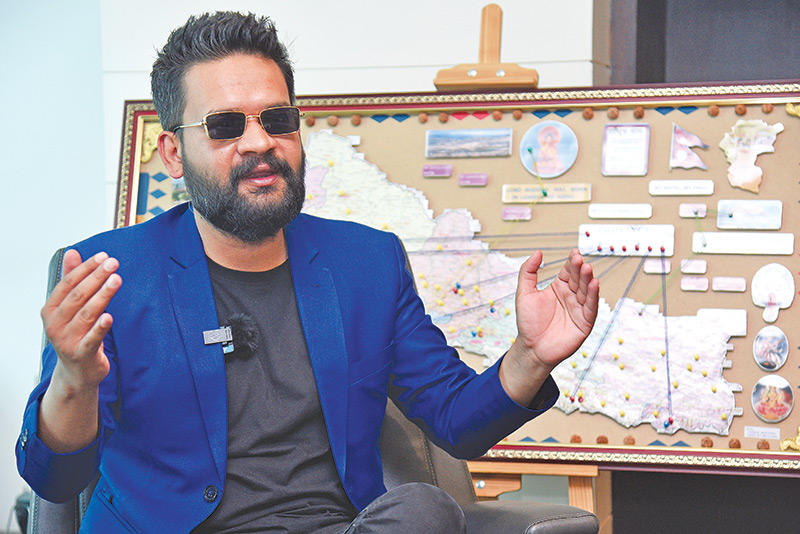
KATHMANDU, The Ministry of Foreign Affairs on Monday instructed the Nepali Embassy in New Delhi to seek answers from the Indian foreign ministry about a controversial mural in India’s new parliament building. The mural titled ‘Akhand Bharat’—or ‘Undivided India’—has stoked controversy as it shows parts of several South Asian countries, including Nepal’s Lumbini and Kapilvastu, as India. “On Monday, the government instructed us to seek an official answer from India’s Ministry of External Affairs regarding the mural in the Indian parliament,” a New Delhi-based Nepali diplomat told the Post. Indian Prime Minister Narendra Modi inaugurated the new parliament building on May 28. After the mural sparked controversy in Nepal, Bangladesh and Pakistan, India’s External Affairs Minister S Jaishankar clarified on June 8 that the wall painting of ‘undivided India’ shows the spread of the Maurya empire of Ashoka (304-232 BC), and encapsulates the idea of responsible and people-oriented governance. The mural shows ancient India from Taxila or Takshashila, which is currently in Pakistan, to a few other ancient cities that are currently inside Nepal and Bangladesh. CPN-UML chair and former prime minister KP Oli, former prime minister Baburam Bhattarai, and some other lawmakers had also questioned the Indian mural and urged the government to take up the matter with New Delhi. Protesting against the Indian mural, a few days ago, Kathmandu Mayor Balen Shah installed the map of pre-Sugauli treaty “Greater Nepal” in his office. Prime Minister Pushpa Kamal Dahal during his visit to India earlier this month had instructed the Nepali Embassy in New Delhi to gather information on the disputed mural. The Nepali Embassy in New Delhi has already sent its report to Kathmandu stating that the mural depicts the ‘cultural’ aspects of the Ashoka Empire and it has historical and cultural significance and does not have much to do with present-day reality, a foreign ministry official told the Post. After receiving the report from the Nepali Embassy in New Delhi, the Ministry of Foreign Affairs on Monday sent another instruction to the embassy to take up the matter with India’s Ministry of External Affairs, the official privy to the development, said. But Foreign Minister NP Saud, speaking at the Parliament’s International Relations Committee on Tuesday, said that the government has instructed the Nepali Embassy in New Delhi to send a report on the mural. But he did not mention the embassy’s response or Monday’s second instruction issued to the embassy. “That is not a political map as per the Indian foreign minister, who has also made an official statement about which the committee is aware. We have already instructed the Nepali Embassy in New Delhi to send a report. The government has taken the mural in the Indian parliament seriously,” the minister told the committee. “There is a national consensus on the issue of Nepal’s international boundary and we are aware that an amendment was made to the constitution of Nepal on June 13, 2020 to update our national map,” said Saud. Saud also said the prime minister, during his India visit, was not fully briefed on the mural issue and hence refrained from commenting on it. Some lawmakers at the committee questioned whether proper protocol was followed when Prime Minister Pushpa Kamal Dahal visited India from May 31 to June 3. CPN-UML lawmaker Surya Thapa asked Saud why the prime minister’s daughter Ganga Dahal was present at Dahal’s meeting with India’s National Security Adviser and Indian Foreign Secretary Vinay Mohan Kwatra. While Bhim Acharya, Sunita Baral, Damador Poudel Bairagi and Thapa, among others, claimed that protocol was disregarded during the prime minister’s India visit, some ruling party lawmakers said there is an international practice allowing prime ministers and presidents to to take along their children on high-level visits. Bimalendra Nidhi of the Nepali Congress and Barsha Man Pun of the CPN (Maoist Center) defended the government saying former presidents Ram Baran Yadav and Bidhya Devi Bhandari and prime minister Girija Prasad Koirala had taken along their daughters on foreign visits. “In the absence of the spouse, heads of state and heads of government used to take along their daughters on such high-level visits,” said Pun, adding, “we can discuss whether we should continue such practice so as to avoid controversy. The foreign ministry should decide the matter.” Minister Saud said the children of prime ministers and presidents accompanying their parents during high-profile visits was normal practice. “Former prime minister Koirala took along his daughter Sujata and the daughters of former presidents [Ram Baran] Yadav and [Bidya Devi] Bhandari had accompanied their parents on several foreign trips,” Saud said. At the meeting, Pun said that Nepal should conduct its foreign policy by factoring its geopolitical sensitivity. “While conducting diplomacy, we should rise above partisan politics and keep our national interests at the core. Otherwise the country will face more problems,” said Pun. Nepali Congress lawmaker Nidhi and CPN (Unified Centre) chief Madhav Nepal complained that Nepal failed to take up the issue of Tarai inundation during Prime Minister Dahal visit to India. “Both Nepal and India should be mindful of bilateral treaties, agreements and international laws, but India has been unilaterally building dams along the Nepal-India border under the pretext of building roads and these have threatened Nepali territories,” Nidhi said. “India should seek Nepal’s permission before building roads, which are in fact dams, on the Indian side of the border. Why is the Nepal government not taking these constructions seriously?”
HOME PAGE
Emerging problem: How to handle hazardous e-waste
CRT monitors account for 40 percent, mobile phones 39 percent and refrigerators 16 percent of the total e-waste.
- SUBIN ADHIKARI
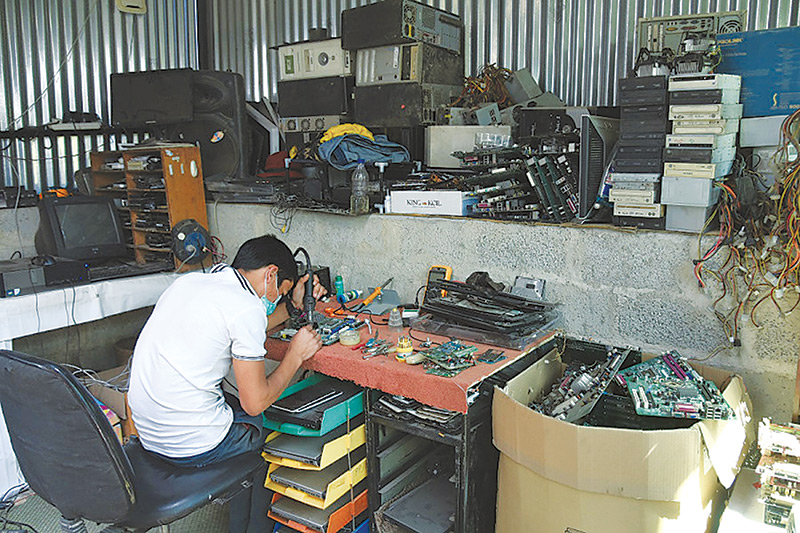
Nepal’s per capita e-waste amounts to 0.9 kg of discarded phones, computers and TV sets. Post File Photo
KATHMANDU, Nepalis tossed out 28,000 tonnes of electronic waste consisting of unusable phones, computers and TV sets in 2019, according to Global E-waste Monitor 2020. This translates into 0.9 kg of e-waste for every man, woman and child in Nepal. The United Nations defines e-waste as any discarded product with a battery or plug, and features toxic and hazardous substances such as mercury, that can pose severe risks to human and environmental health. As Nepal does not have national e-waste laws, questions have been raised about the proper management of such discarded equipment, and experts see this turning into a full-blown crisis in the near future. Nepal imported 5.75 million smartphones in the last fiscal year. The import of other electronic items has been growing steadily. According to a study done by the Department of Environment, the average life of mobile phones is two years, laptops four years, televisions and computers eight years, and refrigerators and washing machines 10 years. After they are no longer usable, most of them are sold to scrap dealers or dumped in landfill sites. Less than 20 percent of electronic items are refurbished or recycled for further use, says the department. Experts say the amount of Nepal’s e-waste could be five times larger than stated in the global report. “The UN calculates only the waste that is collected and taken to the scrap market,” said Jyoti Giri, researcher and assistant professor at Tri-Chandra Multiple Campus. “The informal market in Nepal is huge. It’s very difficult to trace the exact quantity of the e-waste,” said Giri, who has a PhD in biodegradable polymer composites and degradation. “Besides, a large amount of e-waste is dumped in the houses of individuals.” Giri said demand for electronic goods jumped sharply during the Covid pandemic--mostly laptops, fridges and washing machines. “All that will become e-waste at the end of their lifecycle,” said Giri. “But we don’t have an effective plan to manage them.” According to the report, e-waste is generated due to the introduction of the latest technology in 45 percent of the cases. In 10 percent of the cases, it is due to damage to the product, followed by other reasons such as short product lifecycle and high maintenance costs. According to the Department of Environment, there are more than 1,200 scrap dealers in Kathmandu, but only a few of them, mainly start-ups, recycle electronic waste properly. A majority of scrap dealers operate informally and they have little technical knowledge about e-waste, say officials. The International Telecomm-unication Union (ITU) has defined six products as electronic wastes: temperature exchange equipment such as refrigerators and air conditioners, screens and monitors, lamps such as LED and fluorescent, large equipment such as washing machines and printers, small equipment such as calculators and electric toys, and communication devices such as phones and routers. CRT (cathode-ray tube) monitors account for 40 percent of the total e-waste, mobile phones 39 percent and refrigerators 16 percent, as per experts. Laptops, washing machines and CRT televisions, among other products, make up the rest. Dhundi Raj Pathak, a solid waste management expert at the World Bank, says e-waste is different from other solid waste as these components are made up of several components in smaller quantities which complicates recycling. “To recycle other solid waste materials such as plastic bottles, you can put them in a machine and shred them in one go,” said Pathak. “But to recycle electronic equipment, you need to dismantle them and separate each component till the last piece, and only then can you put them in the machine to recycle.” There are around 70 different types of materials in an electronic device in very small quantities. Some of them are high-priced metals such as gold, silver and copper while others are very harmful to human health such as mercury, arsenic and lithium cobalt oxide. When disposed of carelessly, these components pollute water sources and cause serious harm to the environment, which may lead to life-threatening diseases like cancer, according to reports. Scrap collectors usually burn electric wires to extract the copper or export them to India and Bangladesh via unofficial channels for recycling due to the open border.
The Basel Convention prohibits transboundary movement of hazardous waste such as e-waste. Nepal is a signatory to the convention. Experts urge the government to form comprehensive regulations to deal with e-waste. The Solid Waste Management Act 2011 addresses industrial and hazardous waste. But there is no separate law governing e-waste. The National Waste Management Policy 2022 contains a provision about managing e-waste. But the government is yet to implement standard operating procedures and action plans. “A great deal of expertise and resources are required to deal with e-waste. It can’t be left to scrap dealers,” said Keshav Parajuly, an e-waste management expert currently based in Germany. “The government needs to implement the policy of extended producer’s responsibility.” Extended producer’s responsibility (EPR) is a growing practice all over the world where the manufacturing company is responsible to buy back the scrap and recycle or dispose of the waste materials safely. The government of India introduced EPR in 2012 to handle e-waste, and in 2016 it was extended to plastic waste manufacturers. Experts and think tanks have been urging the government to make it mandatory in Nepal too. “Electric appliance dealers in Nepal don’t buy back e-waste except during festivals when they launch exchange offers to lure customers,” he said. “Manufacturing companies have enough supply chains and high-end technology to process them,” said Parajuly. “It is cost-efficient and effective to ask the companies to buy back scrap.” Parajuly also suggests implementing the concept of a circular economy where the government can encourage the establishment of recycling factories which would extract the components of devices and supply them to other parties as raw materials. “Besides establishing such factories, the government can incentivise the mobile repair shops at New Road in Kathmandu which extract useful components from dead phones and fit them in other devices,” said Parajuly. The Nepal Telecommunications Authority has conducted several studies on e-waste and submitted reports urging the government to implement the EPR policy. “But the government is yet to pass it,” said Min Prasad Aryal, director of the Nepal Telecommunications Authority. Doko Recyclers, the first start-up to deal with e-waste, has processed around 259,319 kg of such waste since its founding in 2017. “Every year the quantity of e-waste is increasing by leaps and bounds, but there are limits to how much we alone can do,” said Santosh Kumar Mahato, operations head of Doko Recyclers. “Only 2 percent of the devices we get can be refurbished, the rest are dismantled and sent to other recycling factories, and some are sent to India as well. If the government delays implementing EPR, the situation will be very scary after a couple of years,” said Mahato. Pathak agrees with Mahato’s argument. “Looking at the way the number of EVs has been increasing recently, their dead batteries will become a headache after a couple of decades,” said Pathak. “The government should make EPR mandatory as soon as possible.” The current policy of the government has left the responsibility of handling all kinds of waste to the local government. “It’s beyond the capacity of local bodies and unorganised scrap collectors, therefore, the manufacturers must be made responsible for it,” said Pathak. “Doing this will also pressurise manufacturers to use more eco-friendly and recyclable materials instead of the hazardous materials they are currently using.” Sanjay Agrawal, vice-president of the Nepal Mobile Phone Importer’s Association, says that in other countries the companies buy back the phones, but there is no such practice in Nepal. “The concept is new in the context of Nepal, and we need to see what rule the government will bring,” said Agrawal.
NATIONAL
Kin demand justice as woman’s death raises suspicion
Father of 22-year-old Aarati Sah accuses her husband’s family of killing her over dowry issues. Her husband and father-in-law are in police custody.
- SANTOSH SINGH
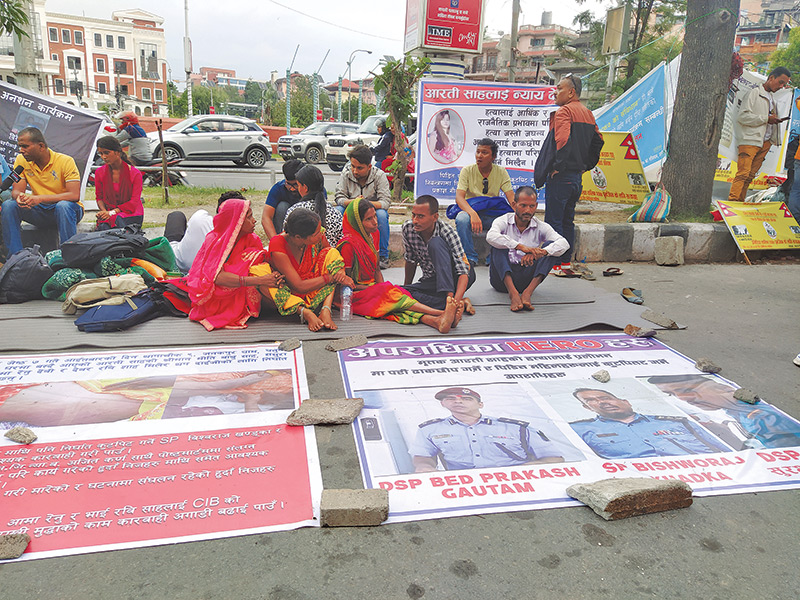
Aarati’s relatives suspect foul play in her death and have been staging a sit-in at Maitighar in Kathmandu demanding justice. Post Photo: Bidhya Rai
DHANUSHA, Aarati Sah, a 22-year-old woman from Dhanusha, died under suspicious circumstances on May 21. Her family has accused her husband’s family of beating Aarati to death for not bringing enough dowry. Motibabu Sah of Thapa Chowk in Janakpur Sub-Metropolitan City-9 and Aarati of Nagarain Municipality-8 were married around two years ago. Theirs was an arranged marriage and Binod Sah, Aarati’s father, alleges his son-in-law and his family killed Aarati for not bringing enough dowry. Motibabu’s family said Aarati was rescued and rushed to the hospital immediately after she was found hanging at home. She was pronounced dead at Kavya Hospital. On Tuesday, Aarati’s relatives and well-wishers resorted to vandalism in Janakpur. The protesters hurled stones at the Dhanusha district court while the custodial hearing of the victim’s husband and father-in-law was underway at the court. Motibabu and his father Madan Sah were taken into police custody a few days ago for investigation into the case. According to Deputy Superintendent of Police Bed Prasad Gautam, scores of Aarati’s supporters attempted to barge into the court demanding the ‘death penalty’ for the suspects. “The security personnel were compelled to use force after the enraged protesters hurled stones and attempted to enter the court compound,” said Gautam. A protester was taken into custody. Police resorted to baton charges in which four demonstrators sustained injuries. A female police officer was also injured in the violent clash. The supporters of deceased Sah have been staging demonstrations in Janakpur as well as in Kathmandu demanding justice for the victim and strong action against the guilty. They accuse the police of not investigating the case sincerely with the intention to free the suspects. Aarati’s father, Binod Sah, his mother, brother, sister, maternal uncle and some other relatives came to Kathmandu on June 16 to pressure the authority for a fair investigation into the case. They have been staging a sit-in protest at Maitighar, Kathmandu, demanding action against the guilty. According to Binod, he had provided Rs2.5 million cash to Motilal’s family two years ago at the time of her wedding as dowry. “The husband, father-in-law, mother-in-law and brother-in-law had been torturing my daughter for not bringing more dowry. It was not suicide. They murdered her,” he said, demanding a fair investigation into the case. Meanwhile, the single bench of judge Ram Prasad Neupane remanded Motibabu and Madan into judicial custody following the court hearing on Tuesday. A team from the Central Investigation Bureau (CIB) of Nepal Police started an investigation into the case. The team is now in Janakpur. According to the District Police Office in Dhanusha, the CIB team has not disclosed any information since the case is still under investigation. A medical team in Janakpur Provincial Hospital carried out a postmortem of the deceased on May 22. The postmortem report says that the victim died by hanging and it could be a suicide. The report mentions that the victim sustained deep injuries on her cheek.
NATIONAL
3 people including Sudurpaschim minister and his wife killed in road accident
- BASANT PRATAP SINGH
Prithvi Bahadur Singh and his wife Amrita in this undated photo obtained from the Facebook page of Singh’s secretariat.
BAJHANG, Sudurpaschim Province Minister of Internal Affairs and Law Prithvi Bahadur Singh, 65, his wife Amrita Singh, and his sister-in-law Jaya Devi Singh died in a road accident in Dharchada of the Kedarsyu Rural Municipality in Bajhang district on Tuesday afternoon. Two other people—the minister’s personal security officer, police constable Dipendra Bhandari, and driver of the vehicle Dharma Raj Joshi—sustained injuries in the accident. According to DIG Bharat Bohara, head of Sudurpaschim provincial police, there were five people in the vehicle, travelling from Dadeldhura to Chainpur, when it fell some 50 metres off the road towards Kalanga riverbank in Dharchada. Singh’s wife, and her sister-in-law, died on the spot while Singh, who was medevaced to Nepalgunj Medical College in Kohalpur was declared dead at around 5:33pm by the hospital. The injured are receiving treatment at the same hospital. DSP Netra KC of the Armed Police Force said that the accident occurred at around 2 pm. Singh was immediately taken to a local medical clinic for preliminary treatment and then to Deura Primary Health Centre, both in Deura of Kedarsyu-1. “Later, Singh along with the two injured were taken to Nepalgunj Medical College in Kohalpur by a Nepal Army helicopter for further treatment,” said KC. According to a press release issued by the Nepalgunj Medical College, the three injured were brought to the emergency ward of the hospital at 4:58 pm. Singh, who sustained major injuries, died during the course of treatment. Bhandari and Joshi’s condition is stable, said the hospital in the statement. Singh was elected to the provincial assembly from the Nepali Congress from Bajhang (A) in the November 2022 elections.
NATIONAL
Discontent with budget rife, lawmakers seek a revision
Ruling parties are also unhappy with disproportionate allocations to some districts at the expense of others.
- Post Report
KATHMANDU, As calls are growing within the ruling parties to amend the annual budget of 2023-24, it has simultaneously triggered a debate as to what ramifications it would have if the budget keeps getting amended every year. Vice Chairman of the ruling CPN (Unified Socialist) Rajendra Pandey has publicly warned his party chair Madhav Kumar Nepal not to allow the budget to pass without amendment. “We will not allow endorsing the budget in its current form,” said Pandey, reiterating his earlier stance. “I have also made this clear to the party chairman.” Pandey has many reservations about the budget. “There is no concrete plan on how to address the crisis being faced by the national pride projects. The capital expenditure is low, the government’s treasury is not in good shape, national pride projects are facing financial crisis, north-south corridor roads are not getting enough funds, and several other projects related to drinking water and bridges are also suffering from funds crunch,” said Pandey. The CPN (Unified Socialist) is one of the key partners of the Pushpa Kamal Dahal-led government. Besides Pandey, Chairman of the Janamat Party Chandra Kant Raut also demanded an amendment to the budget. “If the budget is not amended, we won’t allow its endorsement by Parliament,” Raut said on Monday while addressing a parliamentary committee. “If the budget does not meet the aspirations of the lawmakers, the ruling parties themselves won’t be ready to pass the budget.” Essentially, there is a major discontentment over the distribution of the budget in various districts and lawmakers have alleged that a huge amount of budget has been disproportionately allocated in Gorkha, Dadheldhura, Nuwakot, the home districts or constituencies of Prime Minister Pushpa Kamal Dahal, Nepali Congress President Sher Bahadur Deuba and Finance Minister Prakash Sharan Mahat. Also, huge amounts have been allocated to the constituencies of some key ministers. “Budget for as many as 26 road projects has been allocated in Bhojpur district while in my district, there is just a single road project. How come the tourism minister can allocate such a huge number of roads projects in his district? Is this not a monopoly? Should not the budget be distributed as per the principle of proportional distribution?,” asked Ram Hari Khatiwada, a Nepali Congress lawmaker from Okhaldunga. Sudan Kirati, is the minister for Culture, Tourism and Civil Aviation, who was elected from Bhojpur. Similarly, Minister for Urban Development Sita Gurung is facing charges of monopoly in the budget by only focusing on Terhathum, Panchthar and Taplejung districts. “How can we say this budget is justifiable when Nuwakot, Dadheldhura and Gorkha districts have received more than eight, six and four times more budgets, respectively, than the previous years. The distribution of projects, programmes and funds are leader-centric. Funds have not been allocated proportionally, so I am in favour of amending the budget,” said Khatiwada. Several other lawmakers and leaders of the ruling parties have also urged the prime minister to amend the budget. The prime minister is positive about amending the budget, but Finance Minister Prakash Sharan Mahat is dead against any revision, sources say. “There won’t be any revision,” a leader close to Mahat said. “If any lawmaker has any concerns, they will be addressed after the budget is passed. Not a single digit or sentence is going to be amended before the passage of the budget by parliament.” Finance Minister Mahat has been heard telling party leaders that some adjustments to the projects and programmes can be made after the budget is approved by the House, but before that, it cannot be amended. During Monday’s meeting of the parliament’s Infrastructure Development Committee, Raut said the committee should forward a proposal for amending the budget. “We should recommend an amendment no matter whether they heed it or not. As members of the House panel, it is our duty to recommend to the government a budgetary amendment and we can forward some suggestions too. The minister should listen to the grievances of the lawmakers. The position of the minister is not permanent, so the finance minister should stop being adamant,” said Raut. Raut also gave some examples at the meeting. Sudurpaschim has received more than six times the budget for Madhesh Province. While the population of Madhesh Province is 6.1 million, Sudurpashcim has only a 2.6 million population. “Those preparing a budget should be mindful of the principles like population, human development indexes and other indicators,” said Raut. “If the government does not listen, then the lawmakers have full authority to reject the budget.” Former finance secretary Rameshore Khanal said the parliamentary regulations bar the government from modifying the budget, so if ruling parties want to amend the budget, first they have to change those regulations. “Changing the regulations will pave the way for amendment. then the government has to bring new acts related to the budget and allocations, including the red book. That is not a big deal, but if it becomes the trend in the future, then it will be disastrous,” said Khanal. “The amendment only happens and is possible only in an advanced and matured democracy and parliamentary system, not in ours,” said Khanal. “But if budget amendment becomes a trend, then it will invite instability.” Professor Achyut Wagle of Kathmandu University said that the budget bill cannot be amended. “The budget is not a law, but a bill. If someone tables the amendment proposal in the House and that proposal is passed, then it means, the budget bill has failed, so in principle, the budget bill cannot be amended,” said Wagle, who is also a columnist for the Post.
NATIONAL
One dead, two injured in Tanahun landslide
Briefing
TANAHUN: One person died and two others were injured after they were buried under a landslide in Myagde Rural Municipality-1 on Monday evening. The deceased is a 33-year-old man from Jhapa, according to the District Police Office, Tanahun. Deputy Superintendent of Police Mohan Bahadur Khand said three workers were injured after they were hit by the landslide at around 4pm while constructing a retaining wall. “They were immediately rescued and sent for treatment, but one person succumbed to injuries,” he said. A 45-year-old man from Jhapa is receiving treatment at Damauli Hospital, while a 40-year-old man from Udayapur has been taken to Pokhara for further treatment.
NATIONAL
Local unit provides agricultural tools to farmers
Briefing
DANG: Ghorahi Sub-Metropolitan City on Tuesday provided agricultural tools to farmers for commercial promotion of the agricultural sector. According to Chopnarayan Khanal, head of the agricultural development unit of the sub-metropolitan city, they provided 36 power tillers, 20 mini power tillers, one rotavator, and two thresher machines with a 50 percent subsidy. Similarly, 11 hand pumps and 12 motor pumps were also provided to farmers with an 85 percent subsidy. The sub-metropolitan city also invested an additional Rs4.9 million for the promotion of the agricultural sector, said Khanal.
NATIONAL
Man dies in lightning strike
District Digest
PARASI: A 40-year-old man died after being struck by lightning at Ramgram Municipality-10 of West Nawalparasi on Tuesday. According to the District Police Office, the lightning struck Binod Kahar of Nadawa settlement while he was working in the paddy field. A critically injured Kahar was taken to Bhairahawa City Hospital in Rupandehi where he was pronounced dead on arrival. The deceased was a health worker posted at Birkot Ayurved Aushadhalaya in Purbakhola Rural Municipality-5 of Palpa district.
NATIONAL
Convicted former office bearers of Tax Settlement Commission sentenced to nine years in jail
Stakeholders say those responsible for forming the commission should also be brought to book.
- PRITHVI MAN SHRESTHA
KATHMANDU, The Special Court on Tuesday determined punishment for three members of the now defunct Tax Settlement Commission (TSC) who were earlier convicted by the court for corruption. In one of the biggest corruption cases of the country, the Special Court on June 1 convicted Lumbadhoj Mahat, chairperson of TSC, and its members—Chudamani Sharma, former director general of Inland Revenue Department, who worked as member secretary for the commission, and Umesh Prasad Dhakal—for corruption. At the time, the court had not determined the punishment for them. “The court on Tuesday sentenced Mahat to a prison term of nine years and one month, while the other two members will be jailed for nine years,” Deependra Nath Yogi, spokesperson for the Special Court, told the Post. “Each of them has been fined Rs4.1 billion.” A three-judge bench of its chairperson Srikanta Aryal, Yamuna Bhattarai and Shaligram Koirala sentenced the former officials of the TSC on Tuesday, according to the Special Court. In July 2017, the Commission for Investigation of Abuse of Authority had filed a corruption case against them at the court on the charges of embezzling Rs10.02 billion by each. Among the three convicts, Sharma also fights another corruption case for amassing illegal property. The CIAA had filed another case in the Special Court in January 2018. In February 2015, the Sushil Koirala-led government had formed the TSC to settle the tax dispute under the Tax Settlement Commission Act-1976, which has now been scrapped. Questions were raised about the conduct of TSC members after the Auditor General’s report released in April 2017 questioned the tax settlement by the TSC, saying various enterprises were given exemptions amounting to over Rs21 billion. The parliamentary Public Accounts Committee (PAC) then wrote to the CIAA, asking it to investigate the matter. In its charge sheet, the CIAA said that tax exemptions were given to certain enterprises without any concrete reason for doing so. For example, in the case of Ncell, tax authorities had determined the amount of tax at Rs1.82 billion, but the TSC settled the issue with a payment of only Rs900 million. “Although Ncell has the capacity to pay this amount of tax, and there was no concrete reason for tax exemption, the company was given a tax exemption with the ill-intention of causing loss to the government,” the charge sheet added. Likewise, liquor companies, which were capable of paying taxes, were given tax exemptions on a large scale. In fact, five liquor companies alone got the highest tax exemption of Rs 7.66 billion. According to the charge sheet, TSC members overstepped their jurisdiction. As per the TSC Act, the TSC can handle cases only after they are withdrawn from the revenue tribunal. However, the TSC settled tax cases of 32 enterprises who had not withdrawn their appeals from the revenue tribunal. Even enterprises that took value added tax (VAT) paid by the general public were given tax exemptions. As many as 20 companies that were involved in fake VAT bill scandals in the past, too, were given tax exemptions. The TSC members also falsified their reports to the government by showing a lower amount than the actual amount of tax exemption. For example, the tax exemption given to Triveni Distillery stands at Rs4.01 billion in the charge sheet, while the TSC report shows the company was given a Rs3.29 billion tax exemption, according to the charge sheet. The TSC members appear to have taken advantage of the provisions of immunity given by the now-scrapped TSC Act. Clause 17 of the TSC Act says, “No case or legal action may be instituted or taken against the Commission, any member of the Commission or any person acting as per the order and direction of the Commission for any act and action done or taken or purported to be done or taken in good faith in accordance with this Act or the Rules framed under this Act.” But questions were raised on whether the TSC members had performed their duties in good faith. With the latest verdict, those responsible for giving tax exemptions were sentenced. But questions have also been asked as to why those responsible for forming the TSC faced no scrutiny. “Even those responsible for forming the TSC to give tax exemptions to big corporate houses should have been investigated, something which didn’t happen,” said Padmini Pradhananga, chairperson of Transparency International Nepal. “We have the tax authority bothering small taxpayers for small unpaid taxes, while there’s a commission that exempts tax liability of billions of rupees.”
NATIONAL
President Paudel gets a permanent pacemaker implanted
His health condition is normal, according to Manmohan Cardiothoracic Centre.
- Post Report
KATHMANDU, President Ramchandra Paudel on Tuesday underwent heart surgery at Manmohan Cardiothoracic Vascular and Transplant Centre to have a pacemaker implanted. According to Dr Ratna Mani Gajurel, executive director at the hospital, the device was implanted on the recommendation of experts, which according to them was necessary to stabilise the President’s slow heartbeat. “A permanent pacemaker has been implanted successfully today (Tuesday),” reads the statement issued by Gajurel. “ His (President’s) health condition is normal.” Paudel was admitted to the hospital on Friday night after he complained of uneasiness. On June 13, Paudel complained of chest pain and was admitted to Shahid Gangalal National Heart Centre, where he underwent an angioplasty. President Ramchandra Paudel, 78, has not been keeping well since he assumed office on March 13. Less than a month after assuming office, on April 1, Paudel was admitted to the Tribhuvan University Teaching Hospital at Maharajgunj, Kathmandu after complaining of a problem in his abdomen. The next day, the hospital discharged him after some treatment. After experiencing shortness of breath and fatigue, he was again admitted to the Teaching Hospital on April 18. Doctors attending to Paudel said that his blood oxygen levels had dipped. He was also flown to India for treatment on April 19.
NATIONAL
Congress youth leaders continue ‘party transformation’ drive
The party’s young leaders have been putting in efforts to unite cadres across the country following the party’s bypoll defeats.
- NISHAN KHATIWADA
KATHMANDU, Youth leaders of the Nepali Congress have launched a nationwide campaign ‘Nepali Congress Rupantaran Abhiyan’ (transformation campaign) for a redressal of the party’s modus operandi. As part of which, they have held major gatherings in all seven provinces. On Sunday, the party held a virtual interaction programme with the Nepali diaspora. The youth leaders of Congress have also been mulling district-level major gatherings under the campaign, which was initiated after the party faced a drubbing in the bypolls. “The gatherings in seven provinces were a huge success,” said Bhupendra Jung Shahi, a Congress leader who is at the forefront of the campaign. “The voices for transformation are more intense at the grassroots level.” The leaders have been putting in efforts to unite the cadres across the country and reconnect with the voters after the bypolls, where the ascendant Rastriya Swatantra Party candidates had trounced Congress candidates with overwhelming margins in Tanahun and Chitwan constituencies. Madhu Acharya, a party central committee member who is also a leader of the campaign, said most of the participants at the gatherings were youths in the age group of 18-40 years and there was also a significant participation of women. The leaders of the transformation campaign say they will compile and summarise the suggestions received at rallies, gatherings and interaction programmes and submit it to the party leadership. “If the party holds the central committee meeting, we will submit the report at the meeting,” Acharya said. “If there’s no favourable environment to submit the report, we will start the programmes in the districts.” The next phase of the campaign will also see rallies and gatherings, Acharya said. “We will hold a plenary in Kathmandu and also discuss with the central committee members,” he said. The Congress leadership has long been criticised for ignoring the concerns related to party organisations. Many vacancies in the party’s departments and the central committee have not been filled up for a long time while its sister organisations also remain incomplete and passive. The Congress party statute mandates that the central committee meetings be held every two months. But it has been 10 months since the party held its last central committee meeting. Party leaders say most of the cadres have been demanding a special convention to change the leadership. “If the leadership is unwilling to change its course, we need to consider options such as a leadership overhaul,” Shahi said. After a continuous demand from youth leaders, the Congress is set to hold its policy convention in mid-September. The convention has been due since December 2021 when the party concluded its 14th general convention. The general convention only elected the new party leadership and deferred policy discussions citing the Covid-19 pandemic. The policy convention should have been organised within six months of the general convention.
OPINION
Pathos of vulnerable narcissism
Hyper-nationalism is the conviction in superiority of one’s nation and has no place for self-examination.
- CK LAL
Post File Photo
Just as the film was officially released, Mayor Balendra Shah of Kathmandu Metropolitan City issued an ultimatum to the makers of mythical flick Adipurush. Mayor Shah warned them that unless a portion of the dialogue that referred to Sita as Bharat ki beti—meaning “a daughter of India”—was removed from the Bollywood blockbuster altogether, no Hindi film would be allowed to run in the metropolis. Terrified by the diktat of a “partyless” populist with no political restraint on his whims, owners of cinema halls in the metropolis have suspended all shows of Hindi films for now. The menace has since begun to spread and Mayor Dhanraj Acharya of Pokhara has already issued a similar fiat to ban Hindi film shows. The possibility of other pseudo nationalists jumping on the jingoistic bandwagon can’t be ruled out. With little else to establish their credibility, politicos of Nepal seldom lose an opportunity to flaunt their “nationalistic” credentials. Patriotism may have been “the last refuge of the scoundrel” for Samuel Johnson; but for every busybody and badass in Nepal, nationalism is the first bolthole after any demonstration of unwarranted bellicosity. The unnecessary controversy over a multi-star but mediocre movie in a relatively small market is unlikely to hit the bottom line of its makers. The flick is reportedly doing well at the box-office. Nepali audiences too are unlikely to lose much by not being able to watch yet another propaganda picture of Hindutva politics. But this sordid episode does show at least two things—the risk of patriotism being used as a shield to hide collective inadequacies of an insecure society, and the danger of vulnerable narcissism of the populace being whipped up to foist yet another demagogue on the polity of the country. Handlers of Mayor Shah in the permanent establishment of Nepal (PEON) seem to be playing upon the insecurities, ignorance and ambitions of the political newbie with panache. Mayor Shah has played the scripted character of a maverick city father extremely well so far. Perhaps his promoters are envisaging a bigger role for him in politics, and nothing succeeds like the call to nationalism in establishing the credentials of a politician in a country suffering from collective narcissism.
Arrogant ignorance The insignia of a double-triangle atop crossed khukuris on Mayor Shah’s iconic Bhadgaule cap notwithstanding, it is extremely unlikely that anyone from the Madheshi side of his family ever saw any active military service in the Gorkhali force anywhere in the world. Even though he has a lot of personal achievements to his credit—he has been a popular rapper and a successful consulting engineer before being elected as the city father—he appears to have an urge to constantly prove himself to his core constituency of deracinated urbanites. Having been born and brought up in Kathmandu, Mayor Shah probably assumes that he also belongs here without realising that it’s extremely difficult for a first generation Madheshi to claim roots in a city as ancient as Kathmandu. Former President Rambaran Yadav was once alluded into believing that he was one of the inheritors of Gopalvanshi civilisation. It didn’t take him long to come face to face with the reality that he had merely been given a wax mask for the period of his utility which melted away in the heat of the third Madhesh Uprising. In acts of passion without compassion, Mayor Shah began his term by mounting an attack on slum dwellers along the Bagmati River. It is possible that some of the unauthorised settlers are frauds and swindlers. But there must be some method even in the madness of setting things right in a hurry. The cruelty of metropolitan policy upon hapless hawkers—many of them Madheshis making a hand-to-mouth living in an unwelcoming city—is unlikely to have taken place without his clearance. The decision to ban Hindi movies carries with it seeds of growing into ethnic hatred last seen during anti-Madheshi riots over something trivial that Hindi film star Hrithik Roshan had supposedly said but had never actually said what he was alleged to have said. The cartographic one-upmanship of Akhand Bharat and Greater Nepal are useful fictions that nobody in their right mind find believable. Stories, however, touch the heart and moves a person towards action that may have unintended consequences. Everyone knows that the historic Buddha of the Shakya kingdom or Princess Sita of Mithila in Videha kingdom don’t need Aadhar Card or citizenship certificate from contemporary states of India and Nepal. The 10-yard strip of no man’s land between what was then the East India Company, and the kingdom of Nepal is a creation of political settlements in the wake of the Sugauli Treaty. The section in Mithila was bequeathed to the defeated Gorkhali elite by the victors to buy their loyalty. There is no need to be riled up when a Maithil from Bihar in India says that Sita is their daughter or an Awadhiya from Uttar Pradesh claims that Buddha is also theirs. Commercial considerations come into play when Lumbini and Sarnath or Bodhgaya vie for the business of faithful Buddhists, but the Light of Asia is a shared heritage of two unequal but equally proud members of the comity of nations in the modern world. It requires self-confidence combined with a sense of humility to accept that borders between political entities with a shared civilisational heritage are transitional. In an attempt to be a true “mimic man”, Mayor Shah has unnecessarily pulled nationalism—one’s unconditional love for the mother, the motherland and mother tongue—to the level of cultivated hatred for the imagined other.
Useful lies Hyper-nationalism is the conviction in superiority of one’s nation and has no place for self-examination of one’s beliefs or productive engagement with others. The idea of collective narcissism adds another dimension to the delusion—an unfounded belief that “the exaggerated greatness of one’s group is not sufficiently recognised by others”. Nepal had to surrender to the East India Company through the Sugauli Treaty and accept tributary status of the Qing Emperor after the Treaty of Betrawati. Nepalis were never directly colonised because neither the British nor the Chinese considered it worth their while to colonise a mountainous country with little material or human resource. Despite being one of the poorest countries in the world that had to survive on remittances from the export of untrained warriors and unskilled labour in difficult times, some Nepalis continue to believe that neighbours have their covetous eyes upon their water resources, uranium deposits, fertile plains and sacred hills. According to Surendra Yadav, the Director General of Department of Passport, everyday 6,500 passports are issued to citizens that want to get out of the country at the very first opportunity. But hyper nationalists truly believe that the citizenship of their country is the most coveted document in the world. Psychologists have since identified that vulnerable narcissism involves “a fragile, uncertain sense of self-worth, deeply steeped in shame and distrust, along with the typical antagonism and self-entitlement.” It sums up the sense of an idiom in Indian English: “We are like that only.”
OPINION
The fantasy of border settlement
The Indo-Bangladesh model that Nepali border pundits are calling for is unrealistic and impractical.
- LOK RAJ BARAL
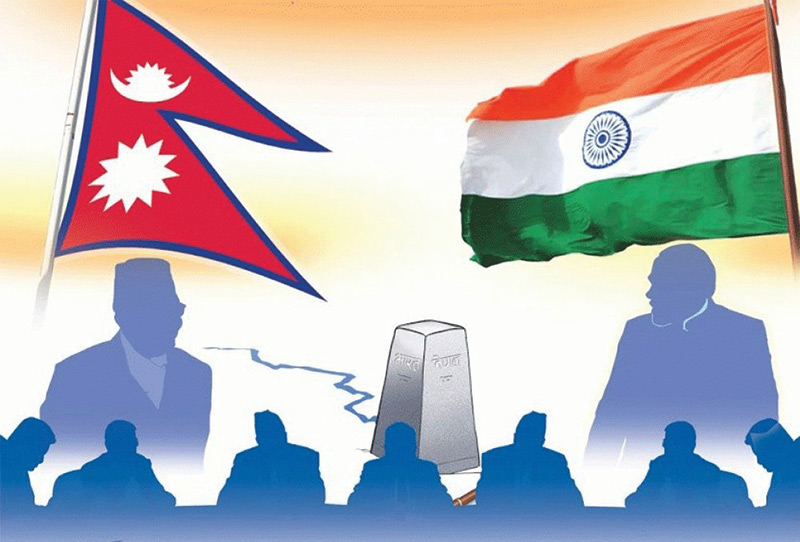
Post illustration
In his distinctive manner, Prime Minister Pushpa Kamal Dahal sometimes makes unwarranted remarks about issues with larger implications that need thorough study and strategy. While referring to the views of some “experts” on the Indo-Bangladesh model for swapping disputed territories (enclaves), he said there could be alternative models for settling border problems as the two countries did for exchanging enclaves. This was enough for some smart Nepalis (experts?) to suggest that Nepal may swap Limpiyadhura, Lipulekh and Kalapani for stretches of territories lying between the Siliguri corridor and Indo-Bangladesh border, enabling Nepal to reach Bangladesh and beyond for third-country trade. Without getting into his actual statement, though, many opposition leaders, including KP Sharma Oli, lashed out at Dahal for being too docile by failing to raise the border issue with Indian Prime Minister Narendra Modi during his official visit to India. Indeed, swapping territories between nations is a regular international practice if such territories are closer to the disputed areas. The Indo-Bangladesh model, to which some Nepali border pundits have been alluding, seems unrealistic and impractical, given the complexity of the location that India considers a lifeline regarding security and connectivity. One of the “experts” has given details about how countries have swapped territories to remove inconveniences for people belonging to their respective areas. India and Bangladesh have exchanged enclaves considering various aspects concerning the peoples of such regions. Notably, these enclaves were not too crucial for mutual security, but they had become the sources of inconvenience for the physical, political and economic connectivity of locals whose social compositions were incompatible. Can the Indo-Bangladesh model be replicated in the given Indian context (called Chicken’s Neck) because of its narrow breadth through which the whole of India is linked with the eight states of Northeast India? The exchange of western Nepal’s border lands for a transit route on the Siliguri corridor that stretches from Barsoi (Bihar) to the Bengal-Assam border at Srirampur is a one-sided view, short of a geopolitical and geostrategic consideration. India wants to avoid such geographical claustrophobia due to its “competition and fixation with China”. It is searching for alternative routes to the Northeast, eventually reaching Myanmar and Thailand under the Bay of Bengal Initiative for Multi-sectoral Technical and Economic Cooperation (BIMSTEC). Evidently, BIMSTEC has been advanced as an alternative to the South Asian Association for Regional Cooperation (SAARC), a nonfunctioning entity due to hostilities between India and Pakistan. The Indian initiation of BIMSTEC and the search for new water and land connectivity via Bangladesh are new avenues sought to reduce the congestion of the Siliguri corridor. The distance between Siliguri and Agartala, Tripura, is 1,600 km. If the new route via Bangladesh is accepted, the travel distance to Kolkata will reduce by 600 km. However, it depends on how the two neighbours reach an understanding of such projects. If such connectivity is developed and India indeed agrees to provide a transit corridor to Nepal, it will be a win-win situation for the three neighbours. No matter whether such projects would be materialised or not, Siliguri corridor continues to be the fulcrum of Indian strategic autonomy and is unlikely to be made a subject of bilateral negotiation. The Partition of India in 1947, carving East Pakistan (now Bangladesh) out of Greater Bengal, put India in a precarious geopolitical situation, making Pakistan and China common foes. The birth of Bangladesh, in which India played the role of a midwife, has diminished the immediate external security threat but continues to make India conscious of the new neighbours’ sensitivity to an independent nation. Contrary to Indian expectation, a truncated Pakistan did not also lower its guard after the defeat in the 1971 war with India but, on the contrary, it increased severe threats to India by becoming a nuclear power as well as by its collusion with China to open a new front against India. Due to staggering border conflicts, India’s competition with China is mixed with rivalry and enmity. The Siliguri corridor is a determining factor for each other’s supremacy as it is closer to the Doklam border (Bhutan-China), where recurrent skirmishes are reported. Robert D Kaplan observed that “India’s rivalry with China is not like the one with Pakistan at all: It is more abstract, less emotional, and (far more significantly) less volatile. And it is a rivalry with no real history behind it”. As China continues to be more assertive and Pakistan continues to face existential problems, India remains a common enemy for the twin countries. The triangular relations are, therefore, more intractable and vulnerable. Nevertheless, despite being placed in a complex geopolitical situation, India cannot be threatened by both the rival powers as they cannot risk getting into a large-scale war that may threaten the territorial integrity of each of them. They might use other methods of harassment, but they cannot go to the extent of waging war. For Nepal, India has already agreed to provide a transit route to Bangladesh via Fulbari in West Bengal, but there has been no traffic flow since the signing of the agreement in 1997. The lack of infrastructure on the Bangladeshi side, and Nepal’s inability to attract traders to use this route instead of Haldia near Kolkata, can be counted as some of the reasons for its non-utilisation. Then why would India be prepared to swap its territory, a cordon sanitaire, for neither contiguous nor socially compatible lands? Moreover, what is the compulsion of exchanging a portion of territory for lands in far-off places? Thus, from different viewpoints, the new formula for settling border disputes, particularly about Limpiyadhura, Lipulekh and Kalapani, is not only short of realistic assessment but may not encourage India and Nepal even to discuss this model casually. I am particularly intrigued by the overzealous Nepali experts who offer suggestions without considering other dimensions. India would not be interested in entertaining suggestions that argue for swapping land in the Siliguri corridor for Nepal’s Kalapani, Lipulekh and Limpiyadhura. Since India has not accepted the new map of Nepal, calling it a “cartographic assertion”, it has become more complex after Nepal decided to make it a part of the Constitution of Nepal. How this will play out in negotiations, let alone swapping lands, is only guesswork as of now.
Baral is a professor of political science and former ambassador of Nepal to India.
OUR VIEW
Old monsoon tale
Managing disaster begins locally. Federal and provincial governments must equip local bodies.
The monsoon in Nepal has just begun and incessant rainfall has already started ravaging the country. Recent floods and landslides in eastern districts—Taplejung, Panchthar, Sankhuwasabha and Terhathum—resulted in the loss of eight lives, with 27 people missing (as of this writing). Over the years, landslides and floods have become more common due to unpredictable weather that is the result of climate change and other anthropogenic activities. Nepal ranks as 20th most disaster-prone country in the world; and 30th on flood hazards. This is why it is all the more important for the government to be prepared to handle such an adversity. As per a report in the Post about the recent disaster, the ward chief of Sidingwa-6 in Taplejung district expressed disappointment at the delay in the supply of relief materials like tents, food, and blankets to displaced individuals. This isn’t a surprise, however. Government agencies are notorious for delays in relief and rescue. True, continuous rainfall messed up rescue efforts, as roads were blocked and bridges damaged. It is nonetheless painful to see the authorities work at a snail’s pace to offer the required assistance, leaving people in a lurch. Following global best practices of community-based approaches in disaster management, Nepal aims to make local level resilient and increase the capacity of communities through the Local Governance Act of 1998. The responsibility to manage the disaster falls, first, on the local governments, as the constitution provides that “the local governments shall do as much as they can on their own, and where they cannot, provincial and federal governments shall provide backup or lead disaster risk reduction and management.” However, a 2020 report titled “Disaster Risk Reduction and Management in Nepal: Delineation of Roles and Responsibilities” argues that the Disaster Reduction and Risk Management Act, 2017 and other legal provisions don’t accurately capture the constitution’s spirit, creating confusion on the roles, responsibilities and accountability between local, provincial and federal levels. Disaster management begins locally; hence federal and provincial governments must ensure they are well-equipped to handle the situation initially by providing adequate budget, human resources and storage of relief packages. The municipalities still rely on the provincial or federal agencies’ generic early warning systems. As a result, they can’t manage the disasters properly. This calls for municipal-level weather forecasts. What’s more, in many places, deforestation, settlements on the banks of rivers and haphazard road construction in hills that lead to devastation are still common. Immediate action is necessary to make people aware and mitigate risks. The federal government must also take proactive measures to obtain accurate weather forecasts to prevent casualties. Conducting landslide susceptibility mapping in disaster-prone areas to identify risks and allowing local levels to handle situations in advance is as important. Disaster mitigation and prevention tools like Geographic Information Systems (GSI) and remote sensing should be promoted in all 8 percent of flood-prone and 59 percent of landslide-prone areas of the country. Only such proactiveness will prevent widespread loss of lives and livelihoods in the days ahead. Nepal has many laws, plans, and policies to address natural disasters, including floods and landslides. Unfortunately, often, the government fails in their effective implementation. The 2021 Melamchi flood and similar water-induced devastations are still etched in our memory. We can’t afford to lose more lives to the state’s inadequacies and carelessness.
THEIR VIEW
For the health of all
People in Pakistan should get proper healthcare for the country to progress.
Though the situation may have improved since the time of independence, Pakistan’s health indicators are hardly satisfactory. Far too many Pakistanis die preventable, early deaths, while debilitating diseases affect the quality of life and productivity of millions. This is mostly because despite the power wielders’ stated commitments to improve the lot of the masses, human development is not a priority for our elite. When members of the elite fall sick, they can opt for the best healthcare money can buy at private medical facilities in the country, or better still, fly off to foreign locales where they are healed in well-equipped hospitals, staffed by competent medical professionals. For the middle and working classes in this country, the choices are far fewer. Should the common man get sick, he can either pay through the nose and be admitted to a private hospital, or opt for suboptimal public health facilities, or die a slow, painful death. To ameliorate this dismal state of affairs, the Human Rights Commission for Pakistan (HRCP) has rightly called for making health a fundamental part of the Constitution. This call needs to be heeded by local authorities as well as those in parliament. Though many of the rights enshrined in the Constitution are denied to the people, incorporating health in the nation’s basic law will at least correct the direction. As the WHO states, health is “a fundamental right of every human being”, one that is unfortunately denied to millions of Pakistanis. Our high rates of neonatal mortality and child stunting, high burden of hepatitis C and tuberculosis, as well as the fact that this country is amongst the two remaining states in the world where polio has not been eradicated, point to only a few of our considerable health challenges. However, all these problems can be tackled, should the state prioritise people’s health. Acknowledging health as a fundamental constitutional right, as was done with education in the 18th Amendment, is the first step. This needs to be followed up by strengthening primary healthcare across the nation, specifically in the less-developed parts of rural Sindh and Balochistan, where healthcare is available only in rudimentary form. If all goes as planned a general election will be held in a few months. Therefore, as pointed out by experts, political parties should commit to making health a fundamental right in their manifestos. Moreover, a multisector approach is needed; better healthcare facilities and professionals will only make a difference when people have cleaner air to breathe and pure water to drink. Affordable healthcare at public facilities (and free for those who cannot pay) is an achievable goal should the elite set their minds to it. A secure and progressive Pakistan can only emerge when its people are healthy, educated and prosperous.
— Dawn (Pakistan)/ANN
MONEY
‘Tough balancing act’: Chinese, German leaders hold talks
- AGENCE FRANCE-PRESSE
BERLIN, Chancellor Olaf Scholz hosted Premier Li Qiang for talks on Tuesday, seeking to recalibrate cooperation between Germany and China after Berlin branded Beijing a “systemic rival”. Li is on his first trip abroad since he was named premier in March and tasked with shoring up China’s sputtering post-Covid economy. But unlike previous visits by Chinese dignitaries, when pragmatic German leaders eager to expand business ties with the Asian giant rolled out the red carpet, Li’s trip comes as Germany is rushing to diversify its trading partners. Burned by its reliance on Russian gas and hurt by supply chain disruptions during the pandemic, Germany is intensifying its efforts to “de-risk” from China. Meeting Germany’s President Frank-Walter Steinmeier on Monday, Li said China was ready to work with Germany to contribute to “global stability and prosperity”. Li was given a full military honours welcome by Scholz on Tuesday, but when they sit down for talks, Germany’s first national security strategy, published days ago, will set the tone. The blueprint accused China of acting against German interests, putting international security “under increasing pressure” and disregarding human rights. But it also underlined the necessity of getting Beijing’s cooperation on global issues such as fighting climate change. Beijing has bristled at being described as a “partner, competitor and systemic rival” in the text, saying such labels would only “push our world towards a vortex of division and confrontation”. Tuesday’s talks between the two governments is “a stress test on whether genuine partnership between Berlin and Beijing is still possible”, Thorsten Benner, director of the Global Public Policy Institute, told AFP. “It’s open as to whether Germany continues to play the game of pretending there is broad agreement with Beijing... or whether it chooses a new path of straight talk and limiting the final statement to areas where there is a genuine path forward for cooperation,” he added. China has been accused of stirring regional instability with threats against Taiwan and of rights abuses against Uyghurs, while refusing to distance itself from Russia’s Vladimir Putin. The latest report published Tuesday by Germany’s intelligence agency also cited China as the “biggest threat in relation to economic and scientific espionage and foreign direct investments in Germany”. On the other hand, it is “important to continue to have a relationship of trust” with Beijing, news magazine Der Spiegel noted. “Managing this balancing act without suffering a hernia is a real challenge” not just at Tuesday’s talks, but “in the years and decades to come”, it said.
MONEY
Qatar inks long-term gas supply deal with China
- AGENCE FRANCE-PRESSE
DOHA, Qatar announced a second 27-year supply deal with a Chinese company on Tuesday as it expands production from the world’s biggest natural gas field. The agreement, to supply four million tons annually to the China National Petroleum Corporation (CNPC), matches the terms of a November deal with China’s Sinopec as the longest ever seen in the industry. Asian countries led by China, Japan and South Korea are the main market for Qatar’s gas, which has been increasingly sought by European countries since Russia’s invasion of Ukraine early last year. “Qatar will supply four million tons annually of natural gas from the North Field East Expansion Project to China over a period of 27 years,” Kaabi told a signing ceremony in Doha. “This will become the second LNG (liquefied natural gas) sale and purchase agreement to China within the North Field East Expansion Project.” By expanding activities at North Field, which has the world’s biggest natural gas reserves and extends under the Gulf into Iranian territory, Qatar is raising its LNG production by 60 percent-plus to 126 million tons a year by 2027. CNPC signed a separate agreement for a five percent interest in North Field East, the equivalent of one gas-liquefying complex producing eight million tons of LNG a year. “It lays a solid foundation for the energy cooperation between the two sides in the next three decades,” CNPC chairman Dai Houliang said in a statement. “CNPC will continue to actively discuss with QatarEnergy all-round cooperation across the hydrocarbon industry chain and other areas like green and low carbon energies,” he added. Qatar, whose gas riches have made its per-capita gross domestic product among the highest in the world, has struck a series of major agreements surrounding the North Field expansion. Earlier this month, QatarEnergy agreed a 15-year supply deal with Bangladeshi state firm Petrobangla, and last month it awarded a $10 billion contract to France’s Technip Energies and Consolidated Contractors Company for the engineering, procurement and construction of the North Field South project.
MONEY
Large cardamom likely to see sharp fall in output
- ANANDA GAUTAM
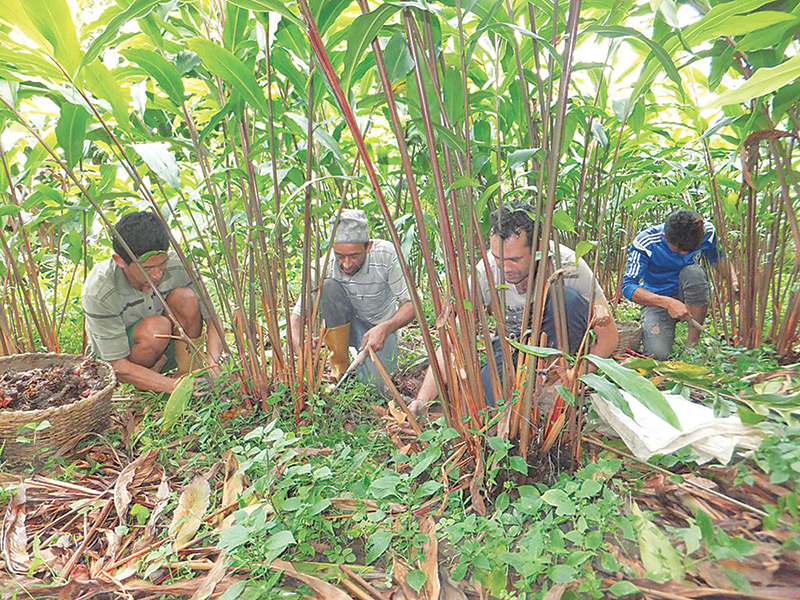
The large cardamom prices, meanwhile, have been increasing. Post file Photo
TAPLEJUNG, The Federation of Large Cardamom Entrepreneurs expects a sharp fall in output this year, mainly due to drought and pest infection. The association of large cardamom buyers said the output may drop by a staggering 40 percent, year-on-year. Nirmal Bhattarai, central president of the federation, said drought and the outbreak of diseases may affect the production this year. The large cardamom prices, meanwhile, have been increasing. “As the producers have already sold their spice which they had stored, the demand may spike in the months ahead,” said Bhattarai. “We will not be able to fulfil the demand of the international buyers this year.” The large cardamom, with a bigger seed, is currently being traded at Rs925 per kg in the market in Birtamod, Jhapa. According to the federation, 8,000 tonnes of large cardamom is produced annually in Nepal. The cultivation is being done in 53 districts with Taplejung the highest producer. But this year, the large cardamom production in Taplejung is expected to drop by 60 percent, said Balmani Baral, president of Large Cardamom Zone, Taplejung. “The large cardamom production has been hit by pests in the mountain region. In the hills, the drought may affect productivity,” he added. Taplejung’s annual production stands at 2,900 tonnes, according to the statistics of the agriculture zone. There are 61 wards in Taplejung district and large cardamom is not produced in only two wards. The large cardamom farmers have demanded that the government control pests and provide irrigation facilities to increase production. Krishna Labung of Paktanglung Rural Municipality-4 said that without pesticides, the crop wouldn’t yield. He, however, said that farmers should be made aware of applying organic pesticides. Organic pesticides are made by using mugwort (bitter leaf) and cow manure. The large cardamom zone has provided assistance for farmers applying organic pesticides in Hangdeva of Phungling Municipality-9, Phaktanglung-3, in Lelep of Likhim and Fungling-6, said Baral. Normally, large cardamom is harvested from September to December. Large cardamom is planted mostly on sloped terraces. The large cardamom price had reached a record Rs3,000 per kg in 2014-2015. Large cardamom is mainly exported to India as well as Pakistan and to the Gulf countries like Saudi Arabia, Qatar and the UAE, via India. Studies have shown that Nepal can produce 35,000 tonnes of large cardamom, but there should be a smart and robust farming system in place. The government has not invested much in large cardamom, which is one of the country’s high-value export items. Nepal exported 5,367 tonnes of large cardamom worth Rs4.81 billion in the last fiscal year. Large cardamom is cultivated predominantly in four districts of eastern Nepal—Taplejung, Panchthar, Ilam and Sankhuwasabha—which account for more than 80 percent of national output. Around 60,000 families are involved in growing it. Large cardamom is being grown in Dadeldhura and Lamjung too. Besides Nepal, this high-value spice is also cultivated in India and Bhutan. More than 90 percent of the large cardamom grown in Nepal is exported to India, traders said. The Nepali large cardamom or black cardamom has a distinct flavour profile due to a specific method of post-harvest drying in bhattis (ovens), which explains its roasted smell and taste. The smoky flavour would overwhelm a sweet cake or pudding, but in a spice rub for roasted meat or in a full-flavoured stew, it imparts a smouldering depth no other spice can, according to experts. As India prefers to import non-processed cardamom for a cheaper price, Nepal has been exporting non-processed cardamom. India then processes, packages and brands the spice and sells it at a higher price.
MONEY
IPPAN appoints NICCI vice president as its advisor
Bizline
KATHMANDU: Sunil KC, vice president of the Nepal-India Chamber of Commerce and Industry (NICCI) has been appointed as an adviser to Independent Power Producers Association Nepal (IPPAN). The 21st annual general meeting of IPPAN held on June 15 elected its new executive committee under the leadership of Ganesh Karki. The first meeting held on June 16 appointed KC as an adviser to IPPAN. KC is the founder of the Asian Institute of Diplomacy and International Affairs (AIDIA), a think tank based in Kathmandu which has been advocating in the field of diplomacy for almost a decade.
MONEY
Boeing, Airbus score new billion-dollar orders at Paris Air Show
Bizline
LE BOURGET: Global airliner rivals Boeing and Airbus notched up new orders from Algeria and the Philippines at the Paris Air Show Tuesday after the European manufacturer snagged the biggest-ever single civilian contract. Philippine Airlines will buy nine of Airbus’ A350-1000 widebody planes, while Air Algerie snapped up eight of Boeing’s medium-haul 737 MAX-9 aircraft. At list prices—usually higher than discounted bulk orders—the Airbus deal is worth $3.3 billion and Boeing’s $1.0 billion. With both plane builders’ order books well stocked, Philippine Airlines can expect delivery from 2025 while Air Algeria will have to wait until 2027. Faced with growing demand for long-haul planes, Airbus is pushing to increase production of the A350, its latest airliner, setting a target of nine per month by the end of 2025. Meanwhile, Boeing’s sales of the 737-MAX appear to be hauling it out of a slump triggered by both Covid and the aircraft’s lengthy grounding after two fatal crashes. (AFP)
MONEY
Hyundai raises annual EV sales goal to two million by 2030
Bizline
SEOUL: Hyundai Motor said Tuesday it aims to sell two million electric vehicles a year by 2030, raising its target from the 1.87 million it set last year as the market for clean-energy vehicles continues to soar. It also announced plans to invest a total of 109.4 trillion won ($85 billion) from 2023 to 2032 to focus on “future businesses, such as autonomous driving, hydrogen, robotics and advanced air mobility.” The South Korean carmaker—one of the world’s largest—is under pressure in the United States and Europe to boost local production of clean vehicles and cut down on its dependence on China-made components and battery minerals. Chips, which have become crucial components for modern vehicles, became scarce as the Covid-19 pandemic shut down factories in China and elsewhere in Asia, causing shortages that are only recently being absorbed by supply chains. (AFP)
WORLD
Biden ready to fete India’s leader, looking past Modi’s rights record and ties to Russia
US president wants to bring India closer to the United States as the administration tilts its foreign policy toward Asia.
- ASSOCIATED PRESS
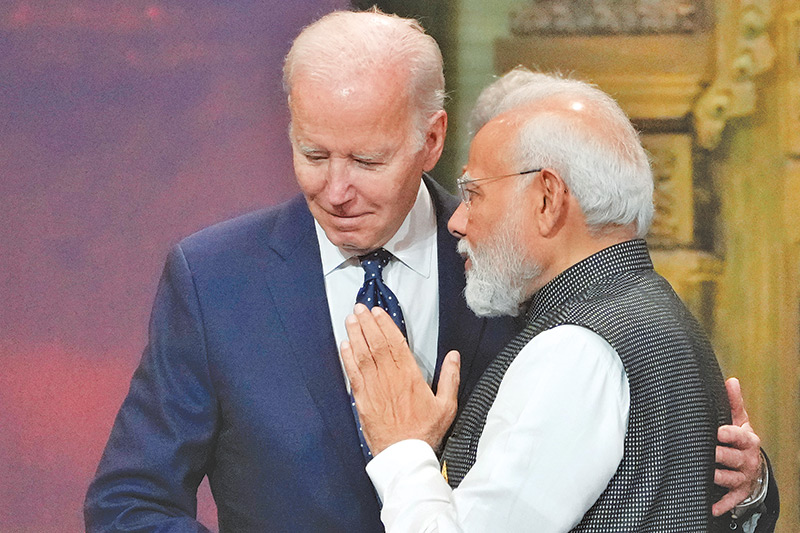
US President Joe Biden and India Prime Minister Narendra Modi in November, last year. AP/RSS
WASHINGTON, Indian Prime Minister Narendra Modi is, on many counts, a curious choice for President Joe Biden to honour with a state visit. Since Russian President Vladimir Putin ordered the invasion of Ukraine 16 months ago, India has boosted its economy by purchasing increasing quantities of cheap Russian oil. Human rights groups and political opponents have accused Modi of stifling dissent and introducing divisive policies that discriminate against Muslims and other minorities. And India’s foreign minister, Subrahmanyam Jaishankar, has espoused a worldview in which there are no allies or friends, only “frenemies.” But Biden, who will welcome Modi to the White House on Thursday for a state visit, has made clear he sees US ties to India—the world’s biggest democracy and one of its fastest growing economies—as a defining relationship. New Delhi, as Biden sees it, will be essential to addressing some of the most difficult global challenges in coming years, including climate change, disruptions related to artificial intelligence, and China’s growing power in the Indo-Pacific. “Now, we know that India and the United States are big, complicated countries,” Secretary of State Antony Blinken told the US-India Business Council in Washington ahead of Modi’s visit. “We certainly have work to do to advance transparency, to promote market access, to strengthen our democracies, to unleash the full potential of our people. But the trajectory of this partnership is unmistakable, and it is filled with promise.” Much is at stake for both sides in the Indian leader’s four-day visit to the US, which begins Tuesday with a stop in New York, where Modi is scheduled to hold meetings with business and thought leaders. Modi will lead an international yoga day event on Wednesday at the United Nations. Biden wants to bring India closer to the United States as the administration tilts its foreign policy toward Asia and looks to build partnerships in the region in the face of an ascendant China. Modi, for his part, is trying to usher in a more prosperous era for his nation of 1.4 billion, delivering on a promise he made when he swept into office more than nine years ago. The Indian prime minister hopes to strengthen US-India economic and military ties. He also has his own worries about Chinese military activities, along the Himalayan border and in the Indian Ocean. India has been locked in a long-running standoff with China in the rugged mountainous area of Ladakh, where each side has stationed tens of thousands of military personnel backed by artillery, tanks and fighter jets. “As China has risen, India and the US both need one another and the US needs more partners in the Indo-Pacific,” said Jitendra Nath Misra, a professor of diplomatic practice at the OP Jindal Global University and a former Indian ambassador. “They can’t do it alone anymore because China is catching up with the US, and the Chinese economy is significantly larger than India’s. So, there is a congruence of geopolitical interests here.” There are plenty of signs that the relationship already has taken a leap forward. Trade between the US and India in 2022 climbed to a record $191 billion. The Indian diaspora in the US stands at nearly 5 million and has become an economic, cultural and political powerhouse. Biden has sought to reinvigorate the Quad, an international partnership of the US, Australia, India and Japan. And US defence sales to India have risen from near zero in 2008 to over $20 billion in 2020. Still, the state visit comes with some problematic aspects for Biden, who as a presidential candidate pledged that human rights would be a driving force in his foreign policy. Elaine Pearson, Asia director for the group Human Rights Watch, urged Biden in a letter not to shy away from confronting Modi on India’s “worsening human rights situation.” Her organisation plans a Tuesday screening in Washington of a BBC documentary critical of Modi that was banned by the Indian government. The documentary delves into Modi’s oversight as chief minister of Gujrat during the deadly 2002 anti-Muslim riots that left more than 1,000 dead. In 2005, the US revoked Modi’s visa to the US, citing concerns that he did not act to stop the communal violence. An investigation approved by the Indian Supreme Court later absolved Modi, but the stain of the dark moment has lingered. More recently, Modi has faced criticism over legislation amending the country’s citizenship law that fast-tracks naturalisation for some migrants but excludes Muslims, a rise in violence against Muslims and other religious minorities by Hindu nationalists, and the recent conviction of India’s top opposition leader, Rahul Gandhi, for mocking Modi’s surname. “Modi’s government has also demonstrated blatant bias in protecting BJP supporters and affiliates accused in a range of crimes, including murder, assault, corruption, and sexual violence,” Pearson wrote, using the initials for Modi’s Bharatiya Janata Party. “At the international level, Modi’s government has often proven unwilling to stand with other governments on key human rights crises, abstaining or refraining from condemning grave human rights violations elsewhere.” The Indian government has continually defended its human rights record and insisted that India’s democratic principles remain robust. Modi has offered only limited criticism of the Russian invasion of Ukraine, urging Putin during a meeting last September to “move onto a path of peace.” The New Delhi-Moscow relationship dates back decades, with Moscow offering key cooperation on defence, nuclear energy and other issues.
WORLD
UN urges nations to keep Sudan borders open as exodus tops 500,000
- AGENCE FRANCE-PRESSE
NAIROBI, The head of the UN’s refugee agency on Tuesday urged Sudan’s neighbours to keep their borders open despite security worries as the number of people fleeing the conflict topped 500,000, while those internally displaced climbed to two million. Filippo Grandi warned in an interview with AFP that the two-month-old war threatened to spread insecurity in the “fragile” nations that border Sudan. “My appeal to all the neighbouring countries is to say I understand your security concerns, but please keep your borders open because these people are really fleeing for their lives,” he said during a visit to Nairobi to mark World Refugee Day. Sudan has been riven by conflict since April 15, with the army led by Abdel Fattah al-Burhan battling the paramilitary Rapid Support Forces (RSF) commanded by his former deputy, Mohamed Hamdan Daglo. “It is a worrying situation. Many of these neighbouring countries are very fragile and there is also an element of insecurity that risks spreading,” Grandi said. The death toll in Sudan has risen above 2,000, according to the Armed Conflict Location and Event Data Project’s latest figures. At an earlier press conference in the Kenyan capital, Grandi said that half a million refugees had fled Sudan since the beginning of the conflict, and another two million were internally displaced. “If we don’t silence those guns, the exodus of Sudanese people will continue,” said the United Nations High Commissioner for Refugees. He was speaking a day after donors at a UN conference pledged close to $1.5 billion to combat the humanitarian crisis in Sudan and help its neighbours host those fleeing the fighting—including Chad, South Sudan and Egypt. That figure was however less than half of what humanitarians have said is required this year and Grandi appealed to the international community to dig deeper, saying donations were a fraction of defence spending by rich nations.
WORLD
Ukraine’s counter-offensive, seen from the ground
- AGENCE FRANCE-PRESSE
A local resident walks among remains of her house in the village of Rus’ka Lozova, Kharkiv. AFP/RSS
KYIV, More than a week into Ukraine’s counter-offensive, Kyiv has reported modest gains, liberating eight settlements in the first cautious steps of a daunting fight back against entrenched Russian positions. Much about Ukraine’s progress is unclear but its ally Britain has said “both sides are suffering high casualties” and that “Russian forces often conduct relatively effective defensive operations.” Analysts also caution that NATO-trained and Western-armed brigades have not yet been fully committed to the fight and that some early assaults are only designed to find weak spots in Russian lines. AFP journalists have recently visited Ukrainian positions along the front, from forested hills in the eastern Lugansk region through Donetsk to Orikhiv 230 kilometres west. The snapshots give an impression of how successfully Ukrainian forces are moving forward and at what cost. Most settlements Ukraine says it liberated lie in the wooded and marshy valley south of Velyka Novosilka in the Donetsk region. Here, soldiers of the 68th Jaeger (“Hunter”) brigade said Russia put up fiercer than expected resistance in the village of Blagodatne, where Russian corpses lay where they fell and two-way artillery fire echoed. “The regular Russian army was here,” said a Ukrainian soldier known by his call-sign “Zahar”, alleging professional Russian units were reinforced by prisoners recruited to fight. “Commanders were from the regular army, and a lot of convicts.” Combat medic Vinni added: “It took two days to clear the area, because they had a lot of dugouts and passages. It was really difficult for our guys to kick them out of here.” The deputy commander of the brigade, using the call-sign “Lermontov”, said the wider goal was to capture nearby Russian stronghold Donetsk. On June 8, when Ukraine was still reluctant to confirm the new operation, Russia said it repelled an armoured column near the front line south of Orikhiv. Russian drone footage appeared to show several German-built Leopard mine-clearing tanks and US-made Bradley fighting vehicles damaged. Ukrainian soldiers from the 47th Brigade resting at a cafe confirmed their motorised infantry company had lost most of its Bradleys, but insisted some were recoverable and that the brigade would fight on. “In our unit, six out of ten Bradleys were wrecked, and three damaged,” one infantryman said. An officer separately said human casualties had been lower than feared thanks to the disabled Bradleys’ tough armour. Ukraine has since launched new attacks on the western and southern fronts and on Monday deputy defence minister Ganna Malyar said the village of Pyatykhatky had been liberated. The longest and bloodiest battle of the war so far has been the fight for the eastern city of Bakhmut, captured by Russian forces in May after months of slaughter. Almost immediately, Ukrainian assault infantry backed by German artillery began pushing Russian troops from the town’s flanks. “They are the most active at night,” a soldier with the call sign “Quiet” told AFP. “You can hear the sound of the equipment, and if they speak loud, you can hear them as well.” A commander said Russian drones and gliding bombs dropped by planes out of Ukrainian air defences’ range were taking a toll, but claimed slow, steady progress all the same. Ukraine has not announced an operation in the eastern Lugansk region, but rumours of one already seem to have reached the Russians. Infantry from the 100th Territorial Defence Brigade, recruited last year in western Ukraine near the Belarus border, are guarding trenches in the forested hills between Sloviansk and Russian-held Kreminna.
WORLD
Advocate for separate Sikh state shot dead in Canada
Briefing
- AGENCIES
OTTAWA: A campaigner for a Sikh nation to be carved out of India’s Punjab state who was wanted by Indian authorities was shot dead in Canada, police said Monday. Federal police said in a statement that a man was found in his pickup truck in the parking lot of the Guru Nanak Sikh Gurdwara temple in Surrey, British Columbia, around 8:30 pm on Sunday, “suffering from apparent gunshot wounds.” “The man died of his injuries at the scene,” the Royal Canadian Mounted Police added. Police did not initially identify the victim, but later said he was 45-year-old Hardeep Singh Nijjar, the temple’s president who advocated for the creation of a Sikh state known as Khalistan. The later police statement said they were releasing his identity “in hopes of advancing their investigation.” “We understand there is a lot of speculation regarding the motive of this homicide, but we are dedicated to learning the facts and letting the evidence lead our investigation,” said Timothy Pierotti of the police’s Integrated Homicide Investigation Team. Nijjar was wanted by Indian authorities for alleged terrorism offenses and conspiracy to commit murder, which he reportedly denied to Canadian media. He had been warned by Canada’s spy agency about threats against him, according to the World Sikh Organization of Canada, which said that he was “assassinated in a targeted shooting.”
WORLD
UN Palestinian refugee agency warns of cash shortage
Briefing
- AGENCIES
BEIRUT: The head of the United Nations agency for Palestinian refugees warned on Tuesday that a funding squeeze could jeopardise access to basic services for millions. UNRWA provides services such as health, sanitation, education and social assistance to nearly six million Palestinians registered in the Palestinian territories, including Israeli-annexed east Jerusalem, as well as in Jordan, Lebanon and Syria. It is the latest in a series of warnings from UNRWA on possible deep cuts if the international community fails to provide more support. In January, it appealed for $1.6 billion in funding for 2023, but donors have only pledged around half of that amount. UNRWA chief Philippe Lazzarini said on Tuesday his agency was seeking $300 million “to keep our operations running between now and the end of the year”. “If we have no more commitment from member states, we will hit the wall” from autumn, he told a press conference in Beirut. The agency needs $200 million for “core activities” including education and social safety nets, $75 million for food aid in the Israeli-blockaded Gaza Strip, and around $20 million in cash assistance to refugees in Syria, Lebanon and Jordan, he said. There is a “risk of a vacuum in the absence of any proper alternative” to UNRWA’s “state-like” services, he said.
WORLD
Joe Biden’s son Hunter reaches plea deal on gun, tax charges
Briefing
- AGENCIES
WASHINGTON: US President Joe Biden’s son Hunter has agreed to plead guilty to two counts of failure to pay federal income tax, and admitted to illegally owning a gun, prosecutors said on Tuesday. Hunter Biden, whose business dealings have been under attack for years from Republican lawmakers, acknowledged possessing a firearm despite being a drug user. The plea agreement between the 53-year-old and the US Attorney’s Office in his home state of Delaware will still need to be approved by a federal judge. The president’s son is unlikely to face any prison time. President Biden and his wife, Jill, issued a statement after the announcement of the deal.
SPORTS
Nepal beat US, register first victory
Medium pacer KC claims four wickets and Sharki scores unbeaten 77 to guide the Rhinos to a six-wicket victory.
- Sports Bureau
Nepal’s Karan KC bowls during the ICC World Cup Qualifier match against the United States in Harare on Tuesday. Photo: Courtesy of CAN
KATHMANDU, Karan KC shone with the ball for Nepal as they registered a six-wicket victory over the United States of America to secure their first victory in the ICC World Cup Qualifiers at the Takashinga Sports Club in Harare, Zimbabwe, on Tuesday. Inviting US to bat first, Nepal put the opponents under pressure from the very beginning after medium pacer KC claimed four early wickets with 18-4 on board. But wicketkeeper-batter Shayan Jahangir scored an unbeaten century for US before they were bowled out for a respectable total of 207 runs in 49th over. In the run chase, Bhim Sharki slammed his career best ODI score for Nepal collecting not out 77 runs as they made 211-4 with seven overs to spare. Nepal, who faced eight-wicket defeat to Zimbabwe in their opening game on Sunday, will vie against West Indies in their third match on Thursday. The victory lifted Nepal to third with two points in the five-team Group ‘A’ and they would be ensured a spot in the Super Six should they secure top three finish. Zimbabwe, who beat the Netherlands by six wickets in their second game on Tuesday, lead the standings with four points from two games. West Indies are second on two points from one game and are above Nepal due to superior run rate. The US and the Netherlands that are yet to open accounts are fourth and fifth in the table. Sharki, who came to bat at number three in the run chase and was dropped on nine runs, struck seven hits to boundaries and a six in his knock of 114 balls. He also shared an unbeaten 74-run stand for fifth wicket with Dipendra Singh Airee, who contributed 32-ball 39 including a winning boundary. Sharki also surpassed his previous best ODI score of 70 runs, which came against the United Arab Emirates in ICC World Cup League 2. Airee, the joint second highest scorer for Nepal along with opener Kushal Bhurtel, slammed five boundaries and a six. Nepal lost opener Aasif Sheikh on 12 runs after he was trapped LBW by Saurabh Netravalkar with 25 runs on board. His opening partner Bhurtel, who missed century by a run against Zimbabwe, contributed 39 runs off 54 comprising four hits to boundaries and a six. He was caught and bowled by Nosthush Kenjige in 16.2 overs with 74-2 on board. Captain Rohit Paudel contributed 16 runs off 29 and Kushal Malla played run-a-ball 13 before their departure. USA bowlers Netravalkar, Kenjige, Nisarga Patel and Steven Taylor clinched a wicket each. Earlier, medium pacer KC gave an early scare to US removing opener Steven Taylor on four runs, trapping him leg before in the penultimate delivery of the second over. Saiteja Mukkamalla was out for a duck in the following delivery after Aarif Sheikh caught him at slip. Captain Aaron Jones was dismissed on two runs off 22 deliveries in the fifth ball of the eighth over after KC made him caught at gully by Bhurtel. Nosthush Kenjige, caught on one run by Bhurtel at first slip, became the fourth victim of the player-of-the-match KC. Gajananda Singh, the unbeaten century scorer in their last game against West Indies on Sunday, tried to revive the innings before he was dismissed on 41-ball 26. All-rounder Dipendra Singh Airee had him caught by Aarif Sheikh at the first slip. But Jahangir, who came to bat at number seven, staged a fight back for US, slamming an unbeaten 100 runs off 79. He struck 10 hits to the fences and three sixes to score the first ODI century of his career in the ninth game. Opener Sushan Modani was the second highest scorer for US contributing 42 runs off 71. He was bowled by left arm spinner Lalit Rajbanshi, who replaced Sompal Kami in the playing squad after he picked up an injury in the last game against hosts Zimbabwe. Jessy Singh was the fourth batter for US to score in double digit figures contributing 12 runs as they lost other batters cheaply. Medium pacer KC came up with a sensational figures with the ball with three maiden overs in his nine-over spell conceding 33 runs. Gulsan Jha grabbed three wickets and Airee pocketed two. Jha gave away 52 runs in his 10-over bowling while Airee conceded 15 runs in his five-over spell.
SPORTS
Nepal coach Annese’s true test is coming
- Sports Bureau
KATHMANDU, Nepal’s Italian coach Vincenzo Alberto Annese will be put to test when the Gorkhalis begin their SAFF Championship 2023 campaign locking horns with Kuwait in Bangalore on Wednesday. Nepal have been drawn in a tough Group A, which also includes defending champions India, who will launch their bid for a record-extending ninth SAFF crown against arch-rivals Pakistan later at the Sree Kanteerava Stadium. India are ranked 101st in men’s FIFA rankings. Kuwait are making a guest appearance in the biennial competition. Lebanon, another guest team, are in Group B alongside Bangladesh, Bhutan and the Maldives. Nepal reached their first and the only SAFF final in Maldives in October 2021. But the inclusion of Asian Cup playing nation Lebanon—ranked 99th—have made Nepal less favourites this time. One of the grave concerns of the Gorkhalis has been the mass exodus of footballers to foreign countries. Since the appointment of Annese in March this year, the build-up to the India SAFF Championship has been surrounded by the immigration of top national players like Sumar Aryal, Tej Tamang, Dinesh Rajbanshi, Sujal Shrestha, Ranjit Dhimal, Gautam Shrestha, Bishal Rai, Sunil Bal and Santosh Tamang—all of whom were part of Nepal national team’s historic march in the last edition. Annese was appointed at the dawn of the ‘A’ Division League and had a four-month window to pick up fresh faces for the national side. More than a dozen players—Deep Karki, Nabin Lama, Sanish Shrestha, Dipak Raj Singh Thakuri, Aashish Chaudhary, Avash Lamichhane, Nishant Khadka, Bishal Shrestha, Mani Kumar Lama, Bimal Pandey, Laken Limbu and Simanta Thapa—will be shouldering their SAFF duty carrying less than five caps. Nepal also had a very short time to prepare for the competition due to the Martyrs Memorial ‘A’ Division League that concluded only ten days ago. “We had very little time to prepare for the tournament,” Annese told a pre-match conference on Tuesday. “I am getting connected with my players day by day. I need to get international experience as a coach and as well as from the new generation of Nepal national team.” He added, “We have to work with what we have. But I believe that my guys will do well.” The 38-year old Italian—whose only national coaching role previous to Nepal came with Belize—led Nepal to Three Nations Cup trophy at the Dasharath Stadium only weeks after taking the job. But the Cup involved less fancied sides in Bhutan and Laos, and Anesse had come to the spotlight after Nepal failed to beat Bhutan for the first time in their history. That served as a testimony of Nepal football team’s sharp decline in the last two years. But Annese will have a chance to change that. “We are facing India, Kuwait and Pakistan. It will be very difficult but we are ready to face strong opponents…and hope to put up a better performance.” Annese added. Nepal and Kuwait have faced each other on nine occasions. Kuwait, ranked 143rd, have won eight of them while one match ended in a draw. Hosts India—the only other participating team to have qualified for the Asian Cup 2023—will be the favourites again but could face a stronger challenge this time.
MEDLEY
Horoscope
- Post Report
ARIES (March 21-April 19) Things will move quickly this morning, but too much on your plate could cause you to feel unstable. Summer starting today will put you in a nostalgic mood. Lean into these vibes by engaging with your favorite items.
TAURUS (April 20-May 20) Your emotions may feel a bit spread out today. You may need to ground and connect with the present. Your curious nature will put you in the mood for summer reading. The evening is perfect for self-care or romantic encounters.
GEMINI (May 21-June 21) Be sure to showcase your passion and drive. Today marks the official start of summer and a period of grounding for you. Your senses will heighten, so stop at the grocery store for your favorite seasonal items tonight.
CANCER (June 22-July 22) Forget about staying plugged in today. Access deep spaces within without losing touch with the beauty and support our earth provides. Seek enrichment in your everyday life, investing more energy into the stuff that fill your spirit with joy.
LEO (July 23-August 22) Do not let your responsibilities pile up today. You will feel supported within yourself. Don’t be afraid to ask for help if you need a hand. You might get hit with a case of the summer blues later tonight.
VIRGO (August 23-September 22) Support yourself through spiritual practices and solitude. It will be easy to set boundaries without losing momentum. Expect your social sphere to expand in the coming months. Plan on shutting off your phone in order to focus on self-care.
LIBRA (September 23-October 22) You may feel like others are being too demanding of your attention this morning. Don’t feel guilty about brushing through conversations you’re not invested in. You will reach new levels of success this month, though you should have fun too!
SCORPIO (October 23-November 21) You’ll feel fired up to advocate for your passions and path toward success today. Assume your more authoritative side, don’t feel guilty over tough negotiations. Take some time to get organized tonight, to bring order to your mind and heart.
SAGITTARIUS (November 22-December 21) Try not to wish for more than you can handle. Today will bring passion to your love life while heightening your intuition and spiritual resolve. You may want to start the season off with just your closest friends.
CAPRICORN (December 22-January 19) Today will bring out your efficient side and carry you through what remains of the work week. Use this energy to get ahead of your to-do list, organize a seamless schedule. Summer love may also be on the horizon.
AQUARIUS (January 20-February 18) Try not to feel overwhelmed by too much of a good thing this morning. Get ready to up your health and wellness game as summer kicks off. Try to catch up with your bestie or favorite sibling later tonight.
PISCES (February 19-March 20) Your thoughts may move more quickly than you can this morning. You may need to break your agenda down into small, digestible steps. Today marks a creative renaissance for you. Do something supportive for your physical self later tonight.
CULTURE & LIFESTYLE
Beyond happily-ever-after
The 2016 modern Marathi classic ‘Sairat’ is a nuanced, honest portrayal of an inter-caste love story.
- Kshitiz Pratap Shah
Akash Thosar and Rinku Rajguru in a scene from the movie. Screengrab via YouTube
Kathmandu Nagraj Manjule’s ‘Sairat’—which translates to ‘wild’—has a special place in Marathi cinema. The movie is a love story between Prashya (Akash Thosar), a talented young man from a lower caste, and Archie, or Archana (Rinku Rajguru), the rebellious daughter of the local upper caste politician of a village. As we follow Parshya and Archana through their romantic journey, we see them break caste-based boundaries and traditional romance cliches. We also see them struggle against a bigoted society and family, and their story continues beyond the ‘happily-ever-after’ to the hardships afterwards. Released in 2016, ‘Sairat’ has been publicly acclaimed for its realistic depiction of romance and complexities associated with inter-caste relationships. What makes the movie interesting is that along with the socially aware aspect, the movie also weaves in epic, sometimes even flashy, elements commonly associated with blockbuster cinema. ‘Sairat’ is the first and only Marathi movie to earn over $14 million at the box office and is to this day considered a cinematic trendsetter. ‘Sairat’ is not a romantic movie in the traditional sense. It does not imagine a utopia for our characters to go and live happily ever after. Even in the first half, when the movie takes a more jolly, carefree tone, remnants of reality are still there. When Parshya jumps into the well to interact with Archie for the first time, he is violating the ‘sacred nature’ of water bodies under the caste system. Similarly, Archie is fierce and independent yet is regularly shut down by her much younger brother just because of her gender. There is no loud proclamation of love with the actors breaking into a musical number. In fact, the confessions from both sides are short and even slightly awkward. Yet, the movie still does not shy away from its well-loved dramatisation. The songs may not be heavy-handed, but the music is still grand, which helps add stakes to every scene. The story, although very common in South Asian cinema, is still a cathartic one. There are long romantic conversations, elaborate slow-motion captures, and refreshing camera work. These elements are well-balanced, the movie never lets the stakes or romance take away from the issues it wants to dig into. That balance makes the movie fit for all kinds of audiences. The nuanced way of showing class discrimination and cross-cultural marriages ‘Sairat’ is also commendable. An important element of the caste system is the issue of water, ie the ‘lower caste’ is not allowed to come in contact with water reserved for the rest, like in wells, ponds, rivers and lakes. Parshya’s first daring act of showing his love for Archie is jumping into a pond where upper-caste women are bathing. Later, when Archie and Parshya get together, they envision a common well for their future home, where they share water equally. Archie takes the initiative to break caste stereotypes, as her reciprocation of Parshya’s love comes with her accepting water from the latter’s family. Finally, there are various elements of caste discrimination and power abuse that the movie shows. Archie’s brother Prince slaps his teacher after being called out for not paying attention in class. But this doesn’t lead to any punishment. In fact, he is given a birthday party and a pat on the back by his father. Parshya and his friends are threatened with rape and kidnapping charges by the police until Archie, an upper-caste woman, comes and vouches for them. The movie does a great job of giving us smaller moments, which don’t directly link to the main plot, but show the severity of caste discrimination in the community. Stylistically, ‘Sairat’ is a unique blend of a Bollywood-style romance movie and a docudrama about the struggles of eloping couples in Maharashtra. The transition to the latter happens when the couple are caught kissing on Prince’s birthday. After this scene, there is a lack of romantic songs and slow motions. Now, things are paced more like real life. I personally believe that there is so much our movie industry can learn from the case of ‘Sairat.’ The movie is grand but not loud, and there is room for social commentary without forceful hand-holding of the audience. Importantly, it shows that dramatic one-liners and overt focus on humour are not entirely necessary for a blockbuster. While Nepal’s moviegoing audience is more limited than that of Maharastra, ‘Sairat’ can act as a template for romance storytelling, one that is authentic and can make money. Thus, either to merely enjoy a socially conscious romance story or to look for avenues to improve our local cinema, ‘Sairat’ is an immersive, thought-provoking watch.
Sairat Director: Nagraj Manjule Released: 2016 Duration: 2 hours 54 minutes Cast: Rinku Rajguru, Akash Thosar, Tanaji Galgunde, Arbaz Sheikh and Suraj Pawar Language: Marathi, Hindi (subtitles available in English) Available on: Zee 5
CULTURE & LIFESTYLE
Controlling milia
Dr Anil Kumar Bhatta, who runs Derm Dynamics, Skin, Hair & Laser Clinic, gives the Post a primer on this skin condition.
- Rukusha Giri
Shutterstock
Kathmandu Milia is a skin condition that many suffer from but are unaware of. They are tiny spots found most commonly in one’s face—mainly near the eye, torso, arms and legs, and genital area. Dr Anil Kumar Bhatta, who runs Derm Dynamics, Skin, Hair & Laser Clinic, gives the Post a primer on this skin condition. Bhatta is an expert in botox, dermal filler and face lifting, and used to work as a dermatologist at Nepal Mediciti Hospital and Let Me In Korean Skin Hospital.
How does one get milia? If you have noticed tiny white bumps on your skin, especially around the eyes or other areas with hair follicles, those are called milium—in plural, milia. They’re harmless and only affect your appearance. They are also called milky spots or white pimples, and often confused with whiteheads and acne. That is a misconception, as milia aren’t a type of acne. Milia occur when keratin, the protein found in epithelial cells that lines our body’s external and internal surfaces, gets trapped beneath the skin’s surface. Our hair, nails, and the top layer of our skin heavily rely on keratins. The protein is also found in the cells lining our organs, glands, and other tissues. The keratin beneath the skin’s surface turns into small cysts and forms milia on top of the skin. The condition can affect people of all ages and ethnicities, but it is most common in newborns. The moisture on the skin can also turns into keratin. So, many individuals get milia in summer, and the condition is uncommon among people with dry skin. Excess cell turnover—ie the skin shedding dead cells and replacing them with new ones—can also be another cause of milia. Typically, your body naturally sheds dead skin cells to make way for new ones. This is crucial for maintaining healthy skin and preventing breakouts. However, if old skin cells don’t fall off, new skin grows on top of them and traps them underneath. The dead skin turns into milia. Lastly, excessive sun exposure can result in milia too.
Types of milia There are several types of milia, including neonatal, primary, secondary, juvenile, milia en plaque, and multiple eruptive milia. Neonatal milia occur in infants and cause white cysts to form on their skin—usually around the nose. Primary milia are small cysts common on the eyelids, forehead, cheeks, or genitals and can affect children and adults. Secondary milia are small cysts that occur after skin damage. Burns, rashes, blisters, sunlight exposure, heavy skin creams, or ointments can also cause them. Juvenile milia are cysts that are a symptom of an inherited condition and can be present at birth or later in life. Milia en plaque is a rare type of milia that often affects women between the ages of 40 and 60 and causes the cysts to clump together on a raised patch of skin on the eyelid, cheek, jaw, or behind the ear. Multiple eruptive milia is another rare type of milia that causes groups of cysts to form over weeks to months on the face, upper arms, and upper abdomen. They can be itchy.
Controlling milia One way to effectively treat milia at home is by establishing a good skincare routine. If one follows that consistently, they will get healthy skin. It will also prevent the formation of keratin cysts. During summer, anyone who has oily skin should clean it thoroughly, at the very least, every night to wash out excess oil and prevent milia. Also, using a good coverage sunscreen and reapplying it multiple times a day is a must. Retinoids can be applied to the face to treat milia. Face washes containing salicylic acid, glycolic acid, and lactic acid can also be helpful. While milia typically last for two to three weeks, they can sometimes persist for months. If a baby’s milia aren’t improving after a few months or worsen, it’s best to seek advice from a healthcare provider or dermatologist for proper diagnosis.
CULTURE & LIFESTYLE
My podcast picks
Monika Karmacharya
Karmacharya is a digital influencer and vlogger. She and her twin sister Monisha run the YouTube channel, Momo Twinsters Mo Mo, and the online fashion brand Twisters Bags.
Anything goes with Emma Chamberlain
The podcast is run by Emma Chamberlain, who shares insights into her life and her thought process in the episodes. Chamberlain’s YouTube channel has a massive following of 12 million subscribers. New episodes of Anything Goes come out every Thursday and Sunday. I love listening to her podcasts. It’s reassuring to hear that life presents difficulties to everyone—even millionaire YouTubers who seem to have it all. I also love her style and am always interested to hear what she has to say about fashion. I listen to Anything Goes whenever I feel sad.
Biswa Limbu
Biswa Limbu, the founder of the infotainment channel Mero Online TV, runs this eponymous podcast launched on September 2022. Over 125 episodes of the show have aired to date. Limbu is known for his vlogs and fun videos on short movies. I am a big fan of this show. It is fun to listen to, and I love how it provides a unique insight into the lives of celebrities in the movie industry. I find Limbu’s interviews fascinating, and I learn a lot about the people making the movies we enjoy.
The Fourth Trimester
The Fourth Trimester is a newly launched podcast by Nyano Diapers. Actor Priyanka Kari hosts it. The episodes provide helpful information for women going through pregnancy. The podcast was launched last month and has released four episodes to date. I have a strong interest in pregnancy-related topics, and I admire Karki a lot. I watched the first episode, featuring former Miss Nepal Jenisha Moktan and was immediately hooked. I can’t wait for more episodes of The Fourth Trimester to come.
A Better You
Host Fernanda Ramirez primarily talks about self-growth in her podcast A Better You. Ramirez is also a YouTuber with 1.21 million subscribers, where she puts out videos on adopting a healthy lifestyle. As a YouTuber in a similar niche, I look up to her work. Her videos have influenced mine quite a bit. I love her views on mental, emotional, physical, spiritual, and social health, as I think they are very wholesome. I can also relate to her as a fellow young adult finding her way through life.